3 Prevailing Conditions in the Arts
6 When very young in school, I often felt that I could make jokes about the axioms from which we proceeded to formulate. Since we knew about the relatively vast spatial relationships of atoms and electrons, I thought that solids were impossible. I remember just before World War I, I began to say that I didn’t think nature had separate departments of Physics, Chemistry, Biology, and Mathematics requiring meetings of department heads in order to decide how to make bubbles and roses! I had a suspicion that nature had just one department! The exploration capabilities of the scientists of my youth were meager compared to today—what the biologist was able to see with his very low-powered microscope looked very different from what the chemists seemed to be dealing with—the chemist couldn’t see what he was dealing with anyway! He just simply found that things associated or disassociated in unique manner and he had ways of measuring the rates and quantities. The physicist didn’t know what he was looking at either—he seemed to feel that what he was dealing with was very different from what the biologist saw, so they felt they had to have different departments. They all made unique measurements. If the information was to be turned to practical account, some kind of coordination of the data, from the different departments’ several methods of quantation, had to be developed. In matters of spatial arrangements the x-y-z coordinate system was used. Men seemed to think that breadth, height, and width were all very logical.
7 Everybody in this room, as I speak today 60 years later, has lived through the days when man began to talk about other dimensions, such as time. He began thinking vaguely about time as a fourth dimension. Science advanced and changed rapidly without any adequate way for the non-scientist population to bridge the great break between the sciences and the humanities. C. P. Snow became well-known around the world for his ‘‘two worlds’’—the concept of the great dichotomy between the sciences and humanities. Snow attributed it to an antipathy at the beginning of the Industrial Revolution on the part of the literary men for the smells of the laboratories and the noisiness of the industry which ensued. Snow also attributed the initial dichotomy not only to carelessness on the part of the scientist toward the antipathy of the literary man, but also to the scientist’s snob enjoyment of being mysteriously obscure. Snow said that the chasm widened until it could never be spanned again.
8 A year ago I talked with C. P. Snow in London; I said that I agreed with him about the existence of the chasm. I felt that anybody who had ever been a science writer would feel that way. In 1938 to 1940 I was the technical advisor to the editors of Fortune magazine. Whenever I attempted to report the scientific content of industrial enterprises to Fortune readers in words, the scientists within those industries said I would be unable to do so. They said that science is entirely mathematical and unless the Fortune readers read the mathematics, there would be no way to explain their scientific formulations. I felt them to be wrong. I battled hard to find ways of spanning this chasm. However, I didn’t make my start to find the answer in 1938--1940. I had been looking for it a long time. It went back beyond 1917 when I said I didn’t think science and nature had different departments. It went back to kindergarten and to my earliest schoolboy skepticism about the very axioms of geometry and arithmetic. I’d been exploring seriously since 1917, at first spasmodically—gradually more intensively—to discover whether we might not be able to find the coordinate system employed by nature. I felt that if and when we did find it, that it would be characterized by arithmetic and geometry which would be extremely simple. Chemistry showed us that nature was associating and disassociating in terms of simple, whole, rational numbers such as H2O, not as HπO which would prevent nature from ever making anything because pi may never be resolved. Pi is irrational. There were no irrational numbers in chemical combinings of atoms and molecules.
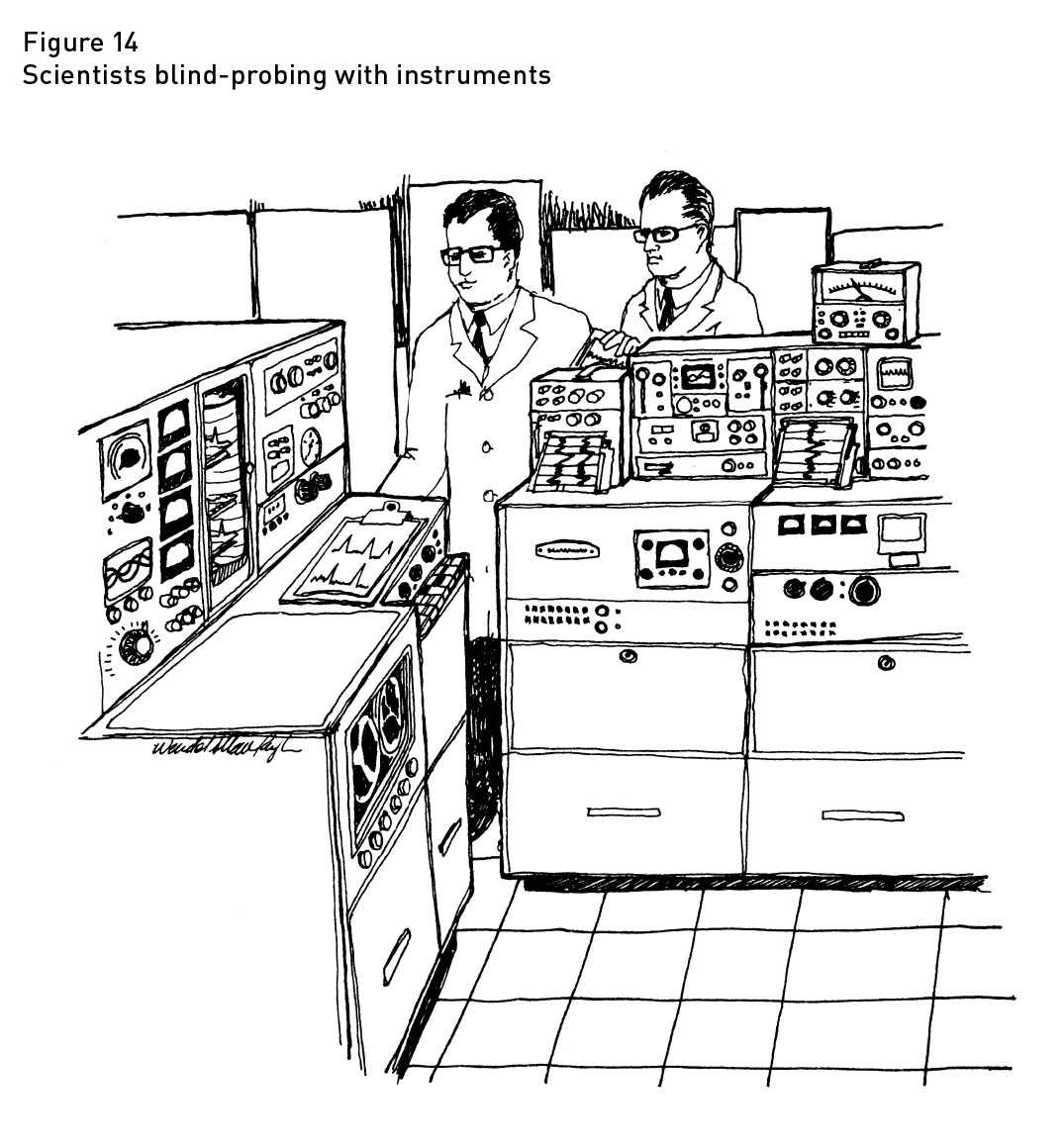
9 What I was able to say to C. P. Snow was that I thought that the break was not due to antipathy on the part of the literary man, but due to a fundamental event that occurred in the world of science in the mid-19th century. I explained that it occurred after Faraday discovered electrical behaviors, and the work of Maxwell and Hertz indicated the existence of invisible electromagnetic waves—waves going through the walls and through each other without interference with one another. In this new electromagnetic world, man found himself dealing with discrete apparatus such as a specific number of copper wire coils wound around a magnet. Each additional coil had a discretely measurable effect all statable in neat algebraic equations. Ohm’s law was typical of this development. The scientists, though dealing with invisible energy phenomena, were able to get beautifully neat answers to experimentally posed questions regarding various arrangements. They found themselves getting on very well without seeing what was going on. It was during some of these early experiments on energy behaviors that a fourth-power relationship was manifest. The equation contained a fourth power x4. You can make a model of x3, e. g., as a cube, and you can make a model of x2 (x to the second power), and call it a square, and a model of x1
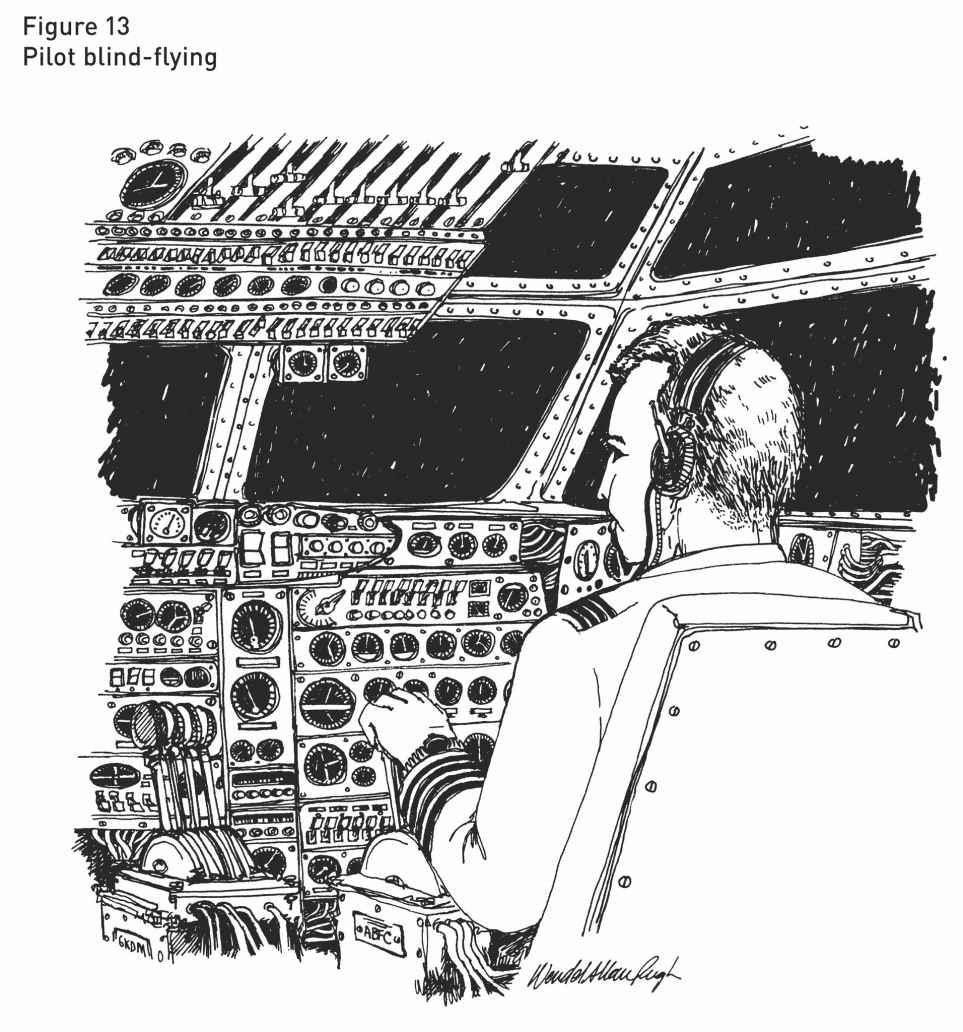
12time and therefore logically invisible—while the other three dimensions were as yet visible. Though it was incorrect, few scientists contradicted this explanation of time; for the scientists no longer thought of, or discussed, models. The cliché of ‘‘the fourth dimension is time’’ became a ‘‘knowing-one’s’’ mystique.
13 So I told C. P. Snow of my own investigation of nature’s coordinating system. In thinking
about nature’s coordinate system, I assumed it must embrace some kind of omnirational
geometry and arithmetic, because of chemical structuring rationality. Figure 15  Change: add ref I also found myself well-impressed with something
we call vectors. Vectors had first been developed to important extent in electrical
engineering (though Galileo used them tentatively and erroneously in developing his
parallelogram of forces). Figure 16
Change: add ref I also found myself well-impressed with something
we call vectors. Vectors had first been developed to important extent in electrical
engineering (though Galileo used them tentatively and erroneously in developing his
parallelogram of forces). Figure 16 Change: add ref According to Galileo
we could make a vectorial pattern of a ship A of such and such a weight, going in
such and such a direction at such and such a velocity. You multiplied the velocity
times the weight and that gave you a vector: x. You then made a vectorial line AC on
your diagram that was x units long, that was shown going in the compass direction
that the ship was going—let us say ‘‘due east.’’ Ship A collided with another ship B at
point C. Ship B weighed such and such an amount. You multiplied ship B’s weight
by its speed (velocity) and it gave you the length, y, of a vector line BC. BC had
a compass direction, too—let us say ‘‘northeast,’’ reading from B to C. Galileo then
constructed a parallelogram ACBD with BD parallel to AC running west from B to D, then
DA constructed parallel to BC, running northeast from D to A. Galileo then drew a
vectorial line diagonally from D to C, the point of collision of ships A and B, and then
Galileo extended the line DC outward of the parallelogram to E with CE = DC, and
with the angle DCE = 180°, i.e., a ‘‘straight’’ line. Galileo called CE the ‘‘resultant
of forces’’—the vector of the combined forces x, y. Galileo’s ‘‘resultant of forces’’ was
wrong because two colliding ships do not waltz gayly east-northeast 12 miles together.
Usually one of the ships goes ‘‘down’’—into the sea—toward the center of earth—which
multidirection vector was not in Galileo’s ‘‘plane’’ geometry scheme. Nevertheless I found
his vectoral diagram exciting Figure 17
Change: add ref According to Galileo
we could make a vectorial pattern of a ship A of such and such a weight, going in
such and such a direction at such and such a velocity. You multiplied the velocity
times the weight and that gave you a vector: x. You then made a vectorial line AC on
your diagram that was x units long, that was shown going in the compass direction
that the ship was going—let us say ‘‘due east.’’ Ship A collided with another ship B at
point C. Ship B weighed such and such an amount. You multiplied ship B’s weight
by its speed (velocity) and it gave you the length, y, of a vector line BC. BC had
a compass direction, too—let us say ‘‘northeast,’’ reading from B to C. Galileo then
constructed a parallelogram ACBD with BD parallel to AC running west from B to D, then
DA constructed parallel to BC, running northeast from D to A. Galileo then drew a
vectorial line diagonally from D to C, the point of collision of ships A and B, and then
Galileo extended the line DC outward of the parallelogram to E with CE = DC, and
with the angle DCE = 180°, i.e., a ‘‘straight’’ line. Galileo called CE the ‘‘resultant
of forces’’—the vector of the combined forces x, y. Galileo’s ‘‘resultant of forces’’ was
wrong because two colliding ships do not waltz gayly east-northeast 12 miles together.
Usually one of the ships goes ‘‘down’’—into the sea—toward the center of earth—which
multidirection vector was not in Galileo’s ‘‘plane’’ geometry scheme. Nevertheless I found
his vectoral diagram exciting Figure 17 Change: add ref . It
suggested a comprehensive geometry consisting entirely of vectors. A vectorial line was
a very nice kind of a line because it had a discrete length—it didn’t go on absurdly
forever to the nowhere of two infinities—in both directions as potential extensibilities of
lines. It didn’t have the ‘‘time’’ to do so. It had a discrete amount of time, which time
was a component factor of the vector’s velocity. I wondered if nature might have a
set of omnidirectionally operative vectors that represented all of our experiences. It
is experiences that we are dealing with in nature. Nature and universe are alike the
aggregate of all experience. Couldn’t I then find vectors that represented any and
every unique experience? Vectors are like spears. I could ‘‘massage’’ any object into a
spear shape, point and thrust-throw it in a discrete direction. I intuitively liked those
directional vector ‘‘spears.’’ I felt that they tended at least to embody all the energetic
qualities of represented experiences. That thinking-feeling, however, was only an intuition
and not an accomplished, mathematically coordinate, generalized-experience system.
That intuition was followed by another pure intuition. I had liked Avogadro, just as
soon as I had heard about him. Avogadro came into the world of chemistry at a time
when chemists were excited about gases. The gases came into recognition as chemical
elements through Lavoisier’s explanation of Priestley’s experiment with the isolation of
fire. All the chemical elements up to the Priestley-Lavoisier event were metals—easy
to recognize by their weights and colors. Lavoisier explained Priestley’s experiment
of fire under a bell jar which had resulted in water vapor and ash whose combined
weight was more than the weight of the item which had burned. Lavoisier said, ‘‘Well
something that was in this space under the bell jar must have been there all the time
which combined—with the visible item which burned—during the process of ‘burning’
whatever that might be.’’ He said that the ‘‘nothingness’’ under the jar (‘‘something’’ men
had called both ‘‘nothingness’’ and ‘‘air’’) must indeed be something which, though
invisible, is physically real which combined to make the water vapor as well as the
ashes.
Change: add ref . It
suggested a comprehensive geometry consisting entirely of vectors. A vectorial line was
a very nice kind of a line because it had a discrete length—it didn’t go on absurdly
forever to the nowhere of two infinities—in both directions as potential extensibilities of
lines. It didn’t have the ‘‘time’’ to do so. It had a discrete amount of time, which time
was a component factor of the vector’s velocity. I wondered if nature might have a
set of omnidirectionally operative vectors that represented all of our experiences. It
is experiences that we are dealing with in nature. Nature and universe are alike the
aggregate of all experience. Couldn’t I then find vectors that represented any and
every unique experience? Vectors are like spears. I could ‘‘massage’’ any object into a
spear shape, point and thrust-throw it in a discrete direction. I intuitively liked those
directional vector ‘‘spears.’’ I felt that they tended at least to embody all the energetic
qualities of represented experiences. That thinking-feeling, however, was only an intuition
and not an accomplished, mathematically coordinate, generalized-experience system.
That intuition was followed by another pure intuition. I had liked Avogadro, just as
soon as I had heard about him. Avogadro came into the world of chemistry at a time
when chemists were excited about gases. The gases came into recognition as chemical
elements through Lavoisier’s explanation of Priestley’s experiment with the isolation of
fire. All the chemical elements up to the Priestley-Lavoisier event were metals—easy
to recognize by their weights and colors. Lavoisier explained Priestley’s experiment
of fire under a bell jar which had resulted in water vapor and ash whose combined
weight was more than the weight of the item which had burned. Lavoisier said, ‘‘Well
something that was in this space under the bell jar must have been there all the time
which combined—with the visible item which burned—during the process of ‘burning’
whatever that might be.’’ He said that the ‘‘nothingness’’ under the jar (‘‘something’’ men
had called both ‘‘nothingness’’ and ‘‘air’’) must indeed be something which, though
invisible, is physically real which combined to make the water vapor as well as the
ashes.
14 I think Lavoisier’s intuitive conceptioning was possibly the most intellectually daring of all history. For a man to dare to think that the nothingness could be something fundamental, so fundamental as to be identified as a chemical element, and not only that, but that the nothingness could be divided into a plurality of fundamental chemical elements was an enormous jump from the conditioned reflex concept of chemical elements only as metals. And so he called one of the invisibles oxygen and he had it combine with the carbohydrate item releasing the carbon and combining with the hydrogen to form the water vapor. I have oversimplified to get on with my story. Other humans were involved, etc. But it is close enough not to be misleading. From that point on scientists came swiftly to understand what fire was. It was fast oxidation. Therefore, they also knew what steam was for they now also knew what H2O was, and how it combined. And they knew what iron rust was. It was iron and oxygen
17arithmetic and geometry. We have number values galore in respect to invisible energy relationships. We have hypothetical chemical constructs but no true geometry which is reliably conceptual. Avogadro’s volume requires a geometric container quantum.
18 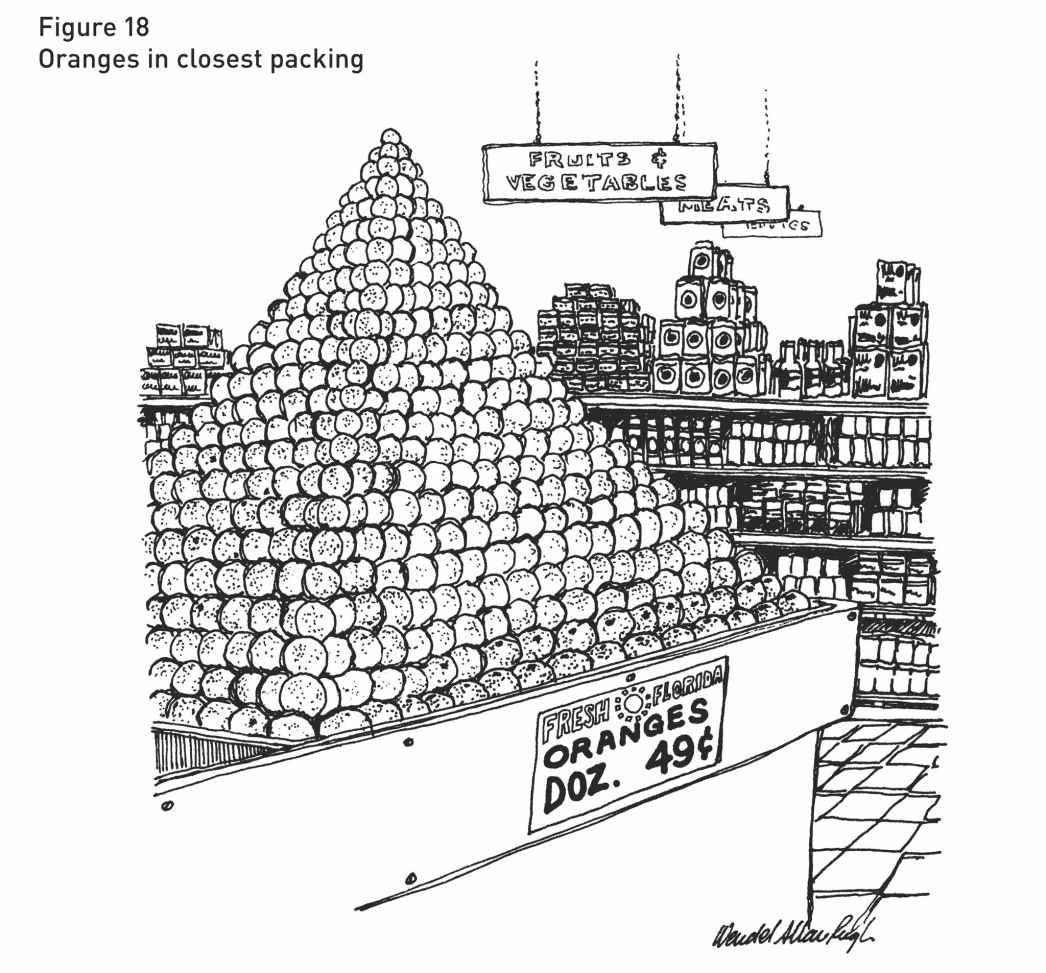 So I said, all right; if all the conditions of energy were the same, what would such a
condition look like in vectors? (And that brings me back to where I detoured from
Galileo to Avogadro.) Well, it would mean that all vectors would have to be the same
length. All of them would have to be running into each other at the same angles. So I
said, can we make realistic, multidimensional, visible, tangible models of equilength
vectors all running into each other at the same angles? Such a vectorial system in
local universe would be inherently finite. It would not imply additional vectors. It
wouldn’t have to go on forever, because vectors, unlike Greek ‘‘lines,’’ don’t have to go on
forever.
So I said, all right; if all the conditions of energy were the same, what would such a
condition look like in vectors? (And that brings me back to where I detoured from
Galileo to Avogadro.) Well, it would mean that all vectors would have to be the same
length. All of them would have to be running into each other at the same angles. So I
said, can we make realistic, multidimensional, visible, tangible models of equilength
vectors all running into each other at the same angles? Such a vectorial system in
local universe would be inherently finite. It would not imply additional vectors. It
wouldn’t have to go on forever, because vectors, unlike Greek ‘‘lines,’’ don’t have to go on
forever.
19 I found I could make just such a model. It came out as what we call the tetrahedron-octahedron
complex; some scientists call it the isotropic vector matrix. Aston, in 1929, made the
discovery for the physicists of what he called ‘‘closest packing of spheres.’’ The fruit dealer
selling oranges and the cannoneers stacking equiradius cannonballs learned about this
closest packing of spheres earlier, but the scientists never noticed it Figure 18 Change: add ref . Two spheres may become tangent Figure 19
 Change: add ref . We may then rest a third ball in the valley between
them with the third ball tangent to both of the first two. The three balls, each one
tangent to both of the others, now form an equiangular triangle group with a valley at
their center. A fourth ball may be rested in that triangular valley. The fourth one
touches each of the other three, and vice versa. The four closest packed spheres make a
‘‘closest-packing array.’’ This closest packing of spheres may go on triangulating in all directions.
Because the spheres are all the same size, equilength vectors may connect each and every
adjacent sphere, with the vectors running from the centers of the spheres through the
points of tangency to the adjacent spheres’ centers Figure 20. Remove the spheres and
leave the vectors and you’ve got the tetrahedron-octahedron complex. The ‘‘isotropic
vector matrix’’ is a structure that I discovered quite independently in kindergarten in
1899.
Change: add ref . We may then rest a third ball in the valley between
them with the third ball tangent to both of the first two. The three balls, each one
tangent to both of the others, now form an equiangular triangle group with a valley at
their center. A fourth ball may be rested in that triangular valley. The fourth one
touches each of the other three, and vice versa. The four closest packed spheres make a
‘‘closest-packing array.’’ This closest packing of spheres may go on triangulating in all directions.
Because the spheres are all the same size, equilength vectors may connect each and every
adjacent sphere, with the vectors running from the centers of the spheres through the
points of tangency to the adjacent spheres’ centers Figure 20. Remove the spheres and
leave the vectors and you’ve got the tetrahedron-octahedron complex. The ‘‘isotropic
vector matrix’’ is a structure that I discovered quite independently in kindergarten in
1899.
20 I related to Lord Snow how I experimented with this kind of geometry, and how I found that
the vector-edged octahedron with the same length edge as the vector-edged tetrahedron had a
volume of four times the tetrahedron Figure 21 Change: add ref
.
Change: add ref
.
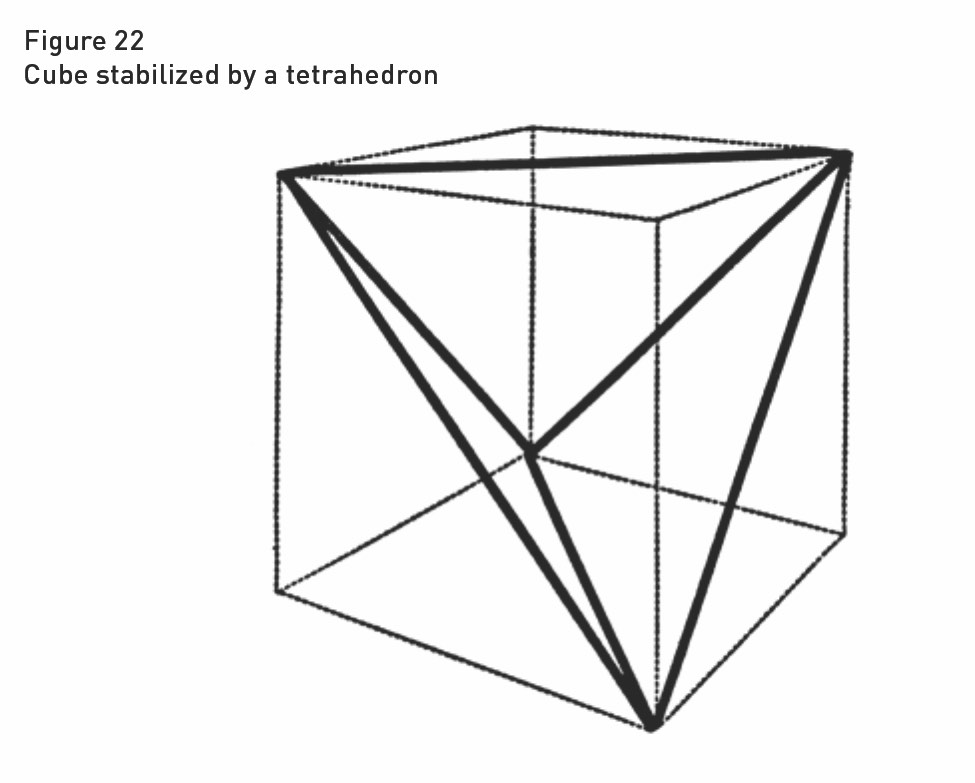
21 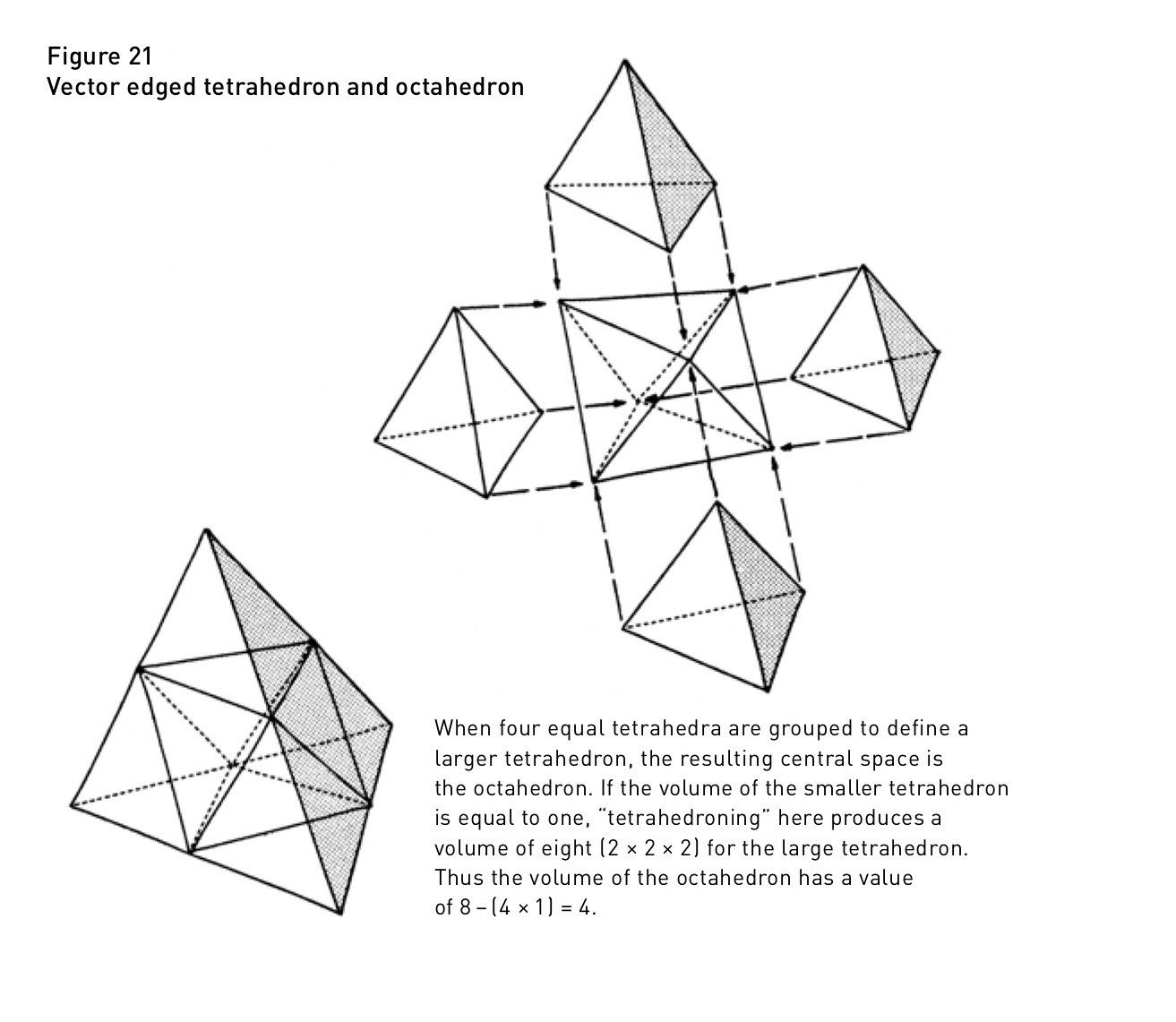 A symmetrical cube has six faces, and a tetrahedron has six symmetrically-oriented edges.
If you put a continuity of six diagonals in each of these six faces of the cube, a tetrahedron is
formed Figure 22
A symmetrical cube has six faces, and a tetrahedron has six symmetrically-oriented edges.
If you put a continuity of six diagonals in each of these six faces of the cube, a tetrahedron is
formed Figure 22 Change: add ref . If you make a model of a cube with
rubber joints, it collapses; it is completely unstable. If there’s a tetrahedron secreted in the six
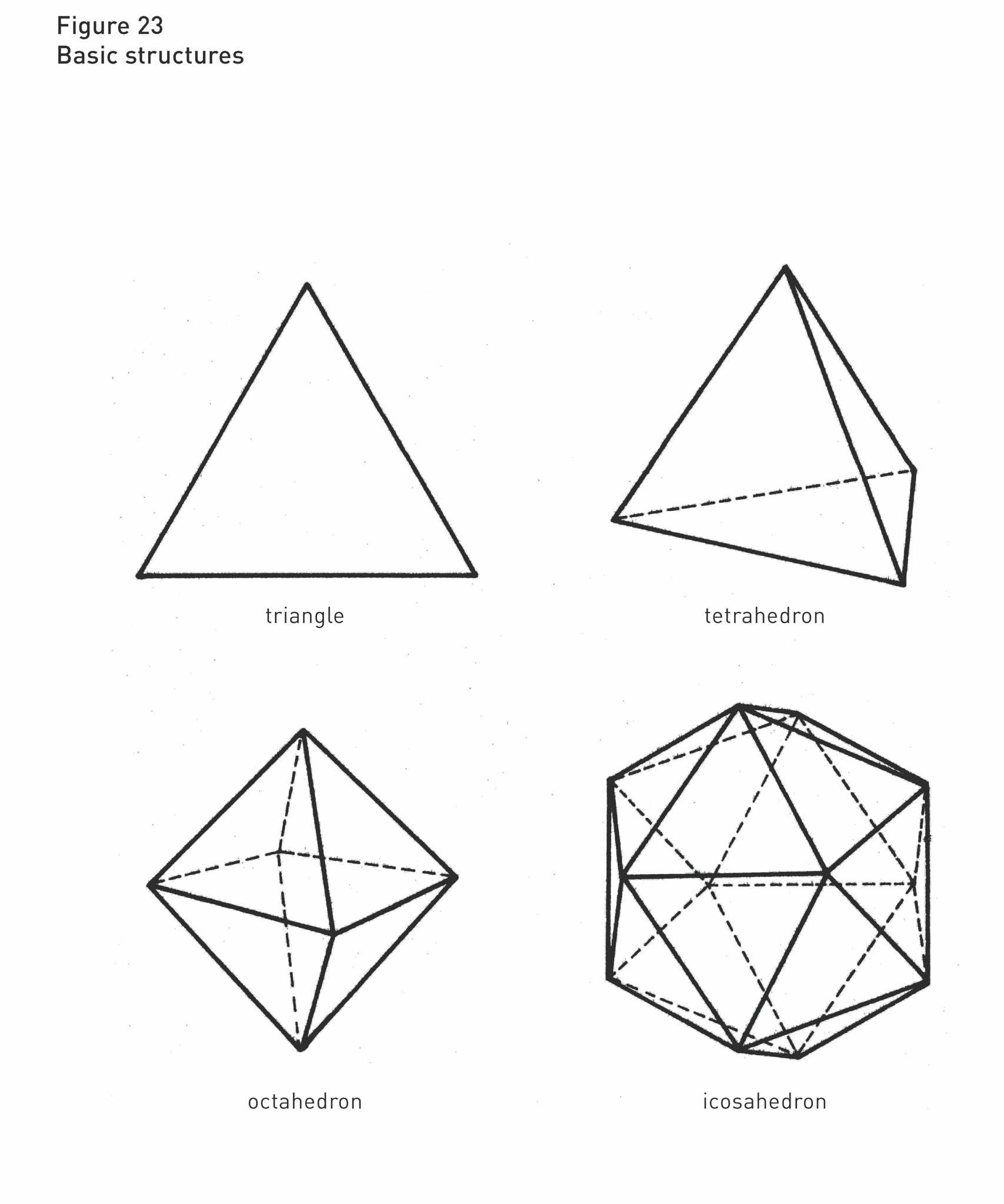
diagonals of the cube’s six faces, it will not fold up. A triangle is the only structurally stable
polygon. A tetrahedron is the minimum omnitriangulated, omnistructural system. A tetrahedron
is the most fundamental of all structures. There are only three basically stable omnitriangulated,
omnisymmetrical structures—the octahedron, the tetrahedron, and the icosahedron Figure 23.
Each is a basic system because each stably and symmetrically subdivides the universe into two
parts: all of the universe inside and all of the universe outside its system Figure 24. When I
then began to explore the volume relationships of the simplest basic, symmetrical
structures and gave the simplest—the tetrahedron—a volume value of 1, I found that an
octahedron had a volume of exactly 4 and a cube had a volume of exactly 3 Figure 25
Change: add ref . If you make a model of a cube with
rubber joints, it collapses; it is completely unstable. If there’s a tetrahedron secreted in the six
diagonals of the cube’s six faces, it will not fold up. A triangle is the only structurally stable
polygon. A tetrahedron is the minimum omnitriangulated, omnistructural system. A tetrahedron
is the most fundamental of all structures. There are only three basically stable omnitriangulated,
omnisymmetrical structures—the octahedron, the tetrahedron, and the icosahedron Figure 23.
Each is a basic system because each stably and symmetrically subdivides the universe into two
parts: all of the universe inside and all of the universe outside its system Figure 24. When I
then began to explore the volume relationships of the simplest basic, symmetrical
structures and gave the simplest—the tetrahedron—a volume value of 1, I found that an
octahedron had a volume of exactly 4 and a cube had a volume of exactly 3 Figure 25 Change: add ref . That’s very interesting because if you try to account
in cubes for nature’s energy associabllities—as structural systems—you use up three
times as much space as you do if you count space volumes in tetrahedron units. The
physicists have found that nature is always most economical; therefore, she could not
use cubes to quantitate her structurings. The cubes, you know, represented our x-y-z
Change: add ref . That’s very interesting because if you try to account
in cubes for nature’s energy associabllities—as structural systems—you use up three
times as much space as you do if you count space volumes in tetrahedron units. The
physicists have found that nature is always most economical; therefore, she could not
use cubes to quantitate her structurings. The cubes, you know, represented our x-y-z
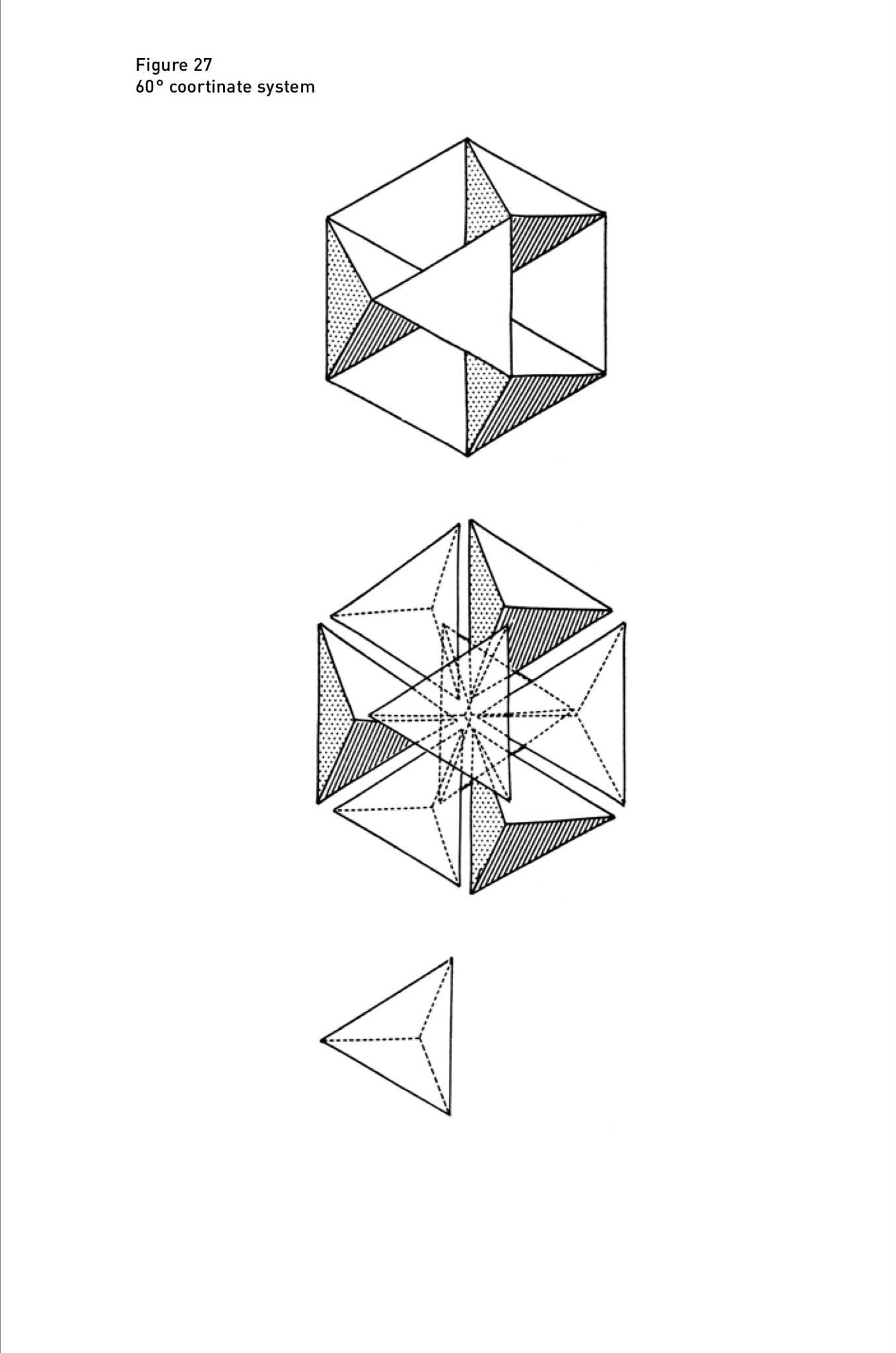
23 When we deal in tetrahedra, we’re dealing in 60°-angle systems because in a regular tetrahedron, all the angles are 60°; they’re equilateral—or equiangular—triangles.
24 You remember that what I told Lord Snow was that when the scientists found an energy relationship in the fourth-power value, they couldn’t make a visual model of it because they couldn’t find a fourth perpendicular to a cube which was not in a plane parallel to one of the planes of the cube. But the scientists did not need a model to calculate fourth-power problems. They were able to handle it very easily algebraically. They did it by using what they called an imaginary number, e. g., by using the square root of 1—1. If that sounds complex, don’t let it bother you. What they were doing was simply saying they had a cubical clock. In effect, their cubical day consisted of eight little cubes around the center of the big cube Figure 28. The first dimension used up one cube, the second dimension used up four cubes, and the third dimension used up all eight cubes. Their day’s entire clock capacity would only take care of ‘‘three dimensions.’’ So what they did was to borrow cubes from ‘‘tomorrow’’—or from ‘‘yesterday.’’ They then carried out their problem algebraically without reference to any conceptual models. After they got finished, they’d paid back the borrowed time and once again had a visual three-dimensional-model quantity. When you use 60°for your coordination, you don’t need imaginary or complex numbers to carry out fourth-power calculations because there is a volume of 20 tetrahedra around one point instead of 8. Two to the fourth power is 16, and I’ve got 20 tetrahedra around a point. There is an additional 2 to the second power in the model which comes in very usefully when this vectorial grouping around a common nucleus is employed to account for nuclear-energy behaviors. When the nuclear group of vectors has a radial or edge molecule of 2 (as do the 8 cubes in closest-packing), then the vectorial system has a volume around its center of 160, which is 5x25. It is perfectly possible today, then, for a child to make fourth- and fifth-power models with tetrahedronal and octahedronal building blocks. Einstein was working on fifth-power problems in his last days, trying to reconcile gravity and electromagnetics.
25 I was able to say to Lord Snow, who was then Sir Charles, that I had found an arithmetical-geometrical energy-coordinating system which apparently coincided rationally and comprehensively with nature’s behaviors which you could make models of and which could handle the fourth- and fifth-power problems which three-dimensional cubes could not, which latter fact had accounted for the discard of models and the preoccupation of science with a completely abstract treatment of nature.
26 Linus Pauling received his first Nobel Prize for his contributions to the general knowledge of chemical structures. He gave me his Nobel laureate paper to read and it was the best and most concise history of chemical structures. The first part of his paper is about organic chemistry.
27 It was in the years around 1800 that the organic chemists, in making experiments, discovered
that associating/disassociating of organic chemistry seemed to be always in number increments of
1, 2, 3, 4. Those were the only numbers you had to have to account for your experiments. In
about 1810, a man named Frankland was the first to make any written notation of that. Then
two men, Kékulé and Cooper, added a little more of the same. In 1835 a Russian, Butlerov, was
the first to use the expression ‘‘chemical structure.’’ And he was the first to say that 1, 2, 3,
4 seemed to have something to do with ‘‘bonding’’ together. He called the bonding
‘‘valence.’’ Then there is a gap in further fundamental discovery up to 1885 when a
man named van’t Hoff said he thought the oneness, twoness, threeness, and fourness
were the tetrahedron’s four vertexes. Van’t Hoff was looked at askance by the other
chemists. He was called ‘‘an outright charlatan.’’ He was called a faker of every kind.
Otherwise the chemical scientists paid no attention to him. He was greatly stunned, but
went on with his experiments and lived to make optical proof of the tetrahedronal
cube configuration of carbon, the combining master of organic chemistry. Van’t Hoff
was the first chemist ever to receive the Nobel prize. From this point on, chemistry
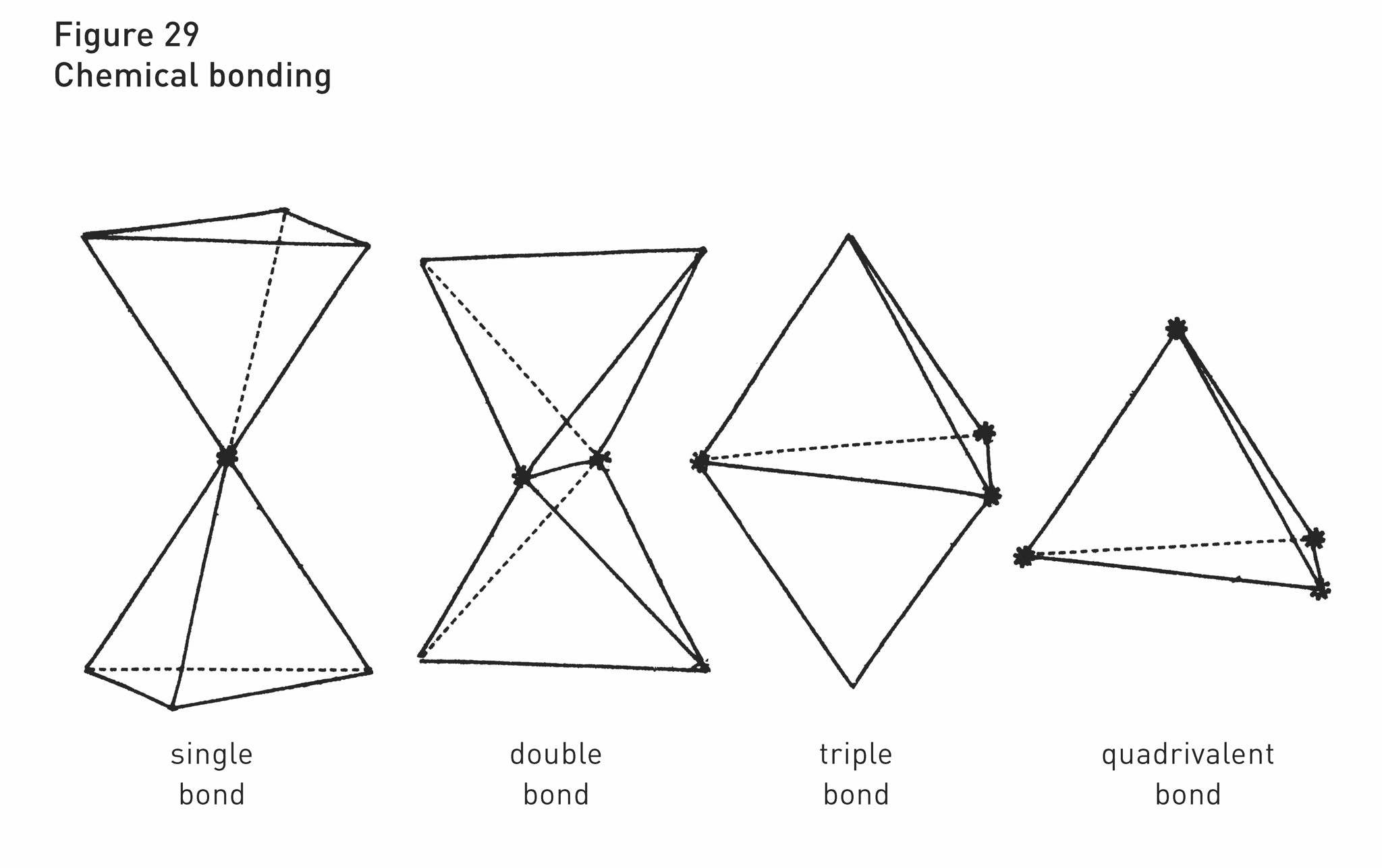
recognized that organic chemistry was tetrahedronally coordinate. Two tetrahedra
linked together by one vertex of each is a single bonding—very flexible, like a universal
joint—like gas Figure 29 Change: add ref . Many tetrahedra so linked
could be stretched to fill much more space than if linked mutually by two or three
vertexes. Two bonds form a hinge—as yet flexible but quite compact as a system—like
water. Triple bonding is rigid, like crystals. You can get four vertexes of tetrahedra
together, which means they are congruent and most densely compacted, possibly like
diamonds.
Change: add ref . Many tetrahedra so linked
could be stretched to fill much more space than if linked mutually by two or three
vertexes. Two bonds form a hinge—as yet flexible but quite compact as a system—like
water. Triple bonding is rigid, like crystals. You can get four vertexes of tetrahedra
together, which means they are congruent and most densely compacted, possibly like
diamonds.
30 I was in Ghana in January, and I received a telephone call from the British Broadcasting Corporation, asking me to come to London. When I reached London, I learned something which to me seemed extraordinary. This, too, is a long story but pertinent. Six years ago I had begun to get letters and photographs from two nuclear physicists who were leading virologists—Dr. Aron Klug, of Birkbeck College at London University, and Dr. Donald Casper, director of cancer research at the Boston Children’s Hospital, now at the Cavendish Laboratories at Cambridge University. These men, using X-ray diffraction also, were finding the shape of the protein shells of the virus to be similar in appearance to my geodesic domes.
31 Very quickly I want to point out the general significance of virology. In the range of magnitudes between macro- and microcosmic limits of exploratory knowledge, there seem to be ‘‘octave’’-like levels of unique pattern-phase relationships. The microdomain of the virus is that in which the tobacco-mosaic experiments first showed that the domain of the virus is apparently the threshold between what we have known in the past as the inanimate and the animate. The virus follows all the behavioral laws of an inanimate crystal, but also follows all the laws of animate biology. It is both animate and inanimate—in fact, because it follows both requirements, you have to say there is no difference between animate and inanimate phenomena. As a threshold, the virus overlaps both. It does not divide them. It calls for a very different concept of what we are, physically; it asks just how physical is life and what is unique to the individual? Within the virus, we have the now famous DNA and RNA, the nucleic acids consisting of four chemical compounds whose interpatterning sequences in helixes control all patterning of all the designs of all life—all the biological forms design-scheduled by DNA and RNA. Investments by world society for the search in the virus domain are great. This is the most probable area in which to find the clues to the possible control of cancer, for here in the virus is the control of the design of life. DNA-RNA may also control the design of anti-life.
32 A virologist is a very interesting kind of man. He was rarely trained to be a virologist; he was trained as a specialist—as a nuclear physicist, a mathematician, a chemist, a biologist, or a geneticist. But as virologists, they become one: an unusually comprehensive thinker—an integrator of widely held findings of science.
33 Just preceding and during World War II, scientists began to find their microscopes getting far more powerful. As a result, their field of observation began to overlap. My original hunch about nature having only one department became increasingly valid. The scientists found themselves forced to adopt hyphens to describe their work—bio-chemistry, etc. The virological teams find themselves inherently comprehensive—they deal with the whole show. And so the men who are good in virology are really extraordinary men, and tremendously articulate. Any good virologist sitting in with us today would find no trouble in participation in your subject. In fact, he would probably be able to lead you in formulating a grand strategy of attacking your special problem. Virologists deal exclusively in fundamentals of structural design and how best to communicate our findings and intuitive formulations.
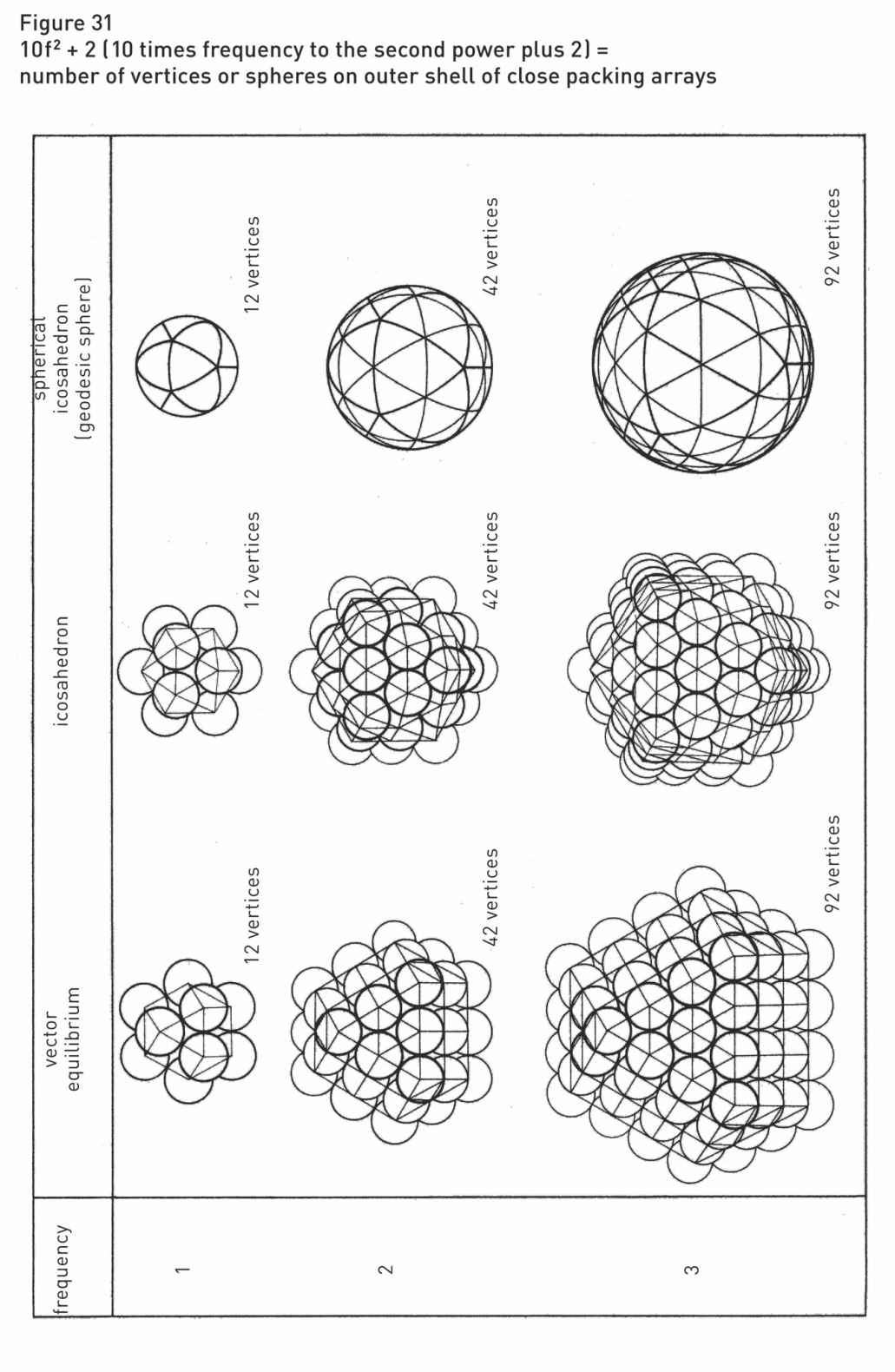
34 The virologist discovered the proliferation of my geodesic structures, which had emerged from
structuring aspects of my energetic geometry studies which pursued nature’s most economical
stratagems. In 1957 Klug asked if I could identify the geodesic-like protein shell of the poliovirus.
I was able to give him the mathematical explanation of the structuring Figure 31 Change: add ref . Gradually, I heard from more virologists. I was told by a
Johns Hopkins scientist the other day that she had read over twenty papers by scientists
identifying my mathematical work—such as I’ve been giving you today—with the findings of their
own investigation areas.
Change: add ref . Gradually, I heard from more virologists. I was told by a
Johns Hopkins scientist the other day that she had read over twenty papers by scientists
identifying my mathematical work—such as I’ve been giving you today—with the findings of their
own investigation areas.
35 I was told by BBC (February 1964) that they were about to open up a broadcasting on a new channel 2, using colored TV, Telstar, and other electronic advances, and that they were about to reach audiences many times larger than their old channel 1 viewers. New receiving sets would be necessary for tuning in channel 2. To warrant their old audience’s purchase of new TV sets BBC felt that they must present programs of higher standards than ever before. They said, ‘‘Let’s see if we can’t take our experience and step up the quality of our program.’’ For their step-up in content quality they took the most popular hour, which is 9:30 Saturday night, and set about to produce a science program once a month which they hoped could be so well done that it would displace lower-caliber amusements through spontaneous popularity. BBC got together its directors who had done science programs and chose the director who had done the Cavendish Laboratory documentary of Drs. Watson, Wilkins, and Crick—the DNA-RNA team which won the 1963 Nobel Prize. This BBC director—Ramsey Short—went out to the Cavendish Laboratories at Cambridge University and asked their scientists what they recommended as the subject of the first channel 2 science program. The Cavendish scientists said, ‘‘Buckminster Fuller would be appropriate because TV must employ visible phenomena and Fuller has found the bridge of structural conceptuality to pure science exploration.’’
36 In the 19th century the literary man had the models taken away from him. He had no model to explain science to the people. Popularization of science employed superficial romance. True science was shunned as too difficult—or as dry, obscure, blackboard equations.
37 Since conceptuality is returning, it was felt that the first television program should deal with a fundamental bridge.
39 At start of today’s meeting, when we were talking with the representative from the U.S. Science Foundation about what science is, science remained obscure in its advanced mathematics wrappings. I asserted (before presenting the integrated information I am now reciting) that man is coming into an extraordinary new era on earth, in which we are going to be able to deal conceptually with advanced science. Inasmuch as conceptual communication is art, art will become intimate with science; and philosophy will be able to comprehend the significance of developments; and thought may enter upon new speculation and altogether new comprehension.
40 One more item—have any of you read a book by Professor Benjamin Bloom of Chicago University? He is Professor of Education and head of the university’s curricula committee. He has written a book, Stability and change in human characteristics—Wiley, publishers—in which he has listed a number of experiments and case histories of lives from birth through university age which correlates progressively taken IQ tests with environment and the effects of events upon immature life at various age levels. The conclusions are astonishing! If you can give Dr. Bloom an adequate report of environmental factors governing a given young life from birth to seventeen years of age—such as description of the home—private bathroom or no—drunken parents—play only in streets—etc., he can give you the IQ of that life within 1%. There are built-in ‘‘alarm clocks,’’ according to the neurophysiologists, which go off at unique moments, which put ‘‘capabilities’’ progressively in operation in the new life. If the new capability is frustrated at outset it is frequently relegated to disuse. At the age of four, 50% of the capacity to improve his IQ capabilities either have been expended or protected. Teaching doesn’t add capability. Teaching can either gratify or frustrate capabilities. Usually they get badly damaged. The IQ is most directly affected by what happens in the first four years. Between four and eight, the next 30% ‘‘of capability to self-improve IQ’’ is brought into operation and either frustrated or gratified. Between eight and thirteen years, 12% more of potential capability is actuated totaling 92%, and at seventeen 100%. After seventeen, the most any human being can do to actuate more IQ is 0%. About $3 billion a year is appropriated jointly by the United States and the local governments for higher education, where the most possible self-improvement of IQ capability is 0%. Where 50% activatability of IQ occurs—that is from zero to four years—no appropriation is made. The only area where important chance of conserving and improving capacity occurs gets the small money going into kindergarten, elementary, and junior high school. The greatest schooling opportunity birth to four is operative through the TV only. The right TV programs for both child and parents could up the national IQ by a large percentage.
41 Dr. Bloom shows that from birth to four years old there are three clearly defined factors which govern the inauguration of capability to improve IQ (at any later date) or what part of that first 50% is to be lost. Factor number one is trust. Human young stay helpless longer than any other living species. If the new life, for any reason, has its utter trust in its parents violated, it is pretty sure to be a dropout. The next two factors after trust which govern the one to four years are autonomy and initiative. You don’t know how to tell the extraordinary new life how to stand up—it just stands up by itself when ready. The initiative is innate. The parents have to be sure the child has room of its own and expendables for the new life’s ‘‘checkout’’ of: tension—cohesion, etc., by trying to tear things, etc. From four to eight, there are several clearly defined factors governing favorable or unfavorable inauguration of 30% of total capability to ever improve IQ. The new five-to-eight-year-old factors are ones to do primarily with the leadership of the parents. If the parents speak their native language properly, effectively, and with joy in a constantly improving vocabulary, it will have a very favorable effect on the child. Blasphemy or slang, a mark of an inferiority complex that is afraid to speak out clearly and constructively, will block off the six-year-old’s brain capabilities.
42 Availability of good books on the shelves is an important environment plus. While the child cannot read the grownup’s books, its intuition detects a drive or lack of drive for self-improvement in its parents. It seems important to our meeting on clues for detecting the gifted schoolchild through art teachers that Dr. Bloom’s findings be known. When we know that ages zero to four are the biggest ‘‘school’’ opportunity and when we discover that entirely new mathematical simplicities are at hand, we must realize that educational theory is in for a complete revolution. There is no question about it—an educational revolution is upon us.
43 Labor opposes automation only because everybody is scared about their jobs. It’s perfectly logical for them to be scared about their jobs. But we’re beginning to do something about it which goes back to the post-World War II GI Bill.
44 We have said we will take all the people who are unemployed because their machines have become automated, and teach them a new skill relating to another machine. But soon the advancing state of automation will be such that by the time they have learned to operate a new machine, that one will have been automated too! They will simply stay in school studying how to operate obsolete tools. What we are going to do about all this is the following. First we must reorient our eons-long nervous-reflex conditioning. It is not strange that we are so negative-minded regarding man’s potential behavior on earth. He has had, up to this century, a 1 in 100 chance of economic success. It is logical that we think of unemployment as a negative, rather than realizing that it is signaling that society now has the ability to free people from the necessity of demonstrating their right to live by gaining and holding employment.
45 The kind of wealth we’re actually dealing with—the industrial wealth—has nothing to do with the old monetary gold, whose retention in balance-of-trade accounting is a mark of innocence of society and an economic-expansion cancer. Our present real wealth is, exclusively, the tool-organized capability to take energies of the universe, which are transforming their patternings in various ways as yet uncontrolled by man, and shunt them through channels onto the ends of circularly arranged levers which man invents so that the energy turns wheels and shafts to do all the work. In doing the foregoing we’re taking nothing from the energy capital of the universe. The physicists make it very clear that energy can neither be created nor destroyed. You can’t exhaust that kind of wealth. It is not physically exhaustible. And in fact, our relationship to the energy wealth is an intellectual one. It says that every time we make an experiment with physical-energy wealth we learn more. Even when we only learn that something we thought might work won’t work, that’s learning more! Every time we make an experiment we learn more, we can’t learn less. Because universal energy is inexhaustible, and our intellectual advantage only gains, our wealth is continually gaining. We’re continually upping the relative metabolic advantage of man in the universe.
46 One of the reasons I can talk to you the way I do is because I am a comprehensivist in an era of almost total specialization. By fortune I go many places and get experience in many directions—I keep in touch with many. I can tell you that at the present regenerative state of intellectual experience and mass science and mass technology that there is the probability that for every 100,000 we ‘‘educate’’ through to a bachelor’s degree, there will be a science-technology realization by one of the 100,000 so world-advancing that it will pay for all the other 100,000 people’s education and livelihood without their direct contribution to the technoscientific breakthrough. That capability is now in operation so that in order to progressively elevate human dignity, we’re going to be able to afford to give everyone student fellowships in any subjects they elect—fly-fishing studies are O.K.—everyone’s going to go back to school! Man no longer has significance as a muscle-and-brain-reflexing machine. The Marxian worker-slave is going into extinction. He is not needed. Man is essential to the success of the industrial equation as a consumer. The more consumers there are, and the more frequently they consume, the more successful and swiftly increasing is the industrial wealth capability. We can only justify the vast investments in world-around industrial networks of structures and machinery by the numbers of spontaneous consumers that are served. Because the initial tool-up undertakings take months and years, as well as vast billions of dollars, the more active consumers there are to divide up costs, the lower the costs and the quicker the total amortization and inauguration of improved tools and efficiency. Therefore, man becomes a regenerative consumer. The more he consumes, the more he learns, and the factor that increases the wealth is the ‘‘know-more’’ factor. We can afford to send everybody back to school. There are a great many people intent on learning and finding out something which increases the common wealth. Those who go fishing may inadvertently make a great contribution through just ‘‘taking it easy’’ and doing some good retrospective thinking. And this inexorably is the way history is going to unfold. We will not undertake this new education and wealth-regenerating spontaneously within our country. We won’t agree and coordinate that fast. But the competition from Russia, China, and others will force us to this logical measure. Economic competition is the catalytic factor. Because the Chinese now have the most potential consumers they can eventually produce at the lowest prices! To underprice all that competition, in a very short time we’re going to be forced to go into total automation only to find ourselves amazedly successful—automated wealth!
47 I’ll give you one more picture to vivify what is happening to us. This picture is of the now visibly developing new ‘‘world man.’’ We had him in the news a few years ago, a man who talked about being a ‘‘world citizen,’’ you may remember, an American in Paris. Society not only laughed at him as a dopey renegade, but now, unexpectedly to all, everybody is beginning to experience more and more travel. World citizenry is coming about by itself.
48 There is something going on with respect to the U.S.A. we haven’t paid much attention to.
Figures were published in last month’s Exchange magazine, published by the New York Stock
Exchange, regarding foreign investments. There are two kinds of foreign investment—one is
called indirect investment, which means purchase of shares in foreign enterprise. The
other kind is called direct investment, where you buy land, put up a factory, and start
producing something. That’s called direct enterprise, or direct investment. U.S.A.’s citizens’
and corporations’ investments in foreign countries started up at the turn of the 19th
into the 20th century Figure 32 Change: add ref . There was a
jog down in the historically rising curve during the 1929--1942 Depression, and now
it’s going up again, ZOOM! Its resumption of the original acceleration rate indicates
that it was trying to happen all the time and that the depression dent was abnormal.
It’s now up to better than $70 billion and the direct earnings from it each year now
exceed $4 1 ∕ 2 billion. Every major corporation is in this outward-bound move. The
hundred largest corporations in the U.S.A. are now spending four out of every five
new-plant-and-machinery dollars in countries outside the U.S.A. General Motors last year,
though its total foreign investment is only 10% of its whole, made one-third of its total profits
from its foreign operations. General Motors total net profits after taxes were $11 ∕ 2
billion.
Change: add ref . There was a
jog down in the historically rising curve during the 1929--1942 Depression, and now
it’s going up again, ZOOM! Its resumption of the original acceleration rate indicates
that it was trying to happen all the time and that the depression dent was abnormal.
It’s now up to better than $70 billion and the direct earnings from it each year now
exceed $4 1 ∕ 2 billion. Every major corporation is in this outward-bound move. The
hundred largest corporations in the U.S.A. are now spending four out of every five
new-plant-and-machinery dollars in countries outside the U.S.A. General Motors last year,
though its total foreign investment is only 10% of its whole, made one-third of its total profits
from its foreign operations. General Motors total net profits after taxes were $11 ∕ 2
billion.
49 Arthur Watson, of IBM International, says that the old foreign-trade language such as speaking of ‘‘Germany trading with Russia’’ or ‘‘England with France,’’ or any country trading with any other country, is now as obsolete as speaking of New York City trading with the city of Chicago. Industry is inherently world-around and is inherently world business—we have no other characteristic but ‘‘world.’’
50 This world-identity-only 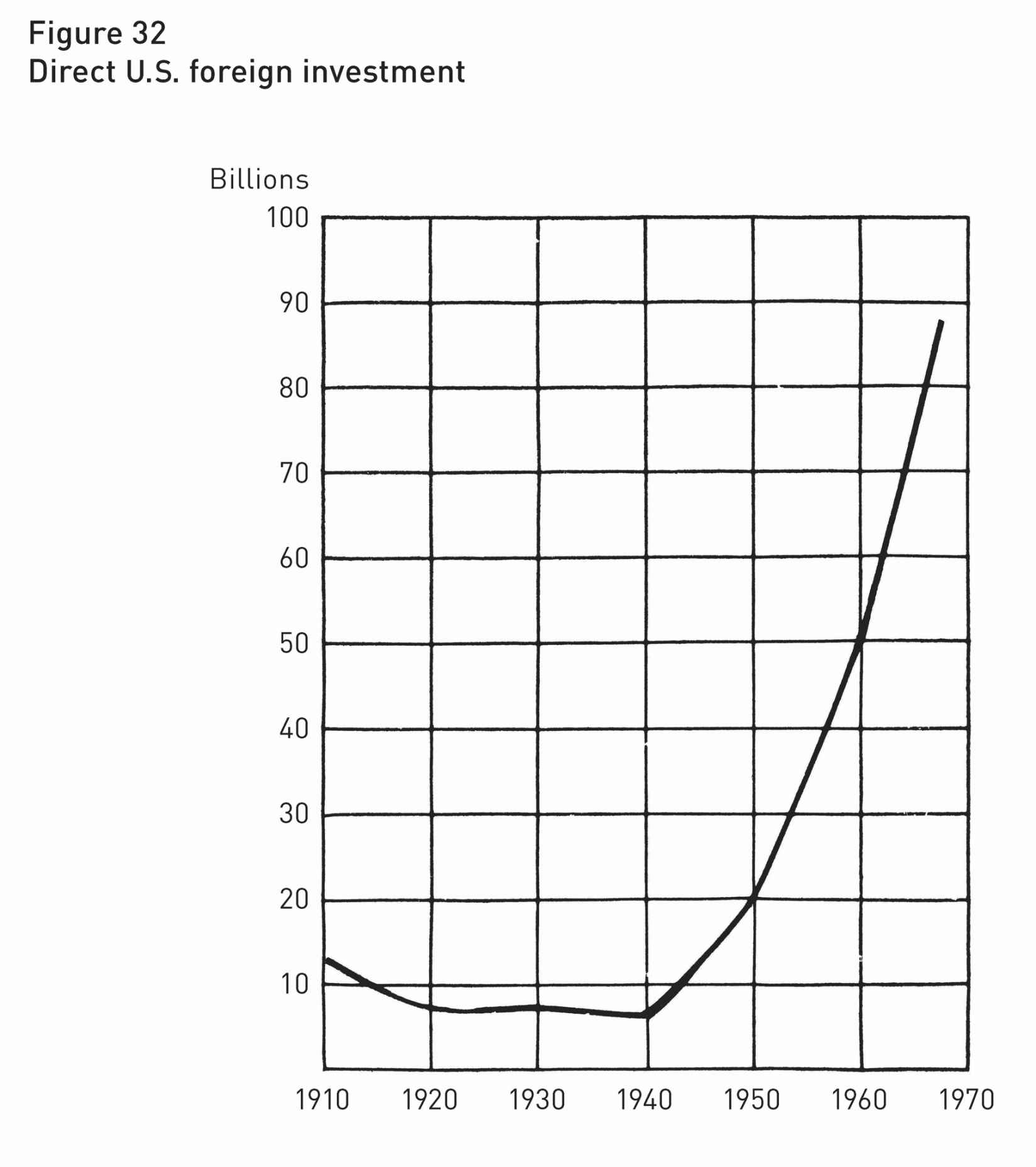
53 I feel that the high capability of the young who do not happen to have been trained in science goes into their intuitive formulations. Artists are now extraordinarily important to human society. Many who have been called artists are healthy human beings who have kept their innate endowment of capabilities intact. The greatest of all their faculties is the ability of the imagination to formulate conceptually. I feel that it is the artists who have kept the integrity of childhood alive until we reached the bridge between the arts and sciences. Suddenly we realize how important that conceptual capability is. Professor Kepes of M.I.T. took uniform-size black-and-white photographs of nonrepresentational paintings by many artists. He mixed them all together with the same size of black-and-white photographs taken by scientists of all kinds of phenomena through microscopes and telescopes. He and students classified the mixed pictures by pattern types. They put round-white-glob types together—wavy-gray-line-diagonals, little circle types, etc., together. When so classified and hung one could not distinguish between the artist’s works and scientific photographs taken through instruments. What was most interesting was that if you looked on the backs of the pictures you could get the dates and the identities. Frequently the artist had conceived of the patterns or arrangements before the scientists had found their counterparts in infra- or ultravisible realms. The conceptual capability of the artists’ intuitive formulation of the evolving new by subconscious coordinations are tremendously important. Much of the essence of what I have been saying to you may or may not be news, but I would not be surprised if tomorrow’s biggest news is that the artists who best appreciate and conserve our natal capabilities have ascended by acclaim to the premiership of this new era of man on earth.