
Contents
2 KERBER


6 NIR
SIND
7 ALLE
8 ASTRONAUTEN
9 UNIVERSUN
RICHARD
BUCKMINSTER
FULLER
IN
SPIEGEL
ZEITGENOSSISCHER
KUNST
▲▲▲
10 MARTa Herford
13 WO!
14 Autoren/Authors 240
15 Fotonachweis / Photo Credits 245
16 Dank / Acknowledgments 244
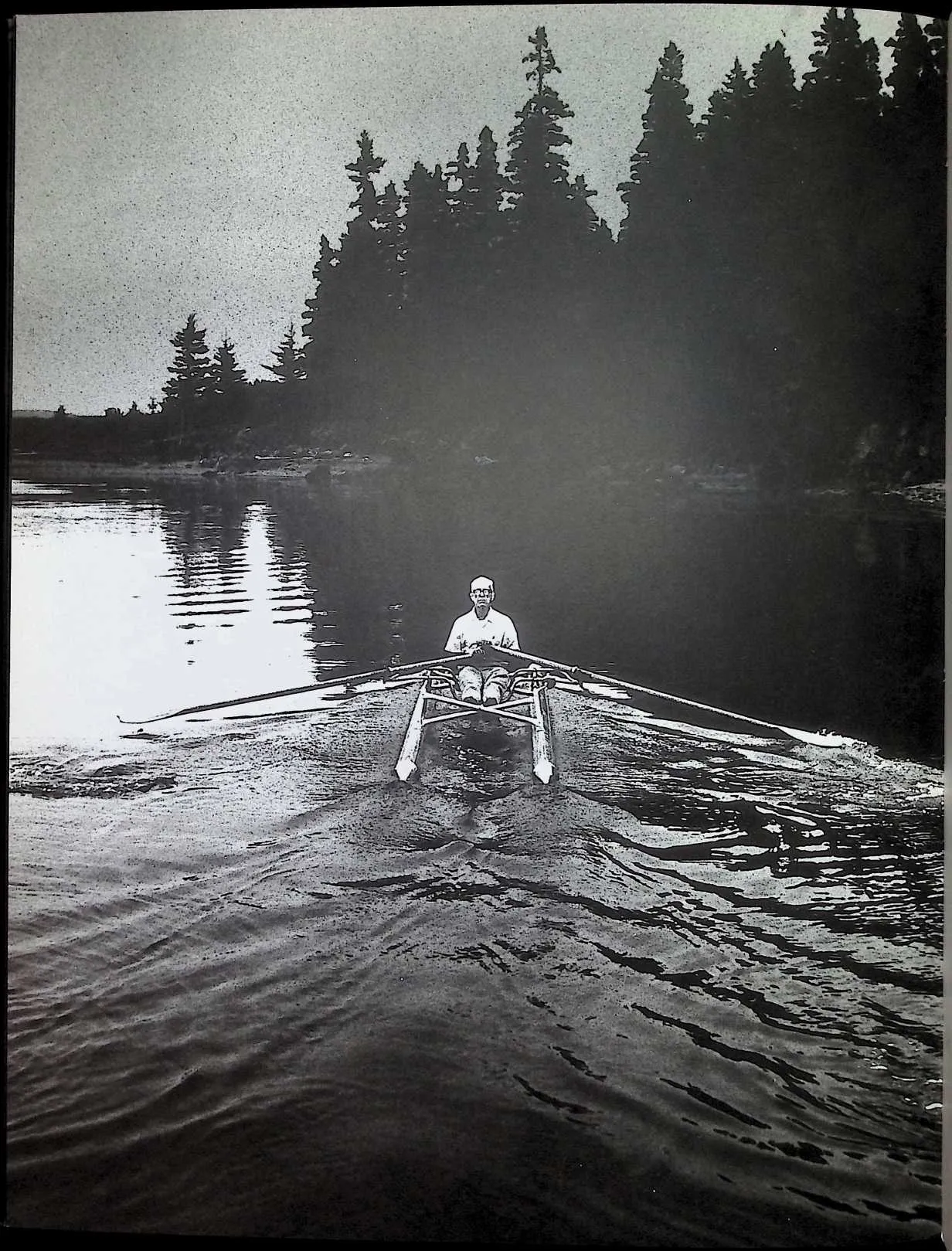
18 VORWORT

20 Die Rettung des Utopischen ins 21. Jahrhundert -konnte das eines der Projekte dieser ersten Dekade im neuen Millennium sein? In einer desillusio-nierten, ernuchterten Zeit, deren Katastrophenszenarien plotzlich nicht mehr angenehm schauerliche Science Fiction sind, sondern Perspektiven mit real greif baren Vorboten? Vielleicht ist das ein Ansatz zur Erklarung der ehernoch steigenden, auf jeden Fallabervorwenigen Jahren neu erwachten Faszinationfiirdie Person und das vielfaltige Werkvon Richard Buckminster Fuller. Seine Ideen und Projekte als Architekt, Designer, Philosoph, Poet, Er-finder, Okologe, Soziologe oder Physiker strahlen diesen ungebrochenen Zukunftswillen und einen Optimismus im Glauben an die Entwicklungsfahig-keit des Menschen aus, der angesichts einer alles in rasendem Tempo nivellierenden Globalisierung und einer vielfach zur Resignation verfiihren-den Komplexitat des Wissens uber die bkonomischen und okologischen Zusammenhange geradezu euphorisierend erscheint. Es war sicherlich auch die Zeit seines Lebens favorisierte Nahe zu den Kiinstlern, die Fullers Denken, Experimentieren und Entwerfen eine grofle Freiheit verlieh und die fur den heutigen Betrachter seiner Zeichnungen.Strukturen und Konzepte den hohen Reiz des Wiederentdeckens ausstrahlen.
21 Schaut man sich die aktuelle Rezeption von Buckminster Fuller gerade auch unter den zeitgenossischen Kiinstlern an, liegt allerdings die Vermutung nahe, dass es weniger die wortwortliche Bezugnahme auf seine Formen und Ideen ist, die vor allem interessiert, als vielmehr eine grundsatzliche Faszi-nation an seiner systemisch offenen Art zu denken und seinem eher kiinstle-rischen und weniger technikf ixierten Blick auf die Welt -ja, dass sich gerade auch im Scheitern vieler seiner Projekt ein mitreiflendes „Und dennoch‘‘ ver-mittelt. Das war zu BuckysZeiten noch deutlichanders, als sich die Welt noch klarer aufteilen liefl in Junger und Zweifler, grofle Verehrer und scharf-ziingige Kritiker.
22 So schrieb beispielsweise der renommierte Architekturjournalist Manfred Sack 1974 uber den waschechten Utopisten anlasslich zweier Veroffent-lichungen seiner Schriften: „Um sich Fuller zu erklaren, fallen einem eine Menge Beobachtungen ein: seine ungebrochene Fortschrittsglaubigkeit; seine unglaubliche Naivitat; die Unbekiimmertheit, mit der er sich nicht nur
23 mit dem beschaftigt, woven er etwas versteht, sondern was ihn neugierig macht und was er fur verwendbar halt; die daraus sich ergebende Ubung, auf alien hinderlichen Ballast zu verzichten, den die Spezialisten, diese ,in Wirklichkeit verkappten Sklaven1, mit sich herumschleppen; jener missiona- rische Eifer, der die Barrieren der .Bescheidenheit' behende iiberwindet; die Uberzeugung, dafi alles machbar ist, wenn die ,Weltmenschen‘ es nur einsahen, und die daraus letztlich resultierende Brutalitat gegeniiber uneinsichtigen Menschen, von denen Anpassung und riicksichtslos Vernunft verlangt wird.‘‘ (Manfred Sack, „Der Mann ohne Ratsel", DieZeit, 15,5. April 1974) Es liegt auf der Hand, dass unsere Zeit angesichts einer dramatischen Veranderung der klimatischen, sozialen, okonomischen und okologischen Rahmenbedingungen die Mafilosigkeit in Buckys Uberzeugungen und Ak-tivitaten als eine notwendige, eher symbolische Radikalitat interpretiert, aus der dann allerdings auch wesentlich leisere, pragmatischere und praxis-orientiertere Projekte erwachsen.
24 Wenn Marta Herford nun der jungeren Wirkung dieser schillernden Figur Richard Buckminster Fuller einen genaueren Blick widmet, so ist dies die konsequente Fortsetzung eines Museumsprogramms, das sich nicht nur dem Dialog von zeitgenossischer Kunst, Architektur und Design ebenso ver-schrieben hat. Es ist vor allem der dezidiert kiinstlerische Blick auf die Ge-staltungsfragen, der besonders interessiert und einen ersten Hbhepunkt inderspektakularen Presentation von Richard Neutraseuropaischen Bauten und Projekten erfuhr. Wahrend generell in der aktuellen Rezeption die Ideen und Produkte der 60er-und 70er-Jahre des vergangenen Jahrhunderts wieder an Bedeutung gewinnen und eine Diskussion um den Umgang mit diesem Erbe gerade auch in architektonischer Hinsicht noch ganz im Anfangs-stadium steckt, spurt Wir sind alle Astronauten einer eherfrei inter- pretierenden, weiter denkenden Auseinandersetzung mit dem historischen Buckminster Fuller nach. Nicht das Zitat, die explizite Referenz Oder ein wie auch immer geartetes „Re-Enactment‘‘ waren im Mittelpunkt des recherchierenden interesses, sondern vielmehr das lockere Umspielen derfriiheren Ideen und Werke, ihr Weiterdenken, Fortspinnen, auf das eigene Werk projizieren. So entstand mit dieser Presentation, die vom Marta Herford Team gemeinsam mit Markus Richter zusammengestellt und erar-beitet wurde, ein ungemein vielfaltiges Universum des kiinstlerischen Arbeitens, durchzogen vom Willen zum Aufbruch, von der Ungebundenheit des Denkens und von der Faszination fur das Zusammentreffen von Form, Funktion, Schonheit, Erkenntnis und Vision.
25 Fur die enge Zusammenarbeit bei diesem ambitionierten und komplexen Unterfangen danken wir ganz herzlich Markus Richter und den beteiligten Kiinstlerinnen und Kiinstlern sowie auch alien involvierten Leihgebern, Galerien und Institutionen. Hervorzuheben ist auch die grofizugige Unter-stiitzung durch Regina Wyrwoll und die Kunststiftung NRW, die dieses Projekt im festen Glauben an seine Tragweite maBgeblich gefbrdert haben, sowie der E.ON Westfalen Weser als Hauptausstellungsforderer.
26 Roland Nachtigaller
27 PREFACE

29 Rescuing the utopian in the 21st century---could this be a project for the first decade of the new millennium? For a disillusioned and sober epoch in which catastrophe scenarios suddenly seem less like pleasantly scary science fiction, and more like real signs pointing toward a new perspective? Perhaps this could be a starting point for understanding a growing fascination with the persona and the wide ranging work of Richard Buckminster Fuller which began to reemerge just a few years ago. His ideas and his projects as an architect, designer, philosopher, poet, inventor, ecologist, sociologist and physicist exude an indefatigable belief in the future, and his optimistic belief in the evolutionary potential of humanity seems almost euphoric in the face of a racing and transformative globalism in which the complexity of knowledge about the connections between economics and ecology often lead to resignation. Fuller’s ideas, the great freedom with which he experimented and sketched, and that which makes his drawings, structures and concepts so interesting to viewers today, can undoubtedly be traced back to his fondness for the company of artists throughout his life.
30 It becomes apparent when looking at current interpretations of Fuller, especially among contemporary artists, that even more than literal references to his forms and ideas, it is a fundamental fascination with his systematically open thought process and his more artistic than technologically fixated view of the world (especially in his many failed projects) that evokes a strong ‘‘yes, but…’’ reaction. This was decidedly different during Bucky’s lifetime, when the world was more easily divided between disciples and doubters, between devoted fans and harsh critics.
31 As for instance, when the respected architecture critic Manfred Sack wrote about the ‘‘dyed in the wool utopian’’ on the occasion of the publication of two of his texts in 1974: ‘‘A lot of observations come to mind when attempting to explain Fuller: his undaunted belief in progress; his unbelievable naivete; the abandon with which he deals not only with the things that he understands but also with that which makes him curious, and what he sees as useful; the exercises resulting from the jettisoning of all of the unneeded ballast that specialists, those ‘disguised slaves’, carry with them; the missionary zeal with which he transcends the barriers of ‘humility’; the conviction that
3233anything is possible when ‘world man’ acknowledges it, and finally the resulting brutality with which those who remain unconvinced are confronted, and the conformity and ruthless reason that is demanded of them.’’ (Manfred Sack, ‘‘Der Mann ohne Ratsel,’’ in: DieZeit, 15, 5 April 1974) In light of the dramatic social, economical, and environmental transformations of our day, it seems evident that the boundlessness of Bucky’s convictions and activities could be interpreted as necessarily and symbolically radical, though they eventually spawned substantially quieter, practical and more pragmatic projects.
34When Marta Herford focusses its gaze upon the current influence of the illustrious figure of Richard Buckminster Fuller, it represents more than the continuation of a programmatic museum concept that is committed to the dialog between contemporary art, architecture, and design; above all it represents an interest in, and a concentration on, artistic vision in questions of form. The first highlight of this concept was the spectacular presentation of Richard Neutra’s European buildings and projects. Whereas current interpretations of the ideas and products of the 1960’s and 70’s are gaining significance and the discussion of how to deal with this inheritance, especially in regards to architecture, is in its very beginnings, We are all Astronauts looks for a freer interpretation and a furthering of thought when dealing with the ‘‘historical’’ Buckminster Fuller. The focus of research for this project was not quotation, specific reference or reenactment, but rather a loose playfulness with early ideas and works, and their continuation and projection onto one’s own work. Thus, the presentation conceived and developed by the Marta Herford team together with Markus Richter, offers an incredibly varied universe of artistic work driven by the desire for new beginnings, freedom of thought and the fascination of convergences of form, function, beauty, perception and vision.
35We would like to extend our heartfelt gratitude to Markus Richter and to all of the participating artists, lenders, galleries and institutions involved, fortheir close collaboration in this ambitious and complex undertaking. A special thanks as well, to Regina Wyrwoll and the Kunstiftung NRW for their generous support; their unshakable faith was critical in making this project possible. Finally, we would like to thank E.ON Westfalen Weser for sponsoring the exhibition.
36 Roland Nachtigaller

38 ■zrr’m'-'wrf.,

41 JOACHIM
KRAUSSE
42 DENKEN.
4344BAUEN UNO LEBEN
45 BUCKMINSTER FULLERS
LIGHTFUL HOUSES
UNO DIE ENTSTEHUNG
VON
46 SCHLUSSELKONZEPTEN
SEINES
47 ENTWERFENS
▲▲▲
4849Fur Allegro Fuller Snyder
50 I.
Haus-
Philosophie
51 Architektur spielt eine wesentliche Rolle in Buckminster Fullers Lebenswerk, und doch ist sie nur ein Medium seines Wirkens fur ein kosmisches Heimisch-werden der Menschen unter Bedingungen der wissenschaftlich-technischen Zivilisation. Nach seiner Auffassung bedarf es dazu allerdings tiefgreifender Anderungen uberkommener Verhaltensmuster und einer epistemografischen Neuausrichtung der „Habits of thought". Da „Habitus‘‘ und „Gewohnheit‘‘ gleichermafien auf das Wohnen und die Wohnung verweisen, ist eine Anderung der Denkgewohnheiten auch mit der Anderung des Habitats verbunden. Es ist Fullers Uberzeugung, dass das konventionelle Haus die Entwicklung des Denkens urn Jahrhunderte verzogert habe.1 Der Entwurf eines zeitge-nossischen Haustyps bedeutet demnach nicht weniger, als das Denken aus den „Habits of thought" zu losen und neu zu verankern. Und das wird am Haus exemplifiziert. Architektur wird fur ihn ein Medium, welches das Ver-haltnis der Menschen zu ihrer Umwelt, des Denkens zum Handeln und der wissenschaftlich-technischen Entwicklung zum alltaglichen Leben neu definiert.
52 In seinem erst 1975-1978 erschienenen Opus magnum Synergetics, das die geometrischen Forschungen Fullers zusammenfasst und gleichzeitig eine empirische Systemtheorie darstellt, ist der urspriingliche Zusammenhang zwischen Denken und Hausbau kaum noch zu erkennen und damit auch nicht, was Synergetics den Fragen nach der menschlichen Behausung verdankt. 1963 wird Buckminster Fuller, nunmehrim Alter von 68 Jahren, mit derVerof-fentlichung von f u nf Biichern2 erstmals einer breiten Offentlichkeit als Autor und Theoretiker bekannt. Fur manche Leser wird irritierend gewesen sein, welches Themenspektrum die Schriften umfassten, es reichte von der Geschichte der Industrialisierung uber Erziehung, Mathematik und Religion bis zur globalen Zukunft und schlielllich zur Autobiografie. Und urn es noch verwirrender zu machen, bediente sich der Autor unterschiedlichster literarischer Formen und Gattungen: Lehrgedicht, Vortragsmitschrift, Essay, Science Fiction, Prosa, autobiografischer Bericht, philosophische Skiz-ze und einiges mehr standen nebeneinander, auch innerhalb einzelner Bande. Waren es nun Sachbucher oder Werke mit literarischem Anspruch Oder Beitrage zu wissenschaftlichen Diskursen? Das war nicht prinzipiell entscheidbar, und dementsprechend werden Leser, Buchhandler und Bib-liothekare ihre liebe Miihe gehabt haben, diesen Schriften einen Platz in ihrem Kategoriensystem einzuraumen.
53 Hatte es 1954 nicht seinen internationalen Durchbruch als Patentinhaber und Architekt der geodatischen Kuppeln gegeben, extrem leichter und fester freitragender Raumfachwerkskonstruktionen besonderer Geometrie, und hatte es nicht die 1960 veroffentlichte Werkmonografie gegeben, in der die experimentellen Strukturen sowie die tatsachlich gebauten Kuppelkonst-ruktionen dokumentiert sind,3so waren Fullers Leser nicht imstande gewesen zu verstehen, womit sich der Autor hauptsachlich befasst. Reyner Banham war der erste Architekturhistoriker, der Fullers Arbeit in den Kontext der modernen Architektur gestellt hat.4Nach der Lektiire von Fullers Schriften schrieb Banham 1963: „Aber bei alledem sollten wir nicht ver-gessen, dass seine ebenso idiosynkratische wie effektive Mathematik ein direktes Ergebnis seiner standigen gedanklichen Beschaftigung mit der menschlichen Behausung ist, und dass sie riickgekoppelt wird mit der Woh-nungsfrage als einer strukturellen Disziplin und einer Methodologie des .Environmental control1.115
54 II.
Der Anfangvon
55 Design und Diskurs in Lightful Houses
56 In seinem ausgedehnten und immer wieder in die Texte eingeflochtenen autobiografischen Diskurs verwies Fuller selbst wiederholt auf den Wende-punkt seines Lebens im Jahr 1927. Die autobiografischen Passagen in Biichern und Vortragen ubernehmen eine doppelte Funktion: als Selbstver-gewisserung einerseits und andererseits als direkte, personliche Ermun-terung der Leser und Zuhdrer, aus ihrem Leben etwas Sinnvolles zu machen. Autobiografische Erzahlung ersetzt jedoch nicht einfach die historische Forschung. Das war Fuller selbst offenbar klarer als manchem seiner Bio-grafen. Es ware andernfalls nicht erklarlich, wieso er mit erheblichem Aufwand die Dokumente seines Lebens und Wirkens sammelte, um eines der umfangreichsten Privatarchive des 20. Jahrhunderts zu hinterlassen.6 Wie jede Autobiografie ist auch die Buckminster Fullers nicht frei von Stilisierungen und Mystifikationen, von Irrtumern und vom Vergessen. Die Notwendigkeit von diesbezliglichen Unterscheidungen in Fullers Reden und Schriften hat der Literaturwissenschaftler Hugh Kenner hervorge-hoben, der von ..Bucky’s myths" gesprochen hat. Und dies nicht etwa, um seinen Protagonisten bloBzustellen, sondern, um ein poetologisches Verstandnis fur diese Art des Sprechens und Schreibens herzustellen.7
57 Einen Fall der Rlickwirkung von derartiger Mythenbildungauf das Erinnern und Vergessen im autobiografischen Diskurs betrifft Fullers Anfange als Entwerfer und die Entstehung seines Hauses an einem Mast, das Dymaxion House. Von ihm selbst durchgangig auf das Jahr 1927 datiert, das Jahr, in dem ein mystisches Erlebnis ihn seine Lebenskrise uberstehen lieB und seinem Leben die entscheidende Wende gab,8 hat den konkreten Entwurfs-prozess und die Entstehung der Entwurfskonzeption eherverdunkelt als erhellt. So schien er die Dokumente, die die Formierung seiner ersten Entwurfskonzeption tatsachlich nachvollziehbar machen, vergessen zu haben, jedenfalls wurden sie zu Fullers Lebzeiten niemals erwahnt. An dieser Stelle sei eine Bemerkung zum Forschungsstand gestattet, wie er sich im August 1994 bei meinem ersten Besuch des Buckminster Fuller Archivs, damals noch in Santa Barbara, CA, darstellte. Interessiert am tat-sachlichen Entwurfsbeginn des Hauses an einem Mast konnte ich einen bis dahin unbekannten Entwurfskomplex indentifizieren, dem Fuller den Na-men Lightful und Lightful Houses sowie Lightful Products gegeben hatte. Erumfasstdie Dokumente von Fullers Entwurfsarbeitvon Januarbis Marz 1928, bis im April 1928 dem Hausprojekt das Logo 4D gegeben wird. Wahr-end fur das legendare Jahr 1927 keine Entwiirfe zu einem Hausprojekt zu fin-den sind -weder Skizzen noch Texte -, enthalt der L/ghtful-Werkkomplex die Anfange von Fullers Arbeit als Entwerfer und dokumentiert die Suchbe-wegung, Wege und Abwege der Entstehung einer Entwurfskonzeption und -philosophie. Es handeltsich um ein Konvolutvon Manuskripten und Typoskripten zusammen mit mehreren Bundeln kleiner Notizzettel sowie einigen Skizzen.9 Dazu gehorig erwies sich eine groflere Bleistiftzeichung, die
58 um einen mittigen Erdglobus herum Vertikalstrukturen und den Schriftzug LIGHTFUL zeigt, sowie eine Vorskizze dazu.10 Da sie, gleich zu Beginn, einige der Leitmotive von Fullers Lebensarbeit und seinem Designdenken enthal-ten, soil auf sie spater naher eingegangen werden. Die Textentwiirfe fiihren zu einem zweiteiligen Typoskript von insgesamt 73 Seiten mit dem Titel Lightful Houses," das als Zwischenergebnis dieser Studien gelten kann und den Basistext bildetfiirdas4D oder4DTime Lock betitelte Buch, das Fuller privat vervielfaltigte und ab Mai 1928 an ausgewahlte Adressaten verteilte beziehungsweise versandte.12Von seiner Entstehung als Textmontage aus dem Basistext und immer wieder neuen Einschuben zeugen Cut-and-paste-Fassungen des 4D-Manuskripts im Archiv.13 Nimmt man noch hinzu, dass Fuller sich bereits im Februar 1928 mit einem technischen Zeichner aus dem Architekturbiiro seines Forderers Russell Walcott trifft, um Zeichnungen fur ein Patent anzufertigen, liber das er seit Anfang Februar mit dem Patent-anwalt verhandelt,14der Entwurf des Hauses am Mast aber noch nicht ein-mal prinzipiell geklart hat, ob es sich um eine Hange-Oder Kragkonstruktion handelt, dann wird deutlich, wie sich die Ereignisse iiberstiirzen und unter welchem Druck Fuller in diesen Monaten arbeitet. Wahrend die Patentzeich-nungen am Konzept einer Kragkonstruktion mit rechteckigem Grundriss festhalten, ist Fuller langst dabei, die Moglichkeiten der Hangekonstruktion auszuloten.’5
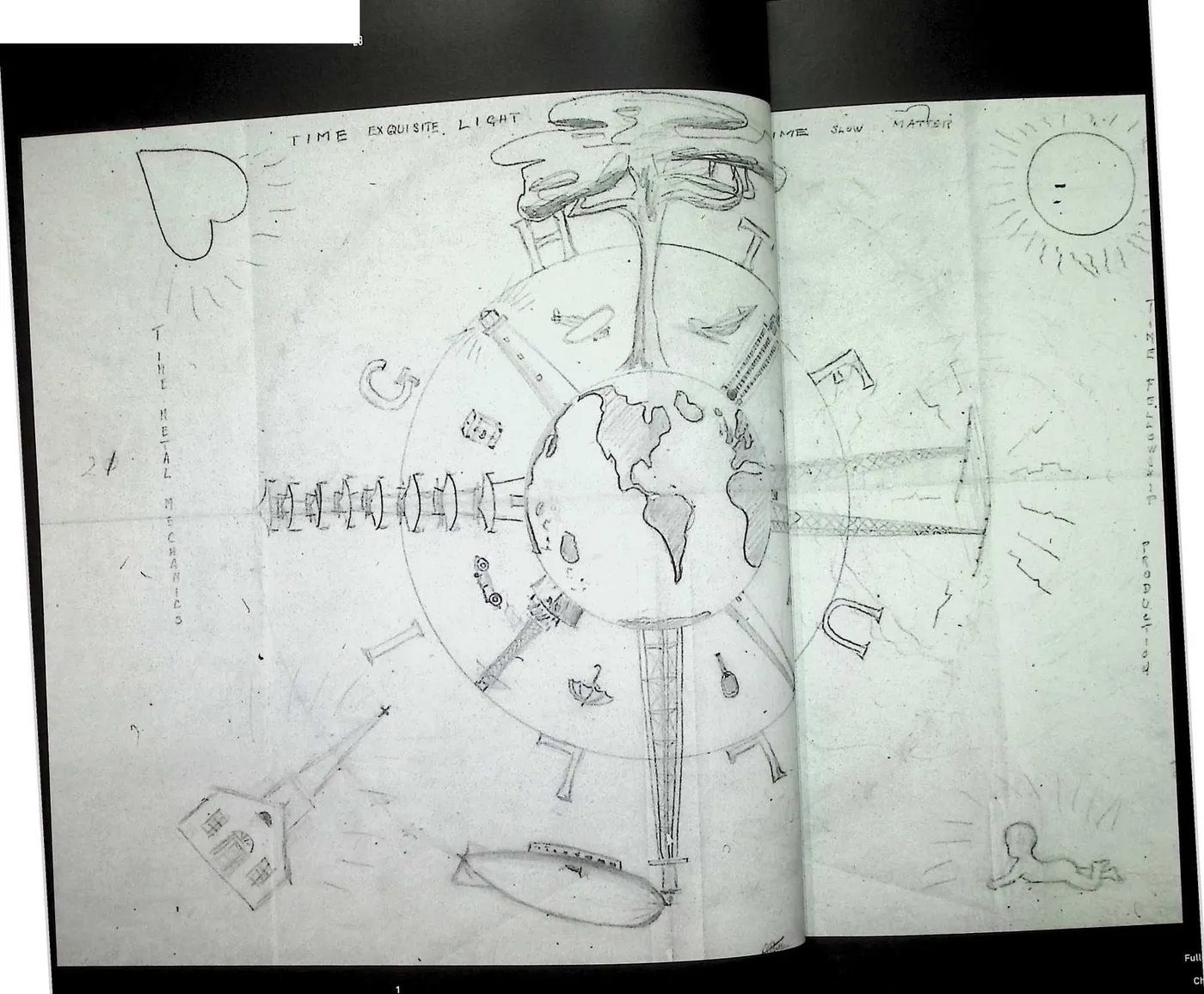
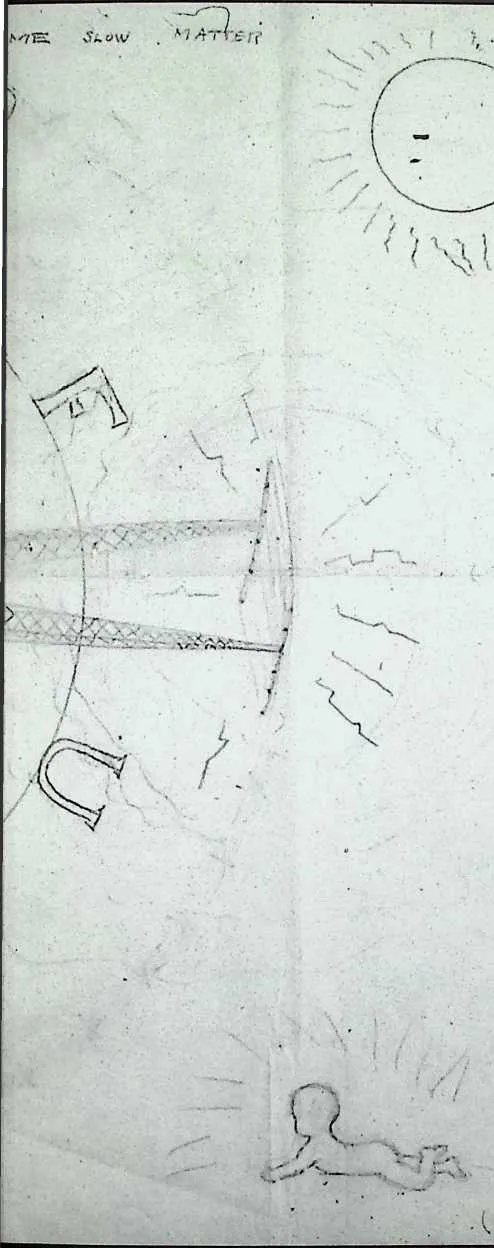
59 Die Arbeit an diesen kleineren konzeptionellen Skizzen scheint sich mit den eiligen Vorbereitungen einer Patentschrift von Februar bis April 1928 zu iiberschneiden. Sie alle belegen die Suche nach einerfunktionsfahigen Struktur fur ein Haus an einem Mast. Ein Grund dafiir, dass das gesamte Thema bei ihm in Vergessenheit geriet, konnte die Tatsache sein, dass der Grundriss noch immer rechteckig war, was sich aus spaterer Sicht als grundlegender Fehler erwies. Vergleicht man dies mit der sorgfaltigen Art und Weise, mit der Fuller die Geometrie seines hexagonalen Grundrisses in seinen4D-Skizzen16analysiert, einschliefilich der Tatsache, dass er dabei das Prinzip des symmetrischen Wachstums entdeckt (vom Zentrum als Zeitachse zu den Randern), wird es offenkundig, dass die Keimzelle fur Synergetics in dieser Grundrissstudie von Lightful, 4D und Dymaxion House liegt. Wahrend des Designprozesses stellt Fuller fest, dass seine Gedanken zum organischen Wachstum und zur zeitlichen Dimension prinzipiell im Widerspruch zu einem quadratischen Oder rechteckigen Muster, dem kubischen Raum und der rechtwinkligen Raumzelle stehen, die unvermeidbar scheinen fur das traditionelle Entwerfen von Gebauden. Dies wird der dauerhafte Antrieb fiir ein Forschungsprogramm: Welche Prinzipien liegen dem Bauen der Natur zugrunde? Oder in Fullers Diktion: Wie koordiniert die Natur? Es ist die Frage, die zu Synergetics fiihrt.
60 III.
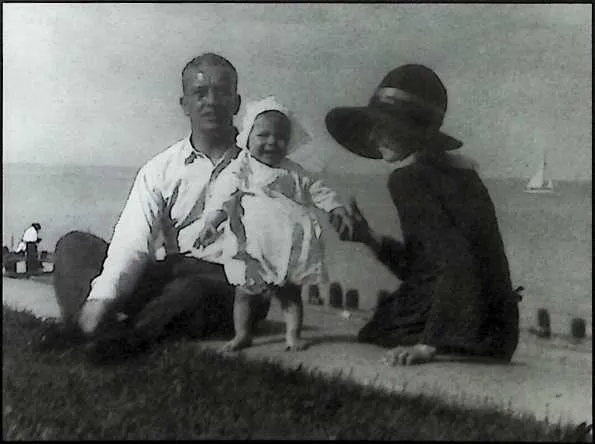
61 Ein kosmografischer Ansatz des Wohnbaus:
Die L/ghtful-Zeichnung
62 Wir sollten die grofie Bleistiftzeichnung, die die inschrift LIGHTFUL im zweiten konzentrischen Ring17 tragt, sowohl als programmatisch wie auch als charakteristisch fur ihren Autor betrachten (Abb. 1). Sie zeigt, wie Fuller an das Problem des Hauses, das es zu gestalten gilt, herangeht. Sie zeigt nicht das Haus, sondern die Welt -die Welt fur die es bestimmt ist. Diese planetarisch-aufierirdische Perspektive, aus welcher der Erdglobus gesehen und in den Mittelpunkt geriickt wird, kann in seinem spateren Werk immer und immer wieder gefunden werden -man denke blofi an Dymaxion World Map, Geoscope, Spaceship Earth und World Game. Man kann diese Zeichnung nicht betrachten, ohne beruhrt zu sein. Das mag mit der Tat-sache zusammenhangen, dass Fuller vier deutlich sichtbare symbolische Gegenstande in die Ecken des Papiers gezeichnet hat, die den personlichen Bezugsrahmen seiner gesamten Entwurfsaktivitat bilden, innerhalb dessen alles weitere angeordnet ist. Diese emblematischen Figuren stellen sozu-sagen seine personlichen Koordinaten dar.
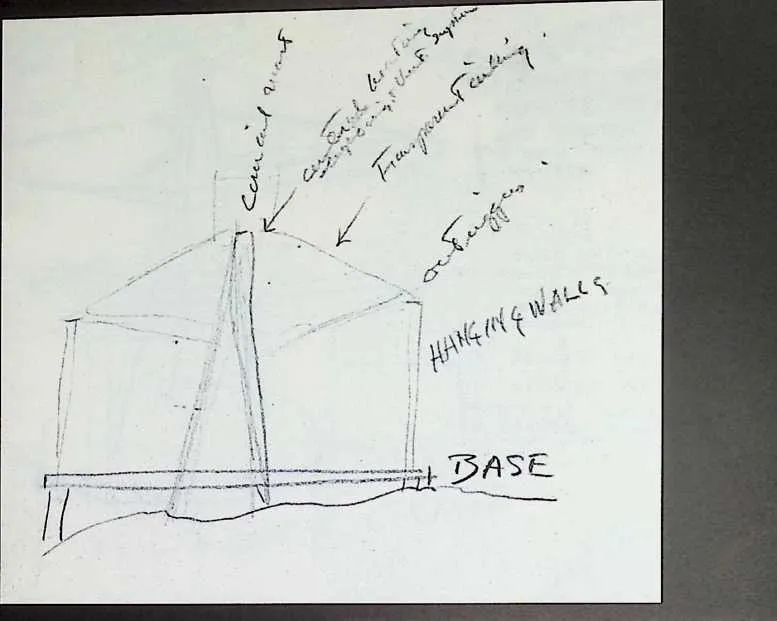
63 Die vier Gegenstande sind in der Lesereihenfolge: Herz, Sonne, Kirche und Baby. Sie alle haben einen angedeuteten Lichtschein, ein Halo. Die Textzeilen, welche die Symbole verbinden, bilden einen Rahmen:
64 Das Baby (unten rechts) gibt diesem Rahmen die personliche Note mit einem streng autobiografischen Bezug; Fullers Tochter Allegra ist zu diesem Zeitpunkt sechs Monate alt (Abb. 2). Der Vater ist arbeitslos zu Hause (in einer billigen Wohnung in Chicago) und hat Zeit, das Baby aufwachsen zu sehen. Es wird gewogen und gemessen und Fuller stellt eine Datensamm-lung zusammen, die als Baby's Record betitelt ist.18 Man darf annehmen, dass das Baby eine zentrale, symbolische Figur im Prozess der Gestaltung geworden ist, denn es taucht in zahlreichen Zeichnungen wieder auf und wird in privaten Dokumenten als President of4D bezeichnet. Spatere Diskurse liber die primare Funktion einer Behausung, das neue Leben zu schutzen, sind aus diesem Erfahrungskontextabgeleitet.19
65 Ein vergleichsweise kleiner Erdglobus f indet sich in der Mitte der vier symbo- lischen Eckpunkte (Liebe, Licht, neues Leben und religiose Spiritualitat). Vertikale Strukturen, die sich wie Speichen Oder Strahlen in alle Richtungen -omnidirektional - ausbreiten, gehen von der Oberflache dieser Kugel in den Raum. Die grofieren, die horizontale und vertikale Hauptachsen des Globus bilden, zeigen einen dominierenden Baum und einen nach unten weisenden tetraederformigen Ankermast mit einem daran festgemachten Luftschiff an derSpitze. Dieser Ankermast -eine Konstruktion des briti-schen Ingenieurs Barnes Wallis-wird beispielhaftfiirdie Konstruktion der Stutze des Hauses und der Ausgangspunkt fur Fullers Uberlegungen zur strukturellen Uberlegenheit des Tetraeders. Aufgrund seiner dominierenden Grofie erinnert der Baum zunachst an den antiken Mythos des Welten-oder Lebensbaumes. Er wandelt dieses mythische Bild dann aber urn in ein strukturfunktionales Modell fur ein technisches Versorgungssystem und ein Muster fur die Verteilungvon Spannungen, dastechnisch angepasst werden kann. Dieser metaphorische Bezug taucht in spateren Arbeits-studien erneut auf. Das Dymaxion House wird beispielsweise auch als „ein Haus wie ein Baum‘‘ bezeichnet. Fullerfindet die Beispiele und konzeptio-nellen Modelle fur sein Design nicht nur in den Artefakten der Zivilisation, sondern eben auch in der Natur. Die linke Seite der Zeichnung (geografisch nach Asien weisend) zeigt einen Pagodenturm, der bereits Aspekte seines 4D Tower vorwegnimmt. Auf der rechten Seite sieht man auseinanderlaufen-de Hochspannungsmasten, die das Thema der Energieversorgung der Welt
66 einfiihren. Im inneren konzentrischen Kreis findet man den amerikanischen Wolkenkratzer, den Fuller in Lightful Houses hinsichtlich seines Gewichts- Volumen-Verhaltnisses als positives Beispiel analysiert. Man sieht ferner einen Obelisken (als einen gnomonischen Zeitmesser) und einen Netz-werkturm der US Navy, eine Konstruktion, die zuriickgeht auf den genialen russischen Konstrukteur Wladimir Schuchow, welche die Auflosung der Masse in ein Netzwerkvon untereinander verbundenen Staben zeigt. Ferner einen Leuchtturm, ein Signale sendendes Instrument zur Navigation und Orientierung.
67 Der Katalog dieser acht vertikalen Strukturen zeigt, Fullers prinzipielle Untersuchung der Stiitzfunktion fur die Baukonstruktion, Pfeiler, Pfosten und Masten verkorpern die evolutionare Verbindung zwischen Gebauden und Menschen. Genau wie Anthropoiden sich zum aufrechten Gang und auf-rechten Stand hin entwickelt haben und wie Kinder lernen, allein zu stehen und zu gehen, indem sie die unterstiitzende Hand der Mutter verlassen, so hat sich auch die Errichtung von Gebauden mit der Hilfe von Stiitzen entwickelt. Fuller unterstrich die Bedeutung dieses Widerstandes gegen die Schwerkraft fur das Leben und fur die Kulturgeschichte in seinem Beitrag Vertical is to live, horizontal is to die.20 Es ist bezeichnend fur Fuller, dass die klassischeVerkorperung der Stiitzfunktion in der Architektur, namlich die Saule, in seinem Katalog vertikaler Strukturen nicht vorkommt. Wir sollten bedenken, dass der Kanon der Proportionen von der Antike bis ins 19. Jahr-hundert durch die Saulenordnungen bestimmt wurde. Dieser Kanon war das Kernstiick akademischer Architekturausbildung. Seine Auslassung muss als ein Akt der Provokation verstanden werden. Der Katalog der vertikalen Strukturen ist gleichzeitig ein Beispiel fur Fullers methodisches Vorgehen des ..Putting aside the irrelevant". Das Thema des Mastes taucht in Fullers architektonischem Werk immer auf, und zwar im Zeichen von Auflosung der Masse, Verwandlung und Temporalisierung. In einer schnellen Abfolge der Bilder seiner Hauser konnen wir sehen, wie, von dem Lightful House bis zu der Wichita Dwelling Machine, alles um einen Mast als zentrale Achse angeordnet ist (Abb. 3). Geodatische Kuppeln benotigen als freitragende Konstruktionen keine Stiitzen mehr. Der Mast erscheint nur voriibergehend als Hebei oder Kran wahrend der Bauphase. Im Ubrigen verschwindet der Mast in einem Netzwerk von Staben oder wird durch das geodatische Raster aufgelost. Die Saule und die entsprechende Struktur des Balkens sind Fuller wegen der Illusion der Dauerhaftigkeit, die sich aus ihrer klassischen Tradition ergibt, immer suspekt gewesen. Im Gegensatz dazu konzentrier-te sich Fuller auf das zyklische Maandern der Krafte in regenerativen Kreis-liiufen. Statt durch substanzielle Dauerhaftigkeit konnte ein Mehr an Starke durch Riickkopplungsschleifen erreicht werden.
68 Zuriick zur Zeichnung: Der Platz zwischen den vertikalen Strukturen zeigt Objekte des alltaglichen Lebens, die Denkmuster reprasentieren, aus denen sich bestimmte Grundsatze des Design ableiten lassen. DerTennisschlager zum Beispiel stellt die Starke eines in einem Rahmen gespannten Netzes bei sehr geringem Gewicht dar. Das Alltagsobjekt wird zum Anlass, liber das in ihm verkorperte Prinzip nachzudenken. Es wird als ein Modell verstanden und kann daher fur einen anderen Zweck angepasst und als Design nutzbar gemacht werden. Fullers Idee, massive Decken und Platten durch wie Netze gespannte Decks zu ersetzen, hat seinen Ursprung in dieser besonderen Weise auf den Tennisschlager zu blicken. Ich mochte es bei diesem Beispiel belassen, wenngleich die Reihe gut erweitert werden konnte. Wichtig ist mir, in dieser Mikroanalyse zu zeigen, wie Fullers Konzept und Analyse wahrend der Entwicklung seiner allerersten Designphase fur sein Haus an einem Mast in einer Weise angelegt war, dass die Einzellosungen wieder und wieder in das systematisch strukturierte Ganze eingebracht werden. Der Bau eines Hauses und die Beschreibung der Welt basieren auf derartigen Erfahrungen von Wechselwirkung und Verstarkung. Das Haus zeigt dann schlieBlich die Welt in etwas anderem Licht.
69 IV.
70 Von Innen nach AuBen
71 Die Zeichnung Lightful steht nicht fur sich alleine. Sie entfaltet ihre Bedeu-tung nur im Kontext mit dem Diskurs, den Fuller in seinem Text Lightful Houses entwickelt sowie mit den Skizzen, Textentwiirfen und Notizen, die sich auf diesen Themenbereich beziehen. Sein Fokus auf vertikale Struk-turen in der Zeichnung ist nur ein Beispiel fur ein Herangehen, das sich von innen nach auBen vollzieht, statt mit der aufieren Form zu beginnen. In Lightful Houses fiihrt er aus: „Man kann nicht von auBen nach innen entwer-fen. Es kann keinen Charakter geben, wenn wir nicht von innen nach auBen gestalten. Die Oberflache muss die innere Funktionalitat und das innere Leben zum Ausdruck bringen.1121 Nur dieser Grundsatz seiner Designphi-losophie erklart die Entschlossenheit, mit der Fuller sich urspriinglich der tragenden Struktur und den Versorgungsfunktionen des Hauses widmet, noch ehe er eine Hausform gefunden hat. Gleichzeitig werden wir daran er-innert, wie das Thema „von innen nach aufien, von auBen nach innen11 auch zum Leitmotiv seiner geometrischen Forschung wird. Seine beeindruckenden Entdeckungen, wie die Jitterbug-Transformation oder die Transformation der geodatischen Raster in Noah’s Ark #2 werden durch solche inverse Trans-formationen gekennzeichnet, die in der Mathematik fur eine lange Zeit keine Beachtungfanden.22Schlussendlich ist sein Tensegrity-Prinzip auf dem grundlegenden Gedanken aufgebaut, die Hierarchie von Zug-und Druckkomponenten einer Struktur umzukehren. Man kann ohne Ubertrei- bung sagen, dass Fullers Herangehensweise an die Frage der Raum-Zeit-Ordnung der ungewohnlichen Neigung zu Umkehrungen beziehungsweise Umkrempelungen im Sinne seines Jnside-outing, outside-inning'1 zu danken ist.
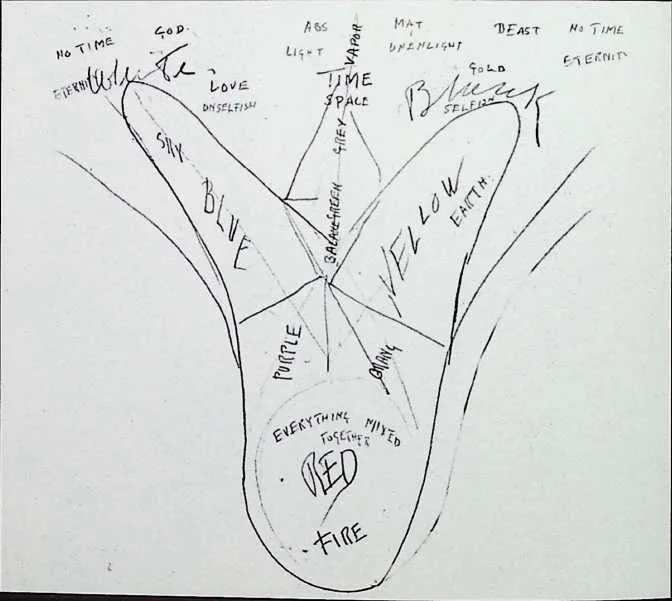
72 In Lightful Houses hat die Gestaltung von innen nach auBen bereits eine Vielzahl von Aspekten und Zusammenhangen, die Fuller auch in seinem Aufsatz erwahnt. Der wichtigste ist vielleicht die Analyse des Lebens und des Lebendigen, denn dies ist eine andauernde Quelle der Inspiration fur all seine Entwurfsarbeit. Sich mit Wachstum, Entwicklung, Transformie-rung und Reproduktion zu befassen, fiihrt von der lebenden Kreatur und der Natur zu den kulturellen Techniken und Artefakten. Fuller als einen Tech-nokraten zu bezeichnen, wie dies oftmals getan wurde, nur weil seine Lbsungen versuchen, die Technologien der Zeit kompromisslos auszuschbp-fen, wird nicht der Rolle gerecht, die die Natur und die organische Welt in seinem Denken gespielt haben. Ich wies bereits darauf hin, wie sehr die Geburt seines eigenen Kindes im Juli 1927 zur Veranderung des Lebens von Buckminster Fuller im Winter 1927/1928 beitrug. Dieser autobiografische Aspekt sollte nicht unterschatzt werden, denn er taucht in seinen Notizen aus dieser Zeit standig auf, und er verwebt das Persbnlich-Familiare mit dem Objektiv-Generellen. Das bezeugt das Tagebuch, das Anne Fuller in Erwar-tung des Babys am 7. August 1927 begann und das sie und ihr Mann bis Ende Marz 1928 fiihrten. Ein Eintrag von Anne Fuller hat folgenden Wortlaut: „RBF unglaublich inspiriert durch das Leben. Es ist Quelle, Gestaltungs-und Motivationskraft. Basis fur Planen & Denken und so weiter." Dieser Eintrag vom 2. Februar 1928 fallt genau in die Zeit fieberhaften Arbeitens an dem Projekt Fuller Houses, wie es intern genannt wurde. Die Feststellung wie auch das gesamte Tagebuch zeigen, wie Umstandeaus dem privaten Leben sich mit anderen Einfliissen verbinden und Eingangfinden in die Philosophie des Hauses.23 Die Auseinandersetzung mit Leben und Wachstum im Allgemein-en findet man auch in den Ideen-Skizzen, die zum L/ghtful-Komplex gehdren. Einige konnen als abstrakte Ideogramme verstanden werden, andere als konzeptionelle Skizzen fur das Design des Hauses. Unter den ideografischen Skizzen findet man eine an einen Keim oder Bliitenkelch erinnernde Abbil-dung, die die Entfaltung von Blattern oderTrieben zeigt (Abb. 4) -wie ein fa-cherformiges Ausbreiten der Farben urn eine zentrale Zeitachse.24 Eine andere zeigt sich urn ein Zentrum ausbreitende Wellen und tragt den Titel TheAbstract/Truth. Vom Zentrum ist ein kegelformiges Biindel von fiinf Strahlen, bezeichnet als die fiinf Sinne, auf die Kreise der Wellen gerichtet. Diese Strahlen vermitteln zwischen Wahrheit und Wellen. Die Metaphern und Bilder, die in den zentralen Passagen von Lightful Houses benutzt werden, entsprechen sowohl den Ideogrammen als auch den Skizzen zur Grund-struktur des Hauses. Fuller interpretiert sie abstrakt aber auch als konkrete Modelle elementarer Bewegungsmuster, von denen er dann ein Ideal fur eine Raum-Zeit-Konstruktion gewinnt.
73 V.
74 Von der Metapherzum Modell;
Die Figur der Fontane
75 Zwei dieser Denkbilder verdienen eine intensivere Untersuchung, da sie fur Fullers spateres Werk sehr bedeutsam sind. Sie zeigen auBerdem, welchen Traditionen seine Denkweise folgt. Es handelt sich um die „Expandierende Sphare", auf die an andererStelle eingegangen wird,25und um die„Fontane des Leben", ein Bild das ganz am Anfang steht und Fuller den Weg zur Gestalt des Hauses weist.26 Lightful Houses findet seinen Hohepunkt in der Passage, wo er Schlussfolgerungen aus der Maxime des Entwerfens von Innen nach Au- Ben zieht: „Unsere neue kiinstlerische Ara architektonischer Ausdrucks-weise werden wir erreicht haben, wenn unsere Gebaude die letzten Spuren feudalistischer Unterdriickung verloren haben: Wenn wir uns in unseren Gebauden erheben in einer konzentrierten Zone der Kompression in Opposition zur Schwerkraft und mithilfe eines Mastes oder Caissons von der ver-tikalen in den Raum ausgreifen durch Druck und Zug, wobei der Druck sich vermindert, sobaid wir aus der Vertikalen herausfallen, bis wir endlich abwarts flieBen in direkter Zugspannung. Dann werden unsere AuBenwande, abhangend vom AuswartsflieBen der Spitze, wie eine groBe Fontane, ganz voller Geschmeidigkeit, Licht und Farbe sein.‘‘27
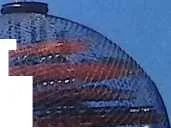
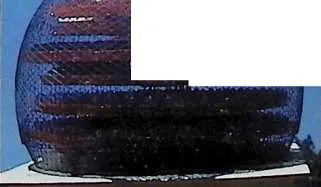
76 Diese erstaunliche Darstellung einer Baukonstruktion scheint nahezu naht-los in den zeitgendssischen Diskurs uber Architektur in Amerika zu passen, wie ihn Louis Sullivan eingefuhrt hatte, auf den sich Fuller in den folgenden Satzen direkt bezieht. Die Passage zeigt aber in ihrer poetischen Konkretheit Fullers ganz eigenen Ansatz im Hinblick auf das Bauen und das Haus. Was so-
77 fort auffallt, ist die Tatsache, dass das eingefiihrte Bild aus einem Prozess der Bewegung entwickelt wird, einem Prozess, der mit dem menschlichen Korper choreografisch nachvollzogen und verstanden werden kann. Diese Ubersetzung in eine Korperbewegung hilft jedem, das Bild zu begreifen. Aber das ist nicht alles: Fullers poetische Beschreibung bringt uns direkt in den Bewegungsfluss des Ansteigens, sich Ausdehnens und Abfallens -ganz so, als ob wir mitten im Fountain Flow waren. Sofuhlen wir-beinahe physisch -die Spannungen, die sich aus dieser Bewegung ergeben, und wie die Krafte im Bewegungsverlauf sich umkehren in ihrer Ausrichtung, vor allem aber umkehren von einer Druck-in eine Zugspannung. Der Autorfindet eine as-thetische Losung fur die Vergegenwartigung der Spannungsverhaltnisse und deren Umwandlung, die ein bewegungsloser Beobachter nicht sofort verstehen kann und die, das mussen wir hinzufiigen, statischem Denken fremd sind.
78 Fullers Beschreibung der Fontane als erlebbares dynamisches System folgt einem Poesieverstandnis, das er von Ralph Waldo Emerson ubernimmt: ,Poesie heiflt, die wichtigsten Dinge auf die einfachste Weise auszudrucken.1128 Der Grundgedanke des Hauses, das zu entwerfen ist, ist nirgendwo in solch konzentrierter Weise zum Ausdruck gebracht worden, wie in der vom Autor in Lightful Houses hervorgehobenen Passage. Sie vereint die ethischen, asthe-tischen, funktionalen und strukturellen Konzepte des Autors in einem Bild, das iibertragen und ausgefuhrt werden will. Seine Mehrdeutigkeit verlangt nach Konkretisierung, vermittelt zugleich aber bereits eine Idee, wie eine strukturell funktionierendes Modell aus einer Metapher heraus entwickelt werden kann.29 Die verbale Konkretisierung liest sich daher in Lightful Houses: „Die Grundidee der Konstruktion ist, dass alle Elemente von oben herabhangen sollen, statt auf Stiitzen von unten zu ruhen.‘‘30 Das dyna-mische Modell der Fontane gibt Fuller die Moglichkeit, sich von der professi-onellen Kategorisierung der Architektur zu losen, der Unterscheidung in Fassade, Baukorper, tragenderStruktur und so weiter odervon Bauelemen-ten, wie Wand, Dach und Decke. Auf diesem Weg kommt er zu einer neuen Bestimmung des Hauses als Schirm und Membran. Hier sehen wir eine we-sentliche Voraussetzung fur die Philosophie der Environment controls, die Fuller erstmals in seinem 1938 erschienen Buch Nine Chains to the Moon (Neun Ketten zum Mond) entwickelt hat.31 Die Auswirkungen dieses Kon-zepts auf die grofiraumige Bedachungs-und Klimatisierungshaut, wie sie Norman Foster, Nicholas Grimshaw, Jorg Schlaich, Renzo Piano, Shigeru Ban und viele andere heute bauen, sind bislang nur rudimentar in die Theorie und Geschichte der Architektur eingegangen.32
79 VI.
80 Fontanenflusse:
Environment Controlling
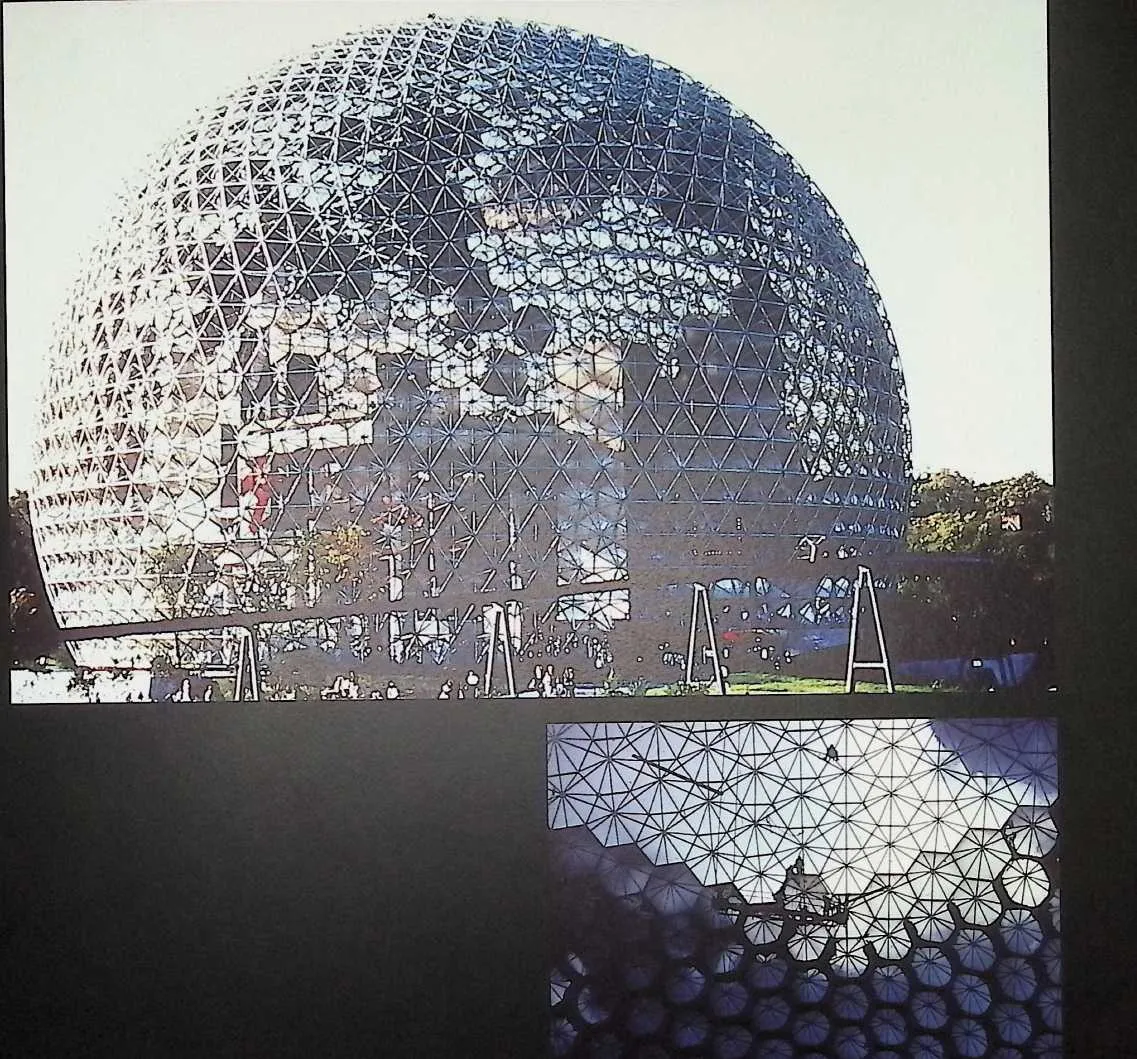
81 Wenn beispielsweise Mies van der Rohes Architektur als Haut-und-Knochen- Architektur richtig charakterisiert worden ist, weil er aus der Skelettbauweise und aus den Moglichkeiten der Vorhangfassaden radikale Konsequenzen gezogen hat, dann konnte fur Fullers Baukonstruktionen gelten, dass sie im Begriff sind, sich sogar des Skeletts zu entledigen, urn reine Membranen zu werden. Die Auflosung des Skeletts kann auf zweierlei Weise geschehen: Einerseits, indem man den Mast oder die Stiitzen, in der Funktion eines Baukranes nur voriibergehend einrichtet, und andererseits, indem man die tragende Funktion in ein masseauflosendes Stabnetzwerk aus zellfbrmi-gen Verbanden iibertragt, in das die Haut unterteilt ist. Um das Verhaltnis zwischen dem System (dem Haus) und seiner Umwelt zu optimieren, kann die Membran durch Offnen oder Schliefien der Zellen beziehungsweise Facetten auf die Umwelt reagieren, um Licht, Temperatur und Feuch-tigkeit zu regulieren und so den Aufwand fur Heizung, Beleuchtung und Beluftung zu minimieren. Die eindrucksvollsten Umsetzungsbeispiele geodatischer Kuppeln als Klimahiillen, das Climatron im Botanischen Garten in St. Louis, Missouri, aus dem Jahr 1960 und die EXPO-Kuppel (Abb. 5,6) auf der Weltausstellung 1967 in Montreal, basieren auf diesem Konzept des Environment Controlling. Es erlaubt eine vollstandige Trennung der Haut des Gebaudes von der inneren Struktur, einschliefllich Boden, Gangen, Rampen, Treppen und so weiter -all dies wird nun zur Innenarchitektur. Man kann sagen, dass die intelligente Haut der Kuppel die Schnittstelle zwischen dem System Haus und seiner Umwelt darstellt. Sie schafft gleichermaBen Fassade, Dach und Aufienwande ab und ersetzt sie vollstandig.
82 Das Bild von der Fontane dient sogar als Geburtshelfer fur dieses Konzept der vollstandig unabhangigen inneren horizontalen und vertikalen Raum-aufteilung, das sich in der EXPO-Kuppel manifestiert. Es reicht nicht aus, die geodatischen Kuppeln als leichte, freitragende Strukturen mit enormer Spannweite zu beschreiben. Obwohl ein GroBteil der Entwurfsarbeit auf die Losung dieser Tragwerksprobleme gerichtet ist, hat Fuller seine Aufmerk-samkeit den inneren und auBeren Bewegungsfliissen -der Luft, des Wassers, der Energie, des Ver-und Entsorgungsmaterials sowie der menschlichen Handlungsablaufe -zugewandt. Das Bild der Fontane finden wir nahezu zwei Jahrzehnte spater in der Beschreibung des Wichita House wieder, dieses Mai bezogen auf ein charakteristisches Detail mit einer haustechnischen Funktion -die Abzugshaube an der Spitze des Hauses. „Mit dem zentralen Ausgangspunkt fur die Beluftung, Belichtung, Beschallung und Versorgung entdecken wir, dass diese Dienste im Betrieb Fliefimuster wie bei einer Fontane beschreiben, aufwarts, auswarts, abwarts in alle Richtungen in kon-zentrischem Fliefien und nachfolgendem ZuriickflieBen. Wir stellen fest, dass dieser Fluss der Fontane umgekehrt werden kann, und in jedem Fall wird die grofite Reichweite mit geringstem Aufwand erzielt."33
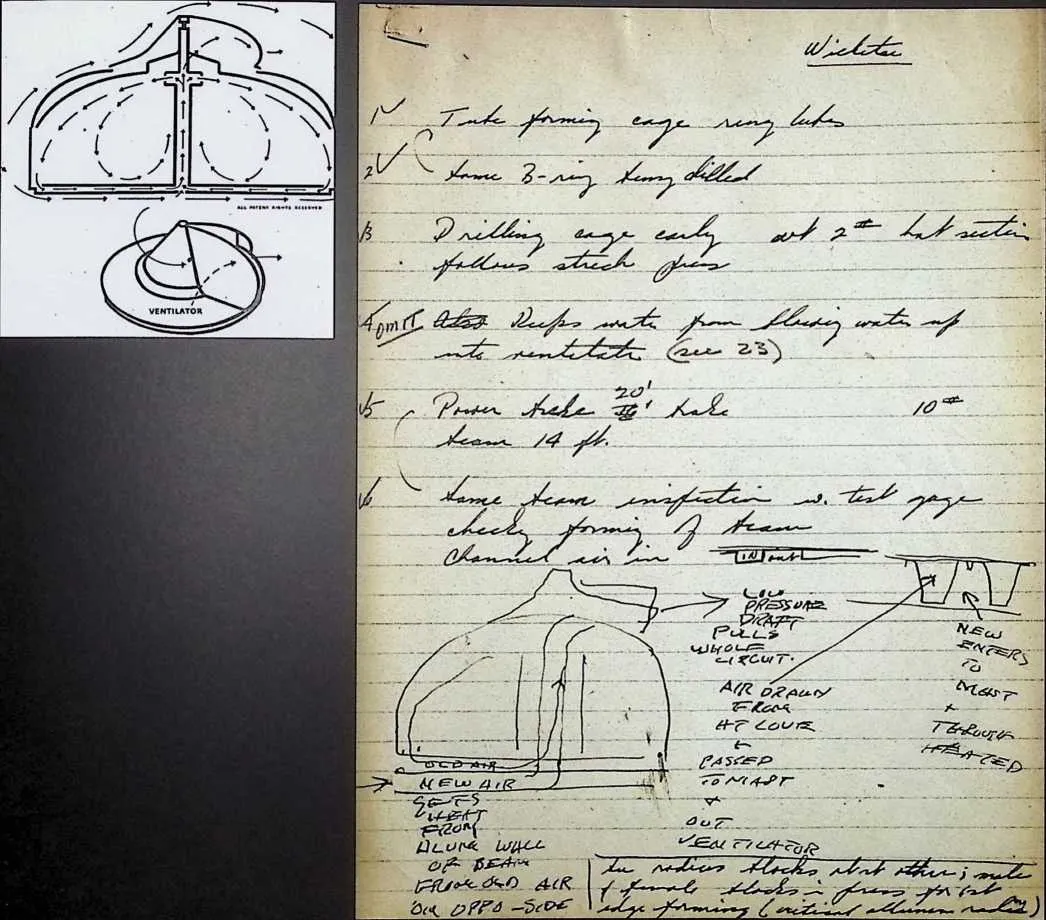
83 Im Wichita House (Abb. 7--9) untersucht Fuller im Windkanal die iiberwiegend natiirliche Luftzirkulation. Das Muster der Luftzirkulation ist Ergebnis der nahezu hemispharischen Form des Hauses, der Lufteinlasse und der aerody-namischen Abzugshaube auf dem Dach, die aus dem vorbeistreichendem Wind einen Sog im Inneren generiert. Die Zirkulation zeigt ein Fontanenbild, genau wie es in der natiirlichen Atmosphare bei lokaler Erwarmung entstiinde. Die ausgekliigelten Heizungs- und Beliiftungssysteme der geodatischen Kuppeln folgen den Entdeckungen, die am Wichita House gemacht wurden.
84 VII.
85 Fountain Factory und das Studium
der natiirlichen Systeme
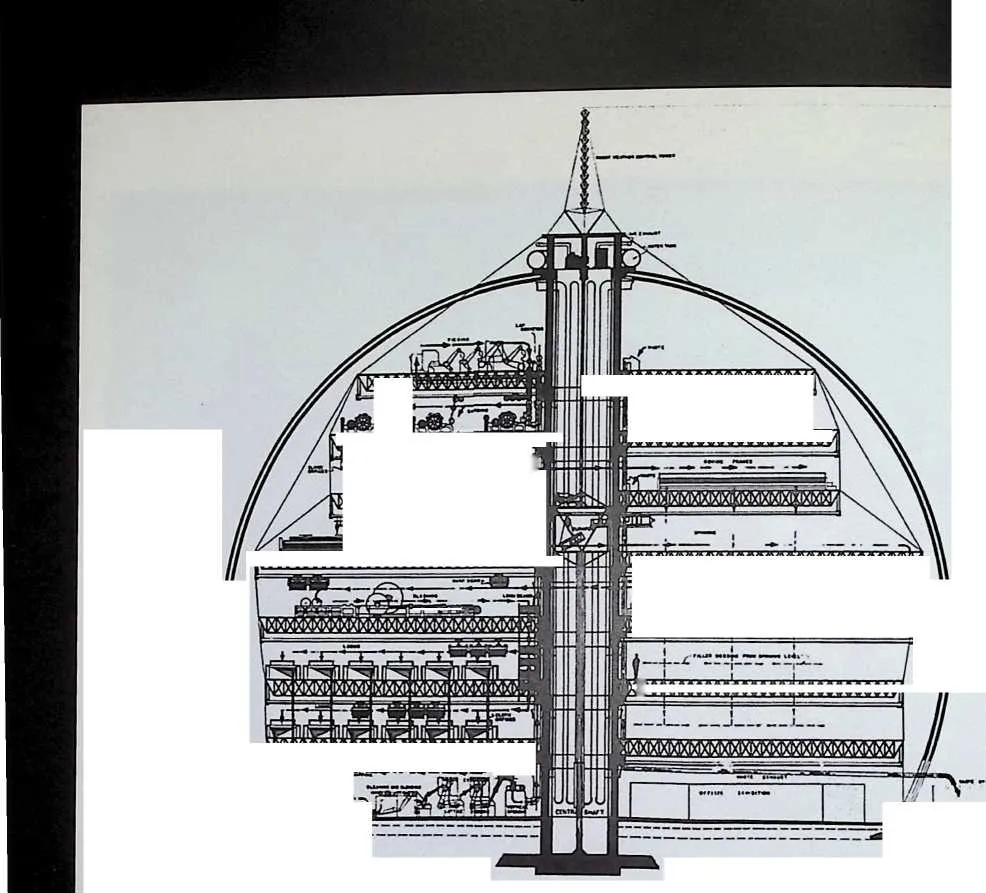
86 1951, nach Beendigung seiner Arbeit zu den geodatischen Rastern, entwickelt Fuller gemeinsam mit seinen Studenten am North Carolina State College, eine neue Gebaudeform fur eine Baumwollmuhle. Der Name Fountain Factory (Abb. 10,11) ist sehr passend, da die gesamte Rohmaterialverarbeitung
8788entsprechend dieser Form organisiert wird. Das Rohmaterial wird durch einen zentralen Versorgungsschacht nach oben transportiert. Es wird sodann nach auBen gebracht und fallt liber die acht Geschosse von einem Bearbeitungsschritt zum nachsten, urn als fertiges Produkt im Erdge-schoss zu landen, von wo es dann abgefahren wird.34 Es ist hier entscheidend, dass zum ersten Mai die Hulie der geodatischen Kuppel vollstandig von der inneren Struktur geldst ist. Die Decken von unterschiedlicher kreisfor-miger Ausdehnung sind lichte, ebene und offene Raumtragwerke aus Oktaeder-Tetraeder-Verbanden (.Octet truss), einer von Fullers drei wesentli-chen Erfindungen. Sie sind an einer hexagonalen Achse verankert und von der Spitze der Kuppel her abgehangt. Die %-Sphare tragt nur sich selbst und ist eine reine Klimahiille, die alle Mbglichkeiten fiir eine unabhangige innere Organisation bietet. Ihre spharische Form ist insofern klimaaktiv, als sie einen umkehrbaren Luftstrom im FlieBmuster einer Fontane erlaubt und aufrecht erhalt und somit eine weitgehende natiirliche Klimatisierung zulasst. Ein bedeutendes bkologisches Argument bereichert nun die strukturelle Kritik am Rechteck und am Kubus in der Architektur: „Der Fontanenfluss ist ange-messen, urn im Winter einen relativ warmen Luftstrom aufrecht zu erhalten und der umgekehrte Fontanenfluss ist hdchst effizient, um im Sommer einen recht kiihlen Luftstrom aufrecht zu erhalten. In keinem dieser Faile des Fontanenflusses erzeugt die Energie ein chaotisches Echosystem, wie wir es in den undurchdachten, kubischen, einem Squash-Platz ahnlichen Schach-teln finden, in denen wir heute leben.‘‘35
89Wir sehen, wie oft das Bild der Fontane in Fullers Forschung und Entwurfen liber einen langen Zeitraum auftaucht. Und wir sehen, wie es wieder und wieder neue Bedeutungen zugewiesen bekommt als ein Modell, ein Modell fiir eine Reihe von Unterfunktionen, die organisch koordiniert werden miissen -und dies geschieht durch einen lebenden Organismus. Fullers einzigartiger Weg als Denker und Designer kann nicht zureichend als „formgebend‘‘ beschrieben werden, ihn charakterisiert vielmehr das Untersu-chen und Entwerfen von dynamischen Systemen im Zusammenwirken mit ihrer Umwelt, um sie vorteilhaft zu regulieren -oder besser noch -um sie sich selbst vorteilhaft regulieren zu lassen. Das ist der Grund, warum er dem Studium natiirlicherSysteme vielAufmerksamkeitgewidmet und sie in einer solch faszinierenden Weise beschrieben hat. Aus diesen Analysen und Beschreibungen hat er unabhangig von den Naturwissenschaften eine Systemtheorie entwickelt, die das Denken ebenso einschlieBt wie das Bau-en von Enviroment controls. Hier ein Auszug aus den Vortragen, die Fullerfiir seine Mitarbeiter am Wichita House und fiir die Techniker der Flugzeug-werft von Beech Aircraft, Wichita, Kansas, gehalten hat, wo der Prototyp seines Hauses gebaut wurde: „Wie eine Wasserfontane als etwas gesehen wird, das frei im Raum als ein System arbeitet Oder wie Licht drauBen in der Nacht ein hemispharisches System eines illuminierten Raumes schafft, so tun dies auch die dynamischen Wirkungen von Warme. Licht, Luft, Klang und Duft. Auch sie stellen natiirliche Systeme physikalischer Phanomene dar, sodass unser hemispharisches Haus nur eines leistet, namlich einen Innen-raum zu isolieren, der den Fluss und die systematischen Brechungswinkel unterstiitzt und sie vor Stbrungen durch dynamische Prozesse auflerhalb des Hauses schiitzt -ganz so, wie der Abzug in einem Lager das Feuer oder eine Elektronenrdhre die freie Funktion seines zentralen Elements schiitzt. Das Prinzip, aufgezeigt anhand der Boomerangbrechungen in alle Richtungen, ist frei beweglich durch unsere ubereinstimmenden Energiesysteme von Licht,
90Warme, Luft, Klang, Duft und so weiter, positioniert im Mittelpunkt unseres Hauses. So 1st unser Haus aerodynamisch optimiert wie ein Flugzeug (falls nicht noch besser), mit dem Ziel, extern und intern einen kleinen parasitaren Zugfiir alle Luftstromungen zu erzeugen, die messbar gesteuert werden kon-nen. Damit schafft ein Minimum an Energie ein Maximum an kontrollierter Leistung.**36
91Als Buckminster Fuller den Biologen Ludwig von Bertalanffy in den friihen 1960er Jahren traf, stellte er die vollstandige Ubereinstimmung seiner Theorie der natiirlichen Systeme, die er durch die Gestaltung seines Hauses herausgefunden hatte, mit der allgemeinen Systemtheorie von Bertalanffy fest. Die allgemeine Systemtheorie entwickelte sich aus der Notwendigkeit, den Organismus als offenes thermodynamisches System im Zusammen-wirken mit seiner spezifischen Umwelt zu erklaren.37 Fullers fortlaufend von 1928 bis 1967 entwickeltes, Hausorientiertes Denken, das keineswegs mit der EXPO-Kuppel abgeschlossen war, fand sich plotzlich am Schnittpunkt der neuen „Superdisziplinen‘‘ Kybernetik, Okologie und allgemeine Systemtheorie. Wie kein anderes Artefakt stellte das Haus ein ganzheitliches Modell eines thermodynamisch offenen Systems dar, das die „organische‘‘ Integration von Unterfunktionen und Untersystemen zur Aufgabe des Designs gemacht hat. Dies experimented erforscht und mit einem vbllig unabhan-gigen Ansatz einer praktischen Theorie natiirlicher Systeme demonstriert zu haben, ist eine von Buckminster Fullers bleibenden Leistungen. Er muss auch als einer der grofien Pioniere der Systemtheorie in der Geschichte der Wissenschaften erachtet werden und fur die Geschichte des Entwerfens allemal.
- 1.
- /Thinking is retarded centuries by house habits.'1 R. Buckminster Fuller, Designing a New Industry, Wichita, KS, 1946, S. 13; die entscheidende Rolle von Technotogie fur die Veranderung der „habits of thought1' betont der amerikanische Soziologe Thorstein Veblen, The Place of Science in Modern Civilization (1906), New York 1961, S. 17.
- 2.
- R. Buckminster Fuller, „Untitled Epic Poem on the History of Industrialization", in; New York 1962; ders., Education Automation, Carbondale, 111., 1962; ders., Ideas and Integrities. A spontaneous Autobiographical Disclosure, Englewood Cliffs, NJ, 1963; ders., No More Secondhand God and other Writings, Carbondale, 111., 1963; ders., Nine Chains to the Moon, (1938), Rev. ed. Carbondale, III. ,1963.
- 3.
- Robert Marks, The Dymaxion World of Buckminster Fuller, New York 1960.
- 4.
- Reyner Banham, Theory and Design in the First Machine Age, London 1960 kanl.-l
- 5.
- Reyner Banham, „The Dymaxicrat (1963)'', in: A Critic Writes. Essays by Reyner Bonham, Berkeley, Los Angeles, London 1996, S. 93f.
- 6.
- R. Buckminster Fuller, ..Guinea Pig B‘‘, Einleitungzu: Inventions. The Patented Works of R. Buckminster Fuller, New York 1983, S.VII---XXVII. Vgl. Joachim Krausse, „Arche und Chronik von Guinea Pig B. Buckminster Fullers aufgezeichnetes Lebensexperiment", in: Lesebuch fur Designer, hrsg. v. Winfried Scheuer, Stuttgart, Leipzig 2000, S. 202--225; Hsiao-Yun Chu, „Paper Mausoleum. The Archive of R. Buckminster Fuller", in: New Views on R. Buckminster Fuller, hrsg. v. Hsiao-Yun Chu und Roberto G. Trujillo, Stanford, CA, 2009, S. 6--22.
- 7.
- Hugh Kenner, Bucky. A Guided Tour of Buckminster Fuller, New York 1973, S. 7f.
- 8.
- R. Buckminster Fuller. Autobiographical Monologue/Scenario, hrsg. v. Robert Snyder, New York 1980, S. 35 ff.
- 9.
- Manuscript Files 28.01.01/28.10.01 (reboxed 6/21/93), Folder I---X, Buckminster Fuller Archive, Santa Barbara, jetzt R. Buckminster Fuller Collection, Stanford University Libraries, Fuller MSS, M 1090: 8:1-2.
- 10.
- Abgedruckt zusammen mit einigen Skizzen und Textauszugen aus den Lightful-Papieren in: Your Private Sky. R. Buckminster Fuller. The Art of Design Science, hrsg. von Joachim Krausse, Claude Lichtenstein, Baden (Schweiz) 1999, Kapitel ..Lightful Houses/4D‘‘, S. 80 ff. (Im Folgenden
92 zit. als YPS 1)
- 11.
- Lightful Houses. Typoskript, 73 S. in zwei Teilen. Fuller MSS, M 1090: 8:2. Der ersteTeil, S. 1--25, ist abgedruckt in Your Private Sky. R. Buckminster Fuller. Discourse, hrsg. von Joachim Krausse und Claude Lichtenstein, Baden (Schweiz) 2001, S. 64--74, Kommentar S. 62. (Im Folgenden zit.
93 als YPS 2)
- 12.
- R. Buckminster Fuller, 4D Time Lock, Chicago 1928, Nachdruck: Albuquerque, NM, 1972.
- 13.
- Manuscript Files 28.01.01, Folder II, wie Anm. 9.
- 14.
- Vgl. die Eintrage im Tagebuch von Fullers Ehefrau Anne
94 „Diary starting August 7th when I came out to Chicago with Bucky". Dymaxion Chronofile, 30, Fuller MSS, M1090:2:15:30.
- 15.
- Vgl. YPS 1, S. 85 ff.
- 16.
- Vgl. YPS 1, S. 14f„ 134; YPS 2, S. 92--96.
- 17.
- Vgl. YPS 1, S. 80--83.
- 18.
- Abgedruckt in YPS 1, S. 78f.
- 19.
- Auf der Ruckseite der Zeichnungfindet sich Fullers Notiz: ..Philosophical Protection: Tower -Time -Love".
- 20.
- R. Buckminster Fuller, ..Vertical is to live, horizontal is to die", in: YPS 2, S. 279 ff.
- 21.
- Fuller, ..Lightful Houses", in: YPS 2, S. 70.
- 22.
- Vgl. den Abschnitt „Fiinf Arten, den Jitterbug zu tanzen", in der Einleitung der Herausgeber, YPS 2, S. 23--31; R. Buckminster Fuller, „Noah's Ark #2‘‘, in: ebenda, S. 176ff.
- 23.
- Wie Anm. 14.
- 24.
- Vgl. YPS1.S.84.
- 25.
- Joachim Krausse, ..Architektur der Hochtechnologie.
95 Buckminster Fuller Dymaxion House 1929", in: Stefan Andriopoulos, Bernhard Dotzler(Hrsg-), 1929. Beitrage zurArchaologie der Medien, Frankfurt am Main 2002, S. 219ff.
- 26.
- Uber die Herkunft der literarischen Metaper der ..Fontane des Lebens" tasst Fuller keinen Zweifel und zitiert Margaret Fuller-Ossoli (1810-1850), seine Grofltante, in seinem Buch Ideas and Integreties in dem Kapitel ..Margaret Fuller's Prophecy" in einerTextpassageaus dem Jahr 1842: „Truth is the one great means by which alone progress can be essentially furthered. Truth is the nursing mother of genius. No man can be absolutely true to himself, eschwingcant, compromise, servile imitation, and complaisance, without becoming original, for there is in every creature a fountain of life which, if not choked back by stones and other dead rubbish, will create a fresh atmosphere, and bring to life fresh beauty. And it is the same with the nation as with the individual man." R. Buckminster Fuller, Ideas and Integreties, Eaglewood Cliffs, NY, 1963, S. 70. Im Jahr 1929, wahrend der Arbeit am Hausentwurf, korrespondiert er mit seiner Schwester Rosamund Fuller uber die herausragende Bedeutung ihrer GroCtante fur die amerika- nische Kulturgeschichte. R. Buckminster Fuller, Brief and die Schwester Rosamund Fuller, 17.6.1928. In: YPS 1, S. 69f. und S. 67.
- 27.
- Fuller, „Lightful Houses", in: YPS 2, S. 70; dt. Ausgabe S. 78.
- 28.
- R. Buckminster Fuller, ..Mistake Mystique", in: YPS 2, S. 296; dt. Ausgabe S. 315.
- 29.
- Vgl. YPS 1,S. 85--87.
- 30.
- YPS 1,S. 114.
- 31.
- R. Buckminster Fuller, Nine Chains to the Moon, Philadelphia 1938, S. 43.
- 32.
- Reyner Banham, The Age of the Masters. A Personal View of Modern Architecture, rev. Ed. London 1975, S. 130--133, uber Fuller und das Climatron St. Louis; Joachim Krausse, ..Environment Controlling -Fur eine Welt der Vielen. Buckminster Fullers Wirkung in GroBbritannien",
96 in: Norman Foster. Architecture is About People, hrsg. von Susann Anna, Koln 2002, S. 97ff.
- 33.
- R. Buckminster Fuller, Designing a New Industry, Wichita, Kansas, 1946, S. 35.
- 34.
- R. Buckminster Fuller, „The 90% Automatic Cotton Mill (1951)‘‘, in: YPS 1,S. 336--339.
- 35.
- Fuller, Designing a New Industry (wie Anm. 32), S. 35.
- 36.
- Ebenda, S. 35.
- 37.
- Ludwig von Bertalanffy, „The Theory of Open Systems in Physics and Biology", in: Science, 111, S. 23--29; ders., General System Theory,
97 New York 1963.
98 R. Buckminster Fuller, Lightful, programmatic drawing, Chicago,
99 JOfcCHIHKRAUSSE/WE ARE ALIASTRDHAUTS
101 2
102 Fullerwith daughter Allegra
and his wife Anne,
Chicago, Lake Michigan,
July 1928
105 3
106 Fuller,
107 Structural model, house with central
mast and hanging walls,
sketch, 1928
108 4
Fuller,
109 Conceptual model of origin and growth,
the germ or seed,
sketch, 1928
110 6
Fuller &Sadao,
US Pavilion, EXP0'67,
Montreal 1967
111 5
112 EXPO’67 dome, detail,
shutters forclosingand opening
the cells of the building's skin
114 AUG 15
115 FIGURES
117 THIS PATTERN-SHOWS
118 2-WAT COMPREHENSIVE
119 •'’EQUILIBRIUM WITH 3 WAY YIELD AND
120 BASIC 6" FUNCTION
121 SATISFACTION WITHOUT INTERNAL
122 CONFLICT AND SINGLE '
123 EXTERNAL COMPLEMENTARITY NEXT A
124 9
Wichita House
Schematic illustration of the fountain-like air
circulation; ventilator mounted
on the supporting mast
126 7
127 Schematic drawing,
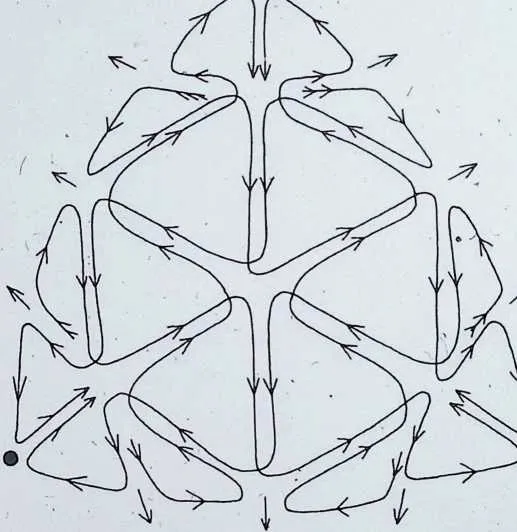
stress flow through a geodesic
structure,
128 1950
129 8
130 Manuscript sheet with sketch of
the ventilation concept for
the Wichita House,
131 1944
132 ftflflflfc
133 ■' • BS SB BBS 3SJ»
134 SmiSH
135 p***r
136 ? "I* ft ft fl ft fl fl fl fl fl ft ft fl ft ft fl ft ft ft *2 fl1 ■
137 [ 1 fl ft fl ft fl ft ft ft ft ft fl ft ft fl fl fl fl ft fl fl ft fl fl fl ft ft ft ft ft "ft C i I'll
138 111III
139 iftftftftflftflftflftftft
140 >IOlOl0jflfl)I<W
141 fl fl fl fl ft ft ft ft ft ft ft fl ft fl ft fl ft ft ft ft ft ft ft ft ft fl ft ft fl ft fj
142 5ftfl.ftftfl9ftft<flflfl
145 r >«**aS80®
146 10
147 Fountain Factory, model, 1951
148 11
Fountain Factory
149 Project for a 90% automated cotton mill:
fountain-like flow of processed materials
through the structure,
1951
150 JOACHIM
KRAUSSE
151 THINKING, BUILDING,
MD LIVING
152 THE FORMATION OF
BUCKMINSTER FULLER’S
KEY CONCEPTS
IN
HIS
153 LIGHTFUL
HOUSES
▲▲▲
- I.
- The Philosophy of the House
154 Architecture played a major role in Buckminster Fuller’s lifework yet >t was also simply another medium with which to express his influential ideas about humanity’s need to find a cosmological home within the context of technological civilization. However, according to Fuller, attaining this new home would reauire a fundamental transformation of behavioral patterns and a new epistemological heading for humanity. As ‘‘habitus’’ and ‘‘habit’’ both refer to living and living space it becomes clear that a change in ‘‘habit" is directly related to a change in ‘‘habitat.’’ Fuller was convinced that traditional housing concepts had in fact retarded the development of human thought for centuries.’ To design a new type of house would therefore require nothing less than a total break with old ‘‘habits of thought,’’ in favor of an utterly new approach. The house itself became the working model for this process, for Fuller architecture represented the relationship between people and their environment, between thought and action and between daily life and technologically advanced society.
155 The original correlation between thought process and housing design, the foundation of Fuller’s architectural activity, is barely discernible in his opus magnum Synergetics which was published between 1975 and 1978. A compendium of his geometric investigations and a presentation of his empirical systems theory, Synergetics also belies the important role that considerations about human shelter played in the development of such theories. Following the publication of five of his books in 1963,2a 68 year old Buckminster Fuller became known for the first time to the broader public as an author and theorist. Undoubtedly, some readers would have been irritated by the wide range of topics that these texts dealt with, ranging from the history of industrialization to education, math, religion and the future of the planet and ultimately to the autobiographical. To make things even more confusing Fuller employed a wide variety of literary forms and genres; didactic poetry, essays, science fiction prose, autobiographical reports, philosophical sketches and much more were put down side by side, sometimes within a single volume. Were these works of non-fiction, works with literary aspirations, or contributions to scientific discourse? This was essentially impossible to decide, therefore readers, book sellers and librarians would have had difficulties in figuring out just how to catalog them.
156 Had he not achieved international notoriety as the patent holder and architect of the extremely lightweight, freestanding geodesic dome in 1954, and had a comprehensive monograph documenting such constructions not been published in I960,3 readers would have had no way of understanding what Fuller was writing about. Architecture critic and historian Reyner Banham was the first person to place Fuller’s work within the context of modern ior,0?®’ ■ Aftnr studyinS Fuller’s writings, Banham wrote the following LffLrth’ b *!" a °.f thlS we shouldn’t forget that his idiosyncratic and human <XTit erna,<;a facility is a direct product of his preoccupation with sSi S l'S?d baCk int°the Shelter situation as a structural discipline and a methodology of environmental control.’’3
- II.
- The Beginnings of Design and Discourse in Lightful Houses
157 Within the sprawling autobiographical discoursethat was woven into so many of his texts, Buckminster Fuller repeatedly stated that the year 1927 was a turning point in his life. The autobiographical passages in Fuller’s books and lectures served a dual purpose; firstly to reassure himself, and secondly as a direct and personal encouragement to readers and listeners to do something meaningful with their lives. Autobiographical anecdotes however, simply cannot replace historical investigation. This fact was apparently more obvious to Fuller than to many of his biographers, otherwise it would be impossible to understand why he would put so much effort into collecting and organizing the documentation of his life and work, creating one of the most comprehensive private archives of the 20th century.6 Like any autobiography, Buckminster Fuller’s is certainly not free from stylization and mystification, from mistakes and even forgetfulness. The importance of that fact was underlined by the literary scholar Hugh Kenner who spoke of ‘‘Bucky’s myths,’’ not as a way of discrediting Fuller, but rather as a way to heighten the poetic understanding of this type of writing and storytelling.7
158 At least one example of the effect that this kind of mythologizing can have on memory can be found in Fuller’s autobiographical discourse, it pertains to his beginnings as an architectural designer and his idea for a house on a mast, the Dymaxion House. A series of documents, all personally dated ‘‘1927’’ by Fuller, the year in which a mystical experience ended his period of personal crisis and gave his life its decisive turn,8 blur ratherthan clarify the inception and subsequent design process of the house. It now appears that he had in fact forgotten documents that would have greatly clarified those first design concepts, in any case they were never mentioned during his lifetime.
159 At this point, a word about the state of research at the time of my first visit to the Buckminster Fuller Archive in August 1994, when it was still in Santa Barbara, California. Interested in finding the true beginnings of the design process of the Dymaxion House, I was able to identify a previously unknown group of drawings and notes that Fuller had variously labeled Lightful, Lightful Houses and Lightful Products. The group consisted of documentation of Fuller’s work from January until April of 1928, at which point the project was given the name and logo 4D. Whereas there are no house designs to be found from the legendary year 1927 (neither sketches nor notes), the Lightful works clearly illustrate Fuller’s beginnings as a designer, documenting his various inquiries and the beginnings of his design concept and philosophy. The group consists of a collection of manuscripts, several bundles of small note cards and several sketches,9 there is also a large graphite drawing which belongs to the group and a small sketch of the same. These last two items feature a centrally positioned globe with vertical structures radiating from it and the word LIGHTFUL surrounding it.10 Since these drawings contain several important motifs from Fuller’s life, work and thought process they will be discussed in some detail later. The text elements of the group spawned a 73 page, typed manuscript in two parts with the title Lightful Houses." This manuscript can be seen as a progress report for the project and as the basic text for Fuller’s 4D or 4D Time Lock book, which he personally reproduced and distributed beginning in May of 1928.12 Cut and pasted versions of the 4D manuscript in the Fuller Archive give evidence of the beginnings of the text and the alterations made to it throughout the process.13 In light of the fact that Fuller began meeting with a technical
160 . m hiA qnonsor Russel Walcott’s architectural office in February StTprepare drawings for a patent application, as well as meeting with a latent lawyer at the same time,-and that basic questions as to the structure of the‘ ‘house on a mast’’ were totally unresolved (was >tto be a hanging struc-t » or a cantilevered structure?) it becomes clear what kind of momentum Ivpn’ts must have taken on, and what kind of pressure Fuller was must have Keen working under at the time. While the patent drawings are based on a cantilevered structure with a square floor plan, Fuller was already deeply involved in working out the possibilities of a hanging structure16
161 Work on these small conceptual sketches appears to have overlapped with Fuller’s hectic patent application preparations between February and April of 1928 and they all point to a search for functional structural solutions for a house on a mast. One possible reason that this entire group of drawings faded from memory might be the fact that at that point the floor plan was still based on a square, which later turned out to have been a fundamental mistake. Compared with the careful way in which Fuller analyzed the geometry of the hexagonal floor plan in his 4D sketches,16 and the fact that he went on to discover the principle of symmetrical growth patterns at this time (growth from the center to the periphery as a temporal dimension) it becomes obvious that the seed for Synergetics lies here, in the Lightful, 4D and Dymaxion House structural studies. During the design process Fuller realized that his thoughts on organic growth and the dimension of time stood diametrically opposed to the squares and rectangles of a cubically conceived space based upon right angles, a concept which seemed so essential to the traditional designing of space. This would turn out to be the driving force in Fuller’s quest to understand how nature manages to bring forth such manifold forms in its growth processes. And it would provide the main question of Synergetics: ‘‘How does nature coordinate?’’
- III.
- A Cosmographical Approach to Housing: The Lightful Drawing
162 We should consider the big pencil drawing, which contains the inscription LIGHTFUL in the second concentric circle,17 as programmatic for as well as characteristic of its (fig. 1) author. It shows how Fuller approaches the problem of the house which is to be designed. It does not show the house but the world---the world for which the house is meant. This planetary-extraterrestrial perspective under which the earth globe is seen and put right to the center can be found again and again in his later work---just remember the Dymaxion World Map, the geoscope Spaceship Earth, and the World Game. One cannot look at this drawing without being touched. This might have to do with the fact that Fuller has drawn four highly visible symbolical objects on the corners of the paper which form the frame of reference under which everything is placed. nrHo mr ’ s°tosay> the personal coordinates. The four objects are, in the The r ° re* m---heart> sun> church, and baby. They all have a suggested halo. The lines of writing that connect the symbols form a frame:
163 ---Time exquisite light / Time
164165Time community production Time metal mechanics
166 strong autobio?ralivht i ‘es.this frame of reference a personal note with a P ica relation; Fuller’s daughter Allegra is six months old
167168at this point in time (fig. 2). The father is unemployed, at home (in a cheap apartment in Chicago), and has time to watch the baby grow up. It is being weighed and measured, and Fuller sets up a data collection in a folder that is titled Baby’s Record.'3 One can assume that the baby has become a central emblematic figure of thought in the process of design since it reappears in numerous drawings and is called President of 4D in private documents. The later discourses on the shelter’s primary function to protect the new life are derived from this context of experience.19
169 A comparatively small earth globe is found in the center of the four emblematic corner points (love, light, new life, and religious spirituality). Vertical structures that spread out like spokes or rays in all directions---omnidirectional---originate from the surface of that globe. The larger ones, forming two concentric circles around the main horizontal and vertical axes of the globe, show a dominating tree and a downward-pointing, tetrahedron-shaped mooring mast with an anchored airship at the top. This mooring mast---a construction of the British engineer Barnes Wallis---becomes the example for the construction of the house’s support and the starting point of Fuller’s reflection of the structural superiority of the tetrahedron. The tree, due to its dominant size, at first recalls the archaic myth of the tree of the world or the tree of life. He then transforms it into a structuralfunctional model for patterns of supply as well as for patterns of the distribution of tension, which can be technically adapted. This motif reappears in his later work. The Dymaxion House, for example, is also called ‘‘a house like a tree.’’ Fuller finds his examples or conceptual models forthe design not only in the artifacts of civilization but also in nature. The horizontal left side of the drawing (geographically pointing toward Asia) shows a pagoda with its hexagonal floors, surely also an inspiration for the 4D Tower. On the right side, one sees diverging high-voltage power masts, which introduce the topic of the world’s energy supply, in the inner concentric circle one finds the American skyscraper, which Fuller thoroughly analyzes in Lightful Houses in terms of its weight/volume ratio. One also finds an obelisk (as a gnomonic meter of time) and a network tower of the US Navy, a construction which goes back to the ingenious Russian constructor Vladimir Shukhov and which shows the resolution of matter in a network of interlaced rods. There is also a lighthouse, a signal-sending device for navigation and orientation.
170 The catalogue of these eight vertical structures shows that Fuller’s focus regarding building construction evolves during the investigation of the supporting function. Pillar, pole, and masts embody the evolutionary connection between buildings and humans. Just as anthropoids have evolved to walk upright and stand erect and as infants learn to stand and walk alone by leaving their mother’s helping hand, so too has the erection of buildings evolved with the help of supports. Fuller underlined the importance of this opposition to gravity for life and forthe cultural history in his essay Vertical is to live, horizontal is to die.20 It is distinctive for Fuller that the classic interpretation of the supporting function in the model of the column does not appear in his catalogue of vertical structures. We should keep in mind that the canon of proportions has been determined in the orders of columns from antiquity until the 19th century. This canon used to be the central piece of academic architecture education. Its omission must be interpreted as an act of provocation. The catalogue of vertical structures is at the same time an example of ‘‘putting aside the irrelevant.’’ The topic of the mast reappears in Fuller’s architectural work as one of resolution and temporalization. In a rapid sequence of pictures of his houses, we could see how, from the Lightful House to the Wichita Dwelling Machine, everything is organized around a mast as central axis (fig. 3). Geodesic domes as clear-span constructions do not need supports anymore. The mast only appears temporarily, as a lever or crane during the assembly. Forthe rest, the mast is dissolved in the network of rods or resoluted by the geodesic grid. The column and the corresponding structure of the beams have always been suspicious to Fuller due to the illusion of permanence connected with their classic tradition. Contrary to that, Fuller focused on the cyclical meandering of forces in regenerative circuits. More strength could be derived from feedback loops rather than from substantial permanence. Returning to the drawing, the space in between the vertical structures shows objects of everyday life, which represent paradigms, i.e. certain principles of design. The tennis racket for example demonstrates the strength of a stretched net in a frame at very low weight. The object of everyday life becomes a cause for thinking about the represented principle. It is being interpreted as a model and can therefore be adapted and made useful for the design. Fuller’s idea to replace massive ceilings with decks spanned like nets originates from his specific way of looking at the tennis racket. I would like to leave it at those examples even though the series could well be continued. What is important for me in this microanalysis is to show how Fuller’s conception and analysis, duringthe process of his very first design phase of this house on a mast, is organized in such a way that the partial solutions can be fed back again and again with the systematically structured whole. Building a house and the description of the world based on this level of experience are becoming the interdependent impulses for a human strategy of bettering the world.
- IV.
- Inside-Outing
171 The Lightful drawing does not stand for itself. It rather reveals its meaning only in the context of the discourse which Fuller unfolds in his text Lightful Houses as well as in the sketches, text drafts, and notes relating to this complex. His focus on vertical structures in the drawing, for example, demonstrates his approach to the problem of the house by designing from the inside out, instead of starting with the outer shape. In Lightful Houses he states: ‘‘One cannot design from the outside in. There can be no character unless we design from the inside out. The surface must express the interior functionalism and life.’’2' Only this maxim of his design philosophy explains the determination with which Fuller initially turns to the load-bearing structure and the supply functions of the house. We are reminded at the same time of how the topic of the ‘‘inside-outing, outside-inning’’ is becoming a leitmotif of his geometrical research. His impressive discoveries such as the Jitterbug transformation or the transformation of geodesic grids in Noah’s Ark #2 are marked by such inverse transformations, which, in mathematics, remained unrecognized for a long time.22 After all, his principle of tensegrity is also based on the basic thought of inverting the arrangement of the tension and compression components of a structure. One can say without exaggeration that Fuller’s approach to the problem of a space-time order originates in his strange propensity to inversions or his ‘‘inside-outings.’’
172 In Lightful Houses, designing from the inside out has already numerous aspects and contexts, which Fuller also mentions in his essay. The most im
173 portant one is probably the analysis of life and of the living itself because this is a constant source of inspiration for all of his designing. Dealing with growth, unfolding, transformation, and reproduction leads from the living creature and nature to the cultural techniques and artifacts. To label Fuller as a technocrat, as it has been done often, only because his solutions want to exhaust the technologies of the time without compromise, misjudges the role that nature and the organic world have played in his thinking. I have already pointed out how much the circumstance of the birth of his own child in July 1927 contributed to the change in Buckminster Fuller’s life in the winter of 1927/ 1928. This autobiographical aspect should not be underestimated because it continuously appears in the notes of that time and it interweaves the personal-familiar with the objective-general. One example is the diary that Anne Fuller, expecting the baby, has started on 7 August 1927 and which she and her husband have kept until the end of March 1928. One entry by Anne Fuller reads: ‘‘RBF terribly inspired by life. It is source, design & motivating power. Basis of planning & thinking etc." This entry from 2 February 1928 falls right into the period of feverish work on the project Fuller houses, as it has been called internally. The statement as well as the entire diary show how impulses from the private circumstances in life connect with other stimuli and are being implemented into the philosophy of the house.23The reflection of life and growth in general can also be found in the idea sketches that belong to the Lightful complex. Some can be understood as abstract ideograms, others as conceptional sketches for the house's design. Among the ideographic sketches, one finds a germ-like or calyx-like depiction which shows the unfolding of sprouts or leaves (fig. 4) asafanningout of the spectrum of colors around a central axis of time.24 Another one shows extending circles of waves around a center with the title ‘‘The Abstract I Truth.’’ From the center, a cone-shaped bundle of five rays, naming the five senses, is directed towards the circles of waves. These rays are mediating between the truth and the waves. The metaphors and images of thought used in the central passages of the text Lightful Houses very much correspond to this. Fuller interprets them abstractly but also as concrete models of elementary patterns of motion from which he then gains a space-time construction ideal.
174 V.
175 From metaphor to model: the fountain figure
176 Two of these images of thought deserve a more detailed investigation because they are very important for Fuller’s later work. They also show which traditions his thinking is following. I am talking about the ‘‘fountain of life’ ’25 and just mention the radiating ‘‘expanding sphere.’’26 Lightful Houses culminates in the passage where he draws his conclusions out of the maxim of designing from the inside out: ‘‘We will have arrived at our new artistic era of architectural expression, when our buildings will have lost their last trace of feudalists depression: when we arise in our buildings in a concentrated area of compression in opposition to gravity by means of mast or caisson reaching out in space from the vertical by tension and compression, compression diminishing as we fall off from the vertical, until we finally flow downward in direct tension. [The author has underlined this passage.] Then will our exteriors, hanging from the outward flow of the top like a great fountain, be full of lithesomeness, light and color.’’27
177 This astounding statement, by emanating from an ethics and aesthetics of h•flrtural expression, seems to fit almost seamlessly into the contempo-rarv discourse on architecture in America, which has been masterminded by nui; Sullivan, whom Fuller refers to directly in the following sentences. The nassase in its expression and verbalization does however show Fuller’s very own approach to building and to the house. What is initially striking is the fact that the introduced figure is imagined out of a process of movement, a process that can be understood and performed with the human body by using gestures in a choreographical way. This embodiment helps everybody to experience the figure. But this is not all: Fuller’s poetic description transports us right inside the flow of movement of ascending, spreadingout, and descending---as if we are a part of what executes the movement or of what happens to a moved particle. This is how we feel---almost physically---the tensions that emerge from this movement and how the forces in the flow are inverted from tension to compression. The author finds an aesthetic solution for the imagination of the stress ratios and their transformation which a static observer cannot immediately understand and which are, this we have to add, foreign to static thinking. Fuller’s description of the fountain is poetic, first of all in the understandingthat he adopts from Ralph Waldo Emerson: ‘‘Poetry means sayingthe most important things in the simplest way.’’28 The idea of the house that is to be designed has nowhere been expressed in such a concentrated way as in the passage in Lightful Houses highlighted by the author. The fountain passage unites the ethical, aesthetical, functional and structural conceptions of the author in one image, an image that has to be figured out. Its ambiguity demands concretion but already offers an indication of how a structurally functional model can be developed out of a metaphor.29The verbal concretion therefore reads in Lightful Houses: ‘‘The basic idea of the construction is that all elements shall be suspended from above rather than rest upon supports from below.’’30 The dynamic image of the fountain gives Fuller the freedom to detach himself from the professional categorization of architecture, the division in facade, body, load-bearing structure, etc. or from the building elements of wall, roof, and ceiling. This is how he arrives at a new designation of the house as an umbrella and membrane. Here we see an essential precondition for the philosophy of environment controlling, which Fuller first developed in his 1938 book Nine Chains to the Moon.3' The implications of this concept on the spacious roofing and climate controlling skin, as Norman Foster, Nicholas Grimshaw, Jorg Schlaich, Renzo Piano, Shigeru Ban, and many others are today building them, have so far only rudimentary entered architecture theory and history.32
- V.
- Fountain flows: environment controlling
178 enfor example Mies van der Rohe’s architecture has been correctly charac-rr>n«nifS S in~and~bone architecture because he has drawn the radical curtain vSiF T Skeleton bu ild ing system and the possibilities of the
179 to that• en °ne C°Uld describe Fuller’s building constructions
180 to become m<=r 3 ey aretryingto get rid even of the skeleton itself in order
181 in two wavs ne j Ttle res°lution of the skeleton can be described
182 form of the builriin °ne and rnakingtbe mast or supports temporary in the ingTunctiorinto therane' °n the °ther hand by transferring the support-the skin is subdivideJT "etwork of rods of the cellular trusses into which (the house) and its ml'" Or er t0 create tbe best ratio between the system ironment, the membrane, by opening and closingthe cells or facets, can be used to regulate the light, temperature, and humidity to optimize the heating, the lighting, and the airing. The most impressive realizations of geodesic domes, the Climatron in the botanical gardens in St. Louis, Missouri of 1960 and the EXPO dome (fig. 5,6) at the World Exhibition 1967 in Montreal, are based on this concept of intelligent environment controlling. There is a complete separation of the building’s skin and the interior structure, including the floor areas, the hallways, the ramps, the escalators, etc.---all this is now becoming interior architecture. One can say that the intelligent skin of the dome represents the interface between the system house and its environment. It equally abolishes facade, roof, and outer walls and substitutes them completely.
183 The fountain figure even acts as an accoucheur for this concept of the completely free inner horizontal as well as vertical room organization, as it manifests itself in the EXPO dome. It is not sufficient to characterize the geodesic domes as light weight clear-span structures only. This is why Fuller has turned his attention to the inner and outer flows---of air, water, energy, material of supply and disposal, as well as to the human procedure of action. Hence, we find the fountain image from Lightful Houses again almost two decades later, in the description of the Wichita House, this time relating to the functions of the house technology. ‘‘With the central vantage point for generating air, light, sound and work services, we discover that those services when in operation describe fountain-like flows upward, outward, downward in all directions with concentric flow for recycling below. We discover also that this fountain flow can be reversed, but in either case maximum coverage with least distance is effected.’’33 In the Wichita House (fig. 7--9), Fuller most carefully examines the mostly natural air circulation. The air circulation is a result of the almost hemispherical shape of the house, the inlets, and the aerodynamic extraction fan. The circulation shows afountain figure just like it would be in the natural atmosphere. The ingenious heating and airing concepts of the geodesic domes are pursuing the discoveries made by the Wichita House.
184 VII.
185 Fountain factory and
the study of natural systems
186 In 1951, after having finished his work on the geodesic grids, Fuller develops, together with his students at the North Carolina State College, a new type of building for a cotton mill. The name Fountain Factory (fig. 10,11) is very appropriate because the entire processing of the raw material is organized in this very figure. The raw material is being transported upstairs inside a central supply shaft, it is then distributed outside and falls through the eight stories from one treatment stage to the other in order to land as the finished product on the bottom floor from where it is then carted away.34 It is decisive that for the very first time the enclosure of the geodesic dome is completely separated from the inner structure. The ceilings of different radial lengths are light, planar and open frame structures of the octet truss type, one of Fuller’s three key inventions. They are anchored on a hexagonal shaft and suspended at the periphery, from the top of the dome. The 3/4 sphere carries only itself and is an absolute climate controlling skin that offers all possibilities for a free inner organization. Its spherical shape is climate active in the sense that it allows and maintains the reversible airflow in the flow pattern of a fountain and
187 -„ro initiates an independent air conditioning. An eminent ecological argu-fhasnow enriched the structural criticism of the rectangle and the cube •me rHtecture-‘‘The fountain flow is appropriate for maintaining relatively in 3 mnhere flow in winter, and the reverse fountain is most efficient maintainingrelatively cool atmospheric flow in summer. In neither of these fountain flow cases does energy set up a chaotic echo system as we find it doing in the indiscriminate, cubical, squash racquet court shaped chambers in which we now live.’’35 We can see how often the image of the fountain reappears in Fullers research and designs over a long period of time. And how it is again and again given new meanings as a model, as a model for a number of sub-functions that have to be coordinated organically---as it is done by a living organism. Fuller’s unique way as a thinker and designer cannot be characterized by ‘‘form giving’’ but rather by finding out and examining the emerging of dynamic systems in the interaction with their environment, in order to favorably regulate them---or better---to let them favorably regulate themselves. This is why he has devoted great attention to the studies of natural systems and has described them in such a fascinating manner. Out of these analyses and descriptions, he develops a system theory independat of the natural sciences, which takes thoughts as well as the construction of Environmental controls into consideration. Here an excerpt of his lectures which Fuller has given for his staff of the Wichita House and for the technicians of the airplane factory of Beech Aircraft, Wichita, Kansas, where the prototype of his house was built: ‘‘As afountain of water is seen to operate freely in space as a system, or as light outdoors in the night creates a hemispherical system of illuminated space by atmospheric refraction of light, so also do these other dynamic functions of heat, light, air, sound and smell constitute natural systems of physical phenomena so that our hemispherical house is seen to afford only an isolating enclosure which complements the flow and systematic refraction angles and protects them from disturbance by dynamic conditions exterior to the house---as does a camp chimney protect the flame or an electronic tube protect the free functioning of its central element. The principle demonstrated by the boomerang refractions in all directions is articulated by our coincident energy systems of light, heat, air, sound, smell, etc. positioned at thecenterof our house. In this way our house is dynamically faired (if not more so) as is an airplane, in order to induce a little parasite drag internally and externally to all the slip streams of dynamics as can be measurably arranged. Thus a minimum of energy provides a maximum of controlled service performance. 36 When Buckminster Fuller met the biologist Ludwig von Bertalanffy in the early 1960s, he noticed a complete correspondence of his theory of natural systems which he had elaborated by modeling his house over decades with Bertalanffy’s general system theory. The general system theory had developed out of the necessity to explain the organism as a holistic system in interaction with its specific environment.37 Fuller’s house-thinking continuously developed between 1928 and 1967, which was by no means completed with the EXPO dome, suddenly found itself on the point of inter-
188 t°h "tu ‘‘!Uper disciPlines’’ cybernetics, ecology, and general has mad e house was hke no other artifact a holistic model which
189 task+ha 5e OrgauIC’’ integration °f sub-functions and sub-systems the with a rnmr>|et'gin • jV'ng exPer>mentally researched and demonstrated this systems is nrl 6/J? ependent aPPr°ach of a practical theory of natural have to ha mn of the remaining achievements of Buckminster Fuller. He will th*hfstory°f the great P’---the system theory by
- 1.
- ‘‘Thinking is retarded centuries by house habits." R. Buckminster Fuller, Designinga New Industry, Wichita (Kansas), 1946,13.
190 The American sociologist Thorstein Veblen underlines the defining role of technology in the transformation of ‘‘habits of thought’’ in his book The Place of Science in Modern Civilization (1906) New York 1961,17.
- 2.
- R. Buckminster Fuller, ‘‘Untitled Epic Poem on the History of Industrialization," in: New York 1962; idem, Education Automation, Carbondale, III.,
191 1962; idem, Ideas and Integrities. A spontaneous Autobiographical Disclosure, Englewood Cliffs, NJ, 1963; idem, No More Secondhand God and other Writings, Carbondale, III., 1963; idem, Nine Chains to the Moon, (1938), Rev. ed. Carbondale, III.,1963.
- 3.
- Robert Marks, The Dymaxion World of Buckminster Fuller, New York 1960.
- 4.
- Reyner Banham, Theory and Design in the First Machine Age, London 1960,chapter 22.
- 5.
- Reyner Banham, ‘‘The Dymaxicrat" (1936), in: A Critic Writes. Essays by Reyner Banham, Berkeley, Los Angeles, London 1996, 93 f.
- 6.
- R. Buckminster Fuller, ‘‘Guinea Pig B,’’ Introduction for Inventions. The Patented Works of R. Buckminster Fuller, New York 1983, VII---XXVII. See Joachim Krausse, ‘‘Arche und Chronik von Guinea Pig B. Buckminster Fullers aufgezeichnetes Lebensexperiment,’’ in: Lesebuch fur Designer, ed., Winfried Scheuer, Stuttgart, Leipzig 2000, 202--225; Hsiao-Yun Chu, ‘‘Paper Mausoleum. The Archive of R. Buckminster Fuller," in: New Views on R. Buckminster Fuller, ed., Hsiao-Yun Chu and Roberto G. Trujillo, Stanford, CA, 2009, 6--22.
- 7.
- Hugh Kenner, Bucky. A Guided Tour of Buckminster Fuller, New York 1973,7f.
- 8.
- R. Buckminster Fuller. Autobiographical Monologue/Scenario, ed., Robert Snyder, New York 1980,35ff.
- 9.
- Manuscript Files 28.01.01/28.10.01 (reboxed 6/21/93), Folder l-X, Buckminster Fuller Archive, Santa Barbara, now R. Buckminster Fuller Collection, Stanford University Libraries, Fuller MSS, M 1090: 8:1-2.
- 10.
- Printed with some sketches and extracts from the Lightful-papers in: Your Private Sky. R. Buckminster Fuller. The Art of Design Science, ed., Joachim Krausse, Claude Lichtenstein, Baden (Switzerland) 1999, Chapter ‘‘Lightful Houses / 4D," 80ff. (In all following quotes listed as YPS 1)
- 11.
- Lightful Houses, typed manuscript, 73 pages, in two parts. Fuller MSS, M 1090:8:2. The first part, 1--25, is printed in Your Private Sky.
192 R. Buckminster Fuller. Discourse, ed., Joachim Krausse, Claude Lichtenstein, Baden (Switzerland) 2001, 64--74, commentary, 62.
193 (In all following quotes listed as YPS 2)
- 12.
- R. Buckminster Fuller, 4D Time Lock, Chicago 1928, reprint Albuquerque, NM, 1972.
- 13.
- Manuscript Files 28.01.01, Folder II (see note 9).
- 14.
- Anne Hewlett Fuller, ‘‘Diary starting August 7th when I came out to Chicago with Bucky," in: Dymaxion Chronofile, vol. 30 (1927-1928), R. Buckminster Fuller Collection, Stanford University.
- 15.
- YPS1,85ff.
- 16.
- YPS 1,14f„ 134; YPS 2, 92--96.
- 17.
- YPS 1,80-83.
- 18.
- YPS 1,78 f.
- 19.
- A handwritten note from Fuller on the reverse side of the drawing reads: ‘‘Philosophical Protection: Tower -Time -Love."
- 20.
- R. Buckminster Fuller, ‘‘Vertical is to live, horizontal is to die," in: YPS 2, 279ff.
- 21.
- R. Buckminster Fuller, "Lightful Houses" (1928), in: YPS 2,70.
- 22.
- Cf. Joachim Krausse / Claude Lichtenstein, ‘‘Earthwalking---skyriding. An invitation to join Buckminster Fuller on a voyage of discovery,"
194 in: YPS 2, the section ‘‘Five ways to dance the Jitterbug," 23--31;
195 R. Buckminster Fuller, "Noah's Ark #2," in: YPS 2,176 ff.
- 23.
- See note 14.
- 24.
- See the illustration in YPS 1, 84.
- 25.
- Fuller leaves no doubt as to the source of the literary metaphor "Fountain of Life’’ by directly qouting a line written by his great aunt Margaret Fuller-Ossoli (1810-1850) in the year 1842, in the chapter entitled ‘‘Margaret Fuller's Prophecy" from his book Ideas and Integreties:
196 ‘‘Truth is the one great means by which alone progress can be essentially furthered. Truth is the nursing mother of genius. No man can be absolutely true to himself, eschwing cant, compromise, servile imitation, and complaisance, without becoming original, for there is in every creature a fountain of life which, if not choked back by stones and other dead rubbish, will create a fresh atmosphere, and bring to life fresh beauty. And it is the same with the nation as with the individual man." In the year 1929, while working on the house design, Fuller and his sister Rosamund maintained a correspondence in which they discussed the extraordinary importance of their great aunt for the cultural history of the United States. Letters to his sister Rosamund Fuller, In: YPS 1,67 and 69f.
- 26.
- Joachim Krausse, ‘‘Architektur der Hochtechnologie. Buckminster Fuller Dymaxion House 1929," in: Stefan Andriopoulos, Bernhard Dotzler, ed., 1929. BeitragezurArchaologie der Median, Frankfurt am Main 2002, 219ff.
- 27.
- R. Buckminster Fuller, ‘‘Lightful Houses,’’ in: YPS 2, 70.
- 28.
- R. Buckminster Fuller, ‘‘Mistake Mystique’’ (1979), in: YPS 2, 296.
- 29.
- Cf. YPS 1, 85--87 (images: YPS 1,86,85; YPS 2,63; YPS 1,87).
- 30.
- YPS 1,114.
- 31.
- r, Buckminster Fuller, Nine Chains to the Moon, Philadelphia 1938,43.
- 32.
- Reyner Banham, The Age of the Masters. XI Personal View of Modern Architecture, rev. edition London 1975,130-133, on Fuller and the Climatron St. Louis; Joachim Krausse, ‘‘Environment Controlling -fur eine Welt der Vielen. Buckminster Fullers Wirkung in Groflbritannien,’’ in: Norman Foster. Architecture is about people, ed. by Susanne Anna, Cologne 2002, 97 ff.
- 33.
- R. Buckminster Fuller, Designing a new industry, Wichita, Kansas, 1946, 35.
- 34.
- R. Buckminster Fuller, ‘‘The 90% Automatic Cotton Mill" (1951), in: YPS 1,336-339.
- 35.
- R. Buckminster Fuller, Designing a new industry, 35.
- 36.
- Ibid., 35.
- 37.
- Ludwig von Bertalanffy, ‘‘The Theory of Open Systems in Physics and Biology,’’ in: Science, 111,23-29; Ludwig von Bertalanffy, Genera/System Theory, New York 1963.
197198joach,mxrausse/weareaelastronauts


201 DANA
MILLER
202 GEDANKENMUSTER
203 BUCKMINSTER
FULLER,
DER
WISSENSCHAFTLER-
KUNSTLER
204 Intuition und Asthetik Ibsen bei uns automatisch
ein Bewusstsein fur vorhandene Gelegenherten aus,
die wir nutzen kbnnen, um angesichts herannahender Ereigmsse,
potenzieller Realisationen oder unvorhergesehenen
Durchbruchen in Kunst, Technik und anderen Gebieten der menschlichen
Produktivitat neuartige Verhaltensweisen Oder Stellungnahmen
zu erwagen und selektiv in die Wege zu leiten.
205 Buckminster Fuller,
Vorwort zu Projections:
Anti-Moterialism,
1970
206 Buckminster Fuller besteht darauf, dass er bei der Ausarbeitung seiner Konstruktionen keinesfalls auf die optische Wirkung achtet. Viele seiner Werke sind aber als asthetische Erkundungen zu verstehen. Wenn es einem seiner Werke an Schbnheit fehlt, weifi Fuller, dass es nicht stimmig sein kann. Architekten und Ingenieure begegnen Fuller nicht selten mit Skepsis, und doch bewegt sich Fuller zeitlebens mit groBem Geschick in kiinstlerischen Kreisen. Fur ihn sind Kiinstler in der einzigartigen Position, Lbsungen fur die Konstruktionsprobleme der Menschheit zu konzipieren. Er spricht ihnen die Fahigkeit zu, die der Natur inharenten Strukturen zu erfassen und auf Designanwendungen ubertragen zu kbnnen. Ganz bewusst kultiviert Fuller Freundschaften mit Kunstlern, da sie ihn inspirieren und er sich ihnen verwandt f ii hit. Dieser Essay handelt von einigen Episoden seines Lebens, das sich immer wieder mit den Werdegangen von Bild-hauern, Malern, Film-und Videokunstlern kreuzt.
207 Fullers unerschutterlicher Glaube an das experimentell erfahrbare Wissen ist ein Schlussel zum Verstandnis seiner Philosophie. Das Austesten von Hypothesen anhand der Methode „Versuch und Irrtum‘‘ und die Akzeptanz des Fehlschlags als Teil des Findungsprozesses sind grundlegend fur seine ..experimented fundierte Mathematik", auf der sein weit reichendes Designprogramm aufbaut. Die Wurzeln seiner Herangehensweise reichen zuriick bis in die Kindheit. Da Fuller als Kleinkind stark schielt, kann er nur Umrisse und Farben erkennen. Sein fruhestes Verstandnis der Welt be-ruht deshalb auf seiner Fantasie und physikalischen Intuition. Im Kindergarten gibt sein Erzieher den Kindern Zahnstocher und Erbsen, mit denen sie Hauser bauen sollen. „Alle anderen Kinder, von denen keines Augenprob-leme hatte, bastelten ein rechteckiges Haus‘‘, erinnert er sich. „Da ich die Rechteckigkeit in meiner Umgebung bis dahin nicht wahrgenommen hatte, verwendete ich nur meinen Tastsinn. Die Muskeln meiner Finger fanden nur bei dem Dreieck eine natiirliche Formstabilitat. Ich tastete mich also vor und erzeugte eine Kombination von Balken in Oktaeder-Tetraeder-Form…Diese Erfahrung war unzweifelhaft der Auslbser dafur, dass ich im Altervon 15 Jahren begann, nach dem strukturellen Koordinatensystem der atur zu suchen. 1 Derteleologisch orientierte Einsatz des „naturinharenten strukturellen Koordinatensystems" zum Nutzen der gesamten Menschheit ®n™‘2kelt s,ch 2ur Grundlage von Fullers Wirken als Designer und Wissen-i t ?US seinem Glauben an ein ..naturliches Koordinatensystem*1 cniidl .rLdaSlaU.e nach diesen PrinziPien errichteten Gebaude strukturell rirhtiO«nd astetlsch ausgewogen sein wiirden -sie wurden nicht nur „nchtig aussehen, sondern sich auch so anfiihlen.
208 Fullers Uberzeugung von der Wirkkraft der Intuition sowie von empirischen informationen bedeutet auch, dass er fur seine Revolution der Designwissen- schaft sowohl Kunstler als auch Wissenschaftler und Designer bendtigt. Kunstler konnen Strukturen erkennen und Methoden entwickeln, um sie auf dreidimensionale Modelle und weitere Anwendungen zu ubertragen. Dies gelingt ihnen nicht selten im Vorfeld von wissenschaftlichen Entdeckungen. Nach Fullers Ansicht beruht dies darauf, dass Kunstler der Spezialisierung widerstehen und so ihre eigene Fahigkeit des unabhangigen, intuitiven und iibergreifenden Denkens bewahren konnen, wahrend Wissenschaftler durch eine rigorose Ausbildung in das Korsett der institutionalisierten Me-thodologie und Spezialisierung gezwangt werden.3 „Kiinstler sind heute aufierordentlich wichtig fur die Gesellschaft. Kunstler haben sich die Integrity der Kindheit bewahrt, ihre Begabungen sind noch intakt, und so schlagen sie eine Briicke zwischen den Kunsten und den Wissenschaften. Ihr groStes Talent ist die Fahigkeit, durch Vorstellungskraft Konzepte aufzustellen. Plotzlich erkennen wir, wie wichtig dieses konzeptuelle Den-ken ist."4 Nur auf der Basis des Verstandes lasst sich Wissenschaft be-treiben und Kunst schaffen: „Only minds can conduct science and produce art",5 und es ist Fullers hochstes Kompliment, jemanden als „Scientist-Artist" („Wissenschaftler-Kunstler‘‘) zu bezeichnen.
209 ..Romany Marie’s Tavern", gefuhrt von der rumanischen Emigrantin Marie Marchand, ist die Kulisse fur Fullers Entwicklung. Diese New Yorker Version eines Pariser Cafes wird von Kiinstlern und Intellektuellen frequentiert, zu denen sich in den spaten 1920er-Jahren auch Fuller als regelmafiiger Gast gesellt. Hier beginnt Fuller als Universalgebildeter und Autodidakt, dessen Bildung im zweifachen Rauswurf aus der Harvard-Universitat einen Abschluss gefunden hat, sein Image des unkonventionellen Querdenkers zu formen, der sich nicht durch akademische und wirtschaftliche Pramissen einschran-ken lasst. In diesem Umfeld scharft Fuller seine rhetorische Gewandtheit und schwingt Reden liber Dymaxion House - die Vision einer Wohnmaschine, die an einem Mast hangt, der sich zur Sonne ausrichten kann.
210 Unterden Kiinstlern, die Fuller im Romany Marie’s trifft, ist auch derjunge Isamu Noguchi. Als Noguchi in ein neues Atelier mit verhangten Fenstern zieht, iibernimmt Fuller die Innenausstattung. „Unter Buckys Einfluss habe ich alles in Silber angestrichen, so dass die Abwesenheit von Schatten fast blendete", erinnert sich Noguchi. „l ch schuf dort sein Portrat in verchromter Bronze -ebenfalls eine Form ohne Schatten."6 (Abb. 1) Mehr als drei Jahr-zehnte vor Warhols mit Silberfolie verkleideter Factory hat Fuller die Vision eines ganzlich reflektierenden, silbernen Ateliers fur Noguchi. Die spie-gelnde Biiste ist eines der ersten verchromten Kunstwerke. Das Verfahren hat bis dahin vor allem in der Autoindustrie Verwendung gefunden. Die Wahl des Materials ist Fuller, dem Verfechter einerTechnik, die im Dienst der Menschheit stehen soil, angemessen. Zu jener Zeit hat Noguchi bereits ein Auskommen als Kunstler. Fuller, der regelmafiig in Geldnbten ist, schlaft nicht selten auf dem FuBboden des Ateliers. Sie werden Freunde auf Le-benszeit, und ein gegenseitiger Einfluss lasst sich an Werken wie Noguchis Miss Expanding Universe (Abb. 2) beziehungsweise an den gemeinsam gestalteten stromlinienformigen Modellen des Dymaxion Car ablesen (Abb. 3).7
211 1929 zieht Marie mit ihrem Lokal in die Minetta Street um. Fuller iibernimmt die neue Gestaltung. Wande und Rohre bekommen einen silbernen Anstrich
212 von John McHale und Shoji Sadao gegen Ende der 1950er-Jahre wie Dome Over Manhattan und Cloud Nine sollen diese Unterschiede noch welter auf-heben. Letzteres wird als Fotomontage prasentiert, in der kugelformige Wolkenstadte liber einer majestatischen Landschaft mit tiefen Canyons treiben (Abb. 9). Diese monumentalen, schwebenden Lebensraume sind die logische Schlussfolgerung aus Fullers friihen Experimenten mit raumum-fassenden Installationen und seiner Betonung von Schwungkraft und Lichtdurchflutung.
213 Seit Mitte der 1950er-Jahre ist Fuller zunehmend in Galerie-und Museums- ausstellungen wie auch in Kunstzeitschriften prasent. Eine Uberblicksaus- stellung von Fullers Werken im Walker Art Center in Minneapolis wird geplant. H. Harvard Arnason, der damalige Direktor, ist einer von Fullers wichtigsten Unterstiitzern, und Gyorgy Kepes, Professor fiirVisuelles Design am Massachusetts Institute of Technology, soil das Ausstellungsdesign ausfiihren. Die Schau kommt nicht zustande, aber 1959/60 organisiert Arthur Drexler, Kurator fur Architektur am Museum of Modern Art, eine Ausstellung von Fullers Werken im Skulpturengarten des Museums: In Three Structures wird eine eine geodatische Kuppel, ein Raumfachwerk und ein Tensegrity-Mast gezeigt. Parallel dazu lauft eine kleinere Begleitausstellung in den Innenrau-men des Museums mit Modellen und didaktischen Tafeln von Fuller. In einem Wandtext schreibt Drexler: „Fullers Genialitat liegt hauptsachlich in dem Einblick in die universale Ordnung, den uns seine Ideen vermitteln. Diese Errungenschaft erhebt ihn liber andere groBe Dichter, Wissenschaftler und Kiinstler.1120 Als interessante Randnotiz ist zu bemerken, dass Jean Tinguelys berlihmt-beriichtigtes Werk Homage to New York (1960) von Fullers Kuppel sprichwortlich ausgebriitet wurde (Abb. 10). Billy Kluver und einige Ingenieure von Bell Labs errichten im Verlauf mehrerer Wochen den sich selbst zerstorenden Mechanismus des Schweizer Klinstlers in Fullers Kuppel im Garten des MoMA. Dies ist der Beginn von Kllivers jahrzehntelanger Vermitt-lungsarbeit zwischen Kiinstlern und Ingenieuren.
214 Fullers Anerkennung erreicht Mitte der 1960er-Jahre einen Hohepunkt. Er schreibt in kurzerZeit mehrere Bucher und wird in umfangreichen Presse-berichten vorgestellt, unter anderem in einer 1964 erscheinenden Titelstory der Time. Zwei Jahre darauf portratiert Calvin Tomkins Fuller im New Yorker.21 Fuller wird nicht mehr nur als Ingenieur, Architekt oder Erfinder angesehen. Peter Blake bezeichnet ihn „einen der groBten Schaffenden schoner Skulptu-ren in diesem Jahrhundert".22 Fullers Schriften gewinnen fur Kiinstler zunehmend an Bedeutung, da der Dialog zwischen den Klinsten und den Wissen-schaften, angefiihrt von Personlichkeiten wie C. P. Snow und Kepes, starker in den Fokus rlickt. Im Jahr 1965 leistet Fuller mit dem Aufsatz„Conceptuality of Fundamental Structures" seinen Beitrag zu dem Band Structure in Art and in Science in dervon Kepes herausgegebenen Reihe Vision + Value. Fuller schreibt: „Die MeiBel-und-Pinsel-Klinstler, die den Literaten zum Trotz, den Wissenschaftlern anhand von ,nicht-reprasentativen‘ Quasi-Abstraktio-nen in die ,Nicht-Konzeptionalitat‘ zu folgen versuchten, erweisen sich nun als diejenigen, die mtuitiv und in ihrer Uberzeugung verankert, in der Lage sind, wirklich der Wissenschaft zu folgen oder sie sogar im Spiel der intuitiven Erforschung anzufiihren."23
215 In ihrer kritischen Besprechung der Reihe Vision + Value schreiben John Chandler und Lucy Lippard in ..Visual Art and the Invisible World": .Wissenschaftler erhoffen sich von der Kunst anscheinend die Methode Oder den Prozess des Kunstschaffenden, seine Gabe der Visualisierung, die ein wichtiger Teil der Methode Galileos und der friihen Wissenschaft war, der im letzten Jahrhundert jedoch vernachlassigt wurde.‘‘ Es ist nicht ver-wunderlich, dass Fuller eine wichtige Rolle in ihrem Aufsatz einnimmt, hat er doch erklart, liber ein physikalisches Modell zu verfugen, das Kiinstlern und Wissenschaftlern gleichermaflen zur Verbildlichung der uns umgeben-den unsichtbaren Krafte dienen konnte: ..Buckminster Fuller ist der Meinung, die Offentlichkeit habe hauptsachlich deswegen keine Chance, sich liber die ,sich entfaltenden Realitaten' der Wissenschaften ausreichend zu informieren, weil die Schriftsteller nicht in der Lage seien, in Bereiche zu folgen, in denen es keine konzeptionellen Modelle gibt. Bildende Kunstler seien aber fahig, in diese Gebiete vorzustoBen, und sie kbnnen auch einen Weg ,im Spiel der intuitiven Erforschung1 weisen. Das Ergebnis sei jedoch, dass weder Klinstler noch Wissenschaftlervon derdurch die Sprache begrenz-ten Offentlichkeit ganzlich verstanden werden. Fuller erhebt den Anspruch, seine Entdeckung des.natiirlichen vierachsigen, 60°-winkligen, tetraedrisch koordinierten Systems' habe der .Konzeptionalitat der dynamischen Strukturprinzipien ihre wissenschaftliche Giiltigkeit' zuriickgegeben."24
216 Chandlers und Lippards Zusammenfassung der Diskussion lasst eine „neue Empfindsamkeit" anklingen, die Susan Sontag 1965 in „One Culture and the New Sensibility" beschreibt. Sontag spricht von einem neuen kulturellen Establishment, das sich den wissenschaftlichen Neuerungen ungeniert bedient und eher der Skulptur als der Literatur zugewandt ist. „Zum neuen Establishment gehoren einige Maier, Bildhauer, Architekten, Sozialplaner, Regisseure, Fernsehtechniker, Neurologen, Musiker, Elektroingenieure, Tan-zer, Philosophen und Soziologen …Einige Ausgangstexte fur diese neue kulturelle Orientierung sind die Schriften von …Buckminster Fuller, Marshall McLuhan, John Cage, Andre Breton, Roland Barthes…[und] Gyorgy Kepes."25
217 Fullers wachsender Einfluss spiegelt sich auch in der Kunst der 1960er-Jahre wieder, zum Beispiel in der MaBstabe setzenden Ausstellung Primary Structures im Jahre 1966. In dieser Schau klindigen sich die grofiformatigen, geome-trisch angelegten Skulpturenderzeitgenossischen Kunst an. Der Kurator der Ausstellung, Kynaston McShine, beschreibt das Werk von Forrest Myers mit Fullers Wortschbpf ung Tensegrity und erlautert im Katalog: „Die Strukturen von Buckminster Fuller sind grundlegend fur einige der Verfahren, mit denen viele Kunstler wie Forrest Myers arbeiten. Fullers Theorien, die mittlerweile weithin akzeptiert und umgesetzt werden, ermbglichen uns Einblicke in die dynamische Struktur der Natur und in die Wechselbeziehungen von Physik, Mathematik und Philosophic."26McShine sieht auch eine direkte Verbindung von Fuller und Sol LeWitts Strukturen und beschreibt ihr kubisches weiBes Gefiige als ..Struktur, die dem ahnelt, was Fuller als .comprehensive design' bezeichnet. Den modularen Mustern, die in der Natur so grundlegend und universal zu finden sind, wird in diesem Werk eine auBergewohnliche Schonheit verliehen."27 Sogar die Time bemerkt in einer Rezension, die Kunstler seien wie „warmes Wachs fur den geodatischen Architekten Buckminster Fuller".28
218 Einige der in Primary Structures vertretenen Kunstler, und zwar Peter Forakis, Robert Grosvenor und Myers, stellen auch in der Park Place Gallery aus. In seinem 1966 erschienenen Aufsatz ..Entropy and the New Monuments" bemerkt Robert Smithson, die Park-Place-Gruppe habe „die .Modelle' der
219 .vektoralen’ Geometrie von R. Buckminster Fuller auf hochst erstaunliche Weise abgewandelt". Erfahrt fort:
220 Einige Wissenschaftler erzahlen Fuller,
die vierte Dimension sei „Ha-Ha‘‘, mit anderen Worten,
sie sei das Lachen an sich …Lachen sei in gewisser Weise
eine Art entropischer „Verbalisierung‘‘.
221 Welche Moglichkeiten sehen Kunstler, diese verbale Entropie,
eben dieses „Ha-Ha‘‘, auf „Festkdrpermodelle‘‘ zu ubertragen?
Einige der Park-Place-Kunstler scheinen
diesen „seltsamen‘‘ Umstand eingehend zu erforschen.
Ordnungund Chaos dervierten Dimension kbnnten
zwischen Lachen und Kristallstrukturangesiedelt werden -
als Hilfsmittel fur uneingeschrankte Spekulation.29
222 Trotz allem findet Fuller in kunstgeschichtlichen Abhandlungen liber Primary Structures nur selten Erwahnung.30 Der Grund hierfiir liegt vielleicht darin, dass sich die Park-Place-Kunstler auf lange Sicht nicht als Verfechter des Minimalismus erweisen -der Kunstrichtung, die angeblich in dieser Aus- stellung aus derTaufe gehoben wird.
223 Smithson zitiert Fuller nicht nur in ..Entropy and the New Monuments".3' Er fiihlt sich von Fuller und Alexander Graham Bellangezogen, die beide versuchen, im Chaos der naturlichen Welt grundlegende Ordnungsprinzipien zu entdecken, die kunstlerisch auf eine monumentale Ebene ubertragbar sind. Fur sie existiert kein Konflikt zwischen organischen Strukturen und modernerTechnologic. Fullers Ausfliige in die Kartografie liefern Smithson eine Vorlage fur alternative Vermessungssysteme (Abb. 11). 1968 schreibt Smithson in „A Museum of Language in the Vicinity of Art": „R. Buckminster Fuller hat eine Schreibform entwickelt, die nicht nur pragmatisch und praktisch, sondern auch erstaunlich und teratologisch ist. Fullers Dym- axion Projection and World Energy Map ist eine .Cosmographia1, die Ptole-maus belegt, der sagte, nur ein Kunstler sei in der Lage, etwas korrekt darzustellen."32 (Abb. 12)
224 Im Friihjahr des Jahres 1967 sind Fullers Werke Teil der Ausstellung Projects for Macrostructures in der Richard Feigen Gallery in New York. Zu sehen sind Project for Floating Cloud Structure (Cloud Nine Project), Tetra City, ein groBformatiger, schwebender Tetraeder, der bis zu eine Million Menschen im New Yorker Hafen beherbergen soil, und Harlem Redesign, ein ..Slumsa- nierungs-Projekt", das bereits 1965 im Esquire vorgestellt wurde.33 (Abb. 13) Zu den Kiinstlern dieser Ausstellung gehoren unter anderen Ronald Bladen, Christo, Hans Hollein, Claes Oldenburg und Tony Smith. Tetra City wurde auf der Titelseite des Arts Magazine im Marz 1967 abgebildet, kombi-niert mit der kontroversen Schlagzeile „A Minimal Future?" (Abb. 14) Im Aufsatz ..Models and Monuments: The Plague of Architecture" vertritt Dan Graham die Ansicht, die Ausstellung bei Feigen sei auffallend stark auf die Presentation von Fullers Megastrukturprojekten hin ausgerichtet.34 Aber obwohl Fuller in Museen, Galerien und Kunstzeitschriften uniibersehbar Present ist, bleibt sein Beitrag zur Kunst der 1960er-Jahre in jungeren Be-trachtungen dieser Zeit unberucksichtigt, und auch in der Literatur zu ausXklAmmlStrSe'ne Beteili&unSan derdamaligen Kunstwelt weitgehend
225 Im Sommer 1967 ist Fuller so present wie nie zuvor, als seine Arbeit Skybreak Sphere fur den Pavilion der USA auf der Expo in Montreal enthulit wird.35 ..Creative America" ist das Thema des amerikanischen Pavilions, in dem Alan Solomon eine Ausstellung fur zeitgenossische Kunst mit dem TitelAmerican Painting Now kuratiert. Solomon entscheidet sich fur die Presentation groB-formatiger Gemalde mit der Ausnahme einer weichen Skulptur von Claes Oldenburg, die von der Decke herabhangt (Abb. 15). Jasper Johns schlagt ein Gemalde vor, das auf Fullers Dymaxion Air-Ocean Worldmap basiert: „Es schien mir logisch …eine Arbeit zu entwerfen, die das Motivder Struktur wieder aufgreift."36 Johns schickt Cage als Fiirsprecherzu Fuller und be-kommt dessen Genehmigung fur die Verwendung der Karte. Johns schreibt daraufhin an Fuller und erklart: „lch bin sehr erfreut. Die 6 Fu13 groBen Dreiecke werde ich mit Scharnieren versehen, damit so die Form des Bildes in anderer Umgebung verandert werden kann.‘‘37 Johns setzt dieses enorme Werk -sein erstes und einziges Gemalde einer Weltkarte -im Atelier auf 22 einzelnenTafeln um (Abb. 16). ..Dieverwendeten Innenrahmen sind gewinkelt, damit das Bild zu einem Ikosaeder geformt werden kann, aber die Unhand- lichkeit und das Gewicht des Werks verurteilen dieses Vorhaben zum Schei-tern.‘‘38Johns Idee entsprechend entsteht ein vielteiliges Gemalde ohne ein-deutige Perspektive, das exemplarisch fur Fullers Auffassung einer „flieBenden Geografie" stehen soil. Als Johns das zusammengesetzte Bild zum ersten Mai in Montreal sieht, ist er enttauscht, denn es kommt seiner Meinung nach Fullers Konzeptzu nahe (Abb. 17). In den folgenden vier Jahren uberarbeitet Johns das Gemalde. Neben anderen Veranderungen iibermalt er den Temperaturindex der Fullerschen Vorlage und entfernt schlieBlich die Scharniere. Das endgliltige Ergebnis bezeichnet er als „eine kompli-zierte visuelle Erfahrung. Es ist zugleich Karte und Bild."39
226 Ende der 1960er-Jahre stellt Fuller die Dominanz der unsichtbaren Krafte und Vektoren, die unseren Lebensraum strukturieren, dabei vor allem das elektromagnetische Spektrum, in den Vordergrund seines umfangreichen Vortragsprogramms. Seine Kuppel in Montreal gilt als Inbegriff von Lichtdurch-flutung, Transparenz und der Auflosungvon Stofflichkeit. Diese Demateri-alisierung der Architektur ist die logische Folge von Fullers Philosophie der Fliichtigkeit und korrespondiert mit der zeitgleichen Dematerialisierung des Kunstobjekts. Im Vorwort fur den Katalog zur Ausstellung Projections: Anti-Materialism, die 1970 im La Jolla Museum of Artausgerichtet wird, schreibt Fuller: „Die Architektur von morgen wird fast unsichtbar sein, nicht nur bildlich gesprochen, sondern im wahrsten Sinne des Wortes. Zahlen wird, wie gut die Architektur der Menschheit dient, wahrend sie sich selbst spontan lautert. Architektur von morgen wird vielleicht in Form eines elektrischen Felds Oder anderer unsichtbarer Eingriffe in die Umwelt um-gesetzt."40
227 Vor allem Kiinstler, die sich mit der Entwicklung neuer Medien befassen, verfolgen Fullers Begeisterungfiir unsichtbare Energien mitgroBem Interes-se, dem „Ha-Ha‘‘, von dem Fuller spricht und das Smithson kommentiert. Inspiriert von Fuller beginnt Stan Vanderbeek 1963 mit dem Bau seines Movie Drome. Die Vorfiihrungen seiner Multiscreen-Filme in dem kuppelformigen runden Gebaude sind die Umsetzung eines Theaters des unendlichen Raumes, „mit Bildschirmen ohne ,Rahmen‘…ein totales Environment mit einerfast unbegrenzten Flut an Bildmaterial, die sich uberden Betrachter im gesamten Drome ergieBt".41 Das Kollektiv Raindance veroffentlicht die Zeitschrift
228229einer alternativen TV-Bewegung -Radical Software. In der ersten Aus gabe ist 1970 ein illegal aufgezeichnetes Interview mit Fuller zu len (Abb. 18). Ant Farm und USCO sind zwei weitere, unterschiedliche und durch Fullers Werk beeinflusste, nonkonformistische Kollektive. Die Mitglieder von Ant Farm verehren Fuller als Held, als „einsamen Rufer in der Wildms zwischen Architekten und lngenieuren‘‘.42Sie „entfuhren‘ Fuller 1969, als er auf dem Weg zu einem Vortrag vor Ingenieuren der Universitat Houston ist. Sie setzen ihn nicht an der Fakultat ab, sondern fahren mit ihm zum Dymaxion Car, dasTeil der Ausstellung The Machine at the End of the MechanicalAge ist, die gerade in Houston Station macht (Abb. 19). 1970 gibt Ant Farm das Inflato- cookbook heraus, das eine Reproduktion von Energy Credit enthalt, einer fiktiven Papierwahrung mit einem Portrat Fullers und seiner geodatischen Kuppel. Fuller verfasst die Einleitung zu Gene Youngbloods wegweisendem Werk Expanded Cinema, dem ersten Buch, das Video als Medium der darstel-lenden Kunst beschreibt. Dazu Fuller: „Die Menschen denken immer noch in oberflachlichen, statischen Dimensionen ---feste Korper, Oberflachen Oder gerade Linien -obwohl keine Dinge ---keine kontinuierlichen Grofien ---so funktionieren, als waren sie so weit voneinander entfernt wie die Sterne der MilchstraUe. Sofunktionieren nurdiskontinuierliche, in der Energiemas-se von einander getrennte Ereignisse. Die Wissenschaft hat keine ,Dinge’ entdeckt, nur Ereignisse. Das Universum hat keine Substantive, nur Verben.’’43
230Im Februar 1975 nimmt Edwin Schlossberg seinen Freund Fuller als Geschenk zum 80. Geburtstag mit in die Druckwerkstatt der Universal Limited Artist Editions. Tatyana Grosman, die Inhaberin, macht Fuller mit der Lithografie vertraut. Fuller beginnt an einer Version derGeschichte von „Goldlbckchen und die Drei Baren" zu arbeiten; er beschreibt die Mysterien des Universums und zeigt Moglichkeiten fur die Zukunft der Menschheit auf. „Ich weifi, dass wir es schaffen konnen. Das ist etwas anderes, als optimistisch sein …Ich bin daran interessiert, ein Produkt zu schaffen, das uns Optionen eroffnet.’’44
231Bezeichnenderweise verwirft Fuller die hergebrachte rechteckige Form des Buches. Tetrascroll besteht aus 26 dreieckigen Seiten. AusschlieBlich in Grofibuchstaben ist der Text mit minimaler Zeichensetzung verfasst. Schlossberg steuert eine Einfuhrung bei. Der Umschlag soil den Ton einer Seemowen-Federtreffen und das Buch wird entsprechend mit Dacron eingebunden, einem Material, das ansonsten fur Segel verwendet wird. Jede ausklappbare Seite des Buches kann in mehrere Richtungen gefaltet werden, so dass Tetrascroll vielfaltig umstrukturierbar ist, darin den Dyma-xion Maps von Fuller und Johns Klapp-Gemalde ahnlich. Im Januar 1977 installiert das MoMA im Rahmen einer Projektreihe Tetrascroll in der Nahe einer Arbeit von Cage.45 Ein zweiter Druck wird fast zeitgleich bei Ronald Feldman Fine Arts auf zwei Tischen in V-Form arrangiert (Abb. 20), und ein dritter Druck wird in der Fendrick Gallery in einem tetraedrischen Rahmen-gefuge ausgestellt Fuller bezeichnet Tetrascroll als „alles, was ich in Mathe-matm und Philosphie denke und fuhle…‘‘. Grossman beschreibt es als „als reine Vision in Lithografie umgesetzt".46
232Zeitraum desO k‘‘nflerischen Avantgarde umspannt einen langen
233Zeitraum des 20. Jahrhunderts, vom Romany Marie’s bis hin zur Videokunst und anderen neuen Median der 1Q7n<ar lahm >
234NatVe
235 gebefert werden. Zum Ende semes Lebens entscheidet er sich, seine Beobachtungen mit unterschiedlichen kunstlerischen Mitteln mitzuteilen. Er erklart, es sei immer seine Vorstellung gewesen, dass die „Bezeichnung .Kunstler, ,Dichter‘ Oder ,Musiker‘ an Einzelpersonen nur von ihren Zeitge-nossen oder spateren Generationen vergeben werden kann‘‘.47 Auch Fuller wird als Kunstler verstanden, so von Marshall McLuhan, der ihn als Leonardo da Vinci des 20. Jahrhunderts wahrnimmt. Nach Fullers Tod nimmt die Zahl derer, die als Kunstler auf ihn Bezug nehmen, stark zu.48Es ist nicht von der Hand zu weisen, dass Fullers Leben als ein grofies performatives Experiment gelten kann, weshalb er sich selbst sogar ..Guinea Pig B‘‘ nennt. Fuller ist der festen Uberzeugung, dass Kunstler fur unsere Gesellschaft unverzichtbar sind, da sie unsere Fantasie befliigeln. Seine Werke verkorpern Krafte der Natur, die bis dahin unentdeckt waren -so auch das Kohlenstoffmolekiil C60. Buckminster Fuller zeigt uns ein weites Feld von Optionen fur unsere Zukunft auf und das macht ihn nach seinen eigenen MaBstaben zum Wissen-schaftler-Kunstlerersten Ranges.
236 Anmerkungen
237 Epigraph. Buckminster Fuller, Vorwort zu Projections: Anti-Materialism, La Jolla, Kalifornien, 1970, o. S.
- 1.
- Aus: Dorothy Harley Eber, ..Prologue: An Interview with Buckminster Fuller", in: Genius at Work: Images of Alexander Graham Bell, New York 1982,
238 S. 11. Fullerfuhrt uber 14 Seiten „important-design-influence experiences" in einem Brief an John McHale vom 7. Januar 1955 aus, M1090, Ser. 4, Box 2, Ordner 1R, Buckminster Fuller Papers, Department of Special Collections, Stanford University Libraries.
- 2.
- Fuller behauptet, auch nach dem Erhalt einer Brille im Alter von
239 vier Jahren auf ubernatiirliche Weise im Einklang mit den ihn umgebenden Mustern gewesen zu sein: „Good luck for me I was born cross-eyed." Zitiert in Deborah Shapely, ..Declaration of War Was Commencement for Class of 1917‘‘, in: Harvard Crimson, 13. Juni 1967.
- 3.
- Fuller betont, das Schulsystem interpretiere das Verweigern einer Spezialisierung haufig als Pflichtvergessenheit Oder Lernstorung. Infolgedessen verlassen viele betroffene Jugendliche die Schule ohne Abschluss und werden zu ,.Outlaws oder Kunstlern, die Ton-Oder Bildkompositionen erschaffen, um ihre eigene Sprache in Sicherheit verwenden und so alles sagen zu konnen, was sie uber den Lauf des Lebens sagen mochten". Zitiert in Howard Taubman, ..Environment as Key to Achievement Is Theme of R. Buckminster Fuller", in: New York Times, 28. November 1967.
- 4.
- Fuller, ..Emergent Humanity: Its Environment and Education", aus R. Buckminster Fuller on Education, nachgedruckt in: Buckminster Fuller: Anthology for a New Millennium, hrsg. von Thomas Zung, New York 2001, S. 114.
- 5.
- Aus einem Vortrag, den Buckminster Fuller bei einem Abendessen der American Academy and Institute of Arts and Letters in New
240 York am 18. Januar 1978 gehalten hat. Veroffentlicht als »Josef Albers (1888-1976)« in: Leonardo 11,4, Herbst 1978, S. 311.
- 6.
- Fuller, An Autobiographical Monologue/Scenario, hrsg. von Robert Snyder, New York 1980, S. 62.
- 7.
- Eine Ausstellung neuerer Zeit mit dem Titel Best of Friends: Buckminster Fuller and Isamu Noguchi ermbglichtevom 19. Mai bis 15. Oktober 2006 im Noguchi Museum eine eingehende Betrachtung derfaszinierenden Beziehung der beiden Kunstler.
- 8.
- Robert Schulman, Romany Marie: The Queen of Greenwich Village, Louisville 2006, S. 105f.
- 9.
- Ebd.,S. 106.
- 10.
- Brief von Fullers Assistent John Dixon an Donald Robertson vom 6. Dezember 1954, Ml 090, Ser. 4, Box 2, Ordner 4, Fuller Papers.
- 11.
- Ein ausfiihrlicher Bericht uber den Sommer 1948 findet sich bei Mary Emma Harris, The Arts at Black Mountain College, Cambridge, Massachusetts 1987. Weitere nennenswerte Quellen zu Fuller und dem BMC sind unter anderem: Eva Diaz ..Experiment, Expression, and the Paradox
241 of Black Mountain College", in: Starting at Zero: Black Mountain College, 1933-1957, Bristol 2006); Martin Duberman, Black Mountain: An Exploration in Community, New York 1993 und Vincent Katz (Hrsg.), Black Mountain College: Experiment in Art, Madrid 2002.
- 12.
- Josef Albers, Briefan Bertrand Goldberg vom 14. Juli 1948, General Files 2, Box 12, Ordner Fuller, Bucky, 1948/49, Black Mountain College Records, 1933-1956, mitfreundlicherGenehmigungdes North Carolina Office of Archives and History, Raleigh. Zitiert mit Genehmigung der Josef and Anni Albers Foundation. Goldberg lernt Albers 1932 wahrend seines Studiums am Bauhaus kennen. Sie treffen sich wieder, als sich Albers und seine Frau nach der Flucht aus Europa in den den Vereinigten Staaten niederlassen. Goldberg hat Fuller moglicherweise vorgeschlagen, nachdem er selbst Albers' Einladungfur den Sommer ablehnte. Fuller zogert seinerseits so lange mit einer Antwort, dass Albers Charles Burchard einladt, einen Architekturen und Professor aus Harvard. SchlieOlich unterrichten beiden in diesem Sommeram College.
- 13.
- Interview mit MerceCunningham, von der PSB-Website ..American Masters", Buckminster Fuller: ThinkingOut Loud, http://www.thirteen.org/ bucky/merce.html, Zugriff am 23. August 2007.
- 14.
- Mary Emma Harris, Interview mit Buckminster Fuller, 3. Oktober 1971, Box 30, Ordner Fuller, Buckminster, Abschrift S. 34, Black Mountain College Projekt (1933-1973), North Carolina State Archives, Raleigh.
- 15.
- Ruth Asawa und Albert Lanier erinnern sich, dass Fullers Auffassung von der Welt als einem in sich geeinten Gebilde recht neu war und kontrovers gesehen wurde. Direkt nach dem Zweiten Weltkrieg wird seine Vorstellung von manchen als anti-amerikanisch empfunden. Interview mitder Autorin, 21. Februar 2007.
- 16.
- Richard Kostelantz (Hrsg.), ..Conversation with John Cage", in: John Cage, New York 1970, S. 10. Eine Besprechung von Cage und Fuller findet sich bei Brandon Joseph, ..Hitchhiker in an Omni-Directional Transport: The Spatial Politics of John Cage and Buckminster Fuller", in: ANY, 17,1997, S. 40.
242 17 Kenneth Snelson, Interview mitder Autorin am 21. Mai 2007.
243 18---Eine weitere Diskussion der komplizierten Beziehung zwischen Fuller und Snelson findet sich in der Abschrift fur Mary Emma Harris, Interview mit Kenneth Snelson am 25. Mai 1972, Box 37, OrdnerSnelson, Kenneth, Black Mountain College Research Project (1933-1973), North Carolina State Archives, Raleigh; Katz, Block Mountain College: Duberman. Black Mountain: und unter http://www.grunch.net/snelson/.
244 19 Mark Wigley, ..Planetary Homeboy", in: ANY, 17,1997, s 20
- 20.
- Arthur Drexler, Text der Wandtafel fur die Ausstellung Structures by Buckminster Fuller, Kunstlerakte Buckminster Fuller, Museum of Modern Art, New York Library.
- 21.
- Nine Chains to the Moon, veroffentlicht im Jahr 1938, ist Fullers einziges Buch, das vor 1962 in einer nennenswerten Auflage in seinem Heimatland erhaltlich war. Fuller veroffentlicht in den 1960er-Jahren einige wichtige Bucher: 1962 Untitled Epic Poem on the History of Industrialization und Education Automation, 1963 Ideas and Integrities,
245 No More Secondhand God and Other Writings und eine Neuauflage von Nine Chains to the Moon und Operating Manual for Spaceship Earth, 50 Years of Design Science Revolution and the World Gome sowie Utopia or Oblivion kommen 1969 heraus.
- 22.
- Peter Blake, „Five Shapers of Today’s Skyline", in: New York Times, 21. Oktober 1962.
- 23.
- Fuller, ..Conceptuality of Fundamental Structures", in: Structure in Art and in Science, hrsg. von Gyorgy Kepes, New York 1965, S. 80f..
- 24.
- John Chandler und Lucy R. Lippard, ..Visual Art and the Invisible World", in: Art International 11,5, Mai 1967, S. 27.
- 25.
- Susan Sontag, „One Culture and the New Sensibility",
246 in: Against Interpretation and Other Essays, New York 1966, S. 298.
- 26.
- Kynaston McShine, Einleitung zu Primary Structures: Younger American and British Sculptors, New York 1966,0. S.
- 27.
- Ebd.
- 28.
- ..Engineer’s Esthetic", Time, 3. Juni 1966.
- 29.
- Robert Smithson, ..Entropy and the New Monuments", in: Artforum 4, Juni 1966, S. 31.
247 30 Linda Dalrymple Henderson gehdrt zu den wenigen, die Fullers Einfluss auf die Kunstler der Park Place Gruppe behandeln. Siehe dazu „Dean Fleming, Ed Ruda, and the Park Place Gallery’’, in: Blanton Museum of Art: American Art since 1900, Austin, Texas, 2006, S. 379-387.
- 31.
- Als weitere Aufsatze, in denen Smithson Fuller zitiert, sind zu nennen: „The Artist as Site-Seer; Or, a Dintorphic Essay" (1966/67), in: Robert Smithson: The Collected Writings, hrsg. von Jack Flam, Berkeley 1996, S. 342; und ..Towards the Development of an Air Terminal Site", in: Artforum 5, Sommer 1967, S. 37. In beiden Texten wird Alexander Graham Bell erwahnt. Smithson spricht uber Fuller und die Entropie auch in einem Interview mit Alison Sky, veroffentlicht als ..Entropy Made Visible", in: On Site 4,1973.
- 32.
- Aus: „A Museum of Language in the Vicinity of Art", in: Art International 12, Nr. 3, Marz 1968, S. 27.1971 bezeiohnet Smithson Fuller bereits
248 als Utopisten und distanziert sich von seinem Programm: „lm Gegenteilzu Buckminster Fuller bin ich an einerZusammenarbeit mit Entropie interessiert…Im Grunde ist ja die Niederlage oft spannender als eine Struktur. Wenigstens ist sie nichtso erdruckend wie die Dymaxion Domes. Wir brauchen keine utopistischen Heilsbringer." Aus einem Interview mit Gregoire Muller, veroffentlicht als „The Earth …Is a Cruel Master", in: Arts Magazine 46, 2, November 1971, S. 40.
- 33.
- June Meyer,,.Instant Slum Clearance", in Esquire 63, 4, April 1965, S. 108ff.
- 34.
- Die beiden anderen Ausstellungen sind Scale Models and Drawings in der Dwan Gallery und Architectural Sculpture, Sculpture Architecture in der Visual Arts Gallery.
- 35.
- Fur die Gestaltung des Pavilions der USA sind folgende Kiinstler im Gesprach: John Johansen, Philip Johnson, Ludwig Mies van der Rohe
249 und Paul Rudolph. Marcel Breuer schickt unaufgefordert einen Entwurf ein. Nach Jack Masey schlagt Peter Chermayeff von Cambridge Seven Associates vor, Fuller solle eine Dreiviertetkugel statt der halbkugelformi-gen Kuppel bauen. Fuller zeigt Masey spater Skizzen, die er mehrere Jahrzehnte zuvor von einer Dreiviertelkuppel anfertigte. Masey trifft Fuller zum ersten Mai, als er Fuller im Auftrag der United States Information Agency (USIA), bittet, eine Kuppel fur die Jeshyn Handelsmesse 1956 in Kabul, Afghanistan, zu bauen. 1959 arbeiten sie gemeinsam an der Moskauer Messekuppel. Jack Masey, Interview mit der Autorin am 8. Mai 2007. Eine ausfuhrliche Besprechung des Pavilions der USA in: Jonathan Massey, ..Buckminster Fuller’s Cybernetic Pastoral: The United States Pavilion at Expo 67", in: Journal of Architecture 11, 4, September 2006, S. 463-483.
- 36.
- Jasper Johns in einem Brief an die Autorin, 12. September 2007.
- 37.
- Jasper Johns in einem Briefan Fuller, 23. Januar 1967, M1090, Serie 2, Box 154, Ordner 2, Fuller Papers. Solomon hat anfanglich
250 den Eindruck, Johns sei nicht in der Lage, ein neues Werk beizutragen, und ist bereit, Johns' grofif ormatiges Gemalde Studio II von privaten Sammlern zu leihen. Brief von Alan Solomon an Victor Ganz,
251 7. Dezember 1966, Alon R. Solomon Papers, Archives of American Art.
- 38.
- Johns an die Autorin, 12. September 2007.
- 42.
- Doug Michels, aus ..Interview with Ant Farm", in: Connie M. Lewallen und Steve Seid, Ant Form, 1968-1978, Berkeley und Los Angeles 2004, S. 44.
- 43.
- Buckminster Fuller, Einleitung zu Gene Youngblood, Expanded Cinema, New York 1970, S. 24.
- 44.
- Zitiert in Amei Wallach, „Bucky and Tatyana", in: Newsday,
- 6.
- Februar 1977.
- 45.
- Cage stellt zwei Werke aus: Apartment House 1776 und Renga,
252 ein System grafischer Notationen mit Pausen von Zeiohnungen aus den Tagebuchern von Henry David Thoreau.
- 46.
- Amei Wallach, Einleitung zu Tetrascroll, Goldilocks and the Three Bears: ACosmic Fairy Tale, von R. Buckminster Fuller, New York 1975.
- 47.
- Brief von Fuller an Calvin Tomkins, datiert auf den 6. Oktober 1982, M1090, Ser. 7, Box 6, Ordner 3, Fuller Papers.
- 48.
- Victoria Vesna, „Bucky Beat", in: Artbyte 1,3, August-September 1998, S. 22-29; Linda Weintraub, „l Seem to Be a Verb: R. Buckminster Fuller
253 as Pioneering Eco-Artist", in: Art Journal 65,1, Fruhling 2006, S. 65f.; Wigley, ..Planetary Homeboy" (wie Anm. 19).
- 39.
- ..Treasure Map",in: Newsweek, 15. Februar 1971, S. 90.
- 40.
- Fuller, Vorwortzu Projections: Anti-Materialism, La Jolla, Kalifornien 1970, o. S.
- 41.
- Stan Vanderbeek, zitiert in Douglas Davis, Art and the Future, New York 1973, S. 49.
254 1
255 Isamu Noguchi (1904-1988),
R. Buckminster Fuller, 1929
Chrome-plated bronze,
33x20.3x25.4 cm
256 2
257 Shelter2, No. 5,1932
Cover features a reproduction of
Isamu Noguchi’s hanging sculpture
Miss Expanding Universe, 1931.
258 3
259 Isamu Noguchi in collaboration
with Buckminster Fuller,
Gypsum models of 4D Transport, ca. 1932
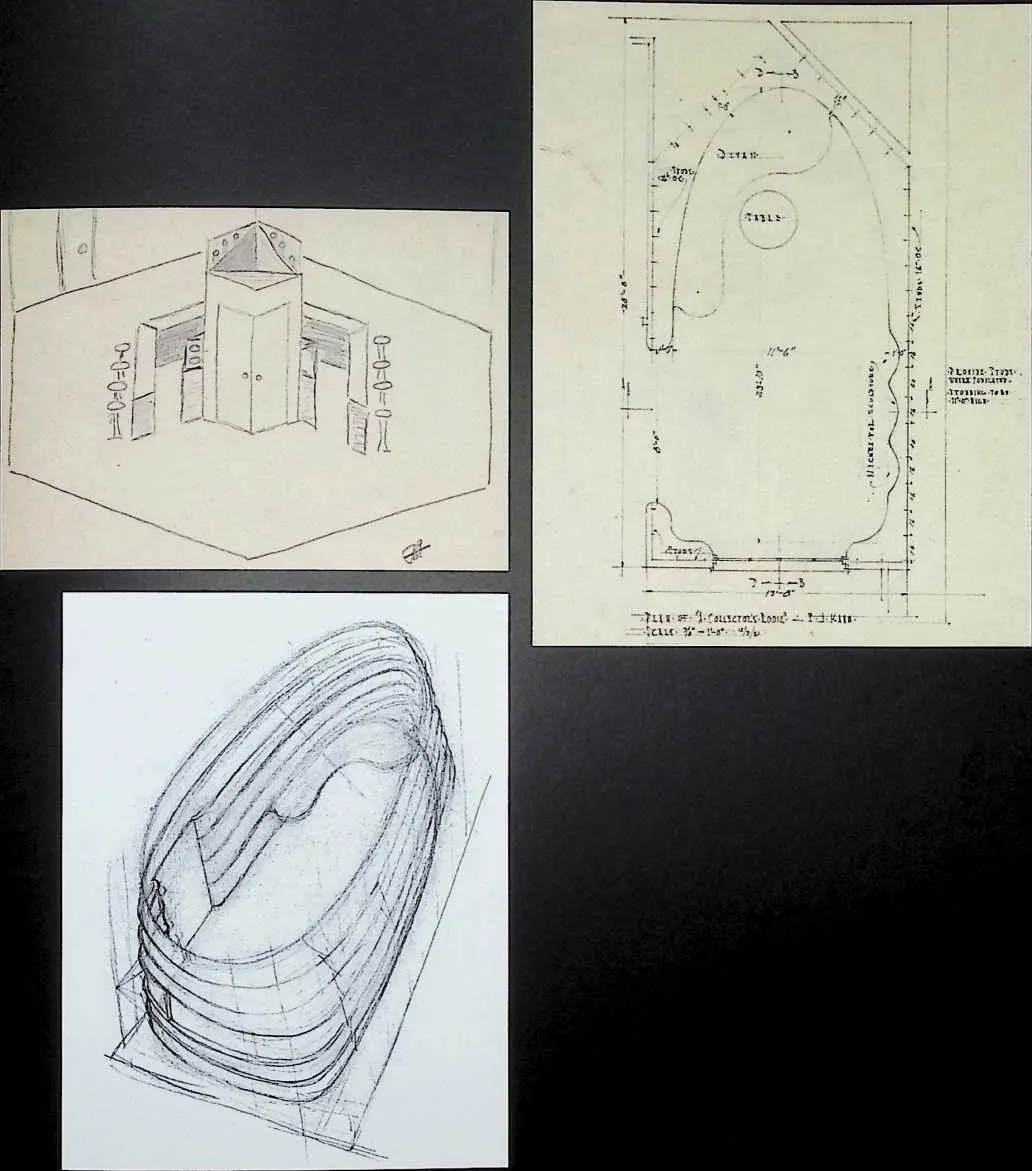
262 5 6
263 4
Proposed Design for
Interior of Romany Marie's Tavern, ca. 1929
Graphite on paper,
21.6x27.6 cm
264 Plan of A Collector's Room, 1931 Isometric Drawing for A Collector’s Room, 1931
265 Graphite on tracing paper, Graphite on tracing paper,
266 ca. 36.5x29.5 cm 38.1 x36.2 cm
267 7
268 Hazel Larsen Archer (1921-2001),
Buckminster Fuller as the Baron Medusa in
The Ruse of Medusa at Black Mountain College,
summer 1948
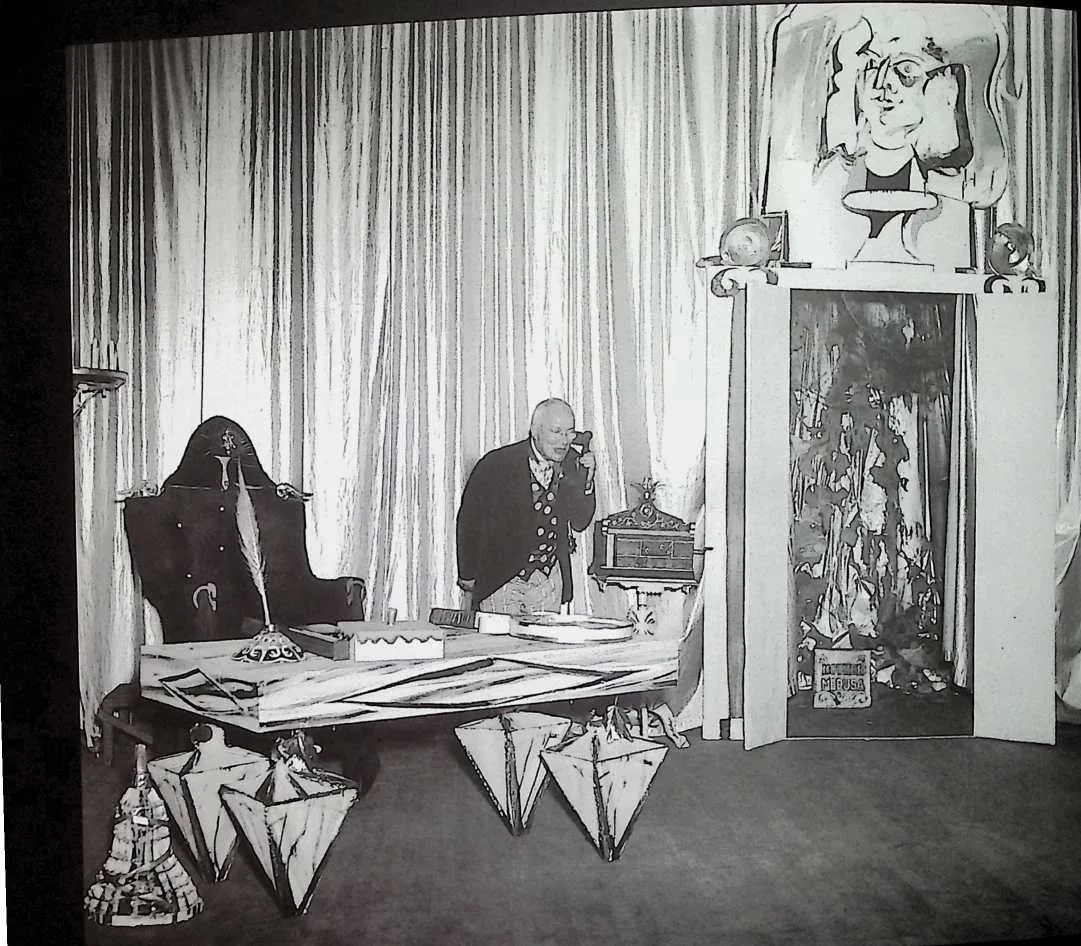
270 8
Kenneth Snelson (b. 1927),
Early X-Piece, 1948/49 (re-created 1959)
Wood and nylon,
29.2x13.7x13.7 cm
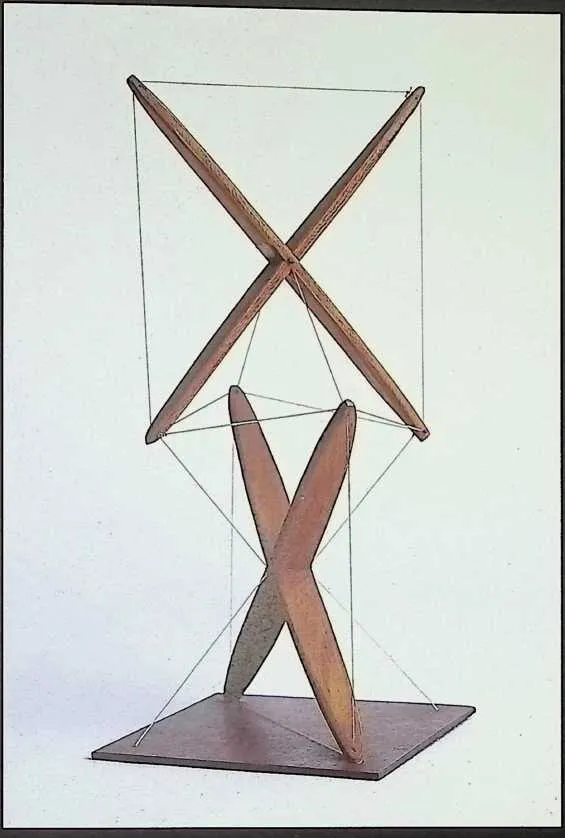
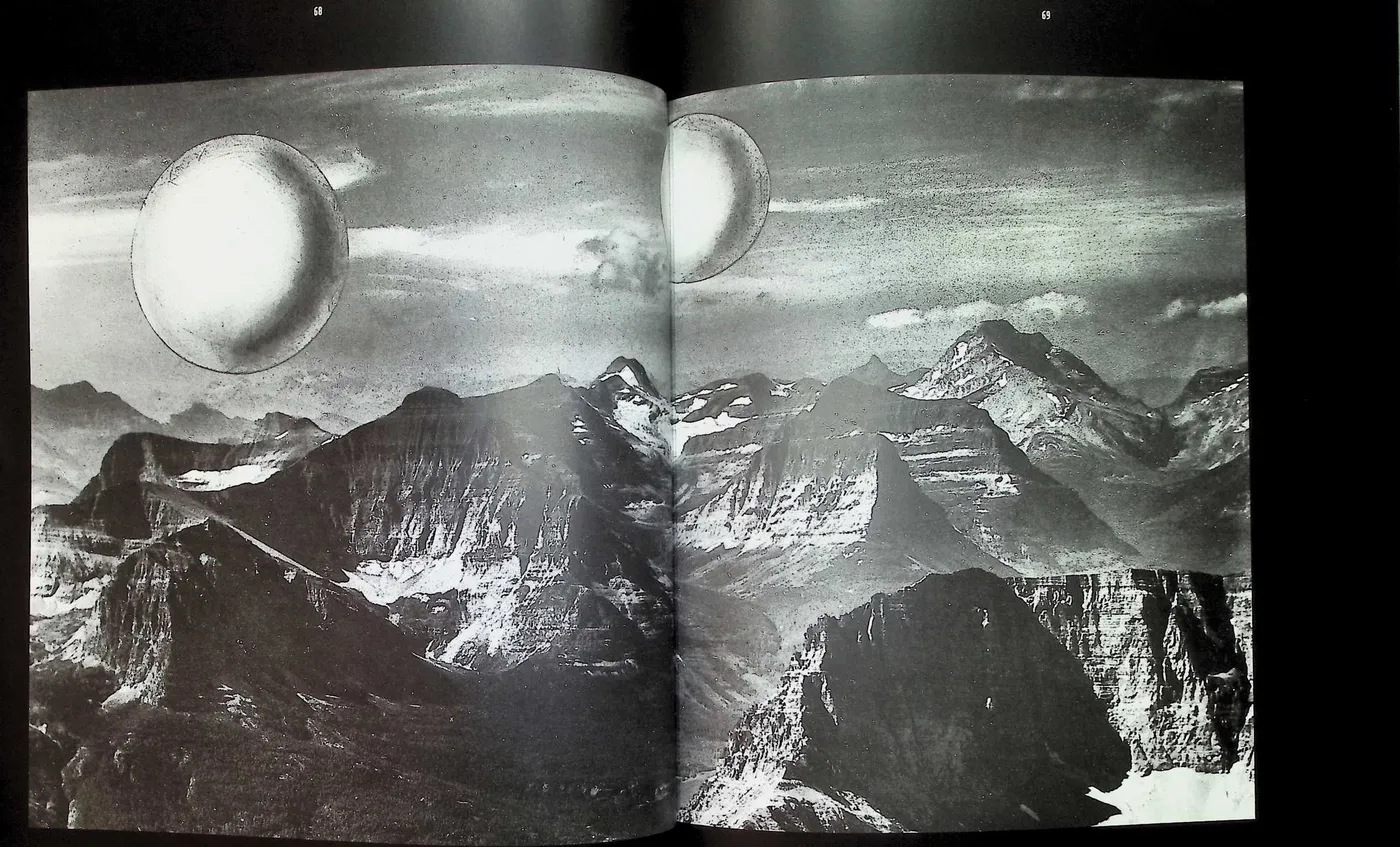
273 DANA MILLER / WE ARE ALL ASTRONAUTS
274 9
275 Buckminster Fuller and Shoji Sadao (b. 1927),
Project for Floating Cloud Structures
(Cloud Nine), ca. 1960
276 Black-and-white photograph mounted on board,
40.3 x 50.2 cm
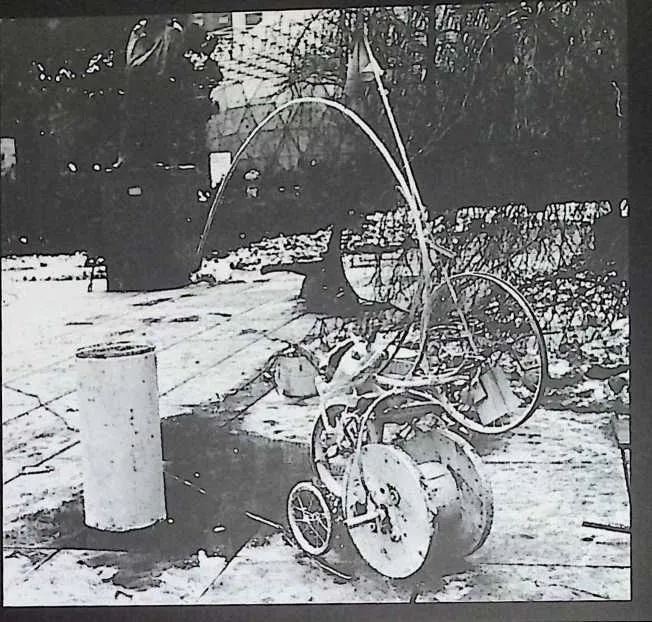
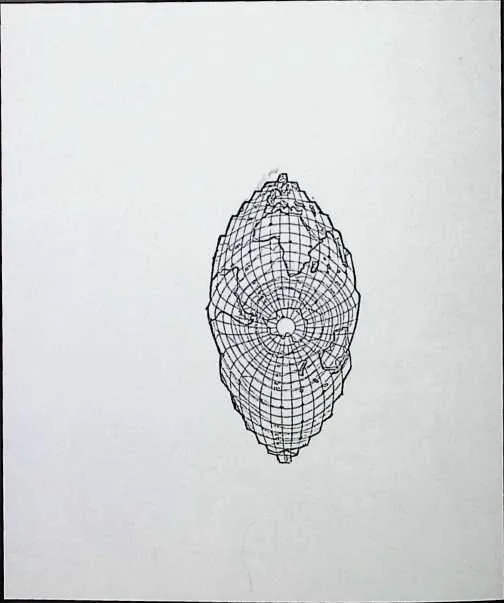
278 (September 22,1959-winter 1960)
in the background.
279 Painted metal, fabric, tape,
wood, and rubber tires,
20.3 x 7.5 x 22.3 m
280 io
281 Jean Tinguely (1925-1991),
Fragment from Homage to New York, 1960,
in the sculpture garden of
the Museum of Modern Art,
with the exhibition Three Structures
by Buckminster Fuller
282 11
283 Robert Smithson (1938-1973),
Detail of World Ocean Map
(Hammer’s Equal Area Projection, 1967)
Graphite and Photostat collage,
30.5x25.4 cm
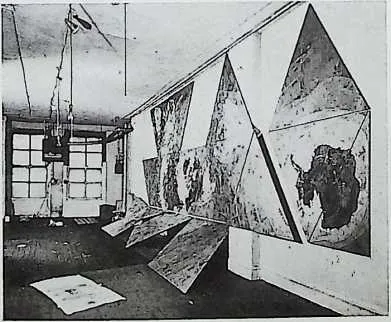
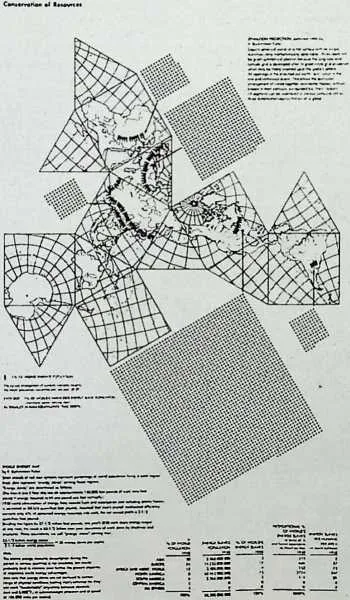
285 Ruth Vollmer. Hound Sphere Minus Lune. By courtesy of the Betty Parsons Gallery, New York
286 Jasper Johns. Map (based on Buckminster Fuller’s Dymaxion Airoccan World), 1967. Encaustic and collage/canvas, 186x396". By courtesy of the Leo Castelli Gallery
287 The World Energy Map pictured on a Dymaxion Projection. The man symbols represent the percentage of world population in each region. The black dots represent the percentage of ‘‘energy slaves’’ serving the regions. (First published in Fortune, February 19-40)
288 shape of crescents intersect at the ‘‘bound’’ equator. The ‘‘lune’’ triangulation in this orb detaches itself and becomes secondary ‘‘sculpture’’.
289 ‘‘ There arc approximately 50 Panama Canals to a cubic mile and there are 317 MILLION cubic miles of ocean.’’
290 R. Buckminster Fuller:
291 Nine Chains to the Moon
292 R. Buckminster Fuller has developed a type of writing and original cartography, that not only is pragmatic and practical but also astonishing and tcratological. His Dymaxion Projection and World Energy Map is a Cosmographia that proves Ptolemy’s remark that, ‘‘no one presents it rightly unless he is an artist.’’ Each dot in the World Energy Map refers to ‘‘1% of World’s harnessed energy slave population (inanimate power serving man) in terms of human equivalents . . .’’, says Fuller. The use Fuller makes of the ‘‘dot’’ is in a sense a concentration or dilation of an infinite expanse of spheres of energy. The ‘‘dot’’ has its rim and middle, and could be related to Reinhardt’s mandala, Judd’s ‘‘device’’ of the specific and general, or Pascal’s universe of center and circumference.
293 Yet, the dot evades our capacity to find its center. Where is the central point, axis, pole, dominant interest, fixed position, absolute structure, or decided goal? The mind is always being hurled towards the outer edge into intractable trajectories that lead to vertigo.
29429512
296 Robert Smithson, Portion of A Museum of
Language in the Vicinity of Art,
as published in Art International 12, no. 3,
March 1968
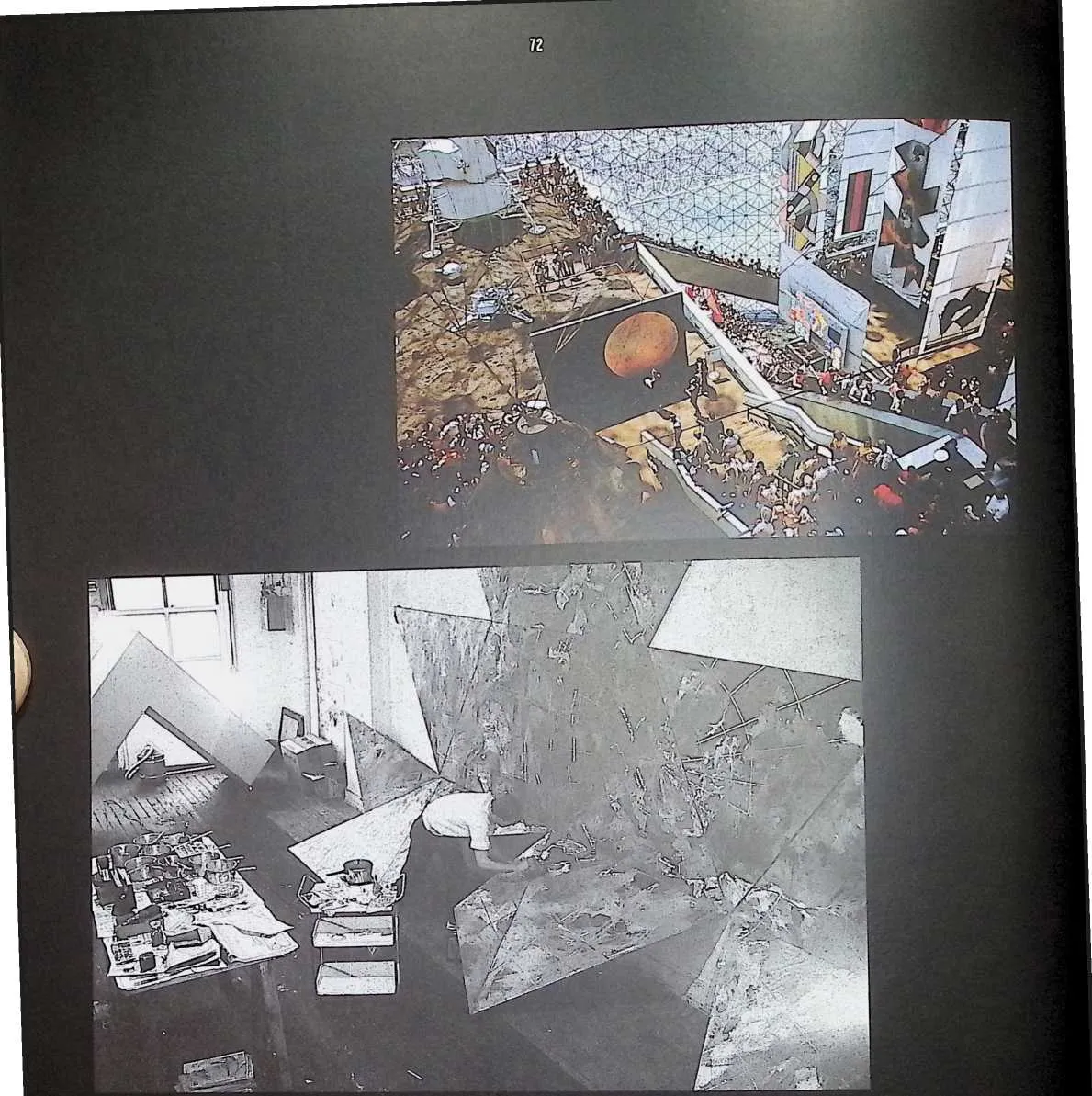
298 17
299 Interior of the U.S. Pavilion at
Montreal Expo’67 showing a portion of
the installation
300 American Painting Now
301 16
302 Jasper Johns (b. 1930)
working on Mop
(based on Fuller's Dymaxion Air Ocean World),
1967-1971
303 Mity-
304 Claes Oldenburg (b. 1929), Giant Soft Fan, 1966/67, as installed in American Painting Now at the U.S. Pavilion of the Montreal Expo’67
305 Construction of vinyl filled with foam rubber, wood, metal, and plastic tubing Fan: 3 x 1.4 x 1.5 m, plus cord and plug: 7.3 m long
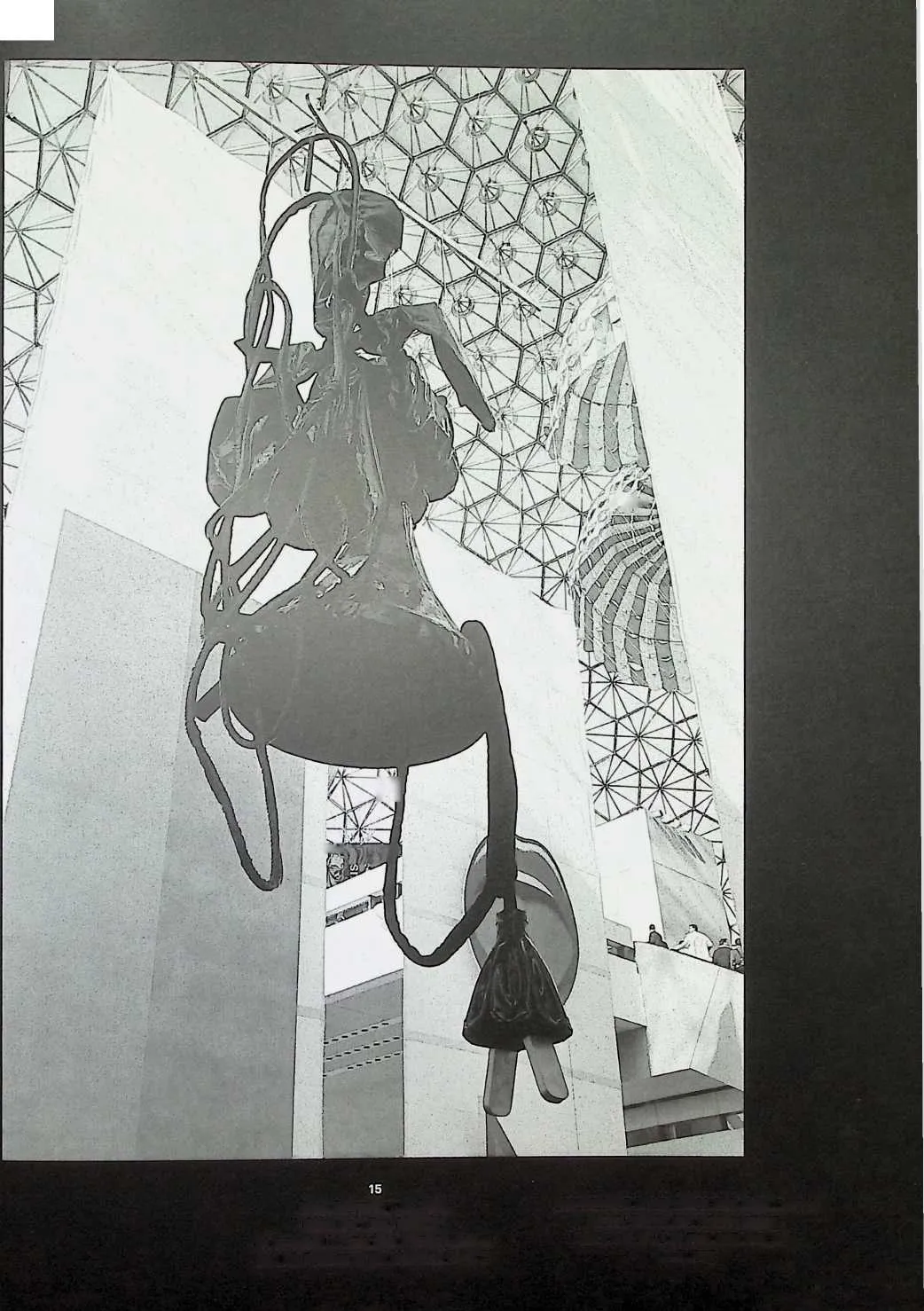
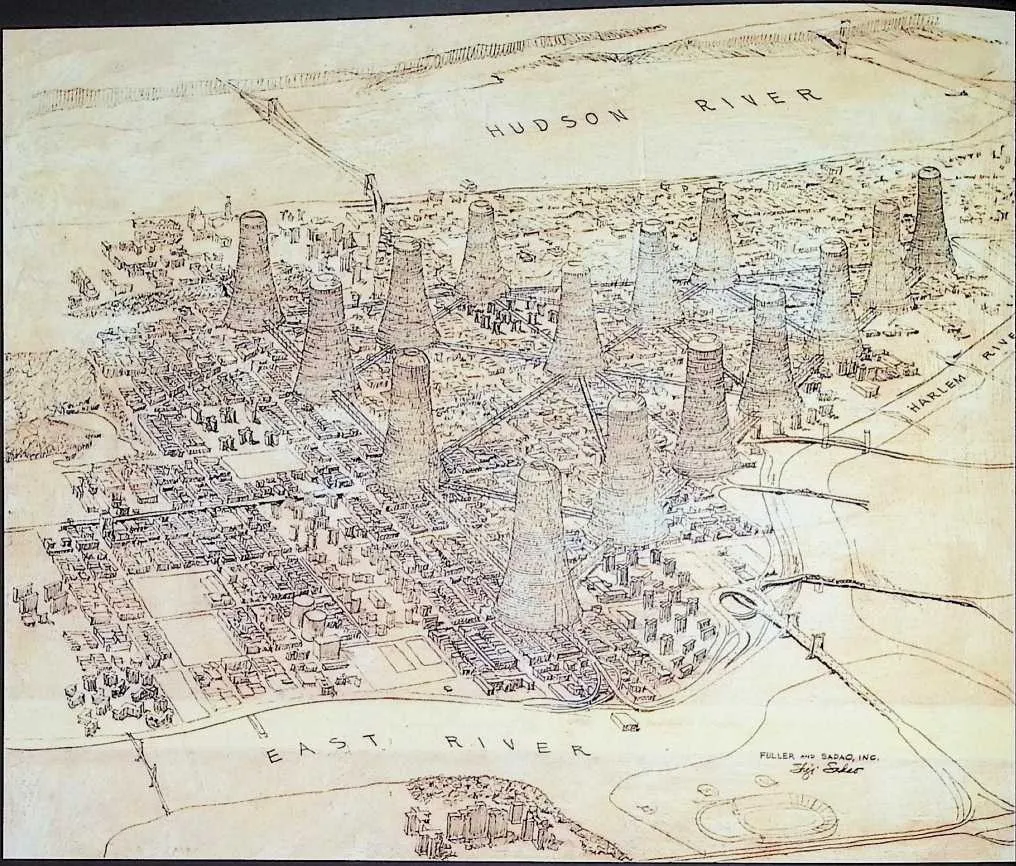
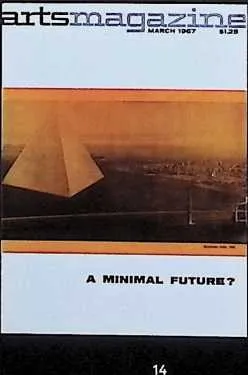
323 Cover of Arts Magazine 41, no. 5, March 1967
324 13
Buckminster Fuller and Shoji Sadao
Harlem Redesign, 1965
Graphit on tracing paper
61 x 50.8 cm
325 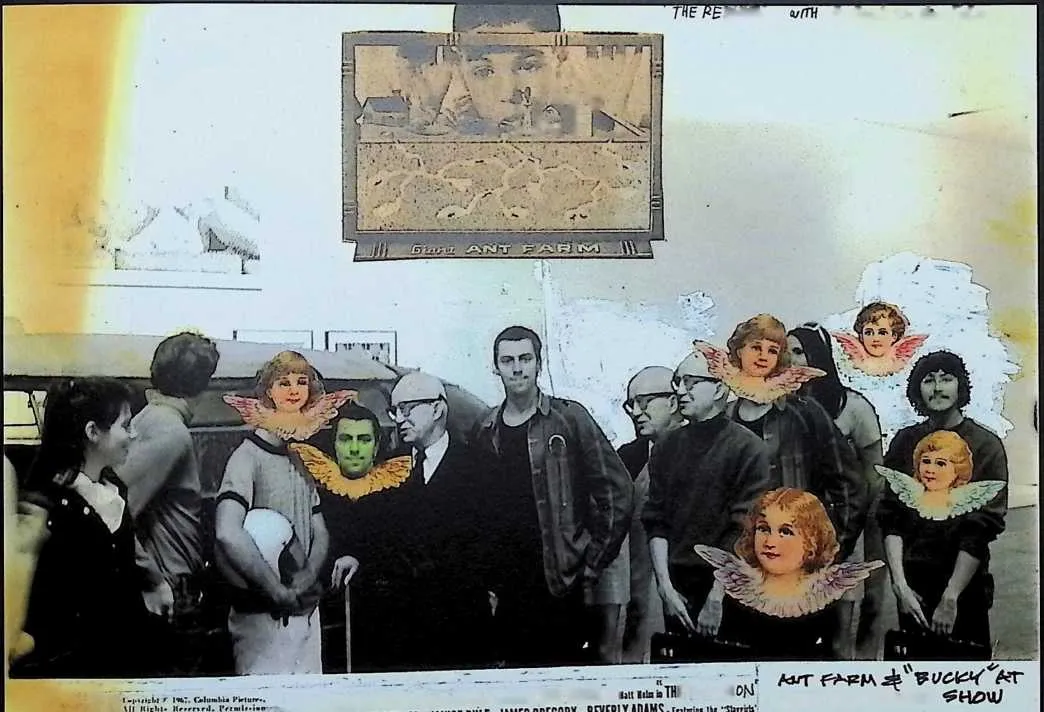 MM SWfflM
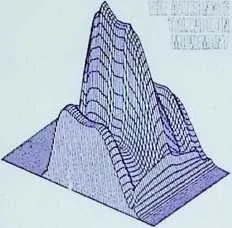
327 ■Hfl
328 H»To by L. Brown bac is
329 18
Cover of first issue of
Radical Software 1, no. 1,
1970
330 UWiON P~-frutknihtfer Fulhw
331332• ■'' ' ■ :
333i-A.
334--? ■ k--i'ja, j
335 coioum mints rm..« f im<s *tttn r>.mii»• OWN M*™ ‘‘'E p b UW’ -[x. M. A«4 IbJE: ….
336337SOUTH W&T <TIT±---
338 S, ■ -------
339 19
Doug Michaels
(1943-2003; cofounder of Ant Farm),
The Reunion,
1970/1996
Photocotlage
340 20
341 Tetrascroll, 1977
342 Installation view at the Ronald Feldman Gallery,
New York
343 (January 29-February 26,1977)
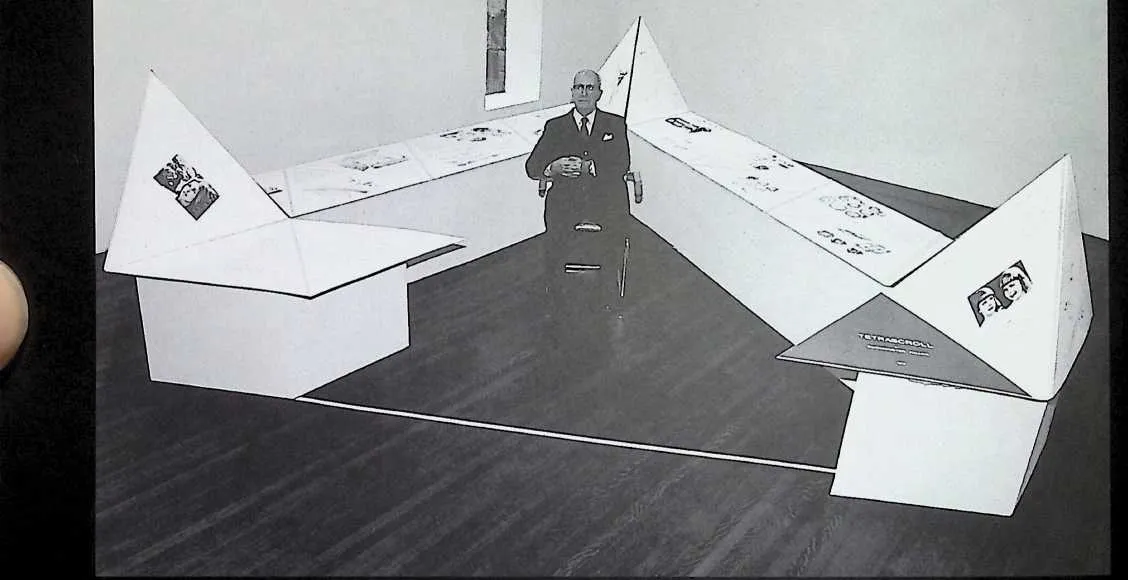
345 DANA
MILLER
346347THOUGHT
348PATTERNS
349 oumkter
350351FULLER
352 IRE
SCIENTIST-ARTIST
353 Intuition and aesthetics automatedly trigger us
into consciousness of the existence
of opportunities to consider and selectively initiate alternative acts
or position-taking regarding oncoming events,
potential realizations or unprecedented breakthroughs in art,
technology and other human productivity.
354 Buckminster Fuller,
foreword to
355 Projections: Anti-Materialism,
1970
356357Although Buckminster Fuller claimed that he never considered the visual impact of his structures while devising them, much of his work can be viewed as aesthetic exploration. If something wasn’t beautiful when he finished it, Fuller knew it wasn’t correct. And while architects and engineers frequently greeted Fuller with skepticism or suspicion, he deftly navigated artistic circles throughout his life. Fuller believed artists were uniquely positioned to conceptualize solutions to humanity’s mounting problems because of their capacity to recognize nature’s inherent patterns and extrapolate comprehensive design applications from them. He consciously cultivated friendships with artists with whom he felt a kinship and from whom he was able to draw inspiration. This essay will illuminate some of the more important episodes in a career that intersected with those of sculptors, painters, and film and video artists again and again.
358Fuller’s ardent belief in experientially gained information was crucial to understanding his philosophy. Testing hypotheses through trial and error and accepting failure as part of the process was essential to the ‘‘experientially founded mathematics’’ at the root of his comprehensive design program. As a severely cross-eyed toddler, Fuller could see only large patterns and colors, and his earliest understanding of the world was based upon his imagination and physical intuition. When he was in kindergarten, his teacher gave his class toothpicks and peas and asked them to build houses. ‘‘All the other children, none of whom had eye trouble, put together rectilinear box houses,’’ he recalled. ‘‘Not having visualized the rectilinearity about me, I used only my tactile sense. My finger muscles found that only the triangle had a natural shape-holding capability. I therefore felt my way into producing an octahedrontetrahedron truss assembly…it was this experience which undoubtedly started me off at fifteen to look for nature’s own structural coordinate system.’ ’’ Employing ‘‘nature’s own structural coordinate system’’ teleologically to benefit all of humanity became the foundation of Fuller’s lifework as a comprehensive anticipatory design scientist.2 The corollary to Fuller’s belief in nature’s coordinate systems is that man-made edifices built upon those principles will be structurally sound and aesthetically resolved. They will look and feel right.
359Fuller’s commitment to intuition and experientially gained information meant that his design science revolution needed artists as much as scientists and designers. Artists could recognize local patterns and envision ways to translate them into threedimensional models and universal applications. They often did so in advance of legitimizing scientific discoveries. According to Fuller, this was because artists had resisted specialization and maintained their inherent ability to think independently, intuitively, and comprehensively, while rigorous education had forced scientists into institutionalized methodology and specialization.3 ‘‘Artists are now extraordinarily important to human society. By keeping their innate endowment of capabilities intact, artists have kept the integrity of childhood alive until we reached the bridge between the arts and sciences. Their greatest faculty is the ability of the imagination to formulate conceptually. Suddenly, we realize how important this conceptual ability is.’ ’4 For Fuller, thinking conceptually meant using the mind, not the brain. He believed that ‘‘only minds can conduct science and produce art,’’5and the highest compliment he could confer upon someone was to call him or her a ‘‘scientist-artist.’’
360Romany Marie’s Tavern, the eponymous gathering spot run by the Romanian emigre Romany Marie Marchand, was the setting for Fuller’s seminal development. As New York’s version of Paris’s cafe society, Romany Marie's was filled with artists and intellectuals, and Fuller became a regular in the late 1920s. It was there that Fuller, a polymath and autodidact whose formal education amounted to being kicked out of Harvard twice, began crafting his persona as a maverick outsider unrestrained by academic or commercial fiefdoms. Fuller also sharpened his oratory skills in this milieu, holding forth on his Dymaxion House, which he described as a dwelling machine suspended on a mast that could turn to meet the sun.
361Among the artists Fuller met at Romany Marie’s was the young Isamu Noguchi. When Noguchi moved to a new, window-wrapped studio, Fuller planned the interior environment. ‘‘Under Bucky’s sway I painted the whole place silver---so that one was almost blinded by the lack of shadows,’’ Noguchi remembered. ‘‘There I made his portrait head in chromeplate bronze---also form without shadows’’ (fig. 1).6 More than three decades before Warhol’s silver-paint-and foil-covered Factory, Fuller conceived of an entirely reflective silver studio for Noguchi. Noguchi’s highly reflective bust of Fuller was among the first works of art to use chrome plating, a process then reserved primarily for automobiles. The choice of media was only appropriate for the man who advocated the harnessing of technology to meet humanity’s needs. At that time Noguchi was supporting himself as an artist, and Fuller, who was regularly broke, often slept on the floor of his studio. They became lifelong friends, and their mutual influence can be detected throughout both careers, including in works such as Noguchi’s Miss Expanding Universe (see fig. 2) and the streamlined models of the Dymaxion Car on which they collaborated (fig. 3).7
362When Marie moved her eatery to Minetta Street in 1929, Fuller offered his design services. He devised chairs based on contemporary airplane and steamship furnishings and painted the walls and pipes silver (fig. 4). He lit the space brightly using horn-shaped aluminum fixtures, explaining, as Marie recalled, that ‘‘pseudos wouldn’t come and hide in my place, they prefer to go hide in dark rooms, dark dining rooms where you can’t see them well---can’t see through them. To this room, Bucky said, only real and upright people would come, because you would immediately see all the way through them and they wouldn’t mind the test.’’8 In practice, the design was less than successful. The chairs collapsed the evening the tavern opened. ‘‘It was the most ridiculous spectacle you ever saw in your life,’’ Marie recalled. ‘‘It wasn’t enough that there was a deviation with all the luminosity when they sit down, they fall down.’’9 The next morning she hired a carpenter to make benches to her specifications.
363The following year Fuller designed A Collector’s Room for the architect Ely Jacques Kahn, which went unrealized. The room, which resembled the streamlined form of the Dymaxion Car, was to have niches for displaying sculpture (fig. 5 and 6). It was ‘‘an outwardly tensed, ovaloid shaped, hyperbolic parabola, faceted, tension (tent) fabric room for installation in the Grand Central Palace at a proposed Architectural Show for a sculptors’ exhibit room---lighting for the room and its sculptural exhibits to diffuse inwardly through the comprehensive translucent, tensed, white fabric ‘walling,’ from lights exteriorto the structure.’’10 Noguchi s studio, Romany Marie’s, and the Collector’s Room all demonstrate Fuller’s early affinity for total environments, employing illumination, reflectivity, translucency, color, tension, and shape to maximum sensorial effect.
364Much has already been written on the two summers that Fuller taught at Black Mountain College, 1948 and 1949, including his encounters with Josef and Anni Albers, Ruth Asawa, John Cage, Merce Cunningham, Willem and Elaine de Kooning, Richard Lippold, and Kenneth Snelson. Yet it was a crucial experience for Fuller and must be discussed, if only briefly.’1 Josef Albers hired Fuller for the 1948 summer session at the suggestion of the architect Bertrand Goldberg, whom he thanked, writing, ‘‘The whole affair of which I was somewhat doubtful, turned out very well. He has accepted and has arrived just the other day. And last night he gave a talk for about three hours and he proves to be a great man.’’12 Fuller thrived in the cross-disciplinary, makeshift atmosphere of BMC, and he would become lifelong friends with Albers and his wife Anni.
365By all accounts Fuller cast a spell on many who were there in 1948, commencing with the lecture he gave that first evening. Cunningham was in attendance and recalled, ‘‘I remember thinking it’s Bucky Fuller and his magic show. It was immediate, I think, with all of us who were there …this immediate absolute adoration and love of this man because of his…ideas, the width of the ideas. The grandeur with which he saw things and the way in which he spoke about them and demonstrated them.’’13 That performative magic was further unleashed when Fuller played the lead in The Ruse of Medusa, part of Cage’s summer-long concentration on Erik Satie (the play was directed by Arthur Penn, also featured Cunningham and Elaine de Kooning, and employed props and sets by Ruth Asawa and Willem and Elaine de Kooning; fig. 7).
366During that summer Cage and Cunningham grew close to Fuller, who appreciated the fields of music, dance, theater, and athletics not the least for their ability to heighten and utilize man’s ‘‘intuitive dynamic sense.’’ The three of them breakfasted together every morning and dreamed up an imaginary finishing school’’ they would run. it was a ‘‘schematic new school…We would finish anything. In other words, we would really break down all of the conventional ways of approaching school. And the ‘finishing school’ was going to be a caravan, and we would travel from city to city.’’14 Both men credited Fuller with expanding their thinking into a multitude of other fnneaCXnS|a encourinsthem t0 think holistically and universally.19 Cage in particular remained in close contact with Fuller, and years later he ruggled to reconcile his belief in indeterminacy with Fuller’s vision of
367 Bl
368369a structured universe, eventually noting with relief, ‘‘There’s a beautiful statement in Fuller’s Education Automation [1963] [sic] in which he says that the whole idea of things being fixed is a notion that we no longer need.’ ’’6
370Much of Fuller s first summer at BMC was occupied with constructing a large-scale great-circle dome. Despite the immense level of anticipation, the dome, composed of strips of aluminum Venetian blinds, refused to rise. Immediately dubbed the ‘‘Supine Dome,’’ it was a lesson, Fuller rationalized, in failure as a necessary step on the path to success. Kenneth Snelson, a young artist who had intended to pursue painting at BMC, was chosen by Albers to assist Fuller in his classes that summer because of his demonstrated abilities with three-dimensional structures and worked on the Supine Dome. The following winter, when Snelson was back in Oregon, he created several sculptures, including Early X-Piece (1948/49), an example of a discontinuous compression structure made of wood and nylon (fig. 8). Snelson sent photographs of the work to Fuller and then brought the sculptures with him to BMC the following summer. Fuller, immediately recognizing the structural possibilities that Snelson’s sculpture presented, having apparently been searching for such solutions himself, asked to have Early X-Piece. In the early 1950s, photos of similar works began to appear in articles about Fuller, without attribution to Snelson. Soon after, Fuller coined the word ‘‘Tensegrity’’ to describe tensional integrity with discontinuous compression. Snelson remembers Fuller asking him what he thought of ‘‘calling ‘our’ structure ‘tensegrity,’ ’’ thereby signaling his intention to take at least partial credit for the innovation Snelson had developed that winter.17 This series of events resulted in a lasting rift between student and teacher.18
371For much of the 1950s Fuller was absorbed with inventorying and tracking the earth’s resources, culminating with the Geoscope or Minni-Earth projects. More than the artifacts that preceded it, the Geoscope was meant to bea ‘symbolic’ visual display of information, an attention getting dramatization. As Mark Wigley has asserted, Fuller conceived the Geoscope ‘‘as a mechanism for blurring the distinction between science and art.’’19 This distinction was further blurred in projects that Fuller worked on with John McHale and Shoji Sadao in the late 1950s, such as Dome Over Manhattan and Cloud Nine. The latter was presented as a photomontage in which spherical cloud cities float above a sublime landscape of deep canyons (fig. 9). These monumental, airborne living spaces were the seemingly inevitable conclusion of Fuller’s early experimentations with total environments and his emphasis on buoyancy and lightfulness.
372As the 1950s progressed Fuller was included in gallery and museum exhibitions, as well as art periodicals, with greater frequency. A full-scale exhibition of Fuller’s work at the Walker Art Center was discussed. H. Harvard Arnason, then director of the Walker, was a principal supporter, and Gyorgy Kepes, professor of visual design at the Massachusetts Institute of Technology, was slated to design the exhibition. That exhibition never came to pass, but in 1959 Arthur Drexler, curator of architecture at the Museum of Modern Art, organized an exhibition of Fuller’s work in the museum’s sculpture garden. Three Structures ran from September 1959 to early spring of 1960 and included a geodesic radome, an octet truss, and a tensegrity mast. A smaller accompanying show with models and didactics was held indoors and overlapped for some of that time. In a wall text Drexler wrote, Central
373to Fuller’s genius, is the insight his ideas give us into universal order. That is an achievement which ranks him with other great poets, scientists, and artists.’’20 An interesting side note is that Jean Tinguely’s infamous Homage to New York (1960) was literally hatched inside Fuller’s dome (fig. 10). Billy Kliiver and engineers from Bell Labs built the self-destroying machine inside Fuller’s radome in MoMA’s garden over a period of several weeks. This would initiate Kliiver's decades-long mediation between artists and engineers.
374 Fuller’s mounting recognition reached a crescendo in the mid-1960s. He wrote several books in short succession and was the subject of extensive press coverage, including a 1964 Time cover story and Calvin Tomkins s New Yorker profile two years later.21 Fuller was no longer described exclusively in terms of engineer, architect, or inventor. Peter Blake called him ‘‘one of the great creators of beautiful sculpture of this century.’’22 His writings became increasingly relevant to artists as a dialogue about the relationship between the arts and the sciences grew in import, led by figures such as C. P. Snow and Kepes. In 1965 Fuller contributed ‘‘Conceptuality of Fundamental Structures’’ to Structure in Art and in Science, one of the Vision + Value series edited by Kepes. He wrote, ‘‘The brush and chisel artists who, despite the literary man’s frustrations, tried to follow the scientists into ‘nonconceptuality’ with their ‘non-representational’ quasi-abstractions are now proven to have been intuitively sound in their conviction that they could really follow or even lead science in the game of intuitive probing.’’23
375 In John Chandler and Lucy Lippard’s review of the Vision + Value series, entitled ‘‘Visual Art and the Invisible World,’’ they wrote, ‘‘What scientists seem to want from art is the method or process of the artist, his powers of visualization---an important part of the method of Galileo and early science, but neglected in the last century.’’ Not surprisingly, Fuller figured prominently in their review, including his assertion that he had finally provided a physical model that artists and scientists alike might use to represent the imperceptible forces around us: ‘‘Buckminster Fuller suggests that the major reason for the failure of the public to keep informed about the ‘evoluting realities’ of science was the literary man’s inability to follow into realms where there were no conceptual models or analogies. Visual artists were not only able to enter these realms, but also occasionally lead the way ‘in the game of intuitive probing.’ However, the result was that neither artist nor scientist was understood by the word-stuck public at large. Fuller claims that his own discovery of the ‘natural four axis, 60 degree, tetrahedronal coordinate system’ has returned ‘conceptuality of dynamic structural principles to scientific validity.’ ’’24
376 Chandler and Lippard’s account of the discussion echoed the ‘‘new sensibility’’ that Susan Sontag had described in her 1965 essay ‘‘One Culture and the New Sensibility.’’ Sontag spoke of a new cultural establishment that unashamedly drew upon scientific developments and was oriented toward the plastic rather than the literary arts. ‘‘This new establishment includes certain painters, sculptors, architects, social planners, filmmakers, TV technicians, neurologists, musicians, electronics engineers, dancers, philosophers, and sociologists…Some of the basic texts for this new cultural *™ntareto befound in the citings of…Buckminster Fuller, Marshall McLuhan, John Cage, Andre Breton, Roland Barthes…[and] Gyorgy Kepes.’’25 Fuller s growing impact was also manifest in the art of the 1960s, one such example being the milestone 1966 exhibition Primary Structures. The show announced the ascendancy of large-scale, geometrically based sculpture in contemporary art. Curator Kynaston McShine used Fuller’s neologism ‘‘ten-segrity’’ to describe Forrest Myers’s contribution and wrote in the catalogue, ‘‘Central to many of the principles upon which many of the artists like Forrest Myers work are the structures of Buckminster Fuller. Fuller’s theories, now widely accepted and implemented, have been insights into the dynamic structure of nature, and into the interrelationship of physics, mathematics and philosophy.’’26 McShine also drew a connection between Sol LeWitt’s structures and Fuller, describing their white cubic framework as possessing ‘‘a logic and structure that seems to be what Fuller described as ‘comprehensive design.’ The modular pattern, which is so fundamental and universal in nature, in this piece assumes extraordinary beauty.’’27 Even Time noted in its review that the artists ‘‘wax hot for the Geodesic Architect Buckminster Fuller.’’26
377378Several of the artists in Primary Structures showed at the Park Place Gallery, namely Peter Forakis, Robert Grosvenor, and Myers. In his 1966 essay ‘‘Entropy and the New Monuments,’’ Robert Smithson noted that the Park
379Place Group had ‘‘permuted the ‘models’ of R. Buckminster Fuller’s ‘vec-toral’ geometry in the most astounding manner.’’ He continued:
380 Fuller was told by certain scientists
that the fourth dimension was ‘‘ha-ha,’’
in other words, that it is laughter…
Laughter is in a sense of kind of entropic ‘‘verbalization.’’
How could artists translate this verbal entropy,
that is ‘‘ha-ha’’ into ‘‘solid models’’?
381 Some of the Park Place artists seem to be
researching this ‘‘curious’’ condition.
382 The order and disorder of the fourth dimension could be set
between laughter and crystal-structural,
as a device for unlimited speculation.29
383384And yet the art historical accounts of Primary Structures rarely mention Fuller.36 Perhaps this is partly because the Park Place artists are not the ones who, overtime, have come to exemplify the Minimalist movement that that exhibition ostensibly baptized.
385‘‘Entropy and the New Monuments’’ was not the only instance in which Smithson cited Fuller.31 Smithson was drawn to Fuller and to Alexander Graham Bell fortheir attempts to isolate within the disorder of the natural world key organizing principles that could be translated into monumentally scaled artifacts. They saw no conflict between organic structures and modern technology. Fuller’s forays into cartography also provided a precedent for Smithson’s investigations into alternative mapping systems (fig. 11). In his 1968 ‘‘A Museum of Language in the Vicinity of Art’’ Smithson wrote, ‘‘R. Buckminster Fuller has developed a type of writing and original cartography, that not only is pragmatic and practical but also astonishing and teratological. His Dymaxion Projection and World Energy Map is a ‘Cosmographia’ that proves Ptolemy’s remark, that, ‘no one presents it rightly unless he is an artist, (fig. 12)
386In the spring of 1967, Fuller’s work was included in a show entitled Projects for Macrostructures at the Richard Feigen Gallery in New York. His contribution included the Project for Floating Cloud Structure (the Cloud Nine Project), Tetra City, a large-scale floating tetrahedron that could house up to a million people in New York Harbor, and Harlem Redesign, a slum clearing project’’ that had appeared in a 1965 issue of Esquire (fig. 13). Ronald Bladen, Christo, Hans Hollein, Claes Oldenburg, and Tony Smith were among the others included in the exhibition. Tetra City was featured on the cover of the March 1967 Arts Magazine with the contentious title ‘‘A Minimal Future?’’ (fig. 14). Dan Graham’s article ‘‘Models and Monuments: The Plague of Architecture’’ considered the Feigen show, as well as two others, prominently illustrating Fuller’s megastructure projects.34 And yet despite Fuller’s high level of visibility in these contexts---museums, galleries, and art periodicals---his significant engagement with the art world of the 1960s goes unnoted in most recent art historical accounts of this period. This significant exchange also remains absent in the literature on Fuller.
387Fuller was never more visible than in summer of 1967, when the three-quarter Skybreak Sphere he created for the U.S. Pavilion, the most dramatic structure he ever realized, was unveiled at the Montreal Expo.35 The pavilion’s theme was ‘‘Creative America,’’ and Alan Solomon was hired to curate a contemporary art exhibition entitled American Painting Now. Solomon selected a show of large-scale paintings, the exception being a soft sculpture by Claes Oldenburg that hung from the roof (fig. 15). Jasper Johns proposed a painting based upon Fuller’s Dymaxion Air-Ocean World Map, thinking ‘‘it seemed logical…to make a work which repeated the motif of the structure.’’36 Employing Cage as his emissary, Johns obtained Fuller’s permission to use the map in this manner. Johns wrote and thanked him, explaining, ‘‘I’m delighted. I intend to hinge the six-foot triangles so that it will be possible to change the form of the picture should it ever have to be shown in different environments.’’37 He made the enormous work, his first and only painting of a world map, in his studio in twenty-two separate panels (fig. 16). ‘‘The stretcher bars used were angled so that the work could bend to form an icosahedron globe, but the clumsiness and weight of the work made this idea an impossibility.’’38 As envisioned, the multipart painting represented a map of possibilities with no single, fixed viewpoint, exemplifying Fuller’s notion of a ‘‘fluid geography.’’ When Johns first saw the painting assembled in Montreal, he was disappointed, feeling it conformed too closely to Fuller’s concept (fig. 17). Over the course of the next four years he reworked it, abandoning the temperature index of Fuller’s map and removing the hinges, among other alterations. Johns described the final result as ‘‘a complicated visual experience. It’s both a map and a painting.’’39
388As the 1960s came to a close, the preponderance of unseen forces and vectors that constitute our environment, particularly the electromagnetic spectrum, gained primacy in Fuller’s vast speaking program. His Montreal dome was the epitome of lightfulness, transparency, and material dilution. This dematerialization of architecture was the logical result of his philosophy of ephemeralization and paralleled the dematerialization of the art object at that time. In his foreword to the exhibition catalogue for Projections: AntiMaterialism, a 1970 show atthe La Jolla Museum of Art, Fuller wrote ‘‘When successful, tomorrow’s architecture will be approximately invisible, not just figuratively speaking, but literally as well. What will count with
389world man is how well the architecture serves all humanity while sublimating itself spontaneously. Architecture may be accomplished tomorrow with electrical field and other utterly invisible environment controls.""10
390Artists, specifically those engaged with developing media, closely followed Fuller’s emphasis on nonvisible forces, the ‘‘ha-ha’’ that he spoke of and Smithson commented on. Inspired by Fuller, Stan Vanderbeek began to construct his Movie Drome in 1963. He showed his multiscreen films inside the domed circular building, which was his attempt at a theater of infinite space, ‘‘with no ‘edge’ to the screen …a total Envelope-Environment---allowing an almost endless amount of image material to flow over you and around the Drome.’’41 The collective Raindance published the alternative television movement journal Radical Software, which included a pirated interview with Fuller in its first issue in 1970 (fig. 18). Ant Farm and USCO were two of the several other antiestablishment collectives influenced by Fuller’s work. The members of Ant Farm considered him a hero and ‘‘the lone voice in the wilderness among architects and engineers.’’42 In 1969 they ‘‘kidnapped’’ Fuller on his way to a lecture at the University of Houston’s engineering school. Instead of delivering him to the school, they took him to see his Dy- maxion Car in the exhibition The Machine at the End of the Mechanical Age, which was on tour in Houston at the time (fig. 19). Their 1970 Inflatocookbook illustrated Energy Credit, an invented paper currency that incorporated Fuller’s visage and a geodesic dome in its design. Fuller penned the introduction to Gene Youngblood’s seminal Expanded Cinema, the first book to treat video as an art medium. He wrote: ‘‘Humans still think in terms of an entirely superficial game of static things---solids, surfaces, or straight lines---despite that no things---no continuums---only discontinuous, energy quanta-separate event packages---operate as remotely from one another as the stars of the Milky Way. Science has found nothings;’only events. Universe has no nouns; only verbs.’’43
391In February 1975 Fuller’s friend Edwin Schlossberg took him to the print workshop Universal Limited Artist Editions as an eightieth-birthday present. There Tatyana Grosman, the proprietor, introduced Fuller to lithography, which he took to immediately. He began crafting a version of the story ‘‘Goldilocks and the Three Bears,’’ retold to explain the mysteries of the universe and the possibilities for mankind’s future. ‘‘I know that we have the option to make it. That’s different than being optimistic. It’s touch and go. Goldy is very concerned. That’s what this is all about. I’minterested in making artifacts that give us options."44 Characteristically, Fuller rejected the traditional rectangular structure of a book and created the Tetrascroll from twenty-six triangular pages. Written in all caps with minimal punctuation, the text included an ‘‘epilever’’ rather than an ‘‘epilogue’’ by Schlossberg. The color was to match a seagull feather, and the book was bound using Dacron, a material frequently used in sailing. Each hinged page of the book can be folded in multiple directions, creating numerous possible configurations of the Tetrascroll, much like his Dymaxion Maps and Johns’s vision for his painting. In January of 1977, as part of their Projects series MoMA installed the Tetrascroll along two perpendicular walls in proximity to an installation of Cage’s work.45A second print was exhibited almost simultaneously on tables arranged in a shape at Ronald Feldman Fine Arts (fig. 20), and a third was shown at the Fendrick Gallery in a tetrahedronal frame structure. Fuller called the Tetrascroll ‘‘everything I think and feel in mathematics and philosophy and everything else.’’ Grossman describedI it as ‘‘a very beautiful achievement by an artist, a pure vision expressed in lithography.
392Fuller’s intersection with the artistic avantgarde spanned an astonishing period of the twentieth century, from Romany Marie’s to the explosion of video and new media art in the 1970s. Throughout this time Fuller remained focused on locating, representing, and utilizing patterns in nature, and toward the end of his life he chose to represent his investigations in several formal artistic modes. Yet he stated that it was his ‘‘life long working assumption that the name ‘artist,’ ‘poet’ or ‘musician’ can only be bestowed on individuals by contemporary of later society, that these titles cannot be professed.’’47 While he was alive, there were those who considered him an artist, including Marshall McLuhan, who called him the Leonardo da Vinci of the twentieth century. Since his death the number of those who refer to him as an artist has dramatically increased.48Certainly one can argue that Fuller’s adult life was a single performative experiment; indeed, he called himself Guinea Pig B for that very reason. He believed artists were essential to society because they could broaden our range of perception and fuel our imagination. He saw patterns and built structures that represented as yet unverified forces in nature, including what would later be known as the C60 carbon molecule. Fuller expanded our options for the future; thus, by his own definition, he was unquestionably a scientist-artist of the highest order.
393 Notes
394 Epigraph. Buckminster Fuller, foreword to Projections: Anti-Materialism (La Jolla, Calif.: La Jolla Museum of Art, 1970), n. p.
- 1.
- From Dorothy Harley Eber, "Prologue: An Interview with Buckminster Fuller,’’ in Genius ot Work: Images of Alexander Graham Bell (New York: Viking Press, 1982), 11. Fuller delved into other ‘‘important-design-influence experiences’’ in a fourteen-page letter to John McHale dated January 7, 1955, M1090, ser. 4, box 2, folder 1R, Buckminster Fuller Papers, Department of Special Collections, Stanford University Libraries.
- 2.
- Even after he received his glasses at age four, Fuller claimed that he was preternaturally attuned to the patterns around him. ‘‘Good luck for me I was born cross-eyed." As quoted in Deborah Shapely, ‘‘Declaration of War Was Commencement for Class of 1917,’’ Harvard Crimson, June 13,1967.
- 3.
- Fuller noted that resistance to specialization is often interpreted by the school system as delinquency or a learning disability, with the result that many such youths drop out of school and become "minor outlaws
395 or artists using sounds or visual compositions in which they can safely use their own language to say anything they want about the going order of life.’’ As quoted in Howard Taubman, ‘‘Environment as Key to Achievement Is Theme of R. Buckminster Fuller," New York Times, November 28,1967.
- 4.
- Fuller, ‘‘Emergent Humanity: Its Environment and Education," from R. Buckminster Fuller on Education, reprinted in Buckminster Fuller: Anthology for a New Millennium, ed. Thomas Zung (New York: St. Martin's Griffin, 2001), 114.
- 5.
- From a talk Buckminster Fuller presented at a dinner of the American Academy and Institute of Arts and Letters in New York on January 18,1978, published as ‘‘Josef Albers (1888-1976)’’ in Leonardo 11, no. 4
396 (Autumn 1978): 311.
- 6.
- Fuller, An Autobiographical Monologue /Scenario, ed. Robert Snyder (New York: St. Martin’s Press, 1980), 62.
- 7.
- The fascinating relationship between Fuller and Noguchi has been explored in depth in the recent exhibition Best of Friends: Buckminster Fuller and Isamu Noguchi at the Noguchi Museum (May 19-October 15,2006), and will be expanded in a forthcoming book by its curator, Shoji Sadao.
397 8 Robert Schulman, Romany Marie: The Queen of Greenwich Village (Louisville, Ky.: Butler Books, 2006), 105-6.
398 9---Ibid., 106.
399 10 Letter from John Dixon, Fuller’s assistant, to Donald Robertson, dated Decembers, 1954, M1090, ser. 4, box 2, folder 4, Fuller Papers.
- 11.
- For a thorough account of the summer of 1948 see Mary Emma Harris, The Arts at Black Mountain College (Cambridge, Mass.: MIT Press, 1987). Other good sources on Fuller and BMC include Eva Diaz, ‘‘Experiment, Expression, and the Paradox of Black Mountain College," in Storting at Zero: Black Mountain College, 1933-57 (Bristol, England: Arnolfini; Cambridge, Kettle’s Yard, 2006); Martin Duberman, Black Mountain: An Exploration in Community (New York: W. W. Norton, 1993); and Vincent Katz, ed., Black Mountain College: Experiment in Art (Madrid: Museo Nacional Centro de Reina Sofia, 2002).
- 12.
- Josef Albers, letter to Bertrand Goldberg, July 14,1948, general files 2, box 12, folder Fuller, Bucky, 1948-1949, Black Mountain College Records, 1933-1956, courtesy North Carolina Office of Archives and History, Raleigh. Quoted with permission of the Josef and Anni Albers Foundation. Goldberg had met Albers at the Bauhaus when he studied there in 1932. They became reacquainted when Albers and his wife fled Europe and settled in the United States. Goldberg may have suggested Fuller after turning down Albers’s invitation for that summer himself. Fuller had been so slow to respond to Albers’s invitation that he invited another architect, Charles Burchard, a professor at Harvard. In the end both Burchard and Fuller taught at the college that summer.
- 13.
- Interview with Merce Cunningham, from PBS American Masters, Buckminster Fuller: Thinking Out Loud, http://www.thirteen.org/bucky/ merce.html (accessed August 23, 2007).
- 14.
- Mary Emma Harris, interview with Buckminster Fuller, October 3,1971, box 30, folder Fuller, Buckminster, transcript p. 34, Black Mountain College Research Project (1933-73), North Carolina State Archives, Raleigh.
- 15.
- Ruth Asawa and Albert Lanier remembered that Fuller’s sense of the world as a united entity was fairly novel and somewhat controversial. Immediately following World War II, this notion was perceived by some to be anti-American. Interview with the author, February 21, 2007.
- 16.
- Richard Kostelantz, ed., ‘‘Conversation with John Cage," in John Coge (New York: Praeger, 1970), 10. For a discussion of Cage and Fuller, see Brandon Joseph, ‘‘Hitchhiker in an Omni-Directional Transport: The Spatial Politics of John Cage and Buckminster Fuller," ANY 17 (1997): 40.
- 17.
- Kenneth Snelson, interview with the author, May 21, 2007.
- 18.
- For further discussion of the complicated relationship between Fuller and Snelson, see transcript for Mary Emma Harris, interview with Kenneth Snelson, May 25,1972, box 37, folder Snelson, Kenneth, Black Mountain College Research Project (1933-1973), North Carolina State Archives, Raleigh; Katz, Black Mountain College; Duberman, Black Mountain; and http://www.grunch.net/snelson/.
- 19.
- Mark Wigley, ‘‘Planetary Homeboy," ANY 17 (1997): 20.
- 20.
- Arthur Drexler, text of wall label for ‘‘Structures by Buckminster Fuller,' Buckminster Fuller artist file, Museum of Modern Art, New York Library. 21 Nine Chains to the Moon, published in 1938, was Fuller's only book available in any significant quantity in this country before 1962.
400 Fuller published several major books in the 1960s: Untitled Epic Poem on the History of Industrialization and Education Automation in 1962, Ideas and Integrities, No More Secondhand God and Other Writings, and a reprint of Nine Chains to the Moon in 1963, and Operating Manual for Spaceship Earth, 50 Years of Design Science Revolution and the World Game, and Utopia or Oblivion in 1969.
- 22.
- Peter Blake, ‘‘Five Shapers of Today’s Skyline," New York Times, October 21,1962.
- 23.
- Fuller, "Conceptuality of Fundamental Structures," in Structure in Art and in Science, ed. Gyorgy Kepes (New York: George Braziller, 1965), 80-81.
- 24.
- John Chandler and Lucy R. Lippard, ‘‘Visual Art and the Invisible World,’’ Art International 11, no. 5 (May 1967): 27.
- 25.
- Susan Sontag, ‘‘One Culture and the New Sensibility," in Against Interpretation and Other Essays (New York: Noonday Press, 1966), 298.
- 26.
- Kynaston McShine, introduction to Primary Structures: Younger American and British Sculptors (New York: Jewish Museum, 1966), n.p.
- 27.
- Ibid.
- 28.
- ‘‘Engineer’s Esthetic,’’ Time, June 3,1966.
401 29 Robert Smithson, ‘‘Entropy and the New Monuments," ArtforumA (June 1966): 31.
402 30---Linda Dalrymple Henderson is one of the few to discuss Fuller's influence on the Park Place group. See ‘‘Dean Fleming, Ed Ruda, and the Park Place Gallery" in Blanton Museum of Art: American Art since 1900 (Austin, Tex.: Blanton Museum of Art, 2006), 379-87.
403 31 ---Among the other essays in which Smithson cites Fuller are ‘‘The Artist as Site-Seer; Or, a Dintorphic Essay" (1966/67) in Robert Smithson: The Collected Writings, ed. Jack Flam (Berkeley: University of California Press, 1996), 342; and ‘‘Towards the Development of an Air Terminal Site,’’ ArtforumS (Summer 1967): 37. Both of these essays also mention Alexander Graham Bell. Smithson also discusses Fuller and entropy in an interview with Alison Sky published as ‘‘Entropy Made Visible,’’ On Site A (1973).
- 32.
- From ‘‘A Museum of Language in the Vicinity of Art," Art International 12, no. 3 (March 1968): 27. By 1971 Smithson had characterized Fuller as a utopian and distanced himself from Fuller’s program: "Unlike Buckminster Fuller, I’m interested in collaborating with entropy…After all, wreckage is often more interesting than structure. At least, not as depressing as Dymaxion domes. Utopian saviors we can do without." From an interview with Gregoire Muller, published as "The Earth…Is a Cruel Master," Arts Magazine 46, no. 2 (November 1971): 40.
- 33.
- June Meyer, ‘‘Instant Slum Clearance," in Esquire 63, no. 4 (April 1965): 108-11.
- 34.
- The other two exhibitions were Scale Models and Drawings at the Dwan Gallery and Architectural Sculpture, Sculpture Architecture,
404 at the Visual Arts Gallery. For more discussion on 1960s megastructures, see Hays’s essay in this volume.
- 35.
- Among the other architects considered for the U. S. Pavilion were John Johansen, Philip Johnson, Ludwig Mies van der Rohe, and Paul Rudolph. Marcel Breuer sent an unsolicited submission. According to Jack Masey, it was Peter Chermayeff of Cambridge Seven Associates who suggested that Fuller build a three-quarter sphere ratherthan a hemispherical dome. Later Fuller showed Masey sketches from several decades before in which he had depicted a three-quarter dome. Masey had first met Fuller when he, under the auspices of the United States Information Agency (USIA), asked Fuller to contribute a geodesic dome to the Jeshyn trade fair in Kabul, Afghanistan, in 1956. They worked together again in 1959 on the Moscow fair dome. Jack Masey, interview with the author, May 8, 2007. For a detailed discussion of the U.S. Pavilion, see Jonathan Massey, ‘‘Buckminster Fuller's Cybernetic Pastoral: The United States Pavilion at Expo 67,’’ Journal of Architecture 11, no. 4 (September 2006): 463-83.
- 36.
- Jasper Johns in a letter to the author, September 12, 2007.
- 37.
- Jasper Johns in a letter to Fuller, January 23,1967, M1090, ser. 2, box 154, folder 2, Fuller Papers. Solomon was initially under the impression that Johns would not be able to contribute a new work and was prepared to borrow Johns’s large painting Studio II from private collectors. Letter from Alan Solomon to Victor Ganz, December 7,1966, Alan R. Solomon Papers, Archives of American Art.
- 38.
- Johns to author, September 12, 2007.
- 39.
- "Treasure Map," Newsweek, February 15,1971, 90.
- 40.
- Fuller, foreword to Projections: Anti-Materialism (La Jolla, Calif.: La Jolla Museum of Art, 1970), n.p.
- 41.
- Stan Vanderbeek, quotedin Douglas Davis, Art and the Future (New York: Praeger, 1973), 49.
- 42.
- Doug Michels, from ‘‘Interview with Ant Farm,’’ in Connie M. Lewallen and Steve Seid, Ant Farm, 1968-1978 (Berkeley and Los Angeles: University of California Press, 2004), 44.
- 43.
- Buckminster Fuller, introduction to Gene Youngblood, Expanded Cinema (New York: E. P. Dutton, 1970), 24.
- 44.
- As quoted in Amei Wallach, ‘‘Bucky and Tatyana,’’ Newsday, February 6,1977.
- 45.
- Cage had two works on display, Apartment House 1776 and Renga,
405 a system of graphic notation using tracings of drawings from Henry David Thoreau's journals.
- 46.
- Amei Wallach, introduction to Tetrascroll, Goldilocks and the Three Bears: ACosmic Fairy Tale, by R. Buckminster Fuller (New York: St. Martin’s Press, 1975).
- 47.
- Letter from Fuller to Calvin Tomkins, dated October 6,1982, M1090, ser. 7, box 6, folder 3, Fuller Papers.
- 48.
- Victoria Vesna, ‘‘Bucky Beat,’’ Artbytel, no. 3 (August-September 1998): 22-29; Linda Weintraub, ‘‘I Seem to Be a Verb: R. Buckminster Fuller as Pioneering Eco-Artist," Art Journal 65, no. 1 (Spring 2006): 65-66;
406 Wigley, ‘‘Planetary Homeboy."

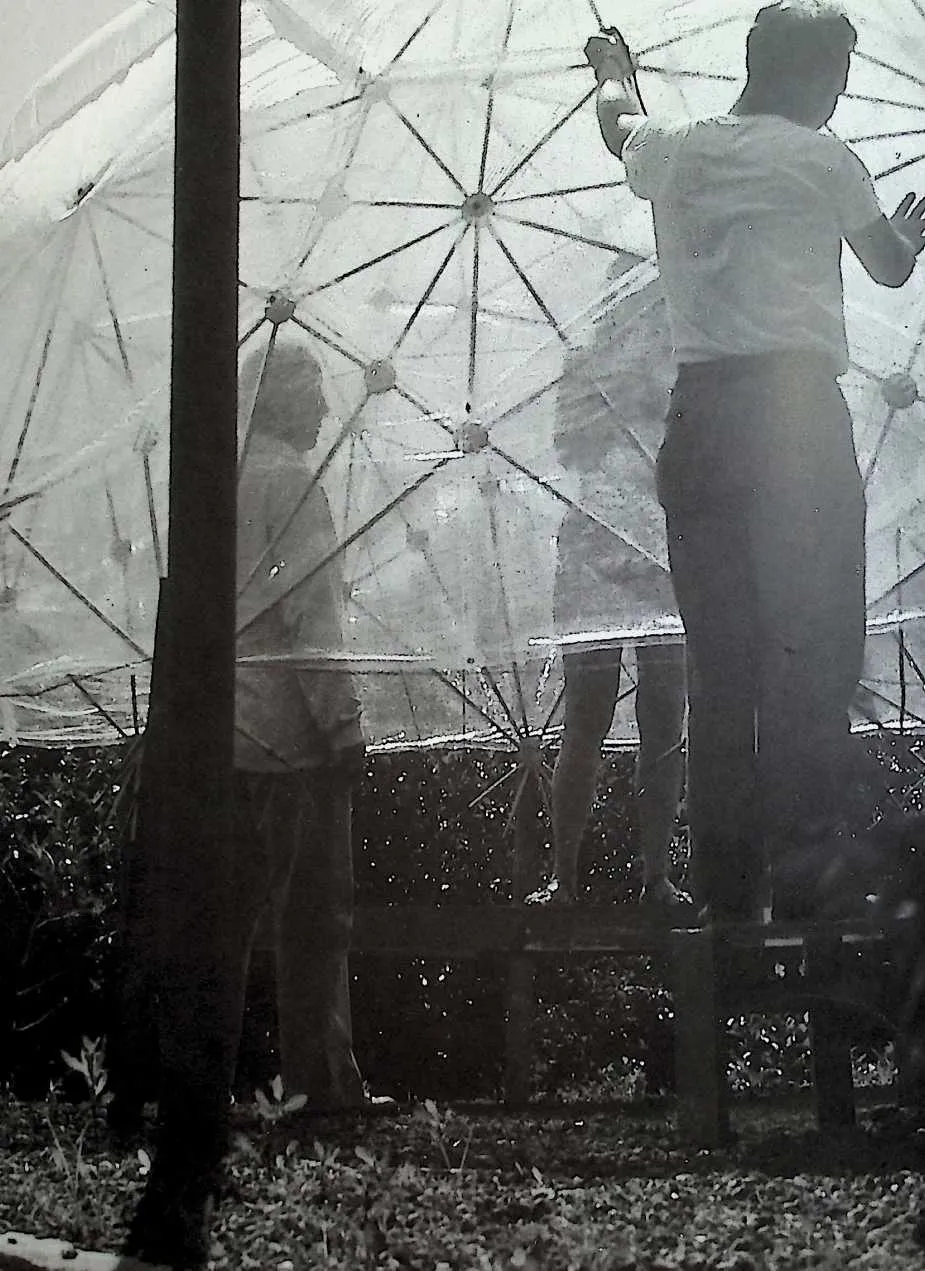
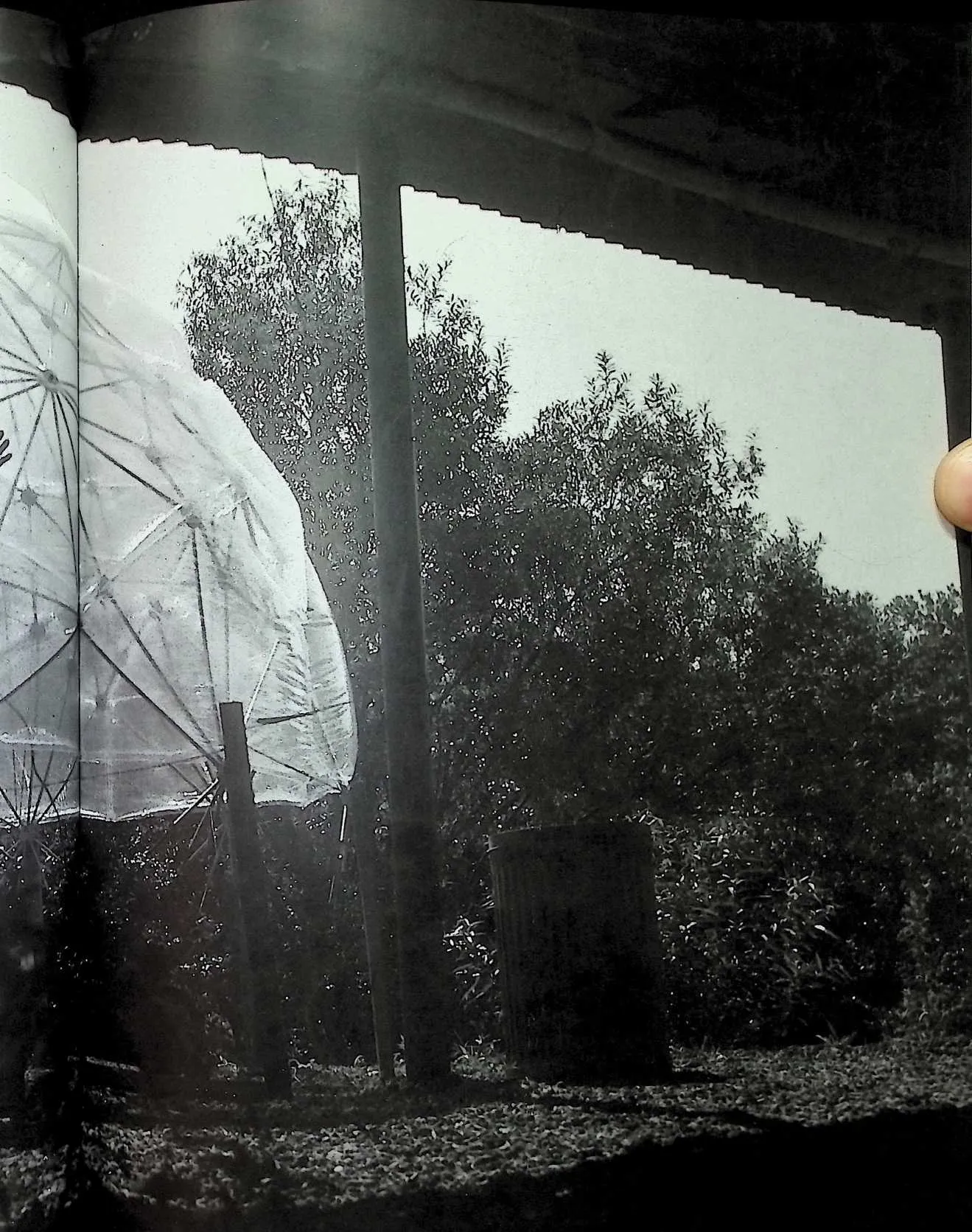
409 MARKUS
410 RICHTER
411 JITTERBUG
WlfflOM
412 BUCKMINSTER
413 FULLER
414 IN
415 OER
ZEITGENOSSISCHEN
KUNST
416 Am 23. April 1948 notiert Richard Buckminster Fuller ehusiastisch: EUREKA -EUREKA -Dies ist es, wonach Archimedes suchte und die ’’hX.rund Kepler und Newton. Und normals Eureka!!! Wlr maehten uns auf den Weg, ein sublimes neues umfassendes System zu finden. vor 20 Jahren -und hier ist es."’ Die Begeisterung Fullers uber seine Entdeckung ist durchausbegriindet. Seit seinen4D-Studien der spaten 1920er-Jahre ist erauf derSuche nach einer Architektur, die nicht raumlich-statisch, sondern auf zeitbasiert-dynamischen Prozessen begrundet sein soil. Das Cartesianische Bezugssystem ist dafiir nicht geeignet und Fuller sucht nach einer Moglichkeit, seine mobile und modulare Architektur analog zu den Wachstumsprozessen der Natur zu entwickeln. In den folgenden Jahren, in denen er sich mit der Entwicklung des Dymaxion Car, der Dymaxion Deployment Unit und des Wichita House befasst, tritt diese Fragestellung in den Hintergrund, beschaftigt ihn aber weiter. Wahrend der Entwicklung der Dymaxion World Map, einer Darstellung der globalen geografischen Verhalt-nisse, die ohne die Verzerrungen der konventionellen Mercator-Projektion auskommen soil, gelingt Fuller dann der Durchbruch: Die volumetrisch beste Annaherung an die (Welt-) Kugel gewahrt der Kuboktaeder, ein halbregelma-fiiger Kbrper, der seit Archimedes bekannt ist und dessen 14 Flachen sich in 6 Quadrate und 8 Dreiecke aufteilen. Diesen archimedischen Korper nutzt Fuller nicht nur als Projektionsflache fur die World Map, sondern nimmt ihn auch zum Ausgangspunkt fur eine dynamische Transformation der Platoni-schen Korper, die bis dahin als statisch galten. Er findet heraus, dass der Kuboktaeder sich schrittweise in einen Ikosaeder, Oktaeder, Tetraeder und wieder zuriick verwandeln kann, ahnlich wie man einen Bettbezug von aufien nach innen nach auflen umstiilpt. Fuller bringt so die platonischen Verhaltnisse zum Tanzen und benennt den Transformationsprozess nach dem urn 1940 angesagten Swing, der bei der weifien Bevolkerung als „Jitterbug‘‘ bekannt war. „ln Fullers Jitterbug' zeigen sich die geometrischen Elemen-tarformen, die seit Platon als ein Satz vollkommener Formen und Korper nebeneinander stehen, als Phasenubergange ein und desselben Verwand-lungsprozesses. Mit anderen Worten, die Formen werden hier zu Phasen einer Bewegungsgestalt."2
417 Auch die Rezeption Buckminster Fullers durch die bildenden Kunste mutet wie ein bestandiger Transformationsprozess an. Bei vielen Werken zeitge-nossischer Kunstler, die sich in den letzten Jahren mit Fullers ideen ausein-andergesetzt haben, handelt es sich urn eine Rezeption der Rezeption. Bereits in den spaten 1960er-Jahren hatten Minimal-und Konzeptkiinstler Fuller fur sich entdeckt, wie Dana Miller in ihrem Beitrag zu diesem Katalog darlegt. Fur die aktuelle Rezeption sind allerdings weniger die kritischen Reflexionen Fullers in den Essays von Robert Smithson und Dan Graham Oder Jaspar Johns’ malerische Umsetzung der Dymaxion Air Ocean World von Bedeutung, als Stewart Brands Whole Earth Catalog und die freie Aneig-nung der geodatischen Strukturen durch die Gegenkultur. Die Domes und Zomes der Hippie-Kommunen Drop City, Libre Oder Red Rockers in Colorado werden zu Phaseniibergangen im Verwandlungsprozess von Fullers hochkomplexen Ideen und Entwiirfen zu Ikonen der Protestkultur.
418 Stewart Brandd d l°SSS * T°°‘S Spielt dabei eine besondere Rolle. 19M und 1074 h den Catalog nut einer Handvoll Freunden zwischen ESrht Jn R huerausglbt’schreibt im litoral der ersten Ausgaben: „Die Emsichten Buckminster Fullers haben diesen Katalog initiiert/'3
419 Er sorgt nicht nur fur die Verbreitung von Fullers Biichern und Ideen weit uber die Kunst-und Architekturszene hinaus, sondern wird zu einer Art Suchma-schine der Gegenkultur und zur Bezugsquelle fur Werkzeuge und Materialien fur den Bau von alternativen Architekturen wie Jurten, Tipis und Domes. Die Do-it-yourself-(DIY)-Philosophie der kalifornischen Alternativbewegung greift damit den praktischen Aspekt von Fullers ganzheitlichem Denken auf. „Der Hands-on-Philosoph‘‘, so Joachim Krausse und Claude Lichtenstein uber Fuller, „nimmt -und damit unterscheidet er sich vom Theoretiker -liber Worte hinaus aktiv teil an der Modifikation des .Ecological Patterning1, er integriert nicht nur Erfahrungen in Texten und Kontexten, sondern objekti-viert: er entwirft, konstruiert, baut.‘‘4
420 Nicht wenige der DIY-Domes und -Zomes waren Kunstlerprojekte. Selbst Drop City, bereits in den friihen 1970er-Jahren eine von traurigen Gestalten bevblkerte Ruinensiedlung, wurde 1965 als Kiinstlerkommune gegriindet. Clark Richert, einer der Drop-City-Griinder, berichtet: „Die idee war, ein Drop-Art-Werk als Lebensraum zu schaffen, beflugelt von den Happenings John Cages und Robert Rauschenbergs am Black Mountain College in den spaten 1940er-Jahren. Inspiriert von den architektonischen Ideen Buckminster Fullers und Steven Baers konstruierten die .Dropper1 Domes auf der Basis geometrischer Korper (einer davon mit Solarheizung) als Wohn- und Atelierraume.115 Die Flutvon Bildern dieserSelbstbau-Domes, insbesondere von der verfallenden Drop City als Menetekel der gescheiterten Utopie, die sich in Zeitschriften und im Internet, in Biichern liber die Gegenkultur der 1960er Jahre und selbst in der wissenschaftlichen Literatur uber Fuller findet, ist heute integraler Bestandteil der Fuller-Rezeption durch jiingere Kiinstlern.
421 Neben den DIY-Bauten bilden auch die von Fuller inspirierten Leichtbauent-wiirfe der „richtigen‘‘ Architektengruppen und -kollektive ab Mitte der 1960er-Jahre einen wesentlichen Bestandteil dieser Rezeption. Interessant ist dabei in unserem Zusammenhang, wie fliefiend die Ubergange zwischen Kunst, Architektur und Performance diesseits wie jenseits des Atlantiks sind. Selbst reine Architektengruppen wie etwa Archigram bewegen sich mit ihren Projekten frei im Spannungsfeld zwischen den Gattungen.6 1966 entwickelt David Greene den Living Pod, eine Verbindung von organischerWohnskulptur und Mondlandefahre, und Michael Webb schafft mit Cushicle (air CUSHion VehiCLE) und Suitalone die ultimative Steigerung des Leichtbauprinzips: tragbare Behausungen, Verbindungen von Overall, Rucksack und aufblasba-rer Mini-Wohnkapsel. Auch der Osterreicher Walter Pichler experimentiert mit der Verbindung von Architektur und Kleidung und entwirft im Jahr darauf unter anderem den TV Helm (tragbares Wohnzimmer). In den USAtourt die Architekten-und Kunstlergruppe Ant Farm mit ihrem Media Van durchs Land, der mit allem notigen Equipment zur Errichtung von Inflatables ausgestat-tet war. Ant Farm veroffentlicht 1970 mit dem Inflatocookbook ein Manifest der ephemeren Architektur, das gleichzeitig als DIY-Manual fur auf blasbare Wohnstrukturen dient. Aus den Jahren 1969---1971 findet sich kaum eine Ausgabe von Architectural Design, Casabella, Domus oder architecture d’aujourd’hui, die frei von Berichten liber pneumatische Strukturen, transportable Prefab-Konstruktionen oder Container-Hauser ist. Justus Dahinden stellt im Einleitungstext zu Stadtstrukturen fur morgen die Frage, ob die Stadt angesichts der wachsenden Bedeutung neuer Kommunika-tionsmittel und elektronischer Medien liberhaupt eine Zukunft hat. „Die
422 Hinnie-Bewegung innerhalb der Jugend ist nicht blofi als Rebellentum gegen menschenfeindliche Welten, sondern als ein grundlegender Beitrag zu Siichen neuen Urban-und Sozialformen anzusehen, denen aufblasbare Mini-Unterkiinfte besserentsprechen als .gebaute Hauser-
423 Fur die Gegenkulturderausgehenden 1960er-Jahre ist Architektur, ganz in Fullers Sinn, ein Transmissionsriemen der groflen Utopiemaschine und viele der Kunstler, die sich gegenwartig mit Fuller auseinandersetzen, knupfen hier an Auch aktuelle Architektengruppen wie raumlaborberlin oder n55 aus Kopenhagen nehmen die Faden der Fuller-Adepten von Archigram bis Ant Farm wieder auf. In ihren Projekten verbinden sie experimentelle Architektur und Design mit angewandter Urbanismus-Kritik und Performance orientierter Skulptur. Wahrend derSpacebuster oder das Kuchenmonument, nomadisie-rende, aufblasbare Bubble-Architekturen von raumlaborberlin, an Ant Farms Inflatables erinnern, greifen andere Projekte der Gruppe auf geodati-sche Strukturen zuriick, wie etwa Der Berg von 2007 im Berliner Palast der Republik. Auch bei n55 finden sich immer wieder Verweise auf die Tetraeder-basierte Geometrie und die grundlegenden Konstruktionsprinzipien der Fuller-Nachfolge: kostengiinstige, aber haltbare und damit nachhaltige Ent-wiirfe in Leichtbauweise, die ohne Spezialkenntnisse und -Werkzeuge vom Nutzer selbst konstruiert werden konnen. Eines der letzten Projekte von n55, die Spaceframe Vehicles, spielen nicht nur dem Titel nach auf Fuller (und dessen Freund Konrad Wachsmann8) an, sondern sind auch eine Weiterent-wicklung der Ideen, die zum Dymaxion Carfiihren und stehen fur eine zeit-gemaBe Form der Mobilitat jenseits der Automobile.
424 Auch Pedro Reyes Ciclomovil von 2007 darf als Anspielung auf Fullers Dymaxion Car verstanden werden. Reyes schreibt dazu: „Das Ciclomovil ist ein durch Menschenkraft angetriebenes Fahrzeug, das ich als alternatives Fortbewegungsmittel fur Mexiko City entwickelt habe. Dieses ergonomische Beforderungsmittel produziert keinerlei Emissionen und konnte dazu beitragen, die Verkehrsprobleme zu mildern. In der Verbindung von Design und Ingenieursarbeit ist es auch ein partizipatorisches Werk.‘‘9 Reyes versteht seinen Entwurf nicht nur als Skulptur, sondern auch als Initialzun-dungfiir ein soziales Unternehmen, das von der Forschung und Entwicklung des Ciclomovil uber dessen Produktion bis hin zum Betrieb und Marketing Arbeitsplatze schaffen konnte.
425 Ich mochte im Folgenden anhand weiterer exemplarischer Positionen die mafigeblichen Aspekte der Fuller-Rezeption durch zeitgendssische Kunstler darlegen, Schwerpunkte und „blinde Flecken‘‘ verdeutlichen und wo immer es sich anbietet, die Transformation der Ideen Fullers durch ihre Rezeption erlautern.
426427Pedr° ReyeS als bildender Kunstler wie auch die Architekten-e ive raumlaborberlin und n55 arbeiten im Sinn von Fullers Idee des
428 ’’ °mprehensive Design". In einem Essay von 1949 definiert Fuller:
429 "a ® kS c J k°mPrehensives Design ist eine emergierende Synthese arem IVIecban’Ker, praktischerdkonom und evolution-
430 mit den °n aR den Kdnstlern>die sich mittel-oder unmittelbar
431 in besonderem «rS auseinandergesetzt haben, trifft diese Definition sich auf da<? p •3 aauf TomasSaraceno zu. Seine Airport Cities beziehen sich auf das Project for Floating Cloud Structures (Cloud Nine)- kugelfbrmige, fliegende Stadte, die Fuller gemeinsam mit Shoji Sadao um 1960 entworfen hat. Die Idee basiert auf der Annahme, dass das Gewicht geodatischer Kugeln bei grofiem Durchmesser relativ gesehen so gering ware dass die durch Sonneneinstrahlung bewirkte Erwarmung der Luft im Inneren die Kugelstadte wie Heiflluftballone von der Erde abheben lassen mlisste. Saraceno greift diese Idee auf und arbeitet mit grower Energie daran, Fullers ' Vision Wirklichkeit werden zu lassen. Als ..Comprehensive Designer" verlasst er dabei den tradierten Bereich der bildenden Kunst, arbeitet gemeinsam mit Wissenschaftlern an der Entwicklung von Materialien, die leichter sind als Luft und hat bereits eine entsprechende Substanz namens ..Aerogel" patentieren lassen.11
432 Eine vergleichbare kollaborative Praxis findet sich bei Olafur Eliasson, in dessen Team schon seit langem Wissenschaftler, Architekten und Designer arbeiten und der in seinen Werken immer wieder auf geometrische Uberle-gungen und Experimente Fullers zurtickgreift. Insbesondere die Entwicklung der Grofikreismodelle und der Jitterbug-Transformation vor und wahrend Fullers Zeit am Black Montain College hat Eliasson entscheidende Anregun-gen vermittelt. Gemeinsam mit dem Architekten Einar Thorsteinn baut er 2003 den auf Fullers Modellen aus der Entwicklungsphase der geodatischen Dome basierenden Model room, der seither in wechselnden Konfiguration- en und architektonischen Rahmungen zu sehen war.12
433 Wahrend Fullers Jitterbug wesentlich auf den geometrischen Eigenschaften des Kuboktaeder und seinen sechs quadratischen und acht dreieckigen Flachen basiert, verbindet sich wenige Jahre nach Fullers Tod ein anderer archimedischer Korper eng mit seinem Namen: der aus zwolf Fiinfecken und zwanzig Sechsecken bestehende abgestumpfte Ikosaeder, auch Fufiball-kbrper genannt. Eine Gruppe von Forschern publiziert 1985 in der Zeitschrift Nature spharische Molekiile aus Kohlenstoffatomen, darunter das C60-Molekiil, das aufgrund seiner an geodatische Dome erinnernden Struktur den Namen ..Buckminster-Fulleren" erhalt. Auch diese Rezeption geodatischer Strukturen durch die Chemie ist mittlerweile in den kiinstlerischen Transformationsprozess der Fuller’schen Formen und Ideen eingegangen: Die in Berlin lebende Kiinstlerin Kerstin Stoll, die sich in ihrem Werk bereits mehrfach mitchemisch-physikalischen Prozessen auseinandergesetzt hat, nahert sich Fuller liber eine halb-fiktionale Recherchearbeit zu den Fullerenen.
434 Einen naturwissenschaftlichen Ausgangspunkt hat auch Albrecht Schafers Ocellus von 2009. Der titelgebende Begriff stammt aus der Zoologie und bezeichnet urtiimliche Lichtsinnesorgane, die beispielsweise bei Quallenar-ten vorkommen. In Schafers Arbeit schwebt eine diinne Kunststofffolie liber einer Batterie von Bauscheinwerfern, die unter der Folie die Luft erhitz-en und das Gebilde so vom Boden abheben lassen. Durch die einstromende kalte Luft sinkt die Folie wieder nach unten und der Prozess beginnt von neuem. Beim Auf-und Abstieg bildet die Folie kuppelartige, sich bestan-dig wandelnde Formationen, Leichter-als-Luft-Gebilde, die sich auch als poetisch-kritischer Kommentar zu den perfekt kugelformigen, fliegenden Stadten lesen lassen.
435 Wahrend Schafers schwebender Ocellus von der erhitzten Abluft der Lampen in einer standigen, an Ein-und Ausatmen gemahnenden Bewegung gehalten wird, hat Michel Francois 200 Ballons mit jeweils einem tiefen Atemzug gefiikt. Die Ballons, in mundgeblasenem schwarzem Gias umgesetzt hangen unbeweglich in einer dichten, schweren Traube an kaum sichtbaren Nylon-faden von der Decke. Francois’ Skulptur mit dem Titel Souffles dans le verre-Black liefie sich als Antithese zu der leichtgewichtig-bewegten Lichtinstal-lation Schafers lesen, hat mit dieser aber die unregelmaBig-orgamsche Form gemein. Beide bilden im Kontext der Ausstellung eine Gegenposition zur den dominanten geodatischen Kugeln und Strukturen. Eine explizit skeptische Auffassungvon Fullers Cloud Nine artikuliert Tobias Putrih, der dem Projekt eine ganze Werkgruppe gewidmet hat. „Es scheint mir kein weiter Weg von Fullers fantastischer Idee zum Konzept der ultimativen, totalen, vielleicht sogar totalitaren Struktur. Science-Fiction-Thriller: Das utopische Moment des amerikanischen Traums verbindet sich mit dem radikalen Konzept der schwebenden Stadt. Eine der moglichen Antworten auf Fullers Vision ware es, seine urspriingliche Idee zuriick in die Hande und Kopfe der Individuen zu bringen, damit der Gestaltungsprozess von neuem beginnen kann und metaphorisch gesprochen Jeder und Jede eine eigene, deformierte Form von Cloud Nine entwickeln kann.‘‘13 Aus diesen Uberlegungen heraus entste-hen ab 2002 Putrihs Zeichnungen und Skulpturen der Werkgruppe Quasi Random, die unterschiedlichste Stadien der Deformation der perfekten Kugel-welten darstellen.
436 Ai Weiwei hingegen hat in einer unbetitelten Arbeit von 2006 die Perfektion der geodatischen Kugelauf dieSpitze getrieben und ein „Fulleren‘‘, einen Ikosaederstumpf, in altchinesischer Handwerkstradition aus wertvollem Huanghuali Holz realisieren lassen. Damit verkehrt er wesentliche Prinzipien Fullers in ihr Gegenteil: Aus dem schnell, ohne grofie Vorkenntnisse und mit preisgiinstigem Material zu konstruierenden „Bucky-ball‘‘ wird ein im Modus notwendiger Langsamkeit gefertigtes exquisites Objekt. Ungeachtet der utopischen Konnotation, die dem „Bucky-ball‘‘ per se inne wohnt, ge-lingt Ai die Transformation des geodatischen Korpers in ein traditionsgesat-tigtes Stuck Handwerkskunst. Das Werk ist gleichermafien ein Kommentar zu den totalitaren Aspekten von Cloud Nine als auch zum fortschreitenden Verlust iiberkommener Kulturtechniken im heutigen China. Die kritische Position des Kiinstlers gegeniiber der chinesischen Politik hat einschneiden-de Konsequenzen: Nachdem die Behorden vor wenigen Monaten seinen Atelier-Neubau in Shanghai abreiflen liefien, wird Ai mittlerweile unter du-biosen Anschuldigungen an unbekanntem Ort gefangen gehalten.
437 DieSkepsis gegeniiber der allzu perfekten Form, dervollkommenen Geometrie, ist ein durchlaufender Topos der Fuller-Rezeption, angefangen bei Robert Smithsons’ beruhmten Verdikt „(…) ein Triimmerhaufen ist haufig interes-santer als eine Struktur. Zumindest nicht so deprimierend wie ein Dymaxion Dome. Auch Smithsons’ Reserve gegeniiber Fullers Ideen ist in die Rezepti-onstransformat'on eingegangen und taucht -mitunter unerkannt -in der uller-Kntik durch zeitgendssische Kiinstler wieder auf. Die „falsch verstan-denen .nicht geometrischperfekten DomesundZomesder Hippiekommu-"nharXan?t her PerSp®kt'VedieRettunSvon Fullers Ideen vordem ihnen
438 ' diPnL Perfekti°nI hier, so sagt etwaTilman Wendland,
439 „fangt die Poesie an . Dieser Poesie verleiht auch Beat Zoderer seinen mit-als aucX MateendT S‘Ch S°W°hl der Pektion der Form
440 fpn kn?if" Mater'lsentziehen. Dieausfarbigen Aluminiumstreifen gefug-ten kugelformigen Skulpturen wirken wie Persiflagen auf die S §
441 selbsttragenden geodatischen Strukturen. Gerade die Abstinenz gegenuber der Perfektion schafft aber die Voraussetzung zur erneuten Beschaftigung mit der konstruktiven, geometrisch streng gefiigten Form, die als solche meist erst auf den zweiten Blick als solche erkennbar wird.
442 Kai Schiemenz hat ganz in diesem Sinn fur die Ausstellung einen deformier-baren ..Bucky-ball'1 entworfen, einen geodatischen Sitzsack, der die perfekte Kugelform notwendigerweise einbuBen muss, soil er seine Funktion als Mbbel erfiillen. Bei Bedarf und nach Belieben der Ausstellungsbesucher kann er aber wieder entzerrt und in seine kugelfbrmige Ausgangsposition zuriick gebracht werden. Eine ahnliche spielerisch-experimentelle Lust am Umgang mit der Fullerschen Geometrie findet sich auch bei Attila Csorgo, der etwa in seiner Football World Map den fussballformigen Ikosaederstumpf, das „Ful-leren‘‘, mit der Dymaxion World Map verbindet Oder auch bei Jose Davila, der Fullers sublime Zeichnung der 25 Great Circles in einen gewohnlichen Teppich transformiert. Mit der 48-teiligen Fotoarbeit When Buildings become Clouds von 2007 verlasst Davila den Bereich des spielerischen Umgangs mit der Geometrie wieder. Die Serie basiert auf einer Gegeniiberstellung von Hauserblocken kurzvor beziehungsweise nach ihrerSprengung. Zu sehen istauf jeweils einem der beiden zusammengehorigen Bildereine groBe Staubwolke, die fur einen Moment zur quasi-architektonische Form gerinnt. Die Verganglichkeit dieser ephemeren „Architekturen‘‘ ist evident. Durch den Titel When Buildings become Clouds verbindet Davila sie rhetorisch mit Fullers Cloud Nine und verleiht ihnen damit Dauer. Die Verknupfung von Cloud Nine mit den Explosionen verweist umgekehrt auf die Beziehungen zwischen Fuller und dem Militar. Der „miltarisch-kunstlerische Komplex" ist von einiger Bedeutung fur die Entwicklung der geodatischen Dome, die ohne die Auftrage und finanzielle Unterstiitzung Fullers durch die US-Navy nur bedingt realisierbargewesen waren. Auch Lucas Lenglets Panzersperren verweisen im Kontext der Ausstellung auf diese Thematik. Die prazise ge-fertigten Module aus schmalen Aluminium-L-Profilen werden zu einem pre-karen fiinf Meter hohen Turm gestapelt, der auf den ersten Blick an einen Tensegrity-Mast erinnert. Dennoch bleiben die Module als „Panzersperren‘‘ identifizierbar und der militarische Hintergrund bei aller Abstraktion present.
443 Die Wahrnehmung des Fuller’schen Werks hat wahrend des hier beschriebe-nen, beinahe 60 Jahre laufenden Rezeptionsprozesses entscheidende Transformationen erfahren. Steht Fuller bis in die spaten 1980er-Jahre fur eine radikale Kritik von Architektur und Stadtebau der Moderne, so rezipieren jiingere Kiinstler sein Werk heute als Bestandteil einer spaten Moderne, deren utopisches Potenzial sie langst nicht mehr nur bei „ha-retischen" Kunstlern und Architekten wie Fuller, Constant, Guy Debord □der Yona Friedman suchen.
444 Aktuell wichtige Aspekte wie die Ideen vom „Raumschiff Erde‘‘ und dem nachhaltigen, verantwortlichen Umgang mit den naturlichen Ressourcen er- scheinen den Kunstlern als wesentliche Bestandteile von Fullers Werk. Die Komplexitat seiner mathematischen Theorien hingegen wurde und w.rd nur partiell zur Kenntnis genommen -selbst wenn Fuller sie in so frappier-ende Begriffe wie ..Jitterbug Transformation11 gefasst hat.
- 1.
- Richard Buckminster Fuller, „Eureka Eureka",
445 Manuskript vom 23, April 1948, Buckminster Fuller Archiv, zitiert nach Joachim Krausse/Claude Lichtenstein,
446 Your Private Sky, R. Buckminster Fuller, Diskurs, Zurich 2001, S. 188.
- 2.
- Joachim Krausse, Claude Lichtenstein, „Earthwatking -Skyriding, Einladung mit Buckminster Fuller auf Entdeckungsreise zu gehen",
447 in: Krausse/Lichtenstein 2001 (wie Anmerkung 1), S. 27.
- 3.
- Stewart Brand, Whole Earth Catalog -Access to Tools, Fall 1968, ohne Paginierung.
- 4.
- Krausse/Lichtenstein 2001 (wie Anmerkung 2), S. 15.
- 5.
- Zitiert nach Eva Diaz, „Dome Culture in the Twenty-first Century", in: Grey Room, 42, Winter 2011, S. 84. Vielen Dank an Matthias Rick fur den Hinweis auf diesen Text!
- 6.
- Bereits die Ausstellung Living City, die Archigram 1963 fur das Londoner ICA konzipiert, ist ein radikaler Bruch mit der Gattungder Arohitektur-prasentation. Anstelle von Planen und Modellen zeigt die Gruppe eine Hommage an urbane Verdichtung und Beschleunigungals skulpturale, multimediale Installation. Eine umfassende Analyse der Ausstellungfindet sich bei Simon Sadler, Archigram, Architecture without Architecture, Cambridge, Massachusetts/London 2005, S. 53-89.
- 7.
- Justus Dahinden, Stadtstrukturen fur morgen. Analysen, Thesen, Modelle, Stuttgart 1971, S. 2.
- 8.
- Fuller und Wachsmann lehren beide in den spaten 1940er-Jahren am Institute of Design in Chicago. Laut Wachsmanns Biograf Michael Gruning waren sie auch befreundet. Vergl. Michael Gruning, „Der Wachsmann Report -Auskunfte eines Architekten", Berlin (Ost) 1986, S. 283. Eine vergleichende Analyse der Raumtragwerke von Fuller und Wachsmann mit Verweisen auf die ambivalente Beziehung der beiden Entwerfer zur US-Army findet sich bei Carsten Krohn,,.Buckminster Fuller und die Architekten", Berlin 2004, S. 78-82.
- 9.
- Pedro Reyes, Ciclomdvil, zitiert nach http://www.pedroreyes.net/ ciclomovil.php?szLang=en&Area=work (11. Mai 2011).
- 10.
- Richard Buckminster Fuller, „Der Komprehensive Designer", Manuskript vom 1. Juni 1940, Buckminster Fuller Archiv, zitiert nach: Krausse/Lichtenstein 2001 (wie Anmerkung 1), S. 258.
448 11 Vgl. dazu Luca Cerizza, „Tom4s Saraceno", in: Megastructure Reloaded. Visionare Stadtentwilrfe dersechzigerJahre reflektiert von zeitgendssischen Kunstlern, hrsg. von Sabrina van der Ley und Markus Richter, Ostfildern 2008,3.260.
449 12---Eine eingehende Beschreibung des Model room findet sich bei Elizabeth A. T. Smith, „The Comprehensivist: Buckminster Fuller and Contemporary Artists", in: Buckminster Fuller: Starting with the Universe, hrsg. von K. Michael Hays und Dana Miller, Ausst.-Kat. Whitney Museum of American Art, New Haven/London 2008, S. 61 f. Der Model room war zuletzt in dergroGen Eliasson-Retrospektive 2010 im Berliner Martin Gropius Bau zu sehen.
450 13 Tobias Putrih in einer Email an den Autorvom 24. Marz 2007.
- 14.
- Interview mit Gregoire Muller, publiziert unter dem Titel „The Earth…Is a Cruel Master", in: Arts Magazine 46, 2 (November 1971),
451 in: New Haven/London 2008 (wie Anmerkung 12), S. 42.
- 15.
- |n einem Gesprach mit dem Autor, 9. Mai 1011.
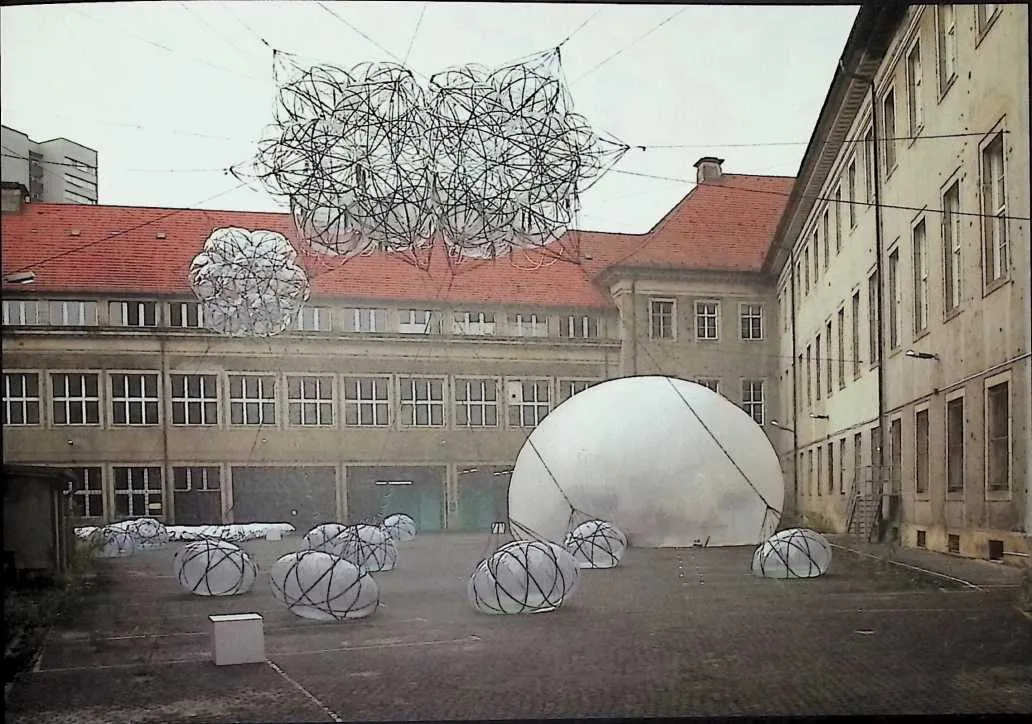
453 Right:
raumlaborberlin,
Kiichenmonument, 2008
Mobile inflatable architecure
454 Installation view
Megastructure Reloaded,
Ehemalige Staatliche Miinze Berlin
Courtesy raumlaborberlin
and European Art Projects
Photo: Matthias Rick
455 Left and in the air:
456 Tomas Saraceno,
457 3 x 12MW(Air Port City),
458 2007/08
459 PVC pillows, air, nylon webbing, and rope
Dimensions variable
460 Tilman Wendland
Untitled, 2011
Collage, montage
Draft for
We are all astrounauts
462 Silke Riechert
463 R. B. Fuller Satellit, 2011
Sketch, 30x35 cm
464 Draft for
465 IVe are all astrounauts

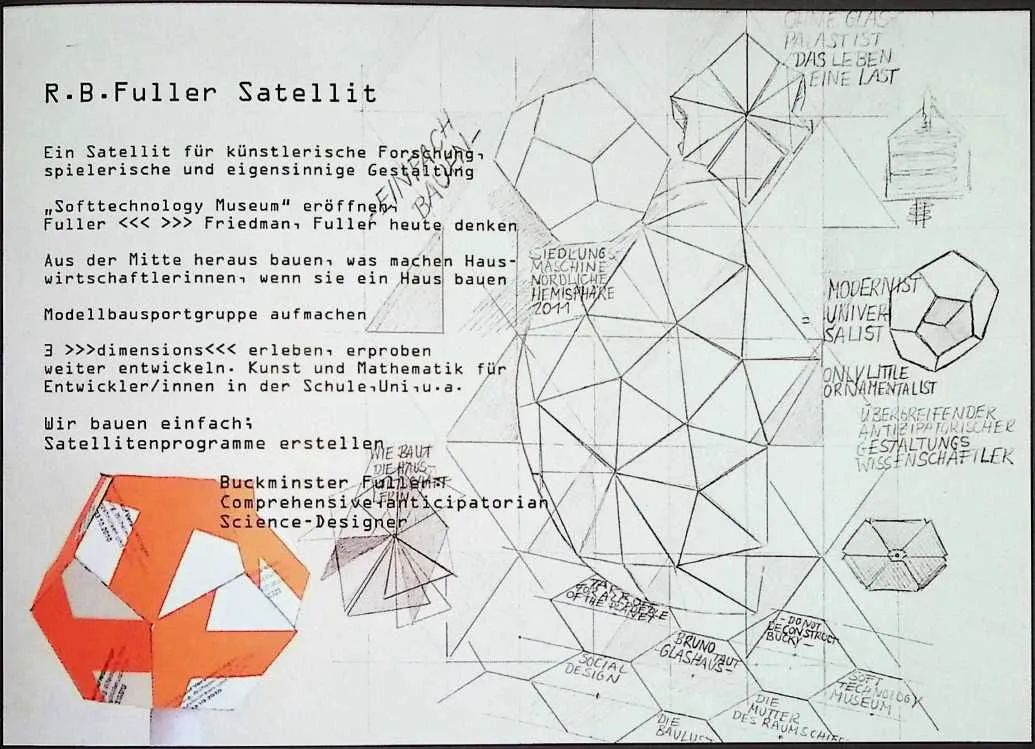
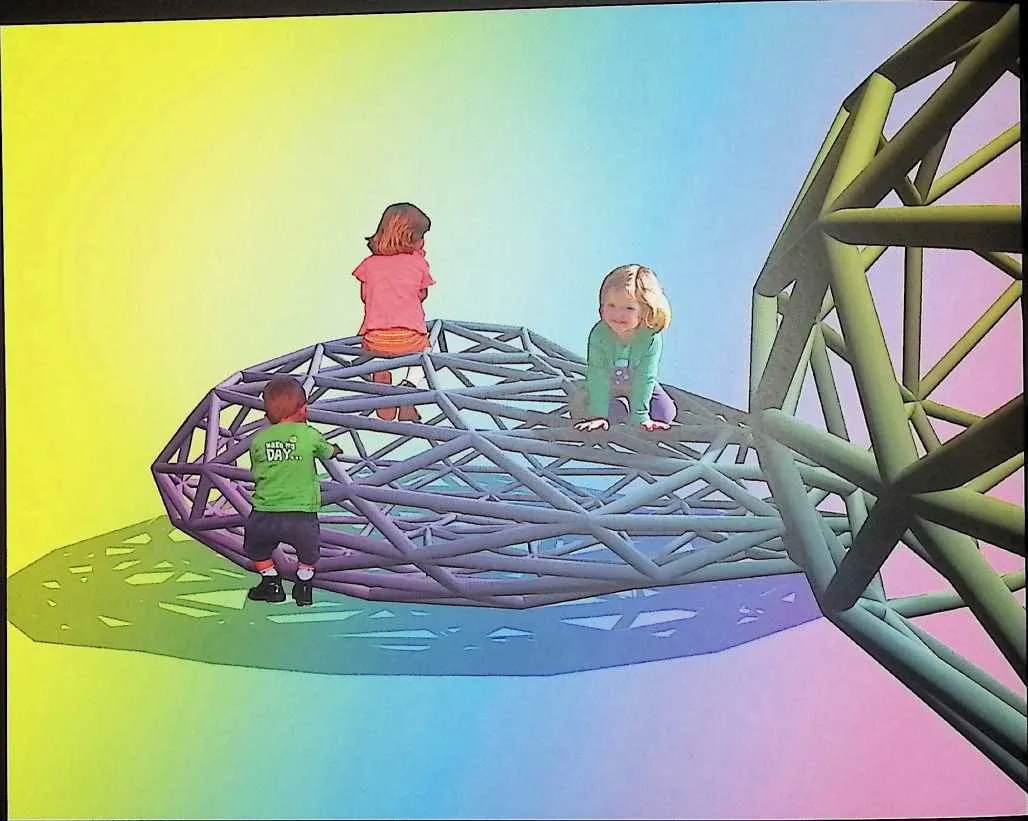
468 KaiSchiemenz
LczySitzsack (working title), 2011
Collage, montage
Draft for
469 We ore all astrounauts
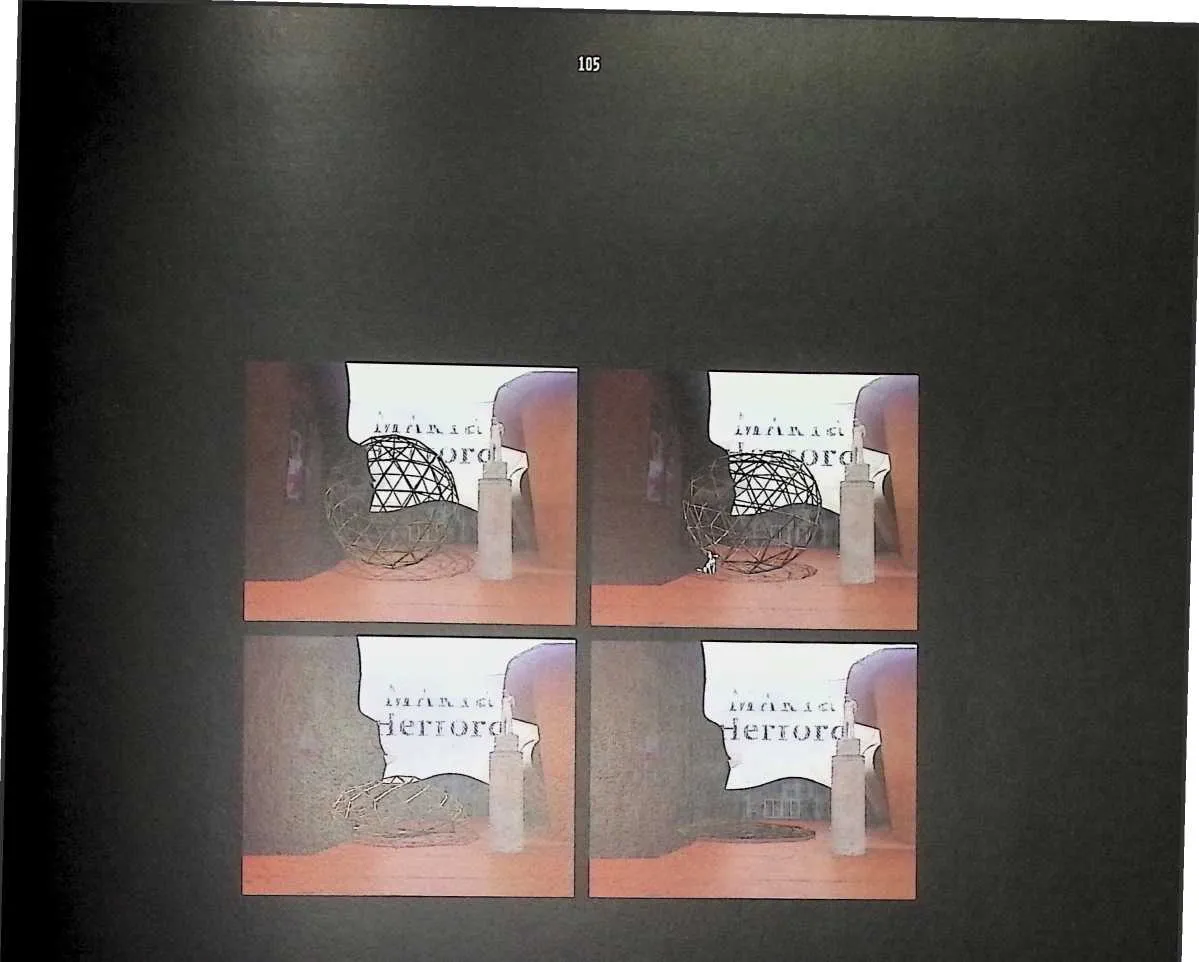
471 Kai Schiemenz
Lazy Bugger, 2011
Self folding and unfolding geodetic sphere
Collage/Montage
First draft for
We are all astrounauts
472 Riccardo Previdi
473 Untitled (long time exposure), 2011
Maquette and reworked photographs
Draft for
474 IVe are all astrounauts
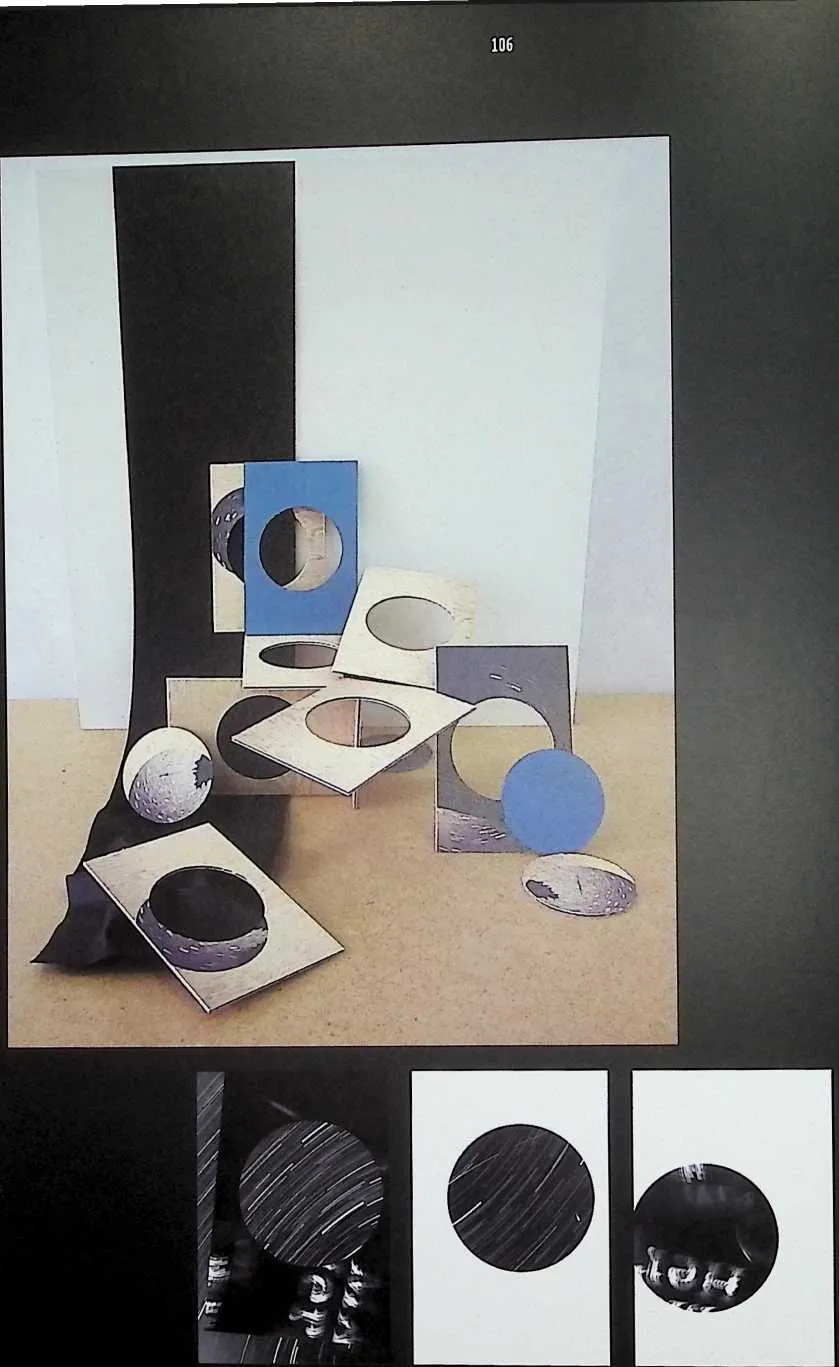
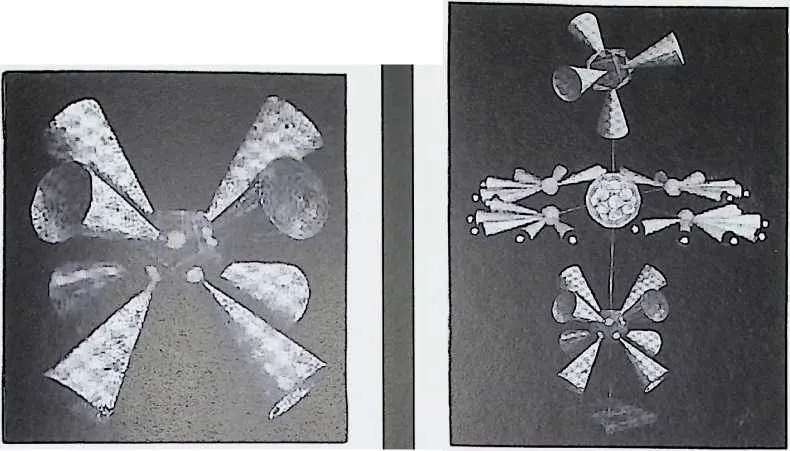
477 FIG. 323. FULLEREN
478 FIG. 321. TYPE OF PENTAGON
479 Kerstin Stoll
Fullerene
(nachA. Besant&C.W. Leadbeater), 2011
From a 3-part series of 11 illustrations, 2011
Inkjet-prints, 30x40 cm
Part of the artists’ project for
We are all astrounauts
480 MARKUS
RICHTER
481 JITTERBUG
482 VARIATIONS
483 BUCKMINSTER
FULLER
IN
CONTEMPORARY
ART
484 On April 23,1948 Richard Buckminster Fuller enthusiastically wrote ‘‘EUREKA EUREKA, This is what Archimides sought and Phytagoreans and Kepler and Newton and Eureka again!!! We set out to find sublime new comprehensive system 20 years ago-and here it is.’’ ’ Fuller’s enthusiasm for his discovery was certainly understandable, he had been searching for an architecture based upon temporal growth patterns ratherthan static spatial constructions since his 4D studies in the late 1920s. Fuller was looking for a way to develop a system for his mobile and modular architecture that would be analogous to natural growth patterns, and Cartesian coordinates were simply not applicable in this quest. Although this idea would be of secondary importance to him during the development of the Dymaxion Car, the Dymaxion Deployment Unit and the Wichita House over the next several years, it continued to occupy his thoughts. Fuller finally achieved his breakthrough while working on his Dymaxion World Map, a visualization of global geographic relationships intended to correct the distortions of the conventional Mercator projection. It was then that he discovered that the closest volumetric approximation of the (world) sphere was actually the cuboctahedron, a semi regular body made up of fourteen planes, consisting of six squares and eight triangles and known since the days of Archimedes. Fuller exploited this Archimedian body not only for his world map, but also as a point of departure for the dynamic transformation of Platonic solids which had until then only been considered as static. He discovered that the cuboctahedron could be transformed, step by step, into a icosahedron, an octahedron, atetrahedron and back into a cuboctahedron, much in the same way that a duvet cover could be turned inside out and back again. In this way, Fuller could make the Platonic solids dance and he named the process after the 1940s swing dance, known among the white population in America as the ‘‘Jitterbug.’’ ‘‘Fuller’s ‘Jitterbug’ shows the elementary forms of geometry, known since the time of Plato as a group of perfect forms separate from one another, as transformative steps in one and the same process. In other words, these solids became phases in a moving form.’’2
485 Interpretations of Buckminster Fuller in the visual arts also suggest a process of constant transformation. In recent years, many of the works produced by contemporary artists dealing with Fuller’s ideas have been interpretations of interpretations. As Dana Miller’s essay in this catalog points out, Minimalist and Conceptual artists had already discovered Buckminster Fuller‘s relevance fortheir own work by the late 1960s. Today, Stewart Brand’s Whole Earth Catalog and counterculture appropriations of geodesic structures appear to be more significant than critical reflections on Fuller in essays by Robert Smithson and Dan Graham, or Jasper Johns’ painterly interpretation of the Dymaxion Airocean World. The domes and zomes of the hippie communes Drop City, Libre or Red Rockers also represent the transformation of Fuller’s highly complex ideas into the icons of a culture of protest.
486 ‘‘Access to tools’’ was an important aspect of The Whole Earth Catalog. Stewart Brand, who published the catalog along with a handful of friends between 1968 and 1974, wrote in an editorial in the first issue, that ‘‘The insights of Buckminster Fuller are what initiated this catalog.’’3 Not only did the catalog provide for the distribution of Fuller’s ideas and books far beyond the art and architecture scenes, it became a kind of search engine for the counterculture and a source for the tools and materials required for building alternative architectural structures such as yurts, teepees and domes.
487 no
488 In this way the DIY (Do-It-Yourself) philosophy of the California alternative movement picked up on the practical aspects of Buckminster Fuller s comprehensive thought process. According to Joachim Krausse and Claude Lichtenstein ‘‘The hands-on philosopher Fuller goes beyond words, therefore differentiating himself from the theorist, and actively participates in the modification of ‘ecological patterning’. He not only integrates experiences into texts and contexts, but objectifies them as well; he designs, engineers and builds.’’4
489 More than a few of these DIY domes and zomes were artist’s projects. Even Drop City which had already become a collection of ruins, inhabited by desolate figures in the early 1970s, had begun as an artists commune in 1965. Clark Richert, one of the founders of Drop City stated: ‘‘The intention was to create a live-in work of ‘Drop Art’ informed by the ‘happenings’ of John Cage and Robert Rauschenberg at Black Mountain College in the late 1940s. Inspired by the architectural ideas of Buckminster Fuller and Steve Baer, the ‘droppers' constructed domes (one solar heated) based on geometric solids, to house their quarters.’’5 The flood of images of such hand made domes and especially those of the failed utopiaof Drop City, found in magazines, the Internet, books about the counterculture of the 1960s and even scientific literature on Fuller, have become an integral part of younger artists’ interpretations of his work.
490 Beyond these DIY buildings, other Fuller inspired, lightweight structures began to appear in the mid-1970s. Designed by ‘‘real’’ architecture groups and collectives, these have now become an integral part of interpreting Fuller’s ideas as well. In our case, it is interesting to look at just how porous the borders between art, architecture and performance were on both sides of the Atlantic. Even projects from such purely architectural groups as Archigram moved freely in the spaces between these disciplines.6 In 1966 David Greene designed the Living Pod, part organic sculpture, part lunar lander and Michael Webb developed Cushicle (air CUSHion vehiCLE) and Suitalone, the ultimate extension of the concept of lightweight building; combinations of overalls, backpacks and inflatable capsules, these were literally, living spaces that you could carry. The Austrian Walter Pichler also experimented with the marriage of architecture and clothing, designing, among other things, the TV Helmet (transportable apartment) in the following year. In the US, the art and architecture group Ant Farm toured the country in their Media Van, which was equipped with everything that one needed for‘inflatables’. In 1970 Ant Farm published the Inflatocookbook, a manifesto on ephemeral architecture and a DIY manual for inflatable living structures. It was almost impossible to pick up an issue of Architectural Digest, Casabella, Domus or L’architecture d'aujourd’hui between the years of 1969 and 1971 that did not have a story on pneumatic structures, transportable pre-fab construction or container houses. In the introductory text to his book Stadtstrukturen fur Morgen (Urban Structures of Tomorrow) from 1971 Justus Dahinden questioned whether or not the city even had a future considering the growing importance of new means of communication and electronic media. ‘‘The hippie movement within the youth should not simply be thought of as a rebellion against an inhumane world, but rather as a fundamental contribution of possible new urban and social forms LJkeJFidlpr1!36 7ni’s,helters are much m°re suited than ‘built’ houses.’ ’’ Like Fuller, the counterculture of the late 1960s saw architecture as a
491 Ill
492 ‘‘transmission belt of the great utopia machine’’ and many of the artists who deal with Fuller today take this as their starting point. Contemporary architecture groups such as raumlaborberlin and n55from Copenhagen, have picked up the strings left hanging by students of Fuller, such as Archigram and Ant Farm. Their projects combine experimental architecture and design with applied urban criticism and performance oriented sculpture. Whereas the nomadic, inflatable bubble architecture of raumlaborberlin’s Spacebuster or Kiichenmonument (Kitchenmonument) projects are reminiscent of Ant Farm’s inflatables, other projects like Der Berg (The Mountain) at Berlin’s Palast der Republic in 2007, refer back to geodesic structures. References to tetrahedron based geometry and to the basic construction principles of Fuller’s successors, namely inexpensive, sustainable, lightweight designs which can be built without special knowledge or tools, are also readily found in the work of n55. Spaceframe Vehicles, one of n55’s latest projects, is not only a word play on one of Fuller’s inventions (as well as one from his friend Konrad Wachsmann8) but also a further development of the ideas that led to the Dymaxion Car, which stands for a timely form of mobility, beyond the automobile.
493 Pedro Reyes’ Ciclomovil from 2007 can also be seen as a reference to Fuller’s Dymaxion Car. Reyes writes, ‘‘The Ciclomovil is a human powered vehicle that I developed for mobility in Mexico City. This ergonomic transporter produces no emissions whatsoever and could help to alleviate traffic congestion. It is also a participatory piece in that it combines the work of designers and engineers.’’9 Reyes not only sees his prototype as a sculpture, but also as a potential spark for initiating a socially minded company which could create jobs around the Ciclomovil, from research and development to marketing and sales.
494 In the following section I would like to highlight exemplary positions related to tendencies in the interpretation of Fuller by contemporary artists; to address their fixed points and ‘‘blind spots’’ and where applicable, the transformation of Fuller’s ideas through these interpretations.
495 The visual artist Pedro Reyes and the architecture collectives raumlaborberlin and n55, all work along the lines of Fuller’s idea of ‘‘Comprehensive Design.’’ Buckminster Fuller defined this idea in an essay from 1949 as follows: ‘‘The specialist in comprehensive design is an emerging synthesis of artist, inventor, mechanic, objective economist and evolutionary strategist.’’10 Among all of the artists who have directly or indirectly dealt with Fuller, this definition seems to apply very clearly to Tomas Saraceno, whose Airport Cities are a direct reference to Fuller’s Project for Floating Cloud Structures (Cloud Nine), the spherical, flying cities that he designed together with Shoji Sadao in 1960. The idea is based on the assumption that the weight of a large diameter geodesic sphere would be so minimal, that solar radiation would theoretically warm the air within it to such a degree that the spherical city would eventually lift off like a hot air balloon. Saraceno picked up on this idea and made great efforts to turn Fuller’s vision into a reality. Working as a ‘‘Comprehensive Designer’’ Saraceno left the traditional realms of the visual arts behind, and began working with scientists to develop materials that were ‘‘lighter than air,’’ until he came up with the substance ‘‘Aerogel whic he subsequently patented.’’
496 A similar collaborative praxis can be observed in the work of Olafur Eliasson, who has assembled a team of scientists, architects and designers with whom he has worked for years, often dealing with Fuller’s geometric considerations and experiments. Eliasson was especially inspired by the evolution of Fuller’s Great Circle models and Jitterbug Transformations before and during histime at Black Mountain College. In 2003, he collaborated with the architect Einar Thorsteinn to build Model room, based on Fuller's models from the early development stages of his geodesic domes. This collaborative work has been seen since then, in a number of different configurations and architectonic frameworks.’2
497 Whereas Fuller’s Jitterbug is based by and large upon the geometric properties of the cuboctahedron with its six square and eight triangular planes, Fuller’s name became closely associated with another Archimedean form solid a few years after his death: a truncated icosahedron consisting of twelve pentagons and twenty hexagons, also known as the ‘‘buckyball.’’ In 1985, the journal Nature published a study by a group of researchers on spheroidal carbon atoms, among them the C-60 molecule, which they had named the ‘‘buckminsterfullerene’’ due to the fact that its form was similar to Fuller’s geodesic dome structures. This interpretation of geodesic structures in chemistry represents yet another transfer of Fulleresque ideas and forms into the realm of the artistic, this time through the work of Berlin based artist Kerstin Stoll. In this case, Stoll, who has often dealt with chemical and physical processes in her work, approaches Fuller’s ideas in a half f ictive research project on the fullerene.
498 Albrecht Schafer’s Ocellus from 2009 also uses the natural sciences as its point of departure. The title comes from a zoological term that is used to identify primeval light sensing organs found in certain types of jellyfish. In Schafer’s piece, a thin sheet of plastic foil floats above a bank of floodlights which warm the air beneath it, causing the foil to rise. Cold airthen flows in beneath the foil causing it to fall again, then the process begins anew. During this process the foil takes on ever changing domelike forms, producing ‘‘lighter than air" images which can be read as a poetic critique or commentary on Fuller’s perfectly round, floating cities.
499 in contrast to the association of inhaling and exhaling called to mind by Schafer’s floating Ocellus, Michel Francois filled 200 balloons with one deep breath each. These balloons were then executed in blown black glass, to be hung in a motionless bunch from the ceiling on virtually invisible nylon strings. Franqois’ sculpture entitled Souffles dans le verre (noire) reads like an antithesis to Schafer’s ephemeral, dancing, light installation, even if they share the commonality of irregular organic form. These two works represent a kind of counterpoint to the dominance of geodesic spheres and structures within the context of this exhibition. Tobias Putrih on the other hand, articulates an explicitly skeptical interpretation of Fuller’s Cloud Nine project, to which he has dedicated an entire body of work. It seems it’s not so far from Fuller’s fantastic idea, to the concept of ultimate, total (perhaps totalitarian) structure. Science-fiction thriller the utopian moment within American dream, concludes with the radical concept of the airborne city. One of the answers to Fuller is to turn his
500 original idea back over to the hands and minds of individuals, to start from the bottom up, where metaphorically speaking, one could find his or her own shape, his or her own deformity of the Cloud Nine ’’13These thoughts spawned the various studies of deformed spheroid worlds in Putrih’s ongoing drawing series entitled Quasi Random, which he began in 2002. 5
501 In contrast, Ai Weiwei took the concept of perfecting the geodesic sphere to a whole new level in an untitled work from 2006, by commissioning a truncated icosahedron otherwise known as a ‘‘fullerene,’’ to be made of Huanghuali wood, in traditional Chinese artisan fashion. In this way, he has subverted Fuller’s guiding principles, turning the idea of a quick, cheap, easy to build buckyball into the painstakingly slow and intricate process of creating an exquisite object. Disregarding the utopian connotations inherent to the buckyball, Ai was able to transform the geodesic body into a piece of craftsmanship steeped in tradition. The piece is at once a comment on the totalitarian aspects of Cloud Nine, as well as the ongoing disappearance of outmoded cultural techniques in contemporary China. However, the artist’s critical attitude toward Chinese political policies has had grave consequences. A few months ago authorities razed his Shanghai studio to the ground and Ai was recently arrested on very dubious charges. He is currently being held prisoner at an undisclosed location on these charges.
502 Skepticism about all too perfect forms and perfect geometry has also been a constant in interpretations of Fuller, starting with Robert Smithson’s famous verdict ‘‘Unike Buckminster Fuller, I’m interested in collaborating with entropy. …After all, wreckage is often more interesting than structure. At least, not as depressing as Dymaxion domes. Utopian saviors we can do without.’’14Smithson’s reservations about Fuller’s ideas have entered into the general transformation of interpretationsand reappear, sometimes unbeknownst, in the Fuller critiques of contemporary artists. From this perspective, the ‘‘misinterpreted" and geometrically imperfect domes and zomes of the hippie communes might be the thing that saves Fuller’s ideas from the perfection that he inherently sought; according to Tilman Wendland, this is where ‘‘the poetry starts.’’15 Beat Zoderer lends this same kind of poetry to his objects however crude they may appear in their formal and material avoidance of perfection. Made from strips of aluminum, these spherical sculptures seem like satires of self supporting geodesic structures. But it is precisely this renunciation of perfection that triggers a fresh consideration of principles of construction and of strict geometric form, which often become evident only upon second glance. Kai Schiemenz has designed a deformable buckyball for this exhibition in that same spirit, a geodesic beanbag which has to forfeit its perfect spheroid form if it is to function as a piece of furniture. The object can be deformed and/or returned to its original shape as necessitated by the desires of museum visitors. A similarly playful experimentation with Fulleresque geometry is evidenced in Attila Csorgd’s Football World Map which combines the soccer ball shaped truncated icosahedron of the fullerene with the Dymaxion World Map. This same attitude can also be seen in Jose Davila’s transformation of Fuller’s sublime drawing 25 Great Circles, into a run of the mill carpet. Davila departs from this playful attitude toward geometry in his forty-eight piece photo series When Buildings become Clouds, from 2007. The series consis s
503 of opposing rows of photos of housing blocks just before, andor just after they have been blown up. In one or the other of the pairs of photos, a large dust cloud can be seen, momentarily morphed into a new, quasi-architectural form. The transience of this ephemeral ‘‘architecture’’ is clear, yet Davila’s choice of the title When Buildings become Clouds rhetorically links them to Fuller’s Cloud Nine thus giving them permanence. Beyond that, in associating Cloud Nine with explosions, the work refers to Fuller’s relationship with the military. The ‘‘military artistic complex’’ was essential to the development of the geodesic dome, which would have been virtually impossible to realize without contracts from, and the financial backing of, the US Navy. Lucas Lenglet’s anti-tank obstacles refer to this relationship within the context of the exhibition as well. Precisely machined modules of thin angled aluminum, precariously stacked up into a five meter high tower recall a Tensegrity Mast at first, but the modules themselves are still identifiable as barricades; thus the military reference is unmistakable, despite all abstraction.
504 During the almost sixty years of ongoing interpretation that have been described here, perceptions of Fuller’s work have undergone great transformations. Though Fuller may have stood for a radical criticism of the architecture and urban planning of the modern era in the late 1980s, young artists today interpret his work as a part of the late modern era. They no longer look solely to ‘‘heretical’’ artists and architects like Fuller, Constant, Guy Debord, or Yona Friedman to find the utopian potential of the time. Currently, artists see the relevance of ideas like that of Spaceship Earth, or those on sustainability and responsibility in our use of natural resources as important aspects of Fuller’s work. His complex mathematical theories on the other hand, have been and still are, only partially acknowledged even though he gave them amazing names, like Jitterbug Transformation.
- 1.
- Richard Buckminster Fuller, ‘‘Eureka Eureka,’’ manuscript from April 23, 1948, Buckminster Fuller Archive, quoted from Joachim Krausse /
505 Claude Lichtenstein, Your Private Sky, R. Buckminster Fuller, Discourse, (Lars Mueller Publishers, Baden 2001), p. 188.
- 2.
- Joachim Krausse, Claude Lichtenstein, ‘‘Earthwalking -Skyriding, Einladungmit Buckminster Fuller auf Entdeckungsreise zu gehen," 2001, in Krausse I Lichtenstein 2001 (see note 1), p. 27.
- 3.
- Stewart Brand, Whole Earth Catalog -Access to Tools, Fall 1968, unpaginated.
- 4.
- Krausse/Lichtenstein 2001 (see note 2), p. 15.
- 5.
- Quoted from Eva Diaz, ‘‘Dome Culture in the Twenty-first Century," in: Grey Room, 42, Winter 2011, p. 84.
506 Many thanks to Matthias Rick for pointing out this text!
507 6 Archigram’s 1963, Living City exhibition conceived for the ICA in London
508 represented a radical break with tradition forms architectural presentation. Instead of blueprints and models, the group chose to present a sculptural, multi-media installation as an homage to urban density and movement.
509 A comprehensive analysis of the exhibition can be found in Simon Sadler, Archigram. Architecture without Architecture (Cambridge, Massachusetts/ London 2005), p. 53-89.
- 7.
- Justus Dahinden, Stadtstrukturen fur Morgen. Analysen, Thesen, Modelie (Stuttgart 1971), p. 2.
- 8.
- Fuller and Wachsmann both taught at the Institute of Design in Chicago in the late 1940s, according to Wachsmann’s biographer Michael Griming the two were also friends. See Michael Griming, Der Wachsmann Report -Auskunfte eines Architekten, (East Berlin, 1986), p. 283. A comparative analytical study of space frames by Fuller and Wachsmann with references to both designers’ ambivalent relationships to the US-Army can be found
510 in Carsten Krohn, Buckminster Fuller und die Architekten, (Berlin 2004), p. 78-82.
- 9.
- Pedro Reyes, Ciclomovil, quoted from http://www.pedroreyes.net/ ciclomovi(.php?szLang=en8iArea=work (accessed May 11, 2011).
- 10.
- Richard Buckminster Fuller, ‘‘The Comprehensive Designer," manuscript from June 1,1940, Buckminster Fuller Archive, quoted from: Krausse/Lichtenstein 2001 (see note 1), p. 258.
- 11.
- Compare with Luca Cerizza, ‘‘Tomds Saraceno," in Megastructure Reloaded. Visionary Architecture and Urban Design of the Sixties Reflected by Contemporary Artists, ed., Sabrina van der Ley and Markus Richter (Ostfildern 2008), p. 260.
511 12 A detailed description of the Model room can be found in Elizabeth A. T. Smith, ‘‘The Comprehensivist: Buckminster Fuller and Contemporary Artists," in Buckminster Fuller. Starting with the Universe, ed., K. Michael Hays and Dana Miller, exh. cat. Whitney Museum of American Art, (New Haven/London 2008), p. 61-62. The Model room was most recently exhibited in the major Eliasson retrospective at the Martin Gropius Bau in Berlin, 2010.
- 13.
- Tobias Putrih from an Email to the author, March 24,2007.
- 14.
- Interview with Gregoire Muller, published under the title ‘‘The Earth …Is a Cruel Master," in Arts Magazine 46, November 1971, in exh. cat. Whitney Museum of American Art (see note 12), p. 42.
- 15.
- From a conversation with the author, May 9, 2011.
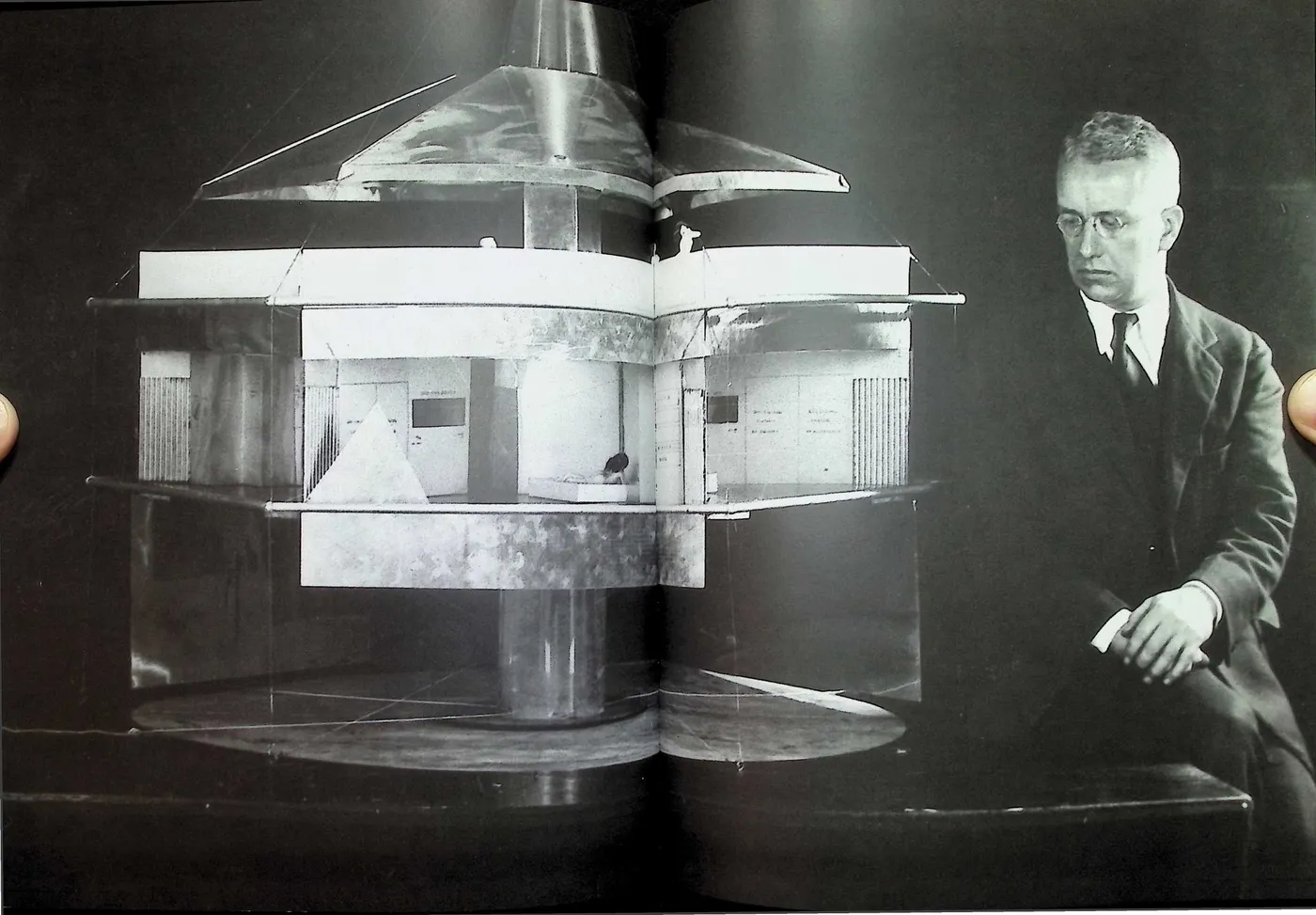
513 Al
514 WEIWEI
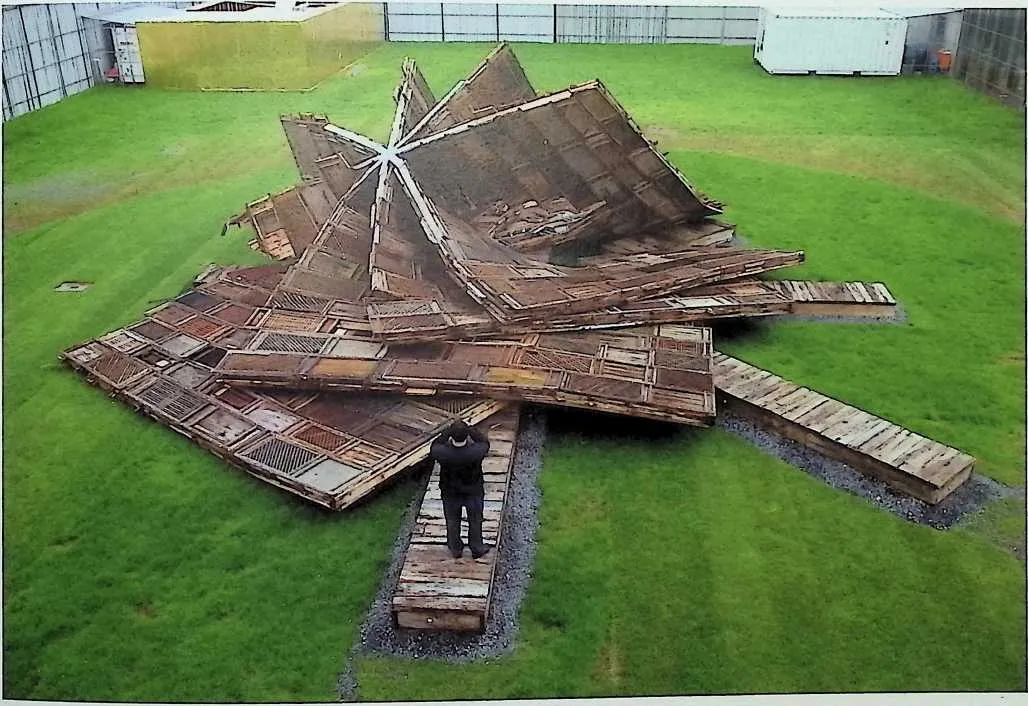
516 Template, 2007
517 Wooden doors and windows from
destroyed Ming and Qing Dynasty houses
(1368-1911)
518 Wooden base: 422 x 1106 x 875 cm
519 Scale No. 1, Scale No. 2, 2008
Copper and stainless steel
26.3x127.8x206.5 cm
resp. 26.3x127.8x137.6 cm
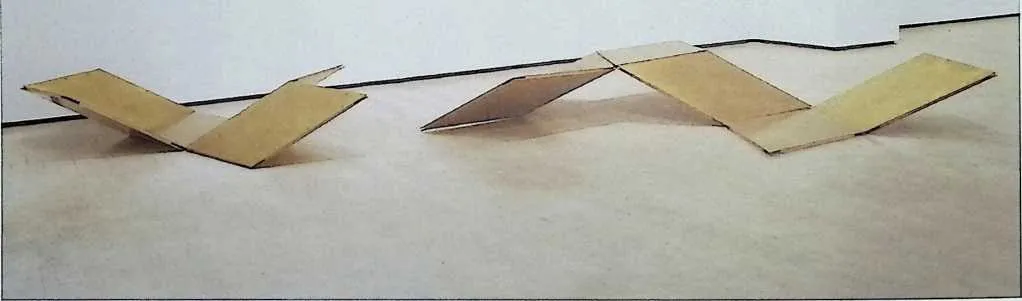
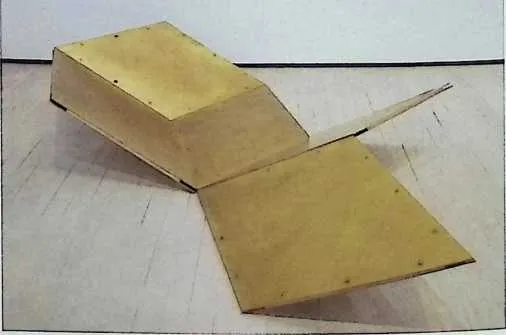
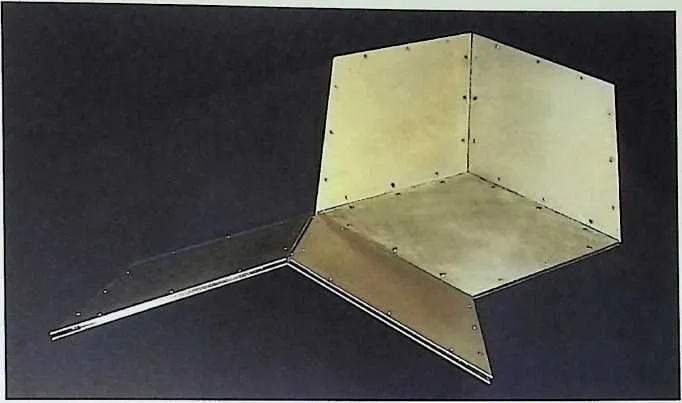
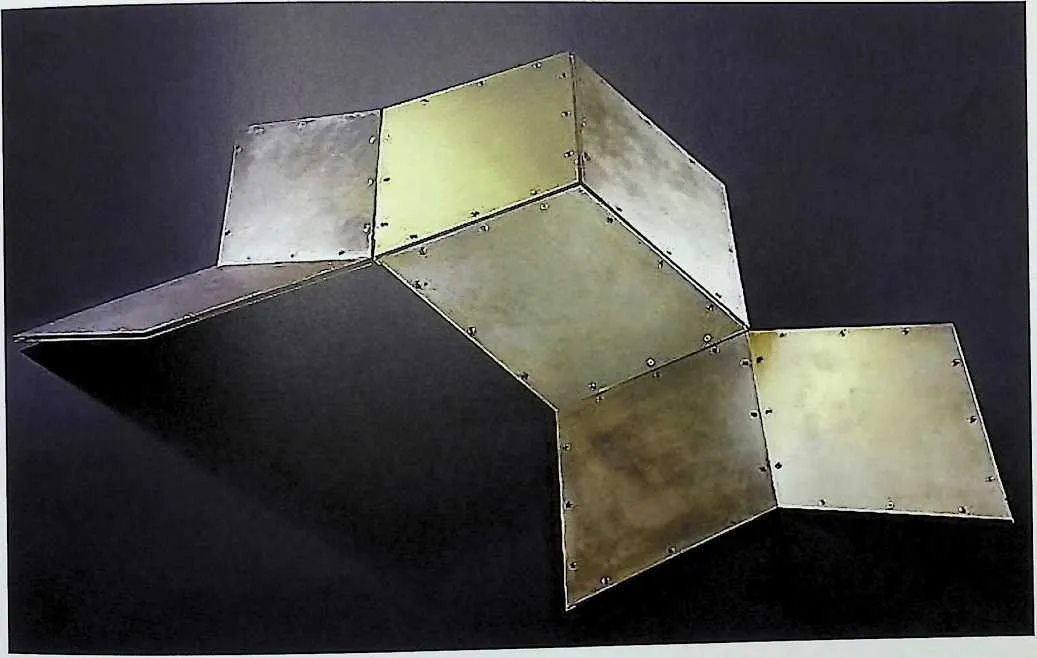
523 Untitled, 2006
Huanghuali wood, 0 278 cm
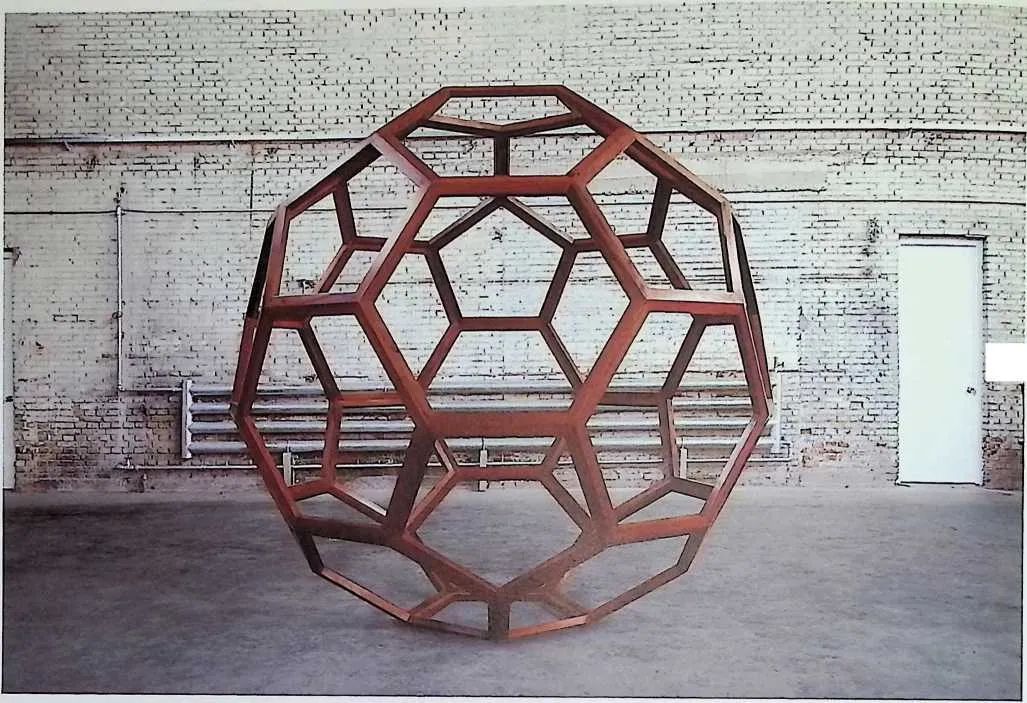
525 ATTILA
CSORGff
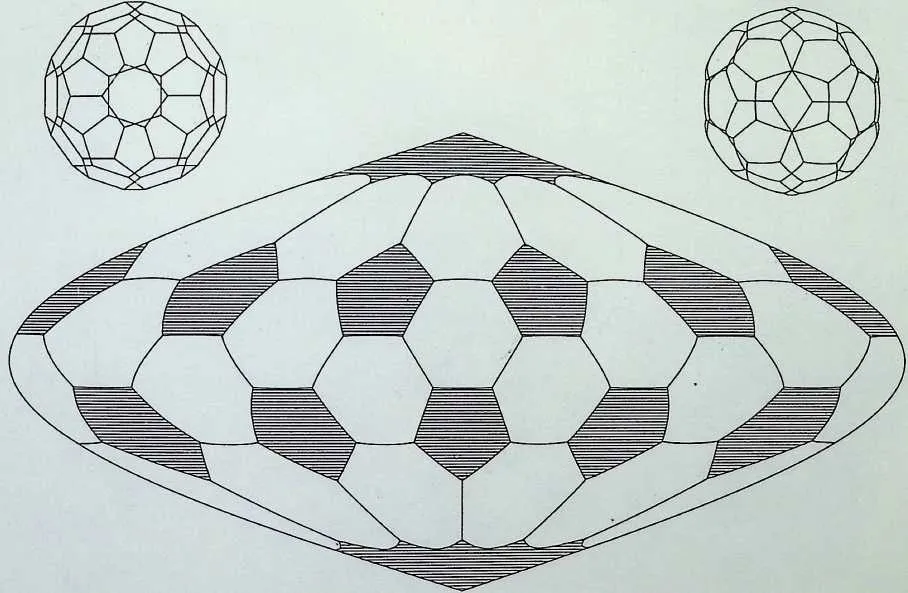
527 Football World Map, 2004
Etching
53.5x76 cm
528 Peeled Cube 1,1995-2001
Black-and-white, 20 x 117 cm
Cube,6x6x6cm
Drawing, 20.7x29 cm
Cut paper, 32x54 cm
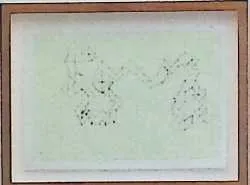
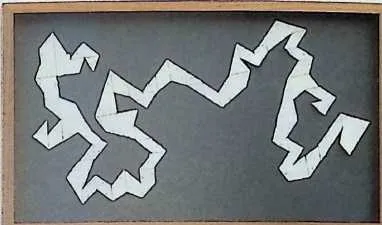
531 Untitled
(Dodecahedron = icosahedron), 1999
Wooden sticks, string, pulley wheel,
iron frame, electromotor
Ca. 180x110x80 cm
532 Landscape, 1993
Gelatin silver print
25x36cm
534 BJORN
DAHLEN
536 Milky Way, 2010
Wood, steel, pebble, enamel varnish
175 x260 x40 cm
537 The Milky Way, 2007
Wood, fluorescent lights, milk bottle
1800x1300x450 cm
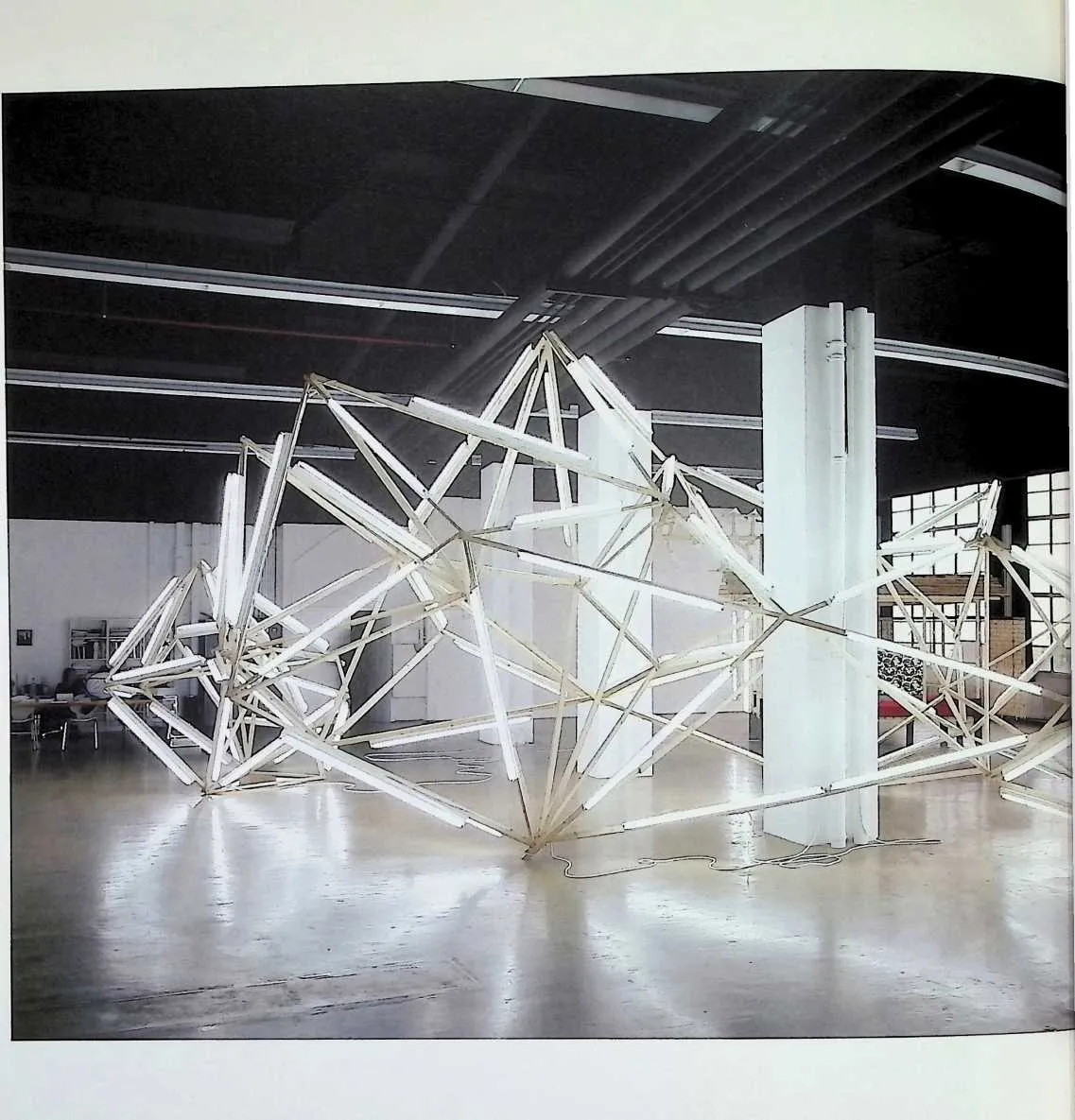
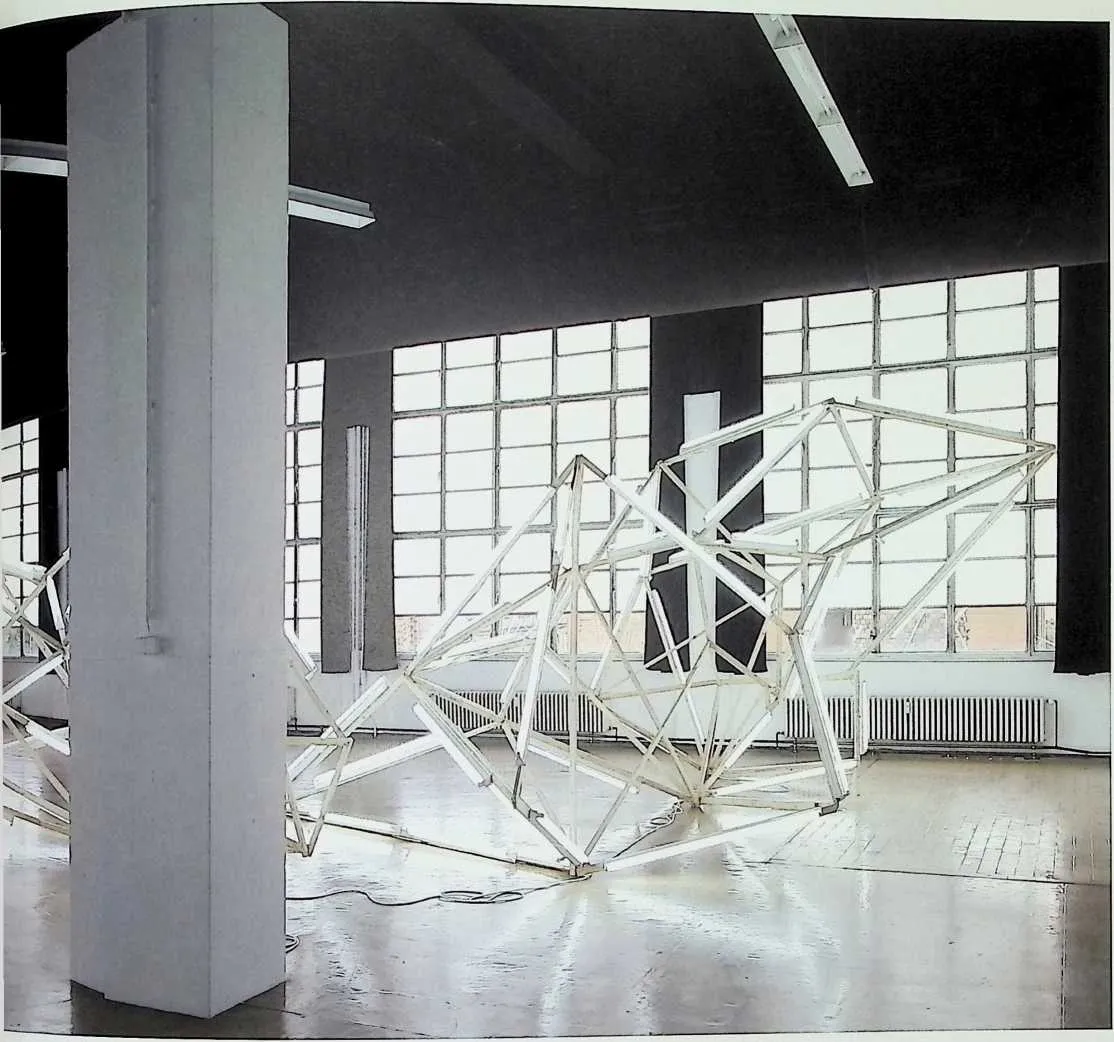
540 O
541 Galaxy (Canls Major), 2009
Wood, steel, fluorescent lights
280x520x210cm
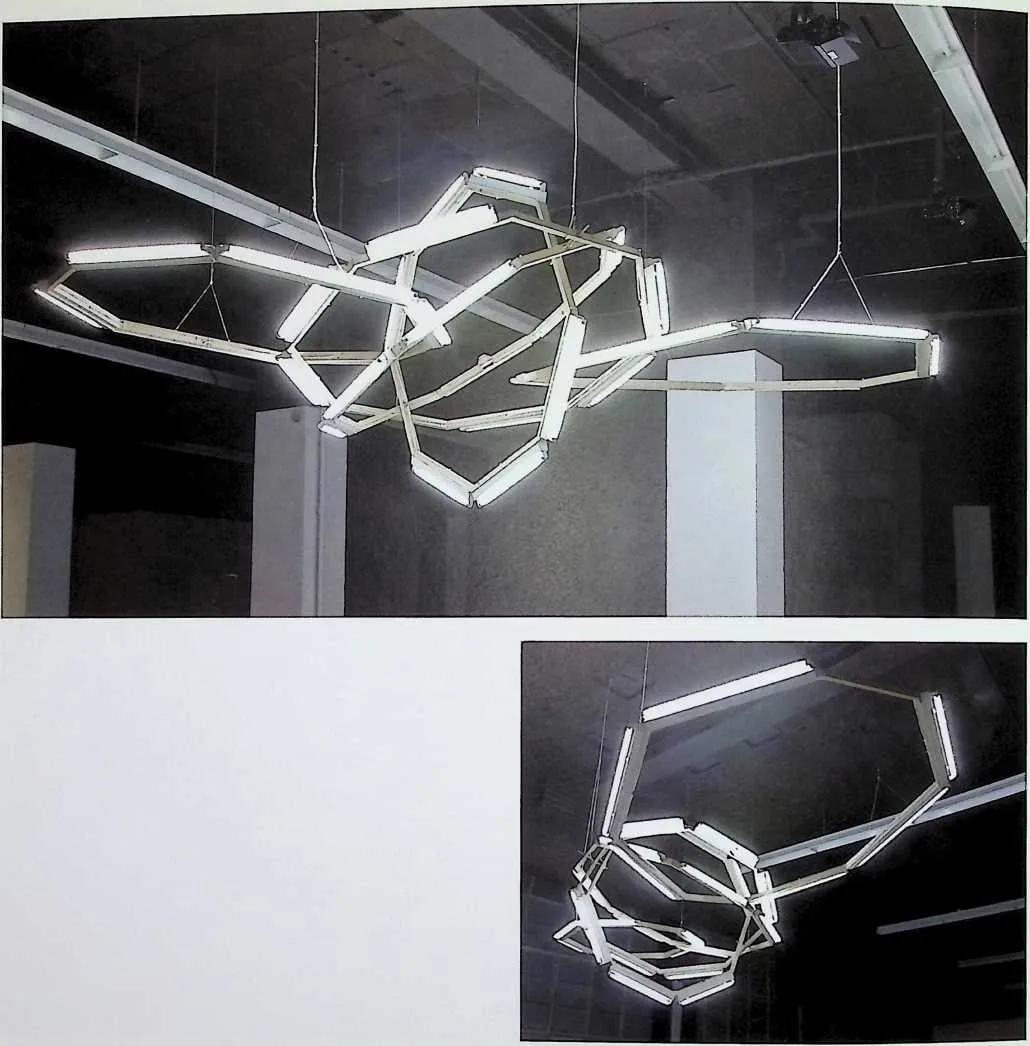
543 JOSE
544 DMA
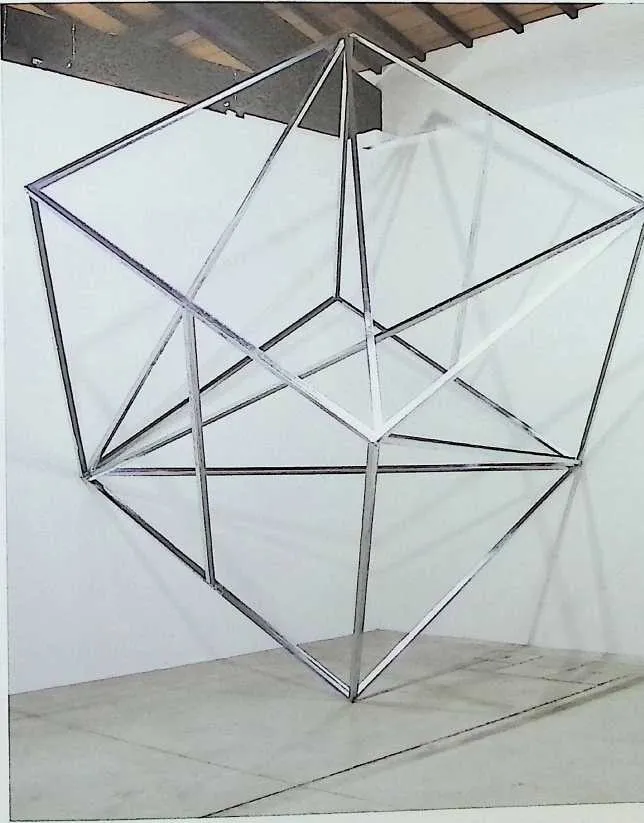
546 Giant Beetle, 2010
Wood and enamel paint coating
65 x 85 x 160 cm
547 josE dJvila / we are all astrohauts
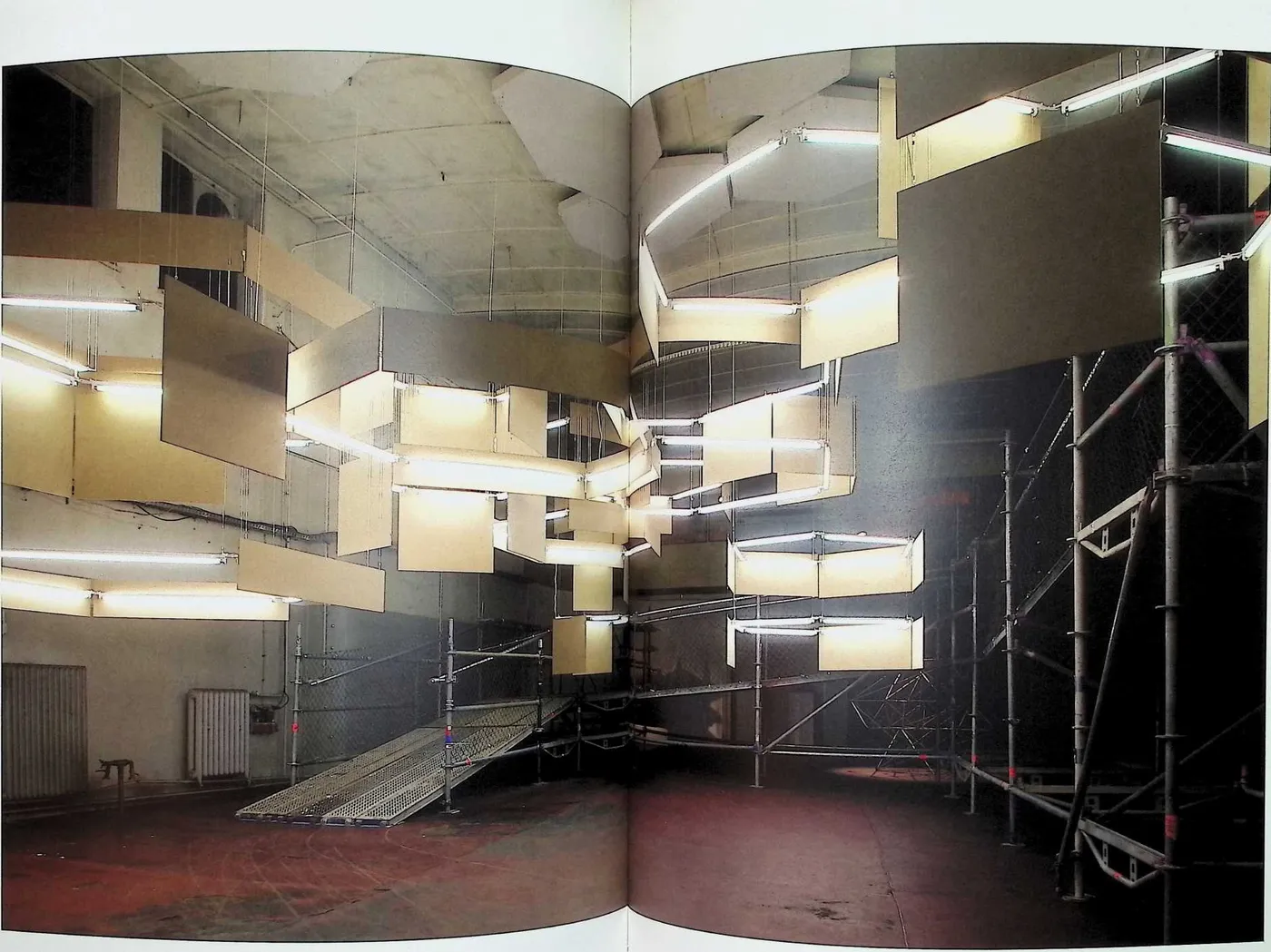
549 Flying City, 2008 MDF, nylon threads, fluorescent light 500x600x400 cm
550 Front:
25great circles, 2007
Synthetic carpet
360 x480 cm
551 On the wall in the back:
When Buildings Become Clouds, 2007
Digital prints
Each 21x26 cm
552 When Buildings Become Clouds
(Details)
2007
Digital prints
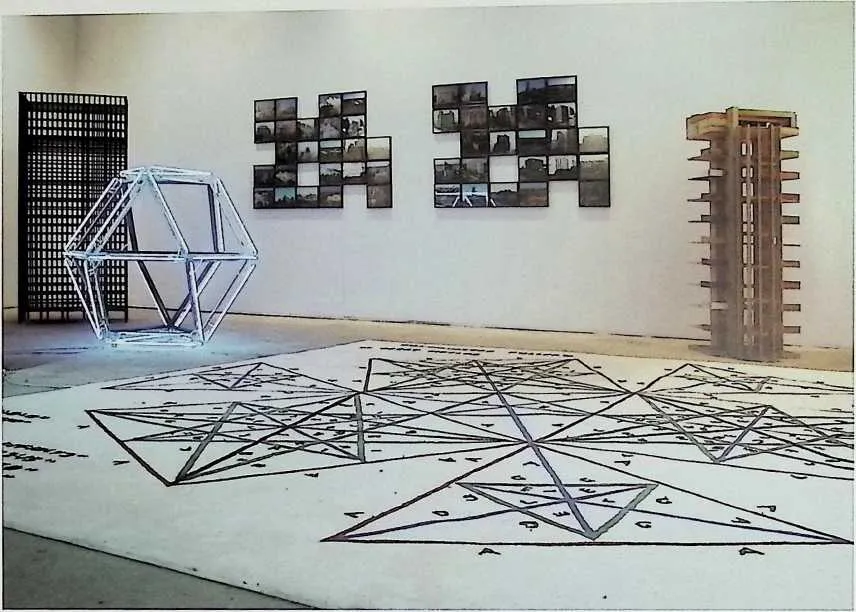
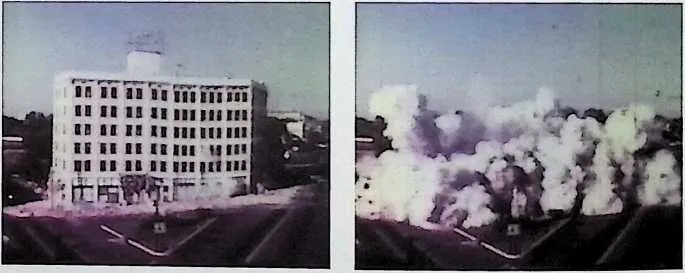
554 SIMON DYBBROE M0LLER
555 ■
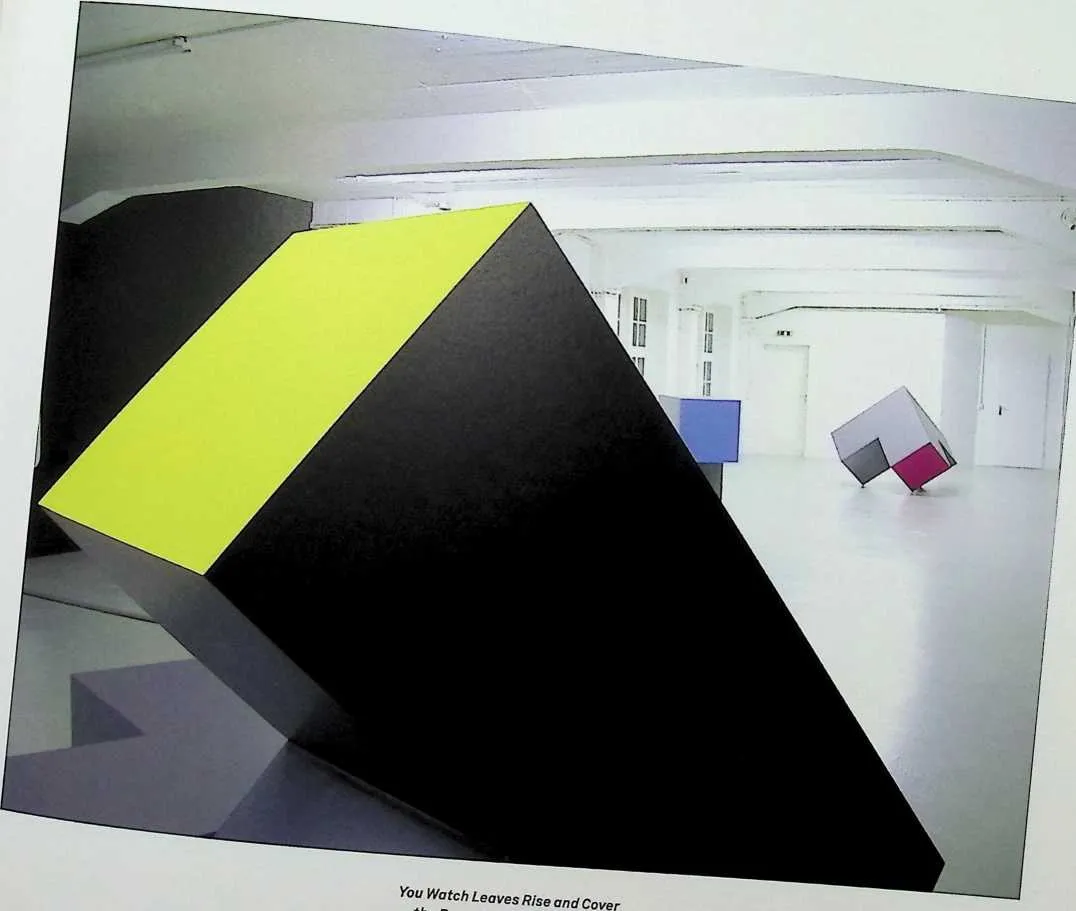
557 Acrylic paint, MDF Variable dimensions
559 20th Century Architecture
(Rhythm, Proportion and Scale), 2006
16mmfilm, 1’10" Loop,
color, sound
561 20th Century Architecture
(Rhythm, Proportion and Scale), 2006
Film stills
562 FACADE, 2008
563 238 loud speakers, amplifier, Audio CD,
3’18’’ Loop
565 OLAFUR
566 ELIASSON
568569The blind pavilion, 2003 Wood, steel, paint, glass (black and transparent) 250 x750 x750 cm
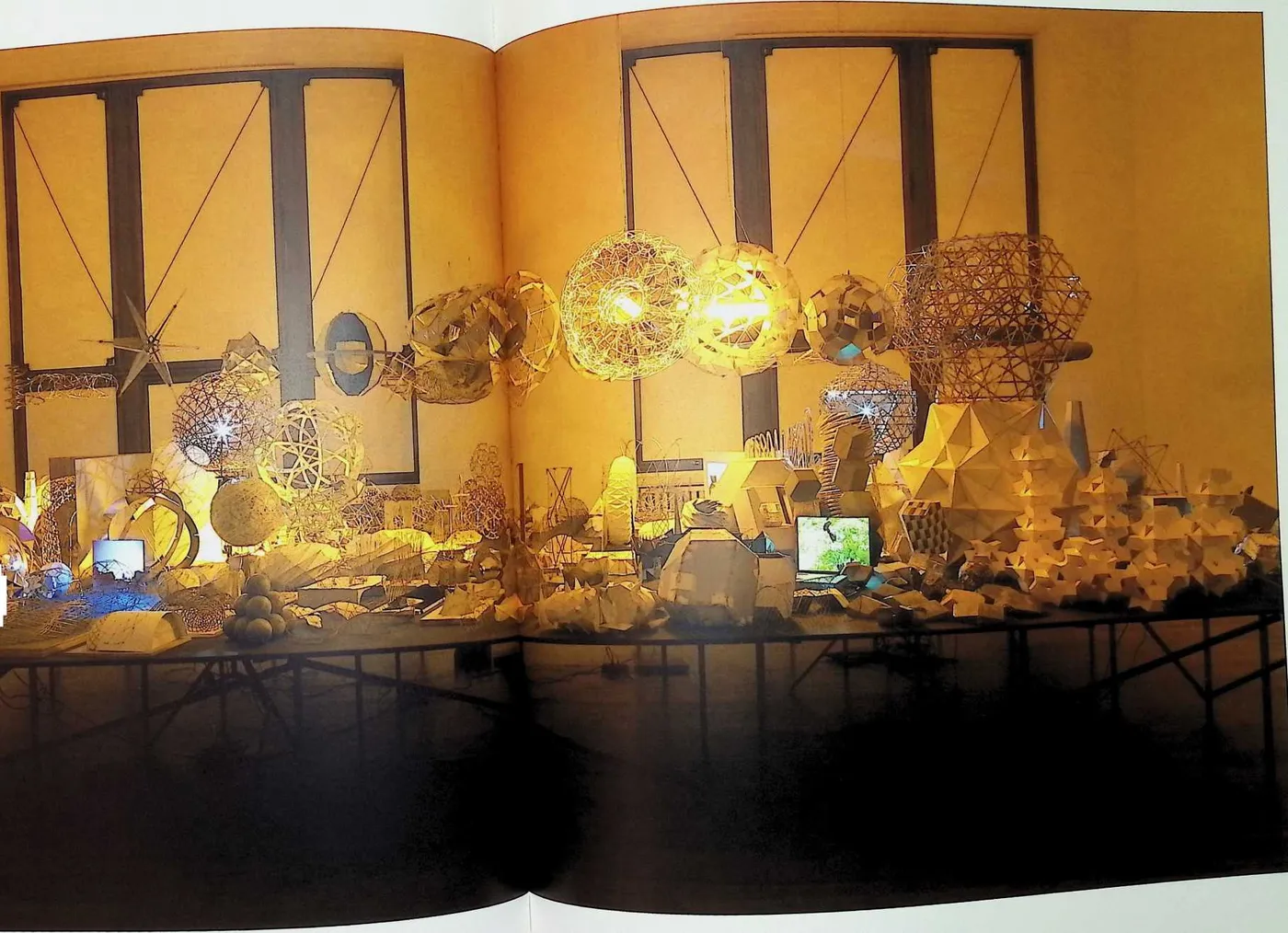
571 Model room, 2003
572 In collaboration with Einar Thorsteinn
Wood table with steel legs,
mixed media models, maquettes, prototypes,
projectors, dvd-players, videos

574 otraiiiM/wmuusmoHiuTs
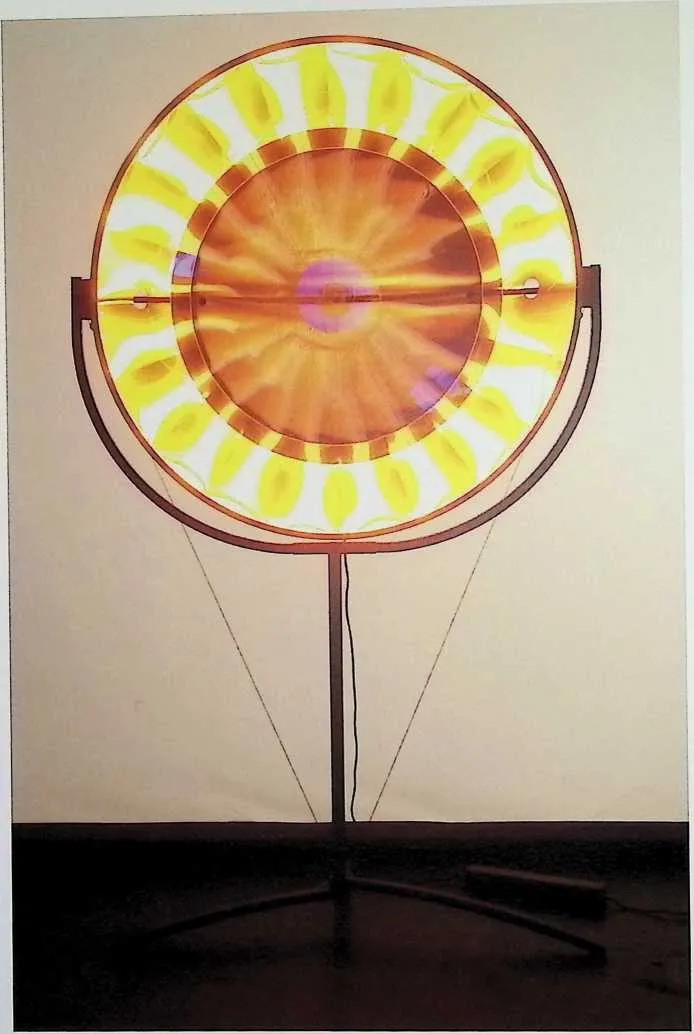
576 Eye see you,
2006
577578Stainless steel, aluminum, filter glass, bulb 230 x 120 x 110 cm, 0 120 cm
579 MICHEL
FRANCOIS
580 Scribble, 2010
Aluminum, plaster, india ink
250 x400 x142 cm
581 Piece detachee, 2010
Steel, magnets
250 x250 x250 cm
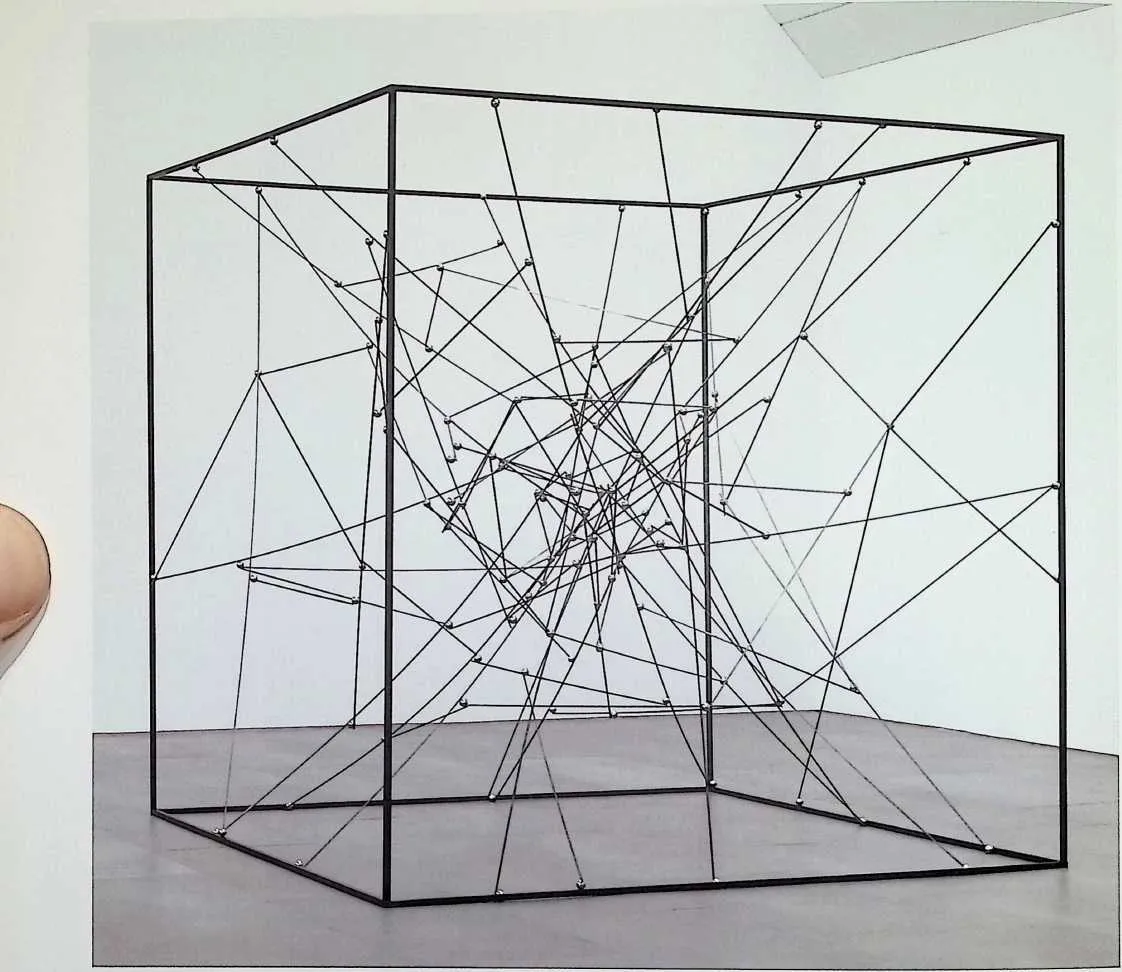
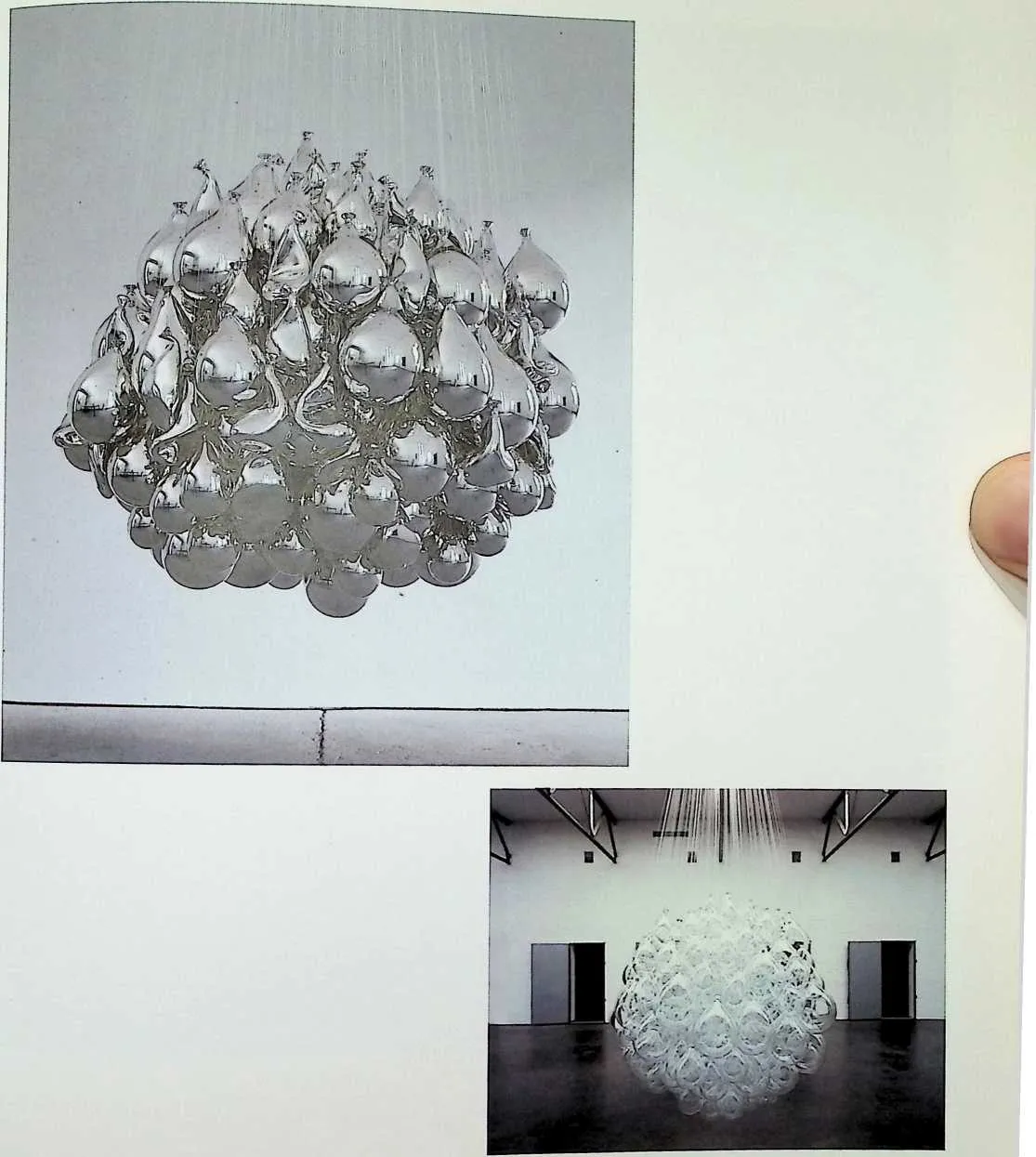
584 Souffles dans le verre (argent), 2006
Blown glass, nylon threads
360 x140 x140 cm
585 Blown-glass balloons,
each containing a volume of air equivalent
to a single exhalation
586 Souffles dons le verre (transparent), 2002
Blown glass, nylon threads
360 x140 x140 cm
588 Souffles dans le verre (noir), 2002
Blown glass, nylon threads
Blown-glass balloons,
each containing a volume of air equivalent
to a single exhalation
360 x140 x140 cm
589 .. FRANKA HORNSCHEMEYER
591 Konditional, 2006
Wood, OSB, plaster, paint
650 x650 x260 cm
593 LaSound90B, 2008
Studframe, gypsum cardboard, mirror, doors
(found in the building)
300x640x880 cm
594 LaSound908
(Grundriss, 300x640x880 cm)
2008/11
Piezo-print, 40 X 30 cm
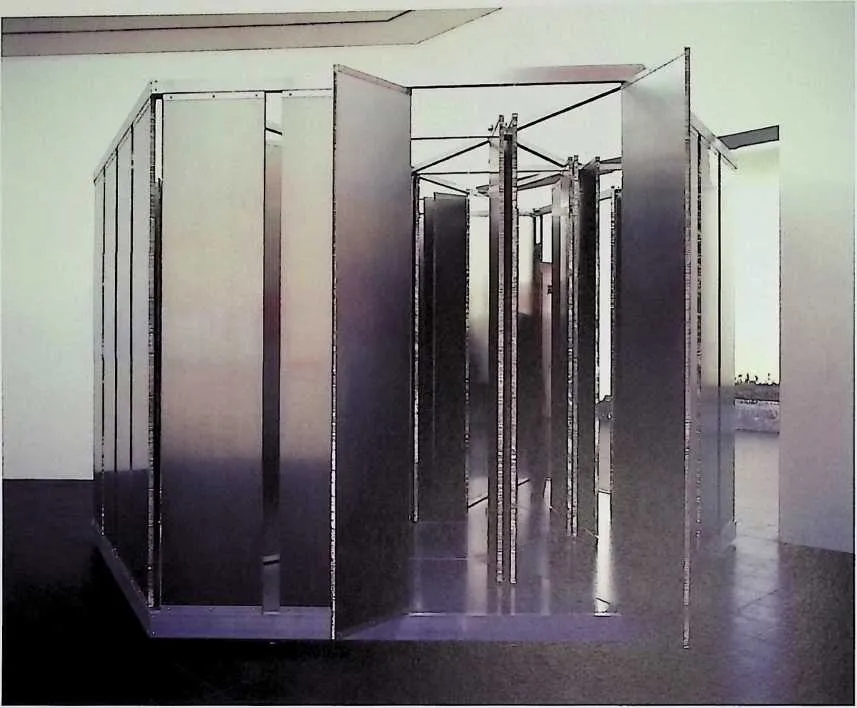
597 Blindtext, 2009
Aluminum honeycomb, wood
270x480x480 cm
598 Blindtext
(Grundriss, 270x480x480 cm)
2009/11
Piezo-print
40x30 cm
599 LUCAS
600 LENGLET
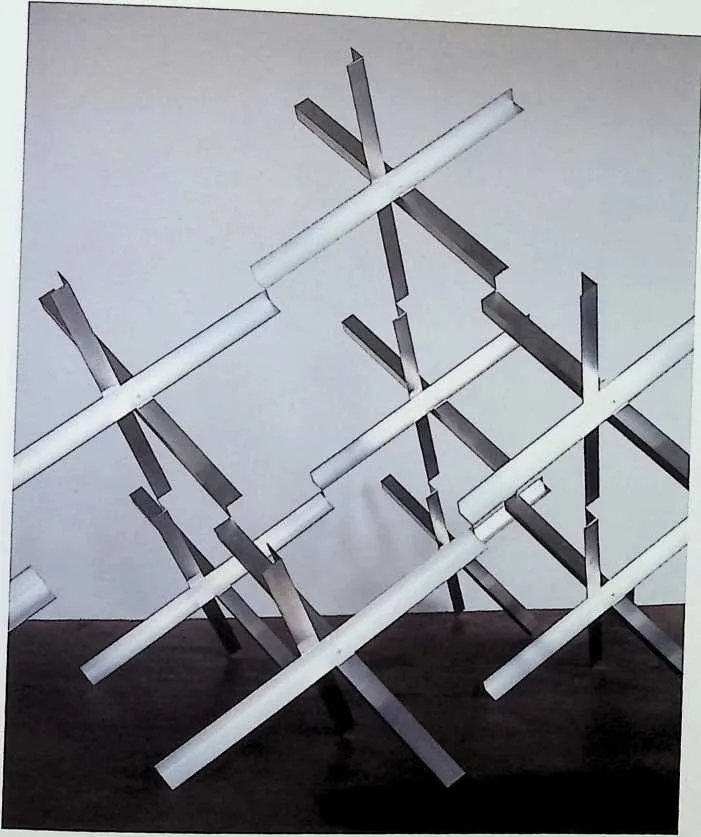
602 Mobile Studio, 2003
603 Steel, wood, cladding, mirror, one-way-mirror
screen, melamine board, appliances
300 x300 x1000 cm
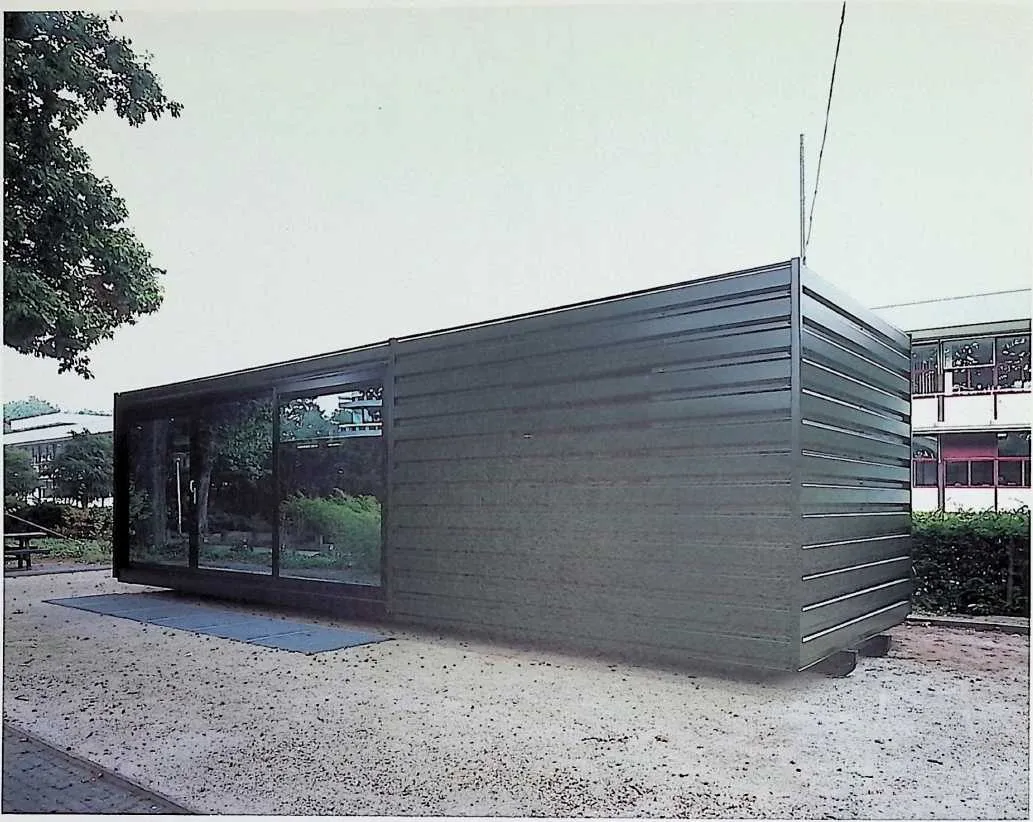
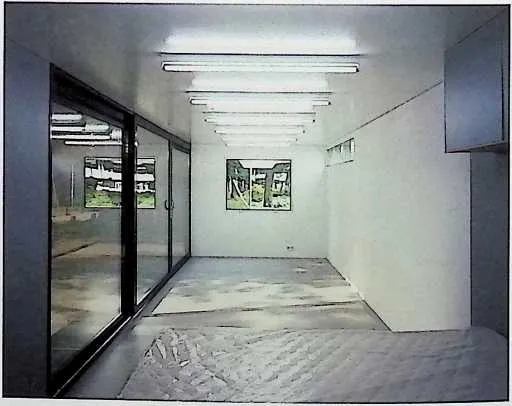
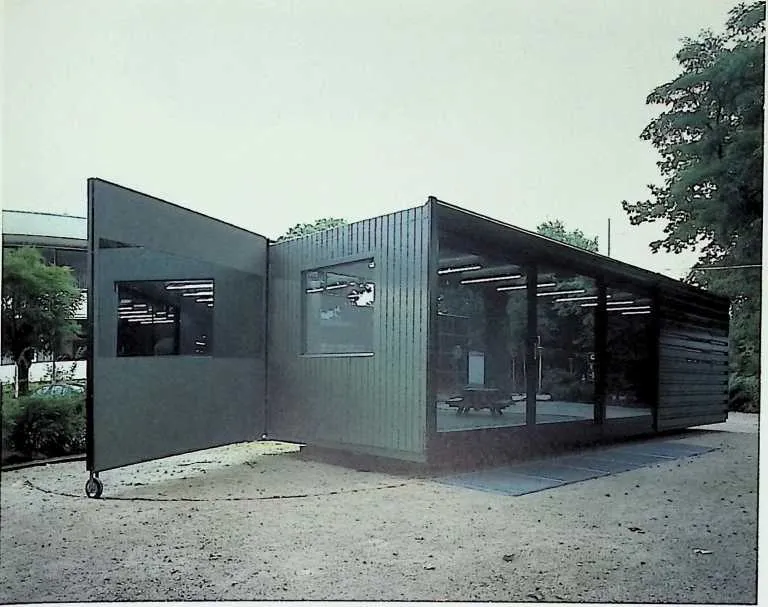
607 Untitled (Column), 2010
Aluminum
100x100x500 cm
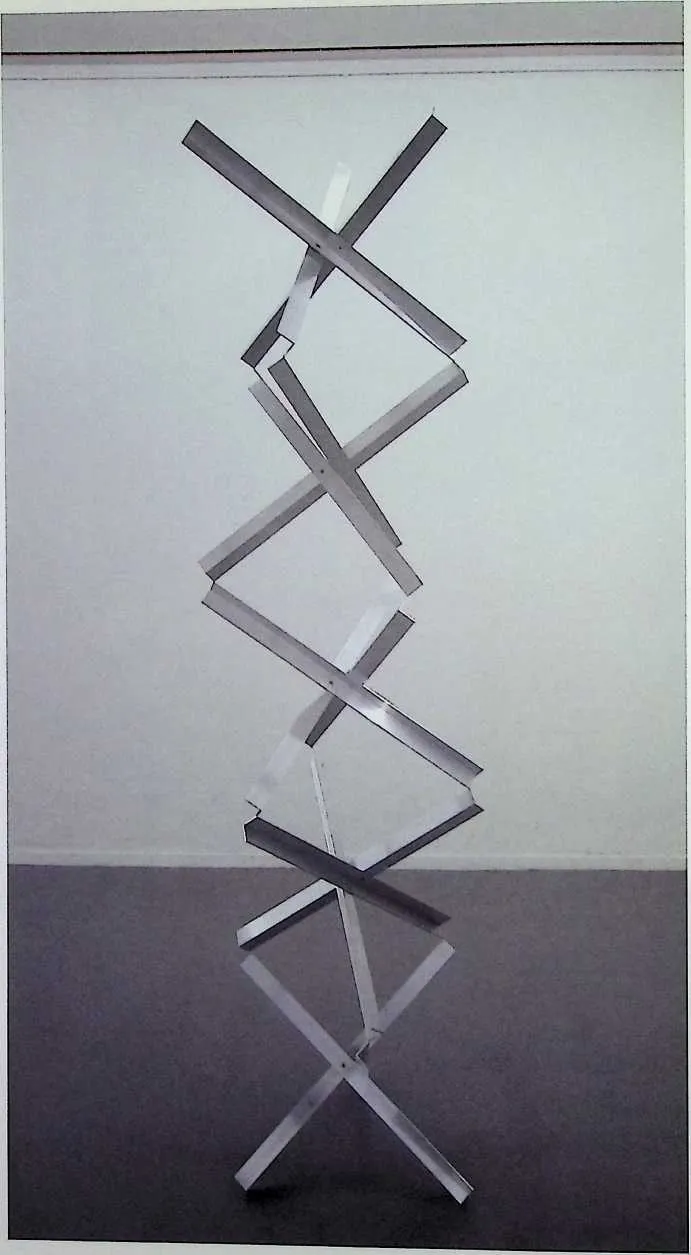
609 DAVID
MALJKOVIC
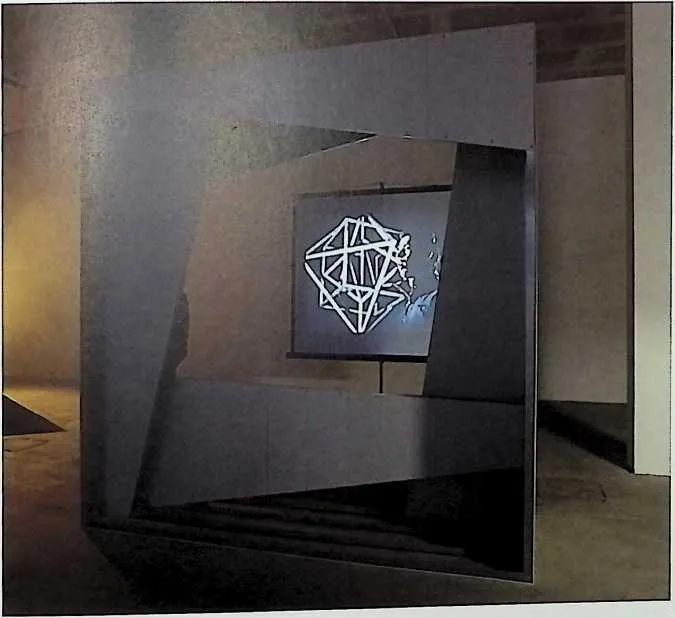
611 Images with their own shadows
2008
612 16 mm film, 6' 16" Loop,
sound, sculpture
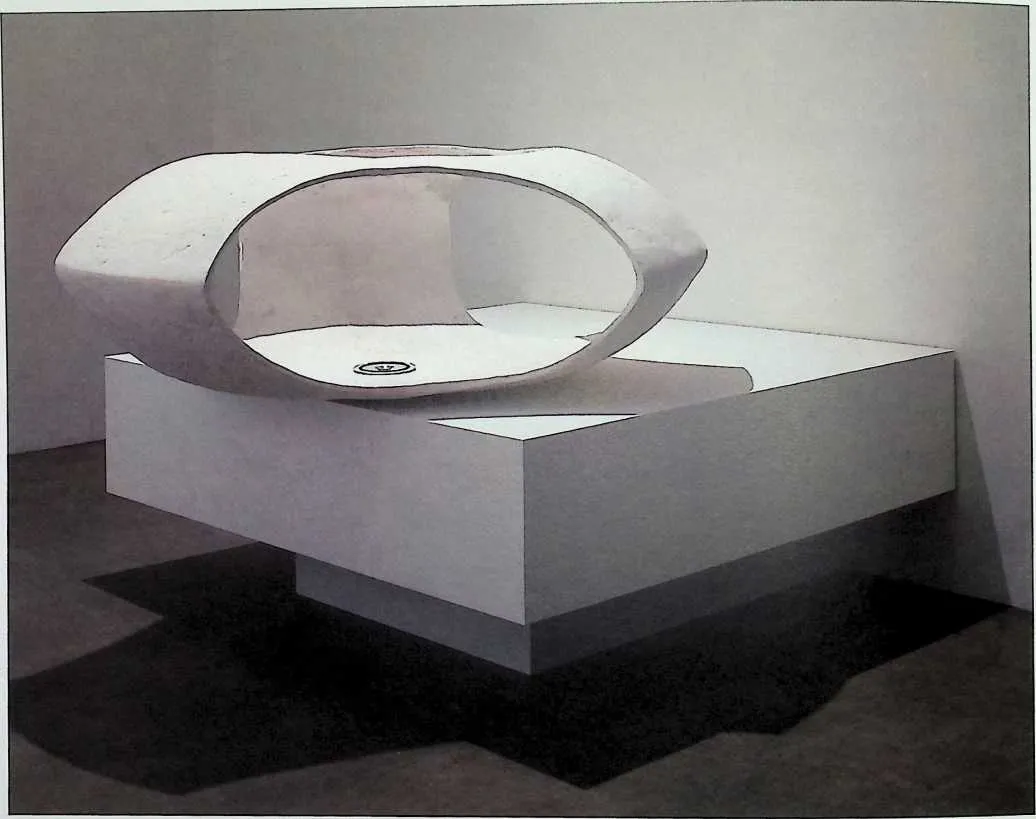
614 Lost Pavilion, 2009
Acrylic resin, loudspeaker, cd-player,
pedestal and collage on paper
Sculpture, 55.9 x 134.6 x 134.6 cm
7 collages, each 26 x 39 cm
615 Lost Pavilion, 2008
Paper and pencil on paper
50x65 cm
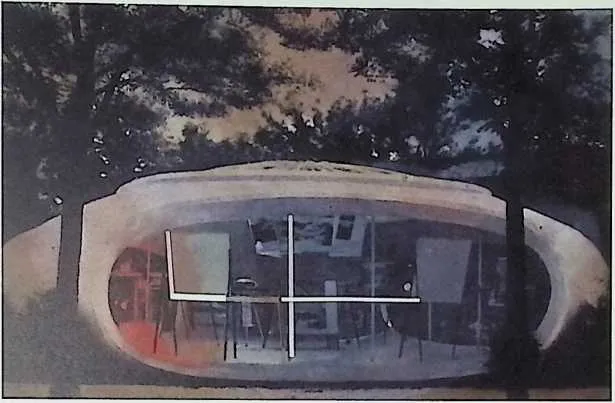
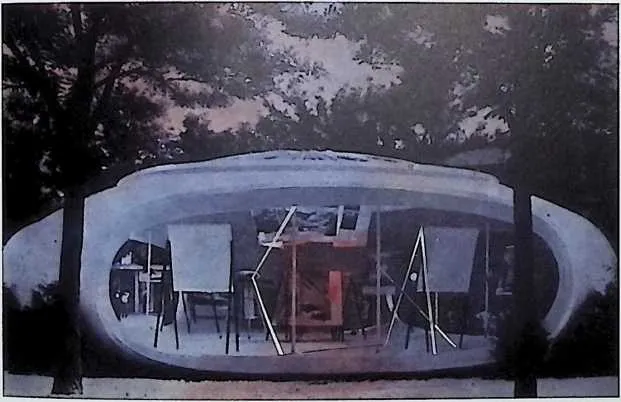
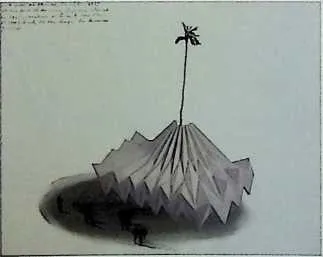
620 Out of Projection, 2009
Film stills
2 channel HDvideo
and sound installation, 18' 41"
621 HERMANN
MAIER
NEUSTADT
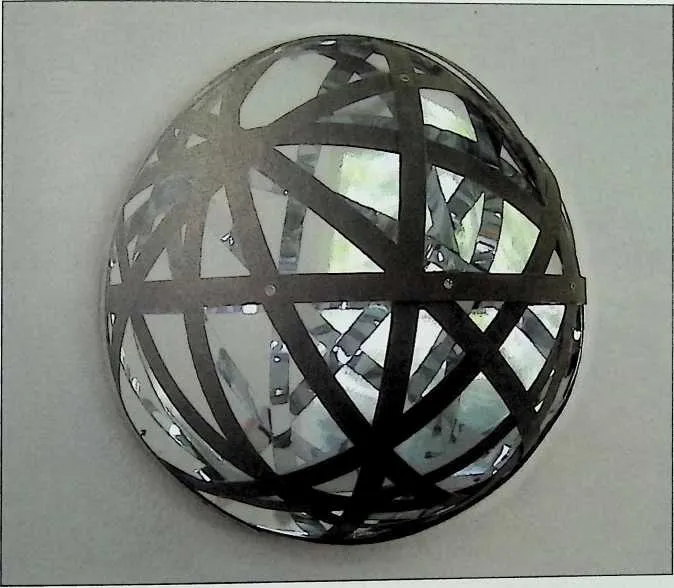
623 Untitled, 2006
Maquette for the projectAtuckY
Cardboard, mirrorfoil
Ca. o50 cm
624 Atucky, 2006
Hard fiber, polyester, light, slight projection,
dvd, beamer
1725 x1840 x340 cm
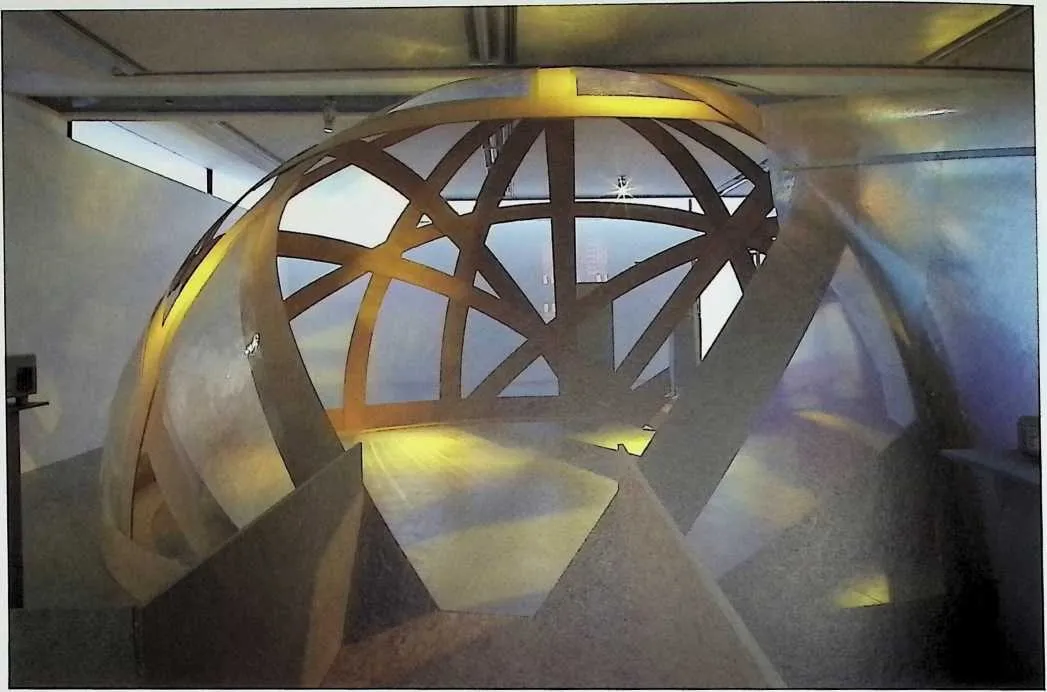
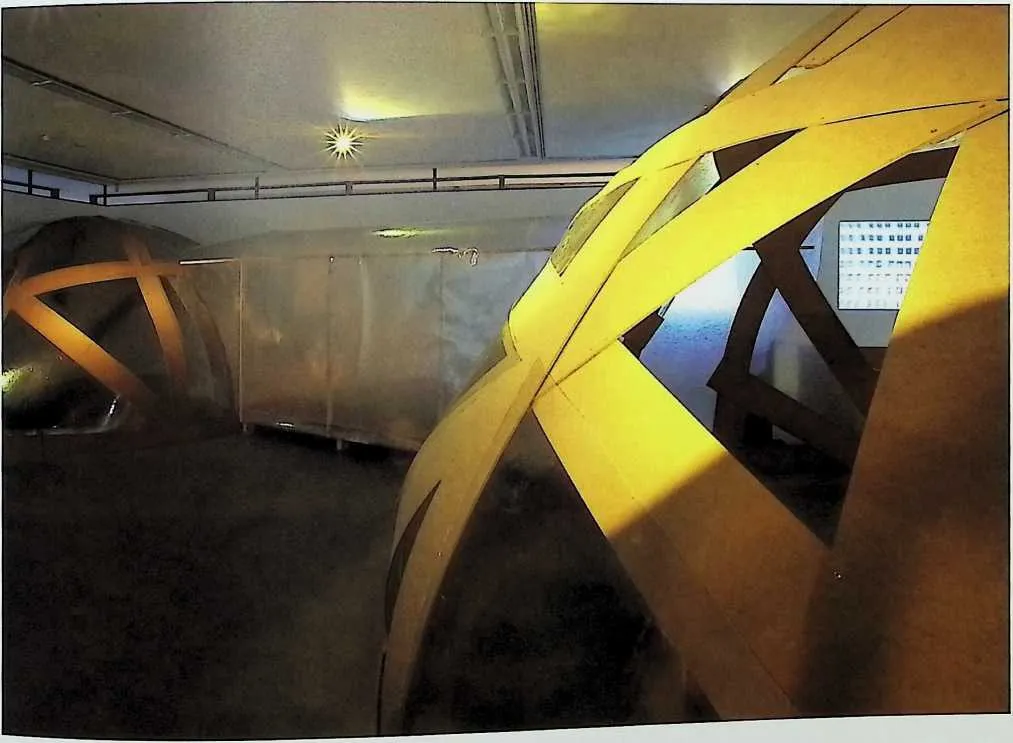
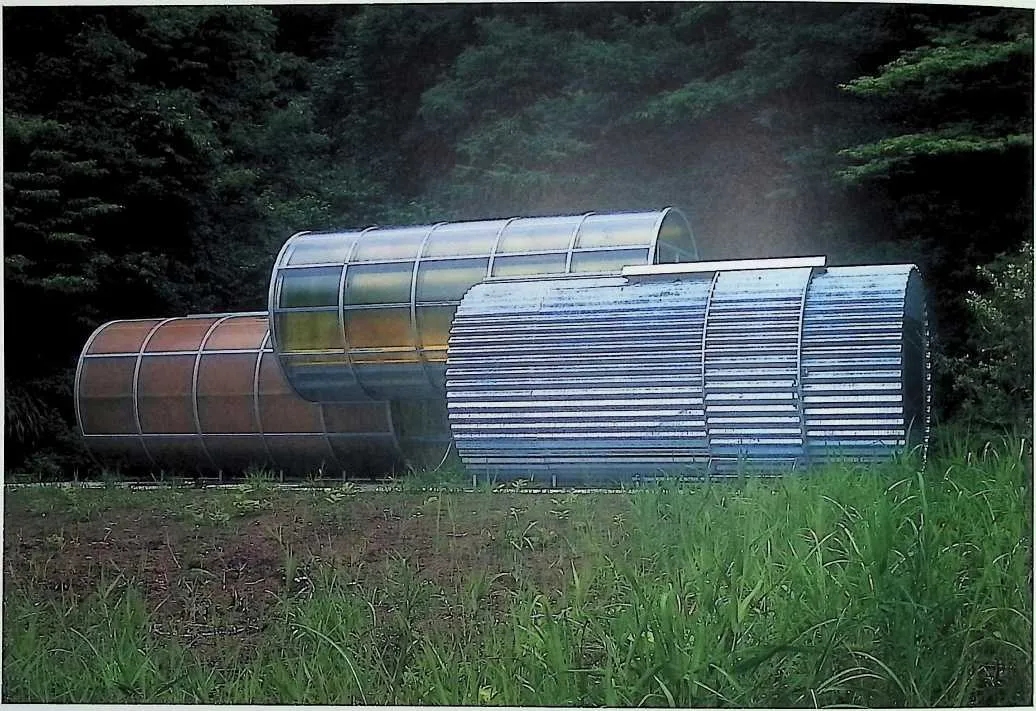
629630WD Spiral Part III, Magic Theater, 2003 Steel, aluminum, polycarbonate, FRP, corrugated iron, wood 1680 x620 x490 cm
631 N55
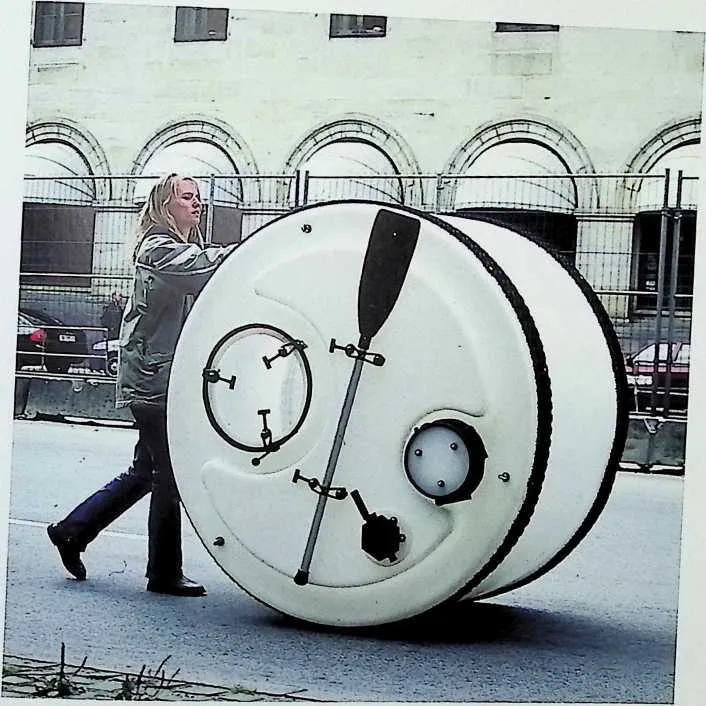
633 Snail Shell System, 2001
634 Cost-saving mobile one-person-living-system
Mixed media
105x0153 cm
635 Public Things, 2000
A system, which enables persons to
use space in different ways
Elements and dimensions variable
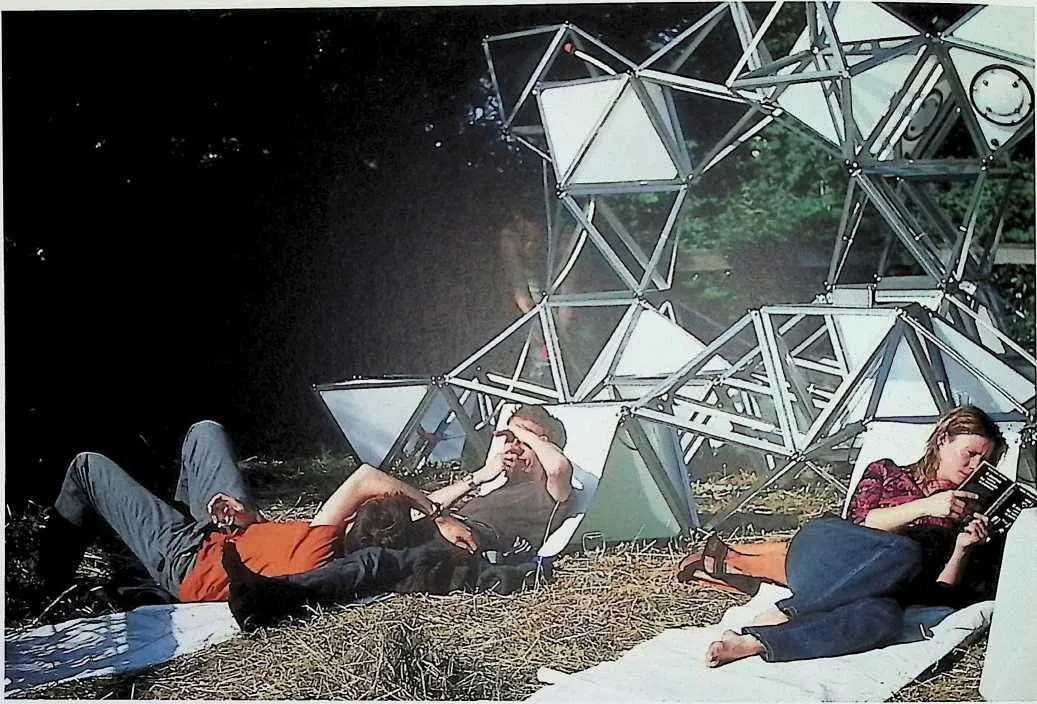
640 Spaceframe Vehicles (Liegerad), 2011
In collaboration with Till Wolfer
Aluminum tubing, polycarbonate plate, stainless
steel washers, bolts and nuts, pedals and
crank-box, chains, wheels, brakes
Length 150 cm
641 RICCARDO
PREVIDI
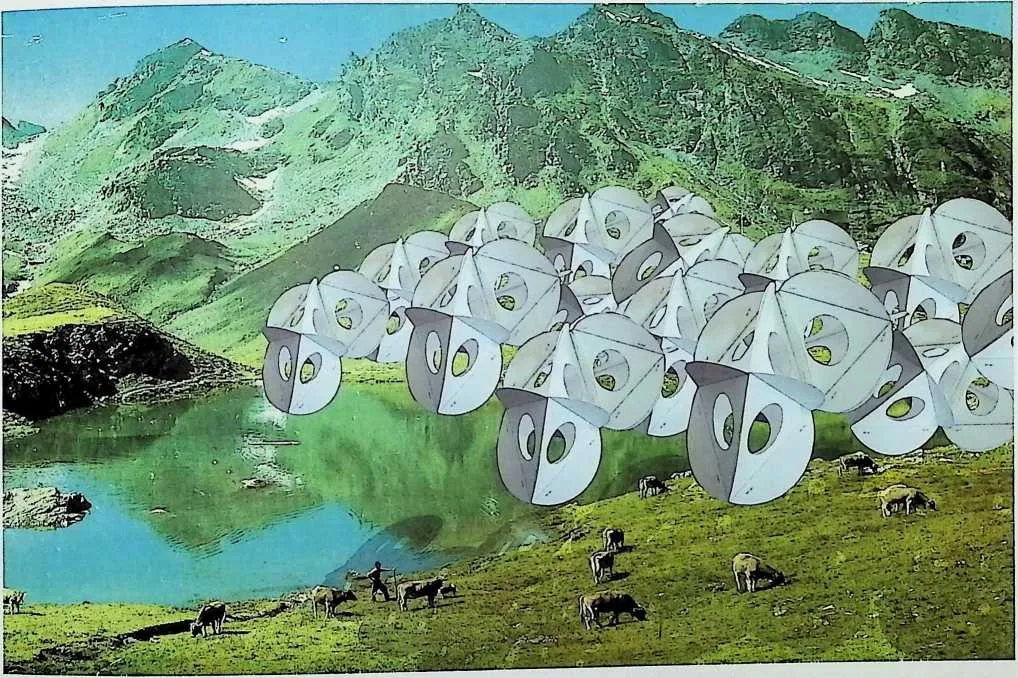
643 OversizingAcona Binconbl, 2005
InkJet print on paper
100x 167 cm
644 168
645 169
646 Walking Clouds, 2007 Cardboard, fluorescenttube, mirrorfoil 400 x600 x200 cm
647 I '
648 J
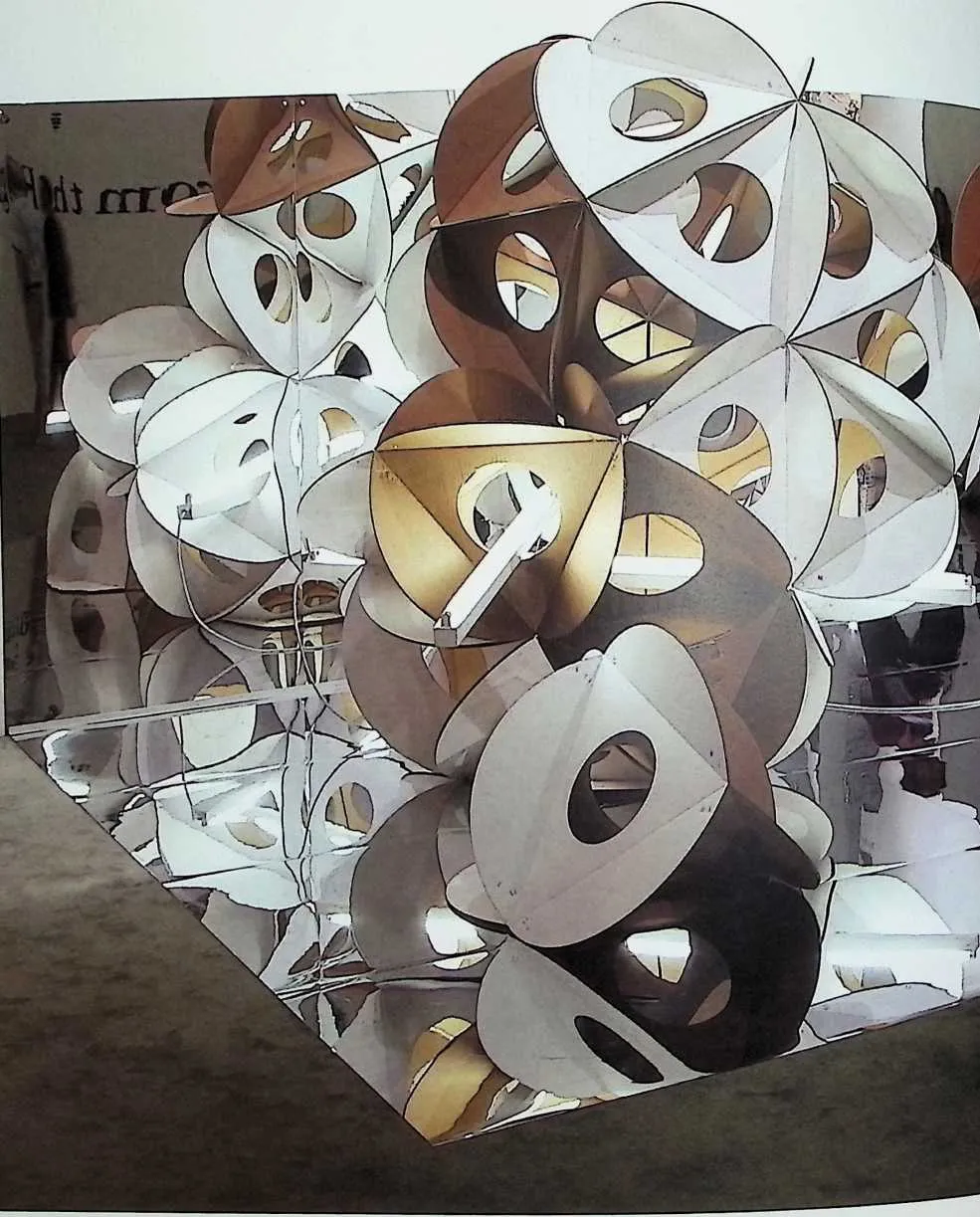
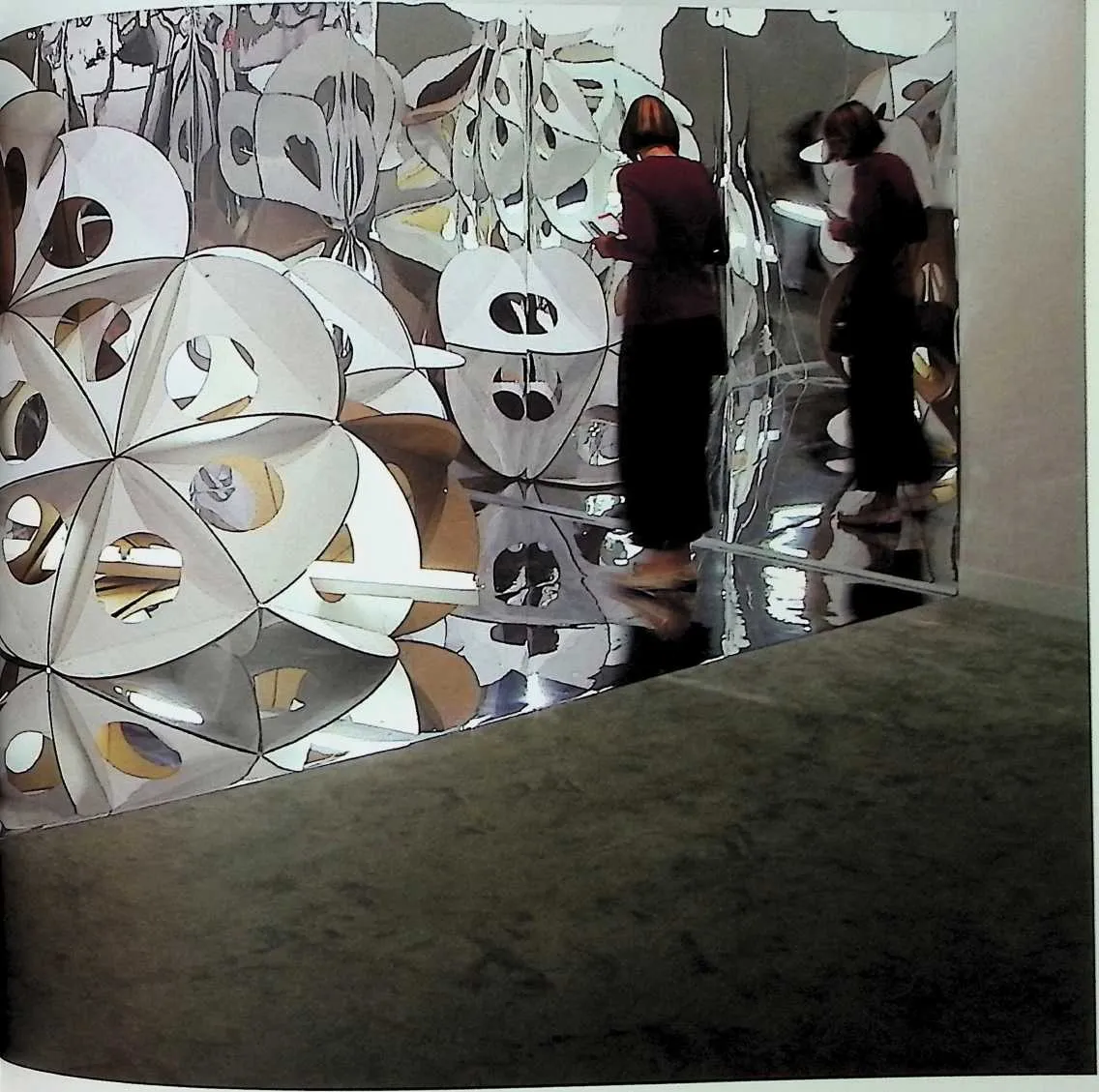
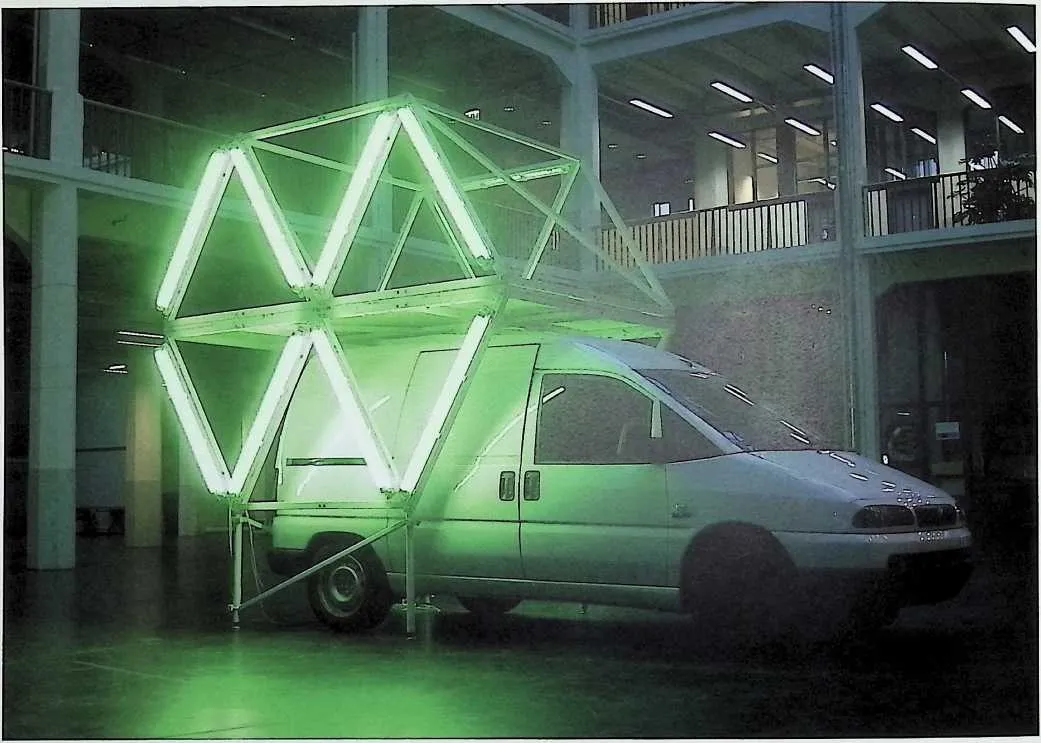
651 Volksbiihne, 2005
Mobile, folding structure, steel, wood,
fluorescent light, Fiat Scudo
180 x600 x200 cm
652 TOMS
653 PUTRIH
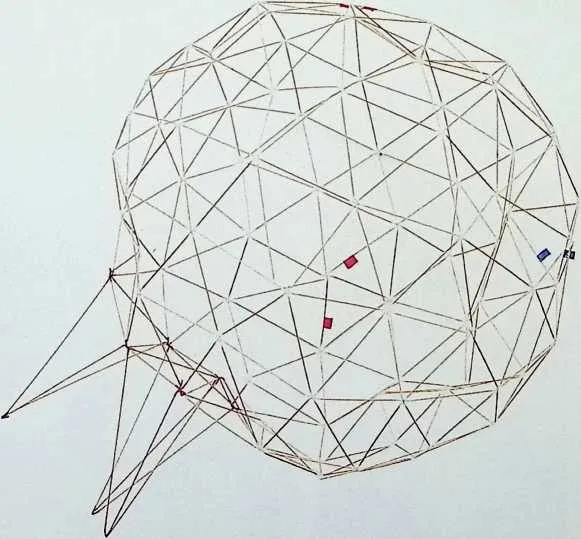
655 Quasi Random, 2006
Wooden sticks, plastic
0 85 cm
656 QR/S/4/Convex, 2004
Pencil on paper
59 x 59 cm (framed)
657 QR/B/V/HRZ, 2005
Pencil on paper
153 x 153 cm (framed)
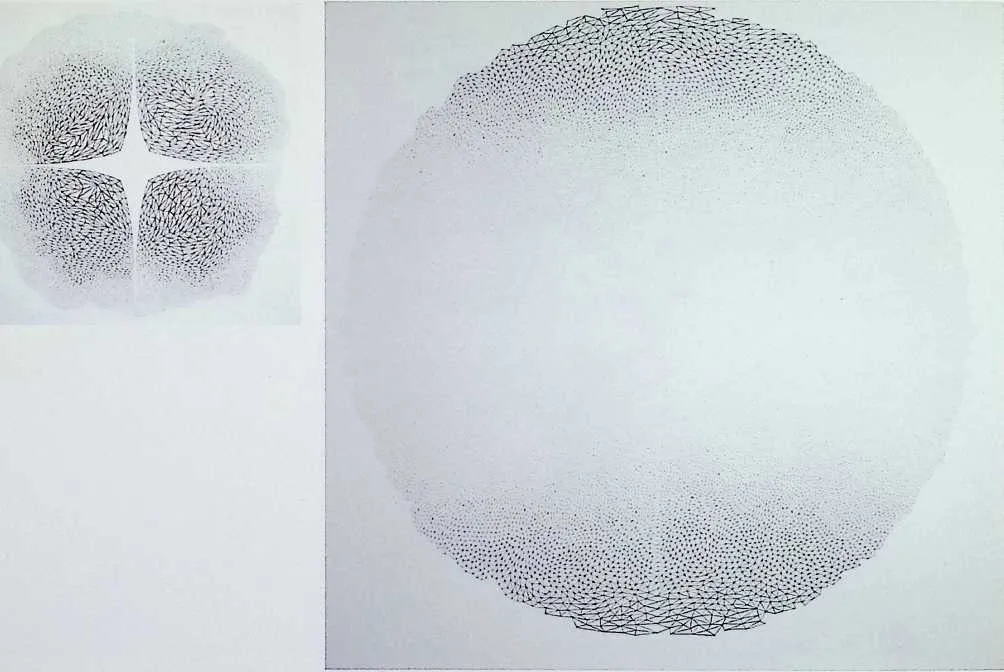
659 OR Reshaping, 2003
C-print
50x70 cm
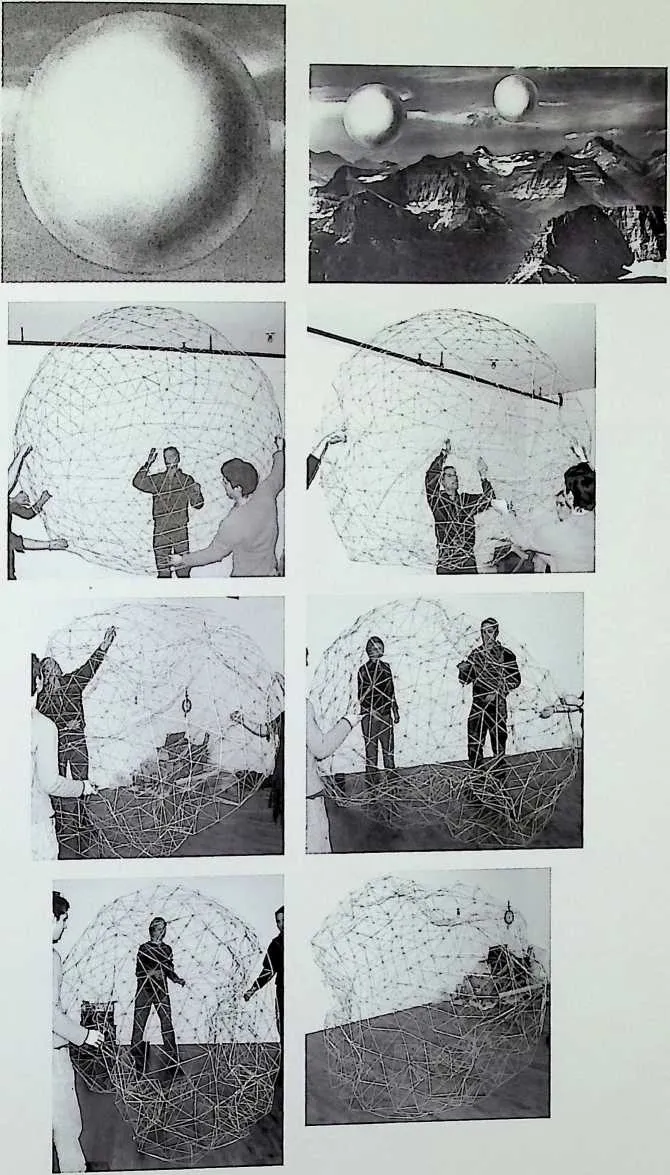
661 Abstract but Possible
(Football Playerwith a Ball),
2003
Videostills, DVD, 6'
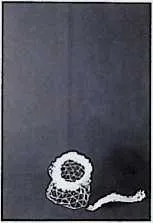
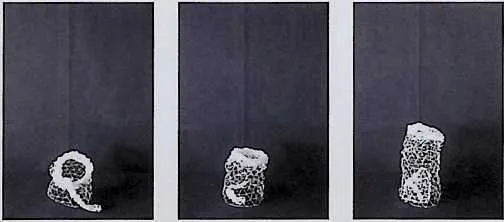
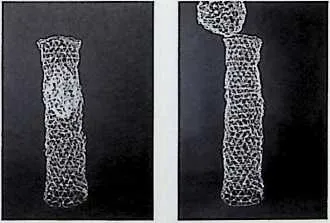
663 PEDRO
664 REYES
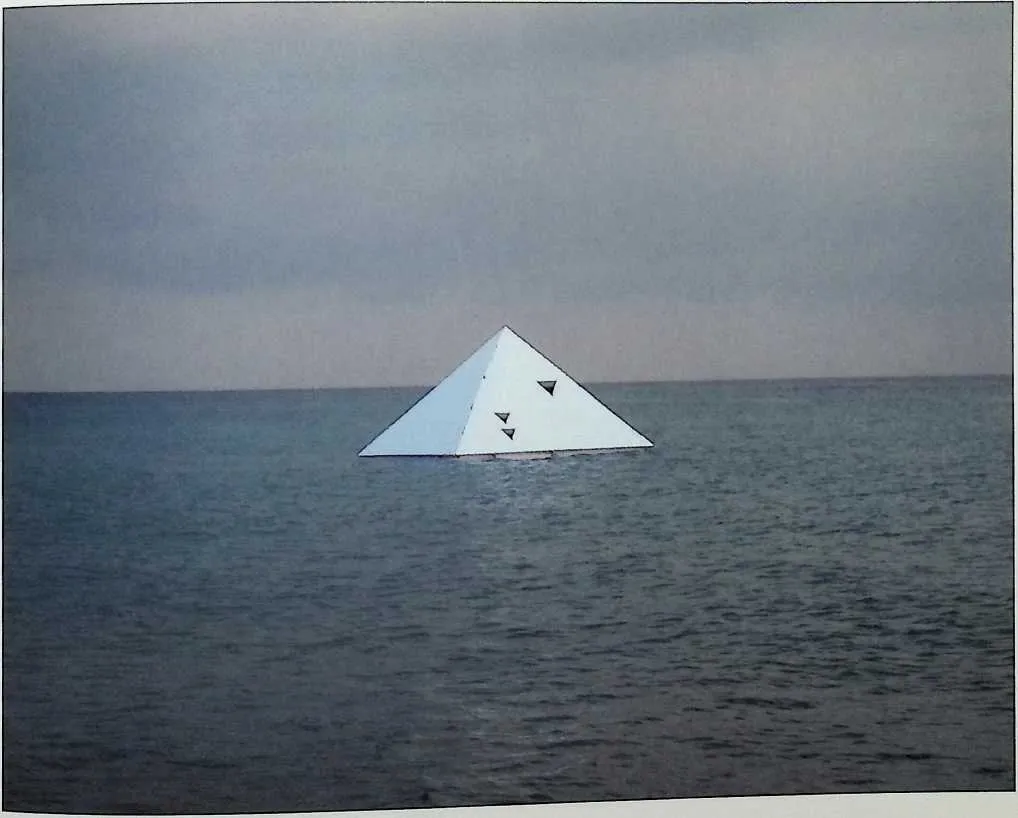
666 FloatingPyramld, 2004 Wood structure, styrofoam
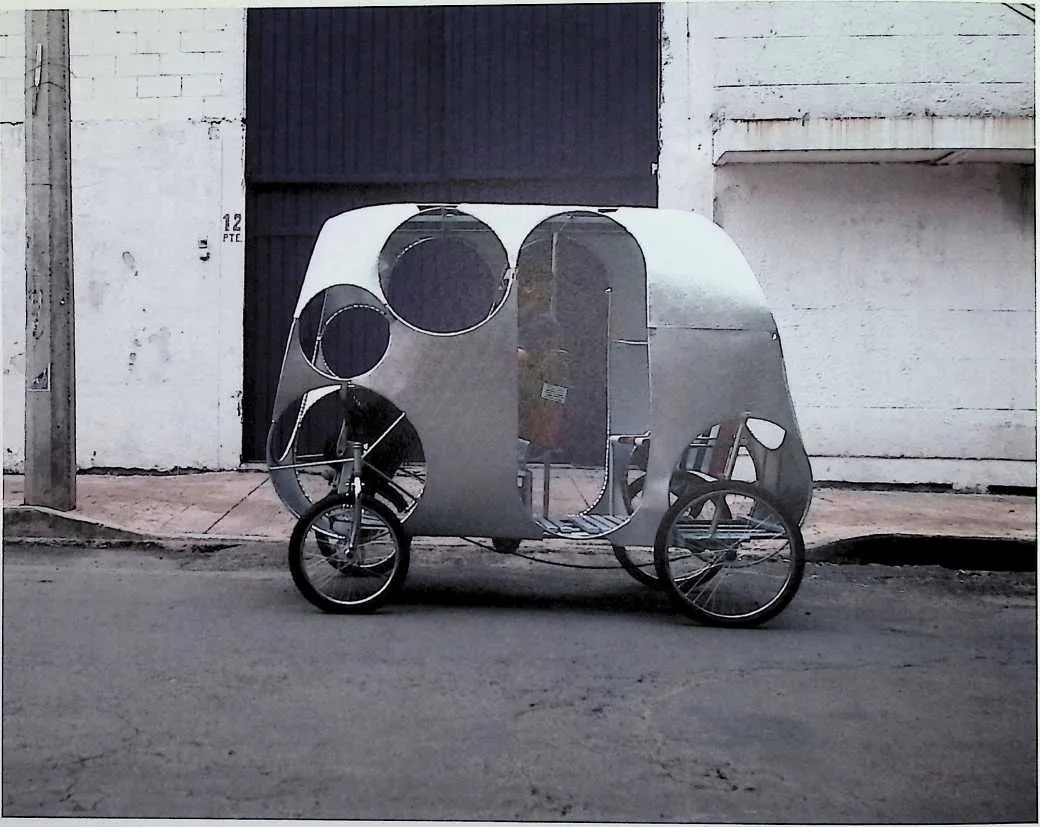
668 Clclomovil, 2007
Aluminum, steel, fiber glass, vinyl,
bicycle mechanics
180 x130 x230 cm
669 Model ofCIclomovil 1,2007
Plastic and cardboard
38x40x60 cm
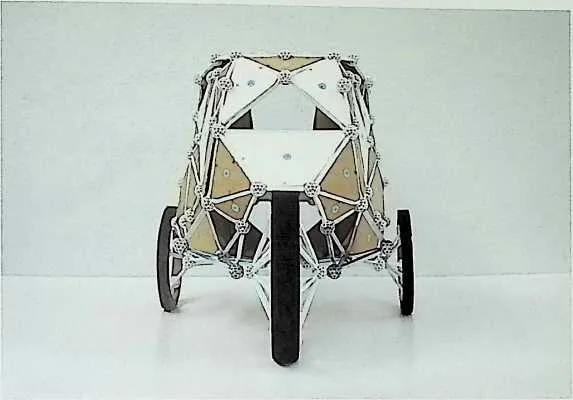
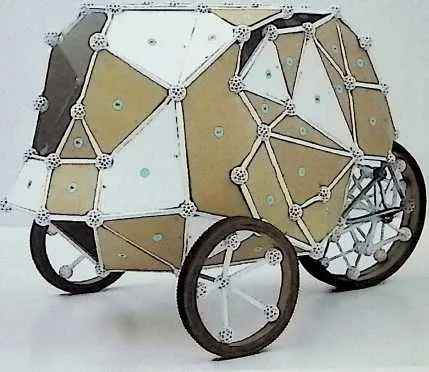
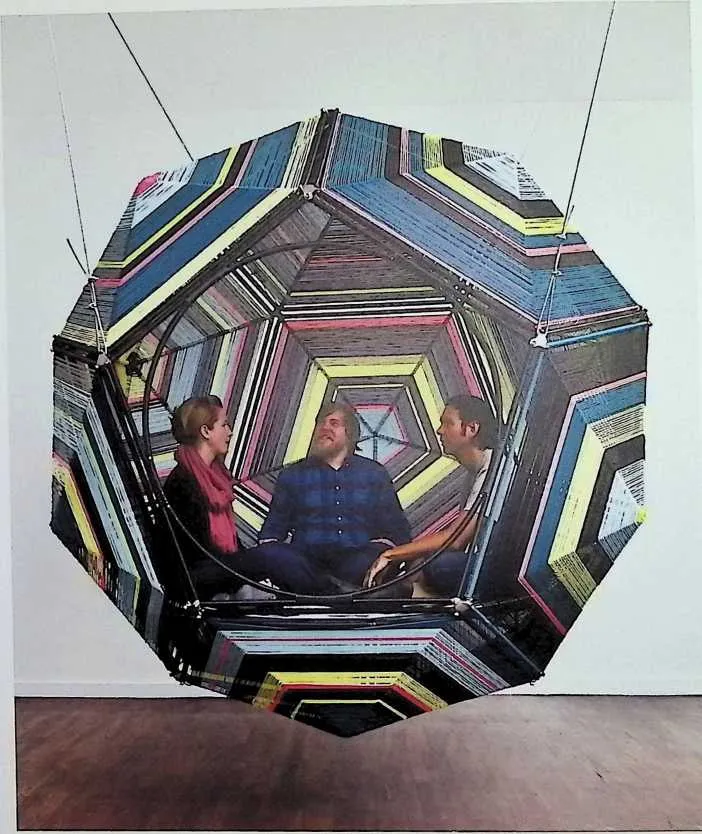
672 Copula Expanded Dodecahedron,
2009/10
Stainless steel frame
woven in vinylcord
Dimensions variable
673 SILKE
RIECHERT
674 Club der internationalen
Raumforscher, Berlin
since 2009
Project room
675 Architecture by Silke Riechert
in cooperation with
Manni Eccli,
Christoph Franz, and teenagers

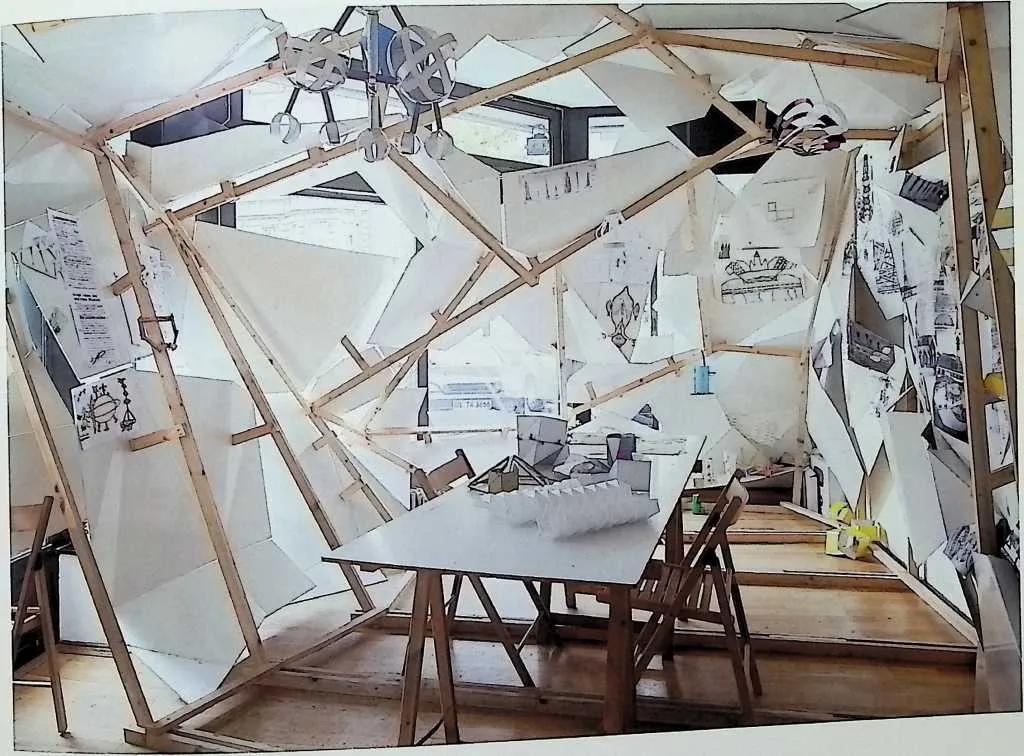
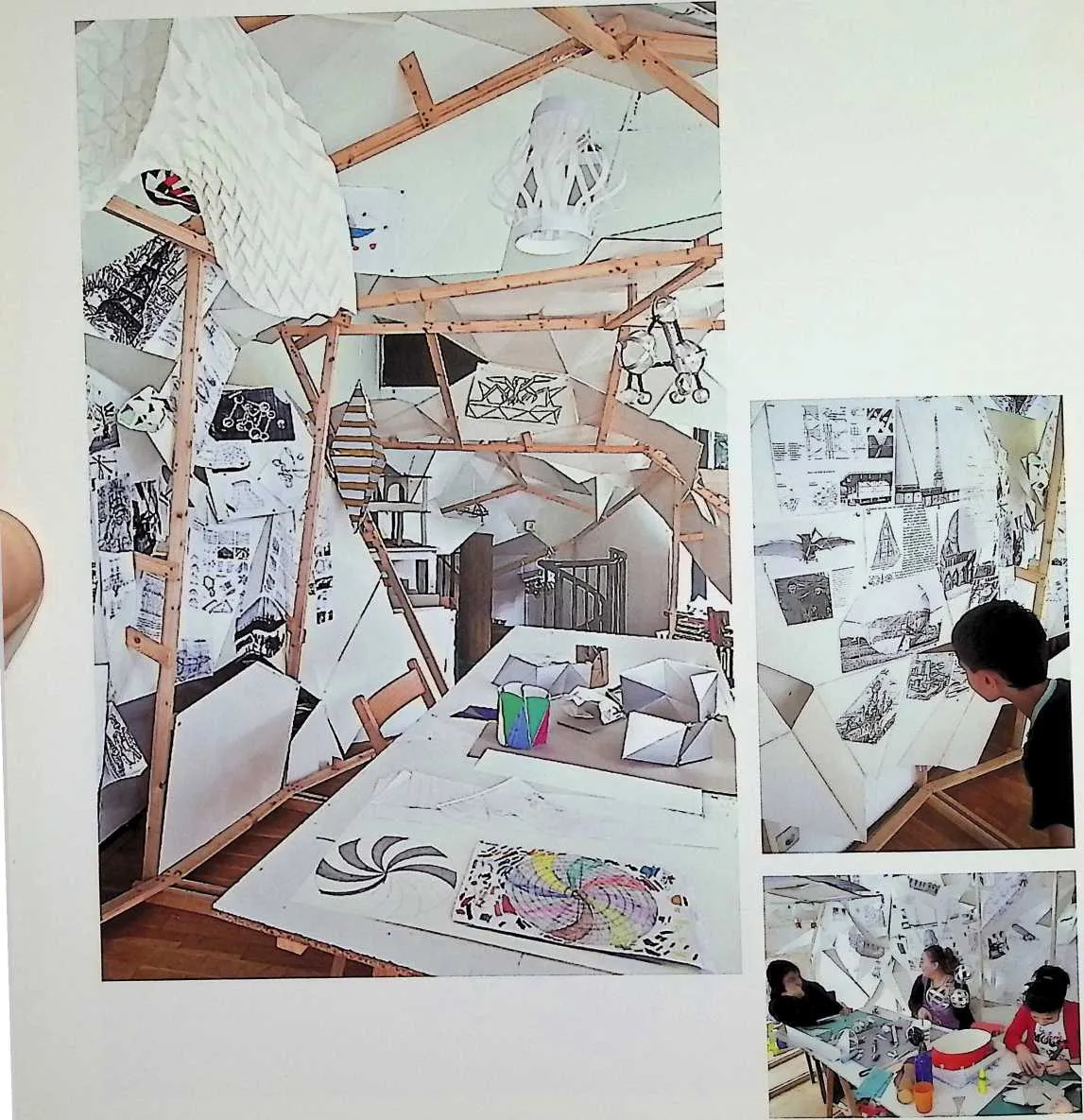
678 Club der Internationalen
Raumforscher,
Berlin since 2009
Works by Silke Riechert,
Aycan Dalkis, Ozgiin Kurt, Mai Tran,
Jakob Bogatzki and others
679 Left above
680 Dos Fllegende FuBballstadion, 2009
Two children's drawings,
Berlin-Weddlng
681 Nach derGeometrie and Modelle,
Papierfaltungen, Modulare Systeme
undGestaltungen,
concepts since 2008
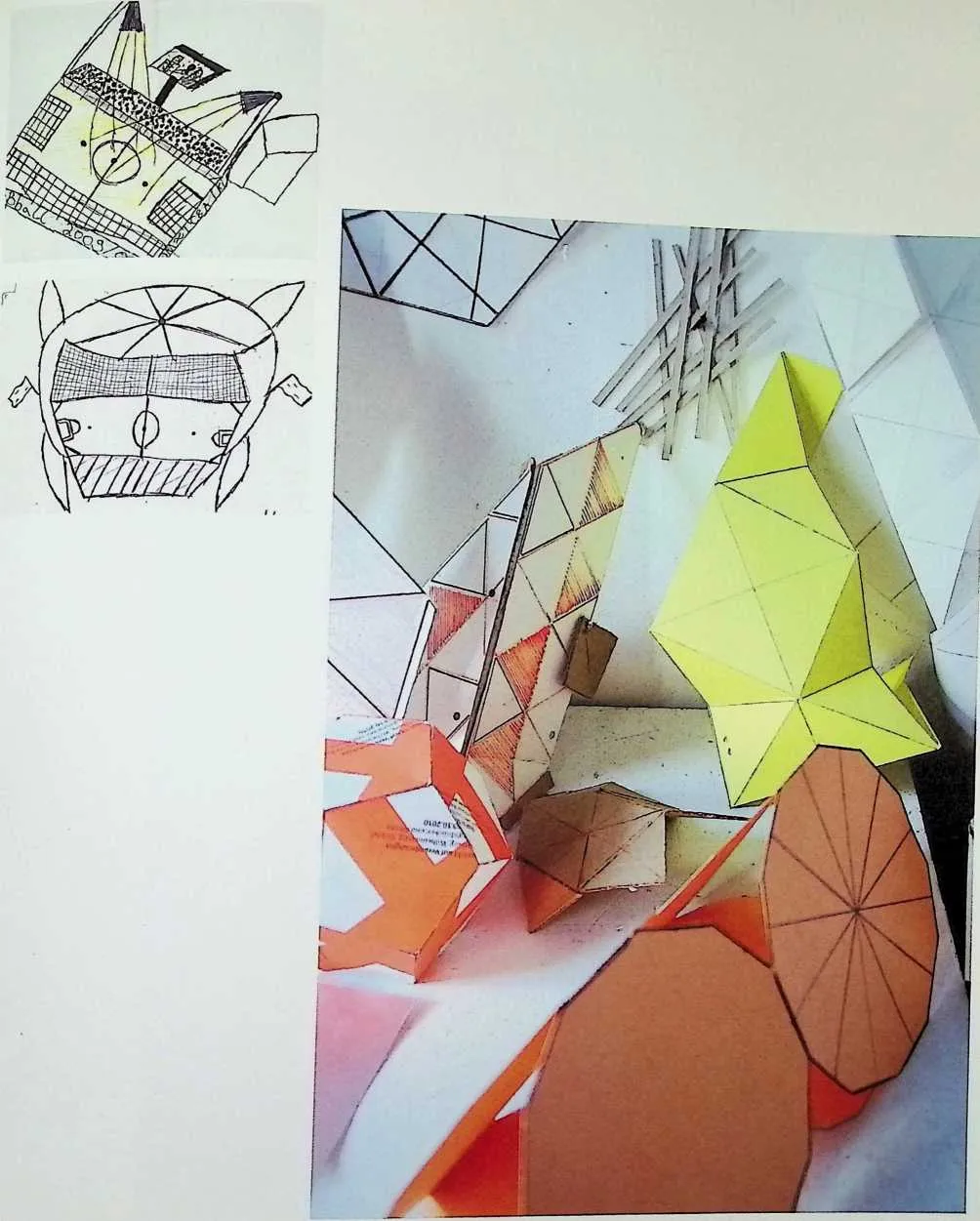
683 Varlationen, 2009
Colorpencil on glassine paper
16x23.5 cm
685 TOMAS
SARACENO
687 Biosphere MW32/
688 Flying Garden/Alr-Port-City, 2007
Elliptical pillows, webbing,
Tillandsias
689 Ca. 0 450 cm
690 Biosphere MW32/Flying Garden/
Air-Port-City, 2007
12 elliptical pillows, 128 x 75 cm,
20 elliptical pillows,
170 x 100 cm, webbing, tillandsias
Dimensions: 0 450 cm, installation variable
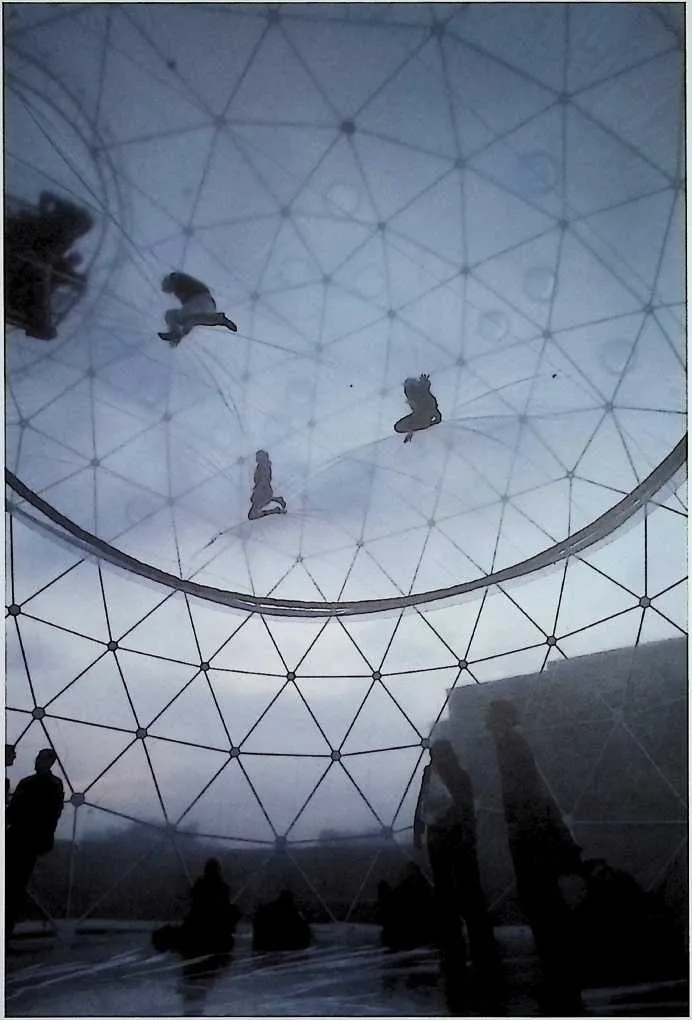
695 Observatory/Air-Port-City, 2008
Metal dome, mirrored floor,
height of the dome: 960 cm
696 tomAssaraceno/ we are all astronauts
697 ALBRECHT
698 • •
699 SCHAFER
700 Le Monde, 24. Janvier2009, 2009
Complete copy of Le Monde,
wallpaper paste
7x7x7cm
702 Ocellus, 2010
Work light’s, sewing thread,
plastic sheeting, 500 x 800 cm
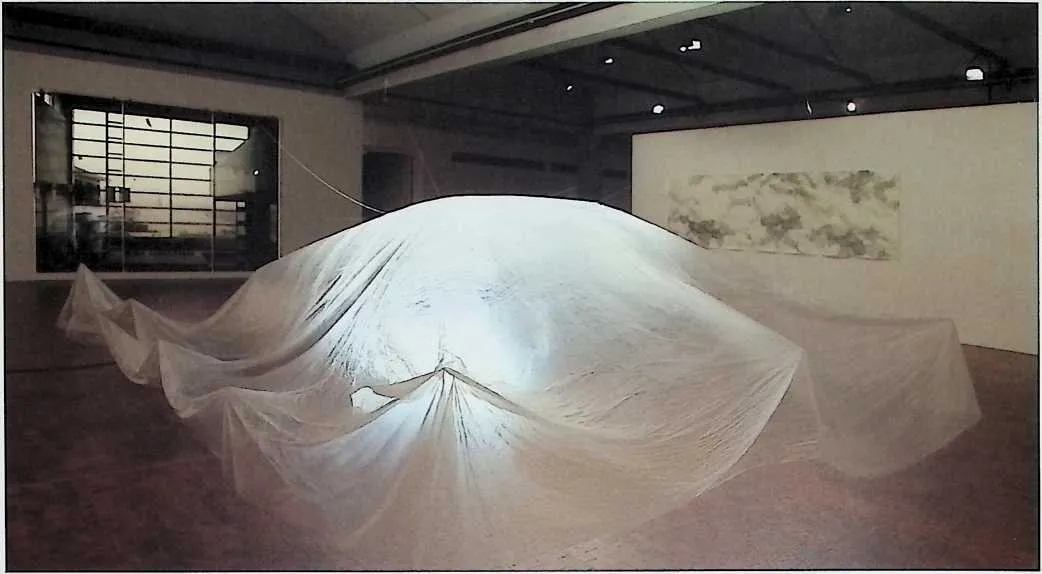
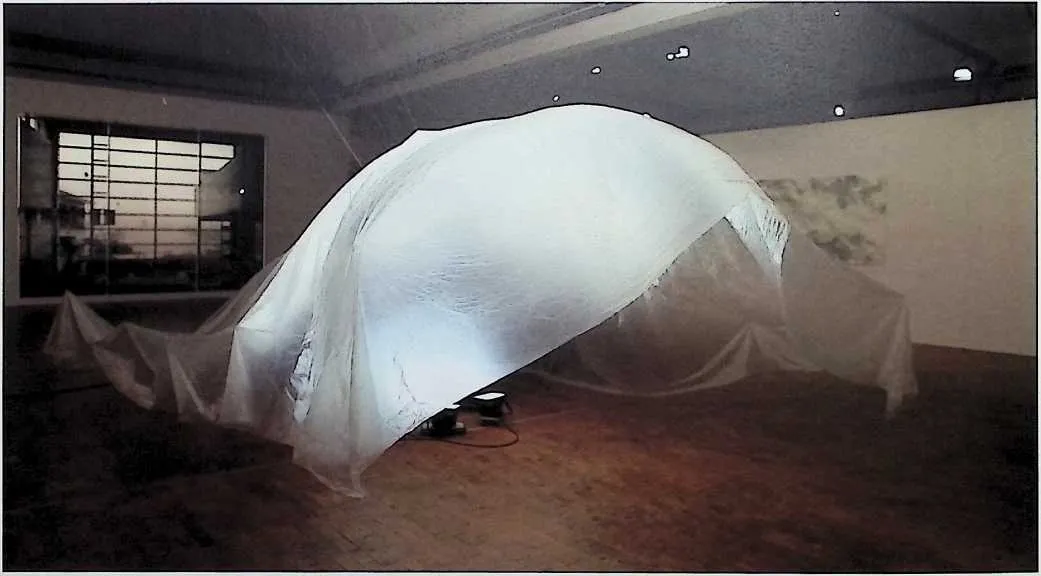
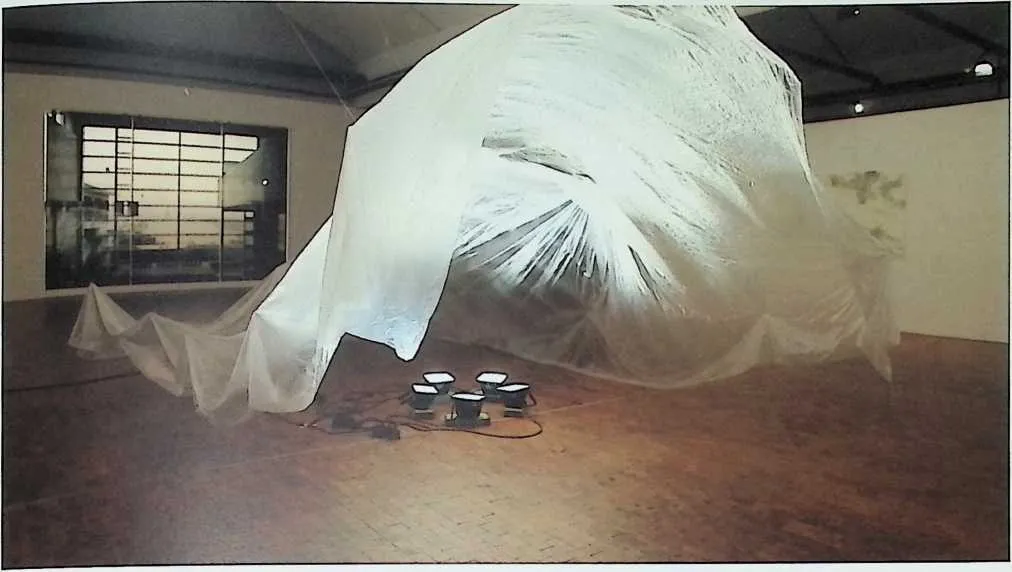
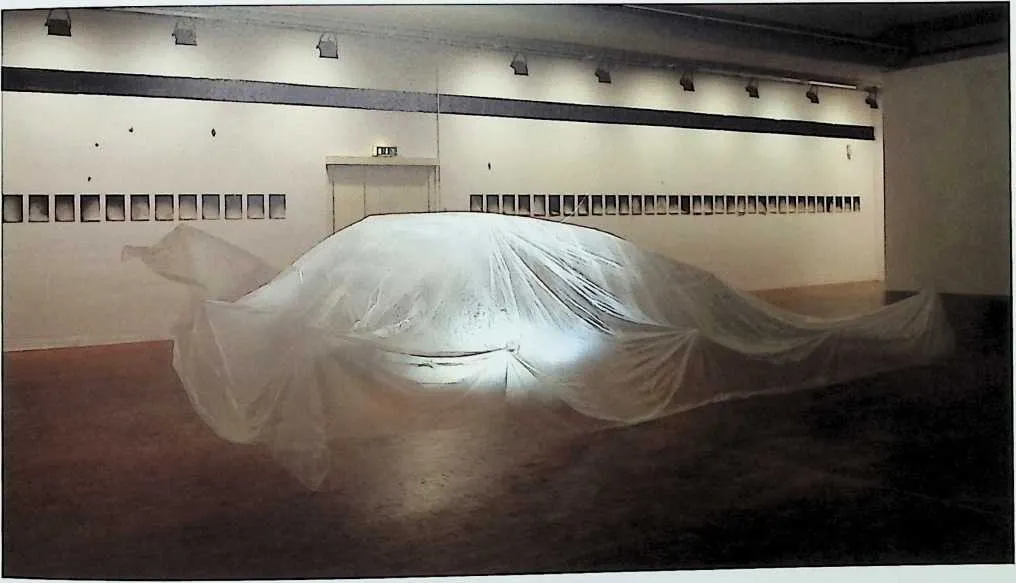
706 case expericrxc* ---"The Law of Decreasing Confusion", or the "Law of Intellectual Conren alien". or the "Law of the Contracting Universe"; or the ‘‘Law of DitniniduflQ Cluos"; <>r ’The Law* of Progressive Order". or lite "Lawof Contractive!) Orderly General izations"
707 Radiation is physical, eniropic. incoherent, propelling. disassociative, poshing. The logical questions arise: -It gravity metaphysical, anti-cctropic coherent anti tensive? Are x'urirv and order wrested and collected intellectually Iron chaos? b intellect u prion to both physical and metaphysical universe? Is the tcnuosal integrity of unit cr*e exclusively an intellectual integrity phenomenon and a contuquence only d intellectual exploration and measurements?
708 While gravity's effects are physically measurable, the concept of ff»v sty is in itself unweighable. lakes* ise the effects of eleetromapxtiun are phy vically weighable. The phy sicists have ruled intellectually dial all that h imponderable it metaphysical. Clearly it is seen that the mrtaph) sical is to the physical at anti-matter is twmatter. i. e. a* the electron is to the positron.
709 Metaphysics andphysics are thus seen toco-ftsclion, to progressively ecnsene the self-regeneration of non-umoloneously and overlapping!) evolving universe. Man's function in universe is that of the metaphysical, onti-cntropic funetlG>. He is essential tothc conservation of universe which is in itself an intellectual ctoccpicn. In 19)11 published my coocluvioi that man i> the ami-entropy of univfneJCobcrt Weiner psdiihed the same statement at the same time. Both of us arrive at cur ccnclustouv by different routes and withart knwlcdgc of the other’s discovary. 1 will now expand on the human's anti-cnlrGpic functioning.
710 In the above statements I am giving previse meaning to tlie word "metaphysics". By metaphysical 1 mean no more no less titan is implicit in my definition of unis erse. Since magic has never been experimentally demonstrated, my uve of the word ‘‘metaphysics" does cot certain overtones of magic or mysticism.
711 "Why Universe?" ---is at present an unanswerable inquiry into the mystical. TiocgOmystical sounds like a contractiav of metaphysical, they are not the same. Cbr tins reason. I consider all time spent tn speculation regarding the inherently Ganswerablc Io he inherently profitless and a squandering of die opportunity to crow er those questions which are answerable by man It is, how ever, experienced by cs that the unanswerable* provoke a vcnsaiion in us to which we allude ---only intuitively -as ‘‘Mysterious".
712 By the same reasoning, 1 discredit oil the speculations which suggest or persuade tJocxincepl of a "beginning or ending" of universe. The most recent statements of Udecding scientists hold that the concept of original chaos is untenable because tlie £ty*rcal composition of universe may not be reduced to lest than the orderly isOtransformability of the neutron and the proton and their respective weak effect Cftncss and rightness adjuncts die electron, positron; neutrino, anti-neutrino ---the pasitivc and negative counterparts including both their negative as well at positive eeights, ergo: -the average of all Height of all phy tical phenomena it zero.
713 This is to say that die umverse, both ph) sicbl *cd metaphy steal, i* rcsoh able into a set of principles u hkh are ever more accurately Ort never exactly) described by the scientists* weightless intellectual generalization*. AZ! generalized principle* which are weightless cognitions nf intellect have no mliwcst beginning or ending I nothing in human experience has ever suggested tie bcginnmOCraiing of a generalized principle) ---ergo the ’beginning* of universe concept* togeCOcah all axioms are experimental or unproven and only superficially obvious fictso Drfoe the measurements of the speed of radiation*, all phene menu teemed (enoostsly) to be visually ‘‘INSTANT. TTiis gave rise to die xuperstitiouxly invented of a genie or god creating an instant universe. A ph) sicist *aid to me a few day* spy ‘‘I have become bored with the noivenvc concept of infinity ---with one end closed by a ’beginning' and the other end open to infinity".
714 Universe by definition and its derivative concepts arc synergetic. Synergy as y ou know, means: Unique behaviors of whole systems unpredicted by any behai ion of their component functions taken separately.
715 Some of ancient Greece’* natural philosopher* and geonctcn took effective advantage of Synergy when they recognized dial the sum cf the angles of a plane triangle is alwoy* ISO degrees, or exactly one-half of cyclic unity ---with unity taken as 360 degrees -ergo unity equals tw o triangles. I avsumwjirv 1917 that ‘‘unity is plural and al minimum two".
716 Tba stable structural behavior of a w hole triangle, which covvist* cf three edges and three indiv idually and independently unstable angles ora total of six components is not pedicted by any one or two of iL* angles or edges taken by themselves. The six edges Cf the two triangles can end frequently do associate with one another, one as a left helix and die other as a right helix, to form the six-edged tetrahedron which bavinjyfcurtriinguhr faces gives synergetic demonstration of four triangles occurring as the result of associating only two mangles. Incidentally, the right and left helixes formed of tlx two triangles' respective sets of three edges each constitute the vectorial modeling in conceptual array of die positive and negative "half spins" or "half quanta" comiipmding, respectively w ith the pro-ton »et and the c=ut=?xet consisting of neutron and neutrino on the left hand and the proton. ctocCZCad tntineutrino on the rightdisr.d. Together there six make one quantum unit -cOich is identified as the tetrahedron.
717 Triangles as conceived by the Greek* arc syncrgedc. The Greek* went on to demonstrate the corollary of Synergy, to wit: dial the koa behavior of the whole and the know n behavior of some of die components nukca pcsuble prediction* of the behavior of each and all of the other, previously, unkron component*.
718 The Arabs' algebraic formulation* and all their modem derivatives, including the calculus, are synergetic strategies.
719 This synergetic strategy of proceeding from the w hcf3 tOdiscover discrete local particulars within the wliole was demonstrated powerfully cxe again a century ago in Euler's Topology which reduced all patterning of unite? to lines, intersection* of lino ---called ‘‘rcrtexcv" -and the areas bound by these or more intersecting
720 21 Wh.ii >' M>bc.>nssi.*u.i-..•- Wbat is tckx-fopy *
721 2* What is autiKiialioti' 21 W’hui is a |i»l' 2* W'hal Is industr) ' 2b W'hot is Minute' 27 W’hal i» inanimate" 2* W'hal alt mcUbnllcs ■ M Wlial is wealth'
722 WTtat is ituuuioo * II W hat arc aesthetics ’ ‘2 W luii is tiarmoriK ' " Wlul Is jwvisal. ' I t W'hal .us ilk* senses ’ " W'hal arc >nai|icni.ih. .' tn Whai is uiusiurc ' '7 WTu>( I* dillciculi.iixfi' W W'hal I* inicyraiH'n ’ tu What is inicjniiv * 40 Wbal is truth '
723 We must now ask.‘‘What will emancipate soeucc from licr century of unnecessary 'Blind Flying' exclusively on instrument* ---a* a slave profession ---with lethal consequence* --and u ill tout any sense of lung distance economic success objectiv c* for all of posterity?"
724 Wc must also tsk. ‘‘Front w lienee will come die tool* of conceptuality w huh w ill emancipate science and permit its assumption of the prime, social, direct, conscious, sensorial responsibility?*
725 What can and will bring world society'* leader* and world society itself to comprehend ns economic potential and it* essential function in universe and to it* successful performance of that function---in time to permit the continuance in universe of the Earthian team of human's ’
726 It seem* to me that our commitment to mutual examination of our respective functioning leads abruptly to there furalamental questions I assume this to be so. I also assume that neidicr of us ha* innate characteristics nuking us uniquely filter than others to address there questions. I assume, however, that both ol u* have come independently to the realization of die task* to be done by world society and by individual men operating with integrity on their own initiative on behalf of their fellow human*. J assume that both ot uv has now unique experiences end organized information and accredited effort which provide u* with some measurable degree of intellectual, technical, and economic advantage in addressing these prime question*. On my part. 1 would like to contribute the follow Ing thought*.
727 First, it seems to me that unless we have experimentally demonstrable and scientifically definable meaning in our words, we cannot communicate effectively with words Communication is with self, ns well as with other*. Ergo: w c may say---die degree of effediveness of communication is proportional to the degree ol exactness of commonly accepted definition ot rneaiunu* of die words used. This statement is a corollary of my lung held working assumption that: -a problem adequately stated is a problem fundamentally ripe and potential of solution.
728 In seeking definitive meaning* I recognize, of course, that Heisenberg's principle of indeterminism, forestalls abwlute exactness. However, tlie tolerance of error is reducible Ergo: wc may approach exactitude in progressive degree. Ergo: what I mean by mutual comprehentlan of meanutvs is stateable only tn term* of approximately exact meanings
729 It is also my w orkmg auumptiun that lacking the approximately exact meaning of the most profound generalized concepts tlictc i* little meaning and approximately no direct ideologic effectiveness, in any and all special case, local experience communication*. For instance, it is impossible to understand tlie previous sentence without a fundamental comprehension of the concept teleology. It h also fundamentally impossible for us to ccke conscious solution of the greatest cad prime problems end their secondary technical challenges without use of the phenomenon teleology.
730 It is my working assumption that the following 40 questions must be definitively answered before wc may realistically discuss our respective philosophies and grand strategies.
731 MR VII GIC QI I SIKJNS
- 1.
- W hatafwc mean by universe *
- 2.
- llir* man a function In univerve ' ’ Wlui ivtlnnkinc ’
732733t W lui arc cvpendKvx ' 5 Wlut arc cvpertinent* ’ f> W tiu Is .Iibjniil,-’
734 7 Wliat isobjcinvc'
735 It Wlut it j|ncliriiMon *
736 ‘i What i» imnnerlKii'hsi'
- 10.
- Wbal is positive ‘ Why '
- 11.
- VVImi is negative'* W hy '
- 12.
- Wlial is pti* vi.al ’
737 l’ W'lwl fc mcljpli) steal ■
738 I I W'tun is syncr*:. '
739740I' Wlui ivcncigy ' It* Wtul is t’run ' . r W lial is mu lie. I is Wliot i»science ’ IM W lial is a sv stem? I 211 W tlJI I. .nils. UHLI-.-ss ■
741 If »rt first accept mutually agreed upon, experimentally baled definition* and nn*c=CT<?Cw*equ»uiRi* a* ts priori to our dialogue, we may then also oberve the foltxaj o be pcrtinenl-and useful to the initiation of our mutual search to the dcfinitivOGaiw cn to the immediately foregoing ut of prime quettians.
742 FirxLd refer you to my own attempt* to make experience founded --- ergo tcientiCcoly definitive ---answers to all 40 of the question*.
743 hSOf my attempt* havetxen publivhcd In books, essays and lectures. I do not assume Cot < have found the casw er*. I do assume that I have addressed the problems on a ciOiflc basis for I hao as Eddington put it. ‘‘nude a sincere attempt to set In order tha to* of expereace".< have progessiv ely included and refined the experience baaltCTCcse meani«0»«rd4Mve progressively refined their verbalization. I have thus dtoovrred ---for ixwsoc ---that there are no noun* for physics ha* found no thing*C?ic. solid phecxia) -Ergo there are only verb*.
744 there are many special concept* which constantly reoccur in my day-to day deliberation*. I find that there are fourteen which dominate. All of them overlap
745 What is Automation, 2005
Booklet, 40 pages
746 KAI
SCHIEMENZ
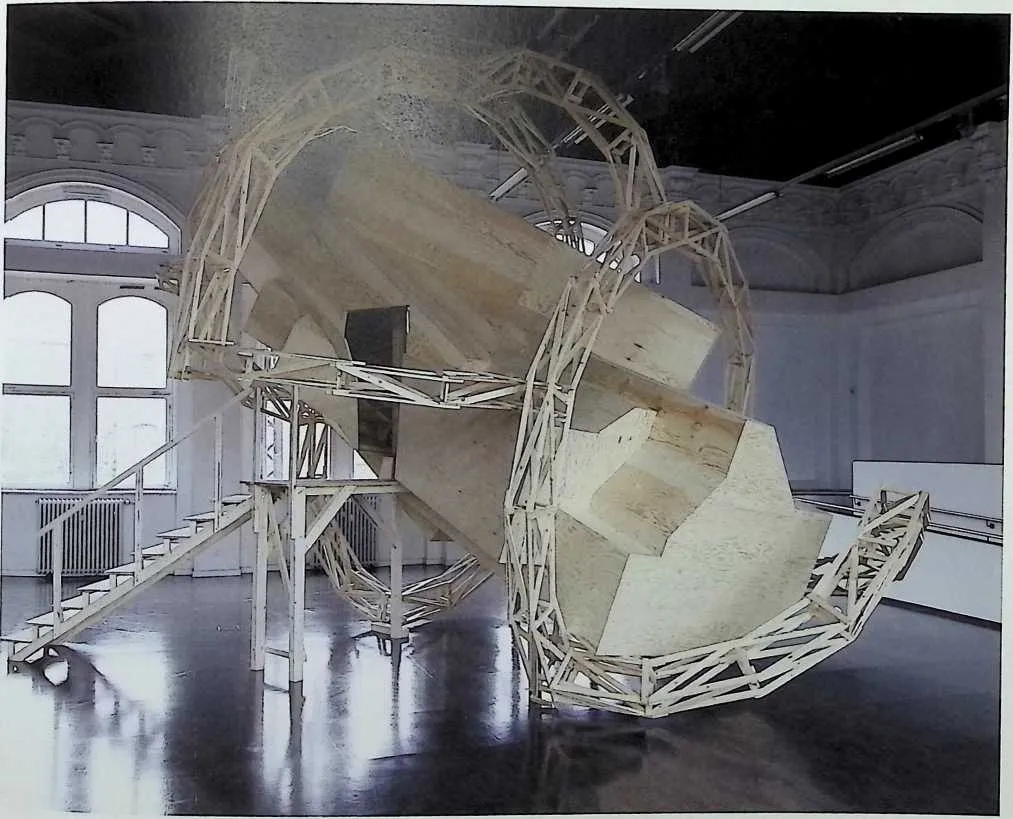
748 The abandoned Architect’s chamber,
deserted for unsatisfied enquiries, 2009
Plywood, wodden lath
620 x1280 x630 cm
749 Total Theatre -Communual Theatre, 2008
Wood
500x650x520 cm
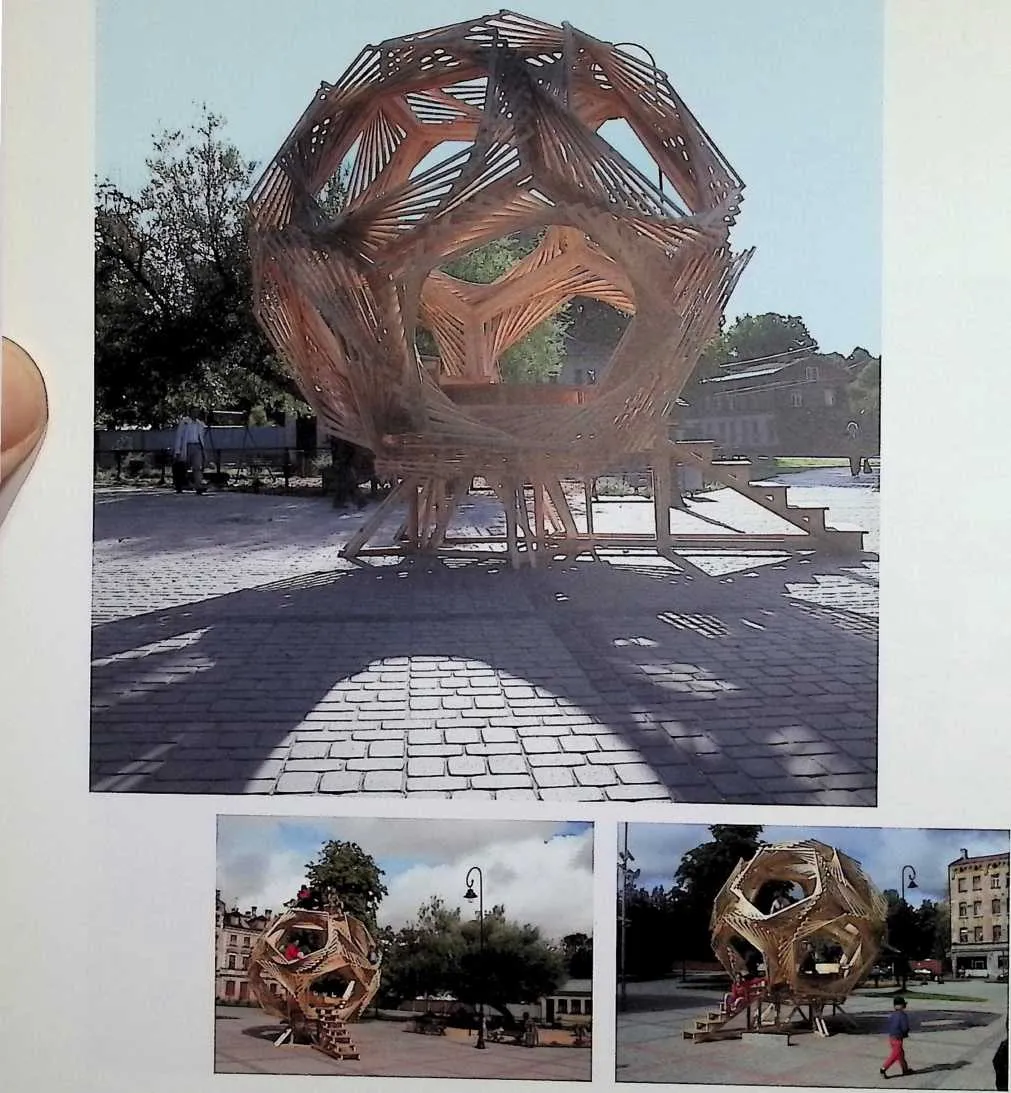
751 The Empty Dwelling, the Vain Tower
and the Mad Colonist, 2008
Wood
750 x650 x500 cm
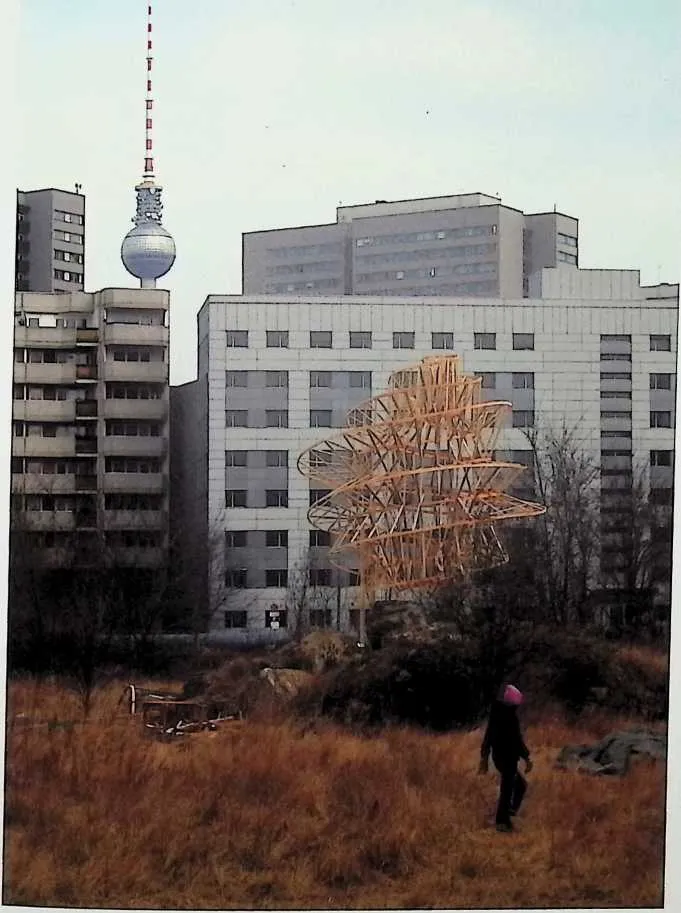
753 The Geograph, 2010
Pencil on paper
29.7x21 cm
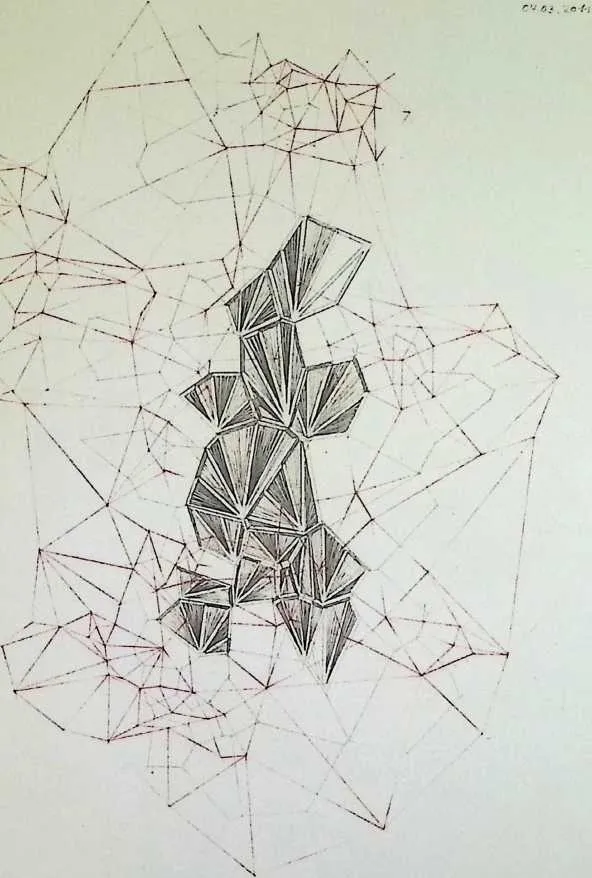
755 KERSTIN
STOLL
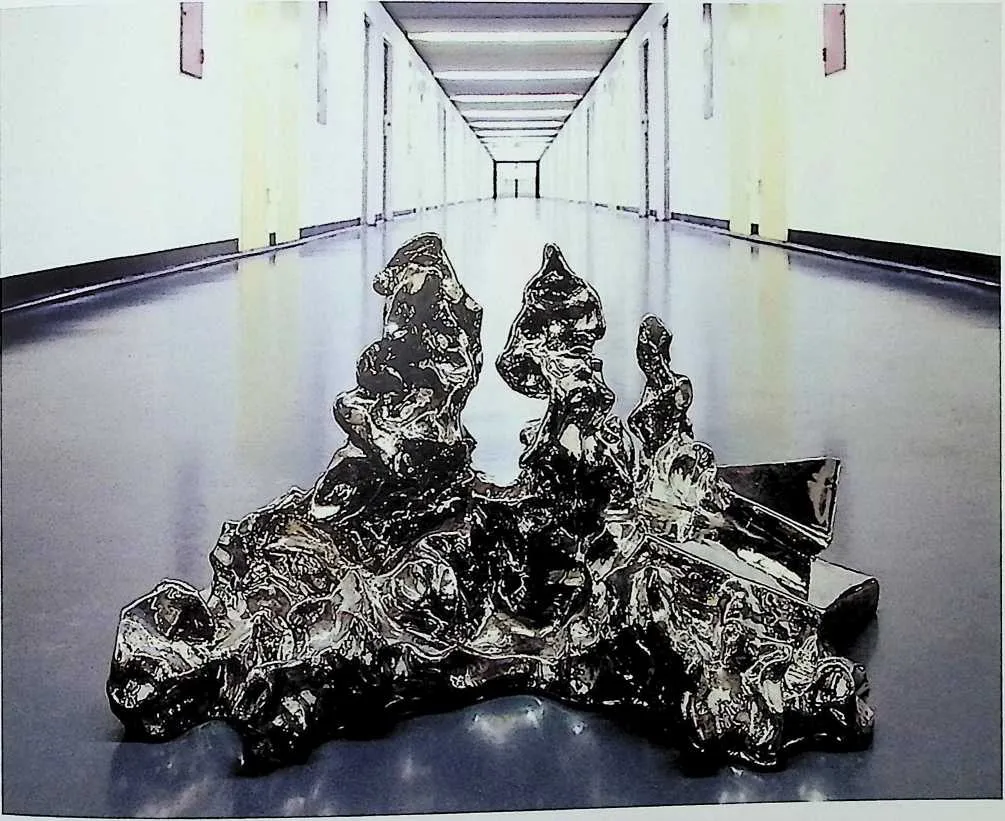
757 Die Glaserne Kette zerbricht, 2010
Ceramic with white gold glaze
33x60x45cm
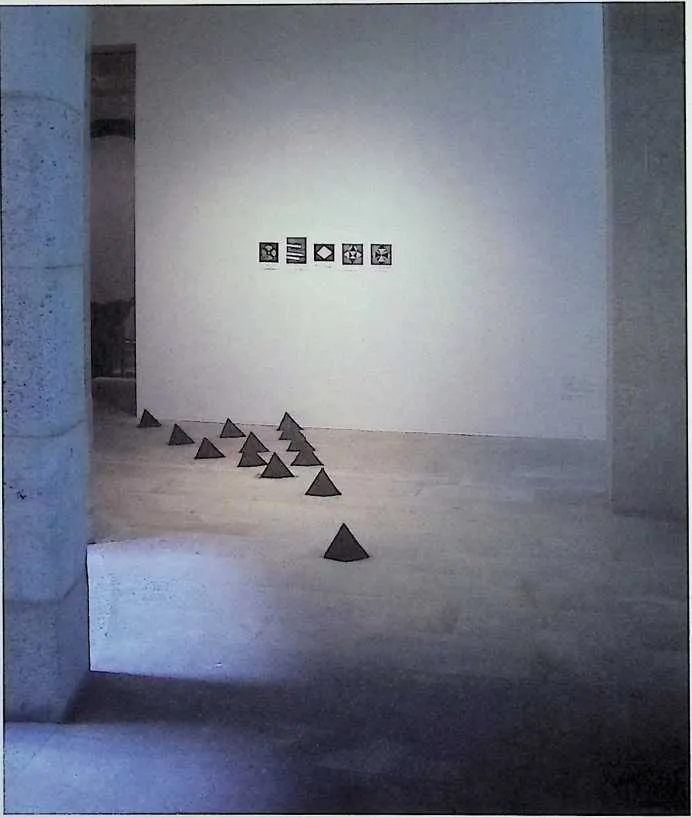
759 Crystallization
760 (A. Besant & C.W. Leadbeater), 2008
Peat, Inkjet print
Each 20x30 cm
761 197
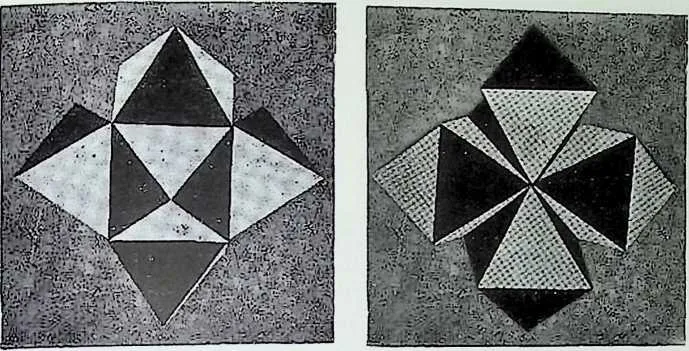
763 FIG. 220. FIVE CARBON ATOMS pjG. 221. VIEW SHOWING
764 MALTESE CROSS
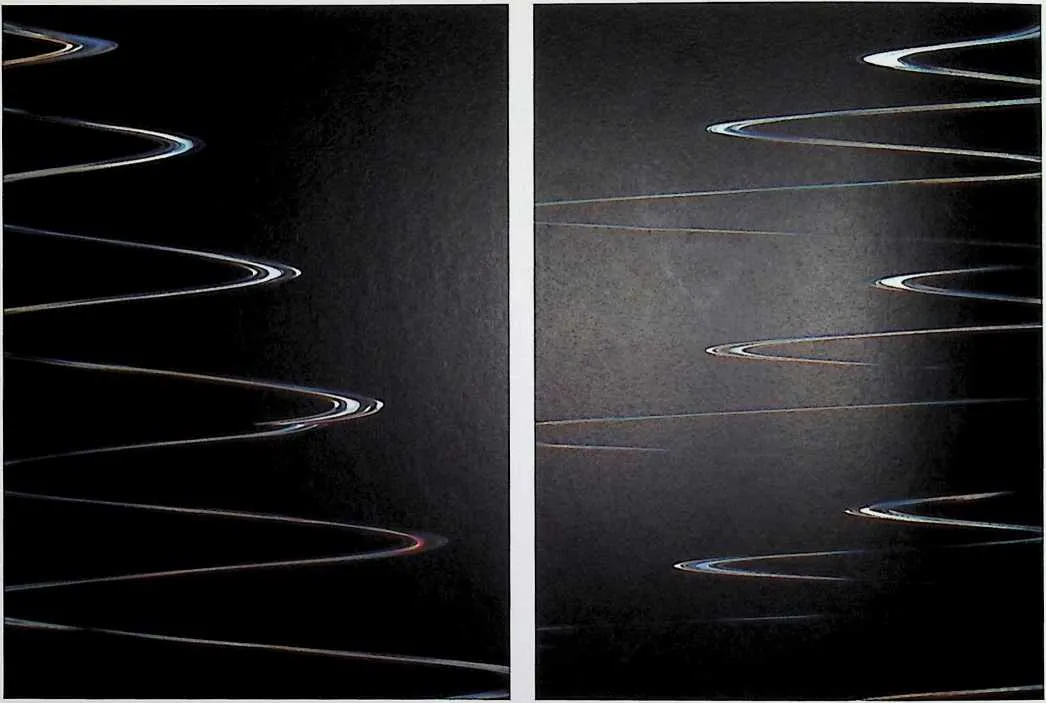
766 Ko'ilon 3/53 and 3/73, 2008
Scanography, Inkjet printon
baryta-coated paper
Each 150 x 100 cm
767 TILMAN WENDLAND
770 Untitled, 2009
Hard fiber, chipboard, wood
Dimension variable
772 Yellow Spot, 2010
773 Photograph by Krzysztof Zielinski from the
collection, child’s drawing, page of newspaper,
chairs, lamps, fiber board, wood, steel cable,
acrylic glass, oil pastels
Dimension variable
774 Yellow Spot, 2010
775 Photograph by Krzysztof Zielinski from the
collection, child's drawing, page of newspaper,
chairs, lamps, fiber board, wood, steel cable,
acrylic glass, oil pastels
Dimension variable
776 mHANWENDLAHD/NEABEALLASTRONAUTS
777 TILMAN WEHDLAHD/WE ARE *11 ASTRONAUTS
780 BEAT
ZODERER
782 Supramat, 2005
Plaster
75x61 x 13 cm
783 A globe in a square room, 2009
Acrylic on aluminum, riveted
BOOOcm
785 F|ickenpaviHonNr.1/08
786 2008
787 Acrylic on aluminum, riveted,
wire, plastic ropes
440x770x580 cm
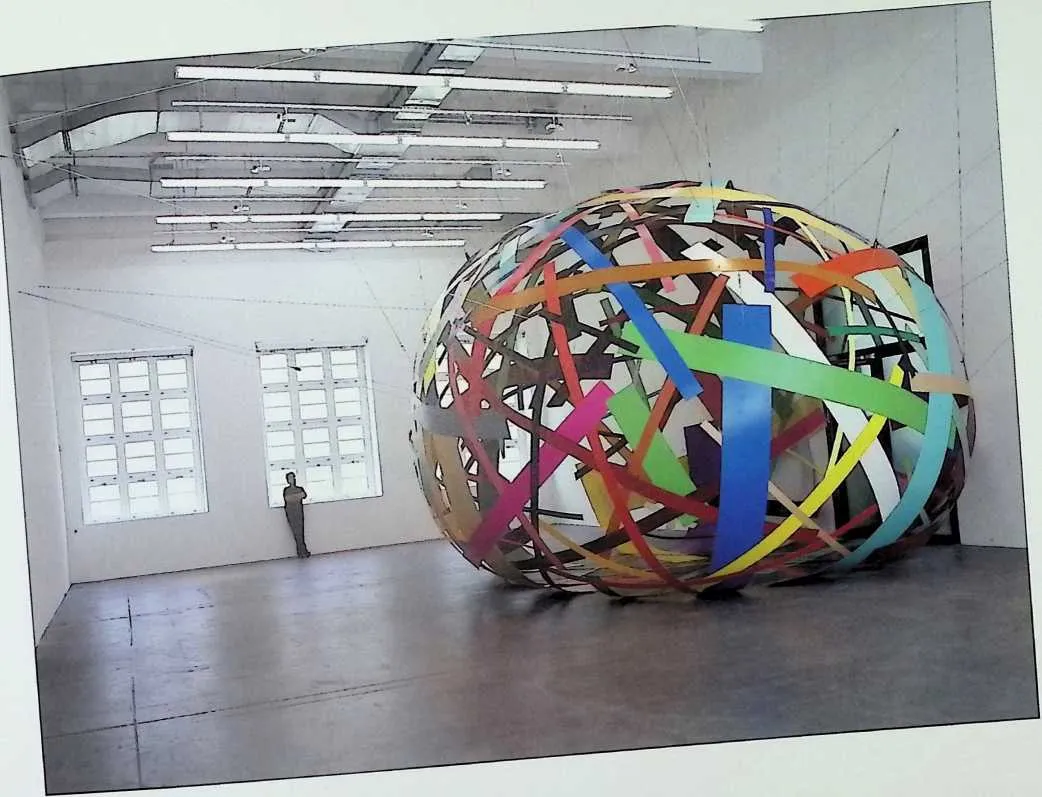
789 Ball, 1985
Coated fiber board, riveted
79x79x98 cm
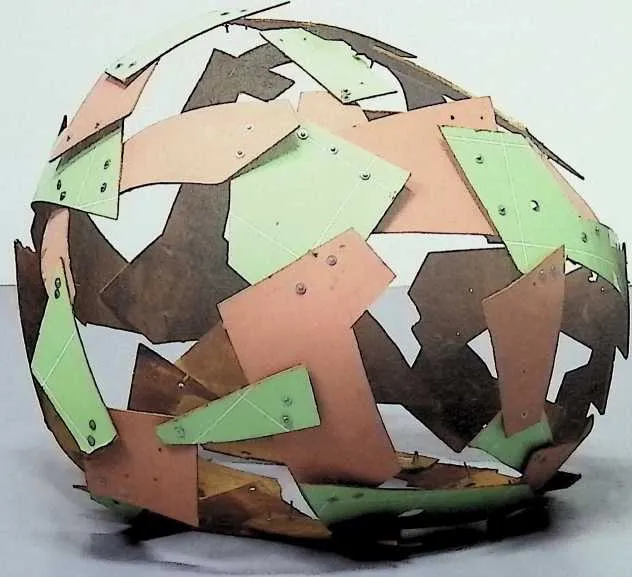

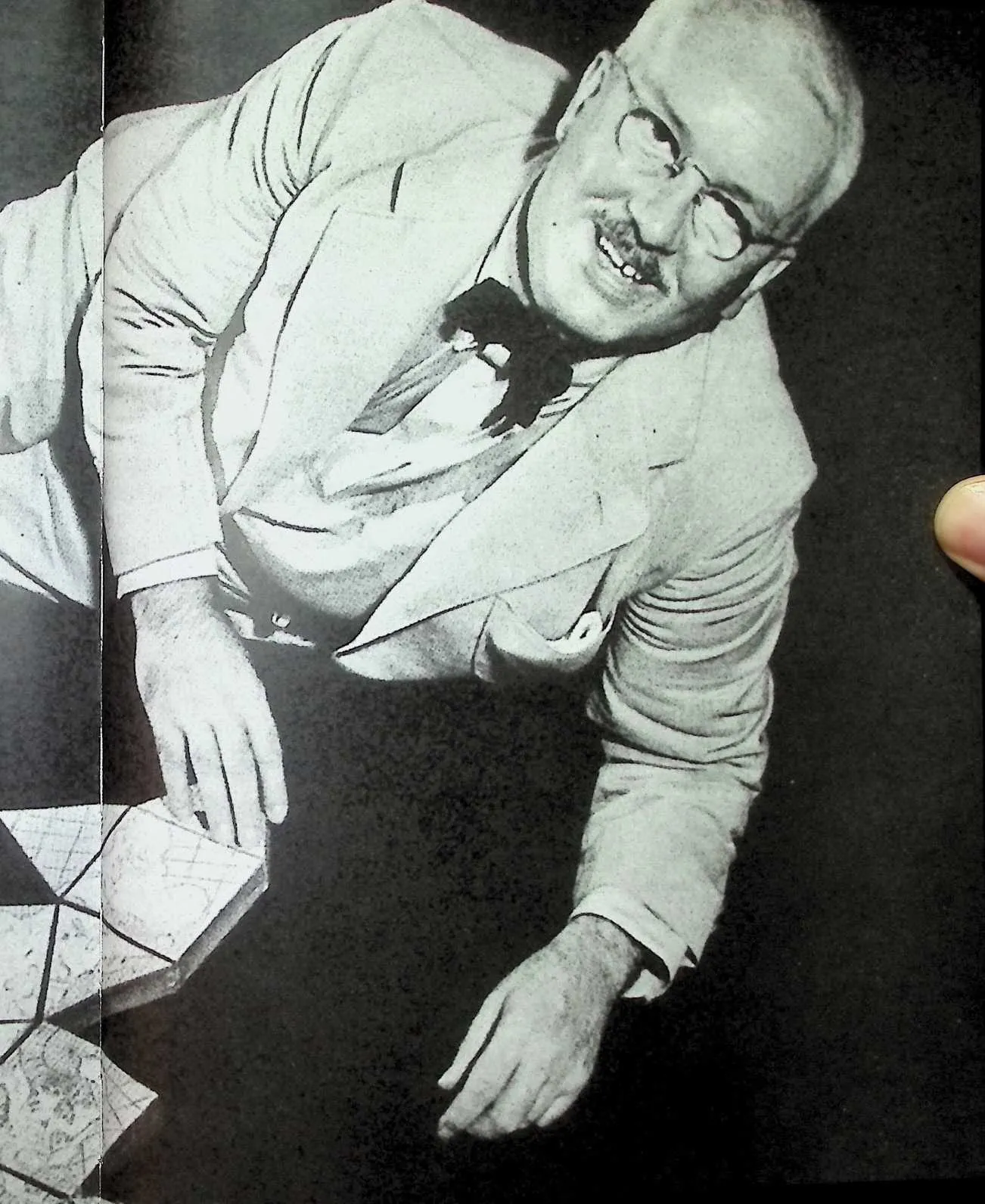
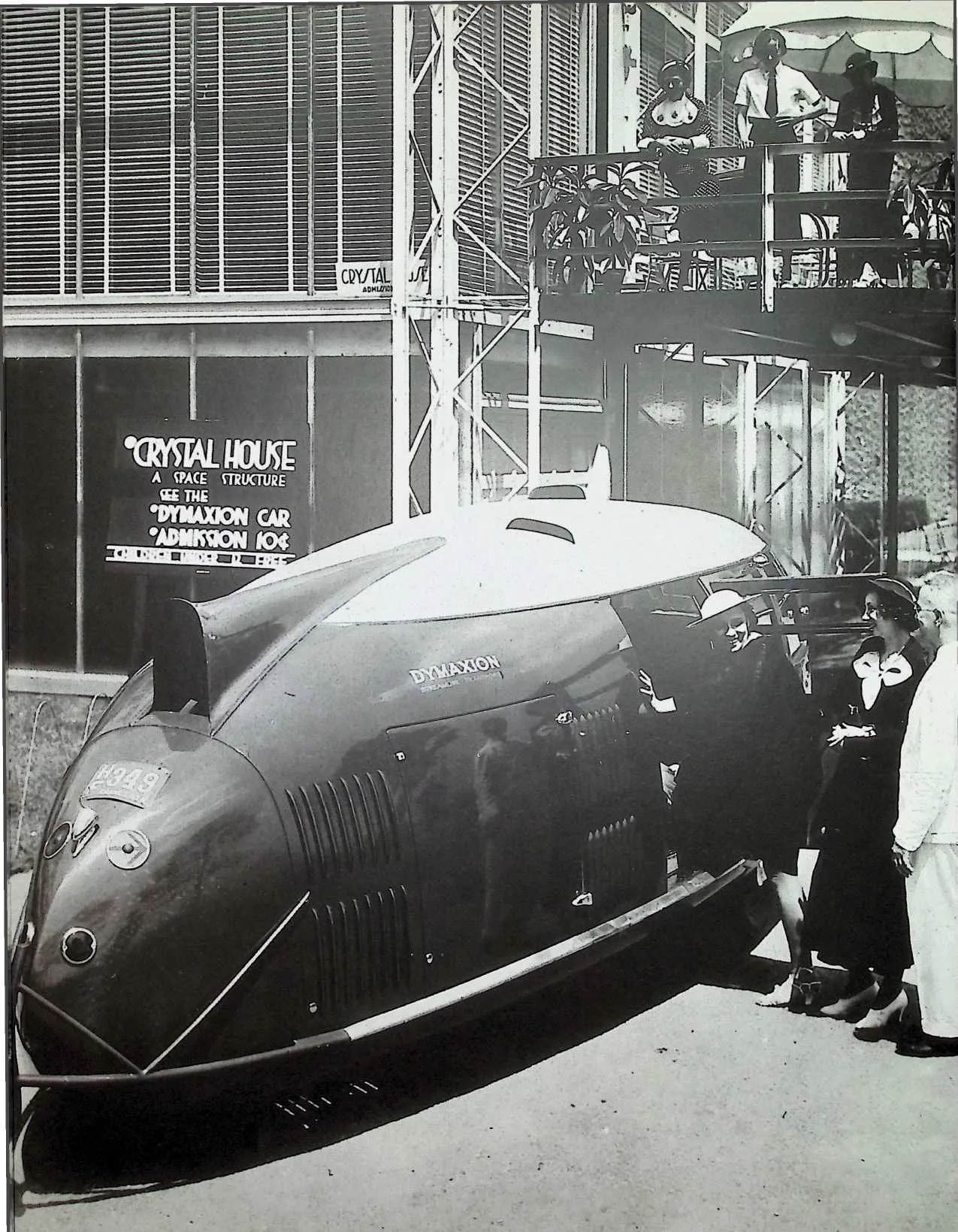
794 IlBlB iiBii®



797 SelectedSoiaExhlbltlonsl
798 thYntSmaHolArchltecturVExhibltloni
799 2003
800 Galerie Urs Meile, Luzern
801 1988
802 Old Shoes -Safe Sex, Art Waves Gallery, New York
803 1982
804 Asian Foundation, San Francisco
805 2007
806 documenta XII, Kassel
807 2006
808 CHINA NOW. Faszlnatlon elner WeltverSnderung, Sammlung Essl, Kunst der Gegenwart, Klosterneuburg
809 Zones of Contact. 15th Biennial of Sydney,
810 Sydney
811 Territorial. Al Weiwei und Serge Spitzer, Museum fur Moderne Kunst, Frankfurt am Main
812 t1987/3S
813 The Star at Harvard: Chinese DIssidentArt, Fairbank Center for East Asian Research, Harvard University, Cambridge
814 1986
815 China’s New Expression, Municipal Gallery, New York
816 1980
817 The Second Star Exhibition, Peking I Beijing
818 1979
819 The First Star Exhibition, Peking/ Beijing
820  2010
2010
821 ffiKubSESIl
822 Archlmedeanlipim;.
823 FRAC
824 2010
825 Ortofrutticolo, Pescara
826 Galerla Monumental
827 1999
828 Tackling Techni, 48th Venice Biennial, Hungarian Pavilion, Venedig/ Venice
829 After the Wall, Moderna Muscat, Stockholm et al.
830 2003
831 Poetic Justice, Sth Istanbul Biennale, Istanbul
832 AusgewShlte Gruppenausstellungen / Selected Group Exhibitions
833 2005 Moving Ports,Museum Tinguely, Basel
834 2007 Platonic Geometry, Szent IstvAn Klrily Muzeum,
835 2006
836 Galleria Contemporaneo, Mestre
837 Skin of Space, Galerija Gregor Podnar, Ljubljana
838 MbdernyGrandDucUean
839 2009
840 2005
841 Gallery Van Zoetendaal, Amsterdam
842 (mit / with Giborosz)
843 2004
844 Platonic Love, Kettles Yard, University of Cambridge Orange Space, acb Gallery, Budapest
845 Donumenta 2010: Aktuelle Kunst aus Ungarn, Kunstforum Ostdeutsche Galerle, Regensburg The Promises of the Past, Centre national d'art et de culture Georges Pompidou, Paris Fine Line, Georg Kargl Fine Art & Georg Kargl Box, Wien/Vienna
846 What Happens If?, Storey Gallery, Lancaster 2009
847 Go East II, MUDAM, Musie d'Art Moderne Grand
848 Due Jean, Luxemburg
849 Materlallen, MOnzsalon, Berlin
850 Revolutloh-FormsthatTurn. 16th Biennial
851 1996
852 Beyond Art, Ludwig Muzeum, Budapest;
853 Neue Galerle, Graz 1994
854 22th Biennial of Sao Paulo, Sao Paulo 1992
855 Space Concepts, Budapest Galbrla, Budapest
856 HTISJS'BlOSMPHIES/llEllllEiLUSTlIIMUS
857 Selected Solo Exhlbtlons
858 2011:
859 Kerstin Engholm Galerie,
860 ,333°
861 2010
862 Die Theorle des Himmels III
863 Galerie Guido'
864 Die Theorle des Himmels I _ ___
865 Die MilchstraBe
866 Kunst im Tunnel, Quadriennale 2010
867 Innsbruck
868 Zentrumfur
869 Kunst
870 KarlsruKe'et al:.
871 s'andldeas:
872 TEEO
873 TEE0

875 7nno
876 unstHalle;
877 The Theory of Heaven I -Bright Matter, La Conserve™, Centro de ArteContempor&neo, Murcia
878 Berlin
879 i Berlin
880 2008
881 The Universe, Hiromi Yoshii, Tokyo
882 2007
883 2006
884 The Homunculus Saloon, Kerstin Engholm Galerie, Wien/Vienna
885 2004
886 Utopia Planitia II, Hamburger Bahnhof,
887 Museum fQr Gegenwart, Berlin
888 Utopia Planitia I, FRAC Fonds Regional d’Art Contemporain Provence-Alpes-Cote d’Azur, Marseille
889 2003
890 Im Zentralkrlstall, Kabinett fur aktuelle Kunst, Bremerhaven
891 Weltraum. Die Kunst und eln Traum, Kunsthalle Wien / Vienna 2010
892 Take Me To Your Leader! The Great
893 Escape Into Space, The National Museum of Art, Architecture and Design, Oslo
894 2009
895 Germania: New Art from Germany,
896 The Saatchl Gallery, London
897 Dos blaue Licht. DerHangzum Krlstalllnen in
898 Kunst und Design, Kunstverein Medlenturm, Graz
899 1999
900 Berlin 2000, The Pace Gallery, New York
901 On Stage, Villa Merkel, Galerie der Stadt lEssjjngerii Esslingen
902 2001
903 Zero Gravity, Kunstverein Dusseldorf, DOsseldorf
904 Futureland, Museum Abteiberg, Monchengladbach / Van Bommel Museum, Venlo
905 2000
906 Locher, Luis Campana, Kbln / Cologne (mit/ with Ralf Berger und / and Gregor Schneider)
907 1999
908 Change Is Good, Kunsthalle Fridericianum, Kassel
909 GaleriaOMR
910 ThefArchitecture’.ofTatiaha;Bllbao,lhstItuto
911 Travesia Cuatro, Madrid
912 Demonstrations Room: The Ideal House, Museo Alejandro Otero, Caracas Jet Propelled, Museo de las Artes, Guadalajara
913 1996
914 One hundred years of cinema, Universldad de Guadalajara, Guadalajara
915 GrldtocIclCItlesfStruciufes.
916 Severe
917 rate"of,bodles'and,values: NewYork;
918 1999
919 2009
920 Hecho en Casa, Museo de Arte Moderno, Mexico City
921 La nadayelser, Fund. Coleccidn JUMEX, Mexico City et al.
922 Mus6e d’art moderne. Saint
923 2011
924 Nowhere'can
925 2010
926 'Architecture Biennial
927 2006
928 El mundo de ayer, Museo Experimental El Eco, Mexico City (mit / with Gonzalo Lebrlja) Simulacra, Museum of Josh Clemente Orozco, Guadalajara (mit/with Gonzalo Lebrija) El archltetto llegale, Studio d'Arte contemporanea D'abbenl, Lugano
929 Searching for an unconquered place, Museo Ex-Teresa Arte Actual, Mexico City

931 2005
932 Nunca en domlngo, Travesia Cuatro Gallery,
933 Madrid
934 Plataforma nomada, Casa de America, Madrid 2004
935 Still standing, Enrique Guerrero Gallery, Mexico City
936 Untitled elevation No. 2, Les Halles, Valais
937 Project room, ARCO 04, Madrid
938 2008
939 Construlr, pensar, habltar, IVAM, Valencia Megastructure Reloaded, European Art Projects, Ehemallge Staatllche Munze, Berlin
940 Fronteras Extendldas: Cartografias Camblantes, Festival de Arte Contemporaneo, Puerto Vallarta
942 Galerie Kamm, Berlin
943 KQnstlerhaus Bremen
944 whYGalleriNIcolall
945 L'mlYdurfNowysIkkemaUenkins&CoyNewjYork
946 BABCB.’GalerleKammT Berlin
947 IncompleteToles',’SchnittumfKdln’ZCblbgne
948 2005
949 UchtkunstdusXunstUchtJMuseuinfOnNeyeKl
950 State of the upper floor: Panorama, Kunstvereln Munchen / Munich
951 The view, the show, the word and the architect I,
952 NeuefiAachenejiKunstverelnTAachen
953 . AusgewahlteGruopenausstellungenV
954 Selected.GrouolExhibltlons
955 Terrible Beauty: Art, Crisis, Change A The Office
956 GeborervZiB6rnY197.6!in’Aarmis;
957 Danemark / Denmark
958 Lebtundarbeite
959 erlln, Deutschland / Germany
960 fresffonaupcomlng?FrankfurteriKunstverelh:
961 am Ma n
962 Karisruhe
963 ShadowgldvJKunsthallen.Brandts
964 Klaedefabrik, Odense
965 Prendre la porte et falre le mur,
966 Ausgewahlte Elnzelausstellungen / Selected Solo Exhibitions 2011
967 Laura Bartlett, London 2010
968 UMMA projects, Ann Arbor, Mlchlg
969 The Whole Of It, Andersen’s Contemporary, Copenhagen
970 Fast Flickering Black Bugs on a Cool White Background, Galerie Kamm, Berlin
971 The Demon of Noontide, Harris Lieberman, aer , nut
972 New York 2009
973 Flotsam and Jetsam, Nicolas Krupp, Basel (mit/with Jacob Dahl Jurgensen) Kompendlum, Kunstvereln Hannover Appendix, Frankfurter Kunstvereln, Frankfurt am Main 2008
974 Here We Stand, Lost In Wonder, Harris Lieberman, New York (with Bernd Ribbeck) 2007
975 real decent golden Jumper, dependance, BrQssel / Brussels (mit / with Lisa Jugert) On III winds and loss of sanity, part II,
976 Like Origami Gone Wrong, Aarhus Kunstbygning, Aarhus et al.
977 On ill winds and loss of sanity, part I, westlondonprojects, London 2006 Letter from the new world to the old world,
978 of Non-Compliance, Dublin Contemporary, Dublin 2010
979 15 Jahre Villa Aurora -Transatlantlsche Impulse, Akademieder Kiinste, Berlin
980 Double Take, Statens Museum for Kunst,
981 Copenhagen
982 FRAC Provence-Alpes-Cote d'Azur, Marseille Rudolf Steiner und die Kunst der Gegenwart, Kunstmuseum Wolfsburg et al.
983 2009
984 The World Is Yours, Louisiana Museum of Modern Art, Humlebaek
985 PortoriWKunsthalle'i-ridericianum, Kassel
986 Black Friday, Galerie Kamm, Berlin
987 Make It New, Portlkus, Frankfurt am Main
988 2002
989 Lltppia.Rathaus Neukoll'n,’Berlin
990 Gasthof, Stadelschule, Frankfurt (Performance) 2001?
991 Bermuda, Moltkerei Werkstatt, Koln / Cologne
992 1999
993 Young Danish Photography 2000, Fotografisk Center, Copenhagen 1998
994 All yesterday's parties, Art Basel Statements, Galerie Kamm, Berlin
995 2008
996 Megastructure Reloaded, European Art Projects, Ehemallge Staatliche Miinze, Berlin
997 Gallerl Under Dybbels Bro, Copenhagen



999 InnenStadtAuBen
1000 of Modern Art und/
1001 >@cGa©
1002 Uchtkunstaus Kunstlicht, ZKM, Karlsruhe
1003 Thin Skin:The Fickle Nature of Bubbles
1004 2004
1005 und/and Your Ught ShocloWi
1006 Contemporary Art,
1007 Arte,
1008 Histdrico,
1009 Frost Activity, Reykjavik Art Museum -HafnarhOs, Reykjavik Minding the World, ARoS, Aarhus Kunstmuseum, Aarhus Photographs, The Menll Collection, Houston 2003
1010 The blind pavilion, Danish Pavilion, 50th Venice Biennale, Venedlg/Venice
1011 The Weather Project, Tate Modern, London
1012 DieWettedesEises:Vom Durchmessen des
1013 SSSfmffBSfKamSflSmnSSBKl
1014 2007
1015 Spoce for your future, Museum for Contemporary Art, Tokyo
1016 Falling Water, Reykjavik Art Museum -HafnarhOs, Reykjavik
1017 The Shapes of Space, Solomon R. Guggenheim Museum, New York Nature Design. Von Inspiration zu Innovation, Museum f Or Gestaltung, ZOrich

1019 8303
1020 Exhibitions
1021 ursulazBlickie
1022 1998
1023 36posters on display, CC Strombeek, Grimbergen (mit/with Richard Venlet)
1024 K0Q«
1025 Gelijkhetleven Is, S.M.A.K., Gent
1026 Engrais, Orties et Pissenlits, Witte De With, Rotterdam et al.
1027 2007
1028 2008
1029 Plansdltyasiori
1030 nee, Paris
Vuitton.
1031 [RalaisTdes:
1032 8333
1033 40 cartazes em exposicao 1994/2008, Gulbenkian Museum, LIssabon/Lisbon :(m@whlfRlchaVenl«).
1034 Editions and Multiples, 1979-2007 Lumen Travo, Amsterdam 2005
1035 Theatre des operation, FRAC Aquitaine, Bordeaux (mit/with Richard Venlet) M. Franpois, Galerie Xavier Hufkens, Brussel/ Brussels
1036 2004
1037 Theatre des operations. Centre photographlque d’lle de France, Pontault-Combault 2003
1038 Deja-vu, WestfalischerKunstverein, Munster et al.
1039 1996 .
1040 Le Monde et les bros, une residence terrestre, FRAC Limousin, Limoges
1041 2002
1042 Recent Video from Belgium, Museum of Art, Philadelphia 1999
1043 Laboratorium, Museum voor Fotografie, Antwerpen / Antwerp

1045 In OsnabrOck
1046 Wilhelm-Hack
1047 Versuchsonstolten
1048 Jeroen Doorenweerd, Ann Veronica Janssens, FrankoHornschemeyer, AlanMurray, Museum Dhondt-Dhaenens, Deurte
1049 2007
1050 Franks
1051 %W>structure Reloaded,.European Act Project® Ehemallge Staatllche Munze, Berlin
1052 Nr. 109, Hamburger Bahnhof, Museum fOr Gegenwart, Berlin 2001
1053 Das Westzlmmer, Kapinos Galerle, Berlin 1998
1054 Galerle Reinhard Hauff, Stuttgart 1997
1055 Galerle Rolf Rieke, KolnZ Cologne
1056 2007
1057 The Best of Show, Kapinos Galerle, Berlin 2006
1058 Ideal City -Invisible Cities,
1059 European Art Projects, ZamoSS / Potsdam
1060 1991 I
1061 Snap, Galerle Equilibrist, St. Nlklaas 1990 Programm VIII, Galerle Rolf Rieke, KBln/ Cologne
1062 invaUdenli
1063 009
1064 best of both, loraini alimantiri / gazonrouge,Athen Z Al
1065 SEGQ
1066 Athen/Athens
1067 I have no gun, but I can spit, Magnus Muller, Berlin Tools for rescue/Toots for hiding KQnstlerhaus Bethanien, Berlin
1068 stffidusei
1069 2004
1070 dialogue series #4, Galerie Markus Richter, Berlin, (mit/with Tim Ayres)
1071 2002
1072 Shamming the Shack, Galerie Fons Welters/ Playstation, Amsterdam
1073 ■Platz, Berlin
1074 Mailand/Milan
1075 2006
1076 Ideal City-Invisible Cities, European Art Projects, ZamoS6 / Potsdam 2005 Urbane Realltaten: Fokus Istanbul, Martin-Gropius-Bau, Berlin after all, constructingan artwork is still building a dream, Galerie Markus Richter, Berlin



1079 330
1080 M0& 003372
1081 Munich. Performance m It SPASM
1082 1998
1083 1993 Kunstverein NQrnberg/Nuremberg
1084 1999 Museum'Kasuva Office II,
1085 L>, Berlin about architecture, CCS, Brussel/Brussels
1086 1997
1087 Museen derStadt Regensburg
1088 Galerle Kostring/Maler, MOnchen / Munich
1089 2006
1090 (Kunstverein
1091 032
1092 (EDO
1093 (Munich
1094 030
1095 IMOnchenMiMunich
1096 DeirAuschwitz Rrozess
1097 ISoflandets’kunstmus'eum
1098 1995
1099 A + TProject, Info Box, Berlin
1100 Galerle Kbstrlng/Maler, MOnchen / Munich
1101 Saari. Kunstlerhaus, SaarbrQcken 1994
1102 Museum fOr Konkrete Kunst, Ingolstadt Kunstverein, Landshut
1103 2004
1104 Silver, Aschenbach-Hofland Galleries, Amsterdam
1105 A Monument for McComb, STUK, Leuven 2003
1106 Happiness, Mori Art Museum, Tokyo imparkt, Olympiapark, Munchen / Munich Storage and Display, Programs Art Center, Mexico City
1107 iTatamBHOuseiExniBfflonnorimoto’s'.nouse;
1108 1992
1109 Galerle der Kunstler, Munchen / Munich 1988
1110 WQrttembergischer Kunstverein, Stuttgart 1987
1111 Kunsthalle, Mannheim
1112 2011
1113 Secession,
1114 LWIenwllennai
1115 Barcelona-
1116 'Amsterdam!
1118 Museum of Modern Art,
1119 2009
1120 2008
1121 Kunstvereln NOrnberg/ Nuremberg
1122 Lost Memories from These Days, Annet Gelink
1123 Gallery, Amsterdam
1124 Lost Review, Le Plateau, Paris
1125 2011
1126 Parallel Compositions, Bergen Kunsthall, Bi
1127 2007
1128 Almost Here, Kunstvereln Hamburg
1129 P.S.1 Contemporary Art Center, New York
1130 Scene for New Heritage III, Whitechapel Art Gallery, London et al.
1131 Days Below Memory, CAPC, Musee d’Art Contemporain, Bordeaux
1132 2006
1133 Museum of Modern and Contemporary Art,
1134 Rijeka
1135 Nouveau Festival du Centre Pompidou, Centre national d'art et de culture Georges Pompidou, Paris Abstract Possible: The Tamayo Take, Museo Tamayo, Mexico City 2010 A Vision of Central Europe, Brugge Centraal Festival, Brllgge 29th Soo Paulo Biennial, Sao Paulo Les Promesses du passi, Centre national d’art et de culture Georges Pompidou, Paris
1136 1999
1137 2nd Croatian Triennial of Drawings, Zagreb
1138 Ars Future, Matrix Croatica Gallery, Triest
1139 1995
1140 The Day of Planet Earth, FuCgangerunter-fiihrung / Pedestrian Underpass, Rijeka
1142 Less-alternative living strategies, PAC, MallandZ Milan 2001
1143 Utopian Haute?, Wllhelm-Hack-Museum, Ludwigshafen funktlonol/fiktlonal, Kunsthatle zu Kiel Days of Hope, VenedlgZ Venice
1144 GOT
1145 2011
1146 Pastlficcio'Cerere
1147 LaScultura
1148 2007
1149 C'etalt un rendez-vous, Francesca Mlnlnl, Malland/Milan
1150 2005
1151 Green Light Pavilion, special project, Berlin
1152 Block Hole, CCA Andratx, Mallorca Speculation on the end§f interieur, Vera Cortis, Llssabon / Lisbon
1153 Tell You,
1154 (mlt/wlth, Fraktur, de yi&'s'iralj
1155 2008
1156 The Opposite Of What We Now Know
1157 Sommer & Kohl, Berlin
1158 C Y K -Block To'TheTgSSiri&IHgKKISl!
1159 Karlsruhe
1160 Collaboration


1162 2003
1163 Present Future, Artisslma, Galleria Massimo
1164 Minlnl, Turin 2002
1165 Gemlne Muse, Castello Sforzesco, Malland/Milan 2001
1166 Joint!, University Bocconl, Malland / Milan
1167 2008
1168 …a lady's shoe lost In the grass, Istltuto Italiano dl Cultura, Stockholm Wenn eln Reisender In einer Winternacht. Variationen Uber Max Bill, MARTa, Herford 2005 Llchtkunst aus Kunstlicht, ZKM, Karlsruhe Light lab, Museion, Bozen / Bolzano Beyond the Ego, 1st Moscow Biennial, Moskau/Moscow
1169 IL'bbtu'ridarbeltet7,W6rksandtivOT|
1170 Selected Solo Exhibitions
1171 RunolsldniTL’osfCInemoLost Modena Runa Islam
1172 [WorsUriderConstructfon;
1173 2009
1174 Betbhsalon;
1175 iTBertln]
1176 'MiieWB'AnMoaornel
1177 2007 Quasi-Random Vanetian, Atmospheric, Venedlg/Venlce S New York
1178 SDK
1179 Seven Sins, Museum of Modern Art, Ljubljana
1180 2006
1181 A Place by Two, GalerIJa Gregor Podnar,
1182 Ljubljana
1183 Laumeler Museum, St. Louis
1184 2005
1185 Max Protetch Gallery, New York Grazer Kunstvereln, Graz
1186 2004
1187 Galerle Almlne Rech, Paris
1188 2010
1189 European Triennial of Small Sculpture, GalerIJa Murska Sobota
1190 29th Blenalde Sao Paulo
1191 Rehabilitation, Wlels, Brdssel / Brussels Material World, Massachusetts Museum of Contemporary of Contemporary Art, North Adams
1192 The Promises of the Past. A Discontinuous History of Artin Eastern Europe, Centre national d’art et de culture Georges Pompidou, Paris Star Clty.The future Under Construction, Nottingham Contemporary, Nottingham
1193 In den Schluchten des Balkans /In the Gorges of the Balkans, Kunsthatle Fridericianum, Kassel Peter Donaldson, Kalin Undena, Tobias Putrih, Transmission Gallery, Glasgow
1194 2002
1195 Manifesto 4, Frankfurt am Main
1196 September Horse, KOnstlerhaus Bethanlen, Berlin
1197 2001
1198 Becomings, Museum of Contemporary Art, Tirana / Mestna galerlja, Ljubljana


1201 Center for the Arts
1202 1989
1203 2009
1204 CCAKitakyushu, Japan
1205 Muses dart
1206 MAC/VAL, Pi
1207 BlenaleoftheAmerlcas
1208 IMuseoIde'ArteModerno
1209 2010
1210 UGP: Urban Genome
1211 PtazaBicentenarib:
1212 Labor, Mexico City
1213 2008
1214 47 Undertakings, Bass Museum, Miami Caractires Mobiles, Yvon Lambert, Parli Conflict Resolution, San Francisco Art Institute, San Francisco 2007
1215 Vehiculo de Pasajeros a Propulsiin Humana,
1216 Galeria Heinrich Erhardt, Madrid
1217 Principles of Social Topology, Yvon Lambert Gallery, New York 2006
1218 Ad usum: To be Used, Carpenter Center, Harvard University, Cambridge Reciclon, Aspen Art Museum, Aspen 2005
1219 Dream Digester, ArnolfinI, Bristol 2004
1220 Nuevas Terapias Grupales,
1221 Galeria Enrique Guerrero, Mexico City
1222 2008
1223 Yokohama Trlennale, Yokohama Expected/Unexpected, Maison Rouge, Paris MashUp, USF Contemporary Art Museum, Tampa Prospect 1 Biennial, New Orleans Art Basel Projects, Basel
1224 Experiment Marathon II, Reykjavik Art Museum, Reykjiavlk
1225 The Tree: From the Sublime to the Social, Vancouver Art Gallery, Vancouver Tlatelolco, The New Museum, New York 2007
1226 Principio de Incertidumbre, Forum de lasCulturas, Monterrey
1227 50. Biennale di Venezia, Venedig/Venice To be political It has to look nice, Apex Art, New York 2002
1228 Shanghai Biennale, Shanghai
1229 Mexico City: An Exhibition about the Exchange
1230 Rates of Bodies and Values, PS1, New York et al.
123212332005
1234Industrleatadtfuturlsmus, Kunstvereln Wolfsburg
1235Re: Modern, KOnstlerhaus, Wien / Vienna



1237 Artietsand Architecture.
1238 Selected Solo Exhibitions
1239 2011
1240 York
1241 Nordrhein
1242 The Curve
1243 Berlin
1244 Bonakdar Gallery, New York
1245 Lighter than Air, Houston
1246 2010
1247 2009
1248 Copenhagen
1249 Luxemburg
1250 2008
1251 Galaxies forming along fflaments.llkeffirffietsS
1252 Dreffislantf Conflicts:
1253 Biennale di Venezia, Venedlg / Venice UhSbuild’Clties, Kunstverein Bonn
1254 2002
1255 X-position, Architekturzentrum, Wien/Vienna
1256 2001
1257 Real Presence, Tito Museum, Belgrad Neue Welt, Frankfurter Kunstverein, Frankfurt am Main
1258 2007
1259 Air-Port-City, De Vleeshal, Mlddelburg Opening, AEREA Christian Larsen, Stockholm Biosphere MW32 Air-Port-City, Pinksummer Gallery, Genua / Genova
1260 Microscale, Macroscale and Beyond: Large-Scale Implications of Small-Scale Experiments, Berkeley Art Museum, Berkeley
1261 iSti'dtisch'eSalerleBremenl
1262 Realidady Utopia, Akademle der Kilnste, Berlin Tales of Resistance and Change. Artists from Argentina, Frankfurter Kunstverein, Frankfurt am Main
1263 Radical conceptual -Posltionen aus der Sammlungdes MMK, MMK, Frankfurt am Main Klimakapseln, Museum fur Kunst und Gewerbe, Hamburg 2009
1264 53. Biennale di Venezia, Venedlg/ Venice
1265 In Defense of Nature, Barbican Art Center, London Life Forms, Bonniers Konsthall, Stockholm etal. Earth, Royal Academy of Arts, London
12671268ARTISTS’BIOGMPHIES/IE ARE AlUSIROHAUIS

1270 Raum'und
1271 'MOnster
1272 Modelie
1273 WestHUscher.Kunstverel n
1274 Berlin/'
1275 BadischerKunstverein, Karlsruhe
1276 2005
1277 Total Cinema, Hochschulgalerie der HfbK, Berlin Hysterische Avantgarde, Galerie Koch und Kesslau, Berlin
1278 2011 Neuer.Kunstverelril
1279 2008
1280 Rural Delights, V Suspended Empi Athen/Athens swl __
1281 Tower to Nowhere, AuswIftlgesAmtl
1282 obsolete In
1283 Akademleder KOnste;
1284 2007
1285 Shrunken Theatre, Galerie dwelling for clandestine clementine Kunstverein Ludwigsburg
1286 2008
1287 Skulpturen Quadrinale, Riga Eclipse, Stedefreund Galerie, Berlin The Empty Dwelling, the Vain Tower and the Mad Colonist, Skulpturenpark Berlln.Zentrum, Berlin The Colonist Descending Slowly, Skulpturenpark Schlofi Pansevltz Kulturaustausch wlrd slchtbar, Villa Aurora, Berlin □rowings, Galerie Fahnemann, Berlin
1288 Kunstraum Munchen / Munich
1289 Slxpack -KRAMHOLLER -vorder Information, Hlnterkontl, Hamburg
1290 Les Vacances des Artistes, 3 bis F,
1291 Aix-en-Provence
1292 Hi-Flyer, Robert Birch Gallery, Toronto
1293 Bartleby-Belagerung, HAU1, Hebbeltheater, Berlin
1294 ARTISTS' BIOGRAPHIES/HE ARE ALLASTROMAUTS
1297 aaoa
1298 MMIII, Kunstvereln
1299 2005
1300 Hlnterconti,
1301 ’Asterism:
1302 [20031.
1303 transportale, Potsdamer Platz, Berlin
1304 (mit/with Andrea Plchl)
1305 Project's Talk. 1:1, Neuer Berliner Kunstvereln,
1306 Berlin (mit/with Ulrich Wendland, Lars MOller) 2002
1307 Flktlve Aktlonen-Nle getan, Staatsbank, Berlin (mit/with Ulrich Wendland, Lars Muller) 2001 Seifenspender, Koch und Kesslau, Berlin
1308 2004
1309 High Flyer, Robert Birch Gallery, Toronto spotter, Hintercontl, Hamburg (mit/with Kai Schiemenz)
1310 Departure/Arrival, Stadtgalerle, Saarbrucken
1311 Quicksand, De Appel, Amsterdam
1312 Ipegblld.ton.maschine, KOnstlerhaus Bethanlen, Berlin
13141315ARTISTS' BIOGRAPHIES /WE ARE ALL ASTRONAUTS

1317 ste
1318 Galerle Guido W
1319 -Jos4D4vila
1320 SAliWeiwelH
1321 119
1322 Template, 2007
1323 Elektromotor/Wooden sticks, string, pulley wheel, iron frame, electromotor ca./app. 180 x 110 x80 cm
1324 Courtesy Galerija Gregor Podnar, Berlin / Ljubljana Foto / Photo: Gybrgy Darabos
1325 ilnstaUBtionsansichyZilstaUiitionyiow
1326 Baudach. Berlin 2007
1327 =430®
1328 Installation documenta
1329 4203ED
1330 KSWj
1331 [WOrfel
1332 Kleselstein
1333 IHolz!
1334 WchftascheV.Wdbtl
1335 IHolz!
1336 ’steel*
1337 ■FotoYiRhotS'RqmanMarz
1338 Qlng Dynasty houses (1368
1339 .. . .
1340 Courtesy The Artist; Leister Foundation, Switzerland; ErlenmeyerStiftung,e--- and Galerie Urs Meile, Beijing-Lucerne *120/121
1341 Scale No. 1, Scale No. 2, 2008
1342 Kupfer und Edelstahl/ Copper and stainless ste 26,3 x 127,8 x 206,5 cm, 26,3 x 127,8 X 137,6 cm Installationsansicht / Installation view A Few Works From Al Weiwei
1343 Privatsammlung/ Private collection, Courtesy Alexander Ochs Galleries Berlin I Beijing 122
1344 Untitled, 2006
1345 Huanghuall-Holz / Huanghuall wood, 0 278 cm Courtesy The artist and Galerle Urs Melle, Beijing-Lucerne
1346 Private collection, Switzerland
1347 Landscape, 1993
1348 Silbergelatineabzug/Gelatln Silver print, 25 x 36 cm
1349 Auflage I Edition 8 + 2 AP
1350 Courtesy Galerija Gregor Podnar, Berlin / Ljubljana Foto / Photo: Marcus Schneider
1351 131
1352 Giant Beetle, 2010
1353 Holz und Lackbeschichtung/Wood and enamel paint coating 65 x 85 x 160 cm
1354 Courtesy the artist


1356 £3
1357 933
1358 crarawr
1359 033
1360 o®3
1361 132/133
1362 ;CDZ238!
1363 StaatllcheMOnYeT
1364 iinmiiatwnsansichtfAlnBt8Uatloniview
1365 IHrnten'auf.denWand’/Onthe.walllnthSback:
1366 Vou Watch Leaves R/seand
1367 MaBevariabel/Dimensions variable
1368 °®3
1369 ®3
1370 . ■KWO
1371 OOS
1372 [EdelstahiyAluminlumTGlasfllter/GiahblrneV
1373 20th Century Architecture (Rhythm, Proportion and Scale), 2006 Filmstills, 16-mm-Film, 1’ 10", Loop, Farbe / Color, Ton / Sound
1374 Museum LudwigKoln, Lelhgabe/On loan: Freunde der ARTCOLOGNE e.V., 2008 Courtesy Galerie Kamm, Berlin
1375 lEotoZiPhotoziStudlgOlafur.Ellaaaoiil
1376 la'iwWtSaeinen
1377 MMeuSntSSnnSieaeHfMmnaUen
1378 148/149
1379 LaSound908, 2008
1380 Standerwerk, Gipskarton, Spiegel,
1381 0®
1382 Matsudai 2003 , FRP, Wellblech,
1383 300x640x880 cm
1384 ®3
1385 [HSIzV.Steel!
1386 i1680r620x'490cm


1388 03
1389 Courtesy Galerie Nordenhake, Berlin
1390 1166’cm:
1391 (BsfEcQGra
1392 Ehemalige Staatllche MOnze, Berlin Courtesy European Art Projects Foto/Photo: David Brand 149 unten / below
1393 *150 oben/above
1394 Blindtext, 2009 honeycomb, wood, 270 x 480 x 480 cm
1395 oO
1396 Manson 1969. Vom Schrecken der,Situotlon!l
1397 Hamburger Kunsthalle, 2009
1398 Foto / Photo: Donat Schilling * 150 unten / below




1400 pjezdPrinty4o?3b’cm
1401 Courtesy Galerie Nordenhake, Berlin
1402 Lucas Lenglet
1403 ®3
1404 COIK0
1405 o
1406 yZt2-channelHD.Vldeo,arid
1407 cm
1408 ! Hermanni MaienNeustadtt
1409 '00’Cff
1410 _> I ,5x21 cm
1411 ■video'und
1412 Bleistift isilvfflschrelber
1413 152/153
1414 Mobile Studio, 2003
1415 Stahl, Holz, Verschalung, Spiegel, Einwegsplegel, * 159 Melaminplate, Bedienvorrichtung/Steel, wood, cladding, mirror, one-way-mirror screen,
1416 Anna Schreiber
1417 151
1418 Untitled (panzersperren), 2006
1419 Aluminium / Aluminum, 350 x 210 x 500 cm
1420 Installationsansicht/Installation view
1421 The Culture of Fear-DieltlpXhest, Halle 14, Leipzig
1422 Foto / Photo: Claus Bach melamine board, appliances, 300 x 300 x 1000 cm Central Tax Office Apeldoorn Foto/Photo: LuukKramer
1423 Modetl zu dem Projekt /
1424 Maquette forthe project AtuckY
1425 igappepjtSiMijSS j
1426 ca. 50 0 cm Silvia Schreiber
1427 Foto / Photo: Anna Schreiber 160/161
1428 Atucky, 2006
1429 Hartfaser, Polyester, Licht, Diaprojektion, DVD, Beamer/ Hard fiber, polyester, light, slight projection, dvd, beamer, 1725 x 1840 x 340 cm Installationsansichten / Installation views Aufdie Buhne, Stadtlsche Galerie Nordhorn, 2006 Foto / Photo: Helmut Claus, Koln
1430 cm
1431 …S
1432 Pencil on paper, 29,5 x 21 cm
1433 163
1434 Snail Shell System, 2001
1435 KostengUnstiges mobiles Ein-Personen-Wohn-system / Cost-saving mobile one-person-Uvlng-system, 105 x 153 0 cm
1436 Musik von / Music by Anders Remmer Foto/Photo: N55
1437 164/165
1438 Pub
14391440IHolzkonstruktlonl
1441 IWoodstructure;
1442 [Bahla'deRIncon;
1443 'BuertoRlcoj
1444 Oben
1445 Toulouse'
1446 ■Print.
1447 Wabenkarton'
1448 MetallZFIben board
1449 fAlumlnlum;
1450 Stahl,
1451 cover, pa per/uv:
1452 ■print
1453 [Galeria'Helnrich~Eh~rh¥rdti
1454 Austria 2000
1455 IF6toV,Photo:
1456 Mark Bowall
1457 FModel of.Clclomdvil7.<2007j
1458 [Private'Collec'tlon;
1459 59 x
1460 100x167 cm
1461 ErancescaMlnlni:
1462 Malland
1463 168/169
1464 Walking Clouds, 2007
1465 EOW(
1466 llristallatlorC
1467 [HoG!
1468 'Eolienl
1469 kOnstlerische Leltung/Concept and artistic direction: Silke Rlechert, Berlin-Wedding
1470 UnteranderemArbeiten von/Works by Silke
1471 Karton, Neonrtthren, Spiege fluorescent tube, mirror foil
1472 Rlechert, Aycan Dalkis, OzgOn Kurt, MalTran,
1473 400 x600 x200 cm
1474 InstallatlonsansIcht/lnstaUatlorivlew Statement, Galleria Francesca Mlnlnl, Art Basel 38,2007
1475 Sammlung Unicredit / MamBo, Bologna
1476 Quo.siiaxdncl/'lb, 2003 Tuscheauf Papier/Ink on paper, je/each 50x50 cm Private collection, Berlin Courtesy GalerIJa Gregor Podnar, Berlin / Ljubljana
1477 Jakob Bogatzki, and others
1478 usToFW/WEJOLmmms
1480 181
1481 Nach der Geometric und / and Modelle, Paplerfaltungen, Modulare System und Gestaltungen, EntwQrfe self/Concepts si ncffiOOSl!1* Links oben / Left above:
1482 Das Fllegende FuBballstadion, 2009 Zwei Klnderzeichnungen /
1483 Two children’s drawIngs.BerllnVeddmgl
1484 °<E®
1485 iBroscffOre
1486 [Rammi
1487 ■coated

1489 182
1490 The abandoned Architect!
1491 Varlationen, 2009
1492 BuntstlftaufPergarhlripapiegM Colorpencil on glassine paper 16x23,5 cm
1493 TnstallatibnsansicntVilnstallationiviewj
1494 Tombs Saraceno
1495 183-185
1496 Biosphere
1497 ■Port-
1498 --
1499 12 Kissen / Pillows: je / each 121
1500 20 Kissen / Pillows: je / each 171 Gewebe / Webbing, Tillandsias Dimensions: ca. 0--450 cm Installationsansicht nmstariatljvRSwl Shor/anBlennipSha’riaffK Courtesvtheartistanapinumm~eraa| contemporary art
1501 Foto / Photo:Stualb-TomAs Saraceno
1502 kotohrnebtcei
1503 [rnstallatibnsansichV/ilnstaUationkView]
1504 Gtoezito
1505 TowerndSiwLColonistl
1506 verschledehe’Materlallen,
1508 ---Albrecht Schafer
1509 asam)
1510 Kerstin Stoll
1511 Metall
1512 Metall
1513 lihstallationsansichtVilnstaUatioview
1514 Observatory/Air-Port-City, 2008 Metallkuppel, Spiegelboden, Hohe der Kuppel: 9,6 m I Metal dome.-mlfrofedflooBM height of the dome: 960 cm Installationsansicht/InstallatlonSieffl Psychobuildings -Artists take on architecture, Hayward Gallery, London 2008 Courtesy the artist and Andersen's Contemporary; Tanya Bonakdar Gallery; pinksummer contemporary art Foto / Photo: Studio Tom&s Saraceno
1515 187
1516 Le Monde, 24. Janvier2009,2009
1517 Volts tandige Ausgabe der Tageszeitung Le
1518 Monde, Tapetenkleister/
1519 A complete copy of the newspaper Le Monde, wallpaper paste, 7 X 7 X 7 cm Courtesy Galerle Kamm, Berlin
1520 installatlonsarlchtViihst'allationlviewl
1521 Skulpturenpark Berlin-Zentrum
1522 ®3
1523 Die Gltiserne Kette zerbrlcht, 2010 Keramik mit Welflgo Idglasu r / Ceramic with white gold glaze, 33 x 60 x 45--196
1524 Crystallization
1525 (A. Besant&C.W. Leadbeater), 2008
1526 Torf / Peat, 5 Inkjet Prints, je/each 20x30 cm
1527 tE3
1528 SarUmKinderzeighnung.-Zeitungsseite, Stuhle, Lampen, Hartfaserplatte, Holz, Drahtseil,Acrylglas,dlkreide,GrdBe variabel/ Photograph by Krzysztof Zielinski from the collection, child's drawing, page of newspaper, chairs, lamps, fiber board, wood, steel cable, acrylic glass, oil pastels, dimension variable Installationsansicht /
1529 Installation view Centre of Contemporary Art, Torun Foto / Photo: Wojciech Olech 202
1530 Untitled, 2010
1531 Hartfaserplatte, Holz, Leuchte, Grofie variabel/ Fiber board, wood, luminary, dimensions variable Installationsansicht / Installation view Heidelberger Kunstverein, 2010 Foto/ Photo: Tilman Wendland
15331534LIST OF WORKS /HE ARE HL ASTRO NAUTS
1535 AUTOREN
1536 AUTHORS
1537 Joachim Krausse wurde mit seinen Arbeiten liber R. Buckminster Fuller bekannt, darunter Bedienungsanleitungfiir das Raumschiff Erde und andere Schriften (Hrsg.) 1973,1998, 2010; Internationale Wanderausstellung mit zwei Begleit-banden Your Private Sky. R. Buckminster Fuller -The Art of Design Science und Discourse 1999--2002 (gemeinsam mit Claude Lichtenstein). Unter-richtet seit 1970 Theorie der Gestaltung u. a. an der Hochschule der Kiinste Berlin, derTU Berlin (Architektur), der HfG Schwabisch Gmiind (Design). 1999--2008 Professor fiirDesigntheorie Hochschule Anhalt in Dessau. 2009/10 Fellow am IKKM der Bauhaus-Universitat Weimar. Seit 2011 Fellow an der Stiftung Bauhaus Dessau. Seit 1991 standiger Mitarbeiter von Archplus. Forscht zum Thema „Architektur der Raumzeit".
1538 Joachim Krausse is known for his works on R. Buckminster Fuller, including Bedienungsanleitung fur das Raumschiff Erde und andere Schriften (Operating manual for spaceship earth) (ed.), 1973,1998 and 2010, and the international traveling exhibition with two accompanying volumes Your Private Sky. R. Buckminster Fuller -The Art of Design Science and Discourse 1999--2002 (with Claude Lichtenstein). He has taught design theory at University of the Arts Berlin, the TU Berlin (architecture), and the HfG Schwabisch Gmund (design). From 1998 to 2008 he was Professor of Design Theory at Anhalt University in Dessau. In 2009/10 he was a Fellow at IKKM of Bauhaus University Weimar. Since 2011 he has been a Fellow at the Bauhaus Foundation Dessau. Since 1991, he has been a regular employee of Archplus. He does research on the topic of ‘‘architecture in the space age.’’
1539 Dana Miller ist Kuratorin der Sammlung des Whitney Museum of American Art. Sie erhielt den B. A. an der Duke University und schloss ihr Master-Studium der Kunst-geschichte an der Columbia University ab. Zu ihren jungsten Projekten gehort die neue Presentation der Sammlung des Whitney Museum 2010 unter dem Titel Singular Visions, die sie mit kuratierte, sowiedie Herausgeberschaft der Publikation Legacy: The Collection of Emily Fisher Landau 2011.2008 war sie Co-Kuratorin der Ausstellung Buckminster Fuller: Starting with the Universe und Mitherausgeberin des Ausstellungskatalogs. Die Ausstellung wurde
15401541mit dem Preis der International Association of Art Critics fur die beste Architektur- oder Designausstellung jenes Jahres ausgezeichnet. 2006 war sie Mitglied desfiinfkopfigen Kuratorenteams der Ausstellung Full House: Views of the Whitney’s Collection at 75, die die gesamte Ausstellungsflache des Whitney Museum einnahm. Zurzeit arbeit Dana Miller an einer Retro-spektive der Kunstlerin Jay DeFeo, die 2012 eroffnen wird.
1542Dana Miller is Curator, Permanent Collection at the Whitney Museum of American Art. She received her B.A. from Duke University and did graduate work at Columbia University, where she received her M.A. in art history. Her most recent projects include co-curating the 2010 re-installation of the Whitney’s permanent collection entitled Singular Visions and editing the 2011 publication Legacy: The Collection of Emily Fisher Landau. 2008 she cocurated Buckminster Fuller: Starting with the Universe and co-edited the exhibition catalogue. The exhibition won the International Association of Art Critics award for best architecture or design exhibition of that year. In 2006 she was among a team of five curators who organized Full House: Views of the Whitney’s Collection at 75, an exhibition that filled the entire Whitney museum. Ms. Miller is currently working on a retrospective of the artist Jay DeFeo, which will open in 2012.
1543 Markus Richter
15441545ist freier Kurator und Autor. Nach dem Studium der Kunstgeschichte, Philosophie und Vergleichender Literaturwissenschaft an der Freien Univer-sitat Berlin arbeitete er 1991--1994 fur das Prasidialburodes Berliner Ab-geordnetenhauses. Ab 1995 war er als Kunstverleger tatig, eroffnete 1997 die Galerie Markus Richter mit Schwerpunkt neuer minimaler und konzep-tueller Positionen, die er bis 2005 fiihrte. 2002 grundete er zusammen mit Sabrina van der Ley und Anne Maier die European Art Projects GmbH und hat seither fur die EAP eine Vielzahl von Projekten sowohl organisatorisch als auch kuratorisch betreut. Dazu gehdren das gemeinsam mit van der Ley konzipierte Projekt Ideal City -Invisible Cities, das 2006 in Zamosc sowie in Potsdam zu sehen war, der erste Teil der Reihe Utopia Revisited, die 2008 in Berlin mit Megastructure Reloaded fortgesetzt wurde. 2010 kuratierte er Transatlantische Impulse in den Hallen der Berliner Akademie der Kiinste am Hanseatenweg. Derzeit arbeitet er an der 2. Biennale fur Internationale Lichtkunst, die 2012 im Ruhrgebiet eroffnet wird.
1546Markus Richter is a freelance curator and author. After studying art history, philosophy and comparative literature at the Free University Berlin, he worked from 1991 to 1994 for the Office of the President of the Berlin House of Representatives. Starting in 1996, he worked as an art publisher. In 1997, he opened the Galerie Markus Richter, focusing on New Minimal and conceptual art (until 2005). In 2002, he founded European Art Projects GmbH with Sabrina van der Ley and Anne Meier, and since then has organized and curated a number of projects forthe EAP. These included the project Ideal City -Invisible Cities which he conceived with van der Ley and which was on view in 2006 in Zamosc, and Potsdam, constituting the first part of the series Utopia Revisited, which was continued in 2008 in Berlin with Megastructure Reloaded. In 2010, he curated Transatlantische Impulse in the halls of the Berliner Academy of Arts. He is currently working on the 2nd Biennale for International Light Art, which will open in 2012 in the Ruhr region of Germany.
1547 SPONSOREN
UNO
FORDERER
1548 SPONSORS
1549 and
1550 SUPPORTERS
1551 Wir danken I We would like to thank
dem Ausstellungssponsor/the Exhibition Sponsor
15521553Westfalen
1554Weser
1555 dem Ausstellungsforderer I the Exhibition Supporter
1556 KUNSTSTIFTUNG O NRW
1557 den Marta Sponsoren / the Marta Sponsors


1559 THE EUROPEAN BRAND
1560 poggetf
1561 PONSS
1562 WEMHONER
1563 Hettich
1564 FROMMHOLZ F10TOTTO Kannegiesser
1565 Sitzkultur seit 1859 u »---------' u u ---s'

1567 moysig;
1568 retail design gmbh
1569 RecyclingBorse/i
1570 schspcr
1571 den Marta Forderern / the Marta Supporters


1573 Freunde &
1574 Forderer e.V. 0!
1575 herford
1576 Der MinisterprSsidentin
1577 des Landes Nordrhein-Westfalen
1578 unseren Medienpartnern / our Mediapartners:
1579 WDR 3
1580 NeueMlisdie
1581 DANK
1582 ACKNOWLEDGMENTS
1583 Wir danken sehr herzlich alien beteiligten Kiinstlerinnen und Kiinstlern sowie den Autoren I We would like to extend our heartfelt thanks to all of the artists participating in this exhibition, and to the authors Joachim Krausse und/and Dana Miller.
1584 Ebenfalls gilt unser herzlicher Dank den beteiligten Leihgebern, Galerien und Institutionen / Our gratitude goes out as well to the following lenders, galleries and institutions: The Estate of Richard Buckminster Fuller, Santa Barbara -John Ferry; Galerie Guido W. Baudach, Berlin; Sammlung Boros -Annette Schryen; Galerie Carlier Gebauer, Berlin -Philipp Selzer; Hamburger Kunsthalle -Anne Barz; Galeria Heinrich Ehrhardt, Madrid -Pablo Florez; Galerie Ulrich Fiedler, Berlin; Xavier Hufkens Gallery, Brussel I Brussels; Galerie Kadel Willborn, Karlsruhe -Iris Kadel; Galerie Joanna Kamm, Berlin -Joanna Kamm, Michaela Konz; Galerie Georg Kargl, Wien / Vienna -Fiona Liewehr; Museum Ludwig, Koln I Cologne -Barbara Engelbach; Galerie Urs Meile, Zurich, Peking I Zurich, Bejing -Irene Christen; Metropictures, New York -James Woodward; Galerie Nordenhake, Berlin; Galerie Alexander Ochs, Berlin -Nora Roho; Galeria OMR, Mexico City -Patricia Ortiz Monasterio; Galerija Gregor Podnar, Berlin, Ljubljana -Marie Graftieux, Gregor Podnar; Galerie Spriith Magers, Berlin, London; Studio Tomas Saraceno, Frankfurt am Main -EmekUlusay; GaleriaTravesia Cuatro, Madrid -Silvia Ortiz, Studio Olafur Eliasson, Berlin -Felix Hallwachs, Valerie Chartrain, Biljana Joksimovic; Matthias Wagner K; The Whitney Museum of American Art, New York -Diana Karnin, Anita Duquette.
1585 Fur ihre Unterstiitzung danken wir sehr herzlich I We would also like to thank for her support Sabrina von der Ley. Fur ihr groBes Engagement bei der Katalogproduktion danken wir/Fortheir commitment to the production of the exhibition catalog we would like to thank Tobias Kohlhaas, Jon Shelton und / and Angelika Thill.
1586 Unser aufierordentlicher Dank gilt unseren Forderern, der Kunststiftung NRW und unserem Ausstellungsforderer E.ON Westfalen Weser/A very special thanks goes out to our sponsors Kunststiftung NRW, and our main exhibition sponsor, E.ON Westphalia Weser.

1588 R. Buckminster Fuller
1589 S. / pp. 2/3: R. Buckminster Fuller im Dome des Woods Hole Restaurant, Cape Cod (Mass.), vor der letzten Bauphase, 1955. / Fuller in the dome of the Woods Hole Restaurant, Cape Cod (Mass.) before its final construction phase, 1955.
1590 S. / p. 6: Fuller mit Rowingi Needld!wdnUgK.i DiacKweu. □: ueparimem or special uouections,
1591 patentierten Erfindung eines Catamaran-Ruder-Stanford University Libraries. Image courtesy boots von 1947, Bear Island, urn 1975. / Fuller The Estate of R. Buckminster Fuller. Photograph by Ben Blackwell. 6: Department of Special Collections, Stanford University Libraries. Image courtesy The Estate of R. Buckminster Fuller. 7: Courtesy the Estate of Hazel Larsen Archer and HBimelBKcJ: Mountaintfege Museum + Arts Center. 8: Collection of the artist © Kenneth Snelson. 9: Department of Special Collections, Stanford University Libraries Images courtesy The Estate of R. Buckminster Fuller. 10: The Museum of Modern Art, New York, Gift of the artist. 11: Estate of Robert Smithson, Courtesy James Cohan Gallery, New York Art © Estate of Robert Smithson. 12: Courtesy the Estate of
1592 Library, nicht datiert. I Fuller in his Dome Hoj/seT. Library, undated.
1593 S. / pp. 48/49: Fuller mit Schraubenzieher bei der Montage einer Dymaxion Deployment Unit in Kansas City, urn 1940. / Fuller with a screwdriver working on the montage of a Dymaxion Deployment Unit in Kansas City around 1940.
1594 S. / pp. 90/91: Necklace Dome mit auflerer Plastikhaut. / Necklace Dome with outer
1595 Bitdnachweis / Photo credits
1596 © die Kunstlerinnen und Kunstler / the artists
1597 © R. Buckminster Fuller:
1598 The R. Buckminster Fuller Estate
1599 ©VG Bild-Kunst, Bonn 2011: Attila Csorgd, Josb Davila, Michel Franpois, Franka Hornschemeyer, Jasper Johns, Hermann Maier Neustadt, Isamu Noguchi, Robert Smithson, Jean Tinguely, Beat Zoderer with his patented invention. Rowing Needle, a 1947-designed catamaran skiff, Bear Island, ca. 1975.
1600 S. / pp. 12/13: Fuller in seiner DbriielHquseM
1601 Dana Miller
16021603Abb. / Fig. 1: Collection of Alexandra and Samuel May © 2007 The Isamu Noguchi Foundation and Garden Museum, New York/courtesy The Noguchi Museum, photograph by F. S. Lincoln. 2: The Noguchi Museum, New York. Image courtesy The Estate of R. Buckminster Fuller / © 2007 The Isamu Noguchi Foundation and Garden Museum, New York, courtesy The Noguchi Museum, photograph by F. S. Lincoln. 3: Images courtesy The Estate of R. Buckminster Fuller / © 2007 The
1604 Isamu Noguchi Foundation and Garden Museum, New York, courtesy The Noguchi Museum, photograph by F. S. Lincoln. 4: Department of Special Collections, Stanford University fcjjLibraries. Image courtesy The Estate of R.
16051606Buckminster Fuller. Photograph by Ben Blackwell. 5: Department of Special Collections, .
1607 Textnachweis / Text credits
1608 Joachim Krausse
1609 Uberarbeitete Fassungvon I Revised version of: ..Thinking, Building, and Living. The Formation of Buckminster Fuller’s Key Concepts in his Lightful Houses", in: Review 5, Next Life, Institute for Art and Architecture, Academy of Fine Arts Vienna, Verlag Anton Pustet, Salzburg 2007, S./P. 16--23: sowie / „Thinking and Building: The Formation of R. Buckminster Fuller’s Key Conceps in Lightful Houses", in: New Views on R. Buckminster Fuller, hrsg. von / ed. by Hsiao-Yun Chu und / and Roberto G. Trujillo, Stanford University Press, Stanford, CA, 2009, S. IP. 53--75. Mit Dank an / Thanks to Antje Lehn, Wien, und / and Itsiao-Yun Chu, Stanford.
1610 Dana Miller
1611 ‘‘Thought Patterns. Buckminster Fuller the Scientist-Artist,’’ in: R. Buckminster Fuller. Starting with the Universe, exh. cat. Whitney Museum of American Art, New York 2008,22-43. Reprinted with permission of Whitney Museum of American Art, New York and Yale University Press, New Haven and London.
1612 plastic skin.
1613 S./pp. 116/117: Fuller mit dem Modellfur4D/ Dymaxion House, 1929. Fuller with the 4D/ Dymaxion House model, 1929.
1614 S. / pp.208/209: Fuller mit der Dymaxion Map im „One-continent‘‘-Design. I Fuller with the Dymaxion Map in the one-continent-layout.
1615 S. / p.210: Dymaxion Car No. 3, Worlds Fair, Chicago 1933/34: A Century of Progress.
1616 Aufnahme vor der Vorderseite des Crystal House entworfen von George Fred Keck. / Photograph taken in front of the Crystal House designed by George Fred Keck.
1617 Robert Smithson/Art © Jasper Johns. 13: Collection of Fuller and Sadao PC. 14: Courtesy The Estate of R. Buckminster Fuller. 15: Collection The Museum of Modern Art, New York, The Sidney and Harriet Janis Collection, 1967. Photo courtesy the Oldenburg van Bruggen Studio. Copyright 1966--67 Claes Oldenburg. 16: Art ©Jasper Johns/Licensed by VAGA, New York, NY/ © South Carolina State Museum, image courtesy the South Carolina State Museum, Columbia. 17: Courtesy Chermayeff and Geismar, photography by George Cserna N/A. 18: Courtesy Beryl Korot and Ira Schneider. 19: Photograph courtesy Chip Lord. 20: Courtesy Ronald Feldman Fine Arts, New York, photograph by Peggy Jarrell
1618 Kaplan.
1620 WESSON/HE ARE All ASTRONAUTS
1622 (23003X2303
1623 (>i2E£n9C58
1624 citsa ®333G223t23
1625 Marta Herford
1626 [dlesePubllkatioTflnnDeutscheh'Natiohalbib-
1627 7/dnbTd-
1628 kTheDeutschTNatlorTatbibilMhekllststhls
1629 Helga Franzen
1630 'Marianne Martan:
1631 Pre.se/Pres.officef:
1632 i?KelniTeirdlw.WerkA*darf.i
1633 ■ Email info8marta~-herford:
1634 ;BlelefeldZ
1635 'OanabrQckl
1636 IKrau.ee:
1637 Accounting, par Sandy Schmidt
1638 Regi.tarln/I
1639 UteWIllaert
1640 Kerber, US Distribution PffigtWArf Publishers. 1MSIidirttvenu«y2MHoorfejj
1641 Leitung Ausstellungstechnlk / Technical Supervision of the exhibition: MichaelTraln
1642 Auf slchtsteam / Guards: traBurBullayMinJu.ChunglMartinGurk,
1643 Gerd Kruse, Bernd
1644 AndreasNeumanff
1647 Martq Herford
1649 *154
1650 Untitled (Column), 2010
1651 Aluminium / Aluminum, 100 x 100 x 500 cm Foto / Photo: Lucas Lenglet
1652 * 188/189
1653 Ocellus, 2010
1654 Malerfolie I Plastic sheeting, 500 x 800 cm
1655 Baustrahler, Nahgarn I Work light's, sewing thread
1656 Installationsansicht / Installation view
1657 Transatlantische Impulse, Akademie der KOnste, Berlin 2010
1658 Foto: Albrecht Schafer