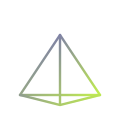
Tetrahedron as Minimum System
The tetrahedron -- four points, six edges, four triangular faces -- is the minimum structure that encloses space, the simplest possible system with an inside and an outside, and Fuller's replacement for the cube as the basic unit of volume.
Fuller's Definition
"Oneness, twoness, and threeness cannot constitute a system, as they inherently lack insideness and outsideness" (§400.05). At minimum, "it takes four triangular planes having inherent fourness of vertexes to constitute differential withinness and withoutness" (§400.05). The tetrahedron displays Euler's irreducible quantities: 4 faces, 4 vertexes, 6 edges (§400.23). Its twelve degrees of freedom -- six positive and six negative -- govern all structures, "symmetrical or asymmetrical, regular or irregular, simple or compound" (§605.01). "All structuring can be topologically identified in terms of tetrahedra" (§603.01).
The minimum single symmetrical system is the regular tetrahedron, "which contains the least volume with the most surface as compared to all other symmetrical single systems," with a volume-to-surface ratio of 1 to 1 (§400.41). Fuller assigns it the unit volume (= 1), replacing the cube, so that the octahedron has volume 4 and the vector equilibrium volume 20 -- all whole-number ratios that the cubic system cannot provide.
Significance in Synergetics
The tetrahedron is the conceptual atom of synergetics. Because it is the minimum system, every thought is at least a tetrahedron: "Thought is systemic" (§400.06), and a system requires at minimum four event foci. Fuller redefines dimensional terminology accordingly -- "squaring" becomes triangling, "cubing" becomes tetrahedroning -- since nature structures with triangles, not squares. The tetrahedron's unit-volume status makes possible Fuller's "rational, whole-number, low-integer quantation of all the important geometries of experience" (§201.03), eliminating the irrational numbers that plague cubic mensuration.
See Also
- Operational Mathematics -- the epistemology that yields the tetrahedron as minimum system
- Triangulation -- why the tetrahedron's four faces must be triangles
- 60-Degree Coordination -- the 60-degree lattice built from tetrahedra and octahedra
- Vector Equilibrium -- volume 20 in tetrahedral units
- Isotropic Vector Matrix -- the all-space array of tetrahedra and octahedra
- A and B Quanta Modules -- the asymmetric tetrahedra that fill all space
- Synergetics -- the system this concept anchors