3 Einstein
2I HAVE SPECULATED A VERY GREAT DEAL about the significance of Einstein and his epistemology. I have written and lectured about him for many years.
3 Only in the context of my direct experiences with Einstein do I have a right to talk of him. Because he told me directly that he approved of the way I analyzed his teleological processing of experience into thought and the latter into systemic formulations and formulae, I have had great confidence in continuing to do so for the past forty-eight years.
4 In cosmicrel Einstein wrote an article for the New York Times Magazine, ‘‘cosmicrel: cosmicrel ’’. In this article, Einstein wrote that Kepler, Galileo, and other scientists who had been labeled heretics and cast out by the Roman Catholic church seemed to him to be much more imbued with a faith in the exquisite intellectual orderliness and sublime integrity of Universe than were the topmost Roman Catholic clergy. Einstein said, ‘‘What faith in the orderliness of Universe must have inspired Kepler to spend all the nights of his life alone in contemplation of the stars.’’ Einstein reasoned that humans cannot undertake that kind of total isolation unless they are deeply inspired and have absolute faith in, and a clear sense of, the integrated significance of that orderliness. This integrity Einstein spoke of as God. It was a nonanthropomorphic god—not shaped like humans or any creature whatsoever. Einstein described the demonstration by humans of such faith in the orderliness of Universe as constituting the cosmic religious sense.
5 Deeply inspired by that article, I started writing my first major book in 1933. I named the book ninechains [ninechains] because I had found that a head-to-foot chain of all human beings on planet Earth would reach back and forth between the Earth and the Moon nine times. I hoped the ‘‘nine chains to the Moon’’ concept might encourage locally preoccupied humans to dare to think more globally and even more cosmically.
6 ninechains [ninechains] began with what I called a ‘‘tentative cosmic inventory’’ of the 1933 limits of what science knew—which was very, very little—about both the macro- and micro-Universe and its intermediary operational behaviors. I carefully checked far and wide with scientists regarding inclusions in the cosmic inventory. I faithfully listed everything considered important regarding all the experientially obtained information on the macrocosmic-microcosmic physical-phenomena limits thus far attained. When ninechains [ninechains] was to be reissued forty years later, I looked at that inventory again and was shocked at the paltry limits of 1933 technological attainment and the meagerness of pre-World War II scientific knowledge.
7 Einstein’s essay cosmicrel [cosmicrel] was published as Chapter 2 of my book, with the permission of its author and publisher.
8 For my third chapter, I considered how a man like Einstein, with that kind of philosophy, thinking as he did, happened to develop the concept of relativity and how he came to his many other preeminent conclusions, such as his revolutionary equation E = mc2.
9 Looking into the facts of Einstein’s everyday life, we find, for instance, that he was not only a schoolteacher but also for quite a while an examiner in the Swiss patent office.
10 Having taken out a great many patents of my own, I am aware of the process of writing a patent claim. One starts with a general review of the most advanced state of that particular invention’s art and then discloses what one has discovered as a technical means for solving a problem, which technical means has never before been conceived of, realized, or proven.
11 As a patent examiner in Switzerland, a country that had developed the world’s best timekeeping devices and led the world in the production of clocks, watches, and chronometers, Einstein must have read a vast number of patent claims on timekeeping devices. Implicit in these invention claims was the fact that nobody had ever found an absolutely accurate timekeeper. Inventors might develop improved accuracy, but none could attain perfection—which is true to this day. All this must have led Einstein to realize that Newton had to be entirely wrong in assuming a perfect uniform time to be a phenomenon instantly, simultaneously, differentiallessly operative and absolutely accurately observed throughout all the Universe. I felt sure Newton’s error in assuming a universally and simultaneously uniform time impelled Einstein to start thinking along different lines.
12 I then concluded that a man who had Einstein’s kind of philosophy and Einstein’s kind of patent-examiner-of-timekeepers experiences would naturally think a great deal about relativity of nonsimultaneously and always differently viewed time experiences.
13 Next, I posited to myself, as best I could, not knowing Einstein personally at that time, how and why he might have come to formulate his various working assumptions; I had my own intuited explanation of how he formulated his epoch-initiating concepts.
14 Chapter 4 expressed my realization that in the world of science, when somebody does make a great breakthrough, ‘‘the Academy’’ is slow in officially acknowledging that breakthrough and acquiesces only when convinced by experiential evidence. Only then does the scientist’s discovery or concept appear in school textbooks.
15 After the discovery is incorporated into textbooks, the new concept has finally arrived and enters the thinking environment of the everyday educational system. At this point, technological innovators commence thinking and speaking in terms of the new knowledge and its possible significance in solving old problems. Following the invention of an appropriate new artifact, there is a time lag before an industry adopts that invention. I call this lag the gestation rate, after its analog in biology. Only after a gestation period do the various new technological tools and goods springing from an invention change the everyday socioeconomic climate and physical environment. Eventually the altered environment induces everybody to think spontaneously like the scientist whose reasoning led to the original breakthrough.
16 My 1927 studies in techno-invention lags relative to various fields of scientific exploration and industrial endeavor showed me that it would take at least fifty years for Einstein’s thinking to become everybody’s ‘‘frame-of-thought’’ reference. My working assumption was that in time Einstein’s theory would prove experimentally to be correct. It was not until 1942 that Einstein’s principal formulation was proven to be both valid and accurate, when the Enrico Fermi pile showed that E = mc2 correctly predicted the energy to be released from a given mass.
17 I had assumed that what Einstein was thinking would in due course be proven and would begin thereafter to affect everyday life. The current concerns about nuclear warfare and disarmament and the questioning of nuclear power plant safety somewhat confirm those predictions. For everyone to think the way Einstein did, however, we must rid ourselves of the Dark Ages concepts still taught in schools. Newtonian physics must be put into historical context, rather than propounded as the final word.
18 Based on that prognosticating logic in 1934, in my manuscript for ninechains [ninechains], I tried to conceive what our planetary life would be like if society indeed began to live in ways comprehensively consistent with Einsteinian thought.
19 My publisher had agreed to publish my book only because a great, successful author had recommended it. Six months after submitting the manuscript, I received a letter from the publisher’s editor in Philadelphia that said, ‘‘You have three chapters on Einstein, and we’ve looked up the list of all the people that understand Einstein, and you’re not on it. In fact, we can’t find you on any list. As a consequence, we think we must not publish your ninechains [ninechains]. We want to avoid being a party to scientifically untenable speculation.’’
20 Dismayed, but being young and a bit fresh, I wrote back to the publisher, ‘‘Dr. Einstein has just now come from Europe to Princeton, New Jersey. Why don’t you send my typescript to him and let him be the judge?’’ I had no hope that they would do such a thing, but nine months later, my Woodmere, Long Island, home telephone rang. The call was from a Dr. Fishbein, who said, ‘‘I live in New York City. My friend, Dr. Albert Einstein, is coming in from Princeton this weekend to stay with me. He has the typescript of your book and would like to talk with you. Do you think you could come in?’’ Obviously, I accepted.
21 On Sunday evening, I entered Dr. Fishbein’s large Riverside Drive apartment. A number of Einstein’s friends were already there. They were seated around the walls of an enormous drawing room. Einstein was seated at the far end of the room. As I was presented to him, I felt mystically moved. My reverence for him was such that I seemed to sense a halo above his head. He immediately arose, excused himself, and led me to Dr. Fishbein’s study. On the desk of the study, under the lamp, I saw my typescript. We sat down on opposite sides of the desk. Einstein said he had read my typescript and found no fault. Better than that, he said that he liked the way in which I explained how he happened to come to think as he did and how he had formulated that thinking into his relativity theories and equation. Then Einstein said, ‘‘I’m advising your publisher of my approval of your explanation of my formulations.’’
22 Next he spoke to me about the fourth chapter of my book, which I called ‘‘E = mc2 = Mrs. Murphy’s Horse Power.’’ I will never forget the gentle way in which he said, ‘‘Young man, you amaze me. I cannot conceive of anything I have ever done having the slightest practical application.’’ He then went on to explain that he had made all his formulations in hope that they would be useful to cosmologists, astrophysicists, and physicists. He had no idea that any of his concepts and formulae would have any everyday practical applications whatsoever.
23 That meeting with Einstein occurred in 1935. Four years later Otto Hahn and Fritz Strassmann in Germany discovered theoretical fission. They conveyed their secret to their scientist friends in America. We all know what happened subsequently. Einstein was assumed by scientists to be the only one amongst them with sufficient credibility to convince Franklin Roosevelt that the Germans were working on the atom bomb and that the United States had better take advantage of this information and do something—fast.
24 Roosevelt responded with support and funds for the Fermi pile experiment, which proved Einstein’s equation to be correct. Fermi’s pile led to the Manhattan Project, the Alamogordo secret deployment, and the subsequent atom bombing of Hiroshima and Nagasaki. Having heard Einstein say what he did, I could imagine how he felt when he learned what the first ‘‘practical application’’ of his thinking had wrought in Japan. His intimates saw how deeply it depressed him to the end of his life.
25 I am convinced that Einstein was very importantly stimulated by the work of Albert Michelson, who was intimately involved in accurate speed-of-light measurements. Nothing could have impressed Einstein more than the fact that Michelson had accurately measured that speed in a mile-long vacuum tube—and done so for all the different types of radiation.
26 As tiny children, we assume spontaneously that our five senses are exactly time coordinated. Then comes the surprise one day when we see somebody pounding on a fence post at a distance from us, and we realize that we hear the pounding after we see it happening. We thus realize that at least two of our senses are not reporting simultaneously.
27 Isaac Newton, along with all but one of the seventeenth-, eighteenth-, and nineteenth-century scientists, assumed it to be in physical evidence that light permeated Universe instantly and that therefore time also instantly permeated Universe. To them, Universe was both instantaneous and simultaneous.
28 Olaus Roemer, royal astronomer and mathematician to the King of Denmark, took exception to this thinking. In 1675 he observed eclipses taking place on the satellites of the planet Jupiter. The displayed lags between appearances of eclipsing shadows on the satellites and on the planet itself, their respective interdistancing and revolution rates, and their respective orbitings, convinced Roemer that light, like sound, has a unique speed and is not a ‘‘no-time-at-all,’’ instantly everywhere phenomenon.
29 Not until the speed of light was scientifically measured on board our planet Earth 230 years later did other scientists pay serious attention to the phenomenon—but not to Roemer.
30 Roemer had excellent astronomical data about the distances intervening at any given time between the Earth, the Sun, and Jupiter, and between Jupiter and its satellites, as we have already noted, making it possible for him to calculate the speed of light, which he proceeded to do. His results closely approximated the measurements achieved by Dr. Michelson and his associates during a series of tests conducted throughout the first third of the twentieth century. Furthermore, Michelson’s measurements and remeasurements with increasing exactitude were applied to the entire visible light spectrum and the invisible electromagnetic wave ranges, showing that all radiation, visible or invisible, has the same speed when unfettered in a vacuum.
31 Einstein could not have been more intuitively excited by this measuring. A number of other scientifically proven phenomena also stimulated Einstein’s synergetic consideration: the Brownian movement is one; blackbody radiation and the discovery of finite photons of light are others. Since all radiation as energy unfettered in vacuo has the same speed, Einstein hypothesized that all slower-speed phenomena must be the result of the 186,000-mile-per-second radiations given off by the myriads of radiant-energy concentrations interfering with one another and tying themselves into knots to produce microcosmic inter-event-pattern systems that we humans identify superficially as matter. Einstein related everything to the speed of radiation, giving rise to his basic assumption that this speed is the norm of cosmic energy unfettered in vacuo. Einstein’s norm will eventually replace Newton’s norm of inertia, which he states in his first law of motion to the effect that ‘‘a body persists in a state of rest or in a line of motion except as affected by other bodies.’’ Newton’s norm of ‘‘at rest’’ is the accepted baseline norm of all twentieth-century economic and technological performance charts. The baseline’s ‘‘at rest’’ means ‘‘no change.’’ All our present technoeconomic charts register changes occurring in time and at rates of change in respect to Newton’s baseline of no change at all.
32 Einstein’s norm of 186,000 miles per second assumed that when any less-than-norm speeds are manifest, energy is interfering with itself locally to tie itself into ‘‘knots’’, which are local holding patterns that humans speak of as matter. Einstein portrayed energy as existing in these two states: a slow phase of local self-interfering patterns, called matter; and a normal phase, as a spherical wave front traveling at the speed of light. This became the epistemological basis for Einstein’s E = mc2 , where c2 is the speed of light to the second power—which is mathematically derived from the fact that the area of the omnioutward, spherical surface wave growth of all radiation must be the second power of its outward linear-radius velocity.
33 To Newton, the norm of life and of the physical Universe in general was rest. To him, it seemed abnormal to have anything in motion; thus, death was the normal state. Newton reasoned that it took energy to put something in motion, as with a human muscle rolling a stone, and that the energy quickly became dissipated by friction, returning the stone to its norm of rest. Like all the classical scientists of his time, Newton subscribed to the concept that all energetic systems continually dissipate their energy, disposing of it in ever more disorderly ways. In later years this concept became known as the second law of thermodynamics and was given the name entropy.
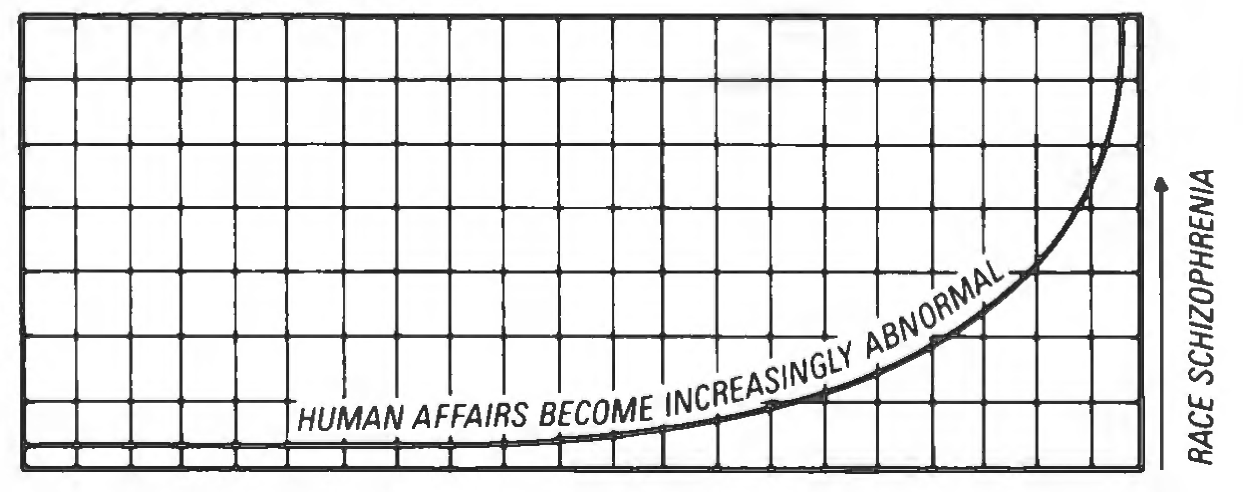
34 Newton’s norm of at rest, or no change, still governs the art of all graphic charting of evolutionary events—technical, economic, or social—when plotted against calendar or clock time. Newton’s no-change norm forms the baseline of all such charts. The progressive magnitudes of change in evolution or development are posted vertically above the Newtonian baseline for the successive rightward calendar- or clock-time measurement.
35 Since the magnitudes of most historic, technologic, economic, or social performances are progressively increasing, our charts of development show an ever more abnormal trending of human affairs, suggesting an acceleration into verticality—which is utter abnormality—or ‘‘race schizophrenia.’’
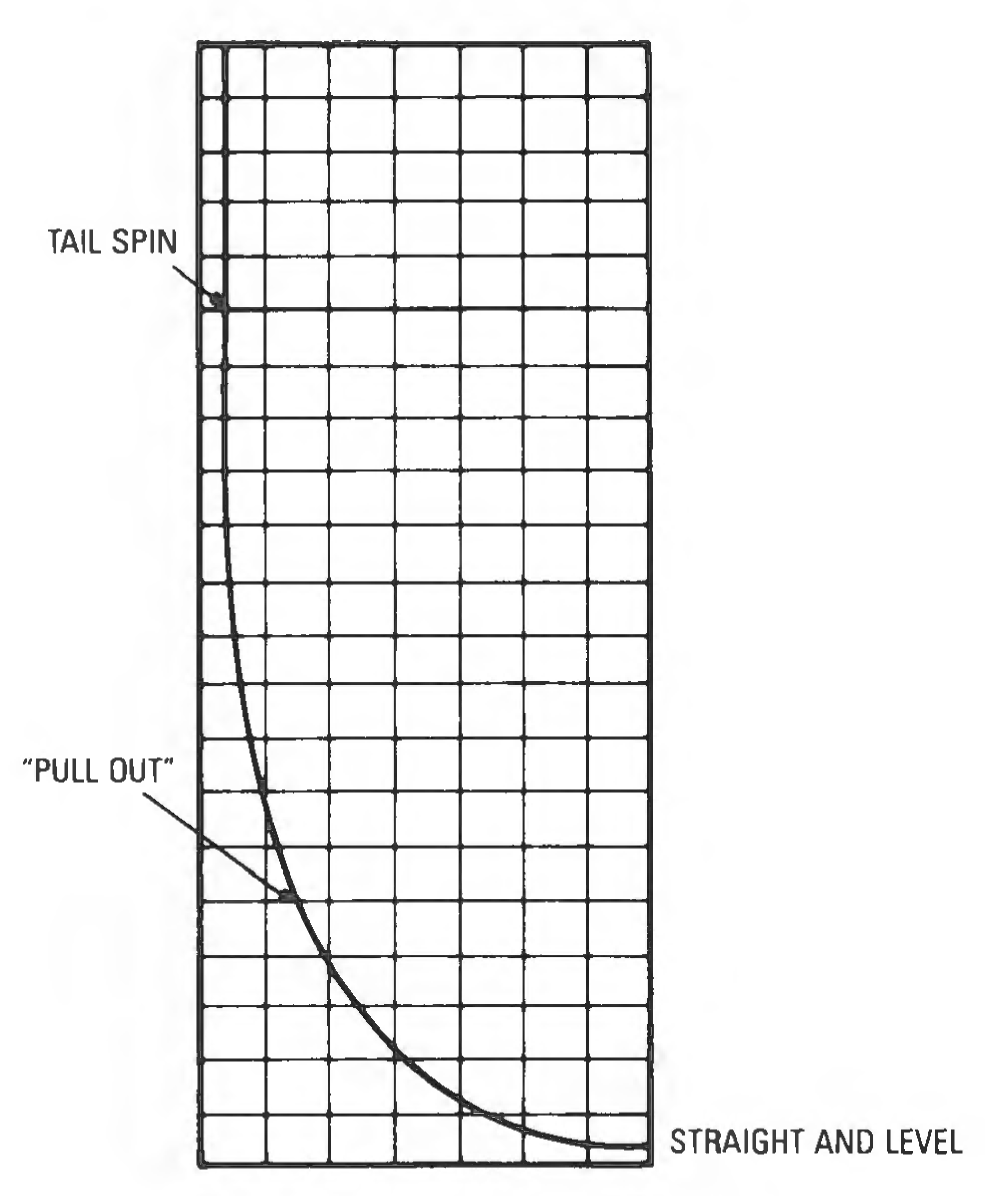
36 If, however, Einstein’s norm of 186,000 miles per second is substituted for the ‘‘motionless’’ norm of Newton’s baseline, we have only to revolve 90∘ clockwise the charts plotted on the Newtonian norm. We will see then that humanity in its earliest and greatest ignorance was tailspinning into extinction, but, in the aviator’s terms, is now progressively ‘‘pulling out into straight-and-level flight’’ (see Figs. 3.1 and 3.2) at the newly realized-to-be-normal speed of electromagnetic radiation’s information transmission—i.e., 186,000 mps.
37 Newtonian reality was locked into the pre-Kepler, pre-Galilean Dark Ages. As already noted, Newton’s gravitational conceptioning showed that the interattractiveness of any two given celestial bodies, as compared to any other pair of bodies a given equal distance apart, is proportional to the product of the respective pairs’ masses and that the magnitude of their interattractiveness varies inversely as the second power of the arithmetical distances intervening. This conception of Newton’s was developed (1) from Kepler’s extraordinary realization and proof of a zero-diameter tensional restraint (line of force) operating between celestial bodies of unlimited magnitude and at apparently unlimited distances apart (for instance, the planet Pluto, a solar-captured comet-planet that orbits the Sun once every 247 years, is over four billion miles from the Sun), and (2) from Galileo’s measurement of the rate of acceleration of free-falling bodies toward Earth, which was the second power of the arithmetical distance traveled. We must correct our cosmic-phenomena comprehension to accommodate the realization that since there is no up or down in Universe, there are no falling bodies. Instead, there are only nontouching, individual celestial bodies, large and small, whose normal motions of continual interpositioning are manifesting the Newtonian law.
38 It is important here to realize that both Kepler and Galileo started their reasoning with the observed fact that the Universe is always and everywhere transforming; these motionful transformings, as with all generalized scientific principles, are inherent in eternally regenerative Universe. It was observing Brownian movement on the microcosmic level that triggered Einstein’s working assumption that constant motion was the norm for physical Universe.
41 When the interference pattern of two or more motion events occurs, it does not mean that either or both events come to rest—i.e., that motion ceases. A chip may fall on somebody’s shoulder, but this does not mean that the individual on whose shoulder the chip landed is motionlessly at rest or that the planet on which the individual on whose shoulder the chip landed is motionlessly at rest or that the planet on which the individual dwells is at rest or that the electrons of which all matter is comprised stop orbiting around their far-within, atomic, nuclear-event complexes.
42 Though unaware of atomic nuclei, Galileo and Kepler apprehended motion as an eternally operative principle, not as something that has to be initiated by something else. Universe is a nonsimultaneously differentiating complex of interference-occasioned relative rates of energy events, reflections, refractions, fractionations, formations, deformations, transformations,intertransformations, interaccelerations, interdecelerations, expansions and contractions, associatings and disassociatings, cotravelings and diametric separatings (radiation).
43 Newton used only his brain, which deals in special-case, time-dimensioned phenomena that ask for beginnings and endings for everything, including Universe. Kepler and Galileo used their minds and found relationships existing eternally between cosmic phenomena. What Galileo discovered was the rate of local interaccelerating of the eternally inherent cosmic acceleration. Multiplying a number by itself is second-powering. Galileo identified this second-powering as accelerating acceleration.
44 Galileo’s falling body was in effect a very small celestial body being interattractively accelerated by a relatively enormous celestial body, the planet Earth. Newton’s statement of his first law of motion (‘‘a body remains in a state of rest or in a line of motion except as affected by other bodies’’) makes it clear that he had not escaped from the nonenergetic, conceptual paralysis of plane and solid geometries, the pseudoscientific conceptual geometry tools of the Dark Ages. The laws of motion of Kepler and Galileo, however, were based on experientially proven measurements of cosmic behaviors, demonstrated a half century before Newton’s hypothetical formalization and publication of their results.
45 Much of Newton’s work must be considered political tour de force—British ‘‘science’’ in support of Great Britain’s claim to the leadership of world science as backed by the world’s supreme power structure. The fact that Newton’s principia [principia] develops all the geometry of his celestial mechanics by trigonometry, and not by calculus, casts a shadow of doubt upon his claim that he developed the calculus before Gottfried Leibniz as an invention of necessity to make possible his scientific discoveries.
46 Newton’s failure to recognize and acknowledge Roemer’s speed-of-light discovery postponed world science’s academic thinking being advantaged by that knowledge. (It was knowledge of light and its speed that surely catalyzed Einstein’s epochal thinking over two hundred years later.) Although Roemer had superbly, scientifically discovered that light has a speed, Newton ignored completely this finding when he published his optics [optics], thereby lessening the historic significance of that work. Newton seems deliberately or perhaps subconsciously to have sought to disregard Galileo’s discovery of the second-power rate of variance of the celestial bodies’ mutual interattraction in respect to the intervening arithmetical distances, rationalizing to himself that Galileo was dealing only with locally falling bodies and not with generalized interrelationships among celestial bodies. By limiting the Galileo discovery to a very-special-case local phenomenon of falling, which could only occur within the imaginary conditions of a static, infinitely extended lateral-plane, center-of-Universe, up-and-down, heaven-and-hell world, it was seemingly left to Newton to make the big scientific generalization.
47 We note in examining documents of the period that before Newton, Galileo had identified, numbered, and named his own laws of motion. Newton cast these aside as he nominated his first, second, and third laws of motion.
48 Newton’s being knighted for his work in the management of the British mint suggests that his scientific work and the great reputation it brought him may have been affected by the interests of the behind-the-scenes power structure at that time promoting a full sovereign-scale British world empire, to be realized a century later with the Battle of Trafalgar.
49 I am dwelling on this Newtonian epistemology in order to emphasize the fact that Newton’s norm of at rest left it to Einstein finally to emancipate the scholarly world—and thereby, in due course, world society in general—from its overwhelmment by the ignorant impotence of the Dark Ages, which had been established and maintained for seventeen hundred years by the might, cunning, and ruthless treachery of an absolutely selfish, deliberately self-misinformed world power structure in the form of the imperialism of the Roman emperor-popes.
50 My thinking has been inspired and accelerated by Einstein’s insights. His written work has refined my speculative epistemology. This occurs to such an extent that I often find myself explaining Einstein beyond any record of his thoughts concerning the matters discussed, yet feeling spontaneously confident that the way I am conceiving on his behalf is so in accord with what I have learned of his way of thinking as to justify my extrapolations of his thought. In such a way do I also often unconsciously give Einstein complete credit for my own direct, experientially exciting epistemological excursions—using what I am confident were the thought exercises he used.
51 From time to time my ‘‘thinking out loud’’ in public addresses absent of prepared notes or outline becomes in fact real-time thought exercises integrated with experientially informed conceptioning.
52 Within Einstein’s sphere of thought, I am most anxious to identify his assumption of a 186,000-mile-per-second inherent cosmic velocity norm with his concept of a nonsimultaneous and only partially overlappingly episodic scenario Universe. Such a finding would verify, support, and clarify Kepler’s and Galileo’s omniinteraccelerating, inherently and eternally intertransforming nowhere-and-nowhen-ever-intertouching, exclusively intertensioned Universe.
53 To better understand this omniinteraccelerating cosmic concept, we must recall the following:
- A.
- Universe is inherently resonant. Resonance is a complex of intertransformative frequencies of miniintertensioned systems.
- B.
- The inherent resonance of Universe is caused by nature’s never pausing at, and only forever transiting, exact equilibrium.
- C.
- The union of Universe is a differentially complementary regenerative-production wedding of inherently, uniquely prime numbers 1, 2, 3, 5, 7, 11 , 13, and all their successive primes. The prime numbers are numbers divisible only by themselves and by 1, representing in synergetics unique system behaviors.
- D.
- The prime numbers impose an eternal disquietude—transfonnative adjustings and omniintertensioned resonances eternally interaccelerating.
54 Professor Robert Goddard, of twentieth-century rocketry fame, realized that Newton’s gravitational interattractiveness variance law explained how a bicycle lying on the surface of the Earth is speeding around the Sun in tandem with the Earth at 60,000 mph, wherefore the bicycle’s additional acceleration by a pedaling rider makes it accelerate faster than the Earth and, together with the mass of its pedaling rider, causes it to start to leave the Earth (as is demonstrated by chasmjumping motorcyclists) and ergo to become dynamically stabilized, with the bicycle and its rider’s integrative center of mass cotraveling just outward from, and a little bit faster than, the Earth’s surface.
55 Goddard saw that with sufficient additional acceleration an Earth-cotraveling object would part company with the Earth and, if sufficiently accelerated, could reach its own orbiting distance outwardly from the Earth, at which distance and speed the attractiveness of other celestially accelerating bodies such as the Moon, planets of the solar system, and the Sun itself are synergetically balanced interattractively upon the Goddard-considered object, whereat the from-Earth-progressively-accelerated object would maintain its own cosmic orbit, though if decelerated sufficiently, it would yield to the Earth’s ever more interattractive pull and thus return to the Earth’s surface. The terms for this limit condition in distance and in speed are critical proximity and critical speed, respectively.
56 Critical speed and critical proximity constitute the independent-system-terminating acceleration that altogether demonstrates whether a celestial object is an independent system in Universe, or an integral part of a larger system of energy interpatternings interknotted as matter.
57 I OFTEN SAW EINSTEIN ON THE STREETS of Princeton from 1951 through 1954. I and other Princeton people respected him so much that none of us ever approached him in the street. I did, however, have a fascinating indirect encounter in 1953.
58 Princeton’s architectural department had an experimental station near the university stadium. In the years before World War I, the building had been used as the polo team’s stables and dressing rooms. It was here that my students and I erected a 50-foot-diameter model of my geodesic tensegrity sphere, which I had invented several years before. It was made of ninety aluminum tubes and flexible stainless-steel cables. One day, Einstein walked over to study it. I was not there at the time, but was told by the architectural students and faculty who were there that he was extraordinarily moved by it.
59 The members of the Princeton community who observed Einstein’s intuitive interest were so excited that they used a photograph of the tensegrity sphere on the cover of the next issue of their graduate magazine, The Princetonian.
60 None of the ninety compression struts touch one another. These nonintertouching tubular aluminum struts are held together by one comprehensive, ninety-intervaled, omniclosed-back-on-itself, spherical network of equitensed Dacron thread. If any part of this system were redundant, one of the whole-system’s tension lines would not be taut. They all twang at the same pitch. If we tighten only one of the ninety intervals in the tension network, the whole system becomes equally tensed and twangs everywhere at a slightly higher pitch, indicating uniform distribution of the stressing throughout the system assembly. If we cut loose any part of the network’s tension system or if we break one of the compression struts, the system does not collapse but slackens mildly, softening like a progressively deflated basketball.
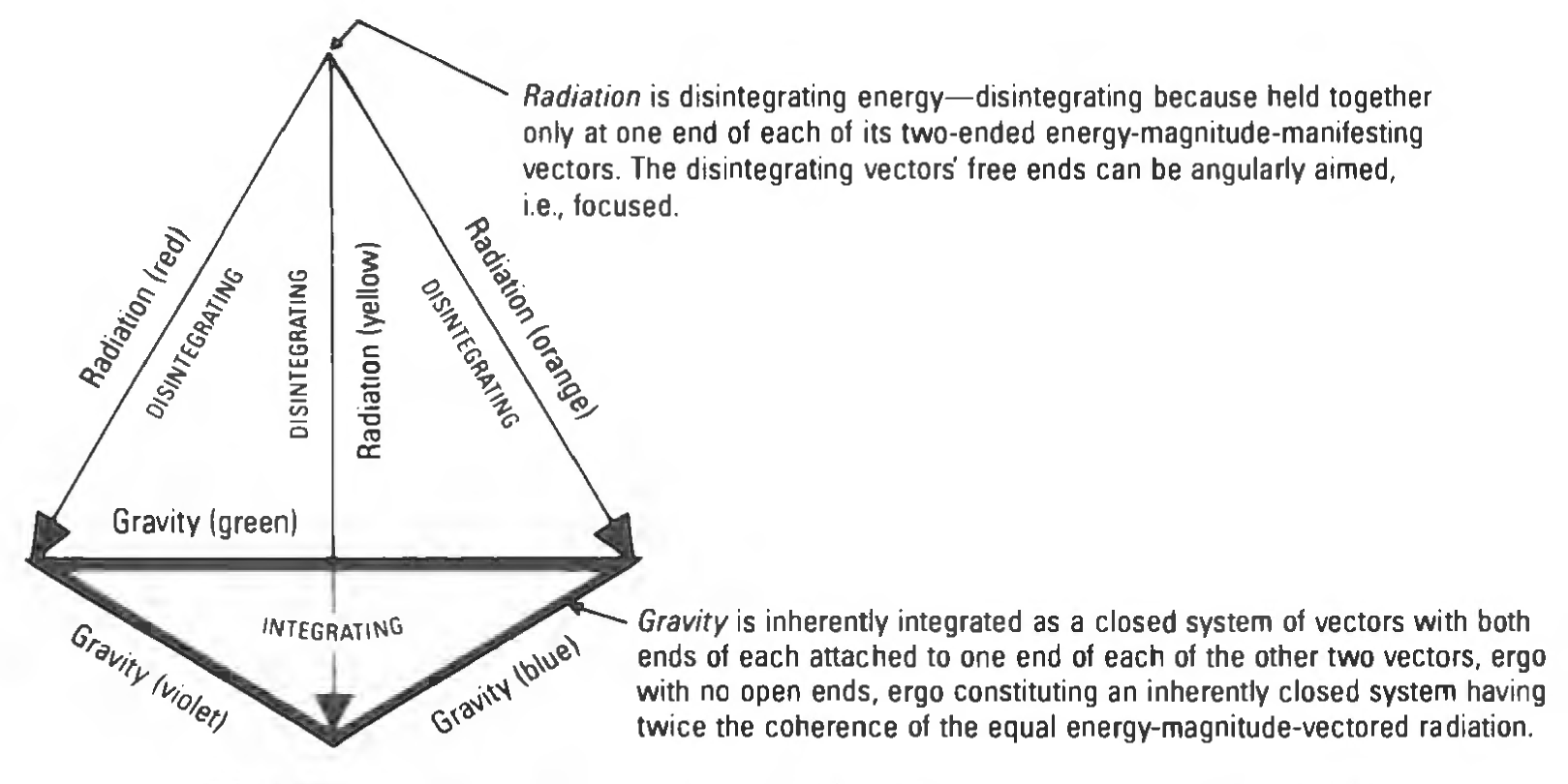
61 Here we have a very extraordinary structure. All structural engineering today is predicated upon our Stone Age experience, in which gravity held a seemingly solid stone on top of, but not on the side of, another stone. All structuring in Universe consists of two primary forces—tension and compression. Stone masonry has high compression-resisting capability—approximately 50,000 pounds per square inch ultimate—but only 50 pounds per square inch tensile strength. Strong wood beams have an average tensile strength of 10,000 pounds per square inch, but wood fibers burn out or in time rot, not having the durability of stone. All structural engineering analysis of buildings today is predicated on what is called ‘‘compressional continuity’’ with only locally occurring tensional augmentation. Building construction using steel-frame and concrete reinforced with steel tension rods was not seen on our planet to any important degree until after World War I.
62 Compression tends to bow-bend compressional column members. Tension tends to stretch its structural members straight. Bending and buckling tends ultimately to break compression members. Straightening out tends to increase strength. Compression columns have slenderness ratios. Greek columns of stone could rise only eighteen column diameters before tending to topple over. Present-day steel columns can extend safely to only forty diameters high before tending, when loaded, to bend, buckle, and fail. Tension elements, however, have no limit ratio of diameter to length. Their invisible atom-constituted alloyed parts do not even touch one another, being held together only by virtue of the Kepler-Galileo-Newton phenomena of relative interproximity and interattractiveness for given masses of gravity and electromagnetism.
63 In 1927 I saw that the interstructuring system of Universe itself is completely different from, and magnificently superior to, structuring as thus far comprehended and employed in history by humans aboard planet Earth. Nature employs only what I call ‘‘spherical islands’’ of discontinuous compression and continuous tension. It is this cosmic complementation that constantly and dynamically interpositions the Earth, the Sun, and the Moon, all the stellar planetary systems, all the galaxies, and the macro and micro aspects of Universe.
64 Wondering whether humans are inherently barred from that level of structural design science, I note that humans did indeed invent the wire bicycle wheel. The wire wheel has a compressional atoll-rim with a hub acting as a central island of compression. The whole wire-wheel assembly takes and holds its shape only by virtue of its twelve spokes—six positively and six negatively intertensioned—and rim.
65 With the wire wheel humans made the historic breakthrough to discontinuous-compression, continuous-tension structures. Next, wondering whether it would be possible to produce such tensional-integrity (‘‘tensegrity’’) structures in a spherically symmetrical array, I invented such a structure at Black Mountain College in 1948. Two years later, I made 3-foot, 6-foot, and 12-foot (in diameter) tensegrity spheres. Then, in 1953, I built the 50-foot-diameter tensegrity sphere that caught Einstein’s attention when it was constructed at Princeton .
66 Universe has its radially explosive, compressional, outwardly pushing radiation and omniembracing, intertensing gravity. The total of cosmic radiation (compression) and the total of cosmic gravity (tension) comprise equal amounts of energy. Gravitation and radiation, however, operate differently. Their respective interpatternings differ. Radiation is beamable (i.e., focusable). Radiation has shadows, whereas gravity has none. Unfocusable gravity is always comprehensive; tension is always embracingly comprehensive of compression. Compression and radiation are always open-ended systems. Tension and gravity are always closed systems.
67 Here is a simple way of thinking about the difference between the compression-patterning and the tension-patterning of Universe. Think of a camera tripod’s three legs. Since the feet of its legs are usually slippery, think of them as tending to slide apart. This happens because the three legs are fastened together only at the hinge-interlinked top end.
68 A force-vector is a line whose length is the product of a given system’s mass and its velocity as it operates in a given known direction in respect to a known axis of angular reference. We will now assume those three sliding-apart tripod legs to be vectors of a given magnitude--that is, of equal length—joined to one another only at the top end. We then take three more tubes of the same metal and dimensions as the three camera tripod legs and fasten them together at both ends to form a closed system triangle. This base triangle tensionally (integratingly) prevents the three compressionally disintegrating legs from sliding further apart. This demonstrates that the three gravity vectors are integrated as a closed-system triangle, with both ends of each tensed vector interfastened with its two adjacent vectors. This closed system is in contrast to the compressional tripod vectors, which constitute an open-ended, disintegrating radiation system, being fastened together only at one end. The amount of energy of Universe operating as gravity is exactly equal to the amount of energy in Universe operating as radiation. However, the gravitational operating pattern of integration (tension) is always twice as effective as the disintegrative, single-ended interpatterning of the energy operating as radiation (compression) (see Fig. 3.3).
70 Disintegrating arrangements of radiation behaviors in Universe are always such that interpatterned gravity operates twice as effectively, which explains the integrity of eternally regenerative Universe.
71 Tensegrity spheres such as the Princeton 50-footer constitute a realized model of the principles governing the structural integrity of the generalized radiation and gravity field, the unified field equation which Einstein sought to express mathematically.
72 In a tensegrity structure, radiation/matter is modeled by the discontinuous struts, and gravitation is modeled by the continuous network of wires unifying the structure. This model reconciles these two disparate elements into a single unified field. No other known model does so.