Chapter 4
Self-Disciplines of Buckminster Fuller
- 1.
- MY FATHER DIED when I was fifteen. ‘‘Darling, never mind what you think.
Listen. We are trying to teach you!’’
2My mother said it. My schoolteachers said it. All grown-up authorities of any kind—the policeman, the druggist said it. ‘‘Thinking’’ was considered to be a process that is only teachable by the elders of the system. ‘‘That is why we have schools, dear.’’ ‘‘Thinking’’ was considered to be an utterly unreliable process when spontaneously attempted by youth.
- 2.
- Grandmother taught us the Golden Rule: ‘‘Love thy neighbor as thy self—do unto others as you would they should do unto you.’’
- 3.
- As we became older and more experienced, our uncles began to caution us to get over our sensitivity. ‘‘Life is hard’’ they explained. ‘‘There is nowhere nearly enough life support for everybody on our planet, let alone enough for a comfortable life support. If you want to raise a family and have a comfortable life for them, you are going to have to deprive many others of the opportunity to survive and the sooner, the better. Your grandmother’s Golden Rule is beautiful, but it doesn’t work.’’
- 4.
- Knowing that my mother and relatives loved me, I did my best not to pay any attention to my own thinking and trained myself to learn what seemed to me ‘‘the game of life’’ as you would train yourself to play football. The rules are all written by others.
- 5.
- Along came World War I. I did well in the Navy. I didn’t have to ‘‘make money’’ with my ships. But when I entered the business world and had to make money over and above producing a good product, or when it had to be myself or somebody else who was to survive in the system, I was a spontaneous failure. I was always sure that I could cope with hardship better than the other guy, so I would yield.
- 6.
- In 1907, at the age of twelve, challenged by Robert Burns’s ‘‘Oh wad some power the giftie gie us to see oursels as others see us,’’ I sought to ‘‘see’’ myself as others might and to integrate that other self with my self-seen self and thereafter to deal as objectively as possible with the comprehensively integrated self. One of the techniques I adopted for doing this was to keep a come-as-it-may chronological-rather than an alphabetical or a categorical-record of my activities. In 1917, at age twenty-two, as commissioned line officer in the U.S. Navy, I named the record the ‘‘Chronofile.’’
- 7.
- It consisted, and as yet consists, of all my ‘‘to and from’’ letters, programs,
sketches, memoranda, doodles, etc., plus a few typical bills.
3In 1917 Anne Hewlett and I were married. In 1918 our daughter Alexandra was born; she contracted infantile paralysis and spinal meningitis and died on her fourth birth-day in 1922. Between 1922 and 1927 I developed a manufacturing and building business, designed and equipped four small factories for manufacturing new building components, and therewith successfully erected 240 residential buildings, but I failed to do so profitably and lost my friends’ investments and became discredited and penniless. Coincidentally with my failure in business in 1927, our second daughter, Allegra, was born in pristine health.
- 8.
- In 1927, at age thirty-two, finding myself a ‘‘throw-away’’ in the business world, I sought to use myself as my scientific ‘‘guinea pig’’ (my most objectively considered research ‘‘subject’’) in a lifelong experiment designed to dis-cover what-if anything-a healthy young male human of average size, experience, and capability with an economically dependent wife and newborn child, starting without capital or any kind of wealth, cash savings, account monies, credit, or university degree, could effectively do that could not be done by great nations or great private enter-prise to lastingly improve the physical protection and support of all human lives, at the same time removing undesirable restraints and improving individual initiatives of any and all humans aboard our planet Earth.
- 9.
- In 1927 I also committed all my productivity potentials toward dealing only
with our whole planet Earth and all its resources and cumulative know-how,
while under-taking to comprehensively protect, support, and advantage all
humanity instead of committing my efforts to the exclusive advantages of my
dependents, myself, my country, my team.
4This decision was not taken on a recklessly altruistic do-gooder basis, but in response to the fact that my Chronofile clearly demonstrated that in my first thirty-two years of life I had been positively effective in producing life advantage wealth—which realistically protected, nurtured, and accommodated X numbers of human lives for Y numbers of forward days—only when I was doing so entirely for others and not for myself.
5Further Chronofile observation showed that the larger the number for whom I worked, the more positively effective I became. Thus it became obvious that if I worked always and only for all humanity, I would be optimally effective.
- 10.
- I sought to do my own thinking, confining it to only experientially gained information, and with the products of my own thinking and intuition to articulate my own innate motivational integrity instead of trying to accommodate everyone else’s opinions, credos, educational theories, romances, and mores, as I had in my earlier life.
- 11.
- I sought to accomplish whatever was to be accomplished for anyone in such a manner that the advantage attained for anyone would never be secured at the cost of another or others.
- 12.
- I sought to cope with all humanly unfavorable conditions, customs, and
afflictions by searching for the family of relevant physical principles involved,
and therewith through invention and technological development to solve all
problems by physical data and devices that were so much more effective as
to be spontaneously adopted by humans and thereby to result in producing
more desirable lifestyles and thus emancipate humans from the previously
unfavorable circumstances.
6I must always ‘‘reduce’’ my inventions to physically working models and must never talk about the inventions until physically proven—or disproven.
7The new favorable-to-humans environment constituted by the technological inventions and information must demonstrate that new inanimate technology could now accomplish what heretofore could not be accomplished by social reforms. I sought to reform the environment, not the humans. I determined never to try to persuade humanity to alter its customs and viewpoints.
- 13.
- I sought never to ‘‘promote’’ or ‘‘sell’’ either my ideas or artifacts or to pay others to do so. I must never hire any agents to produce publicity for me, nor engage any lecture, literary, or ‘‘idea-selling’’ agents, nor hire personnel who would solicit support of any kind on my behalf. All support must be spontaneously engendered by evolution’s integrating of my inventions with the total evolution of human affairs.
- 14.
- I assumed that nature had its own unique gestation rates, not only for the birth of each new biological component of ecological intersupport, but also for each inanimate technological artifact invention of human interadvantaging.
- 15.
- I sought to develop my artifacts with ample anticipatory time margins so that they would be ready for use by society when society discovered through evolutionary emergencies that they needed just what I had developed. I realized that if the new tools I had developed could provide valid human-advantage increases, then they would inevitably be adopted by society during the successive inexorable emergencies that occur in society, which evolution of emergence only through emergencies would dic-tate the proper rate of regenerative gestation of spontaneously adopted social advances.
- 16.
- I sought to learn the most from my mistakes.
- 17.
- I sought to decrease time wasted in worried procrastination and to increase time invested in discovery of technological effectiveness.
- 18.
- I sought to document my development in the official records of humanity by applying for and being granted government patents.
- 19.
- Above all I sought to comprehend the principles of eternally regenerative Universe and to discover human functioning therein, thereby to discover nature’s governing complexes of generalized principles and to employ these principles in the development of the specific artifacts that would benefit humanity’s fulfillment of its essential functioning in the cosmic scheme.
- 20.
- I sought to educate myself comprehensively regarding nature’s inventory
of chemical elements, their weights, performance characteristics, relative
abundances, geographical whereabouts, metallurgical interalloyabilities,
chemical associabilities and disassociabilities.
8I sought to comprehend the full gamut of production tool capabilities, energy resources, and all relevant geological, meteorological, demographic, and economic data, as well as to comprehend the logistics and vital statistics thus far methodically amassed by humanity as derived from its all-history experiences.
- 21.
- I sought to operate only on a do-it-yourself basis and only on the basis of intuition.
- 22.
- I oriented what I called my ‘‘comprehensive, anticipatory design science strategies’’ toward primarily advantaging the new life to be born within the environment-controlling devices I was designing and developing, because the new lives would be unencumbered by conditioned reflexes that might otherwise blind them to the potential advantages newly existent within the new environment-control system in which they found themselves beginning life.
9As already mentioned, our second child, Allegra, was born in 1927. Five years earlier her sister, Alexandra, had died on the eve of her birthday, having gone through four years of spinal meningitis and infantile paralysis.
10 Allegra’s birth was a mysterious, awesome, and beautiful event, for my wife Anne and I realized that not only were we being again entrusted with a new life, but this time with that of a beautifully healthy life. At that moment I was penniless and, to the relatively few who knew me, discredited. I had proved myself to be a failure in a business that had been financially backed by many of my friends. I had only a rich inventory of experience. That experience made clear to me that there were critical problems to be solved regarding total humanity aboard planet Earth—problems that would take at least a half-century to cope with successfully; problems as yet unattended to by anyone; problems that, if successfully solved, would bring lasting advantage to all humanity; problems that, if left unsolved, would find all humanity at ever-increasing disadvantage.
11 It was not that the problems could not be seen by others, but society was preoccupied with individual, national, state, and local business-survival problems, which forced its leaders into short-term, limited-scope considerations—with no time for total world problems. The presidents of great corporations had to make good profits within a very few years or lose their jobs. The politicians, too, were preoccupied with short-range national, state, or municipal survival matters.
12 It seemed also clear to me that there had opened up a new avenue of approach to humanity’s survival problems, an avenue that could be traversed only by an individual operating entirely on the individual’s own economic and philosophic initiative.
13 All the world was preoccupied with inter-competitive survival, being spontaneously motivated by the working assumption of the existence of a fundamental inadequacy of life support on our planet. The leading ideologies said, ‘‘You may not like our system, but we are convinced that we are coping most wisely, justly, and practically with fundamental inadequacy of life support. We are the fittest to survive.’’
14 What my experience taught me was that if the physical laws thus far found by science to be governing Universe were intelligently and fearlessly employed in the production of ever higher performances per each pound of material, erg of energy, and second of time invested, it would be feasible to take care of all humanity at higher standards of living than had ever been known by any humans—and to do so sustainingly. Evolution seemed to be operating in such a manner as to drive humans to inadvertent accomplishment of their own success.
15 Despite the fearful ‘‘you-or-me’’ survival preoccupations, it seemed clear to me that if an individual who had practical experience in engineering, marketing, aeronautics, vessels on the sea, building on the land, mass manufacturing arts, and naval ballistics, who also could discern the evolutionary potentials emerging in scientific discoveries and see what the priority of tasks might be in bringing about general economic success for all humanity, then if that individual were to address those problems, completely committing the balance of his life to the realization of such technical advantaging of humanity, then, if that individual was doing what nature was trying to do, he might find self—and those dependent on self—surviving and gaining in knowledge, capability, and experience relevant to the tasks to be accomplished.
16 Effective exploration requires effective record-keeping. I am confident of the accuracy of the record presented herewith. I am also confident that my personal record is pretty much the same as the record that would have been manifest by any healthy, well-informed individual who undertook the course I chose to steer upon the birth of Allegra in 1927. The fact that the individual who did pursue this course as a deliberate experiment (myself) found that it proved to be an economically tenable way of life and a technically effective way of approaching world problems may encourage others to address problems in the same manner.
19 As already related, in 1907 I started a chronological record of my life and in 1917 named it the ‘‘Chronofile.’’ In 1917, at the age of twenty-two—fortified with the already-thick Chronofile—I determined to make myself ‘‘the special case guinea pig study’’ in a lifelong research project—i.e., documenting the life of an individual born in the ‘‘Gay Nineties’’—1895, the year automobiles were introduced, the wireless telegraph and the automatic screw machine were invented, and X rays were discovered—having his boyhood around the turn of the century, and maturing during humanity’s epochal graduation from the nineteenth century, which closed Sir Isaac Newton’s ‘‘normally at rest and myriadly isolated hybrid world cultures to which change was anathema, into the twentieth century and Einstein’s normally dynamic,’’ omni-integrating world culture to which change has come to seem both essential and popularly acceptable.
20 Though I lived within seven miles of Boston’s center, so new and rare an object was the automobile that I was seven years old when I first saw one. I first drove one when I was twelve. Operators’ licenses and owners’ registration certificates did not come into official use in any states until a decade later.
21 When I was nine years old, the airplane was invented, but I did not see one flying until I was fourteen, and I did not fly one until I was twenty-two, within which same year (1917) I heard the historically first human-voice conversation over the radio. Earlier in that extraordinary year the U.S.A. had entered World War I; I had entered the U.S. Navy; and Anne Hewlett had entered into marriage with me.
22 The cumulative effect of this swift succession of epochally surprising ‘‘first-ever’’ (for me) human and personal experiences precipitated my previously mentioned inauguration of the history of the evolution of ‘‘Guinea Pig B’’ (‘‘B’’ for Bucky)—the Chronofile.
23 Along with millions of other pre-Kitty Hawk juveniles I, too, had tried to invent the airplane, first with paper dart models and then with box-kite-like multiplaned gliders. Despite our elders’ doubts and engineering’s down-to-earth negatives, immanent invention of the ‘‘airplane’’ was everywhere present in the thought world of my pre-Wright Brothers, knee-breeches years. It is interesting that our latest supersonic and 2000-mile-per-hour planes are beginning to take on the overall shape perfection of those early paper darts. Children’s intuitions are keen.
24 My extraordinary experiences with the U.S. Navy’s World War I galaxy of new tools—oil-burning turboelectric ships, aircraft,diesel-engined submarines, radios, automatic range-keepers, etc.—convinced me that the experience pattern of my generation was not to be just one more duplicate generation in a succession of millions of generations of humanity, with an approximately imperceptible degree of environmental change, as compared to the immediately previous generation. I was convinced that, unannounced by any authority, a much greater environmental and ecological change was just beginning to take place in my generation’s unfolding experience than had occurred cumulatively between my father’s, grandfather’s, great-, and great-great-grandfather’s four previous generations. I had read their diaries, expense accounts, or letters containing descriptions of their lives in their successive undergraduate days in the Harvard classes of 1883, 1843, 1801, and 1760, respectively. They all told of days-long walking or driving trips between Cambridge and Boston. I realized intuitively that the subway, which opened in my 1913 freshman year to connect Harvard Square in Cambridge to Tremont and Park streets in Boston in seven minutes, was a harbinger of an entirely new space-time relationship of the individual and the environment.
25 It was clearly the environment and not the humans that was changing, and though the environmental changes might not alter human genes, changes in their external conditions might permit humans to realize many more of their innate capabilities than heretofore.
26 Humans are tool complexes—hands for certain tasks, feet, ears, teeth, etc., for others. Using their human tool complexes, human minds, comprehending variable interrelationship principles, invent detached-from-self tools—the bucket can lift out more water from the well than can a pair of cupped human hands—that are more special-case-effective but not used as frequently as their organically integral tools. Humans invent craft tools and industrial tools. The latter are all the tools that cannot be invented or operated by one human. The first industrial tool was the spoken word. With words humans compounded their experience-won knowledge. (Most industrial tools are driven by inanimate energy rather than by human muscle.)
27 Dwellings are environment-controlling machines. So are automobiles. Automobiles are little part-time dwellings on wheels. Both autos and dwellings are complex tools. Both autos and dwellings are component tools within the far vaster tool complex of world-embracing industrialization. I use the word industrialization to include all intercoordinate humanity, all its artifacts, its evolving omni-interfunctioning and omni-integrating, omni-life-support-producing capability.
28 I do not demean the phenomenon of industrialization by identifying it as being the money-making business that exploits productivity for unilateral profit. I do not identify the biological complexity ‘‘cow’’ and its ecological support system as being a component of some dairy business. Industrialization is not business’s mass production of weaponry and munitions for political proliferation and personal profit. Industrialization’s productivity is exploited by business. But industrialization’s coordinate productivity can be employed directly by spontaneous cooperation of humanity without business-profit-motivation.
29 Life continually alters the environment, and the altered environment in turn alters the potentials, realities, and challenges of life. Environment embraces a complex of nonsimultaneously occurring but omni-integrating mutations of humans’ external, only-by-invention-realized, metabolic-regeneration organisms which we think and speak of as industrialization.
30 Our Harvard 1917 class of 700 had only three automobile-owning members at its 1913 freshman start, one of whom was Ray Stanley, whose father had invented and produced the Stanley Steamer. But it was even then at least wishfully clear that humans in general might sometime acquire automobiles. Since that time I have owned successively forty-three automobiles, three of which I invented and built, and have personally driven the forty-three cars a total of one and one-quarter million miles. I have lived long enough in various places to have had my cars registered in different years in ten different U.S.A. states. I have flown one and one-half million miles, part of that distance in three of my own planes. I have owned many boats, traveled in many others, and have commanded several craft in the United States Navy.
31 My total travel, by land, sea, and air, aggregates more than three and one half million miles to date, and in the last twenty-two years my work has taken me completely around the world forty-seven times, making it more economical and efficient to rent automobiles locally than to own them and leave them sitting in airport parking lots. Consequently I have rented over 100 cars in addition to the forty-three I owned. This is in no wise a unique record. It is fairly average for millions of humans who have responsibilities in the general frontiers of evoluting world society. Three and one-half million is paltry mileage for any senior Pan American Airways pilot. Every astronaut with only two weeks away from Earth has traveled over three and one-half million miles.
32 Pre-1900 average world man covered only 30,000 miles in his entire lifetime, which is only one percent of my lifetime mileage to date.
33 In 1900 no human thought assumed that acceleration existed in human affairs, i.e., sociologically. In 1980 there is no longer valid dissent from the concept of an accelerating change in the affairs of humans on Earth. The average U.S.A. family now moves out of town every three years. My present official address for passports and taxation is in Maine. I have had successive voting privileges in eight states. Whether I am ‘‘in residence’’ or not, my land, my house, you too, and I whirl constantly around the Earth’s axis together (at about 800 miles per hour in the latitude of New York City), as all the while our little Spaceship Earth zooms around the Sun at 60,000 miles per hour, while at the same time our solar system rotates in its nebular merry-go-round at hundreds of thousands of miles per hour—none of which celestial-arena traveling did I include in my previously stated lifetime mileages or in those of other Earthians.
34 In all reality I never ‘‘leave home.’’ My backyard has just grown progressively bigger and more globular until now the whole world is my spherical backyard. ‘‘Where do you live?’’ and ‘‘What are you?’’ are progressively less sensible questions. ‘‘At present I am a passenger on Spaceship Earth,’’ and ‘‘I don’t know what I am. I know that I am not a category, a high-bred specialization. I am not a thing—a noun. I am not flesh. At eighty-five, I have taken in over a thousand tons of air, food, and water, which temporarily became my flesh and which progressively disassociated from me. You and I seem to be verbs—evolutionary processes. Are we not integral functions of the Universe?’’
35 In 1917, in the U.S. Navy, I had intuited that an inter-multiplicative historical acceleration of technical events was beginning that would bring about a fundamental and cataclysmic reorientation of human life in Universe. Accelerating acceleration had been discovered by Galileo circa 1600 in respect to free-falling bodies, out of which, with other discoveries, he formulated his first laws of motion. But the first laws of motion had not been conceived of, initially or since, as being applicable to human sociology—as accelerating our ecological evolution—until I intuitively hailed it as doing just that in 1917.
36 Discussion of ‘‘acceleration’’ in economic, sociologic, and ecologic evolution did not begin in the intellectual publications until more than a decade later. Also, two decades before publication by others was my 1922--1927 discovery that ever higher tool performance per unit of pounds, time, and energy input (as metallurgical and electronic fallout from the weaponry industries into the domestic consumer economy) was resulting sum-totally in providing progressively ever more energetic performances with ever less weight and volume of material per function as well as ever less energy expenditure per each unit of overall performance in the domestic economy. I discovered this when erstwhile weaponry-support contractors sought to exploit their U.S.-government-paid, scientifically instrumented, and production-tooled ‘‘new factories’’ when those factories and all their government-developed tools were returned to the companies after World War I’s armaments contracts were terminated.
37 In contradistinction to the successively greater performance gains with ever less pounds and volumes of materials, ergs of energy, and seconds of time per each unit of performance strategy employed in designing ships (environment controls) of the sea and sky for the military, the dry-land building economy had theretofore been prototyped by fortress and castle building. Increased environment security was to be accomplished only with more weight and masonry massiveness-the heavier, higher, and thicker the walls, the more the security attained.
38 In 1917 this more performance with less weight and volume of materials, less ergs of energy, and less seconds of time investment per each accomplished unit of performance, manifested itself for the first time in the metallurgy, chemistry, and electronics of World War I sea and sky armaments developments. This newly observed phenomena seemed to me to put in question the absolute scientific validity of Malthus’s 1805 discovery that humanity is multiplying its numbers at a geometrical rate while increasing its life-support capability only at an arithmetical rate, as a consequence of which it was universally concluded by all eco-political power system masters that only a few humans are destined to survive successfully. Conversely, it seemed to me that it could come to pass through more-with-lessing that all of humanity might become both physically and economically successful even within the foreseeable future.
39 There is not a chapter in any book in economics anywhere about doing more with less. Economists tradition-ally try to maximize what you have, but the idea that you could go from wire to wireless or from visible structuring to invisible alloy structuring did not occur to them at all. It was out side their point of view—beyond their range of vision. Economists are specialists trained to look only at one particular thing.
40 In my Shelter Change: Add to bib magazine of 1930--33 and in
my 1938 book, Nine Chains to the Moon,
Change: Add to bib magazine of 1930--33 and in
my 1938 book, Nine Chains to the Moon,  Change: add to bib I
identified this progressive doing-more-with-less as ephemeralization. Though Fortune
Change: add to bib I
identified this progressive doing-more-with-less as ephemeralization. Though Fortune Change: Add to bib magazine also published my 1922 concept of
ephemeralization in its tenth-anniversary issue of 1940 in a prominent manner, and despite
ephemeralization having subsequently wrought epochal advancements in the
standard of living for two billion previously deprived humans, ephemeralization is a
phenomenon that in 1980 is as yet largely unknown to or overlooked by the world’s
professional economists. Nonetheless, the combination of accelerating acceleration and
ephemeralization1
has now elevated 60 percent of all humanity from its year-1900 99-percent poverty level
into realization of an everyday standard of living superior to that enjoyed by
any kings, tycoons, or other power-commanding humans prior to the twentieth
century.
Change: Add to bib magazine also published my 1922 concept of
ephemeralization in its tenth-anniversary issue of 1940 in a prominent manner, and despite
ephemeralization having subsequently wrought epochal advancements in the
standard of living for two billion previously deprived humans, ephemeralization is a
phenomenon that in 1980 is as yet largely unknown to or overlooked by the world’s
professional economists. Nonetheless, the combination of accelerating acceleration and
ephemeralization1
has now elevated 60 percent of all humanity from its year-1900 99-percent poverty level
into realization of an everyday standard of living superior to that enjoyed by
any kings, tycoons, or other power-commanding humans prior to the twentieth
century.
42 Sailors watch for every clue nature may give to coming events-cloud formations, temperature of the water, wind direction shiftings, etc. To survive, navigators must anticipate comprehensively. The sailor’s subconscious as well as conscious faculties interact to inform his anticipatory decisions. Only intuiting the subsequently realized epochal significance of accelerating ephemeralization to be implicit, as already noted, I decided in 1917 to scientifically document its emergent realizations as they impinged upon the daily life of an individual, his family, and his world.
43 My 1917 ‘‘Project Guinea Pig B’’ was greatly advantaged by the Dymaxion Chronofile. As of June 1980 the Chronofile consists of 737 volumes, each containing 300--400 pages, or about 260,000 letters in all.
44 The first important regenerative effect upon me of keeping this active chronological record was that I learned to ‘‘see myself’’ as others might—and usually did—see me.
45 Second, it persuaded me ten years later (1927—a decade after inception of ‘‘Project Guinea Pig B,’’ in 1917) to start my life as nearly ‘‘anew’’ as it is humanly possible to do.
46 One basic tenet of my new 1927 volition, as already mentioned, was that whatever was to be accomplished for anyone must never be at the cost of another. Robin Hood, whose story my father read aloud to me when I was very young and not long before my father died, became my most influential early-years’ mythical hero. This meant that in my ‘‘first life’’ I had improvised methods in general to effect swift moral and romantic justice for those I found in trouble or danger. Foolishly self-confident in my ‘‘first life,’’ I had often rushed thoughtlessly to assume responsibilities beyond my physical, monetary, or legal means to fulfill. This rashness led me into complex dilemmas, for in attempting to keep my assumption of responsibilities legal, I inadvertently involved my unwitting family, dragging them into preposterous financial sacrifices.
47 In inaugurating my new life I took away Robin Hood’s longbow, staff, and checkbook and gave him only scientific textbooks, microscopes, calculating machines, transits, and industrialization’s network of tooling in general. I made him substitute new inanimate forms for animate reforms. I did not allow Robin any public relations professionals or managers or agents to ‘‘promote’’ or ‘‘sell’’ him. It seemed obvious that if the new tools that the ‘‘new’’ Robin Hood developed could provide valid human-advantaging increases, they would inevitably be adopted by society during the successive, inexorable economic emergencies-which dictate the proper rate of regenerative gestations of evolution.
48 Along with the Dymaxion Chronofile I have kept all the tear-sheets of newspapers, magazines, programs, etc., in which my work was reported. Until 1970 I could not afford to subscribe to a clipping service. Most of the clippings I have came into my hands by my own discovery or as a consequence of friends and acquaintances spontaneously sending clippings to me. This record now contains over 37,000 articles written and published by others about me or my work. It begins in 1917. Half of the 37,000 unique items have been published in the last twenty years. The record does not include the radio and television broadcasting about me or my work, which radio and TV broadcastings, both local and national, are ever increasing, averaging in 1979 at two per week for an annual total of 100 broadcasts, varying from one minute to an hour each.
49 Published herewith is a curve showing the precise number of separate and individually written items per annum appearing only in The New York Times from 1920 to date. It is a curve of many peaks and valleys. Altogether, it constitutes a wave pattern of ever-increasing magnitude. The cumulative record patterns into a ski-shaped curve—an initially long, almost horizontal pattern, with its nose finally rising ever more swiftly. It is an accelerating-acceleration curve.
50 The successive peaks relate to: my Navy days; my 1918 publication of Transport magazine; my 240 Stock-ade buildings of 1922--1927; the 4-D monograph and the Dymaxion House of 1927--28; my 1930--32 publication of Shelter magazine; the 1927--35 Dymaxion Car; the 1927--38 Dymaxion Bathroom; my 1938 book Nine Chains to the Moon; the 1927 Industrial Man’s Ecological Transformation Charts; Lifelong Energetic/Synergetic Geometry; the Dymaxion Deployment Unit produced by Butler Manufacturing Company of Kansas City in 1940; the 1930—Dymaxion Sky-Ocean World Map, first published in multi-color in an eighteen-page section in Life in March 1943; 1946 O-Volving-book-shelved, Underground Silo Library; 1947 Geodesic Domes; my world-around Geodesic Radomes for the Defense Early Warning system; my 1954 Ma-rine Corps Air-Delivered Geodesic Domes; my U.S.A. Moscow Pavilion Dome; my U.S.A. pavilion for the 1967 Mont-real World’s Fair; my 1967 Triton (tetrahedronal) Floating City for the U.S. Housing Authority; the 1965--1975 World Students’ Design Science Decade; 1927 Inventory of World Resources, Human Trends and Needs; my 1969 World Games—i.e., ‘‘How to Make the World Work,’’ as conducted that year at the New York Studio School, Yale University, Southern Illinois University, University of Southern California, University of Pennsylvania, University of Massachusetts, New York University; my 1970 two-and-a-half-mile-high (Mount Fuji-high) housing-sightseeing tower, completely engineered (but never built) for Matsutaro Shoriki, late owner of Nippon Television Network and the Yomiuri Shimbun—Japan’s largest-circulation daily newspaper; the 1960--73 ‘‘World Man Territory Trusteeship’’ inaugurated on Cyprus under joint auspices of Arch-bishop Makarios, Caress Crosby, the World Academy of Science and Art, and myself; my large-scale tensegrity projects; my eighteen books, especially Synergetics, volumes 1 and 2; scientific publications by others identifying my work with discoveries at various levels of the micro-cosmic structuring of nature; and most latterly to a general admixture of editorial realizations that my separately reported inventions and fundamental concepts all relate to a total unified philosophy that now emerges as comprehensively pertinent to unfolding historical reality.
51 FIGURE 19 Dymaxion Clippings: The New York Times  Change: Fix fig 19
52 The preponderance of later items by others relate clearly to my general philosophy, to my fifty-year 1927 prognostications, and to my world-environment-redesigning stratagems. There is a dawning awareness that I am saying something realistic when I say we have been asking the politicians to do what only we can do ourselves, technologically, by cooperative use of our intellects and active initiatives plus our innate, politically transcendental integrity and artifact-inventing and mass-producing capabilities.
53 I have been consistently faithful to my 1917 determination to treat myself objectively as an historical guinea pig, and I assure any who may be interested that my files include as many unflattering items, such as notices from the sheriff, letters from those who thought me to be a crank, crook, charlatan, etc. I am glad that these negative charges are infrequent and to the best of my knowledge untrue, though the record discloses the ease with which items taken out of context can be negatively interrelated and interpreted.
54 Because my Chronofile and archive’s data constitute a faithfully comprehensive record, I am now able to comment objectively regarding my subjectively disclosed guinea-pig self (and I am usually more critically incisive with myself than I am with studies of other humans). When my subject is being effective, I am glad, and when it is worriedly procrastinating, I am sad. When it makes mistakes, I learn the most and am elated. That is the extent of my prejudice.
55 I think the curves plottable from my data are acceptable as demonstrating the realization of the scientific marshaling of my guinea pig’s case history, as deliberately and methodically undertaken a half-century ago. The curves document that my 1927 working assumptions are approximately congruent with the ensuing fifty-two-year unfoldment of evolutionary patternings in economics, technology, sociology, and mathematics. My 1927 assumptions being well published and now actively reviewed not only are proving valid, but many are also trending to further accredit my present prognosticating. My 1961 prognostications covering world educational developments to 1982—as contained in Buckminster Fuller on Education, now published by University of Massachusetts Press—are tending to be far more spontaneously accepted than were those of my 4-D monograph of 1928 (re-issued as 4D Timelock by the Lama Foundation in 1972).
56 Possibly a more telling trend regarding ‘‘Guinea Pig B’’ is the acceleration in the curve of the rate at which books by others refer to my work. Books usually represent a greater amount of research work, rumor filtering, and retrospective processing than do newspaper or magazine writing. The curve of books with reference to me or my work is accelerating even more swiftly than is the curve of news items published about my work.
57 It has been an expensive and often cumbersome task to keep the records and to hold together the archives that document the half-century history of this experimental undertaking, which had often to passage penniless times. However, that record-keeping has been accomplished. As a consequence it may serve to encourage others to commit themselves to nature’s precessional principles.
60 Few who know me or of me—over and above friends familiar with my 1917 resolution to faithfully document the life of an individual and my 1927 resolution to conduct a lifelong experiment with that individual—are cognizant of the reasons governing adoption of several important stratagems within my personally conceived and adopted grand strategy of self-disciplines, though these have altogether governed the last half-century of my eighty-five years, and as yet continue to do so.
61 In 1927 I designed the experiment’s strategies in a manner that seemed to me most probable to prove clearly that all the irreversible gains for all human individuals that I set about to produce could not be accomplished as conceived and initiated by business corporations, political states, academic, professional, labor, or any other social groups, no matter how powerfully rich, well-informed, well-intentioned, or well-armed they might be. I was concerned with the unique cerebral faculties, conceptual metaphysics, and physical articulatabilities integral to, and operative only within, the inventory of one single individual human’s functioning.
62 As I initiated such a lifelong operation in 1927, it was evident to me that within the extant world-around, socioeconomic milieu, the physical resources essential to the reduction to physical realization and production of the individual’s invented artifacts could only be legally acquired in three ways.
- 1.
- Within the U.S.S.R. only by first persuading the Communist party leaders that
my concepts were either superior to or compatible with theirs, and thereafter
waiting on their relative priority list for half a century until the first ten of
their five-year plans had been completed.
63In February 1933, five years after my strategic decision to rely on ‘‘socioeconomic precession’’—which I will explain a few paragraphs later—an emissary of the U.S.S.R. planning authority (visiting the U.S.A. in connection with Henry Ford’s Dearborn school for U.S.S.R. engineers) told me that the Soviets thought well of my industrially-to-be-produced, service-rented, air-deliverable, scientific dwell-ing machines-the Dymaxion houses. But popular knowledge of their potential, before the time when production of the resources essential to their manufacture had been adequately supplied to inherently prior tasks in the sound organization of their industrial economy, would (if known of in Russia) generate impatience for their realization. This would be a psychologically upsetting factor—ergo, Dymaxion houses would not be brought to public attention until after 1980; so, my 1927 decision to carry out their research and development in the U.S.A., where technological evolution permitted such an initiation, was valid.
- 2.
- Within one of the great dictatorships I might gain the physical means of
realizing my technological artifacts by first persuading the dictator that his
only militarily sustainable plans should be abandoned because they were
diametrically opposed to my concepts (not pursued).
64
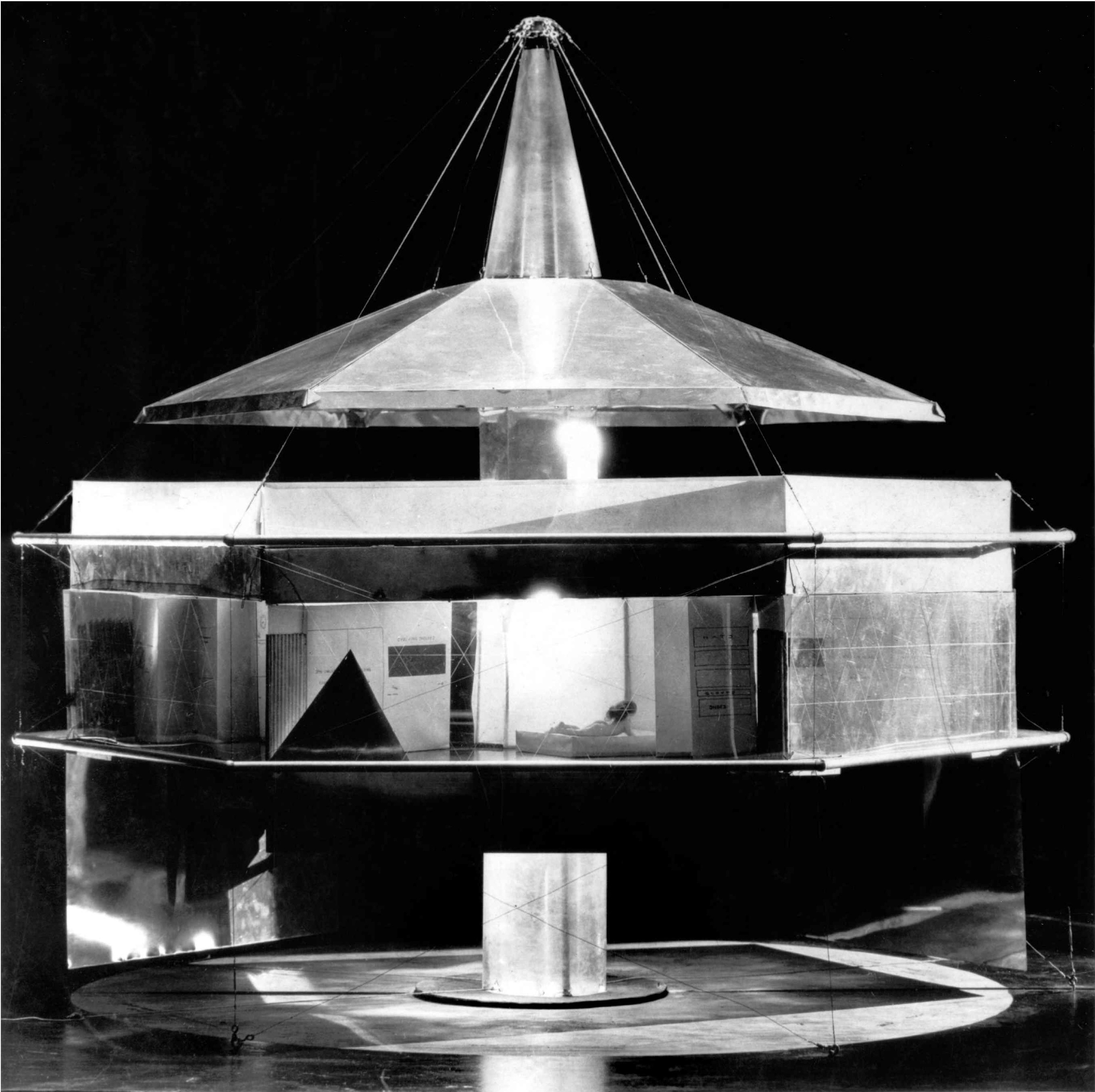 FIGURE 20 Model of the Dymaxion 4-D House
  Change: Fix Fig 20
- 3.
- Within the remainder of the world I would acquire the means only in exchange for cash money or services. This brought me once more to the number-one strategic question: how could the initially moneyless, creditless, physical-facilities-lacking individual succeed in realistically demonstrating that the invented artifacts not only could be practically realized but that their use would substantially increase the economic, technological, and social advantaging of all world-around humanity and not be inherently limited to advantaging only minorities.
65 I saw that twentieth-century money was an economic invention that could be manipulated, for instance, through the Federal Reserve Bank and its control of its member banks’ rediscount rate—or again by the banks’ loaning to already powerful organizations large blocks of the money of many small depositors to enhance the advantage only of the few through profitable exploitations of the many’s needs. As mentioned in an earlier chapter, since Malthus (1810) it had been assumed by all the world’s political ideologies—as it is even today—that there is a fundamental and lethal inadequacy of life support on our planet, wherefore, poverty and misery for vast millions of humans have been accepted as unavoidable. Wherefore, the also universally assumed law of ‘‘survival only of the fittest’’ had given historical rise to various political ideologies, as ways of coping with this fundamental inadequacy—each convinced that the ultimate proof of which ideological group is fittest to survive can be resolved only by periodic trial of arms.
66 Politicians’ effectiveness is dependent on the degree of growth of their ongoing authority. Since there is no sustainable equilibrium in a 100-percent efficient, ever-regenerating physical Universe, the politician of the moment who has gained greatest effectiveness is the one whose gained authority is as yet increasing-i.e., the brightness of whose ‘‘star’’ is waxing. Once their authority becomes visibly less, they are ‘‘on the way out.’’ The same is true of the money-making private-corporation executives. They must play company politics to ever progressively augment personal authority.
67 No matter how altruistic a public image they may attain and maintain, both the budding or full-bloom politicians and corporate executives must secretly have always on highest priority the increasing enhancement of their own public image as well as of their own financial credit. Whether public or private, professional or amateur, their own kudos-building or -maintenance requires that both the politicians and corporate executives forever be attempting to favorably reform the viewpoints of others regarding their particular organizations. To do so they are forever proposing to reform the organization commanded by those others whose prerogatives they hope to acquire.
68 Far different from the politicians’, corporate executives’, and religious leaders’ strategies was the new non-competitive course I took in 1927—i.e., that of reforming only the physical environment through artifacts, such as increasing safety and decreasing accidents by engineering improvements of motor vehicles while also providing overpasses and banked turns for the vehicles to drive on, instead of trying to reform the vehicle drivers’ behaviors. I planned to employ the ever-increasing and -improving scientific knowledge and technology to produce ever more effective human life-improving results with ever less investment of weight of materials, ergs of energy, seconds of time per each measurable level of improved artifact performance. I was hopeful of finally doing so much with so little as to implement comprehensive and economically sustainable physical success for all humanity, thereby to eliminate the need for lethally biased politics and their ultimate recourse to hot or cold warring.
69 The big question remained: How do you obtain the money to live with and to acquire the materials and tools with which to work?
70 The answer was ‘‘precession.’’ What precession is, and why it was the answer, requires some explaining.
71 When we pull away from one another the opposite rigid-disc ends of a flexible, water-filled rubber cylinder, the middle part of the overall cylinder contracts in a concentric series of circular planes of diminishing radius perpendicular (at right angles) to the line of our pulling.
72 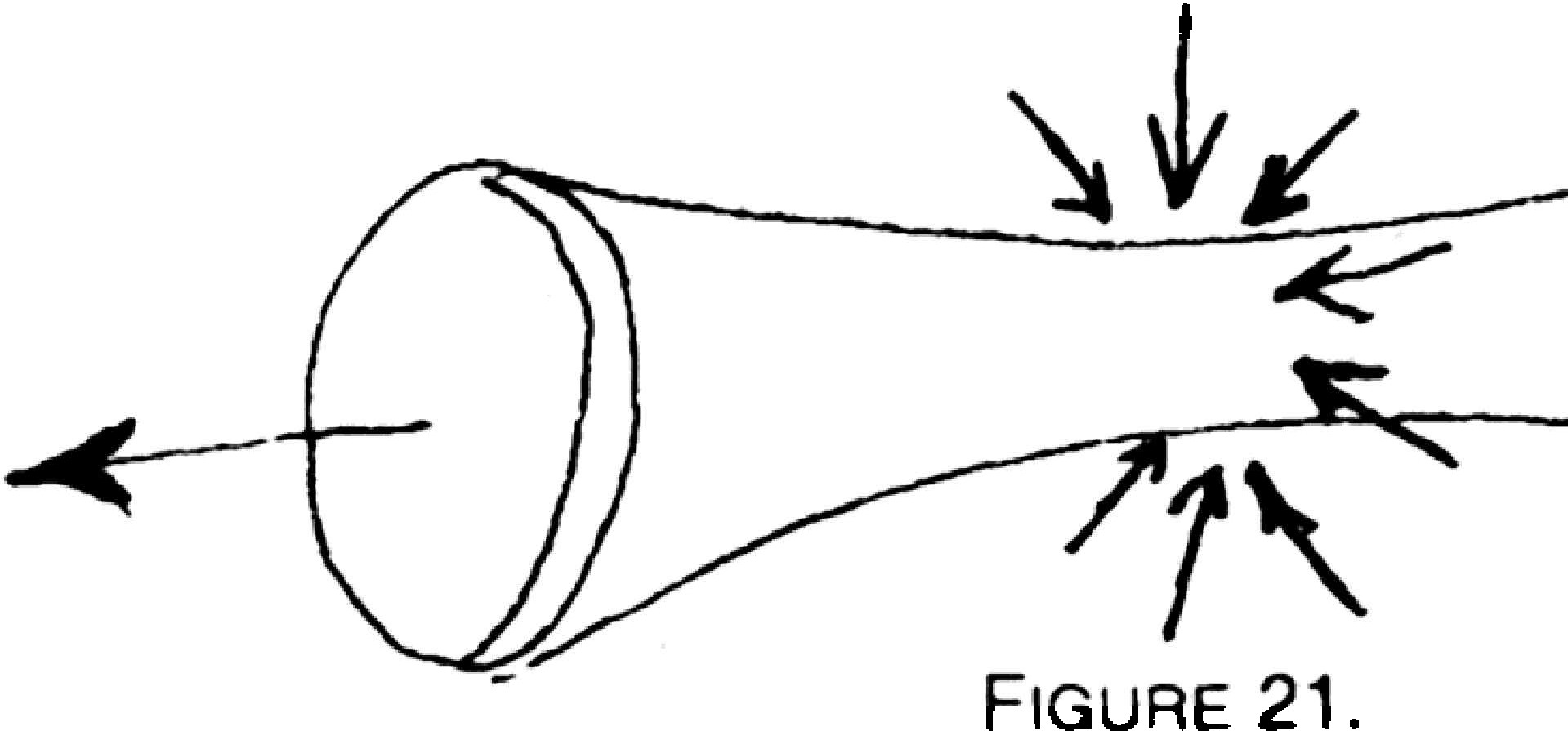


 Change: fix Fig 21
73 When we push toward one another on the two opposite ends of the same flexible, water-filled, rubber, rigid-disk-ended cylinder, the center of the cylinder swells maximally outward in a circular plane perpendicular (at right angles) to the line of our pushing together.



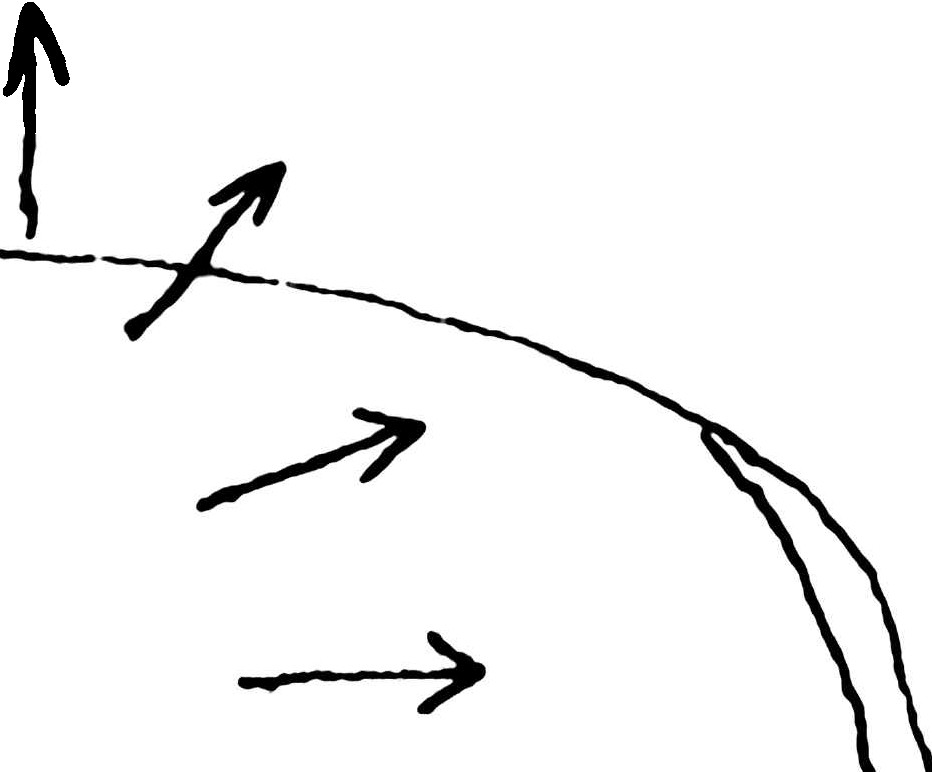
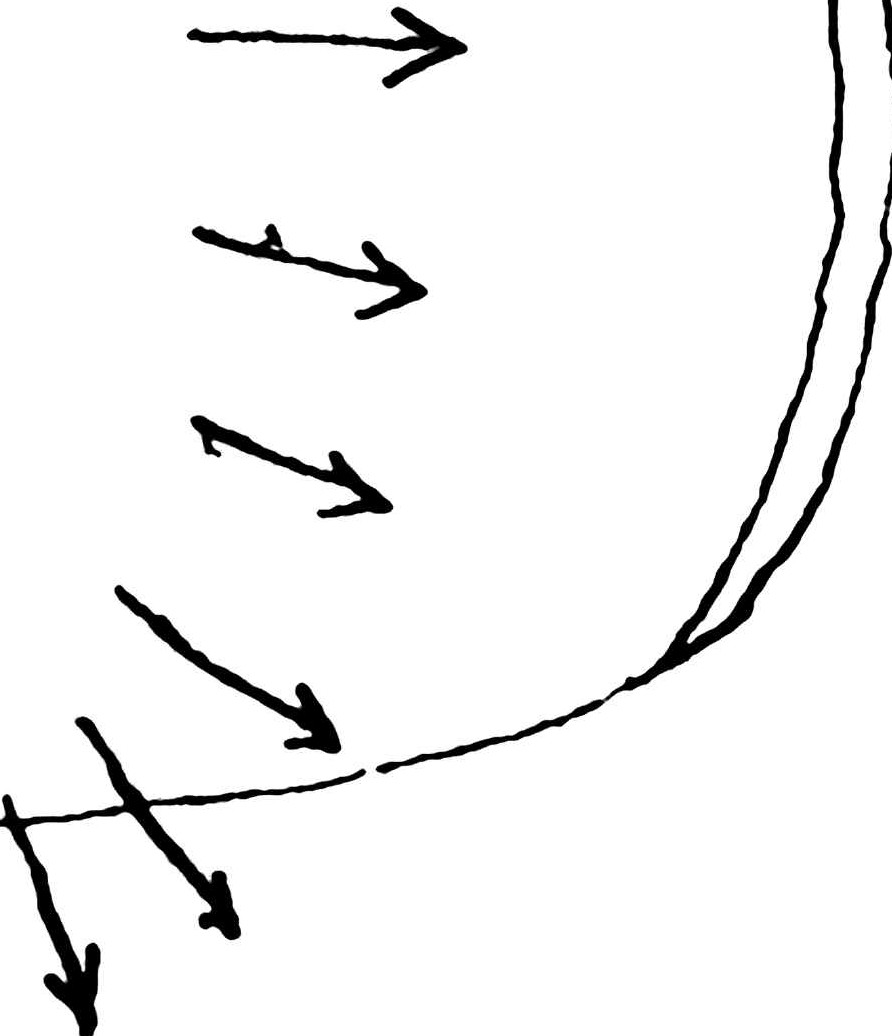
75  Change: fix Fig 22 FIGURE 22.
76 When we drop a stone in the water, a circular wave is generated that moves outwardly in a plane perpendicular (at right angles) to the line of stone-dropping-the outwardly expanding circular wave generates (at ninety degrees) a vertical wave that in turn generates an additional horizontally and outwardly expanding wave, and so on.

78 FIGURE 23.  Change: Fix Fig 23
79 All these right-angle effects are processional effects. Precession is the effect of bodies in motion on other bodies in motion. The Sun and Earth are both in motion. Despite the 180-degree gravitational pull of the in-motion Sun upon the in-motion Earth, precession makes Earth orbit around the Sun in a direction that is at ninety degrees—i.e., at a right angle—to the direction of the Sun’s gravitational pull upon Earth.



81 FIGURE 24  Change: Fix Fig 24
82 The successful regeneration of life growth on our planet Earth is ecologically accomplished always and only as the precessional—right-angled—‘‘side effect’’ of the biological species’ chromosomically programmed individual—survival preoccupations—the honeybees are chromosomically programmed to enter the flower blossoms in search of honey. Seemingly inadvertently (but realistically-precessionally) this occasions the bees’ bumbling tail’s becoming dusted with pollen (at ninety degrees to each bee’s linear axis and flight path), whereafter the bees’ further bumbling entries into other flowers inadvertently dusts off, pollenizes, and cross-fertilizes those flowers at right angles (precessionally) to the bees’ operational axis-so, too, do all the mobile creatures of Earth cross-fertilize all the different rooted botanicals in one or another precessional (right-angled), inadvertent way.
83 Humans, as honey-money-seeking bees, do many of nature’s required tasks only inadvertently. They initially produce swords with metal-forging developed capability, which capability is later used to make steel into farm plows. Humans—in politically organized, group-fear-mandated acquisition of weaponry—have inadvertently developed so-much-more-performance-with-so-much-less material, effort, and time investment per each technological task accomplished as now inadvertently to have established a level of technological capability which, if applied exclusively to peaceful purposes, can provide a sustainable high standard of living for all humanity, which accomplished fact makes war and all weaponry obsolete. Furthermore, all of this potential has happened only because of the at-ninety-degrees-realized generalized technology and science ‘‘side effects’’ or ‘‘fall-out’’ inadvertently discovered as special case manifest of the scientifically generalized principle of precession.
84 At the 1927 outset of project ‘‘Guinea Pig B’’ I assumed that humanity was designed to perform an important function in Universe, a function it would discover only after an initially innocent by-trial-and-error-discovered phase of capability development. During the initial phase humans, always born naked, helpless, and ignorant but with hunger, thirst, and curiosity to drive them, have been chromosomically programmed to operate successfully only by means of the general biological inadvertencies of bumbling ‘‘honey-seeking.’’ Therefore, what humans called the side effects of their conscious drives in fact produced the main ecological effects of generalized technological regeneration. I therefore assumed that what humanity rated as ‘‘side effects’’ are nature’s main effects. I adopted the precessional ‘‘side effects’’ as my prime objective.
85 So preoccupied with its honey-money bumbling has society been that the ninety-degree side effects of the century-old science of ecology remained long unnoticed by the populace. Ecology is the world-around complex intercomplementation of all the biological species’ regenerative intercyclings with nature’s geological and meteorological transformation recyclings. Society discovered ecology only when its economically sidewise discards of unprofitable substances became so prodigious as to pollutingly frustrate nature’s regenerative mainstream intersupport. Society’s surprise ‘‘discovery’’ of ecology in the 1960s constituted its as-yet-realistically-unresponded-to discovery of nature’s main effects—ergo, of precession. It is a safe guess that not more than one human in 10 million is conceptually familiar with and sensorially comprehending of the principle of ‘‘precession.’’
86 In 1927 I reasoned that if humans’ experiences gave them insights into what nature’s main objectives might be, and if humans committed themselves, their lifetimes, and even their dependents and all their assets toward direct, efficient, and expeditious realization of any of nature’s comprehensive evolutionary objectives, nature might realistically support such a main precessional commitment and all the ramifications of the individual’s developmental needs, provided that no one else was trying to do what the precessionally committed saw needed to be done. Precession cannot be accomplished competitively. Precession cannot respond to angularly redundant forces. It can, however, respond to several angularly nonredundant forces at a given time.
87 Since nature was clearly intent on making humans successful in support of the integrity of eternally regenerative Universe, it seemed clear that if I undertook ever more humanly favorable physical-environment-producing artifact developments that in fact did improve the chances of all humanity’s successful development, it was quite possible that nature would support my efforts, provided I were choosing the successively most efficient technical means of so doing. Nature was clearly supporting all her inter-complementary ecological regenerative tasks—ergo, I must so commit myself and must depend upon nature providing the physical means of realization of my invented environment-advantaging artifacts. I noted that nature did not require hydrogen to ‘‘earn a living’’ before allowing hydrogen to behave in the unique manner in which it does. Nature does not require that any of its intercomplementing members ‘‘earn a living.’’
88 Because I could see that this precessional principle of self-employment was a reasonably realistic possibility (though to the best of my knowledge never before consciously adopted and tested by others), I resolved to adopt such a course formally, realizing that there would be no human who could authorize my doing so nor any authority able to validate my decision so to do. I saw that there would be no humans to evaluate my work as it proceeded—nor to tell me what to do next.
89 I went on to reason that since economic machinery and logistics consist of bodies in motion, since precession governs the interbehaviors of all bodies in motion, and since human bodies are usually in motion, precession must govern all socioeconomic behaviors. Quite clearly humans do orbit at ninety degrees to the direction of their interattractions—orbiting elliptically around one another’s most attractively dominant neighbors, as do also galaxies within super-galaxies and all the stars, moons, comets, asteroids, stardust particles, unattached molecules, atoms, and the electrons within the atoms. All orbit their respectively most interattractively dominant nuclei of the moment. I recognized that overall interproximities vary and that Newton’s law of system interattractiveness varies inversely at a second-power rate of the mathematical distances intervening as well as in respect to the product of the masses of any two considered bodies. All of the foregoing evolutionary intertransformings I observed would occasion frequently changing interdominances.
90 I assumed that nature would ‘‘evaluate’’ my work as I went along. If I was doing what nature wanted done, and if I was doing it in promising ways, permitted by nature’s principles, I would find my work being economically sustained—and vice versa, in which latter negative case I must quickly cease doing what I had been doing and seek logically alternative courses until I found the new course that nature signified her approval of by providing for its physical support.
91 Wherefore, I concluded that I would be informed by nature if I proceeded in the following manner:
- (A)
- committed myself, my wife, and our infant daughter directly to the design, production, and demonstration of artifact accommodation of the most evident but as-yet-unattended-to human-environment-advantaging physical evolutionary tasks, and
- (B)
- paid no attention to ‘‘earning a living’’ in humanity’s established economic system, yet found my family’s and my own life’s needs being unsolicitedly provided for by seemingly pure happenstance and always only ‘‘in the nick of time,’’ and
- (C)
- being provided for ‘‘only coincidentally,’’ yet found
- (D)
- that this only ‘‘coincidentally,’’ unbudgetable, yet realistic support persisted, and did so
- (E)
- only so long as I continued spontaneously to commit myself unreservedly to the task of developing relevant artifacts, and if I
- (F)
- never tried to persuade humanity to alter its customs and viewpoints and never asked anyone to listen to me and spoke informatively to others only when they asked me so to do, and if I
- (G)
- never undertook competitively to produce artifacts others were developing, and attended only to that which no others attended
92then I could tentatively conclude that my two assumptions were valid: (1) that nature might economically sustain human activity that served directly in the ‘‘mainstream’’ realization of essential cosmic regeneration, which had hitherto been accomplished only through seeming ‘‘right-angled’’ side effects of the chromosomically focused biological creatures; and (2) that the generalized physical law of precessional behaviors does govern socioeconomic behaviors as do also the generalized laws of acceleration and ephemeralization.
93 The 1927 precessional assumptions became ever-more-convincingly substantiated by experiences—only the ‘‘impossible’’ continued to happen. I became ever more convinced that I must go on developing artifacts that would make possible humanity’s successful accomplishment of survival activities so much more logically and efficiently as to render the older, less efficient ways to be spontaneously abandoned by humanity. I resolved never to attack or oppose undesirable socioeconomic phenomena, but instead committed myself to evolving and cultivating tools that would accomplish humanity’s necessitous tasks in so much easier, more pleasant, and more efficient ways that, without thinking about it, the undesirable ways would be abandoned by society. (I liked the popular 1944 song, ‘‘Accentuate the Positive, Eliminate the Negative.’’
94 All the foregoing was, then, the precessional course I deliberately adopted in 1927. I had only the remaining days of my life to invest. It involved swift sorting out of the complex of design, production, testing, and demonstration tasks to be performed. What was the order of inherent priorities and successively overlapping interdependencies?
95 Socioeconomic precession by environment-controlling artifacts was a strategic course that obviously could be steered only by maximum reliance on our intuitive sensibilities, frequent position determination and course correcting, plus constant attendance upon the thoughts evolvingly generated by our commitment and its moment-to-moment, experience-produced new insights into the relative significance of the whole family of evolving events. It involved swift recognition and correction of all errors of judgment. It required being always ‘‘comprehensively considerate.’’
98 As navigational aids and ‘‘high-seas life-preserving devices’’ wisely to be employed in sailing such a course in heretofore-uncharted socioeconomic seas, I have patented every one of what seemed to me to be strategically important items amongst my inventions, and have done so as they occurred in all economically relevant countries around the world. This has cost threefold any and all royalties ever accruing to those patents. I did so for the following reasons:
99 Having no academically earned scientific degrees I could not qualify for membership in any scientific societies and could therefore not publish my discoveries officially in their journals. I found that filing of patent claims established an equally valid scientific record of my discoveries and inventions. The preamble texts of patent claims are often philosophically and historically enlightening. Of necessity they are meticulously specific in respect to the technological means of practical realizations of the inventions.
100 The worth of a patent, however, is not established by the merit of the invention but by the expertness with which its claims of invention are written. Almost anyone can obtain a patent from the patent office. What history has shown to be socioeconomically important is whether those claims can survive in the highest court trials of patent-infringement cases. Vast knowledge of the precedents in court-decision history and of the patent strategy of great corporations is essential in the writing of the claims. While a U.S.A. patent can be obtained for less than $200, a patent that the great corporations’ patent attorneys see no way of circumventing requires expensively expert professional services. Added to this is the cost of world-around major nations’ patent coverage (which foreign patents must be applied for and obtained because every country can now air-deliver their inventions into any other country within less than a week, in contradistinction to a six-month water-delivery lag in 1900). This world-around patent coverage cost about $50,000 in 1975 (it was $30,000 in 1950) for obtaining each world-protected, probably court-sustainable, infringement-defying patent.
101 In every instance I sought the services of those lawyers most widely acknowledged to be the champion patent attorneys of that moment in the specific category of my type of inventions.
102 From time to time during the half-century since I first obtained a patent, the patent attorneys of more than 100 of the world’s most powerful corporations have called upon my patent attorneys to obtain a license under one or more of my patents. In every one of these instances, phrasing his statement in varying ways, the visiting powerful corporation attorney has said to my attorney (usually as a flattering, but truthful, ‘‘one-professional-to-another,’’ off-the-record remark), ‘‘Of course, the first thing my client asked me to do was to find a way of circumventing your client’s patent, but you have written your claims so well that I was forced to advise my client to procure a license under your patent if indeed he wished to engage in the invention’s manufacture without exposing himself to almost certainly devastating infringement expense.’’
103 That statement discloses two truths. The first is that big business, which now makes its major profits out of know-how, deliberately steals know-how wealth whenever possible; the second is that if I had not taken out patents, you would probably never have heard of me nor would you have learned that an independently operating little individual, starting penniless and creditless, had indeed succeeded in inventing what I, as the half-century ‘‘Guinea Pig B’’—the test-case individual—have been able to accomplish.
104 My half-century experience also discovered the natural, unacceleratable lags existing between inventions and industrial uses in various technical categories, which occur as follows: in electronics—two years; aerodynamics—five years; automobiles—ten years; railroading—fifteen years; big-city buildings—twenty-five years; single-family dwellings—fifty years. Clearly these lags have consistently characterized the lengths of gestation periods in the different arts with which I was concerned. In the case of most of my inventions the gestation lags have been far greater than the seventeen-year life-span of patents in those arts. Patents in the forty-five-to fifty-year invention-gestation-rated single-family-housing arts are financially worthless. I took out many patents in these arts, however, because it was in the field of human-life protection, support, and accommodation that the worst socioeconomic problems existed.
105 In 1927 the American Institute of Architects journal published a plan for a single-family dwelling they felt to be an optimum single-family dwelling under the improving technical circumstances of 1927—it included electric refrigeration instead of the old icebox, oil-burning furnaces instead of human-shovel-stoked coal furnaces, etc. Concerned with my accelerating ephemeralization, I inventoried all the design fixtures of that optimum single-family dwelling-its floor area, its volume, the number and placement of its windows, the number of lumens of light admitted, all of its plumbing and wired facilities, its insulation, etc. —and then I calculated its complete weight, including all of its pipes and wires out to the city mains. It weighed 150 tons.
106 Then, using the most advanced aircraft-engineering techniques and the highest-performance aluminum alloys, etc., I designed a dwell-in-able environment control of the same volume and floor area that in every way provided facilities and degrees of comfort equal to those of AIA’s optimum 1927 single-family dwelling. My aeronautical-engineering-counterpart single-family dwelling weighed only three tons-a fact that I proved seventeen years later when, incorporating all logical interim technological improvements, we built that aircraft-engineering prototype in Beech Aircraft’s plant in Wichita, Kansas.
107 This three-ton to 150-ton {1150th) weight ratio of the difference between the technical capabilities of the aircraft versus the home-building arts clearly confirmed the reasonability of my working assumption that the accelerating ephemeralization of science and technology might someday accomplish so much with so little that we could sustainingly take care of all humanity at a higher standard of living than any have ever experienced, which would prove the Malthusian ‘‘only you or me’’ doctrine to be completely fallacious. Having committed myself to precessional existence, I now focused all my effort for the rest of my life on applying the highest science and technology directly to the realization of human livingry.
108 Most of my inventions have come into public use long after my relevant patent rights have expired. Some of them have not yet come into public use but will do so fifty years after their 1927 invention and thirty-two years after the seventeen-year patents have expired. This has not mattered to me since I did not take out the patents to make money but only to document and demonstrate what the inventive little individual can accomplish, and to prove documentably the socioeconomic existence of such unique industrialization lags.
109 For instance, my mass-producible one-piece bath-rooms that are now in mass production in West Germany and are fabricated as I planned, with glass-fiber-reinforced-polyester-resin, are almost exact visual-form replicas of the sheet-copper and aluminum prototypes I developed, installed, and thoroughly tested and proved at the United States Bureau of Standards, Hydraulic Division, in 1937--38, having first designed one in 1927 -all of which, as designed, had to wait until the glass-reinforced-polyester-resins plastic industry had been developed, there being a half-century gestation period in the home-improvements art.
110 Paradoxically, the truly luxurious West German one-piece bathrooms are now about to be made obsolete by the combined effectiveness of my fog-gun self-cleaning device and my dry-packaged and hermetically sealed and mechanically-carried-away-and-packaged toilet device, which altogether eliminate all wet plumbing and do away with the need of piped-in-and-away water and water-borne wastes. The amount of water needed by the fog gun is less than a pint per day per family. All water for our advanced dwelling machine will be brought to the dwelling in quantities equal to milk and fruit juice consumption.
111 Now that I have proven that an individual can be world-effective while eschewing either money or political advantage-making, I do my best to discourage others from taking patents, which almost never ‘‘pay off’’ to the inventor. My patent taking was to effect a ‘‘bridgehead’’ accreditation to more effective employment of humanity’s potentials.
112 My half-century experience in the foregoing experiment makes me feel certain that if I had developed any of the inventions to make money or to aggrandize self, I would have failed to do either, as have so many thou-sands failed when committed primarily to self-advantaging. I frequently hear from only-to-self-committed individuals who lament with pathetic self-conviction that others are trying to steal their inventions, wherefore they don’t dare to disclose to anyone, while perversely yearning to profit by what to them is invention.
113 Very often, unknown to them, prior disclosures of the same invention ‘‘idea’’ exist.
114 Ideas are easy to come by; reduction to practice is an arduous but inspirationally rewarding matter.
115 I have discovered that one of the important characteristics of most economic trends is that they are too slow in their motion to be visible to humans. We cannot see the motion of the stars, the atoms, a whirling airplane propel-ler, the growth of a tree, or the hour or minute hand of a clock. In the latter case we can see only the movement of the second hand. Humans do not get out of the way of that which they cannot see moving. As with the electro-magnetic spectrum, most of the frequencies and motions of Universe are ultra or infra to man’s sensorial tunability.
116 With a half-century of experience in prognosticating based on the rates of change of my ephemeralization and acceleration curves, I am firmly convinced that I can see clearly a number of coming events, and I am therefore vitally eager that people should not be hurt by the coming of these events, particularly when I can see ways in which it would be possible not only for them to avoid hurt but even to prosper by and enjoy what now seems to me to be inevitable.
117 Much that I see to be inevitable is unthinkingly opposed by various factions of society. Reflex-conditioned society, facing exclusively toward its past, backs up into its future, often bumping its rump painfully but uncomprehendingly against the ‘‘potential-wealth coffers’’ of its future years’ vastly multiplying capability to favorably control its own ecological evolution and the latter’s freedom-multiplying devices.
118 My recitation of self-disciplines may suggest that all I had to do was to conceive of the discipline and institute it, whereas the fact is that my previously conditioned reflexes frequently contradicted my intentions, while circumstances beyond my control converged so powerfully as to divert me from my intended self-disciplines. It has taken constant disciplining and re-disciplining to get myself un-der control to a productively effective degree.
119 Throughout the first half of my last fifty-two years of severe reorientation of my life pattern—in which I determined to give up forever the idea of ‘‘earning a living’’ for my family and self while depending entirely on ecological precession to provide the critically needed material, tools, and monies to carry on the work—my friends and family and my wife’s family and friends would say that I was being stubbornly treacherous to my wife and daughter in not attempting to ‘‘earn a living.’’ Thus goaded, I would from time to time accept a job that was proffered me by some friend, and for the moment all these friends and family were relieved and delighted. In each instance, however, all my grand strategy would languish and things would go wrong until, for one reason or another, I jumped off the deep end again and recommitted myself to the unfunded comprehensive program of solving problems by environment-modifying artifacts produced with the most advanced scientific and technological means. Then everything would go smoothly again.
120 By and large I seem to have made more mistakes than any others of whom I know, but have learned thereby to make ever swifter acknowledgment of the errors and thereafter immediately set about to deal more effectively with the truths disclosed by the acknowledgment of erroneous assumptions.
121 I don’t want a reader of this chronicle to think that I am anything other than what I am—an average healthy human being with all the attendant weaknesses and vulnerabilities. What is important is that the reorientation of my life and the criteria of its conduct did render such an aver-age human being more effective than under conventional circumstances.
122 There is one, as-yet-unmentioned, comprehensively overriding commitment that I made before developing all my already-recounted disciplines and commitments, especially to the principle of precession, whereby I gained complete release from the concept of earning a living for my family and myself and gained, as well, the day-to-day practical physical implementation of all my artifact-inventing and reduction of the latter to physical demonstration.
123 I have deliberately kept this all-important commitment to the last. If it had not come first in my life pattern however, it is quite possible that I might not have had the insights that led to all the intercomplemehtary resolutions and self-discipline.
126 My definition of the word believe means to accept an explanation of physical phenomena without any experiential evidence. At the outset of my resolve not only to do my own thinking but to keep that thinking concerned only with directly experienced evidence, I resolved to abandon completely all that I ever had been taught to believe. Experience had demonstrated to me that most people had an authority-trusting sense that persuaded them to believingly accept the dogma and legends of one religious group or another and to join that group’s formalized worship of God.
127 I asked myself whether I had any direct experiences in life that made me have to assume a greater intellect than that of humans to be operative in Universe. I immediately referred back to my good education in the sciences and my directly experienced learning of the operation of a plurality of physical laws—such as the interattraction of celestial bodies, varying inversely as the second power of the arithmetical distances intervening-which laws could only be expressed in the purely intellectual terms of mathematics, which plurality of laws always and only related to eternal relationships existing between and not in any one of the interrelated phenomena when considered only separately. None of the eternal and always concurrently operative laws had ever been found to contradict one another—ergo, they were all designedly interaccommodative like a train of gears. Many also were interaugmentative. I said that when we use the word design in contradistinction to randomness, we immediately infer an intellect that sorts out a complex of potentials and interarranges components in complementary ways—ergo, human mind in discovering a plurality of these only mathematically expressible eternal laws, all of which are interaccommodative, is also discovering the intellectually designed scenario Universe, whose designing requires the a priori eternal existence of an intellectual integrity of eternally self-regenerative Universe. I said to myself, I am o’erwhelmed by the only experientially discovered evidence of an a priori eternal, omnicomprehensive, infinitely and exquisitely concerned, intellectual integrity that we may call God, though knowing that in whatever way we humans refer to this integrity, it will always be an inadequate expression of its cosmic omniscience and omnipotence.
128 At the time I resolved to do only my own experientially based thinking, in 1927, the Russian Revolution, then ten years old, was beginning to cope with its survival problems by including industrialization as well as farming. In 1928 they brought into operation their five-year plans of successively most important tasks to be accomplished. Realizing from the outset that in order to organize the complete preoccupation of all their over 100 million people with the Communist party’s specific planning, it would be disastrous to their efforts to tolerate the continuing presence of any other mystically higher authority than that of the Communist party—such, for instance, as any of the great organized religions—probably in pure expediency, the Communist party said that science, which is utterly pragmatic, proved that there is no God—ergo, Russia, committed to omniscientific technology, was also thenceforth committed to atheism. Many intellectuals around the world accepted this ‘‘party-line’’ doctrine.
129 In 1930 Einstein, ‘‘Mr. Science’’ himself, published his ‘‘Cosmic Religious Sense—the Nonanthropomorphic Concept of God.’’ Einstein said that the great scientists such as Kepler and Galileo, whom the Roman Catholic Church had excommunicated as ‘‘heretics,’’ were, because of their absolute faith in the orderliness of Universe, far more committed to the nonanthropomorphic cosmic God than were the individuals heading the formal religious organizations.
130 Since 1927, whenever I am going to sleep, I always concentrate my thinking on what I call ‘‘Ever Rethinking the Lord’s Prayer.’’ The Lord’s Prayer had obviously been evolved by a plurality of deeply earnest and thoughtful individuals whose names we will never know. My latest rethinking of it follows.
131 I am confident, contrary to the Russian assumption that science invalidated all possibilities of the existence of God, that, as specifically argued, my following declaration constitutes a scientifically meticulous, direct-experience-based proof of God.
EVER RETHINKING THE LORD’S PRAYER
133July 12, 1979
134 To be satisfactory to science all definitions
135 must be stated
136 in terms of experience.
137 I define Universe as
138 all of humanity’s
139 in-all-known-time
140 consciously apprehended
141 and communicated (to self or others)
142 experiences.
143 In using the word, God,
144 I am consciously employing
145 four clearly differentiated
146 from one another
147 experience-engendered thoughts.
148 Firstly I mean:—
149 those experience-engendered thoughts
150 which are predicated upon past successions
151 of unexpected, human discoveries
152 of mathematically incisive,
153 physically demonstrable answers
154 to what theretofore had been misassumed
155 to be forever unanswerable
156 cosmic magnitude questions
157 wherefore I now assume it to be
158 scientifically manifest,
159 and therefore experientially reasonable that
160 scientifically explainable answers
161 may and probably will
162 eventually be given
163 to all questions
164 as engendered in all human thoughts
165 by the sum total
166 of all human experiences;
167 wherefore my first meaning for God is:—
168 all the experientially explained
169 or explainable answers
170 to all questions of all time—
171 Secondly I mean:—
172 The individual’s memory
173 of many surprising moments
174 of dawning comprehensions
175 of an interrelated significance
176 to be existent
177 amongst a number
178 of what had previously seemed to be
179 entirely uninterrelated experiences
180 all of which remembered experiences
181 engender the reasonable assumption
182 of the possible existence
183 of a total comprehension
184 of the integrated significance—
185 the meaning—
186 of all experiences.
187 Thirdly, I mean:—
188 the only intellectually discoverable
189 a priori, intellectual integrity
190 indisputably manifest as
191 the only mathematically statable
192 family
193 of generalized principles—
194 cosmic laws—
195 thus far discovered and codified
196 and ever physically redemonstrable
197 by scientists
198 to be not only unfailingly operative
199 but to be in eternal,
200 omni-interconsiderate,
201 omni-interaccommodative governance
202 of the complex
203 of everyday, naked-eye experiences
204 as well as of the multi-millions-fold greater range
205 of only instrumentally explored
206 infra- and ultra-tunable
207 micro- and macro-Universe events.
208 Fourthly, I mean:—
209 All the mystery inherent
210 in all human experience,
211 which, as a lifetime ratioed to eternity,
212 is individually limited
213 to almost negligible
214 twixt sleepings, glimpses
215 of only a few local episodes
216 of one of the infinite myriads
217 of concurrently and overlappingly operative
218 sum-totally never-ending
219 cosmic scenario serials
220 With these four meanings I now directly address God.
221 ‘‘Our God—
222 Since omni-experience is your identity
223 You have given us
224 overwhelming manifest:—
225 of Your complete knowledge
226 of Your complete comprehension
227 of Your complete concern
228 of Your complete coordination
229 of Your complete responsibility
230 of Your complete capability to cope
231 in absolute wisdom and effectiveness
232 with all problems and events
233 and of Your eternally unfailing reliability so to do
234 Yours, Dear God,
235 is the only and complete glory.
236 By Glory I mean
237 the synergetic totality
238 of all physical and metaphysical radiation
239 and of all physical and metaphysical gravity
240 of finite
241 but nonunitarily conceptual scenario Universe
242 in whose synergetic totality
243 the a priori energy potentials
244 of both radiation and gravity
245 are initially equal
246 but whose respective
247 behavioral patterns are such
248 that radiation’s entropic, redundant disintegratings
249 is always less effective
250 than gravity’s nonredundant
251 syntropic integrating
252 Radiation is plural and differentiable,
253 radiation is focusable, beamable, and self-sinusing,
254 is interceptible, separatist, and biasable—
255 ergo, has shadowed voids and vulnerabilities;
256 Gravity is unit and undifferentiable
257 Gravity is comprehensive
258 inclusively embracing and permeative
259 is non-focusable and shadowless,
260 and is omni-integrative;
261 all of which characteristics of gravity
262 are also the characteristics of love.
263 Love is metaphysical gravity.
264 You, Dear God,
265 are the totally loving intellect ever designing
266 and ever daring to test
267 and thereby irrefutably proving
268 to the uncompromising satisfaction
269 of Your own comprehensive and incisive
270 knowledge of the absolute truth
271 that Your generalized principles
272 adequately accommodate any and all
273 special case developments, involvements, and side effects;
274 wherefore Your absolutely courageous
275 omnirigorous and ruthless self-testing
276 alone can and does absolutely guarantee
277 total conservation
278 of the integrity
279 of eternally regenerative Universe
280 Your eternally regenerative scenario Universe
281 is the minimum complex
282 of totally intercomplementary
283 totally intertransforming
284 nonsimultaneous, differently frequenced
285 and differently enduring
286 feedback closures
287 of a finite
288 but nonunitarily
289 nonsimultaneously conceptual system
290 in which naught is created
291 and naught is lost
292 and all occurs
293 in optimum efficiency.
294 Total accountability and total feedback
295 constitute the minimum and only
296 perpetual motion system.
297 Universe is the one and only
298 eternally regenerative system.
299 To accomplish Your regenerative integrity
300 You give Yourself the responsibility
301 of eternal, absolutely continuous,
302 tirelessly vigilant wisdom.
303 Wherefore we have absolute faith and trust in You,
304 and we worship You
305 awe-inspiredly,
306 all-thankfully,
307 rejoicingly,
308 lovingly,
309 Amen.
312 In considering theology and science I think it is important to note their differences regarding familiar and not-so-familiar cosmic concepts.
313 It is the very essence of my thinking that, for a principle to qualify as generalizable in science, there must be no known exceptions to its reliability. Exceptionless means eternal. Principles can be only eternal.
314 Mathematics are eternal. Principles are mathematically demonstrable—as manifest, for instance, in synergy. Principles are truly independent of any additional special case, time-size aspects of their manifestation. There are principles governing covarying rates of relative size-time interrelationships.
315 That principle is manifest in E = mc2, c2 being the utterly unimpeded rate of growth of an omnidirectionally expanding light wave’s surface as demonstrated in vacuo.
316 This also involves the mathematical principle that a system’s linear dimension grows at a first-power rate, while its surface grows at a second power rate and its volume at a third-power rate. A steel needle with an initial length of six feet and a diameter of two inches, having a ‘‘slenderness’’ (L/R) ratio of 36/1, is reduced to a needle three inches long with a diameter of .08333 of an inch. The six-foot needle sinks in the water. The three-inch needle floats on the water: its volume—ergo, its weight—has become so negligible that its surface relates only to the surface tension of the water, its weight being much less than can be supported by the atomic interattractions producing the molecular membrane of the water surface.
317 To demonstrate frequency in pure principle I observe painfully that I can not put my finger through the plane of revolution of a swiftly rotating airplane propeller and withdraw it before it gets hit. Yet machine guns can be timed to fire bullets between successively revolving propeller blades. My muscle and brain cannot reflex and act that fast. I might get my finger through once but can’t get it back in time. Operationally speaking, ‘‘solid’’ means very high frequency present in pure principle. I can see through my glasses because light moving through only one way at 186,000 m.p.s. has ample time to avoid the frequency of interference events occurring locally in pure principle.
318 There are no solids. There are no things. There are only interfering and non-interfering patterns operative in pure principle, and principles are eternal. Principles never contradict principles. Principles can interaccommodate one another only in non-interfering frequency ways. Principles can interaugment one another if frequency is synchronizable.
319 Acknowledging the mathematically elegant intellectual integrity of eternally regenerative Universe is one way of identifying God.
320 Everything the brain deals with relates to high-frequency thingness. Mind, and mind alone, deals with understanding the interrelationships existing only between and not in any one principle, considered only by itself. Principles themselves are often subsets of interrelationships existing only between specific principles.
321 God may also be identified as the synergy of the inter-behavioral relationships of all the principles unpredicted by the behaviors or characteristics of any of the principles considered only separately.
322 The synergetic integral of the totality of all principles is God, whose sum total behavior in pure principle is beyond our comprehension and is utterly mysterious to us, because as humans—in pure principle—we do not and never will know all the principles.
323 Apparently the integrity of the synergy of all synergies of all principles is continually testing its own comprehensive adequacy to accommodate all challenges in pure principle to the maintenance in pure principle of the principle of non-simultaneous, only-overlappingly-affected, complex unity’s eternal regeneration.
324 Realization that the foregoing may be true tends to inform humans that the introduction into Universe of humans, in pure principle, with minds operating in pure principle, capable of apprehending and objectively employing in pure principle some of the eternal principles, was courageously undertaken by God to discover whether the principle of the eternally regenerative integrity of Universe can endure inviolate despite the dichotomy of knowledge brought about by introduction into the cosmic system of humans and their minds with access to and employment of some—but not all—of the eternal principles. This was an experiment in pure principle to test the adequacy of the synergy of synergies of principle to cope with the sometimes perverse, egotistical, selfish, and deceitful initiatives inherent in the concept of humans in pure principle without access to the wisdom accruing synergetically only to knowledge of all the principles—ergo, possibly capable of impairing the integrity of eternal regeneration. That may be what the integrity of God needs to know and needs to know by experimental evidence.
325 That is what I am thinking about in ‘‘Ever Rethinking the Lord’s Prayer.’’ It is also
what I am thinking about in volume 2 of Synergetics. Change: Add
to Bib I think it is probably an intuitive awareness of the possible verity—of parts or of
all—of the foregoing that makes the theologist disregard the scientist’s brain-induced
requirement of a cosmic beginning and ending.
Change: Add
to Bib I think it is probably an intuitive awareness of the possible verity—of parts or of
all—of the foregoing that makes the theologist disregard the scientist’s brain-induced
requirement of a cosmic beginning and ending.
326 All scientists have brains. Brains always and only coordinate the special case information progressively apprehended in pure principle by the separate senses operating in pure mathematical-frequency principle. Brain then sorts out the information to describe and identify special whole-system characteristics, storing them in the memory bank as system concepts for single or multiple recall for principle-seeking consideration and reconsideration as system integrities by searching and ever-reassessing mind.
327 Only minds have the capability to discover principles. Once in a very great while scientists’ minds discover principles and put them to rigorous physical test before accepting them as principle. More often theologists or others discover principles but do not subject them to the rigorous physical-special-case testing before accepting and employing them as working-assumption principles.
328 Principles are eternal. Special case interactions of principles are temporal and brain-apprehensible because in pure principle we have time, which is simply the principle of potentially different relative frequencies and not of beginnings and endings.