Part III
Fuller’s Earth: Basic Bucky
4 What follows is Bucky’s summary of the basic information he believes children should understand in order to meet the challenges of the last decades of the twentieth century.
5 This chapter is essentially a transcription of the first session between Bucky and the children (with additions, when relevant, from the second and third meetings). It began at the dining table of Fuller’s home in Pacific Palisades, California. He seated the three children at the circular table, left momentarily, then returned with a bag full of sticks, rubber tubes, and Dacron strings. As he spoke these were assembled into different forms to illustrate the geometry he presented.
6 The setting was intimate, to the children’s scale. The children were nervous at first, but Bucky soon won them over. His victory was complete when he was able to prove that there’s no such thing as a square.
7 FULLER: In preparation for today’s meeting, I’ve done a whole lot of rethinking about my experiences---and I’ve had more than eighty-five years’ worth of experiences. And I’ve thought especially about my experiences with education.
8 First of all, I should say that while I had lots of formal education in schools, I’ve really had more educational experiences out of school than in school, and a lot of these experiences taught me that what I had been learning in school was wrong.
9 I learned a lot of things in school that bothered me. But I also learned quickly that, because the teachers who were telling me these disturbing things were also the same people who were giving me my grades, if I were going to get by in school, I would have to give their answers, regardless of what I felt to be true. But even though I gave their answers, I didn’t stop thinking; and these things continued to bother me a great deal. It’s some of these things I want to share with you today.
10 So let’s get a pencil and some paper and begin.
11 My teachers would talk to me about geometry. That’s the science usually defined as the study of the mathematical properties and relations of lines, angles [where two lines meet], planes [imaginary totally flat areas reaching out to ‘‘infinity’’], and solids [volumes completely enclosed by surfaces].
12 Now, for example, a teacher would go to the blackboard and draw a square:
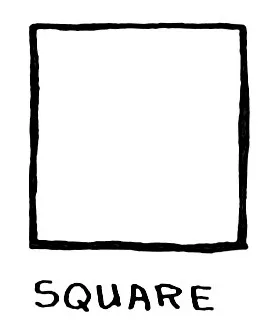
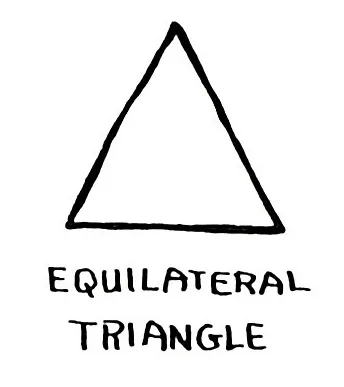
14 A square, we were told, is a closed line with four equal angles and four edges of equal lengths. Then there was the equilateral triangle:
16 which they said was a closed line with three equal edges and three equal angles. So we were taught to look at these forms as areas enclosed by one ‘‘closed line,’’ each formed by a line turning in on itself by angles to meet itself.
17 The teachers would talk about a ‘‘line’’ as something that went on to ‘‘infinity,’’ unless it was bent, angled, back on itself; in which case it would form a square, triangle, circle, or what have you.
18 Now this one teacher who talked about the line going to infinity drew a ‘‘line’’ on the blackboard as she was talking. Now when I looked at the blackboard, I saw a ‘‘line’’ that began and ended on the blackboard. It certainly didn’t go on to any ‘‘infinity.’’ Now let me say here that in science we don’t consider anything to be a ‘‘fact’’ or truth until we have proven it by repeated experiments. So when my teacher started talking about ‘‘infinity’’ again, I asked her, ‘‘Have you ever been there---to infinity, I mean?’’
19 And she said, ‘‘No.’’
20 So I said, pointing to one end of her line on the blackboard ‘‘Well, if this end goes to infinity, where does the other end go?’
21 And she answered, ‘‘Why, to infinity too.’’
22 Then I said, ‘‘Well then, which way is infinity?’’
23 Then I pointed out that all she really had was a chalk line on a blackboard. And while she said it was a ‘‘straight line,’’ if you looked closely, you’d see it was quite crooked; there was a lot of weaving of the chalk as she drew. (Just look at any ‘‘straight line’’ you draw through a magnifying glass and you will see what I mean.)
24 ‘‘You must get the spirit of it,’’ she then told me. Pointing to her blackboard, she said, ‘‘This represents a straight line.’’
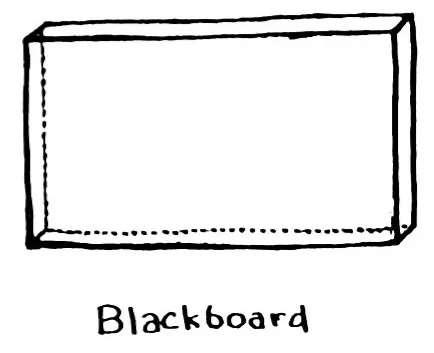
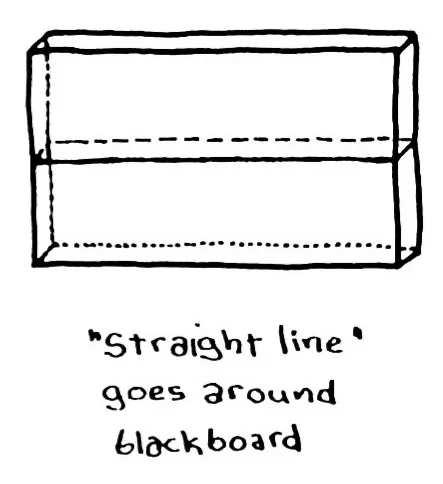
25 But I kept on pointing out that it wasn’t straight. And I said I thought it was nonsense about it going ‘‘out to infinity.’’ The fact was, the line was on the blackboard, and the blackboard didn’t go out to infinity. Where did the blackboard go? Well, the blackboard was just a blackboard, a slab of the rock called slate that had been trimmed down to size. The blackboard had two large flat sides, but there were also four much thinner sides between them:
27 And if you drew a line on the blackboard and kept going, it would just go around the blackboard. Not out to ‘‘infinity.
29 Now let’s pretend you could send a line out into space like the teacher said. The first fact we have to consider is that the line would begin here on earth. Now the earth is a roughly spherical---round---planet that is revolving around its own axis at a thousand miles an hour. That means that any line you started from earth wouldn’t be straight at all. It would leave a trail like a spiral or corkscrew, because the earth is also hurtling around the sun at the speed of 60,000 miles an hour.
30 So if we looked at our supposedly straight line from outer space, from above the North Pole, our line would look like this:
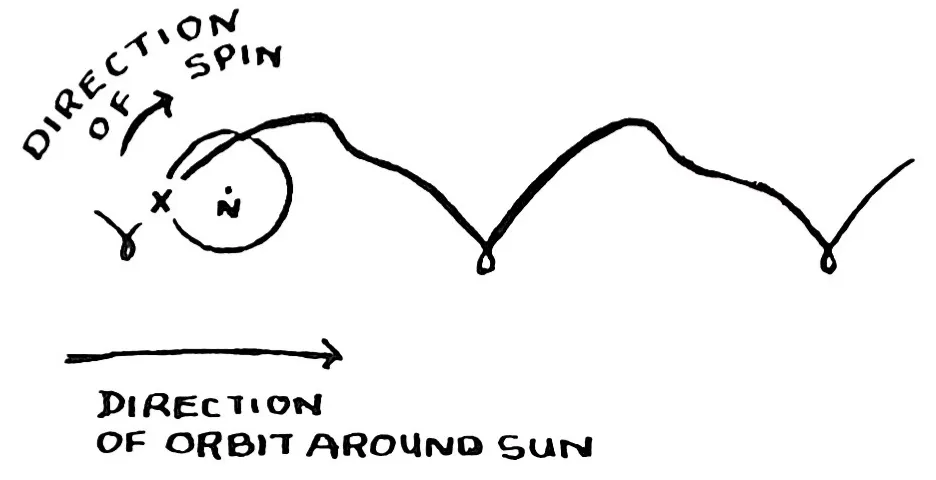
32 Hardly a ‘‘straight line.’’
33 So I thought to myself, Well, this teacher is certainly a nice lady, and she seems to mean well, but I don’t think she knows what she’s talking about. So I shut up for the time being and gave her the answers she wanted. But I kept right on thinking about what I was seeing for myself.
34 Now we all live on earth. It’s not flat, but shaped like a ball, a sphere, and it revolves around an axis which goes right through its center. Now this axis has a North Pole and a South Pole. If we draw a line on the surface of the earth between these two poles exactly the same distance from both and perpendicular---90°---to the axis, we will have a closed line---a line that meets itself---that we call the ‘‘Equator,’’ dividing the earth into the Northern Hemisphere and the Southern Hemisphere. Okay?
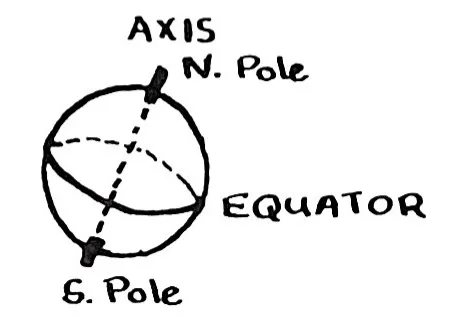
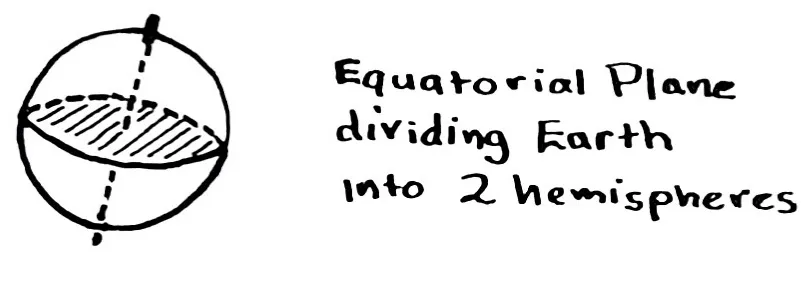
36 You can only draw a line on something, right? And whatever something you draw on is a shape that comes back on itself, whether it’s a piece of paper with very thin edges, a blackboard with thicker edges, or the earth. So any line we draw on the surface of the earth will eventually become a closed line, a circle dividing the earth into two parts we call hemispheres.
38 Now let’s draw another type of ‘‘closed line’’ on the surface of the earth---a triangle.
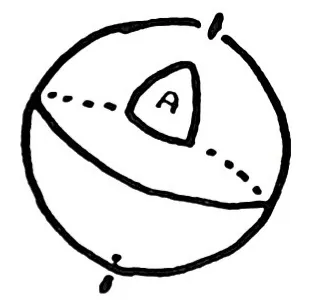
40 The earth is what is sometimes called a ‘‘closed system.’’ In fact, all systems are closed. That is, they have a limited surface area, enclose a fixed volume of space, and are defined by a finite---limited---shape.
41 Now this triangle (A) which we’ve drawn on the surface of the earth divides the surface into two areas: the limited, measurable area inside the lines, and all the rest of the earth’s surface outside the lines---an area that is also limited and measurable, although much larger.
42 But when the teacher was drawing a triangle on her blackboard, she wasn’t paying any attention to the area outside the lines, because she was talking about this nonsense of infinity. But her blackboard is just as much a ‘‘closed system’’ as the earth. It has a limited surface, encloses a definite volume of space, and has a definite shape.
43 And this brings us to an important point. If you make a closed line on any system, it divides the surface of the system into two areas: one inside the closed line and the other outside.
44 But the teacher was saying I could only describe one side of the line, the area ‘‘inside.’’
45 So we have all these school people getting you to look only at the little things, instead of the big things.
46 I discovered that if I made a triangle on the surface of the earth, I have divided the earth into two areas. Now the area inside the triangle I can define as an area bound by a closed line composed of three angles and three edges. But I also find that the area "outside’’ is also bound by a closed line of three angles and three edges.
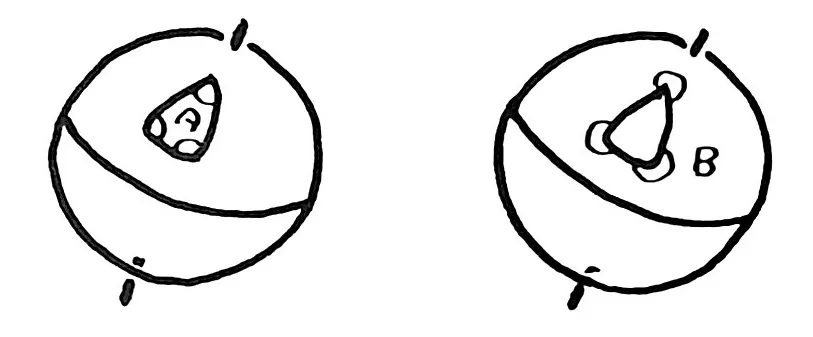
48 Let’s say that each of the angles in triangle (A), the ‘‘inside’’ triangle, is approximately 60°. That would make our triangle (A) an equilateral triangle. The sum of all the angles---60 + 60 + 60--- would be 180°. But then I look at triangle (B), our outside triangle, and I see that here I have three angles of 300°each, for a total of 300 + 300 + 300, or 900°.
49 Again, I find that school is always eliminating and pushing out of the way everything that is really big, the really big things.
50 Now the teacher would say, ‘‘Well, when I draw that triangle, I didn’t mean to divide the earth into two areas.’’ But the fact is, that’s exactly what she did. So, you must see that when you thought you were only doing little things, you were really doing very big things. It’s very important for us to realize that. Not only do we divide something this way; we also divide it that way. So any time you do something like this in Universe---take a little bit out here---you are also creating a very big ‘‘rest of Universe’’ there, like our triangles (A) and (B). You have to pay attention to what you’re really doing, because in school they make you look at things oversimply.
51 Does that make sense to you?
52 JONATHAN NESMITH: Yes, very much so.
53 FULLER: Good. Now let’s look at some other triangles as they really exist on this earth.
54 First, let’s draw our earth again, with its axis, its North and South Poles, and the Equator.
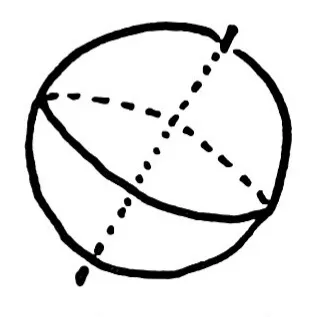
56 Now I want to tell you about something called a ‘‘great circle.’’ That’s a term meaning any line formed on the surface of a sphere by a plane running through the center of the sphere. A great circle is formed by a plane that slices the earth exactly in half. The Equator is a great circle. So are all the meridians of longitude: they are the great circles that pass through the two poles, as well as the center of the earth, and are used in navigation to ‘‘fix’’ locations.
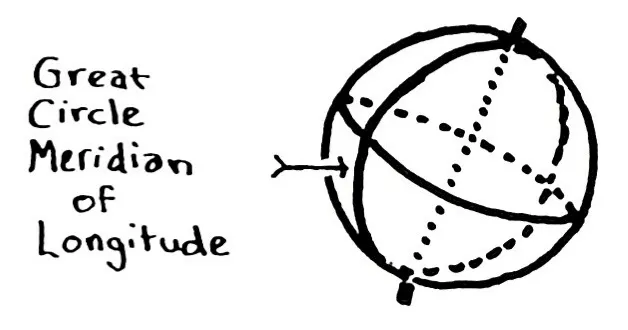
58 The Equator is the only great circle that passes through the center exactly perpendicular to the axis.
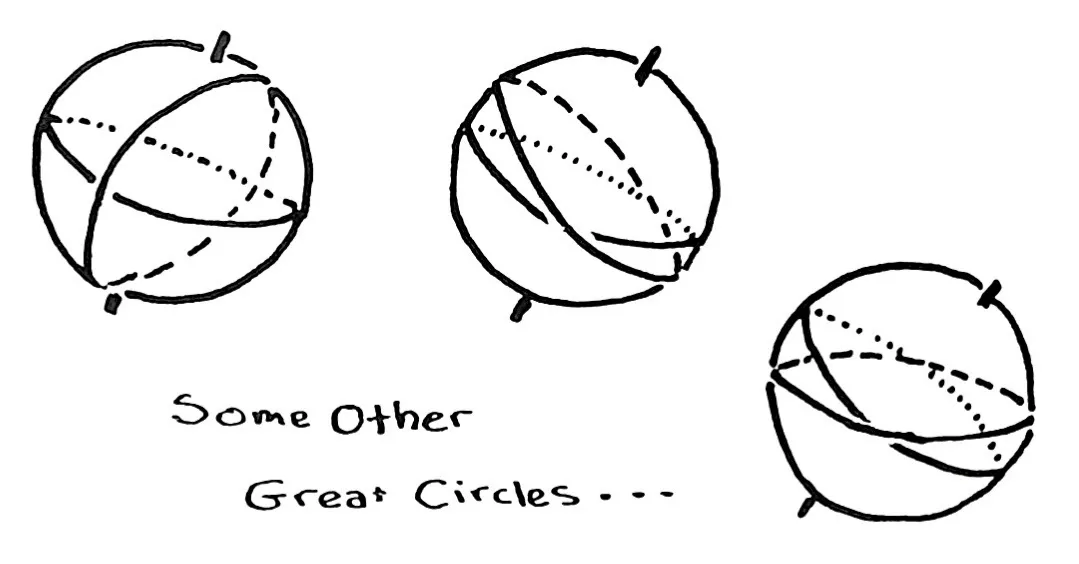
59 But the meridians of longitude and the Equator aren’t the only great circles (these are just the ones most commonly used in mapmaking). There can be any number of great circles drawn that pass through the center of the earth exactly dividing the planet into two equal halves but not passing through nor perpendicular to the poles. Here are a few examples:
61 Now there are also circles we call ‘‘lesser circles.’’ All circles drawn on the surface of a sphere that are not formed by planes passing through the center of the sphere are all called ‘‘lesser circles.’’ All lesser circles are smaller than great circles drawn on the same sphere; the great circle is the largest possible circle that can be drawn on the surface of a sphere.
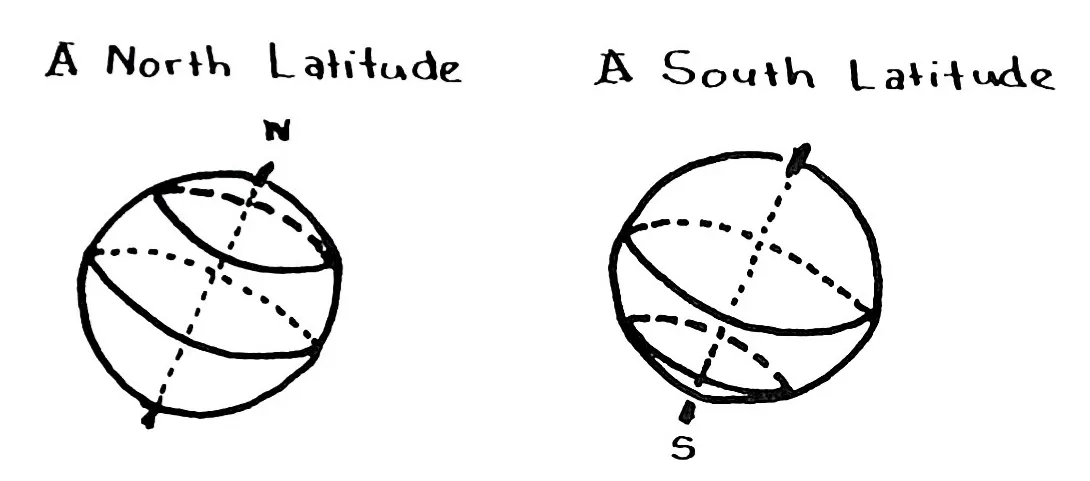
62 The most commonly known and used lesser circles are the lines of latitude. The Equator is also a line of latitude, but the only one that is also a great circle. Lines of latitude are all the lesser circles and the one great circle Equator that are perpendicular to the axis of the earth, but with the exception of the Equator do not pass through the center of the earth. Lines of latitude are described in terms of north or south. They are either parallel to and north of the Equator---between the Equator and the North Pole---or parallel to and south of the Equator---between the Equator and the South Pole.
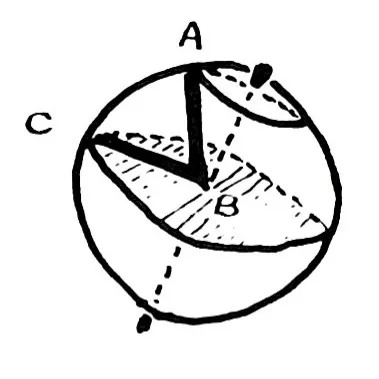
64 The lines of latitude are measured in terms of degrees. These degrees are calculated by measuring the angle formed from any point on the latitude line (A) drawn directly to the center of the earth (B), and from there back to a point on the Equator directly above or below the starting point (C) [that is, on the same meridian of longitude as the starting point].
66 The North Pole is 90°north latitude; the South Pole is 90°south latitude. A point midway between the Equator and the North Pole would be 45 ‘‘north latitude; a point midway between the Equator and the South Pole would be 45°south latitude.
67 So when we talk about longitude and latitude, we are talking about great and lesser circles drawn on our spherical earth. All lines of longitude are great circles; all lines of latitude are lesser circles, except the Equator.
68 Now I’ll take a pair of dividers---a compass---and mark off where 80°north latitude would be up here by the North Pole.
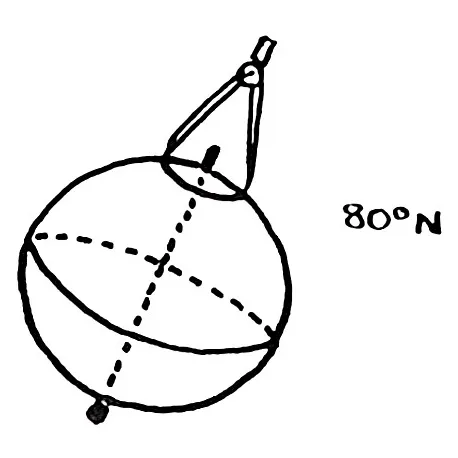
70 Now that my compass is set for a lesser circle exactly the same size as the circle at 80°north, I’ll take it and put the sharp point anywhere along the Equator and swing the pencil side to create a circle of the same size. There.
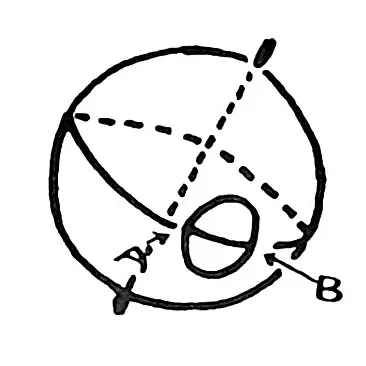
72 Now we can see that this lesser circle crosses the Equator at point (A) and again at point (B). You can also see that it is much shorter to get from (A) to (B) by staying on the great circle Equator than by taking the lesser circle. So we find that great circles are always the shortest distances between any two points on the surface of a sphere. That’s why ships have always tried to follow great circle routes when navigating great stretches of ocean. Do you follow?
73 BENJAMIN MACK: Yes, I see.
74 FULLER: Now what I have been doing these past few minutes is introducing you to what is called ‘‘spherical trigonometry.’’ ‘‘Trigonometry’’ is simply a word that means the study of the relationships of lines and angles in the triangle. Spherical trigonometry is the study of triangles formed on the surfaces of spheres. All navigation of ships and airplanes uses spherical trigonometry.
75 The circles we are using in our spherical trigonometry are the equivalents of the straight lines on a plane. A straight line is the shortest distance between any two points on a plane; a great circle is the shortest distance between any two points on the surface of a sphere.
76 Now I’m going to take a meridian of longitude and bring it down from the North Pole (A) to the Equator (B):
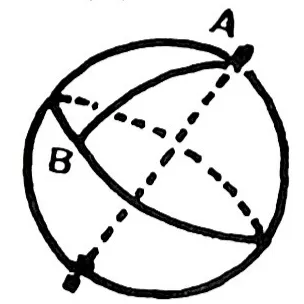
78 Now we already know that the Equator is inherently perpendicular---at exactly 90°---to the axis. The Equator can also be defined as the great circle formed by the spinning of the earth around its axis.
79 Now our meridian (AB) is perpendicular to the Equator, as are all meridians of longitude. So the angle formed by the intersection of (AB) and the Equator is 90°, a perpendicular angle formed between the planes of the meridian and the Equator.
80 Now I’m going to leave point (B) and move along the Equator one-quarter of its total length to a place I’ll label (C). Now we all know that there are 360°in a circle, which tells us that one-quarter of a circle would be 90°.
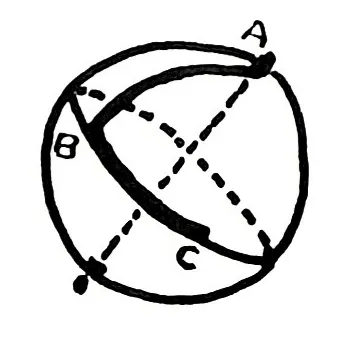
82 Now I’m going to run a new meridian from (C) back up to the North Pole (A). This gives us two angles: (BCA) and (CAB). We already determined that our first angle (ABC) is 90°.
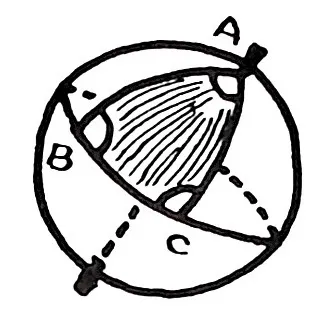
84 Knowing that angle (ABC) is 90°, we can determine that angle (BCA) must also be 90°for the same reason: it is formed by the intersection of a meridian of longitude with the Equator. Now our angle (CAB) is also 90°, because it is formed by the intersection of two meridians of longitude separated by exactly one-fourth the length of the Equator, a great circle of 360°, one-fourth of which must be 90°.
85 Now let’s look at what I’ve done. I’ve taken one meridian from the North Pole to the Equator (AB), moved one-quarter the length of the Equator to (C), and from there formed a new meridian to the North Pole (CA). Both (AB) and (CA) are sections of meridians of longitude, and therefore sections of great circles. Because the meridians (AB) and (CA) are great circle lines from the North Pole to the Equator, they are both the same length. We also know that the Equator is exactly midway between the two poles, and at 90°to the axis. Thus, the distance between the Equator and a pole is exactly one-quarter of a great circle. Now we know that all three legs of our triangle---(AB), (BC), and (CA)---are exactly the same length, one-quarter of a great circle. We have also proved that the angle formed by the intersections of each of the legs with another is 90°.
86 What we have formed here is an equilateral spherical triangle with three equal legs (each one-fourth of a great circle) and three equal angles (each 90°). 90°+ 90°+ 90°= 270°. And that’s clearly not the 180°your teacher told you every triangle must be. We have constructed a very real triangle on a very real earth, and we’ve come up with 270°.
87 Now let’s go a few steps further.
88 Let’s bisect---divide exactly in half---each leg of our spherical 270°triangle and then connect the midpoints to form a new, smaller spherical triangle which we’ll call (DEF).
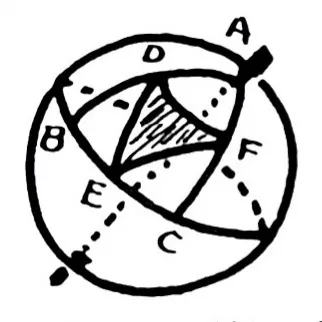
90 (D) is exactly midway between (A) and (B); (E) is midway between (B) and (C); (F) midway between (C) and (A). If we measure each of these three new angles---(FDE), (DEF), and (EFD)---we’ll find that each measures about 73°, for a triangle with total angles of 219°---certainly not our 180°.
91 Now we can repeat the same process with (DEF), bisecting each of its legs and connecting the midpoints to form a new triangle we’ll call (GHI).
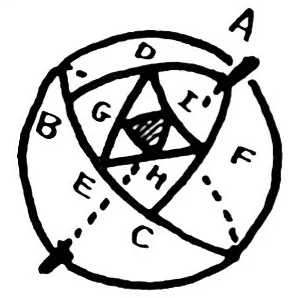
93 Each of the angles in our new triangle is about 63°, for a total of 189°. Again, no 180°triangle.
94 We can continue this process, making smaller and smaller triangles. But as close as the sum of the angles may approach 180°, it can never exactly reach that number, because 180°can happen only on an absolutely flat plane, and there’s no such thing as an absolute plane in the universe. So no triangle ever adds up to exactly 180°. It will always be more. A triangle can approach 180°, but it can never reach it.
95 This is the way you ought to be taught. They make the mistake in school right from the beginning by oversimplifying, and by saying that spherical trigonometry is too complicated for you. So they say, ‘‘I’m going to give you plane geometry,’’ not even cubical geometry. So you have to pretend there’s something called a ‘‘plane,’’ even though you can’t have a surface by itself---it has to be the surface of something. And anything that has a surface must also have an insideness and an outsideness.
96 So you might as well start with reality, and not with the fake imaginary plane that doesn’t even exist.
97 They tell you, ‘‘Well I’m going to start with something simple---a point that really doesn’t exist. It’s an imaginary point. Now I take a row of these points, and that’s one dimension, a line.’’ But you’ve already told me a point is nothing, so how can you make a line out of ‘‘nothing’’? And besides that, it’s impossible to have just one dimension by itself.
98 If you’re a scientist, you can’t accept anything without experimental evidence, and there’s no experiment that’s ever been devised to prove the existence of just one dimension by itself. Now you can have the linear dimension of a polyhedron of some kind. A polyhedron is an object having several surfaces and enclosed space; poly is Greek for ‘‘many’’ and hedron means ‘‘face’’ or ‘‘surface.’’ You can’t have a line by itself; you can’t have a plane by itself; you can’t have a surface by itself. You can’t even have a cube by itself unless it has weight, unless it has longevity, unless it has a temperature---all these qualities of existence.
99 JONATHAN: What do you mean by longevity?
100 FULLER: How long it has existed, how old it is. Anything that exists must have these qualities. I want you all to be scientists, pure scientists right here from the beginning. You have to ask these questions: How big is it? How old is it? And so forth.
101 I know it can be very hard for you, having worked so hard at school, to discover that what you’ve learned is wrong. But I’m giving you some corrections now. So let’s talk a little more about lines.
102 Now my teacher had a very nice ruler, a very good steel one. And she used that to draw her next line. But I told her, ‘‘Your line is still crooked. You can get a magnifying glass and really see how crooked it is. The chalk is uneven, and the line simply isn’t straight.’’
103 But the teacher said, ‘‘You’re simply not getting into the spirit of mathematics. This is a straight line.’’
104 ‘‘It is not,’’ I said.
105 ‘‘Very well, then,’’ she said. ‘‘I mean a line of sight, as when you are looking directly at something far away.’’
106 But let’s suppose I get a telescope and make a ‘‘line of sight.’’ Let’s put the telescope so it’s pointing directly at the point where the sun is tangent---touching---the horizon in the evening, just before we lose sight of it.
107 Now the sun is 93 million miles from the earth, and it takes light, traveling at 186,000 miles a second, about eight minutes to reach the earth. That means that the sun really hasn’t been where our telescope is pointing for eight minutes. We’re actually seeing around the curvature of the earth, and that’s not a straight line.
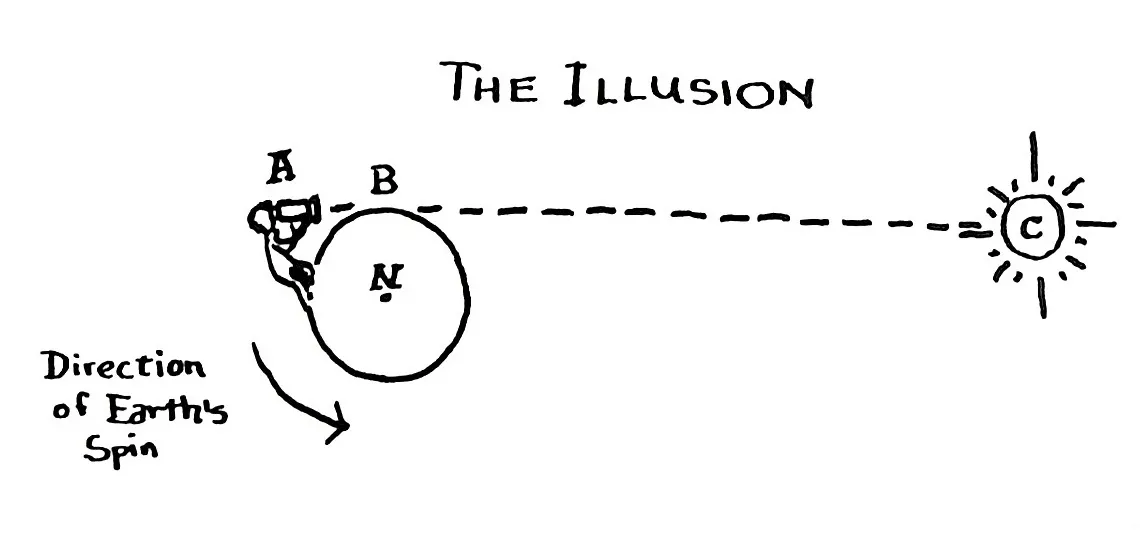
109 Our observer is standing on the Equator, and we are looking at him from a point above the North Pole. What appears to our observer (A) as he looks at the sun touching the horizon (B) is that he is seeing in a straight line from himself to the horizon and on past to the sun. But the earth has already revolved some eight minutes further than when the light left the sun. So our observer is actually hidden from the sun’s real position at the moment he is seeing light eight minutes old.
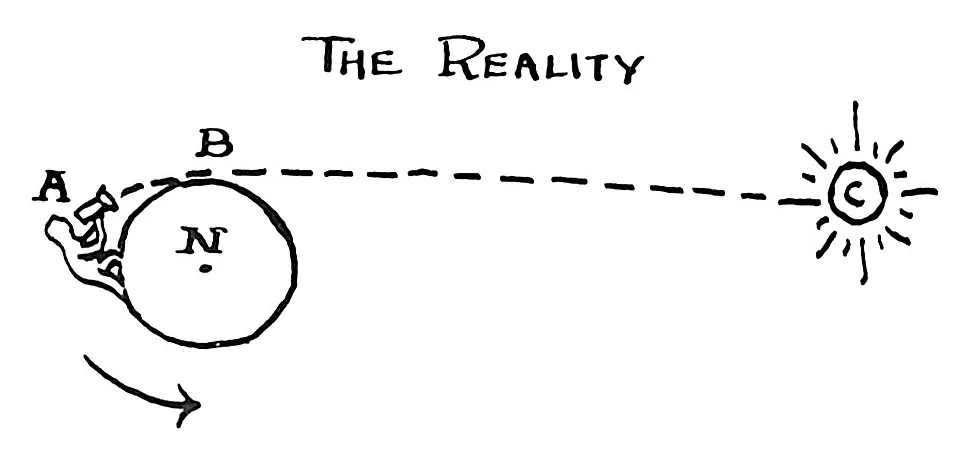
111 The observer is actually seeing around the curvature of the earth. This is what Einstein4 meant when he talked about ‘‘curved space.’’
113 So here was this teacher telling me I wasn’t getting into the ‘‘spirit of mathematics.’’ But the ‘‘spirit of mathematics’’ she was talking about was to make up things like ‘‘The sum of the angles of a triangle is always 180°’’ and ‘‘A triangle exists all by itself, just on one side of the line." And that’s why we have this immediate bias: ‘‘I’m only interested in this side of the line. You can’t pay any attention to the other side, because it goes all the way out to infinity.’’ But I said it didn’t go out to infinity at all.
114 I’m interested in the rest of the world, and that’s what’s on the other side of the line, not infinity.
115 So I said to my teacher, ‘‘I’m going to be a mathematician.’’
116 One of the greatest of the mathematicians was a man named Boole.5 Now Boole found that when you couldn’t get an answer, the best approach was ‘‘Just be completely absurd---make up the most absurd (ridiculous) answer you can think of. Make up a deliberately absurd answer. Then if it’s really absurd, then I can get a little less absurd, and then a little less absurd, and then still less absurd, until finally I may get somewhere near the area where I’ll be correct. At least I’ll be in the right area.’’ This process is called ‘‘reduction from absurdity.’’
118 Now I’m going to do a beautiful thing in the spirit of Boole. I’m going to make what I call a ‘‘deliberately non-straight line.’’
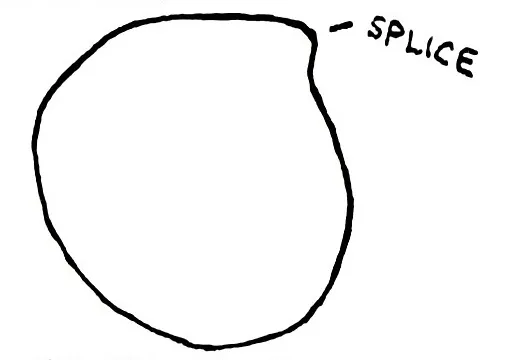
119 One of your ways of defining a straight line is to describe it as a line whose ends never come back on themselves. So we’ll begin our deliberately non-straight line with a length of rope whose ends we’ll splice together. So we’re starting with a line whose ends come back on themselves.
120 Now we’ll use a Dacron rope, because Dacron doesn’t stretch; it always remains the same length, unlike most other materials. And when we look closely at the rope, we see that it is made up of a lot of individual strands that are all woven around each other in curly spirals. So not only does our line come back on itself, but it’s composed of fibers that curl around each other.
121 Now once I’ve spliced the ends together, I’ve made a loop that’s coming back on itself.
123 Next, I m going to take any two parts of the loop and join them together in my hand.
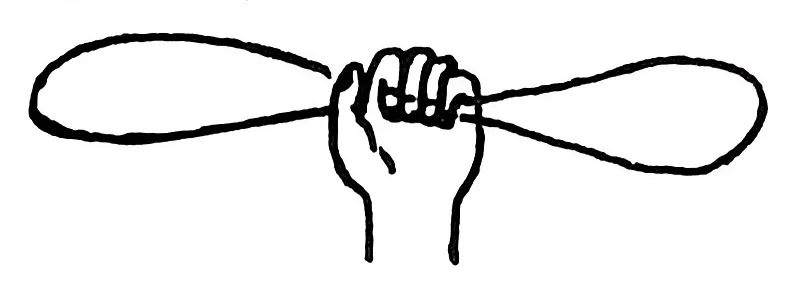
125 Now I’ll put a clamp where they come together, and then I’ll massage along the rope until I reach a point where the two parts turn around. And now I’ll tie a red ribbon at that point.
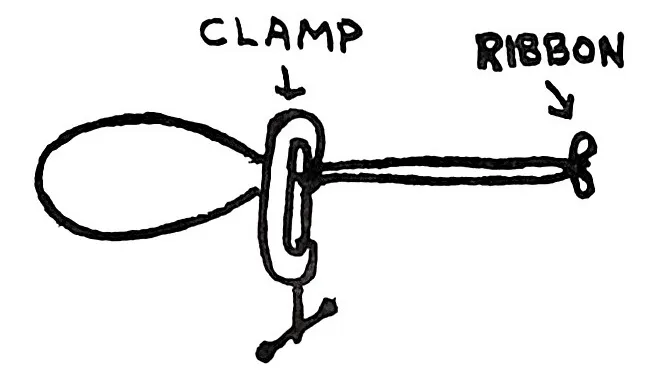
127 Now I’ll go back to the clamp and massage the rope in the other direction until I reach the turnaround point, and I’ll put another ribbon there.

129 Now a circle is a finite [limited] phenomenon. It comes back on itself; it doesn’t go out to infinity like the imaginary line.
130 So what we’ve done with our red ribbons is to divide our rope into two halves, two equal lengths. The ribbons mark the halfway points.
131 What I’ll do next is take our rope and bring the two red ribbons together, and then massage the two lengths of rope together until I reach their turnaround points, where I’ll tie two blue ribbons.
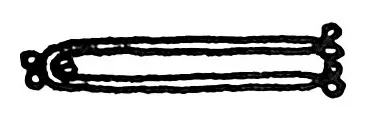
133 Now we have halved our two halves; we’ve divided our rope into quarters. We can keep on with this process, dividing the rope into eighths, sixteenths, thirty-seconds, sixty-fourths, and so on. I can make as many divisions as we want.
134 Next, I’m going to a large wall, and we’re going to drive two nails into the wall at approximately the same height from the floor and at a distance apart from each other less than the distance between the two red ribbons. Now we’ll loop our rope over the two nails.
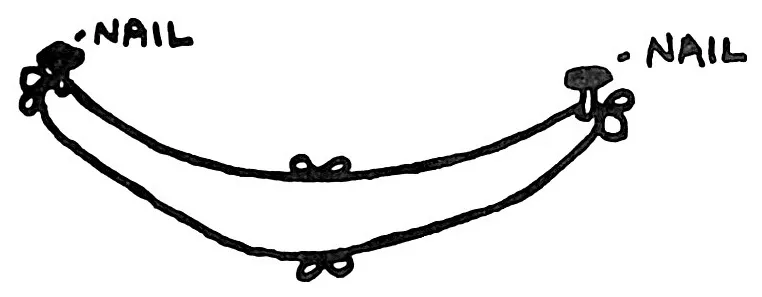
136 Now with the help of two friends, we’ll stretch the rope above and below the two nails until it’s tight, holding the rope at the blue ribbons which divide it into fourths. And when the rope is tight, we’ll drive in two more nails where the blue ribbons are.
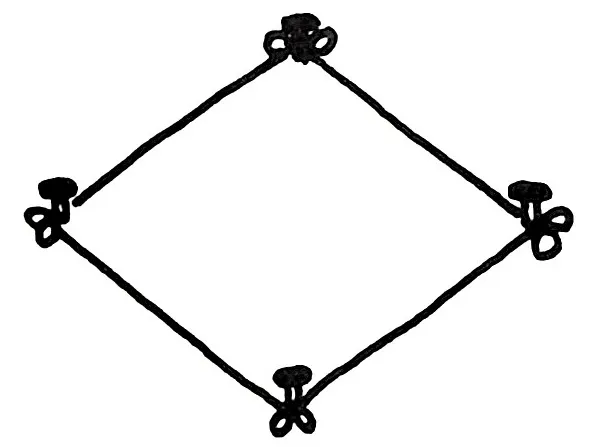
138 This creates what we call a rhombus, a shape of four equal edges and two pairs of angles, each pair equal to itself but not to the other pair.
139 Now let’s say that when we were dividing our rope into successively smaller halves that we marked our next division---that would be eighths---with green ribbons.
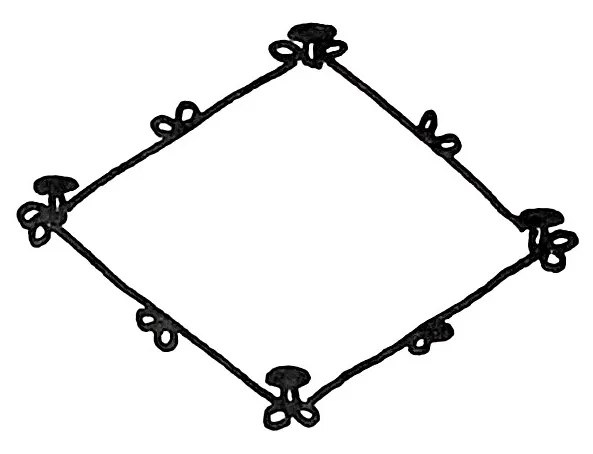
141 Now we’ll put nails inside our rhombus just touching each of the green ribbons. Next, we’ll pull the rope off the two nails where the blue ribbons are and bring the blue ribbons together so that they touch. This results in two rhombuses exactly half the size of the first.
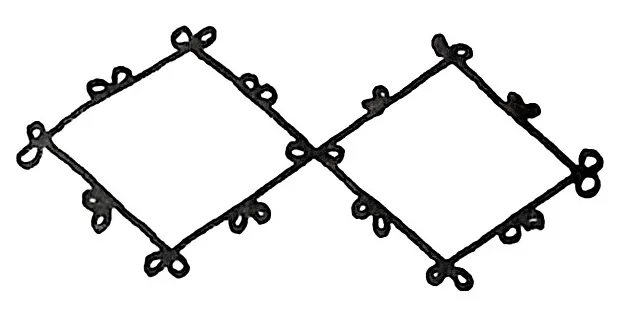
143 Now we can repeat this same process with the next divisions, the sixteenths. This gives us four rhombuses, each one- quarter the size of the first. Each of the rhombuses has four sides, for a total of sixteen---and this was the result of our dividing the rope into sixteenths:
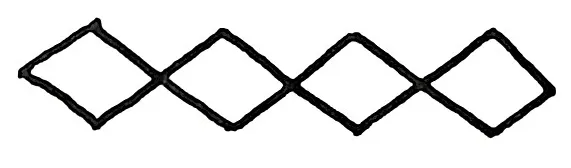
145 Now we can repeat the process again with our next division, the thirty-seconds. This gives us eight diamonds.

147 And if we do it one more time, with the sixty-fourths, we get sixteen diamonds (rhombuses).

149 You can see that we won’t have to continue this very much longer until we get something that looks like a straight line. But you and I know that it’s not a straight line. It’s a deliberately non-straight line.
150 JONATHAN: Right, I understand.
151 FULLER: So what would look like a straight line is simply very, very many of these little diamonds.
152 BENJAMIN: Yes ... I see.
153 FULLER: Now when your physics teacher wants to teach you about a wave, like electromagnetic waves and so forth, he takes a piece of rope and nails one end to the wall and takes the other end in his hand. Next, he pulls the rope tight and whips it. When he does this, you see a wave go to the wall and then come back to his hand. You can see this for yourself by tying a rope to a door handle. The important thing to note is that the wave makes a complete loop every time.
154 What is happening with our deliberately non-straight line is like an electromagnetic wave. And when a mathematician tells you, ‘‘I mean a line of sight,’’ you must remember that sight is like a magnetic wave: very, very high in frequency---number of complete loops per second---and very, very small in wave length---the distance between the starting and finishing points of one complete loop cycle.
155 A low-frequency wave is like our one-rhombus ‘‘line’’; and a high-frequency wave is one that would appear straight but is really not. But a line of sight is a wave line, ‘‘wavilinear,’’ like our deliberately non-straight line, and not a straight line. Physics has found no straight lines, only waves. So we’re in the world of reality when we refuse to accept this ‘‘reality of a straight line,’’ because there’s no such thing.
156 BENJAMIN: So there’re no straight lines, ever?
157 FULLER: That’s correct. How can you make a straight line in a world where you’re on the surface of a sphere that is traveling a thousand miles an hour around its own axis, orbiting the sun at 60,000 miles a hour, and the sun and all its planets are circling the center of the galaxy at an even faster rate of speed, and the whole galaxy is moving through space at a still higher speed? So with all these aspects of Universe in all this motion, where are the straight lines?
158 I find it wonderful how much you’re learning and how quickly you catch on to what the truth is. What you can prove for yourselves as pure scientists is fine---but don’t get fooled by what they teach you in school as absolutes.
159 Today you’ve been learning about relationships. And I hope you can see that you must learn to be logical, and to rely on experimental evidence, evidence which can be proven just as we have been proving things here today. Experimental evidence is evidence about the universe we live in, which is the reality.
160 One more thing about lines. Every line is a history. All lines are the consequences of some action, whether it’s done by you with a pencil, or by some star spinning by you. A line is a history, and the front end of the line is the event creating the history, like the point of the pencil moving across the paper.
161 Now let’s go back to the classroom again. The teacher went to the blackboard and drew a square. But the only reason her square stayed square was because it was held in position by the blackboard. A square can’t hold its shape at all. In fact, there’s no experimental evidence to prove there’s any such thing as a ‘‘square’’ at all.
162 We define a ‘‘plane’’ as a surface formed by three points [one point is a point, two points form a line]. But if we have four points, we have formed a hinge, and a hinge doesn’t have any stability at all. This is very easy to prove for ourselves.
163 We’ll take four sticks of equal lengths and join them together with flexible rubber connections. It takes four connectors to join the four sticks. Now you’ll find that the form we have created has no stability, no ability to hold its own shape. If you pick it up, it wobbles every which way and certainly doesn’t look like a square.
164 But if you take three sticks and three connectors, you’ll create a form that does hold its shape, a triangle. The triangle is the only polygon---the only ‘‘flat’’ figure we can create with sticks and connectors---that will hold its own shape.
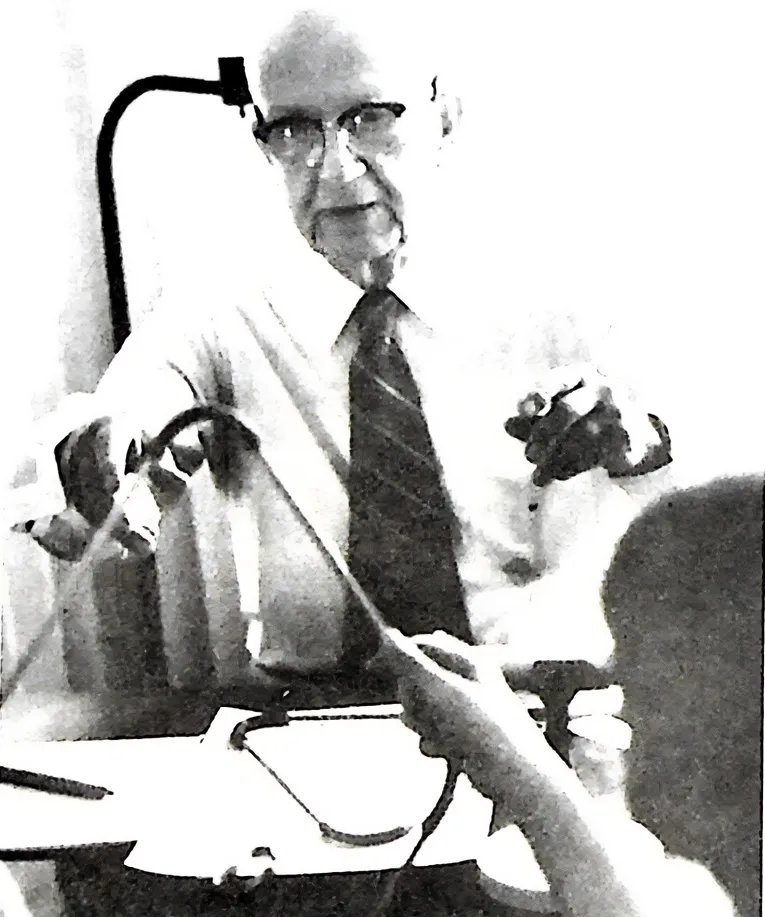
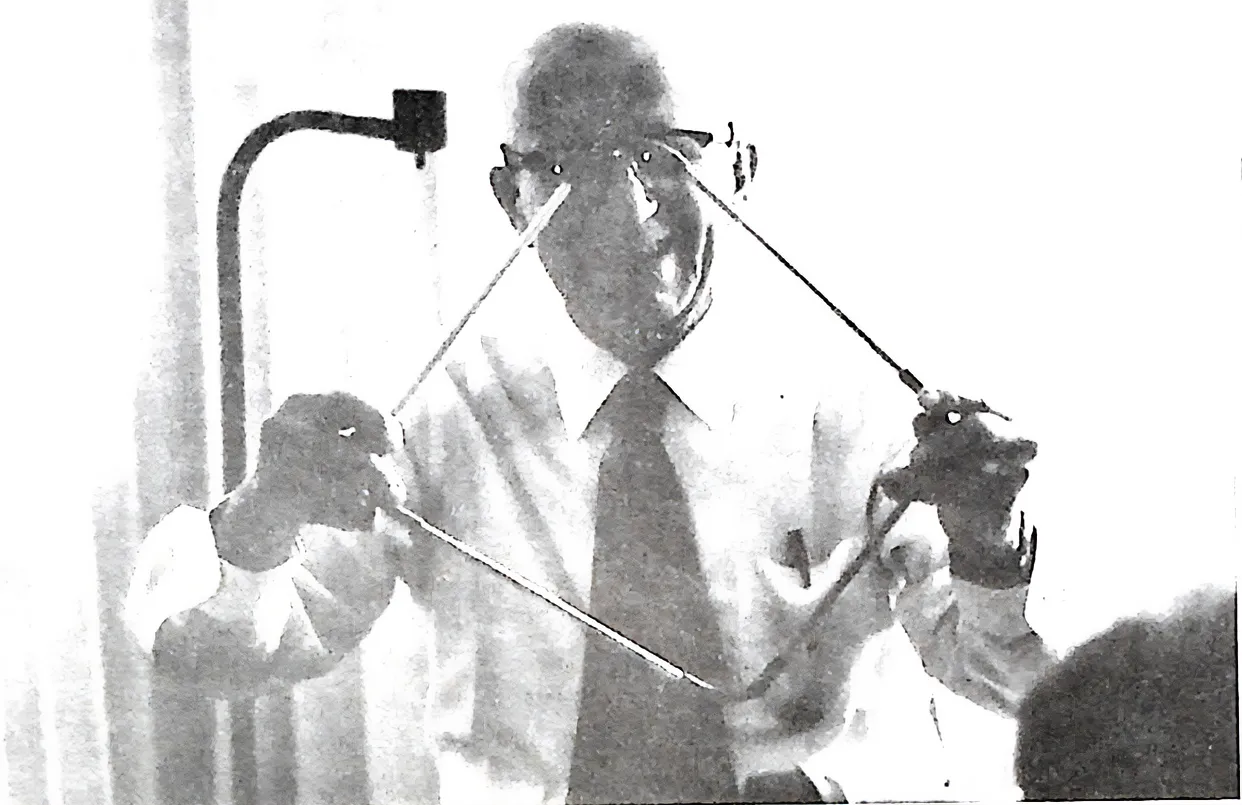
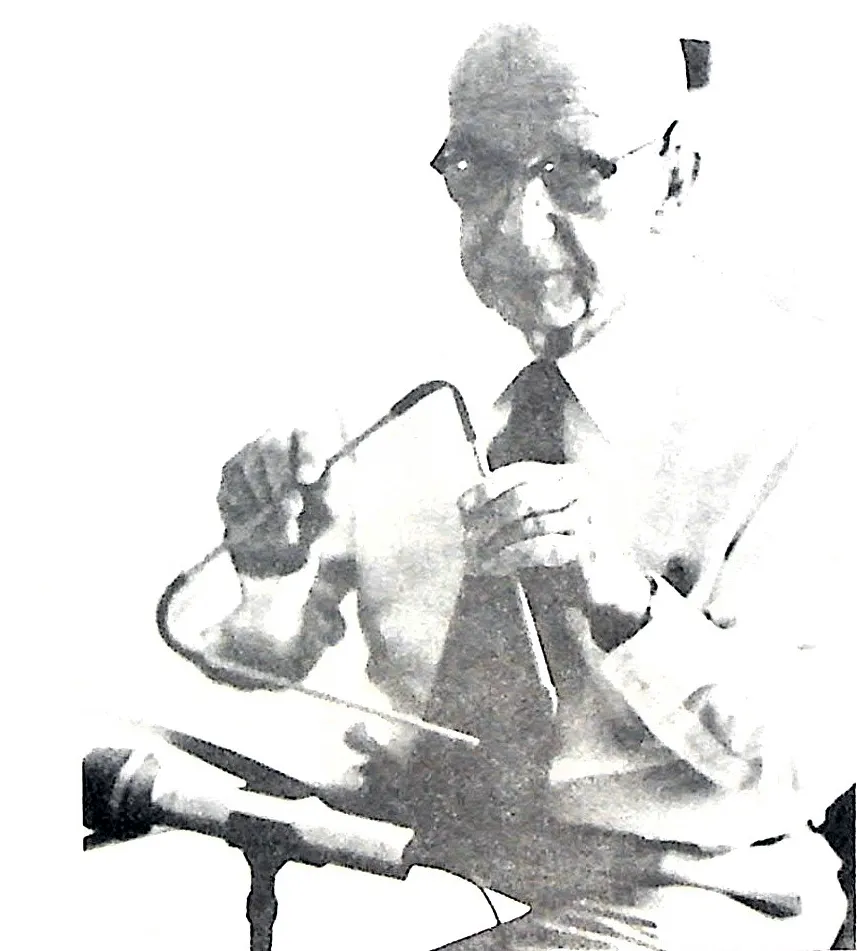
168 If something doesn’t hold its own shape, we can’t talk about it, because it doesn’t exist. When is a non-shape a shape? The only way you could make a stable square is to form it out of two triangles. Because only in the triangle is every potentially flexible hinge restrained by an opposing push-pull bar.
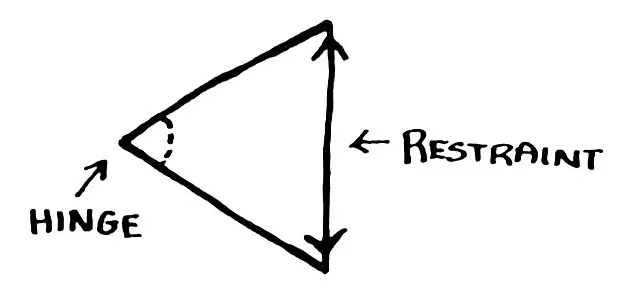
170 BENJAMIN: So you’re saying that the only shape that really exists is the triangle?
171 FULLER: Yes. Now we’ve already seen that a square can’t hold its shape. It has no stability.
172 You have to add another stick to get any stability at all. You can run a stick between any pair of opposite angles in a square, and now you have two stable triangles moving on a common hinge, our new stick.
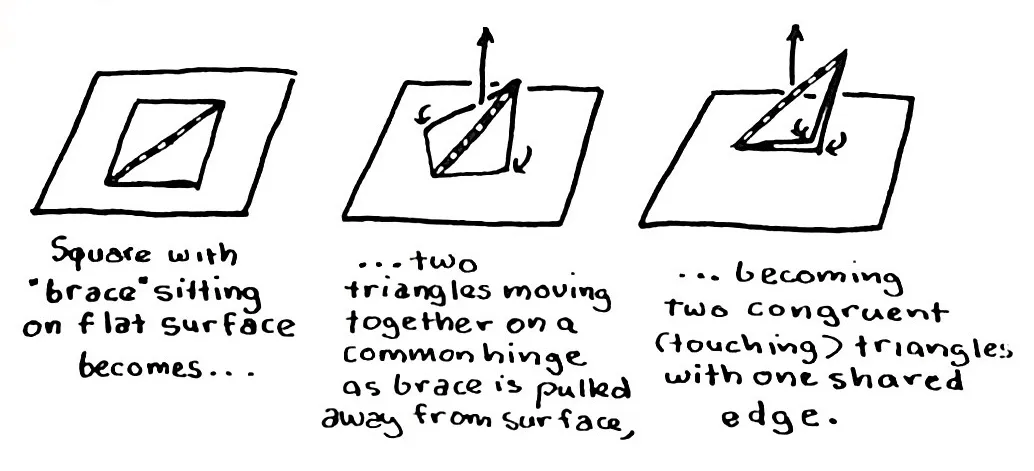
174 Again, the only thing that will hold its shape is a triangle. So when you’re talking about real structures, you have to start with the triangle.
175 Now how does a triangle hold its shape? You remember learning in school about the lever? Like when you take a screwdriver and pry open a paint can? A lever enables you to exert force far stronger than you could simply using your bare hands.
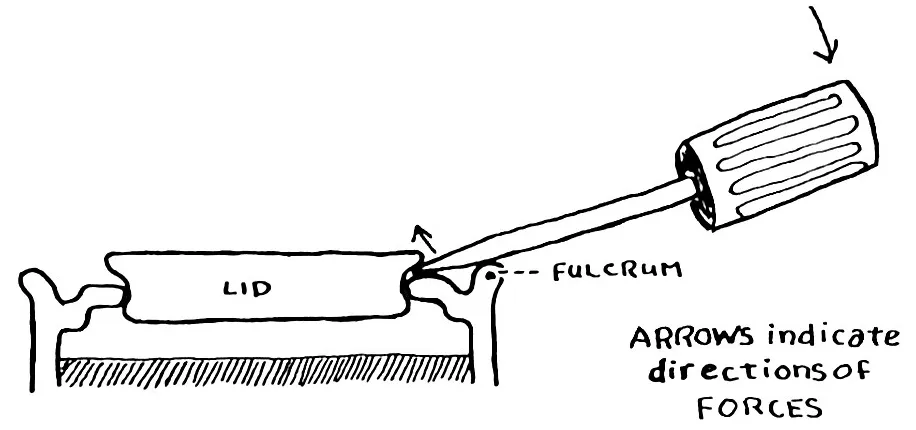
177 Now we call the power a lever gives ‘‘advantage.’’ The lever uses a stable base, a fulcrum, to rest against when it exerts pressure. In our paint can example, the screwdriver is the lever and the ‘‘lip’’ of the can is the fulcrum. The power of the lever becomes increasingly greater the longer the distance between the fulcrum and the place where you are applying the pressure, and the shorter the distance between the fulcrum and the object you are exerting pressure against. So a lever with a short arm is much weaker than a lever with a long arm.
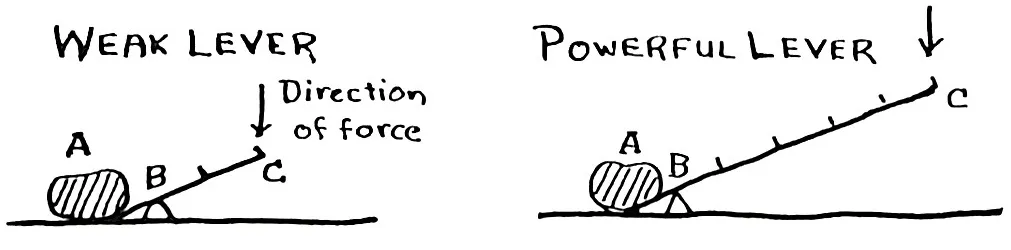
179 Our strong lever is much stronger than our weak lever because the distance between the source of the application of pressure (C) and the fulcrum (B) is greater, the distance between the fulcrum (B) and the object to be moved (A) remaining the same in both instances. The longer the ‘‘handle,’’ the greater the advantage. You can prove this for yourself.
180 The Greek mathematician Archimedes [287--212 B.C.] once said, ‘‘Give me a lever long enough and a place to stand, and I can move the world.’’
181 Now if you take two levers, you can make yourself a pair of scissors. The handles are the pressure points, which you squeeze together with your hands, and the pin that holds the two pieces of metal together is the fulcrum.
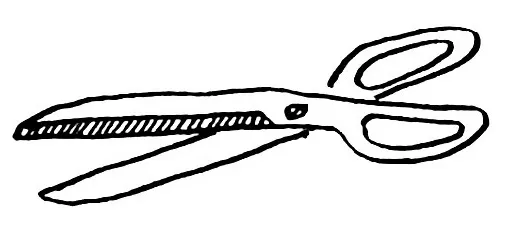
183 Now the longer the handles in relation to the blades, the more power the scissors have, the heavier the materials they can cut. Bolt cutters, used to cut thick pieces of steel, are really very powerful scissors with very long handles and very short blades. Using this tool, the average person can exert thousands of pounds of pressure; that’s how much advantage they give.
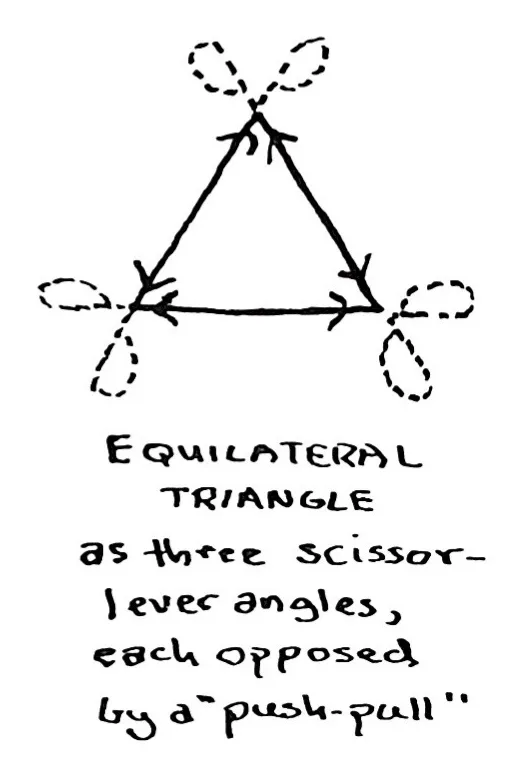
184 Now what we have with one angle of a triangle is a pair of levers, like a pair of scissors.
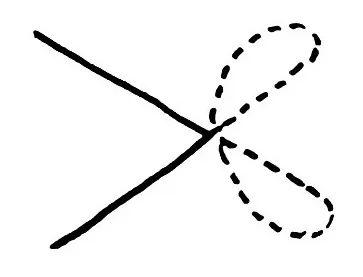
186 The third side, the side opposite the angle, is what I call a ‘‘push-pull.’’ It takes hold of the opposite angle and stabilizes it. Two sticks joined together by a flexible rubber connector can flop any which way, but once they are opposed by the push-pull, they become locked into place.
187 So each of the three angles in a triangle is a pair of levers opposed by a push-pull. There’s no other structure like it.
189 What I began to see as I continued to look at what I was being taught compared to what I was learning to be true showed me that physics and engineering didn’t have any real definition of structure. They said, ‘‘A structure is obvious; a block of marble holds it own shape.’’ But I said, ‘‘Wait. You don’t know what the atoms are doing inside that block of marble, and that’s what you have to look at.’’
190 So when I use the word ‘‘structure,’’ what I mean is ‘‘a complex of events.’’
191 This rubber piece connecting our two sticks at the corner of our triangle has a lot of atomic events going on inside it. And that’s also true with our sticks; each one is a complex of many atomic events [just as a house can be seen as a complex of thousands of bricks, boards, and nails].
192 So our one triangle is also composed of six major parts: our three flexible tension corners and our three rigid push-pull edges. And these six interact with each other to produce a stable balance.
193 So, I say that a structure is a complex of events that interact to produce a stable pattern. A square is not a structure, because it is not stable; a triangle is a structure, because it is stable.
194 Now, let’s look at something else. First, I’m going to draw one triangle.
196 This triangle represents the number 1.
197 Now I’ll draw a second triangle, a bit bigger, and I’ll divide its edges in half and connect the dividing points.
199 This gives us four triangles.
200 Now I’ll draw a third triangle, still larger, and divide each of the edges into thirds, connecting the dividing points as we did before.
202 This gives us nine triangles.
203 Now let’s make one more triangle, the largest yet, and divide its edges into fourths and connect the dividing points.
205 This gives us sixteen triangles.
206 Now you remember how they taught you about ‘‘squaring’’ numbers in school? 1 × 1, or 1 ‘‘squared’’ (12) equals 1; 2 × 2, or two squared (22) equals 4; 3 × 3, or three squared (32) equals 9; 4 × 4, or four squared (42) equals 16. And maybe they’d show you drawings like this:
208 But really the most efficient way is ’‘triangling’’ instead of ‘‘squaring.’’ We’ve already proved that a triangle is stable, while a square is not. Now we can see that a triangle is also more efficient than a square; it does more work with less material and effort.
209 It takes four sides to make the 12 square, but only three sides to make the number-1 triangle. There are nine sides in the number-4 (22) triangle, and twelve sides in the ‘‘4’’ square, three more than in the triangle. There are eighteen connectors in the number-9 triangle, and twenty-four connectors in the ‘‘9’’square. For the number-16 triangle, there are thirty connectors, and forty connectors in the ‘‘16’’ square.
210 So not only is the triangle stable where the square is not, but the non-stable square takes one-third again as much material and effort to contain the same number of units (subdivisions) as the triangle.
211 So what’s really happening is that nature is ‘‘triangling’’ instead of ‘‘squaring.’’
212 And since a square has no integrity, no ability to retain its shape, whereas a triangle does, and since the only stable square is really formed of two triangles, and since we say that nature always does things in the most economical way, you’re really ‘‘triangling’’ even though you say ‘‘squaring.’’ And because a stabilized square is really two triangles, it takes twice as much area to ‘‘square’’ as to ‘‘triangle.’’
213 So when nature multiplies herself times herself, as she does continually, would she be using squaring or triangling?
214 BENJAMIN: Triangling!
215 FULLER: She’d have to be triangling, since she’s always the most economical. She has to use something that works, that she can count on. We’ve seen you can’t count on squares, and so teachers at school are completely wrong about that.
216 RACHEL MYROW: When I hold the square, it just keeps going back and forth in my hand like it’s trying to become a triangle.
218 FULLER: Right, but it will not become a triangle until we put in that one more stick that makes it two triangles. Now it tends to hold its shape.
219 But even now you can’t guarantee that it will stay in one plane, because the two triangles hinge around each other. They only stay a square when you keep them on a flat surface like a table. There’s still something else we need.
220 Now I want you to pay very close attention to what I’m saying now. If I can point to anything, it’s because it’s seeable. And it’s seeable because there is light bouncing off of it back to my eye. Now if I take my pen and touch it to the paper, I may say, ‘‘I’ve got a point here.’’
222 The fact is, I’ve put ink there. I say, ‘‘I’m seeing a point.’’ But what I’m actually seeing is light reflected off the material that makes up the ink. If you turned out all the lights and closed the curtains so that the room was completely dark, you wouldn’t be seeing any point at all.
223 And if I looked at my point through a very big microscope, I could see that it has matter. It’s composed of all the chemicals that make up the ink. So anything I see has light bouncing off its surface. You can’t have a surface of nothing; it has to be a surface of something. And if it’s a ‘‘something,’’ it has to have an insideness and an outsideness.
224 So now I get to a very important question. What is the minimum that will give me an insideness and an outsideness?
225 Now two points have ‘‘between-ness.’’ Three points also have ‘‘between-ness,’’ but no insideness and outsideness. Three is still open, like a circle. But with four points I have an insideness and an outsideness. Four encloses a volume of space.
227 Now if you take a sledgehammer to some rocks and keep breaking them up, you’ll find that you can never get a piece with less than four corners; and you can never get a corner with less than three edges coming together; and you can’t have a face with less than three edges.
228 So there is one structure that is very important. It has four corners, each with three edges coming together, and it has four faces, each with three edges.
229 This structure is the minimum ‘‘something’’ in the universe.
230 Now the minimum ‘‘something’’ in the universe must be very important---and it is. It’s what we call the ‘‘tetrahedron.’’ Tetra is Greek for ‘‘four,’’ and hedron means ‘‘sides.’’
231 But it really isn’t safe to call these ‘‘sides,’’ because there are really no sides to it. There are four triangular windows. The idea of ‘‘sides’’ is another old error dating back to the days when a people saw a block of marble as an absolute solid, before scientists discovered that all so-called sides are really composed of very, very tiny atoms separated from each other by relatively large amounts of space.
232 So we have our triangular windows.
233 Now the minimum ‘‘something’’ of the universe has four corners---we can call them ‘‘loci’’---and four triangular windows. But it also has six edges connecting the four corners and forming the four windows. So there’s the number 6 as well as the number 4.
234 So we see that the minimum something begins with a 4--- the four corners and faces---but it also includes a 6---the six edges. So 4 and 6 are the minimum numbers. There is no number 1 by itself; 4 and 6 are the numbers that begin the minimum ‘‘something.’’ They are, therefore, very important numbers.
235 Now there was a man named Euler6, a mathematician. And Euler said that anything you can see breaks down into three fundamental (basic) elements of see-ability.
237 One is a line. Then there is a vertex, the place where two or more lines meet or cross. Then, when three or more lines cross each other to delineate---outline---a space, you have an area. So you have the line (A), the vertex (B), and the area (C).
239 Now a vertex is formed by two or more lines crossing or intersecting at the same point. An area is formed by three or more lines, and is defined by three or more vertexes where those lines meet.
240 When Euler looked at polyhedra (Greek for ‘‘many sided’’ objects), he discovered that the number of corners---vertexes--- added to the number of areas---the so-called faces---will always equal the number of edges---lines---plus the number 2.
241 So let’s take our tetrahedron. We know that we have four corners and four areas: 4 + 4 = 8. We have six edges, to which we add, as Euler tells us, the number 2. That gives us 6 + 2, or 8: the sum of the corners and faces.
242 Let’s see how this works with a cube, too. But first, I have to say that a cube is like the square in that it has no integrity until triangular braces are added. A cube made of sticks and our flexible connectors simply collapses.
243 So a cube has eight corners and six areas: 8 + 6 = 14. If you count the edges, you’ll come up with 12, to which we add Euler’s number 2, giving us 14, which works out exactly as Euler said.
244 Now this works for any object you can see. Let’s say you take a crocodile and count every exterior point you can see on it, then fill in all the points with lines so that it looks like a crocodile. You’ll still find that the number of points plus the number of areas equals the number of lines plus the number 2. It will always hold in every case. Euler has given us a very satisfactory formula in relation to these simple aspects of things you look at. And it even applies to anything you drew as a kid, because anything you can draw has points and lines and areas.
245 Now in physics they teach you that a cube is the basic unit of volume. But we know by now that a cube cannot exist by itself; it has no stability, no integrity because it is made from squares, which have no stability at all:
247 If you want to make a cube (A) hold its shape, you have to put a triangle in each of its faces (B).
248 So what we have done is put a dotted diagonal on each of the six faces, making each face into two triangles. And if you look closely, you’ll see that the shape formed by the six dotted diagonals has four corners, four faces, and six edges. So what makes a cube hold its shape?
249 JONATHAN: A tetrahedron!
250 FULLER: Right. A cube won’t hold its shape unless it’s triangulated. And when you triangulate a cube according to nature’s ‘‘least possible effort’’ rule, you get a tetrahedron.
251 Now if we take our triangulated cube (C), we see that we have connected only four of the cube’s eight corners in forming our tetrahedron. That leaves four other, opposite corners. If we connect those unused corners with dash-line diagonals, we find that we get another tetrahedron (D).
253 Now I want to account for all the corners of my cube, so I’ll connect them all (E):
255 What this gives me is two tetrahedrons, the dotted and the dashed, which we can also call the ‘‘positive’’ and the ‘‘negative.’’ What we call the ‘‘cube’’ is really two tetrahedrons, what I call the ‘‘star tetrahedron.’’ Let’s make one by pulling two of our tetrahedrons together.
256 RACHEL: Now that’s what I call a stable cube!
257 FULLER: It is. In fact, it’s the only cube.
258 In my synergetic geometry, I had to give up using the cube, because it doesn’t exist. What I do find is the star tetrahedron, made up of the positive and negative tetrahedrons.
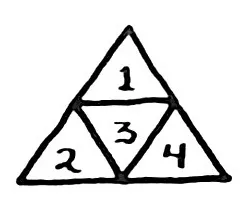
259 Now I’m teaching you nothing that isn’t terribly easy to understand right from the moment you start kindergarten. And I’ve been giving all of you basic physics, even astrophysics.
261 The physicists tell you there are no models for basic concepts, only equations. But that’s wrong. What I’m showing you here is the way Universe works.
262 Now the amazing thing about the star tetrahedron is that the two tetrahedrons, the positive and the negative, are always the same dimensions, and each rotates the other like a sphere. And as they rotate, the vertexes---corners---are always describing, outlining, a sphere. Isn’t that amazing! It’s a sphere of rotation. It’s really terribly exciting.
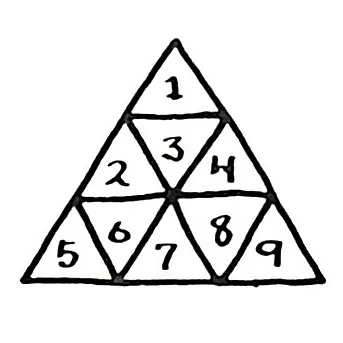
263 JONATHAN: It’s amazing. I can see that I’ve been taught about something that doesn’t really exist.
264 FULLER: Now let me give you some more of this new way of thinking. And always remember that we are proving our concepts each stage of the way: we are being scientists.
265 We now have a set of triangle-based structures, each with an inside and an outside, which we call systems. Now a system divides Universe into three parts; all of Universe inside the system, all of Universe outside the system, and the little bit of Universe that composes---makes up---the system that does the dividing.
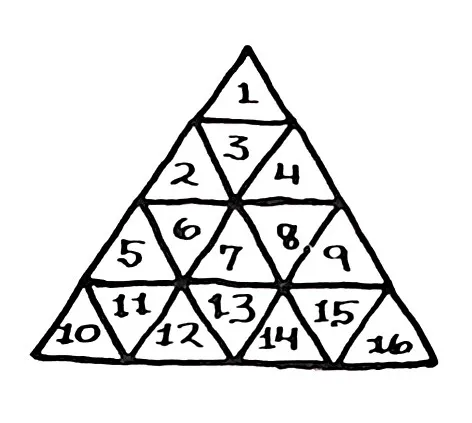
266 There’s another way of saying this. A system divides Universe into the microcosm [the part inside the system], and the macrocosm, the rest of Universe outside the system. Cosm comes from the Greek cosmos, meaning ‘‘cosmic’’ or ‘‘universal.’’ Micro means ‘‘small,’’ and macro means ‘‘large’’ or ‘‘great.’’ Macrocosm is the greatest extreme outwardness or outsideness of Universe; microcosm is the extreme inwardness or insideness of Universe.
267 When we’re in the realm of nuclear physics, we are dealing with the microcosmic; astronomy deals with the macrocosmic.
268 So I have a micro and a macro---a non-relevant and a nonconsidered---for a system is that which is being considered by the mind at this moment out of all the possible considerations in Universe.
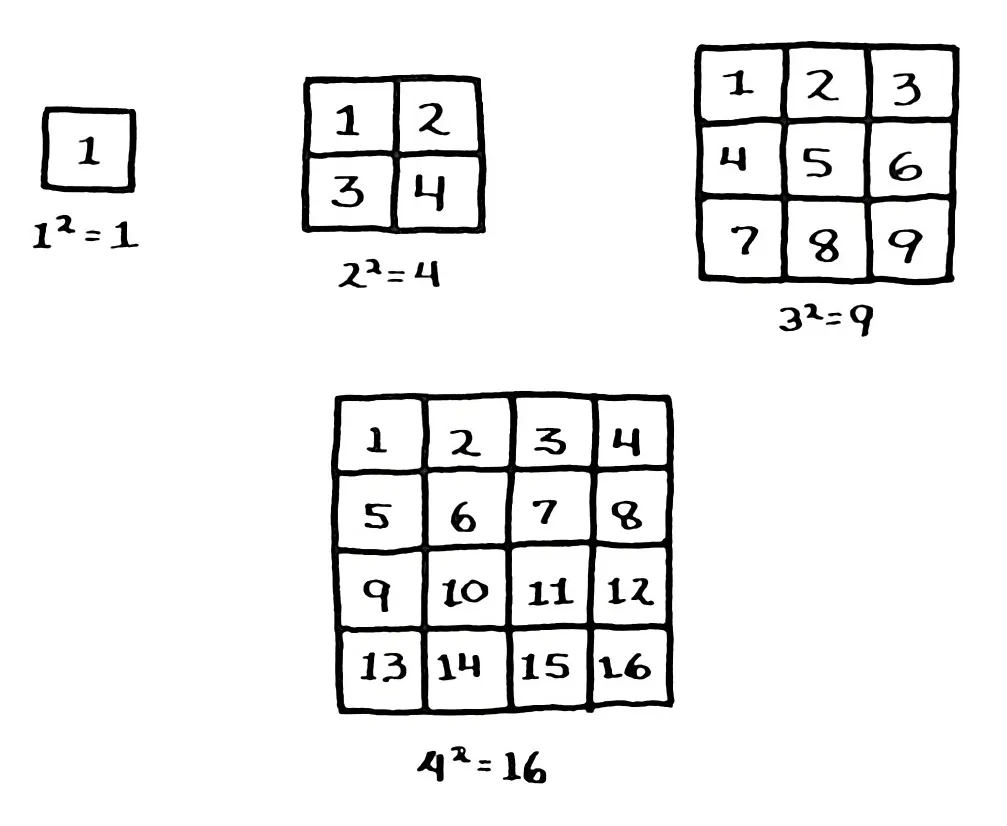
269 Thoughts themselves can be systems. In fact, all of our thinking is systemic. I’m having a thought right now. There are things that are too large and too infrequent to what I’m thinking about and there are things that are too small to even be readable. And then there is the system itself, which is what I am thinking about.
270 This is exactly the way electromagnetic tuning works, like the dial on your radio or the channel changer on your television. There are always bigger waves than you want to tune to, and there are always waves that are smaller. A system is always in between an insideness and an outsideness.
271 And there’s something else to remember about systems. You can’t have just part of a system without having the whole system. An area has to be the area of something, of some specific system with identifiable, describable characteristics.
272 Now let’s look at something else they taught you in school.
273 You’ve been taught to think in terms of ‘‘perpendicular’’ and ‘‘parallel,’’ and in ‘‘x, y, z coordinates.’’ These are all concepts based on 90°, based on a view of the world where the major relationships are at right angles to each other.
274 But Universe doesn’t operate perpendicular or parallel. Universe operates the way you grow. You grow bigger in all directions from the center of your body, like a balloon getting larger and larger as more air is forced in.
275 So the words for our real Universe are convergence and divergence. That’s how a wave operates.
276 BENJAMIN: What are the words?
277 FULLER: Convergence and divergence. To converge means to come together. Verge is Latin for ‘‘moving,’’ and con means ‘‘together.’’ To diverge is to move apart, di meaning ‘‘apart.’’ That’s how all wave phenomena operate. Drop a pebble in a pond, and the waves diverge out from the point where the pebble hit the water. Then the waves hit the edges of the pond and converge back toward the point of impact. Radar operates the same way, and so do sound waves. An echo is sound waves diverging, hitting an obstacle (like a mountain side), and then converging back again so that you hear yourself.
278 And with us, the way we use our minds, our interests diverge outwardly or converge inwardly. Sometimes we’re concerned with world-around problems or interests, sometimes, with some intimate, personal, and private thing. So the way we think is convergent or divergent. We’re attracted or repelled, ‘‘putting things together’’ or ‘‘tearing things down.’’
279 And this is also how we tune things, like a radio, a TV, or a guitar. We tune for exactly the wave we are looking for---the right station, channel, or note---by moving from one side of the wave or the other toward the wave length and frequency we’re looking for.
280 So in our electromagnetic world of wave vibrations, there’s no perpendicular or parallel. There’s only convergent or divergent. That’s the way she operates. So if we are looking for angles, we have to look for the angles of convergence or divergence.
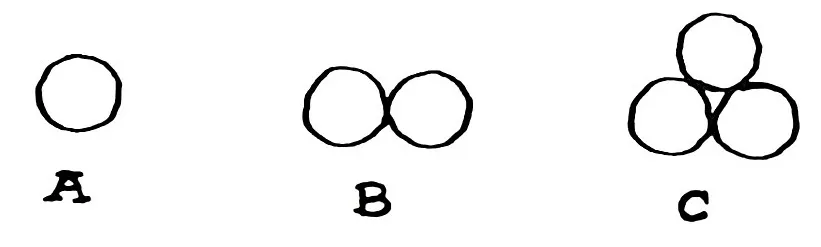
281 Now let’s start with a sphere of a given radius (A), like those spheres generated---formed---by the star tetrahedrons as they rotate around their common center. Now let’s take another sphere of the same radius and bring it as close to the first as possible, so that the two are tangent [touching] (B). Now let’s take a third sphere and bring it tangent to the first two, so that it is touching both (C). You’ll see that the three spheres form a triangular shape, since all three have the same radius.
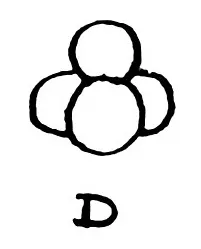
283 Now if we want to bring in a fourth sphere so that it’s tangent with the first three, where does it go? There’s only one possible place---on top of the first three, in the little ‘‘nest’’ at the center of the triangular structure. Now when you look at the resulting structure (D), what is it?
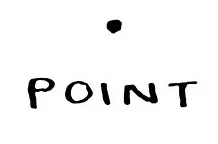
284 JONATHAN: A tetrahedron.
285 FULLER: Yes. And that’s convergence. The spheres have all come together.
287 Now I’ve said that you have vertexes, areas, and edges. The balls we have just put together represent the vertexes. The model we make with our sticks and connectors represents the edges. And you can make a model out of paper, just as I’m doing, that represents the areas, the faces.
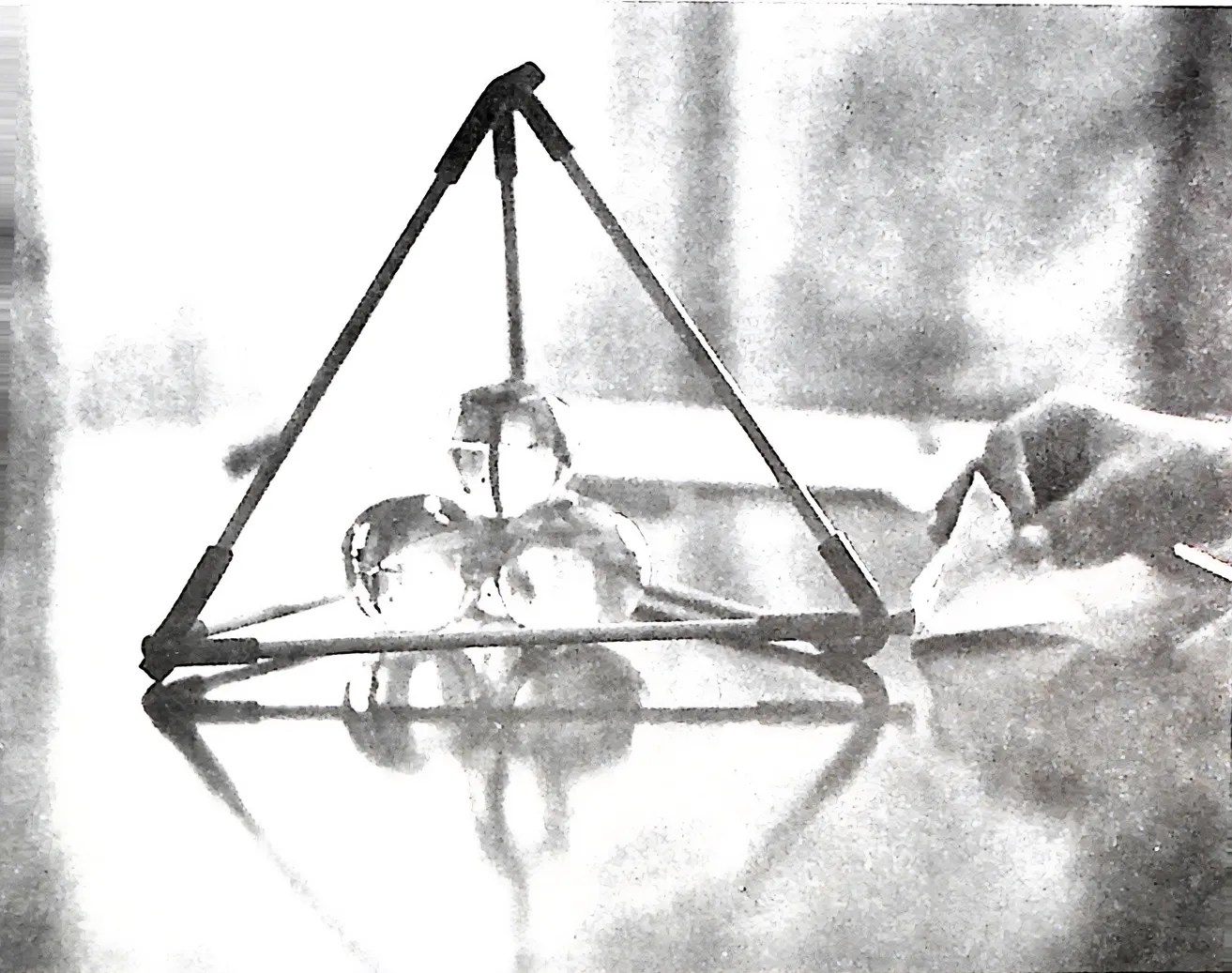
289 Now the way these balls pack together is the same way atoms pack together.
290 Let’s look at something else. We’ll start with another sphere this time, and we’ll see how many spheres of the same size we can place around it so that all the spheres are touching the central one.
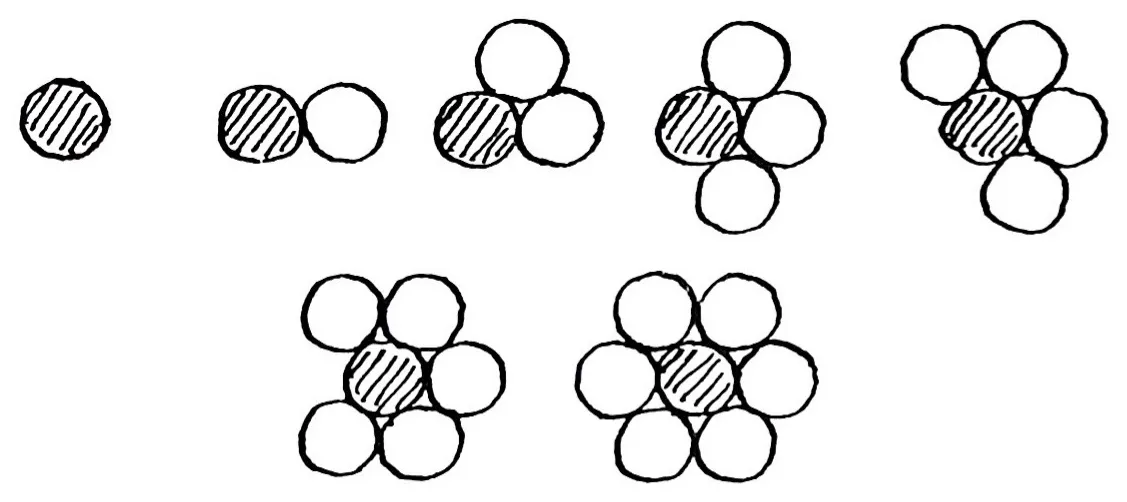
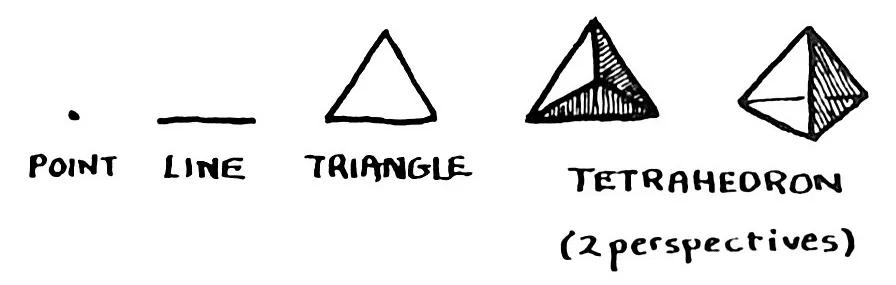
292 So, with our sphere sitting here on the table, we’re able to place six others around it, each touching the central sphere and each touching two other spheres as well, one on either side of it. So I get six-around-one.
293 Now if we mark the center of each of the spheres and then connect them with lines, we’ll see that we get six equilateral triangles forming a pattern described as a hexagon (meaning ‘‘six-sided’’).
295 Now the central sphere is what we call a ‘‘nucleus,’’ or the central event around which other events converge or diverge. These seven spheres, six-around-one, show us how things converge on the nucleus (A).
296 But there are still places in our six-around-one where other spheres could sit and still touch the nucleus, our central sphere. Now on our top side there are ‘‘nests’’ just like the nest on the three-ball structure where we placed a fourth sphere to form our tetrahedron.
297 Now we can place three spheres on top of our six-around- one, all touching other spheres and all touching the central nucleus (B).
299 Now if we turn our structure over, we’ll see that there’s room for three more on the other side, all touching the nucleus. When we’re finished (B), we have a structure in which the central nuclear sphere is completely surrounded by twelve other spheres (C).
301 Now I can give you another picture of the same thing by connecting the centers of all the spheres with radius lines, except for the central sphere (D). I call this structure a ‘‘vector equilibrium,’’ because all the lines are equal in length, and all the vertexes are equidistant (the same distance) from the central vertex and each adjacent vertex (E).
303 Now let’s consider something else. A cube has only three faces.
304 BENJAMIN: What? It sure looks like six to me!
305 FULLER: There are three sets of parallel faces in the cube. The cube has only three basic dimensions.
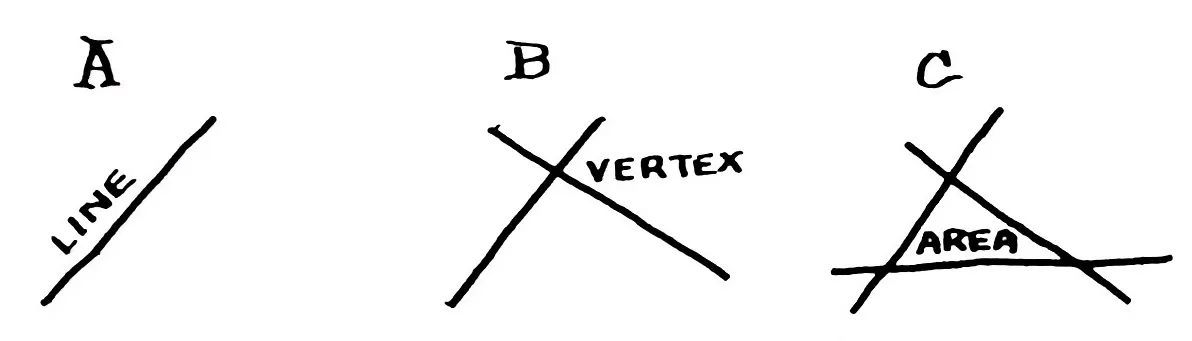
306 But the tetrahedron has four distinct dimensions, four distinct planes. So it is four-dimensional. And the dimensions of the tetrahedron are based on the real-life example of closest-packed spheres.
307 The tetrahedron’s four dimensions are based on 60-degreeness, rather than the 90-degreeness of the cube. And dimensionality is based on 60-degreeness, not on 90-degreeness.
308 Now let’s look at our tetrahedron again. Each of its faces is one of the four planes of 60-degreeness, and directly opposite each face is a vertex. Now let’s think about moving one of these planes or faces toward the opposite vertex. I’ll shade the plane so you can see it (A). Now as we move closer and closer to the vertex, the plane gets smaller and smaller (B, C).
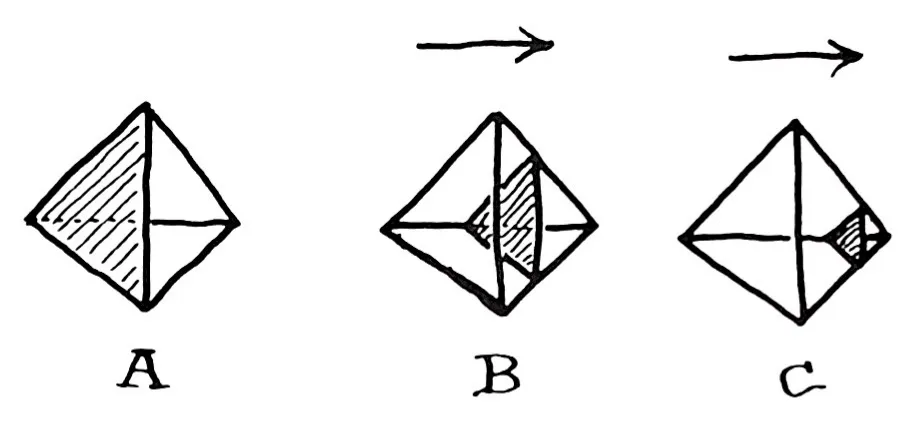
310 Now if we move all four planes to the center at the same time, we’ll have four planes passing through the same place at 60°to each other (D). That’s exactly what’s happening with the vector equilibrium.
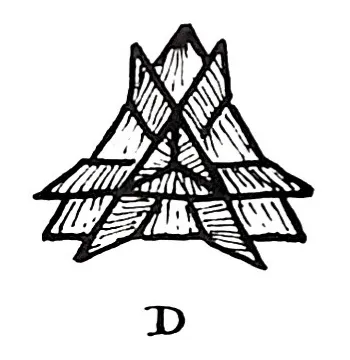
312 If we go back to the drawing [on page 70] we can see that the six-around-one from which we began our vector equilibrium forms a shape we call the hexagon. And if we look at drawing E [on page 74] we can see that the completed vector equilibrium outline is composed of four hexagons interlocked with each other. Each of these hexagons is at 60°to the other, and the plane of each hexagon passes exactly through the nucleus.
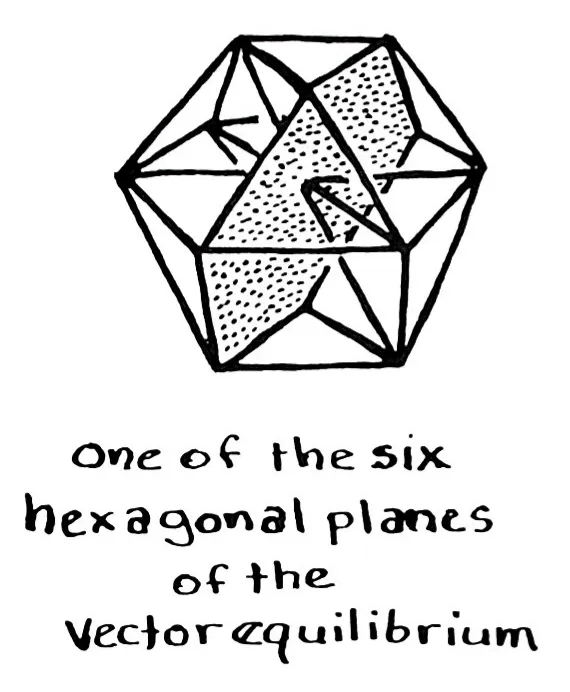
314 So the four hexagonal planes of the vector equilibrium are identical to the four 60°planes of the tetrahedron when they are all moved to the center of the structure.
315 In the vector equilibrium there are four hexagons crossing each other at the same time in 60°relation to each other. Can you all see that?
316 ALL: : Yes.
317 FULLER: So the vector equilibrium has four planes all passing through one central nucleus. It has twelve corners, and it’s based on the closest packing of same-sized spheres, twelve-around-one.
318 This is the way atoms pack. This is the most basic part of the atomic nucleus. This is the way real things converge and diverge.
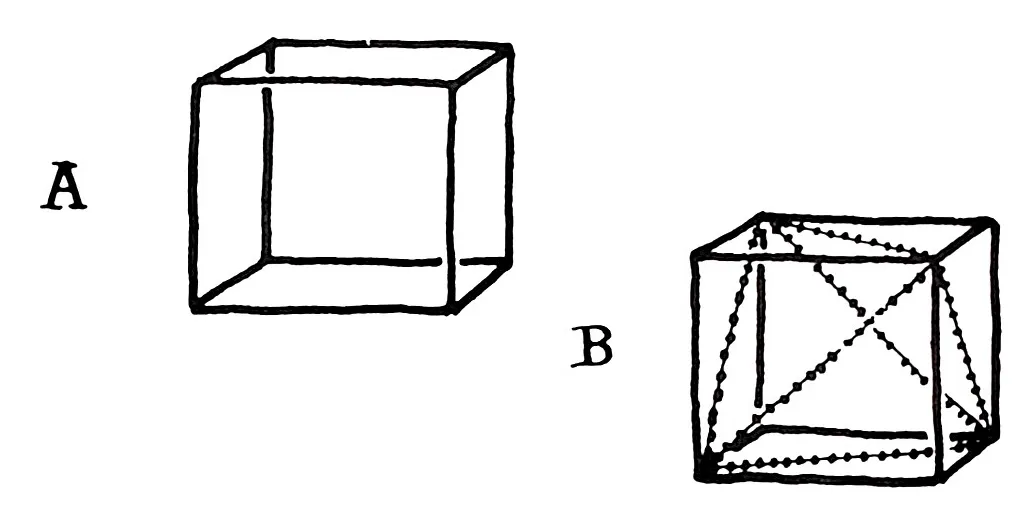
319 Now here’s a way we can make a model of the planes of the vector equilibrium from four same-sized paper circles and twelve bobby pins. Measure your circles on four sheets of paper so they are exactly the same size. Use a compass---or if you don’t have a compass, then use the bottom of a large can or the rim of a bowl.
320 Now, with your four paper circles, follow these steps:
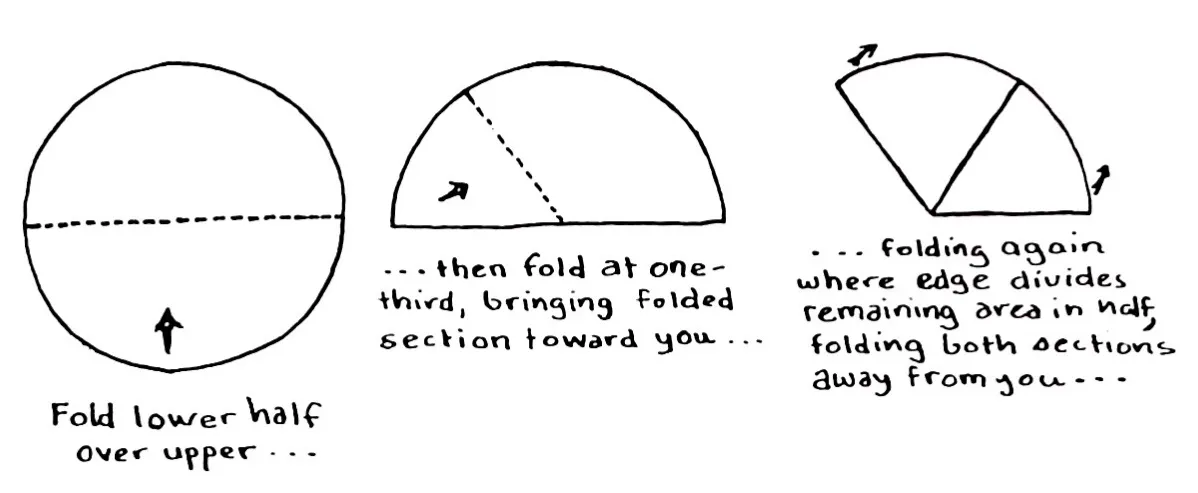
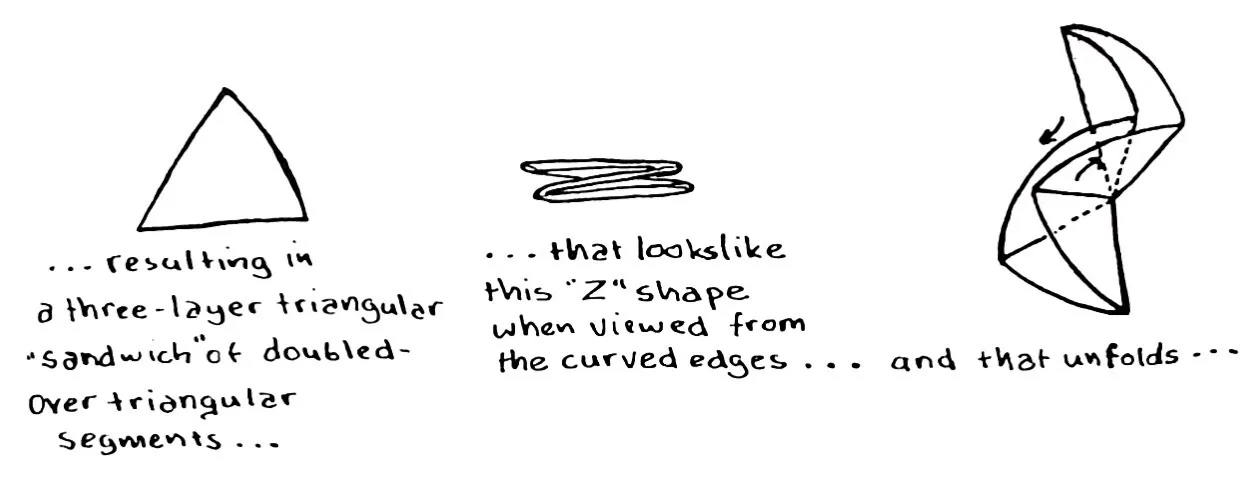
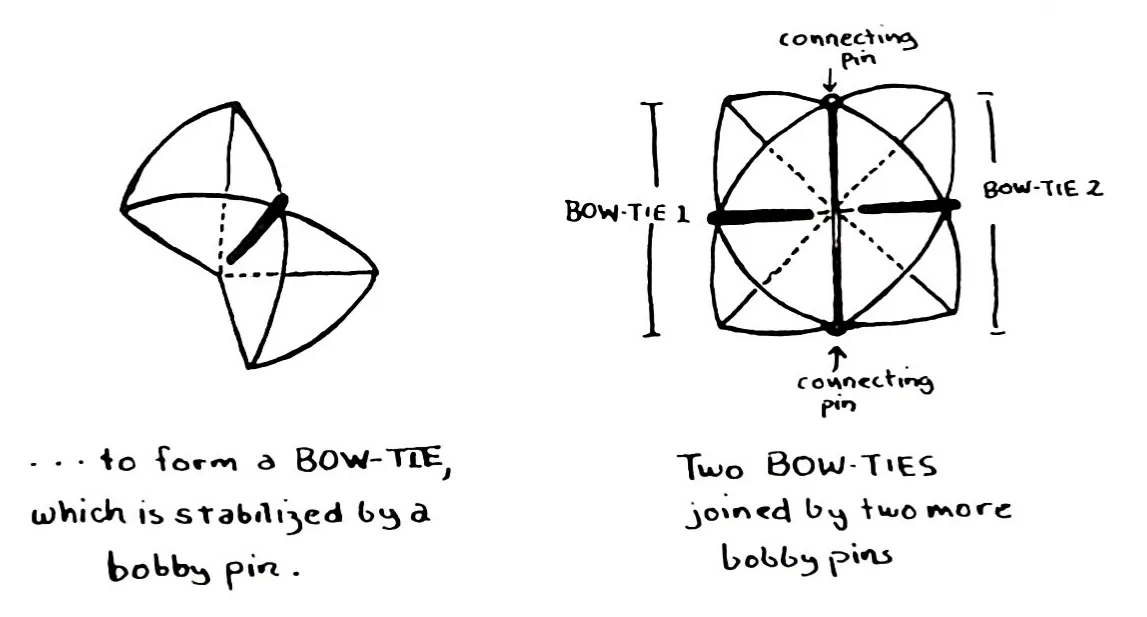
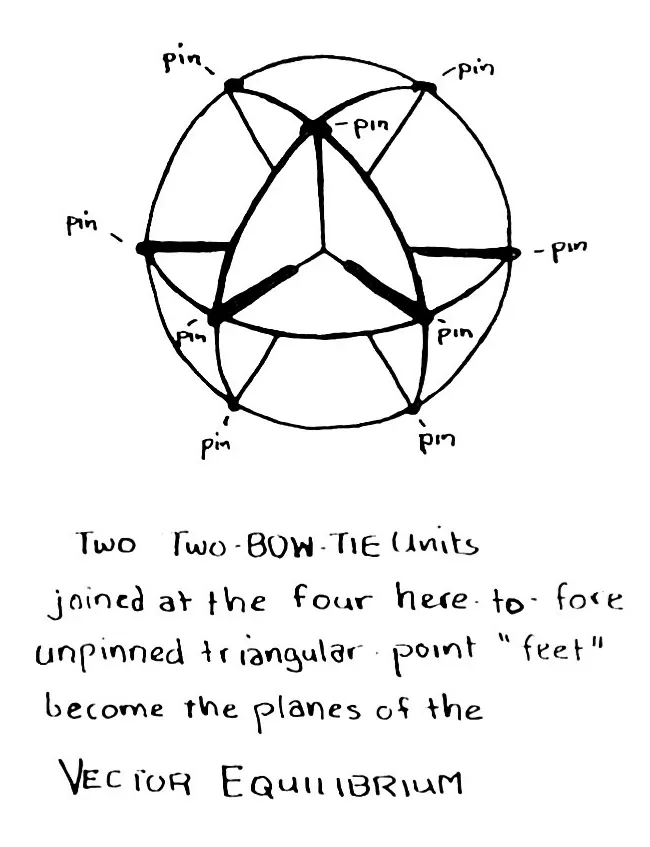
325 Now if you’ll look at the drawing D on page 73, you’ll see these same planes---only we formed them from a tetrahedron.
326 Now we can keep expanding our vector equilibrium model farther and farther out. We can add layers to our basic twelve-around-one, like this, looking at a cross-section (slice) through the center:
328 We find that to completely cover our first ball it took twelve new balls. And to form a layer that completely surrounds the twelve balls of the twelve-around-one takes forty-two new balls, nested on the first twelve just the way we nested the fourth ball to form the tetrahedron. Now a layer to completely cover the forty-two-ball layer will require ninety-two new balls. The next layer would be 162, the next 252, and so forth.
329 Now if we go back and look at drawing E on page 74, we can see that the surface of our vector equilibrium is formed of two shapes---triangles and squares. If we count, we’ll see that there are eight triangles and six squares.
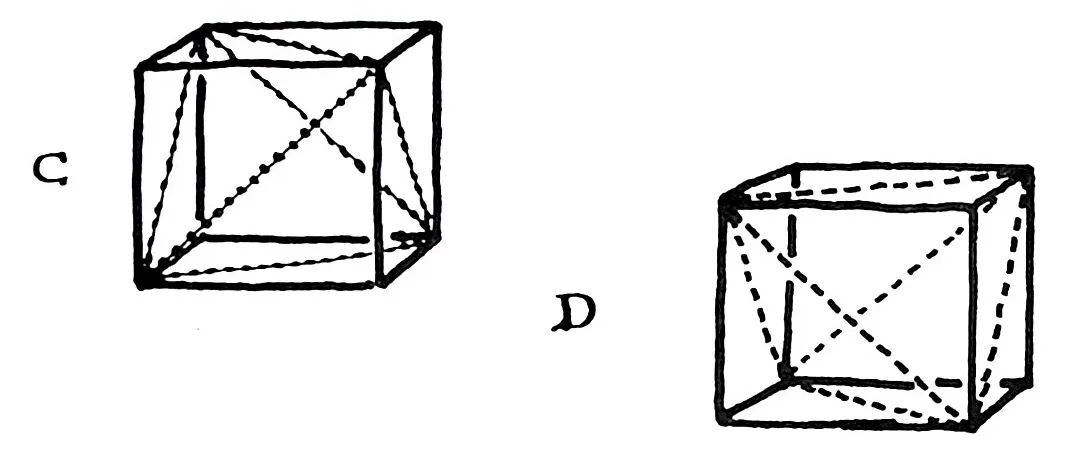
330 Each time we add a new layer of spheres to our vector equilibrium, it maintains the same pattern of triangles and squares.
331 Now we’ve discovered that each time we add a layer of spheres around a central nuclear sphere, the number of spheres in every layer ends with the number 2.
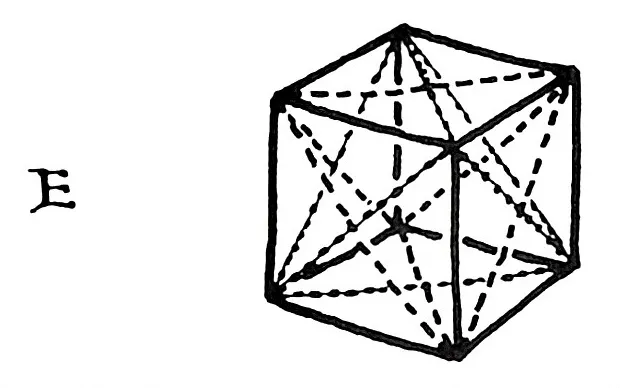
| 1 layer | = | 12 spheres |
| 2 layers | = | 42 spheres |
| 3 layers | = | 92 spheres |
| 4 layers | = | 162 spheres |
| 5 layers | = | 252 spheres |
| 6 layers | = | 362 spheres |
333 Now remember when we talked about Euler’s formula [pages 61--62]? Well, Euler’s formula laid some importance on the number 2. The number of the vertexes plus the number of the faces equals the number of the edges plus the number 2.
334 Now the number of spheres on the surface of a vector equilibrium is the number of the vertexes, and we have already established that the center of one of our spheres represents a vertex.
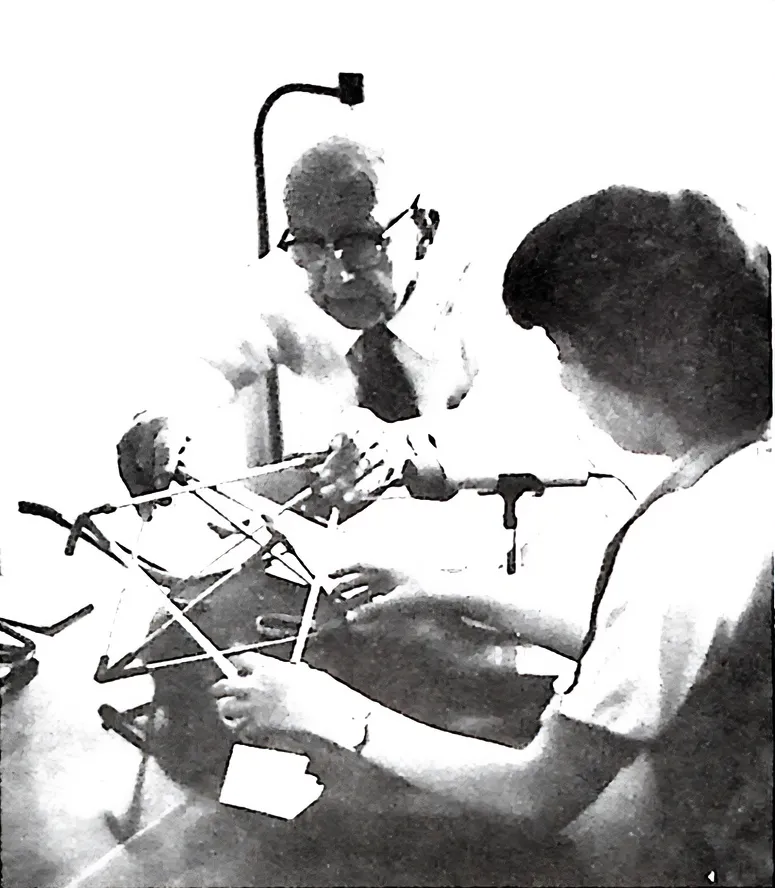
335 When we look at the number of spheres required to make each new layer of spheres on our vector equilibrium, we discover a new formula that is a corollary of Euler’s formula.
336 First, let’s subtract the number 2 from the number of spheres in each layer:
| 1 layer | 12 - 2 | = | 10 |
| 2 layers | 42 - 2 | = | 40 |
| 3 layers | 92 - 2 | = | 90 |
| 4 layers | 162 - 2 | = | 160 |
| 5 layers | 252 - 2 | = | 250 |
| 6 layers | 362 - 2 | = | 360 |
338 Now I suspect you can begin to see a relationship between these numbers and the number of layers out from the center. That relationship will become a lot clearer if we take the additional step of dividing each of these new numbers by 10.
| 1 layer | 10 ÷10 | = | 1 |
| 2 layers | 40 ÷10 | = | 4 |
| 3 layers | 90 ÷10 | = | 9 |
| 4 layers | 160 ÷10 | = | 16 |
| 5 layers | 250 ÷10 | = | 25 |
| 6 layers | 360 ÷10 | = | 36 |
340 Now it becomes clear. If we raise 1 to the second power (1 times itself, 1 × 1) we get 1; 2 to the second power is 4; 3 to the second power is 9; 4 to the second power is 16; 5 to the second power is 25; 6 to the second power is 36.
341 Now before I state our new formula, let me give you one more term: frequency. When I speak of frequency in the vector equilibrium, I am referring to the number of layers of spheres out---diverging---from the central nuclear sphere. So our first layer of 12 spheres is the 1-frequency; our second layer of 42 is the 2-frequency; the third layer of 92 is the 3-frequency; and so forth.
342 And now on to our new formula.
343 I find that the number of spheres in any frequency of the vector equilibrium is equal to the number of the frequency (F) squared multiplied by 10, plus the number 2. We can write it out this way: N = 10F2 + 2, where (N) is the number of balls in the layer and (F) is the number of the frequency.
344 Let’s see how this works. If we want to find the number of balls in the 4-frequency layer, then we square the number of the frequency---4 × 4 = 16---multiply that number by 10---16 × 10 = 160---and then add the number 2---160 + 2 = 162. This works for every frequency of the vector equilibrium.
345 What we’re discovering here is very exciting, because it relates to things going on in the real world and not just imaginary concepts.
346 Now let’s take a special look at the 3-frequency vector equilibrium. There are 92 spheres in the outer layer. You may have already learned in school that there are 92 naturally occurring chemical elements in the known universe. And if we add up the numbers of the first three frequencies (12, 42, and 92) we get 146---and that works out to be the number of neutrons in uranium, which is the 92nd, or final, chemical element. So I find we’re already dealing here in nuclear physics, very deeply into it, further than most of the physicists have gone themselves. There’s also something else about this layer: it’s the first in which the arrangement of the spheres makes the central sphere totally invisible. (You can still see glimpses of it through the spaces in the 2-frequency.)
347 We are dealing here with concepts and principles, and these are independent of size. The concept ‘‘triangle’’ has no particular size. A triangle is a triangle, whatever its size may be.
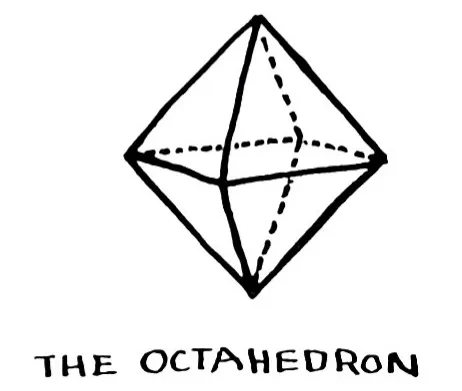
348 Now I said a system divides the universe into an inside and an outside. It is triangular, and a tetrahedron is the minimal structural system or ‘‘something’’ in the universe. There is another triangular system that is composed of all triangular faces, which divides the universe into an inside and an outside, and which exactly fits up against the tetrahedron. This new system is called the ‘‘octahedron.’’
349 Octa means ‘‘eight,’’ so octahedron means eight-sided. And our octahedron has eight faces, each an equilateral triangle. There are six vertexes, and twelve edges. Going back to Euler’s formula (corners + faces = edges + 2) we have 6 corners + 8 faces = 12 edges + 2, or 14 = 14.
350 Let’s take a look at this new system.
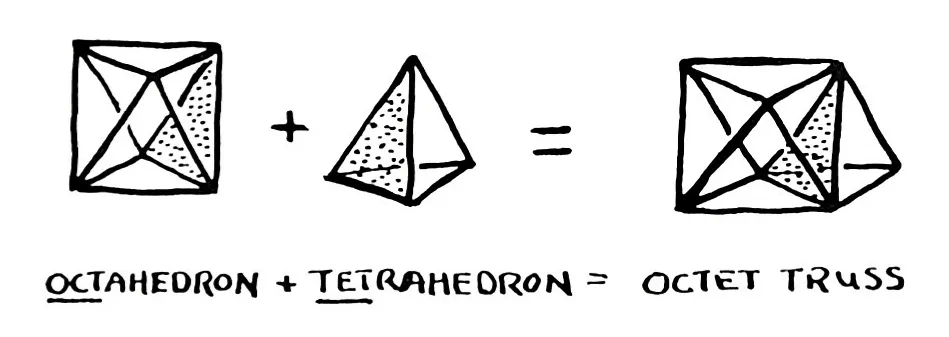
352 There’s something else about the octahedron and its relationship to the tetrahedron. These two systems in combination with each other work to fill all space, leaving no gaps. They are what I call ‘‘allspace filling.’’
353 I call this combination of the octahedron and tetrahedron the ‘‘octet truss."
355 The Greeks liked cubes because they seemed to fill all space, packed next to each other cube to cube.
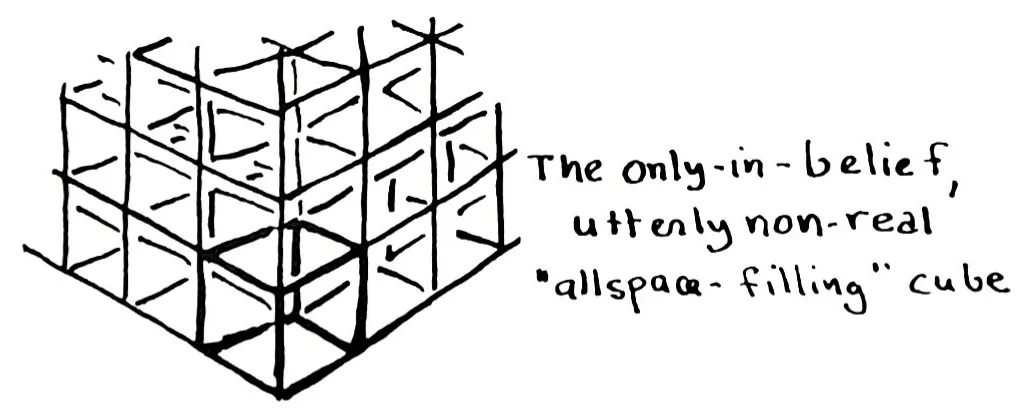
357 But we’ve already seen that the cube is not stable. It’s not triangulated, and so it’s not able to hold its own shape. But the octet truss is based on 60°triangulation and is stable.
358 Now if you double the size of a cube, you increase the volume eight times. That’s easy to see in this drawing:
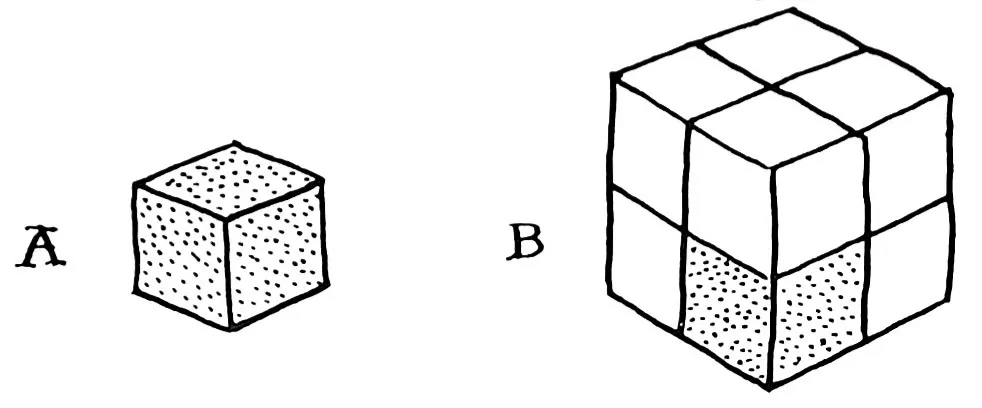
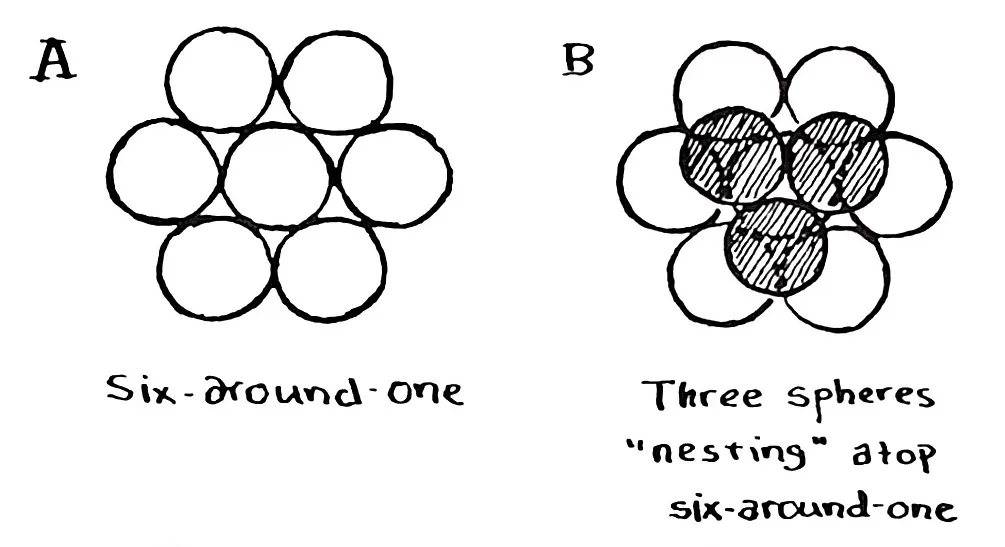
360 If our cube is one inch on a side, we double it by making a new cube two inches on a side. Our first cube (A) had a volume of one cubic inch; our doubled cube (B) has a volume of eight cubic inches. [See also pages 123--125.] Now let’s see what happens when we double the size of a tetrahedron (C) to (D).
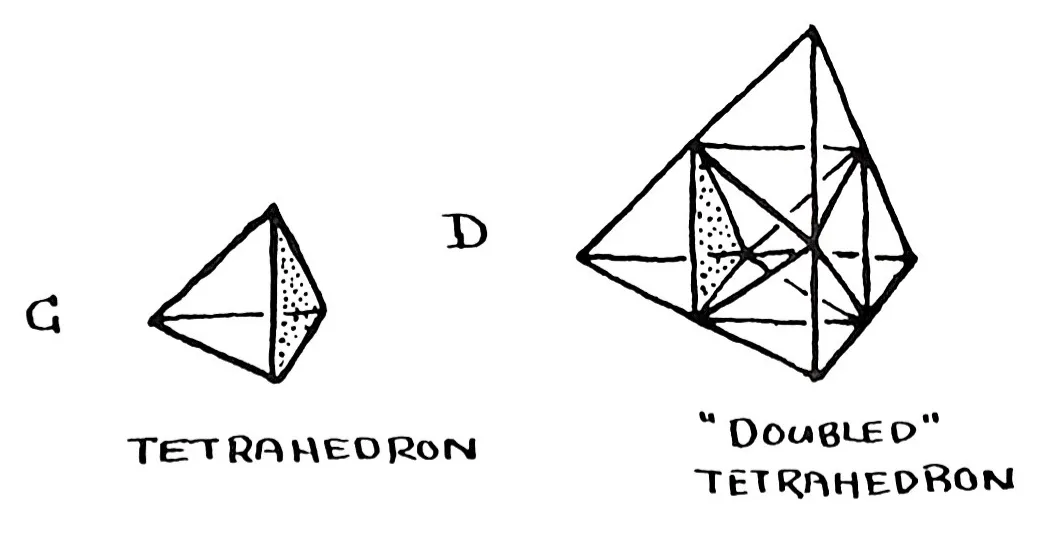
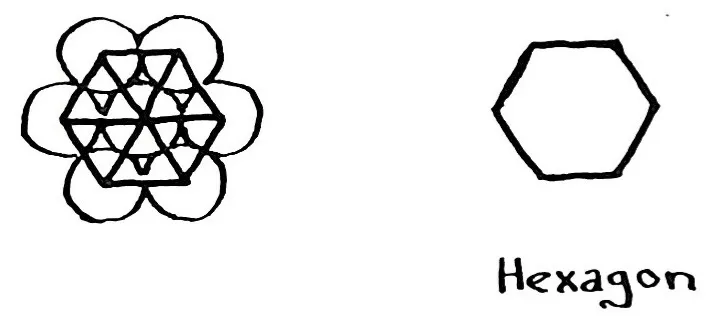
362 Our new doubled tetrahedron also has a volume of eight. It’s a rule in geometry that when you double (square) the edge dimensions of a solid, you ‘‘cube’’ (increase eightfold) the volume.
363 Now something interesting happens with our tetrahedron when its edge dimensions are doubled. If you divide each of the edges of the doubled tetrahedron in half and connect the midpoints, you get a structure in which each of the four corners is composed of a tetrahedron the size of the tetrahedron (C) which we doubled to form (D). If we remove these four corner tetrahedrons, we find they have been covering four of the eight faces of a central octahedron (E):
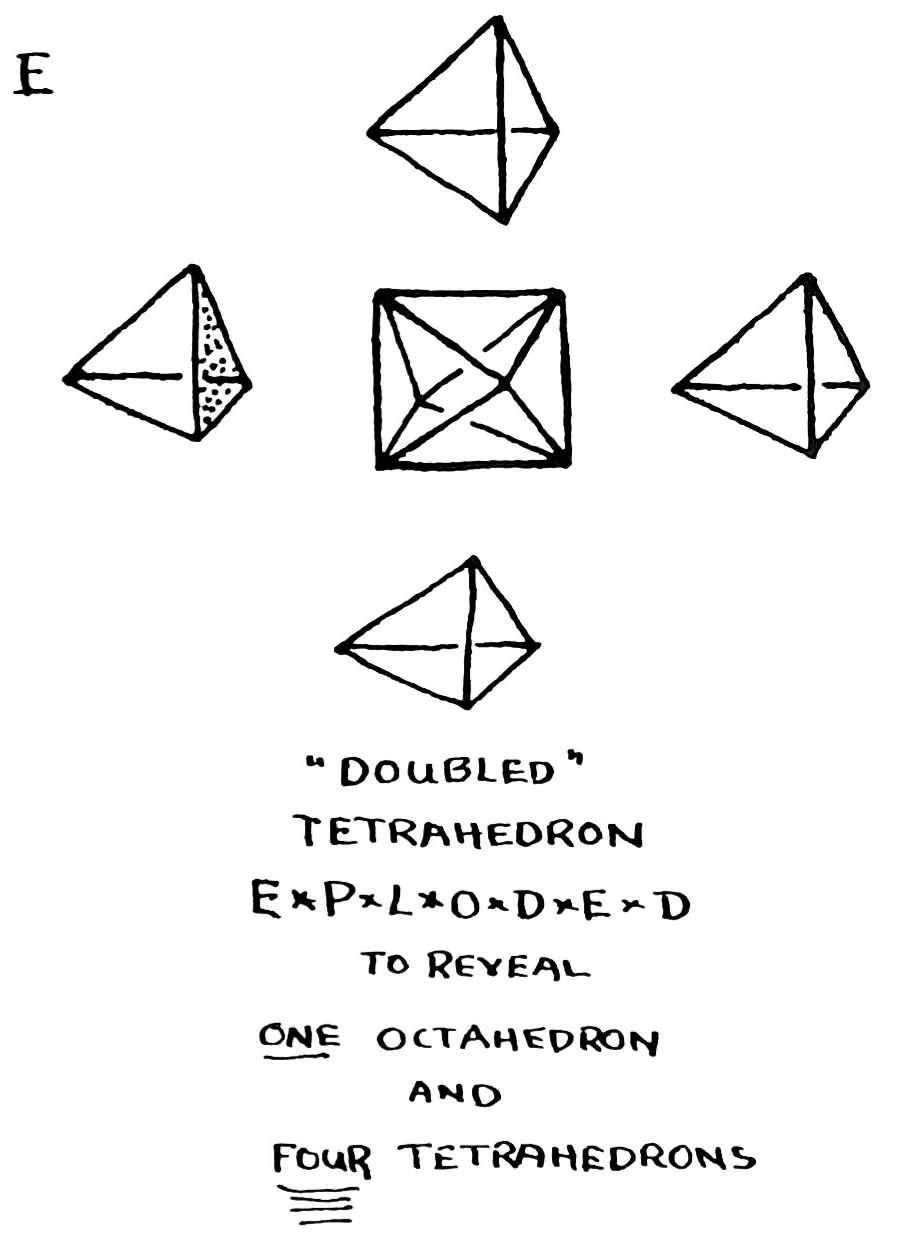
365 Since the volume of each of the four small tetrahedrons is the same as that of our starting tetrahedron (C), we know that when we remove these four from the doubled tetrahedron we are removing four units of volume. We’ve already established that the volume of the doubled tetrahedron is eight times that of the original tetrahedron, so eight units minus four units (the four tetrahedrons) leaves four units---which is the volume of the octahedron. So the volume of an octahedron is four times that of a tetrahedron with the same dimension on any given edge.
366 Now the octahedron has six corners (vertexes), each vertex being directly opposite another. This gives us the x, y, z coordinates, or what is called ‘‘square symmetry.’’ This is where the square does come in in nature, but only because it is part of the structure of the triangulated octahedron.
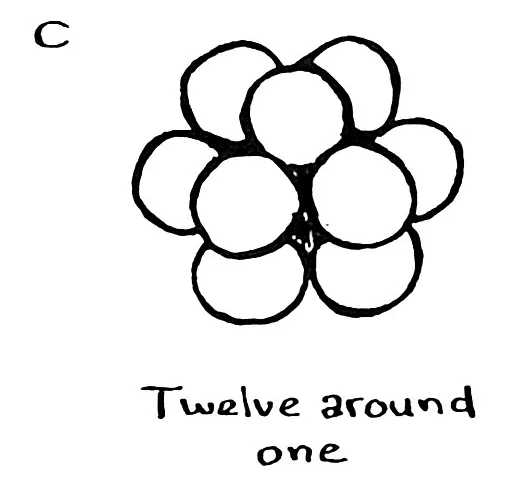
367 The octahedron has three planes, each at 90°to the other, each shaped like a square. All the angles in the same edge [circumferential] plane are 90°---but each face is 60°from any adjacent, tangential [touching] face.
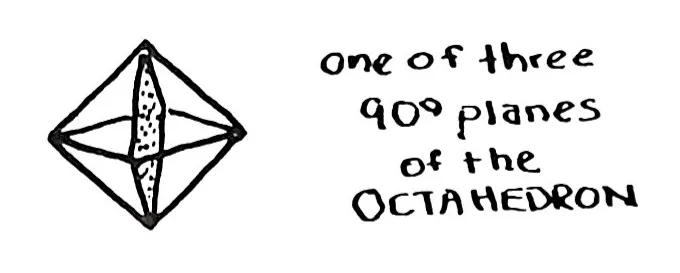
369 If we draw lines connecting the opposing vertexes of the octahedron, we get three axes at 90°to each other [heavy lines].
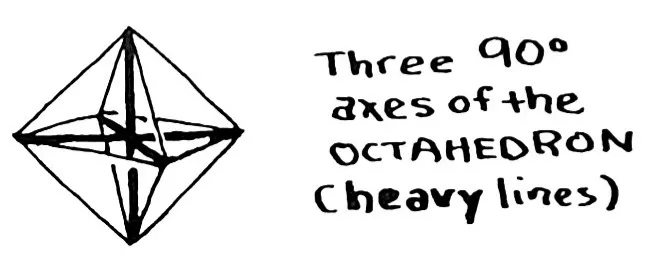
371 Now I can divide the octahedron into identical one-eighth units, using the three central 90°axes we have just seen. If we slice the octahedron along its square circumferential---edge outline---planes, it divides the octahedron into eight parts, each having one of the original 60°triangular faces, and three inner angles of 90°each.
373 Now what we have here is the corner of a cube. The three 90°angles which came from the center of the octahedron now become the outer corner of a cube.
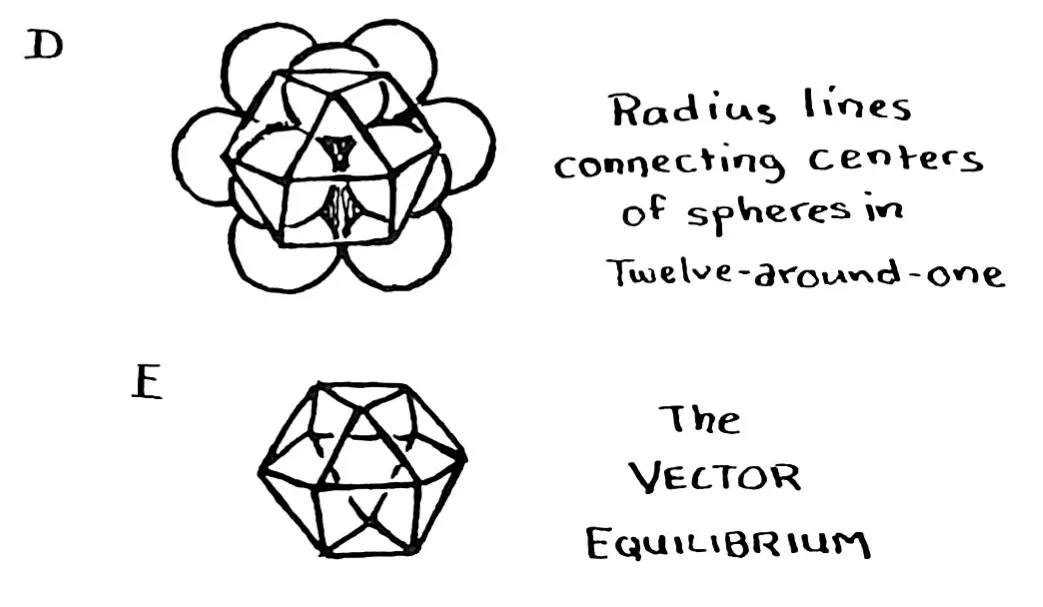
375 Since the volume of our octahedron is eight (compared with one for the starting tetrahedron), the volume of a one-eighth octahedron would be one-half.
377 Now if I take four of these one-eighth octahedra and attach them to a tetrahedron so that the triangular faces are exactly touching and the 90°--90°--90°corners are pointing outward, I get a cube.
378 Now let’s look at what we did. We took four one-eighth octahedra, each
with a volume of one-half, and added them to a tetrahedron, with a volume
of one. That gives us a volume of 4 × + 1, or a total of 3. So the volume of
a triangulated cube in which the diagonal of any face is the same length as a
tetrahedron is three times that of the tetrahedron. So a cube has a volume of
three.
+ 1, or a total of 3. So the volume of
a triangulated cube in which the diagonal of any face is the same length as a
tetrahedron is three times that of the tetrahedron. So a cube has a volume of
three.
379 At this point, let’s look at one more thing about the octahedron. If you look directly at one of the triangular faces so that it is directly facing you, and look through the face to see the face opposite, you’ll see that the opposite face is a triangle pointed in the opposite direction from the near face, the one you are looking through. So the two faces will form a shape like a six-pointed star. In our drawing the opposite, farther face is shaded. I want you to bear this is mind, because it will help you identify the octahedron in some of the drawings I’m about to make to help explain some more new ideas to you.
381 We have already discovered that when we doubled the edge length of a tetrahedron and connected the midpoints of the edges, we formed a new tetrahedron with a volume eight times that of the original and composed of four tetrahedrons the same size as the original and one octahedron. We also discovered that the volume of the octahedron was four times that of the tetrahedron of the same face/edge size.
382 Now if we make another tetrahedron with an edge length three times that of the original and divide the edges into thirds and connect the dividing points, we’ll get a large tetrahedron which has an octet truss internal structure composed of four octahedrons and eleven tetrahedrons. So the volume of our tripled tetrahedron would be 16 (four octahedrons each with a volume of four [4 × 4 = 16]) plus 11 (eleven tetrahedrons, each with a volume of one [11 × 1 = 11], for a total of 27, which is 33 (3 × 3 × 3, or 3 ‘‘cubed’’).
383 Now let’s take a look at some one-layer octet trusses and see what we can discover about them.
384 The basic model for our octet truss is one octahedron and three tetrahedrons, which looks like this from above:
386 To help our accounting, I’m shading the near triangular face of each of the octahedrons, so we can readily identify them.
387 So here we have three tetrahedrons and one octahedron. This gives us a volume of 3 + 4, or 7.
388 Our basic truss had an edge length of two. Now let’s make the next larger one-layer truss, which has an edge length of three.
390 Here we have six tetrahedrons pointing toward us, one pointing away, and three octahedrons. This gives us a volume of seven---our tetrahedrons---plus twelve---our three four-unit octahedrons---for a total of nineteen.
391 Now let’s make another truss with an edge length of four.
393 Here we have ten tetrahedrons pointing toward us, three pointing away, and six octahedrons. This gives us a volume of 10 + 3 (the tetrahedrons) plus six four-unit octahedrons, for a total of 37.
394 So now I can set our 19-volume truss and set it on top of the 37-volume truss we’ve just made. Then on top of the 19-volume truss I’ll place the 7-volume truss. Last of all, we’ll place a 1-volume tetrahedron on the very top. This give us our four-module tetrahedron, a tetrahedron with an edge length four times that of the original. The volume of a four-module tetrahedron is 37 + 19 + 7 + 1, or 64.
397 Let’s look at what we’ve done in another way.
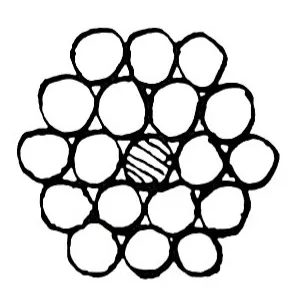
398 We started with 1.
399 Our next level is 7, so 1 + 7 = 8, which is 23.
400 Next came 19, and 19 + 8 = 27, which is 33.
401 Last came 37, and 37 + 27 = 64, which is 43.
402 So our basic tetrahedron is 1, and 13 is still 1. Next came 7 + 1, or 8, which is 2 to the third power (23). Then came 19 + 8, or 27, which is 3 to the third power (33). And then came 37 + 27, or 64, which is 4 to the third power (43).
403 This gives us a mathematical law about our tetrahedrons: We can say that the volume of a tetrahedron equals the module length to the third power.
404 So instead of saying ‘‘cubing’’ when we talk about raising a number to its third power---multiplying a number n×n×n--- we can say ‘‘tetrahedroning,’’ because these are volumes expressed in tetrahedrons, and they coincide exactly with the third powers of the edge modules.
405 Because nature is always most economical, and because a cube uses three times as much Universe as necessary (a cube has a volume of three compared with a tetrahedron of the same diagonal module), and because a tetrahedron can hold its shape while a cube cannot, it is obvious that nature is tetrahedroning instead of cubing.
406 Because physicists started out with the imaginary, unstable cube as their model instead of the real-world stable tetrahedron, they got into all these imaginary numbers and other complicated and completely unnecessary mathematics. It would be so much simpler if they started out with the tetrahedron, which is nature’s best structure, the simplest structural system in Universe.
407 (Just as an aside, to remember later when you’re studying physics in school, I want to point out that the tetrahedron is also equivalent to the quantum unit of physics, and to the electron.)
408 Now let’s talk about one last system.
409 In our tetrahedron, we find three equilateral triangles meeting at every vertex. The sum of the angles meeting at each vertex is 180°(60° + 60° + 60°). Now in the octahedron we have four equilateral triangles meeting at each vertex; and the sum of the angles meeting at each vertex is 240°(60° + 60° + 60° + 60°). Now there’s one more system, and it has five equilateral triangles meeting at each vertex, with a sum of angles for each vertex of 300°(60° + 60° + 60° + 60° + 60°).
410 JONATHAN: Could you have one with six triangles?
411 FULLER: No, because that would be 360°, which would be a plane going out to infinity and not coming back on itself to divide Universe into an inside and an outside.
412 So there are only three structural systems in Universe: tetrahedron, octahedron, and this new one, which we call the ‘‘icosahedron’’ (icosa means ‘‘twenty’’ in Greek). All crystallography (the science of how atoms and molecules arrange themselves into regular patterns) comes back to this. These are the only ways in which atoms interact.
413 I find it most interesting that they don’t teach you about this in school at all.
414 Now the icosahedron looks like this:
417 There are five triangles around the top, ten around the Equator, and five around the bottom.
418 And if you look at it directly from any vertex, it looks like this:
420 Now the tetrahedron has six edges; the octahedron has sixteen; and the icosahedron has thirty. Each of these numbers can be divided by 6:
| Tetrahedron 6 ÷ 6 | = 1 | (1) |
| Octahedron 12 ÷ 6 | = 2 | (2) |
| Icosahedron 30 ÷ 6 | = 5 | (3) |
| (4) |
422 So I say that you can’t have a system unless the edges are six or a multiple of six. In any given units of energy, there are six edges. These represent the push-pull forces or vectors that are necessary for all structures.
423 Six is the beginning of a structural system. We have one set of six in the tetrahedron, two sets in the octahedron, and five in the icosahedron. In the tetrahedron, one set of six gives a volume of one; in the octahedron, two sets of six give a volume of four; and in the icosahedron, five sets of six give a volume of approximately twenty. So with one set of six, you get a ratio of sets to volume of 1 : 1; with two sets, the ratio is 2 : 1; and with five sets, the ratio is approximately 4 : 1. So the icosahedron gives you the most volume enclosed for the least material used---or for the ‘‘least structural investment,’’ to use engineering terms.
424 It is the icosahedron, this most economical of nature’s structures, that I have used as the basis for my geodesic domes. I might also note that we have also found nature to be using the icosahedron as the structure for the protein shells that contain the RNA/DNA genetic codes in our cells.
426 Now all of you are used to the idea of building by putting bricks on top of bricks. When you are very little, they give you wooden building blocks, and that’s how you use them. Now this way of building I call putting compression on top of compression. And when I looked at nature, I saw she wasn’t building this way.
427 When we see a brick, it looks solid to us. But it’s not. It’s really full of all kinds of atomic arrangements, in patterns like those we’ve been looking at.
428 And so I asked myself, ‘‘How is nature really doing things?’’ And I could see that the moon goes around the earth but never touches it, just as the earth is going around the sun but never touching it. Yet all of them are held precisely in place as surely as if by bricks and girders. I saw that nature is using tension-- you can call it gravity---to hold things in place. Nature has islands of compression---like the earth, or an atom---held together by invisible but continuous tension.
429 Compressions are discontinuous---they don’t touch each other---and are held in place by tension, which is continuous.
430 Now for an example. A long time ago, wheels were completely solid, made of thick slabs of wood bolted together. These wheels were compressions. But when we get to wheels with wire spokes, we made a tensional integrity. We have the rim, a band of compression, and the hub, an island of compression, held together in tension by the spokes, and that’s more or less nature’s way of doing things.
432 Now we can also make this same sort of structure omnidirectionally, as we’ll do right now.
433 If you look at our structure, you’ll see twelve five-sided (pentagonal) shapes. They correspond exactly to the vertexes in our old friend, the twelve-around-one vector equilibrium.
434 We have these sticks, these compression members, with Dacron threads between them (we use Dacron because it doesn’t stretch like other fabrics do). No thread is loose.
436 These pentagons are everywhere the same. The tension is equally distributed. It is like a pneumatic---inflatable---tire or ball where the atmospheric molecules inside are hitting the tension network and not being able to escape.
437 So our structure is held together by tension, and this is the way Universe is put together.
438 That is also why I made my geodesic structures based on the icosahedron---to use the least material for the most volume enclosed---and that in turn gives the geodesic structure the purest possible tensional integrity. Now I’ve given this concept a shorter name---tensegrity, from tensional integrity.
440 Now I think that’s enough for me to establish with you how and why I’ve given you a way of reassessing what it is we really were learning, to make what you’re learning coincides with experience and then to turn it into an advantage of ours [just like the advantage of the lever] so we can get more housing for humanity---more environmental control---for less materials. And with this system, I can do it.
441 I can turn what we are learning here to great advantage. We need to rehouse humanity, and we can do it with new structures based on these principles. There’s a limit to cross-section in compressional structures, to the width of structures that can be built with conventional methods. The height of a steel column can’t go over forty times its diameter before it starts to curve over like a banana. But there’s no limit of tension to cross-section. To make a longer and longer suspension bridge, you simply need a better alloy.
442 When I get into tensegrities, there’s no limit to the clear span that can be enclosed. [A clear span is the area enclosed or covered by a structure without internal supporting columns.] When I started geodesics, the largest clear-span dome in the world was only 150 feet in diameter. Today we could make one a half-mile in diameter. In fact, we could make one to go around the world if we wanted. There’s no limit.
443 Now there’s one last thing I’d like to show you.
444 I wanted to be able to see the world correctly, but I found that there were problems with most maps. For instance, the one they give you most commonly is called a ‘‘Mercator projection.’’
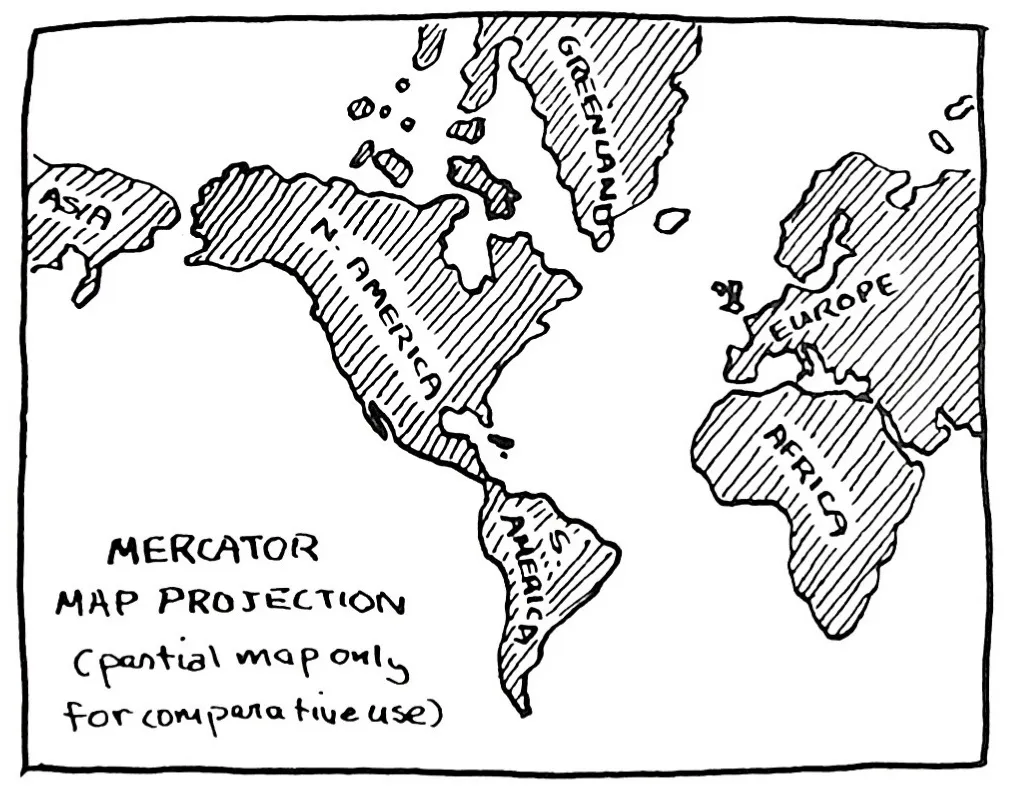
446 Now if you look at a Mercator map, you’ll find that Greenland measures twice the size of South America, and North America looks bigger than Africa.
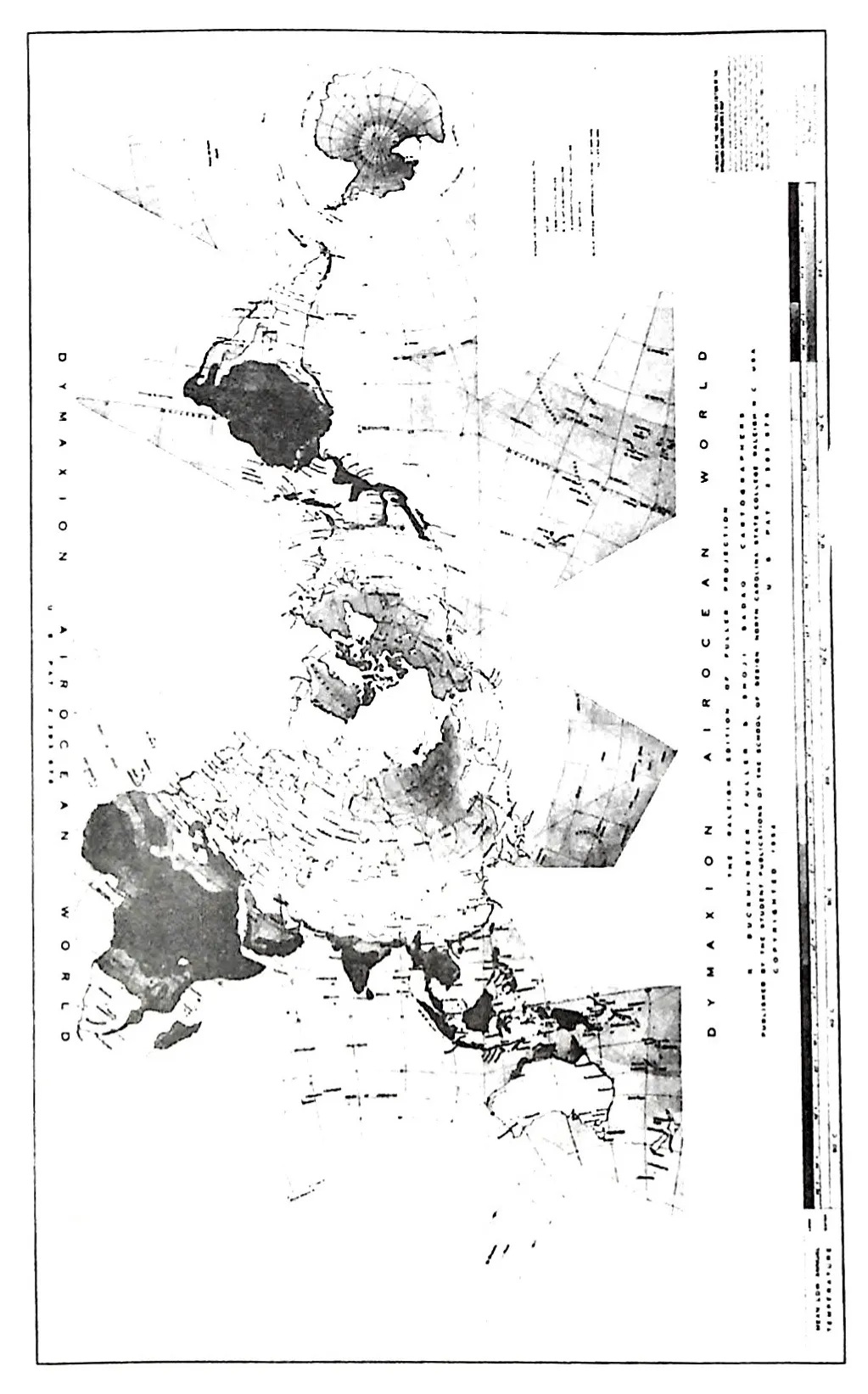
448 But both of these are wrong. Africa is bigger than North America, and Greenland is really a fraction of the size of South America.
449 When I looked at other projections, they had similar problems. In one way or another, they provided distorted information. I discovered that most maps are very false, misleading maps. So I wanted to find a new map, a better map.
450 I began with the twenty triangles of the icosahedron superimposed on the surface of our spherical earth. Now when these triangles are spherical, each angle is 72°. When I reduced them to a plane, each angle became 60°. So to correct for any possible distortions, I simply hold a uniform boundary scale when I contract all the corners symmetrically. What this gives me is a map which lets me see the whole world at once without any visible distortions.
451 Here’s the right size of Greenland. The right size of South America. Here is all of Antarctica, which you can’t even see on most maps. Here is a map with no breaks in the continental contours. I have one world-island in one world-ocean, without any break in the land. It’s the first time you’ve been able to see all the world as it really is at once, without any visible distortion of the shape or the size of the parts.
452 The shadings on this particular map I’m showing you now relate to temperature. Now water holds its temperature much longer than does crystalline material---soils and rocks---so the temperatures over the water are much more uniform than over land. It gets much colder and much hotter over land than water.
453 The ‘‘cold pole’’ of the Northern Hemisphere is in Siberia near a city called Verkhoyansk. In the winter, the average temperature there is -58°Fahrenheit. But in the summer it gets to nearly 100°. The annual variation between average high and low temperatures is almost 150°.
455 But when you get down around the Equator, the variation may be as little as 20°. Now the temperature on the average August day at Verkhoyansk may be no different than the average temperature that same day on the Equator. The real extreme variations have to do with cold, not heat. The real difference between places is how cold they get, not how hot. And this map is shaded to show the mean low annual temperatures.
456 There are other things the Dymaxion map can tell us.
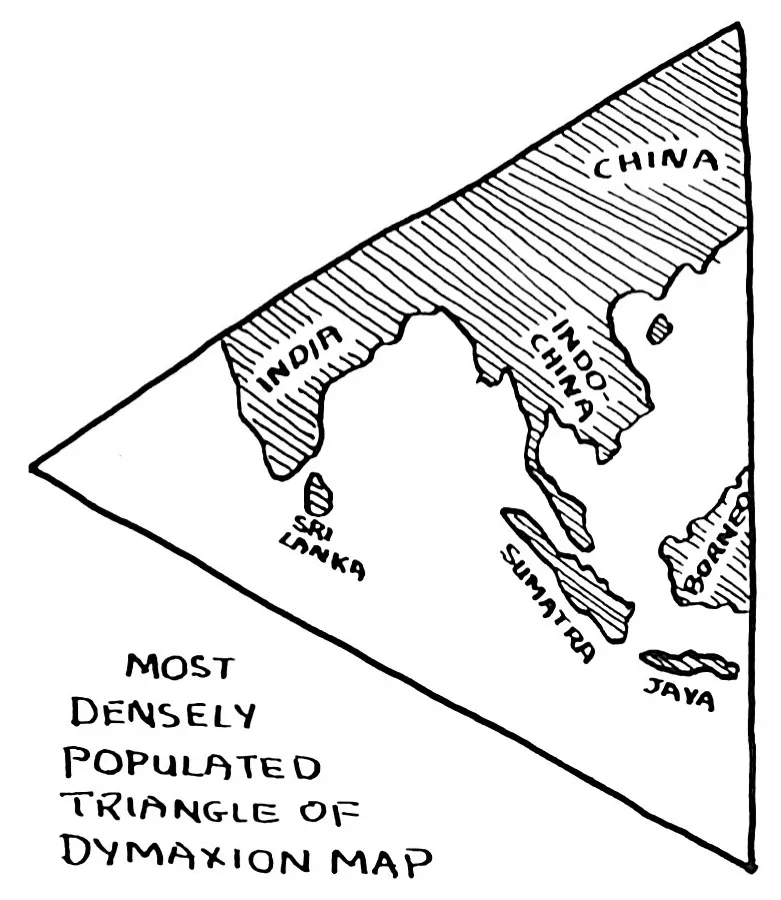
458 Just look at this one triangle. Here we have 34 percent of the world’s humanity in this one triangle---with most of China, Indochina, India, Java, and Sumatra. In North America, which extends over most of two triangles, we have only 7 percent of the earth’s population. Now two islands, Java and the island nation of Japan, together have 6 percent of the world’s humanity---as much as the United States. So you can see that we in the United States are anything but all-important.
459 Asia contains 54 percent of humanity, Europe and Africa 34 percent, and the Americas 12 percent.
460 Now for one last concept.
461 I’ve already told you that I find the whole educational system is incredibly misinforming, and I can see that your parents unintentionally carry on some of these mistakes. Take this one: ‘‘Darling, look at the beautiful sunset; isn’t it pretty when the sun is going down.’’
462 Yet we know that the sun isn’t going down at all. It isn’t setting. The earth is revolving around its own axis to obscure the sun. We all ‘‘know’’ that. But our language has conditioned our senses to the extent that even the great scientists talk about and ‘‘see’’ the sun ‘‘set’’ and ‘‘rise.’’ Yet they’ve known for 500 years that the sun doesn’t ‘‘set’’ or ‘‘rise.’’
463 I use two other terms that more accurately describe the reality: sunclipse in the evening, and sunsight in the morning.
464 You see, there’s no ‘‘up’’ or ‘‘down’’ in Universe. The correct words are ‘‘in’’ and ‘‘out.’’
465 ‘‘Up’’ and ‘‘down’’ are words from the days when people believed the earth was flat, a great plane spreading out to infinity. In such a world, everything was either perpendicular or parallel to the flat plane, and there were only two possible directions, up and down.
466 But the real Spaceship Earth is a sphere. And you understand things by tuning in or tuning out, by converging or diverging.
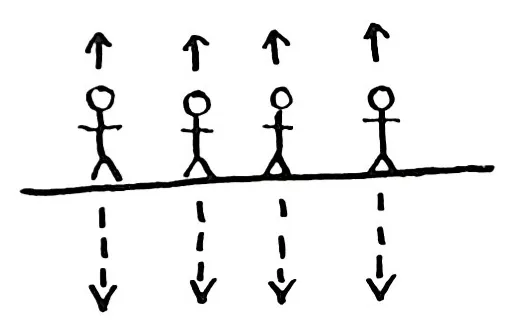
468 In the mythical flat world, all people standing erect would be exactly perpendicular to the same plane and parallel with each other. Up and down are the only possible directions of movement in relation to an object moving away from or toward the plane.
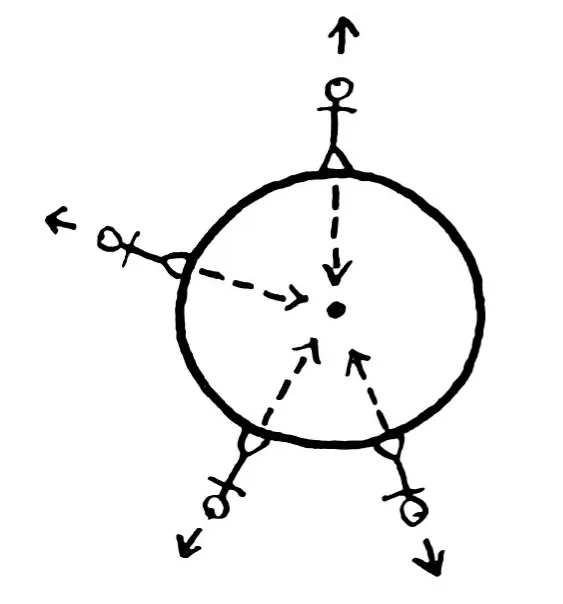
470 In the real Spaceship Earth, all people standing erect are in a unique relationship to one common center of gravity, from which they can converge (as in digging a mine) or diverge (in an elevator or rocket).
471 In the real world, all humanity is related to one common center; while in the mythical world, there is only the vast, endless, and imaginary plane.
472 I think that’s enough of my ideas to get you started thinking on your own.
473 Now I understand that you have some questions for me. I’d love to hear them.