
Part IV
Dymaxion Dialogue
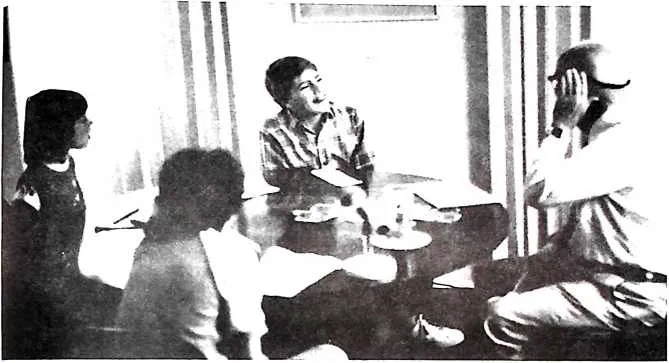
4 These are the children’s own questions, formulated by them on the basis of three Saturday meetings during which I gave them my own best understanding of Bucky and his ideas. Some of the questions were asked immediately following Bucky’s presentation, which you have just read. The others were asked during two subsequent sessions.
5 BENJAMIN: You seem so much against school; what do you think we ought to have instead of school?
6 FULLER: We need just to explore and be, and tell ourselves what we’re finding. That’s what every child starts to do on his own. What parents or teachers are obligated to do is to provide faithful, demonstrable answers.
7 RACHEL: What were your first thoughts as a thinker? The first thoughts you ever had?
8 FULLER: I would say that the earliest thoughts I can really remember were about snow. I can remember being terribly excited by snow.
9 When I was born, we lived seven miles outside Boston, which was really country in those days.
10 You couldn’t see any other homes from our house.
11 I remember you could see the glistening of the snow on the trees, and the few little marks made by the feet of birds and squirrels.
12 The very first thing I remember thinking about was the mystery of ‘‘How far does this glistening white world go?’’
13 This was a little different than just looking at things.
14 It’s when you’re stimulated to think about what this actually means.
15 That white seemed to go off in all directions.
16 It was winter, and there were no leaves, so you could see through the trees.
17 You couldn’t see so far in the summer.
18 The white of the snow seemed like a base.
19 You could see farther, it seemed, and you felt you could just go any direction at all on that snow---like you could glide over it.
20 I was born in July, and this was probably my first Christmas when this happened. I was wondering, ‘‘Where does this all go?’’ This was my first thinking thought. Thinking has to do with mind, and with thinking about relationships. It’s more than just reflexing.
21 I find, looking back, that it was things that had to do with distances that really made me think. Later on, those things made me wonder as I looked out of an upstairs window, ‘‘Where does this all go?’’ And the same thoughts led me to climb trees so I could see farther, see more.
22 My memory goes quite far back in life. I can remember my closest friend and I being wheeled side by side in baby carriages.
23 But what about you? How far back can you remember?
24 RACHEL: I think when I first started remembering things was when I was about a year and a half. I was already walking. I remember pouting about having to sleep with my new baby sister. I wanted a room of my own, and I didn’t want to sleep with Shira. I was mad about having all that attention taken from me.
25 BENJAMIN: If you could rearrange the world in any way you wanted to, how would you change it?
26 FULLER: I wouldn’t change it one iota.
27 BENJAMIN: Why not?
28 FULLER: Because I think it’s great. You and I don’t know enough to change it. We didn’t design the human being, and we didn’t arrange being on Spaceship Earth.
29 BENJAMIN: If you could change politics, what would you do?
30 FULLER: I wouldn’t change that either. I don’t like politics, and I don’t pay them any attention. I think that humanity has fooled itself into thinking it can do more with politics than it really can. By inventing the electric light and making it so people could work at night, Edison did more than anyone could do with politics.
31 JONATHAN: In another hundred years, will we have the same education system as we do now?
32 FULLER: From my own experience, I would think that we would not. In our conversation today, I was able to give you in an hour and a half some of the most important fundamentals.
33 I would say that in the future, we human beings will be able to dial up any information we want from satellites and such. We’ll have access to whatever information we need, wherever it is in Universe.
34 I don’t think you’ll be going to school; you’ll be able to dial up whatever you need right at hand, wherever you are.
35 BENJAMIN: If we’re not going to school, how can we learn things like creative writing? Because computers aren’t able to judge creative works.
36 FULLER: Probably through two-way television. These things can be beautifully taught over television.
37 RACHEL: How did your schoolmates react to the kinds of questions you asked your teachers? How did they take it when you really questioned things?
38 FULLER: I tended to just get a laugh. I was thought of as a kind of goof. A funny goof.
39 JONATHAN: You certainly turned out to be a brilliant man.
40 BENJAMIN: I understand that you believe there’s enough food and energy, enough resources, for everyone, and that everyone should have what they need. If that happened, wouldn’t there be people who would just be laying about and doing nothing---that is, if things were given out freely?
41 FULLER: Well, I think there are a lot of people who already do that. There are a lot of rich people who do nothing else. I see nature developing over time, and it probably takes sometimes two or three generations to get enough experience to set things up so a human being can do something. Everybody on the team is not making a touchdown. It takes a whole lot of enormous social activity for any given thing to happen evolutionarily. But I think it will happen.
42 JONATHAN: You say there’s already enough to go around, and that most people feel forced to go to jobs they don’t like out of a fear that they need to ‘‘earn a living.’’ When do you think man will evolve to a state of mind where he doesn’t feel forced to go to a job he hates?
43 FULLER: There is enough right now for everyone to have a high standard of living. But it has to be organized. In other words, you have to get distribution, and you have to produce certain goods to be distributed. It would take ten years to get everybody actually enjoying this high standard of living, if we all decided that’s what we wanted to do.
44 Today we have the words ‘‘earn a living’’ because we’ve been assuming there’s not enough for everyone. If there’s not enough for everyone, if there’s not enough to go around, you have to earn the right to get in on the life support, the food, energy, shelter, and so forth.
45 But if we create the distribution, you would never have to ‘‘earn a living’’ again. You would be doing whatever you do because that’s what you want to do, and not because somebody else says that’s what you’ve got to do to earn a living.
46 The minute you stop equating what you do as part of ‘‘earning a living,’’ you’ll be doing things because you see something that needs to be done and you feel like doing it; because you like to do it well and want to demonstrate that you can do it better than anyone else. So whatever people do will not be done because of ‘‘earning a living.’’
48 RACHEL: If all the world were to decide that they were going to live under one government and they didn’t know what it was going to be yet and they came to you for advice, what would you tell them?
49 FULLER: That’s a very good question. I’d point out the following two things:
50 First, we’ve developed rockets that can put a satellite into fixed orbit around the earth. The satellite can be held in one position relative to the earth, and then be used to beam electronic waves back and forth over the planet. And we can also use these satellites to hold all kinds of information.
51 Russia and the United States have also learned to use satellites to spy on each other, and on other countries. They have developed things called sensors which can provide incredibly detailed information about things going on aboard the surface of Spaceship Earth. To give you an idea of how sensitive these sensors are, consider that the highest an airplane can go is about 100,000 feet, less than twenty miles. These satellites are more than five times higher than that, and they are so sensitive they can tell the difference between a sheep and a goat. It’s amazing that we have sensors so delicate they can make that kind of distinction.
52 Second, we’ve also discovered that every human being has an electromagnetic field. I’m very certain that phenomena like what we call telepathy or mind reading are caused by very, very, ultra-ultra-high-frequency electromagnetic waves. That’s what accounts for what happens when we’re just sure we’re going to see somebody, and then we turn the corner and there they are. This has happened to so many human beings that I’m sure we all have this ability. It’s operating in all of us.
53 So, we’ve learned that every human being has an electromagnetic field, although it’s very, very high frequency and there’s very little energy involved. And when you’re happy and pleased, you give off a positive field, and when you’re feeling unhappy and displeased, the field is negative.
54 Now, let’s put these two discoveries together, the satellite sensors and the human energy fields. When we do, I would say they might give us a world government that would work like this:
55 We will hire---not elect---people who are skilled at handling mass information, and who have a good voice and appearance for broadcasting. We will have these people presenting propositions [ideas to be voted on] to the whole of humanity.
56 Now human beings in general---anyone and everyone---will be writing up propositions about what ought to be done about various things. If enough people write in about a particular thing they feel ought to be done, then the management, the hired people, will write up a formal proposition for presentation to everyone. Then on certain hours and minutes which have been well publicized in advance around the world, the television will broadcast the propositions: ‘‘We propose to do such and such.’’ And as human beings around the world hear the propositions, they will react positively or negatively---and then our satellite sensors will be able to read their electromagnetic fields and report back to us, ‘‘Sixty-seven percent of humanity is for this, eighteen percent against, and fifteen percent is not reacting.’’ So you will have a direct world-around readout instantaneously.
57 Now we will have set some level of agreement that will have to be achieved before an action can be carried out, say 75 percent. So if 75 percent of the people feel something should be done, you undertake to do that. The function of the world government is to carry out those decisions.
58 Now maybe the people were wrong, for oftentimes people are wrong. But if they are, you find this out very, very quickly, because things won’t be working out. And if things don’t work out, people would reverse their positions very quickly, and the world-around satellite sensors would pick up that the majority didn’t like what they had done. So other propositions would be put forth to improve the situation.
59 The whole process works like the steering device for a ship that we call a ‘‘servomechanism.’’ That’s a piece of equipment that constantly makes corrections to compensate for changing winds and currents to keep a ship on its course.
60 So if you’ve decided to do something and you find it’s wrong, you do something else.
61 You see, we walk right foot-left foot, right, left. We don’t walk with the same foot forward all the time. All progress is a wave phenomenon. We don’t have any straight lines in nature. So, as we make more and more mistakes, we’re also learning more and more about what does work, and we learn to steer better and better.
62 This is the kind of government we would be having. Do you follow me?
63 RACHEL: Right.
64 BENJAMIN: So you believe there’s such a thing as mental telepathy between two people?
65 FULLER: Ben, I don’t use the word ‘‘believe’’ for me. When I say the word ‘‘believe,’’ it means accepting an explanation of a physical phenomenon without any experimental evidence to support the explanation.
66 When I speak of telepathy, I am inclined to accept it by my own direct experience of a number of intuitions, and there have been quite a number of times when I have had telepathic experiences. So my own experience convinces me something is really going on.
67 But most importantly, there is what happened with our first child. My wife and I were married in the time of World War I. Our first child, Alexandra, was born just at the end of the war, and she caught spinal meningitis and infantile paralysis. Because of these illnesses, she couldn’t move around like other children and had to spend her time in a bed being wheeled around. We had two trained nurses, my wife, and myself to look after her.
68 She couldn’t get around like other children, and that meant she couldn’t experience things the same way they did. If another child saw something across the room, the child would get up, touch it, turn it around, taste it, and what have you. The normal child could get the feel of it directly to build up its inventory of experiences. But our daughter couldn’t do that, and so she began getting her information through the people around her who were touching the things themselves.
69 To our amazement, we discovered she was extremely sensitive to other persons, their feelings, and so forth. My wife and I would be about to communicate---I would be about to say something to my wife---and the words would come out of my daughter’s mouth as she lay over there in her bed. My wife and I would both turn, for she wouldn’t be using her kind of words, but ours.
70 So I feel that nature has fail-safe circuits. If one circuit loop stops working, she has an alternate circuit. One of the circuits nature had was for human beings who couldn’t get around yet still had to get information. And our child had this circuit, this fail-safe mechanism. I think we all have it.
71 So when it comes to telepathy, if it’s not magic---and I don’t call it magic---there has to be some kind of explanation. If it’s physical, it’s physical. And I know it does happen. So I’m assuming it’s an ultra-ultra-ultra-high-frequency electromagnetic wave phenomenon which doesn’t work over very great distances (because the higher the wave frequency, the more the possible interference).
72 BENJAMIN: Do you believe this ability will be more developed as time passes?
73 FULLER: Right. I think one of these days we’ll be able to make direct experiences, to be able to actually measure the energies involved.
74 BENJAMIN: Do you believe that’s for good or bad? Do you think the world will use that for good or bad?
75 FULLER: Again, I don’t use the word ‘‘believe’’ for me. I also don’t have any words ‘‘good’’ or ‘‘bad." I think if it’s part of Universe, it’s good. If it isn’t part of Universe, it doesn’t happen.
76 There are things that balance other things. If something moves over here, then something else moves over there to compensate for it, to balance it. That’s the way I see it. I don’t know any human being who has done something society considers obnoxious or undesirable that, had I been born and brought up under the exact same conditions, I would not have done in exactly the same way. So I don’t blame the individual about things. It’s the conditions. And if we change the conditions that made people act certain ways, then they won’t act that way any longer.
77 JONATHAN: Do you think there’s an absolute life form or intelligence---a God?
78 FULLER: Very much. I’m absolutely convinced of it. Look at the discovery of the law of gravity---the fact that all physical bodies in Universe, all mass, is interattracted to all other mass in a relationship that can only and precisely be expressed in mathematical terms. Both the law and its discovery are purely intellectual, mental phenomena. The law must be eternal, because it’s always been there. So what we are really doing is continually discovering these purely intellectual a priori (that means here before you, always here) proofs of an eternal intellectual integrity greater than that of humans. So I’m overwhelmed by the evidence, and I would call that God---the Greater Intellectual Integrity we see operating eternally around us and everywhere.
79 JONATHAN: Do you think there are Martians, or any other intelligent life forms in the universe?
80 FULLER: I’d say that you and I, designed the way we are, looking the way we do, are uniquely fitted to our own special biosphere, the conditions aboard the surface of Spaceship Earth.
81 Our bodies are more than 50 percent water. If I hit myself on the arm, hydraulics distribute the impact to other parts of the system. Hydraulics are non-compressible; you can’t squeeze water into a smaller space. And that helps us keep our shape. That’s the reason I can clap my hands together hard for all these past eighty-five years and not hurt myself. If I were made the same way we make buildings, out of brick and concrete and so forth, I would be just like a china doll and break up if I got hit.
82 So we’re very dependent on liquids, and liquids boil and freeze within very small limits. So we could live only in our particular biosphere where the temperatures are such that we don’t boil or freeze. That tells me our kind of design is only for this particular planet.
83 What intelligent life does is to serve as an information gatherer and local problem solver in Universe. What form that would take to operate on Mars is probably not tune-inable by our particular senses. I wouldn’t expect somebody looking like we do on Mars, because he wouldn’t need to look like a human being. He would just get the information in other kinds of ways.
84 JONATHAN: Could you build a city on another planet, then take and cover it with one of your geodesic domes and make it airtight so people could live there?
85 FULLER: You could do it, but I think it would be very illogical to try. I don’t know what we would want to be doing on that other planet. We don’t need any more metals; all the metals we need are just coming out of the melting up of yesterday’s now- obsolete machinery. We don’t need to do any more mining, so I don t see any point in going to the moon or elsewhere for metals.
86 JONATHAN: Do you think we’ll ever travel to other planets? And if we do, what will the spaceships be like?
87 FULLER: As we learn more about ourselves and the atoms of which we’re made, I think we’ll be developing ways of scanning---really scanning you in depth, not just on the surface---to identify your own unique individual pattern. And then we could send you by radio; 186,000 miles per second---the speed of radio waves and light---would be much faster than any of the rockets.
88 RACHEL: What do you think the universe is?
89 FULLER: My concept of Universe, darling, is the following: In the first place, when I use a word like ‘‘Universe,’’ I need to describe what I mean, so that you can understand what I’m saying when I use it. So when I use the word ‘‘Universe,’’ I mean the sum total of all the experiences of humanity. That’s all--- everything---you can think of. The total experiences. Everything that everyone who has ever lived has experienced right to this moment. I describe Universe as the aggregate (total) of all humanity’s consciously apprehended (knowingly experienced) and communicated experience. And that can mean communicated to themselves or others. There’s something about communicating an experience that makes it special, because in order to communicate, we have to describe what it is we are experiencing, to put it in concepts others can understand. So that’s how I define ‘‘Universe.’’
90 Now let’s look at ‘‘Universe’’ a little more closely. A long time ago, people thought that everything you could see was happening at the moment you saw it, whether it was a burning candle in the same room or an exploding star trillions and trillions of miles away (of course they didn’t realize then just how far away the stars were). As far as what the eye could see, humans believed, everything was happening at exactly the same moment. Everything was instantaneous, occurring at the same instant. Everything you were seeing was happening now.
91 But less than a hundred years ago, all of that changed, because scientists discovered that light has speed.
93 Although it moves very quickly---186,000 miles per second---it still takes time to get from here to there.
94 With the discovery of the speed of light came a completely different way of looking at things.
95 It takes about eight minutes for light to get to us from the sun, our closest star. When you look at the sun, what you’re seeing actually happened eight minutes ago. If you look at the North Star, Polaris, it’s a light show taking place 450 years ago. If you look at the Big Dipper, you’ll see a bright star right at the end of the handle, and that’s a light show that’s a hundred years old. That’s how long it took to get to you. And if you look at the belt in the constellation Orion, you’ll see two very bright stars. The light you’re seeing from one is 1,100 years old, and the light from the other left its star 1,500 years ago.
96 So, looking at Universe in view of the fact of the speed of light, Albert Einstein told us that what we are really looking at is an aggregate of non-simultaneous events, things taking place at all different times.
98 The light just comes to the human eye at the same time, but everything we’re seeing is taking place at entirely different times. One of these stars we are looking at may have been happening a million years ago, and the star may now no longer exist.
99 Einstein told us our Universe is an aggregate of non-simultaneous events. This is exactly the opposite of the ‘‘instantaneous’’ Universe humans once believed in.
100 Einstein said that each one of these stars is an energy event, and each one involves a tremendous amount of energy; each one has its own endurance, its own span of existence. So each one has an energy transformation going on---stars convert matter into light energy---and each one is taking place at a different time.
101 The events we see are overlapping one another. One may be coming in as another is going out.
102 So this Universe Einstein discovered can be described as a scenario, like in a motion picture. You have one character come in and he stays for a while and then dies, but before he dies another character has come in, has overlapped the first.
103 All of these episodes overlap one another, like the threads that come together to make up a rope, overlapping still other threads to form a whole. A rope is a pretty good idea to visualize how a big scenario can be made out of a lot of little scenarios twisted together. Our Universe is an aggregate of overlapping episodes. Beginnings and endings are local to Universe, but they are not Universe. Universe does not begin or end.
104 Now in our scenario Universe you have individual picture frames, and any one frame doesn’t tell you the whole story, just like one picture of a caterpillar doesn’t tell you it’s going to become a butterfly.
105 When we talk about Universe, we usually tend to talk about it as a single picture. But I see it as a whole lot of little pictures, all those little individual frames (a ‘‘frame’’ is what you call one single picture on a reel of motion picture film). So after we have enough frames, we’ll see our caterpillar going through a cocoon and becoming a butterfly. Then it will take a lot more frames to tell you that a butterfly can fly. To get from the caterpillar to the flying butterfly may take a billion frames.
106 That’s why to get any really important information out of scenario Universe, you have to have large, long increments of episodes. And then you have your episodes and I have mine, and if we tell ours to each other, they overlap and make a new scenario that’s a little richer, giving each of us a little better chance to understand what’s going on.
107 Now when you hear that some astronomer has discovered a galaxy that’s very far out, you may tend to say to yourself, ‘‘I wonder what’s outside ‘outside’?’’ But that’s a single-frame picture. When you are talking about something that’s ‘‘outside,’’ that’s a single frame. Do you see that?
108 RACHEL: Yes.
109 FULLER: So I saw that the difference between yesterday’s ‘‘instantaneous’’ Universe and Einstein’s non-simultaneous Universe is very great.
110 You asked me about Universe, and I am telling you that it’s a scenario. The more you and I can talk and communicate to one another, the more we can get to a joint scenario, because we are each adding our information in. That’s a beautiful question you asked, darling. I’m beginning to give you some of my best ideas.
111 BENJAMIN: Do you think the earth will ever become over-populated?
112 FULLER: No. I’m absolutely convinced of the wisdom of God.
113 We’ve talked a little about the ways things are designed and the way nature needs balances---checks and balances. So sometimes there’s quite a lot of mosquitoes, then another year there’s a lot of grasshoppers, and so forth. They all interact. They are not ‘‘good’’ or ‘‘bad’’; they are actually complementary.
114 Nature doesn’t go in a straight line; it’s actually more ‘‘wavilinear,’’ shaped like waves---like our deliberately non-straight line. Nature has an important function to fulfill and designs something to do it. Surely mosquitoes have some function, and certainly the flies and butterflies all have some function. And when there’s a chance of one of her creations not doing well, nature designs another one; she makes more starts.
115 For instance, on our planet we simply can’t take a sunbath to meet all our energy needs. Yet all our energy does come from the sun. What happens is that the vegetation---the plants---captures the sun’s energy first. By a process called photosynthesis, they impound radiation by using it to create beautiful hydrocarbon molecules which we can use.
116 Now to be able to capture the radiation for us, the plant has to have roots so that it won’t be blown away while exposing all its leaves to the sun. It has to get water through its roots to use in photosynthesis, and to maintain its structure hydraulically. And because the vegetation is rooted and spreads out its leaves to capture sunlight, it has to have some way for its seeds to get planted at some distance away, outside its own shadow, so they can get sunlight and grow. Plants may launch thousands and thousands of seeds, often in a way that they float away on the air or water. Hopefully, some will get out from underneath the shadows of other plants, to places where they will get on all right. But a tree can’t deliberately plant its own seeds in a good place; and because the chances are poor of any one seed landing in a favorable place, nature makes many starts---she sends out thousands of seeds.
117 I say that human beings have very much of a function in Universe. While we are born naked, ignorant, utterly helpless, make enormous mistakes, and need a whole lot of replenishing of us, we’re now getting to a point where we have enough information to carry on. We don’t need to make so many starts.
118 Already, birth rates are starting to decline. There have been many predictions that before long there will be ten billion people on earth. We’re now about 4.2 billion, and I do not expect to get over five billion. I’m sure we’ll never get to ten billion, and that the people who are predicting that large a population are not well informed.
119 JONATHAN: Human beings have evolved a great deal. Do you think house pets and other domestic animals will evolve to be more than they are now?
120 FULLER: They tend to evolve more by inbreeding of types, simply because people tend to like, say, a certain kind of cat and begin to inbreed for that type of cat. But cats themselves go out in the night and try to crossbreed back to an average cat.
121 Evolution is really in the specialist cat, the inbred, hybrid cat, which people breed to do certain things that other cats can’t do.
122 If you have two fast-running horses, there’s a mathematical probability that by marrying them you’ll concentrate the faster genes from both of them so that you might get an offspring that’s faster still. This is evolution of a kind, an evolution toward specialization. But what is important about human beings is just the opposite.
123 If we’re really accurate in the way we talk about things, we shouldn’t speak of ‘‘up’’ and ‘‘down,’’ because those two directions only apply if you live on an absolutely flat plane; while all of us live on a sphere. Instead of up and down, we’re either moving out away from the center (diverging) or we are moving in toward the center (converging). This is the way nature operates, by converging and diverging.
124 Specialization is always diverging from the center, going out and away in one direction from the center. Generalization is coming in toward the center, converging. I realize that we will probably never improve on the design of human beings, because we are already at the center. When people become sick, that’s diverging from the center, from normality. Being well is normal, being at the center. Human beings are at the center because they are the least specialized beings in nature. This lack of specialization, coupled with the mind, gives man the ability to confront and solve problems, because he is free to move in any direction from the center; he is not overspecialized, out on some biological limb.
125 While I think humans have learned a lot, I don’t think we’ve evoluted a lot. Physically we’re pretty much the same.
126 JONATHAN: I heard once on the news that a city was thinking about enclosing itself in one of your geodesic domes. Is this practical?
127 FULLER: Let me explain it this way. If I take a geometrical object, let’s say a cube for the sake of our example, and I want to double its size, then I would double the linear dimension---the length of its edges. If I doubled the dimensions of a cube, I would wind up with a new cube composed of eight cubes the size of the one I started with. [See pages 80--81 for illustrations.]
128 Where I had one cube, by doubling its dimensions I produce a structure with the volume of eight times the original cube and with faces four times the size of the faces of the original cube. Now 8---the ratio of the volume of a doubled cube to the original---is 2 to the third power, 2 × 2 × 2. And 4---the ratio of the surface of the doubled cube to the original---is 2 to the second power, 2 × 2. So every time I double the size of a cube, I get eight times as much volume but only four times as much surface.
129 This is also true for the geodesic dome. Every time you double its size, you have eight times as much volume and only four times as much surface. So if I double the size of a dome, I have eight times as many molecules of air inside and only four times the surface. And every time I double the size, I reduce by half the amount of surface through which an interior molecule of atmosphere could gain or lose heat. That means the energy efficiency goes up very rapidly as we increase the size of the domes.
130 You can see this in the case of an iceberg. An iceberg can melt only as fast as it can get heat through its surface from the outside. Its volume is tremendous, but it melts very slowly because its surface area is so small in relation to the volume. But as it melts, the volume gets smaller at the velocity of the third power, and the surface gets smaller only at the velocity of the second power. In other words, as the surface gets smaller, there is more and more surface exposed per unit of volume, and it melts faster and faster the smaller it gets. The iceberg starts melting only very slowly, speeding up as it gets smaller until you get to the last little ice cube, which melts very fast.
131 [You can see this for yourself by taking two same-sized ice cubes and two cups filled with warm tap water. Crush one ice cube and leave the other intact. Put the whole ice cube in one cup and the crushed ice in the other at the same time. The crushed ice melts much faster, because far more surface area is exposed per unit of volume, even though the same amount of ice is present in both cups. You will also note that the whole ice cube melts faster and faster the smaller it gets. This is why restaurants often use crushed ice instead of large ice cubes in their drinks. The crushed ice cools the surrounding liquid much faster than an equivalent amount of ice in a large cube.]
132 Now in buildings, the larger they are the greater their ability to retain energy. In building, the larger the structure the greater the energy efficiency. The efficiency goes up tremendously rapidly as buildings become bigger and bigger.
133 The difference between a cube and a dome is that the structural stresses place limits very quickly on the size of buildings you can construct based on cubical designs and right-angle corners, while there are no limits on the sizes of dome structures. You could build today a dome that would cover all of Manhattan Island in New York.
134 I made a study of what would happen if you built a dome over mid-Manhattan. I found that the surface area of all the buildings there was 84 times larger than the surface area of my dome. That means that heat loss in the city is enormous, compared to what it would be with a single dome covering it. It is feasible right now to build any size of dome. Tensegrity makes it possible to put whole communities under cover, and I think people will do it because it’s unquestionably much more economical.
135 RACHEL: How do you think children should be taught the basics of life?
136 FULLER: Pretty much the way we are doing in this room right now. Try to understand the shape of things. Understand what’s around you. Realize that there are mathematical analyses of what’s around you. That’s an important word, ‘‘understanding.’’ When I use that word, it means, ‘‘what the mind can do to find relationships.’’ I have been giving you relationships and relationships and relationships.
137 I would cultivate the child’s mind. And that’s what the child is already trying to do on its own.
138 You see a child growing, and soon it comes to the age when it begins to tear things. And it goes to your bookshelves and begins to tear the best books and spares the newspaper lying on the floor. And you say to yourself [Fuller laughs], ‘‘Why doesn’t it tear the newspaper and spare the books?’’ But you must remember that the child is constantly experimenting.
139 You find that children soon learn that if they are lying on a bed and roll over, they can fall off the bed. And they learn when they try to stand that there is an invisible ‘‘something’’ trying to pull them down. They become tremendously aware of gravity, though they don’t have a name for it yet. They continue to learn, and they begin to climb up and become a little more sure on their feet. Now when they do this, they want to know what it is they can hold on to when gravity is trying to take over. They want to know what they can hold on to that won’t tear.
140 So what the child is is a research department all by itself, learning in advance what it’s going to need to know: what you can hold on to that you can count on.
141 Now the more you study about children, the more you ask yourself, ‘‘What can a child learn and when?’’ Well, every child is learning about basic principles. If you and I are wise and pay attention to those principles as they are learning, we could have exactly the right things for them to tear, and they would tear them. They would find that this one tears easily, that it takes a little more to tear this other thing; and they would keep on learning until they found something that didn’t tear.
142 You have to say, ‘‘This child is not a senseless little creature crawling around there; it’s a brilliant intelligence, and whatever it’s doing is making a whole lot of sense if I really stay with it and see why it’s doing it.’’
143 This is really a very different way of looking at things.
144 BENJAMIN: You seem to feel there’s a difference between the mind and the brain. What is it? What do you use the brain for? The mind?
145 FULLER: The brain is always coordinating the information of our senses: seeing, hearing, smelling, touching, tasting. It’s the only way we know there’s something outside ourselves. The brain is the only way we know we’re alive. Our brain is our way of saying, ‘‘This one smells different from that one.’’ Our brains are dealing in special cases---each sensation we encounter is a special case---and making systems, making packages of what’s relevant and irrelevant. Its only concern is the system of the moment. Right now I’m concerned with the system of all-of-us-as-a-group-around-the-table. The brain remembers these special cases.
146 Now the mind from time to time discovers relationships between the special cases that are not in a special case considered just by itself. For example, the discovery of the existence of the solar system, as opposed to looking at just one planet at a time.
147 Another example of mind is Newton’s discovery of the law of gravity, the law of mass interattraction of celestial bodies. This is an existing relationship that does not manifest itself in any single body considered just by itself.
148 So the mind deals in relationships.
149 Science is the use of mind to discover generalized laws. A generalized law cannot have any exceptions; and because it cannot have any exceptions, a generalized law is inherently eternal.
150 So mind is dealing in the eternal, and the brain deals in the temporal, the special cases that begin and end. There is a very big difference.
151 Take the case of Copernicus, a Polish astronomer who lived in northern Italy in the 1500s.7 In those days, the power people wanted a universe with earth at the center. But there was no stopping the power of Copernicus’ mind. He tracked the position of the planets over twenty-one days, measured to the minute and second. These two sets of facts---the starting and ending positions and the length of time---were like a hinge, a lever. They enabled him to prove that the earth and all other planets moved in elliptical orbits around the sun. His mind’s discovery had such a shattering effect on the ways people had been accustomed to seeing things that we still refer to it as the ‘‘Copernican Revolution.’’
153 Thinking---as opposed to simply reflexing---is done by mind, not brain; brain only coordinates the senses, the specialcase circumstances, and gives us our sense of being alive.
154 Mind is like a director inside a TV studio control room, brain, where all the information from the senses is displayed. Mind compares and coordinates.
156 You know, it’s really amazing. We’ve never really been outside ourselves. It’s as though each of us lives inside an omnidirectional television tube!
157 JONATHAN: What kinds of recreational activities will we have in the future?
158 FULLER: I think there will be enormous amounts of new things, because people will be doing more and more what I do--- thinking, sitting at desks perhaps too often. So they’ll want to go out and get some exercise to keep their body working right. I see more and more of this.
159 Just in my lifetime, we have gone from where skiing and tennis were sports pursued only by millionaires to now, where suddenly everybody’s in on them. So there will be enormous amounts of recreation in the future.
160 JONATHAN: What kinds?
161 FULLER: I don t know what the forms will be. I’m confident that where today we have hang gliding, we are going to have new forms of personal transportation tomorrow---especially jet harness packs with two small ramjets. Jet stilts, you might say. With these jets and the right clothing, you’ll just go to the window and dial wherever it is you want to go and you’ll be off.
162 That will enable us to do a lot of observing. We’ll find it very exciting to look at the land below us as we fly through the air like birds.
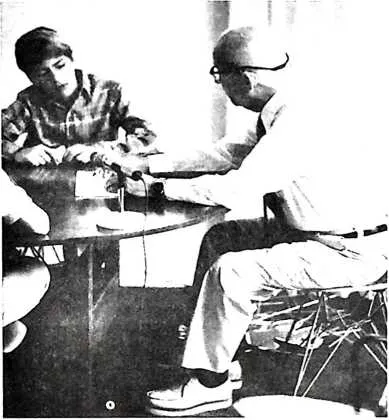
163 BENJAMIN: What do you think the most important culture has been, either present or past?
164 FULLER: You are inclined to ask me which is most important, but I see things the way Rachel wants to see them---where everything counts.
165 I don’t say this is more important than that. I see anything and everything that’s happening as all built in and everything interrelated. Everything. I can’t ever look at things the way specialists do, as separate and not related.
166 BENJAMIN: Do you have a favorite person? Someone you think best reflects our future?
167 FULLER: I don’t have any favorites. I can see, however, which would be the next person who could help me with whatever it is I need to know next.
168 I find that when I play tennis, I always play better when I play with a person who’s better than me than when I play with someone who’s not as good as me. I have often learned to win over a person who’s better than I am just because I really play so much better. And I have found I tended to lose games to somebody I ought to be able to win over very easily, because I simply wasn’t stimulated to do better.
169 So instead of having a one-and-only favorite, I can see that I really ought to think about who is next in my series of evolution of stimulations. And then that person becomes my hero for the moment. Then I graduate on to a new hero.
170 RACHEL: How do you feel after you’ve completed a project?
171 FULLER: Your questions are awfully good. Really, they’re tremendous questions.
172 When I finish a project, I always feel tremendously let down. As I am finishing, I’m terribly excited because I’ve got it done. My projects usually take a whole lot of work, like a book. My last book manuscript was a thousand pages, and I finished just the day before yesterday.
173 But the minute it’s done, where I had been very busy for so long, suddenly I’m not very busy. I really feel terribly let down.
174 I think it’s like a mother on the night after her daughter’s been married. Everything has been building up to this wedding, and it’s all been terribly exciting. Then, suddenly, the bride’s gone and all that’s left are a whole lot of dishes to pick up and clean up. So that’s the way I feel, darling. I can’t wait to get started on something else again.
175 BENJAMIN: I know you decided to get by with as little sleep as possible, and that you’ve slept only two hours a day for most of your life. How has this affected you, and would you recommend others do the same?
176 FULLER: I would never advise anyone to do anything I’ve done. I’m glad to tell people what I’ve done. If they find something useful in it for them, fine. But if they want to do it, it must be their own spontaneous act. They may find something that seems worthwhile to them, but I never tell them to do anything.
177 Now you asked me about not sleeping. This began as an experiment; I was trying to find something out. I had an enormous amount of work to do, and we had no money; although I saw that we always managed to have enough to eat. I decided I had to get the most out of my time.
178 I saw that cats and dogs go to sleep for a while, then they’re ready to spring into action. They didn’t seem to take one long sleep, but a lot of little ones.
179 I said to myself, ‘‘I’ve learned in cross-country running that I have second and third winds; but when I exhaust this third wind, it’s energy that took a long time to store away, and that it’s sort of remote and hard to get at---like it’s ‘way over there.’ So I should learn to live only on my main tanks, like cats and dogs, and never have to use that remote energy.’’
180 Animals can lie down, sleep briefly, then spring into action. When they lie down, they’re replenishing their main tanks, because the main tanks have much larger openings and are easier to fill. So I said, ‘‘Supposing I live on my main tanks?’’
181 Because I had already decided to do what I wanted to do, then I reasoned that should I find myself tiring or my interest flagging, then maybe at that moment I needed to be doing something else: making some tea, dancing, reading something, getting some exercise. And if none of these worked, maybe I needed some rest, and so I’d lie down.
182 I didn’t know how it was going to turn out, but looking back I can see that it worked out that I would lie down and sleep solidly for a half-hour four times a day---amounting to a total of two hours’ sleep a day. And I’ve been getting on great ever since. I find that I’ve never gotten down to my second or third tanks. And I found out what I was trying to find out---that I could get by on my main tanks with a whole lot less sleep.
183 But these are my conclusions, and they might actually be erroneous. They’re what I found out, and I can’t recommend it to anyone else.
184 RACHEL: What kinds of problems do you think will be confronting people in the future?
185 FULLER: The biggest problem is education. Up to the time I was born, the reality people shared was one where everything we were doing could be seen, heard, smelled, touched, or tasted. You could experience it directly through the physical senses. If you were digging a ditch, you could see it and feel it. When people wrote, it was still about things you could see and smell and hear.
186 But when I was three years old, the electron was discovered. And from then on, we began to get into an invisible reality. Microscopes and telescopes became much more important. We were beginning to see parts of the universe we couldn’t see with the naked eye.
187 And now today, 99.9 percent of everything that is going to affect our future is being conducted in the realms of reality non-directly contactable by the human senses.
188 So I think one of the biggest problems, darling, is that we’re dealing in a reality which is non-visible and non-touchable by humanity. And if the newspaper can’t take a photograph of it, they can’t talk about it.
189 And then everybody is so specialized. That’s another of the big problems. Every child, like yourself, is interested in everything and wants to understand all the interrelationships. But the education system and the moneymaking people---the power system---were afraid of the bright people and made them all specialists, because they didn’t want to lose their help. They made them all specialists and said, ‘‘You have to pay attention to this little bit over here, but never mind the whole.’’ So the power people kept track of the big things and made all the bright ones specialists to look into the little things, the ‘‘special areas.’’
190 So the big problem of tomorrow is getting everyone back into comprehensive thinking and understanding, getting all humanity on the right kind of mathematical coordinate system. Those are the kinds of things I’ve been giving you today. That’s why I talked about them right at the very outset.
191 The problem is getting humanity to really educating itself properly. Once humanity has the right information, it’s going to make some very good decisions, particularly through the electronic media.
192 BENJAMIN: Do you believe we’re going to have another war?
193 FULLER: Again, I don’t use the word ‘‘believe.’’ With the information I have, I’m inclined to feel that we’re having a war all the time. The people are fighting in Afghanistan right now, and this is being carried out by Russia and the United States through its puppets. We’ve been having a terrible war going on continuously---Vietnam, Cambodia, Nicaragua, El Salvador--- I’m sorry to say. I hope we’ll have less and less, but if we ever get into an atomic war, then it’s all over for everybody.
194 BENJAMIN: If there is a war between Russia and the United States, will it be carried out by humans or by computers?
195 FULLER: The Russians have a complete upper hand as far as numbers of soldiers, trained divisions, and they have a stronger navy. Now America has more atomic bombs, but if they go for the bombs, then it’s all over for everybody.
196 No sane person is going to start a nuclear war. But there are a lot of angry hotheads with access to the ‘‘button,’’ so it’s absolutely touch and go as to whether or not we’re going to make it.
197 Russia’s way of doing things is not to use the atomic bomb, and Russia now has the upper hand and is beginning to rule the world. The United States had the upper hand until about ten years ago, but now the Russians have it. I think the Russians are most eager to prove their system, their kind of socialist government, can produce a more attractive way of living than the American model. They would like to use their productivity for people instead of weapons, so I think they will insist on disarmament. They’ll keep the upper hand, but they themselves will be disarming as fast as they can, with the other people disarming ahead of them. They’re eager to prove that socialism can work, so I think we’ll get away from a war.
198 RACHEL: When you were a child and came upon discouragements, were there any children---any friends---who urged you on.
199 FULLER: No, I really had no urging whatsoever. There was one friend who I felt was incredibly bright---he got the highest marks at Harvard and we were extraordinarily great friends--- but even he never urged me on to teach myself anything. And in my earlier days, too, I never really had any friends who tried to urge me on to learn anything. It was all really done on my own.
200 BENJAMIN: Is there some special way of looking at problems that will help you solve them, help you know what the outcome will be?
201 FULLER: First of all, I look at problems as for everybody, not just for me. That’s number one. And I say that the answer, if there is an answer, is in universe. I also try to think of the significance of it, the significance of the solution and what value it will be to society. How does the problem fit into the scheme of things? Is it an important problem or a non-important one? I give priorities to problems and ask myself, ‘‘Is this a problem that I want to tackle today, or can I put it off to tomorrow and work on something more important today?’’
202 If it’s one I’m going to tackle today, if it’s important to everyone, then I begin to define the problem. The first and most important thing in solving a problem is to state what the problem is, very clearly, concisely, and incisively. State what the problem really is. I can’t stress how important this is: a problem stated is a problem solved. So many people misstate the problem to fool themselves. But if a problem is properly stated, if its relatedness is clearly defined, the answer will become apparent.
203 RACHEL: How did your first collaborators react to discouragements?
204 FULLER: Oh, I’ve really been surprised. Back in the late 1920s, when I was designing the Dymaxion House, I had a young architectural draftsman working with me who was really terribly excited by me. He said, ‘‘Can I come and work with you?’’ So he came around and worked with me for a while. But then one day he said, ‘‘We don’t have any income. I’m going to have to leave you. I have a wife and a child, and I’m going to have to get a job.’’
205 Well, I had a wife and child too. But I was saying that I don’t have to ‘‘earn a living’’ if I’m doing what evolution wants done, what God needs done. And if I’m doing that, then I’m sure a means of keeping me going will occur by itself. I’m doing an experiment to see whether I’m doing what’s needed for humans to be a success. We’re supposed to be here for a purpose, and that purpose seems to be to make humanity a success. And if I’m helping to do that, then it seems like Universe will keep me going. The hydrogen atom doesn’t have to earn a living to act like a hydrogen atom. It’s only human beings who seem to be having to ‘‘earn a living.’’
206 So I said, ‘‘If I’m really doing what God wants done, the universe should care for me just as the clover is cared for when the bee comes along and pollenizes it.’’
207 But my early collaborators could not see that, and they would go off, get a job, and forget about me.
208 BENJAMIN: How would you suggest solving international problems without violence?
209 FULLER: I always try to solve problems by some artifact, some tool or invention that makes what people are doing obsolete, so that it makes this particular kind of problem no longer relevant.
210 My answer would be to develop a world energy grid, an electric energy grid where everybody is on the same grid. All of a sudden there would be no problems any more, no international troubles. Our new economic basis wouldn’t be gold or dollars; it would be kilowatt hours.
211 RACHEL: How do you think people will look back on your ideas and inspirations twenty years from now?
212 FULLER: I hope they will find them useful, darling. That’s all I ask.
213 Because I’ve really been trying to find out how the universe is working, and how to help people to see things, I have an assumption that if we survive this great crisis we’re going through right now---and atomic war is a great threat---then people will be pleased that I did what I did.
214 When I first started fifty-two years ago, I tried to depersonalize what I did. I tried to operate anonymously. But by doing that I attracted even more attention to myself, because people were trying to find out who was doing those things. So I let myself be visible. But I don’t do anything for me. I don’t do anything because I want to be important or known. Everything is done because something needs to be done for humanity.
215 As far as I’m concerned, I didn’t invent my mind. I didn’t invent me. And I’m absolutely overwhelmed by God. I have absolute faith in the Greater Intellect operating. I’m just trying to be a medium for that Intellect. I don’t care if after twenty years people discover God and not me. In fact, that would really be something.
216 You see, darling, we are here in Universe for our minds, not our muscle. Just look at the eruption of Mount Saint Helens. There was more physical power expressed there in one second than has been expressed by all the human muscles throughout all humanity’s existence. But man can invent a camera and capture the whole thing.
217 Mind discovers relationships. That’s why we are here in Universe. To discover relationships. To solve problems. And the answers are already here if we can just get ourselves out of the way.
218 I hope that I’ve discovered a few relationships that will help humanity.
219 BENJAMIN: Do you think there is a world energy problem?
220 FULLER: There is no energy problem whatsoever. We just have a problem of ignorance and fear.
221 BENJAMIN: How will our country change in the next century?
222 FULLER: Physically, probably not at all. It will be the same continent in a hundred years.
223 Let me first say again that I don’t know if we’re going to get into the twenty-first century. We’ll have to pass through a very great crisis.
224 It used to be an East/West world, with ships being the dominant form of travel. Now it’s a North/South world, and we travel by jets. If we make it into the twenty-first century, we’ll be a planet of world people.
226 We will be integrating all our people very rapidly.
227 I’ve been around the world forty-seven times, and that will be just average for a human being in tomorrow’s world. You will all be world people. You may live in Alaska part of the time, then in India, then---anywhere. You’ll be world people, and that will be the biggest change.
228 BENJAMIN: Of all events of recent years, say the last twenty years, which one has changed our lives the most?
229 FULLER: Robert Burns, the Scot poet, once said, ‘‘Oh wad some power the giftie gie us/To see oursels as others see us!’’ That is, how precious a gift it would be to see ourselves as we are seen by others.
230 And for that reason, I think getting to the moon was one of the most important events of recent history, to be able to be off our planet to see ourselves.
231 This has changed the total concern of humanity, helping everybody to become comprehensivists, to be interested in the whole universe and not just your local South San Diego, or whatever.
232 BENJAMIN: What stories did you like most when you were young?
233 FULLER: I was most excited by Robin Hood. I was intrigued by the idea of an outlaw trying to solve things for people where he didn’t think justice had been done. I loved the daring, and the fact that his life was a terrific fight. But then I began to realize that Robin Hood was using weapons---bows and arrows and swords---and that I could do a better job with trigonometry. I changed the Robin Hood game.
234 I also like the King Arthur stories, the Faerie Queene, Shakespeare, Dickens, the old English tales. I think reading aloud in the family is very important. Libraries are very important.
235 JONATHAN: By disagreeing with your teachers, did you get bad grades?
236 FULLER: Oh, no. I knew what they wanted me to answer, and I gave them their answers. But I said to myself, ‘‘I’m going to have to keep at things I’ve noticed which seem true to me, and discover for myself if there is any significance to them.’’
237 I found that teachers were not interested in my explaining things to them. It really upset them, and I decided that I was not trying to upset people.
238 BENJAMIN: What books would you recommend we read to learn more about your ideas?
239 FULLER: My experience with you makes me answer that question completely differently than I would have ten years ago. There is nothing that I talk about, however intricate it appears to me, that you have not been able to talk about with me. Therefore, I would suggest that you read some of my books. The kinds of things I’ve been talking about with you are the kinds of things I’ve been writing about.
240 I think you would enjoy Operating Manual for Spaceship Earth, Critical Path, and my other books. I think you would enjoy Synergetics very much.
241 BENJAMIN: Are there any other questions you’d have liked us to ask?
242 FULLER: You couldn’t have asked any better questions if you were ten or twenty years older. I’m sure no professor could have asked better questions. I had no idea you would ask such good questions. Really, it was very exciting to me that you asked them. You children were asking me the kinds of questions I’d ask myself. They were very good.
243 RACHEL: I was thinking one last thing. Let’s say we start to make our own colonies on other planets and that we start to make our cities there. Would it be possible for there to be another advanced civilization that was already there, but from another dimension, so that we could both be on the same planet but each not know the other was there?
244 FULLER: In other words, they just happened to be invisible to us, to our spectrum of vision?
245 RACHEL: ---and we happened to be invisible to their spectrum.
246 FULLER: That really is possible. And it may be true throughout Universe, and not just on one planet. You see, I emphasize in every way I can that whatever life is, it is not physical.
247 JONATHAN: I agree.
248 FULLER: I’m now eighty-seven, and so far I have eaten, drunk, and breathed in eight hundred tons of food, water, and air ---which became temporarily my hair and got cut off, became my skin and got rubbed off, and so on. Everything in me changes every seven years. I am not yesterday’s breakfast. That’s very clear to me, although my breakfast does temporarily become my hair.
249 We used to have the words ‘‘animate’’ and ‘‘inanimate.’’ In playing the game of twenty questions, where you had to find out what I was thinking about by asking me no more than twenty questions, two of the questions were always, ‘‘Is it animate?’’ or ‘‘Is it inanimate?’’
250 When we said animate, we’d think of warm and soft; inanimate was hard and cold.
251 Now we used to say that biology was the study of animate things, of living things. After a while, biologists got onto genetics, to studying genes and chromosomes (the microscopic chemical chains that determine the inherited traits of organisms).
252 The biologists who were looking into genetics began studying fruit flies, because they regenerate very rapidly and thus gave the biologists a chance to find out how patterns of development were inherited. Then they discovered that tobacco mosaic virus regenerated even more rapidly than the fruit fly, and this brought them into virology, the study of viruses. And inside the viruses they discovered that the chemicals were arranged like crystals.
253 Now crystals had always been considered as inanimate, lifeless. But here the physical characteristics of living things, of you and me, are being determined by these crystal-like chemicals called DNA and RNA. And these chemicals are composed of molecules, and they in turn are formed of atoms.
254 Now at this level you have all the scientists converging. The biologists, the physicists, the mathematicians are all there studying the same thing. But they’ve become so excited about what they’re discovering that they haven’t been very good philosophers. They haven’t seen the significance of what they’re dealing with.
255 We’re seeing more and more things that are inanimate, and just what is animate is getting less clear. We know that life has to be in there somewhere, because we started with biology, with living things. But when people die, all that’s left is chemicals. People have been weighed as they were dying, and scientists have found that the weight doesn’t change. So whatever life is, we know it doesn’t weigh anything.
256 I’m assuming that nobody ever did die, and that others whom we can’t see may be trying to talk to us right now. I know that there’s really great wisdom that’s available to us that can affect us a great deal, and that’s why I try to listen to my thoughts, thinking that others may be trying to talk to us. That may be the way we get our fresh thoughts.
257 TO EVERYONE: It’s been good to be with you. I feel as though we were old friends. I enjoy being with you so very much.
POSTSCRIPT
258Richard Buckminster Fuller died July 1, 1983, eleven days before what would have been both his eighty-eighth birthday and the sixty-sixth anniversary of his marriage to his beloved Anne. He died of a heart attack suffered at Anne’s bedside in a Los Angeles hospital. Anne died two days later.
259 I spoke to Benjamin Mack the morning after Fuller’s death.
260 ‘‘When I heard last night that he had died, I remembered he was talking about life and death and reincarnation at our last meeting,’’ Ben reminded me. ‘‘And you know, I’m sure that Bucky is still going right now, doing whatever he’s supposed to be doing.’’