
Chapter 3
Prologue
2by Anwar Dil
3 In 1934, when I was a child of five growing up in a small Himalayan town at the gateway to the ancient seat of Indus Valley civilization, comprising present-day Pakistan, Buckminster Fuller was already a well-known American design scientist who had created quite a commotion with a number of his inventions. Mrs. Eleanor Roosevelt learned to drive Fuller’s Dymaxion Car and wrote about the experience in a newspaper article. H. G. Wells during his visit to the United States of America took a well-publicized ride in the Fuller Car in New York City. He told the thirty- eight-year-old inventor that he was familiar with Fuller’s Dymaxion House, and later used some of Fuller’s concepts in his motion picture The Shape of Things to Come. About the same time, Fuller had submitted the typescript of his first major publication, Nine Chains to the Moon, to a leading American publisher who, in turn, submitted it to Albert Einstein for the verification of Fuller’s rather bold chapters in which he had explained how Einstein’s thinking process had led to his discovery of relativity theories and E = me2 equation. Early in 1935, Fuller received an invitation to go and meet Einstein who told him, ‘‘I am notifying your publishers that I approve of your conception of my thinking process.’’
4 When the book was published in 1938, Frank Lloyd Wright, the great architect, reviewing the work in The Saturday Review, wrote: ‘‘Buckminster Fuller—you are the most sensible man in New York, truly sensitive. Nature gave you antennae, long-range finders you have learned to use. I find almost all your prognosticating nearly right—much of it dead right, and I love you for the way you prognosticate.’’
5 Today, fifty years later, Fuller has come a long way with his mind. He is known world-around as the designer of the geodesic dome. His two-volume book Synergetics: Explorations in the Geometry of Thinking (1975) and Synergetics 2: Further Explorations in the Geometry of Thinking (1979), has been hailed world-embracingly by discerning scientists and men of letters as an epoch-making work destined to become one of the great classics of science. U Thant, Secretary-General of the United Nations, on reading the work called Fuller ‘‘one of those rare thinkers who can analyze the trends of human history and who is preoccupied with fashioning the future.’’
6 Fuller’s twenty-first book, Critical Path, published in 1981, inspired the reviewer in the Guardian to call the author ‘‘a man so original that he had to create his own form of new-speak to match the scale and daring of his imaginative perceptions.’’ Cautioning those who might be reading the eighty-seven-year-young Fuller for the first time, the reviewer observed: ‘‘Maybe the written language of the old, wise man is difficult, almost alien in the sense that highly original music seems at first alien. But what he has to say is actually humble and very simple, even if it is girded about with geodesics and mathematics and visions of men actually talking to men about their real needs.’’1 The reviewer in the April 17, 1983 edition of the Sunday Standard of Glasgow in neighboring Scotland opened his essay with these words:
7 Once in every age nature seems to produce a human mind which is able to function in an additional dimension. The list would include Roger Bacon, Leonardo, Paracelsus, Boyle, Newton, Einstein, and perhaps Tesla.
8 All, in a real sense, were mutants able to leap from conditioning thinking to direct contact with an intuitional reality obscured from the rest of us. Such minds crack open the current confines of knowledge and the world is never the same again.
9 Future history (if we have to have any) will probably elect Buckminster Fuller to the Society of Giants. Here in the Giant mould is a mind which seems extra-dimensional alike in physics, politics, architecture, philosophy and mathematics: the genuine polymath.2
10 The reviewer called Fuller's book ‘‘a plan designed to bring world opinion and world government to the point of cooperating with nature ‘to accomplish what nature is inexorably intent on doing.’ Which is to convert all humanity into one harmonious world family, sustainingly, economically successful.’’
11 In the world today, torn by utterly unnecessary, wasteful and degrading economic, political, religious and other rifts, we have few people who have the ability and the courage to speak to all aboard spaceship Earth, to use Fuller’s own term—and fewer still, who if they do speak at all are listened to with respect across the national and ideological boundaries. It is important, therefore, to realize the significance of the fact that Buckminster Fuller is perhaps the only living American thinker whose integrity as a citizen of the world is universally recognized indeed.
12 In 1959, the United States and the USSR had an important protocol exchange. The USSR put on a major exhibition of their technology in New York to acquaint the American people with their way of life and work. Reciprocally, the United States sent Fuller’s geodesic dome to be erected in Sokolniki Park in Moscow to house the American exhibition. Fuller was appointed by the United States State Department to be the engineering representative of the United States at the exhibition. While the large aluminum geodesic dome was being erected, Premier Nikita Krushchev visited the site. Next day the New York Times front-paged a picture of Krushchev on a scaffolding of the dome and quoted him as saying: ‘‘Very interesting, very good and worth copying many times over in the Soviet Union.’’3 The Soviet leader during his forty-five-minute visit kept exclaiming about the Fuller dome and at one point, according to an observer on the occasion, said: ‘‘Some American inventions are good inventions. This geodesic dome is a good invention. I would like Buckminster Fuller to come to the USSR to teach our engineers.’’ Subsequently, the USSR purchased the geodesic dome from the United States. It remains in Sokolniki Park in Moscow and the metropolitan subways advertise the Fuller geodesic dome as a worth-visiting exhibit.
13 In 1964, Buckminster Fuller was appointed, along with other prominent Americans, to represent the United States in a joint meeting with a group of equally prominent Soviet leaders to discuss problems existing between the United States and the USSR. The American team, chosen by Norman Cousins and Patrick Moynihan, included, among others, David Rockefeller, Norton Simon and John Galbraith. The Soviet team was picked by the USSR Academy of Sciences. The meeting, that came to be known as the Dartmouth Conference, was held for one week each in the United States and the USSR. At the conclusion of the sessions in Moscow and Leningrad, it was agreed by all delegates that rather than having a summary of the conference proceedings, one member representing each country should present a discourse in the form of comprehensive prognostications regarding human affairs in the world. The head of the USSR Metereological Sciences presented the Soviet position and Fuller was chosen to speak for the Americans. Fuller was enthusiastically received by both teams. At the concluding dinner party, the President of the USSR Academy of Sciences said that henceforth Buckminster Fuller would be ranked in the Soviet Union along with Benjamin Franklin and Thomas Alva Edison.
14 Fuller was first invited by the People’s Republic of China in 1953 to advise them with the structural strategies for developing their aluminum resources, but at that time ht could not go there. In 1979, Fuller was invited by the Chinese Secretary of Communications for a three-week visit. On arrival in Peking, Fuller was asked by his host: ‘‘How long would it take to make a complete disclosure of your general philosophy of the grand strategy of problem solving?’’ Fuller replied: ‘‘Sixteen hours.’’ The Secretary said: ‘‘All right, we will start on Monday.’’ The audience at the five-day seminar consisted of the members of the Communications Secretariat and the Chinese Academy of Sciences. Fortunately for Fuller and his audience, his interpreter was a Chinese scientist who had been one of Fuller’s students at the University of Minnesota. At the concluding dinner meeting the Secretary of Communications gave a memorably short speech. He said to Fuller: ‘‘You are China. Please return.’’ The South China Morning Post, the widely-read Hong Kong newspaper, in its edition of May 30 highlighted the conclusion of Fuller’s visit with a frontpage article entitled ‘‘US inventor takes China by storm.’’ The newspaper reported the phenomenal attention paid to Fuller in China and that the Chinese people were eager to implement his ideas.4 It might be significant to note that, according to a recent report, Fuller’s 1963 book Operating Manual for Spaceship Earth is number one on the list of the ten most widely-read American books in the People’s Republic of China today.
15 In India, as in a number of other Third World countries, Fuller’s ideas are catching on. In the Indian mind, he is associated both with Gandhi and Nehru—a synergetic unity of the two. Jawaharlal Nehru had great personal affection and regard for Fuller’s scientific and technological approach to upgrade the quality of the human environment. In 1969 Fuller was invited to present the Third Jawaharlal Nehru Memorial Lecture in New Delhi. Prime Minister Indira Gandhi in her introduction and welcome speech said that while Buckminster Fuller is described as an architect because of his special concern with living space, he is really an explorer of the architecture of the universe. Acknowledging his contributions through the geodesic dome and the dymaxion map, Mrs. Gandhi said: ‘‘But what is far more important is that Mr. Fuller has shown how to get the maximum from the minimum material by making the most intelligent use of the resources available on earth.’’5 Fuller’s discourse on the occasion, entitled ‘‘The Leonardo Type,’’ is a thought-provoking exposition of the course of human civilization and the role therein of the Leonardo- type individuals who, to quote Fuller’s own words, ‘‘grow to maturity without losing the full inventory of their innate, intuitive, and spontaneously coordinate faculties and therewith inaugurate new eras of physical environmental transformation so important as in due course to affect the lives of all ensuing humanity.’’
16 Fuller has travelled around the world more than fifty times and has lectured in more than five hundred and fifty colleges and universities on all continents, sharing his vision of the essential functions of the humans in Universe. Former Congresswoman and U.S. Ambassador to Italy, Mrs. Claire Boothe Luce, once wrote:
17 He has spent his life in search of the truths that make men free, but he has spent himself unsparingly sharing them with others—especially with young people. A passionate lecturer, he has excited and challenged the minds of generations of students, not only in America, but around the world. He has taught them that all human progress is the result of trial and error, of learning how to correct our mistakes. He pin-points with extra-ordinary clarity the technological mistakes our generation is making in handling nature, applying science for the benefit of society, and in using our own minds to the fullest—or perhaps one should say to the Fuller capacity. Bucky tells them how man can go about becoming what he ought to be, how he can create the good society—the society in harmony with both technology and nature.6
18 Mrs. Luce said very rightly that it is possible that perhaps Fuller will be best remembered as one of America’s most inspired and influential educators. However, in my estimation, the most comprehensive assessment of Fuller’s life and work was offered by Archibald MacLeish, three-time Pulitzer Prize laureate poet, playwright and author of many important books. MacLeish was Librarian of the United States Library of Congress, held a chair in journalism at Harvard University, and had served as Assistant Secretary of State in the United States Government. In 1978, MacLeish urged the President of the United States that Buckminster Fuller be awarded the Medal of Freedom. On that occasion he wrote: ‘‘Some forty years ago, I published, in Fortune Magazine, some views about the pioneering work of Buckminster Fuller in architecture, engineering and industrial design, which suggested to me that he was one of the most remarkable Americans in the latter years of the Republic—one of the very few by whom the greatness of our society would be judged. I am now convinced that this judgment fell short of the truth. If any man’s life has reconciled our early spiritual achievements with our later scientific triumphs, it is his. And if there is a living contemporary who truly knows what it is to be an American, Buckminster Fuller is that man.’’1
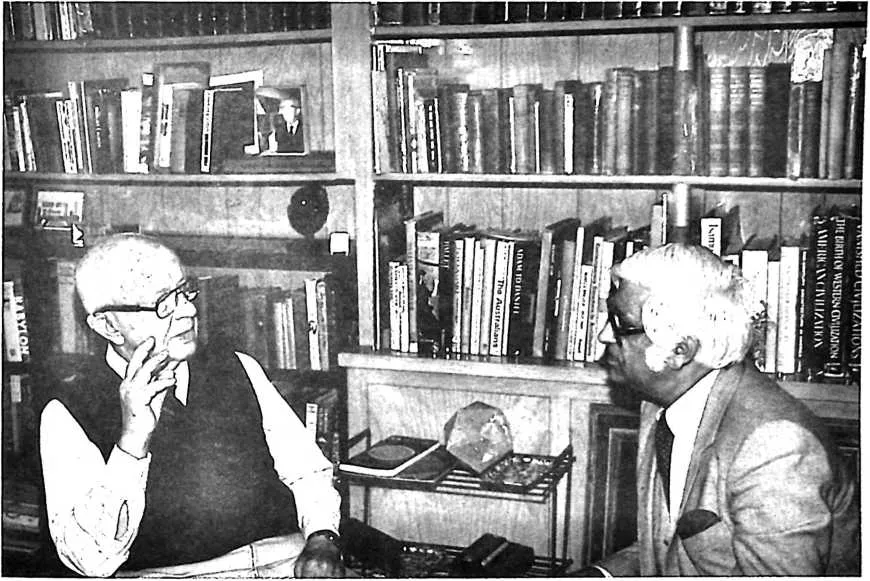
19 On December 3, 1982, Buckminster Fuller arrived in San Diego to give weekend lectures as part of the World Game sponsored by the United States International University where I teach. I asked him if he would mind answering some questions which I had prepared. He agreed. The following day at noon commenced what proved to be a many-houred session covering wide-ranging topics. The conversation has resulted in the present book, Humans in Universe.
20 United States International University
21 San Diego, California
22 June 13, 1983
24 DIL
25 The thinking process