
Chapter 4
Humans in Universe—A Conversation
2I want to explore with you how Buckminster Fuller, at the age of eighty-seven, as we move toward the twenty- first century, looks at himself as one who has lived through this century, and how his mind perceives this world and the universe.
3 But let me clarify my purpose in this exploration. I am interested in understanding
how you look at yourself as a thinking individual human in the universe. But this is just a
beginning, lest it become only a study of your mind, one human’s mind. I am very much
interested in seeing
through your thinking process how people like Albert Einstein, Leonardo da Vinci, and
Buckminster Fuller think. I consider Buckminster Fuller’s mind to be in the class of these
people and I am interested in extending my understanding of the thinking process of such
humans in our universe.
4 The first question that comes to my mind in this context is: When you met Ezra Pound during the Spoleto Festival of Two Worlds in 1971, he wrote:
5 Meeting Ezra Pound at Spoleto
6 Festival
7 To Buckminster Fuller friend of the universe bringer of happiness, liberator.
8 How did you feel when he gave it to you? You have used it as the preface to your book Intuition,8 so obviously it has special meaning for you. Could you recall the occasion?
9 I and my wife had been visiting with Ezra and Olga in their very tiny little house
in Venice. This was the point when he was first speaking to others, after the
terrible time that he had after World War II was over. He had been captured
and treated publicly as humans had not been treated by other humans in our
century. It was in Italy where they first captured him and put him in a cage in
the public square, and everybody was looking at this man in a cage. It almost
killed him. He then had his St. Elizabeth incarceration in America, and he was
so hurt that he stopped speaking. He apparently spoke to Olga, who was his
companion, but not to others. And he had made a trip to Spoleto, for the annual
festival. He had been invited to Spoleto because at the time of the music festival
they had other events such as bringing ballets from around the world, and the
committee at Spoleto had invited all the poets whom they thought well of, who
were
still alive, to come to Spoleto, and he was amongst the poets invited. He came in
silence with Olga. Everybody was astonished when at the poets’ performance in
the theater, Ezra appeared on the stage with the other poets. When his turn
came, he stood and read poetry of his own aloud. He had broken his silence. His
voice was beautiful. The poetry was magnificent. His performance really jumped
out from all the other poets, though some of them were very well known and
had good poetry. But his performance was just what the whole cosmic level is
about.
10 FULLER
11 Then he was silent again after coming off the stage. Isamu Noguchi, the sculptor, and myself had lunch with him and Olga. We attempted to get him to speak by just talking to him, and he decided to answer us. He said to me: ‘‘Every time humanity gives me a chance, I make such a mess of it.’’ He was in terrible pain. I kept on talking with him because he had apparently decided to talk with me. We then went independently to Venice after the festival was over and I met with him again. Noguchi was there and we had a very beautiful time.
12 I went to Venice because 1 was invited to speak there. I was asked to speak on the Isle of St. Giorgio, where there was an old cathedral and its chapels. St. Giorgio was also a small modern navy yard, not the famous old Venice navy yard, but a secondary navy yard. There was a great chapel, and they asked me to speak in the chapel. I spoke there daily for a whole week. I spoke under the auspices of a number of Italian art patrons. They developed a combined school wherein individuals such as myself and Noguchi lectured first for one week in Florence and then one week in Venice. So this was the Venice week.
13 Pound attends Fuller lectures in Venice
14 I was absolutely astonished to see Ezra in the front row. With half-hour breaks every two hours, I spoke throughout the whole mornings and afternoons for a total of eight speaking hours per day for a full week. Ezra was always there in the front row on my left. I realized then that he was intensely interested in my work.
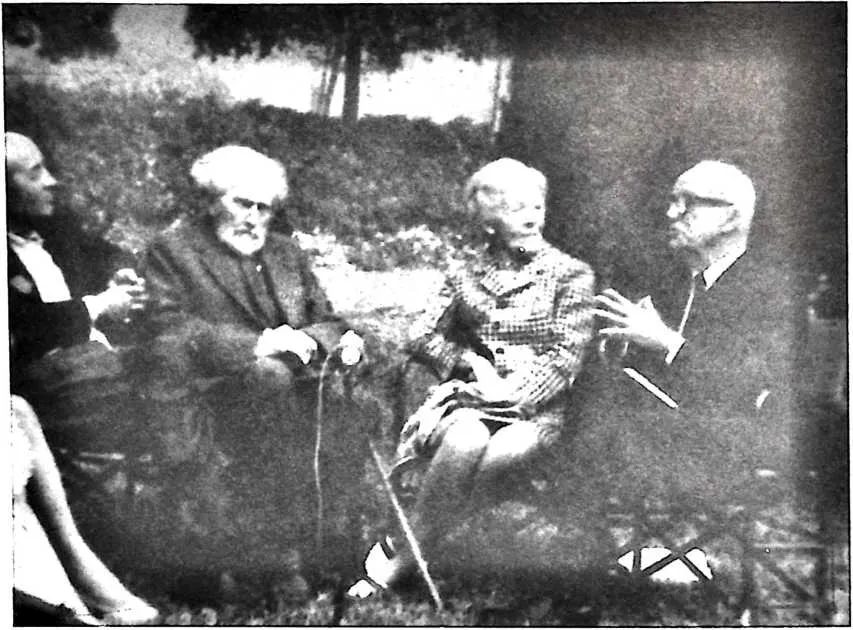
16 One day we went to San Giorgio and worked on a moving picture of Ezra, Olga, Noguchi, Priscilla Morgan, my wife Anne, and myself. While we were on San Giorgio, I saw in the background behind us some very extraordinary pine cones. On these pine cones the little ears that shingled down had edges of gold. So Ezra, Noguchi, and I in a very playful way talked about extracting the gold from the pine cones. And this was the kind of beauty of gold that was most valuable in the universe.
17 With Pound on
18 San Giorgio
19 On another day we went to the very small island of Torrello. Torrello is an island that Hemingway was very fond
20 With Pound on Torrello
21 of. It has on it a lovely little church and a wonderful restaurant. The little church itself had extraordinary mosaic murals. They were the best murals I had ever seen of all the different disciples of Christ. They told much more of their story than I had ever experienced before. Noguchi, as an artist, and Ezra and myself whatever we were, felt ourselves to be in the presence of really great art—very mystically-inspired art.
22 Then there was the island’s one little restaurant. At the end of our luncheon in its garden they served pomegranates. The patterning of the pomegranate seeds resembled the pine cones. We saw them as rubies for our golden pine cones. Their flavor was phenomenal. Following the Torrello visit, he gave Anne and myself another of his cantos in which he wrote the following inscription:
23 Pound inscribes canto for Fuller
24 To Anne and Buckminster Fuller in memory of the garden of San Giorgio and the church of Torrello.
25 The gold from the pine cones—
26 The pomegranate.
27 affectionately, Ezra Pound
28 eleventh October 1970
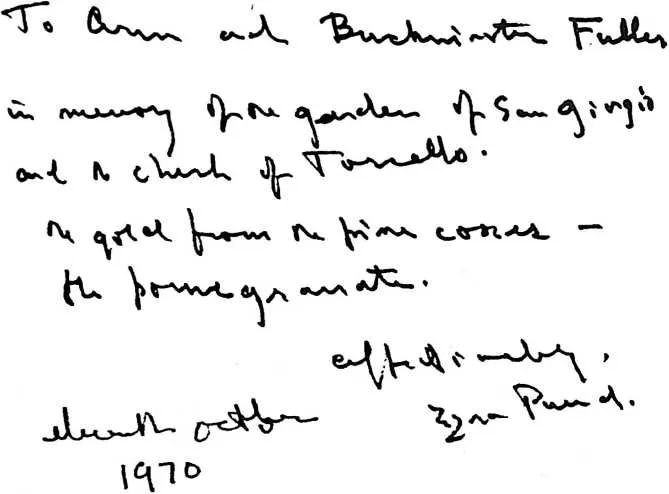
30 It is a lovely piece, because Ezra is letting us know that he was happy again, after all the pain he had been through. He was really enjoying our company. It was a moment of mutual joy. It was soon thereafter that he wrote the lovely piece about which you spoke:
31 Pound calls Fuller "friend of the universe’’
3233To Buckminster Fuller friend of the universe bringer of happiness, liberator.
|
40Then came a final talk at his own house. My wife and I visited with him and looked over and read from many of his cantos. As we left the house and were standing by one of the canals, about to walk over the bridge to take a ferry away from there, Olga ran out with this poem to me. He wrote it on the front page of his Last Cantos. When I got back to America and was doing my book on intuition, I wrote to him and asked if he would be willing to have me use his statement in my book. He said he would be very pleased by this. |
|
|
41DIL |
42You must have thought that his tribute was a very elevating summation of your life and work. |
|
43FULLER |
44It was a very beautiful day. You asked me what I thought as I received it. I was standing out there by the canal and his little house, one of a number of houses there. It was a tiny little three-storied marble-walled house. It was a spiral stairways with three landings surrounding a thirty- feet-high, vertically-tiered bookcase. Ezra and Olga apparently dwelt upon the tiny landings. 45When the poem was handed to me I felt the skies becoming incredibly blue. The beauty of Venice and of the canal I was standing by and the beauty of my wife shone out. I felt a sense of comprehensive living. It was one of those moments when you have no other awareness than that of beauty. |
|
46DIL 47Pound captures essence of Fuller’s life and work |
48Marvelous! You have described it so beautifully. 49Would you like to speculate on how he was able to capture the essence of your life as a person and as a thinker, in three lines? |
|
50FULLER |
51I would not be able to talk about that except to recall that he had apparently exposed himself comprehensively to my thinking for that whole week. And a person who did |
|
66DIL |
|
|
69Pound's Last 70Cantos |
|
|
73Canto 116 |
74Can you enter the great acorn of light? 75But the beauty is not the madness 76Tho’ my errors and wrecks lie about me. 77And I am not a demigod, 78I cannot make it cohere. 79If love be not in the house there is nothing.9 80 |
|
82Canto 117 |
|
|
92Pound’s poetic significance |
|
101 T. S. Eliot in several of his essays acknowledged his personal debt to Pound for publishing his early poems in Poetry and later arranging the publication of his first book of poems by the Egoist Press in 1917. In 1922, Pound edited the manuscript of The Waste Land to about half of its original length, in the form in which it finally appeared in print. In the larger context of Pound’s influence, T. S. Eliot said on a number of occasions that Ezra Pound exercised a vital influence upon English and American poetry, especially on the younger generation of poets: ‘‘Pound did not create the poets: but he created a situation in which, for the first time, there was a ‘‘modern movement in poetry’’ in which English and American poets collaborated, knew each other’s works, and influenced each other. Who, I wonder, in England (to say nothing of the rest of Europe) read any American poetry written between Whitman and Robert Frost? If it had not been for the work that Pound did in the years of which I have been talking, the isolation of American poetry, and the isolation of individual American poets, might have continued for a long time.’’11
102 T. S. Eliot on Pound’s influence
103 It appears, however, that Ezra Pound is more well-known in the context of particular political and ideological controversies leading to his indictment for treason against his country that he maintained he loved dearly. But what is perhaps of lasting significance is the fact that during his six-month detention in the airstrip steel cage in the Detention Training Center at Pisa, which as you say nearly killed him, he could write his Pisan Cantos. When the work was published in 1948 it was awarded the First Bollingen Prize in Poetry. In Canto 76, Pound says:
104 Pound’s Pisan
105 Cantos
106 nothing matters but the quality
107 of the affection—
108 in the end—that has carved the trace in the mind dove sta memoria12
109 Pound’s Cantos
110 Fuller as explorer of human mind
111112and in Canto 81:
113What thou lovest well remains, the rest is dross
114What thou lov’st well shall not be reft from thee
115What thou lov’st well is thy true heritage
116Whose world, or mine or theirs
117or is it of none?13
118 Dr. Fuller, you asked me if I had read any of his books. I would like to say that I am a totally apolitical person. So, leaving aside Pound’s statements regarding particular ideological and ethnic groups, and focusing attention on what he would like us to see as his ‘‘true heritage’’ to the world, I regard Ezra Pound as one of the finest poetic minds of our time. His explorations in his Cantos, on which he began work in 1917 and continued until his death in 1972, cover about eight hundred pages. They represent an odyssey of a truly original twentieth-century mind exploring the universe through representative cultural episodes of historical evolution toward a world civilization. For fifty-five years he kept working on what he jokingly called his ‘‘rag-bag of notes.’’ In 1932, Ernest Hemingway observed: ‘‘The best of Pound’s writing—and it is in the Cantos—will last as long as there is any literature.’’141 believe that future generations will appreciate his best work far more than we do.
119 It is for this reason that I am particularly interested in Ezra Pound’s assessment of Buckminster Fuller as ‘‘friend of the universe.’’ He was himself a friend of the universe and I wanted you to recollect your meeting with him because I think as an outstanding explorer of the human mind himself he could understand what you have been trying to do through your explorations.
120121What Ezra Pound said about you, ‘‘friend of the universe / bringer of happiness / liberator,’’ I really feel that this is
|
128FULLER |
|
|
131DIL |
132 |
|
134FULLER |
135 |
|
138Fuller’s ‘‘How Little I Know’’ |
139I have learned 140That man knows little 141And thinks he knows a lot. 142I am the most unlearned man I know. |
152153But that does not belittle
154The little I seem to know,
155And I have confidence
156In the importance of remembering
157How little we know
158And of the possible significance Of the fact that we prosper, And at some times even enjoy Life in Universe
159Despite the designed-in littleness
160That we have to ‘‘get by with.’’
161Before Heisenberg, T. S. Eliot said, ‘‘Examination of history alters history’’ And Ezra Pound,
162And even earlier poets,
163Reported their discoveries
164That in one way or another
165The act of thinking alters thought itself.
166When we ask ourself
167‘‘What have we learned?’’
168We feel at first
169That the answer is ‘‘nothing.’’
170But as soon as we say so We recall exceptions.
171For instance we have learned
172To test experimentally
173The axioms given to us
174As ‘‘educational’’ springboards, and
175We have found
176That most of the ‘‘springboards’’
177Do not spring
178And some never existed.
|
183When man lacks understanding 184Of nature’s laws 185And a man-contrived structure 186Buckles unexpectedly, 187It does not fail. 188It only demonstrates that man 189Did not understand 190Nature’s laws and behaviors. 191Nothing failed. 192Man’s knowledge or estimating Was inadequate. 193I have learned to undertake 194Reform of the environment 195And not to try to reform man. 196If we design the environment properly 197It will permit both child and adult to develop safely And to behave logically. 198You and I 199Are essential functions 200Of Universe 201We are exquisite syntropy. |
|
|
202DIL |
203I remember the first time I read ‘‘How Little I Know’’ as it came out in the Saturday Review (November 1966). I |
|
204Fuller’s 205Intellectual Development Game in ‘‘How Little I Know’’ |
206was in Bloomington, Indiana studying for my Ph. D. degree. I was deeply touched by a number of your ideas. I hope you won’t mind my taking a few minutes in recalling your Intellectual Development Game which you outlined at the beginning of the poem. 207I recall that 208Thirty-eight years ago 209I invented a routine 210Somewhat similar to |
217218Muscle development
219Accomplished through
220A day-by-day lifting
221Of progressively heavier weights.
222But my new intellectual routine Dealt with the weightless process Of human thought development Which subject is
223Known to the scholars
224As epistemology.
225And I have learned
226That such words as Epistemology
227Stop most of humanity
228From pursuing
229Such considerations
230As the development
231Of the thought processes.
232So my new discipline
233Was invented for dealing
234Even with the ephemeral
235Which word means
236Conceptual but weightless— As is for instance
237The concept of circularity.
238My new strategy required
239That on successive days
240I ask myself
241A progressively larger
242And more inclusive question
243Which must be answered Only in the terms of Experience.
244Hearsaids, beliefs, axioms, Superstitions, guesses, opinions,
245 Were and are
246 All excluded
247 As answer resources
248 For playing my particular
249 Intellectual development game.
250 Dr. Fuller, your conception of Universe as presented in this poem deserves quoting here especially in the context of Ezra Pound’s tribute to you as ‘‘friend of the universe.’’ I find it very helpful in understanding the overall framework of your thinking process.
251 Fuller’s concept of Universe in ‘‘How Little I Know’’
252 The 20th century physicists,
253 In defining physical Universe
254 As consisting only of energy,
255 Deliberately excluded metaphysical Universe—
256 Because the metaphysical
257 Consists only of imponderables,
258 Whereas the physical scientists
259 Deal only with ponderables—
260 Wherefore their physical Universe
261 Excluded for instance
262 All our thoughts—
263 Because thoughts are weightless—
264 But thoughts are experiences—
265 Wherefore I saw
266 That to be adequate
267 To the intuitively formulated
268 And experience-founded controls
269 Of my ever bigger
270 Question and answer routine,
271 My answering definition
272 Of UNIVERSE
273 Must be one which
274 Embraced the combined
|
278Metaphysical and physical 279Components of UNIVERSE. 280Thus my self-formulating answer emerged, 281And has persisted unshattered 282By any subsequent challenges 283From myself or others 284As: 285‘‘By Universe I mean: 286The aggregate of all humanity’s 287Consciously apprehended 288And communicated 289(To self or others) 290Experiences’’ |
|
|
291Man’s function in the universe |
292 294I think man is a very extra-ordinary 295Part of the Universe 296For he demonstrates unique capability 297In the discovery and intellectual identification 298Of the operative principles of Universe • • • |
|
308DIL |
|
|
311FULLER |
|
|
314DIL |
315All right, let us assume then that you are still on this earth |
|
316FULLER |
317I would not be inclined to write a poem about myself. |
|
318DIL |
319Whatever you say in such a context might be a poem. |
|
320FULLER |
|
|
323DIL |
324You do write poetry, and you are a poet. |
|
325FULLER |
326 |
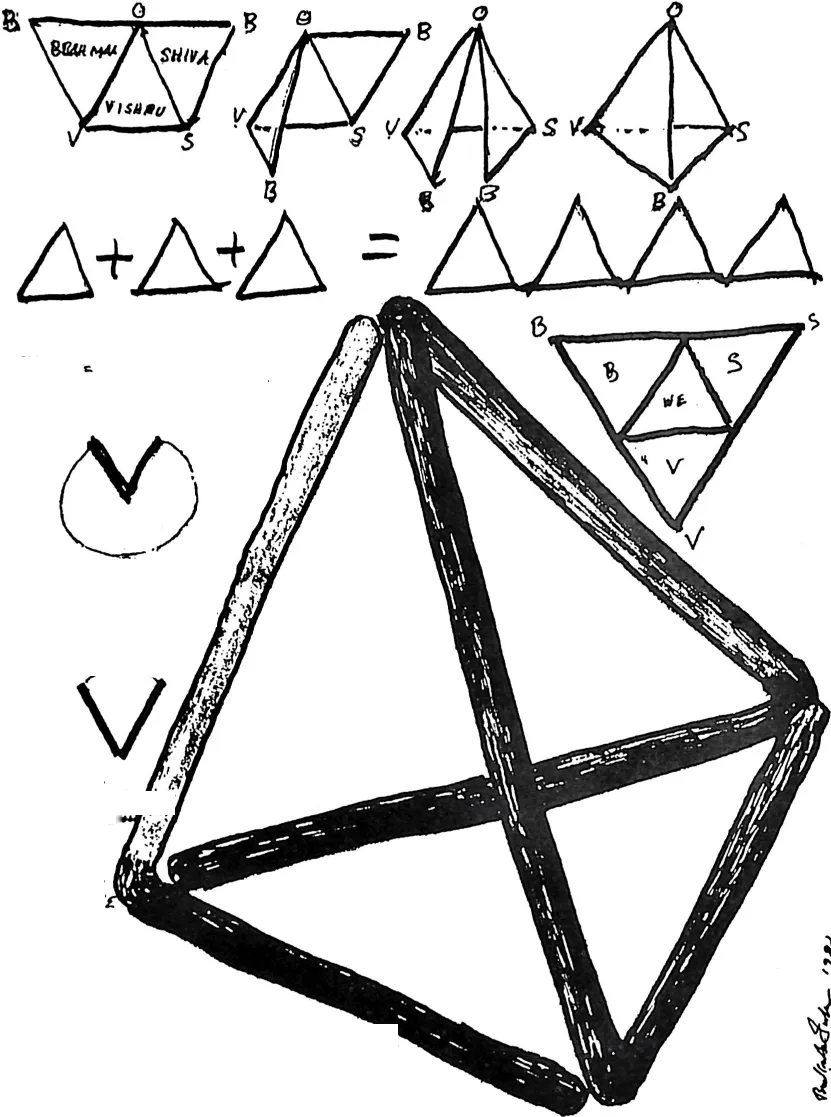
335 ’TElWGbRtw
336 IjNiVEnie.
337 TfriAMi-E s
338 <SANSKItfT WC>ID X’tETI?/lN^vt2c>^ 0> ?>R‘^<Uzv^^A
339 CHATU^AANA N
340 SHIVA
341 EMM<»Y D»V«R<t£NT
342 ?S R4PMF/OA/
343 Vishnu -
344 Unep<;y co anskm
345 A* MATret
346 NuWM< *_£^
347 BfAUMA A
348 Kai^fUtU^uf Ju’t‘ XoVf W is o»>i /VZTMT/Ue C&MPer&ve
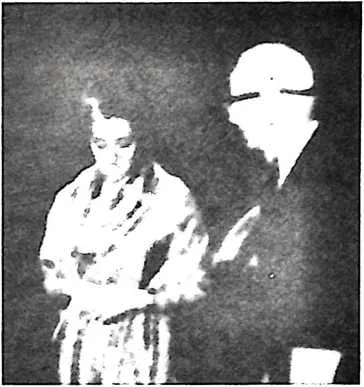
350 Indira Gandhi and Buckminster Fuller in New Delhi, October, 1981
351 Fuller’s poem
352 COSMIC PLURALITY
353 Presented to Indira Gandhi

355 Environment to each must be All there is, that isn’t me. Universe in turn must be All that isn’t me AND ME.
356 Since I only see inside of me What brain imagines outside me, It seems to be you may be me. If that is so, there’s only we.
357 Me and we, too
358 Which love makes three, Universe
359 Perme-embracing
360 It-Them-You-and-We.
361 New Delhi
362 October 8, 1981
363 There is something very special about you, Dr. Fuller, your ability to look into the working of the mind of a poet, an artist, a scientist, a thinker, an explorer. When you wrote your chapter on Einstein’s 1930 essay on cosmic religious sense in your book Nine Chains to the Moon,16 published in 1938, you were impressed by his nonanthropomorphic concept of God. You have called that essay the most important philosophic piece you had read until that time.
364 DIL
365 Einstein’s 1930 article on cosmic religions sense
366367Einstein’s thesis was that fear and longing are the motive forces of all human striving and productivity and thereby humans were brought to the cradle of religious thought and experience. You wrote in your book that Einstein had to reduce these two motivating forces to two words because he needed a polar terminology and that in your own interpretation these words were reducible to ‘‘Exclusion’’ (Einstein’s ‘‘Fear’’) and ‘‘Inclusion’’ (Einstein’s ‘‘Longing’’).
368In course of time the religious sense developed into what Einstein called ‘‘the moral religion’’ because of the humans’ need and longing for love and guidance. Both these forms of religion share the anthropomorphic concept of God. According to Einstein, only exceptionally gifted individuals in human history have risen above this level to display what he called ‘‘the cosmic religious sense’’ which gives those who experience it a marvelous sense of orderliness and oneness present in nature and the universe; and such people, among whom he mentioned Buddha, Democritus, Francis of Assisi and Spinoza, are inspired by a longing for ‘‘the totality of existence as a unity full of significance.’’
369In Einstein’s words: ‘‘No one who does not appreciate the terrific exertions, and, above all, the devotion without which pioneer creations in scientific thought cannot come into being, can judge the strength of the feeling out of which alone such work, turned away as it is from imme-
374 |
|
|
376Fuller’s 1934 commentary on Einstein’s article |
377 |
|
380FULLER |
|
|
383DIL |
|
|
386FULLER |
|
|
389DIL |
|
398 In your 1938 book Nine Chains to the Moon, you in fact proposed how Einstein had conceptualized time and relativity. It is an exciting story that created quite a stir during the thirties. You had written that working as a patent examiner in Switzerland, which led the world in the making of watches, clocks and other time-keeping devices, Einstein must have naturally thought a great deal about time. He must have been led to think that Newton had to be wrong in assuming a uniform and simultaneous time in the universe. Einstein’s cosmic religious sense and his evaluation of time-keeping patents must have led his thinking to relativity and E = me2 equation. On your suggestion the publisher sent your manuscript to Einstein, who was so pleased with your understanding of his thinking process that he invited you to come and see him in New York. That means there is something very special going on in your own mind by way of your being able to understand how Einstein’s mind functioned in terms of his ‘‘conceptual realization,’’ to use your own term instead of ‘‘creativity.’’
399 Fuller's understanding of Einstein’s thinking process
400 The word ‘‘pleased’’ I don’t know about. What Einstein said was that he was advising my publishers that he approved of my method of ascertaining how he came to various formulations and he approved of my understanding of his methods of thinking. I think it was very extraordinary to have him say to me: ‘‘I am notifying your publishers that I approve of your conception of my thinking process.’’ But he did not say it made him happy. He just said he approved of my capability to do so.
401 FULLER
402 That is what I was pointing to: your capability to see how Einstein’s mind worked on a particular conceptual formulation.
403 DIL
404 Would you say something more about your meeting with Einstein?
405 Well, that is the very essence of it right there.
406 FULLER
407 Fuller’s meeting
408 with Einstein
409 A publisher had agreed to publish my book because a successful author, Christopher Morley, had recommended it. Six months later, I received a letter from the publisher’s editor in Philadelphia, saying: ‘‘You have three chapters on Einstein, and we’ve looked up the list of all people that understand Einstein and you’re not on it. In fact, we can’t find you on any list. As a consequence, we think we must not publish your Nine Chains to the Moon. We want to avoid being a party to scientifically untenable speculation.’’
410 I was dismayed. Being also as yet young and a little bit ‘‘fresh’’ I wrote back to the publisher, ‘‘Dr. Einstein has just come from Europe to Princeton, New Jersey. Why don’t you send my typescript to him and let him be the judge?’’ I had no hope that they would do such a thing, but nine months later my Woodmere, Long Island home telephone rang. The call was from a Dr. Fishbein who said, ‘‘I live at such-and-such an address on Riverside Drive in New York City. My friend Dr. Albert Einstein is coming in from Princeton this weekend to stay with me. He has the typescript of your book and would like to talk with you. Do you think you could come in?’’ Obviously, I accepted.
411 On Sunday evening I came to Dr. Fishbein’s large Riverside Drive apartment. A
number of Einstein’s friends were already there. They were seated around the walls of an
enormous drawing room. Einstein was seated at the far end of the room. As I was
presented to him, I felt mysteriously moved. My reverence for him was such that I seemed
to see a halo above his head. He immediately arose and excused himself and myself
from his friends. He led me to Dr. Fishbein’s study. On the desk of the study,
under the lamp, I saw my typescript. We sat down on opposite sides of the desk.
Einstein said he had read my typescript and found no fault. Better than that,
he
said that he liked the way in which I explained how he happened to come to think as he
did and how he had formulated that thinking into his relativity theories and equation.
Then Einstein said, ‘‘I’m advising your publisher of my approval of your explanation of my
formulatings.’’
412 I had three chapters opening my book. I am a comprehensivist and not a specialist. I am only natural like all human beings in that, and I did not get forced into being a specialist, thank goodness. I started my book working from the whole to the particular, with a tentative cosmic inventory in which I did inventory the limits of the macro-searching and micro-searching of scientists and the limits of technical realizations of those findings—to what height had man flown, and what did we know about galaxies. It was, incidentally, only five years before I was writing that Hubble had just discovered another galaxy. Up to that time we had known only of our own Milky Way. Hubble’s 1928 discovery occurred just two years before Einstein wrote that cosmic religious sense article. It was a new idea that there were other galaxies, as noted in my 1933--35 Tentative Cosmic Inventory. Up to a week ago, i.e., January 1, 1983, the public knew of two billion more galaxies. Within this last week, you may recall seeing in the newspaper that with the new radio telescopes we have discovered two hundred billion more galaxies. So it is quite a difference between the tentative 1933 to 1935 and the 1983 inventory.
413 Fuller describes
414 Nine Chains to the Moon
415 My 1935 Tentative Cosmic Inventory was so impressed with Einstein’s 1930 piece on
the cosmic religious sense that I wrote to the New York Times and to Einstein’s publisher
and received permission to use it to represent Einstein’s philosophy. Then came my
chapter of analysis of how he came to do his thinking. Then came a chapter in which I said
that it is history that when a great scientist makes a breakthrough, the Academy of
Science does not
accept him right away. Einstein’s theory determined how much energy there was in any
given amount of matter. They never had a formula for that before. In 1933--35, Einstein’s
theory had not yet been accepted by the society of scientists. I said in my Nine Chains to
the Moon piece that, personally, I was confident that in due course Einstein’s equation
would be proven to be correct; that after many years following the academics’ acceptance,
Einstein’s theory and equation would finally get into the books in the universities and
schools. When such new theories are proven and accepted, they provide a new
kind of intellectual environment for the thinking of the children who are being
educated.
416 I went on to explain in Nine Chains to the Moon that, within this new thinking, there comes invention of new technologies that take advantage of, for instance, electromagnetics, which would also take advantage of Einstein’s theory that matter is energy. Then as the inventions are sold to various industries, industrial businesses begin to produce under the new technical knowledge. The inventions themselves alter the environment of society. Then, within that new environment, society behaves in certain new and unprecedented ways.
417 In view of this evolution, I wrote a chapter called ‘‘E = me2 = Mrs. Murphy’s Horse Power.’’ In this chapter I did my best to depict world behaviors predicated on my assumption that humanity would be behaving in accord with the philosophy of Einstein.
418 I will never forget the gentle way in which Einstein said to me: ‘‘This chapter about Mrs. Murphy. Young man, you amaze me. I cannot conceive of anything I have ever done having the slightest practical application. I have explored, hoping that what I find might be useful to astrophysicists, to cosmogonists, but practical applications are not anticipated.’’
419 Einstein’s comment on practical application of his work
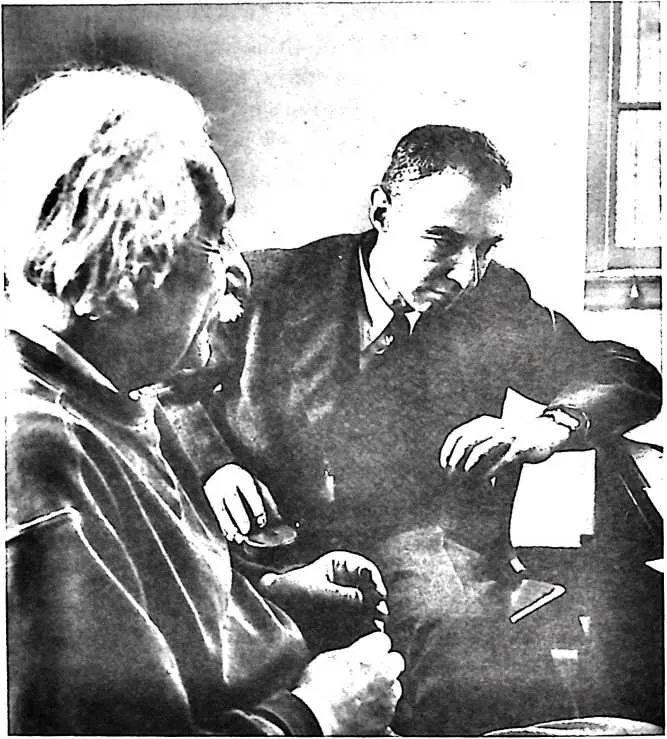
421 Albert Einstein and J. Robert Oppenheimer (Director of Manhattan Project)
422 ‘‘Late in his life, in connection with his despair over weapons and wars, Einstein said that if he had to live it over again he would be a plumber. This was a balance of seriousness and jest that no one should now attempt to disturb. Believe me, he had no idea of what it was to be a plumber, least of all in the United States, where we have a joke that the typical behaviour of this specialist is that he never brings his tools to the scene of the crisis. Einstein brought his tools to his crises: Einstein was a physicist, a natural philosopher, the greatest of our time. . . .
423 Oppenheimer on Einstein
424 Einstein is often blamed or praised or credited with these miserable bombs. It is not in my opinion true. The special theory of relativity might not have been beautiful without Einstein; but it would have been a tool for physicists, and by 1932 the experimental evidence for the inter-convertibility of matter and energy which he had predicted was overwhelming. The feasibility of doing anything with this in such a massive way was not clear until seven years later, and then almost by accident. This was not what Einstein really was after. His part was that of creating an intellectual revolution, and discovering more than any scientist of our time how profound were the errors made by men before them.’’13
425 —J. Robert Oppenheimer’s ‘‘On Albert Einstein,’’ in a commemoration of Einstein’s 10th death anniversary in 1965.
426 It was two years after he said that to me that Hahn and Strassmann in Germany discovered theoretical fission—they were aided by Lisa Meitner. They communicated by secret messenger to their New York scientist colleagues, confiding that they had found theoretical fission. They were also confident that Hitler’s scientists were seeking that atomic energy breakthrough. Hahn and Strass- mann’s German-Jewish scientist friends in America calculated their work and sure enough, they confirmed Hahn and Strassmann’s discovery. Their New York scientist friends then said that nobody would believe their discovery in the political world. Franklin Roosevelt would not believe an unknown name to him, but he might accredit Einstein if Einstein notified him that theoretical fission had occurred. Einstein agreed to do it. President Roosevelt had been given an emergency fund by the New Deal congress. He had enormous funds not used. He took eighty billion dollars of it and applied it immediately to what eventually became known as the Manhattan Project. Out of all this came the physically successful Fermi
427 Manhattan
428 Project
429430Albert Einstein
431Old. Grove 3d.
432Nassau Point Peconic, Long Island August 2nd, 1939
433 P.D. Roosevelt,
434 President of the United States,
435 Nhite House
436 Washington, P.O.
437 Sir:
438 Some recent work by E. Permi and L. Szilard, which has been communicated to me in manuscript, leads me to expect that the element uranium nay be turned into a new and important source of energy in the immediate future. Certain aspects of the situation which has arisen seem to call for watchfulness and, if necessary, quick action on the part of the Administration. I believe therefore that it is my duty to bring to your attention the following facts and recommendations:
439 In the course of the last four months it has been made probable - through the work of Joliot in Trance as well as Termi and Szilard in America - that it may become possible to set up a nuclear chain reaction in a large mass of uranium,by which vast amounts of power and large quantities of new radium-like elements would be generated. Now it appears almost certain that this could be achieved in the immediate future.
440 This new phenomenon would also lead to the construction of bombs, and it is conceivable - though much less certain - that extremely powerful bombs of a new type may thus be constructed. A single bomb of this t-ype, carried by boat and exploded in a port, might very well destroy the whole port together with some of the surrounding territory. However, such bombs night very well prove to be too heavy for transportation by air.
441 -2-
442 The United States has only very 0001 ores of uranium in moderate quantities. There is some good ore in Canada and the former Czechoslovakia, ■while the most important source of uranium is Belgian Congo.
443 In view of this situation you may think it desirable to have some permanent contact maintained between the Administration and the group of physicists working on chain reactions in America. One possible way of achieving this might be for you to entrust with this task a person who has your confidence and who could perhaps serve in an unofficial capacity. His task might comprise the following:
- a)
- to approach Government Departments, keep them informed of the further development, and put forward recommendations for Government action giving particular attention to the problem of securing a supply of uranium ore for the United States;
- b)
- to speed up the experimental work.which is at present being carried on within the limits of the budgets of University laboratories, by proviainc funds, if such funds be required, through his contacts with private persons who are willing to make contributions for this cause, and perhaps also by obtaining the co-operation of industrial laboratories which have the necessary equipment.
444 I understand that Germany has actually stopped the sale of uranium from the Czechoslovakian mines which she has taken over. That she should have taken such early action might perhaps be understood on the ground that the son of the German Under-Secretary of State, von Weizsaoker, is attached to the Kaiser-Wilhelm-Institut in Berlin where some of the American work on uranium is now being repeated.
445446Yours very truly,
447(Albert Einstein)
448pile which proved Einstein’s equation to be correct. For the first time in history, the amount of energy in a given amount of matter was being accurately anticipated.
449 Einstein on atomic bomb
450 DIL
451 Einstein as artist using the medium of science
452 FULLER
453 DIL
454 FULLER
455 DIL
456 FULLER
457 Having heard Einstein say to me that he had never expected any practical application of his work, I could correctly imagine Einstein’s feelings in having his theories finding their first practical application on Hiroshima. I know the old man was really broken over this for the rest of his life. And, in fact, with it he discovered, and he let all his friends know that this experience quite clearly demonstrated, that scientists were caged birds with the system encouraging them to lay eggs; the disposition of the eggs became the exclusive prerogative of the powerful people. And the powerful people would take away those eggs and the scientific people would have nothing to do with what happened to them.
458 This gives us a sobering insight into what the role of the scientist, the thinker, the artist, is in our time.
459 Going back to our exploration of the way Einstein’s mind worked, some people say that he was an artist who was using the medium of science to do his thinking …
460 I didn’t say that.
461 No, the physicist Banesh Hoffmann, who was Einstein’s assistant in 1937, did. In his book Albert Einstein, Creator and Rebel, that won the 1973 Science Writing Award of the American Institute of Physics, Hoffmann noted: ‘‘He was at heart an artist, employing the medium of science.’’19 You wouldn’t say that, would you?
462 I don’t say that.
463 What would you say?
464 I would say the word ‘‘scientist,’’ the word ‘‘artist,’’ the word ‘‘poet,’’ are invented by humans.
465 In your essay ‘‘The Leonardo Type,’’ which was your discourse as the Third Jawaharlal Nehru Memorial Lecturer in New Dehli, 1969, you wrote: ‘‘Ralph Waldo Emerson defined poetry as ‘saying the most important things in the simplest way.’ By that definition Einstein became and will probably remain history’s greatest poet—for who could say so much so simply as did Einstein when he described physical Universe as E = me2?’’20
466 DIL
467 Do you have any other recollections of Einstein?
468 I often saw Einstein on the streets of Princeton in 1951 through 1954. I and other Princeton people respected him so much that none of us ever introduced or reintroduced ourselves to him in the street. I never stopped him and said, ‘‘I’m the man who said such-and-such to you in 1935.’’ But I did have a fascinating indirect encounter in 1953.
469 FULLER
470 Einstein visits Fuller’s geodesic
471 tensegrity project
472 In the 1950s Princeton’s architectural department had an experimental station near the university stadium. In the years before World War I, the building had been used as the Princeton polo team’s stables and dressing rooms. As an architectural student project conducted by me, we erected a fifty-foot-diameter model of my geodesic tensegrity sphere. It was made of ninety aluminum tubes and flexible, aircraft stainless steel cables. Einstein walked over to study it. I wasn’t there at the time but was told by the architectural students and faculty who were there that he was extraordinarily moved by it.
473 I feel that a person like Einstein is tremendously sensitive in trying to understand: ‘‘What is Universe? What is going on in the universe? How come Universe? What am I to think and do about being included in the universe?’’ I am confident that such questions stirred Einstein’s thoughts and motivated his work.
474 I am sure that is the reason Ezra Pound said ‘‘friend of the universe’’ about me.
475 Little children marvel at the universe. Those are the kinds of thoughts we have when we first recollect having thoughts. With the mysterious experience of being loved and looking around, we enter the era which we first remember. We remember just that we were fascinated with the universe. A child looks at the sky and understands it, looks at the trees, looks at the snow falling and sees that the snowflakes are all hexagonal, always cosmically- perfect patterns. These are the simple perfections of every child’s experience. Every child is a poet. In 1922, Christopher Morley wrote a poem about this:
476 Children as friends of the universe
477 Morley’s poem to a child
478 To a Child
479 The greatest poem ever known, Is one all poets have outgrown: The poetry, innate, untold, Of being only four years old.
480481Still young enough to be a part
482Of Nature’s great impulsive heart, Born comrade of bird, beast and tree And unselfconscious as the bee—
483And yet with lovely reason skilled
484Each day new paradise to build;
485Elate explorer of each sense, Without dismay, without pretense!
486In your unstained transparent eyes There is no conscience, no surprise: Life’s queer conundrums you accept, Your strange divinity still kept.
487Being, that now absorbs you, all
488Harmonious, unit, integral,
489Will shred into perplexing bits,—Oh, contradictions of the wits!
490And Life, that sets all things in rhyme, May make you poet, too, in time—But there were days, O tender elf, When you were Poetry itself!21
491 dil I am here reminded of a poem by the Nobel-Laureate
492 Rabindranath Tagore. My wife, Afia, is from Dhaka, Tagore’s poem to a Bangladesh. I remember her reciting the original poem in child Bengali to our son, Kamran, when he was a little boy, and to her daughters, Shaheen and Saeqa, who grew up as my own. We all used to have lots of fun together with Tagore’s poem which I think is one of the loveliest poems to a child. In Afia’s translation it reads like this:
493 To a Child
494 The child calls his mother and asks: ‘‘Where did I come from, Mother? Where did you find me?’’
495 The Mother smiles and cries,
496 takes the child in her arms and says: You were the desire in my heart!
497 You were in my childhood play of dolls.
498 Every morning as I prayed to Shiva
499 I shaped you and reshaped you You were with my god on his throne, And adoring him I adored you.
500 In my hope of all times and in all my love In the heart of my mother and my grandmother In this old house of ours,
501 in the lap of our house-goddess
502 God knows how long you were in hiding.
503 When in my youth I had the. awakening You were the fragrance within me You were there in my young body With all your tender loveliness.
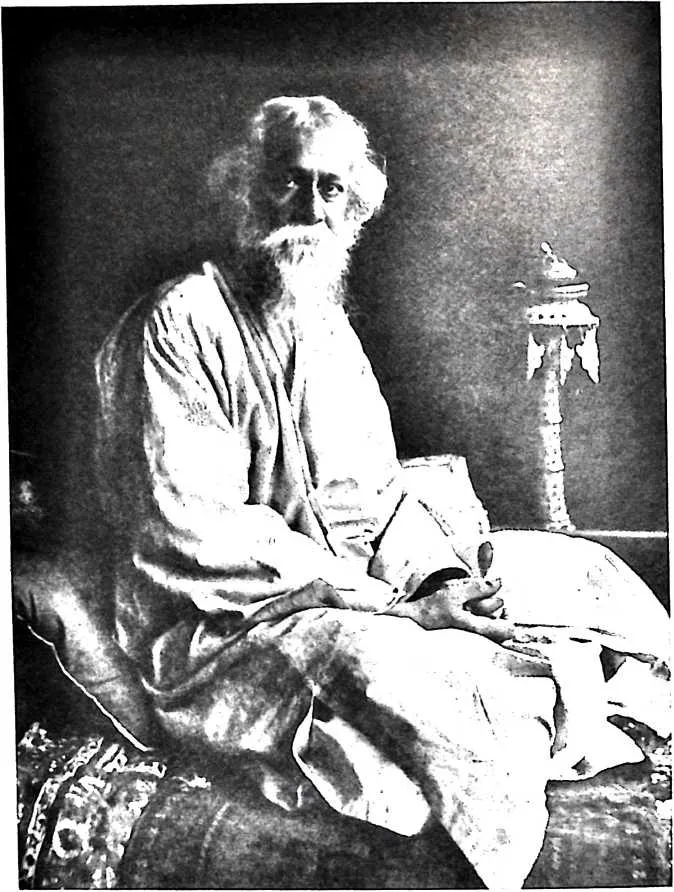
505 Rabindranath Tagore
506 You are the treasure of all gods,
507 You are the perennial love of Eternal Time You are as timeless as the morning light From all the dreams of the world
508 You came in a stream of joy Bringing happiness in your mother’s heart.
|
512I look and keep on looking at you 513 516How this little body of yours kissed mine 517 519How did you appear in the world with beautiful smiles? 520That is why I am sometimes so frightened 521 523I die crying when you are away— 524I do not know with what net of love should I tie 525 527And keep it in my two weak arms! 528Translated from the original 529in Bengali by Afia Dil |
|
|
530FULLER |
531Alexandra, Anne’s and my first child, born in 1918 just after World War I, caught the flu, infantile paralysis, spinal meningitis, and died of pneumonia on her fourth birthday. Our second daughter Allegra, born five years after Alexandra’s death, was wonderfully healthy and happy. She named her daughter Alexandra after her sister. Alexandra, our grand-daughter, is a year and a half older than our grandson Jamie Lawrence Snyder. On his eleventh birthday I came into Jamie’s room and saw on his desk a sheet of paper written by Alexandra. Tagore’s lines: 532You belong to the world 533How did you come to be mine? 534make me think of and wish to repeat Alexandra’s poem to Jamie: |
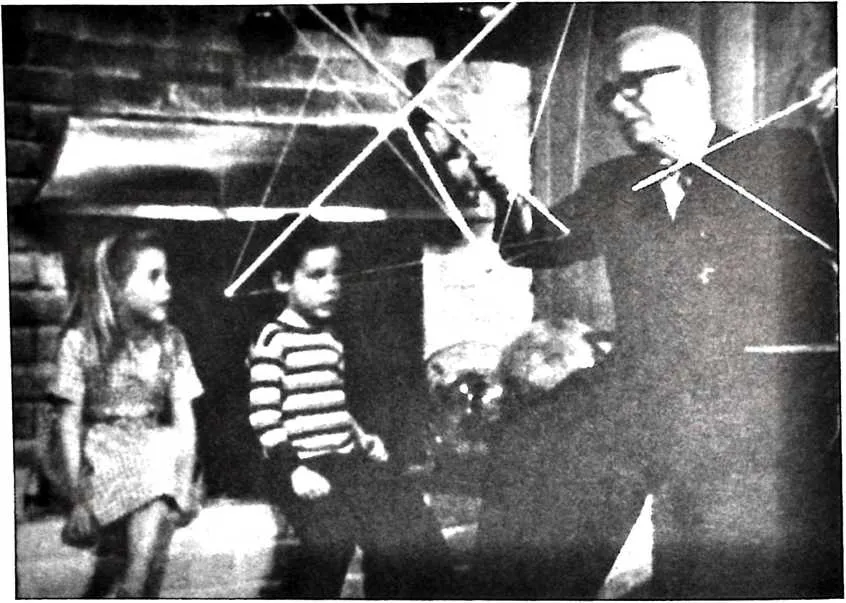
541 Fuller with his grandchildren Jamie and Alexandra Snyder, 1959.
543 So many love you,
544 As do I
545 Who do I thank
546 On this day of your birth?
547 That you were bom
548 A part of me
549 That you were bom
550 My brother.
551 So the word poetry does relate to that extraordinary moment of earlier experiences we try to remember, as we begin to emerge from our mothers’ arms and being loved and being suckled. I cannot remember being suckled, maybe you can, I cannot—but I do remember so much of the smell of the air, the freshness of the gardens, the way
552 Earliest childhood memories of the universe
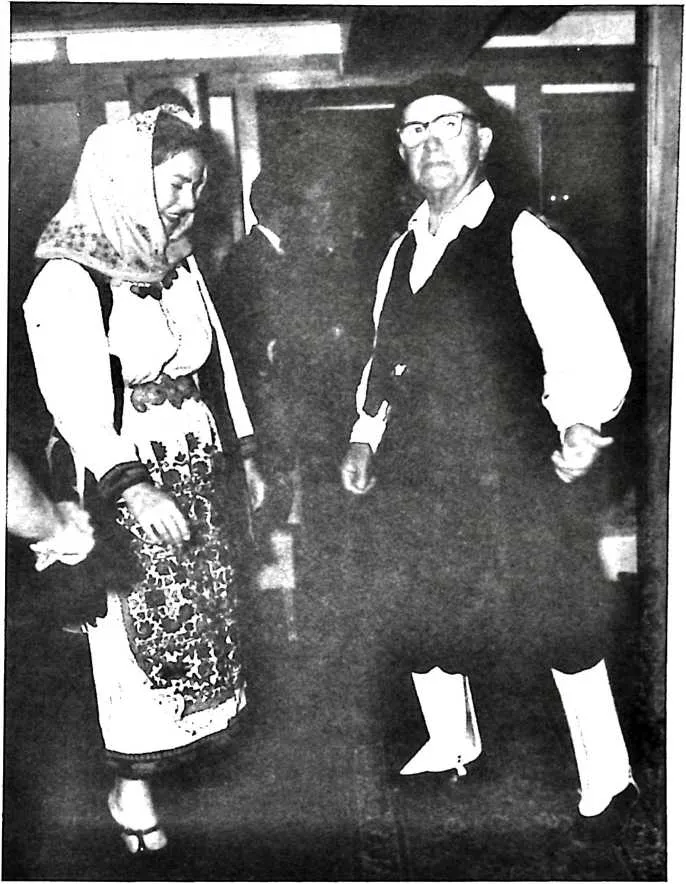
554 Fuller and his daughter Allegra during the celebration of his 70th birthday in Greece, 1965.
555 the tops of trees were moving around, how extraordinary it is, that blue sky, and as they say, snow coming, rain falling on the ground, and all those things. And I am sure all children feel all that. Then someone says: ‘‘Now, you have got to go to school, we have to teach you something,
557 ‘‘The most poetical experiences of my life have been those moments of conceptual comprehension of a few of the extraordinary generalized principles and their complex interactions that are apparently employed in the governance of universal evolution.’’
558 —Fuller lecturing under the auspices of the United States International University, San Diego, December 3, 1982.
559 pay attention.’’ The system tells you to pay no further attention to your own original thinking about the interrelated significance of directly-experienced phenomena. I was told by my mother, who I was sure loved me, ‘‘Darling, never mind what you think - listen—we are trying to teach you.’’ All the school teachers said the same thing to me. Knowing how dearly my mother loved me, I did my best not to listen to my own thoughts.
560 As I said, every child is a friend of the universe, and I, as an original friend of the
universe having temporarily lost that friendship, have now pretty much recaptured it. I
have done everything I could to unfetter myself from all
the social impositions. I apparently have purged myself pretty thoroughly of the
erroneous thinking and value systems that society has put on its young about the
explanations of life and the games the teachers play. I am pretty well free of
those.
561 Last night you came to listen to me speaking before a university audience. I would not be dealing in tetrahedra and octahedra and icosahedra as the three basic structural systems of Universe if I had gone along with the schools’ geometric teaching wherein everything goes back to squares and cubes.
562 It is interesting that when Einstein was asked to look back at his life, he wrote about the phenomenon you are talking about: ‘‘Out yonder there was this huge world, which exists independently of us human beings and which stands before us like a great, eternal riddle, at least partially accessible to our inspection and thinking. The contemplation of this world beckoned like a liberation, and I soon noticed that many a man whom I had learned to esteem and to admire had found inner freedom and security in devoted occupation with it. The mental grasp of this extra-personal world within the frame of the given possibilities swam as highest aim half consciously and half unconsciously before my mind’s eye. Similarly motivated men of the present and of the past, as well as the insights which they had achieved, were the friends which could not be lost.’’22
563 DIL
564 Einstein’s view of the world
565 In essence, this is the same idea you have developed in your writings, probably independently of Einstein. And this fact interests me greatly because we need such inspired humans, in growing numbers, to inhabit the future.
566 I think Einstein was fortunate in that he probably never lost his childhood. I temporarily had mine taken away from me.
567 FULLER
569570Sketch of Einstein by Leonid Pasternak, the father of Boris Pasternak. Courtesy of Lydia Slater-Pasternak.
571‘‘Music does not influence research work, but both are nourished by the same source of longing, and they complement one another in the release they offer.’’
572—Albert Einstein in a letter to a correspondent, October 23, 1928.
573Quoted in Albert Einstein: The Human Side; New Glimpses from his Archives, Selected and edited by Helen Dukas and Banesh Hoffmann. Princeton, New Jersey: Princeton University Press, 1979, p. 78.
|
577DIL |
578Very temporarily—for a very short time. |
|
579FULLER |
580I know. And I had to unburden myself from that. I had a personality put upon me of how my school wanted me to |
|
581Fuller’s childhood |
582be. And what my mother wanted me to be. She wanted me to be a success in the world of the business game. She was a darling and out of her love she did not want me to be hurt. She wanted me to be a success in it. But she became more and more fearful that I was going to be more and more in great trouble. She also said that she was afraid that I was going to go to the penitentiary. Because of my initiatives, the things I did got me into trouble with society. Robin Hood was my hero. Whenever I found individuals in trouble I felt completely free to operate transcendentally to man-made laws, so I did have to go through a great deal to throw off the superficial mantle that was on me. When not Robinhooding, I tried to behave in ways that were pleasing to my mother, which was playing a role which was not me at all. You understand me? |
|
583DIL |
584Yes I do, very much so—from my own experience. |
|
585FULLER |
586I don’t think Einstein ever went through anything like that. |
|
587DIL |
588Maybe, perhaps not to that extent, but he did, of course. |
|
589FULLER 590All children born as geniuses |
591But my point is that whatever you speak about that people have or Einstein had or I have, I am saying every child is born with. |
|
592DIL |
593Oh, yes, I believe that. |
|
594FULLER |
595I have often written that children, all children, are bom geniuses and get de-geniused very rapidly by the fear and love of their parents that they won’t fit into the system, that the power system will hurt them. |
602 Still the question remains, even though every child is born with the capacity to be a genius and to function like one, how does the mind of people like Albert Einstein and Buckminster Fuller work? And that is one reason I was hoping that you would speak a little on how Einstein’s mind worked by way of what precisely thinking is. What I am hoping to do by pursuing this question is to try to understand, through your interpretation of what Einstein said in his autobiographical notes, from which I have quoted earlier.
603 DIL
604 Einstein regarded this as a critical question in his reflections on life and observed: ‘‘What precisely, is ‘thinking’? When, at the reception of sense-impressions, memorypictures emerge, this is not yet ‘thinking’. And when such pictures form series, each member of which calls forth another, this too is not yet ‘thinking’. When, however, a certain picture turns up in many such series, then—precisely through such return - it becomes an ordering element for such series, in that it connects series which in themselves are unconnected. Such an element becomes an instrument, a concept. I think that the transition from free association or ‘dreaming’ to thinking is characterized by the more or less dominating role which the ‘concept’ plays in it. It is by no means necessary that a concept must be connected with a sensorily cognizable and reproducible sign (word); but when this is the case thinking becomes by means of that fact communicable.’’23
605 Einstein's view of what precisely is thinking
606 Last night I differentiated for you brain and mind. Brain, relating to the images that Einstein speaks about, the brain is dealing in images and experiences. I said mind and mind alone has the capability from time to time to discover relationships existing between the special case—brain conceptionings. Einstein says something in what you have just read to me, very close to something I have just said.
607 FULLER
608 Brain and mind
609610I say the following, too, sir. All the time we are having experiences, and they may be while just drinking our tea, or whatever it is, we do not think anything about that—we drink tea many times. But there comes a moment when I am experiencing something—which it seems to me I have experienced before, that is all you can say. Then comes another experience when this seems to be the experience that I said a while back that I thought I had experienced before—this is the third case. And if I am thinking, I ask myself, ‘‘How long ago was that last time?’’ I could not go back to the first ‘‘I think of’’ experiences, because I did not know at that time that what I was experiencing had any significance whatsoever. I can go back to the third time of experiencing something when I said, ‘‘I think what I am now experiencing I have experienced before; and that was just three months ago.’’ If there is some periodic significance in what I am thinking about what I am feeling, then there is some significant factor in my thinking that I have had this experience before, which is repeating itself embodied in some other experience; then three months from today I will be liable to have the same kind of experience and thought. Three months from today when it happens, I say, ‘‘I have really discovered something. What is it?’’ then I begin to think. It takes literally four experiences for mind to discover that there is an interrelationship significance going on here that was not to be evidenced in one experience by itself. This is an accurate mathematical analysis. I have been able to prove this. I can give you a mathematical statement as to how this happens. It always takes four.
611 Relationship of four experiences
612613Any one of many five o’clock experiences: having tea at X; met several people; many rememberable environmental items.
614 5 P.M.
615 Tuesday ®
616 Jan 6, 1981
617 ‘‘It seems to me that this happened to me before.’’ ‘‘Oh, now I remember, it must be coincidence.’’ ‘‘What again?’’ ‘‘How long ago was that? And the time before?’’ ‘‘If this is not strange coincidence, it will happen again on March 31st.’’ ‘‘Sure enough, I have discovered a periodic experience.’’
618 5 P.M.
619 Tuesday
620 Feb 3, 1981
621 5 P‘M’ W
Tuesday ®
March 3, 1981
622 5 P,M’ w Tuesday ill
623 March 31, 1981
624 It always takes a minimum of four equi-intervalled, identical, repeat-experiences to discover time dimensioning. Other relationships You may find many scientists going over what it is they °f f°ur have learned. One of the things they keep saying today is,
625626‘‘How does it happen? That it is always the number 4.’’ This has a great deal to do with what I told you in yesterday’s lecture when I spoke about Linus Pauling’s Nobel Laureate review of the history of organic chemistry.
627In 1880, a man named Frankland noted that in organic chemistry the numbers 1, 2, 3 and 4 were always being manifested. In 1825, a French chemist named Butlerev said that the 1, 2, 3 and 4 number repeatings related to the interbonding of chemical molecules. Butlerev called bonding ‘‘valence.’’ He noted that there were uni-valent, bi-valent, tri-valent and quadri-valent organic chemical bondings.
628In 1860, we have a chemist named Van’t Hoff who stated that the recurrent oneness, twoness, threeness and four- ness related to the four comers of the geometrical form, the tetrahedron.
629 Tetrahedron as In my modern synergetic geometry I proved that the minimum structural tetrahedron is the minimum structural system in the universe.- system
630631In my lecture last night, I reviewed the history of Van’t Hoff’s being rejected by science, which claimed that nature had no geometrical models, only mathematical equations. Van’t Hoff lived to give optical proof of the tetra- hedronal configuration of carbon. He was the first chemist ever to receive the Nobel prize.
632 Dr. Fuller, will you please explain precisely what you mean by the term ‘‘system’’ and ‘‘structural system’’ in nature and the universe? It appears to be a central concept in your thinking and I would like to understand it more clearly.
633 D1L
634 FULLER
635 Meaning of ‘‘structural system"
636 Last night in my lecture I spoke to you about systems. I defined ‘‘system’’ to you. To elucidate on this thinking, I am borrowing a few pages from my in progress book, Cosmography. [FK92]
637638Walk over a path or a roadway of recently-crushed stones. You will soon discover that no matter how many times stones are broken into smaller stones, none are ever produced with fewer than four corners, nor with fewer than three faces around each corner, nor with fewer than three edges around each face. You will also learn that frequently the recurrent form is that of an irregular tetrahedron. You are learning that nature has minute, mathematically elegant mini-terminal aspects.
639Stones are always polyhedra—many sided. Even when stones appear to be polished spheroids, if looked at through a lens of sufficient magnifying power they will always be seen to be in fact many mini-mountained poly-poly-polyhedra.
640The great eighteenth-century Swiss mathematician, Leonhard Euler, made an epochal breakthrough for mathematics and indirectly for all humanity when he discovered a set of always and only manifest unique patternings present in all our geometrical experiences. The patternings he named topology. He showed that all our visually-pictured experiences are always and only resolvable into three unique aspects: firstly lines, secondly crossings of lines (which can be called ‘‘fixes’’ or ‘‘vertices’’ or ‘‘points’’ or ‘‘comers’’) and thirdly areas (or faces) surrounded by the lines.
641Euler showed that a universal law obtained which demonstrated that the number of corners (points, fixes, crossings, etc.) of all polyhedra plus the number of areas of the considered polyhedron will always equal the number of edges of that polyhedron plus two.
642This formula is written as V + F = E + 2. To further elucidate Euler, I introduce my (not Euler’s or anyone else’s) SYSTEM concept.
643A system is the simplest experience we can have. Systems always have insideness and outsideness. Recognition of a system begins either with the initial discovery of self or of the ‘‘otherness.’’ Life begins with awareness. No ‘‘otherness,’’ no awareness. No insideness and outsideness. No life or thought.
644Division of systems Systems always divide all the universe into three principal parts. First, into the system itself. Second, into all the universe otherness outside the system—i.e., the macrocosm. And third, into all the system’s microcosm—i.e., all the otherness inside the system.
645More precisely, the foregoing three-way division can be expanded into five zones: First, into all the universe outside the system being considered, which in turn is divided into: (1) the clearly irrelevant macrocosm and, (2) the twilight macrocosm zone of ‘‘could-be-considered-relevant’’ external environment. Second, into the microcosmic insideness which in turn is divided into: (3) the clearly irrelevant microcosm and, (4) the twilight microcosm zone of ‘‘could-be-considered-as-relevant’’ in the internal environment of the microcosmic system and, (5) into the remaining portion of Universe which is the clearly relevant, clearly tuned-in system itself that convergently-divergently divides all the universe into its macro-out- sideness and its micro-insideness irrelevancies.
646Thought systems Systems have the powerful capability to spontaneously brain-employ our inward-outward, convergent-divergent, concave-convex, sorting-out differentiating. All thoughts also are always spontaneous tunings-in of uniquely inter-relevant thought systems.
647Thought systems consist of all the clearly-relevant considerations. Consideration (con-sidus) means literally bringing together and being concerned with the spontaneously-discovered interrelatedness of a special star group - that is to say, with special constellation of neighboring star thoughts.
648Thought systems have their spontaneously-conceived macro- and micro-relevant limits. There are events too large and too infrequent to be spontaneously considered and events too small and/or of too high a frequency to be noticeably tune-in-able within our magnitude of macromicro range considerations.
649Thoughts, as with TV programs, have their ‘‘tuned-in,’’ always discrete, special wavelengths and frequencies. These tuned-in frequencies inherently exclude all the multitude of neighboring, untuned-in macro- and microfrequencies of concurrently broadcast programs. The tuned-in TV programs unfortunately include irrelevantly-intruded advertising, which trespasses upon not only our chosen programs, but upon a major number of awake hours of our entire lifetime.
650Universe is ever intensively—intertensionally—pulsing and resonating, convergently-divergently, explosively, implosively in a vast range of system frequencies, magnitudes and chords. If our corporeal organism has the normal human equipment, it may be in-tensionally intensively tuned-in. We may become intertuned with other individual, special-case human systems.
651By Bucky Fuller’s ‘‘system law,’’ all systems are always polyhedronal and by Euler’s law all polyhedra only consist of comers, faces and edges. There is, therefore, a topologically-systemic program of thinking. The thinking operation may be systemically programmed into a computer. The computer may be systemically programmed to reject any topological discrepancies. It can give you answers only to specific system questions. It cannot answer a ‘‘What shall I do?’’ It can answer: ‘‘Which is the most physically advantageous way—this way or that way?’’ after you have programmed the computer with all the relevant data leading to each of the system’s two possible answers.
652 Nonexistence of solids
653 Jeans’ definition of science
654 Take note of the fact that the Greeks mistakenly assumed that a phenomenon ‘‘solid’’ existed. In respect to the most prominently-remembered Greeks, all but Democritus assumed marble to be ‘‘solid.’’ We now know by instrumentally-evidenced experience that the electron is as remote from its nucleus as is the Earth from the Moon, as compared in the diameters of their respective spheric-domains of activities. We now know there are no ‘‘solids.’’ Thinking of solids as realistic caused the Greeks to think of Plato’s carved-out cubes, octahedra, tetrahedra, icosahedra, and dodecahedra’s faces, sides, or areas bound within the edge lines of those ‘‘solids’’ as being very ‘‘obviously’’ existent faces or sides or ‘‘hedra.’’ Ergo all multifaceted solid geometry objects became known as polyhedra and are as yet so thought of.
655 We hope our comprehensively-inclusive review of the facts may alter the educational continuance of such errors.
656 Because we now know that no solids exist—there are no solid sides or faces—we must now identify the geometric systems as ‘‘Polyvertexia’’ instead of ‘‘Polyhedra.’’ Sir James Jeans pronounced what is to me the most sensitively-inclusive and accurate definition of ‘‘science’’ when he said, ‘‘Science is the sincere and consistent attempt to set in order the facts of experience.’’ Ernst Mach, the Viennese physicist whose name is associated with the unit of supersonic speed—‘‘Mach number’’—spontaneously and specifically elaborated on Jeans’ generalization when Mach said, ‘‘Physics is the attempt to set the facts of experience in the most economical order.’’ Jeans’ comprehensive ‘‘science’’ considered any order such as relative size or color or weight. Mach’s physics had found that nature always accomplished her tasks in the most economical energy-employing and -expending manner. Ergo his special case of science definition of physics as seeking to set in most energy-efficient (economic) order the facts of experience.
657 Since I am intent upon comprehending what experiences are trying to communicate scientifically to us, and since I am intent upon being consistently scientific, I have in my sorting out of facts and rearranging them in systemic order of relevancy to reword Euler’s topological characteristics. Since what I have learned is that all experiences are systems, and that systems can be and often are micro- tuneable to non-differentiable wavelengths and frequencies, and that sub-micro-tuneable-limit cases of electromagnetic ‘‘signals’’ are known as ‘‘static.’’ I will now identify the micro-fixes as ‘‘static’’ events (corners, vertexes, etc.) and I will identify the micro-minimum system as ‘‘somethings.’’ I will also re-identify the system ‘‘facets’’ as window-framed views of nothingness to be symbolized as A or, as is the symbol O—the cipher, the circular window of nothingness. And I will identify the six most economical lines of interrelatedness of the four ‘‘static’’ somethings defining the four corners of the minimum system embracingly defining the tetravertexion as the minimally and always six-part convergent minimum-set of push-pull energy vectors structurally integrating the tetravertexion—the minimum structural system of Universe.
658 Recording of Euler’s topological characteristics
659 Euler’s equation now reads the number of somethings plus the number of framed views of nothingness will always equal the number of lines of interrelationships of the number of somethings plus the number two.
660 There is no identifiable experience which is less than a system. Two events have only betweenness. Three events have only betweenness. Not until we have four comer events do we have insideness and outsideness differen
661 The minimum system
662 tiating guide points. To inclusively differentiate and identify insideness and outsideness takes a minimum of four micro-wavelength and -frequency ‘‘static electricity’’ lo- cuses to includingly define a tune-in-able wavelength and frequency system.
663 The minimum system is the tetravertexion which consists of four corners (vertices) plus four triangular windowframed views of four congruent internal nothingnesses and six lines of interrelatedness of the four-corner somethings.
664 Thus, progressively considered, Euler’s equation now reads the number of something corners plus the number of interrelationship-framed views of nothingnesses always equals the number of linear interrelationships of the system plus the number two.
665 Cosmic independ- Since the most unique aspect of a system is its cosmic in- ence of systems dependence of existence, and since all independent systems have independent rotatability, they all have uniquely-identifiable axes of spinnability or all-around overall viewability.
666 Axes of spinnability always have two poles. We may now most economically restate Euler’s topological formula of constant interrelative abundance of primitive aspects of all systems as follows: in all polyvertexia, the two vertexially-operative poles of axial spin plus the number of nonpolar vertexia plus the number of lines of interrelationship-framed window views of internal nothingnesses will always equal the total number of uniquely-most-economical, vectorial, linear interrelationships of the system’s corner vertexia ‘‘somethings.’’
667 Hierarchy of nature’s I never employ axioms meaning ‘‘it is evident’’ or ‘‘it has structuring systems aiways been assumed to be true that.’’ I am a scientific
669 mathematician since my raw material is always experimentally-redemonstratable, physical evidence. The product of that experimentally-based science is the following table of cosmically-primitive hierarchy of nature’s structuring systems and their constant-interrelationship volumetric and topological values.
670 If I knock off one corner from any one of the regular- symmetrical polyvertexia, making it irregular, the law persists. Mathematical law is eternally, infinitely constant. For instance, if we knock off one corner of the tetravertextion we leave in its place a small triangular facet. We have now lost one old corner and gained three new corners (net gain: two corners) and gained one additional face and three additional new edges. The total score is now 6 + 5 = 9 + 2 (i. e. six corners plus five faces equals nine edges plus two).
671 Mathematical law eternally constant
672 It doesn’t matter if our original tetrahedron or octahedron or icosahedron or thought, or stone, is irregular in its angular, linear or facial dimensions.
673 Euler had discovered that his topology, embraced all viewable features of any system.
If it is a Rembrandt or a
child’s freely-ranging (so-called two-dimensional) pencil drawing you will find that
the whole picture scheme always can be sorted into lines (edges), areas (faces),
and crossings (corner points or vertices) without any left-over features of the
picture.
674 In fact, a sheet of paper is always a very thin polyhedron of two large, front and back faces and four very narrow side faces and eight corners and twelve edges.
675 The points, lines, areas may be of any color—where a colored area creases a line occurs. No matter how you choose to classify any feature of a Rembrandt, the relative abundance of lines, points and areas the formula will hold.
676 I have mentioned before my differentiation between ‘‘brain’’ and ‘‘mind.’’ Brains are physical atoms and molecules, operating entirely inside the physical skull. Brains are always and only coordinating the information that is being fed in from outside the skull by the senses—smelling, touching, hearing and seeing. The information is always a special case. ‘‘This one smells a little differently from that.’’ Brains are always and only dealing, then, with temporal, terminal, special-case experiences.
677 Function of brain versus mind
678 Minds are entirely metaphysical. Minds, from time to time, discover relationships existing between special cases that cannot be smelled, touched, seen or heard. Such, for instance, is Kepler’s, Galileo’s, and Newton’s combined discovery of the mass interattraction of celestial bodies, i. e., gravity, which could only be inversely expressed as a second power of the arithmetical distances intervening. Halve the distance and the interattraction increases fourfold.
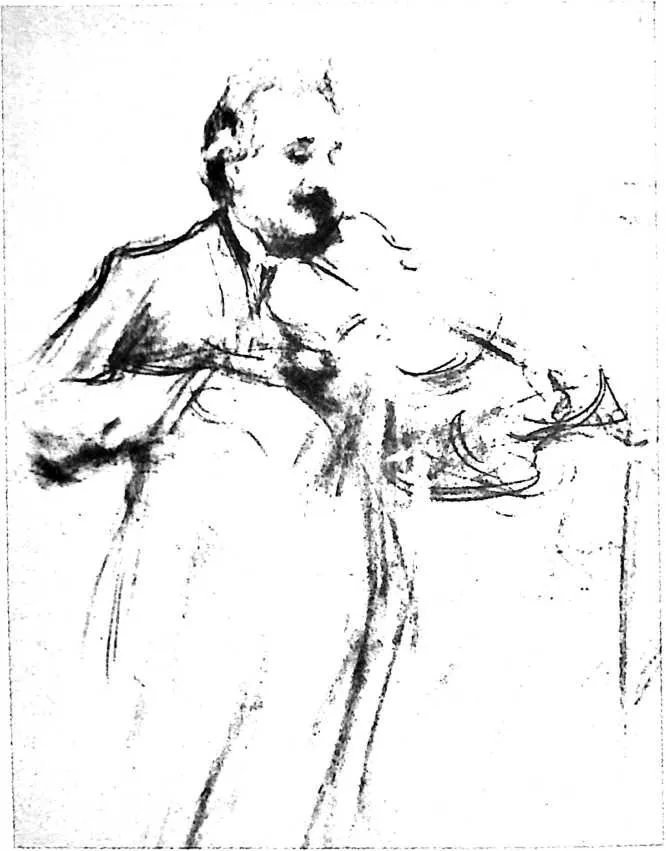
679 You can’t see, smell, touch or hear the mass interattraction intercohering either the macro-or micro-bodies of the universe. Such interrelationships can be discovered only by the mind.
680 Mind seems to be universal. It can be tuned into the individual who is intent upon finding the true interrelationships of our experiences.
681 It is pure metaphysical speculation, but extremely interesting to note, that the names for the first four numbers 1, 2, 3, 4 in many languages are often used in songs: ‘‘Eins, zwei, drei, vier’’; ‘‘ichi, ni, san, shi’’, which names for words are very different from the names of all the other names for numbers. In the chapter on numerology in my book Synergetics24 I show how the numbers 1, 2, 3, and 4 have additive effects on other numbers and the numbers 5, 6, 7, and 8 have subtractive effects and how the number 9 has a neutral effect. I demonstrate the positivenegative tetravertexioning of successive octaves consisting always of the positive-negative half octaves formed by the succession of positive-negative tetrahedra. It is notable that only the tetrahedron can turn itself inside-out. The tetrahedron is apparently the ‘‘black hole’’ turned out of physical state phenomena.
682 First four numbers
683 One, two, three, four Sometimes I wish There were more.
684 Eins, zwei, drei, vier I love the one That’s near
685 Ichi, ni, san, shi …
686 From Harvard Glee Club Song 1900 (Origin unknown)
687 What would you say is the commonality in the way Leonardo da Vinci, Albert Einstein, Buckminster Fuller and such people think? What would you then say is the common pattern, if it were possible to describe it very briefly?
688 DIL
689 FULLER
690 Intuition common to great scientists
691 I wrote a book called Intuition, and intuition is the essence. In my book I reviewed how the word intuition became almost a ‘‘dirty word’’ in the 1920s world of science and technology.
692 I would like to return to consideration of Einstein’s cosmic religious sense essay, published in the New York Times Magazine in 1930, when the USSR atheism was spreading amongst the western world’s intellectuals who were assuming that the 1929 crash and its abysmal recession phase in 1930 meant that capitalism was dead. Einstein’s cosmic religious sense is inherently intuitive.
693 In the USSR’s 1920s ideological war strategy, the word intuition was too dangerously mystical to be tolerated by an atheistic pragmatism. For a protracted period during the Great Depression, there was a general, westernworld, intellectual, university-supported forsaking of accreditation of the concept and the word intuition and other metaphysical-phenomena words. To the new communist pragmatists in the United States, science did not use intuition; it simply stated its problems and solved them by empirical means.
694 I myself have always held that my intuition is the most important faculty that I have.
695 I was very pleased when in the 1950s F. S. C. Northrop at Yale and a professor at another university, quite unbeknownst to one another, made a search of the personal papers of three great scientists who all the world agreed had made great physical knowledge discoveries on behalf of all humanity. What Northrop and his independent researcher counterpart examined were the personal letters, personal scientific notes, and the scientist’s immediate family’s and immediate friends’ letters as written only just before and slightly after the great scientists made their great discoveries.
696 Both research professors found that all these three great scientists, who existed far apart in years and geography, made it perfectly clear in their written record that the single most important factor in their great discoveries was their intuition. The sudden strange impulse to look in this or that particular direction when you are physically busy over here led to making their great discoveries.
697 First intuition
698 The second most important factor was a second intuition that occurred soon after they had made their great discoveries. The second intuition was always the awareness of what needed to be done ‘‘right now’’ if they wished to safely secure the great discovery they had just made as a practically-realizable physical advantage for humanity. The second intuition might tell them, for instance, not to smoke another cigarette, not to go out to lunch, but to sit down right now and produce a clear documentation of the discovery. This first and second intuition is analogous to a fisherman, alerted by the nibbling on baited hook and sinker, realizing that he must jerk his line to secure the hooking and then must pull the line in and land the fish. All this first and second intuitioning was clear in the notes of these great discoverers. This published and widely-read information of Professor Northrop powerfully reaccredited the intuition function amongst the scientific intellectuals. To proliferate this knowledge I wrote my book Intuition. In it I find intuition and aesthetics to be two vitally important faculties of humans’ brains and minds.
699 Second intuition
700 Humans usually learn of the word aesthetics after their childhood. It is, however, pure aesthetics that makes a child love the sight of this or that. I think that I had personally very great good fortune in that my eyes at birth were and still are deformed to a significant degree. I do not know what went on when I was in my mother’s womb. At any rate, my eyes are misshapen. All that I have to do today is take off my glasses if I wish to see what I saw until I was four-and-a-half years old. I have the same basic corrective lenses of my first 1899 prescription. Magnification has been added as I grow older. Without my glasses I cannot see anything as detailed as human eyes. For my first four-and-a-half years, I did not have glasses. All I could see were colors, brightness, shadows, darkness and outlines of large objects. As I take off my glasses now, all I can see is color. I was extremely sensitive to color. I was extremely sensitive to smells. I was extremely sensitive to touching. Not having the power of the eyes, which is so much greater than our other three faculties, imagine my astonishment when they gave me glasses to suddenly see eyes. I became so excited. I found that frogs had eyes, and toads had eyes, and snakes had eyes, and I kept looking deeply and intently into their eyes. They did the same to me. We seemed to say to each other, ‘‘I love and trust you.’’
701 Aesthetics
702 Fuller’s eyesight problem
703 So I went through the ‘‘second take’’ of life. It was like a rebirth. It gave me two kinds of ways of looking at things and therefore two different ways of thinking about my experiences: in the hazy color way and in the detailed way.
704 I kept looking at human eyes and also snakes’ eyes and I found that the snake and I could talk to each other. As a child I would say intuitively that I have got to take this snake home because I love him. When my family or nurse began to take off my clothes, they would shriek because my clothes were full of snakes. I became very sensitive to what other people felt about different beautiful things. So, aesthetics to me was the live functioning of a flower, the ephemeral existence of a drop of water, and of the dew of the lilies. Fortunately, my childhood home had a lovely garden.
705 Intuition and aesthetic sensibility then, in your view, comprise a commonality among Leonardo da Vinci, Albert Einstein, and Buckminster Fuller. I am interested in seeing how such people think. How does the thinking process take shape in the mind? So that if every human child is born with the potential to be a genius, as you say, and to function at a certain level of excellence, to look at life with wonder, to enjoy life, to have so much fun in living, then why is there so much wastage taking place in human life? I am not talking only of great achievements, but of experiencing everyday joys: for example, the joy of drinking a cup of water and having full enjoyment of such common experiences of life once one has become aware of their function and significance in life. Because if this does not happen to the average human being, life won’t be enhanced, and we are going to be living at a limited and lower level of humanity. The limits of human life must be extended and enriched in everyday common living. As I see it, this is what you are trying to do through your explorations as you report them in your world-embracing lectures and publications.
706 DIL
707 In exploring intuition and aesthetics, I’ve discovered something about how each one works.
708 FULLER
709 Number one, we all have the experience of discovering and saying, ‘‘What is the name of that mutual friend of ours; I can’t quite remember it.’’ Then the next morning I’ll remember it. You’ve had the same experience. So we all have the experience of asking ourselves a question that gets answered by ourselves later on. In other words, this tells us we have a reliable subconscious functioning operative in our brains even while we sleep. Let’s try to identify it.
710 Subconscious monitoring system
711 Nowadays I’m traveling ninety percent of the time. With my very poor hearing sometimes I don’t have the ability to hear the telephone or the alarm clock ringing. But I am also often very tired; I swiftly reckon that I could sleep for perhaps three-and-a-quarter hours and then be awakened by that same subconscious faculty activity that retrieved the forgotten name for me while I slept. I intuitively dare do that if there is nobody, nor an adequate mechanical alarm, to wake me up. So what I do is to think up experiences I’ve had that are about three-hours-and- a-quarter long. Then I lie down and I wake up exactly three-hours-and-a-quarter later, right to the minute. This unconscious organization that goes on is employable by us willfully if we do some thinking about various magnitudes of time. I’m astonished to find I can wake myself in exactly three hours and fifty-seven minutes if I want to. I’ve got to do a little thinking first to be sure I remember an experience that was exactly three hours and fiftyseven minutes long, but it will work right to the minute. So what I have established now is that we have a subconscious monitoring process going on in our brain that employs experiences of various magnitudes, which can be reemployed. Once I have established that we have a subconscious monitoring system, I then make another experiment. This has to do with our ‘‘twilight zone’’ consciousness.
712 I stretch both my arms forward and parallel to each other. I turn my two index fingers skyward. I now swing my outstretched arms horizontally away from one another with index fingers as yet skyward-stretched. I keep looking straight ahead but realize that while looking straight ahead I can also see both of my skyward-pointed index fingers. I can see them clearly even when my arms are stretched out sideways, though I say to myself that I am looking straight ahead.
713 Twilight zone consciousness
714 This experiment tells us that there are many events taking place in our lives at which we are not consciously looking but of which we are semiconsciously aware. It is this semiconsciousness which at times arouses our intuition to look directly in this and that direction and thereby discover some sensorially-apprehendible phenomena of significant relevance to our system’s thinking. Semisubconscious awareness of our experience often constitutes the fourth event which produces the significant systemembracing event which produces comprehension of all the system’s interrelationships and even its relationships to other significant systems. Semisubconscious awareness relates to a very effective and available basis for becoming aware of what is going on, in looking this way and looking that way.
715 I think the intuition relates to what I have said earlier about recognizing the significance of the ‘‘third’’ experience—that this is the third experience in which I felt intuitively that I’ve felt it before. The difference between the Leonardo da Vincis, Albert Einsteins and other people is that the other people don’t pay attention to the third experience in the series of four system-defining events. The Leonardos and Einsteins pay powerful attention to the third event.
716 The third of four experiences
717 When I was very young on our island in Maine, my father and mother gave me a
sailboat when I could first swim. It was a very nice little sailing dinghy. One day my
father
and mother and a girl cousin took my boat and went off from the island and sailed out of
sight. They were going to another island several miles away to get our island’s mail. All of
a sudden I became terrifiedly aware that something had happened to them. It was true, a
storm had come up and it was a bad day, and with my experience of sailing the boat, I
had become sensitive to the fact that these were pretty bad conditions to cope with. It was
raining when they took off and they had worn their storm oilskins. They had wanted
to get the mail. It was very important mail. I ran from our island’s harbor to
the older people of the family at the other end of the island. I was then nine. I
was frighteningly certain that my father, mother and cousin were in trouble.
Because I was so young, the rest of the family was not impressed. One of my
cousins had married a minister, and he finally decided that they had best listen to
Bucky. He decided to do something about it. He went down with me to our half-
mile-away island harbor and got our captain who was a native fisherman-farmer.
He sailed our big thirty-five- foot auxiliary-engined Friendship sloop. We sent
him off with the big boat, and sure enough, he found my parents and cousin
had been capsized and luckily had been able to swim to a nearby island. They
were perishing with cold. The captain brought them home with my dinghy in
tow.
718 Fuller’s childhood intuitive experience
719 That experience in my childhood made me absolutely certain of my clairvoyantly-valid awareness that they were in peril. I think it happens to many, many children. That must be built on all kinds of other things such as when you are in the womb and things are happening to your mother outside there, and you are aware of it. What kinds of awareness of things do transpire while we are in the womb? Are you aware of something outside? Probably, but not in geometrically-conceptual terms since you have never yet seen anything.
720 Different kinds of awareness
721 I keep speculating on what, if anything, subconsciousness does while we are as yet in the womb. A newborn baby whose eyes are not yet open moves its fingers deftly. If you put your finger in its hand, the fingers close firmly on your finger. If you decide to move your finger away, the newborn baby’s fingers immediately open. There is a real communication of touch already established at birth. What happens to unwanted babies while they are in the womb?
722 We now know that all human beings have an electromagnetic field of incredibly high frequency and low voltage. It is very difficult to read, but it is there. And when we are feeling negative, it produces a negative field, and when we are feeling positive, it produces a positive field. This may be why people drink together—to release the positive ‘‘good-fellowship field’’ among them. Thus far we don’t know very much about these ultra, ultra shortwave phenomena. Mainly I’m trying to give my concepts about aesthetics and intuition. They are probably all interrelated.
723 In the matter of aesthetics, our sense of smell, of healthy growth (which is the smell of
a new baby), and fresh biscuits, gives a smelling sense of growth versus decay. This also
has something to do with our sense of balance and our spontaneous gauge of accuracy
in design. Our sense of convergence and divergence most augment our growth
and decay appraising. I think that the great sculptors of the era of the great
sculpture in Greece and Italy had an incredible aesthetic sense of structure and
function, of functional adequacy and of proportion as manifest, for example, in
their drawing the neck or back of a woman. I see that this judgment of good
design and accuracy often comes while looking at flowers, petals and stems. Our
sense of shape or of compound curvature is keen. In biological structuring, the
compressional function is accomplished by hydraulics. The crystalline intertensioning
con
tains the compressional hydraulic stresses. Liquids distribute their loads. Crystalline will
not distribute a load but liquids do. Liquids are noncompressible. Gases are compressible.
Liquids are flexible but noncompressible. Liquids, then, guarantee the firmness of all
biological, botanical and zoological structuring.
724 The aesthetic sense and biological structuring
725 All human beings are over sixty percent water. We have crystalline tensional sacks filled with liquid. The sacks overlap each other like fibers spun into thread. The liquid-filled sacks are often held together by spiraling- crystal intertensioning. We have a great sense of how much liquids are coming in or out of our system. We have structural-understanding propensities.
726 We feel the structural integrity of triangles. If we make a large necklace with four or more, six-inch long aluminum tubes strung together on dacron line, we will find it very flexible, which means structurally unstable.
727 Structural integrity of triangles
728 We find that the flexing is done by the short lengths of dacron cord running between the tubes’ ends. Hoping to isolate the flexing phenomenon, we keep taking tubes out of our necklace. Then we get to only five, then four tubes being left in the necklace; it is as yet completely flexible. We now oust one more tube and that is the last we can take out and have the assembly produce a necklace having an opening through it.
729 The Greeks used the name ‘‘polygon’’ for planar-pattern geometrical figures. Six tubes left in the necklace lying on a table produce a hexagon (‘‘gon’’ means side), five tubes make a pentagon, four tubes a square, and the three final tubes left in the configuration produce a triangle. It is the first and only polygon to hold its shape. It is also the minimum, terminal case of a polygon series.
730 The triangle, which holds its shape despite flexible comers, is structure. I define structure as a complex of events that interact to produce a stable pattern. I define a system as that which has an insideness and an outside- ness. There are only three structural, omni-equi-angle triangle-enclosed systems in Universe—the four-vertex, six-vertex, and twelve-vertex systems. In Old Greek, they are called the tetrahedron, octahedron, and icosahedron. Altogether, all crystals and all biological design are made up from those three. When we fasten three corners of a triangular face of any one of the three prime structural systems of Universe together, they form a rigid crystal. When we bring two corners of each of the prime structural systems together, they form a hinge and produce a liquid behavior that can articulate and distribute stresses, but never compress. If we bring one corner of each of two of our prime structural systems together, they will bind to one another in an open stress-distributing but compressible system as a gas.
731 Definitions of structure and system
732 ‘‘It is possible to identify some of the known faculties which we generally assume to be coordinate in those whom society does concede to be adult geniuses. The publicly-accredited characteristics of genius consist for instance of an actively self-attended intuition opening the conceptual doors for innate, frequently and combiningly employed, scientific, artistic, philosophical, idealistic, sen- sorily conceptive, physically talented, logical, farsighted, imaginative and practical articulations.
733 Leonardo da Vinci, who fortunately avoided the geniuseroding processes, manifested and coordinatingly employed all and more of such conceptual faculties and arti- culative capabilities.’’
734 - Buckminster Fuller in his discourse as the Third Jawaharlal Nehru Memorial Lecturer, New Delhi, 1969.
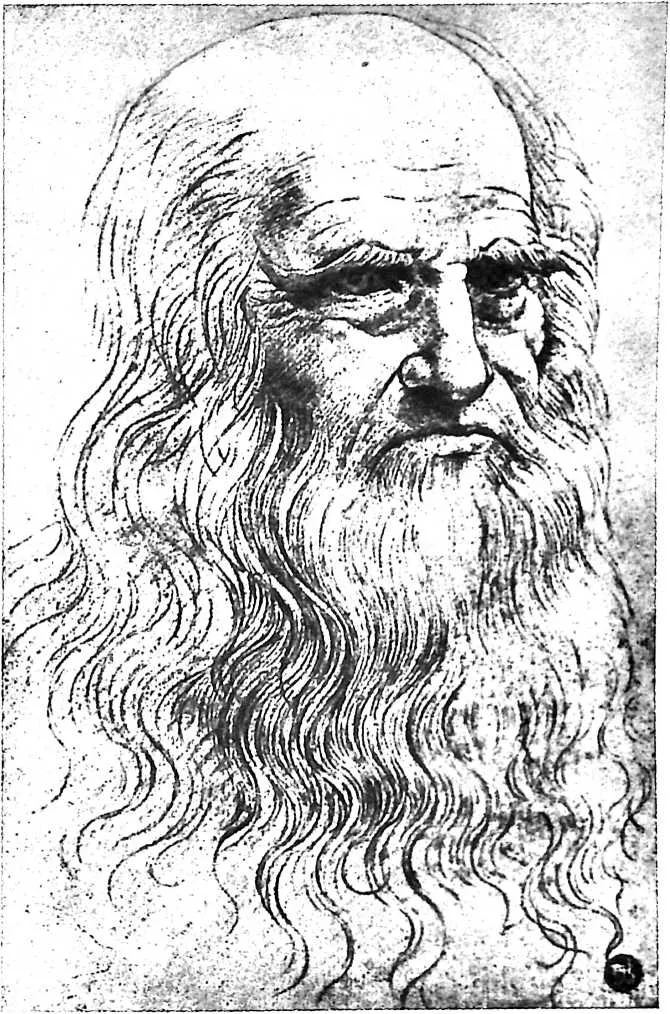
736 Leonardo da Vinci. Self-Portrait, c. 1512--15. Red chalk. 13’/g x 83/s- Royal Library, Turin.
737 I think aesthetics is built on an innate sense of the stress distribution, flexing, and rigidifying capabilities. I am the first to show why these system interbondings are single- bondedly the gases, double-bondedly are the liquids, and triple-bondedly are the crystallines. We have a universeoutside (macro-) and a universe-inside (micro-) set of systems interbonded to produce all physical matter. Our thoughts, our experiences, the book, the table—all are systems.
738 Aesthetics and system interbondings
739 I say life begins with awareness, and with no otherness there is no awareness. Life begins when you get outside—come out of the insideness of the womb and become both insideness and outsideness and self-observing—and realize the outsideness and insideness of the otherness. Our innate genius led me to discover a system and the structural mathematics of systems. This system, which I call synergetics, is now beginning to be recognized and is upsetting all academic mathematics and science. I have enough confidence in my experiences to dare to rely on my natural intuitions and my natural aesthetics and feelings, which led me to making experiments and thereby acquiring experimental evidence of the heretofore-only-intui- tively-dreamed-to-be-possible structuring.
740 Intuitions often turn dreams into demonstrable facts.
741 One thing that really inspires so much hope in me is that people like Leonardo da Vinci, Albert Einstein, and Buckminster Fuller are so full of hope, as contrasted with people like Bertrand Russell who are, in general, skeptical and pessimistic. I hope I am not being unfair to Russell. I have great admiration for his intellect, but at the same time there is a certain lack of hopefulness, almost despair, in his view of human future; for example, in his 1950 essay ‘‘The Future of Mankind’’ and the 1961 book Has Man a Future.25
742 DIL
743 Hopefulness for the future
744 What is it that gives you so much hope? You are one of the most optimistic and hope-inspiring scientist-philosophers of our time, and your writings are full of promise for the future of humankind. The same can be said of Albert Einstein, even though especially in later life his mind was burdened by the problems of the misuse of nuclear energy, and a number of other complex issues of our time. Leonardo was faced with complex problems of both personal and social nature that might have crushed a lesser person. You have experienced critical problems in your own life and continuously write and speak about a number of them. For example, in your lecture last evening you presented a forceful discussion of the increasing threat of atomic holocaust by the more than 50,000 poised-for-delivery atomic bombs. And your newest book, Grunch of Giants,25 is an eye-opening discussion of the power of the military-industrial complex that has led to the emergence of the powerful and mighty multinational corporations that control the economic and political future of humankind. How do you keep the light of hope alive?
745 Because in contrast to the specialists of science and technology, I am a comprehensive thinker and doer. I am also a sailor, a navigator with unlimited first-class maritime papers. I am a licensed airplane pilot. I am a card-carrying member of the oldest labor union in the United States, the International Association of Machinists and Aerospace Workers. I am committed to solving problems with technology and not with politics. I am apolitical.
746 FULLER
747 Over 300,000 of the geodesic domes which I have invented are now operational all around the world, from the point in Greenland closest to the North Pole to one exactly over the South Pole of our planet. One hundred thousand of the geodesic domes are in city playgrounds around the world, teaching children how best to enclose space. I set about fifty-five years ago to take advantage of the invisible evolution in chemistry, metallurgy, electronics and mass-production techniques, wherein we continually achieve ever-more-advanced standards of product and service performance per each pound of material and erg of energy and second of time invested in the technological undertaking.
748 I found in 1917 that all world-dominant political, economic, religious and business-organization economics were formalized when the British Empire was established in 1805, with their winning of Trafalgar and control thereby of all the important sea lanes of the planet. The British Empire was historically the first empire on which it was said that ‘‘the sun never set.’’ It embodied a closed- system planet in contradistinction to the misassumed lateral extension in all directions to infinity of the Roman Empire. Thomas Malthus, professor of political economics at the East India College, near London, was the first human in history to have all the vital statistics and comprehensive resource inventory of the closed-system earth. All world economics are predicated on the 1803 Malthusian conclusion that there is a major and fundamental inadequacy of life support on our planet which, combined with Darwin’s fifty-six-year-later evolutionary law of ‘‘survival of the fittest’’ governs all world political, religious and business organizations.
749 The first geodesic domes
750 Structural materials and the design revolution
751 My theory on how to cope with the seeming inadequacy of life support was to employ, multiply and accelerate the invisible technology gains to such a degree as to take care of all the people - gains such as that of a one-and-three- quarter-ton communications satellite outperforming in performance fidelity and message capacity the transoceanic communications capability of 375 thousand tons of copper cable.
752 When I produced my first geodesic domes, the two largest domes in the world were in Rome. Both were 150 feet in diameter: St. Peter’s Dome, built circa a. d. 1000 and the Pantheon, built in the year a. d. 1. Each of those old domes weighed about thirty thousand tons. My first 150- foot geodesic dome weighed thirty tons, only one-thousandth of conventional masonry domes. My dome was earthquake-proof, and the two Roman masonry domes were not. I have not only been developing unlimitedclear-span geodesic domes but also have been keeping track for fifty-five years of all the performance gains in chemistry, metallurgy, and electronics.
753 In structures there always exist compression and tension. They always and only coexist, as do concave and convex. Radiation is the divergent compressive force of Universe and gravity is Universe’s convergent tensional force. Masonry has a compression-resisting force of 50,000 pounds per square inch but masonry has a tension capability of only fifty pounds per square inch. The best and most plentiful wood has a tensile strength of 10,000 pounds per square inch.
754755In 1851, production steel was inaugurated. Like masonry, it had a compressive strength of 50,000 pounds per square inch (p. s. i.). But unlike masonry, it had also a tensile strength of 50,000 p.s.i., five times that of wood. Since then, in 1883, carbon steel went to 70,000 p.s.i. In World War I, chrome-molybdenum steel went to 110,000 p.s.i. In World War II, chrome-nickel steel brought tensional capability to 350,000 p.s.i. with never an increase in weight or volume. And now, at the onset of the 1980s, we have come to practical use of epoxy- bonded-together carbon fibers with 600,000 p.s.i. plus, and a great reduction of weight per pound as compared with aluminum or steel. McCready’s ninety-five-foot- wing-span, trans-English-Channel, human-peddlingflown ‘‘gossamer albatross,’’ made of epoxy-bonded carbon fibers and mylar skin, weighed only forty-five pounds. Anyone could lift it with one hand.
756In 1970, world-around technology had advanced so greatly in performance per each pound of material, erg of energy and second of time invested per each accomplished unit of performance, that it could be clearly demonstrated by engineering that operating on a world- around design science revolution and using all the metals now invested in armaments, melting them down and reinvesting them in livingry, we could within ten years have all humanity living at a sustainable higher standard of living than ever experienced by any other human, while concurrently phasing out all further use of fossil fuels and atomic energy. No cheers nor offers of realization came from the oil companies.
757The reason you find me hope-giving is that I have discovered humanity’s option to ‘‘make it,’’ which option was heretofore unknown to exist. War is now obsolete. It does not have to be you or me. I know what I am talking about and that gives you confidence.
758 Humanity leams Because advertising pays for newspaper publishing and is by trial and error placed with the journals that are most popularly read, publishers have sought to feed out what kind of news sells the most. They have found that bad news sells best. Humanity designed to be bom naked, helpless and ignorant yet endowed with hunger, thirst and curiosity is forced to learn only by trial and error. Bad news is what steers humanity. Writers are paid most for being brilliantly negative, and develop a popular vocabulary to be brilliantly negative. Many do that to make a living. To be positive, you have to know what you’re talking about, and I do. Most writers are ignorant of the significance of the 99.999 percent invisible technology.
759760Realizing the parts which the brain cannot comprehend, in themselves—the brain cannot do the thinking—so my confidence is in the human mind, which has access to the great principles of the universe itself, to find those cosmic laws.
761I think I was very fortunate in my schooling to have a very extraordinary physics teacher who gave me enormous confidence in organizing experiments to find out
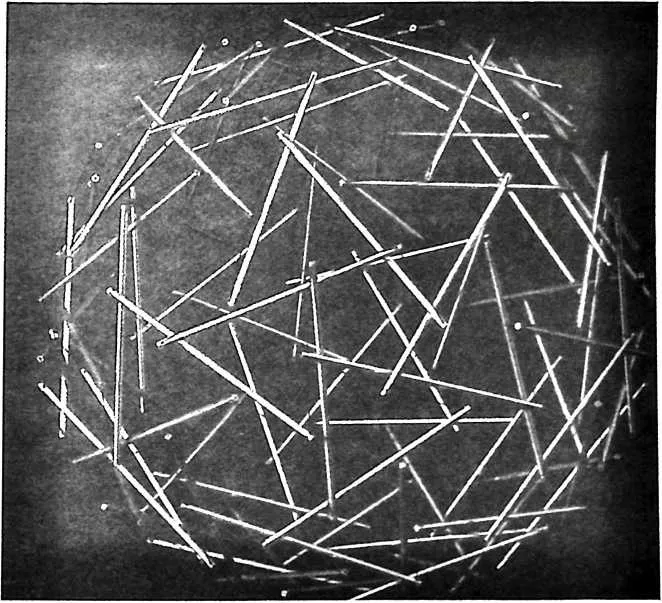
763764Fuller’s Tensegrity model
765 how principles work: how light comes through little holes; discovering that there are mathematical angles and ratios involved; learning how to check my work. In my life I have been able to find and discover generalized principles of structure, that I’ve been able to discover how Universe is structured without anything touching anything else. In discovering and producing my exclusively tensioned integrity structural systems (i. e., tensegrities), I am only finding out how to use on our planet Earth what Kepler found to be going on in the heavens around us. I reduced it to practice. This proved that I was very lucky that when I first started getting into trouble at Harvard, I went off and became a mechanic and learned how to assemble each and every type of cotton-mill machinery. I learned about machine shops, foundries and forging.
766 Discovering tensegrity
767 Fuller’s practical experiences
768 I was very lucky to have been a sailor, very lucky that my family lived on an island where as a boy I had to use a boat to get from here to there, and I had to get the mail every day and row four miles every day, to learn how to use the wind, how to navigate in the fog, how to fell and dress-out my own masts.
769770I was very lucky to be a mechanic because my forebears had been ministers and lawyers with little physical experience, and I had much more physical experience than Einstein. I learned by building buildings.
771Between 1922 and 1927, I built two hundred and forty buildings. I learned that people were building them the wrong way and what they were doing that was wrong. I had learned how you build and rig a ship. How you build a ship is very different from the way you build a house. I was very lucky in having to work in all twenty-eight Greater New York City branch sales houses of a large national meat-packing company, going to work at 3 a.m. and learning how New York City received its foods and how the markets operated.
772I was lucky in my Navy experiences of World War I, having many types of experience in aircraft, radio and in commanding ships.
773I was very, very lucky in having my physical experiences, which I think have given me many more insights regarding the physical significance of aesthetic beauty of line and tension. I have a structural-system subconsciousness.
774One day when I was about fourteen and was sailing home with the mail to Bear Island on a dying northerly wind, I anchored my boat on the south side of our island because I knew my mother wanted me to get home for lunch. We had a good harbor on the north side. But after lunch the wind switched dramatically and as I came on to the high bluff above the shore, I saw that my boat was dragging its anchor, and its wooden stern transom was just beginning to be chewed on the rocks. I must have flown down to those rocks and in almost no time at all was holding my boat off, thinking, what can I do, the anchor is dragging, I can’t really count on it, and the sail is not up, and my boat, if I let go for one second, is going to chew up on the rocks and get a hole and sink. So I began suddenly to use my mind and all my experiences. I could see an oar in the cockpit down under the gunwale, I could see everything inside the boat. I figured that though the anchor was dragging, that it had a little bit of holding capability. I then figured out what moment in the rising and falling of the boat I was holding off the rocks would be most propitious for me to jump aboard to grab the oar to thrust against the rock and hold us off from it. I figured out very rapidly how I could scull the boat out against the waves far enough to first take in the slack in the anchor rope, then to scull out some more into deeper water and next to get my sails on and give me time to beat off shore. I figured it all out and rehearsed it in my mind. I had no time to be discouraged. I did get on board, and with a number of successive scullings between other functions I did get my boat off shore without any additional chewing of my stern by the rocks.
775 Young Fuller
saves his boat
776 Getting out of I am an air pilot and suddenly something goes wrong. I’m
777 tailspins jn a stall anj now a tailspin. What do I do? There’s a
778779moment of being stunned by the fact, then a moment of absolute clarity in which you realize clearly that if in one fraction of a second you do this and that exactly right, you will pull out of your tailspin. Many times I’ve done these exact things in split seconds and have lived to so report. The fact is that I did find that I could get out of tailspins and get back to straight and level flight. It is also a fact that evolution has been constantly proving that I was really right when in 1927 I saw that there was comprehensive physical success for all humanity inherent in alloys, and inherent in the invisible technology of progressively attaining more and more performance with ever less and less pounds of material, ergs of energy and seconds of time per each accomplished function.
780 Technology ground I undertook to do those things, and they worked. So I am for hope tremendously aware that it is highly feasible now to take
781782care of all humanity and do so within a decade because we have the technology to do it. On the other hand, I find almost all intellectual, financial and political leaders technologically ignorant. They write very negatively, and I’ve found people who say that the technology is hell. They don’t understand the most eternal physical fact which is that the physical universe is nothing but technology.
783 Negative voices For reasons already given, there’s been a great financial being silenced support of writers who are negative masters. I found myself up against that world, and I learned that I’m not God, and that God takes time for these things to correct themselves. However, I find it really fascinating and gratifying that most of the prominent and widely-listened-to negative voices that I was up against yesterday are being silenced. The young people aren’t listening to them anymore.
|
786God as a positive factor |
787But your question was, ‘‘Why am I so hopeful?’’ Because, as already reviewed, I have experienced making things work technologically. I find that evolution is trying to do so. Everything in evolution tells me that God is trying to make humans a success. That’s why I’m hopeful. We have God on our side. |
|
788DIL |
789Well, is it possible that in the case of Bertrand Russell, who also knew science and technology, the main difference between you and him is that he did not believe in God? Is that perhaps one of the reasons for his skepticism? |
|
790FULLER |
791Yes, you bet! |
|
792DIL |
793How strongly do you feel about it? |
|
794FULLER |
795I feel very, very strongly. Russell knew a great deal about mathematics but not enough to discover synergetics. He knew very little of technology. He was declaredly committed to exclusively-political solutions of problems. He espoused communist atheism. |
|
796DIL 797Einstein’s view of religion |
798Einstein’s concept of a religiously-inspired person was of one who has faith in God and has achieved freedom from the shackles of personal desires and fears. One of the highest goals of religion, to him, was to liberate mankind from the bondage of individual egocentric preoccupations. He believed that science could contribute to such cosmic spiritualization of human life. In his 1941 essay on science and religion,27 he said that the path to genuine religiousness does not lie through the fear of life and death, and it cannot be reached through blind faith but through rational knowledge, thereby acquiring that profound reverence which is the essence of true religiousness. |
805 He had the cosmic religious sense. Einstein said what a faith in the orderliness of Universe must have inspired Kepler, to be able to spend all the nights of his life alone with the stars, lonely, alone, alone. ‘‘Belief’’ is what others tell you. ‘‘Faith’’ is in the significance of that which you yourself have witnessed.
806 FULLER
807 Faith in the orderliness of Universe
808 I have absolute faith in what I call the intellectual integrity of the eternally-regenerative universe and in its integrated, only mathematically-stateable eternal principles.
809 Fifty-five years ago, at the age of thirty-two, I undertook experiments to see what the
little penniless, unaccredited, unknown human being might be able to do effectively on
behalf of all humanity that it was inherently impossible for political states, private
enterprise and all religious organizations to do. I decided to commit myself to doing
everything with artifacts and not with politics and not trying to reform humans. I knew
that I was going to need tools, expensive materials. I knew I was going to have
to make prototypes, not just talk about them. I knew that just talking about
an invention is useless. Inventions must be reduced to working size, physical
practice if I was to prove that it would work and that it would indeed do more
with less. Obviously those materials and tools were going to cost a lot of money.
And nobody with money, public or private, was interested in backing me. So
I said, ‘‘I am going to have to assume that these very expensive things I am
undertaking to do, not to make money but in order to help make humanity a physical
success, are apparently what God wants us to do.’’ Remember, I called God the
intellectual integrity of the universe. I may find I’ll get on because I see that the grass
doesn’t have to pay the clouds for the rain, the earth doesn’t have to pay the sun
for the radiation. Money is not involved in any of nature’s intertransforming
transactions. Money is an invention of man and is not a requirement of Universe. As
a
man, I’ll be doing what the universe wants done, I’ll be part of evolution, employing a
capability that has been put into humans to employ. This is the time when we have the
knowledge and words and tools to make humans physically successful.
810 Fuller’s life philosophy
811 I saw that I had come into the world at the moment of history when humans are designed to do certain epochal things—if I do what humans are supposed to be doing, I’m very liable to have some very extraordinary insights that I would not have if I were not operating in absolute faith. If I find my work miraculously supported and if I have important insights that other people don’t have, I asked myself, ‘‘Can you trust yourself, Bucky, if you have special insights and great technical vision and forecasting capability as a human-affairs navigator and engineer not as a captain, that if you undertake to do certain things and you understand the trend to do more with less; and if you understand what the chemistries are doing, you’ll be able to make a great deal of reliable prophecy? Can you count on yourself never, ever to turn this capability to personal advantage—to making money, to revert to saying that you are a special son of God, that you are a guru with some power that other people don’t have? Can you trust yourself never to do that?’’
812 I said I am absolutely confident that I can be trusted by God. For this reason, when I am publicly speaking, I always end up remembering that I was a throwaway failure in the accepted rules of earning a living, while playing the ‘‘Malthusian inherent-inadequacy-of-life-sup- port-for-all’’ game.
813 In what sense do you use the word ‘‘throwaway?’’
814 DIL
815 FULLER
816 That I found that I could commit suicide; that I had adequate courage to swim out into the lake until I became exhausted and sank. I felt that it would be a great relief
817 Fuller’s relationship to God
818 DIL
819 FULLER
820 DIL
821 FULLER
822 from mental anguish. So I said instead of committing suicide, I would take this throwaway and turn all of its experience only into advantage for other people. So I said, ‘‘Can you always remember that?’’ Everytime before I go to sleep, I realize that the individual subconscious and universal evolution is going right on. I close my eyes and say, ‘‘Yours, dear God, is all the glory.’’
823 I use the word ‘‘glory’’ to mean the total knowledge, wisdom, love and power entering into the fulfillment events of universal evolution. ‘‘Yours, dear God, is all the glory; though I am being applauded, none of the knowledge and power of the realizations are mine. I have absolute faith and trust in you. I have complete awe of your vision, wisdom and power. I have absolute thankfulness and great joy in it. I love it. I love you, dear God.’’
824 Every night before going to sleep, I consider what I really am—an average human being regarding which extraordinary phenomenon we don’t as yet know much about. The most important thing is that I am an average human being. I am getting many, many letters, from people who are rejoicing in hearing me say that I am not some kind of special human which history has classified as a genius. It is important to everyone to realize that they are born geniuses. Though you cite me with Leonardo . . .
825 But they were also average people, in a way . . .
826 They were, they really were. But society tends to make them ‘‘genius freaks’’ as the young people now phrase it. The word genius is ignorant. There is no question about genetics, that is that all humans have vastly more than any of us know.
827 I entirely agree with you.
828 So I think one of the reasons for my greatest strength today still is that I have not forgotten who I am.
|
831DIL |
832The point is that this average person has so much capacity, so much potential, that in the right environment with intelligent effort it is possible to have a wonderful future for all of humankind. This is the hope you give us. Would you say that your hopefulness also has something to do with your happy married life? |
|
833FULLER |
834Anne and I have been married sixty-six years. So the ex |
|
835Marriage as part of total experience |
836perience is very great. But I do not make it a special part of my overall experiences. Everything is my total life. Being a mechanic and all those things is equally a part. The phenomenon of love is very mysterious. |
|
837DIL |
838There is no question that you are and always have been loved by your family and friends. What role does love play in the nurturing of the average person who fulfills himself or herself? |
|
839FULLER |
840Through all problems of my life, my awareness of the |
|
841The cosmic support of love |
842love that I have felt, that I am being loved, that I love others, that I have been loved by others, this, to me, has been the supreme factor that has carried me through many critical moments when I might have otherwise phased out. Love is it. The cosmic support of love, the great mystery of love. 843There came a point, in my developing knowledge of and experience with principles that operate physically, at which I came to realize that the eternal principles themselves have such integrity of objectivity in wide ranges of frequency and intensity that they become physical reality itself. 844I had an experience with a philosopher, a man who was called a philosopher and professed to be a philosopher. He was a professor of philosophy at a great university. |
|
845Encounter with 846Professor X |
847Many people said to me, ‘‘If you ever meet Professor X, he is going to shatter a lot of your working assumptions.’’ |
854 I received an appointment to that university. It was a special short-term fellowship. When I arrived there, the students asked me if I would meet with Professor X on a television program of the university station. I said I would be glad to. So the first and only time I ever met him was at the university television station. The station director sat Professor X and myself on opposite sides of a large wooden table. The director of the program told the professor to start. It was being taped: it was not the live show. The professor started by dramatically and resoundingly pounding the table with his fist saying, ‘‘Don’t tell me this table isn’t solid!’’ And I said, ‘‘How can you see me?’’ He said, ‘‘What do you mean see you? You’re sitting right there.’’ I said, ‘‘You are seeing me through solid glasses. Did you hear me? How can you see through solid glasses? What do you mean by solid?’’ I went on to recall that all the closely-packed atoms and their electrons are all in motion.
855 I am so glad to hear this. Yesterday when you were commenting on my calligraph ‘‘Al-Hajar,’’ the Arabic word for stone, you especially checked with me to be sure that the calligraph was of the word s-t-o-n-e, and then you said that it was beautiful that it was not a solid. I am sure you must have noticed the movement in the heart of the stone as the central form in my calligraph. It was such a marvelous insight you showed in my conception of the movement in the stone that I wanted to capture in my calligraph.
856 DIL
857 Dil’s calligraph
858 "Al-Hajar’’
859 The point is that there is a frequency of motion of the atoms and electrons like airplane-propeller blades revolving. You cannot see them, but you cannot put your fist through them, it would get cut off. You can take a machine gun and time it to fire between the revolving blades. In the same way, light can pass between the elec
860 FULLER
861 There are no solids
862 tron motions of the atoms. If the glass is thick enough, the passing light can get refracted by the atoms to change in angular course. That is how we obtain the correction in our spectacles. I find that everything that we experience is operating on a principle like that and while you and I call it solid, it is not solid at all. Professor X asked the station director to cancel the program and walked out.
863 What do you say about the idea of love playing an important role in the transformation of the average person’s life? That is, that a person who is not in love or who has not had that experience is less likely to be a person who is able to do something with intuition, with aesthetics, and will fail to find hopefulness in his or her life. But a person who is grounded in love of human beings, of nature and the universe in any form, or of God or a divine being, is a person more sensitive toward a certain hopefulness and brightness in life.
864 DIL
865 Love as a positive force
866 Well, we all experience many principles operating everywhere around us. For instance, around our planet we have oxygen; we go out from the planet and the oxygen is not there but other phenomena are there, the light from the sun, the light from many stars, billions and quadrillions and quintillions. A little way out we get to the phenomenon we call weightlessness. I spoke last night about Newton’s citing what gravity is, the amount of it varying inversely in terms of the second power of the arithmetical distances intervening. That interattraction could be between any two celestial bodies. There are celestial bodies all around us, and they are all integrated with one another according to Newton’s Law. As we move further out from Earth’s surface, the amount of pull on us by the earth lessens and we gradually become weightless, where the omnidirectional pull on us from the celestial bodies all around us is about equal. As we go out from Earth, which is predominant, the pull is swiftly reduced. Each time we double our distance outwardly from the earth, the pull on us is halved. Professor Goddard noted that the earth is traveling at 66,000 miles an hour around the sun and that each of us is going 66,000 miles per hour. Goddard noted that a body going a little faster would tend to part company with the earth. Goddard does not give you an example, but I point out to you a bicycle lying on the ground. You stand it vertically and it will keep falling down. But straddle it and pedal it and the faster you get it going, the more vertically stable it becomes. If you pedal fast enough, it tends to leave the earth. Many times my bicycle has jumped across a space. You cannot tip it over at speed because it is trying to leave the earth. Goddard then said that it is shown by Newton’s Law, every time we double the distance away from the earth, we halve the amount of the gravitational pull on us to pull us back into the earth. That distance out from the earth, spoken of as ‘‘weightlessness’’ and which I call ‘‘critical proximity,’’ is only about a hundred miles out. Now a hundred miles out, in relation to an 8,000-mile-diameter earth, is an almost negligible distance. On my sixty-five-foot long 1/ 2,000,000 distortion-free one-world-island-in-one-world ocean map which I used in last night’s university lecture, one inch is thirty-two miles, so three inches above the map was 100 miles, and that is the height at which powerfully-rocketed bodies go into orbit. That’s how close. Only three inches out on my 1/2,000,000 map. At 100 miles
867 FULLER
868 Weightlessness
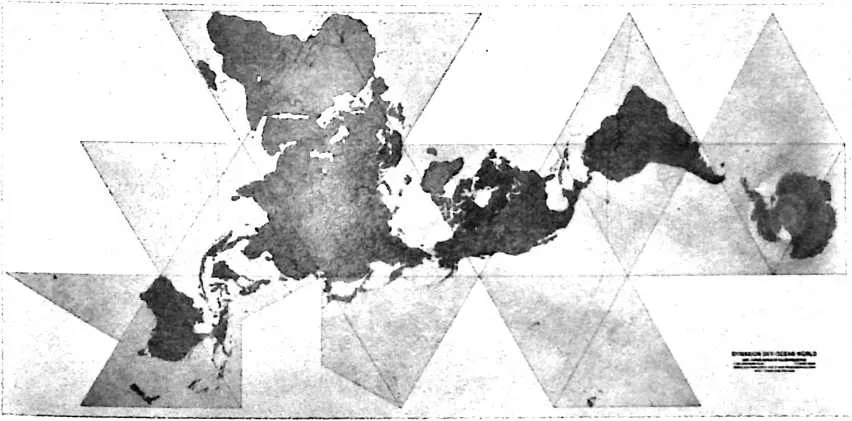
870 Buckminster Fuller’s One-world-island-in-one-world-ocean map
871 out from Earth’s surface, the pull of other celestial bodies would be equal to that of the earth, and we mistakenly call it weightlessness.
872 The universe is cohered by gravity. Each individual physical system of Universe —planet or atom—has its attractive force pulling on its surrounding neighbors as well as its own integral embracing coherence force. The integrity of the universe is this intercohering force which holds it all together. I’m going to give you a graphic way of comprehending gravity and radiation. All structural systems in Universe are always coping with radiant forces of expansion and with embracing forces of contraction.
873 Push-pull forces in the universe
874 The individual system’s individual, system-interrelating, structural components are continually subjected to forces against which they push or pull to withstand the integrative contraction forces of gravity and the disintegrative
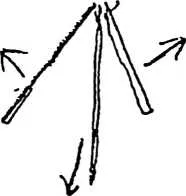
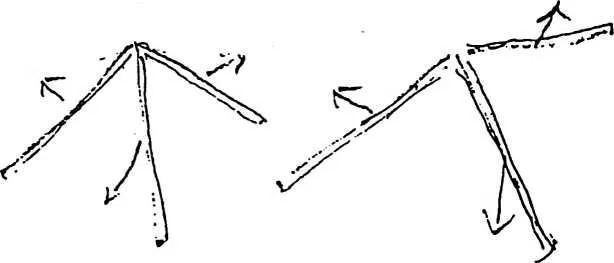
876 Disintegrating vectors of Radiation
877878explosive forces of radiation. In engineering, we find that we can deal very discretely with these push-pull forces by treating these forces as its vectors. Vectors are lines the length of which are the product of the mass multiplied by the velocity of the force involved, which vector is aimed in a specific angular direction in respect to a given axis of reference.
879We will now take six, six-feet-long-each, three-fourths- inch-diameter aluminum tubes, each tube representing one vector. Three of them we employ as a tripod, hingefastening together their three top ends in the manner of a camera tripod’s top-jointing. The tripod’s legs’ three feet try to slide apart from one another on a polished marble floor. To prevent their traveling apart we take the other three six-foot aluminum tubes and string them together with a dacron cord running through the tubes and tied together at one of the joints to form an aluminum tube triangle. These vectors are tensionally cohered with one another at both ends of each other to form a closed polygon. The three aluminum tube vectors in the tripod being fastened to one another at only one end each are disintegrative as their centers of gravity tend to recede from one another. As such they act as radiants.
880What we have learned here is that Universe has divided all its energy into two equal parts and has invested one part in divergent radial expansion and the other half in contractive convergence—gravity.
881 Gravity and radiation
882883But the convergent gravity’s energy-patterning arrangement of fastening together both ends of each vector to produce a closed, inherently integrative polygon is twice as effective as is the radiant-disintegrative patterning, thus insuring the eternal superiority of gravity over radiation.
884The integrity of the universe is that gravity holds all together. And I’m going to give you an example of gravity—and everything is push and pull, and the tendency to
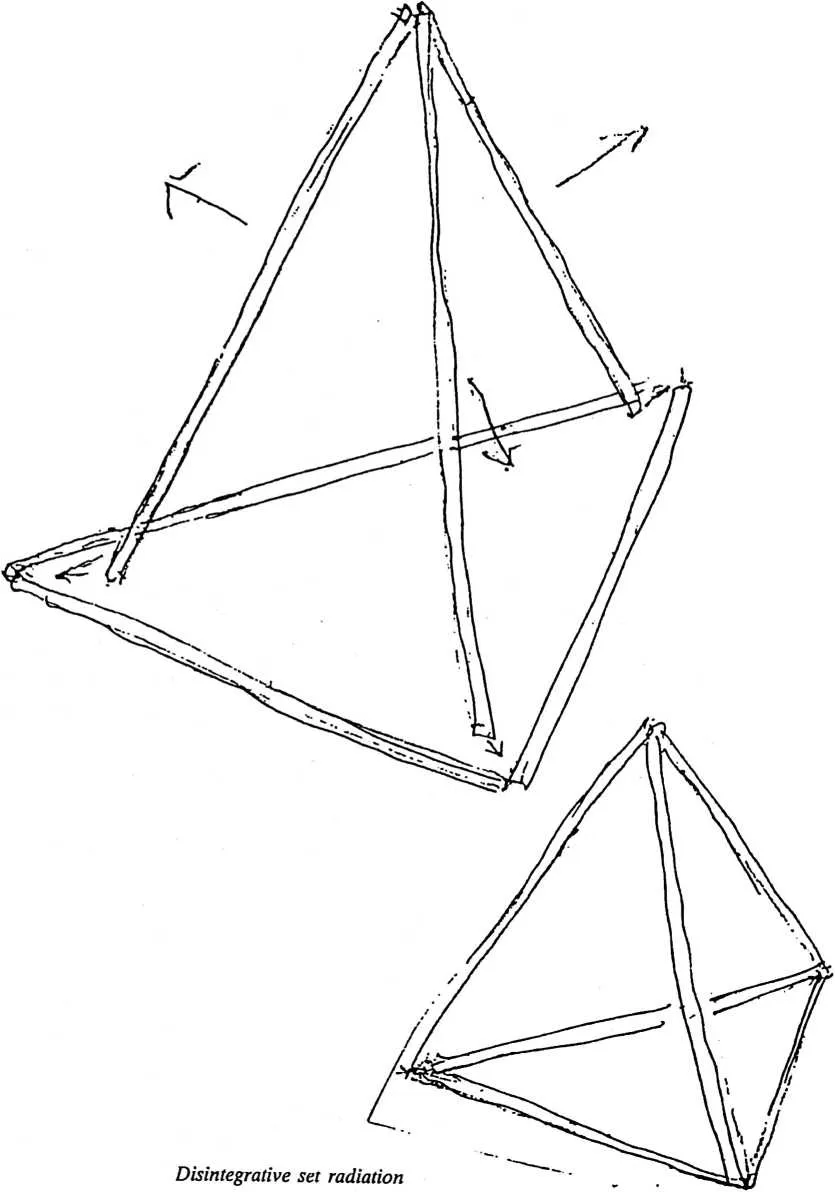
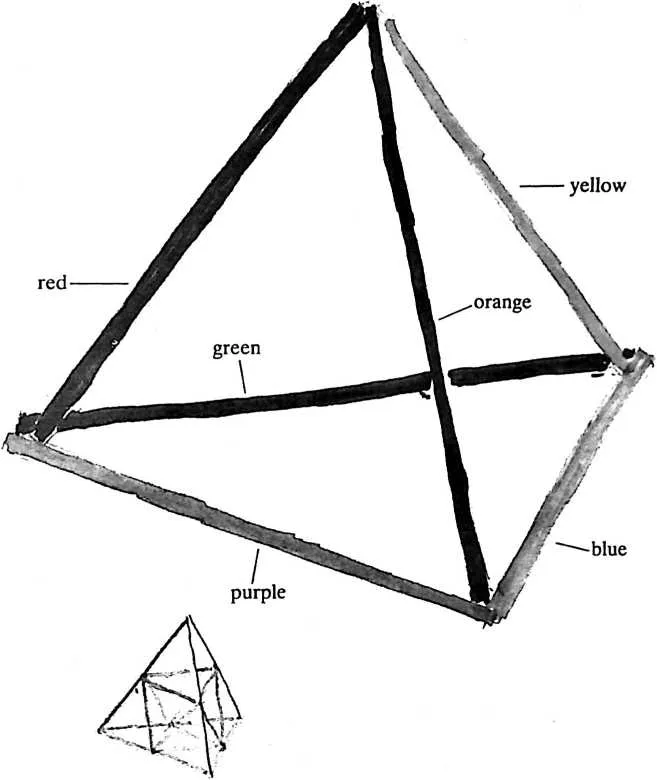
887 Green, blue, purple energy photosynthetically integrative as biologic hydro matter
888 Energy associative gravitationally as crystalline matter
889 push and pull. All structure has push and pull. I’m going to take a camera tripod with three legs and they are fastened together only at the top. So the bottom ends of those legs try to spread apart. These three trying-to- spread-apart legs represent the disintegrative radiation. But we also take three other legs of exactly the same size as the camera tripod legs and fasten them together at
890891both ends, and it makes a closed triangle. With the tripod’s feet placed inside the triangle the tripod’s legs cannot slide any further apart. These three integrative vectors represent the gravity of the universe. So that the energy invested in these three legs, which we call vectors in structural mathematics, exactly equals the amount of energy invested in the tripod’s three vector-disintegrating radiation. Radiation is disintegrative; gravity is integrative.
892The tripod representing the radiation of Universe is fastened together at only one end and its other ends are disintegrative. The triangle’s three vectors are integratively fastened together at both ends. The gravity is integrative and embracing. So the amount of energy invested in Universe in radiation and that invested in gravity are exactly the same, but the gravity is used more efficiently by being fastened together at both ends forming a closed system in contradiction to radiation’s disintegrating systems.
893Gravity guarantees the integrity of eternally-regenerative Universe, so we find that with radiation we can put a reflector behind it, we can beam and focus radiation.
894Radiation has shadows; on the other hand, I find this omni-embracing gravity cannot be focused and has no pure shadows. I spoke to you of experiences happening in pure principle, embracing and permeative metaphysical love. Gravity is omni-embracing and permeative; gravity is physical love. The metaphysical embracement of our universe is love; cosmic integrity is love. That is why only love can take us through the supreme troubles.
895 Gravity as physical love
|
898DIL |
899How do you define love in these terms? |
|
900FULLER |
901I define the personal experience of love as the special case, generalized integrity of Universe. As I have now |
|
902Fuller’s definition of personal love |
903said a number of times, I call God the intellectual integrity of the universe. To really understand such concepts, we have to have at least four repeatings. |
|
904DIL |
905From this perspective, then, love of God, Universe, humankind is an integral element in the fulfillment of human personality. Love of nature, love of one’s self… |
|
906FULLER |
907I don’t call it love of oneself. I call that crass. I hear a lot of people say that. |
|
908DIL |
909What would you say about one’s own personal identity and one’s awareness and cultivation of one’s own individ |
|
910Love of Self |
911ual, unique self? I use the term ‘‘love of one’s self’ in the sense of one’s self-understanding, self-affirmation, selfdevelopment, and self-expression in order for a person to become a worthwhile and fulfilling being. Of course, a natural and simultaneous component of such awareness of one’s unique selfhood is the merging of this uniquely- individual cultivated self into the larger social and cosmic self so that each dimension strengthens and enriches the other. There are poets and philosophers like… |
|
912fuller |
913I first wish to respond to ‘‘love-of-self’ poets. Because a poet has said something in poetry does not make it true. I |
|
914Love-of-self poets |
915pointed out to you yesterday that life begins with awareness of otherness. I have pointed out that radiation is disintegrative and that gravity is integrative. Love can become integrative only with the otherness. What I think you and your poets are talking about is self-appreciation. I think what is masked as ‘‘self-love’’ hides selfishness, greed, pride and fear. |
922 As poetry about love, I think that this one from the New Testament profoundly supports what I conceive love to be:
923 The Lord our God is one Lord.
924 The first law is
925 Thou shalt love
926 The Lord thy God
927 With all thy heart
928 With all thy soul
929 With all thy mind
930 And with all thy strength
931 This is the First Commandment
932 And the Second is like
933 Namely this
934 Thou shalt love
935 Thy neighbor as thyself
936 There is none other commandment
937 Greater than these
938 Upon these two
939 Stand all the law and the prophets.
940941The King James Version of the Bible St. Mark 12: 29-31;
942 The first of all the commandments is,
943 The Lord our God is one Lord:
944 And thou shalt love the Lord thy God
945 with all thy heart, and with all thy strength:
946 this is the first commandment.
947 And the second is like, namely this, Thou shalt love thy neighbor as thyself.
948 There is none other commandment greater than these.
949 In my book Intuition I wrote what was acclaimed as poetry by an Iranian scholar of ancient Persian poetry.
950 Love
951 Is omni-inclusive,
952 Progressively exquisite,
953 Understanding and tender
954 And compassionately attuned
955 To other than self.
956 Macrocosmically speaking
957 Experience teaches
958 Both the fading away
959 Of remote yesterdays
960 And the unseeability
961 Of far forward events.
962 Microcosmically speaking
963 Science has proven
964 The absolutely exact
965 Also to be
966 Humanly unreachable,
967 For all acts of measuring
968 Alter that which is measured.
969 Conceptual totality
970 Is inherently prohibited.
971 But exactitude can be bettered
972 And measurement refined
973 By progressively reducing
974 Residual errors,
975 Thereby disclosing
976 The directions of truths
977 Ever progressing
978 Toward the eternally exact
979 Utter perfection,
980 Complete understanding,
981 Absolute wisdom,
982983Unattainable by humans But affirming God Omnipermeative, Omniregenerative, All incorruptible As infinitely inclusive Exquisite love.
984While humans may never Know God directly They may have and do Palpitatingly hover Now towards, now away. And some in totality Come closer to God.
985And whole ages of peoples In various places Leave average records Of relative proximities Attained toward perfection.
986PERSIA - positioned At demographical center Of all Earthian peoples—Has been traversed by many Into and beyond The vanishing past
987And will be traversed by many Into and beyond
988The foreseeable future.
989And at this most crisscrossed Crossroads of history The record is left Of the relative proximity Averagingly attained To that which is God.
990 The PERSIANS’ record Is tender and poignant Sheltering, embracing, An omnipoetical Proximity to God.
991 Garden,
992 Shah Abbas Inn Isfahan
993 September 6, 1970
994 Four years before writing my poem on love in Isfahan, I was appointed to design the United States Pavilion for the 1967 Montreal World Fair. My Expo 1967 dome and the other four buildings were built on an island in St. Lawrence River just east of the city of Montreal. They had built a tunnel from the city to the island. The tunnel exit on the island was just in front of the United States Pavilion. On the opening day of the fair, I stood with my wife Anne at that tunnel exit. As the people emerged, the first thing they could see was my dome. Almost all of them ejaculated: ‘‘How beautiful!’’
995 FULLER
996 Expo 1967 dome ‘‘Anne’s Taj Mahal’’
997 To Anne this seemed to give sublime validation to the extraordinary backing she had given me throughout the fifty years since our World War I marriage.
998 When I was a little boy my mother used to tell me about the Taj Mahal and showed me pictures of it. She felt it to be the most beautiful building in all the world and she felt its beauty went beyond its structural exquisiteness. She felt that the real beauty was mystical—it sprang from the love of its builder for his wife.
999 Both Anne and Allegra know that in 1927 I gave up entirely the idea of trying to use my capabilities to develop special economic and physical advantage for them, and instead committed myself to the proposition that if those whom I love were indeed the kind of human beings I thought them to be, they would not like finding themselves in a position of special economic and physical advantage won at the cost of deprivation of others, and, likewise, their true happiness could only develop through an awareness that our efforts were always in the direction of progressively-increasing advantage for all humans, without any biases whatsoever.
1000 Because every action has its reaction and resultant, and because no event in Universe can be independent of the rest of Universe, my commitment in the direction of all humanity and its present symbolic embodiment in my
1001 The Taj Mahal
1002 "Anne’s Taj Mahal." Fuller’s name for the geodesic dome he designed for the United States Pavilion at Expo 1967 in Montreal.
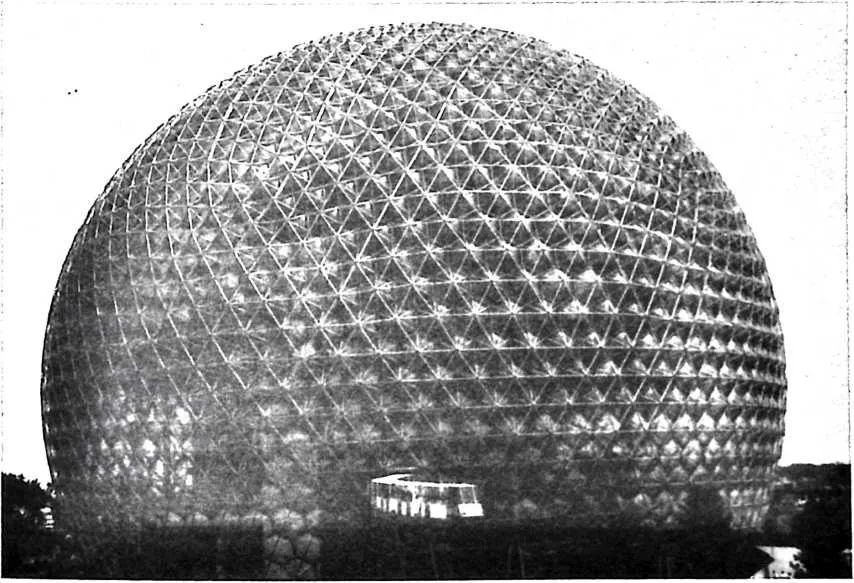
1004 The geodesic dome house that Bucky and Anne Fuller built in Carbondale, Illinois, I960.
1005 Fuller in the library on the second floor in the dome house.
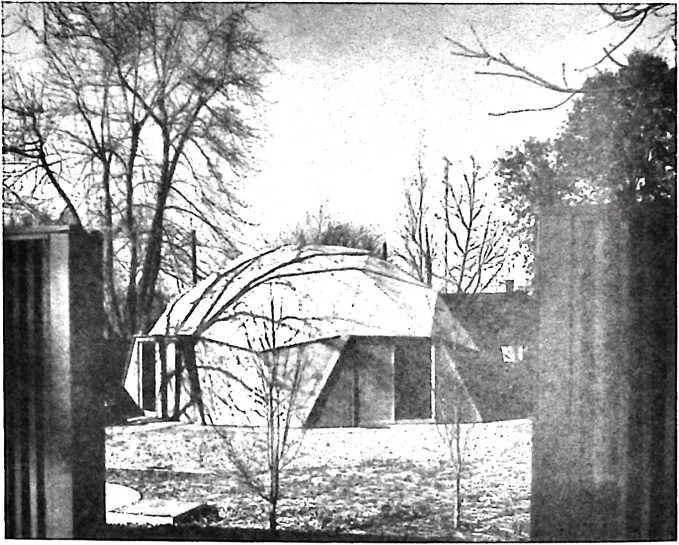
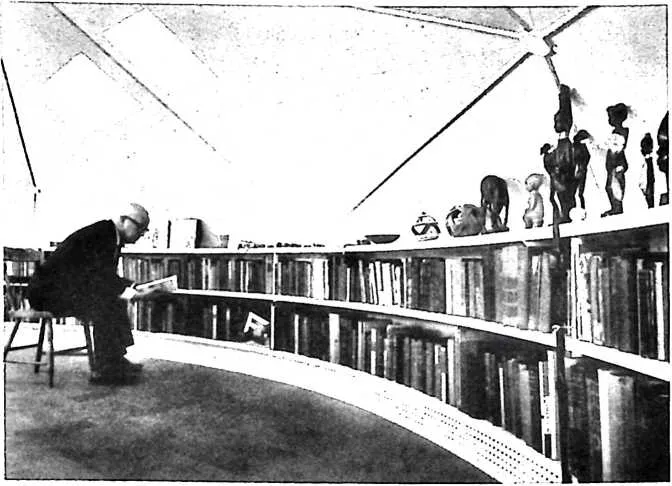
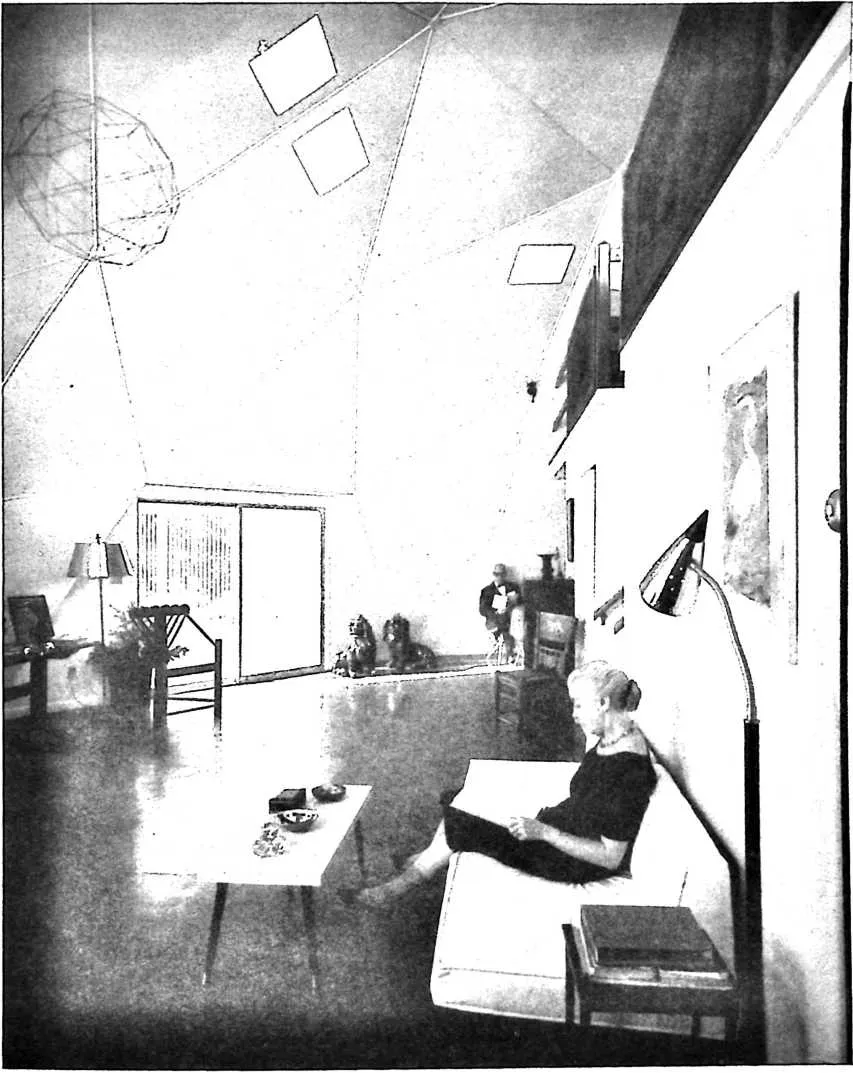
10081009Bucky and Anne Fuller in their geodesic house, 1960.
1010Expo ‘67 dome, though dedicated to all humanity, must have its inadvertently complementary involvement of Anne and Allegra as well.
1011 Anne Fuller's accident
1012 Gene Fowler’s letter to Fuller on love and Anne’s ‘‘Taj Mahal"
10131014I said to Anne at Montreal, ‘‘In addition to the geodesic dome which I have designed here to demonstrate doing so much more with less for all humanity that world man will realize intuitively that his salvation and physical success on the spaceship Earth is to be gained by such a design revolution and not by political revolution, I have inadvertently brought about the production and installation of our own Taj as pure fallout of my love for you.’’ She knew it was so. Our Expo Taj is powerful and the beauty goes far beyond the sum of its physical parts.
1015 Anne and I left the dome and flew from Montreal to New York City. I was to leave her with her family at their old home on Long Island. On the way from Kennedy Airport to New York City the taxi we were riding in skidded at high speed in the rain and we crashed against a bridge abutment and bounced across the highway. Neither the taxicab driver nor I were hurt but Anne was very greatly damaged. She had two hemorrhages in the brain. Three weeks later, after a successful operation, she was at last recovering consciousness and apparently had complete mental clarity.
1016 One June 6,1967 when I wrote about all the foregoing to my poet friend Gene Fowler of San Francisco, she had just been taken from the intensive-care ward to a private room at the University Hospital in New York City. On June 13, Gene wrote back to me as follows:
10171018Dear Bucky:
1019Anne is a woman of considerable strength: she will not leave you to continue alone.
1020I have known a long time that Anne’s strength, beauty and grace were in your work—it makes sense that this skybreak bubble should be, not a monument, but an embodiment of your love of her. Isn’t that love a carrier wave that brought her form and substance, her nature and patterning into and through you and into your visions and work? Isn’t a human being a thin, sparkling transparent membrane reaching out and containing, for a time some part of the universe.
1021Human beings are fragile skybreak bubbles, as vulnerable and quickly gone as a child’s soap bubbles in a bath. Yet, without vulnerability, there is no courage. Without mortality, there is no beauty or love, no reason to reach out and touch.
1022You’ve constructed something slightly tougher than a human being, but with the same beauty and grace, a knowing set into materials torn from our Earth and shaped through our fires and minds, a memory to outlast the one remembered and the one remembering, a knowing of a woman, of Woman, a knowing large enough to be seen from space, a knowing men may enter and share.
1023More than the Taj, Bucky,
1024With love,
1025Gene
1026 dil Beautiful! I agree with Gene Fowler that Anne is a wom
10271028an of extraordinary strength and her beauty and grace are in your work. This is the sixty-sixth year of your wedding anniversary and I wish you both many more years of healthy and inspired life together.
1029 Dll’s poem to his Two years back I wrote a short poem for Afia on our wife twentieth wedding anniversary.
10301031Sunflower
1032A part of
1033the earth’s rotation round the distant star,
1034The sunflower
1035has an added movement all its own.
1036This relation
1037that no other flower—
1038not even the rose—can claim,
1039Makes bold the sunflower
1040to ask the sun:
1041‘‘What is it that is between
1042you and me alone, my friend?’’
1043San Diego, California
1044March 14, 1981
1045What might interest you is that when I read this poem to Afia she thought she was the sunflower, because in the classical Indian poetic tradition it is the woman who is the lover and the man the beloved.
1046 Iqbal’s poetry and But let me return to our discussion of self and self-tran- phdosophy scendence or what I prefer to call the ‘‘I —and—We Equation.’’ What I was going to talk about was of two Persian poems by Muhammad Iqbal, the poet-philosopher of Pakistan. His Asrar-e Khudi (The Secrets of Self) published in 1915, and Rumuz-e Bekhudi (The Mysteries of Self-Transcendence) published in 1918, precisely addressed the question of resolving the classic problem you identified in your usage of the term ‘‘self-love’’ which very often serves as a mask for selfishness, greed and pride. Iqbal was interested in awakening his people through a message of self-understanding and self-development for becoming worthy individuals as a necessary condition toward establishing an ideal society, the kingdom of God on earth. An individual for him was a finite center of human experience, who aspires to a unity with other finite centers, and thereby transcends to its ultimate unity in the Infinite, God.
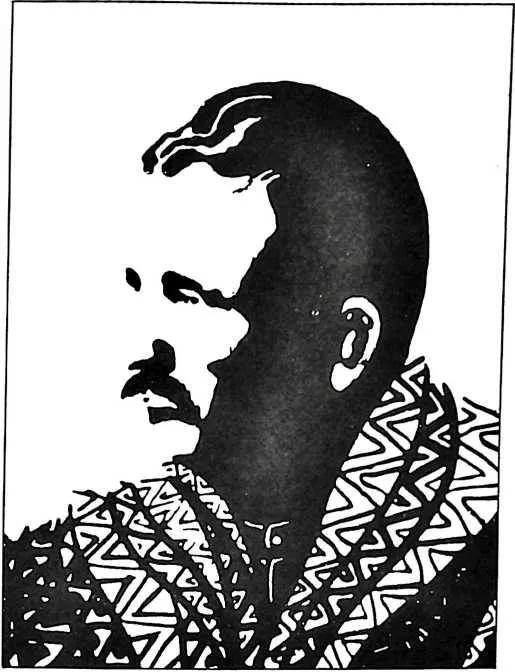
1048 Muhammad Iqbal
1049 Sketch by Aslam Kamal, Lahore, Pakistan.
10501051To quote Iqbal from his introductory note in Asrar: ‘‘To my mind, this inexplicable finite centre of experience is the fundamental fact of the universe. All life is individual; there is no such thing as universal life. God Himself is an individual: He is the most unique individual.’’28
1052Iqbal sees humans in Universe evolving from ‘‘chaos to cosmos.’’ In this movement toward ultimate uniqueness, which is God, the human personality is strengthened by love:
1053The luminous point whose name is the Self Is the life-spark beneath our dust.
1054By love it is made more lasting, More living, more burning, more glowing. From love proceeds the radiance of its being And the development of its unknown possibilities. Its nature gathers fire from Love, Love instructs it to illumine the world.29
1055It is this love-inspired self of the individual human that becomes the vital link between what has gone before and what is to come in the universe. And through such merging of the individual self in the community, humans can fulfill their function in the universe. Life is thus defined by Iqbal in Rumuz as a wave of consciousness of continuity.30
1056 A community comprising such individuals bonded together in love becomes ‘‘like the light of God,’’ which functions at three levels, as Iqbal states in his Javid Nama (1930): first, man’s self-awareness so he sees himself in his own light; second, the consciousness of another so he can see himself in another’s light; and third, his consciousness of God’s essence, so he can see himself in the light of God’s essence.31 Iqbal’s conception of religion is thus ‘‘to awaken in man the higher consciousness of his manifold relations with God and the universe’’ and thus man is conceived as a creative activity, an ascending spirit who, in his onward march, rises from one state of being to another, from the individual to the social to the divine.32 Other philosophers This is what in essence Pierre Teilhard de Chardin also on love in Universe says jn his boo^ j'/jg Phenomenon of Man,33 that love is the affinity of life in all forms. Unless there is a real internal propensity to this cosmic unity and oneness, it is not possible for love to appear in the ‘‘hominized’’ form. Love is thus a fundamental universal principle. This is what de Chardin calls gravity at work in the universe. His concept of ‘‘within’’ of beings is what in essence Iqbal meant by his term ‘‘Khudi’’ or ‘‘Self.’’
10571058As I see it, Martin Buber’s concept of ‘‘Ich und Du’’ (I and Thou)34 is rooted in the convergence of what he calls ‘‘meetings’’ or ‘‘relations’’ in Universe.
1059While Muhammad Iqbal, Teilhard de Chardin and Martin Buber represent the best of the Islamic, Christian and Judaic traditions of knowledge and wisdom in our time, I find the same current of thought in the work of Radha- krishnan of Hinduism, Suzuki of Buddhism, and some other contemporary thinkers - a coming-together of all humans in Universe through the principle of love of humankind and God.
1060This is what we were talking about earlier in the context of Einstein’s faith: ‘‘A person who is religiously enlightened appears to me to be one who has, to the best of his ability, liberated himself from the fetters of his selfish desires and is preoccupied with thoughts, feelings, and aspirations to which he clings because of their super-personal value. It seems to me that what is important is the force of this personal content and the depth of the conviction concerning its overpowering meaningfulness, regardless of whether any attempt is made to unite this content with a divine being, for otherwise it would not be possible to count Buddha and Spinoza as religious personalities.’’35 It is this kind of mind, according to Einstein, that is capable of larger and deeper understanding of life and the universe.
1061 Einstein on religion and enlightenment
10621063‘‘The basic word I-You can be spoken only with one's whole being. The concentration and fusion into a whole being can never be accomplished by me, can never be accomplished without me. I require a You to become; becoming I, I say You.
1064All actual life is encounter.
1065Spirit in its human manifestation is man’s response to his You. Man speaks in many tongues —tongues of language, of art, of action —but the spirit is one; it is response to the You that appears from the mystery and addresses us from the mystery. Spirit is word. And even as verbal speech may first become word in the brain of man and then become sound in his throat, although both are merely refractions of the true event because in truth language does not reside in man but man stands in language and speaks out of it —so it is with all words, all spirit. Spirit is not in the I but between I and You. It is not like the blood that circulates in you but like the air in which you breathe. Man lives in the spirit when he is able to respond to his You. He is able to do that when he enters into this relation with his whole being. It is solely by virtue of his power to relate that man is able to live in the spirit.’’
1066—Martin Buber's I and Thou.
1067Translated by Walter Kaufmann.
1068New York: Charles Scribner’s Sons, 1970, pp. 62, 89.
1069‘‘Everywhere on earth, at this moment, within the new spiritual atmosphere created by the appearance of the idea of evolution, there float —in a state of extreme mutual sensitivity —the two essential components of the Ultra-human, love of God and faith in the world. Everywhere these two components are ‘in the air’: generally, however, they are not strong enough, both at the same time, to combine with one another in one and the same subject. In me, by pure chance (temperament, education, environment) the proportion of each happens to be favourable, and they fuse together spontaneously. The fusion of the two is still not strong enough to spread explosively, but even so it is enough to show that such an explosion is possible and that, sooner or later the chain-reaction will get under way.
1070It is one more proof that if the truth appears once, in one single mind, that is enough to ensure that nothing can ever prevent it from spreading to everything and setting it ablaze.’’
- Pierre Teilhard de Chardin’s Le Christique, March 1955. Teilhard de Chardin Album, edited by Jeanne Mortier and Marie-Louise Aboux. New York: Harper & Row, 1966, p. 210.
10711072‘‘All religions require us to look upon life as an opportunity for self-realization— atmanastu kamaya. They call upon us to strive incessantly and wrest the immortal from the mortal. God is the universal reality, wisdom and love and we are His children irrespective of race or religious belief. Within each incarnate soul dwells the god-consciousness which we must seek out and awaken. When mankind awakes to the truth, universal brotherhood will follow, the at-one-ment with the great fountainhead of all creation. One whose life is rooted in the experience of the Supreme spontaneously develops love for all creation.
1073A religion which brings together the divine revelation in nature and history with the inner revelation in the life of the spirit can serve as the basis of the world order, as the religion of the future. Whatever point of view we start from, Hindu or Muslim, Buddhist or Christian, if we are sincere in our intention and earnest in our effort, we get to the Supreme. We are members of the one Invisible Church of God or one Fellowship of the Spirit, though we may belong to this or that visible Church.’’
- S. Radhakrishnaris Religion and Culture. Delhi: Hind Pocket Books, 1968, pp. 15, 18--19.
10741075‘‘The climax of Buddhist philosophy is reached in the Keg- on conception of Jiji-mu-ge (literally, each thing no hindrance). As I see it, this is the summit of oriental thought as developed by the finest Buddhist minds, and represents Japan’s contribution to world philosophy. Kegon philosophy teaches a four-fold conception of the world: (1) The world viewed as individual existences; (2) The world viewed as the Absolute; (3) The world conceived as individuals retaining their individuality in the Absolute, and (4) The world conceived as each revealed through each other, so that each individual has no hindrance from being merged in every other. . .
1076When the world is so conceived it ceases to be a mere world of the senses, and becomes the spiritual world which Buddhists call the Dharma-loka. If the notion of a physical world is retained, each individual will lose its ultimate significance, but in a spiritual world all which was lost is restored. Each individual is asserted to exist, and the physical world is restored, but this time as a spiritual world. In Christian terminology, it reflects, the divine glory. The earth acquires heavenly splendour and this world of misery becomes a land of purity, or the Pure Land.’’
1077—Daisetz Teitaro Suzuki’s The Essence of Buddhism. English translation of the Command Address to H. M. The Emperor of Japan on April 23--24, 1946. London: The Buddhist Society, 1971, pp. 93—94.
1078 fuller I respect deeply your response to my statement about love. I classify the thoughts of other thinkers which you have submitted as appreciations of the significance of self.
1079 I would like to support my viewpoint with a poem that I wrote two months ago. Before you read it, I would like to point out that in 1944 I was told by the head of the British Scientific Office in Washington, D. C. participating in the Manhattan Project that my dissertation on unity being plural and at minimum two inspired the Manhattan Project scientists to apply it to quantum mechanics, which rendered the latter powerfully effective in their nuclear calculations.
1080 Unity being plural and at minimum two
10811082At Minimum Two
1083Synergy is the complex behavior of whole systems unpredictable by the isolated observation and consideration of only one or more parts of the system.
1084Love is the synergy of omnipermeative and inherently differentiating metaphysical radiation nonsynchronously coexisting with omniembracing and systemically integrating, eternally conserving, metaphysical gravity.
1085Metaphysical radiation and metaphysical gravity eternally and only coexist.
1086The always and only coexistent positive and negative mathematics demonstrated scientifically that unity is plural and at minimum two.
1087In its inherent cell dichotomy, biology demonstrates that unity is plural and at minimum two.
1088Science demonstrates that unity is plural and at minimum two with its life-initiating awareness of otherness.
1089No otherness, no awareness.
1090No life.
1091Life is inherently two.
1092Science again demonstrates that unity is plural and at minimum two by requiring both an insideness and outsideness of both the observed and the observer.
1093Science again demonstrates that unity is at minimum two in the concomitant, always and only coexisting convexity and concavity.
1094Science demonstrates that convexity diffuses and concavity concentrates the same impinging radiation wherefore the always and only coexisting concavity and convexity demonstrate that they are not the same function wherefore unity is plural and at minimum two.
1095The eternally convergent-divergent dissynchronous juxtapositioning of inherently dissipative radiation and inherently conserving gravity pulsatively and resonatively propagate the infinite variety of wavelengths and frequencies of nonsimultaneous, differently enduring, only overlappingly episoded, only locally aborning and dying and only sumtotally eternally regenerative scenario Universe.
1096Appreciation of the integrity of eternally regenerative, scenario Universe is sometimes called ‘‘Wisdom.’’
1097Employment of the only metaphysically experienced, eternally regenerative scenario Universe is sometimes identified as ‘‘Love.’’
1098Unity of Universe is always plural and in its minimum twofoldedness as both Wisdom and Love, these two synergize to constitute the phenomenon we intuitively identify as God.
1099This is probably as close as we may ever come to such human-thought identifying.
1100Penang, Malaysia February 14, 1983 St. Valentine’s Day/ Chinese New Year
1101At eighty-seven years of age, I have consumed 300 tons of food, air and water which became my flesh, hair et al. to be entirely rubbed out and cut off —to join other systems. I am convinced that neither you nor I are the food we eat. I took off seventy pounds and said, ‘‘Who was that?’’ I am convinced that neither humans nor God are physical. Our bodies consist entirely of atoms. Atoms are entirely inanimate. Whatever life may be, it is weightless, metaphysical.
1102 FULLER
1103 Life is metaphysical
1104 ‘‘I took off seventy pounds and said, ‘Who was that?’ ’’ Photo by John A. Blume.
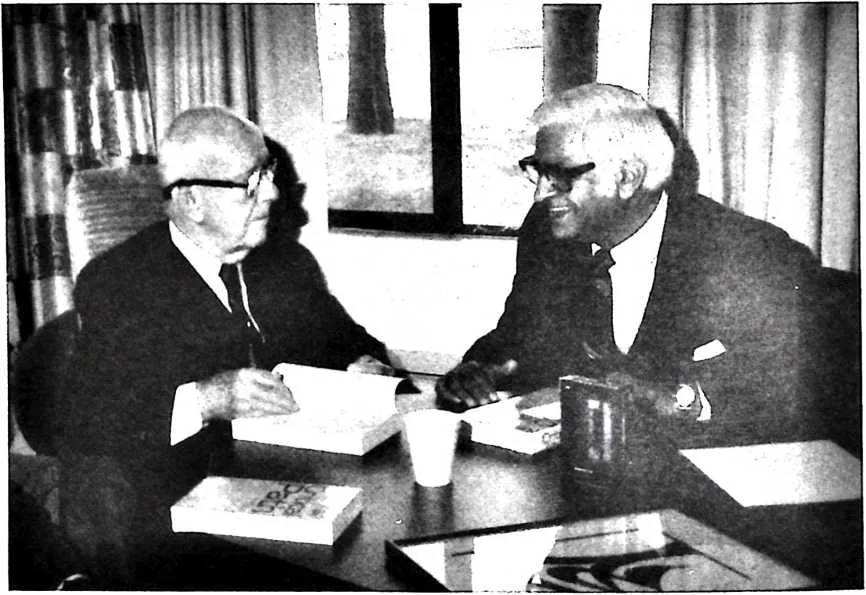
1106 Dr. Fuller, we seem to have reached a stage in our exploration where I would like to ask you the question: What is the essential content of the emotional, intellectual, and spiritual ‘‘baggage’’ that human beings are to carry into the twenty-first century, as we approach it? We seem to be carrying so much dead weight.
1107 DIL
1108 FULLER
1109 The importance of mind
1110 I have already pointed out to you that human beings have a faculty that no other creature has, which is mind. Other creatures have brains, as do humans. And I have found we have minds with access to some of the great generalized principles of the universe. We have arrived at the awareness of that which is a long way from our having always been deliberately born naked, helpless, without any experience, therefore, utterly ignorant. We are given drives of thirst and hunger, curiosity, to learn only by trial and error. We have come to an extraordinary moment in history where we have acquired an awareness of being able to differentiate between brain and mind. I am able to do this only because at this moment in history, things I have been able to do I could not have done earlier. There was that point in history when, having parted with tradition, I set about to discover what Universe is trying to do and that differs from what humanity’s most powerful political and economic leaders are trying to do. I start by trying to determine what I have as equipment and therewith to discover what Universe is and why it included humans, and further, to discover where human beings are in this moment in history and evolution. If I hadn’t done this, someone else would have done it. The moment had come when somebody had to do it.
1111 Evolution, then, is in incredible acceleration because of the discovery of exponential inter-implementing of technology. Our evolutionary acceleration is demonstrably four-dimensional. The fourth power. Things are happening just in this minute we sit here that would have taken
1112 thousands of years to transpire a few centuries ago. This conversation we are having could not have taken place ever before. I find that to me, humans are at a point in history where we now have the capability to forever dispense with learning only by trial and error how to survive. The earning-a-living requirement is about to be eliminated. I see human individuals able to make so many mistakes now having made the greatest mistake, wherein all the great religious and political systems have concluded and decreed that ‘‘nobody should make mistakes.’’ And that we must punish all those who make mistakes. It is only by mistakes that we can learn. We have been doing many right things but always for the wrong reasons. We have come into enough knowledge so that now we are going to be required by Universe to do the right things for the right reasons.
1113 On making mistakes
1114 Our present anti-mistake-making laws and customs tend to frustrate our further growth. Humanity is taught to play the game by the rules and not by thinking. So if antithinking is dominant, we may be all through. I am assuming that we were introduced into Universe to do the local thinking essential to our support of the integrity of eter- nally-regenerative Universe.
1115 I guess there must be some other experiments, in thinking-capable individuals, going on elsewhere. Nature always has alternate fail-safe circuitry. She cannot be dependent on this one little colonization on this one little planet Earth.
1116 Nature’s fail-safe circuitry
1117 I think this particular Earthian colonization is in a final examination to see whether we humans have the intellectual integrity of initiative to go with our minds or are we going to go with our crowd psychology brains. To me the most promising phenomenon is that we have been able to see some real gains of humanity, clearly established, real breakthroughs.
1118 The fathers and mothers of children bom throughout history have been the immediate authority regarding what the children can safely eat and what they can do without getting into trouble with the system around them. The father and mother were the immediate authority. And the mother was tied by her womb-carrying to a small geographical circle. The father could travel, so he became the hunter, one way or another, he covered more geography than the mother. Therefore, he had more news to bring home. Mom talked about social principles to the kids, and Dad talked about the physical news - what the king in the next kingdom said he’s going to do, and so forth. Dad told it to the children in his own esoteric, very-bad- language way. The children understood him, but his and his children’s mouthings gave rise to many, many dialects.
1119 Role of parents
1120 Suddenly, in the evolution of learning principles and that invisible technological revolution I spoke about, in 1927 all the daddies of the world were coming home and the kids said, ‘‘Daddy, come listen to the radio, a man is flying across the Atlantic!’’ And Daddy never brought home the news ever again. He lost that incredibly important function and its authority. The people who got their jobs on the radio did so by virtue of the commonality of their diction rather than the esoteric way in which Daddy said it. The radio voices had also better and larger vocabularies and the capability to use those words spontaneously. The children saw Dad and Mom who were their authority go to the neighbors and say, ‘‘Listen to the radio, what the man is telling.’’ So, quite clearly, the children’s authority, the parents, were declaring that the people on the radio were an even greater authority. Since the people on the radio were saying it this way, the kids said the greater authority says it this way, so we’ll emulate it.
1121 The average workman, sixty years before we had any radio, had a vocabulary of only a few hundred words. The
1122 thousands of years to transpire a few centuries ago. This conversation we are having could not have taken place ever before. I find that to me, humans are at a point in history where we now have the capability to forever dispense with learning only by trial and error how to survive. The earning-a-living requirement is about to be eliminated. I see human individuals able to make so many mistakes now having made the greatest mistake, wherein all the great religious and political systems have concluded and decreed that ‘‘nobody should make mistakes.’’ And that we must punish all those who make mistakes. It is only by mistakes that we can learn. We have been doing many right things but always for the wrong reasons. We have come into enough knowledge so that now we are going to be required by Universe to do the right things for the right reasons.
1123 On making mistakes
1124 Our present anti-mistake-making laws and customs tend to frustrate our further growth. Humanity is taught to play the game by the rules and not by thinking. So if antithinking is dominant, we may be all through. I am assuming that we were introduced into Universe to do the local thinking essential to our support of the integrity of eter- nally-regenerative Universe.
1125 I guess there must be some other experiments, in thinking-capable individuals, going on elsewhere. Nature always has alternate fail-safe circuitry. She cannot be dependent on this one little colonization on this one little planet Earth.
1126 Nature’s fail-safe circuitry
1127 I think this particular Earthian colonization is in a final examination to see whether we humans have the intellectual integrity of initiative to go with our minds or are we going to go with our crowd psychology brains. To me the most promising phenomenon is that we have been able to see some real gains of humanity, clearly established, real breakthroughs.
1128 The fathers and mothers of children bom throughout history have been the immediate authority regarding what the children can safely eat and what they can do without getting into trouble with the system around them. The father and mother were the immediate authority. And the mother was tied by her womb-carrying to a small geographical circle. The father could travel, so he became the hunter, one way or another, he covered more geography than the mother. Therefore, he had more news to bring home. Mom talked about social principles to the kids, and Dad talked about the physical news - what the king in the next kingdom said he’s going to do, and so forth. Dad told it to the children in his own esoteric, very-bad- language way. The children understood him, but his and his children’s mouthings gave rise to many, many dialects.
1129 Role of parents
1130 Suddenly, in the evolution of learning principles and that invisible technological revolution I spoke about, in 1927 all the daddies of the world were coming home and the kids said, ‘‘Daddy, come listen to the radio, a man is flying across the Atlantic!’’ And Daddy never brought home the news ever again. He lost that incredibly important function and its authority. The people who got their jobs on the radio did so by virtue of the commonality of their diction rather than the esoteric way in which Daddy said it. The radio voices had also better and larger vocabularies and the capability to use those words spontaneously. The children saw Dad and Mom who were their authority go to the neighbors and say, ‘‘Listen to the radio, what the man is telling.’’ So, quite clearly, the children’s authority, the parents, were declaring that the people on the radio were an even greater authority. Since the people on the radio were saying it this way, the kids said the greater authority says it this way, so we’ll emulate it.
1131 The average workman, sixty years before we had any radio, had a vocabulary of only a
few hundred words. The
average six-year-old child today has a vocabulary in the neighborhood of five thousand
words.
1132 This is an incredible breakthrough in the integrity of the resources of the mind.
1133 In the mid-sixties we had many dissident college and university student eruptions. These dissident students often invited me to come and meet with them, particularly the ones at University of California at Berkeley. We found that they were born the year the television came into the American home.
1134 The dissident generation
1135 The speed of sound is approximately 700 miles per hour. The speed of light is nearly 700 million miles per hour. The sound stops at the limit of the atmosphere. Electromagnetic communication (light) travels on eternally. The information that we can get with our eyes via television can be one million times greater in range and speed than via our ears and the radio. So here is a new generation, getting world-around and local universe information with both their eyes and ears. They said to me, ‘‘My mother and father love me very much, and I love them very much, but they don’t know what’s going on.’’ The world is in great trouble as the television is telling us about the whole world. These 1965 dissident university students said to me, ‘‘My father and mother don’t have anything to do with anything. They come home and have a beer and go to the television, but they don’t know what to do about the world’s troubles. They have no idea what is really going on in the world. They don’t know anything about going to Korea, they don’t know anything about going to the moon. So we’ve got to do our own thinking because the world is in trouble.’’
1136 Consider, Dr. Dil, how this contrasts to the time when I was a child and my mother would say, ‘‘Never mind what you think, listen, we’re trying to teach you.’’
1137 Suddenly the young people are discovering that the older people can’t teach them, or
are teaching them misinfor
mation. They had to find out for themselves. So suddenly it became incumbent upon a
whole generation of youth to do its own thinking. Universe said to them, ‘‘Hair is coming
out here, I don’t know why we have hair at all. But since it is trying to come out I had
better let it do so.’’ They let the hair come out. The older people did not understand at
all, they thought they were being perverse. It was incredible integrity, trying to do their
own thinking.
1138 Then they found themselves being exploited due to their idealism. And they found they were using their heads as battering rams in political causes without meaning. They said, ‘‘We’ve got to get over that.’’ So they now have developed complete immunity to political issues. So we’re having this breakthrough into a new world that arrived via technology, and the technology came via the understanding of principles which human mind discovered.
1139 Next we have another incredible breakthrough. We have the moon-landing. The moon had been there for whatever number of years the humans have been here, which we now know to be at least three-and-a-half million years. And the moon symbolized everything humans could never reach.
1140 The "post-moon- landers"
1141 I’m finding what I call the ‘‘post-moon-landers,’’ now thirteen or less years of age, writing me letters. The post- moon-landers are very aware of all the complexities of things that had to be done to get to the moon and back safely. It was the first big project of many billions of government dollars that had ever been undertaken in advanced technology that wasn’t obviously undertaken for war.
1142 Behind it there were space-age conflict anticipations, but that was not the dramatic objective, which was just taking us to the moon and back.
11431144Now these thirteen-years-later post-moon-landing-born humans are saying in their letters to me, ‘‘Humanity can do anything it wants to do, why don’t we make the world work for everybody?’’
1145I will give you one more encouraging aspect of evolution, which is that each child born successively is born in the presence of less misinformation. I was born in the presence of my elders saying it was inherently impossible for man to fly. It was inherently impossible to get to the North Pole, or the South Pole, and all those things. Each child born successively is also born in the presence of a little more reliable information. We have come to a new generation which knows that if you can go to the moon and back safely, you can do anything you need to do technologically provided you do it in a big enough way and pay the bills.
1146So I find that the young world now doing its own thinking is doing so in a very big way. It is considering that it can do anything. In five years, the post-moon-landers will be eighteen. In three more years, they will be at the age at which Alexander became Alexander the Great as he conquered the world. The post-moon-landers are the realization of the Biblical ‘‘And a little child shall lead them.’’ As Alexander conquered with the sword, they are going to conquer the world with their minds. So my hopes are predicated entirely on the competent initiative of the young world. And I think we will probably make the breakthrough due to the sanity and the clarity of the thinking of the young world.36
1147In order for these young people to be what you hope that they will, what would be your message to the parents and the children of the world?
1148 DIL
1149 FULLER
11501151My message to the parents is: Please let the children do their own thinking. Honor their thinking and their initiatives.
|
1155DIL |
|
|
1158FULLER |
1159 |
|
1162DIL |
|
|
1165FULLER |
|
|
1168Woman in Fuller’s life |
1169 |
11791180developing a high sensitivity of thinking, along comes, to me, an exceptionally charming female with whom I find myself tending to fall in love. Only when I have successfully restrained myself from falling further and have applied myself exclusively to the discovery or inventing, only then do the critically-relevant conceptions occur which secure my comprehension of the significance of the discovering and/or inventing and what my responsibilities are in making the discovery and inventions effectively available to humanity.
1181 Recirculating human life
1182 Woman as the continuum of human life
11831184I have come to the conclusion that human life coming out of the woman can recirculate for generations, while gaining critical experience but not taking innovative initiatives or making any cosmic discoveries. I can see sex, per se, as the male attempting to re-enter the womb, endeavoring to rejoin the umbilical cord, to be recirculated for further generations in order to avoid taking evolutionadvancing initiatives and thereby taking on socially new and strange responsibilities.
1185At any rate, that is something I have never written before, for which mental sortie you asked me. I suspect it may be importantly true. I think that nature very clearly wants to let people make mistakes and not get too discouraged by them.
1186You have a copy of my piece on integrity wherein I wrote that only women can conceive, gestate, and bear both male and female humans. Women are the continuum of human life. Like the tension of gravity-cohering space- islanded galaxies, stars, planets and atoms, women are continuous. Men are discontinuous space islands. Men, born forth only from the wombs of women, have the function of activating women’s reproductivity.
1187Nature had to have a capability to continually make new babies, some of them gradually developing genetically to conceive new technologies. After the metaphysical humans have invented mechanical substitutes for all their physical components, then the forever-mysterious metaphysical human (mind) may travel elsewhere on a great new cosmic mission.
1188The connection between the rights of women and the atomic holocaust may at first seem remote, but I am confident that the holocaust can be prevented only by individual humans demonstrating uncompromising integrity in all matters, thus qualifying us for continuance in the semi-divine designing initiative bestowed upon us in the gift of our mind.
1189 dil The subject of love in relation to moments of high sensi
1190 tivity of thinking and imagination is perennial. I am re- iqbai on Woman minded of a stanza in Iqbal’s Javid Nama I referred to earlier:
11911192Woman is the guardian of the fire of life, her nature is the tablet of life’s mysteries; she strikes our fire against her own soul and it is her substance that makes of the dust a man.
1193In her heart lurk life’s potentialities, from her glow and flame life derives stability; she is a fire from which the sparks break forth, body and soul, lacking her glow, cannot take shape.
1194What worth we possess derives from her values for we are all images of her fashioning: if God has bestowed on you a glance aflame cleanse yourself, and behold her sanctity.37
1195The joy of creation is like ‘‘fire in the body.’’ Rabindranath Tagore says while paying tribute to Valmiki, the author of the Indian epic Ramayana, that one who is blessed with the divine joy of creation is full of the awakening of ecstasy. This gift is like fire that bums in his heart day and night, and while it burns his being it gives light to the world.
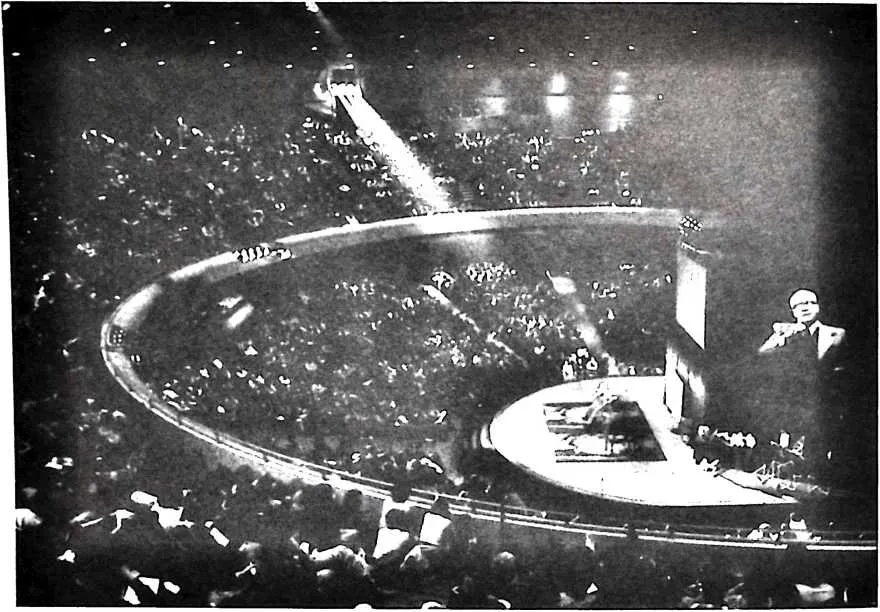
11971198Fuller lecturing in Radio City Music Hall, New York, 1979.
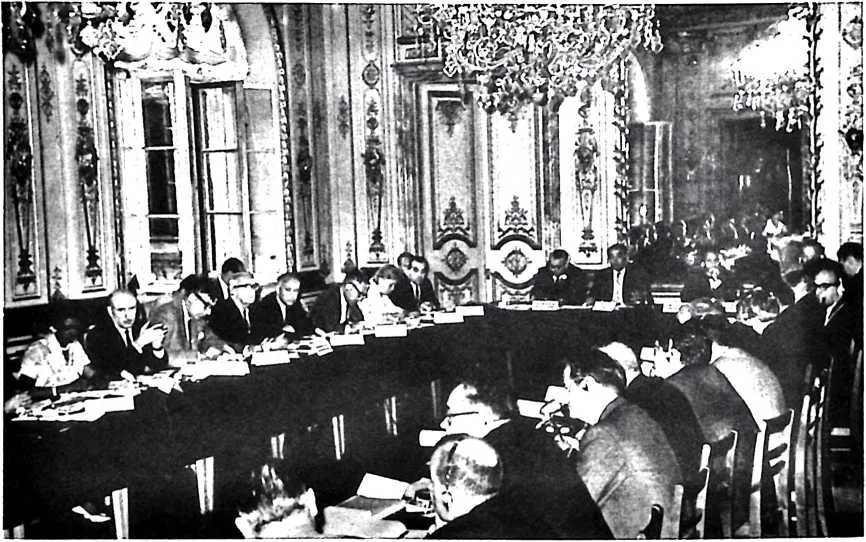
12001201The Dartmouth Conference in Leningrad held under the auspices of the Soviet Academy of Sciences in 1964 to discuss problems existing between the USA and the USSR. At the final session, Fuller (fourth from left) was chosen to speak on behalf of the US delegation.
1202 FULLER
1203 Fuller compliments DU on his questions and suggests the present volume
1204 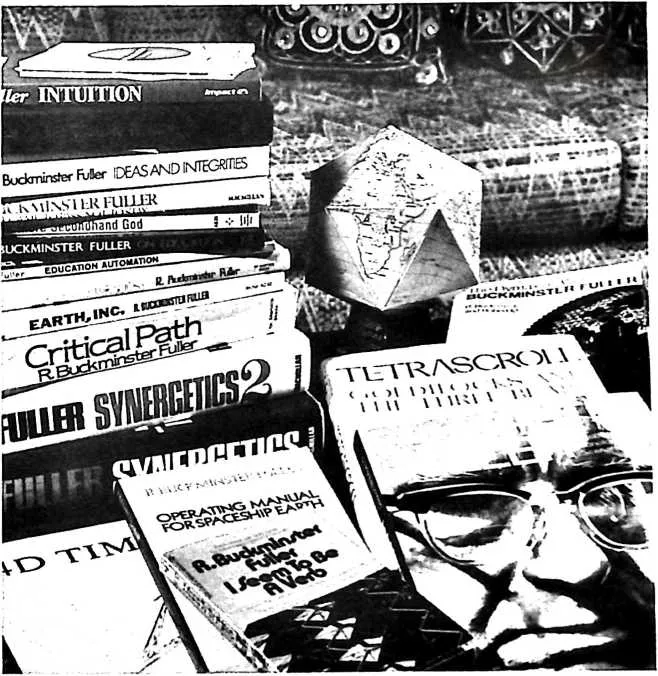 I think this is quite a wonderful day. The time had to come in my life wherein the
average human being that I am —is doing what I am doing, and is being effective, at which
moment a beautiful man such as you would ask me these questions. So this has been a
beautiful moment. That you have been able to record it is very important. I would very
much like to have a copy of the recording. I would like to say something more. What we
have experienced together today - I want to say to you that there had to come
a moment in my life when after writing many, many books, and given many,
many lectures, that there would be someone capable of asking me the sort of
questions you have asked me. And be able to get it all into a really short session and
record it. Remembering that I am what I am, and that I represent really an
evolutionary event, which might have happened to somebody else, so that I am not
kidding myself about where I am at all. I made it very clear that it all is a great
mystery. But there had to come a time when I would be able to have somebody
interrogate me by experience-evolved knowledge, capable of interrogating me about the
important points. So we could condense everything that is important into a very
short period. I never had so much communication in so little time. With the
communicating so capably evolved, as to bring out exactly what is essential
to comprehension of humanity’s present evolutionary status, I would like very
much, if you agree, to have it transcribed. Transcriptions always turn out to be
very disappointing. There is a mysterious difference between written and spoken
syntax. Transcriptions tend to make the speakers appear to be idiots, so the
transcription will have to be translated and verified. After it is transcribed I’ll
do my correcting of it and you may do your correcting of your part. It would
be very appropriate to have it in a book. I would like us to be co-authors of
it.
I think this is quite a wonderful day. The time had to come in my life wherein the
average human being that I am —is doing what I am doing, and is being effective, at which
moment a beautiful man such as you would ask me these questions. So this has been a
beautiful moment. That you have been able to record it is very important. I would very
much like to have a copy of the recording. I would like to say something more. What we
have experienced together today - I want to say to you that there had to come
a moment in my life when after writing many, many books, and given many,
many lectures, that there would be someone capable of asking me the sort of
questions you have asked me. And be able to get it all into a really short session and
record it. Remembering that I am what I am, and that I represent really an
evolutionary event, which might have happened to somebody else, so that I am not
kidding myself about where I am at all. I made it very clear that it all is a great
mystery. But there had to come a time when I would be able to have somebody
interrogate me by experience-evolved knowledge, capable of interrogating me about the
important points. So we could condense everything that is important into a very
short period. I never had so much communication in so little time. With the
communicating so capably evolved, as to bring out exactly what is essential
to comprehension of humanity’s present evolutionary status, I would like very
much, if you agree, to have it transcribed. Transcriptions always turn out to be
very disappointing. There is a mysterious difference between written and spoken
syntax. Transcriptions tend to make the speakers appear to be idiots, so the
transcription will have to be translated and verified. After it is transcribed I’ll
do my correcting of it and you may do your correcting of your part. It would
be very appropriate to have it in a book. I would like us to be co-authors of
it.
1205 Fuller’s published works, July 1, 1983. Photo by Wilbur T. Blume.
12061207Thank you, Dr. Fuller. You do me a great honor.
1208 DIL
12091210At this point let me show you some of my paintings including the ones you showed particular interest in last evening. I appreciate your interest in my work and would like to record any comments you might like to make. This one is an impression of the space shuttle Columbia in flight. It is what I call an arabesque —a design in my particular calligraphic style.
1211Last evening I thought of presenting it to you. I would like it to become part of your personal library. I feel it will have an especially meaningful relationship to you as an explorer of the universe.

12131214‘‘COLUMBIA: Arabesque 3’’ © 1982 Anwar DU. 22’’ x 30’’.
|
1218FULLER |
|
|
1222DIL |
|
|
1225FULLER |
|
|
1228DIL |
|
|
1231FULLER |
|
|
1234DIL |
|
|
1237FULLER |
1238 |

1247 ‘‘AL-HAJAR: Calligraph 189.’’ © 1982 Anwar Dil 22’’ x 26’’.
1248 The original is in Dr. Buckminster Fuller’s Personal Collection at the Buckminster Fuller Institute, Philadelphia.

1250 ‘‘NOAH: Calligraph 203.’’ © 1982 Anwar DU. 40’’ x 26’’.
1251 Here is my calligraph of ‘‘Noah.’’ Last evening I did not understand what you said about it.
1252 DIL
1253 I said Noah in the ancient Hebraic is Naga, the name for the sea serpent, the god of the sea which goes back before Poseidon and Neptune, the Greek and Roman gods of the sea. From most ancient times, sea people from around the world have put Naga on the prows of their ships.
1254 FULLER
1255 I see there the boat. I see the boat with the mast and the sails all set. I see Naga as the boat, and Noah with Noah’s ark, and all those things immediately together. It is very clearly the boat, a very beautiful boat. Look at it, there is a hull at the bottom and there are the sails. The mast and the sails, they are all there.

12571258‘‘BISMILLAH: Calligraph 141’’ © 1980 Anwar Dil. 22’’ x 30’’.
1259The original is in the collection of Mr. Asif Shakeel Ahmad, San Pedro, California.

12611262‘‘AL-JALEEL: Calligraph 150.’’ © 1980 Anwar Dil. 20’’ x 25’’.
|
1266FULLER |
1267That one is lovely. |
|
1268DIL |
1269 1271Lines from the Song of Tahira 1272Like the zephyr I have roamed 1273 1276- Qurratul ’Ain Tahira’s ‘‘Nawa-e-Tahira’’ |
|
1277FULLER |
1278 |
|
1280DIL |
|
|
1283FULLER |
|

1293 ‘‘TAHIRA: Calligraph 198.’’ © 1982 Anwar DU. 42’’ x 30’’.
1294 My medium is pure form and I work with the interplay of positive and negative elements. Through the interaction of the basic opposition of black and white forms I seek to discover the Cosmic Unity in Variety and the incredible simplicity and elegance inherent in the Universe.
1295 DIL
1296 Dil discusses calligraphic art
1297 I am reminded here of a passage in Martin Buber’s I and Thou: ‘‘This is the eternal origin of art that a human being confronts a form that wants to become a work through him. Not a figment of his soul but something that appears to the soul and demands the soul’s creative power. What is required is a deed that a man does with his whole being: if he commits it and speaks with his being the basic word to the form that appears, then the creative power is released and the work comes into being.’’ I feel that Buber wrote these lines to express the kind of challenge I face in doing my calligraphs.
1298 I would like to share with you a few thoughts on calligraphic art, in the context of our discussion. For me, calligraphic art is far more comprehensive and inclusive in scope than the more traditionally-held view of calligraphy as good penmanship. The best of Chinese Shu fa, Islamic Khattati, Japanese Shodo and other traditions put calligraphic art at the intersection of all arts and sciences, including painting, poetry, music, architecture, mathematics, astrophysics, philosophy, mysticism and religion. The simple act of dividing a circle or a rectangle with a straight or curved line has the potential to create spatial forms that have beautiful and mysterious relationships with one another, as well as with the original form. Inspired by creative impulse associated with the sound, the meaning or the graphic form of a word, the mind of a calligraphic artist, working with simple forms, starts its artistic exploration. In this process, individual letters and characters are linked together in innovative patterns. When the artist experiences a certain flow of vitality from a calligraph, very often he has discovered a form that is also full of abstract and symbolic beauty in the context of the word he has written.

1300 ‘‘YA HAFEEZ: Calligraph 138.’’ © 1980 Anwar DU. 20’’ x 25’’. The original is in the artist’s personal collection.
1301 For me, the creation of a calligraph is a deeply stirring experience—a moment of inner illumination. In this process I feel myself a witness to the beauty and power of the WORD. I derive inspiration from the WORD in its varied forms as manifested in the Universe, especially the names of men and women of excellence in history, and the qualities humans have attributed to God.
1302 I aspire, through my calligraphs, to leave life a little more beautiful than when I came upon it.
1304 ‘‘ALIFLAAM MEEM: Calligraph 177’’ © 1981 Anwar DU. 25'/2" x 33'/2". The original is in the collection of Lalolagi Heini Forsyth and Dr. Mrs. Claudia Forsyth, Apia, Western Samoa.

1306 ‘‘UMAR: Calligraph 154‘‘ © 1980 Anwar DU. 25l/2" X 34".
1307 The original is in the collection of Dr. John Efthimiou, Athens, Greece.
1309 ‘‘ILAH: Calligraph 146.’’ © 1980 Anwar Dil. 22’’ x 25’’.
1310 The original is in the collection of Mr. Antony di Gesu, La Jolla, California.

1312 ‘‘AL-TAUBA: Calligraph 205.’’ © 1982 Anwar Dil. 30’’ x 40’’.
1313 The original is in the Conference Room of Farukhi and Company, World Trade Center, Los Angeles.
|
1316DIL |
1317I was born in Jullundur in the Punjab province in India. |
|
1318FULLER |
|
|
1321DIL |
|
|
1325Dil’s poem |
1326 1328for you 1329if only you look for it! 1330It does not dazzle 1331as fireworks do,— 1332the glory of a moment. 1333 1335It is there 1336 1338San Diego, California, March 22, 1981 |
1345 FULLER
1346 Where were you born?
13471348($waad): Calligraph 183." © 1981 Anwar DU. 26" x 40". The original is in the University of Mysore, Mysore, India.
|
1352FULLER 1353Fuller’s inscription to DU |
1354(Presenting an inscribed copy of his book, Critical Path38): 1355To Anwar Dil On the day in which he asked me what seems to me to be the right questions to which I hope that God inspired me to give the nearest to right answers now to be had and given. |
|
1356DIL |
1357Thank you so much. 1358You have added something here too. |
|
1359FULLER |
1360(reading): 1361Anwar Dil, from Jullundur, Punjab, India, and 1362Buckminster Fuller, from Milton, Massachusetts, USA meet in San Diego, California 1363December 4, 1982 |
1370 ‘‘ALI: Calligraph 145" © 1980 Anwar DU. 25'/2" X 34".
1371 The original is in the Conference Room of the Embassy of Pakistan, New Delhi.