
11 Learning Tomorrows: Education for a Changing World
2I'm deeply convinced that the subject of Learning Tomorrows contains within it the answer as to whether humanity is going to be able to continue much longer on our planet—for we are going to have to acquire an almost entirely new educational system and do so almost ‘‘overnight.’’ We are going to have to learn why humans have been included in the design of eternally regenerative Universe and thereafter swiftly to start fulfilling that cosmic function. I therefore feel an enormous responsibility being allowed to be on your platform to discuss such a subject.
3 The first thing I think about is Professor Percival Bridgman of Harvard, the natural philosopher who, at the turn of the nineteenth into the twentieth century said, ‘‘How do you suppose it happened that Einstein surprised all the scientists? Why were all the scientists caught off-guard?’’ Bridgman looked deeply into this matter and concluded that the reason that Einstein caught all the scientists off-guard was that Einstein was what Bridgman called ‘‘operational’’; that is, he paid complete attention to, and interconsidered all the circumstances surrounding any scientific discovery. He did not isolate the discovery, but paid attention to all the circumstances of its occurrence.
4 From Peter H. Wagschal, ed., Learning Tomorrows: Commentaries on the Future of Education (Praeger Special Studies: New York, 1979).
5 I'm going to suggest a way of thinking about Einstein and his operational way of looking at things. This is not an example that he—Einstein—himself used, but it is my own and has become popularly adopted.
6 We have a man riding across the country, going due west, on a railroad train. He leans out the window and drops a flaming apple. He has another scientist with him, and the other scientist has a sextant to measure angles and he has stopwatches. They make observations of the flaming apple's trajectory, which they see flying backwards—that is, to the east, and they measure the angular distances it seems to travel and how much time at each angle. There are two other scientists standing to the north of the railroad at the time the foregoing event occurs. They have sextants, compasses, and stopwatches. They see the apple come out the window traveling westward, and gradually descending to the track. Using their sextants and stopwatches they make accurate observations of exactly what they see. We have another scientist who is standing on the railroad track far to the west, and she sees the flaming apple go very slowly down toward the earth. We have another person who is standing under the railway trestle when this all occurs, and she makes her scientifically recorded observation. We find that all these observations were faithfully made, and yet they were all different. They tallied what distances and in what directions the various observers were from the flaming object, and how much of an angle it moved through, and at what rate. So this brought Einstein into thinking about such variable situations and reports as being relative, not only to one another, but also to all other known cosmic variables. Einstein would observe that the rotation of Earth affected the event. Earth, the train, the observers and the flaming apple were all also zooming around the sun at 60,000 miles per hour.
7 It is very important to realize that Einstein not only was a teacher but was also an examiner in the Swiss Patent Office, reviewing patents. At this time, the most prominent products of Switzerland were clocks and watches. If you were reading patent claims of people inventing time-keeping devices, the first thing you would discover is that none of the devices are accurate. They all come out of production differently. In each, the producer tries to provide a little more accuracy. I'm sure this made Einstein think very much about Isaac Newton's assumption of time as being a phenomenon that permeated all Universe uniformly and simultaneously. Newton's was an instant, omni-everywhere exact Universe. This brought Einstein into thinking about relative accuracies and so forth.
8 I want to give you an example of non-operational procedures in our own schoolroom experience: the teacher goes to the blackboard and says, ‘‘You're going to have your first geometry lesson.’’ And the teacher draws a square, and tells you that a square is an area bound by a closed line consisting of four equal-length edges and four right angles. All the successive plane geometrical figures are accomplished as areas within ‘‘closed lines.’’ While drawing, the teacher says, ‘‘A triangle is an area bound by a closed line of three edges and three angles.’’
9 In all these plane geometry figures, we are taught to see only the little figures that are drawn on the board. We look only at the area bound by the closed line. We tend to think about only the geometry on the inside of the line. On the outer side of the line, the teacher is asking you to assume that the blackboard surface extends outward to infinity. Therefore the outer area is, to the teacher, ‘‘undefinable.’’
10 But the operational fact is that the blackboard doesn't go to infinity; it gets to its four edges and goes around to the back. It is a finite object. It is a board. It has length and breadth and thickness. The teacher drew on the surface of a closed system. When the teacher drew a triangle, the total surface of the blackboard was divided into two areas by the closed line. The teacher made two triangles. There is the little one to which the teacher pointed, but all the rest of the blackboard is an area bound by a closed line, having also three edges and three angles. Unscrew your blackboard from the wall. Make your little triangle and then check the remainder of the blackboard's surface, front, edges, and back, and you will find the other complementary big triangle. The fact that it goes around to the back does not alter the fact that it is a continuous surface area bound by a closed line of three angles. We were not taught to look at things that way. The board's edges, when viewed through a lens, are rounded, continuous surfaces. Edges are not terminal conditions. They are short radius turnabout conditions. Moebius's strip has an ‘‘inside’’ of the paper and ‘‘outside’’ of the paper. It is a flattened substance but it does not have two sides divided by its ‘‘edge lines.’’
11 I say to a young man, ‘‘Draw me a triangle on the ground.’’ And he draws it, and I say, ‘‘You've drawn four triangles.’’ And he says, ‘‘No, I've drawn only one.’’ I have to show him that he has drawn four triangles. A triangle is an area bound by a closed line with three edges and three angles. You'll agree with me that you've drawn it on Earth. I'm going to take an Earth ‘‘globe’’ and make a closed line of it, which we call the equator. It is a circle—a closed line, and it divides the whole Earth into two areas—a southern hemisphere and a northern hemisphere. Let's go all the way to the North Pole, draw a circle around your feet. It divides the total surface of Earth into two areas—a large southern and a very small but very real northern—real because we are standing on it. Now let's draw a triangle around our feet instead of a circle. Now we've divided Earth's whole surface into two areas, both of them bound by a closed line with three edges and three angles. And the student said, ‘‘You must be wrong. The three corners have outside angles of 300 degrees each for a total of 900 degrees. The sum of the angles of a triangle is always 180 degrees.’’ I said, ‘‘Where did you hear that?’’ He said, ‘‘Well, they taught me that in school.’’ I said, ‘‘The school is wrong. The angles of a triangle never add to 180 degrees. I've got to prove that to you also.’’
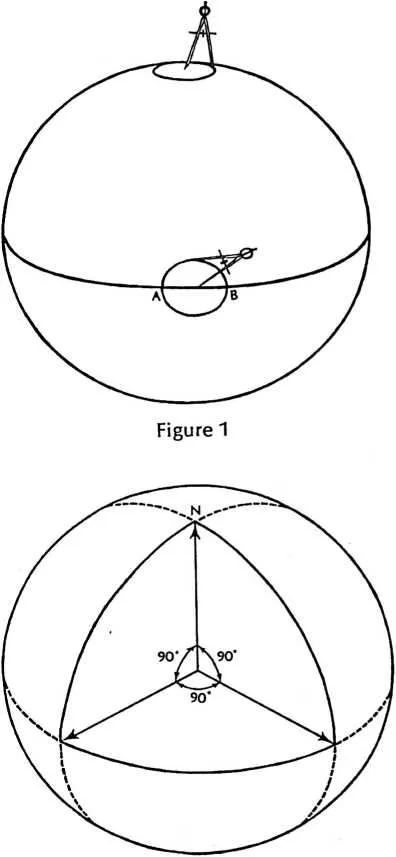
12 We have what is called a ‘‘great circle.’’ A great circle is a line formed on the surface of a sphere by a plane which goes through the center of the sphere. A great circle is the shortest distance between two points on the surface of a sphere. I'm going also to have to prove that to you. I pick up a twelve-inch Earth globe, saying, ‘‘I'm going to pick a latitude circle, which is what we call a lesser circle, because it doesn't go through the center of the sphere. I point to the latitude circle of 80-degrees north latitude. I take a pair of dividers—and put one end of the divider on the North Pole and the other end on the lesser circle of 80-degrees north latitude. With the dividers fixed at that 10-degree radius opening, I now put one end of the divider on the equator and strike a circle exactly the same size as that of the 80-degree north latitude circle. You now see the equator with the little 80-degree north latitude circle superimposed. With its center on the equator, the little circle crosses the equator at two points—A and 8. Quite clearly it is a shorter distance between A and B on the equator than it is on the little circle. I just want to convince you that great circles are always the shortest surface distances between points on a sphere. In spherical trigonometry, we always use great-circle arcs for the ‘‘lines’’ connecting points on a sphere.
13 I'm going to look again at our Earth globe. Starting at the North Pole, I take a meridian of longitude, which is a great circle, and go from the North Pole down to the equator. The meridian impinges on the equator at 90 degrees because the equator is produced by a spinning of Earth around the northsouth axis through which the great-circle plane of the meridian runs. So, I leave the meridian, turn 90 degrees, and walk eastwardly on the equator. I changed my course 90 degrees. I now go one-quarter of the way around Earth at the equator, and take a meridian northward, leaving the equator at 90 degrees. I go back to the North Pole. Because I went one-quarter way around Earth on the equator, the angle of my return to the North Pole is 90 degrees from my starting meridian, so we've got three corners, each of 90 degrees—90-90-90—for a total of 270 degrees, not 180 degrees, as the sum of the angles of a very real triangle, on the surface of Earth.
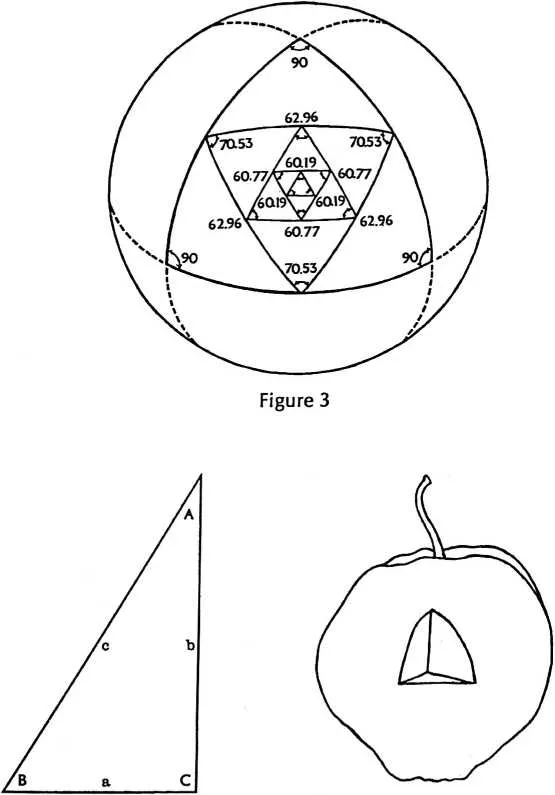
14 Now, see figure 3. We're going to bisect the edges of that 90-90-90-degree triangle, and interconnect the midpoints with great-circle arcs to produce a smaller great-circle triangle whose corners are 70.5288 degrees each. Bisect that smaller triangle's three great-circle arc-edges. Interconnect those midpoints with great-circle arc-lines and get an even smaller triangle, and the
16 three corner angles are 62.9643 degrees each. Bisect that smallest triangle's three arc-edges. Interconnect the midpoints and get an even smaller triangle with corner angles of 60.7664 degrees. Bisect its arc-edges, interconnect the midpoints and get corner angles of 60.1933 degrees. With each smaller triangle, each corner approaches 60 degrees but never gets to 60; that is, the sum of the angles of an approximately flat triangle is approximately +180 degrees, a limit case which is never reached. The sum of the three angles of all physical triangles always adds up to something other than 180 degrees.
17 Incidentally, you and I were taught about fractions in school. We were taught how to multiply and divide them, and so forth; we were taught, also, that we couldn't have peanuts divided by elephants. You had to be dealing entirely with peanuts or entirely with elephants. So, when later on we took trigonometry, we were upset when we came to the trigonometric functions, called sines and cosines, tangents and cotangents, and other unfamiliar new words. ‘‘What is a function?’’ I asked. The teacher said, ‘‘Draw a picture of a right-angled triangle. It has six parts—angles A, B, and C, and three lines, a, b, and c. The corner angle C is known because it is a right angle (90 degrees). The trigonometric functions are ratios between any two of the five unknown parts of that right triangle. This means we have ratios between an angle and a line. Ratios are expressed mathematically as fractions. This means we have fractions in which we divide lines by angles or angles by lines.’’ But I had learned that I can't make a fraction out of peanuts and elephants, how can I have fractions of lines divided by angles?
18 In order to answer that question, I need to be able to make a drawing on a symmetrical something. A simple way is to draw on a sphere. So let's make a triangle on the surface of an apple, drawn with a knife. With the point of the knife, I draw a greatcircle-edged triangle on the apple's surface. Then, using the knife's blade, I cut inwardly on each of the edge lines of the triangle—to the apple's center, and see that what we call the ‘‘edges’’ or arcs of the triangle are in operational fact the ‘‘central angles.’’ We are dividing surface angles by central angles, which is absolutely valid. We are not dividing angles by lines after all.
19 The fact is that we think spontaneously about omnidimensional reality, but were taught at school that real life is much too complicated, so they give you their ‘‘nice, simple, plane geometry.’’
20 They tell you they are starting you with a two-dimensional plane.
21 Now, I'd like somebody to give me experimental evidence of a surface of nothing. That's where we made the first great operational mistake with that blackboard, by saying it had a surface of nothing—and that the plane went laterally to infinity. There is no infinity. No scientist has ever been there to give demonstrable evidence.
22 What we should realize is that we're always dealing experientially with something, and all somethings have both insides and outsides. You learn only in reality by starting off with experienceable somethings. If you really are drawing on something, all your lines are measures of central angles.
23 This is what Bridgman was getting at about Einstein. What are the real physical world circumstances? Don't assume false circumstances where the real circumstances can be found.
24 The boy to whom I am showing these experiences now agrees with me that, inadvertently, he was wrong about the big triangle as well as the little triangle. He says, ‘‘But I didn't mean to make the big triangle,’’ and I say that that is the trouble with what humanity is doing today. We've been taught to look at only one side of closed lines. We have a bias—my family, my house, my country. But everything we do is always going to affect not only us, but also all the rest of planet Earth and Universe. The very littlest things we do on Earth always greatly affect total Universe.
25 Then my student says, ‘‘You said I had drawn four triangles. You have now proved to me that I've drawn two—a very big one and a very little one, but where are the other two?’’ I said, ‘‘Well, you can only draw on something, and that something always has an inside and an outside.’’ Any something—we'll call
27 all somethings ‘‘systems’’—divides all Universe into four parts: (1) all Universe outside the system, (2) all Universe inside the system; and a little bit of Universe which is the system that does the dividing, which itself subdivides into two parts, i.e., (3) and (4); one the outward ‘‘convex’’ (3), and the inward ‘‘concave’’ (4). Convex and concave always and only coexist.
28 When energy as radiation impinges on concave, the latter concentrates the radiation into a beam. When radiation impinges on a convex surface, the radiation is diffused. So convex and concave have completely different physical effects, yet they always and only coexist. I say to the boy, ‘‘What you've done is not only to draw the big surface and little surface triangles, but you've divided the whole Universe into an insideness and an outsideness. You made, then, a big concave triangle and a little concave triangle, and you made a big convex triangle and a little convex triangle. You made four triangles. You can never make a real Universe triangle without making four. This is the way everything begins with fourness.’’ This is the four-dimensional world in which we live.
29 All that I have been explaining is what Professor Percival Bridgman meant by ‘‘operational.’’ There was much abstract philosophical discussion about ‘‘reality’’ at Harvard, led by Peirce, just before the turn of the nineteenth into the twentieth century, which Peirce called the ‘‘school of pragmatism.’’ In contradistinction to Peirce's abstract epistemology, Bridgman wanted a title for a scientific grand strategy that is more than pragmatic, and he used the word operational. This meant dealing comprehensively and incisively with scientifically re-demonstrable reality and in strictly scientific quantation. The word operational has become very much used and misused since that time.
30 What I've been telling you about, really, is operational mathematics. There is always an experiential reality. There is no way you can abstract yourself and take a position outside Universe. You are always in Universe. As integral functions of Universe, whatever we do affects the whole Universe, every time. We are all complementary parts of Universe.
31 I have one rubber glove, a red rubber glove, and I have it on my left hand, it fits on my left hand beautifully. I'm going to start stripping it off my left hand by rolling the bottom of the cuff of it. As I do, I find it's green on the inside. I keep rollpulling it, and finally it comes off, and now the red left hand has been annihilated, we have only a right hand and it is green. What we do locally is complementary to the rest of Universe. There's the rest of Universe that fits around my hand, around my body, that is also altered by any, every act. It's always there —that ever, everywhere intertransforming, nonsimultaneously episoded, eternally regenerative Universe.
32 To comprehend more clearly, we have to electromagnetize our thinking and our communicative vocabulary. What we tune in and what we don't tune in doesn't make the nontuned-in nonexistent. This electromagnetic cerebrating seems to induce a very different way of thinking about things, than about static space and solid things—somethings and nothings. We're always dealing with thinkable systems which are only subdivisions of nonunitarily conceptual Scenario Universe. A system is a tuned-in episode and not a thing.
33 I'm confident that the way I am talking to you is part of Education for Tomorrow. Operational comprehensivity and detail are going to spell the difference between whether the world fails to understand what its potentials and realizable options are, and whether we comprehend enough about the function of humans in Universe to be able to employ our mind and exercise our options to establish lasting physical success for all—or perish. We are going to have to learn that it is going to have to be success for all humanity or for none; that goes for an even larger way of thinking which says it is going to have to be total cosmic success which includes humanity, or it is going to be cosmic quits.
34 We must get over the idea of trying to oversimplify education and make it ‘‘simple’’ by making it unreal, isolated, nonoperational. I became convinced as time went on that it is easy to consider myself always as a function of Universe and to remove false premises and to learn that everything I have ever really learned has come from seeing myself in the context of the cosmic working premise. This is the context in which I have been speaking to you.
35 The next thing I would like to talk about is human beings in Universe right now: how and why we are here. Let us try to understand what all our local problems are, and what all problems everywhere are, and what problems have to do with human beings in Universe.
36 I think that because you and I are so tiny, and our Earth is so big, and Universe is so incredibly incomprehensible—we're not thinking very realistically about the rest of that Universe.
37 When I was twenty-eight years of age, Hubbel first discovered another galaxy. In the fifty-five years since that time, we have found a billion such galaxies. We are surrounded by an incredible amount of information which was not available when I was young, and I want you to think very rapidly with me about our circumstances and our scale. Our planet Earth is 8,000 miles in diameter. Our highest mountains are approximately 5 miles above sea level, and our oceans' deepest points, about 5 miles below sea level, so there is a 10-mile differential between the innermost and outermost surface points on our planet Earth. Ten miles in relation to 8,000 miles is only 1/800. If I take a twelve-inch polished steel ball and breathe on it, the depth of my condensed breathing upon it (1/100 inch) is deeper than the ocean on our planet.
38 I want to think of us on our real planet Earth. We have photographs of our Earth taken from space, and you can see the blue of the water and the brown of the land, but you can't make out mountains, or see the depth of the oceans. You can't see any such differential.
39 Humanity's average height is about 5 feet. There are about 5,000 feet to a mile and, as we have observed—ten miles make the difference between the deepest ocean and the outermost mountain. That difference would be 10,000 of us standing on one another's shoulders, successively one above the other. And since in real Universe, looking at our Earth, you can't even see the altitude difference between the mountain tops and the ocean bottoms, you and I are 1/10,000 of invisible on that planet. We are indeed tiny.
40 We know that our planet Earth is about 1/100 the diameter of the sun. You can look at the sun when the thin cloud-cover in front of it makes it a white disc. If you take coins out of your pocket and hold them at arm's length trying to cover that disc of the sun, you'll find that a twenty-five-cent piece does just cover it neatly, and that coin is about an inch in diameter. School ‘‘rulers’’ are divided and marked to 1/16 inch. Engineers' scales are usually graduated to 1/50 inch, but sometimes to 1/100 inch. A hundredth of an inch is, to most human eyes, a blur. You can't really make out that difference with your eyes. Since our planet Earth's diameter is only 1/100 that of the sun, and since the disc we cover the sun with is only one inch—Earth as seen against the sun would be an almost invisible speck of 1/100 inch. Our star, sun, is a mediocre-sized star. One large star, Betelgeuse, has a diameter greater than the orbit of Earth around the sun. And our star, the sun, is only one of the 100 billion stars in our galaxy, and we now know of a billion such galaxies. I would say that when we get to that kind of knowledge about our Universe, it's clear to me that Universe affairs are not dependent upon whether the republicans or democrats are elected, nor is Universe saying we can't afford another galaxy, let alone lunch for the kids. I don't think of Universe as being concerned with the same kind of nonsense that we are. We can develop and hold a bias unreasonably. To me, Universe is something other than just stars to decorate the night.
41 I'd like to try to be as clear as we can about how and why we are here on this planet. Let's examine what we do know experimentally about ourselves. Let's try to analyze human beings in relation to all other living organisms, to see if we can find something different. Yes. All the other living organisms have some built-in, special equipment, part of their physical organisms, that gives them some special advantage in some special environment. There is a little vine that grows beautifully in the Amazon, but nowhere else. I see the birds have wings, so when they're in the sky they can fly, but when they're not flying, cannot take off their wings, so you see them walking awkwardly, greatly encumbered by their wings.
42 Human beings are not alone in having brains. Many creatures have brains. Brains are always and only coordinating the information of the senses, taking all the information coming from outside and all the information from our innards. Brains are always and only dealing with special cases. This one smells this way, this one has that temperature, so brains store memories of these special case packages.
43 But human beings also have a phenomenon—mind—and human minds have the ability, from time to time, to discover relationships existing between components of a system that are not manifest in any of the components, considered only separately.
44 Human beings, after millions of years of observing the inverted bowl of stars in the sky, see them as seemingly fixed in rememberable pattern interrelationships. But against the ‘‘bowl’’ of the fixed-star heavens, humans long ago successively discovered five mobile lights a little brighter, bigger, and different in color from the fixed stars, which mobile ones reappeared from time to time—sometimes singly, sometimes in company with one another. Humans in general began to recognize these mobile bright ones, and found there were five of them, which we now call ‘‘planets.’’ Humans gave the planets the names of gods, and after a while kept records of their reappearances in relation to the moonths (months), seasons, and years. But humans kept thinking geocentrically—that is, they thought they saw the sun, moon, and stars arising from our flat, fixed world's eastern ocean, all traveling westward through our fixed sky and plunging into our western ocean. Humans needed much more instrumental development and especially mathematical capability to comprehend what is transpiring in a more realistic way: scientific, artifact-proven existence of human mathematical capabilities begins only 4,000 years ago in Babylon—when thus first manifest, mathematics are already highly sophisticated. There is a good possibility that our mathematics first developed in the Orient and gradually worked westward through India into Mesopotamia.
45 Three thousand years ago (that is, 1,000 years after the Bablyonian mathematics' outcropping) the Creeks made magnificent additions to the geometry and algebra. Two thousand years ago the Roman Empire monopolized, quashed, and all but obliterated mathematical capability. They instituted their Roman numerals as an accounting system which could be employed by utterly illiterate servants. About 1,000 years ago, Arabs and Hindus began relaying ancient mathematical concepts via North Africa into southern Italy and Spain. In 800 A.D. al Kwarazimi first wrote a text in Latin which introduced Arabic numerals into the Romans' Mediterranean world. But not until 1200 A.D. was al Kwarazimi's text published. Because of the general illiteracy of those times, it took 200 years more for the concept of the cyphra (zero) and its function of positioning numbers to reach the students of northern Italy and southern Germany. Positioning of numbers (leftward or rightward) of the successive products of successive integer multipliers, written in successively lower lines, made possible both multiplication and (in reverse patterning) long division. Did you ever try to multiply or divide with Roman numerals? If you did, you found it to be impossible. When I first went to school at the beginning of the twentieth century, the older people of my world—our village pharmacist, butcher, and hardware man—asked in a friendly way whether I had as yet ‘‘learned to do my cyphers.’’ That is how the merchants identified mathematics—as a calculating facility, to which the cypher was the key.
46 With the positioning of numbers, Columbus was able to develop navigational competence of a new order. Calculating capability plus telescopic observation made possible Copernicus's discovery that our Earth is a planet going around the sun with the other planets. Calculation made possible Kepler's, Galileo's and Newton's further contributions to celestial knowledge.
47 Mediterranean people began to use Arabic numerals as a shorthand for Roman numerals. The Roman numerals are what we call a scoring system. The masters had a servant stationed at a gate when a herd of sheep was being driven through that gate, the master said to the servant, ‘‘Every time a sheep goes by, you make a mark.’’ That's how we got our Roman numerals.
48 The Arabic numerals were probably invented by ancient Arabs to copy the behavior of an abacus. An abacus has a series of vertical rods in a frame. On the rods, beads are mounted in modular groups—five below a horizontal bar and two above, for each vertical rod. You enter your progressive products and when you have all of the beads pushed up in the first column, you move one up in the next column. Thus you have a way of accumulating the products and when you empty the column, and you are trying to keep track of columns in Arabic numerals, you have to have a cypher to indicate an empty column.
49 Often losing their abacus overboard, or in the caravaning sands, the Phoenicians invented the abak, a tablet sprinkled over with sand on which they drew pictures of the rod and bead abacus array, and on which sand boards they simply entered their single symbols for the number context of the columns. They needed a symbol for an empty column, and invented the cyphra—0.
50 Because the Roman world was scoring and could not see or eat ‘‘no sheep,’’ they did not comprehend or use the cyphra when they used the other Arabic numerals as shorthand symbols for their Roman numerals.
51 There came a series of extraordinary new situations and accomplishments now that people could calculate. Not that their intelligence was greater, but they had a facility which had to be developed cooperatively by and only between human beings that had been born, all of them naked, helpless, ignorant, driven by hunger, thirst, curiosity, lust, fear, and love, having to find their way by trial and error.
52 We get to an historical condition wherein calculated informations compound synergetically going back to Copernicus, Tycho Brahe, Kepler, Galileo, and Newton making much better measurements of the behaviors of those planets, and having calculating capability. Kepler found that the planets were orbiting the sun in ellipses and not in circles. Kepler also found the planets are all different in size and are operating at different distances from the sun and are all going around the sun at different rates. While they are all on the same team, they seemed otherwise to be very disorderly. Kepler, as a mathematician, then said, ‘‘I now know one thing about them: that they are all going around the sun. If I can know something else that they have in common, then I might be able to find out other at-present-unknown characteristics of their planetary system.'' In trigonometry, if we have two knowns, we can find out all the other characteristics of the unknowns. So Kepler said, ‘‘As a mathematician, I'm going to deliberately give them something else in common. I'm going to give them each exactly twenty-one days of time. This is much too small a time for them to demonstrate anything except a rather small arc.’’ So, Kepler assigned twenty-one days to each, and drew a diagram of the twenty-one-day behavior for each of the planets. Each one starts at this known distance from the sun, and moves in an elliptical arc, so that at the end of the twenty-one days, the distance from the sun of each of the planets is a little bit different from its radial distance at the start. Each planet's twenty-one-day data described a thin, pie-shaped form. Kepler then said, ‘‘I might as well calculate the areas of these triangular pieces of pie. There's no pie in the sky, but I might as well calculate it.’’ I am confident that either you or I would be mystically overwhelmed if we had been Kepler, making these calculations, and discovering that ‘‘the areas swept out by each of the planets in twenty-one days, (i.e., in exactly twenty days, twenty-three hours, fifty-nine minutes and sixty seconds) were not just approximately equal areas, but were exactly the same. It would be quite clear to each of us, as it was to Kepler, that, behind the superficial disorders of experience, there is some kind of elegantly exact coordinating system. This high degree of omniinterrelated cosmic coordination challenged Kepler's intellect. If the planets were touching each other like gears, then he could understand how they could coordinate. But they are multimillions of miles apart. ‘‘How can you coordinate celestial bodies at a million miles apart?’’ But there were other relevant facts of which Kepler knew. The first is that the planets were in elliptical orbits. ‘‘If I have a weight on a single restraint string, and swing it around my head, then its orbit will be a circle,’’ said Kepler. ‘‘If I want to make an ellipse, I have to have two restraints. There's some type of invisible, cordless tension going on between the planets and the sun. When the planets tend to bunch together, they have a more powerful restraining effect on one another, which brings about an ellipse.’’
53 Human intellect has to imagine, as did Kepler, the existence of some incredible kinds of tendons that are absolutely invisible, that operate reliably at distances of millions and billions of miles. This conceptioning is an extraordinary challenge to the human mind. We are accustomed to pushing and pulling, but not to that kind of remote control. Kepler's knowing that there were enormous weights and enormous sizes involved to be interrestrained in such an invisible manner, made his stratagems and reasoning an extraordinary human feat.
54 So then we have Galileo calculating the rate of free-falling bodies, and discovering that the acceleration rate was in terms of the second power of the arithmetical distance traveled.
55 And then we have Isaac Newton, deeply eager to find out what Kepler's extraordinary cosmic pull might be. Newton is excited by the then-popular knowledge that human beings have identified the occurrence of very high tides of Earth's oceans with the full-moon phases. Thinking in terms of this great six quintillion tons of ocean lift, Newton realized that when we have a full moon with the sun on the same side of Earth as the moon, the sun and moon are both pulling together on Earth's oceans. The pull would be very great under those circumstances compared to other such times as when the sun and moon would be on opposite sides of Earth with the moon's minor pull cancelling some of the sun's great pull.
56 Isaac Newton was also greatly advantaged by the astronomers and navigators, who had, by his time, been able to catalog the angular attitudes of Earth in relation to the sun and the other plantetary bodies for each day, hour, and minute of the year. So Isaac Newton then, using all the foregoing information, hypothesized his first law of motion, which said that, ‘‘A body persists in a state of rest or in a line of motion except as affected by other bodies.’’ Newton realized that gravitational pull between the moon, Earth and sun must be enormous, in order to lift six quintillion tons several feet twice daily. He then hypothesized again that the relative initial interattraction of any two bodies in respect to that between any two other equidistanced bodies in Universe would be proportional to the product of the masses of the respective pair of bodies. The Earth-moon-sun interattractiveness is so great that the pull between two neighboring apples is overwhelmed by the pull of Earth on both of the apples. Then, Newton thought about the idea of Earth letting go of the moon, the way you can let go of a weight on a sling. He then chose a given moment many nights hence when the moon would be in the full, and, from the astronomical data, Newton plotted the line of trajectory of the ‘‘sling-released moon’’ as it departed from Earth as seen against the ‘‘fixed’’ star bowl of the heavens and as seen from a given point on Earth. On that day and moment, Newton observed the behavior of the moon and ‘‘traveled away from that theoretical trajectory and followed the Earth,’’ as Earth and the moon together went around the sun at 60,000 miles an hour, while the moon went around Earth, and he found the behavior of the moon exactly verified Galileo's law of ‘‘falling bodies.’’ (We shouldn't talk about falling bodies, they are simply being attracted to other dominant bodies.) At any rate, Newton concluded that the interattractiveness of any two bodies was in terms of the second power of the mathematical distance between the bodies. If you double the distance between the two, you reduce the attraction to a quarter of what it was, if you halve the distance between the two, you increase the attraction fourfold. Newton then made this conclusion his working hypothesis, and the astronomers began to use it, and scientists since then have used it to explain all the celestial behaviors, wherever it could be appropriately employed. We have, then, Isaac Newton's discovery: what we call the gravitational law, mass attraction. If you ask Mr. Newton what ‘‘gravity’’ is, he would say, ‘‘There is nothing you can point to.’’ It exists only as the interrelationship existing between bodies. There is nothing in any of the bodies by themselves that predicted they would be attracted to other bodies. It is only because humans for millions of years realized that the planets were, as a team, behaving seemingly differently from the rest of the stellar Universe that aroused human curiosity enough to finally discover what was going on between the members of the team that finally disclosed a cosmic law.
57 I want to point out that this is what human minds have the exclusive capability to discover—relationships existing between, that are not in, the special cases, whereas the brain is used in apprehending and remembering the special cases.
58 Newton's discovery is what we call a scientific generalization. To qualify as a scientific generalization means that no exceptions can be found to the operation of the principle, which means that scientific generalizations are inherently eternal. Because it deals only in special cases, all of which begin and end, the brain asks for explanations of how Universe began and is to end. But the human mind discovered that there is no beginning or ending to eternally regenerative Universe. There are only eternal principles.
59 Human minds have, then, the unique and exclusive capability to discover and express only mathematically, mind-discovered principles, which are some of the eternal interrelationships (principles) of Universe. All of these are synergetic. Synergy means behavior of whole systems unpredicted by the behavior of any of the system components when considered only separately.
60 As far as we know, only human beings have this generalized principle-discovering capability, and we have now discovered quite a family of these generalized principles. There are not so many of them that we know about, and we never know when we're going to discover one, and we don't know that the last one discovered is going to be the last one at all. But there is an at-present known family, and when we look at them sum-totally together, we learn something very fascinating: none of them has ever been found to contradict any of the others. Not only are they eternal, but they are all interaccommodative. When you and I use the word design in contradistinction to chaos, we mean that an intellect has sorted out and deliberately arranged the patterning of all the components of the experienced composition as visually, aurally, tactilely, or olfactorily apprehended in detail by the brain—but as comprehensively comprehended only by mind and expressible only as eternal interrelationship, only in mathematical terms by mind—special-case human mind discovering eternal a priori generalized mind, the intellectual concept of eternal, interaccommodative principles. It seems the human mind has limited access to the great design of Universe itself.
61 Human beings must have some very important function to serve in Universe, or we wouldn't be given such a cosmic capability. What we have to think about is the human's function in Universe.
62 I would point out to you that the most common experience of all human minds throughout history is ‘‘problems, problems, problems.’’ In fact, if you're good at problem solving, you don't come to a problemless Utopia. You qualify for bigger and bigger problems.
63 Quite clearly, human beings have the capability to discover principles and to employ them. But humans can't design a generalized principle. For instance, they can't design a generalized lever. It has to be a special-case lever, made of such and such a size, and such and such material. You find, then, that human beings have the capability to discover principles and to employ them. For instance, we have the Wright brothers discovering how to make airplanes glide, then how to engine- and propeller-pull them into flight. Long before that, children found out how to make paper darts fly across the schoolroom. Their darts were the prototypes for the most advanced delta wing ‘‘fighters’’ of today. Also long ago, Bernoulli discovered the mathematically stateable law of pressure differentials in gases. Because of Bernoulli's mathematics, humans were able to calculate how to make wingfoils to give us increasing lift advantage in airplanes. And so, today, wingless human beings have made powered wings for themselves, and can fly forty-two times faster and thirteen times higher than any bird. With their diving equipment, humans can dive deeper and swim faster than a whale. In fact, humans can outperform all the specially equipped mammals in their special areas of excellence. You can take the wings and fly them, or I can fly them, or we can melt them down and make better ones as they become completely interchangeable between us. Humans have a completely different way of coping with their environment because of their minds' access to some of the principles of Universe.
64 The most important physical fact humans have so far learned about Universe is that no energy is being created and no energy is being lost. Universe is eternally regenerative. It is a 100-percent efficient system. In comparison, we humans make reciprocating engines which are 15 percent efficient. We make turbines which are 30 percent efficient; we make jet engines which are 60 to 65 percent efficient; we make what we call fuel cells, up to 85 percent efficient. Efficient means how much work we can get out of the energy we invest. But Universe itself is 100 percent efficient. It is the one and only completely efficient system of which we know.
65 For every turn to play in Universe there are six moves to be made, within twelve equioptimally economical degrees of freedom—six positive and six negative. If you want to make a wire wheel, you'll find you have to have twelve spokes; you have to have three leftward, three rightward, three backward, and three forward spokes. It takes a minimum of twelve spokes, six positive and six negative, to give you a fixed structure. In every system in our Universe that has structural stability, there are a minimum of twelve restraints. And nature always does things in the most economical manner. That is why I say that with every turn to play you have six positive and six negative, equally optimally economical alternative moves. Mathematically speaking, and from a topological viewpoint, we find that all the lines in Universe are evenly divisible by the number six. With the twelve degrees of freedom and the incredibly high frequency of event occurrences of all the different omniintertransforming systems of Universe, the frequency of turns to play is such that you can design anything—a daisy or a galaxy. One takes a little longer than the other, but all of these designs are permitted. Thus we discover our Universe to be of such extraordinary complexity that everything is everywhere transforming constantly, yet is sum-totally so intercomplementary, though nonsimultaneously, as to be 100 percent accounted, no energy being created and none being lost.
66 We begin to see that we have humans on board our planet to discover principles, and to employ them instrumentally, and to gain information. Just within my lifetime, we have developed such powerful telescopes and such advanced photography that we have discovered a billion galaxies. With the opening of the twentieth century, humanity has entered upon a new kind of reality. Up to the twentieth century, reality was everything we could see, smell, touch, or hear directly. When I was three years old, electrons were discovered. (I was born in 1895.) This twentieth century brought humans into electromagnetics. Within electromagnetics, we found that every chemical element has a set of unique electromagnetic frequencies which are not tunable directly by the human eye, but which can be tuned in instrumentally by what is called a spectroscope. In this century, humans have developed metallic alloys, for instance, by adding 2 percent of copper to aluminum. The aluminum becomes twice as strong in tension, but doesn't weigh any more.
67 In our twentieth century, we have developed a vast and ever more exquisitely effective invisible capability. In producing structures, we have evolved ever higher tensile strength with the same weight of material. We now have the ability to communicate almost weightlessly with electromagnetics. We are constantly doing more with ever less investment of physical resources per each magnitude of functional capability.
68 A new era of human affairs has been opened to us. In 1930, the first chart of the vast electromagnetic spectrum was published (in the United States). All the different chemical elements are present and all the radio wavelengths, the X-rays, infrareds, and then the red, orange, yellow, green, blue, violet wavelengths which you and I have the equipment to tune in directly. Then we go on into ultraviolet and further non-direct tunability of humans. We discovered that where you and I can tune in to reality is, in fact, less than one millionth of reality. All of the things that are going to affect all of our lives tomorrow are being conducted in realms of electromagnetic spectrum that can only be reached by instrument. So humanity has a very new relationship to Universe with its 99 percent invisible reality.
69 When we begin to think about the educational problems of humanity, we must think in terms of the whole and its intercomplementarity. We're in for a very important new phase of education wherein, as a prelude, during my lifetime, we have gone from 90 percent illiteracy of total humanity to 90 percent literacy. Our little minds, probing the invisible reality, have discovered some very extraordinary principles. Human beings have been employing these principles of the invisible world, and employing them primarily in the realm of weaponry. The cost to realize use of these principles requires vast amounts of money to buy million-dollar tools. Humanity says we can't afford that. But when national defense says the enemy is going to destroy you if you don't buy these tools, our political leaders say, ‘‘All right, we have to cope with the enemy,’’ and we bring in the highest new scientific capability in order to cope. So we have humanity employing these extraordinary principles primarily for what is called national defense. But the national defense employs scientists to discover with what the enemy is going to attack next, and this brings the most powerfully opposed political systems into escalating the forms of warfare and into exploiting realistically those highest capabilities of humanity. And then, after people have produced new weaponry, their old weapon becomes obsolete but they still have the production capabilities for it. So they look around the home front for some outlet, and so we have a gradual fallout of ever advancing technology from the military into the home front.
70 But we're operating politically on our planet according to a view first considered scientifically infallible in 1800 when Thomas Malthus, professor of political economics for East India Company College, for the first time in history had available for his study the total vital statistics from around our closed-system spherical planet. The British Empire was the first spherical empire. All the empires before were flat empires, starting with a flat-world civilization with its unknown wilderness extending laterally into infinity. If you didn't like the way things were going, you had an infinite number of chances of reaching the right god by prayer, and would come out fine. But here we have Thomas Malthus in 1800 with all the vital statistics from around the world, and he found quite clearly that humanity is multiplying itself at a geometrical rate and multiplying its life support at an arithmetical rate, wherefore humanity is clearly designed to be a failure. This concept became, then, the model of all economics and social sciences—an inherently inadequate planetary life support.
71 Each of the great political systems on the planet is saying, ‘‘You may not like our system, but we're convinced we have the fairest, most logical, most ingenious method of coping with an inherently inadequate life support.’’ Because there are those who disagree completely on the method of coping, it can only be resolved by trial of arms which political system is fittest to survive. That's why, for the last thirty years, Russia and the United States have jointly spent over $200 billion a year on how to destroy most expertly, rather than on how to make our world work; all on the basis that there is not enough to go around, so we don't try to use the great principles discovered by science to make the humans' world work. It was this fact, plus the new era capability to do more with the same weight, that made me resolve fifty years ago to try to reverse, and to use the high technologies only for livingry.
72 I was an officer-of-the-line in the United States Navy in 1917, in World War I, and I found a great deal of classified information having to do with the invisible world. When, for example, you came into contact with the enemy, he knew the weight of your ship, and its tonnage, armaments, and so forth, but he did not know that your ship and its armament were made of metals that can do twice as much with the same weight as could his metals. So he was overpowered and sunk. Much of the highly classified information had to do with doing more with the same, or more with less. You don't find anything in books on economics about doing more with less. Now, it occurred to me then (way back in 1917) that if we could continue doing more with less to cope with the enemy, then we might someday be able to do so much with so little that we could take care of everybody peacefully. In 1927, fifty-one years ago, I committed myself to following through on that; taking the highest production capabilities of humanity and applying them to the home front. I found, at that time, that the best single-family dwelling that you could find weighed 150 tons. And I found that, using the most advanced aircraft technology and design, you could build it weighing 3 tons. I now have over 200,000 geodesic domes around the world, as constant proof of producing very much more environment-controlling apparatus with ever-less amounts of physical weight of input.
73 We learned long ago that if you double the length of a ship, you have four times as much ship surface and eight times as much volume or payload. I learned that if I double the size of a dome, I have four times as much surface, and eight times as much volume; which means that every time I double the size of a dome, I halve the amount of surface through which an interior molecule of atmosphere can gain or lose energy as heat. This is why icebergs melt very, very slowly, but little ice cakes melt very, very fast. The smaller they get, the faster they melt. The bigger they get, the more they conserve their energy and the more energy stable they become.
74 So now I am able to say informedly and irrefutably that employing only humanity's proven technology and its already mined and recirculating metals, it is now clearly demonstrable that within ten years we can have all humanity living at a higher standard than anyone has heretofore experienced. During this ten-year time, we can phase out forever all further uses of nature's savings account energies—the fossil fuels, and atomic energy (nature's cannibal account). We can live entirely on our energy income. But I find that no one is taking that seriously.
75 If you get into the idea that it has to be you or me, and finally you get hold of money that makes it easier to take care of me, then you get tied up with an enormous amount of investment. The ‘‘money’’ does not go after low-grade ore when there is high-grade ore right next to it. Money always chooses the way which makes the most money, and in the shortest time. After it uses up the fossil fuel, it goes over to the exhaustion of atomic energy. None of the big governments or big religious organizations, and none of the private enterprises are looking seriously at using only our direct daily energy income: the three great power bureaucracies see no way of putting meters between people and the sun. I know that living entirely on our energy income is completely feasible, and I can demonstrate how it can be done. Which means that we don't have to cheat all the generations to come of their chances to survive. Which means that I now know that the working philosophy of all our major political systems is wrong, it does not have to be ‘‘only you or only me.’’ I could not have come to this proven option until the invention of alloys demonstrated our ability to do so much with so little.
76 On our planet are 4 billion human beings. Possibly a thousand of them know by their own experience that what I am saying is actually true. Ninety-nine percent of humanity does not understand science, because science is using mathematics which have no experimental evidence. Therefore 99 percent of humanity does not understand science. Ninety-nine percent does not understand that all science has ever found out is that the universe is the most incredibly reliable technology—that you and I are very much better technology than any of the machinery we have been able to design ourselves. We have the 99 percent who don't understand science thinking that technology is something new. The 99 percent connect technology only with weapons or machinery that competes for their jobs. They say, ‘‘Let's get rid of it.’’
77 All of humanity now has the option to ‘‘make it’’ successfully and sustainably, by virtue of our having minds, discovering principles, and being able to employ the principles to do more with less. We have that option, but humanity has been set against itself by thinking that it's against technology.
78 From a future educational responsibility viewpoint, nothing is more challenging than the question of how we get the 99 percent to understand technology. The universe is technology. How do we induce humanity to teach itself that a design revolution is completely different from a political revolution? The latter vengefully pulls the top down. A design revolution would elevate the bottom, and all the others, to sustainable standards of living higher than the top has ever experienced.
79 I've discovered that nature has a coordinate system that is completely comprehensible. She is completely four-dimensional, absolutely understandable to a child. I have elucidated this coordinate system in a book called ‘‘Synergetics,’’ which is now in its third printing by Macmillan.
80 We have in the world of education a great deal of fear. The vast majority of human beings are worried about their jobs. Human beings are convinced by custom that they have to earn a living to get in on the supposedly inadequate life support. We have, then, nature trying very hard to make humans successful, but people self-frustrated by their fear.
81 There has been thus far a complete inability to take advantage of electronics for helping the children to educate themselves by, for example, the radio or TV cassette, where they could get their education directly from the world master of any subject such as, for instance, Einstein, instead of listening to someone who doesn't understand Einstein too well. We have our American children, now, latched on to the TV six hours a day. But they are getting nothing but poison. If we could get conceptual understanding of the mathematical coordinate system of nature on TV for those kids, we could help them to understand exactly how nature designs. The children would soon understand that they could exercise our design revolution option to make it on our planet.
82 Humanity has, by cosmic design wisdom, always been born helpless, naked, ignorant, hungry, thirsty, and curious, and has been forced to learn only by trial and error that our mind is everything and our muscle is nothing.
83 We are coming now into our final examinations, to see whether we're really going to qualify. But muscle and brain cunning are as yet in control of human affairs, not mind. If humanity omni-individually resolves to rely upon its mind, humanity could come out of this, and rebloom into a new relationship to Universe wherein people never again have to prove their right to live, that we have it automatically. The hydrogen atom does not have to earn a living before it is allowed to act like a hydrogen atom. We're about to qualify that way if we come out with mind in control.
84 If, in our ‘‘final exam,’’ mind comes into control, we will exercise our option to be a physical success—all of us. The function of ‘‘Education Tomorrow’’ can only be exercised for about another eight years before we get to where we either have to destroy ourselves or take the option to ‘‘make it.’’ The function of education of tomorrow is to assure that humanity qualifies to continue in Universe.
85 When I was young, all of humanity was remote from one another, but today, we're all integrated, we all have to act as human occupants on one spaceship planet. It has to be everybody or nobody.
86 Recently, nature made a drastic evolutionary move, in the following way. Amongst mammals, males cover more geography annually than females because females carry the young. Humans have acted that way, I'm sure, from the earliest time. The father was the hunter, the mother was the consolidator. Not only was Dad the hunter, but he also brought home the news. All the kids of all generations had Dad and Mom as the authority about what all the successive generations' Dads and Moms before them had said was safe to eat or do. Dad brought home the news, and told the kids about things in his own esoteric language. They listened to Dad, and, because he was the authority, they emulated his speech. This brought about more and more dialects, which in turn developed into more and more languages.
87 When I was thirty-two, in May 1927, all the Daddies were coming home one afternoon and the kids said, ‘‘Daddy, come in quickly. Listen to the radio. A man is flying across the Atlantic.’’ And Dad said, ‘‘What? Wow!’’ and he never brought home the news again.
88 Nobody ever told the kids that Daddy was the authority. He was obviously so. But suddenly, in and after 1927, the kids saw Dad and Mom listening to the radio and repeating to their neighbors the radio broadcasters' news. So, quite clearly, without anyone saying so, the man on the radio was an authority greater than Dad. All the broadcasters were selected for the jobs because of the commonality of their pronunciation and because of the magnitude of their vocabulary. Because the radio broadcasters were the new authority, the children began to emulate their pronunciation and vocabulary. This is where their vocabularies came from. At the turn of the century, in my first jobs, all the workmen I worked with had vocabularies of approximately only one hundred words, 50 percent profane or obscene. But suddenly, with the radio, came a larger, more accurate, and rich common vocabulary, everywhere around the world.
89 The speed of sound is 700 miles an hour. The speed of light is 700 million miles an hour—a million times faster than sound. Sound only works in our atmosphere—light and radiation go right on through our Universe. What humans get in the way of information visually is approximately a million times what they get by sound. In came the television. When the University of California students at Berkeley had made their first world news as dissidents, that particular group asked me to come and talk to them. The majority of them graduated in 1966. They were born the year the television came into the American home.
90 Those students said, quite clearly, ‘‘I know Dad and Mom 'love me to pieces' and I love them to pieces, but they don't know what's going on. They don't have anything to do with going to the moon, and they don't have anything to do with going to Korea.’’ So Dad and Mom ceased to have any educational responsibility, and the kids said, ‘‘We've got to do our own thinking.’’
91 I was brought up in an era when my mother and all the teachers said, ‘‘Darling, never mind what you think, listen to what we've got to teach you.’’ Nobody is saying that to their kids anymore. The kids suddenly found out that they had to do their own thinking, and they knew that, since we could get to the moon, we ought to be able to make our world work.
92 What happened here evolutionarily is similar to the case of the child within the womb. It has to have oxygen, and mother is where the oxygen is. So mother gets it into her lungs, and through her blood and the umbilical cord into the child. When the child is out of the womb, and able to get its own oxygen, we cut the cord.
93 Humanity is born naked, helpless, and ignorant, and has to learn by mistakes. By billions of errors, humanity has acquired much information, but the significance of the information has been frequently misinterpreted. Until Copernicus, we were the center of our Universe. We had an older world making bad explanations. Then, nature suddenly cut the metabilical cord.
94 Thus was created a young world in which every successive child was being born in the presence of less misinformation; every child was being born in the presence of more reliable information. Nature said. ‘‘Let's cut the 'metabilical' cord and let the young world do its own thinking.’’
95 Of course, the first such free-thinking young peoples' idealism is highly exploitable. With Russia and the United States spending $200 billion a year on getting ready for war, they jointly spend about $20 billion on psycho-guerilla warfare. This is waged by breaking down the other person's economy before we get to all-out war. Thus, Russia and the United States both have pushed narcotics on the kids of the other side, and did everything they could to break down the other one's economies. The psychoguerilla warfare succeeded in exploiting these kids at first, and then the kids discovered that the politicians had them using their heads for battering rams instead of for thinking. Very rapidly, the young developed immunities to all such political exploitation. I find the young world in love with the truth, abhorring any form of hypocrisy and superficial pretense.
96 I find this young world guarding and cultivating its sensitivity, and doing its own thinking, discovering great mystery. They don't need any religious teaching to recognize the incredible mystery present in life. They try to understand what, how, and why the various integrities manifest themselves in Universe.
97 I find the young people guarding and cultivating the phenomenon love. Love is a very extraordinary phenomenon—very mysterious.
98 Each child, then, is becoming successively a little less misconditioned, having a better chance to reorganize human affairs.
99 Nature is trying very hard to make humans successful. If we do make it, we're going to make it by virtue of that young world and its determination to learn the truth and the synergetic intersignificance of all the truths. Once you give the young world a synergetic clue, they will find they can really understand technology and their Universe. Then, knowledge is going to proliferate very rapidly.
100 Because I see that we have the option to make it does not mean that I am optimistic that we will do so—I think it is absolutely touch and go as to whether we will win. I think that whether we are going to make it or not, it is really up to each one of us; it is not something we can delegate to the politicians. What kind of world are you really going to have? Are you going to really go along with experimental evidence, or just the way you were taught? Are you going to revert to letting yourself see the sun setting, the sun rising, when you know that the sun is not rising or setting? For 500 years, scientists have failed to do anything in the educational world about coordinating our senses with our knowledge. ‘‘Tomorrow's Learning’’ could easily teach children to see Earth revolving in respect to the sun, if you don't start their lives by saying that it is much more practical to say sun-set and sun-rise. The way we're going to make it is through each one of us being thoughtfully operational about how we communicate what we know.
101 Seeing much of the young world all around the world, I would say there is a good chance we can make it. Spontaneously thoughtful individual integrity will be able to win, and that is exactly what the world around young individuals is beginning to manifest.