
6 Heartbeats and Illions
2Scientists who know the sun is not ‘‘going down’’ ‘‘see’’ it setting. Scientists who know there are no solids, or straight lines, or things still ‘‘see’’ and talk about solids, straight lines, and things (e.g., they refer to high-energy events as ‘‘particles’’). Humanity's intellect and sensorial reflexes are completely uncoordinated. We see clouds floating by, birds flying, and people moving, but we can't see plants or humans growing. We can't see the economic charts realistically: humanity gets out of the way only when it sees the motion. We cannot see the dates on the calendar moving nor the hour or minute hands on the clock moving; we can only see the second hand move. Like parrots, we learn to recite numbers without any sensorial appreciation of their significance. We have yielded so completely to specialization that we disregard the comprehensive significance of information.
3 Human beings' faulty number sense is being further confused by meaningless money magnitudes—for instance, the combined war budgets of the United States, NATO, China, and Russia, which annually average about $200 billion. People talk about these cost magnitudes without any sensorial identity of relative
4 From World (March 13 and 27,1973), vol. 2, nos. 6 and 7.
5 significances. Dollar bills are approximately seven inches long by three inches wide. If we stack them and glue their edges together, as with a pad of paper, we get approximately $200 in each one inch of stacking. If we keep adding to the pile, it forms a column whose cross section is approximately three inches by seven inches. As we keep on adding to it, it gets too high to be stable, so we rotate it from the vertical to horizontal. It will begin to look like a beam, a seven-inch-by-three-inch beam. The lumber business has beam framings called four-by-eights. Finished by planing, this prime lumber size dresses out at three inches by seven inches, but is still called four-by-eight. So our structural four-by-eight of laminated dollar bills, when extended to ten feet in length, has the shape of a beam, such as you may see in short ceiling spans of any wood-framed house. So we have now a floor beam of solidly laminated dollar bills. We keep adding more bills to both ends of this four-by-eight until it consists of 200 billion one-dollar bills. Such a four-by-eight of 200 billion one-dollar bills will circle right around Earth at approximately 40 degrees north latitude running due east and west through New York, Pittsburgh, St. Louis, Kansas City, San Francisco, Tokyo, Peking, Istanbul, Madrid, the Azores, and back to New York.
6 That we are spending $200 billion annually to get ready to destroy one another gives you an idea of how ‘‘magnitude ignorant’’ and ‘‘sense-disconnected’’ humanity is; when it says, ‘‘we can afford to take proper care of the majority of world people,’’ while plowing food back to raise prices to make money, and simultaneously raising tariffs to discourage production by other peoples around the Earth. We humans need to find a means of cerebrating a little more realistically about number significance and about what we have learned about the principles governing eternally regenerative Universe—and our tiny planet and its ecologically regenerative system, which has no sovereign boundaries nor rent bills, due to our planetary landlord, the sun, who might shut off our life support because we say we can't afford to pay that cosmic bill.
7 We need a way for humans to coordinate their senses and thought in terms of their personal life experience, for instance, with their respective allotments of life time. Each one is born to some average total lifetime expectancy, as calculated from census statistics by the life insurance-company mathematics. Some Russians live 150 years, but the average in the Western world is now about 70 years, having doubled in the last three-quarters of a century. Let us think, then, about the minutes and seconds you and I really have at our elective disposal out of every twenty-four hours. We all have to sleep—about one-third of our time. A lot of our time is dedicated to just going from here to there. We don't have very much available to us for elective investment. The one kind of time measurement directly and sensorially available to all of us is our heart beating. We have a built-in clock. Just close your eyes lying in bed, and feel your own pulse or heartbeat. Healthy hearts beat between sixty and one hundred times each minute; you're quite normal if you are pulsing sixty to the minute, or once each second of Earth revolution time. So a ope-second-of-time heartbeat is a natural time increment that you can really feel. Let us now assess human history and Universe in one-second heartbeats. For instance, two weeks is 1 million heartbeats. One year is only 31 million heartbeats. You enter college at 500 million heartbeats. At the prime of life, i.e., about thirty-two years of age, you've had about 999 million heartbeats. So not until you start the second half of your life do you need to get into billions magnitude. Vitally speaking then, millions are large numbers. The money game of ‘‘millions’’ and those who are millionaires have led us to assume that millions are inferior magnitudes leading swiftly to eccentric billionaires. If you live to full life insurance ‘‘expectancy’’—seventy years—you will complete only 2 billion heartbeats. If you reach 100 years, you've had only 3 billion heartbeats. Christ and Mohammed both lived tens of billions of heartbeats ago. The billions magnitude does not exhaust itself rapidly. You may begin to realize how preposterous it is that humanity is spending $200 billion each year on armaments on the erroneous assumption that we cannot afford to support all humanity, when that magnitude of 200 billion, considered in your own heartbeats, takes history back to the dawning of the 8,000-years-ago earliest-known Egyptian people. The earliest known artifacts of artistically cultured people were being fashioned only 500 billion heartbeats, i.e., 15,000 years, ago in northeast Thailand. We don't exhaust billion magnitudes until we go back historically to 30,000 years ago, about the time of the last ice age. Earlier than that we must go for the first time into the trillion magnitudes. The earliest known skull of a human being found by the Leakey father-and-son team was in live use 2.5 million years ago, which is only 75 trillion heartbeats ago. The capital worth in tools and other resources of all the nations of the Earth in 1972 is also estimated to be 75 trillion U.S. dollars, which last year yielded the annual world income of $3.6 trillion. Heartbeat magnitudes give us an idea of the nonsense characterizing the reflexing of human brains when talking ‘‘dollars.’’ As the $75 trillion worth of the world's organized wealth regenerating capacity is just about the same number as the number of heartbeats-ago of the earliest known humans on Earth—2.5 million years ago—it suggests that during each one-second heartbeat of that time humans were making and ‘‘saving’’ $1 net.
8 They were, in fact, saving memories of experience, which ever multiply, from which accumulate metaphysical know-how that has never been entered into the ledgers of world-wealth accounting. Those pages are preoccupied only with sovereignty-guaranteed, physical-property equities of socialist or capitalist governments and the economic enterprises that they respectively foster. GNP stands for gross national product annually. GWP stands for gross world product annually, the GWP of 1972 estimated at $3.6 trillion. The world's population of 1972 was 32/s billion humans. A trillion is 1,000 billion; therefore, the world's 1972 GWP of $3.6 trillion meant an average income for each world human of $1,000. However, the production was not evenly distributed, as is well known, and half the world's people averaged an income of $2,000 each, while the other half averaged $100 each. In 1810, just before industrialization began in the United States, the annual individual income was less than the $100-annual-income purchasing capability of the 1972 world's industrial-as-yet-have-nots. The difference is the spread of the new method of survival by industrial rather than by farm and craft means. The curve of this rising number of highly advantaged humans shows less than 1 percent benefited haves as of 1900, 4 percent haves as of the entry into World War I, and 20 percent haves as of entry into World War II. In 1972 we went through the 50 percent haveness point. Nineteen hundred and seventy-three opens the new chapter of human history wherein, for the first time, the majority of humanity are haves. For the 2.5 million years of man's known presence on Earth, a majority of 99 percent were have-nots subsisting at or below the living standards of the half of humanity who in 1972 received only $100 of the gross world product. Nineteen hundred and seventy-two was history's most critical year, when the sudden avalanche of new affluence left the not-as-yet-industrialized have-nots dramatically dismayed by the differences in human fortune.
9 Up to 1972 the ever-increasing irritation of the majority of human have-nots continually multiplied the probability of world revolution. Up to 1972 this could have brought holocaust so devastating as to preclude the further existence of any human beings on our planet at any standard of living. There is now the possibility that the majority of humans who are now haves will realize increasingly that they cannot enjoy their haveness while the dismay and irritability of the have-nots persists. The haves will come to understand that it is now highly feasible for the first time in history to accelerate the realization of 100 percent haveness—this realization to be reached at the earliest by 1985, a time when the majority of all present humanity will still be alive and young enough to enjoy the new concept—by then the established norm—of human beings as cosmically designed to be successful in Universe, even as are the chemical elements and the principles of radiation and gravity.
10 At the present time the $200 billion going for armaments of all the great powers of Earth is a little more than goes to feed the 1.8 billion $100-a-year have-nots.
11 Allowing three years for this to make sense and get going, it also happens to be true that the same $200 billion annually appropriated by world governments for military use will purchase the 40 million new $5,000 homes required annually during each of the next twenty-five years until A.D. 2000 if we are to accommodate those now ill-housed as well as the interim world population increase.
12 Next we get into the quadrillion magnitudes to express the probable age of our planet Earth, whose birth was only 100 quadrillion heartbeats ago. Then we come to the age of Universe thus far known to have existed, which is only 300 quadrillion heartbeats ago. We don't know of anything older than 300 quadrillion heartbeats ago. At this historical moment, the limit of anything we can talk about observationally as time is only 300 quadrillion heartbeats ago.
13 Let us now consider how fast the fastest-known phenomenon can travel in our shortest sensory-time interval—a one-second heartbeat. This fastest-known-in-Universe speed is the 186,000 miles traveled by light and all other electromagnetic radiation in one heartbeat of time.
14 Satisfactorily generated and transmitted, electric light pulses cyclically and appears as steady, or constant, light. The cyclically pulsing light occurs at sixty pulses per second of Earth-rotation time, which is also about sixty pulses per heartbeat. This is because we also see pulsatively, in sixty separate light takes per each one-second heartbeat. We see at a rate of heartbeats2 (heartbeats to the second power; don't say heartbeats ‘‘squared’’). For a sequence of motion-picture film frames to appear faultlessly as ‘‘motion’’ to our eyes, the optimum speed is twenty-four frames per second. The difference between the sixty per second, eye-take cycling is due to the after-image clear-away lag.
15 When the adult human male hand is placed palm down against a firm surface, the thickness of the widest part of the thumb's first joint is approximately one inch. The distance from the tip of the adult male's pointing (or index) finger to that finger's first knuckle is also one inch. You don't have to say ‘‘approximately’’ one inch, because an inch is an approximation as are all measures, as Heisenberg's ‘‘indeterminism’’ made clear. An adult human foot length is twelve inches. Three ‘‘feet’’ make one adult male's stride of one yard, i.e., thirty-six inches. An ‘‘extra long’’ stride is approximately one meter, or thirty-nine inches plus.
16 There are, of course, much smaller humanly visible distance increments than an inch, for instance a hair's breadth, this being approximately the same as the smallest interval visible to the naked eye, which is approximately one-hundredth of one inch. At one-hundredth of an inch, the white spaces between dark points on a measuring scale blur together, as do the separate ‘‘dots’’ in ‘‘halftone,’’ black-and-white printed pictures. At a two-hundredth-of-an-inch interval between the separately colored dots of printing, the optical illusion seems ‘‘absolutely true to nature.’’
17 The smallest-known orderly phenomenon in Universe is the atom. The diameter of the atom's nucleus is the smallest-known distance measurement in Universe. The diameter of the outer shell of the atom is approximately 10,000 times that of its nuclear diameter. The ratio of diameter sizes of the atomic nucleus and the diameter of its outer electron orbit (shell) is 1 to 10,000. This also is somewhat the same order of magnitude as is the 8,000-mile diameter of Earth in relation to its own sun-orbiting diameter of 184 million miles, i.e., 1 to 23,000. But Earth is not the solar system's nucleus. The sun is the planetary nucleus. Earth orbits the sun at a diameter that is only 230 times the diameter of the sun. Pluto, however, is the outermost-known planet, ergo, it is the sun-nucleated system's outer-shell-describing planet, and Pluto's orbital diameter is 9,000 times the diameter of the sun. Thus, the solar system discloses approximately the same nucleus-to-shell diameters ratio as that of the atoms, and may indeed do so exactly, for there are new calculations suggesting a tenth planet at possibly the exact 10,000-sun-diameter's distance.
18 As companion to our one-second heartbeat as the unit of time, we will now adopt the diameter of the nucleus of the atom as our experiential unit of minimum distance, or space measurement. Science uses the diameter of the outer orbital ‘‘shell’’ of the atom as its unit of space measuring, and calls that atomic-shell diameter one angstrom unit. One angstrom is the diameter of the spherical domain of one atom, and it is 10,000 atomic-nucleus diameters.
19 Ten billion angstroms equal one meter in space (or distance measuring), which is about 3-1/3 feet. So one meter is 100 trillion nuclear diameters, i.e., 10,000 times 10 billion. There are 1,600 meters in a mile. This means that there are 160 quadrillion nuclear diameters in a mile. Here we have again reached the quadrillion magnitude, which number accommodated the total number of heartbeats in the age of the thus-far discovered Universe.
20 Astronomers deal in light-years as their units of distance in space. One light-year is the distance radiation light travels in any one linear direction within one Earth-around-sun-orbiting year. Light travels at a rate of 186,000 miles a second, which is 6 trillion miles in one light-year. Multiplying 6 trillion miles per year by the 160 quadrillion atomic-nuclear diameters in a mile, we find that light travels in one year a distance of 96 octillion nuclear diameters (96 x 1028). With the world's most powerful telescope—the 200-inch reflector at Mount Palomar—the diameter of the total sphere of observation of our Universe in all directions thus far explored by Earth's astronomers is 22 billion light-years, which is 22 duodecillion atomic nucleus diameters —2 x 1O40. And that is as big and as little and as long ago as we now can go.
21 We are not familiar with the Greek or Latin number prefixes like dec-, non-, or oct-of these larger numbers, nowadays spoken of by the scientist only as powers of ten (see table); but on the other hand, we are indeed familiar with the Anglo-American words one, two, three, wherefore we may prefix these more familiar designations to the constant illion suffix, which we will now always equate with a set of three successive zeros.
22 We used to call 1,000 one thousand; we will now call it 1-illion. Each additional set of three zeros is recognized by the prefixed number of such three-zero sets: 1 million = 2-illion; 1 billion is 3-illion (always hyphenated to avoid confusion with the set of subillion enumerators, i.e., 206--4-illions). The English identified illions only with six zero additions, while the Americans used illions for every three zeros, starting, however, only after 1,000, overlooking its three zeros as common to all of them. Both the English and American systems were thus forced to use awkward nomenclature by retaining the initial word thousand, as belonging to a different concept and a historically earlier time. Using our consistent illion nomenclature, we express the largest experientially conceivable measurement, which is the diameter of thus-far observed Universe measured in diameters of the nucleus of the atom, and that measurement is a neat 20--13-illions.
23 The numbers traffic in entirely nonsensorially geared terms helps to produce such misconceptions as that of our Earth standing still and the rest of Universe revolving around it, with the stars considered by most to be some kind of ‘‘side show.’’ The nonsensorially identified number reflexing permits the President of the United States publicly to congratulate the astronauts about going up to the moon and back down to Earth—when Universe has no up and down—with few of his listeners aware of the manifest ignorance. That humans have made a number of successful trips to the moon despite such ignorance discloses the excellence of the instrumentation involved; for we heard the scientists at Houston talking back and forth to the astronauts about the speeds at which their rocketed capsule was traveling through space, and the speeds given were relative to both the moon and Earth standing still in space. All the while, however, Earth and its Earth-orbiting moon and the moon capsule were traveling around the sun at 60,000 mph. This should have been added to the 5--15,000 mph of the astronauts' reported speed. But that is not all, for in addition to our 60,000 mph around the sun, the sun itself and its nine planets are traveling as a team both within and with the fat-centered, thin-edged, disk-shaped galactic system, the rim of which we call the Milky Way. Our sun and its planets are traveling in their flight-holding position about three-quarters out from the center of the galactic system, which is merry-go-rounding in the cosmos with its perimeter revolving at 1 million mph. Where we in the sun group are cotraveling, the galactic merry-go-round is revolving at 800,000 mph; that's another 800,000 mph to be added to the 60,000 mph Earth and moon are traveling around the sun, all to be added to the little 5--15,000 mph reported to us over TV by the Houston space-center scientists as the speed that the Earth-to-moon capsule was making. That we are so self-deceived and so careless in accounting our experiences renders absurd all would-be serious discussions of wealth, financial equities, and ‘‘costs’’ in general.
24 Up to the twentieth century, ‘‘reality’’ was everything humans could touch, smell, see, and hear. Since the initial publication of the chart of the electro-magnetic spectrum in 1930, humans have learned that what they can touch, smell, see, and hear is less than one-millionth of reality. Ninety-nine percent of all that is going to affect our tomorrows is being developed by humans using instruments and working in the ranges of reality that are non-humanly sensible.
25 Let's take another look at ourselves. Although our planet seems so huge to us that we see it as stretching away to infinity in all directions, it is only 8,000 miles in diameter. Our highest mountain's altitude is five miles; our deepest ocean's depth, five miles. Ten miles is the maximum spherical radius aberration of our planet's surface. Ten miles in relation to the 8,000-mile diameter of the Earth is 1/800. A twelve-inch steel ball, polished mirror smooth, may have visually undetectable aberrations
|
28Number of zeros |
29Power of ten |
30American system |
31British system |
32Dymaxion system |
|
333 |
3410’ |
35Thousand |
36Thousand |
37One-lllion |
|
386 |
3910° |
40Million |
41Million |
42Two-lllions |
|
439 |
4410° |
45Billion |
46Milliard |
47Three-lllions |
|
4812 |
4910‘‘ |
50Trillion |
51Billion |
52Four-lllions |
|
5315 |
5410‘‘ |
55Quadrillion |
56— |
57Five-I llions |
|
5818 |
5910‘‘ |
60Quintillion |
61Trillion |
62Six-I llions |
|
6321 |
641021 |
65Sextillion |
66— |
67Seven-lllions |
|
6824 |
6910‘‘ |
70Septillion |
71Quadrillion |
72Eight-I I lions |
|
7327 |
7410’’ |
75Octillion |
76— |
77Nine-lllions |
|
7830 |
7910‘‘ |
80Nonillion |
81Quintillion |
82Ten-lllions |
|
8333 |
8410‘‘ |
85Decillion |
86— |
87Eleven-IIlions |
|
8836 |
8910‘‘ |
90Undecillion |
91Sextillion |
92Twelve-lllions |
|
9339 |
9410‘‘ |
95Duodecillion |
96— |
97Thirteen-lllions |
|
9842 |
9910‘‘ |
100Tredecillion |
101Septillion |
102Fourteen-lllions |
|
10345 |
10410*° |
105Quattuordecillion |
106— |
107Fifteen-lllions |
|
10848 |
10910‘‘ |
110Quindecillion |
111Octillion |
112Sixteen-lllions |
|
11351 |
11410‘‘ |
115Sexdecillion |
116— |
117Seventeen-lllions |
|
11854 |
11910°* |
120Septendecillion |
121Nonillion |
122Eighteen-I llions |
|
12357 |
1241057 |
125Octodecillion |
126— |
127Nineteen-lllions |
|
12860 |
12910‘‘ |
130Novemdecillion |
131DecilliOns |
132Twenty-lllions |
139140Significant numbers, one nuclear diameter taken as unit measurement
|
144One-illion |
1451X10* One angstrom in atomic nuclei diameters |
|
146Three-illions |
|
|
149Five-illions |
15016X10‘‘ One hundred sixty-five-illions, one mile in atomic nuclei diameters |
|
151Nine-illions |
15296 X 10‘‘ Nine hundred sixty-nine-illiohs, one light year in atomic nuclei diameters |
|
153Thirteen-illions |
|
162 greater than that 1 ⁄ 800 of its diameter. The highest mountain and deepest ocean differential of Earth is invisible on a twelve-inch globe, it is equally invisible to the astronauts on the moon, or at any distance away from Earth. Humans average about five feet tall. There are about 5,000 feet to a mile, so a thousand humans standing on one another's heads reach a mile high. Ten thousand humans standing on one another's heads equal the difference between Earth's highest mountain and its deepest ocean. We've found that difference to be invisible, so you and I are 1/10,000 invisible in respect to our planet.
163 The 8,000-mile-diameter Earth is about 1 ⁄ 100 the diameter of the sun. A one-inch-diameter wire circle held at arm's length is congruent with the apparent disk of the sun seen through the clouds. One-hundredth of an inch is practically invisible to the unaided human eye: Earth at best is a tiny speck on the disk of the sun. The sun is 92 million miles away, and the next nearest star, Rigel Kent, is 270,000 times farther away than the sun; it is 25 trillion miles away from Earth. We are getting all our biological life support on Earth by radio from the sun. And the sun is a very small star; i.e., the 200 million-mile diameter of Betelgeuse, in the constellation Orion, has a circumference bigger than the orbit of Earth around the sun. There are more than 100 billion stars in our galaxy, which is an average galaxy star population. And we know of more than a billion such galaxies in thus-far-observed Universe.
164 Any who think that humans on Earth are running Universe—or that Universe was created only to amuse or displease or bore humans—are obviously ignorant. Pay no attention to those who say, ‘‘Never mind that space stuff; let's get down to Earth; let's be realistic. We can't afford it.’’ In reality we are so remote and infinitesimally tiny in space as to be almost nothing but space. The only reality is that of our sizeless minds, and the eternal metaphysical principles that they have discovered to be governing eternally regenerative Universe.
165 Since Earthians' astronomical measurements have only been conducted for a few thousand years, and nine-tenths of the information has been accumulated in the last five centuries, to be conservative, we can say that 11,000 years' exploration has brought in data covering 11 billion years. The ratio:
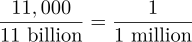
167 clearly manifests a high-order experiential acceleration in the rate of information gaining. Thus we take note of how really little we know and alert ourselves to the probability that the next decade will disclose what in effect must seem an entirely new Universe—so much more of the cosmically eternal a priori mystery will have been vouchsafed to us.