Synergetics Dictionary — K
96 cards
K
Letter Group Divider
Kahn, Louis
Cross Reference
Cross-References
Kaleidoscope
← Kahn, Louis | Kaleidoscope (1) →
Index Entry
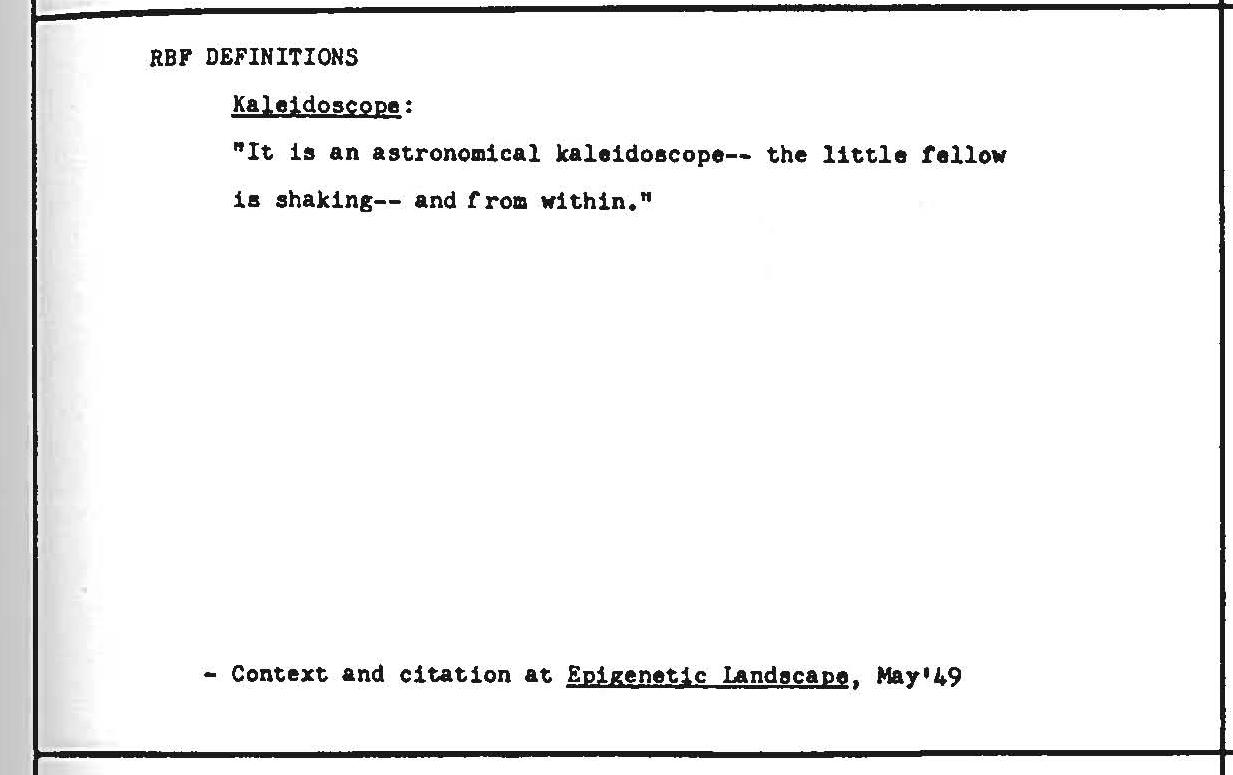
Kaleidoscope:
"It is an astronomical kaleidoscope-- the little fellow is shaking-- and from within."
- Context and citation at Epigenetic Landscape, May'49
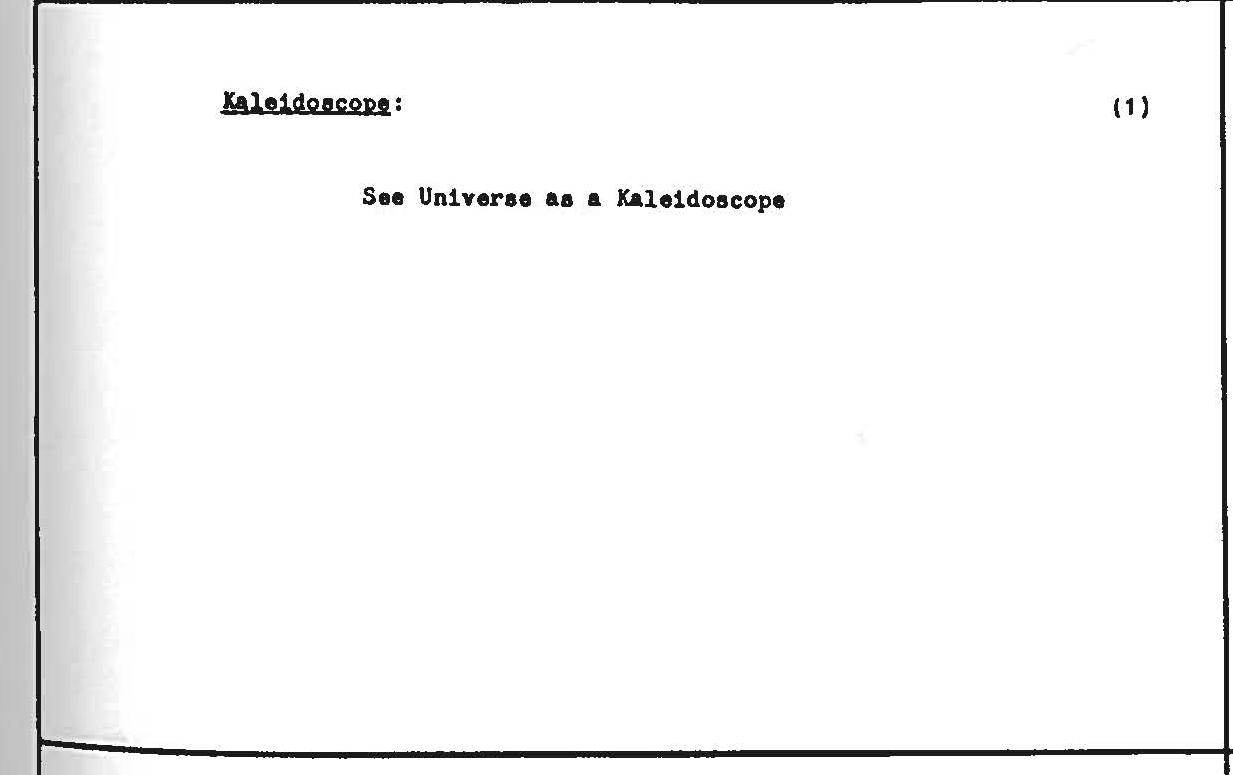
Kaleidoscope (1)
← Kaleidoscope | Kaleidoscope (2) →
Cross Reference
Cross-References
Kaleidoscope (2)
← Kaleidoscope (1) | Kelvin: Lord Kelvin's Solid →
Cross Reference
Cross-References
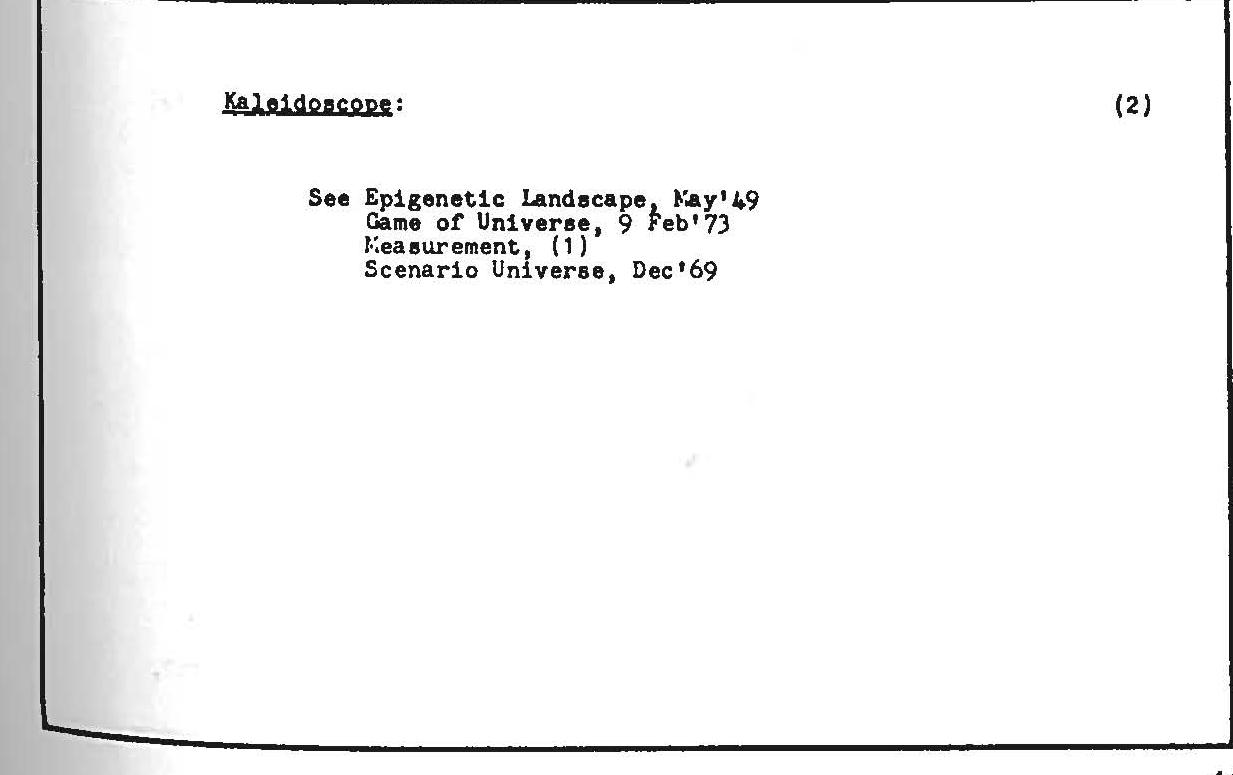
- Epigenetic Landscape, May'49
- Game of Universe, 9 Feb'73
- Measurement, (1)
- Scenario Universe, Dec'69
Kelvin: Lord Kelvin's Solid
Cross Reference
Kelvin: Lord Kelvin's Solid: (Wm. Thomson: 1824-1907)
Cross-References
Kenner
← Kelvin: Lord Kelvin's Solid | Kenner, Hugh →
Index Entry
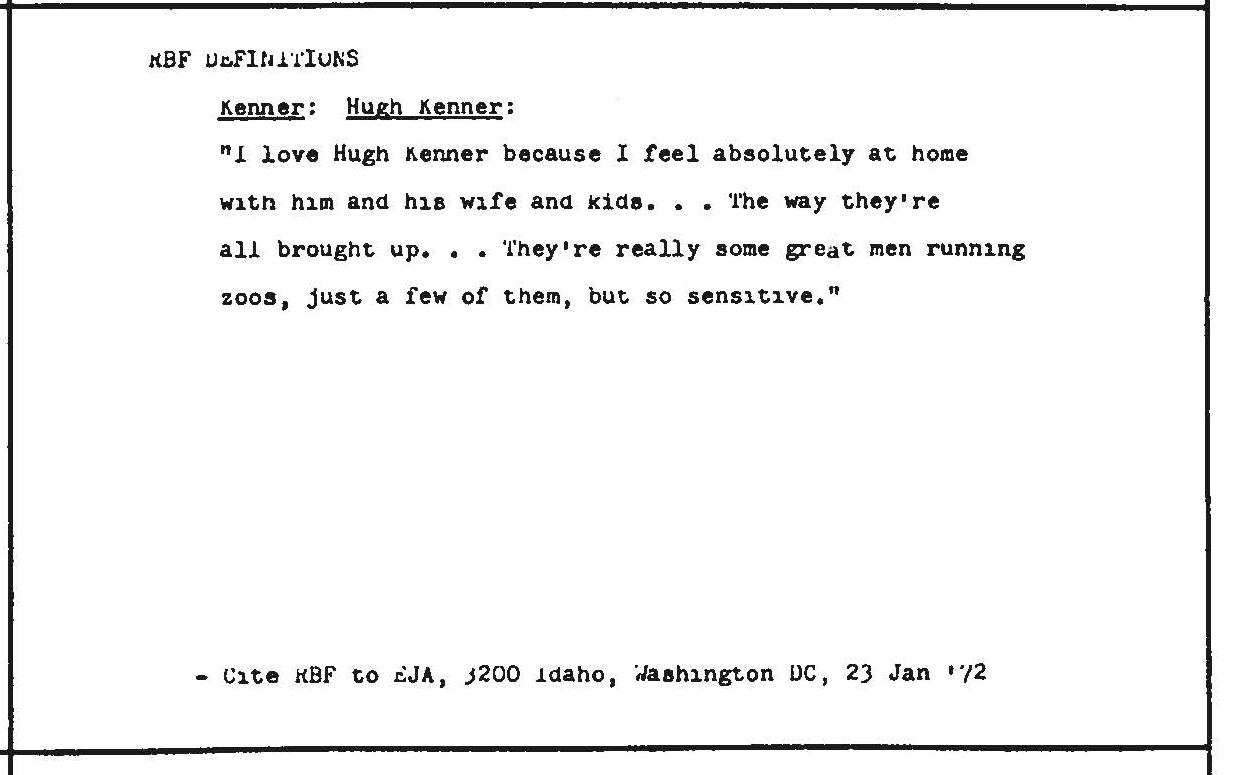
Hugh Kenner:
"I love Hugh Kenner because I feel absolutely at home with him and his wife and kids. . . The way they're all brought up. . . They're really some great men running zoos, just a few of them, but so sensitive."
- Cite RBF to EJA, 3200 Idaho, Washington DC, 23 Jan '72
Kenner, Hugh
← Kenner | Kepler's Third Law (1) →
Cross Reference
Cross-References
- Fuller, R.B: The Thinking Me, 18 Dec'76
Kepler's Third Law (1)
← Kenner, Hugh | Kepler Alone with the Stars →
Cross Reference
Cross-References
- Synergetic Hierarchy, 13 Nov'69
- Volumetric Hierarchy, (1)
Kepler Alone with the Stars
← Kepler's Third Law (1) | Kepler Alone with the Stars →
Index Entry
Kepler Alone with the Stars:
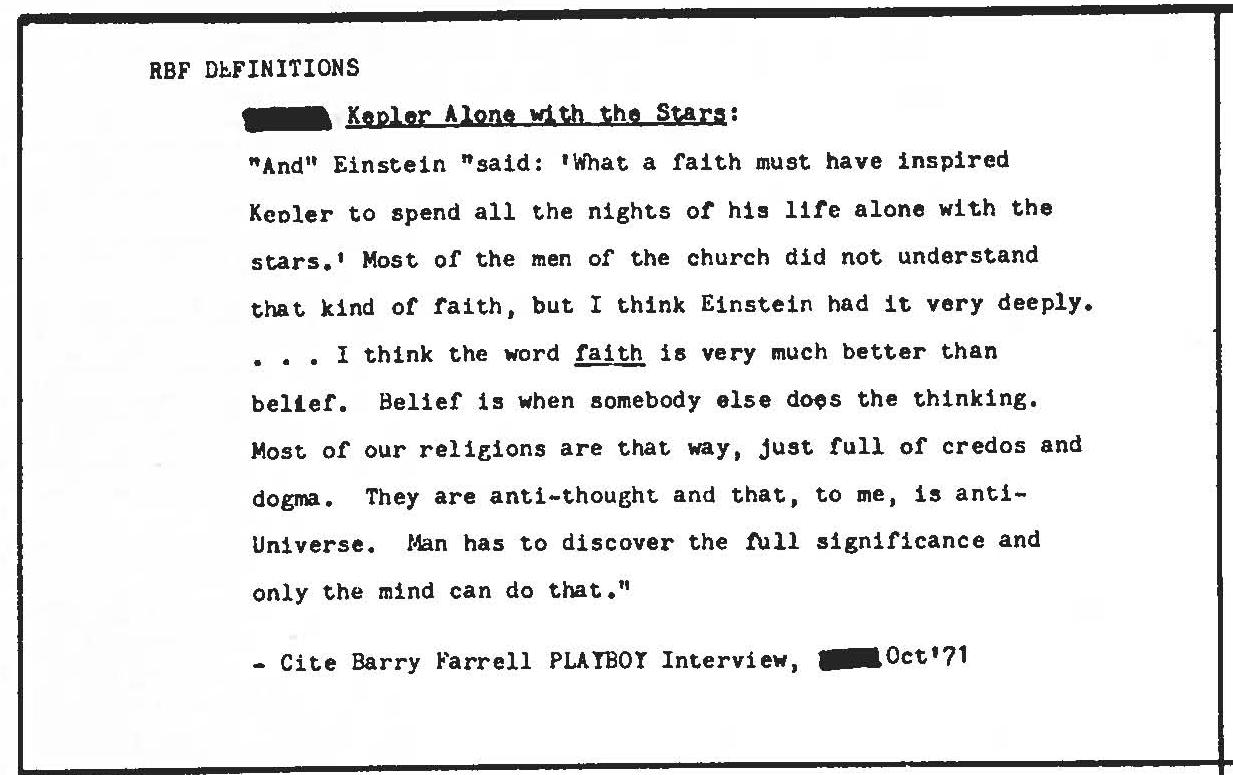
"And" Einstein "said: 'What a faith must have inspired Kepler to spend all the nights of his life alone with the stars.' Most of the men of the church did not understand that kind of faith, but I think Einstein had it very deeply. . . . I think the word faith is very much better than belief. Belief is when somebody else does the thinking. Most of our religions are that way, just full of credos and dogma. They are anti-thought and that, to me, is anti-Universe. Man has to discover the full significance and only the mind can do that."
- Cite Barry Farrell PLAYBOY Interview, Oct'71
Kepler Alone with the Stars
← Kepler Alone with the Stars | Kepler Alone with the Stars (1) →
Index Entry
Kepler Alone with the Stars:
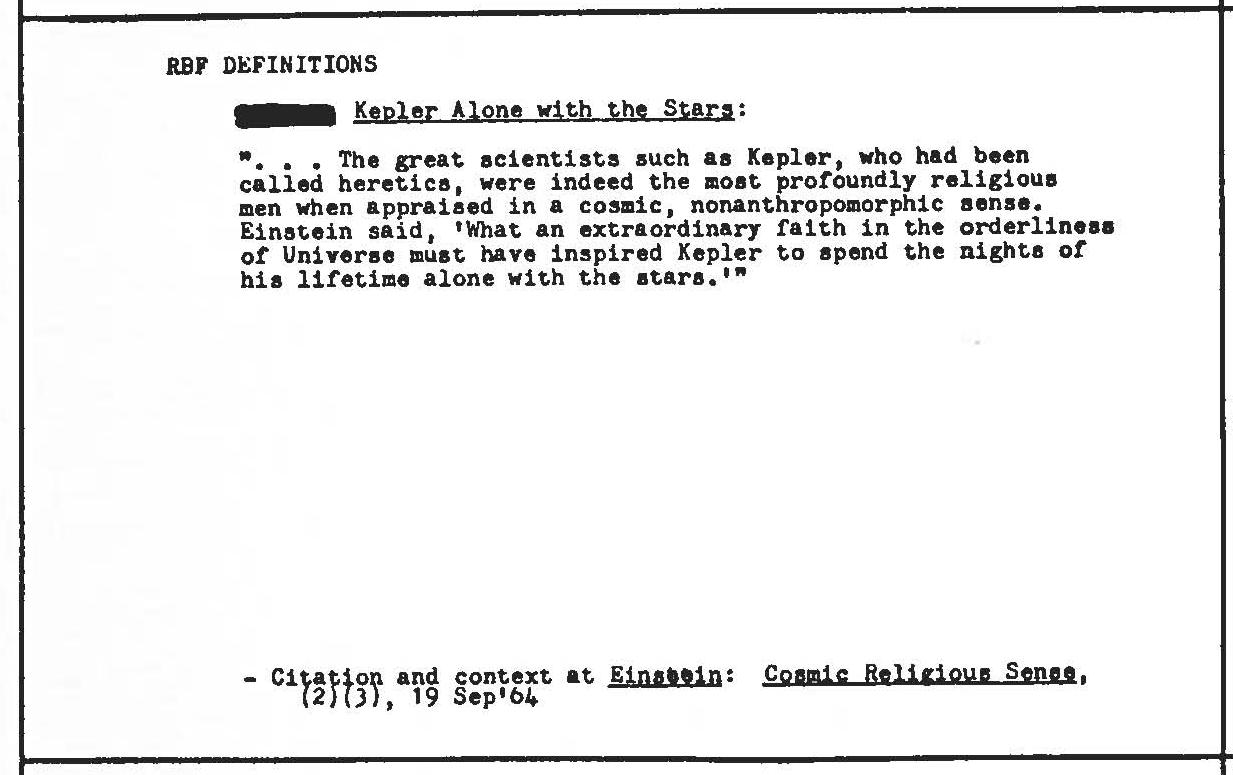
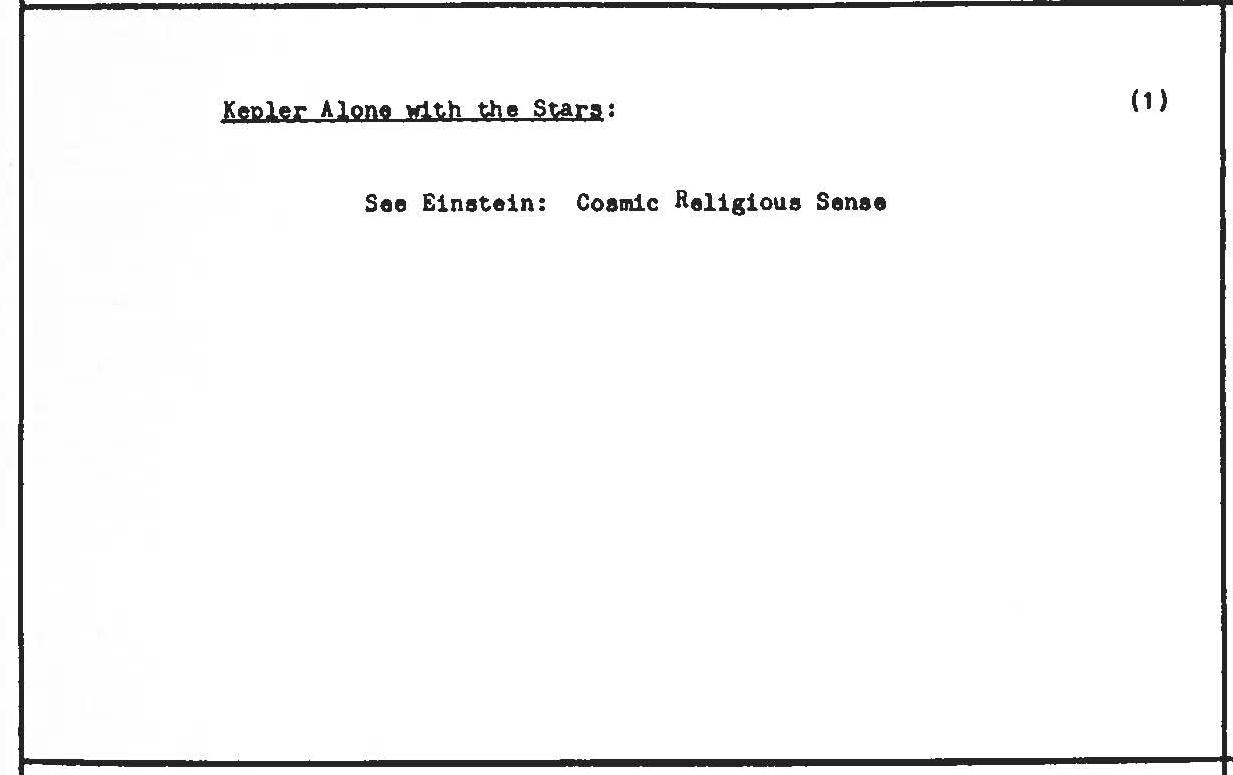
"... The great scientists such as Kepler, who had been called heretics, were indeed the most profoundly religious men when appraised in a cosmic, nonanthropomorphic sense. Einstein said, 'What an extraordinary faith in the orderliness of Universe must have inspired Kepler to spend the nights of his lifetime alone with the stars.'"
Kepler Alone with the Stars (1)
← Kepler Alone with the Stars | Kepler Alone with the Stars (2) →
Cross Reference
Cross-References
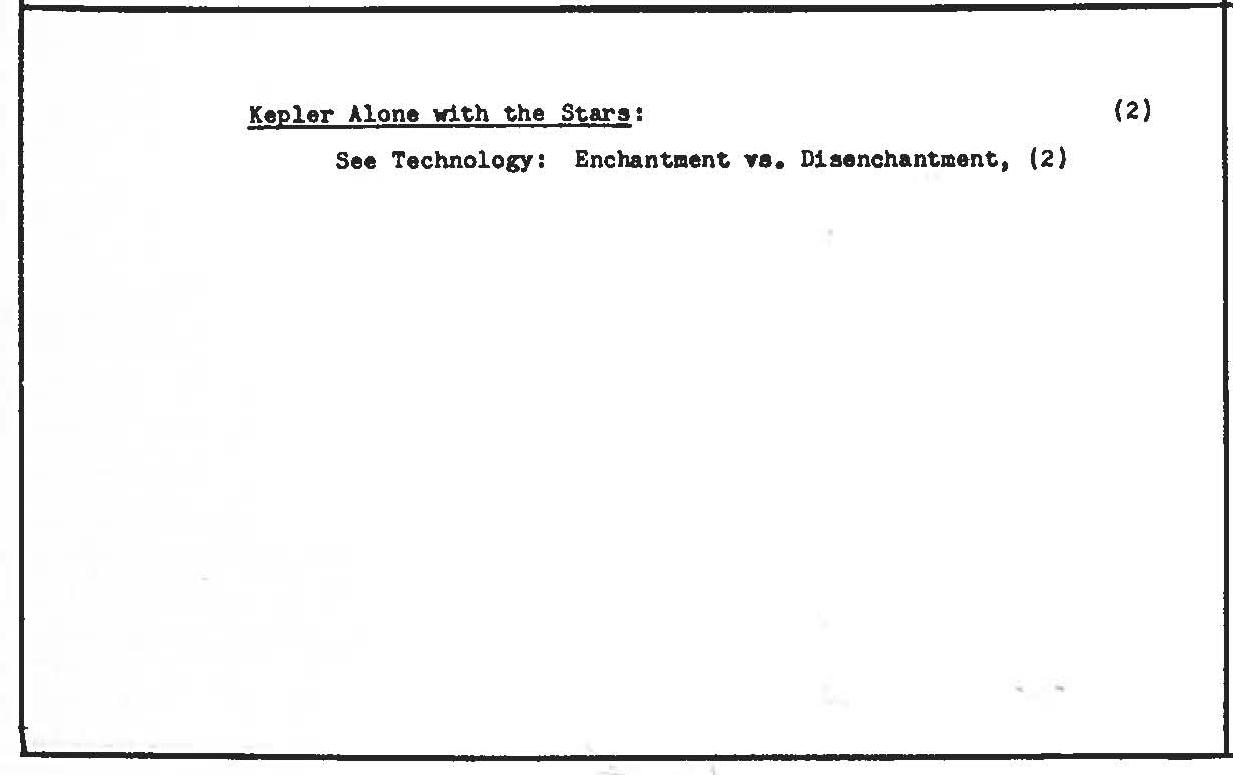
Kepler Alone with the Stars (2)
← Kepler Alone with the Stars (1) | Kepler: Johannes →
Cross Reference
Cross-References
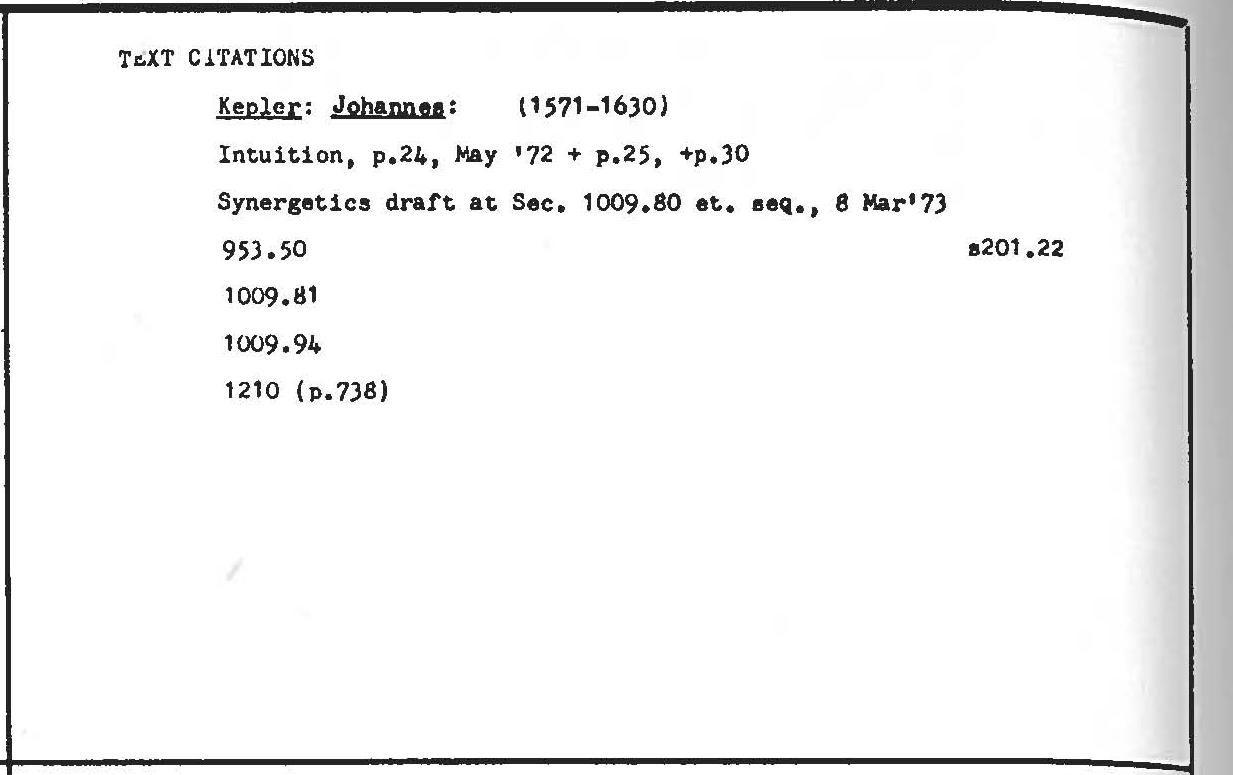
Kepler: Johannes
← Kepler Alone with the Stars (2) | Kepler →
Index Entry
(1571-1630)
Intuition, p.24, May '72 + p.25, +p.30
Synergetics draft at Sec. \hrefhttps://www.buckyverse.org/en/synergetics/content/chapters/1000-omnitopology#section-1009.801009.80 et. seq., 8 Mar'73
\hrefhttps://www.buckyverse.org/en/synergetics/content/chapters/900-modelability#section-953.50953.50
\hrefhttps://www.buckyverse.org/en/synergetics/content/chapters/1000-omnitopology#section-1009.811009.81
\hrefhttps://www.buckyverse.org/en/synergetics/content/chapters/1000-omnitopology#section-1009.941009.94
1210 (p.738)
Kepler
← Kepler: Johannes | Key-Keyhole Sequence (1) →
Cross Reference
Cross-References
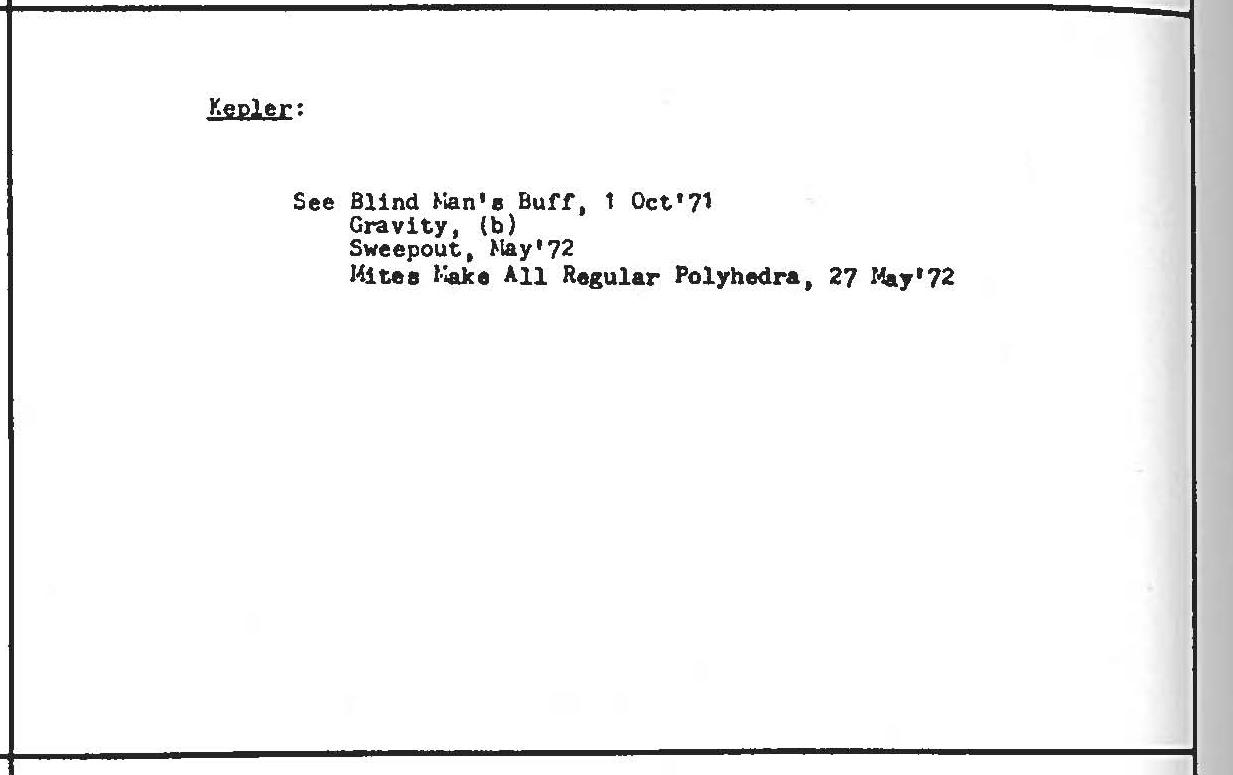
- Blind Man's Buff, 1 Oct'71
- Gravity
- Sweepout, May'72
- Mites Make All Regular Polyhedra, 27 May'72
Key-Keyhole Sequence (1)
← Kepler | Key-Keyhole Sequence (2) →
Index Entry
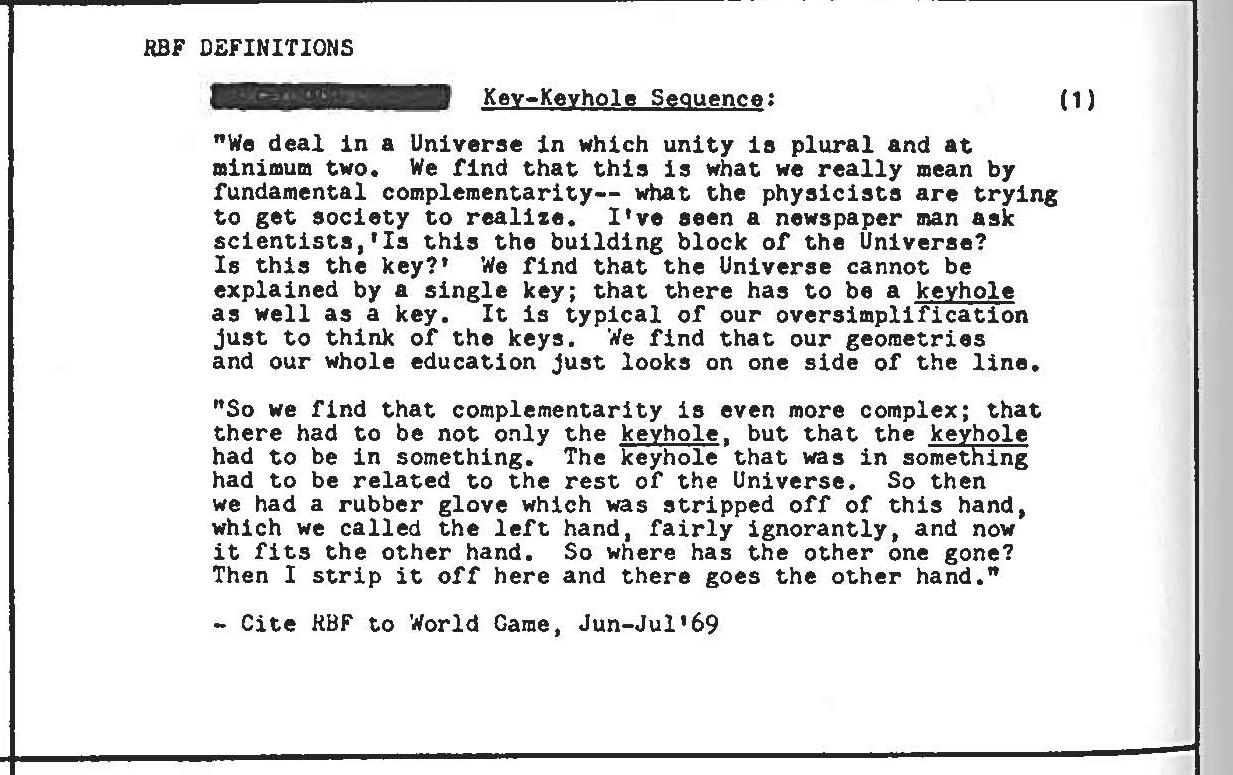
Key-Keyhole Sequence:
"We deal in a Universe in which unity is plural and at minimum two. We find that this is what we really mean by fundamental complementarity-- what the physicists are trying to get society to realize. I've seen a newspaper man ask scientists,'Is this the building block of the Universe? Is this the key?' We find that the Universe cannot be explained by a single key; that there has to be a keyhole as well as a key. It is typical of our oversimplification just to think of the keys. We find that our geometries and our whole education just looks on one side of the line.
"So we find that complementarity is even more complex; that there had to be not only the keyhole, but that the keyhole had to be in something. The keyhole that was in something had to be related to the rest of the Universe. So then we had a rubber glove which was stripped off of this hand, which we called the left hand, fairly ignorantly, and now it fits the other hand. So where has the other one gone? Then I strip it off here and there goes the other hand."
Key-Keyhole Sequence (2)
← Key-Keyhole Sequence (1) | Keyhole (1) →
Index Entry
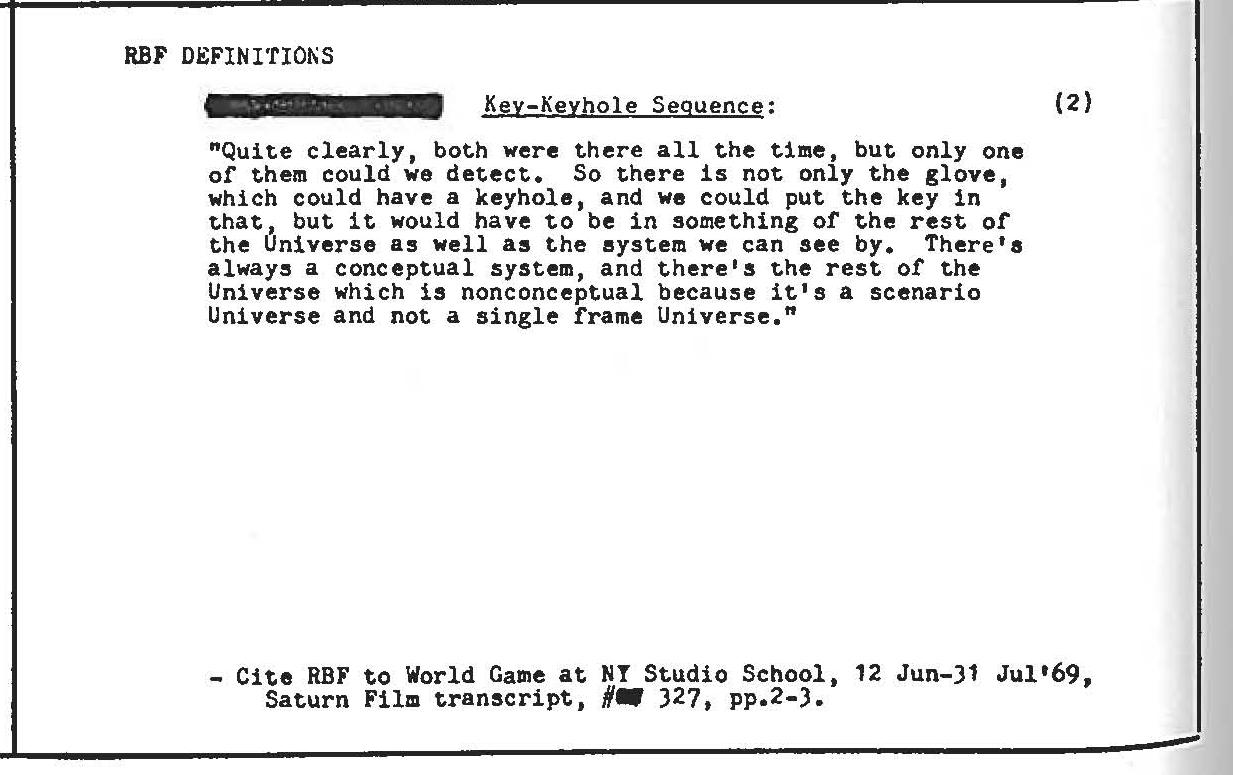
Key-Keyhole Sequence:
"Quite clearly, both were there all the time, but only one of them could we detect. So there is not only the glove, which could have a keyhole, and we could put the key in that, but it would have to be in something of the rest of the Universe as well as the system we can see by. There's always a conceptual system, and there's the rest of the Universe which is nonconceptual because it's a scenario Universe and not a single frame Universe."
- Cite RBF to World Game at NY Studio School, 12 Jun-31 Jul'69, Saturn Film transcript, #327, pp.2-3.
Keyhole (1)
← Key-Keyhole Sequence (2) | Keyhole (2) →
Cross Reference
Cross-References
Keyhole (2)
Cross Reference
Cross-References
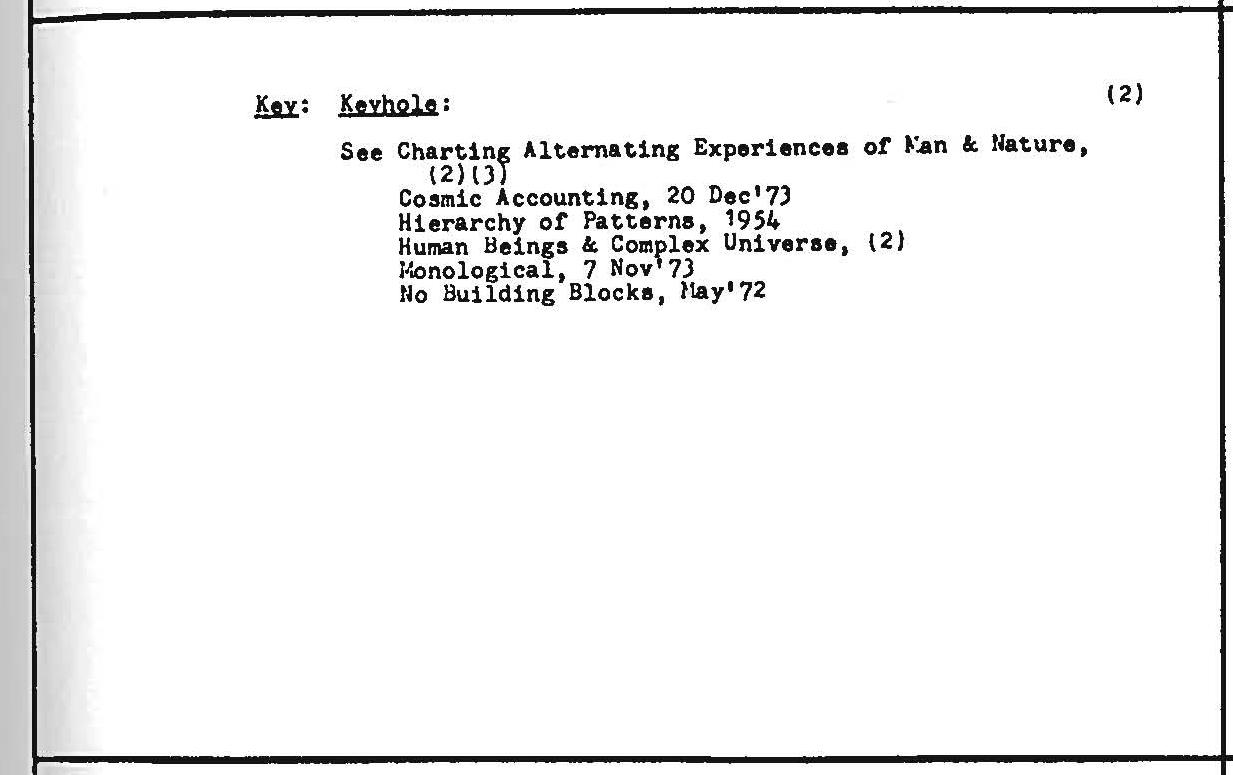
- Charting Alternating Experiences of Man & Nature, (2)(3)
- Cosmic Accounting, 20 Dec'73
- Hierarchy of Patterns, 1954
- Human Beings & Complex Universe, (2)
- Monological, 7 Nov'73
- No Building Blocks, May'72
Kids
← Keyhole (2) | Killingry (1) →
Cross Reference
Kids:
Cross-References
Killingry (1)
Cross Reference
Cross-References
Killingly (2)
← Killingry (1) | Kilowatt Hours →
Cross Reference
Cross-References
- World Game, 29 Jun'72
Kilowatt Hours
← Killingly (2) | Kindergarten →
Cross Reference
Cross-References
Kindergarten
← Kilowatt Hours | Kindergarten Level of Comprehension →
Cross Reference
Montessori
Cross-References
Kindergarten Level of Comprehension
← Kindergarten | Kinetics of Gases →
Cross Reference
Kindergarten Level of Comprehension:
Cross-References
- Future of Synergetics, 19 Apr'66
- antation, Oct
- Powering, (2)
- Synergetics, Feb'71; Jun'66
- Conceptual Mathematics, (1)(2)
Kinetics of Gases
← Kindergarten Level of Comprehension | Kinetic Omnigramming →
Cross Reference
Cross-References
- Balloon
- Domains of Actions, 21 Dec'71
- Repulsion, 9 Jul'62
Kinetic Omnigramming
← Kinetics of Gases | Kinetic Tapestry (2) →
Cross Reference
Cross-References
Kinetic Tapestry (2)
← Kinetic Omnigramming | Kinetic: Kinetics (1) →
Cross Reference
Cross-References
Kinetic: Kinetics (1)
← Kinetic Tapestry (2) | Kinetic: Kinetics (2) →
Cross Reference
Cross-References
Kinetic: Kinetics (2)
← Kinetic: Kinetics (1) | King's Capability →
Cross Reference
Cross-References
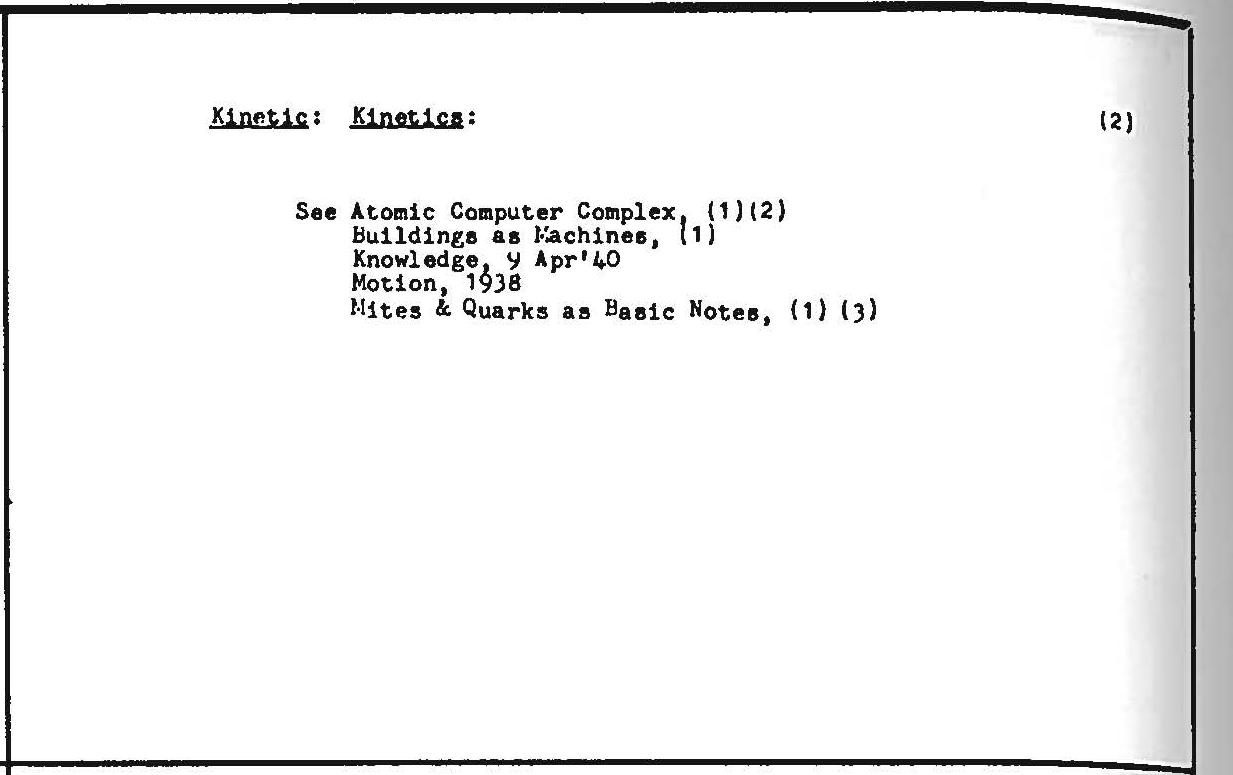
- Atomic Computer Complex, (1)(2)
- Buildings as Machines, (1)
- Knowledge, 9 Apr'40
- Motion, 1938
- Mites & Quarks as Basic Notes, (1) (3)
King's Capability
← Kinetic: Kinetics (2) | King's Sign →
Cross Reference
Cross-References
- Sixty Degreeness, 18 Jun'71
King's Sign
← King's Capability | King's Sign (1) →
Index Entry
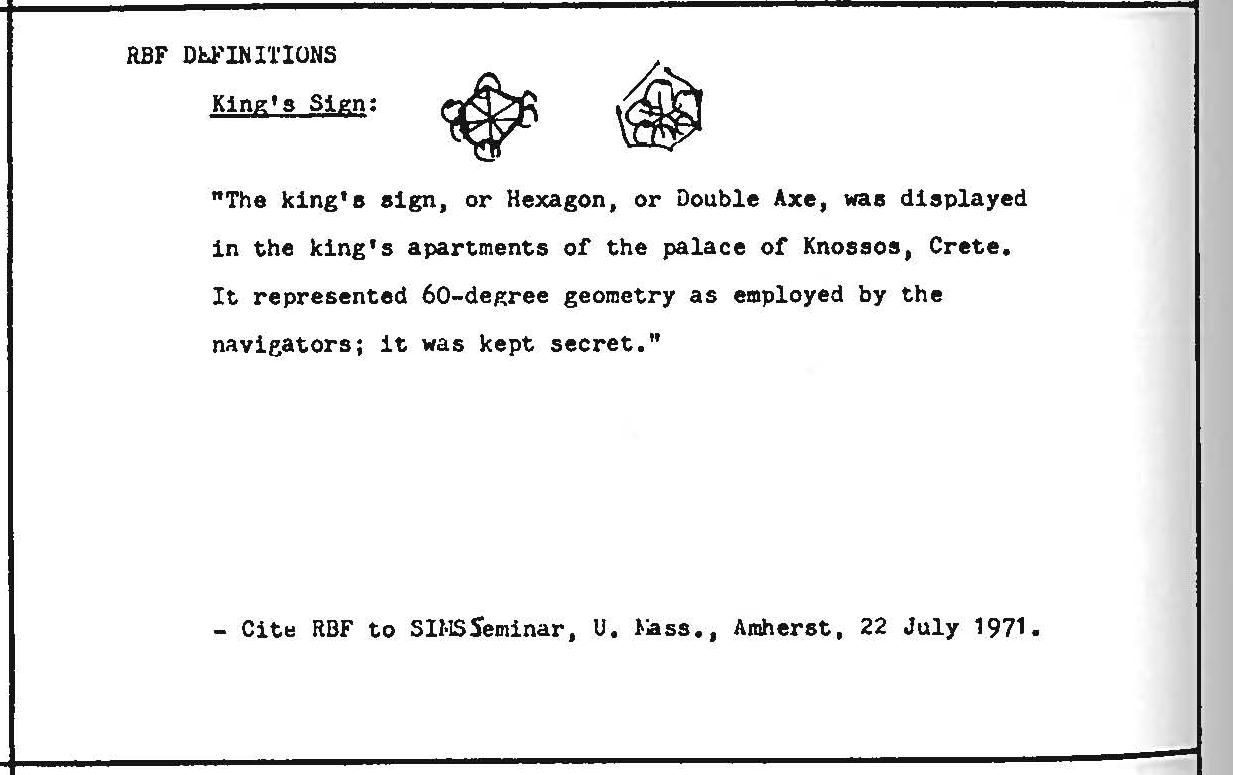
King's Sign:
"The king's sign, or Hexagon, or Double Axe, was displayed in the king's apartments of the palace of Knossos, Crete. It represented 60-degree geometry as employed by the navigators; it was kept secret."
- Cite RBF to SIMSSeminar, U. Mass., Amherst, 22 July 1971.
King's Sign (1)
← King's Sign | King's Sign (2) →
Cross Reference
Cross-References
King's Sign (2)
← King's Sign (1) | King's Sign (2) →
Cross Reference
Cross-References
- Sixty Degreeness, 18 Jun'71 (2)(3)
- Three-way Weaving vs. Two-way Crisscross, 18 Jun'71 (2)(3)
King's Sign (2)
← King's Sign (2) | King (1) →
Cross Reference
Walls vs, Airspace Technology, (1)
Cross-References
- Sixty Degreeness, 18 Jun'71
- Three-way Weaving vs. Two-way Crisscross, (2)(3)
King (1)
← King's Sign (2) | King (2) →
Cross Reference
Cross-References
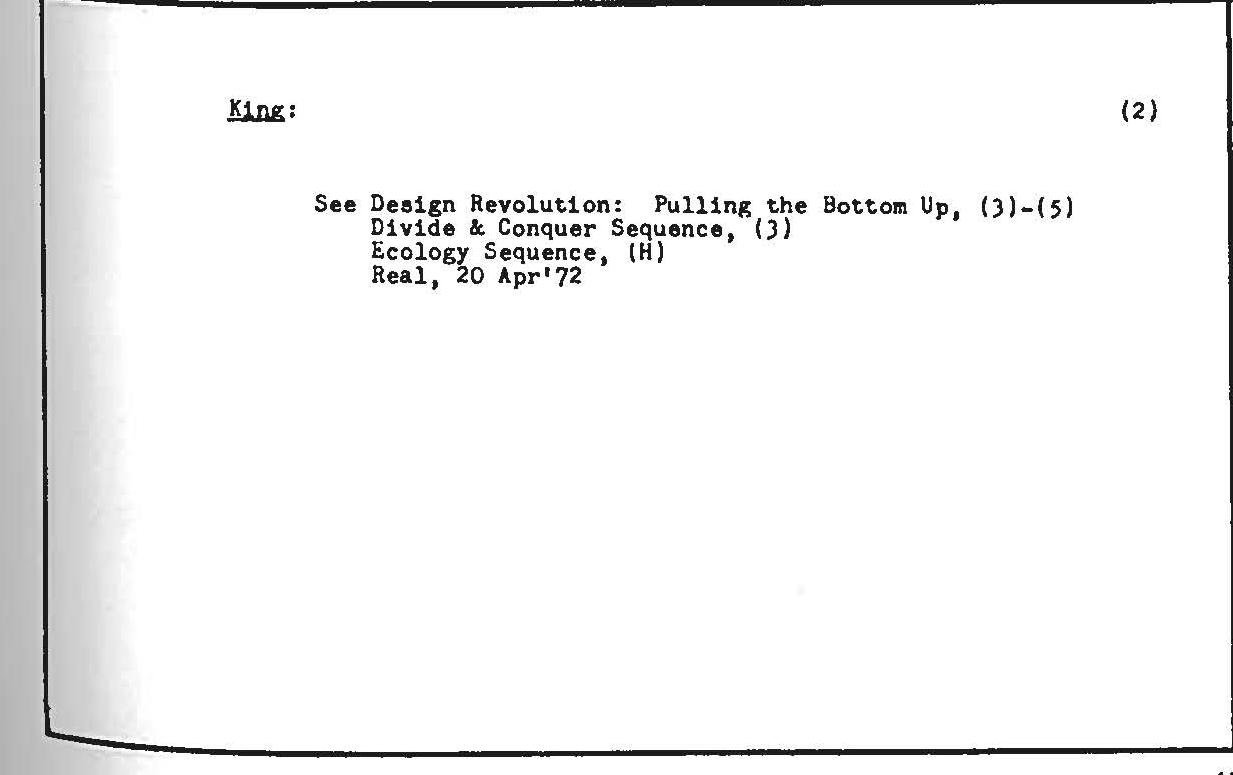
King (2)
← King (1) | Kipling, Rudyard (1) →
Cross Reference
Real, 20 Apr'72
See Design Revolution: Pulling the Bottom Up, (3)-(5)
Divide & Conquer Sequence, (3)
Cross-References
- Design Revolution: Pulling the Bottom Up-(5), (3)
- Ecology Sequence
Kipling, Rudyard (1)
← King (2) | Kipling, Rudyard (2) →
Cross Reference
Cross-References
- east/west theme, (1)
Kipling, Rudyard (2)
← Kipling, Rudyard (1) | Kissing →
Cross Reference
Cross-References
- Critic, 29 Sep'76 (2)
Kissing
← Kipling, Rudyard (2) | Kiss: Locked Kiss →
Index Entry
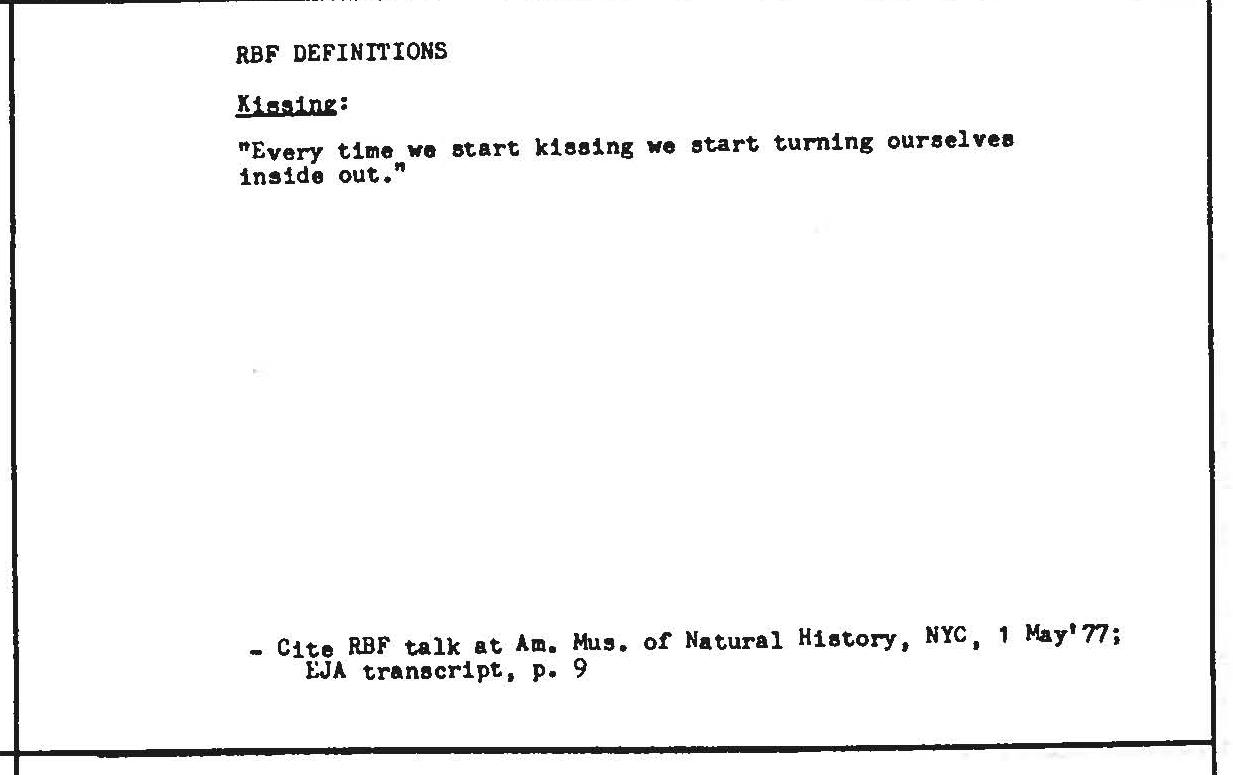
Kissing:
"Every time we start kissing we start turning ourselves inside out."
- Cite RBF talk at Am. Mus. of Natural History, NYC, 1 May'77; EJA transcript, p. 9
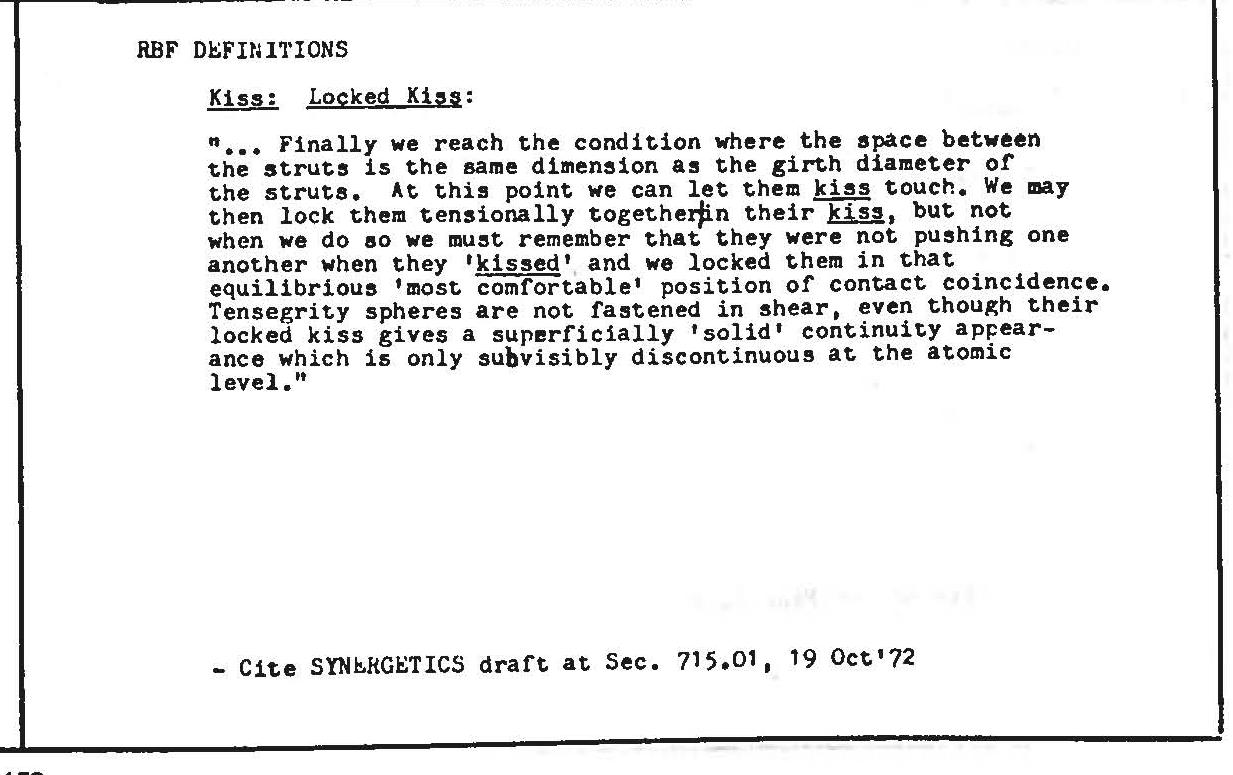
Kiss: Locked Kiss
RBF Definitions
"... Finally we reach the condition where the space between the struts is the same dimension as the girth diameter of the struts. At this point we can let them kiss touch. We may then lock them tensionally together in their kiss, but not when we do so we must remember that they were not pushing one another when they 'kissed' and we locked them in that equilibrious 'most comfortable' position of contact coincidence. Tensegrity spheres are not fastened in shear, even though their locked kiss gives a superficially 'solid' continuity appearance which is only subvisibly discontinuous at the atomic level."
Citations
- SYNERGETICS draft at Sec. \href{https://www.buckyverse.org/en/synergetics/content/chapters/700-tensegrity#section-715.01}{715.01}, 19 Oct'72
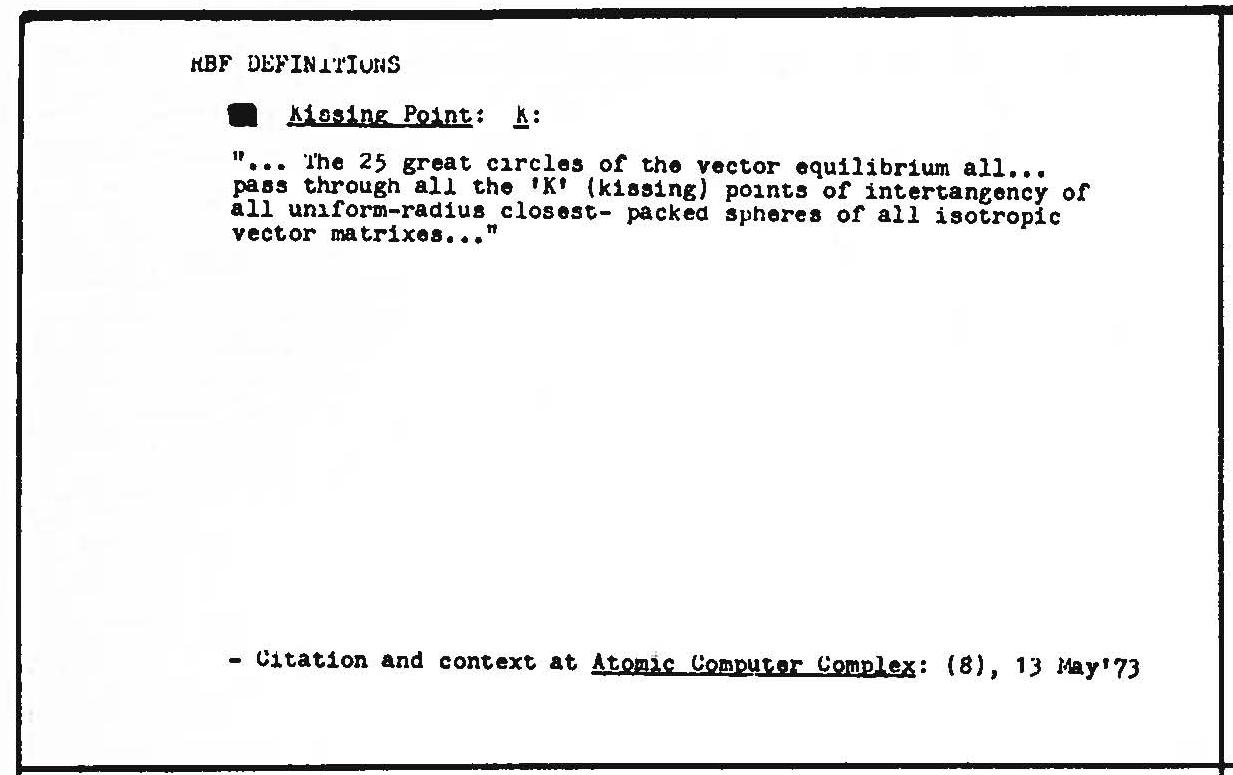
Kissing Point
← Kiss: Locked Kiss | Kissing (1) →
Index Entry
"... The 25 great circles of the vector equilibrium all... pass through all the 'K' (kissing) points of intertangency of all uniform-radius closest- packed spheres of all isotropic vector matrixes..."
Kissing (1)
Cross Reference
Cross-References
- Posterioral Osculations
- Locked Kiss
Kiss (2)
Cross Reference
Cross-References
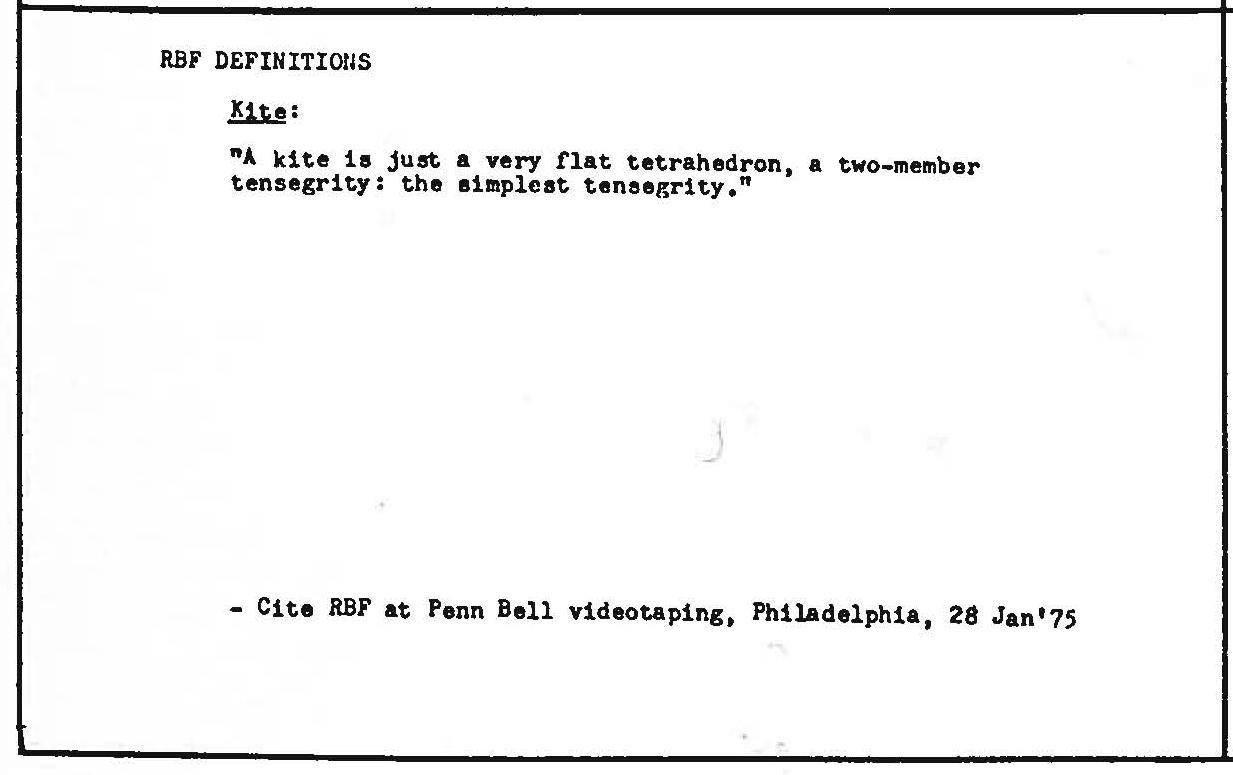
Kite
RBF Definitions
"A kite is just a very flat tetrahedron, a two-member tensegrity: the simplest tensegrity."
Citations
- RBF at Penn Bell videotaping, Philadelphia, 28 Jan'75
Kite
Cross Reference
Cross-References
- Syte, 20 Dec'73
Kitten (1)
← Kite | Kleptomaniac Intellectual Kleptomaniac →
Cross Reference
Cross-References
- Average Man, (1)
Kleptomaniac Intellectual Kleptomaniac
Cross Reference
Williams, Robert
Cross-References
Knapsack
← Kleptomaniac Intellectual Kleptomaniac | Knight's Move in Chess →
Cross Reference
Cross-References
- Autonomous 'Living Technology Packet
Knight's Move in Chess
← Knapsack | Knight's Move in Chess →
Index Entry
Knight's Move in Chess:
"The XYZ coordinate analysis... arbitrarily shuns most economical directness and time realizations-- by virtue of which calculus is able only awkwardly to define positions rectilinearly, moving only as the chessman's knight."
- Citation and context at Rectilinear Frame, 24 Sep'73
Knight's Move in Chess
← Knight's Move in Chess | Knitting Needles →
Index Entry
Knight's Move in Chess:
"The knight's move in chess is precessional."
- Cite RBF to EJA, 3200 Idaho, NW, 7Oct'71
Knitting Needles
← Knight's Move in Chess | Knot →
Cross Reference
Cross-References
- Interference, Nov'71
- Vectorial Model of Interference, Apr'71
Knot
Index Entry
Knot:
"Pulling on the two ends of the knotted rope causes the knot to contract. This is a form of interference wave where the wave comes back on itself, and as a consequence of any tension in it, the knot gets tighter. This is one of the ways in which the energy-mass patterns begin to tighten up. It is self-tightening. This is the essence of 'matter' as a consequence of two circles of 720 degrees tending to annihilate or lose one's self. Tetrahedron creates an insideness. Knot attempts to annihilate it. The knot is a tetrahedron or a complex of tetrahedra. Yin-Yang is a picture of a minimum tetrahedron knot interference tying."
- Cite SYNERGETICS text at Sec. \hrefhttps://www.buckyverse.org/en/synergetics/content/chapters/500-conceptuality#section-506.14506.14, RBF galley rewrite, 7 Nov'73
Knot
Index Entry
Knot:
"A knot in a spliced rope consisting successively of manila, cotton, wool, or nylon may be progressively slipped along the spliced-together rope with all the latter's material changes of thickness, color, and texture along its length. We agree that the 'knot' is not really any of these locally traversed substances. They were just so many colors and tactile experiences whose pattern displacement reported something moving through as a locally recurring pattern configuration. The knot is not the rope; it is a weightless, mathematical, geometric, metaphysically conceptual, pattern integrity tied momentarily into the rope by the knot-conceiving, weightless mind of the human conceiver-- knot-former."
Knot
Index Entry
Knot:
"I'll bet a monkey can't tie a knot. . . if they could, they'd capture other animals and tie the whole jungle up in knots. What would the behaviorists say? Kind saw the knot, monkey did not. The monkeys held hands. But they didn't discover that the handshake is two circles running through one another."
- Cite RBF to EJA, Somerset Club, Boston, 22 April 1971
Knot
Index Entry
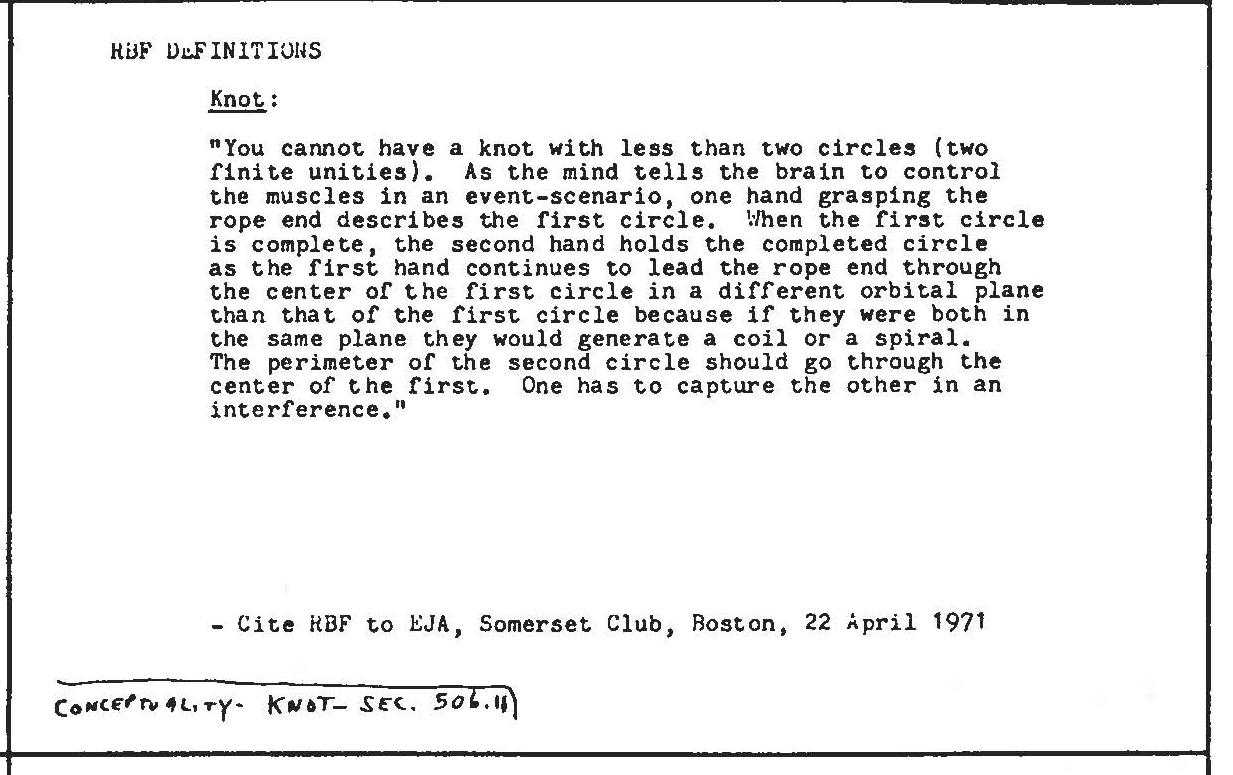
You cannot have a knot with less than two circles (two finite unities). As the mind tells the brain to control the muscles in an event-scenario, one hand grasping the rope end describes the first circle. When the first circle is complete, the second hand holds the completed circle as the first hand continues to lead the rope end through the center of the first circle in a different orbital plane than that of the first circle because if they were both in the same plane they would generate a coil or a spiral. The perimeter of the second circle should go through the center of the first. One has to capture the other in an interference.
Knot
Index Entry
Knot:
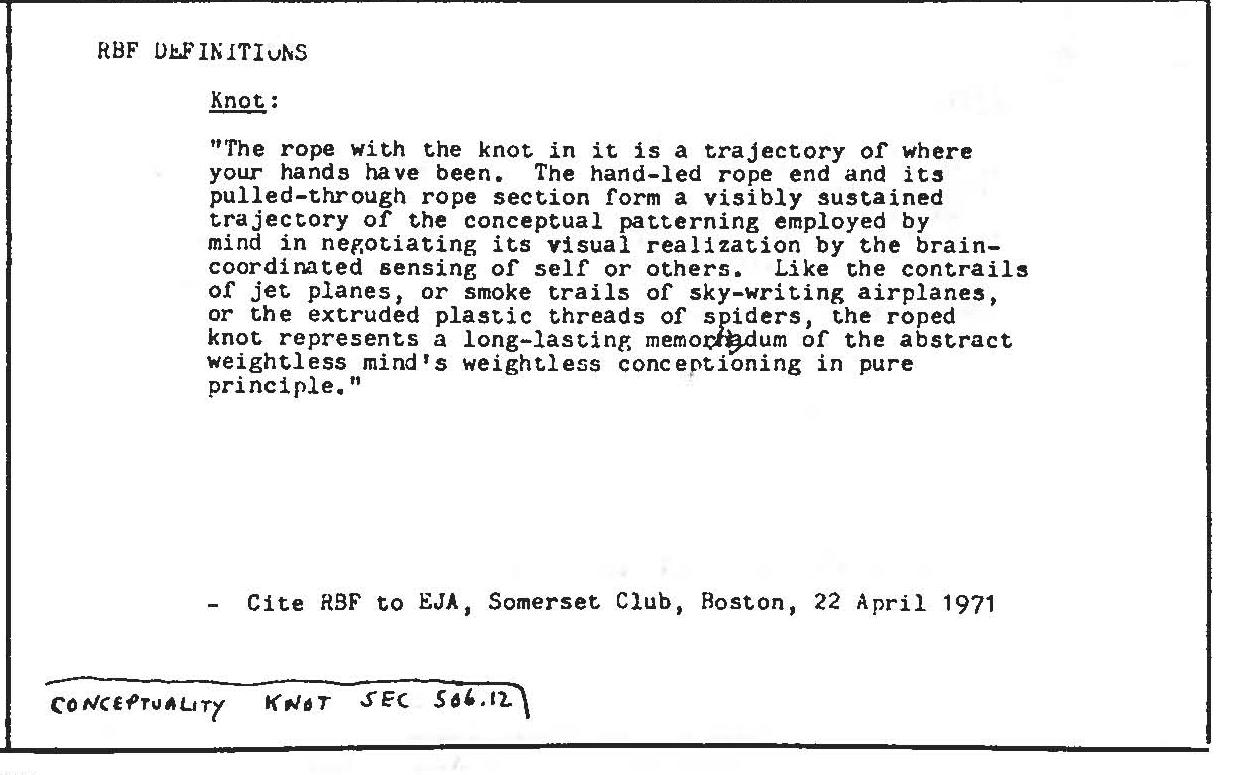
"The rope with the knot in it is a trajectory of where your hands have been. The hand-led rope end and its pulled-through rope section form a visibly sustained trajectory of the conceptual patterning employed by mind in negotiating its visual realization by the brain-coordinated sensing of self or others. Like the contrails of jet planes, or smoke trails of sky-writing airplanes, or the extruded plastic threads of spiders, the roped knot represents a long-lasting memorandum of the abstract weightless mind's weightless conceptioning in pure principle."
- Cite RBF to EJA, Somerset Club, Boston, 22 April 1971
Knot
Index Entry
Knot:
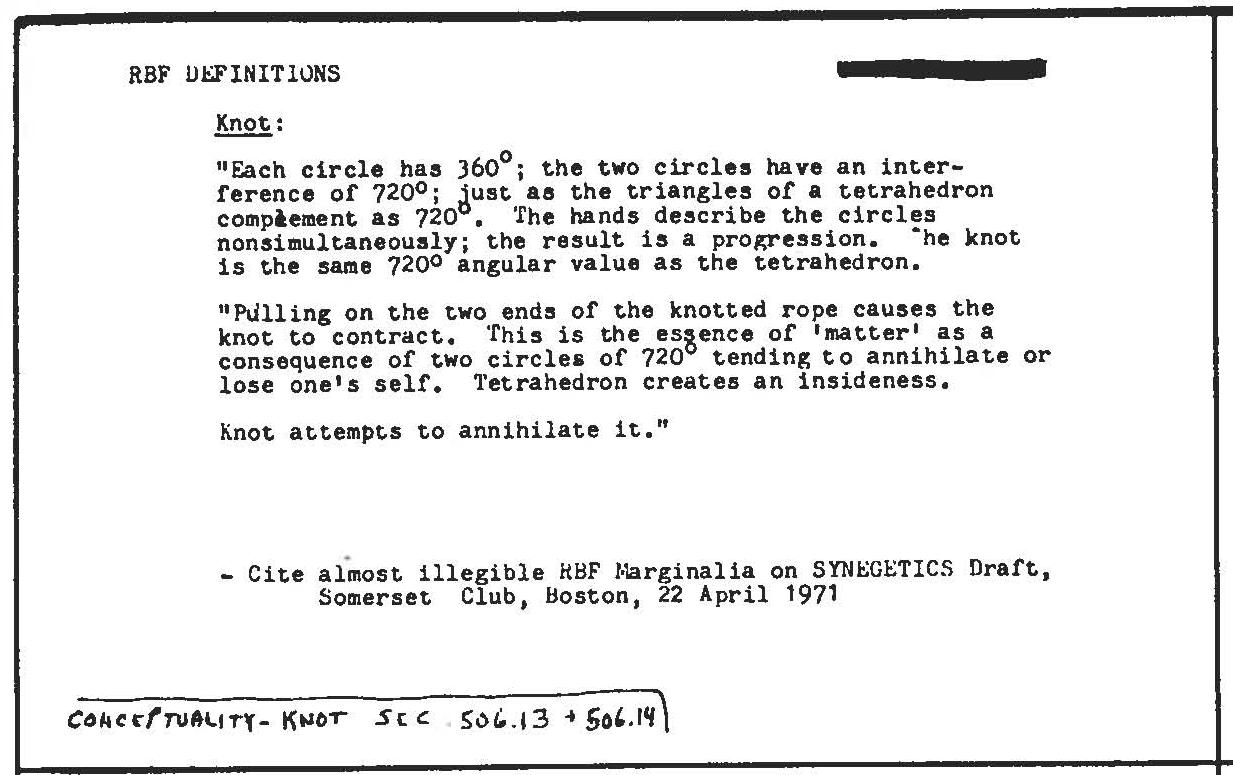
"Each circle has 360°; the two circles have an interference of 720°; just as the triangles of a tetrahedron complement as 720°. The hands describe the circles nonsimultaneously; the result is a progression. The knot is the same 720° angular value as the tetrahedron.
"Pulling on the two ends of the knotted rope causes the knot to contract. This is the essence of 'matter' as a consequence of two circles of 720° tending to annihilate or lose one's self. Tetrahedron creates an insideness.
Knot attempts to annihilate it."
Knot
Index Entry
Knot:
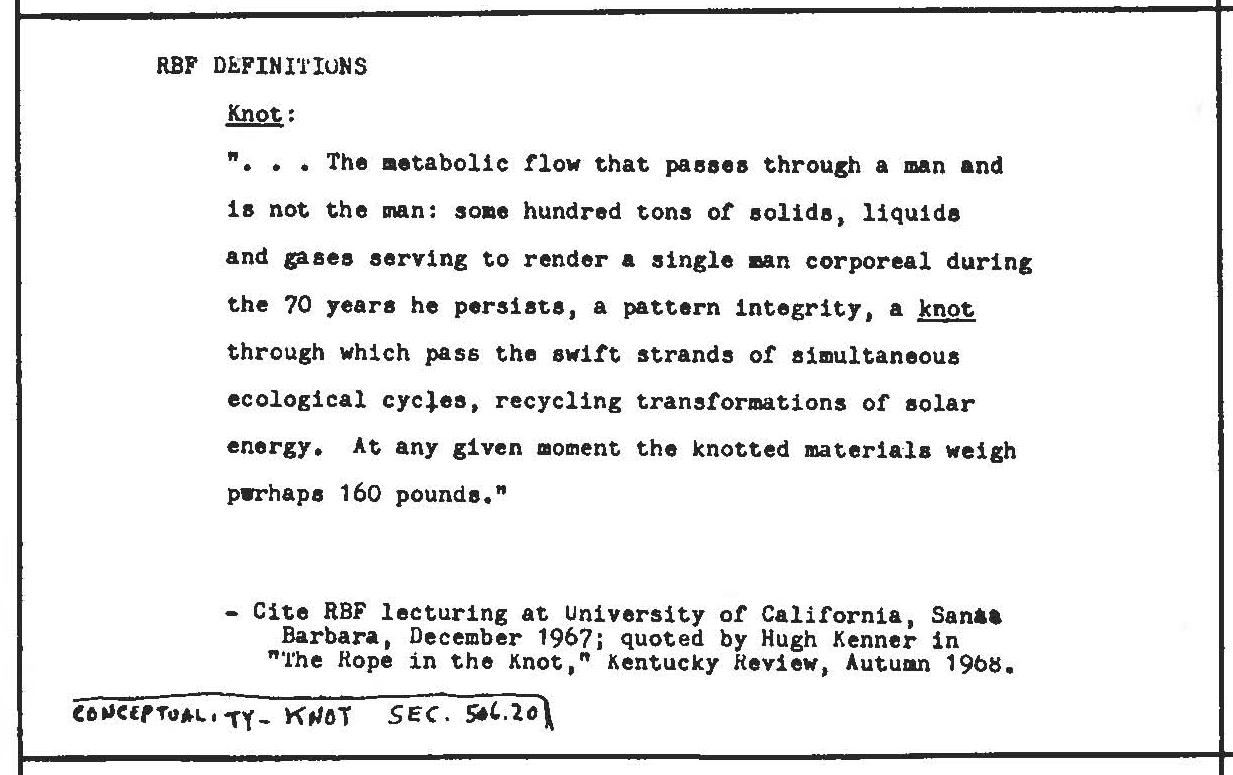
"... The metabolic flow that passes through a man and is not the man: some hundred tons of solids, liquids and gases serving to render a single man corporeal during the 70 years he persists, a pattern integrity, a knot through which pass the swift strands of simultaneous ecological cycles, recycling transformations of solar energy. At any given moment the knotted materials weigh perhaps 160 pounds."
Cite RBF lecturing at University of California, Santa Barbara, December 1967; quoted by Hugh Kenner in "The Rope in the Knot," Kentucky Review, Autumn 1968.
Knot
Index Entry
Knot:
"As a knot in a series of spliced rope of manila, cotton, nylon, etc. may be progressively slipped through all the material changes of thickness and texture along the length yet remain an identifiable pattern configuration, so man is an abstract pattern integrity which is sustained through all the physical changes and processing."
- Cite THE YEAR 2000, San Jose State College
Knot
Index Entry
"No longer do I want to talk about the chemical elements as things but as pattern integrities. Each one of them is a unique pattern integrity. . . in a sense a form of knots so we get where there are chemical compounds and the knots tend to be interlinkable and they will catch on one another. This one is holding together all right, but this ball of twine and this ball of twine, suddenly one weaves into the other every so often and associates . . ."
Knot (1)
Index Entry
"What we call rope turns out to be wave phenomena. The fibers themselves turn out to be wave phenomena. We are beginning to discover there is not too much difference between this tactile superficiality of apprehension and the real frequency phenomena which we can't see in the intervals between the waves. We are beginning to have some faith in these principles. . . .
"I am going to take the rope and curl out several of these things and I am going to splice a piece of manila rope into a piece of cotton rope and then I'm going to splice in a piece of nylon rope. We now have cotton, nylon and manila and I'm going to bring the ends of the rope around and splice them together. But before doing that I am going to put a slip knot in it. This is another form of interference wave where the wave comes back on itself and a s a consequence of any tension in it the knot gets tighter. This is one of the ways which the energy masses of the Einstein kind of patterns begin to tighten up. It is self-tightening. I can take this knot and slide it along the rope and suddenly it goes off the manila and on tothe cotton, and then it slides off there and on to the nylon. . . There is a regenerative pattern of
Knot (2)
Index Entry
Knot:
"integrity that is reported to us by virtue of a set of interferences.... The actual fact is that the water wave and the manila wave are nontunable frequencies."
- Cite Oregon Lecture #4, p.102, 5 Jul'62
Knot
Index Entry
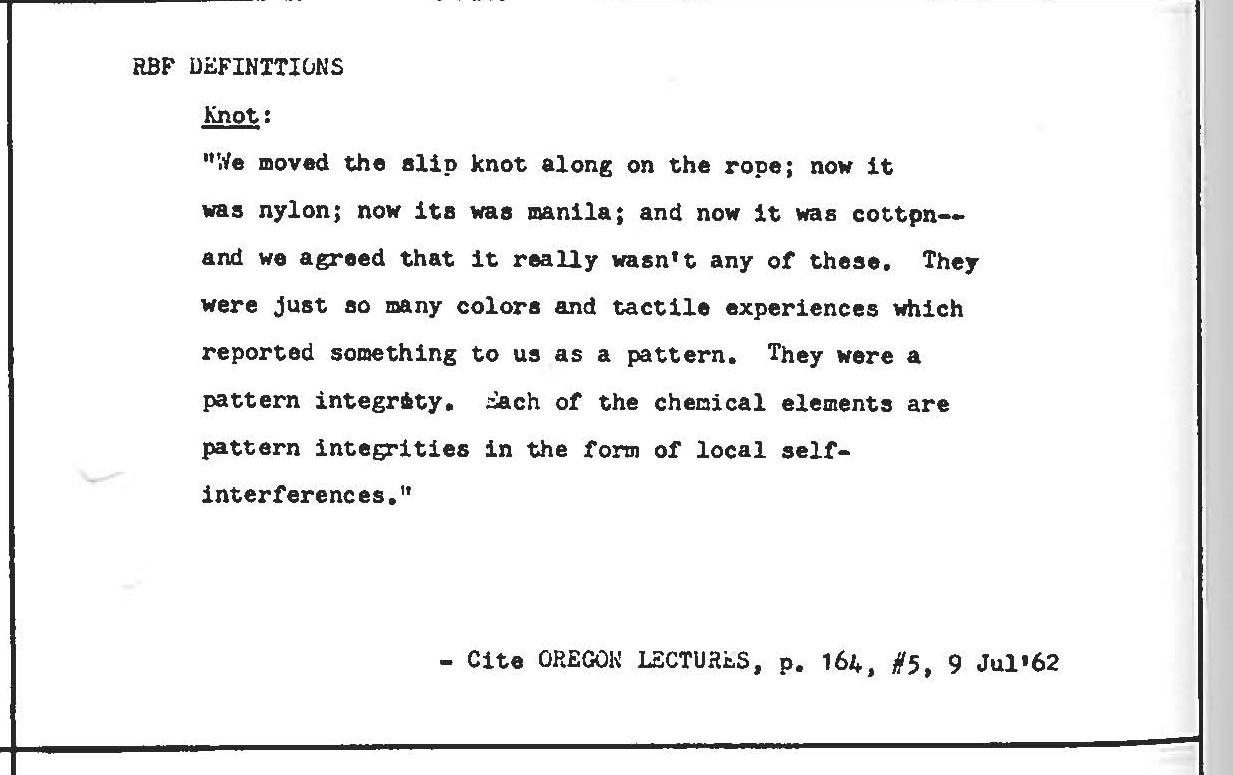
Knot:
"We moved the slip knot along on the rope; now it
was nylon; now its was manila; and now it was cotton--
and we agreed that it really wasn't any of these. They
were just so many colors and tactile experiences which
reported something to us as a pattern. They were a
pattern integrity. Each of the chemical elements are
pattern integrities in the form of local self-interferences."
- Cite OREGON LECTURES, p. 164, #5, 9 Jul'62
Knot
Index Entry
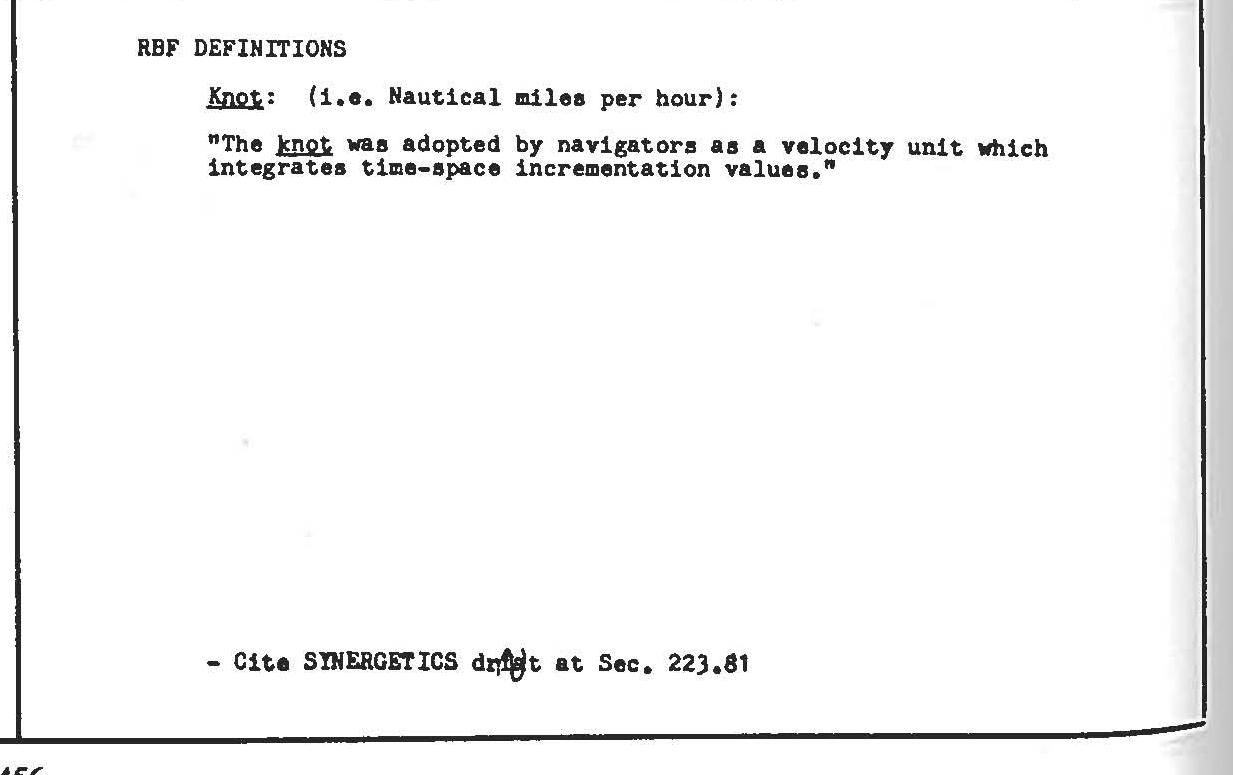
Knot: (i.e. Nautical miles per hour):
"The knot was adopted by navigators as a velocity unit which integrates time-space incrementation values."
- Cite SYNERGETICS draft at Sec. \hrefhttps://www.buckyverse.org/en/synergetics/content/chapters/200-synergetics#section-223.81223.81
Knot: Square Knot
Index Entry
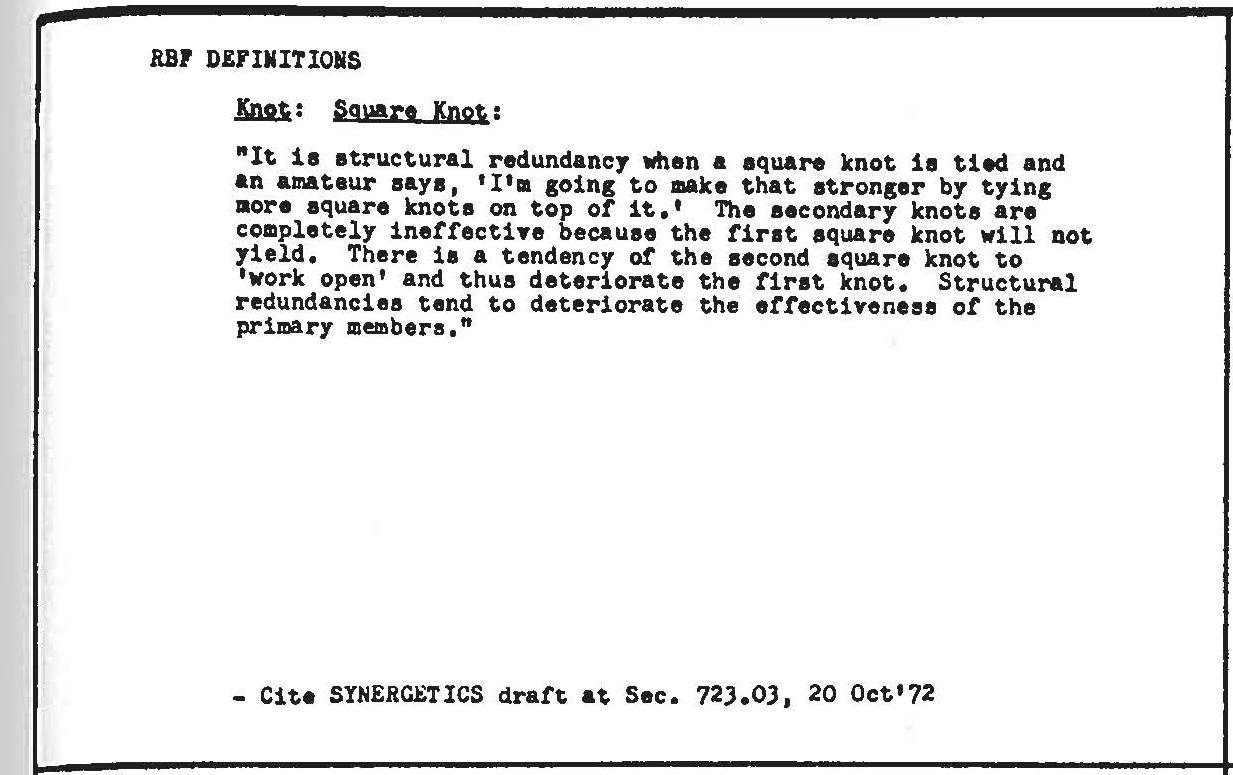
Knot: Square Knot:
"It is structural redundancy when a square knot is tied and an amateur says, 'I'm going to make that stronger by tying more square knots on top of it.' The secondary knots are completely ineffective because the first square knot will not yield. There is a tendency of the second square knot to 'work open' and thus deteriorate the first knot. Structural redundancies tend to deteriorate the effectiveness of the primary members."
- Cite SYNERGETICS draft at Sec. \hrefhttps://www.buckyverse.org/en/synergetics/content/chapters/700-tensegrity#section-723.03723.03, 20 Oct'72
Knot
← Knot: Square Knot | Knot Knotted (1) →
Index Entry
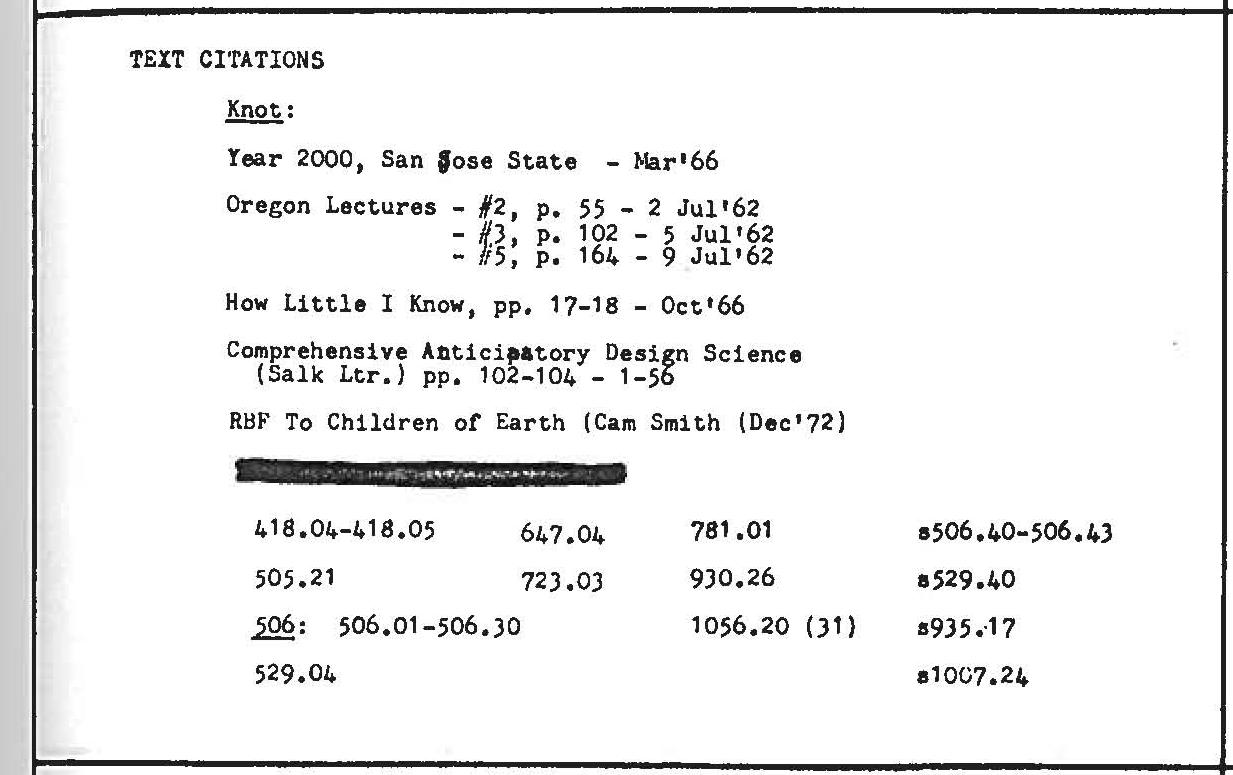
Knot:
Year 2000, San Jose State - Mar'66
Oregon Lectures - #2, p. 55 - 2 Jul'62
-
#3, p. 102 - 5 Jul'62
-
#5, p. 164 - 9 Jul'62
How Little I Know, pp. 17-18 - Oct'66
Comprehensive Anticipatory Design Science
(Salk Ltr.) pp. 102-104 - 1-56
RBF To Children of Earth (Cam Smith (Dec'72))
\hrefhttps://www.buckyverse.org/en/synergetics/content/chapters/400-system#section-418.04418.04-\hrefhttps://www.buckyverse.org/en/synergetics/content/chapters/400-system#section-418.05418.05 \hrefhttps://www.buckyverse.org/en/synergetics/content/chapters/600-structure#section-647.04647.04 \hrefhttps://www.buckyverse.org/en/synergetics/content/chapters/700-tensegrity#section-781.01781.01 \hrefhttps://www.buckyverse.org/en/synergetics/content/chapters/200-synergetics#section-8506.408506.40-\hrefhttps://www.buckyverse.org/en/synergetics/content/chapters/500-conceptuality#section-506.43506.43
\hrefhttps://www.buckyverse.org/en/synergetics/content/chapters/500-conceptuality#section-505.21505.21 \hrefhttps://www.buckyverse.org/en/synergetics/content/chapters/700-tensegrity#section-723.03723.03 \hrefhttps://www.buckyverse.org/en/synergetics/content/chapters/900-modelability#section-930.26930.26 \hrefhttps://www.buckyverse.org/en/synergetics/content/chapters/200-synergetics#section-8529.408529.40
506: \hrefhttps://www.buckyverse.org/en/synergetics/content/chapters/500-conceptuality#section-506.01506.01-\hrefhttps://www.buckyverse.org/en/synergetics/content/chapters/500-conceptuality#section-506.30506.30 \hrefhttps://www.buckyverse.org/en/synergetics/content/chapters/1000-omnitopology#section-1056.201056.20 (31) \hrefhttps://www.buckyverse.org/en/synergetics/content/chapters/200-synergetics#section-8935.178935.17
\hrefhttps://www.buckyverse.org/en/synergetics/content/chapters/500-conceptuality#section-529.04529.04 81007.24
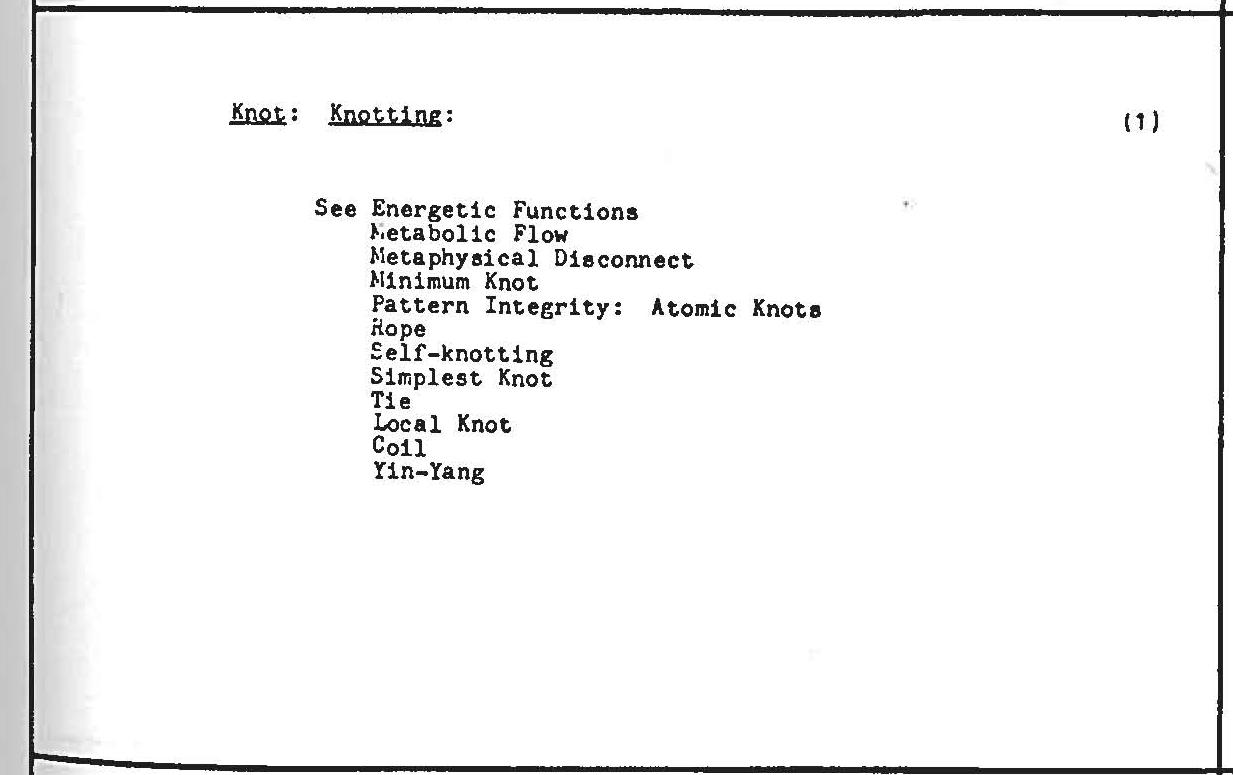
Knot Knotted (1)
Cross Reference
Cross-References
- Energetic Functions
- Metabolic Flow
- Metaphysical Disconnect
- Minimum Knot
- Pattern Integrity: Atomic Knots
- Hope
- Self-knotting
- Simplest Knot
- Tie
- Local Knot
- Coil
- Yin-Yang
Knot Knotting (2)
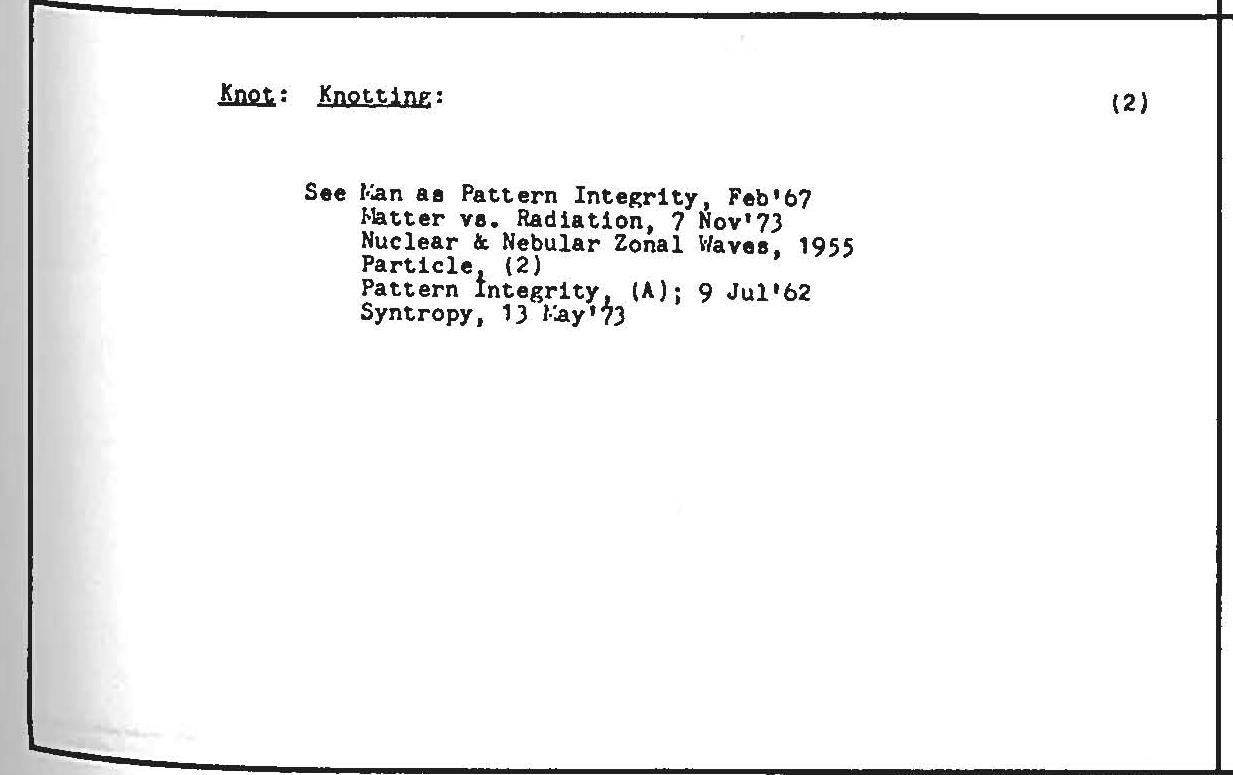
← Knot Knotted (1) | Knowing vs. Reasoning (1) →
Cross Reference
Cross-References
- Kan as Pattern Integrity, Feb'67
- Matter vs. Radiation, 7 Nov'73
- Nuclear & Nebular Zonal Waves, 1955
- Particle, (2)
- Pattern Integrity, 9 Jul'62
- Syntropy
Knowing vs. Reasoning (1)
← Knot Knotting (2) | Know-how →
Cross Reference
Cross-References
Know-how
← Knowing vs. Reasoning (1) | Know-how Accounting vs. Physical Accounting →
Index Entry
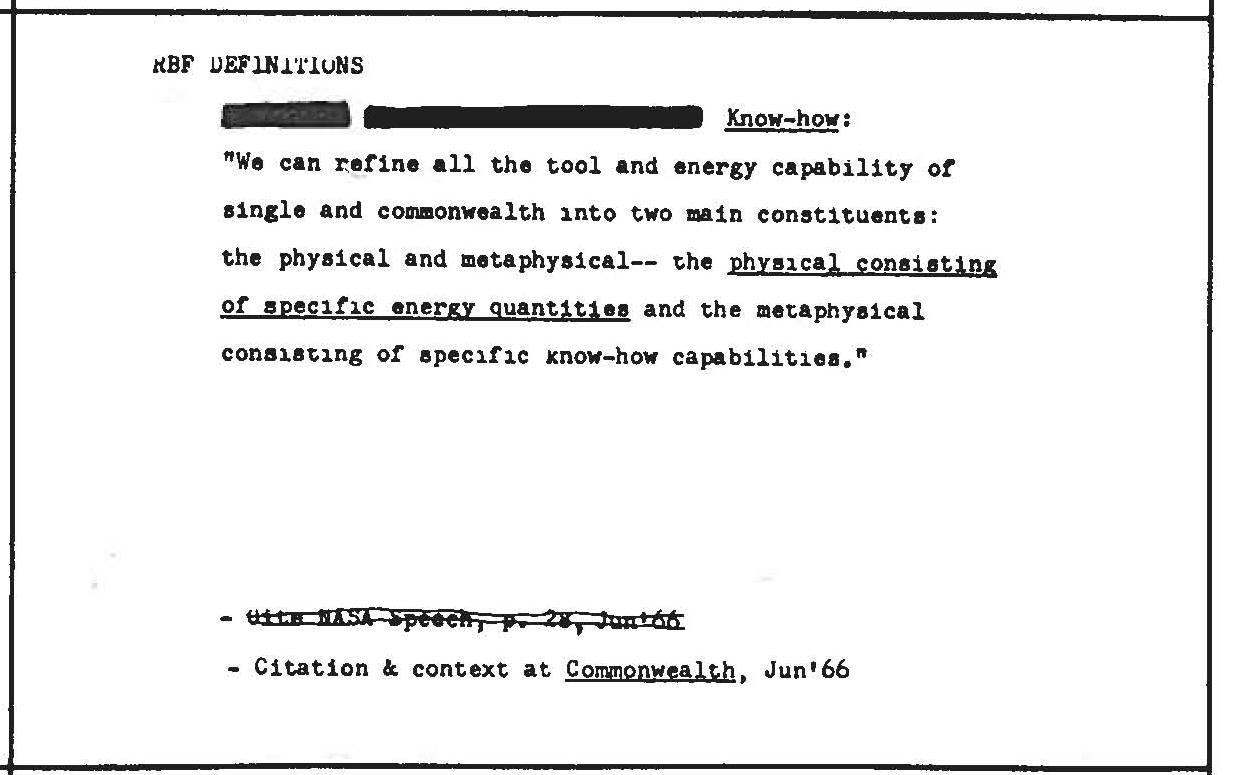
Know-how:
"We can refine all the tool and energy capability of single and commonwealth into two main constituents: the physical and metaphysical-- the physical consisting of specific energy quantities and the metaphysical consisting of specific know-how capabilities."
-
With NASA Speech, p. 28, Jun'65
-
Citation & context at Commonwealth, Jun'66
Know-how Accounting vs. Physical Accounting
← Know-how | Know-how Accounting vs. Physical Accounting (1) →
Index Entry
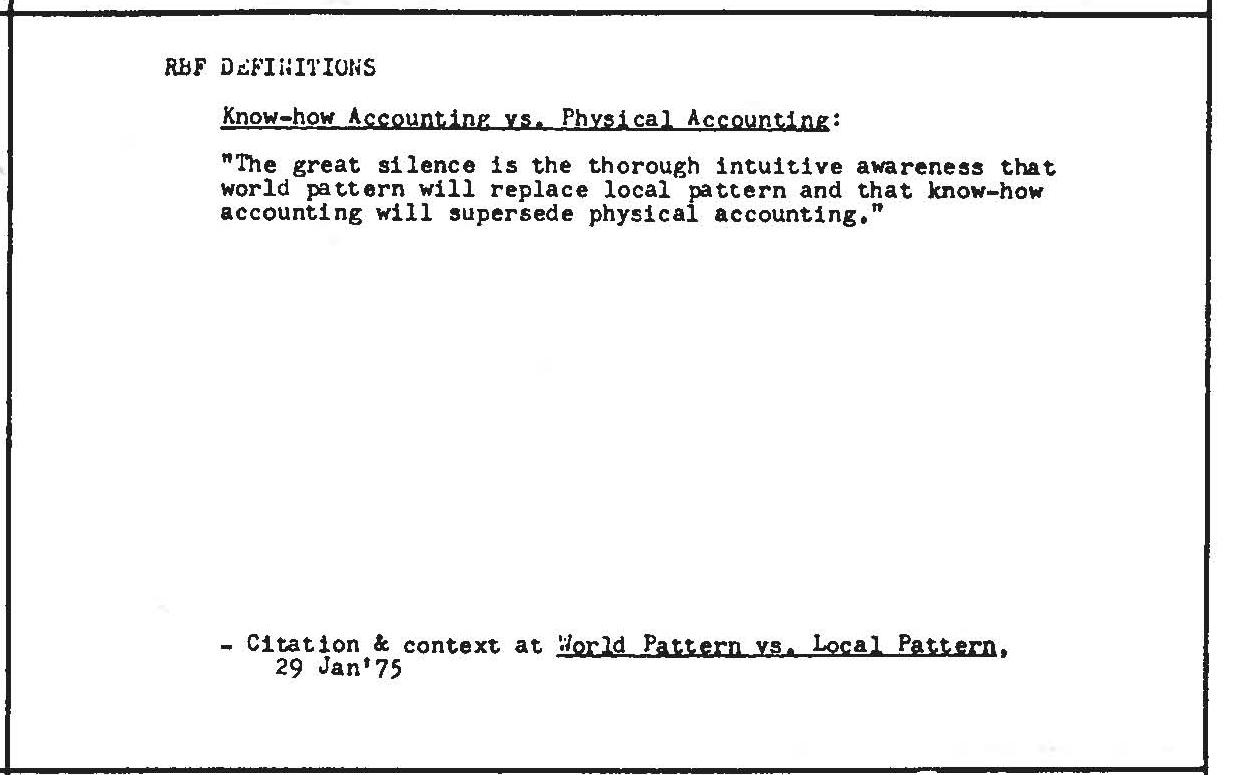
Know-how Accounting vs. Physical Accounting:
"The great silence is the thorough intuitive awareness that world pattern will replace local pattern and that know-how accounting will supersede physical accounting."
- Citation & context at World Pattern vs. Local Pattern, 29 Jan'75
Know-how Accounting vs. Physical Accounting (1)
← Know-how Accounting vs. Physical Accounting | Know-how Accounting vs. Physical Accounting (2) →
Cross Reference
Cross-References
Know-how Accounting vs. Physical Accounting (2)
← Know-how Accounting vs. Physical Accounting (1) | Know-how: Cumulative Know-how of Humanity →
Cross Reference
Old Man River Project, 20 Sep'76
Cross-References
- Disarmament, 20 Sep'76 (1)(2)

Know-how: Cumulative Know-how of Humanity
← Know-how Accounting vs. Physical Accounting (2) | Know-how & Know-what →
Cross Reference
Cross-References
- Technology, (1)
- News & Evolution, (3)(4)
Know-how & Know-what
← Know-how: Cumulative Know-how of Humanity | Know-how (1) →
Index Entry
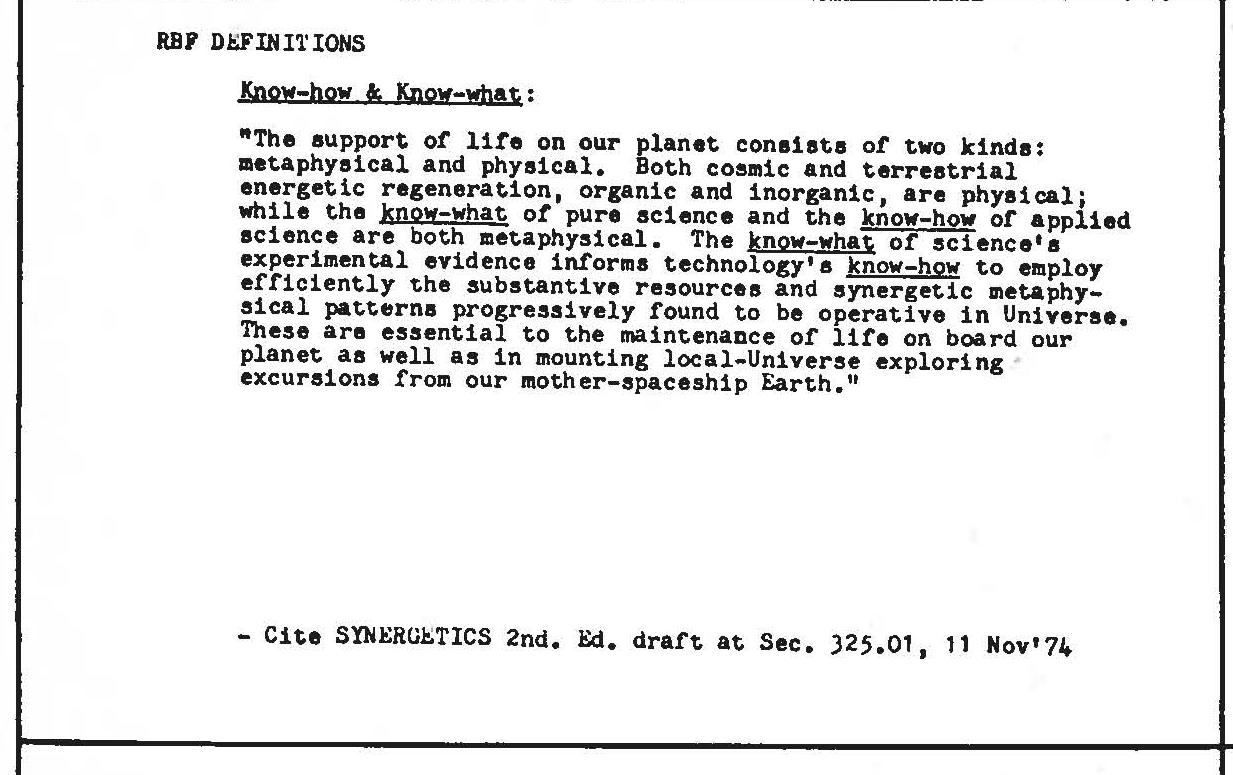
Know-how & Know-what:
"The support of life on our planet consists of two kinds: metaphysical and physical. Both cosmic and terrestrial energetic regeneration, organic and inorganic, are physical; while the know-what of pure science and the know-how of applied science are both metaphysical. The know-what of science's experimental evidence informs technology's know-how to employ efficiently the substantive resources and synergetic metaphysical patterns progressively found to be operative in Universe. These are essential to the maintenance of life on board our planet as well as in mounting local-Universe exploring excursions from our mother-spaceship Earth."
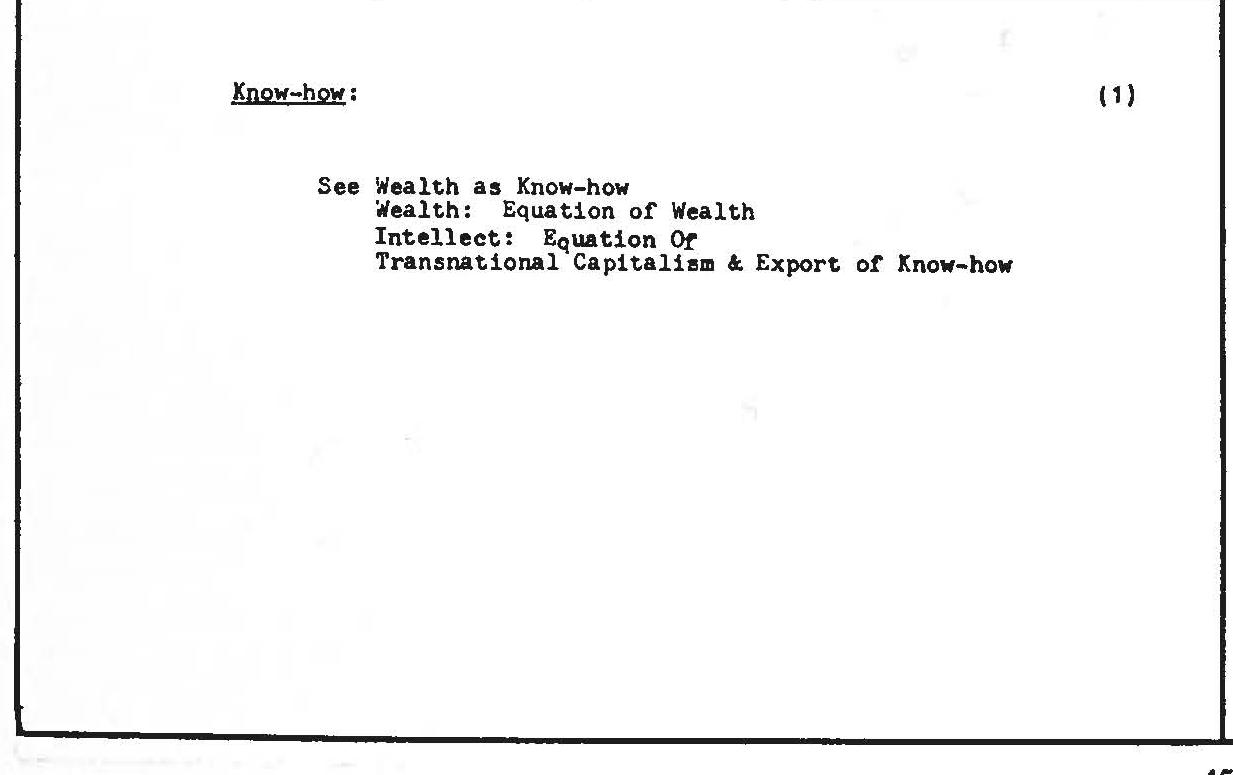
Know-how (1)
← Know-how & Know-what | Know-how (2) →
Cross Reference
Cross-References
- Wealth as Know-how
- Wealth: Equation of Wealth
- Intellect: Equation Of
- Transnational Capitalism & Export of Know-how
Know-how (2)
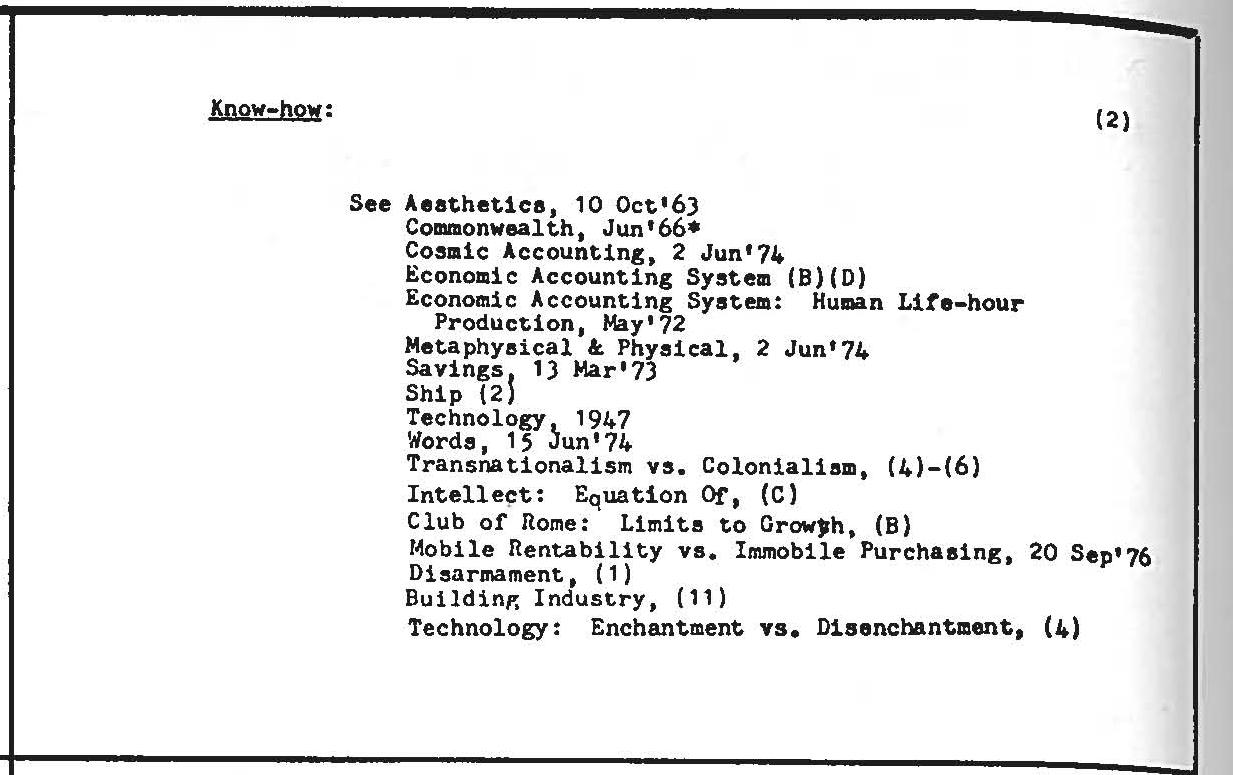
Cross Reference
Cross-References
- Aesthetics, 10 Oct'63
- Commonwealth, Jun'66*
- Cosmic Accounting, 2 Jun'74
- Economic Accounting System
- Production, May'72
- Metaphysical & Physical, 2 Jun'74
- Savings, 13 Mar'73
- Ship, (2)
- Technology, 1947
- Words, 15 Jun'74
- Transnationalism vs. Colonialism, (4)
- Intellect: Equation Of
- Club of Rome: Limits to Growth
- Mobile Rentability vs. Immobile Purchasing, 20 Sep'76
- Disarmament, (1)
- Building Industry, (11)
- Technology: Enchantment vs. Disenchantment, (4)
Know-what
Cross Reference
Cross-References
Knowledge
Index Entry
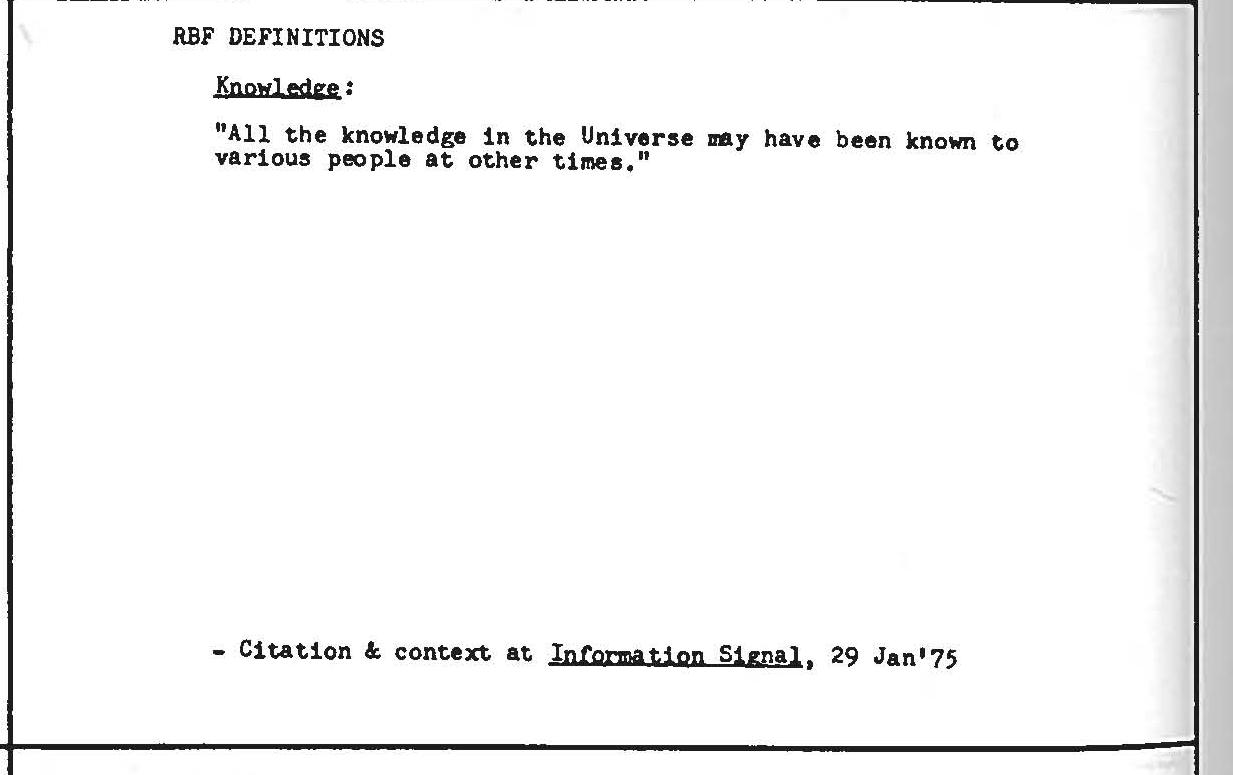
Knowledge:
"All the knowledge in the Universe may have been known to various people at other times."
- Citation & context at Information Signal, 29 Jan'75
Knowledge
Index Entry
Knowledge:
"Knowledge organizes itself geometrically, i.e., with models."
- Citation and context at Epistemology, 16 Dec'73
Knowledge
Index Entry
Knowledge:
"Awareness is terminable, but knowledge is eternal. Comprehending and knowing are eternal."
- Citation and context at Communicating (2), 11 Sep'73
Knowledge
Index Entry
Knowledge:
"Knowledge is orbital."
Citation and context at Orbiting, 5 Jun'73
Knowledge
Index Entry
Knowledge:
"Knowledge is of the brain
Wisdom is of the mind
And there is herewith implicit
An a priori Wisdom of wisdoms."
-
Citation at Wisdom of Wisdoms, May'72
-
Citation at p.43, May'72
Knowledge
← Knowledge | Knowledge Backward in Time →
Index Entry
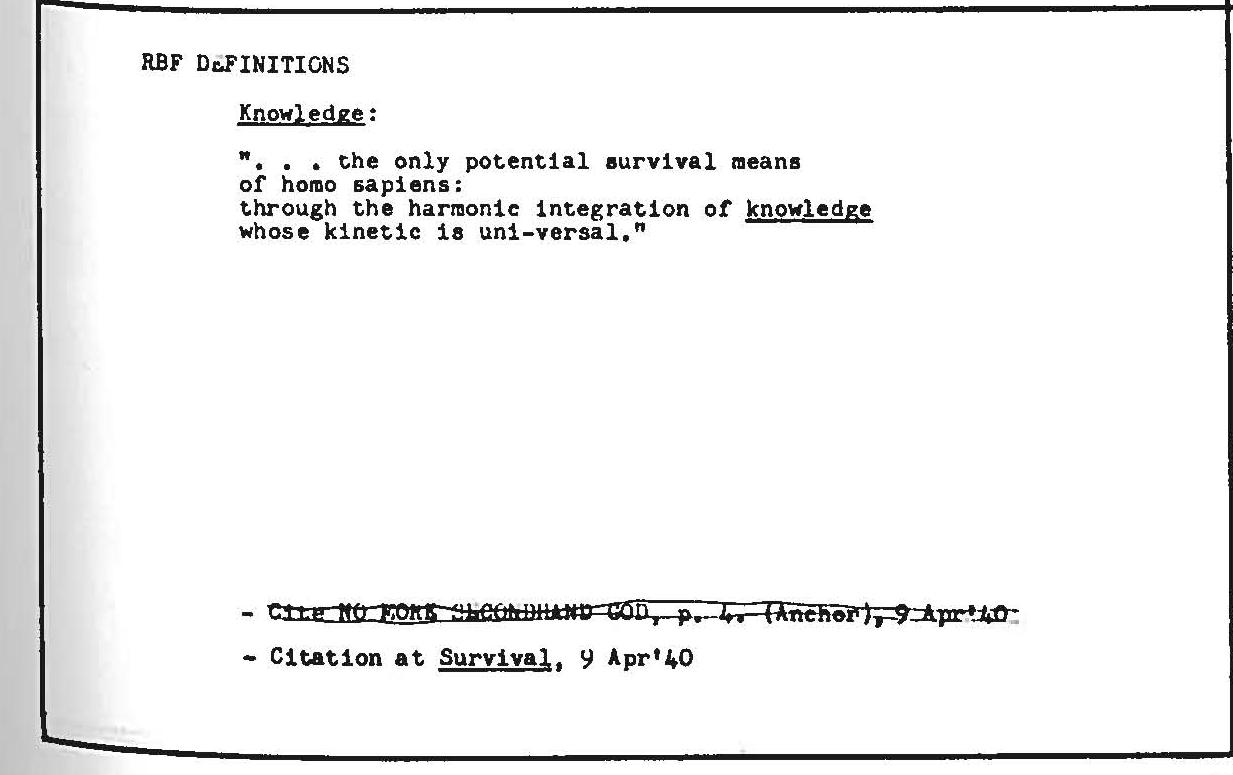
Knowledge:
"... the only potential survival means
of homo sapiens:
through the harmonic integration of knowledge
whose kinetic is uni-versal."
-
Cite NO MORE SECONDHAND GOD, p. 4, (Anchor), 9 Apr'40
-
Citation at Survival, 9 Apr'40
Knowledge Backward in Time
← Knowledge | Knowledge as Reflexes (1) →
Cross Reference
Cross-References
- History, 29 Aug'64
Knowledge as Reflexes (1)
← Knowledge Backward in Time | Knowms Harvested From All the Unknownms →
Cross Reference
Fuller, R.B: Moratorium on Speech, (1)
Cross-References
- Invisible Reality, May'72
Knowms Harvested From All the Unknownms
← Knowledge as Reflexes (1) | Knowledge Know Knowing (1) →
Cross Reference
Knowms Harvested From All the Unknownms:
Cross-References
- A Priori Mystery, 8 Mar'73
- Geometry, 14 Nov'73
- Unknowable, 8 Mar'73
Knowledge Know Knowing (1)
← Knowms Harvested From All the Unknownms | Knowledge Know Knowing (2) →
Cross Reference
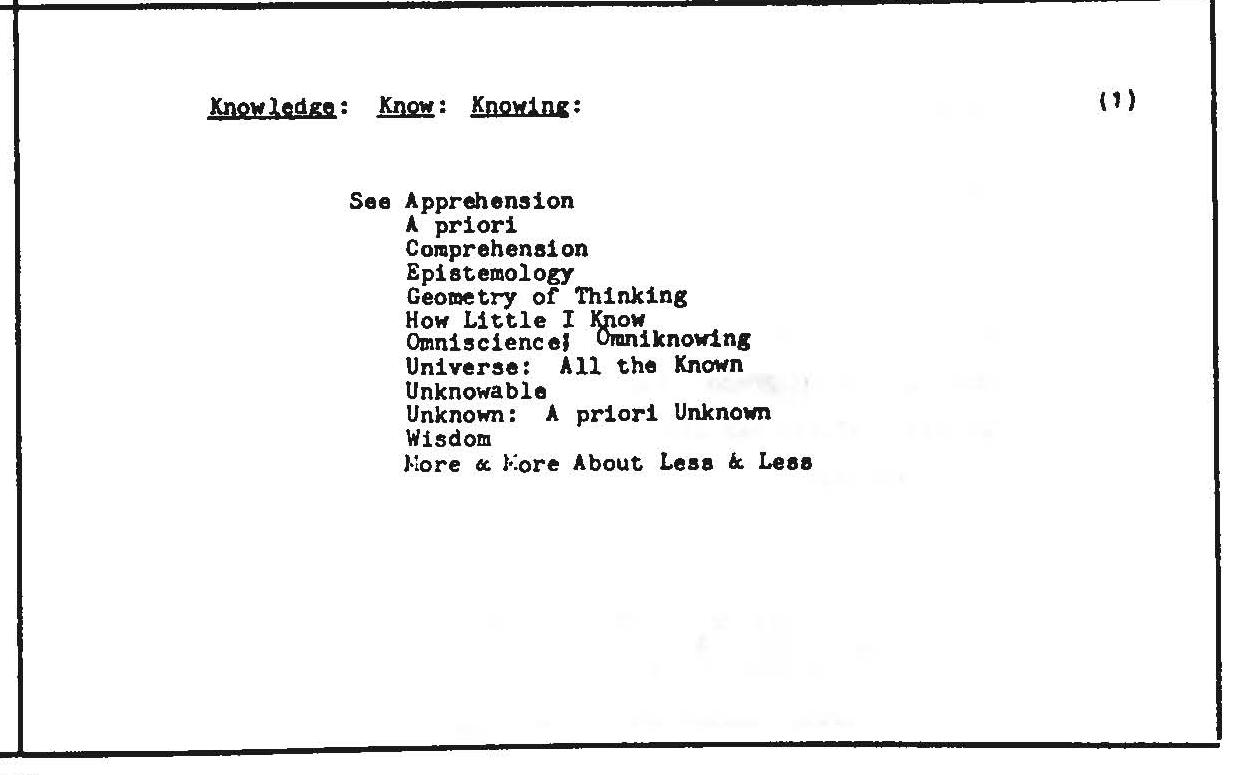
Omniscience; Omn-knowing
Cross-References
- Apprehension, (1)
- A priori
- Comprehension
- Epistemology
- Geometry of Thinking
- How Little I Know
- Universe: All the Known
- Unknowable
- Unknown: A priori Unknown
- Wisdom
- More & More About Less & Less
Knowledge Know Knowing (2)
← Knowledge Know Knowing (1) | Knowledge Know Knowing (3) →
Cross Reference
Cross-References
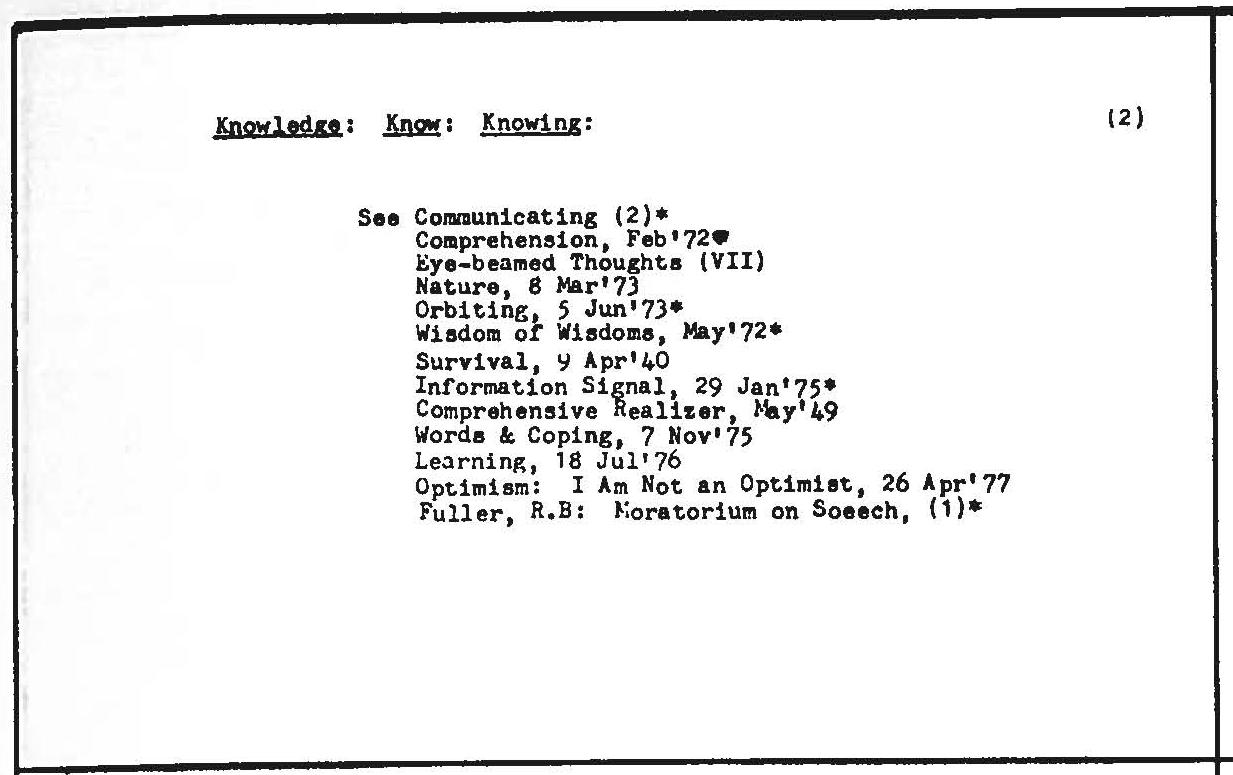
- Communicating, (2)
Knowledge Know Knowing (3)
← Knowledge Know Knowing (2) | Koestler, Arthur →
Cross Reference
Cross-References
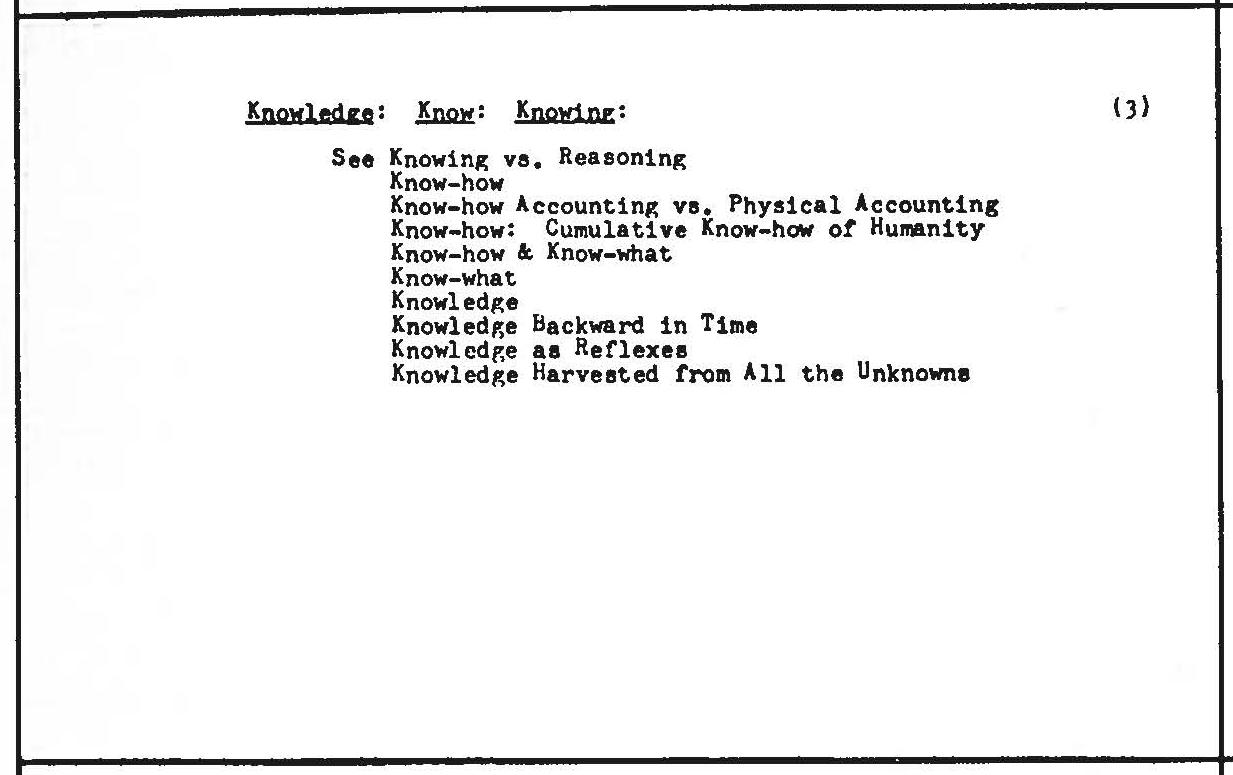
- Knowing vs. Reasoning
- Know-how
- Know-how Accounting vs. Physical Accounting
- Know-how: Cumulative Know-how of Humanity
- Know-how & Know-what
- Know-what
- Knowledge
- Knowledge Backward in Time
- Knowledge as Reflexes
Koestler, Arthur
← Knowledge Know Knowing (3) | Korzybski: Alfred Korzybski →
Cross Reference
Cross-References
- Brain, 1972
Korzybski: Alfred Korzybski
← Koestler, Arthur | Korzybski, Alfred →
Index Entry
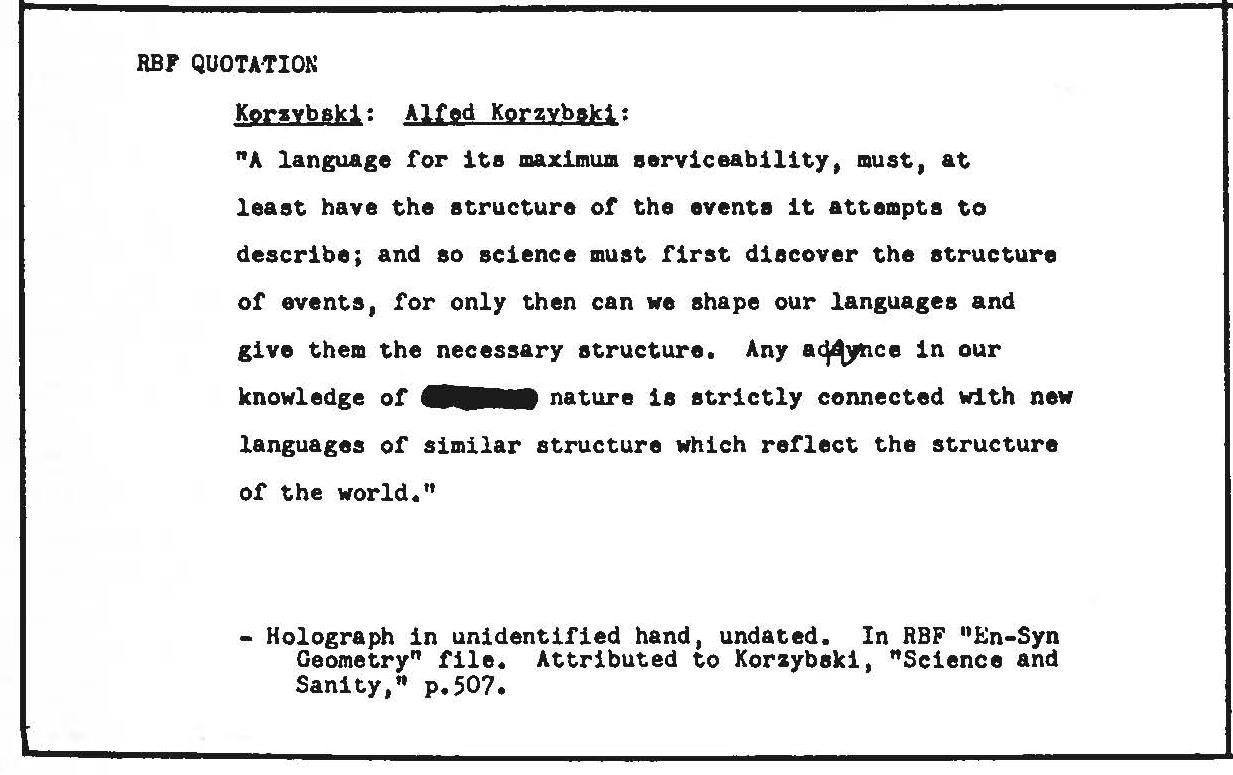
Korzybski: Alfred Korzybski:
"A language for its maximum serviceability, must, at least have the structure of the events it attempts to describe; and so science must first discover the structure of events, for only then can we shape our languages and give them the necessary structure. Any advance in our knowledge of nature is strictly connected with new languages of similar structure which reflect the structure of the world."
- Holograph in unidentified hand, undated. In RBF "En-Syn Geometry" file. Attributed to Korzybski, "Science and Sanity," p.507.
Korzybski, Alfred
← Korzybski: Alfred Korzybski | Kumasi Dome (1) →
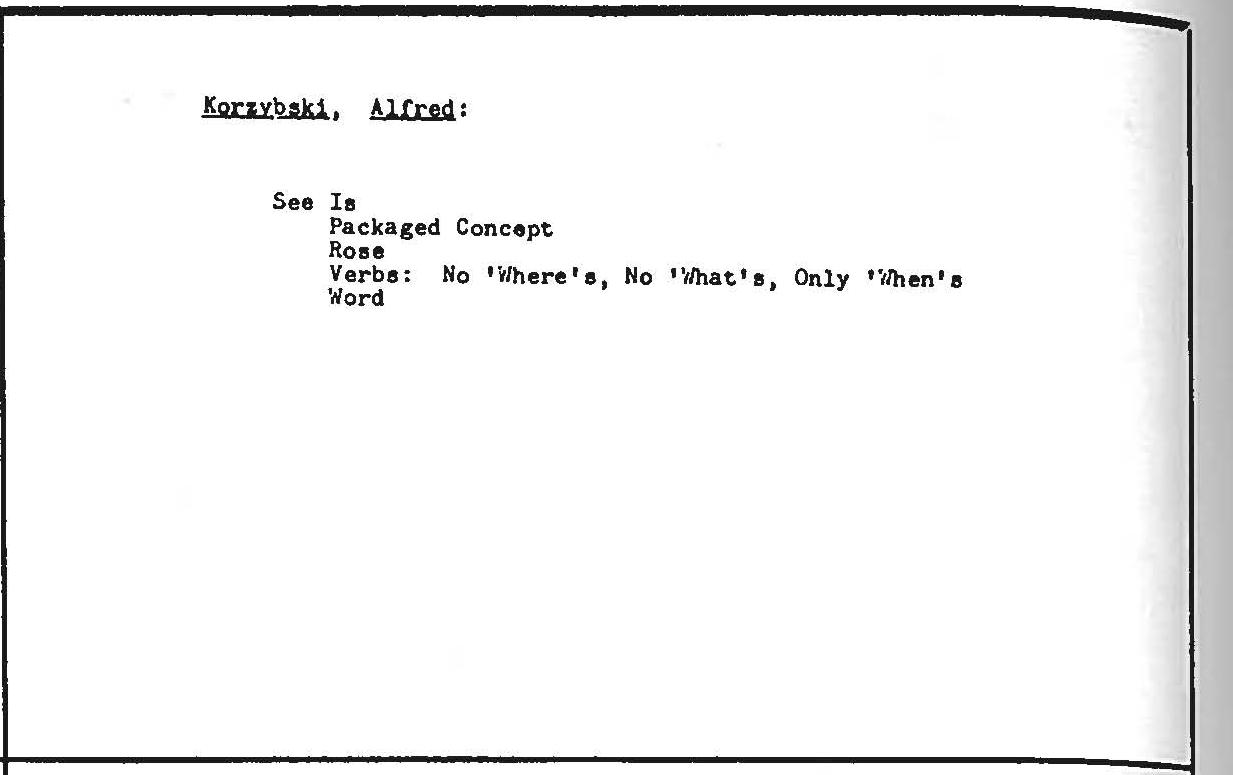
Cross Reference
Cross-References
Kumasi Dome (1)
← Korzybski, Alfred | Kumasi Dome (2) →
Cross Reference
Cross-References
Kumasi Dome (2)
Cross Reference
Kumasi Dome: See Ghana Dome: Self-chilling Machine, (1)
Cross-References
- Ghana Dome, (1)