Synergetics Dictionary — V
529 cards
V
← Utopia or Oblivion (2) | Vacant - Available →
Letter Group Divider
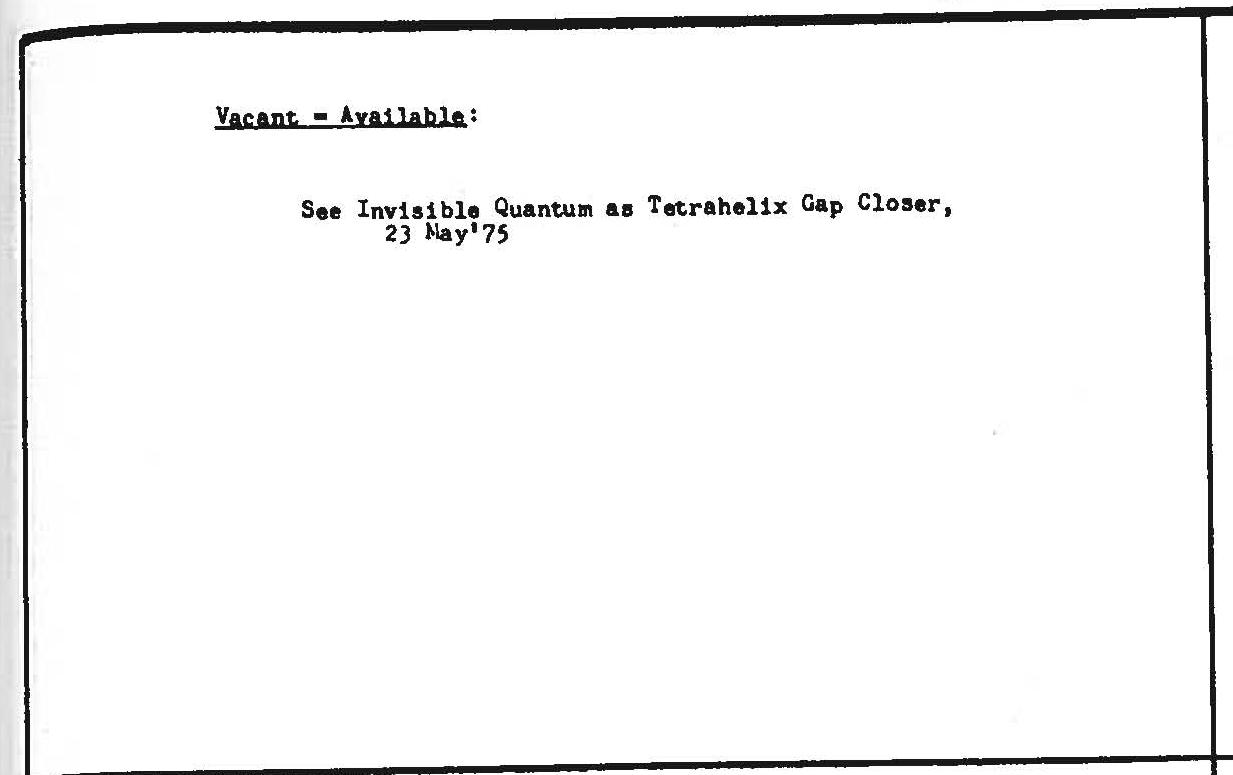
Vacant - Available
Cross Reference
Cross-References
- Invisible Quantum as Tetrahelix Gap Closer, 23 May'75
Vacuum
← Vacant - Available | Vacuum →
Index Entry
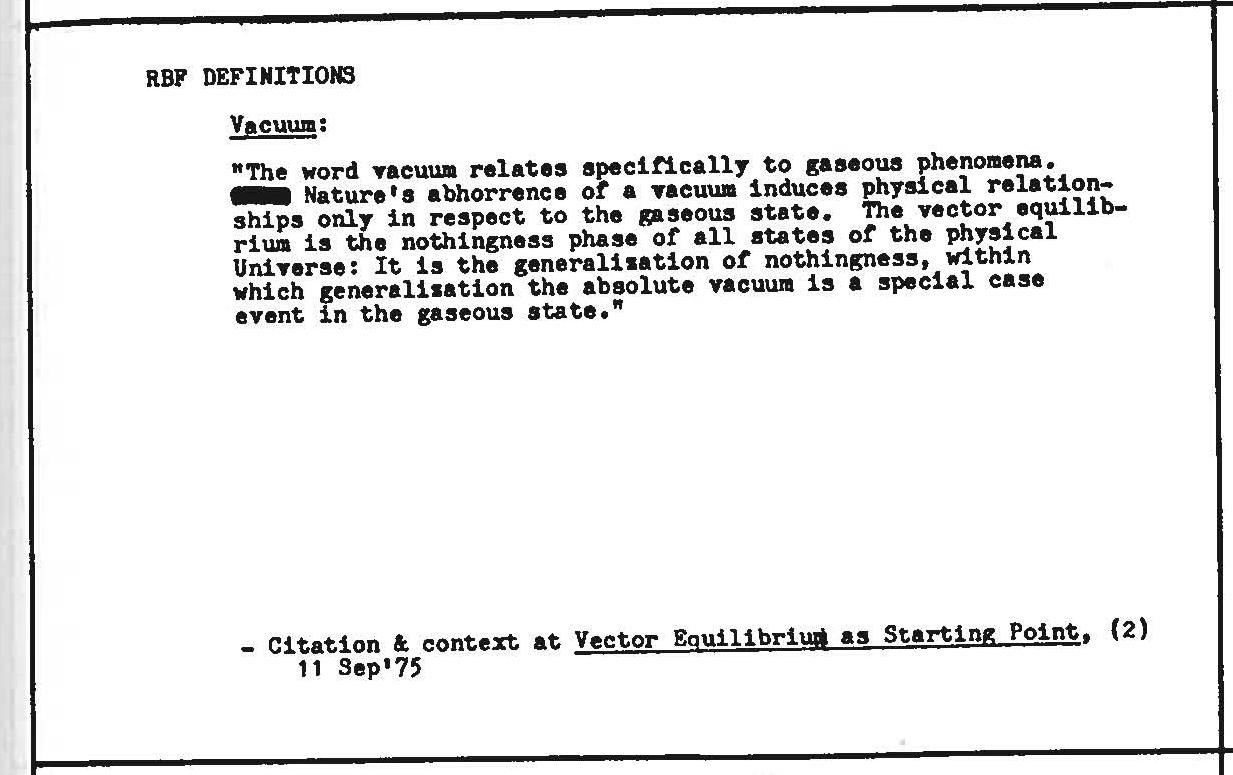
Vacuum:
"The word vacuum relates specifically to gaseous phenomena. Nature's abhorrence of a vacuum induces physical relationships only in respect to the gaseous state. The vector equilibrium is the nothingness phase of all states of the physical Universe: It is the generalization of nothingness, within which generalization the absolute vacuum is a special case event in the gaseous state."
- Citation & context at Vector Equilibrium as Starting Point, (2)
11 Sep'75
Vacuum
RBF Definitions
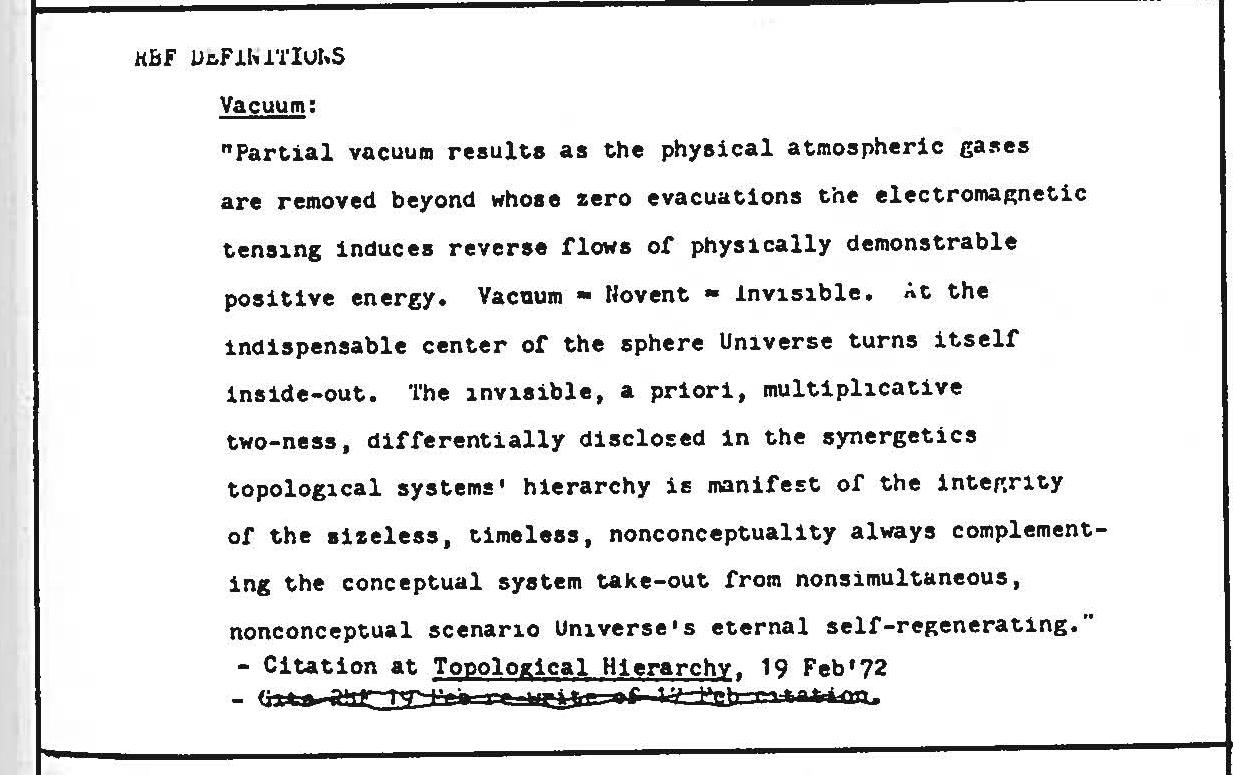
"Partial vacuum results as the physical atmospheric gases are removed beyond whose zero evacuations the electromagnetic tensing induces reverse flows of physically demonstrable positive energy. Vacuum = Novent = invisible. At the indispensable center of the sphere Universe turns itself inside-out. The invisible, a priori, multiplicative two-ness, differentially disclosed in the synergetics topological systems' hierarchy is manifest of the integrity of the sizeless, timeless, nonconceptuality always complementing the conceptual system take-out from nonsimultaneous, nonconceptual scenario Universe's eternal self-regenerating."
-
Citation at Topological Hierarchy, 19 Feb'72
-
(Cite RBF's re-write of 19 Feb citation.
Citations
- RBF's re-write of 19 Feb citation.
Vacuum
Index Entry
Vacuum:
"Vacuum = novent = invisible. The center of the sphere turns inside out.?
- Cite RBF to EJA + BO'R, 3200 Idaho, Was DC, 17 Feb'72
Vacuum
← Vacuum | Vacuum-fulcrumed Cars →
Index Entry
Because I don't talk space, I don't have to have a vacuum. I don't start with space. I start with nothing. Things are always special-case temporary realizations of a specifically detailed dimension and behavior complex of generalized laws applied to a local inventory of physical resources. I start thinking with a No-Size conceptual model of a whole system.
- Cite RBF to EJA +BU'R, 3200 Idaho, DC, 17 Feb '72 as rewritten 19 Feb '72
Vacuum-fulcrumed Cars
← Vacuum | Vacuum = Noevent = Invisible →
Cross Reference
Cross-References
- Ruddering Sequence, (5)
Vacuum = Noevent = Invisible
← Vacuum-fulcrumed Cars | Vacuum of Universe →
Cross Reference
Cross-References
- Vacuum, 19 Feb'72
Vacuum of Universe
← Vacuum = Noevent = Invisible | Vacuum Vacuumizing (1) →
Index Entry
Vacuum of Universe:
"The Platonic solids do not stand in a vacuum of Universe. They are in Universe and if you change that thing you change everything else."
- Citation & context at Platonic Solids, 12 Jul'62
Vacuum Vacuumizing (1)
← Vacuum of Universe | Vacuum Vacuumizing (2) →
Cross Reference
Vacuum =ent = Invisible, Nov
Cross-References
- Invisible
- Nothing
- ent, Nov
- Oar: Vacuum-fulcrumed Oars
- Ruddering Sequence
- Space
- Cosmic Vacuum Cleaner
- De-vacuumizing the Wake
- Cold & Vacuum
- Nonstate
Vacuum Vacuumizing (2)
← Vacuum Vacuumizing (1) | Vagina →
Cross Reference
Cross-References
- Platonic Solids, 12Jul'62
- Rowing Needles, (1)(2)
- Topological Hierarchy, 19Feb'72*
- Weather, Feb'73
- Whole, 17Feb'72
- Wind Power Sequence, (5)
- Vector Equilibrium as Starting Point, (2)
Vagina
← Vacuum Vacuumizing (2) | Valence Valent →
Cross Reference
Cross-References
- Evaginating, 22 Jun'75
Valence Valent
← Vagina | Valid to the King →
Cross Reference
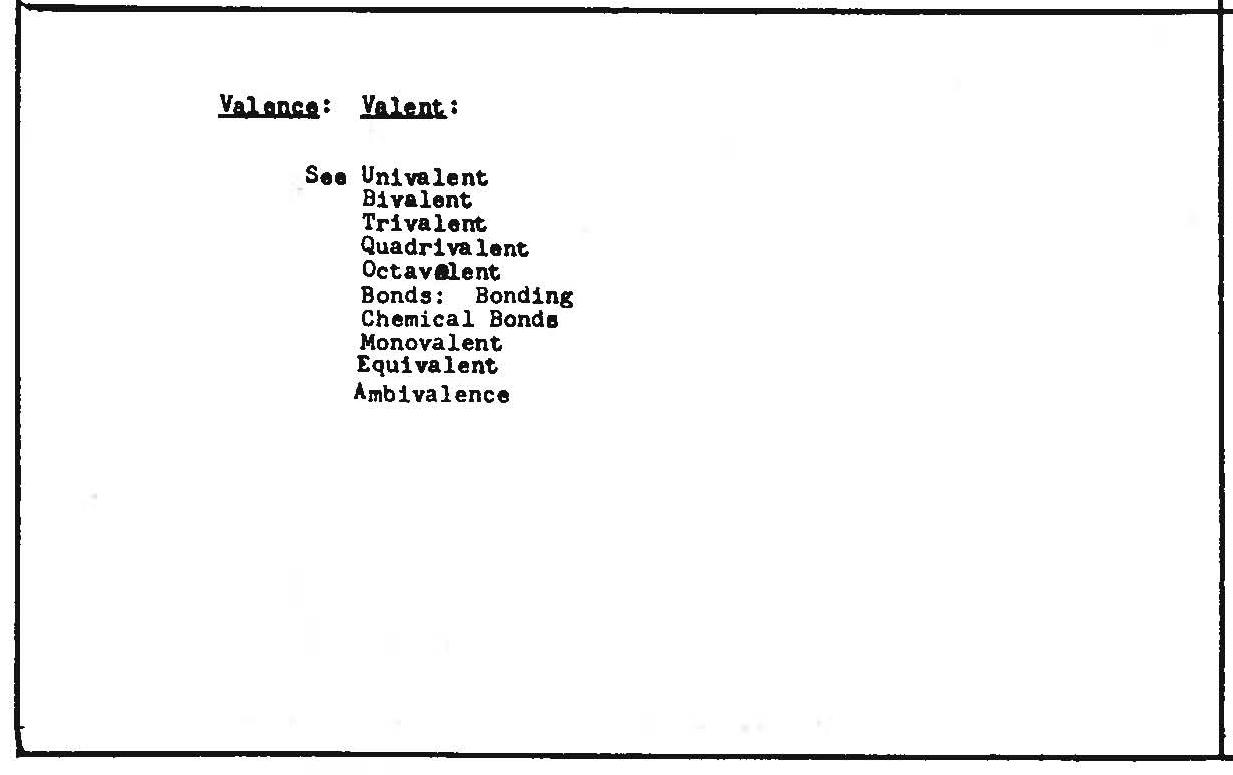
ivalent, Oct
Equivalent
Cross-References
Valid to the King
← Valence Valent | Valid Validity (1) →
Cross Reference
Valid to the King:
Cross-References
- Real, 20 Apr'72
Valid Validity (1)
← Valid to the King | Valid Validity (2) →
Cross Reference
Cross-References
Valid Validity (2)
← Valid Validity (1) | Valuable Chemistry →
Cross Reference
Cross-References
- Bias on One Side of the Line, May'65
- Self-debiasing, May'65
Valuable Chemistry
← Valid Validity (2) | Valuable Unit →
Cross Reference
Cross-References
- Toilet, 28 Jun'72
- Building Business, (4)
Valuable Unit
← Valuable Chemistry | Values (1) →
Cross Reference
Cross-References
- Wright, F.L, 8 Aug'38
Values (1)
← Valuable Unit | Values (2) →
Cross Reference
Optimism: Reverse Optimism
Profit: Man-invented Game of Quick Profit
Quantum Values
Intervaluations
Cross-References
- Balncing of Values
- Energy Quanta Values
- Good & Evil
- Morality
- Number-value Accounting
- Man as a Function of Universe
- Plastic Flowers
- Sin
- Teleology
- Unselfishness
- Anticipatory Discounting of Forwardly Reckonable Values
Values (2)
Cross Reference
Cross-References
- Technology, 13 Mar'73
- Topology, 1969
- News & Evolution, (3)
Valvability
Index Entry
Valvability:
"The fact that the rhombic dodecahedron can have its 144 modules oriented as either introvert-exrovert, or as three-way circumferential, provides its valvability between broadcasting-transceiving and noninterference relaying."
- Citation and context at Rhombic Dodecahedron, 30 Nov'72
Valve
RBF Definitions
"The spheres turn into spaces and the spaces turn into spheres: they operate as valves."
Citations
- RBF to LJA, 3200 Idaho, DC, 20 Feb '72
Valving
Index Entry
Valving:
"The Kites are always either positively or negatively biased internally in respect to their energy valving (amplifying, choking, cutting off, and holding) proclivities..."
Valving
Cross Reference
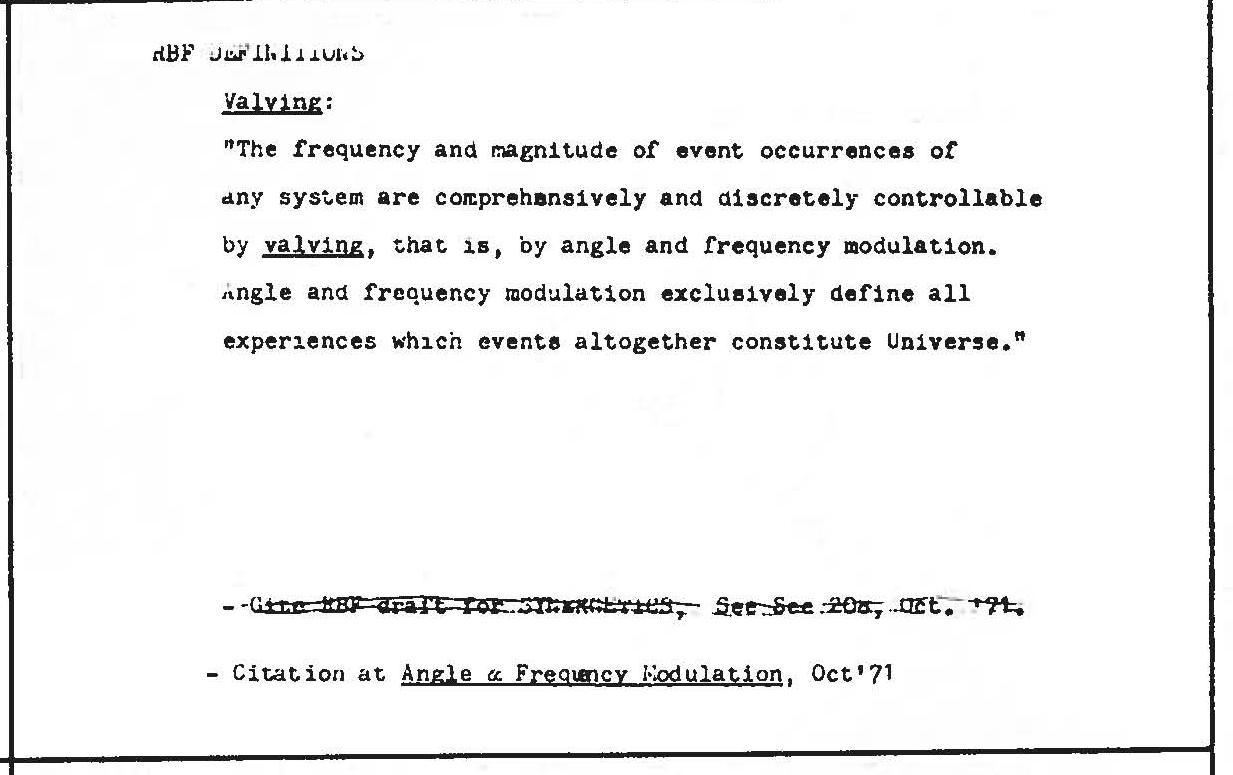
The frequency and magnitude of event occurrences of any system are comprehensively and discretely controllable by valving, that is, by angle and frequency modulation. Angle and frequency modulation exclusively define all experiences which events altogether constitute Universe.
Cross-References
Valving
← Valving | Valve of Sensitivity →
Index Entry
Valving:
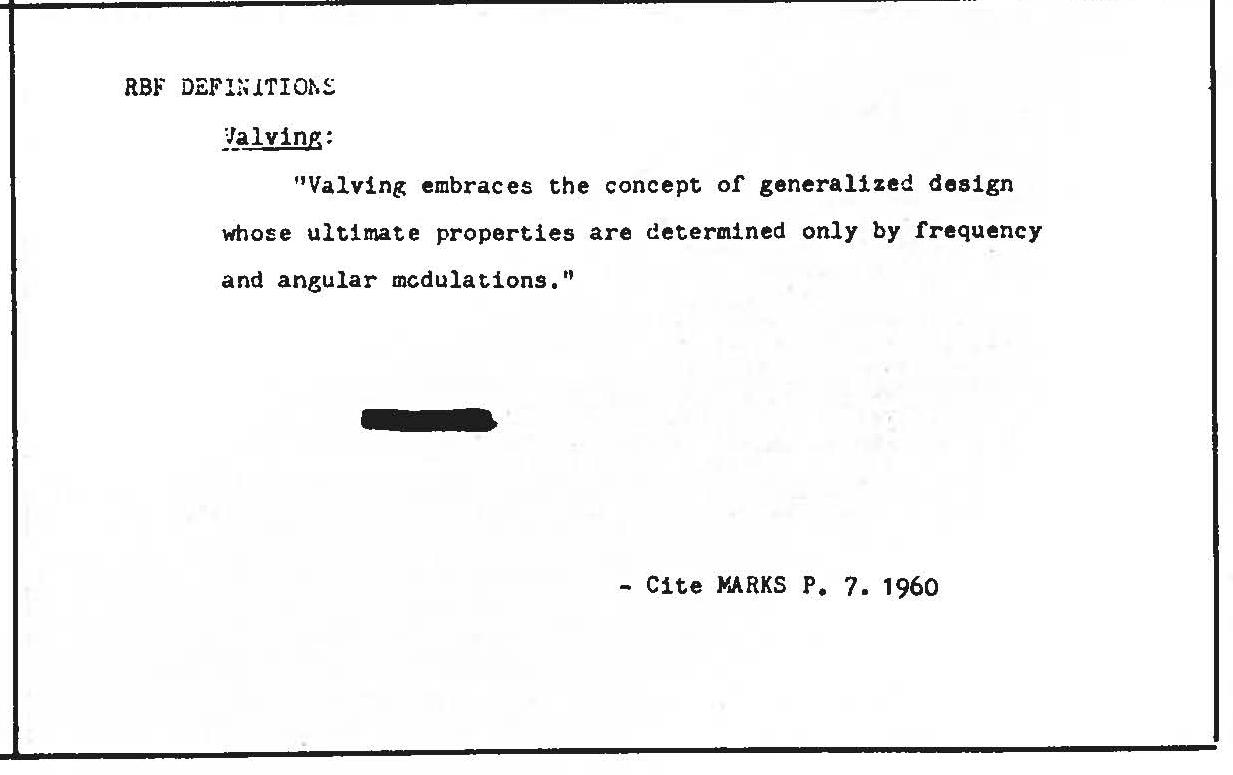
"Valving embraces the concept of generalized design whose ultimate properties are determined only by frequency and angular modulations."
- Cite MARKS P. 7. 1960
Valve of Sensitivity
← Valving | Valving: Valvability (1) →
Cross Reference
Sensitivity of the artist-scientists, Apr'77
Cross-References
- Average Man, (2)
- Fuller, R.B: Crisis of, 1927 (1)
Valving: Valvability (1)
← Valve of Sensitivity | Valving Valvability (2) →
Cross Reference
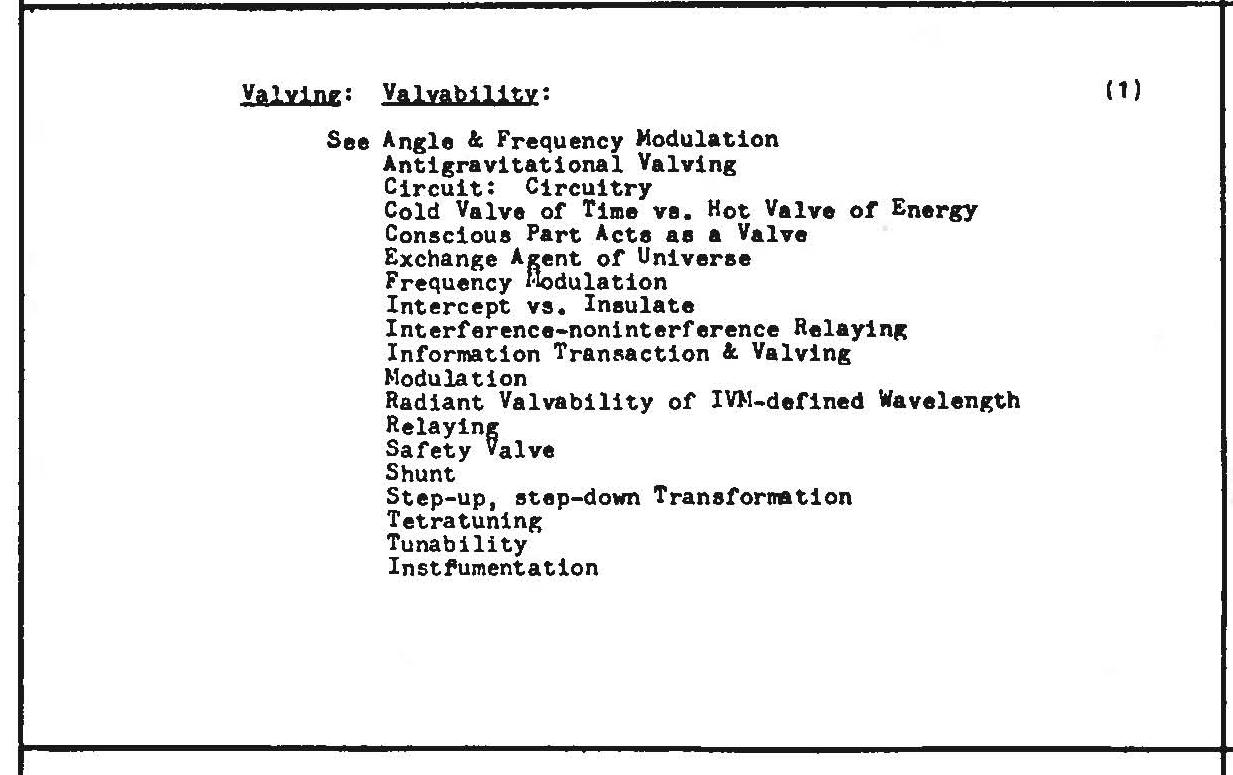
Cold Valve of Time vs. Hot Valve of Energy
Conscious Part Acts as a Valve
Information Transaction & Valving
Radiant Valvability of IW-defined Wavelength
Instfumentation
Cross-References
- Angle & Frequency Modulation
- Antigravitational Valving
- Circuit: Circuitry
- Exchange Agent of Universe
- Frequency Modulation
- Intercept vs. Insulate
- Interference-noninterference Relaying
- Modulation
- Relaying
- Safety Valve
- Shunt
- Step-up, step-down Transformation
- Tetratuning
- Tunability
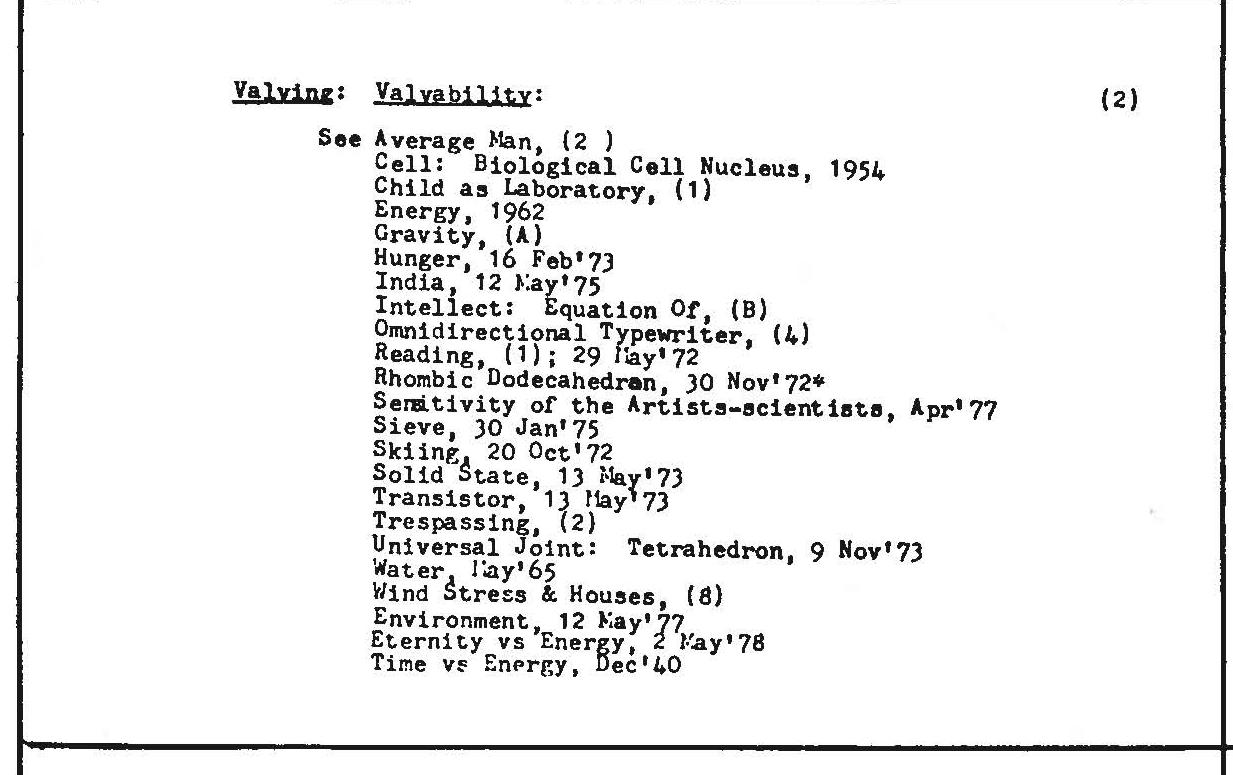
Valving Valvability (2)
← Valving: Valvability (1) | Van Allen Belt →
Cross Reference
Cell: Biological Cell Nucleus, 1954
Sensitivity of the Artists-scientists, Apr'77
Time vs Energy, Dec'40
Cross-References
- Average Man, (2)
- Child as Laboratory, (1)
- Energy, 1962
- Gravity
- Hunger, 16 Feb'73
- India, 12 May'75
- Intellect: Equation Of
- Omnidirectional Typewriter, (4)
- Reading, (1)
- Rhombic Dodecahedron, 30 Nov'72*
- Sieve, 30 Jan'75
- Skiing, 20 Oct'72
- Solid State, 13 May'73
- Transistor, 13 May'73
- Trespassing, (2)
- Universal Joint: Tetrahedron, 9 Nov'73
- Water
- Wind Stress & Houses, (8)
- Environment, 12 May'77
- Eternity vs Energy
Van Allen Belt
← Valving Valvability (2) | Van Allen Belt →
Index Entry
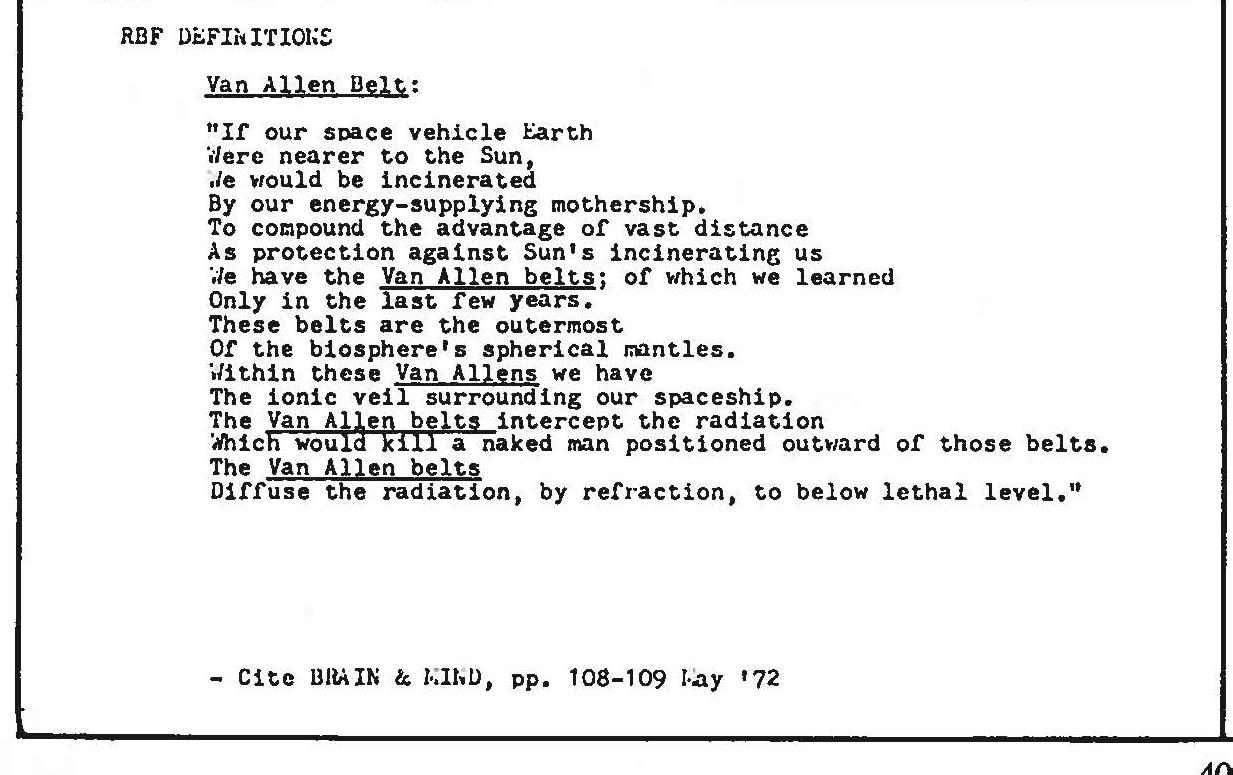
Van Allen Belt:
"If our space vehicle Earth
Were nearer to the Sun,
We would be incinerated
By our energy-supplying mothership.
To compound the advantage of vast distance
As protection against Sun's incinerating us
We have the Van Allen belts; of which we learned
Only in the last few years.
These belts are the outermost
Of the biosphere's spherical mantles.
Within these Van Allens we have
The ionic veil surrounding our spaceship.
The Van Allen belts intercept the radiation
Which would kill a naked man positioned outward of those belts.
The Van Allen belts
Diffuse the radiation, by refraction, to below lethal level."
- Cite BRAIN & MIND, pp. 108-109 May '72
Van Allen Belt
← Van Allen Belt | Vancouver →
Cross Reference
Cross-References
- Biosphere Inventory, 15 Nov'74
- Radiation Sequence, (1)
- Spaceship Earth
Vancouver
← Van Allen Belt | Vanish Vanishment (1) →
Cross Reference
Vancouver:
Cross-References
- Habitat'76 UK World Conference
Vanish Vanishment (1)
← Vancouver | Vanish Vanishment (2) →
Cross Reference
Cross-References
Vanish Vanishment (2)
← Vanish Vanishment (1) | Vanity (1) →
Cross Reference
Cross-References
- VE & Icosa, 10 Apr'75
- Magnitude, May'49
Vanity (1)
← Vanish Vanishment (2) | Vanity (2) →
Cross Reference
Cross-References
Vanity (2)
Cross Reference
Cross-References
- Intuition Sequence, (3)
- Superstition, May'49
- How Little I Know, 1 Feb'75
- Climate & Intellect, May'49
- Mistake, 7 Nov'75
- Crowd-reflexing, 7 Nov'75
van't Hoff
Index Entry
van't Hoff:
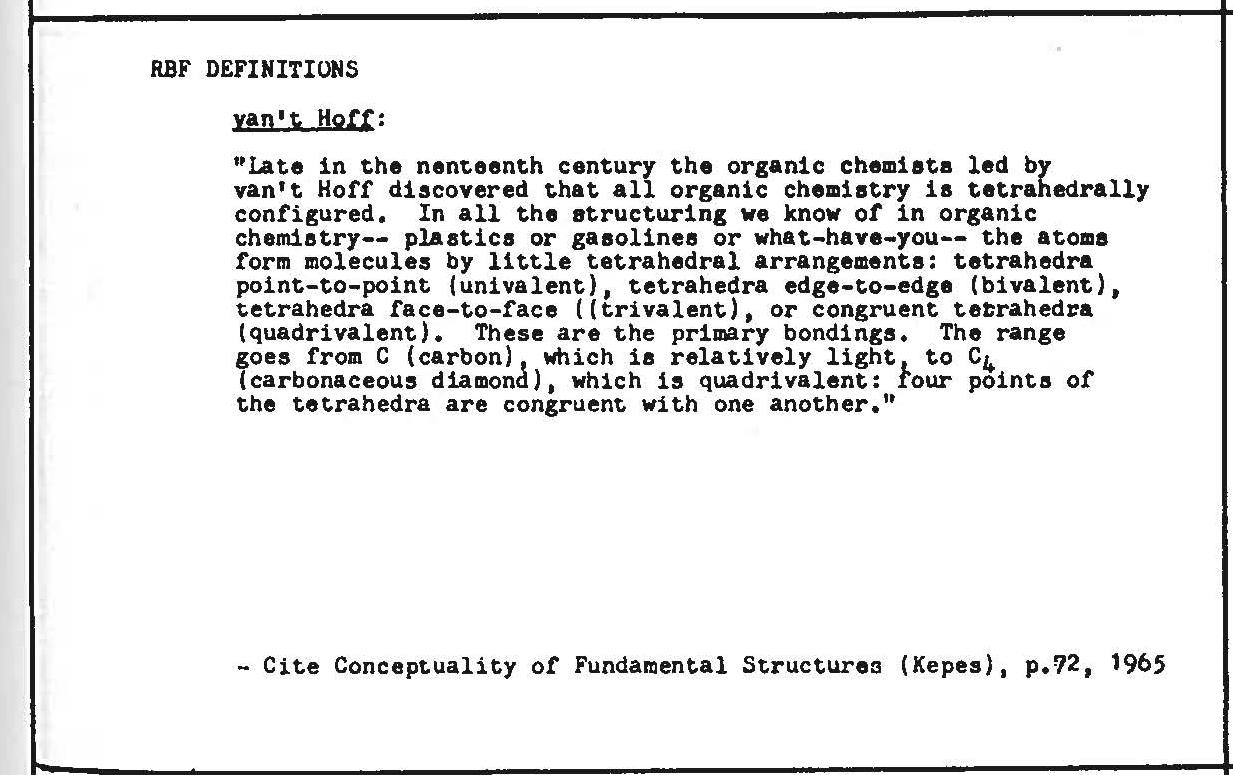
"Late in the nineteenth century the organic chemists led by van't Hoff discovered that all organic chemistry is tetrahedrally configured. In all the structuring we know of in organic chemistry-- plastics or gasolines or what-have-you-- the atoms form molecules by little tetrahedral arrangements: tetrahedra point-to-point (univalent), tetrahedra edge-to-edge (bivalent), tetrahedra face-to-face ((trivalent), or congruent tetrahedra (quadrivalent). These are the primary bondings. The range goes from C (carbon), which is relatively light, to C₄ (carbonaceous diamond), which is quadrivalent: four points of the tetrahedra are congruent with one another."
-- Cite Conceptuality of Fundamental Structures (Kepes), p.72, 1965
van't Hoff
Index Entry
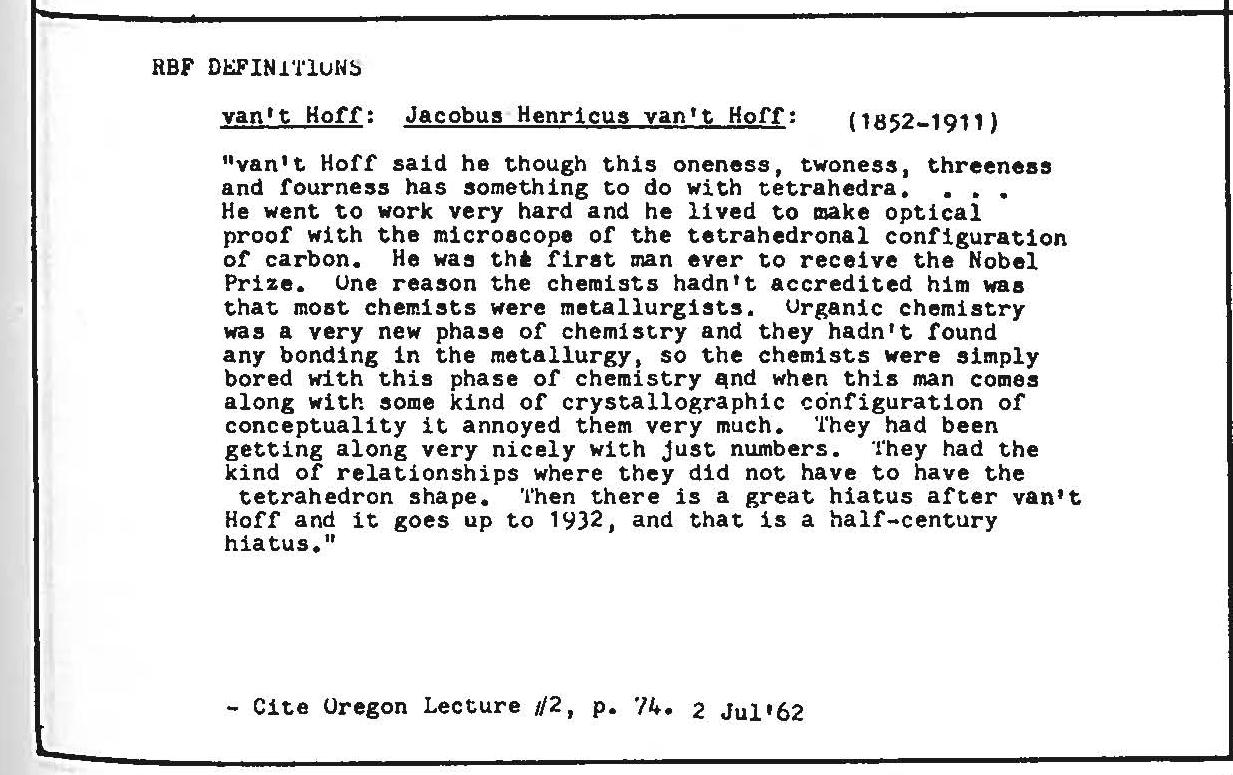
van't Hoff: Jacobus Henricus van't Hoff: (1852-1911)
"van't Hoff said he though this oneness, twoness, threeness and fourness has something to do with tetrahedra. . . . He went to work very hard and he lived to make optical proof with the microscope of the tetrahedronal configuration of carbon. He was the first man ever to receive the Nobel Prize. One reason the chemists hadn't accredited him was that most chemists were metallurgists. Organic chemistry was a very new phase of chemistry and they hadn't found any bonding in the metallurgy, so the chemists were simply bored with this phase of chemistry and when this man comes along with some kind of crystallographic configuration of conceptuality it annoyed them very much. They had been getting along very nicely with just numbers. They had the kind of relationships where they did not have to have the tetrahedron shape. Then there is a great hiatus after van't Hoff and it goes up to 1932, and that is a half-century hiatus."
- Cite Oregon Lecture #2, p. '74. 2 Jul'62
van't Hoff
← van't Hoff | van't Hoff: Combining van't Hoff & Pauling →
Index Entry
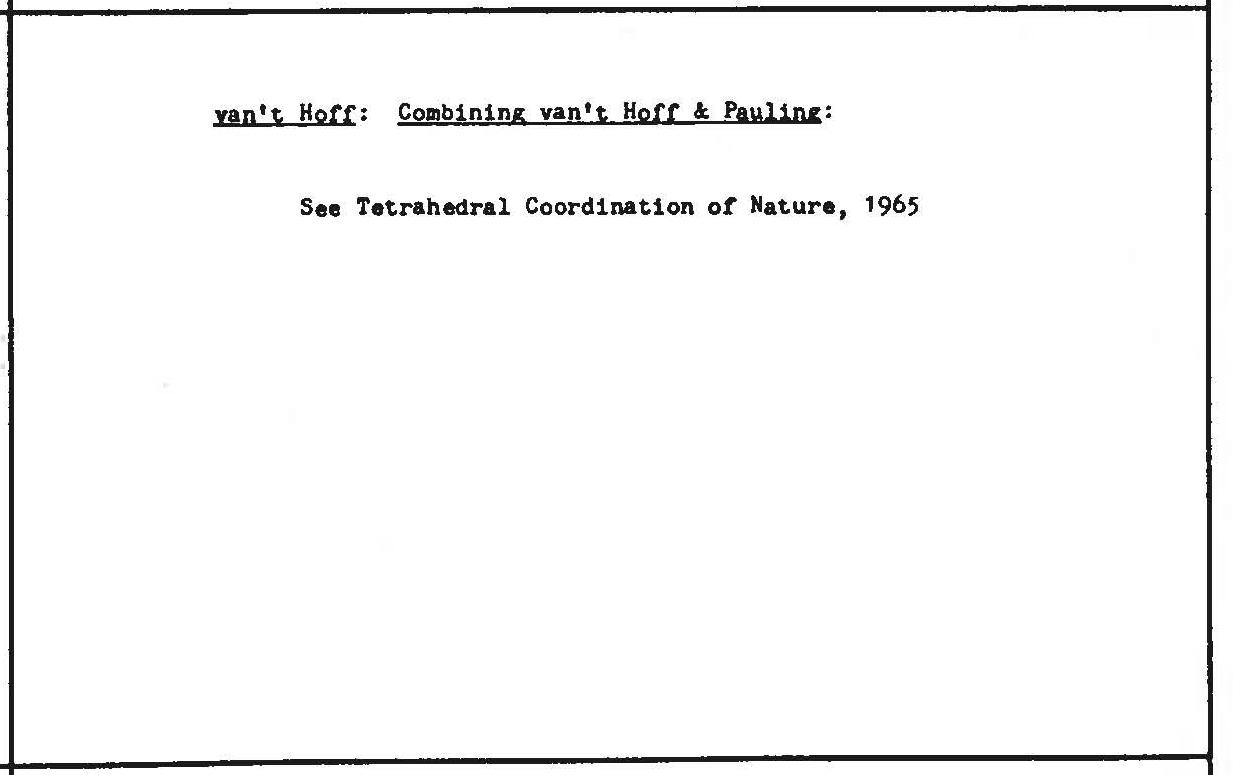
van't Hoff:
"... van't Hoff showed that all organic chemical structuring is tetrahedrally configured in vertexial linkage ..."
van't Hoff: Combining van't Hoff & Pauling
Cross Reference
Cross-References
van't Hoff
← van't Hoff: Combining van't Hoff & Pauling | van't Hoff →
Cross Reference
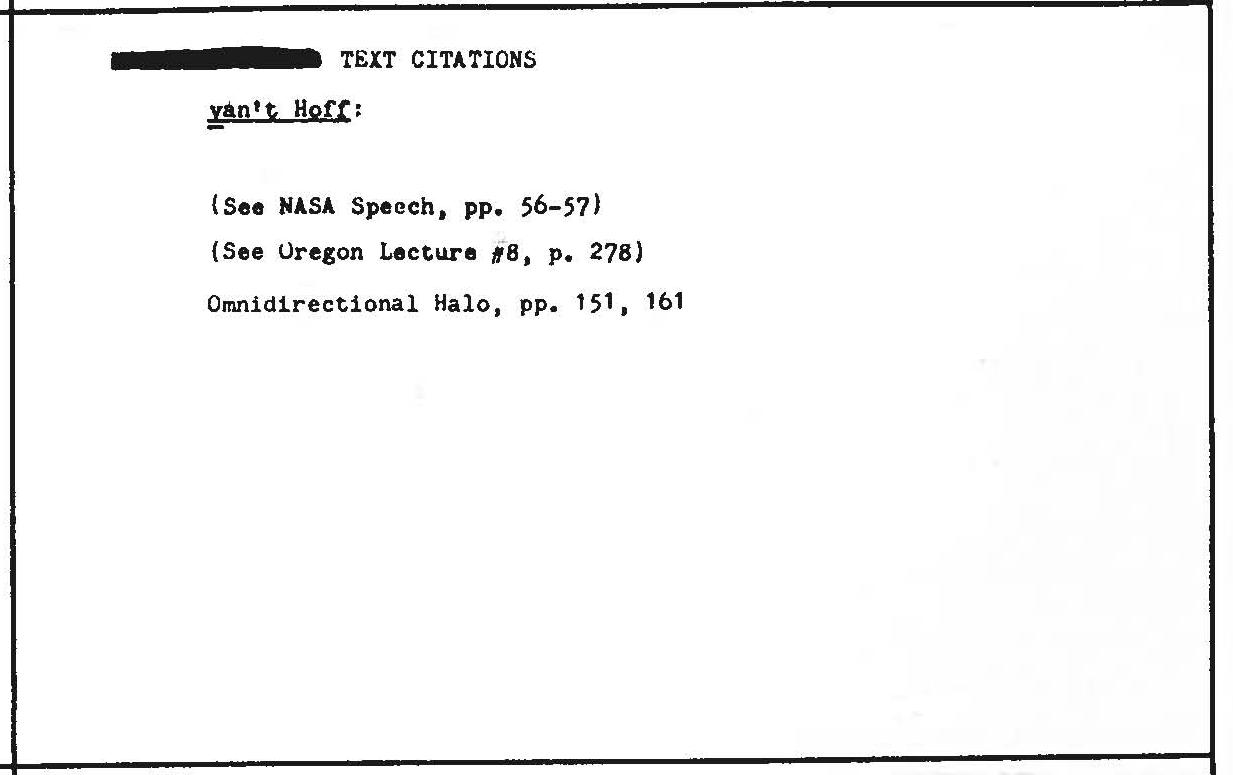
Omnidirectional Halo, pp. 151, 161
Oregon Lecture #8
Cross-References
- NASA Speech
van't Hoff
Cross Reference
Cross-References
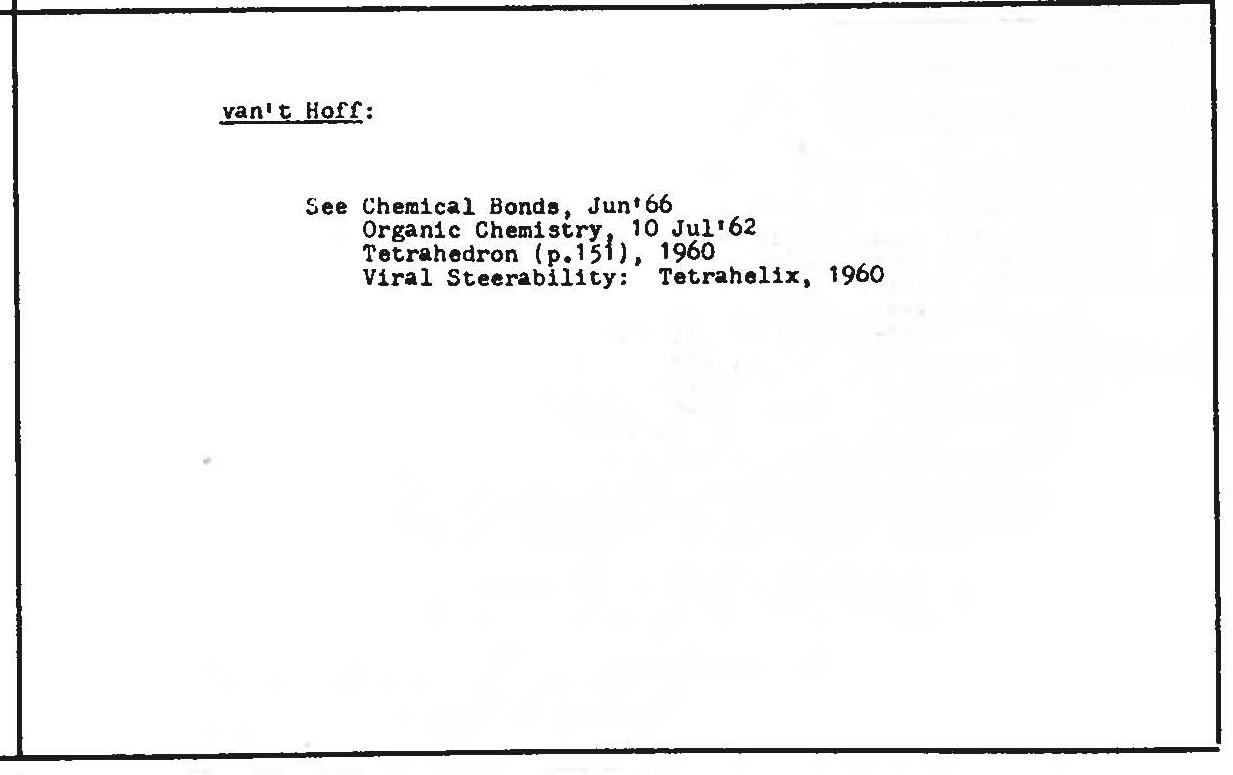
- Chemical Bonds, Jun'66
- Organic Chemistry, 10 Jul'62
- Tetrahedron (p.151), 1960
- Viral Steerability: Tetrahelix, 1960
Vapor (1)
← van't Hoff | Vapor Vaporization (2) →
Cross Reference
Cross-References
- Liquid-crystal-vapor-incandescent phases
Vapor Vaporization (2)
← Vapor (1) | Variables: Theory Of →
Cross Reference
Cross-References
- Rain, 11 Feb'76
Variables: Theory Of
← Vapor Vaporization (2) | Variables →
RBF Definitions
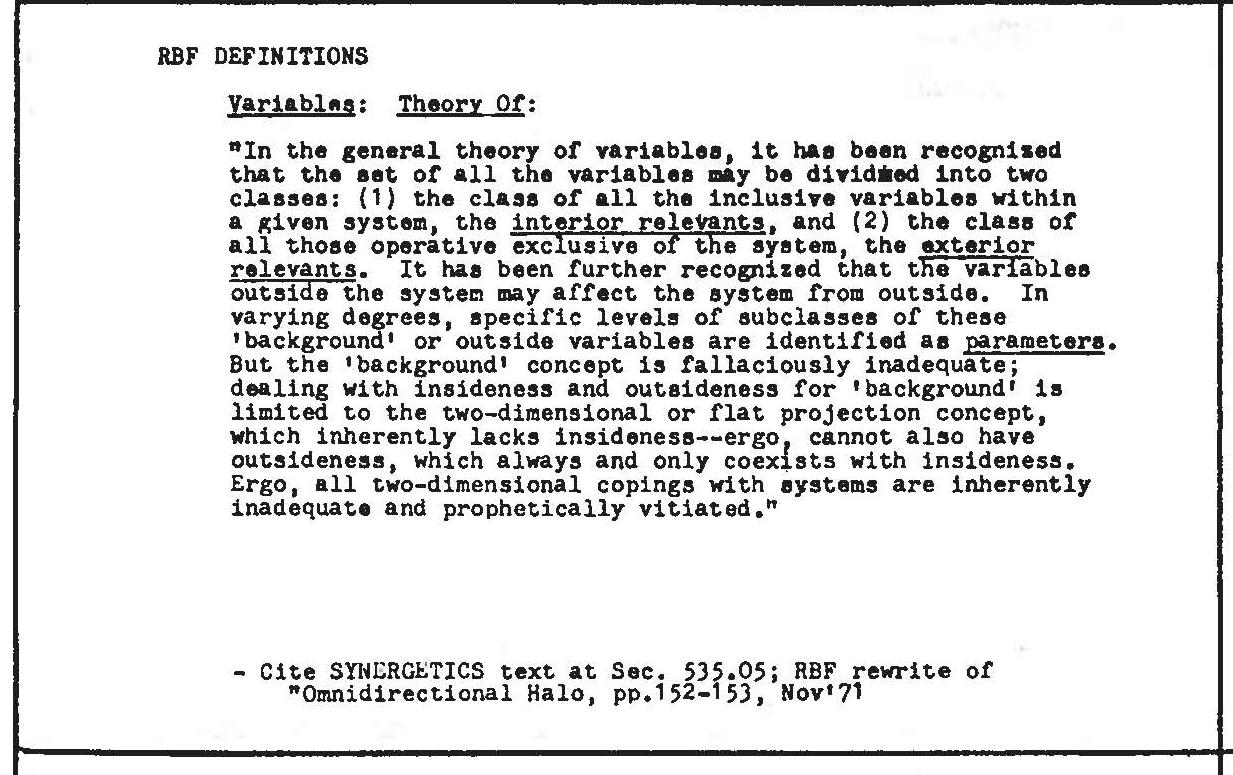
"In the general theory of variables, it has been recognized that the set of all the variables may be divided into two classes: (1) the class of all the inclusive variables within a given system, the interior relevants, and (2) the class of all those operative exclusive of the system, the exterior relevants. It has been further recognized that the variables outside the system may affect the system from outside. In varying degrees, specific levels of subclasses of these 'background' or outside variables are identified as parameters. But the 'background' concept is fallaciously inadequate; dealing with insideness and outsideness for 'background' is limited to the two-dimensional or flat projection concept, which inherently lacks insideness--ergo, cannot also have outsideness, which always and only coexists with insideness. Ergo, all two-dimensional copings with systems are inherently inadequate and prophetically vitiated."
Citations
- SYNERGETICS text at Sec. \href{https://www.buckyverse.org/en/synergetics/content/chapters/500-conceptuality#section-535.05}{535.05}; RBF rewrite of "Omnidirectional Halo, pp.152-153, Nov'71
Variables
← Variables: Theory Of | Variable Strands Braiding →
Index Entry
General Theory of Variables:
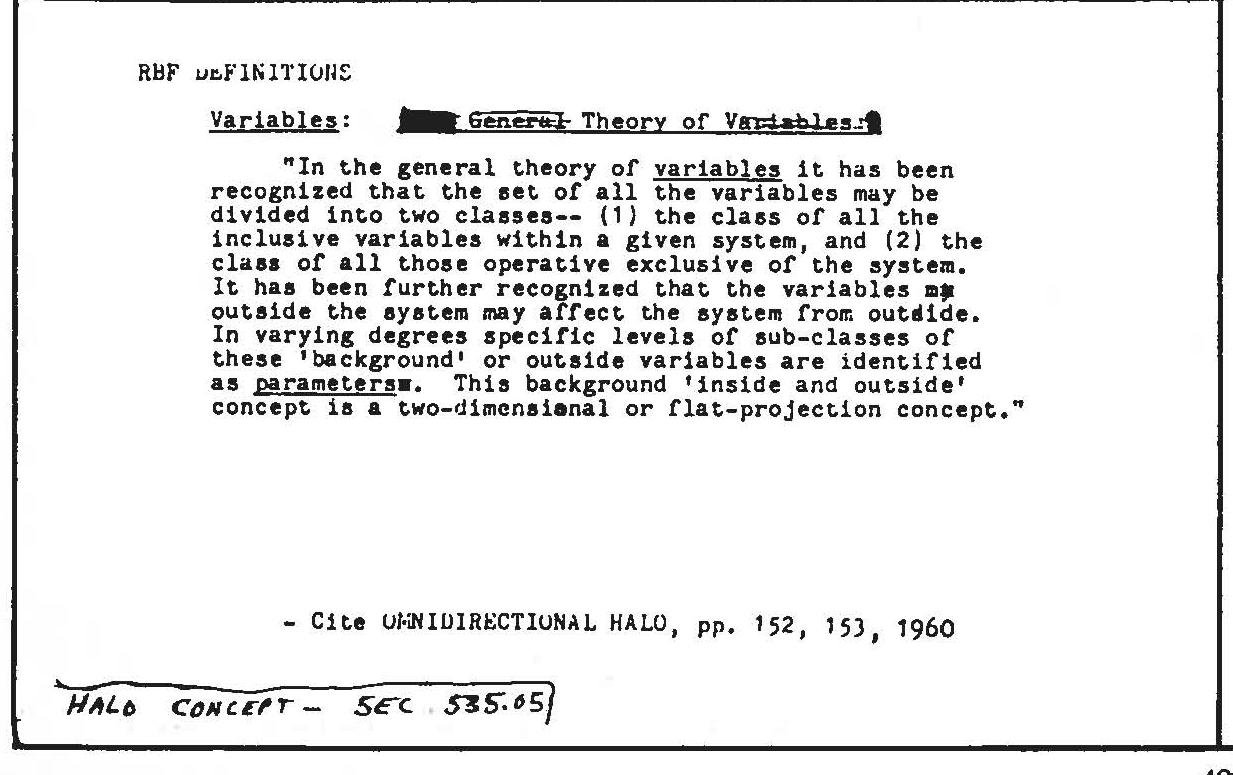
"In the general theory of variables it has been recognized that the set of all the variables may be divided into two classes-- (1) the class of all the inclusive variables within a given system, and (2) the class of all those operative exclusive of the system. It has been further recognized that the variables may outside the system may affect the system from outside. In varying degrees specific levels of sub-classes of these 'background' or outside variables are identified as parameters. This background 'inside and outside' concept is a two-dimensional or flat-projection concept."
- Cite OMNIDIRECTIONAL HALO, pp. 152, 153, 1960
Variable Strands Braiding
← Variables | Variables: Theory Of →
Cross Reference
Cross-References
Variables: Theory Of
← Variable Strands Braiding | Variable Variables (1) →
Cross Reference
Cross-References
Variable Variables (1)
← Variables: Theory Of | Variable Variables (2) →
Cross Reference
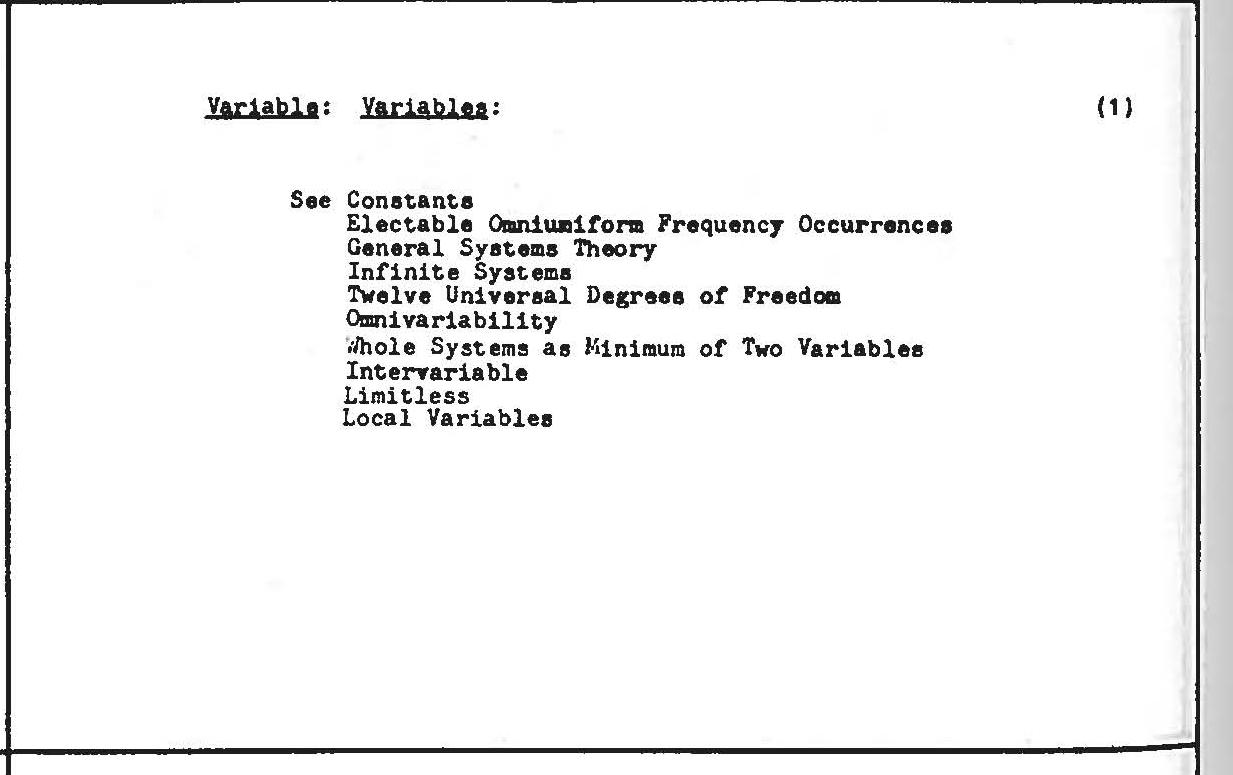
Electable Omniumuniform Frequency Occurrences
Intervariable
Cross-References
- Constants
- General Systems Theory
- Infinite Systems
- Twelve Universal Degrees of Freedom
- Omnivariability
- Whole Systems as Minimum of Two Variables
- Limitless
- Local Variables
Variable Variables (2)
← Variable Variables (1) | Variant Variation →
Cross Reference
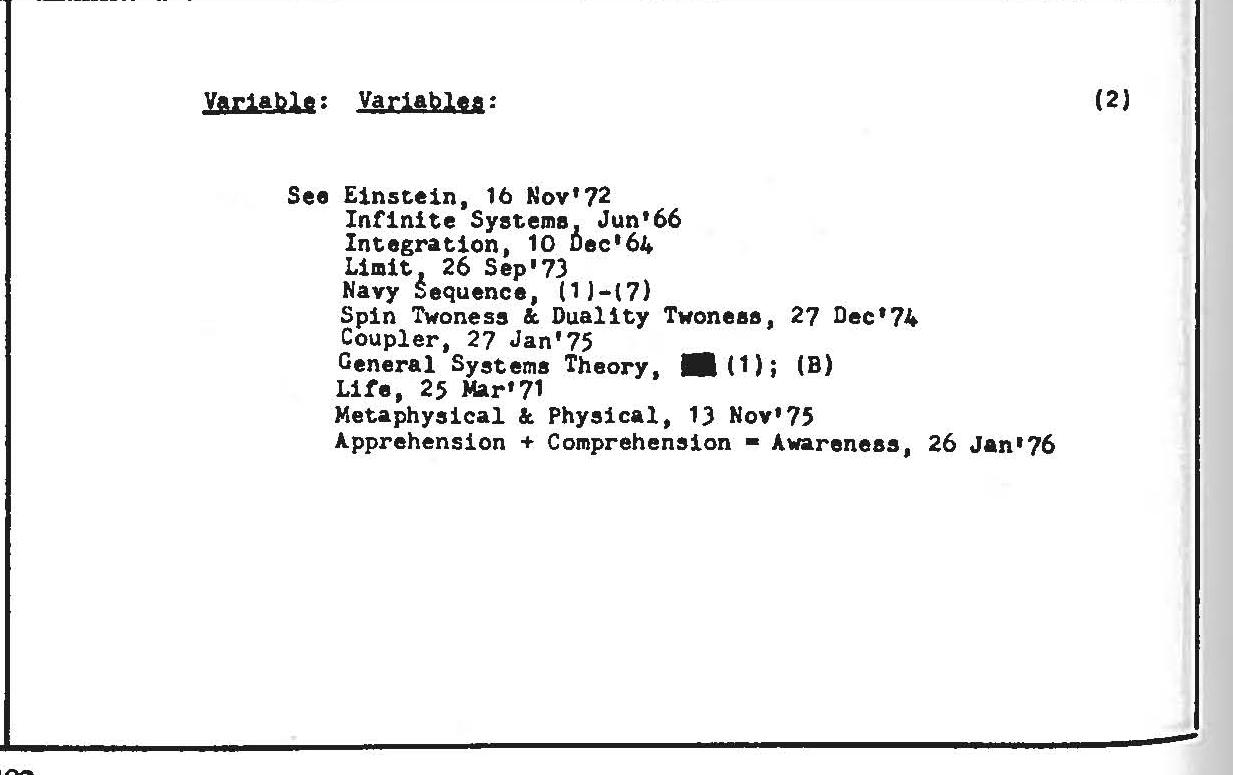
Cross-References
- Einstein, 16 Nov'72
- Infinite Systems, Jun'66
- Integration, 10 Dec'64
- Limit, 26 Sep'73
- Navy Sequence
- Spin Twoness & Duality Twoness, 27 Dec'74
- Coupler, 27 Jan'75
- General Systems Theory
- Life, 25 Mar'71
- Metaphysical & Physical, 13 Nov'75
- Apprehension + Comprehension = Awareness, 26 Jan'76
Variant Variation
← Variable Variables (2) | Vari-intertransformabilities →
Cross Reference
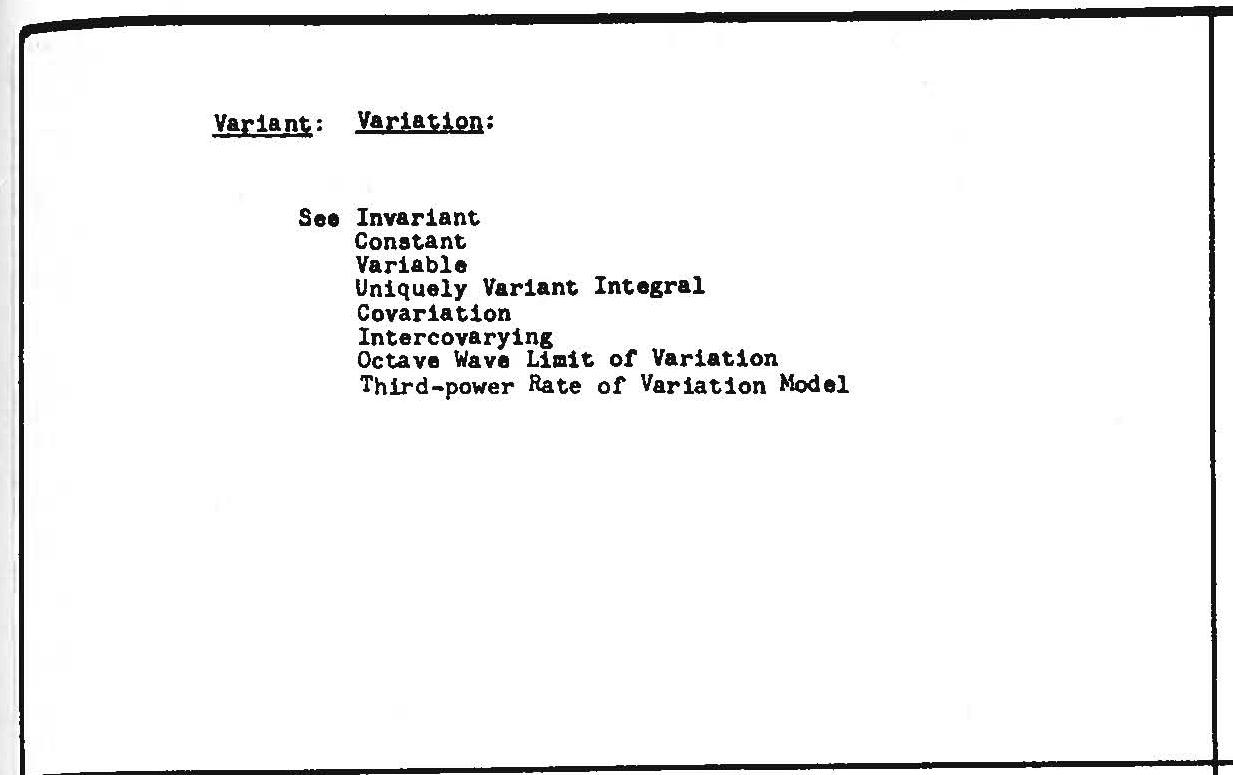
Constant
Variable
ave Wave Limit of Variation, Oct
Cross-References
Vari-intertransformabilities
← Variant Variation | Varsity Team of Universe (2) →
Cross Reference
Vari-intertransformabilities:
Cross-References
- Heres & Theres, 4 Jun'72
Varsity Team of Universe (2)
← Vari-intertransformabilities | Varsity →
Cross Reference
Cross-References
- Spherical Triangle, (2)
Varsity
← Varsity Team of Universe (2) | Vase (1) →
Cross Reference
Cross-References
- Work, Dec'72
Vase (1)
Cross Reference
Cross-References
Vase (2)
Cross Reference
Cross-References
- Flatland, 1 Oct'71
Vector
Index Entry
Vector:
"Vectors . . . exist only as energetic phenomena. A vector always represents a product of mass and the velocity of a given energy entity operating in a given angular direction in respect to a given axis of observational reference."
- Citation & context at Synergetics, 17 Oct'77
Vectors
Index Entry
Vectors:
"Do not refer to vectors as restraints. Vectors are capabilities, not restraints."
- Cite RBF to question by Dr. Michael Bruwer at World Game Workshop'77; Phila., PA: 22 Jun'77
Vector
Index Entry
Vector:
"So-called edges and vectors are inherently only convergent or divergent interrelationships between multiply-identifiable, point-to-able, vertex fixes."
- Cite SYNERGETICS text at Sec. \hrefhttps://www.buckyverse.org/en/synergetics/content/chapters/900-modelability#section-905.24905.24, 16 Dec'73
Vector
Index Entry
Vector:
"Every vector has two ends which it joins as unity."
- Cite Marginalis by RBF on first SYNERGETICS galley #71 (\hrefhttps://www.buckyverse.org/en/synergetics/content/chapters/400-system#section-421.00421.0: (not included in text for technical reasons only), 10 Nov'73
Vector
Index Entry
Vector:
"The vector is inherent in the synergetics system since it is structured with the vector as unity. Because vectors = mass x velocity, all the factors of time, distance, and energy, as both mass and effort as well as angular direction, are inherent; and E as energy quantum of one photon = 20 P²."
- Cite SYNERGETICS draft at Sec. \hrefhttps://www.buckyverse.org/en/synergetics/content/chapters/200-synergetics#section-223.75223.75, 26 Sep'73
Vector
Index Entry
Vector:
"First powering expresses only one vector, i.e., one-twelfth of relevant system potential."
- Citation and context at Powering: One Dimension, 15 Oct'72
Vector
Index Entry
Vector:
"The local energy content of a vector is its mass times its velocity."
- Cite RBF to EJA, Beverly Hotel, NY, 22 Jun'72
Vector
RBF Definitions
"... Vectors, being the product of physical energy constituents, are 'real,' having velocity multiplied by mass operating in a specific direction; velocity being a product of time and size modules; and mass being a volume-weight relationship. On impact, mass at velocity transforms into heat and work. These energy factors can be translated not only into work, but into heat, or into time as well."
- Citation at Time, 27 May'72
Citations
- SYNERGETICS draft, Sec. \href{https://www.buckyverse.org/en/synergetics/content/chapters/400-system#section-410.05}{410.05}, RBF rewrite of 27/5-May'72
Vector
Index Entry
Vector:
"A vector manifests a unique energy event-- either potential or realized-- expressed discretely in terms of direction, mass, velocity, and distance. A vector is a partial generalization being either metaphysically theoretical or physically realized, and in either sense an abstraction of a special case, as are numbers both abstract (empty sets) or special case (filled sets)."
Vector
Index Entry
Vector:
"All the interrelationships of system foci are conceptually representable by vectors. A system is a closed configuration of vectors. It is a pattern of forces constituting a geometrical integrity which returns upon itself in a plurality of directions."
- Citation and context AT Polyhedral Systems, 25/2 May'72
Vector
Index Entry
Vector:
"Time is in our dimensioning because our geometry is vectorial. Every vector = mass x velocity, and time is a function of velocity."
-
Citation & context at Time, 21 Dec'71
-
Citation from EJA, 3200 Idaho, Washington DC, 21 Dec'71.
Vector
Index Entry
Vector:
"Vectors are not abstractions: they are resolutions."
(Synergetics: \hrefhttps://www.buckyverse.org/en/synergetics/content/chapters/900-modelability#section-962.40962.40)
(New context at Time-size, 30 Oct'72
- Cite RBF to EJA, 3200 Idaho, Washington DC, 21 Dec. '71.
Vector
Index Entry
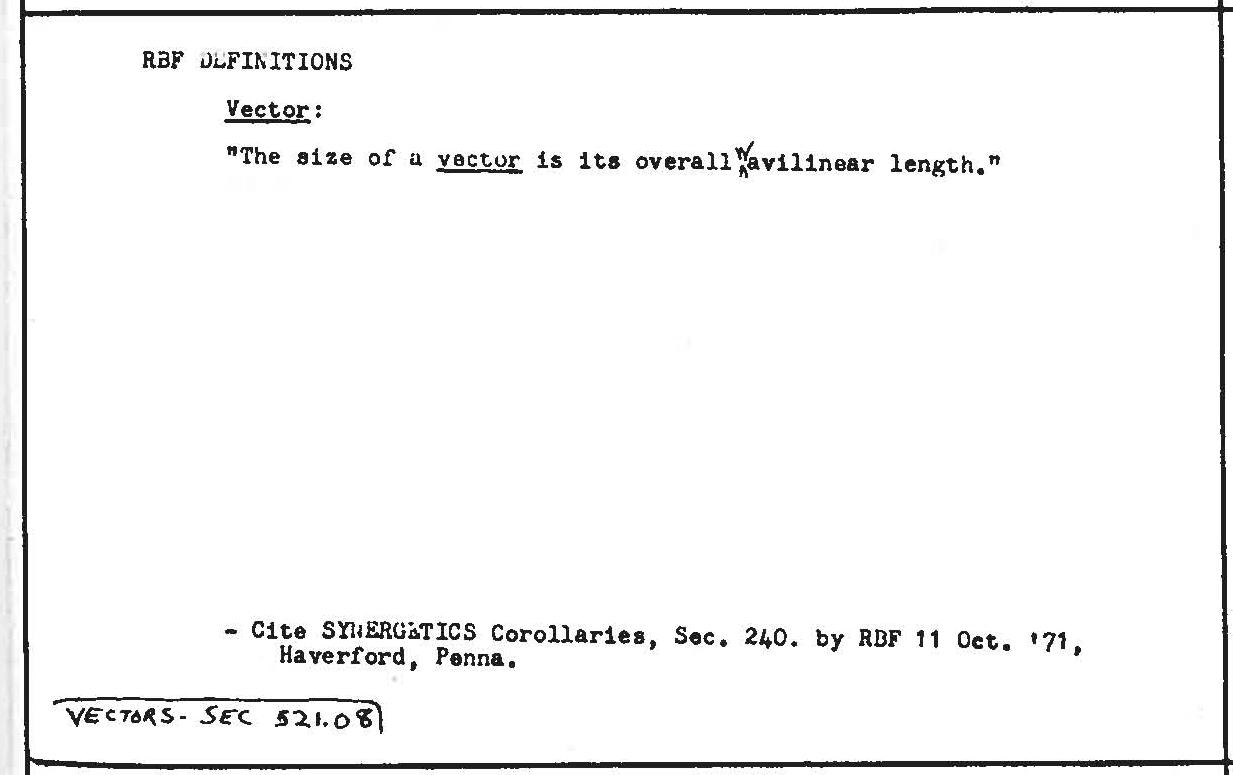
Vector:
"The size of a vector is its overall wavilinear length."
- Cite SYNERGETICS Corollaries, \hrefhttps://www.buckyverse.org/en/synergetics/content/chapters/200-synergetics#section-240.00240. by RBF 11 Oct. '71, Haverford, Penna.
Vector
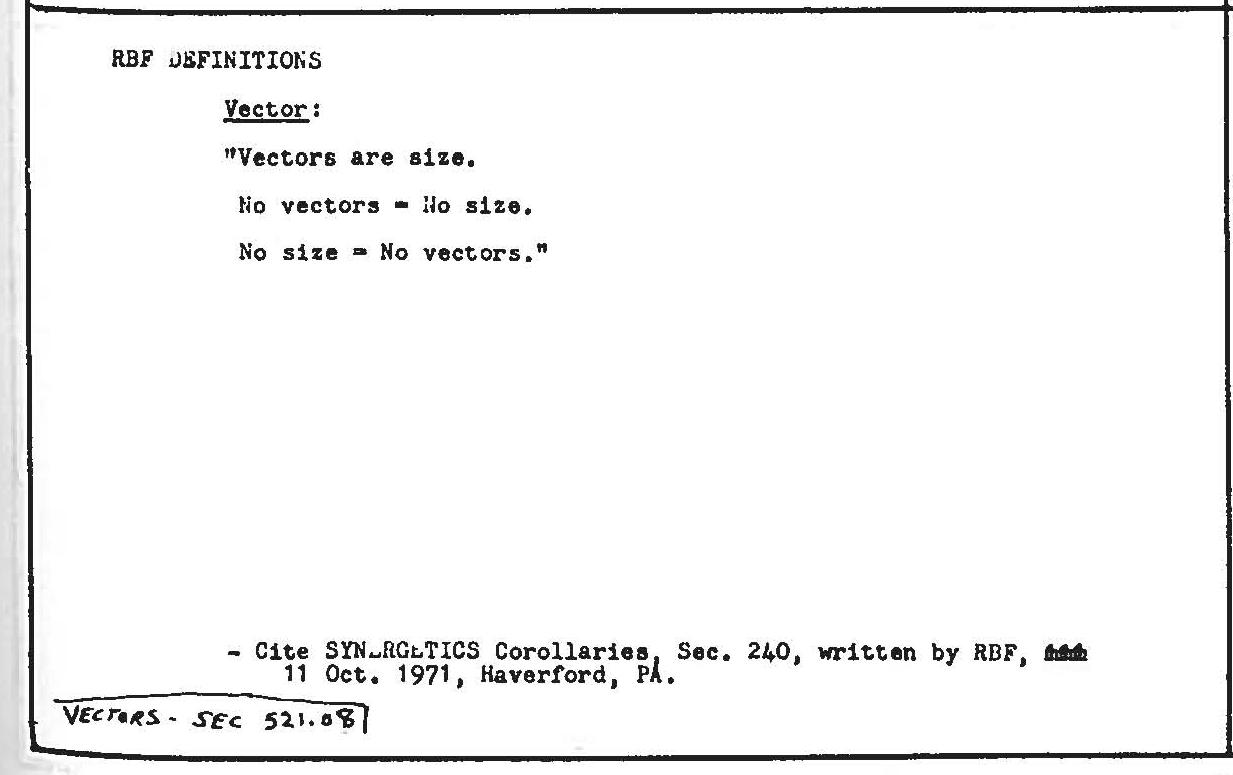
Index Entry
Vectors are size.
No vectors = No size.
No size = No vectors.
Vector
Index Entry
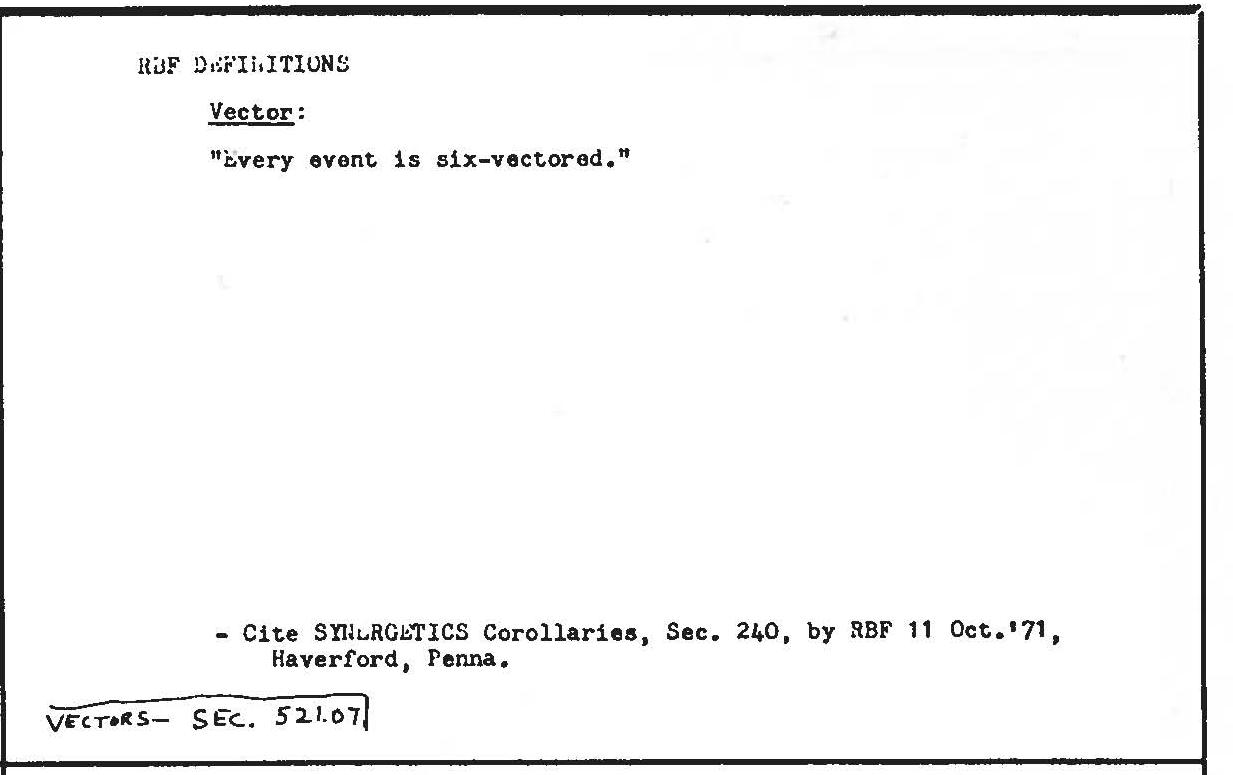
Vector:
"Every event is six-vectored."
- Cite SYNERGETICS Corollaries, \hrefhttps://www.buckyverse.org/en/synergetics/content/chapters/200-synergetics#section-240.00240, by RBF 11 Oct.'71, Haverford, Penna.
VECTORS- SEC. \hrefhttps://www.buckyverse.org/en/synergetics/content/chapters/500-conceptuality#section-521.07521.07
Vector
Index Entry
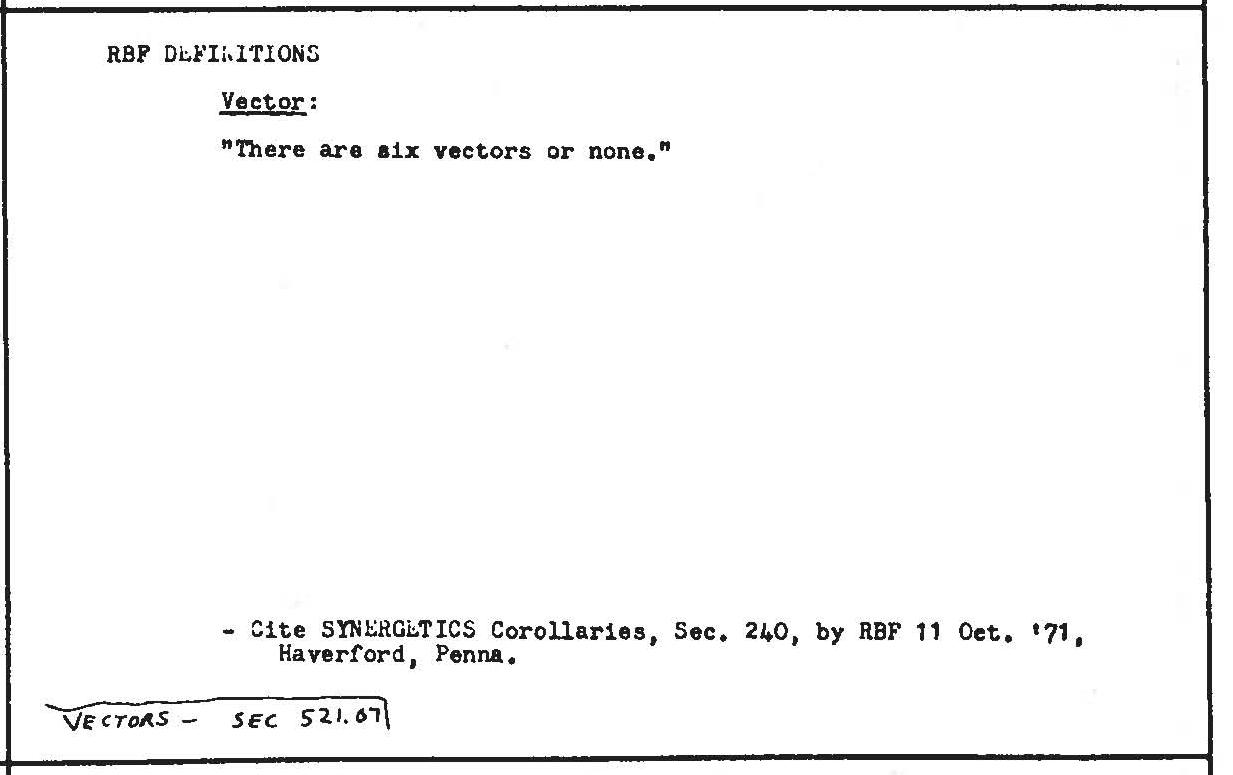
Vector:
"There are six vectors or none."
- Cite SYNERGETICS Corollaries, \hrefhttps://www.buckyverse.org/en/synergetics/content/chapters/200-synergetics#section-240.00240, by RBF 11 Oct. '71, Haverford, Penna.
Vector
Index Entry
Vector:
"You have six vectors or none for every energy event."
(EJA comment: A query to RBF in May'72 confirms that the intent of the above is that there cannot be less than six vectors. It does not mean that there can be an event with no vectors.)
- Cite RBF to Eja, Washington, DC, 7 Oct. '71.
Vectors
Index Entry
Vectors:
"Sum totally the four hexagons [of the vector equilibrium] have 24 radial disintegrative vectors and 24 chordally integrative vectors. The unique planes of any two hexagons of the set of four interact with one another in such a manner that the line of interaction (intersection) of the planes is congruent with the radially defined diameters of the two hexagons. This paired congruency of the 24 radial disintegrative vectors of the four hexagons reduces their visible number to 12. While the 24 chordal integrative vectors remain non-congruent and appear as 24. The congruence of vectors occurs many times in nature's coordinate structuring and de-structuring and often misleads the uninformed observer."
- Cite RBF Marginalis, Bear Island, 25 Aug. '71, Synergetics, Sec. \hrefhttps://www.buckyverse.org/en/synergetics/content/chapters/800-operational-mathematics#section-851.72851.72 \hrefhttps://www.buckyverse.org/en/synergetics/content/chapters/1000-omnitopology#section-1011.401011.40
Vectors
Index Entry
Vectors:
"Now we have what we call vectors. Vectors represent energy experiences. A vector is a line going in a specific direction in relation to to two points giving you an axis, say your head and your feet. That gives you an axis of reference and then you have a vector, an energy action moving at some angle in relation to that axis of yours. And the length of the line is arrived at by multiplying the mass times the velocity. Those then are energy vectors. And energy vectors are extremely useful because they do represent actual experience in relation to yourself as observer. It acts as a reference."
- Cite RBF at SINS Seminar, U. Mass., Amherst, 22 July '71, p. 19
Vector
Index Entry
Vector:
"Since neither light nor any other experiential phenomena are instantaneous, than an action and the vector by which it is manifest is linear. If it were instantaneous it would be less than a point."
- Cite RBF SYNERGETICS Draft Mar '71
Vector
Index Entry
Vector:
"A vector manifests a unique energy event
expressed discretely in term of direction, mass
velocity and distance."
- Cite RBF in SYNERGETICS Draft
March 1971
Vectors
Index Entry
Vectors:
"Vectors always and only coexist with two other vectors, whether or not expressed, i.e., every event has its nonsimultaneous action, reaction and resultant."
- Cite RBF Marginalis on SYNERGETICS Draft, \hrefhttps://www.buckyverse.org/en/synergetics/content/chapters/600-structure#section-604.00604, March 1971.
Vectors
Index Entry
Vectors:
"Vectors are curvilinear lines of very high frequency regeneration of energy events whose high frequency short wavelengths only superficially appear to be straight."
- Cite RBF to Hans Meyer in H.M. Memo 6f 23 January 1971 as re-written by RBF on insert at \hrefhttps://www.buckyverse.org/en/synergetics/content/chapters/600-structure#section-601.00601 of SYNERGETICS Draft, March 1971.
Vector
Index Entry
Vector:
"A vector is a very high frequency line of energy
which looks superficially 'straight.'"
(Adapted.)
- Cite RBF to Hans Meyer in H.M. memo
of 23 January 1971.
Vector
Index Entry
Vectors are spearlike lines representing the integrated velocities, directions, and masses of the total aggregate of nonredundant forces operating complexedly with a given energy event as the latter transpires within a generalized environment of other experiences whose angular orientations and interdistance relationships are known.
Every physical event in nonsimultaneous scenario Universe is characterized by three, multidimensionally interlinked vectors which interact at angles other than 180° to one another as in the multidimensionally, helically zigzagging pattern of lightning.
Vector
Index Entry
Vectors as lines don't go to infinity; they are absolutely discrete. It always has angular direction in respect to other experiences. Now that is a vector.
Vector
Index Entry
Vector:
"A vector is a line as a discrete unit of energy expressed in terms of mass, velocity and distance."
- Cite DEFINITIONS FOR SYNERGETICS BY PETER PEARCE, May'67
Vector
Index Entry
Since "neither light nor any other phenomenon is instantaneous, then an action and the vector it creates is not instantaneous. Therefore the terminal end of an action's vector occurs later. (Adapted.)
Vectors
Index Entry
Vectors:
"What do we mean by lines? We can say that because lines are directional energy events, they are vectors. A vector always has direction, relative to other events, and its length, or energy magnitude, always represents the product of its velocity multiplied by its mass. The direction is an angular one in respect to an omnidirectional coordinate system having a specific central point and a specific set of external points at specific angles and distances from one another and from the central point."
.- Cite CARBONFILE-ART-H.25
Vector
Index Entry
Vector:
"Because lines are directional energy events they are vectors. A vector always has direction, relative to other events and its length or energy magnitude always represents the product of its velocity multiplied by its mass. The direction is an angular one in respect to an omni-directional coordinate system having a specific central point and a specific set of external points at specific angles and distances from one another and from the central point."
LAST SENTENCE = AXIS OF REFERENCE- SEC. \hrefhttps://www.buckyverse.org/en/synergetics/content/chapters/500-conceptuality#section-514.02514.02
FIRST HALF = VECTORS - SEC \hrefhttps://www.buckyverse.org/en/synergetics/content/chapters/500-conceptuality#section-521.02521.02
Vector
Index Entry
Vectors have unique direction in relation to other experiences; they have mass times velocity and they are discrete in length.
- Cite LEDGEMONT, pn 6-7, 15 Oct '64
Vector
Index Entry
Vector:
"For every point (q.v.) in universe there are six uniquely and exclusively operative vectors.
"Each vector is reversible having its negative alternate.
"Every point may export all or any of its six positive or six negative vectors by importing like numbers.
"Each point in universe could be said to have twelve unique and exclusive vectors, but one set of six is operative and its alternate reverse effect set is only potential."
Cite COLLIER'S, P. 113, Oct '59
Vector
Index Entry
Vector:
"Vectors describe energy conditions."
- For citation and context see Isotropic Vector Matrix, Jun '66
Vector
← Vector | Vectorial Advantage →
Index Entry
Vectors are real experiences and they have inherent velocity and mass.
Vectorial Advantage
← Vector | Vectors - Capabilities →
Cross Reference
Cross-References
- Gravity, 21 Dec'71
Vectors - Capabilities
← Vectorial Advantage | Vector Center Fix →
Cross Reference
Cross-References
- Vectors, 22 Jun'77
Vector Center Fix
← Vectors - Capabilities | Vector Constant →
Cross Reference
Cross-References
- Isotropic Vector Matrix, 30 Nov'72
Vector Constant
← Vector Center Fix | Vectorial Convergence (1) →
Cross Reference
Cross-References
Vectorial Convergence (1)
← Vector Constant | Vectorial Convergence (2) →
Cross Reference
Cross-References
- Twist Vertex
- Uni-angular Vectorial Convergence
- Vertexial Connections
Vectorial Convergence (2)
← Vectorial Convergence (1) | Vectorial Expression of Mass & Frequency →
Cross Reference
Cross-References
- Convergence, 16 Nov'72
Vectorial Expression of Mass & Frequency
← Vectorial Convergence (2) | Vectorial Geometry Field →
Cross Reference
Cross-References
- Powering: Fourth Powering, 15 Oct'72 ; 9 Sep'75
Vectorial Geometry Field
← Vectorial Expression of Mass & Frequency | Vectorial Geometry Field (1) →
Index Entry
Vectorial Geometry Field:
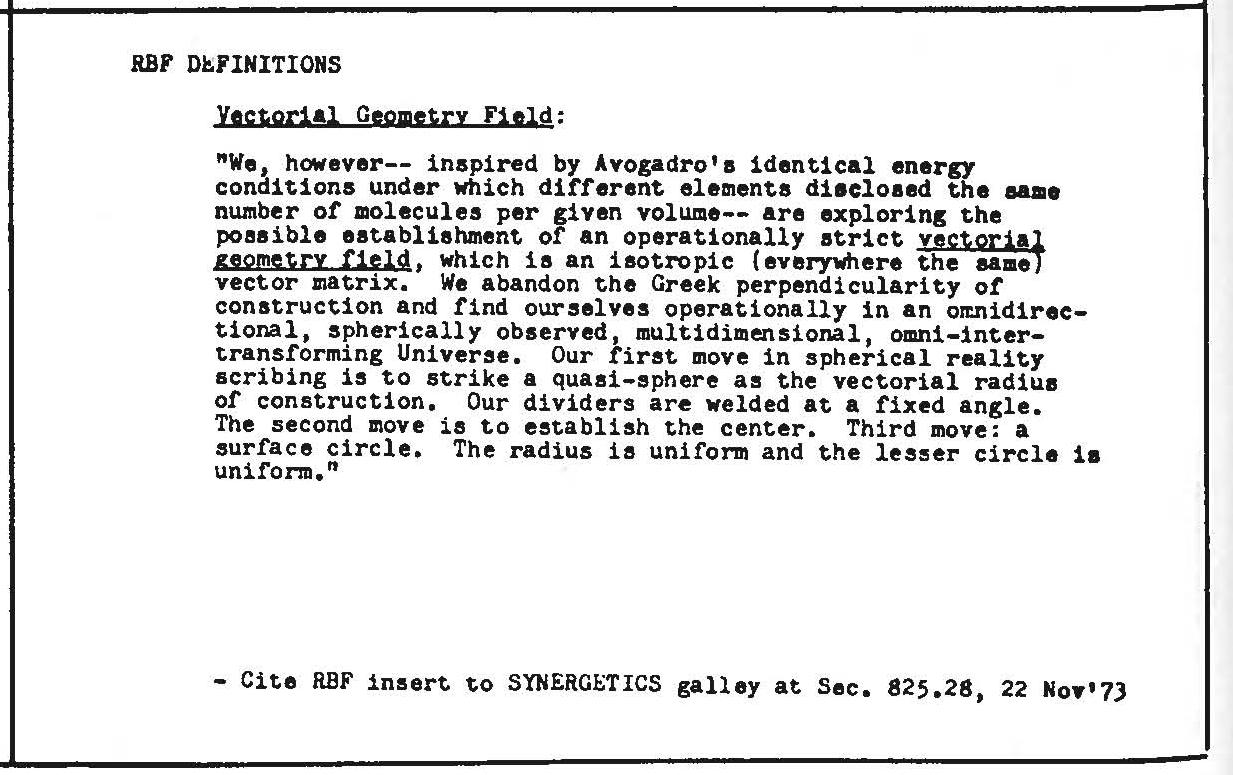
"We, however-- inspired by Avogadro's identical energy conditions under which different elements disclosed the same number of molecules per given volume-- are exploring the possible establishment of an operationally strict vectorial geometry field, which is an isotropic (everywhere the same) vector matrix. We abandon the Greek perpendicularity of construction and find ourselves operationally in an omnidirectional, spherically observed, multidimensional, omni-intertransforming Universe. Our first move in spherical reality scribing is to strike a quasi-sphere as the vectorial radius of construction. Our dividers are welded at a fixed angle. The second move is to establish the center. Third move: a surface circle. The radius is uniform and the lesser circle is uniform."
- Cite RBF insert to SYNERGETICS galley at Sec. \hrefhttps://www.buckyverse.org/en/synergetics/content/chapters/800-operational-mathematics#section-825.28825.28, 22 Nov'73
Vectorial Geometry Field (1)
← Vectorial Geometry Field | Vectorial Geometry Field (2) →
Cross Reference
Cross-References
Vectorial Geometry Field (2)
← Vectorial Geometry Field (1) | Vectorial Geometry →
Cross Reference
Cross-References
- Geometry of Vectors, Aug'71
- Sixty-degree Modulatability, 19 Nov'72
Vectorial Geometry
← Vectorial Geometry Field (2) | Vector: Half Vectors →
Cross Reference
Cross-References
Vector: Half Vectors
← Vectorial Geometry | Vector: Half Vectors →
Index Entry
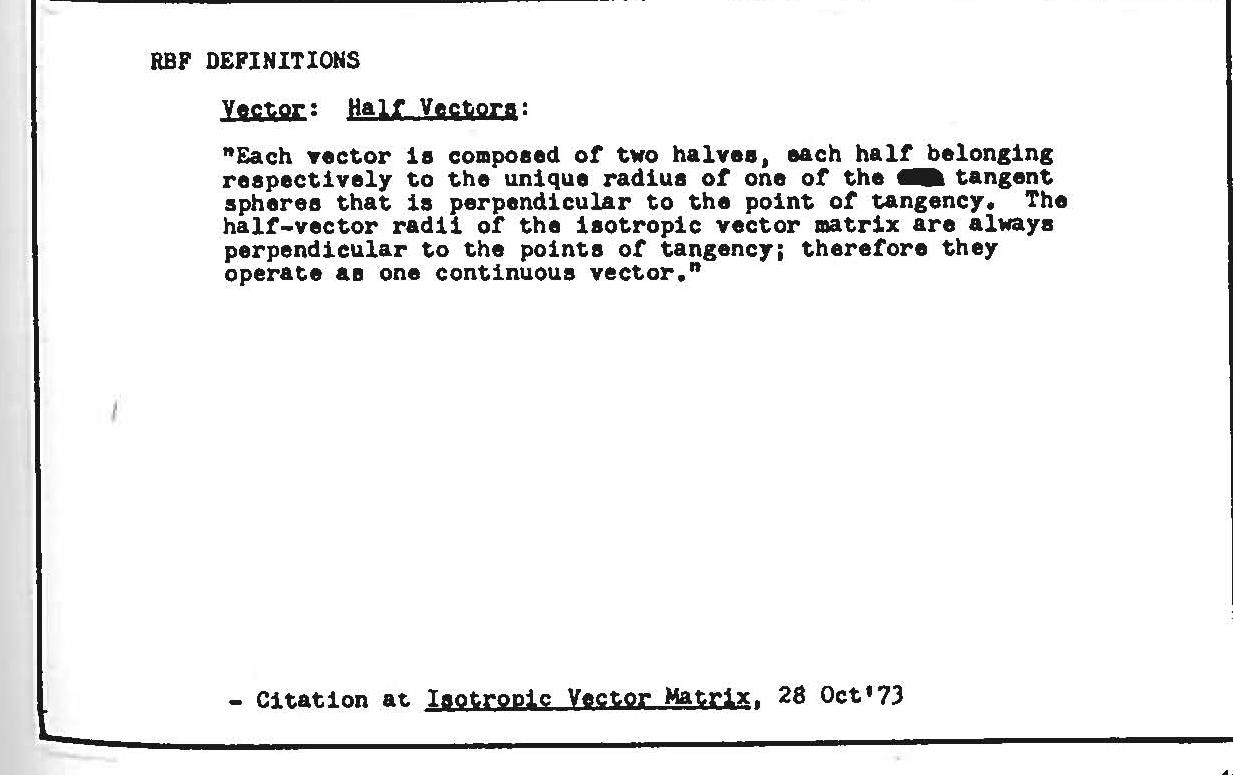
Each vector is composed of two halves, each half belonging respectively to the unique radius of one of the tangent spheres that is perpendicular to the point of tangency. The half-vector radii of the isotropic vector matrix are always perpendicular to the points of tangency; therefore they operate as one continuous vector.
- Citation at Isotropic Vector Matrix, 28 Oct'73
Vector: Half Vectors
← Vector: Half Vectors | Vector Half Vectors (1) →
Index Entry
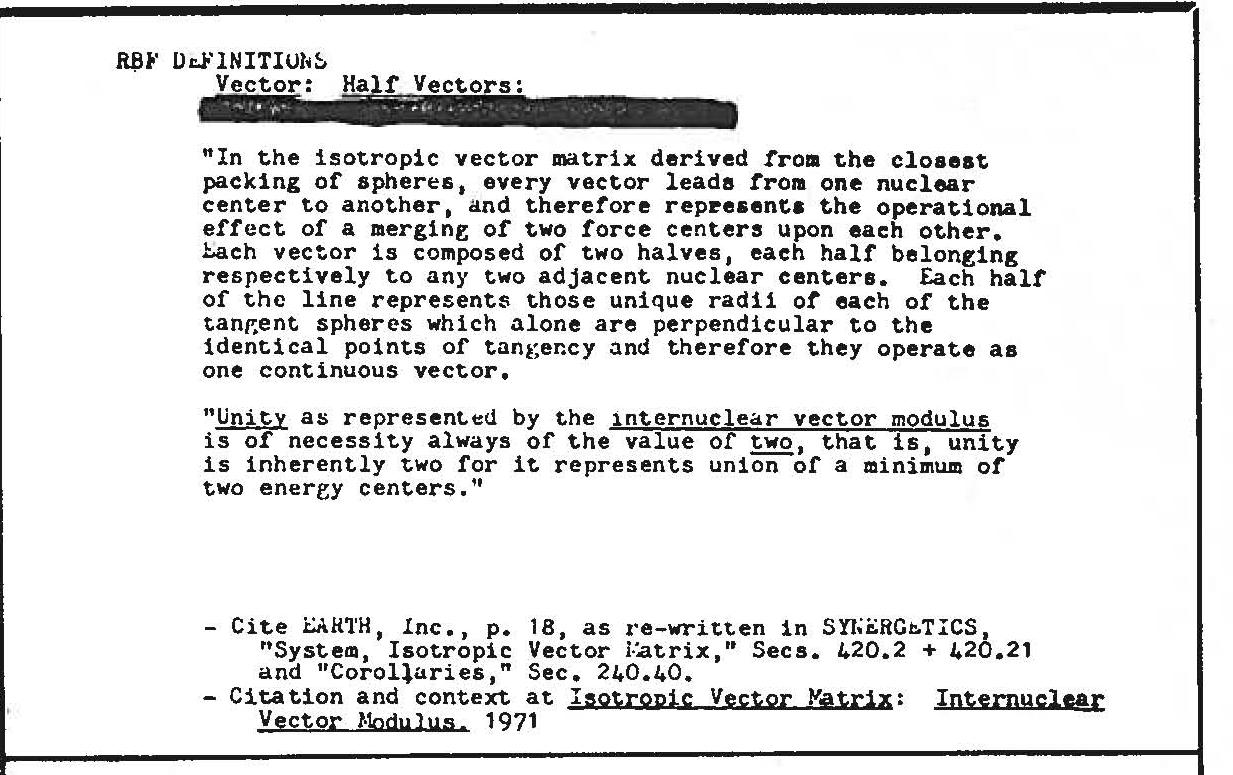
In the isotropic vector matrix derived from the closest packing of spheres, every vector leads from one nuclear center to another, and therefore represents the operational effect of a merging of two force centers upon each other. Each vector is composed of two halves, each half belonging respectively to any two adjacent nuclear centers. Each half of the line represents those unique radii of each of the tangent spheres which alone are perpendicular to the identical points of tangency and therefore they operate as one continuous vector.
"Unity as represented by the internuclear vector modulus is of necessity always of the value of two, that is, unity is inherently two for it represents union of a minimum of two energy centers."
Vector Half Vectors (1)
← Vector: Half Vectors | Vector: Half Vectors (2) →
Cross Reference
Cross-References
Vector: Half Vectors (2)
← Vector Half Vectors (1) | Vectorial Model of Interference →
Cross Reference
Cross-References
- Compression, 9 Jul'62
- Infinity & Finity, (1)
- Pauling, Linus, 7 Oct'71
- Tidal, 31 May'71
Vectorial Model of Interference
← Vector: Half Vectors (2) | Vector Modelability →
Index Entry
Vectorial Model of Interference:
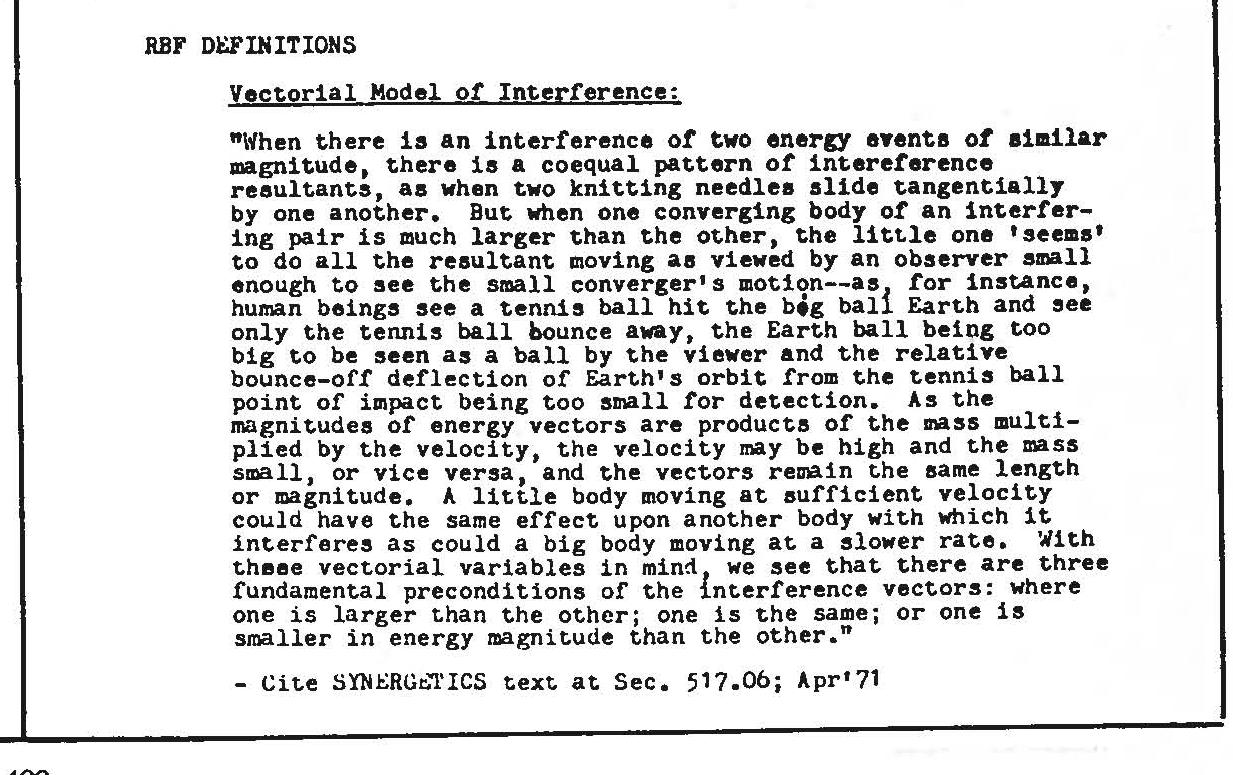
"When there is an interference of two energy events of similar magnitude, there is a coequal pattern of interference resultants, as when two knitting needles slide tangentially by one another. But when one converging body of an interfering pair is much larger than the other, the little one 'seems' to do all the resultant moving as viewed by an observer small enough to see the small converger's motion--as, for instance, human beings see a tennis ball hit the big ball Earth and see only the tennis ball bounce away, the Earth ball being too big to be seen as a ball by the viewer and the relative bounce-off deflection of Earth's orbit from the tennis ball point of impact being too small for detection. As the magnitudes of energy vectors are products of the mass multiplied by the velocity, the velocity may be high and the mass small, or vice versa, and the vectors remain the same length or magnitude. A little body moving at sufficient velocity could have the same effect upon another body with which it interferes as could a big body moving at a slower rate. With these vectorial variables in mind, we see that there are three fundamental preconditions of the interference vectors: where one is larger than the other; one is the same; or one is smaller in energy magnitude than the other."
Vector Modelability
← Vectorial Model of Interference | Vectorial Model for Magic Numbers →
Cross Reference
Quantum Mechanics: Minimum Geometrical Fourbess,
(4)
Cross-References
- Graphable, 2 May'72
Vectorial Model for Magic Numbers
← Vector Modelability | Vectorial Near-miss →
Cross Reference
Vectorial Model for Magic Numbers:
Cross-References
Vectorial Near-miss
← Vectorial Model for Magic Numbers | Vectorial Orientation →
Cross Reference
Cross-References
- Twisting, 20 Dec'73
Vectorial Orientation
← Vectorial Near-miss | Vectorial Orientation (1) →
Index Entry
Vectorial Orientation:
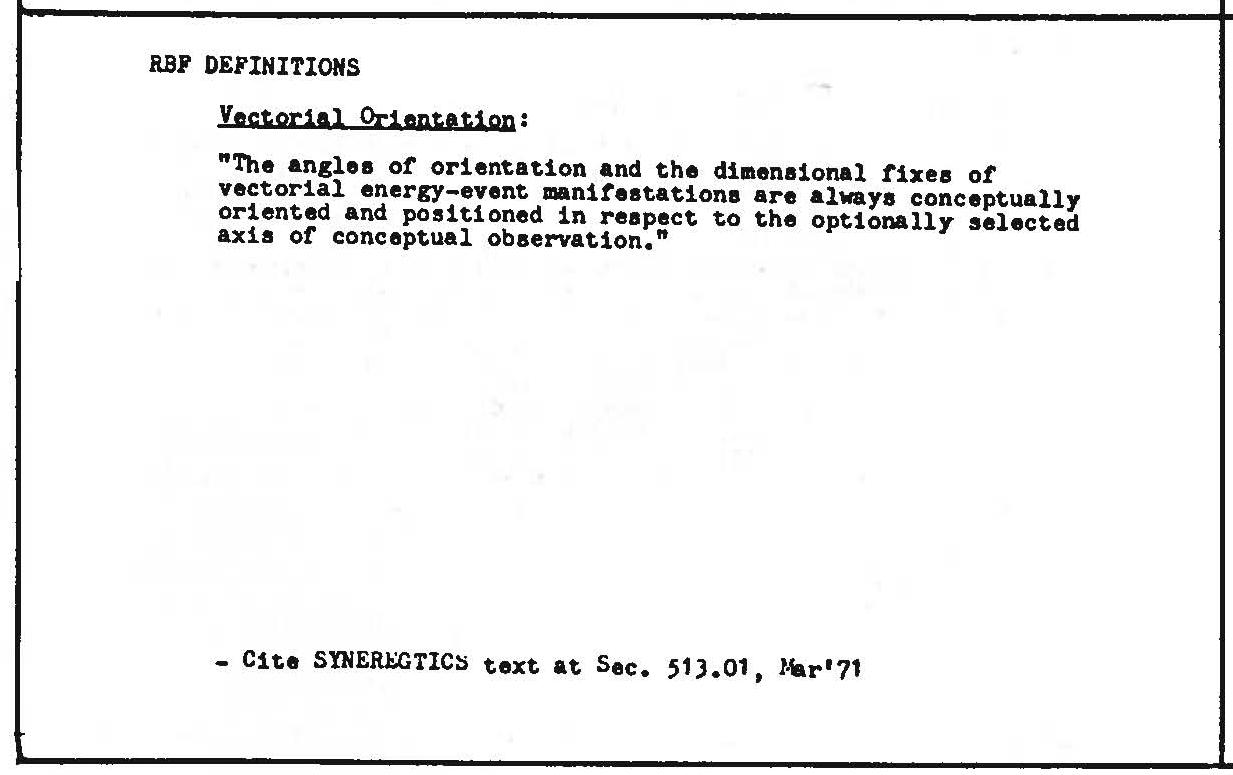
"The angles of orientation and the dimensional fixes of vectorial energy-event manifestations are always conceptually oriented and positioned in respect to the optionally selected axis of conceptual observation."
- Cite SYNERGETICS text at Sec. \hrefhttps://www.buckyverse.org/en/synergetics/content/chapters/500-conceptuality#section-513.01513.01, Mar'71
Vectorial Orientation (1)
← Vectorial Orientation | Vectorial Orientation (2) →
Cross Reference
Orientation
Cross-References
Vectorial Orientation (2)
← Vectorial Orientation (1) | Vector as 1/12th of Relevant System Potential →
Cross Reference
Cross-References
- Synergetics, 24 Sep'73
Vector as 1/12th of Relevant System Potential
← Vectorial Orientation (2) | Vector as 1/12th of Relevant System Potential (1) →
Cross Reference
Vector as 1/12th of Relevant System Potential: "First powering expresses only one vector, 1.e., 1/12th of relevant system potential."
Cross-References
- Powering, 15 Oct'72
Vector as 1/12th of Relevant System Potential (1)
← Vector as 1/12th of Relevant System Potential | Vector as 1/12th of Relevant System Potential (2) →
Cross Reference
Cross-References
Vector as 1/12th of Relevant System Potential (2)
← Vector as 1/12th of Relevant System Potential (1) | Vectors Are Real →
Cross Reference
Cross-References
- Powering, 15 Oct'72*
Vectors Are Real
← Vector as 1/12th of Relevant System Potential (2) | Vectors Are Real →
Index Entry
Vectors Are Real:
"...God is 99.9999 percent of Universe and the six total vectors come back upon themselves, for the vectors are real."
- Citation & context at Heaven, 23 May'72
Vectors Are Real
← Vectors Are Real | Vectors f Restraints →
Cross Reference
Cross-References
- In, Out & Around, Nov'71
Vectors f Restraints
Cross Reference
Cross-References
- Vectors, 22 Jun'77
Vector
← Vectors f Restraints | Vectorial Symmetry →
Cross Reference
One-second Vector Length:
Cross-References
- Vector Equilibrium, 2 Nov'73
Vectorial Symmetry
← Vector | Vectorial System Modular Frequency →
Cross Reference
Cross-References
- Vector Equilibrium, 19 Feb'72
Vectorial System Modular Frequency
← Vectorial Symmetry | Vector-tensor Mensurability (2) →
Cross Reference
Cross-References
- Powering: Sixth Dimension, 28 Oct'73
Vector-tensor Mensurability (2)
← Vectorial System Modular Frequency | Vectors & Tensors →
Cross Reference
Cross-References
- Vector Equilibrium, (2)
Vectors & Tensors
← Vector-tensor Mensurability (2) | Vectors & Tensors →
Index Entry
Vectors & Tensors:
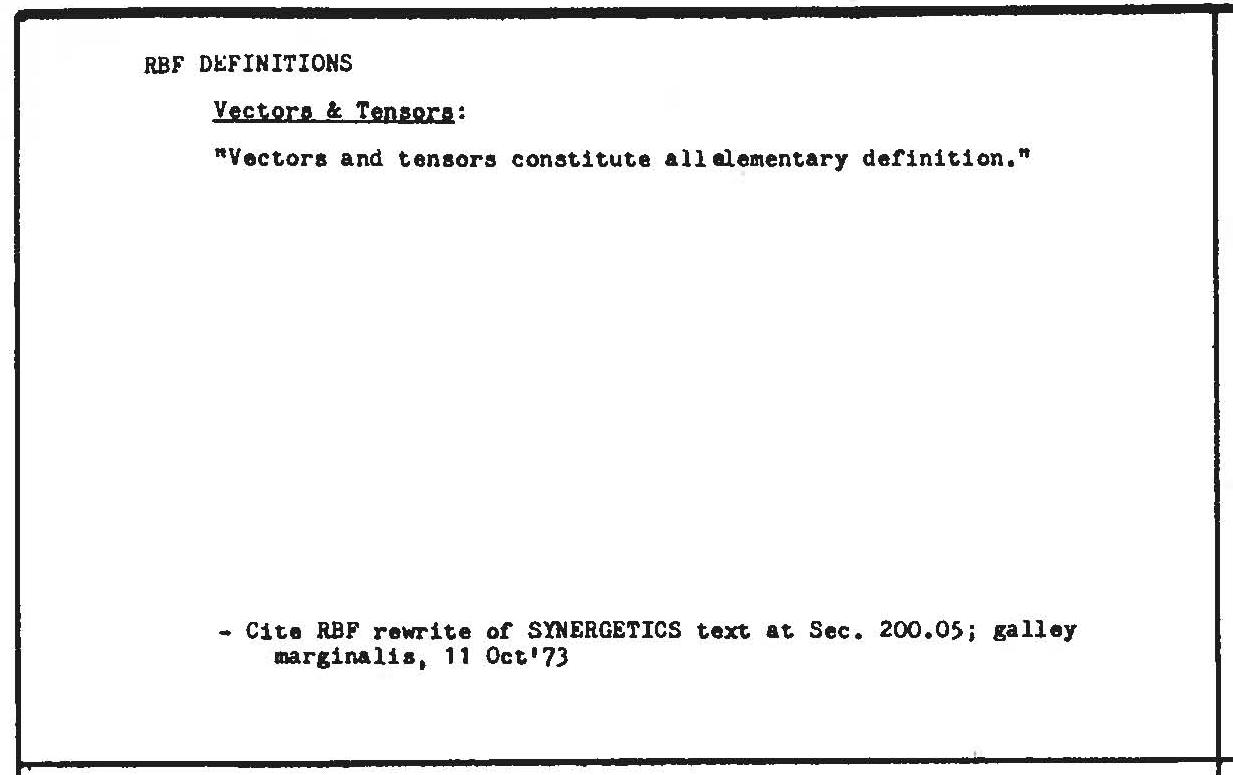
"Vectors and tensors constitute all elementary definition."
- Cite RBF rewrite of SYNERGETICS text at Sec. \hrefhttps://www.buckyverse.org/en/synergetics/content/chapters/200-synergetics#section-200.05200.05; galley marginalis, 11 Oct'73
Vectors & Tensors
← Vectors & Tensors | Vectors & Tensors →
Index Entry
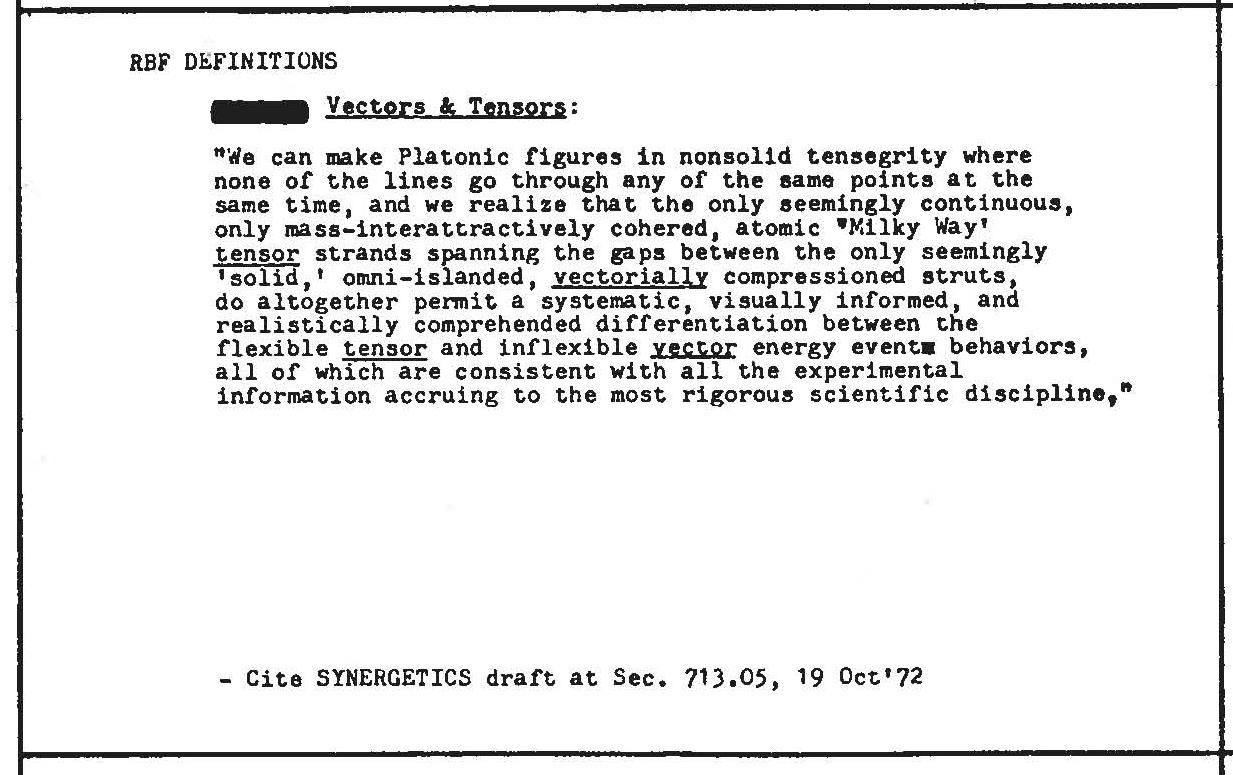
We can make Platonic figures in nonsolid tensegrity where none of the lines go through any of the same points at the same time, and we realize that the only seemingly continuous, only mass-interattractively cohered, atomic "Milky Way' tensor strands spanning the gaps between the only seemingly 'solid,' omni-islanded, vectorially compressed struts, do altogether permit a systematic, visually informed, and realistically comprehended differentiation between the flexible tensor and inflexible vector energy event behaviors, all of which are consistent with all the experimental information accruing to the most rigorous scientific discipline,
Vectors & Tensors
← Vectors & Tensors | Vectors & Tensors →
Index Entry
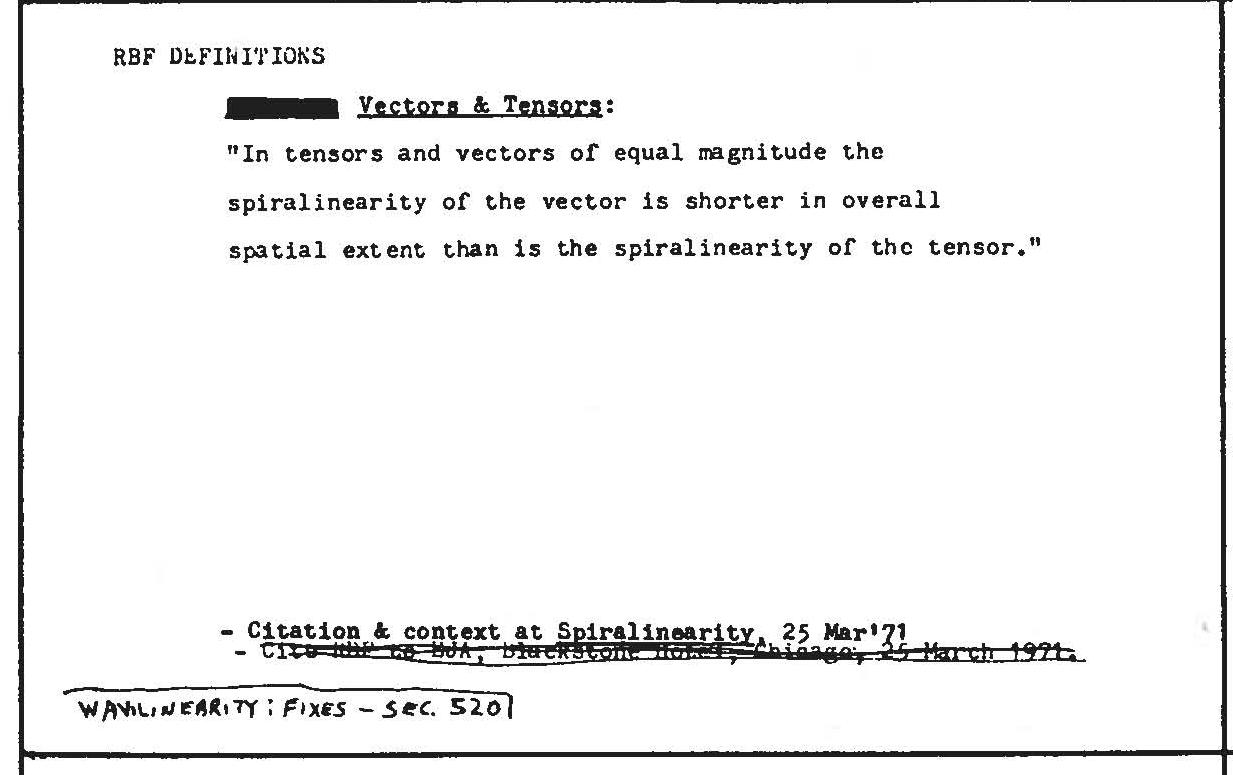
Vectors & Tensors:
"In tensors and vectors of equal magnitude the spiralinearity of the vector is shorter in overall spatial extent than is the spiralinearity of the tensor."
-
Citation & context at Spiralinearity, 25 Mar'71
-
Cite RBF to EJA, Blackstone Hotel, Chicago, 25 March 1971.
Vectors & Tensors
← Vectors & Tensors | Vectors & Tensors →
Index Entry
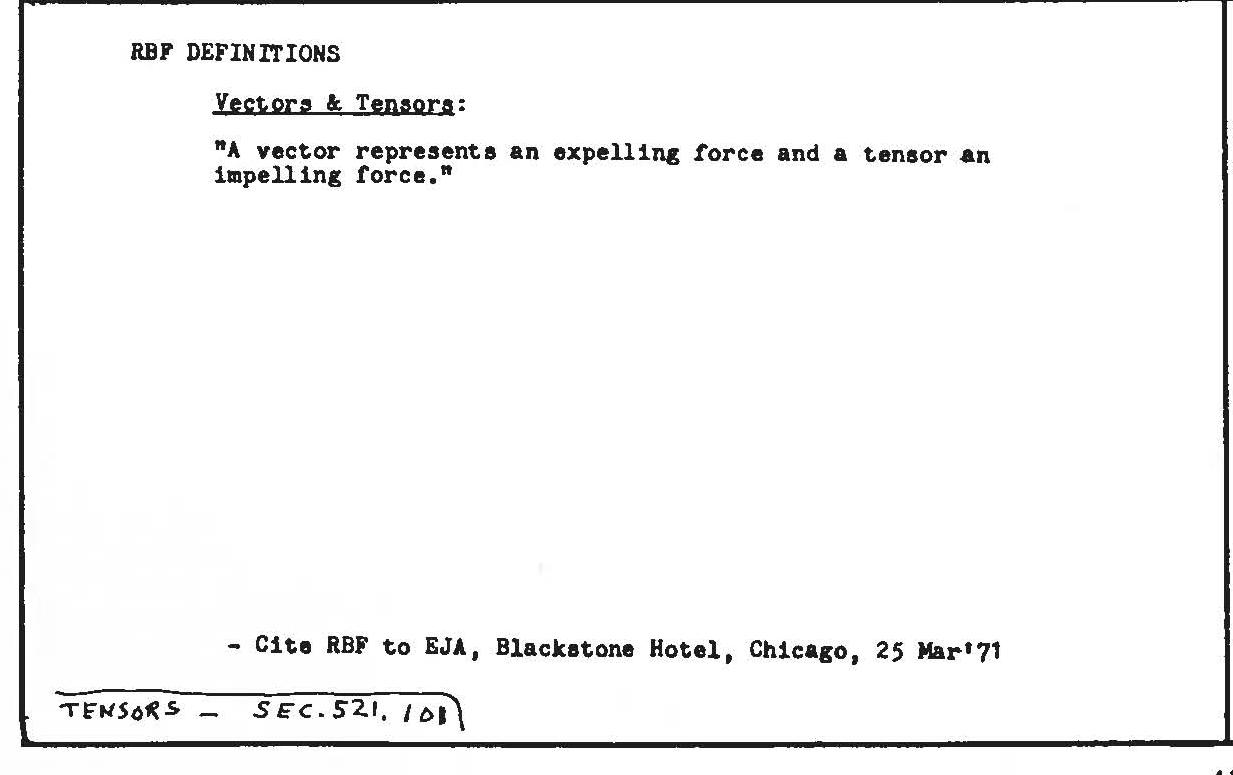
Vectors & Tensors:
"A vector represents an expelling force and a tensor an impelling force."
- Cite RBF to EJA, Blackstone Hotel, Chicago, 25 Mar'71
TENSORS - SEC.\hrefhttps://www.buckyverse.org/en/synergetics/content/chapters/500-conceptuality#section-521.101521.101
Vectors & Tensors
← Vectors & Tensors | Vectors & Tensors Vector-tensor →
Index Entry
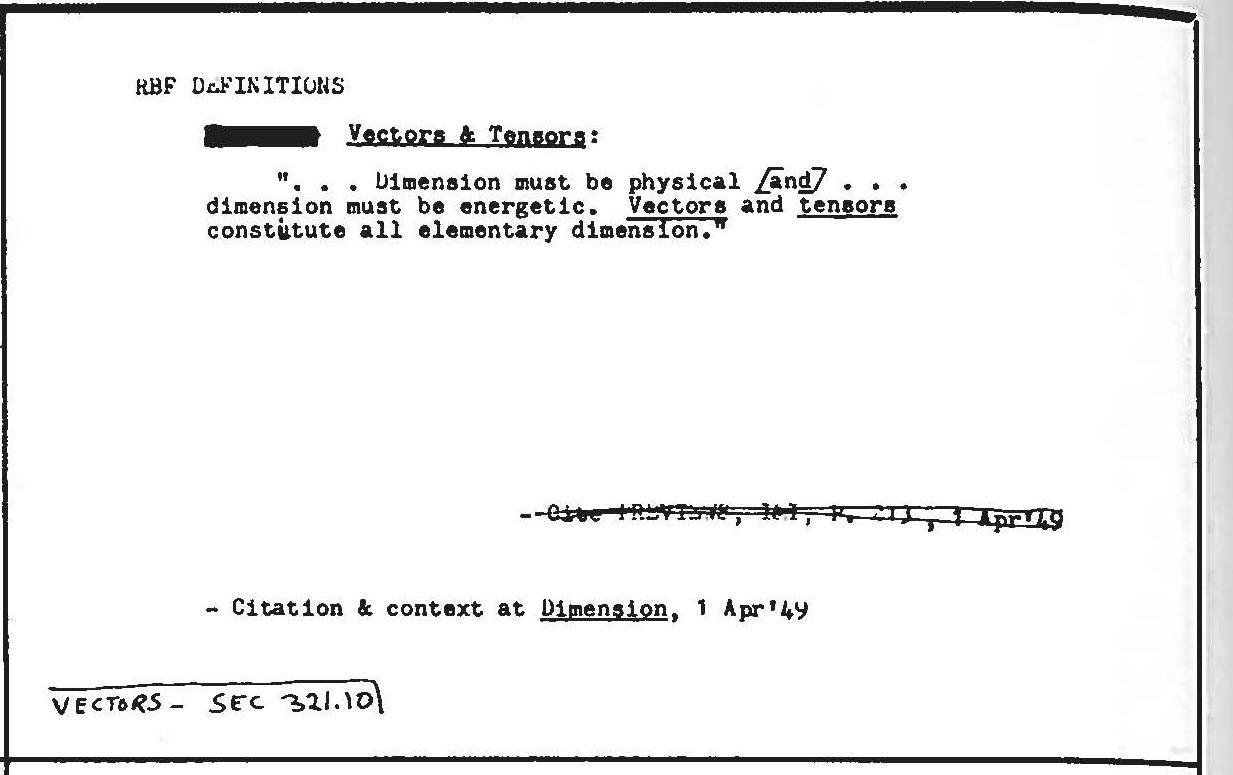
"... Dimension must be physical [and] ... dimension must be energetic. Vectors and tensors constitute all elementary dimension."
Vectors & Tensors Vector-tensor
← Vectors & Tensors | Vector: Threeness of the Vector (1) →
Cross Reference
Cross-References
- Dimension, 1 Apr'49*
- Spiralinearity, 25 Mar'71
- Vector Equilibrium, 23 Oct'72
Vector: Threeness of the Vector (1)
← Vectors & Tensors Vector-tensor | Vector: Threeness of the Vector (2) →
RBF Definitions
"There is a constant relative abundance for every vertex in the Universe. There will always be two faces and there will always be three edges. Which is to say then, that for every event in the Universe the number of lines (which are the vectors, the energy actions) will always be three-- or multiples of three.
"Now this is consistent with what we used to have in engineering where we learned that 'every action has a reaction.' But since the discovery of the speed of light . . . we realize that every action has a reaction and a resultant. The resultant and the reaction are not the same. This, then, gives you something very interesting. Every energy action, every energy event is three-part: action and reaction and resultant. They are the vectors. Now we find that the reaction and the resultant are never a 180° continuance of the vectors. There is always something that transpires that makes it precess. So an energy action is some kind of a 'Z'-- an open 'Z' if you think of a 'Z' as three connecting lines. Now the ends of the same three could come around and make it look like a triangle. So it might be a 'Z' or a triangle. There are always three parts, but never at 180° so it's not a straight line"
Citations
- RBF to Verner Smythe, NYC, Reel 2, p.6, 11 Mar'69
Vector: Threeness of the Vector (2)
← Vector: Threeness of the Vector (1) | Vectors: Three-vector Teams (1) →
Index Entry
Vector: Threeness of the Vector:
'It has been found that the proton and the neutron consist of three basic energy components. The proton has its electron and its antineutrino. That takes three vectors. The neutron has its positron and its neutrino. Each one is threefold. Now I take these two and I put them together. Each one of those is called in physics-- either could be called 'One-half quantum,' 'one-half Plank's constant,' or one-half spin.'
'I find when I join the two of them together they give me something that is very stable: it makes one tetrahedron. There are the six edges of the tetrahedron. . . . A tetrahedron is one unit of quantum. This threeness of the vectors is always in here so this gets to be the basic model. The only difference here is that the prime numbers 1, 2, 3, and 5-- they take care of the hierarchy of all the polyhedral geometries, of all the structures of all the atoms.'
- Cite RBF to Verner Smythe, NYC, Reel 2, pp.6-7, 11 Mar'69
Vectors: Three-vector Teams (1)
← Vector: Threeness of the Vector (2) | Vectors: Three-vector Teams (2) →
Cross Reference
Cross-References
Vectors: Three-vector Teams (2)
← Vectors: Three-vector Teams (1) | Vectorial Topology →
Cross Reference
Cross-References
- Coherence, 18 Feb'71
Vectorial Topology
← Vectors: Three-vector Teams (2) | Vectorial & Vertexial Geometry (1) →
Index Entry
Vectorial Topology:
"In the coordinate vectorial topology of synergetics, exponential powers and physical model dimensioning are identified with the number of vectors which may intercept the system at a constant angle, while avoiding parallelism or congruence with any other of the uniquely converging vectors of the system."
- Cite SYNERGETICS draft at Sec. \hrefhttps://www.buckyverse.org/en/synergetics/content/chapters/900-modelability#section-962.07962.07, 17 Nov'72
Vectorial & Vertexial Geometry (1)
← Vectorial Topology | Vectorial & Vertexial Geometry (2) →
Index Entry
Vectorial & Vertexial Geometry:
"That's how I arrived at the icosahedral version of my Dymaxion airocean world map. Its edge is an arc of 60° 23' with symmetrical subsidence locally. All the changes are internal rather than outwardly. If you dismiss error outwardly in a circle-- or circumferentially-- you end up with three times as much error as if you dismiss them inwardly. The only way to improve on the isosceles version would be to have the 120 triangles of spherical unity, but that would mean breaking up the continents which I didn't want to do. It took me two years to find the airocean array.
"Any incremental module rule could be made into the spherical uniform boundary scale. You just never break open the system.
"Measurement = frequency.
"That's what I thought Avogadro was looking for: a geometry of vectors bringing in time through the velocity of the vector... the frequency of their discrete dimension!
"Avogadro accounts volume with number in a much better way than just putting water in a cube.
- Cite RBF videotaping session, Philadelphia, Pa., 27 Jan'75
Vectorial & Vertexial Geometry (2)
← Vectorial & Vertexial Geometry (1) | Vectorial & Vertexial Geometry (3) →
Index Entry
All three-phase vectors come together to make sum-total structures.
You look at any scratched surface and you will always see circles. Where there is light present there are lines that get lit up since they are precessional to the direction of the light. This gives you the sunburst effect in a hubcap or fender.
Vertexial accounting = spherical accounting
The rhombic dodecahedron, like the cube, fills allspace. It has a volume of six. It is the epitome of the behavior of closest packing. The rhombic dodecahedron is the domain of a sphere - spheric.
The 25 great-circle planes/the eighth-octahedra vector equilibrium corners into the A and B Modules. The fractions come out rationally.
The triangle is invariable: connecting the bisectors produces similar triangles. This is not true of quadrangular
Vectorial & Vertexial Geometry (3)
← Vectorial & Vertexial Geometry (2) | Vectorial & Vertexial Geometry →
Index Entry
Vectorial & Vertexial Geometry:
"bisection.
"Force diagram = music stand form.
"So you have 70° 32' and 109° 28'. The coupler fills allspace with a unity of 24 = 1/24th tetra. Two spheres kiss in the coupler. It provides 92 basic rearrangements of the A and B modules to accommodate the 92 chemical elements.
"All number relationships are covered by the octant, inside-outing, plus-minusing, and so forth. What are all the variables of the system? That is the question to ask. All of the variables of the system are in the coupler.
Plato tried to accommodate the number seven. He knew that 7 x 35 = 2520, a very interesting number.
- Cite RBF at Penn Bell videotaping session, Philadelphia, 27 Jan'75
Vectorial & Vertexial Geometry
← Vectorial & Vertexial Geometry (3) | Vectorial & Vertexial Geometry →
Index Entry
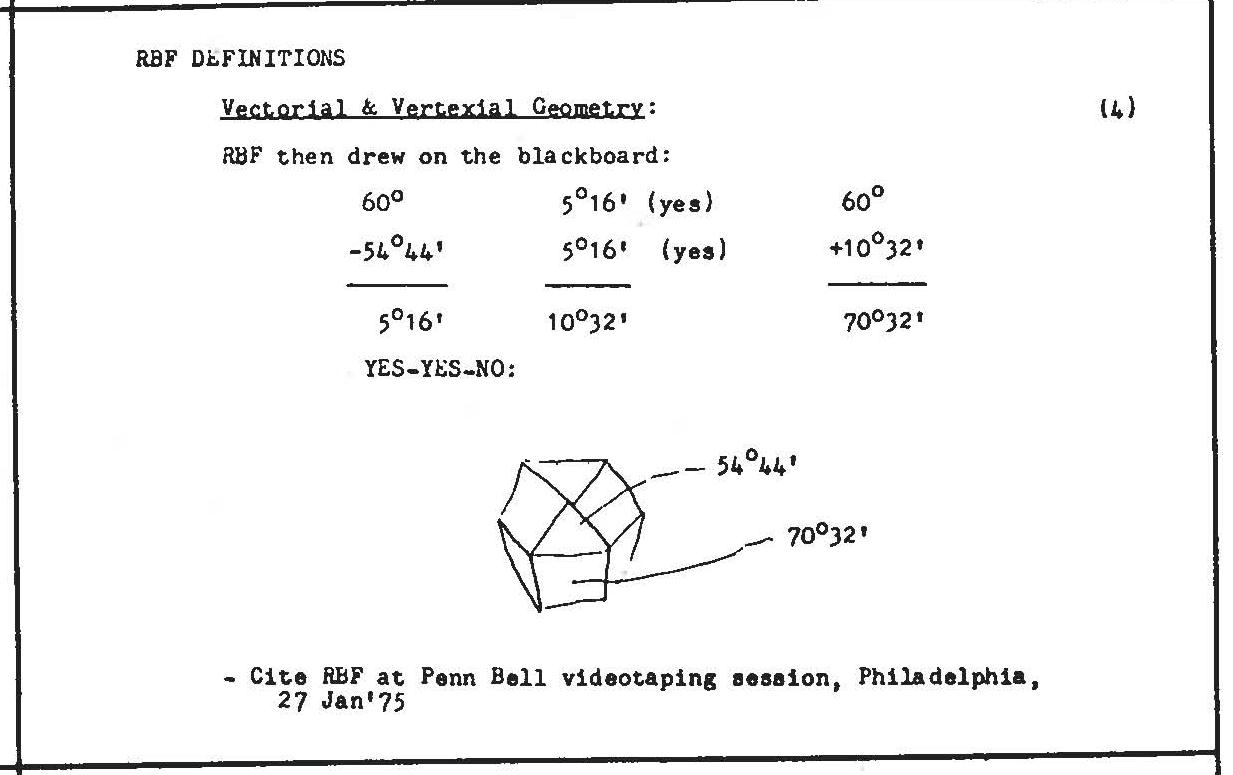
RBF then drew on the blackboard:
60°
-54°44'
5°16' (yes)
5°16' (yes)
60°
+10°32'
5°16'
10°32'
70°32'
YES-YES-NO:
- Cite RBF at Penn Bell videotaping session, Philadelphia, 27 Jan'75
Vectorial & Vertexial Geometry
← Vectorial & Vertexial Geometry | Vector (1) →
Cross Reference
Cross-References
- Avogadro: Generalized Avogadro System
- Geometry of Vectors
- Force Lines: Omnidirectional Lines of Force
- Vectorial Geometry Field
- Isotropic Vector Matrix
Vector (1)
← Vectorial & Vertexial Geometry | Vector (1B) →
Cross Reference
Doubling-up of Vectors
Cross-References
- Action-reaction-resultant
- Balancing of Vectors
- Congruence of Vectors
- Cosmic Vectors
- Edge
- Energy Vectors
- Force Lines: Omnidirectional Lines of Force
- Four Vectors Define Minimum System
- Geometry of Vectors
- Hexagonal Vector Pattern
- High Tide Aspects of Vectors
- Intervectorial
- Integrated Vectorial Resultant
- Isotropic Vector Matrix: Internuclear Vector Modulus
- Javelin
- Limit Case Vector Chord System
- Line
- Negative Vectors
- Physical Vectors
- Precession ofa Edge-vector, Oct
- Prime Vector
Vector (1B)
Cross Reference
Cross-References
- Radial
- Spear
- Tensor
- Three-vector Teams
- Time Vector
- Trajectory
- Three-phase Vectors
- Uni-vectorings
- Wavilinear
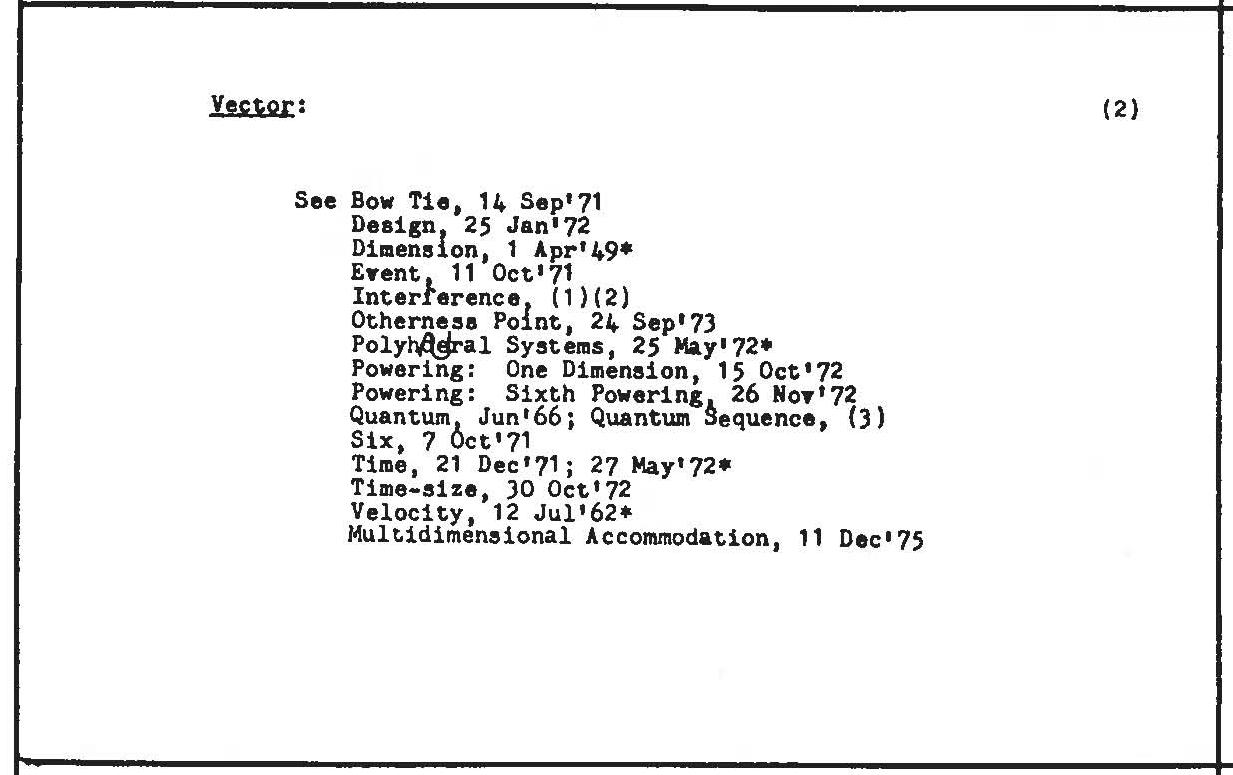
Vector (2)
Cross Reference
Cross-References
- Bow Tie, 14 Sep'71
- Design, 25 Jan'72
- Dimension, 1 Apr'49*
- Event, 11 Oct'71
- Interference, (1)(2)
- Otherness Point, 24 Sep'73
- Polyhedral Systems, 25 May'72*
- Powering: One Dimension, 15 Oct'72
- Powering: Sixth Powering, 26 Nov'72
- Quantum, Jun'66 (3)
- Six, 7 Oct'71
- Time, 21 Dec'71; 27 May'72*
- Time-size, 30 Oct'72
- Velocity, 12 Jul'62*
- Multidimensional Accommodation, 11 Dec'75
Vector (3)
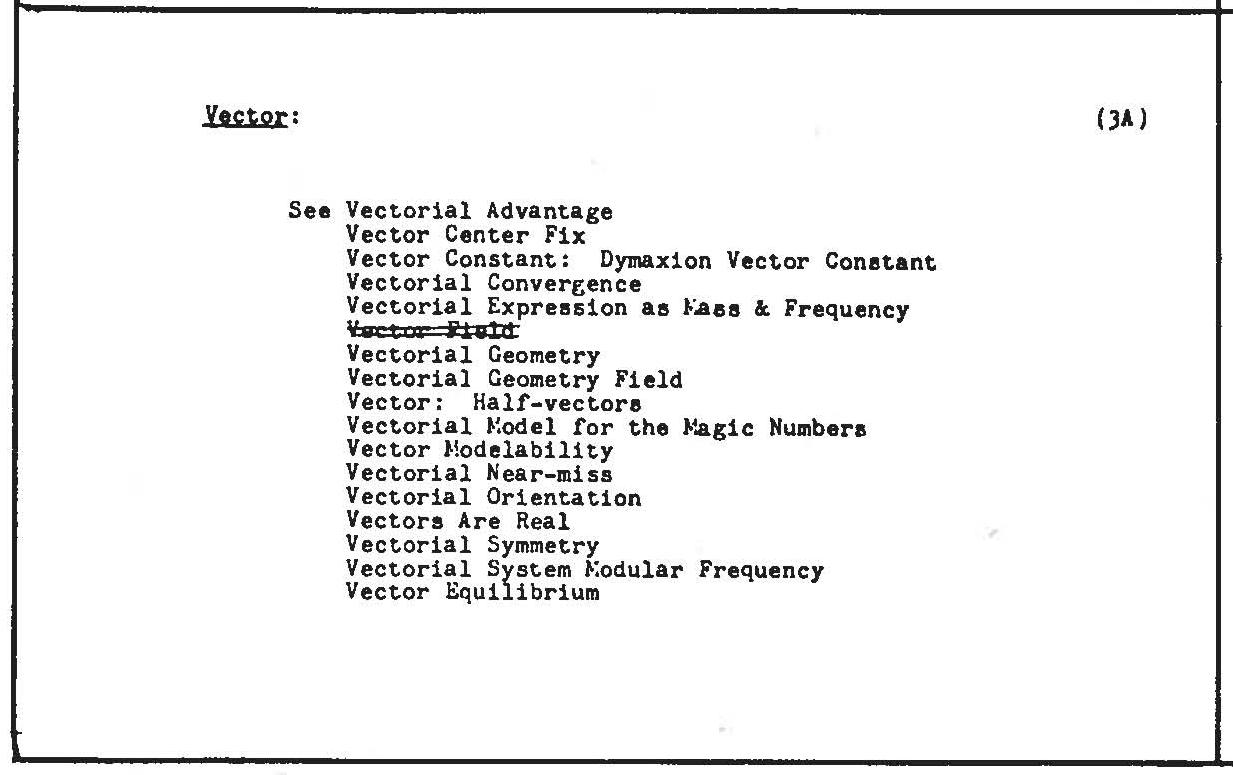
Cross Reference
Vector Constant: Dymaxion Vector Constant
Vectorial Expression as Mass & Frequency
Vector Field
Vector: Half-vectors
Cross-References
- Vectorial Advantage
- Vector Center Fix
- Vectorial Convergence
- Vectorial Geometry
- Vectorial Geometry Field
- Vectorial Model for the Magic Numbers
- Vector Modelability
- Vectorial Near-miss
- Vectorial Orientation
- Vectors Are Real
- Vectorial Symmetry
- Vectorial System Modular Frequency
- Vector Equilibrium
Vector (3B)
← Vector (3) | VECTOR EQUILIBRIUM →
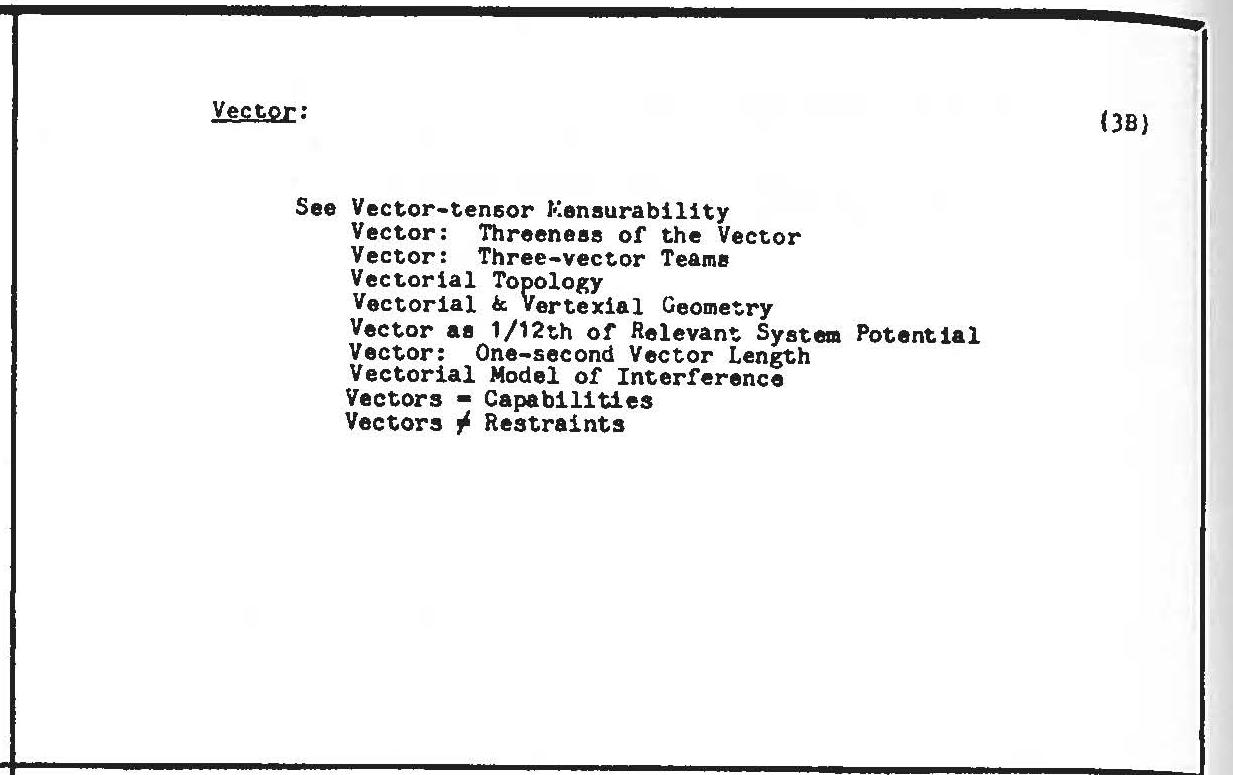
Cross Reference
Vector: Threeness of the Vector
Vector: Three-vector Teams
Vectorial Topology
Vectorial & Vertexial Geometry
Vector as 1/12th of Relevant System Potential
Vector: One-second Vector Length
Vectorial Model of Interference
Vectors = Capabilities
Vectors ≠ Restraints
Cross-References
VECTOR EQUILIBRIUM
← Vector (3B) | Vector Equilibrium →
Index Entry
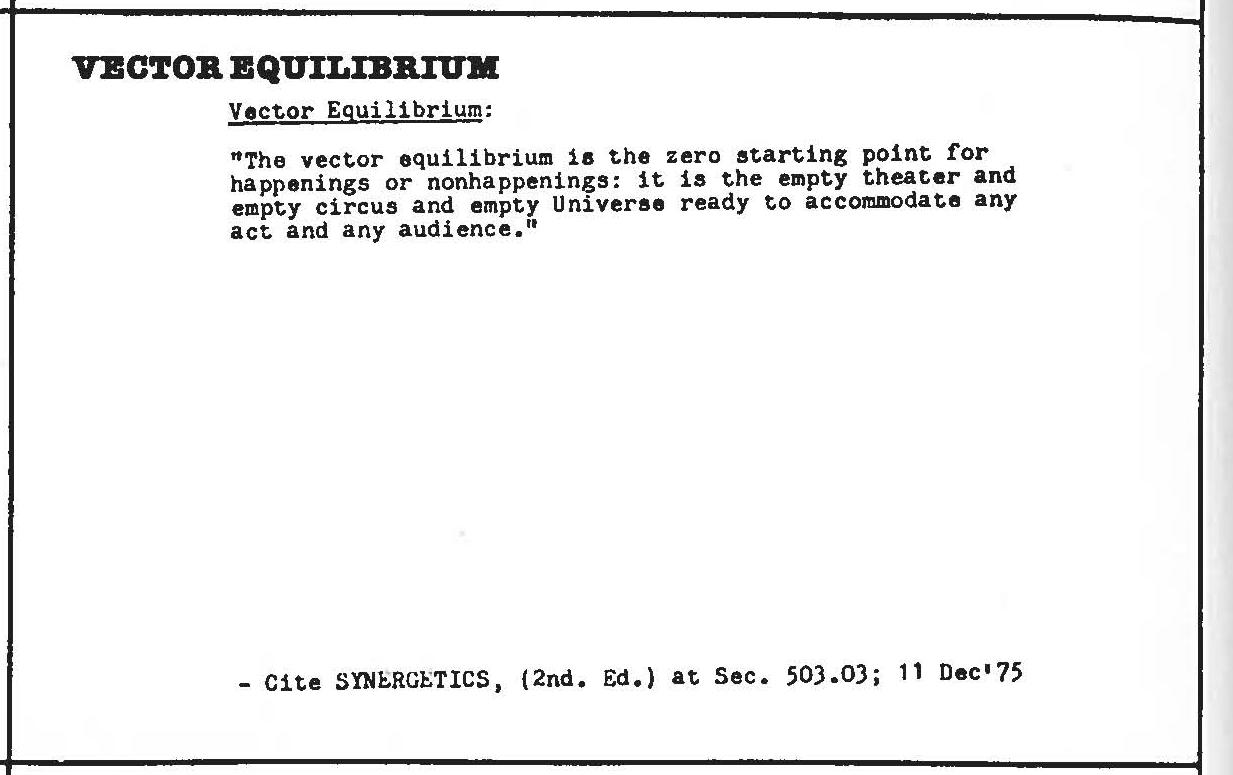
Vector Equilibrium:
"The vector equilibrium is the zero starting point for happenings or nonhappenings: it is the empty theater and empty circus and empty Universe ready to accommodate any act and any audience."
- Cite SYNERGETICS, (2nd. Ed.) at Sec. \hrefhttps://www.buckyverse.org/en/synergetics/content/chapters/500-conceptuality#section-503.03503.03; 11 Dec'75
Vector Equilibrium
← VECTOR EQUILIBRIUM | Vector Equilibrium →
RBF Definitions
"Science is} arriving at a new phase of comprehension in
We are } which we will be discovering that all physical cases experi-
mentally discovered are only special cases of the generalized
principles of nuclear systems: i.e., the vector equilibrium."
(Sec. \hrefhttps://www.buckyverse.org/en/synergetics/content/chapters/500-conceptuality#section-531.06531.06; 2nd.Ed.)
Citations
- RBF marginalia at "Quarks With Color and Flavor" in Scientific American, Oct'75
Vector Equilibrium
← Vector Equilibrium | Vector Equilibrium →
RBF Definitions
"What you speak of as the cubo-octahedran, I speak of as the vector equilibrium, its radial and chordal vectors being of equal magnitude and abundance.... The vector equilibrium has the virtues of having a boundary scale of 60 degrees for each of the pieces, and its spherical excess is slightly less than that of the icosahedron; ergo the distortion is mildly less than that of the icosahedron..."
- Citation & context at Dymaxion Airocean World Map, (2), 26 Aug'75
Vector Equilibrium
← Vector Equilibrium | Vector Equilibrium →
Index Entry
Vector Equilibrium:
"To understand the linear expansion rate think of making soap bubbles where deeply layered molecules get stretched into a single layer as the single atoms guarantee the interattractiveness integrity of the area-stretching thin-out of the atoms.
"We now come to the balancing of the vectors of the vector equilibrium and the arrangement of the 24 external vectors-- end-to-end, closing back upon themselves-- in four great-circle planes, constituting an 'additional' vector force magnitude of 24 embracing the outwardly and separately exploding 24 internal vectors which now operate in increasing independence of one another-- each produces a force of only one.
"We have the surface net drawing on a force resource of 24-- multiplied by radius frequency to the second power-- while the originally-24-force, radially explosive events separate out from one another to produce only separate first-power effectiveness. Hence the gravitational force's geometrical progression rate of gain; i.e. its second-power surface embracing finiteness closure is always at a high energy effectiveness advantage over the disintegrative linear first-power, or only arithmetical progression rate of gain in force."
- Cite SYNERGETICS, 2nd. Ed. at Sec. \hrefhttps://www.buckyverse.org/en/synergetics/content/chapters/1000-omnitopology#section-1052.671052.67, 3 Jan'75
Vector Equilibrium
← Vector Equilibrium | Vector Equilibrium →
RBF Definitions
"The behavioral interpatterning frame of reference of the six degrees of freedom in respect to omnidirectionality is, of course, the vector equilibrium, which embraces the three-dimensionality of the cube and the six-dimensionality of the vector equilibrium....
"The 24-positive- and 24-negative-vectored vector equilibrium demonstrates an initially-frequenced, tetrahedrally quantized unity of 20; ergo the Universe, as an aggregate of all humanity's apprehended and comprehended experiences, is at minimum a plurality of 24 vectors."
- Citation & context at Twelve Universal Degrees of Freedom, 19 Nov'74
Vector Equilibrium
← Vector Equilibrium | Vector Equilibrium →
Index Entry
The vector equilibrium is the central symmetry through which both balanced and unbalanced asymmetries pulsatingly and complexedly intercompensate and synchronize.
The vector equilibrium's frequency modulatability accommodates the numerically differentiated twonesses.
Vector Equilibrium
← Vector Equilibrium | Vector Equilibrium →
Index Entry
Whenever we refer to an entity it has to be structurally valid and therefore it has to be triangulated. Being locally mixed, vectorially symmetrical but facially asymmetrical; being triangulated but not omnitriangulated, vector equilibrium may function as a system but not as a structure
- Cite RBF composite; incorporated in SYNERGETICS 2 at Sec. \hrefhttps://www.buckyverse.org/en/synergetics/content/chapters/200-synergetics#section-223.34223.34; 8 Sep'77
Vector Equilibrium
← Vector Equilibrium | Vector Equilibrium →
Index Entry
Whenever we refer to an entity it has to be structurally valid and therefore it has to be triangulated.
Being locally mixed, symmetrical and asymmetrical, being triangulated but not omnitriangulated, (vector equilibrium) may function as a system but not as a structure.
- Cite EJA composite prior to 7 Sep'77
Vector Equilibrium
← Vector Equilibrium | Vector Equilibrium →
Index Entry
Vector Equilibrium:
"Systems are domains of volumes. One difference between a domain and a volume is that a domain cannot have an interior point, because if it did, it would be subject to more economical subdivision. For instance, the vector equilibrium is a system and has a volume, but it consists of 20 domains. A vector equilibrium is not a prime domain or a prime volume, because it has a nucleus and consists of a plurality of definitive volumetric domains. The vector equilibrium is inherently subdivisible as defined by most economical triangulation of all its 12 vertexes into eight tetrahedra and 12 quarter-octahedra, constituting 20 identically volumed, minimum prime domains."
- Cite SYNERGETICS text at Sec. \hrefhttps://www.buckyverse.org/en/synergetics/content/chapters/1000-omnitopology#section-1011.111011.11; RBF rewrite of 26 Dec'73
Vector Equilibrium
← Vector Equilibrium | Vector Equilibrium →
Index Entry
Vector Equilibrium:
"As the circumferentially united and finite great-circle chord vectors of the vector equilibrium cohere the radial vectors, so also does the metaphysical cohere the physical."
- Cite RBF rewrite of SYNERGETICS galley at Sec. \hrefhttps://www.buckyverse.org/en/synergetics/content/chapters/400-system#section-440.08440.08, 4 Nov'73
Vector Equilibrium
← Vector Equilibrium | Vector Equilibrium →
Index Entry
Vector Equilibrium:
"All the internal, or nuclear, affairs of the individual atoms occur internally to the vector equilibrium. All the external, or chemical compoundings or disassociations, occur externally to the vector equilibrium. All the phenomena external to-- and more complex than-- the five-frequency equilibria relate to chemical compounds. Anything internal to-- or less complex than-- the five-frequency vector equilibrium relates principally to single atoms. Single atoms maintain omnisymmetries; whereas chemical compounds may associate as polarized and asymmetrical chain systems."
- Cite RBF rewrite of SYNERGETICS galley at Sec. \hrefhttps://www.buckyverse.org/en/synergetics/content/chapters/400-system#section-440.03440.03, 3 Nov'73
Vector Equilibrium
← Vector Equilibrium | Vector Equilibrium →
Index Entry
The vector equilibrium is a system. It is not a structure. Nor is it a prime volume because it has a nucleus. It is the prime nucleated system. The eight tetrahedra and the six half-octahedra into which the vector equilibrium may be vectorially subdivided are the rational accounting volumes that are relevantly involved.
Vector Equilibrium
← Vector Equilibrium | Vector Equilibrium →
Index Entry
Vector Equilibrium:
"The omnidirectional, omniwave, propagating pulsivity of Universe realizations is eternally potential and implicit in the vector equilibrium."
- Cite RBF rewrite of SYNERGETICS galley at Sec. \hrefhttps://www.buckyverse.org/en/synergetics/content/chapters/300-universe#section-310.02310.02, 30 Oct'73
Vector Equilibrium
← Vector Equilibrium | Vector Equilibrium →
Index Entry
Vector Equilibrium:
"The radial arrangement of unit tetrahedral volumes around an absolute radiation center (the vector equilibrium) constitutes a prime radiational-gravitational proclivity model with a volume of 20 where the cube is 3 and the tetrahedron 1."
- Citation and context at Planck's Constant (A)(B), 15 May'73
Vector Equilibrium
← Vector Equilibrium | Vector Equilibrium →
Cross Reference
Vector Equilibrium:
"It was the initial quality of seemingly invisible vector equilibrium, as well as that it was not experimentally discoverable, which has kept the vector equilibrium so long unrecognized as the equilibrious model."
- Cite RBF to EJA, National Airport, 27 Nov'72
Cross-References
- Vector Equilibrium as Starting Point, 8 Apr'75
Vector Equilibrium
← Vector Equilibrium | Vector Equilibrium →
Index Entry
Vector Equilibrium:
"The vector equilibrium always and only represents the first omnisymmetric embracement and nucleation of the first-self-discovered-by-otherness-sphere by the completely self-embracing, twelvefold, isotropic, continuous otherness.
"Sphere is prime awareness.
"Spheric domain is prime volume.
"Only self-discoverableSpheric system awareness generates all inwardness, outwardness, and aroundness dimensionality."
- Cite SYNERGETICS draft at Secs. \hrefhttps://www.buckyverse.org/en/synergetics/content/chapters/900-modelability#section-981.21981.21-24, 18 Nov'72
Vector Equilibrium
← Vector Equilibrium | Vector Equilibrium →
Index Entry
Vector Equilibrium:
"On the other hand, the vector equilibrium is the one and only unique symmetric polyhedron inherently recurring as a uniformly angled, centrally triangulated, complex collection of tetrahedra and half-octahedra, while also constituting the simplest and first order of nuclear, isotropically defined, uniformly modulated, inward-outward-and-around, vector-tensor structuring, whereby the vector equilibrium of initial frequency, i.e., 'plus and minus one' equilibrium, is sometimes identified only as 'potential,' whose uniform-length 24 external chords and 12 internal radii, together with its 12 external vertexes and one central vertex, accommodates a galaxy of 12 equiradiused spheres closest packed around one nuclear sphere, with the 13 spheres' respective centers omnicongruent with the vector equilibrium's 12 external and one internal vertex."
- Cite SYNERGETICS text at Sec. \hrefhttps://www.buckyverse.org/en/synergetics/content/chapters/900-modelability#section-955.02955.02; RBF rewrite of 23 Oct'72
Vector Equilibrium
← Vector Equilibrium | Vector Equilibrium →
Cross Reference
Vector Equilibrium:
". . . . We have now all the permeabilities of the MITE's, and the number of nonregular octahedra and the number of nonregular dodecahedrons. Then we have next the total sphere as the convergence in the vector equilibrium with its spaces . . . and concave. And we have the concept of the limits of asymmetry in respect tb the vector equilibrium as the limit of coming to the molecules. That's what we have: nuclear uniqueness, and all of its variables within the domain of the three-frequency vector equilibrium. . . Dealing with the transformation of the jitterbug and tensegrity forming from tetra to icosa by sliding the point of concentrated pressure, going from the ends to the middle, and our confirmation of the original concept that the vector equilibriums are nuclear structures embracing all the variables of Universe, assogiating all the molecular build-ups, which has to do with syntax because I am holistic and I really don't want to be limited. . . ."
- Citation and context at Cosmic Fish Sequence (3), 16 Oct'72
Cross-References
Vector Equilibrium
← Vector Equilibrium | Vector Equilibrium →
Index Entry
Vector Equilibrium:
"Twentyness is significant as the inherent minimum twentyfoldness of the time-space, energy-mass, volume potential of the subfrequency vector equilibrium as quantized by using as unity the geometrical volume of the minimum structural system of Universe: the tetrahedron whose fractional integrity subdivided by the complex of A and B Module reorientations is in the high order number of magnitude of the enzymes' interrelationship permutations."
-
Citation & context at Enzymes, 2 Oct'72
-
Cite SYNERGETICS draft at Sec. \hrefhttps://www.buckyverse.org/en/synergetics/content/chapters/1000-omnitopology#section-1053.051053.05, 2 Oct'72.
Vector Equilibrium
← Vector Equilibrium | Vector Equilibrium →
Index Entry
Vector Equilibrium:
"As the most compact spherical agglomeration the vector equilibrium expands indefinitely with a new nucleus every four successive generations of symmetrical self-embrace."
Vector Equilibrium
← Vector Equilibrium | Vector Equilibrium →
Cross Reference
Vector Equilibrium:
"Vector equilibrium and ideal are the same. Nature never stops there. Universe has it. But in our temporal life there will always be some degree of lag or asymmetry which misses the exactitude of the ideal. . . "
Cross-References
- Ideal, 1 Apr
Vector Equilibrium
← Vector Equilibrium | Vector Equilibrium →
Index Entry
Vector Equilibrium:
"The vector equilibrium is always facially asymmetrical, but vectorially symmetrical. The tetrakaidecahedron is vertexially asymmetrical but linearly symmetrical."
- Cite RBF (discussing Tetrakaidecahedron, 31 May'71) dication to EJA, 19 Feb'72
Vector Equilibrium
← Vector Equilibrium | Vector Equilibrium →
Index Entry
Vector Equilibrium:
"Congruence is allowable only in the vector equilibrium because we can talk about vectors or about circuitry as a design."
-
Citation & context at Congruence, 25 Jan'72
-
Cite RBF to EJA, 3200 Idaho, Washington DC, 25 Jan '72.
Vector Equilibrium
← Vector Equilibrium | Vector Equilibrium →
Index Entry
Vector Equilibrium:
"Universe is a nonsimultaneously potential vector equilibrium."
- Cite SYNERGETICS Corollaries, 1971
SYNERGETICS text at Sec. \hrefhttps://www.buckyverse.org/en/synergetics/content/chapters/200-synergetics#section-240.28240.28
Vector Equilibrium
← Vector Equilibrium | Vector equilibrium →
Index Entry
Vector Equilibrium:
"Only the vector equilibrium has the same surface and central angles."
- Cite RBF to EJA, 3200 Idaho, Washington DC, 21 Dec. '71.
Vector equilibrium
← Vector Equilibrium | Vector Equilibrium →
Index Entry
"While nature oscillates and palpitates asymmetrically in respect to the frame of omnirational vector equilibrium, the plus and minus magnitudes of asymmetry are rational fractions of the omnirationality of the equilibrium state, ergo, omnirationally commensurable and modelable to the sixth power-- which order of powering embraces all experimentally disclosed physical behavior. It was the failure of the exclusively three-dimensionality of the XYZ interperpendicular coordination that gave rise to the concept that the "fourth dimension" must be a mysterious state, which might be spoken of casually as a time dimension, because the XYZ coordinates in themselves, as heretofore adopted by man, has seeming validity only in its linear and spatial characteristics independent of time and physical reality." - Cite RBF to EJA, 21 Dec. '71, 1200 Idaho, Wash. DC.
Vector Equilibrium
← Vector equilibrium | Vector Equilibrium →
Index Entry
... The syntropic vector equilibrium's reversibility-- inwardly-outwardly-- is the basis for the gravitationally maintained integrity of Universe.
Vector Equilibrium
← Vector Equilibrium | Vector Equilibrium →
Index Entry
Vector Equilibrium:
"The vector equilibrium itself is only a referential frame of conceptual relationships at which nature never pauses."
- Cite SYNERGETICS, "Synergetics," \hrefhttps://www.buckyverse.org/en/synergetics/content/chapters/200-synergetics#section-219.00219, as re-written by RBF 7 Oct. 1971.
Vector Equilibrium
← Vector Equilibrium | Vector Equilibrium →
Index Entry
Vector Equilibrium:
"The vector equilibrium consists not of curved lines but of wave lines."
-
Cite RBF to EJA, Bear Island, 25 August, 1971,
-
Citation & context at Push-Pull: Push Wave &Pull Wave, 25 Aug'71
Vector Equilibrium
← Vector Equilibrium | Vector Equilibrium →
Index Entry
Vector Equilibrium:
"The connection between the six degrees of freedom and omnidirectionality is, of course, the vector equilibrium, which combines the threeness of the cube in relation to 20 as unity = VE. Experience is inherently omnidirectional. Ergo, there is not just one 'other.' There are always at least 12 'others.' Ergo, vector equilibrium, which is subfrequency. Happenability has the vector equilibrium as its minimum model, ergo the Universe, experience, can't be one quantum."
Vector Equilibrium
← Vector Equilibrium | Vector Equilibrium →
Index Entry
Vector Equilibrium:
"The vector equilibrium remains subfrequency until we have a frequency of two, where frequency begins. Not until we have size, not until we have energetic experienceability, i.e. not until we have reality, do we have structural stabilization of the nuclear 12. . . And even at the frequency of two, the half-octahedra are unstable."
- Cite RBF to EJA, Bear Island, 23 August 1971.
Vector Equilibrium
← Vector Equilibrium | Vector Equilibrium →
Cross Reference
"One difference between a domain and a volume is that a volume cannot have an interior point, because if it did it would be subject to more economical subdivisions. For instance, the vector equilibrium is a system and not a volume. A vector equilibrium is not a volume because it has a nucleus. The vector equilibrium breaks down into eight tetrahedra and six half octahedra: those being the volumes which are really involved."
- Cite Synergetics draft, \hrefhttps://www.buckyverse.org/en/synergetics/content/chapters/500-conceptuality#section-550.00550-4, August 1971.
Cross-References
- Vector Equilibrium, 26 Dec'73
Vector Equilibrium
← Vector Equilibrium | Vector Equilibrium →
Index Entry
Vector Equilibrium:
"The vector equilibrium contains the whole phenomenology of the Universe. The vector equilibrium is never witnessed by man. It is as pure as God. It is truth which is approached; it is exactitude that is approached."
- "Bucky" by Hugh Kenner, p. 116; probably from Snyder Film or Farrell tape, summer'71
Vector Equilibrium
← Vector Equilibrium | Vector Equilibrium →
Index Entry
Vector Equilibrium:
"Vector equilibrium is not a structure."
- Cite RBF to EJA, New York, 8 May 1971.
Vector Equilibrium
← Vector Equilibrium | Vector Equilibrium →
Index Entry
Vector Equilibrium:
"The vector equilibrium and the isotropic vector matrix are the equilibrium or the central set of conditions through which physical reality palpitates. It never stops at the center. . . You will never be able to catch Nature at the dead center because it has alternate dead centers"
Vector Equilibrium
← Vector Equilibrium | Vector equilibrium →
Index Entry
Vector Equilibrium:
"The vector equilibrium is absolutely dead center of Universe and will never be seen by man in any physical experience-- yet it is the frame of reference. And it is not in rotation and it is sizeless and timeless. . ."
- Cite tape transcript RBF to BO'R, Carbondale Dome, p. 39, 1 May '71
Vector equilibrium
← Vector Equilibrium | Vector equilibrium →
Index Entry
Vector equilibrium:
"This omniradiational isotropic vector system accounting shows a set of values corresponding to the omnirational quantation of all chemistry's associative or disassociative events. It also shows that the vector equilibrium-- consisting basically of twenty tetrahedraal quanta-- is at once the concentric push-pull interchange, vectorial phase or zone, of neutral resonance which occurs between outwardly pushing wave propagation and inwardly pulling gravitational coherence."
- Cite Nehru Speech, p. 26, 13 Nov'69
Vector equilibrium
← Vector equilibrium | Vector equilibrium →
Cross Reference
Vector equilibrium:
"The polyhedral shape of these nuclear assemblages of closest packed spheres . . . is always that of the vector equilibrium (or cuboctahedron), having always six square faces and eight triangular faces. They are vector equilibrium models because their explosive and implosive forces are always equal, as is shown by their four-dimensional hexagonal cross sections whose radial and circumferential vectors balance. Nature never pauses her cycling at the equilibrium phase. She always closes her transformative cycles at the maximum positive or negative asymmetry stages. See the delicate crystal asymmetry in nature."
Cross-References
Vector equilibrium
← Vector equilibrium | Vector equilibrium →
Index Entry
Vector equilibrium:
"The vector equilibrium's volume is always frequency to the third power times twenty. When the vector equilibrium's frequency is one (or radiationally inactive) its volume is 20 x 1^3 = 20."
Cite Nehru Speech, p. 26, 13 Nov'69
Vector equilibrium
← Vector equilibrium | Vector equilibrium →
Index Entry
Vector equilibrium:
"For wave propagation I had already found nature using the vector equilibrium as the neutral geometric configuration occurring between the radiational and gravitational forces."
- Cite RBF holograph, Bear Island, 18 Sep '69
Vector equilibrium
← Vector equilibrium | Vector Equilibrium →
Cross Reference
Vector equilibrium:
"The volume of the vector equilibrium consists of eight tetrahedra and six half-octahedra. Therefore, the volume of the vector equilibrium is exactly twenty."
Cross-References
- Illustration # 28
Vector Equilibrium
← Vector equilibrium | Vector Equilibrium (1) →
Index Entry
The vector equilibrium is the "most compact spherical agglomeration;" it "expands to infinity" with "a new nucleus every four orbits." (Adapted.)
Vector Equilibrium (1)
← Vector Equilibrium | Vector Equilibrium (2) →
Index Entry
The vector equilibrium is of the greatest importance to all of us because all the nuclear tendencies to implosion and explosion are reversible and always in exact balance. But the important thing is that the radials which, if they are outwardly pushing, would tend to explode, are always frustrated by the tensile finiteness of the circumferential vectors which close together in an orderly manner to cohere the disorderly sundering.
When the radial vector are tensiley contractive and separately implosive, they are always prevented from doing so by the finitely closing pushers or compressors of the circumferential set of vectors. The integrity of Universe is implicit in the external finiteness of the circumferential set which always encloses the otherwise divisive internal radial set of omnidirectional vectors.
All the internal or nuclear affairs of the atom occur internally to the vector equilibrium and all the external or chemical associations occur externally to the vector equilibrium.
- Cite NASA Speech, p.83, Jun'66
Vector Equilibrium (2)
← Vector Equilibrium (1) | Vector Equilibrium →
Index Entry
Vector Equilibrium:
"The vector equilibrium itself is never found exactly symmetrical in nature's crystallography. Nature, which is ever pulsive and impulsive, refuses to get caught unrecoverably at the zerophase of energy. Therefore, there will always be positive and negative sets which are ever interchangeably intertransformative with uniquely differentiable characteristics. The vector equilibrium is the true zero reference of the energetic mathematics."
- Cite NASA Speech, p.83, Jun'66
Vector Equilibrium
← Vector Equilibrium (2) | Vector Equilibrium →
Index Entry
Vector Equilibrium:
"The geometrical form constituted by the twenty volumes of tetrahedra is called the vector equilibrium because the value of its radial vectors is exactly matched by the finitely closed, circumferentially arrayed vectors of opposite implosive-explosive potential."
- Cite-Carbondate Draft Return-to-Modelability, p. 4.16. (cite NASA 3rd Ed., p. 81, Jun '66)
Vector Equilibrium
← Vector Equilibrium | Vector equilibrium →
Index Entry
Vector Equilibrium:
"The metaphysical, as with the circumferentially united, great-circle chord vectors of the vector equilibrium, coheres the physical."
- Citation and context at Metaphysical and Physical, Jun'66
Vector equilibrium
← Vector Equilibrium | Vector Equilibrium →
Index Entry
'The Dymaxion', this seemed to me, in due course, to be presumptuous as it is nature's most fundamental of all energy interactions, i.e., the vector equilibrium.
Vector Equilibrium
← Vector equilibrium | Vector equilibrium →
Index Entry
Vector Equilibrium:
"I found this √10·F² + 2√ relationship first in respect to what I call the vector equilibrium (which is usually known by its ambiguous Platonic title, the 'cubo-octahedron.') I gave it its title of vector equilibrium because of its four symmetrically interacting great-circle planes, each consisting of hexagonally bound planes-- visible when the vector equilibrium is cut into two halves, by any one of its four great-circle planes. Because they are radii of similar hexagons, the twelve radii of the vector equilibrium are equal in length to the 24 chordal edges which bind the four hexagonal hemi-sections of the system."
Vector equilibrium
← Vector Equilibrium | Vector equilibrium →
Index Entry
Vector equilibrium:
"Because each of the twelve radii of the vector equilibrium consist of two congruent radii, of the 24 radii of the four hexagonal hemi-sections, the sum of the vectorial values of the radii is 24-- and the vectorial sum of the finitely closed chordal perimeters of the four hexagons is also 24-- which means that the vector equilibrium's explosive or implosive forces are in equilibrium with its externally and finitely containing tense bonds or compressively spread or strutted structural system."
- Cite RBF Ltr. to Dr. Robt. W. Horne, 1 Dec '65, p.1.
Vector equilibrium
← Vector equilibrium | Vector Equilibrium →
Index Entry
'Unitary symmetry' is conceivably? ... my vector equilibrium discovered in early 1917 and named 'vector equilibrium' in 1940.
- Cite RBF marginalia on article by F.T. Matthews, "The Pattern of Matter," The Listener, 25 Nov. 1965. Matthews uses the term 'unitary symmetry' to describe hexagonal patterns of particles of spin.
Vector Equilibrium
← Vector equilibrium | Vector Equilibrium →
Index Entry
Vector Equilibrium:
"Vector equilibrium, i.e., a structural [sic - EJA] system in which the radial vectors and the circumferential vectors are of equal magnitude; ergo the tendency to explode or to contract is in equilibrium; either could but neither does, unless something is added or subtracted to change the dynamic balance. Equilibrium is a 'dangerous' condition because-- due to entropy-- something is always about to be added or subtracted to change the balance.
"When an airplane stalls it is in equilibrium. The vector equilibrium consists of four symmetrically interdisposed planes. These four planes are parallel to the four unique, symmetrically interdisposed planes of the regular tetrahedron. The vector equilibrium shown in the picture is subpatterned with a two-fold, modular frequency, edge and radius subdivision. Both radial and circumferential frequencies of modular subdivision of the vector equilibrium are always, everywhere, equal, in both magnitude and number.
"The volume of the vector equilibrium is always 20 times frequency to the third power, written as 20 F³.
- Cite Conceptuality of Fundamental Structures (Kepes) p.69, 1965 (Caption, Fig. 3)
Vector Equilibrium
← Vector Equilibrium | Vector equilibrium →
Index Entry
Vector Equilibrium:
"The vector equilibrium is also known as an isotropic vector matrix. The vertexes of the vector equilibrium of any frequency are always congruent with spheres of equal radius in closest packing. . .
"The number of vertexes in the vector equilibrium, which are always the same as the number of the spheres in omnisymmetrical closest packing, are always: frequency to the second power times ten plus two-- written as 10 F^2 + 2."
- Cite Conceptuality of Fundamental Structures (Kepes), p.69, 1965 (Caption, Fig. 3)
Vector equilibrium
← Vector Equilibrium | Vector Equilibrium →
Cross Reference
Vector equilibrium:
"All of the fundamental forms of the crystals are involved in the vector equilibrium. It is a starting point, not anything in its own right, if it is a vector equilibrium."
- Cite LODGEMENT LAB Lecture, 15 Oct '64, p. 29
Cross-References
- Vector equilibrium as Starting Point, 8 Apr'75
Vector Equilibrium
← Vector equilibrium | Vector equilibrium →
Index Entry
Vector Equilibrium:
"The word frequency would never relate to the word one, because frequency involves some plurality of events. Therefore, frequency would begin at two. . . Therefore, vector equilibrium . . . a one-frequency system . . . is really subsize. . . . Looking at vector equilibrium as unity-- as all the domain of a point . . . we find that it has a volume of 480."
-
Cite RBF Lecture 8 p. 280 12 Jul'62
-
Citation at Frequency, 12 Jul'62
Vector equilibrium
← Vector Equilibrium | Vector Equilibrium →
Index Entry
Vector equilibrium:
" . . . The twelve radials are the twelve degrees of freedom . . . "
" . . . Two of those degrees of freedom are always subject to being polarized. . . "
- Cite Oregon Lecture #7, p. 238. + p. 242. 11 Jul'62
Vector Equilibrium
← Vector equilibrium | Vector Equilibrium →
Index Entry
Vector Equilibrium:
"In the vector equilibrium form we have an enormous number of random lines running omnidirectionally which begin to triangulate omnidirectionally. On of the important aspects of this is that it consists of four planes. At its equator it has a hexagon and four hexagonal planes crossing each other at the center of the system. Those four hexagonal planes correspond to the four faces of the tetrahedron, and they are parallel to them. . . It has eight tetrahedra; there is one on the top, or four altogether in the northern hemisphere and four in the southern hemisphere. And there are six one-half octahedra. There are six square faces and eight triangular faces and the square faces are part of the half octahedra. Therefore it consists of six on-half octahedra each with a volume of two, 6 x 2 = 12, and eight tetrahedra each with a volume of one, so 8 + 12 = 20.
"Vector equilibrium: /is derived from/ 12 composited spheres around one.
-
Cite Carbondale-draft Nature's Coordination, pp. VI.22,23
-
Cite - OREGON #7 p.223,
-OREGON #7 - p 249,250, 11 Jul'62
Vector Equilibrium
← Vector Equilibrium | Vector Equilibrium →
Index Entry
Vector Equilibrium:
"It is called the vector equilibrium because its radials are all the same length as its circumferentials. Representing a geometry of vectors it tends to explode or contract . . . opposing one another so that they are in equilibrium with exactly the same values."
- Cite OREGON Lecture #5 - p. 179, 9 Jul'62
Vector Equilibrium
← Vector Equilibrium | Vector Equilibrium →
Index Entry
The vector equilibrium is "the Grand Central Station of the coordinate mathematical-physical system that is apparently the coordinate system employed by nature to account most economically for its myriad transactions."
Vector Equilibrium
← Vector Equilibrium | Vector Equilibrium →
Index Entry
Vector Equilibrium:
"A zero tetrahedron is vector equilibrium is Universe."
- Citation at Tetrahedron: Zero Tetrahedron, 1960
Vector Equilibrium
← Vector Equilibrium | Vector Equilibrium (1) →
Index Entry
Vector Equilibrium:
"Universe is a nonsimultaneously potential vector equilibrium."
- Cite SYNERGETICS Corollaries, \hrefhttps://www.buckyverse.org/en/synergetics/content/chapters/200-synergetics#section-240.00240. Oct'59
Vector Equilibrium (1)
← Vector Equilibrium | Vector Equilibrium (2) →
Index Entry
Vector Equilibrium:
"The vector equilibrium represents:
A. The energy Universe in equilibrium;
B. (Corollary) The Universe at dynamic 'centerpoint' and at static 'center point;'
C. The geodesic centers of influence and convergent intercourse;
D. A four-dimensional Universe from which universal dynamics 'slip by' into three-dimensional aspects;
E. Energy at absolute expansion; Energy at absolute contraction; Energy at absolute heat; Energy at absolute zero;
F. Rational number fractionation of Universe;"
- Cite Rbf Synergetics notes, Feb'48
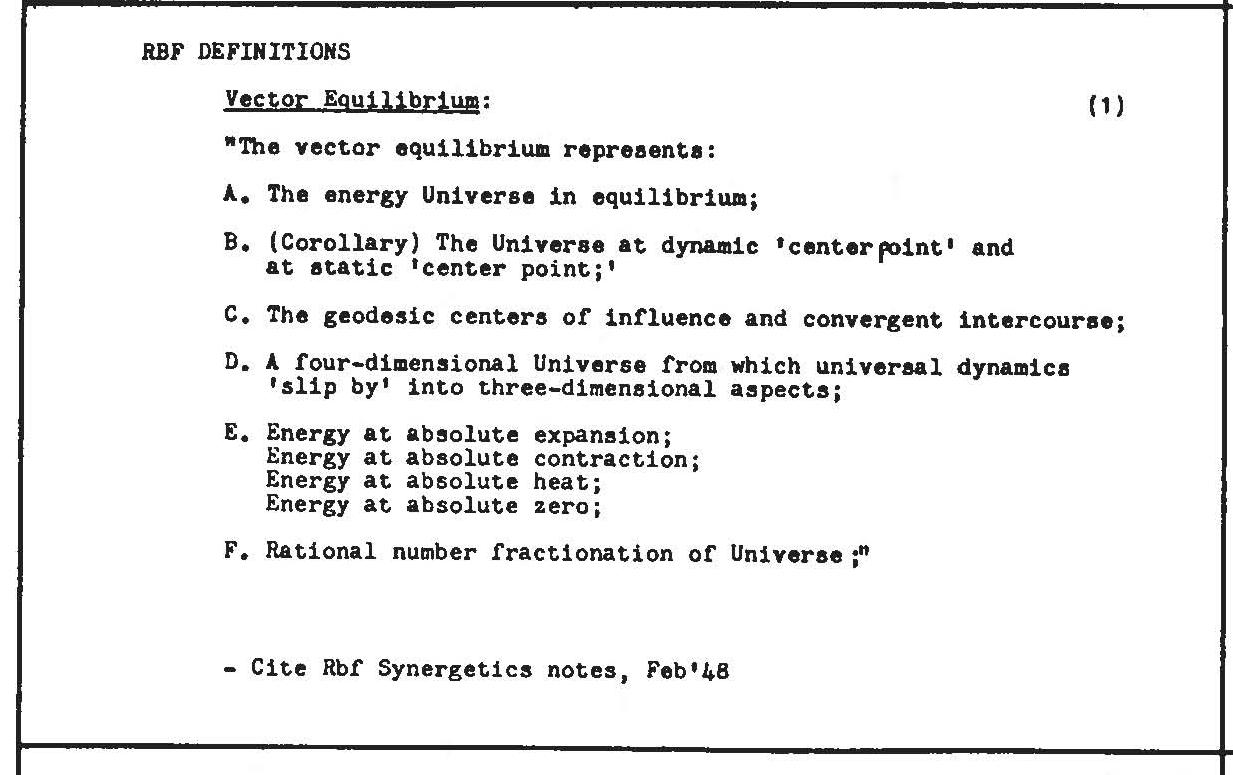
Vector Equilibrium (2)
← Vector Equilibrium (1) | Vector Equilibrium →
Index Entry
Vector Equilibrium:
"G. The absolute network of energy articulation including proclivities of--
Chemical,
Biological,
Electrical,
Crystallographic,
Vector-tensor,
Thermal,
Geologic,
Geodetic,
Expansion-contraction,
Spin,
Wave propagation mechanics,
Wave network,
Insideoutability,
Special plus-minus polarity phase,
Gravitational,
Mensurability in comprehensive constants of rational number."
- Cite RBF Synergetics notes, Feb'48
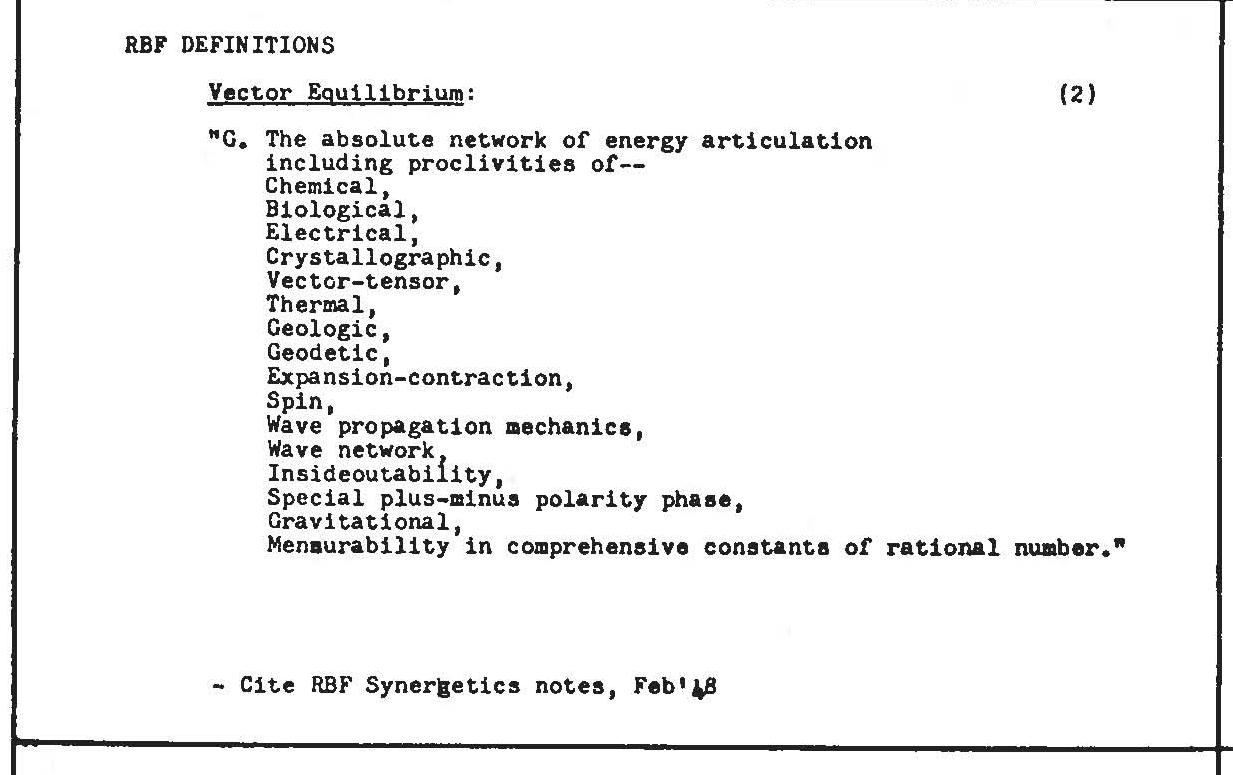
Vector Equilibrium
← Vector Equilibrium (2) | Vector Equilibrium Articulation Of →
Index Entry
The Vector equilibrium "is the common denominator of the tetrahedron, octahedron and cube. It is the decimal unit within the octave system. Double its radius for octave expansion." - Cite DYMAXION COINP. SYSTEM, 1944, Table 4, caption
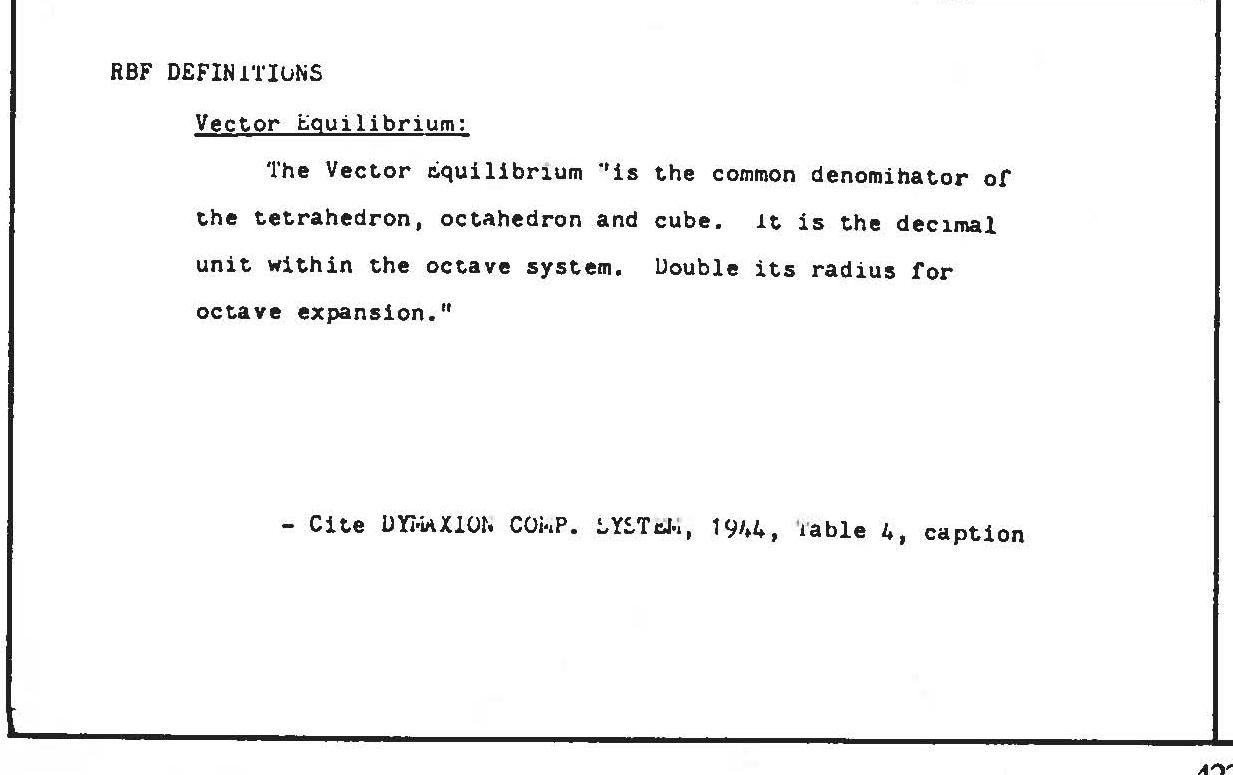
Vector Equilibrium Articulation Of
← Vector Equilibrium | Vector_Equilibrium: Axes →
Cross Reference
Vector Equilibrium: Propagative Transformation Of
Cross-References
Vector_Equilibrium: Axes
← Vector Equilibrium Articulation Of | Vector Equilibrium: Complementary to Vector Equilibrium →
RBF Definitions
"Only one axis of the eight tetrahedra in the vector equilibrium may be active at any given time: three are passive and one is active."
Citations
- RBF to EJA, 200 Locust, Phila.; 28 Jan'76
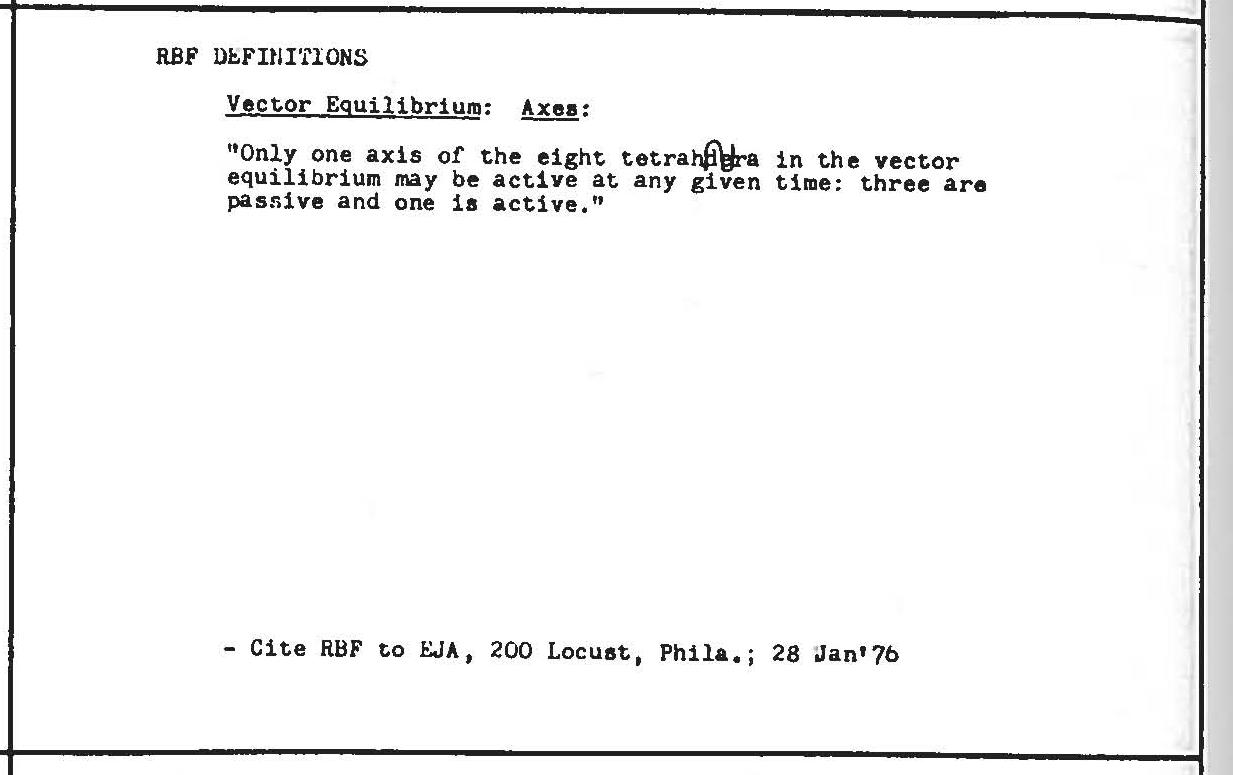
Vector Equilibrium: Complementary to Vector Equilibrium
← Vector_Equilibrium: Axes | VE: Complementary →
Cross Reference
Vector Equilibrium: Complementary to Vector Equilibrium:
"In the vector equilibrium we have all the sets of the tetrahedra bivalently or edge-joined, as well as centrally univalent. Synergetics calls the basally developed larger tetrahedron [see Star Tetrahedron.] the non-mirror-imaged complementary of the vector equilibrium. In vectorial energy content and dynamic symmetry lies the complementarity."
- Cite SYNERGETICS draft "Antitetrahedron," 8 Oct. '71, page 6.
Cross-References
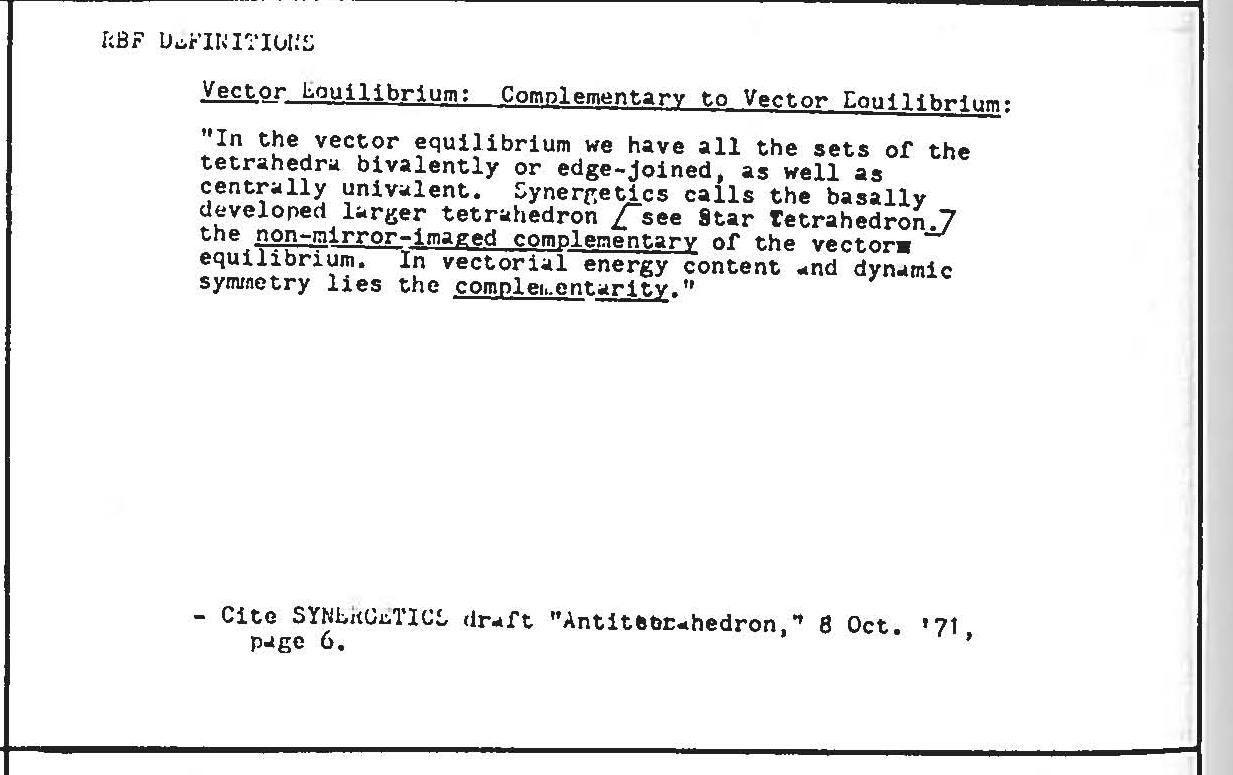
VE: Complementary
← Vector Equilibrium: Complementary to Vector Equilibrium | Vector Equilibrium Eight-pointed Star System →
Cross Reference
Negative VE
Star Tetrahedron & VE
Cross-References
Vector Equilibrium Eight-pointed Star System
← VE: Complementary | Vector Equilibrium as Empty Set Tetrahedron →
Index Entry
Vector Equilibrium: Eight-pointed Star System:
"The same vector equilibrium's eight, nuclear-embracing, bivalent tetrahedra's eight nuclear congruent vertexes may be simultaneously outwardly pulsed through their radially-opposite, outward triangular exits to form eight externally pointing tetrahedra, which thus become only univalently, i.e., only-single-vertex interlinked, and altogether symmetrically arrayed around the vector equilibrium's eight outward 'faces.' The thus-formed, eight-pointed star system consisting of the vector equilibrium's volume of 20 (tetrahedral unity), plus the eight star-point-arrayed tetrahedra, total volumetrically to 28. This number, 28, introduces the prime number seven factored exclusively with the prime number two, as already discovered in the unity-twoness of the tetrahedron's always and only co-occurring, concave-convex, inherently disparate, behavioral duality. This phenomenon may be compared with the 28-ness in the Coupler accounting as described in section \hrefhttps://www.buckyverse.org/en/synergetics/content/chapters/900-modelability#section-954.72954.72."
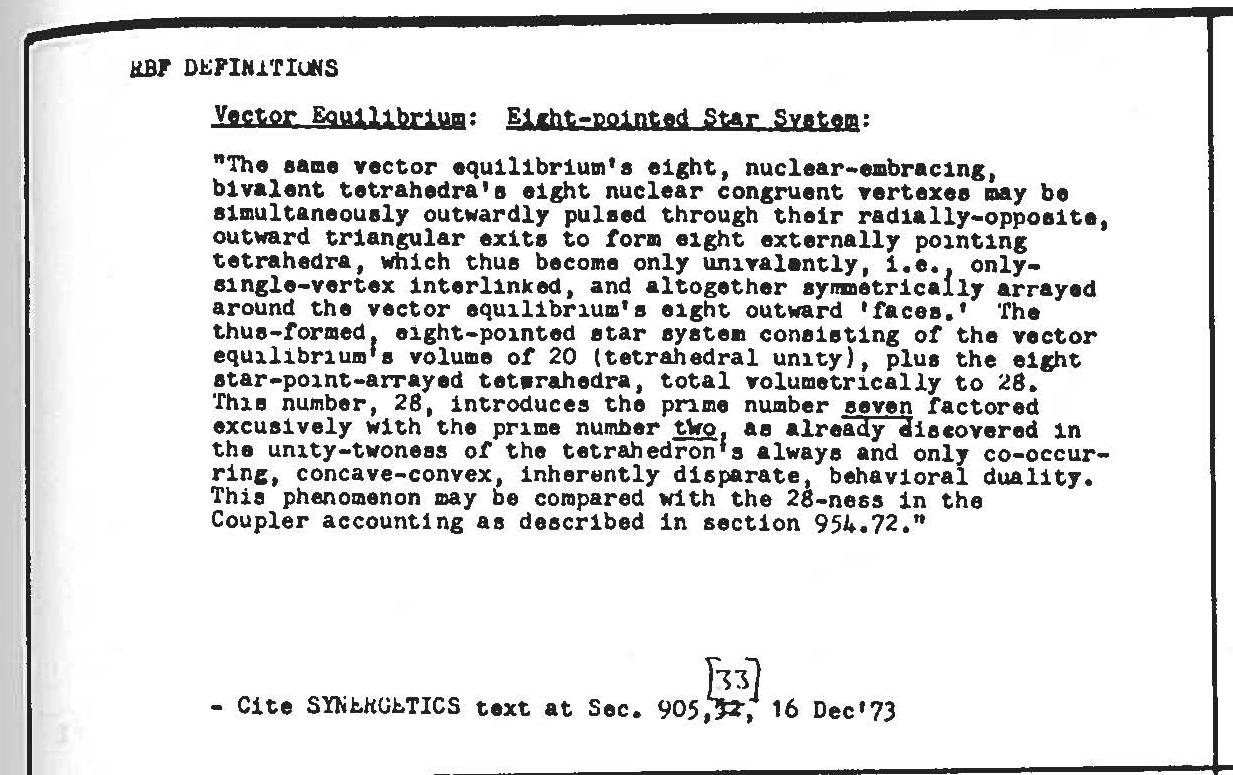
Vector Equilibrium as Empty Set Tetrahedron
← Vector Equilibrium Eight-pointed Star System | Vector Equilibrium as Empty Set Tetrahedron →
Index Entry
"The inherent zero-disconnectedness accounts for the finite energy packaging and discontinuity of Universe. The vector equilibria are the empty set tetrahedra of Universe, i.e., the tetrahedron, being the minimum structural system of Universe independent of size, its four facet planes are at maximum remoteness from their opposite vertexes and may have volume content of the third power of the linear frequency. Whereas in the vector equilibrium all four planes of the tetrahedra pass through the same opposite vertex-- which is the nuclear vertex-- and have no volume, frequency being zero: F⁰." Cite RBF addition to SYNERGETICS galley at Sec. \hrefhttps://www.buckyverse.org/en/synergetics/content/chapters/400-system#section-415.45415.45, 2 Nov'73
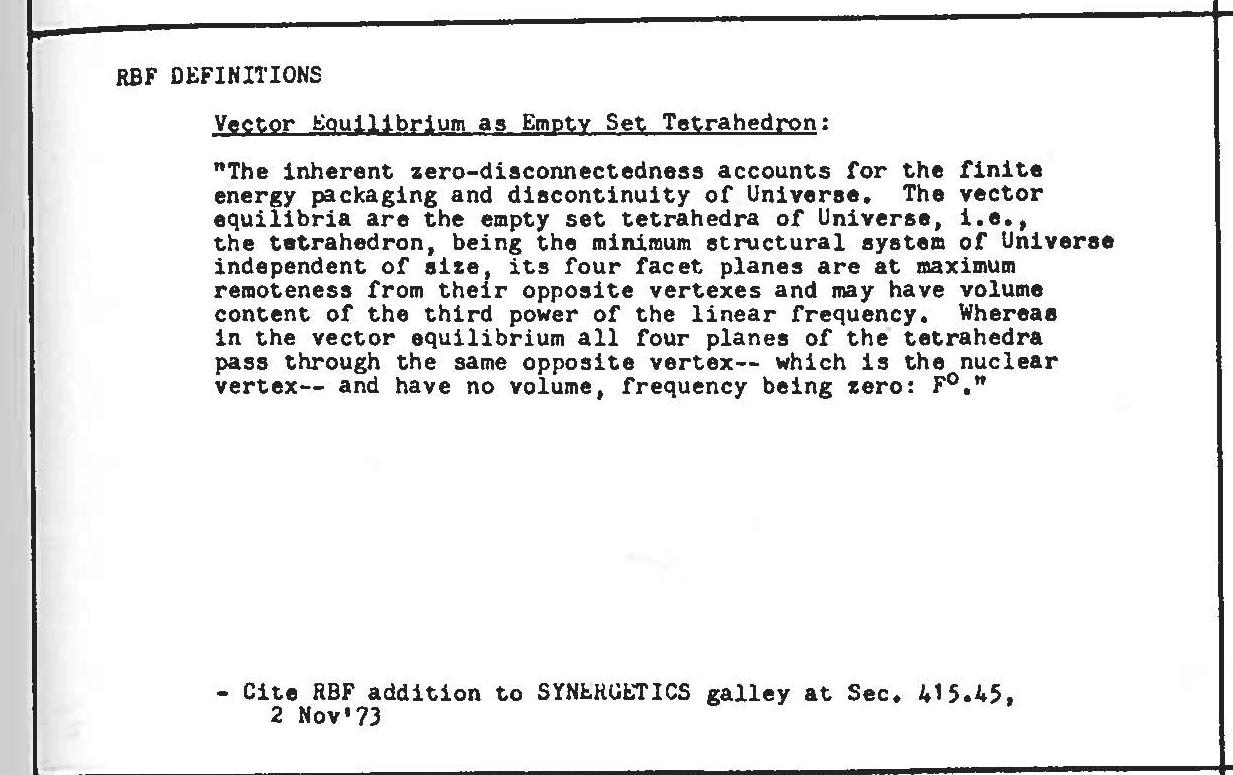
Vector Equilibrium as Empty Set Tetrahedron
← Vector Equilibrium as Empty Set Tetrahedron | Vector Equilibrium: Field of Energy →
Cross Reference
Cross-References
- Vector Equilibrium: Zerophase Zero Frequency
Vector Equilibrium: Field of Energy
← Vector Equilibrium as Empty Set Tetrahedron | Vector Equilibrium: Field of Energy →
Index Entry
Vector Equilibrium: Field of Energy:
"The geometrical model of energy configurations in synergetics is developed from a symmetrical cluster of spheres, in which each sphere is a model of a field of energy all of whose forces tend to coordinate themselves, shuntingly or pulsatively, and only momentarily in positive or negative asymmetrical patterns relative to, but never congruent with, the eternality of the vector equilibrium. The vectors connecting the centers of the adjacent spheres are identical in length and angular relationship. The forces of the field of energy represented by each sphere interoscillate through the symmetry of equilibrium to various asymmetries, never pausing at equilibrium. The vector equilibrium itself is only a referential pattern of conceptual relationships at which nature never pauses. This closest packing of spheres in 60-degree angular relationships demonstrates a finite system in universal geometry.
"Synergetics is comprehensive because it describes instantaneously both the internal and external limit relationships of the sphere or spheres of energetic fields; that is, singularly concentric, or plurally expansive, or propagative and repro-"
Vector Equilibrium: Field of Energy
← Vector Equilibrium: Field of Energy | Vector Equilibrium Field of Energy →
Index Entry
ductive in all directions, in either spherical or plane geometrical terms and in simple arithmetic.
"When energy-as-heat is progressively extracted from systems by cryogenics, the geometries visibly approach equilibrium; that is to say, removing energy-as-heat reduces the asymmetrical pulsativeness in respect to equilibrium. As the asymmetric kinetics of energy-as-heat are removed, and absolute zero is neared, the whole field of vectors approaches identical length and identical angular interaction; that is to say, they approach the model of closest-packed spherical energy fields. The lines interconnecting the adjacent spheres' centers constitute a vectorial matrix in which all the lines and angles are identical, which is spoken of by the mathematical physicists as the isotropic vector matrix; i.e, where all the energy vectors are identical; i.e., in equilibrium: the cosmically absolute zero.
- Cite SYNERGETICS text at Sec.s \hrefhttps://www.buckyverse.org/en/synergetics/content/chapters/200-synergetics#section-205.01205.01-\hrefhttps://www.buckyverse.org/en/synergetics/content/chapters/200-synergetics#section-205.02205.02, galley rewrite, 11 Oct'73
Vector Equilibrium Field of Energy
← Vector Equilibrium: Field of Energy | Vector Equilibrium: Field of Energy →
Index Entry
Vector Equilibrium Field of Energy:
"Metaphysically, the isotropic vector matrix is conceptually permitted. The difference between the physical and the metaphysical is the omnipulsative asymmetry of all physical oscillation in respect to the equilibrium. Metaphysical is equilibrious and physical is disequilibrious."
"The metaphysically permitted frame of reference for all the asymmetrical physical experience of humanity is characterized by the 60-degree coordination with which synergetics explores nature's behaviors-- metaphysical or physical.
The phenomenon of time entering into energy is just a metaphysical concept. It explains our slowness and our limitations. Temporality is time, and the relative asymmetries of oscillation are realizable only in time-- in the time required for pulsative frequency cycling. Synergetics correlates the verities of time and eternity. The awareness of life is always a complex of cognition and recognition lags. Lags are wave frequency aberrations.
The vectorial coordinate system deriving from closest packing of spheres permits fourth- and fifth-power models of modular-";
Vector Equilibrium: Field of Energy
← Vector Equilibrium Field of Energy | Vector Equilibrium: Field of Energy →
Index Entry
Vector Equilibrium: Field of Energy:
"volume symmetrical aggregations around single points in an omnidirectional, symmetrical, allspace-filling radial growth. The unit of modular volumetric measurement is the tetrahedron, whose 60-degree angles and six equilength edges disclose omnipersistent, one-to-one correspondence of radial wave modular growth with circumferential modular frequency growth of the totally involved vectorial geometry. This means that angular and linear accelerations are identical. This is a rational convenience prohibited by 90-degree coordination, whose most economical circumferential geometries are in most cases inherently irrational.
"The angular and linear accelerations of synergetics' isotropic, vectorially triangulated, omnidirectional matrix initiations are rational and uniformly modulated; whereas in the XYZ 90-degree coordinate analysis and plotting of the computational findings of the calculus, only the linear is analyzable and the angular resultants are usually irrationally expressed.
"The frequency and magnitude of event occurrences of any system are comprehensively and discretely controllable by valving,"
Vector Equilibrium: Field of Energy
← Vector Equilibrium: Field of Energy | Vector Equilibrium: Field of Energy (1) →
Index Entry
Vector Equilibrium: Field of Energy:
"that is, by angle and frequency modulation. Angle and frequency modulation exclusively define all experiences, which events altogether constitute Universe.
- Cite SYNERGETICS text at \hrefhttps://www.buckyverse.org/en/synergetics/content/chapters/200-synergetics#section-208.00208, Oct'71
Vector Equilibrium: Field of Energy (1)
← Vector Equilibrium: Field of Energy | Vector Equilibrium: Field of Energy (2) →
Index Entry
"The geometrical model of energy configurations in synergetics is developed from a symmetrical cluster of spheres, in which each sphere is a model of a field of energy all of whose forces tend to coordinate themselves, shuttlingly or pulsatively, and only momentarily in positive or negative asymmetrical patterings relative to the most eternal form of the vector equilibrium. The vectors connecting the centers of the adjacent spheres are identical in length and angular relationship. The forces of the field of energy represented by each sphere oscillate through the symmetry of equilibrium to various asymmetries while never pausing at equilibrium. The vector equilibrium itself is only a referential frame of conceptual relationships at which nature never pauses. This closest packing of spheres in 60-degree angular relationships demonstrates a finite system in universal geometry. Synergetics is comprehensive because it describes instantaneously both the internal and external relationships of the sphere or spheres of energetic fields; that is, singularly concentric, or plurally expansive, or propagative and reproductive in all directions, in eitherspherical or plane geometrical terms and in simple arithmetic.
Vector Equilibrium: Field of Energy (2)
← Vector Equilibrium: Field of Energy (1) | Vector Equilibrium Field →
Index Entry
Vector Equilibrium: Field of Energy:
- Cite: all but the last sentence: RBF dictation to EJA for SYNERGETICS, Beverly Hotel, New York, 28 Feb'71; rewritten by RBF at \hrefhttps://www.buckyverse.org/en/synergetics/content/chapters/200-synergetics#section-205.10205.1, Oct'71
- Cite Last sentence: Dymaxion Comprehensive System, Table 4, caption, 1944
Vector Equilibrium Field
← Vector Equilibrium: Field of Energy (2) | Vector Equilibrium Field (1) →
RBF Definitions
RBF DEFINITIONS
"While nature oscillates and palpitates asymmetrically in
respect to the omnirational vector-equilibrium field, the plus
and minus magnitudes of asymmetry are rational fractions of
the omnirationality of the equilibrium state, ergo, omniration-
ionally commensurable to the fourth power, volumetrically,
which order of powering embraces all experimentally disclosed
physical volumetric behavior."
Cite RBF rewrite of SYNERGETICS text at Sec. \hrefhttps://www.buckyverse.org/en/synergetics/content/chapters/900-modelability#section-966.10966.10, 20 Dec'73
Cross-References
- Vector Equilibrium, 21 Dec'71
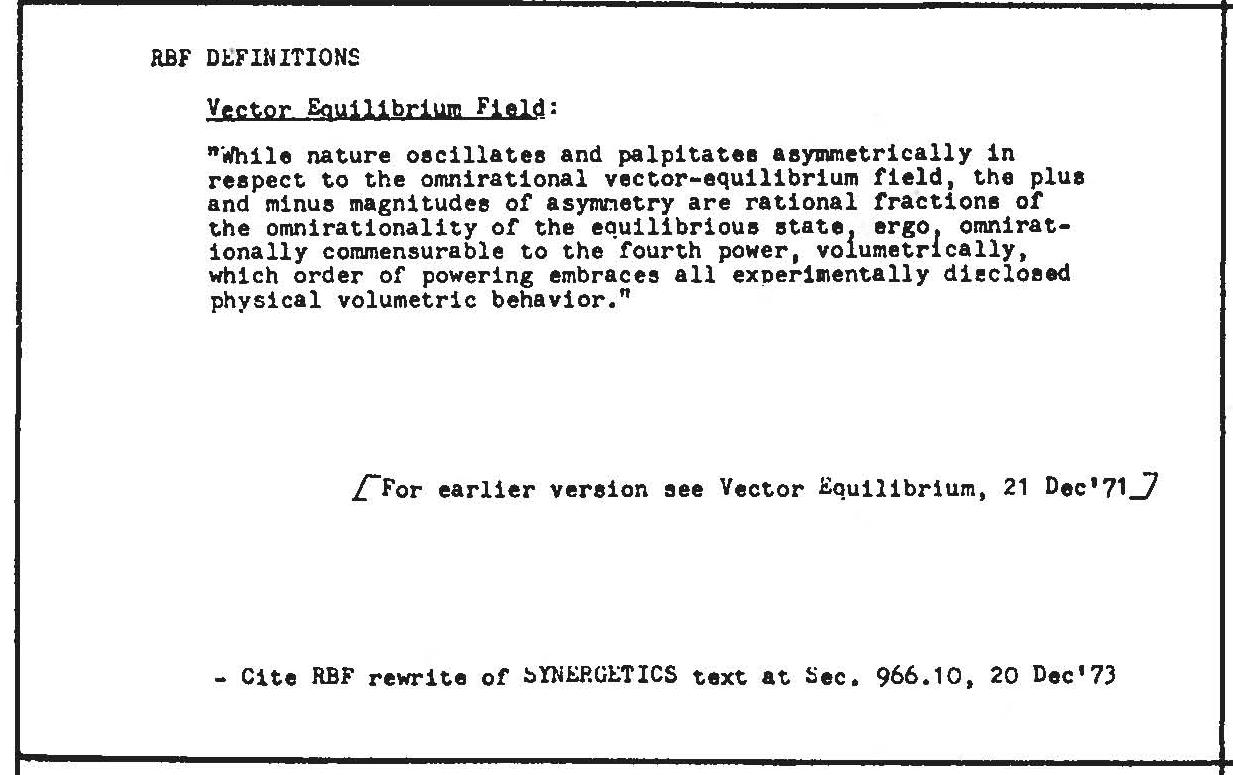
Vector Equilibrium Field (1)
← Vector Equilibrium Field | Vector Equilibrium Frame →
Cross Reference
Cross-References
Vector Equilibrium Frame
← Vector Equilibrium Field (1) | Vector Equilibrium Frame →
Index Entry
Vector Equilibrium Frame:
"The vector equilibrium is the anywhere, anytime, eternally regenerative, event inceptioning and evolutionary accommodation and will never be seen by man in any physical experience. Yet it is the frame of evolvement. It is sizeless and timeless. We have its mathematics, which deals discretely with the chordal lengths. The radial vectors and circumferential vectors are the same size."
- Cite RBF rewrite of SYNERGETICS galley at Sec. \hrefhttps://www.buckyverse.org/en/synergetics/content/chapters/400-system#section-440.04440.04, 3 Nov'73
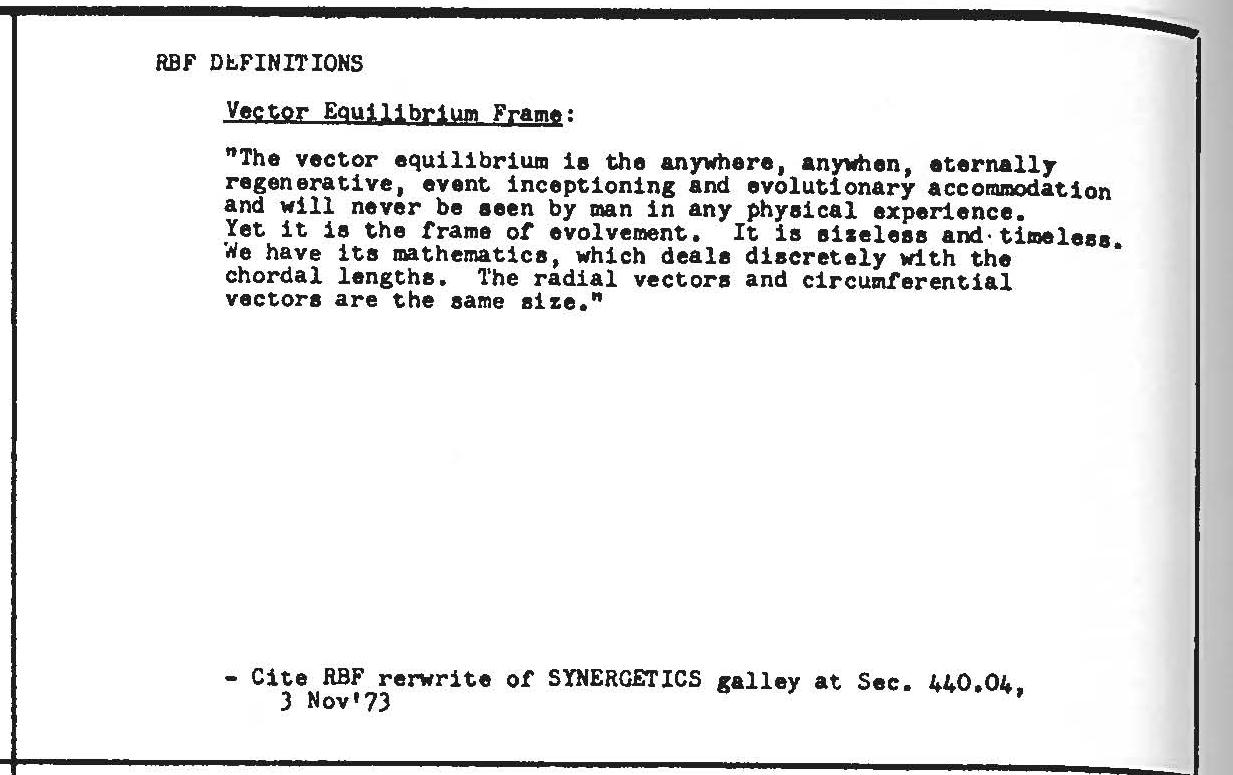
Vector Equilibrium Frame
← Vector Equilibrium Frame | Vector Equilibrium Frame →
Index Entry
Vector Equilibrium Frame:
"All local events of Universe may be calculatively anticipated by inaugurating calculation with a local vector_equilibrium frame and identifying the disturbance initiating point, direction, and energy of introduced action."
- Cite Colliers Ltr., McKale, p.114, Oct'59
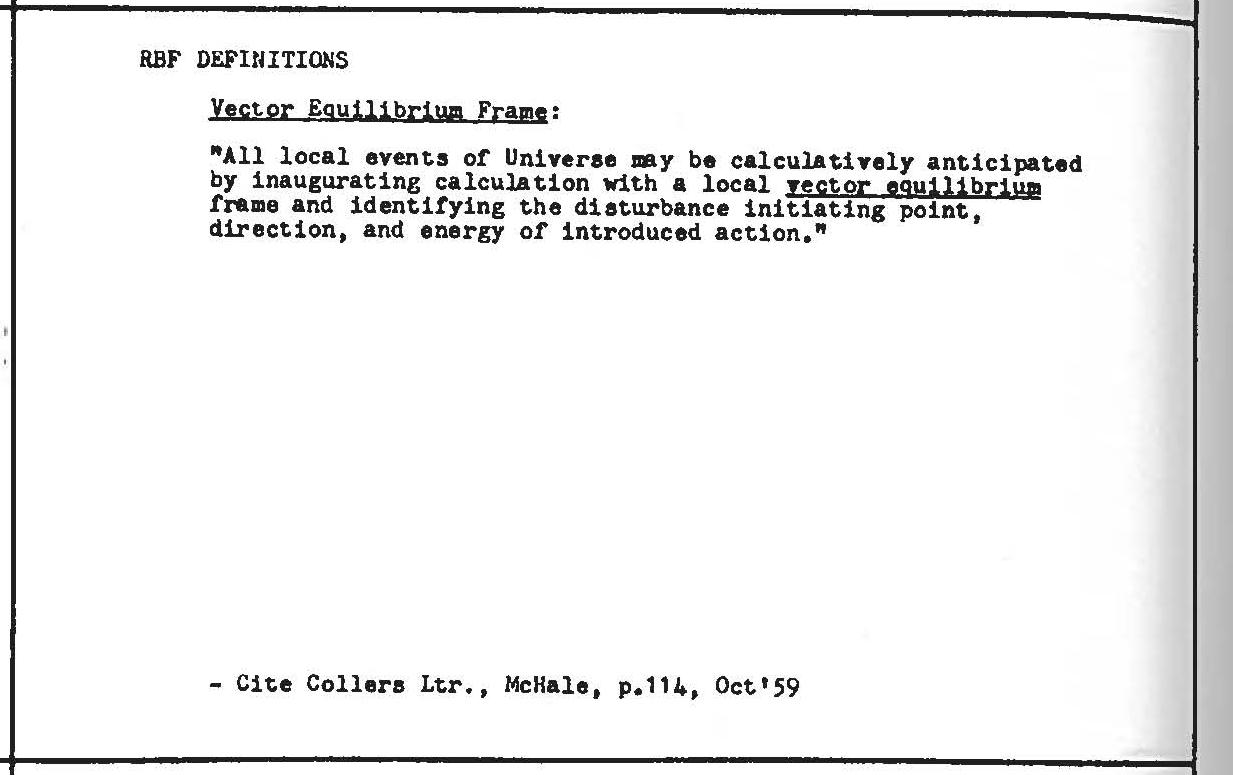
Vector Equilibrium Frame
← Vector Equilibrium Frame | Vector Equilibrium: Frequency Of →
Cross Reference
Cross-References
- Synergetics Calculation, 1971
Vector Equilibrium: Frequency Of
← Vector Equilibrium Frame | Vector Equilibrium: Great Circles Of (1) →
Index Entry
Where frequency is one /as in the vector equilibrium/, it just means it isn't frequent. Which means frequency must be two or more /except in the vector equilibrium which is subsize/. in the vector equilibrium where frequency is one, there is only one interval: the first layer = 10 P^2 + 2 = 12. Twelve balls of the first layer. The center ball has a value of two for outside-inside, convex-concave: terminal condition. But the center ball's frequency is zero.
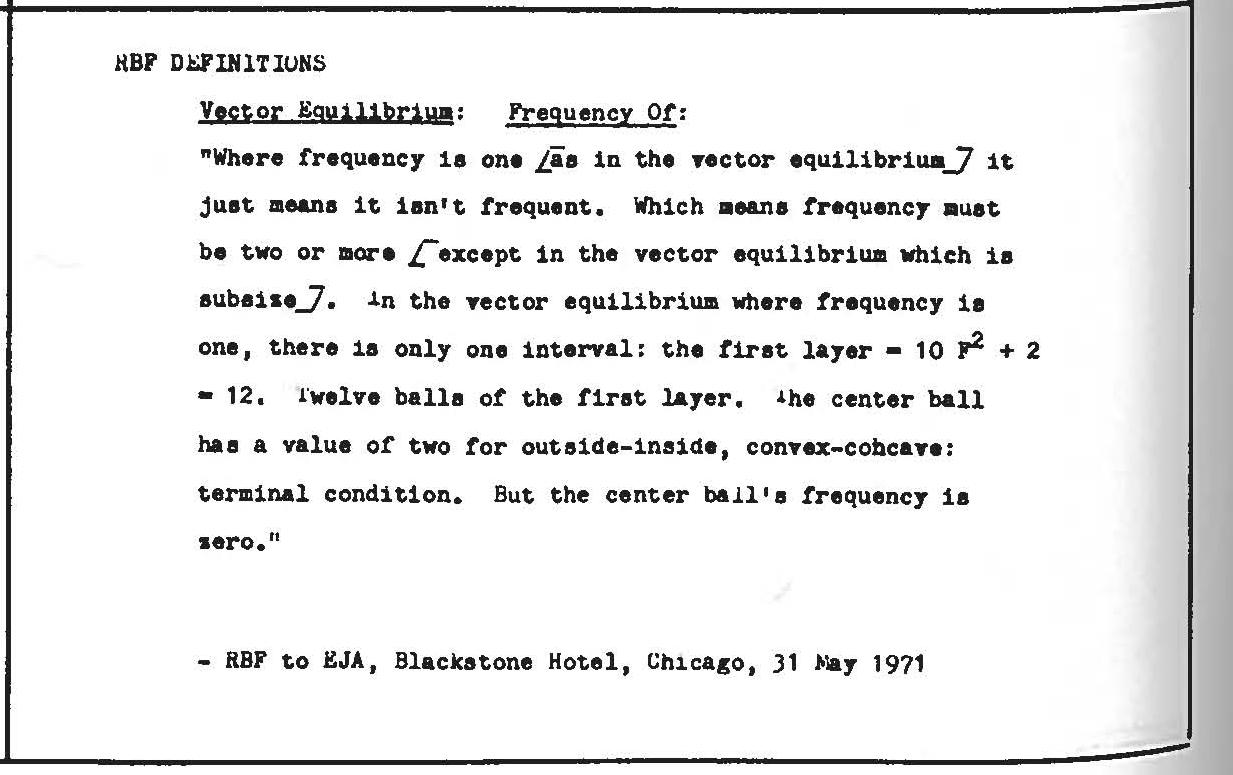
Vector Equilibrium: Great Circles Of (1)
← Vector Equilibrium: Frequency Of | Vector Equilibrium: Great Circles Of (2) →
RBF Definitions
"The great circle planes of the vector equilibrium projected as true circles on a sphere represent the equators of spin... The vector equilibrium has 14 faces which represent the 14 main aspects of a regular tetrahedron. Six of these faces are square and they are symmetrical to one another. We can pair the square faces so that there are three pairs of square faces and we can interconnect their opposite centers of gravity, which provides three axes corresponding to the XYZ coordinates. We can spin the vector equilibrium on any one of these three axes of symmetry to produce three equators of spin. These we speak of as the 'vector Equilibrium's three great circles.
"There are also the eight triangular facets of the vector equilibrium. If we take the opposite midpoints of these eight triangles, we can pair them into four sets giving us four axes and spin the vector equilibrium on these axes to produce four equators of spin of the vector Equilibrium's four great circles.
"The vector equilibrium also has 12 vertexes which provide six axes of spin. These produce the vector equilibrium's six great circles. The vector equilibrium has one other set of symmetrical"
Citations
- Oregon Lecture #6, p. 225, 10 Jul'62; RBF rewrite, Aug'71 SYSTEM- SECS, \href{https://www.buckyverse.org/en/synergetics/content/chapters/400-system#section-450.01}{450.01} → THRU 0.6
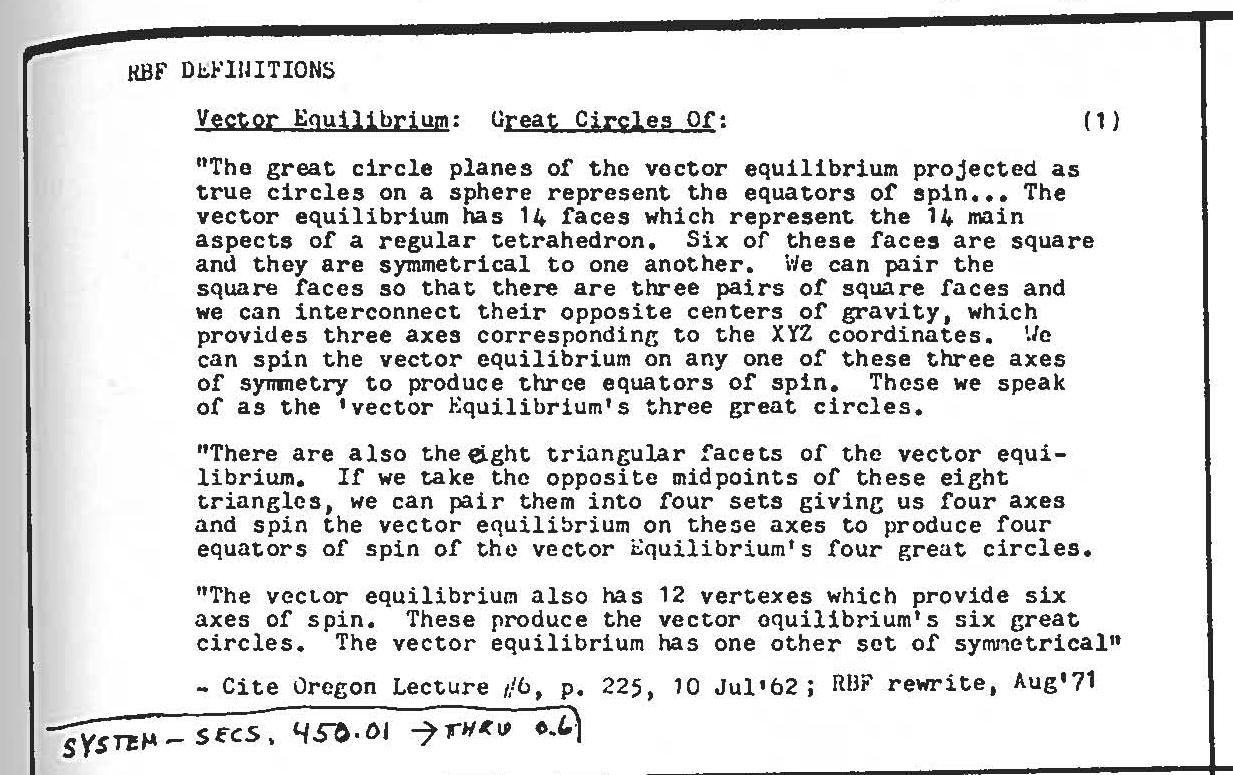
Vector Equilibrium: Great Circles Of (2)
← Vector Equilibrium: Great Circles Of (1) | Vector Equilibrium: Great Circles Of (3) →
Index Entry
axes: if we take the 24 mid-edge points and interconnect their diametric opposites, we get 12 axes of spin; when rotated these generate the vector equilibrium's '12 great circles,' which run from the corners to the opposite mid-edges of the vector equilibrium's six squares.
"So we now have three axes (from midpoints of the squares); plus four axes (from midpoints of the triangular facets); plus 6 axes (from vertexes); plus 12 axes (from the mid-edges of the squares). 3 + 4 + 6 + 12 = 25, for a total of 25 great circles for the vector equilibrium.
"It is a characteristic of all those great circles that every one of them go through two or more of the 12 vertexes and these 12 vertexes correspond to all the points of tangency of closest packed spheres: four go through six; three go through four; six go through two; and 12 go through two."
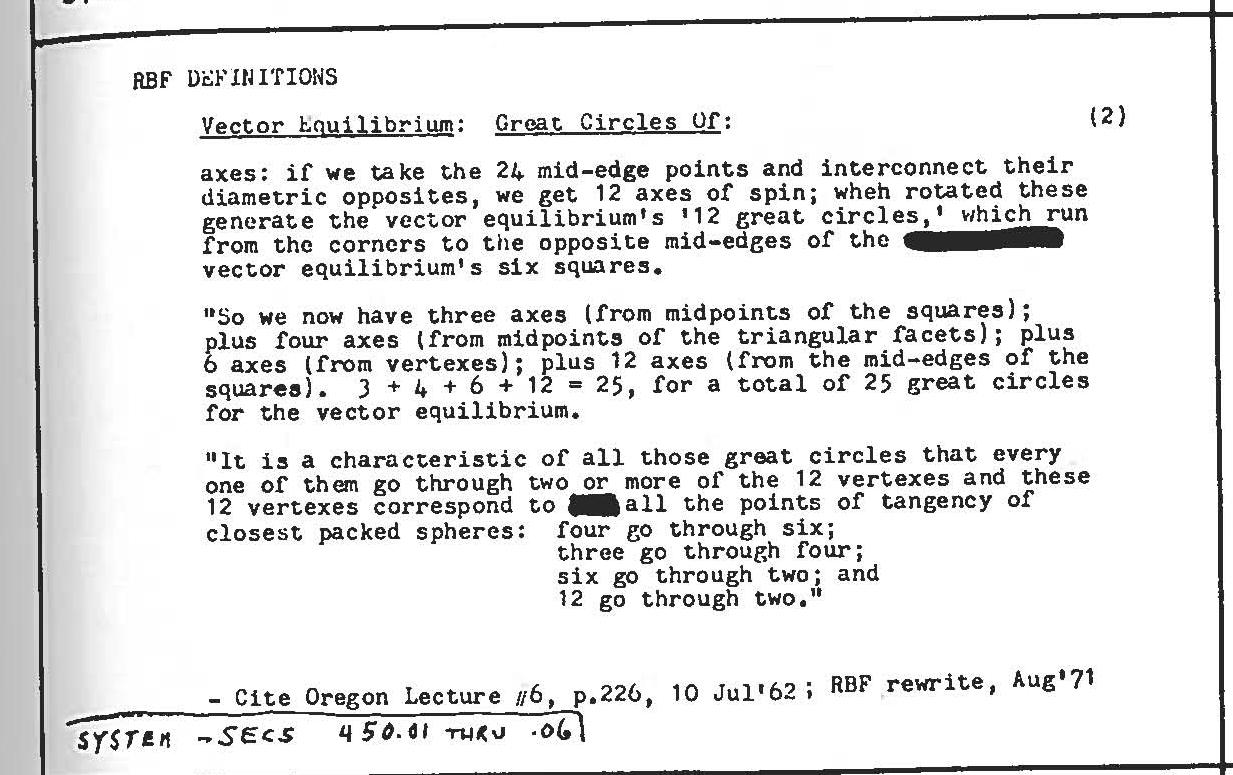
Vector Equilibrium: Great Circles Of (3)
← Vector Equilibrium: Great Circles Of (2) | Vector Equilibrium: Great Circles Of →
Index Entry
Vector Equilibrium: Great Circles Of:
"It is a characteristic of all these great circles of the vector equilibrium that every one of them go through at least two of the 12 vertexes.
"When spheres are closely packed, what do we mean by that? Let us take four billiard balls on a billiard table. We get them as close together as we can, and they could make a square; but they are unstable as a square. Let them rotate a little as ball bearings and they become a diamond; and then they are stable because they consist of two triangles and triangles are stable. I can get three together stably or I can get six-around-one stably, or four as a diamond. They pack in omnitriangulation and that is called closest packing.
"I can get 12 spheres around one omnidirectionally-- six around it in a plane and 12 omnidirectionally. The 12 balls then are in the position of the 12 vertexes of the vector equilibrium where we say all the radii are identical in length. This would be the radii of the spheres. We would have a sphere the same size as the center of the system and its radius would use up half of the radius of the vector equilibrium's radials. They"
Vector Equilibrium: Great Circles Of
← Vector Equilibrium: Great Circles Of (3) | Vector Equilibrium: Great Circles Of →
Index Entry
Vector Equilibrium: Great Circles Of:
"would be tangent to one another, giving us 12 balls tangent around one. In the closest packing of spheres, which the physicist finds is employed by nature in the basic gridding of all agglomerations of atoms-- and we find time and again nature using this closest packing for basic coordination-- and you always get 12 around one. The 12-around-one would then be at these various points.
"Therefore in finding all the sets of great circles which can be generated by all the axes of symmetry of a vector equilibrium, and finding that they all go through the 12 vertexes is very interesting, because if this sphere were tangent to other spheres these would be its points of tangency in closest packing. The point of tangency of spheres in closest packing would be a very important point because any energy traveling over the surface of one sphere to get to another sphere would have to go through a point of tangency to the next sphere.
"The great circles represent the shortest distances between points on a sphere; they are the most economical lines on a sphere. These 25 great circles represent all the railroad tracks of energy following the shortest distance between points-- all the possible railroad tracks that go through all the points of"
Vector Equilibrium: Great Circles Of
← Vector Equilibrium: Great Circles Of | Vector equilibrium: Great Circles Of (1) →
Index Entry
Vector Equilibrium: Great Circles Of:
"tangency of other spheres. Therefore, energy could travel from sphere to sphere in closest packing following the surface of the spheres, but in order to do so it would have to follow the most economical distance between those points and it would have to go on one of these railroad tracks. These are the railroad tracks of energy following the surfaces of spheres of closest packing. These are the most economical distances. Therefore they get to be quite important kinds of lines."
- Cite Oregon Lecture #6, p.227, 10 Jul'62
Vector equilibrium: Great Circles Of (1)
← Vector Equilibrium: Great Circles Of | Vector Equilibrium: Great Circles Of (2) →
Cross Reference
Cross-References
Vector Equilibrium: Great Circles Of (2)
← Vector equilibrium: Great Circles Of (1) | Vector Equilibrium Growth →
Cross Reference
Cross-References
- Omnidirectional Typewriter, (3)(4)
Vector Equilibrium Growth
← Vector Equilibrium: Great Circles Of (2) | Vector Equilibrium →
Index Entry
Vector Equilibrium Growth:
"Vector equilibrium growth from unity is nuclear: 1 → 12, 12 → 42, 42 → 92, etc."
- Citation & context at Tetrahedral Growth, 13 Nov'75
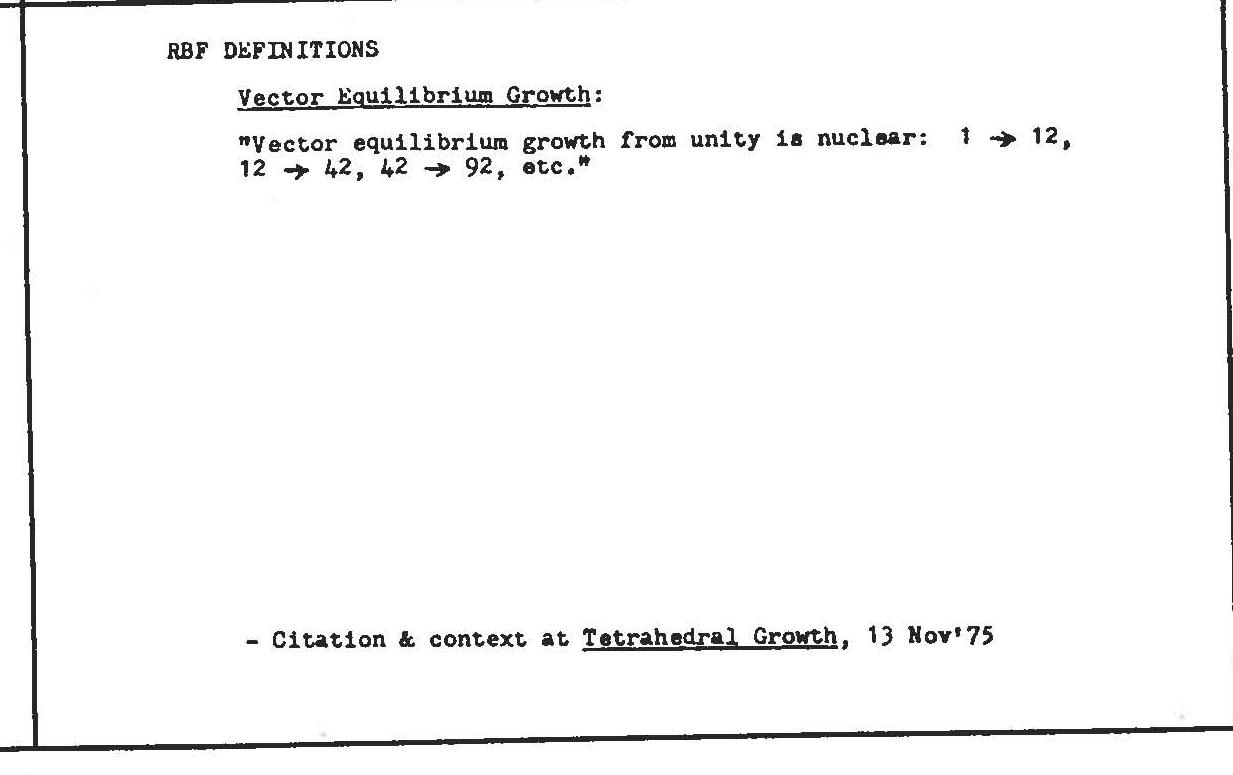
Vector Equilibrium
← Vector Equilibrium Growth | Vector Equilibrium: Eight New Nuclei at Fifth Frequency →
Index Entry
Vector Equilibrium: Eight New Nuclei at Fifth Frequency:
"Frequency five embraces nine new nuclei: the original central nucleus plus eight new nuclei occurring at the centers of volume of the eight tetrahedrons symmetrically surrounding the nucleus, with each of the nine enclosed with a minimum of two layers of spheres. VE at f⁰ = 12; f² = 42; f³ = 92; f⁴ = 162; and at f⁵ = 252 we get eight new nuclei; therefore their eightness of 'begettness' relates to the eight triangles of the VE. Six nucleated octahedra with two layer omni-enclosure of their nuclei does not occur until f⁶ = 362 in the outer shell of the VE. At this stage we have six new nuclei, with fourteen nuclei surrounding the fifteenth, or original, nucleus."
- Cite RBF tape fragment, Fairfield, Conn., 18 Jun'71; rewritten by RBF Wash. DC, 7 Oct'71; and on 28 May '72
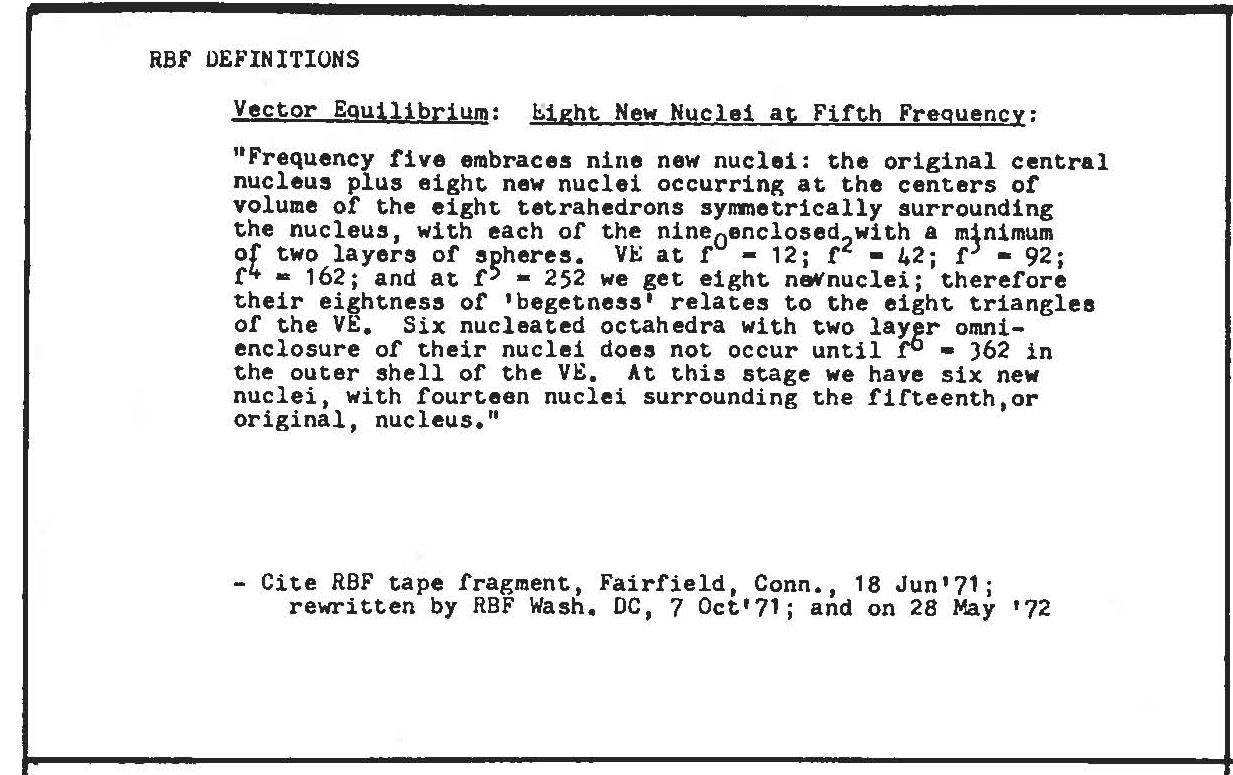
Vector Equilibrium: Eight New Nuclei at Fifth Frequency
← Vector Equilibrium | VE & Icosa →
Index Entry
Vector Equilibrium: Eight New Nuclei at Fifth Frequency:
"Frequency five embraces nine nuclei: the original central nucleus plus eight new nuclei occurring at the centers of volume of the eight tetrahedra symmetrically surrounding the nucleus, with each of the nine enclosed with a minimum of two layers of spheres.
"P0 = 12; F2 = 42; F3 = 92; F4 = 162; and at F5 = 252 we get eight new nuclei; therefore their eightness of 'begetness' relates to the eight triangles of the vector equilibrium.
"Six nucleated octahedra with two-layer omnienclosure of their nuclei does not occur until P6 and the vector equilibrium's outer shell = 362; at this stage we have six new nuclei with 14 surrounding the 15th, or original, nucleus."
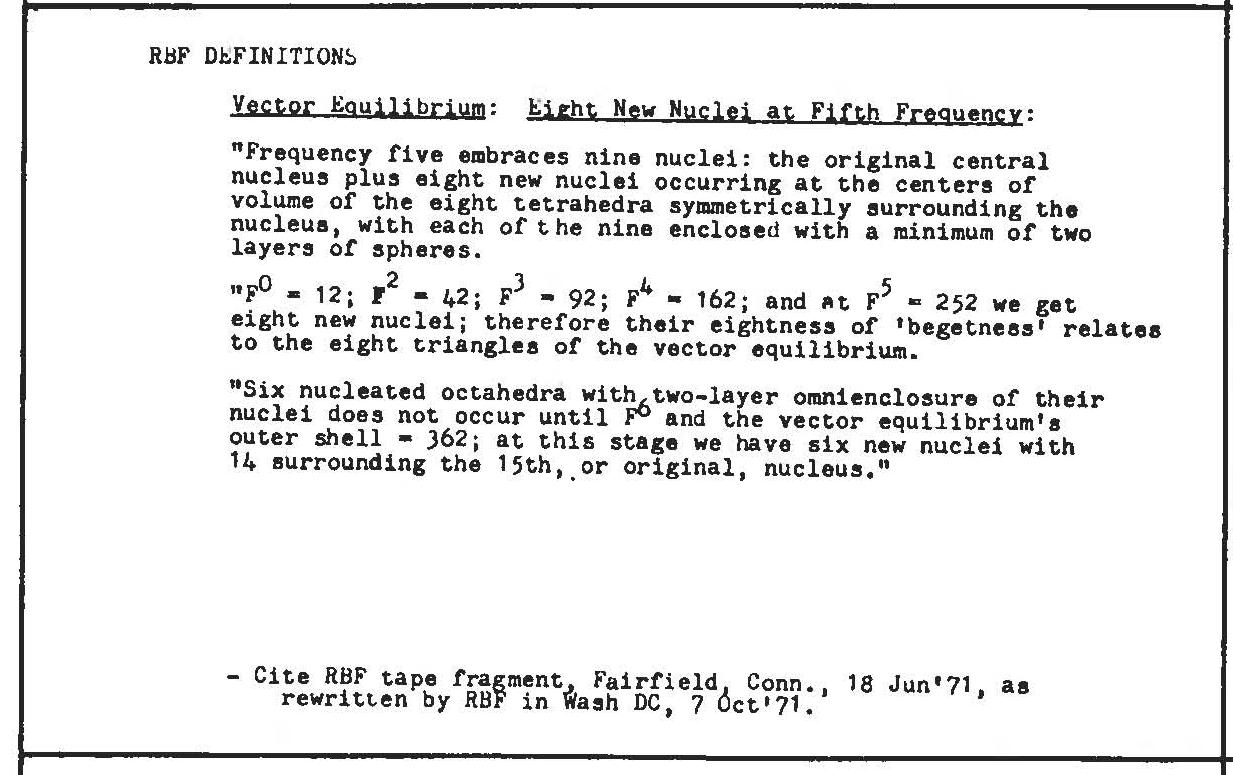
VE & Icosa
← Vector Equilibrium: Eight New Nuclei at Fifth Frequency | VE & Icosa →
RBF Definitions
"The icosahedron is the structuring of the VE."
- Citation & context at Synergetica: Evolution Of, 14 Oct'76
VE & Icosa
Index Entry
The icosahedron and its 12 vertices represents the denucleated phase of the nucleated vector equilibrium with its 12 vertices.
Citation & context at Dymaxion Airocean World Map,(3), 26 Aug'75
VE & Icosa
RBF Definitions
"The original-- only vertexially-single-bonded, vectorially-structured-- triangles of the vector equilibrium jitterbug transform by symmetrical contraction from it openmost vector-equilibrium state, through the {unstable-without-six-additional-vector inserts; i.e., one vectorial quantum unit) icosahedral stage only as accommodated by the nuclear sphere's annihilation, which vanished central sphere reappears transformedly in the 30-vector-edged icosahedron as the six additional external vectors added to the vector equilibrium to structurally stabilize its six "square" faces, which six vectors constitute one quantum package."
VE & Icosa
← VE & Icosa | VE & Icosa (1) →
RBF Definitions
"Reminiscent of electron proclivities, the icosahedron displays the same surface number of spherically conformed, energy-event packages and its only-one-wavelength-deep, single, outer sphere layer array is omnitriangulated, while the vector equilibrium's surface is arrayed two-fifths in triangulation and three-fifths in open, unstable, square tangency. As spherical agglomerates decrease in radius-- as, for instance, do the vector equilibria's contract to the icosahedral phase-- their sphere centers approach one another, and Newton's mass-interattraction law, which shows a second-power gain as the interproximities are halved, imposes an intercoherence condition whereby as their overall system radius decreases, their circumferential mass-interattractions increase exponentially as r², where r = radius of the system."
Citations
- RBF rewrite of SYNERGETICS galley at Sec. \href{https://www.buckyverse.org/en/synergetics/content/chapters/1000-omnitopology#section-1052.44}{1052.44}, Beverly Hotel, NYC, 9 Jan'74
VE & Icosa (1)
← VE & Icosa | VE & Icosa (2) →
Cross Reference
Cross-References
- Universal Integrity: VE & Icosa
- Great Circles: Excess of One Great Circle over Edge Vectors in VE & Icosa
VE & Icosa (2)
← VE & Icosa (1) | Integral Negative →
Cross Reference
Cross-References
- Spherical Nostalgia, 12 Jun'74
- Individuality, 22 Jun'72
- Integer, 15 Oct'72
- Omnirational Control Matrix, 12 May'75
- Gravitational Constant, (1)(2)
- Dymaxion Airocean World Map, (2)(3)
- Stabilized Vector Equilibrium, 23 Feb'72
- Quantum Jump, 26 Aug'76
- Shell Growth Rate, 23 Oct'77
Integral Negative
← VE & Icosa (2) | Vector Equilibrium Involvement Domain →
Cross Reference
Cross-References
- Negative VE, 8 Oct'71
Vector Equilibrium Involvement Domain
← Integral Negative | Vector Equilibrium Involvement Domain →
Index Entry
Vector Equilibrium Involvement Domain:
"How can an object move through water, which is a noncompressible substance? By the intertransformability of spheres becoming spaces and spaces becoming spheres. This is how the annihilation model works in allspace filling. The vector equilibrium and the eight one-eighth-octahedra on the triangular facets make up the nucleated cube. The annihilation model functions at the eight corners of the vector equilibrium.
"In an analogous intertransformability manner the one-quantum-annihilating octahedron which in one-eighth-octahedron increments complements the zero-to-twenty-volume vector equilibrium by furnishing the eight corners."
Vector Equilibrium Involvement Domain
← Vector Equilibrium Involvement Domain | Vector Equilibrium Involvement Domain →
Index Entry
Vector Equilibrium Involvement Domain:
"How do you walk through water? By the intertransformability of spheres becoming spaces and spaces becoming spheres. This is how the annihilation model works in allspace-filling. The vector equilibrium and the eight one-eighth-octahedra on the triangular facets make up the nucleated cube. The annihilation model functions at the eight corners."
- Cite RBF to EJA, 3200 Idaho Ave, Wash. DC; 23 Apr'76
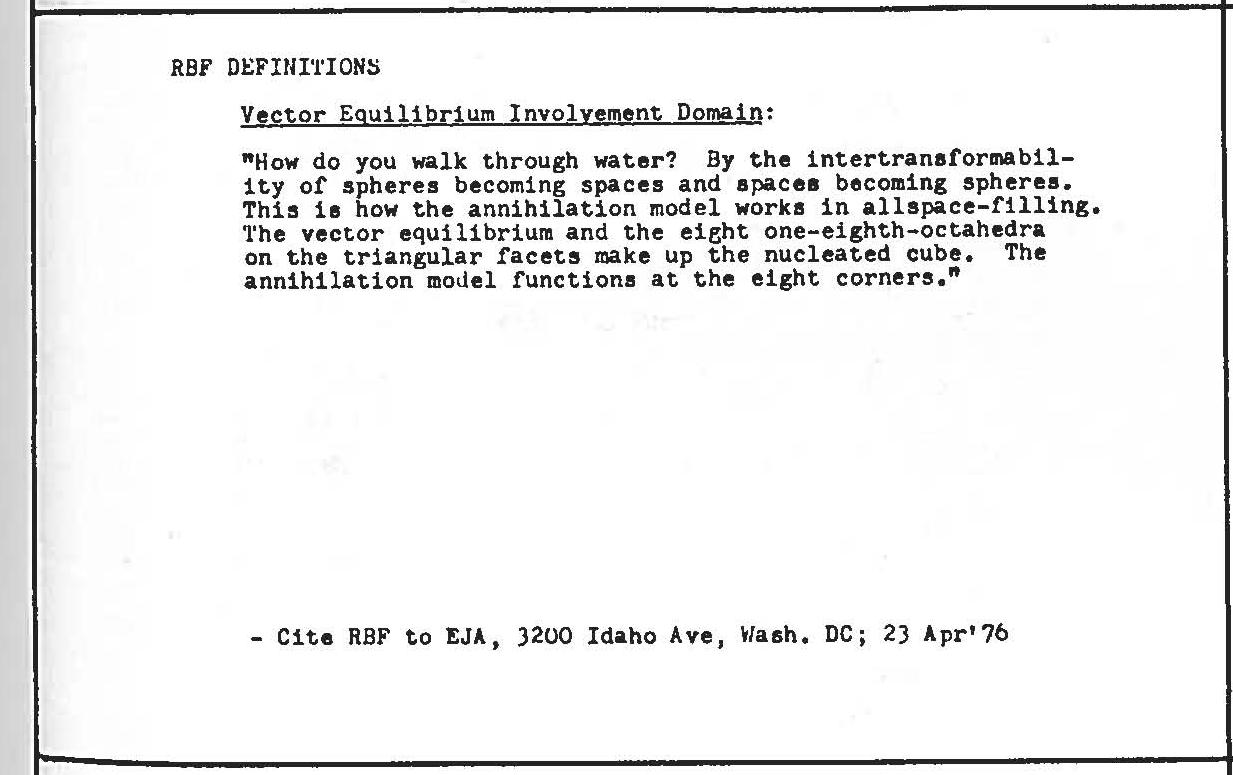
Vector Equilibrium Involvement Domain
← Vector Equilibrium Involvement Domain | Vector Equilibrium Involvement Domain →
Index Entry
Vector Equilibrium Involvement Domain:
"The vector equilibrium has the comprehensive, nuclear concentric, intertransformability involvement domain."
"The sphere of tetravolume 5 is involved with the rhombic dodecahedron of tetravolume 6."
"It takes two of the nucleated cubes because the cube is tetravolume 3."
- Cite RBF to EJA, 3200 Idaho, Wash. DC; recorded 12 Dec'75
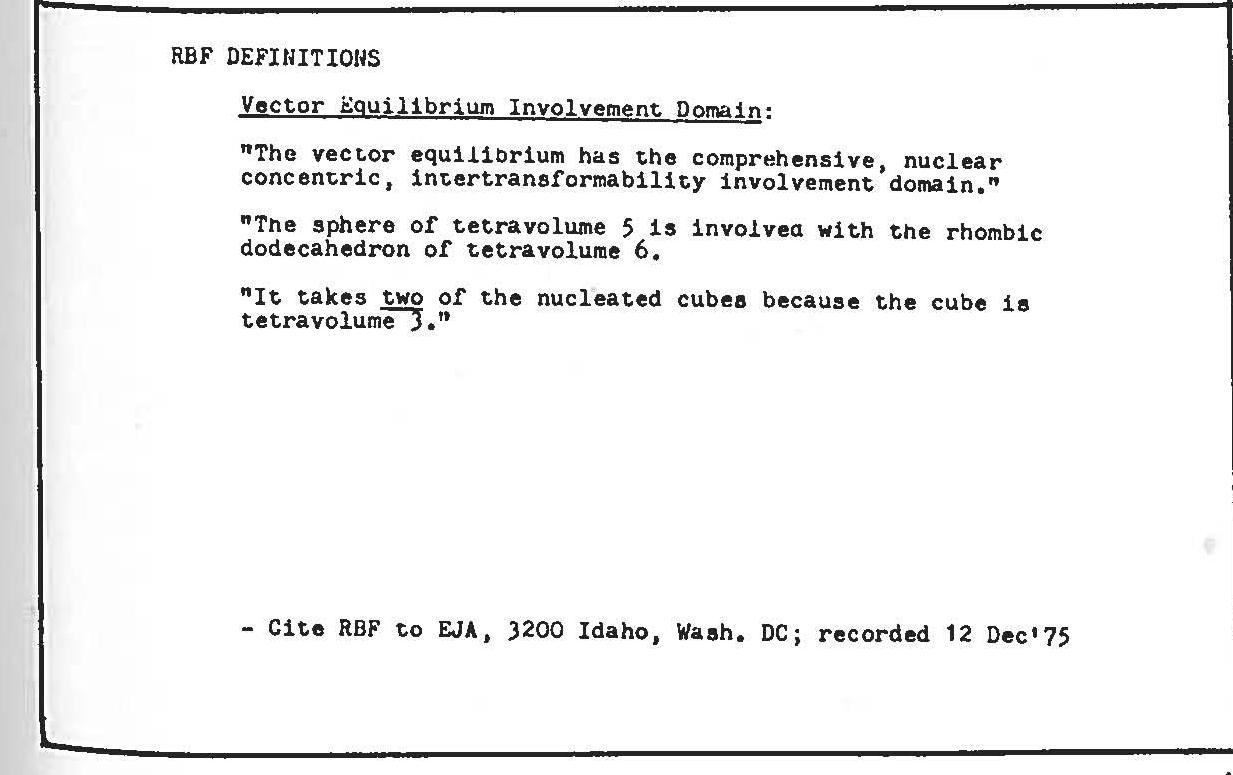
Vector Equilibrium Involvement Domain
← Vector Equilibrium Involvement Domain | Vector Equilibrium Involvement Domain (1) →
Index Entry
Vector Equilibrium Involvement Domain:
"The total involvement domain of the vector equilibrium can be either two of the nuclear cubes #### unstable or the rhombic dodecahedron (=stable). The two cubes and one rhombic dodecahedron are intertransformable aspects of the vector equilibrium domain."
- Cite RBF to EJA holograph, Wash. DC, 11 Dec'75
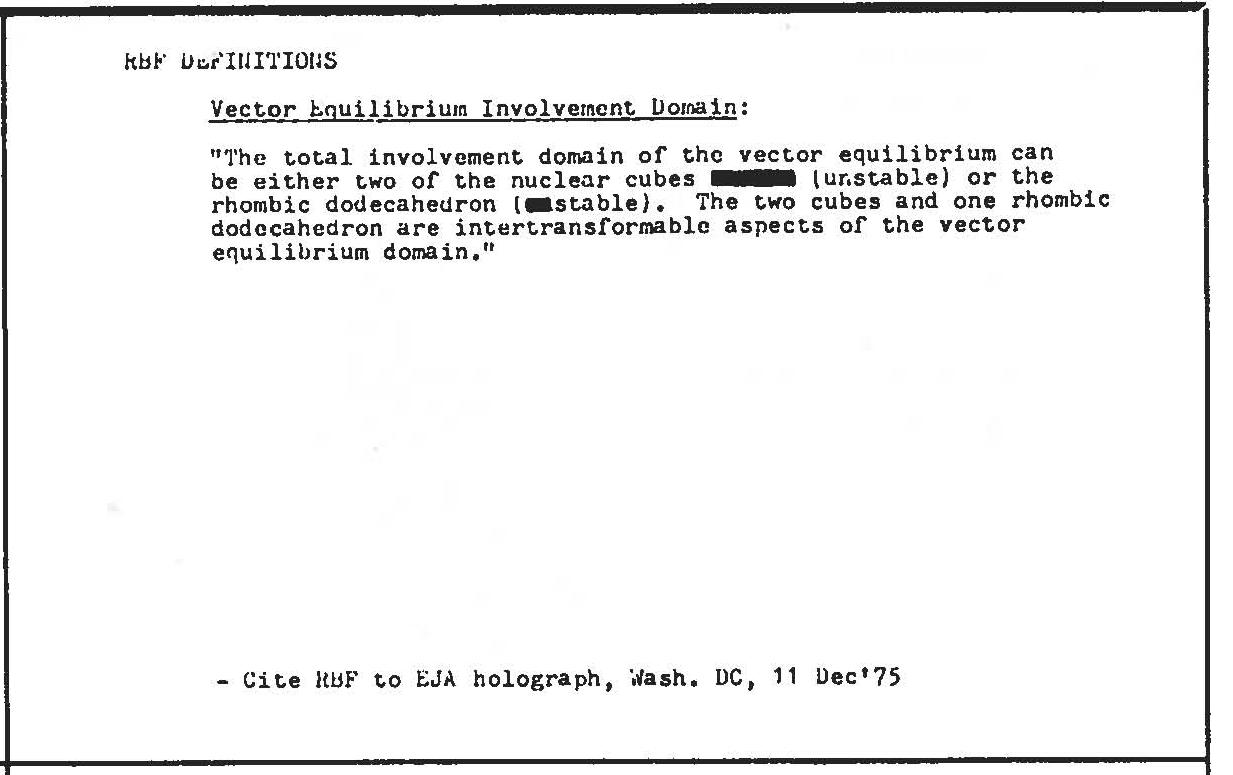
Vector Equilibrium Involvement Domain (1)
← Vector Equilibrium Involvement Domain | Vector Equilibrium Involvement Domain (2) →
Cross Reference
Cross-References
Vector Equilibrium Involvement Domain (2)
← Vector Equilibrium Involvement Domain (1) | Vector Equilibrium: Lending & Borrowing Model →
Cross Reference
Cross-References
- Crystallography, 11 Dec'75
- Nuclear Cube, 11 Dec'75; 23 Feb'76
Vector Equilibrium: Lending & Borrowing Model
← Vector Equilibrium Involvement Domain (2) | Vector Equilibrium: Lending & Borrowing Model →
Index Entry
Vector Equilibrium: Lending & Borrowing Model:
"Atoms borrow electrons when they combine. The open and unstable square faces of the vector equilibrium provide a model for the lending and borrowing operations. When the frequency is three, we can lend four balls from each square. Four is the greatest number of electrons that can be lent: here is a limit condition with the three-frequency and the four-ball edge. All the borrowing and the lending operates in the squares. The triangles do not get jeopardized by virtue of the lending. A lending and borrowing vector equilibrium is maintained without losing the structural integrity of Universe."
- Cite RBF rewrite of SYNERGETICS galley at Sec. \hrefhttps://www.buckyverse.org/en/synergetics/content/chapters/900-modelability#section-942.64942.64, 20 Dec'73
Vector Equilibrium: Lending & Borrowing Model
← Vector Equilibrium: Lending & Borrowing Model | Vector Equilibrium: Odd or Even Shell Growth →
Cross Reference
Cross-References
Vector Equilibrium: Odd or Even Shell Growth
← Vector Equilibrium: Lending & Borrowing Model | Vector Equilibrium: Odd or Even Shell growth →
Index Entry
Vector Equilibrium: Odd or Even Shell Growth:
"The vector equilibrium accommodates positive or negative numbers. The shell generating frequencies of the vector equilibrium are either odd or even. The shell generating frequencies of the octahedron, tetrahedron or cube are only even numbers."
(RBF identifies the above as a Basic Discovery of Synergetics.)
- Cite RBF to EJA, Washington, DC, 7 Oct. 1971.
Vector Equilibrium: Odd or Even Shell growth
← Vector Equilibrium: Odd or Even Shell Growth | Vector Equilibrium: Odd or Even Shell Growth →
Index Entry
Vector Equilibrium: Odd or Even Shell growth:
"Only the vector equilibrium accommodates symmetrical growth or contraction of a nucleus-containing concentric shell series characterized by either even or odd numbers of shells-- a smooth progression of odd or even numbers of shells."
- Cite RBF to EJA, Haverford, Penna., 11 Oct. '71.
CONCENTRIC SHELL GROWTH - SEC. \hrefhttps://www.buckyverse.org/en/synergetics/content/chapters/400-system#section-414.01414.01 +02
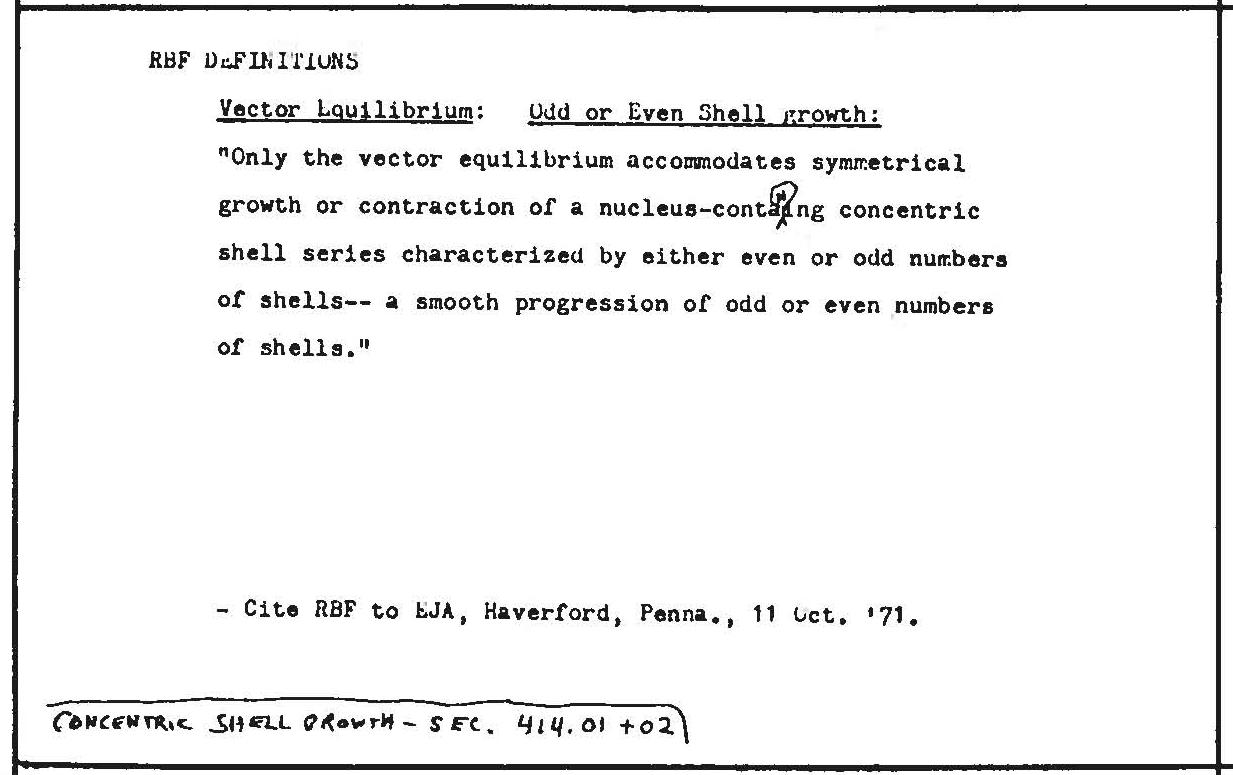
Vector Equilibrium: Odd or Even Shell Growth
← Vector Equilibrium: Odd or Even Shell growth | Vector Equilibrium Package →
Cross Reference
Vector Equilibrium: Odd or Even Shell Growth:
Cross-References
Vector Equilibrium Package
← Vector Equilibrium: Odd or Even Shell Growth | Vector-equilibrium Phase →
Cross Reference
Vector Equilibrium Package: See Dimensional Growth, 20 Dec'73
Cross-References
- Dimensional Growth, 20 Dec'73
Vector-equilibrium Phase
← Vector Equilibrium Package | Vector Equilibrium: Polarization (1) →
Cross Reference
Cross-References
- Zero-nineness, 11 Sep'75
Vector Equilibrium: Polarization (1)
← Vector-equilibrium Phase | Vector Equilibrium: Polarization (2) →
Index Entry
Vector Equilibrium: Polarization:
"...There are two ways you can play this game, because time and again you find that in nesting work.. we are, for instance, taking six which would be in this position and you only nest three on it: so we use this nest: this nest: and this nest. We leave untouched, thos nests. They are in closest packing, we find, always alternate spaces that are not being used, so that triangular groups can be rotated into one position-- or 60 degrees to an alternate nestable place.
We get vector equilibrium in this condition; but in the other condition I have it rotating 60 degrees, and instead of being a vector equilibrium, we simply have in effect a polarized system. These are equilibriums going on in all directions and this goes into a polarized condition. Apparently all the organic chemistry is predicated on this polarized condition.
"We find that you can take two halves of the vector equilibrium made out of balls and take one half off it as vector equilibrium, rotate it 60 degrees and bring them together again and instead of having the condition you have in the vector equilibrium of alternate faces being squares and triangles in array around it,"
- Cite Oregon Lecture #7, pp.234-235, 11 Jul'62
Vector Equilibrium: Polarization (2)
← Vector Equilibrium: Polarization (1) | Vector Equilibrium: Polarization Of →
Index Entry
Vector Equilibrium: Polarization:
"you will get a top triangle and a bottom triangle in the system by rotating it 60 degrees-- and then you will get a square and a square touching each other, and a triangle and a triangle, a square and a square.
"It is polarized. In other words you take the vector equilibrium, rotate it 60 degrees to the next nestable position and suddenly it is polarized. It is this polarized condition, then, that a section through-- it makes the famous chemical hex that the chemists have used. The chemists recognize that form but 10 or 15 years ago they didn't have an experience like that, but they did in the polarized system. Apparently then, all the chemical compounding in the organic chemistry relates to polarized systems."
Vector Equilibrium: Polarization Of
← Vector Equilibrium: Polarization (2) | Vector Equilibrium →
Cross Reference
Cross-References
- Vector Equilibrium, 11 Jul'62
Vector Equilibrium
← Vector Equilibrium: Polarization Of | VE as Prime Nonnucleated System →
Index Entry
Vector Equilibrium: Potential & Primitive Tetravolumes:
"When the isolated single sphere's vector equilibrium of
tetravolume 2½ is surrounded by 12 spheres to become a
nuclear sphere, the vector equilibrium described by the
innermost-economically-interconnecting of the centers of
volume of the 12 spheres comprehensively and tangentially
surrounding the nuclear sphere--as well as interconnecting
their 12 centers with the center of the nuclear sphere--
has a tetravolume of 20 and the nuclear group's rhombic
dodecahedron has a tetravolume of 24."
(Incorporated in SYNERGETICS 2 draft at Sec. \hrefhttps://www.buckyverse.org/en/synergetics/content/chapters/1000-omnitopology#section-1033.1821033.182.)
- Cite RBF marginalis at SYNERGETICS 2 draft at Sec. \hrefhttps://www.buckyverse.org/en/synergetics/content/chapters/1000-omnitopology#section-1033.201033.20;
(draft of 19 Aug'76); RBF marginals done 12 May'77
VE as Prime Nonnucleated System
← Vector Equilibrium | VE as Prime Nucleated System →
Cross Reference
Cross-References
VE as Prime Nucleated System
← VE as Prime Nonnucleated System | Vector Equilibrium: Spheres & Spaces (1) →
Cross Reference
Cross-References
- Nucleus, 2 Nov'73
Vector Equilibrium: Spheres & Spaces (1)
← VE as Prime Nucleated System | Vector Equilibrium: Spheres & Spaces (2) →
Index Entry
Vector Equilibrium: Spheres & Spaces:
"Spheres enclose the packing of the spaces between them. And the spaces turn into only two kinds: there is a concave vector equilibrium and a concave octahedron. Those are the two spaces.
"So I call the sphere a convex vector equilibrium and space a concave vector equilibrium: and an alternate one, which is the octahedron. So it is a precessional side shift. There are three alternates: so suddenly a space, a sphere, becomes a space and the space becomes a sphere. And I have a model where you can see it actually do that. You just press one energy action and the whole thing takes place and propagates an omnidirectional wave. You can literally see it-- drop a stone in the water and you can see an omnidirectional wave occurring... So the curves are generated and are not instantaneous. I have really the only instantaneous way of carrying on, where I don't have a curve generated by a hexagon: I simply have the hexagon, and its chords are equal to its radii.
"Physics has had only two kinds of acceleration: angular and linear. But it hasn't been able to coordinate the angular, so she uses only the liner and tries to experiment. So she hasn't been able to use the angular, so she uses only the linear and"
Vector Equilibrium: Spheres & Spaces (2)
← Vector Equilibrium: Spheres & Spaces (1) | Vector Equilibrium →
Index Entry
"tries to experiment. So she hasn't been able to use the angular because it did involve this pi, so she throws in this constant to make up for it.
"And they have been going with analysis by 90-degree positionings of the actions; and nature doesn't make those 90 degrees... So my chords and my radii are the same and they are the angular and the linear accelerations. They are the vector zones."
Vector Equilibrium
← Vector Equilibrium: Spheres & Spaces (2) | Vector Equilibrium as Starting Point (1) →
Index Entry
Vector Equilibrium: Spheres and Spaces:
"A sphere is an asymmetrical phenomenon. It is an inward-outwardpulsative from the vector equilibrium. The sphere's spaces are interchangeable. The spaces between the spheres are complementaries. Our model really shows each sphere becoming a space and every space becoming a sphere. Each one can be either a concave or convex symmetry of the vector equilibrium. Vector equilibrium then having the maximum radius, then the radius contracts in order to be a sphere. That is how it can be accommodated within the total frame of reference. The edge of the vector equilibrium gets bent into becoming the arc of the sphere. So that the sphere of the vector equilibrium is contracted as a chord turns into an arc the radius contracts."
Cite RBF tape transcript, Chicago, Blackstone Hotel, to LJA + BO'R, p. 49, 31 May '71
Vector Equilibrium as Starting Point (1)
← Vector Equilibrium | Vector Equilibrium as Starting Point (2) →
Index Entry
"Being the zerophase of energy the vector equilibrium is inherently invisible and non-empirically-discoverable, which accounts for its having been for so long unrecognized as the spontaneous equilibrious model. As specialists scientists seek only for somethings. The vector equilibrium is the only model of nonbeing zero-inflection at the nonmoment of omniintertransformabilities where anything can happen and must happen single-atomically within and multiatomically without. Specializing science seeking only somethings inherently overlooked the nonthing vector equilibrium.
"The vector equilibrium is the most abstract of all the always-and-only abstract scientific generalization, for it is the heart of all interrelationships existing between and not in or of any of all the empirically apprehended intertransforms of the ever-and-everywhere intertransforming scenario Universe. The vector equilibrium is the zerophase, ergo inexpressible, interrelationship of all Universe events.
"The word vacuum relates specifically to gaseous phenomena. Nature's abhorrence of a vacuum induces physical relationships only in respect to the gaseous state. The vector equilibrium"
Vector Equilibrium as Starting Point (2)
← Vector Equilibrium as Starting Point (1) | Vector Equilibrium as Starting Point →
Index Entry
Vector Equilibrium as Starting Point:
"is the nothingness phase of all states of the physical Universe: it is the generalization of nothingness, within which generalization the absolute vacuum is a special case event in the gaseous state. The vector equilibrium is such a physically abhorred nonstate as to be the eternal self-starter, ergo the eternal re-self-starter ever regenerating the off-zero perturbations, oscillations, and all the wave propagation of all humanly experienceable physical and metaphysical phenomena.
"The sense-coordinating brain of each and all humans, like sound or light, has a limit speed of apprehending. There is no instant cerebral cognition. The apprehension lags automatically impose off-center human cognition which occasions the sense of time in a timeless eternity. The sense of time occasions the conception of life and serial experience. The inherently invisible vector equilibrium self-startered life and ever regenerates life. Inherent in the lags is our intimate knowledge only of self."
- Cite SYNERGETICS, 2nd. Ed. Secs \hrefhttps://www.buckyverse.org/en/synergetics/content/chapters/400-system#section-440.11440.11-\hrefhttps://www.buckyverse.org/en/synergetics/content/chapters/400-system#section-440.12440.12, 11 Sep'75
Vector Equilibrium as Starting Point
← Vector Equilibrium as Starting Point (2) | Vector Equilibrium →
Index Entry
Vector Equilibrium as Starting Point:
"It was the initial quality of seemingly invisible vector equilibrium-- as well as that it was not experimentally discoverable-- that has kept the vector equilibrium so long unrecognized as the equilibrium model.
"While the vector equilibrium is involved in all the forms of the crystals, the vector equilibrium is a starting point; it is not anything in its own right; it is the zero-inflection, nonmoment of omniintertransformabilities where anything can happen and must happen single-atomically within and multiatomically without."
- Cite Vector equilibrium, 15 Oct'64 & 27 Nov'72 as rewritten by RBF, Wash. DC, 8 Apr'75
Vector Equilibrium
← Vector Equilibrium as Starting Point | Vector Equilibrium: Three-frequency VE →
Cross Reference
Vector Equilibrium: Symmetrical Contraction Of
Cross-References
Vector Equilibrium: Three-frequency VE
← Vector Equilibrium | Vector Equilibrium →
Index Entry
Vector Equilibrium: Three-frequency VE:
"We have the total sphere as the first stage of radial contraction of the vector equilibrium. As its radii contract, its 24 chords respond to the lessening of space between the radii's outward ends by bowing or arcing either inwardly or outwardly of the system; if outwardly the arcs become convex and altogether produce or form a sphere; if inwardly they become concave and form or produce the space between the spheres.
"We have here some of the concepts of the limits of alternative asymmetric pulsative potential in respect to the vector equilibrium as the outward limit of nuclear phenomena beyond which vector equilibrium limits the first structural growth complexities are those of the crystals and molecules and thereafter the protoplasm and the biologicals.
"That's what we have: nuclear uniqueness and all its initial manifold transformative variables as they occur within the domain of the three-frequency vector equilibrium."
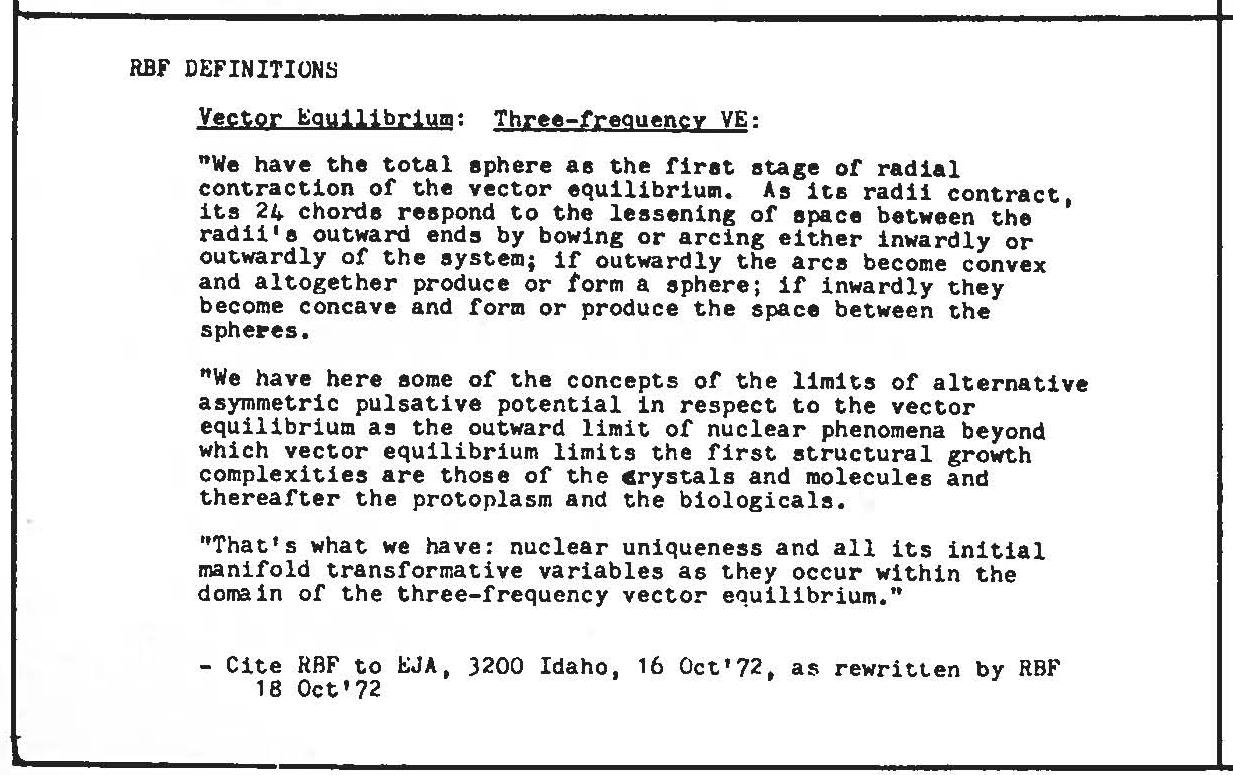
Vector Equilibrium
← Vector Equilibrium: Three-frequency VE | Vector Equilibrium: Three-frequency VE →
RBF Definitions
"We have the total sphere as the convergence of the vector equilibrium. And we have the concepts of the limits of asymmetry in respect to the vector equilibrium as the limit of coming to the molecules. That's what we have: nuclear uniqueness and all of its variables within the domain of the three-frequency vector equilibrium."
Citations
- RBF to EJA, 3200 Idaho, 16 Oct'72
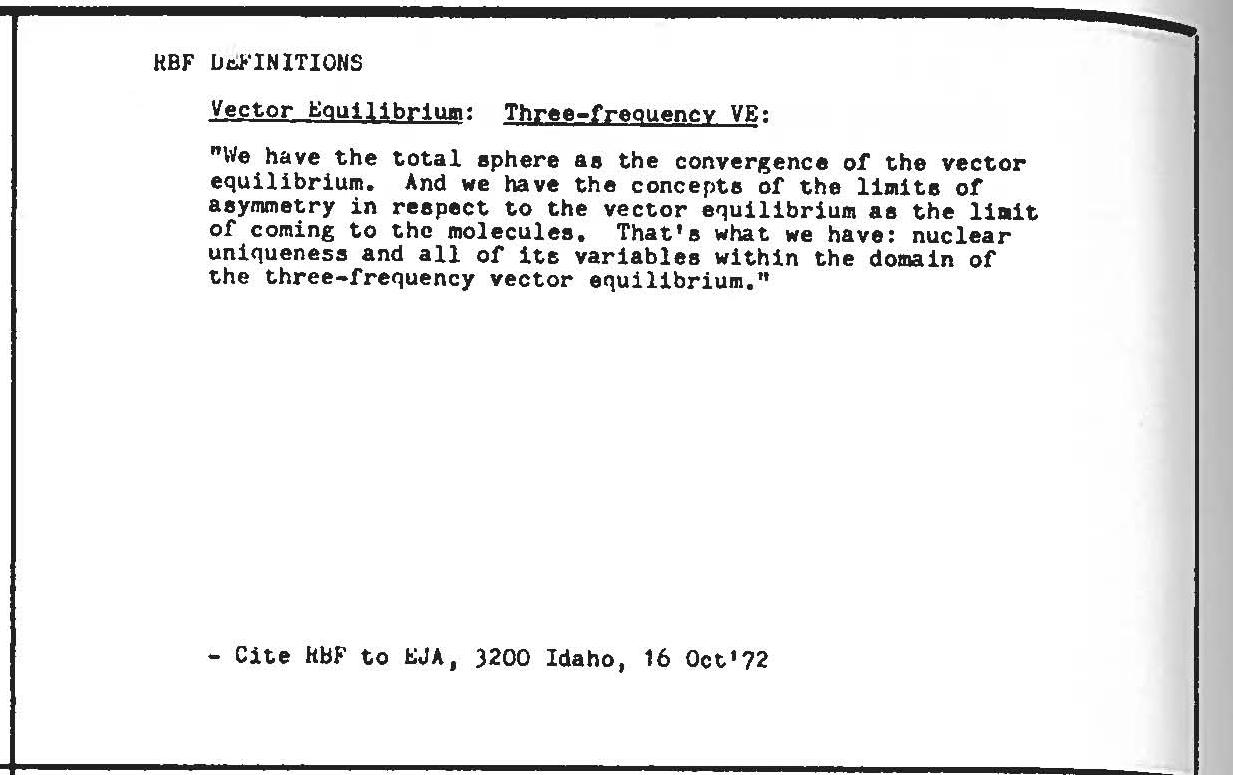
Vector Equilibrium: Three-frequency VE
← Vector Equilibrium | Vector Equilibrium Threshold →
Cross Reference
Vector Equilibrium: Three-frequency VE:
Cross-References
Vector Equilibrium Threshold
← Vector Equilibrium: Three-frequency VE | Vector Equilibrium Threshold →
Index Entry
"Critical proximity is a threshold; the absolute threshold-- a vector equilibrium threshold. If it persists, we call it 'matter,'"
Vector Equilibrium Threshold
← Vector Equilibrium Threshold | Vector Equilibrium: Unarticulated VE →
Cross Reference
Vector Equilibrium Threshold:
Cross-References
- Critical Proximity Threshold, 19 Jun'71*
Vector Equilibrium: Unarticulated VE
← Vector Equilibrium Threshold | Vector Equilibrium Unarticulated VE →
Index Entry
Vector Equilibrium: Unarticulated VE:
"Wavelength times frequency is the speed of all radiation. If the frequency of the vector equilibrium is four, its vector radius, or basic wavelength = 186,000/4 miles reachable within one second= 46,500 reach-miles. Electromagnetically speaking, the unarticulated vector equilibrium's one-second vector length is always 186,\hrefhttps://www.buckyverse.org/en/synergetics/content/chapters/200-synergetics#section-282.396282.396 miles.
"We multiply our frequency by the number of times we divide he vector of the vector equilibrium, and that gives c²; our reachable points in Universe will multiply at a rate of F² x 10 + 2."
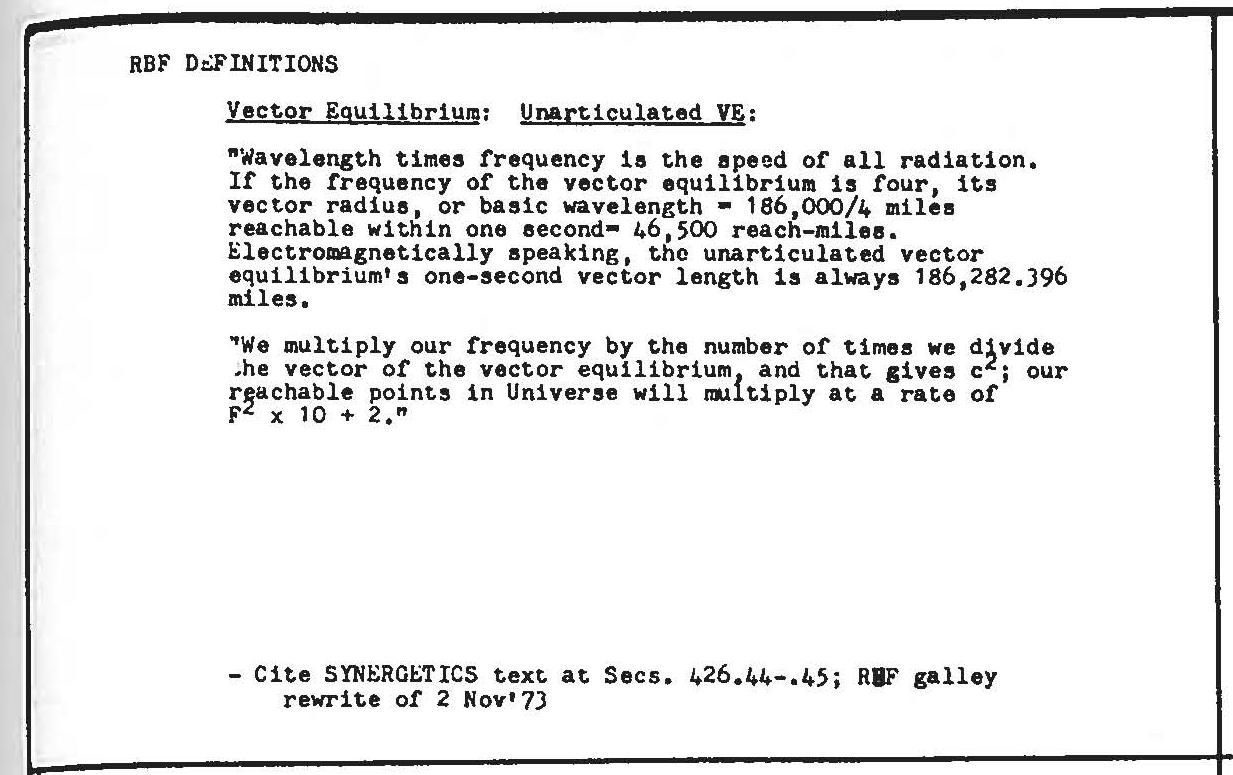
Vector Equilibrium Unarticulated VE
← Vector Equilibrium: Unarticulated VE | Vector Equilibrium as Unity →
Cross Reference
Cross-References
- Radiation, 30 Nov'72
Vector Equilibrium as Unity
← Vector Equilibrium Unarticulated VE | Vector Equilibrium →
Index Entry
Vector Equilibrium as Unity:
"The maximum space employed by unity is the vector equilibrium."
- Cite RBF at Penn Bell Videotaping session, Philadelphia, PA., 20 Jan'75
Vector Equilibrium
← Vector Equilibrium as Unity | Vector Equilibrium Zero Condition →
Index Entry
Vector Equilibrium: Ratio of Volume to Quantum:
"To stabilize the vector equilibrium structurally we need to insert six vectors as dia,onals in each of its quadrangular square faces, which converts the six vector-edged squares into six vector-diagonalled diamonds, but in doing so shrinks the vector equilibrium's 20 units of enclosed volume to 18.51 units of volume. (I.e., 3.702 vol : 1 quantum.)
Vector Equilibrium Zero Condition
← Vector Equilibrium | Vector Equilibrium Zerophase →
Index Entry
Vector Equilibrium Zero Condition:
"We have said that this is a vector equilibrium and in a
zero condition and is nonreality. Nature would not permit
it but a minute after that these six edges turbine around
that point one way or another and you see plenty of the
models of the lines trubining around. We will have to say
that there had to be a moment theoretically when this plane
went from being a positive tetrahedron to a negative
tetrahedron, which it could be, and had theoretically to
pass through that point."
- Cite Oregon Lecture #7, p. 237, July '62
Vector Equilibrium Zerophase
← Vector Equilibrium Zero Condition | Vector Equilibrium: Zerophase →
Index Entry
Vector Equilibrium Zerophase:
"When the four planes of each of the eight tetrahedra move toward their four opposite vertexes the momentum carries them through zero-volume nothingness of the vector equilibrium phase. All their volumes decrease at a third-power rate of their linear rate of approach. As the four tetrahedral planes coincide, the four great circle planes of the vector equilibrium all go through the same nothingness local at the same time. Thus we find the vector equilibrium to be the inherent zero-nineness of fundamental number behavior."
(s1013.42)
- Cite SYNERGETICS, 2nd. Ed. at RBF margunals at Sec. \hrefhttps://www.buckyverse.org/en/synergetics/content/chapters/1000-omnitopology#section-1013.421013.42; 30 Aug'75
Vector Equilibrium: Zerophase
← Vector Equilibrium Zerophase | Vector Equilibrium: Zerophase →
Index Entry
Vector Equilibrium: Zerophase:
"Pulsation, the vector equilibrium is the nearest thing
we will ever know to eternity and God: the zerophase of
conceptual integrity inherent in the positive and negative
asymmetries which propagate the problems of the
consciousness. Our inherently limited perceptivity which
requires these definitions of the asymmetric emphasis of
experience. Experience is inherently terminal, partial,
differentiable. . . the antithesis of eternal integrity."
-
Citation at Experience, 12 Sep'71
-
Cite RBF to EJA, Beverly Hotel, New York, 12 Sept 1971.
Vector Equilibrium: Zerophase
← Vector Equilibrium: Zerophase | Vector Equilibrium →
Index Entry
Vector equilibrium is all the things any one tetrahedron could do by pumping (turning itself inside out). It has four directions it could turn inside out. So it does all four of them to a common center and makes eight tetrahedra. So this is a tetrahedron exploding itself: turning itself inside out in four possible directions. So we get eight: inside and outside in four directions. The vector equilibrium is all the potentials. This is the way you become invisible.
Vector Equilibrium
← Vector Equilibrium: Zerophase | Vector Equilibrium Zerophase →
Index Entry
Vector Equilibrium: Zerophase:
"The vector equilibrium is absolutely dead center of Universe and will never be seen by man in any physical experience-- yet it is the frame of reference. And it is not in rotation and it is sizeless and timeless. . . We have its mathematics which deals absolutely discretely because it does shut mm off in those chordal lengths. The radial vectors and circumferential vectors are absolutely the same size so I don't have to think about pi. She is able to entertain the pi in a rational system."
- Cite tape transcript RBF to BO'R, CarbondaleDome, 1 May 1971. pp. 39-40.
Vector Equilibrium Zerophase
← Vector Equilibrium | Vector Equilibrium: Zerophase →
RBF Definitions
But the point is the vector equilibrium simply gives you the key. . . . All four planes of all eight tetrahedra are in common centers. Yet you see only four. Both the positive and the negative phase of the tetrahedra are in congruence in the center. And they are able to do this because they are discontinuous. Their centers -- literally, they are the first time you ever saw an absolutely empty thing. All four planes go through the same center. And you can only do that when there is nothingness."
Vector Equilibrium: Zerophase
← Vector Equilibrium Zerophase | Vector Equilibrium: Zerophase: Zerosize (1) →
Index Entry
Vector Equilibrium: Zerophase:
"I have a vigorous conviction that all the phenomena larger and more complex than vector equilibrium do relate to chemical compounds and anything smaller than vector equilibrium relates to the single atoms which do get into the symmetries whereas the chemical compounds get into a polarized system. The vector equilibrium is a condition that nature never allows herself to be caught in. We do not find the vector equilibrium occuring per se as a crystal in universe. We have vector equilibriums mildly distorted as nature goes positive and negative in respect to the equilibrium and everything that we know as reality has to be either a positive or a negative condition. She does not get caught at the zero because vector equilibrium is really a zero."
- Cite Carbondale-Draft
Nature's Coordination, p. VI.43
- Cite OKCOSW #1, p. 235, 11 Jul'62
VE AS ZERO MODEL - Sec. \hrefhttps://www.buckyverse.org/en/synergetics/content/chapters/400-system#section-432.03432.03
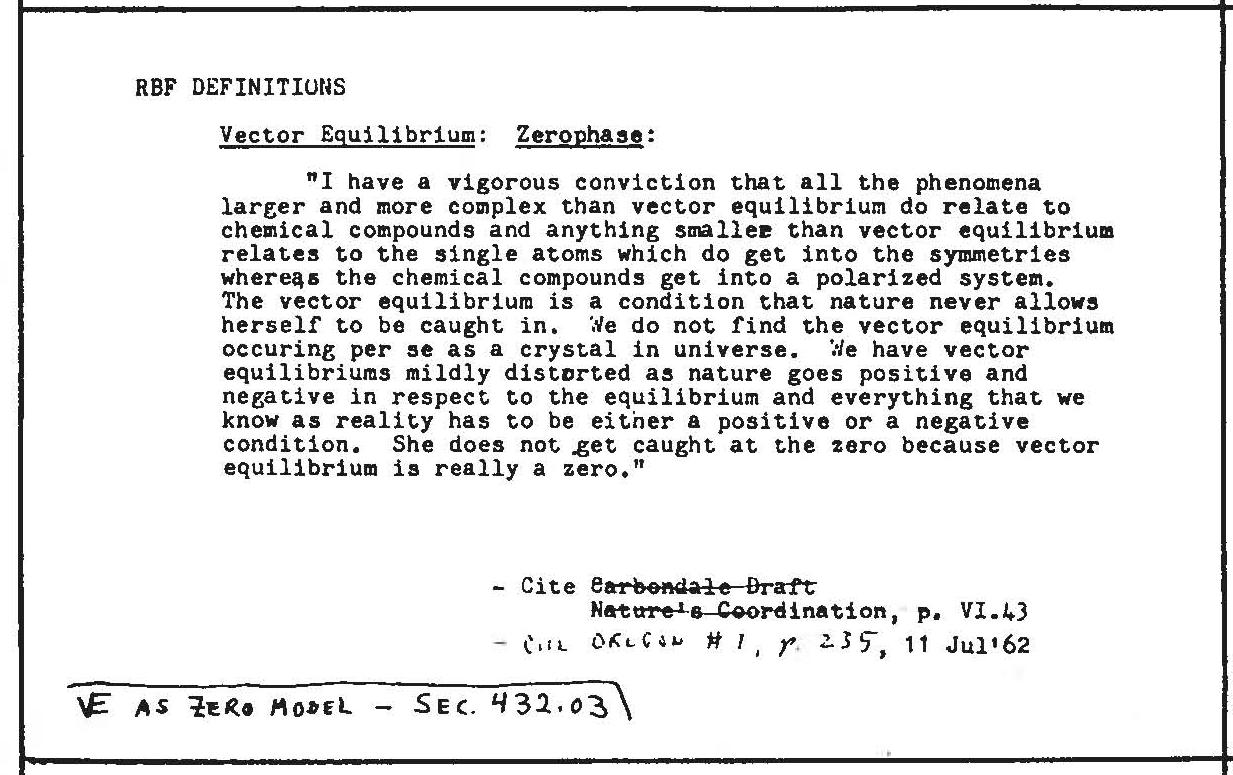
Vector Equilibrium: Zerophase: Zerosize (1)
← Vector Equilibrium: Zerophase | Vector Equilibrium Zerophase Zerosize (2) →
Cross Reference
Cross-References
- Tetrahedron: Inside-outing Of Congruence at the Center Hedra
Vector Equilibrium Zerophase Zerosize (2)
← Vector Equilibrium: Zerophase: Zerosize (1) | Vector Equilibrium: Zerosize →
Cross Reference
Cross-References
- Experience, 12 Sep'71
- Point, 20 Dec'73
- Single Integer Differentials, (1)
- ave Wave Model, Oct
- Powering: Fourth Powering, 9 Sep'75
- Tetrahedron: Nine Schematic Aspects, 30 Aug'75
Vector Equilibrium: Zerosize
← Vector Equilibrium Zerophase Zerosize (2) | Vector Equilibrium: Zero Tetrahedron →
Index Entry
Vector Equilibrium: Zerosize:
"The relative size of the vector equilibrium begins with the initial zerosize integrity of conceptuality and its omnidimensional modular subdivisibility for accounting any frequency of geometrical configuration transformative accounting."
- Cite RBF rewrite of SYNERGETICS galley at Sec. \hrefhttps://www.buckyverse.org/en/synergetics/content/chapters/400-system#section-445.07445.07, 4 Nov'73
Vector Equilibrium: Zero Tetrahedron
← Vector Equilibrium: Zerosize | Vector Equilibrium: Zero Tetrahedron →
Index Entry
"Vector equilibrium accommodates all the intertransformings of any one tetrahedron by polar pumping or turning itself inside out. Each vector equilibrium has four directions in which it can turn itself inside out. It uses all four of them through the vector equilibrium's common center and generates eight tetrahedra. The vector equilibrium is a complex tetrahedron imploding-exploding itself, turning itself inside out in four possible directions. So we get eight: inside and outside in four directions. The vector equilibrium is all eight of the potentials." - Cite RBF rewrite of SYNERGETICS galley at Sec. \hrefhttps://www.buckyverse.org/en/synergetics/content/chapters/400-system#section-441.02441.02, 4 Nov'73
Vector Equilibrium: Zero Tetrahedron
← Vector Equilibrium: Zero Tetrahedron | Vector Equilibrium: Zero Tetrahedron (1) →
Index Entry
"All four planes of all eight tetrahedra, i.e., 32 planes in all, are congruent with the four visible planes passing through their common vector equilibrium center. So you see only four planes. Both the positive and negative phase of the eight vector equilibrium tetrahedra are in congruence in the center. They are able to do this because they are synchronously discontinuous. Their common center provides the local of an absolutely empty event."
Vector Equilibrium: Zero Tetrahedron (1)
← Vector Equilibrium: Zero Tetrahedron | Vector Equilibrium: Zero Tetrahedron (2) →
Index Entry
Vector Equilibrium: Zero Tetrahedron:
"There is something I would like to speak about in regard to vector equilibrium and tetrahedron. I spoke yesterday about a rather extraordinary realization that in looking at a tetrahedron we say, I see there are three around any one vertex: there are three faces and three edges in beautiful synchronization and we say that all looks simple and logical. Then we find it rather surprising because we find that the inventory of three faces came out of an inventory of four total that are available in the tetrahedron. And the inventory of three edges came out of an inventory of six that are available. So that the sixness and fourness were very different inventories. Somehow around any one vertex nature had arranged to put them in neat balance of different inventories.
"Consider the case I spoke of one time of the cheese tetrahedron as pushing one of the faces towards the opposite vertex. I am not going to talk about it as a cheese now, but for a moment we will think of it just as a plane. As the top plane of this tetrahedron-- I am going to move it (the plane) towards this opposite vertex. Finally I move it until it is congruent with"
Vector Equilibrium: Zero Tetrahedron (2)
← Vector Equilibrium: Zero Tetrahedron (1) | Vector Equilibrium: Zero Tetrahedron (3) →
Index Entry
Vector Equilibrium: Zero Tetrahedron:
"the opposite vertex. There is now no volume, but we have agreed that the conditions of symmetry in the tetrahedron, the sixness and fourness, are all still there, but they are empty.
"Now with this plane congruent with the opposite vertex we have a very interesting condition. We have all four planes of the tetrahedron going through the same point at the same time-- or, theoretically, as close as you can ever get. You have six edges going through the same point at the same time. We have agreed that this is a condition that can never happen in reality, but in the vector equilibrium-- where it has no size-- we have the only possible time when this would seem to occur.
"So we now have all six edges and a total inventory of four faces and six edges all going through the same theoretical point at the same moment. We have said that this is a vector equilibrium and in a zero condition and is nonreality. Nature would not permit it. But a minute after that, those six edges turbine around the point one way or another-- and you see plenty of models of the lines turbining around-- but we will have to say that there had to be a moment theoretically when this plane"
Vector Equilibrium: Zero Tetrahedron (3)
← Vector Equilibrium: Zero Tetrahedron (2) | Vector Equilibrium (1) →
Index Entry
Vector Equilibrium: Zero Tetrahedron:
"went from being a positive tetrahedron to a negative tetrahedron, which it could be, and had theoretically to pass through that point. Very clearly vector equilibrium is a zero tetrahedron: and we already had tetrahedron as an indestructible conceivable phenomenon independent of size. An d then we have it getting into its own true zero vector equilibrium. It is very interesting to realize what that condition is. It is a condition that nature apparently does not permit in our life, but what we call reality is always a positive and negative set of the whole."
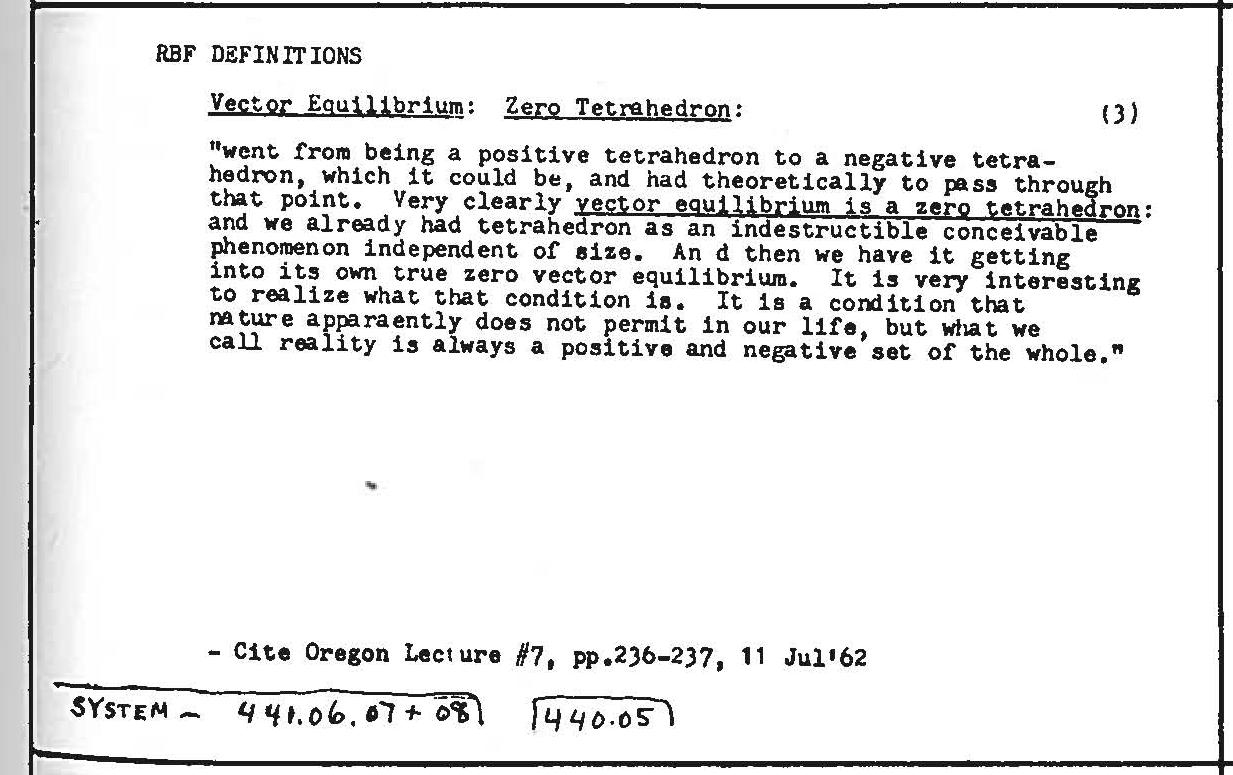
Vector Equilibrium (1)
← Vector Equilibrium: Zero Tetrahedron (3) | Vector Equilibrium (1) →
Cross Reference
See Allspace Filling:ahedron & VE, Oct
Between: VE as Prime Betweenness Model
Domain of VE
Equilibrium Model
Fourth Dimension: VE as Fourth-dimension Model
Genesis of Modelability = VE
Cross-References
- Allspace Filling:ahedron \& VE, Oct
- Central Symmetry
- Closest Packing of Spheres
- Cube & VE as Wave Propagation Model
- Dymaxion
- Equanimity Model
- Isotropic Vector Matrix
- Jitterbug
Vector Equilibrium (1)
← Vector Equilibrium (1) | Vector Equilibrium (1) →
Cross Reference
Negative VE
Potential VE
Propagative Transformation of VE
Stabilized VE
Star Tetra & VE
Spontaneous Equilibrrious Model
Transvector-equilibrium
Tensegrity VE
Cross-References
- Local VE
- Model of Nonbeing
- Nuclear Domain
- Omniequilibrium
- Omnilibrium
- Rhombic Dodecahedron
- Symmetrical Contraction of VE
- Tetraa & VE, Oct
Vector Equilibrium (1)
← Vector Equilibrium (1) | Vector Equilibrium →
Cross Reference
Cross-References
Vector Equilibrium
← Vector Equilibrium (1) | Vector Equilibrium (2) →
Cross Reference
Everwhen, 18 Nov'77
Cross-References
- Allspace Filling, 11 Jul'62
- Congruence, 25 Jan'72*
- Constant Relative Abundance, 29 Nov'72
- Cosmic Fish Sequence, (3)
- Cryogenics, 28 Oct'72
- Critical Proximity Threshold, 19 Jun'71*
- Crystallography, 17 Aug'70; 11 Dec'75
- Dymaxion Airocean World Map, (2)
- Enzymes, 2 Oct'72*
- Equilibrious, 23 Jan'72
- Experience, 12 Sep'71; 25 Aug'71*
- Eternal & Temporal, 20 Feb'77
- Fourth Dimension, 19 Feb'76
- Fourteen, 1 Jun'71
- Frame of Reference, 4 Oct'72
- Frequency, 12 Jul'62*
- Gravitational Constant, (1)
- Gravity: Speed Of, 21 Oct'72
Vector Equilibrium (2)
← Vector Equilibrium | Vector Equilibrium →
Cross Reference
Cross-References
- Happenability, 25 Aug'71
- Ideal, 1 Apr'72*
- Interchangeable Intertransformativeness, 22 Feb'73
- Icosahedron as Local Shunting Circuit, 22 Jan'72
- Integrity of Universe, 30 Oct'73
- Immaculate Conception, 25 Jan'72
- Metaphysical & Physical, Jun'66*
- Nonthing, 11 Sep'75
- Neutral Angle, 16 Dec'73
- Other, 25 Aug'71
- Physics: Difference Between Physics & Chemistry, Jun'66; 11 Jul'62
- Planck's Constant
- Prime Vector
- Powering, 10 Jul'62
- Push-pull: Push Wave & Pull Wave, 25 Aug'71*
Vector Equilibrium
← Vector Equilibrium (2) | Vector Equilibrium (3A) →
Cross Reference
Cross-References
- Sixty Degreeness, 1965
- Size, 22 Jun'72
- Sphere, 31 May'71
- Star Tetrahedron, 8 Oct'71*
- Stable & Unstable Structures, 7 Jun'72
- Schematic of the Principles, 10 Sep'74
- Subfrequency, 12 Jul'62
- Tetrahedron: Zero Tetrahedron, 1960
- Ten, 22 Jun'75
- Twelve Universal Degrees of Freedom, 19 Nov'74*
- Two Kinds of Twoness
- T Module, 31 Jul'77
- Understanding, 25 Aug'71
- Unit Magnitude, 13 May'73
- Vectorial & Vertexial Geometry, (4)
- Wichita House, (1)
Vector Equilibrium (3A)
← Vector Equilibrium | Vector Equilibrium (3B) →
Cross Reference
VE: Eight-pointed Star System, 3A
VE as Empty Set Tetrahedron, 3A
VE: Field of Energy, 3A
VE Field, 3A
VE: Eight New Nuclei at Fifth Frequency, 3A
VE Frame, 3A
VE: Frequency Of, 3A
VE: Great Circles Of, 3A
VE Frame, 3A
VE Growth, 3A
VE: Integral Negative, 3A
VE Involvement Domain, 3A
VE: Lending & Borrowing Model, 3A
VE: Odd or Even Shell Growth, 3A
VE Package, 3A
VE: Propagative Transformation Of, 3A
VE Phase, 3A
VE: Polarization, 3A
Cross-References
- VE: Articulation Of, 3A
- VE: Complementary
- VE as Prime Nucleated System
Vector Equilibrium (3B)
← Vector Equilibrium (3A) | Vegetable Crop Harvesting →
Cross Reference
VE as Starting Point
VE: Spheres & Spaces
VE: Symmetrical Contraction Of
VE: Three-frequency
VE: Unarticulated VE
VE as Unity
VE: Zerophase
VE: Zerosize
VE: Zero Tetrahedron
VE &a, Oct
VE: Axes
VE: Potential & Primitive Tetravolumes
Cross-References
- VE: Ratio of Volume to Quantum
- VE & Icosa
Vegetable Crop Harvesting
← Vector Equilibrium (3B) | Vegetable Crop Harvesting →
Index Entry
Vegetable Crop Harvesting:
"Now let's look at the present situation in agriculture where the basic food production is. Of the total vegetable crop harvesting about 10 percent is actually, finally available for human consumption in America. There are various reasons for this, but it is if you were sort of standing and picking apples, and for every nine apples that you pick, you only get■ one in your basket. It's a very frustrating, inefficient process."
Cite RBF to World Game at NY Studio School 12Jun-31Jul'69, from Saturn Film transcript, Sound 1, Take 1, pp.16-17.
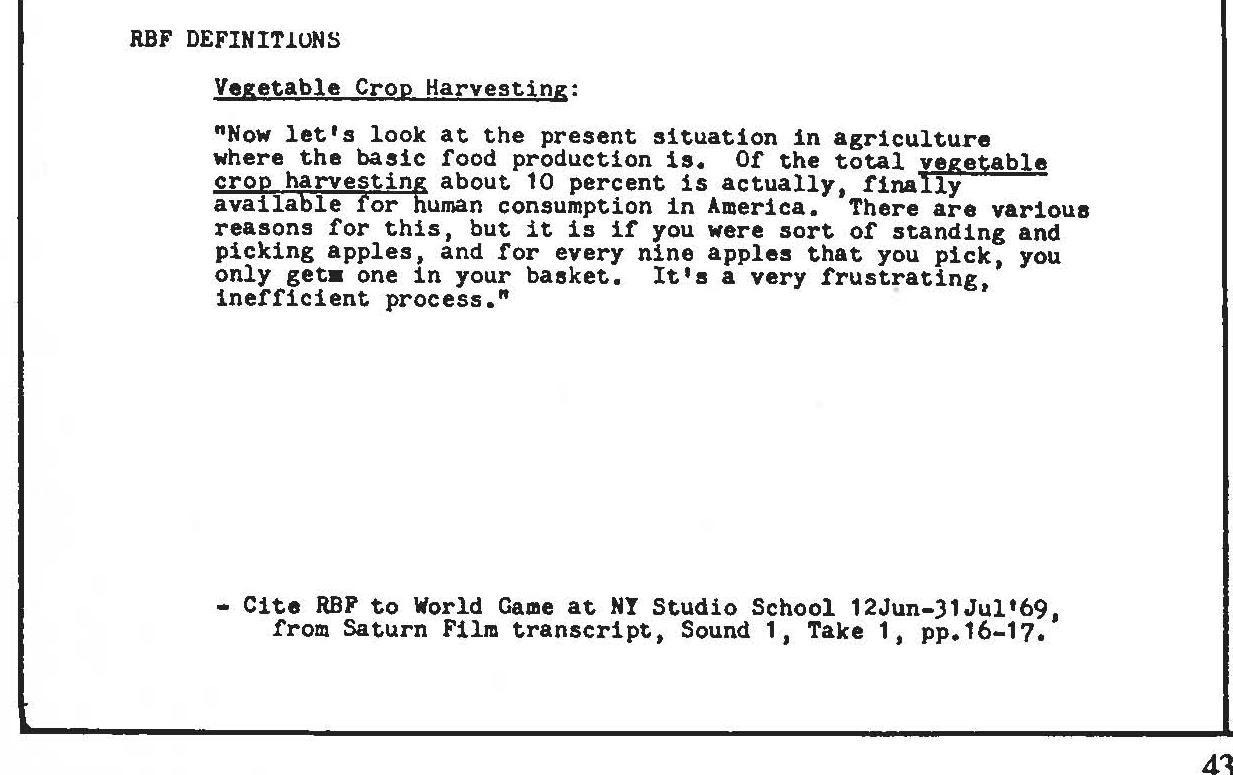
Vegetable Crop Harvesting
← Vegetable Crop Harvesting | Vegetables →
Cross Reference
Cross-References
Vegetables
← Vegetable Crop Harvesting | Vegetation →
Cross Reference
Vegetables:
Cross-References
- Man As Pattern Integrity, 1970
Vegetation
← Vegetables | Vegetation (1) →
Index Entry
Vegetation:
"... The vegetation's terrestrial impoundments of the star-radiated energy which alone regenerates all biological life around Earth planet..."
Vegetation (1)
← Vegetation | Vegetation (2) →
Cross Reference
Impoundment
Cross-References
- Ecology Sequence
- Energy Inhibited as Zoology or Vegetation
- Energy Capital
- Income Energy
- Mammalian-vegetation Interchange of Gases
- Metabolic Flow
- Photosynthesis
- Pine Tree & Palm Tree Belts
Vegetation (2)
Cross Reference
Cross-References
- Bumblebee, 6 Nov'72*
- Design, (2)
- Energy Capital Sequence, (1)
- Radiation Sequence, (2)
Vehicle
Cross Reference
Vehicle:
Cross-References
Velocity
RBF Definitions
Velocity can be inward, outward, or around, and the arounding will always be chordal and exactly equated with the inwardness and outwardness time expendibilities." - Cite SYNERGETICS draft at Sec. \hrefhttps://www.buckyverse.org/en/synergetics/content/chapters/900-modelability#section-962.43962.43, 17 Nov'72
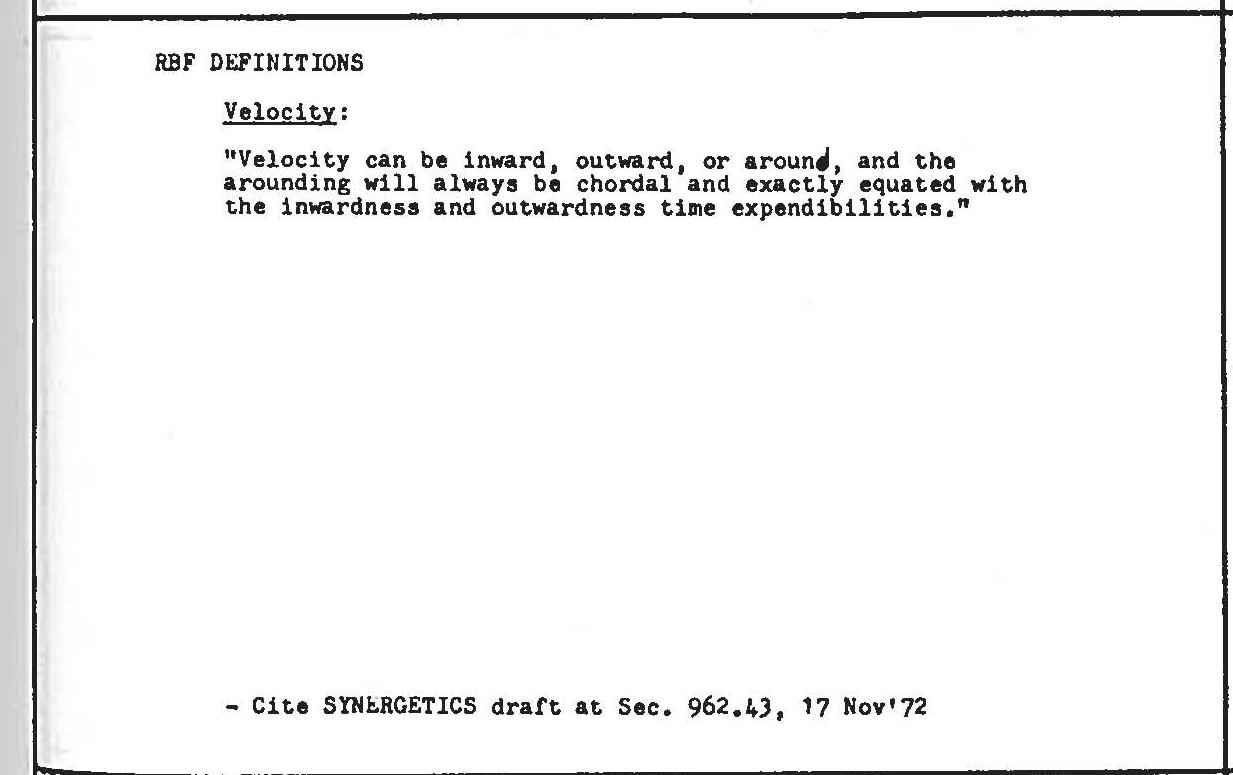
Velocity
Index Entry
... Vectors, being the product of physical energy constituents, are 'real,' having velocity multiplied by mass operating in a specific direction; velocity being a product of time and size modules; and mass being a volume-weight relationship.
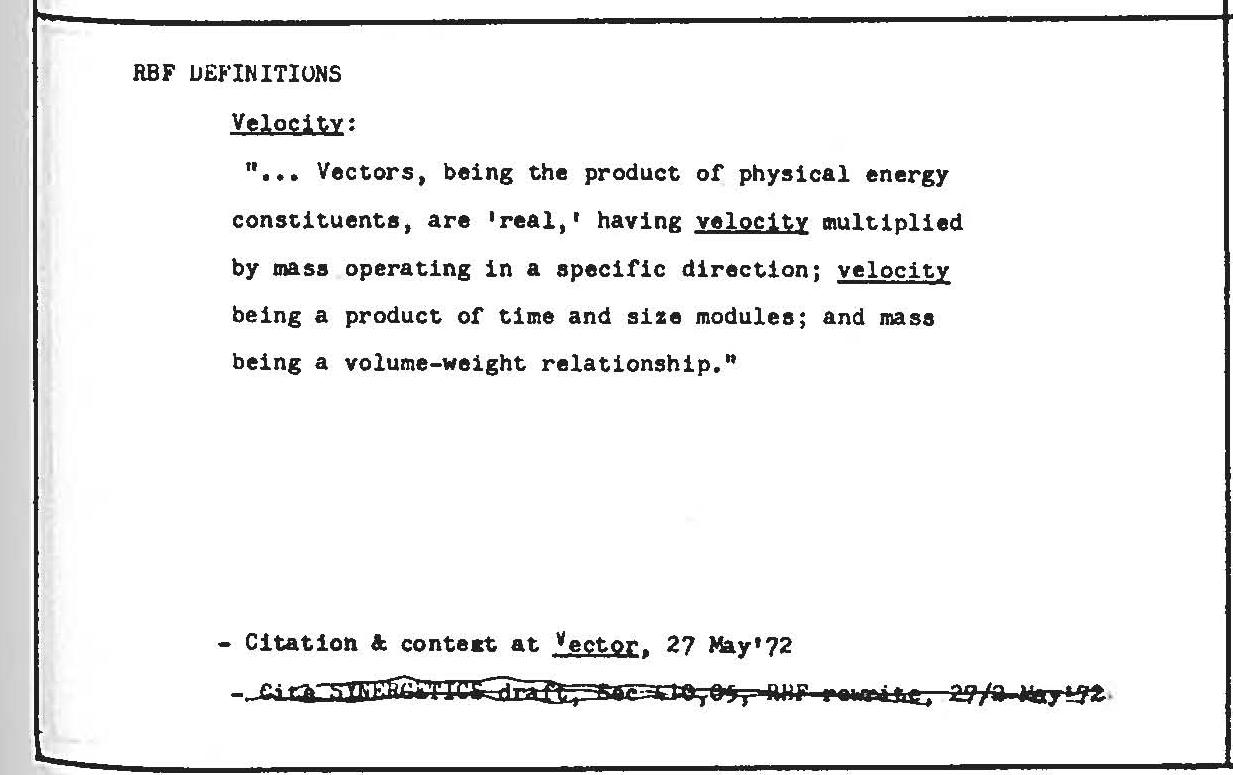
Velocity
Index Entry
Time is in our dimensioning because our geometry is vectorial. Every vector = mass x velocity, and time is a function of velocity.
Cite RBF to Ed, 3200 Idaho, Washington DC, 21 Dec. 71.
Citation & context at Vector, 21 Dec'71.
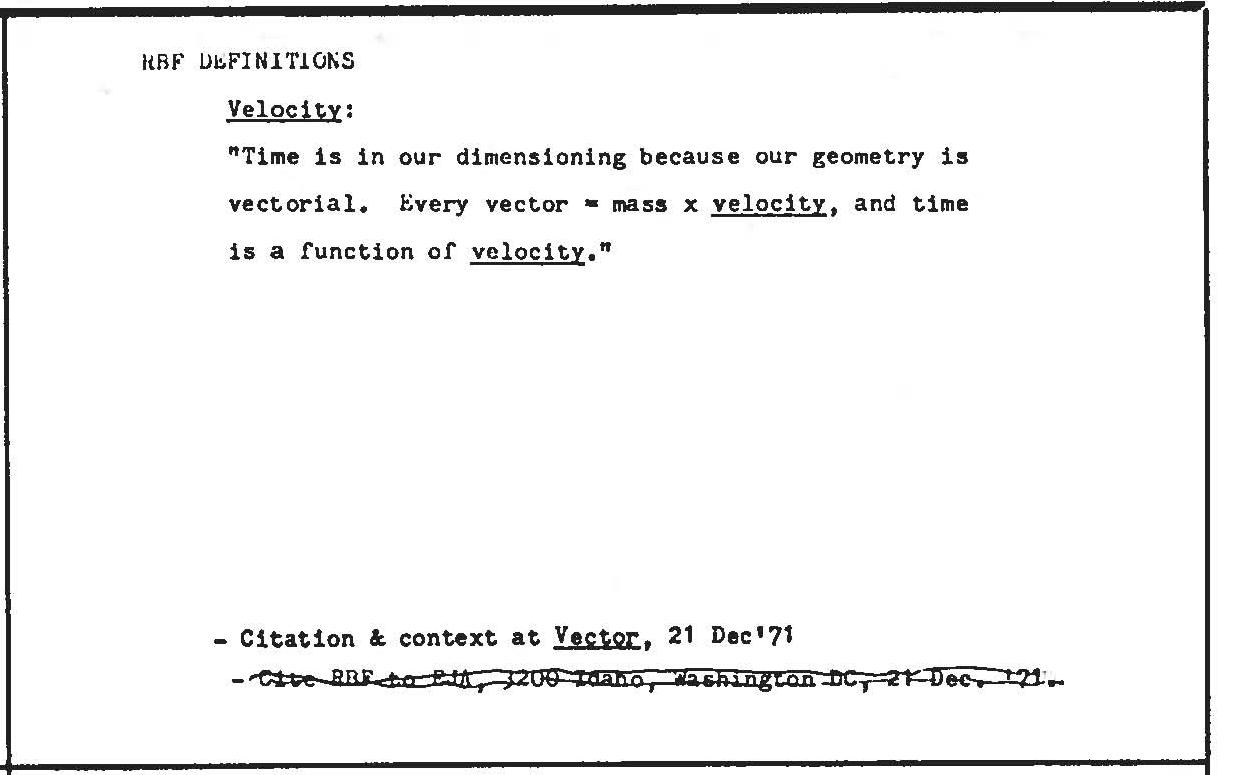
Velocity
Index Entry
Velocity:
"The physical expands and increases its velocities to cope with the greater and greater distances. However, there seems to be a constancy of top velocity and it was this that so impressed Einstein. All the various types of radiation, the ultraviolet, the radio wave and the x-ray reach about 186,000 miles per second."
-
Cite RBF Preface for Francis WA:EAHK, p. 3, Undated
-
Citation and context at Eternal Slowdown (1), 1970
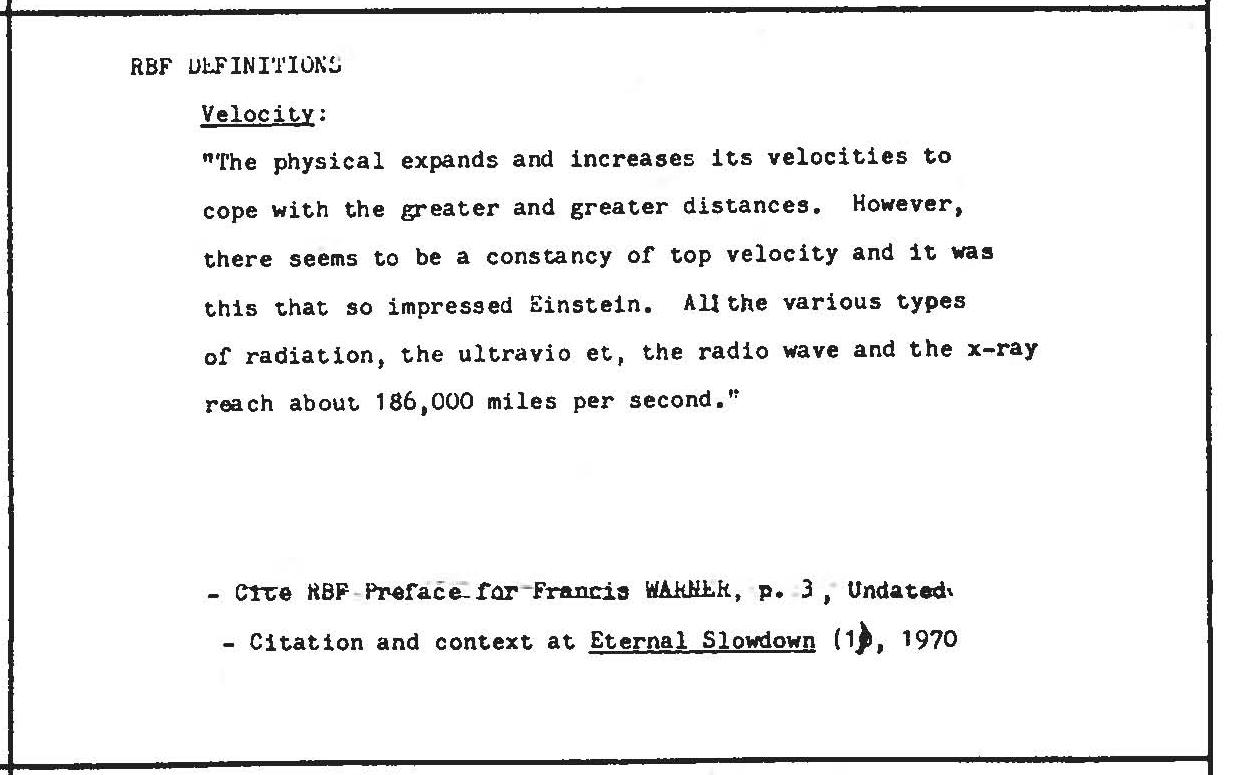
Velocity
Index Entry
Vectors are real experiences and they have inherent velocity and mass. Velocity is the complementarity of time and space. Time and space are simply functions of velocity. Velocity is really the reality. You can examine the time or the space increment, but they are never independent of one another. They are unified as velocity.
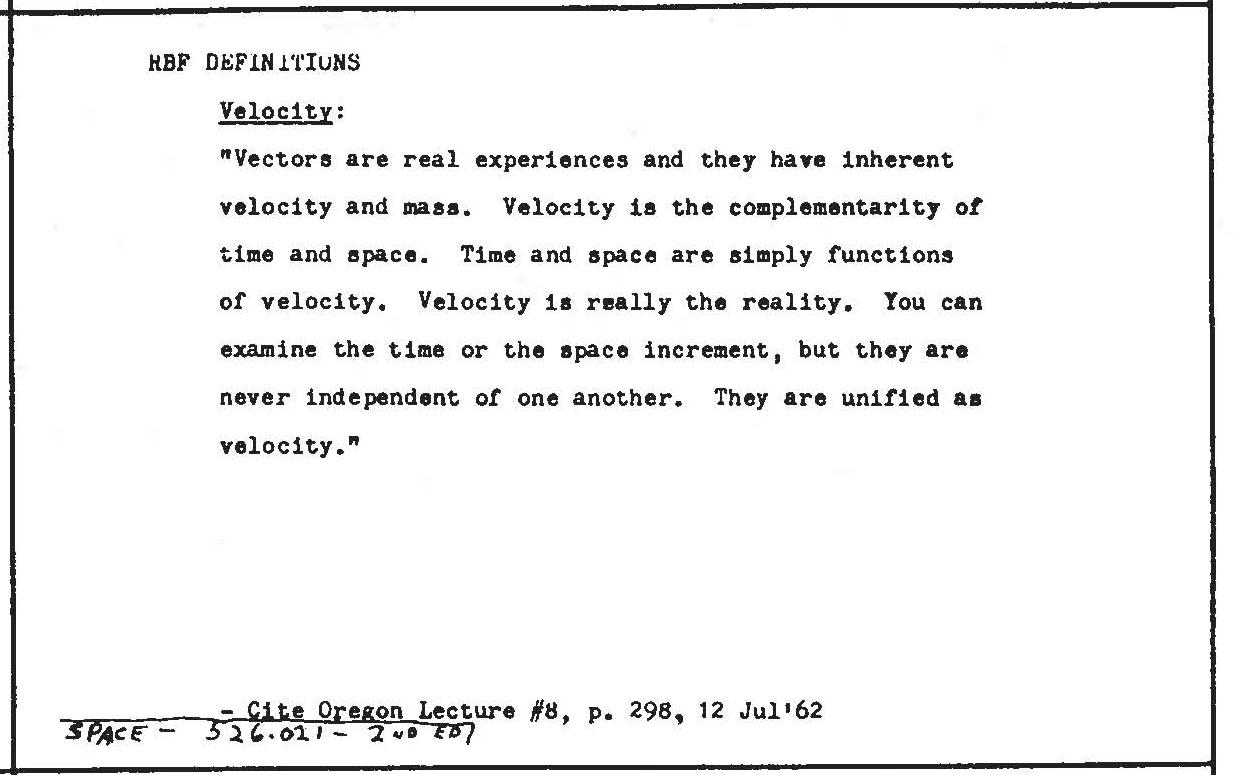
Velocity
Index Entry
Velocity:
".... As we find out in Electromagnetics there are domains of actions and these molecules want certain sizes and when you pressure too many of these patterns into the same area there is not enough room so they develop a very high speed and speed makes up for the crowding."
-
Citation and context at Domain of Action, 9 Jul'62
-
Cite Oregon Lecture #5, p. 186, 9 Jul'62
Velocity
RBF Definitions
"The higher the velocity the lesser the possibility
of interference in any one local."
Citations
- OREGON Lecture #5 - p. 187, 9 Jul'62
Velocity
Index Entry
Velocity:
"Velocity gives us what we call pressure or heat, it can be read either way."
- Cite OREGON Lecture #5 - p. 187, 9 Jul'62
Velocity (1)
Cross Reference
Cross-References
Velocity (2)
← Velocity (1) | Venice Venetian →
Cross Reference
Cross-References
- Domain of Action, 9 Jul'62*
- Energetic-synergetic Geometry, Jul'59
- Vector, 26 May'72; 27 May'72; 21 Dec'71*
- Geometry of Vectors, 27 Jan'75
- Time & Space, 12 Jul'62; Nov'71
Venice Venetian
← Velocity (2) | Ventilated Prose →
Cross Reference
Cross-References
- Phoenician Phonetic Sequence, 23 Jan'75
Ventilated Prose
← Venice Venetian | Ventilated →
Cross Reference
Cross-References
- Mental Mouthfuls, 9 May'62
Ventilated
← Ventilated Prose | Venus Proximity →
Cross Reference
Cross-References
- avely Ventilated, Oct
Venus Proximity
Cross Reference
Cross-References
- New York City, (7)
Verbs
Index Entry
Verbs:
"There is no verb for eternity. Verbs are always special case."
- Cite RBF to EJA, 3200 Idaho, Wash, DC; 12 Nov'75
Verb
Index Entry
Verb:
"Architecture, like music, will be a verb and not a noun."
- Citation and context at (F), Aug'72 Invisible Architecture:
Verbs
Index Entry
Verbs:
"Physics has not found any things. It has only found energy events that are continually transforming. Only verbs are applicable. There are no nouns because there are no things."
- Cite RBF to EJA, Mayflower Hotel, 1969.
Verbs
← Verbs | Verb: I Seem to Be a Verb →
Index Entry
"There are no nouns, for physics has found no things (static, solid phenomena)-- ergo there are only verbs."
- Cite DOXIADIS, p. 308 , 20 Jun'66
Verb: I Seem to Be a Verb
← Verbs | Verbs: I Seem to be a Verb →
Index Entry
Q. "What are you? . . . What is it that you do?"
RBF: Jarling, I don't know any other way to answer you except to say that I once wrote a book called 'I Seem to Be a Verb.' . . . . I don't like labels. . . . I don't profess myself.
Verbs: I Seem to be a Verb
← Verb: I Seem to Be a Verb | Verb: I Seem To Be a Verb →
Index Entry
Verbs: I Seem to be a Verb:
"I know that I am not a category, a hybrid specialization,
I am not a thing-- a noun.
I seem to be a verb--
an evolutionary process--
an integral function of the Universe,
and so are you."
R.B.F.
- Cite Frontispiece to THE BUCKMINSTER FULLER READER, Ed. James Keller, J. Cape, 1970.
Verb: I Seem To Be a Verb
← Verbs: I Seem to be a Verb | Verb →
RBF Definitions
"Where do you live? And: What are you? are progressively less sensible questions. As of now I am a passenger on Spaceship Earth. I don't know what I am. I know I am not a category hybrid specialization. I am not a thing, a noun. You and I seem to be verbs in evolutionary process. Are we not integral functions of the Universe?"
- Citation & context at Acceleration of Change,(1), 16 Aug'70
Verb
← Verb: I Seem To Be a Verb | Verb vs. Noun →
Index Entry
I Seem To Be A Verb:
"I live on Earth at present,
And I don't know what I am.
I know that I am not a category.
I am not a thing-- a noun.
I seem to be a verb,
An evolutionary process--
An integral function of the Universe."
Verb vs. Noun
Index Entry
Verb vs. Noun:
"Nouns can be at the same time, but verbs cannot."
- Citation & context at Overlapping, 30 may'75
Verb vs. Noun
← Verb vs. Noun | Verbs: Verbing →
Cross Reference
See Quick & the Dead: Song Of, Oct'66
Cross-References
- Quick \& the Dead: Song Of, Oct'66
- Overlapping, 30 May'75*
Verbs: Verbing
Index Entry
Verbs: Verbing:
"... There are no 'absolutes'
-- No 'ends' in themselves-- no 'things'--
Only transitionally transformative verbing."
- Cite How Little, p. 52. Oct'66
Verbs
← Verbs: Verbing | Verbs: No 'Where's, No 'What's, Only 'When's →
Index Entry
Verbs: No 'Where's, No 'What's, Only 'When's:
"Because physics has found no continuums, no experimental solids, no things, no real matter, I had decided half a century ago to identify mathematical behaviors of energy phenomena only as events. If there are no things, there are no nouns of material substance. The old semantics permitted common-sense acceptance of such a sentence as , 'A man pounds the table,' wherein a noun verbs a noun or a subject verbs a predicate. I found it necessary to change this form to a complex of events identified as me, which must be identified as a verb. The complex verb me observed another complex of events identified again ignorantly as a 'table.' I disciplined myself to communicate exclusively with verbs. There are no wheres and whats, only angle and frequency events described as whens."
Verbs: No 'Where's, No 'What's, Only 'When's
← Verbs | Inventory of Verbs →
Index Entry
Verbs: No 'Where's, No 'What's, Only 'When's:
"because physics has found no continuums, no experimental solids, no things, no real matter, I had decided half a century ago to identify mathematical behaviors of energy phenomena only as events. If there are no things, there are no nouns of material substance. The old semantics which permitted common-sense acceptance of such a sentence as 'A man pounds the table,' wherein a noun verbs a noun or a subject verbs a predicate. I found it necessary to change this form to a complex of events identified as 'I,'. 'He' must be identified as a verb and that/the complex verb 'He' observed another event complex ignorantly called a 'man,' which event complex developed as a complex interference pattern with another complex of events identified again ignorantly as a 'table.' I disciplined myself to communicate exclusively with verbs. There are no where's and what's; only angle and frequency events described as when's."
- hBf Marginalia on SYNERGETICS draft at Sec. \hrefhttps://www.buckyverse.org/en/synergetics/content/chapters/200-synergetics#section-250.04250.04, Dec '71, at 3200 Idaho, Washington DC, 26 Jan '72. Incorporate at SYNERGETICS Sec250.32, 11 Oct'72
Inventory of Verbs
← Verbs: No 'Where's, No 'What's, Only 'When's | Verb (1) →
Cross Reference
Verbs: Inventory of Verbs: See Verb: I Seem to Be a Verb God as a Verb Mind as Verb Einstein is a Verb Universe: The Great Verb 'Universe' Meaning as a Dynamic Patterning Verb
God as a Verb
Universe: The Great Verb 'Universe'
Meaning as a Dynamic Patterning Verb
Cross-References
Verb (1)
← Inventory of Verbs | Verb Verbal Verbing (2) →
Cross Reference
Intellecting
Universe: The Great Verb Universe
Cross-References
- Einstein is a Verb
- God as Verb
- God as Verb of Optimum Understanding
- Korzybski
- Meaning as a Dynamic Patterning Verb
- Mind as Verb
- Objective Intellect
- Verb: I Seem to be a Verb
- Verb vs. Noun
- No Nouns
Verb Verbal Verbing (2)
Cross Reference
Cross-References
- Form, 1938
- Invisible Architecture
- Meaning, 16 Aug'50
- Communications Hierarchy, (2)
- Verse vs. Prose, 11 Dec'75
Verify
← Verb Verbal Verbing (2) | Veritas →
Cross Reference
Verify:
Cross-References
- Reverifiable
Veritas
Index Entry
Veritas:
"I might have answered your letter in a much more poetical way by quoting only the motto of 340-year-old Harvard University: 'Veritas'-- (Vere-i-tas)--controlling the veering of one's course, V = two alternate angular directions. Veritas-- it will never be superseded."
- Cite RBF Ltr. to Bro. Jos. Chuala., p.5; 7 Nov'75
Verity
Index Entry
Verity:
"Verities are generalized principles stated in semimetaphorical terms. Verities are differentiable."
- Citation and context at Truth, 29 Dec'73
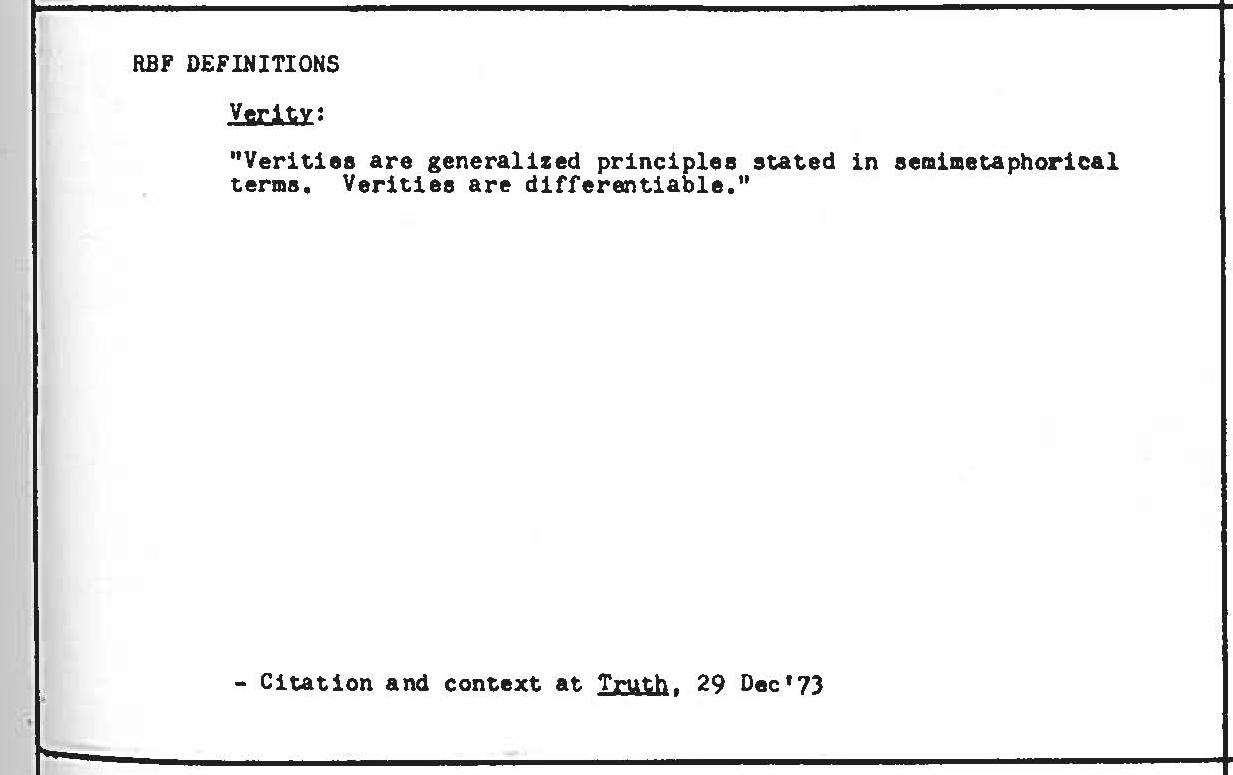
Verity
← Verity | Verity Verities (1) →
Index Entry
Verity:
"Verities are semi-special-case."
- Citation and context at Truth, 29 Dec'73
Verity Verities (1)
← Verity | Verity Veritas (2) →
Cross Reference
Cross-References
Verity Veritas (2)
← Verity Verities (1) | Verse vs. Prose →
Cross Reference
Cross-References
- Creation, May'65
- Dymaxion Airocean World
- Truth, 29 Dec'73*
- Verse vs. Prose, 11 Dec'75
Verse vs. Prose
← Verity Veritas (2) | Versus: Checklist (1) →
Index Entry
The difference between verse and prose is the difference between converging-diverging and parallelism.
Verse, ver-se is con-ver-gent-di-ver-gent ver-bing....
veering, ver-ing... the way waves and music pulsatingly veer
in Uni-verse, Uni-ver-se... ver, vers (toward), ver-i-tas (truth
Prose is parallel. P-prose is P-parallel... pursuit.
Prose is stratified and Prose is prone, ponderous.
∂ = bias symbol. P = 1 + ∂ . B is |∂ . B is Biased.
P = | + ∂ = |: + ∂ = |e ∂ the story.
Citr RBF holograph, 11 Dec'75
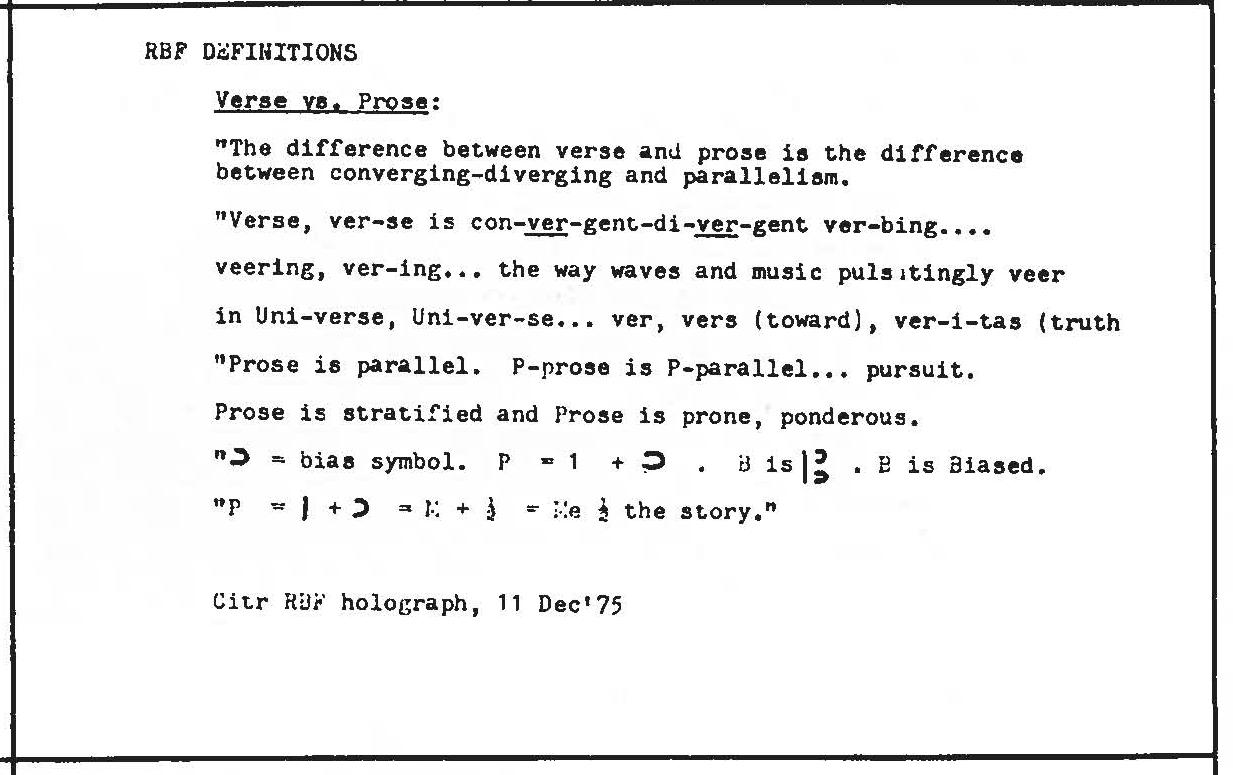
Versus: Checklist (1)
← Verse vs. Prose | Versus (A2) →
Cross Reference
*indexed under other formulation
All-motion Universe vs. Instant Universe**
Articulating vs. Observing**
Agricultural Accounting vs. Industrial**
Attraction vs. Push**
Artillery Wheel vs. Wire Wheel**
Active vs. Potential**
Automatics vs. Intellections
Asymmetry: Balanced vs. Unbalanced
Aberration vs. Principle**
Accounting: Triangular vs. Quadrangular**
Airspace Technology vs. Walls**
Admission vs. Omission**
Cross-References
- Abstract vs. Energetic
- Abstract vs. Sensorial
- Annihilation vs. Synergy
- Appreciative vs. Depreciative Commonwealth
- Acceleration: Direct vs. Indirect
- Avoidance vs. Interference
- Abstraction vs. Resolution
Versus (A2)
← Versus: Checklist (1) | Versus: Checklist →
Cross Reference
Versus: Checklist:
*Indexed under other formulation
Cross-References
- Absolute Symmetry vs. Scenario**
- Airplanes vs. Railroads
Versus: Checklist
← Versus (A2) | Versus: Checklist (1) →
Cross Reference
Believe vs. Guess**
Blossoms vs. Roots**
Beams vs. Columns**
Broadcasting vs. Incasting**
Boundaries vs Nucleus**
Bone vs. Cartilage**
Big Bang Theory vs. Scenario Universe**
Cross-References
- Behaviorist Word vs. Static Word
- Big Man vs. Little Man
- Biologicals vs. Nonbiologicals
- Brain's Automatics vs. Mind's Intellections
- Balanced vs. Unbalanced
- Body vs. Medium
Versus: Checklist (1)
← Versus: Checklist | Versus: Checklist (2) →
Cross Reference
- indexed under other formulation
Complex vs. Elementary*
Computers vs. Humans: Feedback Comprehensivity*
Comprehensive vs. Local*
Corporeal vs. Living: Morphology*
Coils vs. Knots: Rope*
Constant vs. Time*
Commonwealth: Appreciative vs. Depreciative*
Colonialism vs. Transnationalism*
Contracting Metaphysical Universe vs. Expanding Physical Universe*
Conceptual vs. Qualitative
Conceptuality vs. Space*
Centralize vs.entralize, Dec*
Cross-References
Versus: Checklist (2)
← Versus: Checklist (1) | Versus: Checklist (3) →
Cross Reference
- Indexed under other formulation
See Community vs. Privacy, (2)*
Cold Valve of Time vs. Hot Valve of Energy, (2)
Consistency vs. Learning, (2)*
Circumferential Tension vs. Radial Compression, (2)*
Cure vs. Mend, (2)*
Curved vs. Flat, (2)*
Catenary vs. Suspension, (2)*
Chaos vs. Design, (2)*
Crystal vs. Radiation Model, (2)*
Conceptual Tetrahedron vs. Physical Tetrahedron, (2)*
Cross-References
- Community vs. Privacy*, (2)
- Conceptual vs. Quantitative, (2)
- Concept vs. Information, (2)
- Circumferential Finite vs. Radial Infinite, (2)
- Cartilage vs. Bone, (2)
- Concentration vs. Radiation, (2)
- Convergent vs. Parallel, (2)
- Cognition vs. Recognition, (2)
- Convergent vs. Radiant, (2)
Versus: Checklist (3)
← Versus: Checklist (2) | Versus: Checklist (1) →
Cross Reference
- indexed under other formulation
Complex vs. Unity
Critical Path vs. Orbital Feedback Circuitry*
Cross-References
Versus: Checklist (1)
← Versus: Checklist (3) | Versus: Checklist (2) →
Cross Reference
- indexed under other formulation
Discovery vs. Invention**
Depreciative vs. Appreciative Commonwealth**
Direct vs. Indirect: Acceleration**
Differentiated Proclivities vs. Synergetic Proclivities**
Discovery vs. Creation**
Death: Slow Death by Slums vs War as Quick Death
Darwin's Determinism vs. Free Will
Distribute vs. Inhibit**
Dust vs. Stone**
Cross-References
- Design vs. Generalization
- Design: A Priori Design vs. Deliberate Design
- Dynamic vs. Kinetic
- Dynamic vs. Stable
- entralize vs. Centralize, Dec
- Dynamic vs. Static
- Discrete vs. Probability
- Design vs. Chaos
- Design vs. Happenstance
Versus: Checklist (2)
← Versus: Checklist (1) | Versus Checklist (1) →
Cross Reference
- Indexed under other formulation
Cross-References
- Demonstable vs. Thinkable
- Design Science Revolution vs. Global Political Revolution
- Design vs. Technology
Versus Checklist (1)
← Versus: Checklist (2) | Versus: Checklist (2) →
Cross Reference
- indexed under other formulation
Energetic vs. Abstract**
Einstein vs. Newton**
Effects: Primary vs. Side**
Ego vs. Omniscience
Emergency vs. Spontaneous: Teleology**
Entropy vs. Information**
Emergency vs. Freedom**
Cross-References
- Edge vs. Radius
- Electrostatic vs. Electromagnetic
- Elementary vs. Complex
- Embracing vs. Linear
- Eternal vs. Finite
- Experience vs. Integrity
- Exponential Model vs. Limits to Growth
- Ephemeralization vs. Visualization
- Expanding Physical Universe vs. Contracting Metaphysical Universe
- Euler vs. Synergetics
Versus: Checklist (2)
← Versus Checklist (1) | Versus: Checklist →
Cross Reference
- Indexed under other formulation
Extraversion vs. Introversion*
Energy vs. Time*
Error: Inward vs. Outward Dismissal Of*
Evolution vs. Familiarity*
Energy vs. Mind*
Exponential vs. Experimental
Electricity vs. Visible Light*
Engineer vs. Sculptor*
Energism vs. Synergism*
Cross-References
Versus: Checklist
← Versus: Checklist (2) | Versus: Checklist →
Cross Reference
- indexed under other formulation
Finite vs. Eternal*
Faster & Far Apart vs. Slower & Closer*
Finity vs. Infinity*
Face vs. Vertex*
Freedom vs. Emergency*
Form vs. Model*
Frequency vs. Primitive*
Cross-References
- Feedback Comprehensivity: Computers vs. Humans
- Free Energy vs. Structure
- Flexible vs. Inflexible
- Free Will vs. Darwin's Determinism
- Flat vs. Curved
- Fantasy vs. Principle
- Familiarity vs. Evolution
- Fuller's Reality vs. Popular Reality
Versus: Checklist
← Versus: Checklist | Versus: Checklist →
Cross Reference
- indexed under other formulation
Generalization vs. Design*
Graphics vs. Words: Slides*
Generalization vs. Reality*
Global Political Revolution vs. Design Science Revolution
Cross-References
- Generalization: Mathematical vs. Literary
- Guess vs. Believe
- Geodesics vs. Structure
- Geodesics vs. Irrelevance
Versus: Checklist
← Versus: Checklist | Versus: Checklist (1) →
Cross Reference
- indexed undero other formulation
Humans vs. Computers: Feedback Comprehensivity**
Humanity vs. Man**
Hearing vs. Seeing**
Happenstance vs. Design**
Humans vs. Trees**
Humans' Technology vs. Nature's Technology**
Cross-References
Versus: Checklist (1)
← Versus: Checklist | Versus: Checklist (2) →
Cross Reference
- indexed under other formulation
Inventions vs. Discovery
Intellections vs. Automatics*
Integrity vs. Experience*
Indirect vs. Direct: Acceleration*
Infinite Series vs. Minimum Limit*
Inflexible vs Flexible*
Cross-References
- Ideal vs. Real
- Imaginary Universe vs. This Universe
- Indoors vs. Outdoors
- Instant Universe vs. All-motion Universe
- Inventions vs. Pure Science Events
- Industrial vs. Agricultural Accounting
- Internal Metabolics vs. Industrialization
- Infinity vs. Finity
- Intercept vs. Insulate
- Information vs. Entropy
- Individual Freedom vs. Mutual Emergency
- Intellect vs. Radiation
Versus: Checklist (2)
← Versus: Checklist (1) | Versus: Checklist →
Cross Reference
- Indexed under other formulation
Interference vs. Avoidance, (12)
Information vs. Concept, (12)*
Integer vs. Pattern, (12)*
Invisible Electrodynamics vs. Visible Thermodynamics, (12)*
Instrument vs. Service, (12)*
Inside-out vs. Outside-out, (12)*
Immobile Purchasing vs. Mobile Rentability, (12)*
Cross-References
- Introversion vs. Extraversion, (12)
- Improvement vs. Surprise, (12)
- Inhibit vs. Distribute, (12)
- Inwardness vs. Omnidirectional, (12)
- Incasting vs. Broadcasting, (12)
- Inward vs. Outward Dismissal of Error, (12)
- Individual vs. Universe, (12)
- Interrelatedness vs. Names, (12)
Versus: Checklist
← Versus: Checklist (2) | Versus: Checklist →
Cross Reference
Kinetic vs. Dynamic*
Cross-References
- Knots vs. Coils: Rope*
- Know-how Accounting vs. Physical Accounting
- Knowing vs. Reasoning
Versus: Checklist
← Versus: Checklist | Versus: Checklist (1) →
Cross Reference
- indexed under other formulation
Linear vs. Omnimbracing
Limits to Growth vs. Exponential Model*
Literary vs. Mathematical: Generalizations*
Living vs. Corporeal: Morphology*
Limited vs. Unlimited*
Lever vs. Coherence*
Local Pattern vs. World Pattern*
Light vs. Electricity*
Cross-References
- Light Side vs. Serious Side of any Question
- Linear vs. Orbital
- Local vs. Comprehensive
- Local Radius vs. Wide Arc
- Liquid vs. Solid
- Low Pressure vs. Positives
- Learning vs. Consistency
- Laws of Nature vs. Laws of Man
- Linear vs. Omnidirectional
Versus: Checklist (1)
← Versus: Checklist | Versus Checklist →
Cross Reference
- indexed under other formulation
Manifest vs. Potential*
Man: Big vs. Little*
Mind's Intellecutions vs. Brain's Automatics*
Mathematical vs. Literary: Generalizations*
Model: Pendulum vs. Scenario*
Model vs. Synergetics*
Mutual Emergency vs. Individual Freedom*
Medium vs. Body*
Multiatomic vs. Single Atomic*
Cross-References
- Man vs. Humanity
- Matter vs. Radiation
- Morphology: Living vs. Corporeal
- Most Economical vs. Shortest
- Minimum Limit vs. Infinite Series
- Mend vs. Cure
- Mind vs. Reflex
- Model vs. Form
Versus Checklist
← Versus: Checklist (1) | Versus: Checklist →
Cross Reference
Man vs. Machines
Cross-References
- Mind vs. Energy
- Modulation vs. Precession
- Machines vs. Structures
- Model vs. Scenario
- Mechanics vs. Structure
- Mobile Rentability vs. Immobile Purchasing
- Model vs. Photograph
- Money: Making Sense vs. Making Money
Versus: Checklist
← Versus Checklist | Versus Checklist →
Cross Reference
- indexed under other formulation
Nonbiologicals vs. Biologicals**
Noun vs. Verb**
Ninety Degreeness vs. Sixty Degreeness**
Nonuse vs. Use
Nuclear Domain vs. Spheric Domain**
Ninety Degreeness vs 180-degreeness
Names vs. Interrelatedness**
Nature's Technology vs. Humana' Technology
Cross-References
- New Forms vs. Reforms
- Newton vs. Einstein
- Navigation vs. Probability
- Nucleus vs. Boundaries
- Nuclear vs. Superficial
Versus Checklist
← Versus: Checklist | Versus: Checklist (1) →
Cross Reference
- indexed under other formulation
Operationally Effective vs. Potential**
Operative vs. Potential**
Outdoors vs. Indoors**
Omniembracing vs. Linear**
Orbital vs. Linear**
Orbital vs. Radial**
Omnidirectional vs. Polarization
Omnidirectional vs. Inwardness**
Outward vs. Inward Dismissal of Error **
Omnidirectional vs. Linear**
Cross-References
- Observing vs. Articulating
- Omniscience vs. Ego
- One Way vs. Round Trip
- Omniembracing vs. Permeating
- One vs. Zero
- Outside-out vs. Inside-out
- Omission vs. Admission
- Orbital Feedback Circuitry vs. Critical Path
Versus: Checklist (1)
← Versus Checklist | Versus Checklist (2) →
Cross Reference
Political Revolution vs. Design Revolution*
Physical vs. Structural
Primary vs. Side Effects
Process vs. Thing
Process vs. Thing
Politics vs. World Game
Push vs. Attraction
Potential vs. Physically Realized
Pure Science Events vs. Inventions*
Principle vs. Resource*
Particle vs. Wave*
Precession vs. Synergy*
Positives vs. Low Pressure*
Pushive vs. Tensive
Proclivities: Synergetic Differentiated vs. Synergetic
Permeating vs. Omniembracing*
Polarization vs. Omnidirectionality*
Pathology: Preventive vs. Curative
- indexed under other formulation
Cross-References
Versus Checklist (2)
← Versus: Checklist (1) | Versus: Checklist (3) →
Cross Reference
*Indexed under other formulation
Probability vs. Navigation**
Principle vs. Fantasy**
Physical Accounting vs. Know-how Accounting
Probability vs. Discrete**
Precession vs. Modulation**
Parallel vs. Convergent**
Prose vs. Verse**
Physical vs. Constant**
Prime Volume vs. System**
Cross-References
- Privacy vs. Community
- Point vs. Zone
- Pattern vs. Integer
- Principle vs. Aberration
- Push-pull: Push Phase vs. Pull Phase
- Prediction: Socio-economic vs. Engineering
- Physical Tetrahedron vs. Conceptual Tetrahedron
- Primitive vs. Frequency
Versus: Checklist (3)
← Versus Checklist (2) | Versus →
Cross Reference
*Indexed under other formulation
Photograph vs. Model*
Popular Reality vs. Fuller's Reality*
Cross-References
- Primitive vs. Potential*
- Proclivities: Basic vs. Secondary
Versus
← Versus: Checklist (3) | Versus Checklist →
Cross Reference
Versus: Checklist: (Potentials)
Cross-References
- Potential vs. Active
- Potential vs. Manifest
- Potential vs. Operationally Effective
- Potential vs. Operative
- Potential vs. Radiant
- Potential vs. Physically Realized
- Potential vs. Primitive
Versus Checklist
Cross Reference
Versus: Checklist:
(Q)
- indexed under other formulation
Quantitative vs. Conceptual*
Quadrangular Accounting vs. Triangular Accounting*
Quanta: Structural vs. Volumetric*
Cross-References
Versus (1)
← Versus Checklist | Versus Checklist (2) →
Cross Reference
- Indexed under other formulation
Radiant vs. Potential**
Radius vs. Edge**
Radiation vs. Matter**
Reforms vs. New Forms**
Round Trip vs. One Way**
Reflexes vs. Structure**
Radiation vs. Intellect**
Radial Infinite vs. Circumferential Finite**
Reflex vs. Mind**
Resolution vs. Abstraction**
Radiation vs. Concentration**
Cross-References
- Minima-Maxima
- Radial vs. Orbital
- Rope: Knots vs. Coils
- Roots vs. Blossoms
- Rigidity vs. Resilience
- Radial Compression vs. Circumferential Tension
- Resources: Fresh vs. Waste
- Reality vs. Generalization
Versus Checklist (2)
← Versus (1) | Versus Checklist (1) →
Cross Reference
- Indexed under other formulation
Research vs. Search*
Recognition vs. Cognition*
Radiant vs. Convergent*
Railroads vs. Airplanes*
Reasoning vs. Knowing*
Cross-References
- Radiation vs. Crystal Model
- Revolution: Design Science Revolution vs. Global Political Revolution
- Realms vs. Surface
- Reality: Fuller's Reality vs. Popular Reality
Versus Checklist (1)
← Versus Checklist (2) | Versus: Checklist (2) →
Cross Reference
- indexed under other formulation
Synergy vs. Precession
Spontaneous vs. Emergency: Teleology**
Speech vs. Vision**
Solid vs. Liquid**
Structure vs. Geodesics**
Space vs. Thinkability**
Shortest vs. Most Economical**
Side Effects vs. Primary**
Structural vs. Physical**
Scenario Model vs. Pendulum Model**
Serious Side vs. Light Side of any Question**
Structure vs. Free Energy**
Sensorial vs. Abstract**
Synergy vs. Annihilation**
Static Word vs. Behaviorist Word**
Stable vs. Dynamic**
Synergetics vs. Euler**
Cross-References
- Graphics vs. Words
- Slower & Closer vs. Faster & Far Apart
- Structure vs. Reflexes
- Synergetics vs. Model
Versus: Checklist (2)
← Versus Checklist (1) | Versus: Checklist (3) →
Cross Reference
- Indexed under other formulation
Synergetic Proclivities vs. Differentiated Proclivities**
Static vs. Dynamic
Surprise vs. Improvement**
Search vs. Research
Settlements vs. Unsettling**
Structures vs. Machines
Cross-References
- System vs. Structure
- Space vs. Conceptuality
- Service vs. Instrument
- Seeing vs. Hearing
- Suspension vs. Catenary
- Single Atomic vs. Multiatomic
- System vs. Thing-in-itself
- Sixty Degreeness vs. Ninety Degreeness
- Sculptor vs. Engineer
- Spheric Domain vs. Nuclear Domain
- Structural Quanta vs. Volumetric Quanta
Versus: Checklist (3)
← Versus: Checklist (2) | Versus (1) →
Cross Reference
*Indexed under other formulation
Stone vs. Dust, (S3)
Superficial vs. Nuclear*, (S3)*
Scenario vs. Model*, (S3)*
Structure vs. Mechanics, (S3)
Surface vs. Realms*, (S3)*
Cross-References
- Scenario vs. Absolute Symmetry
- System vs. Prime Volume
- System vs. Scenario
- System vs. Withoutness
- Synergism vs. Energism
- Salvation vs. Self-discipline
- Static Invalidity of Solid Things vs. Empty Space
- Scenario Universe vs. Big Bang Theory
Versus (1)
← Versus: Checklist (3) | Versus vs. Checklist →
Cross Reference
Versus: Checklist:
- indexed under other formulation
This Universe vs. Imaginary Universe**
Thing vs. Process**
Thing-in-itself vs. System**
Thing-in-itself vs. Zero Model**
Thinkable vs. Demonstrable**
Technology vs. Design**
Technology: Nature's vs. Humans'**
Cross-References
- Teachable vs. Un teachable
- Thinkability vs. Space
- Time vs. Constant
- Transnationalism vs. Colonialism
- Teleology: Spontaneous vs. Emergency
- Tensive vs. Pushive
- Technology: Enchantment vs. Disenchantment
- Time vs. Energy
- Triangular Accounting vs. Quadrangular Accounting
- Three-way Weaving vs. Two-way Crisscross
- Trees vs. Humans
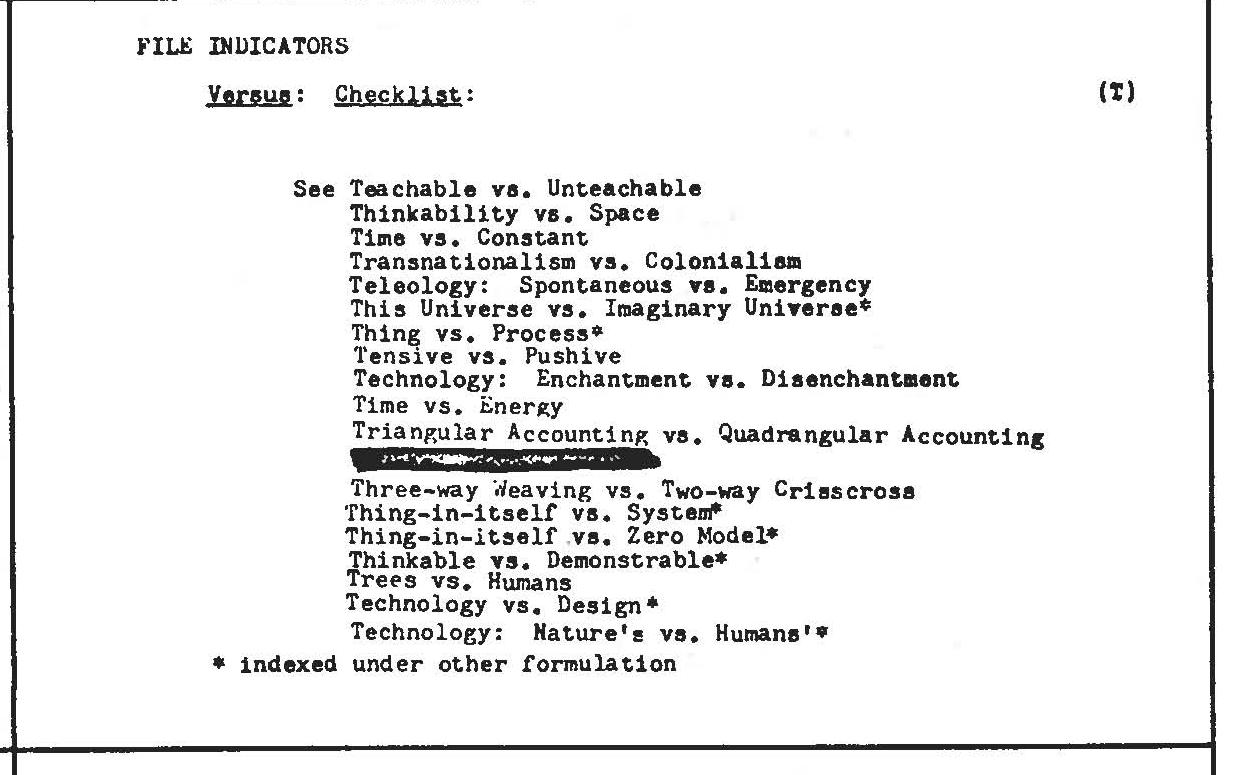
Versus vs. Checklist
← Versus (1) | Versus: Checklist →
Cross Reference
- indexed under other formulation
Un teachable vs. Teachable*
Unbalanced vs. Balanced*
Unexpected vs. Expected*
Universe vs. Individual*
Cross-References
Versus: Checklist
← Versus vs. Checklist | Versus Checklist →
Cross Reference
- indexed under other formulation
Vertex vs. Space
Visualization vs. Ephemeralization*
Vertical vs. Horizontal*
Visible Thermodynamics vs. Invisible Electrodynamics
Volumetric Quanta vs. Structural Quanta*
Cross-References
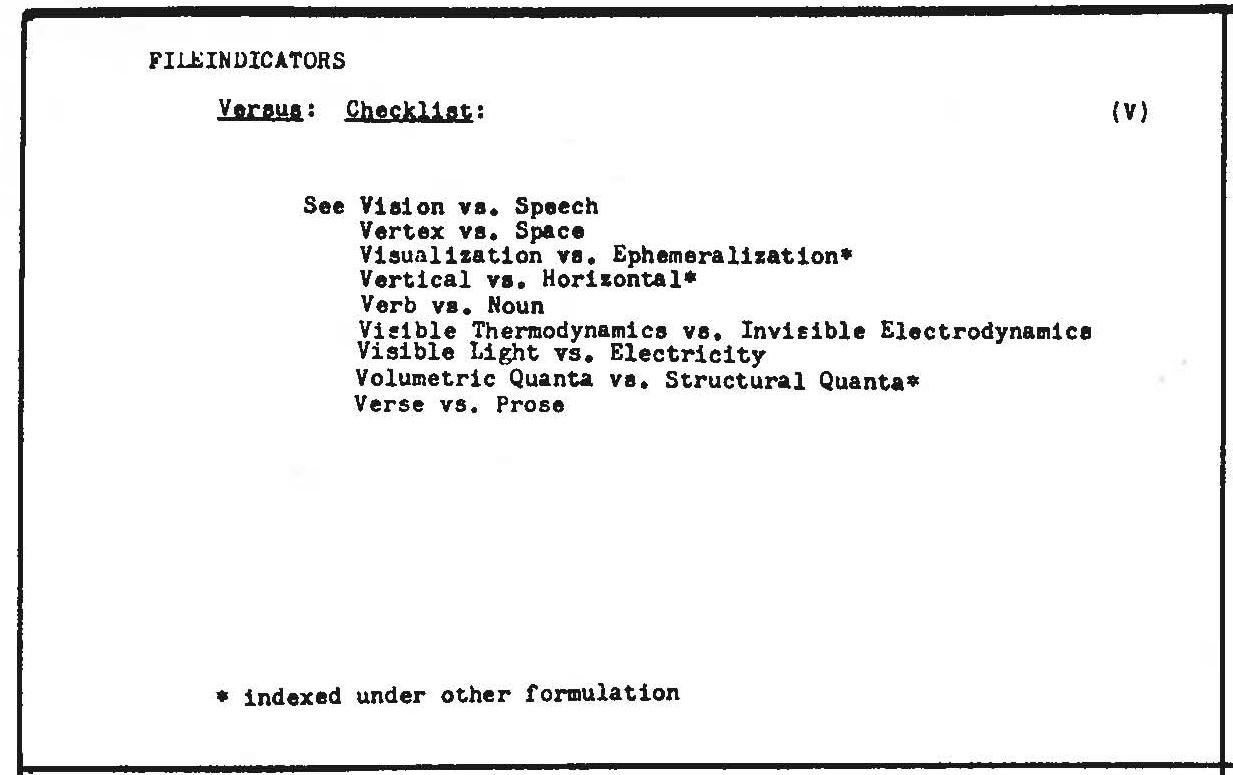
Versus Checklist
← Versus: Checklist | Versus: Checklist →
Cross Reference
- indexed under other formulation
Wheel: Artillery Wheel vs. Wire Wheel
Word: Behaviorist vs. Static**
Wide Arc vs. Local Radius**
World Game vs. Politics**
Words vs. Graphics: Slides**
Withoutness vs. System**
Cross-References
- Wave vs. Particle
- War: Slow Death by Slums vs. War as Quick Death
- World Pattern vs. Local Pattern
- Walls vs. Airspace Technology
Versus: Checklist
← Versus Checklist | Versus Checklist →
Cross Reference
- Indexed under other formulation
Zone vs. Point*
Zero vs. One*
Cross-References
- Zero vs. Heat*
- Zero Model vs. Thing-in-itself
Versus Checklist
← Versus: Checklist | Vertex →
Cross Reference
Paired Concepts: Checklist
Checkslist
Dichotomizing
Cross-References
Vertex
Index Entry
"Vertexes are always identified by the nuclear centers of closest-packed sphere aggregates." - Cite RBF marginalis at SYNERGETICS galley #24 at Sec.\hrefhttps://www.buckyverse.org/en/synergetics/content/chapters/200-synergetics#section-223.40223.40 but inadvertently omitted from 1st. Edition text. 11 Oct'73
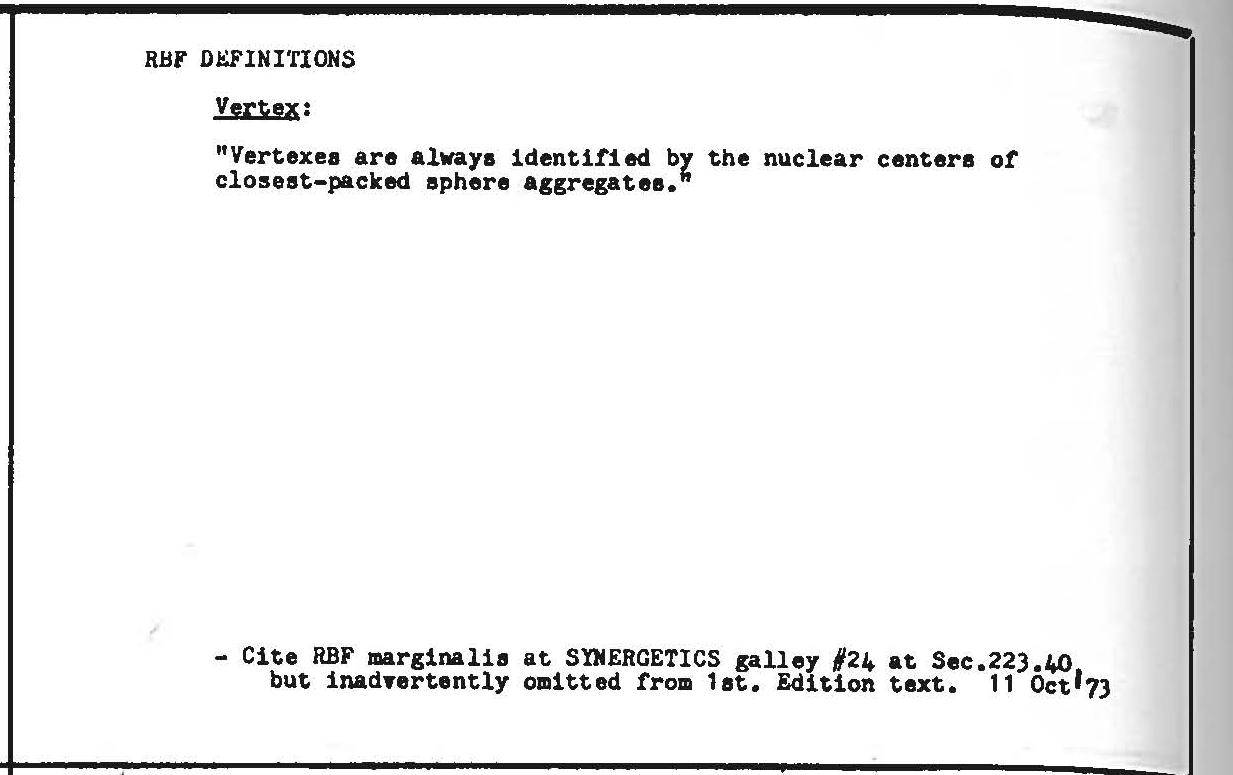
Vertex
Index Entry
Vertex:
"A six-trajectory isolation of insideness and outsideness has four interweaving vertexes or prime convergences of the trajectories, and four areal subdivisions of its isolation system and constitute tetrahedra."
-
Cite SYNERGETICS Coordinates, Sec: 210 by RBF 11 Oct. '71, BeyerBound., Penna.
-
Citation at Tetrahedron, 11 Oct.'71
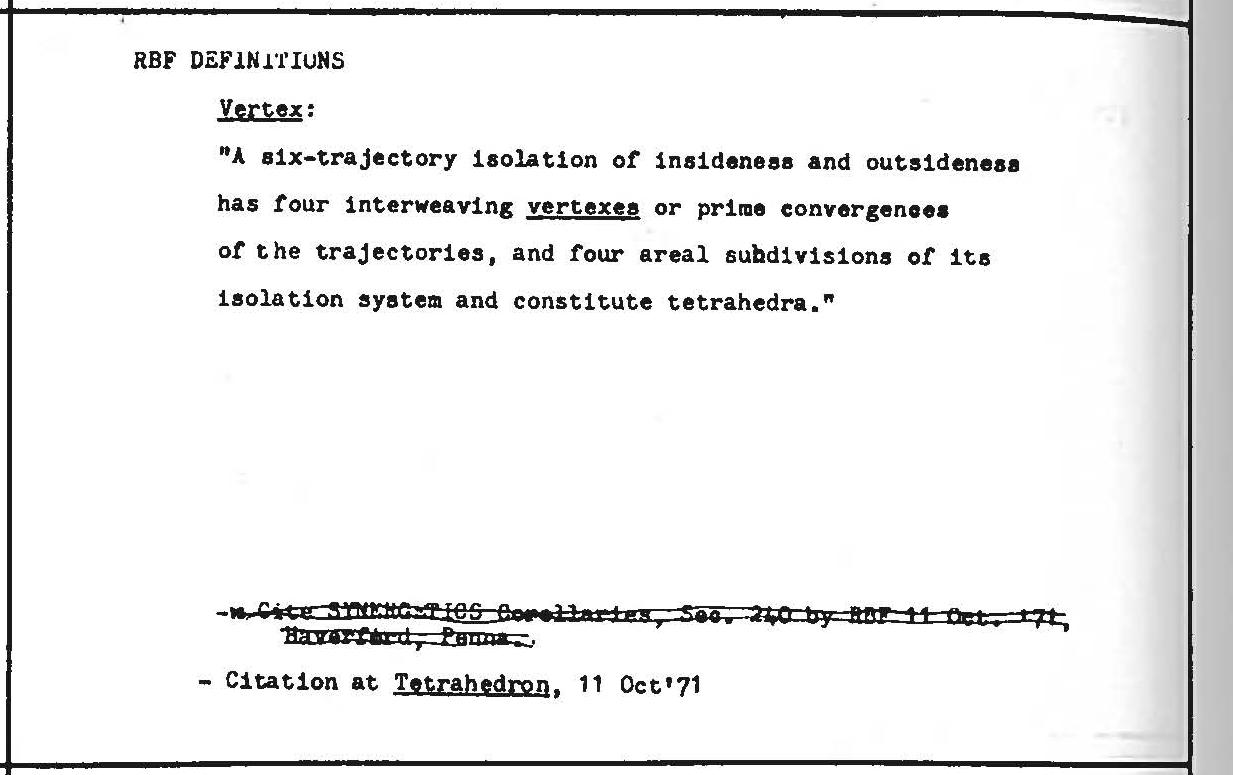
Vertex
Index Entry
Vertex:
"Edges and vertexes do not come out as the same number systems-- you can describe the world both ways and not be redundant."
-
Citation at Description, 25 Aug'71
-
Cite RBF to Ada, Bear Island, 25 August 1971.
Vertex
Index Entry
Vertex:
"Spheres are high tide aspects of vertexes. . . . Spheres in closest packing are high tide aspects of vertexes."
-
Cite RBF to EJA, Blackstone Hotel, Chicago, 31 May 1971
-
Citation and context at Tidal, 31 May'71
Vertex
Index Entry
Vertex:
"The number of vertices are always divisible by four in a structural system."
- Cite P. PEARCE, Inventory of Concepts, June 1967
VERTEXES: CROSSINGS - SEC. \hrefhttps://www.buckyverse.org/en/synergetics/content/chapters/500-conceptuality#section-523.03523.03
Vertex
Cross Reference
Vertex:
"Euler showed that there were lines-- any kind of lines, crooked or not socrooked. He then showed that the pattern of two or more lines crossing one another was completely distinguishable from any single line by itself. We call this crossing, or convergence of lines a Vertex.
"When three or more lines each cross two others, we have enclosures or areas. So Euler had areas, vertexes, and lines which he said were fundamentally unmistakable for one another. Euler showed also that all conceptual experiences which we can pattern, or form, are composed exclusively of three patterning elements: lines, vertexes and areas. They are all that are necessary to analyze and inventory all parts of, as well as all whole, patterns."
-Cite Carbondale-DRAPT IV-41
- Cite NASA SPEECH, pp. 58-59. Jw'66
Cross-References
- VERTEXES; CROSSINGS
Vertex
Index Entry
Vertex:
"Where every vertex is the domain of a sphere we have CLOSEST PACKING."
- Cite Oregon Lecture #8, p. 289. 12 Jul'62
Vertex
Index Entry
Vertex:
"Euler said, 'If I have two lines, where the two lines cross is distinctly different from where the lines don't cross.' He called this the vertex, the convergence. He said this is absolute pattern uniqueness."
-
Beta-Oregon Lecture #7, p. 245, 11 Jul'62
-
Citation & context at Pattern Uniqueness, 11 Jul'62
VERTEXES: CROSSINGS - SEC \hrefhttps://www.buckyverse.org/en/synergetics/content/chapters/500-conceptuality#section-523.01523.01
Vertex
Index Entry
Vertex:
"A vertex is in convergence and a face is in divergence."
- Citation and context at Gravitational System Zone, 14 Jan'55
Vertex
← Vertex | Vertexial Accounting - Spherical Accounting (2) →
Index Entry
"In topological systems vertexes are finite relationships . . ."
Vertexial Accounting - Spherical Accounting (2)
← Vertex | Vertexial Advantage →
Cross Reference
Cross-References
Vertexial Advantage
← Vertexial Accounting - Spherical Accounting (2) | Vertexial Asymmetry →
Cross Reference
Cross-References
Vertexial Asymmetry
← Vertexial Advantage | Vertexial Connections →
Index Entry
Vertexial Asymmetry:
"The tetrakaidecahedron is vertexially asymmetrical, but linearly symmetrical."
- Citation at Tetrakaidecahedron, 19 Feb'72
Vertexial Connections
← Vertexial Asymmetry | Vertexial Connections: The Rules of Never-quite-touching →
Index Entry
Vertexial Connections:
"Energy bounces around in triangles working toward the narrowest vertex where the impossibility of more than one line going through any one point at any condition imposes a twist vertex of exit at the corners of all polyhedra. Therefore, all triangles "leak" energy, but no one triangle leaks as much, or as fast, as two of its similar triangles vertexially connected."
- Cite SYNERGETICS draft at Sec. \hrefhttps://www.buckyverse.org/en/synergetics/content/chapters/900-modelability#section-931.25931.25, Apr '72
Vertexial Connections: The Rules of Never-quite-touching
← Vertexial Connections | Vertexial Connections (1) →
Cross Reference
Cross-References
- Coherence, 10 Feb'73
- Synergetics, 15 Oct'64
- Particulate Model, 10 Feb'73
- Quantum, 17 Feb'73
Vertexial Connections (1)
← Vertexial Connections: The Rules of Never-quite-touching | Vertexial Connections (2) →
Cross Reference
Torque at the Center of Convergence
Twist: Local Twist
Cross-References
- Chemical Bonds: Single Bond
- Convergence
- Corner
- Fitting
- Rules of Never-quite-touching
- Tangential Avoidance
- Clothesline
- Locked Kiss
- Tetrahedron: Leak in the Corners
- Tepee: Half-spin Tepee Twist
- Twist Vertex of Exit
- Vectorial Convergence
- Vectorial Near-miss
- Bounce Patterns of Energy
- Tensegrity Clothesline
Vertexial Connections (2)
← Vertexial Connections (1) | Vertexes - Crossings →
Cross Reference
Cross-References
- Chemical Bonds, 6 Mar'73
- Critical Proximity, 15 Feb'73
- Point, 19 Dec'73
- Thread, 31 Oct'72
- Geodesic Sphere, (1)
Vertexes - Crossings
← Vertexial Connections (2) | Vertex vs. Face →
Cross Reference
Vertexes - Crossings:
Cross-References
- Crossing, 22 Apr'71
Vertex vs. Face
← Vertexes - Crossings | Vertexes, Faces & Edges →
Cross Reference
Vertex vs. Face:
Cross-References
- Tetrahedron: Inside-outing Of, 28 Oct'73
- Convergence & Divergence, 1 Oct'72
Vertexes, Faces & Edges
← Vertex vs. Face | Vertexes, Faces & Edges (1) →
Index Entry
Vertexes, Faces & Edges:
"In topology we have then a unique aspect that we call a line, not a straight line but an event tracery. When two traceries cross one another we get a fix, which is not to be confused in any way with a noncrossing. Fixes give geographical locations in respect to the system upon which the topological aspects appear.
"When we have a tracery or a plurality of traceries crossing back upon one another to close a circuit, we surround a novent area. Traceries coming back upon themselves produce areas or noventa. The areas, the traces, and the fixes of crossings are never to be confused with one another: all visual experiences are resolved into these three conceptual aspects."
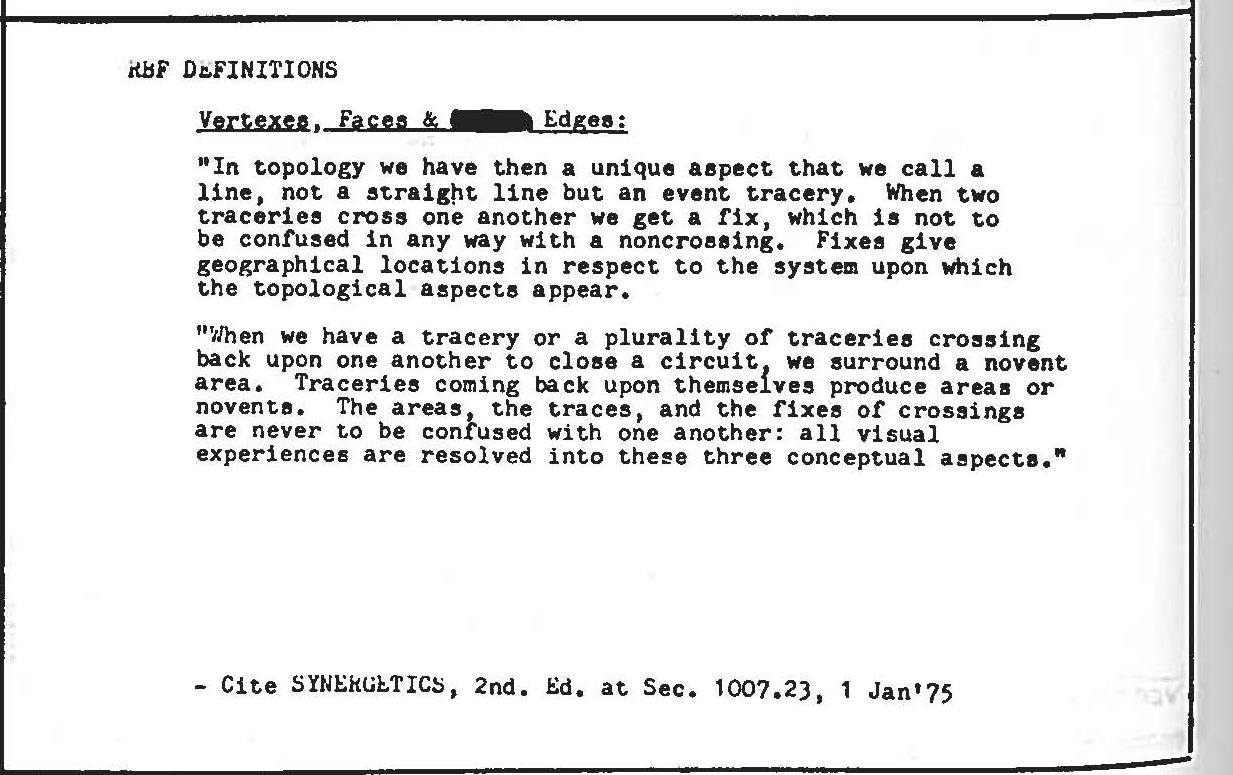
Vertexes, Faces & Edges (1)
← Vertexes, Faces & Edges | Verteces, Faces & Edges (2) →
Cross Reference
See Crossings, Openings, & Trajectories
Cross-References
- Crossings, Openings, \& Trajectories
- Euler
- Eventsents & Event Interrelatabilities, Nov
- Constant Relative Abundance
- Topological Abundance
- Points, Areas & Lines
- Fixes, Discontinuities & Continuities
- Joints, Windows & Struts
Verteces, Faces & Edges (2)
← Vertexes, Faces & Edges (1) | Vertexes & Nonvertexes (1) →
Cross Reference
Cross-References
- Domain & Quantum, (1)(2)
- General Systems Theory
- Minimum Tetrahedron, 22 Feb'77
- Polyhedra, 18 Jul'76
- Push-pull Members, 28 Oct'72
- Topology, 11 Dec'75
Vertexes & Nonvertexes (1)
← Verteces, Faces & Edges (2) | Vertexes & Nonvertexes (2) →
Cross Reference
Tetrahedron: Inside-outing Of: Visible & Invisible
Vertexes
Tetrahedron: Inside-outing Of: Visible & Invisible Vertexes
Cross-References
Vertexes & Nonvertexes (2)
← Vertexes & Nonvertexes (1) | Vertexial Spheres →
Cross Reference
Cross-References
Vertexial Spheres
← Vertexes & Nonvertexes (2) | Vertexial Spheres →
Index Entry
Vertexial Spheres:
"Since the number of all the vertexes is divisible by two, Linus Pauling was right that sumtotally Universe is always an even number and that you can divide all Universe evenly by pairs of closest packed spheres, as pairs of tangent spheres.
"However, each of the spheres that constitute the vector's inherently two interrelated vertexial spheres are in themselves two unique differentials in spheres: the congruent concave and convex spheres whose respective radiant energy-reflecting properties are so opposedly differentiable as to act respectively as energy Universe's prime diffusers or concentrating transformers; ergo, each sphere is always two spheres."
Vertexial Spheres
← Vertexial Spheres | Vertexial Symmetry →
Cross Reference
Cross-References
Vertexial Symmetry
← Vertexial Spheres | Vertexial Topology →
Cross Reference
Vertexial Symmetry:
Cross-References
- Vector Equilibrium, 19 Feb'72
Vertexial Topology
← Vertexial Symmetry | Vertexial Topology →
Index Entry
Vertexial Topology:
"Second powering does not refer to 'squaring' or to surface amplification, but to the number of the system's external vertexes in which equating the second power and the radial or circumferential modular subdivisions of the system (multiplied by the prime number one, if a tetrahedral system; by the prime number two if an octahedral system; by the prime number three, if a triangulated cubical system; and by the prime number five, if an icosahedral system), each multiplied by two, and added to by two will accurately predict the number of superficial points of the system."
- Cite SYNERGETICS text at Sec. \hrefhttps://www.buckyverse.org/en/synergetics/content/chapters/900-modelability#section-964.20964.20, Aug'71
(Same text appears at Sec. \hrefhttps://www.buckyverse.org/en/synergetics/content/chapters/200-synergetics#section-223.40223.40)
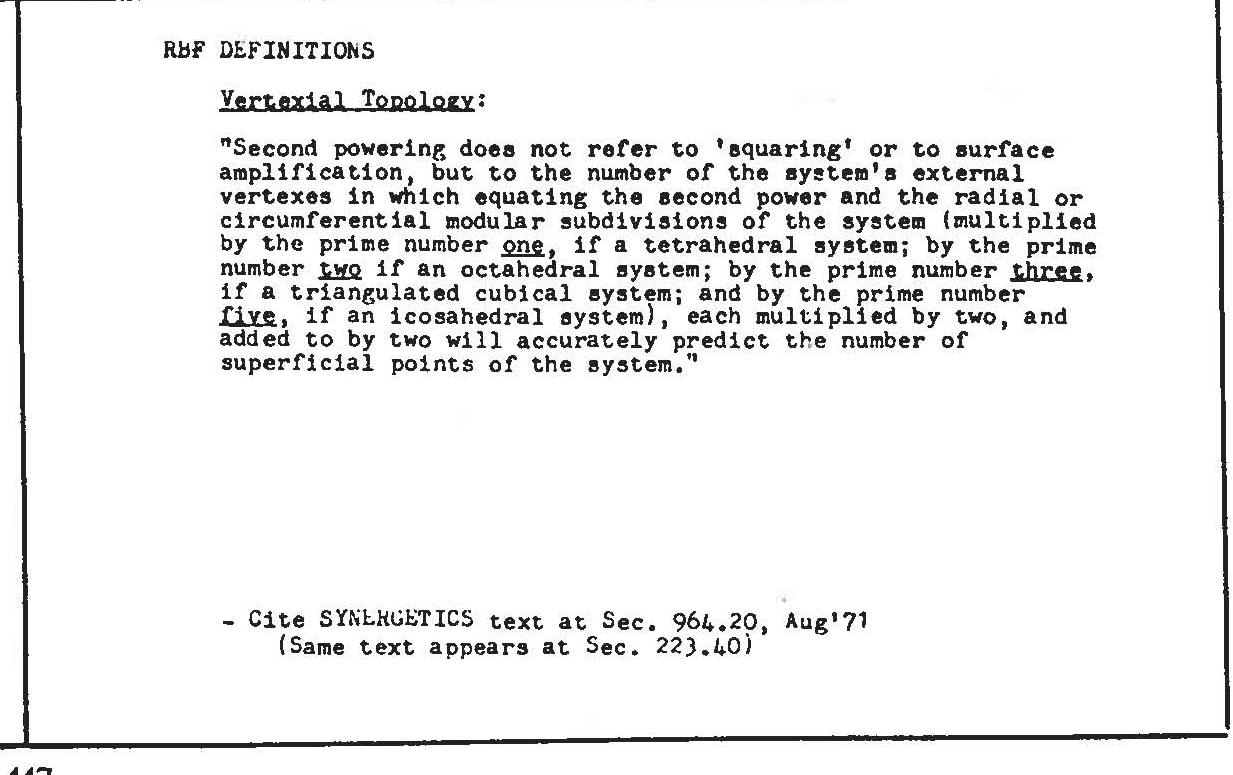
Vertexial Topology
← Vertexial Topology | Vertexes = Tunings →
Cross Reference
Vertexial Topology:
Of the Topology of Symmetrical Structural Systems:
Principle of
Superficial: Superficiality
Cross-References
- Prime Number Inherency & Constant Relative Abundance
- Prime Number Inherency \& Constant Relative Abundance Of the Topology of Symmetrical Structural Systems: Principle of Superficial: Superficiality
Vertexes = Tunings
← Vertexial Topology | Vertexial Unities (1) →
Cross Reference
Vertexes = Tunings:
Cross-References
- T Module, 21 Jun'77
Vertexial Unities (1)
← Vertexes = Tunings | Vertexial Unities (2) →
Cross Reference
Cross-References
Vertexial Unities (2)
← Vertexial Unities (1) | Vertex-vortex Rotations (1) →
Cross Reference
Cross-References
- Angular Topology: Principle Of, 1960 (1)
Vertex-vortex Rotations (1)
← Vertexial Unities (2) | Vertex (1) →
Cross Reference
Vertex-vortex Rotations:
Cross-References
Vertex (1)
← Vertex-vortex Rotations (1) | Vertex (2) →
Cross Reference
Touch = tex of Vertex
Face Congruence with Opposite Vertex
Cross-References
- Convergence
- Coupler as Domain of IVM Vertexes
- Corner
- Crossing
- Evenly Coupled Vertexes
- High Tide Aspects of Vertexes
- Polar Vertexes
- Prime Structural Systems
- Prime Vertexes
- Radiantly Alternate Vertexes
- Vertexes & Nonvertexes
- Chemical Bonds: Single Bond
- Nuclear Vertex
- Dimpling
- Interior Vertex
- OmniConvertex
- Vectorial & Vertexial Geometry
- Domains of Vertexes
- Universal Vertex Center Model
- Spheres & Vertexes
Vertex (2)
← Vertex (1) | Vertex Vertexial (3) →
Cross Reference
Cross-References
- Circumferential Field, Apr'72
- Description, 25 Aug'71*
- Convergence & Divergence, 1955
- Domain, 12 Jul'62
- Gravitational System Zone, 14 Jan'55*
- Pattern Uniqueness, 11 Jul'62*
- Petal: Tetrahedron as Three-petaled Flower Bud, 11 Feb'73
- Tetrakaidecahedron, 19 Feb'72*
- Point, 19 Dec'73
- Start, 29 Dec'58
- Touch, 29 Dec'58
- Tidal, 31 May'71*
- Twoness, 1967
- Vector, 16 Dec'73
Vertex Vertexial (3)
← Vertex (2) | Vertical is to Live: Horizontal is to Die →
Cross Reference
Vertexes = Crossings
Cross-References
- Vertexial Accounting = Spherical Accounting
- Vertexial Advantage
- Vertexial Asymmetry
- Vertexial Connections
- Vertex vs. Face
- Vertexes, Faces & Lines
- Vertexes & Nonvertexes
- Vertexial Symmetry
- Vertexial Topology
- Vertexial Unities
- Vertexial Spheres
- Vertex-vortex Rotations
- Vertexes = Tunings
Vertical is to Live: Horizontal is to Die
← Vertex Vertexial (3) | Vertical: Verticality →
Cross Reference
Cross-References
- Freeways, Mar'66
Vertical: Verticality
← Vertical is to Live: Horizontal is to Die | Vertol →
Cross Reference
Cross-References
Vertol
← Vertical: Verticality | Vessel →
Cross Reference
Cross-References
- Air Delivery & Submarine Cities, (1)(2)
- Dymaxion Car, (1)(2)
Vessel
Index Entry
"Inspired by nature's nut, mollusk, egg, and vegetable shells, men learned, hundreds of milleniums ago, how to hollow out or build up and bind together hydraulic containers or vessels. Learning gradually how to expand the vessel-making art, men finally hollowed out largelogs and then later shaped and tied together tree planks, later bent around stout frames. They pitch-sealed the seams between planks to exclude, rather than include, the hydraulic element, as had their earlier water-holding vessel, the vase-- yes, short for vessel.
"Vessels represent man's discovery not only of the generalized principles governing stabilized separations of liquids and gases anywhere locally in Universe, but also of the generalized solution of local environment pattern-controlling by man within the otherwise frequently hostile, if not lethal, environment event patterning of total energetic Universe. Vessels embrace the fundamental principle of finite local system mathematics. Vessels, as systems, divide the Universe into two main parts-- the withinness and the withoutness."
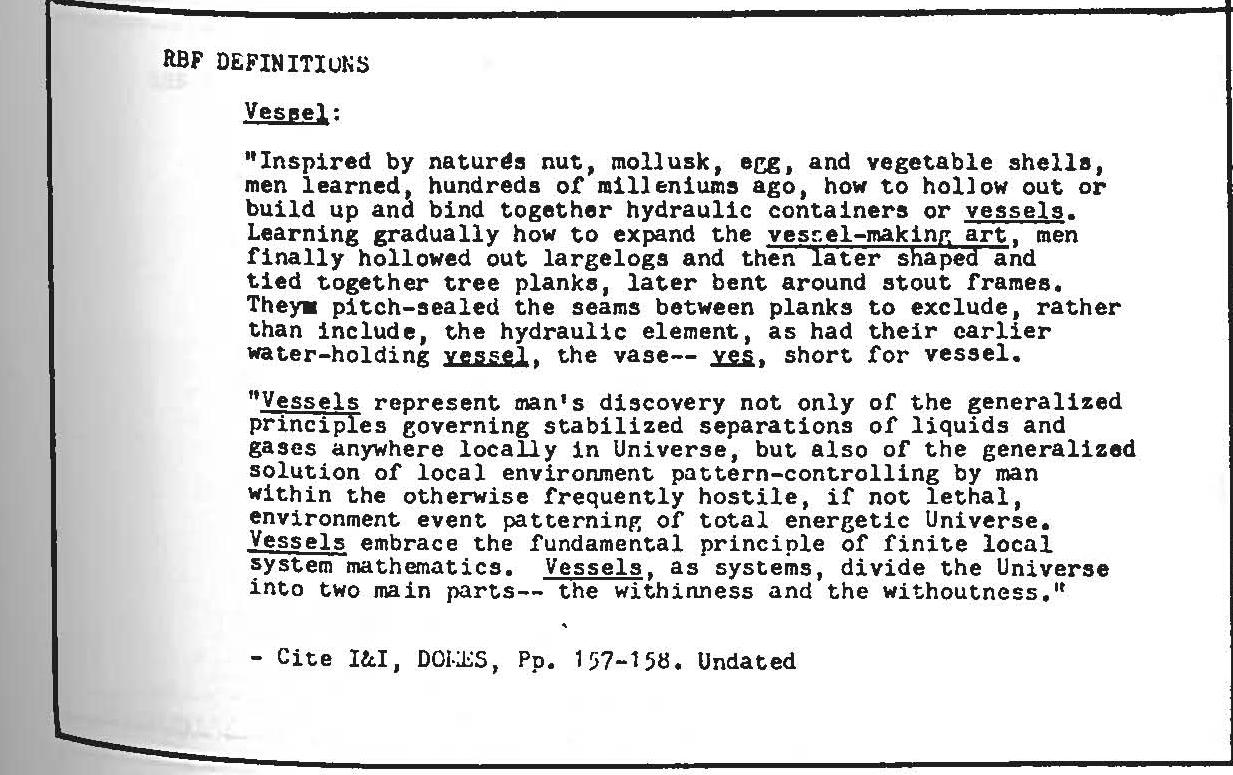
Vessel (1)
Cross Reference
Cross-References
Vessel (2)
← Vessel (1) | Vibrant: Vibration (1) →
Cross Reference
Cross-References
- Environmental Control Valve, 1954
Vibrant: Vibration (1)
Cross Reference
See Notes & Quarks as basic Notes, (3)
Cross-References
- Notes \& Quarks as basic Notes, (3)
Vicarious
← Vibrant: Vibration (1) | Vices →
Cross Reference
Vicarious:
Cross-References
Vices
Cross Reference
Cross-References
Victrola
← Vices | Video Cassette Documentaries (1) →
Cross Reference
Cross-References
Video Cassette Documentaries (1)
← Victrola | Video Videotapes (3) →
Cross Reference
Video Cassette: Video Cassette Documentaries:
Words, 17 Jul'73
Cross-References
- Communicating, 17 Jul'73 (1)
Video Videotapes (3)
← Video Cassette Documentaries (1) | Vietnam Vietnam War →
Cross Reference
Cross-References
- Now House, (3)
Vietnam Vietnam War
← Video Videotapes (3) | View & Review →
Cross Reference
Transnational Capitalism, (2)(3)
Export of Know-how, (2)(3)
Cross-References
- Design Science, 8 May'71
View & Review
← Vietnam Vietnam War | View →
Cross Reference
Cross-References
- Search vs. Research, 14 Feb'72
View
Cross Reference
Cross-References
Village
Cross Reference
Cross-References
Vine Vines
← Village | Viral Steerability →
Cross Reference
Cross-References
- Geodesics, (2)
- Grow-a-dome, 1 Dec'76
- Ice, 29 Apr'77
Viral Steerability
← Vine Vines | Viral Steerability →
Index Entry
Viral Steerability.
"Talking about the synergy of synergies we find over and over again that precession is not predicted by mass attraction; the chemical compounds are not prophesied by the atoms; the biological protoplasm is not predicted by the chemical compounds and the design of the elephant or the pine tree is not predicted by the protoplasm. We know there is DNA and RNA, of which any one set of those form a special case: they don't carry the general capability. They don't tell us why the protoplasm could be elephant or pine tree. Viral steerability is angle-frequency design. There's no question about it. It is a specific set of cases and it has its four fundamental constituents-- its two pairs. . . Third pairs, which are upside down, are GCTA. . . We know the code, but we don't know how it comes out elephant. . . The complementarity of the holisticness of it would balance out. And so an elephant does walk and its not something left over with some gaps in it. That's how it is with DNA and RNA."
- Cite tape transcript excerpts, RBF to EJA and BOR, Chicago, 31 May 1971.
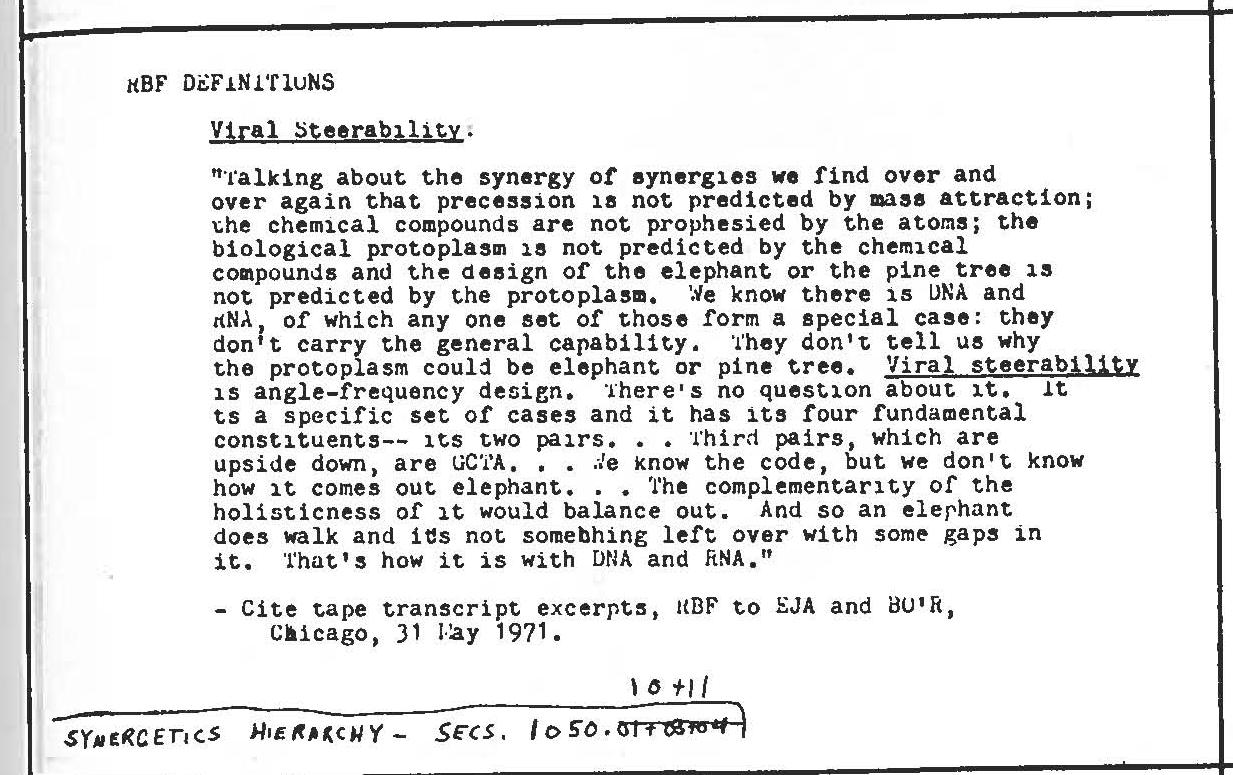
Viral Steerability
← Viral Steerability | Viral Steerability: Tetranelix →
Index Entry
Viral Steerability: Angle-Frequency Design Control:
"We know that there is DNA and RNA, any one genetic code of which dictates both a species and within it an individual or special-case formulation. DNA-RNA codes do not explain why the protoplasm could produce either an elephant, pine tree, or daisy. What we call viral steerability as produced by the DNA-RNA codes is simply our familiar and generalized angle-frequency design control."
- Cite RBF at SIMS, U. Mass., Amherst, 22, p. 22, 22 July '71, as rewritten by RBF Aug '71 and incorporated at Synergetics text, Sec. \hrefhttps://www.buckyverse.org/en/synergetics/content/chapters/1000-omnitopology#section-1050.021050.02, Apr. '72.
Viral Steerability: Tetranelix
← Viral Steerability | Viral Steerability: Tetrahelix (1) →
Index Entry
The four chemical compounds-- guanidine,etc., whose first letters are G, C, T, and A, of which DNA always consists, in various paired code pattern sequences such as GC, GC, CG, AT, TA, GC (in which A and T are always paired as are G and C) are demonstrable by equivalent variations of the four individually unique spherical radii of two unique pairs of spheres which may be centered at the four tetrahedra vertexes giving the tetrahedra four unique asymmetries in any variation of series which will result in the steerability of the shaping of the tetranelix prototypes all of which can account for the pattern controls effected in all biological structures by DNA.
Viral Steerability: Tetrahelix (1)
← Viral Steerability: Tetranelix | Viral Steerability: Tetrahelix (2) →
Index Entry
Viral Steerability: Tetrahelix:.
"Now one of the main important characteristics of DNA is that we have in the DNA helix a patterning instruction. There is a coding of four principal chemical compounds:-- GCTA. They find that all the instructions for the designing of all the patterns known to biological life is contained in GCTA, which will sometimes read GCCCGCATATTA. These are the four letters that are used and they govern all the coding of all the life structures. They know that one of these codings, then, makes a parent /apparent?. . ._/ and then there is some kind of zipping that occurs where there is a dichotomy and the new life breaks off from the old pattern with a perfect imprint and repeats the other./ It is quite interesting that in these helixes you have the ability for them to literally nest by virtue of the spring, so that even though one is being imprinted by the other, it is not because one is a negative column and the other a positive column. They are all the same columns and yet they nest. Therefore, the other column, when it comes off, is a replica of the original column. They also found there is a tendency in the dichotomy to unzip:for the new life printed by the old life to unzip itself from the previous life-- so we have found in this model so far a tendency to unzip, to primp, and there is a coincidence of
Viral Steerability: Tetrahelix (2)
← Viral Steerability: Tetrahelix (1) | Viral Stereability: Tetrahelix →
Index Entry
Viral Steerability: Tetrahelix:
"the ten increments per cycle that was also in the Watson-Crick chemistry. I don't mildly even imply that I am giving you the picture of it; and yet this is the kind of tantalizing confrontation that I have come to have-- many times when I seem to be in the right area."
- Cite Oregon Lecture #6, p.200, 6 Jul'62
Viral Stereability: Tetrahelix
← Viral Steerability: Tetrahelix (2) | Viral Steerability →
Index Entry
"We inaugurate exploration with our theorem of omniuniverse tetrahedral structuring. Whereas Van't Hoff showed that all inorganic chemical structuring is tetrahedronally configured in vertexial linkage and Pauling's X-ray diffraction analyses show omnitetrahedral configuration interlinkages of gravitational centers of compounded atoms in all metals analyzed our omnitetrahedral structuring as a triple-bonded linear tetrahedral array may coincide with the DNA helix, and the tetra's four unique quanta corners may explain DNA's dichotomy transferred T,A; G,C patterning control of all biological species reproductions."
- Cite OMNIDIRECTIONAL HALO, p. 161, 1960
Viral Steerability
← Viral Stereability: Tetrahelix | Virgin →
Cross Reference
DNA: RNA
Cross-References
Virgin
← Viral Steerability | Virgin →
Index Entry
Virgin:
"A virgin is a generalization. A special case cannot be virgin. Virgin is another way of saying eternity.
"Virgin is an unused angle: the 'V' is an angle, an unoccupied angle. A male is convex and a female concave. You cannot really have concavity without convexity, so virginity is eternal."
- Cite RBF to EJA, 3200 Idaho, Wash, DC, 8 Apr'75
Virgin
Index Entry
"Virgin identifies the topological insideness aspect of the coincidental insideness-outsideness of all generalized systems independently differentiated from all the macrocosmos Universe outside the virgin's system and all the microcosm Universe inside the virgin and the little of the cosmos Universe with which the virgin imaginably differentiates the outsideness from the insideness.
"And virgin is half a system because unity is plural and at minimum two; the virgin being the prime insideness of concavity to be dimensionally or experientially and operationally realized only by special-case-recognized congruence of the convex outsideness with the inside concavity."
Virgin
← Virgin | Virgin - Primitive →
Index Entry
There can be no special case generalized virgins.
- Citation & context at Primitive Regeneration, 27 Dec'74
Virgin - Primitive
← Virgin | Virgin = Unused Angle →
Cross Reference
Cross-References
- Primitive Regeneration, 27 Dec'74
Virgin = Unused Angle
← Virgin - Primitive | Virgin →
Cross Reference
Cross-References
- Virgin, 8 Apr'75
Virgin
← Virgin = Unused Angle | Virtue →
Cross Reference
Cross-References
- Minimum Limit Case, 12 May'75
Virtue
Cross Reference
Cross-References
Virus
RBF Definitions
"... Frequency to the second power times ten plus two: is the number of balls in any given layer. This simple formula governing the rate at which balls are agglomerated around other balls or shells in closest packing is an elegant manifest of the reliably incisive transactions, formings and transformings of universe. I made that discovery and published it in 1944. This is the mathematics which the molecular biologists have confirmed and developed by virtue of which we can predict the number of nodes in the external protein shells of all the viruses, within which shells are housed the DNA-RNA programmed design controls of all the biological species and individuals within those species. Although the polio virus is quite different from the common cold virus, and both are different from other viruses, all of them employ frequency to the second power times ten plus two in producing those most powerful structural enclosures of all the biological regeneration of life. It is the power of these geodesic-sphere shells that makes so lethal those viruses unfriendly to man. 'they are almost indestructible.'
Citations
- RBF marginalia, New York, 19 June 1971, to Synergetics draft, Section \href{https://www.buckyverse.org/en/synergetics/content/chapters/200-synergetics#section-222.32}{222.32}.43
Virus
Index Entry
Virus:
"Viruses,
The smallest organized structures
Exhibiting 'life'
May be classified either
As inanimate or animate,
As crystalline or 'cellular' forms."
- Cite HOW LITTLE, p. 72, Oct'66
Virus
← Virus | Virus: Viral Structures: Virology (1) →
Index Entry
Virus:
"I put 'animate' and 'inanimate' in quotes as their previously assumed identification with life and nonlife respectively, has been experimentally discovered to be invalid as the two overlap throughout the virus structures. The viruses may be described as entirely animate or entirely inanimate."
-
Citation and context at Animate & Inanimate, Jun'66
-
Cite NASA Speech, p. 58, Jun'66
Virus: Viral Structures: Virology (1)
← Virus | Virus Viral Structures Virology (2) →
Cross Reference
Cross-References
Virus Viral Structures Virology (2)
← Virus: Viral Structures: Virology (1) | Viscosity →
Cross Reference
Omnidirectional Closest Packing of Spheres: Syner-
getics Principle Of: (2)(3)
4 Apr'73
Cross-References
- Animate and Inanimate Sequence (A)(B)
- Icosahedron, 2 Oct'72
- Omnidirectional Closest Packing of Spheres: Synergetics Principle
- Pattern Integrity
- Science: Comprehensive Integration of the Sciences, 4 Apr'73
- Structure, 16 Dec'73
- Twenty Questions
- Icosahedron: Subtriangulation
- Angle & Frequency Modulation, 7 Nov'75
Viscosity
← Virus Viral Structures Virology (2) | Visibility →
Index Entry
Viscosity:
"Liquids are noncompressible: you find that if you put tetrahedra edge-to-edge that you cannot compress them any more. The coherence of the liquid's viscosity is twice that of the gases inherently."
- Cite Tape transcript RBF to EJA and BO'R, Chicago, 31 May 1971.
Visibility
Index Entry
Visibility:
"The outbound, tetrahedrally-packaged, fractional point works toward and reaches the inherent visibility phases of radiation."
Visibility
Index Entry
Visibility:
"... Nature takes two complete 360-degree angular
tucks in the illusory infinity of a plane to render
systems locally and visibly finite. The
difference between visually finite systems and illusory
infinity is two."
(RBF added the two underlined words to Synergetics draft
Secton \hrefhttps://www.buckyverse.org/en/synergetics/content/chapters/200-synergetics#section-224.02224.02)
- Cite RBF Synergetics marginalia- 19 June 1971.
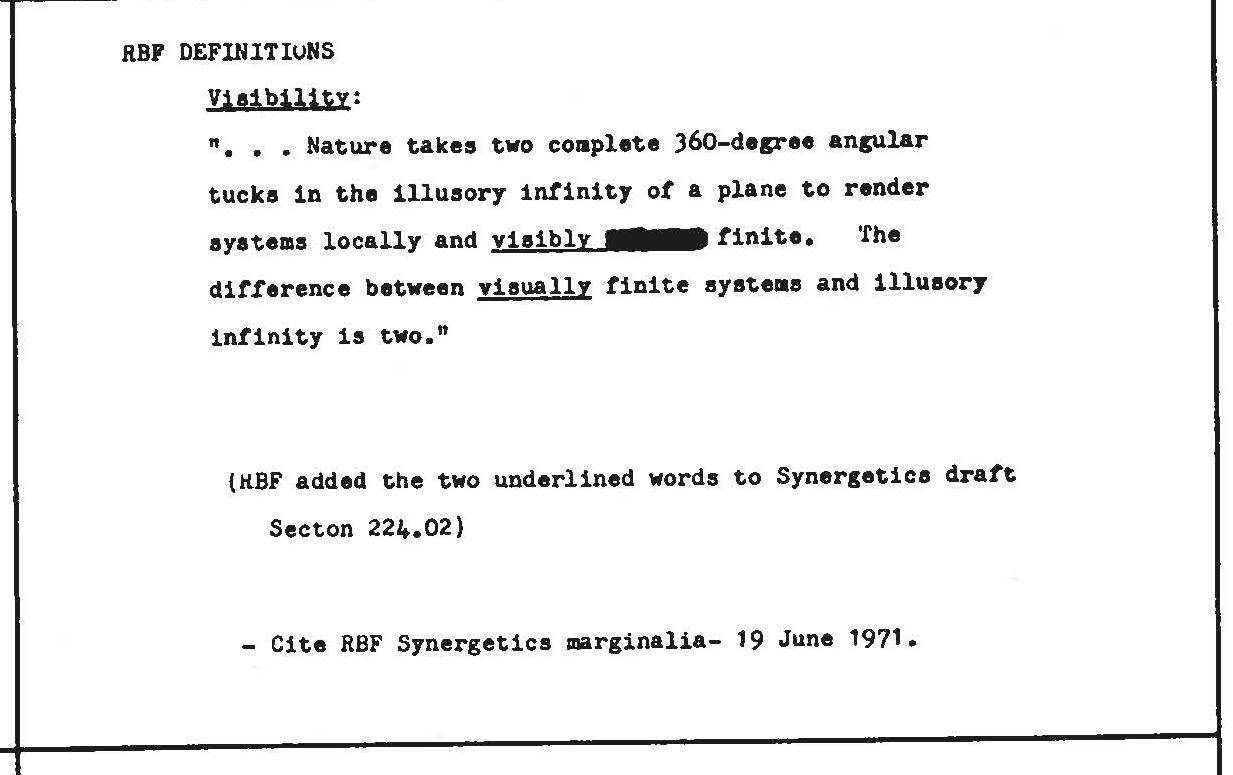
Visibility
← Visibility | Visible & Invisible →
Index Entry
Visibility:
"Visibility . . . is local and temporary."
- Reconstructed from SYNERGETICS text, Sec. \hrefhttps://www.buckyverse.org/en/synergetics/content/chapters/600-structure#section-614.081614.081. 1971
Visible & Invisible
← Visibility | Visibility & Invisibility of Systems (1) →
Index Entry
Visible & Invisible:
"Conceptuality is something independent of visibility or invisibility."
-
Citation & context at Conceptuality Independent of Size, 9 Jul'62
-
Cite Oregon Lecture #5, p. 189. 9 Jul'62
Visibility & Invisibility of Systems (1)
← Visible & Invisible | Visibility & Invisibility of Systems (2) →
Index Entry
There are six uniquely differentiable components of all systems and of all thoughts: (1) insideness; (2) outsideness; and (3) (4) (5) (6) the four star events that do the defining of the insideness and the outsideness, which inadvertently display
-- six interrelationships, which, in turn, inadvertently define
-- four triangles; which, again inadvertently define
-- the four areas (openings) of most economical omni-inter-relationships between the triangles' edge-defining lines that definingly exclude the macro-outsideness and definingly include the micro-insideness.
There are six parts of Universe and four of them are always humanly conceptualizable and always define the successively considerable domains of human thought, while the other two of the six cosmic parts are always invisible; i.e., the ultra-macro tunable otherness and the infra-micro tunable otherness.
- Cite SYNERGETICS, 2nd. Ed. at Secs. \hrefhttps://www.buckyverse.org/en/synergetics/content/chapters/400-system#section-400.71400.71-\hrefhttps://www.buckyverse.org/en/synergetics/content/chapters/400-system#section-400.72400.72, 16 May'75
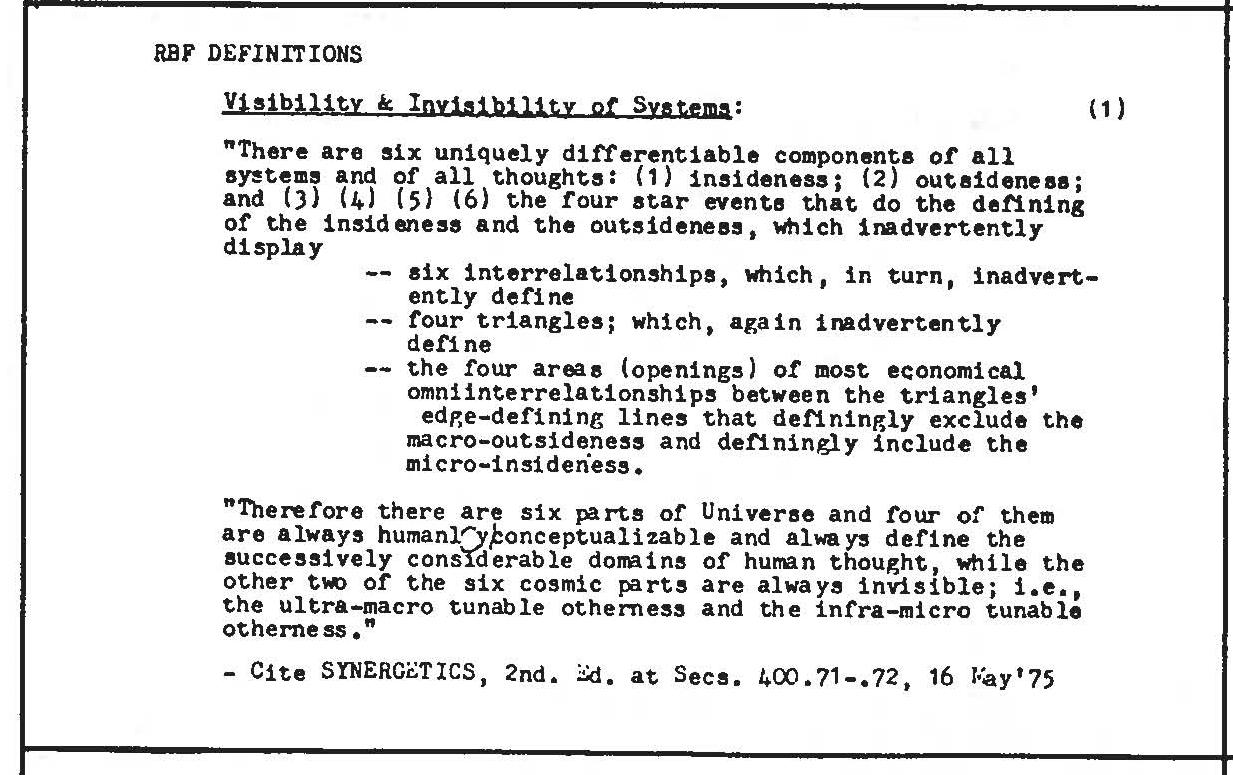
Visibility & Invisibility of Systems (2)
← Visibility & Invisibility of Systems (1) | Visibility & Invisibility of Systems →
Index Entry
Visibility & Invisibility of Systems:
"The visibility of conceptuality is always so preoccupying of human senses and minds as to render spontaneously forgettable our only-progressively-acquired knowledge of the vast ranges of the know-to-exist but nonsimultaneously tunable, ergo invisible, otherness of scenario Universe."
- Cite SYNERGETICS, 2nd. Ed. at Sec. \hrefhttps://www.buckyverse.org/en/synergetics/content/chapters/400-system#section-400.73400.73, 16 May'75
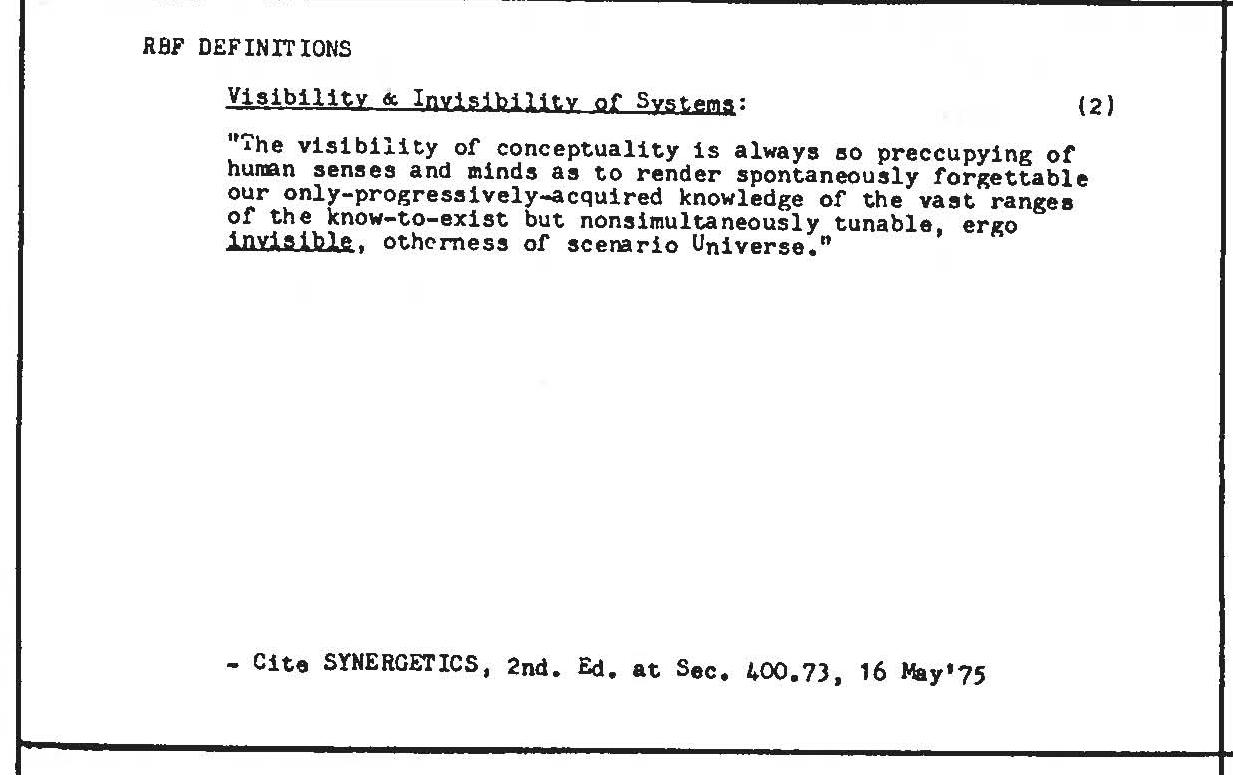
Visibility & Invisibility of Systems
← Visibility & Invisibility of Systems (2) | Visible & Invisible (1) →
Index Entry
The three aspects of systems are (a) insideness, (b) outsideness, and (c) the four star events which do the defining of the insideness and the outsideness, which inadvertently, have
-- six interrelationships; and
-- for triangles, which exclude the macro-outside-ness and include the micro-insideness.
"Therefore there are six parts of Universe and two of them are always invisible. There is an inherent twoness in the invisible macro and micro. The four visible parts define the system."
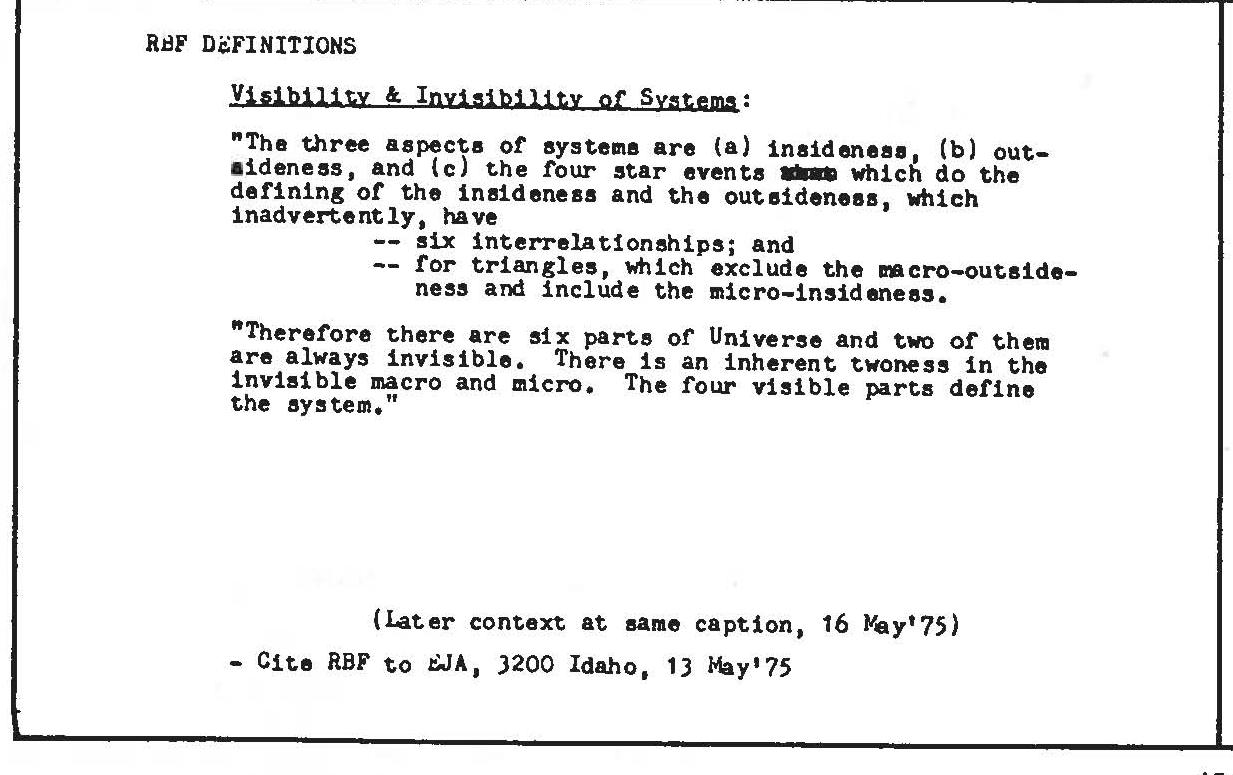
Visible & Invisible (1)
← Visibility & Invisibility of Systems | Visible & Invisible (2) →
Cross Reference
Tetrahedron: Inside-outing of Tetrahedron:
Visible & Invisible Vertexes
Tetrahedron: Visible & Invisible Chordal Arcs
Cross-References
- Now You See It: Now You Don't
- Tetrahedron: Inside-outing of Tetrahedron: Visible & Invisible Vertexes
- Demonstrable vs. Thinkable
- Fourth Quantum
- Tuning-in & Tuning-out
- Somethingness & Nothingness
Visible & Invisible (2)
← Visible & Invisible (1) | Visible to Invisible (1) →
Cross Reference
Cross-References
- Aesthetics & Integrity, 8 Sep'75
- Architecture, 1965
- Artist, 6 Jul'62
- Conceptuality Independent of Size, 9 Jul'62*
- Halo Concept, 6 Nov'73; Nov'71
- Life, 22 Apr'71
- Parity, Nov'71
- Redundancy: Reduction Of, 22 Apr'71
- Seeability, 31 May'71
- Syte, 31 May'71
- Visual Symphony, (2)
- Tidal, 9 Nov'73
- Tetrahedron: Nine Schematic Aspects, 30 Aug'75
- Geodesic Domes, 24 Jan'58
- Form Cannot Follow Function, 20 Sep'76
- Synergetics, 17 Oct'77
Visible to Invisible (1)
← Visible & Invisible (2) | Visible to Invisible (2) →
Cross Reference
Cross-References
- Invisible to Visible
- Track to Trackless
- Wire to Wireless
- Ephemeralization
- Visible Thermodynamics vs. Invisible Electrodynamics
Visible to Invisible (2)
← Visible to Invisible (1) | Visible Light vs. Electricity →
Cross Reference
Cross-References
- Dome Over Manhattan, 28 Jan'75
- Pure Principle, 6 Jul'62
Visible Light vs. Electricity
← Visible to Invisible (2) | Visible Spectrum →
Index Entry
Visible Light vs. Electricity:
"Visible light is a pushed phase of radiation and is limited to relatively short distances through atmosphere and required enormous power to push it, while what we call electricity is tensed or pulled radiation and the distances over which radiation can be drawn by wire is very great compared to searchlight beaming."
- Citation & context at Wind Stress & Houses,(10), 1946
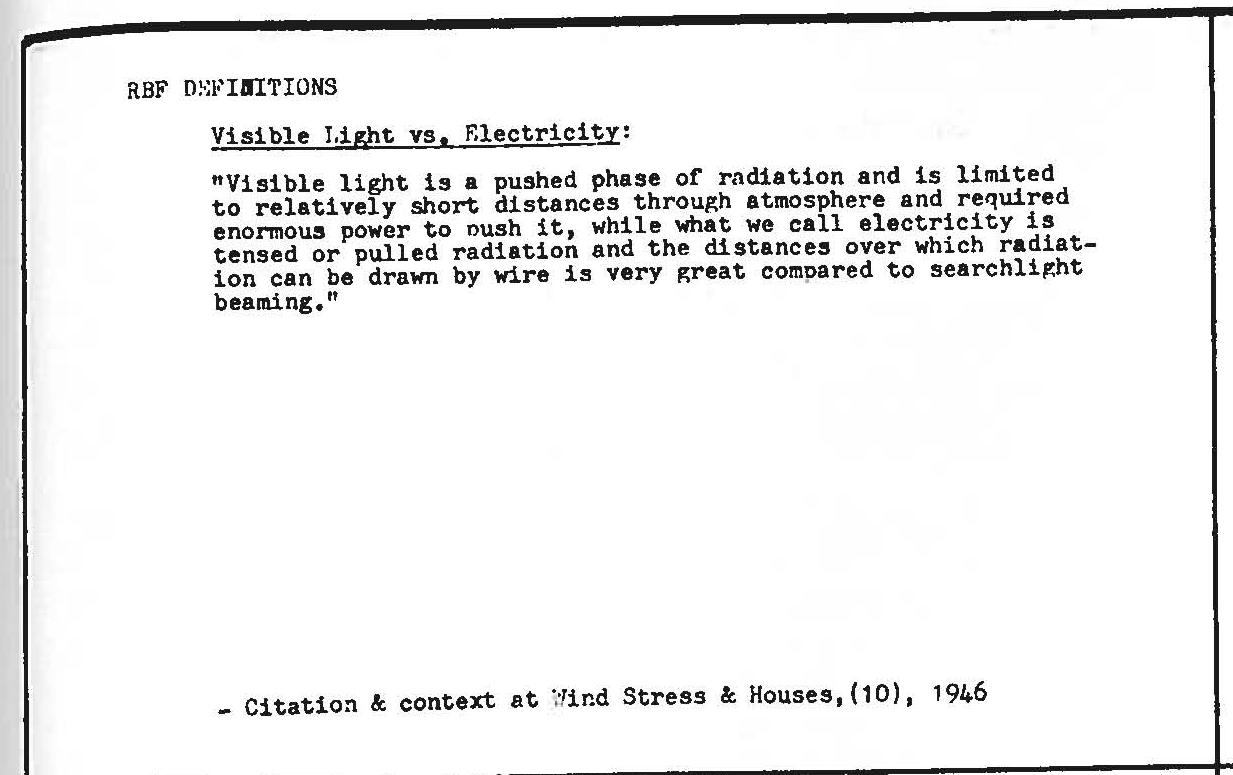
Visible Spectrum
← Visible Light vs. Electricity | Visible Synergetics →
Cross Reference
Cross-References
- Animate & Inanimate, 1971
Visible Synergetics
← Visible Spectrum | Visible Thermodynamics vs Invisible Electrodynamics →
Cross Reference
Cross-References
Visible Thermodynamics vs Invisible Electrodynamics
← Visible Synergetics | Visible: Visibility (1) →
Cross Reference
Cross-References
- Fourth Dimensional Modelability, 24 Feb'75
- Modelability
Visible: Visibility (1)
← Visible Thermodynamics vs Invisible Electrodynamics | Visibility (2) →
Cross Reference
Geoscope = World Looks at Itself
Half Visible
Cross-References
Visibility (2)
← Visible: Visibility (1) | Vision vs. Speech →
Cross Reference
Cross-References
- Point: Outbound Point, 23 Sep'73*
Vision vs. Speech
Index Entry
Vision vs. Speech:
"Vision is unlimited universal language; speech is local and limited."
Visual
← Vision vs. Speech | Visual →
Index Entry
Visual: preponderantly sensing the radiating-deflecting-reflecting, unbonding-rebonding, atom and molecule energy export state, including all those ultratactile, humanly-tune-in-able frequency ranges of electromagnetic wave phenomena.
- Cite SYNERGETICS 2 draft at Sec. \hrefhttps://www.buckyverse.org/en/synergetics/content/chapters/100-synergy#section-100.020100.020; 22 Feb'77
Visual
RBF Definitions
Euler differentiated all physical Universe into lines, crossings, and areas; the fundamental visual aspects of our experiences having to do with our eyes, radiation frequencies and conceptual images."
(10)
Visual Music
← Visual | Visual Symphony (1) →
Cross Reference
Cross-References
Visual Symphony (1)
← Visual Music | Visual Symphony (2) →
Index Entry
Visual Symphony:
"What World Game does have is confrontations... in terms of sounds, words, and languages. When we had the radio, it was only words. People are going to say that in the television there is only an embellishment: the fact that you can see, and nothing more. We can only shout a half mile. Words are in all languages, special languages. But sight is a universal language. A person goes to a horse race in Japan and on TV it's the same thing. This is not like radio at all. I can see 700 million miles an hour and I can hear only 700 miles an hour. The step-up to sight was a millionfolding.
"The information that TV really gives to people; when there's a program there the kids are feeling the dancing, and feeling the gravity. And this is informing them in ways that they have no idea of how they are really being informed. And World Game has to work this way.
"You can listen to a symphony, but you can only hear one set of chords at a time. It takes you an hour to wait and hear the whole symphony. In sum total they have only so many notes in "
- Cite Tape #3, pp.7-8; RBF to W. Wolf, Phila., PA, 15 Jun'74
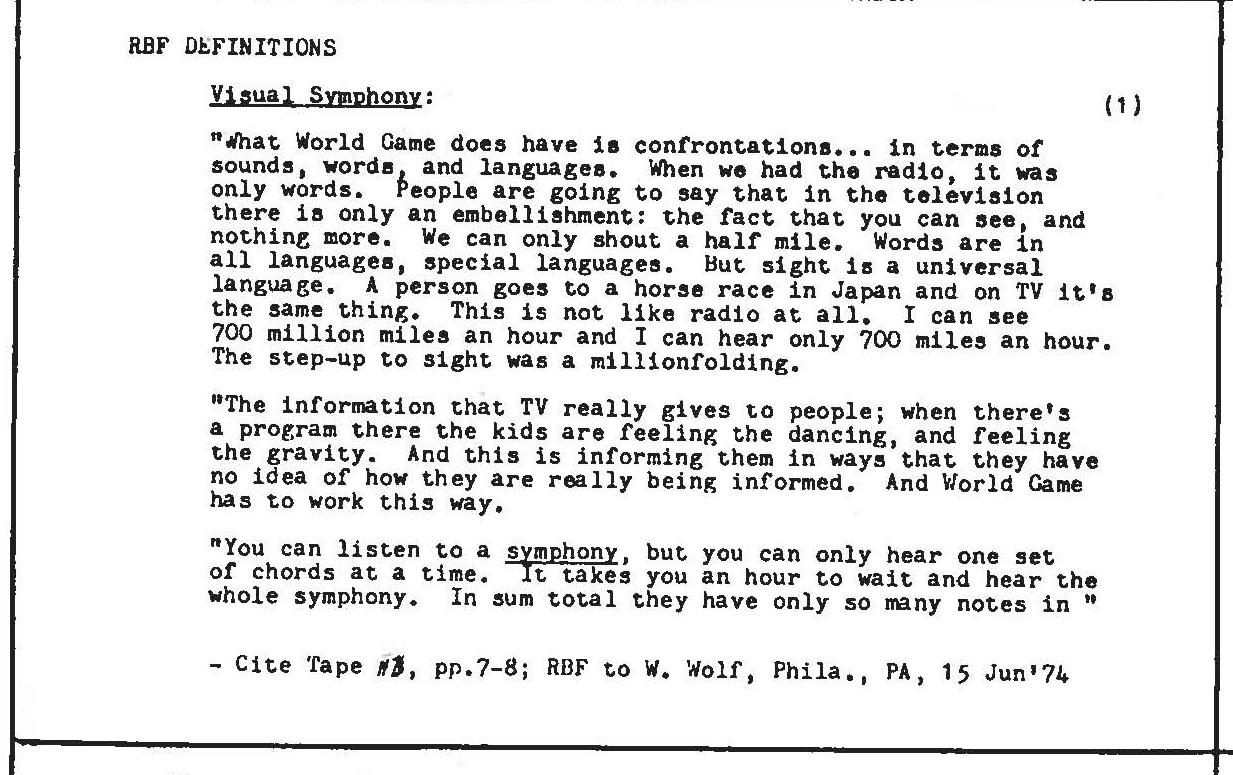
Visual Symphony (2)
← Visual Symphony (1) | Vision Visual (1) →
Index Entry
Visual Symphony:
"the symphony, maybe five or ten thousand, whatever it is. You look at the sky and you're looking at a symphony that took over a million years. You're looking simultaneously at events that took place a million years ago. We forget that sight is incredible. World Game is a visualization of so much that is not otherwise visible.
"You have to realize that every thing I do is synergetic and has to be talked about only in terms of the big complex. Thepoint is that man cannot see the very limited spectrum of motion and change. He can't see the stars moving from the distances where they are, an incredible distance, the motion rate at which they are moving; he can't see the tree grow. And if he doesn't see something in motion, coming at him, he doesn't get out of the way. But it is possible to step-up and step-down, so that he can suddenly see all these things coming together to WHAM!... and that's exactly what World Game is: it's always visual.... You have this slow playback. The point is that World Game can make visible what was not visible in the statistics or in curves."
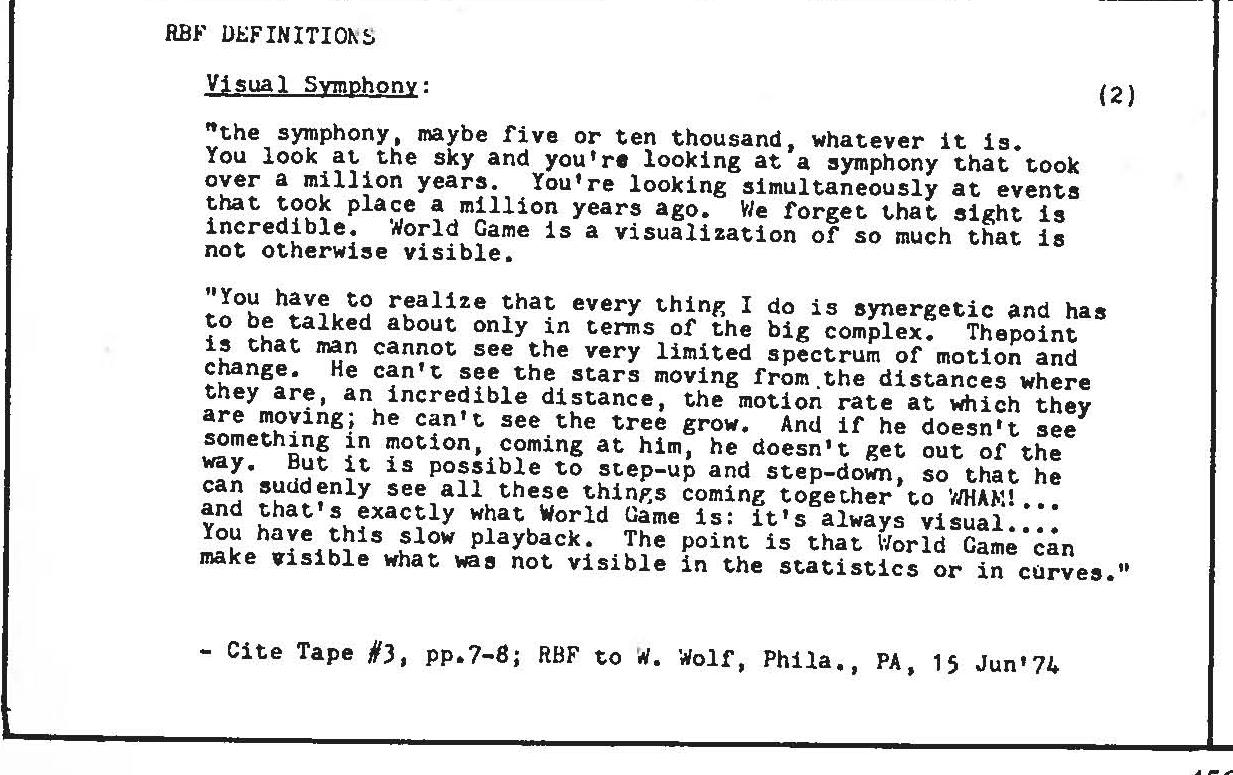
Vision Visual (1)
← Visual Symphony (2) | Vision Visual (2) →
Cross Reference
Eye Comprehendibility
Television: TV: Omnidirectional TV Set
Cross-References
- Color Spectrum
- Human Sense Ranging & Information Gathering
- Motion Apprehension
- Perception
- Seeability
- Sight
- Visual Music
- Ephemeralization vs. Visualization
- Vision vs. Speech
- Resolvability Limits
Vision Visual (2)
← Vision Visual (1) | Vitalistics →
Cross Reference
Cross-References
- Brain's TV Studio, 22 Nov'73
- Ephemeralization, 1938
- Privacy, 22 Apr'71
- Topology: Synergetics & Eulerian, (1)(2)
- Measurement Trends, 1938
- Vertexes, Faces & Lines, 1 Jan'75
- Zero Volume Tetrahedron, 10 Dec'75
- Silence, 30 Sep'76*
Vitalistics
← Vision Visual (2) | Vitalistics (3) →
Index Entry
Vitalistics:
"At the outset, certain new words must be introduced, among which are vitalistics to replace the dead word statistics, and mobilata to supersede data. These substitutions are necessary in order to incorporate a time element and to make allowance for the constant adjustment of figures into the meanings of the words. Statistics are static, time-less, the blinding dust of death. Vitalistics and mobilata, on the other hand are appropriately used in connection with a cosmic inventory because scientific events and corrections may cause a one hundred percent amplification or refinement in our cosmic inventory even before the manuscript reciting the items can be printed."
- Cite NINE CHAINS, p. 47, 1938
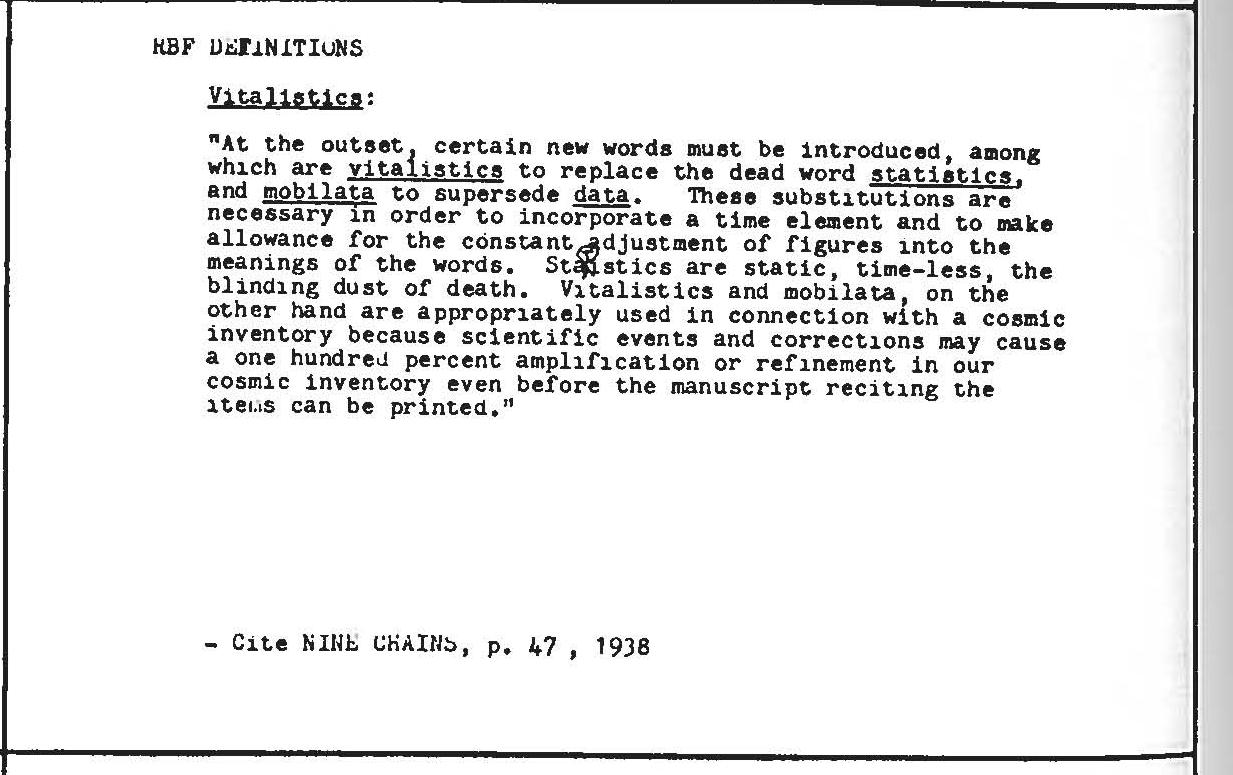
Vitalistics (3)
← Vitalistics | Vizier Grand Vizier →
Cross Reference
Cross-References
- Teleology, (3)
Vizier Grand Vizier
← Vitalistics (3) | Vocabulary →
Cross Reference
Vizier: Grand Vizier:
Cross-References
Vocabulary
← Vizier Grand Vizier | Vocabulary (1) →
RBF Definitions
"With our present large vocabulary inheritance we squander meanings on unworthy causes and communicate little that needs to be said. 'Shazam.' 'Now, off with these clothes.' 'What goes up must come down.'"
Citations
- I SEEM TO BE A VERB, Queen, May '70 (Not in Bantam edition)
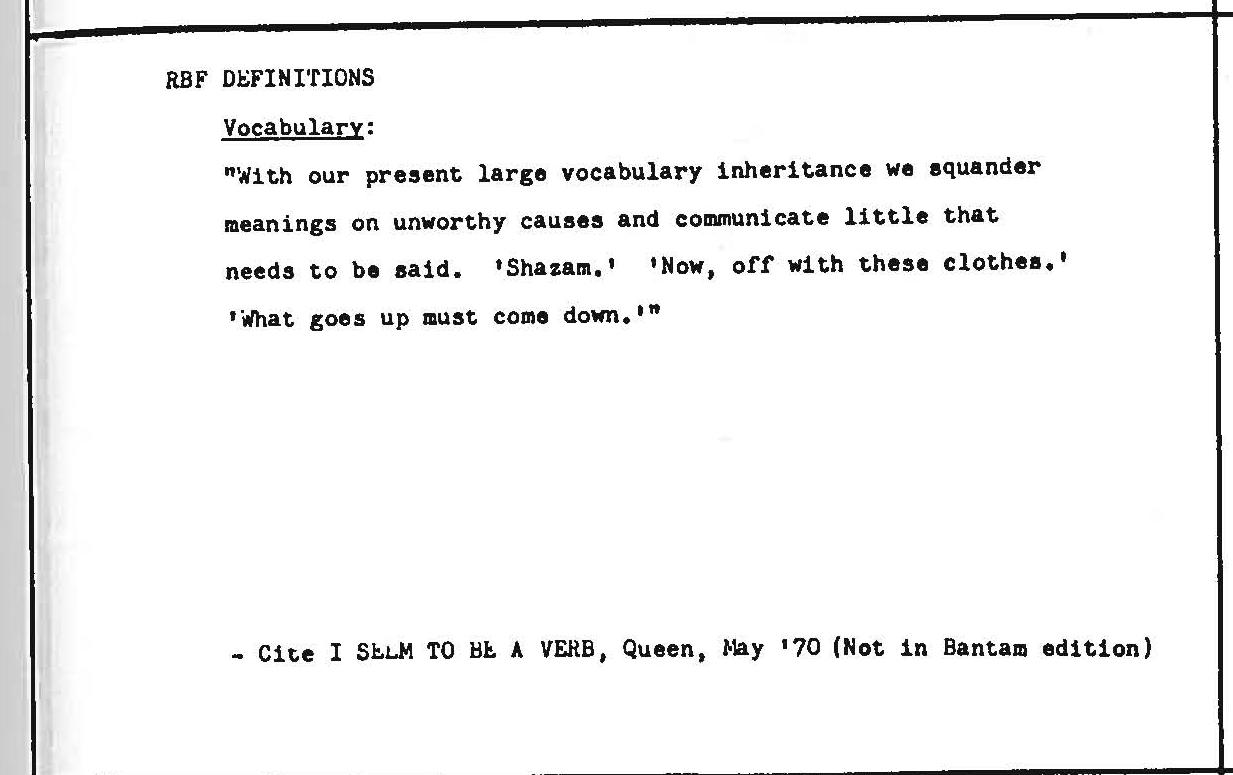
Vocabulary (1)
← Vocabulary | Vocabulary (2) →
Cross Reference
Cross-References
Vocabulary (2)
Cross Reference
Cross-References
- Advertising, 28 Apr'71
Void (1)
Cross Reference
Cross-References
- Internuclear Voids
- No Absolute Void
- Nothing
- ent, Nov
- Opening
- Space
- Tetra-void
- Vacuum
- Vertexes & Nonvertexes
Void (2)
Cross Reference
Allspace Filling:ahedron & VE, Oct
Cross-References
- Fireworks, May'72
- Frequency: High & Low, 26 Apr'71
- Solid State, Nov'71
- Omnidirectional: Physical Existence Environment Surrounds, (2)
Volitiona (1)
Cross Reference
Cross-References
Volitions (2)
Cross Reference
Cross-References
- Electronic Referendum, 9 Jan'75
Volume
RBF Definitions
"A volume cannot have an interior point. A volume is minimal. A volume can have no subdivisions."
Citations
- RBF to EJA, Fairfield Conn., Ches Wolf. 18 June 1971.
Volume
Index Entry
Volume:
"VOLUME - 3rd power volumetric quanta."
- Cite DEFINITIONS FOR SYNERGETICS BY PETER PEARCE, May'67
Volume
← Volume | Volumetric Annihilation →
Index Entry
"The volumes of the first four polyhedra are as follows:
tetrahedron 1
cube 3
octahedron 4
vector equilibrium 20
"Because these metric values are rational (values that can be expressed as a ratio of a whole number), all the derivative, complex, symmetrical polyhedra geometries" of Synergetics " are rational when expressed 'tetrahedrally' rather than 'cubically.'"
(Adapted.)
- Cite MARKS, pp 47-48, 1960
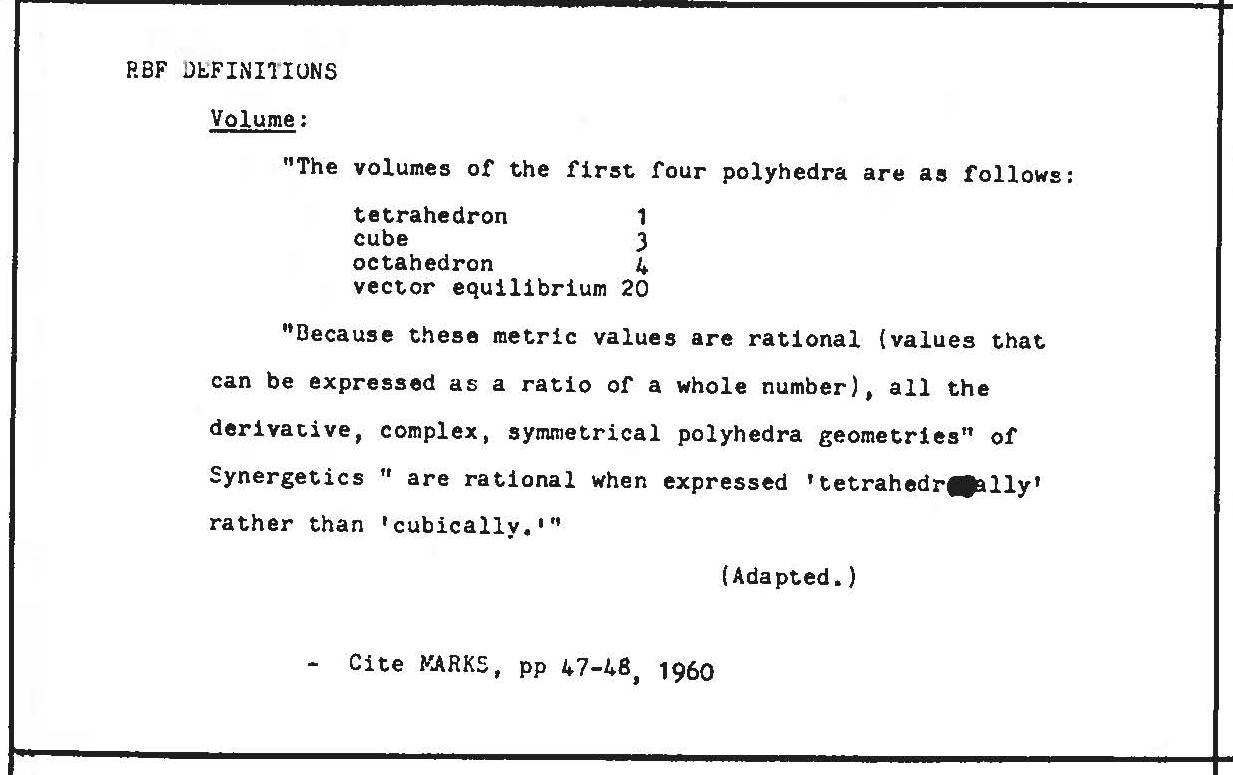
Volumetric Annihilation
← Volume | Volumetric Annihilation →
Index Entry
Volumetric Annihilation:
"The octahedron provides an example of volumetric annihilation when you remove one vector and reduce the figure to three tetrahedra triple-bonded. This also reduces from the volumetric value of four to the volumetric value of three. The process is, of course, reversible."
- Cite RBF marginalia and Sketch #1 on p.3, SYNERGETICS draft, 28 Feb'71
Volumetric Annihilation
← Volumetric Annihilation | Volumetric Annihilation →
Index Entry
"Volumetric annihilation is simple precession -- the falling in from critical proximity."
- Cite RBF to EJA
Beverly Hotel, New York
28 Feb 1971
Volumetric Annihilation
← Volumetric Annihilation | Volumetric Awareness →
Cross Reference
Volumetric Annihilation:
Cross-References
Volumetric Awareness
← Volumetric Annihilation | Volumetric Domain Unity →
Index Entry
Volumetric Awareness:
"Not until we have four othernesses do we have macrocosmic volumetric awareness. Four is required for substantive awareness, where you can have a collection of things you can touch."
- Cite SYNERGETICS draft at Sec. \hrefhttps://www.buckyverse.org/en/synergetics/content/chapters/1000-omnitopology#section-1023.191023.19, 20 Feb'73
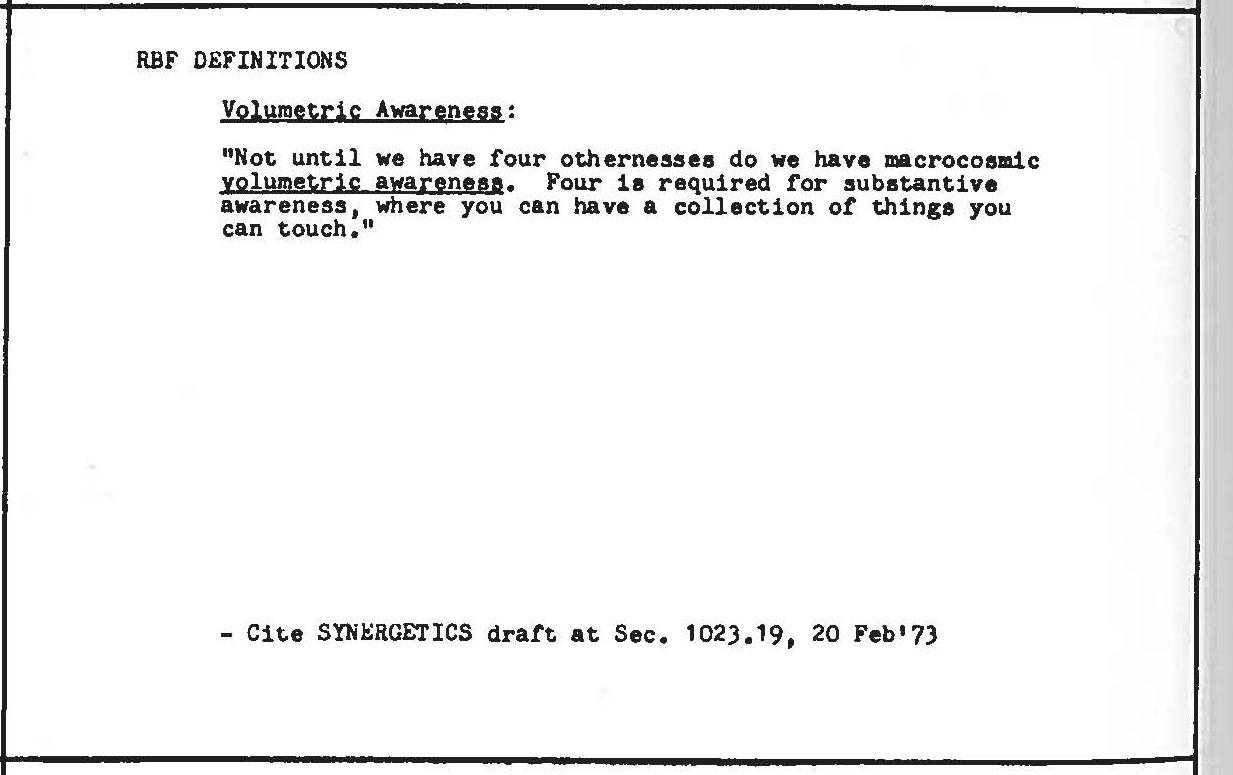
Volumetric Domain Unity
← Volumetric Awareness | Volume-energy Ratios →
Cross Reference
Cross-References
Volume-energy Ratios
← Volumetric Domain Unity | Volumetric Hierarchy (1) →
Cross Reference
Cross-References
Volumetric Hierarchy (1)
← Volume-energy Ratios | Volumetric Hierarchy (2) →
Index Entry
Volumetric Hierarchy:
"What Michael Berz is discovering here and what I had discovered and incorporated in the Kepler-like drawing of concentric symmetrical geometries of the 12 spheres surrounding the nuclear sphere (Fig. \hrefhttps://www.buckyverse.org/en/synergetics/content/chapters/900-modelability#section-982.61982.61) and all the other well-known symmetrical systems which I showed in the chart, which occurs below my drawing showing that the central sphere has a volume of and the central sphere is in fact the spherical icosahedron, giving complete rational value to the sphere in the terms of the vector equilibrium's 20-ness, the octahedron's fourness, the rhombic dodecahedron's sixness, the cube's threeness and the tetrahedron's oneness. This particular drawing and the hierarchy of volumes I consider to be the most important single contribution of the whole book, 'Synergetics.'
"This is why I felt devastated by the lack of color as well as the separation of the drawing from the hierarchical chart which itself had been done in color. This is the very essence of what Kepler's great drawing hoped to discover but failed to do so because of his assumption of the cube for volumetric unity.
- Cite RBF ltr. to EJA, 13 Nov'75
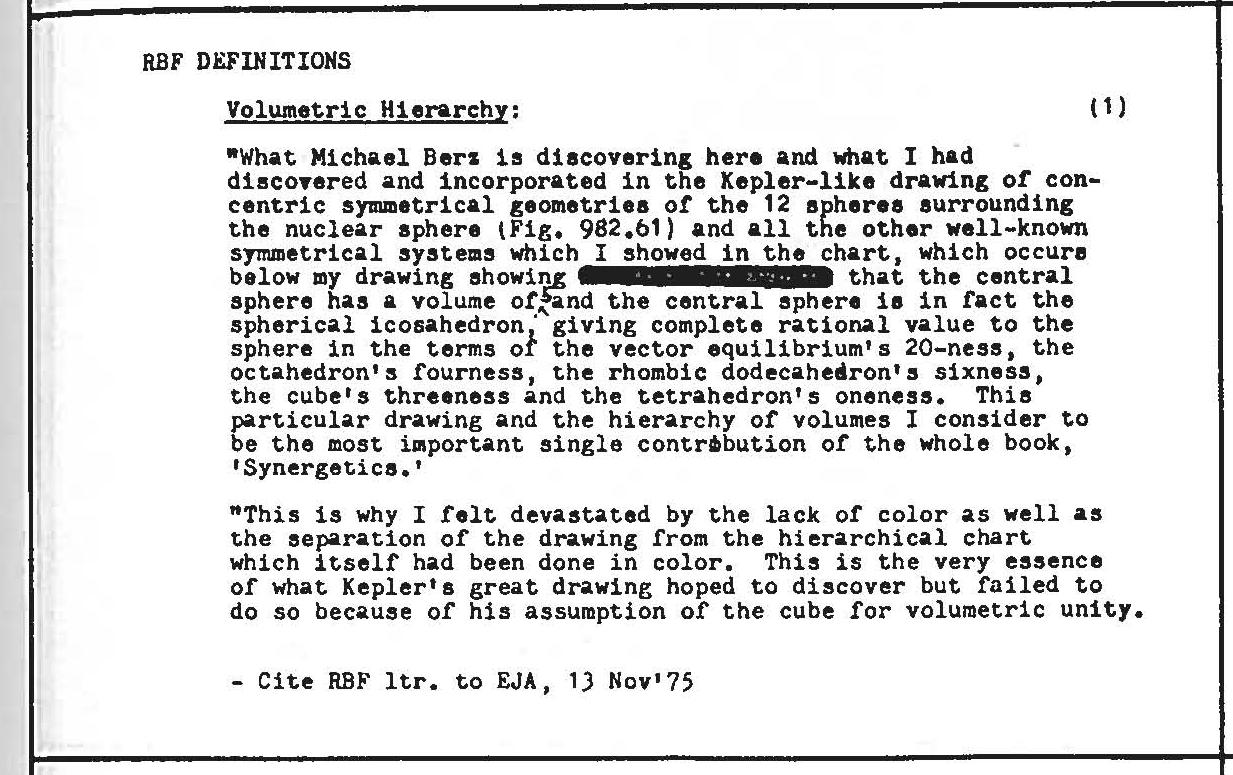
Volumetric Hierarchy (2)
← Volumetric Hierarchy (1) | Volumetric Hierarchy →
Index Entry
What Michael, with his thorough reading of 'Synergetics,' missed the significance of my drawing and its elsewhere included hierarchical chart and felt that he was making a discovery that the difference between the rhombic dodecahedron (the spheric) and what he callsthe small vector equilibrium five, is exactly the volume of one tetrahedron.
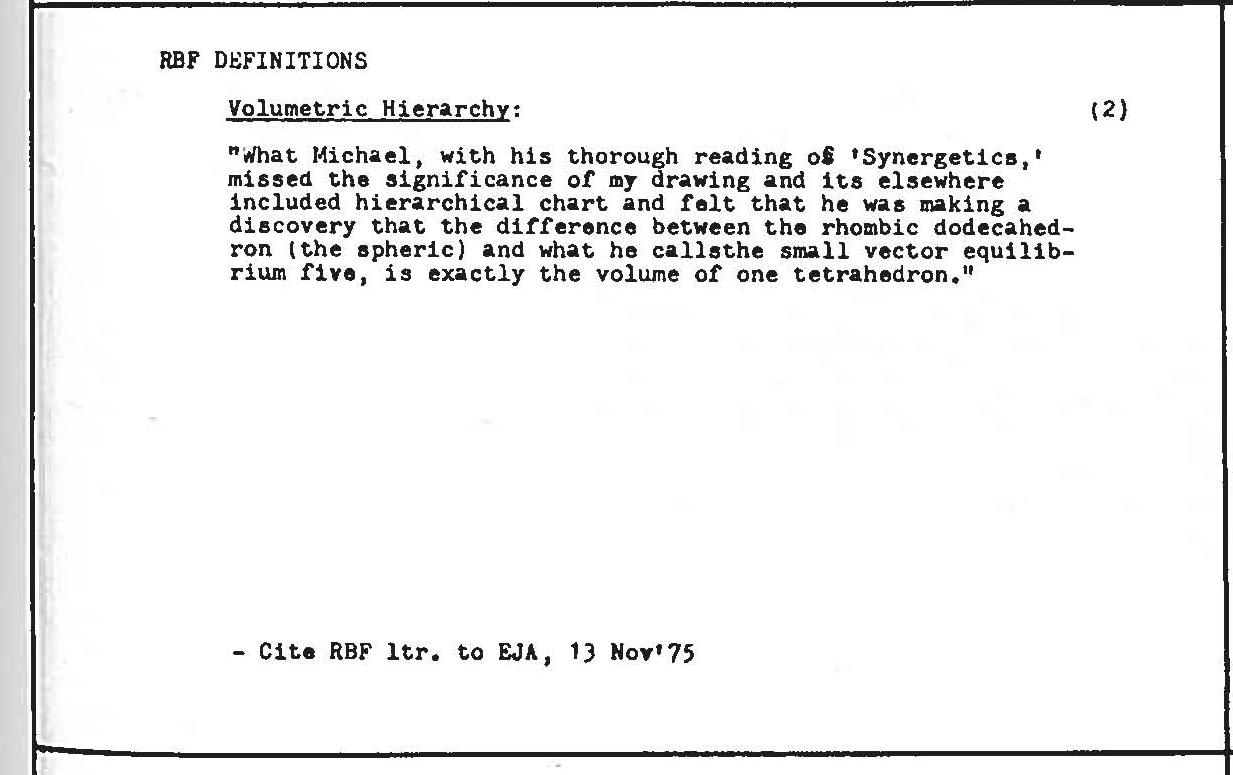
Volumetric Hierarchy
← Volumetric Hierarchy (2) | Volumetric Intervaluations →
Cross Reference
Volumetric Hierarchy:
Cross-References
- ahedron, Oct
Volumetric Intervaluations
← Volumetric Hierarchy | Volume-number Ratios →
Cross Reference
Cross-References
- Isotropic Vector Matrix, 30 Nov'72
Volume-number Ratios
← Volumetric Intervaluations | Volumes = Powers →
Cross Reference
Volume-number Ratios:
Cross-References
- Cosmic Democracy, 27 May'72
- Avogadro, 27 Jan'75
Volumes = Powers
← Volume-number Ratios | Volumetric Quantum →
Cross Reference
Cross-References
Volumetric Quantum
← Volumes = Powers | Volume-quanta Ratios →
Cross Reference
Cross-References
Volume-quanta Ratios
← Volumetric Quantum | Volume-structure Ratios →
Cross Reference
Cross-References
- Potential Ratio of Volume to Quantum Values
- Vector Equilibrium: Ratio of Volume to Quantum
- Tetrahedron as Volumetric Quantum
- Tetrahedroning
- Units of Environment Control
- Structural Quanta vs. Volumetric Quanta
Volume-structure Ratios
← Volume-quanta Ratios | Volume-surface Hierarchy →
Cross Reference
Cross-References
Volume-surface Hierarchy
← Volume-structure Ratios | Volume-Surface Relationship (1) →
Cross Reference
Cross-References
- System Totality, 7 Mar'73
Volume-Surface Relationship (1)
← Volume-surface Hierarchy | Volume-surface Ratio (2) →
Cross Reference
Container Structuring: Volume-surface Ratios
Cross-References
Volume-surface Ratio (2)
← Volume-Surface Relationship (1) | Volumetric Unity →
Cross Reference
Cross-References
Volumetric Unity
← Volume-surface Ratio (2) | Volumetric Unity (1) →
Index Entry
Volumetric Unity:
"If we try to express it in terms of cube as unity, which has the number three, then these others would come out unevenly because due to the irrationality that the three would bring about in relation to the others. When we start with the tetrahedron as unity, then the cube comes out even. These are all whole rational numbers. It is an extraordinary sublime relationship."
- Cite RBF to Verner Smythe, NYC, Reel 2, p.3, 11 Mar'69
Volumetric Unity (1)
← Volumetric Unity | Volumetric Unity (2) →
Cross Reference
Cross-References
Volumetric Unity (2)
← Volumetric Unity (1) | Volume-Weight Relationship (1) →
Cross Reference
Icosahedron & Vector-edged Cube, 11 Mar'69
Cross-References
- Allspace Filling, Jun'66
- Synergetics, 17 Oct'72
- Unity: Complex Unity, Oct'59
- Structural Quanta, 9 Nov'73
Volume-Weight Relationship (1)
← Volumetric Unity (2) | Volume-weight Relationship (2) →
Cross Reference
Cross-References
Volume-weight Relationship (2)
← Volume-Weight Relationship (1) | Volume (1) →
Cross Reference
CGS: Cgts System, 7 Oct'71
Cross-References
- Chemical Phenomenon, May'72
- Mass, 27 May'72; 14 May'73
Volume (1)
← Volume-weight Relationship (2) | Volume Volumetric (2) →
Cross Reference
Constant Volumes Model
Energy & Volume
Cross-References
- Center of Volume
- Concentric Centers of Volume
- Domains of Volumes
- Equatability of Volumes & Powers
- Idealized Volume
- Minimum Volume
- No Absolute Enclosed Surface or Volume
- Nothingness of Areal & Volumetric Spaces
- Prime Volumes
- Sphere: Synergetics Formula for Area & Volume of a Sphere
- Zero Volume
- Structural Quanta vs. Volumetric Quanta
- Intervolumetric
- Tetravolume
- Modules: A & B Quanta Modules: Constant Volume
- Relative Volumetric Frequency & Interval
Volume Volumetric (2)
Cross Reference
Cross-References
- Domain, Aug'71
- Powering: Fourth Dimension, 26 Nov'72
- Tetrahedron, 22 Jul'71
- Synergetic Hierarchy, Oct'75
Volume (3)
← Volume Volumetric (2) | Voluntary & Involuntary →
Cross Reference
Volume-Energy Ratios: Manifest & Potential
Cross-References
- Volumetric Annihilation
- Volumetric Awareness
- Volumetric Hierarchy
- Volumetric Intervaluations
- Volumetric Unity
- Volume-Weight Relationship
- Volume-Surface Relationship
- Volume-number Ratios
- Volume-quanta Ratios
- Volumes = Powers
- Volume-structure Ratios
- Volumetric Domain Unity
Voluntary & Involuntary
← Volume (3) | Voluntary & Involuntary →
RBF Definitions
"Being born is involuntary
Directional stone throwing is voluntary.
Life's first event being involuntary,
The game of life's order of play
Is involuntarily initiated
And is inherently subject to modification
by the a priori mystery
Within which consciousness has emerged."
Citations
- INTUITION, Draft Feb. '71, p. 1.
Voluntary & Involuntary
← Voluntary & Involuntary | Voluntary & Involuntary →
Index Entry
Voluntary & Involuntary:
"We may say that experiences are involuntary or voluntary.
'Involuntary' comes first, which is the way life is.
Birth is involuntary."
- Cite RBF to EJA re definition of
'Universe' in SYNERGETICS
Beverly Hotel, New York
28 Feb '71
Voluntary & Involuntary
← Voluntary & Involuntary | Voluntary & Involuntary (1) →
Index Entry
Voluntary & Involuntary:
"My definition of Universe includes both the objective and the subjective: i.e., all voluntary experiences-- i.e., experiments-- as well as all involuntary experiences-- i.e., all Happenings."
- Citation & context at Happening, 20 Jun'66
Voluntary & Involuntary (1)
← Voluntary & Involuntary | Voluntary & Involuntary (2) →
Cross Reference
Cross-References
Voluntary & Involuntary (2)
← Voluntary & Involuntary (1) | Voluntary →
Cross Reference
Cross-References
- Metaphysical & Physical, Oct'71
- Brain, May'72
- Happening, 20 Jun'66*
- Understanding, 1 Apr'49
Voluntary
← Voluntary & Involuntary (2) | Voodoo →
Cross Reference
Elective
Volition
Cross-References
Voodoo
Cross Reference
Voodoo:
Cross-References
- Gurdjieff, 14 Apr'70
Vortex (1)
Cross Reference
Cross-References
- Vertex-vortex
Vortex (1)
Cross Reference
Cross-References
Voting
← Vortex (1) | Vulnerability →
Cross Reference
Cross-References
Vulnerability
Index Entry
Vulnerability:
"Without vulnerability there is no courage."
- Cite RBF to EJA, Royal Scot Restaurant, N.Y. 14 Sept. 1971.