Synergetics Dictionary — Q
102 cards
Q
← Pythagoras Pythagorean Theorem (2) | Quadrangle Quadrangular →
Letter Group Divider
Q
Quadrangle Quadrangular
Cross Reference
Cross-References
Quadrant
← Quadrangle Quadrangular | Quadrivalent (1) →
Cross Reference
Cross-References
Quadrivalent (1)
← Quadrant | Quadriivalent (2) →
Cross Reference
Self-congruence Packing
Chemical Bonds: Quadruple Bond
Cross-References
Quadriivalent (2)
← Quadrivalent (1) | Qualitative →
Cross Reference
Cross-References
- ahedron, Oct
- Quanta Loss by Congruence, (1)(2)
- Four Intergeared Mobility Freedoms, 2 Nov'73
Qualitative
← Quadriivalent (2) | Quantize →
Cross Reference
Cross-References
Quantize
← Qualitative | Quantized Models →
Index Entry
Quantize:
"The A and B modules quantize our total experience."
- Cite RBF in Synergetics draft 740.1, 14 Sept. 1971. Re=editing of Oregon Lecture #8, p. 285.
Quantized Models
← Quantize | Quantitative vs. Qualitative →
Cross Reference
Cross-References
Quantitative vs. Qualitative
← Quantized Models | Quantitative Quantation Quantized (1) →
Cross Reference
Cross-References
- Synergetic vs. Model (A)
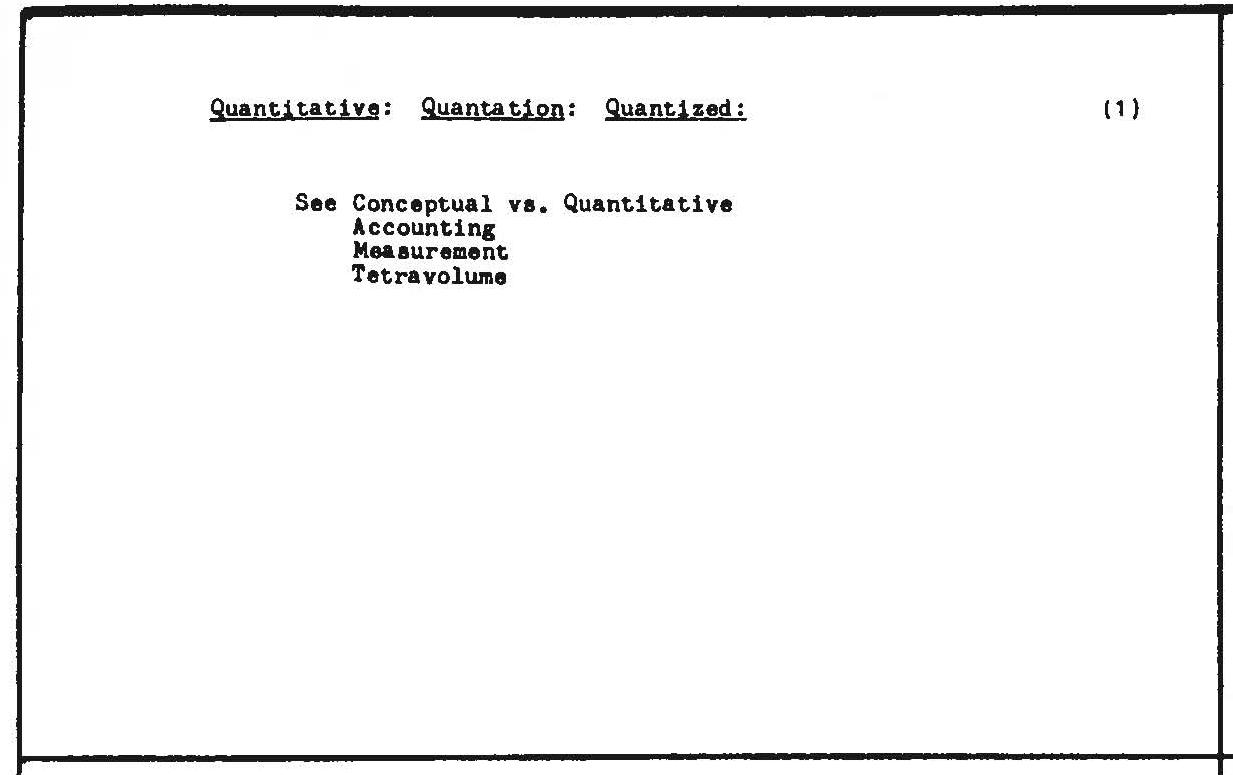
Quantitative Quantation Quantized (1)
← Quantitative vs. Qualitative | Quantitative Quantation Quantized (2) →
Cross Reference
Cross-References
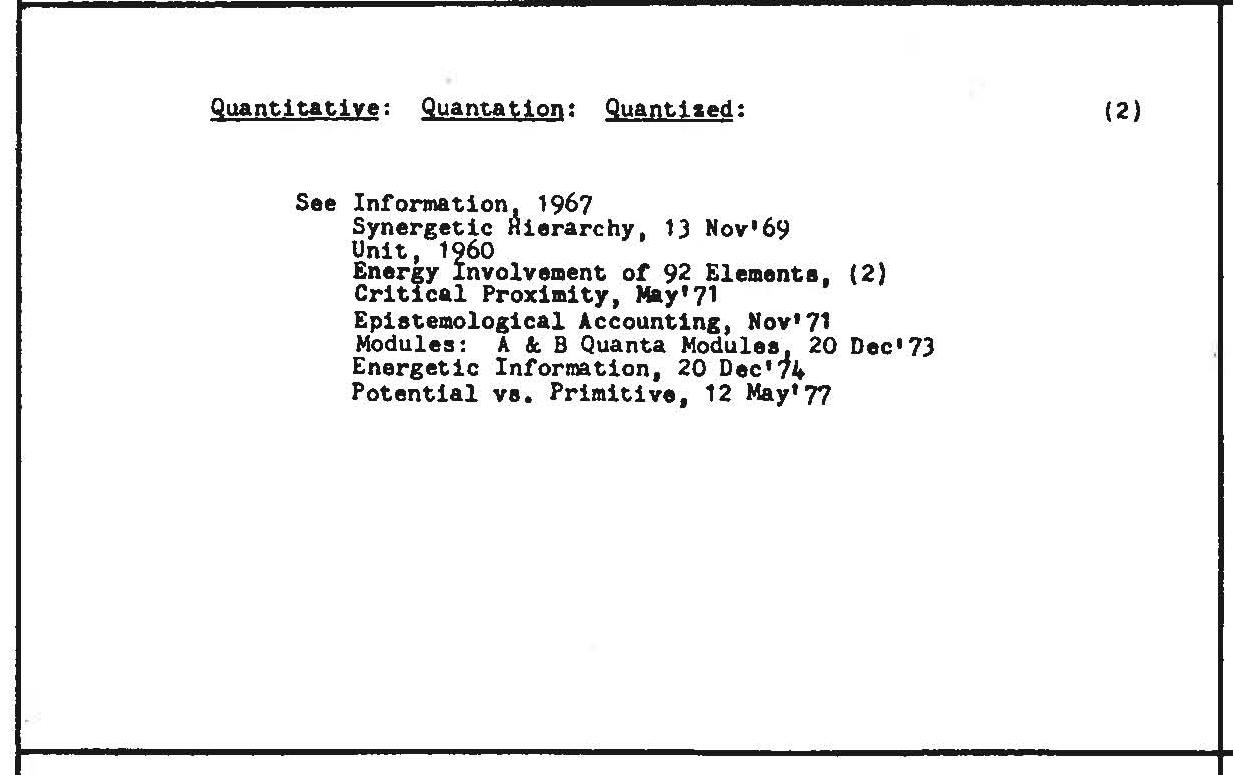
Quantitative Quantation Quantized (2)
← Quantitative Quantation Quantized (1) | Quantum Sequence (1) →
Cross Reference
Cross-References
- Information, 1967
- Synergetic Hierarchy, 13 Nov'69
- Unit, 1960
- Energy Involvement of 92 Elements, (2)
- Critical Proximity, May'71
- Epistemological Accounting, Nov'71
- Modules: A & B Quanta Modules, 20 Dec'73
- Energetic Information, 20 Dec'74
- Potential vs. Primitive, 12 May'77
Quantum Sequence (1)
← Quantitative Quantation Quantized (2) | Quantum Sequence (2) →
Index Entry
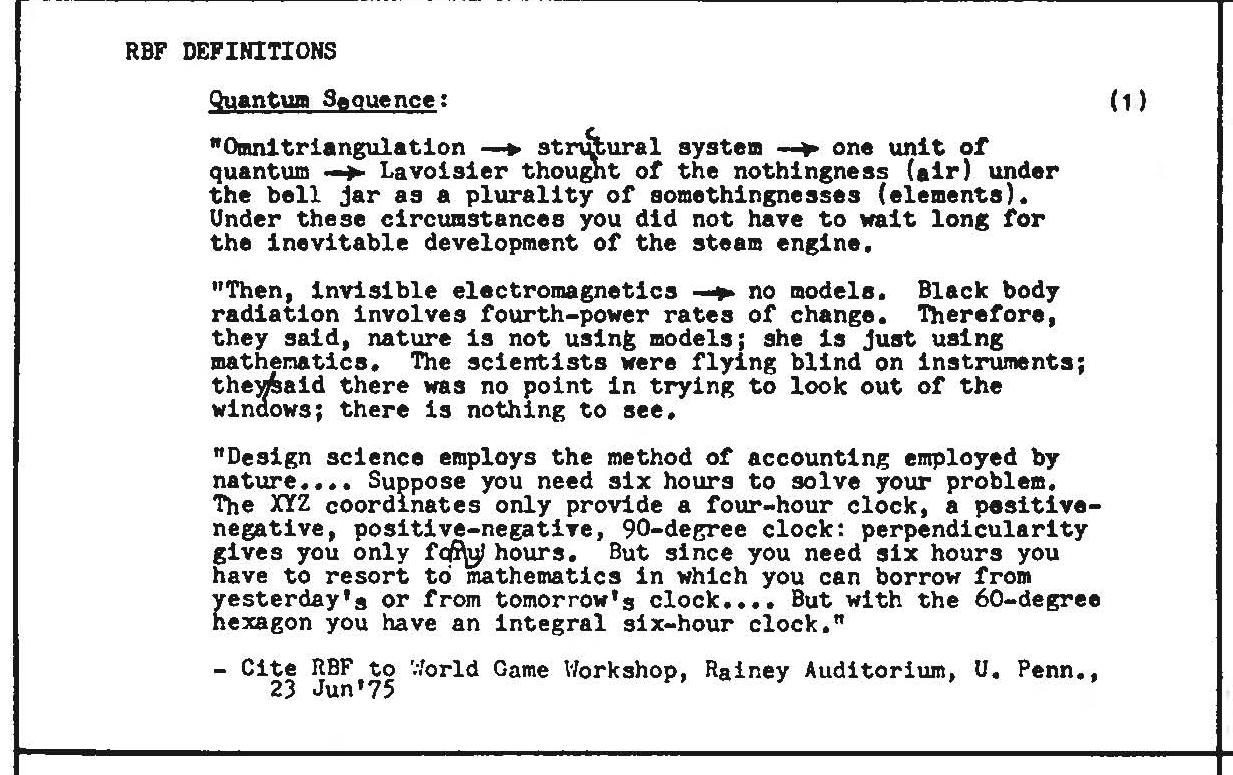
Quantum Sequence:
"Omnitriangulation -> structural system -> one unit of quantum -> Lavoisier thought of the nothingness (air) under the bell jar as a plurality of somethingnesses (elements). Under these circumstances you did not have to wait long for the inevitable development of the steam engine.
"Then, invisible electromagnetics -> no models. Black body radiation involves fourth-power rates of change. Therefore, they said, nature is not using models; she is just using mathematics. The scientists were flying blind on instruments; they said there was no point in trying to look out of the windows; there is nothing to see.
"Design science employs the method of accounting employed by nature.... Suppose you need six hours to solve your problem. The XYZ coordinates only provide a four-hour clock, a positive-negative, positive-negative, 90-degree clock: perpendicularity gives you only four hours. But since you need six hours you have to resort to mathematics in which you can borrow from yesterday's or from tomorrow's clock.... But with the 60-degree hexagon you have an integral six-hour clock."
Quantum Sequence (2)
← Quantum Sequence (1) | Quantum Sequence (3) →
Index Entry
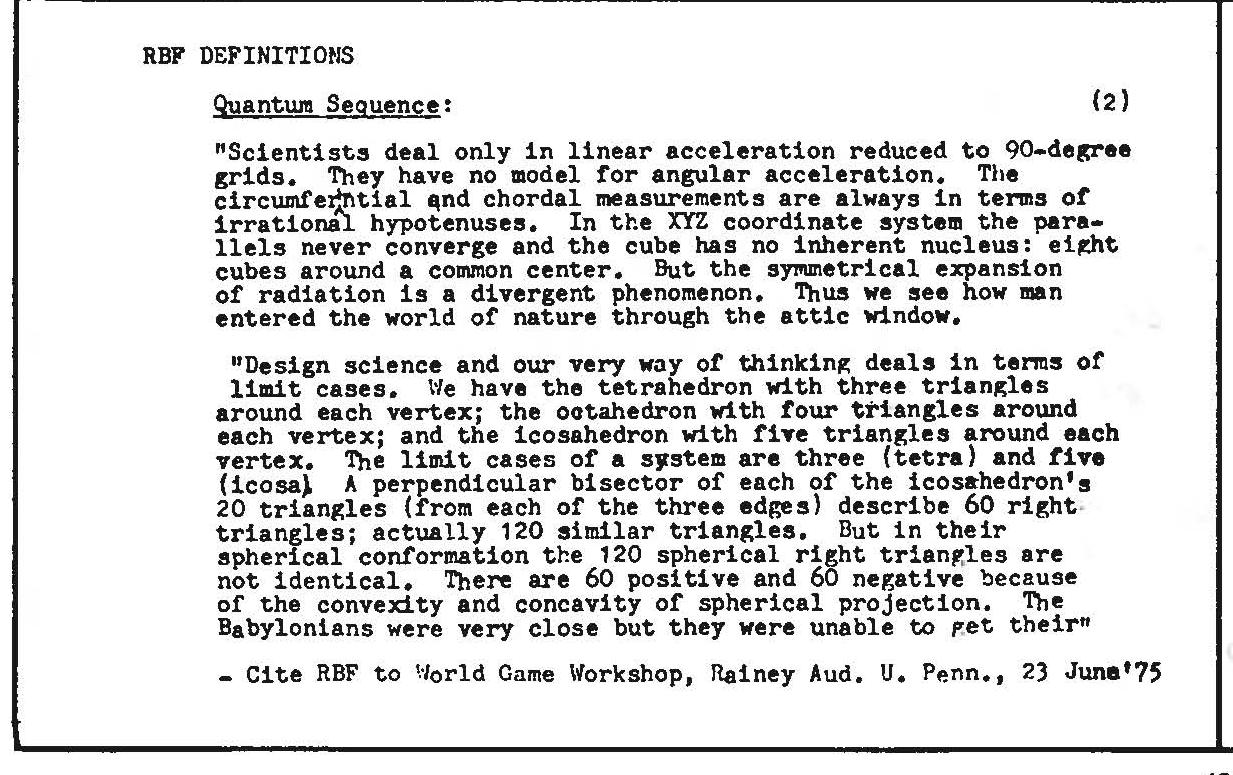
Scientists deal only in linear acceleration reduced to 90-degree grids. They have no model for angular acceleration. The circumferential and chordal measurements are always in terms of irrational hypotenuses. In the XYZ coordinate system the parallels never converge and the cube has no inherent nucleus: eight cubes around a common center. But the symmetrical expansion of radiation is a divergent phenomenon. Thus we see how man entered the world of nature through the attic window.
Design science and our very way of thinking deals in terms of limit cases. We have the tetrahedron with three triangles around each vertex; the octahedron with four triangles around each vertex; and the icosahedron with five triangles around each vertex. The limit cases of a system are three tetra and five icosa. A perpendicular bisector of each of the icosahedron's 20 triangles from each of the three edges describe 60 right triangles; actually 120 similar triangles. But in their spherical conformation the 120 spherical right triangles are not identical. There are 60 positive and 60 negative because of the convexity and concavity of spherical projection. The Babylonians were very close but they were unable to get their
Quantum Sequence (3)
← Quantum Sequence (2) | Quantum Sequence →
Index Entry
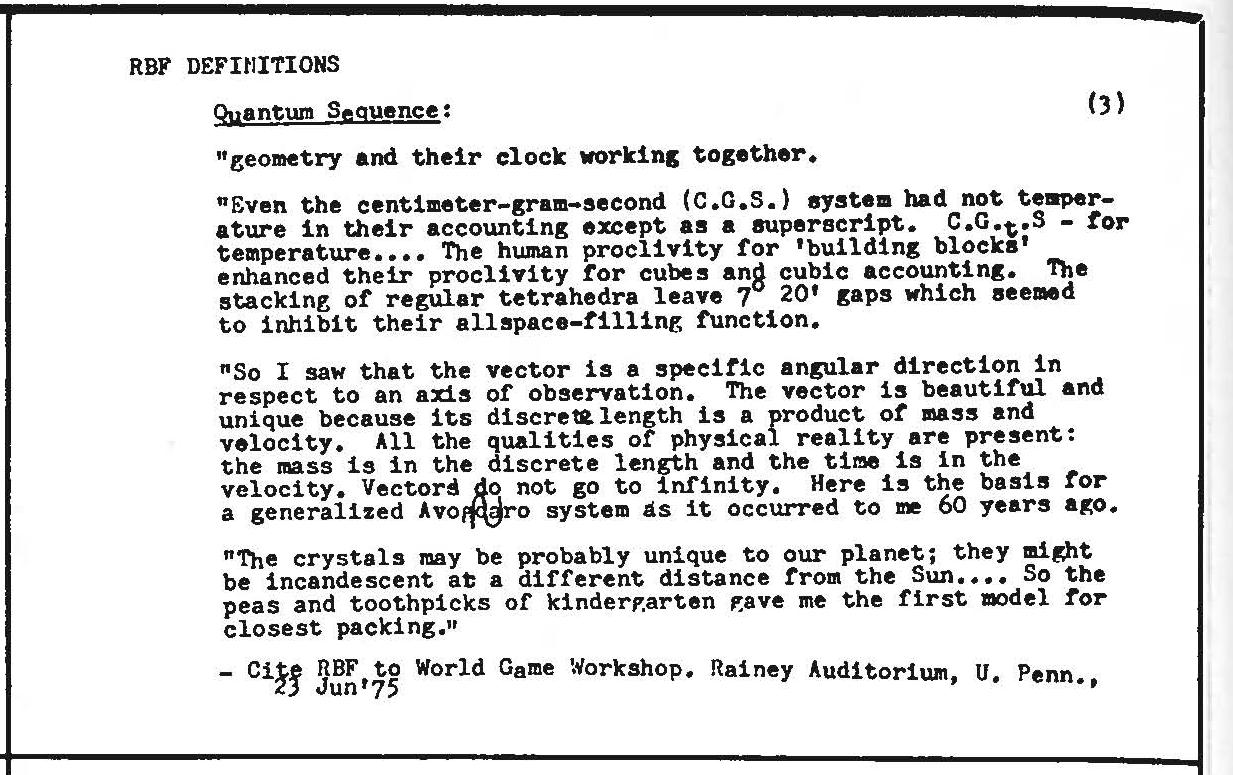
Quantum Sequence:
"geometry and their clock working together.
"Even the centimeter-gram-second (C.G.S.) system had not temperature in their accounting except as a superscript. C.G.t.S - for temperature.... The human proclivity for 'building blocks' enhanced their proclivity for cubes and cubic accounting. The stacking of regular tetrahedra leave 7° 20' gaps which seemed to inhibit their allspace-filling function.
"So I saw that the vector is a specific angular direction in respect to an axis of observation. The vector is beautiful and unique because its discrete length is a product of mass and velocity. All the qualities of physical reality are present: the mass is in the discrete length and the time is in the velocity. Vectors do not go to infinity. Here is the basis for a generalized Avogadro system as it occurred to me 60 years ago.
"The crystals may be probably unique to our planet; they might be incandescent at a different distance from the Sun.... So the peas and toothpicks of kindergarten gave me the first model for closest packing."
- Cite RBF to World Game Workshop, Rainey Auditorium, U. Penn., 23 Jun'75
Quantum Sequence
← Quantum Sequence (3) | Quantum Sequence →
RBF Definitions
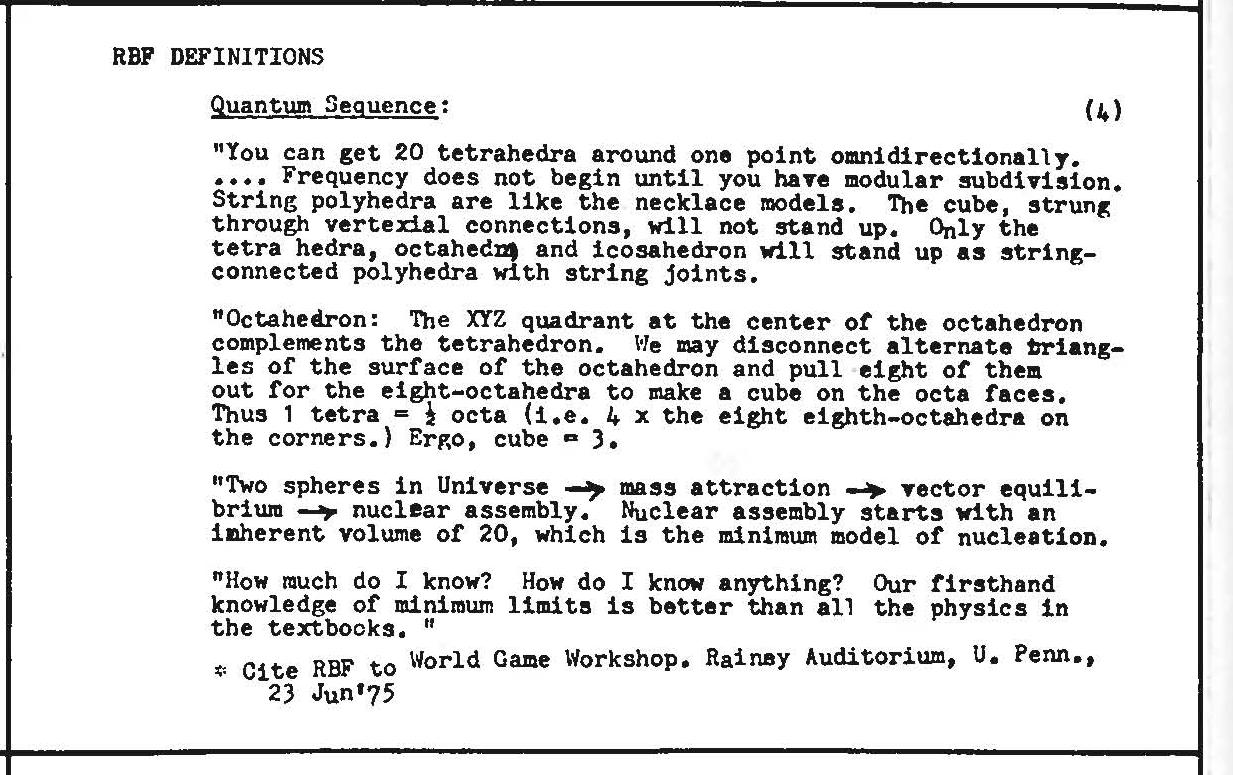
"You can get 20 tetrahedra around one point omnidirectionally. .... Frequency does not begin until you have modular subdivision. String polyhedra are like the necklace models. The cube, strung through vertexial connections, will not stand up. Only the tetrahedra, octahedra and icosahedron will stand up as string-connected polyhedra with string joints.
"Octahedron: The XYZ quadrant at the center of the octahedron complements the tetrahedron. We may disconnect alternate triangles of the surface of the octahedron and pull eight of them out for the eight-octahedra to make a cube on the octa faces. Thus 1 tetra = ½ octa (i.e. 4 x the eight eighth-octahedra on the corners.) Ergo, cube = 3.
"Two spheres in Universe → mass attraction → vector equilibrium → nuclear assembly. Nuclear assembly starts with an inherent volume of 20, which is the minimum model of nucleation.
"How much do I know? How do I know anything? Our firsthand knowledge of minimum limits is better than all the physics in the textbooks.
Citations
- RBF
Quantum Sequence
← Quantum Sequence | Quantum →
Index Entry
Quantum Sequence:
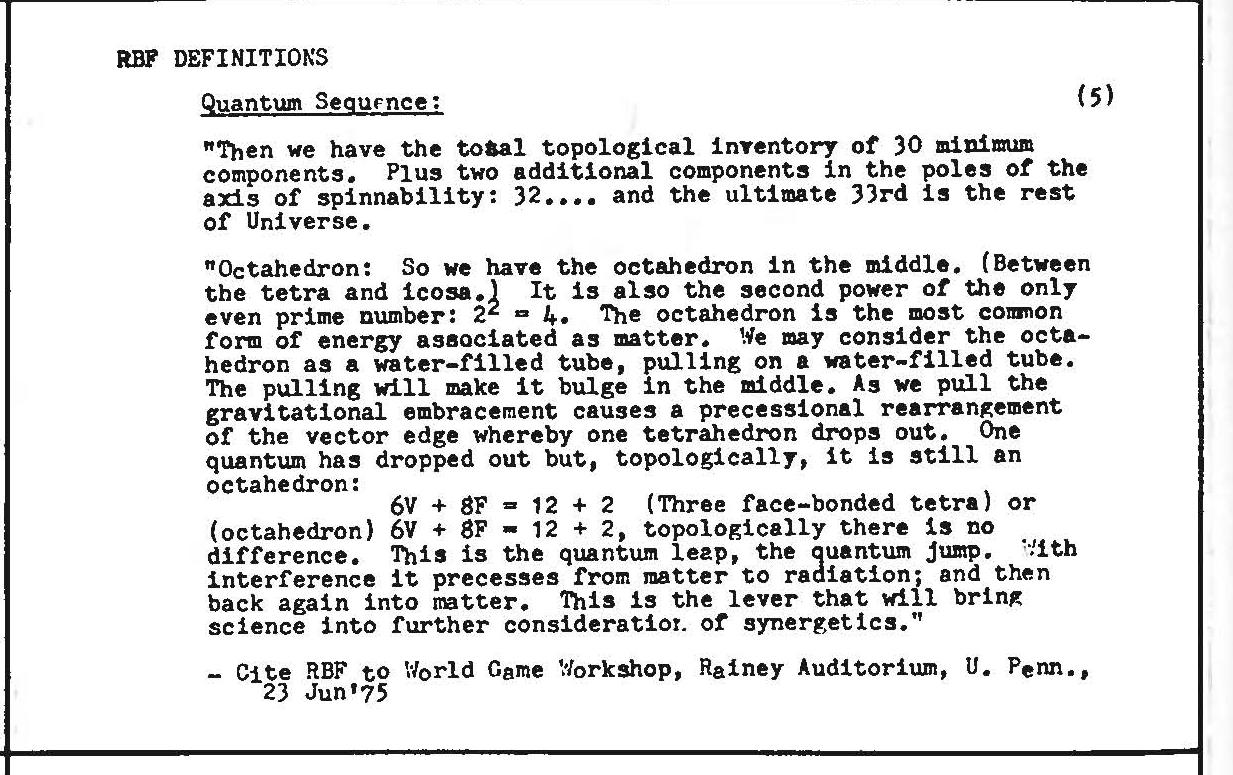
"Then we have the total topological inventory of 30 minimum components. Plus two additional components in the poles of the axis of spinnability: 32.... and the ultimate 33rd is the rest of Universe.
"Octahedron: So we have the octahedron in the middle. (Between the tetra and icosa.) It is also the second power of the only even prime number: 2² = 4. The octahedron is the most common form of energy associated as matter. We may consider the octahedron as a water-filled tube, pulling on a water-filled tube. The pulling will make it bulge in the middle. As we pull the gravitational embracement causes a precessional rearrangement of the vector edge whereby one tetrahedron drops out. One quantum has dropped out but, topologically, it is still an octahedron:
6V + 8F = 12 + 2 (Three face-bonded tetra) or (octahedron) 6V + 8F = 12 + 2, topologically there is no difference. This is the quantum leap, the quantum jump. With interference it precesses from matter to radiation; and then back again into matter. This is the lever that will bring science into further consideration of synergetics."
- Cite RBF to World Game Workshop, Rainey Auditorium, U. Penn., 23 Jun'75
Quantum
← Quantum Sequence | Quantum →
Index Entry
"Quantum as prime-structural-system volume is eternally generalized, ergo transcends any particulate, special-case, physical-energy quantation. Generalized quanta are finitely independent because their prime volumetric-domain-defining lines do not intertouch."
- Citation & context at Domain & Quantum, 17 Feb'73
Quantum
Index Entry
Quantum:
"Happenability has the vector equilibrium as its minimum model, ergo the Universe, experience, can't be one quantum."
-
Cite RBF to EJA, Bear Island, 25 August 1971
-
Citation and context at Happenability, 25 Aug'71
Quantum
Index Entry
Quantum:
"One quantum . . turns out to be also the minimum structural system of Universe."
- Cite RBF at SIMS, U. Mass, Amherst, 22 July '71, p.22
Quantum Frame
Index Entry
Quantum Frame:
"At the end of a piece of rope we make a metaphysical disconnect and a new set of observations are inaugurated, each consisting of finite quanta integral ingredients such as the time quality of all finite-energy quanta."
- Cite RBF-marginalia of Infinity entry from HOW LITTLE, Confirmed and expanded Beverly Hotel, N.Y., 19 June 1971. - Citation at Metaphysical Disconnect, 19 Jun'71
Quantum
Index Entry
Quantum:
"Quantum implies particularity."
- For citation and context see Module, 1 Jun '71
Quantum
Index Entry
Quantum:
"The tetrahedron is a vectorial model of one quantum of energy."
- Cite NEHRU SPEECH, p. 14, 13 Nov'69
Quantum
Index Entry
Quantum:
"One quantum = one tetrahedron
"One-half quantum = One-half tetrahedron = One triangle =
= One event."
- Cite P. Pearce Inventory of Concepts, June 1967
Quantum
Cross Reference
Quantum:
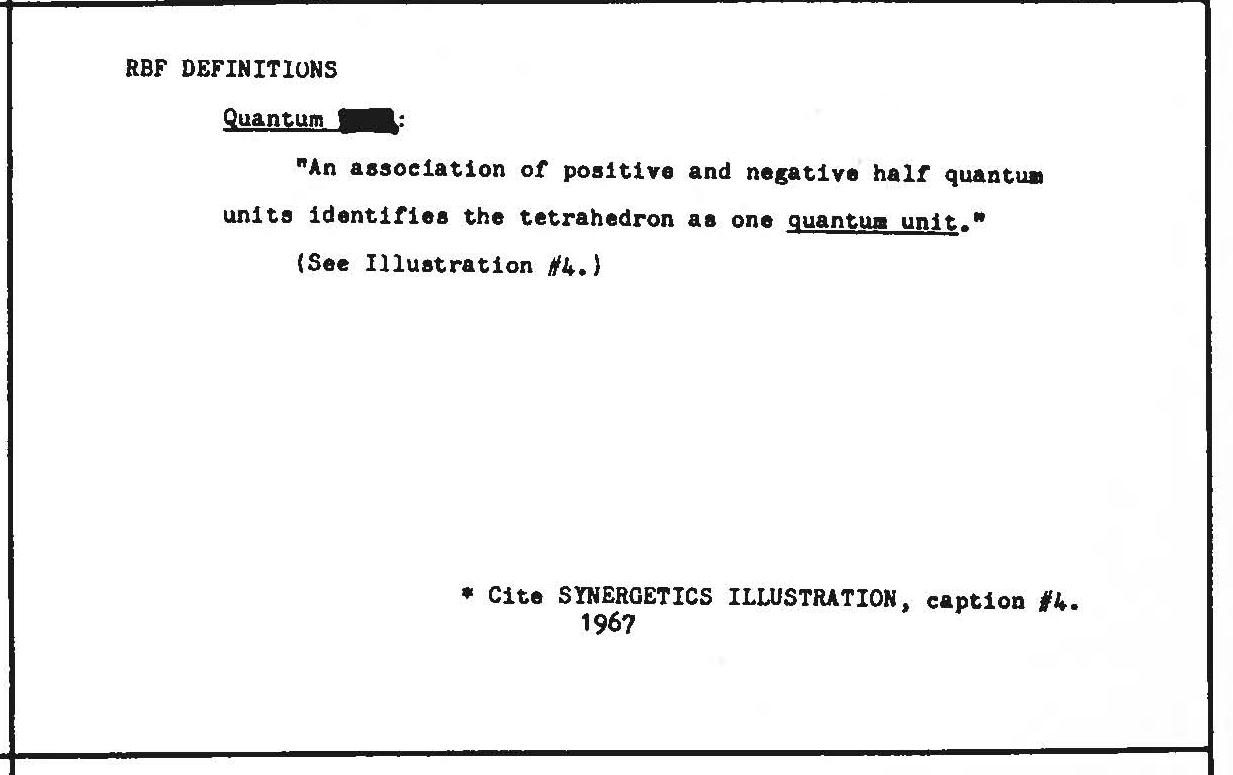
"An association of positive and negative half quantum units identifies the tetrahedron as one quantum unit."
- Cite SYNERGETICS ILLUSTRATION, caption #4. 1967
Cross-References
- Illustration #4
Quantum
RBF Definitions
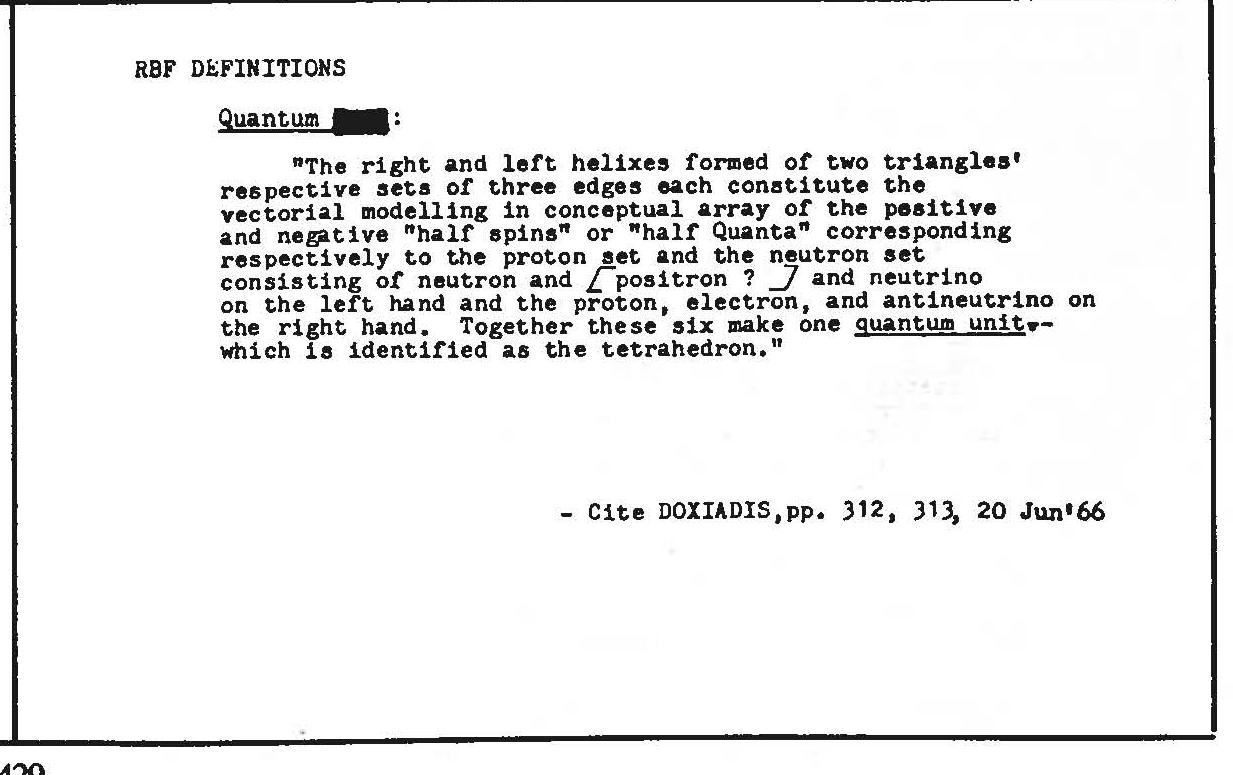
"The right and left helixes formed of two triangles' respective sets of three edges each constitute the vectorial modelling in conceptual array of the positive and negative "half spins" or "half Quanta" corresponding respectively to the proton set and the neutron set consisting of neutron and √ positron? √ and neutrino on the left hand and the proton, electron, and antineutrino on the right hand. Together these six make one quantum unit-- which is identified as the tetrahedron."
Citations
- DOXIADIS,pp. 312, 313, 20 Jun'66
Quantum
Index Entry
Quantum:
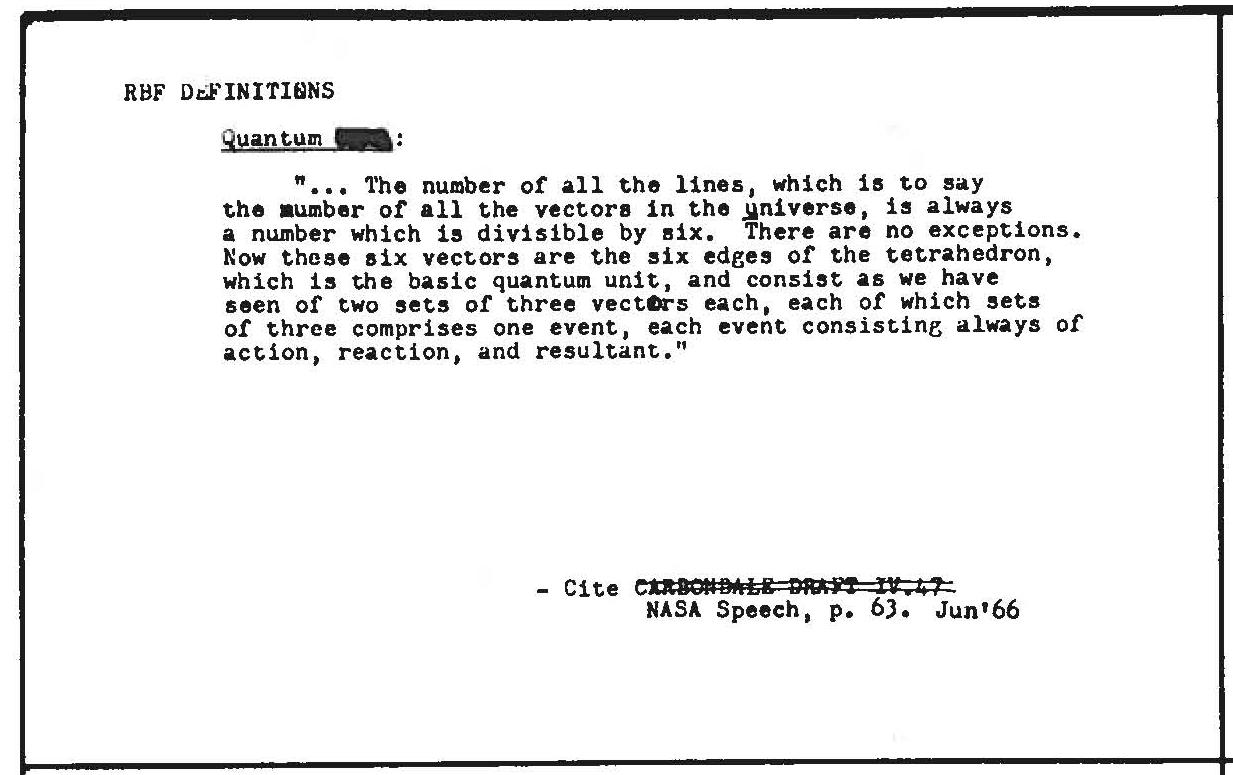
"... The number of all the lines, which is to say the number of all the vectors in the universe, is always a number which is divisible by six. There are no exceptions. Now these six vectors are the six edges of the tetrahedron, which is the basic quantum unit, and consist as we have seen of two sets of three vectors each, each of which sets of three comprises one event, each event consisting always of action, reaction, and resultant."
- Cite CARBONDALE-DRAFT IV-47 NASA Speech, p. 63. Jun'66
Quantum
← Quantum | Quantum Accounting →
Index Entry
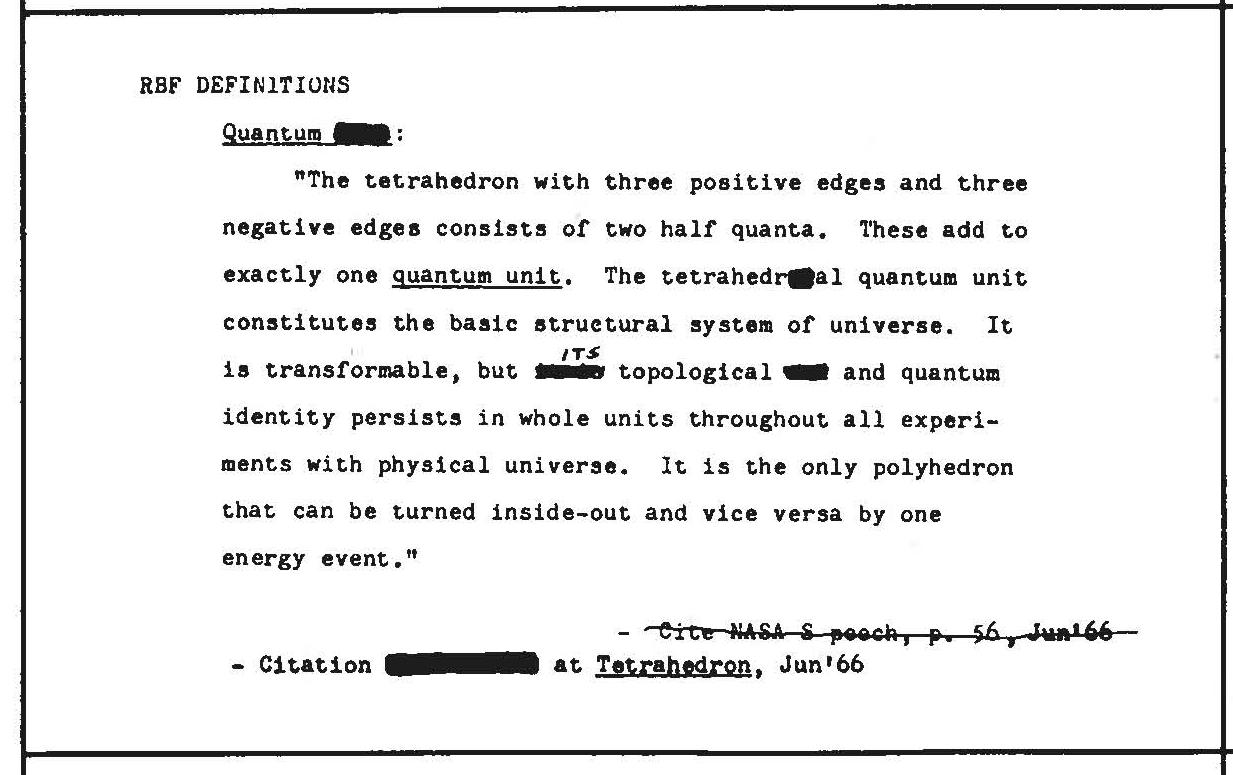
The tetrahedron with three positive edges and three negative edges consists of two half quanta. These add to exactly one quantum unit. The tetrahedral quantum unit constitutes the basic structural system of universe. It is transformable, but its topological and quantum identity persists in whole units throughout all experiments with physical universe. It is the only polyhedron that can be turned inside-out and vice versa by one energy event.
Quantum Accounting
← Quantum | Quantum: Event-Paired Quanta →
Cross Reference
Cross-References
- Parallax, 23 Sep'73
Quantum: Event-Paired Quanta
← Quantum Accounting | Quantum: Event-paired Quanta →
Index Entry
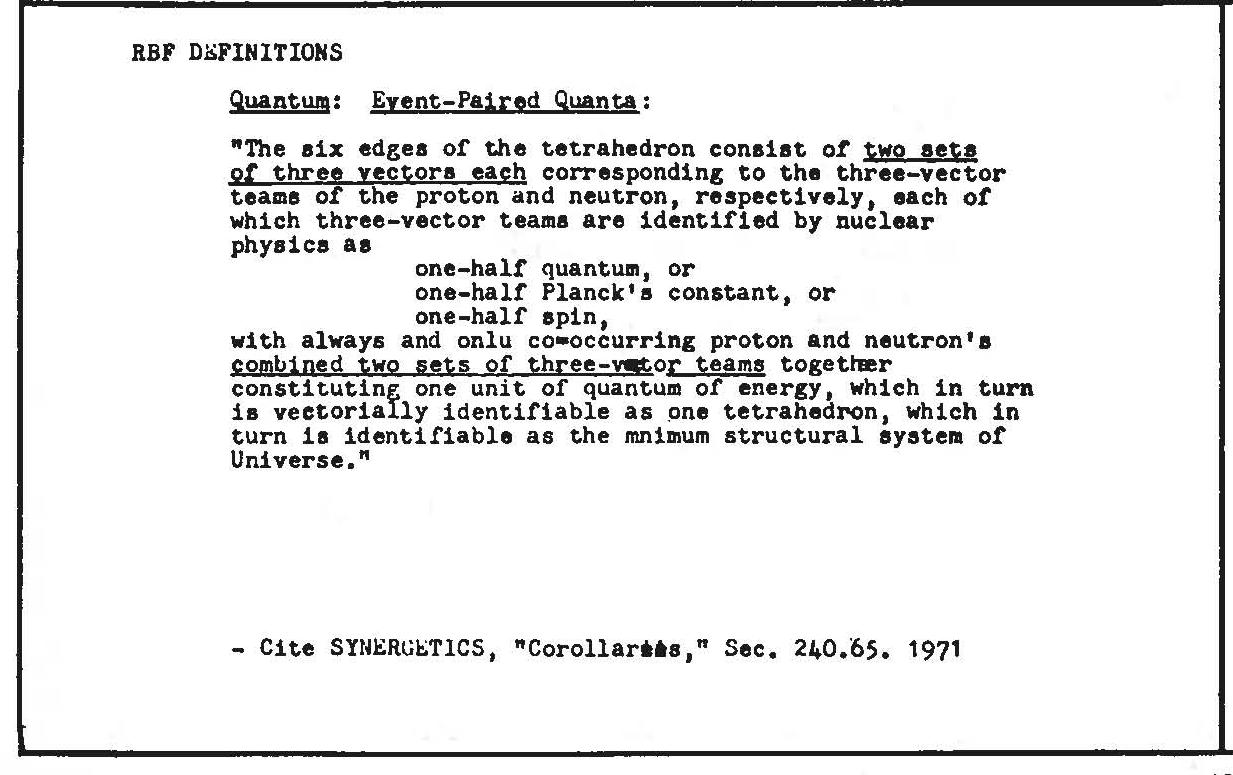
The six edges of the tetrahedron consist of two sets of three vectors each corresponding to the three-vector teams of the proton and neutron, respectively, each of which three-vector teams are identified by nuclear physics as
one-half quantum, or
one-half Planck's constant, or
one-half spin,
with always and only co-occurring proton and neutron's combined two sets of three-vector teams together
constituting one unit of quantum of energy, which in turn is vectorially identifiable as one tetrahedron, which in turn is identifiable as the minimum structural system of Universe.
Quantum: Event-paired Quanta
← Quantum: Event-Paired Quanta | Quantum: Event-Paired Quanta →
Index Entry
Quantum: Event-paired Quanta:
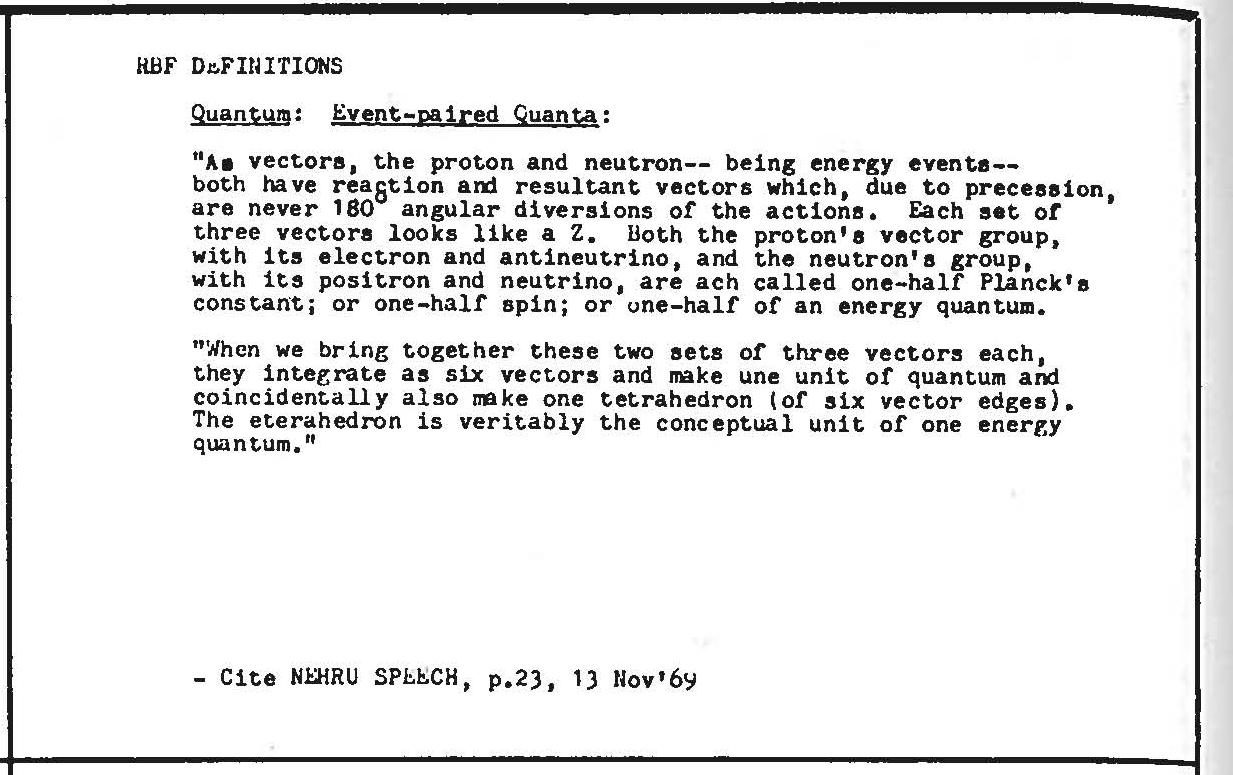
"As vectors, the proton and neutron-- being energy events-- both have reaction and resultant vectors which, due to precession, are never 180° angular diversions of the actions. Each set of three vectors looks like a Z. Both the proton's vector group, with its electron and antineutrino, and the neutron's group, with its positron and neutrino, are ach called one-half Planck's constant; or one-half spin; or one-half of an energy quantum.
"When we bring together these two sets of three vectors each, they integrate as six vectors and make une unit of quantum and coincidentally also make one tetrahedron (of six vector edges). The eterahedron is veritably the conceptual unit of one energy quantum."
Quantum: Event-Paired Quanta
← Quantum: Event-paired Quanta | Quantum: Event-paired Quanta →
Index Entry
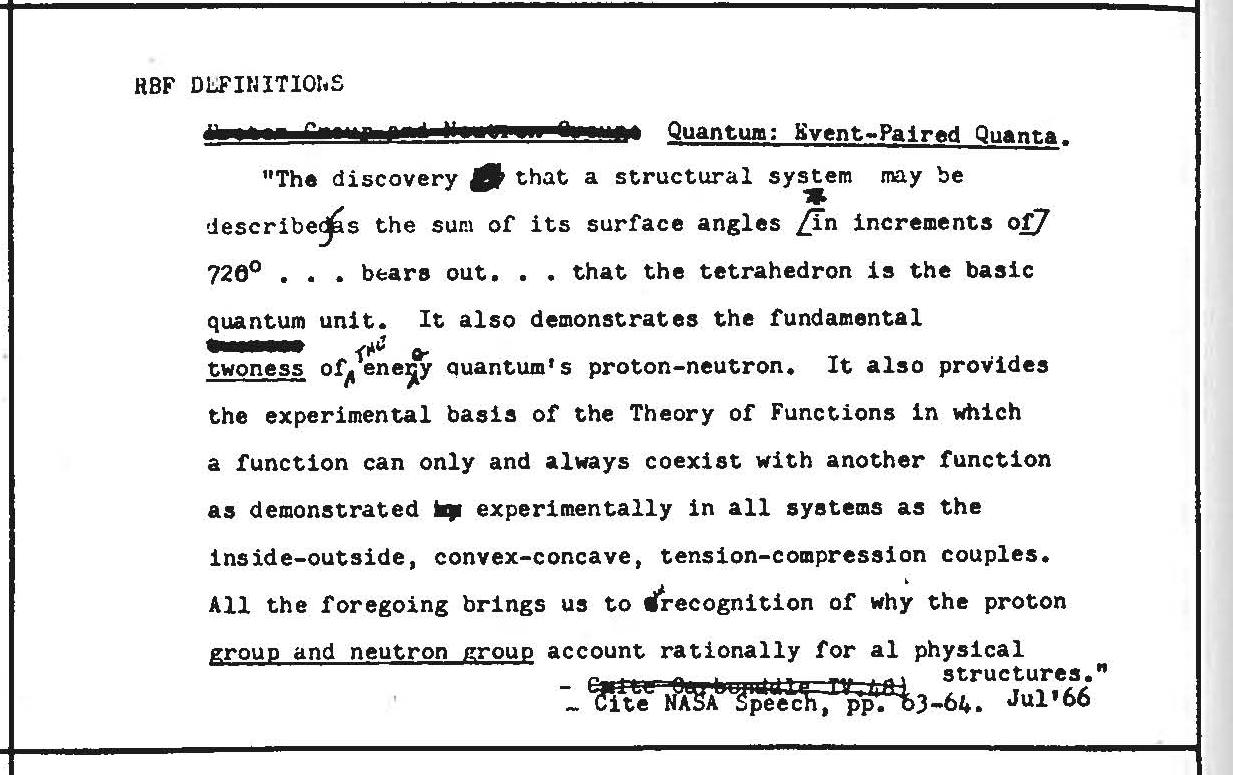
The discovery that a structural system may be described as the sum of its surface angles (in increments of7 720° . . . bears out. . . that the tetrahedron is the basic quantum unit. It also demonstrates the fundamental twoness of A quantum’s proton-neutron. It also provides the experimental basis of the Theory of Functions in which a function can only and always coexist with another function as demonstrated in experimentally in all systems as the inside-outside, convex-concave, tension-compression couples. All the foregoing brings us to a recognition of why the proton group and neutron group account rationally for al physical structures.
Quantum: Event-paired Quanta
← Quantum: Event-Paired Quanta | Quantum Event-paired Quanta (1) →
Index Entry
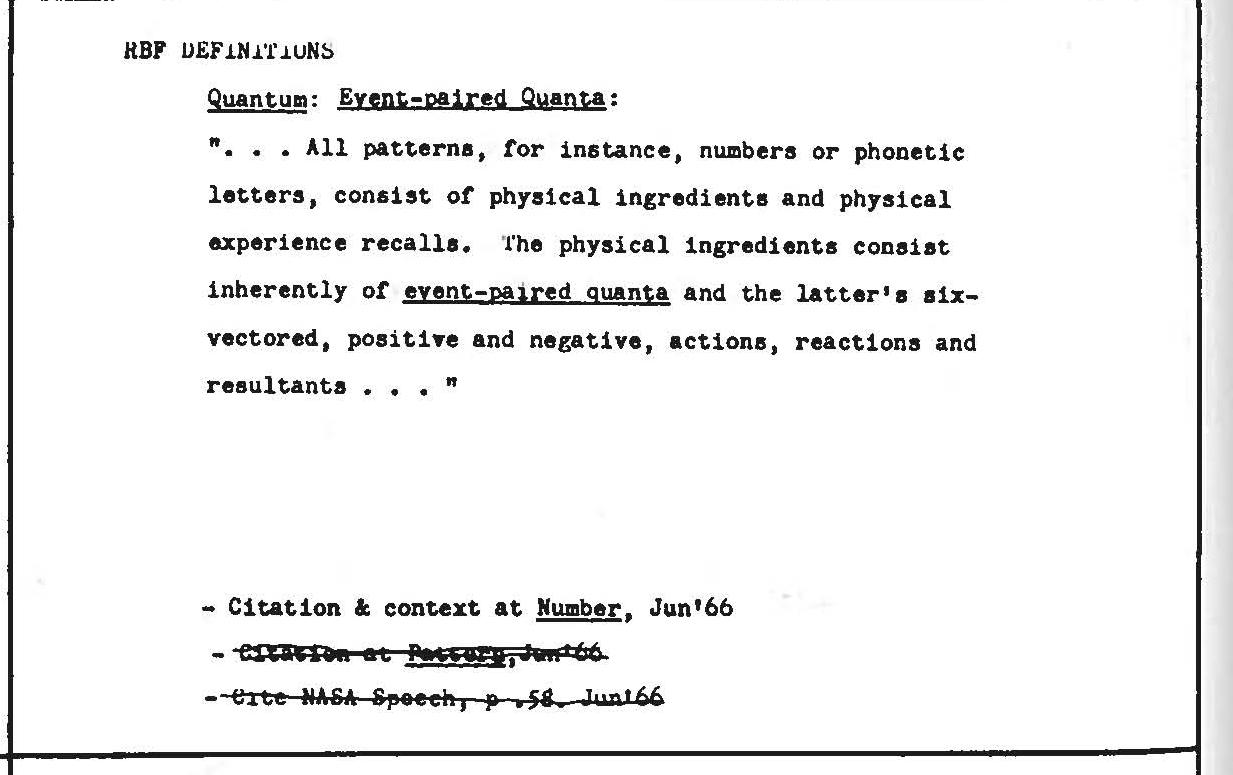
..... All patterns, for instance, numbers or phonetic letters, consist of physical ingredients and physical experience recalls. The physical ingredients consist inherently of event-paired quanta and the latter's six-vectored, positive and negative, actions, reactions and resultants ....
-
Citation & context at Number, Jun'66
-
Citation at Patterns,Jun'66.
-
Cite NASA Speech, p.58. Jun166
Quantum Event-paired Quanta (1)
← Quantum: Event-paired Quanta | Quantum Event-paired Quanta →
Cross Reference
Cross-References
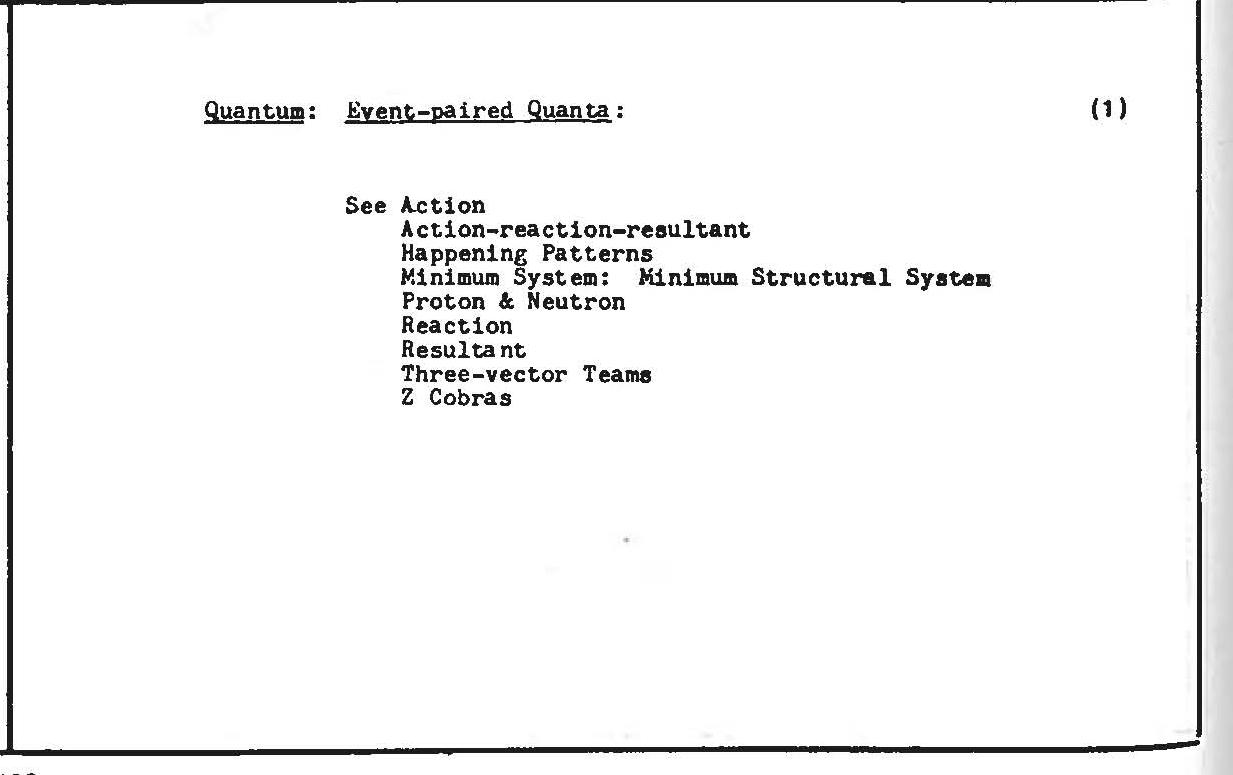
- Action
- Action-reaction-resultant
- Happening Patterns
- Minimum System: Minimum Structural System
- Proton & Neutron
- Reaction
- Resultant
- Three-vector Teams
- Z Cobras
Quantum Event-paired Quanta
← Quantum Event-paired Quanta (1) | Quantum Hierarchy →
Cross Reference
Cross-References
- Cube: Diagonal Of, (1)
Quantum Hierarchy
← Quantum Event-paired Quanta | Quantum Jump →
Cross Reference
Cross-References
Quantum Jump
← Quantum Hierarchy | Quantum Jump: Quantum Leap →
Index Entry
Quantum Jump:
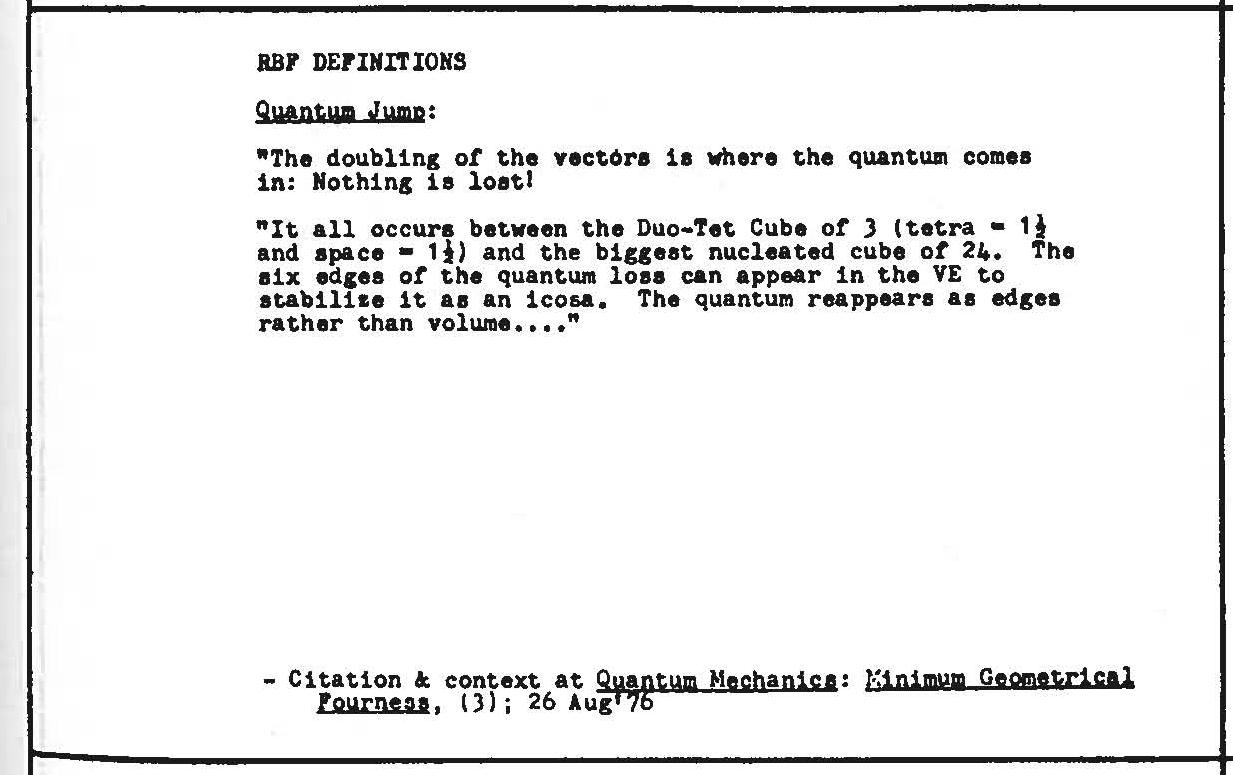
"The doubling of the vectors is where the quantum comes in: Nothing is lost!
"It all occurs between the Duo-Tet Cube of 3 (tetra = 1½ and space = 1½) and the biggest nucleated cube of 24. The six edges of the quantum loss can appear in the VE to stabilize it as an icosa. The quantum reappears as edges rather than volume...."
Quantum Jump: Quantum Leap
← Quantum Jump | Quantum Jump Quantum Leap (1) →
Index Entry
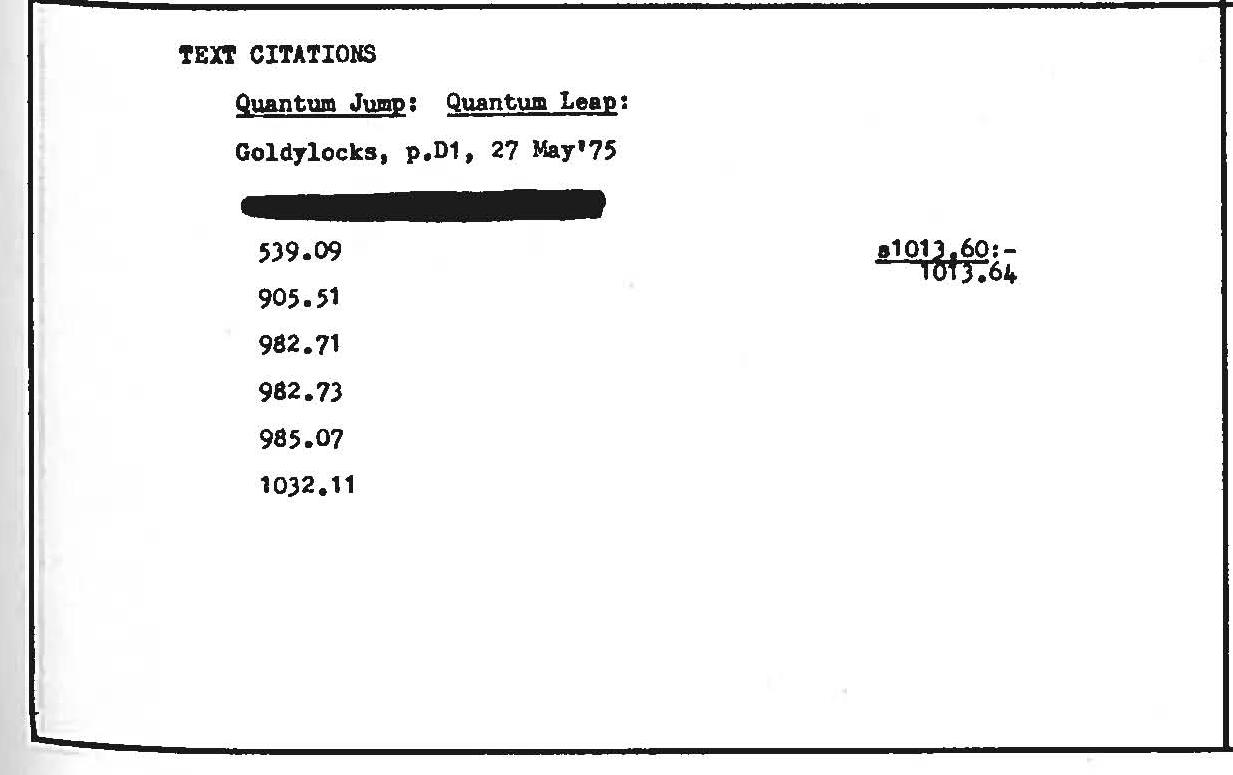
Goldylocks, p.D1, 27 May'75
\hrefhttps://www.buckyverse.org/en/synergetics/content/chapters/500-conceptuality#section-539.09539.09
\hrefhttps://www.buckyverse.org/en/synergetics/content/chapters/900-modelability#section-905.51905.51
\hrefhttps://www.buckyverse.org/en/synergetics/content/chapters/900-modelability#section-982.71982.71
\hrefhttps://www.buckyverse.org/en/synergetics/content/chapters/900-modelability#section-982.73982.73
\hrefhttps://www.buckyverse.org/en/synergetics/content/chapters/900-modelability#section-985.07985.07
\hrefhttps://www.buckyverse.org/en/synergetics/content/chapters/1000-omnitopology#section-1032.111032.11
Quantum Jump Quantum Leap (1)
← Quantum Jump: Quantum Leap | Quantum Jump Quantum Leap (2) →
Cross Reference
Cross-References
Quantum Jump Quantum Leap (2)
← Quantum Jump Quantum Leap (1) | Quanta Loss by Congruence (1) →
Cross Reference
Cross-References
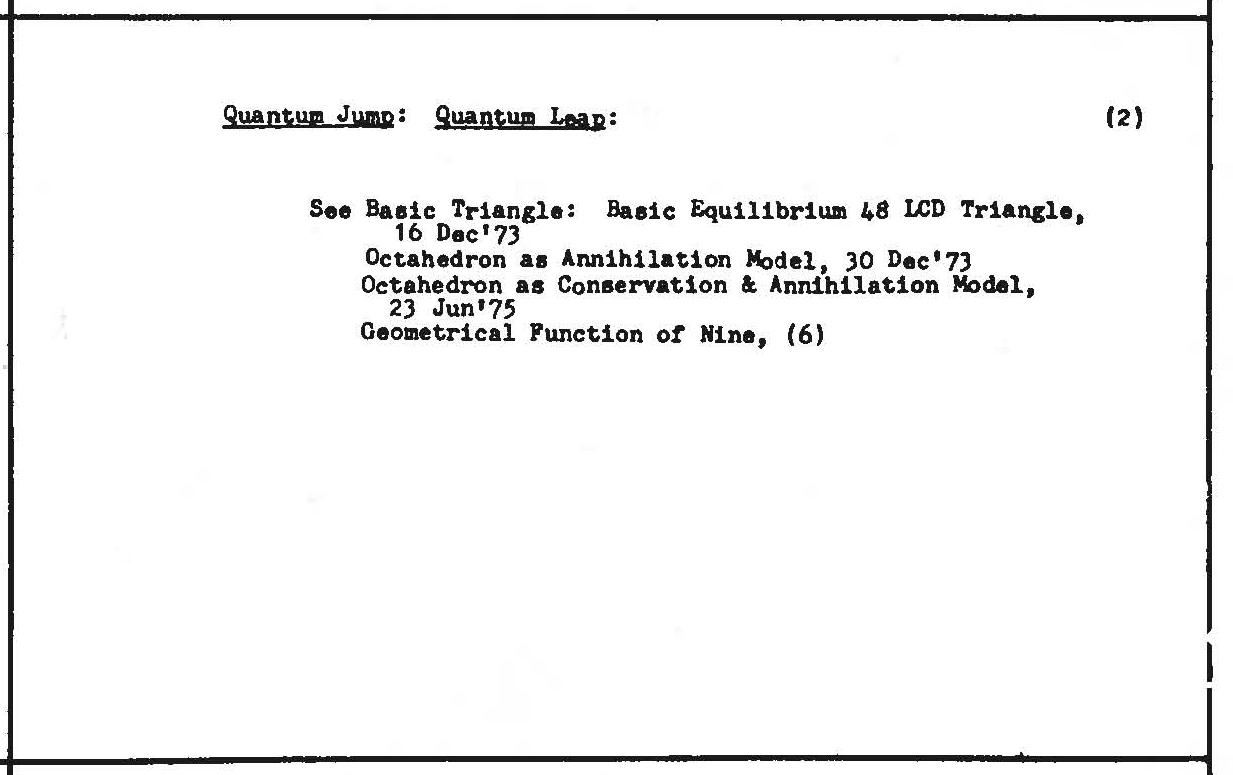
- Basic Triangle, 16 Dec'73
- ahedron as Annihilation Model, Oct
- ahedron as Conservation & Annihilation Model, Oct
- Geometrical Function of Nine, (6)
Quanta Loss by Congruence (1)
← Quantum Jump Quantum Leap (2) | Quanta Loss By Congruence (2) →
Index Entry
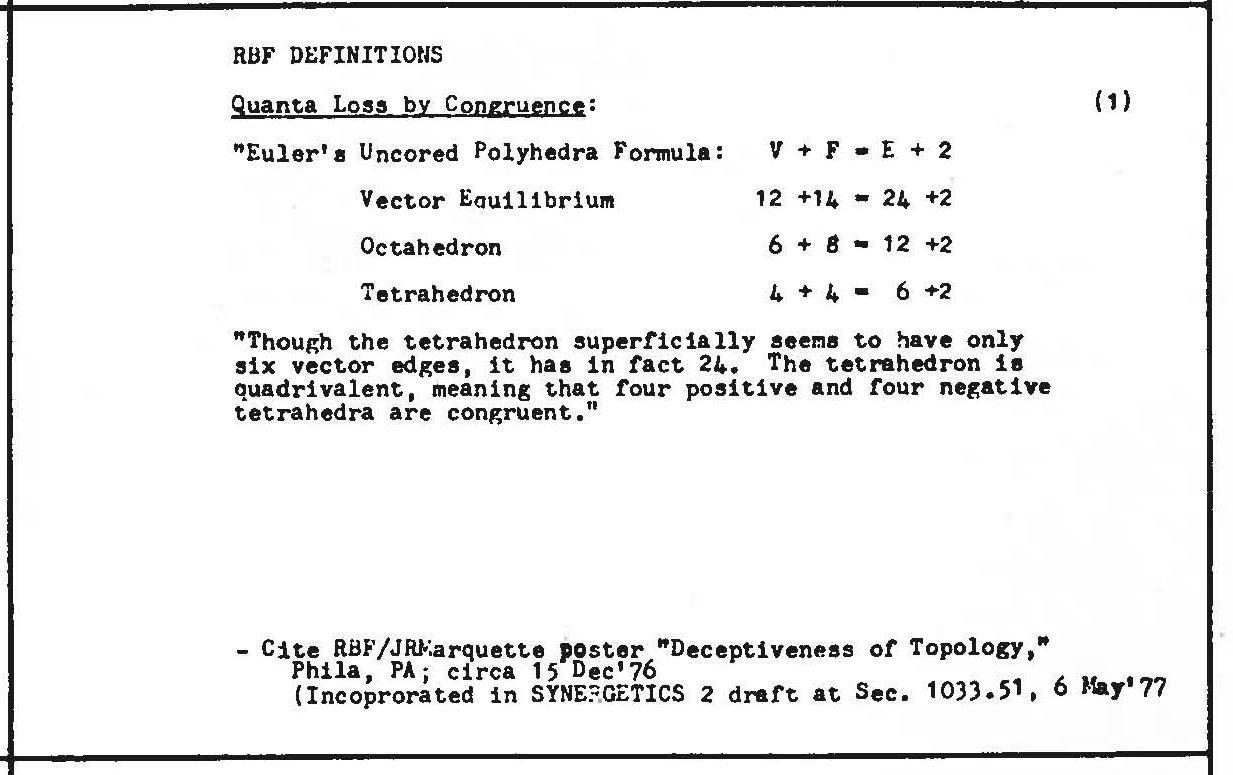
Quanta Loss by Congruence:
"Euler's Uncored Polyhedra Formula: V + F = E + 2
Vector Equilibrium 12 +14 = 24 +2
Octahedron 6 + 8 = 12 +2
Tetrahedron 4 + 4 = 6 +2
"Though the tetrahedron superficially seems to have only six vector edges, it has in fact 24. The tetrahedron is quadrivalent, meaning that four positive and four negative tetrahedra are congruent."
Quanta Loss By Congruence (2)
← Quanta Loss by Congruence (1) | Quanta Loss by Congruence (3) →
Cross Reference
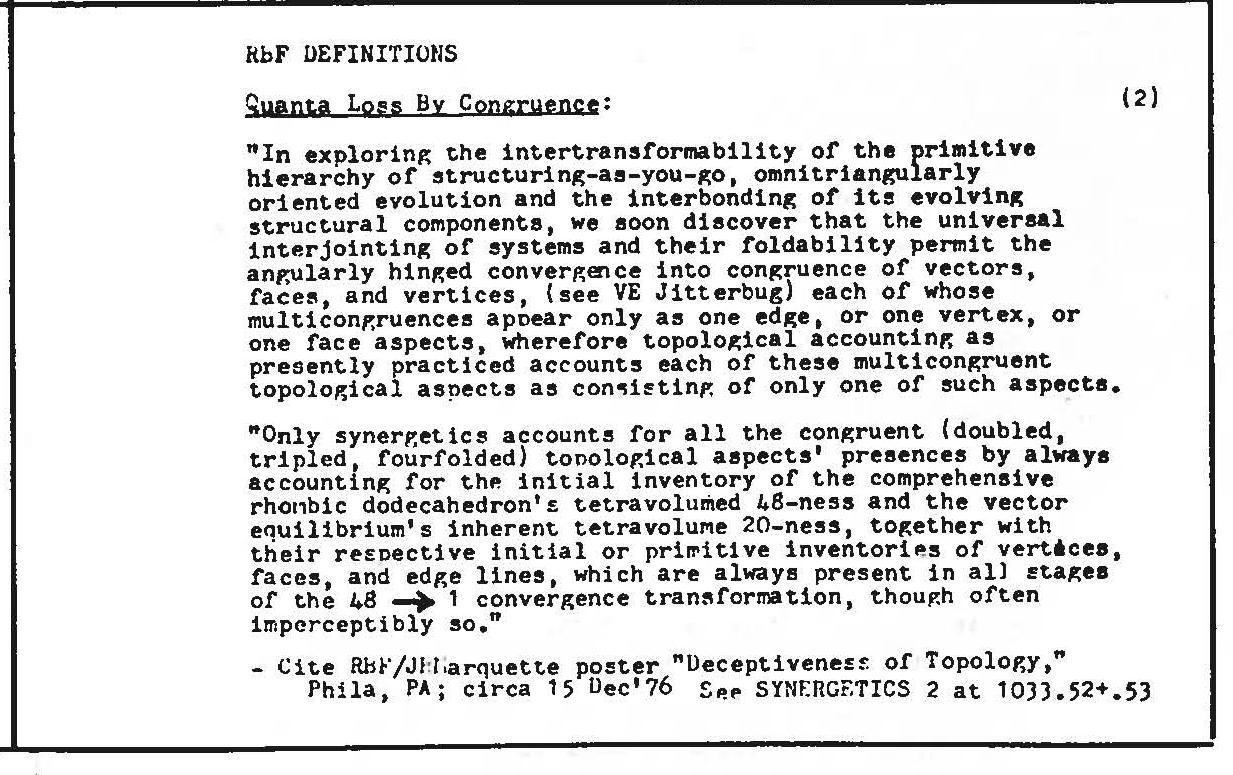
Quanta Loss By Congruence:
"In exploring the intertransformability of the primitive hierarchy of structuring-as-you-go, omnitriangularly oriented evolution and the interbonding of its evolving structural components, we soon discover that the universal interjoining of systems and their foldability permit the angularly hinged convergence into congruence of vectors, faces, and vertices, (see VE Jitterbug) each of whose multicongruences appear only as one edge, or one vertex, or one face aspects, wherefore topological accounting as presently practiced accounts each of these multicongruent topological aspects as consisting of only one of such aspects.
"Only synergetics accounts for all the congruent (doubled, tripled, fourfolded) tonological aspects' presences by always accounting for the initial inventory of the comprehensive rhombic dodecahedron's tetravolumed 48-ness and the vector equilibrium's inherent tetravolume 20-ness, together with their respective initial or primitive inventories of vertices, faces, and edge lines, which are always present in all stages of the 48 → 1 convergence transformation, though often imperceptibly so."
- Cite RBF/JHMarquette poster "Deceptiveness of Topology," Phila, PA; circa 15 Dec'76 See SYNERGETICS 2 at \hrefhttps://www.buckyverse.org/en/synergetics/content/chapters/1000-omnitopology#section-1033.521033.52+.53
SYNERGETICS 2 at.52+.53, 1033
Cross-References
- VE Jitterbug
Quanta Loss by Congruence (3)
← Quanta Loss By Congruence (2) | Quantum: Paired-event Quanta →
RBF Definitions
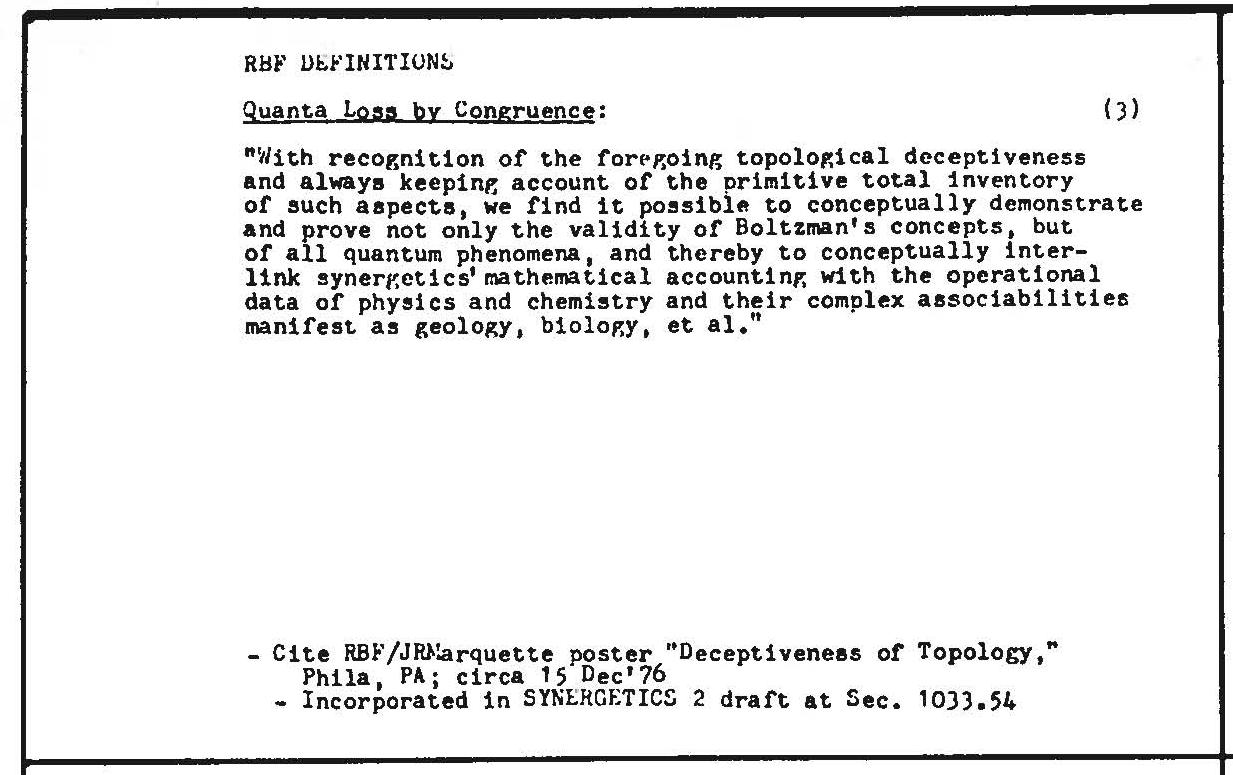
"With recognition of the foregoing topological deceptiveness
and always keeping account of the primitive total inventory
of such aspects, we find it possible to conceptually demonstrate
and prove not only the validity of Boltzman's concepts, but
of all quantum phenomena, and thereby to conceptually inter-
link synergetics' mathematical accounting with the operational
data of physics and chemistry and their complex associabilities
manifest as geology, biology, et al."
Citations
- RBF/JRMarquette poster "Deceptiveness of Topology," Phila, PA; circa 15 Dec'76 - Incorporated in SYNERGETICS 2 draft at Sec. \href{https://www.buckyverse.org/en/synergetics/content/chapters/1000-omnitopology#section-1033.54}{1033.54}
Quantum: Paired-event Quanta
← Quanta Loss by Congruence (3) | Quantum Mechanics →
Index Entry
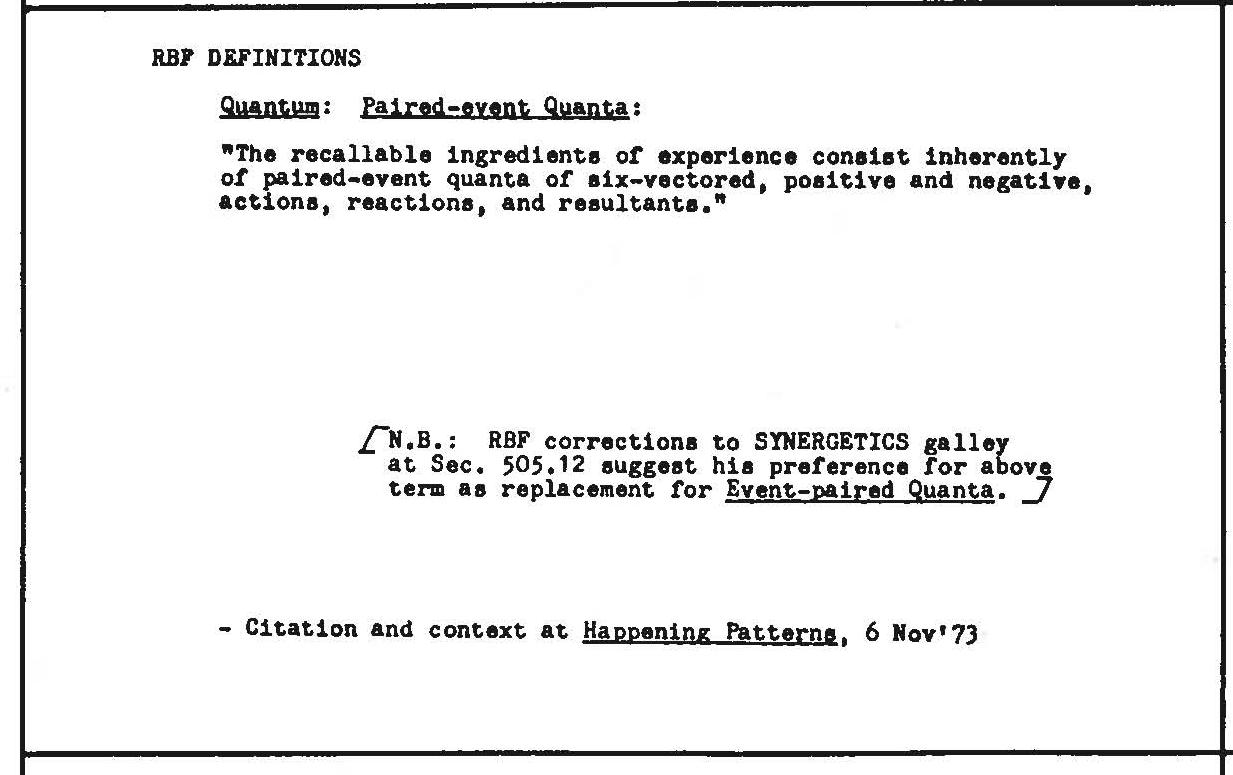
Quantum: Paired-event Quanta:
"The recallable ingredients of experience consist inherently of paired-event quanta of six-vectored, positive and negative, actions, reactions, and resultants."
N.B.: RBF corrections to SYNERGETICS galley at Sec. \hrefhttps://www.buckyverse.org/en/synergetics/content/chapters/500-conceptuality#section-505.12505.12 suggest his preference for above term as replacement for Event-paired Quanta.
- Citation and context at Happening Patterns, 6 Nov'73
Quantum Mechanics
← Quantum: Paired-event Quanta | Quantum Mechanics →
Index Entry
Quantum Mechanics:
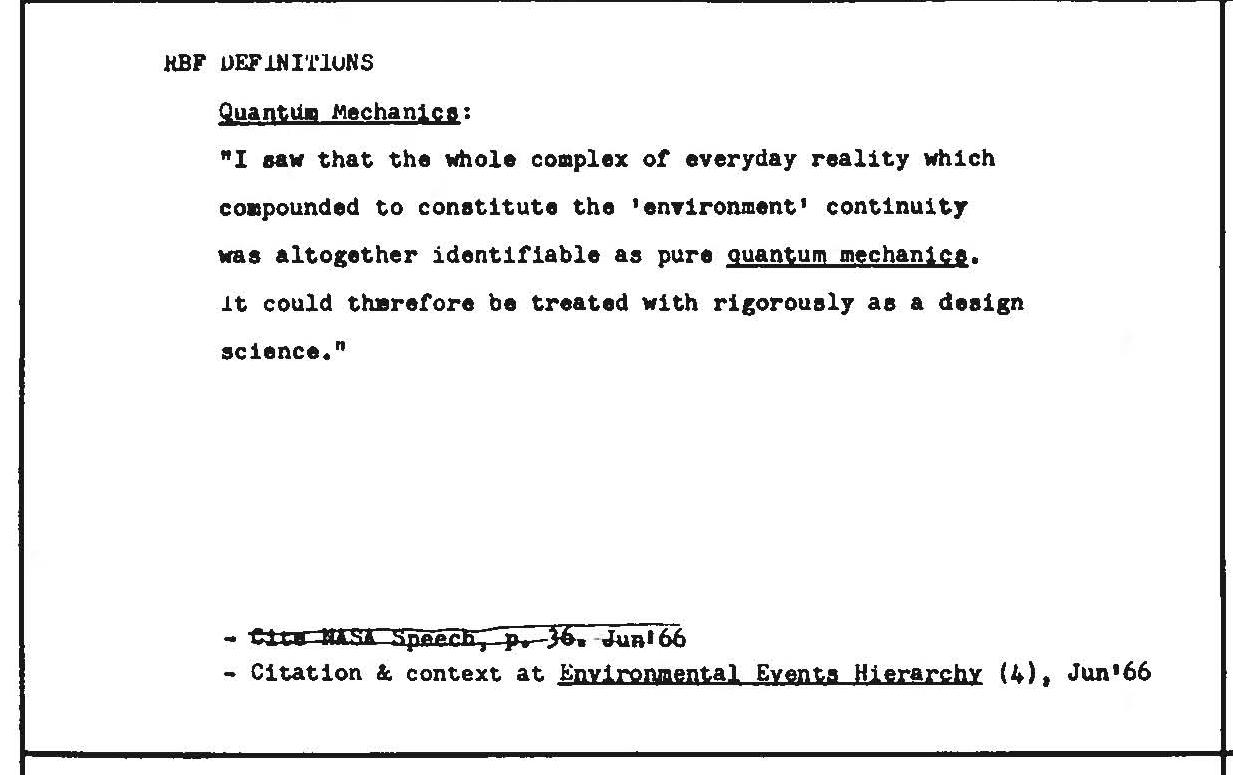
"I saw that the whole complex of everyday reality which compounded to constitute the 'environment' continuity was altogether identifiable as pure quantum mechanics. It could therefore be treated with rigorously as a design science."
-
Cite NASA Speech, p. 36, Jun'66
-
Citation & context at Environmental Events Hierarchy (4), Jun'66
Quantum Mechanics
← Quantum Mechanics | Quantum Mechanics: Grand Strategy →
Index Entry
Quantum Mechanics:
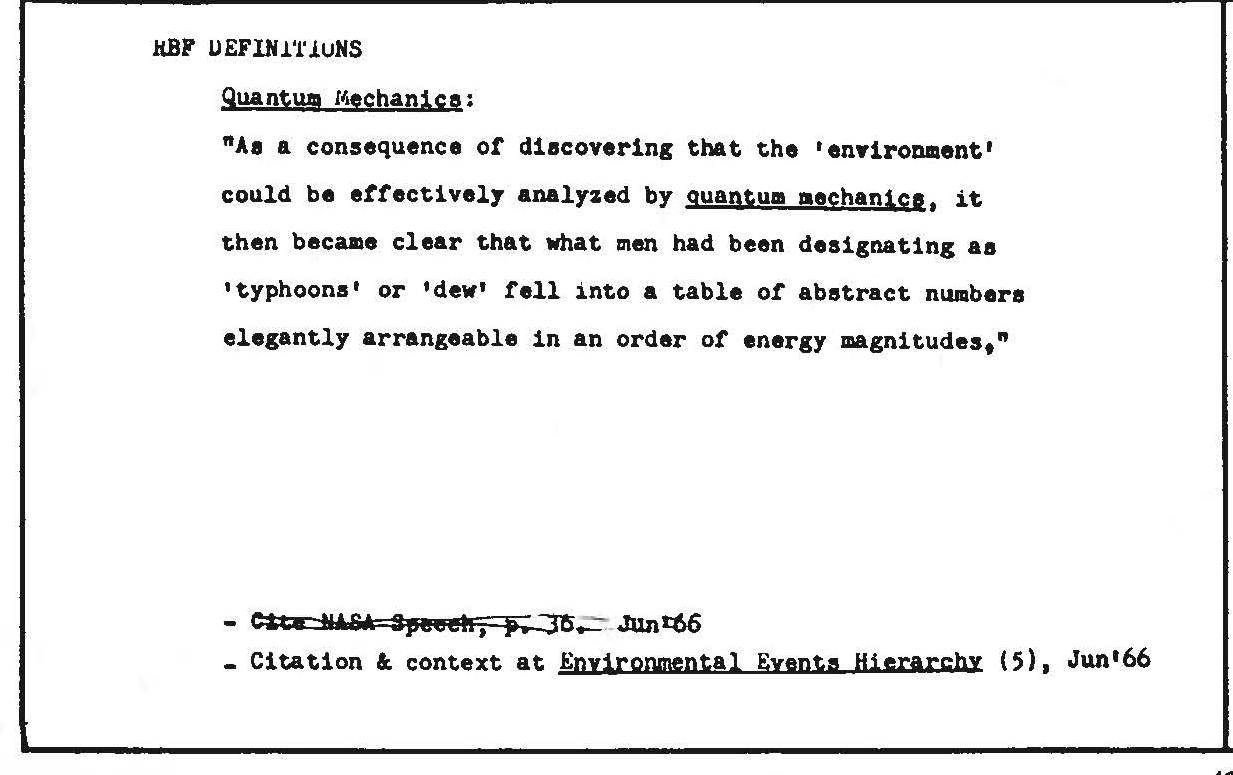
"As a consequence of discovering that the 'environment' could be effectively analyzed by quantum mechanics, it then became clear that what men had been designating as 'typhoons' or 'dew' fell into a table of abstract numbers elegantly arrangeable in an order of energy magnitudes,"
-
Cite NASA Speech, p. 36. Jun'66
-
Citation & context at Environmental Events Hierarchy (5), Jun'66
Quantum Mechanics: Grand Strategy
← Quantum Mechanics | Quantum Mechanics: Grand Strategy →
Index Entry
Quantum Mechanics: Grand Strategy:
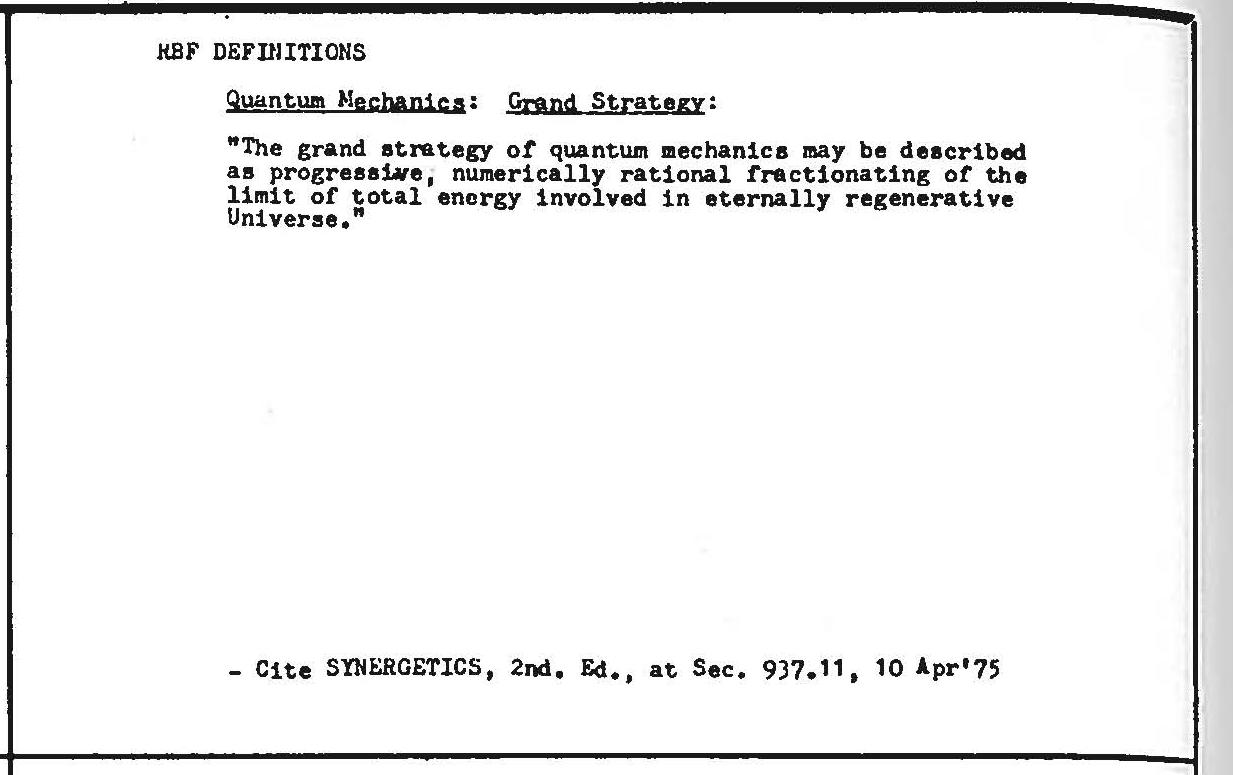
"The grand strategy of quantum mechanics may be described as progressive, numerically rational fractionating of the limit of total energy involved in eternally regenerative Universe."
- Cite SYNERGETICS, 2nd. Ed., at Sec. \hrefhttps://www.buckyverse.org/en/synergetics/content/chapters/900-modelability#section-937.11937.11, 10 Apr'75
Quantum Mechanics: Grand Strategy
← Quantum Mechanics: Grand Strategy | Quantum Mechanics: Grand Strategy →
Index Entry
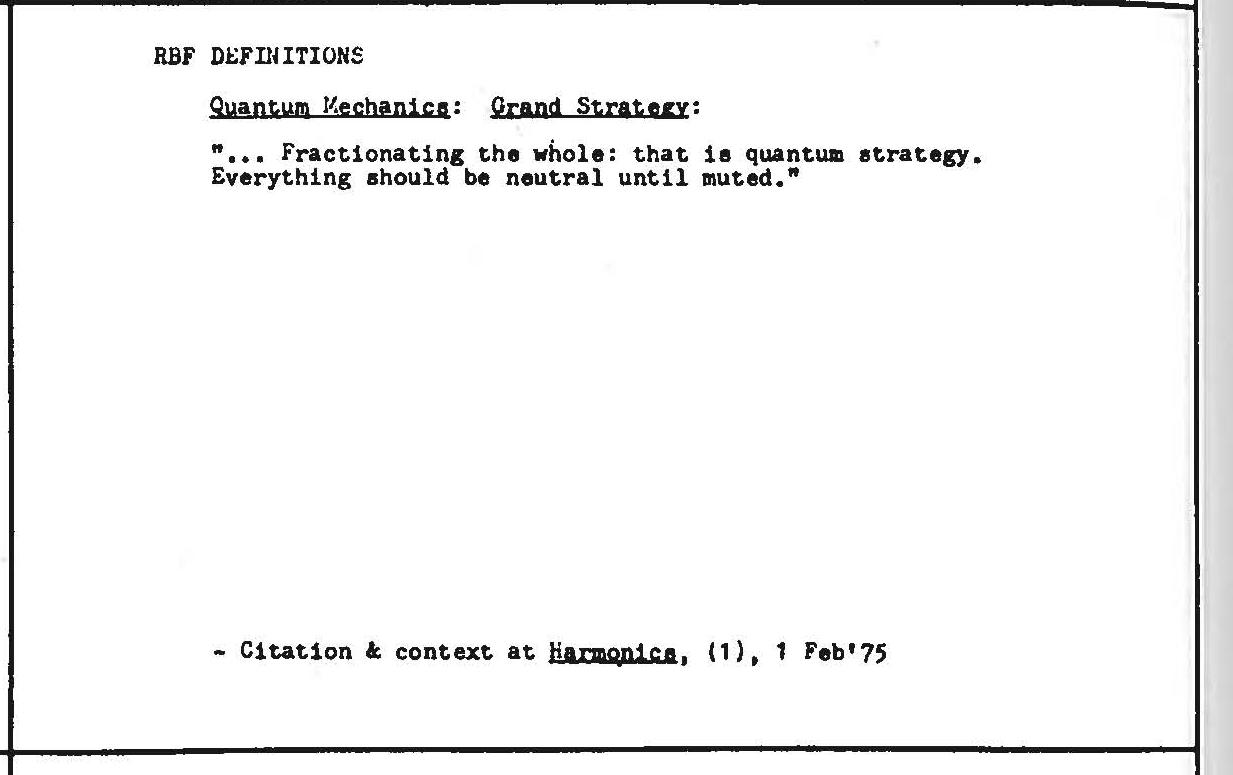
... Fractionating the whole: that is quantum strategy. Everything should be neutral until muted.
- Citation & context at Harmonics, (1), 7 Feb'75
Quantum Mechanics: Grand Strategy
← Quantum Mechanics: Grand Strategy | Quantum Mechanics →
Index Entry
Quantum Mechanics: Grand Strategy:
"The quantum mechanics of Universe reveals that the big ones are the least frequent. This is the hierarchy of environmental events. Tornadoes vs. Kosquitoes. There is an hourglass pattern. And there are specific designing criteria. I wouldn't know how to make a house nova-proof. I don't have to try. This is quantum mechanics."
Quantum Mechanics
← Quantum Mechanics: Grand Strategy | Quantum Mechanics: Grand Strategy →
Index Entry
Quantum Mechanics: Grand Strategy:
"Dealing always in terms of a finite Universe or totality of behavior, we are able to work from the generalized whole to the particular or special-case manifestation of the generalized accounting. This is the basis of the grand philosophical strategy of quantum mechanics."
Cite NASA Speech, pp. 29-30. Jun'66
Quantum Mechanics: Grand Strategy
← Quantum Mechanics | Quantum Mechanics Grand Strategy →
Index Entry
Quantum Mechanics: Grand Strategy:
"My working assumption that unity was plural and at minimum two actually changed the grand strategy in quantum wave mechanics."
- Citation & context at Unity Is Plural, 6 Jul'62
Quantum Mechanics Grand Strategy
← Quantum Mechanics: Grand Strategy | Quantum Mechanics: Minimum Geometrical Fourness (1) →
Cross Reference
Cross-References
- Harmonics, (1)
- Unity Is Plural, 6 Jul'62*
- Considerable Set, 1959
- Generalization & Special Case, Nov'71
Quantum Mechanics: Minimum Geometrical Fourness (1)
← Quantum Mechanics Grand Strategy | Quantum Mechanics (2) →
Index Entry
Quantum Mechanics: Minimum Geometrical Fourness:
"You can take stones and break them into smaller stones
and they will always remain polyhedra--no matter how small.
It is like piezo-crystals. You can break down stones →
into crystals → into atoms → into minimum set. There
is the inevitable minimum set = crystal = tetra.
Electromagnetics--like ultrasonics--has a minimum geomet-
rical fourness: What is a chord? What is a quark? well,
there are a minimum of four frequencies. The crystals are
four-dimensional. Time → spectrum."
- Cite RBF to EJA, from Deer Isle, Sunset, ME; 26 Aug'76
Quantum Mechanics (2)
← Quantum Mechanics: Minimum Geometrical Fourness (1) | Quantum Mechanics: Minimum Geometrical Fourness (3) →
Index Entry
Minimum Geometrical Fourness:
"The cosmic hierarchy shows that the rhombic dodecahedron, rather then the vector equilibrium, is the largest in the hierarchy and is also allspace-filling. The successive polyhedra result from further closest packing in which every closest packed sphere has its passive complement. The spheres transform into spaces and the spaces into spheres (as shown in \hrefhttps://www.buckyverse.org/en/synergetics/content/chapters/1000-omnitopology#section-1032.001032.)
"This explains why the physicists did not understand Boltzmann's law and how they didn't employ the powerful tool of Euler's topology. They would not have seen the connection with Euler's constant relative abundance without my"
Quantum Mechanics: Minimum Geometrical Fourness (3)
← Quantum Mechanics (2) | Quantum Mechanics →
Index Entry
Quantum Mechanics: Minimum Geometrical Fourness:
"extraction of the polar twoness and without synergetics' analysis which demonstrates the doubling of the vectors. The doubling of the vectors is where the quantum comes in: Nothing is lost!
"It all occurs between the Duo-Tet Cube of 3 (tetra = 1½ and space = 1½) and the biggest nucleated cube of 24. The six edges of the quantum loss can appear in the VE to stabilize it as an icosa. The quantum reappears as edges rather than volume. The hierarchy is topological. Even the rhombic dodecahedron has to be omnitriangulated to become stabilized. Each of its diamond faces has to be"
Quantum Mechanics
← Quantum Mechanics: Minimum Geometrical Fourness (3) | Quantum Mechanics: Minimum Geometrical Fourness →
Index Entry
connected (along the short fold) . . . and you will find
that it takes two quanta to do that.
"The 1, 2, 3, and 5 sequence: these are the three-event
vectors that also show up in the vector model of the
magic numbers (\hrefhttps://www.buckyverse.org/en/synergetics/content/chapters/900-modelability#section-995.00995.)"
- Cite RBF to EJA, by telephone from Sunset, ME; 26 Aug'76
Quantum Mechanics: Minimum Geometrical Fourness
← Quantum Mechanics | Quantum Mechanics (1) →
Cross Reference
Cross-References
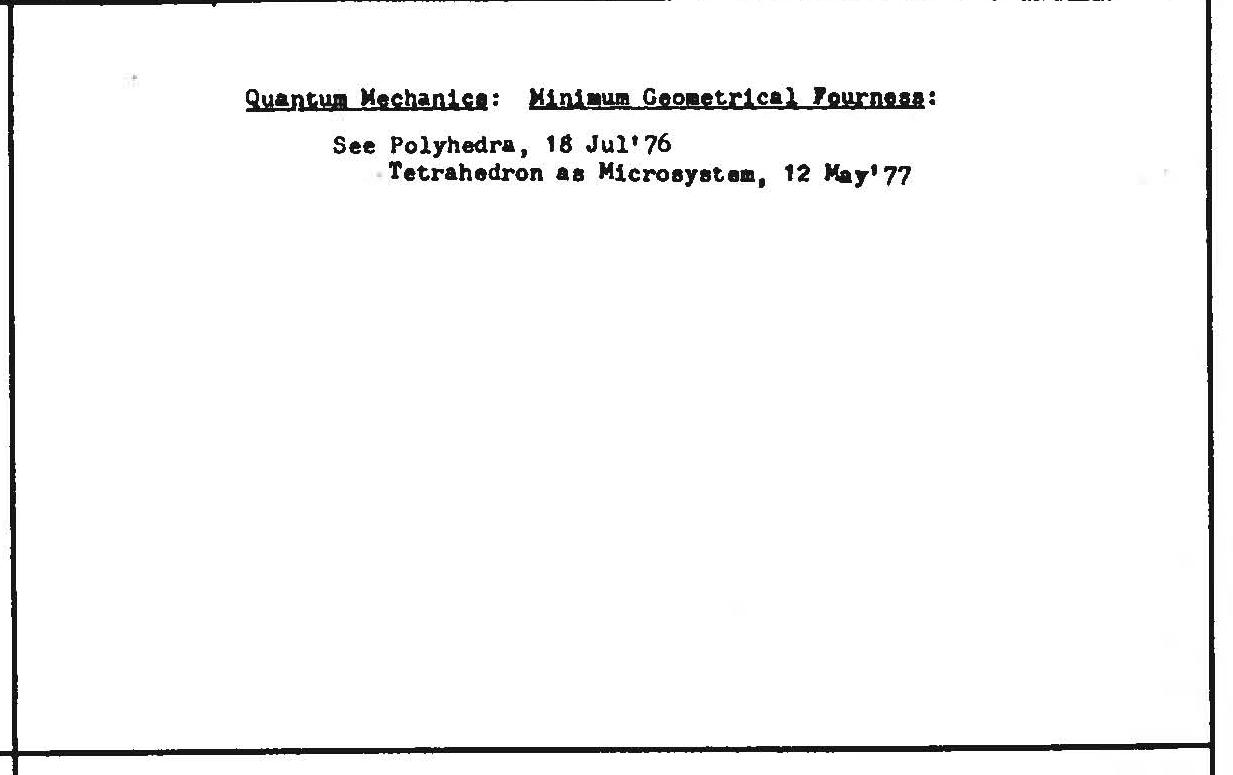
- Polyhedra, 18 Jul'76
- Tetrahedron as Microsystem, 12 May'77
Quantum Mechanics (1)
← Quantum Mechanics: Minimum Geometrical Fourness | Quantum Mechanics (2) →
Cross Reference
Cross-References
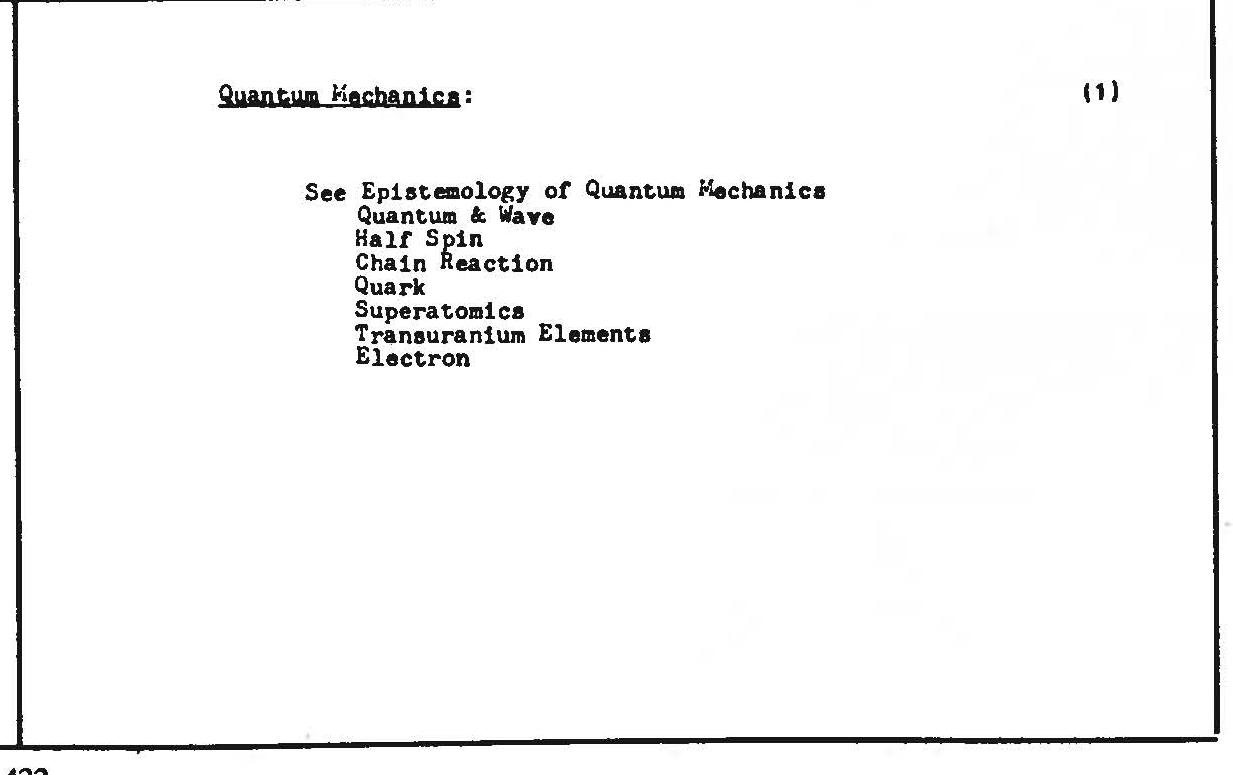
- Epistemology of Quantum Mechanics
- Quantum & Wave
- Half Spin
- Chain Reaction
- Quark
- Superatomics
- Transuranium Elements
- Electron
Quantum Mechanics (2)
← Quantum Mechanics (1) | Quantum Propagation →
Cross Reference
Cross-References
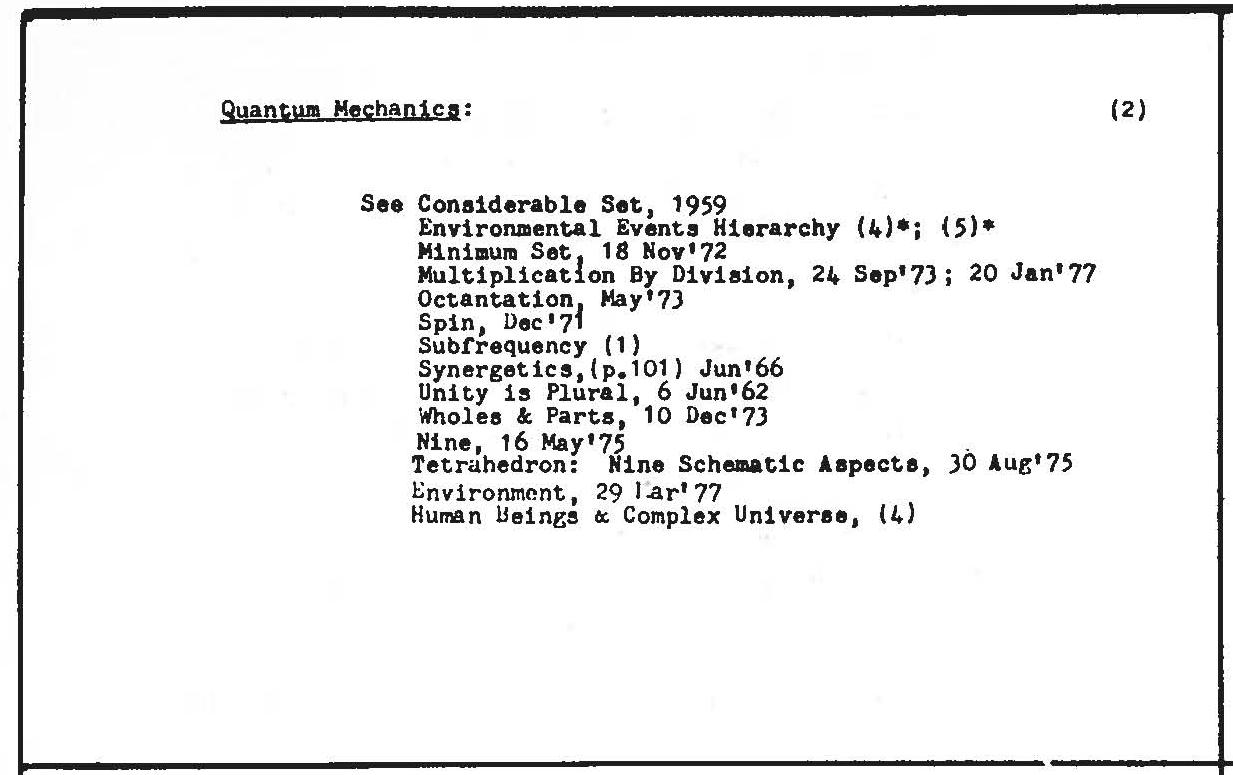
- Considerable Set, 1959
- Environmental Events Hierarchy, (4)
- Minimum Set, 18 Nov'72
- Multiplication By Division, 24 Sep'73; 20 Jan'77
- antation, Oct
- Spin, Dec'71
- Subfrequency, (1)
- Synergetics, Jun'66
- Unity is Plural, 6 Jun'62
- Wholes & Parts, 10 Dec'73
- Nine, 16 May'75
- Tetrahedron: Nine Schematic Aspects, 30 Aug'75
- Environment, 29 Jan'77
- Human Beings & Complex Universe, (4)
Quantum Propagation
← Quantum Mechanics (2) | Quantum Theory →
Cross Reference
Cross-References
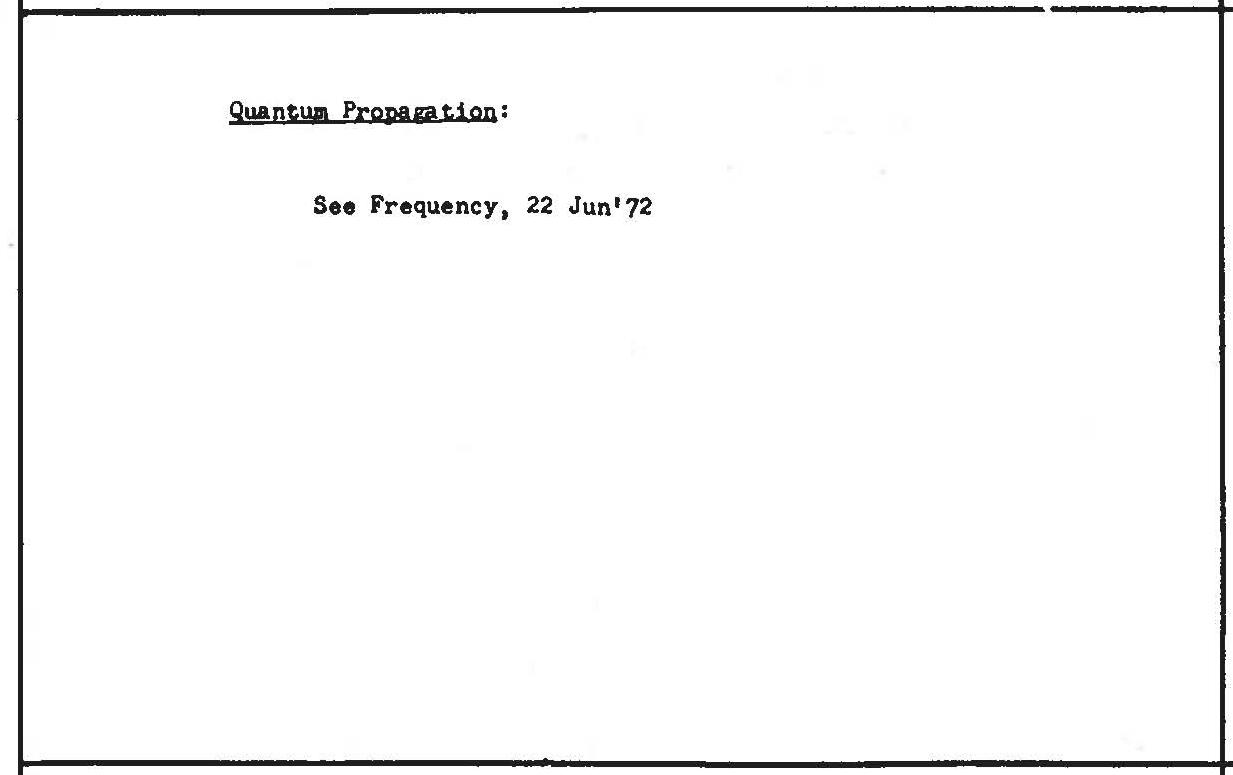
- Frequency, 22 Jun'72
Quantum Theory
← Quantum Propagation | Quanta Values (1) →
Cross Reference
Cross-References
- Neutral Axis, 1 Jan'75
- Uncertainty Principle, May'67
Quanta Values (1)
← Quantum Theory | Quantum Value (2) →
Cross Reference
Cross-References
Quantum Value (2)
← Quanta Values (1) | Quantum Wave Phenomena Sequence (1) →
Cross Reference
See Universal Integrity: Manifest Ratios & Potential Ratios, 1 Apr'72
Cross-References
- Universal Integrity: Manifest Ratios \& Potential Ratios, 1 Apr'72
Quantum Wave Phenomena Sequence (1)
← Quantum Value (2) | Quantum Wave Phenomena Sequence (2) →
Index Entry
Quantum Wave Phenomena Sequence:
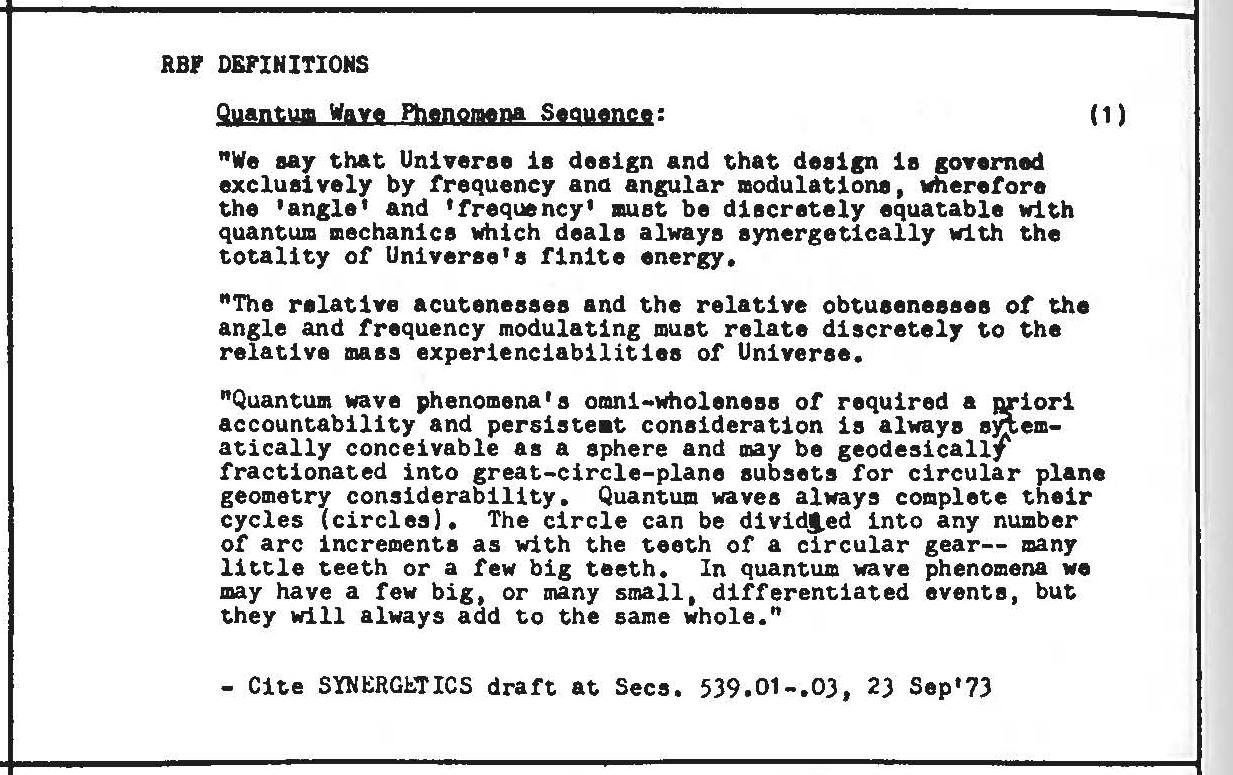
"We say that Universe is design and that design is governed exclusively by frequency and angular modulations, wherefore the 'angle' and 'frequency' must be discretely equatable with quantum mechanics which deals always synergetically with the totality of Universe's finite energy.
"The relative acutenesses and the relative obtusenesses of the angle and frequency modulating must relate discretely to the relative mass experienciabilities of Universe.
"Quantum wave phenomena's omni-wholeness of required a priori accountability and persistent consideration is always systematically conceivable as a sphere and may be geodesically fractionated into great-circle-plane subsets for circular plane geometry considerability. Quantum waves always complete their cycles (circles). The circle can be divided into any number of arc increments as with the teeth of a circular gear-- many little teeth or a few big teeth. In quantum wave phenomena we may have a few big, or many small, differentiated events, but they will always add to the same whole."
- Cite SYNERGETICS draft at Secs. \hrefhttps://www.buckyverse.org/en/synergetics/content/chapters/500-conceptuality#section-539.01539.01-\hrefhttps://www.buckyverse.org/en/synergetics/content/chapters/500-conceptuality#section-539.03539.03, 23 Sep'73
Quantum Wave Phenomena Sequence (2)
← Quantum Wave Phenomena Sequence (1) | Quantum & Wave →
Index Entry
Quantum Wave Phenomena Sequence:
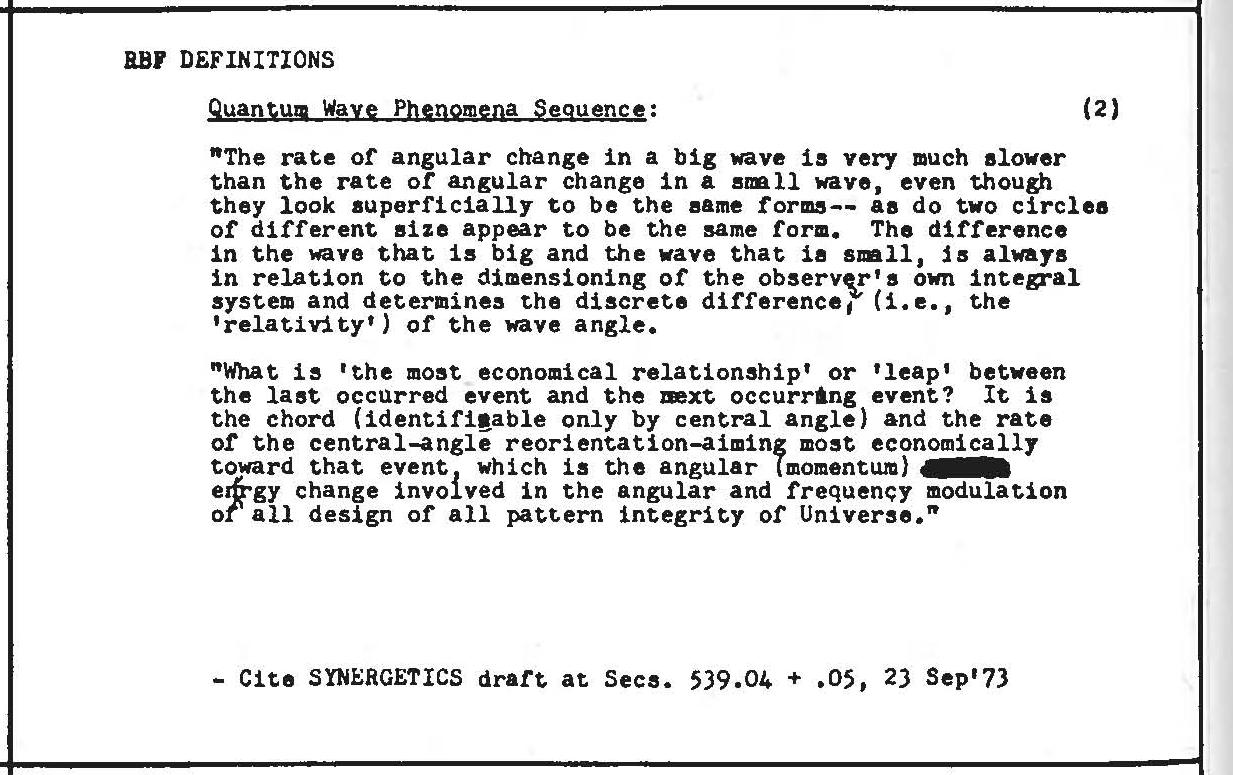
"The rate of angular change in a big wave is very much slower than the rate of angular change in a small wave, even though they look superficially to be the same forms-- as do two circles of different size appear to be the same form. The difference in the wave that is big and the wave that is small, is always in relation to the dimensioning of the observer's own integral system and determines the discrete difference, (i.e., the 'relativity') of the wave angle.
"What is 'the most economical relationship' or 'leap' between the last occurred event and the next occurring event? It is the chord (identifiable only by central angle) and the rate of the central-angle reorientation-aiming most economically toward that event, which is the angular (momentum) energy change involved in the angular and frequency modulation of all design of all pattern integrity of Universe."
- Cite SYNERGETICS draft at Secs. \hrefhttps://www.buckyverse.org/en/synergetics/content/chapters/500-conceptuality#section-539.04539.04 + .05, 23 Sep'73
Quantum & Wave
← Quantum Wave Phenomena Sequence (2) | Quantum (1) →
Cross Reference
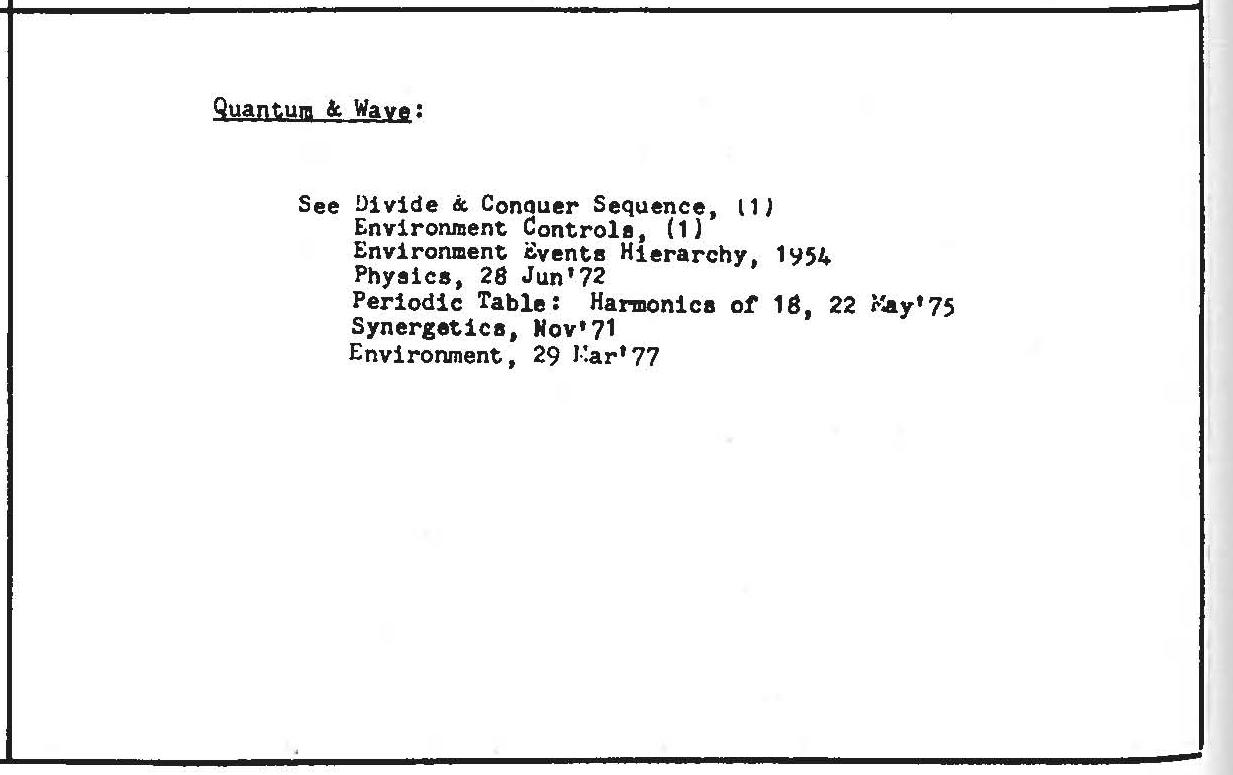
See Divide & Conquer Sequence, (1)
Cross-References
- Divide \& Conquer Sequence, (1)
- Environment Controls, (1)
- Environment Events Hierarchy, 1954
- Physics, 28 Jun'72
- Periodic Table: Harmonics of 18, 22 May'75
- Synergetics, Nov'71
- Environment, 29 Mar'77
Quantum (1)
← Quantum & Wave | Quantum (2) →
Cross Reference
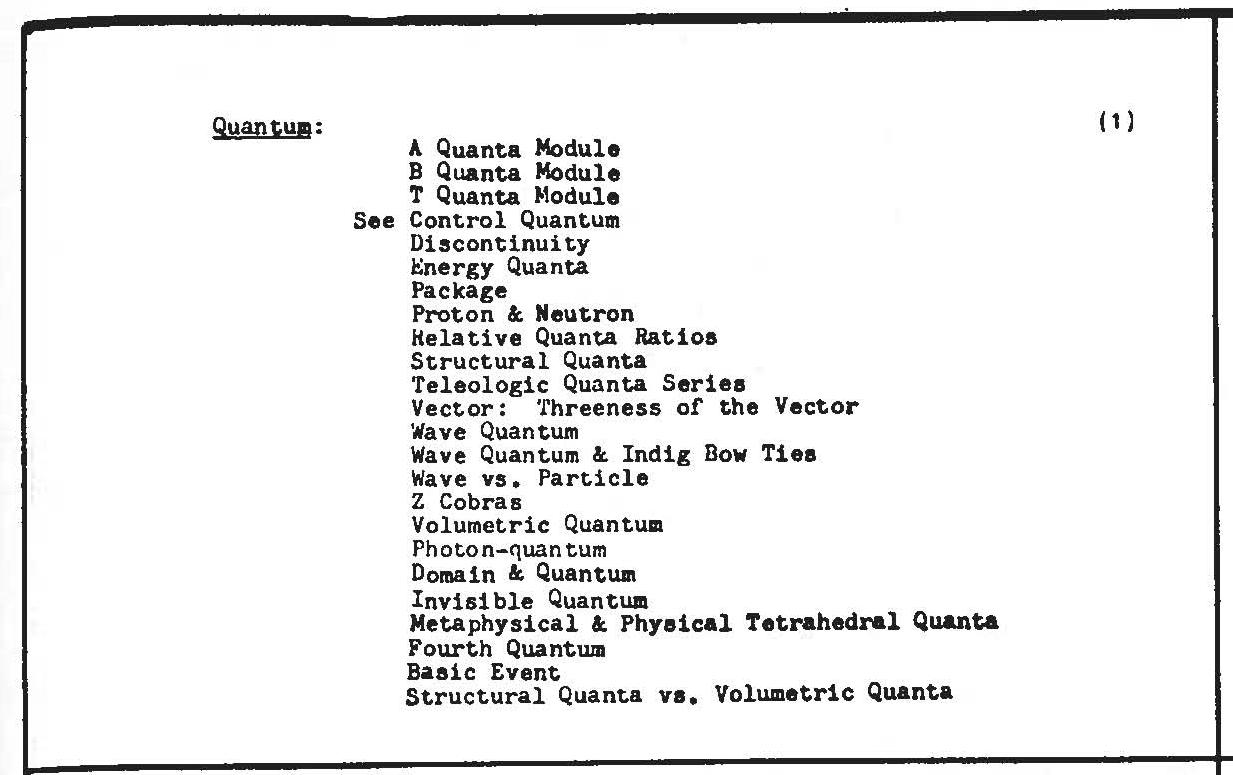
A Quanta Module
B Quanta Module
T Quanta Module
Discontinuity
Energy Quanta
Package
Proton & Neutron
Relative Quanta Ratios
Structural Quanta
Teleologic Quanta Series
Vector: Threeness of the Vector
Wave Quantum
Wave Quantum & Indigo Bow Ties
Wave vs. Particle
Z Cobras
Volumetric Quantum
Photon-quanta
Domain & Quantum
Invisible Quantum
Metaphysical & Physical Tetrahedral Quanta
Fourth Quantum
Basic Event
Structural Quanta vs. Volumetric Quanta
Cross-References
Quantum (2)
Cross Reference
Cross-References
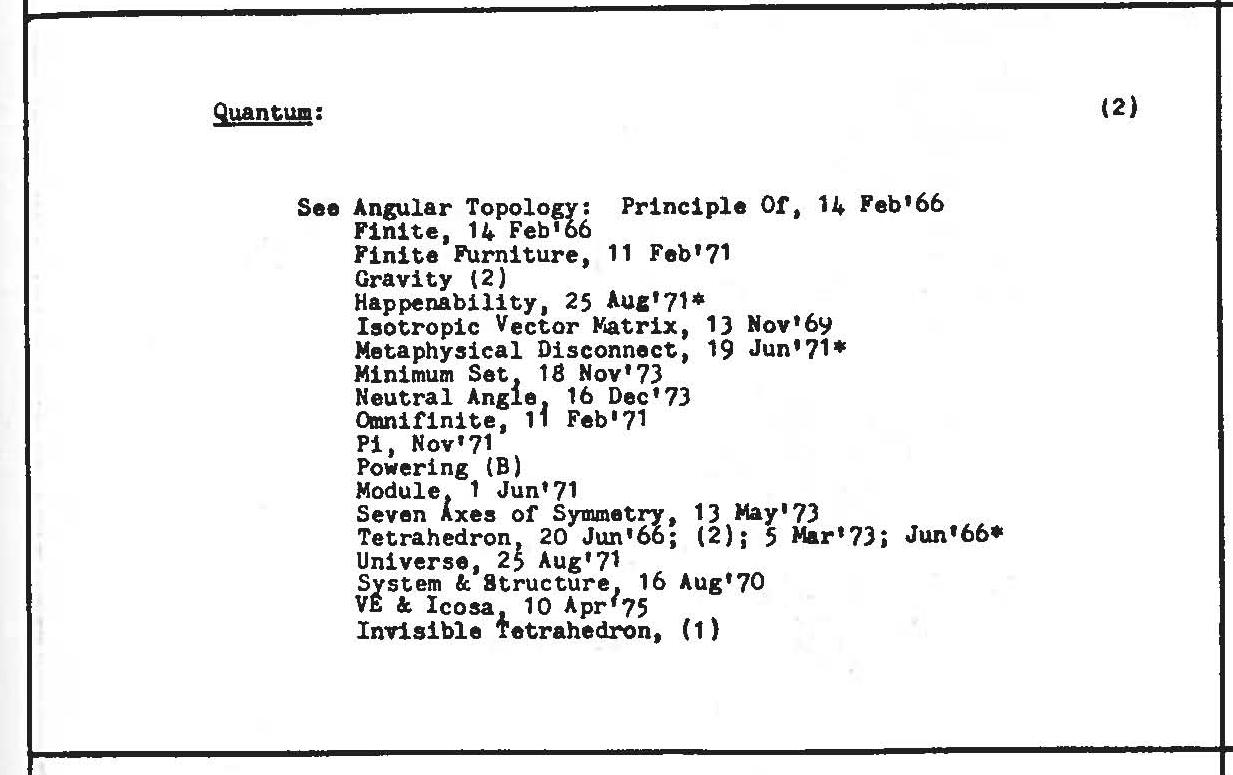
- Angular Topology: Principle Of, 14 Feb'66
- Finite, 14 Feb'66
- Finite Furniture, 11 Feb'71
- Gravity, (2)
- Happenability, 25 Aug'71*
- Isotropic Vector Matrix, 13 Nov'69
- Metaphysical Disconnect, 19 Jun'71*
- Minimum Set, 18 Nov'73
- Neutral Angle, 16 Dec'73
- Omnifinite, 11 Feb'71
- Pi, Nov'71
- Powering (B)
- Module, 1 Jun'71
- Seven Axes of Symmetry, 13 May'73
- Tetrahedron, 20 Jun'66 (2)
- Universe, 25 Aug'71
- System & Structure, 16 Aug'70
- VE & Icosa, 10 Apr'75
- Invisible Tetrahedron, (1)
Quantum (3)
Cross Reference
Quantum Hierarchies
Quantum Values
Quantum & Wave Mechanics
Quantum Wave
Cross-References
- Quantum Accounting
- Quantum: Event-paired Quanta
- Quantum Jump
- Quantum: Paired-event Quanta
- Quantum Mechanics
- Quantum Mechanics: Grand Strategy
- Quantum Propagation
- Quantum Theory
- Quantum Wave Phenomena Sequence
- Quanta Loss by Congruence
Quarks
RBF Definitions
Q. "The high-energy particle physicists have their devices ever seeking the final smallest particle. Will the quarks become quarklets? Are the quarks a by-product of the devices used to seek them, or are they a priori?"
RBF: "Yesterday I gave you the A and B Quanta Modules... and a tensed string as a system with mathematical properties. Thus the Mites identify with quarks.
"Being tetrahedra, it is no trouble to halve the mites into lower and lower altitude scalehe tetrahedra... the infinite spinnability of the quarter tetrahedra. There is no limit; but they may arrive at incredibly small volume.... These may well show up as quarklets."
Citations
- RBF to World Game Workshop'77; Phila., PA; 22 Jun'77
Quark
Index Entry
(For RBF discussion of quark in synergetics see Ltr. to Dr. Robt. W. Horne, pp. 3 - 6, 14 Feb '66.)
Sec. \hrefhttps://www.buckyverse.org/en/synergetics/content/chapters/200-synergetics#section-260.12260.12 (2nd. Ed.)
s260.12
s1052.32
s1052.343
s1052.357
Quark (1)
Cross Reference
Cross-References
- Mite as Model for the Quark
- Half Spin
- Quantum Mechanics
- Mites & Quarks as Basic Notes
- Strange Particles
Quark (2)
← Quark (1) | Quarry: Quarrying →
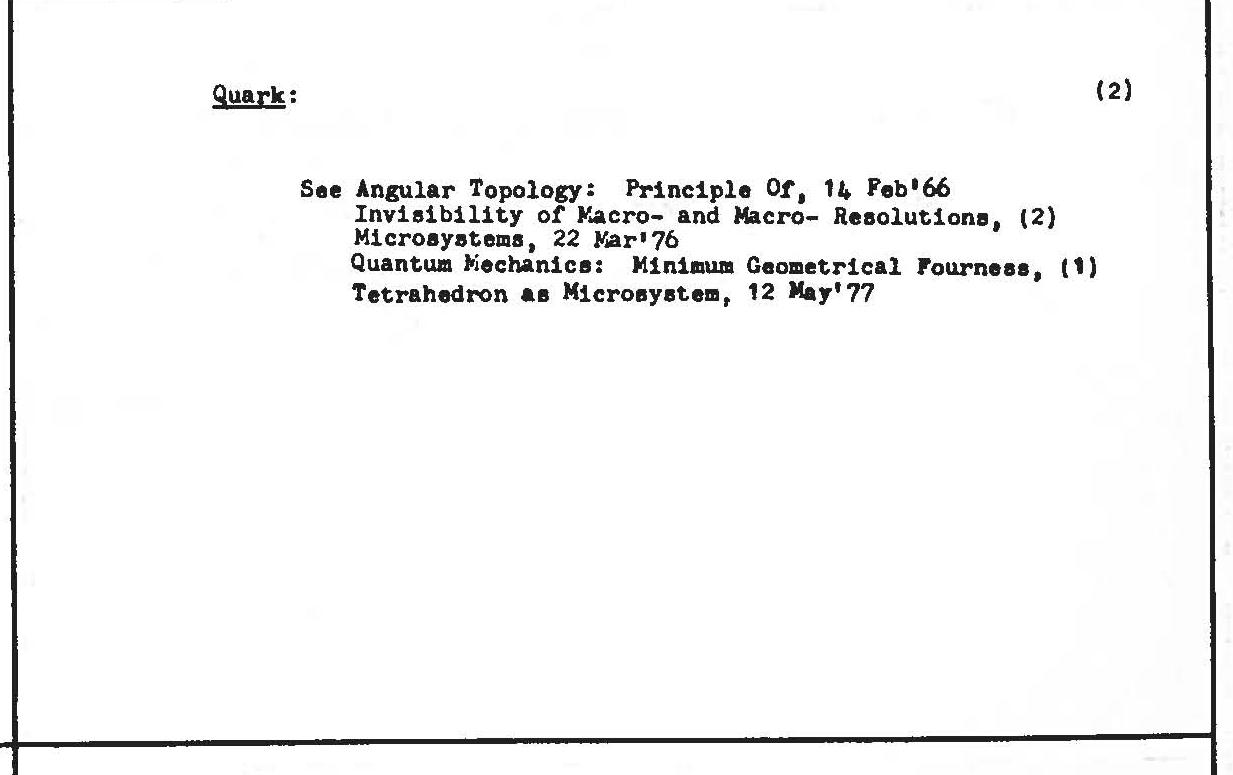
Cross Reference
Invisibility of Macro- and Macro- Resolutions, (2)
Cross-References
- Angular Topology, 14 Feb'66
- Microsystems, 22 Mar'76
- Quantum Mechanics, (1)
- Tetrahedron as Microsystem, 12 May'77
Quarry: Quarrying
← Quark (2) | Quarry Quarrying (1) →
Index Entry
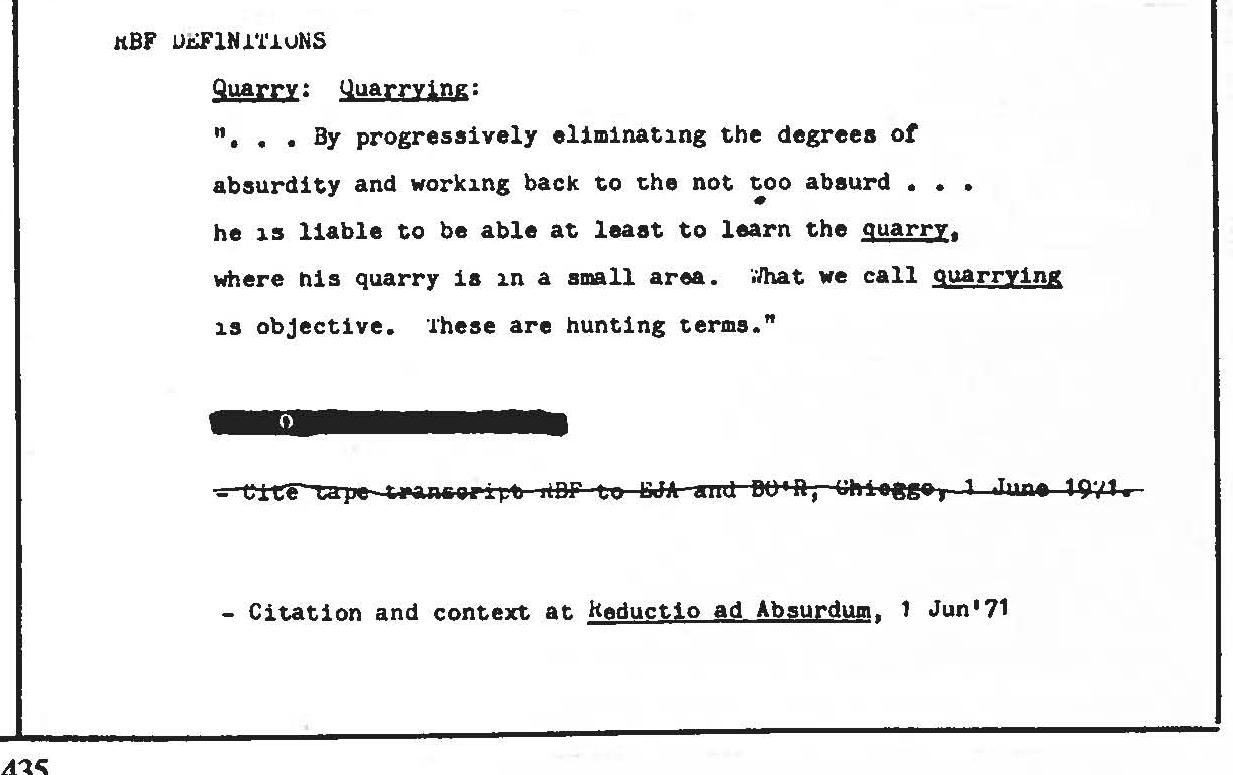
Quarry: Quarrying:
". . . By progressively eliminating the degrees of absurdity and working back to the not too absurd . . . he is liable to be able at least to learn the quarry, where his quarry is in a small area. What we call quarrying is objective. These are hunting terms."
-
Cite tape transcript RBF to EJA and BOR, Chicago, 1 June 1971.
-
Citation and context at Reductio ad Absurdum, 1 Jun'71
Quarry Quarrying (1)
← Quarry: Quarrying | Quarry Quarrying (2) →
Cross Reference
Cross-References
Quarry Quarrying (2)
← Quarry Quarrying (1) | Quarterback →
Cross Reference
Cross-References
- Reductio ad Absurdum, 1 Jun'71 ; Nov'71
Quarterback
← Quarry Quarrying (2) | Quarterback (2) →
Cross Reference
Cross-References
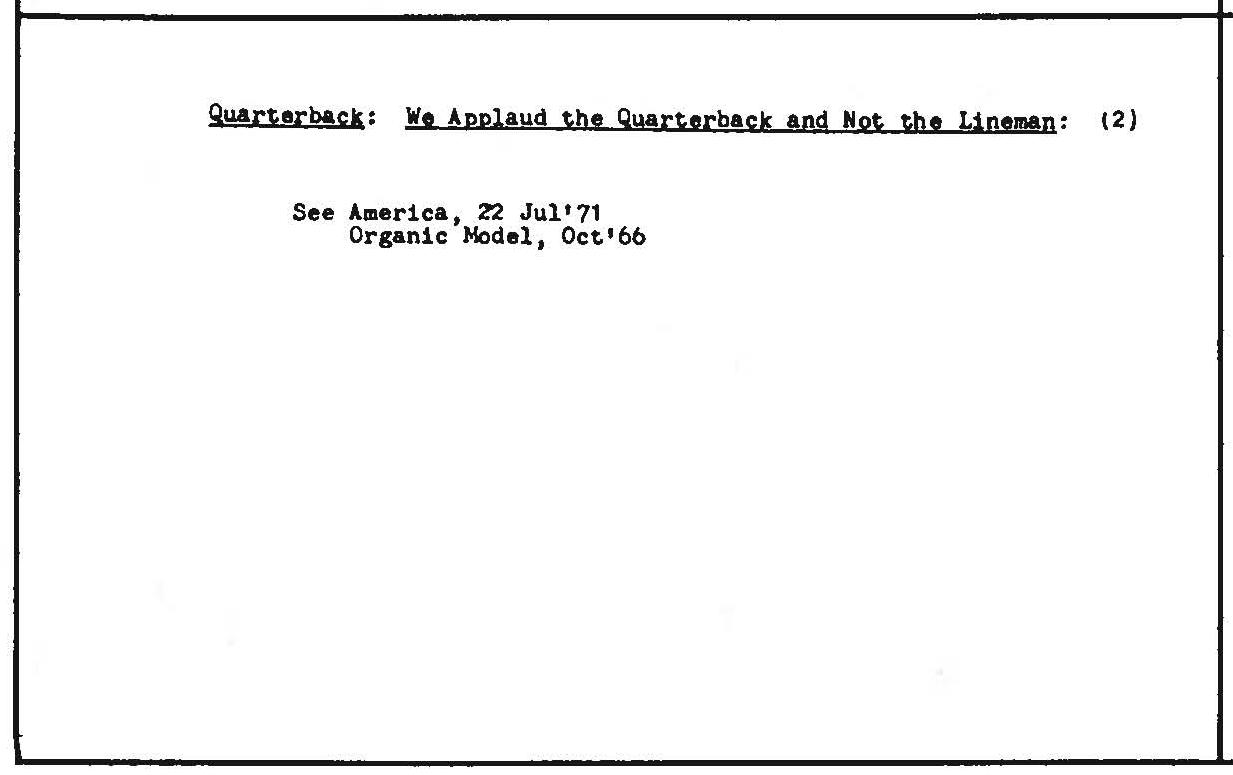
Quarterback (2)
← Quarterback | Queen Mary Steamship →
Cross Reference
Cross-References
- America, 22 Jul'71
- Organic Model, Oct'66
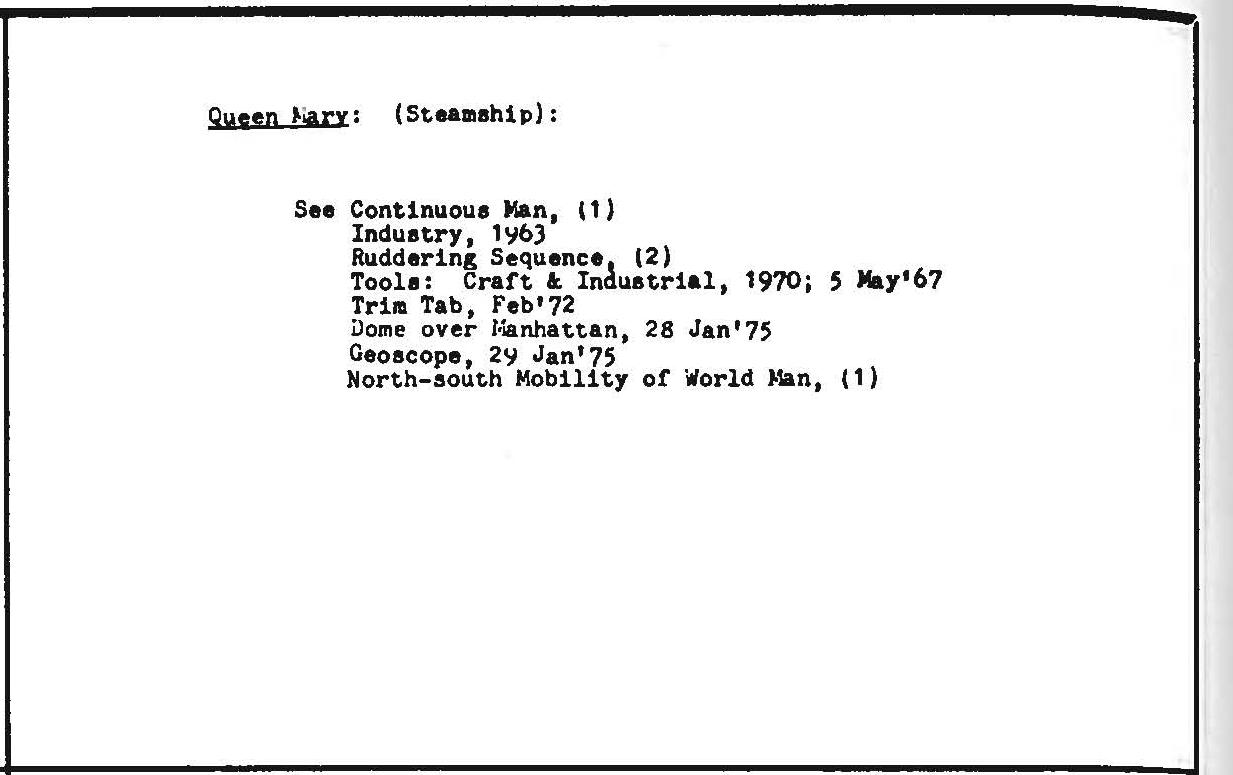
Queen Mary Steamship
← Quarterback (2) | Questions: Answering Questions →
Cross Reference
Cross-References
- Continuous Man, (1)
- Industry, 1963
- Ruddering Sequence, (2)
- Tools: Craft & Industrial, 5 May'67
- Trim Tab, Feb'72
- Dome over Manhattan, 28 Jan'75
- Geoscope, 29 Jan'75
- North-south Mobility of World Man, (1)
Questions: Answering Questions
← Queen Mary Steamship | Question Answering →
Index Entry
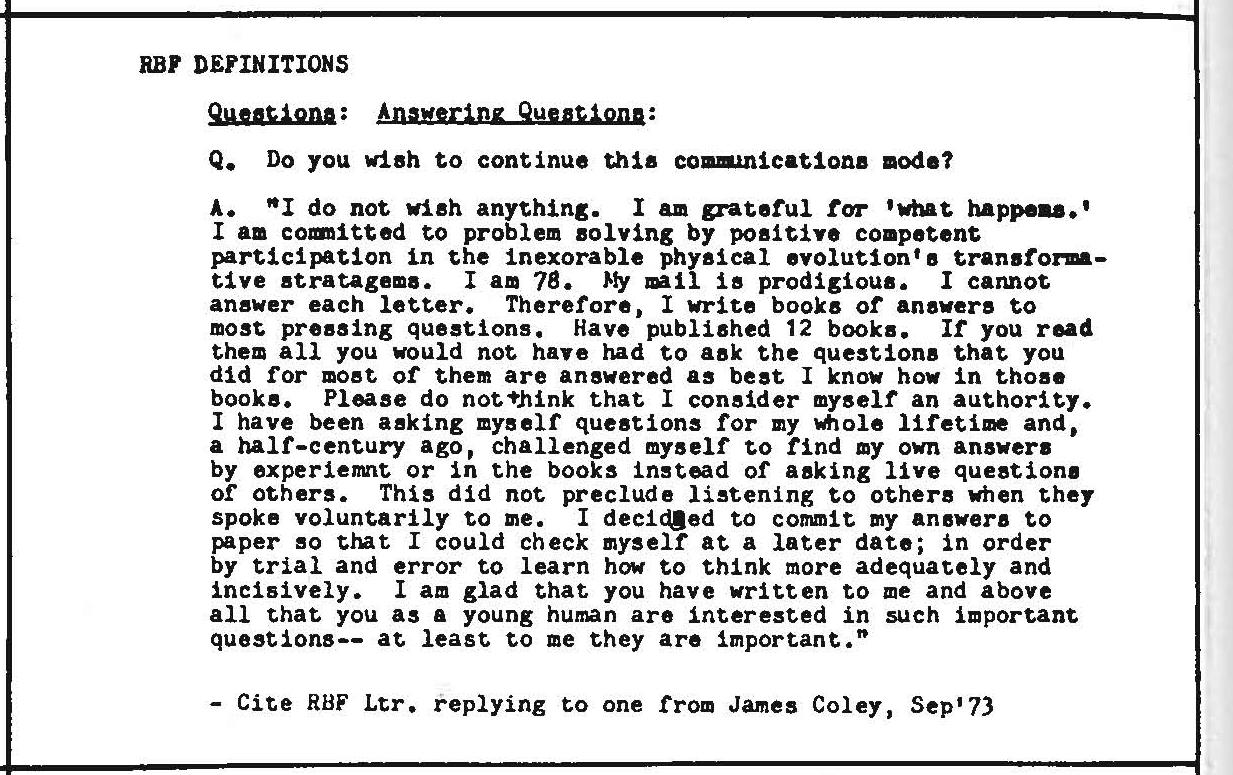
Q. Do you wish to continue this communications mode?
A. "I do not wish anything. I am grateful for 'what happens.' I am committed to problem solving by positive competent participation in the inexorable physical evolution's transformative stratagems. I am 78. My mail is prodigious. I cannot answer each letter. Therefore, I write books of answers to most pressing questions. Have published 12 books. If you read them all you would not have had to ask the questions that you did for most of them are answered as best I know how in those books. Please do not think that I consider myself an authority. I have been asking myself questions for my whole lifetime and, a half-century ago, challenged myself to find my own answers by experiment or in the books instead of asking live questions of others. This did not preclude listening to others when they spoke voluntarily to me. I decided to commit my answers to paper so that I could check myself at a later date; in order by trial and error to learn how to think more adequately and incisively. I am glad that you have written to me and above all that you as a young human are interested in such important questions-- at least to me they are important."
Question Answering
← Questions: Answering Questions | Question Asking →
Cross Reference
Question Answering:
Cross-References
Question Asking
← Question Answering | Question-asking Possibility →
Index Entry
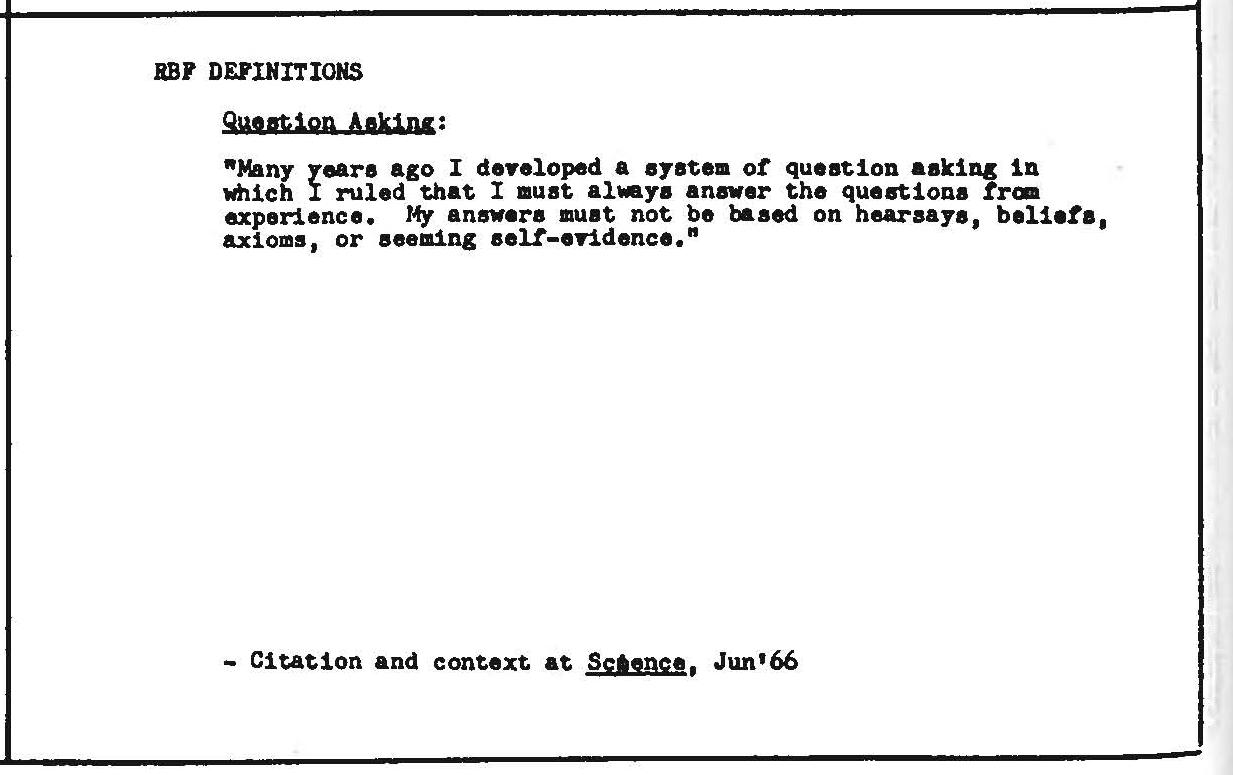
Question Asking:
"Many years ago I developed a system of question asking in which I ruled that I must always answer the questions from experience. My answers must not be based on hearsays, beliefs, axioms, or seeming self-evidence."
- Citation and context at Science, Jun'66
Question-asking Possibility
← Question Asking | Question-asking Possibility →
Index Entry
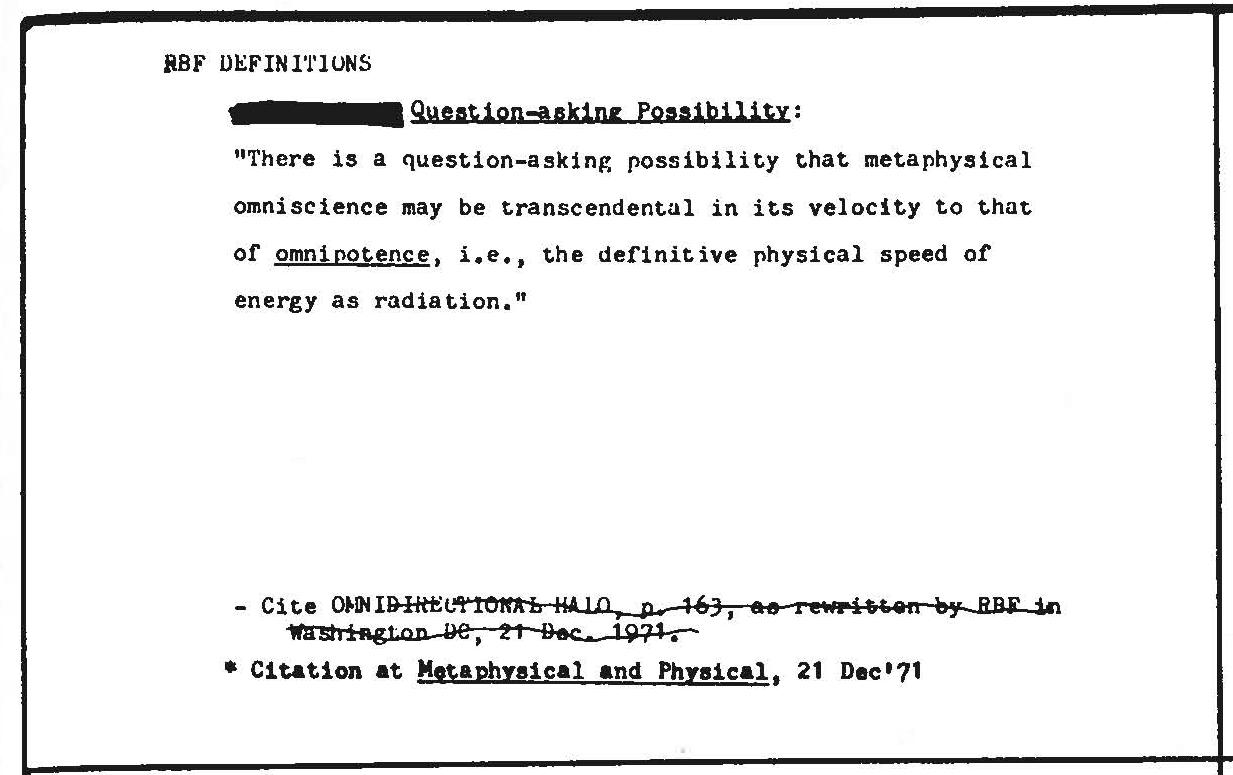
Question-asking Possibility:
"There is a question-asking possibility that metaphysical omniscience may be transcendental in its velocity to that of omnipotence, i.e., the definitive physical speed of energy as radiation."
- Cite OMNIDIRECTIONAL HALO, p.163, as rewritten by RBF in Washington DC, 21 Dec. 1971.
- Citation at Metaphysical and Physical, 21 Dec'71
Question-asking Possibility
← Question-asking Possibility | Question Asking (1) →
Index Entry
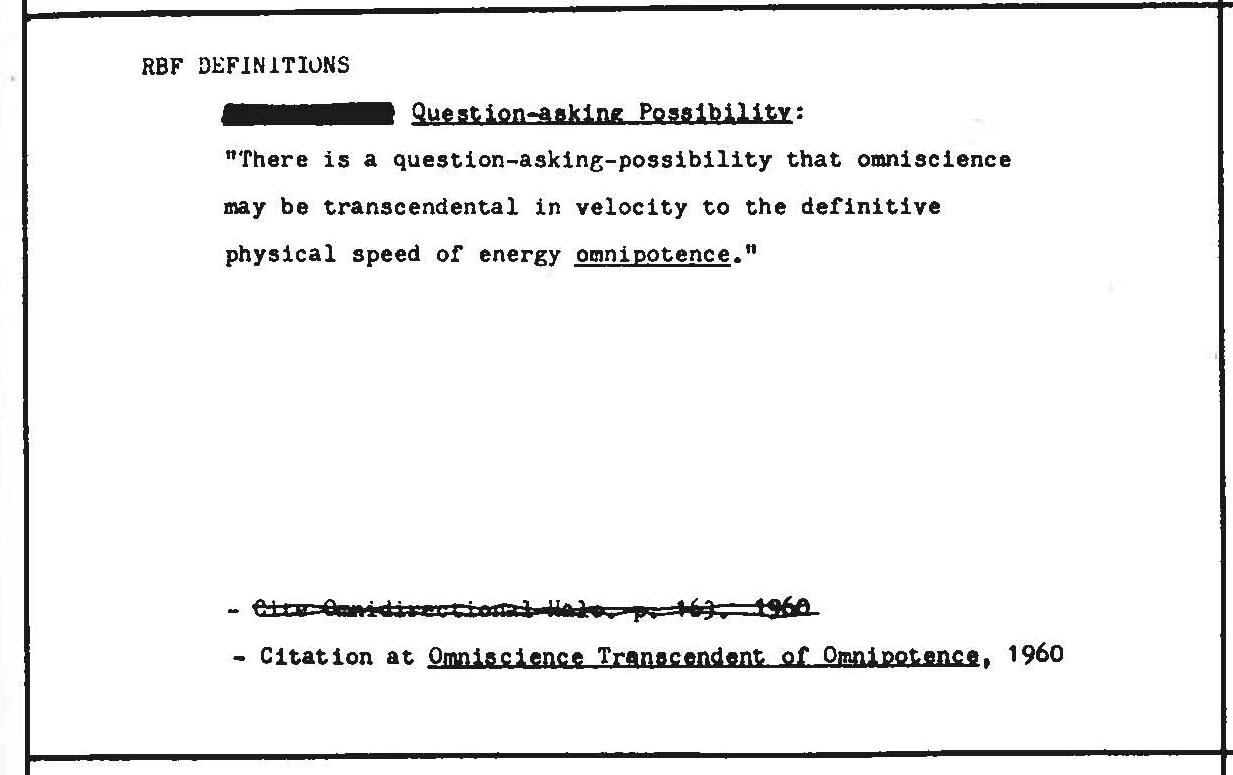
Question-asking Possibility:
"There is a question-asking-possibility that omniscience
may be transcendental in velocity to the definitive
physical speed of energy omnipotence."
-
Cite Omnidirectional Halo, p. 163, 1960
-
Citation at Omniscience Transcendent of Omnipotence, 1960
Question Asking (1)
← Question-asking Possibility | Question Asking (2) →
Cross Reference
Cross-References
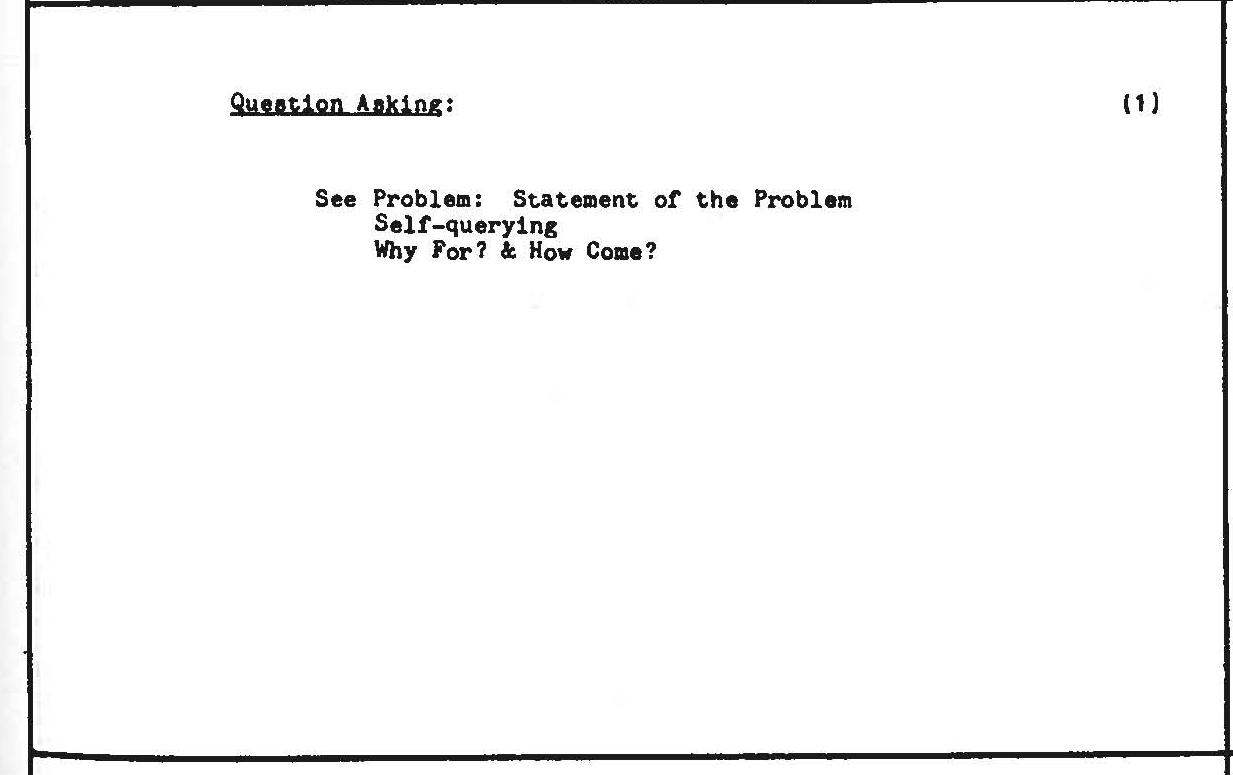
Question Asking (2)
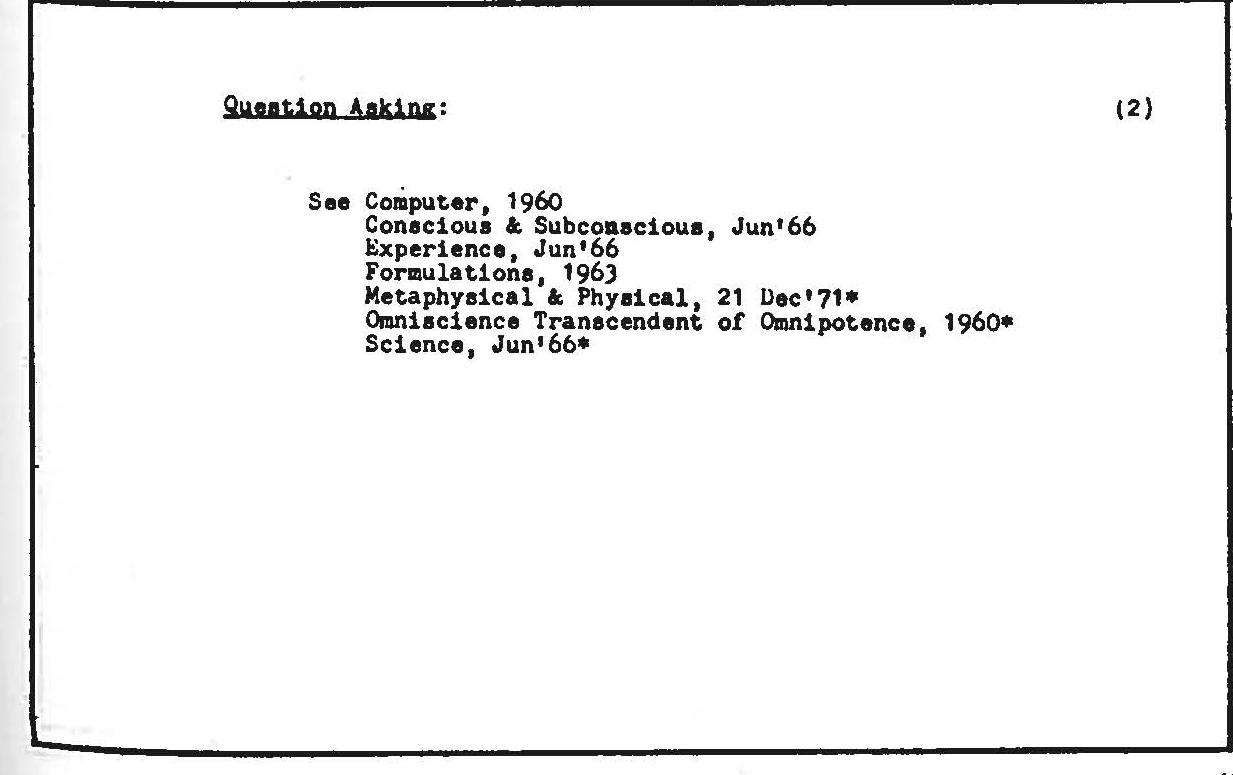
← Question Asking (1) | Question: Largest Askable & Answerable Question →
Cross Reference
Cross-References
- Computer, 1960
- Conscious & Subconscious, Jun'66
- Experience, Jun'66
- Formulations, 1963
- Metaphysical & Physical, 21 Dec'71*
- Omniscience Transcendent of Omnipotence, 1960
- Science, Jun'66*
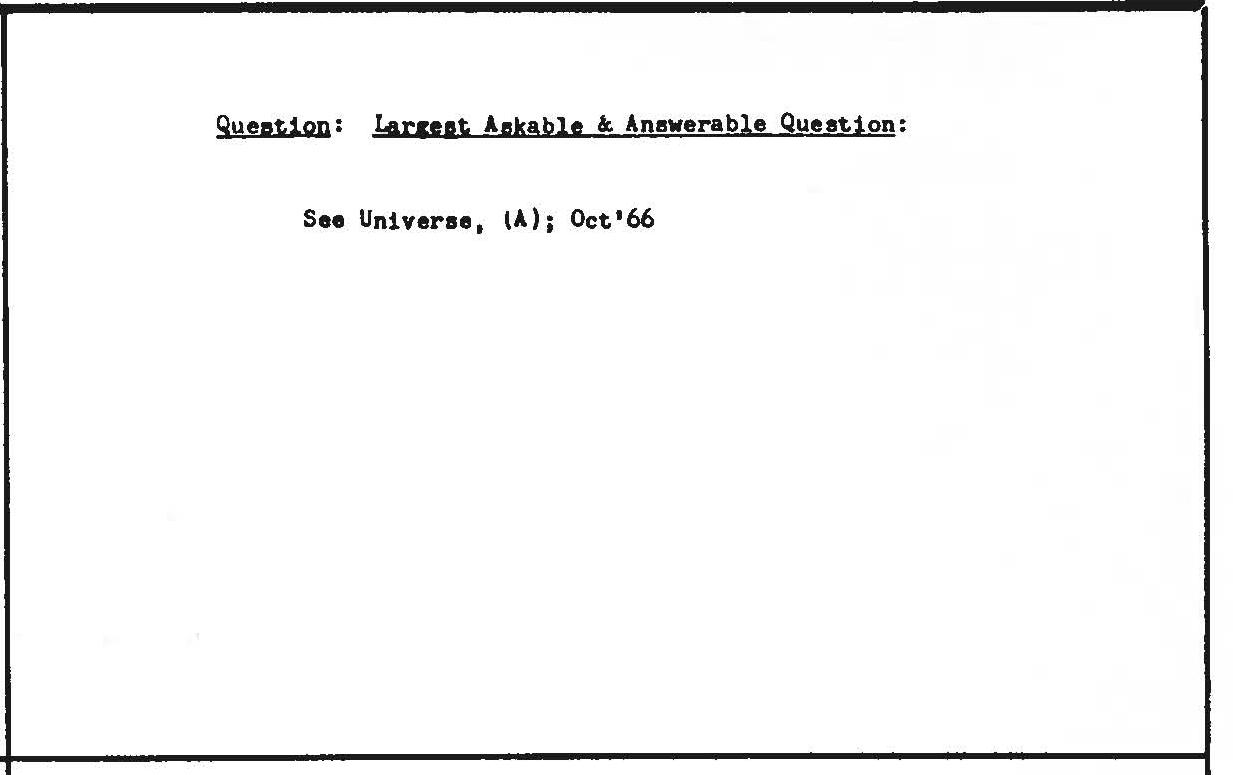
Question: Largest Askable & Answerable Question
← Question Asking (2) | Question: Most Comprehensive (1) →
Cross Reference
Cross-References
- Universe, Oct'66
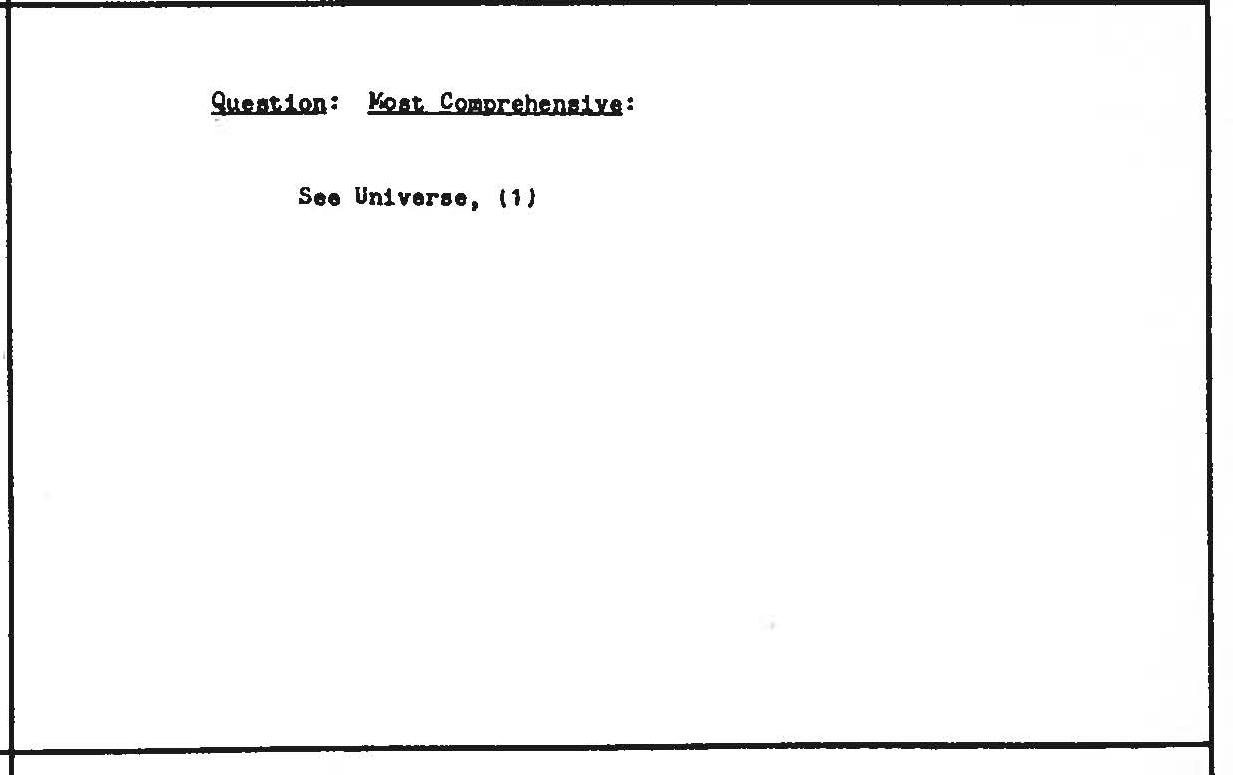
Question: Most Comprehensive (1)
← Question: Largest Askable & Answerable Question | Question: Original Question →
Cross Reference
Cross-References
- Universe, (1)
Question: Original Question
← Question: Most Comprehensive (1) | Question: Original Question →
RBF Definitions
"... Here then is an original question: born through occurrence of unexpected interference in experimental interpatternings. ♂ Original questions of computers or humans probably are, always, products of unexpected interferences. ..." - Citation and context at Computer (D), 10 Dec'64
Question: Original Question
← Question: Original Question | Question: Original Question (1) →
Index Entry
Question: Original Question:
"The scientist-philosophers of computer integration say that because the asking of original questions is a consequence of interferences, and because interferences are products of time sequences, it follows that original questions are both functions and products of time. There must be a great number of moves and a vast number of computer components before enough time can elapse to develop new types of secondary or tertiary interferences, which in turn may from time to time provoke original questions."
- Citation and context at Computer Asks an Original Question (4) (5), 29 Aug'64
Question: Original Question (1)
← Question: Original Question | Question (2) →
Cross Reference
Cross-References
- Computer Asks an Original Question Starting with Universe
Question (2)
← Question: Original Question (1) | Question Period →
Cross Reference
Question: Original Question:
Cross-References
- Computer (D), (D)
- Cybernetics, May'65
- Interference, May'65
Question Period
← Question (2) | Question: Each Next Good Question →
Index Entry
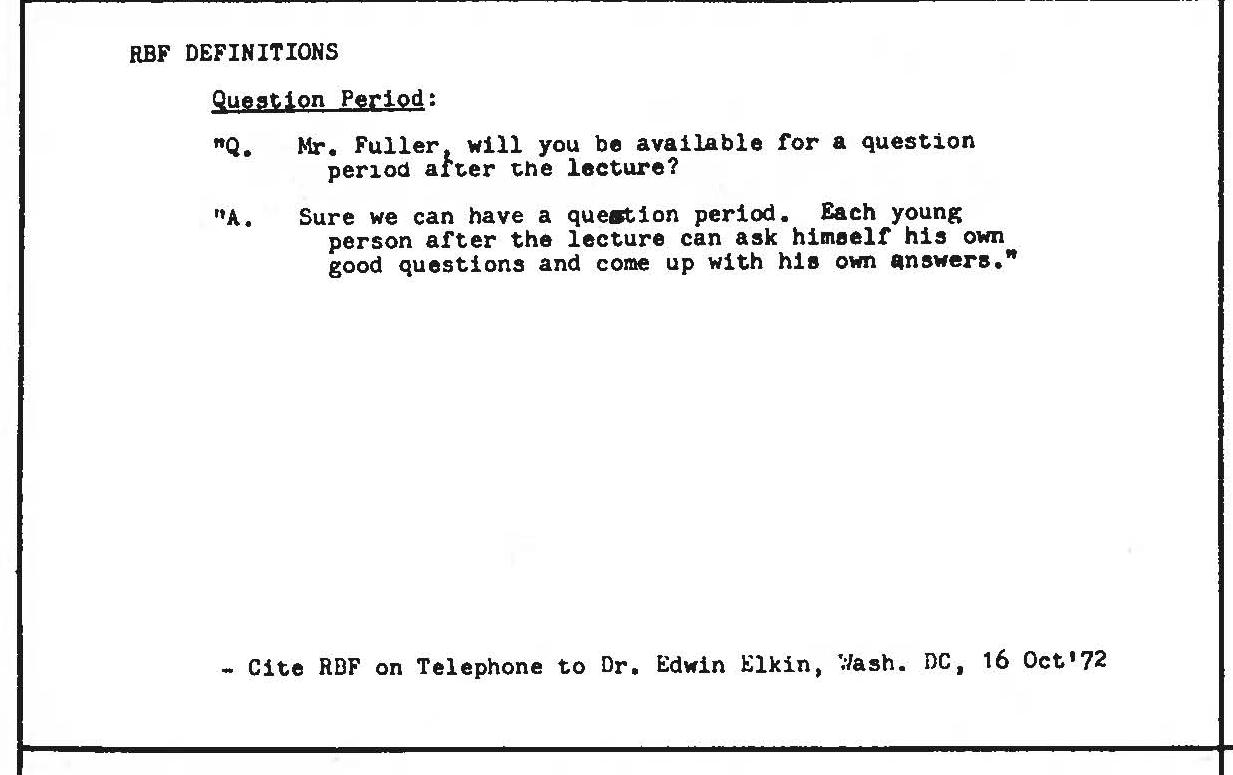
Q. Mr. Fuller, will you be available for a question period after the lecture?
A. Sure we can have a question period. Each young person after the lecture can ask himself his own good questions and come up with his own answers.
Question: Each Next Good Question
← Question Period | Question (1) →
Cross Reference
Cross-References
- Future of Synergetics, 1960
Question (1)
← Question: Each Next Good Question | Question Questions (2) →
Cross Reference
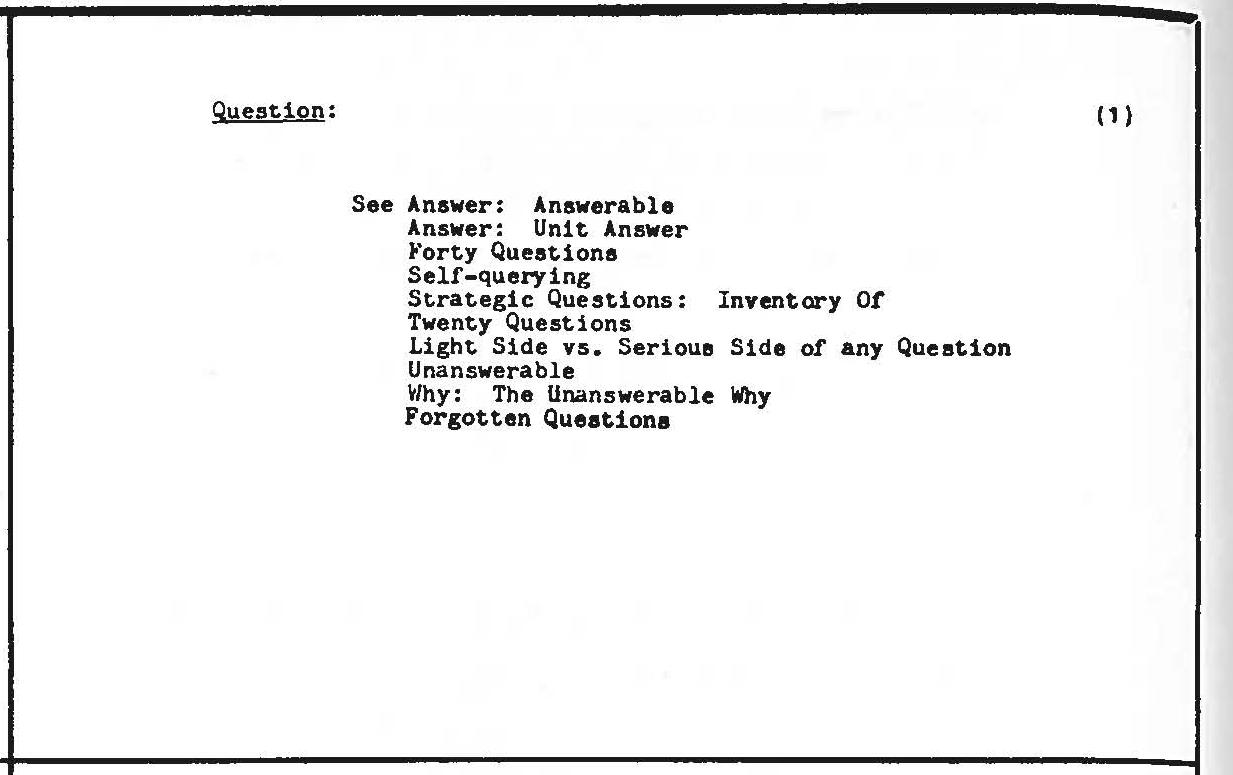
Answer: Unit Answer
Strategic Questions: Inventory Of
Cross-References
- Answerable
- Forty Questions
- Self-querying
- Twenty Questions
- Light Side vs. Serious Side of any Question
- Unanswerable
- Why: The Unanswerable Why
- Forgotten Questions
Question Questions (2)
← Question (1) | Question (3) →
Cross Reference
Cross-References
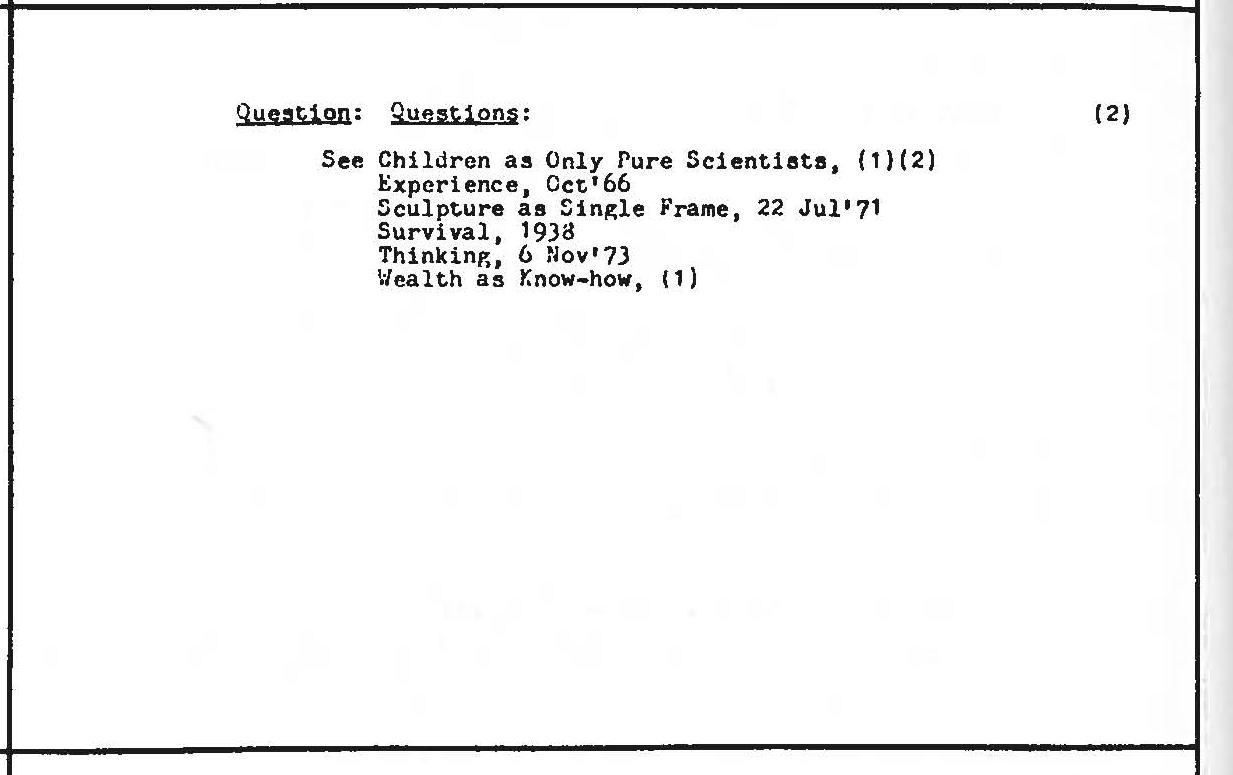
- Children as Only Pure Scientists, (1)(2)
- Experience, Oct'66
- Sculpture as Single Frame, 22 Jul'71
- Survival, 1938
- Thinking, 6 Nov'73
- Wealth as Know-how, (1)
Question (3)
← Question Questions (2) | Quick and the Dead →
Cross Reference
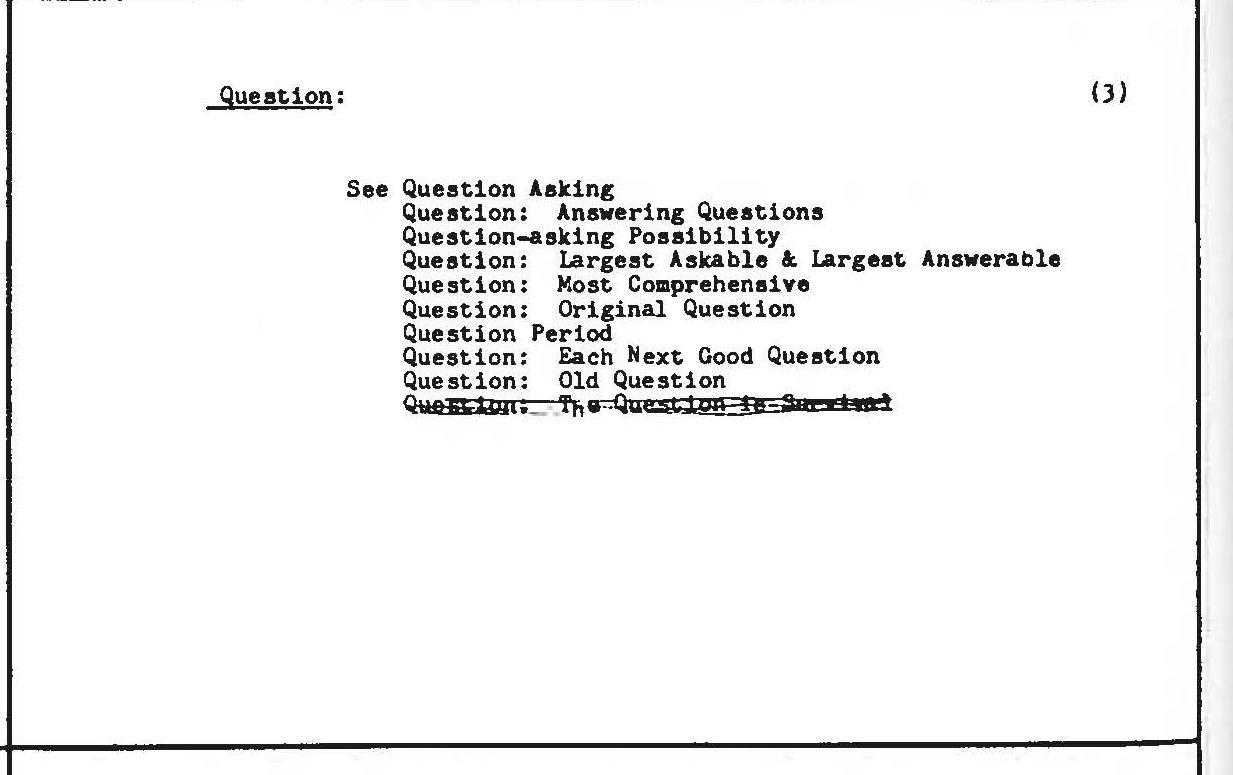
Question: Answering Questions
Question: Largest Askable & Largest Answerable
Question: Old Question
Question: The Question is Suspect
Cross-References
- Question Asking
- Question-asking Possibility
- Question: Most Comprehensive
- Question: Original Question
- Question Period
- Question: Each Next Good Question
Quick and the Dead
← Question (3) | Quick & the Dead (1) →
Index Entry
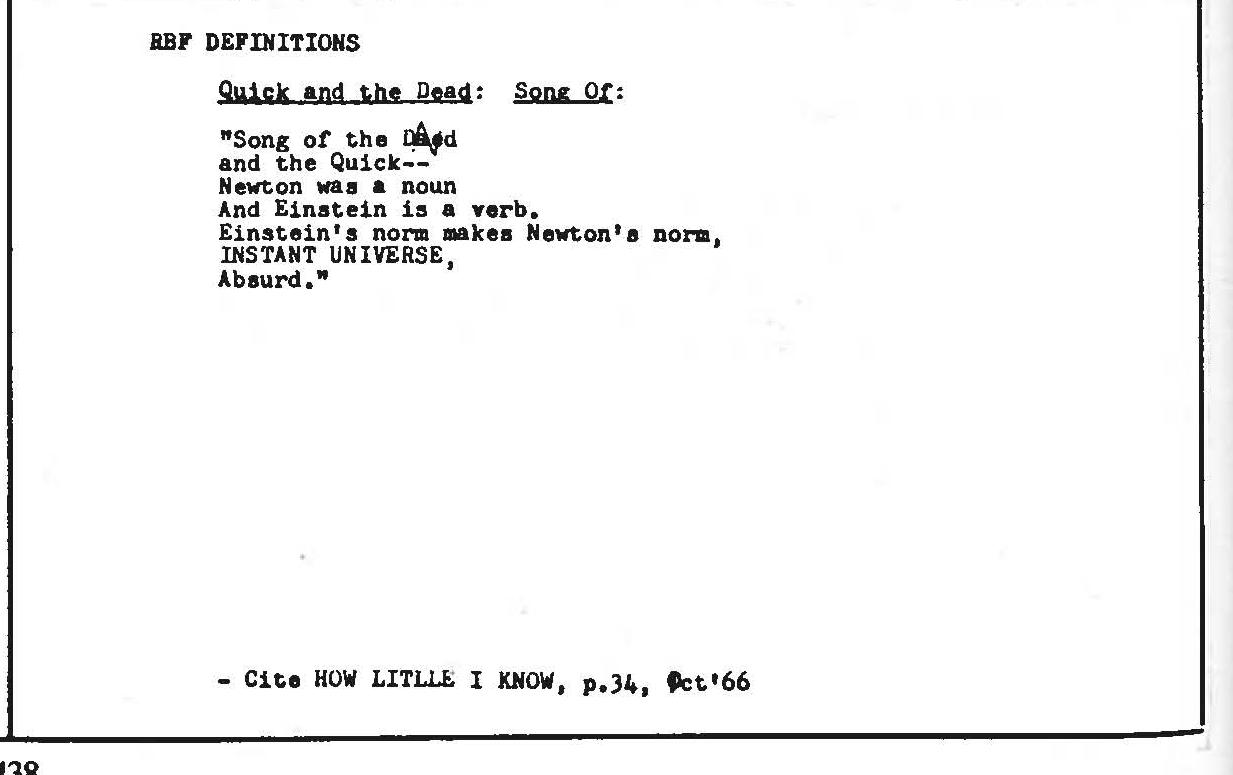
"Song of the Dead and the Quick--
Newton was a noun
And Einstein is a verb.
Einstein's norm makes Newton's norm,
INSTANT UNIVERSE,
Absurd."
- Cite HOW LITTLE I KNOW, p.34, Oct'66
Quick & the Dead (1)
← Quick and the Dead | Quick & the Dead (2) →
Cross Reference
Cross-References
Quick & the Dead (2)
← Quick & the Dead (1) | Quick Death →
Cross Reference
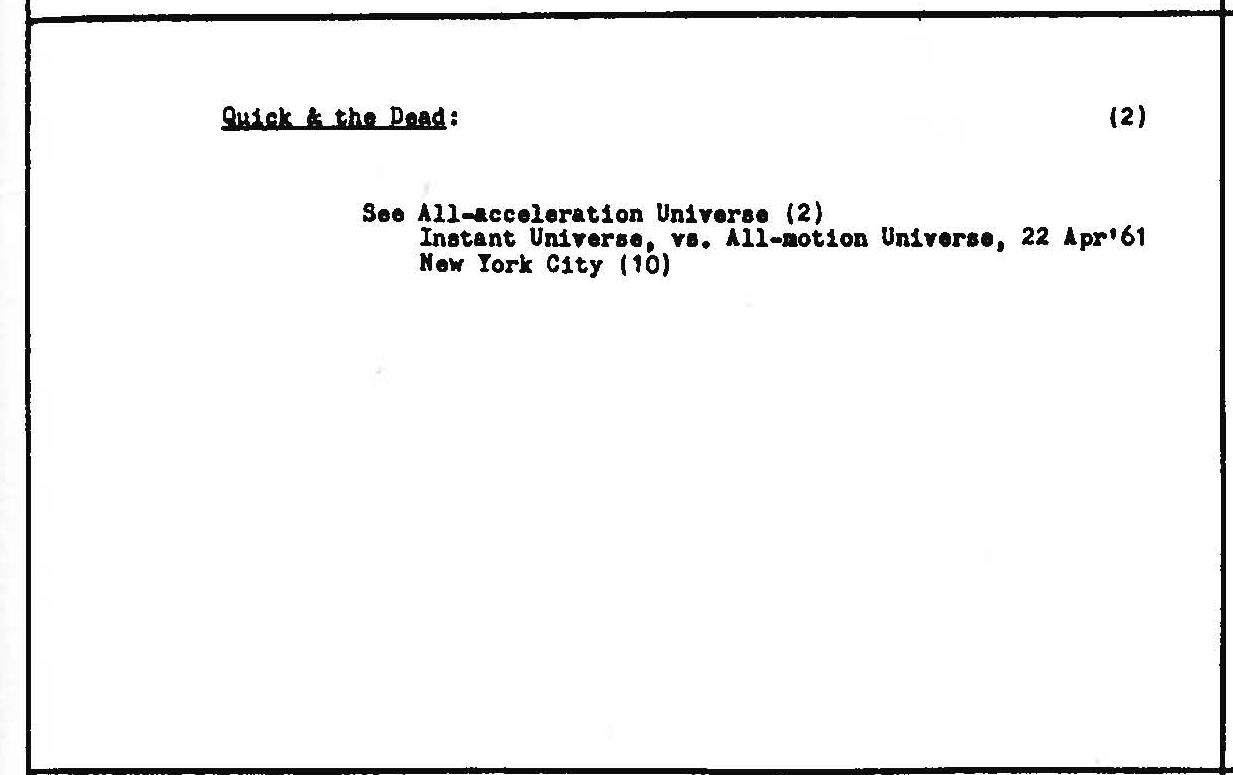
New York City (10)
Instant Universe, vs. All-motion Universe, 22 Apr'61
Cross-References
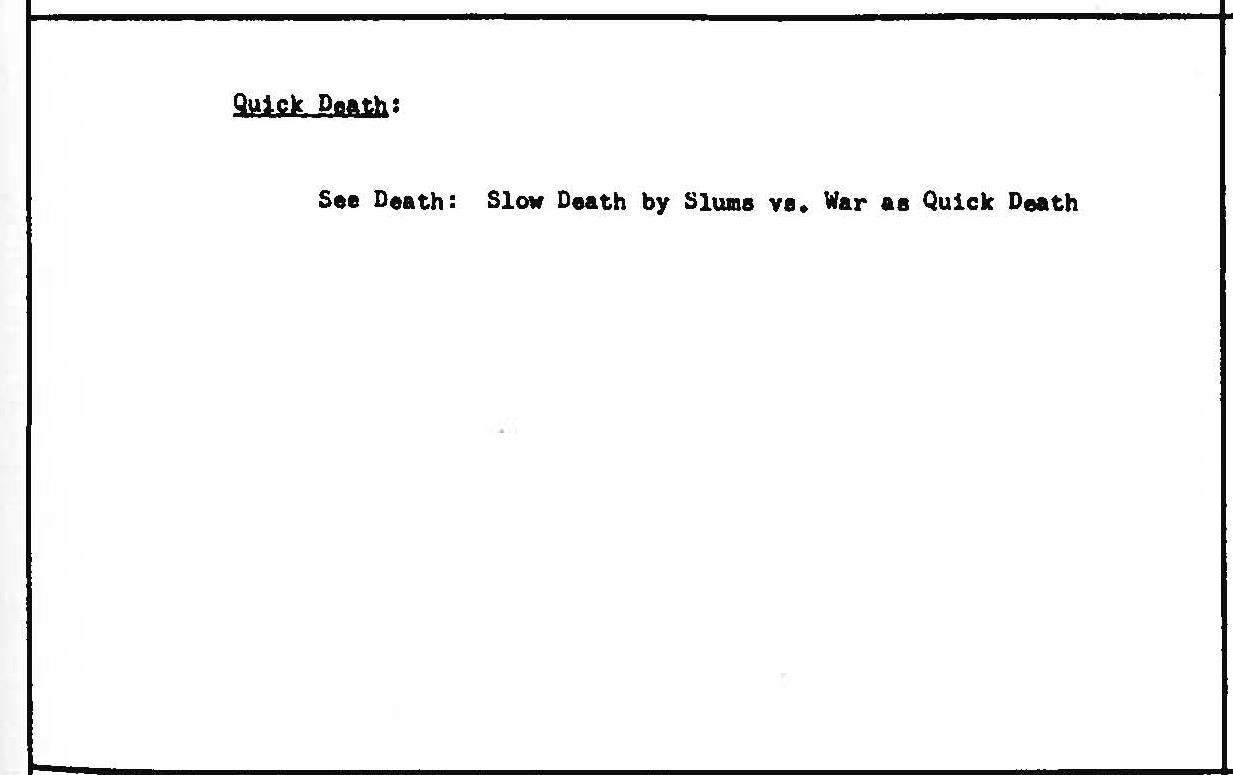
Quick Death
← Quick & the Dead (2) | Quick Quickness (1) →
Cross Reference
Cross-References
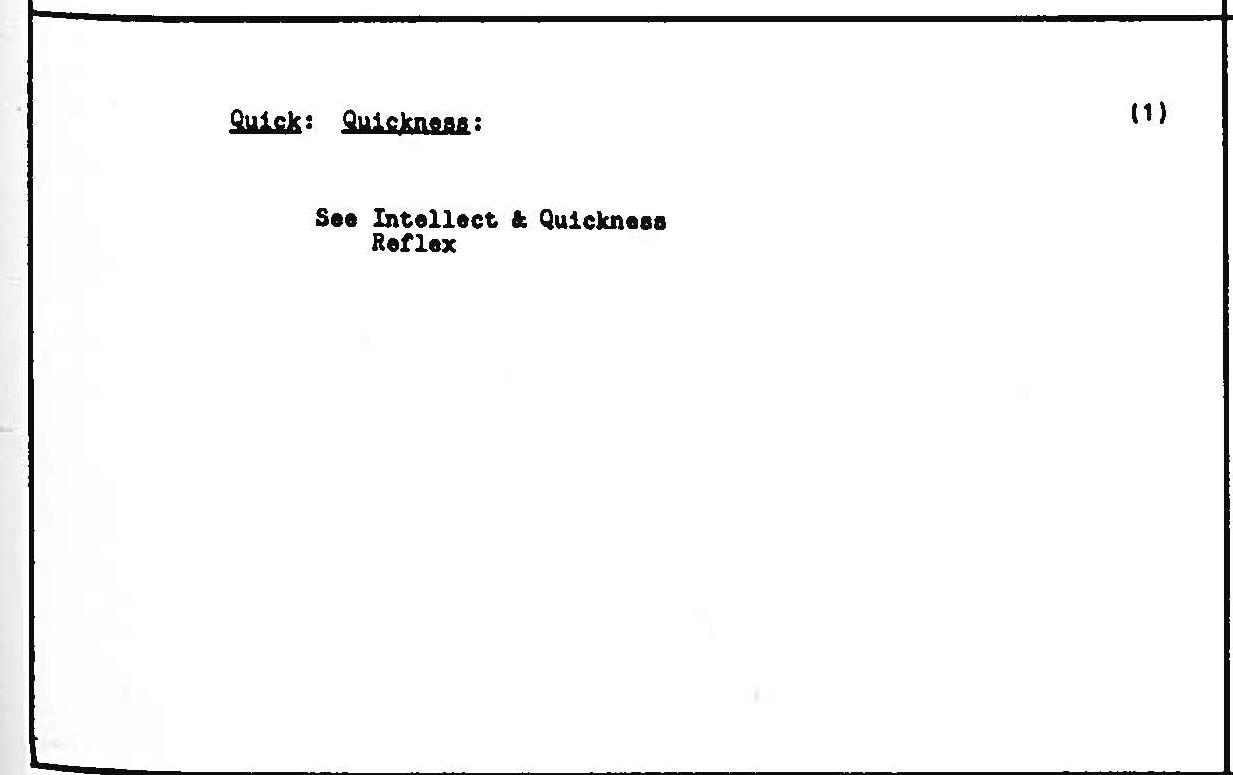
Quick Quickness (1)
Cross Reference
Reflex
Cross-References
Quick (2)
Cross Reference
Quick: Quickness:
Cross-References
- Locomotion, 1 Apr'49 (2)