
Synergetics Dictionary — R
860 cards
R
Letter Group Divider

Race
Index Entry
There is no race other than the human race.
Those who look superficially different
Are the consequence only
Of millenniums of isolation, attrition inbreeding
And inbreeding of the survival types
Under unique environmental conditions.
If, in fact, there were different races
No political contriving
Could close the psychological gap.
But in fact
There is only one race.
- Cite EVOLUTIONARY 1972-1975 SPACE VEHICLE Earth, Jan. '72, p.14
Race (1)
Index Entry
Race:
"University stir-ups, also greatly heightened by the cold-war-stimulated awareness of a century of nonfulfilment of the U.S.A. war for the emancipation of Blacks, and the economic and cultural bans which prolong the racist discriminations against nonwhites... with Blacks skillfully persuaded into activism...
"I well remember the sense of exultant camaraderie which I experienced in 1907 when entering 'Upper School' at Milton Academy. I discovered that the big boys were derisively displeased with the headmaster and, in learning that he was to resign, went into a townwide riot of joy. How I whooped and danced and ran with the others, knowing absolutely nothing of the merits or demerits of the case against the maligned and dishonored 'Head.' This gives me insights into the mass actions of today's students.
"The latter have much more cause for fundamental skepticism, scorn, displeasure, and action against the establishment in general because their elders are asleep at the switch of history's express trains, and because the so-called educational system is failing to give them powerful insights about what"
Race (2)
Index Entry
Race:
"they need to know and do regarding their elders' dereliction.
"There is no social class distinction, no genetic difference: only history-long brain damaging by undernourishment between conception and one-year old. There is no race differentiation, only a bleach-out of hibernating skin-covered, sub-freezing dwelling zones: Swarthy pink; Sailor mew; Crossbreed-- and go into the north to remain as Eskimos. Finns and Scandinavian blondes-- millenniums of tribally inbred long arctic night hibernators. Man, born naked prior to invention of clothes, stayed in temperate zones where his nakedness was tolerable; but going from Polynesia westward across the Indian Ocean into arid Africa, he became greatly blackened on his topsides, but his hands and feet bottoms and fingernail-shielded skin stayed 'white man's' pale pink. White's are bleached out colored people who are the normal people. The undernourished cereal-roots- nuts- and bread-eating poor, constituting 99.9 percent of history-long humanity, thought to be not only illiterate, but incapable of becoming literate, due to an assumed innate 'dumbness' of the masses. Nobility was assumed, by self and commoners, to be a kind of god-contrived, different genetic breed; ergo it was required that the king's sons, daughters,"
Race (3)
Index Entry
Race:
"nephews, and nieces marry only sons and daughters of royal or noble stock, whether they be friend or foe.
"Karl Marx assumed the scientific validity of both Malthus and Darwin with their combined 'fundamental inadequacy of popular life support' and 'survival only of the fittest.' He assumed that the working masses were the fittest because, though dumb, they instinctively understood how to cultivate agriculture, husband animals, and work the craft tools. Wherefore the great pirates, the nobility, and the bourgeoisie who serviced the nobility, were parasites and must perish. Marx also assumed that the genetic difference between the nobility and the masses was valid; ergo his fundamental class warfare inherent in the economic inadequacy to support both. He also assumed the necessity of downgrading standards in order to stretch support systems to serve all; and he assumed minority-party rule by dogmatic adherence to nonindividualistic code, and annihilation of the treacherous 'other class.'
"For only the last ten years of human history, since 1960, have we known beyond scientific doubt that the 'mass dumbness'

Race
← Race (3) | Race with Evolution →
RBF Definitions
"was not genetic, but the consequence of undernourishment: i.e., the non-chemically-interbalanced and chemically deficient diet during gestation or the first year of post-wombland life, which resulted from the meat-eating nobility's monopoly. of the animal flesh resources and the animals' multi-herb diet."
Citations
- Fragment on RACE, 7 Aug'70
Race with Evolution
Cross Reference
Race with Evolution:
Cross-References
- Synergetics, 21 Jun'71
Race
← Race with Evolution | Racing →
Cross Reference
Race:
Cross-References
- Crossbreeding World Man
- No Race: No Class
- World Man
- Nation
- Ethnic

Racing
Cross Reference
Cross-References
- Sailboats, Aug'72

Radar Reflector
← Racing | Radar: Radarscope →
Cross Reference
Cross-References
- ahedron, Oct
Radar: Radarscope
Cross Reference
See Twenty-foot Earth Globe & 200-foot Celestial Sphere, (1)
Cross-References
- Twenty-foot Earth Globe \& 200-foot Celestial Sphere, (1)
- Lasso, 1946
- ahedron: Eighth-octahedra, Oct (2)
Radial
← Radar: Radarscope | Radial-circumferential →
Index Entry
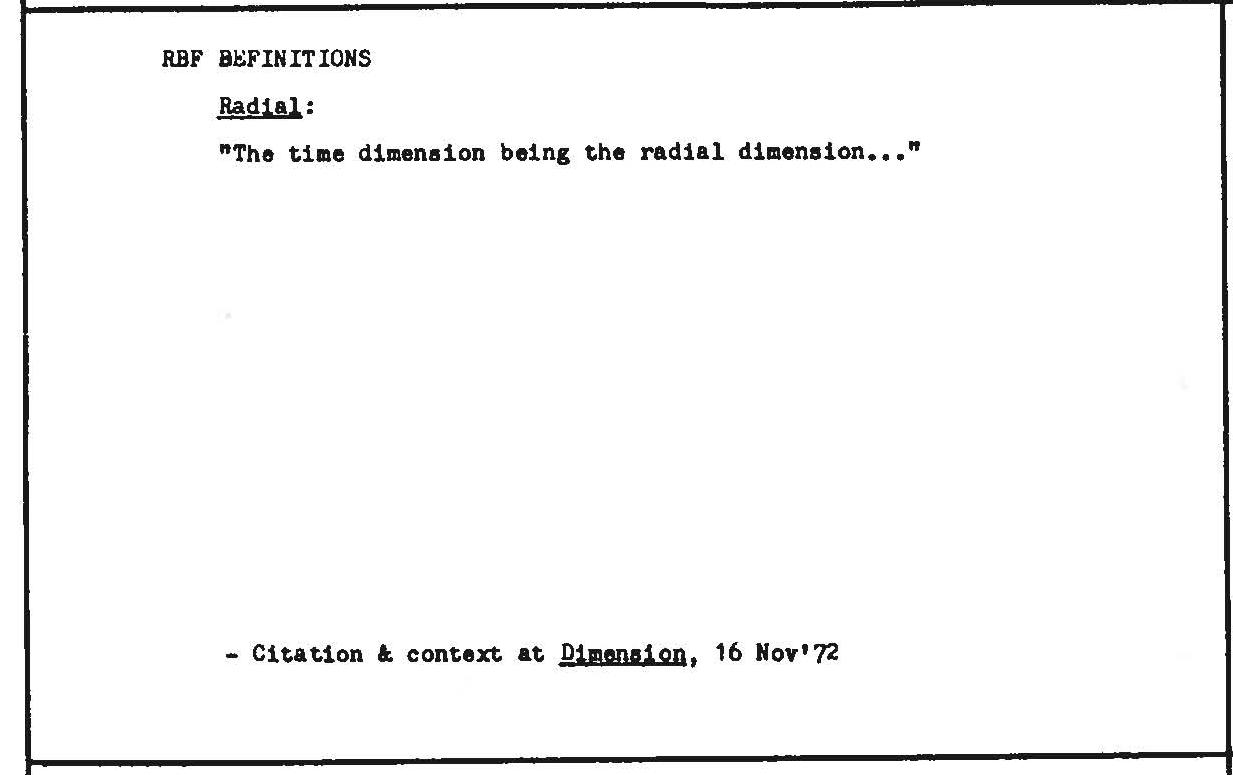
Radial:
"The time dimension being the radial dimension..."
Radial-circumferential
← Radial | Radial-Circumferential →
Index Entry
Radial-circumferential:
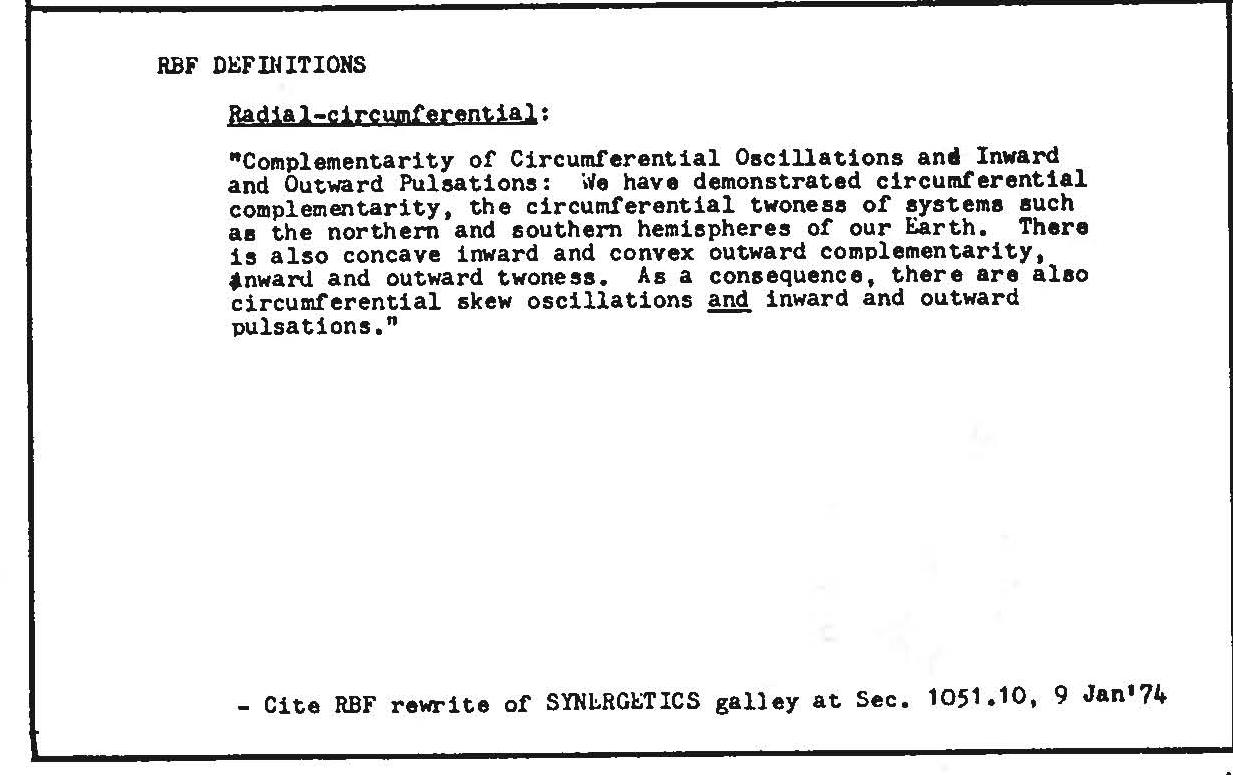
"Complementarity of Circumferential Oscillations and Inward and Outward Pulsations: We have demonstrated circumferential complementarity, the circumferential twoness of systems such as the northern and southern hemispheres of our Earth. There is also concave inward and convex outward complementarity, inward and outward twoness. As a consequence, there are also circumferential skew oscillations and inward and outward pulsations."
- Cite RBF rewrite of SYNERGETICS galley at Sec. \hrefhttps://www.buckyverse.org/en/synergetics/content/chapters/1000-omnitopology#section-1051.101051.10, 9 Jan'74
Radial-Circumferential
← Radial-circumferential | Radial-Circumferential →
Index Entry
Radial-Circumferential:
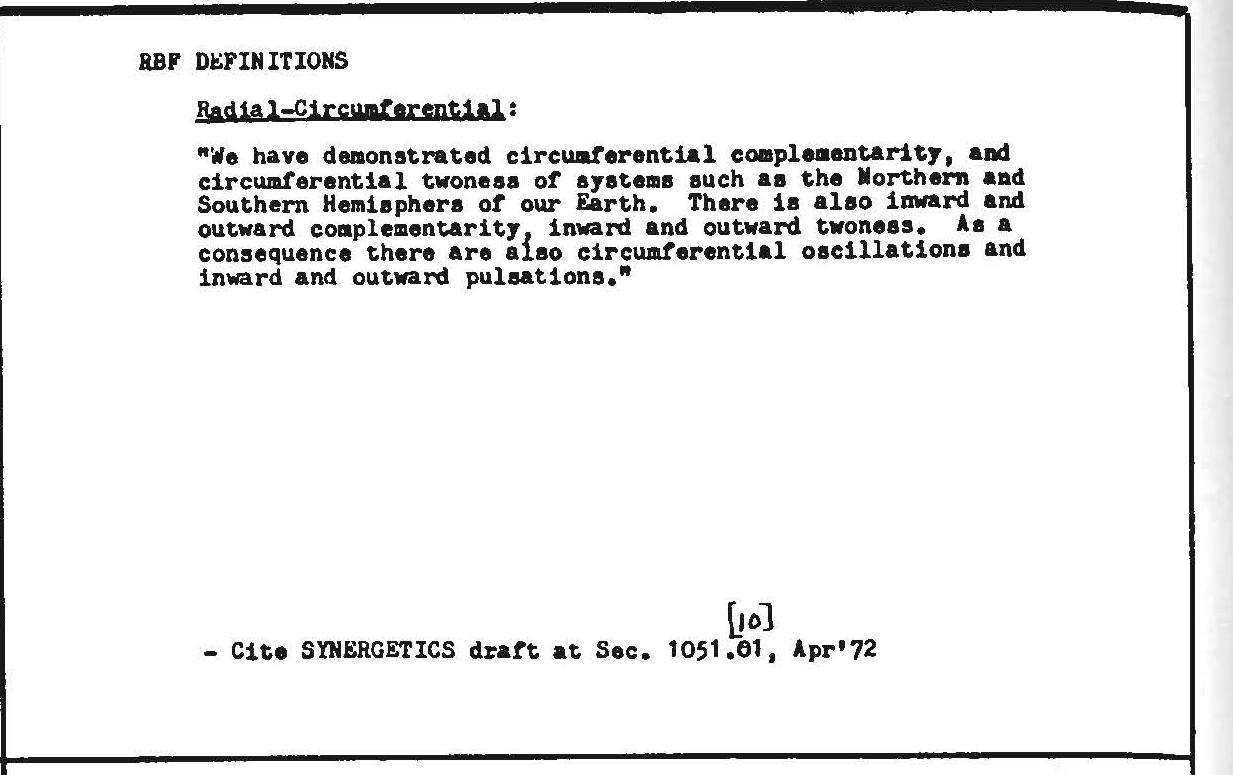
"We have demonstrated circumferential complementarity, and circumferential twoness of systems such as the Northern and Southern Hemispheres of our Earth. There is also inward and outward complementarity, inward and outward twoness. As a consequence there are also circumferential oscillations and inward and outward pulsations."
- Cite SYNERGETICS draft at Sec. \hrefhttps://www.buckyverse.org/en/synergetics/content/chapters/1000-omnitopology#section-1051.011051.01, Apr'72
Radial-Circumferential
← Radial-Circumferential | Radial-Circumferential →
Index Entry
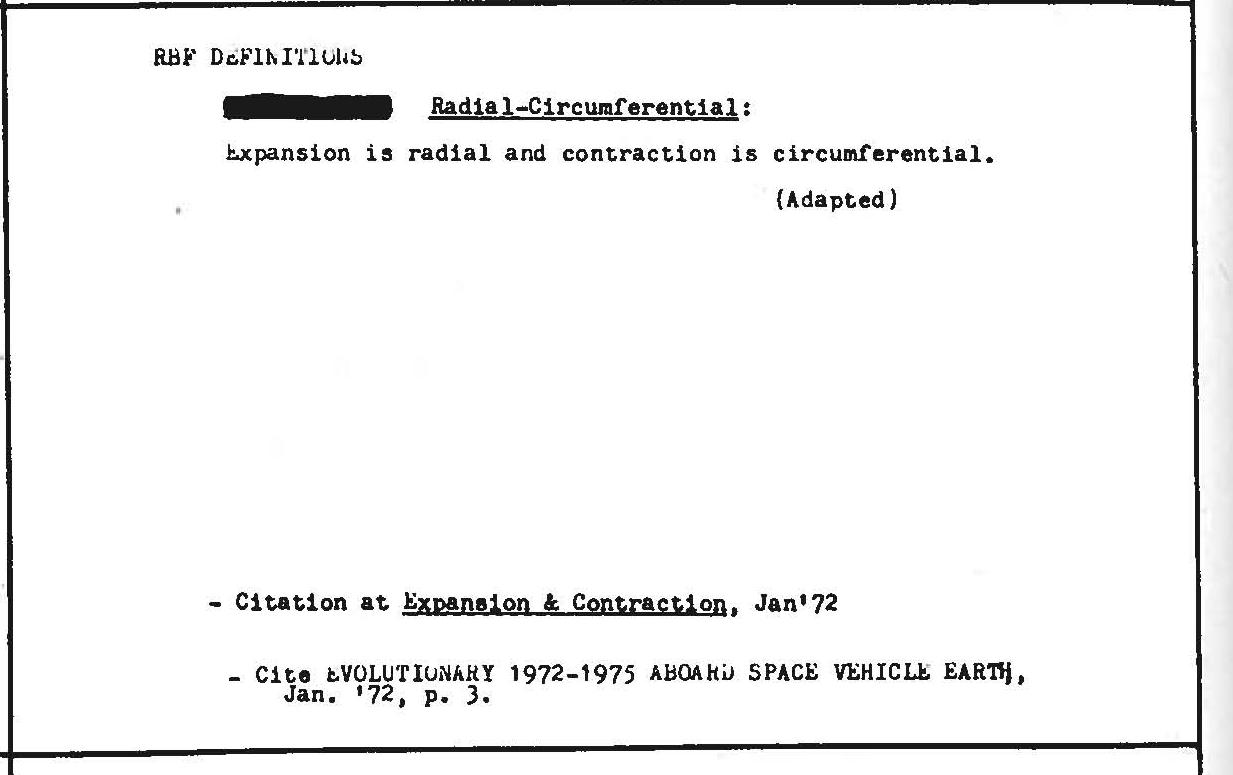
Expansion is radial and contraction is circumferential.
(Adapted)
-
Citation at Expansion & Contraction, Jan'72
-
Cite EVOLUTIONARY 1972-1975 ABOARD SPACE VEHICLE EARTH, Jan. '72, p. 3.
Radial-Circumferential
← Radial-Circumferential | Radial-circumferential →
Index Entry
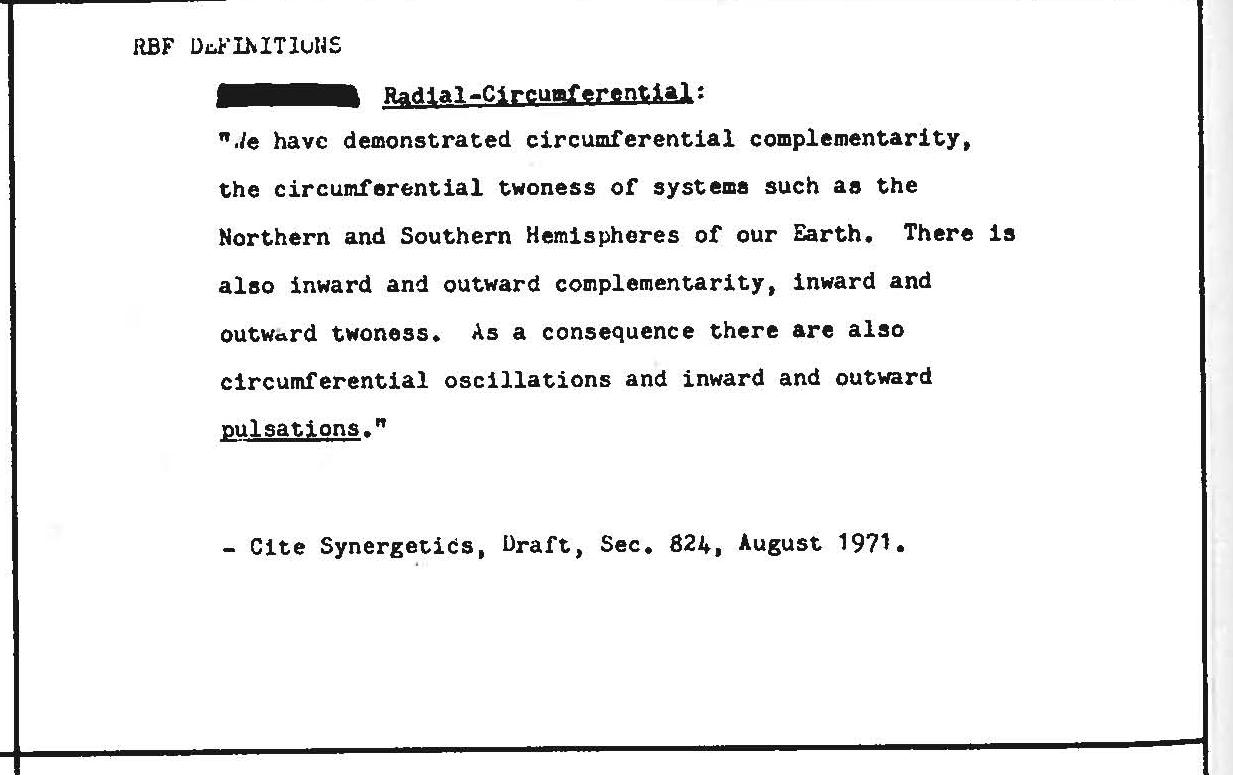
We have demonstrated circumferential complementarity, the circumferential twoness of systems such as the Northern and Southern Hemispheres of our Earth. There is also inward and outward complementarity, inward and outward twoness. As a consequence there are also circumferential oscillations and inward and outward pulsations.
Radial-circumferential
← Radial-Circumferential | Radial-circumferential Accelerations →
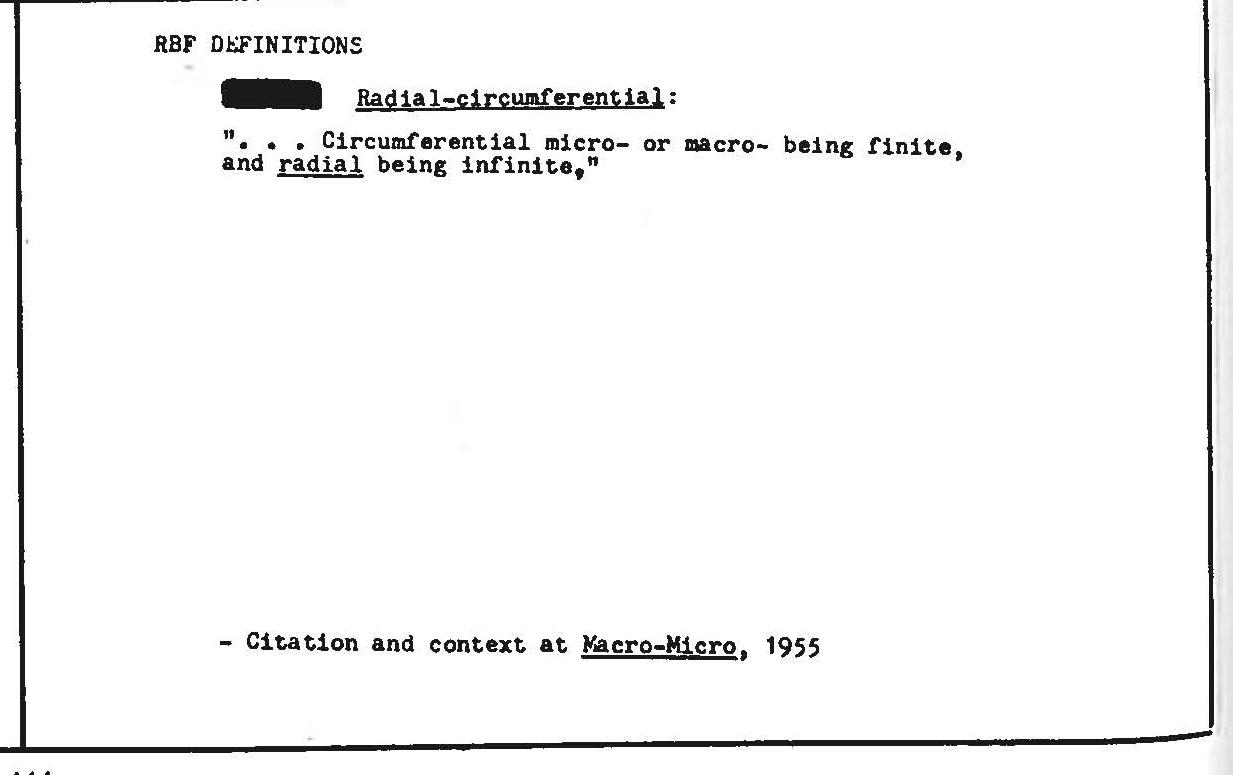
RBF Definitions
"... Circumferential micro- or macro- being finite, and radial being infinite,"
- Citation and context at Macro-Micro, 1955
Radial-circumferential Accelerations
← Radial-circumferential | Radial-Circumferential Coordination →
Cross Reference
Cross-References
- Gravitational System Zone, 14 Jan'55
Radial-Circumferential Coordination
← Radial-circumferential Accelerations | Radial-circumferential Coordination →
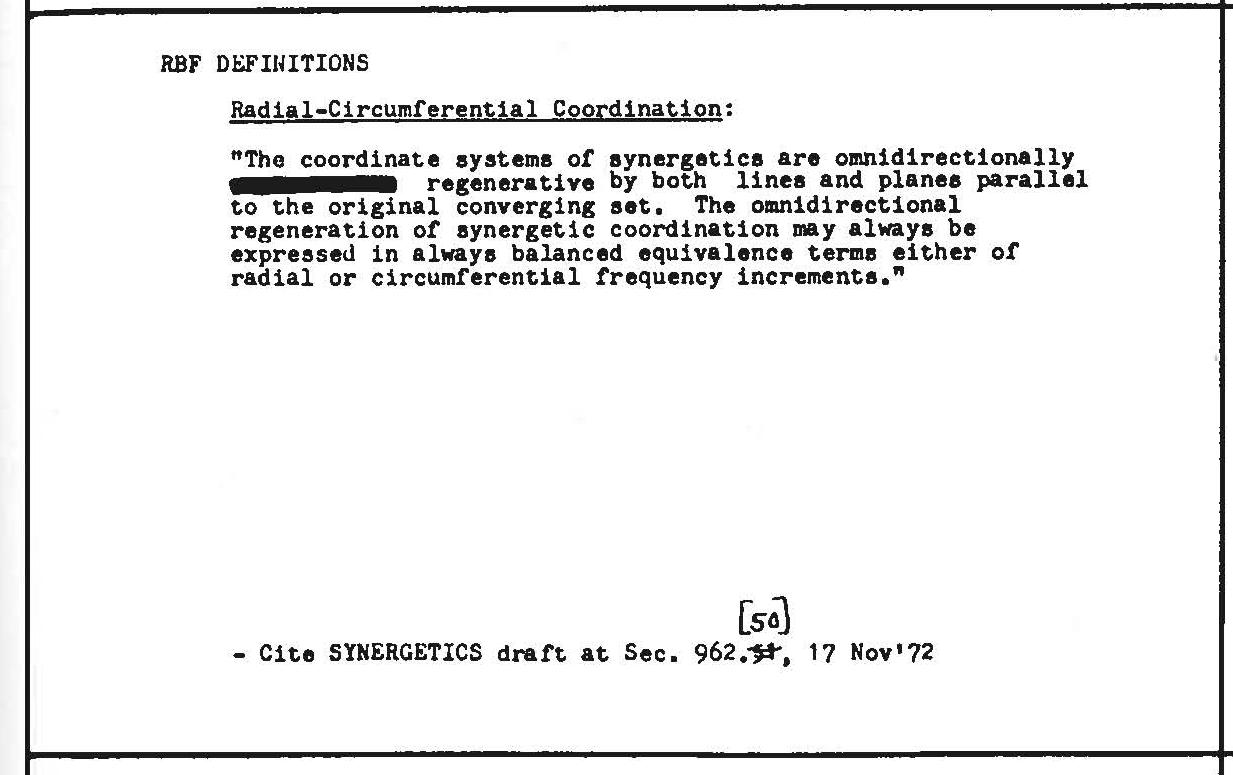
RBF Definitions
"The coordinate systems of synergetics are omnidirectionally regenerative by both lines and planes parallel to the original converging set. The omnidirectional regeneration of synergetic coordination may always be expressed in always balanced equivalence terms either of radial or circumferential frequency increments."
Citations
- SYNERGETICS draft at Sec. \href{https://www.buckyverse.org/en/synergetics/content/chapters/900-modelability#section-962.24}{962.24}, 17 Nov'72
Radial-circumferential Coordination
← Radial-Circumferential Coordination | Radial-Circumferential Modularity →
Cross Reference
Cross-References
- Analytical Geometry, 7 Oct'71
- Life & Death, 26 Jan'76
Radial-Circumferential Modularity
← Radial-circumferential Coordination | Radial-Circumferential Modularity →
Index Entry
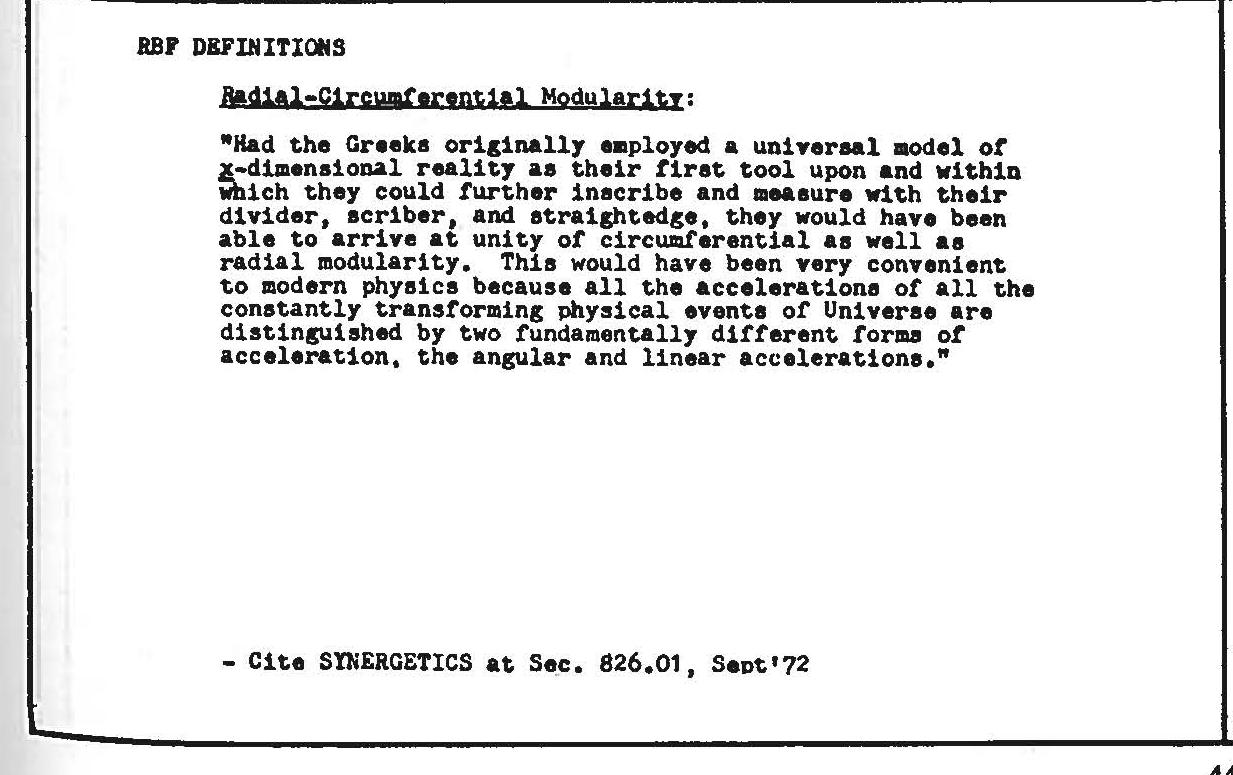
Had the Greeks originally employed a universal model of x-dimensional reality as their first tool upon and within which they could further inscribe and measure with their divider, scriber, and straightedge, they would have been able to arrive at unity of circumferential as well as radial modularity. This would have been very convenient to modern physics because all the accelerations of all the constantly transforming physical events of Universe are distinguished by two fundamentally different forms of acceleration, the angular and linear accelerations.
Radial-Circumferential Modularity
← Radial-Circumferential Modularity | Radial-Circumferential Modular Growth →
Index Entry
Radial-Circumferential Modularity:
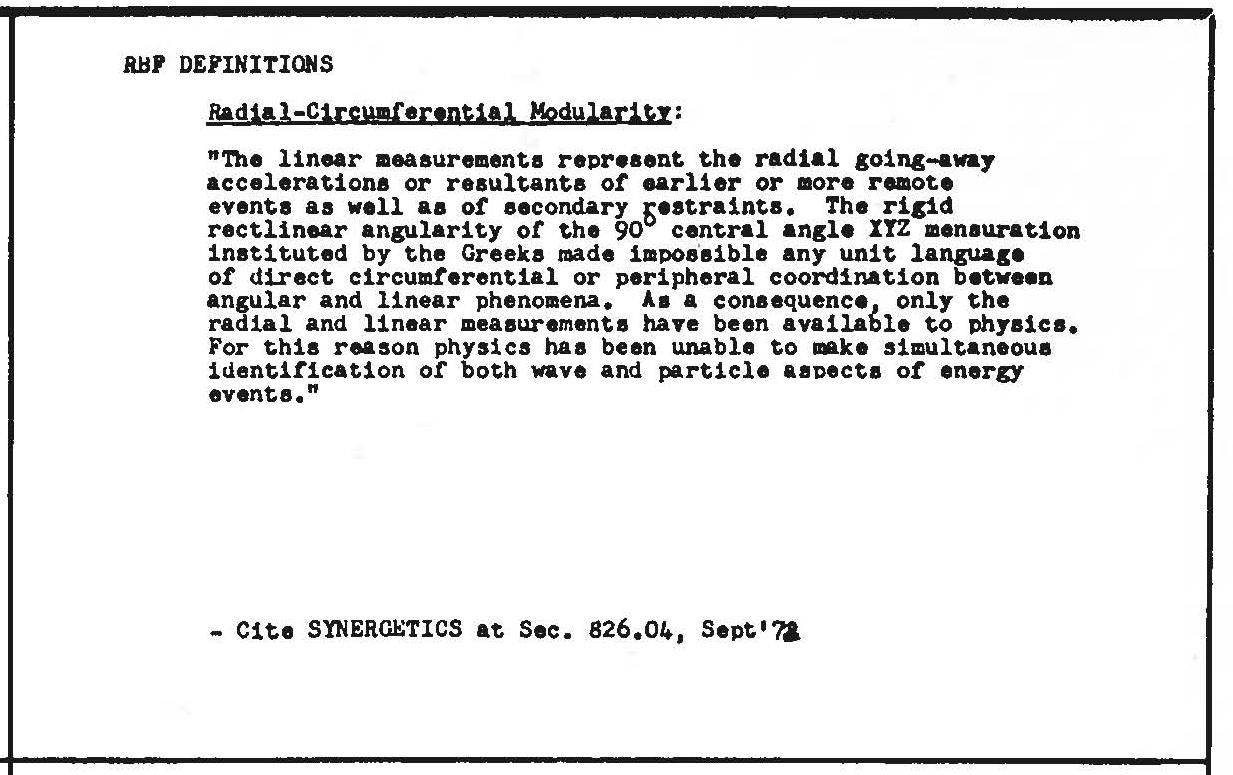
"The linear measurements represent the radial going-away accelerations or resultants of earlier or more remote events as well as of secondary restraints. The rigid rectilinear angularity of the 90° central angle XYZ mensuration instituted by the Greeks made impossible any unit language of direct circumferential or peripheral coordination between angular and linear phenomena. As a consequence, only the radial and linear measurements have been available to physics. For this reason physics has been unable to make simultaneous identification of both wave and particle aspects of energy events."
- Cite SYNERGETICS at Sec. \hrefhttps://www.buckyverse.org/en/synergetics/content/chapters/800-operational-mathematics#section-826.04826.04, Sept'72
Radial-Circumferential Modular Growth
← Radial-Circumferential Modularity | Radial-circumferential Modular Growth (1) →
Index Entry
Radial-Circumferential Modular Growth:
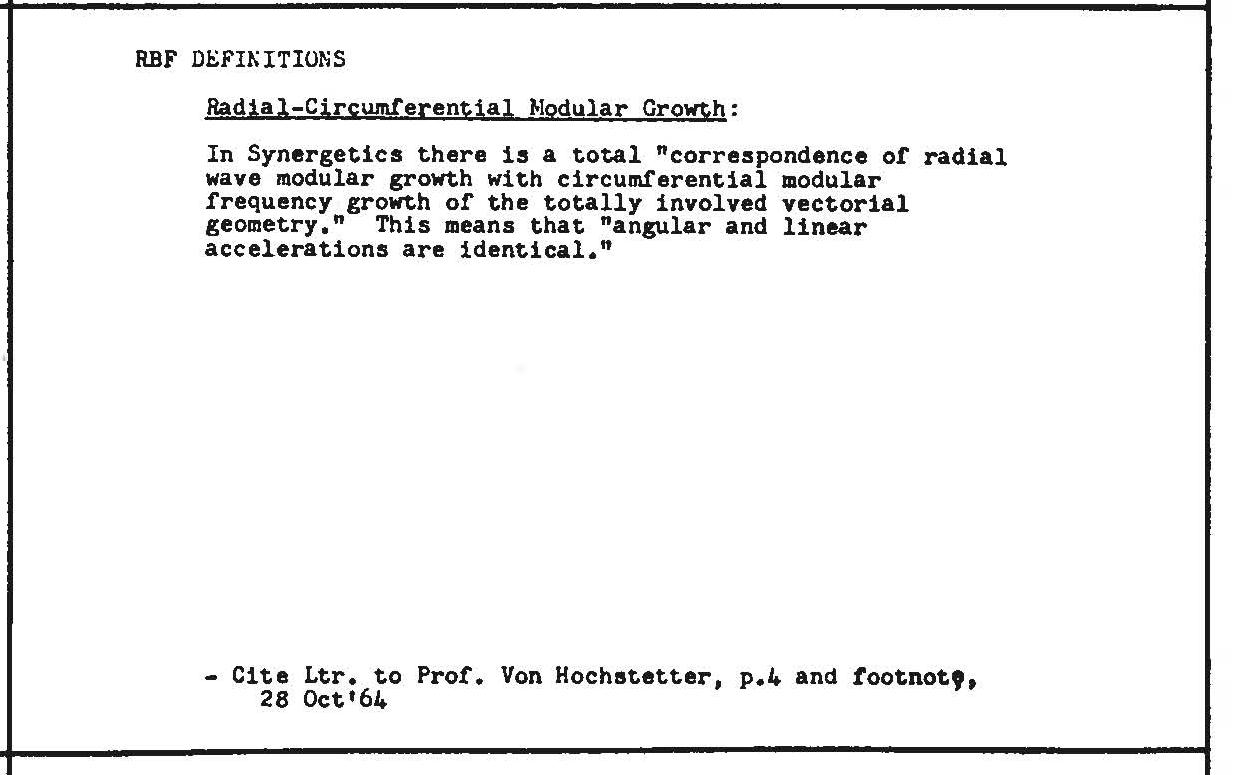
In Synergetics there is a total "correspondence of radial wave modular growth with circumferential modular frequency growth of the totally involved vectorial geometry." This means that "angular and linear accelerations are identical."
Radial-circumferential Modular Growth (1)
← Radial-Circumferential Modular Growth | Radial-circumferential Modular Growth (2) →
Cross Reference
Cross-References
Radial-circumferential Modular Growth (2)
← Radial-circumferential Modular Growth (1) | Radial-circumferential (1) →
Cross Reference
Cross-References
- Frequency, Jun'71
Radial-circumferential (1)
← Radial-circumferential Modular Growth (2) | Radial-circumferential (2A) →
Cross Reference
Spherical Barrel: Radial Compression vs.
Circumferential Tension
Inward & Outwardness
Radial & Orbital
Cross-References
- Boundary Layer
- Circumferential Finite vs. Radial Infinite
- In, Out & Around
- Nuclear & Nebular Zonal Waves
- Spherical Barrel: Radial Compression vs. Circumferential Tension
- Spherical Field
- Inwardness vs. Omnidirectional
- Frequency & Wave
Radial-circumferential (2A)
← Radial-circumferential (1) | Radial-circumferential (2B) →
Cross Reference
Cross-References
- Acceleration: Angular & Linear, 18 Oct'64
- Cosmic Discontinuity & Local Continuity, 15 Jan'74
- Electric Motor, 25 Jan'72
- Expansion & Contraction, Jan'72*
- Fourth Dimension, 1965
- Frequency, 15 Oct'72
- Gears: Spherical Gears, May'72
- Gravity, 18 Oct'72
- Integrity of Universe, 23 Sep'73; 30 Oct'73
- Jitterbug, 11 Oct'71
- Macro-micro, 1955
- Powering: Second Powering, 28 Oct'73
- Scenario Universe, Jan'72
- Shunting: Relative Motion Patterns, 1955
- Sixty Degreeness, 18 Jun'71
- Synergetics, 14 May'73; 14 Jan'55
Radial-circumferential (2B)
← Radial-circumferential (2A) | Radial Compression vs. Circumferential Tension →
Cross Reference
Cross-References
- Tension & Compression, 1944
- Vector Equilibrium, 4 Nov'73
- Zoneness: System Zoneness, 8 Jan'55
- Peripheral, Sep'72
- Vertexial Topology, Aug'71
- Evaginating, 22 Jun'75
- Gravity: Speed Of, 21 Oct'72
Radial Compression vs. Circumferential Tension
← Radial-circumferential (2B) | Radial Depth →
Cross Reference
Cross-References
Radial Depth
← Radial Compression vs. Circumferential Tension | Radial Depth (1) →
Index Entry
Radial Depth:
"Operationally omnitriangulated polyhedra may only be realized systematically, i.e., with special case dimensionality or special case radial depth of insideness. Dimensionality = radial depth = frequency. Radial depth is expressed in frequency of omnidirectional wave propagations per unit of time."
- Cite SYNERGETICS, 2nd. Ed., at Sec. \hrefhttps://www.buckyverse.org/en/synergetics/content/chapters/1000-omnitopology#section-1071.231071.23, 20 Dec'74
Radial Depth (1)
← Radial Depth | Radial Depth (2) →
Cross Reference
Cross-References
- Dimensionality = Radial Depth = Frequency
Radial Depth (2)
← Radial Depth (1) | Radial Line →
Cross Reference
Cross-References
- Structure, 26 Dec'74

Radial Line
← Radial Depth (2) | Radial Line as Tetra Edge →
Index Entry
Radial Line:
"The particular line of geometrical reference humans picked
happened not to be the line of most interattractive integrity.
It was neither the radial line of radiation nor the radial line
of gravity of spherical Earth...."
Radial Line as Tetra Edge
← Radial Line | Radial Line as Tetra Edge (1) →
Index Entry
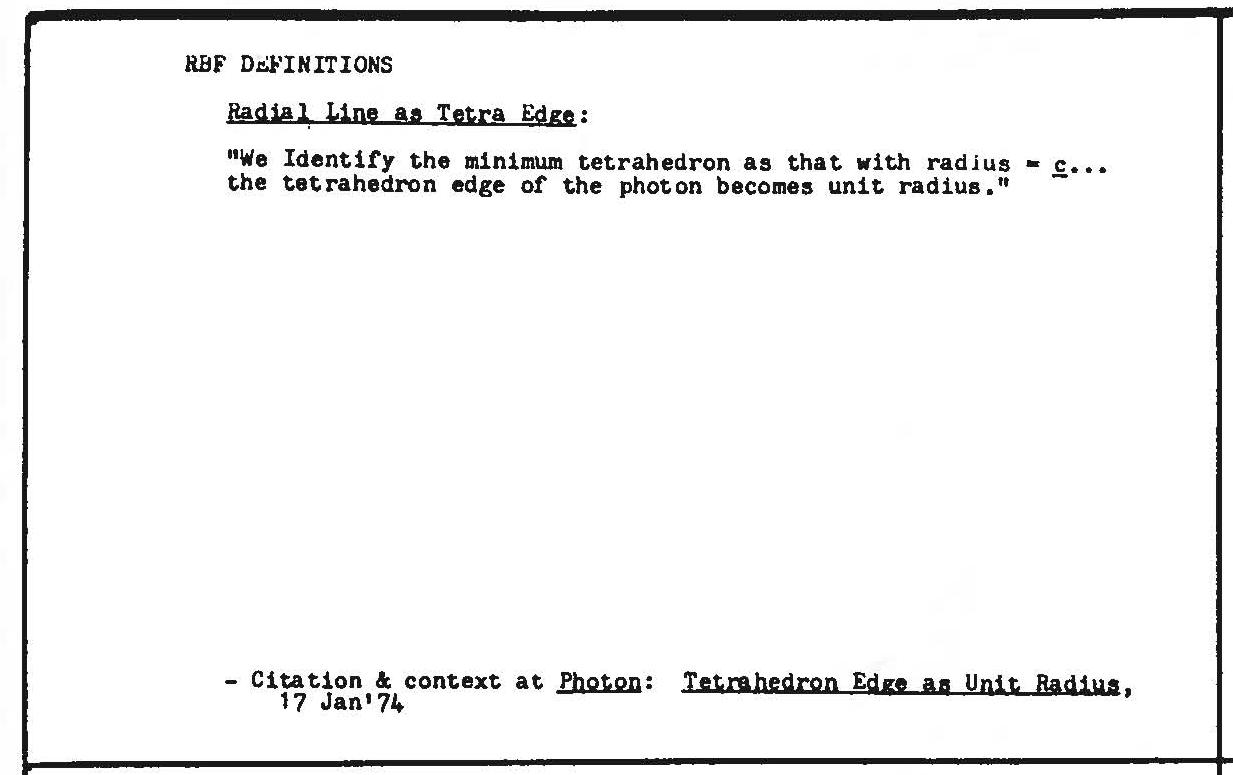
"We Identify the minimum tetrahedron as that with radius = c... the tetrahedron edge of the photon becomes unit radius."
- Citation & context at Photon: Tetrahedron Edge as Unit Radius, 17 Jan'74
Radial Line as Tetra Edge (1)
← Radial Line as Tetra Edge | Radial vs. Orbital (1) →
Cross Reference
Cross-References
Radial vs. Orbital (1)
← Radial Line as Tetra Edge (1) | Radial vs. Orbital (2) →
Cross Reference
Cross-References
- Linear vs. Orbital
- Radial-circumferential
- Embracing vs. Linear
- One Way vs. Round Trip
- Local vs. Comprehensive
- Local Radius vs. Wide Arcs
- Orbital Feedback Circuitry vs. Critical Path
Radial vs. Orbital (2)
← Radial vs. Orbital (1) | Radial Reach (1) →
Cross Reference
Einstein: Special Theory & General Theory, 4 Mar'73
Cross-References
- Frequency, 11 Mar'69
- Umbilical Cord, 4 Mar'73
Radial Reach (1)
← Radial vs. Orbital (2) | Radial Reach (2) →
Cross Reference
Radial Reach:
Cross-References
- Sweepout Reachability Range, (1)
Radial Reach (2)
← Radial Reach (1) | Radial Set →
Cross Reference
Cross-References
- Central Angle, 23 Sep'73
Radial Set
← Radial Reach (2) | Radial Symmetries →
Cross Reference
Cross-References
- Vector Equilibrium, (1)
Radial Symmetries
← Radial Set | Radial Symmetries Radially Symmetric →
Index Entry
Radial Symmetries:
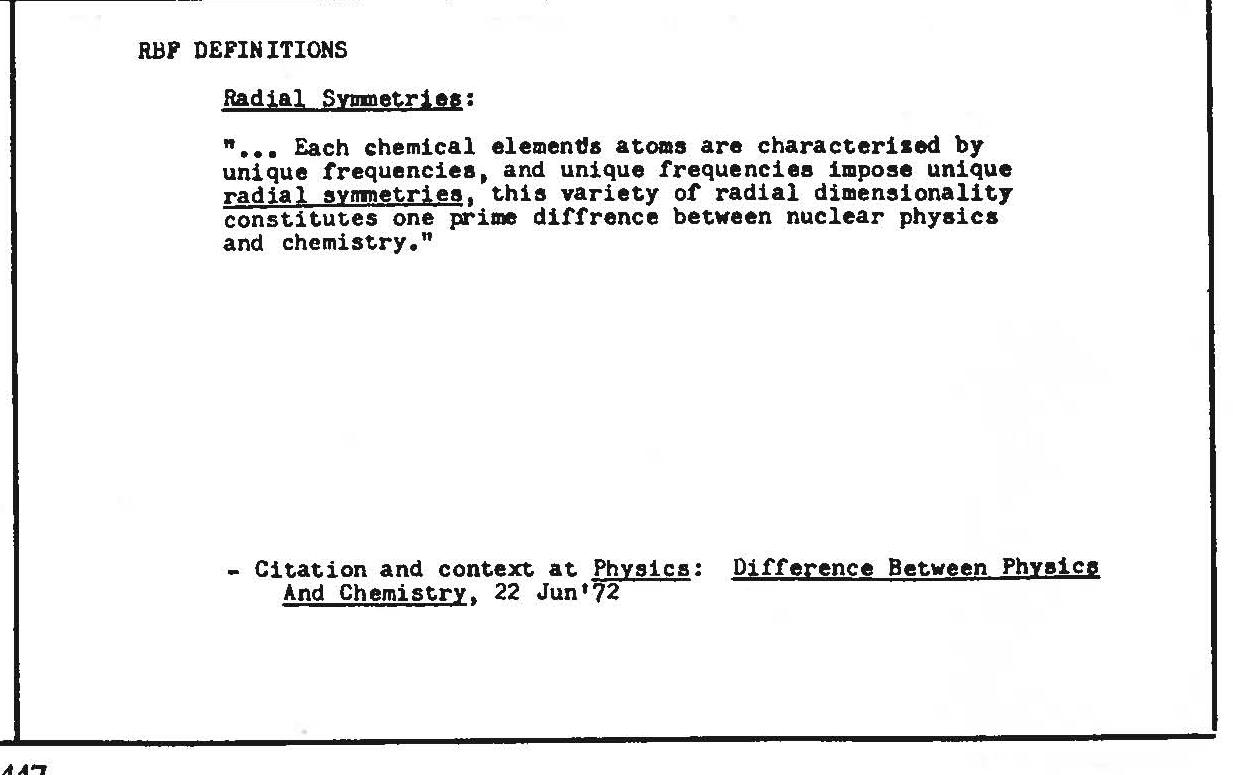
"... Each chemical elements atoms are characterized by unique frequencies, and unique frequencies impose unique radial symmetries, this variety of radial dimensionality constitutes one prime difference between nuclear physics and chemistry."
- Citation and context at Physics: Difference Between Physics And Chemistry, 22 Jun'72
Radial Symmetries Radially Symmetric
← Radial Symmetries | Radial Unity (1) →
Cross Reference
Radial Symmetries: Radially Symmetric:
Cross-References
- Mites Make All Regular Polyhedra, 27 May'72
- Physics & Chemistry: Difference Between, 22 Jun'72*
Radial Unity (1)
← Radial Symmetries Radially Symmetric | Radial Unity (2) →
Cross Reference
Unit Radius: Unit Vector Radius
Cross-References
Radial Unity (2)
← Radial Unity (1) | Radial Wave Modular Growth →
Cross Reference
Cross-References
- Rhombic Dodecahedron, 13 Apr'77
Radial Wave Modular Growth
← Radial Unity (2) | Radial Waves (1) →
Cross Reference
Einstein Equation: E = Mc², 1959
Cross-References
Radial Waves (1)
← Radial Wave Modular Growth | Radial Waves (2) →
Cross Reference
Cross-References

Radial Waves (2)
← Radial Waves (1) | Radial (1) →
Cross Reference
Cross-References
- Gears, May'72

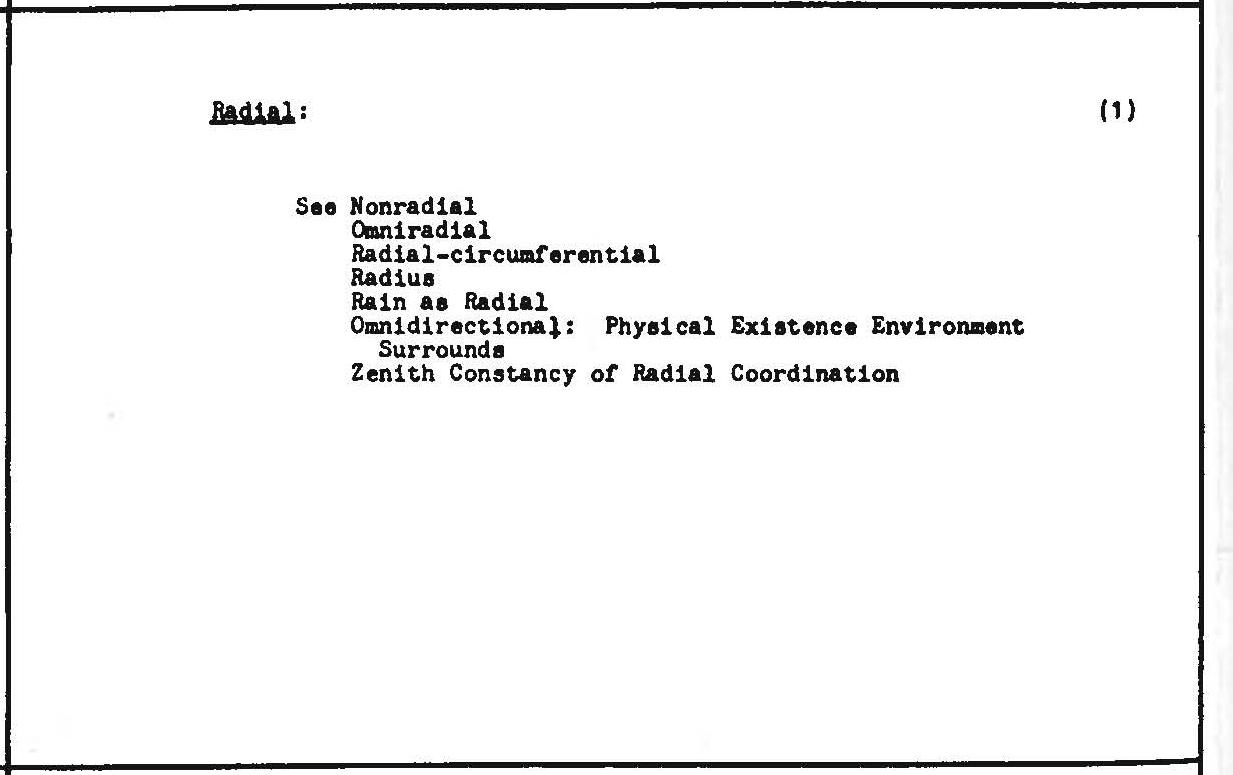
Radial (1)
← Radial Waves (2) | Radial (2) →
Cross Reference
Cross-References
- Nonradial
- Omniradial
- Radial-circumferential
- Radius
- Rain as Radial
- Omnidirectional: Physical Existence Environment Surrounds
- Zenith Constancy of Radial Coordination
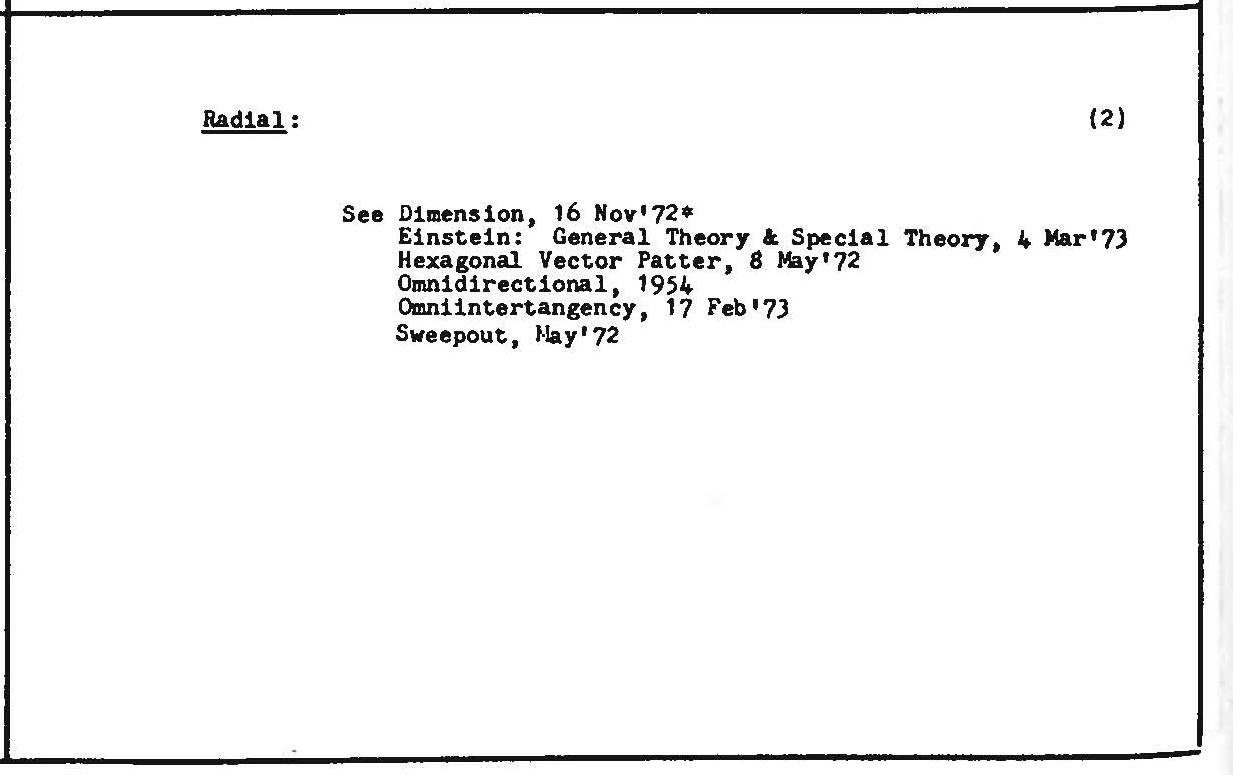
Radial (2)
Cross Reference
Hexagonal Vector Patter, 8 May'72
Omnireintertangency, 17 Feb'73
Cross-References
- Dimension, 16 Nov'72*
- Einstein: General Theory & Special Theory, 4 Mar'73
- Omnidirectional, 1954
- Sweepout, May'72
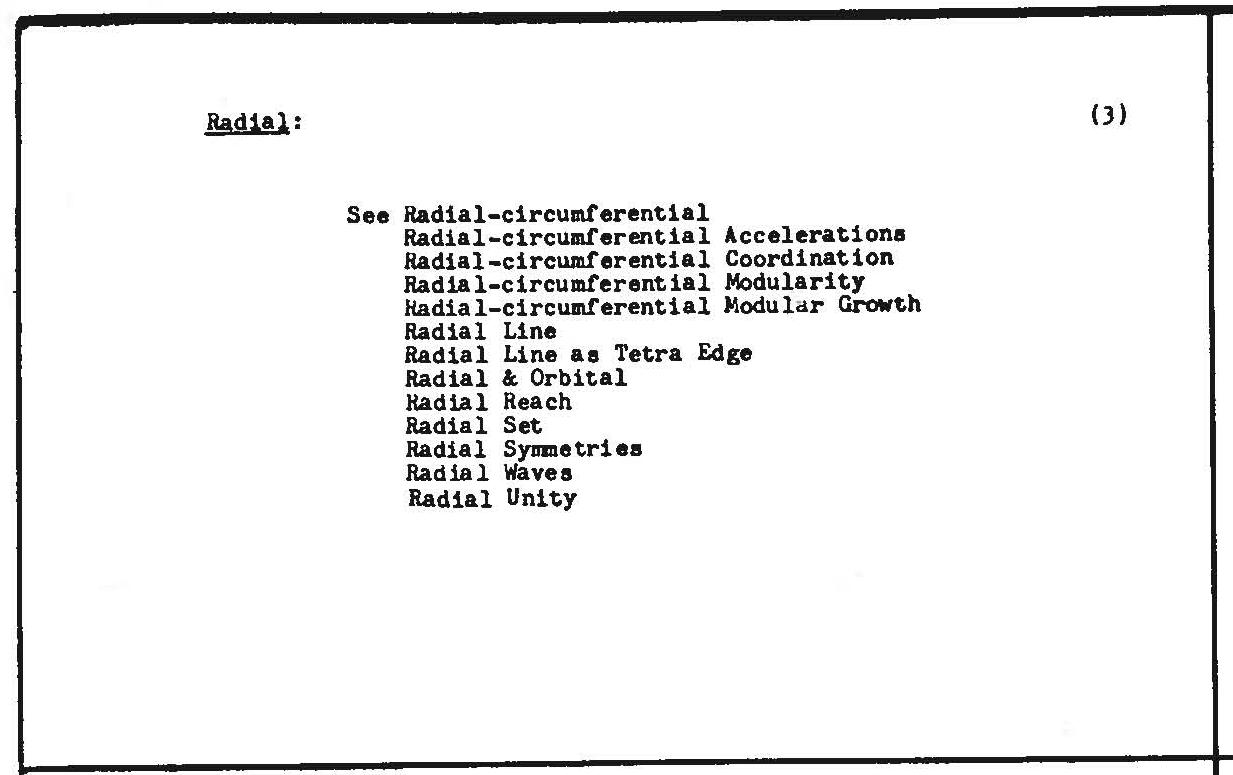
Radial (3)
Cross Reference
Radial & Orbital
Cross-References
- Radial-circumferential
- Radial-circumferential Accelerations
- Radial-circumferential Coordination
- Radial-circumferential Modularity
- Radial-circumferential Modular Growth
- Radial Line
- Radial Line as Tetra Edge
- Radial Reach
- Radial Set
- Radial Symmetries
- Radial Waves
- Radial Unity
Radian
← Radial (3) | Radiantly Alternate Vertexes →
Cross Reference
Cross-References

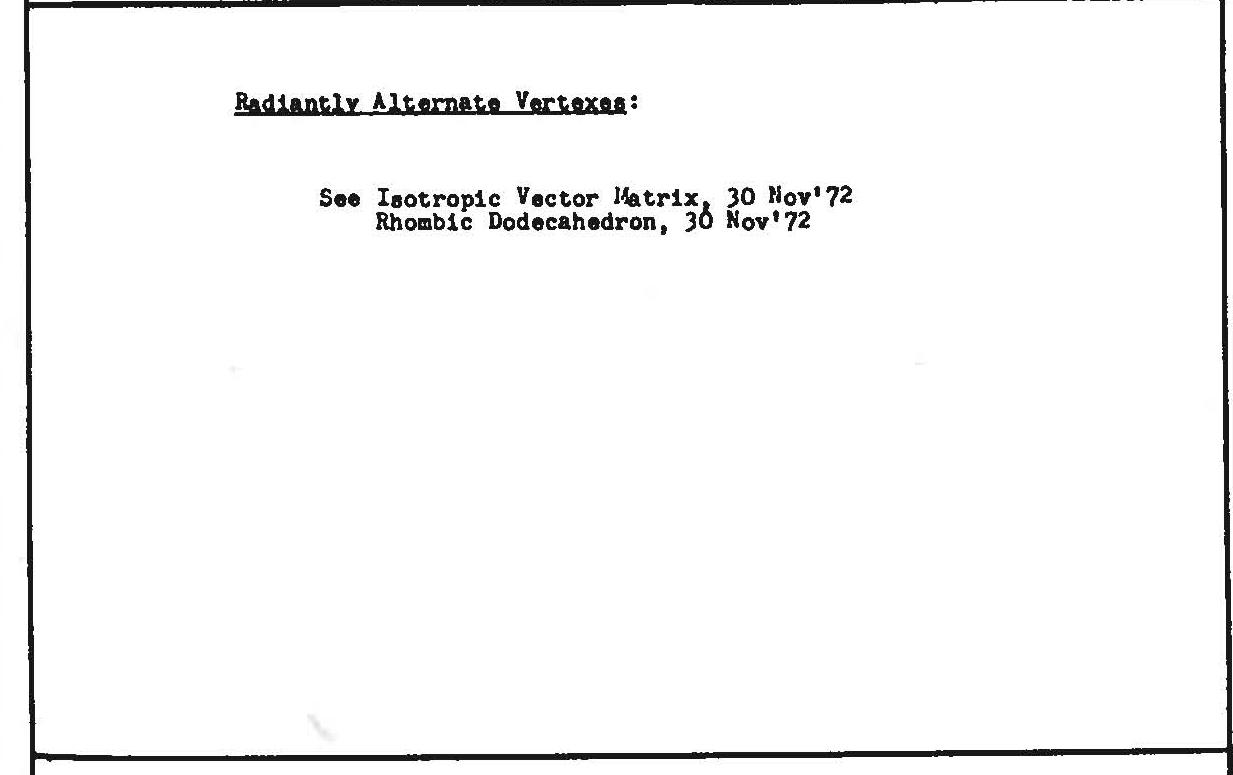
Radiantly Alternate Vertexes
← Radian | Radiant Valvability of IVM-defined Wavelength →
Cross Reference
Cross-References
- Isotropic Vector Matrix, 30 Nov'72
- Rhombic Dodecahedron, 30 Nov'72
Radiant Valvability of IVM-defined Wavelength
← Radiantly Alternate Vertexes | Radiant (1) →
Index Entry
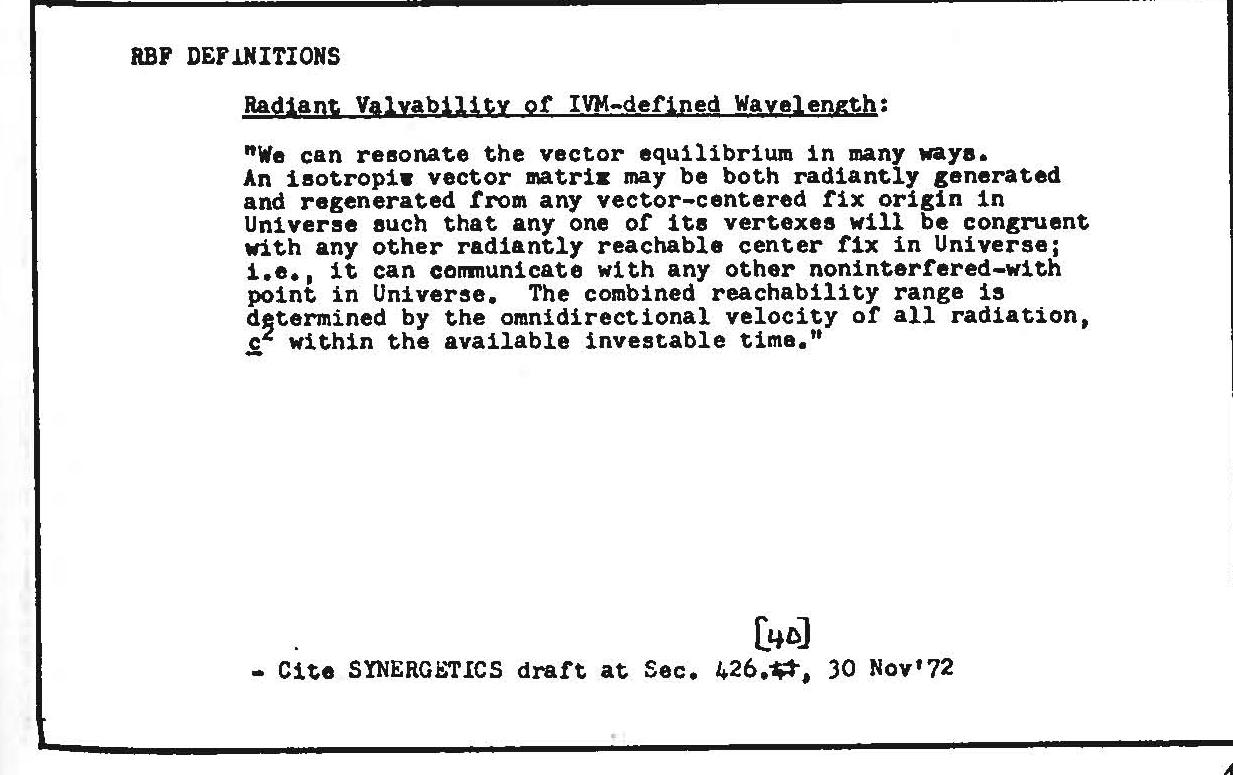
Radiant Valvability of IVM-defined Wavelength:
"We can resonate the vector equilibrium in many ways. An isotropic vector matrix may be both radiantly generated and regenerated from any vector-centered fix origin in Universe such that any one of its vertexes will be congruent with any other radiantly reachable center fix in Universe; i.e., it can communicate with any other noninterfered-with point in Universe. The combined reachability range is determined by the omnidirectional velocity of all radiation, c² within the available investable time."
Radiant (1)
← Radiant Valvability of IVM-defined Wavelength | Radiant (2) →
Cross Reference
Cross-References

Radiant (2)
Cross Reference
Cross-References
- Convergence, 16 Nov'72
- Earth, Jun'66
- Geodesic Dome, 12 Mar'74
- Frequency, 22 Jun'72
- Hexagonal Vector Pattern, 8 May'72
- Isotropic Vector Matrix, 30 Nov'72
- Radiation-gravitation, 12 Jun'74
- Spherical Interstices, 18 Nov'72
- Halo, 1938
- Nucleus, 13 Nov'75
Radiation
RBF Definitions
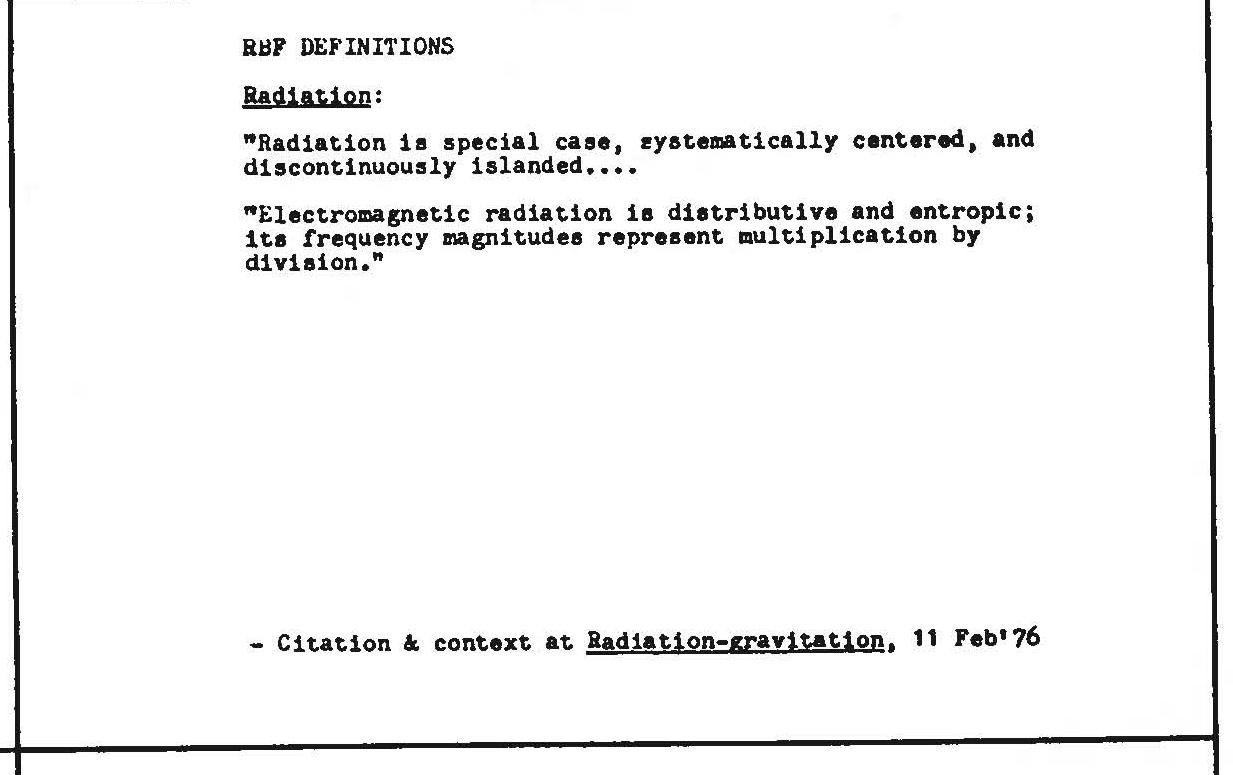
"Radiation is special case, systematically centered, and
discontinuously islanded....
"Electromagnetic radiation is distributive and entropic;
its frequency magnitudes represent multiplication by
division."
- Citation & context at Radiation-gravitation, 11 Feb'76
Radiation
Index Entry
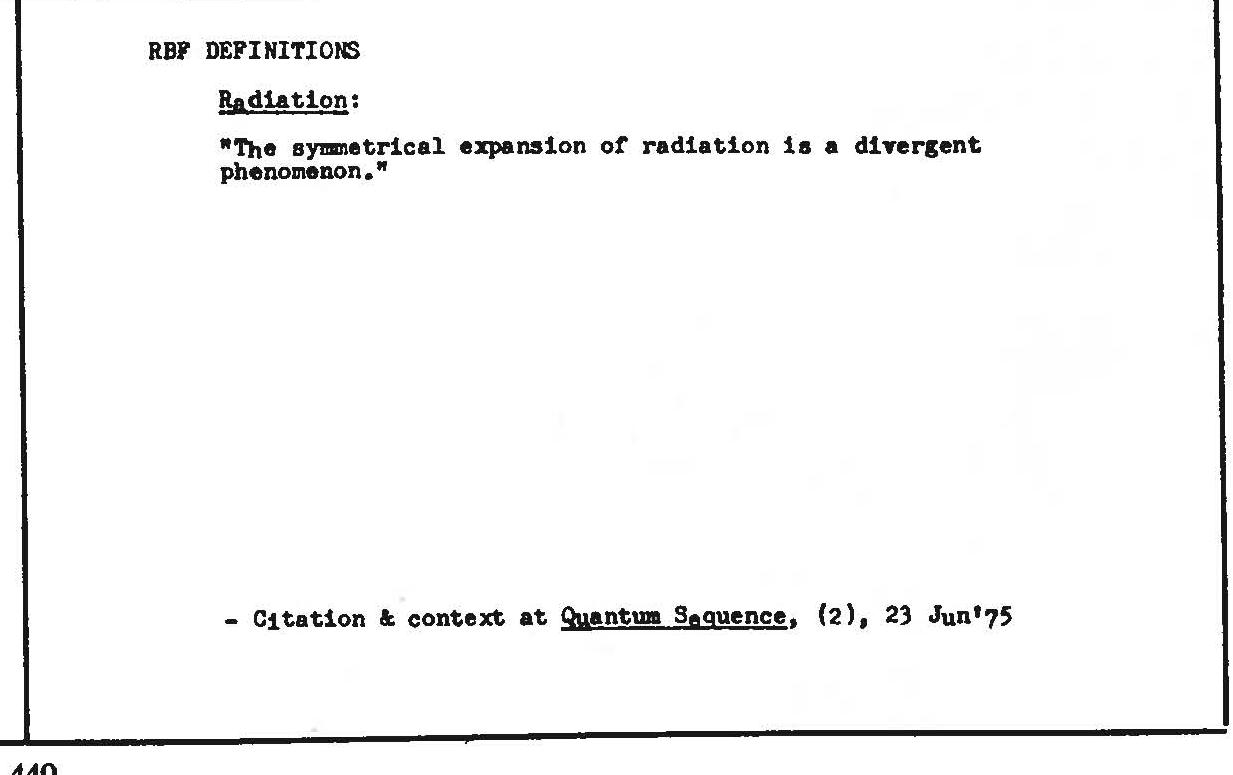
"The symmetrical expansion of radiation is a divergent phenomenon."
Radiation
Index Entry
Radiation:
"Radiation distributes energy systems outwardly in omnidiametric directions. Radiation fractionates whole systems into multidiametrically dispatched separate packages of the whole. The packaging of spherical unity is accomplished by radii-defined, central-angle partitioning of the spherical whole into a plurality of frequency-determined, simplest, central divisioning, thus producing a plurality of three-sided cornucopias formed inherently at minimum limit of volumetric accommodation by any three immediately adjacent central angles of any sphere of any omnitriangulated polyhedron. The threefold central-angle vertex surroundment constitutes the inner vertex definition of a radially amplified tetrahedral pack of energy; while the three inner faces of the package are defined by the interior radial planes (there is a great-circle plane common to any two radii) of the sphere of omnidiametric distribution; and the fourth, or outermost, face is the spherical triangle surface of the tetrahedron which always occurs at the radial distance outwardly traveled from the original source at the speed of radiation, symbolized as lower-case c."
Radiation
Index Entry
Radiation:
"Radiation is pushive, ergo tends to increase in curvature.... Radiation tends to increase in its overall curvature (as in the 'bent space' of Einstein). The pushive tends to arcs of ever lesser radius (microwaves are the very essence of this)..."
Radiation
Index Entry
Radiation:
"Euler deals with the physical Universe as radiation, or it 'coming apart' phase."
- Cite SYNERGETICS draft at Sec. \hrefhttps://www.buckyverse.org/en/synergetics/content/chapters/1000-omnitopology#section-1054.121054.12, 6 Mar'73
Radiation
Index Entry
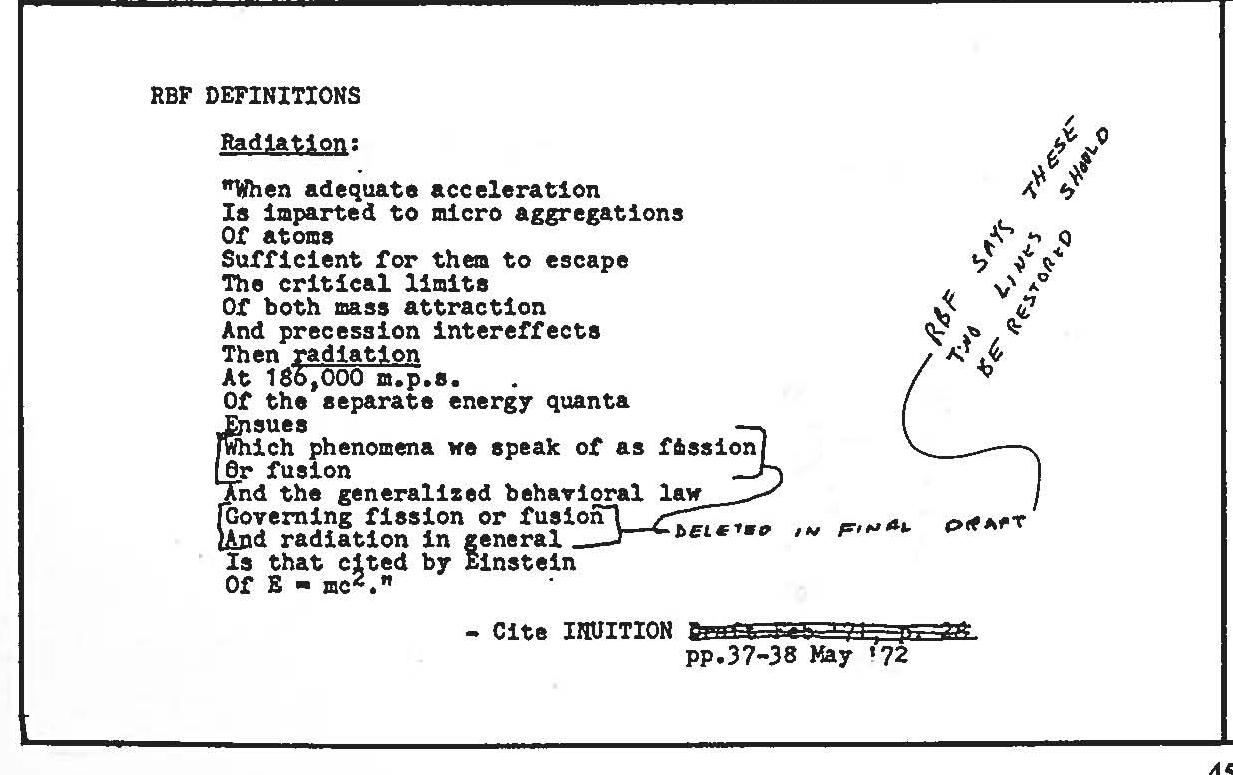
When adequate acceleration
Is imparted to micro aggregations
Of atoms
Sufficient for them to escape
The critical limits
Of both mass attraction
And precession intereffects
Then radiation
At 186,000 m.p.s.
Of the separate energy quanta
Ensues
Which phenomena we speak of as fission
Or fusion
And the generalized behavioral law
(Governing fission or fusion
And radiation in general
Is that cited by Einstein
Of E = mc².
RBF SAYS THESE
TWO LINES SHOULD
BE RESTORED
Radiation
Index Entry
Radiation:
"It is also characteristic of these waves
And of all radiation
That when the wave propagation
Is beamingly aimed
Perpendicularly outward from Earth's surface
They experience little or no interferences,
Once outside our atmo-, strato, and ionospheres,
Other then by collision with meteorites
And other celestially traveling objects.
"There seems to be no impedance
And no inherent limitation to the distance
Which such electromagnetic wave signals can go
Once outside the Earth mantles.
As far as we know,
The waves can go on forever in Universe--
Unless they hit some object,
And when they hit an object they lose some energy
Then bounce away
And keep going
In a new direction."
- Cite BRAIN & MIND, pp.158-159 May '72
Radiation
Index Entry
Radiation:
"The star tetrahedron's entropy may be the basis of irreversible radiation. . .
-
Cite SyntRoetic Draft "Antitetrahedron," 8 Oct. '71, p. 8.
-
Citation & context at Star Tetrahedron, 8 Oct'71
Radiation
Index Entry
Radiation:
"Radiation is physical, entropic, incoherent, propelling, disassociative, pushing."
- Cite DOXIADIS, p. 310, 20 Jun'66
Radiation
Index Entry
Radiation:
"Wave magnitude and frequency are experimentally interlocked as co-functions and both are experimentally gear locked with energy quanta."
- Citation at Frequency, Jun'66
-Cite NASA Speech, p. 100,
Radiation
RBF Definitions
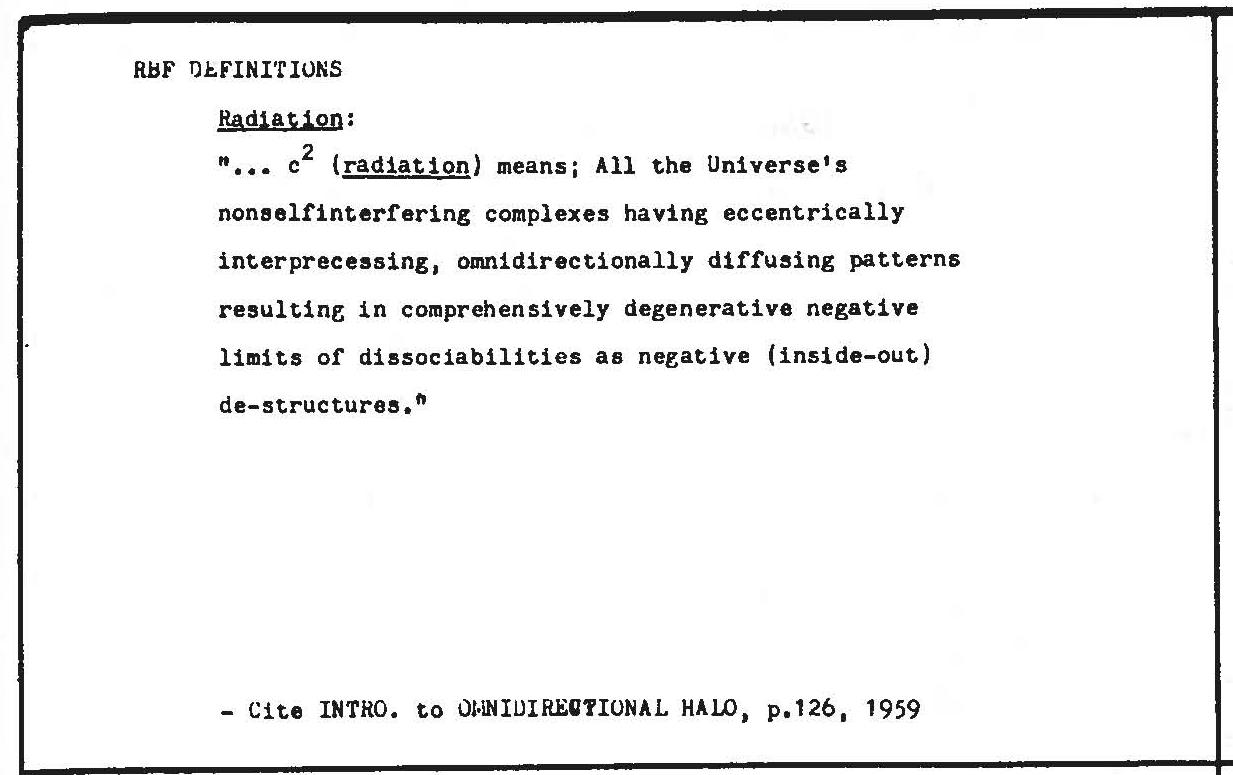
"... c² (radiation) means; All the Universe's nonselfinterfering complexes having eccentrically interprocessing, omnidirectionally diffusing patterns resulting in comprehensively degenerative negative limits of dissociabilities as negative (inside-out) de-structures."
Citations
- INTRO. to OMNIDIRECTIONAL HALO, p.126, 1959
Radiation
← Radiation | Radiation Sequence (1) →
RBF Definitions
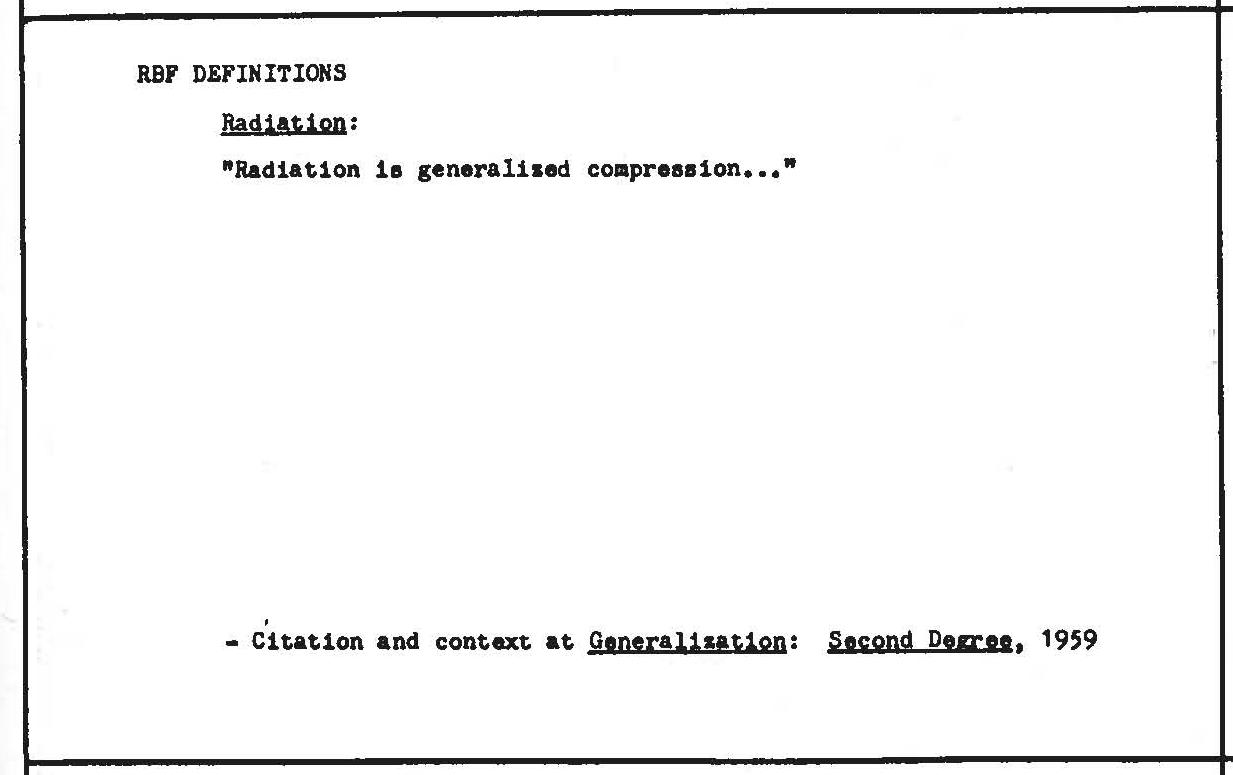
Radiation is generalized compression..."
Radiation Sequence (1)
← Radiation | Radiation Sequence (2) →
Index Entry
Radiation Sequence:
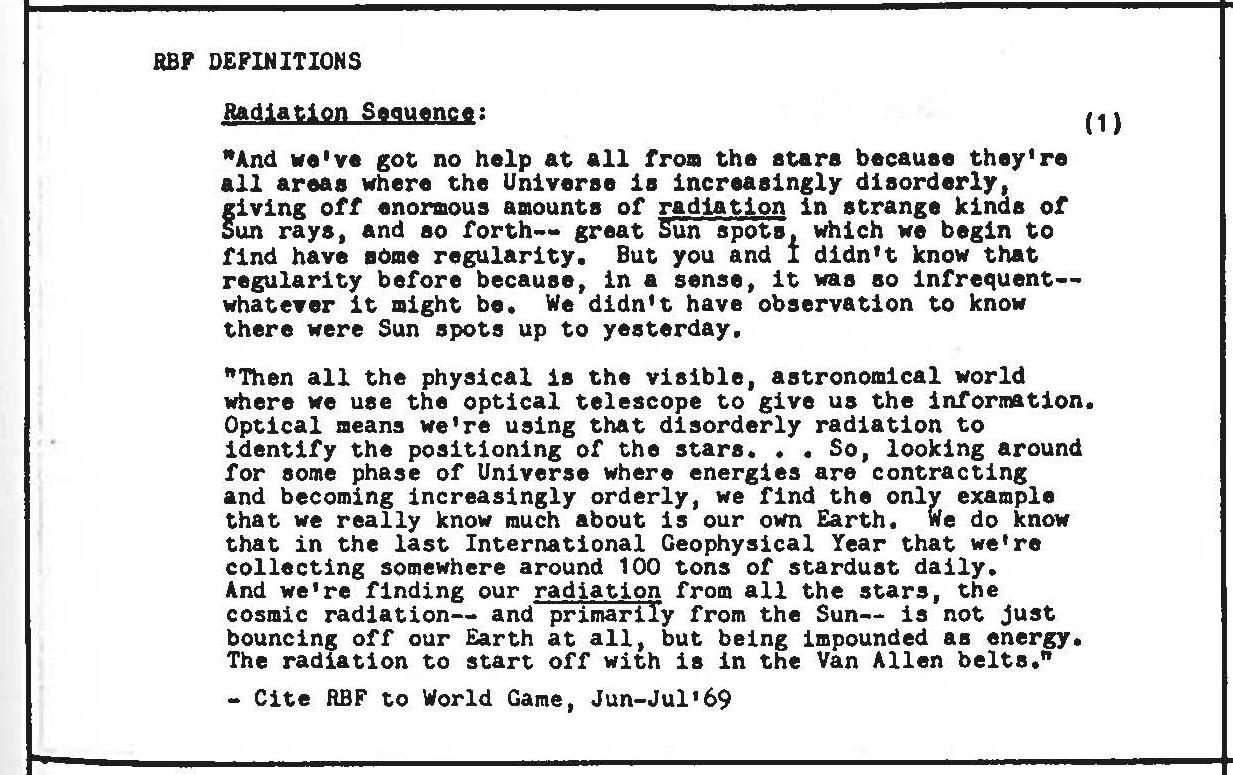
"And we've got no help at all from the stars because they're all areas where the Universe is increasingly disorderly, giving off enormous amounts of radiation in strange kinds of Sun rays, and so forth-- great Sun spots, which we begin to find have some regularity. But you and I didn't know that regularity before because, in a sense, it was so infrequent-- whatever it might be. We didn't have observation to know there were Sun spots up to yesterday.
"Then all the physical is the visible, astronomical world where we use the optical telescope to give us the information. Optical means we're using that disorderly radiation to identify the positioning of the stars. . . So, looking around for some phase of Universe where energies are contracting and becoming increasingly orderly, we find the only example that we really know much about is our own Earth. We do know that in the last International Geophysical Year that we're collecting somewhere around 100 tons of stardust daily. And we're finding our radiation from all the stars, the cosmic radiation-- and primarily from the Sun-- is not just bouncing off our Earth at all, but being impounded as energy. The radiation to start off with is in the Van Allen belts."
Radiation Sequence (2)
← Radiation Sequence (1) | Radiational Constant →
Index Entry
Radiation Sequence:
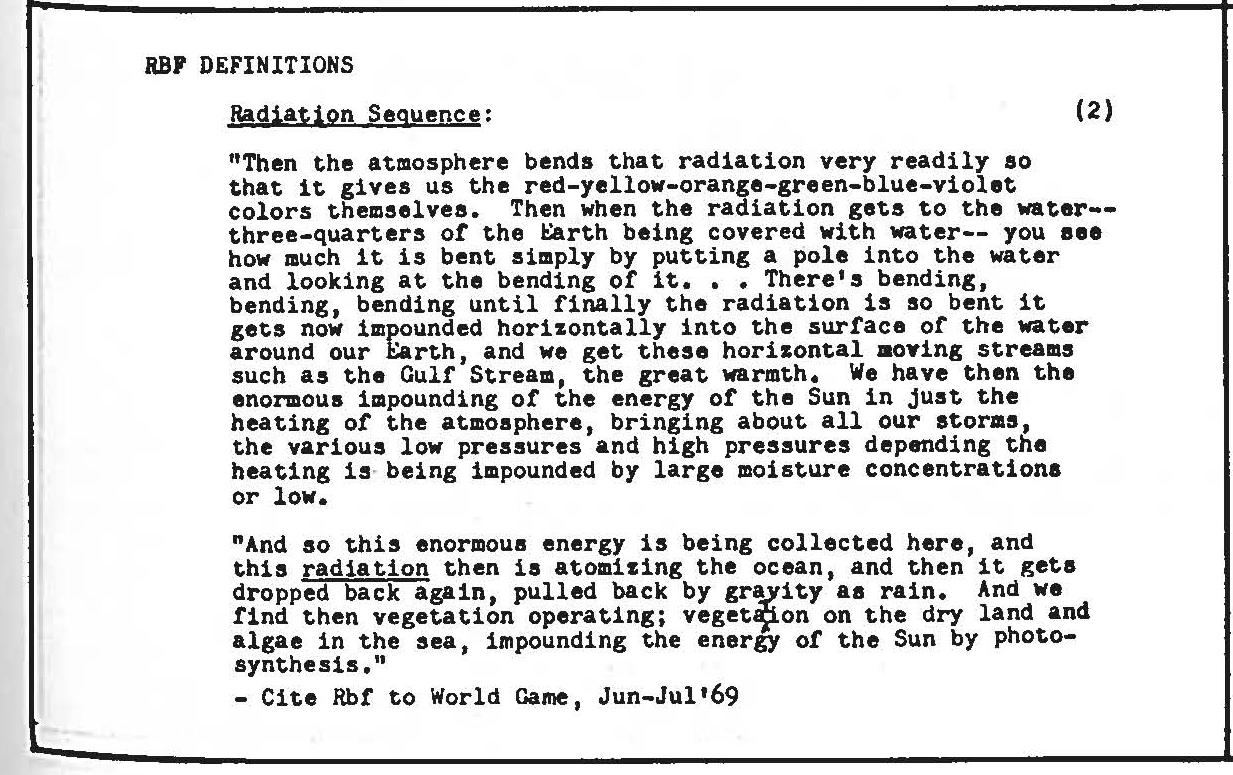
"Then the atmosphere bends that radiation very readily so that it gives us the red-yellow-orange-green-blue-violet colors themselves. Then when the radiation gets to the water--three-quarters of the Earth being covered with water-- you see how much it is bent simply by putting a pole into the water and looking at the bending of it. . . There's bending, bending, bending until finally the radiation is so bent it gets now impounded horizontally into the surface of the water around our Earth, and we get these horizontal moving streams such as the Gulf Stream, the great warmth. We have then the enormous impounding of the energy of the Sun in just the heating of the atmosphere, bringing about all our storms, the various low pressures and high pressures depending the heating is being impounded by large moisture concentrations or low.
"And so this enormous energy is being collected here, and this radiation then is atomizing the ocean, and then it gets dropped back again, pulled back by gravity as rain. And we find then vegetation operating; vegetation on the dry land and algae in the sea, impounding the energy of the Sun by photo-synthesis."
- Cite Rbf to World Game, Jun-Jul'69
Radiational Constant
← Radiation Sequence (2) | Radiational Constant (1) →
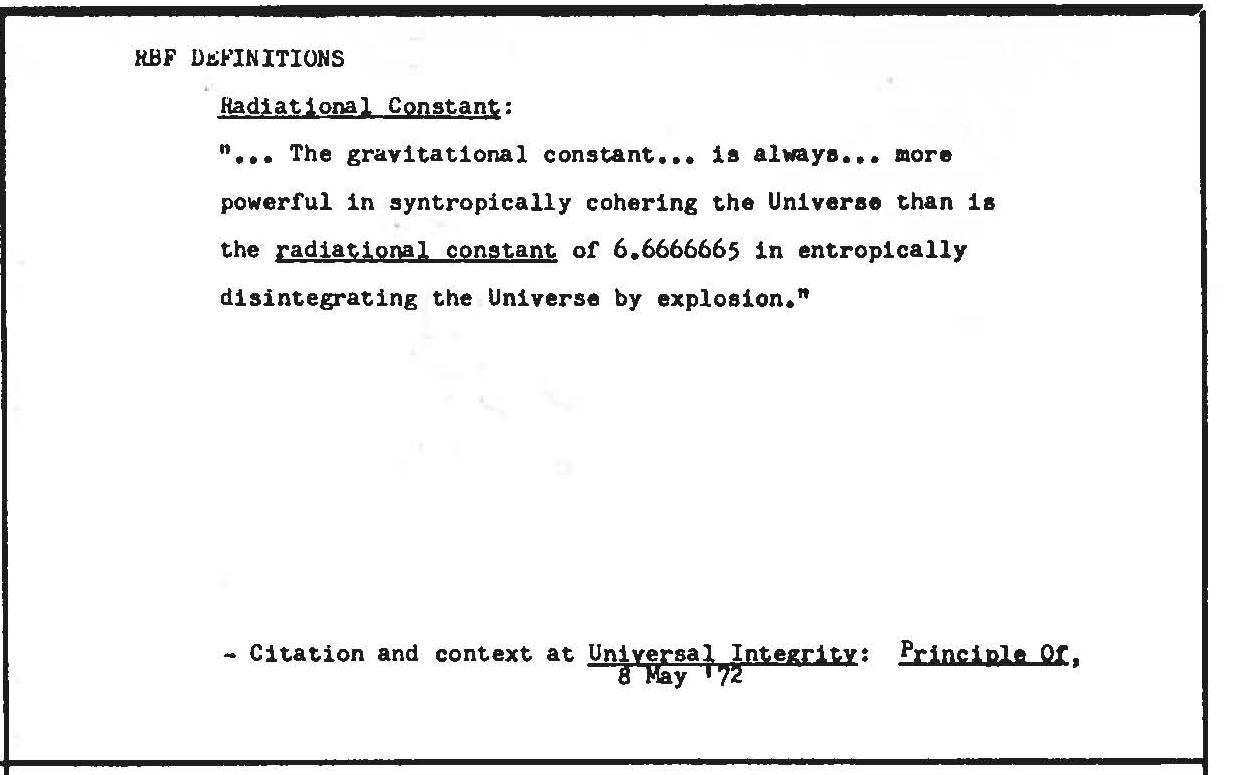
RBF Definitions
... The gravitational constant... is always... more powerful in syntropically cohering the Universe than is the radiational constant of 6.6666665 in entropically disintegrating the Universe by explosion." - Citation and context at Universal Integrity: Principle Of, 8 May '72
Radiational Constant (1)
← Radiational Constant | Radiational Constant (2) →
Cross Reference
Cross-References
- Gravitational Constant
- Newton vs. Einstein
- Universal Integrity: Principle Of
- Congruence of Gravitational & Radiational Constants
Radiational Constant (2)
← Radiational Constant (1) | Radiation vs. Crystal Model →
Cross Reference
Cross-References
- Icosahedron as Electron Model, 7 Mar'73
Radiation vs. Crystal Model
← Radiational Constant (2) | Radiation vs. Crystal Model →
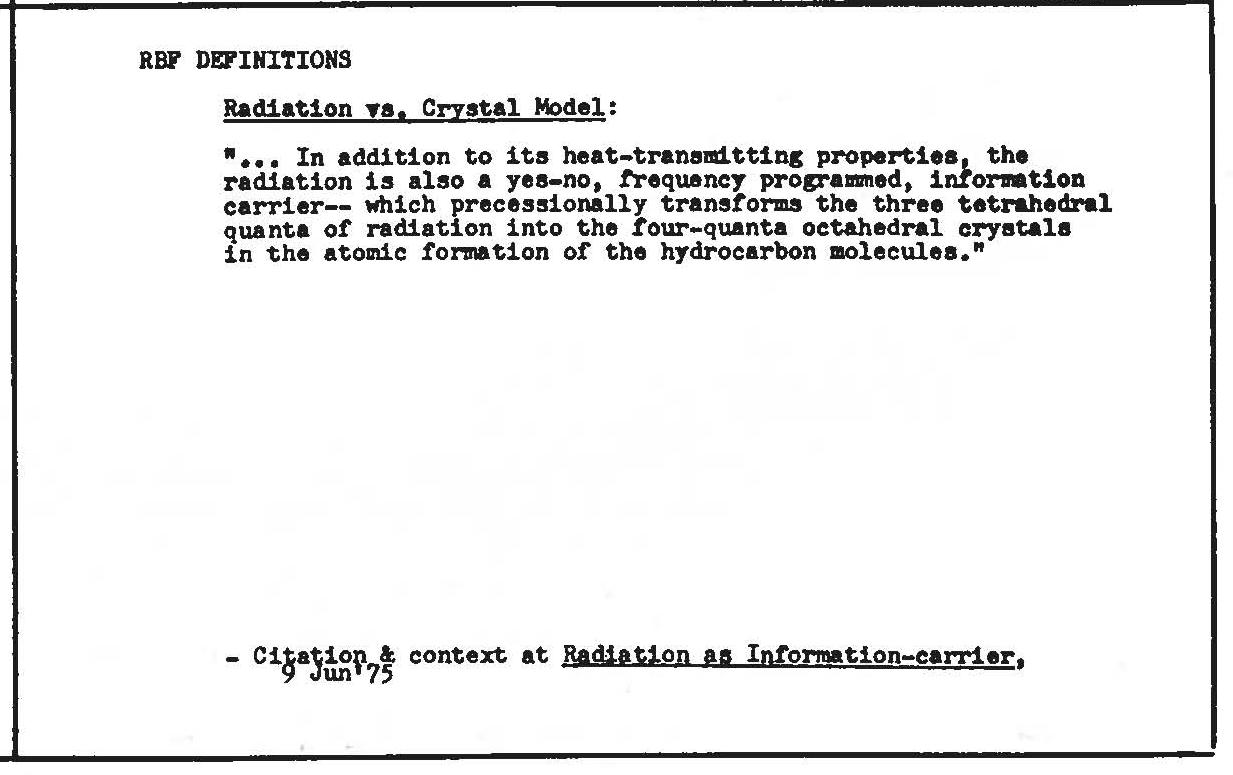
RBF Definitions
"... In addition to its heat-transmitting properties, the radiation is also a yes-no, frequency programmed, information carrier-- which precessionally transforms the three tetrahedral quanta of radiation into the four-quanta octahedral crystals in the atomic formation of the hydrocarbon molecules."
- Citation & context at Radiation as Information-carrier. 9 Jun'75
Radiation vs. Crystal Model
← Radiation vs. Crystal Model | Radiation as Entropy →
Cross Reference
Cross-References
Radiation as Entropy
← Radiation vs. Crystal Model | Radiation-gravitation →
Cross Reference
Cross-References
- Instant Universe, (1)(2)
- Celestial Radiation Accumulators, 28 Apr'77
Radiation-gravitation
← Radiation as Entropy | Radiation-gravitation →
Index Entry
Radiation-gravitation:
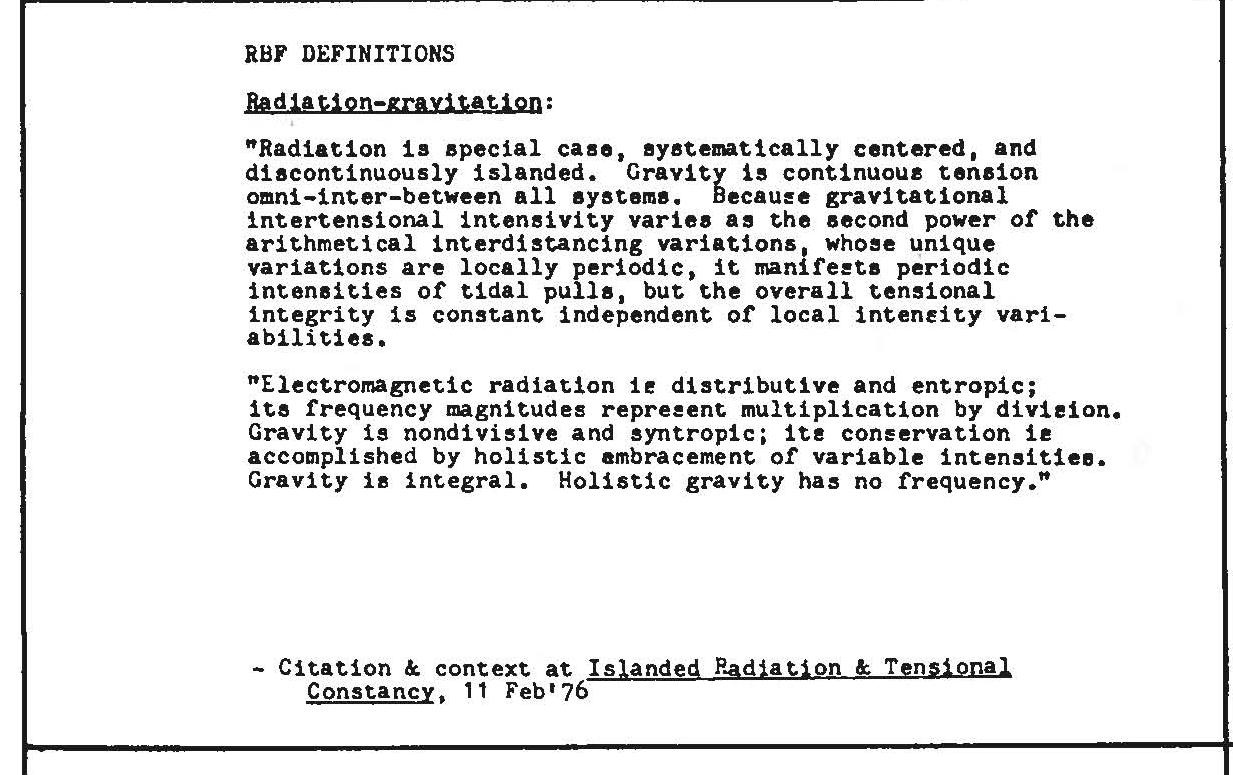
"Radiation is special case, systematically centered, and discontinuously islanded. Gravity is continuous tension omni-inter-between all systems. Because gravitational intertensional intensity varies as the second power of the arithmetical interdistancing variations, whose unique variations are locally periodic, it manifests periodic intensities of tidal pulls, but the overall tensional integrity is constant independent of local intensity variabilities.
"Electromagnetic radiation is distributive and entropic; its frequency magnitudes represent multiplication by division. Gravity is nondivisive and syntropic; its conservation is accomplished by holistic embracement of variable intensities. Gravity is integral. Holistic gravity has no frequency."
- Citation & context at Islanded Radiation & Tensional Constancy, 11 Feb'76
Radiation-gravitation
← Radiation-gravitation | Radiation-Gravitation →
Cross Reference
Radiation-gravitation:
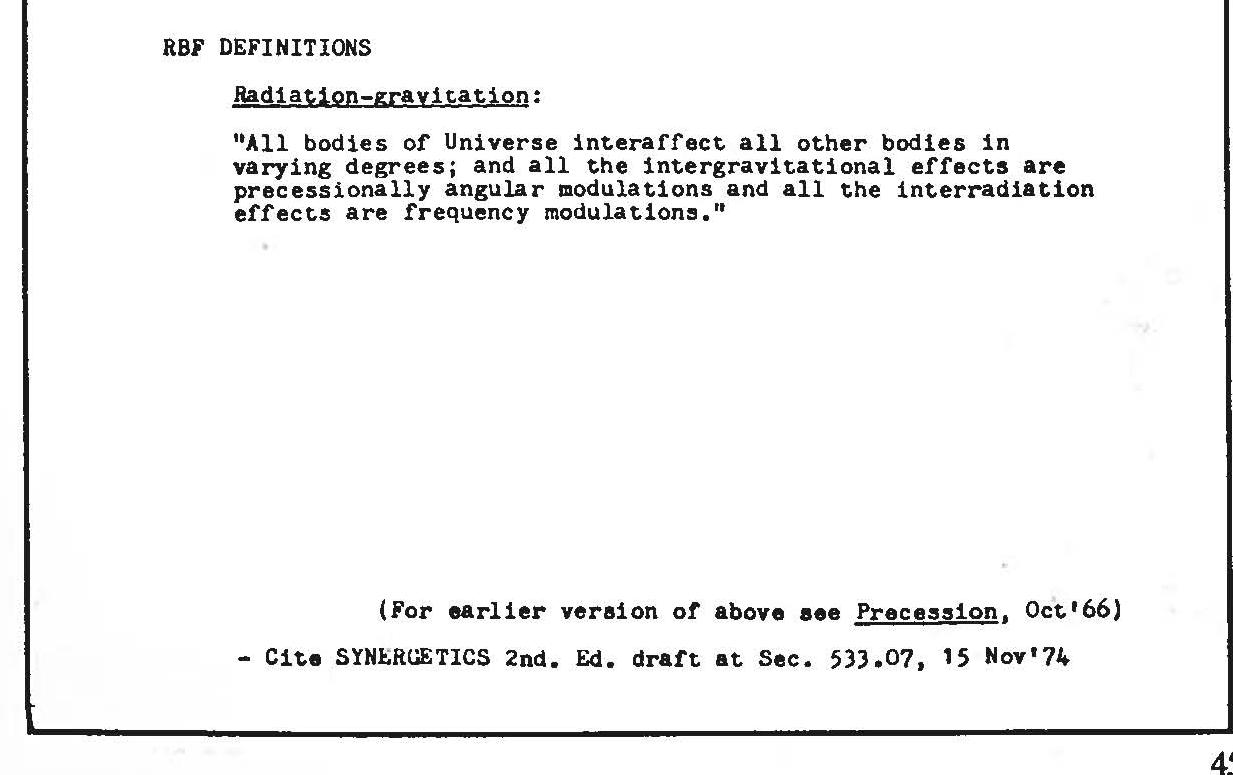
"All bodies of Universe interaffect all other bodies in varying degrees; and all the intergravitational effects are precessionally angular modulations and all the interradiation effects are frequency modulations."
- Cite SYNERGETICS 2nd. Ed. draft at Sec. \hrefhttps://www.buckyverse.org/en/synergetics/content/chapters/500-conceptuality#section-533.07533.07, 15 Nov'74
Cross-References
- Precession, Oct'66
Radiation-Gravitation
← Radiation-gravitation | Radiation-Gravitation →
Index Entry
Radiation-Gravitation:
"Electromagnetic radiant energy is entropic; gravitational energy is syntropic."
- Citation & context at Gravity (d), 12 Jun'74
Radiation-Gravitation
← Radiation-Gravitation | Radiation-Gravitation →
Index Entry
Radiation-Gravitation:
"Radiation is disintegrative; gravity is integrative."
- Cite SYNERGETICS draft at Sec. \hrefhttps://www.buckyverse.org/en/synergetics/content/chapters/500-conceptuality#section-541.05541.05, 23 Sep'73
Radiation-Gravitation
← Radiation-Gravitation | Radiation-Gravitation →
Index Entry
Radiation-Gravitation:
"Radiation has shadow while gravitation does not."
- Citation and context at Fuller, R.B.: Meeting with Fernandez-Moran (2), 5 Apr'73
Radiation-Gravitation
← Radiation-Gravitation | Radiation-Gravitation →
Index Entry
Radiation-Gravitation:
"The generalizations are of the mind and are omniembracing and omnipermative. Like the rays of the Sun radiations are radii and are focusable. Gravity cannot be focused; it is circumferentially embracing. Radiation has shadows; gravity has none. Radiation produces the phenomenon known to Einstein as the bending of space, the gravitational field."
Radiation-Gravitation
← Radiation-Gravitation | Radiation-Gravitation →
Index Entry
Radiation-Gravitation:
"Physics hasn't really associated radiation with (+) and gravitation with (-), but that's what they are."
Radiation-Gravitation
← Radiation-Gravitation | Radiation-Gravitation →
Index Entry
Radiation-Gravitation:
"Gravity is circumferential. All the superficial surface angles are the gravity. Central Angles are the radiation."
- Cite RBF to EAJ, 3200 Idaho, Washington DC, 21 Dec. '71.
Radiation-Gravitation
← Radiation-Gravitation | Radiation-Gravitation →
Index Entry
Radiation-Gravitation:
"The differences between the central angles and surface angles' functionings are identifiable with radiational and gravitational functionings. Radiation identifies with central angles. Radiation is outwardly focusable."
-
Citation & context at Gravity, Aug'71
-
Cite Synergetics draft, \hrefhttps://www.buckyverse.org/en/synergetics/content/chapters/600-structure#section-670.00670, August 1971.
Radiation-Gravitation
← Radiation-Gravitation | Radiation-Gravitation →
Index Entry
Radiation-Gravitation:
"The coming apart phase of critical proximity is radiation. The coming together and holding together phase is emphasized in our ken as gravity."
- Cite RBF insert to SYNERGETICS (Conceptuality, Critical Proximity), Chicago, 1 June 1971
Radiation-Gravitation
← Radiation-Gravitation | Radiation-Gravitation →
RBF Definitions
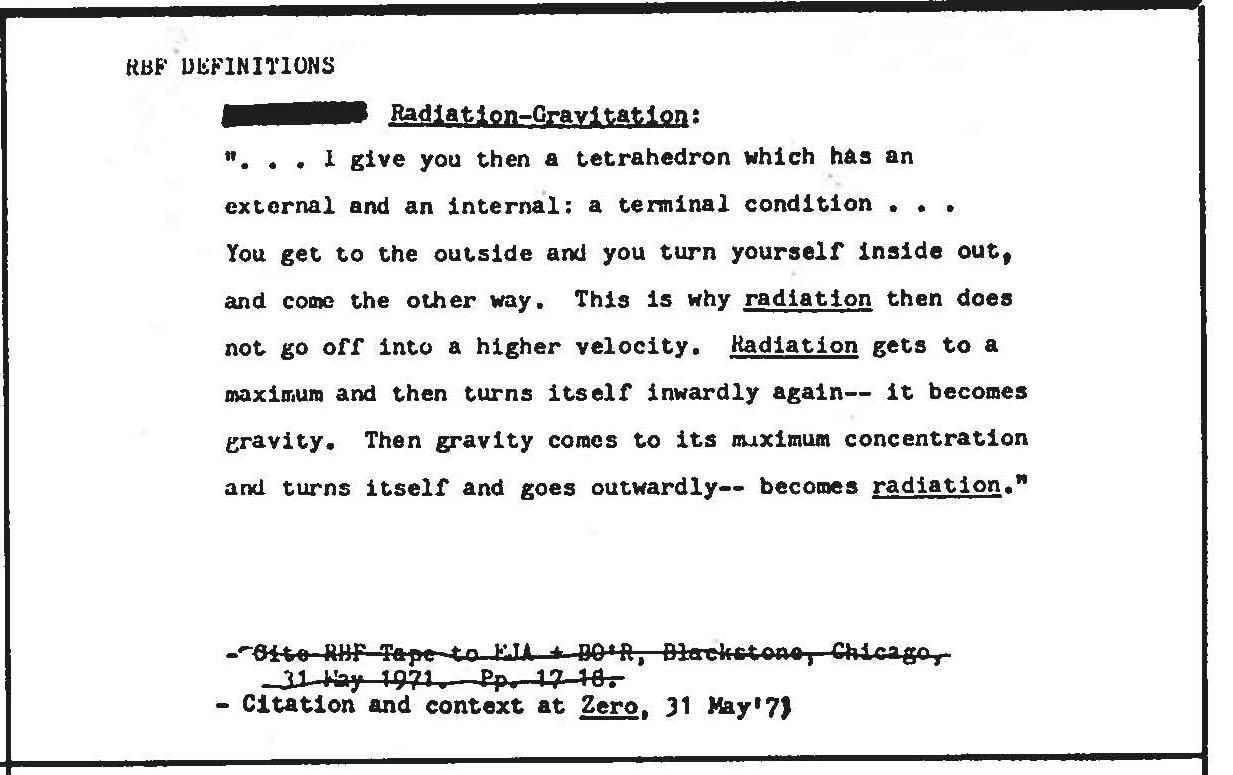
". . . I give you then a tetrahedron which has an external and an internal: a terminal condition . . . You get to the outside and you turn yourself inside out, and come the other way. This is why radiation then does not go off into a higher velocity. Radiation gets to a maximum and then turns itself inwardly again-- it becomes gravity. Then gravity comes to its maximum concentration and turns itself and goes outwardly-- becomes radiation."
Citations
- RBF Tape to EJA + DO+R, Blackstone, Chicago, 31 May 1971. Pp. 17-18. - Citation and context at Zero, 31 May'71
Radiation-Gravitation
← Radiation-Gravitation | Radiation-Gravitation →
Index Entry
Radiation-Gravitation:
"Radiation can be focused;
explosions can be linear.
Gravity cannot be focused;
it is circumferential contraction."
- Cite RBF to EJA
Sarasota, Florida
7 February 1971

Radiation-Gravitation
← Radiation-Gravitation | Radiation-Gravitation →
RBF Definitions
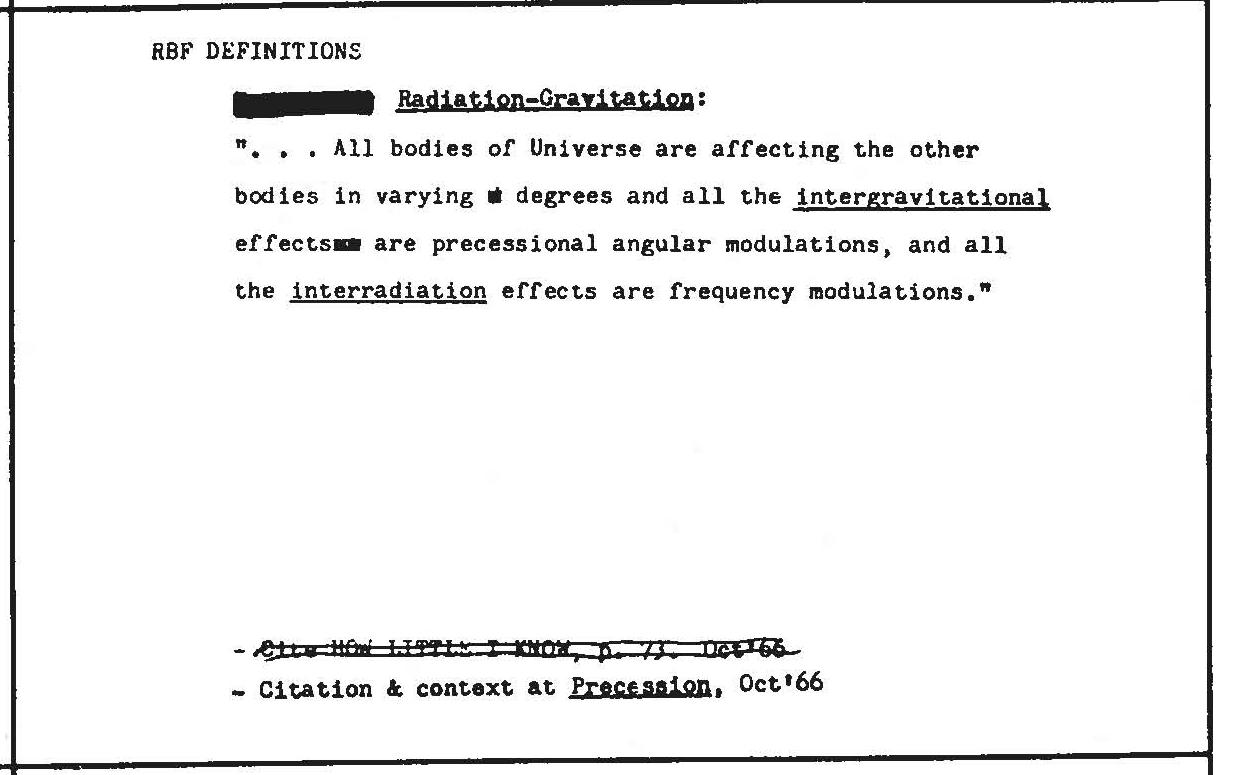
"... All bodies of Universe are affecting the other bodies in varying degrees and all the intergravitational effects are precessional angular modulations, and all the interradiation effects are frequency modulations."
Citations
- HOW LITTLE I KNOW, p. 75 Oct'66 - Citation & context at Precession, Oct'66
Radiation-Gravitation
← Radiation-Gravitation | Radiation-Gravitation Sequence (1) →
Index Entry
Radiation-Gravitation:
"... Gravity is swifter than radiation, therefore, Universe collects its masses in ever tighter concentrations."
- Citation and context at Point: Outbound Point, circa 1948
Radiation-Gravitation Sequence (1)
← Radiation-Gravitation | Radiation-Gravitation Sequence (2) →
Index Entry
Radiation-Gravitation Sequence:
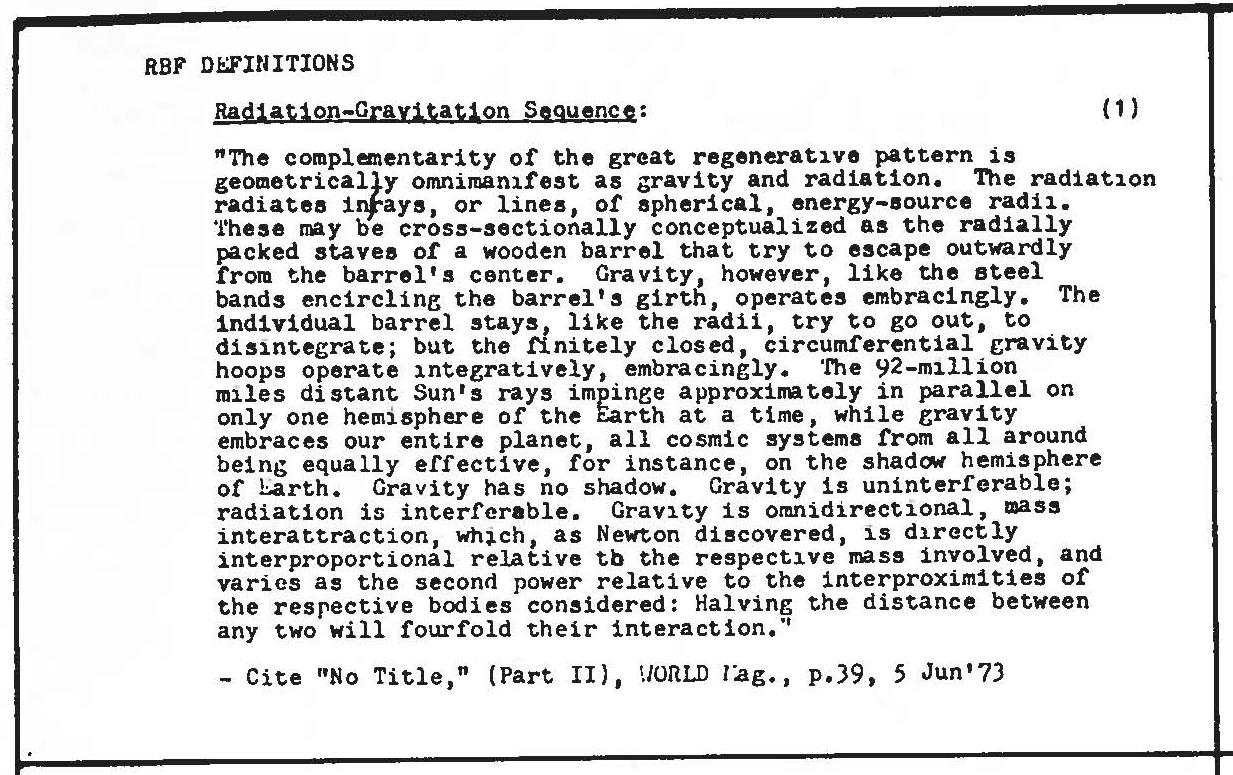
"The complementarity of the great regenerative pattern is geometrically omnimanifest as gravity and radiation. The radiation radiates infrays, or lines, of spherical, energy-source radii. These may be cross-sectionally conceptualized as the radially packed staves of a wooden barrel that try to escape outwardly from the barrel's center. Gravity, however, like the steel bands encircling the barrel's girth, operates embracingly. The individual barrel stays, like the radii, try to go out, to disintegrate; but the finitely closed, circumferential gravity hoops operate integratively, embracingly. The 92-million miles distant Sun's rays impinge approximately in parallel on only one hemisphere of the Earth at a time, while gravity embraces our entire planet, all cosmic systems from all around being equally effective, for instance, on the shadow hemisphere of Earth. Gravity has no shadow. Gravity is uninterferable; radiation is interferable. Gravity is omnidirectional, mass interaction, which, as Newton discovered, is directly interproportional relative to the respective mass involved, and varies as the second power relative to the interproximities of the respective bodies considered: Halving the distance between any two will fourfold their interaction."
- Cite "No Title," (Part II), WORLD Tag., p.39, 5 Jun'73
Radiation-Gravitation Sequence (2)
← Radiation-Gravitation Sequence (1) | Radiation-Gravitation Sequence (3) →
Index Entry
Radiation-Gravitation Sequence:
"All the Universe is in motion, and all the effect of bodies in motion on other bodies in motion are what we call 'precessional.' Precession and mass-attractive gravity convert centrifugal into orbital motion. And precession always affects the motion of other bodies in directions other than 180 degrees, not toward or away from one another but at approximately 90 degrees to the line between the most powerfully interprocessing of the bodies. Holding a string in your hand, which, like mass attraction, is fastened to a weighty object on the other end, you precess this object into orbit around you by axial rotation of your body. Thus the precessional effect of the axially rotating Earth on the Moon is to make the lesser mass go into orbit around the greater.
"Mass attraction and precession cooperate synergetically to affect all of the Universe: 99.9999 percent of all entities of the Universe are in orbit around some other spinning entity, macro- or micro- cosmic in scale. And once in a while some of the entities accelerate so congruently close to one another that their inter-mass-attraction renders the precessional effect negligible, and the lesser body falls into the greater."
- Cite "No Title," (Part II), WORLD Mag., p.39, 5 Jun'73
Radiation-Gravitation Sequence (3)
← Radiation-Gravitation Sequence (2) | Radiation-gravitation: Angular Functions →
Index Entry
Radiation-Gravitation Sequence:
"You and I are going around the Sun at 60,000 mph. So too is the Earth. We are so close to our Earth that gravity makes us 'fall in' in orbiting company. Little children find gravity forever pulling them in toward the Earth's center; although they know nothing about gravity they feel it pulling them to the floor. All of the Earth's biological organisms respond so powerfully in a linear manner to the gravitational effect that it is much like the organisms being linearly programmed to a specialized behavioral program. Thus we fail to realize that gravity really works as circumferentially embracement. We find everything operating at 90 degrees tangent while humanity fools itself into thinking that it accelerated the object in a 180-degree direction. Because of this, humanity has come to think illogically in 180-degree, straight-line, ways. The fact is that entities are always traveling away at 90 degrees from the direction at which we are aiming.
"All the cosmic generalized principles are omniembracing-always-true. Truth, like gravity, is nonlinear; it is omniembracing. And of all the creatures on our planet, only humans have demonstrated the ability to discover such truth."
Radiation-gravitation: Angular Functions
← Radiation-Gravitation Sequence (3) | Radiation-gravitation Harmonics →
Index Entry
Radiation-gravitation: Angular Functions:
"The differences between the central angles' and surface angles' functionings are identifiable with radiational and gravitational functionings. Radiation identifies with central angles. Radiation is outwardly divergent. Gravity identifies with the three surface angles' convergent closure into the surface triangle's finite perimeter. Gravity is omniembracing and is not focusable. Gravity is Universe-conservingly effective in its circumferential coherence."
Radiation-gravitation Harmonics
← Radiation-gravitation: Angular Functions | Radiation-Gravitation Model →
Index Entry
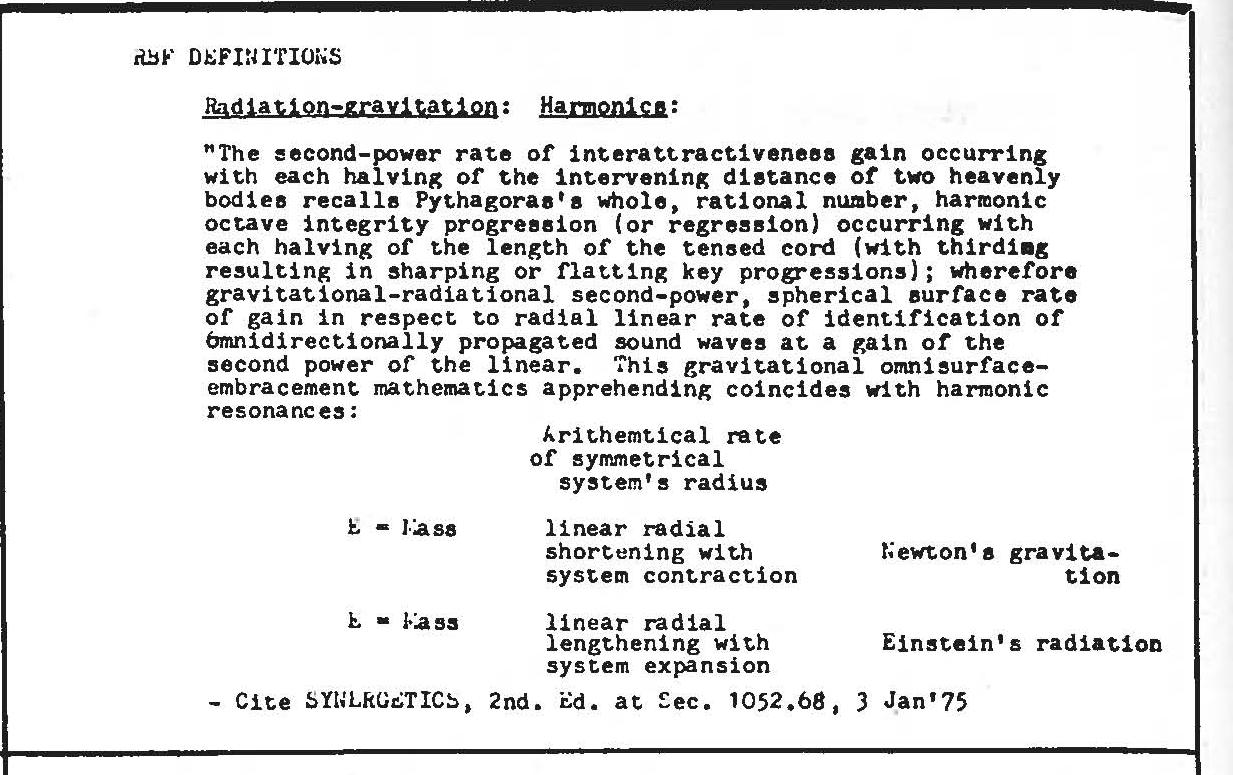
The second-power rate of interattractiveness gain occurring with each halving of the intervening distance of two heavenly bodies recalls Pythagoras's whole, rational number, harmonic octave integrity progression (or regression) occurring with each halving of the length of the tensed cord (with thirding resulting in sharpening or flatting key progressions); wherefore gravitational-radiational second-power, spherical surface rate of gain in respect to radial linear rate of identification of omnidirectionally propagated sound waves at a gain of the second power of the linear. This gravitational omnisurface-embrace-ment mathematics apprehending coincides with harmonic resonances:
Arithmetical rate
of symmetrical
system's radius
ï = Mass linear radial shortening with system contraction Newton's gravitation
ł = Mass linear radial lengthening with system expansion Einstein's radiation
Radiation-Gravitation Model
← Radiation-gravitation Harmonics | Radiation Gravitation Model (1) →
RBF Definitions
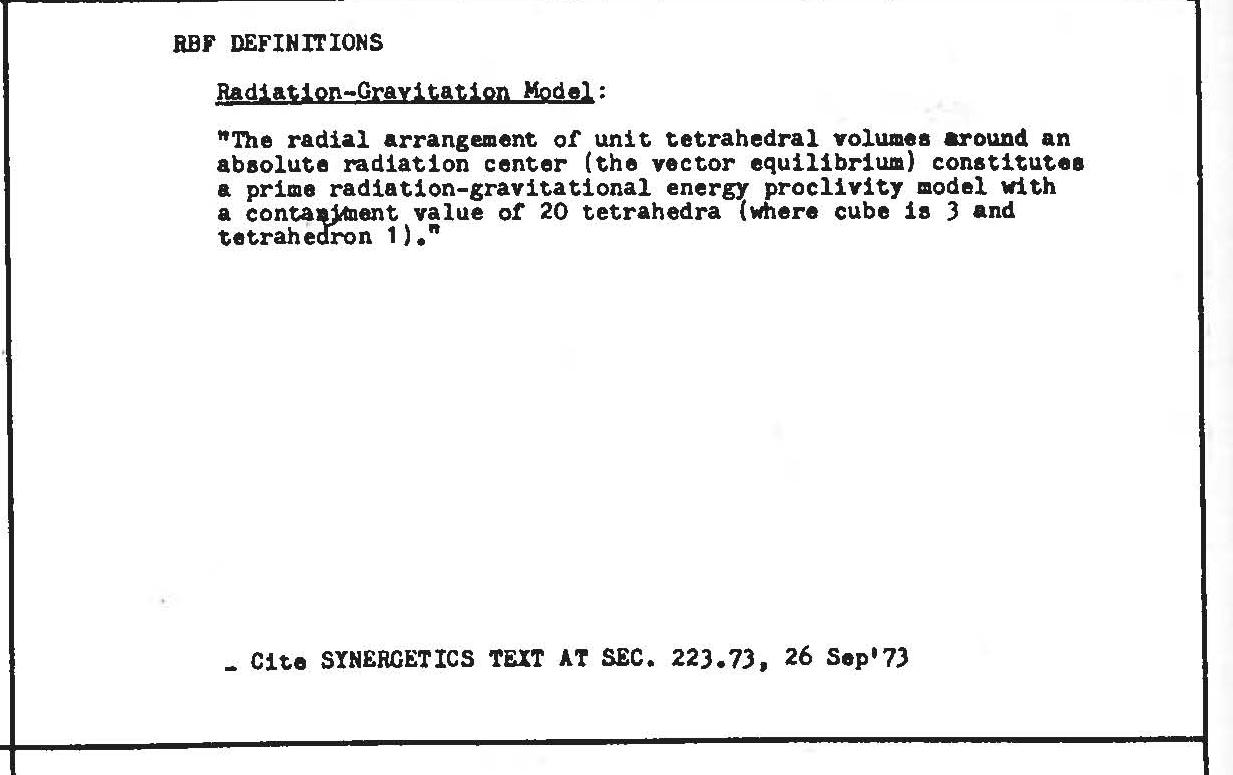
"The radial arrangement of unit tetrahedral volumes around an absolute radiation center (the vector equilibrium) constitutes a prime radiation-gravitational energy proclivity model with a containment value of 20 tetrahedra (where cube is 3 and tetrahedron 1)."
Citations
- SYNERGETICS TEXT AT SEC. \href{https://www.buckyverse.org/en/synergetics/content/chapters/200-synergetics#section-223.73}{223.73}, 26 Sep'73
Radiation Gravitation Model (1)
← Radiation-Gravitation Model | Radiation-gravitation Model (2) →
Cross Reference
Jitterbug Model
Cross-References
Radiation-gravitation Model (2)
← Radiation Gravitation Model (1) | Radiational ≠ Gravitational →
Cross Reference
Cross-References
- Jitterbug, 11 Oct'71
- Vector Equilibrium, 15 May'73
Radiational ≠ Gravitational
← Radiation-gravitation Model (2) | Radiation-gravitation (1) →
Cross Reference
Cross-References
- Radiation-gravitation, 1948
- Boltzmann Sequence, (3)
- Universal Integrity: Principle Of, 8 May'72; 24 Mar'71; 13 Nov'69
Radiation-gravitation (1)
← Radiational ≠ Gravitational | Radiation-gravitation (2A) →
Cross Reference
Cross-References
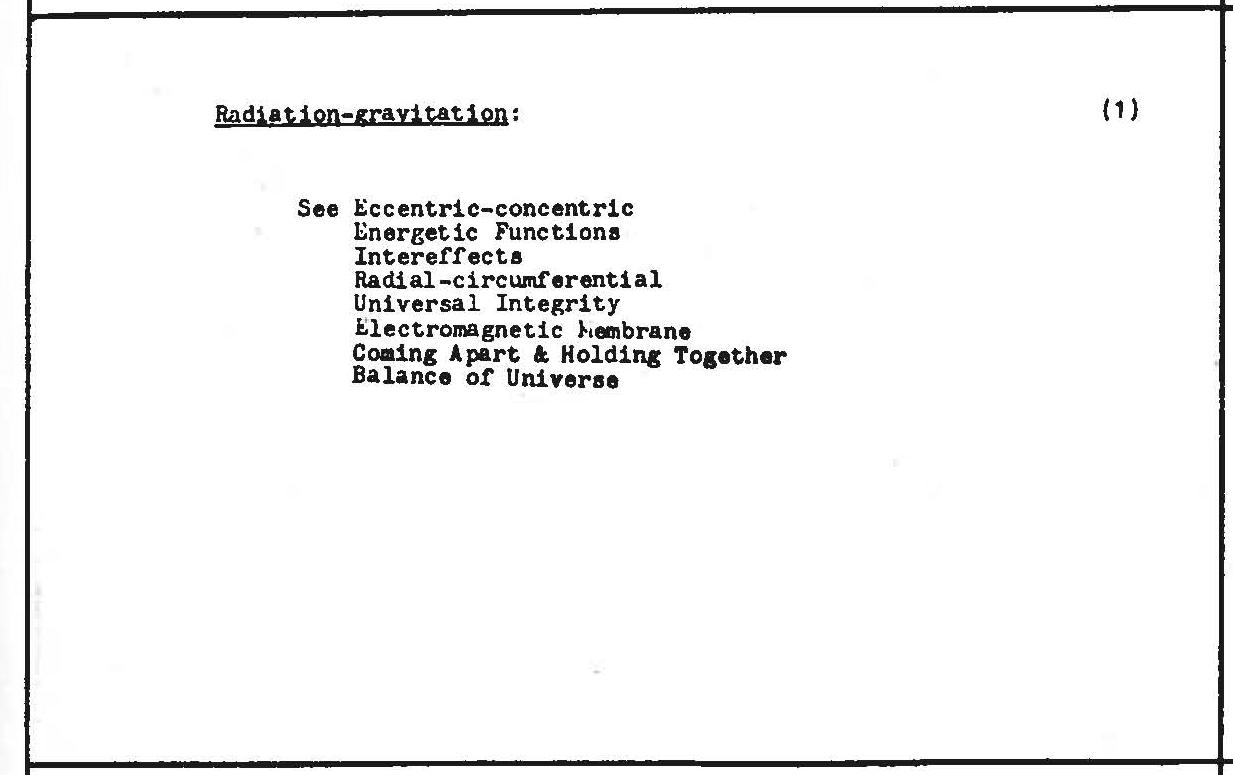
- Eccentric-concentric
- Energetic Functions
- Intereffects
- Radial-circumferential
- Universal Integrity
- Electromagnetic Membrane
- Coming Apart & Holding Together
- Balance of Universe
Radiation-gravitation (2A)
← Radiation-gravitation (1) | Radiation-gravitation (2B) →
Cross Reference
Cross-References
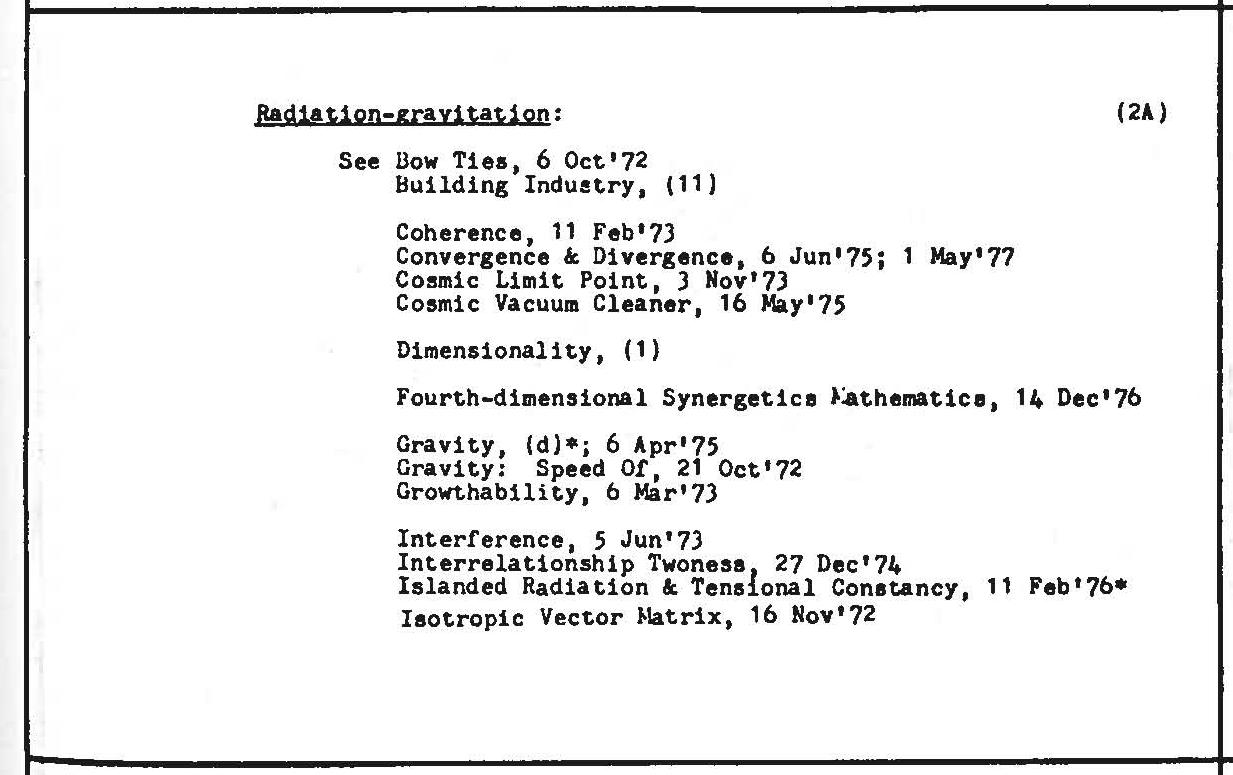
- Bow Ties, 6 Oct'72
- Building Industry, (11)
- Coherence, 11 Feb'73
- Convergence & Divergence, 6 Jun'75; 1 May'77
- Cosmic Limit Point, 3 Nov'73
- Cosmic Vacuum Cleaner, 16 May'75
- Dimensionality, (1)
- Fourth-dimensional Synergetics Mathematics, 14 Dec'76
- Gravity, 6 Apr'75
- Gravity: Speed Of, 21 Oct'72
- Growthability, 6 Mar'73
- Interference, 5 Jun'73
- Interrelationship Twoness, 27 Dec'74
- Islanded Radiation & Tensional Constancy, 11 Feb'76*
- Isotropic Vector Matrix, 16 Nov'72
Radiation-gravitation (2B)
← Radiation-gravitation (2A) | Radiation-gravitation (2C) →
Cross Reference
Cross-References
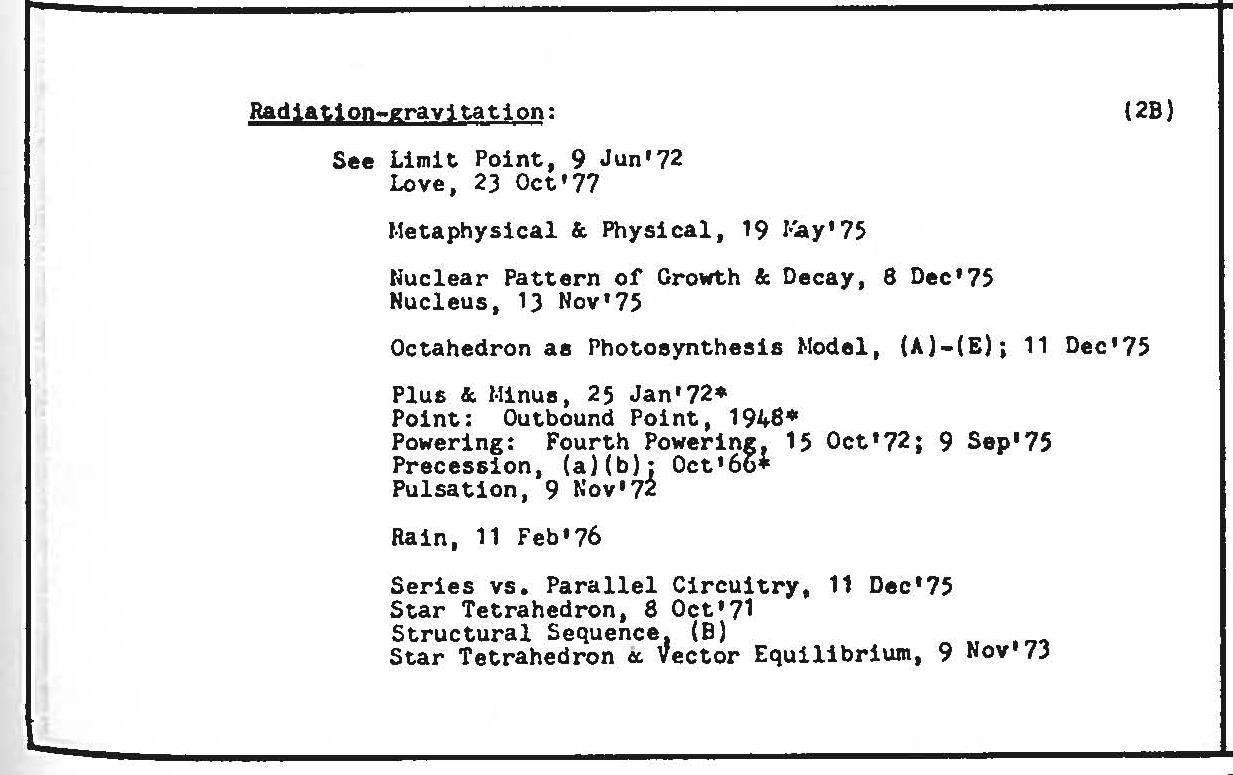
- Limit Point, 9 Jun'72
- Love, 23 Oct'77
- Metaphysical & Physical, 19 May'75
- Nuclear Pattern of Growth &ay, Dec
- Nucleus, 13 Nov'75
- ahedron as Photosynthesis Model, Oct
- Plus & Minus, 25 Jan'72*
- Point: Outbound Point
- Powering: Fourth Powering, 15 Oct'72; 9 Sep'75
- Precession, Oct'66*
- Pulsation, 9 Nov'72
- Rain, 11 Feb'76
- Series vs. Parallel Circuitry, 11 Dec'75
- Star Tetrahedron, 8 Oct'71
- Structural Sequence (B)
- Star Tetrahedron & Vector Equilibrium, 9 Nov'73
Radiation-gravitation (2C)
← Radiation-gravitation (2B) | Radiation-gravitation (3) →
Cross Reference
Cross-References
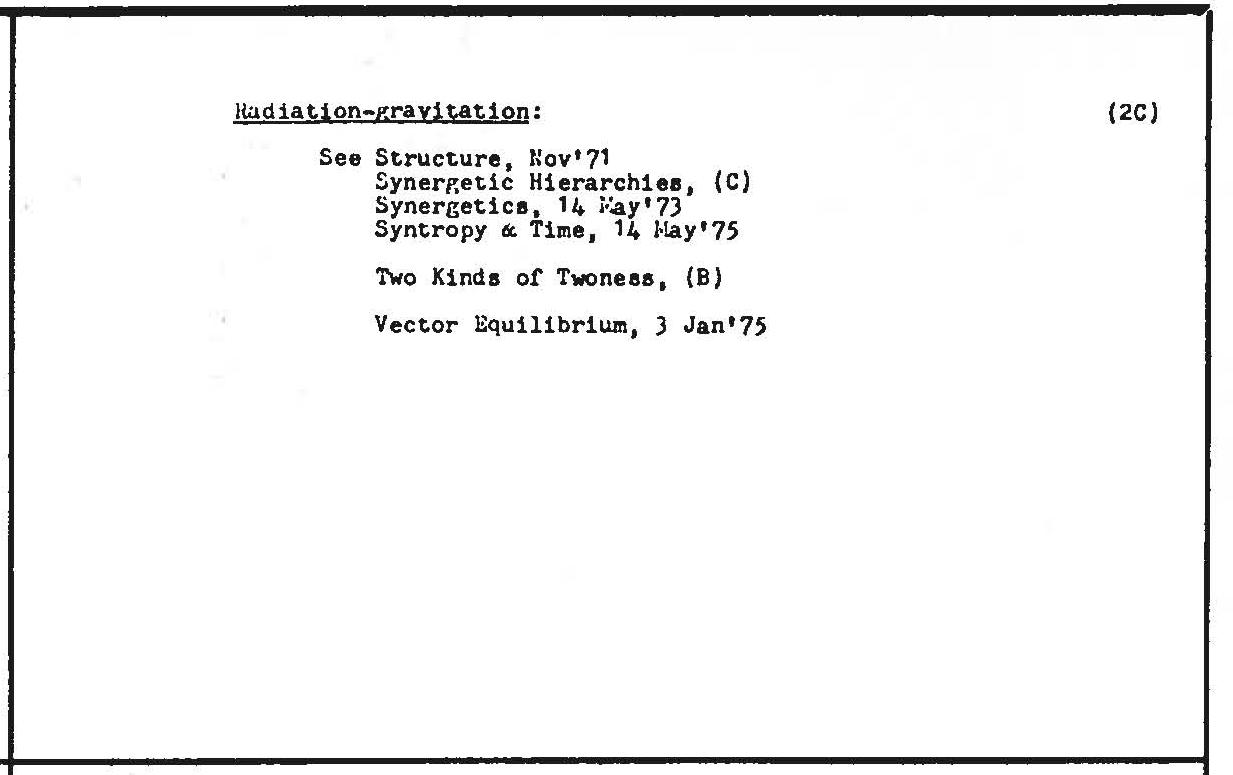
- Structure, Nov'71
- Synergetic Hierarchies
- Synergetics, 14 May'73
- Syntropy & Time, 14 May'75
- Two Kinds of Twoness
- Vector Equilibrium, 3 Jan'75
Radiation-gravitation (3)
← Radiation-gravitation (2C) | Radiation as Information-carrier →
Cross Reference
Radiation-gravitation:
Cross-References
Radiation as Information-carrier
← Radiation-gravitation (3) | Radiation as Information-carrier →
Index Entry
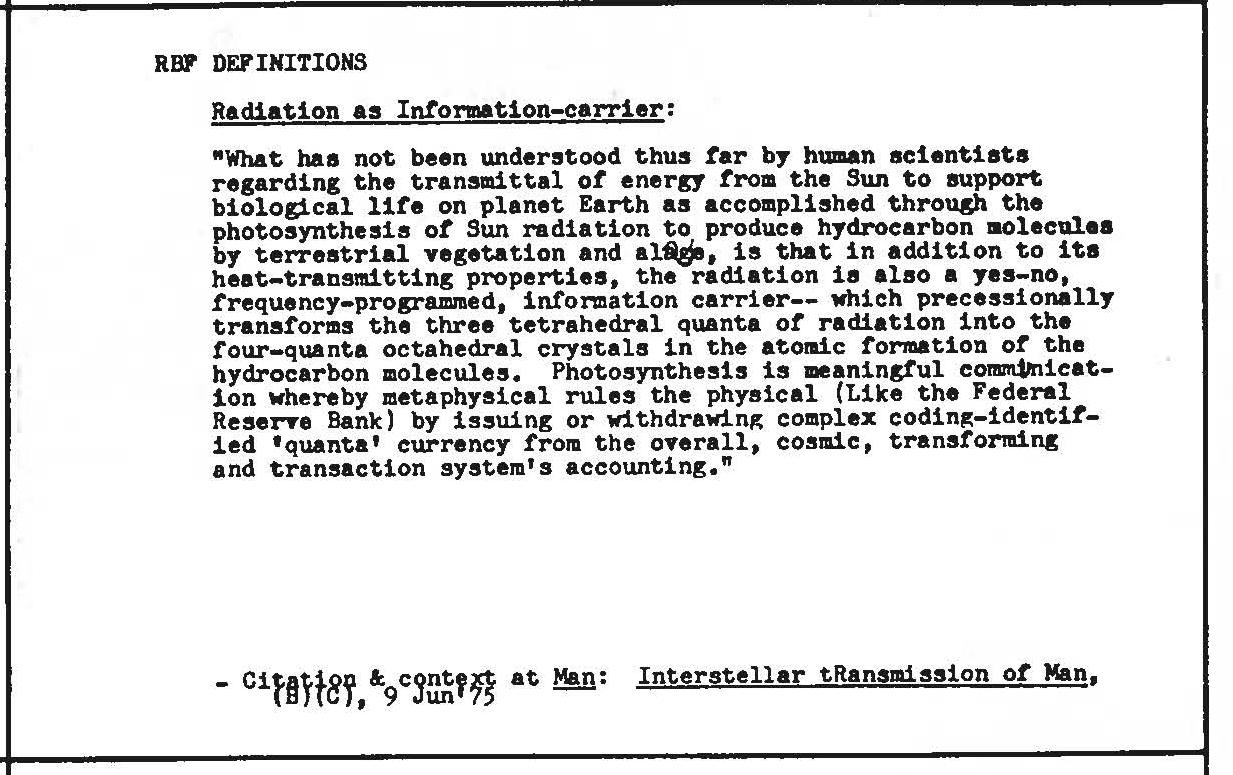
What has not been understood thus far by human scientists regarding the transmittal of energy from the Sun to support biological life on planet Earth as accomplished through the photosynthesis of Sun radiation to produce hydrocarbon molecules by terrestrial vegetation and algae, is that in addition to its heat-transmitting properties, the radiation is also a yes-no, frequency-programmed, information carrier-- which precessionally transforms the three tetrahedral quanta of radiation into the four-quanta octahedral crystals in the atomic formation of the hydrocarbon molecules. Photosynthesis is meaningful communication whereby metaphysical rules the physical (Like the Federal Reserve Bank) by issuing or withdrawing complex coding-identified 'quanta' currency from the overall, cosmic, transforming and transaction system's accounting.
- Citation & context at Man: Interstellar tRansmission of Man, (B)(C), 9 Jun'75
Radiation as Information-carrier
← Radiation as Information-carrier | Radiational Measurability →
Cross Reference
Cross-References
Radiational Measurability
← Radiation as Information-carrier | Radiation Minimum Increment Of (1) →
Cross Reference
Cross-References
- Vector Equilibrium, (2)
Radiation Minimum Increment Of (1)
← Radiational Measurability | Radiation: Minimum Increment of Radiation (2) →
Cross Reference
Cross-References

Radiation: Minimum Increment of Radiation (2)
← Radiation Minimum Increment Of (1) | Radiation: Speed Of →
Cross Reference
Cross-References
- Unit Radius, 17 Jan'74

Radiation: Speed Of
← Radiation: Minimum Increment of Radiation (2) | Radiation: Speed Of →
RBF Definitions
RBF DEFINITIONS
Radiation: Speed Of:
"Wavelength times frequency is the speed of all radiation. If the frequency of the vector equilibrium is four, its vector-radius, or basic wavelength = 186,000/4 miles reachable within one second = 46,500 reach-miles. Electromagnetically speaking the unarticulated vector equilibrium's vector length is always 186, \hrefhttps://www.buckyverse.org/en/synergetics/content/chapters/200-synergetics#section-282.396282.396 miles."
(For later version & context of above, see Vector Equilibrium: Unarticulated VE, 2 Nov'73)
Cite SYNERGETICS draft at Sec. \hrefhttps://www.buckyverse.org/en/synergetics/content/chapters/400-system#section-426.45426.45, 30 Nov'72
Cross-References
- Vector Equilibrium: Unarticulated VE, 2 Nov'73
Radiation: Speed Of
← Radiation: Speed Of | Radiation Speed Of →
Index Entry
Radiation: Speed Of:
"The speed of light, at the limit case, becomes the time. The speed of radiation is the limit case, but it is the initial limit. It always comes back to itself."
- Cite RBF to EJA, Beverly Hotel, NY, 22 Jun'72
Radiation Speed Of
← Radiation: Speed Of | Radiation: Speed Of →
Index Entry
The speeds of all the known different phases of measured radiation are apparently identical despite vast differences in wavelength and frequency. Einstein's adoption of electromagnetic radiation expansion- omnidirectionally in vacuo-- as normal speed suggests a top speed of omnidirectional entropic disorder increase accommodation at which radiant speed reaches its highest velocity. This highest velocity is reached when the last of the eternally regenerative Universe cyclic frequencies of multi-billions of years have been accommodated, all of which complex of nonsimultaneous transforming multivarietied frequency synchronizations is complementarily balanced to equate as zero by the sum totality of locally converging orderly and synchronously concentrating energy phases of scenario Universe's eternally pulsative, and only sum totally synchronous, disintegrative, divergent, omnidirectionally exporting and only sum totally synchronous, integrative, convergent and discretely directional individual importings.
Radiation: Speed Of
← Radiation Speed Of | Radiation: Speed Of →
Index Entry
Radiation: Speed Of:
"The speed of light had been measured linearly in a tube-- this is the speed of light in any one direction from its source. But radiation is called radiation because it goes in all directions from its source unless reflectively beamed. When we double the linear dimensions of any object-- the surface of the symmetrically amplified system grows as the second power of the linear. Science had to choose the lower-case letter c to represent the speed of the radiation linearly, to arrive at the rate at which it grew in an omnidirectional spherical way-- the rate at which the surface of the omnidirectional radius increases as the second power of the radius-- or linear speed: c^2."
- Cite RBF to EJA, Sarasota, Florida, 7 Feb '71
Radiation: Speed Of
← Radiation: Speed Of | Radiation: SpeedOf →
Index Entry
There are no instant lines--
Reaching instantly to eternity;
For the concepts
Of instantaneity, simultaneity, and eternity
Were anulled by the discovery
That light and all radiation
Have an approximately discrete speed
Of seven hundred million miles an hour,
which, of course, is too fast for man's
Perceptive detection,
But accounts lucidly
For humanity's assuming erroneously
That his sight experience
Is instantaneous.
Prior to the Michelson-Morley experiments--
Throughout all past history--
On every clear night
Man could seemingly witness for himself
The 'instantly eternal' stars.
However, with the measurement of light's
And of other
Radiation: SpeedOf
← Radiation: Speed Of | Radiation: Speed Of →
RBF Definitions
"Electromagnetic radiations' speed
We learned that it took
Eight minutes for light
To reach us from the Sun
And two and one-half years
From the next nearest star,
And an astronomical variety of other
Greater and different time lags
For light to reach us
From each of the other
Myriads of stars.
"These time lags were far different
From instantaneous and simultaneous.
And experiments made evident
That such light sources
Are always exhausting
Their local energy concentrations,
Wherefore they cannot be eternal.
"Prior to that measurement
The illusion of 'instantaneity
Induced false concepts
Citations
- GENERALIZED PRINCIPLES, p.5, 28 Jan'69
Radiation: Speed Of
← Radiation: SpeedOf | Radiation: Speed Of →
RBF Definitions
"Which man formalized into statements
And labeled as axioms
Holding them to be self-evident and a priori,
Ergo fundamental, characteristics of nature
Reduced to their respective simplest degrees.
"Typical of such
Axiomatic illusions
Were the concepts
Of solids, continuums, at rest,
Surfaces, and straight lines.
That reach instantly to infinity;
All of which concepts are contradicted
By experimental physics
Which has found only
Discontinuity and
Nonsimultaneity
As, for instance, is witnessible
In the discontinuity of the stars
In the Milky Way,
And is instrumentally discoverable
In the remotenes of electrons"
Citations
- GENERALIZED PRINCIPLES, pp.5-6, 28 Jan'69
Radiation: Speed Of
← Radiation: Speed Of | Radiation: Speed Of →
RBF Definitions
(D)
"From their nuclear protons
Which remoteness is equal
To the star spacing
In relation to their respective
Relative activity diameters.
"We have learned experimentally
That lines are always energy events
And because of their ever variant
Complex of other energy events
Of the total environment
There are always a myriad
Of precessionally steering ______ effects
Which result in curvilinear
Orbits, rotations, pulsations,
Implosions, explosions, and torations.
"Lines are finitely developed events.
And their durations
Are always relative
To some cyclic experience in time.
"Size and time are synonymous."
Citations
- GENERALIZED PRINCIPLES, p.6, 28 Jan'69
Radiation: Speed Of
← Radiation: Speed Of | Radiation Speed Of (1) →
Index Entry
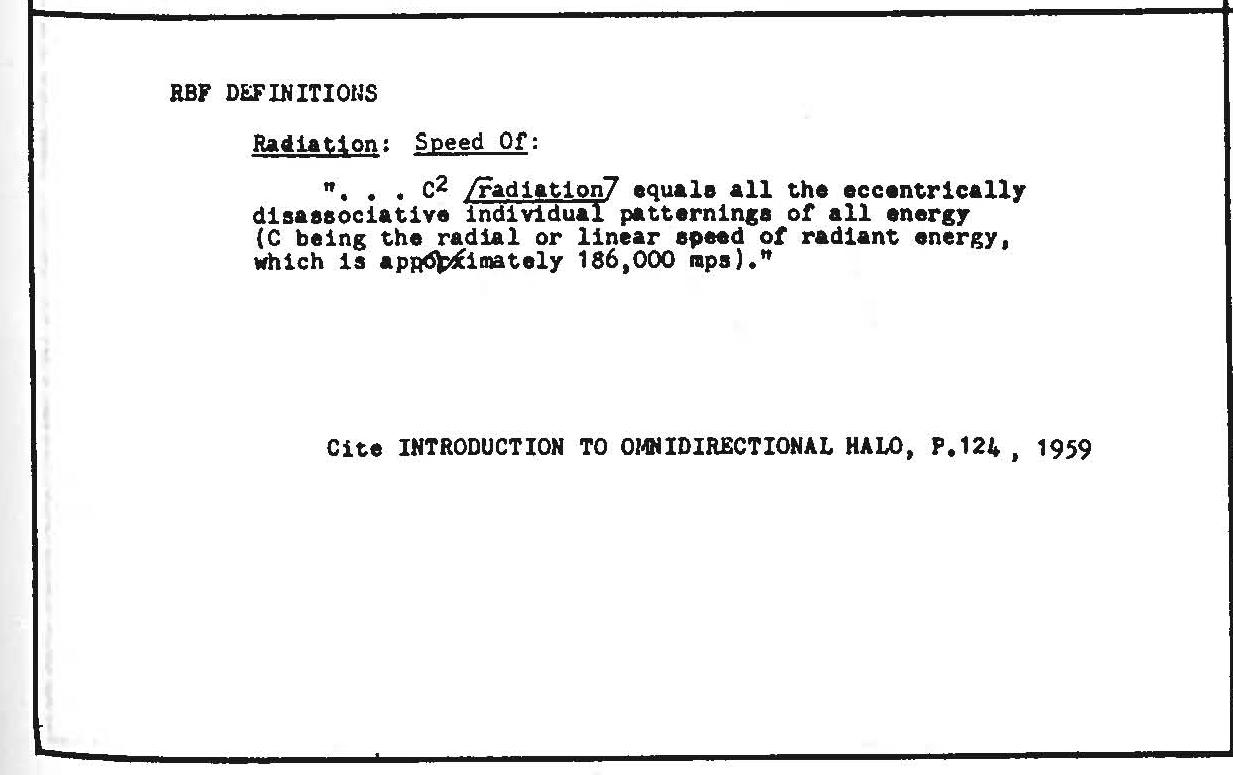
Radiation: Speed Of:
"... C² [radiation] equals all the eccentrically disassociative individual patternings of all energy (C being the radial or linear speed of radiant energy, which is approximately 186,000 mps)."
Radiation Speed Of (1)
← Radiation: Speed Of | Radiation Speed Of (2) →
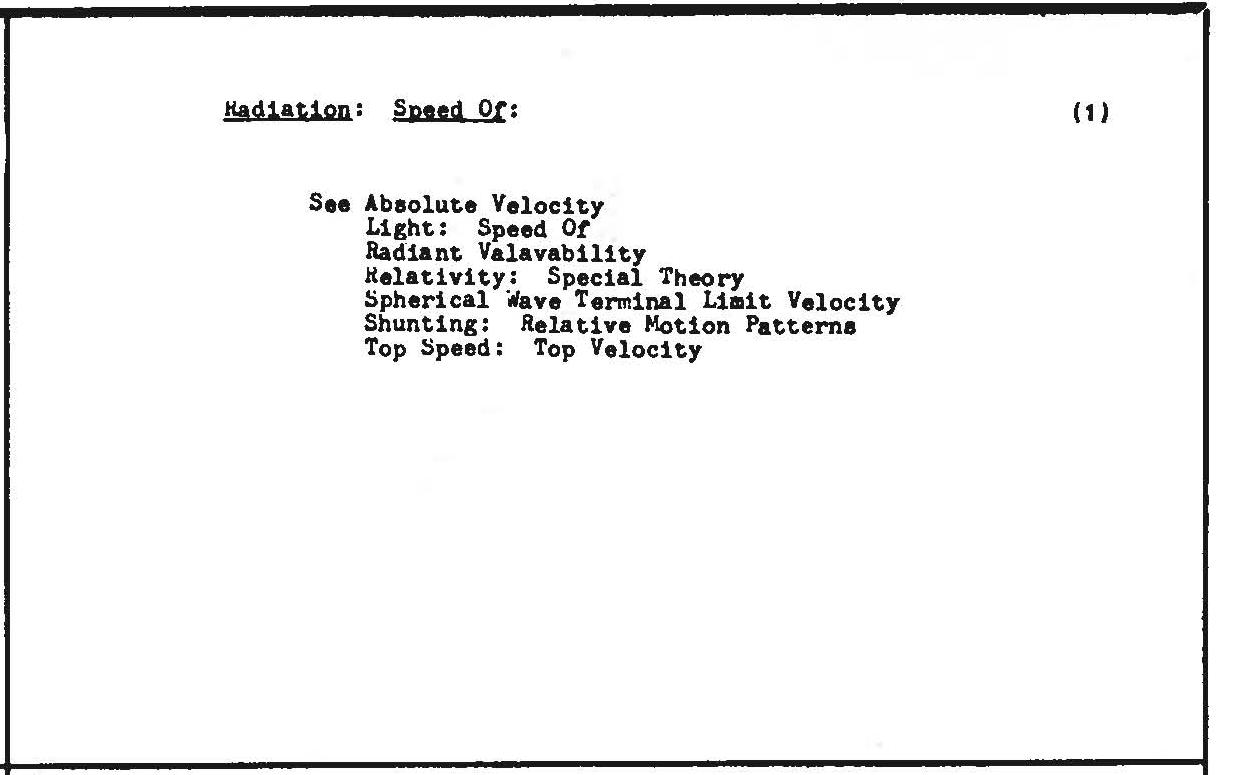
Cross Reference
Radiant Valavability
Spherical Wave Terminal Limit Velocity
Cross-References
- Absolute Velocity
- Light: Speed Of
- Relativity: Special Theory
- Shunting: Relative Motion Patterns
- Top Speed: Top Velocity
Radiation Speed Of (2)
← Radiation Speed Of (1) | Radiation (1) →
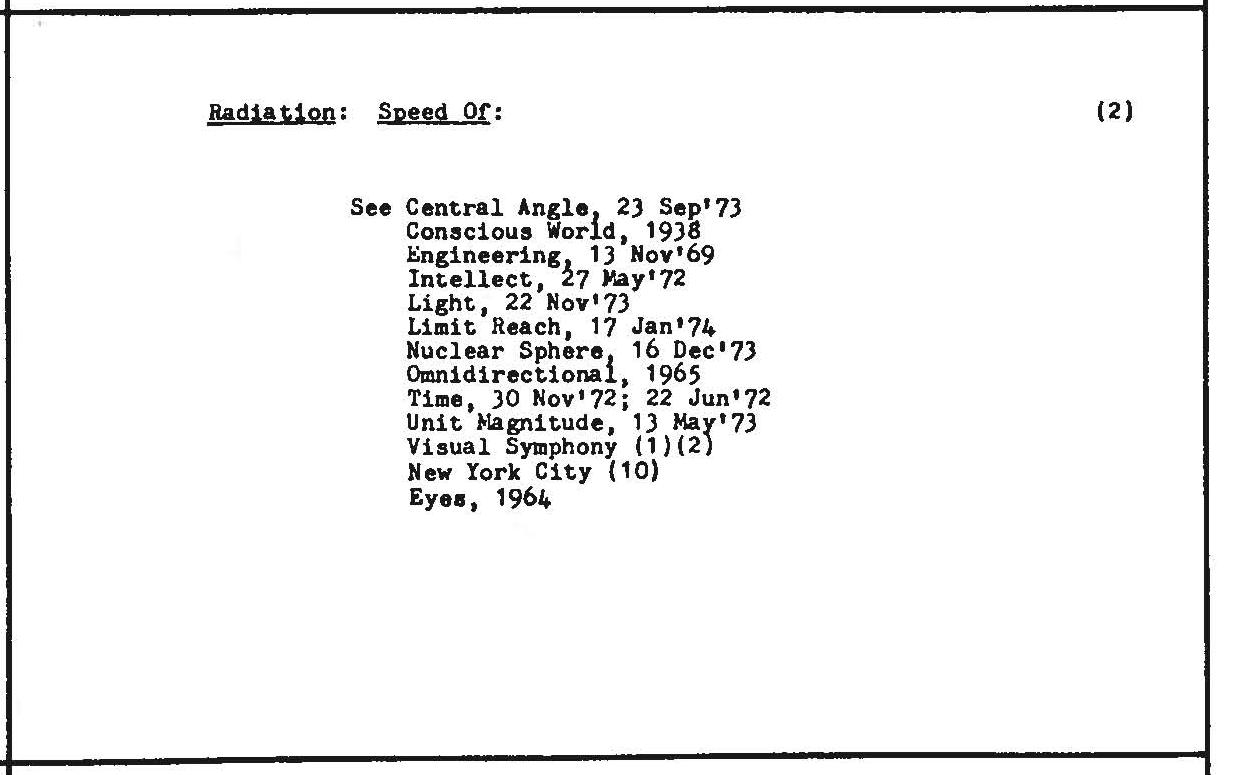
Cross Reference
Cross-References
- Central Angle, 23 Sep'73
- Conscious World, 1938
- Engineering, 13 Nov'69
- Intellect, 27 May'72
- Light, 22 Nov'73
- Limit Reach, 17 Jan'74
- Nuclear Sphere, 16 Dec'73
- Omnidirectional, 1965
- Time, 30 Nov'72; 22 Jun'72
- Unit Magnitude, 13 May'73
- Visual Symphony, (1)(2)
- New York City, (10)
- Eyes, 1964
Radiation (1)
← Radiation Speed Of (2) | Radiation (2) →
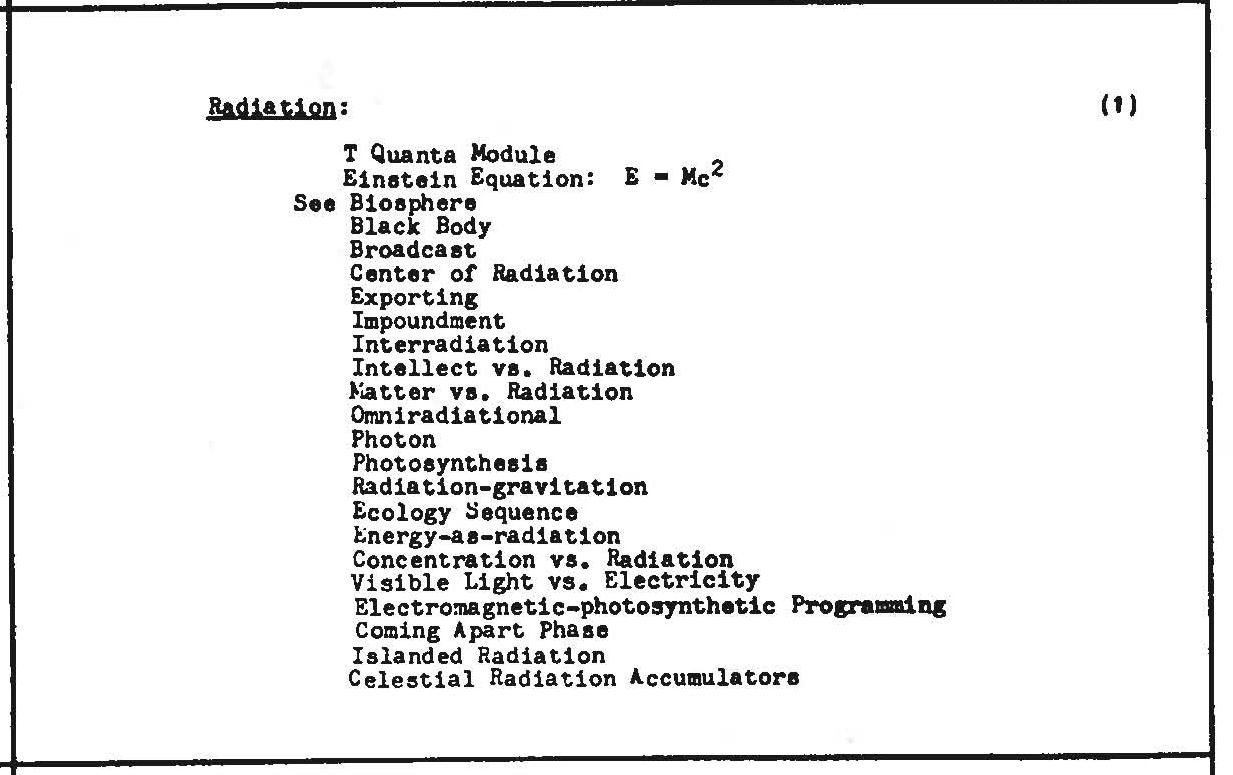
Cross Reference
T Quanta Module
Einstein Equation: E = Mc²
Black Body
Center of Radiation
Impoundment
Islanded Radiation
Cross-References
- Biosphere
- Broadcast
- Exporting
- Interradiation
- Intellect vs. Radiation
- Matter vs. Radiation
- Omniradiational
- Photon
- Photosynthesis
- Radiation-gravitation
- Ecology Sequence
- Energy-as-radiation
- Concentration vs. Radiation
- Visible Light vs. Electricity
- Electromagnetic-photosynthetic Programming
- Coming Apart Phase
- Celestial Radiation Accumulators
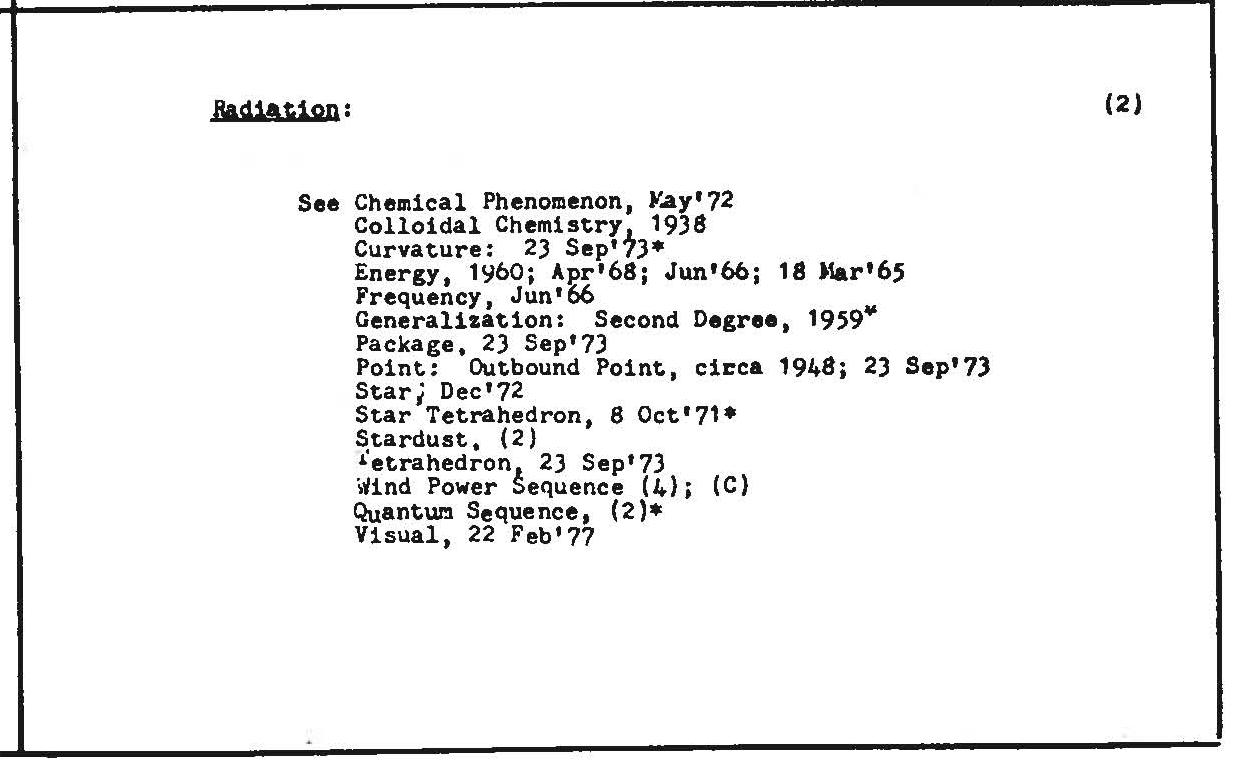
Radiation (2)
← Radiation (1) | Radiation (3) →
Cross Reference
Cross-References
- Chemical Phenomenon, May'72
- Colloidal Chemistry, 1938
- Curvature, 23 Sep'73*
- Energy, Apr'68; Jun'66; 18 Mar'65
- Frequency, Jun'66
- Generalization: Second Degree, 1959
- Package, 23 Sep'73
- Point: Outbound Point, 23 Sep'73
- Star, Dec'72
- Star Tetrahedron, 8 Oct'71*
- Stardust, (2)
- Tetrahedron, 23 Sep'73
- Wind Power Sequence, (4)
- Quantum Sequence, (2)
- Visual, 22 Feb'77
Radiation (3)
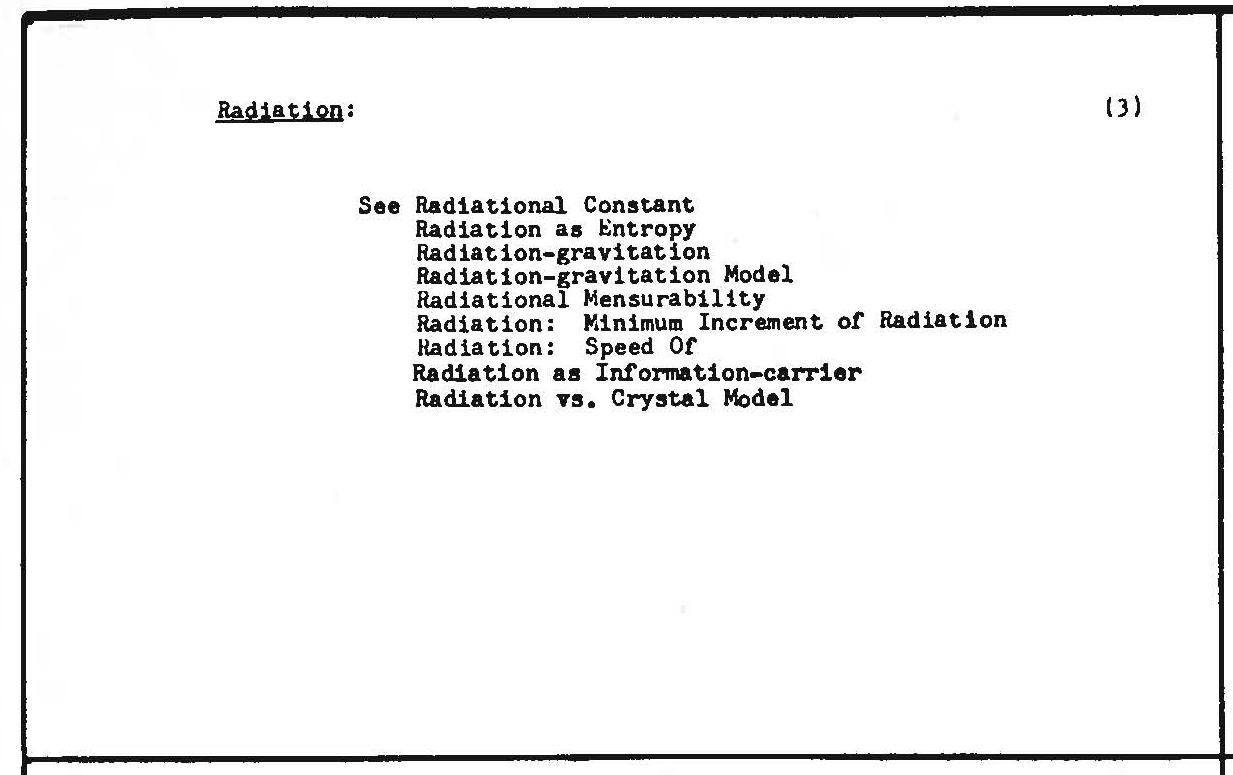
Cross Reference
Radiational Mensurability
Cross-References
- Radiational Constant
- Radiation as Entropy
- Radiation-gravitation
- Radiation-gravitation Model
- Radiation: Minimum Increment of Radiation
- Radiation: Speed Of
- Radiation as Information-carrier
- Radiation vs. Crystal Model
Radical
← Radiation (3) | Radio Ham Language (1) →
Cross Reference
Cross-References
- Assumptions, 1946

Radio Ham Language (1)
← Radical | Radio Set is Not the Music (1) →
Cross Reference
Cross-References

Radio Set is Not the Music (1)
← Radio Ham Language (1) | Radio Set is Not the Music (2) →
Cross Reference
Cross-References

Radio Set is Not the Music (2)
← Radio Set is Not the Music (1) | Radio Tuning Crystal →
Cross Reference
Cross-References
Radio Tuning Crystal
← Radio Set is Not the Music (2) | Radio: Radio Waves (1) →
Index Entry
Radio Tuning Crystal:
"The first radio tuning crystal must have been a rhombic dodecahedron."
- Citation and context at Rhombic Dodecahedron, 30 Nov'72
Radio: Radio Waves (1)
← Radio Tuning Crystal | Radio: Radio Waves (2) →
Cross Reference
Cross-References
Radio: Radio Waves (2)
← Radio: Radio Waves (1) | Radioactivity (1) →
Cross Reference
Cross-References
- All-acceleration Universe, 20 Jun'66
- Ball at the Center, 9 Mar'73
- Visual Symphony, (4)
- Seeing vs. Hearing, 22 Jan'75
- Individuality & Degrees of Freedom, (3)
- Lasso, 1946
Radioactivity (1)
← Radio: Radio Waves (2) | Radioactivity (2) →
Cross Reference
Cross-References
Radioactivity (2)
← Radioactivity (1) | Radiolaria (1) →
Cross Reference
Cross-References
- Now, 14 Feb'72

Radiolaria (1)
← Radioactivity (2) | Radiolaria (2) →
Index Entry
Radiolaria:
"The micro animal structures, the radiolaria, if you study them, will always show that they are based on either the tetrahedron, the octahedron, or the icosahedron. This picture (R-4-1) was drawn by English scientists almost a century ago as they looked through a microscope at these micro-sea structures.
"Today I have given you some fundamental structural principles and subsequently shown you their use by nature. I didn't, however, start by studying these structures of nature seeking to understand their logic. The picture of the radiolaria has been available for 100 years, but I didn't happen to see it until after I had produced the geodesic structures from the mathematical sequence of developments which I reviewed with you earlier. In other words I did not copy nature's structural patterns. I did not make arbitrary arrangements for superficial reasons. What really interests me therefore in all these recent geodesic tensegrity findings in nature is that they apparently confirm that I have found the coordinate mathematical system employed in nature's structuring. I began to explore structure and develop it in pure mathematical principle out of which the patterns emerged in pure"
Radiolaria (2)
← Radiolaria (1) | Radiolaria →
RBF Definitions
principle. I then realized those developed structural principles as physical forms, and in due course applied them to practical tasks. The reappearance of these structures as recent scientists' findings at various levels of inquiry are pure coincidence-- but excitingly validating coincidence." - Cite MEXICO '63, p. 59, 10 Oct '63
Radiolaria
← Radiolaria (2) | Radionics →
Cross Reference
Cross-References
- Invention, 3 Oct'72

Radionics
Cross Reference
Cross-References
- Universal Vertex Center Model, 29 Apr'43
Radius
Cross Reference
Radius:
"It is very easy to be greatly misled when you see two spheres in tangency. There is only one line between the two. This is where you see that unity is two because the line breaks itself into radii of the two spheres."
- Cite RBF tape-Blackstone Hotel, Chicago, 31 May 1971, p.37
Cross-References
- Tangency, 31 May'71
Radius
Index Entry
Radius:
"As a chord turns into an arc the radius contracts."
- For citation and context see Vector Equilibrium: Spheres and Spaces, 31 May '71
Radius
Index Entry
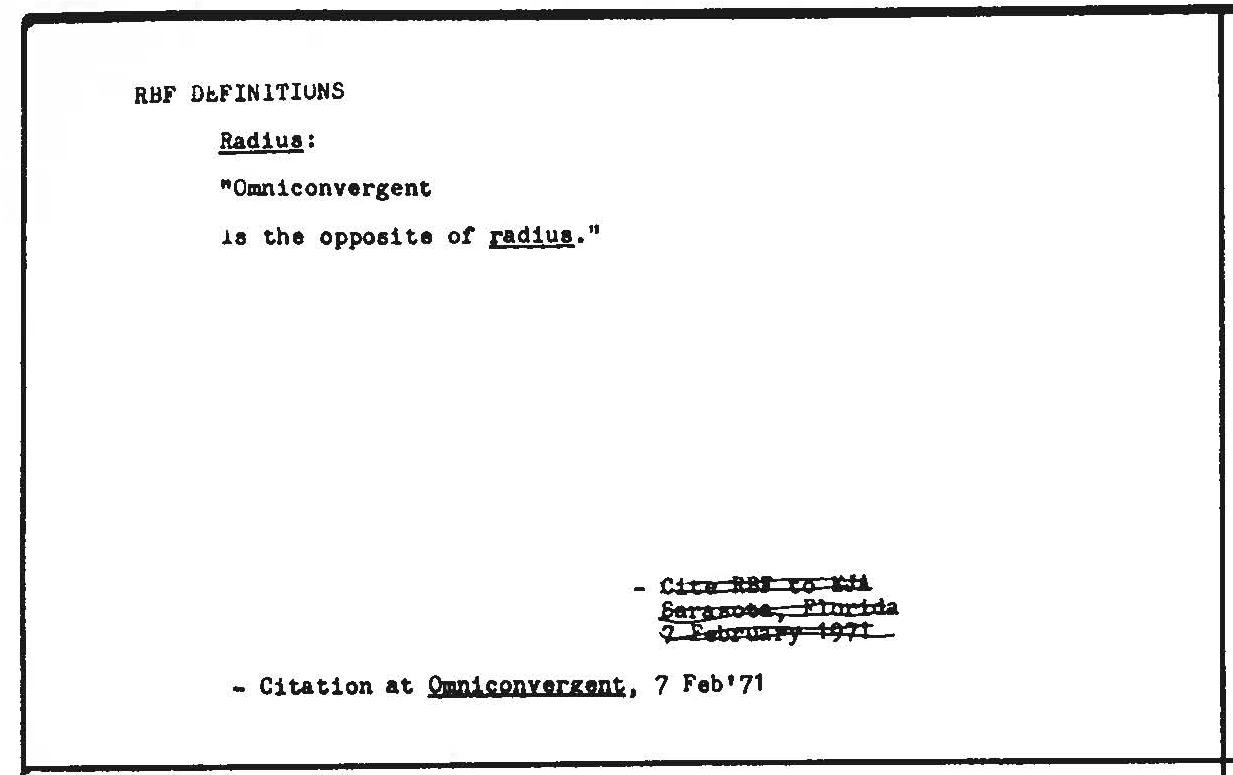
Radius:
"Omniconvergent
is the opposite of radius."
- Cite RBF to EJA
Sarasota, Florida
7 February 1971
- Citation at Omniconvergent, 7 Feb'71
Radius
Index Entry
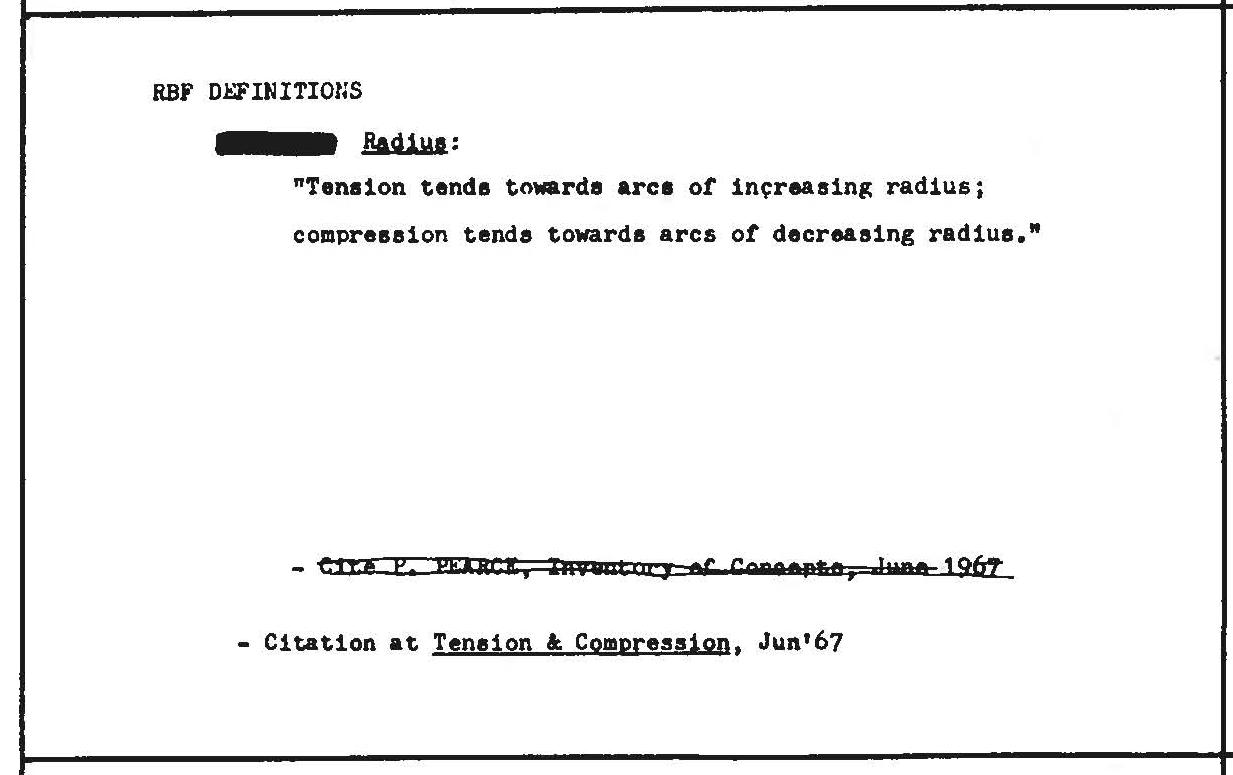
Tension tends towards arcs of increasing radius; compression tends towards arcs of decreasing radius.
-
Cite P. PEARCE, Inventory of Concepts, June 1967
-
Citation at Tension & Compression, Jun'67
Radius
Index Entry
Radius:
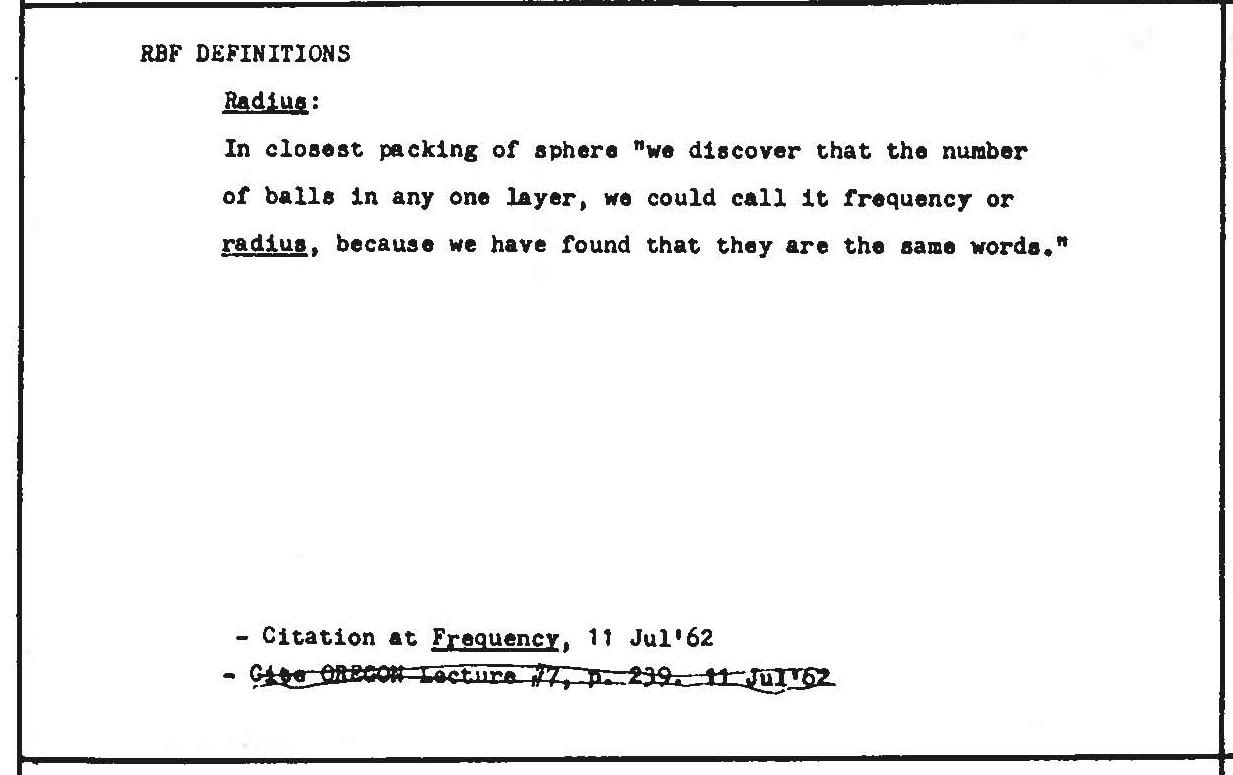
In closest packing of sphere "we discover that the number of balls in any one layer, we could call it frequency or radius, because we have found that they are the same words." Citation at Frequency, 11 Jul'62 Cite OREGON Lecture #7, p. 239. 11 Jul'62
Radius (1)
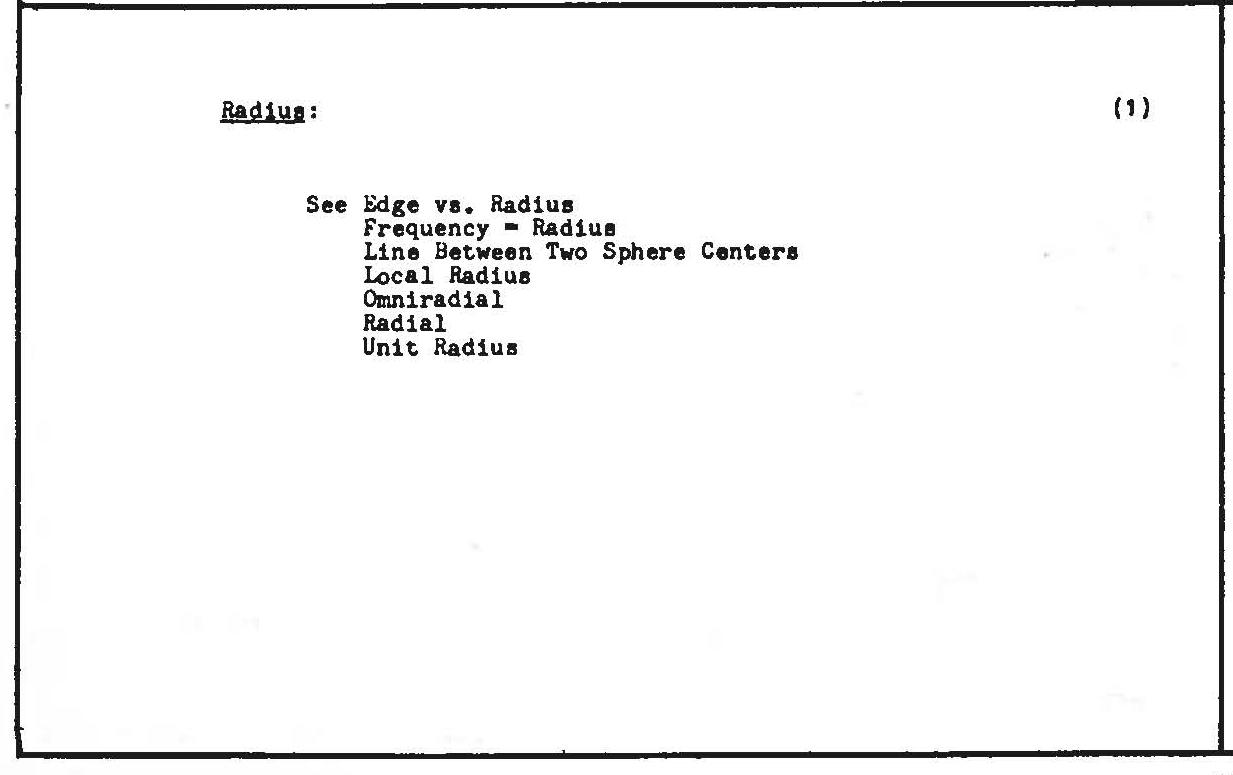
Cross Reference
Cross-References
- Edge vs. Radius
- Frequency = Radius
- Line Between Two Sphere Centers
- Local Radius
- Omniradial
- Radial
- Unit Radius
Radius (2)
← Radius (1) | Radome Sequence →
Cross Reference
Cross-References
- Frequency, 11 Jul'62*
- Geometry of Vectors, Aug'71
- Omniconvergent, 7 Feb'71*
- Powering: One Dimension, 15 Oct'72
- Radiation, 8 Mar'73
- Rotate, 6 May'48
- Tangency, 31 May'71*
- Tension & Compression, Jun'67*
- Vector Equilibrium: Spheres & Spaces, 31 May'71*
Radome Sequence
← Radius (2) | Radome Sequence →
Index Entry
Radome Sequence:
"This is one of the geodesic radomes tested for the Arctic. They are made out of polyester fiberglass and the diamond-shaped, paneled pieces are made with bolt holes in their adjacent flanges. All the mathematics must be done very accurately to permit these pieces to be interchangeably bolted together. We hold our spherical trigonometry calculations to an accuracy of 1/1000 of a second of circular arc. The geodesic radome structures go up in an average of 14 hours each in the Arctic.
"Our Air Force Radomes were installed in the Arctic mostly by Eskimos and others who had never seen them before. The mass production technology made assembly possible at an average rate of 14 hours each. One of these radomes was lent by the U.S. Air Force to the Museum of Modern Art in New York City for an exhibition of my work in 1959-1960. It took regular building trades skilled labor one month to assemble the dome in New York City.
"American labor fought a great and worthy battle to win the working man's share of the synergetic productivity of industry. Labor's battle proved doubly worthwhile because it inadvertently brought about mass consumption. Without mass consumption you cannot maintain mass production. You cannot have the mass"
Radome Sequence
← Radome Sequence | Radome Sequence →
Index Entry
production of industrialization without an original investment of vast capital effort of work and that original capital came first and long ago from serfdom or outright slavery. In order to bring industrialization to benefit comprehensively emancipated man, you must have mass purchasing power, which in due course will underwrite automation, which in turn will eventually produce so much wealth as to be able to free man's time for further education and research to increase the wealth long generated by unimpeded automation. American labor will not yield that unimpedement until it is clearly demonstrated that all men will prosper directly by doing so. American labor did bring about the vast purchasing power in industry, but in so doing it established all kinds of rules which inadvertently protected the obsolete inefficiencies of building.
When the kind of structure which goes up in the Arctic in 14 hours takes a month in New York City, clearly there has been an inordinate shunting of social wealth in a direction in which legitimate value was not added to the product. This is an indirect, illogical, and therefore indefensible way of distributing wealth for it hides the new advantages and therefore retards the growth of those advantages as wealth generators of the
Radome Sequence
← Radome Sequence | Radome Sequence (1) →
RBF Definitions
"commonwealth. We must be very careful in judging the new, high production technology structural experiments so as not to have our fundamental tactical information distorted by ill conceived labor tactics. We have very real social problems which must be solved by realistic acceptance of the facts rather than deferred from realistic consideration of the inherent new wealth-generating advantages by hiding the new technical advantage under the wing of individually conceived palliatives which are operated by old rules that do not permit the real advantages to be recognized by the labor movement's management. We are going to have to bring industrial mass purchasing ability to all of humanity. But first we are going to have to get labor rates evened up all around the world in order to have every man's raw time worth as much as any other man's time when translated into purchasing power per kilowatts or pounds of specific metal goods. Next we are going to let automation take over after we find ways to pay everyone dividends from its wealth making to keep up purchasing power at a maximum and thereby to regenerate the industrial evolution advance."
Citations
- RBF photo caption, Fig. 177, dome photos, about 1960.
Radome Sequence (1)
← Radome Sequence | Radome Sequence (2) →
Index Entry
Radome Sequence:
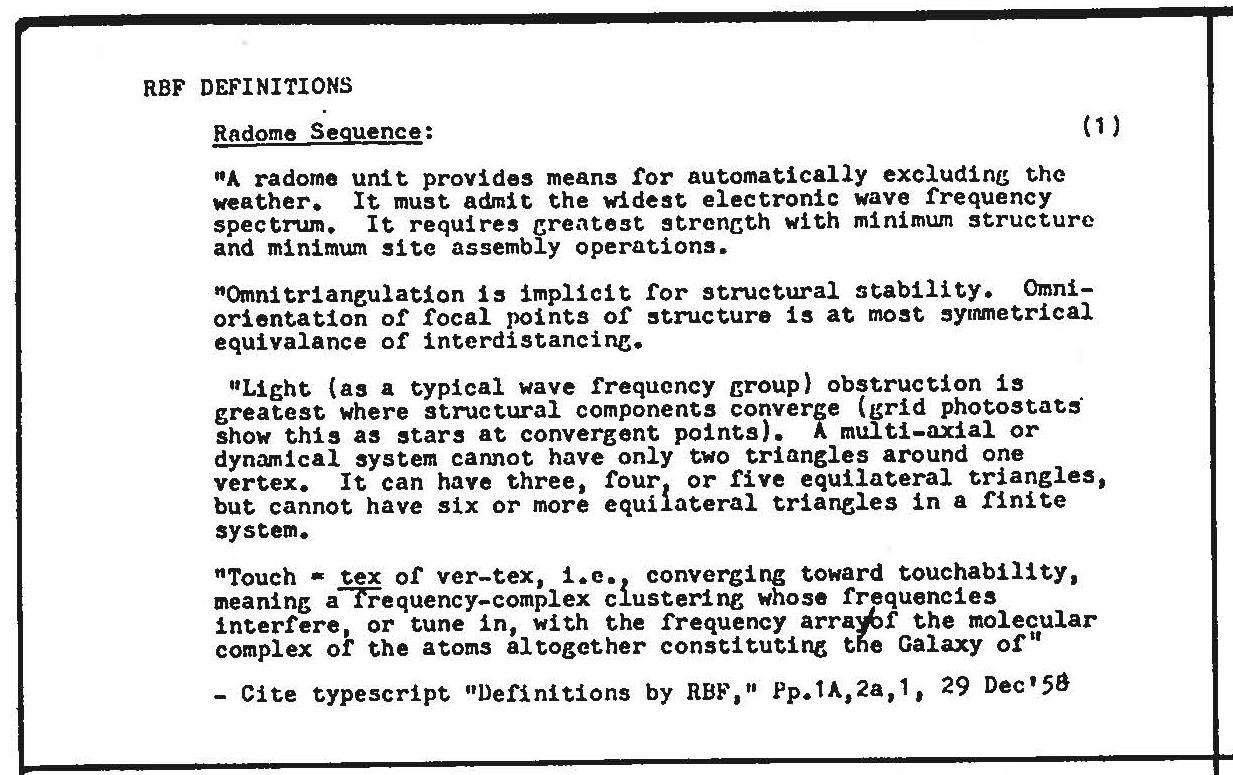
A radome unit provides means for automatically excluding the weather. It must admit the widest electronic wave frequency spectrum. It requires greatest strength with minimum structure and minimum site assembly operations.
Omnitriangulation is implicit for structural stability. Omni-orientation of focal points of structure is at most symmetrical equivalence of interdistancing.
Light (as a typical wave frequency group) obstruction is greatest where structural components converge (grid photostats show this as stars at convergent points). A multi-axial or dynamical system cannot have only two triangles around one vertex. It can have three, four, or five equilateral triangles, but cannot have six or more equilateral triangles in a finite system.
Touch = tex of ver-tex, i.e., converging toward touchability, meaning a frequency-complex clustering whose frequencies interfere, or tune in, with the frequency arrayof the molecular complex of the atoms altogether constituting the Galaxy of"
Radome Sequence (2)
← Radome Sequence (1) | Radome Sequence (3) →
RBF Definitions
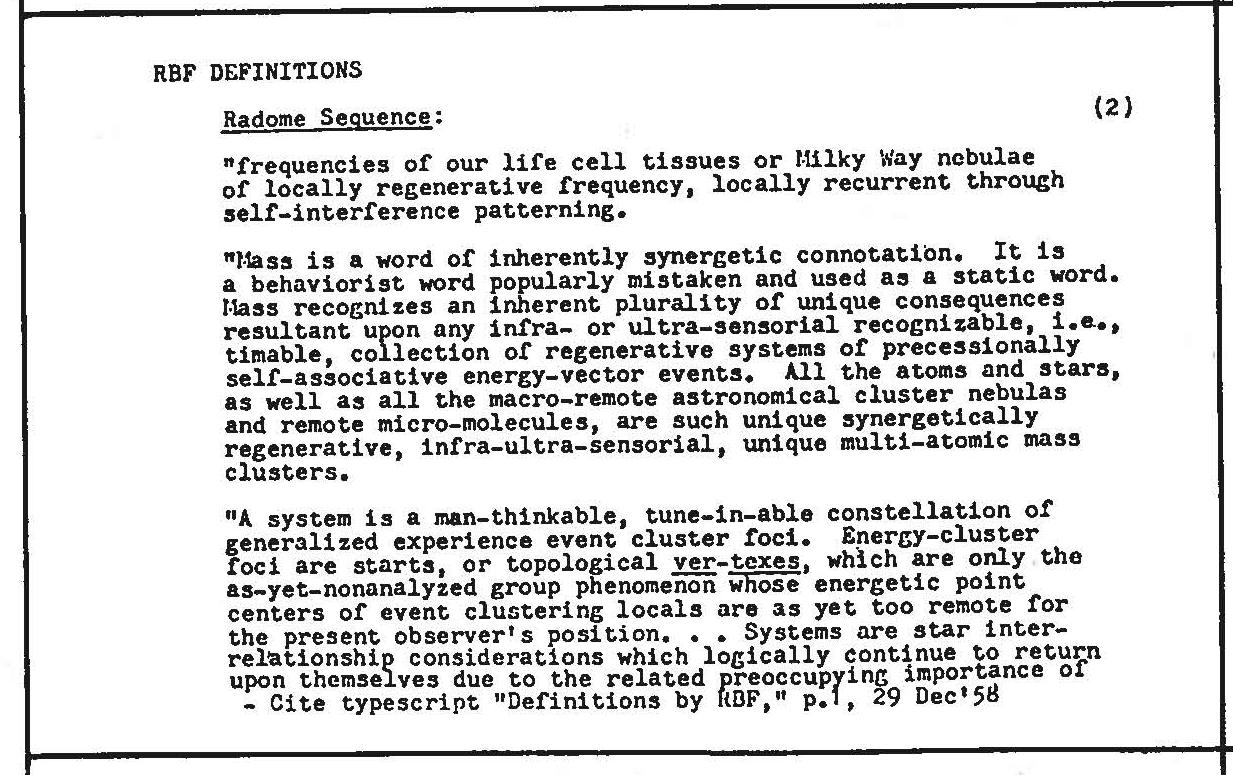
"frequencies of our life cell tissues or Milky Way nebulae
of locally regenerative frequency, locally recurrent through
self-interference patterning.
"Mass is a word of inherently synergetic connotation. It is
a behaviorist word popularly mistaken and used as a static word.
Mass recognizes an inherent plurality of unique consequences
resultant upon any infra- or ultra-sensorial recognizable, i.e.,
timable, collection of regenerative systems of precessionally
self-associative energy-vector events. All the atoms and stars,
as well as all the macro-remote astronomical cluster nebulas
and remote micro-molecules, are such unique synergetically
regenerative, infra-ultra-sensorial, unique multi-atomic mass
clusters.
"A system is a man-thinkable, tune-in-able constellation of
generalized experience event cluster foci. Energy-cluster
foci are starts, or topological ver-texes, which are only the
as-yet-nonanalyzed group phenomenon whose energetic point
centers of event clustering locals are as yet too remote for
the present observer's position. . . Systems are star inter-
relationship considerations which logically continue to return
upon themselves due to the related preoccupying importance of
Citations
- typescript "Definitions by RBF," p.1, 29 Dec'58
Radome Sequence (3)
← Radome Sequence (2) | Radome Sequence →
Index Entry
Radome Sequence:
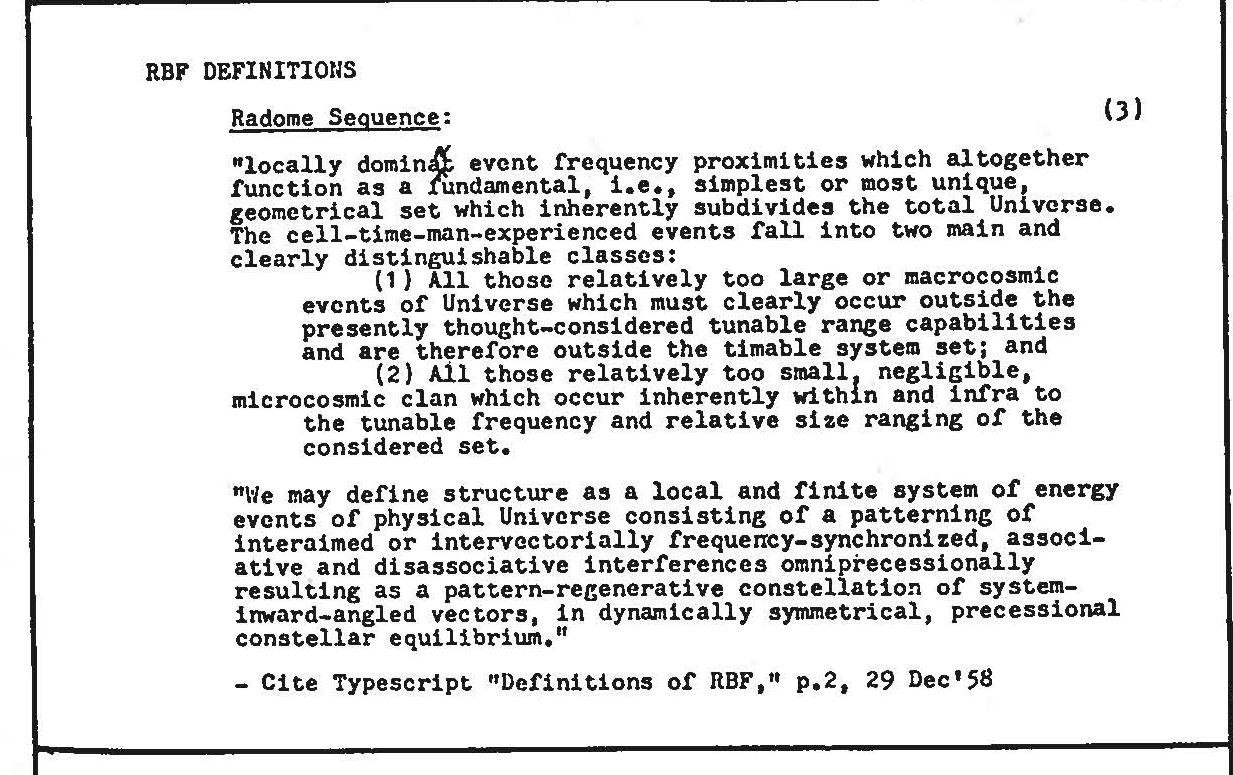
"locally dominant event frequency proximities which altogether function as a fundamental, i.e., simplest or most unique, geometrical set which inherently subdivides the total Universe. The cell-time-man-experienced events fall into two main and clearly distinguishable classes:
(1) All those relatively too large or macrocosmic events of Universe which must clearly occur outside the presently thought-considered tunable range capabilities and are therefore outside the timable system set; and
(2) All those relatively too small, negligible, microcosmic clan which occur inherently within and infra to the tunable frequency and relative size ranging of the considered set.
"We may define structure as a local and finite system of energy events of physical Universe consisting of a patterning of interaimed or intervectorially frequency-synchronized, associative and disassociative interferences omniprecessionally resulting as a pattern-regenerative constellation of system-inward-angled vectors, in dynamically symmetrical, precessional constellar equilibrium."
- Cite Typescript "Definitions of RBF," p.2, 29 Dec'58
Radome Sequence
← Radome Sequence (3) | Radome Sequence →
Index Entry
Radome Sequence:
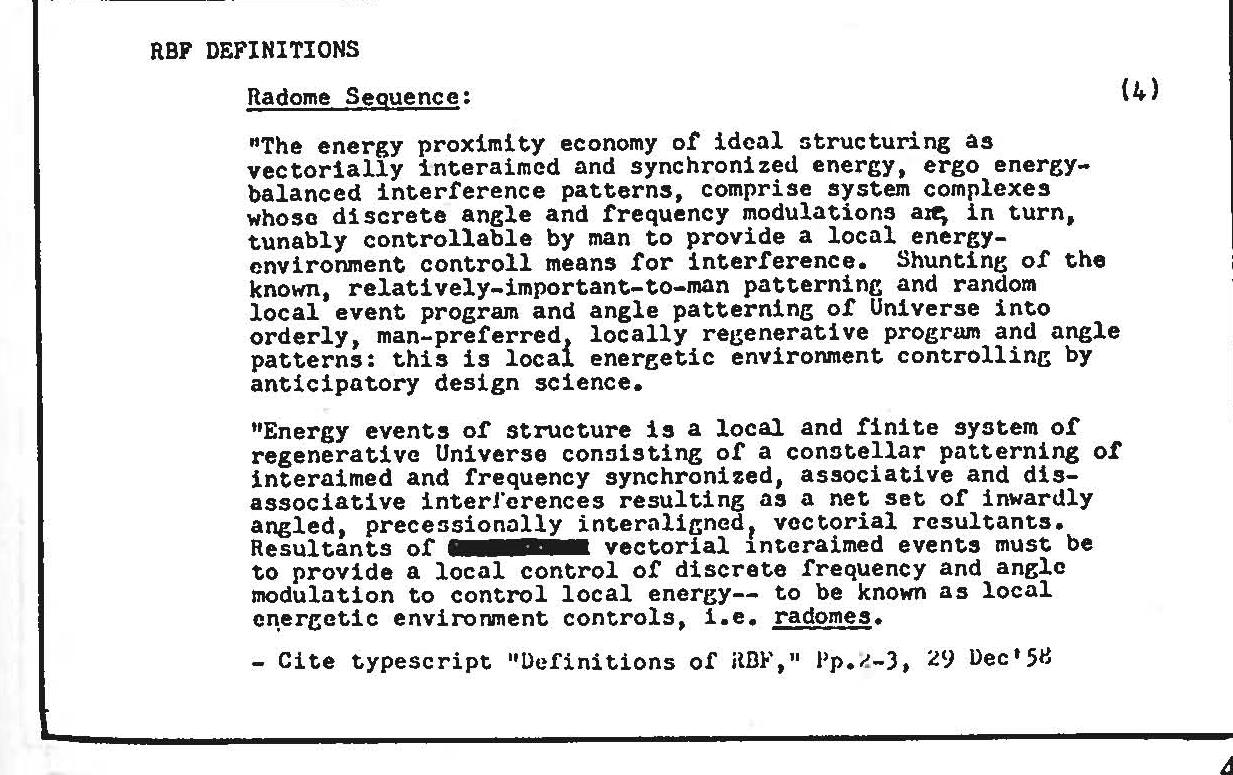
"The energy proximity economy of ideal structuring as vectorially interaimed and synchronized energy, ergo energy-balanced interference patterns, comprise system complexes whose discrete angle and frequency modulations are, in turn, tunably controllable by man to provide a local energy-environment control means for interference. Shunting of the known, relatively-important-to-man patterning and random local event program and angle patterning of Universe into orderly, man-preferred, locally regenerative program and angle patterns: this is local energetic environment controlling by anticipatory design science.
"Energy events of structure is a local and finite system of regenerative Universe consisting of a constellar patterning of interaimed and frequency synchronized, associative and disassociative interferences resulting as a net set of inwardly angled, precessionally interaligned, vectorial resultants. Resultants of vectorial interaimed events must be to provide a local control of discrete frequency and angle modulation to control local energy-- to be known as local energetic environment controls, i.e. radomes.
Radome Sequence
← Radome Sequence | Radome Sequence →
Index Entry
Radome Sequence:
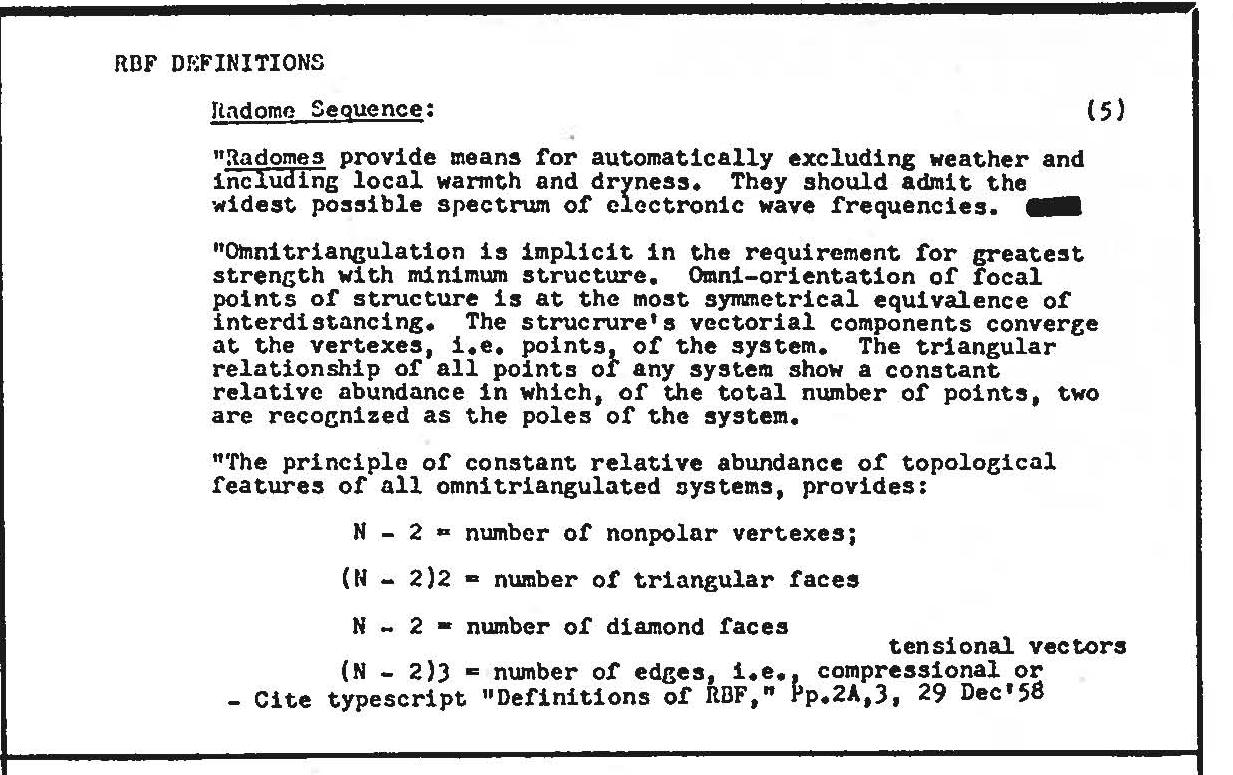
"Radomes provide means for automatically excluding weather and including local warmth and dryness. They should admit the widest possible spectrum of electronic wave frequencies.
"Omnitriangulation is implicit in the requirement for greatest strength with minimum structure. Omni-orientation of focal points of structure is at the most symmetrical equivalence of interdistancing. The structure's vectorial components converge at the vertexes, i.e. points, of the system. The triangular relationship of all points of any system show a constant relative abundance in which, of the total number of points, two are recognized as the poles of the system.
"The principle of constant relative abundance of topological features of all omnitriangulated systems, provides:
N - 2 = number of nonpolar vertexes;
(N - 2)2 = number of triangular faces
N - 2 = number of diamond faces
(N - 2)3 = number of edges, i.e., compressional or tensional vectors
- Cite typescript "Definitions of RBF," Pp.2A,3, 29 Dec'58
Radome Sequence
← Radome Sequence | Radome Sequence →
Index Entry
Radome Sequence:
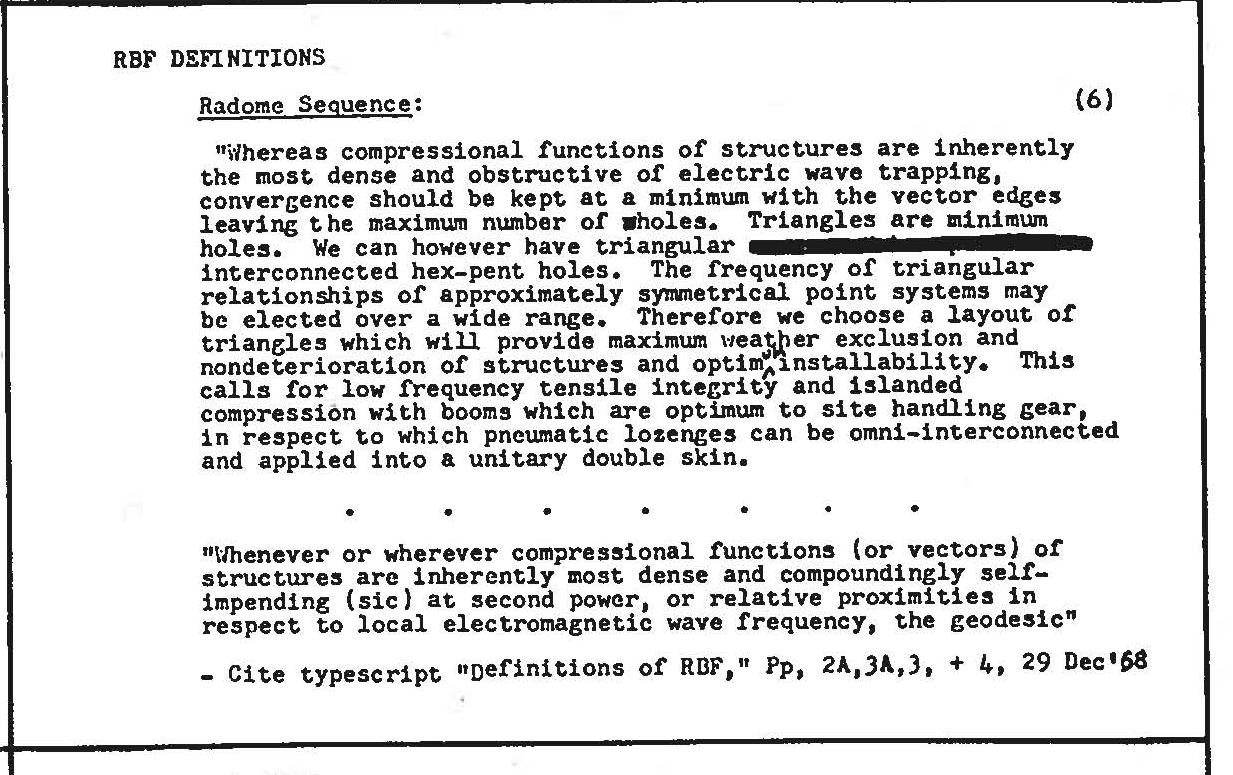
"Whereas compressional functions of structures are inherently the most dense and obstructive of electric wave trapping, convergence should be kept at a minimum with the vector edges leaving the maximum number of wholes. Triangles are minimum holes. We can however have triangular interconnected hex-pent holes. The frequency of triangular relationships of approximately symmetrical point systems may be elected over a wide range. Therefore we choose a layout of triangles which will provide maximum weather exclusion and nondeterioration of structures and optim installability. This calls for low frequency tensile integrity and islanded compression with booms which are optimum to site handling gear, in respect to which pneumatic lozenges can be omni-interconnected and applied into a unitary double skin.
"Whenever or wherever compressional functions (or vectors) of structures are inherently most dense and compoundingly self-impending (sic) at second power, or relative proximities in respect to local electromagnetic wave frequency, the geodesic"
Radome Sequence
Index Entry
frequency design traffic should keep compressional componentation and its interconvergence at minimum, i.e., in edge or vector function leaving a maximum pattern of holes (i.e. hex-pent triangular faces)... .
Radome
Cross Reference
DEW Line Radomes
Cross-References
- Dome entries
Raft
Index Entry
Raft:
"The raft is tangent to the sphere at midpoint. The early navigators all knew this. They saw the islands disappearing over the horizon in the distance and they were all very conscious of a spherical world."
- Cite RBF to EJA, Michael Denneny & Arthur Morey, at Belmont Stakes restaurant breakfast, NYC, 3 Apr'75
Raft
← Raft | Rafts: Early World Drifting on Rafts (1) →
Index Entry
Raft:
"The origins of the raft are simple: take a man standing on the bank of a river. He falls in but he doesn't know how to swim. If he grabs a stone he will sink but if he hold on to a large enough piece of wood it will support him. Next we take a man climbing on to a floating log. He notices that it rolls so he tumbles back into the water. But if it has a big enough branch or a smaller branch that falls across another log, he will be able to stand up. This is a basic raft. If this raft consists of two logs separated by a distance like an outrigger, the resistance is much less if the wind is blowing on the sides. Therefore it will move in that course since everything goes in the direction of least resistance."
- Cite RAGA TO THE INVISIBLE SEA, p. 12.1970
Rafts: Early World Drifting on Rafts (1)
← Raft | Rafts: Early World Drifting on Rafts (2) →
Index Entry
Rafts: Early World Drifting on Rafts:
"If you were part of the very early world that drifted on rafts, with currents and with the winds, you just rarely came back to anything that you were familiar with. The patterns were very, very large and you just kept sweeping on, and you could say goodbye to those people and you never ever saw them again. Because you were saying goodbye to people and never seeing them again, the phenomena really of life and death-- you are alive and they are alive, but you never see them again-- so life and death to those people did not have the distinction that it had later on. If you never came to anything that you recognized, you would not then recognize any really fundamental pattern. Furthermore, there were some patterns of stars in the sky, but you didn't get the same orientation of them ever again, so you don't tend to recognize that pattern. If you were, however, some of the early people who went offshore and accomplished some of the sailing with the beginning of the ability to navigate tow windward, when sailing ships first developed the ability to work to windward, you could retrace your steps, and if you did retrace your steps, you would then begin to get the same star patterns that you had before. You wouldn't have any islands or anything around you, but one thing that would be familiar is that you would get the same
Rafts: Early World Drifting on Rafts (2)
← Rafts: Early World Drifting on Rafts (1) | Rafts: Early World Drifting on Rafts (2) →
Index Entry
Rafts: Early World Drifting on Rafts:
"stars around you. And anyone who does any amount of sailing
knows how very familiar those stars become in the different
aspects."
- Cite Oregon Lecture #7, pp.251-252, 11 Jul'62
Rafts: Early World Drifting on Rafts (2)
← Rafts: Early World Drifting on Rafts (2) | Raft (1) →
Cross Reference
Cross-References
- Death, 1970
- Orbital Escape from Critical Proximity, (2)

Raft (1)
← Rafts: Early World Drifting on Rafts (2) | Raft Rafts (2) →
Cross Reference
Cross-References

Raft Rafts (2)
← Raft (1) | Railroad Tracks →
Cross Reference
Cross-References
- Four-dimensional Reality, 30 Apr'77
Railroad Tracks
← Raft Rafts (2) | Railroad Tracks: Great Circle Energy Tracks on the Surface Of A Sphere →
Index Entry
Railroad Tracks: Great Circle Energy Tracks on the Surface Of A Sphere:
"The vector equilibrium railroad tracks are trans-world-- like being in an airplane; you can go anywhere. But the icosahedron is stuck locally with no way to get to another continent. The vector equilibrium is how you go from one sphere to another, from Earth to Mars."
- Citation and context at Icosahedron As Local Shunting Circuit, 22 Jun'72
Railroad Tracks: Great Circle Energy Tracks on the Surface Of A Sphere
← Railroad Tracks | Railroad Tracks →
Index Entry
Now I have found that nature insists on doing things most economically. We find that energy insists on following the convex surface. It has to follow the great circles. We find the 25 great circles of symmetry of the VE have a very interesting characteristic: every one of them goes through the 12 vertexes. The 12 vertexes are made out of spheres in closest packing, packed 12-around-one. These are the points of tangency of spheres in closest packing. We have here 25 railroad tracks by which energy can go from here to there anywhere in the Universe in the shortest possible way and it is the only way it will go. Thses are the only possible transfers from here to there. So then if you want to go from here to there in the Universe, you have to follow these surfaces and you have to go through these contact points. So these 25 great circles represent a very special set of events because some of them, for instance the four great circles go through six vertexes; three great circles only go through four vertexes, etc.; they have different opportunities to peel off. They require different frequencies. I think
- Cite RBF to Verner Smythe, NYC, Reel 2, pp.8-9, 25 Feb'69
Railroad Tracks
← Railroad Tracks: Great Circle Energy Tracks on the Surface Of A Sphere | Railroad Tracks (1) →
Index Entry
Great Circle Energy Tracks on the Surface Of a Sphere:
"if you follow different great circles and their frequencies, incidentally, every one of the chemical elements has been identified by four different frequencies which absolutely leads to that chemical element.
"This has all the symmetries there are.
"Now the same sphere could become the icosahedron. . . It has the only great circles we have which don't go through the transfer points. Then they are not in agreement any more. When they get into an icosahedron you can shut off the energy supply and any waves would start going through the system and vector equilibrium would go through it."
Railroad Tracks (1)
← Railroad Tracks | Railroad Tracks (2) →
Cross Reference
Great Circle Energy Tracks on the Surface of a Sphere:
"The shortest distance between points on the surface of a sphere are the great circles. They are called the geodesic lines and inasmuch as there is no such thing as a straight line and we are working in some kinds of developing surfaces, the great circles are called geodesic lines. We are now getting into the axes of spin which are inherent in any system. We found that systems could be joined up /See Rubber Tires/ and they develop axial aspects, but they don't frustrate the rest of the Universe.
"Now we are very interested in the kinds of great circles which are developed by the various spins because they must have some kind of important relationship. We saw that if we had twelve spheres in what we call closest packing-- if you wanted to go the shortest distance between points on the surface of spheres-- supposing you were an electric charge, an electron. We make great copper spheres, the old Van de Graaff generators and so forth, you could build up enormous charges of electricity on the surface of this sphere."
- Cite Oregon Lecture #7, p. 266, 11 Jul'62
Cross-References
Railroad Tracks (2)
← Railroad Tracks (1) | Railroad Tracks →
Index Entry
Great Circle Energy Tracks on the Surface of a Sphere:
"The charges never try to go on the concave side of this sphere. They always stay on the convex side. You run into this kind of behavior just in trying the electroplate phenomenon. You will find that you cannot plate the concave side. You automatically electroplate the convex side. The convex side goes into higher tension which means that it is actually thinner and therefore less resistant and therefore the energy tries to follow the convex surfaces. Supposing you were the kind of energy that always follows the convex kind of surfaces and yet, being energy, you always have to do it the shortest way. You want to go from sphere to sphere on the surface of the sphere so you would have to take the great circles at the points where the spheres touch one another and therefore you would take the great circles of them. Therfore those 25 great circles are very important because they are all the possible great circles that carry all the traffic between the twelve points-- they are all the possible geodesic railroads. With that kind of energy which always has to follow surfaces, these are the railroad tracks that you would have to follow. . . "
- Cite Oregon Lecture #7, pp. 266-267. 11 Jul'62
Railroad Tracks
← Railroad Tracks (2) | Railroad Tracks →
Index Entry
Railroad Tracks: Great Circle Energy Tracks on the Surface of a Sphere: Convex and Concave:
"Dr Einstein pointed out that you could be the little man in the Universe who always went from sphere to sphere and through the points of tangency. You lived inside the concave surface of a sphere and you could get to the point of tangency in the next sphere, and the next sphere, concavely, and you could go right through the Universe that way. Or you could be the little man who lived on the outside of the sphere, and always lived convexly, and you came to the same point of tangency and you went on. This is one way of looking at Universe and the sphere is another way of looking at Universe. This is typical of not being fooled by just looking at the spheres-- or just looking at the little triangle locally on the surface of your big sphere where you had your big triangle. This is beginning to give us ways of seeing the complementarity at all times."
- Cite Oregon Lecture #7, p. 258. 11 Jul'62
Railroad Tracks
← Railroad Tracks | Railroad Tracks →
Index Entry
Great Circle Energy Tracks on the Surface of a Sphere: Foldability:
"This may be pure accident but I could say something to you now categorically that is really very fascinating, that is, I found that you could fold and make all the 25 and 31 great circles. There are no other circles though that I know how to fold and make any other kind of great circle patterns on spheres. They and they alone seem to be foldable into these conditions. This seems to be a very strange kind of control because if they did they all relate, they are the ways of the grand central station and all the shortat, most economical railroad tracks between all the points in Universe-- flying either concave or convex."
Railroad Tracks
← Railroad Tracks | Railroad Tracks: Great Circle Energy Tracks on the Surface: of a Sphere (1) →
Index Entry
Triangular Systems of Energy Networks.
"In any network high energy charges refuse to take the long way round to their opposite pole. They tend to push through, the separating space, striving to 'short.' Thus energy will automatically triangulate via a diagonal of a square, or via the triangulating diagonals of any other polygon to which the force is applied. Triangular systems represent the shortest, most economical energy networks. The triangle is the basic unit of energy configurations, whether occurring as free energy or as structure."
- Cite R.W. HARKS, p. 43. 1960
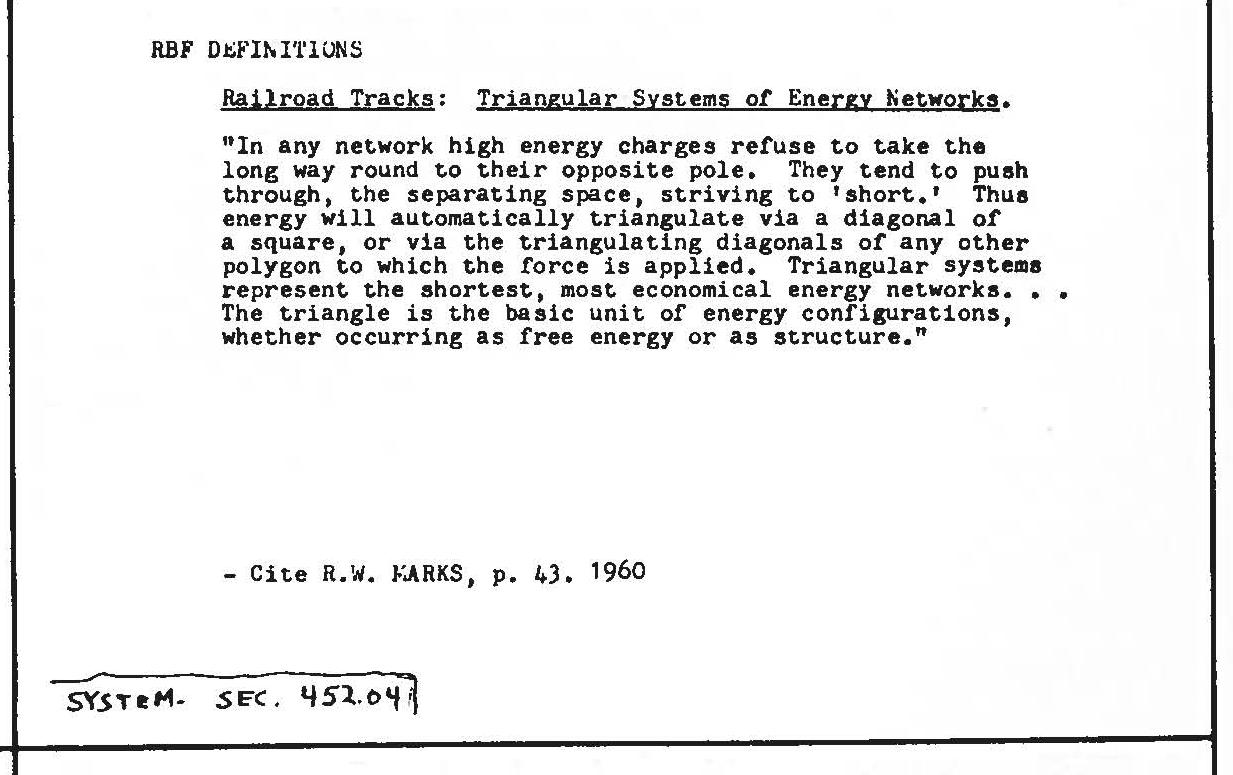
Railroad Tracks: Great Circle Energy Tracks on the Surface: of a Sphere (1)
← Railroad Tracks | Railroad Tracks: Great Circle Energy Tracks on the Surface of a Sphere (2) →
Cross Reference
Kissing Point: K:
Cross-References
- Foldability of Great Circles
- Frequency: Alternate Wavelength Frequency
- Grand Central Station of Universe
- Holding Circuit
- Tensegrity: Vertexial Connections
- Vector Equilibrium: Great Circles Of
Railroad Tracks: Great Circle Energy Tracks on the Surface of a Sphere (2)
← Railroad Tracks: Great Circle Energy Tracks on the Surface: of a Sphere (1) | Railroads Railroad Tracks (1) →
Cross Reference
See Allspace Filling:a & VE, Oct
Cross-References
- Allspace Filling:a \& VE, Oct
- Gravitational Constant, (1)(2)
- Omnidirectional Typewriter, (2)
Railroads Railroad Tracks (1)
← Railroad Tracks: Great Circle Energy Tracks on the Surface of a Sphere (2) | Railroads Railroad Tracks (2) →
Cross Reference
Railroads: Railroad Tracks:
Cross-References
Railroads Railroad Tracks (2)
← Railroads Railroad Tracks (1) | Railway Trains: Loosely Coupled →
Cross Reference
Convergent vs. Parallel Perception, 13 Nov'75
Cross-References
- Dymaxion Airocean World, 13 Nov'75
Railway Trains: Loosely Coupled
← Railroads Railroad Tracks (2) | Rain →
Cross Reference
Cross-References
- Diesel Ship at Sea, May'72
Rain
← Railway Trains: Loosely Coupled | Rain as Radial →
Index Entry
Rain:
"Earth's biospheric inventory of water is radially dispersed outwardly by vaporization and omnilocally condensed as inwardly 'falling' drops of rain, which are gravitationally and convergently collected as ocean."
- Citation & context at Islanded Radiation & Tensional Constancy, 11 Feb'76
Rain as Radial
Cross Reference
Cross-References
- Cosmic vs. Terrestrial Accounting, (3)
- Ecology, 16 Feb'73
- Precession
- Rain, 11 Feb'76
Rain
Cross Reference
Cross-References
- Ecological Pattern, 19 Sep'64
- Ecology Sequence
- Radiation Sequence, (2)
- Trespassing, (1)
- Water, May'65
- Wind Power Sequence, (5)
- Islanded Radiation & Tensional Constancy, 11 Feb'76*
Rainbow
Cross Reference
Cross-References
Raison d'Etre
RBF Definitions
"The illogically developed stigma*
Which misinforms millions today
Is being swiftly eradicated
As its championship raison d'etre
Is manifest in world athletics."
[*of race]
Citations
- EVOLUTIONARY 1972-1975 ABOARD SPACE VEHICLE EARTH, Jan '72, p. 15
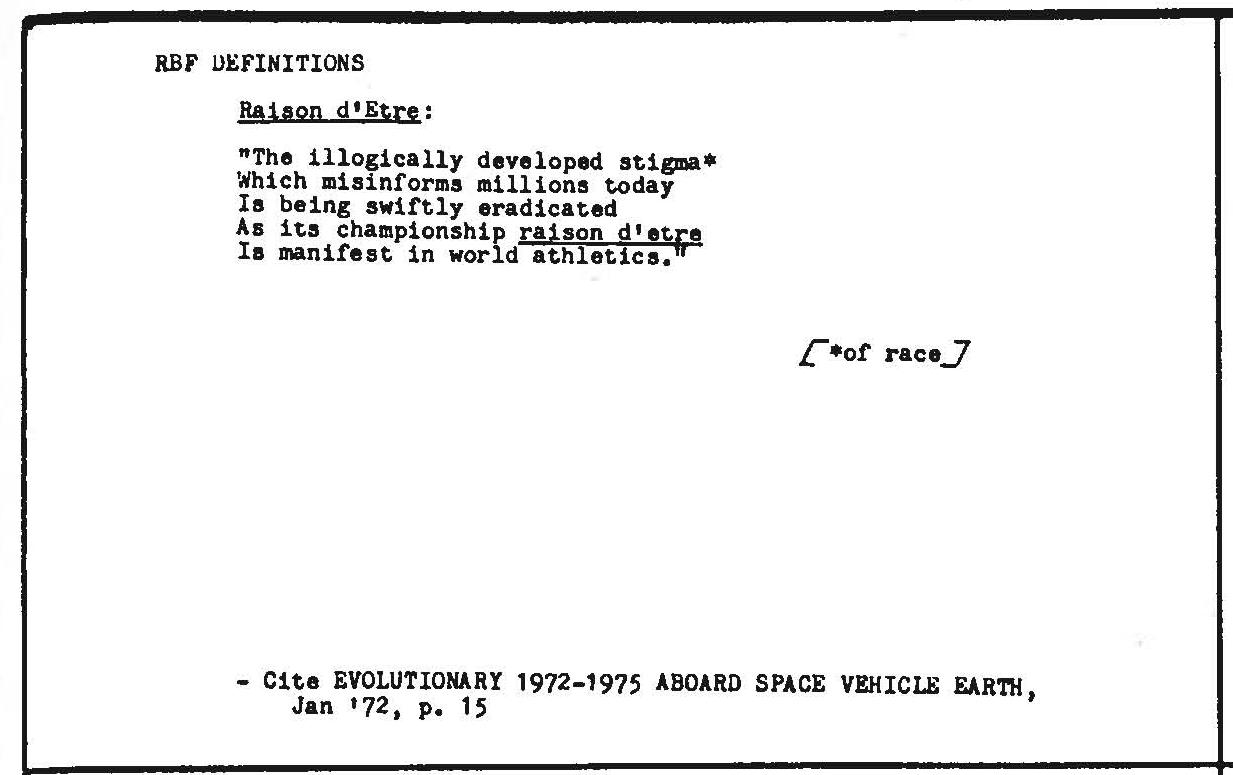
Raison d'Etre
← Raison d'Etre | Maison d'Etre of Boast & Fear →
Index Entry
Raison d'Etre:
"Environment is the whole raison d'etre of man's existence. . . This is why I became preoccupied with environment: how do we protect the infant, being born a genius, from being de-geniused by his environment."
-
Cite RBF to Students International Meditation Seminar - U.Mass., Amherst, 22 July 1971.
-
Citation at Environment, 22 Jul'71

Maison d'Etre of Boast & Fear
← Raison d'Etre | Raison d'Etre of Going Awayness →
Cross Reference
Cross-References
- Superstition, May'49
- Ignorance, (1)(2)

Raison d'Etre of Going Awayness
← Maison d'Etre of Boast & Fear | Raison d'Etre (1) →
Cross Reference
Cross-References
- Repulsion, 7 Feb'71
Raison d'Etre (1)
← Raison d'Etre of Going Awayness | Raison d'Etre (2) →
Index Entry
Raison d'Etre:
(1)

Raison d'Etre (2)
← Raison d'Etre (1) | Ramify →
Cross Reference
Cross-References
- DNA, 31 May'71
- Environment, 22 Jul'71*
- More With Less: Sea Technology, (4)
- Building Industry, (12)
- Propaganda, 29 Mar'77
Ramify
← Raison d'Etre (2) | Ramify the Idealistic →
Index Entry
Ramify:
"Unlike Siddhartha .. I decided to ramify the ramifiable."
- Cite RBF to EJA, Governor House Motel, Bethesda, 28 April 1971 after reading Herman Hesse's "Siddhartha" the night before, given him by Mary Cohen.

Ramify the Idealistic
Cross Reference
Cross-References
- Now, 14 Feb'72

Ramify (1)
← Ramify the Idealistic | Ramify (2) →
Cross Reference
Cross-References

Ramify (2)
← Ramify (1) | Random Element Law of Increase of The (1) →
Cross Reference
Cross-References
- Capabilities, 20 Apr'72
- Thinking, (3)
- Dymaxion Airocean World Map, (5)

Random Element Law of Increase of The (1)
← Ramify (2) | Random Element Law of Increase of The (2) →
Cross Reference
Cross-References
Random Element Law of Increase of The (2)
← Random Element Law of Increase of The (1) | Random Element (1) →
Cross Reference
Cross-References
- Antientropy, 10 Oct'63
- Man as a Function of Universe
- Sorting, May'65
- Stardust, May'65
Random Element (1)
← Random Element Law of Increase of The (2) | Random Element (2) →
Cross Reference
Random Element:
Cross-References

Random Element (2)
← Random Element (1) | Randomness →
Cross Reference
Man as a Function of Universe, (B)
Profess: Profession, 22 Apr'61
Stardust, May'65
Wow: The Last Wow, 22 Apr'71
Cross-References
- Inadvertence, 1938

Randomness
← Random Element (2) | Randomness →
Index Entry
Randomness:
"All stars radiate energy in a random manner. Randomness begets increasing disorder which is self-expansive."
- Citation and context at Boltzmann Sequence (5), Dec'72
Randomness
Index Entry
Randomness:
"Randomness of lines automatically works back to a set of interactions and a set of proximities which begin to triangulate themselves. . . . The most comfortable condition of triangles is equilateral so there will be a tendency for them to try to become equilateral. . . . This effect goes on in depth and in to the tetrahedra or octahedra."
-
Cite Ledgmont Lab, p.20, 15 Oct'64
-
Cite Carbondale Draft- Nature's Coordination, p. VI.1
Randomness
← Randomness | Random Randomness (1) →
Index Entry
Randomness:
"Entropy is not random; it is always one negative tetrahedron."
-
Cite OMNIDIRECTIONAL HALO, p. 157, 1960
-
Citation at Entropy, 1960
Random Randomness (1)
← Randomness | Random Randomness (2) →
Cross Reference
Entropy & Randomness
Rearrange Random Receipts
Entropy != Randomness
Cross-References
- Brouwer, L.E.J
- Coincidental Articulation Sequence
- Intercept the Random Event
- Omnirandomness
- Order Underlying Randomness
- Probability
- Happen Happening Happenstance
Random Randomness (2)
← Random Randomness (1) | Range Finder →
Cross Reference
Random: Randomness:
Cross-References
- Boltzmann Sequence, (5)
- Entropy, 1960
- Nebula, 29 Oct'72
- Space Technology, (7)
- Triangle, 8 Oct'64
- Biological Life, (1)
- Thinking, 6 Nov'73
- Light on Scratched Metal, 9 Nov'73
Range Finder
← Random Randomness (2) | Range Finder Range Finding →
Index Entry
Range Finder:
"Dual personality... provides two viewpoints... equivalent to the eyes of a range finder, an instrument which mechanically widens the distance between the two human eyes..."
Range Finder Range Finding
Cross Reference
Range Finder: Range Finding:
Cross-References
- Convergent vs. Parallel Perception, 13 Nov'75
Rate
← Range Finder Range Finding | Rate →
Index Entry
"Rate occurs only when there is terminal. Rate is a modulation between terminals. With termination, a system's integrity is brought about by the individually covarying magnitudes and the omnidirectional experience pulls on the system."
Rate
Index Entry
You don't get rate until there is terminal. Rate is a modulation between terminals. With termination of a system's integrity is brought about by the individually covarying magnitudes and the omnidirectional experience pulls on the system.
Rate
Index Entry
Rate:
"...Rate being the inseparable relationship of time and space."
- Citation and context at Conscious World, 1938
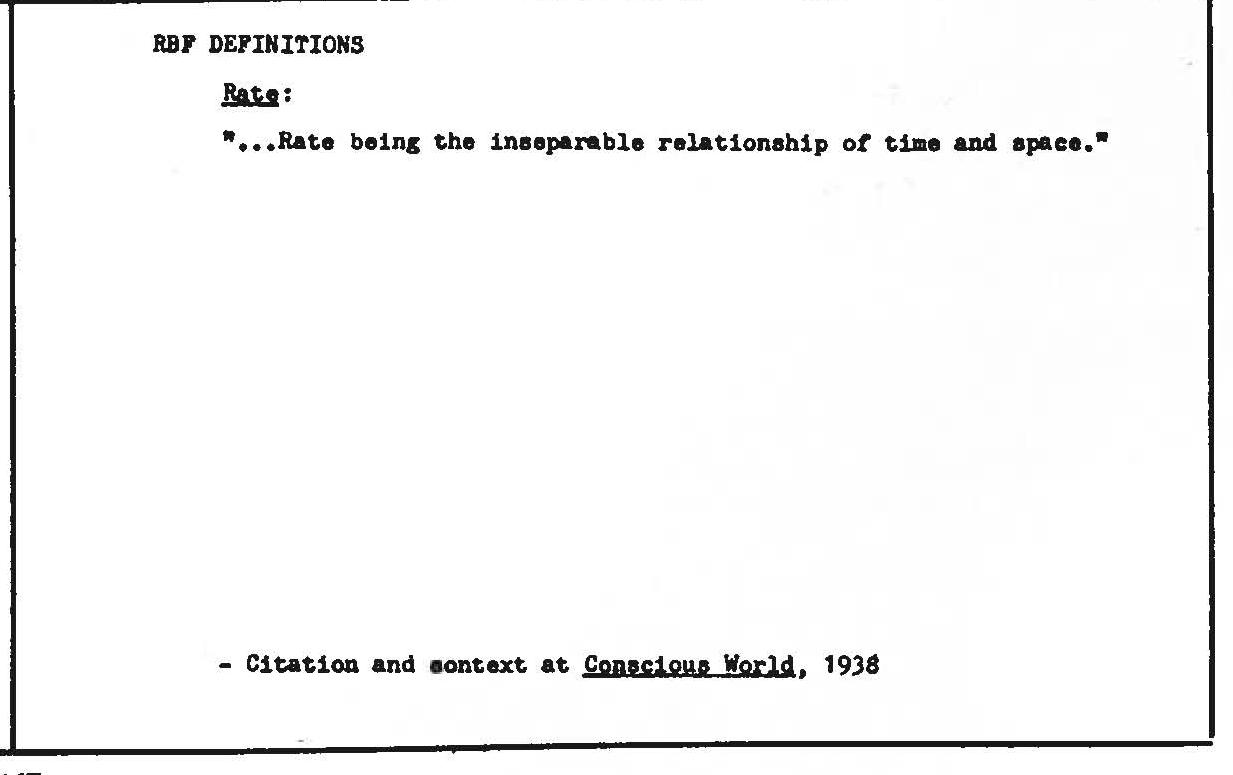
Rate
← Rate | Rates & Magnitudes (1) →
Index Entry
Rate:
"Speed is a unit of rate which is an integrated ratio of both time and space and no greater rate of speed than that provided by its cause, which is pure energy, latent or radiant, is attainable."
- Citation & context at Einstein Equation: Telegram to Noguchi, 1938
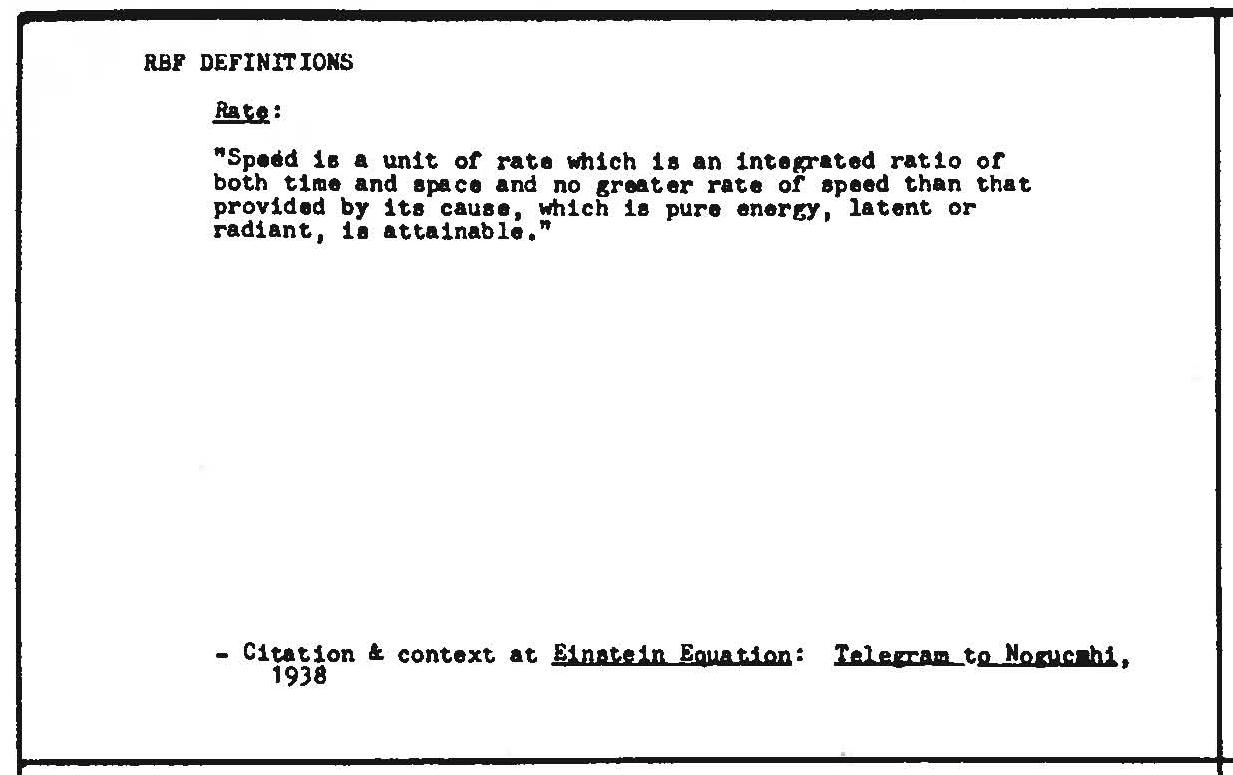
Rates & Magnitudes (1)
← Rate | Rates & Magnitudes (2) →
Cross Reference
Cross-References
- Fast & Slow
- Big & Little
- Universal Integrity: Second-power Congruence of Gravitational & Radiational Constants
- Frequency & Magnitude
- Slower & Closer vs. Faster & Far Apart
Rates & Magnitudes (2)
← Rates & Magnitudes (1) | Rate & Terminal →
Cross Reference
Cross-References
- Integration, 29 Aug'64
- Shunt, Jun'66
- Tetrahedron: Coordinate Symmetry, 15 Oct'64
- Time, 23 May'72
- Time-energy Economics, 15 Jun'74
- Pollution Control, (2)
- Gravity: Circumferential Leverage, (4)
- Historical Event Cognition, 2 Mar'68
- Vector Equilibrium, 3 Jan'75
- Periodic Experience, (9)
- Intellect: Equation Of
- Hyperbolic Paraboloid, 14 May'75
- Structural Sequence
- Frequency Islands of Perception, 13 Nov'75
- Flywheels, 11 Dec'75
- Gestation Rate, 1 Mar'77
Rate & Terminal
← Rates & Magnitudes (2) | Rato & Terminal →
Cross Reference
Cross-References
- Rate, 2 Nov'73

Rato & Terminal
← Rate & Terminal | Rate (1) →
Cross Reference
Cross-References

Rate (1)
← Rato & Terminal | Rate (2) →
Cross Reference
Melting: Rate Of
Recall Rates
Point Growth Rate
Cross-References
- Degree of Freedom Rate
- Expansion-contraction System Accumulating Rates
- Frequency
- Lag Rates
- Rates & Magnitudes
- Tetrahedron: Dissimilar Rate of Change Accomodation
- Terminal Rate
- Omnidifferentiated Rates
- Third-power Rate of Variation Model
- Nuclear Propagation Rate
- Shell Growth Rate
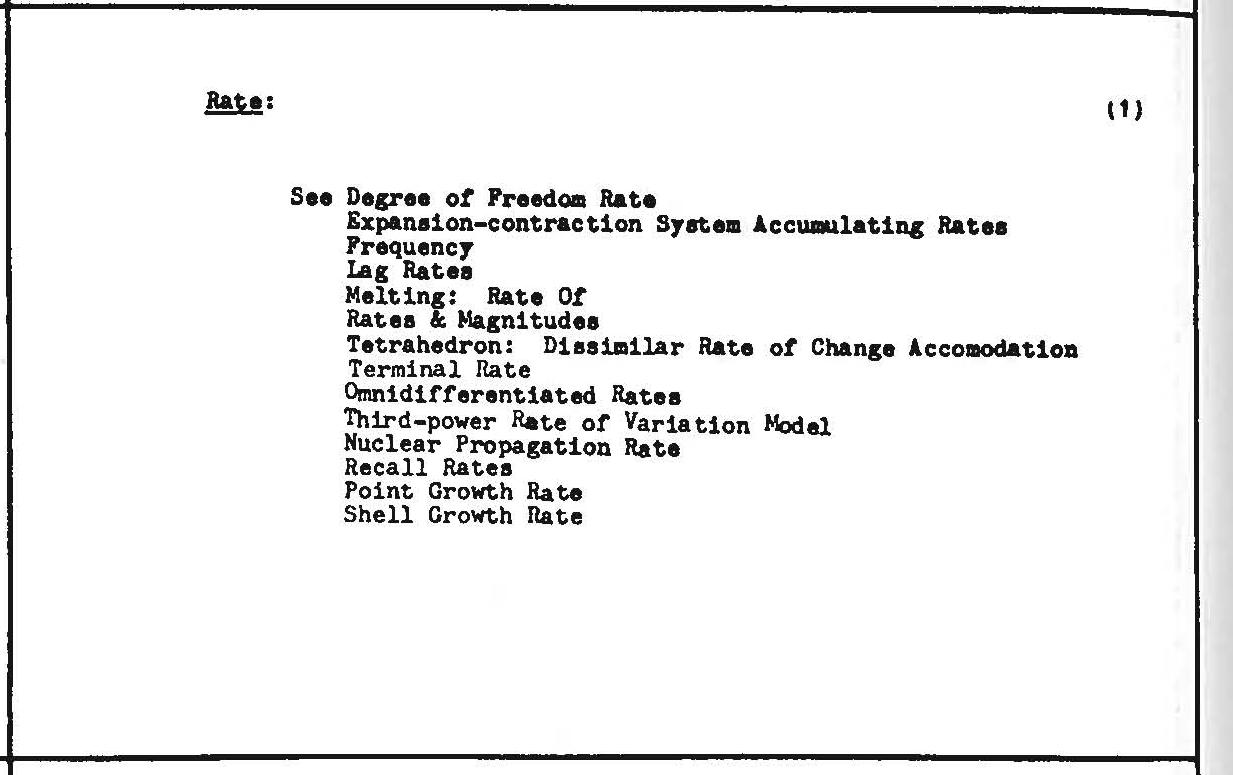
Rate (2)
← Rate (1) | Ratios Checklist (1) →
Cross Reference
Cross-References
- Change, 9 Nov'72
- Comprehensive, 1960
- Conscious World, 1938
- Future of Synergetics, 22 Apr'68
- Good & Evil Sequence, (1)
- Pythagoras, (1)
- Subset, 1960
- Synergetics, 26 May'72
- Tidal, May'72
- Calculus, Mar'71
- Individuality & Degrees of Freedom, (1)
- Life, 25 Mar'71
- Machines vs. Structures, 13 Nov'75
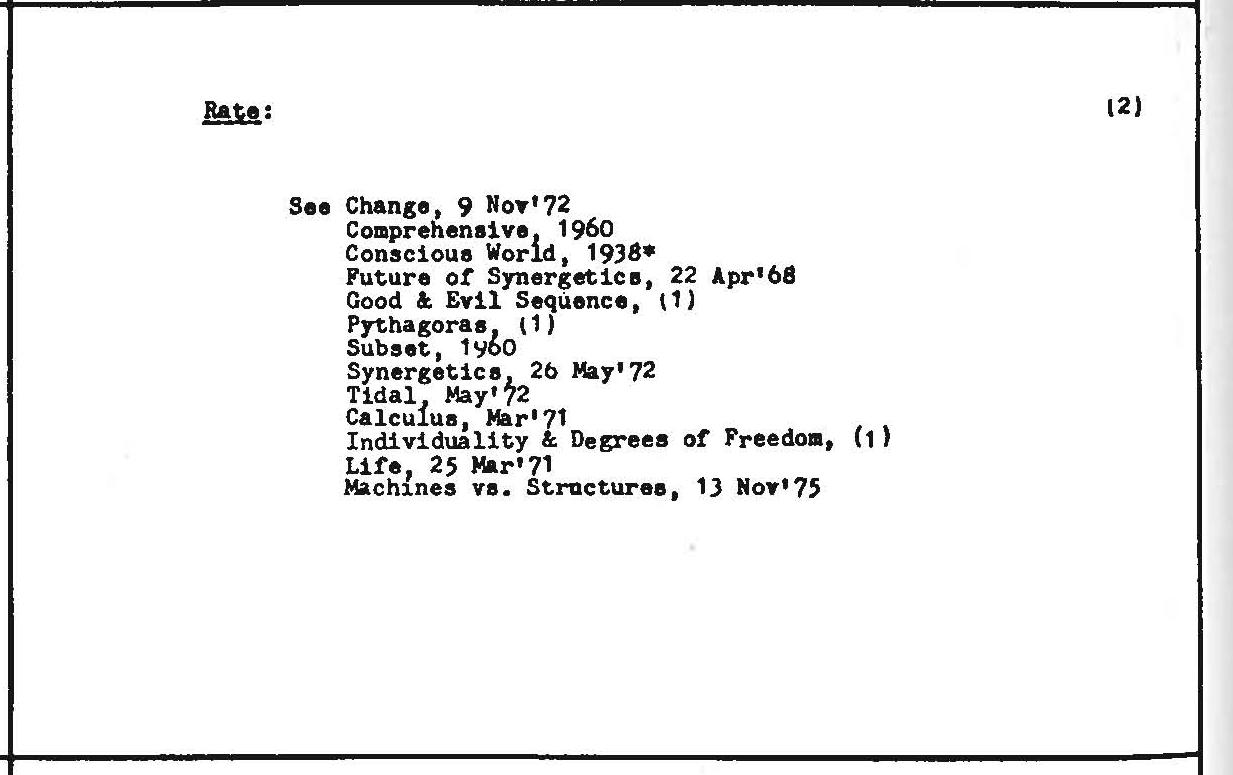
Ratios Checklist (1)
← Rate (2) | Ratios Ratio-ing (2) →
Cross Reference
Volume-weight Ratios
Twentyness in Mass Ratio of Electron & Proton
Quantum Values: Potential Ratio of Volume to Realized Quantum Values
Universal Integrity: Manifest Ratios & Potential Ratios
Surface-mass Ratios
Cross-References
- Volume-energy Ratios
- Volume-number Ratios
- Volume-quanta Ratios
- Volume-surface Ratios
- Universal Integrity: Vector Equilibrium & Icosahedron
- Vector Equilibrium: Ratio of Volume to Quantum
- Gravitational Constant
- Slenderness Ratio
- Length-to-girth Ratio
- Coordinate Abundance Ratios
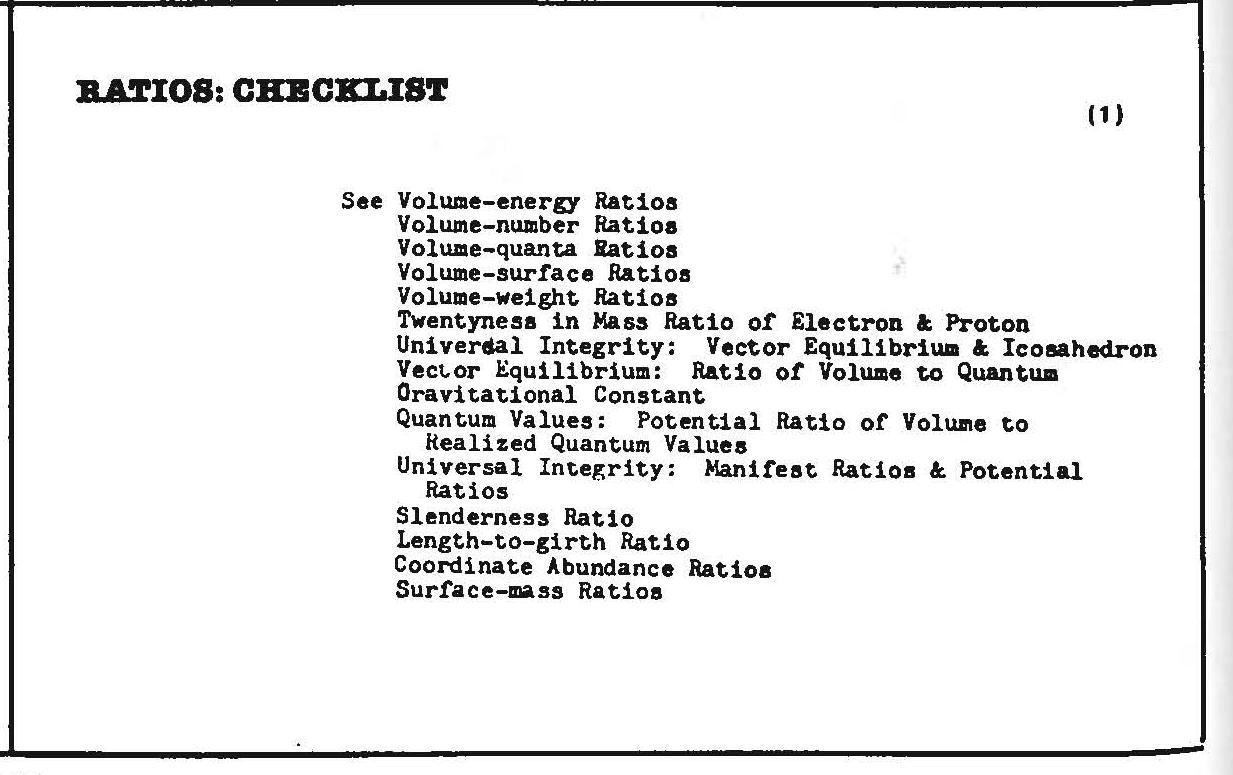
Ratios Ratio-ing (2)
← Ratios Checklist (1) | Rational Action in a Rational World →
Cross Reference
11 Jul'62
Cross-References
- Cartilage vs. Bone, Dec'61
- Efficiency, 22 Jan'75
- Greater Intellect, (2)
- Inverse, 11 Jul'62
- Trigonometry: Spherical Trigonometry, (1)
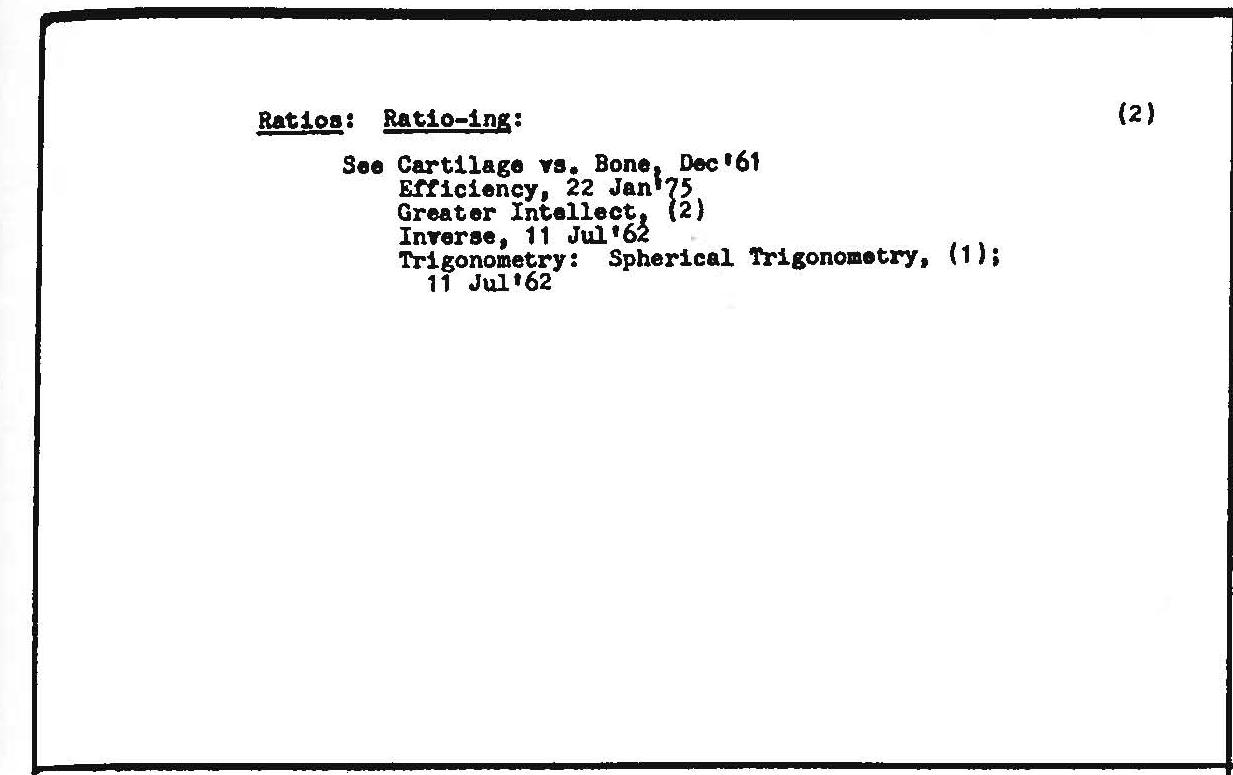
Rational Action in a Rational World
← Ratios Ratio-ing (2) | Rationality by Complementation →
Cross Reference
Cross-References
- Dymaxion, 1967

Rationality by Complementation
← Rational Action in a Rational World | Rational Concentricity →
Cross Reference
See Icosahedron & Vector-edged Cube
Cross-References
- Icosahedron \& Vector-edged Cube
Rational Concentricity
← Rationality by Complementation | Rational Fractions (1) →
Cross Reference
Cross-References
- Unified Operational Field, 30 Dec'73

Rational Fractions (1)
← Rational Concentricity | Rational Fractions (2) →
Cross Reference
Cross-References
Rational Fractions (2)
← Rational Fractions (1) | Rational - Relational →
Cross Reference
Cross-References
- Vector Equilibrium Field, 20 Dec'73 (2)
Rational - Relational
← Rational Fractions (2) | Rationalization of Selfishness →
Cross Reference
Cross-References
- Reason, Aug'73

Rationalization of Selfishness
← Rational - Relational | Rational Whole Numbers →
Cross Reference
Cross-References
- Propaganda, 29 Mar'77
- News & Evolution, (3)
- Technology: Enchantment vs. Disenchantment, (3)(4)
Rational Whole Numbers
← Rationalization of Selfishness | Rational Whole Numbers (1) →
Index Entry
Rational Whole Numbers:
"Rational values . . . can be expressed as a ratio of a whole number. . . . Nowhere in" Synergetics "is it necessary to introduce irrational numbers such as pi, (3.14159..+)."
Rational Whole Numbers (1)
← Rational Whole Numbers | Rational Whole Numbers (2) →
Cross Reference
Asymmetry: Plus & Minus Magnitudes as Rational Fractions
Prime Rational Integer Characteristics
Single Integer Differentials
Cross-References
Rational Whole Numbers (2)
← Rational Whole Numbers (1) | Rationality: Rational (1) →
Cross Reference
Cross-References
- Simplex, 1965
- Vector Equilibrium, (1)
- Twelve Universal Degrees of Freedom, Dec'61
- Energy Has Shape, 24 Sep'73
- Absolute Network, 10 Nov'74
- Omnihalo, Nov'71
- Module: A Quanta Module: Introduction Of, 22 Feb'77
- Multiplication by Division, 20 Jan'77
- Kites & Quarks as Basic Notes, (1)
- Trigonometry, 26 Sep'77
Rationality: Rational (1)
← Rational Whole Numbers (2) | Rationality (2) →
Cross Reference
Cross-References
- Omnirationality
- Prime Rational Integer Characteristics
- Reason
- Nuclear Geometrical Limit of Rational Differentiation
Rationality (2)
← Rationality: Rational (1) | Rationalization Sequence (1) →
Cross Reference
Cross-References
- Cosmic Accounting, 20 Dec'73
- Dymaxion
- Oscillation, 21 Dec'71
- Powering: Second Powering, 21 Dec'71
- Vector Equilibrium, (1)(2)
- Triacontrahedron, 3 May'77
- Min-max Limits, 8 Aug'77
Rationalization Sequence (1)
← Rationality (2) | Rationalization Sequence (2) →
Index Entry
Upon the premise that the sumtotal human desire to survive is dominant over the sumtotal of the impulse to destroy, this book is designed. it does not seek to provide a formula to attainment. To do so would develop dogma and nullify the process of individual rationalization that is utterly essential for growth.
"Rationalization is an act similar to walking through a half-frozen, marshy, unexplored country to mark out a trail that others may eventually follow. It involves not only the familiar one-two progression of shifting the weight and balance from one foot to the other, but an unknown quantity progression of selective testing to avoid treacherous ground before putting full weight upon the forward foot.
"Rationalization is a time-word to replace 'thinking,' which is an ancient, mystically evolved word tentatively signifying an attempt to force the power of god into one's self. Rationalization connotes a constant, selective balancing of relative values, gained from experience, for the purpose of harmonious, inclusive recomposition and subsequent extension.
- Cite NINE CHAINS TO THE MOON, p. ix, 1938
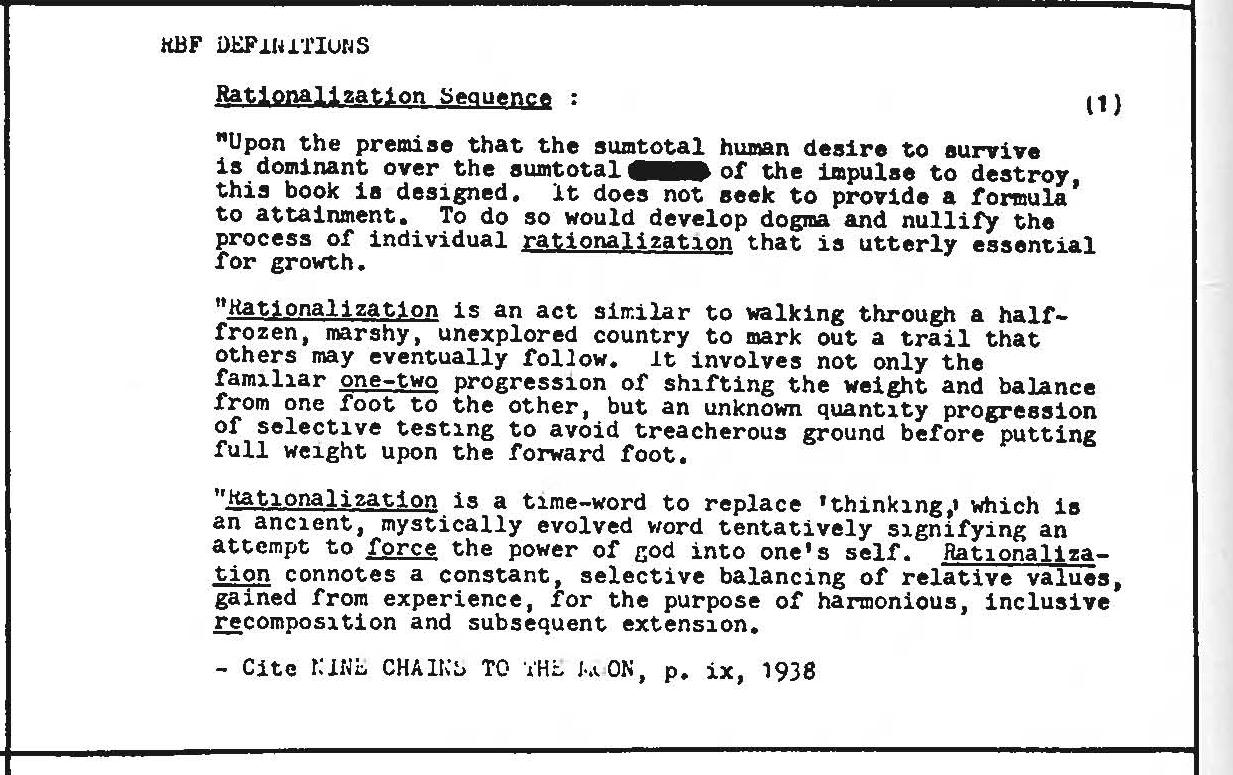
Rationalization Sequence (2)
← Rationalization Sequence (1) | Rationalization Sequence (3) →
Index Entry
Rationalization Sequence:
"It is central to my philosophy that everything in the Universe
is constantly in motion, atomically if not visibly,
and that opposing forces throughout this kinetic picture are
always in neat balance; furthermore, that everything invariably
moves in the direction of least resistance.
"The history of man's creative effort is the story of his
struggle to control 'direction' by the elimination of known
resistances.
"To the degree that the direction of least resistance is controlled
by vacuumizing the advance and de-vacuumizing the wake, the
course of society can be progressively better charted and
eventually determinable with a high degree of certainty.
"The creative control, or streamlining, of society, by the
scientific-minded (the right-makes-mightiest) is in direct
contrast to attempts by scheming matter-over-mindists (the
might-makes-rightist) to control society by increasing, instead
of lessening, resistance to natural flows through such devices
as laws, tariffs, prohibitions, armaments, and the cultivation
of popular fear.
- Cite NINE CHAINS TO THE MOON, p.x, 1938
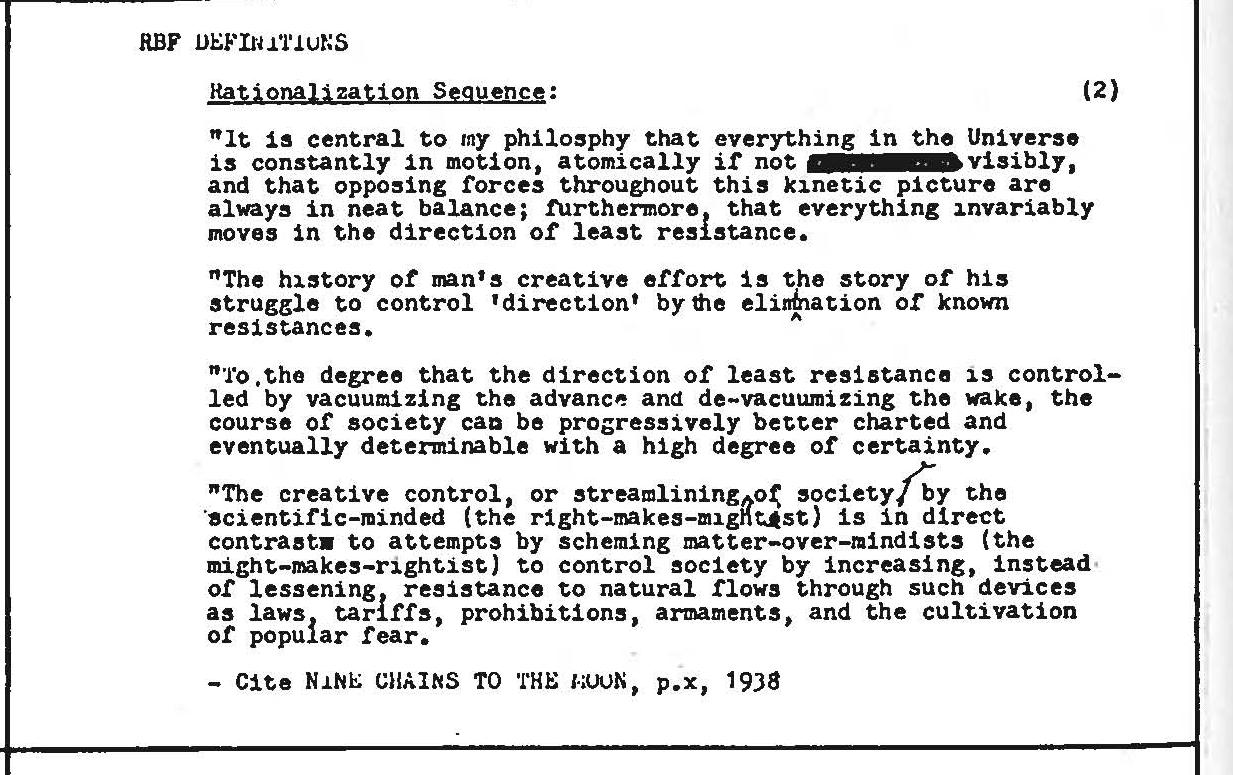
Rationalization Sequence (3)
← Rationalization Sequence (2) | Rationalization Sequence →
Index Entry
Rationalization Sequence:
"By controlling direction it becomes possible, scientifically, to increase the probability that specific events will 'happen.'
"Preparation of the material herein set forth dates from the very beginning of my experience. Up to a point in that experience I lived by the common code of loyalty and good fellowship with all of its convincing and romantic 'tradition.' Then, through my own particular quota of important slaps in the face, it became apparent that in 'tradition' lies fallacy, and that to be guided in conduct and thought by blind adherence to tenets of tradition is, as said in slang, bravely to 'stick the neck out.' I realized that experience is the vital factor, and that, since one can think and feel consciously only in terms of experience, one can be hurt only in terms of experience. When one is hurt, then somewhere in the linkage of his experience can be discovered the parting of the strands that led to the hurt. Therefore it follows that strict adherence to rationalization, within the limits of self-experience, will provide corrections to performance obviating not only for one's self, but for others, the pitfalls that occasion self-hurt. By cultivating the ability to rationalize in the absolute, one acquires the power of so ordering experience that truths are"
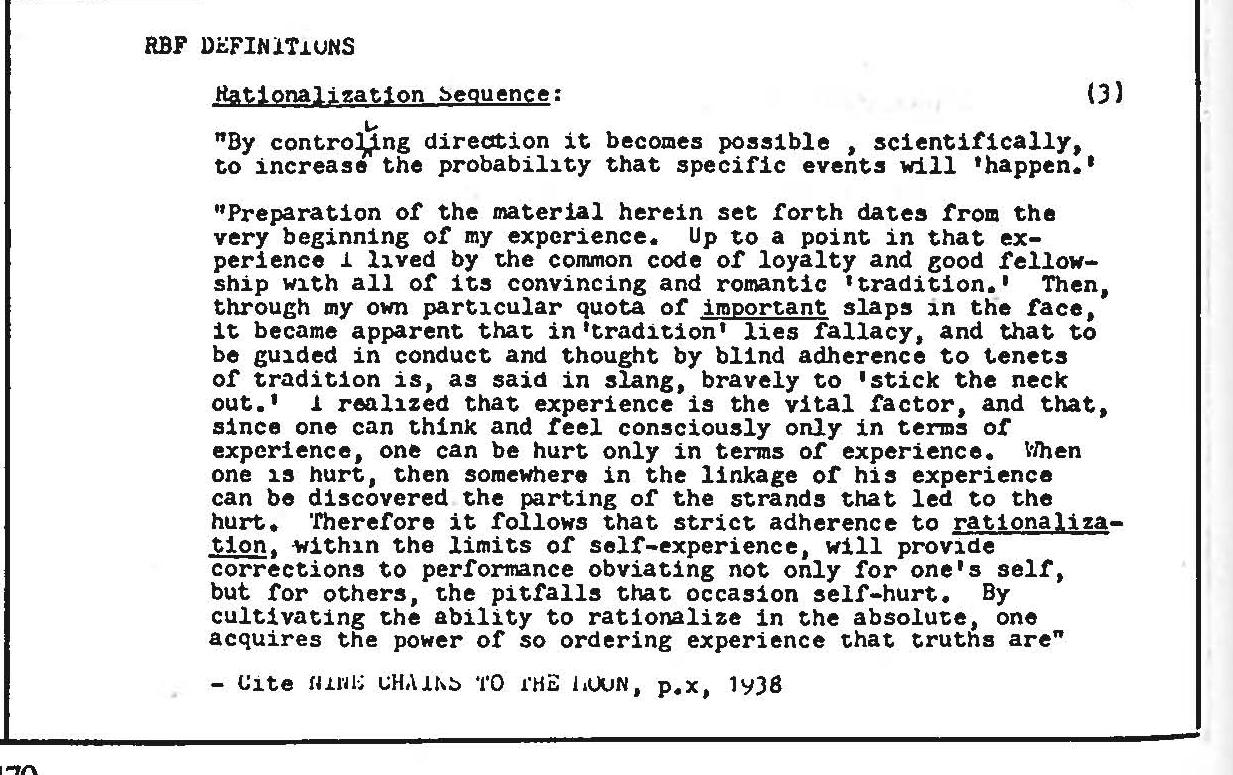
Rationalization Sequence
← Rationalization Sequence (3) | Nationalization Sequence →
Index Entry
Rationalization Sequence:
"clarified and susceptibility to self-hurt is diminished to the point of negligibility. Through rationalizations anyone may evolve solutions for any situations that may arise, and by the attainment of this ability through experience one obtains his license to be of service to mankind.
"Rationalization alone, however, is not sufficient. It is not an end in itself. It must be carried through to an objective state and materialize into a completely depersonalized instrument-- a 'pencil.' (Who knows who made the first pencil? Certainly not Eberhard Faber or 'Venus.') The pencil not only facilitates communication between men, by making thought specific and objective, but also enables men cooperatively, to plan and realize the building of a house, oxygen tent, flat iron, or an x-ray cabinet by virtue of the pencil's availability. The inventor, alive or dead, is extraneous and unimportant; it is the 'pencil' that carries over. Abstract thought dies with the thinker, but the mechanism was building for a long time before the moment of recognized in-vention.
"The substance of this book develops my conviction of these truths. In a final chapter I have recorded certain thought-"
Nationalization Sequence
← Rationalization Sequence | Rationalization Sequence →
Index Entry
Nationalization Sequence:
"processes and results of abstract intuitive thinking which would be obscure without reading the preceding sections. The reason for exposing myself to possible suspicion of 'mysticism' is to show how important it is to transcribe the faint thought messages coming into our personal cosmos at the time of occurrence-- sketchy and puzzling though they may be-- because time, if well served, will turn them into monkey-wrenches and gas torches.
"The title 'Nine Chains to the Moon' was chosen to encourage and stimulate the broadest attitude toward thought. Simultaneously, it emphasizes the littleness of our Universe from the mind viewpoint. A statistical cartoon would show that if, in imagination, all of the people of the world were to stand upon one another's shoulders, they would make nine complete chains between the Earth and the Moon. If it is not so far to the Moon, then it is not so far to the limits-- whatever, whenever, or wherever they may be.
"Limits are what we have feared. So much has been done to make us conscious of our infinite physical smallness that the time has come to dare to include the complete Universe in our"
Rationalization Sequence
← Nationalization Sequence | Rationalization →
Index Entry
Rationalization Sequence:
"rationalizing. It is no longer practical to gaze at the surfaces of 'named' phenomena within the range of vision of the smoking car of the 5.15 with no deeper analysis of their portent than is derivable from a superficial exchange of complexed opinion-notions with fellow-commuters.
"After all,' Jeans said, 'it is man who asked the question.' The question is survival, and the answer, which is unit, lies in the progressive sumtotaling of man's evolving knowledge. Individual survival is identifiable with the whole-- as extension or extinction. There is no good country doctor on Mars to revive those who, through mental inertia, are streamlining into extinction."
- Cite NINE CHAINS TO THE MOON, p.xi, 1938
Rationalization
← Rationalization Sequence | Razor →
Cross Reference
Cross-References
- Political Mandates: Inventory Of, 27 Dec'73
- Selfishness, 20 Sep'76

Razor
← Rationalization | Reachable Point →
Index Entry
Razor:
"... The blade of a razor is a randomly dumped breakwater of spherical rubble."
- Cite SYNERGETICS draft at Sec. \hrefhttps://www.buckyverse.org/en/synergetics/content/chapters/1000-omnitopology#section-1009.411009.41, 10 Feb'73
Reachable Point
Cross Reference
Cross-References
- Vector Equilibrium: Unarticulated VE, 2 Nov'73
Reach-miles
← Reachable Point | Reach Reachability Range (1) →
Cross Reference
Cross-References
- Radiation: Speed Of, 30 Nov'72
- Vector Equilibrium: Unarticulated Ve, 2 Nov'73
Reach Reachability Range (1)
← Reach-miles | Reach Reachable (2) →
Cross Reference
Radiant Valvability of IVM-defined Wavelength Sweepout
Cross-References
Reach Reachable (2)
← Reach Reachability Range (1) | Reaction →
Cross Reference
Cross-References
- Isotropic Vector Matrix, 30 Nov'72
- Point, 16 Nov'72
- Time, 30 Nov'72
Reaction
← Reach Reachable (2) | Reaction (1) →
Index Entry
"While the human's actions are antientropic, his reactions are entropic, ergo unpredictable."
-
Citation and context at Individuality, May'65
-
Cite-RBF in AAUW Journal, p. 176, May 165.

Reaction (1)
Cross Reference
Cross-References

Reaction (2)
Cross Reference
Cross-References
- Sixty Degreeness, 8 Dec'72
Reading
← Reaction (2) | Reading (1) →
Index Entry
We don't know how we retrieve information from our brain. The conscious part does some triggering; it acts as a valve; it can be a brake or it can be an accelerator. But the conscious part is less than one-millionth of the retrieval process. The rest is subconscious. There is an automatic process. When we can't remember a name the brain doesn't forget we asked the question, although maybe we have forgotten. But the lags are variable, and therefore the feedbacks are not orderly. The only conscious part is the holding back of irrelevancies. And this is true of reading, too.
Reading (1)
Index Entry
Reading:
Q. "Mr. Fuller, you're quite a traveler. Where do you find the time and the places to read?"
A. "Obviously airplanes and airports are great places, as are hotel rooms very late at night. I'm convinced you can't put out if you don't put in. In other words, thinking does come from experience. Reading increases the number of experiences from which you may gradually adduce generalized principles. I am now fairly aware of what my conscious part is in this very complex system called thinking. That conscious part, which is only one-millionth of the picture, can do some triggering, can be a brake or an accelerator, a valve that can shut off or turn off a process.
"We experience different rates of retrieval of information. Even in my vocabulary and in my reading, there are lags, and when people talk about speed reading, it's really just a means of diminishing the lag. I'm not interested in speedreading, but rather in content and understanding. But I find the subconscious is very powerful.
"During 1938-1940 I was consultant in science and technology to the editor of Fortune magazine, and my function was to emphasize the science foundations of great industry.
- Cite Michael Bandler Interview, BOOK WEEK, 11 Jun'72
Reading (2)
← Reading (1) | Reading: Escapist Reading →
Index Entry
"I read 'Patent Gazette,' and I could literally spin the pages, and when my eyes saw something I wasn't familiar with they would stop me. They recognized absolutely everything I wasn't familiar with. So when I read today I don't have to process the material. I know my subconscious will stop me when I'm not familiar with something. Everybody has that capacity, but not everyone uses it."

Reading: Escapist Reading
← Reading (2) | Reading Out Loud →
RBF Definitions
What do you do in the way of what might be called escapist reading?"
A: "I have nothing to escape. I'm really so fascinated with life."
Reading Out Loud
← Reading: Escapist Reading | Reading →
Index Entry
Reading Out Loud:
"We read all of Dickens out loud. In reading out loud your eye really goes several lines ahead and you can anticipate the meaning and inflections. Out loud reading went right on through the time of World War I, but it went out just like that when popular radio came in."
- Cite RBF in tape interview with Mike Bandler, Wash. Post., "Portrait of a Man Reading," 3200 Idaho, Wash DC, 29 May'72
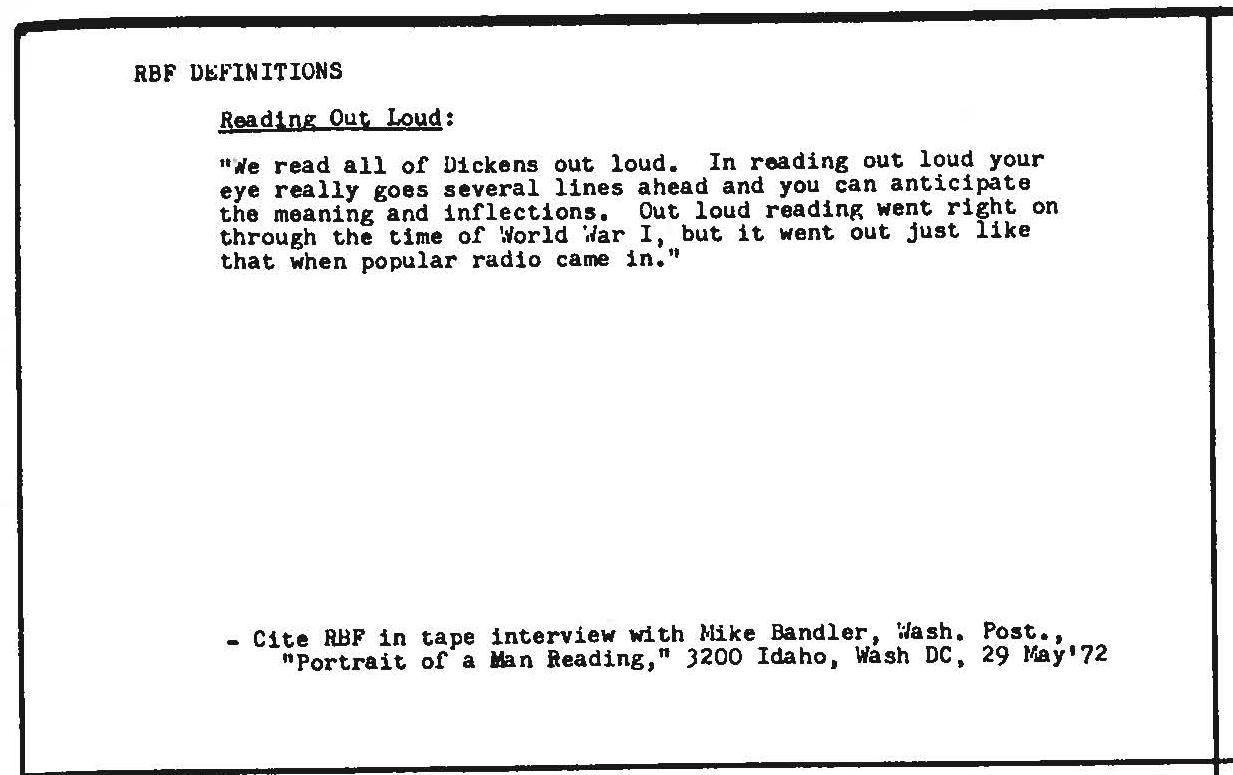
Reading
Cross Reference
Fuller, R.B: Books Read in His Youth, 1971
Semantics, 20 Feb'73
Cross-References
- Child Sequence, (3)
Real
Index Entry
Real:
"... Vectors being the product of physical energy constituents, are 'real,' having velocity multiplied by mass operating in a specific direction; velocity being a product of time and size modules; and mass being a volume-weight relationship."
-
Citation at Vectors, 27 May'72
-
Cosmography draft, Sec. \hrefhttps://www.buckyverse.org/en/synergetics/content/chapters/400-system#section-410.05410.05, RBF rewrite 27/2 May'72
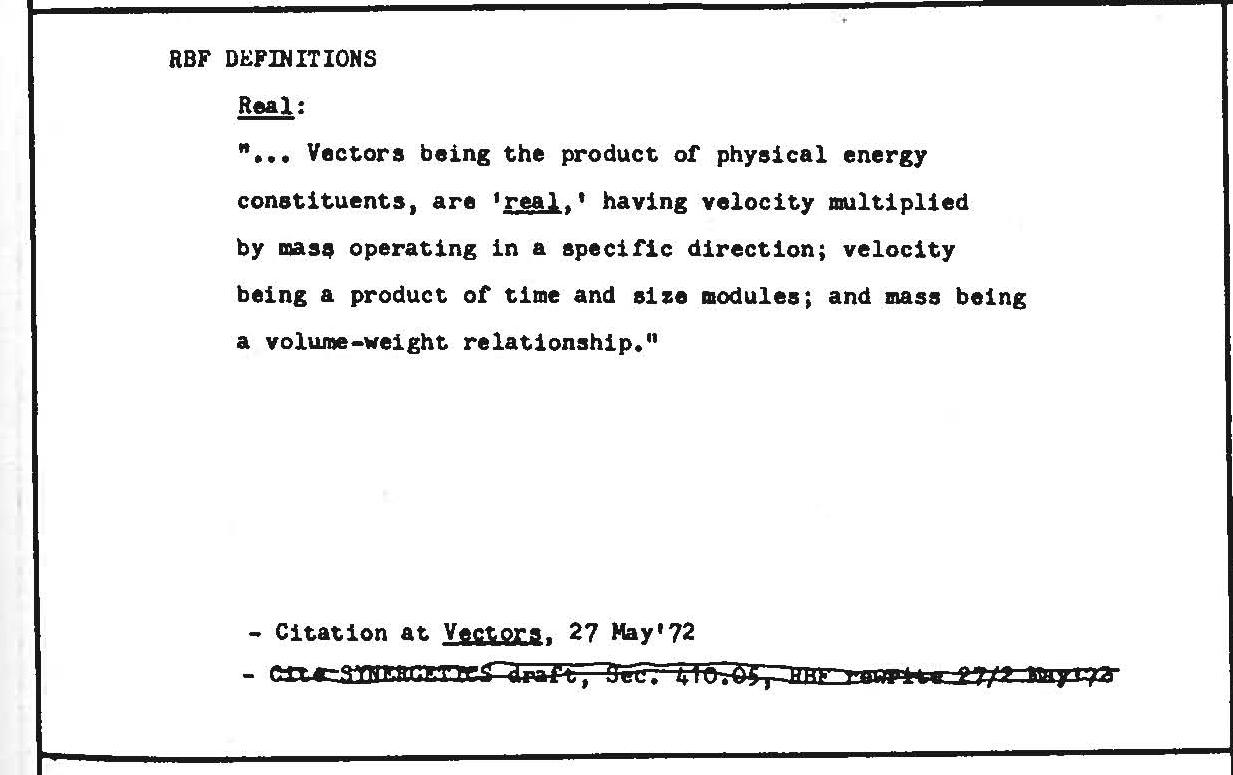
Real (1)
Cross Reference
Real:
Cross-References
Real (2)
Cross Reference
Cross-References
Real Estate
← Real (2) | Real Estate Development →
Index Entry
Real Estate:
"Big money has left all the sovereignly locked-in, local-property-game players holding the unmovable bags of real estate...."

Real Estate Development
← Real Estate | Real Estate Real Estate Development (1) →
Index Entry
Real Estate Development:
"We find that generally speaking the geographically larger the physical task to be done, the duller the conceptual brain is brought to bear upon the technically realized applications."
-
Cite RBF quoted by Hal Argnery, in Rolling Stone, 10 June 1971
-
Citation and context at Politics, 10 Jun'71
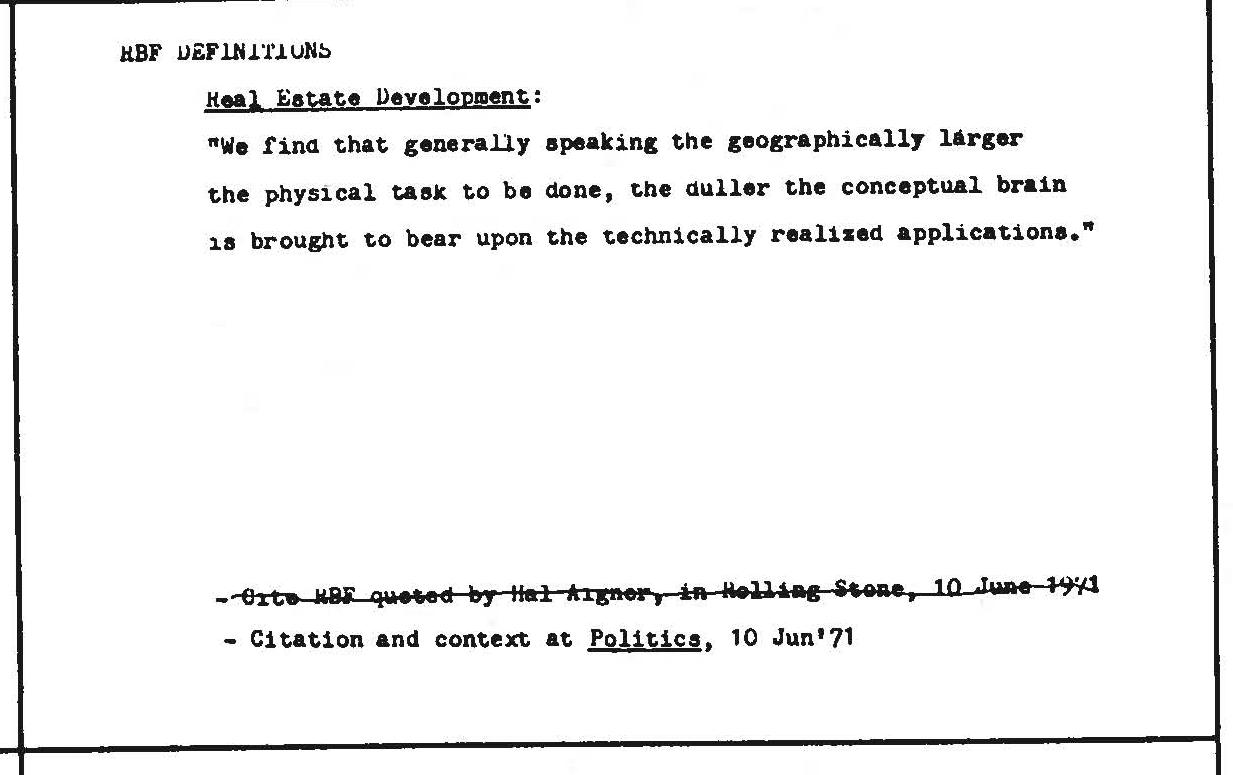
Real Estate Real Estate Development (1)
← Real Estate Development | Real Estate Real Estate Development (2) →
Cross Reference
Cross-References
- Building Business
- Realm Real Royal
- Whitehead's Dilemma
- Land Exploitation
- Deed (Property Deed)
- Miniature Castle Building
Real Estate Real Estate Development (2)
← Real Estate Real Estate Development (1) | Realistic →
Cross Reference
Transnational Capitalism & Export of Know-how, (1)*
Houses & Infrastructure, 20 Sep'76
Cross-References
- New York City, (12)
Realistic
← Real Estate Real Estate Development (2) | Reality →
Index Entry
Synergetics draft at Sec. \hrefhttps://www.buckyverse.org/en/synergetics/content/chapters/1000-omnitopology#section-1001.141001.14, 16 Feb'73

Reality
Index Entry
Reality:
"The reality is always orbital."
- Citation & context at Orbit = Circuit, 10 Sep'74
Reality
Index Entry
Reality:
"Reality is always indeterminate."
- Cite RBF to EJA, 3200 Idaho, Wash. DC, 5 May'74
Reality
Index Entry
Reality:
"Nature modulates probability and the degrees of freedom, i.e., frequency and angle, leads to the tensegrity sphere; which leads to the pneumatic bag; all of which are the same kind of reality as the three automobiles."
- Citation and context at Sphericity of Whole Systems, 26 Sep'73
Reality
Cross Reference
Reality:
". . . What we call reality is always a positive or negative set of the whole."
(This is in the context of a description of zero vector equilibrium.)
-
Citation & context at Vector Equilibrium: Zero Tetrahedron (3), 17 Jul'62
-
Cite Carbondale Draft Nature's Coordination, p. VI.45
-
Cite Oregon Lecture #7, p. 236. 11 Jul '62
Incorporated in SYNERGETICS draft at Sec. \hrefhttps://www.buckyverse.org/en/synergetics/content/chapters/400-system#section-441.23441.23, 9 Jun'72
Cross-References
- Physical Reality, 4 Nov'73
Reality
Index Entry
Reality:
"What the mathematicians have been calling abstraction is reality. When they are inadequate in their abstraction then they are irrelevant to reality. The mathematicians feel they can do anything they want with their abstraction because they don't relate it to reality. And, of course, they can really do anything they want with their abstractions but, like masturbation, it is irrelevant to the propagation of life.
"The only reality is the abstraction of the principles, the eternal generalized principles. . . Most people talk of reality as what are just the after-image effects-- the realization lags, which register superficially and are asymmetric and off center. (The principles themselves have different lag rates and different interferences.) When we get to reality it's absolutely eternal.
"The inherent inaccuracy is what people call the reality. Man's way of apprehending is always slow: ergo the superficial and erroneous impressions of solids and things, which can actually be explained only in principle."
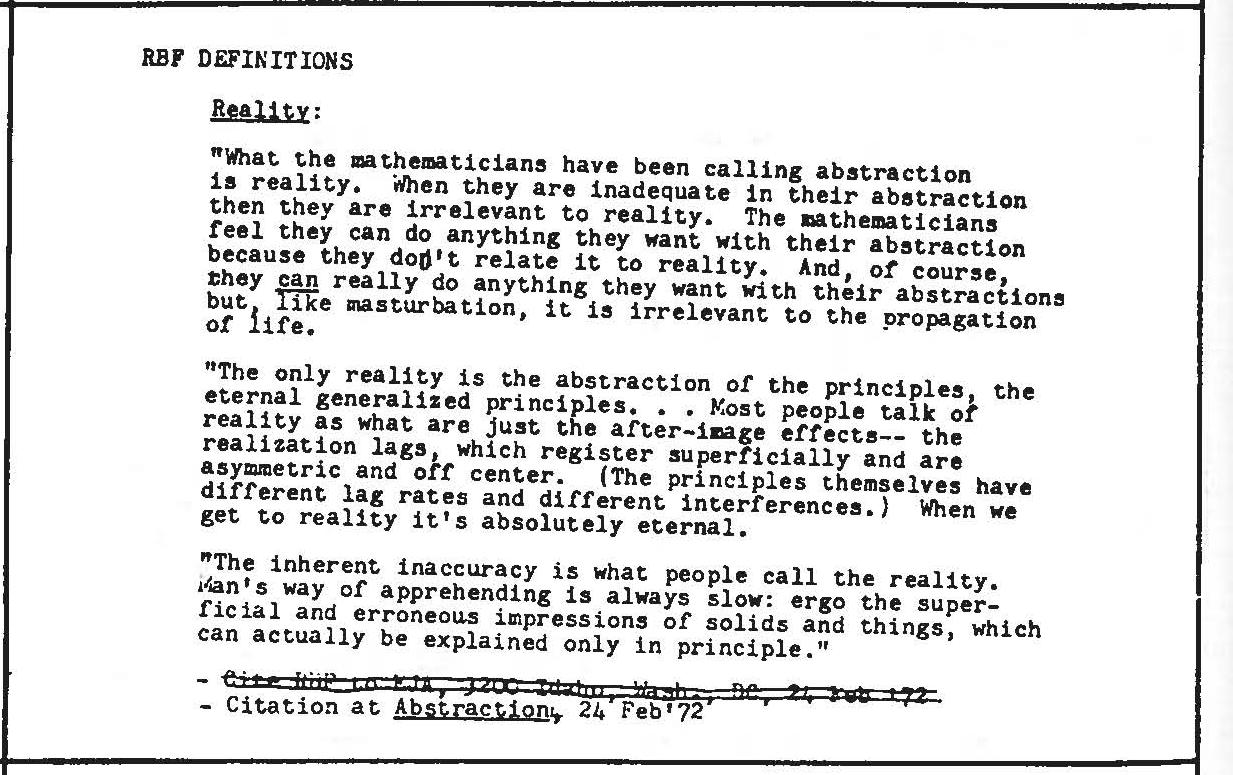
Reality
Index Entry
Reality:
"The principle is more of a reality than the qualities
they produce."
-
Cite RBF to EJA, 3200 Idaho, DC, 22 Feb '72
-
Citation and context at Principle, 22 Feb '72
Reality
Index Entry
"...There is no straight line; only the wave coincides with reality."
- Citation & context at Now, 14 Feb'72
Reality
Index Entry
Reality:
"The nonsimultaneity and dissimilarity
Of the complementary interpatternings
Produce what we sense to be reality,
Otherwise they would cancel one another
And there would be no sensoriality."
- Citation at Senses, 1971

Reality
Index Entry
Reality:
"... Not until we have size, not until we have energetic experienceability, i.e., not until we have reality, do we have structural stabilization of the nuclear 12 balls of the vector equilibrium."
-
Cite RBF to EJA, Bear Island, 23 August 1971.
-
Citation & context at Vector Equilibrium, 23 Aug'71
Reality
Index Entry
Reality:
"Conceptuality is metaphysical and weightless.
"Reality is physical."
-
Cite RBF to EJA, Somerset Club, Boston, 22 April 1971
-
Citation & context at Conceptuality & Reality, 22 Apr'71
Reality
Index Entry
Reality:
"All of the weightless metaphysical thoughts concerning reality are mentally understandable independently of any special-case physical sense experience. All such weightless thoughts can be imaginatively described by one person either to himself or to another person by weightless conceptions. Such weightless thinking-- independent of physical sensing-- plus our scientific discovery of the great infra- and ultra-to-human-sense-ranging of physical energy's electromagnetic spectrum regularities altogether combine to both establish and confirm that less than one-millionth of reality is now directly apprehensible by the human senses."
- Cite ARCHITECTURE AS ULTRA INVISIBLE REALITY, p. 150, Dec. '69
Reality
Index Entry
Reality:
"The wellspring of reality is the family of weightless generalized principles."
- Cite NEHRU SPEECH, p.41, 13 Nov'69

Reality
Index Entry
Reality:
"Every chemical element has its unique frequencies. That became the way that you know, this is what you mean by that, mathematically and scientifically this is the element, this is the reality. Copper is real, and copper was those frequencies. . . "
- Cite RBF Address THE HABITABLE CITY, 14 Oct '69.
Reality
Index Entry
Reality:
"...Everything we know as reality has to be either a positive or negative condition."
- Citation and context at Nature, Jun'66
Reality
Index Entry
Reality:
"Pure science events represent openings of windows through the wall of ignorance and fiction, to reveal the only reality-- the behavior of the naked Universe that always was, is, and will be. True it is that the first glimpses may be hazy and imperfect, but the behavior itself is absolute and progressively clarified. . . ."
Citation and context at Science, p.13, 1947
Reality
← Reality | Reality: Fuller's Reality vs. Popular Reality →
Index Entry
"I really very clearly differentiate today what I call reality and what most people call reality. Their reality is that you have got to make money and you have got to pay your bills. I consider that really a game. So it is part of my reality that man is hooked with a game, which makes it very inconvenient for me where they are not dealing with reality. The game includes social standings, reputation... that there is a place called Chicago... because in my reality there are probably no names."
Reality: Fuller's Reality vs. Popular Reality
← Reality | Reality vs. Generalization →
Cross Reference
Cross-References

Reality vs. Generalization
← Reality: Fuller's Reality vs. Popular Reality | Reality - Inexactitude →
Index Entry
Reality vs. Generalization:
"There are a lot of different realities. That is the difference between reality and generalization. There is only one generalization."
- Citation & context at Individuality & Degrees of Freedom, (3)
17 Jun'75
Reality - Inexactitude
← Reality vs. Generalization | Reality as Structural Interaction of Principles →
Index Entry
e543.05

Reality as Structural Interaction of Principles
← Reality - Inexactitude | Reality as Structural Interaction of Principles →
Index Entry
Reality as Structural Interaction of Principles:
"The relative abundances of reciprocally patterning principles everywhere constitute the so far discovered inventory of minimally complex, ergo fundamentally differentiable structurally regenerative universal governance. The complex of interactively accommodating principles and their relative abundance accommodation are reality-- the only reality. What man, in his sensorially preoccupied misapprehending, has termed 'abstract,' in contradistinction to sensorial, as well as that which man has designated as metaphysical in contradistinction to physical, are altogether one reality. The fact of meagerness of the experience-generated knowledge of man in respect to the omni regenerative structure of reality and the observational facts taken in the twilight zones between the meager known and the as-yet -unexperienced, in no way alters the unitary integrity of the utter interaccommodation of complex structural interaction of the principles as so far sum totally inventoried by the faithfully reported experiences of man."
- Cite I&I, DJKE5, p. 147. 1963
Reality as Structural Interaction of Principles
← Reality as Structural Interaction of Principles | Reality →
Cross Reference
Cross-References
- Universe, 1960
- Airplane, May'49
- Periodic Experience, (7)
Reality
← Reality as Structural Interaction of Principles | Reality & Unreality →
RBF Definitions
The mathematical patterning and intertransformability of nature's geometrical structurings are the only reality of Universe. The infinitely regenerative dynamism, always potential in the fundamental relationship of the principles, in itself constitutes the intellectually tunable and ever inescapable reality." -- Cite I&I, DOMES, p. 147. 1963
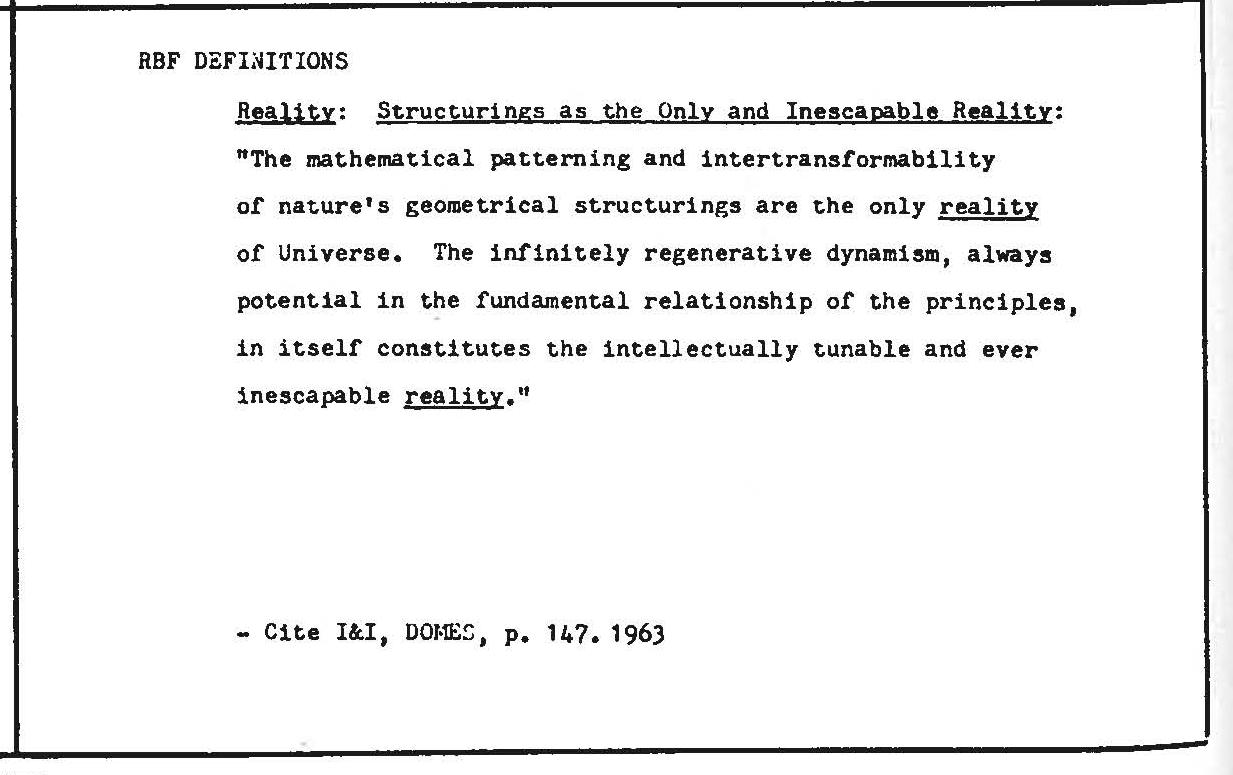
Reality & Unreality
Cross Reference
Cross-References
- Dynamic Equilibrium, 24 Apr'76
Reality (1)
← Reality & Unreality | Reality (1B) →
Cross Reference
Cross-References
- Common Sense Reality
- Conceptuality & Reality
- Cosmetry
- Earth: Let's Get Down to Earth
- Game of Reality
- Geometry of Reality
- Ideal vs. Real
- Invisible Reality
- Local Reality
- Mind as Reality
- Minimum Reality
- Nonreality
- Official Reality
- Perceptual Peephole
- Physical Reality
- Residual Reality
- A Priori Four-dimensional Reality
- Mind-over-matter Reality
- Temporality = Tempo-reality = Time-reality
Reality (1B)
← Reality (1) | Reality (2A) →
Cross Reference
Spherical Reality
Cross-References
- Sensorial Identification of Reality
- Superficial Reality
- Wellspring of Reality
- Vectors Are Real
- Four-dimensional Reality
- Momentary Reality
Reality (2A)
← Reality (1B) | Reality (2B) →
Cross Reference
Cross-References
- Abstraction, 24 Feb'72*
- Apprehending, 22 Nov'73
- Benday Screen, 28 Oct'72
- Conceptuality & Reality, 22 Apr'71*
- Dream, 1968
- God, May'68
- Invisible Colors, 4 Mar'69
- Imaginary Universe vs. This Universe, 22 Feb'72
- Magic, 18 Nov'72
- Mother: Infant Nursing at Mother's Breasts, 18 Nov'72
- Nature, Jun'66
- One, 20 Dec'73
- Now, 14 Feb'72*
- Positive & Negative, 11 Jul'62
- Principle, 22 Feb'72*
- Quantum Mechanics, Jun'66
- Responsibility, 14 Oct'69
- Science, 1947
- Sphericity of Whole Systems, 26 Sep'73*

Reality (2B)
← Reality (2A) | Reality (3) →
Cross Reference
Cross-References
- Vector Equilibrium
- Velocity, 12 Jul'62
- Senses, 1971
- Orbit = Circuit, 10 Sep'74*
- Principle, 6 Apr'75
- Thought, May'49
- In, Out & Around, Nov'71
- Multidimensional Accommodation, 11 Dec'75
- Life & Death, 26 Jan'76
- Me, 18 Dec'76
- Life is Not Physical, 20 Feb'77
- Conceptual Limits, 22 Jun'77
Reality (3)
Cross Reference
Cross-References
- Reality: Fuller's Reality vs. Popular Reality
- Reality vs. Generalization
- Reality as Structural Interaction of Principles
- Reality: Structurings as the Only & Inescapable Reality
- Reality & Unreality
Realizable
Index Entry
Realizable:
"Physical interferences of our sensibilities are alike true and real, or realizable, only in principle."
- Citation and context at Principle, May'49
Realization
Index Entry
Realization:
"...All physical realizations are always disequilibrium."
- Citation and context at Basic Triangle: Basic Disequilibrium 120 LCD Triangle, 20 Dec'73
Realization
RBF Definitions
"A vector is a partial generalization being either
metaphysically theoretical or physically realized, and
in either sense, an abstraction of a special case. . . "
- Citation and context at Vector, 26 May'72
Realization
Index Entry
Realization:
"Realizations are always imperfect."
-
Citation and context at Physical Is Always the Imperfect, 14 Feb '72
-
Cite RBF marginalia at Necole, 'Facing Reality,' 14 Feb. '72
Realization
Index Entry
Realization:
"Potential lines are metaphysically straight, all physically realized relationships are geodesic and curved trajectories."
-
Cite SYNERGETICS Coordinates, \hrefhttps://www.buckyverse.org/en/synergetics/content/chapters/200-synergetics#section-240.00240, 1970
-
Citation at Metaphysical & Physical, 1971
Realization
Index Entry
Realization:
"Realization is objective integrity."
- Cite I&I, PRIME DESIGN, p. 245. May'60
Realization
← Realization | Realization Lag →
Index Entry
The new reliable understanding of meaning. . . . requires the revision not only of semantics but also of their complex aspect as thought habits employed to describe experience with accuracy, such as . . . the substitution of the word 'realization'for the very inaccurate use of the verb 'to create.' Man creates naught. If he comprehends in principle, he rearranges locally in Universe by realization of the interactions of principles.
Realization Lag
← Realization | Realization Lags →
Index Entry
Realization Lag:
"Where all the local vectors are approximately equal
we have a potentially local isotropic vector equilibrium,
but the operative vector complex has the inherent qualities
of both proximity and remoteness in respect to any
locally initiated action, ergo, a complex of relative
velocities of realization lags."
-
Citation at Proximity, Oct'59
-
Cite SYNERGETICS, Corollaries, \hrefhttps://www.buckyverse.org/en/synergetics/content/chapters/200-synergetics#section-240.00240. 1971
Realization Lags
← Realization Lag | Realization Realizable (1) →
Cross Reference
Cross-References
- Abstraction, 24 Feb'72
- Local Vector Equilibrium, 2 Nov'73
- Metaphysical, 14 Feb'72
- Proximity, Oct'59*
- Time, 23 May'72
Realization Realizable (1)
← Realization Lags | Realization Realizable (2A) →
Cross Reference
Quantum Values
Self-realization
Time-somethingness
Cross-References
- After-image
- Conceptual Genesis
- Creativity
- Cyclic Realization
- Discovery
- Potential vs. Realized
- Pulsivity of Realizations
- Regenerative Design: Law Of
- Systematic Realization
- Operational Realizations
- Comprehensive Realizer
- Operational = Physically Realized
- Temporary Realizations
Realization Realizable (2A)
← Realization Realizable (1) | Realization Realizable (2B) →
Cross Reference
Cross-References
- Basic Triangle: Basic Disequilibrium 120 LCD Triangle, 20 Dec'73*
- Conceptuality & Reality, Jun'66
- Experience, 1960
- Four, 26 Jan'73
- Frame of Reference, 4 Oct'72
- Interference, May'49
- Isotropic Vector Matrix, 6 Mar'73
- Isotropic-vector-matrix Field, 20 Dec'73
- Meaning, May'49*
- Metaphysical & Physical, 1971
- Physical Is Always the Imperfect, 14 Feb'72*
- Principle, May'49; 7 Oct'75
- Space Nothingness & Time Somethingness, 28 Dec'73
- Timeless, 1 Apr'72
- Time-sizing, 30 Nov'72
- Vector, 26 May'72*
- Wavilinear, 28 Oct'73
- Radial Depth, 20 Feb'74
Realization Realizable (2B)
← Realization Realizable (2A) | Realm: Real: Royal →
Cross Reference
Cross-References
- Special Case, 27 Dec'74
- Scenario vs. Absolute Symmetry, 11 Dec'75
- Children as Only Pure Scientists, 28 Apr'77
Realm: Real: Royal
← Realization Realizable (2B) | Realm Real Royal →
Index Entry
Realm: Real: Royal:
"All of us really carry on much on a really safe basis, going back again to people with swords and farming the land. We go back to somebody with weapons more powerful than other people saying, 'I claim this and don't anybody say No.' If nobody said 'No' then you called your officers to write the deeds... We have our deedings going back to whoever is the sovereign of that land. The word real in Spanish is the word royal or our word real-- coming from is it valid to the king... Our real estate going back to royalty's estate. Valid to the king-- comes back to the deeds of the king. Then we have man monopolizing the physical. Fantastic laws we have protecting the land and almost no laws protecting man's ideas, the metaphysical. We protect the physical. It is the underlying financing of the building in terms of the land. This land exploitation is very dominant in the building world, making the equities of land more and more, not thinking at all about the fundamentals of how do you really serve man."
(Edited and slightly rearranged.)
- Cite Transcript Univ. of Alaska Address, p.2, 20 Apr '72

Realm Real Royal
← Realm: Real: Royal | Realms vs. Surface →
Index Entry
Realm: Real: Royal:
"The great pirates came into the various lands and picked the strongest man in each to be their local head man. He became their general manager of the local realm (realm = real-m). Real (pronounced re-al) means royal in Spanish. Roi means king (French). Roy means grand ruler (India). All are derived from Ra or Re: Thu sun gods of India, China, Mesopotamia, and Egypt. From this comes 'the real thing,' realization, and reality, i.e., the commonly recognized experience-- ergo, real estate which was certified under royal deeds issued by the original sovereign claimant of the land. There is an official reality which is sometimes unnatural."
- Cite ENVIRONMENT AND CHANGE, Ed. W.R. Ewald, P. 350. Above passage omitted from OPERATING MANUAL FOR SPACE* SHIP EARTH text at P. 28. 1968

Realms vs. Surface
Cross Reference
Cross-References
- Black Holes & Synergetics, 1 Mar'77
Realm
Index Entry
OF reame, reeme, L. regimen, later becoming realm, realme (royaume under influence of real, royal. Mod. form, later influencing pronunc., is due to influence of ME real, royal, usual early forms being reame, reme.
Real
Index Entry
Adj. F. reel, Late L., realis, from res, thing. As trade description perh. influenced by ME real, rial (royal), stock epithet for superior merchandise.

Realm Real Royal
← Real | Real Models of Reality (1) →
Cross Reference
Cross-References

Real Models of Reality (1)
← Realm Real Royal | Real Modals of Reality (2) →
Cross Reference
Railroad Tracks: Great Circle Energy Tracks on
The Surface of a Sphere
Cross-References
- Grand Central Station of Universe
- Local Vector Equilibrium
- Railroad Tracks: Great Circle Energy Tracks on The Surface of a Sphere
Real Modals of Reality (2)
← Real Models of Reality (1) | Real Universe (1) →
Cross Reference
Cross-References
- Graphable, 27 May'72
Real Universe (1)
← Real Modals of Reality (2) | Real Universe (2) →
Cross Reference
Cross-References

Real Universe (2)
← Real Universe (1) | Real World →
Cross Reference
Cross-References
- Graphable, 27 May'72
- Probability, (1)

Real World
← Real Universe (2) | Rearrange Elemental Order →
Index Entry
Real World:
"The real world is a special case."
- RBF confirmed his authorship of above bumper sticker by leaping out of EJA car on 34th Street in Georgetown en route to a State Dept. Meeting. RBF chatted with woman driver of DC license # 160-585; she also attributed statement to RBF; 12 May'75

Rearrange Elemental Order
← Real World | Rearranging the Environment →
Index Entry
Rearrange Elemental Order:
"Energy is the capability or the capacity to rearrange elemental order."
Citation & context at Energy, 1967
Rearranging the Environment
← Rearrange Elemental Order | Rearrange the Environment →
Index Entry
Rearranging the Environment:
"I'm experienced in going from original conceptions, i.e. inventions-- ergo, unknown to others-- to altering the environment in a complex of ways which are omni-considerate of all side effects on the altered environment. I am accustomed to starting from primitive conditions, where as far as one can see no other man has explored. I have learned how to rearrange the environment in such a way that it does various things for our society that we could not do before, such as building a dam which in turn produces a pond..."
- Cite RBF Introduction to Victor Papanek's "Design for the Real World," 9 Apr'71
Rearrange the Environment
← Rearranging the Environment | Rearranging the Furniture →
Cross Reference
Cross-References
Rearranging the Furniture
← Rearrange the Environment | Rearrange the Landscape →
Cross Reference
Cross-References
Rearrange the Landscape
← Rearranging the Furniture | Rearrange Locally (1) →
Index Entry
Rearrange the Landscape:
"It is only the metaphysical that can rearrange the physical landscape to human advantage..."
Rearrange Locally (1)
← Rearrange the Landscape | Rearrange Locally (2) →
Cross Reference
Cross-References
Rearrange Locally (2)
← Rearrange Locally (1) | Rearrange Random Receipts in Molecular Chains →
Cross Reference
Realization, May'49
Cross-References
- Hammering Sheet Metal, May'49 (1)
Rearrange Random Receipts in Molecular Chains
← Rearrange Locally (2) | Rearrange the Scenery →
Cross Reference
Cross-References
- Antientropy, Jun'66
Rearrange the Scenery
← Rearrange Random Receipts in Molecular Chains | Rearrange the Scenery (1) →
Index Entry
Rearrange the Scenery:
"To date, we have gained vast inventories
Of trial-and-error experience
From all of which information we have developed
A family of generalized scientific principles
Which are weightless pattern concepts.
Being weightless they are metaphysical.
From the metaphysics
We have in turn designed
Rearrangements of the physical behavior constituents
Of our omnikinetic environment scenery.
We have rearranged the scenery
In the pattern of world-around occurring power-driven tool networks
All of which teleologic process
Has produced an ever-increasing survival advantage for humanity."
Rearrange the Scenery (1)
← Rearrange the Scenery | Rearrange the Scenery (2) →
RBF Definitions
"I'd like to answer one more sort of challenge we had a little earlier, and that is that I've learned not only this grand strategy of not trying to reform the individual; to assume that the individual can concentrate entirely on rearranging the scenery in permitted ways to make it more favorable for life-- to demonstrate its capabilities. I have also learned that where you see things that need to be done-- you can see the scenery can be rearranged. Your experience tells you that scenery can be rearranged to a higher advantage for man. . . And there's nobody to tell you to do it. . . You will try to do something about it, to rearrange it, and then he says, 'What have you done?' And then you explain what you've done and how it works, and then he says 'Well, that's very interesting,' but then goes right on about his regular business. Then I find that there's always an emergency, when you have to have something waiting there. So my whole strategy is-- and I've been able to live now on the frontier without anybody guaranteeing me anything, or telling me what to do-- taking the economic initiative and trying to find out what nature needs to be done."
Citations
- RBF to World Game at NY Studio School 12 Jun-31 Jul'69, Saturn Film transcript, Sound 2, Part 3, pp. 68-69.
Rearrange the Scenery (2)
← Rearrange the Scenery (1) | Rearrange the Scenery (1) →
Index Entry
"When you can't go any further with one thing, then you look over to another one that needs attending to, and you keep shifting from one to the other. So, at any rate, I've learned how to survive there. One of the things I do is never try to persuade anybody. I don't try to sell anything. You see what needs to be done and you do it. And you wait until a man says 'What is that?' and then you tell him what it is. For instance, I've learned that there's no use going around with pulmotors dor-to-door like a Fuller Brush man and say 'I'd like to sell pulmotors.' But all of a sudden there's some suffocation and you have to have a pulmotor in a hurry, and then it's lucky you did it. So I find that society has its emergencies. . . So you have what I call emergence by emergency. And that's what is really going on at this table with the individuals really beginning to find out how you do do it. That's the thing, not talking about it theoretically, but just really looking at what can be done-- and more than just getting the figures. This then leads to design: What are the things that need designing?"
Rearrange the Scenery (1)
← Rearrange the Scenery (2) | Rearrange the Scenery, Rearrange the Landscape (2) →
Cross Reference
Furniture entries
Cross-References
- Environment: Altering the Environment
- Individual Economic Initiative
- Reform of Environment Rather than Reform of Man
Rearrange the Scenery, Rearrange the Landscape (2)
← Rearrange the Scenery (1) | Rearrange Rearrangements (2) →
Cross Reference
Cross-References
- Biosphere Inventory, 15 Nov'74
- Copper, (1)
- Leonardo Type, 13 Nov'69
- Man as a Function of Universe, Jun'69
- Comprehensive Realizer, May'49
Rearrange Rearrangements (2)
← Rearrange the Scenery, Rearrange the Landscape (2) | Rearrange (3) →
Cross Reference
Cross-References
- Hammering Sheet Metal, 27 Dec'73 (1)
- Invention, 27 Dec'73
- Pattern, 3 Oct'72
- Windows of Nothingness, (2)
Rearrange (3)
← Rearrange Rearrangements (2) | Reason →
Cross Reference
Rearranging the Environmental Furniture
Rearrange the Furniture
Rearrange Random Receipts
Cross-References
- Rearrange Elemental Order
- Rearrange the Environment
- Rearrange the Landscape
- Rearrange Locally
- Rearrange the Scenery
Reason
← Rearrange (3) | Reason & Cause →
Cross Reference
Reason:
"Reason ≠ Cause. (See Introduction to "Nine Chains to the Moon".)*
"Rational = Relational."
*N.B. - Passage from Introduction to NINE CHAINS TO THE MOON cited in this file as Rationalization Sequence (1)-(6).
- Cite RBF marginalia at Foundations of Physics, Vol. 1, No.4, 1971, pp.362-363. D. Bohm: "Quantum Theory as an Indication of a New Order in Physics."
Cross-References
- Introduction to "Nine Chains to the Moon"*
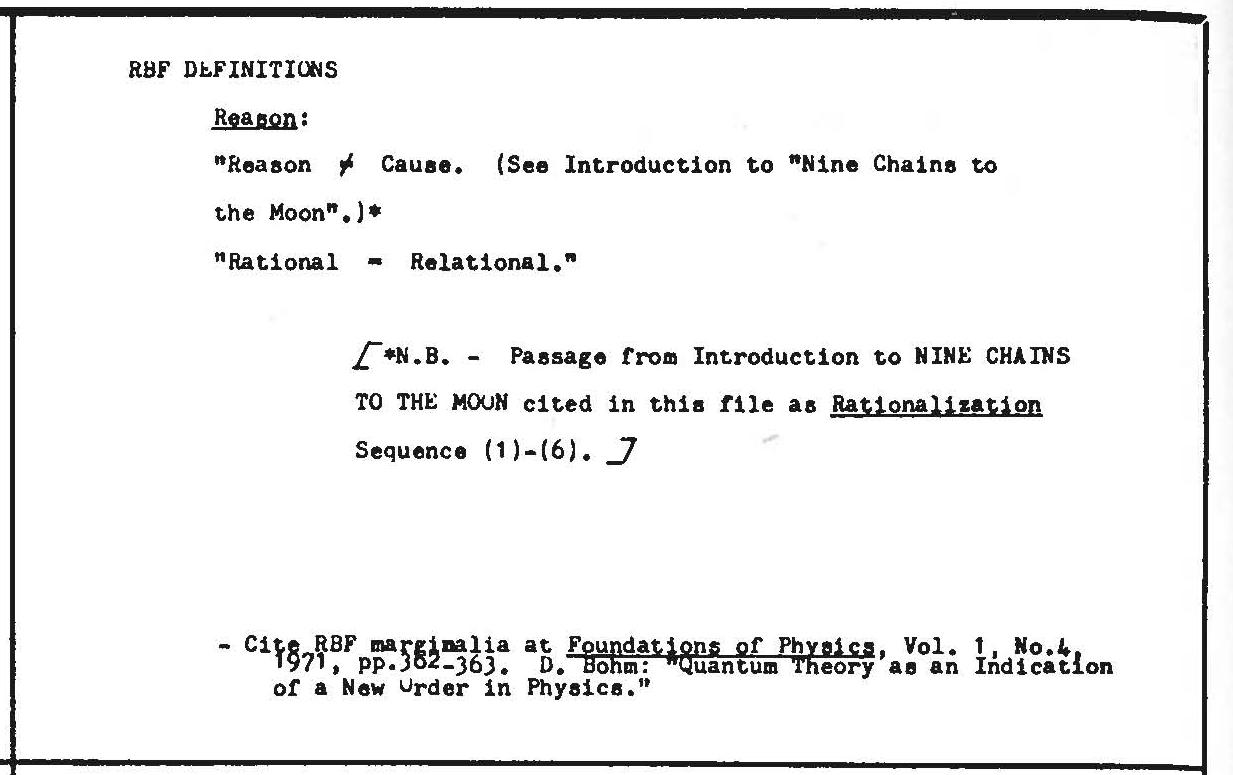
Reason & Cause
← Reason | Reason Reasonable Reasoning →
Cross Reference
Cross-References
- Reason, Aug'73

Reason Reasonable Reasoning
← Reason & Cause | Rebirth (1) →
Cross Reference
Cross-References
Rebirth (1)
← Reason Reasonable Reasoning | Rebirth (2) →
Cross Reference
Cross-References
Rebirth (2)
Cross Reference
Cross-References
- Eternal Slowdown, (2)
- Isotropic Vector Matrix, 16 Nov'72
- Time-size, 20 Dec'73
Rebonding
Cross Reference
Cross-References

Recall Lags
← Rebonding | Recall Momentum →
Index Entry
Recall Lags:
"The whole of Universe is a consequence of our not seeing instantly. As a result of the recall lags the physical is always imperfect."
--Cite Rbf to Eda, 3200 Idaho, Wash Dc., 26 May'72
(Citation and context at Equanimity Model, 26 May'72)
Recall Momentum
← Recall Lags | Recall Playbacks (2) →
Index Entry
Recall Momentum:
"Again reviewing for recall momentum..."
- Cite RBF marginalis on SYNERGETICS galley at Sec. \hrefhttps://www.buckyverse.org/en/synergetics/content/chapters/900-modelability#section-954.55954.55, 28 Dec'73
Recall Playbacks (2)
← Recall Momentum | Recall Set →
Cross Reference
Recall Playbacks:
Cross-References
- Brain's TV Studio, (2)
Recall Set
← Recall Playbacks (2) | Recall Set →
Index Entry
Brains differentially correlate the succession of special case informations communicated to the brain by the plurality of senses. The brain distinguishes the new, first-time-event, special case experiences only by their comparison with the set of all its recalled prior cognitions.
Recall Set
← Recall Set | Recall Recall Lags (1) →
Cross Reference
Recall Set:
Cross-References
- Set, 5 Jul'62

Recall Recall Lags (1)
← Recall Set | Recall Lags (2) →
Cross Reference
Cross-References
Recall Lags (2)
← Recall Recall Lags (1) | Recall Lags (3) →
Cross Reference
Cross-References
- Brain, 5 Jun'75
- Equanimity Model, 26 May'72*
- Frequency Islands of Perception, 13 Nov'75
- Happening Patterns, 6 Nov'73
- Life, 25 Mar'71
- Metaphysical & Physical Tetrahedral Quanta, 25 Mar'71
- Pattern, Jun'66
- Thinking, 22 Oct'72; 7 Nov'73
- Thought, 31 May'71
- Unitary Conceptuality, 22 Oct'72
Recall Lags (3)
Cross Reference
Cross-References
Recede
← Recall Lags (3) | Recentering →
Index Entry
Recede:
"The external crossing points of the system continually recede."
- Cite RBF 16 Feb citation Surface as re-written 17 Feb '72 (Q.V.)
Recentering
Cross Reference
Cross-References
- Structure, 3 Oct'72
Reciprocal
Index Entry
Reciprocal:
"It is very interesting to consider ... a total inventory of the relative abundance of different patterns remembering that the patterns are reciprocal."
-
Cite OREGON Lecture #5 p. 167, 9 Jul'62
-
Citation at Pattern, 9 Jul'62
Reciprocal
← Reciprocal | Reciprocal Involvement (1) →
Index Entry
Since universe is the minimum perpetual motion machine, there is a minimum set of patterns that is a consequence of this set of patterns reacting with that set of patterns.
-
Cite OREGON University Lecture #5 p. 167, 9 Jul'62
-
Citation and context at Minimum Set, 9 Jul'62
Reciprocal Involvement (1)
← Reciprocal | Reciprocal Involvement of Experiences & Principles →
Cross Reference
Cross-References
Reciprocal Involvement of Experiences & Principles
← Reciprocal Involvement (1) | Reciprocals of Permissible Viewpoints →
Cross Reference
Cross-References
- Simplicity, 1954
Reciprocals of Permissible Viewpoints
← Reciprocal Involvement of Experiences & Principles | Reciprocal Self-precessors →
Cross Reference
Reciprocals of Permissible Viewpoints:
Cross-References
- Pattern, 1954
Reciprocal Self-precessors
← Reciprocals of Permissible Viewpoints | Reciprocating Engine →
Cross Reference
Cross-References
- Omnidirectional, 1954
- Zoneness: System Zoneness, 8 Jan'55

Reciprocating Engine
← Reciprocal Self-precessors | Reciprocating Sub-sets →
Cross Reference
Reciprocating Engine:
Cross-References
Reciprocating Sub-sets
← Reciprocating Engine | Reciprocating Torus Model →
Cross Reference
Reciprocating Sub-sets:
Cross-References
- Relativity, May'49
Reciprocating Torus Model
← Reciprocating Sub-sets | Reciprocity (1) →
Cross Reference
Cross-References
- Rubber Tires, 24 Jan'75
Reciprocity (1)
← Reciprocating Torus Model | Reciprocity (2) →
Index Entry
"But as we come to explore for the fundamental principles of interpotentials and interactions called atoms, we find that , despite the astronomical number of aspects and events, only a few principles of behavior pervade the whole of Universe as, for instance, 92 tendencies to self-impoundment of energy; a fundamental inwardness and outwardness relative only to the 'system' center of observation; the corollary principles of inherent first tendencies to inward-outward pulsations and to precession, and the principles of inside-outing-- convergence-divergence, spin and counterspin, torque and countertorque tension and pressure, the biological reciprocals of Universe (and diaphragming).
"Relativity leads us toward fundamental classification of our experience and observation, in the terms of a few hierarchies of dynamic interactions and principle transformations of an all-energy, continuous-discontinuous, synchronous-dissynchronous Universe tensionally cohered, precessional of local compressive spherical energetic collections-- as (Suns) stars or planets or moons or asteroids or meteorites; and the progression of within-ward sub-sets of events of interactions at planet crust, etc., and inward to "
Reciprocity (2)
← Reciprocity (1) | Reciprocity (3) →
Index Entry
Reciprocity:
"the 92 common principles of atomic convergence of energy in principle, and the pervasive sets of dynamic associations by contraction, expansion, spin, orbit, torque, push, and pull, and precession. This all brings us by progressive collections of thoughts into a fundamental twoness of dynamic reciprocities which, internally paired, ultimately become one with outwardly paired principles of reciprocity.
"The becoming one of both the finity inward with the finity outward indicates a sensibility of experience preoccupying man as a superficial reality which only occurs at middling dimensions of Universe and appears schematically as a magnetic field. Its flux patterns, like two tangent balls, include every size of particle, as their hour-glass-like tangentially linked inwardness, displays both inwardly and outwardly mingled sets of fountain and reverse fountain flows-- concurrently at both ends-- and through the middle. Periodically, the whole double-bulbed dynamic flux contracts axially, as the two bulbs of dynamic flow merge progressively, and then merge completely, and again separate axially. It is obvious that inasmuch as the whole system was always in flow, that the new bulbs of flux are of necessity"
Reciprocity (3)
← Reciprocity (2) | Reciprocity →
Index Entry
Reciprocity:
"new and are therefore only identifiable in principle with the previous comprehensive duality of shapes. The system has inherent yet empty twoness.
"The reality is real-- or realized-- in principle only, by events of relative interaction transpiring only in principle. The whole of the above pulsive-waveful-dynamic-duality is schematic, and is in principle clarifying only, for, though it progressively groups all-energy Universe into an oscillating binary system, it must be understood that the whole scheme cancels out by virtue of a super paradox which finds that the infinity inward and the infinity outward of an infinite plurality of centers must be identical, and one with the infinity inward, of an infinite plurality of centers, and that: in comprehensive Universe, dimension drops out and conceptual principle remains. Physical interferences of our sensibilities are alike true and real, or realizable, only in principle. Positive and negative cancel as the principle zero.
"It is discovered in principle that probability probing of physical Universe on a statistical basis is now becoming of"
Reciprocity
← Reciprocity (3) | Reciprocity →
Index Entry
Reciprocity:
"necessity frustrated while, probing in empty conceptual principle could be instituted and accelerated for further advancement or fundamental information. Exploration in principle is re-rewarding.
"It is necessary that the comprehensive designer explore in principle for verification of this significance of relativity, whereby it is discovered that in the consciously realizable comprehensive binary, truth may not be dealt with as isolated, but only as relative relationships of interaction governing in principle the interactions of specially nonsimultaneous sets of dynamic principles. The comprehensive realizer thus will come, with acceleration, to competence in rearranging forwardly anticipated events, measured in principle, and forwardly projected, in associated principles of reciprocal interaction and juxtaposition to the anticipated energetic magnitudes of variable stresses and flows. These interactions are known as structures and mechanics.
"Thus it is discerned how the comprehensive realizer of relativity may become competent as an integrator of the until-then- threatening chaotic dissipation of common"
Reciprocity
← Reciprocity | Reciprocate Reciprocity Reciprocal (1) →
RBF Definitions
(5)
"advantage of men in Universe brought about by runaway, diametric preoccupations of specializations. The comprehensive realizer becomes a synergist."
Citations
- TOTAL THINKING, I&I, p.236, Fay'49
Reciprocate Reciprocity Reciprocal (1)
← Reciprocity | Reciprocal Reciprocate Reciprocity (2) →
Cross Reference
Design Reciprocity
Complementary & Reciprocal
Cross-References
- Axes of Corotation
- Energetic Functions
- Gear Train: Locking & Blocking
- Motion Reciprocity
- Reality as Structural Interaction of Principles
- Structural Functions
- Twoness of Dynamic Reciprocities
- Alternate: Alternative
- Mutual: Mutuality
- Bicycle Wheel Model
Reciprocal Reciprocate Reciprocity (2)
← Reciprocate Reciprocity Reciprocal (1) | Reciprocal Reciprocate Reciprocity (3) →
Cross Reference
Spaceship, 26 Sep'68
Cross-References
- Automation, 4 Mar'69
- Intellect, 16 Aug'50
- Minimum Set, 9 Jul'62*
- Pattern, 9 Jul'62*
- Prime Dichotomy, (2)
- Simplicity, 1954
- Technology, 12 May'39
- Tidal, Dec'61
- Hierarchy of Patterns, 1954
- Zoneness, 8 Jan'55
- Ninety-two Elements, 15 Jun'74
- Jitterbug, 1 Dec'65
- Synergetics Constant, 10 Dec'75
- Fourth Dimension, 22 Jun'77
Reciprocal Reciprocate Reciprocity (3)
← Reciprocal Reciprocate Reciprocity (2) | Recirculation →
Cross Reference
Reciprocating Subsets
Cross-References
- Reciprocal Involvement of Experiences & Principles
- Reciprocals of Permissible Viewpoints
- Reciprocal Self-precessors
- Reciprocating Engine
- Reciprocity
Recirculation
← Reciprocal Reciprocate Reciprocity (3) | Recognition →
Cross Reference
Metals: Recirculation Of
Roundtrip
Cross-References
Recognition
← Recirculation | Recognition →
Index Entry
"Everything that you have ever recognized in Universe as a pattern is re-recognized as the same pattern you have seen before. Because only the triangle persists as a constant pattern, any recognized patterns are inherently recognizable only by virtue of their triangularly structured pattern integrities. Recognition is as dependent on triangulation as is original cognition....."
Recognition
Index Entry
Recognition:
"We have an expression, something we say very often, 'I recognize that.' Recognition means that you have seen that pattern before. You have probably seen its several time before you say, 'I recognize it.' Recognizability of pattern would depend upon the stability of the pattern; it would have to have some fundamental shape. Only a triangle has any reliability of pattern. So I say everything and anything that you and I ever say 'I recognize,' must go back to a triangle. Only triangle is structure."
- Cite RBF Address at National Conference for Philosophy of Creativity at SIU, Carbondale, Ill., 16 Oct. '69. - p. 64.
Recognition
← Recognition | Recognition Lags →
Index Entry
Recognition:
"Everything that you have ever recognized in the Universe as a pattern is re-recognized as the same pattern you have seen before. Because only the triangle persists as a constant pattern any recognized patterns must be recognizable only by virtue of being a triangle or a complex of triangles. This is the only possible basis of recognition."
- Cite NASA Speech, p. 54. Jun'66
Recognition Lags
← Recognition | Recognizability →
Cross Reference
Recognition Lags:
Cross-References
- Mind, 24 Feb'72
- Tunability, 24 Apr'76

Recognizability
← Recognition Lags | Recognition Recognizable (1) →
Index Entry
Recognizability:
"Everything you say you recognize, means that you recognize a pattern. The recognizability of the pattern must go back to some triangles."
- Cite RBF at SIMS Seminar, U. Mass., Amherst, 22 July '71, Transcript p. 18
Recognition Recognizable (1)
← Recognizability | Recognition Recognizable (2) →
Cross Reference
Cross-References
- Pattern Cognition
- Pattern Cognizance
- Unrecognized
- Cognition vs. Recognition
Recognition Recognizable (2)
← Recognition Recognizable (1) | Recollect →
Cross Reference
Cross-References
- Experience, 1971
- Mass, 29 Dec'58
- thinkable You, (1)
- Triangle, 25 Feb'69
- Understanding, 1960
- Minimum Awareness, (1)
- Identity, 2 Jul'75
- Local System, Jun'66
- Omnitriangulation, 3 Oct'72
Recollect
← Recognition Recognizable (2) | Reconsider →
Cross Reference
Recollect: Recollections:
Cross-References
- Design Covariables: Principle Of, 1959
- Words, 2 Jul'62
- Conceptual Systems, 27 May'75
Reconsider
← Recollect | Off the Record →
Cross Reference
Reconsider: Reconsideration:
Cross-References
- Metaphysical & Physical Tetrahedral Quanta, 25 Mar'71
- Thought, 31 May'71
- Conscious & Subconscious, 1960
- In, Out & Around, Nov'71
- Nonsimultaneity, 7 Nov'73
Off the Record
Cross Reference
Record: Off the Record:
Cross-References
- Fuller, R.B: His Modus Operandi, 15 Jun'74
Recourse
← Off the Record | Rectification →
Cross Reference
Cross-References

Rectification
← Recourse | Rectilinear Frame →
Cross Reference
Cross-References
- Social Adjustment, Feb'72

Rectilinear Frame
← Rectification | Rectilinear Grid Systems (1) →
Index Entry
Rectilinear Frame:
"A vectorial evolvement in no way conforms to a rigid rectilinear frame of the XYZ coordinate analysis which arbitrarily shuns most economical directness and time realizations-- by virtue of which calculus is able only awkwardly to define positions rectilinearly, moving only as the chessman's knight. Nature uses rectilinear patterns only precessionally; and precession brings about orbits and not straight lines."
- Cite SYNERGETICS draft at Sec. \hrefhttps://www.buckyverse.org/en/synergetics/content/chapters/500-conceptuality#section-540.09540.09, 24 Sep'73
Rectilinear Grid Systems (1)
← Rectilinear Frame | Rectilinear (2) →
Cross Reference
Rectilinear:
See Grid: Crisscross, Right-angle Grid in Civil & Agrarian Law
Cross-References
- Grid: Crisscross, Right-angle Grid in Civil \& Agrarian Law
- Local Squareness
- Ninety Degreeness
- Two-way Rectilinear Grid
- XYZ Coordinate System
- Right Angle
- Square
- Two-way Crisscross
Rectilinear (2)
← Rectilinear Grid Systems (1) | Recyclings →
Cross Reference
Rectilinear: rectilinear Grid Systems:
Cross-References
- Air Space, May'65
- Frame of Reference, 27 Feb'72
- General Systems Theory, 8 Nov'73
- Nucleus, (1)
- Spherical Triangle: Equator as Square, (3)
- Twelve Universal Degrees of Freedom: General Systems
Recyclings
← Rectilinear (2) | Recycling (1) →
Index Entry
Recyclings:
"... The integrity of Scenario Universe's
Never exactly identical recyclings."
- Citation and context at Metaphysical, p.152 May '72
Recycling (1)
← Recyclings | Recycling (2) →
Cross Reference
Recycling:
Cross-References
Recycling (2)
← Recycling (1) | Redemonstrable →
Cross Reference
Cross-References
- Time, 1970 (2)
Redemonstrable
← Recycling (2) | Redesign Cycle →
Cross Reference
Cross-References
- Children as Only Pure Scientists, 28 Apr'77
Redesign Cycle
← Redemonstrable | Reductio ad Absurdum →
Cross Reference
Cross-References
- Energy & Intellect, May'49
- Improvement, May'49
- Periodic Experience, (6)
Reductio ad Absurdum
← Redesign Cycle | Reductio ad Absurdum →
Index Entry
Reductio ad Absurdum:
"The deliberately nonstraight line of synergetics employs the mathematicians' own invention for dealing with great dilemmas: the strategy of reductio ad absurdum. Having moments of great frustration, the mathematician learned to forsake looking for local logic; he learned to go in the opposite direction and deliberately to choose the most absurd. And then, by progressively eliminating the degrees of absurdity, he could work back to the not too absurd. In hunting terms, we call this quarrying his objective. Thus he is able at least to learn where his quarry is within a small area."
- Cite SYNERGETICS text at Sec. \hrefhttps://www.buckyverse.org/en/synergetics/content/chapters/500-conceptuality#section-522.03522.03; Nov'71
Reductio ad Absurdum
← Reductio ad Absurdum | Reductio ad Absurdum →
Index Entry
Reductio ad Absurdum:
"Having demonstrated to the mathematician that his
imaginary straight line gets worse and worse-- every time
he gives me an example, I am going to employ the
mathematician's own strategy of dealing with the great
dilemmas as invented by Boole-- the reductio ad absurdum.
Here I now a Jeliberately Non-Straight Line / q.v. /.
"The mathematician having moments of great frustrations
learned to forsake looking for local logic by going in the
opposite direction and choosing the most absurd, and then
progressively eliminating the degrees of absurdity and
working back to the not too absurd. And he is liable to
be able at least to learn the quarry, where his quarry is
a small area. What we call quarrying is objective.
These are hunting terms."
Reductio ad Absurdum
← Reductio ad Absurdum | Reductio ad Absurdum (1) →
Index Entry
Reductio ad Absurdum:
"When scientists and mathematicians fail to find positive clues leading towards solution of their problems, they sometimes reverse their frontal strategies and employ reductio ad absurdum, which by a process of eliminating all the impossibles and improbables, leaves a residue of least absurd, ergo most plausible solutions, which may be reduced, by physically testing to unequivocable answers."
- Cite RBF foreword to Samuel Rosenberg's "The Come As You Are Masquerade Party." 1970
Reductio ad Absurdum (1)
← Reductio ad Absurdum | Reduction By Bits →
Cross Reference
Cross-References
Reduction By Bits
← Reductio ad Absurdum (1) | Reduction of Myriadness to Unity (1) →
Cross Reference
Cross-References

Reduction of Myriadness to Unity (1)
← Reduction By Bits | Reduction of Myriadness to Unity (2) →
Cross Reference
Cross-References
Reduction of Myriadness to Unity (2)
← Reduction of Myriadness to Unity (1) | Reduction to Practice →
Cross Reference
See Metaphysical & Physica;, Jun'66
Cross-References
- Metaphysical \& Physica;, Jun'66
Reduction to Practice
← Reduction of Myriadness to Unity (2) | Reduction to Practice →
Index Entry
Reduction to Practice:
"There is no use talking about bright ideas. Everyone has bright ideas. But there is no use talking about the artifact until we reduce it to practice, until we see whether nature permits it, whether society permits it-- including worldwide distribution."
- Cite RBF at Penn Bell videotaping, Philadelphia, 29 Jan'75
Reduction to Practice
← Reduction to Practice | Reduction to Practice →
Index Entry
Reduction to Practice:
"Back in 1932 then, thinking that I would commit myself to only alterations of the environment-- not to 'multidisciplines' and so forth. I must never then 'talk about' anything. Whatever ideas I have I must find out how to translate them into some effect on the environment, in principle, and I must not talk about them until I have reduced them into practice and have discovered advantage for man. And I've really been able to prove to myself-- I find that bright ideas are so profuse-- but they don't get reduced to practice, you don't really know what the interactions are with the times and other environmental events. . . . So I would never talk about it until I have reduced it to practice: something physical. And somebody would say: what is that? And then I'd have the responsibility of telling them what it was. But I mustn't even ask them to look at it. I've really held very tightly to these disciplines, because I was interested in what the individual could do on behalf of his fellow man. . . even in a very few years."
Reduction to Practice
← Reduction to Practice | Reduction to Practice (1) →
Index Entry
Reduction to Practice:
"A trim tab is a physical environmental control device in a Universe where change, motion, and evolution are inexorable.... You must not just have a theoretical idea but reduce it to practice. That is my strategy."
- Citation at Trim Tab, 22 Jul'71
Reduction to Practice (1)
← Reduction to Practice | Reduction to Practice (2) →
Cross Reference
Science-Technology-Industry-Economics-Politics
Cross-References
Reduction to Practice (2)
← Reduction to Practice (1) | Redundant Excess →
Cross Reference
Invention Sequence (B)(C), (B)(C)
Cross-References
- Dome: Rationale for the Big Dome (A)
- Generalized Principle, 5 Jul'62
- Intuition of the Child, (3)
- Inventability Sequence, (2)
- Omnidirectional: Physical Existence Environment Surrounds, (2)
- Philosophy;, 1946
- Surfing: Surfboarding, 5 Jul'62
- Trim Tab, 22 Jul'71
- Design Science (A)
- Navy Sequence, (2)
- Artifacts, 17 Sep'74
- Icosahedron: Subtriangulation, (2)
Redundant Excess
← Reduction to Practice (2) | Redundancy →
Cross Reference
Cross-References
- Tetrahedron as Norm, 15 May'72
Redundancy
← Redundant Excess | Redundancy →
Index Entry
Redundancy:
"Edges and vertexes do not come together as the same number system. You can describe the world both ways and not be redundant. The world as seen by a child and the world as seen by an old man could not be redundant descriptions."
-
Cite RBF to EJA, 25 August 1971, Bear Island.
-
Citation at Description, 25 Aug'71
Redundancy
Index Entry
Redundancy:
"... Redundancy being a temporal consequence of brain lagged dullness of comprehension and ignorance."
- Citation and context at Differentiation, 27 May'72
Redundancy
← Redundancy | Redundancy: Reduction Of →
Index Entry
Redundancy:
"Redundancy cannot be determined by energetic observation of behaviors of single struts, (beams or columns) or any chain-linkage of same which are less than six in number, or less than tetrahedron."
-
Citation & context at Strut, 1950's
-
Cite for undated holograph on M.I.T. memo pad. (1950's)
Redundancy: Reduction Of
← Redundancy | Redundancy Redundant (1) →
Index Entry
"In the Greek temple each column carries its share of the stone on top of it. Figuring the ultimate compressive weight of the stone as 50,000 psi-- which equals 25 tons-- the result is that each column can carry 1000 tons when it only has to carry 25 tons. The rest of the column is unnecessary except for stability. We can make it a cone or a tripod, like a camera tripod.
"We find the only thing holding up a Greek column was a tetrahedron.... The thorns and buds of trees are tetrahedra: concentric cones-- the wing roots of the limbs. Goethe spoke of trees as waves.
"Only the tetrahedron can become visible and invisible. This is life: life is male & female, visible and invisible, but immortal.
"Hydraulics, mechanics, and the wave connection cofunction as the bio-connection: bio-logic. (A nice name.)"
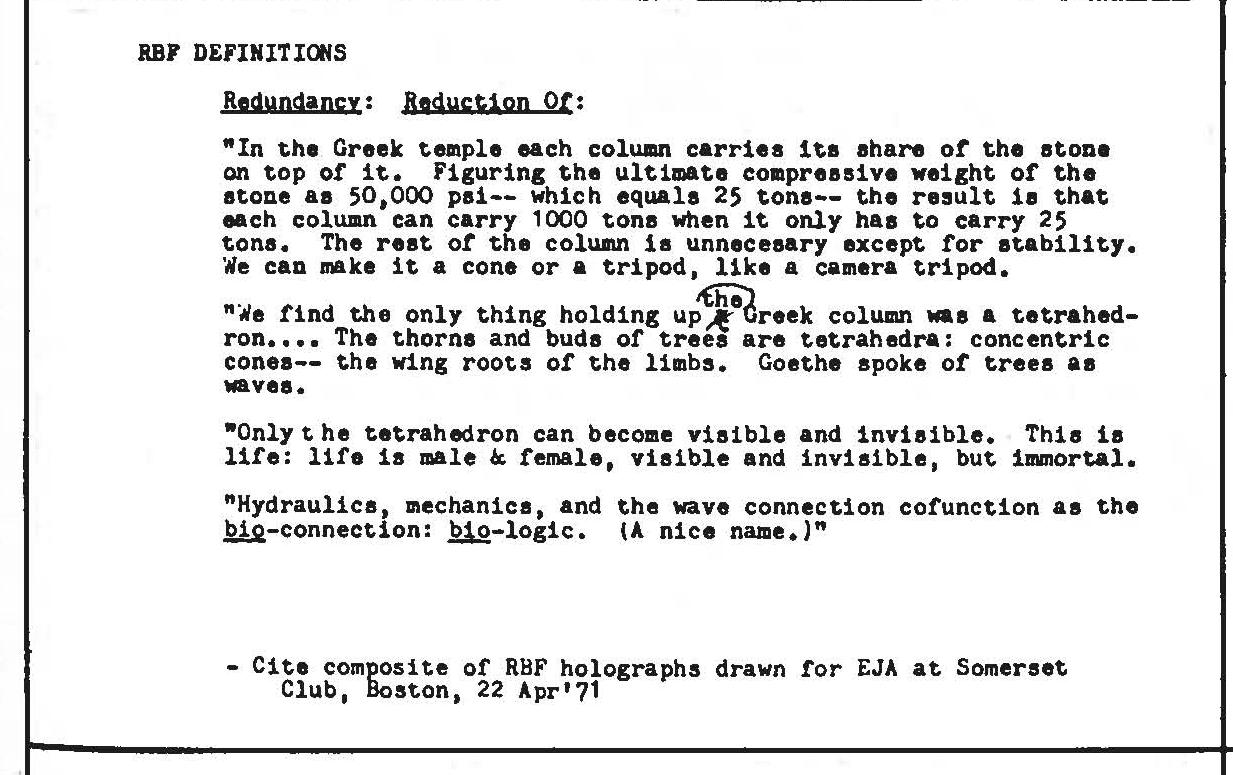
Redundancy Redundant (1)
← Redundancy: Reduction Of | Redundancy, Redundant (2) →
Cross Reference
Cross-References
Redundancy, Redundant (2)
← Redundancy Redundant (1) | Reef →
Cross Reference
Cross-References
- Antipathy, 15 May'72
- Cube, (1)
- Description, 25 Aug'71*
- Differentiation, 27 May'72*
- Knot: Square Knot, 20 Oct'72
- Strut, 1950
- Tensegrity: Unlimited Frequency of Geodesic Tensegrities, (9)
- Triangular Topology Integrity, 15 May'72
- Minimum System: Minimum Structural System, Nov'71
Reef
← Redundancy, Redundant (2) | Reel →
Cross Reference
Cross-References

Reel
← Reef | Reel of Tape Recorder (1) →
Cross Reference
Cross-References

Reel of Tape Recorder (1)
← Reel | Reel of Tape Recorder (2) →
Cross Reference
Cross-References
Reel of Tape Recorder (2)
← Reel of Tape Recorder (1) | Re-exterior (1) →
Cross Reference
Cross-References
- Axis of Spin, (1)(2)
Re-exterior (1)
← Reel of Tape Recorder (2) | Re-exterior (2) →
Cross Reference
Cross-References

Re-exterior (2)
← Re-exterior (1) | Reference (1) →
Cross Reference
Cross-References
- brouwer's Theorem, 1 Jan'75
Reference (1)
← Re-exterior (2) | Reference (2) →
Cross Reference
Cross-References
Reference (2)
← Reference (1) | Referendum →
Cross Reference
Cross-References
- Size, 22 Jun'72
Referendum
← Reference (2) | Refinement Refining →
Cross Reference
Referendum:
Cross-References

Refinement Refining
Cross Reference
Cross-References
- Relativity, May'49
- Truth, 10 Nov'72
Reflection
← Refinement Refining | Reflection Sequence: Apple (1) →
Index Entry
Reflection:
". . . It is possible
To conserve energies by reflection
As well as to reach
Great distance by beaming. . ."
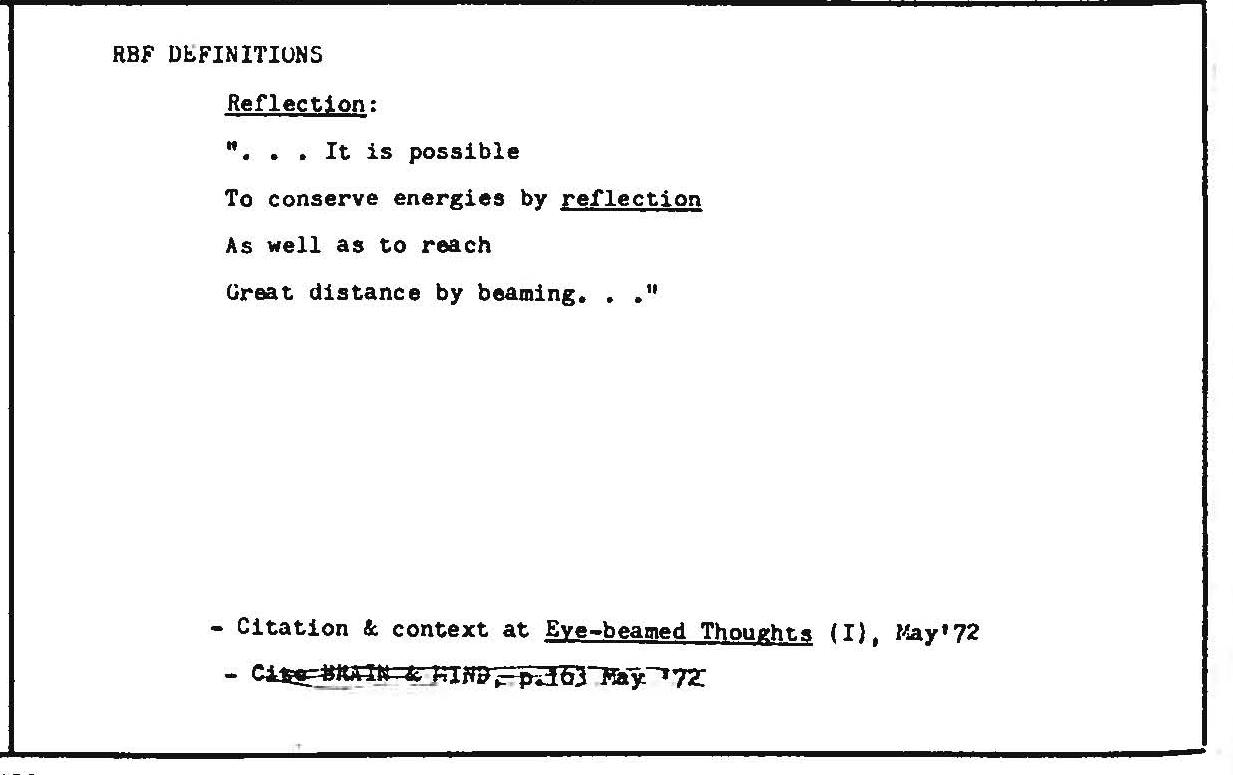
Reflection Sequence: Apple (1)
← Reflection | Reflection Sequence: Apple (2) →
Index Entry
Reflection Sequence: Apple:
"I see an apple.
"The light of the Sun is reflected from the surface of an apple, after the occurrence of the spectroscopic action of light segregation through the medium of crystals on the surface of the apple.
"Not all of the energy ray tones are reflected, however. Those that are useful to the apple are absorbed by it, while the remainder, i.e., the non-useful, or nondigestible, or, more specifically, non-chemically combinable ray tones are reflected from the surface of the apple through the air to and through the lens of the human eye, where they are analyzed by the retina and telephotographed to the brain of the beholder.
"Incidentally the light that the apple gives off is a negative, that is, the opposite of the light complementary to the growth phenomenon 'apple.' It is not one of the chemical apple's actual constituents. This is something like the phenomenon of the camera film negative except that the latter is more honest than the eye's for the eye reverses light and shadow instead of properly appraising them as does the camera. In printing,"
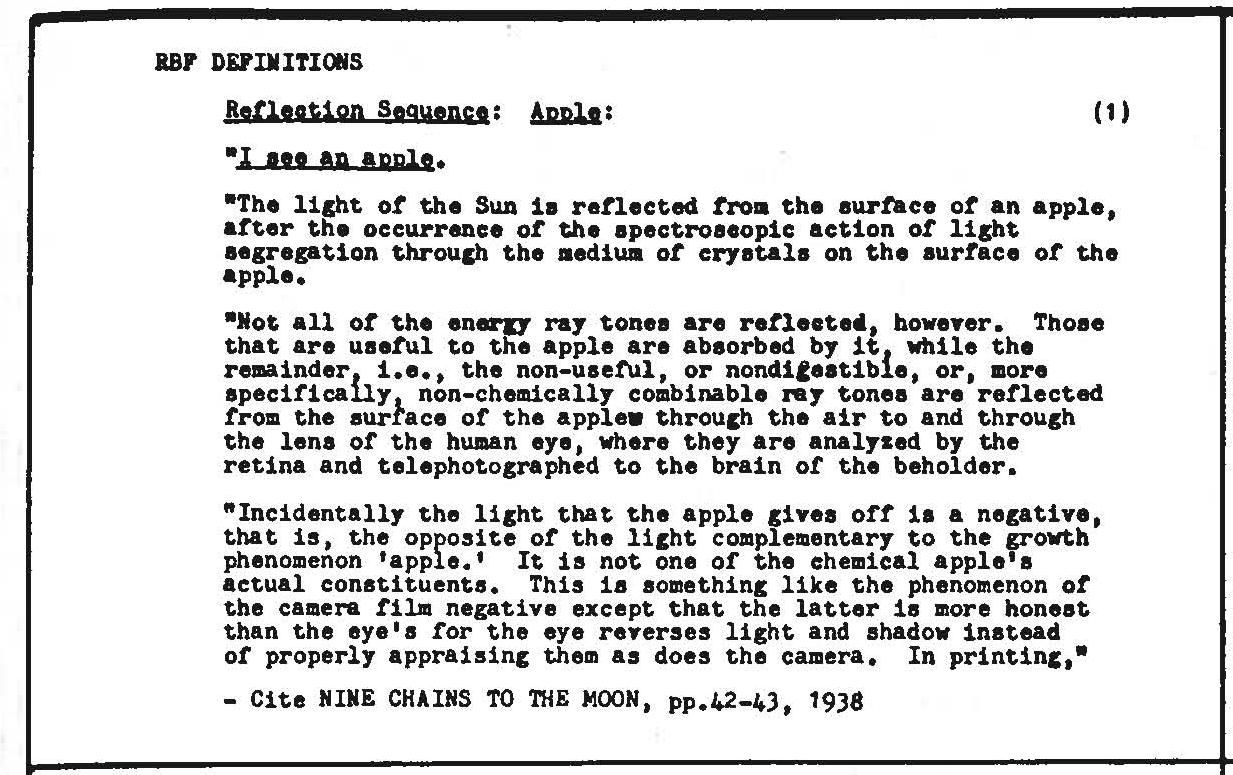
Reflection Sequence: Apple (2)
← Reflection Sequence: Apple (1) | Reflection Sequence: Apple (3) →
Index Entry
Reflection Sequence: Apple:
"the black and white of the film have to be reversed in order to represent the illusion of the apple as the eye sees it. Many apples are probably blue, having taken blue from the spectrum, but the eye, taking up the rejected red, 'sees' the apple as red.
"Whether or not the eye sees a negative or a positive of the apple, light absorption and reflection are mechanical considerations because neither life nor mind activity is involved until the essence of the picture has been articulated in the 'brain' and has been automatically referred to the memory filing department (the system of which is even more complicated than the worldwide Bertillon system of finger-print identification) for comparison with all of the apple experiences of the 'see-er.' The new picture of 'apple' is laid out on the table for comparison with the whole reference file by the executive officer 'brain,' who never sees the phantom captain although under his permanent orders to lay out the file in the captain's outer study. Then 'brain' retires through the front door, closes it behind him, and the phantom captain enters from his inner sanctum to peruse the exhibit.
- Cite NINE CHAINS TO THE MOON, p.43, 1938
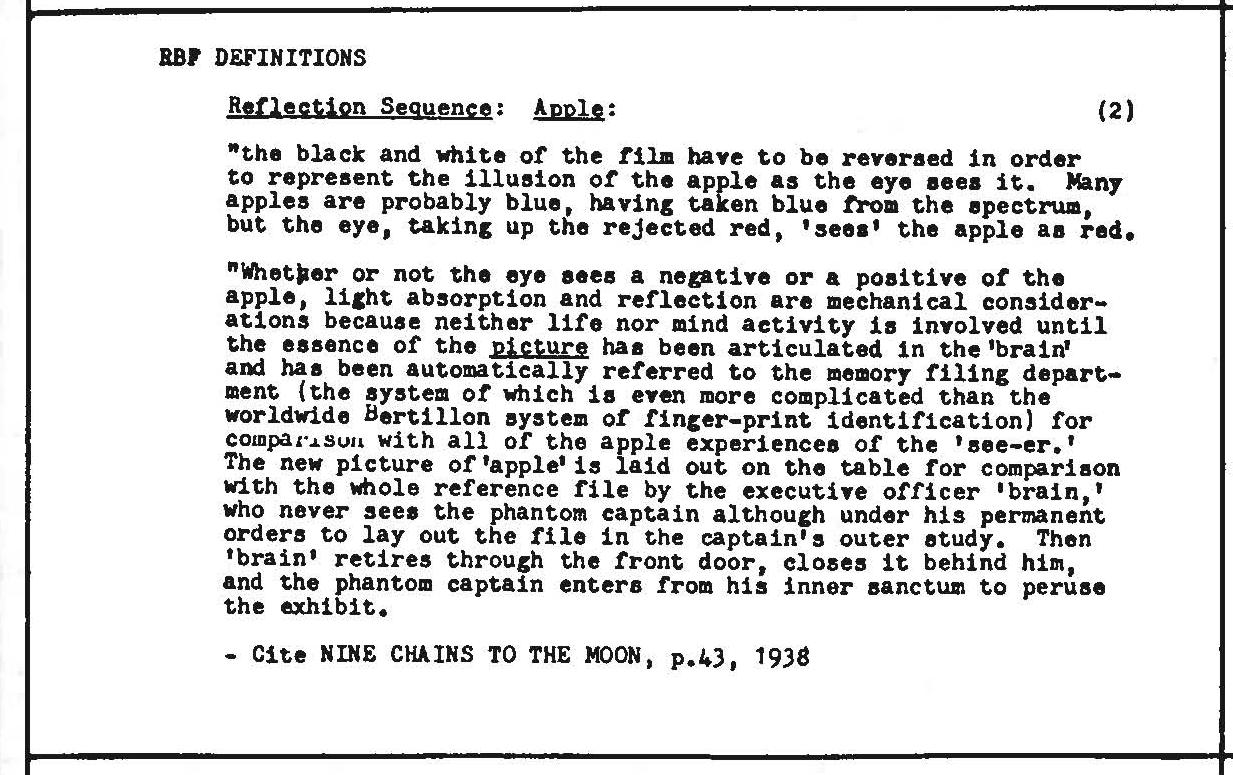
Reflection Sequence: Apple (3)
← Reflection Sequence: Apple (2) | Reflecting Lake Waters →
Index Entry
"If interested at all-- generally he is not-- the captain considers the progression of apple phenomena, as indicated by the pictures in the file, and decides that the latest addition is a better or worse apple, i.e., it is an apple that would, or would not, be useful as fuel for his ship, in the cleansing process of his machinery, or as bait. Having decided 'yes' or 'no,' he leaves a message for 'brain' beside the exposed file and retires."
- Cite NINE CHAINS TO THE MOON, pp.43-44, 1938
Reflecting Lake Waters
← Reflection Sequence: Apple (3) | Reflection (1) →
Cross Reference
Cross-References
- Invisible Pneumatics, 27 Dec'73

Reflection (1)
← Reflecting Lake Waters | Reflection (2) →
Cross Reference
Focal: Focus
Cross-References
Reflection (2)
Cross Reference
ahedron: Eight-octahedra, Oct (3)(4)
Cross-References
- Broadcast, May'72
- Eye-beamed Thoughts
- Interference, (2)
- Radiation, May'72
- Sight, 1 Apr'49
- Vertexial Spheres, 8 Apr'75
- Cloud Chamber, Nov'71
- Visual, 22 Feb'77
Reflexes
Index Entry
Reflexes:
"In 1927 when I was starting to re-educate myself, trying to unlearn all the things that I'd been taught to be so, that I had proven not to be so, I tried to get my reflexes disconnected from the false reactions or the unfavorable and the hard reactions and try to become sensitive again."
- Cite Museums Keynote Address Denver, p. 6. 2 Jun'71
Reflexes
Index Entry
Reflexes:
" . . . The designing capability . . .of human organisms
. . . to offset the gamut of non-thinking conditioned
reflexes of all biological systems."
- Cite Museums Keynote Address, p. 14. 2 Jun'71
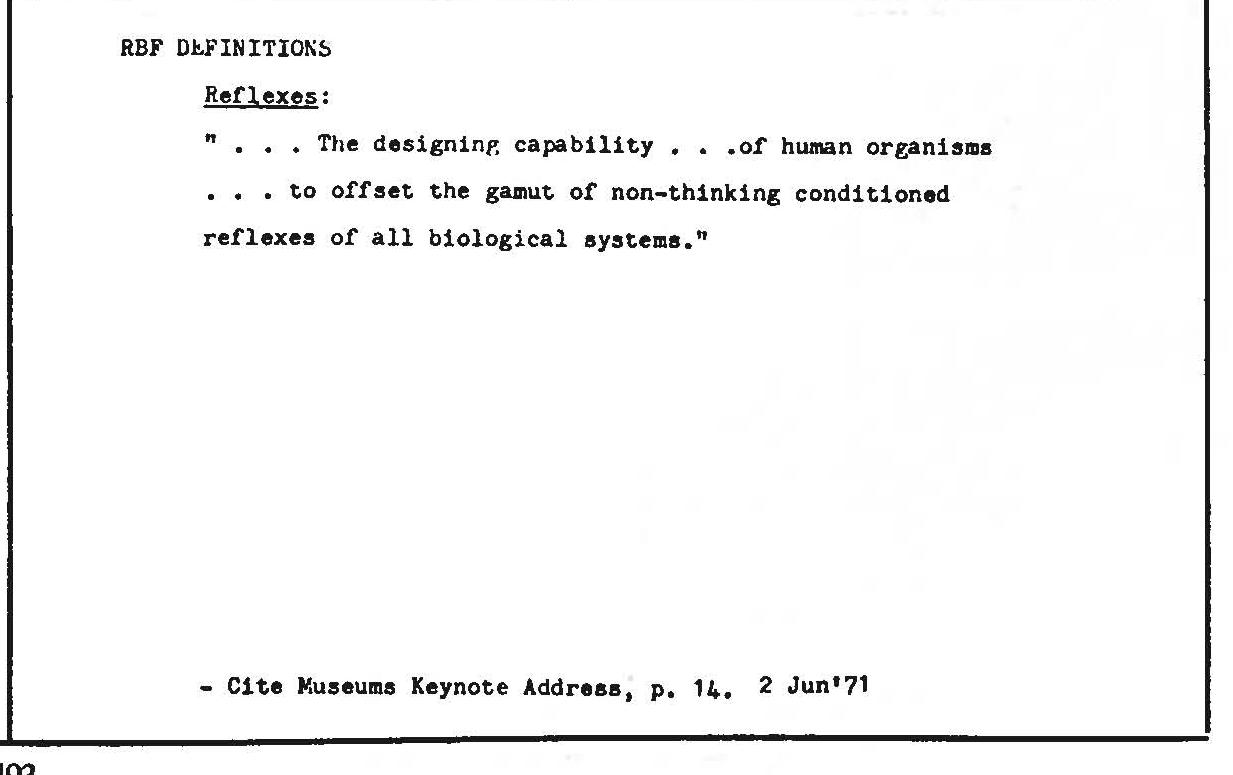
Reflexes
← Reflexes | Reflex Reflexes (1) →
Index Entry
Reflexes:
"Probably our most polluted resource is that of the tactical information to which humanity spontaneously reflexes."
-
Citation at Information: Tactical Information, 13 Nov'69
-
Cite NEHRU SPEECH, p.--37, 13 Nov'69
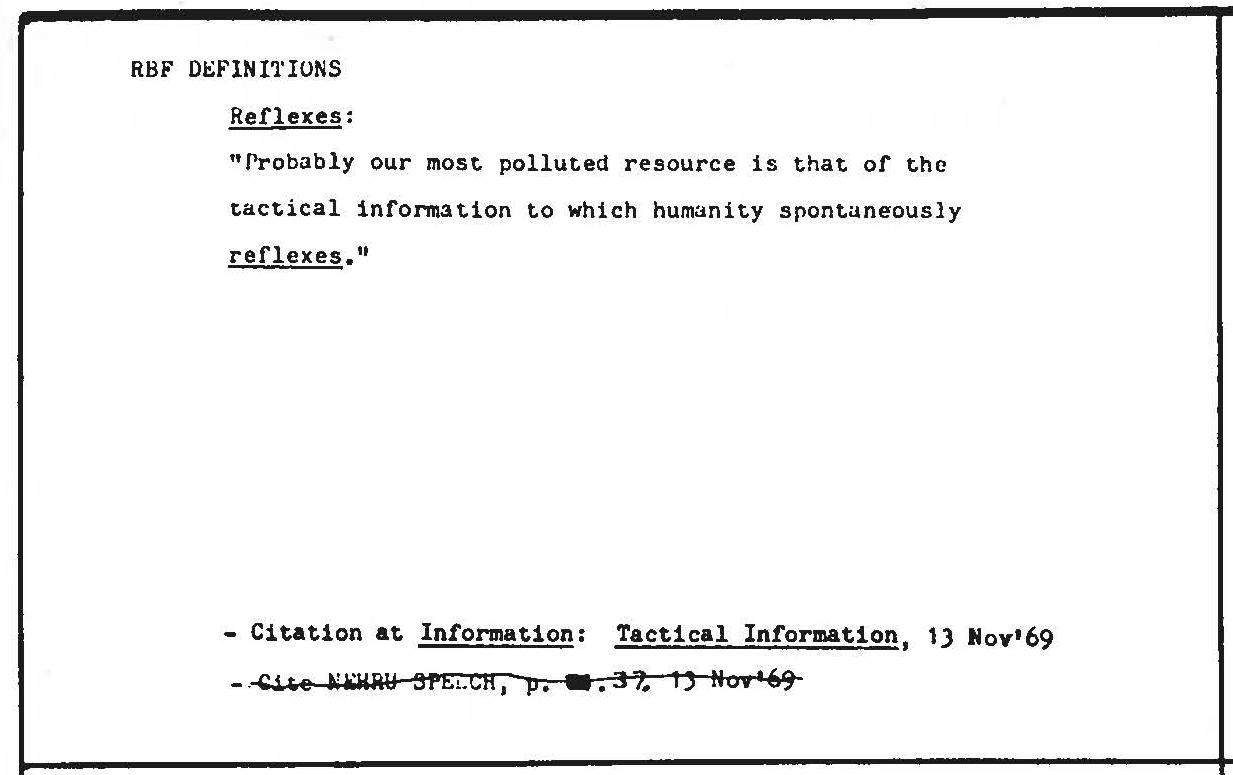
Reflex Reflexes (1)
← Reflexes | Reflex Reflexes (2) →
Cross Reference
Conditioned Reflexes
Quickness
Cross-References
- Automatics
- Bias on One Side of the Line
- Common Sense: Official News
- Conditioning
- ondition My Subconscious Reflexing, Dec
- Feedback
- Ignorance
- Knowledge as Reflexes
- Mine: That's Mine
- Nonthinking
- Muscle & Reflex Jobs
- Planar Reflex
- Sensorial Reflex
- Structure vs. Reflexes
- Habit Reflexes
- Mind vs. Reflex
- Crowd-reflexing
- Proclivities: Basic vs. Secondary
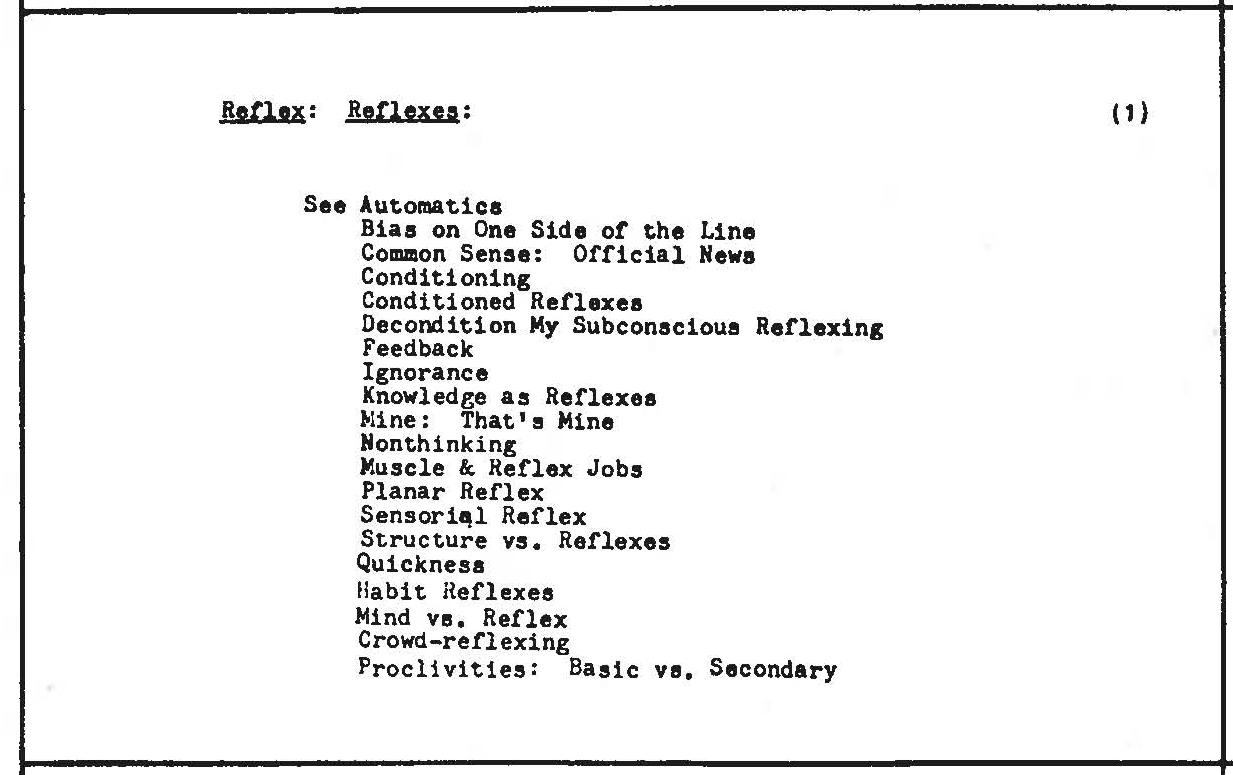
Reflex Reflexes (2)
← Reflex Reflexes (1) | Reform of Environment Rather than Reform of Man →
Cross Reference
Information: Tactical Information, 13 Nov'69*
Spaceship, (D)
Cross-References
- Antithinking, 2 Jun'71
- Awareness, Feb'50
- Computer
- Ecology Sequence
- Environment Events Hierarchy, (2)
- Fighting, 7 Nov'67
- Gross World Product Sequence, (1)
- Intuition, 22 Jun'72
- Fuller, R.B: Crisis of, 1927 (2)
- Life Is Not Physical, 13 Jul'74
- Mind, 26 Nov'72
- Poverty, May'72
- Space Technology, (2)
- Survival Sequence: Love, (1)
- Telepathy, 29 Jun'72
- War: Official & Unofficial, (1)
- Semantics, 20 Feb'73
- Death, 29 Mar'77
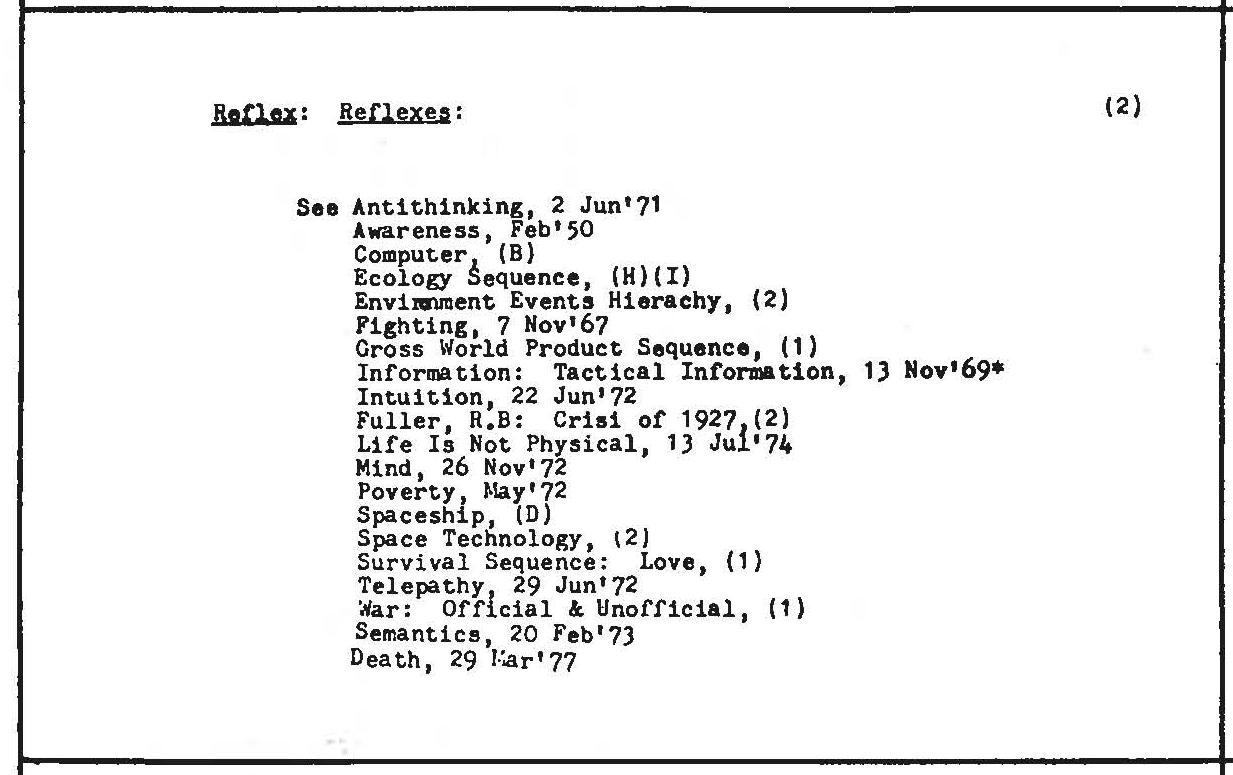
Reform of Environment Rather than Reform of Man
← Reflex Reflexes (2) | Reform of Environment Rather than Reform of Man →
Index Entry
Reform of Environment Rather than Reform of Man:
"My discipline is to reform the environment in ways favorable to the success of all humanity with confidence that propitious environmental circumstances induce spontaneously pro-social behaviors."
- Citation and context at Design Science (1), 29 Jun'73
Reform of Environment Rather than Reform of Man
← Reform of Environment Rather than Reform of Man | Reform of Environment Rather than Reform of Man (1) →
Index Entry
Reform of Environment Rather than Reform of Man:
"I developed a fundamental philosophic concept in 1927 which was that it is possible, instead of trying to reform man, to reform the physical patterns--to reform the environment in such a way as to make the physical environment patterning more favorable to the new life being born into it. It seemed possible that the new human generation, born into the streamlined environment, might quickly react by re-employing the newly designed advantages, and in so doing might establish a new level of integrity of human response to environmental stimuli whereby society might come to act in creative spontaneity to continually convert the highest knowledge born of the cumulative experience of man toward the direct enhancement of the life processes, instead of, as at present, leaving the prime social initiative for the weaponry exploiters who derive their mandate only from the negative fears born of ignorance, and the congealing inertia of that ignorant fear."
- Cite MEXICO '63, p.18, 10 Oct '63
Reform of Environment Rather than Reform of Man (1)
← Reform of Environment Rather than Reform of Man | Reform of Environment Rather than Reform of Man (2) →
Cross Reference
Fuller, R.B: Hisision that he Must not be a Persuader but a Doer, Dec
Cross-References
- Blind Date with Principle
- Design Revolution
- Design Science
- Fuller, R.B: Crisis of, 1927
- Fuller, R.B: What I Am Trying To Do
- Individual Economic Initiative
- Inventions as Lifeways of Human Behaviors
- Leonardo Type
- Rearrange the Scenery
Reform of Environment Rather than Reform of Man (2)
← Reform of Environment Rather than Reform of Man (1) | Reform Reformers →
Cross Reference
Cross-References
- Artifacts, 17 Sep'74 (1)(2)
- Bridge, 13 Nov'69
- Design Science, 29 Jun'73 (1)
- Environment, May'65
- Trim Tab, 8 Jan'66
- Fuller, R.B: I am Apolitical, 15 May'75
Reform Reformers
← Reform of Environment Rather than Reform of Man (2) | Refraction (1) →
Cross Reference
Cross-References
- Trim Tab Sequence, (1)
- Political Revolution, 10 Oct'63
- Success, 10 Sep'75
Refraction (1)
← Reform Reformers | Refraction (2) →
Cross Reference
Manifest: Two
Color Spectrum: Red, Orange, Yellow, Green, Blue, Violet
Cross-References
Refraction (2)
← Refraction (1) | Refrigeration →
Cross Reference
Refraction: Refractive:
Cross-References
- Boltzmann Sequence, (5)
- Interference, (2)
- Radiation Sequence, (2)
- Sweepout: Spherical Sweepout, (1)
- Van Allen Belt, May'72
- Bendings, 23 Jun'75
- Wind Stress & Houses, (9)(10)
- Cloud Chamber, Nov'71
- Halo Concept, Jun'71
Refrigeration
← Refraction (2) | Regeneration →
Cross Reference
Cross-References
- More With Less: Sea Technology, (3)(4)
- Human Unsettlement, (2)
Regeneration
← Refrigeration | Regeneration →
Index Entry
Regeneration:
"The significance of Einstein's electromagnetic radiation's top speed unfettered in vacuo is that there is a cosmic limit accommodation point of complete regeneration by which Universe is the only and minimum perpetually self-regenerative system."
- Citation at Absolute Velocity, 30 Oct'73
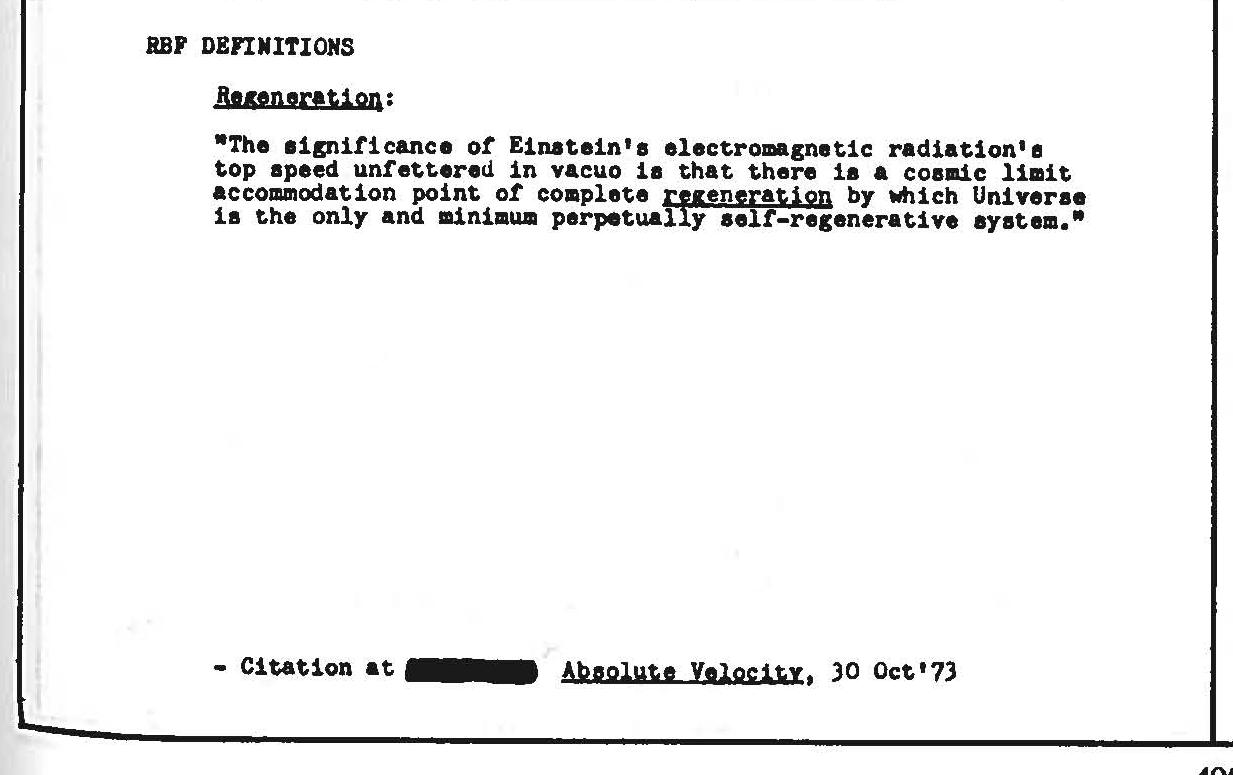
Regeneration
← Regeneration | Regeneration →
Index Entry
Regeneration:
"The Universe is
The min-max, self-regenerative organism.
The regeneration is
A nonsimultaneous sequence
Of only partially overlapping
Physical transformation events--
Occurring in a vast range
Of ever-and-anon, synchronizing,
Pulsative frequencies
With associative concentrations
Here and there
Nonsimultaneously accommodating
Disassociative dispersals
In other heres and theres--
Like the 'high' and 'low' interalternations
Of the forever changing atmosphere's 'weather.'"
- Cite Drayfus Preface,"Decrease of Meaning.*
28-April 1971, pp. 1-2.
- Citation & context at Universe, 28 Apr'71
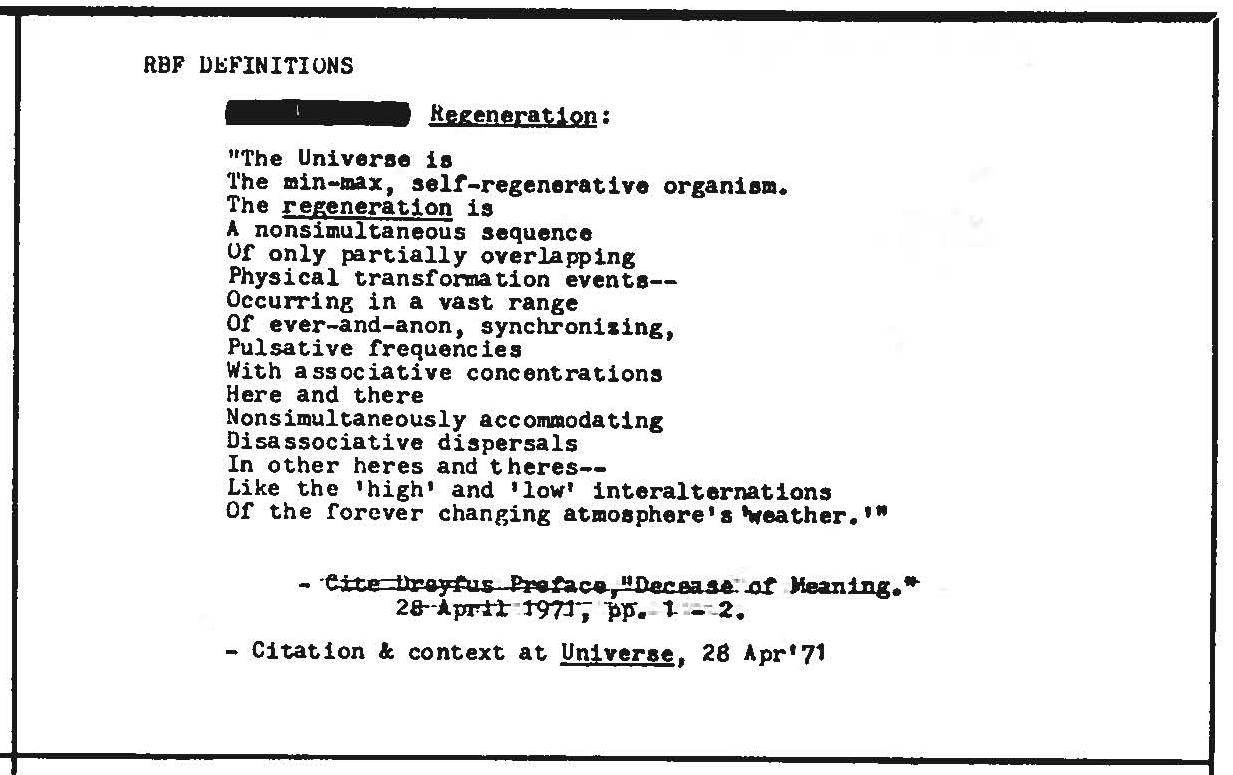
Regeneration
← Regeneration | Regenerative →
Index Entry
Regeneration:
"Universe is the minimum as well as the maximum closed system of omni-interacting, precessionally transforming, complementary transactions of synergetic regeneration. . ."
-
Citation & context at Universe, 1960
-
Citation CONTEXTUAL HALO, p. 135, 1960
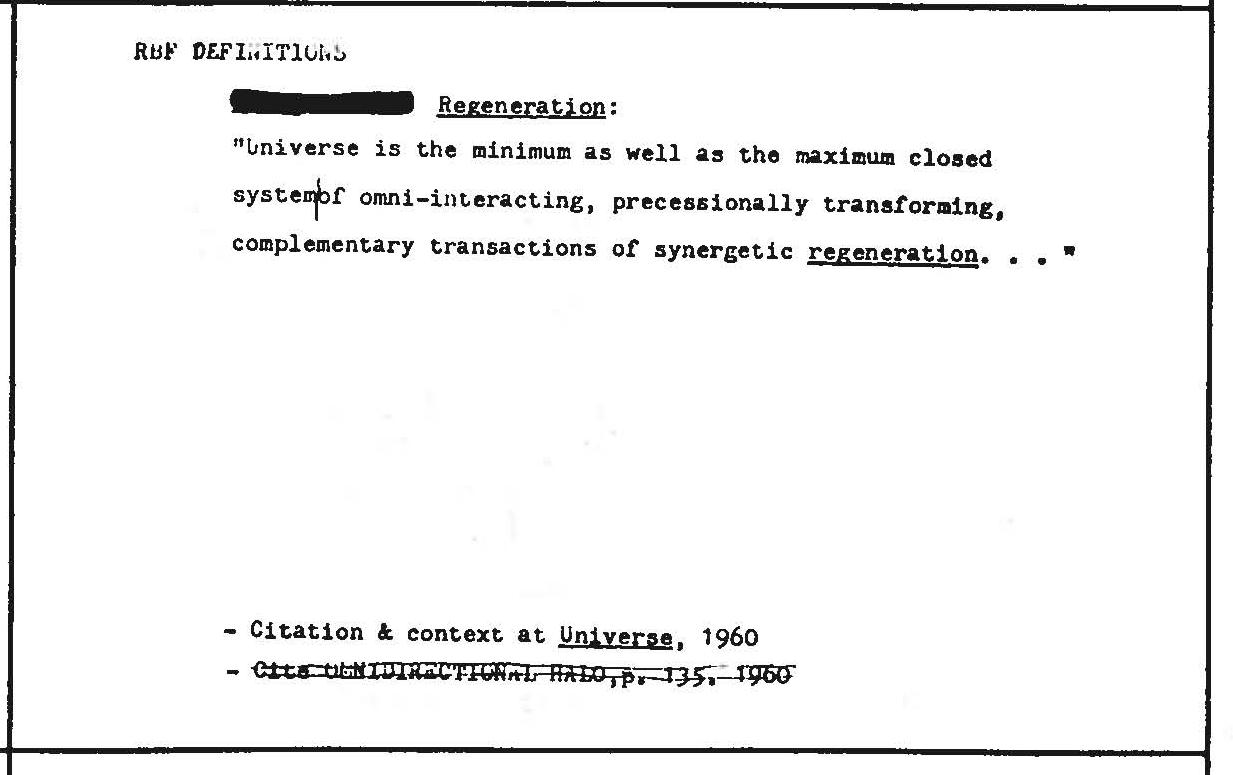
Regenerative
← Regeneration | Regenerative →
Index Entry
The isotropic vector matrix "coordinate system is ever regenerative in respect to the nuclear centers all of which are rationally accounted for by synergetica.
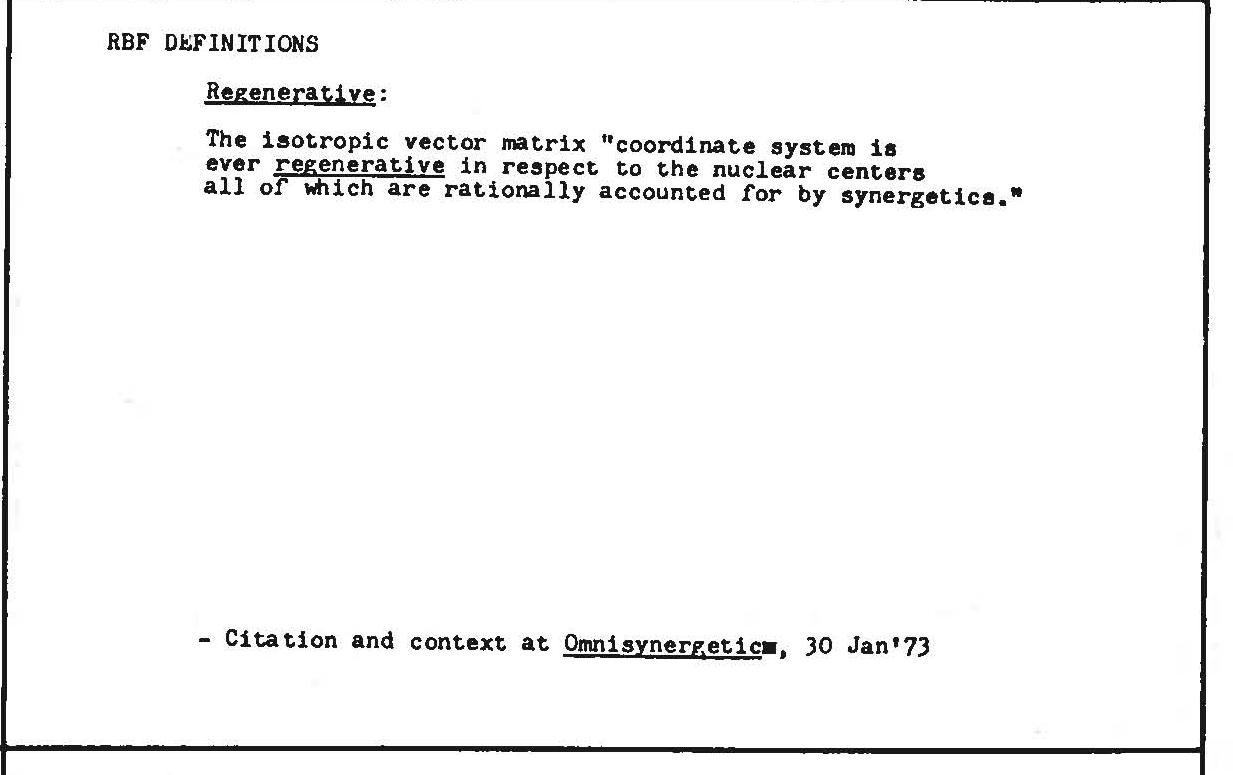
Regenerative
← Regenerative | Regenerative →
Index Entry
Regenerative:
"Regenerative means local energy-pattern conservation."
- Cite SYNERGETICS text at Sec. \hrefhttps://www.buckyverse.org/en/synergetics/content/chapters/600-structure#section-600.04600.04, 3 Oct'72
Regenerative
← Regenerative | Regenerative →
Index Entry
Regenerative:
"Regenerative means local energy pattern conservation.
"Regenerative means local conservation of energy events interpatterning.
"Structures are pattern conservations."
- Cite RBF to EJA, Beverly Hotel, NYC, 15 Mar'71
Regenerative
← Regenerative | Regenerative →
Index Entry
Regenerative:
"I use the term regenerative because in an all-motion universe (which Einstein posited and the physicists in due course found to be true), all the patterns of the universe are continually but non-simultaneously affecting all the other patterns of Universe in varying degrees and are continually reduplicating themselves in unique local configurations.
"These patterns may be described as constellar because their component events stand dynamically together like star groupings, and any event patternings which become locally regenerative are constellar patterns. It is a tendency for patterns either to repeat themselves locally or for their parts to separate-out to join severally or singly with other patterns or to form new constellations."
-
Cite RBF2, p. 66, 1965
-
Citation and context at Structure Sequence (1)(2), 1965
Regenerative
← Regenerative | Regenerative →
Index Entry
Regenerative:
"Universe... a closed system of complementary patterns that is regenerative, that is, adequate to itself...."
- Citation and context at Chess: Game of Universe, 9 Jul'62
Regenerative
← Regenerative | Regenerative →
Index Entry
Regenerative:
"Regenerative means multiorbital, cyclic, precessionally concentric.
"Regenerative means the ability to display one form, then another, in a gamut of phases; each phase, however, like a tree ring, or a wave generated by a stone thrown into water, has its own orbit; and the various orbits progress outward or inward in concentric circles or shells.
"A seed is regenerative. A crystal is regenerative. Energy itself is an ever-regenerative patterning entity. Its forms are protean. It can appear as the breath of a hawk or coign of a cliff. It can cloak itself as radiation, as mass, as design, and as the wellspring of work. And since by fundamental law, energy can neither be created nor destroyed, its fate in the cosmic scheme is to meander through eternity in persistent, regenerative bliss."
Regenerative
← Regenerative | Regenerative Birth →
Index Entry
Regenerative:
"If the spheres* are close packed" to form a vector equilibrium, "and the center sphere is removed or compressed, the remaining spheres close in to form a 20-sided 'solid,' the icosahedron. From this it follows that a vector equilibrium can be translated into an icosahedron and vice versa. They are close relatives. Each has twelve vertexes and the same number of surface-defining spheres. And each is a model of symmetrical regularities. Each, in fact, has a place in a family of relationships which is capable of cycling through a sequence of phases, hence . . . regenerative."
- Cite MARKS, p. 41, 1960
Regenerative Birth
← Regenerative | Regenerative Design Law Of (1) →
Cross Reference
Cross-References
- Duality of Universe, May'49

Regenerative Design Law Of (1)
← Regenerative Birth | Regenerative Design: Law Of (2) →
Index Entry
The prime eternal law governing design science as thus-far accrued to that of the cosmic law of generalized design science exploration, is realizability and relative magnitude of reproducibility which might be called the law of regenerative design: which is, that the relative physical time magnitude of reproducibility is proportional to the order of magnitude of generalizability. Because the higher the order of generalization the more embracing and simple its statement, only the highest orders can embracingly satisfy the plurality of low-order interaccommodation conditions.
"There are several corollaries to the prime law of regenerative design durability and amplitude of reproducibility. Corollary A is: The simpler, the more enduringly reproducible. Corollary B: The special-case realizations of a given design complex correlate as: the more symmetrical, the more reproducible. Corollary C: There being limit cases of optimum symmetry and simplicity, there are simplicities of conceptual realization. The most enduringly reproducible design entities of Universe are those occurring at the min-max limits of simplicity and symmetry."
- Cite RBF draft Ltr. to Karan Singh incorporated in SYNERGETICS at Secs. 166-7, 13 Mar'73
Regenerative Design: Law Of (2)
← Regenerative Design Law Of (1) | Regenerative Design: Law Of (3) →
Index Entry
Regenerative Design: Law Of:
"Corollary D: There being unique minimum-maximum system limits governing the transformation of conceptual entities in Universe which differentiate the conceptually unique entities of Universe into those exceptions occurring exclusively outside the system considered and all of the Universe inside of the conceptual entity, together with the structural pattern integrity system separating the inside from the outside, there being a minimum limited set of structural and operating principles eternally producing and reproducing recognizable pattern integrity. And there are likewise a minimum set of principles which interact to transform already orderly patterns into other structured patterns, and there being minimum constituent patterns which involved the complex intertransformings and structural formings of symmetrical orders and various magnitudes of asymmetrical deviations tolerated by the principles complexedly involved. There are scientifically discoverable nuclear aggregates of primary design integrity as well as complex symmetrical reassociabilities of the nuclear primary integrities and deliberately employable relationships of nuclear simplexes which designedly impose asymmetrical-symmetrical pulsativ@ periodicities."
- Cite RBF draft Ltr. to Karan Singh incorporated in SYNERGETICS text at \hrefhttps://www.buckyverse.org/en/synergetics/content/chapters/100-synergy#section-168.00168, 13 Mar'73
Regenerative Design: Law Of (3)
← Regenerative Design: Law Of (2) | Regenerative Design Law Of (1) →
Index Entry
Regenerative Design: Law Of:
"Corollary E: The more symmetrical and simple and nuclear, the more frequently employable; ergo more frequently occurring in eternally regenerative Universe transformative problem solutions.
"Corollary F: The smaller and simpler, more symmetrical, frequently-occurring in Universe and the larger and more complex, less-frequently originally occurring, and periodically re-occurring: for example, the hydrogen limit minimum simplex constituting not only nine-tenths of physical Universe but most frequently and most omnipresent in Universe; with asymmetrical terrestrial battleships (fortunately) least-frequently and compatibly recurrent throughout the as-yet known cosmos, being found only on one minor planet in one typical galaxy of one hundred billion stars amongst already-discovered billion galaxies, there having been only a few score of such manmade battleships recurrent in the split-second history of humans on infinitesimally minor Earth."
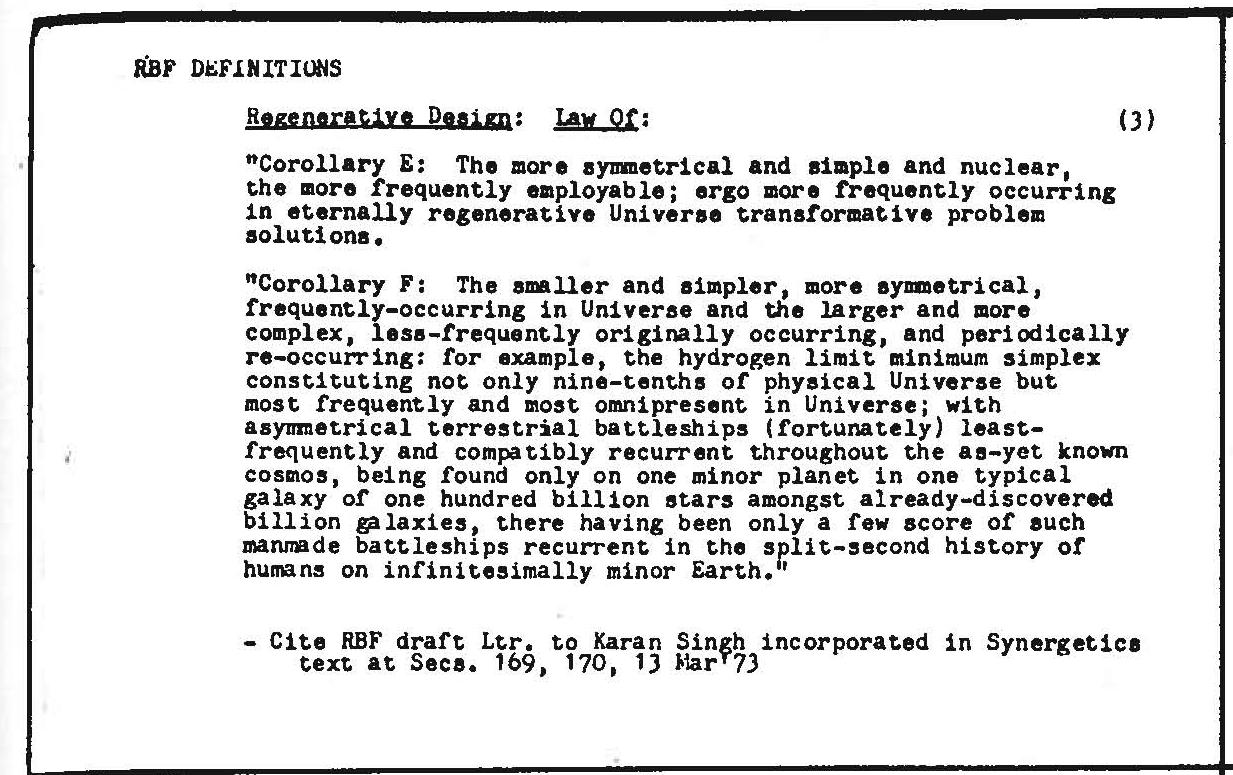
Regenerative Design Law Of (1)
← Regenerative Design: Law Of (3) | Regenerative Design Law Of (2) →
Cross Reference
Cross-References

Regenerative Design Law Of (2)
← Regenerative Design Law Of (1) | Regenerative Economic Sustenance →
Cross Reference
Cross-References
- Design, 1938
Regenerative Economic Sustenance
← Regenerative Design Law Of (2) | Regenerative Intersupport →
Cross Reference
Cross-References
- Money, 22 Jun'77
Regenerative Intersupport
← Regenerative Economic Sustenance | Regenerative Intersupport →
Index Entry
Regenerative Intersupport: Equation Of:
"Precession + ecology = regenerative intersupport."
- Cite RBF to State Dept. Senior Seminar, Rosslyn, Va., 22 Dec'74
Regenerative Intersupport
← Regenerative Intersupport | Regenerative Organica →
Cross Reference
Regenerative Intersupport: Equation Of:
Cross-References
Regenerative Organica
← Regenerative Intersupport | Regenerative Precession →
Cross Reference
Cross-References
- Gonads, 22 Sep'71

Regenerative Precession
← Regenerative Organica | Regenerative Stimulations →
Cross Reference
Cross-References
- Spiralinearity, Nov'71

Regenerative Stimulations
← Regenerative Precession | Regenerative System Integrity →
Cross Reference
Cross-References
- Discovery, 20 Dec'71
Regenerative System Integrity
← Regenerative Stimulations | Regenerativity →
Cross Reference
Cross-References
- Organic, 26 May'72
Regenerativity
← Regenerative System Integrity | Regeneration Regenerative (1) →
Index Entry
Regenerativity:
"The regeneration may be that of a complete new baby or the local regeneration of cells in an ongoing organism. Rebirth is continual. The overall growth and refinement of information and comprehension by continuous humanity transcends the separate generations of life and steadies toward eternal unalterability; the special case physical experiences and the identification of their significance in the overall scheme of eternal cosmic regenerativity ever accelerate as the information bits multiply exponentially; wherefore the overall rate of gain of metaphysical comprehension of the physical behavior in general accelerates exponentially in respect to such arithmetical periodicities as that of the celestial cycles of the solar system."
(a1052.67)
- Cite RBF rewrite of SYNERGETICS, 2nd. Ed. at Sec. \hrefhttps://www.buckyverse.org/en/synergetics/content/chapters/1000-omnitopology#section-1052.671052.67; 17 Jan'75
Regeneration Regenerative (1)
← Regenerativity | Regenerativity (2) →
Cross Reference
Origin
Nuclear = Regenerative
Infinite = Eternally Regenerative
Cross-References
- Automation of Metabolic & Regenerative Processes
- Biologicals
- Center of System Regeneration
- Epigenetic Landscape
- Integrity Coherence
- Local Regeneration
- Metabolic Regeneration
- Minimum Regenerative Set
- Ninety-two Elements
- Organic Model
- Primitive Regeneration
- Procreation
- Rebirth
- Self-regenerative
- Cosmic Regeneration
- Eternally Regenerative
- Syntropy
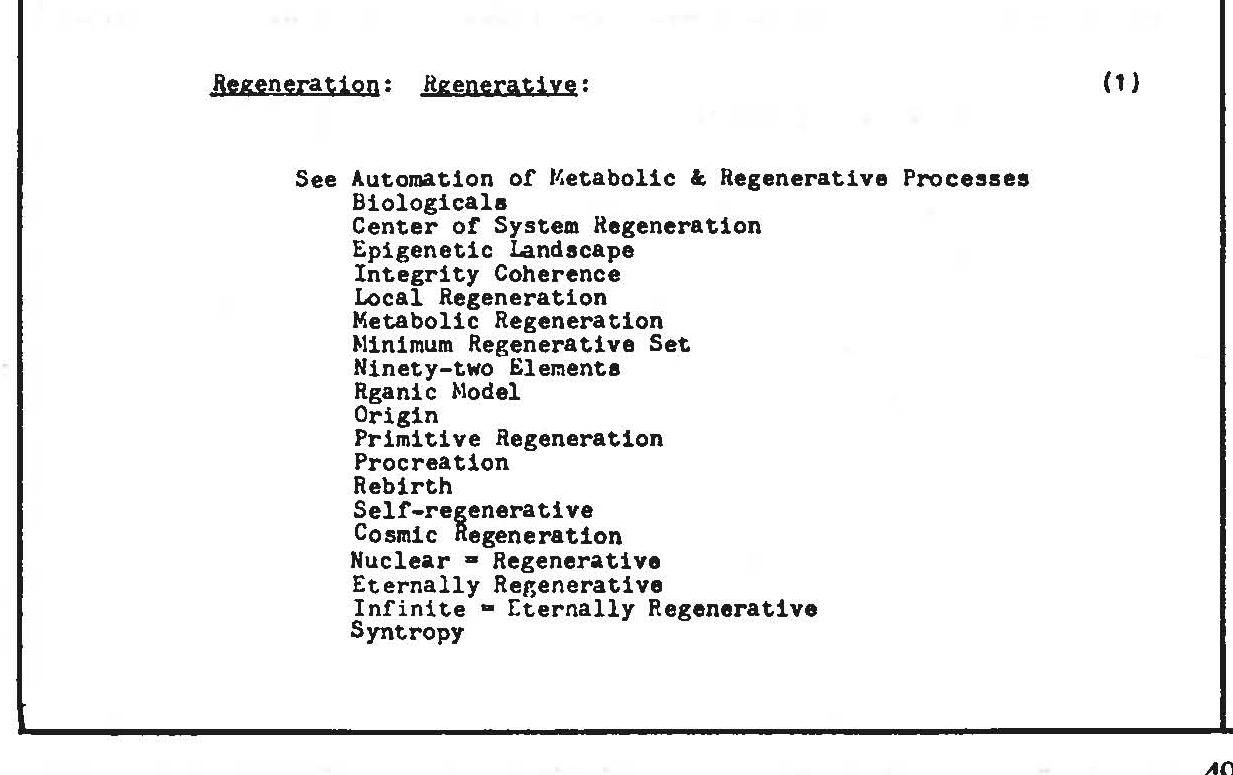
Regenerativity (2)
← Regeneration Regenerative (1) | Regeneration Regenerative (2A) →
Cross Reference
Cross-References
- Concentricity, 1959
- Ecology, 16 Feb'73
- Petal: Tetrahedron as Three-petaled Flower Bud, 11 Feb'73

Regeneration Regenerative (2A)
← Regenerativity (2) | Regeneration Regenerative (2B) →
Cross Reference
Push=pull, 22 Feb'73
Spaceship, 26 Sep'68
Cross-References
- Absolute Velocity, 30 Oct'73*
- Chess: Game of Universe, 9 Jul'62*
- Cosmic Accounting Sequence, (1)
- God, 26 May'72
- Infinite, 15 Oct'72
- Intertransformation, 22 Jul'71
- Isotropic Vector Matrix, 30 Nov'72
- Metaphysical & Physical, 2 Jun'74
- Monkey Wrench, 30 Oct'73
- Nuclear & Nebular Zonal Waves
- et Truss, Oct
- Omnisynergetic, 30 Jan'73*
- Principle, (1)
- Star, Dec'72
- Structure Sequence, (1)(2)
- Tactile Sequence, (2)
- Universe, 28 Apr'71
- Wow: The Last Wow, 22 Apr'71
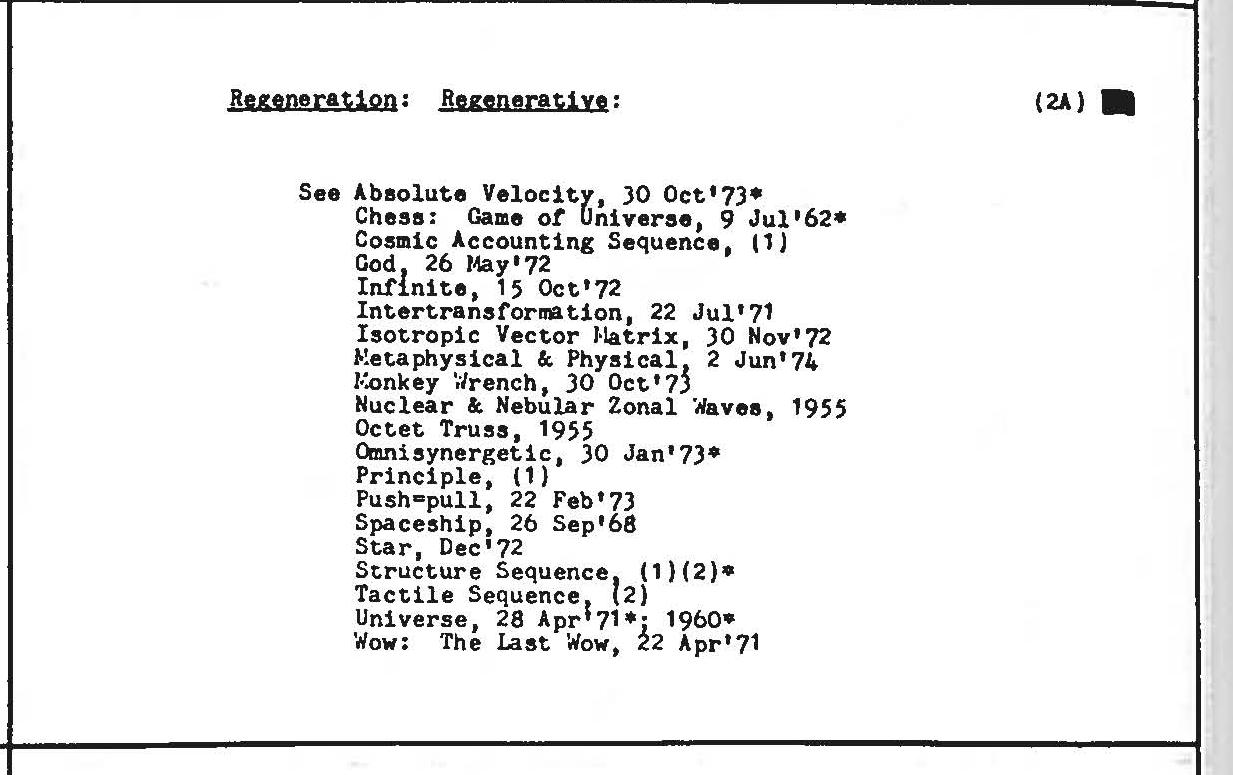
Regeneration Regenerative (2B)
← Regeneration Regenerative (2A) | Regeneration Regenerative (3) →
Cross Reference
Cross-References
- Technology, 20 Jan'75
- Quantum Mechanics: Grand Strategy, 10 Apr'75
- Constellar, May'71
- Aesthetics of Uniformity, (1)
- Cosmic & Local, 3 Oct'75
- Object, 9 Nov'73
- Great Circles, May'44
- Self-discipline, 28 Mar'77
- Electron, 12 May'77
- Identity, 16 Feb'78
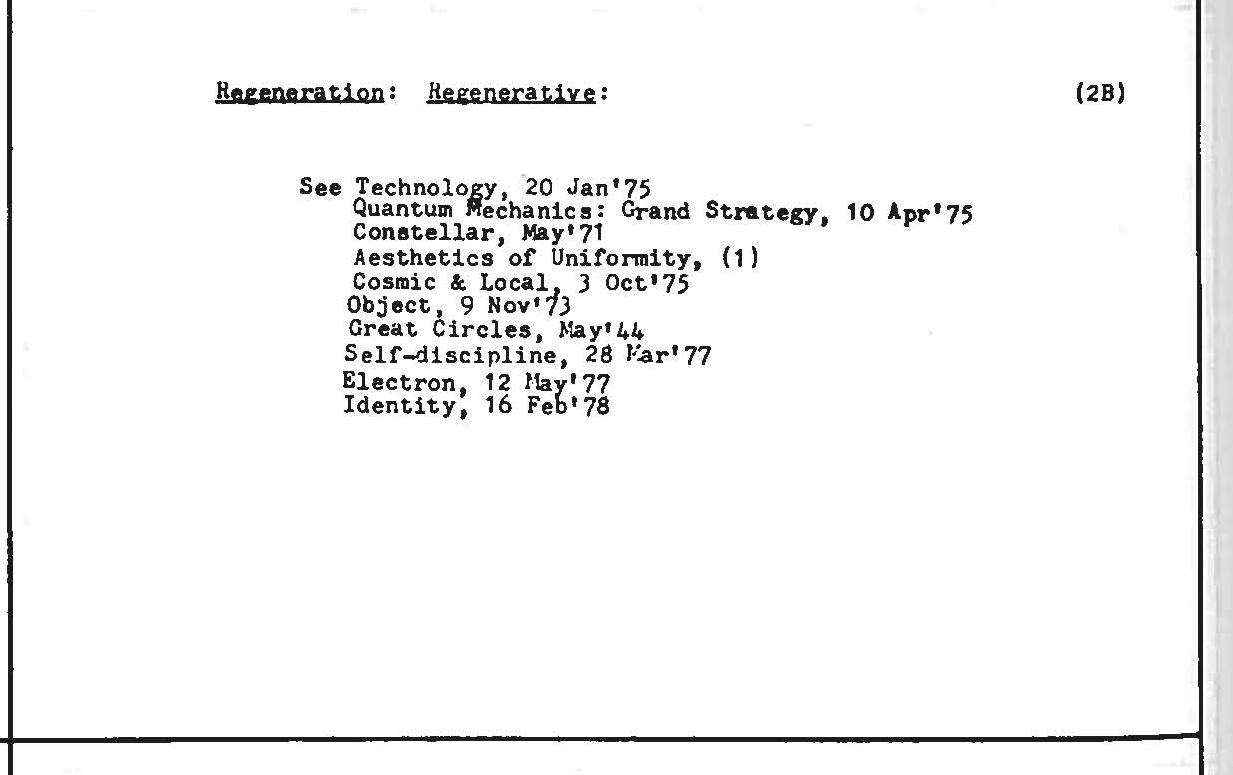
Regeneration Regenerative (3)
← Regeneration Regenerative (2B) | Regenerativity →
Cross Reference
Regenerative Organics
Cross-References
- Regenerative Design: Law Of
- Regenerativity
- Regenerative Stimulations
- Regenerative System Integrity
- Regenerative Intersupport: Equation Of
- Regenerative Birth
- Regenerative Precession
- Regenerative Economic Sustenance
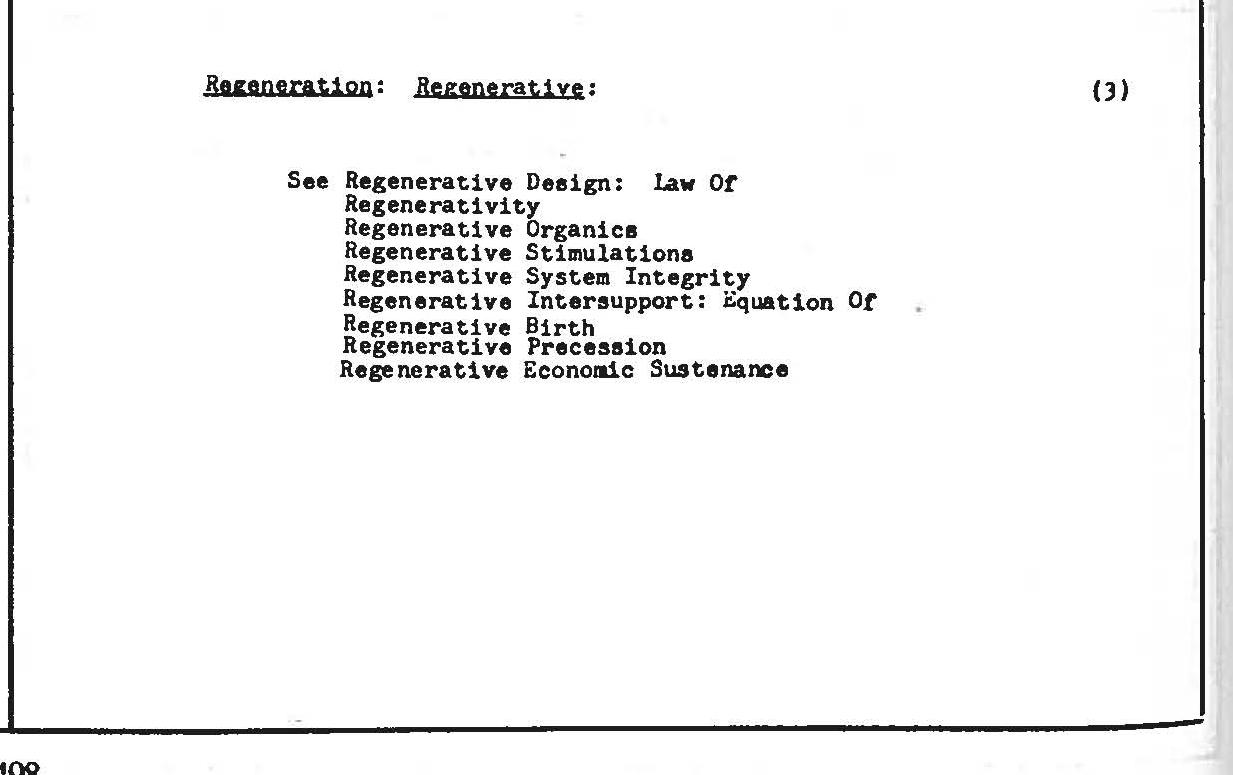
Regenerativity
← Regeneration Regenerative (3) | Regenerativity (1) →
Index Entry
Regenerativity:
"I've been looking for the word to take the place of creativity and it's regenerativity . . . it suggests not the creation of something new but simply the reorganization of something that was always there."
- Cite RBF to EJA, 3200 Idaho, DC, 14 Feb '72
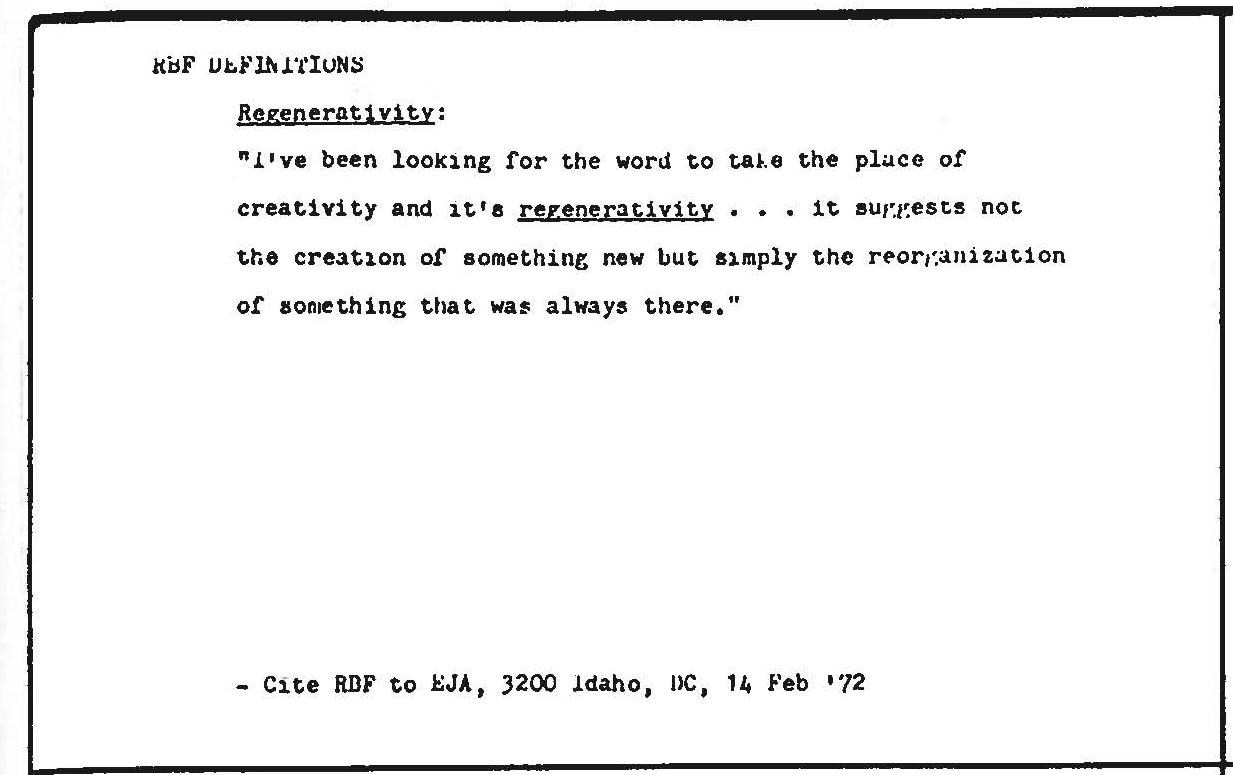
Regenerativity (1)
Cross Reference
Cross-References

Regenius
← Regenerativity (1) | Regression →
Index Entry
Regenius:
"Man shows synergetic regenius inferior to nature's regeneration."
- Citation & context at Charting Alternating Experiences of Man & Nature (1), May'49
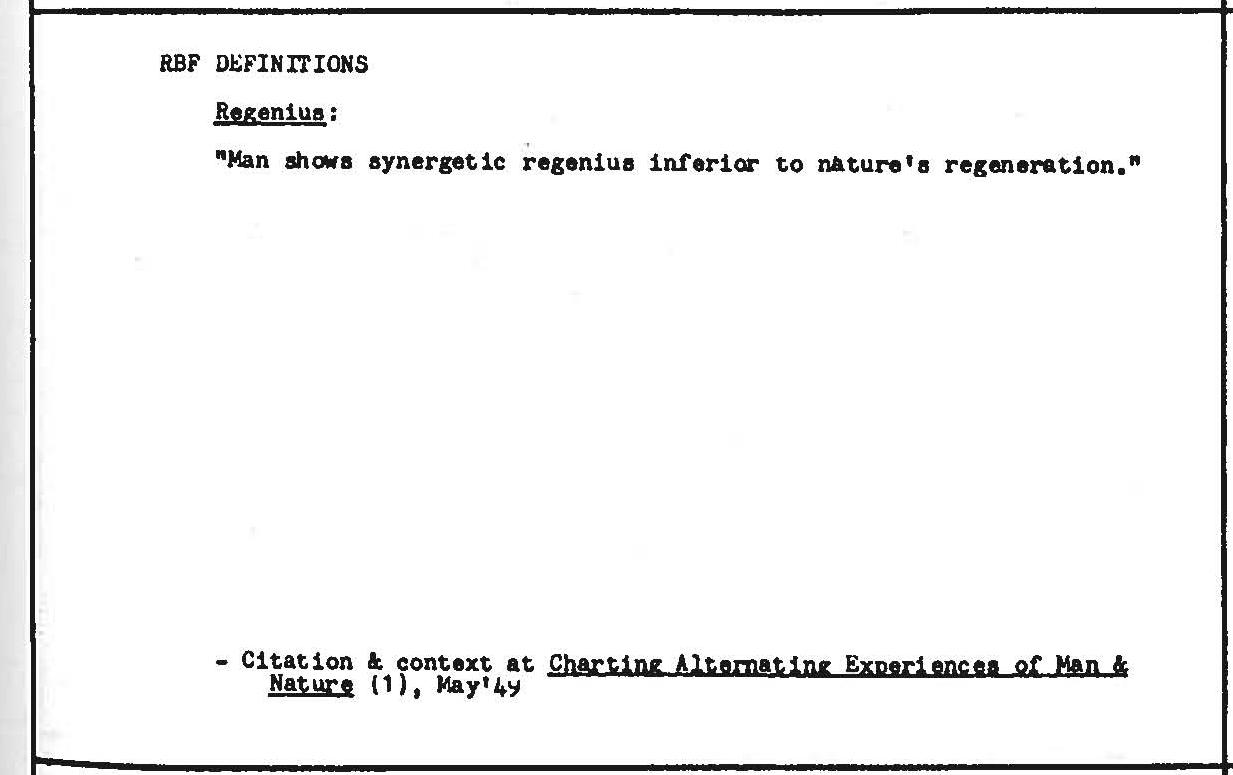
Regression
Cross Reference
Cross-References
Regularity (3)
← Regression | Regular Polyhedra (1) →
Index Entry
Regularity:
"Regularity is eternal. But the regularities are eternally omni-interaccommodative, permitting approximately limitless freedoms of selectable alternative developments involving a vast plurality of time-dimensioned frequency involvements."
- Cite SYNERGETICS draft at Sec. \hrefhttps://www.buckyverse.org/en/synergetics/content/chapters/700-tensegrity#section-780.33780.33, 2 Nov'72
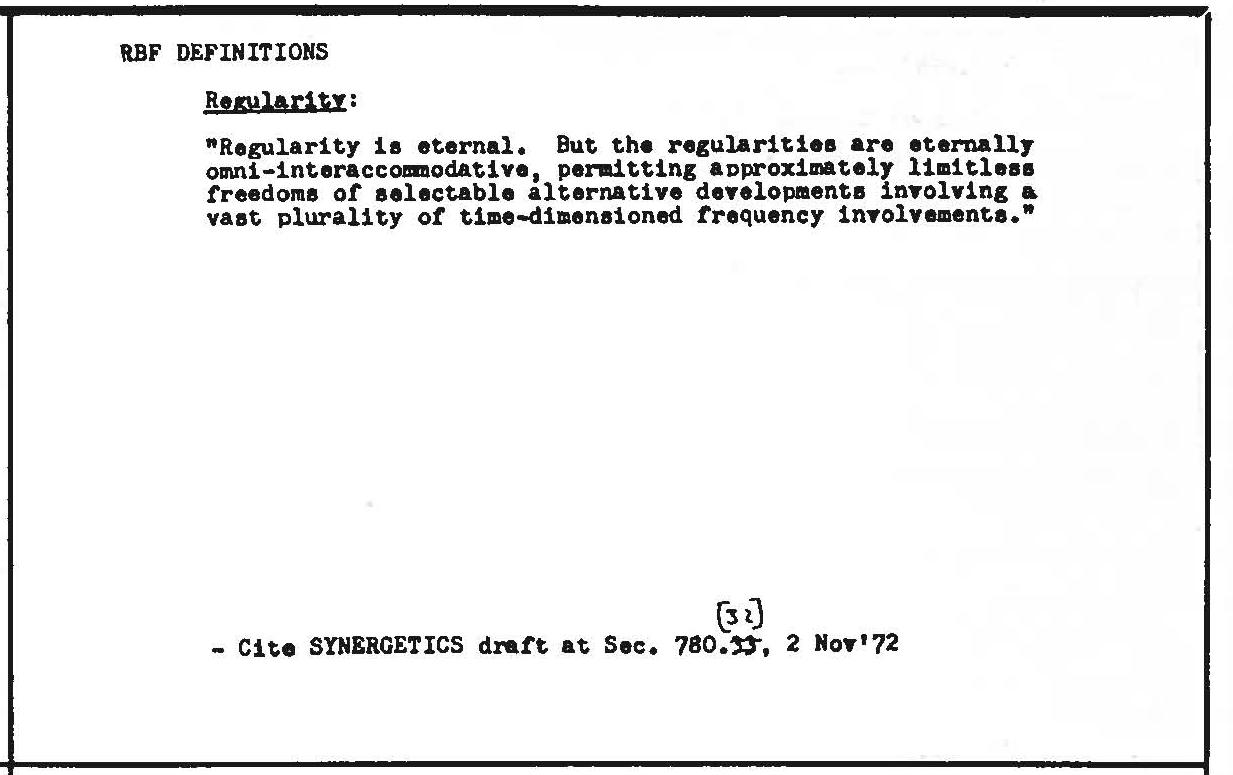
Regular Polyhedra (1)
← Regularity (3) | Regular Polyhedra (2) →
Cross Reference
Cross-References
Regular Polyhedra (2)
← Regular Polyhedra (1) | Regular Tetrahedron (2) →
Cross Reference
Cross-References
- Planck's Constant
- Subvisible Discontinuity, 19 Oct'72

Regular Tetrahedron (2)
← Regular Polyhedra (2) | Regular = Uniangular →
Index Entry
Regular Tetrahedron:
"The four obtuse central angles of convergence of the four perpendiculars of the regular tetrahedron pass convergently through the center of the tetrahedral volume at 109° 28'."
- Cite SYNERGETICS draft at Sec. \hrefhttps://www.buckyverse.org/en/synergetics/content/chapters/900-modelability#section-966.22966.22, 29 Nov'72
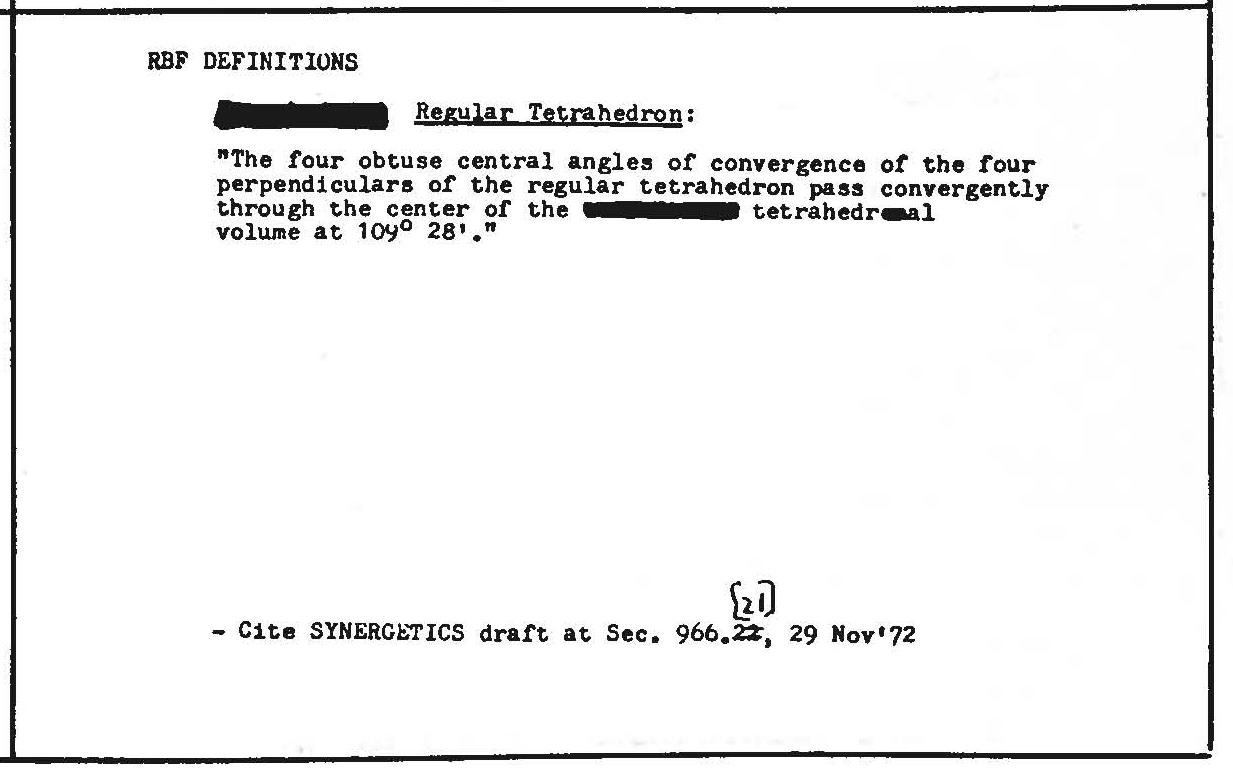
Regular = Uniangular
← Regular Tetrahedron (2) | Regularity (1) →
Index Entry
Regular = Uniangular:
"The regular--regular means absolutely uniangular--tetrahedron is absolute and generalized, and thus never physically realized."
(Sec. 5)2.18, 2nd. Ed.)
- Citation & context at Crystallography, 11 Dec'75
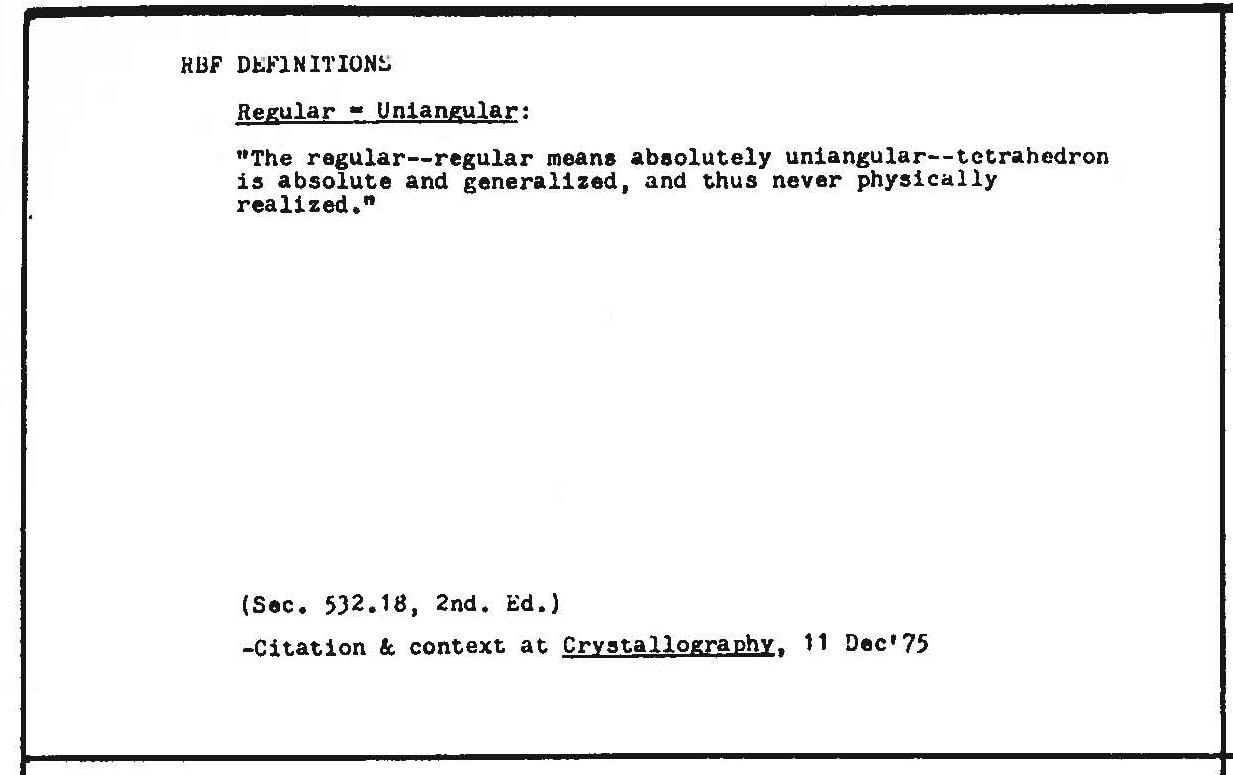
Regularity (1)
← Regular = Uniangular | Regular Regularity (2) →
Cross Reference
Ninety-two Elements: Periodic Regularities Of Reproducible
Cross-References
Regular Regularity (2)
← Regularity (1) | Reinforced Concrete →
Cross Reference
Cross-References
- Conceptions, Dec'69
- Cryogenics, 28 Oct'72
- Einstein: Cosmic Religious Sense, (2)
- Environment Controls, (1)
- Solid State, 13 May'73
- Eyes, 1964

Reinforced Concrete
← Regular Regularity (2) | Reintegrative →
Cross Reference
Reinforced Concrete:
Cross-References
Reintegrative
← Reinforced Concrete | Reinvestable Time and Survival Needs →
Cross Reference
Reintegrative:
Cross-References
- Heres & Theres, 4 Jun'72

Reinvestable Time and Survival Needs
← Reintegrative | Reinvestable Time & Survival Needs →
RBF Definitions
"The most incredible thing is that in the areas where all the people are there is no power or food. . . You need food so everything comes back to electrical power.
These figures on the Dymaxion Airocean World Map projection . . . Each of the people have their hands raised and they have a number of fingers on each hand indicating how much of their time is reinvestable and how much they have to devote to survival needs. The people in this area have no time: their hands are in their fists. In the areas in the United States they have all their fingers up: they have their whole life to reinvest in the way they want to reinvest it. . . So it begins all of a sudden . . . just thinking about mobile areas and politics, you begin to see a whole Earth at once and how man is doing on whole Earth."
Citations
- RBF to World Game at NY Studio School, 12 Jun-31 Jul'69, from Saturn Film transcript, Sound 1, Take 1, pp.24-26.
Reinvestable Time & Survival Needs
← Reinvestable Time and Survival Needs | Relationships →
Cross Reference
Lifetime: Personal Lifetime Experience for Elective Experience
Cross-References
Relationships
← Reinvestable Time & Survival Needs | Relationship →
Index Entry
Relationships:
"I am not sure that there are relationships; maybe there are only interrelationships."
- Cite RBF to EJA, 3200 Idaho, Wash, DC; 24 Apr'76
Relationship
← Relationships | Relationship →
Index Entry
Relationship:
"A point is not a relationship. A line is the simplest relationship. . . ."
- Citation and context at Line, 7 Nov'72
Relationship
← Relationship | Relationships →
Index Entry
Relationship:
"Relationships are local to pattern. Patterns are comprehensive to relationships."
-
Cite RBF to EJA, 3200 Idaho Ave., NW, Wash. DC, 20 Dec. '71
-
Citation at Pattern, 20 Dec'71
Relationships
← Relationship | Relationships →
Index Entry
Relationships:
"We have relationships-- but not space."
- Citation and context at Space, Nov'71
Relationships
← Relationships | Relationship →
Index Entry
Relationships:
"We have time relationships but not static space relationships."
Relationship
← Relationships | Relationships →
Index Entry
Relationship:
"Abstractions may be stated in pure principle of relationship."
-
Cite SYNERGETICS, "Corollaries," Sec. \hrefhttps://www.buckyverse.org/en/synergetics/content/chapters/200-synergetics#section-240.58240.58, 1971
-
Citation & context at Abstraction, 1971
Relationships
← Relationship | Relationships →
Index Entry
Relationships:
"I have two events and they have one relationship. I have three events and they have three relationships... Four events and we have six relationships. And five events, we have ten relationships. Six, it will be fifteen relationships. So the numbers of relationships are not the same as the numbers of events at all. They are a different progression.... Of course these events can be in any kind of an array and need not be simultaneous, yet they will have their relationships....
"You will find that the relationships are triangular.... look at the stars.... You will find that every one of the sets of relationships will always be triangulatable. There is no case where they are not."
- Cite LEDGE:LADY LAB. Lecture, 15 Oct. '64, pp 14, 15
Relationships
← Relationships | Relationships →
Index Entry
Relationships:
"In a nonsimultaneous Universe all the relationships are geodesic."
- Cite Oregon Lecture #3, p. 112. 5 Jul'62
Relationships
← Relationships | Relationships →
RBF Definitions
"Generalized systematic conceptuality's omni-directional relationships are only angularly configured and are independent of size or dimension."
Citations
- OMNIDIDIRECTIONAL HALO, p. 135, 1960
Relationships
← Relationships | Relationships →
Index Entry
Relationships:
"Relationships which have definite integrity and independence of size are conceptual principles of abstract thought independent of physical realization."
- Cite OMNIDIRECTIONAL HALO, p. 146, 1960
Relationships
← Relationships | Relationship →
Index Entry
The whole of Universe is the minimum consideration and the relationship of its regenerative subsystem functionings are alone elementary.
- Citation and context at University, 15 Apr '55
Relationship
← Relationships | Relationship Analysis (1) →
Index Entry
Relationship:
"There are no empty sets but only generalized group or system synergetical relationship characteristics."
- Cite RBF Synergetics notes, Feb'50
Relationship Analysis (1)
← Relationship | Relationship Analysis (2) →
Index Entry
Relationship Analysis:
"We look at the stars and they look very random scattered throughout the sky. I will tell you then that the numbers of relationships between all the stars is always N^2 - N and this chart tells you quite clearly and simply that I am mathematically justified in doing so. This will give you a personal sense of the power of the infinitely tiny human's mind in the presence of that vast array of stars whose distances and occurrences can only be identified in terms of millions and billions and higher numbers of years and miles away.
"This relationship analysis discloses the omniuniversal order-liness that scientific man finds to be always underlying all superficial randomness of experience. This tells us that the seeming disorder of physical entropy is only superficial and explains why metaphysical thought can always find the orderliness that engulfs the disorderliness. Disorderliness is nonthinking. Brain, which stores the memories of all special-case experiences, does not find the relationship any more than a library in itself can find or does find the interrelationships of the data that it houses. Only mind, the great metaphysical, pattern-seeking function, has demonstrated to us the capability to" Cite Nasa Speech, pp.94-95, Jun'66
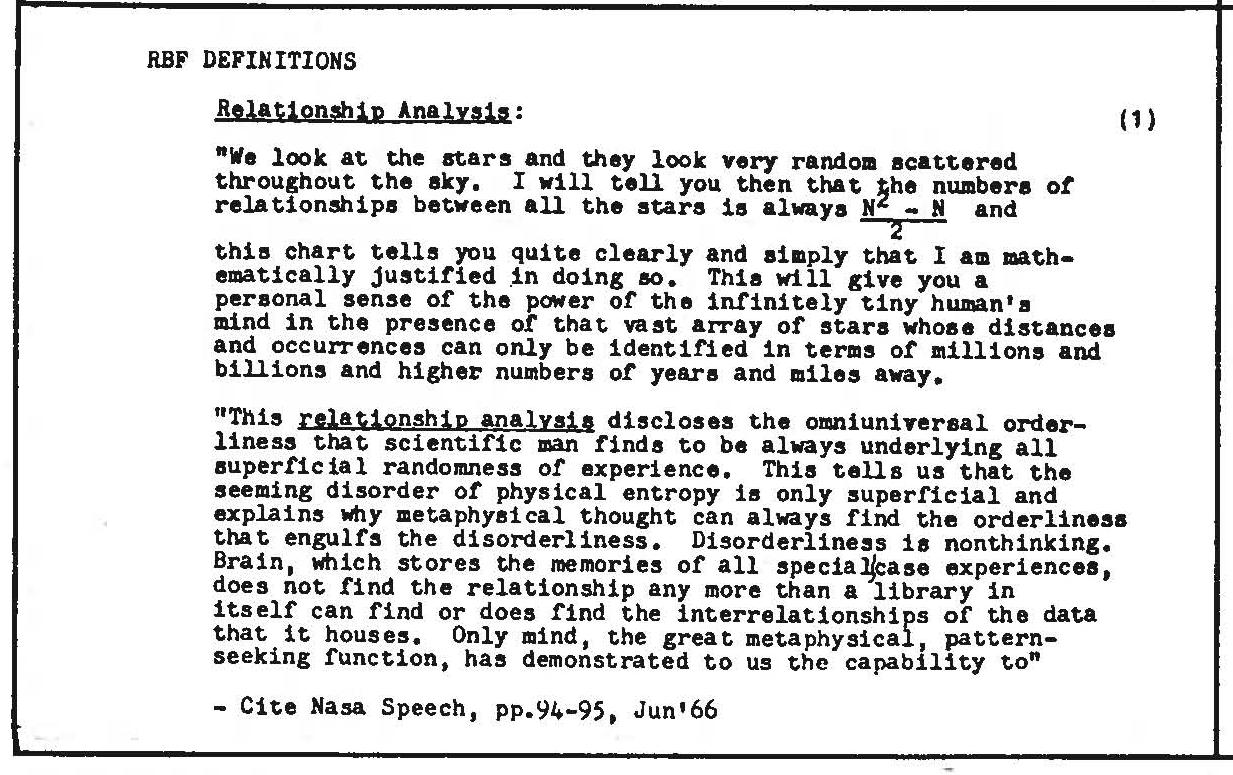
Relationship Analysis (2)
← Relationship Analysis (1) | Relationship Analysis →
Index Entry
Relationship Analysis:
"interconnect the experiences and to find the generalized patterns and orderly principles underlying all our randomly encountered experiences."
- Cite Nasa Speech, p.95, Jun'66
Relationship Analysis
← Relationship Analysis (2) | Relation Relationship Relatedness (1) →
Cross Reference
Cross-References
- Connections and Relatedness
- Order Underlying Randomness
- Number: Tetrahedral Number
- Process Relationships
Relation Relationship Relatedness (1)
← Relationship Analysis | Relation Relatedness Relationship (2) →
Cross Reference
Cross-References
- Absolute Relationship
- Arelational
- Behavioral Relationships
- Connections & Relatedness
- Envelopmental relationship
- Epistemological Stepping Stones
- Nonrelationship
- Order Underlying Randomness
- Number: Tetrahedral Number
- Process Relationships
- Omniinterrelationships
- Rational - Relational
- Interrelationships
Relation Relatedness Relationship (2)
← Relation Relationship Relatedness (1) | Relative Abundance →
Cross Reference
Cross-References
- Abstraction, 1971
- Constants, 26 Sep'73
- Line, 7 Nov'72
- Pattern, 20 Dec'71*
- Potential, 1963
- Reason, Aug'73
- Space, Nov'71*
- Thinkable You, (1)
- Time & Space, May'71*
- University, 15 Apr'55*
- Twoness, 27 May'72
- Threeness, 27 May'72
- Human beings & Complex Universe, (1)
Relative Abundance
← Relation Relatedness Relationship (2) | Relative Abundance (1) →
RBF Definitions
"I began to play a game of looking at relative total abundances of various patterns in various systems and looking at a daisy and looking at a tortoise and looking at a waste basket, I find that the relative abundance of the fundamental patterns called chemical elements vary quite greatly. I sort of began to play a game of relative abundance because this is a nice 100 per cent game and that is the kind of game that the physicist learned to do so ably as a synergetic capability because he was always dealing in 100 per cent. Remember that when he had an unknown percentage showing in an experiment, that is what gave him his clue to meson or whatever it might be. I found it very interesting to look at the total pattern man.
Citations
- OREGON Lecture #5 - p. 168, 9 Jul'62
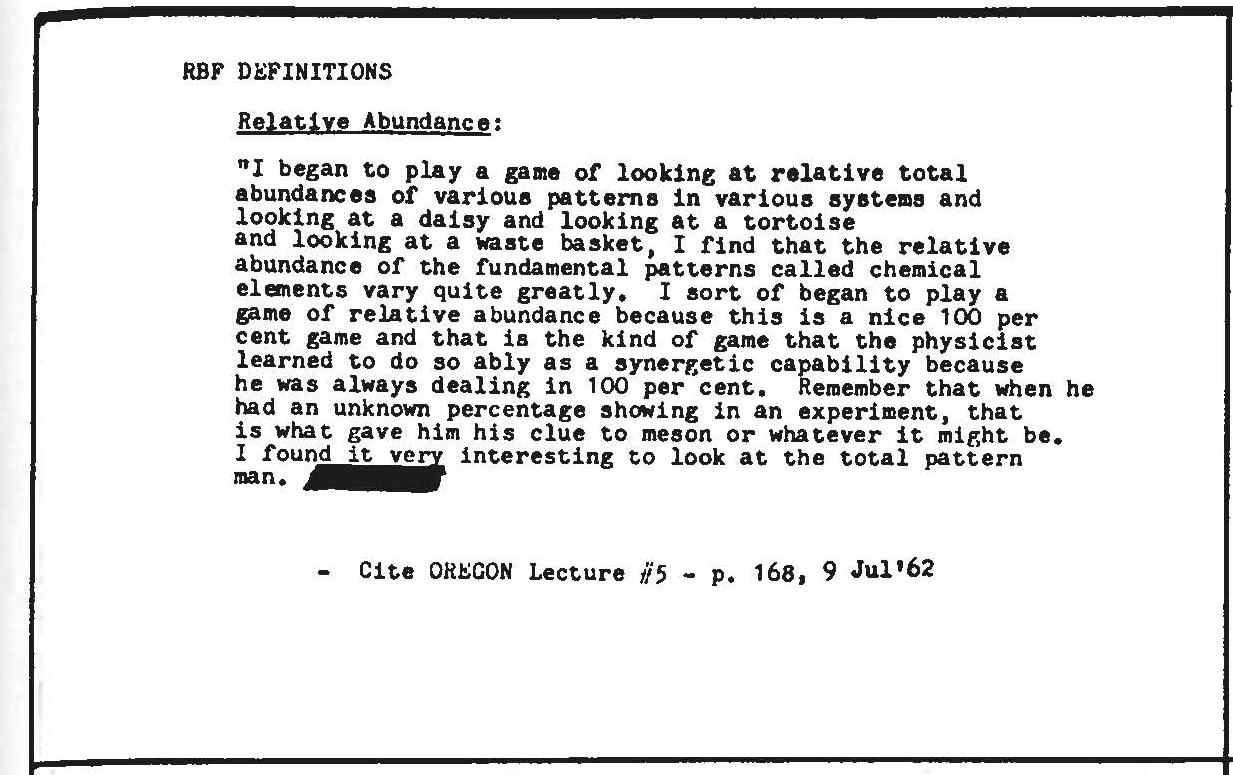
Relative Abundance (1)
← Relative Abundance | Relative Abundance (2) →
Cross Reference
Euler
Man: Relative Abundance of Chemical Elements In Man & Universe
Cross-References
Relative Abundance (2)
← Relative Abundance (1) | Relative Activity Diameters of Stars & Electrons (1) →
Cross Reference
Cross-References
- Gravity: Circumferential Leverage, (3)
- Reality as Structural Interaction of Principles, 1963
- Sweepout: Spherical Sweepout, (2)
Relative Activity Diameters of Stars & Electrons (1)
← Relative Abundance (2) | Relative Activity Diameters of Stars & Electrons (2) →
Cross Reference
Cross-References
- Atom as Solar System
- Astro & Nucleic Interpositioning
- Invisibility of Macro- and Micro- Resolutions
- Nuclear & Nebular: Nucleus & Galaxies
Relative Activity Diameters of Stars & Electrons (2)
← Relative Activity Diameters of Stars & Electrons (1) | Relative Activity Diameters →
Cross Reference
Cross-References
Relative Activity Diameters
← Relative Activity Diameters of Stars & Electrons (2) | Relative Asymmetry Sequence (1) →
Cross Reference
Cross-References
Relative Asymmetry Sequence (1)
← Relative Activity Diameters | Relative Asymmetry Sequence (2) →
Index Entry
Relative Asymmetry Sequence:
"Observing that there is a fundamental complementarity, and that the complementations are rarely mirror images of one another, we find that the physical Universe is always locally entropic-- that is, it is always giving off energy in one way or another. Because each local system has its own orbiting, and its own frequencies and so forth, the ways in which they give them off are not synchronized with the others. Therefore, as they're given off, they're relatively disorderly. ... And actually calculably disorderly; they're not infinitely disorderly at all. They're not something we might call chaos. It may look disorderly to you as you look at the turbulence of a waterfall, and the water's going down there, But I've become very fascinated with the fact that I'm beginning now to understand what the different turbu- lences are. I can begin to see what the vortex is and all the interprecessional effects.
"It's no longer looking quite as disorderly to me as it used to look. Our word 'disorder' is a relative matter: it gets to be relatively asymmetrical. Relative to the symmetry of equilibrium it gets to be relatively asymmetrical, and I find that it goes to a maximum asymmetry and then comes back"
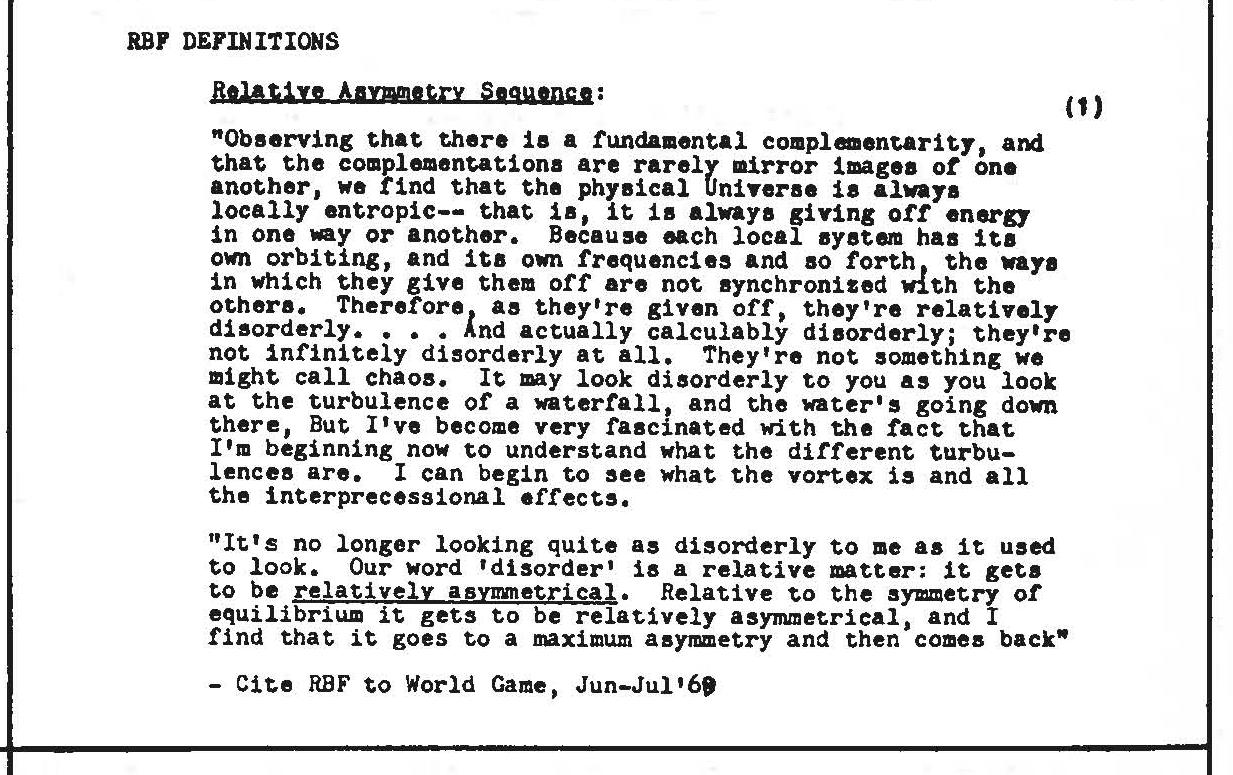
Relative Asymmetry Sequence (2)
← Relative Asymmetry Sequence (1) | Relative Asymmetry (1) →
Index Entry
Relative Asymmetry Sequence:
"to symmetry again.
"I think this is why we might have something we call octaves in music. There are sort of octaves in our thinking. We think octavely. . . We say the atom has its nuclear arrangement, has its own synergetics, which is how they associate to form molecules and the molecules associate to form cells and how the cells associate to form living organisms, and so forth."
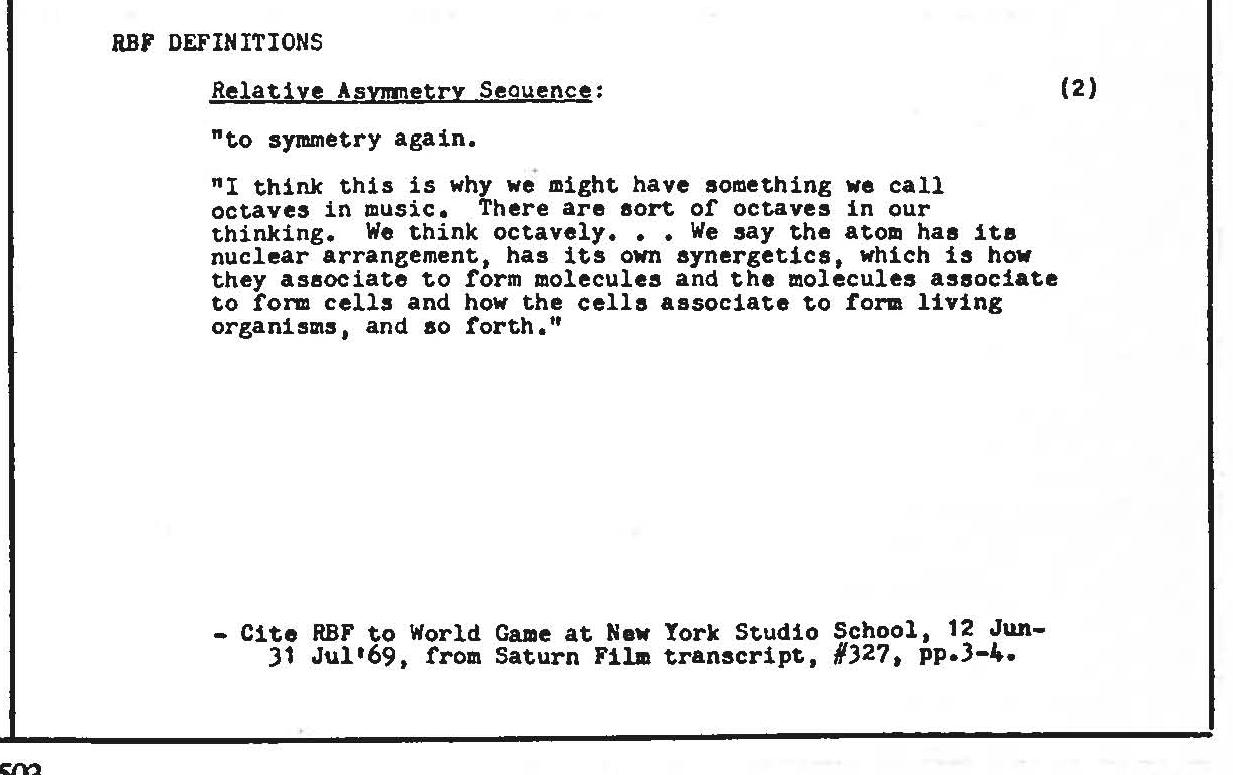
Relative Asymmetry (1)
← Relative Asymmetry Sequence (2) | Relative Asymmetry (2) →
Cross Reference
Cross-References
Relative Asymmetry (2)
← Relative Asymmetry (1) | Relative Volumetric Frequency & Interval →
Cross Reference
Cross-References
- Entropy, Jan'72
Relative Volumetric Frequency & Interval
← Relative Asymmetry (2) | Relative (1) →
Cross Reference
Relative Volumetric Frequency & Interval: See Mass, 12 May'77
Cross-References
- Mass, 12 May'77
Relative (1)
← Relative Volumetric Frequency & Interval | Relative (2) →
Cross Reference
Cross-References
Relative (2)
Cross Reference
Cross-References
- Avogadro: Generalized Avogadro System
- Description, Jun'66
- Epigenetic Landscape, May'49
- Functions, 26 May'72
- Synergetics
- Unique Frequencies, 9 Jul'62
Relativity
Index Entry
Relativity:
"Lines are relativity. A line is the first order of relativity: the basic sixness of minimum system and cosmically constant sixness of relationship identifies lines as the relativity in the formula N^2 - N."
- Citation and context at Line, 7 Nov'72
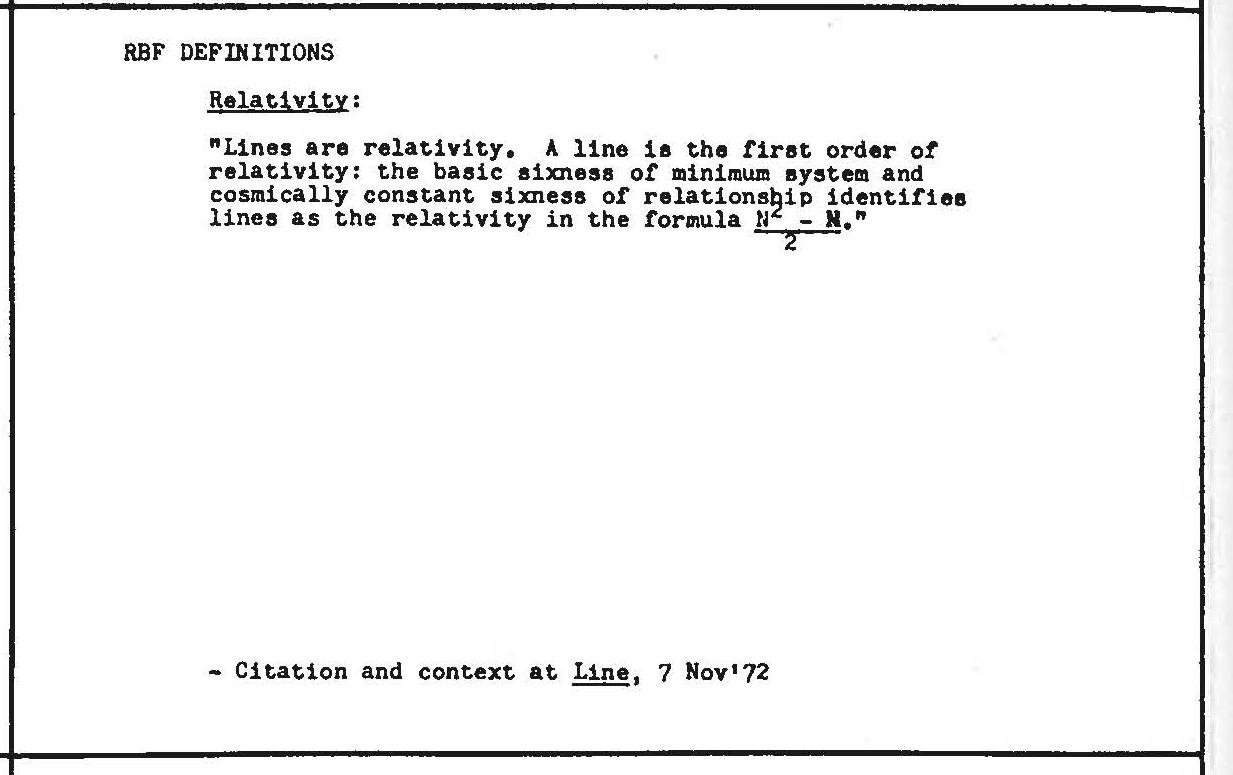
Relativity
Index Entry
Relativity:
"Size is where relativity becomes generated. The eternality of synergetics is conceptually experienciable independent of the successive experiences of relativity of time and size."
- Citation and context at Size, 22 Jun'72
Relativity
RBF Definitions
"I have a railroad train going west through the desert and a man leans out the window and drops a flaming apple. He sees it go East. He has a sextant and a stopwatch with him and measures the angle and the amount of time, and so forth. But he sees that he himself is standing still. He is like all of the people standing on the surface of the Earth not realizing that the Earth is going around the Sun at 60,000 miles per hour. And so for him the apple seems to go in an easterly direction.
"Another man standing at a great distance simply sees the apple descend toward the Earth.
"Then a man standing very much to the north sees the apple go west-- with the motion of the train.
"All these different observers then come out with different results concerning the same experiment."
Citations
- RBF to BO'R, Kent, Ohio, 23 May'72
Relativity
Index Entry
Relativity:
"Is is always special case relativity."
- Citation and context at Is, 24 Apr'72
Relativity
Index Entry
Relativity:
"We cannot have relativity
Without at least two phenomena to be differentially related. There is also the word complementarity. We cannot have one phenomenon complemented By less than one other phenomenon. The words complementarity and relativity Do not identify identical physical phenomena. We need to discover Whether there exists a generalized concept Which embraces both phenomena, And we find that the ponderable physical energy Universe That is, physical Universe, In contradistinction to the Universe's Weightless, metaphysical aspects, Does embrace both complementarity and relativity."
- Cite BRAIN & MIND, p.135 May '72
Relativity
Index Entry
Relativity:
"Time, relativity and consciousness
Are always and only coexistent functions
Of an a priori Universe. . ."
- Citation and context at Consciousness, p. 12, May '72
Relativity
Index Entry
Relativity:
" . . . What Einstein realized has not as yet been comprehended in any important way except that of developing the atomic bomb. . . "
"Einstein intuited from scientific observations, such as that of the Brownian Movement in water, and black body radiation, that the physical universe is always transforming complex- ily. Masively twisted, the geology of our Spaceship Earth's crust makes clear how severe have been the great transformings of its history."
- UNESCO TIFLIS 1968, p. 9
Relativity
Index Entry
Relativity:
"The theory of functions holds for Universe itself. Universe consists at minimum of both the metaphysical and the physical. The fundamental twoness of physical Universe was embraced in Einstein's one word, 'relativity,' and in a more specific and experimental way in the physicists' concept of complementarity."
Cite NASA Speech, p.68, Jun'66
Cite Carbondale Draft
Return to Modelability, p. V.3
Relativity
Index Entry
Relativity:
"Time can be expressed only as 'relativity' in the terms of relative frequency of reoccurrence of any constantly recycling behavior of any chosen sub-system of universe."
-
Cite NASA Speech, p. 49, Jun'66
-
Citation at Time, Jun'66
Relativity
Index Entry
Relativity:
"Science states that the entire physical universe is energy. E = mc²."
- Cite HOW TO MAINTAIN MAN AS A SUCCESS, p. 228, Mar'65
Relativity
RBF Definitions
Relativity leads us toward fundamental classification of our experience and observation, in terms of a few hierarchies of dynamic interactions and principle transformations of an all-energy, continuous-discontinuous, synchronous-dissynchronous Universe tensionally cohered, precessional of local compressive spherical energetic collections--as (Suns) stars or planets or moons or asteroids or meteorites; and the progression of within-ward sub-sets of events of interactions at planet crust, etc., and inward to the 92 common principles of atomic convergence of energy in principle, and the pervasive sets of dynamic associations by contraction, expansion, spin, orbit, torque, push, and pull, and precession. This all brings us by progressive collections of thoughts into a fundamental twoness of dynamic reciprocities which, internally paired, ultimately become one with outwardly paired principles of reciprocity."
- Citation and context at Reciprocity (1) + (2), May'49
Relativity
Index Entry
Relativity:
"The concept of relativity involves high frequency of re-established awareness, and progressively integrating consideration of the respective, and also integrated, dynamic complexities of the moving and transforming frame of reference and of the integrated dynamic complexities of the observed, as well as of the series of integrated sub-dynamic complexities, in respect to each of the major categories of the relatively moving frames of reference of the observer and the observed. It also involves constant reference of all the reciprocating sub-sets of the comprehensive totality of nonsimultaneous Universe, from which naught may be lost."
- Citation and context at Dynamic Frame of Reference (5), May'49
Relativity
Index Entry
Relativity:
"Relativity treats with concepts in principle; therefore, it can be treated in words as well as in mathematical phrasing. Relativity is inherently convergent, though convergent toward a plurality of centers of abstract truths. Degrees of accuracy are only degrees of refinement, and magnitude in no way affects the fundamental reliability, which refers, as directional or angular sense, toward centralized truths. Truth is a relationship."
- Citation & context at Words, May'49
Relativity
← Relativity | Relativity: Marriage of Social & Natural Law →
Index Entry
Relativity:
"The invisible structure was E = mc²."
- Cite PREVIEWS, I&I, p. 211, 1 Apr'49
Relativity: Marriage of Social & Natural Law
← Relativity | Relativity: Special Theory of Relativity →
Cross Reference
Relativity: Marriage of Social & Natural Law:
Cross-References
- Air Space, May'65
Relativity: Special Theory of Relativity
← Relativity: Marriage of Social & Natural Law | Relativity (1) →
Index Entry
Relativity: Special Theory of Relativity:
"The Special Theory of Relativity states that (1) the laws of physical phenomena are the same for all inertial systems, and (2) the velocity of light in any given inertial system is independent of the velocity of that system."
- Cite RBF Glossary of terms bound with "The Live Book Squad," 1967. (Reconfirmed by RBF, 3200 Idaho, Wash DC, 15 Jul'73.)
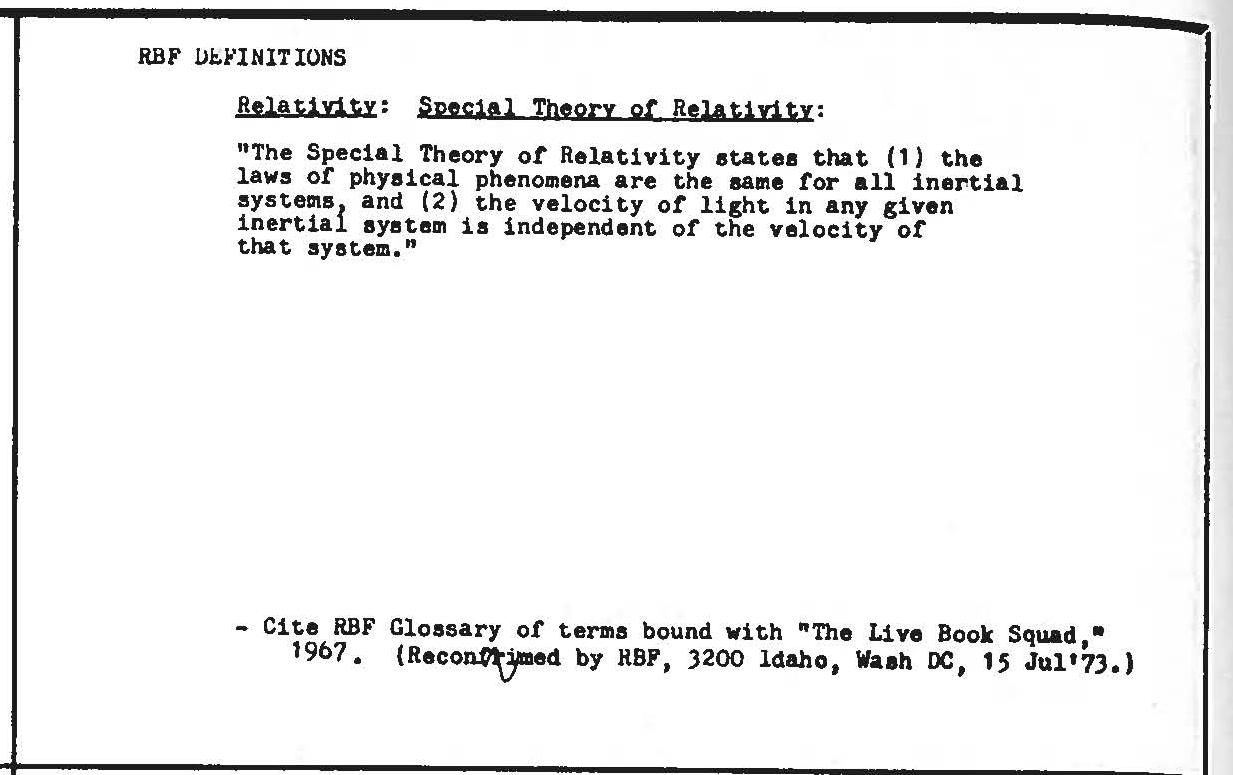
Relativity (1)
← Relativity: Special Theory of Relativity | Relativity (2) →
Cross Reference
Einstein
Generalization: Fourth Degree
Generalizations Reduced to One Word
Synergy: Metaphysical Synergy
Stars as Live Shows Billions of Years Ago
Cross-References
Relativity (2)
← Relativity (1) | Relax Relaxed →
Cross Reference
Cross-References
- Complementarity, Jun'66
- Consciousness, May'72*
- Dynamic Frame of Reference, (5)
- Is, 24 Apr'72*
- Line, 7 Nov'72*
- Reciprocity, (1)(2)
- Size, 22 Jun'72*
- Tetrahedral Dynamics, (1)
- Time, 23 May'72; May'72; Jun'66*
- Words, May'49*
- Time-angle-size Aspects, 30 Apr'77
- Mass, 12 May'77
Relax Relaxed
← Relativity (2) | Relay: Relaying (1) →
Cross Reference
Relax: Relaxed:
Cross-References
- Hexagon, 30 Dec'73

Relay: Relaying (1)
← Relax Relaxed | Relay Relaying (2) →
Cross Reference
Telemetry: Satellite-relayed
Cross-References
- Noninterference Relaying
- Precessionally Shunted Pattern Relay
- Social-industrial Relay
- Substitutional Relaying
- Interference-noninterference Relaying
- Valvability
Relay Relaying (2)
← Relay: Relaying (1) | Relevance →
Cross Reference
Cross-References
- Ecological Pattern, 19 Sep'64
- Eye-beamed Thoughts
- Manifest: Two, 1963
- Dynamic vs. Static, 12 Nov'75

Relevance
← Relay Relaying (2) | Relevant: Almost Relevant →
Index Entry
Relevance:
"Relevance is systematic; a relatedness; something going on around the intertriangulation of the six vectors. (What is the structure involved?)"
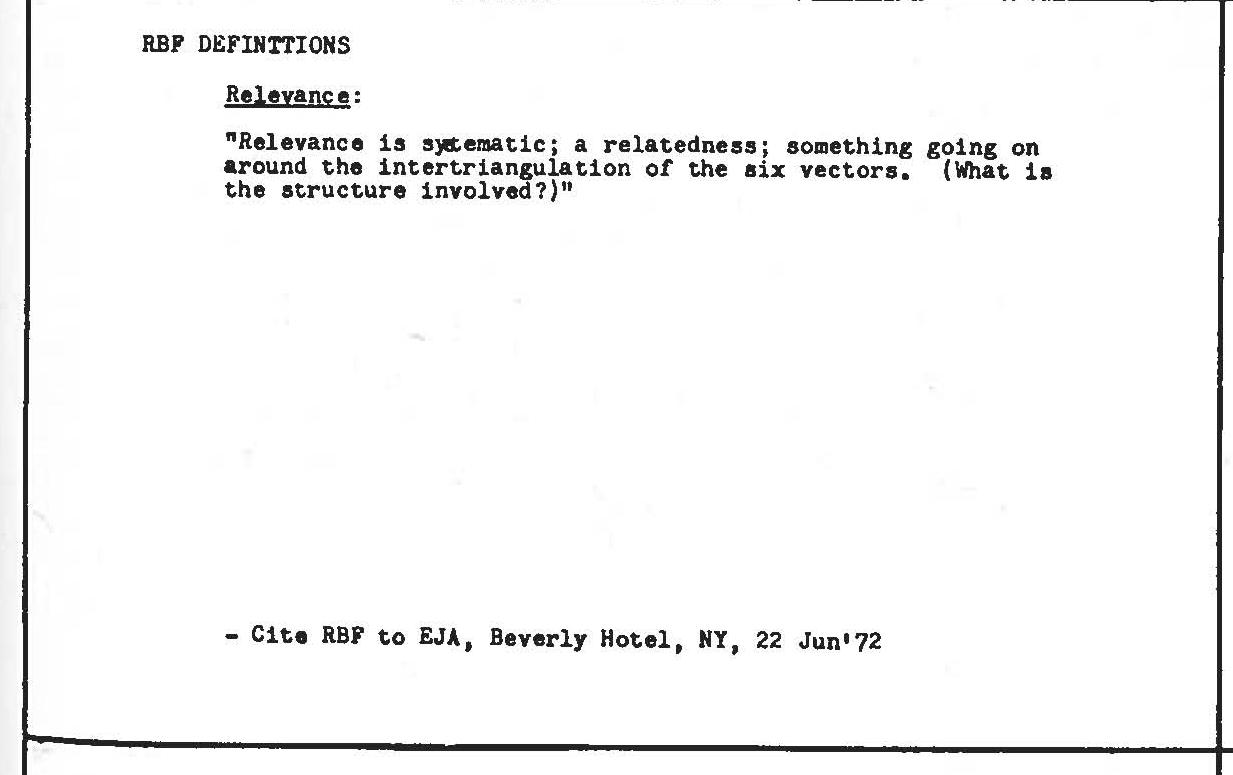
Relevant: Almost Relevant
Cross Reference
Relevant: Almost Relevant:
Cross-References

Relevant
← Relevant: Almost Relevant | Relevant. Lucidly Relevant Set →
Index Entry
Relevant: Lucidly Relevant Set:
". . . All irrelevancies fall into two main categories or 'bits.' One set embraces all the events which are irrelevant because they are too large in magnitude and too delayed in rate of reoccurrence to have any effect on the set of relationships we are considering. The other set of irrelevancies embraces all the events that are too small and too frequent to be differentiably resolved at the wave length we are tuned in at . . in any discernible way to alter the interrelationship values of the set of exnerience relationships we are considering. Having dismissed the two classes of irrelevances there remains the lucidly relevant set to be studied."
- Cite NASA Speech, p. 40, Jun'66
CONSIDERABLE SET-SEC \hrefhttps://www.buckyverse.org/en/synergetics/content/chapters/500-conceptuality#section-509.03509.03
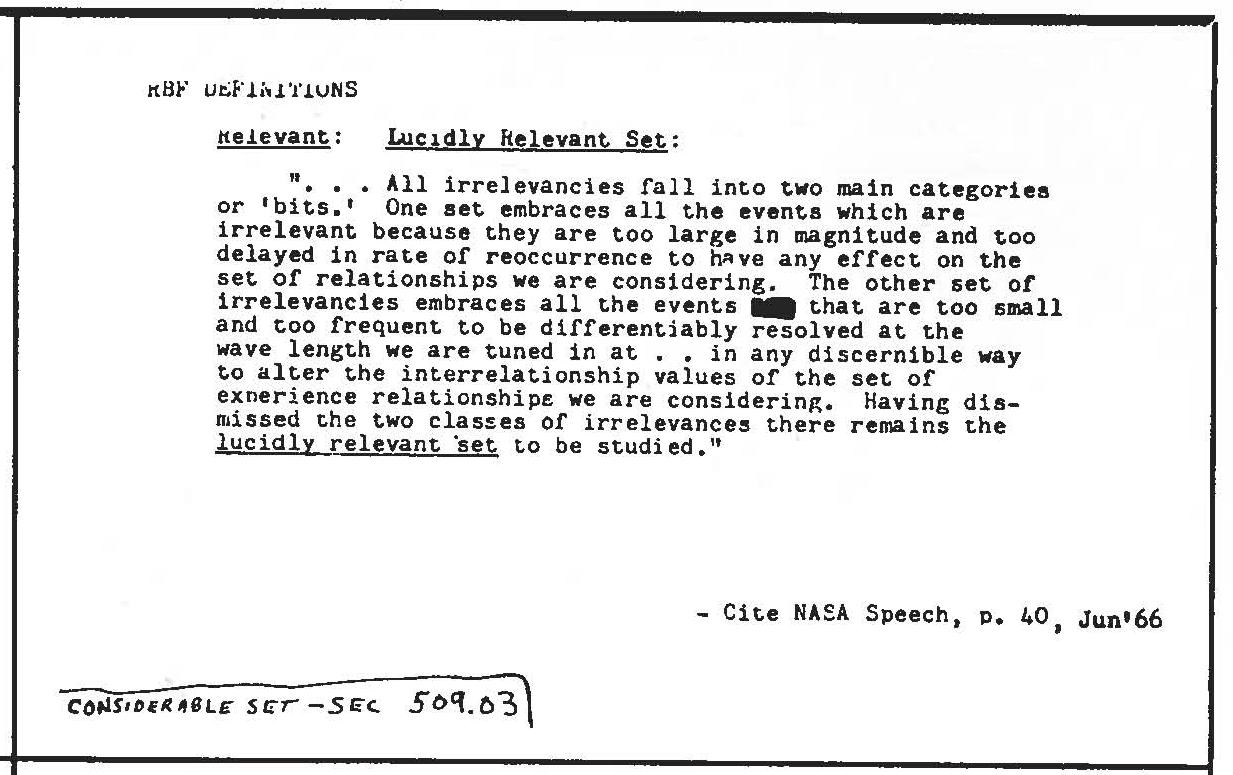
Relevant. Lucidly Relevant Set
← Relevant | Relevant: Lucidly Relevant Set →
RBF Definitions
Thinking is a momentary dismissal of irrelevancies. . . . There is a twilight zone of tantalizingly almost relevants. There are two such twilight zones-- the macro and the micro-- tantalizingly almost relevants. Between them there is always a set of extraordinarily lucid items of relevance."
- Citation at Thinking, Oct'65
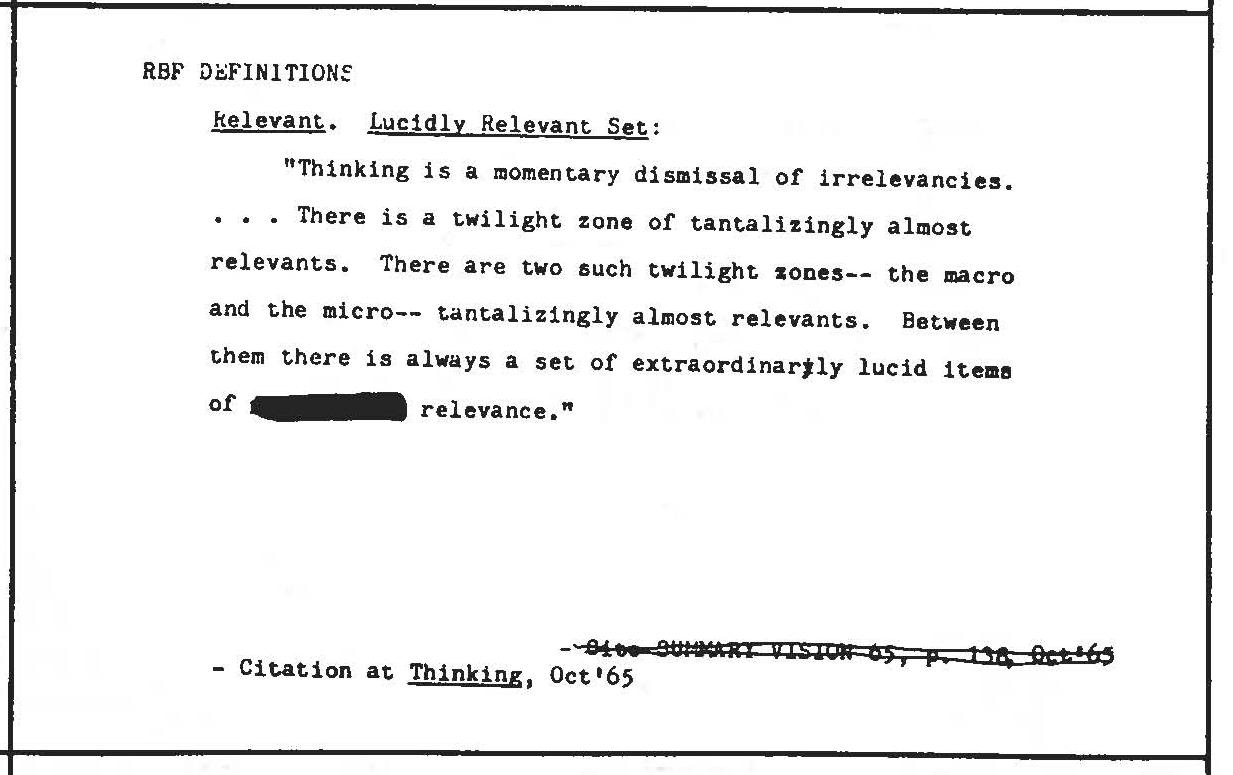
Relevant: Lucidly Relevant Set
← Relevant. Lucidly Relevant Set | Relevant System Potential →
Index Entry
Thinking consists . . of a self-disciplined deferment of conscious consideration of any incoming information traffic other than that which is lucidly relevant to the experience intuited quest for comprehension of the significance of the emergent pattern under immediate priority of consideration.
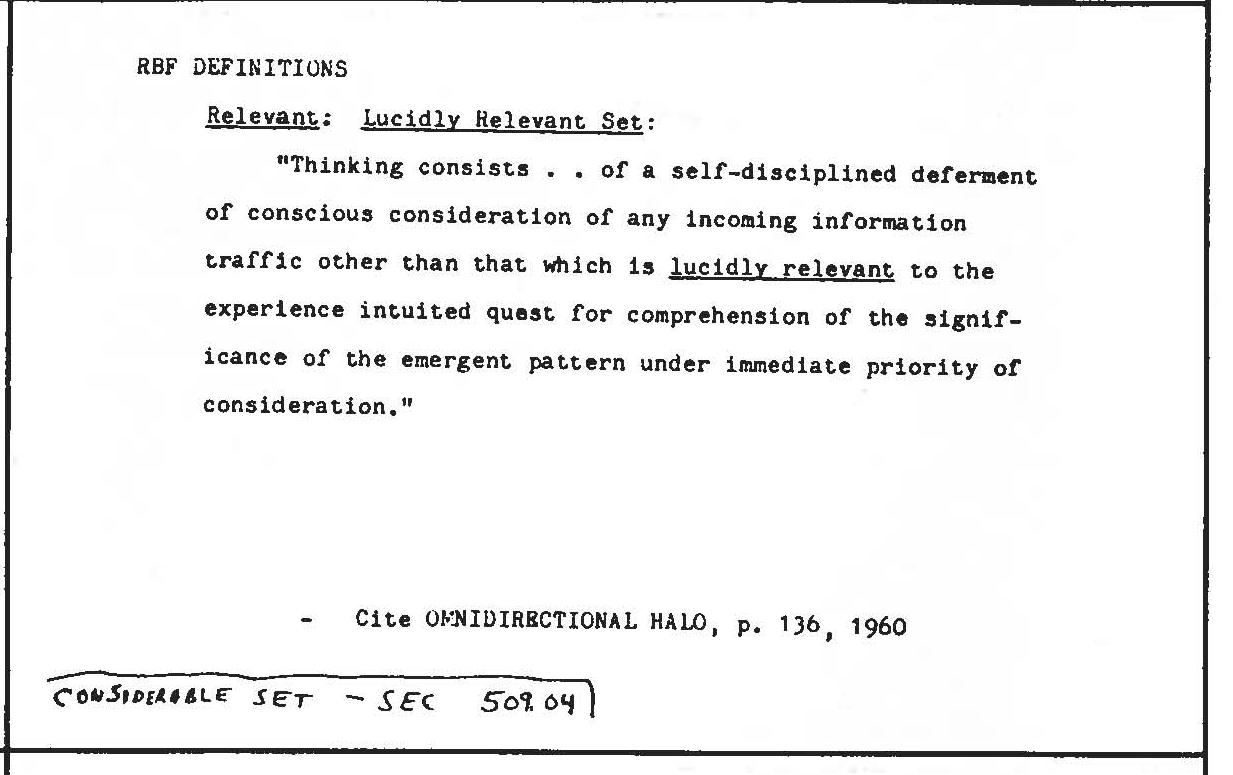
Relevant System Potential
← Relevant: Lucidly Relevant Set | Relevant Relevance Relevant Set Lucidly Relevant (1) →
Cross Reference
Cross-References
Relevant Relevance Relevant Set Lucidly Relevant (1)
← Relevant System Potential | Relevant Relevance Relevant Set Lucidly Relevant (2) →
Cross Reference
Irrelevancies: Dismissal Of
Irrelevancy
Irrelevancies: Dismissal Of Irrelevancy
Exterior Relevance
Cross-References
- Corelevant
- Bits: Bitting
- Stark
- Thought = Relevant Set
- Omniinterrelevant
- Interior Relevants
- Star Events
- Zone of Lucidity
- Interrelevant
Relevant Relevance Relevant Set Lucidly Relevant (2)
← Relevant Relevance Relevant Set Lucidly Relevant (1) | Reliable: Eternal Reliability →
Cross Reference
Cross-References
- Part, May'72
- Powering: One Dimension, 15 Oct'72
- Stark, 29 May'72
- Thinking, Oct'65*
- Repetition, (1)
- Halo Concept, Nov'71
- Omnihalo, Nov'71
- Pronouns: I = We = Us, (2)
- Human Beings, 22 Jun'77
Reliable: Eternal Reliability
← Relevant Relevance Relevant Set Lucidly Relevant (2) | Religion →
Cross Reference
Reliable: Eternal Reliability:
Cross-References
- A Priori Mystery, 22 Jul'71
- Integrity, 25 Jan'72
- Inherent, 3 Oct'72

Religion
← Reliable: Eternal Reliability | Religion (1) →
Index Entry
Religion:
"I do not want to inaugurate another religion and persuade people to believe in a set of rules. I am convinced that the Almighty does not need anybody to promote God."
Citation & context at God, May'65

Religion (1)
Index Entry
Religion:
"...Another young lady came to me and said was I going to talk some more about these religious ideas. I really had talked a whole lot about it to you but... I had never really used the word religion. I knew what she was talking about because she spoke about some kind of faith, some confidence in an integrity and a meaning in our experience of life... The word really is 'religio.' They had come out of a set of rules of dogma, interpretations at second-, third, and fourth-handings, sometimes very remote, a thousandfold secondariness of experiences of others and thought which have occurred spontaneously to original explorers.
"I myself am quite confident that the more we know about who specifically inspired religions-- Christ, Mohamed, Buddha, and Confucius-- these may be generalized characters, but there was one or several men who at various times in history tended to have the kinds of experiences that are accounted for word by word, mouth by mouth, word of mouth. These experiences are experiences of individuals who have extreme confidence in the integrity of the invention man and the invention Universe, who in every instance find this integrity to have great power, to be a priori to human intellect."

Religion (2)
Index Entry
Religion:
"None of them ever account experiencing a god in the image of man. That is one thing that Einstein was talking about in his nonanthropomorphic concept of the scientists. At any rate, they are people who experience an a priori integrity, a comprehensive anticipatory intellectual integrity greater than that of man. And they have enormous confidence in it, great faith in it, and try to help others to understand the success that they have experienced through their confidence in that integrity. At any rate, apparently these people have had such success as to have excited people by various patterns of experiences that have occurred. There are many then who in their day were excited, really very blindly and superstitiously, into subscribing to what was going on. This man was a man of powers without their trying to understand what those powers were. When they die then there were those who do better than others and they tend to become the authorities; and while they are alive they then are asked to make various recordings of what they think had been said and what the rules were. Gradually this gets thinner and thinner and we have official custodians of the information and interpretations and that is the way our religions have developed."
- Cite Orgeon Lecture #5, p.161, 9 Jul'62
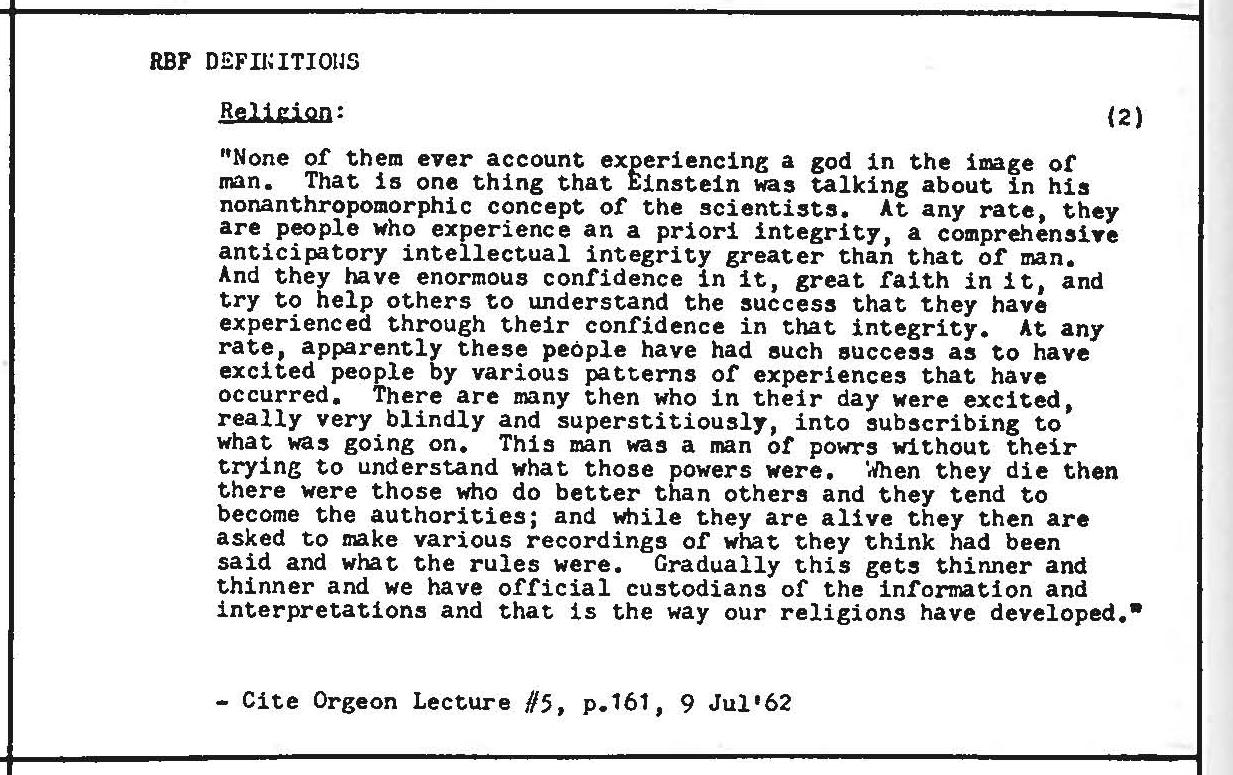
Religion
← Religion (2) | Religious Edifices →
Index Entry
Religion:
"As these individual explorers of the sciences went off into their laboratory and went down with their blinders on, men of enormous integrity, they said they never found anything in that particular area that seemed to confirm any of the given religions. Therefore, atheism began to develop, not as something you profess-- but there was sort of a double life. These men tended to honor their forebears, honor the literature, honor the humanism, and they would say probably the trouble is that I am such a narrow person from being in such a narrow field, that I just don't understand your other things. But there is nothing that I am doing experimentally here that seems to tell me that what the people have said about how the Universe was put together and the way it works, particularly from a religious viewpoint, that really seems to be valid. I think these people over here are dear muddleheaded people, but I am just going to have to leave them alone for my own professional part. So what has been thought of as an atheism is really just an evasion. It wasn't a declaration of againstness, and was not something against religion, but there seemed to be nothing to take its place."
- Cite Oregon Lecture #4, p. 130. 6 Jul'62
Religious Edifices
← Religion | Religious Edifices →
Index Entry
Religious Edifices:
"... The enormous credit and physical investment of local undertakings in the most transcendental class as mystical insurance for eternal equanimity as built into the great religious edifices by the local communities, as representing the most generalized problem treatment and infinite range planning known to man's history."
- Citation and context at Ships (1), 1954-59
Religious Edifices
← Religious Edifices | Religion as Make-believe →
Cross Reference
Religious Edifices:
Cross-References
Religion as Make-believe
← Religious Edifices | Religion →
Cross Reference
Cross-References
- Synergetics, Apr'72

Religion
← Religion as Make-believe | Religion →
Index Entry
Religion: Related to 'Reglio' or Rule:
"I personally interpret the word religion as being related to 'reglio' or rule. You begin with the assumption that everyone is very ignorant, and somebody much wiser comes along and says, "Darling, you're not old enough to understand. I do understand however, and I want you to believe every word I say." And you say, "All right, father, I know you love me and wouldn't mislead me or cause me harm, So I believe you. There you have an exchange that I'd call religious. it is built on subscription to dogma. You're told what to believe and you learn how to repeat it."

Religion
Index Entry
F., L. religio-n, from religens, careful, opposite of negligens, and prob. cogn. with diligens.

Religion
← Religion | Religion Religions (1) →
Index Entry
Oregon Lecture #5 - pp. 160-163 - 9 Jul'62
\hrefhttps://www.buckyverse.org/en/synergetics/content/chapters/200-synergetics#section-203.10203.10
\hrefhttps://www.buckyverse.org/en/synergetics/content/chapters/1000-omnitopology#section-1056.201056.20 (24)
\hrefhttps://www.buckyverse.org/en/synergetics/content/chapters/200-synergetics#section-8531.058531.05

Religion Religions (1)
← Religion | Religion Religious (2) →
Cross Reference
Cross-References

Religion Religious (2)
← Religion Religions (1) | Remember →
Cross Reference
Cross-References
- A Priori Mystery, May'72
- Child Sequence, (1)
- Modelability, (3)
- Synergetics, 19 Jun'71
- Thinking, (1)
- Iceland, 7 Oct'75
- Word Trends, May'44
- Belief, 20 Feb'77
- Greater Intellect, (2)

Remember
← Religion Religious (2) | Rememberable Entity →
Index Entry
Remember:
"To be remembered, it must first be membered, to be membered it must be structured, to be structured it must be triangulated."
- Cite RBF to B0'R, 3200 Idaho, DC, 20 Feb '72
Rememberable Entity
← Remember | Remembering Names →
Cross Reference
Rememberable Entity:
Cross-References
- Member, 9 Nov'73
- Dodecahedron, 23 Feb'72

Remembering Names
← Rememberable Entity | Rememberable Numbers →
Cross Reference
Cross-References
- Subconscious, Jun'66
Rememberable Numbers
← Remembering Names | Rememberable Number (1) →
Index Entry
Rememberable Numbers:
"When nature gives us a number we can remember, she is putting us on notice that the cosmic communications circuits are open: you are connected through to many sublime truths!"
Rememberable Number (1)
← Rememberable Numbers | Rememberable Number (2) →
Cross Reference
Cross-References
Rememberable Number (2)
← Rememberable Number (1) | Remembered →
Cross Reference
Cross-References
- Prime Number, Oct'71

Remembered
← Rememberable Number (2) | Remember (1) →
Index Entry
Remembered:
"Experiences remembered by none are, in effect, nonexistent--may never have occurred."
- Citation and context at Experience, 1968
Remember (1)
← Remembered | Remember Remembering (2) →
Cross Reference
Cross-References
- Memory
- Pattern Cognizance
- Trail Making & Trail Remembering
- Furniture of Remembered Experiences
- Unremembered = Nonexistent
Remember Remembering (2)
← Remember (1) | Remergent Synchronization →
Cross Reference
Cross-References
- Model, 22 Jan'75
- Universe, May'72
- Minimum Awareness, (1)
- Environment
Remergent Synchronization
← Remember Remembering (2) | Remote →
Cross Reference
Cross-References
- Hot Line of Intuition, 15 Aug'72
Remote
← Remergent Synchronization | Remote - Intellectual →
Index Entry
Remote:
"The remote aspect of a spiral is a wave because there are no planes."
- Citation & context at Spiralinearity, Nov'71
Remote - Intellectual
← Remote | Remote - Intellectual →
Index Entry
Remote - Intellectual:
"The more remote the function the more intellectual the perspective we have on it and the greater the speed with which we accelerate its adaptability into our economic life."
- Citation & context at Intellectual Perspective, 1 Jul'62
Remote - Intellectual
← Remote - Intellectual | Remote Remoteness (1) →
Cross Reference
Remote - Intellectual:
Cross-References
Remote Remoteness (1)
← Remote - Intellectual | Remote Remoteness (2) →
Cross Reference
Remote = Intellectual
Cross-References
Remote Remoteness (2)
← Remote Remoteness (1) | Renting: Rental (1) →
Cross Reference
Cross-References
- Energy, 6 May'48
- Physical, 27 Dec'74
- Spiralinearity, Nov'71*
- Structure, 15 Oct'64
Renting: Rental (1)
← Remote Remoteness (2) | Rent Rental (2) →
Cross Reference
Cross-References
- Mobile Rentability vs. Immobile Purchasing Service Industry
Rent Rental (2)
← Renting: Rental (1) | Reoccur Reoccurrence (1) →
Cross Reference
Cross-References
- Service Industry, 15 May'73
- Mobile Homes, (1)(2)
- Dome House Grand Strategy, 1927 (3)
- Building Industry, (8)
- Energy Environment-harvesting Machines, 27 Jan'77
Reoccur Reoccurrence (1)
← Rent Rental (2) | Reoccur: Reoccurrence (2) →
Cross Reference
Cross-References
Reoccur: Reoccurrence (2)
← Reoccur Reoccurrence (1) | Reorganize →
Cross Reference
Cross-References
- Entropy, 16 May'72
Reorganize
← Reoccur: Reoccurrence (2) | Reorientation →
Cross Reference
Reorganize:
Cross-References

Reorientation
← Reorganize | Re-origin Re-originatable →
Cross Reference
Cross-References

Re-origin Re-originatable
← Reorientation | Repelling Fields →
Cross Reference
Cross-References
- Origin
- Regenerative

Repelling Fields
← Re-origin Re-originatable | Repetition →
Cross Reference
Cross-References
- Domains of Actions, 9 Jul'62; 21 Dec'71
- Black Holes & Synergetics, 1 Mar'77
Repetition
← Repelling Fields | Repetition →
Index Entry
"In a recent study of the use of repetition in literature, Bruce F. Kawin observes that 'Events whose repetition is not extraordinary do not seem worth recording, in fact, hardly seem worth noticing.' This statement is very close to what has been the strategy of my life. This is what it means to dare to be naive. The preoccupied search for the extraordinary pattern cannot fail to obscure the larger and more obvious ordinary patterns-- so obvious that they always seemed to be missed."
- Cite SYNERGETICS, 2nd. Ed. front matter, Author's Note on Rationale for Repetition in This Work, p.xx1, 2 Jul'75

Repetition
← Repetition | Repetition (1) →
Index Entry
Repetition:
"Le Corbusier told the whole story on the first page. And then he told it again in a few pages. And then he told it again in the whole book. And that's the only way people can really understand it. You have to keep retelling it. This is the way Le Corbusier did it in his book called ... and everyone loved it that way.
"This gives me another metaphor.... It is all part of the grand strategy. You know how a pole vaulter can't do it all the first time. He has to run over the same cinder path hundreds and hundreds of times before he gets to his new record. And that's the way we should tell it in the book."
Repetition (1)
← Repetition | Repetition (2) →
Index Entry
Repetition:
"It is the writer's experience that new degrees of comprehension are always and only consequent to ever-renewed review of the spontaneously rearranged inventory of significant factors. This awareness of the processes leading to new degrees of comprehension spontaneously motivates the writer to describe over and over again what-- to the careless listener or reader-- might seem to be tireless repetition, but to the successful explorer is known to be essential mustering of operational strategies from which alone new thrusts of comprehension can be successfully accomplished.
"To the careless reader seeking only entertainment the repetition will bring about swift disconnect. To those experienced with the writer and motivated by personal experience with mental discoveries-- co-experiencing comprehensive breakthroughs with the writer-- are not dismayed by the seeming necessity to start all over again inventorying the now seemingly lucidly relevant.
"Universe factors intuitively integrating to attain new perspective and effectively demonstrated logic of new degrees of comprehension-- that's the point! I have not forgotten that"
Repetition (2)
← Repetition (1) | Repetition →
Index Entry
Repetition:
"I have talked about these things before. It is part of the personal discipline, no matter how formidable the re-invent- orying may seem, to commit myself to that task when inspired by intuitive glimpses of important new relationships-- inspired overpoweringly because of the realized human potential of successful escape from ignorance."
- Cite SYNERGETICS front papers, "Author's note on Rationale for Repetition in this Work," p. xxi, from notes of RBF to EJA, 3200 Idaho, Wash., DC, 30 Oct'72
Repetition
← Repetition (2) | Repetitive →
Index Entry
"Of course it can be abused, like cast iron souvenir statues of G.I.'s, where the motive and integrity is so low the effect is cloying. But repetition has a very high function."
- Citation & context at Reproducible, 30 May'72
Repetitive
← Repetition | Repetition Repetitive (1) →
Index Entry
Repetitive:
"Metaphor is repetitive. Wave function and frequency are inherently repetitive. Sight, the awareness of all the electromagnetic-spectrum reality, is identified only by its unique frequencies of reliable repetition. Identity results only from a family of uniquely repetitive frequencies."
- Cite RBF to EJA and RBF marginalia in Bruce F. Kawin, "Telling It Again and Again," p.5; 28 May'75
Repetition Repetitive (1)
← Repetitive | Repetition Repetitive (2) →
Cross Reference
Cross-References
Repetition Repetitive (2)
← Repetition Repetitive (1) | Reprecession (1) →
Cross Reference
Cross-References
- Interval, 6 May'48
- Reproducible, 30 May'72
- Generalized Principle, (1)
- Scenario, 2 Jun'71
- Harmonic Interval, May'49
- Identity, 2 Jul'75
- Metaphor, 2 Jul'75
- Aesthetics of Uniformity, (1)

Reprecession (1)
← Repetition Repetitive (2) | Reprecessation (2) →
Cross Reference
Cross-References

Reprecessation (2)
← Reprecession (1) | Reproducible →
Cross Reference
Cross-References
- Two Kinds of Twoness, (B), (B)

Reproducible
← Reprecessation (2) | Reproducible →
Index Entry
Reproducible:
"The more symmetrical: the more reproducible. The more asymmetrical, the less it fits Universe. The most successful design in Universe is the hydrogen atom. The more adequate the prototype, the better it fits Universe.... There is an unfortunate tendency to abhorrency of the plastic. Our fingernails are plastic. Our eyes are plastic. Cf course it can be abused, like cast iron souvenir statues of G.I.'s, where the motive and integrity is so low the effect is cloying. But repetition has a very high function."
Reproducible
← Reproducible | Reproducible →
RBF Definitions
"...The Sun energy impounding functions of the billions times billions of blades of grass around its spherical surface are essential to the regeneration of life aboard Spaceship Earth, ergo Whitman's 'Blades of Grass' are almost infinitely reproducible."
Citations
- GENERALIZED LAWS OF DESIGN,pp.2-3, 22 Apr '68
Reproducible
← Reproducible | Reproducibleness: Law Of →
RBF Definitions
"It seems to be a law of nature that the more fundamentally simple and biologically propitious an evolutionary growth may be, the more aesthetically satisfying and lastingly acceptable is its multireproduction, e.g., roses, stars, and blades of grass."
Citations
- ARCHITECTURE: THE PRESENT SCENE, Newsweek, 1968
Reproducibleness: Law Of
← Reproducible | Reproducible; Reproducibility →
Cross Reference
Cross-References
- Harmonic, 22 Apr'68

Reproducible; Reproducibility
← Reproducibleness: Law Of | Reproduction (1) →
Cross Reference
Reproducible: Reproducibility:
Regenerative Design; Law Of
Simplicity
Regenerative Design; Law Of Simplicity
Cross-References
Reproduction (1)
← Reproducible; Reproducibility | Reproduction (2) →
Cross Reference
Aesthetics of Reproduction
Cross-References
Reproduction (2)
← Reproduction (1) | Repro-shelter Industry →
Cross Reference
Cross-References
- Reproducible, 1968
- Aesthetics of Uniformity, (1)
Repro-shelter Industry
← Reproduction (2) | Repulsion →
Cross Reference
Cross-References
- Industrial Hypocrisy, May'32

Repulsion
← Repro-shelter Industry | Repulsion →
Index Entry
When humans "repel one another physically
The least strong is rocketed
Into remote system orbit.
Repulsion
Index Entry
Repulsion:
"Repulsion, or the raison d'etre of going awayness..."

Repulsion
Index Entry
Repulsion:
In the kinetics of gas under pressure "there are critical proximities tensionally and critical proximities compressionally, that is, there are repellings. . . as we would find out in electromagnetics so there are domains of actions. . . "
-
Cite OREGON Lecture #5 p. 186, 9 Jul'62
-
Citation & context at Domains of Actions, 9 Jul'62
Repulsion (1)
Cross Reference
Cross-References
- Repel

Repulsion (2)
← Repulsion (1) | Require Requirements →
Cross Reference
Cross-References
- Domains of Actions, 9 Jul'62*
- Geometry of Vectors, Aug'71
- Gravity, (1)
- Precession: Analogy of Precession & Social Behavior, May'72*
- Structure, Nov'71
Require Requirements
← Repulsion (2) | Re-rewarding →
Cross Reference
Cross-References

Re-rewarding
← Require Requirements | Research (1) →
Index Entry
Re-rewarding:
"Exploration in principle is re-rewarding."
- Citation and context at Probability, May'49
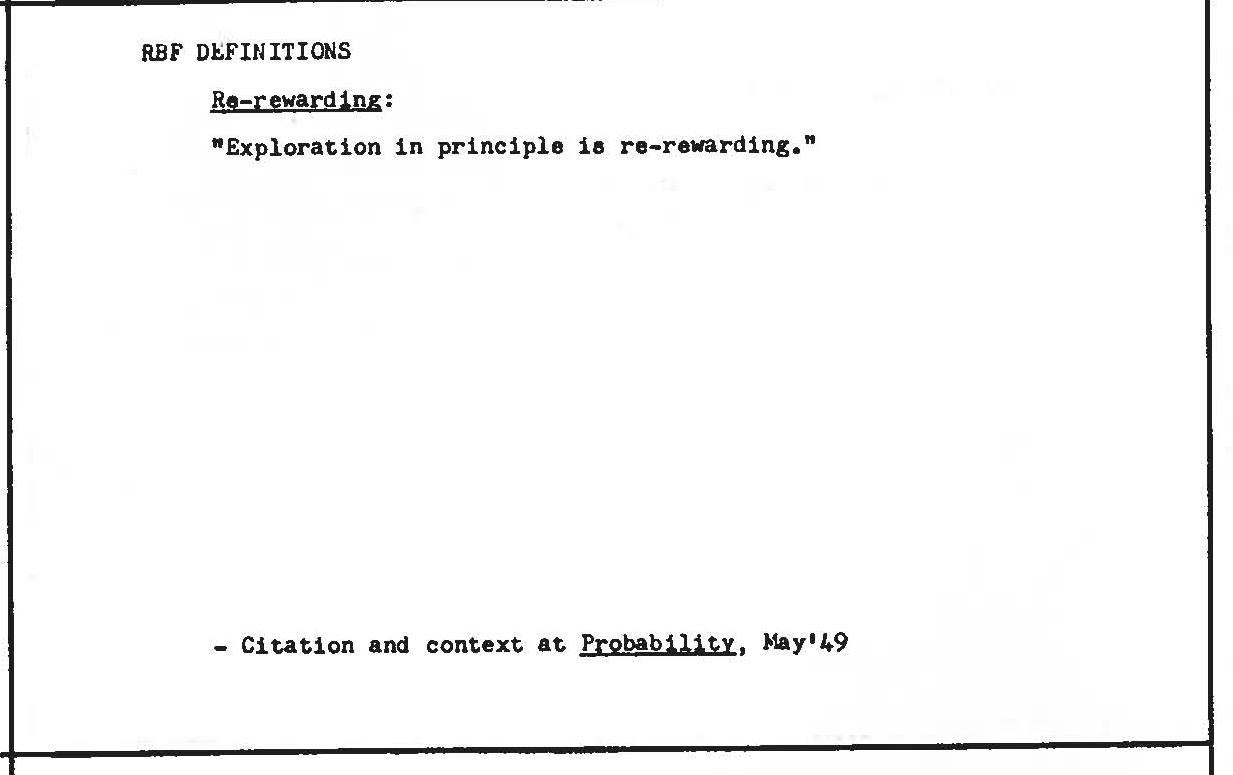
Research (1)
← Re-rewarding | Research (2) →
Index Entry
We must break a barrier in the kind of thinking we've been doing about the word 'research.' You have to have search before you can have research. The word research came into use in industry and business during the '20's. They started going over the things they were throwing away. They began to apply new technologies. So you searched once and exploited your findings; then you researched what you'd done and exploited it again. It was very spottily done between 1900 and World War I; research really begins in 1929. Today it covers all kinds of things. When we talk about research in a university, that's new too. The research professor is something very new. You had large corporations paying for a chair in the chemistry department and it was really a racket because what it meant was that you had a large number of people, graduate students working for you for nothing. You had a research professor giving your company very special benefits. The ulterior motives are frequently visible.
A researcher is always someone who goes over things again. He is a technician staying in one area to see what he can find. Research is very different from pure science exploration and invention. Research can just be processing and refining without
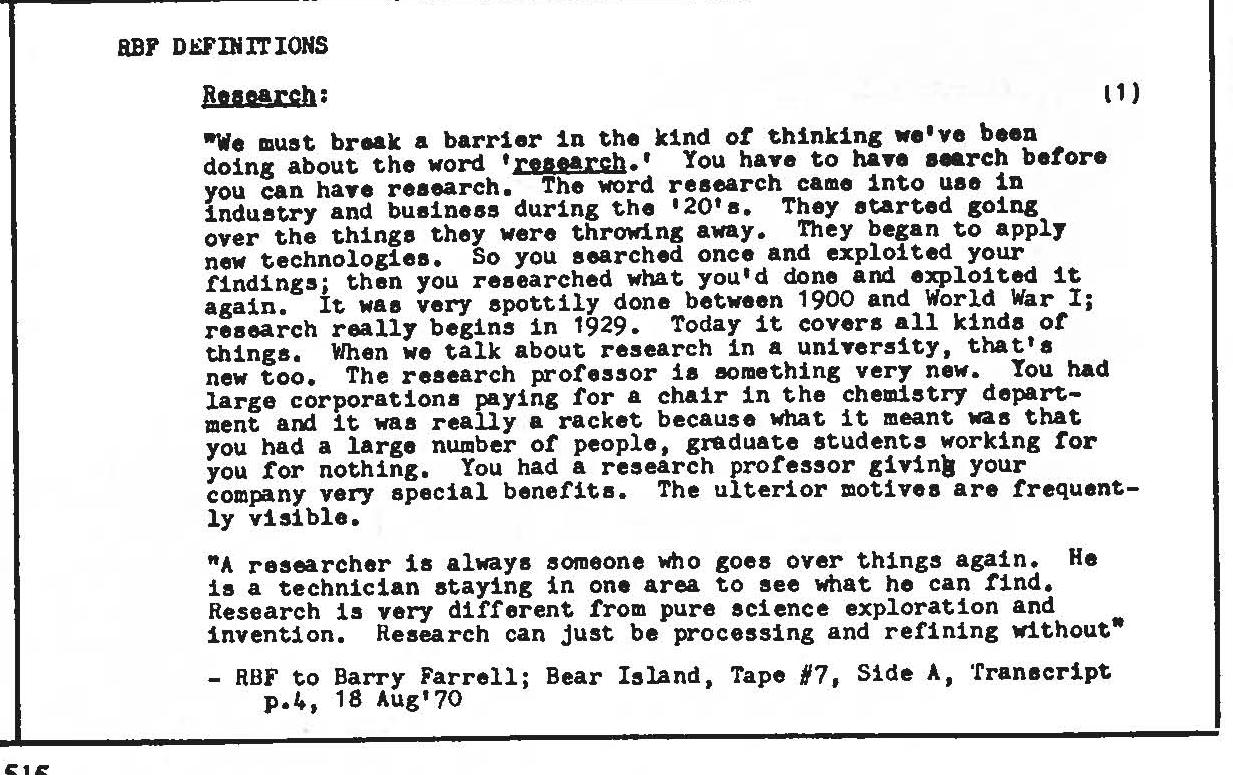
Research (2)
← Research (1) | Research & Development (1) →
Index Entry
Research:
"Initiating anything. I don't expect people to initiate very much, very often. The whole technique is to find what are the first things first in Universe."
- RBF to Barry Farrell; Bear Island, Tape #7, Side A; transcript p.4, 18 Aug'70
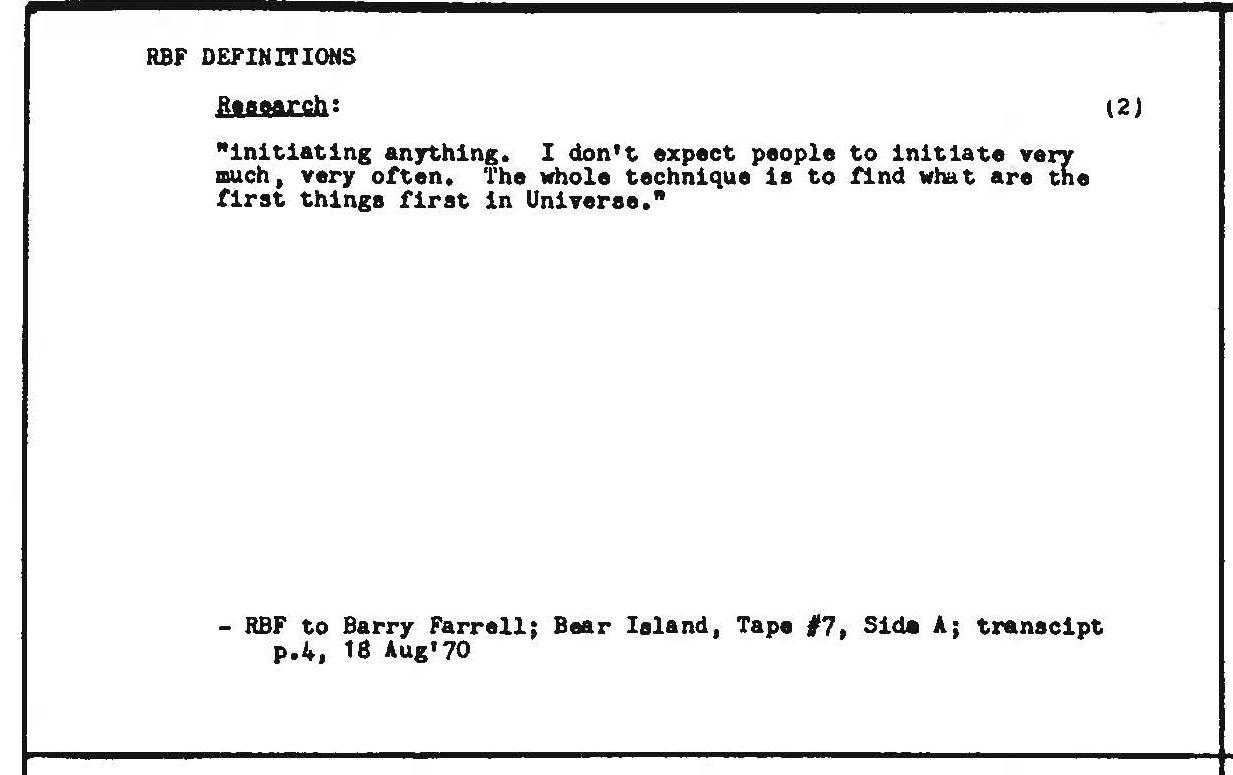
Research & Development (1)
← Research (2) | Research & Development (2) →
Cross Reference
Cross-References
- Fellowships: Life Fellowships in Research & Development
- Prototype
- Buggy Industry Could Never Invent Automobile
- Adoption of the New Only as Last Resort
- Dome House Grand Strategy
Research & Development (2)
← Research & Development (1) | Research Fellowships →
Cross Reference
Invention Sequence (A)-(D); (b)
Cross-References
- Ephemeralization, 1 Jun'49
- Everybody's Business, (1)
Research Fellowships
← Research & Development (2) | Research (1) →
Cross Reference
Cross-References

Research (1)
← Research Fellowships | Research (2) →
Cross Reference
Search vs. Research
Cross-References
Research (2)
← Research (1) | Reserve Reserves →
Cross Reference
Cross-References
- Labor: American Labor, 1960
Reserve Reserves
← Research (2) | Reservoir (1) →
Cross Reference
Cross-References

Reservoir (1)
← Reserve Reserves | Reservoir (2) →
Cross Reference
Cross-References

Reservoir (2)
← Reservoir (1) | Residual Error →
Cross Reference
Cross-References
- Shunt, Jun'66
Residual Error
← Reservoir (2) | Residual Error →
Index Entry
There will always be residual error to surprise man. The integration of all possibilities of the complementary alternates, though confinable, inherently defies exact identity because the minimum is pattern and not isolated integer. All pattern has inherent plurality of viewable aspects, which are the reciprocals of pluralities of permissible viewpoints, for instance, from within or from without a system. All treatable pattern is a subdivision of Universe, and disposes, in its first generalization, of the macrocosmic and microcosmic irrelevancies. Ergo, thought identification and communication to self or others must tune in a zone® system, with inherent center-of-zone, equilibrium 'sphere,' and therefore possessed of inherent wave propagative inward-outward tendency between the unstable variable limits, or infra-ultra twilights confining the clearly tunable mean interior-exterior zone limits occurring between the ultra-tunable macro-cosmos and the intra-tunable microcosmos.
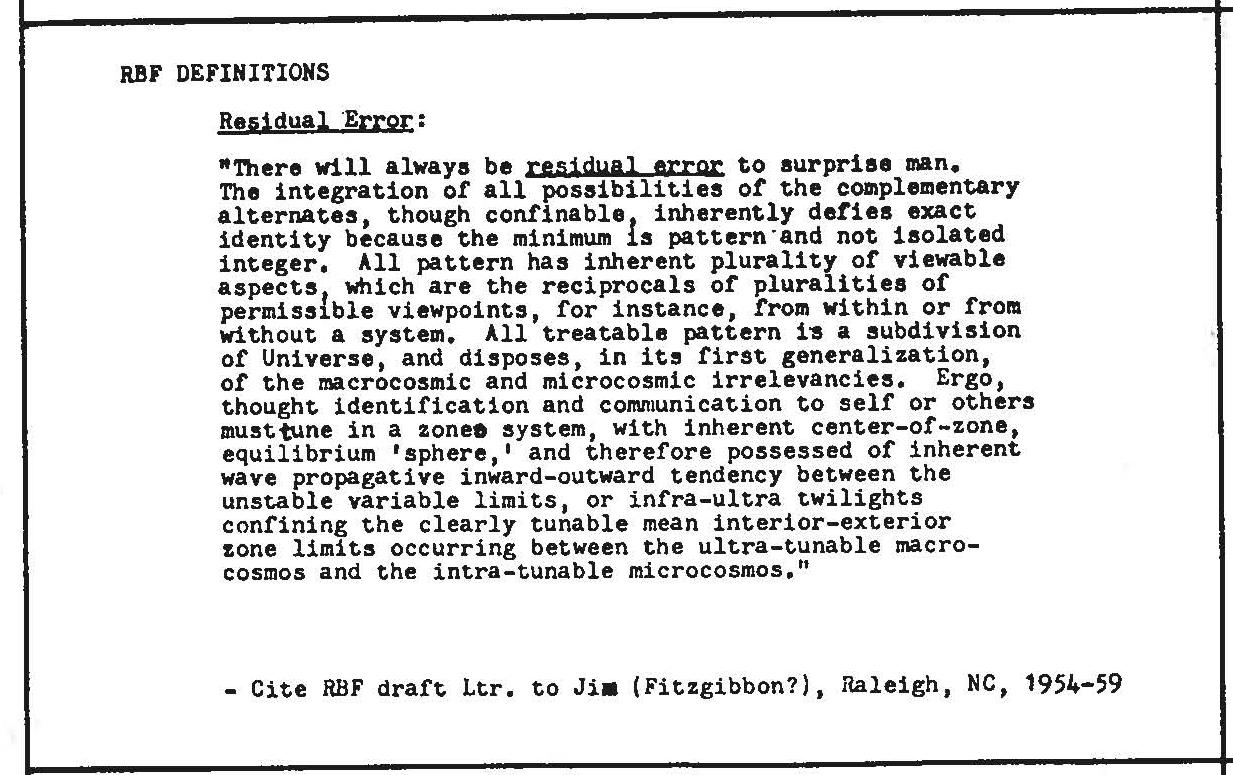
Residual Error
← Residual Error | Residual Ignorance of Temporality →
Cross Reference
Cross-References
- Observing & Articulating, 4 Aug'75
- Cybernetics, 7 Nov'75
Residual Ignorance of Temporality
← Residual Error | Residual Ignorance →
Index Entry
Residual Ignorance of Temporality:
"Only residual ignorance of temporality dulls the growing comprehension and allows fear to corrupt the child's innately absolute trust in love."
- Citation and context at Death, 11 Sep'73

Residual Ignorance
← Residual Ignorance of Temporality | Residual Reality →
Cross Reference
Cross-References
- Understanding, 1 Apr'49

Residual Reality
← Residual Ignorance | Residual →
Cross Reference
Residual Reality:
Cross-References
- Specialization, Dec'69

Residual
← Residual Reality | Residual (2) →
Cross Reference
Residual:
Cross-References
Residual (2)
Cross Reference
Cross-References
- Exactitude, May'72
- Historical, 1971

Residual
Cross Reference
Cross-References
Resilience
Cross Reference
Cross-References
- Bend: Bending
- Rigidity vs. Resilience
Resistance (1)
← Resilience | Resistance (2) →
Cross Reference
Cross-References
Resistance (2)
← Resistance (1) | Resolution →
Cross Reference
Cross-References
- Tunability, 1960 (2)

Resolution
← Resistance (2) | Resolution →
Index Entry
Resolution:
"Things in parallel never get resolved. Convergent things get beautifully resolved; they get exactly... they get nature into a corner."
- Citation & context at Convergence & Divergence, 1 May'77
Resolution
Index Entry
Resolution:
"...The resolution is not linear nor planar; it is omnidirectional; it is hierarchical in ascending or descending hierarchies."
- Citation & context at Minimum Limit Case, 12 May'75
Resolution
Index Entry
Resolution:
"Vectors are not abstractions: they are resolutions."
-
Citation at Vector, 21 Dec'71
-
Cite RBF to EJA, 1200 Idaho, Washington DC, 21 Dec.'71.
Resolution
Index Entry
Resolution:
"Points are complex but nondifferentiably resolvable to superficial inspection."
-
Cite RBF to EJA, Beverly Hotel, New York, 19 June 1971.
-
Citation & context at Point, 19 Jun'71
Resolution
RBF Definitions
"A star is something you cannot resolve. We call it a point, playing Euler's game of crossings. One star does not have an outsideness and an insideness. It is a point because you cannot resolve it."
Citations
- RBF to EJA, Carbondale, 2 Aprili 1971. - Citation & context at Point, 2 Apr'71
Resolution
← Resolution | Resolvability Limits →
Index Entry
Resolution:
"... Think about some of the limits of thinking of what we call resolution. Just look at this ruler ... it is divided into centimeters and it is down to tenths of centimeters. ... Or if you take an engineers' rule and get down to hundredths of an inch a good eye can see and resolve the black from the white, but beyond that you stop operating and you sec gray. These are frequencies. From now on we really get into the phenomena of frequency-- and then you see pink and yellow. I want you to realize you are seeing something to do with frequencies, where you do not have resolution of separation and this is not at all mysterious. We realize how very limited we are, and then when we begin to see things superficially-- they are tactile-- we don't realize how much confusion we are having on an extraordinary set of frequencies."
-- Cite Oregon Lecture #3, pp. 100. 5 Jul'62
Resolvability Limits
← Resolution | Resolution Resolvability (1) →
Index Entry
Resolvability Limits:
"The visual limits of 'now-you-see-it-now-you-don't,' yes-no-yes-no, something-nothing-something-nothing, dot-dash-dot-dash are relative size-scale discernabilities spoken of technically as resolution. These resolvability limits of the human eye may be pictured as follows:
one inch
1/2
tenths
thirtieths
fiftieths
hundredths
The
Engineers'
Scale
"The finest 'smooth' surface, intercolor-crossblending, continuum photogravure printing is accomplished with a benday screen which employs 200 unique color dots per each square inch of printed surface."
- Cite SYNERGETICS 2 draft at Sec. \hrefhttps://www.buckyverse.org/en/synergetics/content/chapters/100-synergy#section-100.031100.031; 30 Apr'77
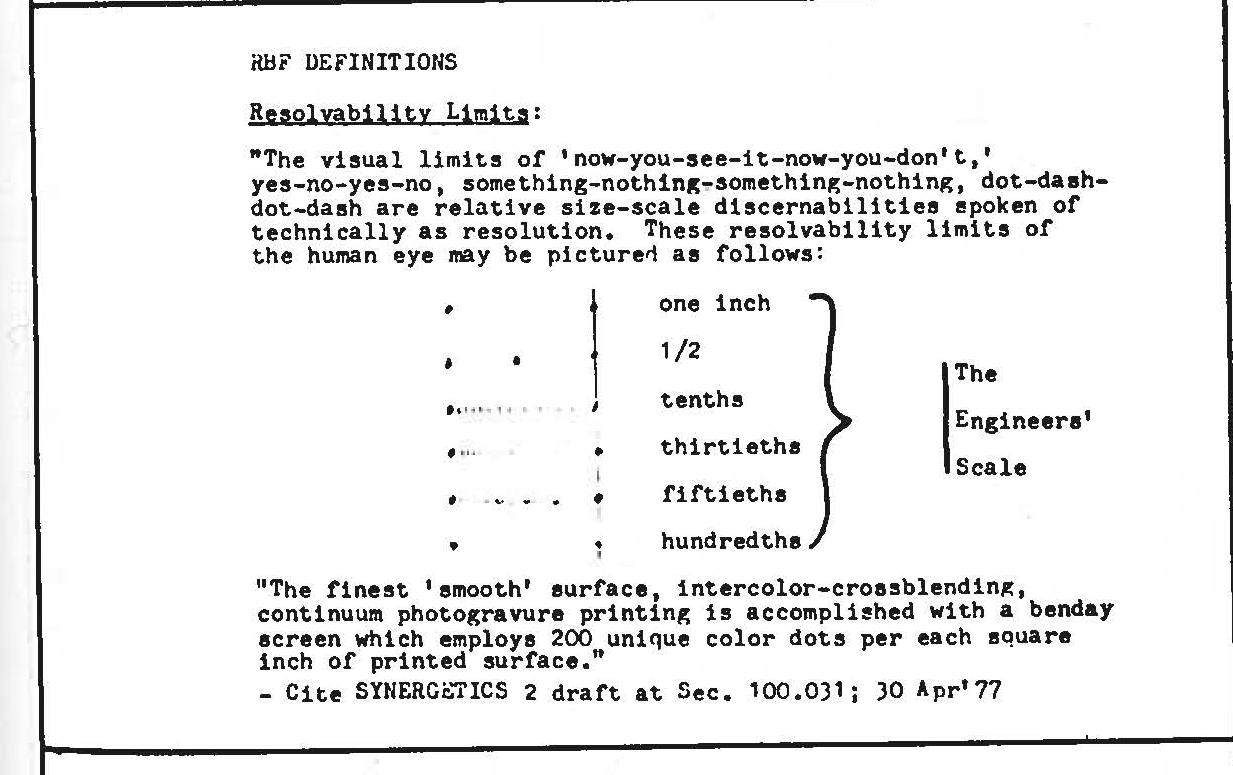
Resolution Resolvability (1)
← Resolvability Limits | Resolution (2) →
Cross Reference
Invisibility of Macro- and Micro Resolution
Cross-References
- Benday Screen
- Differentiation
- Point
- Tunability
- Abstraction vs. Resolution
- Unresolvable
- Frequency Islands of Perception
- Conceptual Genesis
Resolution (2)
← Resolution Resolvability (1) | Resonance →
Cross Reference
Resolution: Resolvable:
Cross-References
- Female Leg, Aug'64
- Point, 6 Nov'73; 19 Jun'71; 2 Apr'71*
- Prime Otherness, 24 Sep'73
- Tetrahedron as Conceptual Model, Nov'71
- Vector, 21 Dec'71*
- Clusters, 7 Nov'73
- Minimum Limit Case, 12 May'75*
- Convergence & Divergence, 1 May'77*
- Six Motion Freedoms & Degrees of Freedom, (1)(2)
Resonance
← Resolution (2) | Resonance →
Index Entry
Resonance:
"... Lines are always curvilinearly realized because of universal resonance, spinning, and orbiting."
- Citation and context at Line, 7 Nov'72
Resonance
← Resonance | Resonance Field →
Index Entry
I'm talking about physics and the waves of the periodic table... its unique frequencies would interact... and what the permutations would be mathematically-- And I found this highly suggestive that the octave with its characteristic- ally flat resonance really governing the interactions of frequencies. The resonances are the key to much of modern physical exploration.
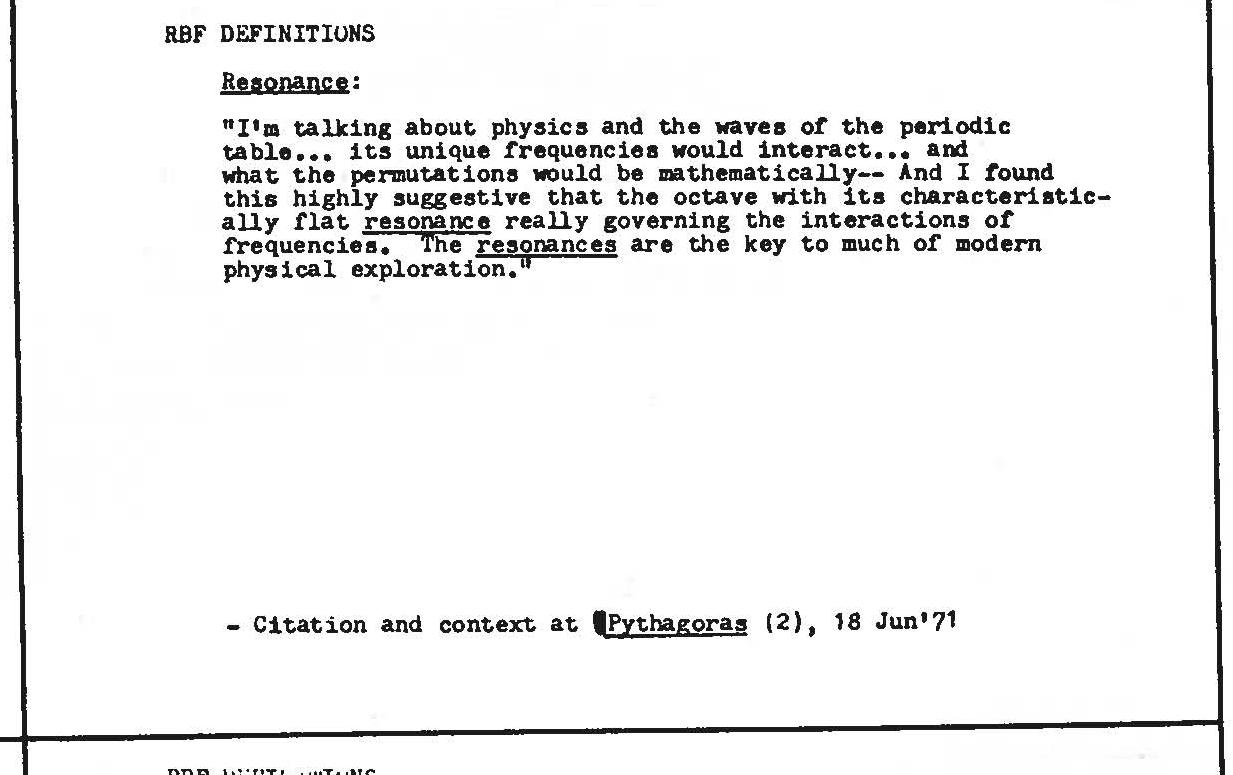
Resonance Field
← Resonance | Resonance Resonatability (1) →
Index Entry
Resonance Field:
"...Employing as a resonance field all the intertransforming spheres and between-sphere spaces; and employing the myriadly selectable, noninterfering frequencies of such propagatable intertransformation resonance..."
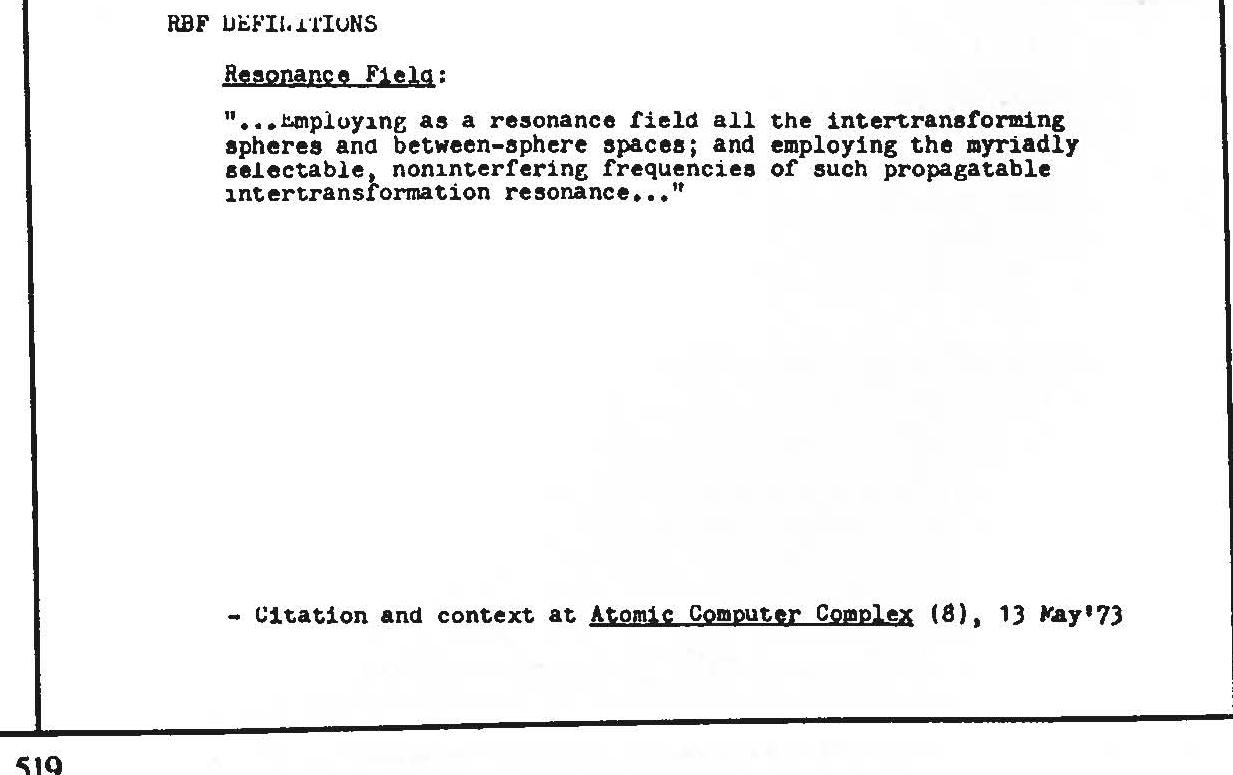
Resonance Resonatability (1)
← Resonance Field | Resonance Resonatability (2) →
Cross Reference
Omniinterresonated
Oscillation
Pulsation
Synchro-resonance
Tidal
Zone of Neutral Resonance
Omniresent
Heard & Unheard Resonances
Wavelength, Frequency & Resonance
Harmonic: Harmony
Tensed String
Chords & Notes
Cross-References
Resonance Resonatability (2)
← Resonance Resonatability (1) | Resources →
Cross Reference
Nites & Quarks as basic Notes, (3)
Cross-References
- Integer, 15 Oct'72
- Isotropic Vector Matrix, 16 Nov'72; 30 Nov'72
- Line, 7 Nov'72*
- Music, 4 Mar'69
- Observing vs. Articulating, Mar'71
- ave, Oct
- Point, 16 Nov'72
- Pythagoras, (2)
- Synergetics Calculation, 30 Oct'72
- Time-size, 20 Dec'73
- Tunability, 19 Oct'72; 16 Nov'72
- Radiation-gravitation: Harmonics, 3 Jan'75
- Womb of Permitted Ignorance, 13 Dec'73
- Metaphysical & Physical Tetrahedral Quanta, 25 Mar'71
- Energy Involvement of 92 Elements, (1)
- Metaphysical & Physical, 13 Nov'75
- Aural, 22 Feb'77
- Olfactoral, 22 Feb'77
Resources
← Resonance Resonatability (2) | Resources →
Index Entry
Resources:
"If there's so little of it, it must be used in a broad sense. I must never have helium in a retail pub; it must be in the tools that serve the tools....
"I want to really do something, but I don't want to sell boron on the street-corner to use for toothpicks. I want to see that everything is used where it's meant to be used."
Resources
Index Entry
Resources:
"...All the 'cream rich' initial discoveries of original resource geography lodes become exhausted..."
Resources
← Resources | Resource Effectiveness →
Index Entry
Resources:
"... Spaceship Earth's prime resources belong to everybody."
- Citation and context at Young World (10, 4 Jul'72
Resource Effectiveness
← Resources | Resources: Fresh vs. Waste (1) →
Cross Reference
Cross-References
- Industrial Man, 10 Oct'63
- Revolution by Inadvertence, 10 Oct'63
Resources: Fresh vs. Waste (1)
← Resource Effectiveness | Resources (2) →
Cross Reference
Cross-References
Resources (2)
← Resources: Fresh vs. Waste (1) | Resource Inadequacy →
Cross Reference
Resources: Fresh vs. Waste:
Cross-References
- Biological Life, (2)
Resource Inadequacy
← Resources (2) | Resource Inadequacy (1) →
Index Entry
Resource Inadequacy:
"I also realize intuitively
That the elimination
Of the condition of resource inadequacy
And thereby the elimination of human want
May probably eliminate war
-- Or quick death--
Which is always consequent to the overlong protraction
Of the slow and more anguished poverty's
Slow dying
As brought about by lethal ignorance
In respect to the design revolution potentials
As society takes its only known recourse
In political actions..."
Resource Inadequacy (1)
← Resource Inadequacy | Resource Inadequacy (2) →
Cross Reference
Cross-References
Resource Inadequacy (2)
← Resource Inadequacy (1) | Resource Integration →
Cross Reference
Cross-References
- Political Revolution, 10 Oct'63
- Selfishness, 22 Jun'75
Resource Integration
← Resource Inadequacy (2) | Resource Inventorying (1) →
Cross Reference
Cross-References
- Leaders: Take Away the Leaders, 4 Jul'72

Resource Inventorying (1)
← Resource Integration | Resource Inventorying (2) →
Cross Reference
Cross-References
Resource Inventorying (2)
← Resource Inventorying (1) | Resource & Principle →
Cross Reference
Problem: Statement Of, Aug'72
Cross-References
- Biosphere, (1)
Resource & Principle
← Resource Inventorying (2) | Resource Resources (1) →
Index Entry
Resource & Principle:
"Inventions are extemporaneous. They represent trial balances of resource and principle drawn off in the light of shifting needs."
- Citation & context at Inventions, 1947
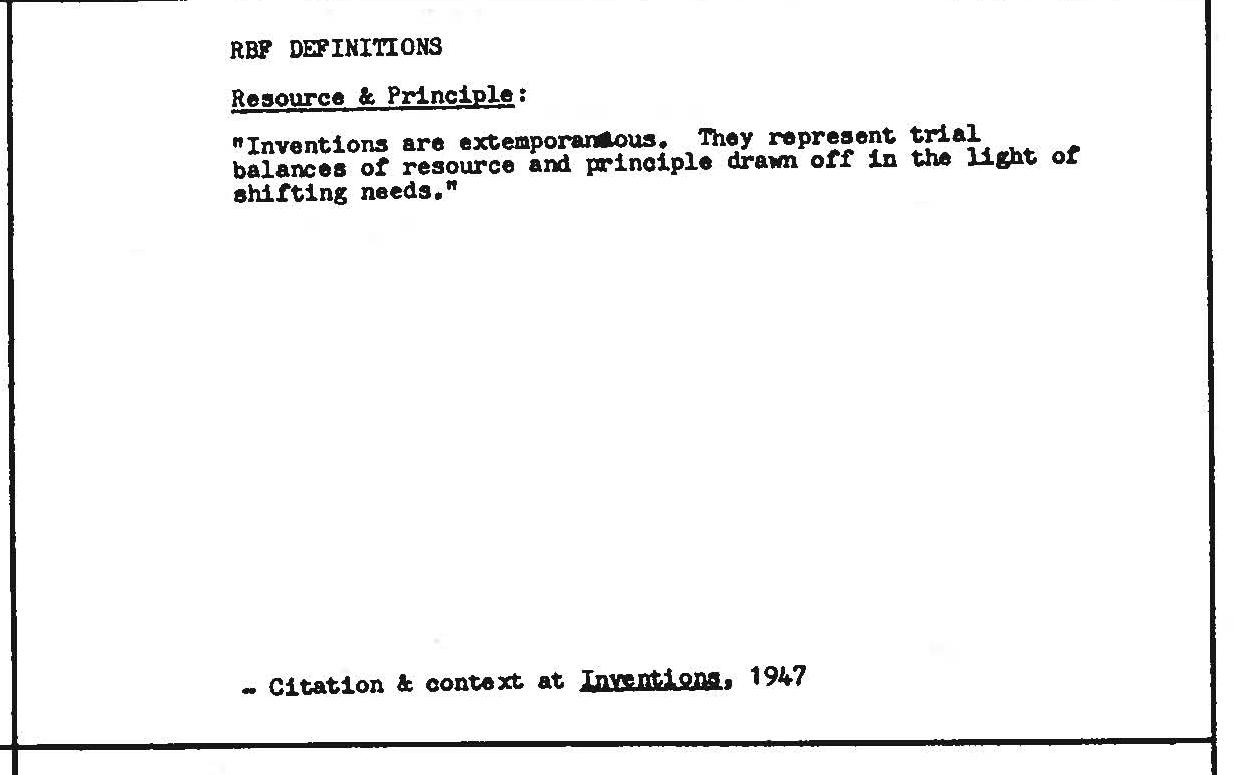
Resource Resources (1)
← Resource & Principle | Resource (2) →
Cross Reference
Wilderness Resources
Cross-References
Resource (2)
← Resource Resources (1) | Resource (3) →
Cross Reference
Cross-References
- Biological Life, (1)
- Biosphere, (1)(2)
- Leaders: Take Away the Leaders, 4 Jul'72
- Miniature Earth, 28 Apr'74
- Wealth, 20 Sep'76
- Womb of Permitted Ignorance, 13 Dec'73*
- World Game: Grand Strategy, 2 Jun'74
- Young World, 4 Jul'72*
- Intellect, 21 Jun'77
Resource (3)
← Resource (2) | Responsible →
Cross Reference
Resource: Resources:
Cross-References
- Resource Effectiveness
- Resource inadequacy
- Resource Integration
- Resource Inventorying
- Resource & Principle
Responsible
← Resource (3) | Responsibility →
Index Entry
Responsible:
"We have to take the responsibility of being responsible. So far we have not been very responsible. You don't say to a new child, 'You'd better go back in there, you're not very responsible...' They're just using words-- foxes and daisies... I say: What might I do that made it logical for man not to do these things? That's what I'm caring about. That's what design science is."
Responsibility
← Responsible | Responsibility →
Index Entry
Responsibility:
"Our history of social customs indicates that until very recently, when Freud offered evidence to the contrary, man thought of his awake self as being utterly conscious. The laws held people absolutely responsible for all their awake acts. Reality was what could be seen, smelled, touched, tasted, and heard. There was no popular awareness of sub- or ultra-visible reality. There were beliefs of invisible gods or demons playing tricks on the humans."
- Cite ARCHITECTURE AS ULTRA INVISIBLE REALITY, p. 149, Dec. '69
Responsibility
← Responsibility | Responsibility →
Index Entry
Responsibility:
"We are all equally responsible not only for the big complementary surface areas which we develop on systems by our every act. . . We are inherently responsible for the transformation of Universe, inwardly, outwardly, and all around every system which we alter."
- Citation and context at Spherical Triangle (4), 13 Nov'69
Responsibility
← Responsibility | Responsibility (1) →
Index Entry
Responsibility:
""... Up to the nineteenth century, or the beginning of the twentieth century, what we could smell, see, hear, and touch was what he meant by reality. I think to many in our society today that is still what you mean by reality. Freud and Mesmer shook society's concept of this kind of reality, because man up to this time had been saying, because that is reality, every human being knows just what he is doing. If he is of sound mind, when he is awake, then he knows just what he is doing. Therefore, he must be entirely responsible for his every act. So as we developed laws, we made man utterly responsible for his every act. But Freud and Mesmer, through their hypnotism, were able to disclose behaviors of human beings for which the human being was not responsible at all. So this shook the idea of the courts, and we have had to have psychiatrists and others come in to bring you a reconsideration of the responsibilities of human beings. Now, what has really not been paid attention to in our society, again because we are all so specialized, is that there is almost no tendency to look at the whole and to really understand the whole."

Responsibility (1)
← Responsibility | Responsibility (2) →
Cross Reference
Cross-References

Responsibility (2)
← Responsibility (1) | Rest: At Rest →
Cross Reference
Cross-References
- Design Scientist, 30 Jan'75
- Publishing, 30 Jan'75
- Success, 10 Sep'75
Rest: At Rest
← Responsibility (2) | Rest At Rest (1) →
Index Entry
The words 'at rest,' artificial, and failure are all meaningless.

Rest At Rest (1)
← Rest: At Rest | Rest At Rest (2) →
Cross Reference
Cross-References
Rest At Rest (2)
← Rest At Rest (1) | Restlessness →
Cross Reference
Cross-References
- Norm of Einstein as Absolute Speed, Jun'56
- Radiation: Speed Of
- Future: Man Backs into His Future, May'49
- Dynamic Equilibrium, 24 Apr'76
Restlessness
← Rest At Rest (2) | Rest of the Universe →
Cross Reference
Cross-References
- Energetic Functions, 8 Aug'77
Rest of the Universe
← Restlessness | Rest of the Universe →
Index Entry
The complementarity of the octahedron with the vector equilibrium permits us to get down to the local and not be afraid of missing the rest of the Universe, because we know the fundamental complementations of macro tetra and micro tetra. We were always looking at the XYZ quadrant--focusing on the quadrant at the center of the octahedron, rather than on the functioning of the covariations.
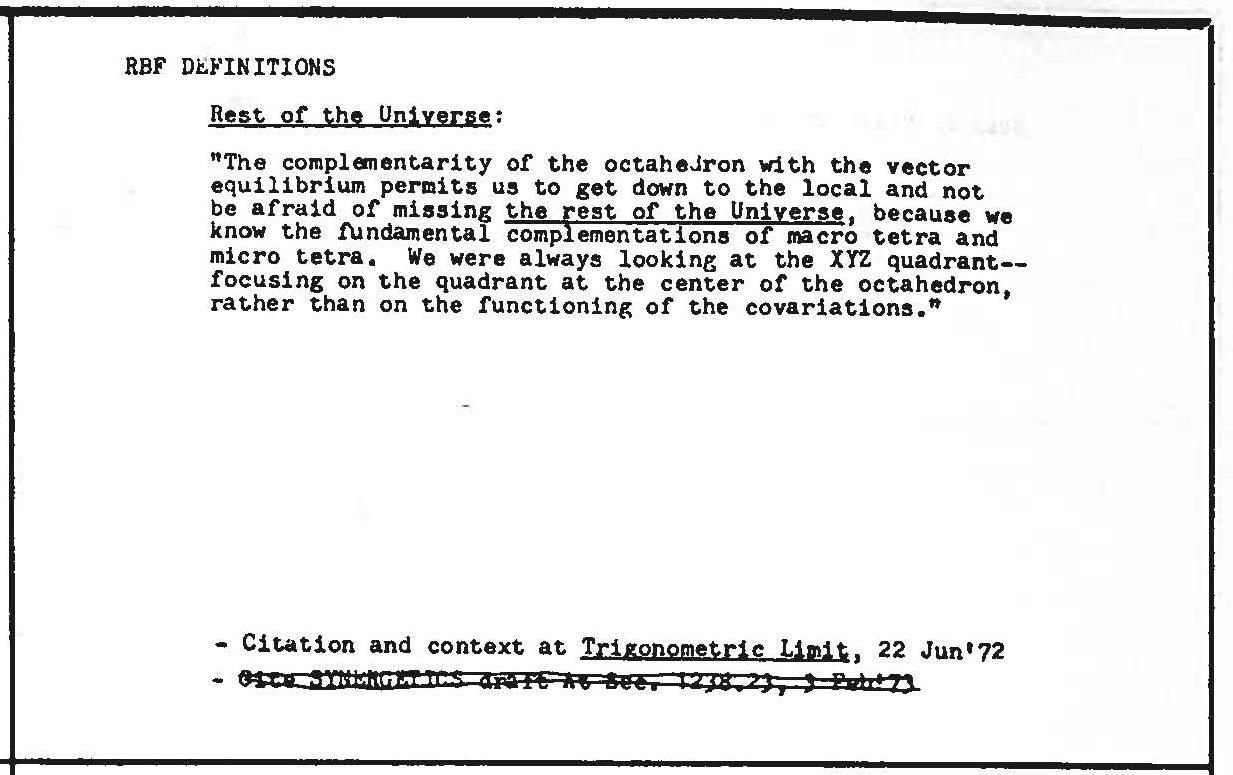
Rest of the Universe
← Rest of the Universe | Rest of the Universe →
Index Entry
Rest of the Universe:
". . . You and I are matched by the rest of the Universe. There is an invisible hole-- a matrix of you and I sitting in the Universe. So it really isn't annihilated, but it is nonlocally identifiable. . ."
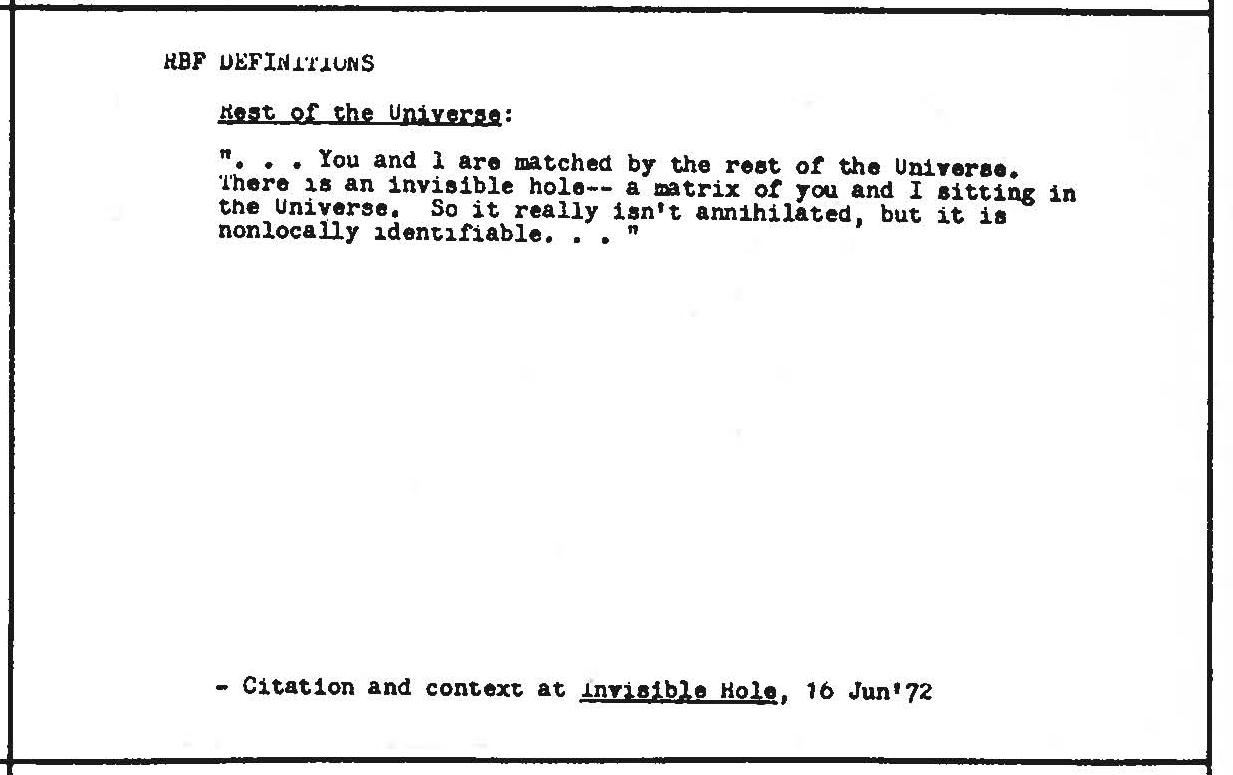
Rest of the Universe
← Rest of the Universe | Rest of Universe Other than Earth →
Index Entry
Rest of the Universe:
"The Platonic Solids do not stand in a vacuum of Universe. They are in Universe and if you change that thing you change the rest of Universe. Nothing can change locally without changing everything else."
- Citation at Platonic Solids, 12 Jul'62
Rest of Universe Other than Earth
← Rest of the Universe | Rest of Universe (1) →
Cross Reference
Cross-References
- Spherical Triangle Sequence, (111)
Rest of Universe (1)
← Rest of Universe Other than Earth | Rest of Universe (2A) →
Cross Reference
Cross-References

Rest of Universe (2A)
← Rest of Universe (1) | Rest of Universe (2B) →
Cross Reference
Thinkable System Takeout, (2)
See Allspace Filling:ahedron & Ve, Oct
Eternity: Equation Of, 27 May'72
Cross-References
- Allspace Filling:ahedron \& Ve, Oct
- Event, 1968
- Invisible Hole, 16 Jun'72
- Local Entity, 1960
- Nonmirror Image, 13 Jun'74
- Orbiting, 5 Jun'73
- Key-keyhole Sequence, (1)(2)
- Platonic Solids, 12 Jul'62*
- Plus One, 9 Jul'62
- Rubber Tires, (4)
- Sphere, (1)
- Tetrahedron: Coordinate Symmetry, 10 Jul'62
- thinkable System Takeout, (2)
- Thinking, (1)
- Trigonometric Limit, 22 Jun'72*
Rest of Universe (2B)
← Rest of Universe (2A) | Restraints →
Cross Reference
Cross-References
- Universal Joint, 9 Nov'73
- Minimum Sphere, Aug'71
- Quantum Sequence, (5)
- Time is Only Now, 19 Jul'76
- In, Out & Around, 17 May'77
- Human Beings & Complex Universe, (4)
Restraints
← Rest of Universe (2B) | Restraints →
Index Entry
Restraints:
"Six restraints are essential to structure and pattern stability."
Cite RBF marginalis to SYNERGETICS 2 draft at Sec. \hrefhttps://www.buckyverse.org/en/synergetics/content/chapters/400-system#section-400.664400.664; 8 Aug'77
Restraints
← Restraints | Restraints (1) →
Cross Reference
Nothing stands in a vacuum of Universe. Nothing can change locally without changing everything else. We have to look for conditions where there is permitted transformability and where there is some really great unanimity of degrees of freedom. We see that certain kinds of patterns accrue from certain numbers of restraints. You could see how planar things could happen as a consequence of two restraints and how linear things could happen as a consequence of three restraints. (See \hrefhttps://www.buckyverse.org/en/synergetics/content/chapters/400-system#section-401.00401, Twelve Vectors of Restraint Define minimum System.) We see, then, that we are in a Universe where there is a certain limited number of permitted freedoms. Synergetics discovers that whatever is rigidly related to anything else discloses 12 restraints. There are a minimum of 12 restraints in developing anything we might call a rigidly related set of events.
Cross-References
- Sec. 401, Twelve Vectors of Restraint Define minimum System
Restraints (1)
← Restraints | Restraints (2) →
Index Entry
Restraints:
"I've got a way of checking degrees of freedom. I said there is myself and the universe, and I see a hole in the stars. I try to shoot out through the stars. I go llike the Pleiades; the stars get closer and closer together; I seem to be very far. All the stars in the rest of the universe are in one huddle, and I am over here. . . "
"I can't get away from the universe: one tension restraint. I can do as a tetherball; you hit it and make any kind of a spherical form that you want. . . I give myself now two restraints, I only had one restraint, now I have two restraints, not as if I were a ball in the middle of a music string. I can still move but I can only move in a plane. I give myself a third restraint: I am in a drumhead; I can still move, but only in a line. Then I give myself a fourth restraint and first I am pulling the drumhead in one direction and I seem to be immobilized. . . . I found that even though semi-immobilized, you could put a monkey-wrench on it and it would contort. . .
"I had to get each one of the four restraints; they had to be three-folded and come in tangentially, making a total of 12. There would be six positive and six negative, corresponding
Restraints (2)
← Restraints (1) | Restraints →
Index Entry
Restraints:
"to the six edges of the tetrahedron, negative and positive... They keep showing up in these models.
"You are trying to make a wire wheel. How many spokes does it take? You have to have three out this way and three out that way to keep the hub from shimmying. You have to take care of the rotation and the torque-- that way and this way-- we had six... multiply each of these by two... comes 12. You cannot have a wire wheel with less than 12 spokes."
Restraints
← Restraints (2) | Restraints →
Index Entry
Restraints:
"The Platonic Solids do not stand
nothing stands in a vacuum of Universe. Nothing can change
locally without changing everything else. We have to look
for conditions where there is permitted transformability
and where there is some really great unanimity and I have
been looking for degrees of freedom-- ways in which this
could happen, the kinds of patterns that accrue to one
restraint, two restraints and so forth. You could see how
linear things could happen as the consequence of three
restraints and how planar things could happen as the
consequence of two restraints, and so forth. We then get
into a Universe of a certain number of permitted freedoms
and I have discovered that nothing was-- you might say--
rigidly related to anything else unless there were twelve
restraints so there was a minimum of twelve restraints to
develop anything we might call rigidly related set of events."
- Cite Oregon Lecture #8, p. 285. 12 Jul'62
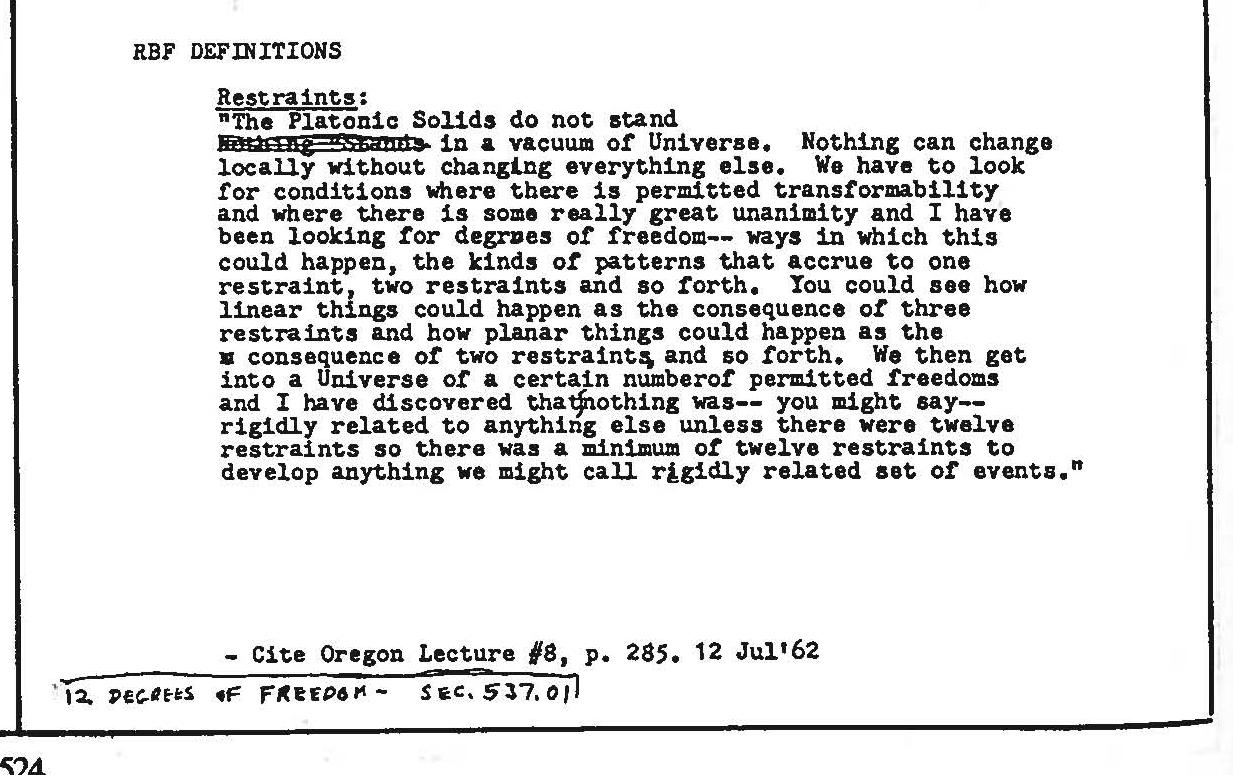
Restraints
← Restraints | Restraint Focus →
Index Entry
Restraints:
"Here are those degrees of freedom that I spoke about and illustrated where we have the single ball able to move to all kinds of patterns, but when there are two restraints they can only move in a plane, when there are three restraints they can only move in a line, and with four restraints it stays fixed, but it can rotate locally."
- Cite OREGON Lecture #6, p. 208,10 Jul'62
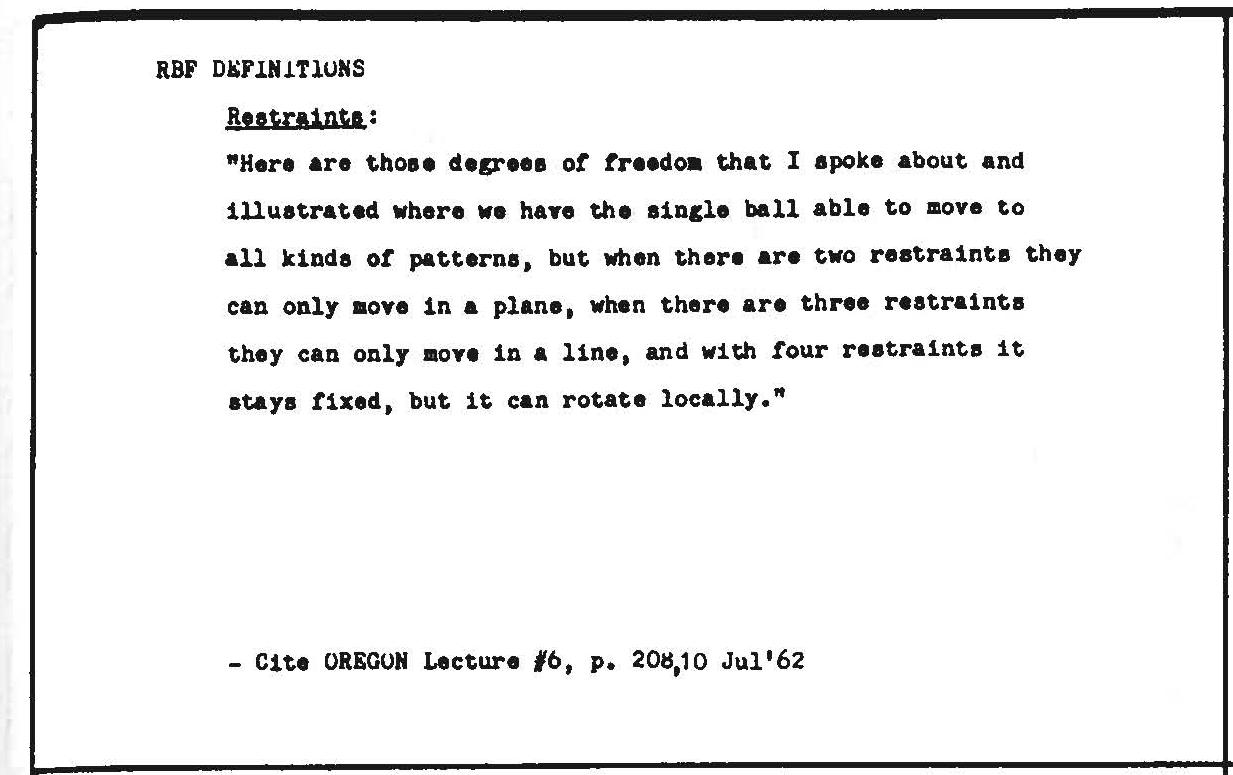
Restraint Focus
← Restraints | Restraints (1) →
Cross Reference
Cross-References
- Aberration, 19 Dec'73
Restraints (1)
← Restraint Focus | Restraints (2) →
Cross Reference
Otherness Restraints
Vectors ≠ Restraints
Cross-References
Restraints (2)
← Restraints (1) | Restructurings →
Cross Reference
Cross-References

Restructurings
← Restraints (2) | Resultant →
Cross Reference
Cross-References
Resultant
← Restructurings | Resultant →
Index Entry
Resultant:
"The resultant was not recognized until it was realized that light had a speed."
- Cite RBF at Penn Bell videotaping session, Philadelphia. PA., 20 Jan'75
Resultant
← Resultant | Resultant as Disturbance Diminishing (1) →
Index Entry
Resultant:
"Now, up to the speed of light measurement, engineers spoke of every action as having a reaction and it was thought by the engineers-- because the public didn't understand-- that every action had a reaction. Little man is so small, and Earth is so big, he doesn't realize that when he steps this way, he's pushing the Earth the other way. But you can feel it in an automobile when it accelerates rapidly, shoving the pebbles in the opposite direction. Now with the speed of light measurements, we discover while the speed of light is very great, say 700 million miles an hour. . . While, That's very fast it is very slow in contrast to no time at all. And the engineers have not updated their thinking since the speed of light. They hadn't realized the speed of light had anything to do with their action and reaction. But because there is now no instantaneity, no simultaneity, there is always some energy lag, and time is involved here. Therefore every action not only has a reaction but it has its resultant, and the resultant and the reaction are not the same. So we now realize that every energy event is characterized not only by a reaction but also by a resultant."
- Cite RBF at SIMS, U.Tass, Amherst 22 July '71, pp 19-20
Resultant as Disturbance Diminishing (1)
Cross Reference
Cross-References

Resultant (1)
← Resultant as Disturbance Diminishing (1) | Resultant (2) →
Cross Reference
Cross-References
- Action
- Action-reaction-resultant
- Interference
- Reaction
- 2 Cobras
- Integrated Vectorial Resultant
- Vectorial Model of Interference
Resultant (2)
← Resultant (1) | Retirement →
Cross Reference
Cross-References
- In, Out & Around, Nov'71

Retirement
← Resultant (2) | Retirement Retiring →
Index Entry
Retirement:
"Retirement was invented by the insurance companies. There are 9,000 Ph.D.'s in physics today and only 2,000 of them have jobs."
Retirement Retiring
← Retirement | Returning Upon Itself: Systems Return Upon Themselves →
Cross Reference
Cross-References
- Squatters, (1)(2)
- Building Industry, (2)

Returning Upon Itself: Systems Return Upon Themselves
← Retirement Retiring | Returning Upon Itself (1) →
Index Entry
Returning Upon Itself: Systems Return Upon Themselves:
"To be able to return upon itself is a characteristic of
all systems. A plane would go on to infinity, so to form
a system you would have to take an angle out."
- Cite RBF at Students International Meditation Seminar,
U. Mass., Amherst, 22 Jul '7l, p. 10
Returning Upon Itself (1)
← Returning Upon Itself: Systems Return Upon Themselves | Returning Upon Itself: Systems Return Upon Themselves (2A) →
Cross Reference
Systems Return Upon Themselves:
Nature Always Comes Back on Itself
Cross-References
- Closed System
- Embracement
- Finite
- Geometrical Integrity
- Patterns of Experience Return Upon Themselves in All Directions
- Wave Returns Upon Itself
Returning Upon Itself: Systems Return Upon Themselves (2A)
← Returning Upon Itself (1) | Returning Upon Itself: Systems Return Upon Themselves (2B) →
Cross Reference
Cross-References
- Closed System, 26 May'72
- Comprehension, Dec'61
- Congruence, 25 Jan'72
- Considerable Set, 1959
- Finite, 13 Nov'69
- Gears, 7 Nov'73
- Geometrical Integrity, 25 May'72
- Infinity & Finity, Jun'66
- Interference, 15 Oct'64
- Motion, 4 Feb'68
- Omnidirectional, 23 Sep'73
- Polygon, Jun'66
- Prime Structural Systems, 11 Jul'62 ; 3 Nov'73
- Radiation: Speed Of, 22 Jun'72
- Simultaneous, 5 Jul'62
- System, (1)(2)
- Thinkability, 1 May'71
- Triangle, 5 Jul'62
Returning Upon Itself: Systems Return Upon Themselves (2B)
← Returning Upon Itself: Systems Return Upon Themselves (2A) | Return to Modelability (1) →
Cross Reference
Cross-References
- Vector, 25 May'72
- Vectors Are Real, 23 May'72
- Vertexes, Faces & Lines, 1 Jan'75
- Plane, 19 Feb'72; 13 Nov'69
- General Systems Theory
Return to Modelability (1)
← Returning Upon Itself: Systems Return Upon Themselves (2B) | Return to Modelability (2) →
Cross Reference
Cross-References
Return to Modelability (2)
← Return to Modelability (1) | Reverify Reynarifiable →
Cross Reference
Cross-References
- Artist, 6 Jul'62
- Powering, (1)(2)
- Synergetics, Dec'72; 30 Dec'73
- Xyz Coordinate System, 1965
Reverify Reynarifiable
← Return to Modelability (2) | Reverse Atomics →
Cross Reference
Reverify: Reverifiable:
Cross-References
- Unknown, 13 May'73

Reverse Atomics
← Reverify Reynarifiable | Reverse Atomics (1) →
Index Entry
Reverse Atomics:
"Maybe we ought to try to capture lightning in electrostatic generators underground: build up charges of lightning and then release it later.
"We might really reverse our atomics: instead of learning how to release atomic energy we could learn how to make the atoms and how to employ the exponential increase of their gravitational energy as their components are allowed to self-assemble themselves."
- Cite tape transcript, DSI Project; RBF to W. Wolf, pp.10-11, 28 Apr'74; as rewritten by RBF at 3200 Idaho, 10 Sep'74
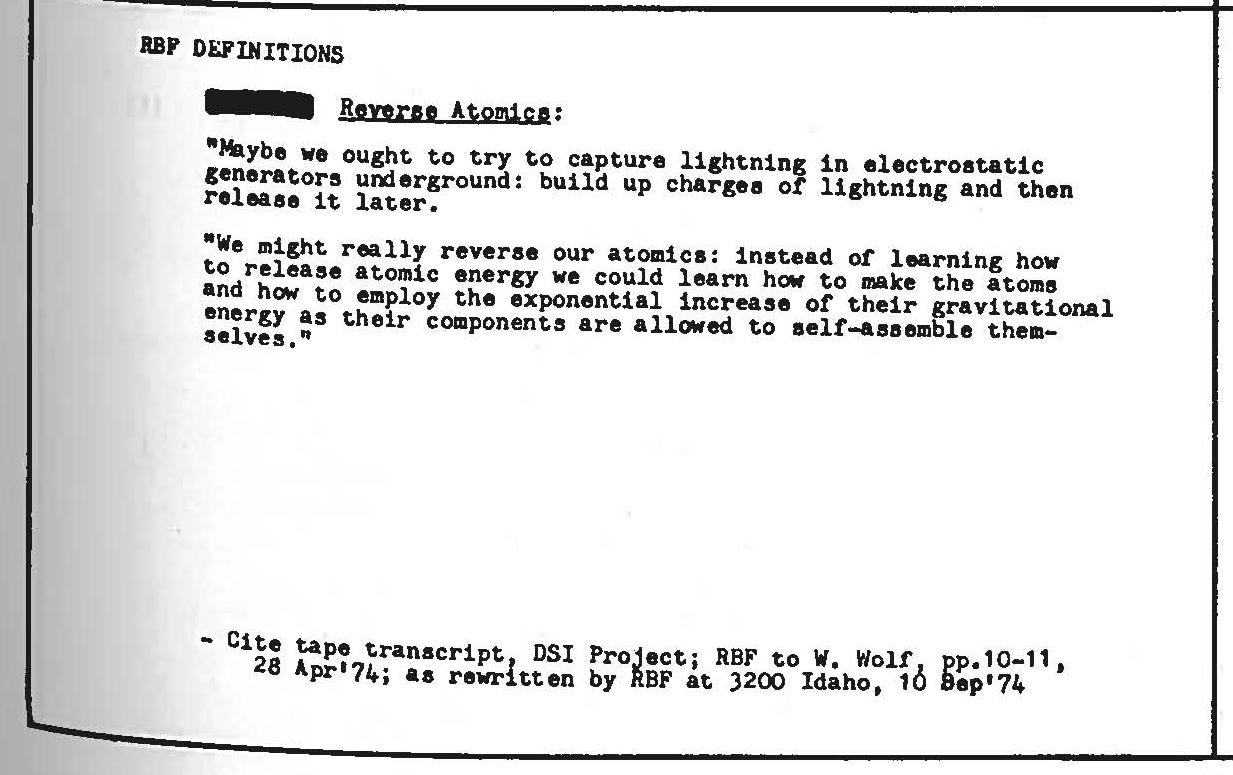
Reverse Atomics (1)
← Reverse Atomics | Reverse Atomica (2) →
Cross Reference
Cross-References
Reverse Atomica (2)
← Reverse Atomics (1) | Reverse Fountain Flow →
Cross Reference
Cross-References
- Lightning & Atoms, 28 Apr'74
Reverse Fountain Flow
← Reverse Atomica (2) | Reverse Optimism →
Cross Reference
Cross-References
- Wind Stress & Houses, (9)
Reverse Optimism
← Reverse Fountain Flow | Reversibility →
Cross Reference
Reverse Optimism:
"Optimism is usually thought of as constituting a mildly unwarranted hopefulness in respect to the future. But there is a reverse projection of optimism in the nostalgia-generated myths that recall only the rare and sublime moments of yesterday. Forgetting the negative, reverse optimism overemphasizes, thus deliberately shuts its eyes to reality, and is therefore unable to see the values immediately present.
"I am convinced that we are swiftly emerging from the abysmal conformities of yesterday's illiterate, spit-punctuated profanity and monosyllabic verbalism, in which rags, filth, diseased bodies, prevalent stenches, devastating superstition, and local bias reigned supreme."
- Cite THE PROSPECT FOR HUMANITY, WDSB Doc. 3, p.74, Aug'64
Cross-References
- Conformity, 10 Oct'63
Reversibility
← Reverse Optimism | Reversibility →
Index Entry
Reversibility:
". . . The syntropic vector equilibrium's reversibility-- inwardly-outwardly-- is the basis for the gravitationally maintained integrity of Universe."
-
Citation at Star Tetrahedron, 8 Oct'71
-
Cite SYNERGETICS draft "Antitetrahedron," 8 Oct. '71, p. 8.
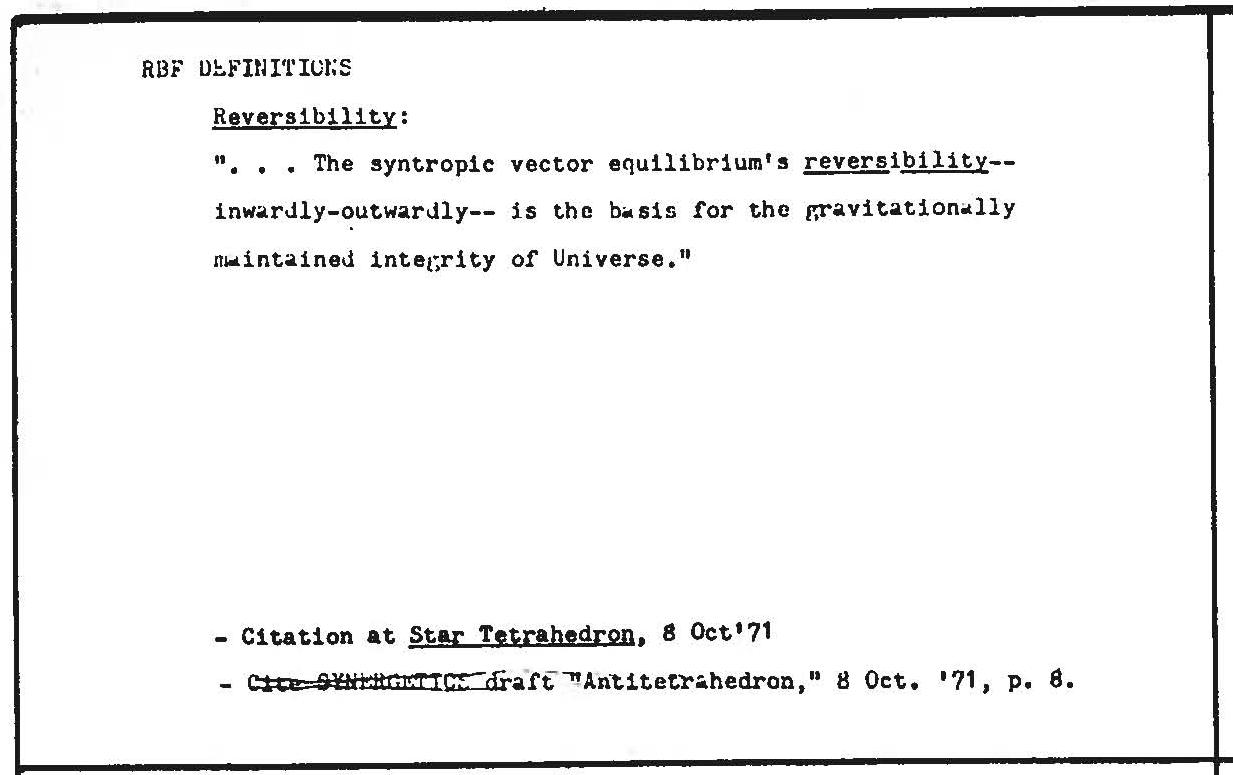
Reversibility
← Reversibility | Reversibility (1) →
Index Entry
Reversibility:
"Each vector is reversible having its negative alternate."
-
Cite SYNERGETICS Corollaries, \hrefhttps://www.buckyverse.org/en/synergetics/content/chapters/200-synergetics#section-240.00240. 1970
-
Citation & context at Vector, Oct'59
Reversibility (1)
← Reversibility | Reversibility Reverse (2) →
Cross Reference
Darwin: Evolution May Be Going the Other Way
See Inward & Outwardness
Opposition
Future: Man Back Into His Future
Cross-References
- Inward \& Outwardness
- Irreversibility
- Obverse & Reverse
- Moving Picture Run Backwards
- Negative
- Mirror Reversal
- Enantiodromia
Reversibility Reverse (2)
← Reversibility (1) | Review →
Cross Reference
Implosion- explosion, Jun'66
Cross-References
- Energy, 16 Sep'67
- Star Tetrahedron, 8 Oct'71*
- Vector, Oct'59*
- Vector Equilibrium, 8 Oct'71
- ahedron as Conservation & Annihilation Model, Oct
- Error, 30 May'75
Review
← Reversibility Reverse (2) | Revolution →
Cross Reference
Review:
Cross-References

Revolution
← Review | Revolution: Design Science Revolution vs. Global Political Revolution →
Index Entry
Revolution:
"The revolution is not being effected by pulling the top down. It is being effected by pulling the bottom up. It is being effected by doing more with ever less in such a manner as to take care of all without taking away the functional capabilities and fundamental advantages of any. The surprise--constantly doing vastly more with ever fewer physical resources per function--is our legacy from the millenia-long armaments struggle to do more with less in a world where a pea-size transistor now does more than an army of yesterday and a fistful of atomic fuel takes a large ship around the Earth."
- Cite THE PROSPECT FOR HUMANITY, WDSD Doc. 3, p. 65, Aug'64
Revolution: Design Science Revolution vs. Global Political Revolution
← Revolution | Revolution: Hard Revolution + Soft Revolution (1) →
Cross Reference
Cross-References
Revolution: Hard Revolution + Soft Revolution (1)
← Revolution: Design Science Revolution vs. Global Political Revolution | Revolution (2) →
Index Entry
Revolution: Hard Revolution + Soft Revolution:
"The exponentially accelerating rate
of a new world order realization
is irreversibly emergent
through chain reaction emergencies
transpiring as a primarily invisible
soft revolution
As omni humanity's critical thoughts
breaking out as news events,
with the break-outs too swiftly shifting
their geography
and too frequently multiplying and altering
their run-off routes
to develop any local power cloutures
and consequent burst-out bores
of sufficient local magnitude
to detonate full scale hard world revolution,
yet so far out-performing hard revolutions
in omni egalitarian social advancement--
by elevating the bottom
instead of depressing the top--
Thereby arriving at a world's socio-economic ocean
which levels spherically
to contain any magnitude of local energy outbursts
as storms or volcanoes
Revolution (2)
← Revolution: Hard Revolution + Soft Revolution (1) | Revolution By Inadvertence →
Index Entry
Revolution: Soft Revolution + Hard Revolution:
"whose violence is swiftly dissipated
by circumferential hydraulic wave displacements.
The brimming ocean wave of commonwealth
is bound radially by gravity
in spherical mantle unity.
Thereafter, the ocean will pulse
only in world tidal integrity
as an omniliterate, closed sphere system democracy
consciously, spontaneously, instantly
rearticulating its responses
to world around electro-telepathetic info-waves.
- Cite EVOLUTIONARY 1972-1975 ABOARD SPACE VEHICLE EARTH, Jan. '72.
Revolution By Inadvertence
← Revolution (2) | Revolution by Inadvertence (1) →
Index Entry
Revolution By Inadvertence:
"Each nation has been looking out for itself and each man within the nations has been looking out for himself and his family! Therefore the surprising and continual increase in the proportion of world humanity being served at ever higher industrial standards . . . cannot be attributed in any way to any consciously organized effort of humanity to make the resources go further. It is in no way attributable to charitable gifts.
"Forced to look elsewhere for an explanation, we find that the increase in the world's numbers who are prospering has been brought about entirely by indirection and inadvertence as the consequence of man's earlier heavy and prime subsidy of weapons race evolution."
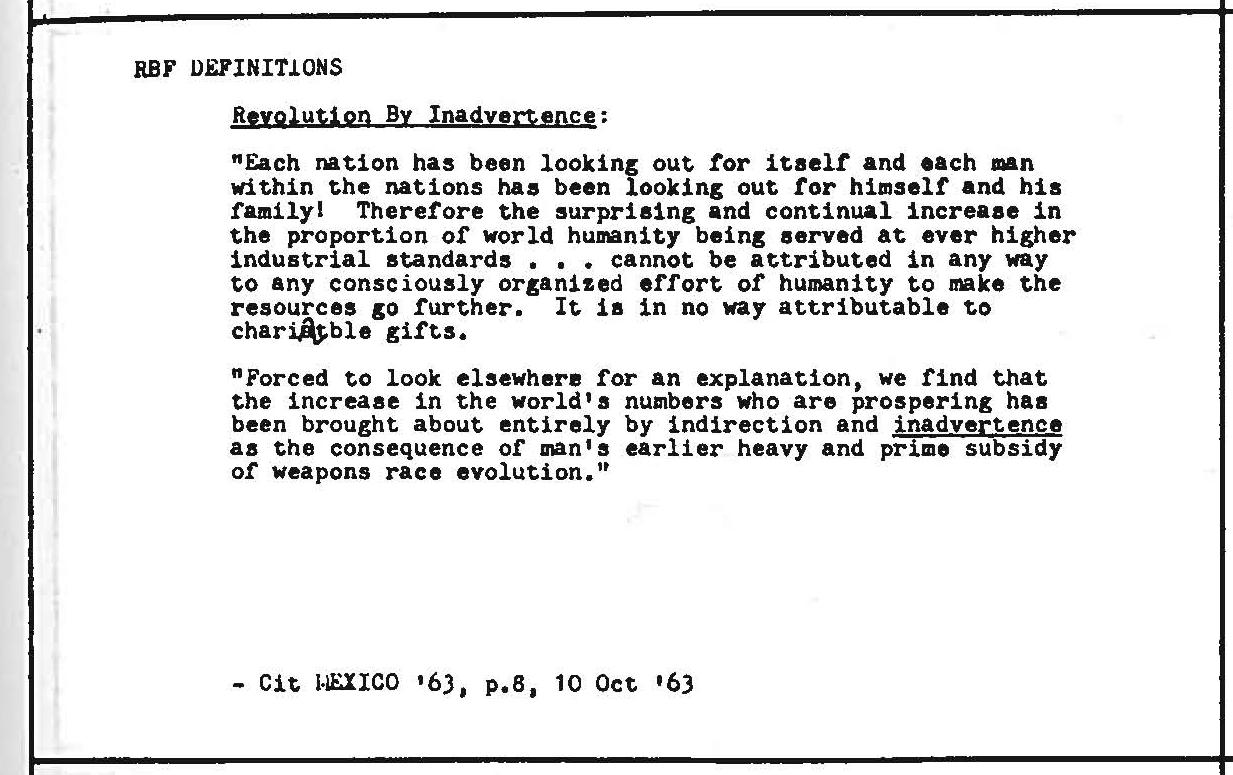
Revolution by Inadvertence (1)
← Revolution By Inadvertence | Revolution by Inadvertence (2) →
Cross Reference
Cross-References
Revolution by Inadvertence (2)
← Revolution by Inadvertence (1) | Revolution (1) →
Cross Reference
Cross-References
- Economic Accounting System: Human Life-hour Production, (2)
- Geosocial Revolution, (1)
- Ignorance, (1)(2)
Revolution (1)
← Revolution by Inadvertence (2) | Revolution (2) →
Cross Reference
Geosecical Revolution
Cross-References
Revolution (2)
← Revolution (1) | Rewarding →
Cross Reference
Cross-References
- Birth, 22 Dec'74 (2)
- News & Evolution, (3)

Rewarding
Cross Reference
Cross-References
Re-wow
← Rewarding | Rhombic Dodecahedron →
Cross Reference
Cross-References

Rhombic Dodecahedron
← Re-wow | Rhombic Dodecahedron →
Index Entry
Rhombic Dodecahedron:
"The total space is 24--with the vector equilibrium's Eighth Octahedra extraverted to form the rhombic dodecahedron.
"For every space there is always an alternate space: this is where we get the 48-nesss of the rhombic dodecahedron as the domain of a sphere.
2½ x 8 = 20
6 x 8 = 48
(Incorporated in SYNERGETICS 2 draft at Sec. \hrefhttps://www.buckyverse.org/en/synergetics/content/chapters/1000-omnitopology#section-1033.1841033.184)
- Cite RBF to EJA, 3200 Idaho, Wash. DC: 12 May'77
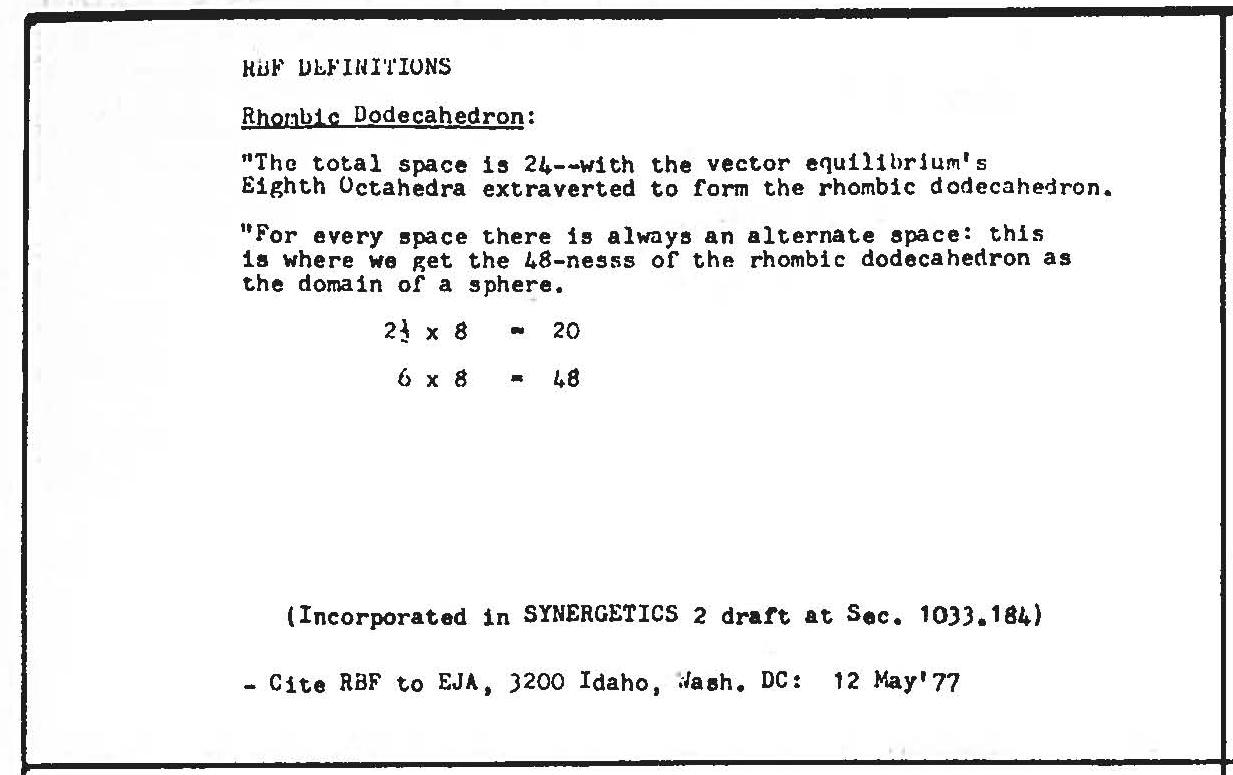
Rhombic Dodecahedron
← Rhombic Dodecahedron | Rhombic Dodecahedron →
Index Entry
Rhombic Dodecahedron:
"The rhombic dodecahedron is the domain of omni-closest-packed spheres; the middle of its diamond face is the control point for the sphere's radius, the unity vector."
Cite Citation & context at Triacontrahedron as Limit Regular Polyhedron, 13 Apr'77
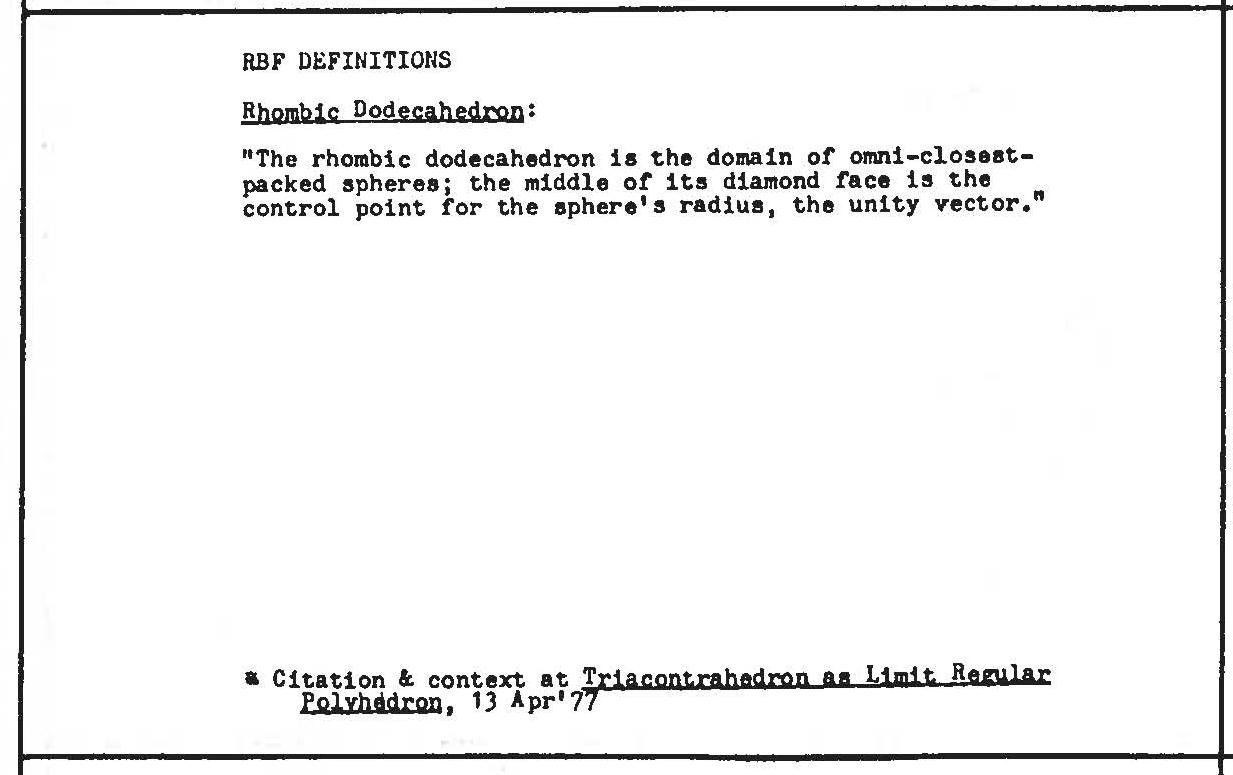
Rhombic Dodecahedron
← Rhombic Dodecahedron | Rhombic Dodecahedron →
Index Entry
Rhombic Dodecahedron:
"The rhombic dodecahedron, like the cube, fills allspace. It has a volume of six. It is the epitome of the behavior of closest packing. The rhombic dodecahedron is the domain of a sphere = spheric."
- Citation & context at Vectorial & Vertexial Geometry, (20, 27 Jan'75
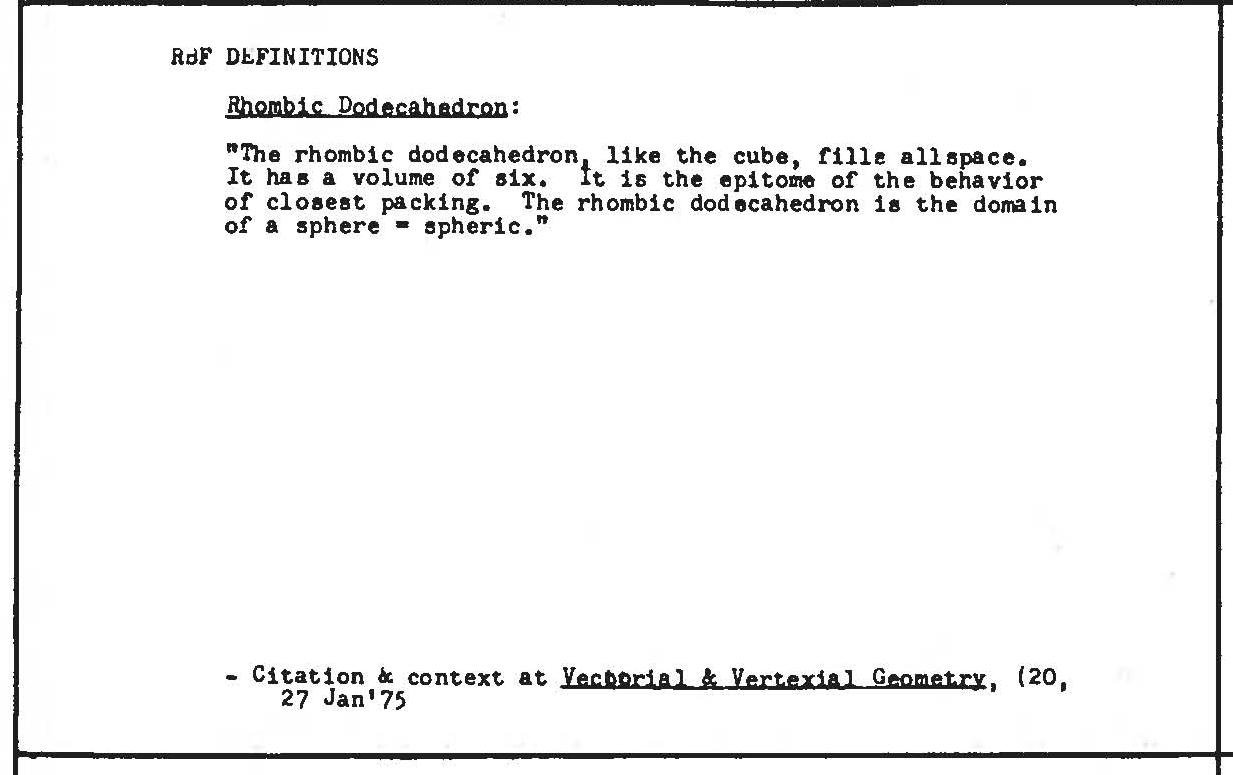
Rhombic Dodecahedron
← Rhombic Dodecahedron | Rhombic Dodecahedron →
Index Entry
Rhombic Dodecahedron:
"The rhombic dodecahedron contains the most volume with the least surface of all the allspace-filling geometrical forms, ergo, rhombic dodecahedra are the most economical allspace subdivider of Universe. The rhombic dodecahedra fill subsymmetrically subdivide allspace most economically, while simultaneously, symmetrically, and exactly defining the respective domains of each sphere as well as the spaces between the spheres, the respective shares of the inter-closest-packed-sphere interstitial spacem."
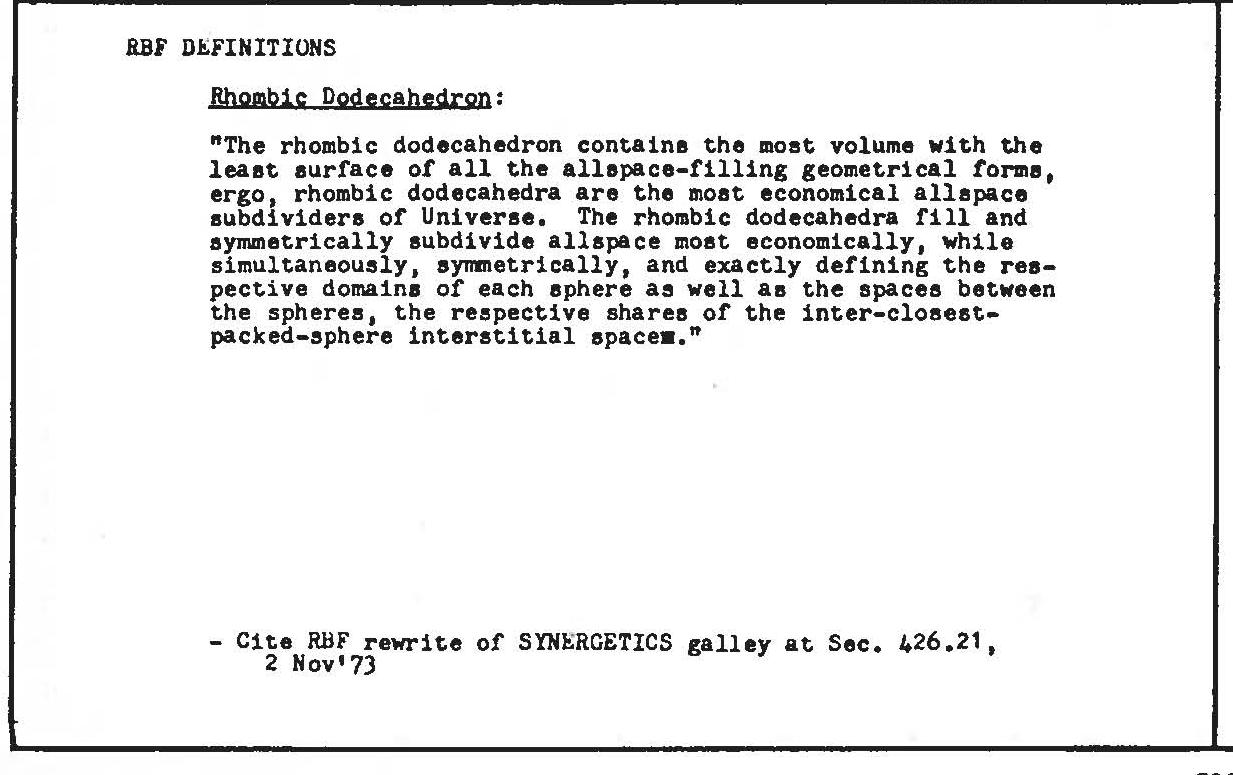
Rhombic Dodecahedron
← Rhombic Dodecahedron | Rhombic Dodecahedron →
Index Entry
Rhombic Dodecahedron:
"The rhombic dodecahedron is the most faceted, identical faceted (diamond) polyhedron and accounts, congruently and symmetrically, for all the isotropic-vector-matrix vertexes in closest packed spheres and their 'tween' spaces. Each rhombic dodecahedron's diamond face is at the long-axis center of each coupler (Vol. = 1) asymmetrical octahedron, with each of the rhombic dodecahedra sharing it 12 omni-adjacent spherics..."
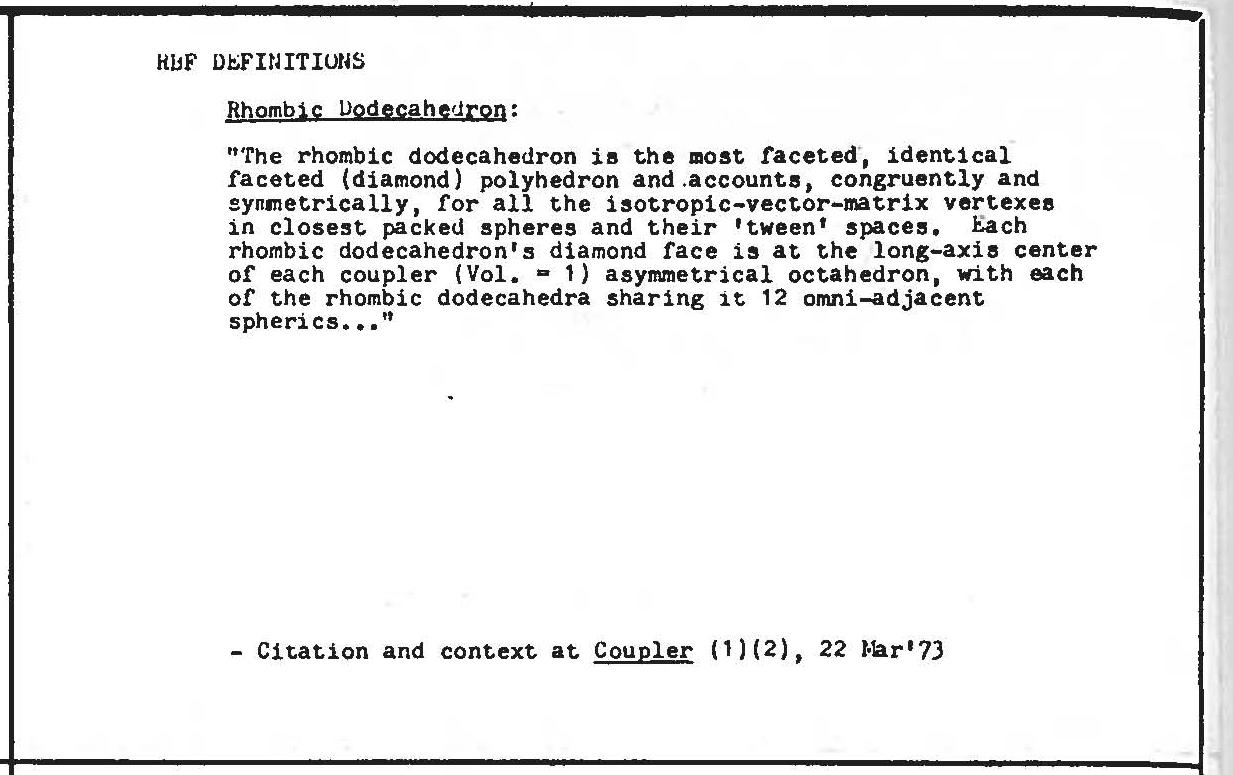
Rhombic Dodecahedron
← Rhombic Dodecahedron | Rhombic Dodecahedron →
Index Entry
Rhombic Dodecahedron:
"The fact that the rhombic dodecahedron can have its 144 modules oriented as either introvert-extrovert, or as three-way circumferential, provides its valvability between broadcasting-transceiving and noninterference relaying. The first radio tuning crystal must have been a rhombic dodecahedron."
Cite SYNERGETICS draft at \hrefhttps://www.buckyverse.org/en/synergetics/content/chapters/400-system#section-426.00426 at, 30 Nov'72
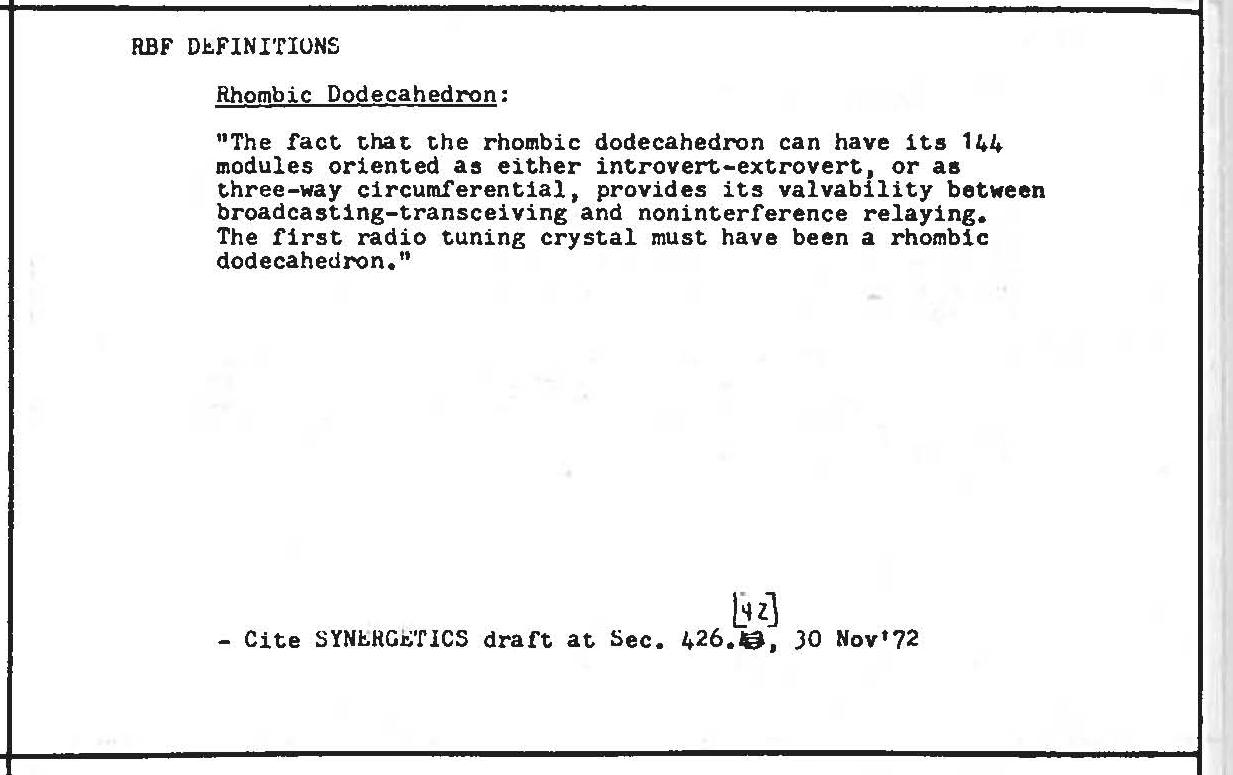
Rhombic Dodecahedron
← Rhombic Dodecahedron | Rhombic Dodecahedron →
Index Entry
Rhombic Dodecahedron:
"The rhombic dodecahedron symmetrically fill allspace in symmetric consort with the isotropic vector matrix. Each rhombic dodecahedron defines exactly the unique and omnisimilar domain of every radiantly alternate vertex of the isotropic vector matrix as well as the unique and omnisimilar domains of each and every interior-exterior vertex of any aggregate of closest packed, uniradius spheres whose respective centers will always be congruent with every radiantly alternate vertex of the isotropic vector matrix, with the corresponding set of alternate vertexes always occurring at all the intertangency points of the closest packed spheres."
= Cite SYNERGETICS draft at Sec. \hrefhttps://www.buckyverse.org/en/synergetics/content/chapters/400-system#section-426.24426.24, 30 Nov'72
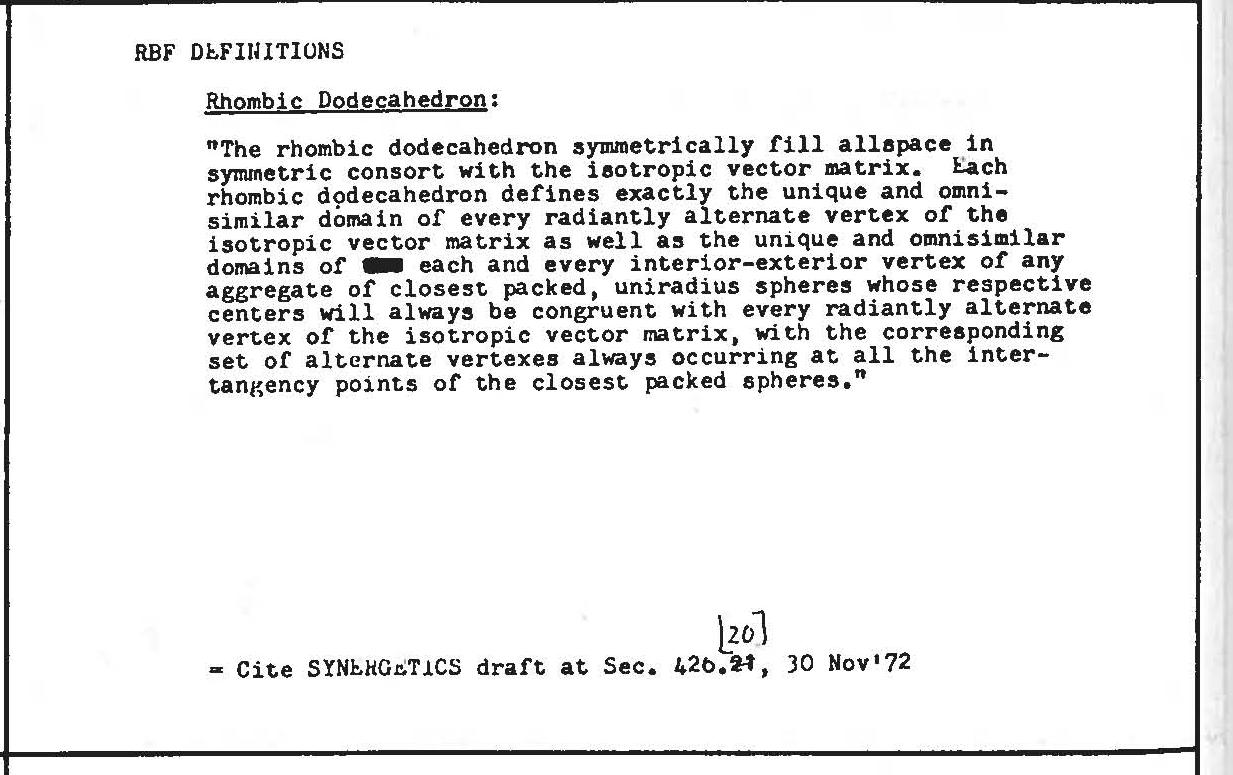
Rhombic Dodecahedron
← Rhombic Dodecahedron | Rhombic Dodecahedron →
Index Entry
Rhombic Dodecahedron:
"The rhombic dodecahedron six is entirely outside, but twelvefoldedly tangential to, the initial sphere..."
Rhombic Dodecahedron
← Rhombic Dodecahedron | Rhombic Dodecahedron →
Index Entry
Rhombic Dodecahedron:
"The rhombic dodecahedron can be put together with NITE's and so it is all-space filling.
"The symmetrical arrays of the rhombic dodecahedron may explain the chemical compoundings of periodic atomics."
- Cite RBF to EJA, 3200 Idaho, DC, 25 Feb '72
Rhombic Dodecahedron
← Rhombic Dodecahedron | Rhombic Dodecahedron →
Index Entry
Rhombic Dodecahedron:
"Nature always starts over again with the isotropic vector matrix. Energy is not lost; just not available.
"At the heart of the vector equilibrium is the ball in the center of the rhombic dodecahedron at the core-- the one sphere all by itself. You put 12 rhombic dodecahedra around one central rhombic dodecahedron and you get the vector equilibrium.
"This is why synergetics can investigate nuclear symmetries: it all comes out absolutely discretely. And it does have both the A and B Quanta Modules in it. Look at the picture [MARKS, p. 167, Pl. L.8.] which shows the one-half of the Rhombic dodecahedron. Of all the polyhedra nothing really falls into a group so easily as the rhombic dodecahedron, the most common polyhedron in nature."
- Cite RBF to EJA, 3200 Idaho, Wash., DC, 24 Feb. '72
Rhombic Dodecahedron
← Rhombic Dodecahedron | Rhombic Dodecahedron →
RBF Definitions
The rhombic dodecahedron is fundamentally associative." - Cite RBF to EJA, 3200 Idaho, Washington DC, 24 Jan '72
Rhombic Dodecahedron
← Rhombic Dodecahedron | Rhombic Dodecahedron →
Index Entry
Rhombic Dodecahedron:
"Sixth powering is all the perpendiculars to the rhombic dodecahedron which is all the internal truncations of the tetrahedron."
-
Cite RBF to EJA, Bear Island, 25 August 1971.
-
Citation at Powering: Sixth Powering, 25 Aug'71
Rhombic Dodecahedron
← Rhombic Dodecahedron | Rhombic-Dodecahedron →
Index Entry
"I employ . . . the icosahedron and the rhombic dodecahedron in almost all the geometrical forms where one or another provides unique economic advantage. I use the rhombic dodecahedron as the hub of my octahedron-tetrahedron truss--the octet truss. Its twelve facets represent the planes perpendicular to the six fundamental degrees of freedom."
Rhombic-Dodecahedron
← Rhombic Dodecahedron | Rhombic Dodecahedron #1: United Sphere →
Index Entry
Rhombic-Dodecahedron:
"The rhombic-Dodecahedron" has a volume of "six." The rhombic-Dodecahedron is an all space filler like the cube. . . . This is one of the most common naturally occuring crystals.
-
Cite Oregon # , p.224, 11Jul'62
-
Cite Carbondale Draft Nature's Coordination, p. VI.20
Rhombic Dodecahedron #1: United Sphere
← Rhombic-Dodecahedron | Rhombic Dodecahedron ¥2: Fractionated Sphere →
Index Entry
Rhombic Dodecahedron #1: United Sphere:
"In the rhombic dodecahedron #1 there is one sphere integrated at the center. The A and B Quanta Modules as viewed at the peak from above are arrayed around a united sphere. It represents the proton model."
- Cite RBF to EJA, 3200 Idaho, Wash. DC, 24 Feb '72 + 22 Feb holograph.
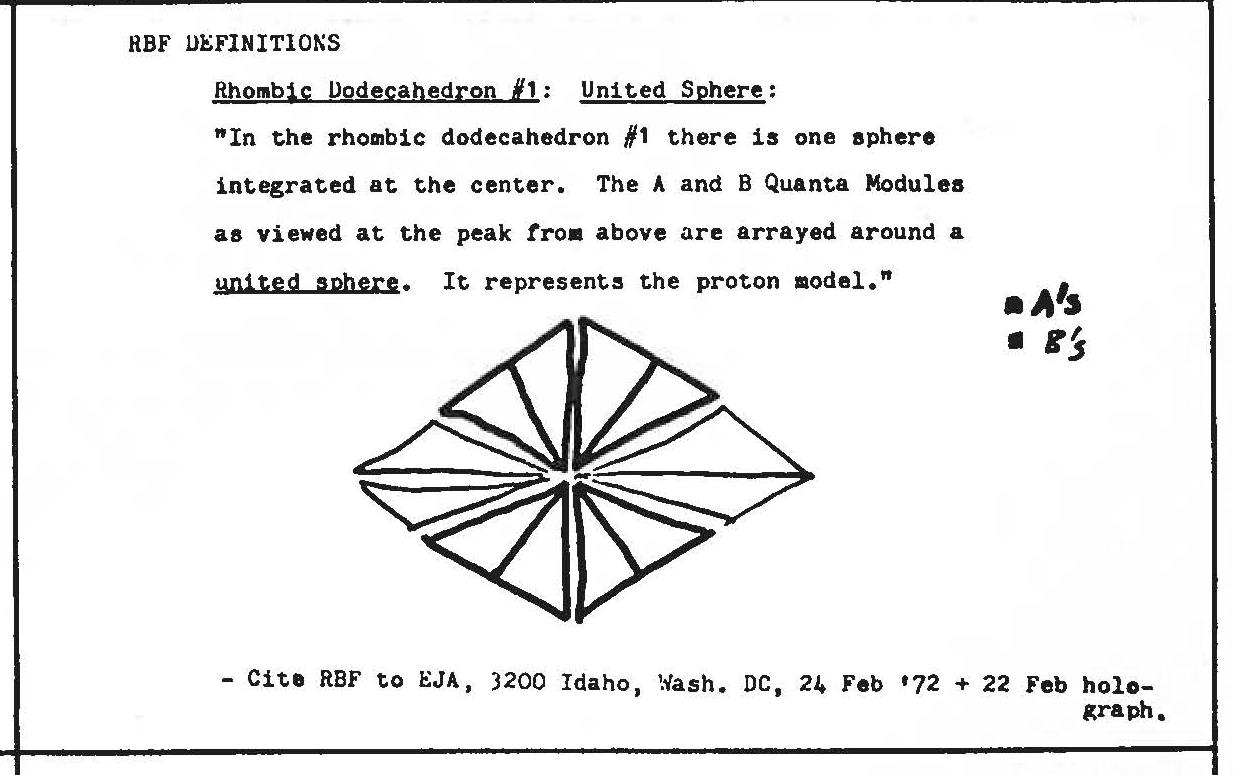
Rhombic Dodecahedron ¥2: Fractionated Sphere
← Rhombic Dodecahedron #1: United Sphere | Rhombic Dodecahedron (1) →
Index Entry
"In the rhombic dodecahedron ¥2 there are a large variety of asymmetrical interior aggregations. There is one sphere disintegrated into six symmetrically deployed parts. The A and B Quanta Modules as viewed at the peak from above are arrayed around a fractionated sphere. It represents the neutron model."
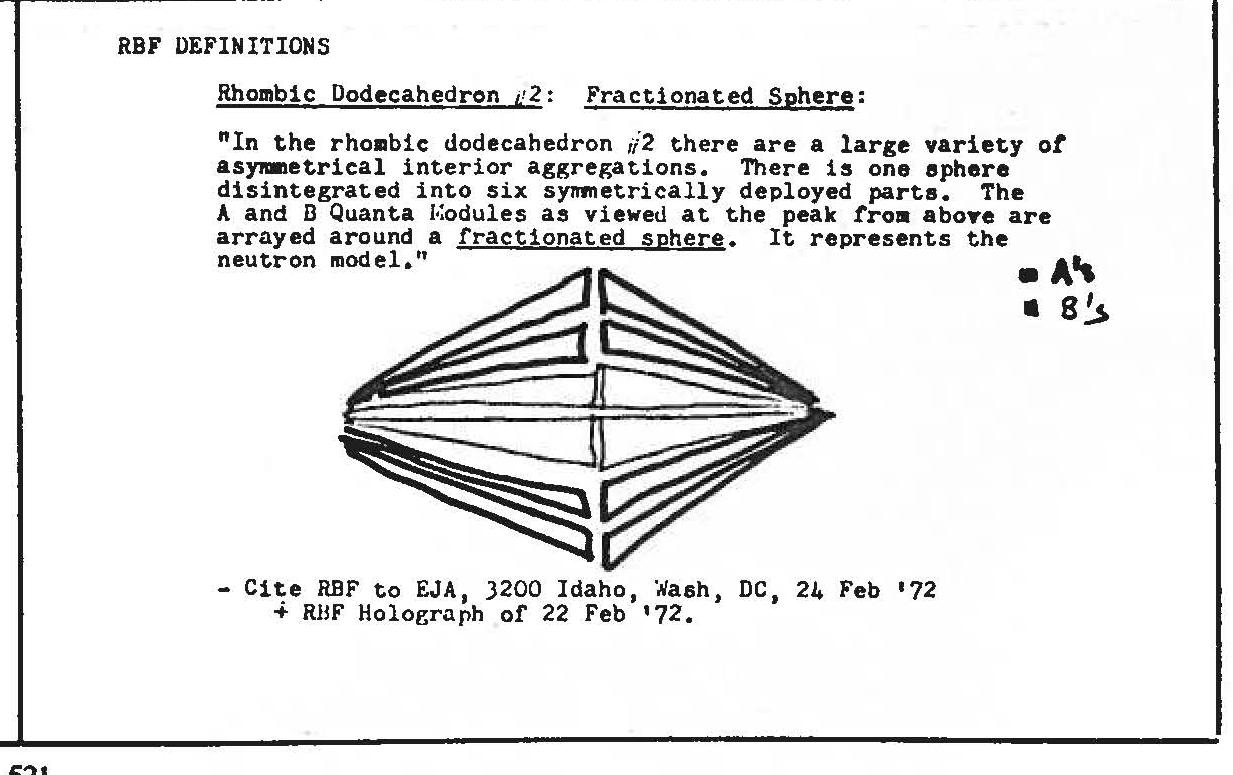
Rhombic Dodecahedron (1)
← Rhombic Dodecahedron ¥2: Fractionated Sphere | Rhombic Dodecahedron (2) →
Cross Reference
Minimum Limit Case: Hexagon & Rhombic Dodecahedron
Cross-References
Rhombic Dodecahedron (2)
← Rhombic Dodecahedron (1) | Rhombic (1) →
Cross Reference
Mite: Positive & Negative Functions, (1)(2)
Cross-References
- A & B quanta Modules, 10 Jul'62
- Constant Relative Abundance, 29 Nov'72*
- Coupler, 5 Apr'73; 20 Dec'73 (1)(2)
- Isotropic Vector Matrix, Feb'72
- et Truss, Oct
- Powering: Sixth Dimension, 9 Nov'73
- Powering: Sixth Powering, 25 Aug'71*
- Vectorial & Vertexial Geometry, (2)
- Domains of Interferences, 7 Nov'73
- Domain of a Point, 7 Nov'73
- Stable & Unstable Structures, 7 Jun'72
- Vector Equilibrium Involvement Domain, 11 Dec'75
- Quantum Mechanics: Minimum Geometrical Fourness, 31 Aug'76 (2)
- Triclinic, 31 Aug'76
- Triacontrahedron as Limit Regular Polyhedron, 13 Apr'77*
- Quanta Loss by Congruence, (2)
- Triacontrahedron, 13 May'77
- Vector Equilibrium: Potential & Primitive Tetravolumes, 12 May'77
Rhombic (1)
← Rhombic Dodecahedron (2) | Rhombic (2) →
Cross Reference
Rhombic:
Cross-References
- Antirhombic

Rhombic (2)
Cross Reference
Cross-References
Rhythm (1)
Cross Reference
Cross-References

Rhythm (2)
Cross Reference
Cross-References
- Montessori System, 1928
- Pole Vaulter, 2 Jul'75
- Ghana Dome: Self-chilling Machine, (1)
Ribbon
← Rhythm (2) | Rich Man Drowning in Shipwreck →
Cross Reference
Cross-References
- Pattern Strip
- Wrapability
- Tetrascroll
Rich Man Drowning in Shipwreck
← Ribbon | Richter Transformation →
Cross Reference
Rich Man Drowning in Shipwreck:
Cross-References
Richter Transformation
← Rich Man Drowning in Shipwreck | Richter Don →
Cross Reference
Cross-References
Richter Don
← Richter Transformation | Riemann, G.F.R →
Cross Reference
Cross-References
- Curvature: Compound, Aug'72
- Triacon, 22 Jun'72
Riemann, G.F.R
← Richter Don | Riemann, George Friedrich Bernhard →
Index Entry
Robt. W. Mors, p. 44 : 1960
Synergetics : Sec. \hrefhttps://www.buckyverse.org/en/synergetics/content/chapters/500-conceptuality#section-522.22522.22

Riemann, George Friedrich Bernhard
Cross Reference
(1826-1866)
Cross-References
- Spherical Triangle Sequence
- Geodesics, (1)(2)
Right
← Riemann, George Friedrich Bernhard | Right Angle →
Index Entry
"Now, what we call thinkable is always outside-out. What we call space is just exactly as real, but it is inside-out. There is no such thing as right and left!"
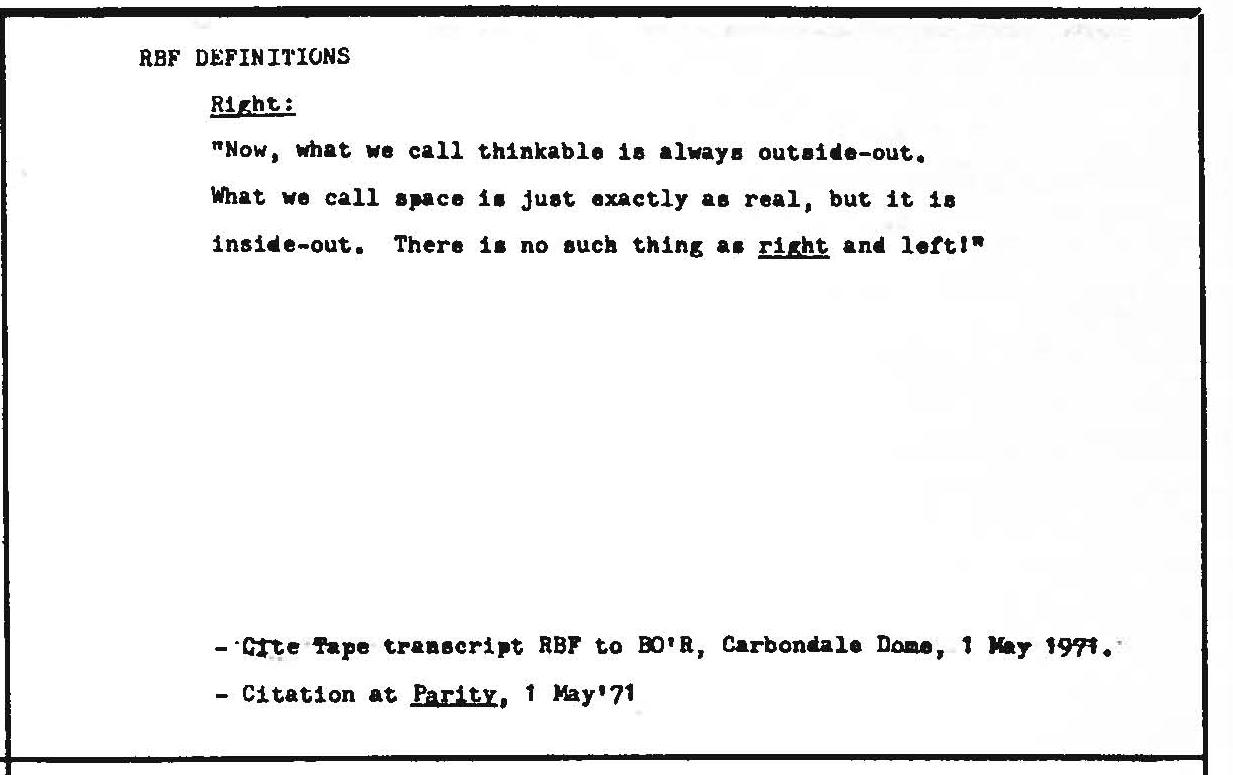
Right Angle
Index Entry
Right Angle:
"The Greeks knew a right angle, but they never called it 90 degrees."
- RBF on telephone to EJA from Philadelphia, 25 Nov'73
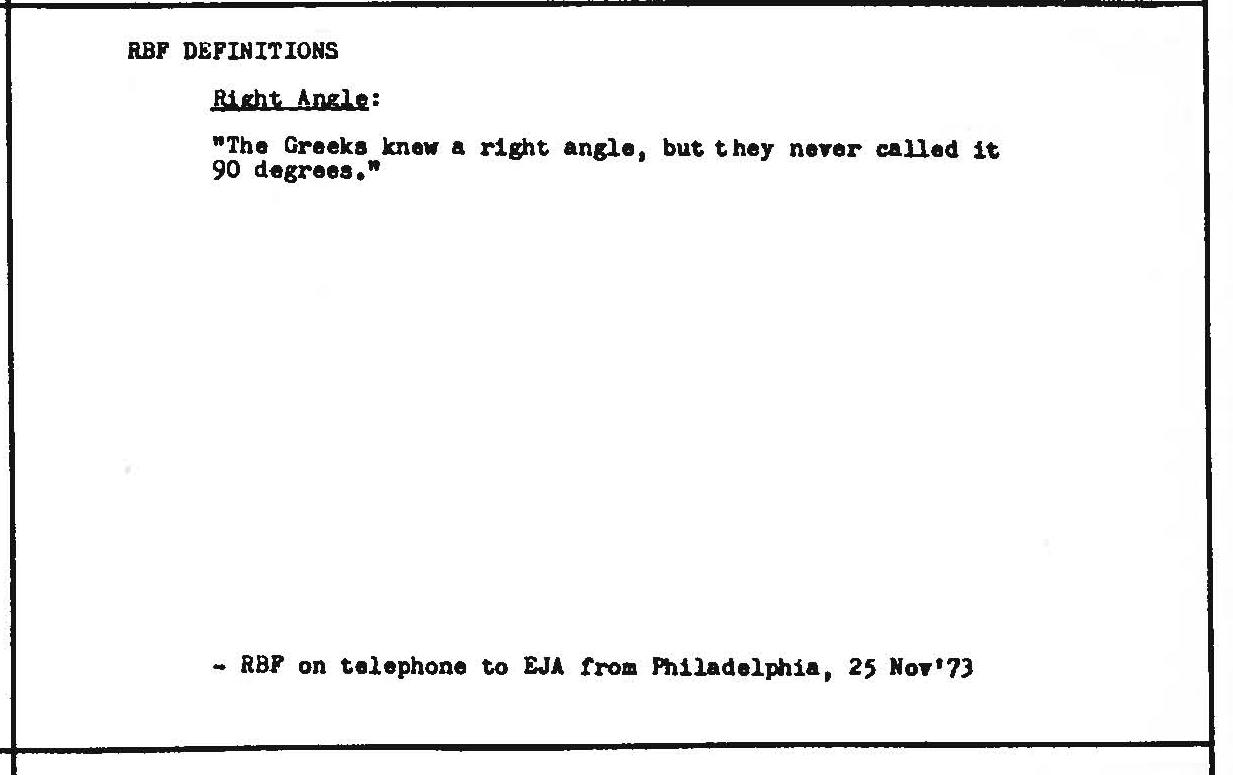
Right Angle (1)
← Right Angle | Right Angle (2) →
Cross Reference
Cross-References
Right Angle (2)
← Right Angle (1) | Right to Live Proving Your Right to Live (1) →
Cross Reference
Model of Toothpicks & Semi-dried Peas. (1)
Cross-References
- Tidal, 15 Oct'64
Right to Live Proving Your Right to Live (1)
← Right Angle (2) | Right to Live: Proving your Right to Live (2) →
Cross Reference
Cross-References

Right to Live: Proving your Right to Live (2)
← Right to Live Proving Your Right to Live (1) | 'Right Makes Might' Dominance →
Cross Reference
Cross-References

'Right Makes Might' Dominance
← Right to Live: Proving your Right to Live (2) | Right-over-Might (1) →
Index Entry
'Right Makes Might' Dominance:
"Great historical leaders have always hoped that we may be trending from 'might makes right' to 'right makes might' dominance, which means from a rooted, programed creature, a 'specialist'-- just going after its own honey and stinging others who interfere with its program-- to an ecologically cognizant, spontaneously synergetic, omni-integration of cosmic functioning...."
- Citation and context at Ecology Sequence (G), 5 Jun'73
Right-over-Might (1)
← 'Right Makes Might' Dominance | Right-over-Might (2) →
Cross Reference
Metabiblical Cord
Mind-over-Muscle
Cross-References
- Individual Rights
- Lincoln
- Might Makes Right
- Mind-over-Matter
- Metaphysical Transcendent of the Physical
Right-over-Might (2)
← Right-over-Might (1) | Right →
Cross Reference
Cross-References
- Continuous Man, (5)
- Design Revolution, 6 Mar'74
- Ephemeralization, 1938
- Rationalization Sequence, (2)(3)
- Society: Control Of, 1938
- Superstition of Social Superiority, 1946

Right
← Right-over-Might (2) | Rigid →
Cross Reference
Cross-References

Rigid
Index Entry
Rigid:
'Rigid means 'sized'-- arbitrarily sized. 'Rigid' is always special case.'
- Citation and context at Scheme of Reference, 24 Sep'73

Rigidity
RBF Comments
RBF DEFINITIONS
Rigidity:
D. Bohm, Foundations of Physics, Vol. 1, No.4, 1971, p.369:
"The new order and measure introduced in relativity theory implies new notions of structure, in which the idea of a rigid body can no longer play a key role."
RBF Comment:
"Generalization of tetrahedra utterly independent of rigidity."
- Cite RBF marginalis at QUANTUM THEORY AS INDICATION OF NEW ORDER IN PHYSICS, p.369, done Aug'73
Rigidity
← Rigidity | Rigidity vs. Resilience →
Index Entry
Rigidity:
"This /thirty strut tensegrity dome_/is made out of steel turnbuckles and could be tightened into a very tight structure. As you tighten it up it simply means that the frequencies increase, it gets higher and higher pitched, and finally gets to a point where you don't seem to have any audible tone at all and you call it rigid. In other words then, what we call the rigid structures are not because they are redundant in nature, the atoms, but because they are at a non-aurally tunable frequency."
- Cite OREGON Lecture #5 - p. 181, 9 Jul'62
Rigidity vs. Resilience
Index Entry
Rigidity vs. Resilience:
"Rigid structural systems consist of whole or truncated interior tetrahedra. If the truncated tetrahedra are shoal enough and if the frequency of the system is high enough, the surface's structural triangles' edge legs may permit resilient bending which will allow an exterior vertex to dimple inwardly of the structural system."
- Cite SYNERGETICS, 2nd. Ed. at Sec. \hrefhttps://www.buckyverse.org/en/synergetics/content/chapters/1000-omnitopology#section-1071.241071.24, 20 Dec'74
Rigid-Sized
← Rigidity vs. Resilience | Rigid Rigidity (1) →
Cross Reference
Cross-References
- Scame of Reference, 24 Sep'73
Rigid Rigidity (1)
← Rigid-Sized | Rigid Rigidity (2) →
Cross Reference
Inflexibility
Rigid = Sized
Cross-References
Rigid Rigidity (2)
← Rigid Rigidity (1) | Ring (2) →
Cross Reference
Cross-References
- Chemical Bonds, May'72
- Rectilinear Frame, 24 Sep'73
- Scheme of Reference, 24 Sep'73*
- Triangle, 8 Oct'64
- Prime Nuclear Structural Systems, 27 Dec'74
- Chemical Bonds: Triple Bond, 19 Dec'73
- Light on Scratched Metal, 9 Nov'73
Ring (2)
Index Entry
Rings are lines . . . which are all inherently curved and must eventually meet or rejoin their ends.
- Citation, context, and sketch at Two , 10 Jan'50
Ring
← Ring (2) | River: You Might as Well Jump in the River →
Cross Reference
Ring:
Two, (2)*
Cross-References
- Moebius Strip, 10 Jan'50

River: You Might as Well Jump in the River
Index Entry
River: You Might as Well Jump in the River:
"... People who like to be prosaic and like to make man feel so small can say everything is just going to turn out to be inanimate chemistry and you are all the consequence of probabilities and you might as well jump in the river."
- Citation and context at 'Threshold of Life, 6 Jul'62

River (1)
← River: You Might as Well Jump in the River | River (2) →
Cross Reference
Cross-References
- Boats at Anchor Retard the River's Flow Bridge River: You Might as Well Jump in the River

River (2)
← River (1) | Roads Turn at Right Angles →
Cross Reference
Cross-References

Roads Turn at Right Angles
← River (2) | Roads Roadway Systems (1) →
Cross Reference
Roads Turn at Right Angles:
Cross-References
- Local Squareness, 9 Jul'62
Roads Roadway Systems (1)
← Roads Turn at Right Angles | Roads: Roadway Systems (2) →
Cross Reference
Cross-References
Roads: Roadway Systems (2)
← Roads Roadway Systems (1) | Robertson, Donald, W →
Cross Reference
Cross-References
Robertson, Donald, W
← Roads: Roadway Systems (2) | Robin Hood Sequence (1) →
Cross Reference
Cross-References
- Invention Sequence, (A)-(D)
Robin Hood Sequence (1)
← Robertson, Donald, W | Robin Hood Sequence (2) →
Index Entry
"The chronofile persuaded me ten years after its inception to start my life as nearly new as is humanly possible to do. It persuaded me to dedicate my life to others instead of myself. Not on an altruistic basis but because the chronofile for the first 32 years of my life clearly demonstrated that I was positively effective in producing wealth only when I was dedicated to others. Further chronofile observations then showed me that the larger the number for whom I worked the more positively effective I became.
"Thus it became obvious through the chronofile that if I worked for all of humanity I would be optimally effective. Setting out to start life all over again, I did not try to make myself a new, or a different, man, another man. I sought only to allow myself to articulate my own innate motivational integrity instead of trying to accommodate everyone else's prefabricated credos, educational theories, romances, and mores that had occurred in my first life.
"One basic tenet of my new volition was that whatever was to be accomplished for anyone must never be at the cost of another. Robin Hood was a story my father read aloud to me when I was"
Robin Hood Sequence (2)
← Robin Hood Sequence (1) | Robin Hood Sequence →
Index Entry
Robin Hood Sequence:
"very young, not long before my father died. Robin Hood became my most influential early years' mythical hero. This meant that in my first life I had improvised methods in general to effect swift moral and romantic justice for those whom I'd found in trouble or danger. Foolishly self-confident in my first life, I had often rushed thoughtlessly to assume responsibilities beyond my physical and legal means. This rashness led me into complex dilemmas, for in an attempt to keep my assumptions of responsibility legal, I inadvertently borrowed from my unwitting family dragging them into preposterous financial sacrifices
"In inaugurating my new life I took away Robin Hood's long bow and staff and gave him only scientific textbooks, microscopes, calculating machines, transits in industrialization and a network of tooling in general: I made him substitute new and inanimate forms for animate reform. I did not allow Robin any further public relations professionals or managers or agents to promote or sell him. It seemed obvious that if the new tools that the new Robin Hood did develop could provide valid man advantage increases, they would inevitably be adopted by society in general as the inexorable emergencies which dictate the proper rate of regenerative gestation of evolution took place."
- Tape transcript 6A Side A. pp.17-18; RBF to Barry Farrell; Bear Island, 16 Aug '70

Robin Hood Sequence
← Robin Hood Sequence (2) | Rock →
Cross Reference
Robin Hood Sequence:
Cross-References
Rock
← Robin Hood Sequence | Rocks Don't Love →
Index Entry
Rock:
"I begin to look at all these rocks, and it doesn't look like anything. Then I begin to pick them up, and I pick up any rock, and I find it has a beautiful face here, and them another beautiful face, another beautiful face.. These are not carelessly done. You begin to study these rocks a little more, and you find face, face, face, face. Their corners have been knocked off...but all of these racks were once tetrahedrons."
- Cite RBF to Cam Smith in RBF TO CHILDREN OF EARTH, Dec'72
Rocks Don't Love
Cross Reference
Cross-References
- Youth, Truth & Love, 1 Apr'73
- Fuller, R.B: On Christopher Morley, 22 Jun'77

Rock Rocks (1)
← Rocks Don't Love | Rock Rocks (2) →
Cross Reference
Cross-References
Rock Rocks (2)
← Rock Rocks (1) | Rockabye Baby →
Cross Reference
Cross-References
Rockabye Baby
← Rock Rocks (2) | Rockefeller, David →
Cross Reference
Rockabye Baby:
Cross-References
- Fear, 1938

Rockefeller, David
← Rockabye Baby | Rocketable Logistics →
Cross Reference
Cross-References
- Cosmic Accounting, 2 Jun'74

Rocketable Logistics
← Rockefeller, David | Rockets: Steerable Rockets (1) →
Cross Reference
Rocketable Logistics:
Cross-References
- Airspace Technology, 20 Sep'76
Rockets: Steerable Rockets (1)
← Rocketable Logistics | Rockets: Steerable Rockets (2) →
Cross Reference
Cross-References
Rockets: Steerable Rockets (2)
← Rockets: Steerable Rockets (1) | Rockets Rocketry (1) →
Cross Reference
Cross-References
- Locality, May'71
- Measurement, Jun'66
Rockets Rocketry (1)
← Rockets: Steerable Rockets (2) | Rockets Rocketry (2) →
Cross Reference
Cross-References
- Four Nosimultaneous Rocket Bursts
Rockets Rocketry (2)
← Rockets Rocketry (1) | Rods →
Cross Reference
Cross-References
Rods
← Rockets Rocketry (2) | Rogers, Will →
Cross Reference
Cross-References

Rogers, Will
← Rods | Rollability of Polyhedra →
Cross Reference
Cross-References
- Funambulist, 1938

Rollability of Polyhedra
Index Entry
Rollability of Polyhedra:
"The more evenly faceted and the more uniform the radii of the respective polygonal members of the hierarchy of symmetrical polyhedra, the more closely they approach rollable sphericity. The four-facet tetrahedron, the six-faceted cube, and the eight-faceted octahedron are not very rollable, but the 12-faceted, one-sphere-containing rhombic dodecahedron, the 14-facted vector equilibrium, and the 14-faceted tetrakaidecahedron are easily rollable."
- Cite RBF insert at SYNERGETICS galley, Sec. \hrefhttps://www.buckyverse.org/en/synergetics/content/chapters/900-modelability#section-942.70942.70, 20 Dec'73
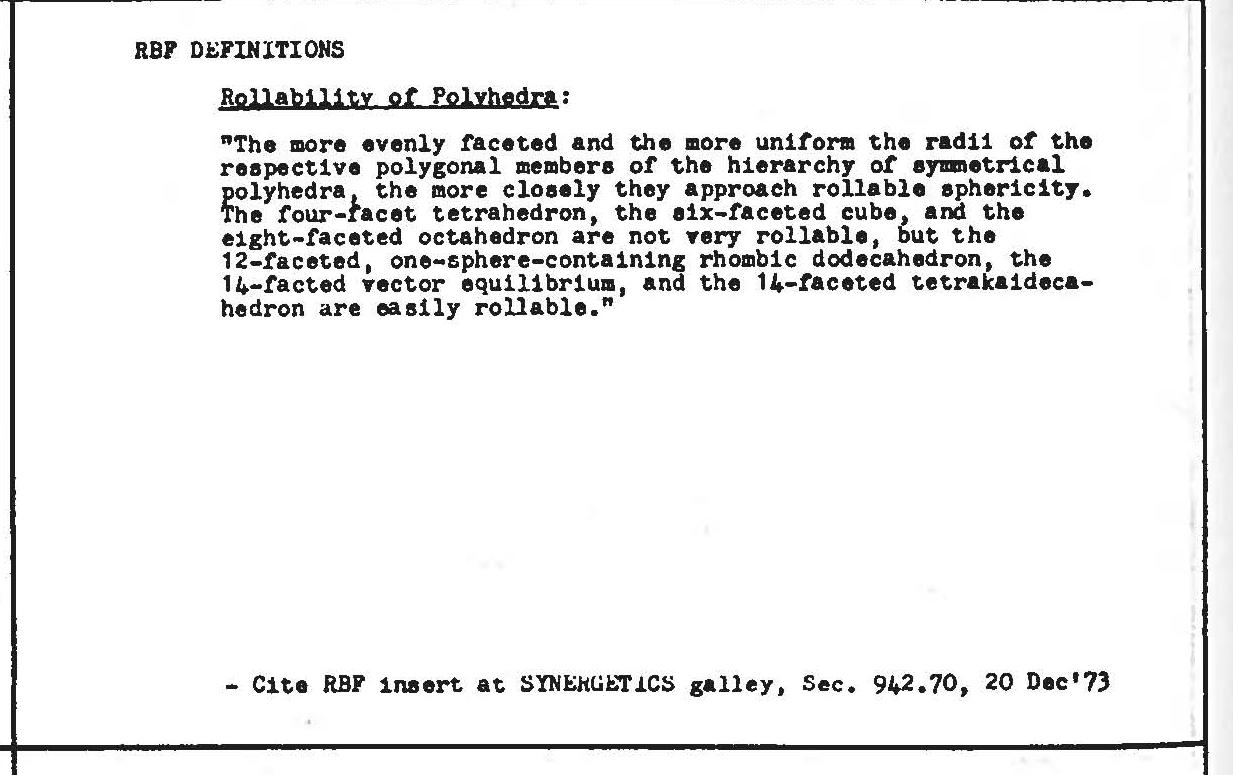
Rolls
← Rollability of Polyhedra | Rolls →
Index Entry
We want to think about production and getting then films and environments under controls, separating from outside to inside. There is no way man develops such high speed production as in rolling devices that produce sheet steel at fantastic rates coming out from those rollers-- and film which can be such barriers. And the other one is paper-making. You make a number of rollers of paper and you have two of them coming together and corrugated ones in between and gluing them together, making the corrugated paper board out of half paper is very good; it has a very high wet tensile strangth-- doesn't bother it at all if it gets wet. But as you have something coming out of rolls, the roll going around, and you have another roll, and there's a printing press. So you can get some newspaper coming out. And so you can print information. . . Any kind of shapes you want, any picture. So I find then you can do any complex kind of work you want and print it right out on your paper-board as it comesout at fantastic high speed, and not only print it, you can put a little groove in it. You press the paper down, and that's the way you want it to fold. And paperboard domes can really be produced at a fantastic rate.

Rolls
Index Entry
Rolls:
"Of all the materials that man can produce fast
the things that come out of rolls are the fastest.
Newsprint is the fastest thing he can produce."
- Cite RBF tape of CHA:WE Script
14 larch 1971
Roll (1)
← Rolls | Roll Rolls Rolling (2) →
Cross Reference
Roll: Rolls:
Cross-References
Roll Rolls Rolling (2)
Cross Reference
Tetra-eroll, (1)
Cross-References
- Invention Sequence (B)
- Evaginating, 22 Jun'75
- Hex-pent Sphere: Transformation into Geodesic Spiral Tube, (1)(2)
- Four Intergeared Mobility Freedoms, 2 Nov'73
- Membranes, 21 Jun'77
Romance
← Roll Rolls Rolling (2) | Romance of History in the Making →
Index Entry
Romance:
"There's nothing you have to do that isn't fascinating. Whether you're a plumber's helper and have to wipe a joint or whatever it is."
- Cite RBF at Penn Bell videotaping, Philadelphia, 30 Jan'75

Romance of History in the Making
Cross Reference
Cross-References
- New York City, (5)

Romantic
← Romance of History in the Making | Romantic →
Index Entry
Romantic:
"I find that universe has not lost one iota
of its romance for me. I find living now quite
as satisfactory as ever."
- RBF to EJA in mid fast stride at
corner of 44th and Vanderbilt,
New York City 12 March 1971
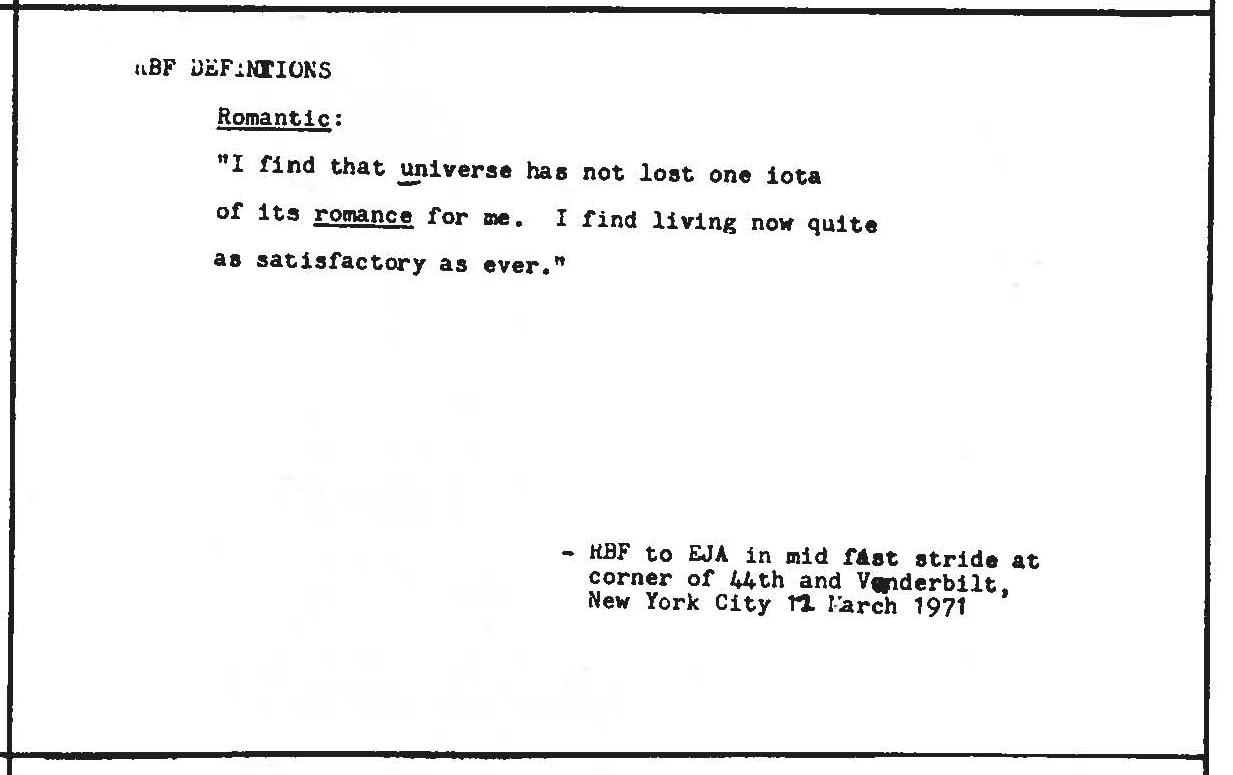
Romantic
← Romantic | Romance Romantic →
Index Entry
Over a very large period of time, I think that the total data recorded by Charles Fort from around the world may prove of great scientific worth. Above all this there is something extremely inspiring about Fort's interest in his Universe. His interest is very romantic. It isn't written in romantic terms at all, but man is full of dreams-- dreams of significance. Fort was in love with the world that jilted him. Fort, as humanity was looking for significance in experience. Fort is becoming increasingly popular with the university students who all around the world are looking for significance. Billions of young people are in love with a world whose complexity seems to be trying to jilt them. I don't think their love will be unrequited. Fort's superb humor and tenderness are communicated with economically telling skill is rarely equalled.

Romance Romantic
Cross Reference
Cross-References
- Fuller, R.B: Crisis of, 1927
- Robin Hood Sequence, (1)
Rootless
Index Entry
Rootless:
"I don't like the word 'rootless' because it shouldn't suggest running away from things. I'm not leaving town. My backyard is just getting bigger."
- Cite RBF to Elizabeth Drew, WETA-TV, Wash. DC, 19 Oct'72
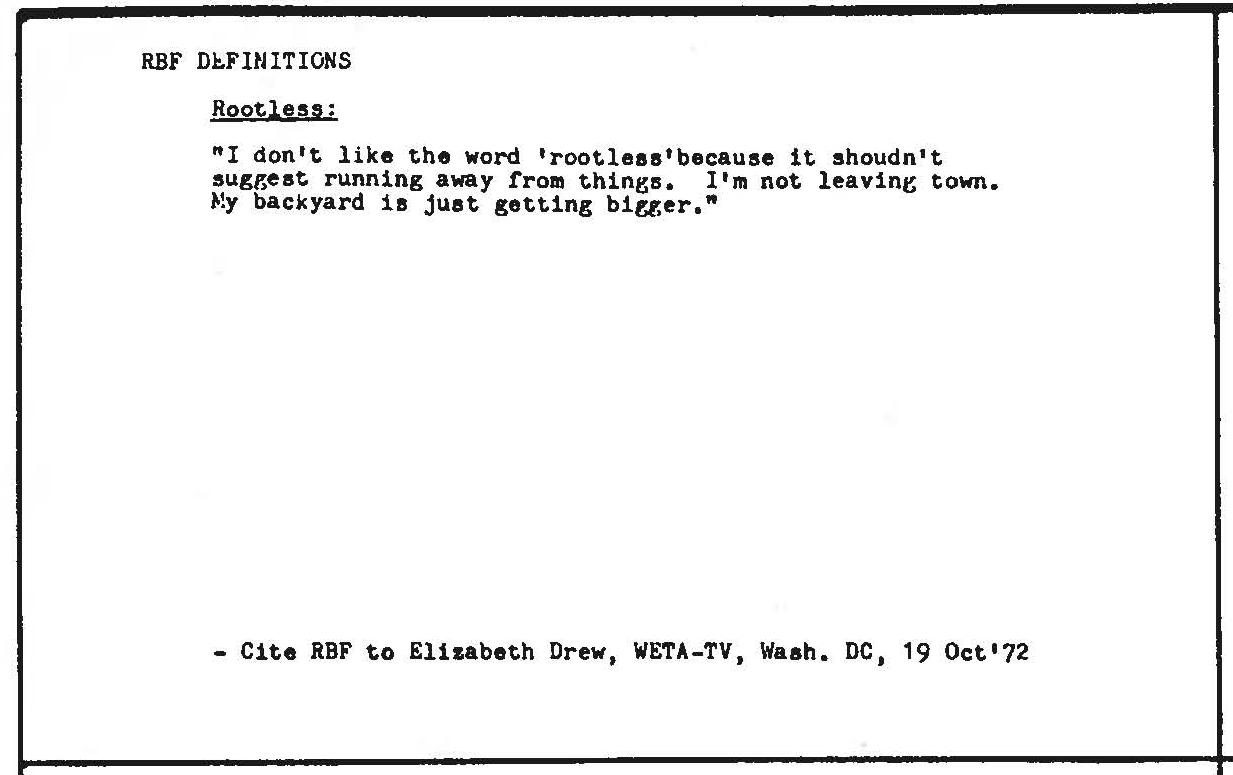
Roots
Index Entry
Roots:
"Biological life... would be dehydrated were it not osmotically watercooled by its root-connected hydraulic circuitry of Earth waters' atomization for return into the sky-distributed, fresh-water-regenerating biological support system, which rooting frustrates integral procreation of the vegetation..."
Roots
Cross Reference
Roots:
"At one time people thought of themselves as having roots. Why? Because in order to survive they had to be near the vegetation. And the vegetation had to have roots so it could be water-cooled, and the animals fought the people for it. But now we have the refrigeration which preserves the food, we have the canning and the other processes, and nobody has to be near the roots anymore. They can live anywhere they want. They do have legs and they can go round this world, and the food will be brought to them and none of us has to perish. We can free ourselves from these other kinds of roots just as simply, merely by recognizing that the necessity no longer exists."
- Cite RBF tape transcript for Barry Farrel Playboy Interview Feb '72. Above passage omitted from final text. See transcript p. 61.
Roots
Index Entry
Roots:
"As the prime energy impounder, The vegetation on the land has to have roots In order to get enough water to cool itself So that it will not be dehydrated While it photosynthesizes the radiation energy of the Sun Into the beautiful molecular structures That provide the metabolic energy exchange functions Of terrestrial life support."
- Cite BRAIN & MIND, p.110 May '72
Roots
← Roots | Roots vs. Blossoms →
Index Entry
Roots:
"Man is born with legs, not roots."
Citation at Loge, 26 Aug'66
- Cite-bdw...C.-Higbee-Introduction, -26 Aug.-'66-, quotient-RBF.
Roots vs. Blossoms
Cross Reference
Cross-References
- Good & Evil Sequence, (1)
Roots
← Roots vs. Blossoms | Roots Rooted (1) →
Index Entry
(In Mathematics)
"In synergetics 'square' roots and 'cube' roots are treated as triangular and tetrahedraal roots. Therefore, we do not lose the radical. The root becomes rational, as √4. The fractions will come out rationally with triangular and tetrahedraal roots."
- Cite RBF to EJA, Beverly Hotel, New York, 14 Sept. 1971.
Roots Rooted (1)
Cross Reference
Cross-References

Roots (2)
Cross Reference
United States: One of the Most Difficult Sovereignties To Break Up, 28 Jun'72 (2)
Cross-References
- Bumblebee, 6 Nov'72 (2)
- Ecology Sequence, (2)
- Lags, (2)
- Legs, 26 Aug'66 (2)
- Manifests, (2)
- Organic Model, Oct'66 (2)
- Sovereignty: Elimination Of, 29 Jun'72 (2)
- Redundancy: Reduction Of, 22 Apr'71 (2)
- Human Unsettlement, (2)
Rope
Index Entry
Rope:
"There is much within the critical proximity environment which demonstrates the normal-- where the disparate mass relativities are not operating, as, for instance, when a rope is tensed and reacting at 90° to the direction of the tensing and thus becomes tauter. Compression members precess to bend."
- Citation and context at Normal, 6 Mar'73
Rope
Index Entry
Rope:
"To present my scientific differentiation
Of brain and mind
I proceed as follows--
First I say:
'I take a piece of rope and tense it.'
As I purposely tense it
I inadvertently make it tauter.
But I was not tensing the rope
For the purpose of making it tauter,
I was only trying to engage the rope.
Its girth is inadvertently contracting and
The rope is also inadvertently getting harder.
"In contracting and getting harder
The rope is going into radial compression
In a plane at ninety degrees to the axis of
My consciously purposeful tensing... "
- Cite BRAIN & MIND, p.124 May '72
Rope
Index Entry
Rope:
"As recounted before,
Saying, 'Let us take a piece of rope...'
To demonstrate the generalized rope concept--
I am drawing on
A multiplicity of special-case rope experiences
As a brain-stored resource of that audience,
Probably amounting to over a hundred experiences each:
With different kinds of pieces of rope,
Ergo-- I am drawing upon a memory resource
Of more than one hundred thousand experiences
With as many different pieces of rope,
When I speak to an audience of one thousand."
Rope
Index Entry
"I started out our brain-mind differentiation\nBy saying, 'I take a piece of rope.'\nI've done this before many audiences,\nAnd no audience has ever said,\n'You don't have a piece of rope.'\nBut the fact is I didn't have a piece of rope.\nNor has anybody ever said,\n'Is it nylon, manila or cotton?'\nOr, 'What is its diameter?'\n\n- Cite BRAIN & MIND, p.136 May '72
Rope
Index Entry
Rope:
"Each fiber in the rope is randomly spiral. The larger braided strands are also spiral together into three final spiral bundles which, in turn, spiral together as a piece of rope, clearly the rope is an aggregate non-straight lines of many varieties of spiraling curvature. The design final twisting of the rope, when its ends are spliced together, will expose a unique number of profile humps. If the twist of the rope has 1/16th inch humps per quarter-inch of rope length, and 64 profile humps per inch, and 768 per foot; then there will be 768 times 64, or 49,152 humps in its total peripheral horizon, inside or outside: that 's a great complex of wavilinear integrations."
- Cite RBF dictation to Alexandra Snyder, Ashoka Hotel, New Delhi, India, Dec. '71
Rope
RBF Definitions
"Physicists have never discovered any straight lines in Universe. They have discovered only waves which are inherently curvilinear, that is, they are corkscrew or spiral traceries between covariable events, such as You and Me, with our relationship identified by a rope stretched between us with two reels at each end to pay out as we move independently with varying lags in the rate of the rope's response to other forces acting upon it than thos of our two independent pulls, as for instance the effect of wind on the rope; or the Earth's gravitational heated expansion of the rope; and the lag or inertia of the rope in changing the rope's shapes given it progressively by You, Me, the wind, gravity, Sun, and atoms of which the rope itself is composed, whose behaviors are very directionally discrete in order to give the rope its unique recognizability."
Citations
- RBF dictation to Alexandra Snyder, Ashoka Hotel, New Delhi, Dec. '71.
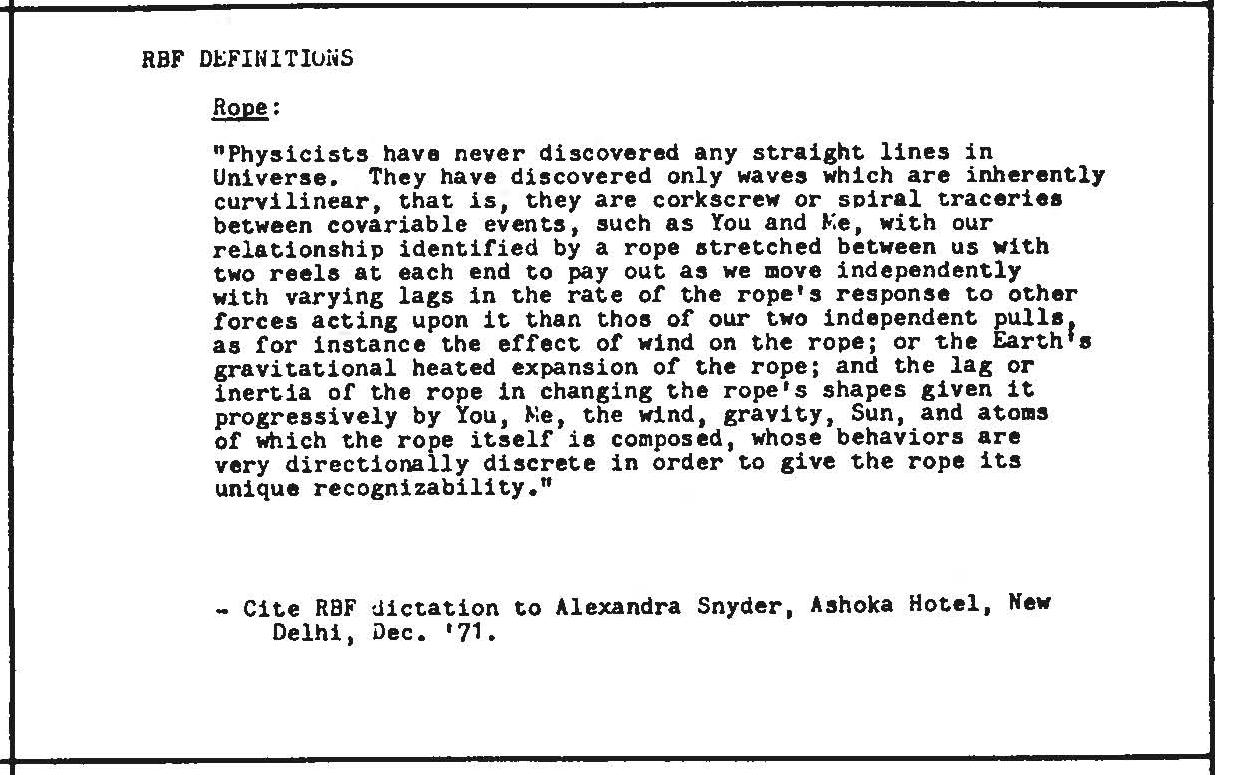
Rope
Index Entry
"I take a piece of rope and I tense this piece of rope as vigorously as I know how. And the more I tense it the tauter it becomes. When it becomes taut, it means it is contracting in its girth. This means that while I am purposely tensing it in its linear axis, it is going into compression at 90 degrees to my purposeful tensing. Compression is occurring, though I am only applying tension. You understand that? The rope is contracting, going into compression, as a consequence of my pulling it."
- Cite RBF at Students International Meditation Seminar, U. Mass., Amherst, 22 July '71, p. 8
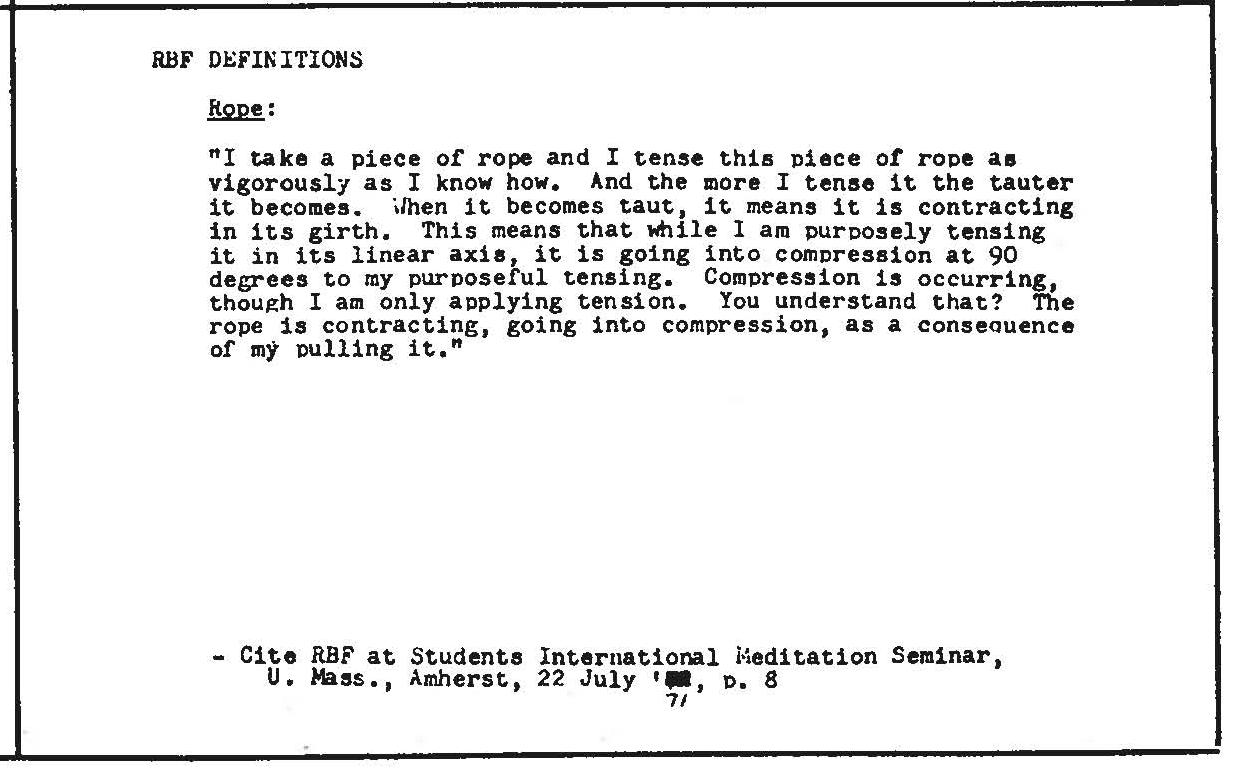
Rope
← Rope | Rope Knots vs. Coils →
Index Entry
Rope:
"Parallel lines can be torqued. So may the parallel lines of a cylinder be twisted as we see them in a rope. A rope and a cone are both forms of simple curvature."
-
Cite HAI, p. 217, Preview of Building, 1 Apr'49
-
Citation at Torque, 1 Apr'49
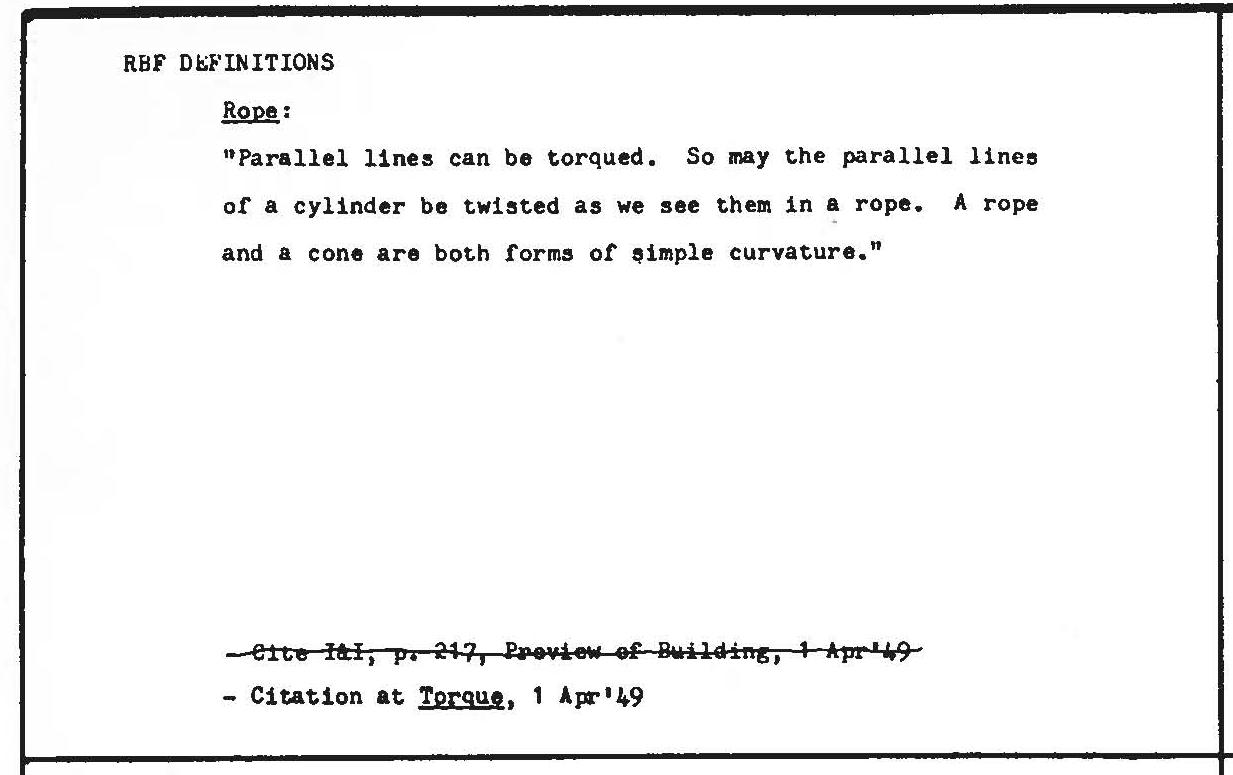
Rope Knots vs. Coils
Cross Reference
Cross-References
- Matter vs. Radiation, 7 Nov'73
Rope
← Rope Knots vs. Coils | Rope (1) →
Index Entry
Univ. of Alaska Address, p.11ff, 20 Apr '72
Approaching the Benign Environment. p. 82. 1970 (also p.86-cited)
\hrefhttps://www.buckyverse.org/en/synergetics/content/chapters/500-conceptuality#section-506.01506.01-\hrefhttps://www.buckyverse.org/en/synergetics/content/chapters/500-conceptuality#section-506.15506.15
\hrefhttps://www.buckyverse.org/en/synergetics/content/chapters/500-conceptuality#section-522.04522.04-\hrefhttps://www.buckyverse.org/en/synergetics/content/chapters/500-conceptuality#section-522.09522.09
\hrefhttps://www.buckyverse.org/en/synergetics/content/chapters/600-structure#section-640.60640.60
\hrefhttps://www.buckyverse.org/en/synergetics/content/chapters/600-structure#section-644.01644.01
\hrefhttps://www.buckyverse.org/en/synergetics/content/chapters/700-tensegrity#section-711.01711.01-\hrefhttps://www.buckyverse.org/en/synergetics/content/chapters/700-tensegrity#section-711.04711.04
\hrefhttps://www.buckyverse.org/en/synergetics/content/chapters/1000-omnitopology#section-1005.301005.30
\hrefhttps://www.buckyverse.org/en/synergetics/content/chapters/1000-omnitopology#section-1054.611054.61
Rope (1)
Cross Reference
Cross-References
- Deliberately Nonstraight Line
- Dog Pulling on a Belt
- Funambulist
- Generalizations: First Degree
- Knot
- Metaphysical Disconnect
- Pattern Integrity
- Waterspout
Rope (2)
Cross Reference
IIex-pent Sphere: Transformation into Geodesic Spiral Tube, (1)
Cross-References
- Abstraction, 10 Dec'64
- Civil War, (2)
- Intellect: Equation Of, (1)
- Normal, 6 Mar'73*
- Pull, 2 Jul'62
- Tension, (1)(2)
- Pattern Integrity, 22 Jan'75
- Tidal, May'72
- Torque, 1 Apr'49
Rose
Index Entry
... Packages consist of complexedly interrelated and not as-yet differentially analyzed phenomena which, as initially unit cognitions, are potentially re-experienciable. A rose for instance, grows, has thorns, blossoms, and fragrance, but often is stored in the brain only under the single word -- 'rose.'
'As Korzybski, the founder of general semantics, pointed out, the consequence of its single-tagging is that the 'rose' becomes reflexively considered by man only as a red, white, or pink device for paying tribute to a beautiful girl, a thoughtful hostess, or last night's deceased acquaintance. Thetagging if the complex biological process under the single title 'rose' tends to detour human curiosity from further differentiation of its integral organic operations as well as consideration of its interecological functionings aboard our planet. We don't know what a rose is, nor what may be its essential and unique cosmic function. Thus for long have we inadvertently deferred potential discovery of the essential roles in Universe which are performed complementarily by many, if not most, of the phenomena we experience...'
Rose
Index Entry
Rose:
"Biology, chemistry, and physics can explain some of the characteristics of the mechanics and processes that constitute the composite, constantly changing living-machine rose, but neither Julia nor the scientist could presume to tell little Tim what a rose is."
- Cite NINE CHAINS TO THE MOON, p.10, 1938
Rose Bushes
Cross Reference
Cross-References
- Privacy, 22 Apr'61

Rose
Cross Reference
Cross-References
- Brain, 3 Jun'72 (1)
- Design, (1)
- Reproducible
- Aesthetics of Uniformity, (1)

Rotate
Index Entry
One thing we have learned about all systems when isolated from other systems, is that they have the ability to be rotated or for things to rotate around them.
Rotate
← Rotate | Rotational Aberrating Limit →
Index Entry
Rotate:
"Radii must grow from point to surface. . . . therefore, spherical irregular tetrahedra (irretetra), therefore as spheres are interacting and spinning and energy is both local and remote as radius expands it, or generates unfolding leaves.... Because man rotates he has fingers and toes. Maybe hen rotates around egg with a nuclear gyro."
- Cite RBF holograph, 6 May'48
Rotational Aberrating Limit
← Rotate | Rotation of Night as a Shadow →
Cross Reference
Rotational Aberrating Limit:
17 Dec'73
Cross-References
Rotation of Night as a Shadow
← Rotational Aberrating Limit | Rotation of Spheres →
Cross Reference
Cross-References
- Sleep, 1963
Rotation of Spheres
← Rotation of Night as a Shadow | Rotative Systems →
Cross Reference
Rotation of Spheres:
"A single sphere is free to rotate in any direction.
"Two spheres although free to rotate in any direction must do so cooperatively, assuming no slippage between the touching spheres.
"Three spheres can only rotate cooperatively about respective axes which are parallel to the edges of the equilateral triangle defined by joining the sphere centers, that is, each sphere rotates toward the center of the triangle.
"Four spheres lock together. No rotation is possible, making the minimum stable system: the tetrahedron."
Cite SYNERGETICS ILLUSTRATIONS caption #8, 1967
Cross-References
- Illustration #8
Rotative Systems
← Rotation of Spheres | Rotation Rotatability (1) →
Cross Reference
Rotative Systems:
Cross-References
- Associability, 21 Mar'73
Rotation Rotatability (1)
← Rotative Systems | Rotation: Rotatability (2) →
Cross Reference
Cross-References
- Axis of Inherent Rotatability
- Co-rotation
- Wind Power: Effect of Earth's Rotation
- Vertex-vortex Rotations
Rotation: Rotatability (2)
← Rotation Rotatability (1) | Roundness →
Cross Reference
Cross-References
- Axis of Spin, (1)
- Omnidirectional, 2 Jul'62
- Radiation: Speed Of
- Cybernetics, 7 Nov'75
Roundness
← Rotation: Rotatability (2) | Round Roundness →
Index Entry
Imagination "means man's communication of what he thinks it is that he thinks his brain is doing with the objects of his experience. His discovery of general conceptual principles characterizing all of his several experiences--as the rock, having insideness and outsideness, the many pebbles, having their corners knocked off and developing roundness: the thinks there could be pure 'roundness' and thus imagined a perfect sphere."
Round Roundness
Cross Reference
Round: Roundness:
Cross-References
Round Trip
← Round Roundness | Rowing Needles (1) →
Cross Reference
Cross-References

Rowing Needles (1)
← Round Trip | Rowing Needles (2) →
Index Entry
Rowing Needles:
"I'd like to make good rowing available to the average man. He'd soon get tired then of having an outboard motor and just putt-putting from here to there. But the average rowing boat is a very awkward affair, so you can't blame people for staying away from them. But with rowing needles it's easy. Three good pulls, and I'm out of the harbor. The satisfaction is enormous.
"The bows are domed. With a sharp point you've got a plow pushing the water out ahead of you. This does exactly the opposite: the molecules roll off and they roll off in all directions and because they're rolling in all directions they exhaust the cone of entry and it builds up a vacuum.
"Watch a little, tiny guppy in a great tank. He gives a kick of his tail and it builds up low pressure on his nose and it sails right across the tank without any more effort at all. It opens its mouth and builds up that low pressure a little higher and it pulls it right across. I want to really exploit that capability. The bows on atomic submarines are also spherical for the same reasons. As the molecules roll, they take up more"
Rowing Needles (2)
← Rowing Needles (1) | Rowing →
Index Entry
and more of their own medium and the vacuum builds up and just pulls you forward. Today, if you want to punch through steel, you don't use a sharp point. This form is it. Atoms are discontinuous and you want to push between them, not obliterate them. You can't obliterate them.
Rowing
← Rowing Needles (2) | Royal →
Cross Reference
Cross-References

Royal
Cross Reference
Cross-References

Rubber Glove
Index Entry
Rubber Glove:
"Entropic dispersal . . . and syntropic association. . . . Between the two they work very much like the rubber glove. There really is an annihilation into eternity with no time and dimensioning-- these are only in our temporal relativity."
- Citation and context at Eternity (1), 23 May'72
Rubber Glove
← Rubber Glove | Rubber Glove →
Index Entry
Rubber Glove:
"The glove is seeability, experiencability-- we go through the invisible. The annihilation is the invisible and the timeless.
"There is no geometry of space-- only of local aggregates of principles, of special cases.
"The lag is the whole of life. It is lag and aberration."
- Cite RBF to BO'R, Kent, Ohio, 23 may'72
Rubber Glove
← Rubber Glove | Rubber Glove →
Index Entry
Rubber Glove:
"If you have a rubber glove on your left hand and strip it off, it now fits your right hand. There's only one rubber glove. The left hand has been annihilated. That's the way our Universe is. There are the visibles and the invisibles of the inside-outing nonsimultaneity."
- Cite Museums Keynote Address Denver, p. 10. 2 Jun'71
Rubber Glove
← Rubber Glove | Rubber Glove Sequence →
Index Entry
Rubber Glove:
"The rubber glove stripped inside-outingly from off the left hand now fits only the right hand. First the left had was conceptual and the right hand was nonconceptual. Then the process of stripping off inside-outingly seemingly annihilated the left hand and created the right hand--then vice versa as the next strip off occurs. When physics finds experimentally that a unique energy pattern--erroneously referred to in archaic terms as a particle--is annihilated, that annihilation is only of the rubber glove kind. The positive becomes the negative and the positive only seems to have been annihilated. We begin to realize conceptually the finite, yet nonsensorial outness which can be converted into sensorial in-ness by the inside-outing process. Frpo, Novent is the finite but nonsensorial continuum."
CONCEPTUALITY
PARITY
SEC.507
BUT ONLY AT THE EXPENSE OF LOSING AFTERIMAGE OF THE PREVIOUS SENSE-MEMORIES OF CONCEPTUAL FIXATION
- Cite NEHRU SPEECH, p .12. 13 Nov'69
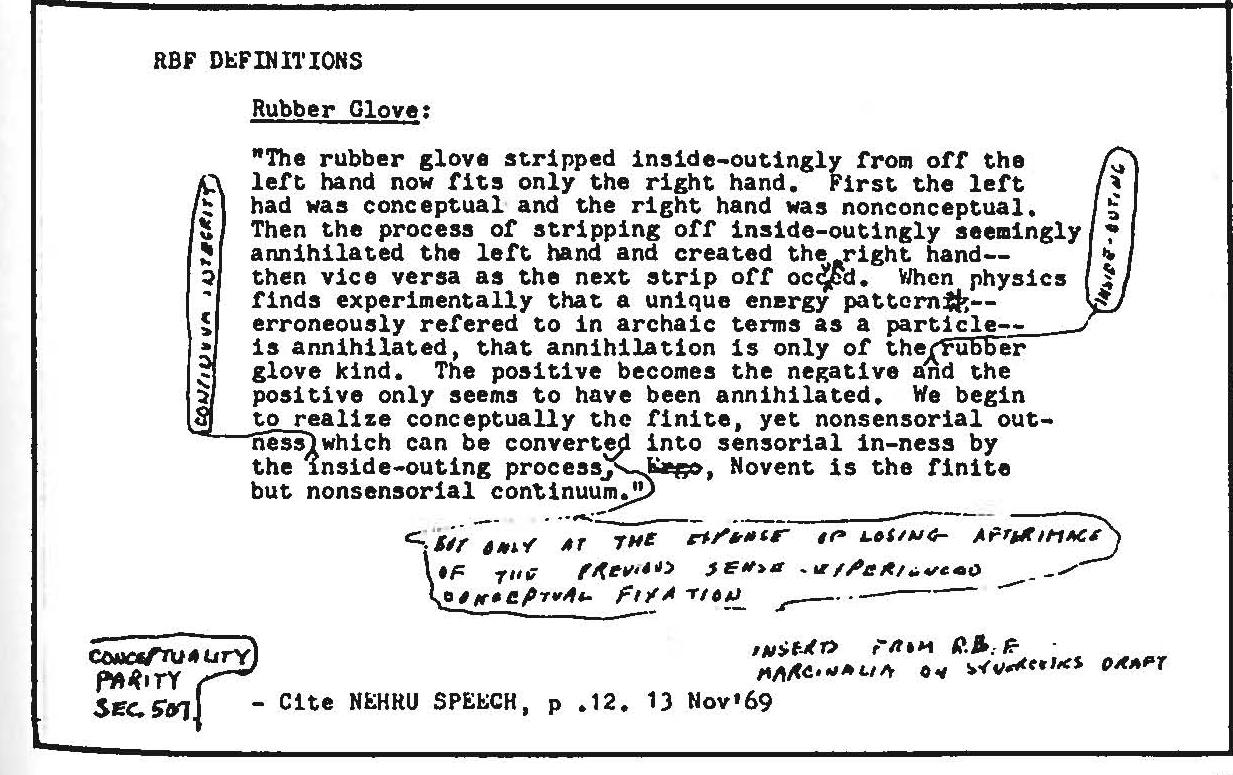
Rubber Glove Sequence
← Rubber Glove | Rubber Glove (1) →
Index Entry
Rubber Glove Sequence:
"So we find that complementarity is even more complex; that there had to be not only the keyhole, but that the keyhole had to be in something. The keyhole that was in something had to be related to the rest of the Universe. So then we had a rubber glove which was stripped off this hand, which we called the left hand, fairly ignorantly, and now it fits the other hand. So where has the other one gone? Then I strip it off here and there goes the other hand.
"Quite clearly, both were there all the time, but only one of them could we detect. So there is not only the glove, which could have a keyhole, and we could put the key in that, but it would have to be in something of the rest of the Universe as well as the system we can see by. There's always a conceptual system, and there's the rest of the Universe which is nonconceptual because it's a scenario Universe and not a single frame Universe."
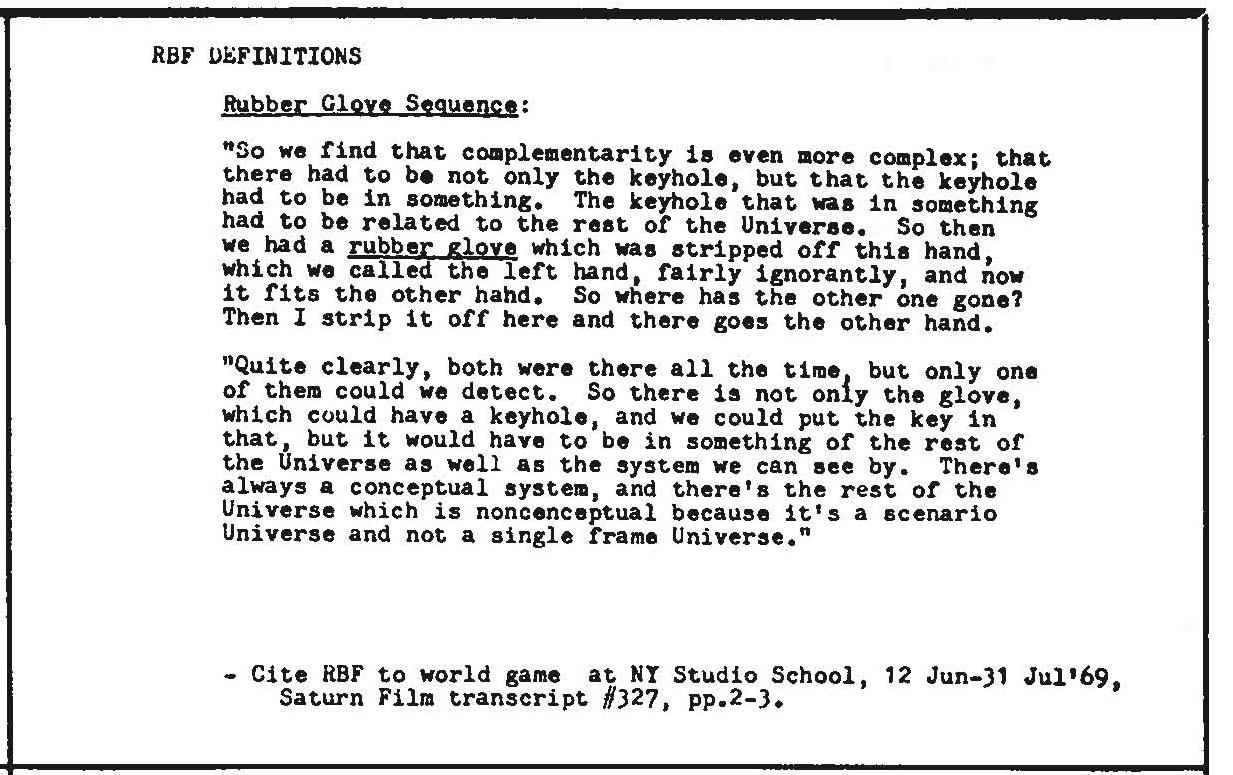
Rubber Glove (1)
← Rubber Glove Sequence | Rubber Glove (2) →
Cross Reference
Cross-References
Rubber Glove (2)
← Rubber Glove (1) | Rubber Tires →
Cross Reference
Cross-References
- Equilibrium, 25 Feb'69
- Eternity
- Invisible Hole, 16 Jun'72
- Irreversibility, 4 May'57
- Superatomics Sequence, (1)
- Nuclear Domain & Elementality, (1)(2)
- Human Beings & Complex Universe, (4)
Rubber Tires
← Rubber Glove (2) | Rubber Tires (1) →
Index Entry
Rubber Tires:
"Miniature rubber automobile tires may be substituted for the triangles of the vector equilibrium to provide a model of reciprocating toruses. The eight wheels should be independently journaled but touching one another with sufficient friction so that when you move any one of them all of the eight will rotate reciprocally. We can also consider each rubber tire as a torus and we can see how they can involute and evolute at the same time the wheels are reciprocatingly rotating. This provide a model of what turbulence really is."
- Cite RBF at Penn Bell studios videotaping marathon, Philadelphia, PA., 24 Jan'75
Rubber Tires (1)
← Rubber Tires | Rubber Tires (2) →
Index Entry
Rubber Tires:
"You can make this model out of little automobile tires and you can run them up on the shaft and use tape to act as a thrust bearing to keep them from coming outwardly. You brought them in until each of these tires are barely touching the other tires in three points-- so it really is a triangle.
"Remember how gears work. We have a train of gears where around any hole there are always four gears, so as this wheel goes one way the other wheel can go that way very comfortably. And since there are four we find that the trains reciprocate. There is no blocking anywhere. All of the holes are four-sided so it is an even-numbered train of gears. When I rotate one wheel in this whole system all the other wheels move very neatly. They are in friction to one another. I can also hold on to one of the wheels and turn the system around it. If I do that a very interesting thing happens. ... A rubber tire can be mounted like a torus, or can be rotated outwardly like the big atomic bomb mushroom cloud-- opening in the center and coming in at the bottom. That is what we call an evolving or involuting torus. These rubber tires could do that-- and not only could they rotate around on each other this way, but it is quite possible to make
- Cite Oregon Lecture, #7, p. 262, 11 Jul'62
Rubber Tires (2)
← Rubber Tires (1) | Rubber Tires (3) →
Index Entry
this wheel in such a way that it has little roller bearings along its rim and each of these roller bearings allows the rubber tire to rotate in the rim so that the tire could be involving and evolving. Therefore, if any one tire started to evolute all the other tires reciprocate.
Rubber Tires (3)
← Rubber Tires (2) | Rubber Tires →
Index Entry
Rubber Tires:
". . . . It is quite possible to make an automobile tire and mount it in such a way that it looks triangular. That is, it gets to a very small radius on its corners. I can simply take the same rubber tire and stretch it onto a triangular frame and also have the samee little roller bearings so it can involute and evolute. . . The triangular tires swell pump from being the vector equilibrium into being the octahedron, the way we saw it before, in and out again. If I were then to immobilize one part of it, if I were just holding it with one finger like this, doing this means that I won't let this one involute and evolute-- but the rest of the system, due to the rotation, is contracting to become an octahedron so it makes all the others reciprocate-- involuting and evolving so that I am able to immobilize one axis and the rest of the system can work comfortably."
Rubber Tires
← Rubber Tires (3) | Rubber Tires →
Index Entry
Rubber Tires:
"What we are learning here is something very fascinating and it means the following: That in an omnimotional Universe it is possible for me to take two moving systems-- if you have two systems-- which move four dimensionally, comfortably, the way you see those four sets of wheels, eight wheels altogether moving perfectly comfortably, but I can fasten one vector equilibrium to another by a pair of wheels, immobilizing one of them and getting one of theses axes-- the axis which is immobilized but on which the rest of the system can keep right on rolling around. By fastening one such part of the Universe literally, you don't stop the rest of the motion of Universe. That is what we are learning here.
"In all the other kinds of mechanical systems that you will ever run into on a three-dimensional basis, if anything is blocked then everything is blocked. In a four-dimensional system this is not true at all. You are able then to have one local thing occur. You can have two atoms join one another perfectly well and the rest of Universe can go right on in its motion. Nothing is frustrated but they themselves do certain polarized things in relation to one another, which begins to explain a lot of the basic joinings."
- Cite Oregon Lecture #7, pp. 264-265. 11 Jul'62
Rubber Tires
Cross Reference
Rubber Tires:
Cross-References
Rudder
← Rubber Tires | Ruddering: Rudder Concept →
Index Entry
Rudder:
"The interesting thing about a rudder is that the ship has already gone by, all but the stern, and you throw the rudder over, and what you're really doing is to make a little longer distance for the water to go round; in other words, you're putting a low pressure on the other side, and the low pressure pulls the whole stern over and she takes a new direction. The same in an airplane-- you have this great big rudder up there, with a little tiny trim tab on the trailing edge, and by moving that little trim tab to one side or the other you throw a low pressure that moves the whole airplane. The last thing, after the airplane has gone by, you just move that little tab."
- Cite Calvin Tomkins, The New Yorker, 8 Jan 66, p. 64.
Ruddering: Rudder Concept
← Rudder | Ruddering Sequence (1) →
Index Entry
"Order is achieved through positive and negative, magnitude and frequency-controlled alteration of the successive steering angle. We move by zigzagging control from one phase of physical universe evolution to another. The rudder concept of social law is most apt. Norbert Wiener chose the word 'cybernetics,' derived from the Greek roots of 'rudder,' because Wiener, Shannon and others in communication theory were exploring human behaviors and their brain-controlled 'feedback,' and the like, as a basis for the design of computers, and it became evident that the human brain steers man through constant change." The identical text to the above appears in blank verse form in "How Little I Know." Page 71, 1966. - Cite AAUW JOURNAL, May 1965, P. 176
Ruddering Sequence (1)
← Ruddering: Rudder Concept | Ruddering Sequence (2) →
Index Entry
Ruddering Sequence:
"Within the grand strategy of anticipatory problem solving
to be accomplished exclusively through design transformations
of human ecology's physical environment apparatus, the
design strategems range from powerful to subtle. For
instance, instead of attempting to push the bow of an ocean
liner from one side to the other in order to steer it (as we
do the front ends of automobiles, as well as of social trend
fronts) inasmuch as the great seas also try to push the bows
to one side or the other thus tending to throw the ship out
of control, the naval architect must design in such a way that
the ship's course will not tend to be diverted by heavy seas,
yet will be steerable. To do this he designs a ship's hull
with the hinge or pivot point of the ship occurring
forwardly under the step of the bow. This makes a long
lever arm aft and a very short lever arm forward of the
pivot, and the long lever overpowers the short one as in a
weathervane 'ship.' Thus the naval architect makes the
stern of the ship (rather than the bow) swing to one side or
the other of the course. The course tends to be held
steadily by the bow. The stern tries to follow the bow in
a straight course. The keel then makes the stern follow the"
Ruddering Sequence (2)
← Ruddering Sequence (1) | Ruddering Sequence (3) →
Index Entry
Ruddering Sequence:
"bow when the ship is in motion. In order to change course, the stern is deliberately swung to one side or the other. This is done by the rudder at the stern which is so small as to be easily manipulated. The rudder, by making a small drag angle, creates a partial vacuum on the side of the rudder opposite to that of the direction in which the rudder is moved. This partial vacuum starts to pull the stern of the boat, which causes a much larger partial vacuum to build up on the stern quarter of the ship on the side toward which the stern swings as the ship moves through the water in this askew attitude. This vacuum is built up for the same reason that the horizontal askew attitude of a wing foil in motion through the air creates the lifting vacuum on its cambered or top surface. The reason is that it is a longer distance around the cambered askew side for the parted water to reach, as suddenly displaced by the ship's motion, which makes the longer-way-reach tense the air-interspersed water molecules creating a partial vacuum. So powerful is this partial vacuum, or negative pressure, chain reaction buildup that it can, for instance, suck-pull the 30-knot speeding hull of the 85,000 ton, Empire State Building-sized Queen Mary into a new angle in respect to the directionally fixed"
Ruddering Sequence (3)
← Ruddering Sequence (2) | Ruddering Sequence →
Index Entry
Ruddering Sequence:
"momentum of her bow-pivot center, which thus hinges the Queen Mary into a new course attitude, which is fixed when the rudder is returned past 'midship' to 'meet her,' or break the vacuum buildup, and then returned to midship position.
This principle of creating vacuums with minimum effort that will self-regenerate to build up large vacuums to govern very large pattern-transforming work is even more dramatically emphasized in the case of the giant jet airliners where, literally, postage-stamp size trim tabs in the trailing edges of the large vertical and horizontal ruddering surfaces are all that are used by the automatic gyro-pilot servomechanisms to keep these 100-ton sky giants hurtling along at 600 miles per hour on accurate multidimensional course despite invisible atmospheric turbulences far greater in size and velocity magnitude than those of the water ocean.
"My philosophy takes primary heed of the fact that all in Universe is in constant transformative complex motion and all transform in patterns of least resistance. Therefore, philosophically, it became evident that by subtly designed"
Ruddering Sequence
← Ruddering Sequence (3) | Ruddering Sequence →
Index Entry
'trim-tab' size inventions we could, with least physical effort, control the least resistant directions of various fundamental transformings. This could be done by devices which would so control the angle and frequency occurrences of little vacuums and tension which could cause man's ecological patterning to evolve in preferred patterns. Designs could also detect and discretely vitiate specific subtle vacuums chain-reacting into larger vacuums and thereby holding certain transforming systems on socially deleterious courses.
"How much more powerful is the minuscule ship's rudder when in good order than a squadron of ships trying to move a rudderless ship in a heaving sea by attempting to push the rudderless one with their plunging bows in preferred directions as do tugs maneuver a big ship in still water when the ship is moving too slowly to have steerage way! Also how futile are shouted words of warning and exhortations in such situations! Only the rudder and the brain that directs the rudder are effective. No wonder Norbert Wiener included the Greek name for rudder in coining his 'cybernetics' to identify the newly emergent computer's"
Ruddering Sequence
← Ruddering Sequence | Ruddering Sequence →
Index Entry
Ruddering Sequence:
"feedback system science. No wonder the early Egyptian and Greek shipmasters stood in the stern of their ships facing forwardly alongside the single-oar-steering slave as the crew of backwards-facing slaves tensed at the banks of vacuum fulcrumed oars. Here is the picture of society straining at its slavishly accepted work, backing up blindly into its future as an,often nearsighted, excursion captain cons the course.
"My philosophy also takes heed of the approximately unlimited ratio of length to girth of tensional controls which always tend to pull true, versus the very limited length-to-girth ratio of pushing devices which, when pushed, tend to bend and break.
"Philosophically it is clear that trim tabs in the trailing edges of trailing devices-- in the tail-end of tail-end events-- at the stern of the ship as the last event and not at the bow as the first event. The bow is important to keep the ship on a chosen course but the stern rudder puts and holds it on the chosen courses. The real steering takes place when the non-scientifically informed observer thinks"
Ruddering Sequence
← Ruddering Sequence | Rudder Ruddering (1) →
Index Entry
everything is all over. But that final steering has to be done from 'on board,' Just 'having the last word' from way back in the wake of the ship is futile. Scientists have often said that the most important part of their great discoveries occurred at the outset in the proper formulation of the project's objectives, forgetting that those enlight- ened formulations were really the afterimage inducements of tail-end events of earlier and seeming failures of experimentation.
- Cite NEW FORMS VS. REFORMS, ADSD Doc. #1, p.53, 1963
Rudder Ruddering (1)
← Ruddering Sequence | Rudder Rudderling (2) →
Cross Reference
Cross-References
Rudder Rudderling (2)
← Rudder Ruddering (1) | Ruler (1) →
Cross Reference
Cross-References
- Omnimedia Transport Sequence, (3)
- Feedback, 7 Nov'75
Ruler (1)
← Rudder Rudderling (2) | Ruler (2) →
Cross Reference
Cross-References
Ruler (2)
← Ruler (1) | Rule of Communication →
Cross Reference
Cross-References
- Resolution, 5 Jul'62

Rule of Communication
← Ruler (2) | Rule of Communication →
Index Entry
Rule of Communication:
"At this time I developed a thought which has been very powerful in my theory of communication ever since. I said, 'I don't care if I am not understood as long as I am not misunderstood. For if I am misunderstood the captain of a ship may do the wrong thing with fatal consequences, but if he does not understand me, he queries the message and you give it to him again until he gets it right.' This principle became absolutely fundamental in my life from then on."
- Cite RBF to Alden Hatch in "RBF: At Home in the Universe," p.65. From Hatch's 1972 tape recapitualting RBF formulation of 1918.
Rule of Communication
← Rule of Communication | Rule of Communication (1) →
Cross Reference
"I made up my mind as a Rule of Communication
that I wouldn't care if I was not understood --
so long as I was not misunderstood."
- RBF to EJA and assembled
company, Carbondale, Illinois
2 April 1971.
Cross-References
- Intro, to Gene Youngblood
Rule of Communication (1)
← Rule of Communication | Rule of Communication (2) →
Cross Reference
Cross-References
Rule of Communication (2)
← Rule of Communication (1) | Rules of Interval (1) →
Cross Reference
Cross-References
- Comprehension, Sep'72 (2)

Rules of Interval (1)
← Rule of Communication (2) | Rules of Interval (2) →
Cross Reference
Vertexial Connections: Rules of Never-quite-touching
Cross-References
Rules of Interval (2)
← Rules of Interval (1) | Rules of Operational Procedure →
Cross Reference
Cross-References
- Coherence, 10 Feb'73
Rules of Operational Procedure
← Rules of Interval (2) | Rules of No Actual Particulate Solids →
Cross Reference
Cross-References
- Whole System, 28 May'72
Rules of No Actual Particulate Solids
← Rules of Operational Procedure | Rules of Never-quite-touching (1) →
Cross Reference
Rules of No Actual Particulate Solids:
Cross-References
- Coherence, 10 Feb'73

Rules of Never-quite-touching (1)
← Rules of No Actual Particulate Solids | Rules of Never-quite-touching (2) →
Cross Reference
Cross-References
- Vertexial Connections: Rules of Never-quite-touching, (1)
Rules of Never-quite-touching (2)
← Rules of Never-quite-touching (1) | The Rules of Universe →
Cross Reference
Cross-References
- Coherence, 10 Feb'73

The Rules of Universe
← Rules of Never-quite-touching (2) | Rules of Universe →
Index Entry
The Rules of Universe:
"It's not an either/or condition ever-- so much is permitted
by the rules of Universe."
- Citation and context at Degrees of Freedom, 9 Dec'73

Rules of Universe
← The Rules of Universe | Rule Regulation (1) →
Cross Reference
Fuller, R.B: On Drinking Liquor, 22 Jun'77
Cross-References

Rule Regulation (1)
← Rules of Universe | Rule Regulation (2) →
Cross Reference
Law: Laws
Cross-References

Rule Regulation (2)
← Rule Regulation (1) | Rule Regulation (3) →
Cross Reference
Cross-References
- Technology, 13 Mar'73
Rule Regulation (3)
← Rule Regulation (2) | Rule Ruler →
Cross Reference
Cross-References
- Rule of Communication
- Rules of Interval
- Rules of No Actual Particulate Solids
- Rules of Never-quite-touching
- Rules of Operational Procedure
- Rules of Universe
Rule Ruler
← Rule Regulation (3) | Runaway of Ignorance →
Cross Reference
Religion: Related to "Reglic" or Rule
Cross-References

Runaway of Ignorance
Cross Reference
Cross-References
- Problem: Statement Of, Feb'72
Russia
Cross Reference
Cross-References
- Soviet
- USSR