Synergetics Dictionary — G
650 cards
G
Letter Group Divider
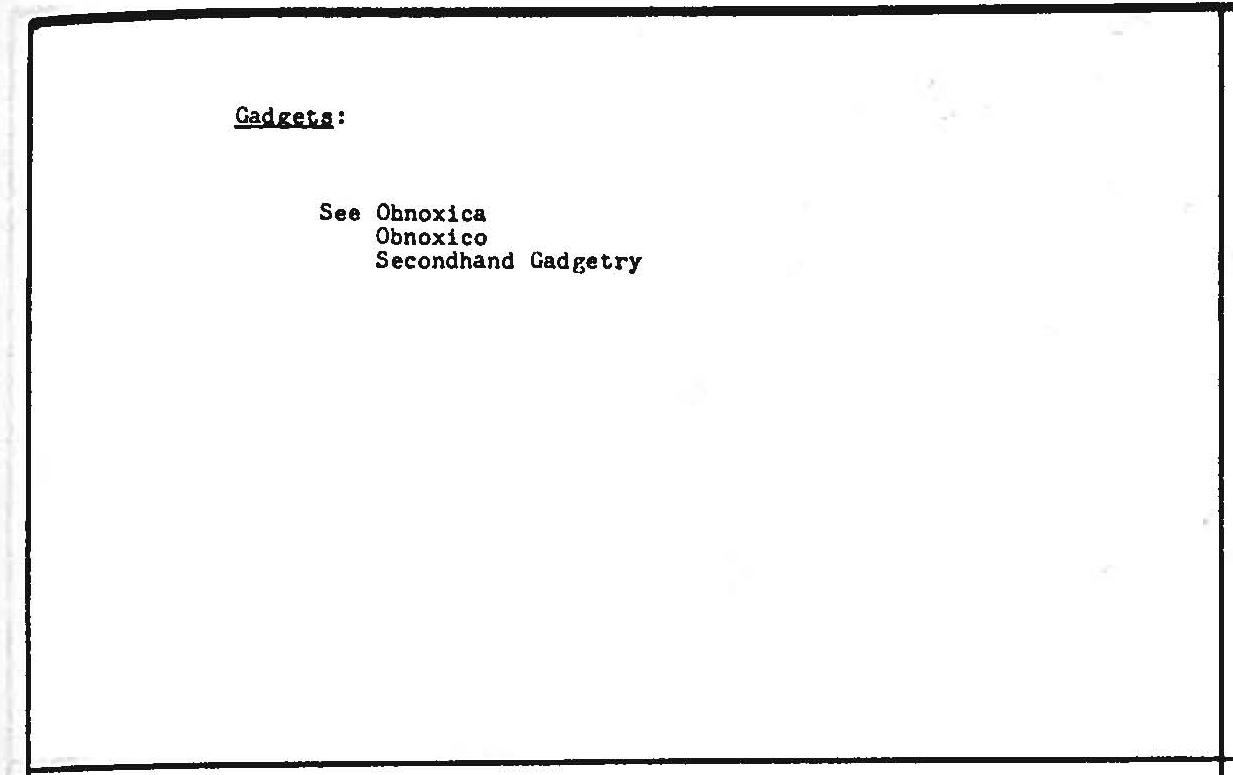
Gadgets
← G | Gains Consolidator (1) →
Cross Reference
Cross-References
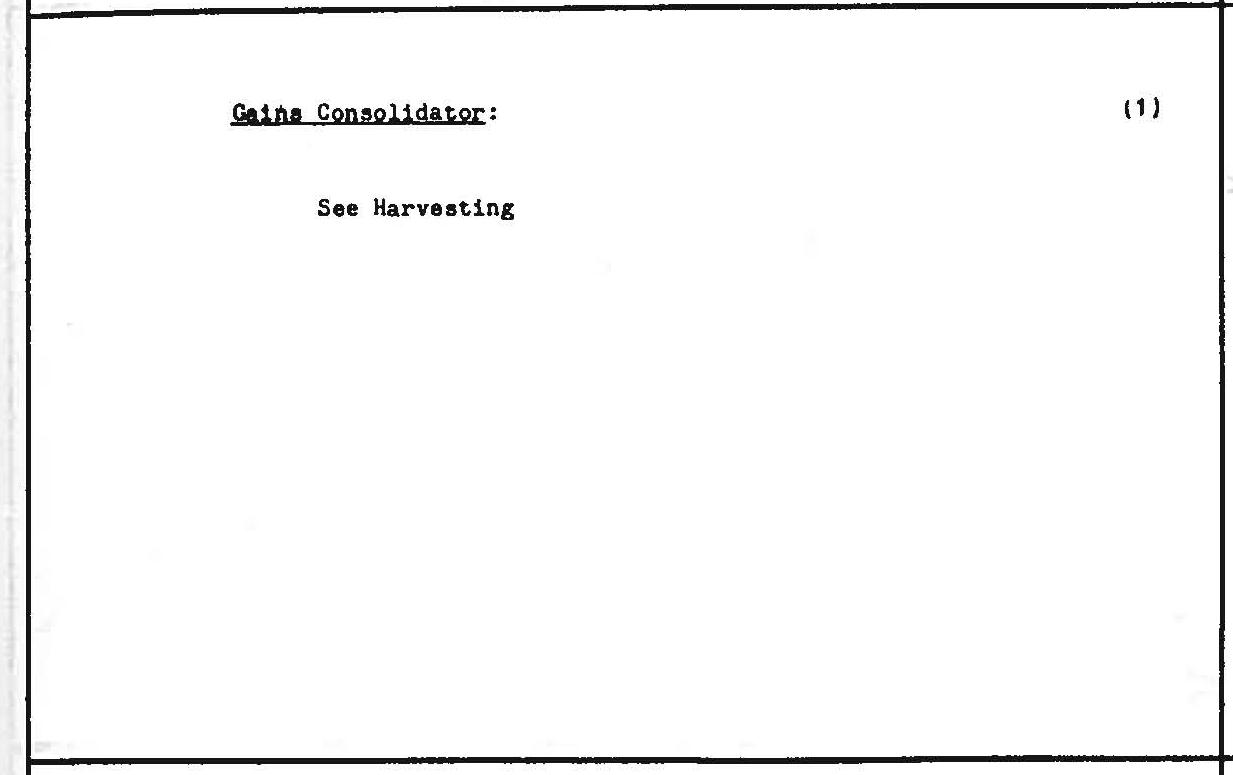
Gains Consolidator (1)
← Gadgets | Gains Consolidator (2) →
Cross Reference
Cross-References
- Harvesting
Gains Consolidator (2)
← Gains Consolidator (1) | Gain at the Expense of Another →
Cross Reference
Cross-References
- Female, 17 Oct'72; May'65
- Girl, 13 Dec'73
- Male & Female, 19 Dec'71
Gain at the Expense of Another
← Gains Consolidator (2) | Galahad, Sir (3) →
Cross Reference
Gain at the Expense of Another:
Cross-References
Galahad, Sir (3)
← Gain at the Expense of Another | Galaxies: Interpulsion Of (2) →
Cross Reference
Cross-References
- Child Sequence, (3)
Galaxies: Interpulsion Of (2)
← Galahad, Sir (3) | Galaxy Galaxies (1) →
Cross Reference
Omnilibrium, 19 Feb'72
Cross-References
- Black Hole, 19 Feb'72 (2)
Galaxy Galaxies (1)
← Galaxies: Interpulsion Of (2) | Galaxy Galaxies (2) →
Cross Reference
Cross-References
- Spherical Sweeput
- Solar System
- Spherical Sweepout
- Nuclear & Nebular: Nucleus & Galaxies
Galaxy Galaxies (2)
← Galaxy Galaxies (1) | Galileo: Galilei: (1564-1642) →
Cross Reference
Cross-References
- Black Hole, (1)
- Cosmic Structuring, (2)
- Parallax, 23 Sep'73
- Touch, 29 Dec'58
- Omniequilibrium, (2)
- Invisibility of Macro- and Micro- Resolutions, (2)
- Energetic Information, 23 Apr'76
- Black Holes & Synergetics, 1 Mar'77
Galileo: Galilei: (1564-1642)
← Galaxy Galaxies (2) | Galileo (1) →
Cross Reference
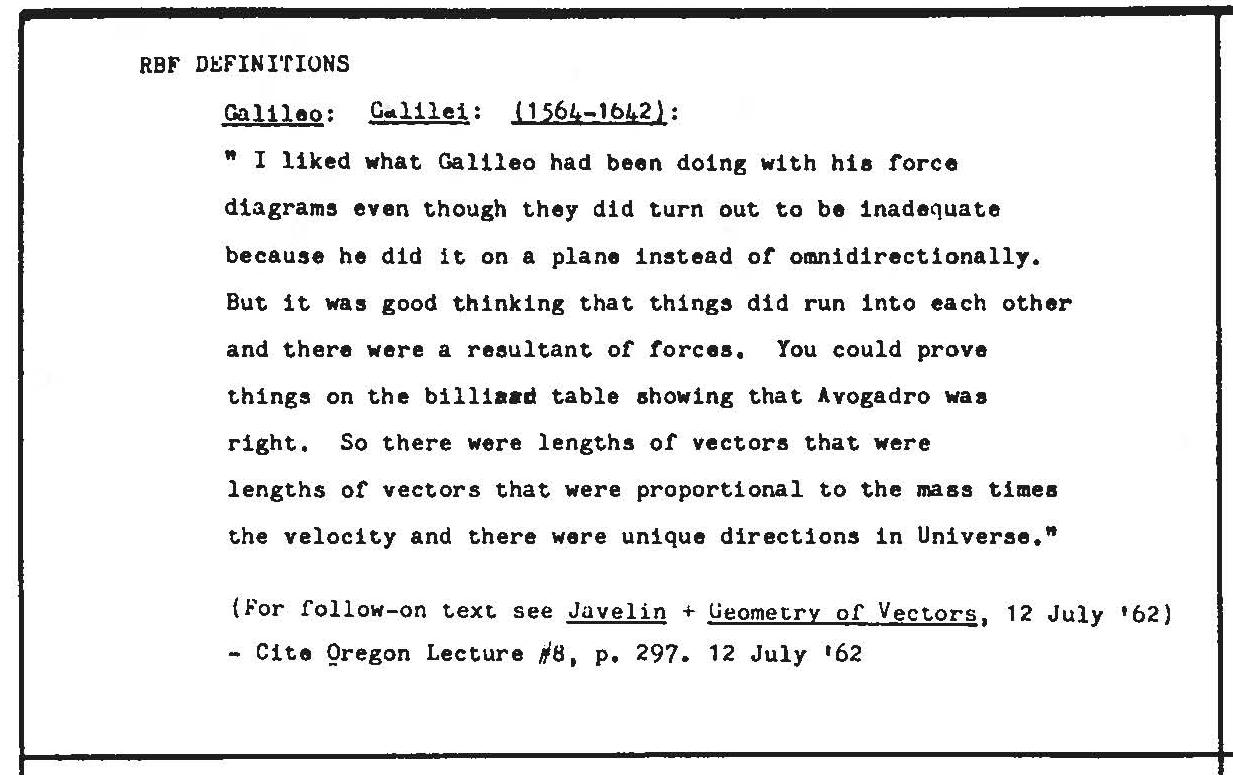
Galileo: Galilei: (1564-1642):
" I liked what Galileo had been doing with his force diagrams even though they did turn out to be inadequate because he did it on a plane instead of omnidirectionally. But it was good thinking that things did run into each other and there were a resultant of forces. You could prove things on the billiard table showing that Avogadro was right. So there were lengths of vectors that were lengths of vectors that were proportional to the mass times the velocity and there were unique directions in Universe."
- Cite Oregon Lecture #8, p. 297. 12 July '62
See Javelin + Geometry of Vectors, 12 July '62
Cross-References
- Javelin + Geometry of Vectorsy '62, 12 Jul
Galileo (1)
← Galileo: Galilei: (1564-1642) | Galileo →
Cross Reference
Cross-References
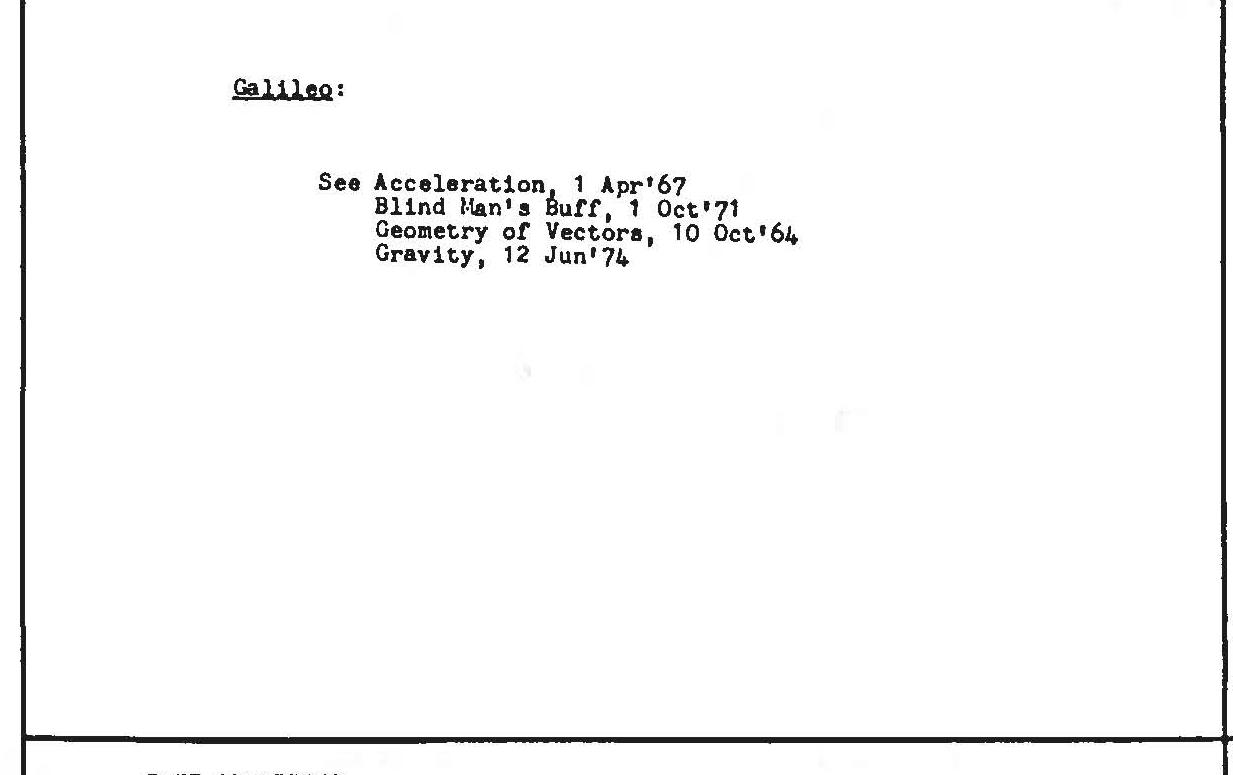
Galileo
Cross Reference
Blind Man's Buff, 1 Oct'71
Cross-References
- Acceleration, 1 Apr'67
- Geometry of Vectors, 10 Oct'64
- Gravity, 12 Jun'74
Galileo
Index Entry
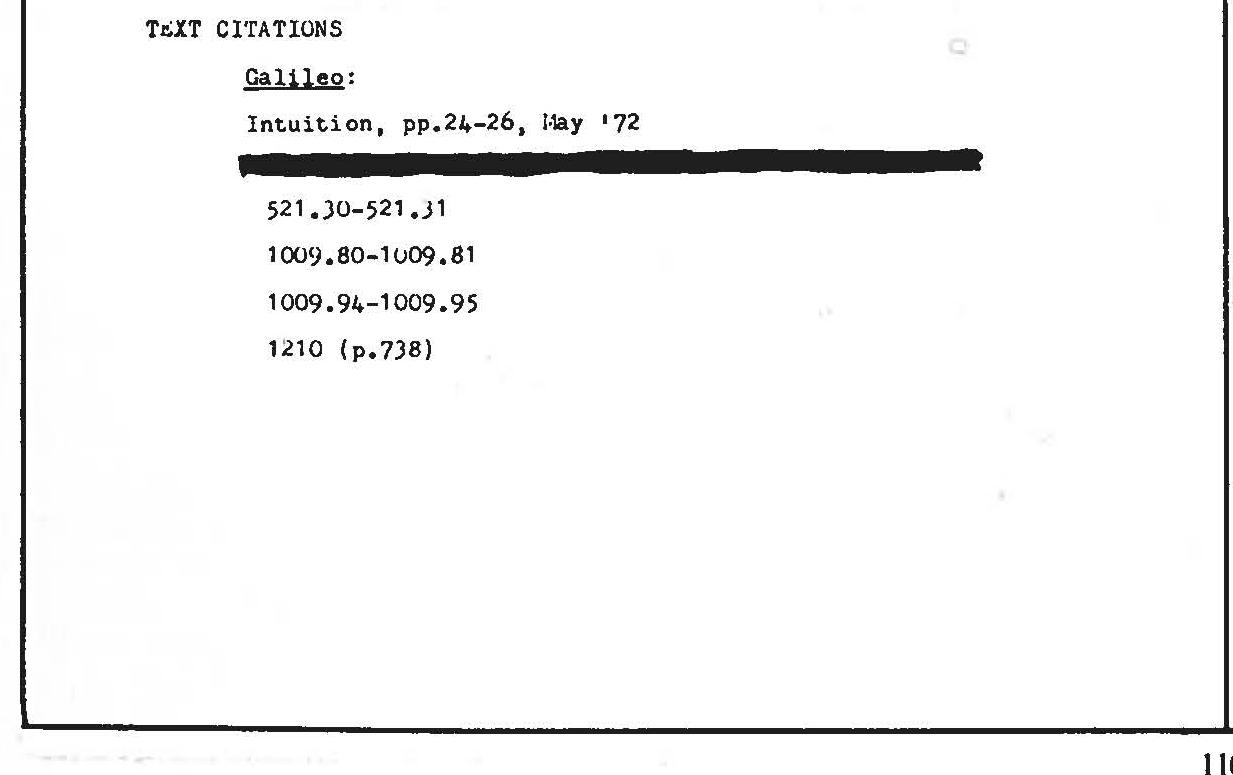
Intuition, pp.24-26, May '72
\hrefhttps://www.buckyverse.org/en/synergetics/content/chapters/500-conceptuality#section-521.30521.30-\hrefhttps://www.buckyverse.org/en/synergetics/content/chapters/500-conceptuality#section-521.31521.31
\hrefhttps://www.buckyverse.org/en/synergetics/content/chapters/1000-omnitopology#section-1009.801009.80-\hrefhttps://www.buckyverse.org/en/synergetics/content/chapters/1000-omnitopology#section-1009.811009.81
\hrefhttps://www.buckyverse.org/en/synergetics/content/chapters/1000-omnitopology#section-1009.941009.94-\hrefhttps://www.buckyverse.org/en/synergetics/content/chapters/1000-omnitopology#section-1009.951009.95
1210 (p.738)
Galley Proofs
Cross Reference
Cross-References
- Fuller, R.B: On Galley Proofs

Gambling
Index Entry
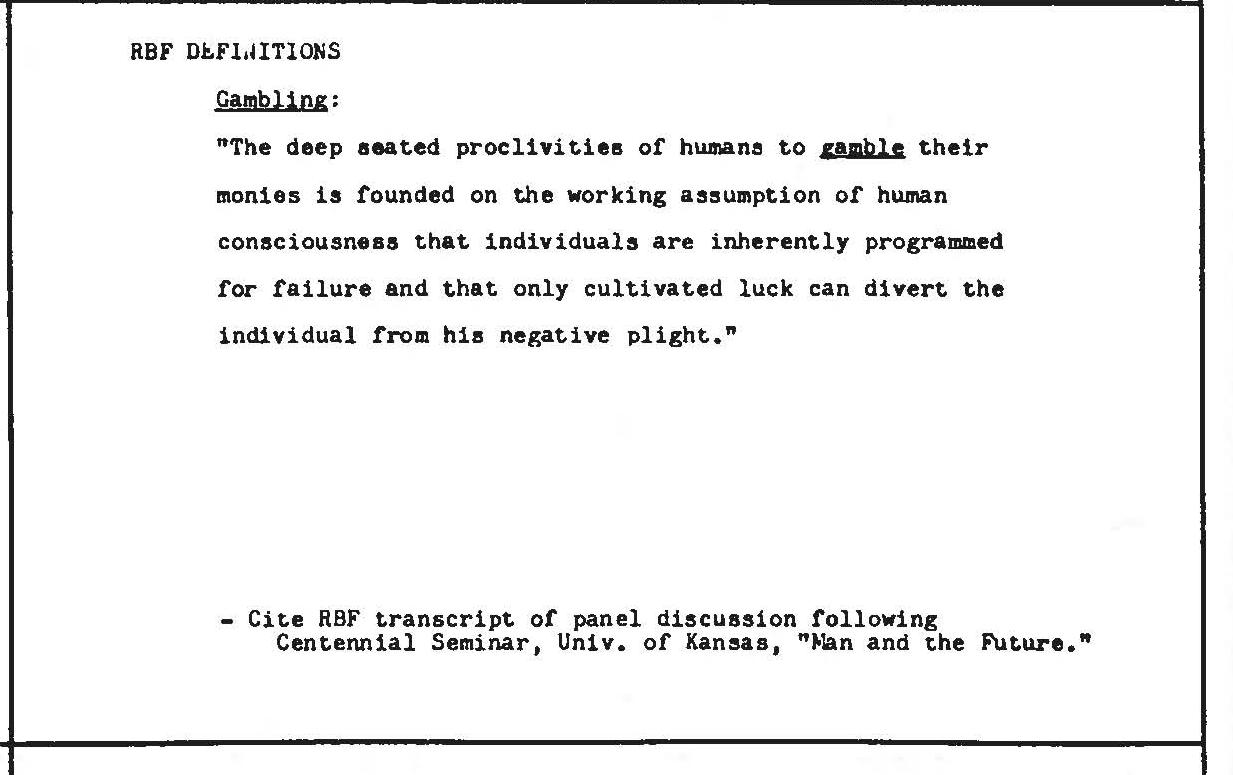
The deep seated proclivities of humans to gamble their monies is founded on the working assumption of human consciousness that individuals are inherently programmed for failure and that only cultivated luck can divert the individual from his negative plight.
Gambling
Cross Reference
Cross-References
- Political Mandates, 27 Dec'73
Games
Index Entry
Games:
"...All human games are ways of initiating disorder to be parried by converting the disorder to order."
- Citation and context at Problems, 13 Dec'73
Games
← Games | Game: Dying as a Game (3) →
Index Entry
There are only two kinds of games-- you or me and you and me. They are equally good games. The competition in you and me is to see who can help the other most effectively...
Game: Dying as a Game (3)
← Games | Game of Cosmic History →
Cross Reference
Cross-References
Game of Cosmic History
← Game: Dying as a Game (3) | Game of Life →
Index Entry
Game of Cosmic History:
"There is the Game of Cosmic History, in which Universe goes on approximately unaware of human nonsense while accommodating its omnilocal game-playing. Flies have their game. Mosquitoes have their game. Microbes have their game. Lion cubs have their game. Whatever games they may be playing, positive or negative, all the games are fail-safe, alternate circuits, omniconsequential to eternally regenerative Universe integrity. It's all permitted. It all belongs."
Game of Life
← Game of Cosmic History | Game of Life's Order of Play →
Cross Reference
Cross-References
Game of Life's Order of Play
← Game of Life | Game of Masks & Monuments (2) →
Cross Reference
Game of Life's Order of Play:
Cross-References
- Involuntary, Feb'71
- Life's Original Event, May'72

Game of Masks & Monuments (2)
← Game of Life's Order of Play | Game Called Money →
Cross Reference
Cross-References
Game Called Money
← Game of Masks & Monuments (2) | Game Called Money →
Index Entry
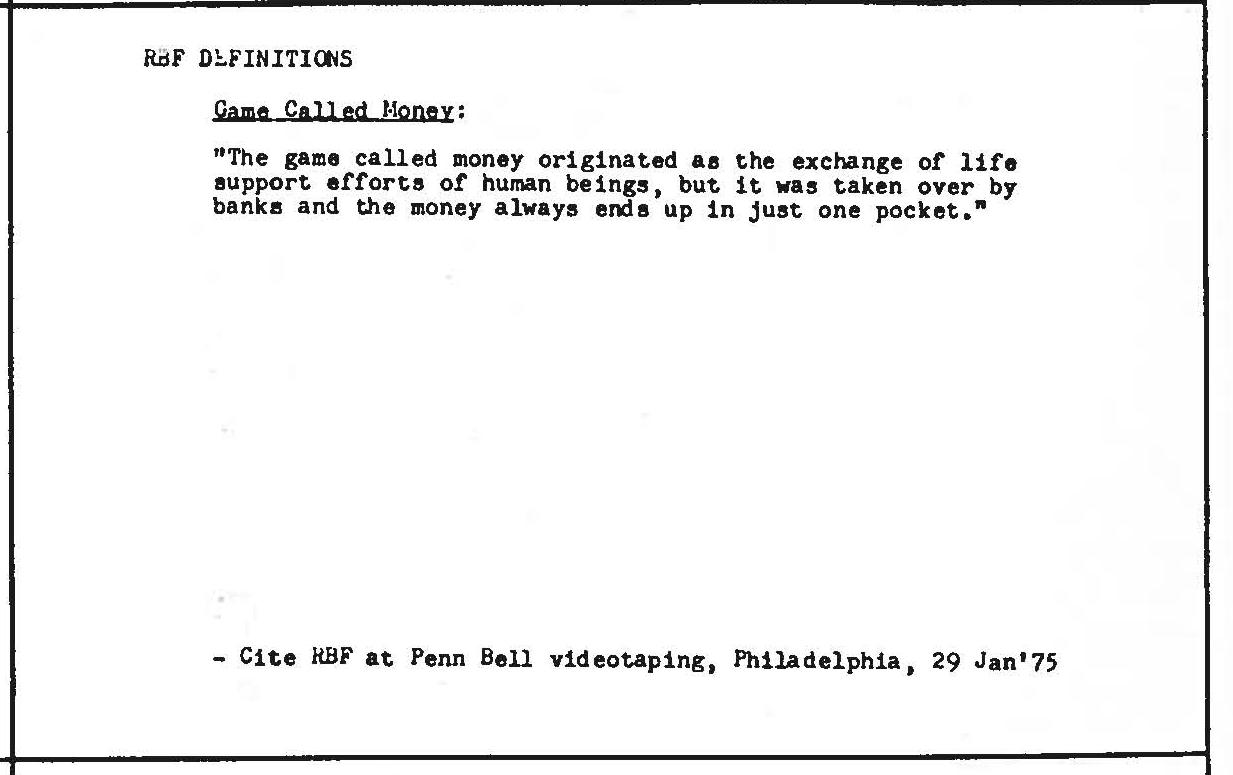
Game Called Money:
"The game called money originated as the exchange of life support efforts of human beings, but it was taken over by banks and the money always ends up in just one pocket."
- Cite RBF at Penn Bell videotaping, Philadelphia, 29 Jan'75
Game Called Money
← Game Called Money | Game of Reality →
Cross Reference
Cross-References
- New York City, 31 Jul'75
- Wealth, 8 Dec'75
Game of Reality
← Game Called Money | Game of Symbols →
Cross Reference
Cross-References
- Cosmetry, 1 Oct'71

Game of Symbols
← Game of Reality | Game: Synergetics as a Game (1) →
Index Entry
Game of Symbols:
"We thought... we could have complete substitution of symbols for numbers and play the game of symbols."
- Citation and context at Conceptuality, 11 Jul'62
Game: Synergetics as a Game (1)
← Game of Symbols | Game: Synergetics as a Game (2) →
Index Entry
Game: Synergetics as a Game:
"Energetic Geometry is, as mathematicians say, a game; and it is a game of solitaire I started playing in 1917. It is now no longer a game of solitaire. Certainly, I have many friends like Duncan (Stuart) who are playing the game with us and we find it very fruitful. When a game becomes fruitful, whereby you can get information from the game itself, one can transfer it to the larger game of life.
"Energetic Geometry started as a game before it had the nice name of Energetic Geometry. It started in 1917 when I was in the Navy and was interested in trying to give myself an additional education which I did not receive in college. I suppose the education I was trying to give myself would have arrived in very fine order if I would have had the chance of going on in college; and I assumed that what I began to discover in the game was territory that had been well covered by students long ago. In some instances that would seem to be the case. In other instances, it would seem that we have rediscovered arrangements of phenomena that, if they have been known to man, have long since been forgotten. I must say that when you play a game like this you get a strange feeling when you come into view of arrangements of components of your energetic Universe with which you are not at all familiar and"
Game: Synergetics as a Game (2)
← Game: Synergetics as a Game (1) | Game Theory →
Index Entry
Game: Synergetics as a Game:
"which you are quite sure men have not seen recently. Yet you have the astounding feeling that someone was here only several thousand years ago, or something like that. You get the feeling of a close kinship to the intellectual speculation of all time. You sometimes feel that this time you can make it stick."
- Cite RBF talk to students at Design School, Raleigh NC, 1950
Game Theory
← Game: Synergetics as a Game (2) | Game of Universe →
Cross Reference
Cross-References
Game of Universe
← Game Theory | Game of Universe (1) →
Index Entry
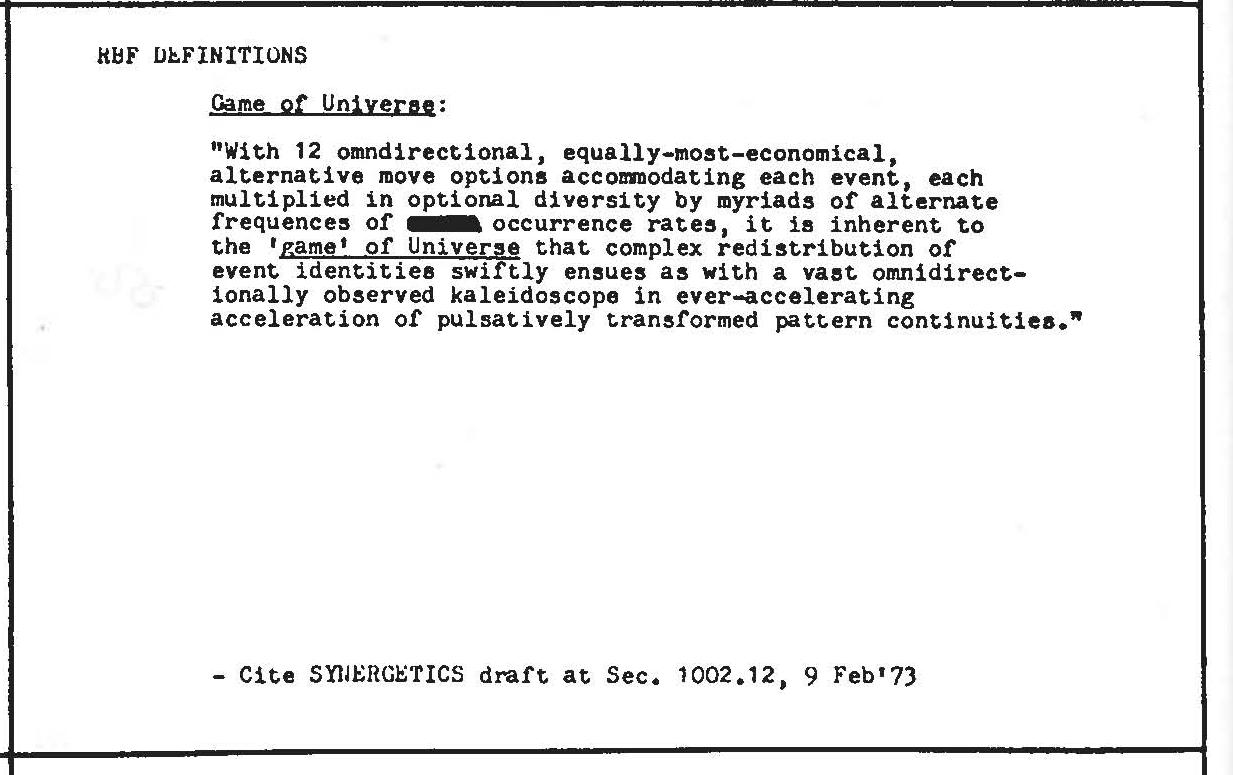
Game of Universe:
"With 12 omnidirectional, equally-most-economical, alternative move options accommodating each event, each multiplied in optional diversity by myriads of alternate frequencies of occurrence rates, it is inherent to the 'game' of Universe that complex redistribution of event identities swiftly ensues as with a vast omnidirectionally observed kaleidoscope in ever-accelerating acceleration of pulsatively transformed pattern continuities."
- Cite SYNERGETICS draft at Sec. \hrefhttps://www.buckyverse.org/en/synergetics/content/chapters/1000-omnitopology#section-1002.121002.12, 9 Feb'73
Game of Universe (1)
← Game of Universe | Game of Universe (2) →
Cross Reference
Cross-References
Game of Universe (2)
← Game of Universe (1) | Games of Words →
Cross Reference
Cross-References
- Dynamic Frame of Reference, (1)
- Individual Universe, (1)
- Miniature Universe, 13 May'73
Games of Words
← Game of Universe (2) | Game Games (1) →
Cross Reference
Cross-References
- Politics, 1960

Game Games (1)
← Games of Words | Game Games (1B) →
Cross Reference
Blind Man's Buff
Fun & Play: Scientific Events First Appearing In Fun & Play
Football
Profit: Man-invented Game of Quick Profit
Cross-References
- Baseball
- Checkers
- Children's Games
- Chess
- Chess: Game of Universe
- Chess: A Priori Intellect Invents a Game Called "Life"
- Competition
- Euler's Game of Crossings
- Gambling
- Intellectual Development Game
- Scoring
- Sports
- Toys
- Unique Way of Playing the Game
- Musical Chairs
- Craps
Game Games (1B)
← Game Games (1) | Game Games (2) →
Cross Reference
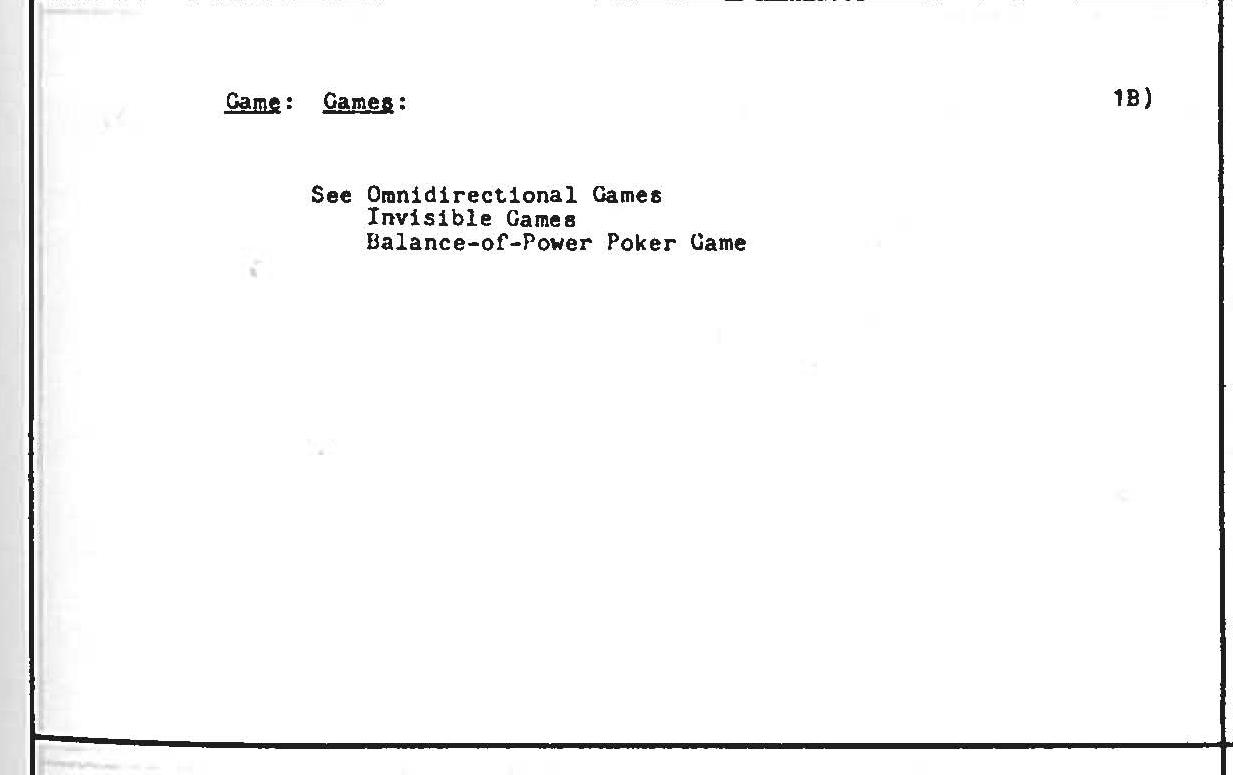
Balance-of-Power Poker Game
Cross-References
Game Games (2)
← Game Games (1B) | Game Games (3) →
Cross Reference
Cross-References
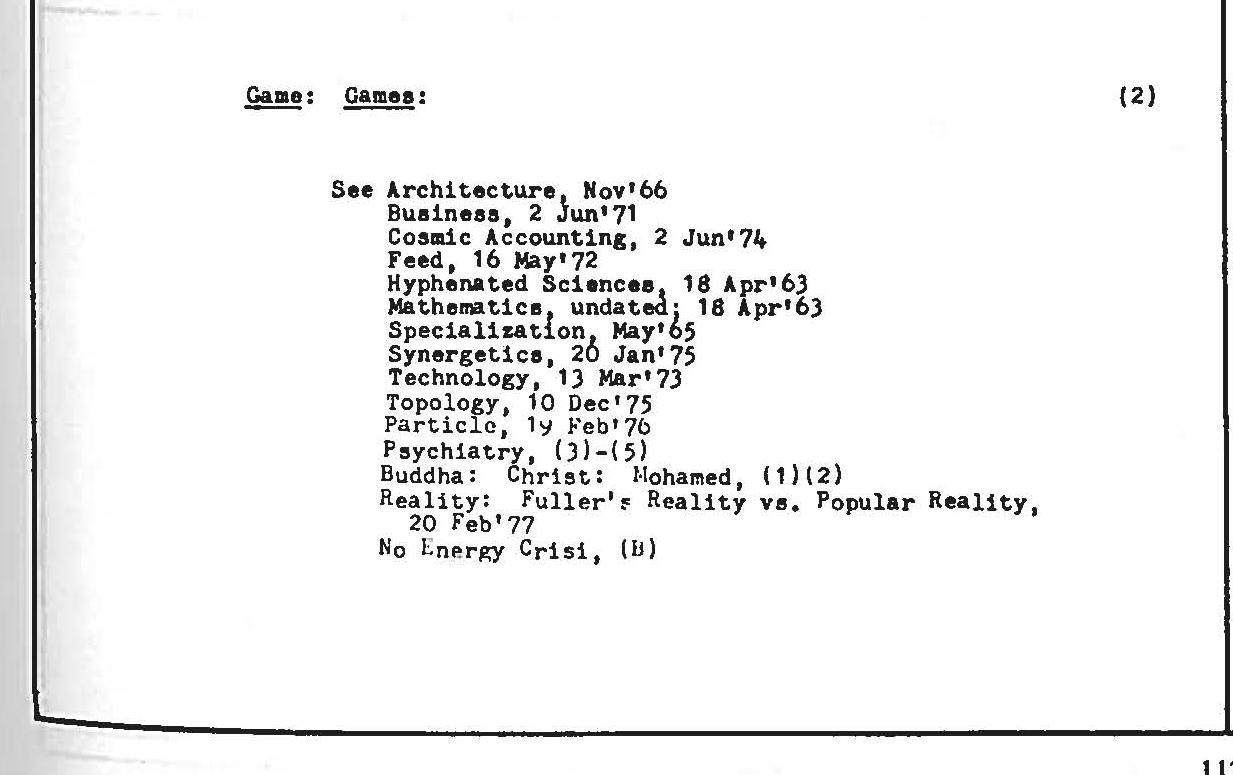
- Architecture, Nov'66
- Business, 2 Jun'71
- Cosmic Accounting, 2 Jun'74
- Feed, 16 May'72
- Hyphenated Sciences, 18 Apr'63
- Mathematics, 18 Apr'63
- Specialization, May'65
- Synergetics, 20 Jan'75
- Technology, 13 Mar'73
- Topology, 10 Dec'75
- Particle, 19 Feb'76
- Psychiatry, (3)
- Buddha: Christ: Mohamed, (1)(2)
- Reality: Fuller's Reality vs. Popular Reality, 20 Feb'77
- No Energy Crisis
Game Games (3)
Cross Reference
Cross-References
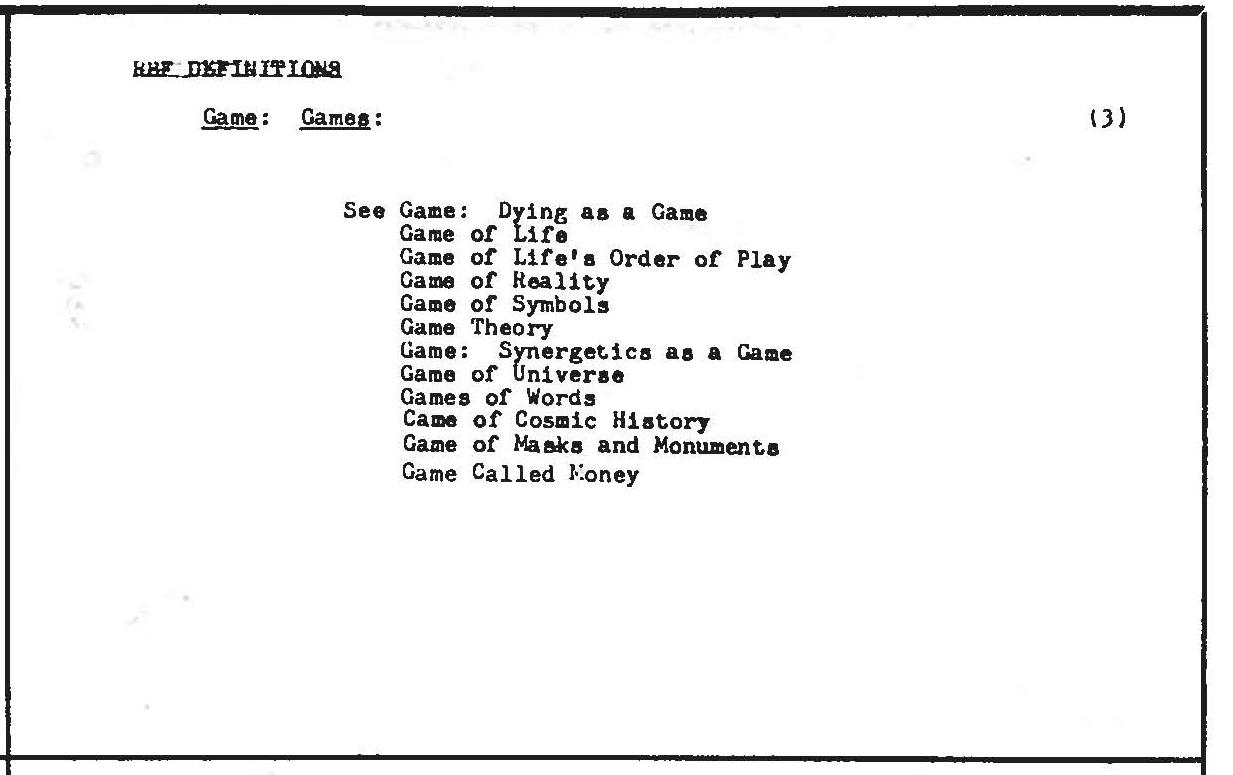
- Dying as a Game
- Game of Life
- Game of Life's Order of Play
- Game of Reality
- Game of Symbols
- Game Theory
- Synergetics as a Game
- Game of Universe
- Games of Words
- Game of Cosmic History
- Game of Masks and Monuments
- Game Called Money
Gamut
← Game Games (3) | Gandhi, Indira →
Cross Reference
Gamut: See Cosmic Gamut
Cross-References

Gandhi, Indira
Cross Reference
Cross-References
- General Systems Theory, 4 Jan'70
- Politics, 4 Jan'70
Gandhi
Index Entry
- World-Around Problems That Have to Be Solved by Bloodless Design Science Revolution, 29 Jun'72
Gandhi
Cross Reference
Cross-References
Gap
Cross Reference
Science: Gap Between Science & Humanities
Cross-References
Garden of Eden
Cross Reference
Cross-References
- Parable, Feb'72
Gas
← Garden of Eden | Gas Turbine →
Cross Reference
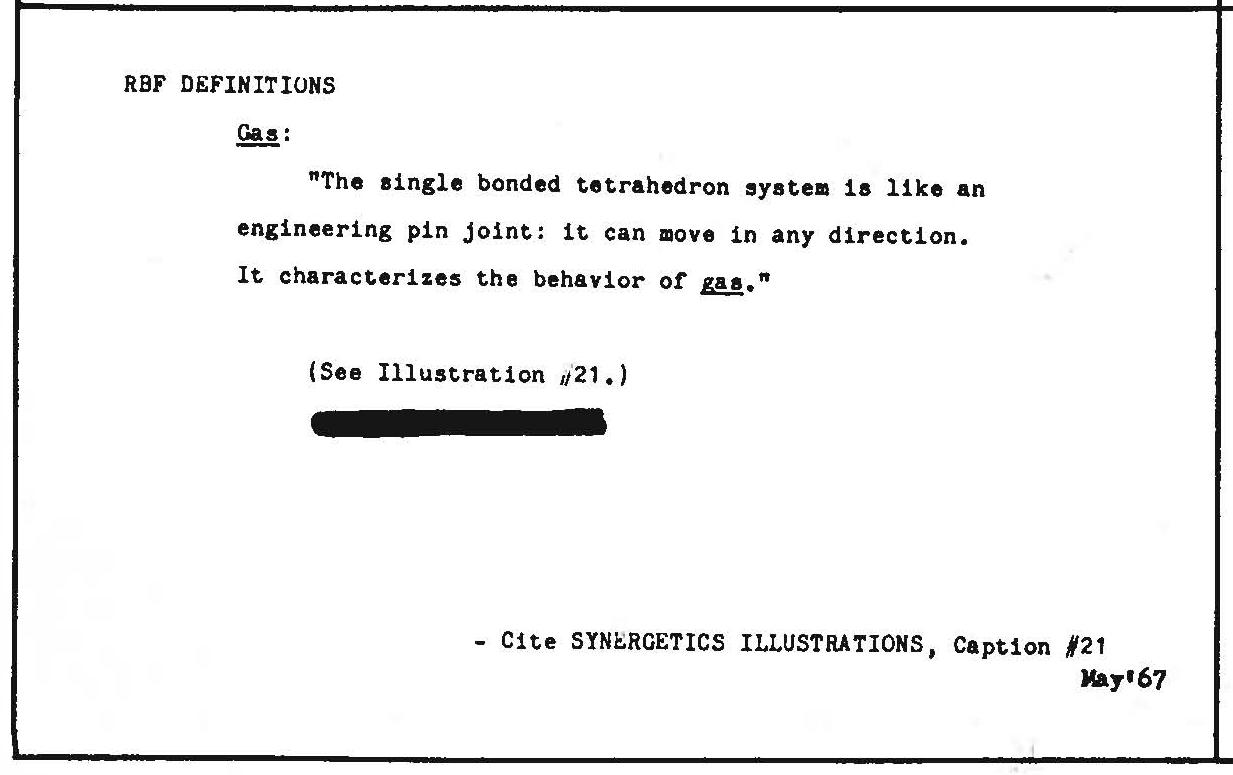
The single bonded tetrahedron system is like an engineering pin joint: it can move in any direction. It characterizes the behavior of gas.
- Cite SYNERGETICS ILLUSTRATIONS, Caption #21
Cross-References
- Illustration #21
Gas Turbine
Cross Reference
Cross-References
Gas (1)
Cross Reference
Cross-References
- Chemical Bonds
- Kinetics of Gases
- Load Distribution
- Mammalian-vegetation Interchange of Gases
- Methane Gas Engine
- Metaphysical Gas
- Incandescence
- Univalent
- Monovalent
Gas (2)
Cross Reference
Cross-References
- Domains of Actions, 21 Dec'71
- Incandescence, 5 Jun'73
- Tetrahedron: Coordinate Symmetry, 15 Oct'64
- Thermal, 6 Mar'73
- Vacuum, 11 Sep'75
- Aural, 22 Feb'77
- Bubble Bursting, 20 Jan'78
Gathering Point
← Gas (2) | Gather Gathering →
Cross Reference
Cross-References
- Planet Earth, 14 Aug'70
Gather Gathering
← Gathering Point | G-C-T-A: DNA →
Cross Reference
Cross-References

G-C-T-A: DNA
Cross Reference
Cross-References
Gears
Index Entry
Gears:
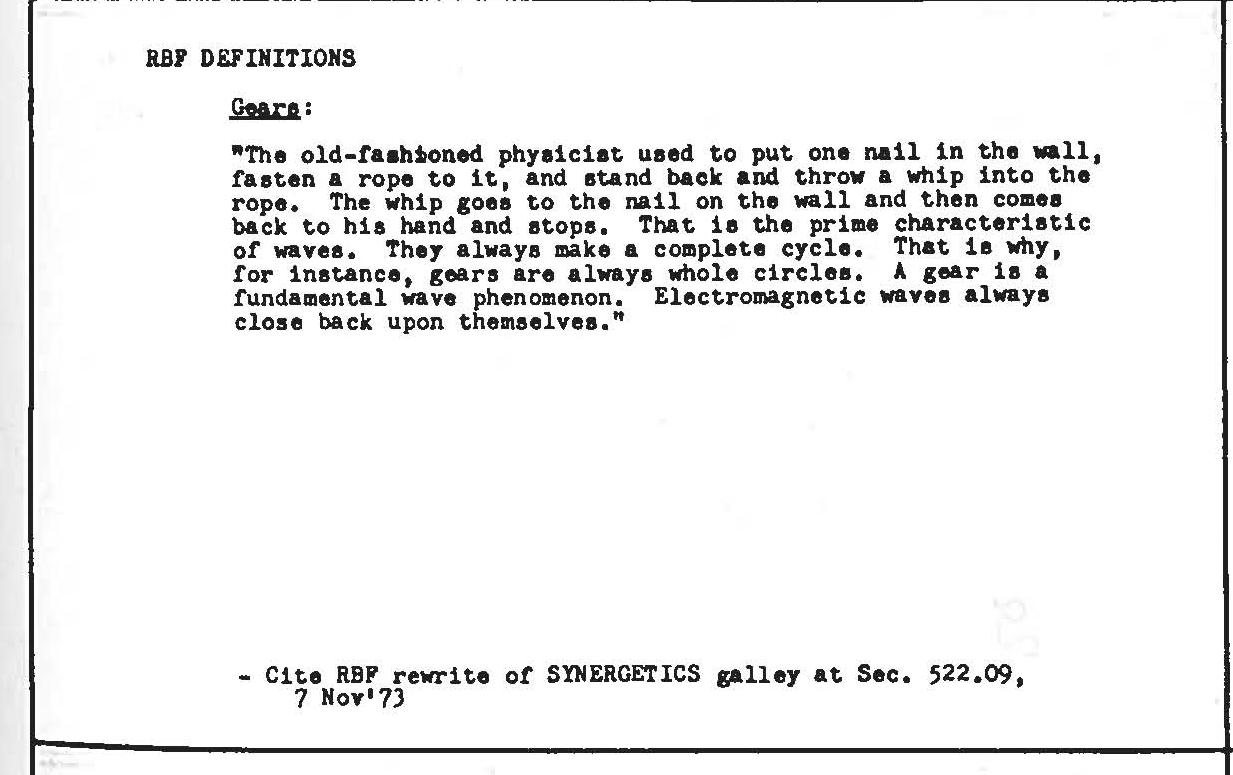
"The old-fashioned physicist used to put one nail in the wall, fasten a rope to it, and stand back and throw a whip into the rope. The whip goes to the nail on the wall and then comes back to his hand and stops. That is the prime characteristic of waves. They always make a complete cycle. That is why, for instance, gears are always whole circles. A gear is a fundamental wave phenomenon. Electromagnetic waves always close back upon themselves."
- Cite RBF rewrite of SYNERGETICS galley at Sec. \hrefhttps://www.buckyverse.org/en/synergetics/content/chapters/500-conceptuality#section-522.09522.09, 7 Nov'73
Gears
Index Entry
Gears:
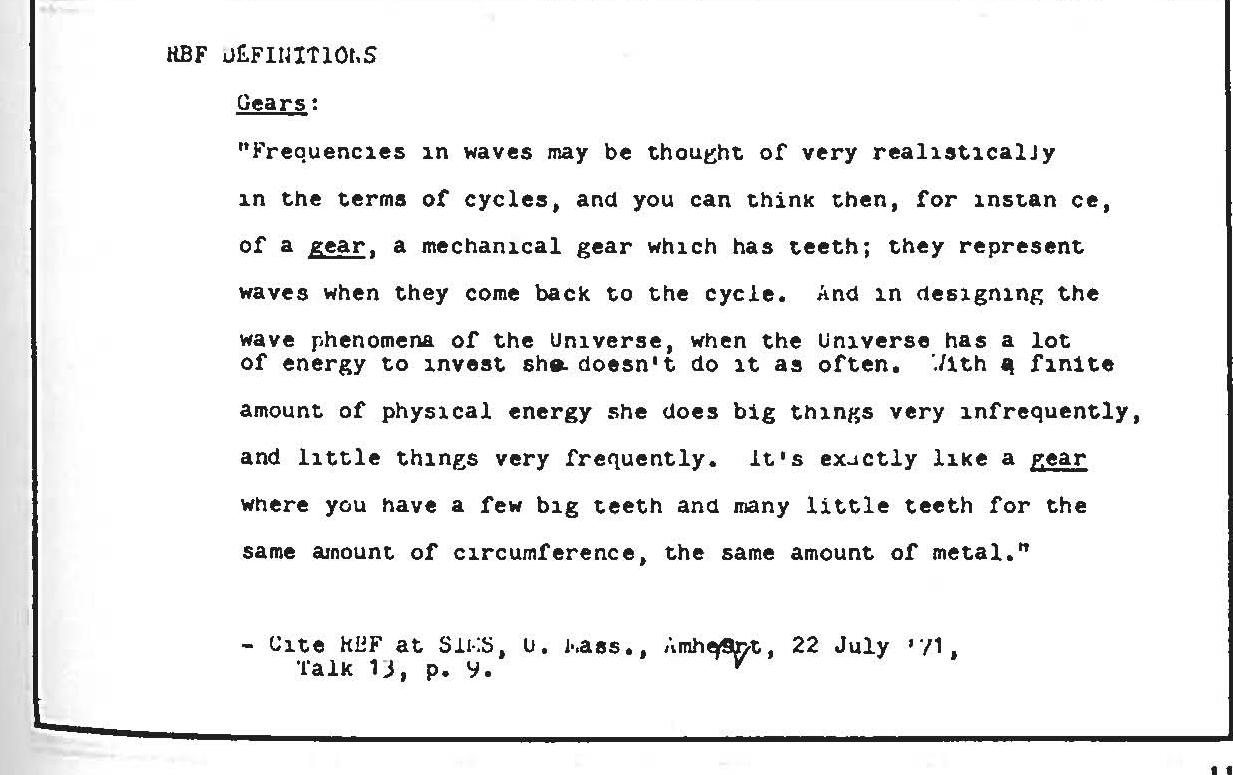
"Frequencies in waves may be thought of very realistically in the terms of cycles, and you can think then, for instance, of a gear, a mechanical gear which has teeth; they represent waves when they come back to the cycle. And in designing the wave phenomena of the Universe, when the Universe has a lot of energy to invest she doesn't do it as often. With a finite amount of physical energy she does big things very infrequently, and little things very frequently. It's exactly like a gear where you have a few big teeth and many little teeth for the same amount of circumference, the same amount of metal."
- Cite RBF at SIIS, U. Mass., Amherst, 22 July '71, Talk 13, p. 9.
Gear-locked
Cross Reference
Cross-References
- Frequency & Magnitude, Jun'66
- Synergetics, Nov'71
Gears: Loose Gear
← Gear-locked | Gears: Spherical Gears →
Index Entry
Gears: Loose Gear:
"...A gear is designed to mesh with other gears. But one loose gear put into the machinery will strip all the others. When it is on the right pinion it meshes with the other gears and can bridge a gear-train gap. That's exactly what happens to copper and spinach..."
Gears: Spherical Gears
← Gears: Loose Gear | Gears: Toothed Gears →
RBF Definitions
"Having different sized teeth, and rates of revolution,
Two such gears cannot mesh, but associate only tangentially.
Consequently, their axial centers must be farther apart
Than are those of meshable gears.
Omnidirectionally pulsative systems
Are, in effect, spherical gears.
Their inwardly and outwardly pulsating and rotating 'teeth'
Consist of multifrequenced circumferential and radial waves
Of fifty-six great-circle subdivisions of spherical unity,
Often nonmeshing with other local systems.
The universally infrequent meshing of wavelengths and frequencies
Produces an omnicondition
In which the new omnidirectional system's center must, as each is
created,
Continually occupy omnidirectionally greater domains of disorder."
Citations
- BRAIN & MIND, p.89 May '82
Gears: Toothed Gears
← Gears: Spherical Gears | Gear Train: Locking and Blocking →
Index Entry
"Toothed gears correspond with wave frequency cycles. Waves are cyclic. Whatever the number of teeth might be we can call the wave frequency. Two gears that do not mesh can only be brought into tangent proximity and take up more room than do meshing gears. Frequencies given off entropically that don't mesh with energies given off by other systems take up more room in Universe."
Gear Train: Locking and Blocking
← Gears: Toothed Gears | Gear Train: Locking and Blocking →
Index Entry
Gear Train: Locking and Blocking:
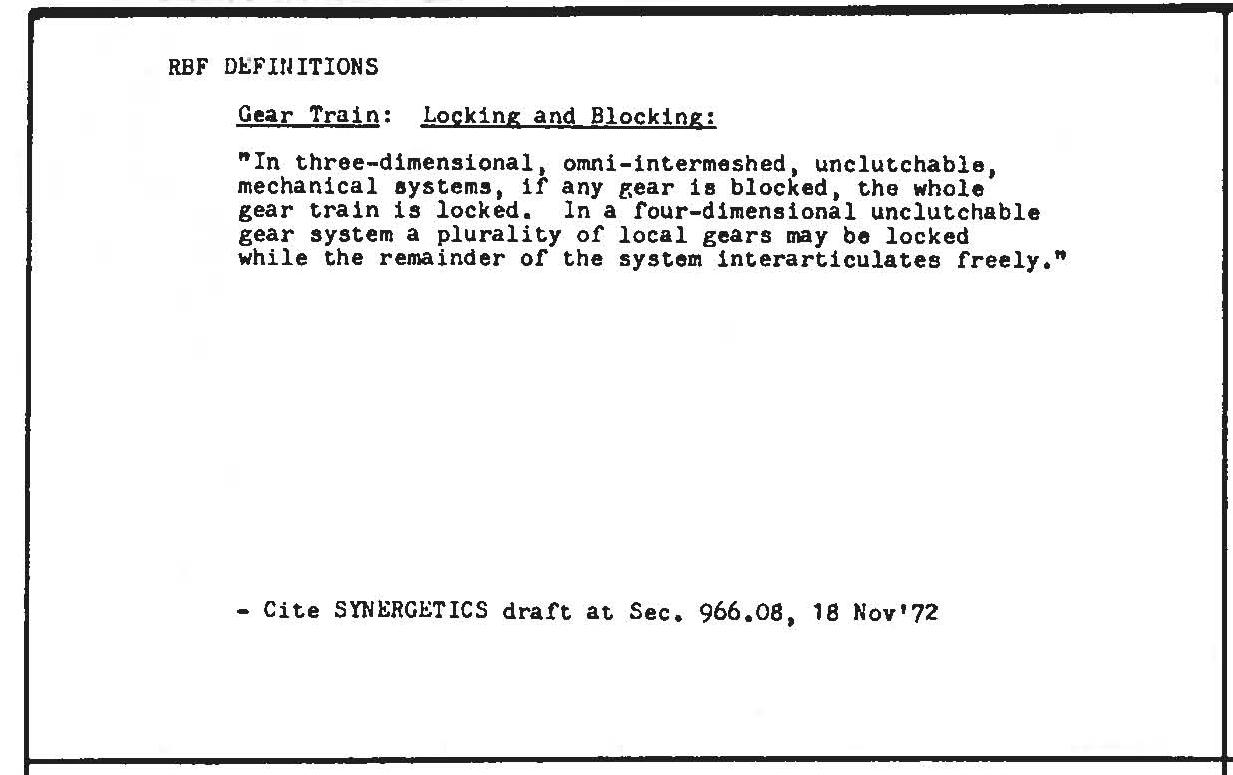
"In three-dimensional, omni-intermeshed, unclutchable, mechanical systems, if any gear is blocked, the whole gear train is locked. In a four-dimensional unclutchable gear system a plurality of local gears may be locked while the remainder of the system interarticulates freely."
- Cite SYNERGETICS draft at Sec. \hrefhttps://www.buckyverse.org/en/synergetics/content/chapters/900-modelability#section-966.08966.08, 18 Nov'72
Gear Train: Locking and Blocking
← Gear Train: Locking and Blocking | Gear Train: Locking & Blocking (1) →
RBF Definitions
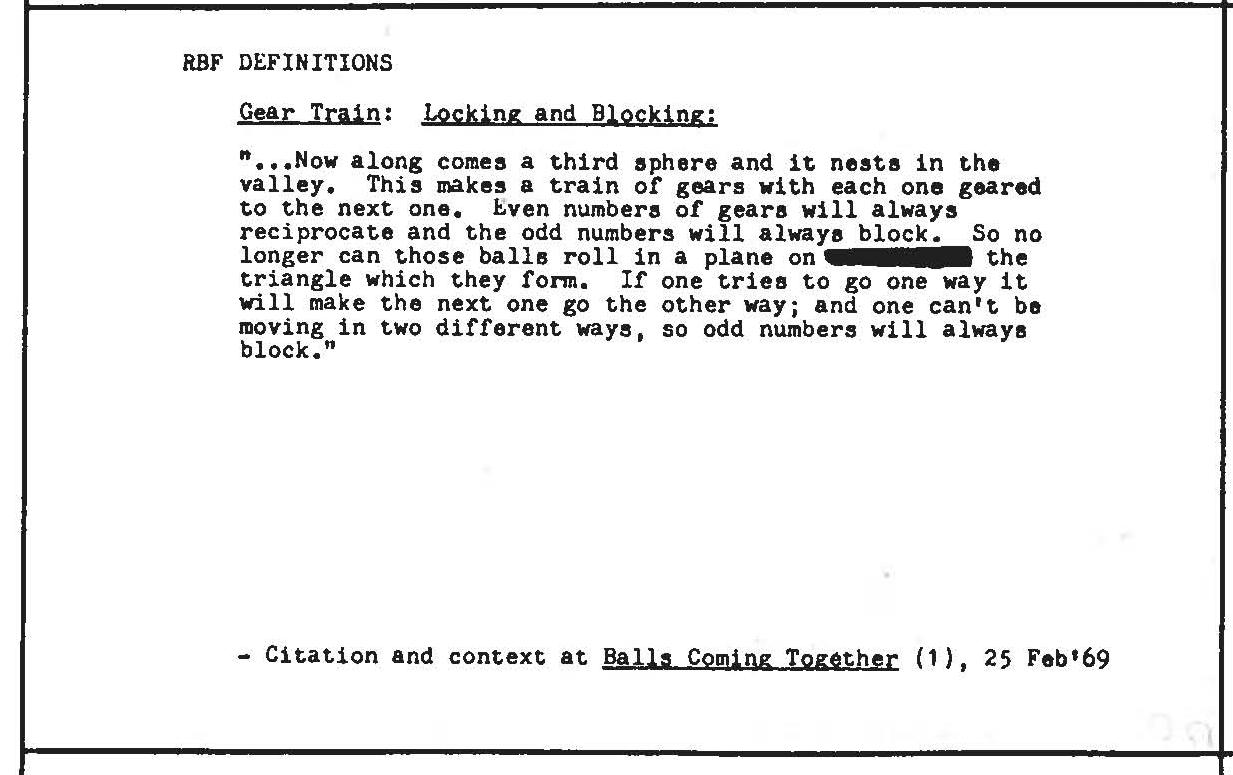
"...Now along comes a third sphere and it nests in the valley. This makes a train of gears with each one geared to the next one. Even numbers of gears will always reciprocate and the odd numbers will always block. So no longer can those balls roll in a plane on the triangle which they form. If one tries to go one way it will make the next one go the other way; and one can't be moving in two different ways, so odd numbers will always block."
- Citation and context at Balls Coming Together (1), 25 Feb'69
Gear Train: Locking & Blocking (1)
← Gear Train: Locking and Blocking | Gear Train: Locking &Blocking (2) →
Cross Reference
Cross-References
Gear Train: Locking &Blocking (2)
← Gear Train: Locking & Blocking (1) | Gear with Two Teeth →
Cross Reference
Icosahedron: Contraction from VE, 11 Jul'62
Cross-References
Gear with Two Teeth
← Gear Train: Locking &Blocking (2) | Gears Geared Gearing (1) →
Cross Reference
Cross-References
- Ellipse, 14 Feb'73
Gears Geared Gearing (1)
← Gear with Two Teeth | Gears Geared Gearing (2) →
Cross Reference
Metabolic Gears
Omni geared
Cross-References
- Brain be Lacking certain Gears, May
- Interlocking
- Meshing & Nonmeshing
- Ovational Gearing
- Intergeared Mobility Freedoms
Gears Geared Gearing (2)
← Gears Geared Gearing (1) | Gender →
Cross Reference
Energetic Function
Quanta Wave Phenomena Sequence, (1)
Cross-References
- Balls Coming Together, (1)
- Critical Proximity, 10 Feb'73
- Frequency
- Lever
- Monkey Wrench, 9 Jul'62
- Precession
- Skinning
- Spinach, 11 Feb'73*
- Time-sizing, 30 Nov'72
- Wow, (1)
- Atom, 30 May'75
- Womb of Permitted Ignorance, (1)
Gender
← Gears Geared Gearing (2) | General Case →
Index Entry
Gender:
Male & Female
General Case
Index Entry
The general case is tensegrity; three-way great-circling of islands of compression. Polarized precession is special case. Omnidirectional precession is generalized.
General Case
Cross Reference
Cross-References
- Omnidirectional, 23 Sep'73
Generalist
← General Case | Generalists & Specialists →
Index Entry
Generalist:
"I've been asking some large questions-- when you are a generalist you learn to look towards big patterns-- and I ask myself the question, 'Does man have a function in the Universe?"
Generalists & Specialists
← Generalist | Generalization →
Index Entry
Q. "You say you are holistic and opposed to specialists. But cannot generalists be employed to coordinate the work of the specialists?"
RBF: "Yes. The specialists were all generalists anyway until they got to the graduate level. So they lose authority. An effective generalist just learns all of the generalized principles; the specialist just seeks the special cases-- with ever less and less chance of finding a new generalization.
"The specialists don't see the applications of their knowledge; they are encouraged not to. It's like the blacksmiths vs. the Nobel prize-winners, the system tries to make them smaller than they really are."
Generalization
← Generalists & Specialists | Generalizations →
Index Entry
Generalization:
"There are eternal generalizations which embrace a plurality of generalizations. The most comprehensive generalization would be that which has U = MP, standing for an eternally regenerative Universe of M times P, where M stands for the metaphysical and P stands for the physical. We could then have a subgeneralization which says that the physical P = Er·Em, where Er stands for energy as radiation and Em stands for energy as matter."
Generalizations
← Generalization | Generalization →
Index Entry
Generalizations:
"Generalizations are of the mind and are chiembracing and omnipermeative."
Radiation-Gravitation
- Citation and context at 8 Mar'73
Generalization
← Generalizations | Generalization →
Index Entry
Generalization:
"Generalization is independent of size and time but the generalization principle must be present in every special case of whatever size or time magnitude."
- Cite SYNERGETICS draft at Sec. \hrefhttps://www.buckyverse.org/en/synergetics/content/chapters/1000-omnitopology#section-1011.341011.34, 17 Feb'73
Generalization
← Generalization | Generalization →
Index Entry
Generalization:
"... A vector is a partial generalization being either metaphysically theoretical or physically realized, and in either sense an abstraction of a special case..."
Generalization
← Generalization | Generalization →
Index Entry
Generalization:
"...Generalization itself is sequitur to experience."
- Citation & context at Mathematics, 13 Mar'71
Generalization
← Generalization | Generalization Sequence (1) →
Index Entry
A generalized principle holds true in every case. If there is one single exception then it is no longer a generalized principle. No one generalization ever contradicts Another generalization in any respect. They are all interaccommodating.
- Cite Lecture "The Function of Man in Universe" Town Hall, New York, 26 Feb 1971
Generalization Sequence (1)
← Generalization | Generalization Sequence (2) →
Index Entry
There's no drive we have quite so great as the sense of order and the urge to employ the sense of order. The best I can see of man's function is the one of the mind. The mind has the ability to generalize. We don't have any experimental suggestion that the physical would be able to generalize. The physical is always a special case. Each of the neurons are keeping the special case incident, but in mind we see the ability to run them over and find out that which is generalized among them. For instance, we said the other day that we have the theory of functions where X can stand for tension and Y for compression; where X could stand for photons and Y for neutrons; where X could stand for concave and Y for convex. These are always normally coexistent. That's the theory of Functions, that is, a generalization of generalizations. And there are generalizations which embrace a plurality of generalizations.
There are very basic first-degree generalizations, and second-degree, and third-degree, and fourth-degree. We find there are five degrees of generalizations where one embraces the others, and we finally get to a word like 'Universe.' - Cite RBF to World Game, Jun-Jul'69
Generalization Sequence (2)
← Generalization Sequence (1) | Generalization Sequence (3) →
Index Entry
Generalization Sequence:
"We find that 'Universe' itself has to be complementary because there is the conceptual and the nonconceptual automatically.
"We have nothing else to indicate mind present anywhere in other animals, or in mountains, or in the physical. There is nothing in our experience with little dogs, our affection for a little dog, or whatever it might be, to suggest that little dogs could develop the theory of functions. We find that the ability to generalize is absolutely unique to mind and that the little dog has brains, beautiful brains, but not mind.
"We have no experience of the mind except in terms of the human being; the mind of the human being, which is able to apprehend and comprehend generalized principles. All the generalized principles have been discovered by human mind. The people who have discovered them are usually called scientists. Sometimes there's a poet, but really the sort of artist-scientist is the one who discovers them, and every time he discovers them, he's prone to make a record of the fact that he discovered it, and that he didn't invent it."
- Cite RBF to World Game, Jun-Jul'69
Generalization Sequence (3)
← Generalization Sequence (2) | Generalization Sequence →
Index Entry
Generalization Sequence:
"The great scientists and artist-scientists finding these life principles find them all never contradictory one of the other. They are intercomplementary; they are interaccommodative. There can't be a principle that has a 'beginning' and an 'ending'. We cannot suggest that an abstraction could have a beginning and an end. The words 'beginning' and 'end' have to do with the physical.
"So we have, then, this extraordinary a priori set of absolutely weightless, pure metaphysical principles which all interaccommodate and therefore are extraordinarily orderly. And they can only be discovered by intellect or mind. They seem to be quite clearly purely metaphysical, and in their orderliness and metaphysicality, they seem to be intellectual in their own right. There seems to be an a priori greater intellect operative in the Universe.
"Anyone who discovers anything about his physical Universe begins to be overwhelmed by it. Just to start off with, there is mass attraction. You learn how mass attraction operates. But no scientist has the slightest idea of the why or how of mass attraction. The more you discover scientifically,
- Cite RBF to World Game, Jun-Jul'69
Generalization Sequence
← Generalization Sequence (3) | Generalization →
Index Entry
Generalization Sequence:
"the more you are overwhelmed by what we don't know. We're dealing in a fantastic mystery, and yet that mystery does have all this extraordinary orderliness, so that you can't help but realize that it can only be found by intellect. Apparently we learn it subjectively, so apparently there must be an objective intellect. There seems to be an a priori greater intellect than that of man operative.
"I don't have to do anything about it. Nature knows exactly what to do. Nature is never caught off guard. (RBF throws coin into the air) I haven't the slightest idea really how to resolve it when I threw that coin in the air. But nature knew how to handle it. Nature is never nonplussed about what to do. But you and I get tremendously nonplussed about what to do."
- Cite RBF to World Game at NY Studio School, 12 Jun-31 Jul'69, Satrun Film transcript #327, pp.13-16.
Generalization
← Generalization Sequence | Generalization →
Index Entry
Generalization:
"If you try to remember all the special case experiences of which your life is composed, your brain will be very quickly overloaded in the given category of recall. It is going to take too long to get this information back and sorted out to use. Instead of trying to deal in all the special cases, deal exactly with the opposite; work towards the great generalizations. Mathematics is one of the great generalizations and so I've worked and kept myself at mathematics. By understanding the fundamentals of mathematics, I can now understand special case behaviors very rapidly. This is one of the major strategies."
- Cite RBF address at Univ. of Rhode Island, 26 Aug. '66. p.195.
Generalization
← Generalization | Generalization: Degrees Of →
Index Entry
Generalization:
"You begin to be able to do away with thousands and thousands of what we call special cases when you get into generalizations. Generalization gives you great strength so what I had learned in chemistry, physics and mathematics began to be very useful. I readopted mathematics because mathematics contains all the great generalizations and there are not really many generalizations. I discovered that if I could be master of the generalizations that I could develop a very high capability."
- Cite OREGON Lecture #2 - p. 55, 2 Jul '62
Generalization: Degrees Of
← Generalization | Generalisation Degrees Of →
Index Entry
Generalization: Degrees Of:
"The degrees are then progressive omnibus stages
Of generalizations of generalizations."
- Cite BRAIN & MIND, p.139 May '72
Generalisation Degrees Of
← Generalization: Degrees Of | Generalization. Degrees of →
Index Entry
The whole process of generalizing generalizations forms a pyramid whose base consists of all the special cases of direct physical experiences. But when we said, 'We take a piece of rope and tense it,' we did not in fact have a rope in our hands. We have all had so many rope experiences that we generalized the concept. This was a first degree generalization. The discovery of always and only coexisting tension and compression was a second degree generalization. Finding a whole family of always and only coexisting phenomena was a third degree generalization; and conceiving therefrom a relativity was a fifth (sic) degree generalization.
In this pyramid of generalizations, the human mind then goes way beyond the biologicals in its development of an increasing and diminishing conceptual Universe. So we find the metaphysical not only balancing the physical-- which should have been expected-- but also encompassing the physical by one tetrahedron, and thereafter reducing its myriadness to unity. The metaphysical, as with the circumferentially united, great-circle chord vectors of the vector equilibrium, coheres the physical.
"...Man is the great antientropy."
- Cite NASA Speech, p.89, Jun'66
Generalization. Degrees of
← Generalisation Degrees Of | Generalization Degrees Of →
Index Entry
Each degree of generalization shrinks the number of component concepts from the original myriad of special-case experiences. Man's mind is therefore the most powerful anti-entropy manifested in the universe.
Generalization Degrees Of
← Generalization. Degrees of | Generalization: First Degree →
Index Entry
How Little I Know, pp.28-29, Oct '66
Music in the New Life, p.14
Generalization: First Degree
← Generalization Degrees Of | Generalizations: First Degree →
Index Entry
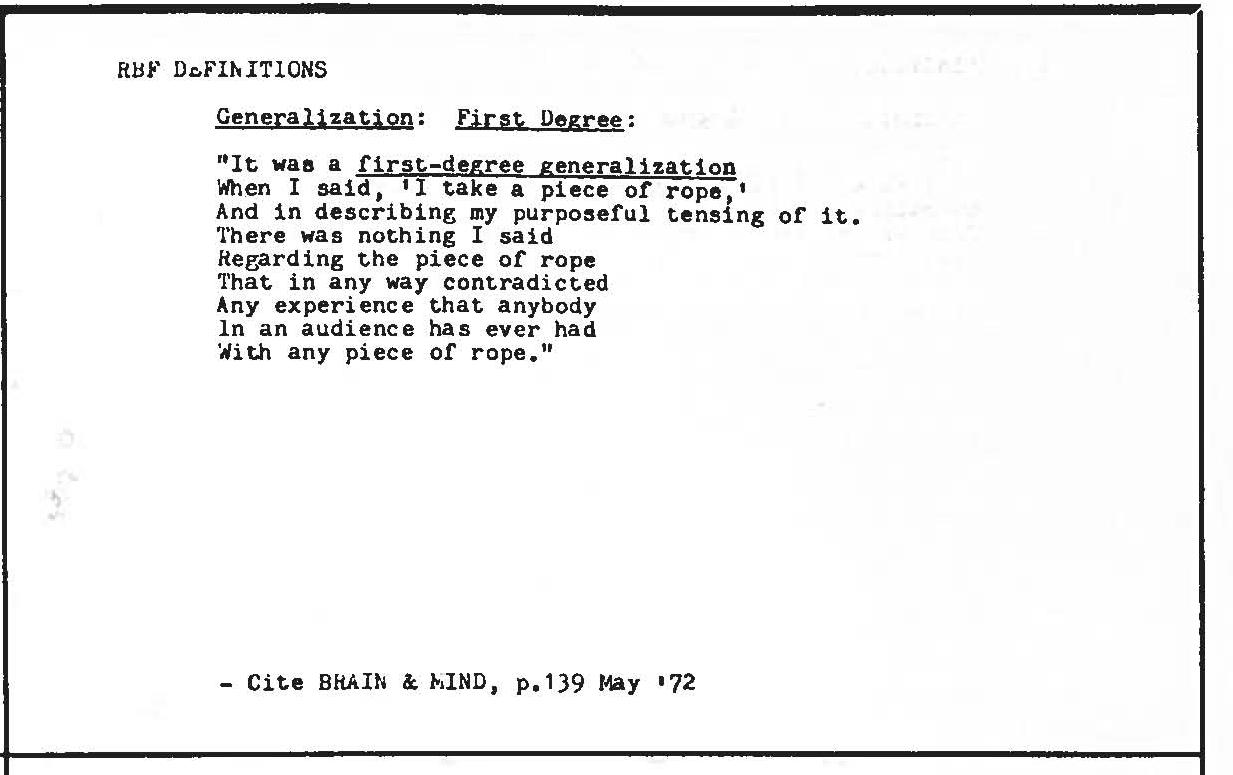
Generalization: First Degree:
"It was a first-degree generalization
When I said, 'I take a piece of rope,'
And in describing my purposeful tensing of it.
There was nothing I said
Regarding the piece of rope
That in any way contradicted
Any experience that anybody
In an audience has ever had
With any piece of rope."
- Cite BHAIN & MIND, p.139 May '72
Generalizations: First Degree
← Generalization: First Degree | Generalization, First-Degree →
Index Entry
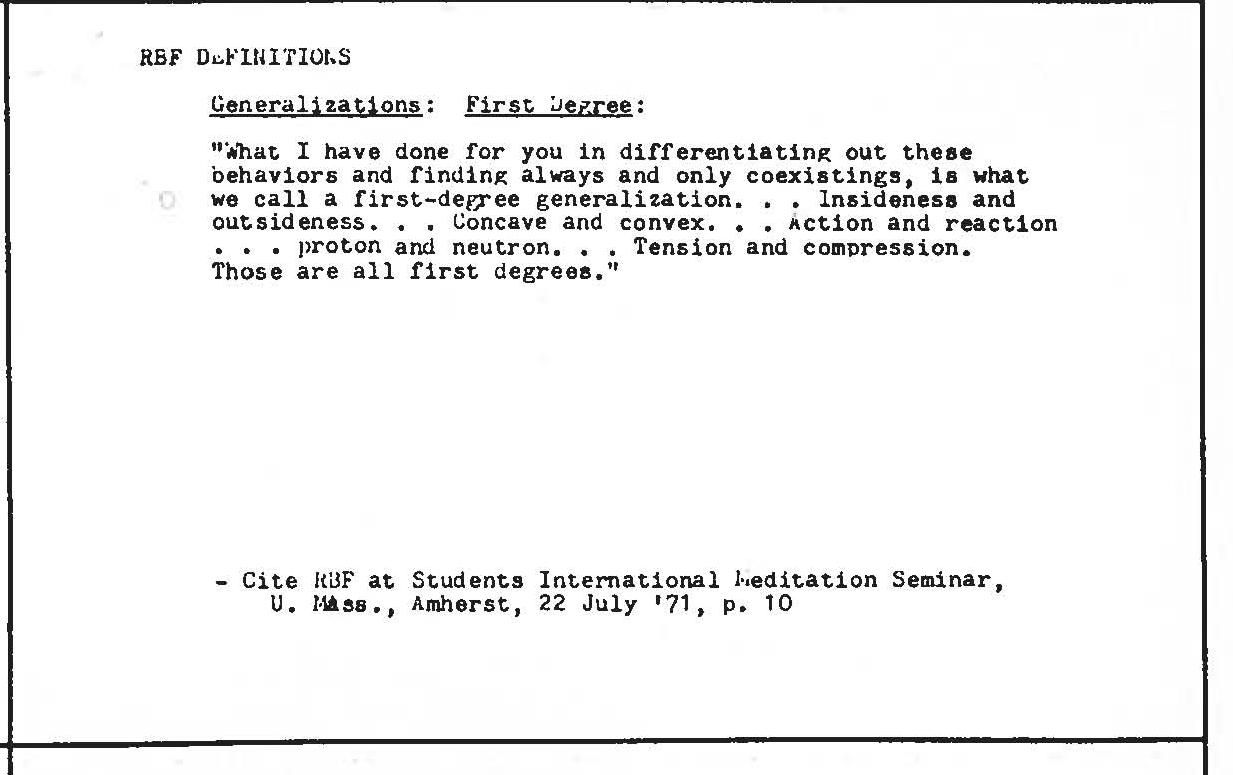
Generalizations: First Degree:
"What I have done for you in differentiating out these behaviors and finding always and only coexistings, is what we call a first-degree generalization. .. Insideness and outsideness. .. Concave and convex. .. Action and reaction .. . proton and neutron. .. Tension and compression. Those are all first degrees."
- Cite RBF at Students International Meditation Seminar, U. Mass., Amherst, 22 July '71, p. 10
Generalization, First-Degree
← Generalizations: First Degree | Generalization First-Degree →
Index Entry
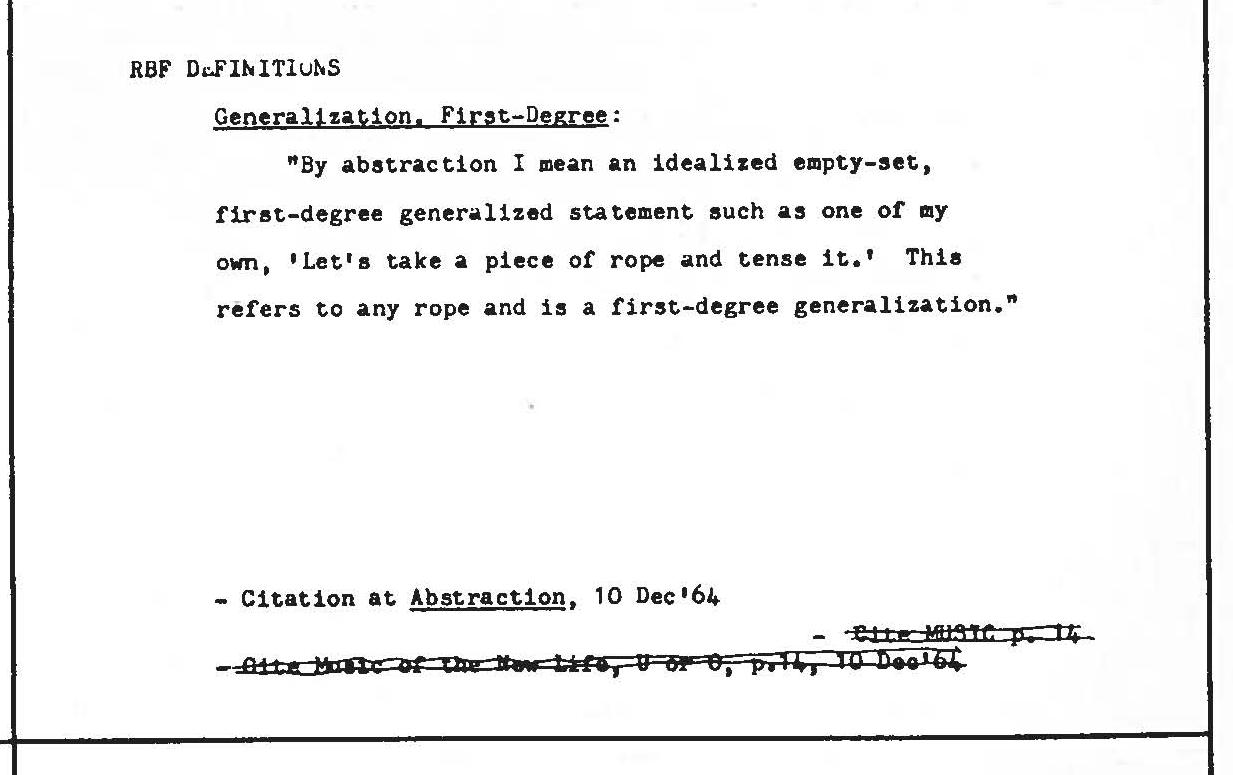
Generalization, First-Degree:
"By abstraction I mean an idealized empty-set, first-degree generalized statement such as one of my own, 'Let's take a piece of rope and tense it.' This refers to any rope and is a first-degree generalization."
-
Citation at Abstraction, 10 Dec'64
-
Cite MUSIC p. 14
-
Cite Music of the New Life, U of O, p.14, 10 Dec'64
Generalization First-Degree
← Generalization, First-Degree | Generalization: Second Degree →
Cross Reference
Cross-References
Generalization: Second Degree
← Generalization First-Degree | Generalization: Second Degree →
Index Entry
It is a second-degree generalization
To find an additional generalized principle
Operating within the generalized piece of rope;
Such as the always and only
Coexisting tension and compression.
It is also a second-degree generalization
To find the concave and convex within generalized systems.
Generalization: Second Degree
← Generalization: Second Degree | Generalization Second Degree →
Index Entry
Generalization: Second Degree:
"It was a second-degree generalization to find the theory of functions embracing generalizations. Here is a generalization of x and y embracing a number of clearly differntiated yet nonetheless generalized principles."
- Cite RBF at Students International Meditation Seminar, U. Mass., Amherst, 22 July '71, p. 10
Generalization Second Degree
← Generalization: Second Degree | Generalization, Second-Degree →
Index Entry
Generalization Second Degree:
"And within the specialized occupational categories
An ever multiplying host
Of second degree specializations
Are frequently being instituted
All in perverse disregard of the fact
That humans are born with universal curiosity,
And omnifunction inventing capability
With which to cope extracorporeally
With ever evolving
Environmental challenges. . ."
- Context and citation at Generalized Principle(3) + (4), 28 Jan'69
Generalization, Second-Degree
← Generalization Second Degree | Generalization: Second Degree →
Index Entry
Next I say, 'Tension and compression are only coexistent'-- when you tense a rope its girth contracts--ergo compresses. This observation is a second-degree generalization.
- Cite MUSIC, p. 14, 10 Dec'64
Generalization: Second Degree
← Generalization, Second-Degree | Generalization: Third Degree →
Index Entry
Generalization: Second Degree:
"When a second order of pattern distillation as a generalized conceptual principle emerges, but this time exclusively from the emergently-induced coordinate consideration of a plurality of generalized conceptual principles themselves, each independent of any special-case sensoriality, and in such a regeneratively recognizable manner of patterning as to provide a means of mathematical accounting and therefrom a tentative forecasting capability, not only of generalized developments but also of special forward experiences in the terms of specific sensorial conditions, and those calculated forecast condition materialize, and the forecasting capability is subsequently verified by recurrent experimental demonstrations under controlled generalized conditions, then we may tentatively assume that we have discovered at least a clause of 'natural law.' For example, we tentatively assume that radiation is generalized compression and that gravity is generalized tension and that tension and compression are inseparable, precessionally complementary functions of universal structure."
- Cite INTRODUCTION to OMNIDIRECTIONAL HALO, p.120, 1959
Generalization: Third Degree
← Generalization: Second Degree | Generalization →
Index Entry
Generalization: Third Degree:
"It's a third-degree generalization
Or a generalization of a group of generalizations,
To develop the Theory of Functions
Wherein the X and Y could stand
For any one second-degree coexistence generalizations."
- Cite BRAIN & MIND, p.139 May '72
Generalization
← Generalization: Third Degree | Generalization, Third-Degree; and Fourth-Degree →
Index Entry
Generalization: Third Degree and Fourth Degree:
"So I found there was a hierarchy of generalizations of generalizations. ...we go into relativity as a third degree generalization and Universe as a fourth degree generalization."
- Cite RBF at Students International Meditation Seminar, U. Mass., Amherst, 22 July '71, p. 10
Generalization, Third-Degree; and Fourth-Degree
← Generalization | Generalization: Farth Degree →
Index Entry
Only coexisting phenomena tension and compression, convexity and concavity, and electromagnetic charges are each special cases of the generalized mathematical case of the only-coexistence of functions of a system. This statement is a third-degree generalization which generalizes generalizations.
"Forty years ago I generalized this third-degree abstraction even further by saying that 'unity is plural and at minimum two.' This is a fourth-degree generalization."
Generalization: Farth Degree
← Generalization, Third-Degree; and Fourth-Degree | Generalization: Fifth Degree →
Index Entry
Generalization: Farth Degree:
"It is a fourth-degree generalization
To develop the word 'relativity.'"
- Cite BRAIN & MIND, p.139. May'72
Generalization: Fifth Degree
← Generalization: Farth Degree | Generalization: Fifth Degree →
Index Entry
Generalization: Fifth Degree:
"When we get to the fifth-degree generalization,
Universe,
We have increased our numbers-of-experiences base
To all the experiences
Ever known to and remembered by humanity,
Including all the experiences
With all the atoms and their nuclear components.
"Thus, the human mind
Has collected, combined, and refined
All experiences of all humanity,
In all-remembered time,
Into one single concept,
Universe,
Which is, ipso facto,
The ultimate generalization."
Generalization: Fifth Degree
← Generalization: Fifth Degree | Generalization: Fifth Degree →
Index Entry
Generalization: Fifth Degree:
"And it's a fifth-degree generalization
To employ the word 'Universe'
To embrace both the relativity and complementarity."
-
Citation at Universe, May'72
-
Cite BRAIN & MIND, p.139 May '72
Generalization: Fifth Degree
← Generalization: Fifth Degree | Generalization, Fifth-Degree →
Index Entry
Generalization: Fifth Degree:
"Life is a fifth degree generalized principle
Permeating the gamut
Of special case, inanimate,
Physical energy events.
Live animals have no reaction to dead animals.
Animals do not think about life and death."
Generalization, Fifth-Degree
← Generalization: Fifth Degree | Generalizations of Generalizations →
Index Entry
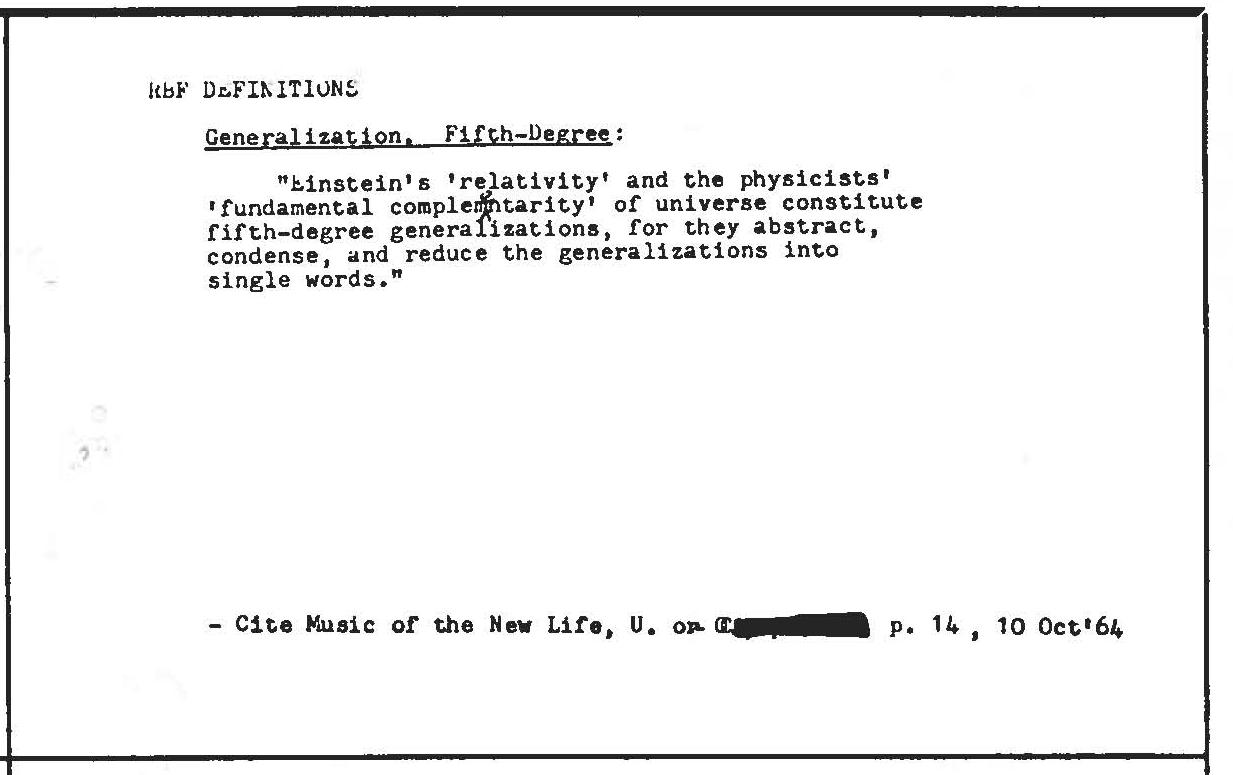
Generalization, Fifth-Degree:
"Einstein's 'relativity' and the physicists' 'fundamental complementarity' of universe constitute fifth-degree generalizations, for they abstract, condense, and reduce the generalizations into single words."
- Cite Music of the New Life, U. on G. p. 14, 10 Oct'64
Generalizations of Generalizations
← Generalization, Fifth-Degree | Generalizations of Generalizations →
Index Entry
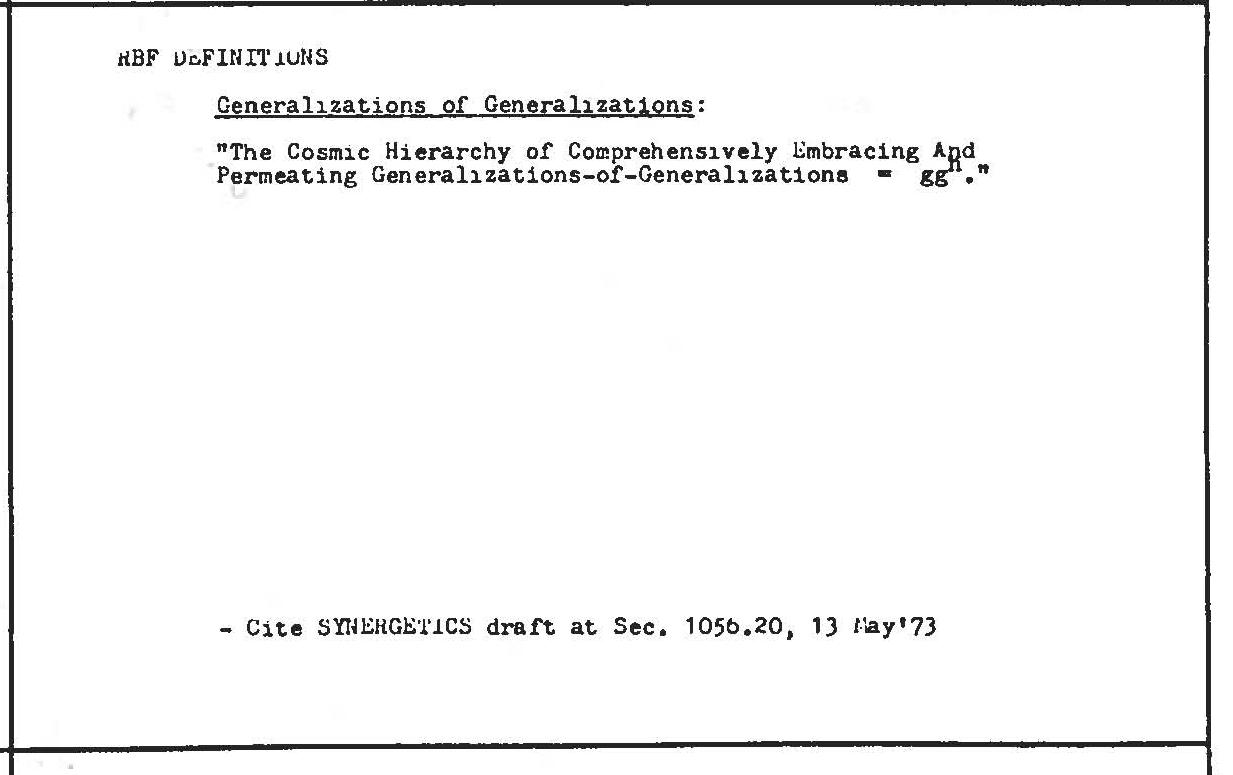
Generalizations of Generalizations:
"The Cosmic Hierarchy of Comprehensively Embracing And Permeating Generalizations-of-Generalizations = gg".
- Cite SYNERGETICS draft at Sec. \hrefhttps://www.buckyverse.org/en/synergetics/content/chapters/1000-omnitopology#section-1056.201056.20, 13 May'73
Generalizations of Generalizations
← Generalizations of Generalizations | Generalizations of Generalizations (1) →
Index Entry
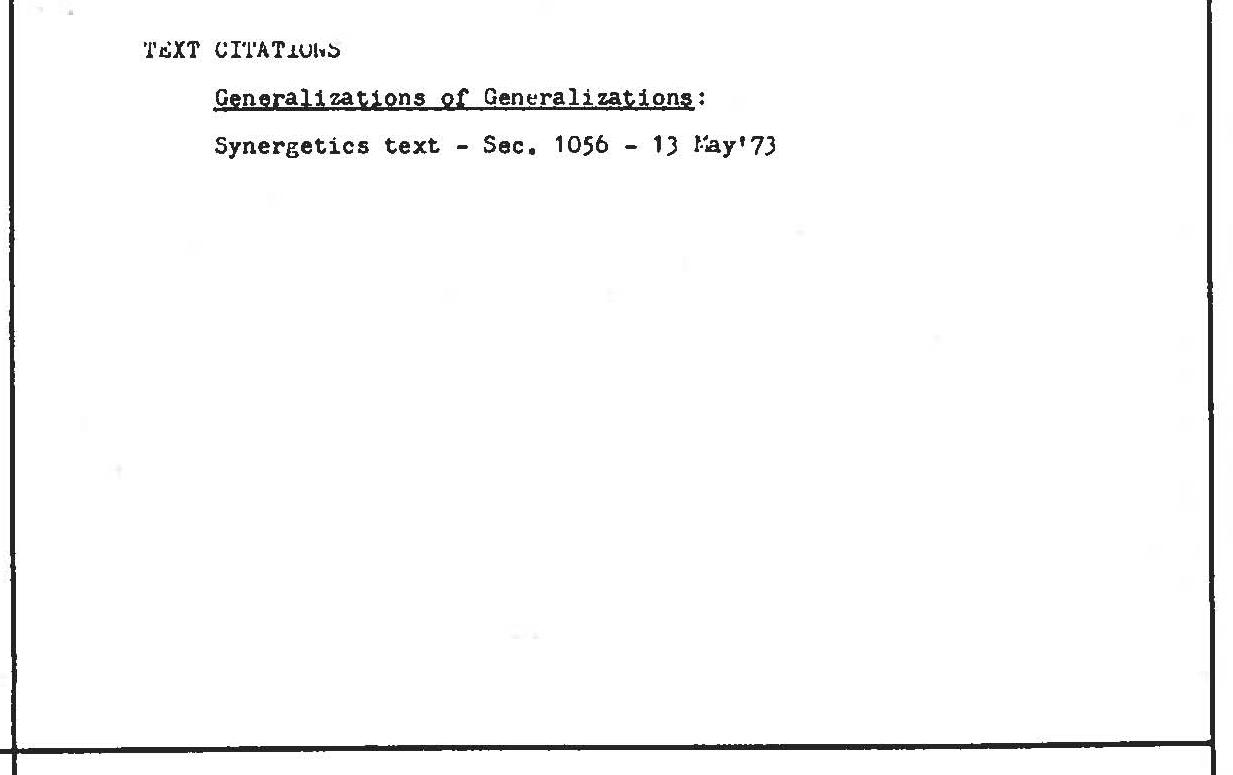
Synergetics text - \hrefhttps://www.buckyverse.org/en/synergetics/content/chapters/1000-omnitopology#section-1056.001056 - 13 May'73
Generalizations of Generalizations (1)
← Generalizations of Generalizations | Generalizations of Generalizations (2) →
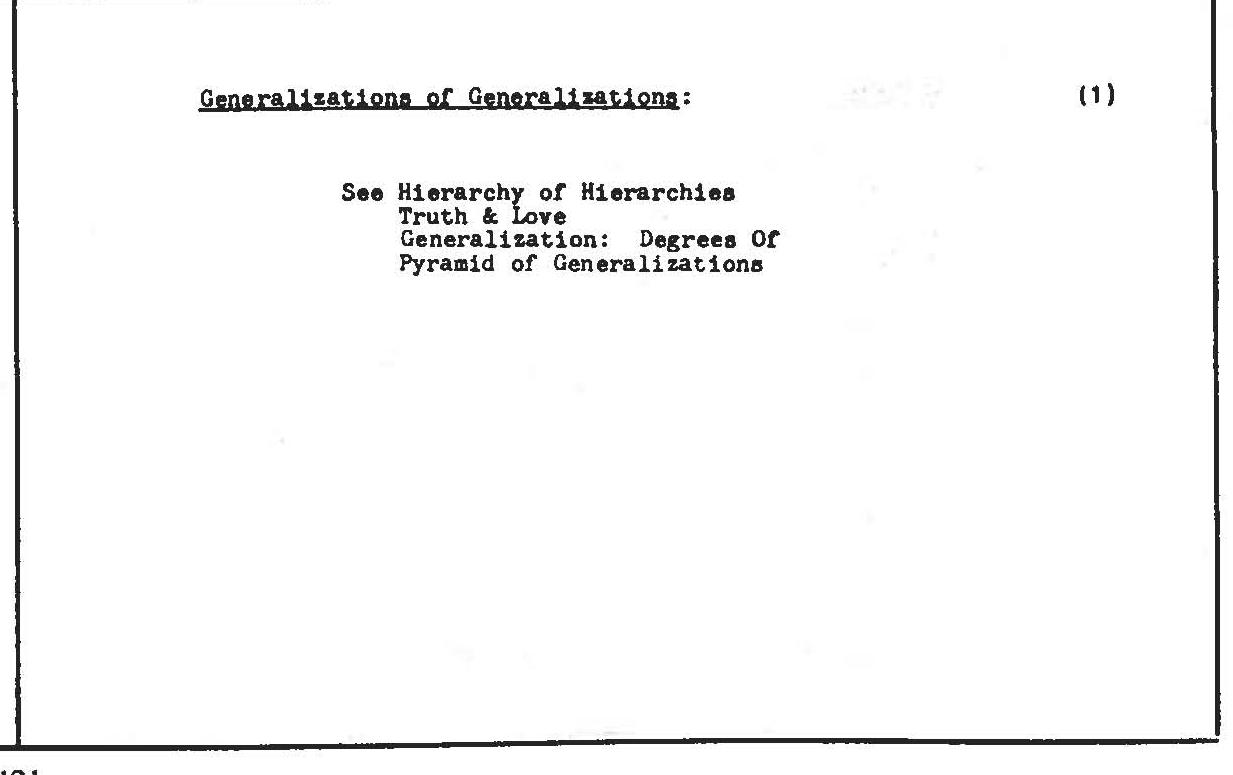
Cross Reference
Truth & Love
Cross-References
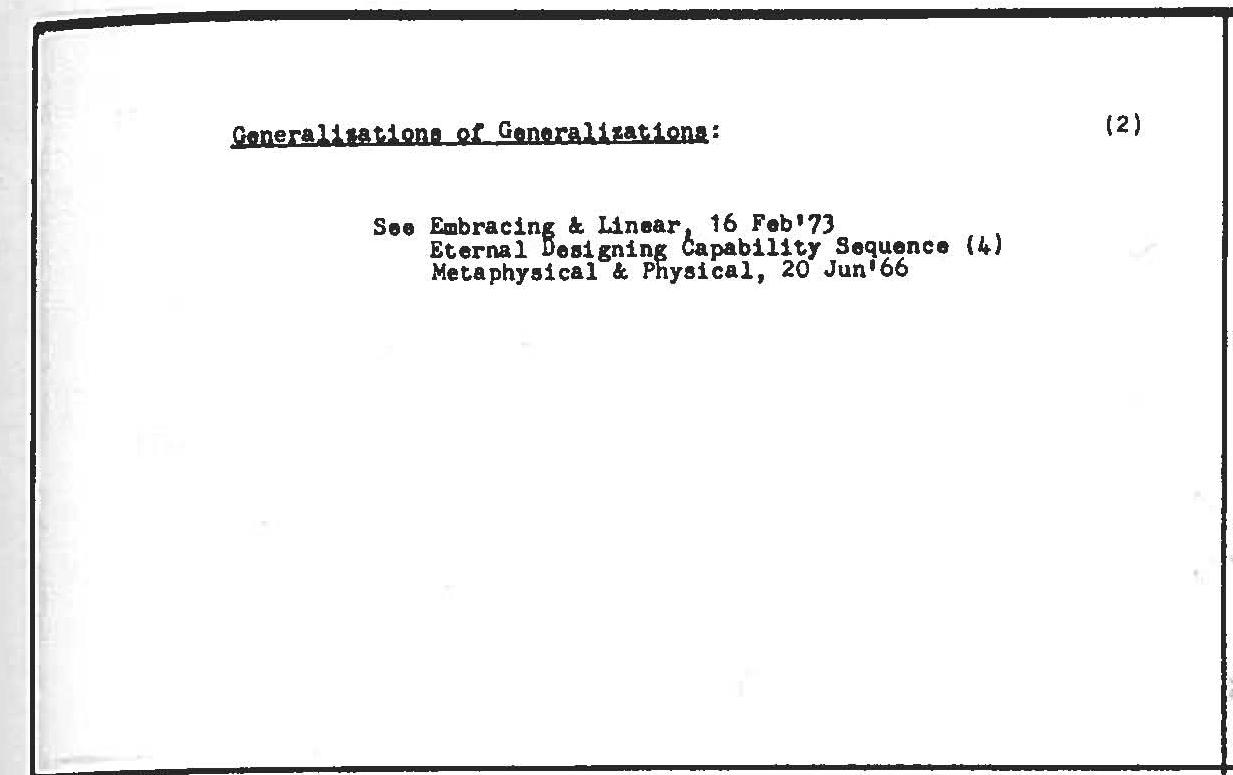
Generalizations of Generalizations (2)
← Generalizations of Generalizations (1) | Generalization: Mathematical vs Literary →
Cross Reference
Cross-References
- Embracing & Linear, 16 Feb'73
- Eternal Designing Capability Sequence, (4)
- Metaphysical & Physical, 20 Jun'66
Generalization: Mathematical vs Literary
← Generalizations of Generalizations (2) | Generalization: Mathematical vs Literary →
Index Entry
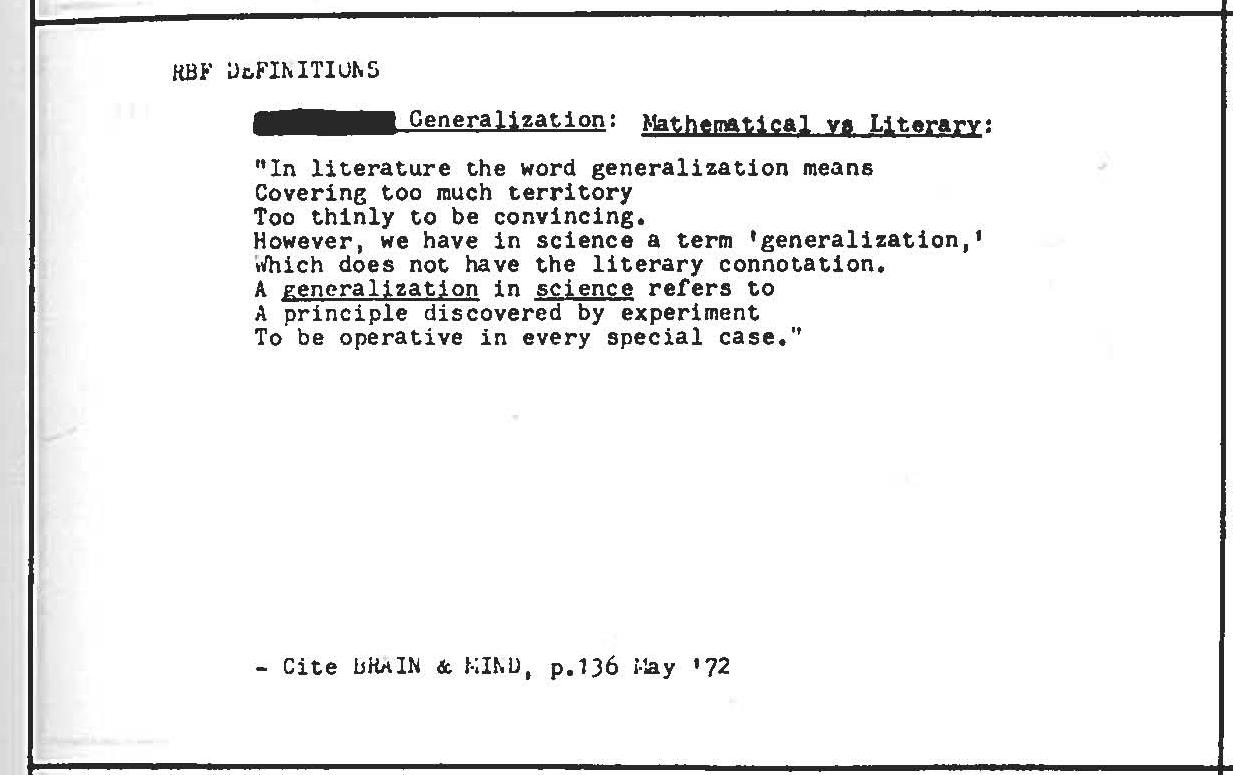
Generalization: Mathematical vs Literary:
"In literature the word generalization means
Covering too much territory
Too thinly to be convincing.
However, we have in science a term 'generalization,'
Which does not have the literary connotation.
A generalization in science refers to
A principle discovered by experiment
To be operative in every special case."
- Cite BRAIN & MIND, p.136 May '72
Generalization: Mathematical vs Literary
← Generalization: Mathematical vs Literary | Generalization; Mathematical vs Literary →
Index Entry
Generalization: Mathematical vs Literary:
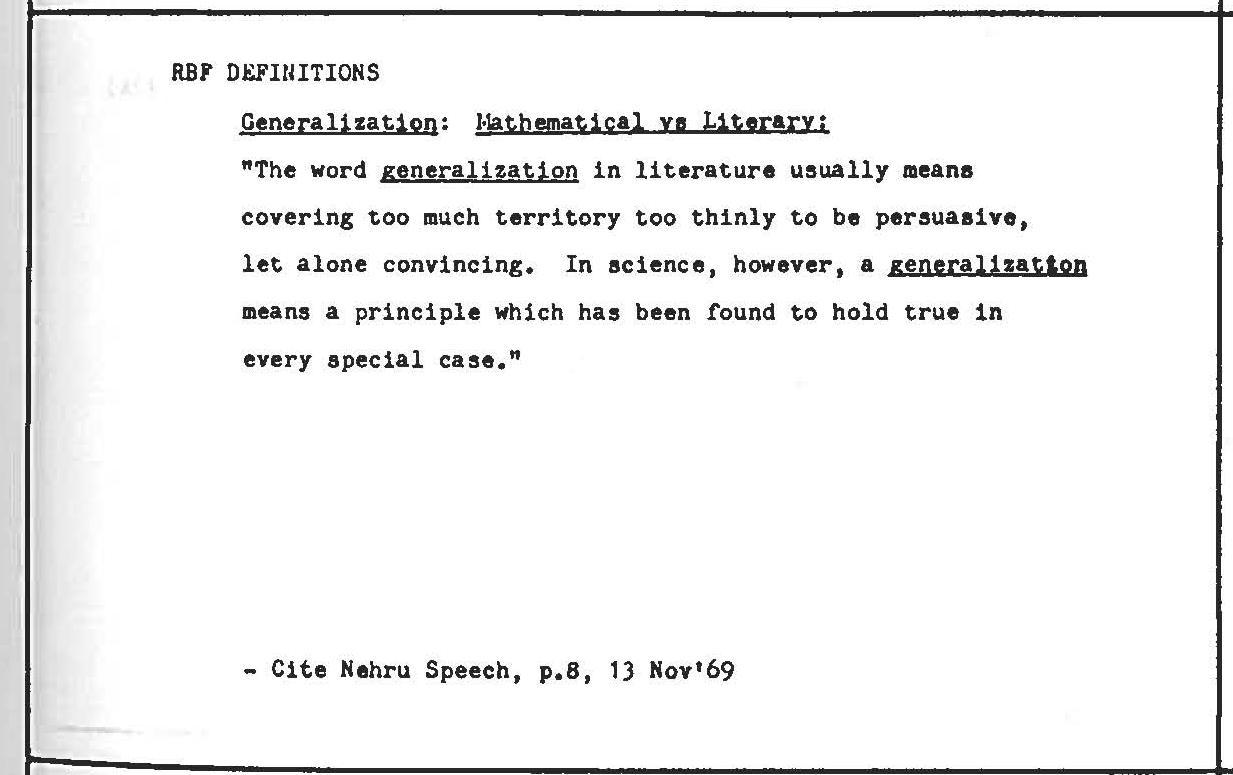
"The word generalization in literature usually means covering too much territory too thinly to be persuasive, let alone convincing. In science, however, a generalization means a principle which has been found to hold true in every special case."
- Cite Nehru Speech, p.8, 13 Nov'69
Generalization; Mathematical vs Literary
← Generalization: Mathematical vs Literary | Generalization →
Index Entry
Generalization: Mathematical vs Literary:
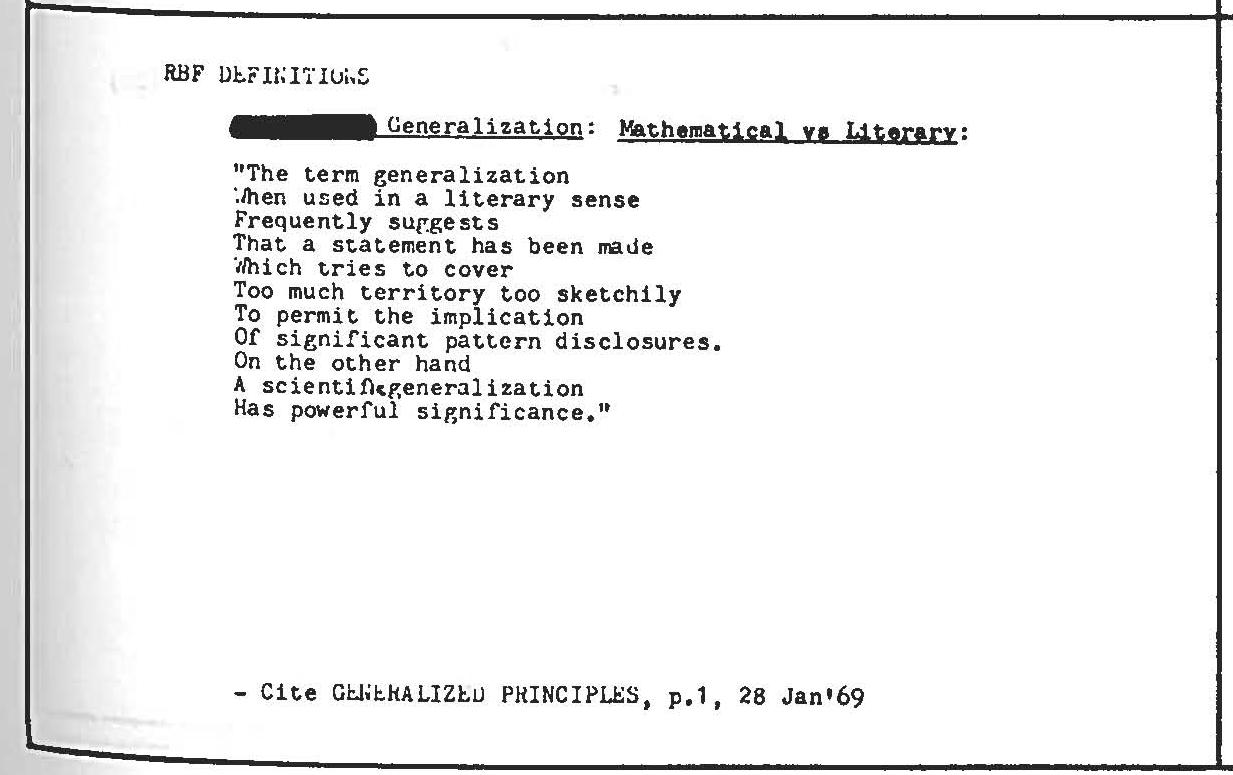
"The term generalization
when used in a literary sense
Frequently suggests
That a statement has been made
Which tries to cover
Too much territory too sketchily
To permit the implication
Of significant pattern disclosures.
On the other hand
A scientific generalization
Has powerful significance."
- Cite GENERALIZED PRINCIPLES, p.1, 28 Jan'69
Generalization
← Generalization; Mathematical vs Literary | Generalizations: Mathematical vs. Literary (1) →
Index Entry
Generalization: Mathematical vs. Literary:
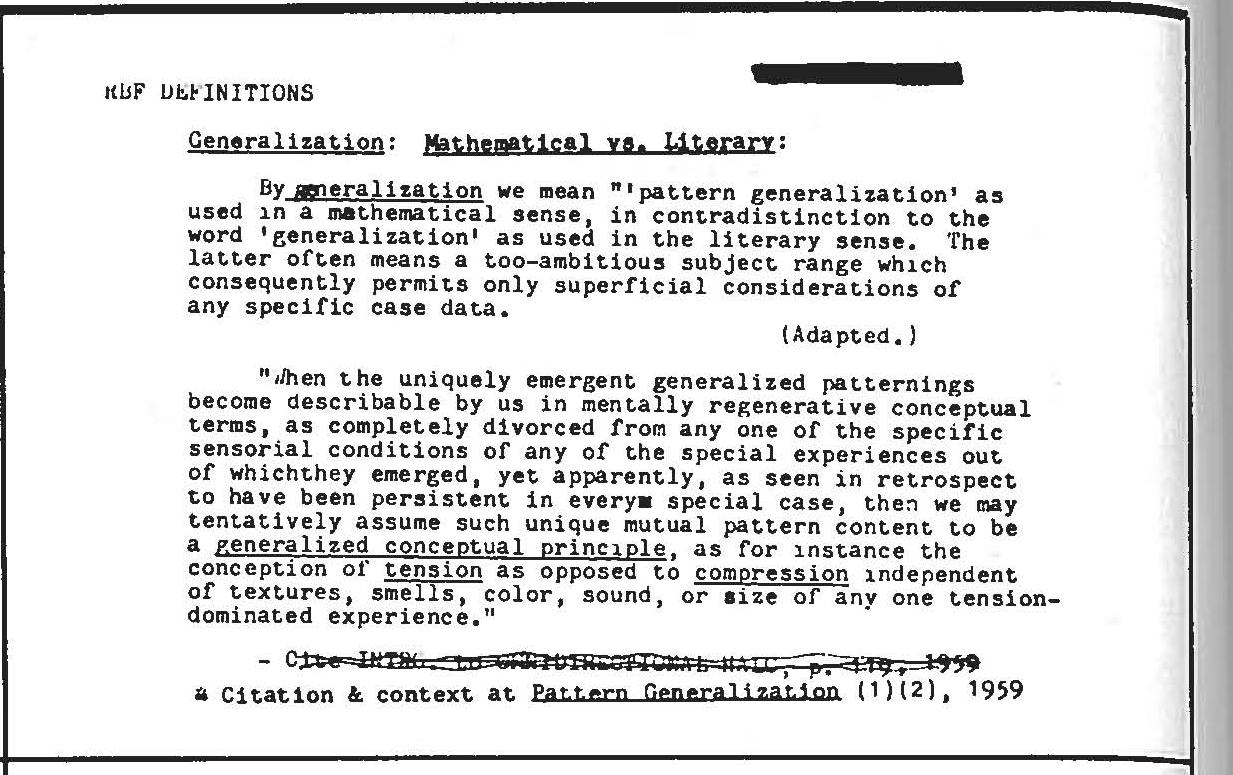
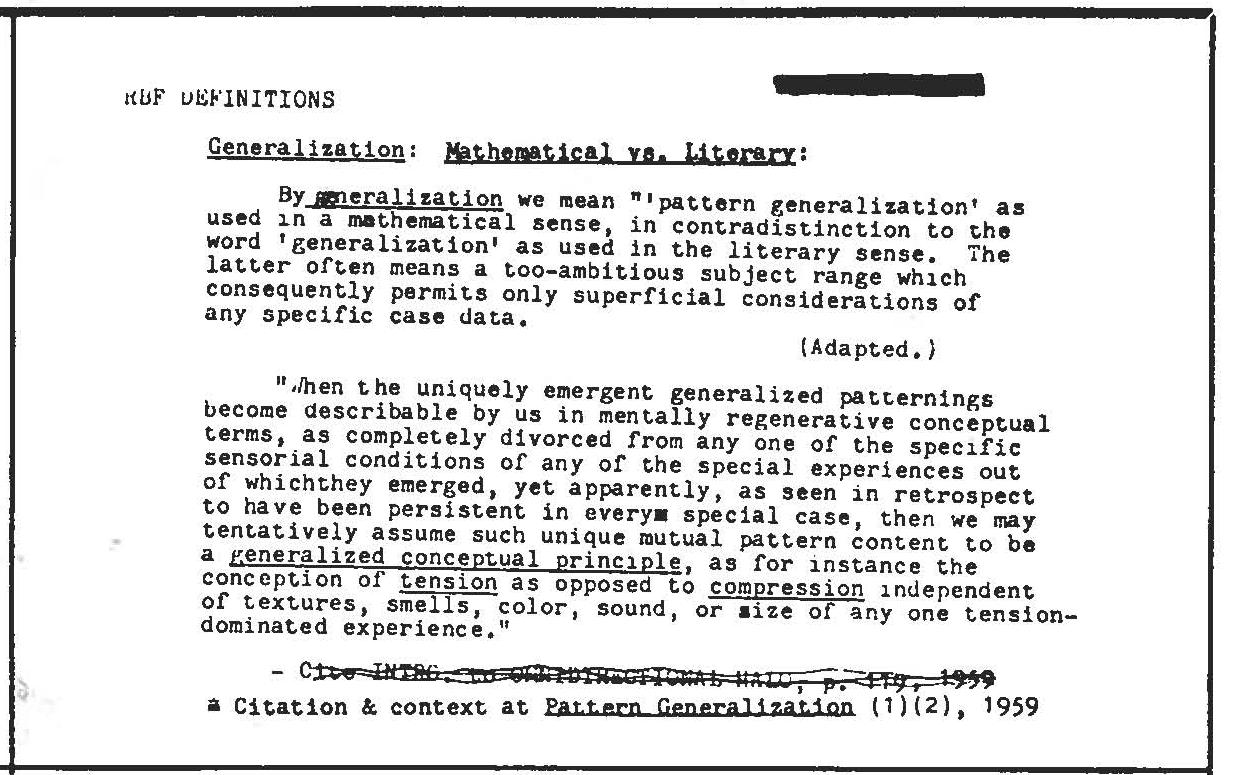
By generalization we mean 'pattern generalization' as used in a mathematical sense, in contradistinction to the word 'generalization' as used in the literary sense. The latter often means a too-ambitious subject range which consequently permits only superficial considerations of any specific case data.
(Adapted.)
"When the uniquely emergent generalized patterings become describable by us in mentally regenerative conceptual terms, as completely divorced from any one of the specific sensorial conditions of any of the special experiences out of whichthey emerged, yet apparently, as seen in retrospect to have been persistent in everym special case, then we may tentatively assume such unique mutual pattern content to be a generalized conceptual principle, as for instance the conception of tension as opposed to compression independent of textures, smells, color, sound, or size of any one tension-dominated experience."
- Cite INTX. to CONTRACTION-HALLC, p. 419, 1959
- Citation & context at Pattern Generalization (1)(2), 1959
Generalizations: Mathematical vs. Literary (1)
← Generalization | Generalizations: Mathematical vs. Literary (2) →
Cross Reference
Cross-References
Generalizations: Mathematical vs. Literary (2)
← Generalizations: Mathematical vs. Literary (1) | Generalization & Special Case →
Cross Reference
Cross-References
Generalization & Special Case
← Generalizations: Mathematical vs. Literary (2) | Generalizations of Generalizations (2) →
Index Entry
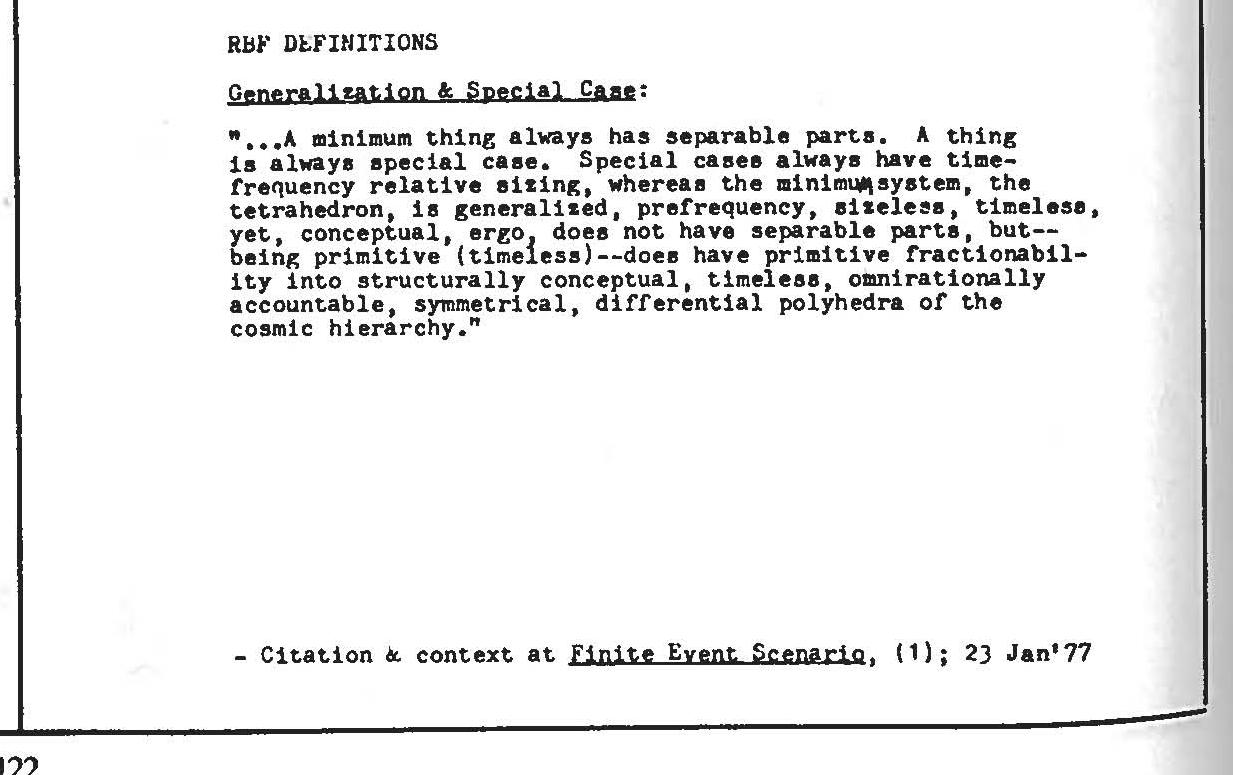
...A minimum thing always has separable parts. A thing is always special case. Special cases always have time-frequency relative sizing, whereas the minimum system, the tetrahedron, is generalized, prefrequency, sizeless, timeless, yet, conceptual, ergo, does not have separable parts, but--being primitive (timeless)--does have primitive fractionability into structurally conceptual, timeless, omnirationally accountable, symmetrical, differential polyhedra of the cosmic hierarchy.
Generalizations of Generalizations (2)
← Generalization & Special Case | Generalization →
Cross Reference
Cross-References
- Embracing & Linear, 16 Feb'73
- Eternal Designing Capability Sequence, (4)
- Metaphysical & Physical, 20 Jun'66
Generalization
← Generalizations of Generalizations (2) | Generalization →
Index Entry
Generalization: Mathematical vs Literary:
"In literature the word generalization means
Covering too much territory
Too thinly to be convincing.
However, we have in science a term 'generalization,'
which does not have the literary connotation.
A generalization in science refers to
A principle discovered by experiment
To be operative in every special case."
- Cite BRAIN & MIND, p.136 May '72
Generalization
← Generalization | Generalization: Mathematical vs Literary →
Index Entry
Mathematical vs Literary:
"The word generalization in literature usually means covering too much territory too thinly to be persuasive, let alone convincing. In science, however, a generalization means a principle which has been found to hold true in every special case."
- Cite Nehru Speech, p.8, 13 Nov'69
Generalization: Mathematical vs Literary
← Generalization | Generalization: Mathematical vs. Literary →
Index Entry
The term generalization
When used in a literary sense
Frequently suggests
That a statement has been made
Which tries to cover
Too much territory too sketchily
To permit the implication
Of significant pattern disclosures.
On the other hand
A scientific generalization
Has powerful significance.
Generalization: Mathematical vs. Literary
← Generalization: Mathematical vs Literary | Generalizations: Mathematical vs. Literary (1) →
Index Entry
By generalization we mean 'pattern generalization' as used in a mathematical sense, in contradistinction to the word 'generalization' as used in the literary sense. The latter often means a too-ambitious subject range which consequently permits only superficial considerations of any specific case data.
(Adapted.)
"When the uniquely emergent generalized patternings become describable by us in mentally regenerative conceptual terms, as completely divorced from any one of the specific sensorial conditions of any of the special experiences out of whichthey emerged, yet apparently, as seen in retrospect to have been persistent in everym special case, then we may tentatively assume such unique mutual pattern content to be a generalized conceptual principle, as for instance the conception of tension as opposed to compression independent of textures, smells, color, sound, or size of any one tension-dominated experience."
Generalizations: Mathematical vs. Literary (1)
← Generalization: Mathematical vs. Literary | Generalizations Mathematical vs. Literary (2) →
Cross Reference
Cross-References
Generalizations Mathematical vs. Literary (2)
← Generalizations: Mathematical vs. Literary (1) | Generalization & Special Case →
Cross Reference
Cross-References
Generalization & Special Case
← Generalizations Mathematical vs. Literary (2) | Generalization & Special Case →
RBF Definitions
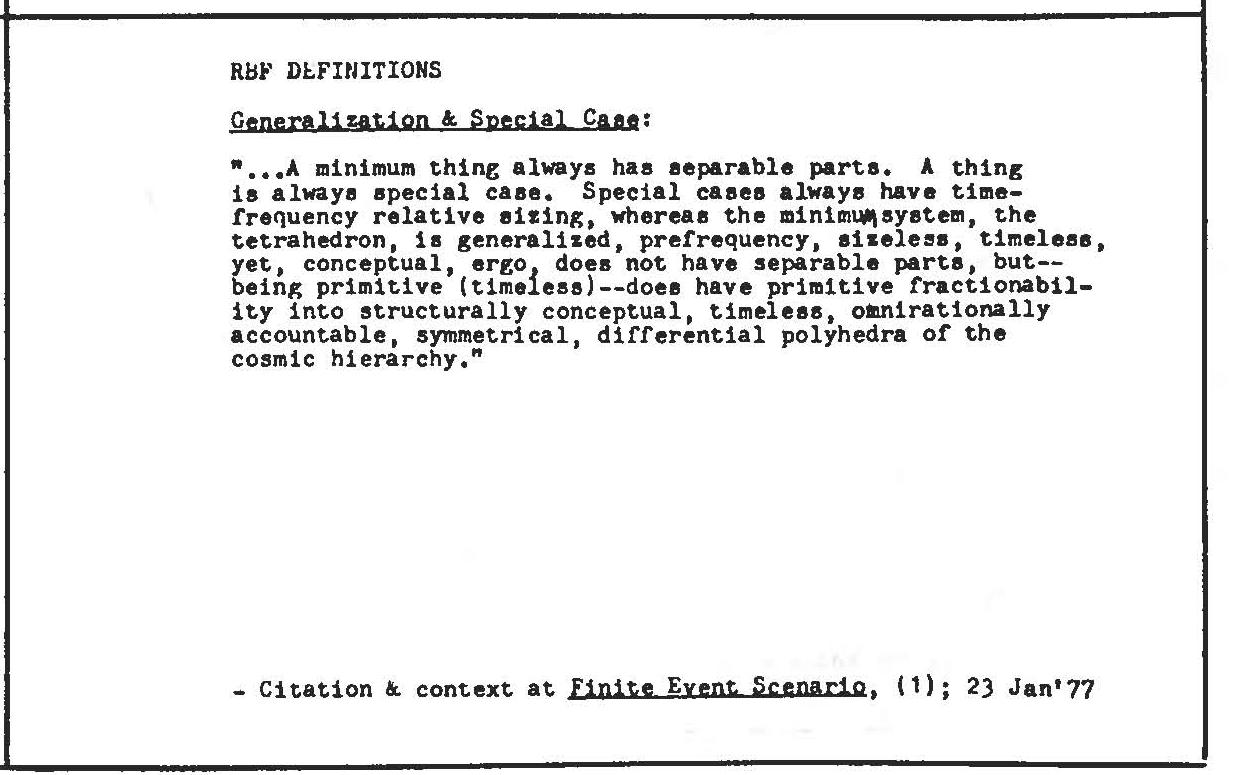
"...A minimum thing always has separable parts. A thing is always special case. Special cases always have time-frequency relative sizing, whereas the minimum system, the tetrahedron, is generalized, prefrequency, sizeless, timeless, yet, conceptual, ergo, does not have separable parts, but--being primitive (timeless)--does have primitive fractionability into structurally conceptual, timeless, omnirationally accountable, symmetrical, differential polyhedra of the cosmic hierarchy."
- Citation & context at Finite Event Scenario, (1); 23 Jan'77
Generalization & Special Case
← Generalization & Special Case | Generalization & Special Case →
Index Entry
Generalization & Special Case:
"I make each individual as special case but consciousness as the generalization. Like that bumper sticker this morning (DC license # 160-585) THE REAL WORLD IS SPECIAL CASE. Reality is special case. You and I are sitting here and no one else can be sitting right where we are. But the newspapers miss this: they write about reality as if we were all the same realities, as if we were all the same things. If you and I were sitting here we couldn't possibly be anywhere else.
"There are a lot of different realities. That is the difference between reality and generalization; there is only one generalization."
(\hrefhttps://www.buckyverse.org/en/synergetics/content/chapters/200-synergetics#section-8537.448537.44)
- Cite RBF to EJA, 3200 Idaho, Wash. DC; 12 May'75
Generalization & Special Case
← Generalization & Special Case | Generalization & Special Case →
Index Entry
Generalization & Special Case:
"Special cases are inherently terminal. Brain would like to have everything begin and end. But principles are eternal, a word with which brain is not familiar.
"All inputs to the brain are finite."
- Cite RBF videotaping session Philadelphia, Pa., 20 Jan'75
Generalization & Special Case
← Generalization & Special Case | Generalizations & Special Case →
Index Entry
Generalization & Special Case:
"Our method of demonstrating the nature of the special-case experiences out of which the pure mathematicians' imaginary generalized case of his pure straight line was evolved, also contains within it the complete gears-interlocking of quantum-wave mechanics and vectorial geometry, which are coordinately contained in synergetics with computer binary 'bitting.'"
- Cite SYNERGETICS text at Sec. \hrefhttps://www.buckyverse.org/en/synergetics/content/chapters/500-conceptuality#section-522.36522.36; Nov'71
Generalizations & Special Case
← Generalization & Special Case | Generalization & Special Case (1) →
Index Entry
Generalizations & Special Case:
"If you try to remember all of the special case experiences of which your life is composed, your brain will be very quickly overloaded in the given category of recall. It is going to take too long to get this information back and sorted out to use. Instead of trying to deal in all the special cases, deal with exactly the opposite: work towards the great generalizations."
- Cite RBF Address to Geographers in Rhode Island, 26 Aug'66
Generalization & Special Case (1)
← Generalizations & Special Case | Generalization & Special Case (1) →
Index Entry
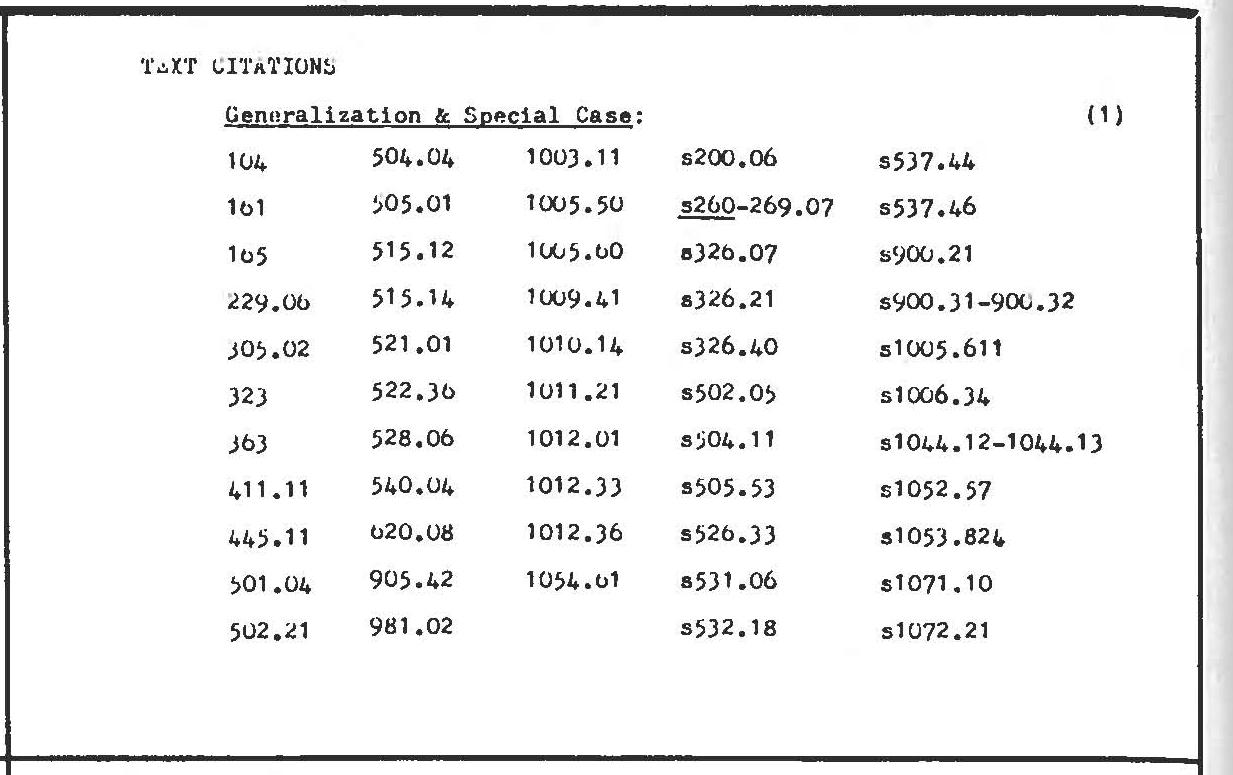
104 \hrefhttps://www.buckyverse.org/en/synergetics/content/chapters/500-conceptuality#section-504.04504.04 \hrefhttps://www.buckyverse.org/en/synergetics/content/chapters/1000-omnitopology#section-1003.111003.11 s200.06 s537.44
161 \hrefhttps://www.buckyverse.org/en/synergetics/content/chapters/500-conceptuality#section-505.01505.01 \hrefhttps://www.buckyverse.org/en/synergetics/content/chapters/1000-omnitopology#section-1005.501005.50 s260-\hrefhttps://www.buckyverse.org/en/synergetics/content/chapters/200-synergetics#section-269.07269.07 s537.46
165 \hrefhttps://www.buckyverse.org/en/synergetics/content/chapters/500-conceptuality#section-515.12515.12 \hrefhttps://www.buckyverse.org/en/synergetics/content/chapters/1000-omnitopology#section-1005.601005.60 s326.07 s900.21
\hrefhttps://www.buckyverse.org/en/synergetics/content/chapters/200-synergetics#section-229.06229.06 \hrefhttps://www.buckyverse.org/en/synergetics/content/chapters/500-conceptuality#section-515.14515.14 \hrefhttps://www.buckyverse.org/en/synergetics/content/chapters/1000-omnitopology#section-1009.411009.41 s326.21 s900.31-\hrefhttps://www.buckyverse.org/en/synergetics/content/chapters/900-modelability#section-900.32900.32
\hrefhttps://www.buckyverse.org/en/synergetics/content/chapters/300-universe#section-305.02305.02 \hrefhttps://www.buckyverse.org/en/synergetics/content/chapters/500-conceptuality#section-521.01521.01 \hrefhttps://www.buckyverse.org/en/synergetics/content/chapters/1000-omnitopology#section-1010.141010.14 s326.40 s1005.611
323 \hrefhttps://www.buckyverse.org/en/synergetics/content/chapters/500-conceptuality#section-522.36522.36 \hrefhttps://www.buckyverse.org/en/synergetics/content/chapters/1000-omnitopology#section-1011.211011.21 s502.05 s1006.34
363 \hrefhttps://www.buckyverse.org/en/synergetics/content/chapters/500-conceptuality#section-528.06528.06 \hrefhttps://www.buckyverse.org/en/synergetics/content/chapters/1000-omnitopology#section-1012.011012.01 s504.11 s1044.12-\hrefhttps://www.buckyverse.org/en/synergetics/content/chapters/1000-omnitopology#section-1044.131044.13
\hrefhttps://www.buckyverse.org/en/synergetics/content/chapters/400-system#section-411.11411.11 \hrefhttps://www.buckyverse.org/en/synergetics/content/chapters/500-conceptuality#section-540.04540.04 \hrefhttps://www.buckyverse.org/en/synergetics/content/chapters/1000-omnitopology#section-1012.331012.33 s505.53 s1052.57
\hrefhttps://www.buckyverse.org/en/synergetics/content/chapters/400-system#section-445.11445.11 \hrefhttps://www.buckyverse.org/en/synergetics/content/chapters/600-structure#section-620.08620.08 \hrefhttps://www.buckyverse.org/en/synergetics/content/chapters/1000-omnitopology#section-1012.361012.36 s526.33 s1053.824
\hrefhttps://www.buckyverse.org/en/synergetics/content/chapters/500-conceptuality#section-501.04501.04 \hrefhttps://www.buckyverse.org/en/synergetics/content/chapters/900-modelability#section-905.42905.42 \hrefhttps://www.buckyverse.org/en/synergetics/content/chapters/1000-omnitopology#section-1054.011054.01 s531.06 s1071.10
\hrefhttps://www.buckyverse.org/en/synergetics/content/chapters/500-conceptuality#section-502.21502.21 \hrefhttps://www.buckyverse.org/en/synergetics/content/chapters/900-modelability#section-981.02981.02 s532.18 s1072.21
Generalization & Special Case (1)
← Generalization & Special Case (1) | Generalization & Special Case →
Cross Reference
Cross-References
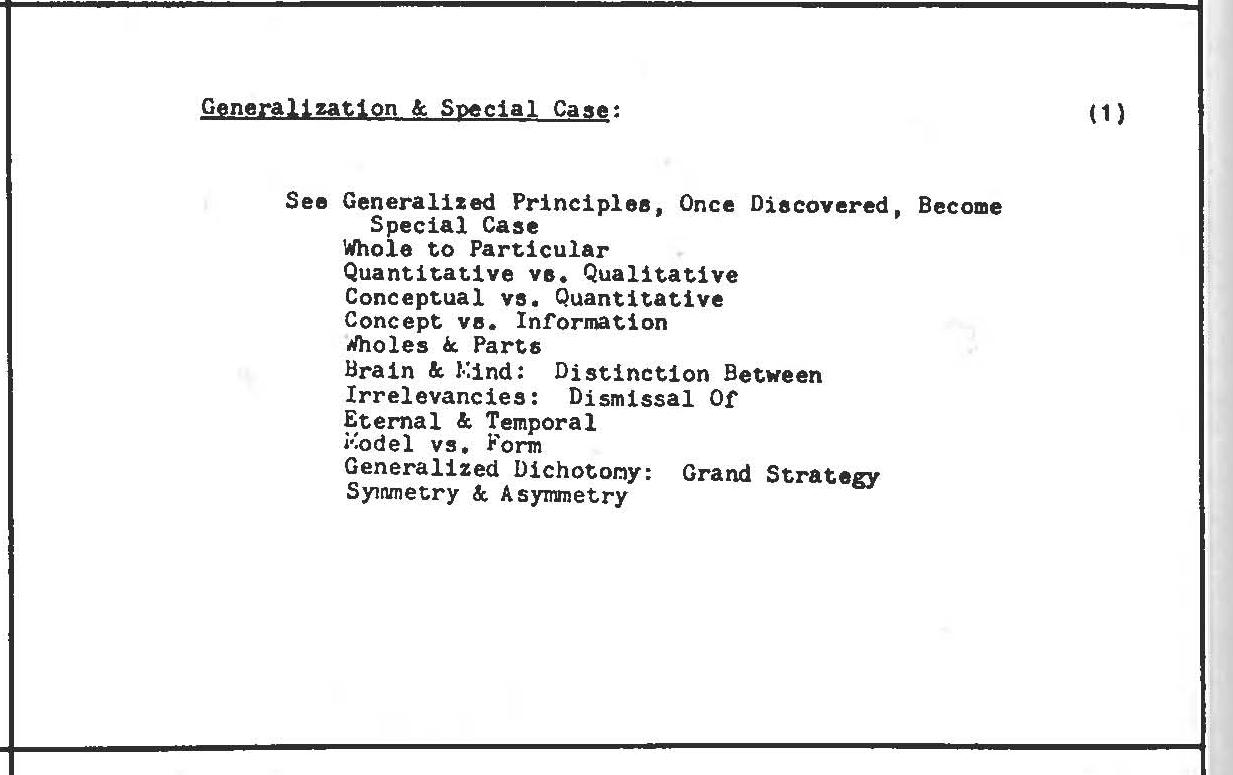
- Generalized Principles, Once Discovered, Become Special Case
- Whole to Particular
- Quantitative vs. Qualitative
- Conceptual vs. Quantitative
- Concept vs. Information
- Wholes & Parts
- Brain & Mind: Distinction Between
- Irrelevancies: Dismissal Of
- Eternal & Temporal
- Model vs. Form
- Generalized Dichotomy: Grand Strategy
- Symmetry & Asymmetry
Generalization & Special Case
← Generalization & Special Case (1) | Generalization & Special Case (2B) →
Cross Reference
Cross-References
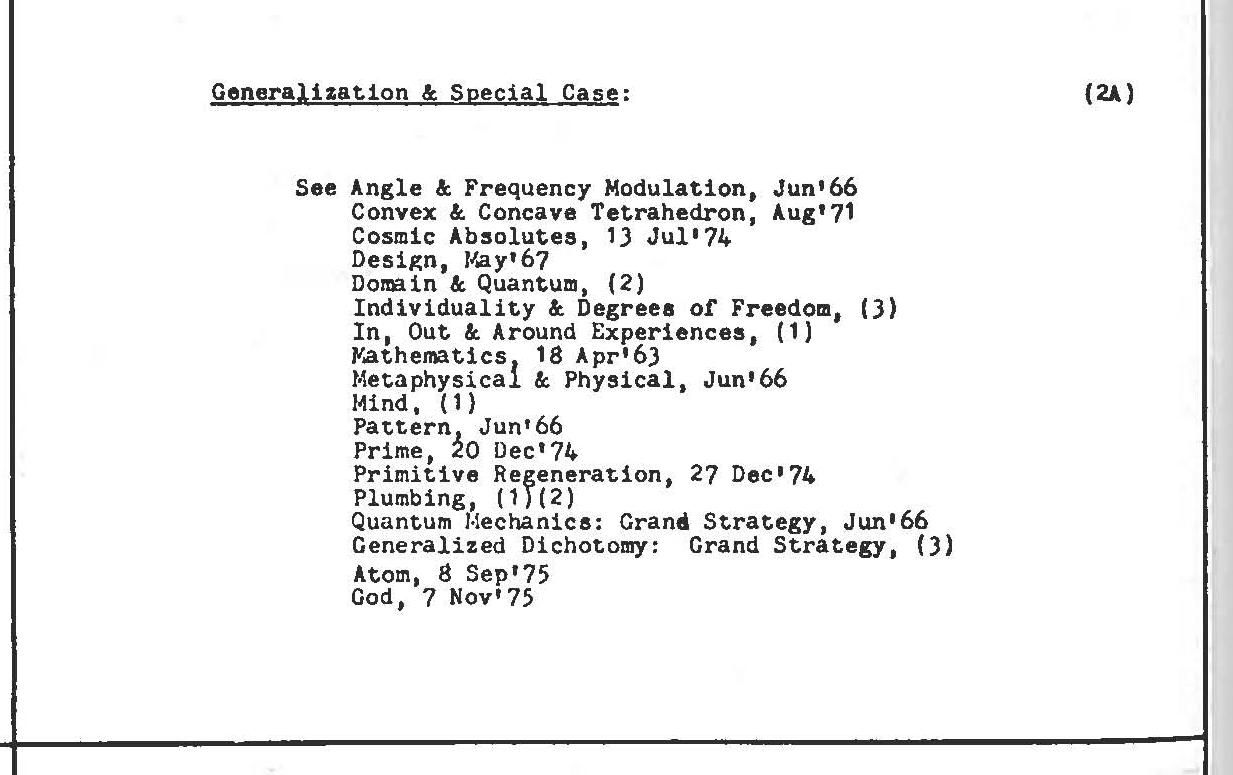
- Angle & Frequency Modulation, Jun'66
- Convex & Concave Tetrahedron, Aug'71
- Cosmic Absolutes, 13 Jul'74
- Design, May'67
- Domain & Quantum, (2)
- Individuality & Degrees of Freedom, (3)
- In, Out & Around Experiences, (1)
- Mathematics, 18 Apr'63
- Metaphysical & Physical, Jun'66
- Mind, (1)
- Pattern, Jun'66
- Prime, 20 Dec'74
- Primitive Regeneration, 27 Dec'74
- Plumbing, (1)(2)
- Quantum Mechanics: Grand Strategy, Jun'66
- Generalized Dichotomy: Grand Strategy, (3)
- Atom, 8 Sep'75
- God, 7 Nov'75
Generalization & Special Case (2B)
← Generalization & Special Case | Generalization of the Special Cases →
Cross Reference
Cross-References
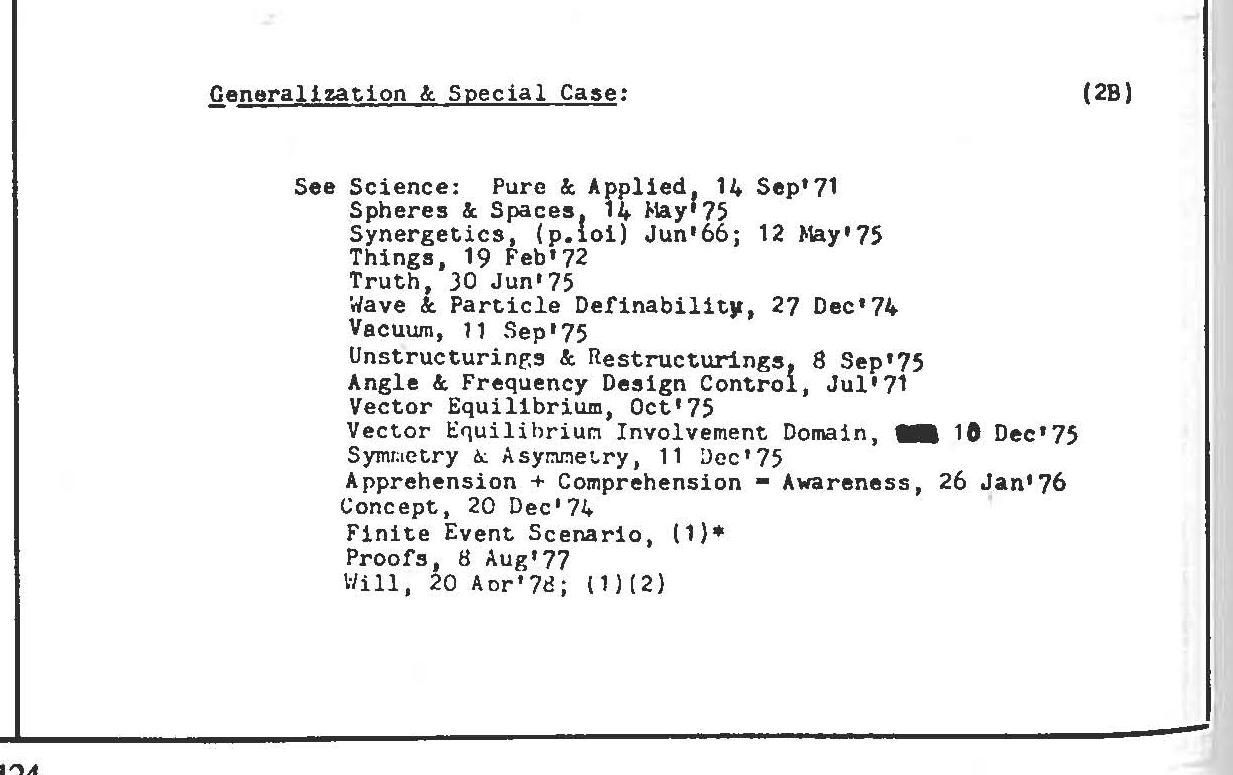
- Science: Pure & Applied, 14 Sep'71
- Spheres & Spaces, 14 May'75
- Synergetics, Jun'66; 12 May'75
- Things, 19 Feb'72
- Truth, 30 Jun'75
- Wave & Particle Definability, 27 Dec'74
- Vacuum, 11 Sep'75
- Unstructurings & Restructurings, 8 Sep'75
- Angle & Frequency Design Control, Jul'71
- Vector Equilibrium, Oct'75
- Vector Equilibrium Involvement Domain, 10 Dec'75
- Symmetry & Asymmetry, 11 Dec'75
- Apprehension + Comprehension = Awareness, 26 Jan'76
- Concept, 20 Dec'74
- Finite Event Scenario, (1)
- Proofs, 8 Aug'77
- Will, 20 Apr'78 (1)(2)
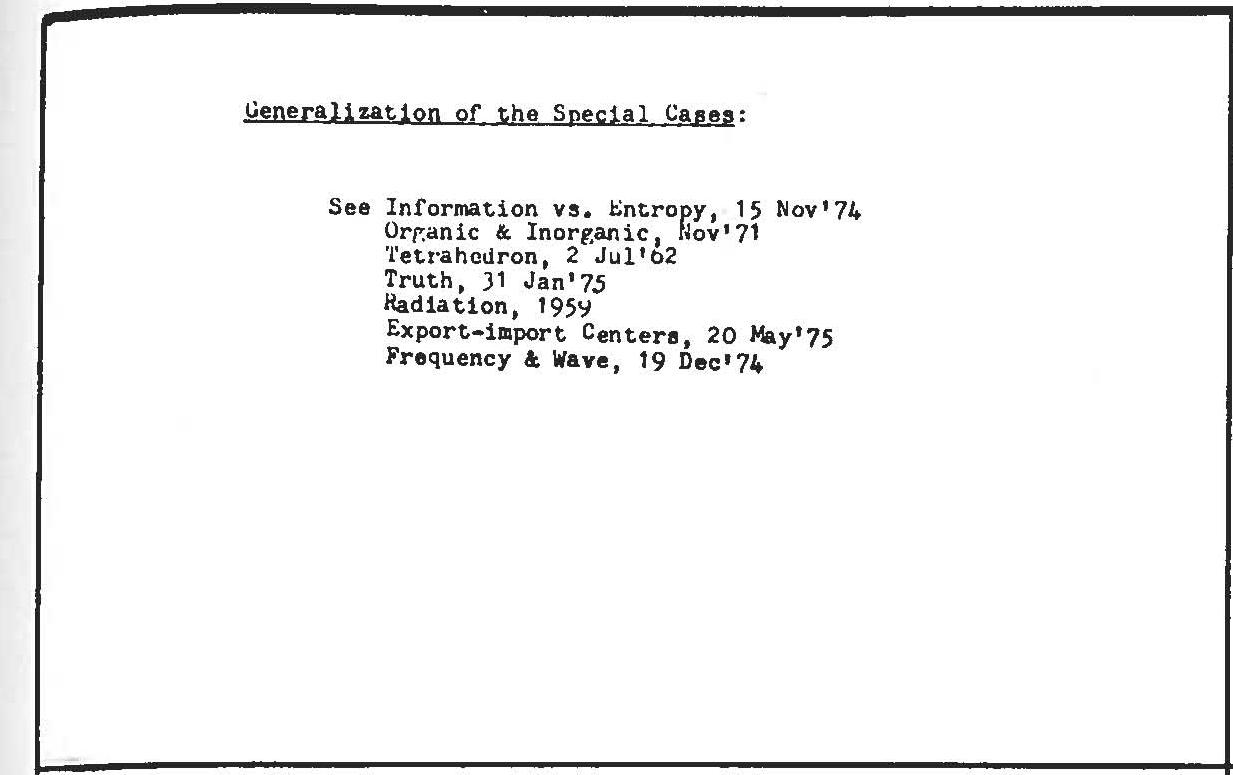
Generalization of the Special Cases
← Generalization & Special Case (2B) | Generalizations Reduced to One Word →
Cross Reference
Cross-References
- Information vs. Entropy, 15 Nov'74
- Organic & Inorganic, Nov'71
- Tetrahedron, 2 Jul'62
- Truth, 31 Jan'75
- Radiation, 1959
- Export-import Centers, 20 May'75
- Frequency & Wave, 19 Dec'74
Generalizations Reduced to One Word
← Generalization of the Special Cases | Generalizations Reduced to One Word →
Index Entry
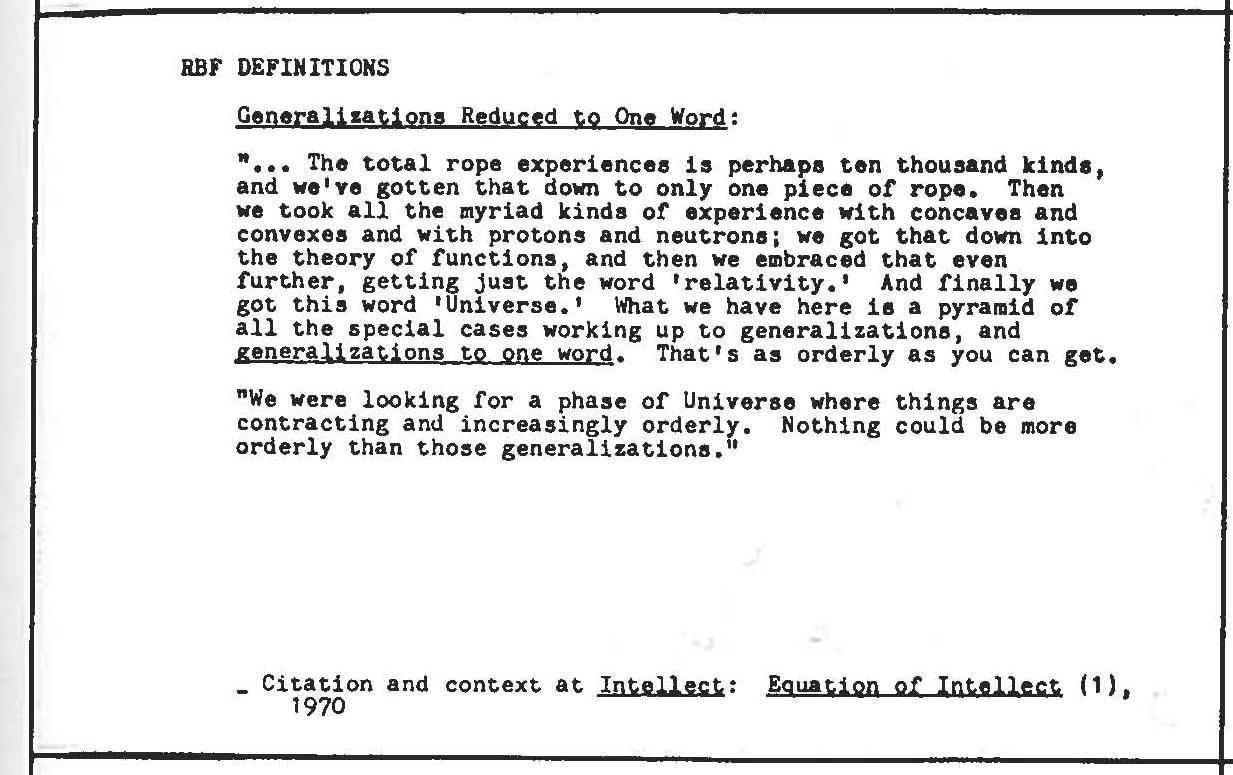
Generalizations Reduced to One Word:
"... The total rope experiences is perhaps ten thousand kinds, and we've gotten that down to only one piece of rope. Then we took all the myriad kinds of experience with concaves and convexes and with protons and neutrons; we got that down into the theory of functions, and then we embraced that even further, getting just the word 'relativity.' And finally we got this word 'Universe.' What we have here is a pyramid of all the special cases working up to generalizations, and generalizations to one word. That's as orderly as you can get.
"We were looking for a phase of Universe where things are contracting and increasingly orderly. Nothing could be more orderly than those generalizations."
_Citation and context at Intellect: Equation of Intellect (1), 1970
Generalizations Reduced to One Word
← Generalizations Reduced to One Word | Generalize →
Cross Reference
Cross-References
Generalize
← Generalizations Reduced to One Word | Generalized Boat →
Index Entry
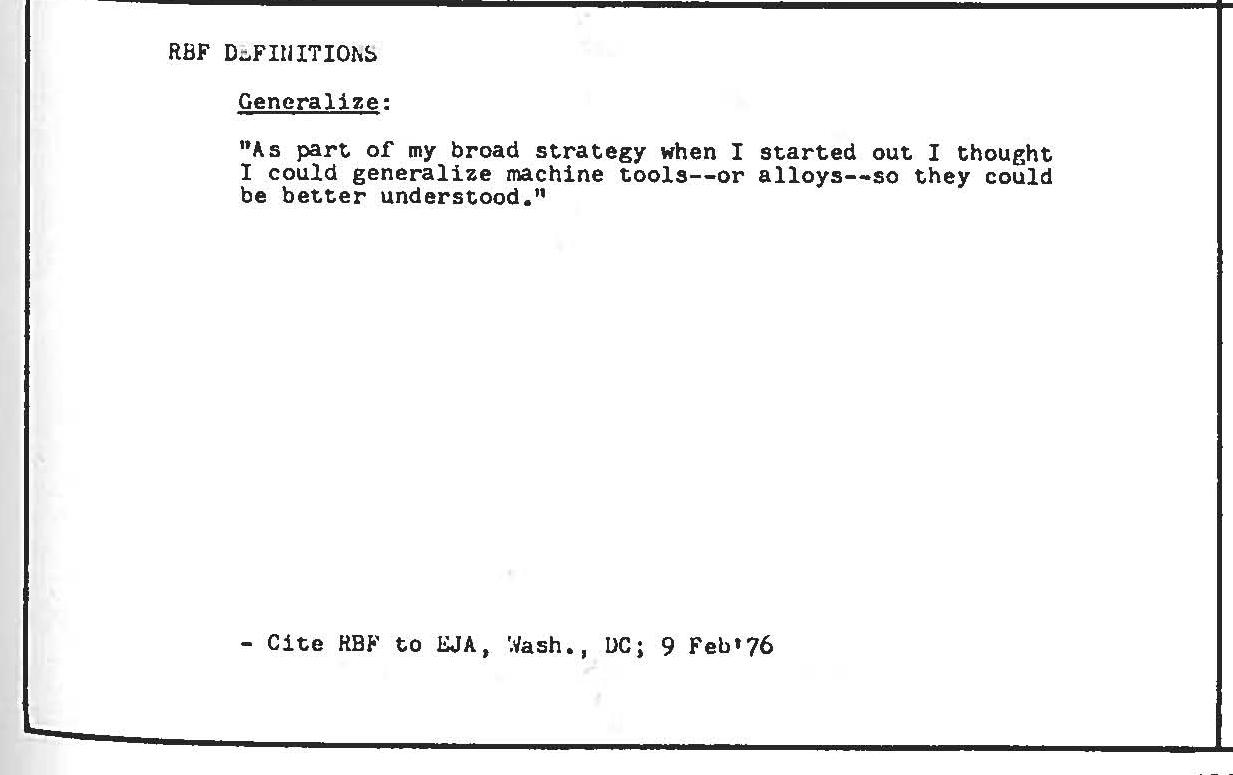
Generalize:
"As part of my broad strategy when I started out I thought I could generalize machine tools--or alloys--so they could be better understood."
- Cite RBF to EJA, Wash., DC; 9 Feb'76
Generalized Boat
← Generalize | Generalized Design →
Cross Reference
Cross-References
Generalized Design
← Generalized Boat | Generalized Dichotomy: Grand Strategy (1) →
Cross Reference
Cross-References
- Valving, 1960
Generalized Dichotomy: Grand Strategy (1)
← Generalized Design | Generalized Dichotomy: Grand Strategy (2) →
Index Entry
Generalized Dichotomy: Grand Strategy:
"I do not mean to infer any set of special case paired dichotomies.
"I first developed the concept of synergy, the behavior of whole systems unpredicted by the behavior of the parts considered separately, which automatically identifies the unique behavior of the whole as resulting from the interrelationships existing between but not in any of the parts.
"Next I pointed out that there was nothing in atoms per se that predicted their association as chemical compounds; there was nothing in chemical compounds per se that predicted biological protoplasm; I said there was nothing in biological protoplasm per se that predicted camels and palm trees; nor the respiratory interexchange between those mammals and botanicals. Quite clearly, the more complex systems were never predicted by the behaviors of the lesser systems.
"I next pointed out that there is what we call synergetic grand strategy. The synergetic strategy is that the known behavior of the whole and the known behavior of some of the"
Generalized Dichotomy: Grand Strategy (2)
← Generalized Dichotomy: Grand Strategy (1) | Generalized Dichotomy: Grand Strategy (3) →
Index Entry
parts may frequently provide the capability to discover unknown parts or all the unknown parts.
"I pointed out that Euler's topology provided mathematical means for dealing with the whole of visual experience reducing it into points, areas, and lines and we found there was a consistent generalization of the relative abundance of those three irreducible aspects of experience.
"I then pointed out that Willard Gibbs, at the beginning of the 20th century had been able to provide a formula for relative abundance of the tactile experiences of liquids, crystallines, and gases; and with the known behavior of the whole and the known behavior of some of the parts quantitatively predicted, the behavior of the unknown parts and energy inputs we could arrive at the factors necessary to establish the equilibrium of a substance.
"Having found, then, that humanity had three successful grand strategies for proceeding from the whole to the particular, I produced my scientific definition of Universe; and I produced the concept of a system; and was able to find an equation for"
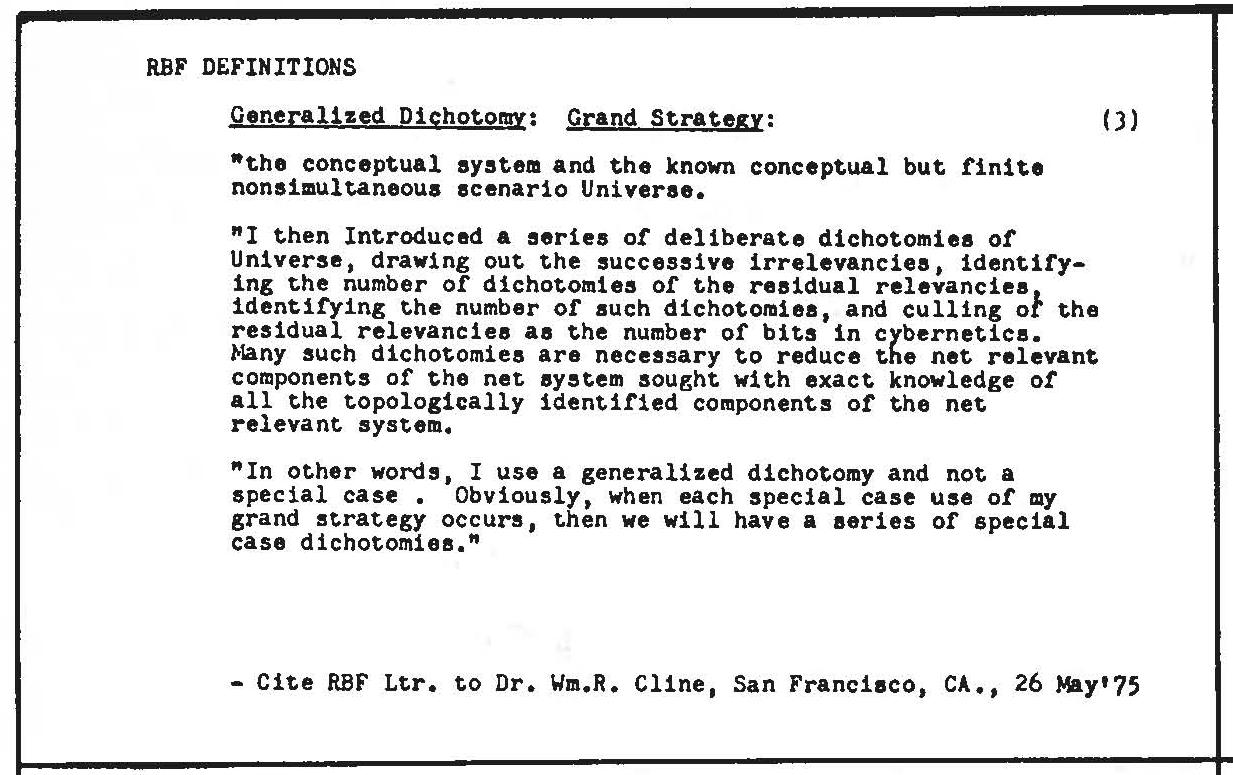
Generalized Dichotomy: Grand Strategy (3)
← Generalized Dichotomy: Grand Strategy (2) | Generalized Dichotomy →
Index Entry
Generalized Dichotomy: Grand Strategy:
"the conceptual system and the known conceptual but finite nonsimultaneous scenario Universe.
"I then Introduced a series of deliberate dichotomies of Universe, drawing out the successive irrelevancies, identifying the number of dichotomies of the residual relevancies, identifying the number of such dichotomies, and culling of the residual relevancies as the number of bits in cybernetics. Many such dichotomies are necessary to reduce the net relevant components of the net system sought with exact knowledge of all the topologically identified components of the net relevant system.
"In other words, I use a generalized dichotomy and not a special case. Obviously, when each special case use of my grand strategy occurs, then we will have a series of special case dichotomies."
- Cite RBF Ltr. to Dr. Wm.R. Cline, San Francisco, CA., 26 May'75
Generalized Dichotomy
← Generalized Dichotomy: Grand Strategy (3) | Generalized Law →
Cross Reference
Cross-References
Generalized Law
← Generalized Dichotomy | Generalized Law →
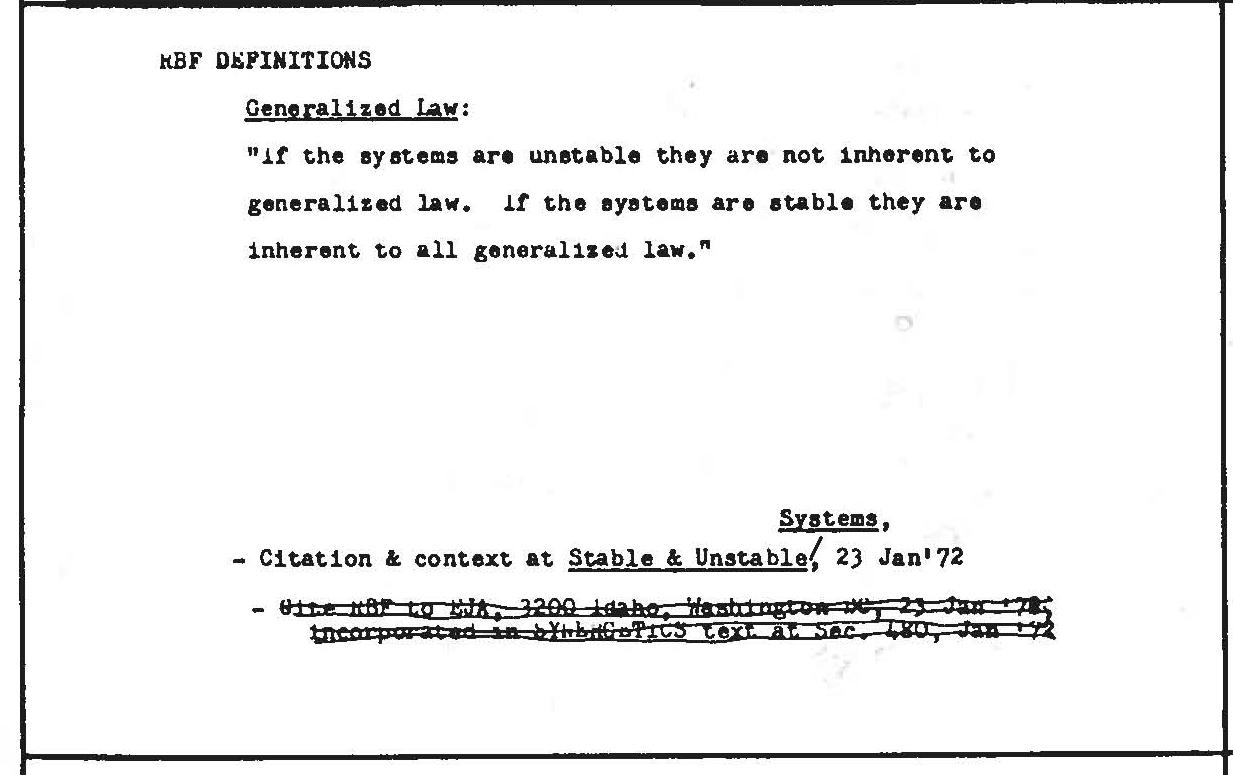
Index Entry
Generalized Law:
"if the systems are unstable they are not inherent to generalized law. If the systems are stable they are inherent to all generalized law."
Systems,
-
Citation & context at Stable & Unstable, 23 Jan'72
-
Cite RBF to EJA, 3200 Idaho, Washington DC, 23 Jan '72 incorporated in Synergetics text at \hrefhttps://www.buckyverse.org/en/synergetics/content/chapters/400-system#section-480.00480, Jan '72
Generalized Law
← Generalized Law | Generalized Orbiting →
Cross Reference
Cross-References
- Metaphysical, 22 Apr'68
- Eternal & Temporal, 4 Sep'77
Generalized Orbiting
← Generalized Law | Generalized Principles →
Cross Reference
Cross-References
- Orbit, 14 Feb'73
Generalized Principles
← Generalized Orbiting | Generalized Principles →
Index Entry
Generalized Principles:
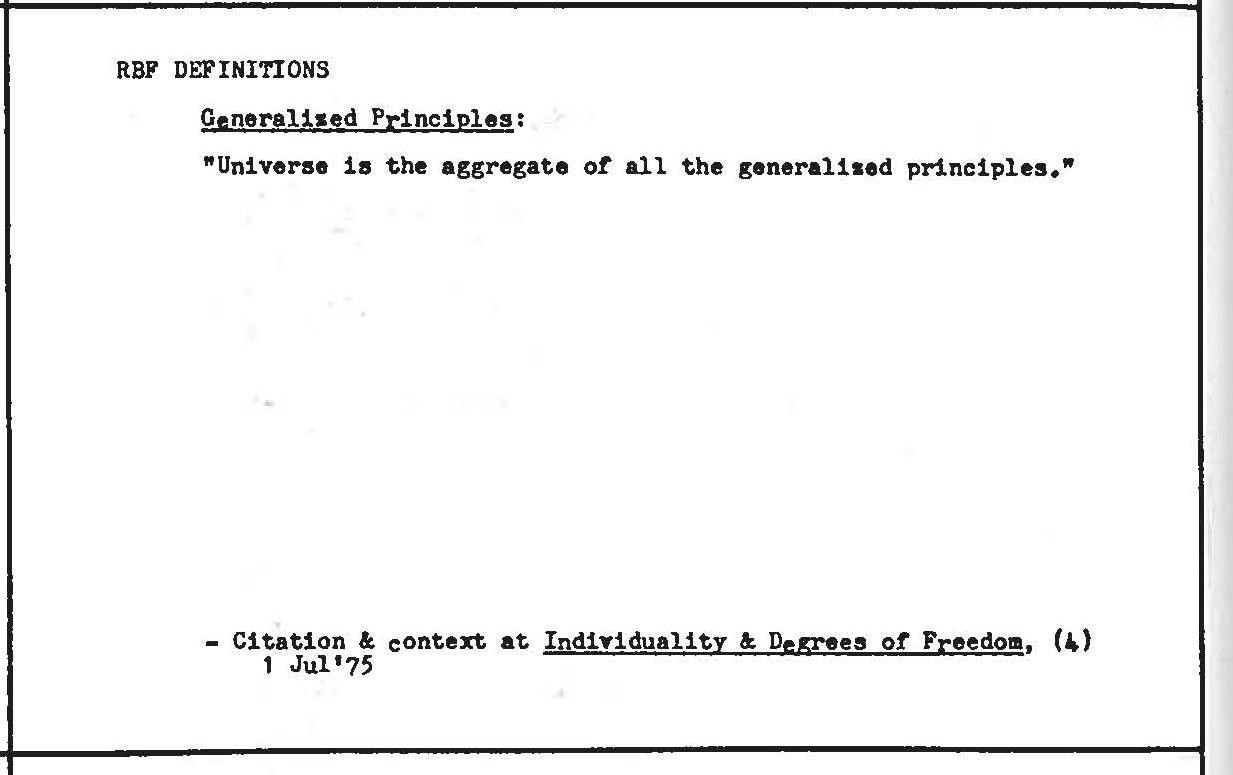
"Universe is the aggregate of all the generalized principles."
- Citation & context at Individuality & Degrees of Freedom, (4)
1 Jul'75
Generalized Principles
← Generalized Principles | Generalized Principle →
Index Entry
Generalized Principles:
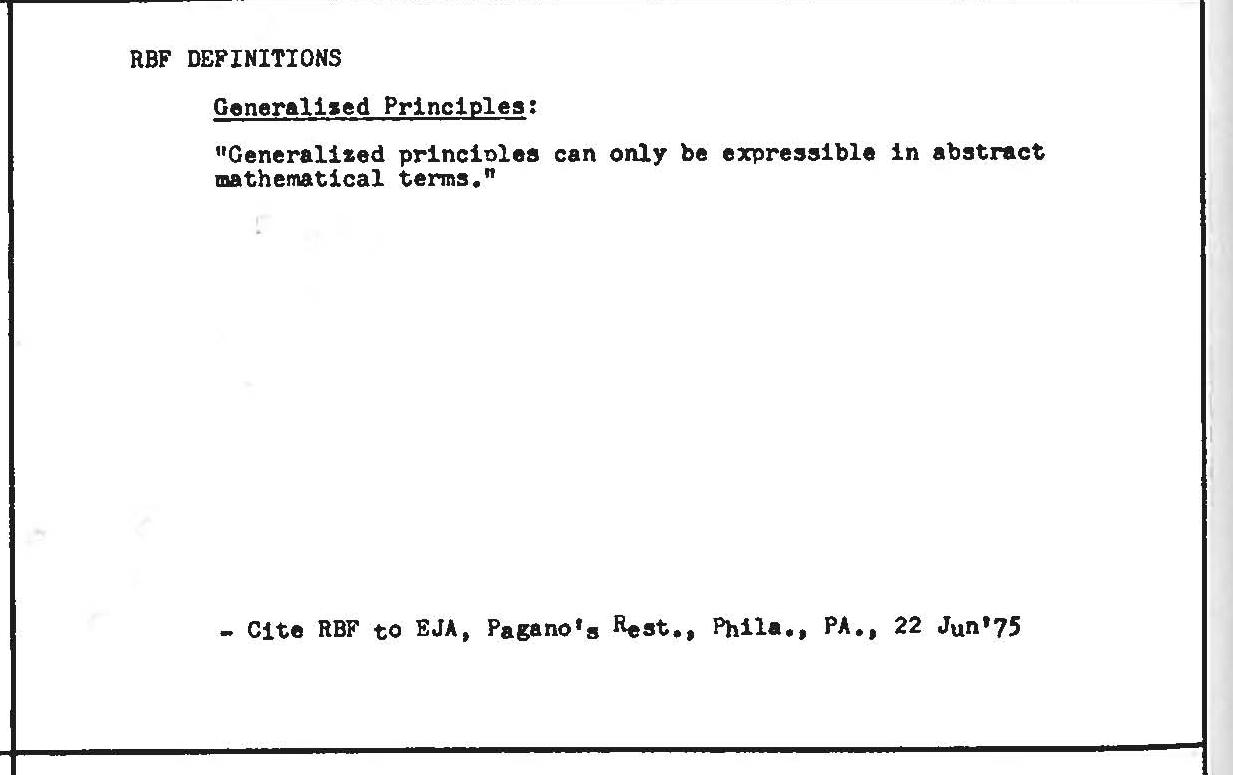
"Generalized principles can only be expressible in abstract mathematical terms."
- Cite RBF to EJA, Pagano's Rest., Phila., PA., 22 Jun'75
Generalized Principle
← Generalized Principles | Generalized Principles →
Index Entry
Generalized Principle:
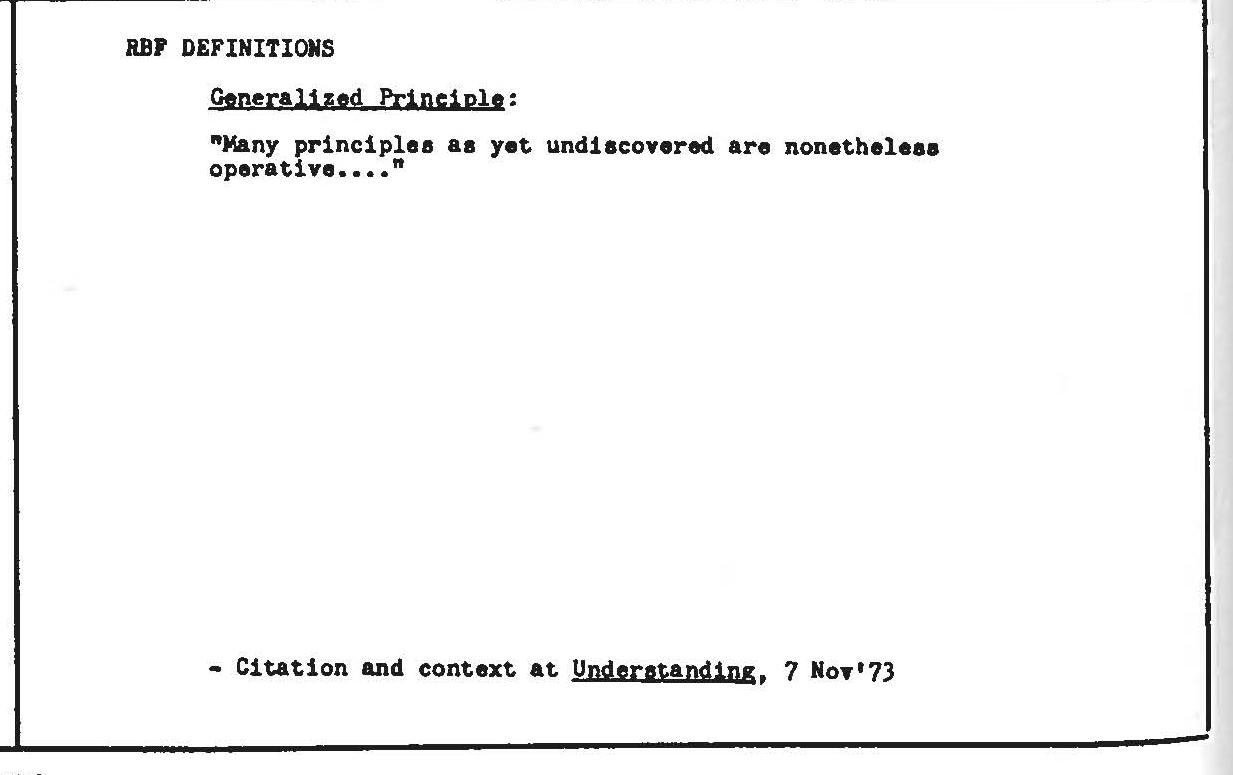
"Many principles as yet undiscovered are nonetheless operative...."
- Citation and context at Understanding, 7 Nov'73
Generalized Principles
← Generalized Principle | Generalized Principle →
Index Entry
Generalized Principles:
"If the only momentary and optically illusory system consideration proves to be unstable, it does not manifest generalized principle. If systems are stable, they are inherent in and accommodate all generalized principles."
- Citation & context at Stable & Unstable Systems, 2 Nov'73
Generalized Principle
← Generalized Principles | Generalized Principle →
Index Entry
Human mind has discovered a number of generalized principles, each quite different from the others: one, for instance, being mass attraction; another being leverage; another being refraction of radiation; another being precession, etc. in order to qualify as generalizations, these different principles found by science must be devoid of exceptions. Therefore, principles must be both eternal and mutually interaccommodative. Humanity apparently discovered a plurality of a priori, absolute, weightless, abstract principles, each displaying unique mathematical relationships, realization of which generalizations can be employed physically by humans but only in time-limited special cases-- for instance, to produce a lever of such and such a length of wood or other substance.
Only through a succession of many subjective, special-case physical experiences do we humans gradually tome to discover a generalized principle. Later we also discover that we can objectively employ those generalized principles. But then we find they can only be employed in spacial-case physical ways. Only the human mind can discover and think conceptually in generalized terms. Physical life is always a special-case.
Generalized Principle
← Generalized Principle | Generalized Principle →
Index Entry
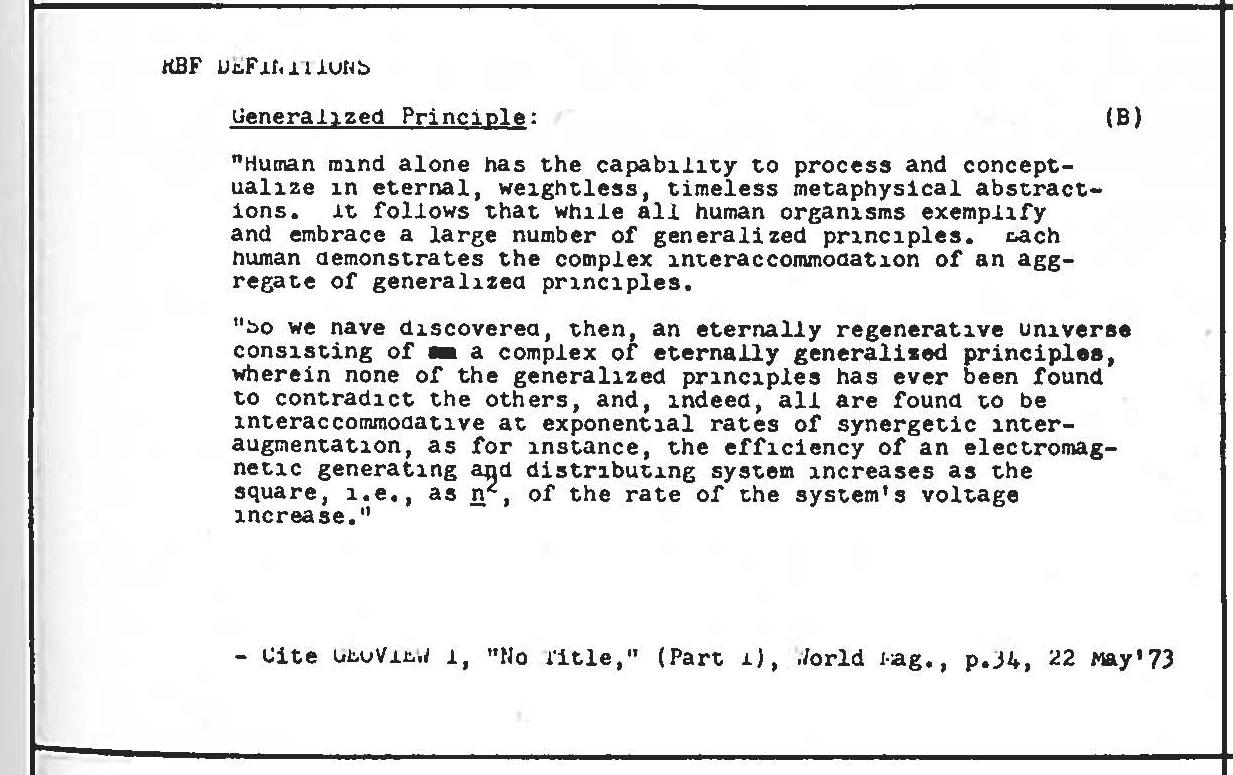
Human mind alone has the capability to process and conceptualize in eternal, weightless, timeless metaphysical abstractions. It follows that while all human organisms exemplify and embrace a large number of generalized principles. Each human demonstrates the complex interaccommodation of an aggregate of generalized principles.
So we have discovered, then, an eternally regenerative universe consisting of a complex of eternally generalized principles, wherein none of the generalized principles has ever been found to contradict the others, and, indeed, all are found to be interaccommodative at exponential rates of synergetic interaugmentation, as for instance, the efficiency of an electromagnetic generating and distributing system increases as the square, i.e., as n², of the rate of the system's voltage increase.
Generalized Principle
← Generalized Principle | Generalized Principles →
Index Entry
Generalized Principle:
"Synergy manifests itself in the generalized principles and their exponential rate of interaugmentation."
- Cite RBF in Baccalaureate Address, University of Virginia, Charlottesville, 3 Jun'72
Generalized Principles
← Generalized Principle | Generalized Principle →
Index Entry
Generalized Principles
"... All the generalized principles
Thus far discovered
Are uniquely identifiable
Exclusively as
'Behavorial interrelationships'
Of two or more
Separate components..."
- Cite Intuition, p.28 May '72
Generalized Principle
← Generalized Principles | Generalized Principle →
Index Entry
Generalized Principle:
"The physical universe is a self-regenerative process. Its regenerative interrelationships and intertransformings are governed by a complex code of weightless, generalized principles. The principles are metaphysical. The complex code of eternal, metaphysical principles is omni-interaccommodative. That is, it has no intercontradiction. To be classifiable as 'generalized,' principles cannot terminate or go on vacation. If indeed they are, they are eternal, timeless."
- Cite Dreyfuss, Preface, "Decease of Meaning" 28 April 1971, pp. 4,5
Generalized Principle
← Generalized Principle | Generalized Principle →
Index Entry
Generalized Principle:
"Because the generalized principles cannot be principles unless they are eternal, because human experience is inherently limited, there can be no finality of human comprehension."
-
Cite RBF dictation for SYNERGETICS, 28 Feb. '71. \hrefhttps://www.buckyverse.org/en/synergetics/content/chapters/200-synergetics#section-200.00200,215,208,177.
-
Cite RBF to EJA, 28 Feb'71
Generalized Principle
← Generalized Principle | Generalized Principle →
Index Entry
Generalized Principle:
"A generalized principle hold true in every case.
If there is one single exception then it is
no longer a generalized principle.
No one generalization ever contradicts
another generalization in any respect.
They are all interaccommodating."
- Cite Lecture "The Function of Man in Universe"
Town Hall, New York, 26 Feb 1971
Generalized Principle
← Generalized Principle | Generalized Principle →
Index Entry
Generalized Principle:
"To date, we have gained vast inventories
Of trial-and-error experience
From all of which information we have developed
A family of generalized scientific principles
Which are weightless pattern concepts."
- Cite RBF Draft, BRAIN & MIND, p. 10
1971
Generalized Principle
← Generalized Principle | Generalized Principle (1) →
Index Entry
Generalized Principle:
"The wellspring of reality is the family of weightless generalized principles."
-
Citation at Reality, 13 Nov'69
-
Cite NEARO SPEECH, p. 41, 13 Nov'69
Generalized Principle (1)
← Generalized Principle | Generalized Principle (2) →
Index Entry
Generalized Principle:
"To qualify scientifically as generalized principles
The concept relationships
Must endure limitlessly
And hold true without exception
While also being transcendental
To the locally coming-to-pass
Separate experience sensations,
Within whose only superficial novelties
They persist unobtrusively.
"Generalizations are also transcendental
To beginnings and endings.
"In his endeavor to cope subjectively
With the information explosion,
And objectively
With socio-economic survival problems,
Man has developed a myriad
Of specialized academic, technical, craft,
And repetitive labor tasks.
- Cite GENERALIZED PRINCIPLES, p.2, 28 Jan'69
Generalized Principle (2)
← Generalized Principle (1) | Generalized Principle (3) →
Index Entry
Generalized Principle:
"Having concentrated all their
Cognitive faculties and reflexes
In responding exclusively
To the inventory of characteristics
Of certain experiences
The 'special case' data on which
Agglomerate astronomically
Frequently to overwhelm
The brain's physically limited
'Special case' data
Storage capacity.
"The alternative intellectual discipline strategy
To that of specialization
Is to extract from all
The special case experiences
Of our total life's inventory
The easily rememberable
Few hundreds
Of thus far intuitively discovered
And experimentally verified
Generalized principles.
And because the generalized principles
Hold true in all cases," - Cite GENERALIZED PRINCIPLES,p.2, 28Jan'69
Generalized Principle (3)
← Generalized Principle (2) | Generalized Principle →
Index Entry
Generalized Principle:
"All special cases can be understood
By those familiar with
The inventory of generalized principles
For the latter must hold true
In all special cases.
"There is apparently a complex family
Of immortal and omni-interaccommodative
Generalized principles
Which altogether govern Universe--
Indeed constitute Universe.
Comprehension of that family
Provides comprehensive understanding
Of all experiences.
"And within the specialized occupational categories
An ever multiplying host
Of second degree specializations
Are frequently being instituted
All in perverse disregard of the fact
That humans are born with universal curiosity,
- Cite GENERALIZED PRINCIPLES, p.3, 28 Jan'69
Generalized Principle
← Generalized Principle (3) | Generalized Principle →
Index Entry
Generalized Principle:
"And omnifunction inventing capability
with which to cope extracorporeally
with ever evolving
environmental challenges;
In lieu of burdening or distorting
Their integral organisms
with special tool functions
Or even with hybrid evolved
New organic appendages
To cope with special case
Environmental conditions
As do all other
Biological species.
In evolving his hybrid
One ton tail
with which to bash loose
Likely food items!
The dinosaur developed two small brains,
One in his head
And one in his tail
And apparently
Jagged himself
Disordantly into extinction."
- Cite GENERALIZED PRINCIPLES, p.3
Generalized Principle
← Generalized Principle | Generalized Principle →
Index Entry
Generalized Principle:
"Because of his ever multiplying
Transfer of essential functioning
To his organically detached tools,
Man's degrees of freedom of action
And magnitude of Universe penetrations
And velocity of information harvesting
Have become ever regeneratively amplified.
"The histories of biological species
Teach us that special extinction
Has always been caused
By overspecialization
And loss thereby
Of general adaptability."
- Cite GENERALIZED PRINCIPLES, p.3, 28 Jan'69
Generalized Principle
← Generalized Principle | Generalized Principle →
Index Entry
Generalized Principle:
"But we must recognize also
The irreversibility aspect
Of generalized principles
Which show that
Though they can be distilled
And abstracted from
A multitude of special case experiences,
Their net significance economically isolated
And their unique characteristics defined,
They cannot be employed
In total universally ranging performance.
You can abstract
From many experiences
With floating objects
The principle of displacement
As did Archimedes,
But you cannot design
A generalized displacement
Nor a generalized boat."
- Cite GENERALIZED PRINCIPLES, p.4, 28 Jan'69
Generalized Principle
← Generalized Principle | Generalized Principle →
Index Entry
Generalized Principle:
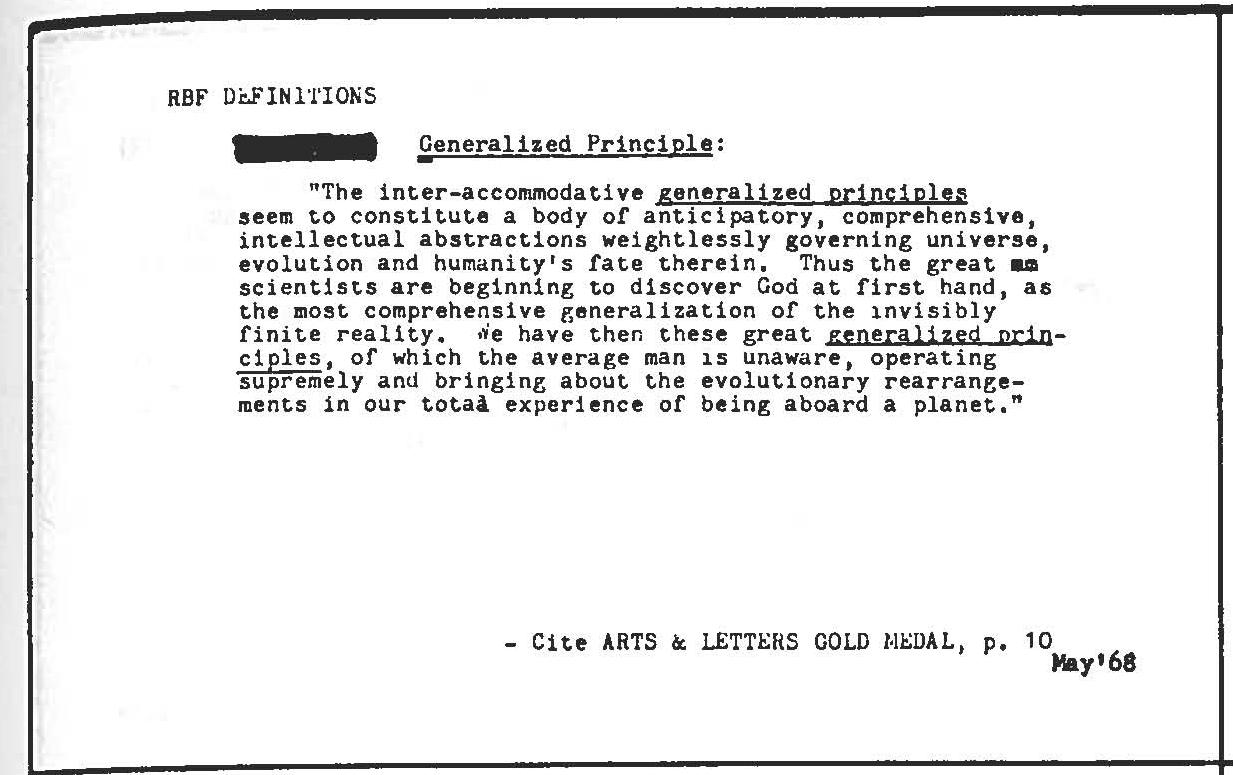
"The inter-accommodative generalized principles seem to constitute a body of anticipatory, comprehensive, intellectual abstractions weightlessly governing universe, evolution and humanity's fate therein. Thus the great scientists are beginning to discover God at first hand, as the most comprehensive generalization of the invisibly finite reality. We have then these great generalized principles, of which the average man is unaware, operating supremely and bringing about the evolutionary rearrangements in our total experience of being aboard a planet."
- Cite ARTS & LETTERS GOLD MEDAL, p. 10
Generalized Principle
← Generalized Principle | Generalized Principles, Once Discovered, Become Special-case Experiences →
Index Entry
Generalized Principle:
"Pure principles are usable. They are reducible from theory to practice."
- Cite Oregon Lecture #3, p. 102. 5 Jul'62
Generalized Principles, Once Discovered, Become Special-case Experiences
← Generalized Principle | Generalized Principles (1) →
Cross Reference
Cross-References
- Mind, (1)
- Universe: All the Known, 15 Jan'74
- Special-case Experience, 6 Nov'73
Generalized Principles (1)
← Generalized Principles, Once Discovered, Become Special-case Experiences | Generalized Principles (2) →
Cross Reference
Cosmogony: Orderliness Operative in Nature
Cross-References
- Cosmic Law Family
- Discovery of Generalized Principles
- Equatability of Generalized Principles
- Eternal Principles
- Generalization
- Inventory of Principles
- Inventory of Characteristics of Principles
- Metaphysical Synergy
- Principle
- Pure Principle
- Undiscovered Principles
- Interaccommodation: Interaccommodative
Generalized Principles (2)
← Generalized Principles (1) | Generalized Topological Definability (1) →
Cross Reference
Cross-References
- Comprehensive, Feb'72
- Eternal, May'72; 13 Mar'73
- Hierarchy of Constellar Configurations, 1959
- Metaphysical, Jan'68
- Metaphysical Environment, 13 Nov'69
- Metaphysical & Physical, 22 Apr'68; 27 Dec'74
- Reality, 13 Nov'69*
- Synergetic Surprise, 9 Apr'71
- Tension, (1)(4)
- Understanding, 7 Nov'73
- Stable & Unstable Systems, 2 Nov'73*
- Individuality & Degrees of Freedom, (4)
- Wealth, 8 Dec'75
Generalized Topological Definability (1)
← Generalized Principles (2) | Generalized Topological Definability (2) →
Index Entry
Generalized Topological Definability
"Generalized principles have topological system definability of angle, number, and constancy. Special cases have unique frequency dimensionability. Wherefore we propose that all recallably thinkable experiencings, physical and metaphysical, are fivefoldedly characterized:
(1) systematically,
(2) topologically (topo-aspectively),
(3) angularly,
(4) numerically (topo-interabundantly),
(5) frequency definable (special case: physical).
"All conceptually thinkable exclusively metaphysical experiencings are fourfoldedly characterized as above. All generalized principles are conceptually thinkable and fourfoldedly definable."
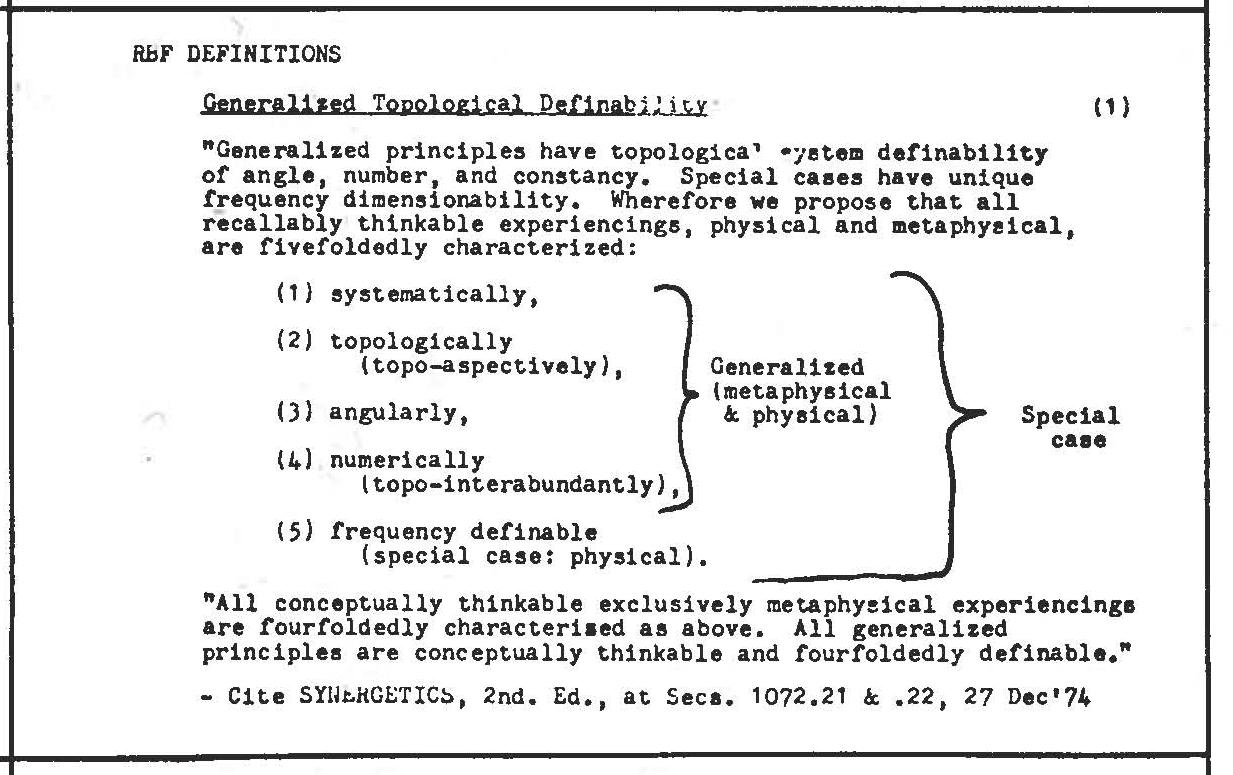
Generalized Topological Definability (2)
← Generalized Topological Definability (1) | General Systems Grid →
Index Entry
Generalized Topological Definability:
"Generalization is conceptually (i.e., systematically) imaginable independent of (5) frequency.
"The fifth characteristic, (5) frequency, is the unique special case variable. Physical experiencings are dependent not only on the four generalizable characteristics, but also on (5) frequency (i.e., size)."
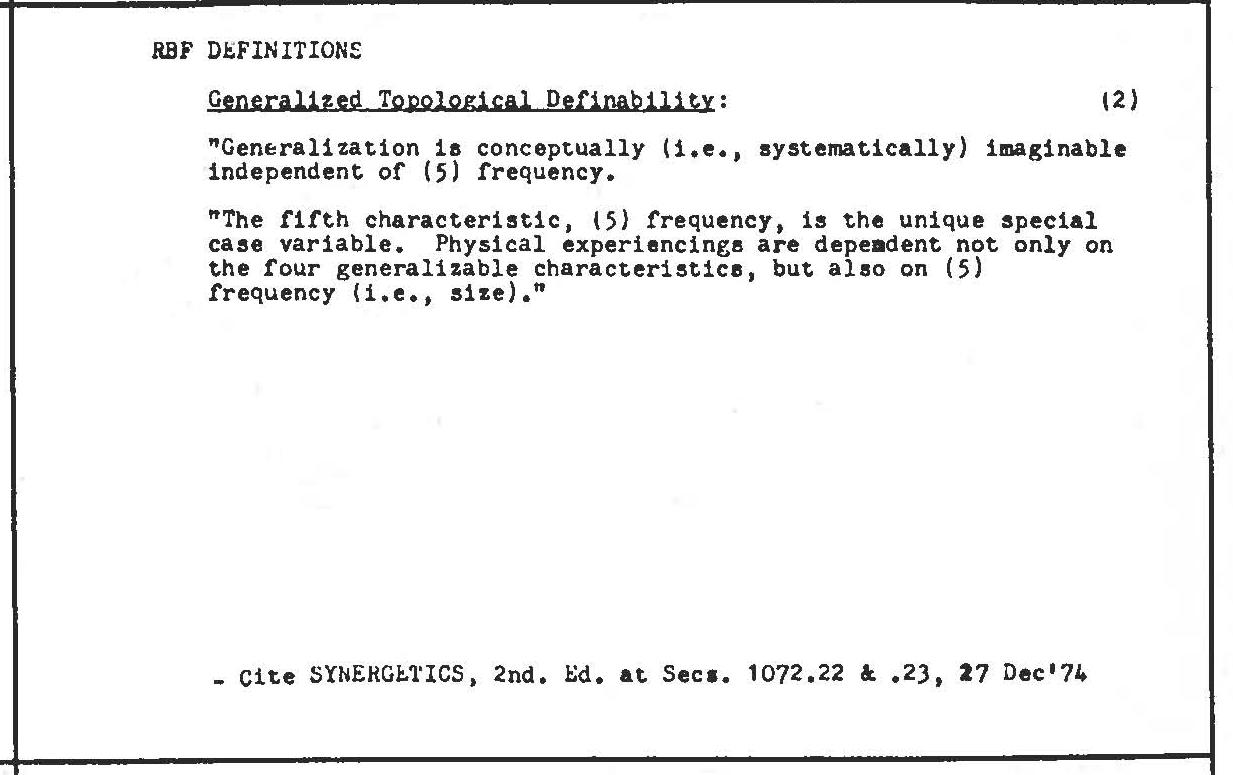
General Systems Grid
← Generalized Topological Definability (2) | General Systems' Mathematical-control Matrix →
Cross Reference
Cross-References
- Ekistics, Aug'72
General Systems' Mathematical-control Matrix
← General Systems Grid | General Systems Theory →
Cross Reference
Cross-References
- Basic Triangle, 20 Dec'73
General Systems Theory
← General Systems' Mathematical-control Matrix | General Systems Theory →
Index Entry
General Systems Theory:
"General systems theory usually relates to arbitrary parameters; I relate general systems theory to Universe."
- Cite RBF at O.B. Hardison dinner party, Wash. DC., 18 Dec'74
General Systems Theory
← General Systems Theory | General Systems Theory (1) →
Index Entry
General Systems Theory:
"Just now, man is coming into technical discovery of general systems theory. The experimental probing of the potentials of the computers awakened man to a realization of the vast complexes of variables that can be mastered by general systems theory. So far, man has dealt but meagerly and noncomprehensively with his powerful planning capability. So far, he has employed only limited systems theory in special open-edged systems-- 'tic-tac-toe' rectilinear grid systems and planar matrixes. The arbitrary open parameters of infinite systems can never be guaranteed to be adequate statements of all possible variables. Infinite systems engender an infinite number of variable factors. Unless one starts with Universe one always inadvertently starts with open infinite systems. Only by starting with finite Universe and progressively dismissing finite irrelevancies can one initiate finite, locally limited, general system theory to assured satisfaction in problem solving."
General Systems Theory (1)
← General Systems Theory | General Systems Theory (2) →
Index Entry
General Systems Theory:
"The 12 universal degrees of freedom govern the external and internal motions of all independent systems in Universe. In order to take synergetic strategy advantage and thereby to think comprehensively and anticipatorily, in terms of total systems, we have to start off with Universe itself as a closed finite system that misses none of the factors. We must also include all the universal degrees of freedom, and the approximately unlimited range of frequencies in the use thereof, which cover all variable interrelationships of Universe. They become the controlling factors governing general systems and, thereby govern such supercomplex systems design as that of a nation's navy or a fundamental program for comprehensively considerate and efficiently effective use of all world resources.
- Cite SYNERGETICS text at Sec. \hrefhttps://www.buckyverse.org/en/synergetics/content/chapters/500-conceptuality#section-537.31537.31; galley rewrite, 7 Nov'73
General Systems Theory (2)
← General Systems Theory (1) | General Systems Theory →
Index Entry
General Systems Theory:
"The general systems approach starts with the differentiation of Universe, including both metaphysical and physical, and permits progressive subdivisions in cybernetical bits to bring any local pattern of any problem into its identification within the total scheme of generalized system events. Problem solving starts with Universe and thereafter subdivides by progressively discarding irrelevancies thereby to identify the 'critical path' priorities and order of overlapping developments that will most economically and efficiently and expeditiously realize the problem's solution by special local problem identification and location within the totality of the problem-solving scenario."
- Cite RBF rewrite of SYNERGETICS galley at Sec. \hrefhttps://www.buckyverse.org/en/synergetics/content/chapters/500-conceptuality#section-537.31537.31, 7 Nov'73
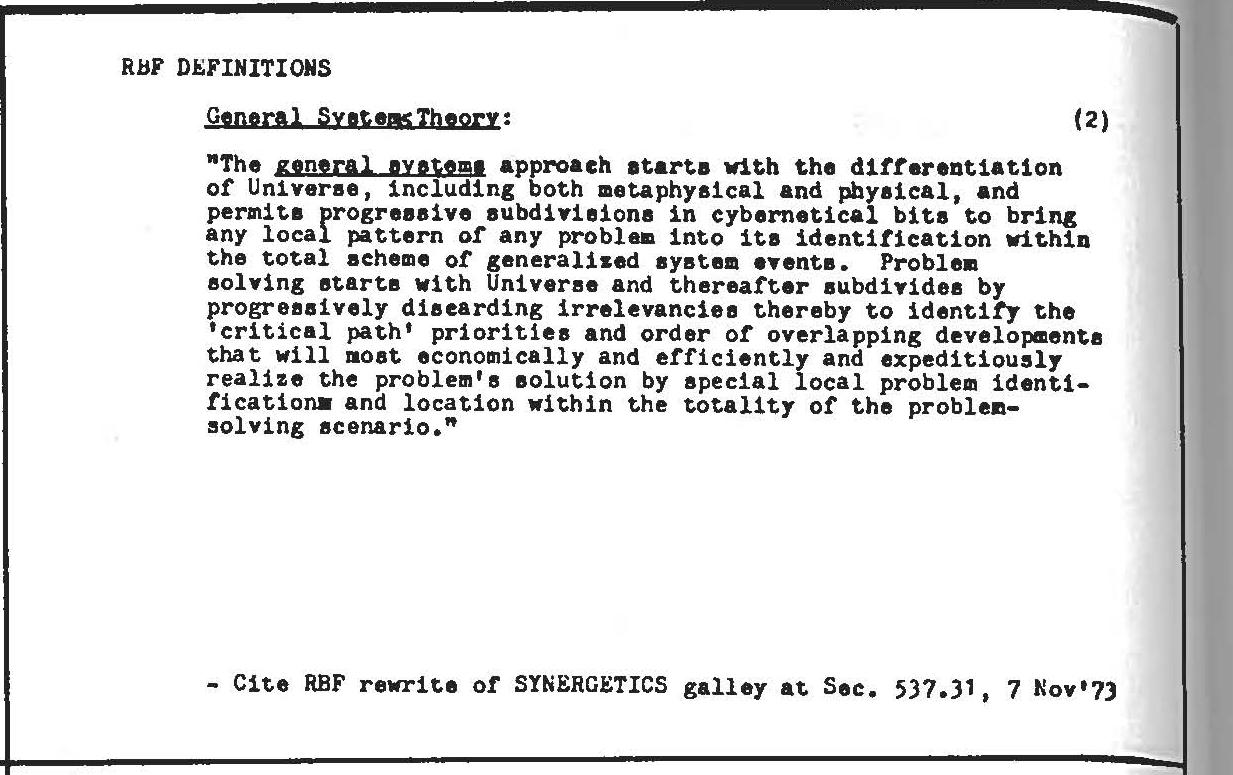
General Systems Theory
← General Systems Theory (2) | General Systems Theory →
Index Entry
General Systems Theory:
"General systems theory treats with phenomena that are holistically comprehensible. The objects of our experience are finite systems. Their superficial outlines close back upon themselves multidirectionally as a systematic continuity of relevantly contiguous events.
"Maximum system complexity consists of a dissimilarly quantified inventory of unique and nonintersubstitutable components. That is, Euler's irreducible-system aspects of vertexes, areas, and edges exhibit the respective dissimilar quantities 4, 4, and 6 in the minimum prime system, the tetrahedron. This demonstrates the inherent synergy of all systems, since their minimum overall inventory of inherent characteristics is unpredicted and unpredictable by any of the parts taken separately. Systems are unpredicted by oneness, twoness, or threeness. This explains how it happens that general systems theory is a new branch of science.
"General systems theory is another example of evolution by inadvertence. It developed fortuitously to accommodate the unprecedented and vastly complex undertakings of the late twentieth century, such as the 10 million separate and only"
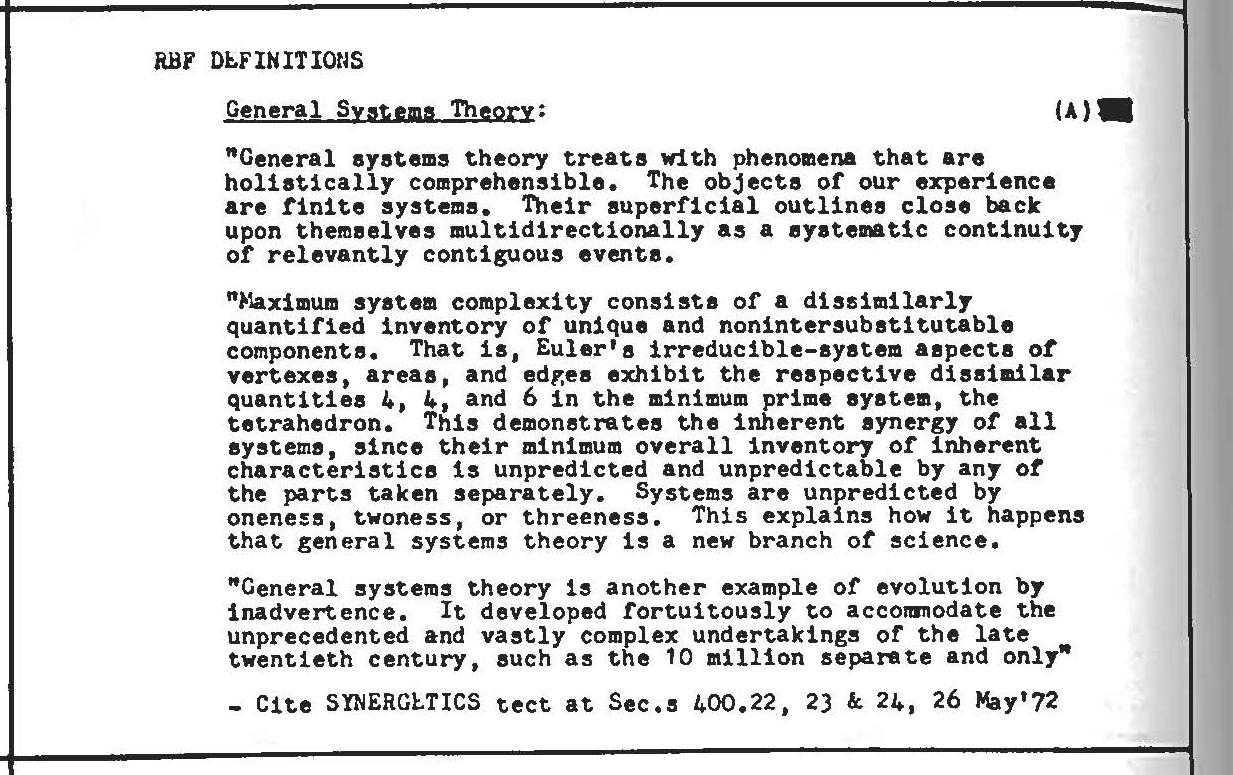
General Systems Theory
← General Systems Theory | General Systems Theory →
Index Entry
General Systems Theory:
"partially overlapping 'critical path' tasks that had to be accomplished and tested to foolproof reliability en route to countdown to eventual blastoff, Moon landing, and safe return to Earth, which found all conventional mathematical theory wanting. It required the development of the computer and star-focused instruments and computer programming arts together with operational research, which guess-improvises the inventory of parameter of variables that must be progressively programmed into the system in order to further reduce the magnitude of tolerated errors consequent to trial 'bird' (rocket vehicle) 'flight' (trajectory) control as the vehicles are progressively zeroed-in to progressive target rendezvous with celestial entities. Neither differential and integral calculus, nor 'probability' statistics, nor any branch of specialized hard science has accredited synergy as an a priori assumption. General systems theory, which recognizes synergy as inherent, was discovered and named by the biologic-ally inspired Ludwig van Bertalanffy."
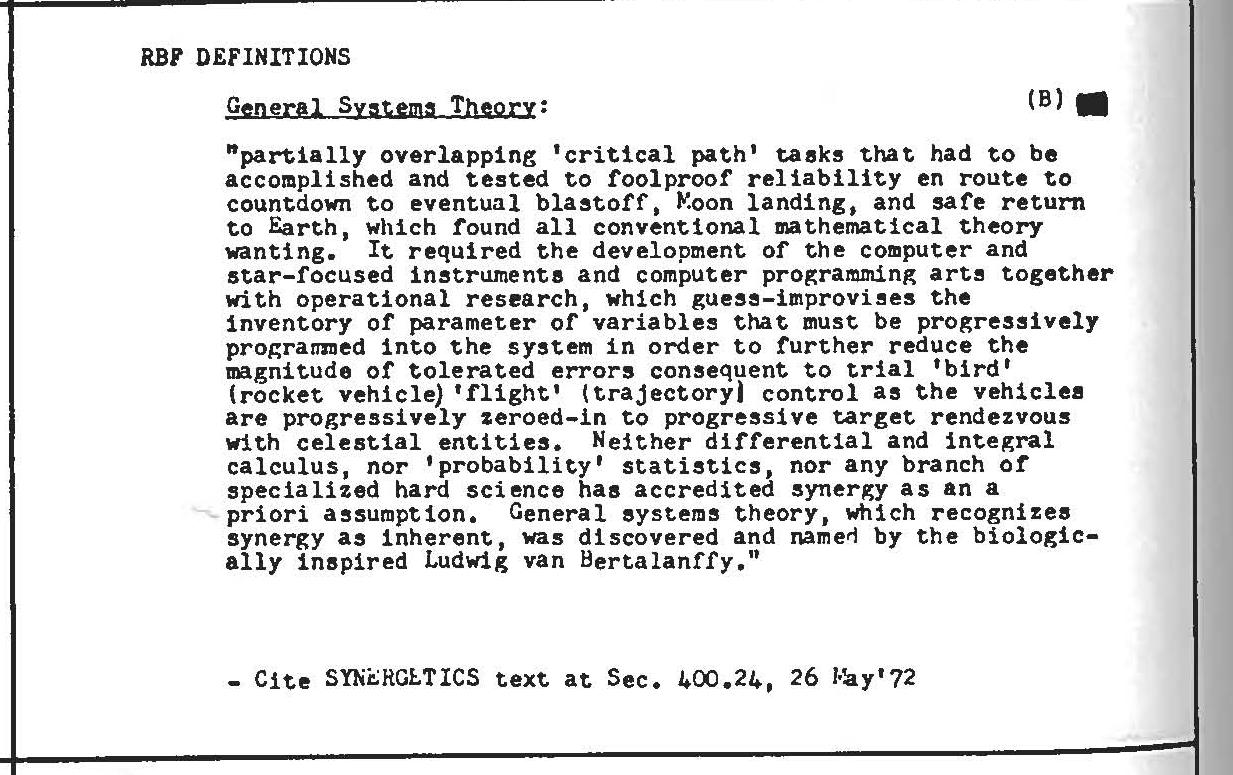
General Systems Theory
← General Systems Theory | General Systems Theory →
Index Entry
General Systems Theory:
"...The computer operational research and general systems sciences and their equipment will help... to progressively dispense with opinion judgments. They, as in the space operations, can cope effectively with all the tactical variables."
- Cite RBF Ltr. to Indira Gandhi, p.7, 4 Jan'70
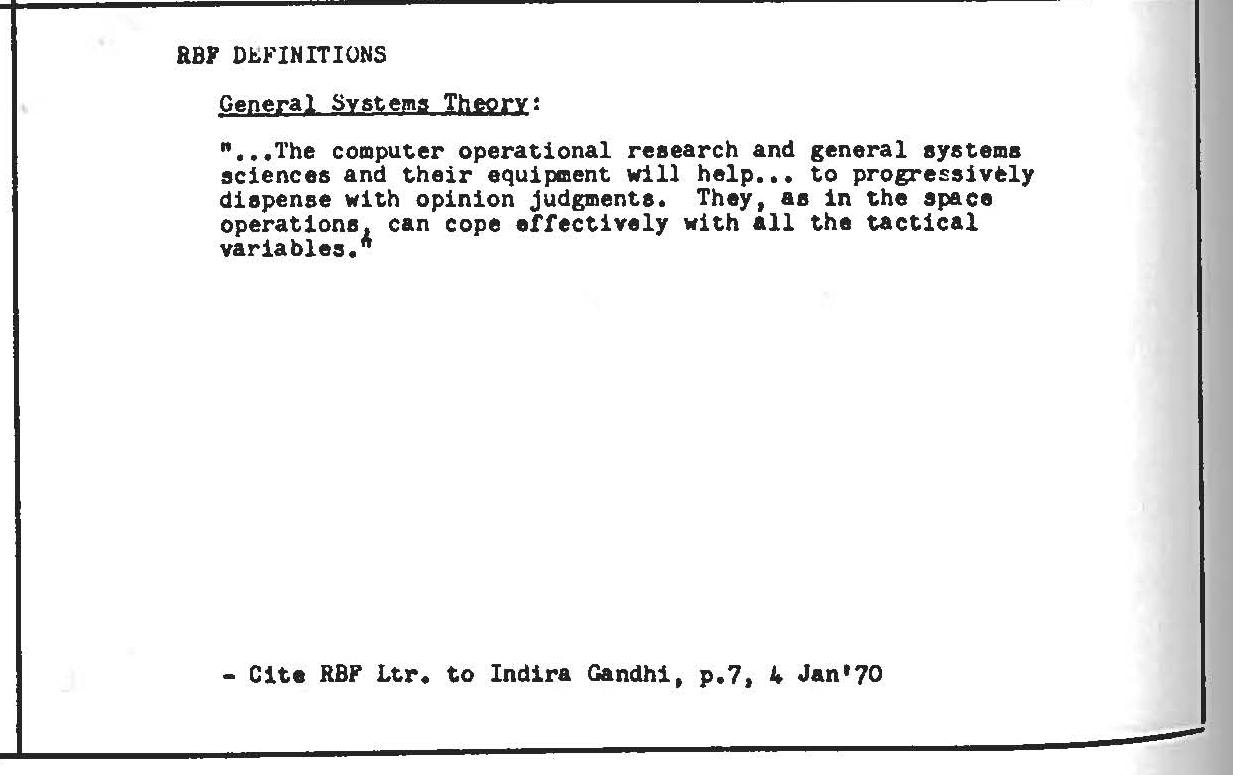
General Systems Theory
← General Systems Theory | General Systems Theory →
Index Entry
General Systems Theory:
"General systems theory is central to all the successful prognosticating. This theory has been employed in the logistics and ballistics of world-embracing naval theory for at least a century. It involves all the fundamental variables entering into the problem. Its strategy is to start with the most comprehensive family of variable factors possible, and by progressive elimination of those factors irrelevant to the special case problem, to arrive at logically predictable condition [sic] at a given time and place. The most desirable results often require invention and development of new tools and instruments. Thus, the physical novelties of tomorrow are often the consequences of a complex family of variables."
- Cite the AGE OF THE DOVE, Jul'69
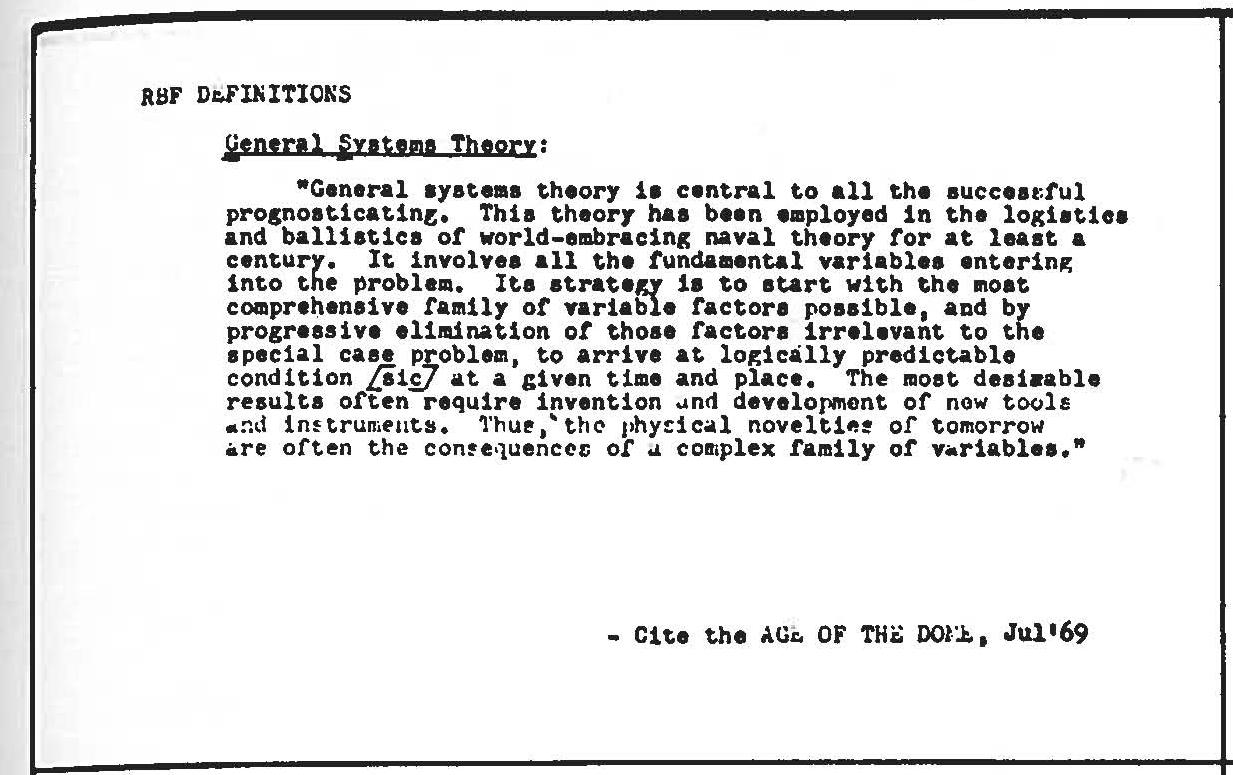
General Systems Theory
← General Systems Theory | General Systems Theory →
Index Entry
General Systems Theory:
"In a great matrix we can call out the frequency and once we have the frequency, we know how many there are in that layer. . . So we would be able for a given frequency to know how many special-case informations we have stored there and how many relationships there are.
"Now it's very possible that we are getting to general systems theory. For a given frequency, what ever number of cells there are in that outer layer, is exactly what you are going to have to have for your general systems theory. Those are the number of variables at that level of discretion. You can generalize it more, or you can get down to less generalized levels."
- Cite RBF to Verner Smythe, NYC, Reel 2, p.2, 11 Mar'69
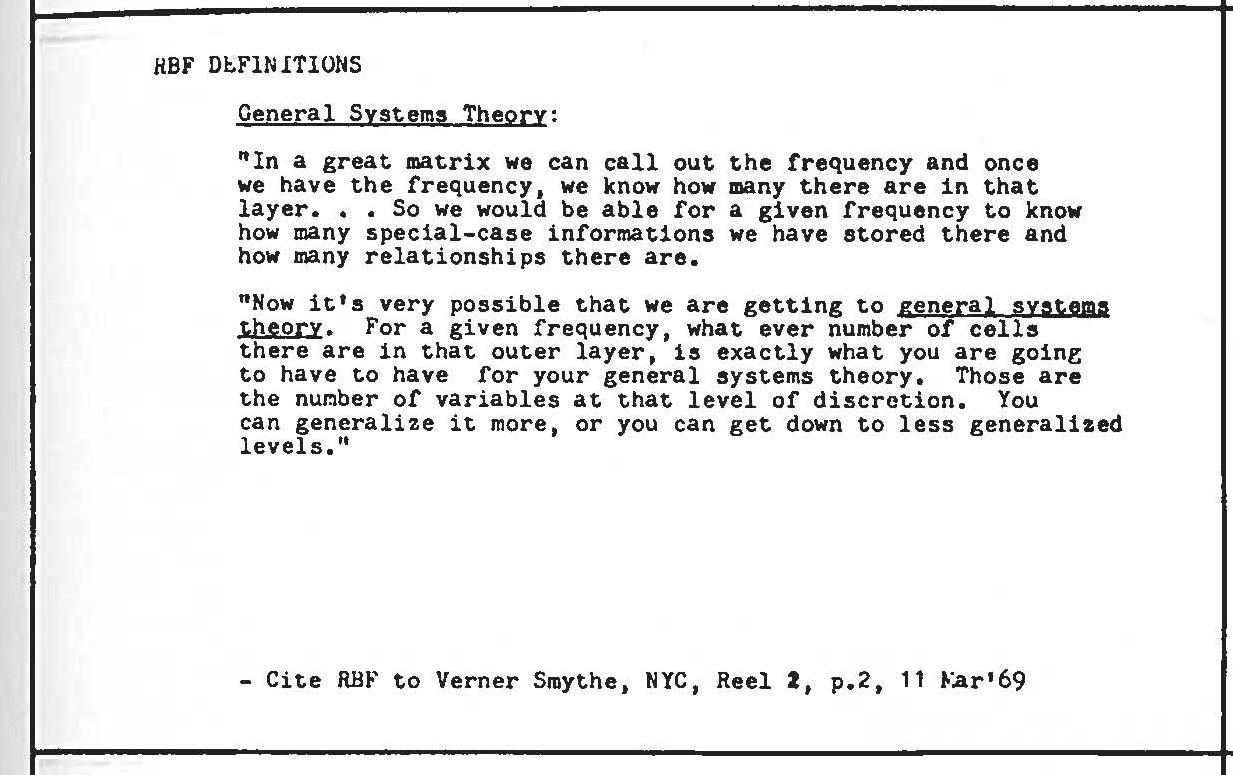
General Systems Theory
← General Systems Theory | General Systems Theory →
Index Entry
General Systems Theory:
"The General Systems Theory is deductive and states that only if we begin with universe and consider it finitely and comprehensively in terms of total systems, can we deal effectively with the maximum and minimum number of limiting factors of the combined and complementary physical and metaphysical subdivisions of universe."
bound with the "Live Book Squad"
- Cite RBF Glossary of Terms
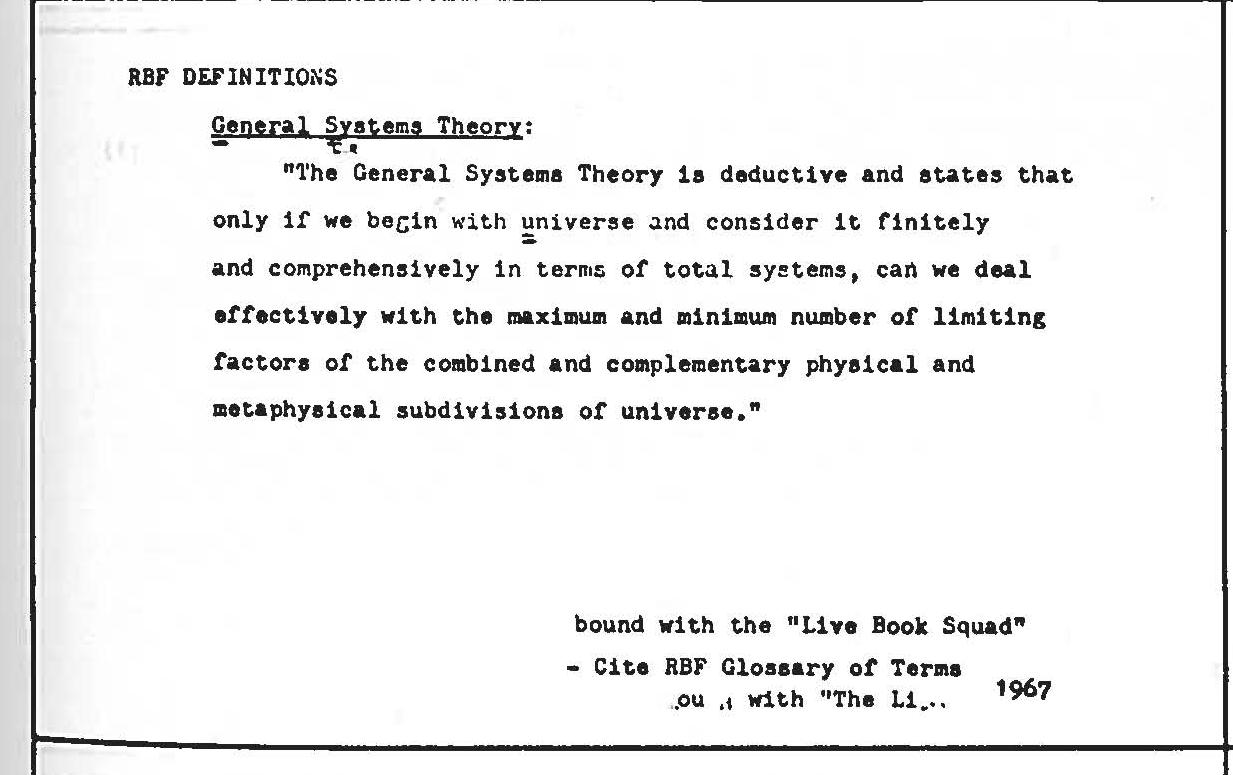
General Systems Theory
← General Systems Theory | General Systems Theory →
Index Entry
General Systems Theory:
"How may we organize our self-disciplining to deal comprehensively and capably with the maximum and the minimum of limiting factors of the combined and complementary physical and metaphysical prime subdivisions of universe?"
- Cite NASA Speech, p. 24, Jun'66
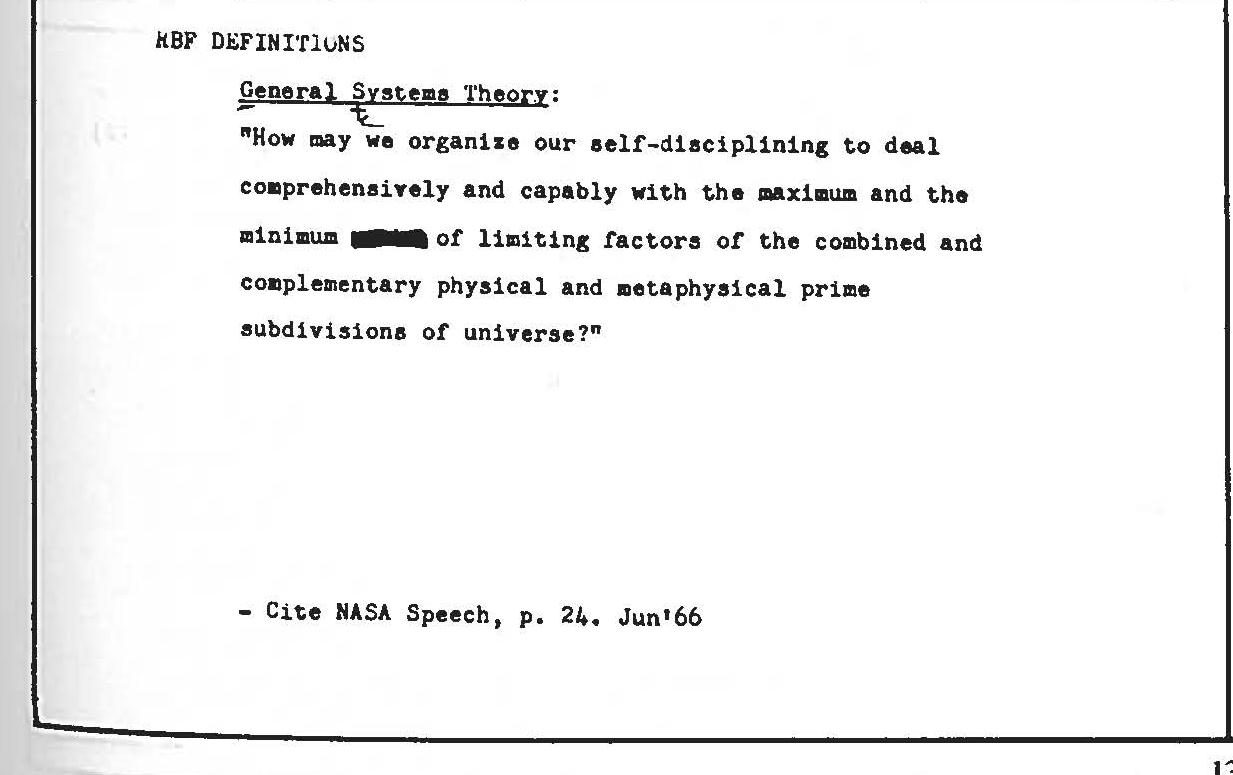
General Systems Theory
← General Systems Theory | General Systems Theory →
Index Entry
General Systems Theory;
"The sphere is complex unity and the triangle is simplex unity. Here and here alone lie the principles governing finite solution of all structural and general systems theory problems...."
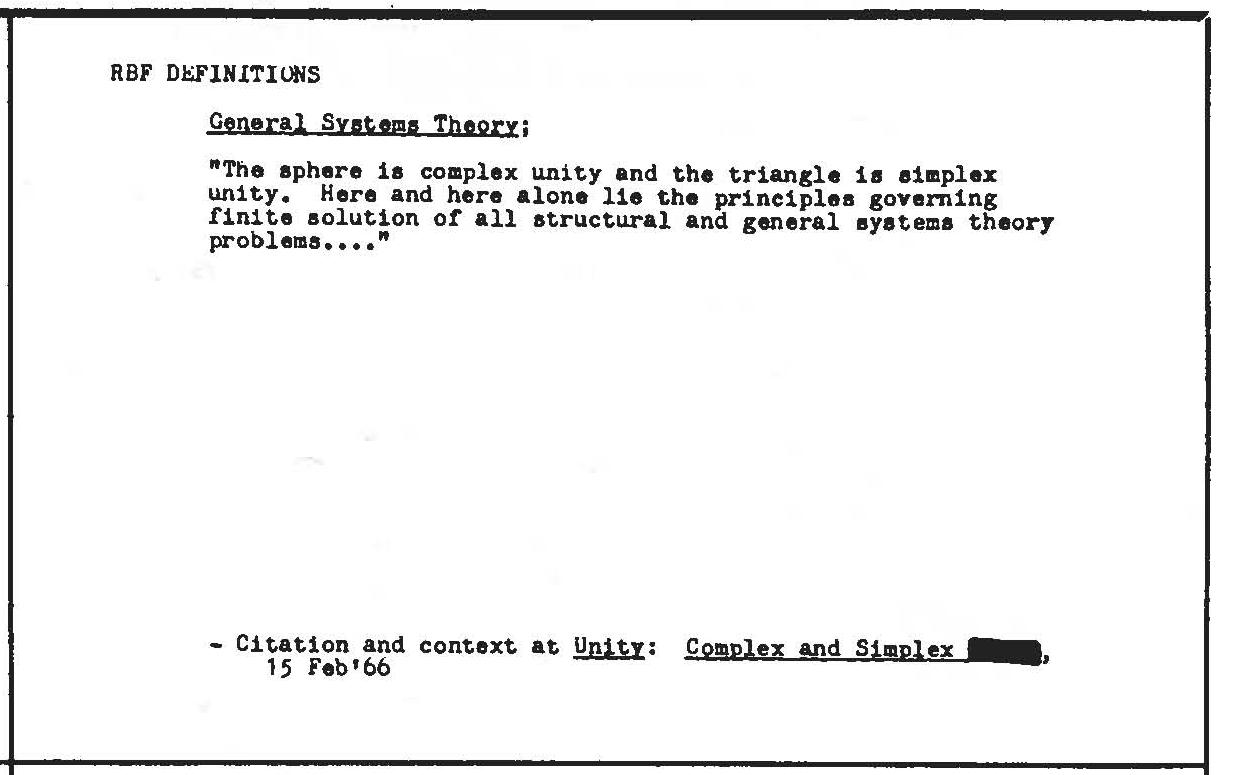
General Systems Theory
← General Systems Theory | General Systems Theory (1) →
Index Entry
EDUCATION AUTOMATION, pp. 66-67 s201.21
\hrefhttps://www.buckyverse.org/en/synergetics/content/chapters/400-system#section-400.22400.22-\hrefhttps://www.buckyverse.org/en/synergetics/content/chapters/400-system#section-400.24400.24 s304
\hrefhttps://www.buckyverse.org/en/synergetics/content/chapters/500-conceptuality#section-537.30537.30: \hrefhttps://www.buckyverse.org/en/synergetics/content/chapters/500-conceptuality#section-536.31536.31-\hrefhttps://www.buckyverse.org/en/synergetics/content/chapters/500-conceptuality#section-537.34537.34 s326.24
\hrefhttps://www.buckyverse.org/en/synergetics/content/chapters/700-tensegrity#section-707.01707.01
\hrefhttps://www.buckyverse.org/en/synergetics/content/chapters/900-modelability#section-901.18901.18
\hrefhttps://www.buckyverse.org/en/synergetics/content/chapters/1200-numerology#section-1238.801238.80
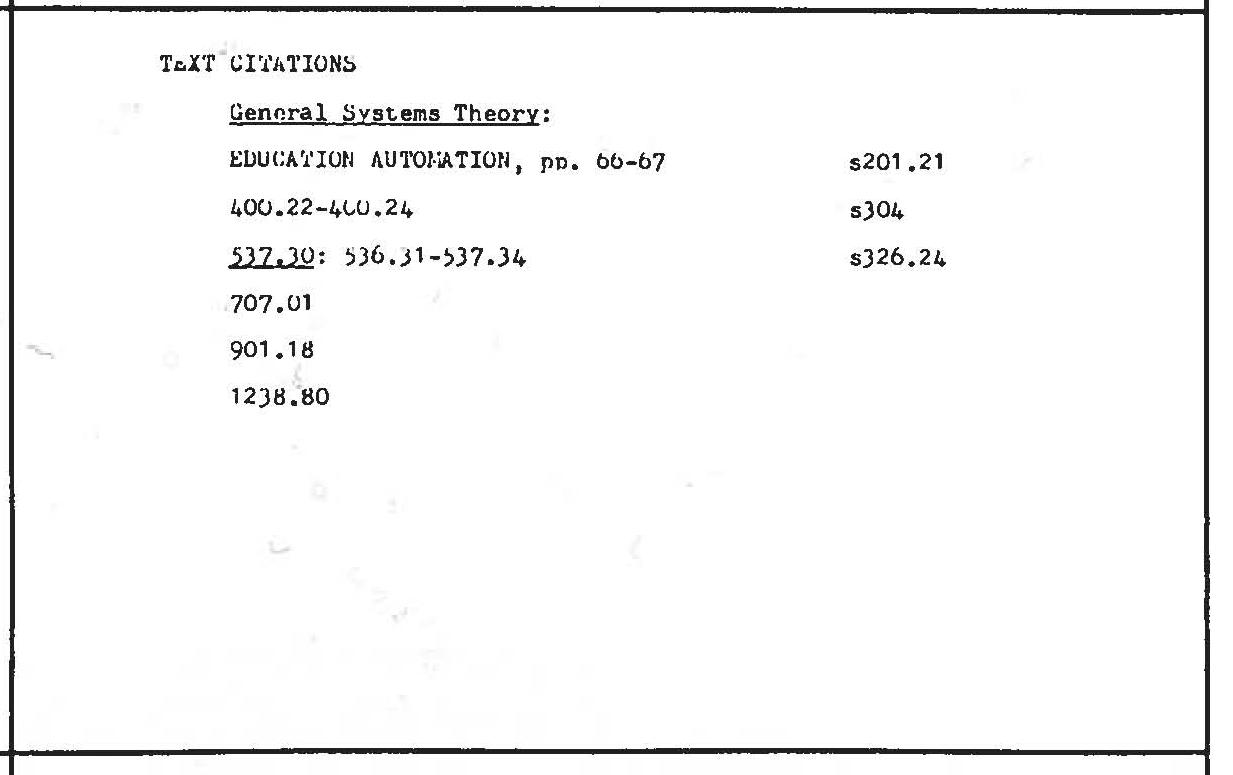
General Systems Theory (1)
← General Systems Theory | General Systems Theory (2) →
Cross Reference
Cross-References
- Bertalanffy
- Bridgman
- Differential
- Operational
- Problem Solving
- Question: Original Question
- Starting with Universe
- Parameters
- Variables: Theory Of
- Irrelevancies: Dismissal Of
- Systems Alter Other Systems
- Grand Strategy
- Comprehensibility of Systems
- Critical Path
- Geometry of General Systems
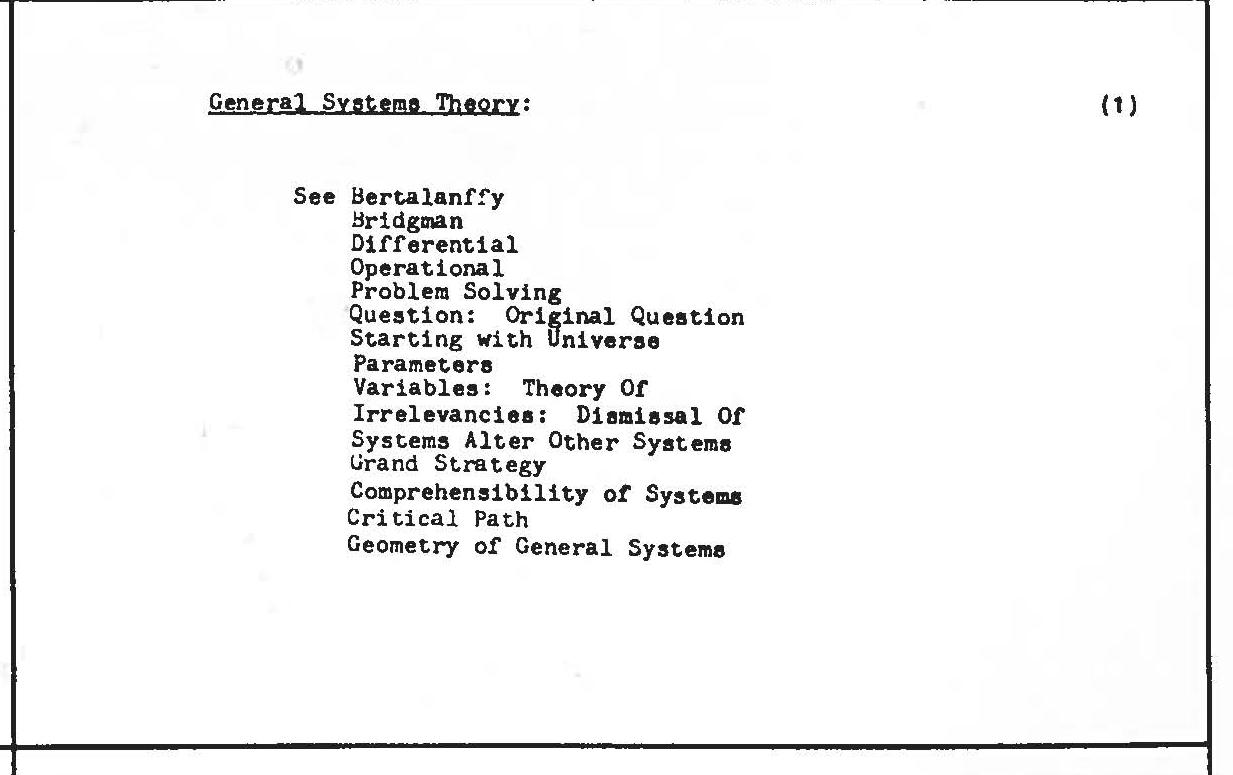
General Systems Theory (2)
← General Systems Theory (1) | Generalization: Generalised (1) →
Cross Reference
Cross-References
- ant, Oct
- System, (1)
- Twelve Universal Degrees of Freedom: General Systems
- Unity: Complex & Simplex, 16 Oct'72; 15 Feb'66*
- XYZ Coordinate System, Jun'66
- Generalization & Special Case, Nov'71
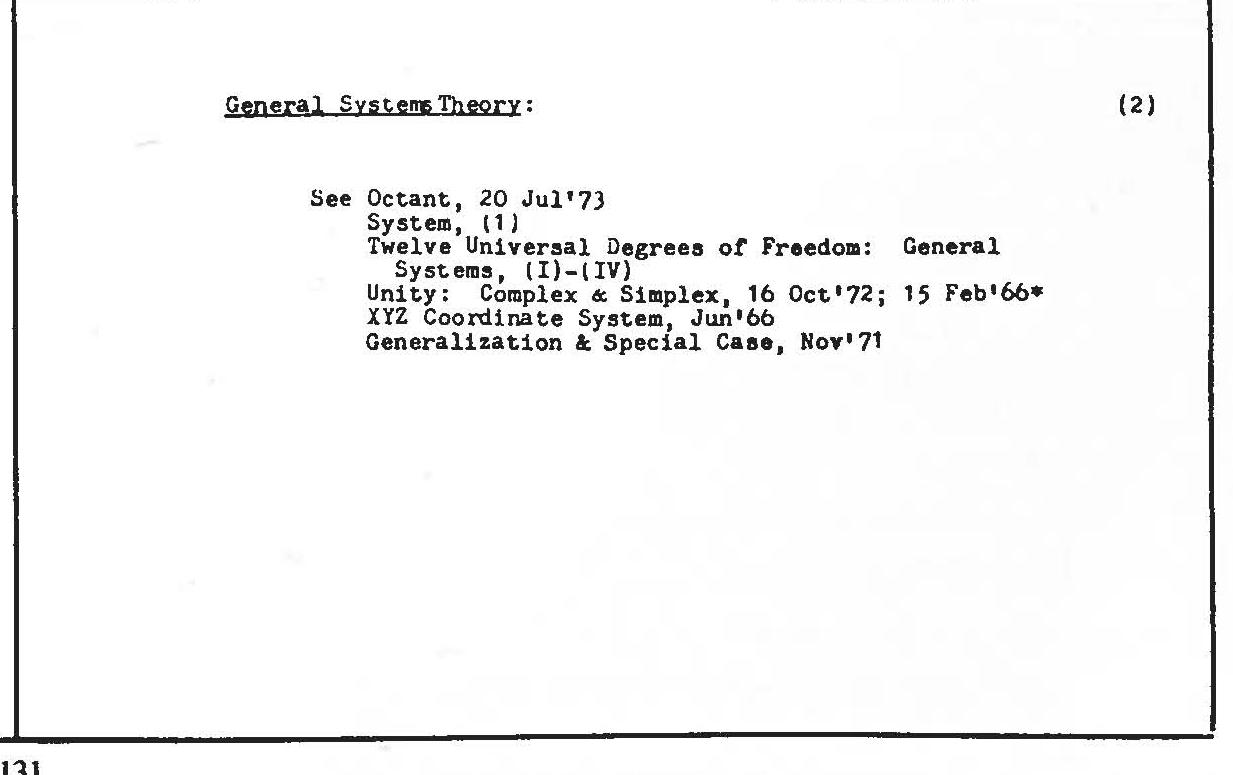
Generalization: Generalised (1)
← General Systems Theory (2) | Generalization Generalized (2) →
Cross Reference
Mathematics - Generalization
Cross-References
- Absolute Generalizability
- Contractively Orderly Generalization
- Design vs. Generalization
- Ideal Generalization
- Partial Generalization
- Pattern Generalization
- Scientific Generalization
- Subgeneralization
- Ultimate Generalization
- No Generalized Boat
- Metabolic Process Generalization
- Reality vs. Generalization
- Avogadro: Generalized Avogadro system
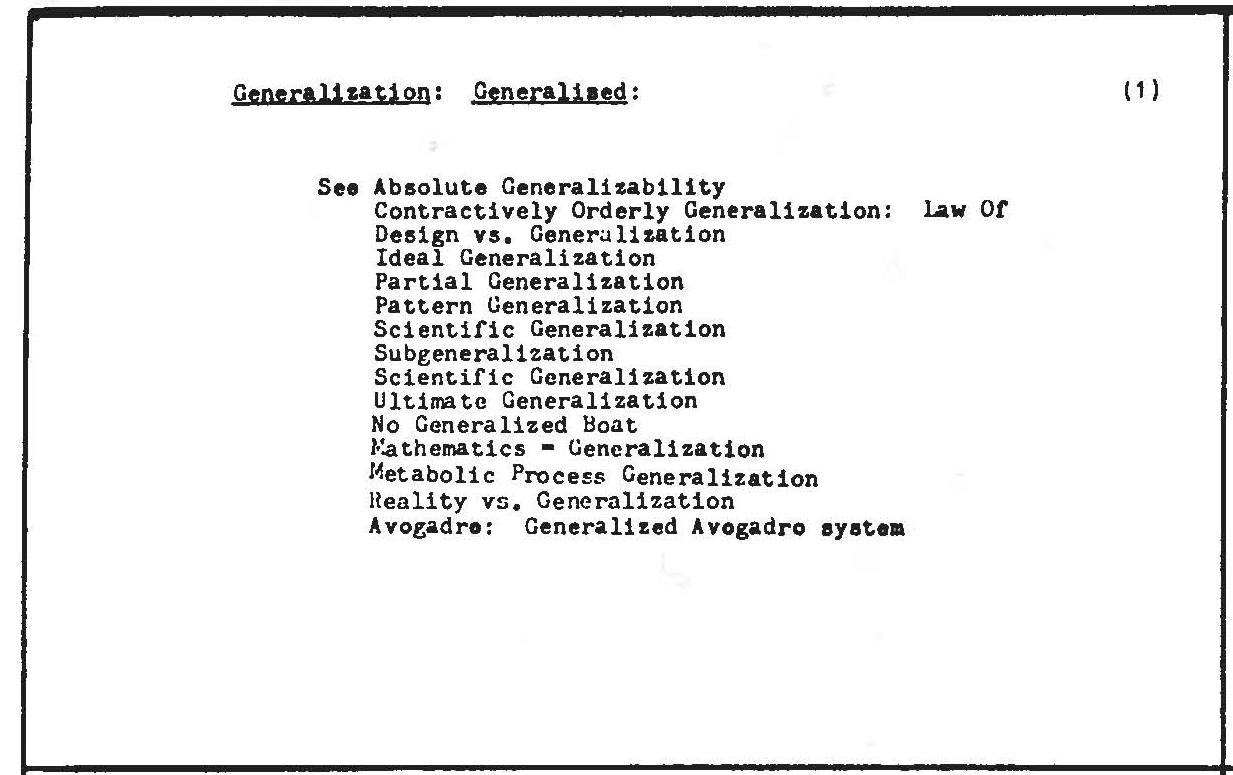
Generalization Generalized (2)
← Generalization: Generalised (1) | Generalization (3) →
Cross Reference
Cross-References
- Frequency, 16 Feb'73
- Integration, 10 Oct'63
- Lever, (2)
- Mathematics, 2 Jul'62; 13 Mar'71*
- Point, 20 Feb'73
- Quantum Mechanics, Jun'66
- Radiation-gravitation, 8 Mar'73*
- Transcendental, 28 Jan'69
- Vector, 26 May'72*
- Metaphysical & Physical, 19 Nov'74
- Prime Thinkability, 26 Dec'74
- Truth as Progressive Diminution of Residual Error, 1 Feb'75
- Otherness Restraints & Elliptical Orbits, (2)
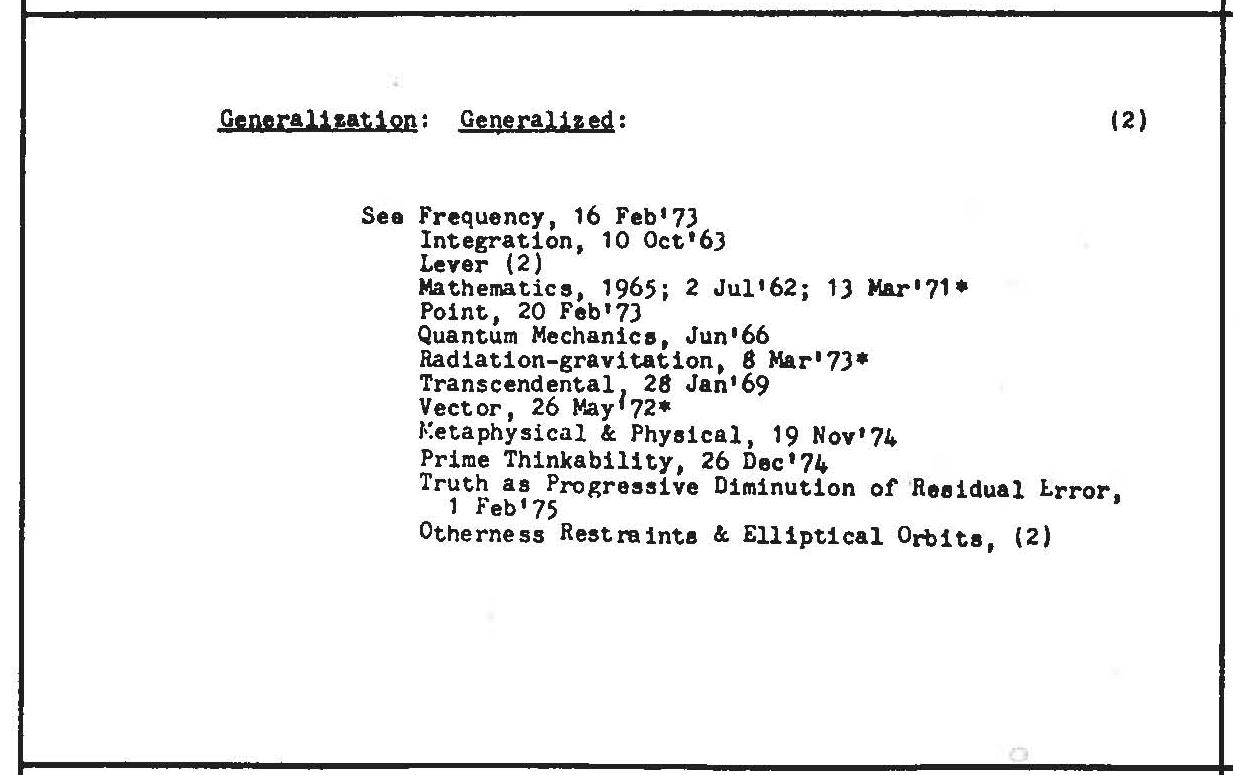
Generalization (3)
← Generalization Generalized (2) | General Generalization →
Cross Reference
Cross-References
- General Case
- Generalist
- Generalization
- Generalization: Degrees Of
- Generalizations of Generalizations
- Generalization: Mathematical vs. Literary
- Generalization & Special Case
- Generalizations Reduced to One Word
- Generalize
- Generalized Boat
- Generalized Topological Definability
- Generalized Design
- Generalized Dichotomy: Grand Strategy
- Generalized Law
- Generalized Orbiting
- Generalized Principles
- Generalized Principles, Once Discovered, Become Special-case Experiences
- General Systems Grid
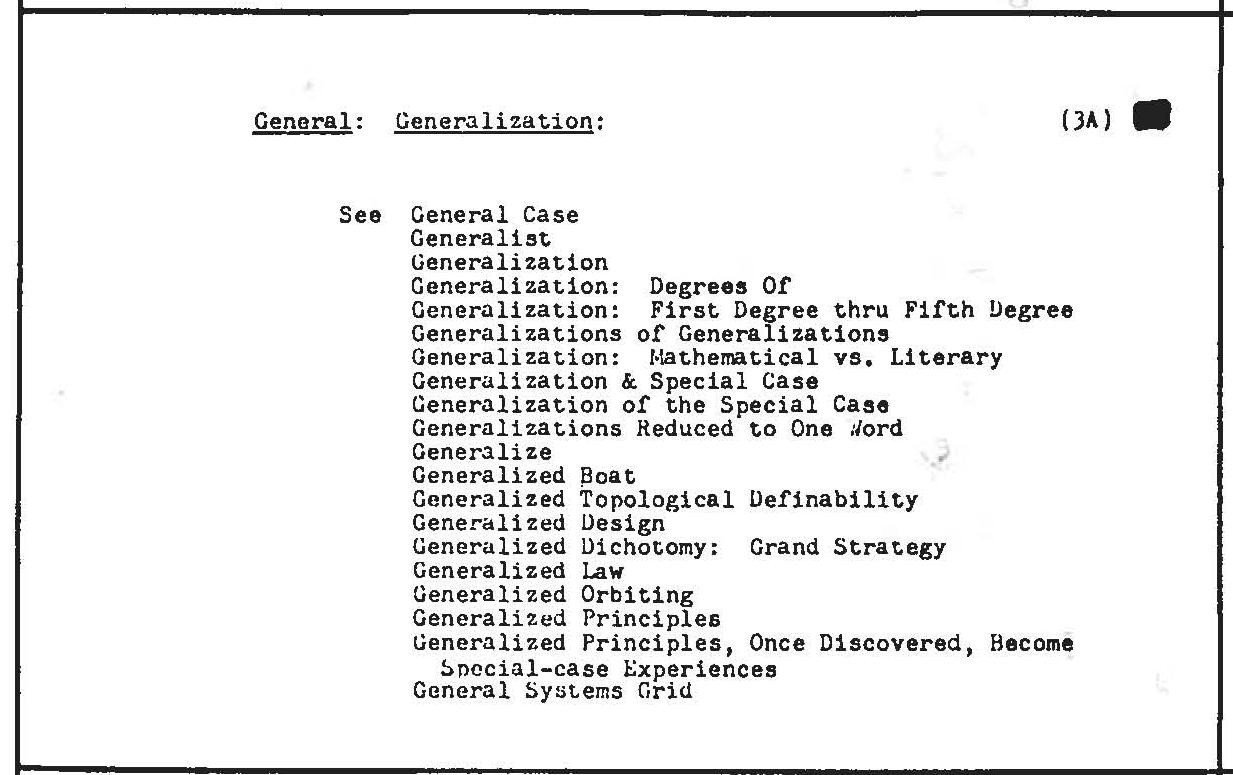
General Generalization
← Generalization (3) | Generate Generating →
Cross Reference
General: Generalization:
Cross-References
- General Systems' Mathematical Control Matrix, (3B)
- General Systems Theory
Generate Generating
← General Generalization | Generation Gap →
Cross Reference
Propagate
Radiantly Gnerated
Cross-References
- Broadcastingly Generated
- Electively Generatable
- Electromagnetic Generating
- Omnisymmetrically Generated
- Regenerative
- System Generates Itself
- Prime Generation
- Nuclear Power Generation
Generation Gap
← Generate Generating | Generation (1) →
Cross Reference
Cross-References
Generation (1)
← Generation Gap | Generation Generations (2) →
Cross Reference
Cross-References
- Older Generation, (1)
- The TV Generation, (1)
- Young World, (1)
Generation Generations (2)
← Generation (1) | Generators →
Cross Reference
Cross-References
- Regenerativity, 17 Jan'75

Generators
← Generation Generations (2) | Generators →
Index Entry
Generators:
"Electric current generators unpeel the gravitationals. They unwrap the orbitals and precess them into linearly focussed paths. Their generated output is induced by remote closing of a wired circuit between the user and the generator, which local switch closing allows an electron train to be tensed toward the generator which releases the power flow away from the generator toward the user's switched-in 'outlet.'"
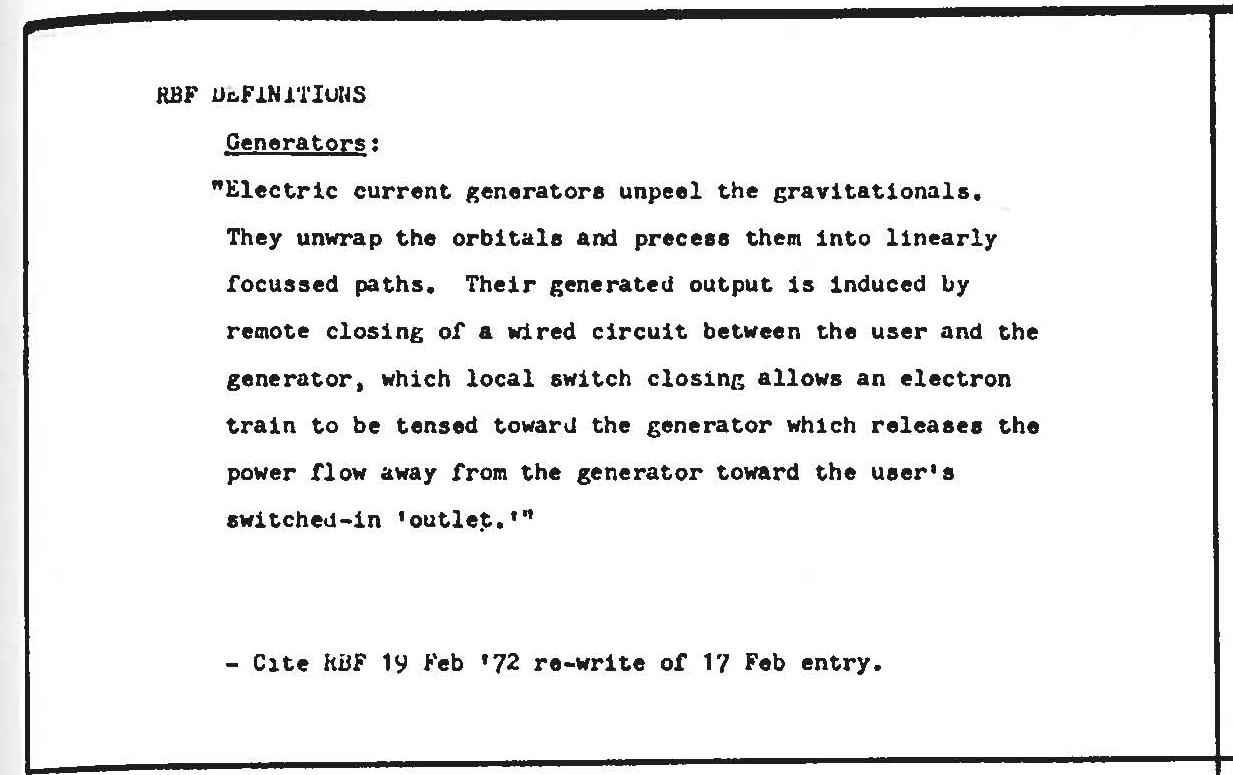
Generators
Index Entry
Generators:
"Generators unpeel the gravitationals. They unwrap the orbitals and turn them into the linears."
- Cite RBF to EJA + BO'R, 3200 Idaho, Wash DC, 17 Feb'72
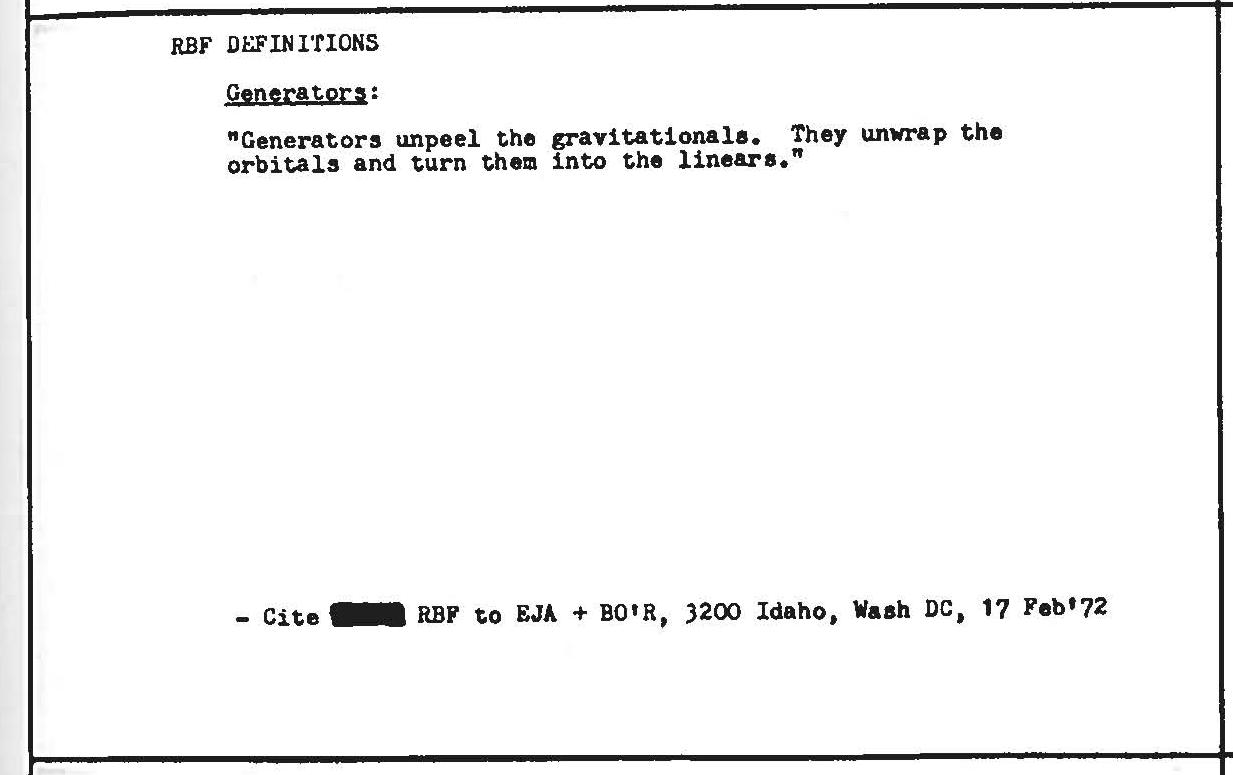
Generatora
← Generators | Generators Electric Power Generators (1) →
Cross Reference
Generatora: Tumbling a Set of Dominoes to the Generating Station:
23 Jan'72
Cross-References
- Circuitry: Thermionic & Political Analogy, 23 Jan'72
Generators Electric Power Generators (1)
← Generatora | Generators Electric Power Generators (2) →
Cross Reference
Cross-References
- Electric Motor
- Electromagnetic Generating
- Electrostatic Generating
- Flywheel
- Power Generation
- Windmill
- Wind Power Sequence
- Energy Harvesting
Generators Electric Power Generators (2)
← Generators Electric Power Generators (1) | Generous →
Cross Reference
Cross-References
- Energy, Jun'66
- Pollution Control, (1)
Generous
← Generators Electric Power Generators (2) | Generous →
Index Entry
Generous:
"So here we are then in this fantastic dilemma-- all specialized. Whereas I am perfectly confident that it is perfectly possible for all humanity to really be what they are born to be. To be generous."
- Cite Univ. of Chicago Address, p.11, 5 May'72
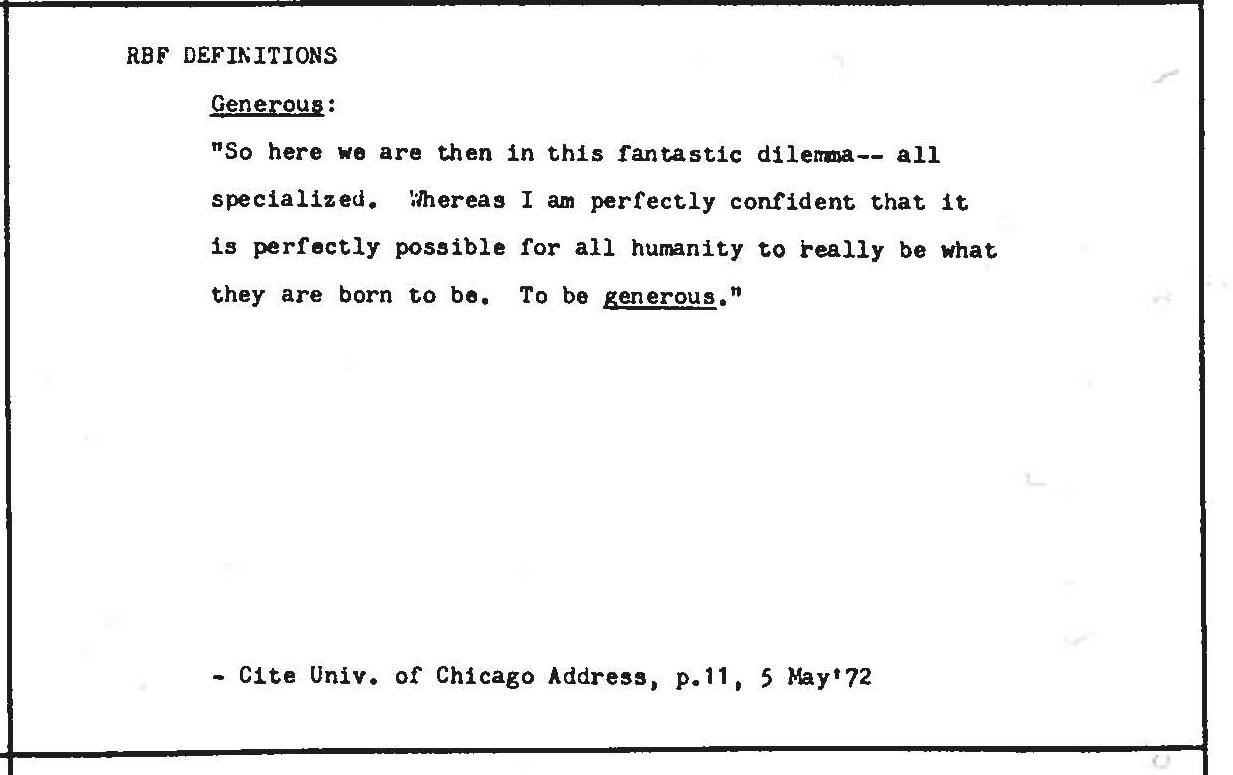
Generous
← Generous | Genesis of Modelability - Vector Equilibrium →
Cross Reference
Cross-References
- Unselfish

Genesis of Modelability - Vector Equilibrium
Cross Reference
Cross-References
- Modelability, 12 Sep'71
Genesis
← Genesis of Modelability - Vector Equilibrium | Genetic →
Cross Reference
Bow Tie: Genesis Of
Cross-References
Genetic
Index Entry
Genetic:
"Genetic = A priori code of discrete instructions.
Dialogue means two-way feedback, logos-communication as always referenced to an a priori complex integrity of abstract weightless, mathematically ordered equatability of generalized, and only scientifically discovered, eternal principles."
- Cite RBF marginalis at Eccles' "Facing Reality," p. 3, 14 Feb '72, as rewritten same date.
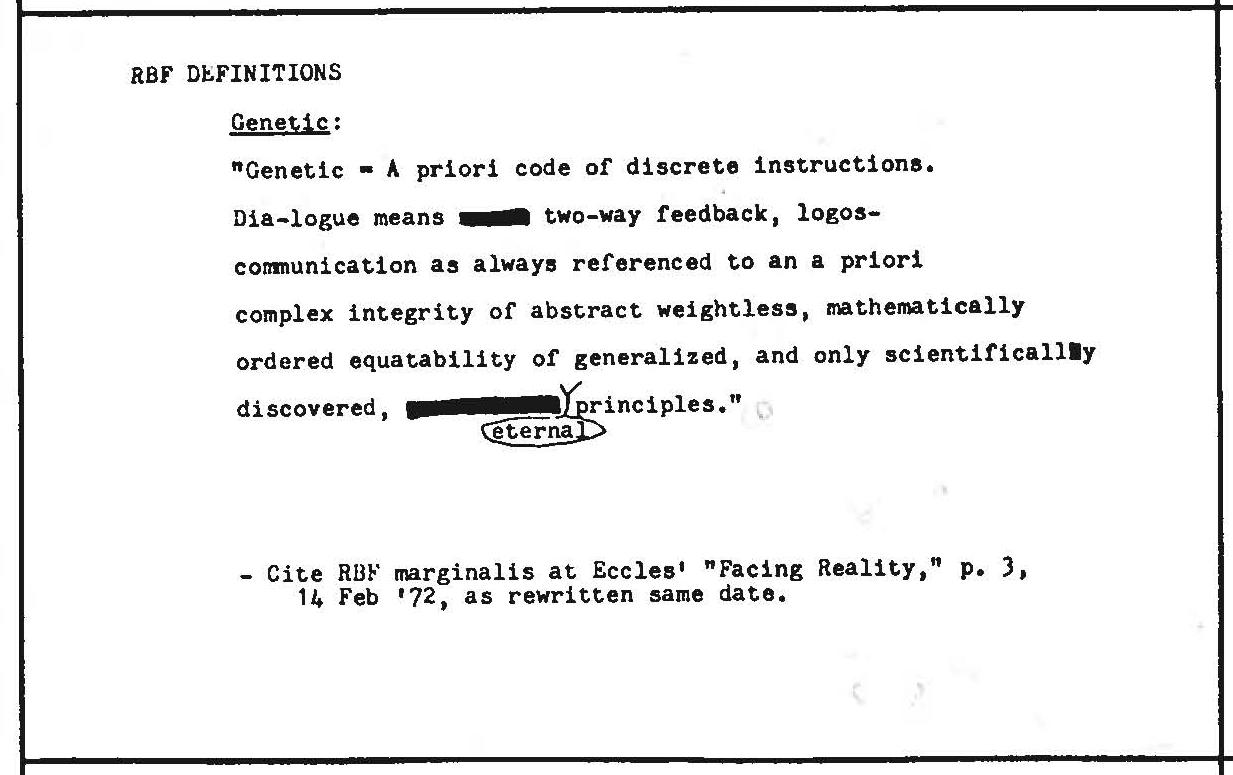
Genetic
← Genetic | Genetic - Instructions →
Index Entry
Genetic:
"Genetic = a priori code of discrete instructions.
"Dia-logue as two-way logos-communication all with a priori complex of philosophies."
- Cite RBF marginalis at Eccles, 'Facing Reality,' p.3, 14 Feb'72
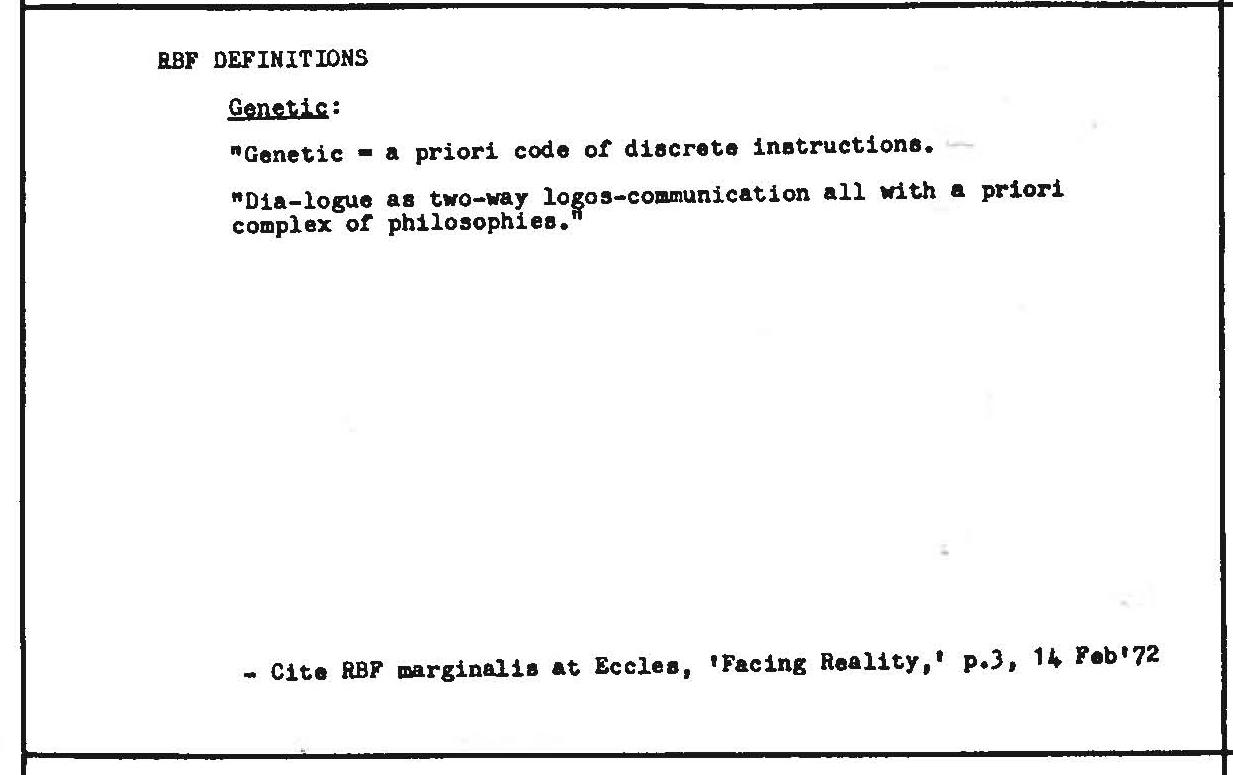
Genetic - Instructions
← Genetic | Genetics Genetic Code (1) →
Cross Reference
Cross-References
- Genetic, 14 Feb'72
Genetics Genetic Code (1)
← Genetic - Instructions | Genetics Genetic Code Genes (2) →
Cross Reference
Cross-References
Genetics Genetic Code Genes (2)
← Genetics Genetic Code (1) | Genghis Khan (3) →
Cross Reference
Science: Comprehensive Integration Of, 4 Apr'73
Cross-References
- Metaphysical Independent of Inbreeding, (2)
- Race, (1)
- Personality, 9 Jan'75
- Human Beings at the Center, (1)(2)
Genghis Khan (3)
← Genetics Genetic Code Genes (2) | Genius →
Cross Reference
Cross-References
- Child Sequence, (3)
Genius
Index Entry
Genius:
"I have powerful reasons for assuming that genius is omni-innate. Our first child was born at the time of World War I [and so on, into the Alexandra Theme.]"
- Cite Address to Am. Assn of Museums, p. 1, 2 Jun'71
Genius
Index Entry
Genius:
"I am grateful for being so generously introduced. But I hasten to point out that all humans are born geniuses. However they are usually degeniused rapidly by perverse circumstances. Most perverse is the ignorantly and lovingly lavished don't or do that cultivates that which does not 'come naturally,' and discourages much of what does 'come naturally,' There is nothing innately exceptional about me. I was just lucky."
- Cite Museum Keynote address, Denver - p. 1. 2 Jun'71

Genius
← Genius | Genius: Children Are Born Geniuses (1) →
Index Entry
Genius:
"The genius, as discovered by genetics is characterized by a combination of highly divergent physical life cells that are representative of widely cross-bred parent chains. These cells engage in a ceaseless polar tug-of-war for dominance of the specific human offspring and the result is a dual or multiple personality manifestation. Each progressively revealed momentarily prevailing personality is a summary of the dominants of the whole hereditary line.
"Dual or multiple personality provides, then, two or more viewpoints-- equivalent to the two eyes of a range finder, an instrument which mechanically widens the distance between the two human eyes; or to the multiple eyes of the Fairchild aerial camera. Thus genius has the ability to 'fix' events by the convergent angle of two or more 'sight lines,' not only in time (or space) past, but, also, in time (or space) ahead, from the central perspective of self-now. Resultantly it becomes possible for genius first to analyze teleologically such 'fixed' phenomena, and then to objectify them in a precise time-energy composition. Genius's dual or multiple personalities may be said to be representative of a breadth of viewpoint, more-than-average, highly worldly, and having an exquisite sense of Timeliness."
Genius: Children Are Born Geniuses (1)
← Genius | Genius: Children Are Born Geniuses (2) →
Index Entry
Genius: Children Are Born Geniuses:
"All children are born geniuses. Out of every 1,000 some 999 are swiftly and inadvertently degeniused by the grown-ups. Because millions of human beings in all the years of their history have always been born naked, helpless, and though superbly equipped cerebrally, utterly lacking in experience, ergo utterly ignorant. Their delicate sensing equipment is as yet untried.
"Born with built-in hunger, thirst, curiosity, and procreative urge, they could only learn what humanity has earned by trial and error--by billions upon billions of errors. Lest humanity be utterly dismayed by these errors, humans were also endowed with easily self-deceiving pride by all those witnessing their errors--proclaimed to themselves and others that they (the witnesses) knew the answers all the time. Motivated entirely by love, but also by fear for the future of the children they love, parents in their ignorance act as though they know all the answers and curtail the spontaneous exploratory acts of the genius of their children.
"Genius does its own thinking-- has confidence in its own exploratory finding, has confidence in its own intuitions."
- Cite RBF draft preface for Mrs. John S. Lillard, Lake Forest,
Genius: Children Are Born Geniuses (2)
← Genius: Children Are Born Geniuses (1) | Genius: Children Are Born Geniuses →
Index Entry
Nature has her own gestation rates for all evolutionary development. The behaviors of the parents represent the checks and balances of nature's gestation control. Humanity can evolve healthily only at a given rate. Maria Montessori was fortunately permitted to maintain, sustain, and cultivate her innate genius. Maria's innate genius involved her awareness of the genius inherent in all other children. The intuition and initiative of genius inspired Maria to discover ways of safeguarding the genius while allaying the ignorant fears of the children's parents--but not all parents--far from it. Hers was the difficult frontiering task of genius.

Genius: Children Are Born Geniuses
← Genius: Children Are Born Geniuses (2) | Genius: Children Are Born Geniuses →
Index Entry
Genius: Children Are Born Geniuses:
"By genius I mean those who act spontaneously with imaginative realism-- that is, by subconscious coordination of brain by mind-- as stimulated by intuitive insights regarding the interrelationship significances of their successive experiences; such geniuses are to be contrasted to those who respond only to external considerations, self-conscious disciplines and pre-conditioned nerve and muscle reflexing.
"All children are born geniuses but almost all are swiftly degeniused by environmental events. By environment I mean all of the Universe that is not self.
"Great artists and great scientists are the same. They cannot be one without being them other. Both realize their inspirations through intuitions. Both have complete confidence in the validity of their intuitions. Both have the courage to commit themselves to the testing of their intuitions."
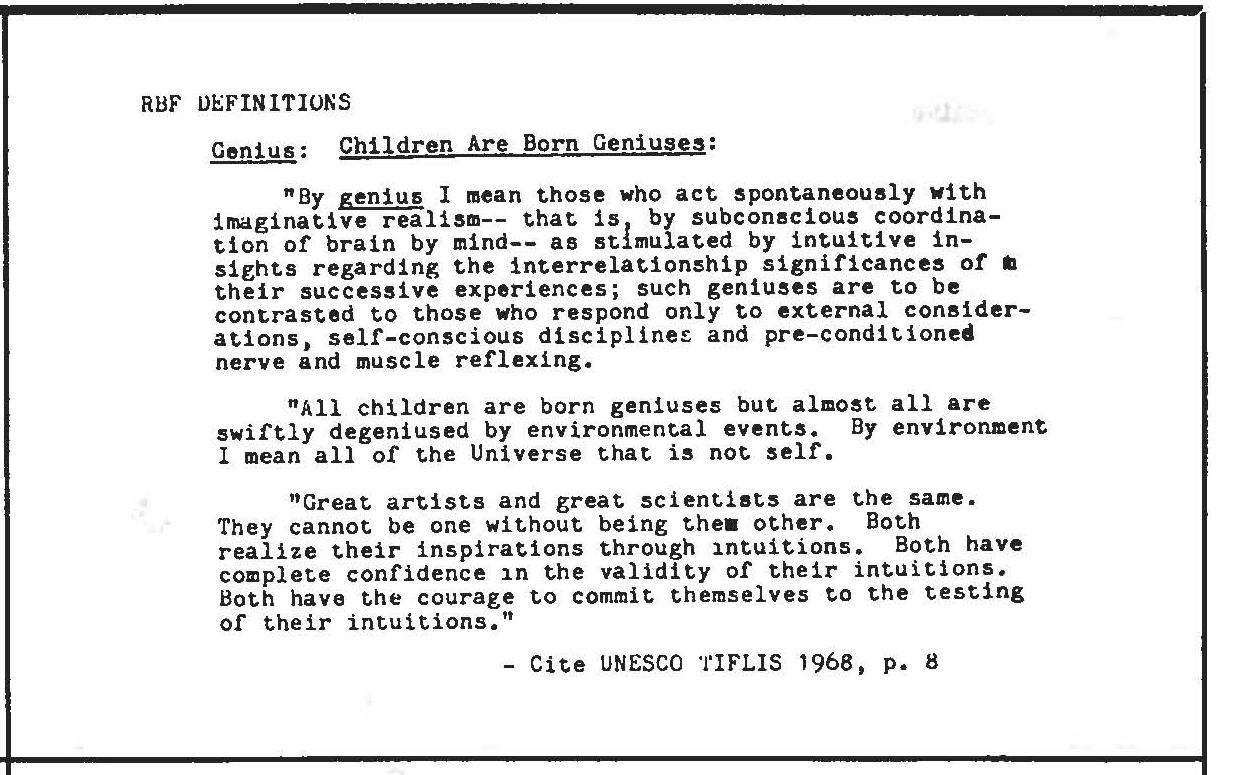
Genius: Children Are Born Geniuses
← Genius: Children Are Born Geniuses | Genius: Children Are Born Geniuses (1) →
RBF Definitions
How can you say everyone is born a genius? Can you really mean that?"
RBF: "Yes. There is originality in everyone. There is not anyone who can't in some way add to the Universe and contribute to humanity."
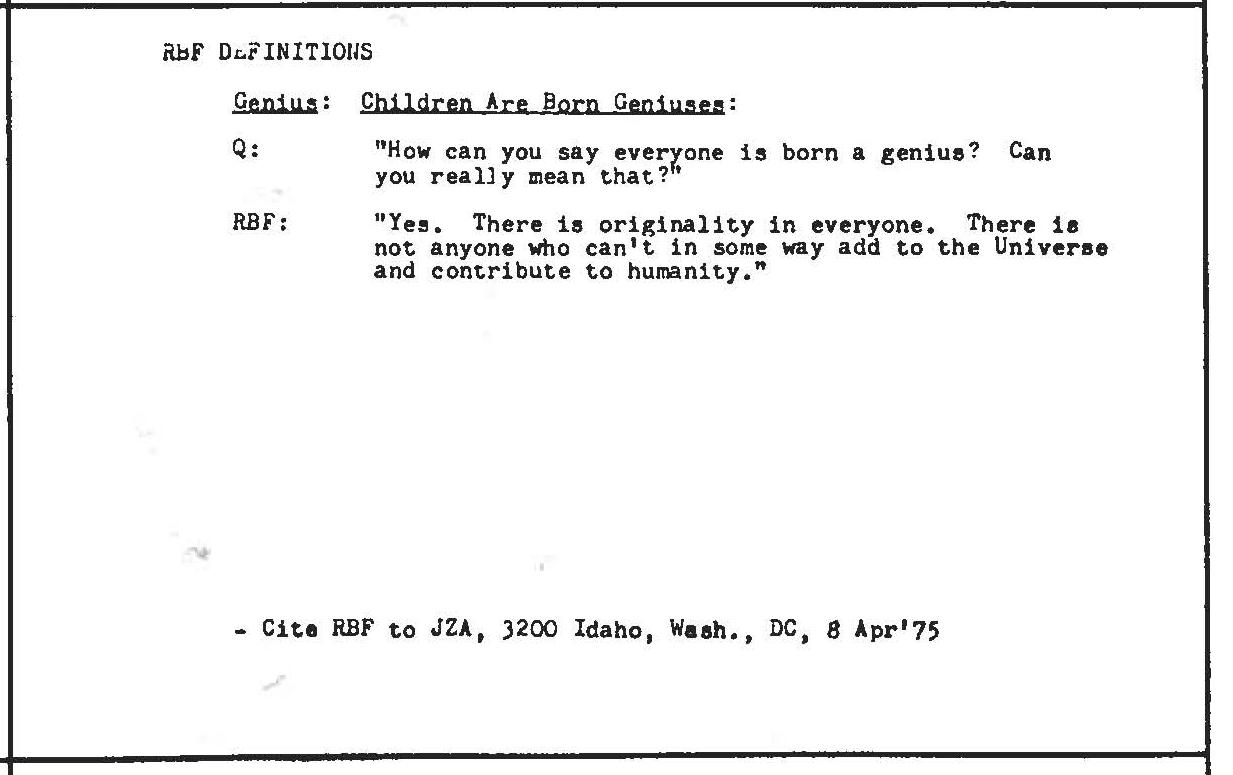
Genius: Children Are Born Geniuses (1)
← Genius: Children Are Born Geniuses | Genius (1) →
Cross Reference
Cross-References
Genius (1)
← Genius: Children Are Born Geniuses (1) | Genius (2) →
Cross Reference
Cross-References
Genius (2)
Cross Reference
Intuition of the Child, \1, 1
Cross-References
- Fuller, R.B: On Himself, 1973
- Fear & Longing, 1938
- Twilight Zone, Feb'73
Geodesic
Index Entry
Geodesic:
"...Geodesic being the most economical interrelationships of a plurality of events."
- Citation and context at Schema of Reference, 24 Sep'73
Geodesic
Index Entry
Geodesic:
"The time factor... is always accounted only in most economical to self-experience, energy-time relationship (i.e., geodesic) units."
- Citation and context at Time Vector, 24 Sep'73
Geodesic
Index Entry
We have a mathematical phenomenon known as a geodesic. A geodesic is the most economical relationship between any two events. It is a special case of geodesics which finds that a seemingly straight line is the shortest distance between two points in a plane. Geodesic lines are also the shortest surface distances between two points on the outside of a sphere. Spherical great circles are geodesics.
Geodesic
Index Entry
Geodesic:
"When we begin to talk about the interconnection between the individual atoms that make our sphere, we find that there are arcs and there are chords. And the shortest distance is the chord. So it's the chords that come together instead of the arcs. . .
"What you call a sphere is all the most important shortest systems between all the points, which turn out to be all triangulated. You can divide all the other polygons into triangles and that's as far as you go. You can't have something less than the triangle. So we get all the most economical relationships between all those points and you simply have a spheroidal array of triangulated interrelationships. Simply what we call a geodesic, a dome. You can see how you arrive at this by something very simple. So the simplest sphere which is concave and convex is the m tetrahedron. It seems to be a very angular sphere."
- Cite Univ. of Alaska Address, p.30, 20 Apr '72
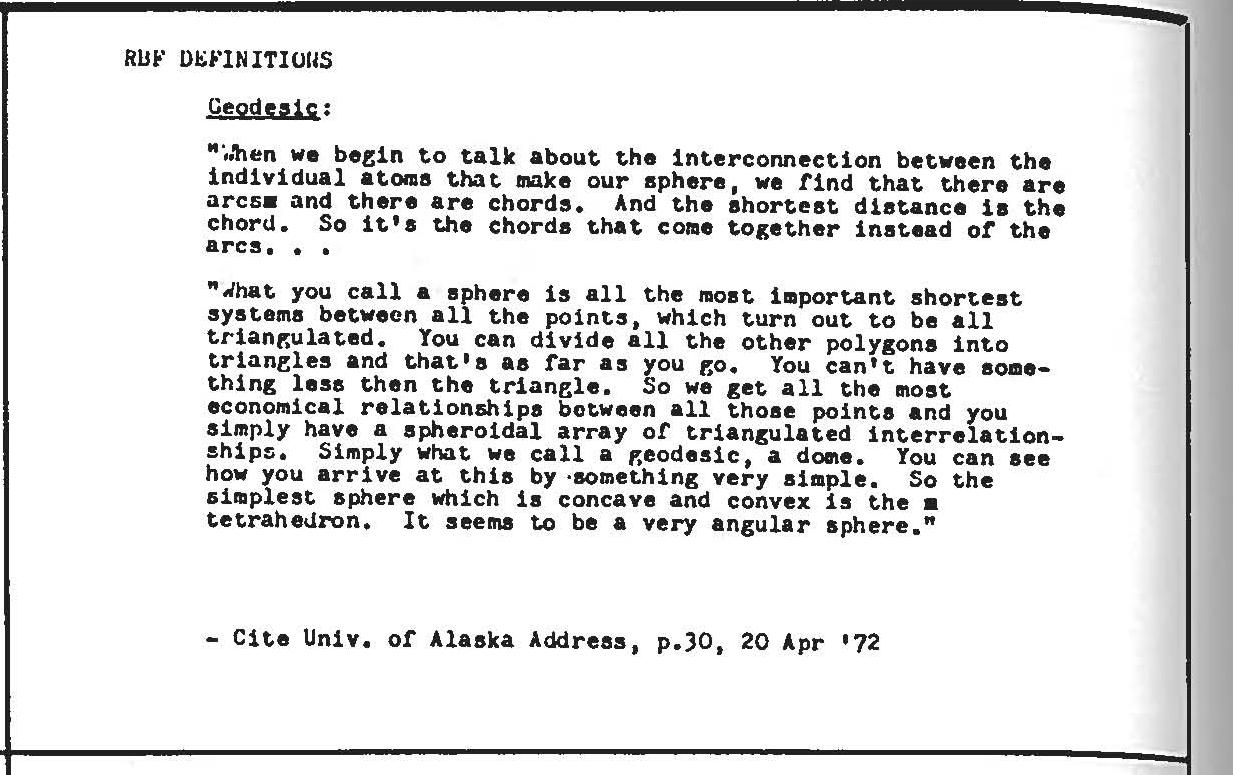
Geodesic
Index Entry
Geodesic:
". . . A 10,000 frequency geodesic, which is what the Earth really is."
- Cite RBF to EJA, 3200 Idaho, DC, 22 Feb '72
Geodesic
Index Entry
Geodesic:
"Potential lines are metaphysically straight, all physically realized relationships are geodesic and curved trajectories."
-
Cite Synergetics Corollaries, \hrefhttps://www.buckyverse.org/en/synergetics/content/chapters/200-synergetics#section-248.00248, 1974
-
Citation at Metaphysical & Physical, 1971
Geodesic
Index Entry
Geodesic:
"Vectorial Lines, or 'trajectories' are always the most economical event interrelationships, ergo, geodesic."
-
Cite SYNERGETICS, Coordination, \hrefhttps://www.buckyverse.org/en/synergetics/content/chapters/200-synergetics#section-240.00240, 1971
-
Citation at Interrelationships, 1971
Geodesic
Index Entry
Geodesic:
"Geodesic lines [are] curvilinear and most economical lines of inter-relationship between two independently moving events."
"Great circles are geodesic lines because they provide the most economical (energy, effort) distances between any two points on a spherical system's surface; therefore, nature, which always employs only the most economical realizations, must use those great circles which, unlike spiral lines, always return upon themselves in the most economical manner. All the system's paths must be topologically and circularly interrelated for conceptually definitive, locally transformable, polyhedral understanding to be attained in our sponaneous-- ergo, most economical-- geodesically structured thoughts."
- Cite OPERATING MANUAL, Pp. 66-67, 1969
Geodesic
Index Entry
Geodesic:
"Geodesic means the shortest distance between two points on a sphere."
- Cite RBF. Glossary of Terms bound in "The Live Book Squad" 1967
Geodesic
Index Entry
Geodesic:
"Geodesic lines may . . . be described experimentally as 'the most economic relationships between two event focii."
Geodesic
Index Entry
Geodesic:
"The largest volume, least event, omnitriangular system is the icosahedron and its multiple subtriangulated geodesic patterning. . . what I call the geodesic structuring."
-
Cite RBF Ltr. to Dr. Urmston, 8 Oct 1964, p. 2
-
Citation at Icosahedron, 8 Oct'64
Geodesic
Index Entry
Geodesic:
"A geodesic line means the most economical relationship between events, but the events are not necessarily simultaneous. So there is a relationship between a rocket that just went off and another rocket that goes off a little later. When for instance, if you are so peculiar in the head that you like to shoot at a duck, if you want to hit the duck the way to shoot is not at the duck. You shoot where you hope the duck is going to be, but you don't shoot at the duck or you won't hit it. This is typical of the geodesic relationship between yourself and a nonsimultaneous event. The point of the head would not be simultaneous to any shoot. We have pictures taken during this last world war of night battles between two planes using tracer bullets and the pictures are sometimes taken from the firing plane and sometimes from another plane in company with it. In these pictures of the tracer bullets you will sometimes see a plane fire and hit another plane, but the lines are completely skew lines. These are geodesic lines. They are the most economical relationship between those two events. In a nonsimultaneous Universe all the relationships are geodesic. There are no straight lines."
- Cite Oregon Lecture #3, p. 112, 5 Jul'62
Geodesic
Index Entry
Geodesic:
"The most economic relationships of points in Universe
and their transformation tendencies."
- Cite MARKS, F. 8, 1960
Geodesic
Index Entry
Geodesic:
"Geodesics are the most economical momentary relationships between separate events.
"To shoot a flying duck a man does not aim at the duck, but where the duck is going to be. If the bullet hit the duck, its trajectory was geodesic."
_Cite R.W. Marks, DYMAXION WORLD OF RBF, p.44, 1960
Geodesic
Index Entry
Geodesic:
"Of or pertaining to great circles of a sphere, or of arcs of such circles; as a geodesic line, hence a line which is a great circle or arc thereof; and as a geodesic pattern, hence a pattern created by the intersections of great circle lines or arcs, or their chords."
- Cite Patent No. 2,682,235, June 29, 1954
Geodesic
Index Entry
Geodesic:
"In synergetic geometry geodesic signifies the shortest (time) energy involvement distance between action centers."
- Cite RBF undated holograph on M.I.T. Memo pad.
Geodesics (1)
Index Entry
Geodesics:
"Einstein and Reimann had resuscitated from a similar limbo to that of pre-1800 synergy the word 'geodesic' as used in relation to great circles on spheres and then anew to Einstein's curved space mathematics. Stevenson had long used geodetics to embrace the whole art and science of measuring the dimensions of subdivision of approximately spherical Earth. I gave geodesics a new scientific definition as 'constituting the most economical relationships between separate event entities in loci in Universe.
"At any one given moment in time, geodesics were dramatically and visually manifest during World War II in photographs taken by the U.S. Air Force of two fighter planes in a "dogfight" at night with one ship firing it nose-mounted machine gun using luminous tracer bullets and successfully hitting its enemy ship. These two airplanes (unattached to Earth) were two 'celestial bodies' and the geodesic line of most economical interrelationship between them was that of the bullets that 'knocked the other out' and that luminous, chain of bullets' tracers was always an acceleratedly cork-screw line."
Geodesics (2)
Index Entry
Geodesics:
"More geodesics--the top leaves of fast-growing vines reach toward the Sun as the Earth revolves, leaving them reaching westward and outward at evening sunclipse. In the morning, the Sun is to the eastward and the vine circles its top leaves to reach eastward; thus the spiraling vine's leaves are always nearer to the Sun than are the vine's roots.
"But Einstein spoke only of geodesic lines--because the great circles of a sphere provide the shortest distances between any two points on the surface of a sphere, they are called geodesic lines. Superimpose a circle of the radius of 80° north latitude upon the equator of a 12-inch Earth globe, which equator is a geodesic line. The latitude circle which is not a geodesic but a lesser circle, crosses the equator at two points, A and B, and it is quickly manifest that it is a shorter distance between A and B along the equator than it is along the circular distance of the small circle. Because I structured my spherical structures entirely with triangles consisting entirely of chords of those great circles, they were structured in the most economical awareness for that form, and therefore did not want to transform into any other shape. I called the structures 'geodesics--and the art and science of dealing with geodesic lines as 'GEODESICS.'"
Geodesics
Index Entry
Geodesics:
"Spheres are just very high frequency geodesics."
- Cite RBF to EJA, Fairfield, Conn. Chez Wolf. 18 June 1971.
Geodesics
Index Entry
Geodesics:
"If you closest pack.geodesics they will take up just a little more room as point-bonded (gas), than as edge-bonded (liquid), than as face-bonded (crystal)."
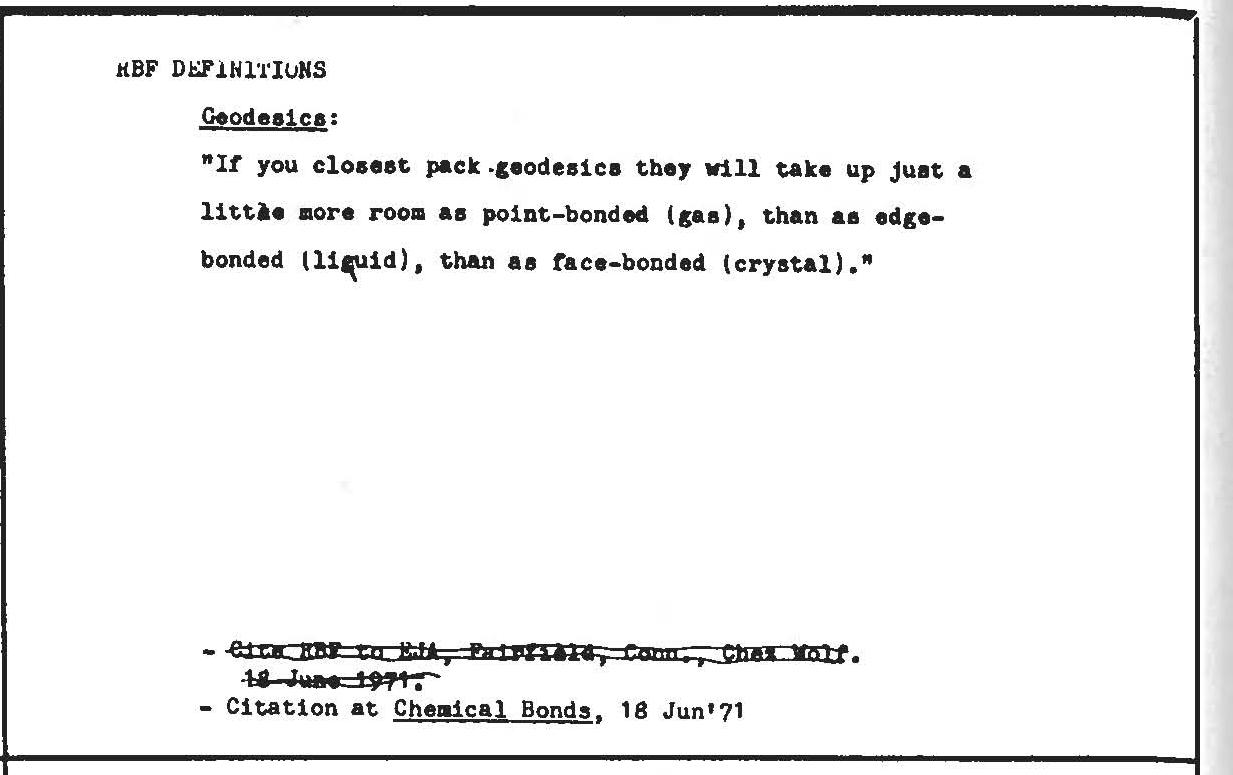
Geodesica
Index Entry
Geodesica:
"Pi (π) is irrelevant in synergetics because the sphere is not experimentally demonstrable and the tetrahedron is the minimum sphere. Compound curvature starts with the tetrahedron. Pi drops out because chords are more economical than arcs. Chords of an omnidirectional system never add up to 360° around a point. They are always geodesics. A point on a sphere is never an infinitesimal tangency with a plane."
-
Cite RBF to EJA, Blackstone Hotel, Chicago, 31 May 1971
-
Citation & context at Sphere, 31 May'71
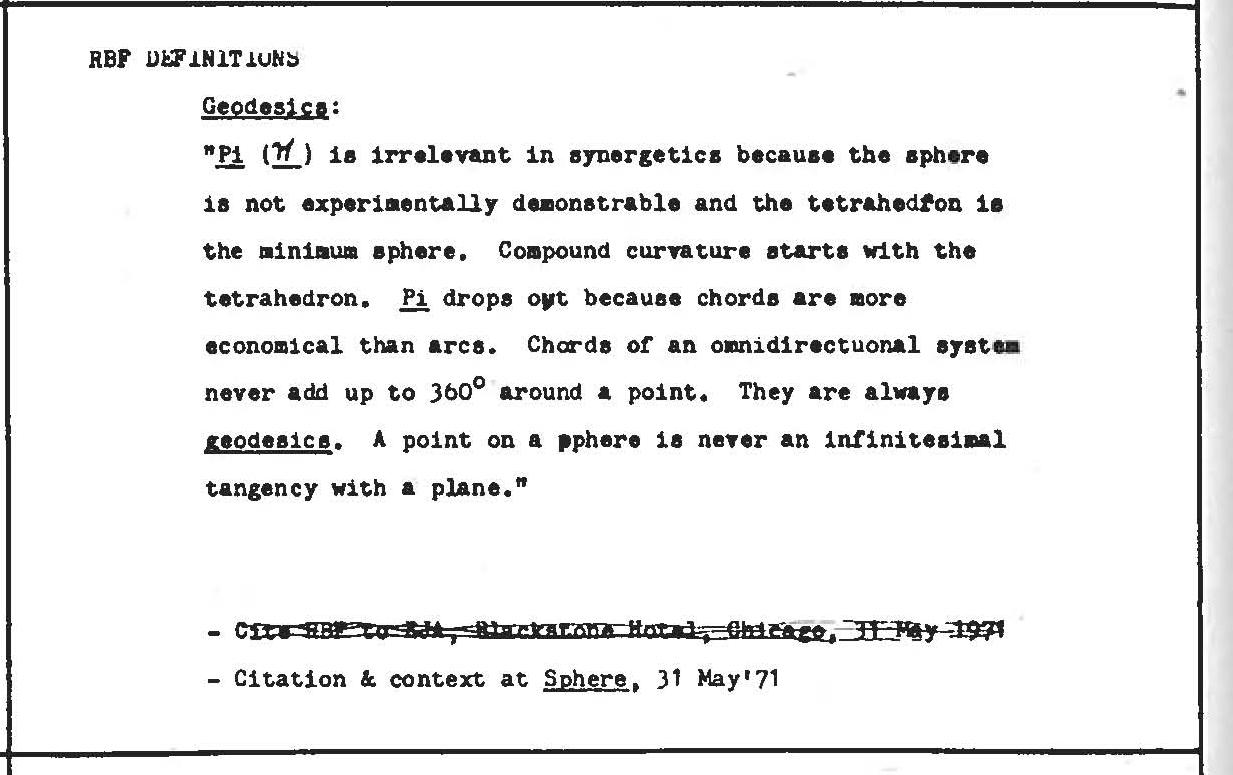
Geodesics
← Geodesica | Geodesic Center (1) →
Index Entry
Geodesics:
"Geodesics are the most economical momentary relationships between separate events."
- Cite MARKS, P. 44, 1960
Geodesic Center (1)
← Geodesics | Geodesic Design in Nature: Confirmation Of →
Cross Reference
Cross-References
- Vector Equilibrium, (1)
Geodesic Design in Nature: Confirmation Of
← Geodesic Center (1) | Geodesic Design in Nature Confirmation Of (1) →
Index Entry
McHale, RBF - Note 17, p.45, 1962
Conceptuality of Fundamental Structures (Kepes) p.72 ff. 1965
Geodesic Design in Nature Confirmation Of (1)
← Geodesic Design in Nature: Confirmation Of | Geodesic Design in Nature Confirmation Of (2) →
Cross Reference
Grebe, John J.
Cross-References
- Flies' Eye
- Radiolaria
- Tetrahedral Coordination of Nature
- Viral Steerability
- Black Holes & Synergetics
Geodesic Design in Nature Confirmation Of (2)
← Geodesic Design in Nature Confirmation Of (1) | Geodesic Diamonds →
Cross Reference
Omnidirectional Closest Packing of Spheres: Principle Of, 19 Jun'71 (2)(3)
Cross-References
- Invention, Dec'61
- Tensegrity: Unlimited Frequency of Geodesic Tensegrities, (8)
- Radiolaria, (1)(2)
Geodesic Diamonds
← Geodesic Design in Nature Confirmation Of (2) | Geodesic Diamonds →
Index Entry
Geodesic Diamonds:
"Geodesic Diamonds: there is always an even number of triangles on a sphere so they may be treated in pairs as diamonds, always made with straight lines but the lines are different in length. The fats and thins have equal length."
- Citation & context at Wichita House, (1)*, 31 Jan'75
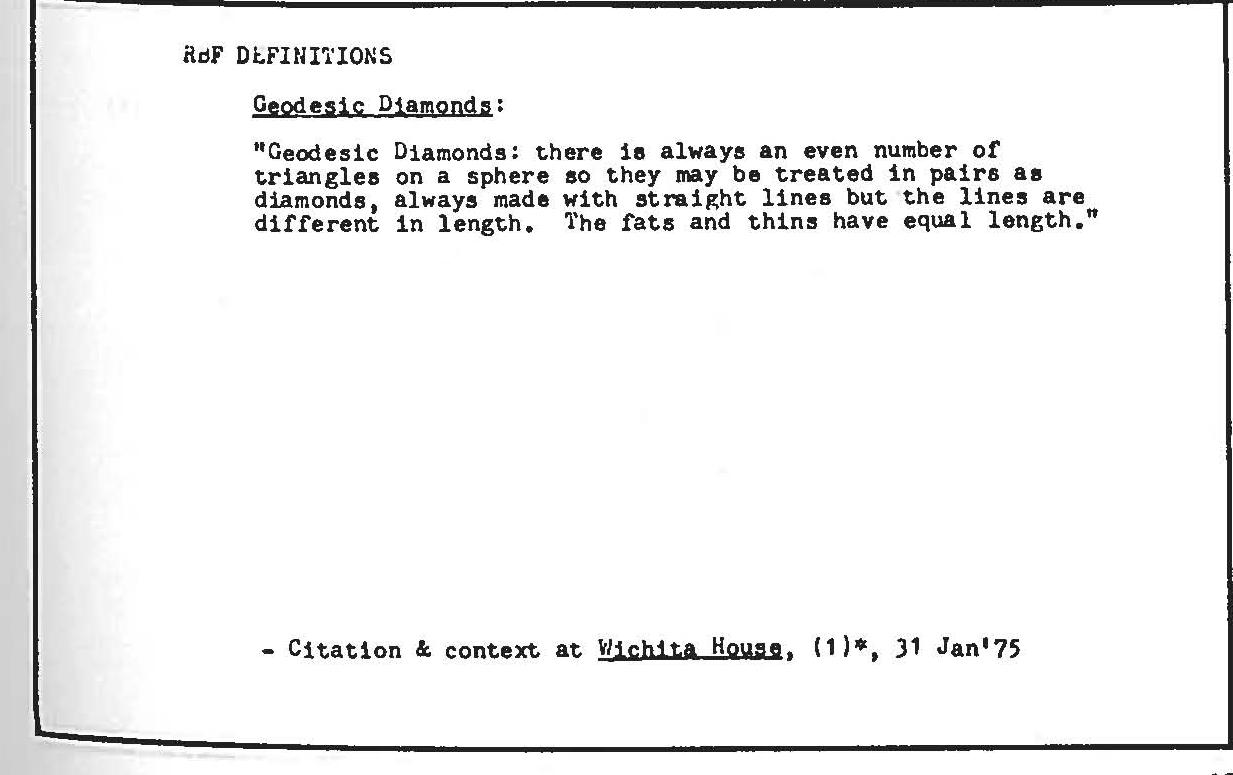
Geodesic Diamonds
← Geodesic Diamonds | Geodesic Domes →
Cross Reference
Cross-References
- Wichita House, (1)
- Hex-pent Sphere, 15 Sep'76
- Hex-pent Sphere: Transformation into Geodesic Spiral Tube, (1)
Geodesic Domes
← Geodesic Diamonds | Geodesic Dome →
Index Entry
Geodesic Domes:
"Geodesic Domes abandon the compression conduits of engineering: they are tension conduits."
- Cite RBF to USAID conference; Foreign Disaster Assistance Conference Room, State Dept, Wash. DC; 12 May'77
Geodesic Dome
← Geodesic Domes | Geodesic Dome →
Index Entry
Because geodesic structures inherently are always tensegrity structures, i.e., discontinuously compressed, omnicontinuously tensioned, three-way embraced, there is no fastening in shear and all local loadings are radiantly distributed ever diminishing to equidiffusion as in all pneumatically and hydraulically compressed structures,
- Cite RBF Ltr. to Mr. Robertson, 12 Mar'74
Geodesic Dome
← Geodesic Dome | Geodesic Dome →
Index Entry
Geodesic Dome:
"It was for this reason, p. the discovery of the fact that the icosahedron-- among all he three-and-only prime structural systems of Universe (see section \hrefhttps://www.buckyverse.org/en/synergetics/content/chapters/600-structure#section-610.20610.20)-- required the least energetic, vectorial, structural investment per volume of enclosed local Universe, that led to the development of the Basic Disequilibrium 120 LCD Spherical Triangle and its multifrequenced triangular subdivisioning as the basis for calculating all high-frequency, triangulated, spherical structures and structural subportions of spheres; for within only one disequilibrious LCD triangle were to be found all the spherical chord-factor constants for any desired radius of omnisubtri-angulated spherical structure.
"In the same way it was discovered that local, chord compression struts could be islanded from one another, and could be only tensionally and non-inter-shearingly connected to produce stable and predictably efficient enclosures for any local energetic environment valving uses whatsoever by virtue of the approximately unlimited range of frequency-and-angle, subtriangle-structuring modulatability."
- Cite RBF rewrite of SYNERGETICS galley at Secs. \hrefhttps://www.buckyverse.org/en/synergetics/content/chapters/900-modelability#section-901.15901.15+16, 20 Dec'73
Geodesic Dome
← Geodesic Dome | Geodesic Dome →
Index Entry
Geodesic Dome:
"... My prime invention (of omnitriangulated compound-curvature, great-circle-arc chording and its synergetically surprising structural advantages in pounds, kilowatts, and minutes required per each unit of measurable performance) ... geodesic dome patents..."
Geodesic Dome
← Geodesic Dome | Geodesic Dome (1) →
Index Entry
Geodesic Dome:
"The best geodesic dome design is the three-frequency five-eighths."
- Cite RBF to EJA, Washington, 7 Oct. '71.
Geodesic Dome (1)
← Geodesic Dome | Geodesic Dome (2) →
Index Entry
Quite clearly, I am, to myself, not a dome salesman. In fact I don't want to be a salesman of anything. I don't want to persuade anybody to do anything that is illogical and anti-evolutionary. I'm identified with the dome only because, back in 1927, in trying to seek out how I might be able to affect and help man most, I said: if I could only protect younger life while it still has its comprehensive interest in the total Universe and give it a chance to develop its faculties for comprehending the whole-- it would be a way in which we might most rapidly arrive at a condition where all of humanity might be a success. So, I said, this means a controlled environment, and I kept searching for ways not only of controlling it, but of using the chemistry around us in our environment so effectively that there would be enough to go round to take care of everybody and not just a few. All this brought me into very deep study of all that science was doing and all forms of industrialization, and how we could produce the most with the least. This meant then that I went into a series of experiments in how to control the environment, and it was the geodesic dome that was the practical breakthrough.
Geodesic Dome (2)
← Geodesic Dome (1) | Geodesic Dome →
Index Entry
Geodesic Dome:
"The geodesic domes were the beginning of the public's realization of what I'm talking about; therefore I became identified as the dome man. But I think I've made it quite clear that this was simply the inadvertent consequence of my concern with young life and protecting that young life."
- Cite RBF in transcript in "The Listener" interview by John Donat, 26 Sep'68
Geodesic Dome
← Geodesic Dome (2) | Geodesic Dome →
Index Entry
Geodesic Dome:
"Geodesic tensegrity spheres are highly magnified, pneumatic principle structures."
- Cite CONCEPTUALITY OF FUNDAMENTAL STRUCTURES, Ed. Kepes, 1965, p. 86
Geodesic Dome
← Geodesic Dome | Geodesic Dome →
Index Entry
Geodesic Dome:
"Domes combine both horizontal and vertical behaviors progressively translated into mutual synergetical aid and integrated success."
- Cite I&I, DOMS, p. 154,1963
Geodesic Dome
← Geodesic Dome | Geodesic Dome (1) →
Index Entry
Geodesic Dome:
"The forms we see in geodesic structures are synergetic, which is to say that they are visible in mathematical principle only, and only as the interaction of a complex of functions. No one industrial function is visible. Any one member, in a geodesic structure may be at one time operative essentially in tension and at another time essentially in compression. These are exact opposites and none of these alternating operative behaviors would be visible to an observer of a geodesic dome as the latter remained poised, apparently serene, in a hurricane. Geodesic domes are then designed as synergetic complexes of events which maintain a superficial ultra-high-frequency integrity of constellar patterning."
- Citation & context at Tooling of Domes, (3); 24 Jan'58
Geodesic Dome (1)
← Geodesic Dome | Geodesically Interrouted Communications Traffic →
Cross Reference
Cross-References
- DEW Line Radomes
- Dome
- Dome: Rationale for the Dome
- Radome
- Grow-a-dome
- Now House
- Zeiss Dome
- Dome House
- Structural Shell
- Montreal Expo'67 Dome
- Turtle Dome
- North Face Domes
Geodesically Interrouted Communications Traffic
← Geodesic Dome (1) | Geodesic Dome (2) →
Cross Reference
Geodesically Interrouted Communications Traffic:
Cross-References
Geodesic Dome (2)
← Geodesically Interrouted Communications Traffic | Geodesics vs. Irrelevance →
Cross Reference
Cross-References
- Curvature: Compound Curvature, 25 Jan'73
- Inventability Sequence, (2)
- Wichita House, (1)
- Museum, 17 Dec'74
- Building Business, (4)(5)
Geodesics vs. Irrelevance
← Geodesic Dome (2) | Geodesic Line →
Cross Reference
Geodesics vs. Irrelevance:
Cross-References
- Epistemological Stepping Stones, 30 Dec'73
Geodesic Line
← Geodesics vs. Irrelevance | Geodesic Line →
Index Entry
Geodesic Line:
"Synergetic geometry deals with the most economical relationships and not with the shortest lines. 'Most economical' and 'shortest' are not the same.
"The 'straight' line of the Early Greeks is the shortest distance between two points. Ergo, curved lines are not the 'shortest.' But geodesic lines are the most economical (meaning least time-energy involvement) relationship between any two events. Events are energetic. The way to shoot a bird is not to aim at where the bird is now flying."
Cite RBF rewrite of EJA query, 9 Sep'74
Geodesic Line
← Geodesic Line | Geodesic Line →
Index Entry
Geodesic Line:
"When two great-circle geodesic lines cross they form two sets of similar angles, any one of which paired with the other, will always add to 180°. (This we also learned in plane geometry.) When any one great circle enters into-- or exits from-- a spherical triangle, it will form the two sets of similar angles as it crosses the enclosing great-circle-edge-lines of that triangle.
"As in billiards or in electromagnetics, when a ball or a photon caroms off a wall it bounces off at an angle similar to that at which it impinged."
Geodesic Line
← Geodesic Line | Geodesic Lines →
Index Entry
Geodesic Line:
"A geodesic line is the most economical time-distance-effort relationship."
- Cite DEFINITIONS FOR SYNERGETICS BY PETER PEARCE, 1967
Geodesic Lines
← Geodesic Line | Geodesic Lines →
Index Entry
Geodesic Lines:
"Whereas none of the geodesic lines of universe touch one another, the lines approach one another, passing succesively through regions of most critical proximity, and diverge from one another, passing succesively through regions of most innocuous remoteness."
- Cite COLLIER'S, p. 114, Oct'59
Geodesic Lines
← Geodesic Lines | Geodesic Sphere (1) →
Cross Reference
Cross-References
- Fourth Dimension, 17 Nov'72
Geodesic Sphere (1)
← Geodesic Lines | Geodesic Sphere (2) →
Index Entry
Geodesic Sphere:
"What we do have experimentally as a sphere is an aggregate of energy-event foci approximately equidistant in approximately all directions from one approximate energy-event focus.
"This is a system in which the most economical relationships between embracingly adjacent foci are the great-circle chords, and not the arcs. This is why pi (π) is operationally irrelevant. Physics finds that nature always employs the most economical means. Being shorter, chordal distances are more economically traversed than are detouring arcs. All the chords between external points of systems converge with one another concavely and convexly, i.e., with the angles around each external point always adding to less than 360 degrees. They do not come together, as do radii in a plane, with 360 degrees around each point.
"The chords of an omnidirectional system always come together with concavity on one side and convexity on the other. The angles never add up to 360 degrees, as do those formed on a plane by lines converging radially upon a point. This is why the long-held working assumption of mathematics-- that for"
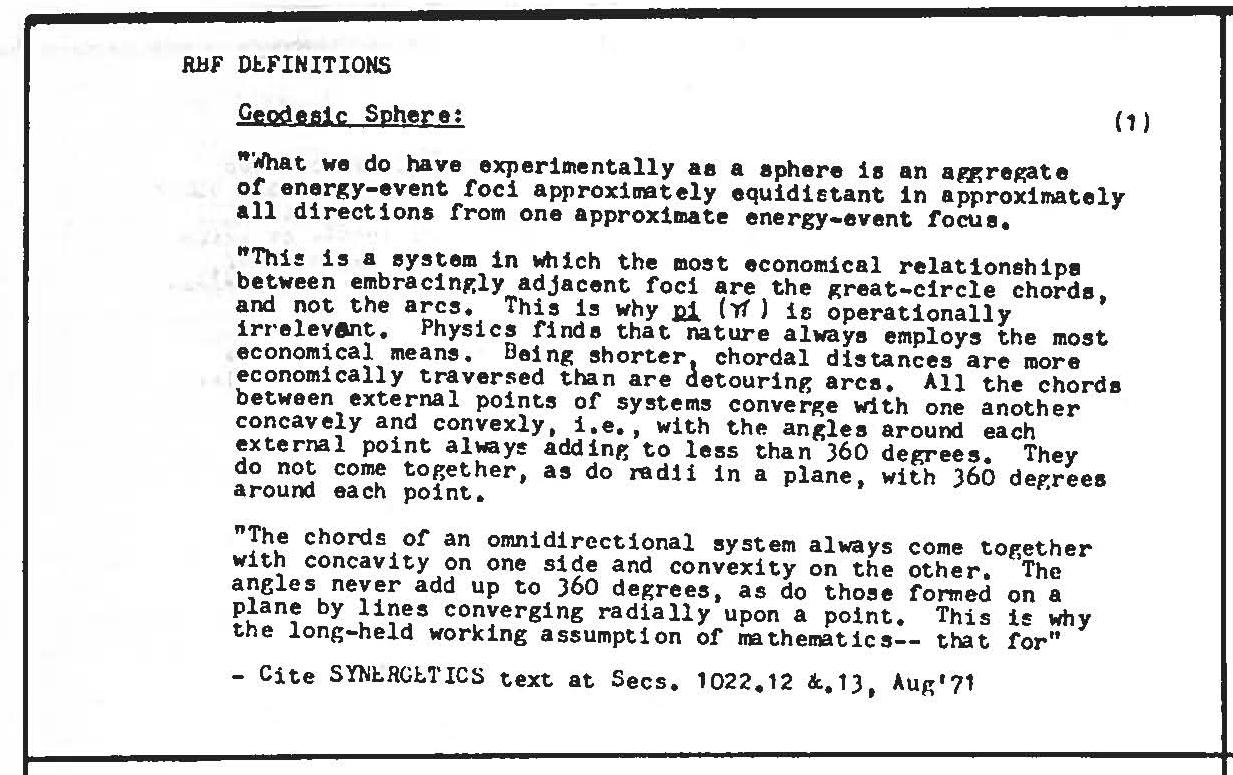
Geodesic Sphere (2)
← Geodesic Sphere (1) | Geodesic Sphere (3) →
Index Entry
Geodesic Sphere:
"an infinitesimal moment a sphere is congruent with the plane to which it is tangent-- is invalid. Therefore, spherical trigonometry, with its assumption of 360 degrees around a point, is also invalid. Greek spheres cannot be scientifically demonstrated. Almost-spherical polyhedra are the nearest approximation. It can only be treated with as polyhedral--as an aggregate of points in which the most economical relationships are chords: ergo, geodesics.
"If you find all the connections between all the points, the system is omnitriangulated. A spherical polyhedron is a high-frequency geodesic polyhedron. Its symmetric base may be tetrahedral, octahedral, or icosahedral; but it may not be hexagonal, i.e., with angles adding to 360 degrees around each external point of the system. The sum of all the angles around all the external points of the superficially seeming spherical systems will always add up to 720 degrees less than the number of external vertexes when each is multiplied by 360 degrees.
"In every geodesic sphere, you can always take out 12 pentagons. These 12 pentagons each drop out one triangle from the hexagonai"
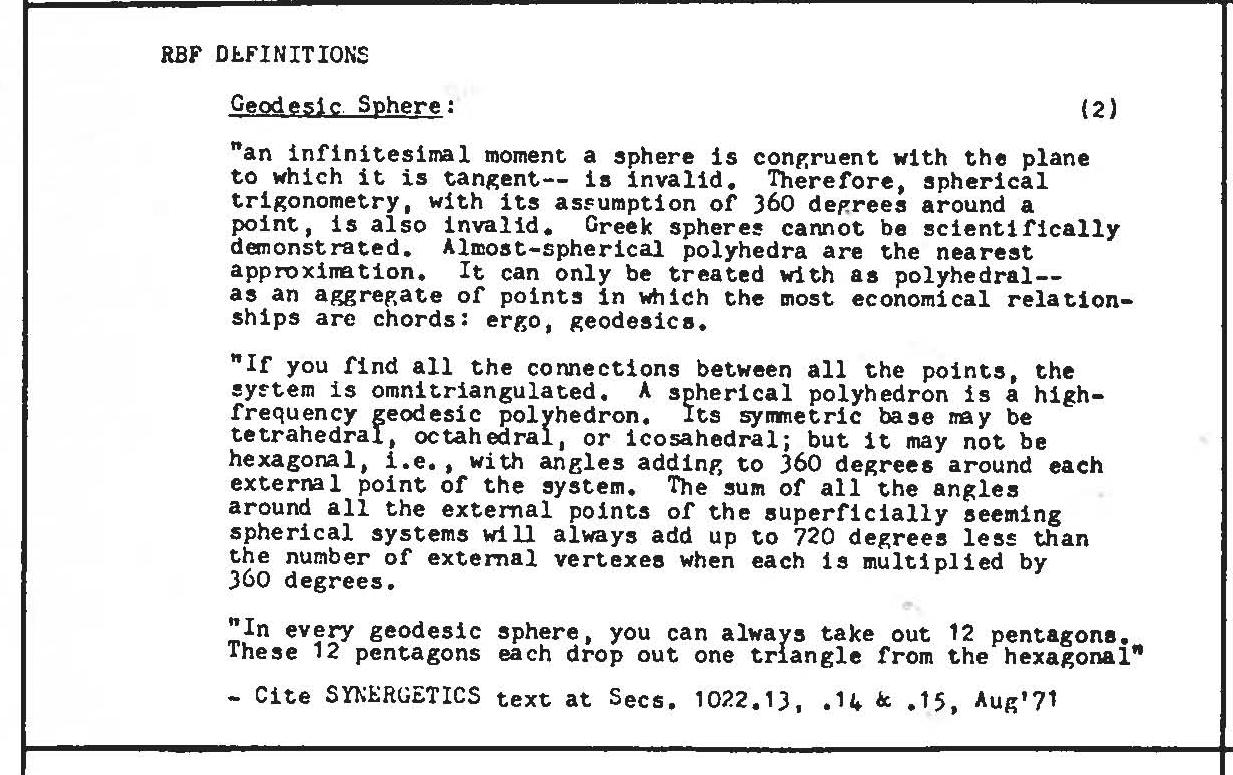
Geodesic Sphere (3)
← Geodesic Sphere (2) | Geodesic Sphere (1) →
Index Entry
Geodesic Sphere:
"clusters around all other points. Assuming the dropped-out triangles to be equiangular, i.e., with 60-degree corners, this means that 60 x 12 = 720°, which has been eliminated from the total inventory of surface angles. You can always find 12 pentagons on spherically conformed systems such as oranges, which are icosahedrally based; or four triangles with 120-degree corners if the system is tetrahedrally based; or six squares where the system is octahedrally based."
- Cite SYNERGETICS text at Sec. \hrefhttps://www.buckyverse.org/en/synergetics/content/chapters/1000-omnitopology#section-1022.151022.15, Aug'71
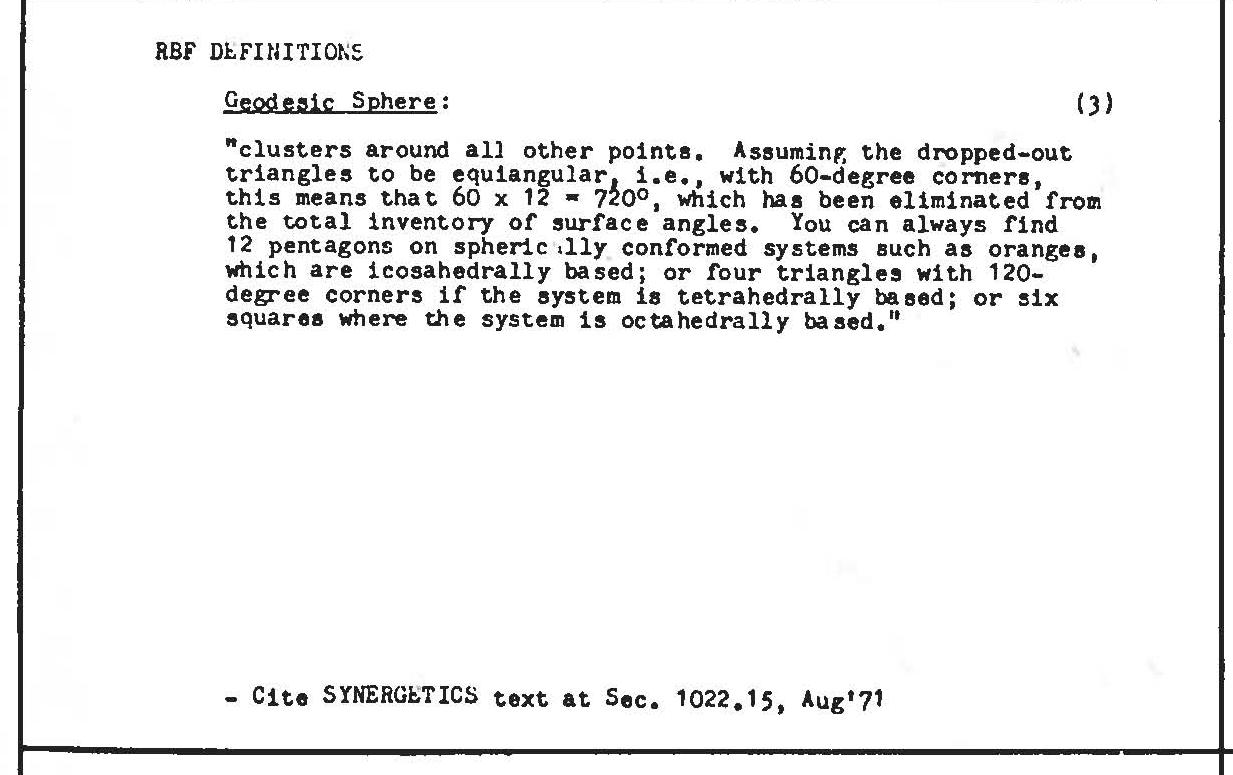
Geodesic Sphere (1)
← Geodesic Sphere (3) | Geodesic Sphere (2) →
Cross Reference
Cross-References
Geodesic Sphere (2)
← Geodesic Sphere (1) | Geodesic Spheric Experience →
Cross Reference
Cross-References
- Gravitational Field, 8 Mar'73
- Convex & Concave Tetrahedron, Aug'71
- Domain of a Line, 7 Nov'73
- Necklace, Nov'71
- Stable & Unstable Structures, 7 Jun'72
Geodesic Spheric Experience
← Geodesic Sphere (2) | Geodesic Spinnaker (1) →
Index Entry
Geodesic Spheric Experience:
"The spheric experience is a high-frequency omnidirectional complex of events and their relatedness. Since it is concerned with the most economical relatedness we can also speak of it as a geodesic spherical experience. This is where the importance of chords comes in... "
- Citation and context at Connections and Relatedness, 20 Feb'73
Geodesic Spinnaker (1)
← Geodesic Spheric Experience | Geodesic Spinnaker (2) →
Index Entry
Geodesic Spinnaker:
"It's very interesting the way boating and sailing has become so important today. It's all so fundamental: dealing with those tensions involved in those lines and winches. Everything we think about is there, the pneumatics, the hydraulics... vectorial forces, everything is there. I think it's going to result in at least one geodesic spinnaker. She's going to be a real beauty... We'll just bring those stresses back to the three corners; but once its out from those corners the distribution will be such that the worst you could ever do to spinnaker is to blow out one little triangle. It would be very easy to repair; there would be no rips or tears.
Jay Baldwin: "You could have panels that would be loaded with elastic so that if a certain load were exceeded the panels would open and bleed out the load and then shut again."
RBF: "Sure. We could really do such a thing... when you put springs in them, when you trim, so they breathe out for a second instead of pulling.... There really could be something like the coin purse or tobacco pouch, a twisting cylinder that would release. Just string would do it if you got into a"
Geodesic Spinnaker (2)
← Geodesic Spinnaker (1) | Geodesic Spiral Tube →
Index Entry
Geodesic Spinnaker:
"tensegrity octahedron it would just twist around and come right back. It would look like a flower opening, lilies opening."
- Cite transcript of RBF tape to Barry Farrell, Tape #3, Side A, p.24; Bear Island, 12 Aug'70
Geodesic Spiral Tube
← Geodesic Spinnaker (2) | Geodesic Structure →
Cross Reference
Cross-References
Geodesic Structure
← Geodesic Spiral Tube | Geodesic Structure →
Index Entry
Geodesic Structure:
"In contrast to all previous structural experience, the law of diminishing returns is operative in the direction of decreasing size of geodesic tensegrity structures, and increasing return is realized in the direction of their increasing dimensions."
(Sec. \hrefhttps://www.buckyverse.org/en/synergetics/content/chapters/700-tensegrity#section-750.23750.23)
- Cite SYNERGETICS text at Sec. \hrefhttps://www.buckyverse.org/en/synergetics/content/chapters/700-tensegrity#section-750.23750.23; 31 Oct'72
Geodesic Structure
← Geodesic Structure | Geodesic Structure (1) →
Index Entry
Geodesic Structure:
"Though superficially similar in patternings to radiolaria and flies' eyes, geodesic structuring is true invention. The radiolaria collapse when taken out of water. Flies' eyes will not provide structural precedent of man-occupiable structures.
"The processes of engineering, up to the moment of introduction of my invention of geodesic structures, are predicated upon the stress analysis of individual beam and column behaviors, as separate components and thereafter upon comprehensively organized beams, columns and cantilevers as a solid compressional over-all integrity of cohesion, aided here and there by tensionally exaggerated sinews--tension being subordinate and local. Therefore, engineering as academically constituted in 1951 could in no way predict the associated behaviors of geodesics, in which any one, several or many of the components could be removed without, in any way, jeopardizing the structural integrity cohesion of the remaining primary structure."
Geodesic Structure (1)
← Geodesic Structure | Geodesic Structure (2) →
Index Entry
Geodesic Structure:
"Emulating the compound curvature trussing the atom's dynamic structure comprised of great-circle forces, our geodesic structure, though not inventing the principles, employs them for the first time in man-made structure. This was a patentable invention. . .
"In our geodesic structures, the surface of a sphere is interlaced by an omni-three-way grid of great circles which always uniquely intercept one another in such a manner that everywhere the surface areas described by the intersections are triangular. As triangles are nondistortable, this intersecting, if substantially structured, represents a rigid trussing of the spherical surface. If, between each of the vertexes or intersections of the great circles occurring in the surface of the sphere, we construct chords, or straight lines, these lines must fall below the surface between their surface terminals. The lines converging at any one vertex all leading away below the point on the surface must form a convex intersection or pyramidal point. As we press against any convex vertex, where the other ends of the lines are elastically restrained, the vertex will subside and the lines will tend to form a flat plane."
@ Cite IDEAS & INTEGRITIES, PREVIEWS, P, 216, 1 Apr'49
Geodesic Structure (2)
← Geodesic Structure (1) | Geodesic Structure (3) →
Index Entry
Geodesic Structure:
"As each of the chordal ends between vertexes of our geodesic structure is tensionally restrained by the comprehensive trussing of the sphere, it is seen that when pressure is exerted inwardly against any vertex it will thrust outwardly against each of the chords leading radially from it. It will be seen that, inasmuch as each vertex represents a pyramid of triangular planes, the bases of the planes opposite the vertex constitute a closed tensional ring. Because the linkage is of great circle chords and because sections of the great circle always represent the shortest distance between any two points on a sphere (and the chords of the great circle represent the shortest distance between the two points in space through the sphere), the ring of chords tensionally opposite the compression thrust of the pyramidal lines from any one vertex may not be elongated. The vertexes will not subside.
"Thus it seems that the geodesic structure employs the principle of compound curvature as the stress is radially distributed from a single point. All the vertexes surrounding any one vertex are secondarily actuated, and each in turn thrusts outwardly to adjacent vertexes; rings of triangles of geodesic lines are successively activated from the original thrust"
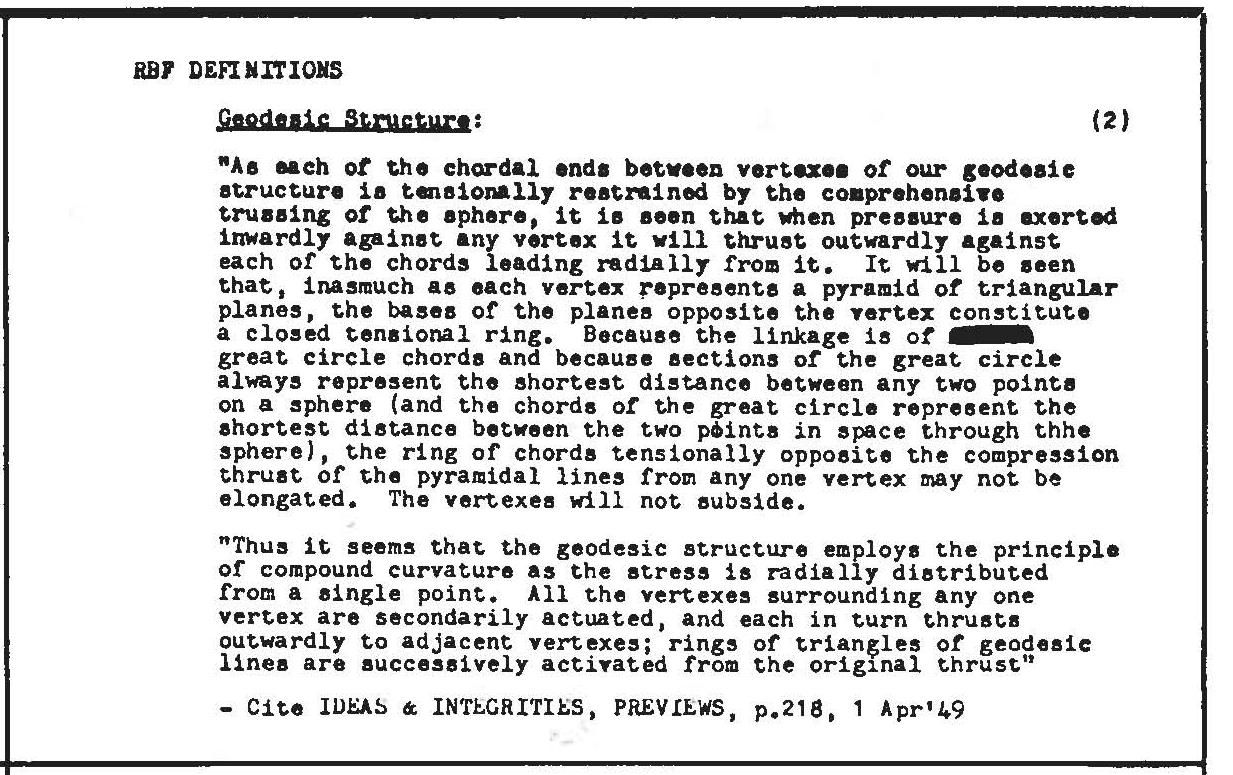
Geodesic Structure (3)
← Geodesic Structure (2) | Geodesic Structure →
Index Entry
Geodesic Structure:
"against one vertex until six rings have been activated and the equator is reached. All thrusting outwardly against the equator symmetrically, their outward thrust is compoundingly restrained by the opposite hemisphere.
"In the case of a geodesic structure representing a portion of a sphere, the functions of the balance of the sphere are rendered by the Earth, which tends to complete the spherical structure by stress extension within the Earth. Thus, in compound curvature structures of nature, emulated in principle by our geodesic structure, working stresses are ultimately translated into omnidirectional outward thrust from the stressed centers, and are ultimately satisfied throughout all the cohesiveness of all the enclosing tension. In contradistinction to simple curvature, which is ultimately satisfied in polar focus upon two compression points, compound curvature invokes ultimate activation of comprehensive tension.
"Men have employed geodesic structure in the form of tetrahedrons, octahedrons, and icosahedrons. While useful in small structures, the relative sizes of spans or chords of these well-known continuities of great-circle triangulation become so great in unsupported length when applied to structures appropriate to"
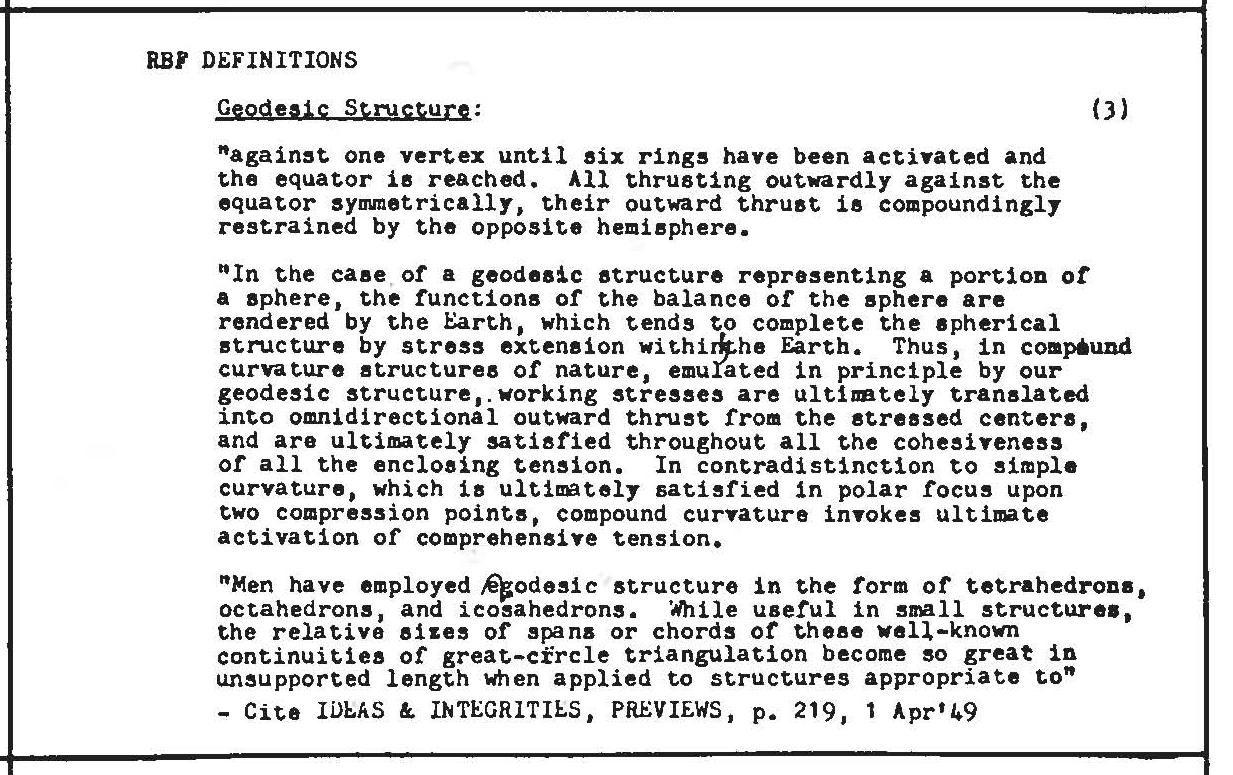
Geodesic Structure
← Geodesic Structure (3) | Geodesics vs. Structure →
Index Entry
Geodesic Structure:
"men's buildings that their virtues were unavailable for practical purposes.
"The surprise factor in my introduction of geodesic structures is the surprise provided by nature. We have discovered, and not invented, all-triangular interaction of 25 great circles and 31 great circles whose relative chordal lengths make them appropriate for structures of up to unlimited diameter."
- Cite IDEAS & INTEGRITIES, PREVIEWS, p. 219, 1 Apr'49
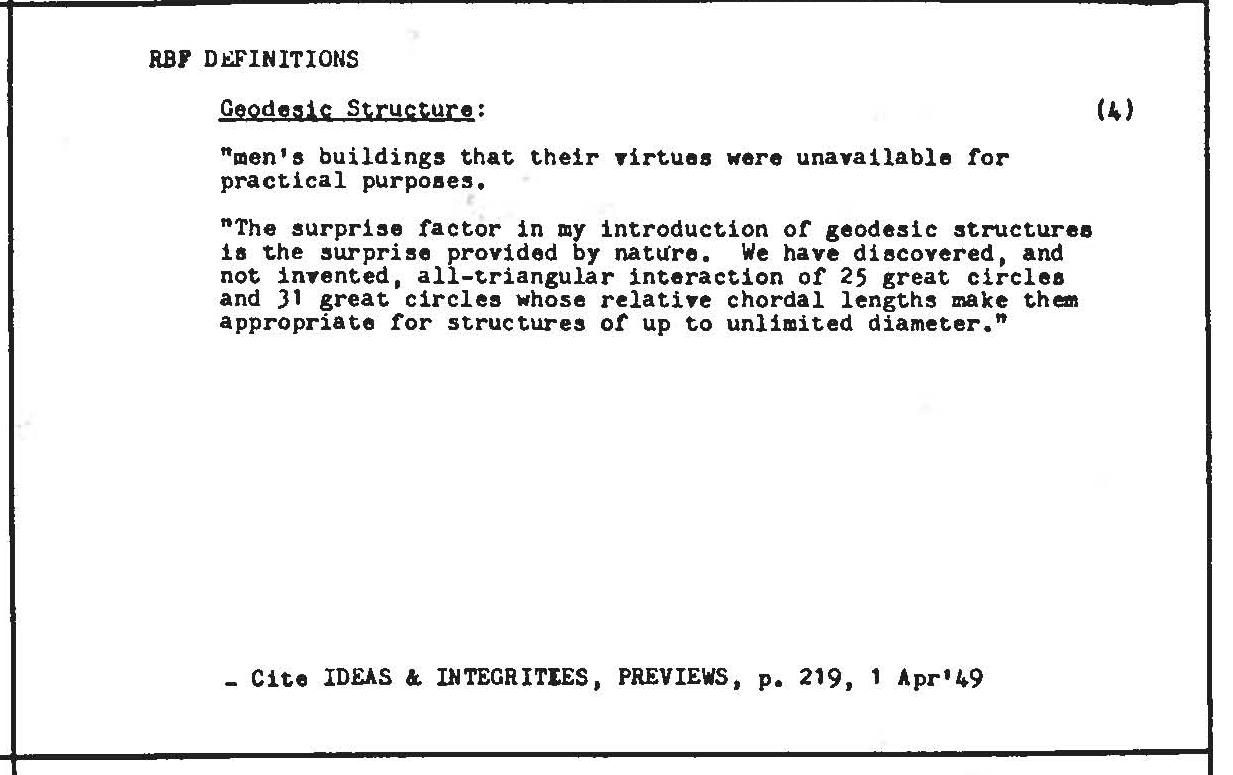
Geodesics vs. Structure
← Geodesic Structure | Geodesic Structures →
Cross Reference
Cross-References
- Geodesics & Tensegrities, 9 Sep'74
Geodesic Structures
← Geodesics vs. Structure | Geodesic Structures (1) →
Index Entry
\hrefhttps://www.buckyverse.org/en/synergetics/content/chapters/200-synergetics#section-203.09203.09 \hrefhttps://www.buckyverse.org/en/synergetics/content/chapters/500-conceptuality#section-541.06541.06 \hrefhttps://www.buckyverse.org/en/synergetics/content/chapters/1000-omnitopology#section-1022.141022.14 s201.11
\hrefhttps://www.buckyverse.org/en/synergetics/content/chapters/200-synergetics#section-222.43222.43 \hrefhttps://www.buckyverse.org/en/synergetics/content/chapters/600-structure#section-608.11608.11 \hrefhttps://www.buckyverse.org/en/synergetics/content/chapters/1000-omnitopology#section-1023.151023.15
\hrefhttps://www.buckyverse.org/en/synergetics/content/chapters/200-synergetics#section-240.25240.25 \hrefhttps://www.buckyverse.org/en/synergetics/content/chapters/600-structure#section-612.11612.11
\hrefhttps://www.buckyverse.org/en/synergetics/content/chapters/200-synergetics#section-240.27240.27 \hrefhttps://www.buckyverse.org/en/synergetics/content/chapters/600-structure#section-618.30618.30
\hrefhttps://www.buckyverse.org/en/synergetics/content/chapters/200-synergetics#section-240.29240.29 \hrefhttps://www.buckyverse.org/en/synergetics/content/chapters/600-structure#section-640.01640.01-\hrefhttps://www.buckyverse.org/en/synergetics/content/chapters/600-structure#section-640.02640.02
\hrefhttps://www.buckyverse.org/en/synergetics/content/chapters/200-synergetics#section-240.31240.31 702-\hrefhttps://www.buckyverse.org/en/synergetics/content/chapters/700-tensegrity#section-702.01702.01
\hrefhttps://www.buckyverse.org/en/synergetics/content/chapters/200-synergetics#section-240.35240.35 \hrefhttps://www.buckyverse.org/en/synergetics/content/chapters/700-tensegrity#section-703.01703.01-\hrefhttps://www.buckyverse.org/en/synergetics/content/chapters/700-tensegrity#section-703.16703.16
\hrefhttps://www.buckyverse.org/en/synergetics/content/chapters/400-system#section-427.02427.02 \hrefhttps://www.buckyverse.org/en/synergetics/content/chapters/700-tensegrity#section-710.02710.02-\hrefhttps://www.buckyverse.org/en/synergetics/content/chapters/700-tensegrity#section-710.03710.03
\hrefhttps://www.buckyverse.org/en/synergetics/content/chapters/500-conceptuality#section-501.101501.101 \hrefhttps://www.buckyverse.org/en/synergetics/content/chapters/700-tensegrity#section-714.01714.01-\hrefhttps://www.buckyverse.org/en/synergetics/content/chapters/700-tensegrity#section-714.02714.02
\hrefhttps://www.buckyverse.org/en/synergetics/content/chapters/500-conceptuality#section-535.11535.11 \hrefhttps://www.buckyverse.org/en/synergetics/content/chapters/900-modelability#section-960.03960.03
\hrefhttps://www.buckyverse.org/en/synergetics/content/chapters/500-conceptuality#section-536.32536.32 \hrefhttps://www.buckyverse.org/en/synergetics/content/chapters/900-modelability#section-982.13982.13
\hrefhttps://www.buckyverse.org/en/synergetics/content/chapters/500-conceptuality#section-540.05540.05 \hrefhttps://www.buckyverse.org/en/synergetics/content/chapters/1000-omnitopology#section-1021.131021.13
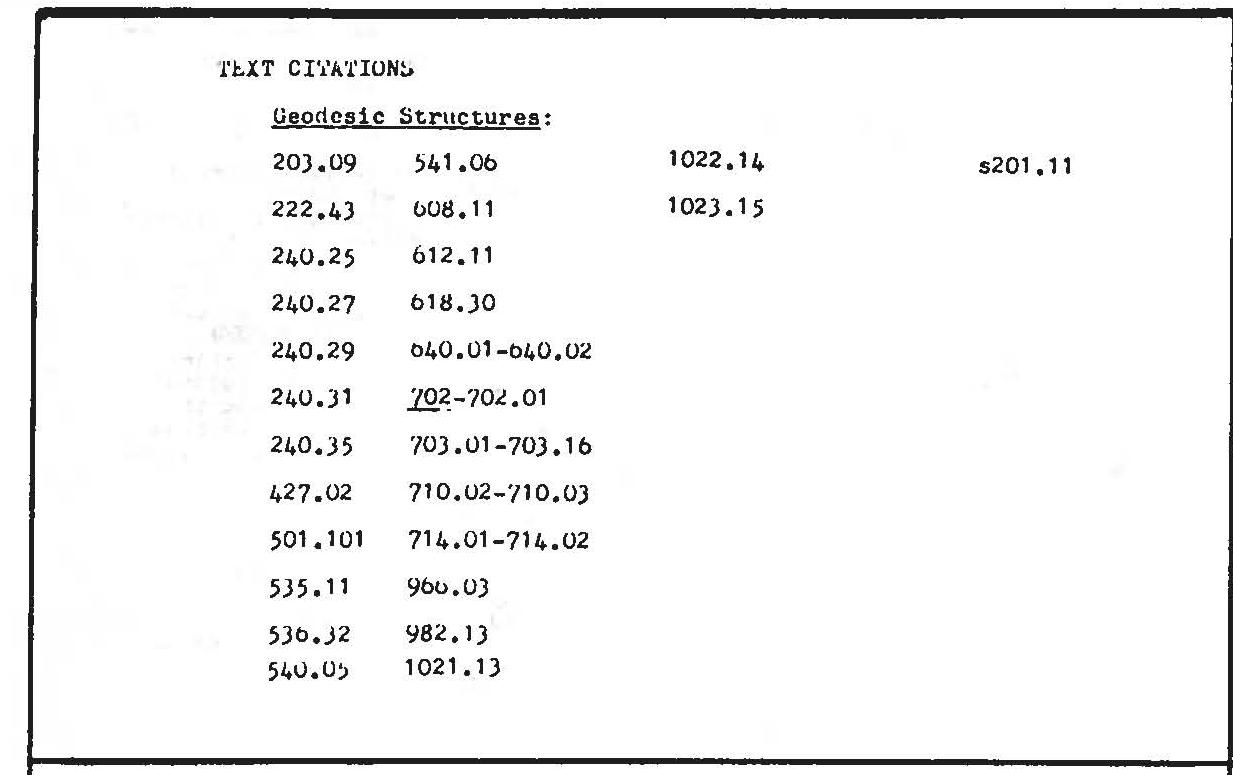
Geodesic Structures (1)
← Geodesic Structures | Geodesic Structures (2) →
Cross Reference
Cross-References
Geodesic Structures (2)
← Geodesic Structures (1) | Geodesics & Tensegrities →
Cross Reference
Cross-References
- Environment Control Valve, 1954
- Invention, 3 Oct'72; Dec'61
- Icosahedron: Subtriangulation, (1)(2)
Geodesics & Tensegrities
← Geodesic Structures (2) | Geodesically Structured Thoughts →
RBF Definitions
Is tensegrity a special case of geodesics?"
RBF Reply: "Geodesics are generalizations. It does not mean 'structure,' it means the most economical relationship between any two events. But tensegrity involves more than two events. All of Universe is tensegrity. Geodesic is the relation between the Moon and the Earth. Tensegrity is always a total system.
"Geodesics represent a subgeneralization of tensegrity. All geodesics are not, as built, tensegrities. Tensegrities are inherently nonredundant."
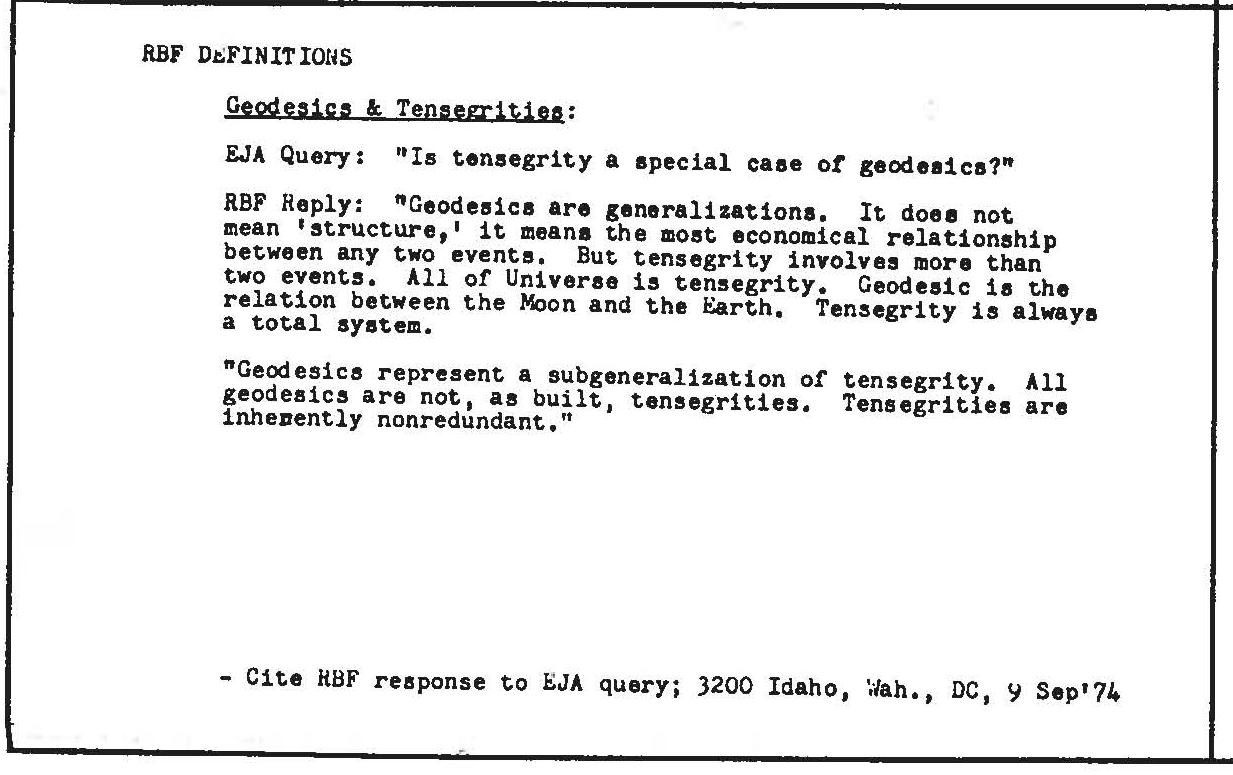
Geodesically Structured Thoughts
← Geodesics & Tensegrities | Geodesic (1) →
Cross Reference
Geodesically Structured Thoughts:
Cross-References
- Polyhedral Understanding, 1969
Geodesic (1)
← Geodesically Structured Thoughts | Geodesic Geodesica (2) →
Cross Reference
Cross-References
- Dome
- Great Circle
- Radome
- Spherical Structures
- Spherical Triangle Sequence
- Tensegrity Sphere
- Transformational Projection
- Most Economical
Geodesic Geodesica (2)
← Geodesic (1) | Geodesic Geodesics (3) →
Cross Reference
Cross-References
- Chemical Bonds, 18 Jun'71*
- Earth, 22 Feb'72
- Embracement, 22 Jul'71
- Energy, 19 Dec'73
- Epistemological Stepping Stones, 30 Dec'73
- Fourth Dimension, 17 Nov'72
- Icosahedron, 8 Oct'64*
- Interrelationships, 1971
- Metaphysical & Physical, 1971
- Relationships, 5 Jul'62
- Scheme of Reference, 24 Sep'73*
- Sphere, 31 May'71*
- Spherical Triangle Sequence
- Time Vector, 24 Sep'73
Geodesic Geodesics (3)
← Geodesic Geodesica (2) | Geodesy →
Cross Reference
Geodesically-inter-routed Communications Traffic
Geodesic Systems
Cross-References
- Geodesic Center
- Geodesic Design in Nature: Confirmation Of
- Geodesic Dome
- Geodesic Lines
- Geodesic Sphere
- Geodesic Spheric Experience
- Geodesic Structure
- Geodesically Structured Thoughts
- Geodesic Spinnaker
- Geodesics vs. Structure
- Geodesics & Tensegrities
- Geodesics vs. Irrelevance
- Geodesic Diamonds
- Geodesic Spiral Tube
Geodesy
← Geodesic Geodesics (3) | Geodetic Mensurability →
Cross Reference
Cross-References
Geodetic Mensurability
← Geodesy | Geographical Identity (1) →
Cross Reference
Geodetic Mensurability: Geodetics:
Cross-References
- Vector Equilibrium, (2)
- Geodesics, (1)
Geographical Identity (1)
← Geodetic Mensurability | Geographical Identity (2) →
Cross Reference
Local Identification
Cross-References
Geographical Identity (2)
← Geographical Identity (1) | Geography (1) →
Cross Reference
Cross-References
Geography (1)
← Geographical Identity (2) | Geography (2) →
Cross Reference
Cross-References
Geography (2)
← Geography (1) | Geologic Measurability (2) →
Cross Reference
Cross-References
- Periodic Experience, (9)
- Bundle of Experiences, May'49
Geologic Measurability (2)
← Geography (2) | Geology (1) →
Cross Reference
Cross-References
- Vector Equilibrium, (2)
Geology (1)
← Geologic Measurability (2) | Geology (2) →
Cross Reference
Cross-References
Geology (2)
← Geology (1) | Geomathematical →
Cross Reference
Cross-References
- Epigenetic Landscape, May'49
- Relativity, 1968
Geomathematical
Cross Reference
Cross-References
- Starting With Parts: The Nonradial Line, 29 Dec'73
Geometry
← Geomathematical | Geometry →
Index Entry
Geometry:
"When you process your experiences it produces a geometry."
- Cite RBF to EJA, 200 Locust St., Philadelphia, 21 Jan'75
Geometry
Index Entry
Geometry:
"To me no experience in childhood so reinforced self-confidence in one's own exploratory faculties as did geometry. Its inspiring effectiveness in winnowing out and evaluating a plurality of previously unknowns from a few given knowns, and its elegance of proof lead to the further discovery and comprehension of a grand strategy for all problem solving... the science of pattern analysis."
- Citation & context at Coxeter, H.S.M., 14 Nov'73
Geometry
Index Entry
There is no geometry of space-- only of local aggregates of principles, of special cases.
Geometry
Index Entry
Geometry:
"Geometry = Geo + Metry. It relates only to the Earth, one single sphere. Ge- o- metry has an 'o' in it = a circle = Geodes = Gods. For the Greeks the 'o' became unreal; we don't want to get caught in an avenue to Flatland."
- Cite RBF to EJA, 3200 Idaho, Wash DC, 1 Oct. '71.
Geometry
Index Entry
Geometry:
"Time is in our dimensioning because our geometry is vectorial."
-
Cite RBF to EJA, 3200 Idaho, Washington DC, 21 Dec. 71
-
Citation & context at Time, 21 Dec'71
Geometry
Index Entry
Geometry:
"Geometry-- meaning world measuring."
- Citation and context at Up and Down Sequence (2) 13 Nov'69
Geometry
Index Entry
Geometry:
"There is no static geometry. There are momentarily existant geometrical relationships."
- Citation and context at Space, 1968
Geometry
Index Entry
Geometry:
"In our approach to geometry we thought it would be simpler to start with plane geometry; and it was supposed to be very complicated when you get to solid geometry and much more so when you get to spherical. So I gradually began to reverse my field, in order to get the total experience, and decided that spherical was much easier than solid, and the solid easier than the plane, so that everything became much simpler merely if I really started with the totality all the time and dealt-- in spherical geometry-- with the vectors."
- Cite LLORIENT LABORATORIES Lecture, 15 Oct '64, pp. 11-12
Geometry
Index Entry
Geometry:
"Geometry begins to emerge . . . where there are convergences to critical proximity, twistings around points . . . where you find domains that are staked out by events . . . corresponding to what would seem to be a separate octahedron-tetrahedron, whatever it might be, coming up through vertexes."
- Cite LEDGEMONT LAB Lecture, 15 Oct '64, p. 13
Geometry
Index Entry
Geometry:
"So we have come to structure and we have come to pattern. Pattern has emerged first from our preoccupation with getting rid of the irrelevancies and out of it has emerged a minimum constellation, a minimum consideration and it is a four star affair. It is tetrahedral. It is very amazing to have a geometry just appear out of our just considering what is thought. We have come to some conceptuality and this conceptuality is essential to this thinking process. When we say, 'I understand,' there is some conceptuality finally developed."
-
Citation at Tetrahedron, 2 Jul'62
-
Cite Oregon Lecture #2, p. 69, 2 Jul'62
Geometry
Index Entry
Geometry:
"Now I have discovered that this thinking process is one in which by holding out and getting rid of the irrelevancies, we definitely developed for the first time a conceivable geometry. The geometry of the Universe was not conceivable because it was nonsimultaneous. In the first place I found this a very important and satisfying kind of discovery and it stopped me from having to know where the ball ends. It is not a ball, but thought begins to develop the first geometry with a dismissal outwardly and a dismissal inwardly which leaves a spherical zone of irrelevancy. The thinking is omnidirectional."
-
Cite Oregon Lecture #2, pp. 66-67. 2 Jul'62
-
Citation at Thinking, 2 Jul'62
Geometry
Index Entry
Geometry:
"Substituting the word tetrahedron for the number two completes my long attempt to convert all the residual heretofore unidentifiable integers of topology into geometrical conceptability."
-
Cite OMNIDIRECTIONAL HALO, p. 156, 1960.
-
Citation at Synergetics, 1960
Geometry
← Geometry | Geometry of General Systems →
Index Entry
Geometry:
"Out of nonsimultaneously conceptual, yet finite, universe has emerged a definitively conceptual geometry, not a geometry invented by the conceiver but an a priori geometry discovered by the re-considerer as a residual relevancy constellation."
- Cite OMNIDIRECTIONAL HALO, p. 138, 1960
Geometry of General Systems
← Geometry | Geometrical Conceptuality →
Cross Reference
Cross-References
- Synergetics, 17 Oct'77
Geometrical Conceptuality
← Geometry of General Systems | Geometric Hierarchy (1) →
Index Entry
Geometrical Conceptuality:
"Substituting the word tetrahedron for the number two completes my long attempt to convert all the previously unidentifiable integers of topology into geometrical conceptuality. Thus we see both the rational energy quantum of physics and the topological tetrahedron of the isotropic vector matrix rationally accounting all physical and metaphysical systems."
(Above is a synthesis of Isotropic Vector Matrix, 13 Nov'69 and Unity as Two, 1960.)
- Cite RBF rewrite of SYNERGETICS galley at Sec. \hrefhttps://www.buckyverse.org/en/synergetics/content/chapters/600-structure#section-620.12620.12, 11 Nov'73
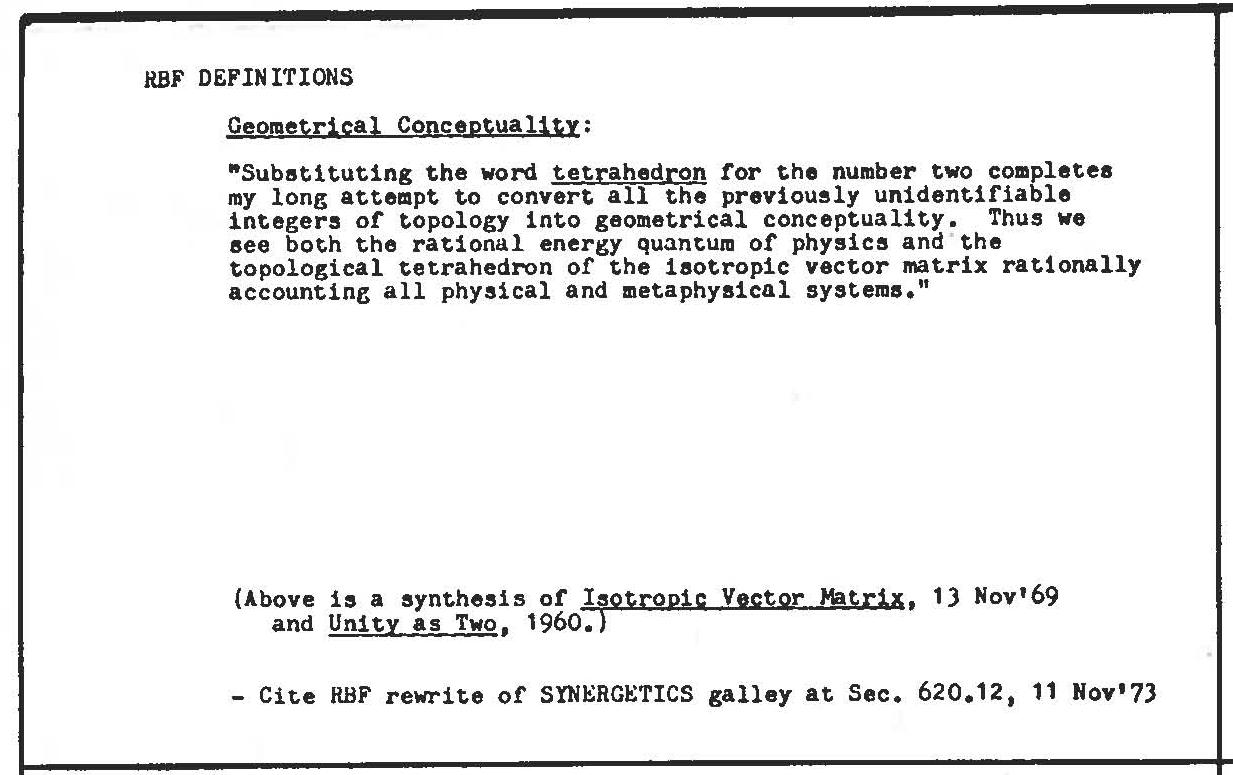
Geometric Hierarchy (1)
← Geometrical Conceptuality | Geometric Hierarchy (2) →
Cross Reference
Cross-References
Geometric Hierarchy (2)
← Geometric Hierarchy (1) | Geometrical Integrity →
Cross Reference
Cross-References
- Potential vs. Primitive, 12 May'77
- Trigonometry, 26 Sep'77
Geometrical Integrity
← Geometric Hierarchy (2) | Geometrical Integrity →
Index Entry
Geometrical Integrity:
"A system is a closed configuration of vectors. It is a pattern of forces constituting a geometrical integrity which returns upon itself in a plurality of directions."
- Citation and context at Polyhedral Systems, 25/2 May'72
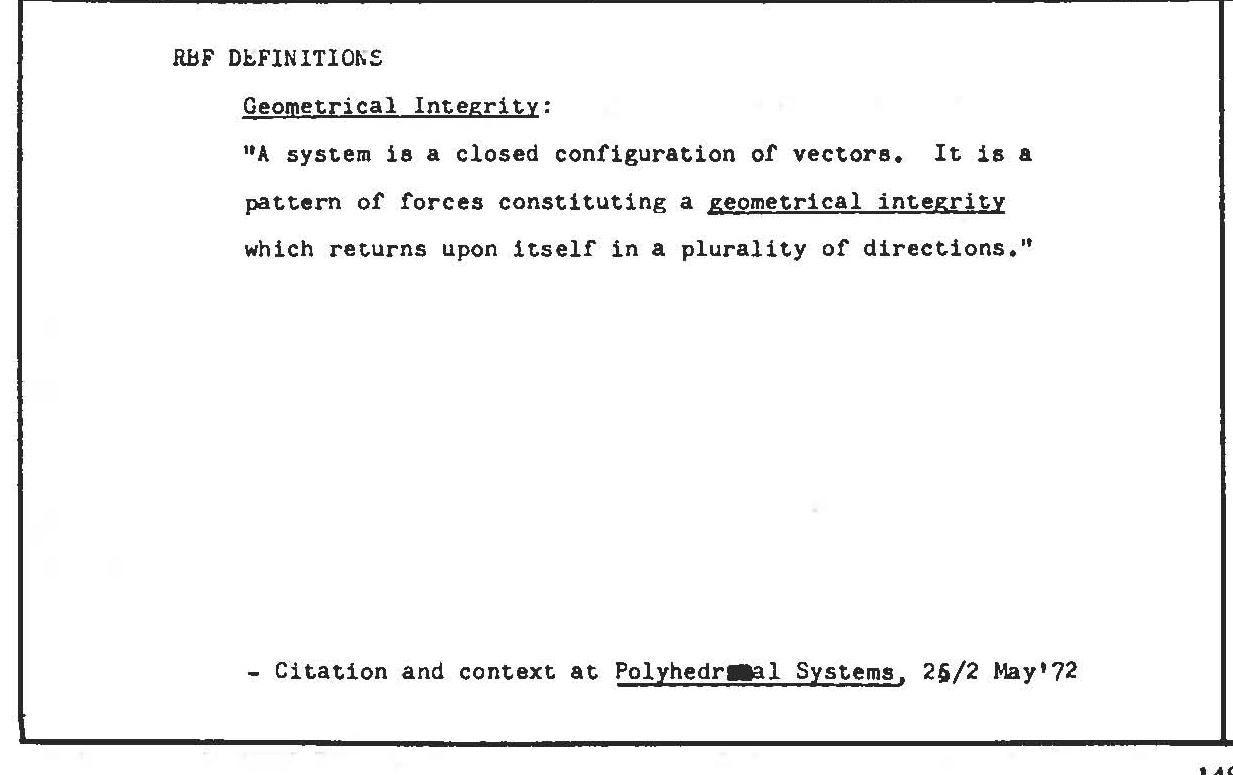
Geometrical Integrity
← Geometrical Integrity | Geometrical Interrelatability of Events →
Cross Reference
Cross-References
- Invisible Pneumatics, 27 Dec'73
Geometrical Interrelatability of Events
← Geometrical Integrity | Geometry of Inwardness & Outwardness →
Cross Reference
Cross-References
- System, 25 May'72
Geometry of Inwardness & Outwardness
← Geometrical Interrelatability of Events | Geometrical Function of Nine (1) →
Index Entry
How many stars does it take to develop a geometry of outwardness and inwardness? What is the minimum number of stars to divide the Universe into outwardness and inwardness? I find it takes a minimum of four.
Geometrical Function of Nine (1)
← Geometry of Inwardness & Outwardness | Geometrical Function of Nine (2) →
Index Entry
Geometrical Function of Nine:
"Thinking about precession Goldy observes that fish fan their tails sideways to produce forward motion, that snakes wriggle sideways to produce forward motion. She sees that iceboats attain speeds of 60 miles per hour in a direction at right angles to wind blowing at half that speed. Coming back to her triangles and their synergetic surprise behaviors, Goldy flips one simple white triangle over and find the other side is black. She realizes that there are two triangles, the obverse and reverse, always and only coexisting congruently.
"Goldy realizes that every sphere has a concave inside and a convex outside. She knows that convex and concave are not the same because concave reflectors concentrate energy as radiation and convex mirrors diffuse the radiant energy. Convex and concave are nature's macro-to-micro or macro-to-macro radiant-energy transformers.
"Goldy realizes that unity is always plural and at minimum two. Unity does not mean the number one. She realizes that one does not and cannot exist by itself. In Universe life's existence begins with awareness. No otherness: no awareness. The observed requires an observer. The subjective and objective always and only coexist and therewith demonstrate"
Geometrical Function of Nine (2)
← Geometrical Function of Nine (1) | Geometrical Function of Nine (3) →
Index Entry
Geometrical Function of Nine:
"the inherent plurality of unity-- inseparable union. Physics tends to think of 'complementarity' (discovered half a century ago) and the latter's nonmirror-imaged complementation (discovered only twenty years ago) as being the interrelationship characteristics of two separate entities. However, the always-and-only coexistent, non-mirror-imaged complementations also may coexist with inseparable plural-unity.
"Goldy finds she can interconnect the three mid-edge points of a triangle which subdivides the big triangle into four similar smaller triangles and can fold the three corner triangles along their connecting lines to produce two different tetrahedra, because folding the corner triangles under or over produces either a white tetrahedron with a black inside or a black tetrahedron with a white inside. Since the inside of the tetrahedron is concave and the outside is convex, there are two very real and separate tetrahedra in evidence, whose eight (four white, four black) faces have been evolved from only four externally viewable triangles, which four were in turn evolved from one (unity-is-plural) triangle.
"Since both the positive and negative concave tetrahedra have four different black faces and four different white faces, she"
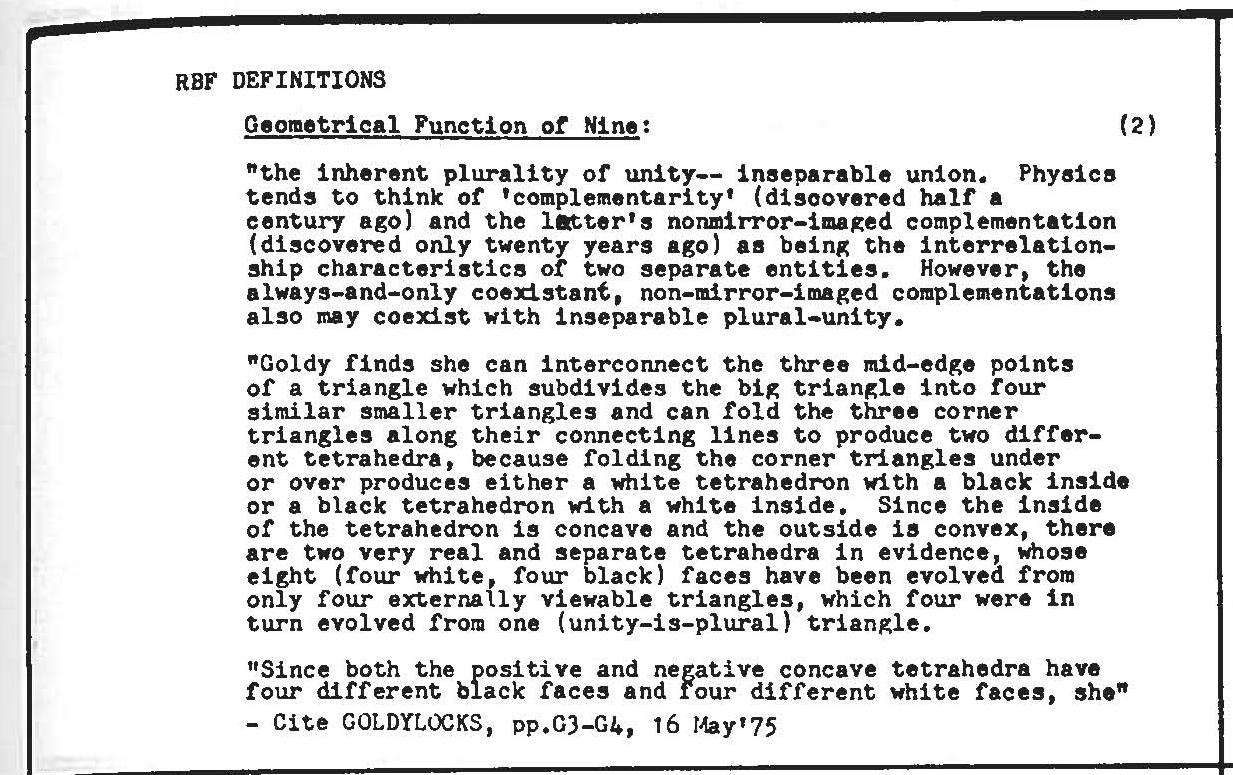
Geometrical Function of Nine (3)
← Geometrical Function of Nine (2) | Geometrical Functions of Nine →
Index Entry
Geometrical Function of Nine:
"can differentiate them by placing a red, a green, a yellow, and a blue dot in the center of each of their respective four white inside faces; and an orange, a purple, a brown, and a gray dot in the center of each of their outside black triangles successively. Since each of the two tetrahedra can turn themselves inside out (as their respective three triangular corners rotate around the central triangle's three edge hinges-- thus to open like a three-petalled flowerbud), each tetrahedron can be opened in four such flowerbud ways, with three triangular petals around each of their four respective triangular flower-receptacle base faces. These four separate cases of inside-outing transformability permit the production of four separate and unique positive and four separate and unique negative tetrahedra all generated from the same unity-- each of which tetrahedra can rank as nature's simplest structural system. Therefore, each prime structural system in Universe has nine separate and unique states of existence-- four positive, four negative, plus one schematic unfolded nothingness state-- which Goldy reminds the bears constitutes the same schematic 'game' set up as that of physics' quantum mechanics with four positive and four negative quanta as we go from a central nothingness equilibrium to first one, then two, then three,"
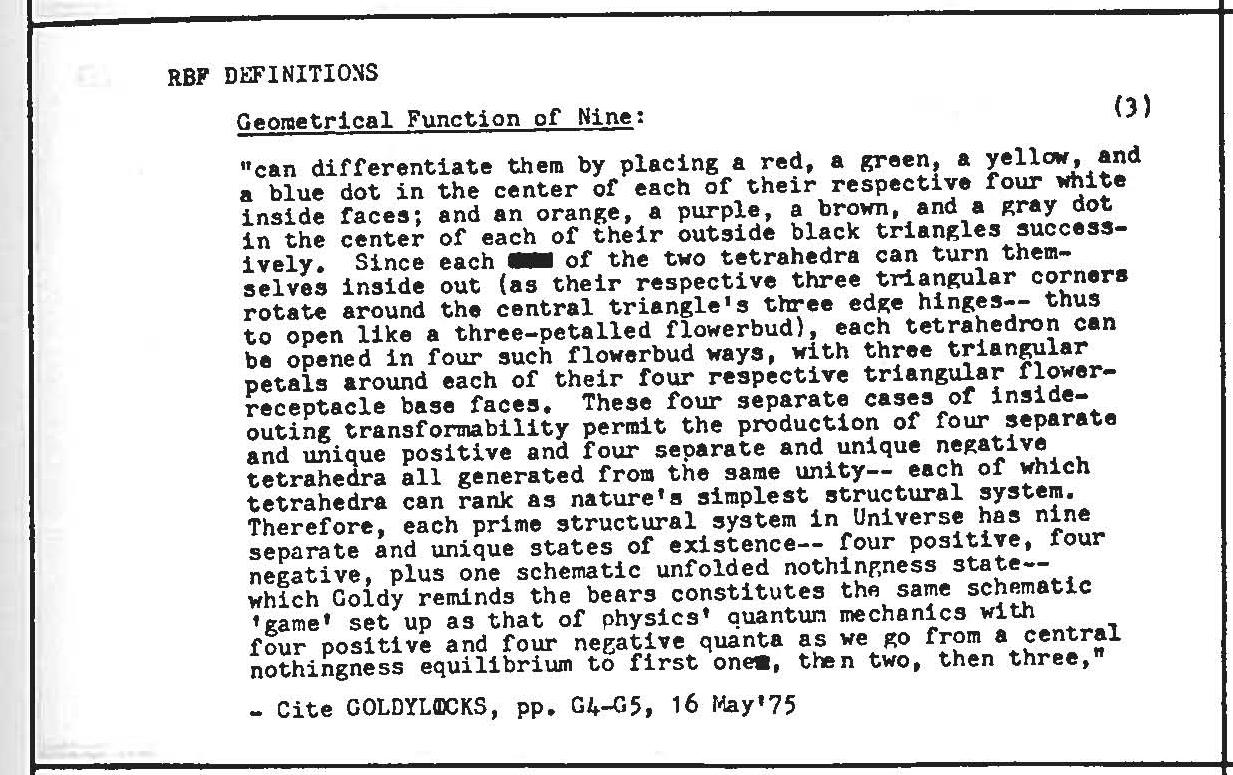
Geometrical Functions of Nine
← Geometrical Function of Nine (3) | Geometrical Functions of Nine →
Index Entry
Geometrical Functions of Nine:
"then four, high-frequency, regenerated, alternate, equi-integrity, tetrahedral quanta. All eight of which have eight invisible counterparts.
Visibly demonstrable (Physical) 4 white three-petalled flowers
one with: red base receptacle
one with: green base receptacle
one with: yellow base receptacle
one with: blue base receptacle
4 black three-petalled flowers
one with: orange base receptacle
one with: purple base receptacle
one with: brown base receptacle
one with: gray base receptacle
- Cite GOLDYLOCKS, p. G5, 16 May'75
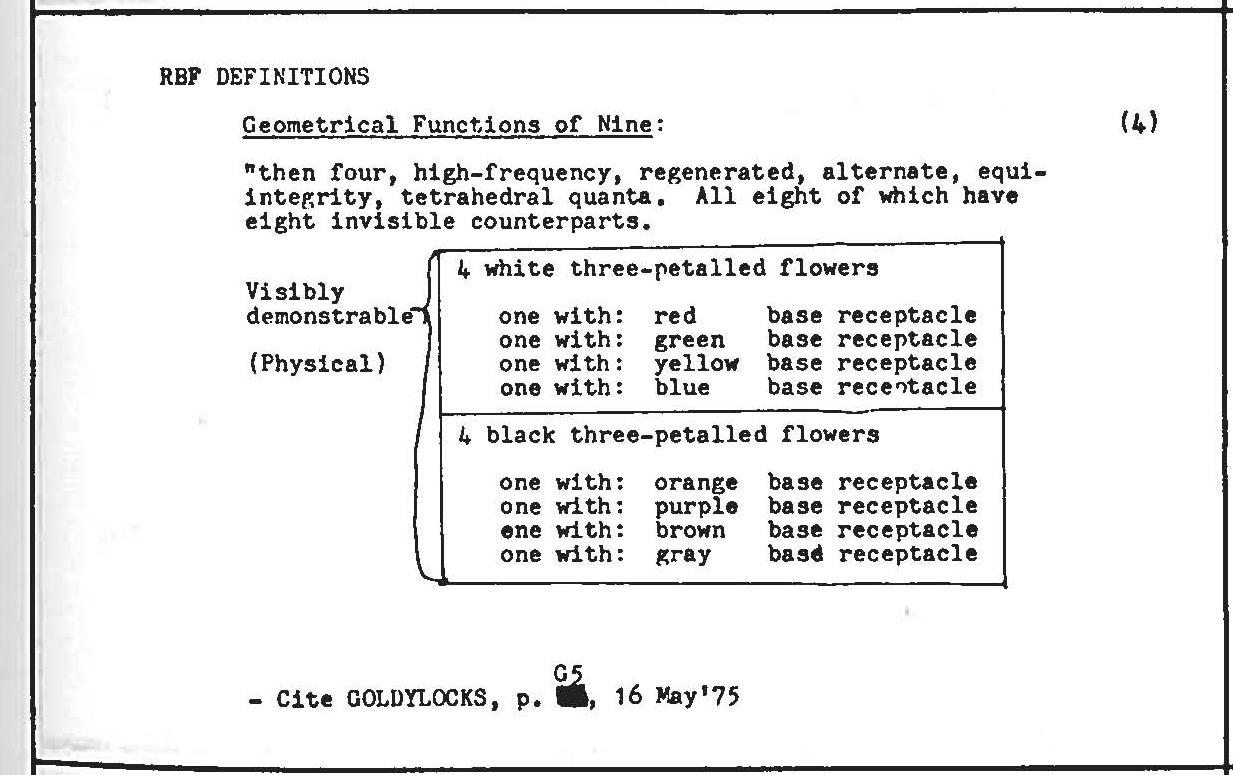
Geometrical Functions of Nine
← Geometrical Functions of Nine | Geometrical Function of Nine →
Index Entry
4 white three-petalled flowers
one with: orange base receptacle
one with: purple base receptacle
one with: brown base receptacle
one with: gray base receptacle
4 black three-petalled flowers
one with: red base receptacle
one with: green base receptacle
one with: yellow base receptacle
one with:: blue base receptacle
Invisible but thinkable
(Metaphysical)
"Goldy now takes any two of these triangularly petalled tetrahedra with both of their three respective, 60-degree folded corners partially open and pointing out from their bases like petals of an opening tulip bud. Goldy rotates one of the 60-degree petalled tetrahedra a sixth-of-a-circle turn and precesses it axially 60°, which points its opened"
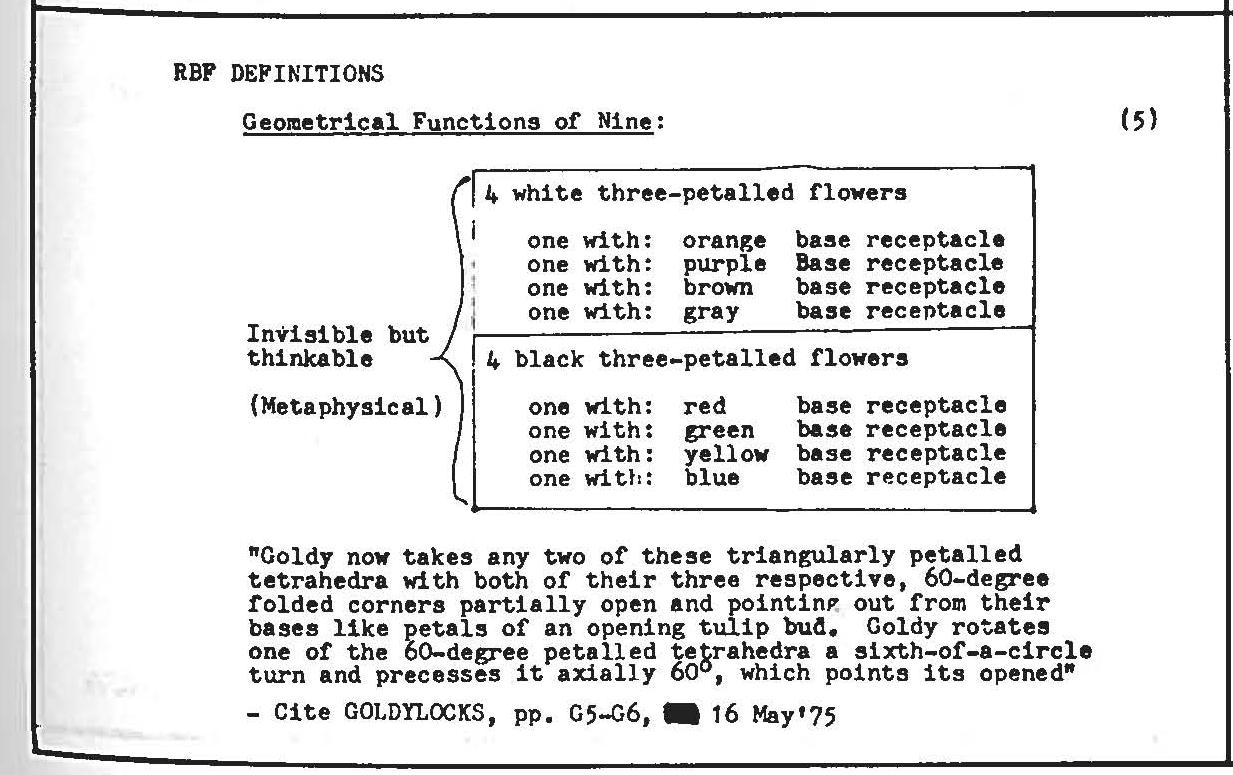
Geometrical Function of Nine
← Geometrical Functions of Nine | Geometrical Function of Nine →
Index Entry
Geometrical Function of Nine:
"triangular petals toward the others' 60-degree openings. Goldy brings them convergently together edge-to-edge to produce the octahedron.
"Since the octahedron thus produced has a volume of four tetrahedra, and since we have learned that each tetrahedron is one energy quantum unit, Goldy has put one quantum and one quantum together to produce four quanta. Another quantum leap is demonstrated.
"What Goldy finds equally exciting is to _ realize that each of the two tetrahedra combining to make the octahedron can consists of the eight unique combinations of the black and the white triangular faces and their four red, green, yellow and blue center dots. This means that an octahedron of eight black triangles, eight white and one of four white plus four black, and that the alternation of the four different color dots into all the possible combinations of eight produces four times 26-- which is the 104 possible combinations."
- Cite Goldylocks, p. G6, 16 May'75
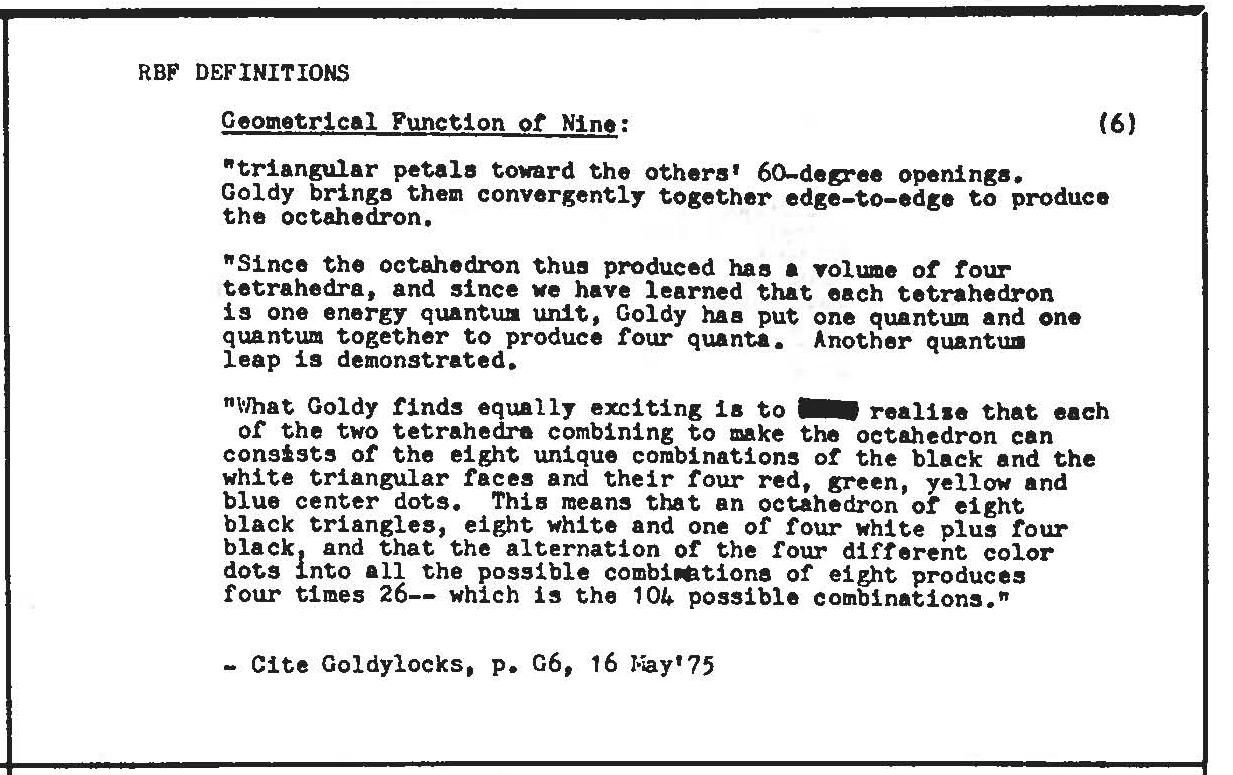
Geometrical Function of Nine
← Geometrical Function of Nine | Geometrical Functions of Nine →
Index Entry
"Where N = 8, and there are four sets of 8, the formula for the number of combinations is:
4 (N^2-N/2).
This result has a startling proximity to the 92 unique regenerative chemical elements plus their 12 additional non-self-regenerative isotopes. The bears applaud."
- Cite GOLDYLOCKS, p.G6, 16 May'75
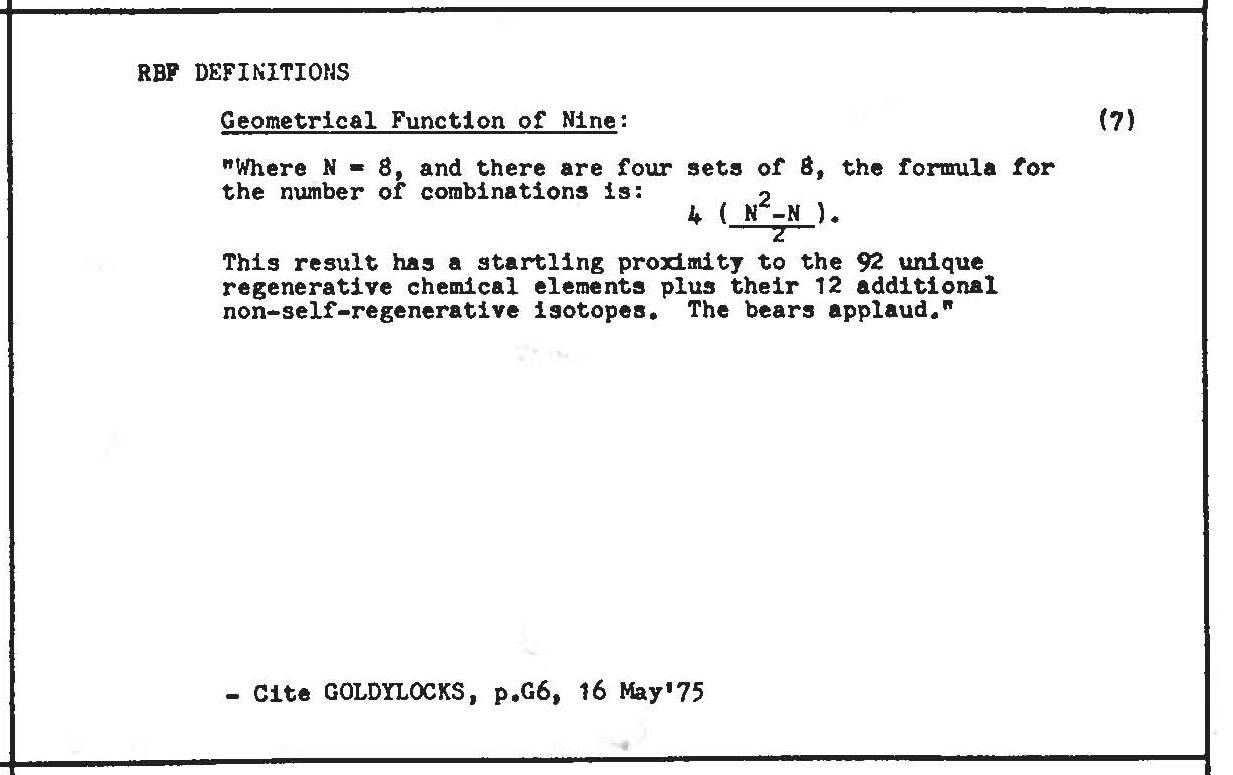
Geometrical Functions of Nine
← Geometrical Function of Nine | Geometry & Number →
Cross Reference
Cross-References
Geometry & Number
← Geometrical Functions of Nine | Geometry & Number (1) →
RBF Definitions
"All geometrical and numerical values derive from fractionation of the whole."
- Citation & context at Proofs, 8 Aug'77
Geometry & Number (1)
← Geometry & Number | Geometry & Number (2) →
Cross Reference
Cross-References
- Intertransformative Number-value Accounting
- Energy & Number
- Prime Rational Integer Characteristics
- Volume-energy Ratios
- Volume-number Ratios
- Volume-quanta Ratios
- Geometrical Function of Nine
- Wave Quanta & Indig Bow Ties
Geometry & Number (2)
← Geometry & Number (1) | Geometry: Plane Geometry →
Cross Reference
Cross-References
- ahedron, Oct
- Synergetics Constant, 10 Dec'75
- Module: A Quanta Module: Introduction Of, 22 Feb'77
- Proofs, 3 May'77; 8 Aug'77*
Geometry: Plane Geometry
← Geometry & Number (2) | Geometry: Plane Geometry (1) →
Index Entry
Geometry: Plane Geometry:
"... 'When we said that 'plane' geometry is more fundamental and therefore easier than solid geometry, and that a dynamic geometry was something prohibitively 'way out' in relative difficulty of comprehensibility. 'Geometry didn't have all the qualities of energy,' said the pure mathematicians. All their complete abstraction of pattern from reality of experiences was thought to be simple. I discovered that nothing can be more complicated than 'plane' geometry nor a more highly specialized case of 'pure mathematics.' Plane geometry is the most special case of 'not true at all.'"
Geometry: Plane Geometry (1)
← Geometry: Plane Geometry | Geometry: Plane Geometry →
Cross Reference
See Up & Down Sequence
Cross-References
- Up \& Down Sequence
Geometry: Plane Geometry
← Geometry: Plane Geometry (1) | Geometry of Reality →
Cross Reference
Unit, 1938
Cross-References
- Spaceship Earth, 1938
Geometry of Reality
← Geometry: Plane Geometry | Geometry of Reality (1) →
Index Entry
Residual ignorance has employed the as-yet-primitive tools of mathematics in linear diametrics-- in the 'either yes or no' of two-dimensional oversimplification. Ignorance thinking in blackboard and paper planes labors protestingly over the geometry of reality. A complete reorganization of mathematics will probably occur within the next quarter century (or generation) with all the now so-called elementary phases relegated to non-sense and the ever most advanced intuitions shifted to elementary priority in the effective informing of the new life by the old. - Cite TOTAL THINKING, I&I, pp. 230-231, May'49
Geometry of Reality (1)
← Geometry of Reality | Geometry of Reality (2) →
Cross Reference
Cross-References
Geometry of Reality (2)
← Geometry of Reality (1) | Geometry of Space →
Cross Reference
Cross-References
- Quantum Mechanics, Jun'66
Geometry of Space
← Geometry of Reality (2) | GEOMETRY OF THINKING →
Cross Reference
Cross-References
GEOMETRY OF THINKING
← Geometry of Space | Geometry of Thinking →
Index Entry
GEOMETRY OF THINKING
"Getting nature into a corner is the essence of synergetics. It is the coordination of thought and physical action, the genesis of geometry, system, and structure."
- Citation & context at Nature in a Corner, 13 Nov'75
Geometry of Thinking
← GEOMETRY OF THINKING | Geometry of Thinking →
Index Entry
Geometry of Thinking:
"Synergetics is the geometry of thinking. How we think is epistemology and epistemology is modelable; which is to say that knowledge organizes itself geometrically, i.e., with models.
"Unity as two is inherent in life and the resulting model is tetrahedral, the conceptuality of which derives as follows:
-- life's inherent unity is two;
-- no otherness = no awareness;
-- life's awareness begins with otherness;
-- otherness is twoness;
-- this moment's awareness is different from previous awareness;
-- differentiations of time are observed directionally;
-- directions introduce vectors (lines);
-- two time lines demonstrate the observer and the observed;
-- the interconnection of two lines results in a tetrahedron;
-- sixfold interrelatedness is conceptual:
- RBF holograph incorporated in SYNERGETICS at Sec \hrefhttps://www.buckyverse.org/en/synergetics/content/chapters/900-modelability#section-905.01905.01.02. 16 Dec'73
Q.E.D.
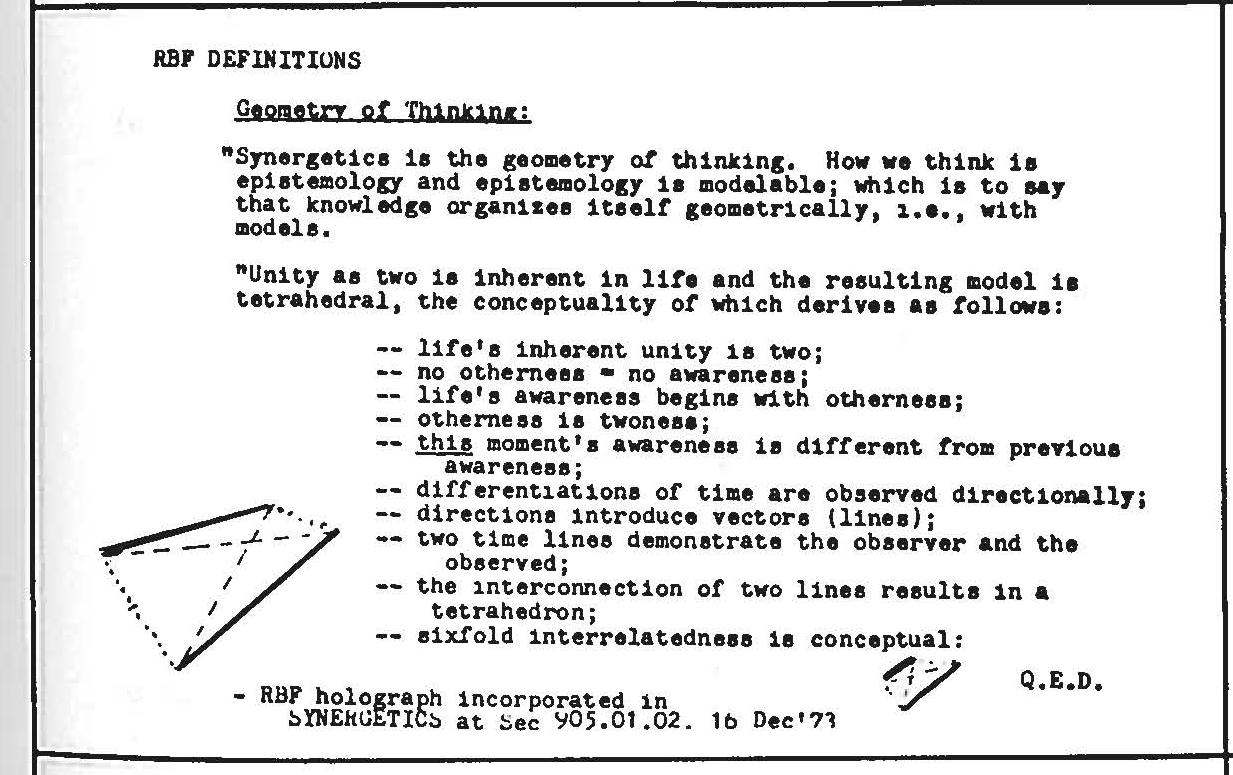
Geometry of Thinking
← Geometry of Thinking | Geometry of Thinking (1) →
Index Entry
Geometry of Thinking:
"Conceptual formulation is inherently empirical."
Citation and context at Experience, Feb'50
Geometry of Thinking (1)
← Geometry of Thinking | Geometry of Thinking (1) →
Cross Reference
Centers of Abstract Truths
Comprehensibility of Systems
Conceptual Finite
Conceptual Geometry
Conceptuality as Polyhedral
Conceptuality & Space
Congruence of Metaphysics & Physics
Connections & Relatedness
Epistemography
Ethical Physics
Geodesically Structured Thoughts
Geometrical Conceptuality
Geometry of Reality
Irrelevancies: Dismissal Of
Isotropic-vector-matric Fields of Thought
Cross-References
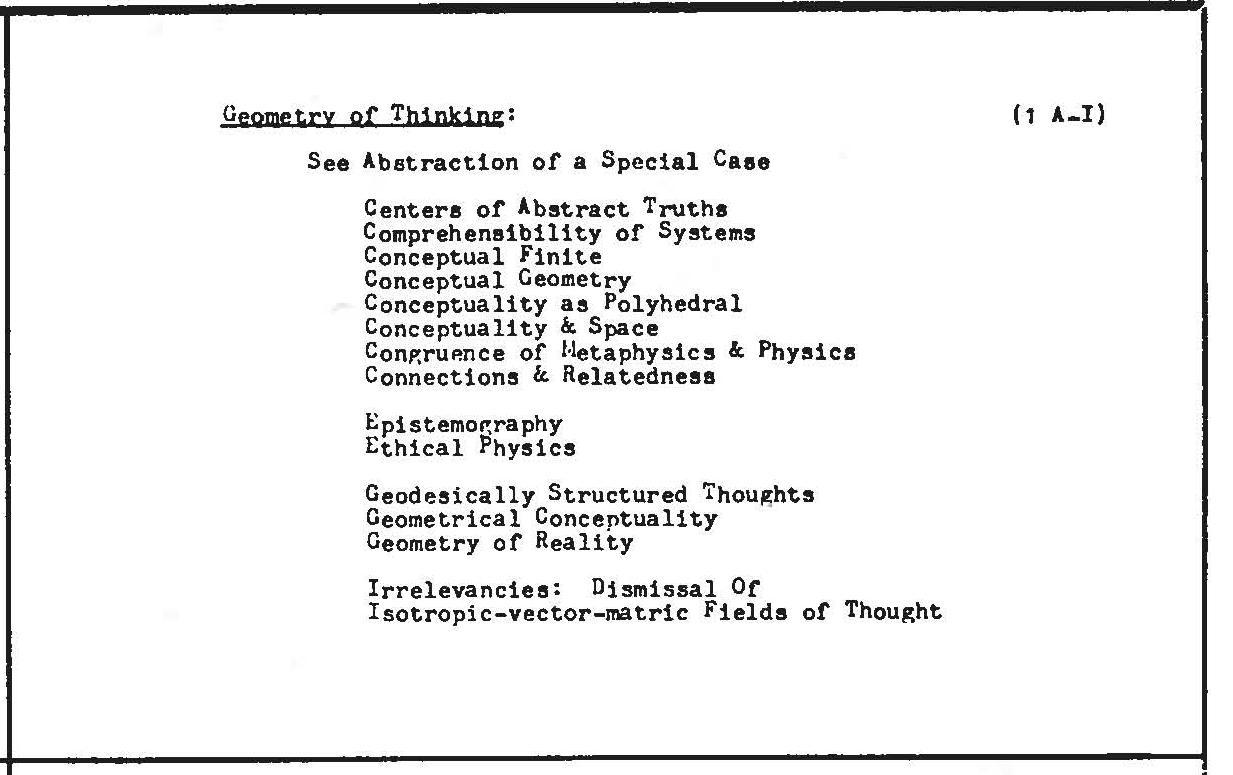
Geometry of Thinking (1)
← Geometry of Thinking (1) | Geometry of Thinking (1) →
Cross Reference
Metaphysical & Physical Tetrahedral Quanta
Nature in a Corner
Number: Tetrahedral Number: N² - N
2
Observer & Otherness: Tetrahedral Relationship
Between
Omnitopology
Polyhedral Understanding
Precessional Thinking
Primitive Geometric Conceptuality
Psychological Geometry
Spherical Comprehension
Spherical Thinking
Straight-line Thinking
Structural Conceptuality
Structure of Meaning
Cross-References
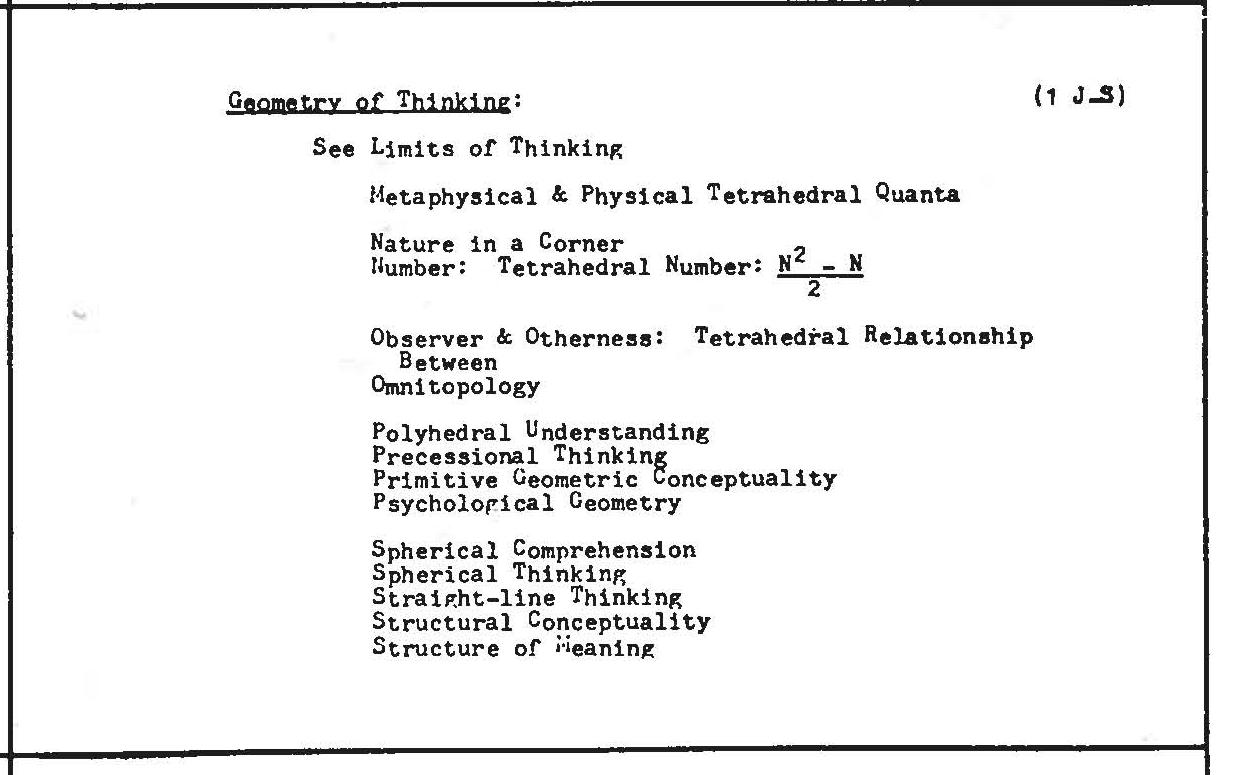
Geometry of Thinking (1)
← Geometry of Thinking (1) | Geometry of Thinking (2) →
Cross Reference
Thinking: Analogy of Sphere Layers
Thought Has Shape
Topology = Conceptuality
Cross-References
Geometry of Thinking (2)
← Geometry of Thinking (1) | Geometry of Vectors →
Cross Reference
Cross-References
- Comprehension, 10 Jan'74; Dec'71
- Conceptual Formulation, Feb'50
- Conceptuality, 1 Apr'72
- Epistemology, 16 Dec'73; 9 May'62
- Experience, Feb'50*
- Ideal, 23 May'72
- Knowledge, 16 Dec'73
- Minus Two, Aug'73
- Synergetics, 15 Jul'73
- thinkable, 1 May'71
- Thought, May'72
- Remember, 20 Feb'72
- Star Events, 2 Jul'62
- Conceptuality Independent of Size, 31 Jan'75
- Nature in a Corner, 13 Nov'75*
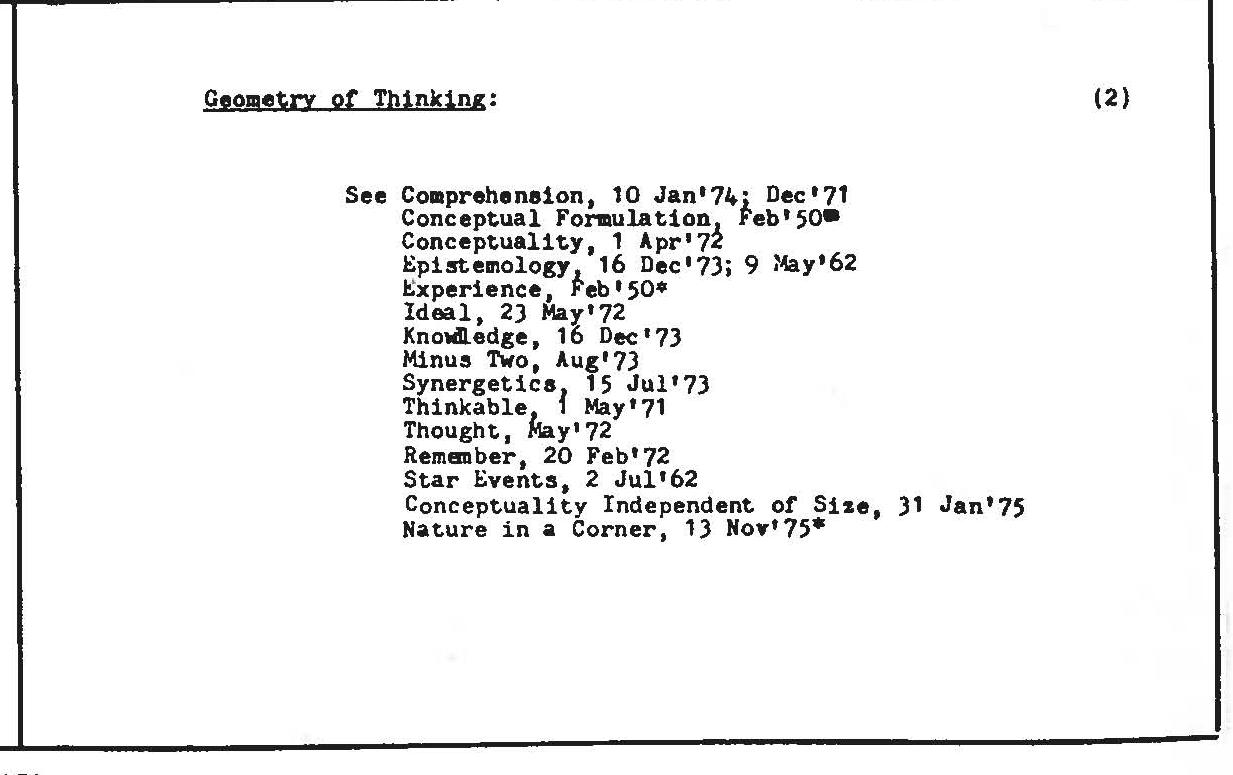
Geometry of Vectors
← Geometry of Thinking (2) | Geometry of Vectors →
Index Entry
Geometry of Vectors:
"That's what I thought Avogadro was looking for: a geometry of vectors bringing in time through the velocity of the vector... the frequency of their discrete dimension!
"Avogadro accounts volume with number in a much better way than just putting water in a cube.
"All three-phase vectors come together to make sum-total structures."
Geometry of Vectors
← Geometry of Vectors | Geometry of Vectors →
Index Entry
Geometry of Vectors:
"I have a very discrete mathematics about how loads are
distributed. They couldn't be more vectorially fundamental.
Synergetic geometry is vectorial geometry. That's exactly
how forces are translated and to what magnitudes.
"And I always must do it nonredundantly. Plurality: there must
be always two discrete configurations. When you get to two
you have wanderability ([vulnerability?]); when you have three
you are absolutely fixed."
Geometry of Vectors
← Geometry of Vectors | Geometry of Vectors →
Index Entry
Geometry of Vectors:
"Remember the words vectorial geometry: if you want to look for maximum efficiency, you do things vectorially."
- Citation & context at Most Economical, 15 Jun'74
Geometry of Vectors
← Geometry of Vectors | Geometry of Vectors →
Index Entry
Geometry of Vectors:
"Time is in our dimensioning because our geometry is vectorial."
-
Citation and context at Time, 21 Dec'71
-
Cite RBF to JIA, 3200 Idaho, UC, 21 Dec'71
Geometry of Vectors
← Geometry of Vectors | Geometry of Vectors (1) →
Index Entry
Geometry of Vectors:
"Assuming an energy Universe of curved paths generated by angular accelerations of varying intertensions, rates, and radii, resulting in orbits of high-frequency continuities, and separating time out of the compound dynamic system there remains only the relative attractions or repulsions expressed in relative vectorial terms in respect to the radius of any one interattracted couple of the set of all the radii expressed.
"In such a timeless and equilibrious instant the remainder of the system may be discovered as a vector construction of force interrelationships between centers. A geometry composed of a system of interrelated vectors may be discovered which represents the complete family of potential forces, proclivities, and proportional morphosis by octave introversion or extroversion."
- Cite SYNERGETICS text as of Aug'71 as revised by RBF between Aug and Dec '71. Incorporated at Secs. 215.1 + 215.2.
Geometry of Vectors (1)
← Geometry of Vectors | Geometry of Vectors →
Index Entry
Geometry of Vectors:
"At the Naval Academy we learned about Galileo's parallelogram of forces. I liked the idea of vectors. I was excited by vectors because I felt that vectors did what the geometry teacher couldn't do with her 'purely abstract straight' lines. Vectors had not only unique direction in relation to other experiences, but also were discrete in their relative lengths, which were arrived at by multiplying their object's mass times their object's velocity. We didn't have to worry about the vector's lines going to infinity. There was no such inference in their deliberately developed construction. A vector went just so far and that was the end of it. So a vector constituted an experimentally satisfactory kind of a line.
"Furthermore, I could convert mass and velocity into heat, and I could ascertain the time dimension from the velocity, thus all the qualities and behavioral characteristics plus the environmental conditions of 'existence' which I had been seeking, were satisfactorily expressed as vectors. So I said, 'Might there not be a Geometry of Vectors?' -- and I remembered those equilength toothpicks of my kindergarten experimental exploration for logical structuring and the complex"
Geometry of Vectors
← Geometry of Vectors (1) | Geometry of Vectors →
RBF Definitions
"of triangulated polyhedra which I had evolved by tactile
stability tests."
Citations
- RBF marginalis at old Chap. 2, "Synergy," I.13, 18 Mar'69
Geometry of Vectors
← Geometry of Vectors | Geometry of Vectors →
Index Entry
In synergetics there is a total"correspondence of radial wave modular growth with circumferential modular frequency growth of the totally involved vectorial geometry." This means that "angular and linear accelerations are identical."
Geometry of Vectors
← Geometry of Vectors | Geometry of Vectors →
Index Entry
Geometry of Vectors:
"The only thing you have to watch for in the vectorial geometry is times when things double up."
- Cite LEDGEMONT Laboratory Address, p. 25, 15 Oct '64
Geometry of Vectors
← Geometry of Vectors | Geometry of Vectors (1) →
Index Entry
Geometry of Vectors:
"I found his [Galileo's] vectorial diagram exciting. It suggested a comprehensive geometry consisting entirely of vectors. A vectorial line was a very nice kind of a line because it had a discrete length-- it didn't go on absurdly forever to the nowhere of two infinities-- in both directions as potential extensibilities of lines. It didn't have the 'time' to do so. It had a discrete amount of time, which time was a component factor of the vector's velocity.
"I wondered if nature might have a set of omnidirectionally operative vectors that represented all of our experiences. It is experiences that we are dealing with in nature. Nature and Universe are alike the aggregate of all experience. Couldn't I then find vectors that represented any and every unique experience? Vectors are like spears. I could massage any object into a spear shape, point and thrust-throw it in a discrete direction. I intuitively liked those directional vector 'spears.' I felt that they tended at least to embody all the energetic qualities of represented experiences. That thinking-feeling, however, was only an intuition and not an accomplished, mathematically coordinate, generalized experience system."
Geometry of Vectors (1)
← Geometry of Vectors | Geometry of Vectors (2) →
Index Entry
Geometry of Vectors:
"I felt that it would be possible, for instance, when I could make a model of two ships running in to each other, where I took each of the ships. . . and I simply put it into compression, and I make it into a great long sphere, and it weighed and had the same density as the other sphere, and it would have a certain length and I saw that I could make a model out of these interesting things.
"I thought vectors were extremely realistic. In fact, I liked the idea then of a geometry which would be made up entirely of vectors instead of a geometry made up of some hypothetical kinds of patterns. In other words, they could be made of vectors of actions. They were our experiences of basic phenomena, so I said wouldn't it be interesting if we had no geometry unless there were vectors, because the vectors are real experiences, and because the vectors had inherent velocity and mass. Velocity is the complementarity of time and space. Time and space are simply functions of velocity. Velocity is really the reality. You can examine the time or space increment, but they are never independent of one another. They were unified as velocity. I said because it had"
Geometry of Vectors (2)
← Geometry of Vectors (1) | Geometry of Vectors →
Cross Reference
Geometry of Vectors:
"velocity this kind of geometry would be a very nice geometry."
(For text immediately preceding the above see Javelin, 12 July '62 and Galileo, 12 July '62)
- Cite Oregon Lecture #8, p. 298, 12 July '62
Cross-References
Geometry of Vectors
← Geometry of Vectors (2) | Geometry of Vectors (1) →
Index Entry
Geometry of Vectors:
"When you get into the energetic-synergetic geometry you have to watch out the number of times these vectors" double up. "Remember that they represent a mass and a velocity and sometimes they can double up so they represent twice the value-- or four times the value-- when they become congruent."
- Cite Oregon Lecture #7, p. 248, 11 Jul '62
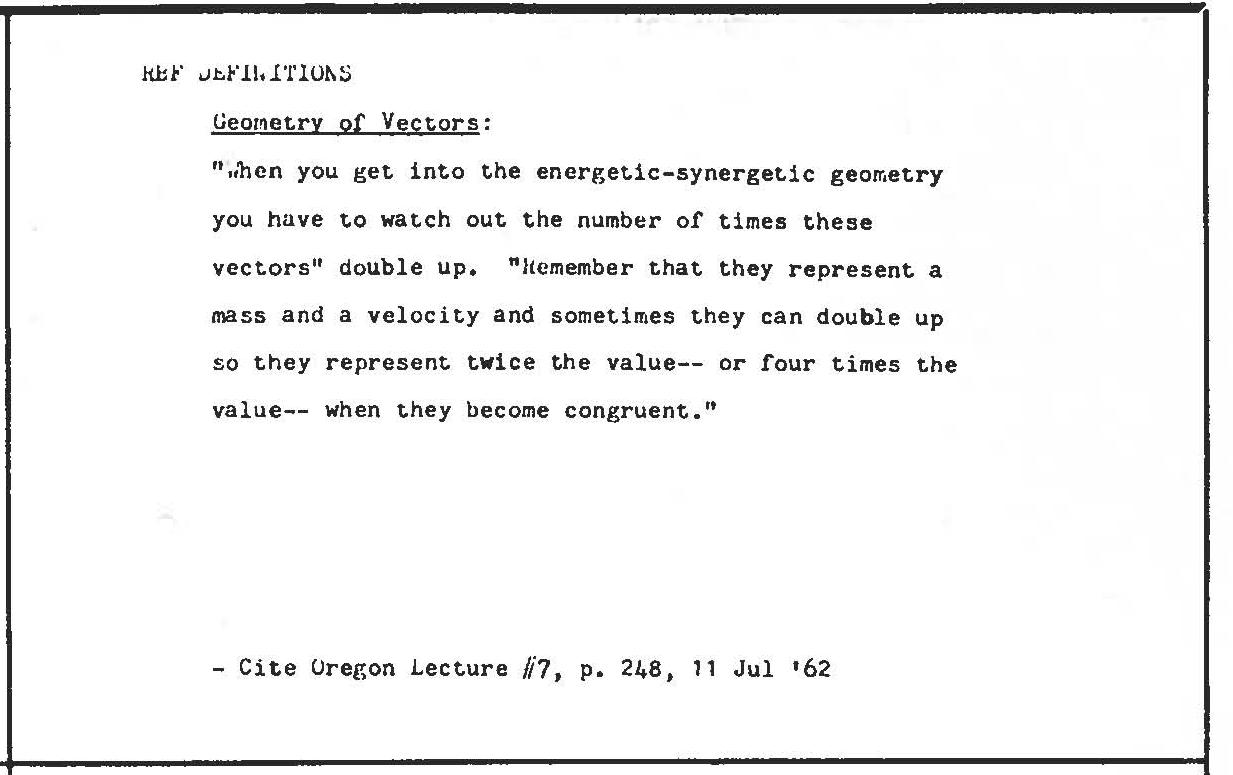
Geometry of Vectors (1)
← Geometry of Vectors | Geometry of Vectors (2) →
Cross Reference
Cross-References
- Avogadro: Generalized Avogadro System
- Chemical Bonds
- Congruence of Vectors
- Force Lines: Omnidirectional Lines of Force
- Self-congruence Packing
- Vectorial Geometry Field
- Vectorial & Vertexial Geometry
- Model of Toothpicks & Semi-dried Peas
Geometry of Vectors (2)
← Geometry of Vectors (1) | Geometry (1) →
Cross Reference
Cross-References
- Accelerations: Angular & Linear, 18 Oct'64*
- Avogadro, 12 Jul'62
- Closest Packing of Spheres Sequence, (1)
- Ninety-two Elements, 9 Apr'40
- Time, 21 Dec'71*
- Vector Equilibrium, 9 Jul'62
- Most Economical, 15 Jun'74*
- Intuition Sequence, (2)
- Time-size, 20 Dec'73
- ahedron as Conservation & Annihilation Model, Oct (4)
- Synergetics, Nov'71
- Topology, 11 Dec'75
Geometry (1)
← Geometry of Vectors (2) | Geometry (1B) →
Cross Reference
Euclidean Geometry
Nuclear Geometrical Limit
Piaget, Jean: Child's Spontaneous Geometry
Primitive Geometrical Conceptuality
Cross-References
- Analytical Geometry
- Celestial Geometry
- Conceptual Geometry
- Cosmetry
- Distaff Geometry
- Greek Geometry
- Hierarchy of Geometrical Transformings
- Minimum Geometrical Fourness
- No Geometry of Space
- Omnigeometric
- Operational Geometry
- Operational Mathematics
- Plane Geometry
- Polygon
- Polyhedra
- Psychological Geometry
- Regular Polyhedra
- Space ≠ Unoccupied Geometry
Geometry (1B)
← Geometry (1) | Geometry (2) →
Cross Reference
Cross-References
- Spherical Triangle Sequences
- Tools of Geometry
- Topology
- Vectorial & Vertexial Geometry
Geometry (2)
← Geometry (1B) | Geometry (3) →
Cross Reference
Up & Down Sequence, (2)*
Cross-References
- Rubber Glove, 23 May'72*
- Synergetics, Oct'71; 17 Nov'72; Jun'66; 15 Nov
- System, 25 May'72
- Space, 1968
- Tetrahedron, 2 Jul'62*
- Thinking, 2 Jul'62*
- Time, 21 Dec'71*
- Conceptuality Independent of Size, 31 Jan'75
- Progressions, May'49
- Structural System, Nov'71
- Universal Vertex Center Model, 29 Apr'43
- Modules: A & B Quanta Modules, 20 Dec'73
Geometry (3)
← Geometry (2) | Geophysical Year →
Cross Reference
Geometry of Space: There Is No
Geometrical Hierarchy
Cross-References
- Geometrical Conceptuality
- Geometrical Integrity
- Geometry of Inwardness & Outwardness
- Geometrical Interrelatability of Events
- Geometry: Plane Geometry
- Geometry of Reality
- Geometry of Thinking
- Geometry of Vectors
- Geometrical Function of Nine
- Geometry & Number
- Geometry of General Systems
Geophysical Year
Cross Reference
Cross-References
- Antientropy, (1)
- Geosocial Revolution, (1)
- Man as a Function of Universe
- Manifest: Six, 1973
- XYZ Coordinate System, 14 Sep'71
Geoscope
← Geophysical Year | Geoscope →
Index Entry
Geoscope:
"The geoscope has the same relationship to the Earth as one of the lifeboats on the davits of the Queen Mary has to the Queen Mary. If the Queen Mary turns the lifeboat does likewise, retaining the same relative position to the keel. If the Queen Mary rolls the lifeboat rolls.
"The 4,000-mile parallax from the center of the Earth to the Geoscope at the Earth's surface is inconsequential.... You can see the Earth revolving faster at the equator."
- Cite RBF at Penn Bell videotaping session, Philadelphia, 29 Jan '75
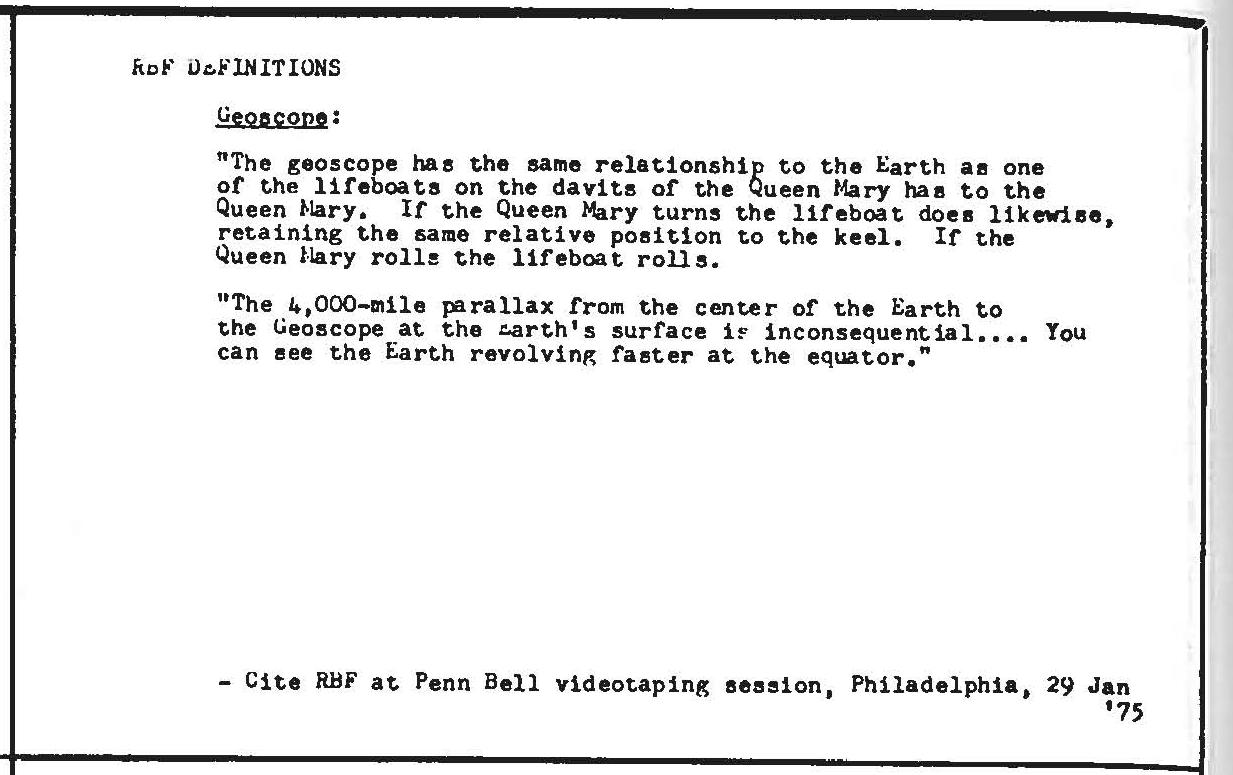
Geoscope
← Geoscope | Geoscope - World Looks at Itself →
Index Entry
Geoscope:
"The biggest problem of humanity right now is how to get all of humanity to learn what it's all about in the shortest possible time."
- Citation & context at World Game, 15 Jun'74
Geoscope - World Looks at Itself
Cross Reference
Cross-References
- Geoscope, 15 Jun'74
Geoscope
← Geoscope - World Looks at Itself | Geoscope →
Index Entry
Education Automation, p.45
Geoscope
← Geoscope | Geosocial Revolution (1) (2) →
Cross Reference
Tool of Reorientation
Cross-References
- Earth Globe Models
- Miniature Earth
- Minni-Earth
- Geoview
- Seeing the Whole World at Once
- World Looks at Itself
Geosocial Revolution (1) (2)
← Geoscope | Geosocial Revolution (2) →
Index Entry
Geosocial Revolution:
"A half century of subconsciously developing world revolution is now crossing the threshold into human consciousness and ultimate popular support. The heretofore subconscious world revolution may well become the conscious focus of effort of the International Cooperation Year.
"The IGY-1965 itself has been indirectly occasioned by the subconsciously occurring techno-scientific revolution and its myriad of separate world- around transformations of human ecology.
"The unheralded human ecology transformations have developed only as inadvertent, unanticipated interactions of individually undertaken uncoordinated inventions.
"The independent physical environment reforming inventions have integrated, figuratively speaking, as streamliningly divided, double-decked, banked, and cloverleafed lifeways of human behaviors. These lifeways permit ever increasing numbers of humans to survive logically and sense-satisfyingly without mutually frustrating interferences.
(2)
- Cite GEOSOCIAL REVOLUTION: SYNOPSIS, /DSD, Doc /3, p.79, 1965
Geosocial Revolution (2)
← Geosocial Revolution (1) (2) | Geosocial Revolution (3) (2) →
Index Entry
Geosocial Revolution:
"There are two main classes of inventions: those which increase and those which decrease the degrees of freedoms. Because men are born immobilized there are few invention opportunities for his immobilization. These are prisons, traps, straightjackets, handcuffs, and caskets. On the other hand there are an infinity of opportunities to invent man's increased mobilization-- all the way up to the speed of light, 186,000 mps., and in all directions. Means-of-increased-freedom inventing is irreversible.
"Inventions occur when individuals, frustrated by circumstance, eschew negative blaming and undertake positive physical environment reforms rather than abstract human reforms. The latter depend precariously only upon moral, ethical, and legal codes which are enforceable only by negative penalties.
"The silent preoccupations of the artist-scientist, whose inventions subsequently permit mankind to realize his innate potentials without interference with others are in marked contrast to political behaviorisms. Political theories apparently assume that there is no alternative to the word,"
Geosocial Revolution (3) (2)
← Geosocial Revolution (2) | Geothermal Power →
Index Entry
Geosocial Revolution:
"fist, and bullet battles between opposing ideologies. Each ideology seeks to reform man. They scheme and labor to impose their respective viewpoints by omni-interfering political, moral, psychological persuasions, furtive corruptions, bullyings, or punishments.
"Both professional and amateur spokesmen for society apparently assume that the political battles will persist until man annihilates himself. The only considered alternative, happy or unhappy according to the individual's viewpoint, is that one bias or another will gain sufficient advantage to be able to dictate the terms of mankind's reprieve from total extinction. We don't agree. We think there is a third eventuality wherein the political chaos will fade out in ways entirely unpremeditated by political man as the invention order looms in. Geosocial revolution explores the possibility that the non-political surprise has already occurred and will soon be increasingly visible to all."
(2)
- Cite GEOSOCIAL REVOLUTION: SYNOPSIS, WDSD Doc. #3, p.79, 1965
Geothermal Power
← Geosocial Revolution (3) (2) | Geoview (1) →
Cross Reference
Geothermal Power:
Cross-References
Geoview (1)
← Geothermal Power | Geoview (2) →
Cross Reference
Cross-References
Geoview (2)
Cross Reference
Cross-References
- Search vs. Research, 14 Feb'72
Gestalt
RBF Definitions
"What matters, with regard to both scientific method and social usefulness, is the total physico-economic apicture, the Gestalt of nature-- the patterns that are inherently comprehensive and universal, in contradistinction to what is local. Specific parts of a pattern, the local designs, can be derived from the general design, the comprehensive scheme. The reverse, however, is not true; in nature, society, and industrial complexes, wholes express more than the simple effect resulting from the sum of their respective parts."
Citations
- Marks DYMAXION WORLD OF RBF, p.8, 1960
Gestalt
Cross Reference
Cross-References
- Synergy, Oct'69
Gestation
Index Entry
Gestation
"The Special Theory is the umbilical cord, the conceptional and locally dependent gestational phase."
- Citation and context at Einstein: General Theory and Special Theory, 4 Mar'73
Gestation
Index Entry
Gestation:
"The metaphysical integrities manifest throughout the everywhere intertransforming Universe's omni-interaccommodative cosmic system apparently are from time to time emulated in meager degree by the intellect of the human passengers who are gestating within the spherical womb sheath of planet Earth's watery, gaseous, and electromagnetic biosphere."
- Cite RBF Introduction to Gene Youngblood's EXPANDED CINEMA, p.23. Mar'66
Gestation Lag
Index Entry
Gestation Lag:
"We know there is a great variety in the time spans of gestation lags between the moment of egg fertilization and the birth of the independently conceived babies of the different zoological species. But almost no variation occurs within any one species' gestation rate-- for instance, human babies take nine months. In the same way there is a great range of time lags between invention and industrial production among the different technical arts, but almost no difference within a given art "
- Cite ARCHITECTURE AS ULTRA INVISIBLE REALITY, p. 154, Dec. '69
Gestation Lag
← Gestation Lag | Gestational Phase →
Cross Reference
mobil Moca Sequence, (2)
Cross-References
- Now, 14 Feb'72
Gestational Phase
← Gestation Lag | Gestation Rate →
Cross Reference
Cross-References
- Gestation, 4 Mar'73
Gestation Rate
← Gestational Phase | Gestating Seed →
RBF Definitions
"Nature has her own gestation rates. The biggest--most important--events take the longest."
- Citation & context at Black Holes & Synergetica, 1 Mar'77
Gestating Seed
← Gestation Rate | Gestation (1) →
Cross Reference
Cross-References
- Duality of Universe, May'49
Gestation (1)
← Gestating Seed | Gestation (2) →
Cross Reference
Pregnant Mother
Cross-References
Gestation (2)
← Gestation (1) | Gestured Communication →
Cross Reference
Cross-References
- Automation of Metabolic & Regenerative Processes, May'65
- Einstein: General Theory & Special Theory, 4 Mar'73*
- Industrialization: Curve Of, (1)
- Now, 14 Feb'72
- Promote: I Don't Promote, 2 Jun'74
- Race, (4)
- Subconscious Coordinate Functioning, May'65
- Time, 23 May'72
- Unique Frequencies, 18 Aug'70
- Evolutionary Checks & Balances, Aug'75
- Black Holes & Synergetics
- Womb of Permitted Ignorance, (2)
Gestured Communication
← Gestation (2) | Ghana Dome: Self-chilling Machine (1) →
Cross Reference
Cross-References
- Communications Hierarchy, (1)(2)
Ghana Dome: Self-chilling Machine (1)
← Gestured Communication | Ghana Dome: Self-chilling Machine (2) →
Index Entry
Q. "What effect will the materials employed in your domes have on the underdeveloped countries?"
RBF: "The underdeveloped countries are like 150 admirals on one spaceship. I don't think in terms of underdeveloped countries. The people aren't going to stay in those countries any more than Americans stay in the same town.
"My feeling about the African students is that they are much keener than others in their mathematics. We learned this at Kumasi. We should have expected that their great feeling for rhythm should have made them good in mathematics.... Last month in my meeting at the State Department they said that Africans couldn't use tools. I asked them what do they at the State Department know about tools?
"Those countries have high capabilities and have been developed for a very long time... but I understand what you are asking. Taking the bauxite from Ghana is economic colonialism. In the 1970s the Ghanaians made the most beautiful dome ever built right in Accra--better than the one in Kumasi. They made this"
Ghana Dome: Self-chilling Machine (2)
← Ghana Dome: Self-chilling Machine (1) | Ghostly Greek Geometry: Sphere →
Index Entry
beautiful geodesic dome as a self-chilling machine. The dome generates a thermal column pulling the air from around the large openings at the bottom and down through a small hole in the roof. He found this phenomenon first in the Butler Grain Bins; out in the Sun they could be too hot to touch on the surface yet very cool on the inside.
"Of course, the exploitation will go on... but the Ghanaians are very rapidly becoming Worldians."
Ghostly Greek Geometry: Sphere
← Ghana Dome: Self-chilling Machine (2) | Ghostly Greek Geometry: Sphere (1) →
Index Entry
Ghostly Greek Geometry: Sphere:
"The Greek sphere is wrong because it is a net too small for the molecules of gas to get out."
- Cite RBF to EJA, 3200 Idaho, Wash DC, 1 Oct.'71.
Ghostly Greek Geometry: Sphere (1)
← Ghostly Greek Geometry: Sphere | Ghostly Greek Geometry: Sphere (2) →
Index Entry
The definition of a sphere by the Greeks was 'a surface equidistant in all directions from a point.' Now if you have a surface equidistant in all directions from a point it couldn't have a hole in it. If it had a hole in it the distance would not be equidistant because the surface would start to turn inwardly and the radius would not be the same. To say then that you have a surface equidistant in all directions from a point is considered some kind of a solid surface. A sphere then would be a subdivision of universe in which part of the universe would be inside and part outside and no communication between the two because there are no holes in it. In other words, the Greek definition of a sphere was the definition of the first perpetual motion machine or local system that was adequate in itself. It didn't need any of the rest of the universe. All experiments in physics has shown energy losses in systems and energy intakes and so there would have to be some holes in the system for them to pass through. Therefore we discover we have to give up the concept of the sphere as defined by the Greeks and all we can say is that
Ghostly Greek Geometry: Sphere (2)
← Ghostly Greek Geometry: Sphere (1) | Ghostly Greek Geometry →
Index Entry
Ghostly Greek Geometry: Sphere:
"what we mean by a sphere is an aggregate of events approximately equidistant in all directions from one event. They may be of very relative high frequency, of such a high frequency that you can't resolve it and it looks continuous to your eye, and that you call a sphere... That is the way we found we were fooled by the pneumatic bags. They were full of holes too."
- Cite Oregon Lecture #6, pp. 204-5, 10 Jul'62
Ghostly Greek Geometry
← Ghostly Greek Geometry: Sphere (2) | Ghost →
Cross Reference
Cross-References
- Bias on One Side of the Line, (1)
- Calculus, (1)
- Geodesic Line, 9 Sep'74
- Synergetics, 1 Apr'49
- Tools of Geometry, (1)(2)
- Nucleus vs. Boundaries, 28 Jan'75
- Subvisible Discontinuity, 19 Oct'72
Ghost
← Ghostly Greek Geometry | Gibbs: Phase Rule →
Cross Reference
Cross-References

Gibbs: Phase Rule
Index Entry
Gibbs: Phase Rule:
"Willard Gibbs in evolving his phase rule was engaged in probability relating to chemistry when he inadvertently and intuitively conceived of his phase rule for explaining the number of energetic freedoms necessary to introduce into a system complexedly constituted of crystals, liquids, and gases, in order to unlock them into a common state of liquidity. His discovered phase rule and topology are the same: they are both synergetic."
- Citation and context at Probability Model of Three Cars on a Highway (2), 26 Sep'73
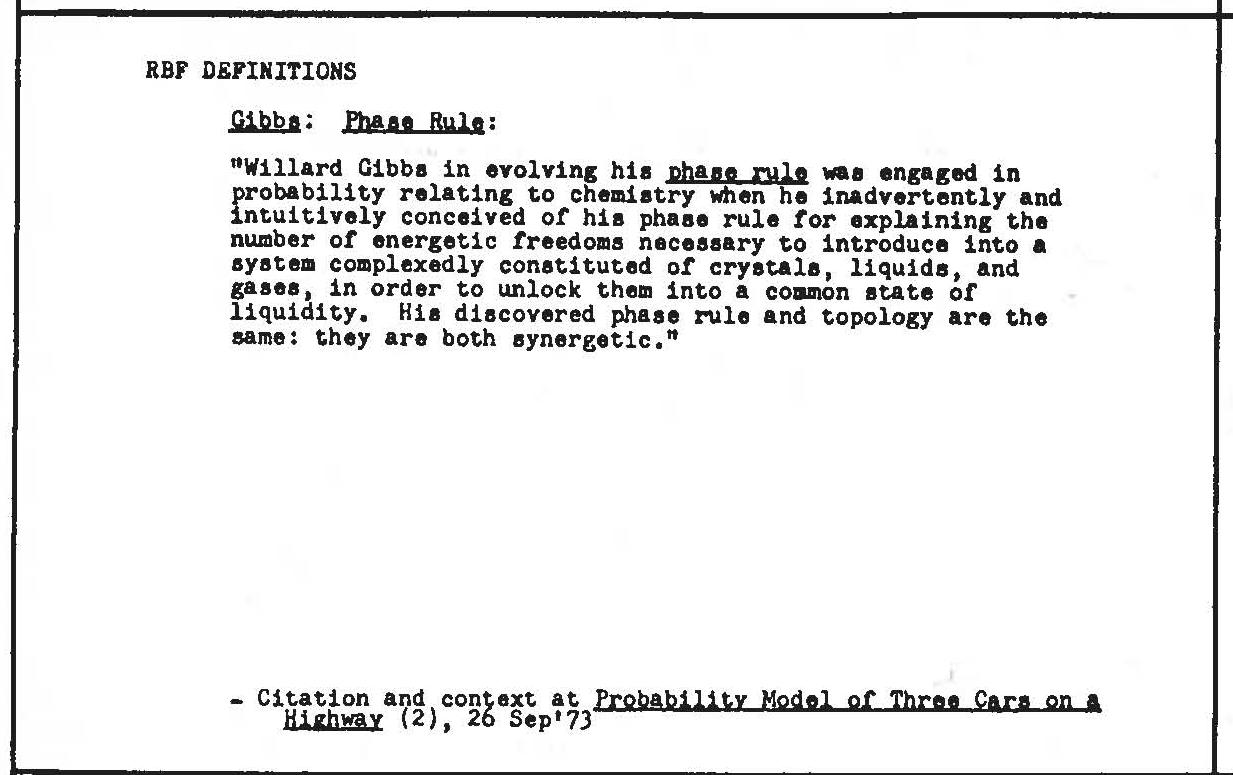
Gibbs' Phase rule
← Gibbs: Phase Rule | Gibbs: Phase Rule →
Index Entry
Gibbs' Phase rule:
"Gibbs, in his phase rule, ties up the probability with chemistry. His phase rule and topology are the same. But still all the different chemistries and topologies seem to be random. But synergetics, by relating energy and topology to the tetrahedron, and to systems as defined, and by its synergetic hierarchy, replaces randomness with a rational hierarchy."
-
Cite RBF to EJA, 3206 Idaho, BC, 17 Feb'72
-
Citation & context at Probability, 17 Feb'72
Gibbs: Phase Rule
← Gibbs' Phase rule | Gibbs, Josiah Willard (1) →
RBF Definitions
"Willard Gibbs' phase rule in a formula similar to Euler's in which the degrees of freedom are in effect the vectorial edges brought synergetic advantages to chemical strategy."
Citations
- OMNIDIRECTIONAL HALO, pp. 160-161, 1960
Gibbs, Josiah Willard (1)
← Gibbs: Phase Rule | Gibbs' Phase Rule (2) →
Cross Reference
Liquid-crystal-vapor-incandescent phases
Cross-References
Gibbs' Phase Rule (2)
← Gibbs, Josiah Willard (1) | Gibraltar Rock Of →
Cross Reference
Whole System: Principle Of, (1)
Cross-References
- Chemical Bonds, 6 Mar'73
- Probability, 17 Feb'72*
- Probability Model of Three Cars on a Highway, 26 Sep'73*
- Synergetic Accounting Advantages: Hierarchy Of, (2)
- Synergetic Hierarchy, (1)
- Thermal, 6 Mar'73
- Time, 6 Mar'73; Aug'71
- Twelve Universal Degrees of Freedom, 6 Mar'73
- Topology, 11 Dec'75
- Degrees of Freedom & Bonding, 24 Jan'76
- Modules: A & B Quanta Modules, 20 Dec'73
Gibraltar Rock Of
← Gibbs' Phase Rule (2) | Gin Pole (1) →
Cross Reference
Cross-References
- Culture, 27 Jan'77
Gin Pole (1)
← Gibraltar Rock Of | Gin Pole (2) →
Cross Reference
Cross-References
Gin Pole (2)
Cross Reference
Cross-References
- Twelve Universal Degrees of Freedom, 10 Jul'62
Girl
Index Entry
Girl:
"There is something of the harvester about girls: what I call the gains consolidator. Girls fall in love with me. Nothing shakes them! They fall in love with integrity. It's nothing to do with me at all, but what seems to be integrity of thought."
- Cite RBF to EJA, re Mala, nee Thaper of New Delhi; at 3200 Idaho, Wash, DC, 13 Dec'73
Girl
Cross Reference
Cross-References

Girth
Cross Reference
Cross-References
Give
Cross Reference
Give: Giving:
Cross-References

Glands
← Give | Glimpse-discover Glimpsing (1) →
Cross Reference
Cross-References
Glimpse-discover Glimpsing (1)
← Glands | Glimpse-discovery Glimpsing (2) →
Cross Reference
Cross-References
Glimpse-discovery Glimpsing (2)
← Glimpse-discover Glimpsing (1) | Glimpsor →
Cross Reference
Truth, Jan'72
Cross-References
- Invention Sequence, Jan'72
Glimpsor
← Glimpse-discovery Glimpsing (2) | Global Political Revolution →
Cross Reference
Glimpsor:
Cross-References
Global Political Revolution
← Glimpsor | Global Village (1) →
Cross Reference
Cross-References
Global Village (1)
← Global Political Revolution | Global Village (2) →
Cross Reference
Cross-References
- Earth Shrunk to One-town World
- One-town World
- Geoview
Global Village (2)
← Global Village (1) | Globe →
Cross Reference
Cross-References
- McLuhanshall, Mar (1)

Globe
← Global Village (2) | Globe →
RBF Definitions
"You think you can only read half of a globe, but you'll find that you can only see one-quarter of it at any one time."
Citations
- RBF to Henry Liberman, NY Times, 22 Jun'72

Globe
Cross Reference
Cross-References
Glory (2)
Cross Reference
Cross-References
- Greater Intellect, (2)
Gloves
RBF Definitions
"Gloves are a complex of tetrahedra."
Citations
- RBF holograph, Somerset Club, Boston, 22 April 1971.
Gnomonic
Cross Reference
Cross-References
Go In To Go Out
Cross Reference
Cross-References
Go No-go (1)
← Go In To Go Out | Go: No-go (2) →
Cross Reference
Cross-References
Go: No-go (2)
Cross Reference
Cross-References
- Degrees of Freedom, 13 Dec'73
- Omnidirectional Typewriter, (3)
- Causality, Jan'77
- Will, (1)
God
Index Entry
God:
"The only-intellectually-discoverable, comprehensive integrity of omni-everywhere-and-everywhen, complexly intertransforming Universe is omnigoverned by the mathematically-incisive, generalized principles. It is to that comprehensive intellectual integrity and wisdom to which I refer when using the abstract word 'God.' God designs us and our Scenario Universe.
"The self-discipline involves commitment only to God: all humanity and all the experimentally-demonstrable, mathematically generalized principles thus far discovered by humans and all the special case truths as we progressively discover them."
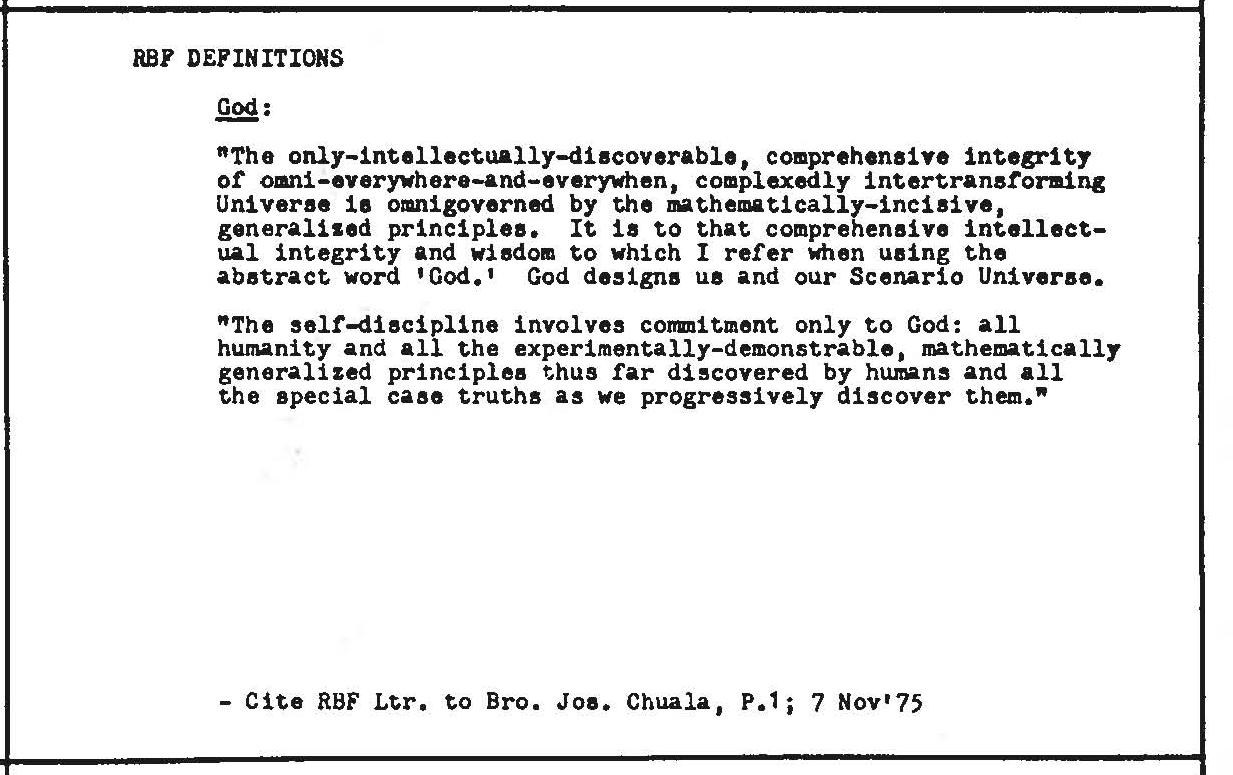
God
Index Entry
God:
"God is the synergetic integral of all truths... but these are just words, utterly inadequate. You can only talk to god on behalf of everybody.
"I have had experiences that make me feel that god knows what I am doing."
- Citation & context at Truth, 31 Jan'75
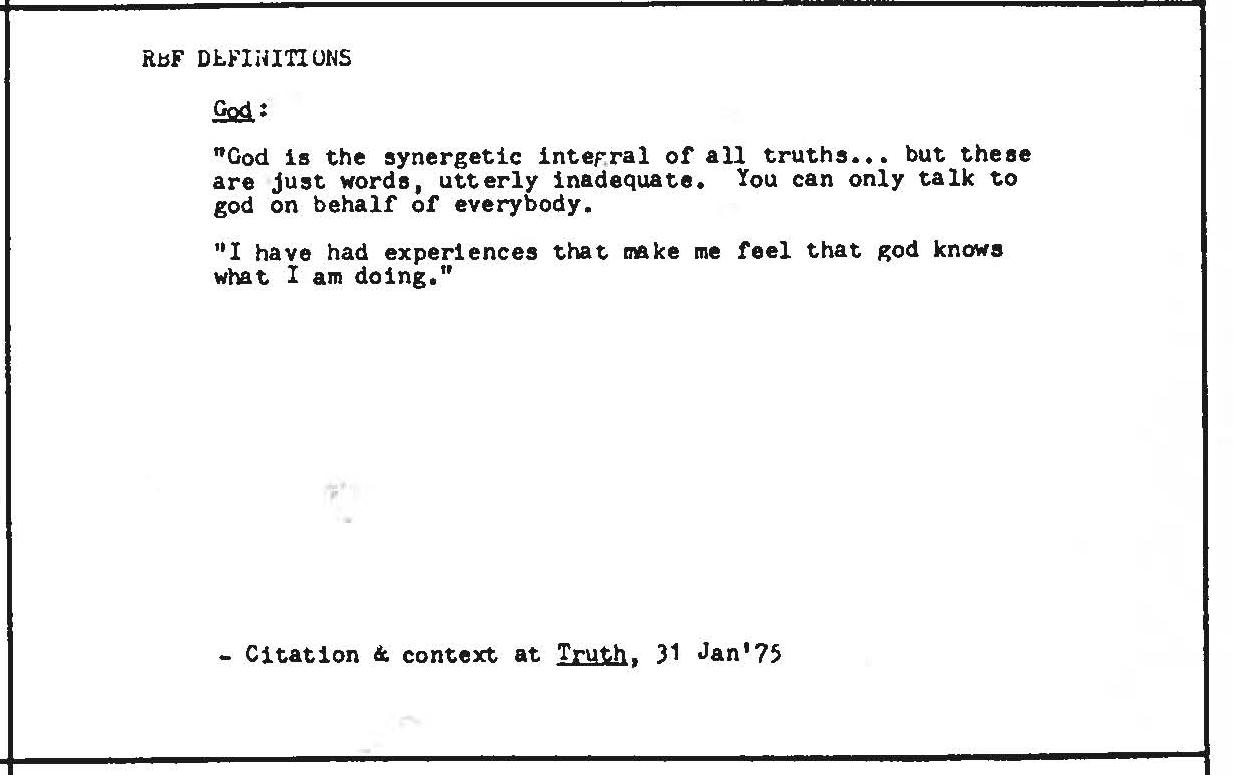
God
Index Entry
God:
"God is the unknowable totality of generalized principles which are only surprisingly unveiled, thereby synergetically inaugurating entirely new, heretofore unpredicted-- because unpredictable-- ages."
- Cite RBF rewrite of SYNERGETICS galley xix ("Moral of the Work") telephoned to EJA from Philadelphia, 3 Apr'74
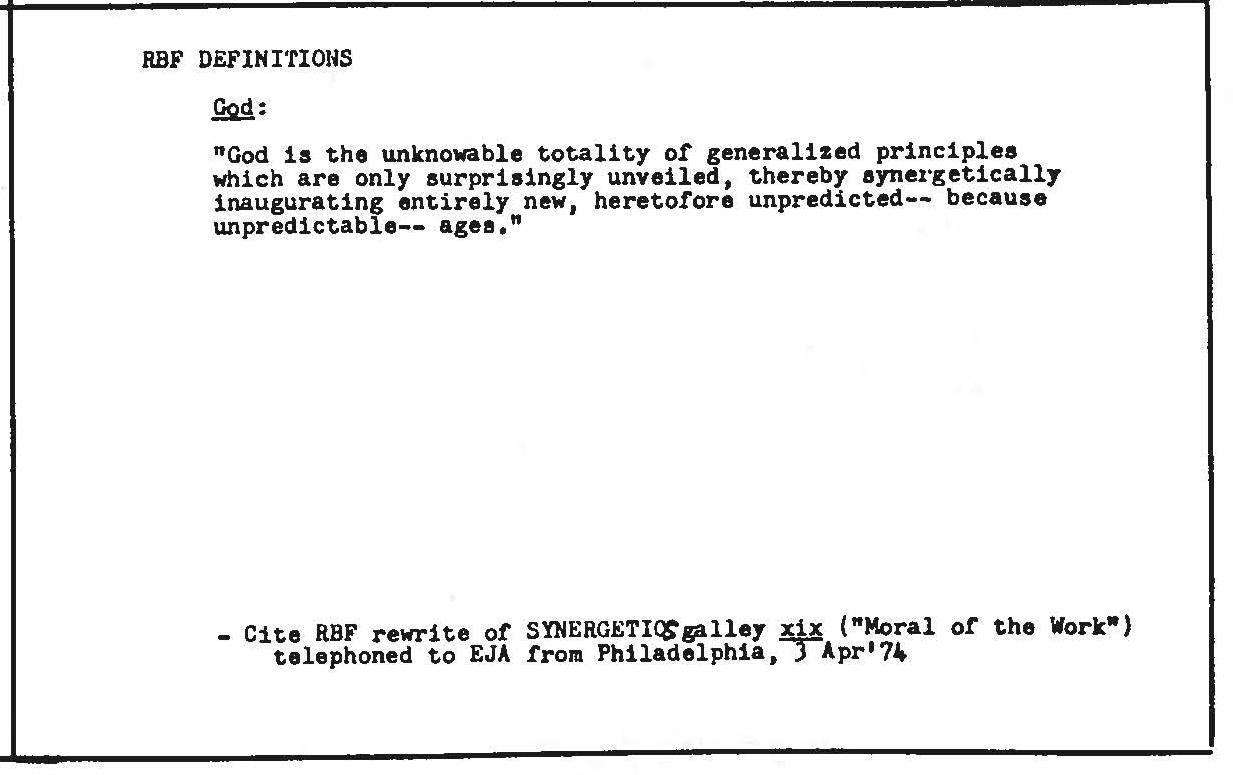
God
Index Entry
God:
"And I started off as a thinker. I didn't start with bathrooms. I started off with God and my charge was to work with the physical.. That's where I had the capability; that's why we're here..."
- Citation and context at Fuller, R.B.: RBF Modus Operandi, Feb'73

God
Index Entry
Little man on little Planet Earth evoking words to describe his experiences, intuiting ever and anon the greater integrity, struggles to form a word to manifest his awareness of the greater integrity. His lips can express, his throat and lungs can produce, in the limited atmosphere of Planet Earth, he may make a sound like g o d . . . which is obviously inadequate to identify his inherent atunement to eternal complex integrity. The little humans on little Earth, overwhelmed these millions of years with the power of the bigger over the lesser (muscles) have spontaneously identified the cosmic integrity with the local terrestrial experience. The conditioned reflex feedbacks have introduced enormous confusion of approximate indentification, fusing the local physical muscular authority with the eternal complex integrity, whose absolute generalizability can never be locked into or described as a special case.
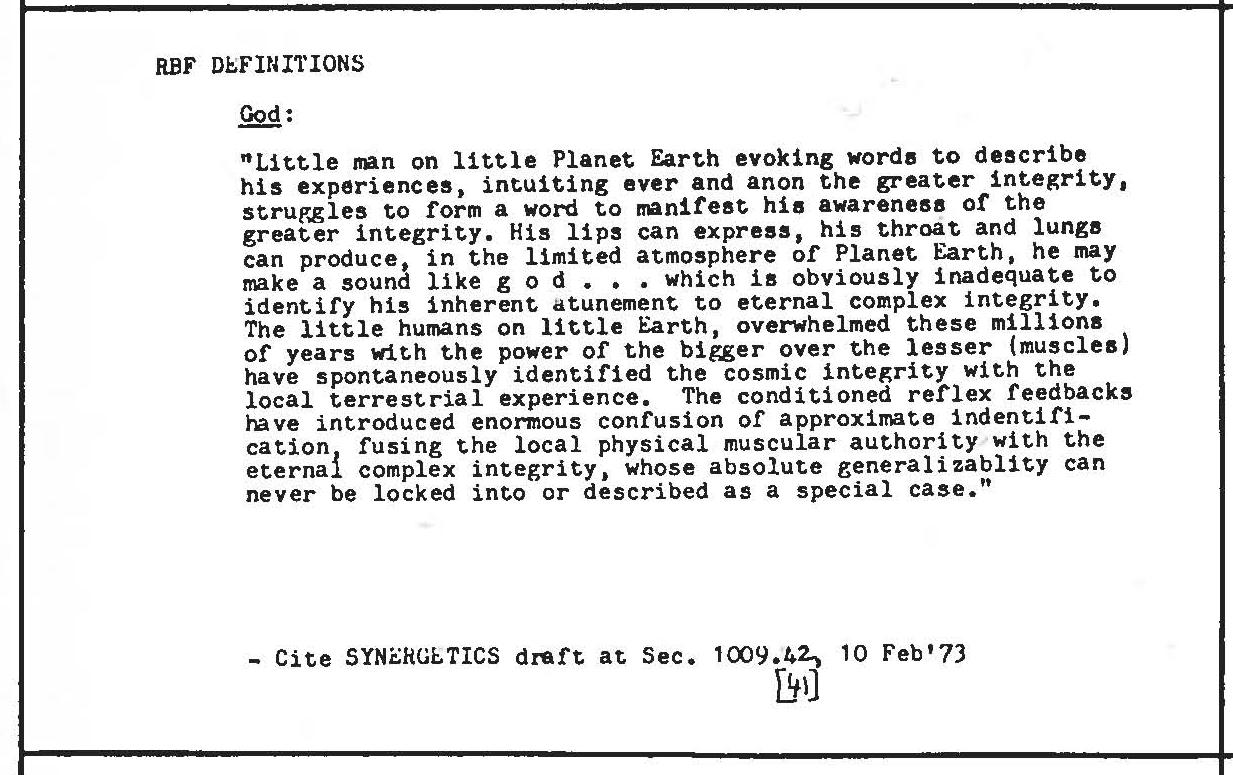
God
Index Entry
God:
"It is inherently potential in the integrity of eternal regeneration and the inherent complexity of unity that only god can invent a new generalized principle, and he apparently does so, from time to time, thus synergetically creating entirely new and heretofore unpredicted-- because unpredictable-- ages."
(Above is superseded by RBF amendment cited as God, 3 Apr'74)
- Cite SYNERGETICS Front Paper, 26 May'72
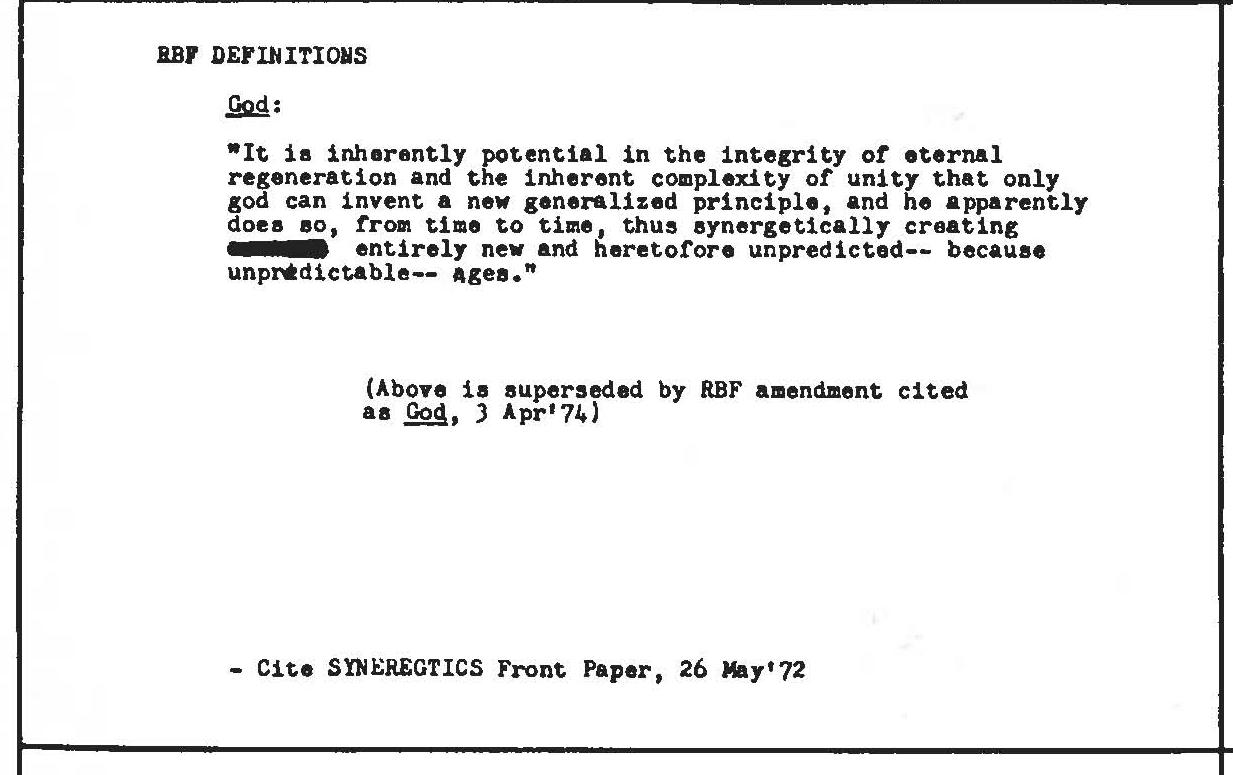
God
Index Entry
God:
"... The eternally exact
Utter perfection,
Complete understanding
Absolute wisdom,
Unattainable by humans
But affirming God
Omnipermeative,
Omniregenerative,
All incorruptible
As infinitely inclusive
Exquisite love."

God
Index Entry
God:
"Thus also humanity is permitted
By the omni-intellectual,
Weightless, amorphous,
Metaphysical integrity of Universe--
Which we intuitively designate
By the sound word 'god'
To participate in meager degree
Locally and temporarily--
In god's own vast
Evolutionary designing capabilities."
- Cite INTUITION, pp.53-54 May '72
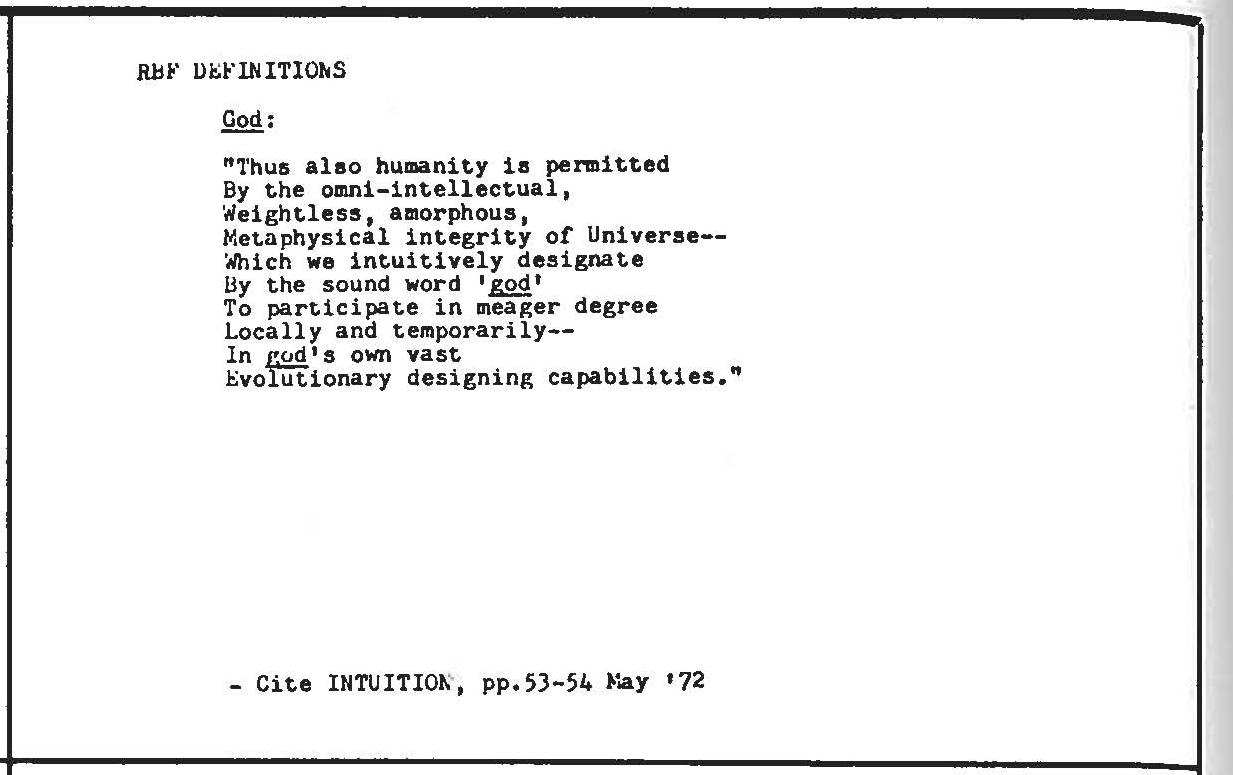
God
Cross Reference
God:
"God makes no mistakes."
(A common observation by RBF)
Cross-References
- Mistake, 19 Dec'71
God
Index Entry
God:
"Pulsation, the vector equilibrium is the nearest thing we will ever know to eternity and God: the zerophase of conceptual integrity inherent in the positive and negative asymmetries which propagate the problems of the consciousnes. . ."
-
Citation & context at Experience, 12 Sep'71
-
Incorporated in SYNERGETICS draft at Sec. \hrefhttps://www.buckyverse.org/en/synergetics/content/chapters/400-system#section-440.00440.00, Nov'71
-
Cite RBF to EJA, Beverly Hotel, New York, 12 Sept. 1971.
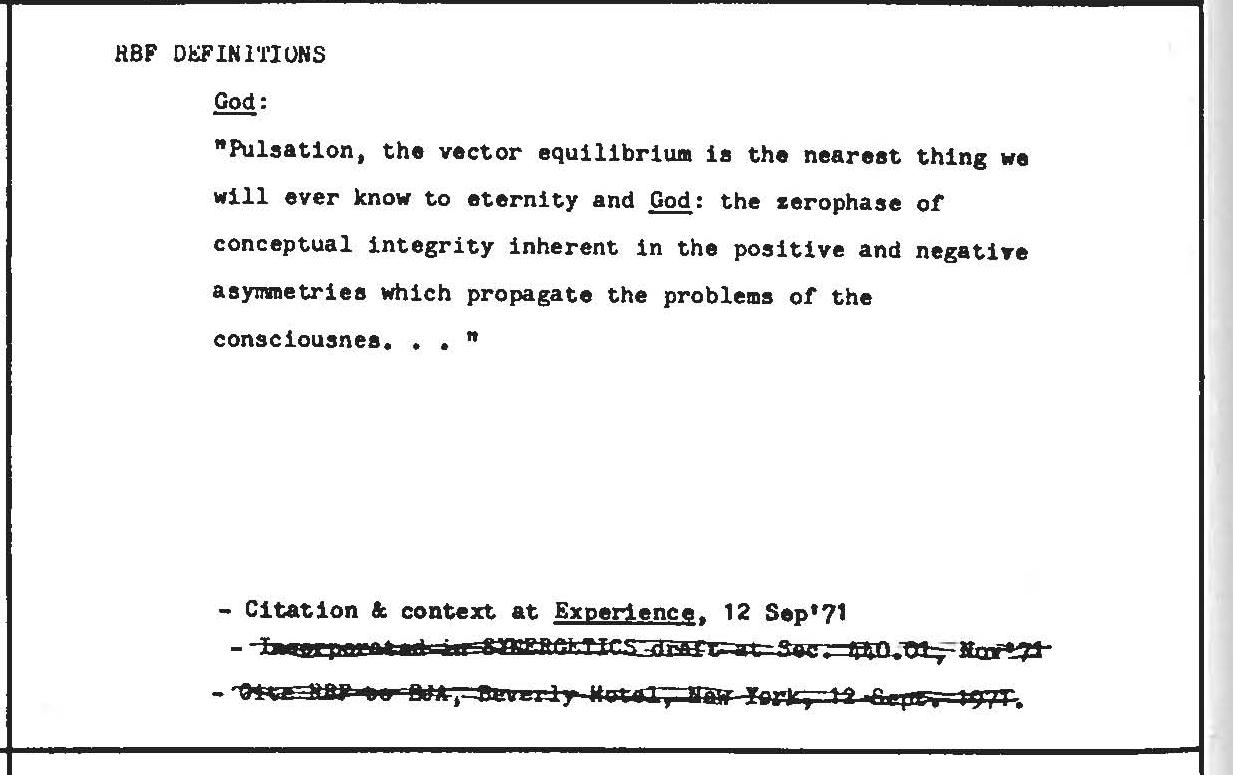
God
Index Entry
God:
"May the great a priori intellectual integrity of eternally regenerative Universe grant glorious flight to the chicks."
- Cite A Definition of Evolution, p. 5. 15 Sep'71
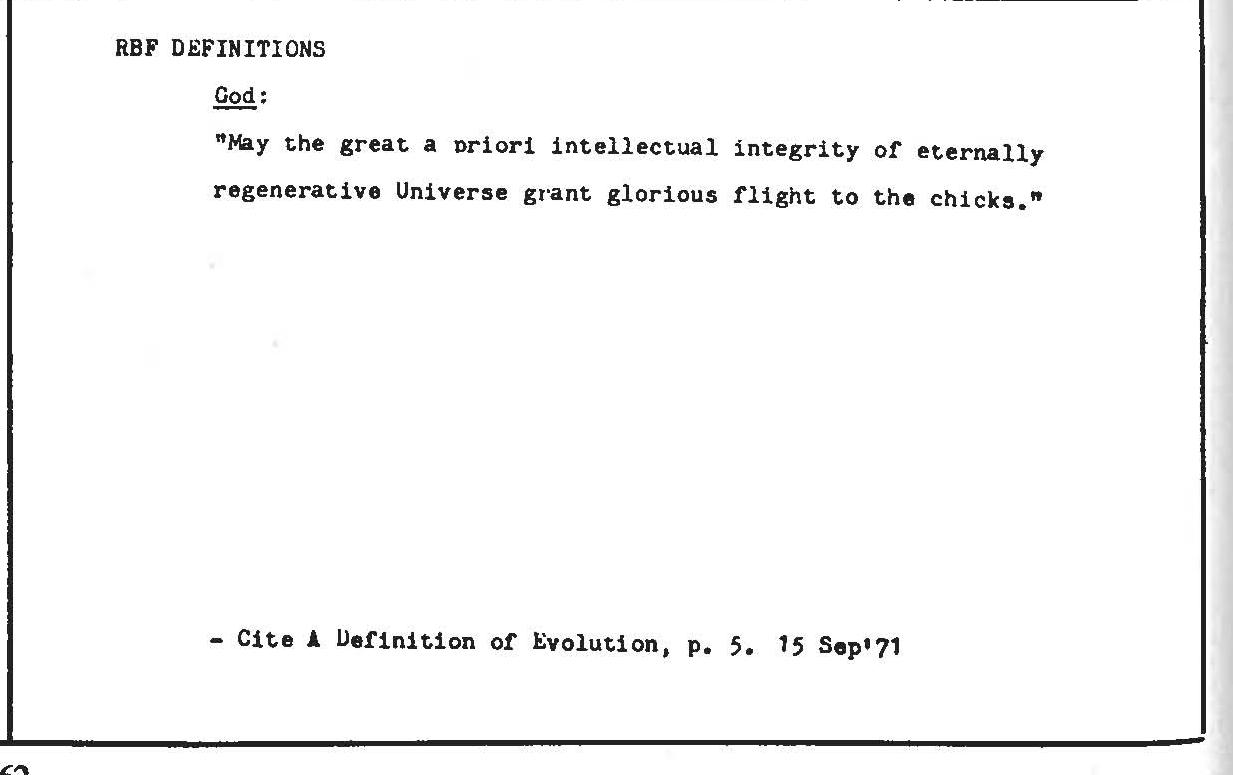
God
Index Entry
God:
"God makes no mistakes. Never fear god."
- Cite RBF to EJA, Beverly Hotel, New York 15 Sept. 1971.
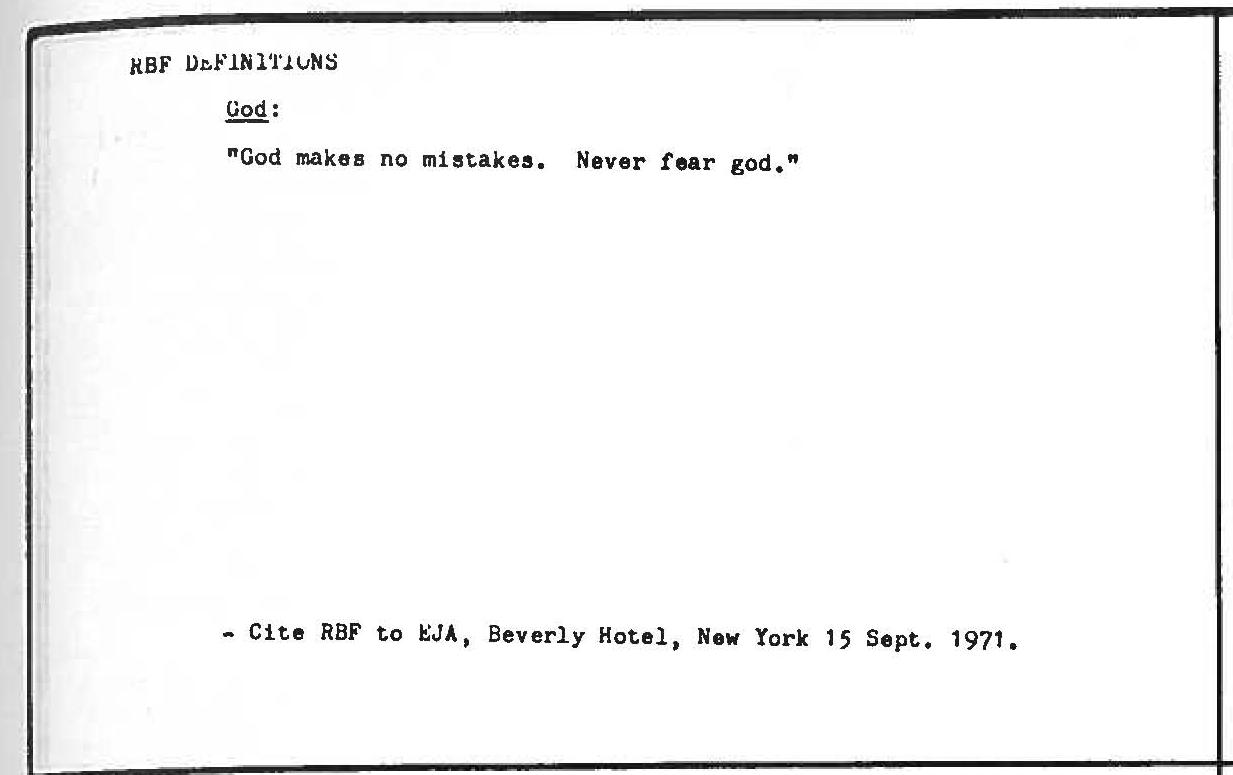
God
Index Entry
God:
"I don't use a capital G for god because that just seems to stand for the old anthropomorphic idea."
- Cite RBF to EJA, Blackstone Hotel, Chicago, 31 May 1971.
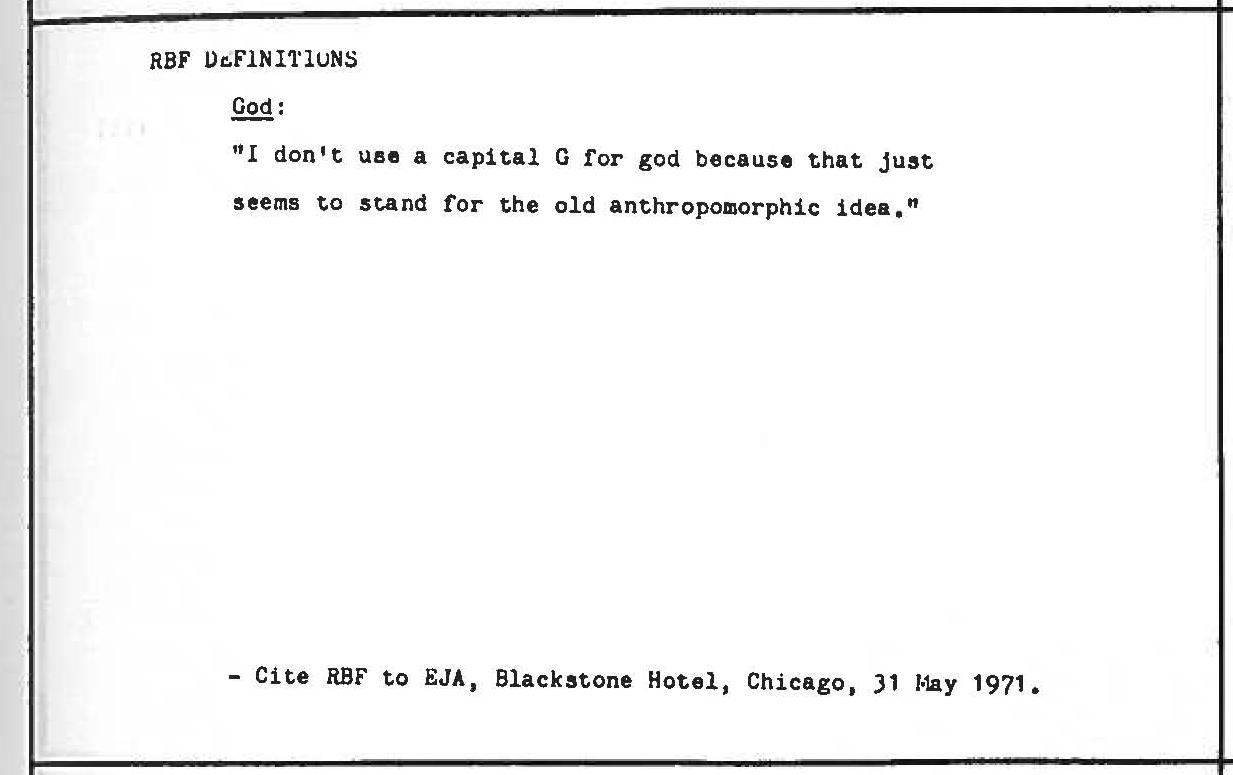
God
Index Entry
God:
"God . . . the most comprehensive generalization of the invisible finite reality."
- Cite ARTS & LETTERS GOLD MEDAL, p. 10 May'68
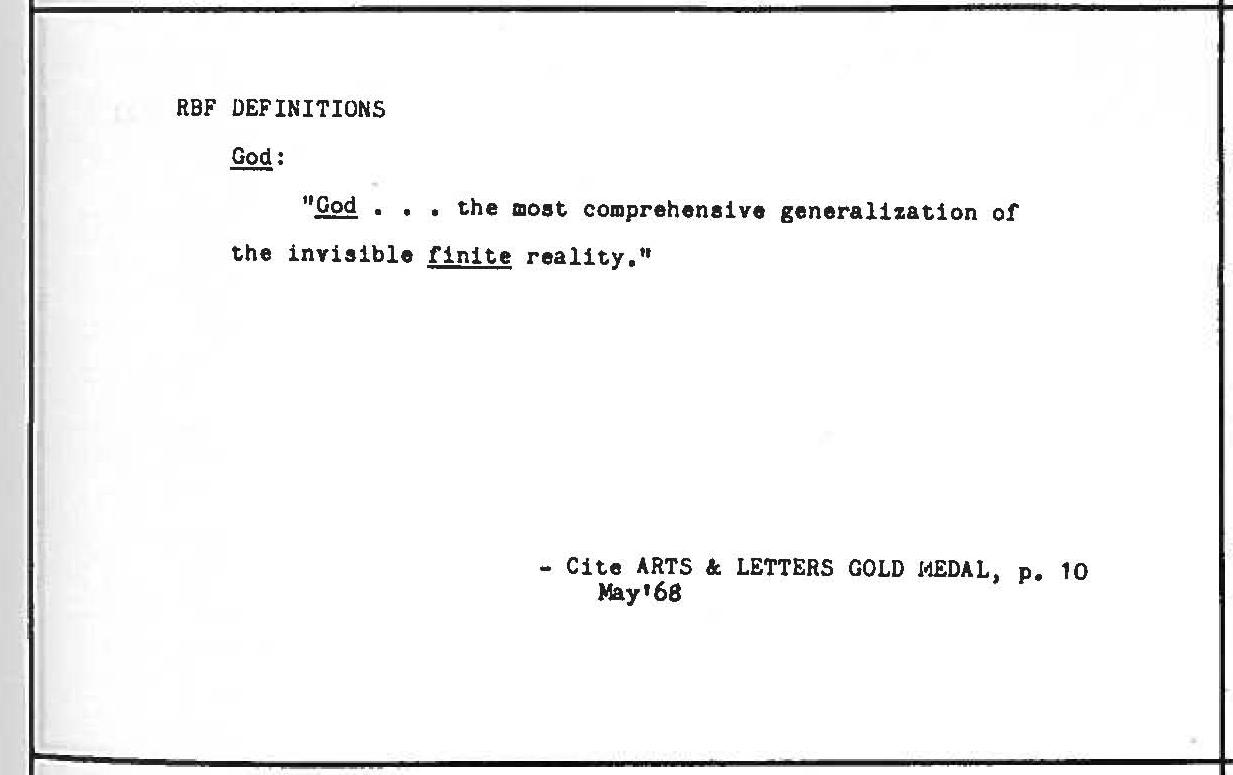
God
Index Entry
God:
"It takes two to make a baby
But it takes God to make two.
"God is twoing
God is threeing
God is multiplying
By dividing
-
- *"
- Cite HOW LITTLE I KNOW, Oct. '66, P. 56.
God
Index Entry
God:
"I think of God not as a superman but as the great comprehensive a_priori integrity of the universe within which man finds himself to be operative."
- Cite MERGERS & ACQUISITIONS, Vol. 1. No. 3., p.42 Spring 1966
God
Index Entry
God:
"God is entropy
And god is also antientropy,
God is synergy
God is energy.
And god is always
A verb--
The verbing of
Integrity."
- Cite HOW LITTLE I KNOW, p. temp 57. Oct'66
God
Index Entry
God:
"I conceive of God as a verb, not a noun. Intellect manifest in man is to some extent God. God is part of the thinking process of every man.
"I have to recognize something much bigger than my capabilities in creativity. The orderliness of the Universe and all the potential N² - N relationships are by experience a priori to man's exploration and discovery of them. Often two remote persons discover their existence independently.
"...But I do not want to inaugurate another religion and persuade people to believe in a set of rules. I am convinced that the Almighty does not need anybody to promote God. God to me is the total abstract intellectual capability and conscience."
- Cite RBF at AAUW Panel, AAUW Journal, Pp.172-173, May'65
God as Mind (1)
Cross Reference
Cross-References
God as Mind (2)
← God as Mind (1) | God As Verb of Optimum Understanding (1) →
Cross Reference
Cross-References
- Individual Universes, (2)
- Timeless, 1 Apr'72
- Transcendental, 2 Jun'71
God As Verb of Optimum Understanding (1)
← God as Mind (2) | God As Verb of Optimum Understanding (2) →
Index Entry
God As Verb of Optimum Understanding:
"It seems possible to me
That God may be recognizable
In man's limited intellectlon
Only as the weightless passion drive
Which inspires our progressive searching
For the-- momentarily only--
And only most-truthful-thus-far-possible--
Comprehension of all the interconnections
Of all experiences.
It seems then to me
That the nearer we come to understanding,
The nearer we come to the
Orderly omni-interrelationships
Of all the weightless complex
Of all generalized principles
Which seem to be disclosed to us
As so important
As to be tentatively identified as God,
For it is the integratable interrelationships
Of all the generalized laws
Which apparently govern
The great verb 'Universe'
Or the vastly greater
-- Because comprehensively anticipatory--
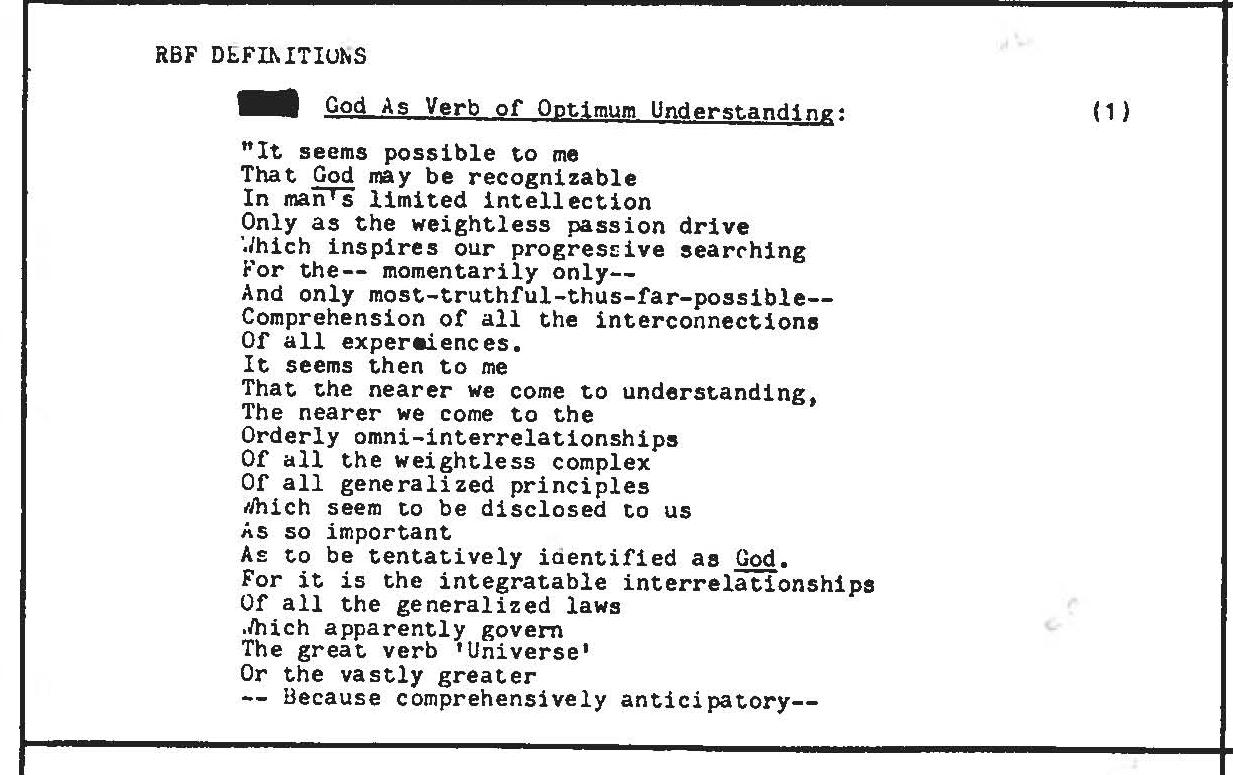
God As Verb of Optimum Understanding (2)
← God As Verb of Optimum Understanding (1) | God as Verb →
Index Entry
God As Verb of Optimum Understanding:
"Verb intellecting
Which verb of optimum understanding
may be 'God.'"
God as Verb
← God As Verb of Optimum Understanding (2) | God (1) →
Cross Reference
Cross-References
- God, May'65
- Objective Intellect, Jun'69
God (1)
Cross Reference
Intellection that is Infinitely Perfect
Cross-References
- Absolute Integrity
- Absolute Wisdom
- Almighty
- A Priori Great Design
- Comprehensive Integrity
- Cosmic Intelligence
- Divine: Divinity
- Einstein: Cosmic Religious Sense
- Eternal Designing Capability
- Great Design: The
- Great Intellect: Greater Intellect
- Greater Understanding
- Mind: Concept of God as Mind
- Mind: Great Eternal Mind
- Nonanthropomorphic God
- Objective Intellect
- Omniscience
- Religion
God (1B)
Cross Reference
Great Design: The
Competence Greater than that of Humans
Great Design: The Competence Greater than that of Humans
Cross-References
- Supreme Intellect
- Science: The Great Design
- Triangle as Signature of God
- Universal Mind
- World as Idea in the Mind of God
- Trinity: Equation of Trinity
- Synergetic Integral
- No Secondhand God
- Cosmic Wisdom
God (2)
← God (1B) | Goddard, Robert H →
Cross Reference
Lord's Prayer, 16 Feb'78
Experience, 12 Sep'71
Generalized Principle, May'68
Geometry, 1 Oct'71
False Property Illusion, (1)
Intellectual Capability, May'65
Intellectual Integrity, Aug'64
Local vs. Comprehensive, (1)(2)
Mistake, 2 Dec'71; 3 Jun'72; 19 Dec'71*
Perceptual Peephole, Dec'69
Thinking, 1938
Time, 1940
Timeless, 1 Apr'72
Transcendental, 2 Jun'71; 6 Jul'62
Vector Equilibrium, Summer'71
Vector Equilibrium: Zerophase, 12 Sep'71
Heaven, 23 May'72
Truth, 31 Jan'75*
Individuality & Degrees of Freedom, (1)
Christ, 7 Oct'71
Cross-References
- Death, 1970
Goddard, Robert H
← God (2) | Going Awayness (1) →
Cross Reference
(1882-1945)
Cross-References
Going Awayness (1)
← Goddard, Robert H | Going Awayness (2) →
Cross Reference
Cross-References
- Coming Apart
- Raison d'etre of Going Awayness
- Coming Towardness
Going Awayness (2)
← Going Awayness (1) | Golden Rule (1) →
Cross Reference
Cross-References
- Repulsion, 7 Feb'71
Golden Rule (1)
← Going Awayness (2) | Golden Rule (2) →
Cross Reference
Cross-References
- All or None
- Consideration for Others
- Expense: Without Any Individual Profiting at The Expense of Another
- Meek Have Inherited the Earth
- Utopia or Oblivion
- Trespassing: Not Trespassing
Golden Rule (2)
← Golden Rule (1) | Goldylocks →
Cross Reference
Cross-References
- Competition: Elimination Of, 2 Jun'74
- Fuller, R.B: Crisis of, 1927 (1)
Goldylocks
← Golden Rule (2) | Goldilocks (1) →
Index Entry
Typescript extracts of 22 Jun'75 in RBF Phila. Office may be found at:
Thirty Minimum Topological Characteristics (1)(2)
Somethingness & Nothingness, 9 Jun'75
Self & Otherness: Four Minimal Aspects, 9 Jun'75.
In that order.
Goldilocks (1)
← Goldylocks | Goldylocks (2) →
Cross Reference
Cross-References

Goldylocks (2)
Cross Reference
Cross-References
Gon
Cross Reference
Cross-References

Gonads
Index Entry
Gonads:
"It is no aesthetic accident that nature encased our brains and regenerative organs in compoundly curvilinear structures-- there are no cubical heads, eggs, nuts, or planets."
-
Citation at Curvature: Compound, 22 Sep'71
-
Citation at PAN RIVER PROPOSAL, 22 Sep'71
Good
Index Entry
If All The Good People Were Clever:
"If all the good people were clever
And all clever people were good
The world would be nicer than ever
We thought that it possibly could.
But somehow tis seldom or never
That the two hit it off as they should
For the good are so harsh to the clever
And the clever so rude to the good."
-
Doggerel verse attributed to "Some little old lady in England," RBF asked Chris. Morley, Editing "Bartlett's" to try to track it down.
-
Cite RBF to EJA, 3200 Idaho, 21 Oct'72
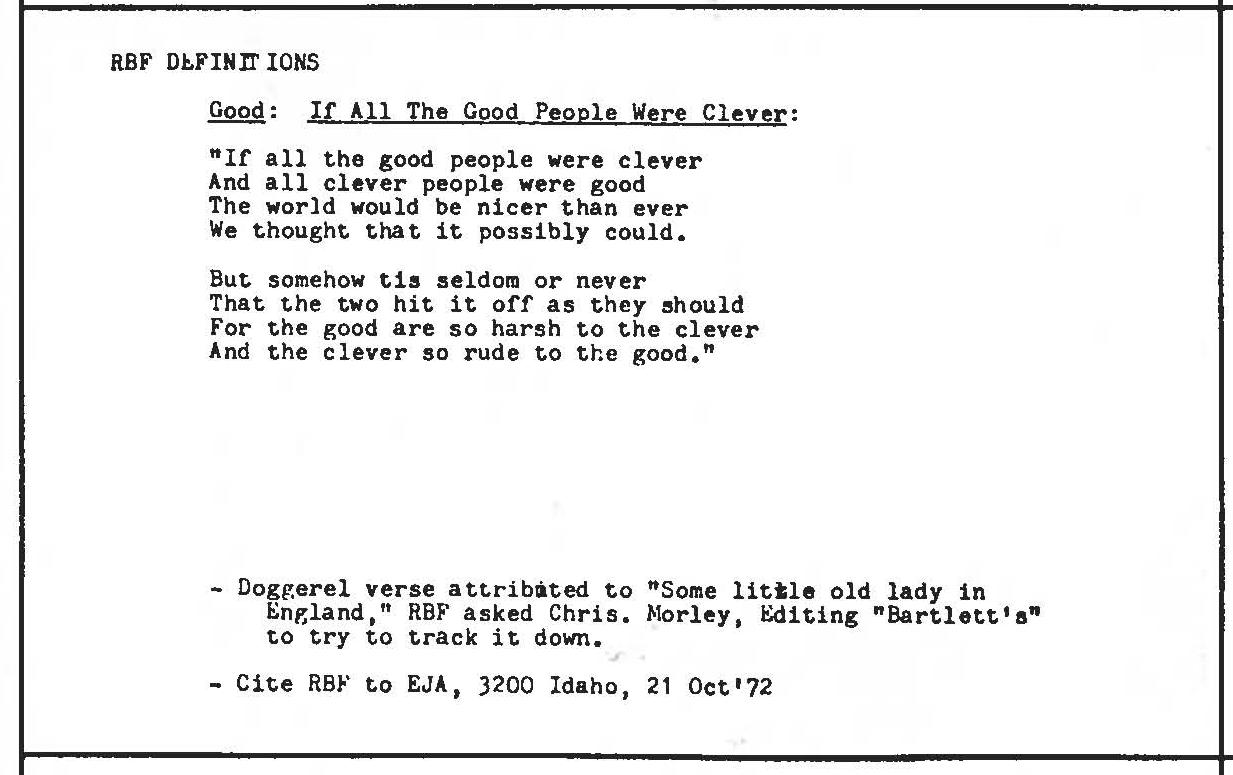
Good & Bad
← Good | Good & Badding Kind of Idea →
Index Entry
Good & Bad:
"I don't use the words 'good' and 'bad.' I try not to oppose evolution. If you do oppose evolution it's not bad, it's just stupid."
- Cite RBF to World Game Workshop; Phila. PA; 2 Jun'77
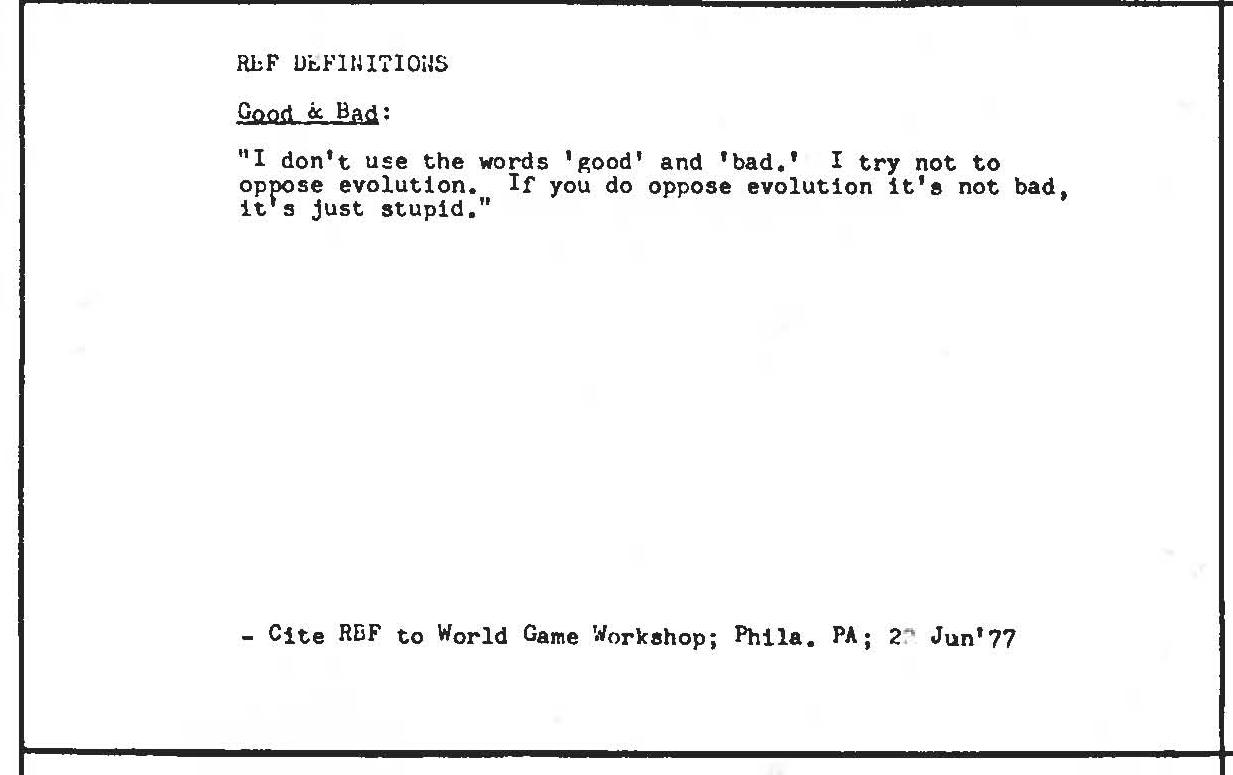
Good & Badding Kind of Idea
← Good & Bad | Good & Evil Sequence (1) →
Cross Reference
Cross-References
- Homosexuality, 1972
Good & Evil Sequence (1)
← Good & Badding Kind of Idea | Good & Evil: Sequence (2) →
Index Entry
Good & Evil Sequence:
"I have to be very careful to take things in a big frame. And I see that nature does have manure, and she has roots, as well as blossoms; and I don't blame the roots for not being blossoms. Things go through phases. I think society is getting somewhere; we don't really know. We don't understand very much about how and where we're going... I think we really are immortal. I think life is really going somewhere.
"We tend to think always in superficials: saying that you are your skin. But I've just been sitting here peeling off skin all the time, throwing it away. It isn't me. But we still assume so. So many of the things we think of as bad and hard and cruel may not be so in the end. Just coming out of the womb, There's a river flowing into the ocean and there are back eddies all over. But I don't call that evil. We are in a very big course. I don't think anything that's gone before really has to happen again. But there are quite clearly rates of change. You don't make a baby in less than nine months. There are those unique frequencies. I do not tend to think of a Universe which consists of good or evil. I don't think an electron is bad because we give it a negative sign. Much of the"
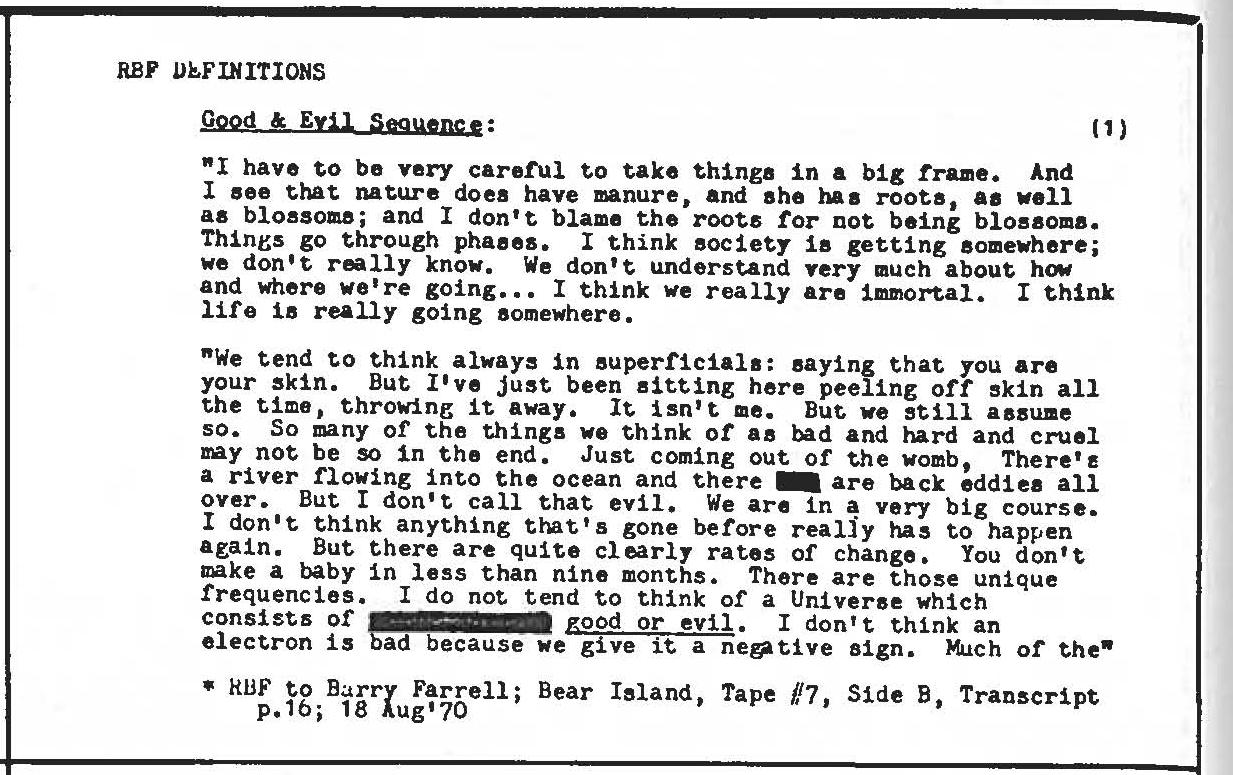
Good & Evil: Sequence (2)
← Good & Evil Sequence (1) | Good & Evil Good & Bad (1) →
Index Entry
Good & Evil: Sequence:
"pain is related to the words we've invented and the significance we attach to things. We make people ashamed when they need not be ashamed. The young world is breaking out from much pain that people had before; they're not having it simply because they're not ashamed... Evolution has her own accounting system and that's the only one that's going on. The Sun never heard of our fiscal year. And it's the Sun that's keeping us going."
- RBF to Barry Farrell; Bear Island; Tape #7, Side B, transcript p.17, 18 Aug'70
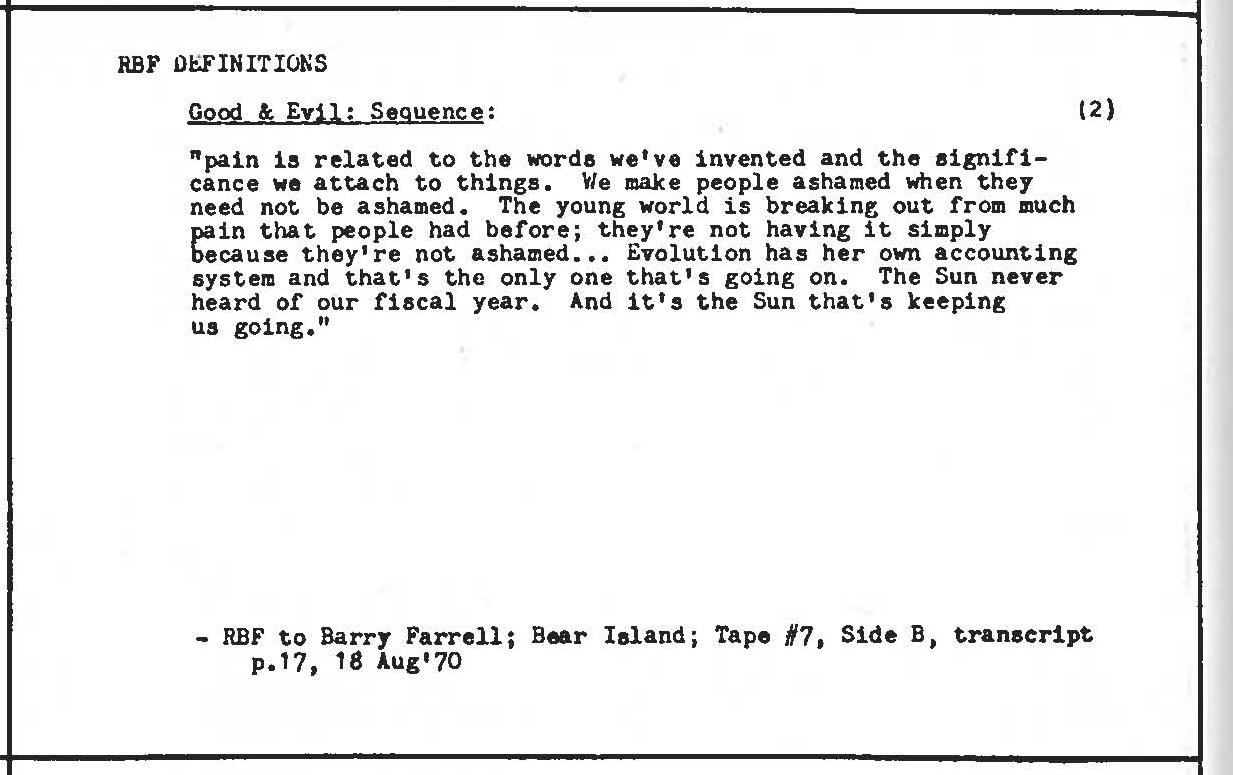
Good & Evil Good & Bad (1)
← Good & Evil: Sequence (2) | Good & Evil (2) →
Cross Reference
Cross-References
- Good & Badding Kind of Idea
- Immorality
- Sin
- Ethics
- Nature is Neither Good Nor Bad
- Pleased or Displeased: We Are Not Here to Be
Good & Evil (2)
← Good & Evil Good & Bad (1) | Good (1) →
Cross Reference
Cross-References
- Plastic Flowers, Oct'70
- Nature, 22 Jun'75
Good (1)
← Good & Evil (2) | Government (1) →
Cross Reference
Utopia
Cross-References

Government (1)
Cross Reference
Cross-References
- Politics
- City Management Concept of World Government
- One-world Management
- Planetary Democracy
- World Democracy
Government (2)
Cross Reference
Cross-References
- Committee, 3 Jun'72
- Doing What Needs to Be Done, (1)
- Houses & Infrastructure, 20 Sep'76
Grammar
Cross Reference
Cross-References

Gramming
← Grammar | Grand Banks Cosmic Fish in the Grand Banks →
Cross Reference
Cross-References
- Omnigramming
Grand Banks Cosmic Fish in the Grand Banks
Cross Reference
Cross-References
- Cosmic Fish Sequence, (1)
Grand Canyon
← Grand Banks Cosmic Fish in the Grand Banks | Grand Central Station of Energy →
Cross Reference
Grand Canyon:
Cross-References
Grand Central Station of Energy
← Grand Canyon | Grand Central Station of Universe (1) →
Cross Reference
Grand Central Station of Energy:
Cross-References
- Alcohol, 1946
Grand Central Station of Universe (1)
← Grand Central Station of Energy | Grand Central Station of Universe (2) →
Cross Reference
Avogadro: Generalized Avogadro Field
Cross-References
- Railroad Tracks: Great Circle Energy Tracks on The Surface of a Sphere
- Exchange Agent of Universe
- Local Vector Equilibrium
- Real Models of Reality
- Isotropic Vector Matrix
Grand Central Station of Universe (2)
← Grand Central Station of Universe (1) | Grandfather Dead: What Again? →
Cross Reference
Cross-References
- Cosmic Democracy, 27 May'72
- Graphable, 27 May'72
- Vector Equilibrium, 1960
Grandfather Dead: What Again?
← Grand Central Station of Universe (2) | Grand Strategy (1) →
Cross Reference
Cross-References
- Death, 11 Sep'73
- Intuition of the Child, (2)

Grand Strategy (1)
← Grandfather Dead: What Again? | Grand Strategy (2) →
Cross Reference
Dome House Grand Strategy:-, 1977
General System Theory
Cross-References
- Artifact & Grand Strategy
- Design Science: Grand Strategy
- Generalized Dichotomy: Grand Strategy
- Nature in a Corner
- Quantum Mechanics: Grand Strategy
- Starting with the Whole
- Starting with Universe
- Synergetic Hierarchy
- Variables: Theory Of
- World Game: Grand Strategy
Grand Strategy (2)
← Grand Strategy (1) | Grand Vizier (1) →
Cross Reference
Assumption, 1946
Cross-References
- Rearrange the Scenery, (1)
- Artifacts, 15 Jun'74
- Geometry, 14 Nov'73
- Education, 1 Jul'62
- Plumbing, (1)(2)
- Repetition, 8 Mar'75; 2 Jul'75
- Generalization & Special Case, Nov'71
- Machines vs. Structures, 13 Nov'75
Grand Vizier (1)
← Grand Strategy (2) | Grand Vizier (2) →
Cross Reference
Cross-References

Grand Vizier (2)
← Grand Vizier (1) | Granite →
Cross Reference
See Divide & Conquer Sequence, (5)
Cross-References
- Divide \& Conquer Sequence, (5)
Granite
← Grand Vizier (2) | Graphable →
Cross Reference
Cross-References
- Matter, 3 Oct'72

Graphable
← Granite | Graphable: Graphics →
Index Entry
Graphable:
"... Electromagnetic scientists had found that all their E.M.F. (electromotive force) problems could be graphed vectorially; that 'graphable' or 'modelable' vectors can interact modelably in real Universe space seemed to promise that the equations of nature's omnicoordinate transactions expressed in omni-space-intruding vectorial models might produce real models of reality of nature's Grand Central Station of omnicoordination."
- Cite SYNERGETICS draft, Sec. \hrefhttps://www.buckyverse.org/en/synergetics/content/chapters/400-system#section-410.05410.05, RBF rewrite of 27/2 May'72
Graphable: Graphics
← Graphable | Graph: Graphable: Graphics (2) →
Cross Reference
Cross-References
Graph: Graphable: Graphics (2)
← Graphable: Graphics | Grass (1) →
Cross Reference
Cross-References
- Spiral, 1938
- Halo, 1938
- Thinking, 10 Sep'75
- Dymaxion Airocean World Map
- Universal Vertex Center Model, 29 Apr'43
Grass (1)
← Graph: Graphable: Graphics (2) | Grass: Putting Aside the Grasses to Isolate the Trail (2) →
Cross Reference
Putting Aside the Grass to Isolate the Trail:
Irrelevancies: Dismissal Of
Cross-References
Grass: Putting Aside the Grasses to Isolate the Trail (2)
← Grass (1) | Grass Blades of Grass →
Cross Reference
Cross-References
- Thinking, Jun'66 (2)
Grass Blades of Grass
← Grass: Putting Aside the Grasses to Isolate the Trail (2) | Grasshopper's Legs →
Cross Reference
Cross-References
- biological Design, 13 Mar'73
- Intuition of the Child, (2)
- Reproducible, 22 Apr'68
- Simplicity, 1968
Grasshopper's Legs
← Grass Blades of Grass | Grateful Gratitude →
Index Entry
Synergetics, 2nd. Ed. - Sec. \hrefhttps://www.buckyverse.org/en/synergetics/content/chapters/1000-omnitopology#section-1053.751053.75
Grateful Gratitude
← Grasshopper's Legs | Gravel →
Cross Reference
Cross-References
Gravel
← Grateful Gratitude | Graveyards Grave →
Cross Reference
Cross-References
Graveyards Grave
← Gravel | Gravitational Constant (1) →
Cross Reference
Cross-References
Gravitational Constant (1)
← Graveyards Grave | Gravitational Constant (2) →
Index Entry
Gravitational Constant:
"Pondering on Einstein's adopted last problem of the Unified Field Theory, in which he sought to identify and explain the mathematical differentiations between electromagnetics and gravity: the two prime attractive forces of universe. In that connection, recalling my conclusion that gravity operates in spherical embracement-- and not by direct radial vectors-- and recalling that electromagnetism follows the high tension convex surfaces, possibly the great circle trunk system of railroad tracks, I found myself pondering, surprisingly, over the fact that the vector equilibrium, which identifies the gravitational behaviors, and the icosahedron which identifies the electron behaviors of electromagnetics, discloses 25 great circles for the vector equilibrium in respect to its 24 external vector edges, and the icosahedron discloses 31 great circles in respect to its 30 external vector edges.
"In each case there is an excess of one great circle over the edge vectors. Recalling that the vector edges of the vector equilibrium exactly equal the radial explosive forces, while the icosahedron's 30 external edges are
- Cite RBF dictation, 1 Apr '72
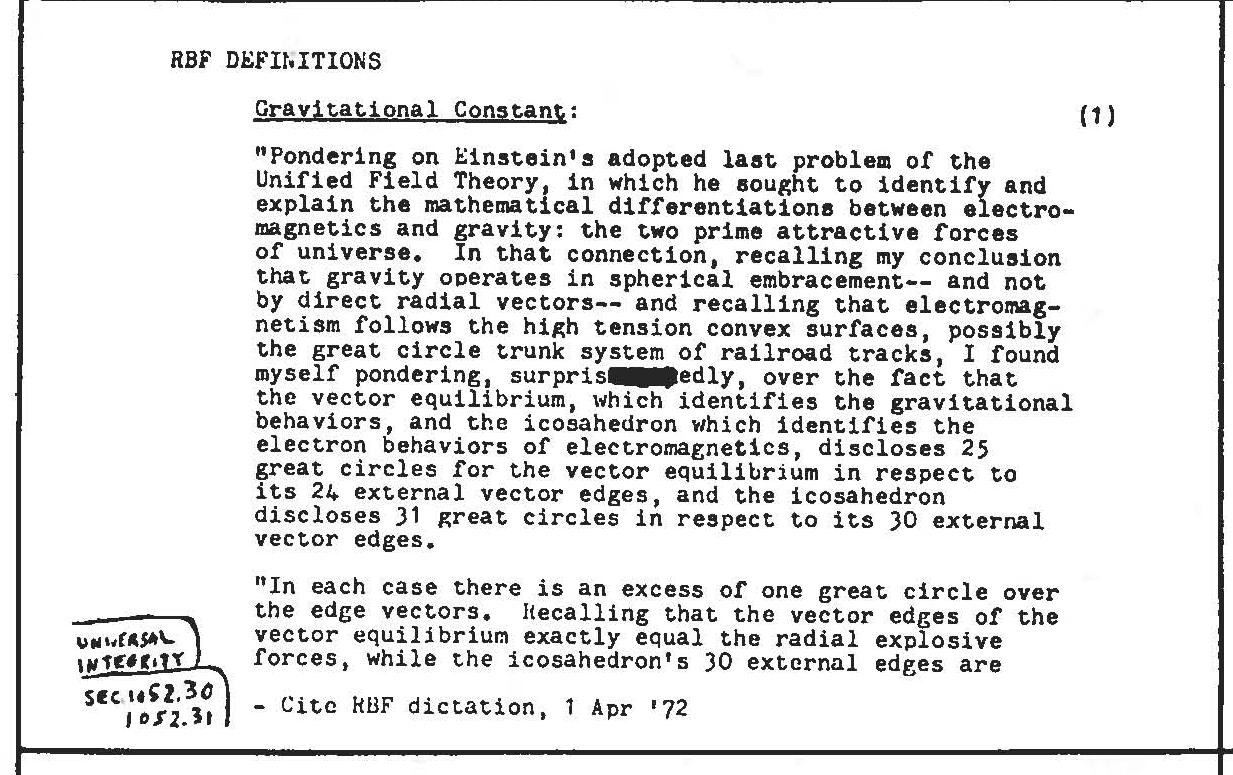
Gravitational Constant (2)
← Gravitational Constant (1) | Gravitational Constant →
Index Entry
Gravitational Constant:
"longer and more powerful than its 30 radial vectors, yet each has an excess of one great circle, which great circles must have two polar axes of spin, we encounter once more the excess two polar vertexes characterizing all topological systems, and witness the excess of embracingly cohering forces in contradistinction to the explosively disintegrative forces of Universe.
"This is the field theory.
"The excess two poles permit omniradially propagated waves of energy to be polarly focused, ergo beamable, or wirable by conductors.
"Gravity is to electromagnetics as 20 is to 18:51."
- Cite RBF dictation to EJA at breakfast, International Hotel, Kennedy Airport, NY, 1 Apr '72
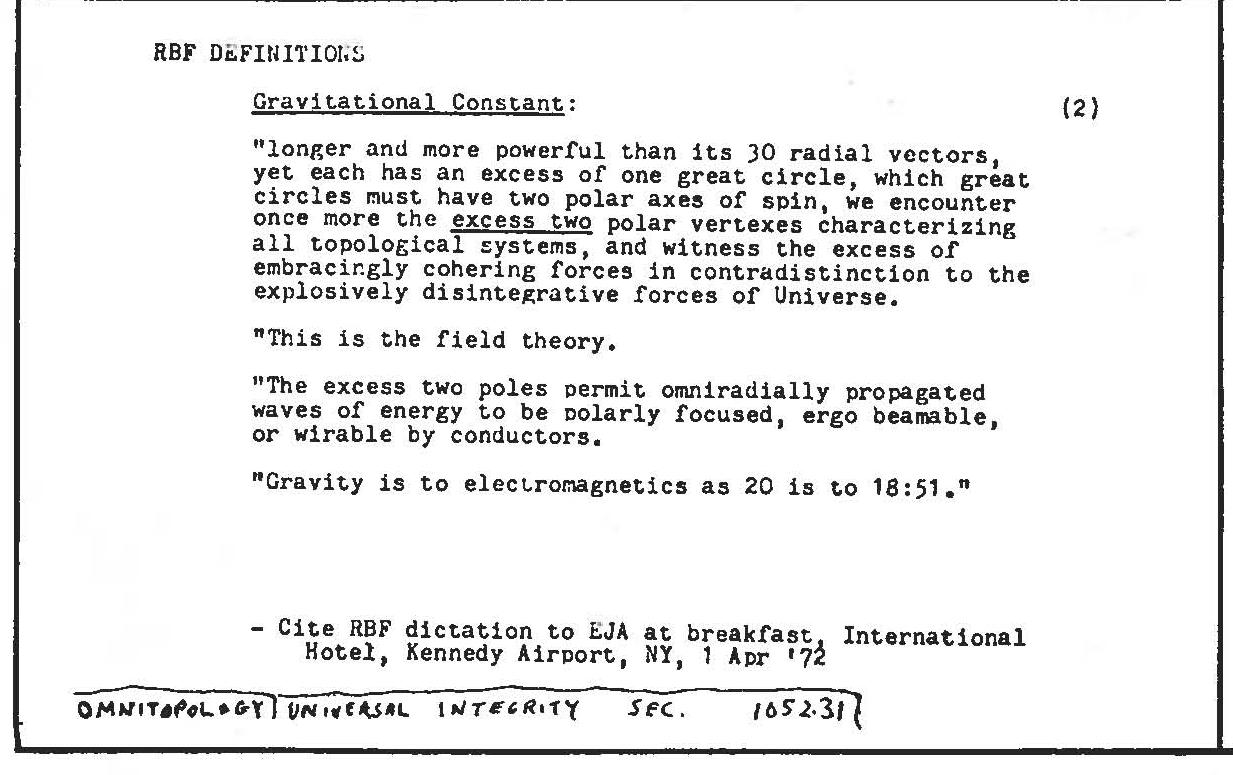
Gravitational Constant
← Gravitational Constant (2) | Gravitational Constant →
Index Entry
Since Einstein's discovery of relativity, E=mc², the physicists have been preoccupied with the significance of the radiational constant-- 186,00 m.p.s. as the top speed of radiation. But physicists since then seem to have paid very little attention to the complementary concept of the gravitational constant-- the top speed of gravity, which is just as significant as the radiational constant.
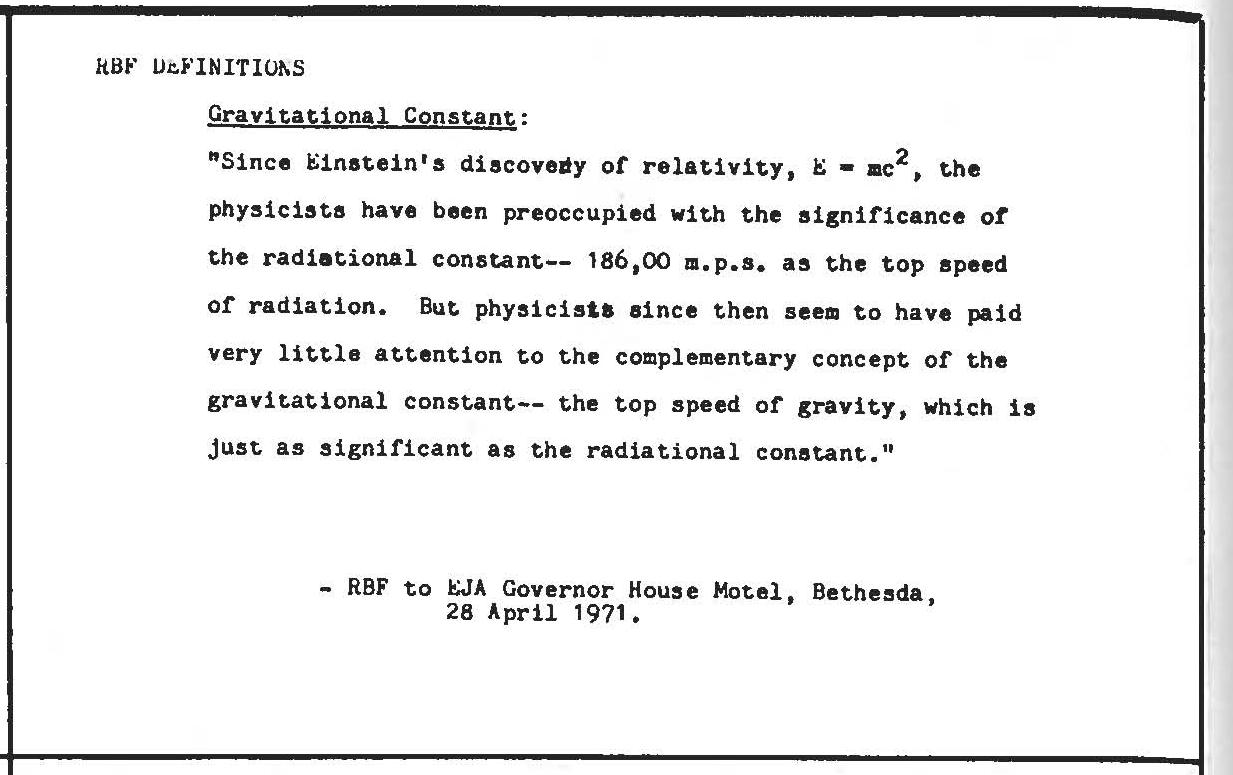
Gravitational Constant
← Gravitational Constant | Gravitational Constant (1) →
Index Entry
Gravitational Constant:
"... The gravitation constant of 6.6666667 is always inherently more comprehensively, implosively, powerful is syntropically cohering the Universe than is the radiational constant..."
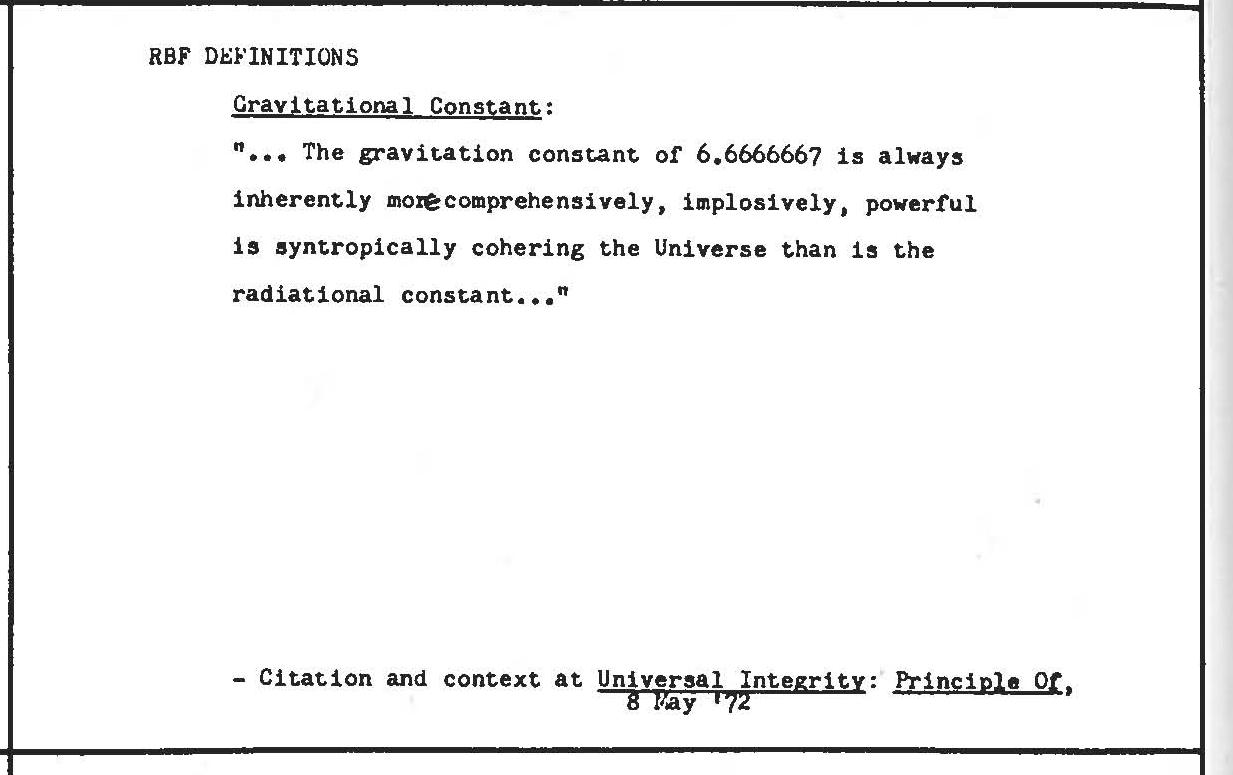
Gravitational Constant (1)
← Gravitational Constant | Gravitational Constant (2) →
Cross Reference
Cross-References
- Newton vs. Einstein
- Radiational Constant
- Universal Integrity: Principle Of
- Congruence of Gravitational & Radiational Constants
Gravitational Constant (2)
← Gravitational Constant (1) | Gravitational Continuum →
Cross Reference
Cross-References
- Icosahedron as Electron Model, 7 Mar'73
- Synergetic Hierarchy, 13 Nov'69
Gravitational Continuum
← Gravitational Constant (2) | Gravitational Continuum →
Index Entry
Gravitational Continuum:
"Novents characterize the finite but nonsensorial remote masses' interattraction, i.e., the gravitational continuum."
- Citation & context at Events & Novents, Nov'71
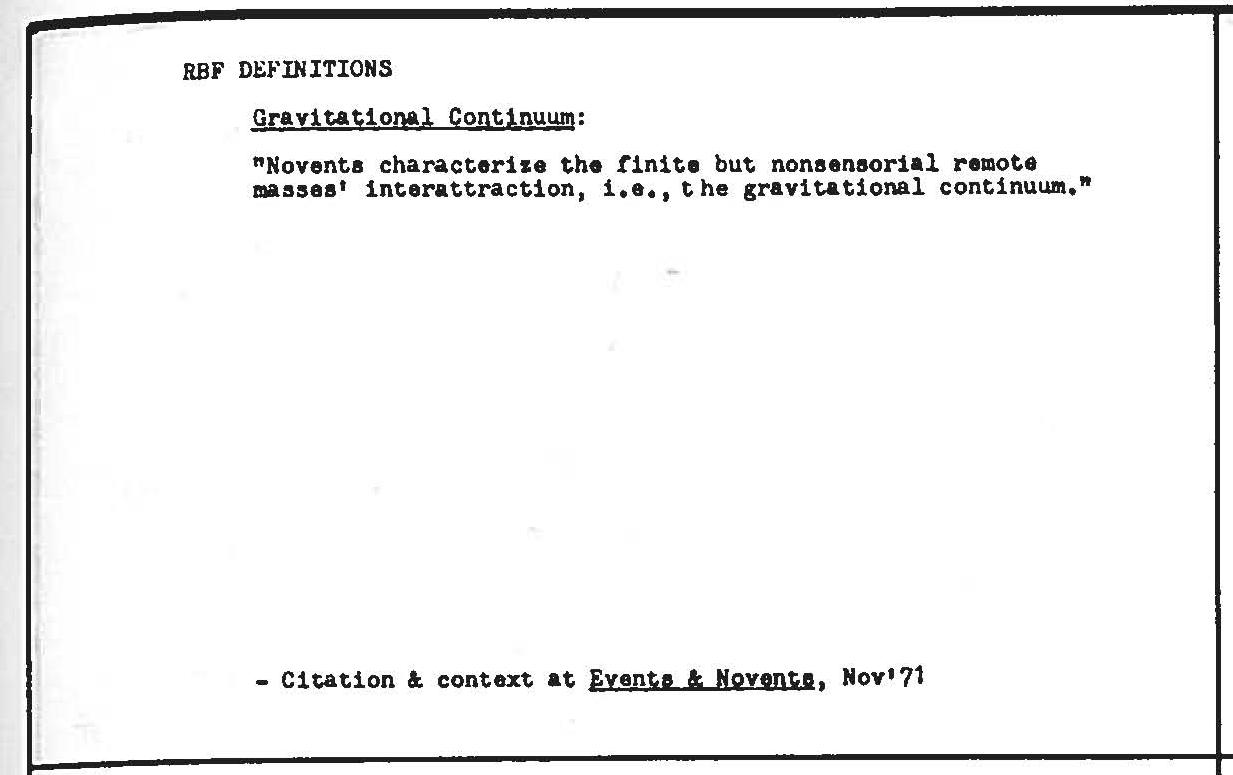
Gravitational Continuum
← Gravitational Continuum | Gravitational Field →
Cross Reference
Cross-References
- ent Continuum, Nov
Gravitational Field
← Gravitational Continuum | Gravitational Field →
Index Entry
Gravitational Field:
"Omnitriangulated geodesic spheres consisting exclusively of three-way interacting great circles are realizations of gravitational field patterns... The gravitational field will ultimately be disclosed as ultra high-frequency tensegrity geodesic spheres. Nothing else."
- Citation and context at Three-way Great Circling: Three-Way Grid:, 8 Mar'73
Gravitational Field
← Gravitational Field | Gravitational Mensurability (2) →
Index Entry
Gravitational Field:
"Radiation produces the phenomenon known to Einstein as the bending of space, the gravitational field."
Radiation-Gravitation,
- Citation and context at 8 Mar'73
Gravitational Mensurability (2)
← Gravitational Field | Gravitational System Zone →
Cross Reference
Cross-References
- Vector Equilibrium, (2)
Gravitational System Zone
← Gravitational Mensurability (2) | Gravitation Inverse Square Law Of →
Index Entry
Gravitational System Zone:
"There is no pointal center of gravity. There is a gravitational system zone of concentration with min-max zone system limits.
"Vertex is in convergence and face is in divergence.
"Synergetic geometry precession explains radial-circumferential acceleration transformations."
(Slightly edited)
- Cite RBF holograph, Synergetics Notes, 14 Jan'55
(Incorporated in SYNERGETICS at Sec. \hrefhttps://www.buckyverse.org/en/synergetics/content/chapters/1000-omnitopology#section-1030.211030.21)
Gravitation Inverse Square Law Of
← Gravitational System Zone | Gravity →
Cross Reference
Cross-References
Gravity
← Gravitation Inverse Square Law Of | Gravity →
Index Entry
Gravity:
"Gravity is continuous tension omni-inter-between all systems. Because gravitational intertensional intensity varies as the second power of the arithmetical interdistancing variations, whose unique variations are locally periodic, it manifests periodic intensities of tidal pulls, but the overall tensional integrity is constant independent of local intensity variables....
"Gravity is nondivisive and syntropic; its conservation is accomplished by holistic embrace of variable intensities.
"Gravity is integral. Holistic gravity has no frequency."
- Citation & context at Radiation-gravitation, 11 Feb'76
Gravity
Index Entry
Gravity:
"The physicists tend to describe gravity as a 'weak' force because they don't recognize that it's a big-arc effect in contradistinction to little pockets of energy like an Earth or a star.
"Gravity is omnipresent, the most subtle of the great integrities.
"This is typical of the semantics of scientists with their addiction to axioms and solids; for the physicists a strong force is a tiny thing like a bomb."
- Cite RBF to EJA, 3200 Idaho, 12 May'75
Gravity
Index Entry
The effect of gravity on all matter is to make it want to precess as radiation.
- Cite RBF to EJA and BO'R, 3200 Idaho, Wash. B.C., 6 Apr'75
Gravity
Index Entry
Gravity:
(a) "My theory of gravitational behavior is an intuitively evolved
operational concept. Since
(a) Spheres contain the most volume with the least
surface; and since,
(b) Nature always employs only the most economical
intertransformative and omnicosmic interrelatedness behavioral
stratagems; and since,
(c) With each and every event in Universe, no matter
how frequently recurrent, there are always twelve unique,
equieconomical, omnidirectionally operative, alternative action,
options: which twelve occur as four sets of three always
interdependent and concurrent actions, reactions, and resultants;
and since,
(d) Galileo discovered the mathematically uniform,
second-power, exponential rate of acceleration manifest by free
falling bodies; and since,"
- Cite RBF Ltr. to Annie Dillard, 12 Jun'74
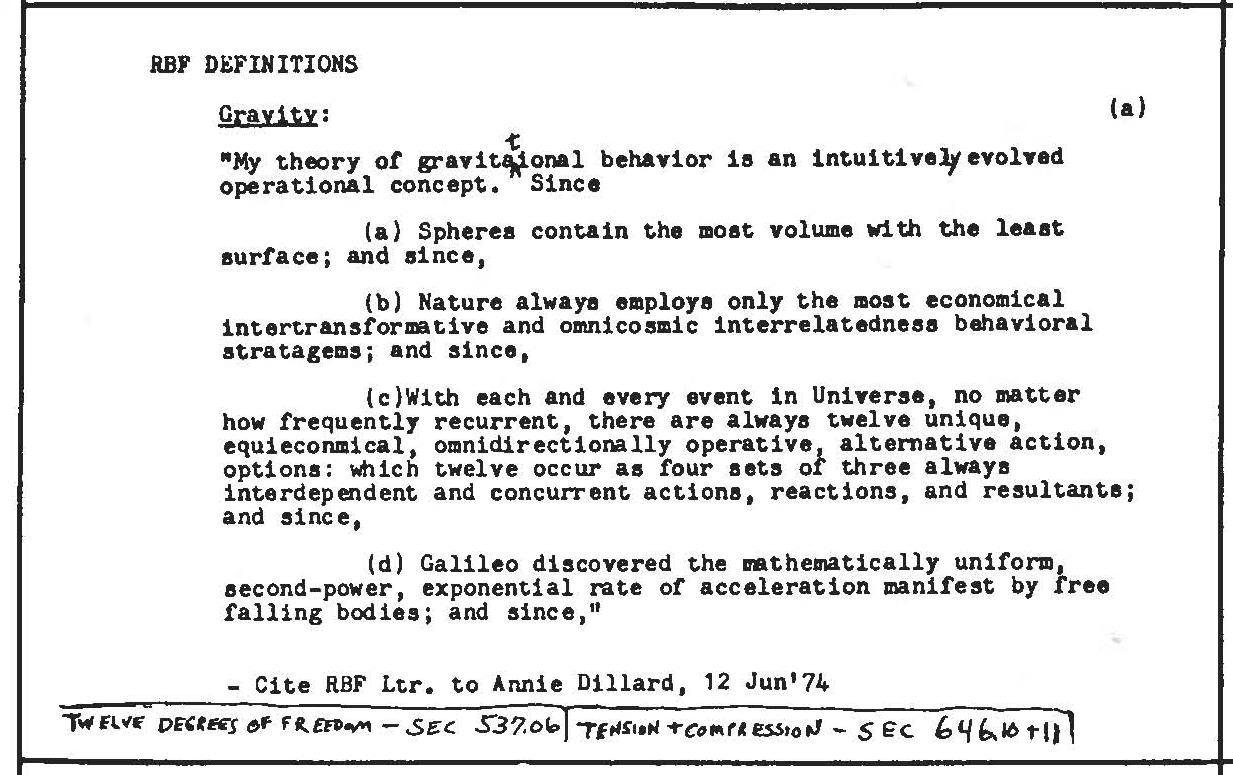
Gravity
Index Entry
(e) Kepler discovered that hidden within the superficial disorder of individual omnidifferences-- differences of size; differences of distances from the Sun; and differences of Sun-orbiting rates-- there nonetheless existed an elegantly exact, one-to-one mathematical correspondence in the Sun's planets' intercoordinate. behaviors manifest by the equi-areas of the radii- and arc-bounded, piece-of-apple-pie-shaped, areal sweepouts, within an identical time span, of all the Sun's planets as they orbited elliptically around the Sun at vast distances from one another, all accomplished without any visible mechanical interlinkage such as gears, yet whose orbiting around the Sun-- rather than flying off tangentially from those orbits by centrifugal force as do the round iron balls released by 'hammer throwing' athletes-- altogether suggests some incredibly powerful interattractivemess to be operative; and since,
(f) Newton correlated (a), (b), (c), (d), and (e) above to discover
Firstly, that the prime interattractivemess magnitude existing between two mutually remote bodies, as compared to the prime interattractiveness existing between any other two mutually remote bodies, is arrived at by multiplying each of the"
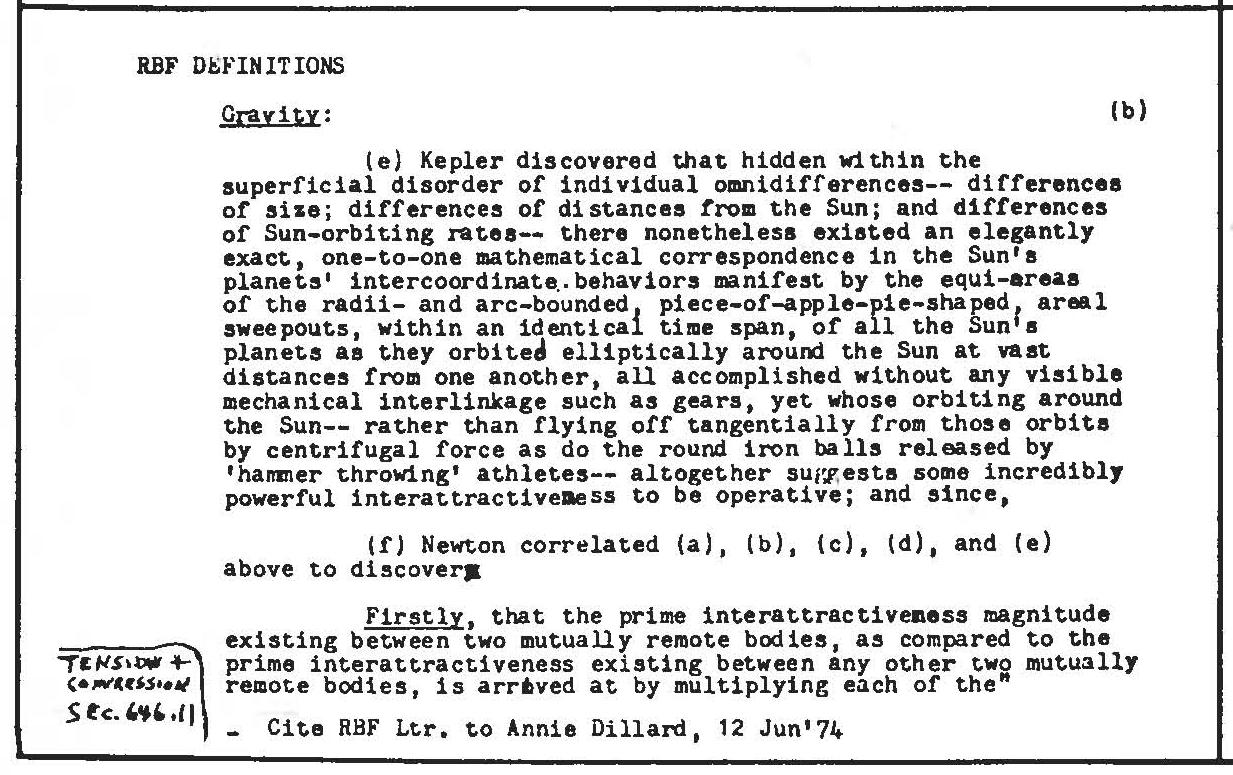
Gravity
Index Entry
Gravity:
"respective couples' separate masses by one another; and
Secondly, as a cosmic generalization of the acceleration of Galileo's Earthward falling bodies, Newton discovered the second-power mathematical rate of interattractiveness gain occurring with each half of the intervening distance of any two given celestial bodies; whereby it was shown that there are interrelationship behaviors manifest in physical Universe that are in no wise indicated to be operative by any or all of the unique geometrical or physical characteristics of any one of the mass-interattracted bodies when considered only separately; and since,
(g) Synergy means behavior of whole systems unpredicted by the integral characteristics of any of the system's separate parts, it has come to pass that it has been synergetically proven that Copernicus was 'right on,' for the ever exponentially increasing interattractiveness of bodies freed of other external restraints to come ever closer together, must induce their ultimate huddling together in the most economical, volume-to-enclosing-surface manner, which as the number of converging bodies increases is that of the spherical conformation."
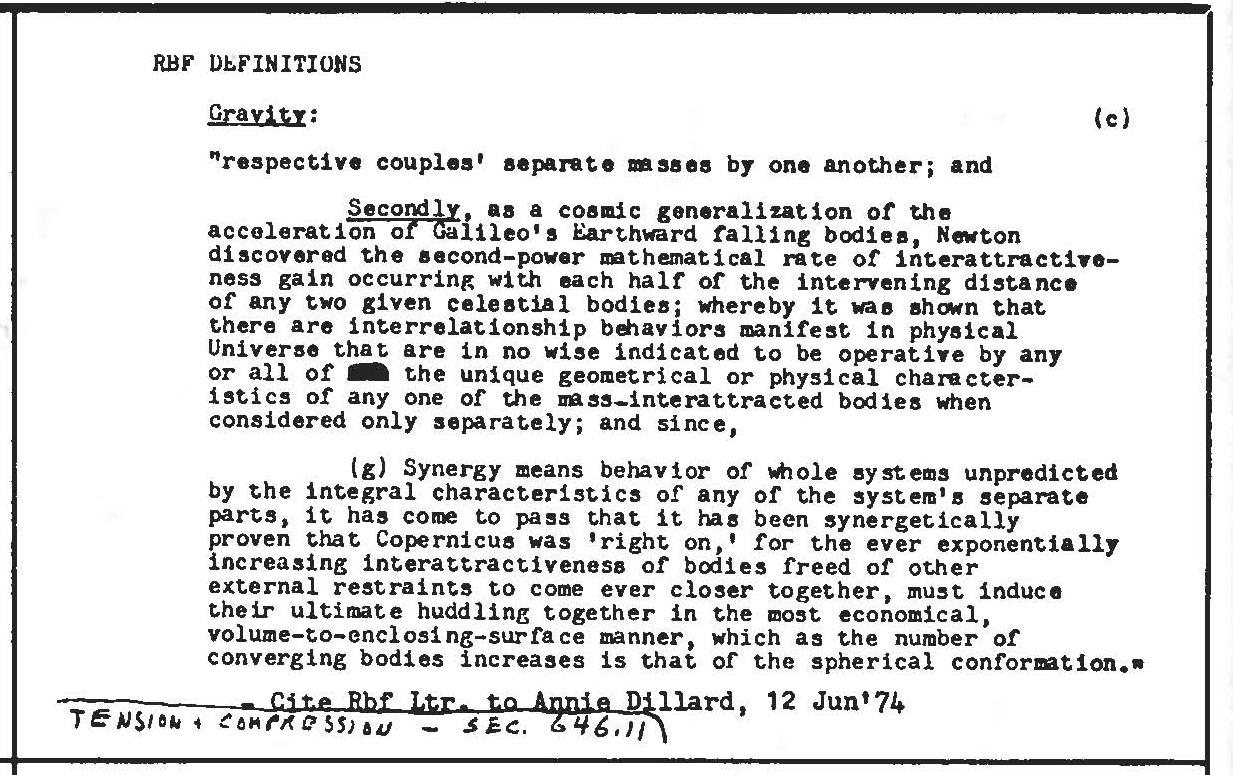
Gravity
RBF Definitions
"This would also occasion the spherically trending series of intertransforming events that would take place as two independent large spherical masses, such as two asteroids, fell into one another and their multitudinous individual atoms began to sort themselves into most economical interarray. Interestingly enough, this is the opposite of what transpires with biological cell dichotomy.
"Electromagnetic radiant energy is entropic; gravitational energy is syntropic.
"Speaking mathematically, the surface area growth is always at a second-power rate of increase in respect to the linear dimension's rate of increase; wherefore, as Newton's linear distance apart was measured arithmetically, we can understand systematically why the relative interattraction of the bodies varies as the second power, which represented their relative surface rates of change, but this does not explain why there is any interattraction. Interattraction is eternally mysterious."
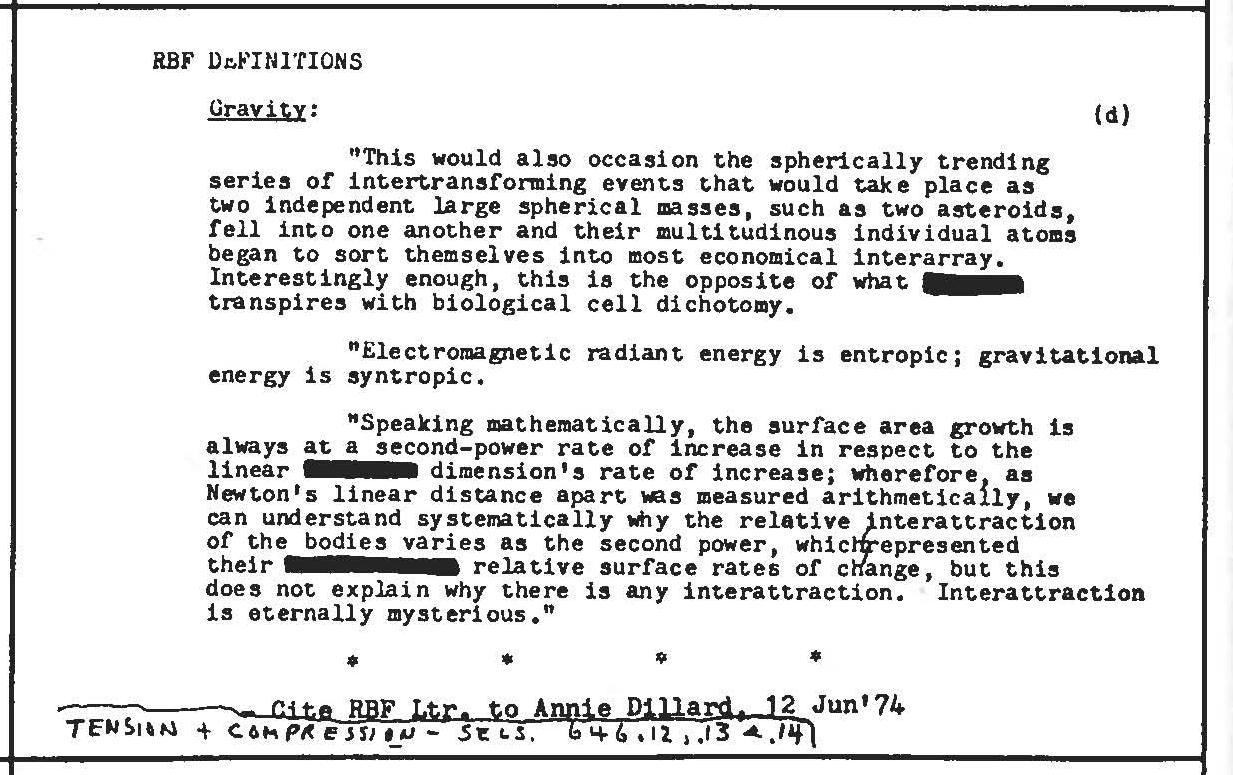
Gravity
Index Entry
Gravity:
"I met an old friend yesterday, Cyril Stanley Smith. I first knew him in 1950 when he was the director of the Institute for the Study of Metals at the University of Chicago. It was in his institute that the first Enrico Fermi atomic pile was assembled, erected, and operated. Cyril Smith was one of the original Manhattan Project scientists. For a number of subsequent years he has been professor of the History of Science at MIT. He is one of the world's great metallurgists.
"I discussed with him yesterday unique metallurgical techniques I had experienced in connection with producing my automobiles, bathrooms, and aeronautical structures. In producing these prototypes I always had occasion to take on metal craftsmen called 'hammer men.' The best hammer men have been Polish-Americans. They inherited their craft as the best of the early armor makers of Europe. I said to Cyril, 'I don't think any of those sheet metal workers ever think of what they are doing in the way you and I would think about what their work does to the atoms.' Cyril's said, 'You mean "in the ways the atoms accommodate their work."' I said, 'Yes, that's what I should have said.'
- Cite RBF Ltr. to Annie Dillard, 12 Jun'74
Gravity
Index Entry
Gravity:
"The hammer men have learned that they can gather the metal together, that is hammer it thicker. Anybody can conceive of hammering metals thinner. Few would think spontaneously of hammering it thicker. The hammer men do, however, hammer it in such a way as to bulk it. They can start with a flat sheet of metal and hammer it thicker as you would knead dough together after it had been rolled out thin with a rolling pin. But you push the dough together horizontally with your hands. You do not pummel it vertically from above. The skilled sheet metal hammerers can do just that with metal, which amateurs would spontaneously assume to be illogical if not impossible.
(1) We can conceive of heating metal until it becomes liquid and flows together. Thus the blacksmith's heating of his horseshoes to a bright red, to a condition just short of melted, makes it easy for us to think of the cherry-red metal as being in a plastic or semimolten condition which permits the smith to smite it into any preferred shapes-- thicker or thinner. But the Polish hammer men hammer cold, hard sheet metal into any shape.
(2) What the Polish hammer men do intuitively without sensing it realistically is to hit the indestructible atoms"
Gravity
Index Entry
Gravity:
"tangentially as might a billiard player 'kiss' the object ball with his cue ball. Thus does the hammer inadvertently impel atoms sidewise often to roll atop the next nearest 'spherical' aggregate of atoms-- spherical because of the electrons' orbiting combined with the atoms' spinning at so high a rate as usually to present a dynamically spherical surface.
(3) I went on to say to Cyril, 'I don't think hammer men think about their work as bounce-impelling the spherical atoms around as if they were a bunch of indestructible ball bearings stuck together magnetically as a consequence of which the accelerated ball bearings would cleave-roll, to relodge themselves progressively in certain most economically travelled-to, closest-packed, internested rearrangements.
(4) Dislodged atoms of the outer layer atoms of the omniintermagnetized ball bearings would always roll around on one another to relocate themselves in some closest packing array, any two mass-interattracted atoms being at least in tangency. When another dynamical spherical domain atom comes into closest-packing tangency with the first two the mutual interattractiveness interrolls the three to form a triangle. Three in a"
Gravity
Index Entry
triangle produce a 'planar' pattern of closest packing. When a fourth ball bearing lodges in the nest formed between and atop the first three, each of the four balls now touch three others simultaneously and produce a tetrahedron having a concave-faceted void within it. In this tetrahedral position, with four-dimensional symmetry of association, they are in circumferential closest packing. Having no mutual nuclear sphere they are only inter-circumferentially mass-interattracted and cohered: i.e., gravity alone coheres them but gravity is hereby seen experimentally to be exclusively in circumferential interbonding.
With further spherical atom additions to the initial tetrahedral aggregate, the outermost balls tend to roll coherently around into asymmetrical closest packing collections until they are once more symmetrically interstabilized with twelve closest packed around one, and as yet exerting their exclusively intercircumferential interattractiveness, bound circumferentially together by four symmetrically interacting circular bands; whereby each of the 12 surrounding spheres has four immediately adjacent circumferential shell spheres interattracting them circumferentially while there is only one central nuclear ball
Gravity (1)
Index Entry
"inwardly, i.e. radially, attracting each of them. In this configuration they form the vector equilibrium, known to Plato as the cuboctahedron. Here we have clarification of the Copernican 'nostalgia' or synergetic proclivity of the circumferentially arrayed spheres to associate symmetrically around the nucleus sphere or the nucleus void which, as either configuration-- the vector equilibrium or the icosahedron--rotates dynamically producing a spherical surface. But the modus operandi of four symmetrically intertriangulated gravitational hoops (in the case of the vector equilibrium) and the six (in the icosahedron) are lucidly manifest. If we took out the central ball, or if it shrinks in diameter, we will discover synergetics' jitterbug model showing that the twelve circumferential spheres will closest pack circumferentially until each of the twelve circumferentially arrayed balls is tangent to five surrounding balls and thus altogether form the Platonic icosahedron.
"Cyril agreed with me that the hammer men probably didn't think about these properties of atoms. The fact is that the spheres don't actually touch each other. They are held together only mass-interattractively and their electron paths are, of course, at distances from their atomic nuclei equivalent relatively to"
Gravity (1)
Cross Reference
Gravity:
"that of the distance of the Earth from the Sun as proportioned to the respective radii of these vastly different sized spheres. As Cyril said, 'The hammer men can push the atoms only as the physical laws allow them to be moved.'
"The reason I mention this hammer man inadvertency is that you had spoken in your letter about 'hammering barrel hoops' and I felt that the hammering of barrel hoops introduced the operational concept of what it is that the only-intuitively-exploratory hammerer does not see yet, by virtue of which, nature accommodates his only superficially contrived hammering strategies while all the time all those atoms are intercohered by gravity-- which the hammerer associates only with falling objects.
"My book, SYNERGETICS, is committed to conceptual elucidation of the intertransformative geometrics operative in the nonoptically-tunable ranges of Universe events. Synergetics conceptualities always manifest geometrical integrities of intertransformabilities.
"Up to the twentieth century 'reality' was all that we could see, smell, hear, and touch. The vast range of the thus far"
Cross-References
- Tension + compression, SEC. 696.2
Gravity
Index Entry
discovered electromagnetic spectrum was first published in 1930. It included the frequency bands of all the 92 regenerative chemical elements as well as those of x-ray, ultraviolet, infra-red, radio, the television broadcasting bands, etc.; with the discovery of that electromagnetic spectrum we learned experientially that 99.9 percent of reality is invisible to humans. Almost nothing of the reality of our present life meets the human eye; wherefore our most important problems are invisible. Our problems are almost exclusively metaphysical and can only be coped with by scientific competence and intellectual integrity on the part of the discovering humans.
Gravity
Index Entry
Gravity:
"Gravity... is the variable interattractiveness of nonmagnetic bodies, which interattractiveness varies at a second-power rate inversely proportional to the relative distances intervening the masses, as those distances vary only at an arithmetical rate of change."
- Cite Universal Requirements of a Dwelling Advantage, 31 May'74
Gravity
Index Entry
Gravity:
"Gravity is timeless and eternally instant."
- Citation and context at Universal Integrity, 7 Nov'73
Gravity
Index Entry
Gravity:
"Gravity is omnipresent, omniembracing, and omnicollective: shadowless and awavilinear. Awavilinear means nonwavilinear or antiwavilinear. Gravity counteracts radiation; it is progressively and centrally focusing; and it is always apparently operative in the most economical, i.e., radially-contractive, transformation-- the radii being the shortest distances between a sphere's surface and its volumetric center; ergo, employing the absolute straight-nothingness, radial line of direction, which, as such, is inherently invisible."
- Cite SYNERGETICS at Sec. \hrefhttps://www.buckyverse.org/en/synergetics/content/chapters/500-conceptuality#section-541.03541.03, 23 Sep'73
Gravity
Index Entry
Gravity:
"Gravity is tensive, ergo tends to decrease its overall curvature. The ultimate reduction of curvature is no curvature.... The tensive tends to arcs of ever greater radius."
- Citation and context at Curvature, 23 Sep'73
Gravity
Index Entry
Gravity:
"Gravity's omniembracing collectiveness precessionally generates circumferential surface foldings-- waves (earthquakes)-- consequent to the second-power rate of surface diminution in respect to the radially-measured, first-power linear rate of system contraction. Gravity is innocent of wave. Gravity is innocent of radial; i.e., linear aberration waves; i.e., gravity is nonwavilinear. The most economical interterminal relationship is always that with the least angular aberration. Gravity is the geodesic-- most economical-- relationship of events."
- Cite SYNERGETICS draft at Sec. \hrefhttps://www.buckyverse.org/en/synergetics/content/chapters/500-conceptuality#section-541.06541.06, 23 Sep'73
Gravity
Index Entry
Gravity:
"...Gravity is nonlinear... omniembracing."
- Citation and context at Truth, 5 Jun'73
Gravity
Index Entry
Gravity:
"Gravity has no shadow. Gravity is uninterferable; radiation is interferable. Gravity is omnidirectional, mass interattraction, which, as Newton discovered, is directly interproportional relative to the respective mass involved, and varies as the second power relative to the interproximities of the respective bodies considered: Halving the distance between any two will fourfold their interaction."
- Citation and context at Radiation-Gravitation Sequence (1), 5 Jun'73
Gravity
Index Entry
Gravity:
"When man is so tiny and Earth is so great we can only see gravity as operating in the perpendicular. We think of ourselves as individuals with gravity pulling in perpendiculars parallel to one another. But we know that in actuality radii converge. We do not realize that you and I are interattracted because gravity is so big. The attraction is there but it seems so minor we dismiss it as something we call 'aesthetics' or 'love affair'. Gravity seems so vertical."
- Cite SYNERGETICS draft at Sec. \hrefhttps://www.buckyverse.org/en/synergetics/content/chapters/1000-omnitopology#section-1005.631005.63, 16 Feb'73
Gravity
Index Entry
Gravity:
"Gravity is circumferential-- the barrel hoop staves trying to get out."
- Cite RBF to EJA, 200 Locust, Phila., 22 Jan'73
Gravity
Index Entry
Gravity:
"Gravity is a spherically circumferential contractive force. The resultant is radially inward, attempting to make the system get smaller. The circumferential mass-interattractive effectiveness has a constant advantage ratio of 12 to 1 over the radial inward mass attraction."
- Cite RBF to EJA, 3200 Idaho, WashDC, 18 Oct'72. RBF rewrite.
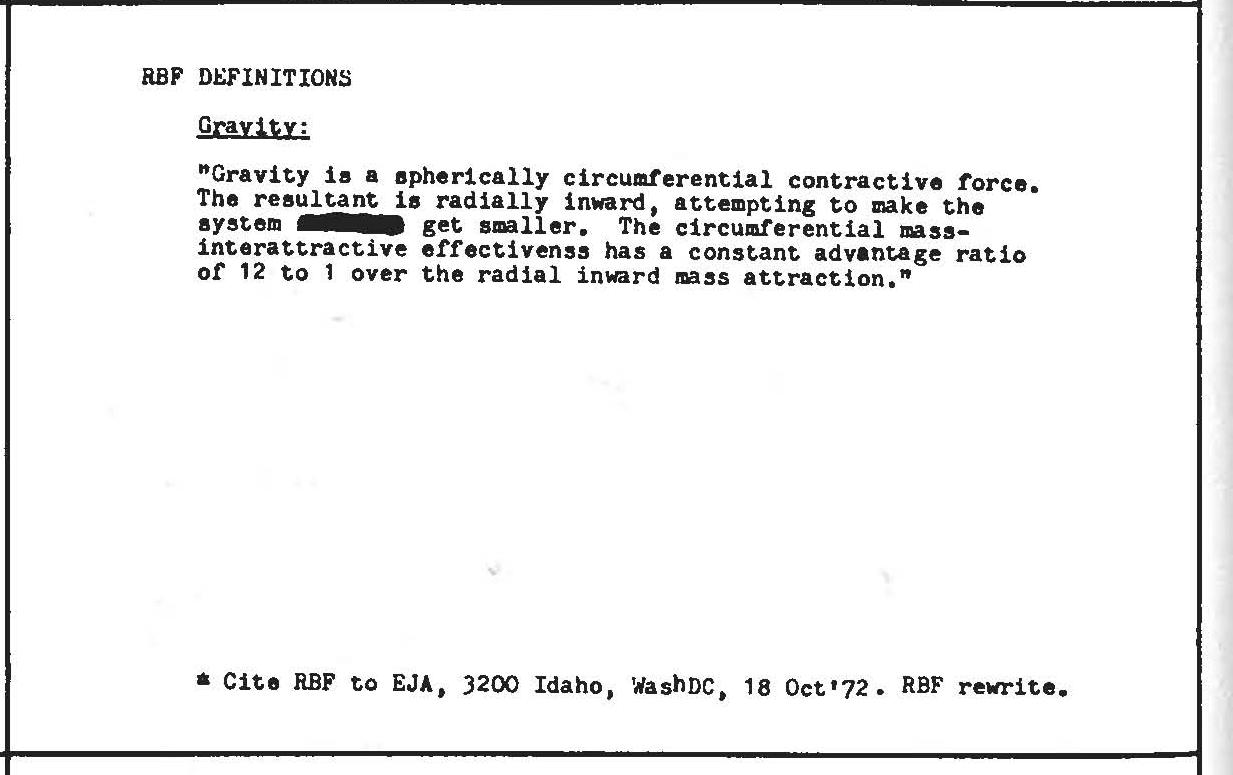
Gravity
Index Entry
Gravity:
"Gravity is matterlessness: the whole integrity of our Universe."
- Cite RBF to EJA, Beverly Hotel, NYC, 22 Jun'72
Gravity
Index Entry
Gravity:
"Nothing is quite so prominent in a child's life. His mother is not always around but gravity is always there. And every time he tries to stand up-- Boom! Down he goes again."
- Citation and context at Child Pushes Spoon Off Edge of Table, 16 Jun'72
Gravity
Index Entry
Gravity:
"What holds things together is inherently invisible.
Gravity is inherently invisible. That is why the Universe is so mysterious: the absolute mystery. The integrity of the Universe is invisible.
"But the behaviors of the integrity are
-- apprehendable;
-- measurable;
-- eternally reliable."
- Citation and context at Integrity, 25 Jan'72
Gravity
Index Entry
Gravity:
"The gravitational is comprehensively embracing and circumferentially contractive, ergo advantaged over the centrally radiational by a 6.28 effective energy advantage; i.e., a circumference-to-radius vectorial advantage of contraction versus expansion, certified by the finite closure of the circumference, ergo, a cumulative series versus the independent disassociating disintegration of the radii."
-
Cite RBF to Lda, 21 Dec'71, Washington, DC, Incorporated in Universe at Sea, 25 Apr'05.
-
Citation at Universal Integrity: Principle Of, 21 Dec'71
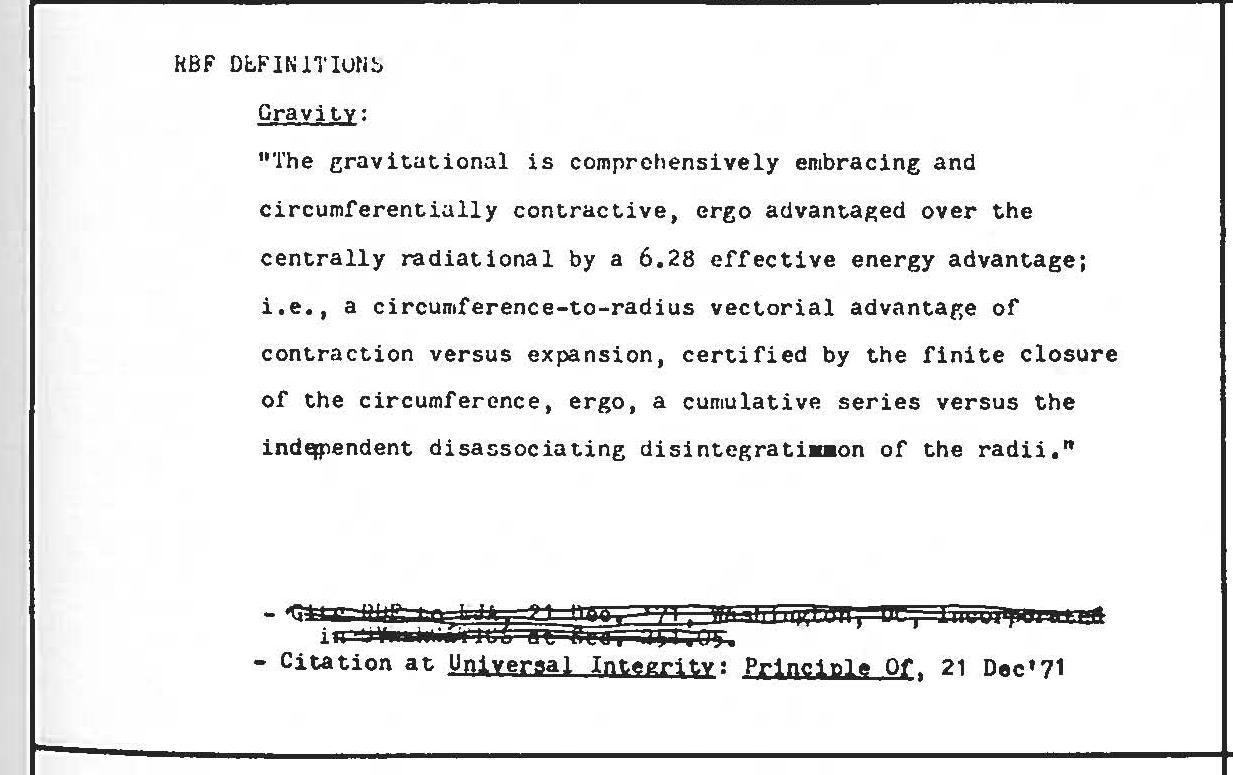
Gravity
Index Entry
Gravity:
"The difference between the central angles and surface angles' functionings are identifiable with radiational and gravitational functionings. . . Gravity identifies with surface angles. Gravity is omni-embracing and is not focusable. Gravity is most effective in its circumferential coherence."
- Cite Synergetics draft, Sec.-870, August 1971.
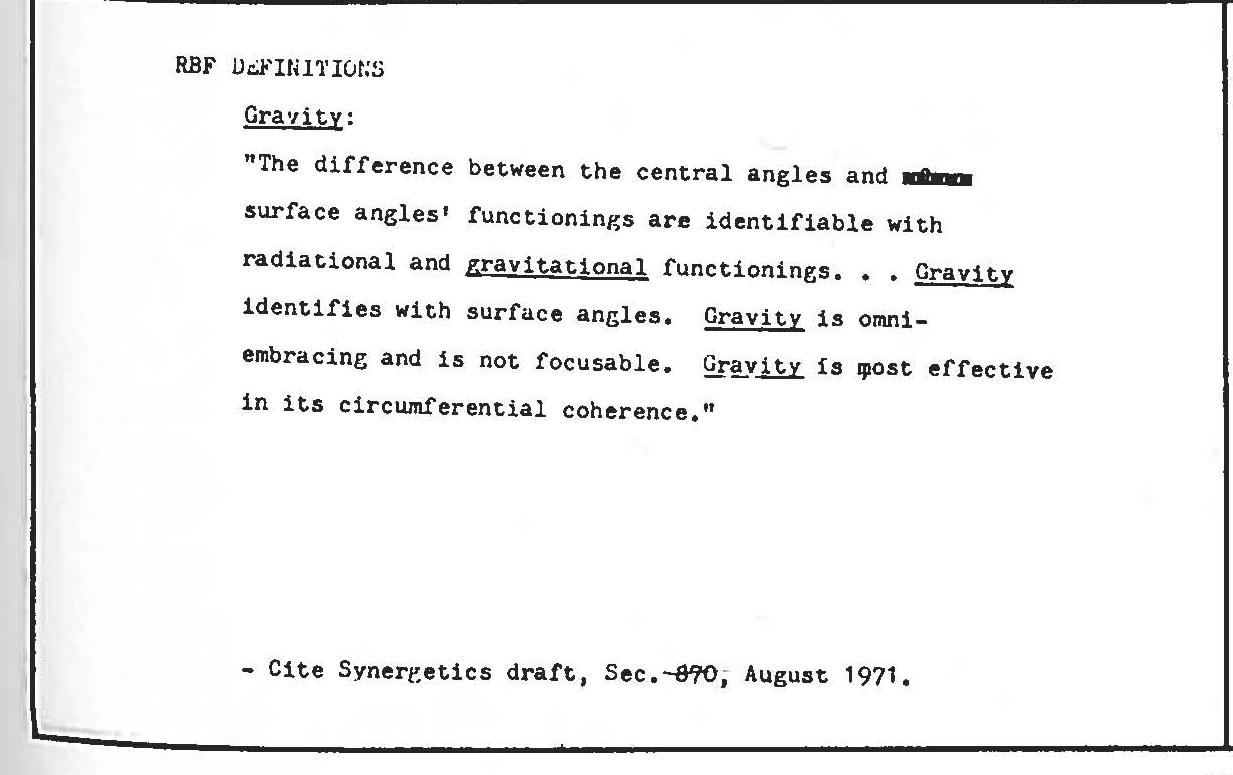
Gravity
Index Entry
Gravity:
"... The electromagnetic frequencies of systems are sometimes complex but always exist in complementation of gravitational forces to constitute the prime rational integer characteristics of physical systems."
- Cite NASA Speech, p. 91 as amplified by RBF at Deer Isle, Me., 25 August 1971.
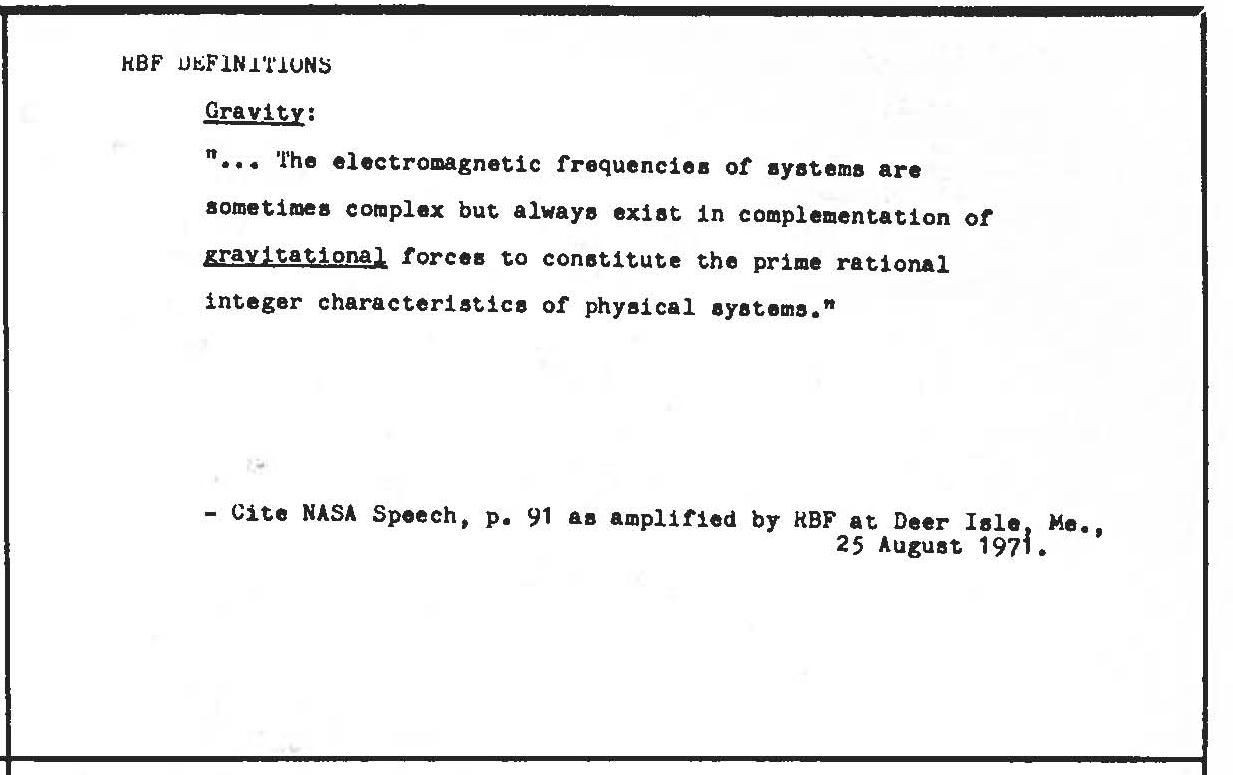
Gravity (1)
Index Entry
We now have another impressive kind of second-power relationship, the word 'second-power' having something to do with radials and surfaces. Regarding gravity, Newton discovered a certain relationship of masses, but unfortunately his relationship is stated in a negative way. He talks about an inverse ratio. The word inverse ratio makes it very difficult conceptually. He talks about not what it is, attraction, i.e. coming towardness, but about something else, i.e., repulsion, or raison d'etre of going awayness-- the opposite of what he is attempting to explain.
It could have been stated that the gravitational relationship is in terms of the second power of the relative distance between the given masses as stated in the terms of the radius of one of the masses. That is the way we would say it today. He could have said, quite simply, 'Every time the distance between the bodies is halved, the attraction is fourfolded.'
We find that the gravitational law is in terms of the second power of radius, which terms are convertible into Einstein's" mass conversion into radiation in terms of the second power of the radius.
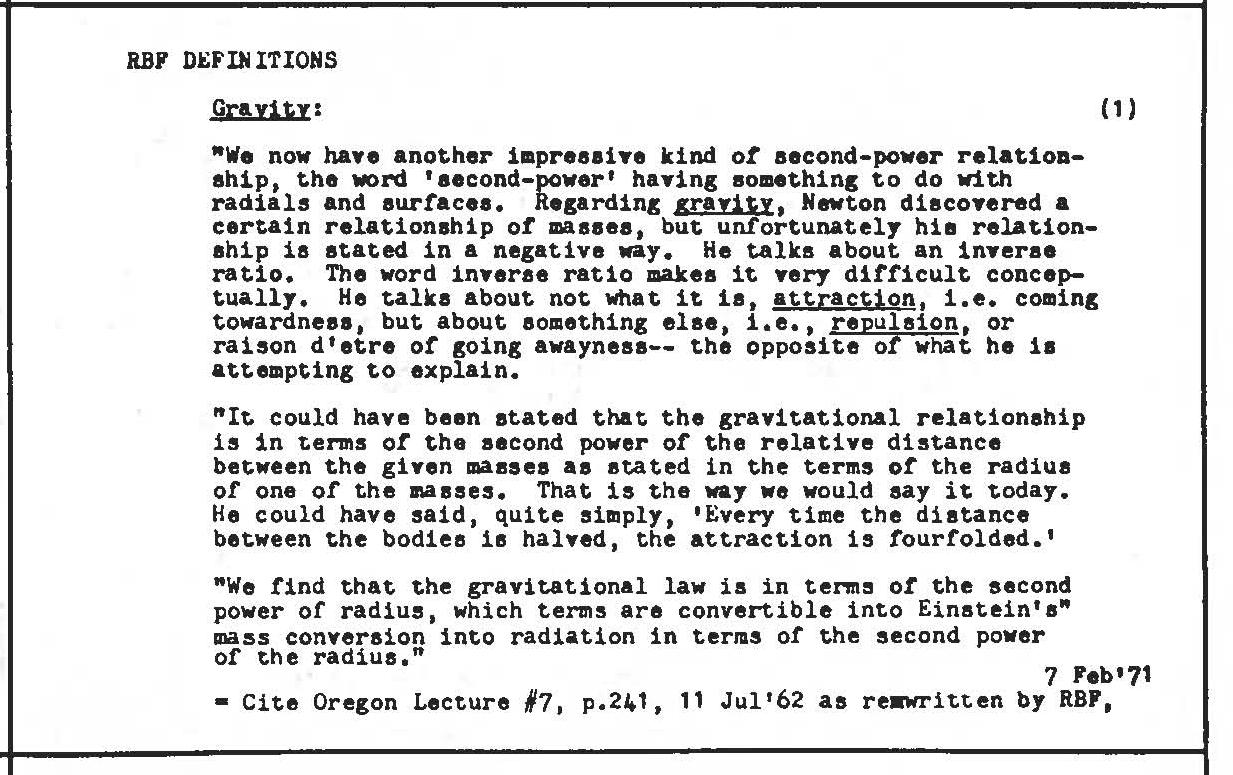
Gravity (2)
Index Entry
Gravity:
"We would then be able to know where relative mass was, how much energy and how much quantum were in it; and we would suddenly see the gravitational state in terms of the second power and this relative concentration of masses. The gravitational, then, is the contractive quantitative of second power of the relative masses status in quantum or photons-- and the other one is the Einsteinian one, which is the rate of omni- expansive surface growth of the radiation.
"We have two main conditions of energy: energy omni- radiantly divergent, and energy omni- convergent-- and we find both of them in the second power of the radial dimension. We suddenly find a very neat relationship going on."
- Cite Oregon Lecture #7, p.241, 11 Jul'62 as rewritten by RBF 7 Feb'71.
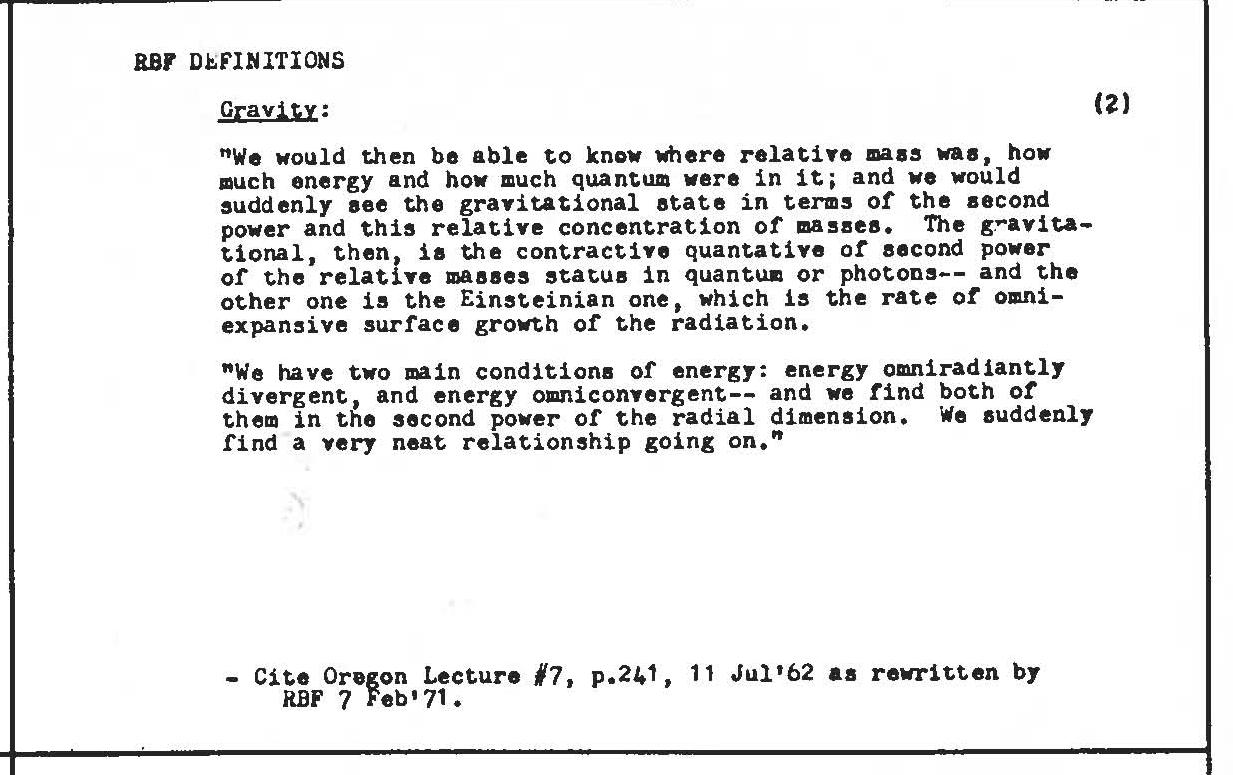
Gravity
RBF Definitions
"As man's knowledge of chemical element interactions as alloys improves (wherein those atomic proximities are intensified by symmetrical congruence wherein the 2nd power mass attractions multiply) the length of tensile members relative to given section diameter or given stress, trends to increasing amplification-- to infinite length with no section. Incredible? No! Every use of gravity is a use of such sectionless tensioning. The electrical tension first employed by man to pull energy through the non-ferrous conductors and later to close the wireless circuit was none other than such universally available sectionless tensioning."
-
- Cite PREVIEWS, I&I, p. 212 as amplified by RBF 7 Feb '71 Sarasota, Florida.
Citations
- PREVIEWS, I&I, p. 212 as amplified by RBF 7 Feb '71 Sarasota, Florida.
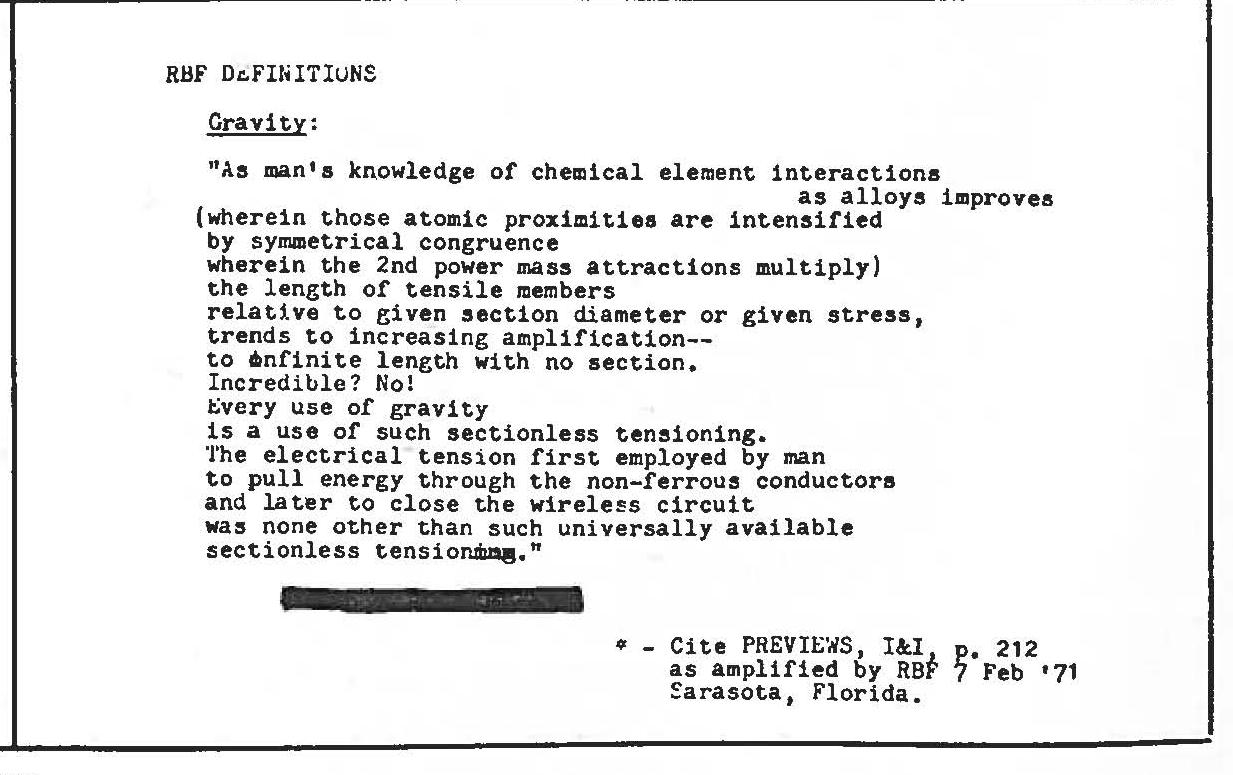
Gravity
Index Entry
Graviv is a principle of synchronous coordination of dynamic complexvties. Gravity can break a dish carelessly relinquished to its force. Principles may remain carelessly or ignorantly unheeded, or uncomprehended, and the dynamic effects may thus intrude upon man's unrealistic preoccupations to be misapprehended as 'destruction' or 'chaos.'
'If, however, gravity is recognized as a principle, and its behavior and rates are measured, then its enormous force may be put systematically to work to augment man's as yet meager degree of conscious advantage over evolutionary process and environment. Thus great hydroelectric dams as complex products of intellectual comprehension of principles converted to physical system, operate under routine guidance of a dozen men to valve this principle of cosmic force to provide 20 million inanimate energy slaves to serve an Earth-huddled city of a millon humans.
'This is a puny accomplishment in view of the poentials of the principle. The principle of gravity takes a little thing like the minor planet Earth, weighing only 6,000 billion'
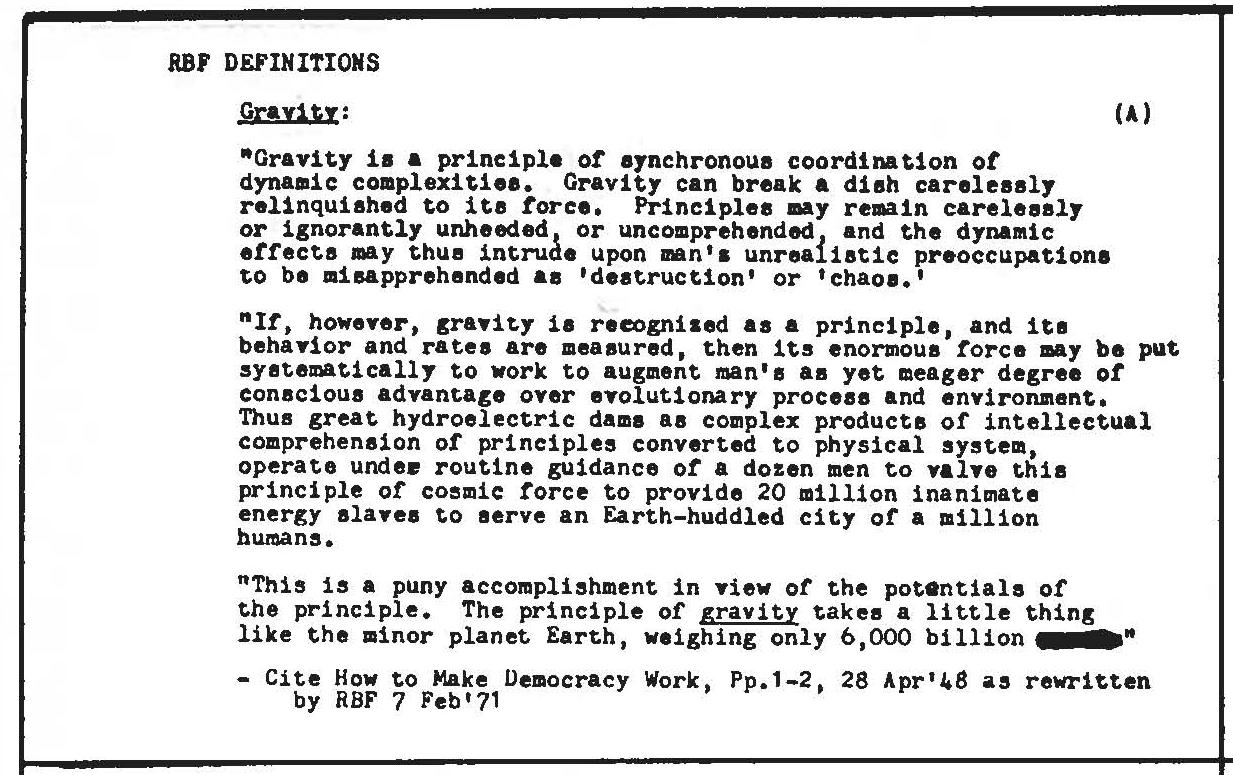
Gravity
Index Entry
tons, on a 93 million-mile tether, and swings it around the Sun at 68,000 miles per hour, while simultaneously juggling eight other planets around the Sun, while it swings that minor star 'Sun' and its nine planets along its group orbit at 44,000 miles per hour as one of 30 billion such star groups which gravity is zooming around in deft ellipses with the Milky Way nebula, while simultaneously piloting billions of these nebulae about the totality. Yet so infinitely comprehensive is principle, that gravity includes capacity for detail such as attending to the smashing of the cup against the floor as it is relinquished from the careless fingers.
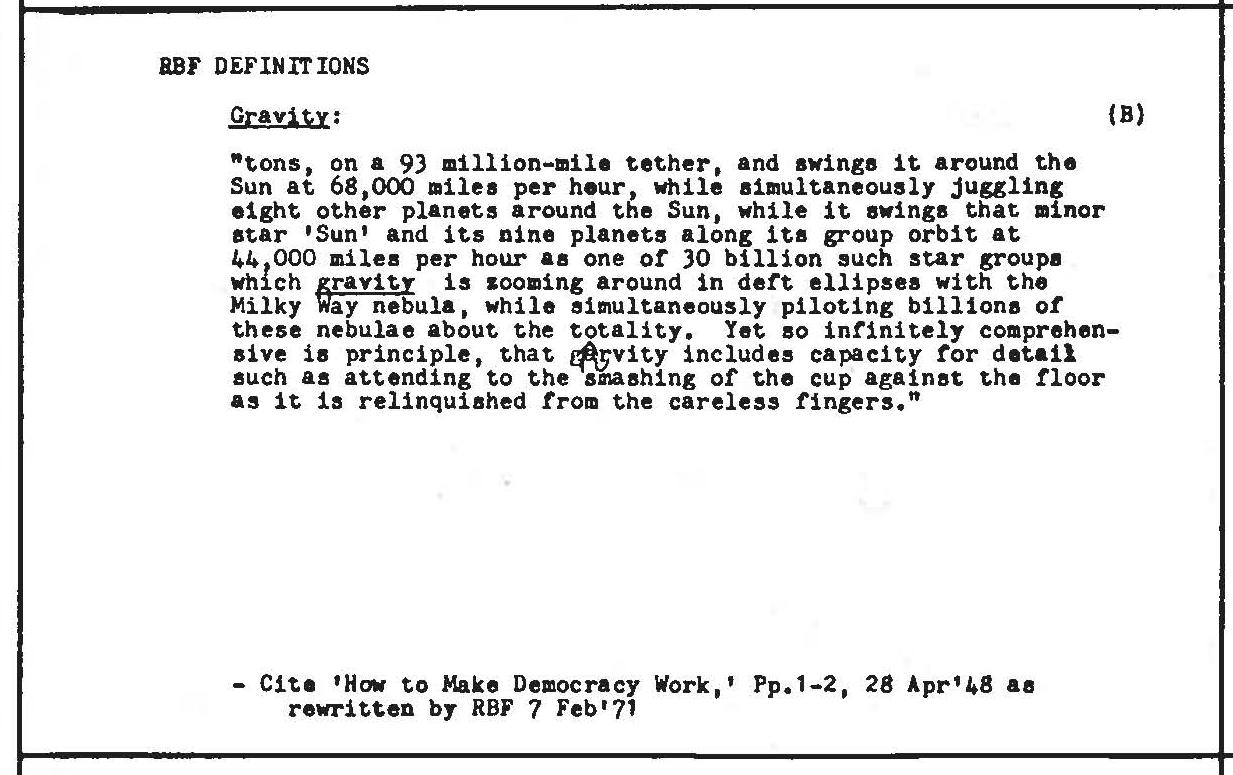
Gravity
Index Entry
Gravity:
". . . A single massive sphere . . . will both exert and yield attractively with a neighboring massive sphere."
- Cite NEHRU SPEECH, p. 34, 13 Nov '69
Gravity
Index Entry
Gravity:
". . . The moon and the Earth are tensionally cohered by gravity. The moon cannot get away from Earth, yet we can fly an airplane between the centers of gravity of the Earth and moon without severing their coherence. Obviously, the celestial bodies enjoy the zero-diameter-to-great-length tensional relationships."
- Cite GODDESSES, Sat. Review 21Mar68
Gravity
Index Entry
Gravity:
". . . All bodies of Universe are affecting the other bodies in varying degrees and all the intergravitational effects are precessionally angular modulations, and all the interradiation effects are frequency modulations."
-
Cite HOW LITTLE I KNOW, p. 73. OCT'66
-
Citation & context at Precession, Oct'66
Gravity
Index Entry
"What we wanted to do in making tension members is to get longer and longer and less and less section for a given strength as a reason for increasing the bridges. That curve is going up very, very rapidly as every metallurgist knows. However, I saw we were tending towards infinite length and no section at all, so I said back in 1927 is that a silly question that we are working towards great length with no section at all? Of course, in order to be able to see this, we will have to deal in big patterns of the universe because these are big patterns that I'm talking about. Let's look at just the Earth and the Moon, and quite clearly, they are cohering in tension, beautifully, gravitationally, and yet you can fly an airplane right through the point, the center of gravities with no trouble at all. I saw here in the heavens we were demonstrating over and over again great length with no section at all. . . This always seems to be true in the microscope-- with electrons and protons and all the atomic behavior. . . man is excluded from thinking the way the universe does-- this very efficient way of doing the big cohering tension, and having only local islands of compression."
Gravity
Index Entry
Gravity:
"Gravity is generalized tension..."
Gravity
← Gravity | Gravity & Bonding (1) →
Index Entry
Gravity:
"As man's knowledge of chemical interaction improves the length of tensile members relative to given section diameter, or given stress, tends to increasing amplification--to infinite length with no section. Incredible: No! Every use of gravity is a use of such sectionless tensioning. The electrical tension first employed by man to pull energy through the nonferrous conductors, and later to close the wireless circuit, was none other than such universally available sectionless tension."
Gravity & Bonding (1)
Cross Reference
Cross-References
Gravity
← Gravity & Bonding (1) | Gravity & Bonding (2) →
Index Entry
Gravity:
"Gravity cannot be focused; it is circumferential contraction."
- Cite RBF to cJA
Sarasota, Florida
7 February 1971
Gravity & Bonding (2)
← Gravity | Gravity: Circumferential Leverage (1) →
Cross Reference
Cross-References
- Gravity (j)
- Mass Attraction, 6 Mar'73
- Co-orbiting of Earth & Moon around Sun, Apr'71
Gravity: Circumferential Leverage (1)
← Gravity & Bonding (2) | Gravity: Circumferential Leverage (2) →
Index Entry
"The principle of leverage is employed in shears, nutcrackers, and pliers. The longer the lever arms, the more powerful the pressure applied between the internal central angles of the nutcracker's lever arms. We can make an illuminating model of our planet Earth if we think of it as a spherical bundle of nutcrackers with all their fulcrums at the center of the sphere and all the radii of the sphere acting as the lever arms of the pincers. The whole bunch of pincers have a common universal fulcrum at the common center. The farther out we go on the radial lever arms, the less effort is required to squeeze the ends together to exert nutcracking pressure at the center. If we go around the sphere-embracing circumference progressively tying up the ends of the levers together, we find that it takes very little, local, surface effort tensively between any two surface points to build up excruciatingly powerful, central-compression conditions. The bigger the model, the easier it is to tie it up; ever more delicate an exterior web will hold it together.
- Cite RBF rewrite of SYNERGETICS galley at Sec. \hrefhttps://www.buckyverse.org/en/synergetics/content/chapters/1000-omnitopology#section-1051.501051.50, 9 Jan'74
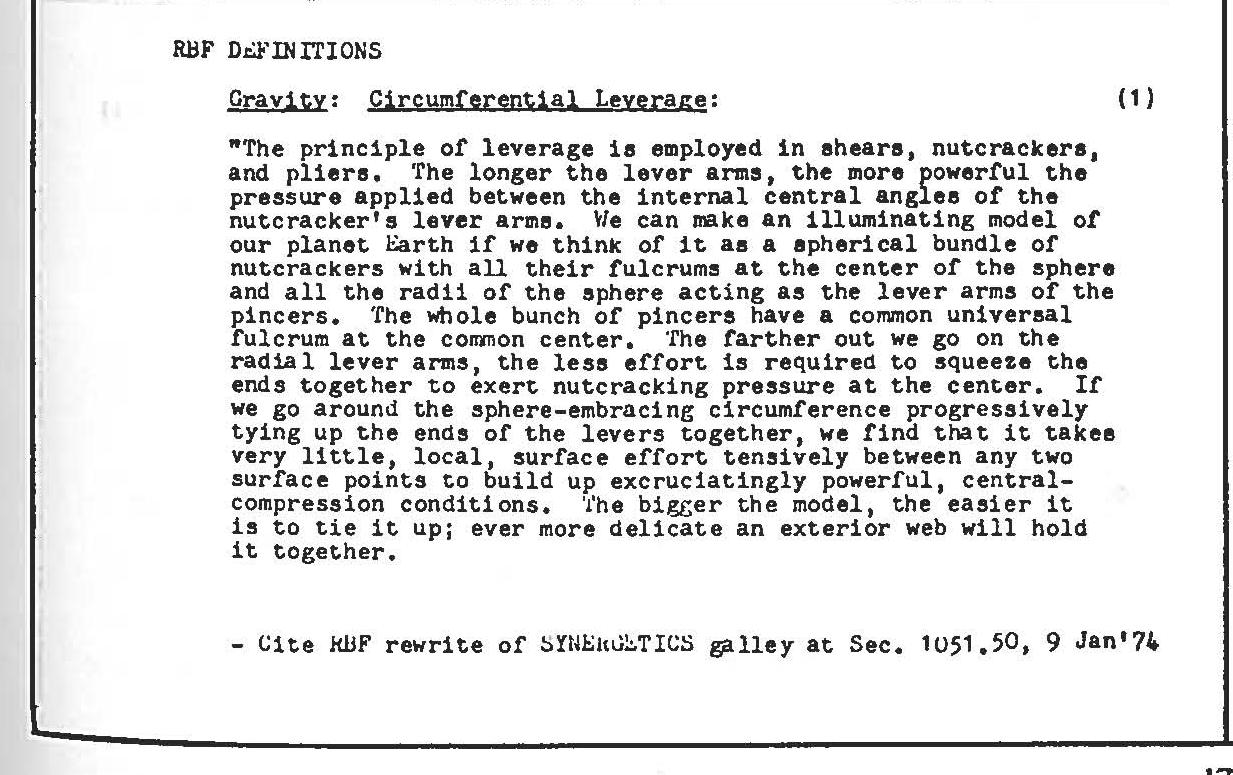
Gravity: Circumferential Leverage (2)
← Gravity: Circumferential Leverage (1) | Gravity: Circumferential Leverage (3) →
Index Entry
Gravity: Circumferential Leverage:
"Look at the relative distance of the atom and its outside electron orbit. The atom's electron field may be equivalent to our magnetic field around this Earth. This elucidates the electromagnetic field of Earth as a world-around, circumferential-embracement field operating ephemerally on the outer ends of 4,000-mile-long levers.
"Identifying the surface-angle chordinos with gravity, we comprehend why it is that as we get deeper and deeper, we see that the increasing gravitational-compression effect is due to the circumferential containment. The external containment web is always getting hold of the outermost ends of the centrally pinching levers. With this leverage effect, the farther out you go, the more advantage you have and the more powerful work you can do with that lever. Leverage effectiveness increases toward the center, ergo the increasing pressure that we identify with gravity. But it has this circumferential aspect.
- Cite RBF rewrite of SYNERGETICS galley at Secs. \hrefhttps://www.buckyverse.org/en/synergetics/content/chapters/1000-omnitopology#section-1051.511051.51 and \hrefhttps://www.buckyverse.org/en/synergetics/content/chapters/1000-omnitopology#section-1051.521051.52, 9 Jan'74
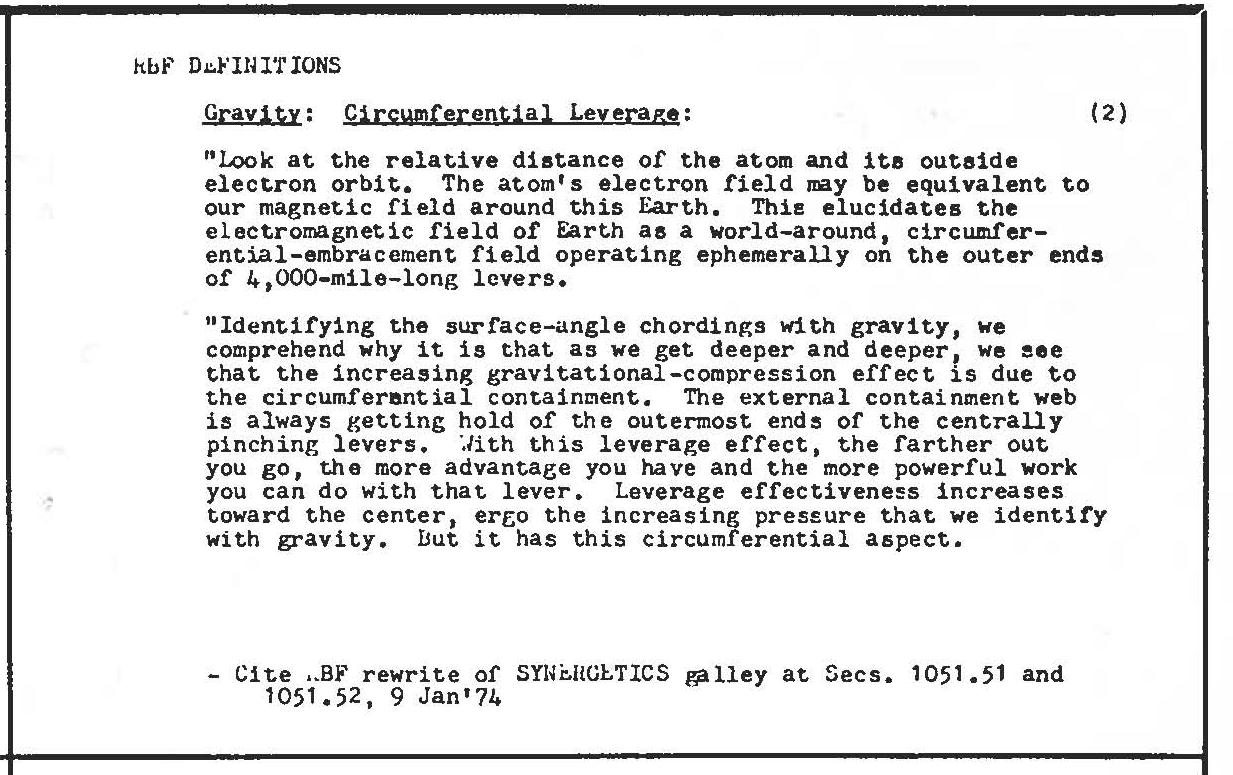
Gravity: Circumferential Leverage (3)
← Gravity: Circumferential Leverage (2) | Gravity: Circumferential Leverage →
Index Entry
There is a tendency to misinterpret the increasing pressures occurring inwardly of Earth as 'deadweight,' i.e., only as a radiationally-inward force, but it must be realized that the 'weight' is omnidirectional compression. The gravitational intermass-attraction is progressively augmented, as we go radially outward, by the circumferential mass-interattraction of the relative abundance of elemental atoms, which increases at the second-power rate of the radial-distance outwardly from the Earth's center; and as the pressures bring about ever closer presence of the atoms to one another, there is also an additional second-power exponential gain which results in r² varying as proximity² = P⁴, where P = relative compressive force. The surface chordal angle magnitudes multiplied by radius to the second power produce the relative magnitude of network leverage-advantage resulting in the relative increase in pressure as you go inward toward Earth's center. This is exciting because we now comprehend that gravity is a circumferentially operative force and not a radial force, with precession bringing about the 90-degreeness.
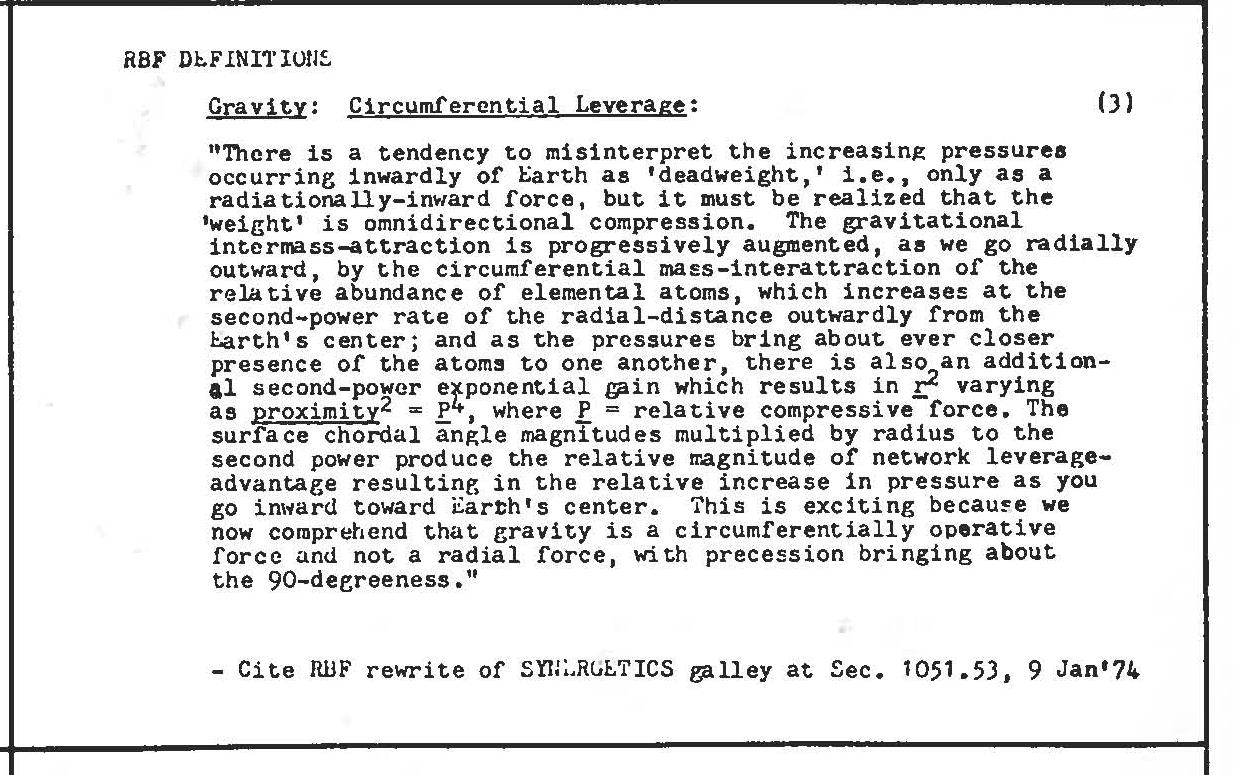
Gravity: Circumferential Leverage
← Gravity: Circumferential Leverage (3) | Gravity ≠ Implosion →
RBF Definitions
"Remembering Newton's law of gravity, wherein the relative interattractions are directly proportional to the product of the masses increased by the second power of the distances between the respective mass centers, we realize that doubling the size of a sphere brings about an eightfold multiplication of the circumferential mass-interattraction. In effect, we have a network of chordal cables tensively intertriangulating the progressively outmost ends of the spherical nutcracker bundle with circumferential turnbuckles continually tightening the tensional surface-triangulated network. This means that the pressures being exerted internally are proportional to the fourth power of the relative radial depth inward of Earth's surface.
"The surface-embrace leverage-advantage of the sphere operating at the fourth power can always overmatch the total volumetric gaining rate as only the third power of radial (frequency), linear gain, as the second-power interproximity attractiveness is further multiplied by the second-power, radial-lever-arm, advantage gains."
Citations
- RBF rewrite of SYNLRCLTICS galley at Secs. \href{https://www.buckyverse.org/en/synergetics/content/chapters/1000-omnitopology#section-1051.54}{1051.54} and \href{https://www.buckyverse.org/en/synergetics/content/chapters/1000-omnitopology#section-1051.55}{1051.55}, 9 Jan'74
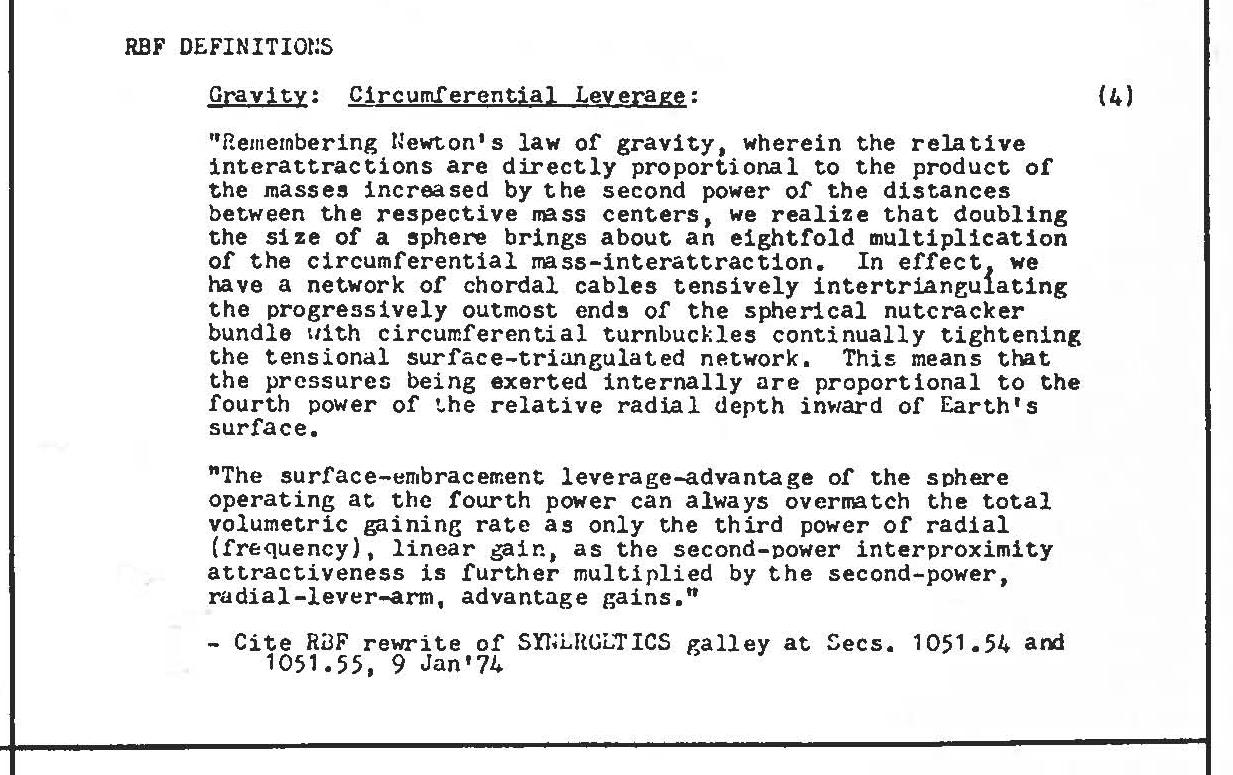
Gravity ≠ Implosion
← Gravity: Circumferential Leverage | Gravity - Importing →
Cross Reference
Cross-References
- Implosion, 19 Dec'71; 8 Apr'75
Gravity - Importing
← Gravity ≠ Implosion | Gravity Operates Circumferentially →
Cross Reference
Cross-References
- Importing, 25 Sep'73
Gravity Operates Circumferentially
← Gravity - Importing | Gravity Operates Circumferentially (1) →
RBF Definitions
"...But the point is that the bands of a barrel are finite: they come back upon themselves and they embrace. You have to return on to yourself to embrace. Gravity operates then by embracement. The larger the phenomenon that it embraces, the more leverage effect it has because you simply tighten the screws and the bands at the ends of the lever. This is why the pressures increase as you go into the Earth; they continually increase the further in you go due to the leverage effect of the embracement."
- Citation & context at Octahedron as Photosynthesis Model, (A), 8 Jun'75
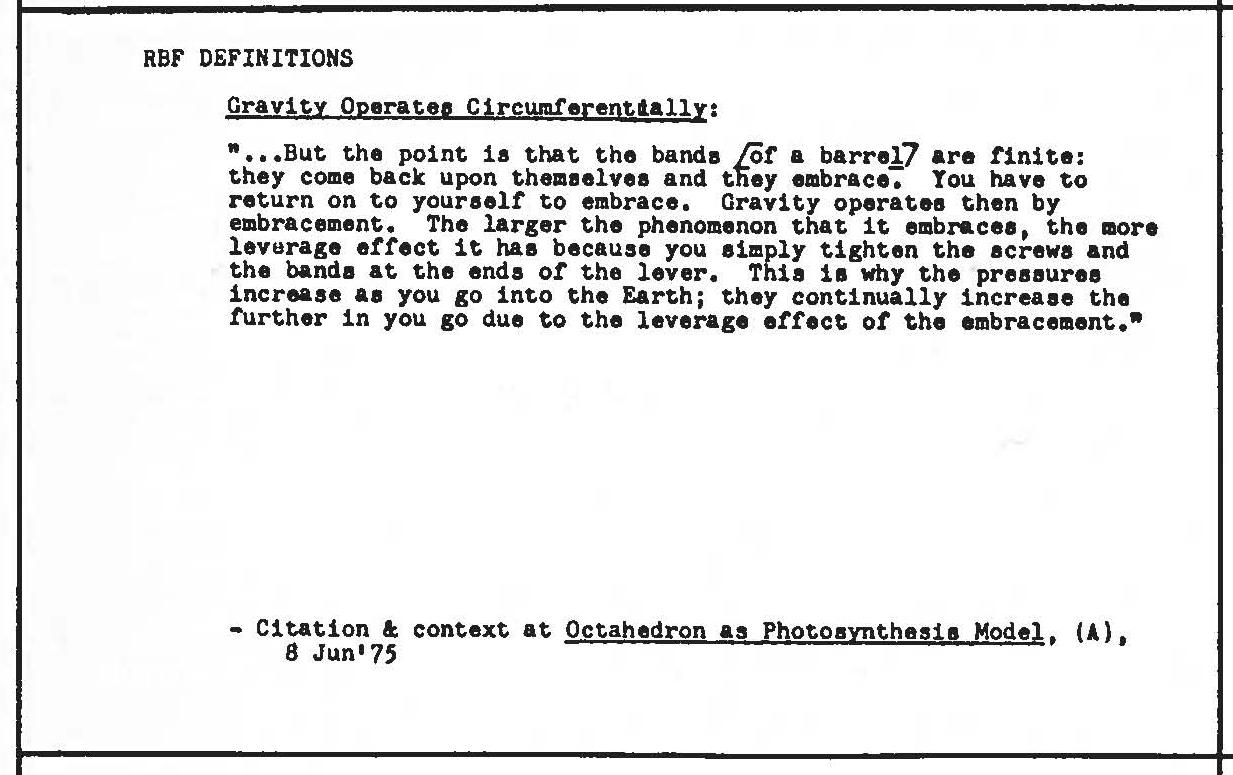
Gravity Operates Circumferentially (1)
← Gravity Operates Circumferentially | Gravity Operates Circumferentially (2) →
Cross Reference
Cross-References
Gravity Operates Circumferentially (2)
← Gravity Operates Circumferentially (1) | Gravity Come to Maximum Concentration and Becomes Radiation →
Cross Reference
Cross-References
- Gravitational Constant, (1)
- Gravity (h), 18 Oct'72 (1)
- Hexagonal Vector Pattern, 8 May'72
- ahedron as Photosynthesis Model, Oct
Gravity Come to Maximum Concentration and Becomes Radiation
← Gravity Operates Circumferentially (2) | Gravity: Speed Of →
Cross Reference
Cross-References
- Limit Point, 9 Jun'72
- Heaven & Hell, 31 May'71
Gravity: Speed Of
← Gravity Come to Maximum Concentration and Becomes Radiation | Gravity as Syntropy →
Cross Reference
Gravity: Speed Of:
"This (the expanding Universe concept) may be the universal effect of the speed of gravity, whose force (possibly in order to eternally cohere Universe) is, as is often found experimentally, always just a fraction greater than the cosmic speed of inherently disintegrative radiation. (See \hrefhttps://www.buckyverse.org/en/synergetics/content/chapters/200-synergetics#section-231.00231.)
"This conceptioning becomes lucid if one is familiar with the vector equilibria and their identity with isotropism, which spontaneously accommodates coexpansion or contraction independent of any Universe center, every nuclear point within the system being a Universe center, with all its 12 most immediate neighbors always being equidistant and bearing the the same toal of central-angle magnitudes from one another, (i.e., 60 degrees. The nucleus of a square would have a completely different distance to its corners than the corners would have to each other.) with the circumferentially closed, embracing vector forces always more effective than their equal and opposite radial vectors' noncooperative, open-ended, disintegrative forces."
(Sec. \hrefhttps://www.buckyverse.org/en/synergetics/content/chapters/700-tensegrity#section-780.24780.24)
- Cite SYNERGETICS text at Sec. \hrefhttps://www.buckyverse.org/en/synergetics/content/chapters/700-tensegrity#section-780.24780.24; RBF rewrite; 21 Oct'72
Gravity as Syntropy
← Gravity: Speed Of | Gravity Gravitational (1) →
Cross Reference
Cross-References
- Instant Universe, (1)(2)
Gravity Gravitational (1)
← Gravity as Syntropy | Gravity Gravitational (2A) →
Cross Reference
Radiamtion-gravitation
Unpeel the Gravitationalals
Coming Towardness: Coming Together Phase
Cross-References
- Black Holes
- Center of Gravity
- Child Pushes Spoon Off Edge of Table
- Energetic Functions
- Importing
- Mass Attraction
- Tidal
- Universal Integrity
- No Center of Gravity
- Electromagnetics vs. Gravity
- Conservation of Gravity
- Newton's First Law of Motion: RBF Restatement Of
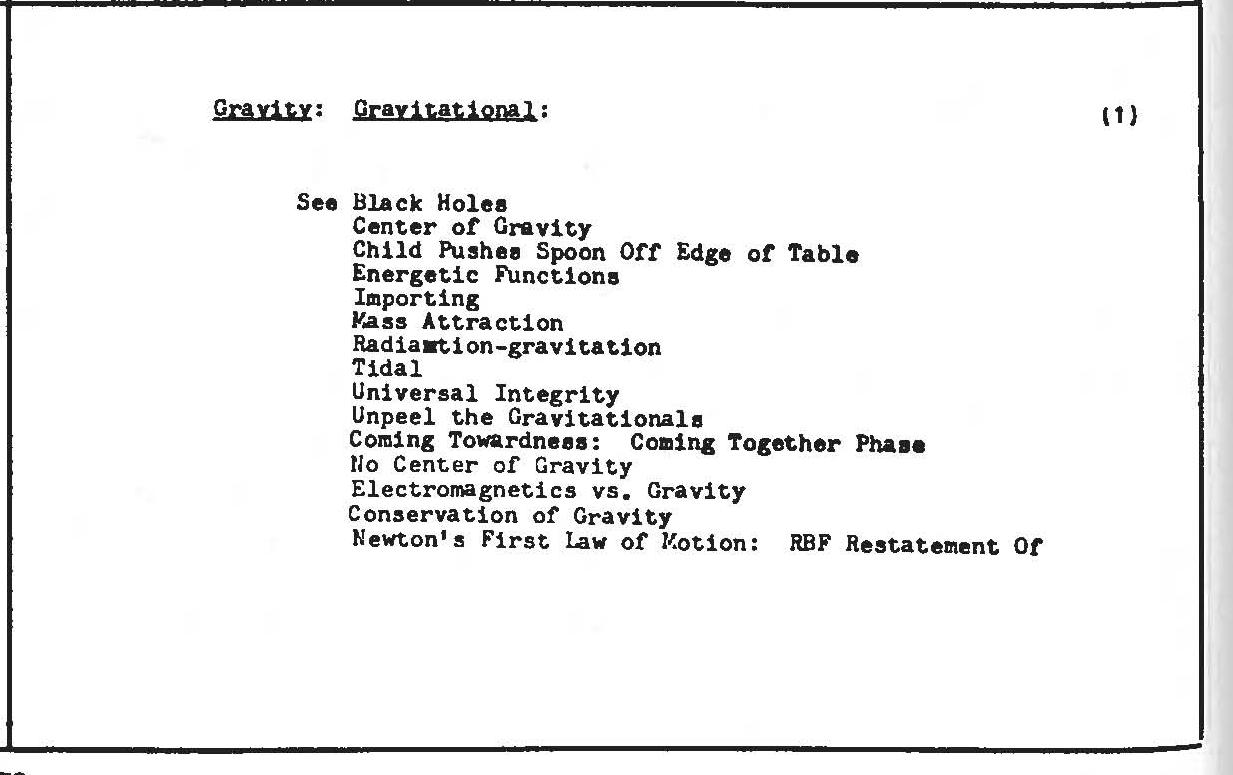
Gravity Gravitational (2A)
← Gravity Gravitational (1) | Gravity Gravitational (2B) →
Cross Reference
Cube: Diagonal Of, (2)
Cross-References
- Chemical Bonds, (1)(2)
- Child Pushes Spoon off Edge of Table, 16 Jun'72*; 15 Jun'74
- Coherence, 10 Oct'63
- Conceptual Physics, (2)
- Critical Proximity, Jun'71
- Curvature, 23 Sep'73*
- Energetic Words, 1 Jul'62
- Energy, Apr'68
- Generalization: Second Degree, 1959
- Integrity, 25 Jan'72*
- Physical Synergy, Jan'72
- Point: Inbound Point, 23 Sep'73
- Precession, Oct'66* (1)
- Prehending, 19 Dec'74
- Push-pull, 28 Mar'77
- Reverse Atomics, 10 Sep'74
- Skiing, 20 Oct'72
- Star Tetrahedron, 8 Oct'71
- Synergy, 31 Jan'75
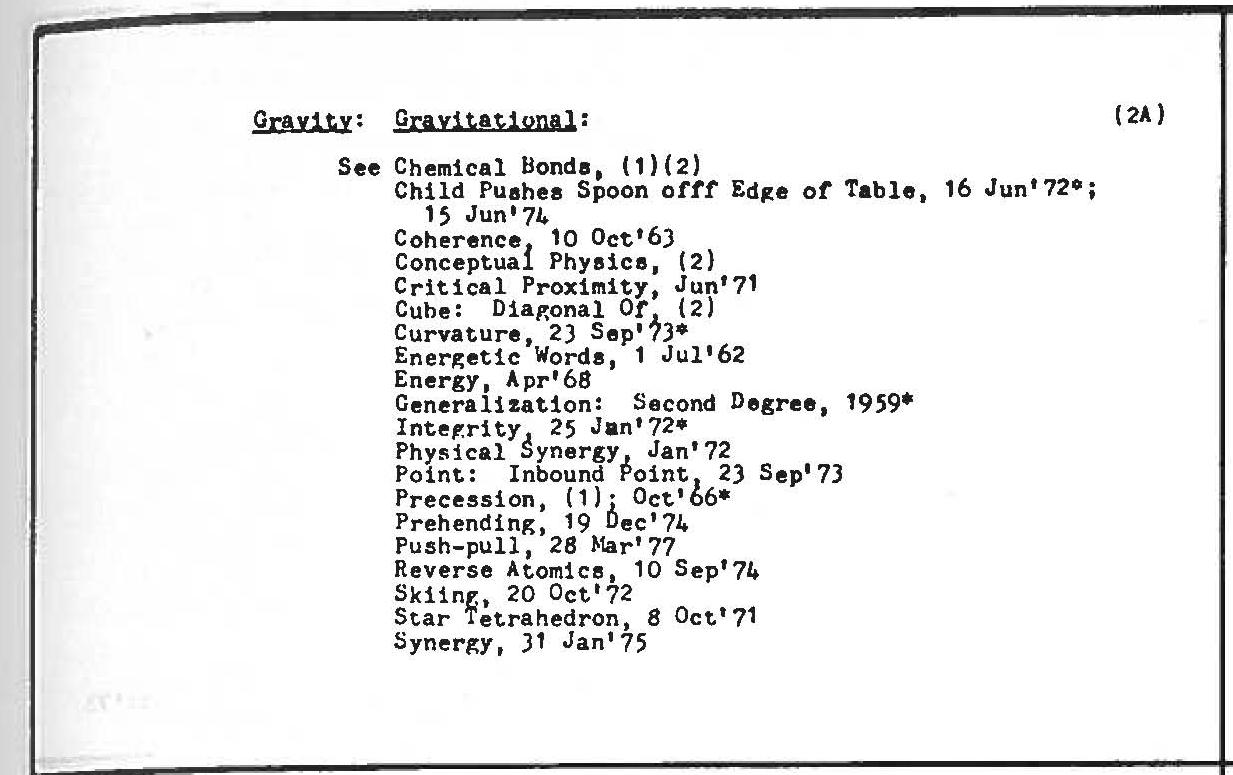
Gravity Gravitational (2B)
← Gravity Gravitational (2A) | Gravity Gravitational (3) →
Cross Reference
Cross-References
- Tripod, 27 May'75
- Truth, 5 Jun'73*
- Universal Integrity, 7 Nov'73*
- Universal Integrity: Principle Of, 21 Dec'71*
Gravity Gravitational (3)
← Gravity Gravitational (2B) | Great Circle →
Cross Reference
Gravitational Menurability
Gravity Comes to Maximum Concentration add Becomes Radiation
Gravity = Importing
Cross-References
- Gravitational Constant
- Gravitational Field
- Gravitational System Zone
- Gravity & Bonding
- Gravity Operates Circumferentially
- Gravity as Syntropy
- Gravity ≠ Implosion
- Gravitational Continuum
- Gravity: Speed Of
- Gravitation: Inverse Square Law Of
Great Circle
← Gravity Gravitational (3) | Great Circle →
Index Entry
Great Circle:
"Every great circle plane is inherently two spherical segment tetrahedra of zero altitude, base-to-base."
- Cite RBF correction to Synergetics galley at \hrefhttps://www.buckyverse.org/en/synergetics/content/chapters/1100-triangular-geodesics#section-1106.001106,25, Santa Monica, CA, 12 Jan'74
Great Circle
← Great Circle | Great Circle →
Index Entry
Great Circle:
"Every great circle always intercepts any other great circle twice, the interception points always being 180-degree polar opposites."
- Cite RBF rewrite of SYNERGETICS galley at Sec. \hrefhttps://www.buckyverse.org/en/synergetics/content/chapters/700-tensegrity#section-703.13703.13, 10 Nov'73
Great Circle
← Great Circle | Great Circles →
Index Entry
Great Circle:
"Events are forced to bounce in spherically contained circles because they seek the largest possible interior circumference patterns. All great circles cross each other twice. Three or more noncongruent great circles are automatically inter-self-triangulating in their repetitive searching for the 'most comfortable' interactions which always resolve their three-way-great-circle pattern-ing into regular spherical icosahedra, octahedra, or tetrahedra."
- Citation and context at Three-way Great Circling: Three-Way Grid, 8 Mar'73
Great Circles
← Great Circle | Great-circle Chord Edges →
Index Entry
Great Circles:
"...Every great circle twice meets and crosses the path of every other great circle, of the infinity of great circles, while lesser and parallel circles need never meet another lesser circle. Only great circles are biologically regenerative."
- Cite Motion Economics, p. 56; May'44
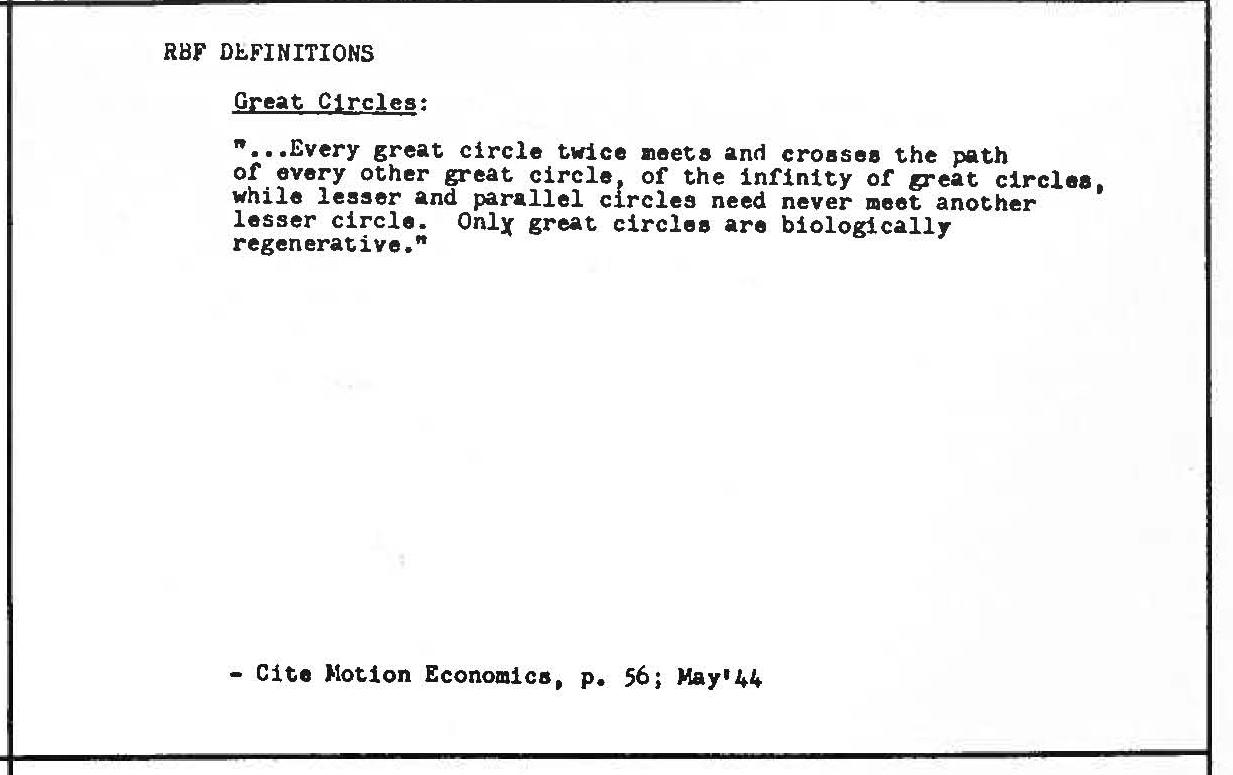
Great-circle Chord Edges
← Great Circles | Great Circle Subdivisions of Spherical Unity →
Cross Reference
Cross-References
- Tetrahedron, (1)(2)
Great Circle Subdivisions of Spherical Unity
← Great-circle Chord Edges | Great Circle Subdivisions →
Index Entry
Great Circle Subdivisions of Spherical Unity:
"Their inwardly and outwardly pulsating and rotating 'teeth' Consist of multifrequenced circumferential and radial waves Of 56 great circle subdivisions of spherical unity, Often nonmeshing with other local systems."
- Citation and context at Gears: Spherical Gears, May'72
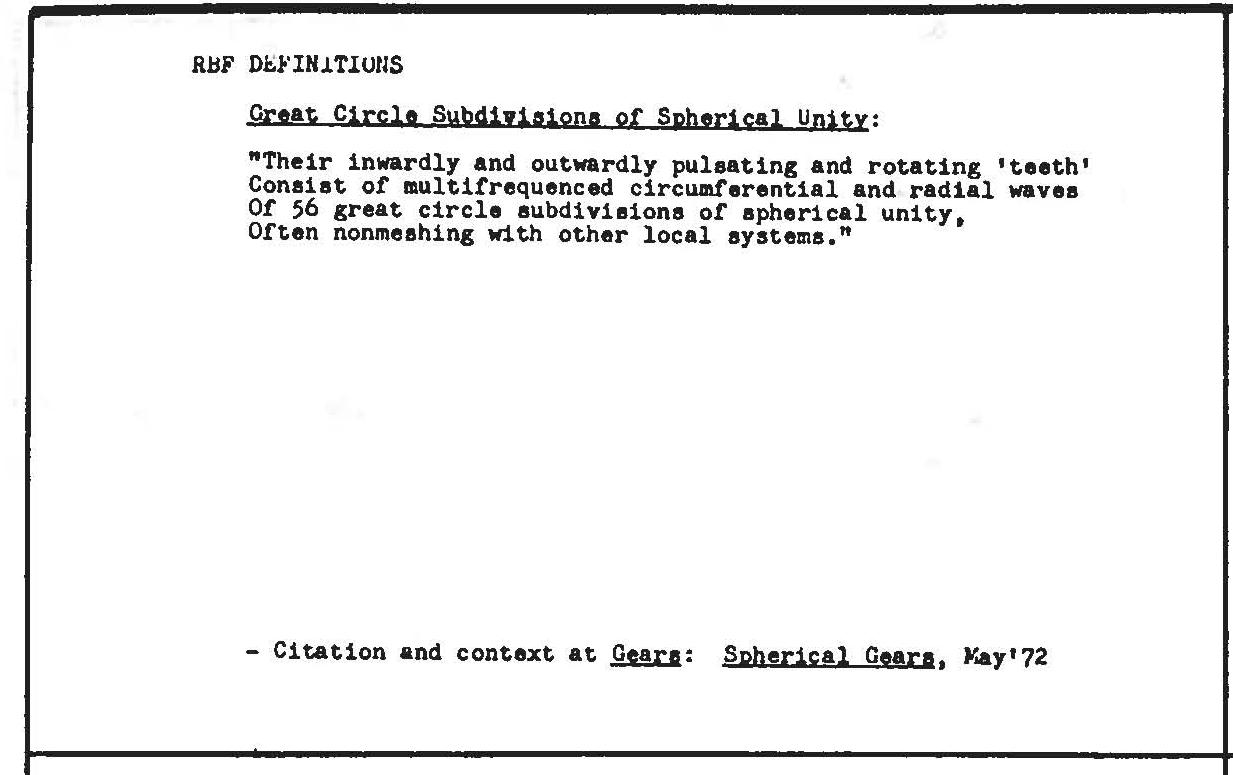
Great Circle Subdivisions
← Great Circle Subdivisions of Spherical Unity | Great Circles: Excess of One Great Circle over Edge Vectors In VE & Icosa →
Cross Reference
Cross-References
Great Circles: Excess of One Great Circle over Edge Vectors In VE & Icosa
← Great Circle Subdivisions | Great Circles →
Cross Reference
Cross-References
- Gravitational Constant, (1)(2)
Great Circles
← Great Circles: Excess of One Great Circle over Edge Vectors In VE & Icosa | Great-circle Spinnable Symmetries →
Cross Reference
Triangles, 16 Dec'73
13 Apr'77
Cross-References
- Basic Triangle: Basic Disequilibrium 120 LCD
- Basic Triangle: Basic Disequilibrium 120 LCD Triangles, 16 Dec'73
- Triacontrahedron as Limit Regular Polyhedron, 13 Apr'77
Great-circle Spinnable Symmetries
← Great Circles | Great Circles (1) →
Cross Reference
Hierarchy Of:
"As you go from one sphere-foldable great-circle set to another in the hierarchy of spinnable symmetries (the 3-, 4-, 6-, 12-sets of the vector equilibrium's 25-great-circle group and the 6-, 10-, 15-sets of the icosahedron's 31-great-circle group), the central angles of one often become the surface angles of the next-higher-numbered, more complex, great-circle set while simultaneously some (but not all) of the surface angles become the respective next sphere's central angles. A triangle on the surface of the icosahedron folds itself up, becomes a tetrahedron, and plunges deeply down into the congruent central angles; void of the icosahedron (see section \hrefhttps://www.buckyverse.org/en/synergetics/content/chapters/900-modelability#section-905.47905.47)."
Cross-References
- section 905.47
Great Circles (1)
← Great-circle Spinnable Symmetries | Great Circles (2) →
Cross Reference
Cross-References
- Circumferential Field
- Foldability of Great Circles
- Geodesic
- Constant Zenith Projection
- Railroad Tracks: Great Circle Energy Tracks on the Surface of a Sphere
- Symmetry: Seven Axes Of
- Three-way Great Circling: Three-way Grid
- Vector Equilibrium: Great Circles Of
- Icosahedron: Great Circles Of
- Spherical Grid
- Triacontrahedron: Great Circles Of
Great Circles (2)
← Great Circles (1) | Great Design: The (1) →
Cross Reference
Cross-References
Great Design: The (1)
← Great Circles (2) | Great Design: The (2) →
Cross Reference
Competence: A Knowing Competence Greater than That of Humans
Cross-References
- A Priori Great Design
- Eternal designing Capability
- Greater Understanding
- Science: The Great Design
- Supreme Intellect
- Universal Mind
- God
- Cosmic Wisdom
Great Design: The (2)
← Great Design: The (1) | Great Dipper →
Cross Reference
Cross-References
- Christ, 7 Oct'71
- Thinking, (3)
- Words & Coping, 7 Nov'75
- Universe is Technology, (2)
Great Dipper
← Great Design: The (2) | Great Eternal Mind →
Cross Reference
Great Dipper:
Cross-References

Great Eternal Mind
← Great Dipper | Greater Intellect (1) →
Cross Reference
Spreme Intellect
Cross-References
Greater Intellect (1)
← Great Eternal Mind | Greater Intellect (2) →
Index Entry
Greater Intellect:
"When I first determined that I should do my own thinking I decided I was going to go entirely on the basis of experimental evidence. And that kind of evidence is a very large resource as I found that we can also draw on the experiences of our friends; through our reliable friends we can accent much of the data of science as part of our experience inventory.
"I use the word belief to describe men accepting the explanations of physical phenomena without experimental evidence to confirm them. So I gave up all my beliefs--clearing my deck of any of them.
"But possibly the majority of human beings are deeply moved by the knowledge of some greater power operative in our Universe.... You do have experiences that force you to assume that a greater intellect is operating than that of humans. I am forced to conclude that we do.
"Design is related to intellect: as a deliberate arrangement"
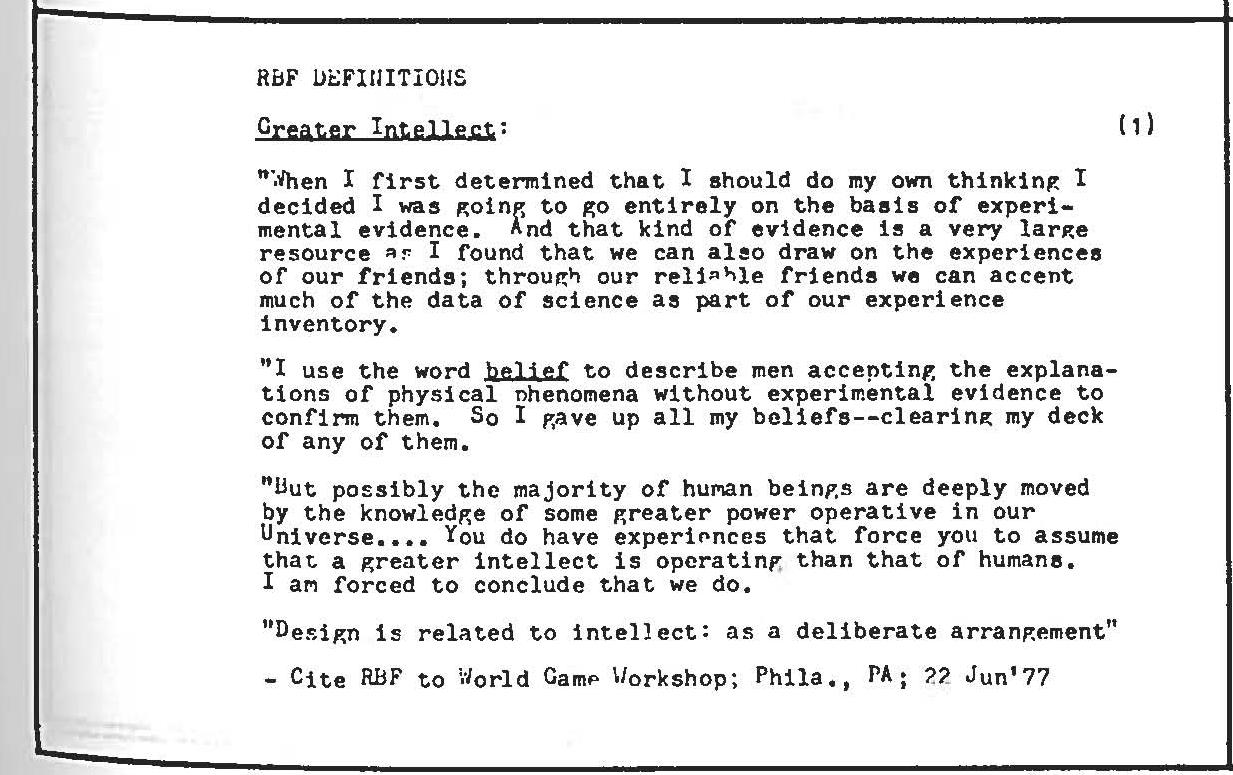
Greater Intellect (2)
← Greater Intellect (1) | Great Intellect →
Index Entry
Greater Intellect:
"of parts and their interaugmentation of arrangements which are discoverable only by mind. (RBF explains the lever.)
"It is the mathematical statements of principles that permit environmental transforming. The observation of mathematical ratio-ing is purely intellectual in a Universe where nothing ever fails to work--with that great design of the interaccommodation of principles. As we look at the operation of all the macro-micro laws in Universe we are o'erwhelmed by the evidence of a greater intellect to which we should be the servant. Human beings should have no glory--all the glories are to this intellect: it does not need any proselyting or religion: it is the Universe. I had to let you know how I feel."
- Cite RBF to World Game Workshop; Phila., PA; 22 Jun'77
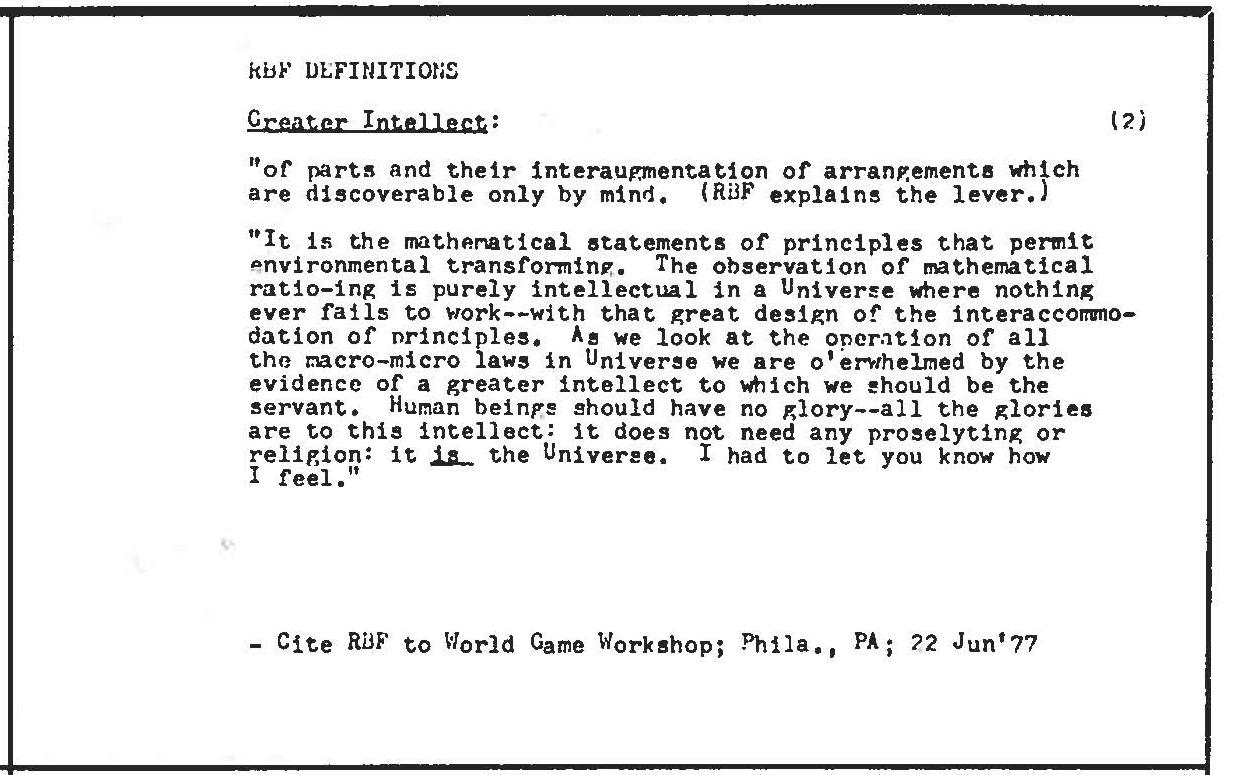
Great Intellect
← Greater Intellect (2) | Great Intellect Greater Intellect (1) →
Index Entry
Great Intellect:
"All of which organic design conception
May be that of a great intellect
Which is inventing Universe progressively
Evolving mathematically elegant
Integral equations
For each conceivable challenge
Including the invention
You and me."
- Citation and Context at Sensorial Identification of Reality, (2), May '72
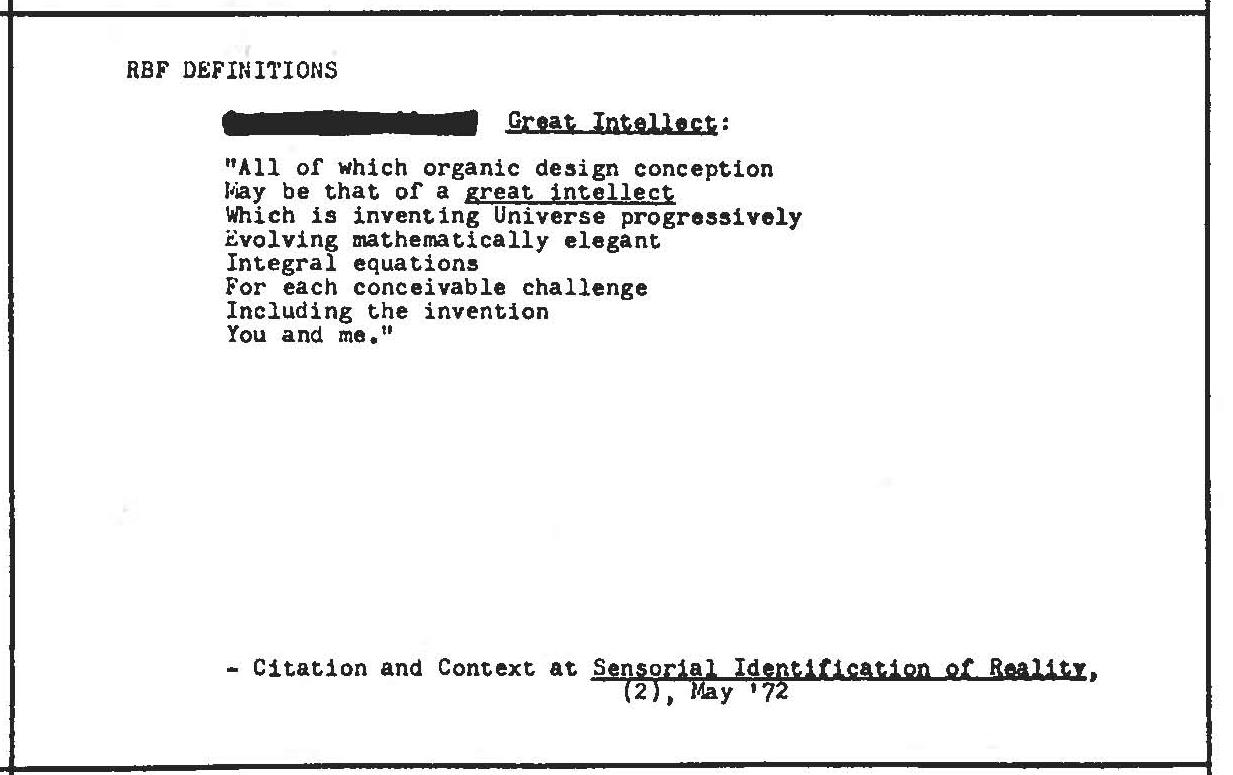
Great Intellect Greater Intellect (1)
← Great Intellect | Great Intellect Greater Intellect (2) →
Cross Reference
Cross-References
- Supreme Intellect
- Eternal Designing Capability
- Science: The Great Design
- Cosmic Intelligence
- God
- Transcendental
Great Intellect Greater Intellect (2)
← Great Intellect Greater Intellect (1) | Great Pirates →
Cross Reference
Spaceship, (A)
Cross-References
- Einstein: Cosmic Religious Sense, (3)
- Population Sequence, (6)
- Sensorial Identification of Reality, May'72
- Human Beings & Complex Universe, (15)
Great Pirates
← Great Intellect Greater Intellect (2) | Greater Understanding →
Cross Reference
Cross-References
Greater Understanding
← Great Pirates | Greek Geometry →
Cross Reference
Cross-References
- Man as a Function of Universe, Jun'69
Greek Geometry
← Greater Understanding | Greek Temple →
Cross Reference
Greek Geometry:
Cross-References
Greek Temple
Cross Reference
Cross-References
- Redundancy: Reduction Of, 22 Apr'71
Grid
← Greek Temple | Grid Basis: Multipolygonality of Great Circle Grids →
Index Entry
A pattern of intersecting members, lines or axes; usually intersecting great circles forming patterns made up of equilateral triangles, diamonds, or hexagons.
- Cite Patent No. 2, 682, 235, June 29, 1954
BUILDING CONSTRUCTION
Grid Basis: Multipolygonality of Great Circle Grids
← Grid | Grid Basis: Spherical Triangular Grid Bases →
Index Entry
Grid Basis: Multipolygonality of Great Circle Grids:
"It is a matter of Dymaxion cartographic strategy that: the greater the number of great circle polygonal zones employed in the transformation, the less the spherical excess to be subsidingly concentrated within each zonal surface, and therefore the less the residual distortion distributed to each of the planar mosaic aspects of the whole world's reassembled surface when arrayed in one continuous flat 'skin.'"
The projective transformation "represents the only method by which the whole world data can be transferred from the spherical to the planar within an all great circle grid triangularly, quadrangularly, multipolygonally or all two or three together."
"Because of a hemisphere's polar symmetry to its opposite polar hemisphere the total inventory of great circle grid triangles in the comprehensive world grid is always even in number, therefore adjacent triangles may always be associated in total or partial quadrangular pattern-phases without increase in vertex count."
Grid Basis: Spherical Triangular Grid Bases
← Grid Basis: Multipolygonality of Great Circle Grids | Grid →
Index Entry
The projective transformation "consists of great circle bounded triangles of any angular magnitude which can transform the comprehensive geographical data of the world from spherical to planar by employment of either the spherical tetrahedron, spherical cube, spherical octahedron, or spherical vector equilibrium and its alternate, the icosahedron, of any development of these. . . It is a discovery of synergetics that there are no other spherical triangular grid bases other than the above."
Grid
← Grid Basis: Spherical Triangular Grid Bases | Grid (2) →
Cross Reference
Grid: Crissacross, Right-angle Grid in Civil & Agrarian Law:
Cross-References
- Air Space, May'65
Grid (2)
Cross Reference
See Twenty-foot Earth Globe & 200-foot Celestial Sphere, (2)
Cross-References
- Twenty-foot Earth Globe \& 200-foot Celestial Sphere, (2)
Grid (1)
← Grid (2) | Grid Gridding (2) →
Cross Reference
General Systems Grid
Local Squareness
Rectilinear Grid Systems
Spherical Grid
Tensegrity Geodesic Grid: Three-way Grid
Three-way Great Circling: Three-way Grid
Two-way Rectilinear Grid
World Power Grid
Three-way Weaving
Two-way Crisscross
Triangle & Hexagon Grid
Coordinate System
Matrix
Cross-References
Grid Gridding (2)
← Grid (1) | Gross Communication (1) →
Cross Reference
Cross-References
- Vector Equilibrium: Great Circles Of Hyperbolic Paraboloid, 14 May'75 (4)
Gross Communication (1)
← Grid Gridding (2) | Gross World Product Sequence (1) →
Cross Reference
Cross-References
Gross World Product Sequence (1)
← Gross Communication (1) | Gross World Product Sequence (2) →
Index Entry
Gross World Product Sequence:
"The capital worth in tools and other resources of all the nations of the Earth in 1972 is... estimated to be 75 trillion U.S. dollars, which last year yielded the annual world income of 3.6 trillion. Heartbeat magnitudes give us an idea of the nonsense characterizing the reflexing of human brains when talking 'dollars'. As the 75 trillion worth of the world's organized wealth-regenerating capacity is just about the same number as the number of heartbeats ago of the earliest known humans on Earth-- 2.5 million years ago-- it suggest that during each one-second heartbeat of that time humans were making and 'saving' $1 net.
"They were, in fact, saving memories of experiences, which ever multiply, from which accumulate metaphysical know-how that has never been entered into the ledgers of world-wealth accounting. Those pages are only preoccupied with sovereignty-guaranteed physical-property equities of socialist or capitalist governments and the economic enterprises that they respectively foster. GNP stands for gross national product annually. GWP stands for gross world product annually, the GWP of 1972 estimated at $3.6 trillion. The world's population of 1972 was 3-2/3 billion humans. A trillion is 1000 billion;"
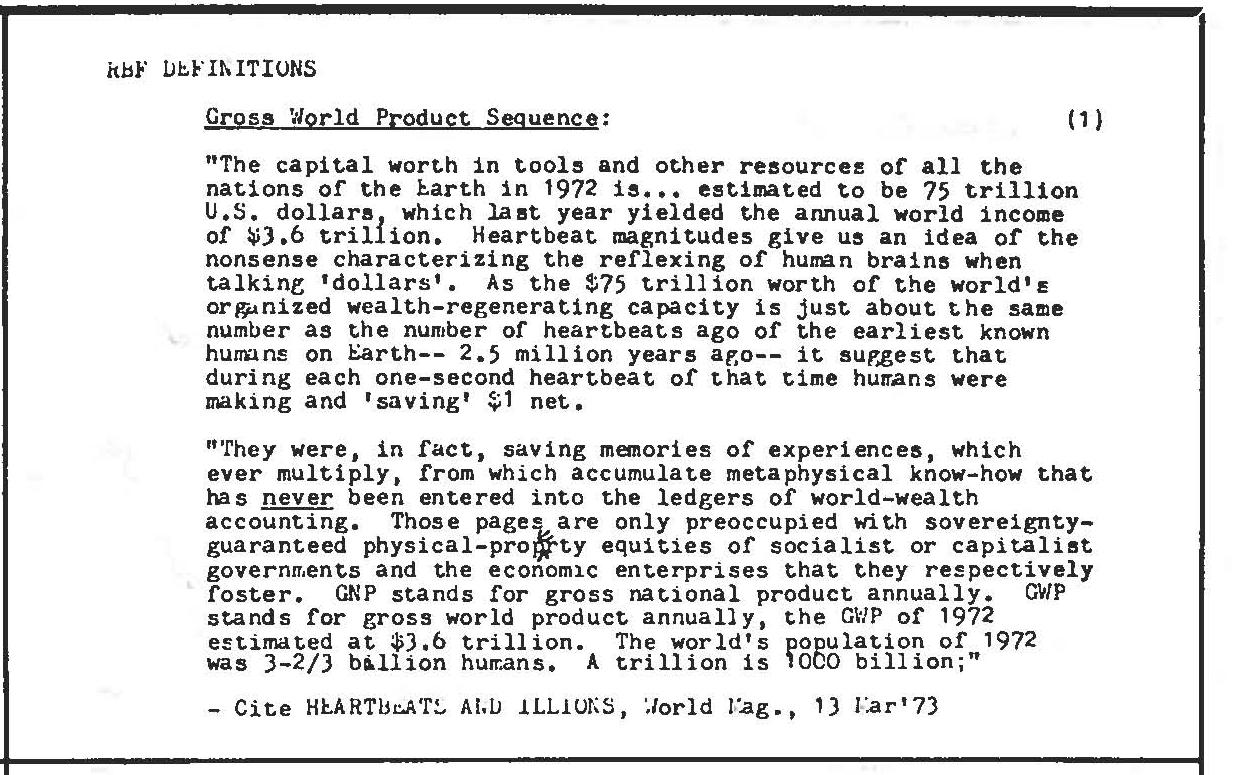
Gross World Product Sequence (2)
← Gross World Product Sequence (1) | Gross World Product Sequence (3) →
RBF Definitions
"therefore, the world's 1972 GWP of 3.6 trillion meant an average income for each world human of 1000. However, the production was not evenly distributed, as is well known, and half the world's people averaged an income of $2000 each, while the other half averaged $100 each. In 1810, just before industrialization began in the United States, the annual individual income was less than $100-annual-income-purchasing capability of the 1972 world's industrial as-yet-have-nots. The difference is the spread of the new method of survival by industrial rather than by farm and craft means. The curve of this rising number of highly advantaged humans shows less than 1 per cent benefited haves as of 1900, 4 per cent haves as of the entry into World War I, and 20 per cent haves as of entry into World War II. In 1972 we went through the fifty percent haveness point. Nineteen hundred and seventy-three opens the new chapter of human history wherein, for the first time, the majority of humanity are haves. For the 2.5 million years of man's known presence on Earth, a majority of 99 percent were have-nots subsisting at or below the living standards of the half of humanity who in 1972 received only $100 of the gross world product. Nineteen hundred and seventy-two was history's"
Citations
- HEARTBEATS AND ILLIONS, World i.ag., 13 Mar'73
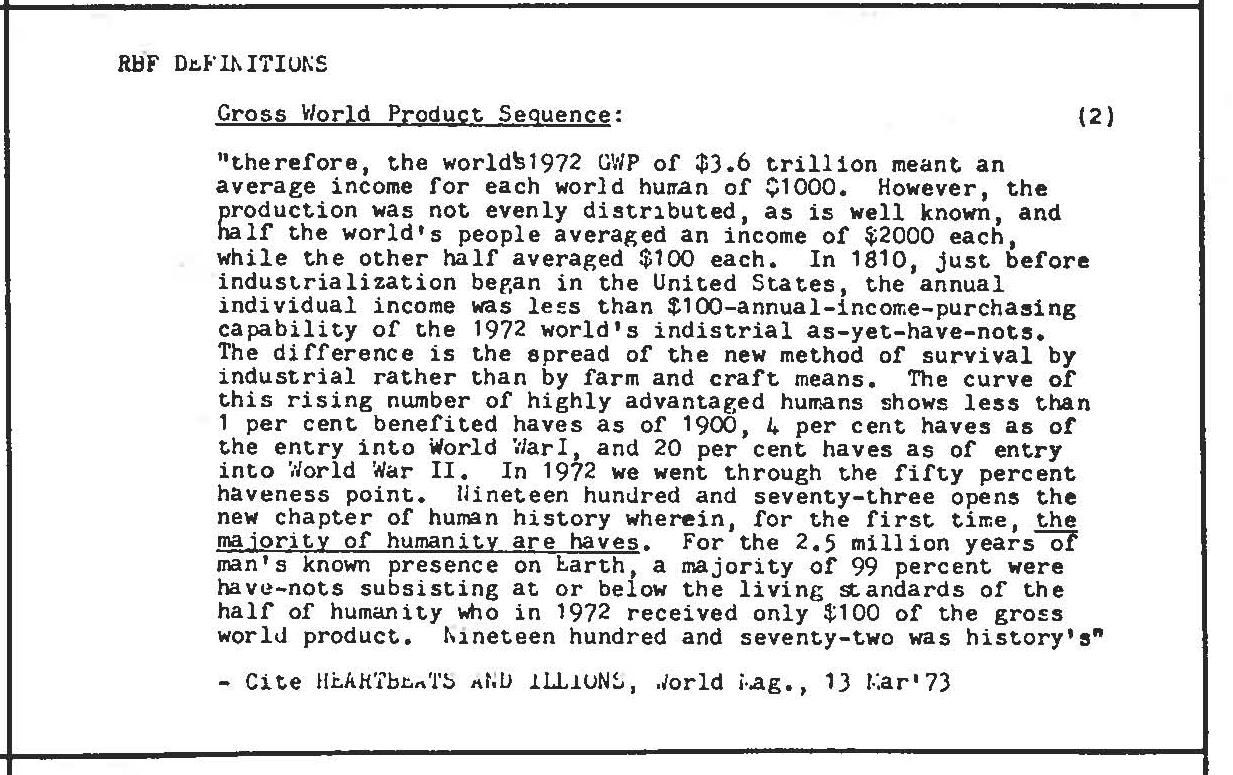
Gross World Product Sequence (3)
← Gross World Product Sequence (2) | Gross World Product Sequence →
Index Entry
Gross World Product Sequence:
"most critical year, when the sudden avalanche of new affluence left the not-as-yet industrialized have-nots dramatically dismayed by the differences in human fortune.
"Up to 1972 the ever-increasing irritation of the majority of human have-nots continually multiplied the probability of world revolution. Up to 1972 this could have brought holocaust so devastating as to preclude the further existence of of any human beings on our planet at any standard of living. There is now the possibility that the majority of humans who are now haves will realize increasingly that they cannot enjoy their haveness while the dismay and irritability of the have-nots persist. The haves will come to understand that it is now highly feasible for the first time in history to accelerate the realization of 100 per cent haveness-- this realization to be reached at the earliest by 1985, a time when the majority of all present humanity will still be alive and young enough to enjoy the new concept-- by then the established norm-- of human beings as cosmically designed to be successful in the Universe, even as are the chemical elements and the principles of radiation and gravity."
- Cite HEARTBEATS AND ILLIONS World Mag., 13 Far'73
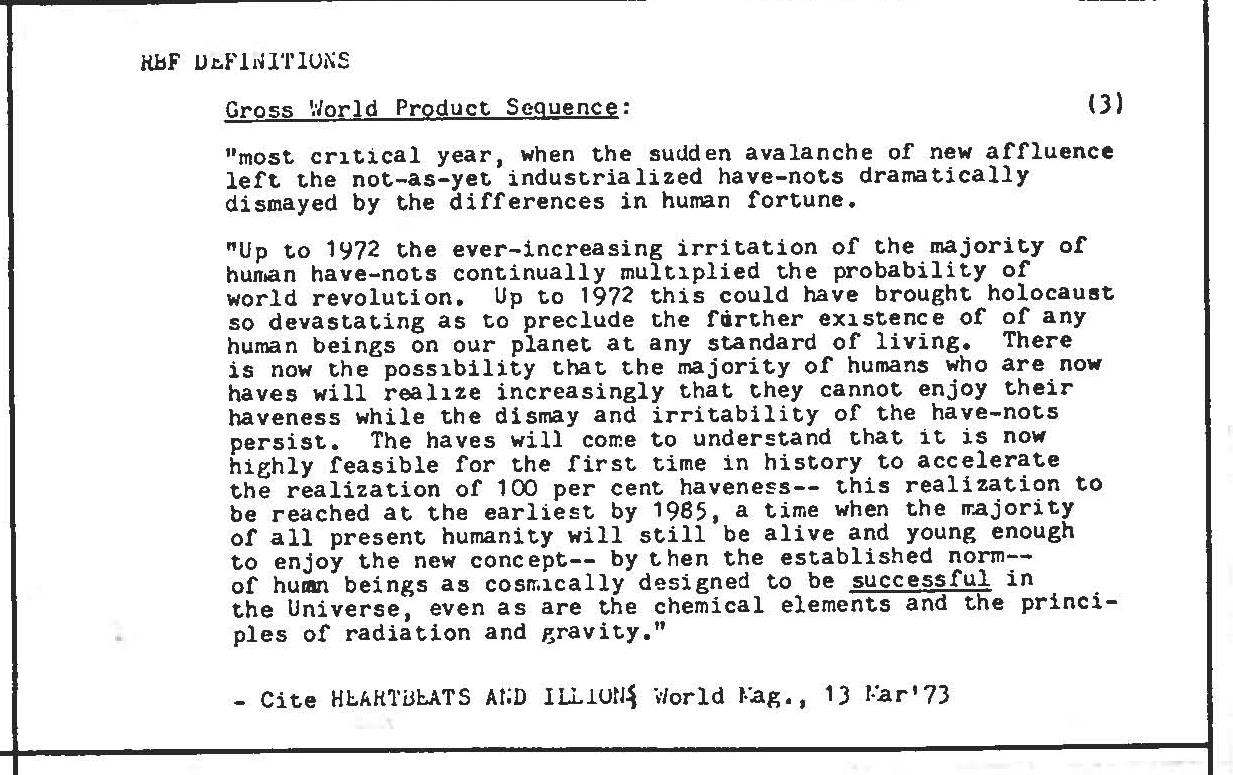
Gross World Product Sequence
← Gross World Product Sequence (3) | Group Advantage Gains →
Index Entry
Gross World Product Sequence:
"At the present time the $200 billion going for armaments of all the great powers of the Earth is a little more than goes to feed the 1.8 billion $100-a-year have-nots.
"Allowing three years for this to make sense and get going, it also happens to be true that the same $22 billion annually appropriated by world governments for military use will purchase the 40 million new $5000 homes required annually during each of the next 25 years until A.D. 2000 if we are to accommodate those now ill-housed as well as the interim world population increase."
- Cite HEARTBEATS AND ILLIONS, World Mag., 13 Mar'73
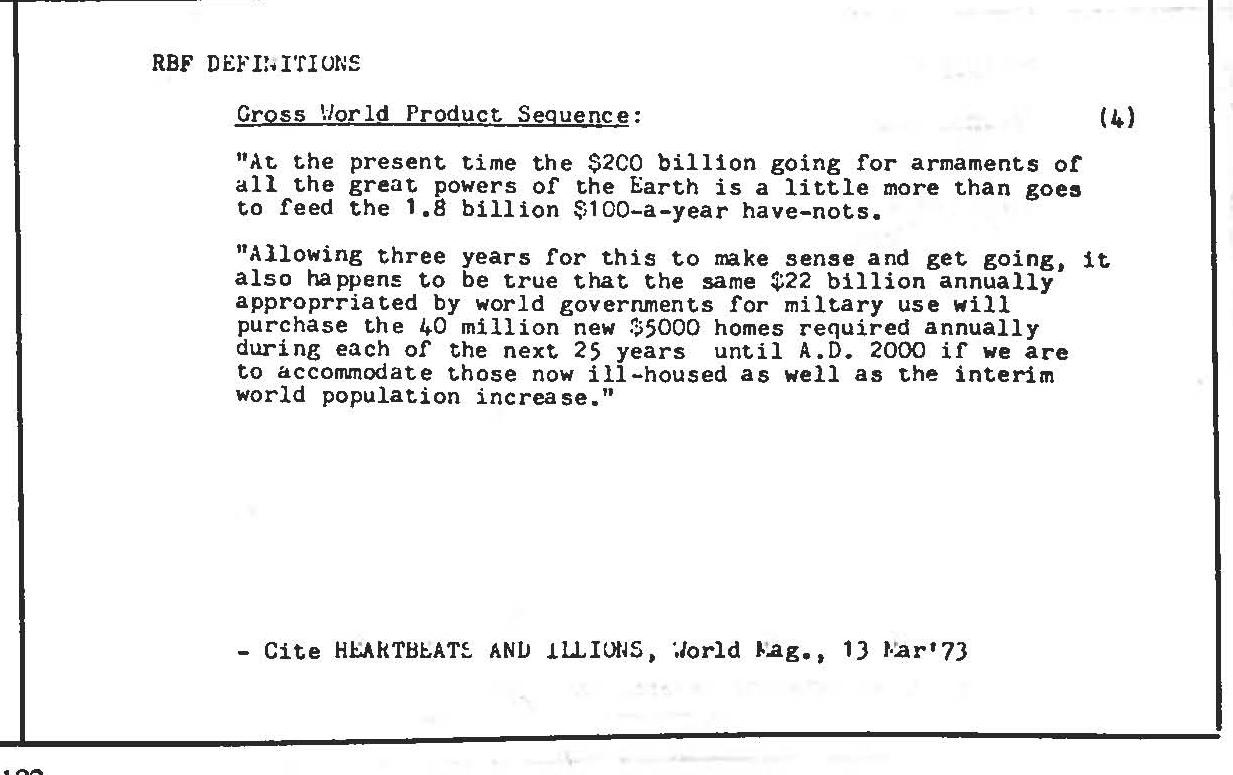
Group Advantage Gains
← Gross World Product Sequence | Group Coordination (1) →
Cross Reference
Cross-References
- Loss: Discovery Through Loss, 14 Dec'73
Group Coordination (1)
← Group Advantage Gains | Group Coordination (2) →
Cross Reference
Cross-References
Group Coordination (2)
← Group Coordination (1) | Group Design →
Cross Reference
Cross-References
- Photon, 26 Sep'73
Group Design
← Group Coordination (2) | Group Memory (1) →
Index Entry
Q. Can groups design?
RBF: "Design is an individual function, but it can be coordinated. Design synergetics enters in because the object of design is not just the object."
- Cite RBF videotaping session Philadelphia, Pa., 1 Feb'75
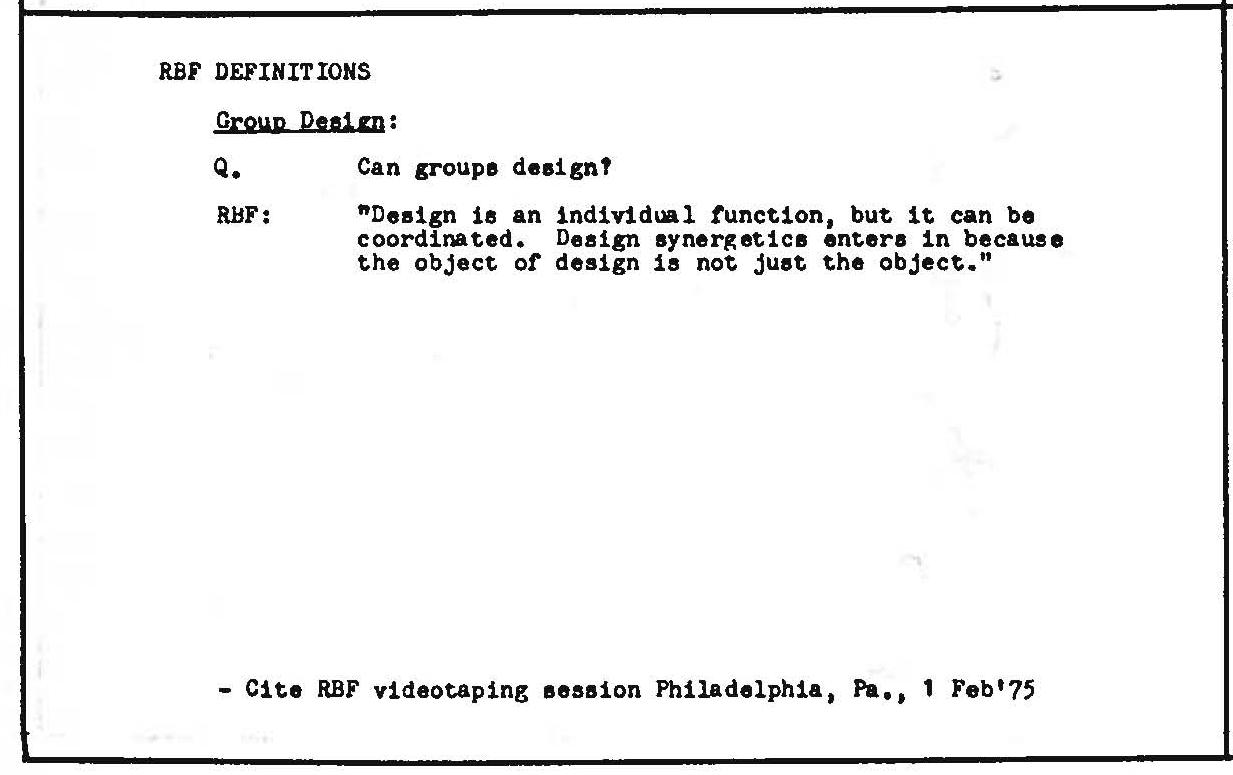
Group Memory (1)
← Group Design | Group Memory (2) →
Cross Reference
Cross-References
Group Memory (2)
← Group Memory (1) | Group Starter →
Cross Reference
Cross-References
- Thinking, 1960
Group Starter
← Group Memory (2) | Group Womb →
Cross Reference
Group Starter:
Cross-References
- Social-industrial Relay, 1 Apr'49
Group Womb
Cross Reference
Cross-References
- Womb of Permitted Ignorance, 10 Dec'73

Group (1)
← Group Womb | Groupings (2) →
Cross Reference
Cross-References
Groupings (2)
Cross Reference
Cross-References
- Constellar, May'71 (2)
- Communications Hierarchy, (2)
Group (3)
← Groupings (2) | Grow-a-dome →
Cross Reference
Cross-References
Grow-a-dome
Index Entry
The idea of the grow-a-dome is one that I've had around for many, many years. The idea is to plant and grow a geodesic trellis dome of interwoven live bamboo. Then you let it get overgrown with rather hardy vines like wisteria so that it will survive on the bamboo framework even if the original bamboo dies. And on the inside you just put a dacron tent lining--just as in any of the standard trade-fair domes. . . . This would be very suitable throughout southeast Asia where they might function also like hostels, where people could put up their own tents inside the grow-a-dome.
Growing Up
← Grow-a-dome | Grownups (1) →
Cross Reference
Cross-References
- Metabolic, 1963
Grownups (1)
Cross Reference
Cross-References
- Older Generation

Growups (2)
← Grownups (1) | Growthability →
Cross Reference
Cross-References
- Education: Evolutionary Touchdowns, May'65
- Intuition Sequence, (6)
- Morley Poem, 10 Oct'63
- Television: Third Parent, May'65
Growthability
Index Entry
You cannot have time without growthability which implicitly has a nucleus from which to grow. We would not have discovered the frequency, or time, dimension, had we not explored the expansiveness-contractiveness and radiational-gravitational behavior of nuclei in pure metaphysical sizeless and timeless principle.
Growth
← Growthability | Growth & Decay →
Index Entry
Growth:
"A cone is simply a tetrahedron being rotated. Omnidirectional growth-- which means all life-- can only be accommodated by tetrahedron."
-
Cite RBF to Eja, Bear Island, 25 August 1971.
-
Citation at Tetrahedron; 25 Aug'71
Growth & Decay
← Growth | Growth Rate Modular Growth (1) →
Cross Reference
Cross-References
Growth Rate Modular Growth (1)
← Growth & Decay | Growth Rate Modular Growth (2) →
Cross Reference
Cross-References
- Circumferential Modular Frequency Growth
- External Point Growth Rate
- Linear Becomes the Second-power Rate of Growth
- Radial Wave Modular Growth
- Shell Growth Rate
- Radial-circumferential Modular Growth
Growth Rate Modular Growth (2)
← Growth Rate Modular Growth (1) | Growth Growing (1) →
Cross Reference
Cross-References
- Synergetic Hierarchy, Oct'75
Growth Growing (1)
← Growth Rate Modular Growth (2) | Growth: Growing (2) →
Cross Reference
Emotion as Essential to Growth
Trees: Invisible Growth of Trees
Complementarity of Growth and Aging
Cross-References
- Dimensional Growth
- Limits to Growth
- Omnidirectional Growth
- De-grown
- Turtle Dome
- Tetrahedral Growth
- Vector Equilibrium Growth
Growth: Growing (2)
← Growth Growing (1) | Guage Guages →
Cross Reference
Cross-References
- Culture, 1 Feb'75
- Emotion, 1938
- Lags, (1)
- Minimum Limit Case, 12 May'75
- Rationalization Sequence, (1)
- Servomechanism, 15 May'75
- Tetrahedron: Coordinate Symmetry, Nov'71
- Universe, 16 Jun'72
- Regenerativity, 17 Jan'75
- Ice, 29 Apr'77
Guage Guages
← Growth: Growing (2) | Guanine →
Cross Reference
Cross-References
- Johansen Guages

Guanine
Cross Reference
Cross-References

Guerilla
← Guanine | Guess vs. Believe (1) →
Cross Reference
Cross-References
- Psycho-guerilla

Guess vs. Believe (1)
← Guerilla | Guess-Improvise (1) →
Cross Reference
Guess vs. Believe: "I am guessing. I don't have a 'believe' here. I do guess as a consequence of trends that I observe, that we will always have a limited function, that we are meant to be a local function and not the comprehensive function." (Larger context at Local vs. Comprehensive (1).)
- Cite tape transcript, p.15; RBF to B. Brooks, 30 Apr'74
Cross-References
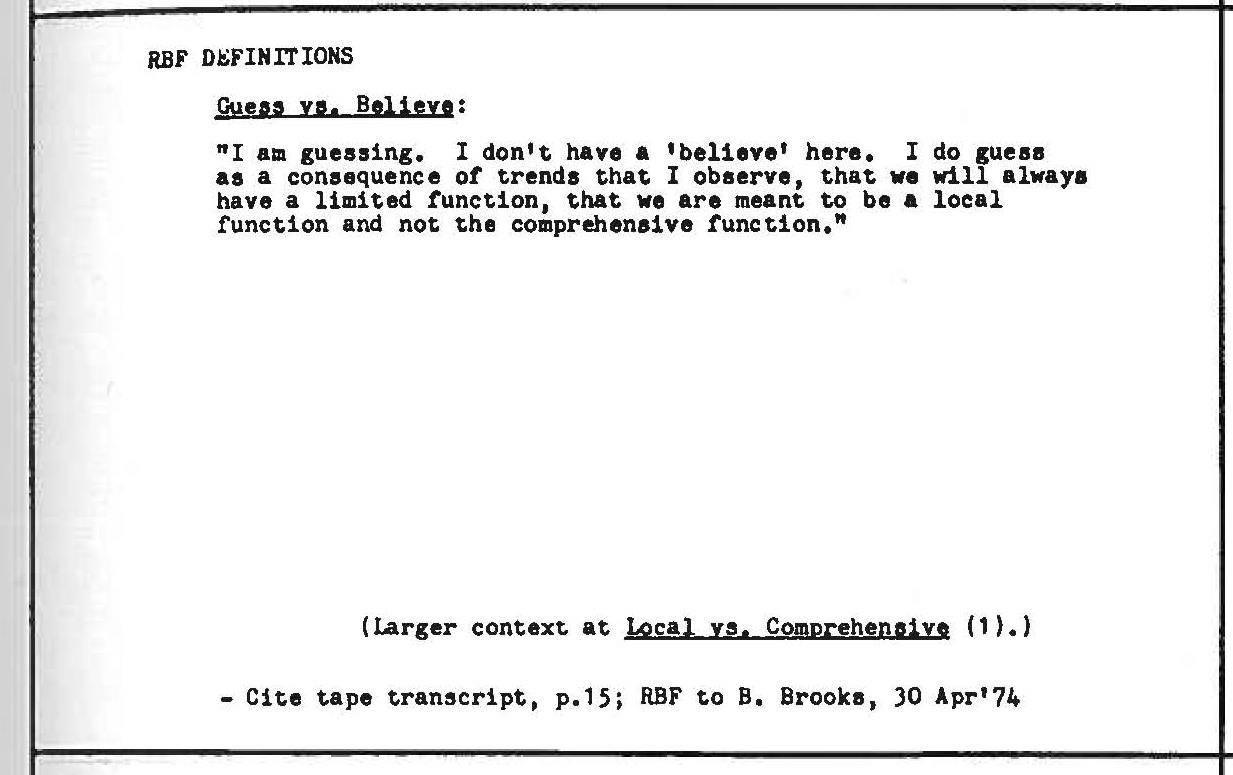
Guess-Improvise (1)
← Guess vs. Believe (1) | Guess-improvise (2) →
Cross Reference
Cross-References
- Glimpse-discover

Guess-improvise (2)
← Guess-Improvise (1) | Guess →
Cross Reference
Cross-References
Guess
← Guess-improvise (2) | Guinea Pig →
Cross Reference
Guess: Guesses:
Cross-References
- Excluded Answer Resources, Oct'66
Guinea Pig
Index Entry
Q. "Could you elaborate on your ethics of facilitation?"
RBF: "I am a guinea pig undertaking a world program. I don't invite negatives or barriers or political and banking games. The young architects wanted to support me at their meeting in Cuba but McGeorge Bundy wouldn't let me attend.... I do not operate by trickery. If I am doing the right thing, at the right time evolution will support me. I try to make decisions on the basis of what is right for humanity."
- Cite RBF to World Game Workshop'77; Phila., PA: 22 Jun'77

Guinea Pig
Index Entry
Guinea Pig:
"I consider myself my own private guinea pig."
- Citation and context at Average Man (1), 16 Jun'72

Guinea Pig
← Guinea Pig | Guinea Pig (1) →
Index Entry
Guinea Pig:
"I'm the only really important guinea pig I have."
- Cite RBF to EJA, 3200 Idaho, Washington DC, 27 Apr'71
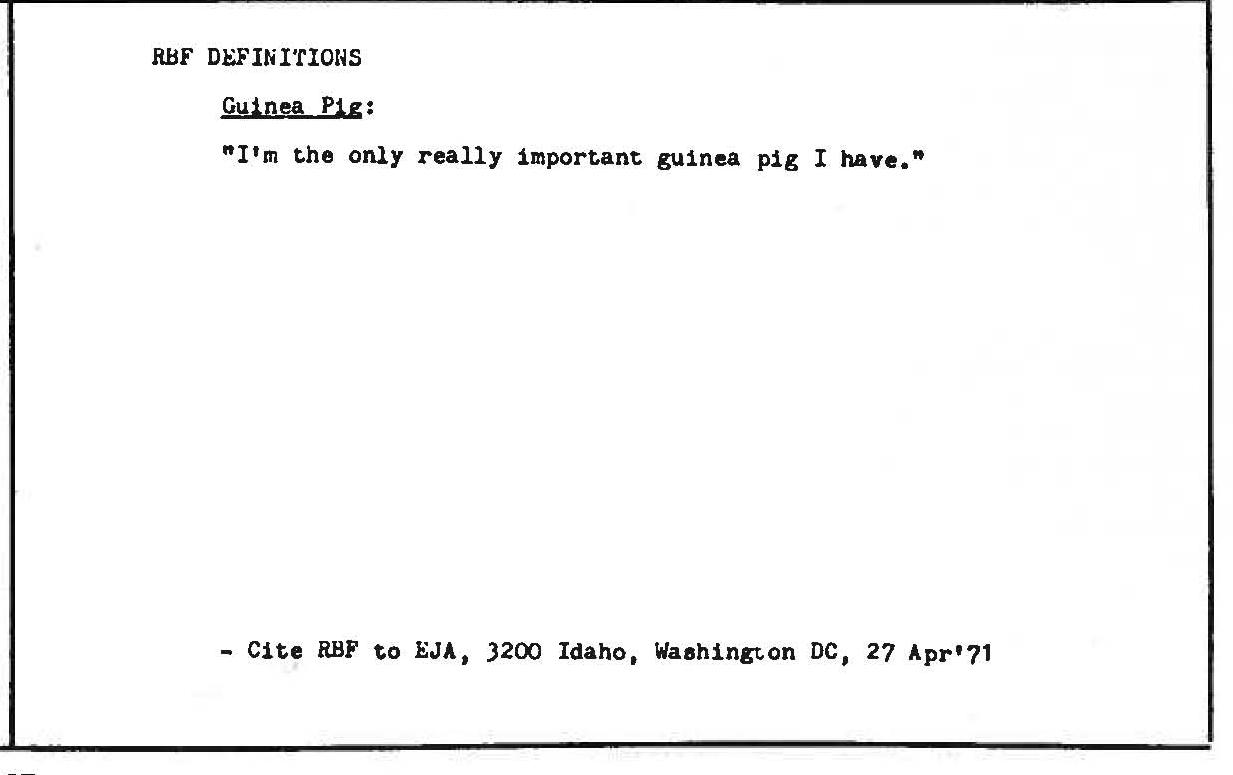
Guinea Pig (1)
← Guinea Pig | Gulf Stream (2) →
Cross Reference
Fuller, R.B: What I Am Trying To Do, 8 Jan'66
Newton vs. Einstein (1)
Cross-References
- Average Man, (1)
Gulf Stream (2)
← Guinea Pig (1) | Gull Flying (1) →
Cross Reference
Cross-References
- Radiation Sequence, (2)
Gull Flying (1)
← Gulf Stream (2) | Gull Gulls →
Cross Reference
Cross-References
- Omnimedia Transport Sequence, (1)
Gull Gulls
Cross Reference
Gull: Gulls: See Sea Gulls
Cross-References

Gun
Cross Reference
Cross-References
- Machine Gun

Guppy
Cross Reference
Cross-References
- Rowing Needles, (1)(2)

Gurdjieff
Index Entry
Gurdjieff:
"I knew Gurdjieff quite well. I was anything but a Gurdjieffian disciple, but I knew a great deal of my friends who before they went on to Alcoholics Anonymous went on to Gurdjieff and he made it fairly comfortable for them. He would open up his daily sessions with them by 33 toasts to all the types of idiots, and by this time everybody was pretty well plastered and then they'd go to work writing his life history. He had beautiful expressions. 'Shovelling out the manure' and so forth. And very sort of easily appealing, talking about the different centers of man and so on. I think too well of the voodoo people to really call a Gurdjieffian one of them."
- Cite RBF interview by Colin Moorcraft in "Friends," (London), 14 Apr'70. "On his way to Oxford he chatted nonstop about his ideas and actions to a carriage full of unsuspecting travellers, including myself."-- C.M.

Gurdjieff (1)
Cross Reference
Cross-References
- Artist: Histrionics, (1)
Gusset (1)
← Gurdjieff (1) | Gusset (2) →
Index Entry
Gusset:
"Since cubes make such poor structures, the only way that men are able to stabilize the cubical buildings they do build is by going to the corners where the members come together at 90 degrees and putting in little triangular gusset-plate reinforcements. Sometimes this vertexial triangulation of quadrangular buildings is done with a whole lot of nails, but in a big steel building it is done by putting in triangular patterns by riveting or welding in the gusseting. The triangular steel gussets at the corners of interstices of steel structures must withstand the prying action of the lever arm of the full length of the beam to which each gusset is attached. The builders are able to make the building 'stand' because of the excessive use of steel and massive inertia but not because the building is really well designed."
- Cite RBF Conceptuality of FundamentalStructures, Ed. Kepes., 1965, p. 82.
Gusset (2)
Index Entry
Gusset:
"If we draw a line diagonally from corner to corner on each of the six faces of a cube, we find that these six lines turn out to be the outlines of a tetrahedron. These hidden tetrahedra in 'solid' cubes make the cube stand up. Let us now reconsider the triangular gusset plates in the corners of the cubical buildings of steel, fighting the long lever beams attached to them. Quite clearly, if we made the triangular gusset plates a little larger they would be more effective in opposing the beam's leverage against them. If we increase the size of the gusset triangles progressively they ultimately become the diagonals of the quadrangular openings of the buildings and correspond to the six edges of the tetrahedra hidden in the cubical or quadrangular building scheme"
- Cite CONCEPTUALITY OF FUNDAMENTAL STRUCTURES, Ed. by Kepes, 1965. Pp. 82-84.
Gusset
Cross Reference
Cross-References
- Stabilized Cube, 9 Nov'73
Gymnasium
Index Entry
Hyper, ☐ World Mag., 10 Apr'73
Gyrate
Cross Reference
Cross-References
- Lasso, 1946

Gyroscope
Index Entry
Gyroscope:
"...Minimum-angular-error-maintaining devices, such as gyroscopes..."
Gyroscope
← Gyroscope | Gyro Gyrocompass Gyroscope (1) →
Text Citations
TEXT CITATIONS
Gyroscope:
"Sperry's Spinning Wheel," FORTUNE, May'40, pp. 57-60, Vol. XXI, No. 5
- RBF edited.
\hrefhttps://www.buckyverse.org/en/synergetics/content/chapters/400-system#section-401.05401.05
\hrefhttps://www.buckyverse.org/en/synergetics/content/chapters/1000-omnitopology#section-1005.111005.11
\hrefhttps://www.buckyverse.org/en/synergetics/content/chapters/1000-omnitopology#section-1009.601009.60 footnote
\hrefhttps://www.buckyverse.org/en/synergetics/content/chapters/1000-omnitopology#section-1009.801009.80-\hrefhttps://www.buckyverse.org/en/synergetics/content/chapters/1000-omnitopology#section-1009.981009.98
Gyro Gyrocompass Gyroscope (1)
← Gyroscope | Gyroscope Gyrocompass Gyro (2) →
Cross Reference
Cross-References
Gyroscope Gyrocompass Gyro (2)
← Gyro Gyrocompass Gyroscope (1) | H →
Cross Reference
Cross-References
- Eccentricity, 7 Feb'71
- Precession, 13 Nov'69
- Life is a Sumtotal of Mistakes, (2)
- Feedback, 7 Nov'75*