24 Critical Concepts to Teach Anyone Synergetics
A curriculum-ready concept inventory for R. Buckminster Fuller's Synergetics, organized in six tiers of four concepts each, sequenced by pedagogical dependency. The number 24 is not arbitrary — it echoes the 24 A-modules that compose the tetrahedron, the irreducible unit of Fuller's system. Just as the tetrahedron decomposes into exactly 24 volumetric quanta, this curriculum decomposes synergetics into 24 conceptual quanta.
Read the source text: Synergetics on the Buckyverse Reader — all §-number citations below link directly to Fuller's paragraphs.
The Question
What are the 24 critical concepts to teach anyone synergetics?
No existing "24 concepts" curriculum has been published by Fuller, Amy Edmondson, Kirby Urner, the Buckminster Fuller Institute, or any other practitioner. The closest precedents are Edmondson's 16-chapter A Fuller Explanation (the canonical pedagogical sequence), Urner's computational "School of Tomorrow" curriculum, and C. J. Fearnley's 3-tier concept hierarchy in the Fuller FAQ. This playbook synthesizes all three, cross-referenced against Fuller's primary text and the Buckyverse wiki's existing coverage, to produce an original 24-concept inventory.
Why 24?
The number 24 is geometrically load-bearing in synergetics:
- 24 A-modules compose the tetrahedron (the unit of volume)
- 24 edges define the vector equilibrium
- 24 tetravolumes is the capacity of the Duo-tet Cube, the allspace-filling complement to the VE's 20-ness
- Fuller himself singled out "Twentyness & 24-ness of the VE" as a named concept (§1033.70–77)
The VE's 20-ness is "maximum somethingness" but cannot fill allspace alone; 24-ness completes it. Similarly, a synergetics curriculum needs more than its geometric core — it needs the philosophical and applied concepts that fill out the full picture.
The 24 Concepts
Tier 1: Philosophical Foundation — the "why" before the "what"
These four concepts establish the worldview that makes synergetics comprehensible. Without them, the geometry is just shapes; with them, it becomes a way of thinking.
1. Synergy The behavior of whole systems unpredicted by the behavior of their parts taken separately. The organizing fact of Universe and the namesake of the entire system. Fuller's seed demonstration: three hinged triangles fold into a tetrahedral tent whose base is a fourth triangle — "1 + 2 = 4." Chrome-nickel-steel alloys are stronger than the sum of their component metals. (§100–106)
2. System The first subdivision of Universe into an inside, an outside, and everything irrelevant. All systems are polyhedra. The tetrahedron is the minimum system — four points are the fewest that enclose a volume. This is not a definition of convenience; it is a topological necessity. Every concept in synergetics is a system or a relationship between systems. (§400)
3. Universe "The aggregate of all humanity's consciously apprehended and communicated, nonsimultaneous, and only partially overlapping experiences." Not "everything" but everything experienced and communicated. Universe is a scenario (an ever-unfolding film), not a static frame. Finite but nonsimultaneously conceptual. This definition rejects the physicist's "everything" and the mystic's "the All" — it is operational, observer-anchored, and experiential. (§300)
4. Generalized Principles Experimentally verified truths that hold in every case without exception — leverage, precession, conservation. Fuller's "eternal" operating laws. The distinction between generalized principles (metaphysical, syntropic, pattern-conserving) and special cases (physical, entropic, energy-dispersing) is the epistemological backbone of synergetics. Science discovers generalized principles; design applies them. (§200)
Tier 2: Geometric Foundations — the "rules of the game"
These four establish how synergetics does geometry differently from the Euclidean/Cartesian tradition.
5. Operational Mathematics Geometry derived from physical operation, not from assumed axioms or imaginary entities (infinitely thin lines, dimensionless points). One line scribed on a system divides it into two complementary areas. "One triangle is really four" (on a sphere, a triangle bounds a concave/convex, large/small pair). Fuller replaces the impossible infinite plane with the operational reality of spherical systems. (§800)
6. Tetrahedron as Minimum System Four points, six edges, four faces, twelve vectors of restraint. The tetrahedron is the minimum structural division of Universe — the simplest form that creates an inside and an outside. Fuller redefines "squaring" as triangling and "cubing" as tetrahedroning. The tetrahedron is the unit of volume (= 1), replacing the cube. This single move reorganizes all of mensuration. (§100, §400, §600)
7. 60-Degree Coordination Nature closest-packs spheres at 60 degrees, not 90. Synergetics replaces the imaginary straight line and cube with the vector, the tetrahedron, and an omnidirectional 60-degree lattice. This is not an aesthetic preference — it is an empirical observation: equal spheres pressed together never form a square checkerboard; they settle into triangles. The entire coordinate system follows from this physical fact. (§200, §410)
8. Triangulation The triangle is the only inherently self-stabilizing polygon. A square collapses; a triangle cannot (with fixed-length sides). Therefore triangulation, not solidity, is what makes structure. This principle governs everything from the octet truss to the geodesic dome. Structure is a "self-stabilizing energy-event complex." (§600)
Tier 3: Core Structures — the "pieces on the board"
The four central geometric objects of synergetics, in dependency order.
9. Closest Packing of Spheres Equal spheres pressed together settle at 60° into a pattern where twelve spheres symmetrically surround one nuclear sphere (§413.01). Packing doesn't start with a nucleus — it starts with two balls touching; the nucleus is what the twelve enclose. Shell counts grow by 10F² + 2 (12, 42, 92…). The 92-sphere shell is the last uniquely individual one — which Fuller ties to the 92 regenerative chemical elements. This tactile fact is the experiential ground floor of the entire system. (§410–413)
10. Vector Equilibrium (VE) The twelve closest-packed spheres around one define not a super-sphere but a fourteen-faced polyhedron — the cuboctahedron, which Fuller renamed the vector equilibrium because its radial vectors equal its circumferential vectors (§430.02–430.03). Outward thrust exactly balances inward restraint — the "zero model," the true zero of energetic mathematics. Volume = 20 tetravolumes (= 480 A & B modules). It is a system, not a structure — being un-triangulated, it is unstable. It is never physically observed; nature never tarries at the zero phase. (§430–440)
11. Isotropic Vector Matrix (IVM) Join the centers of all closest-packed spheres, remove the spheres: what remains is the IVM, an all-space array of equal-length vectors at equal angles — "isotropic" = "everywhere the same energy conditions" (§420.01). It partitions all space into just two cells: the regular tetrahedron and the octahedron, alternating as complementary space-fillers. Realized as structure, this is the octet truss. Fuller offers the IVM in place of the XYZ cube: 60°-coordinated, omnirational. (§420–426)
12. Concentric Hierarchy The whole-number volume relationships that emerge when the tetrahedron is the unit of volume: tetrahedron = 1, cube = 3, octahedron = 4, rhombic dodecahedron = 6, vector equilibrium = 20. These are exact integers, not approximations, because every form is an integer count of A & B quanta modules. This hierarchy is the payoff of 60-degree coordination — the reason synergetics produces rational numbers where Cartesian geometry produces irrationals. (§982)
Tier 4: Dynamics & Decomposition — the "how it moves"
How the static structures transform, subdivide, and fill space.
13. Jitterbug Transformation Build the VE from only its 24 outer edges (drop the 12 radii). Its 8 triangles stay rigid; its 6 square faces are the "give." Lower the top triangle and all 12 vertices spiral synchronously inward through a fixed phase sequence: VE (vol 20) → icosahedron (vol 18.51) → octahedron (vol ~4, struts doubled) → tetrahedron (vol 1, struts quadrupled), which then turns inside-out and oscillates. Fuller's hand-holdable, size-independent model of how structure and energy change phase. Named for the 1930s swing dance. (§460–461)
14. A & B Quanta Modules The IVM's tetra/octa cells resolve into two irregular tetrahedra of identical volume, each 1/24 of a regular tetrahedron (§913, §916). Same volume, different behavior: the A module is energy-impounding (introvertive), the B module energy-exportive (extrovertive, ~4× faster) — Fuller's analogy to proton/neutron. Module tallies are whole numbers: tetra 24, cube 72, octa 96, rhombic dodecahedron 144, VE 480. This is why the concentric hierarchy is rational. (§913–982)
15. Frequency The number of modular subdivisions of a system — Fuller's way of describing "size" by how finely a structure is subdivided, not by absolute measure. A 2-frequency geodesic has twice as many subdivisions as a 1-frequency. Frequency replaces the concept of absolute scale; it is the bridge between the sizeless generalized principle and the special-case physical artifact. (§200, §515)
16. All-Space Filling Which forms fill space without gaps? The Mite (Minimum Tetrahedron: 2A + 1B modules) is the simplest all-space filler. The Duo-tet Cube has 24 tetravolumes and fills allspace — completing what the VE's 20-ness cannot. Fuller's §1033.70 pairs 20 and 24 as a complementarity: maximum somethingness (20) needs 24-ness for total atomic behavior. The 24/20 duality connects the geometric to the physical — 24 × 4 = 96, and 92 + 4 = 96 (the 92 natural elements + the octahedron's annihilating function). (§953, §1033.70–77)
Tier 5: Applied Geometry — the "what you can build"
The structural and architectural applications that make the geometry physically consequential.
17. Great Circles The shortest path on a sphere — a circle whose plane passes through the center. Every great circle divides a sphere into two equal hemispheres. The triangulation of great-circle paths is the mathematical basis of geodesic subdivision. Fuller's "Cosmic Railroad Tracks" (Edmondson Ch. 14) — the spherical trigonometry that turns the IVM into buildable domes. (§1100)
18. Tensegrity "Tensional integrity": structures of isolated compression members (struts) suspended within a continuous network of tension (cables). "Islands of compression in a sea of tension." All structures from the solar system to the atom are tensegrity structures. The triangle's self-stabilizing property is the reason tensegrity works — triangulated tension networks provide the continuous integrity. Kenneth Snelson's sculpture + Fuller's principle. (§700)
19. Geodesic Structures Self-supporting shells spanning via triangulated great-circle grids. The geodesic dome encloses the most volume with the least surface area and material. As frequency increases, the dome approaches a sphere — strength increases while weight-per-unit-of-enclosed-volume decreases. The practical proof of ephemeralization and the most visible application of synergetics. (§1100, Geodesic Math)
20. Octet Truss The IVM realized as a structural space frame — alternating tetrahedra and octahedra. Fuller's patented space-frame of alternating octahedra and tetrahedra — an exceptionally strong, lightweight structural lattice. The structural proof that nature's 60-degree coordination produces superior strength-to-weight ratios over the 90-degree cube frame. (§420, Fuller's Patents)
Tier 6: Integrative Principles — the "so what"
Four concepts that connect synergetics to life, action, and meaning. These are why the geometry matters beyond itself.
21. Pattern Integrity A pattern has an integrity independent of the medium through which it is propagated. The knot in a rope persists whether the rope is cotton, nylon, or steel. A wave crosses an ocean while the water stays local. You replace all your atoms every seven years, yet "you" persist. Pattern integrity is Fuller's answer to "what is real?" — not substance, but pattern. It is conceptuality independent of size made tangible. (§505)
22. Precession The effect of a body in motion on other bodies in motion at angles other than the line of action. The honeybee flies toward nectar (its "purpose") and pollinates flowers at 90° to its flight path (the precessional effect). Fuller generalizes: the side effects of purposeful action are often the main cosmic event. Livelihood arrives precessionally — do the work you believe matters and let income be the 90° consequence. (§400, §533)
23. Ephemeralization "Doing more with less": the historical tendency of technology to accomplish ever more human advantage with ever less material, energy, and time. A communications satellite weighing a quarter-ton outperforms 175,000 tons of transoceanic copper cable. Fuller's central empirical claim: this trend, if not blocked by political failure, makes it technically feasible to support all humanity at a higher standard than anyone currently enjoys. (§000, Operating Manual, Critical Path)
24. Design Science The application of generalized principles through comprehensive, anticipatory design to serve all humanity — Comprehensive Anticipatory Design Science (CADS). "Comprehensive" = zooming out to the widest system. "Anticipatory" = designing for the future, not reacting to the present. "Design" = inventing artifacts, not reforming institutions. "Science" = using only experimentally verified generalized principles. The end toward which all synergetics points — the reason Fuller built this geometry was to build a better world. (§000, Pilot for Spaceship Earth)
The Dependency Map
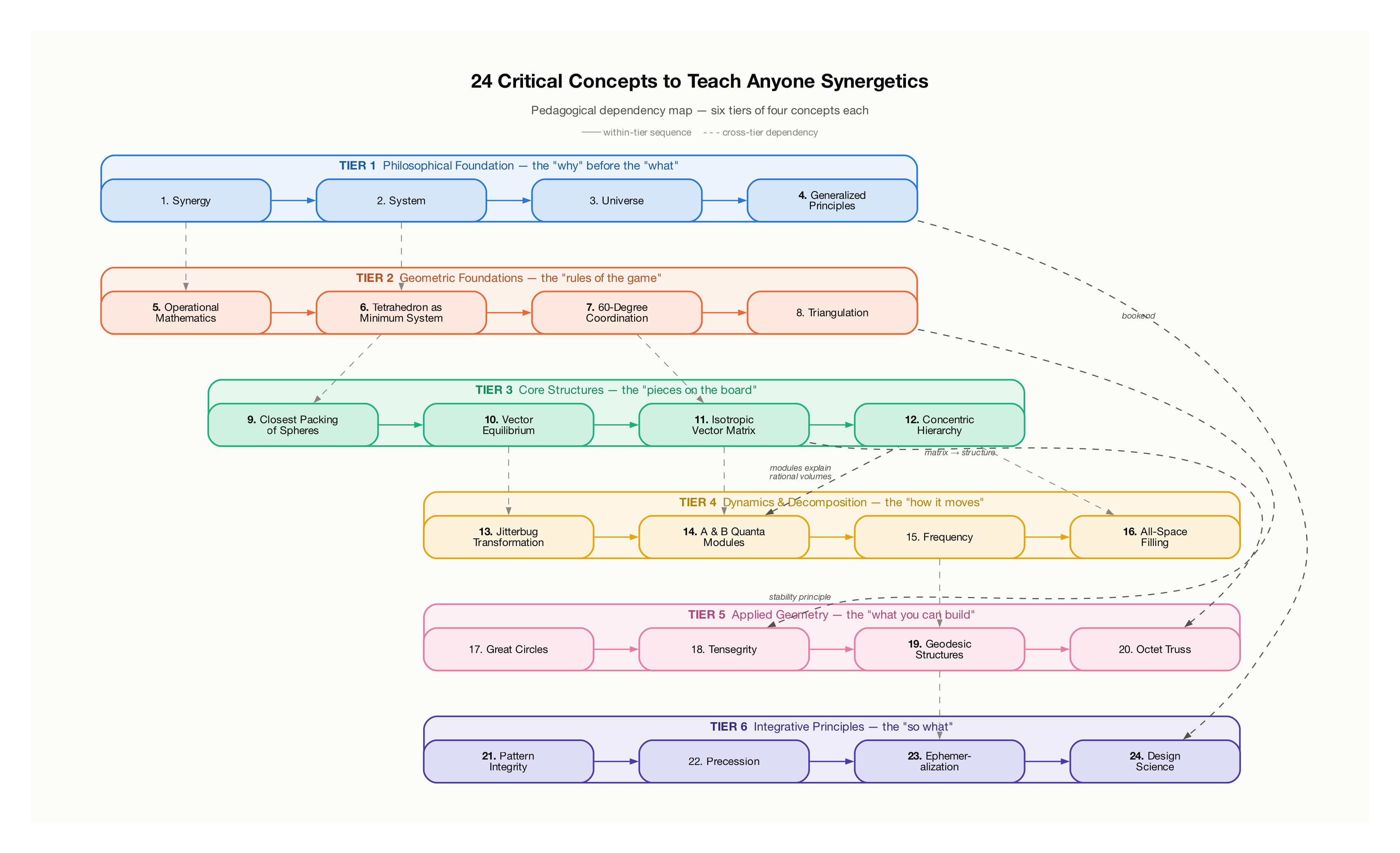
Key cross-tier dependencies
The tiers flow top-to-bottom, but the real pedagogical structure is a web, not a ladder. Key lateral dependencies:
- System (#2) → Tetrahedron as Minimum System (#6): The abstract definition ("first subdivision of Universe") produces the concrete geometric minimum.
- 60-Degree Coordination (#7) → IVM (#11): The coordination rule generates the matrix.
- VE (#10) → Jitterbug (#13): The static zero-model becomes the dynamic phase-sequence.
- IVM (#11) → A & B Modules (#14): The matrix decomposes into its quanta.
- IVM (#11) → Octet Truss (#20): The matrix realized as buildable structure (skips two tiers).
- Triangulation (#8) → Tensegrity (#18): The stability principle is the reason tensegrity works (skips two tiers).
- Frequency (#15) → Geodesic Structures (#19): Subdivision frequency controls dome geometry.
- A & B Modules (#14) ↔ Concentric Hierarchy (#12): The modules explain why the hierarchy's volumes are rational integers — a feedback loop, not a one-way dependency.
- Generalized Principles (#4) → Design Science (#24): The bookend — science discovers the principles; design science applies them. The philosophical foundation and the integrative conclusion are the same idea at two altitudes.
- Geodesic Structures (#19) → Ephemeralization (#23): The dome is the empirical proof of doing more with less.
Teaching Notes
Pedagogy sources this draws on
-
Amy Edmondson, A Fuller Explanation (1987) — 16-chapter pedagogical sequence; the canonical teaching order. Edmondson was Fuller's student and chief engineer. Her ordering (topology → VE → sphere packing → IVM → concentric hierarchy → jitterbug → modules → great circles → tensegrity → design science) is independently validated by Urner and Fearnley.
-
Kirby Urner, "School of Tomorrow" / "MartianMath" — computational/Python approach teaching synergetics through code. Confirms the same concept backbone while adding Quadray coordinates, the Synergetics Constant (S3), and graph-theory framing.
-
C. J. Fearnley, Fuller FAQ — 3-tier concept hierarchy (foundation / intermediate / advanced) from the Synergeo mailing list community. Emphasizes physical model-building as a prerequisite skill.
How to use this as a curriculum
- Teach the tiers in order — each tier depends on the previous ones
- Within each tier, concepts roughly depend left-to-right but can be taught in parallel
- Build models at every tier — comprehension is gated on hands-on manipulation, not reading (see suggested models below)
- The A-module connection: just as 24 A-modules build the tetrahedron (the unit), these 24 concepts build a complete understanding of synergetics (the system). The analogy is the curriculum's organizing metaphor
Suggested hands-on models by tier
| Tier | Model | What it teaches |
|---|---|---|
| 1 | Three hinged triangles → fold into tetrahedron ("1 + 2 = 4") | Synergy as physical surprise |
| 2 | Toothpick-and-marshmallow square vs. triangle — push test | Triangulation; operational proof that triangles self-stabilize |
| 2 | Six chopsticks rubber-banded into a tetrahedron | Minimum system; 4 faces, 6 edges, 4 vertices by hand |
| 3 | 13 ping-pong balls (1 nuclear + 12 shell) glued at tangent points | Closest packing; the 12-around-1 discovery |
| 3 | Bamboo-skewer VE (12 radii + 24 edges, all equal length) | Vector equilibrium; radial = circumferential |
| 4 | Folding VE model — drop the radii, flex the square faces | Jitterbug transformation through VE → icosa → octa → tetra |
| 4 | Cardboard A-module templates (24 per tetrahedron) | A & B Modules; why the concentric hierarchy uses whole numbers |
| 5 | Dowel-and-fishing-line 6-strut tensegrity | Tensegrity; islands of compression in a sea of tension |
| 5 | Newspaper-and-tape geodesic dome (2v or 3v icosahedron) | Geodesic structures; frequency, great circles, and triangulation in one build |
| 6 | Rope knot passed hand-to-hand along its length | Pattern integrity; the pattern persists independent of the medium |
What's NOT in the 24
These are important but not critical for a first pass:
- Euler's Law (V + F = E + 2) — a prerequisite from classical topology, not a synergetics invention
- Dymaxion Map — an application, not a concept
- Spaceship Earth / World Game — essential Fuller context but not synergetics per se
- Syntropy/Entropy — subsumed under Generalized Principles (#4)
- Trimtab — a metaphor, not a geometric or epistemological concept
- Mites/Sytes/Coupler — subsumed under All-Space Filling (#16)
- T/E/S modules — advanced subdivisions beyond the essential A/B
- Synergetics Constant (S3) — a conversion factor, not a concept
- Omnitopology — subsumed across Pattern Integrity and System
Suggested theses for follow-up research
- "The 60-degree coordination system produces simpler (lower-integer) volume relationships than the 90-degree Cartesian system for all crystallographic structures" — testable against materials science databases.
- "Edmondson's chapter ordering produces measurably better learning outcomes than Fuller's own chapter numbering" — testable in a teaching context.
- "Pattern integrity (not tensegrity, not the geodesic dome) is Fuller's most consequential intellectual contribution to design theory" — testable via citation analysis.
Sources
Compiled from:
- Synergetics (wiki) — hub overview of the primary text
- Synergetics Chapter Digests — per-chapter map
- A Fuller Explanation (wiki) — Edmondson's pedagogical introduction
- Study Guide: Synergetics — existing wiki study guide (5 big ideas + 5 primitives)
- Fuller's Coined Terms — the vocabulary dictionary
- Fuller FAQ: Synergetics — Fearnley's learning guide (newly ingested)
- Concept articles: Vector Equilibrium, IVM, Closest Packing, A & B Modules, Jitterbug, Tensegrity, Design Science
- Fuller, Synergetics §1033.70–77 (Twentyness & 24-ness of VE) — primary text
- Amy Edmondson, A Fuller Explanation (1987) — chapter ordering as pedagogical sequence
- Kirby Urner, "School of Tomorrow" / "MartianMath" notebooks — computational curriculum
- C. J. Fearnley, "The R. Buckminster Fuller FAQ" — community learning guide
- Design Science Primer (Gabel & Heeney, 2015) — practical design science methodology