
11 ACTION Making a Difference
2‘‘Take the initiative. Go to work, and above all co-operate and don’t hold back on one another or try to gain at the expense of another. Any success in such lopsidedness will be increasingly short-lived.’’
3 
 A Buckminster Fuller gave this instruction to many of his audiences in
response to the questions, ‘‘What should I do?’’ and ‘‘How can I make a difference with my life?’’
This was not, however, the philosophical meandering of someone with another good idea. This
was and still is the experiential solution of a man who learned what works through trial and error
experimentation during long yeajsjf-heing labeled axiackpot idealist. fiecTto ‘‘make a living’’ and
support his family at the expense of others, and he realized that most people play a win- lose
game such as the stock market or investing in real estate with the hope that they will
be winners. Such people don’t, however, usually understand that—even though we
label such income as earned from investments—in these ‘‘games’’ someone must lose
a dollar for every dollar that is won. Once he was aware of the losses and suffering
such initiatives caused, Bucky stopped playing games and profiting at the expense of
others.
A Buckminster Fuller gave this instruction to many of his audiences in
response to the questions, ‘‘What should I do?’’ and ‘‘How can I make a difference with my life?’’
This was not, however, the philosophical meandering of someone with another good idea. This
was and still is the experiential solution of a man who learned what works through trial and error
experimentation during long yeajsjf-heing labeled axiackpot idealist. fiecTto ‘‘make a living’’ and
support his family at the expense of others, and he realized that most people play a win- lose
game such as the stock market or investing in real estate with the hope that they will
be winners. Such people don’t, however, usually understand that—even though we
label such income as earned from investments—in these ‘‘games’’ someone must lose
a dollar for every dollar that is won. Once he was aware of the losses and suffering
such initiatives caused, Bucky stopped playing games and profiting at the expense of
others.
4 Buc
5 Thus, KeTecame an advocate of complete cooperation, peace7~anTT~nworZ3 that worfcsjor everyone." He also realized <thatTKe GoldeiTRule is more than a theoretical aphorism. It reflects the reality of cause and effect or, as some label it, the law of karma. In other words, we eventually reap what we sow, regardless if others know what we have done or not.
67With that understanding Bucky resolved never to create initiatives that take advantage of another person. He always

9 did his best to make his projects as inclusive as possible and would always tell people that he found others to be just as compassionate and caring as he was.
10 The issue that he found most problematic in promoting ~ global cooperation is that the few individuals who control most of our planet’s resources keep the masses in line using scare tactics and promoting constant fear. Were afraid that we won’t get our share. We’re afraid that ‘‘foreigners’’ will invade our land. We’re afraid of ‘‘terrorists’’ and ‘‘strangers.’’ And we’re even afraid of our neighbors when we buy the scarcity story propagat°d y nnr ‘‘leaders ’’ z
11 Bucky’s view was the exact opposite of this fear-based perspective. He did his best to never judge other people and to take initiatives that included as many people as possible for the long haul rather than the quick Band-Aid fix. He sought success for all people and would sacrifice his needs to further the welfare of another. He would also experience many losses because he chose to make long-term sense rather than make short-term money
12 One such instance was the Stockade Building System. In 1926 at the age of 31, Bucky worked with the well-known architect James Monroe Hewlett to create a new modular building system that was far superior to anything on the market. Hewlett, who was also Bucky’s father-in-law, and other family members and friends invested the funding for the initiative. This put Bucky in the precarious situation of being financially accountable to family and friends, and when the endeavor was another ‘‘learning experience’’ that failed financially, he was devastated.
13  It was only then that Bucky realized that he was not a good businessman.
His_£nr.iic was not—on-making money nr profiting at the expense of others. As he would
later recount, ‘‘I had to decide if I would make pood buildings or make money, and
I
It was only then that Bucky realized that he was not a good businessman.
His_£nr.iic was not—on-making money nr profiting at the expense of others. As he would
later recount, ‘‘I had to decide if I would make pood buildings or make money, and
I
14 Stockade System buildings were affordable, easy to con- structfTireproof, and wHIinsulated. But because they could /"beerected by anyone, they were a threat to construction workers and their unions, especially brick masons who were a powerful force at the time. When these unions realized that I Stockade System buildings would create an advantage for the average man who could use the system to build the structure for his home or business without expensive labor costs, they made sure that building inspectors caused problems every time someone attempted to erect a Stockade System building, I
1516Still, Bucky would not allow his initiative to produce profit at the expense of other peopl. He wanted to build good build- ings that were of use to everyone, and Stockade Systems was a financial failure until he was fired and the company was sold. From the perspective of most people, Stockade Systems waj an enormous failure, and that 1927 experience was so devas- tating that it led Bucky to contemplate suicide.
17On the verge of killing himself, Bucky had his famous epiphany when he got the message that he did not have the right to kill himself and that from that time on he would always speak the truth. Years later, he realized that the Stockade System period of his life had simply been another ‘‘learning experience.’’ It was not a failure. It was simply another opportunity to see what worked and what did not and to focus his attention and initiatives on what worked using what he had learned to avoid another such crisis.
18By using this approach to global and personal problems Bucky (and those of us who have adopted his view and followed in his footsteps) have discovered how we can each create the utopian vision of "a world that works for everyone —including ourselves. We are also able to follow Bucky’s lead that is described by Buddhists as accumulating merit. This practice of being supportive and doing good is central to many spiritual practices, and it is something needed by the world at this critical moment in our evolution.
- 2.
1920‘‘There is no use talking about bright ideas.Everyone has bright ideas. There is no use talking about an artifact until we reduce it to practice, until we see whether Nature permits it, whether society permits it.’’
21 By Dr. Cherie Clark
22 Guest Commentator
2324I had worked in the criminal justice system for more than thirty- six years by the time I retired in November of 2010. Throughout my career, I had applied the principles Bucky had discovered, first unconsciously, then deliberately, as I learned more, through ‘‘experience-based knowledge,’’ about how the ‘‘omni-interac- comodative generalized principles’’ described in all of his talks, books, and papers truly were, ‘‘always and everywhere true.’’
25My work kept me focused. I just kept applying the principles to develop Total Learning Environments™ based in these principles in the prison system in New York and for other states.
26The two main ideas that were the basis of the model I came to name Social Synergetics™ (the science of stable relationships) provided the structure for and informed my work throughout the years I was working on application.
27Bucky described the ‘‘four-cornered tetrahedron’’ as ‘‘the minimum structural system in Universe." Throughout his writings he returns again and again to the tetrahedron as the essential foundation for his inventions and ‘‘prognostications.’’ Relative to the second key idea, in Chapter 7 of Critical Path, he says:
28‘‘In naval science we have four scientifically developed prognosticating arts. ... one ... that of designing and producing the generalized tools ... two ... employing the ... tools, we design ... three ... celestial navigation, ... four ... ballistics—... interior and exterior.
29I became gradually interested in the possibility that all variables involved in naval ballistics might be identified with all the variables operative in the most complex problems of Universe. I intuited that the combined sciences of navigation and ballistics might embrace all the variables governing Universe-event prognostication. It could be that: (1) navy yard industrialization, (2) fleet operation and individual ship design, (3) astronavigation, and (4) ballistics constituted the four ‘special case’ corner complexes of a generalized tetrahedral complex of variable design factors governing all human mind-controllable participation in all cosmic, altemative-intertransforming potentials. ’’
30 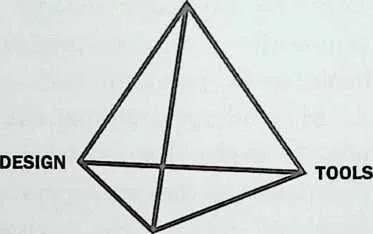 To understand this, I needed to draw it. It helps me to integrate ideas more easily when I
do this. So I drew a simple tetrahedron and began playing around with the four corners. It
looked like this when I was finished:
To understand this, I needed to draw it. It helps me to integrate ideas more easily when I
do this. So I drew a simple tetrahedron and began playing around with the four corners. It
looked like this when I was finished:
31 ASTRONAVIGATION
32 BALLISTICS
33 Interior/Exterlor
34 Dr. Cherie Clark
35 Then I tested it with every model I had studied, applied, and practiced in my private counseling practice and in the Total Learning Environments™ I designed for corrections. I realized the models studied were the tools so necessary to build the model and each also fit ‘‘the
36 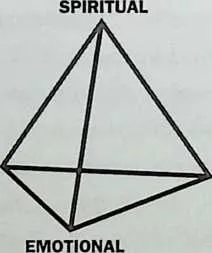 four ‘special case’ corner complexes of a generalized tetrahedral complex.’’
37 MENTAL
38 PHYSICAL
39 The second iteration became:
4041I met Lisa Matheson in 1991 and we began to work together when Lisa asked me if I had written anything about my discoveries. She kept at me until we agreed in 1993, to write about my discoveries. Together, we began writing DOING LIFE! A Life Skills Approach to Recovery From Addictions, with contributions from a colleague, Mary Bogan. The more I saw the exact connection between the six motion freedoms of the generalized principles and the Twelve Steps to recovery, the more clear I became that the two independent discoveries exactly paralleled each other.
42The longer I worked with what was the beginning of the Social Synergetics™model, the more I could see that the 12 Steps were ‘‘special case truths’’ of the Twelve Degrees of Freedom Bucky spoke about as ‘‘omni-interaccomodative generalized principles."
43After completing and testing DOING LIFE! Lisa insisted that I keep writing and exploring this idea. We wrote S.M.A.R.T CHOICES! Also based in all of the models I had studied and then it was time to formalize all of it.
44I started writing my doctoral dissertation, Twelve Degrees of Freedom: Synergetics and the 12 Steps to Recovery, on nights and weekends from 1996--2001, while still working full-time to apply the model to the TLE™ in prisons in New York and around the country. I had lots of current examples of how Synergetics had supported the development of the Social Synergetics™ model.
45There were countless times that I’d think, ‘‘I know Bucky said …about this.’’ I could hear him saying it, and wanted to make sure I had the exact quote. I'd reach over to my pile of ‘‘Bucky books,’’ pick up one and open it to the exact quote I was looking for. At first, it startled me. Then, it became a game. Usually around 3 a.m. I would hear Bucky’s distinctive voice, with a suggestion for how to more clearly respond to a question I was wrestling with earlier. He was right beside me the whole time I was writing, more than thirteen to eighteen years after he had departed this life, guiding, coaxing, teasing me to understand what he had said.
46Now more than ever, I believe Bucky’s time has come. He once said he worked so long into the future so that people would not misinterpret his words. I believe his extensive body of work is even more viable today, more necessary than ever. Bucky wanted everyone to study Synergetics, convinced that his discoveries would help us to solve the ‘‘most complex problems of Universe.’’ Let us continue to do just that.
47Dr. Cherie Clark retired from the New York State Department of Correctional Services in November 2010 after forty-three years of state service, thirty-six in corrections. At the time of her retirement, she was Director of the Shock Incarceration Program and Willard Drug Treatment Campus. The Network Program was the first variation of this intensive educational and life skills intervention.
48Due to the unprecedented success of Network, she was asked to design and direct Shock Incarceration, a six-month intensive treatment program for non-violent felony offenders. At the time of her retirement, there were more than forty thousand graduates and documented savings of more than $1.4 billion. Dr. Clark is an author, philosopher, and futurist, dedicated to having everyone understand the elegant simplicity of Synergetics as a foundation for solving all problems. See www.socialsynergetics.com for more information.
49 A Buckminster Fuller was extremely resolute about the fact that action is critical to success. Again and again, he would remind audiences that he was ‘‘just an average healthy man’’ and that they could achieve much more than he had done if they took the initiative. Such initiatives were a key element in his being able to accomplish so much and make such a differences in one lifetime.
5051He continually reminded people that information is constantly flowing throughout Universe, and sometime a person will ‘‘tune in’’ to that information and have what they believe is a bright idea. These flashes of insight are what Bucky labeled ‘‘cosmic fish,’’ and he was constantly ‘‘cosmic fishing’’ by recording the fish/ideas before he forgot them.
52 Once they were recorded, he began the process of evaluating them to find the ones that would make the most difference for the greatest number of people. Then he began the process of reducing the best ideas to practice, usually by constructing a physical artifact—be it a new form of geodesic dome, a three-wheeled car, or a book. This was the test phase mode.
53 Bucky knew that nothing could exist unless Nature permits it. He often said that there is nothing artificial in the world. Either Nature allows it to exist or it does not exist. And he knew that if his cosmic fish artifact was something that was beneficial to Universe and Nature, he would be supported in the creation of the model of the artifact and the artifact itself.
54 Time and time again, he proved this strategy to be valid and viable. The Dymaxion Vehicle is a perfect example of reducing an idea to a genuine physical entity. When he first came up with the idea in 1931, it was so outlandish that he was considered a crackpot visionary, but Bucky persisted and built a scale model to show people. He also began speaking about both his futuristic Dymaxion House and Dymaxion Vehicle to anyone who would listen.
55 Eventually, people began to marvel at the models and renderings of both the House and the Vehicle. Then, a few days after President Roosevelt temporarily ordered all the banks shut down, a man who had heard Bucky speak about his idea and models gave him a suitcase full of cash to build a prototype.
56 One significant element of this manifestation that many people overlook is that it did not just happen overnight or the moment Bucky had the idea. The major support he needed did not even show up during the years he devoted to making presentations about the practicality of his ideas and models. Bucky had to persist. He often experienced low points and times when he felt that his ideas would never come to fruition. Still, he maintained some semblance of faith, knowing that Universe and Nature always support what needs to happen and exist.
5758Decades later, he encouraged his proteges, students, and audiences to do more than just talk about their good ideas. He urged them to produce some form of them and share that model, book, or other artifact with others. Only when engaged in that process can we know whether Nature and society will permit it. And only then can we truly know and appreciate the natural order of all things, including humans and the ‘‘cosmic fish’’ bright ideas that constantly swim through our minds.
59 73 ‘‘What can a little man effect
r toward such realizations in the face
of the formidable power of great
corporations, great states, and all
their know-how, guns, monies,
armies, tools and information?
6061The individual can take initiatives without anybody’s permission.
62Only individuals can think and can look for the principles manifest in their experiences that others may be overlooking because they are too preoccupied with how to please some boss or with how to earn money, how to take care of today’s bills. Only the individual disregards his fears and commits himself exclusively to reforming the human environment by developing tools that deal more effectively and economically with evolutionary challenges.
63Humans can participate—consciously and competently—in fundamental ways, to changes that are more favorable to human life. It became evident that the individual was the only one that could deliberately find the time to think in a cosmically adequate manner.’’
64By Peter Meisen Guest Commentator
65The following is a chronology of turning an idea into action. It outlines how we created the Global Energy Network Institute (GENI).
66 Early Inspiration
6768I remember very clearly the first time that I heard Bucky speak. It was in 1971, and I was invited by my Dad to hear Bucky deliver one of his infamous four-hour ‘‘Tours of the Universe’’ in Oceanside, California. I was enthralled, dumbfounded, but couldn’t actually tell you what he had said. As a high school senior at the time, I knew what Bucky was saying was important but little did I know how this experience would change my life.
69The next time I met Bucky wouldn’t be for more than ten years when I was invited to the Hunger Project Board meeting where Bucky was a guest speaker. Older now, I was able to better understand his global vision and extended answers. It was at this meeting that someone asked him, ‘‘Bucky, what should we do?’’ and in typical fashion, he encouraged us to look for what was wanted and needed in the world, and he suggested we read his new book, Critical Path.
70It wasn’t until three years later while on vacation, when I was looking for the next project in my life, that I finally got around to reading the book. On page 206, Bucky states that the ‘‘global energy grid is the World Game’s highest priority objective.’’ I realized that this strategy was most wanted and needed, and I decided to take a stand.
71 Initial Stages
7273Needless to say, the scope of the project scared me to the bone. With my engineering background, I had a core understanding of the importance of electrical energy to sustain
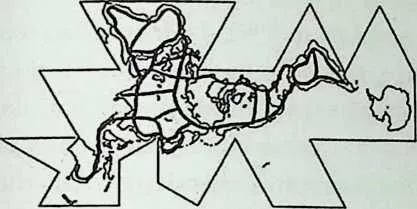
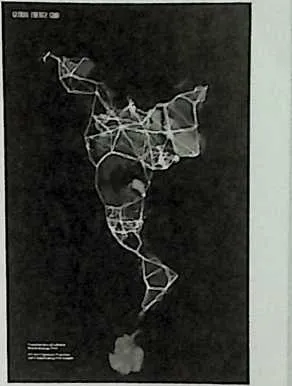
75 Fuller’s Dymaxion Power Grid displayed on his Dymaxion Map. The Global Energy Network Institute ( www.geni.org)
76 modern society. In Critical Path, Bucky explained how the linking of abundant renewable energy resources between nations and continents would reduce pollution and population growth while increasing the quality of life for all.
77 I began to re-educate myself, scouring libraries (there was no Internet), and digging into the Buckminster Fuller Institute archives in Los Angeles. I had ‘‘played’’ Bucky's World Game1’’ beforehand and used its mission statement as my creed:
7879‘‘Hozv do you maize the world zvorkfor 100% of humanity in the shortest possible time through spontaneous cooperation zvithout ecological damage or disadvantage to anyone'?’’
80 My first presentation was to friends around the kitchen table with a Dymaxion Map and pen drawing of the grid concept. There was no budget, just stationery, business cards, and a small mailing list.
81 The original three-year business plan was to educate leaders and utilities about this solution, then generate agreements between nations, with the ultimate end goal of actually building it. How naive I was! Energy systems and electric grids are the most complex machines ever created, and naturally, tend to change very slowly.
82 Official Formation
83 GENI was founded as a nonprofit in 1991. Its first office was a one-room, donated space in San Diego, where we worked on an IBM 286 laptop. That same year in Manitoba, Canada, we organized an international workshop on ‘‘The Limits of Long-Distance, High-Voltage Power Transmission and the Corresponding Economic, Environmental, and Social Political Implications.’’ Thirty-six experts from around the world attended and gave their credential to the economic and social benefits of interconnecting grids between regions and nations. We created a video, ‘‘A Win-Win Solution,’’ which led to endorsements and allowed us to develop our first website in 1995.
84 I recall the first conversations with executives and engineers who would listen politely, nod, and respond with ‘‘good luck.’’ They knew the challenges and hurdles much better than I and at that time the Berlin Wall meant that East and West would never connect.
85 Moving Forward
86 Buckminster Fuller was a visionary engineer ahead of his time. Today, when we speak about ‘‘linking renewables,’’ the prevailing response is ‘‘of course, we need to do that.’’ The benefits to jobs, domestic energy, and climate change are clear. The problem is that we are moving at a half step when we need to be moving double time. Bucky gave us a road map in Critical Path and Operating Manual for Spaceship Earth, now it’s our job to get it built. Bucky often reminded us,
8788‘‘Now we’ve reached the point of discovering that muscle is nothing, mind is everything. Evolution is integrating us and were no longer so remote from each other. Clearly we are here to use our minds, to he information gatherers in the local universe, problem solvers in relation to the maintenance of the integrity of the eternally regenerative universe.
89Muscle is nothing; mind, is everything. But muscle is still in control of human affairs. In about ten years, if we come out with muscle in control, we will have chosen oblivion; if we come out ivith mind in control, it's going to be utopia and eternity. Yes, ive do have the option to make it, but it’s absolutely totich and go, a matter of the integrity of ever)' human being from now on."
90PETER MEISEN founded GENI in 1989 to conduct research on and educate world leaders about the strategy of linking renewable energy resources around the world. He helped to create the KLD/MSCI Global Climate Index to foster investment in climate solutions. Meisen led the development of the World Resources Simulation Center to visualize and accelerate sustainable solutions. He is an internationally recognized speaker on the global issues of renewable energy, transmission, and distribution of electricity. His work can be found at can be found at www.geni.org and www.wrsc.org
91 A Buckminster Fuller continually referred to himself as ‘‘the little man,’’ and he would frequently tell his audience that the most important thing about him was that he was an ‘‘average man.’’ This was not the put-down of an insecure man, but rather the suggestion that anyone could achieve what he had accomplished and more. It was also the approach he used to introduce people to the things he had discovered that would make the biggest impact with the most people in the shortest period of time.
9293When Bucky was initially formulating what would eventually become his ‘‘56 Year Experiment’’ to determine and document what one individual could achieve, he had no resources, had created no positive results, and had no formal education beyond high school. In other words, he was a failure in the eyes of society, and he almost fell into the trap of agreeing with that perspective. Fortunately, he had a young daughter and wife to support, and he looked to see what he, as an average little man could do that could not be done by any organization, institution, or corporation no matter how large or powerful.
94 It was then that he realized that no organization or corporation had ever thought or taken action. Only individual humans can think, discover Nature’s generalized principles and incorporate those principles into action that serves all people. This simple strategy became his trimtab to make the most difference with the least amount of effort.
95 Regardless of the propaganda espoused by large corporations, governments, religions, and other institutions, we can all follow this simple path in creating the seemingly elusive ‘world that works for everyone’’ right here and right now. Only we individuals can think and take action. No corporation will ever generate a single thought—much less invent the next great app, computer program, or ground transportation vehicle. No religion will ever come up with a single inspirational aphorism. And no government will ever shut down a single military facility. These things are all initiated and accomplished by individuals.
96 Sometimes these individuals work together to accomplish a task, but the initial idea and impetus always and only arises in the mind of a single person. It may appear as a thought to several people at the same time, but rarely does more than one person take the needed action to manifest the idea into physical reality. Bucky often shared his unique perspective on why this happens when he said:
9798‘‘All the knowledge in Universe may have been known to various people at other times. However distant or remote any information signal is, it has to just go on forever unless it is interrupted.’’
99 The interruption of that signal happens when it appears as a thought or what Bucky labeled a ‘‘cosmic fish.’’ People like Bucky who are practiced at ‘‘cosmic fishing’’ record these cosmic fish the instant that they appear. He always carried a small notebook for such moments, and many of them resulted in his most famous inventions and books.
100 This phenomenon and the ability to make enormous changes in our world are available to everyone. It can’t be taken from you, but you must cultivate it if you want to be a fully functioning and participating crewmember on board Spaceship Earth.
101 You have to look beyond making the next dollar, driving a newer car, or building a bigger house and develop a perspective of universal competent curiosity. You have to realize that only individuals can take action, and that if you do this from the perspective of servicing the whole of humankind, you will be supported and rewarded. That’s the simple law of cause and effect, and it can lead us all to lives of contribution, satisfaction, and freedom well beyond what most of us can imagine.
- 4.
102 ‘‘My working assumption is that y we are here as local Universe information gatherers. We are given access to the divine design principles so that from them we can invent objectively the instruments and tools that qualify us as local Universe problem solvers in support of the integrity of an eternally regenerative Universe.’’By Michelle Levey
103 Guest Commentator
104 I had the great good fortune to personally meet Buckminster Fuller at the first World Symposium on Humanity in Vancouver, B.G., in the fall of 1976, and was so moved, inspired, and expanded by his presence and by what he had to share that my life was forever changed by that meeting. This statement has always been one of my favorite Bucky quotes and one that I first encountered at that time.
105 Posed as a ‘‘working assumption,’’ Bucky invites us here to shift our view to behold ourselves as embodiments of the Universe, discovering and awakening more fully to itself through our being. The portal of our creative intelligence is open to receiving ‘‘divine design principles’’ to fulfill our role as ‘‘local Universe information gatherers’’—if we are able to develop the right blend of clear presence, depth of reasoning, intuition, and motivation that will enable us to realize this innate potential and ‘‘qualify’’ as innovative problem solvers in service to the Whole.
106 What is your assumption about why you are here and why humans live in this world?
107 As we refine our capacity to live and serve in support of the integrity of an eternally regenerative Universe, we awaken ever more deeply to the experience that the upwelling flow of life experience that breaks upon the shore of our being moment-to-moment, breath-to-breath, heartbeat-to-heartbeat, and mind moment-to-mind moment is the upwelling revelation of life presented uniquely to and through each of us in every precious moment. As we learn to align and attune ourselves ever more deeply to be present to what is expressing itself as universal design principles at play, we become ever more capable of discerning the true nature of reality and living in creative, inventive ways that are congruent and in harmony with it rather than opposed to it.
108 Can you imagine how different our world would be if we were to develop our capacity to truly understand these divine design principles that determine the nature of life, the Universe, and ourselves, and to live in support of its integrity and wholeness? Can you imagine how different our world would be if we learned to free ourselves from what Einstein called the ‘‘optical delusion of consciousness’’ that leads us to view ourselves as separate from all creation, and to instead, ‘‘widen the circle of our compassion to embrace the whole of nature in all of its beauty?’’
109 As Bucky reminds us—we have access to these ‘‘divine design principles.’’ They are not hidden from us. They live within each of us and throughout the Universe.
110 Will we seek out the wisdom teachings and practices necessary to discover and fully fathom those principles, and then align ourselves with them so that we honor and support them in how we live our lives and design our workplaces and communities? Or will our species continue to compromise them out of ignorance, and thereby act in ways that create immense suffering for ourselves, others, and generations to come?
111 A good practice is to check in with yourself frequently throughout the day, asking:
112 Is my mode of being in this moment in support of the ‘‘eternally regenerative Universe’’—or not?Are the divine design principles of the Universe clear to me in this moment?Are the choices I am making and the actions I am engaged with in harmony with and in support of the whole field of complex relationships in which I am embedded in this moment—or not?In this wonderful quote, Buckminster Fuller gives us the gift of a great spirit of optimism and a tremendous affirmation of our co-creative potential. It is up to us to choose to accept this remarkable invitation, to develop our wholeness, deep listening, and problem-solving capacity, and to live in ways that are in harmony, alignment, and support of it—in service and for the resilient benefit of all.
113 MICHELLE Levey is co-founder of InnerWork Technologies Inc.; WisdomAtWork. com; and the International Institute for Mindfulness, Meditation, and MindBody Medicine. Michelle also serves on the Advisory Board of the International Institute for Compassionate Cities and stewards the Kohala Sanctuary, a permaculture-designed learning center on the Big Island of Hawaii. She is the co-author of many books and audio programs including Living in Balance-, Luminous Mind; Wisdom at Work; and The Fine Arts of Relaxation, Concentration, and Meditation, and blogs for the Huffington Post in their Healthy Living—Spirit section. Michelle’s work with leading organizations around Spaceship Earth draws insights from science, spirituality, and medicine, and offers an integrative approach to change resilience focusing on personal, community, and organizational sustainability and thrivability. For more information about Michelle and her work go to http:/Avww.wisdomatwork.com.
114 A Buckminster Fuller devoted a great deal of time to contemplating why he (and all humans) was here on Earth. After serious consideration, he concluded that humans are here to gather information and solve problems locally in ways that are sustainable. In other words, we humans discover new information in order to create sustainable solutions to problems in this ‘‘local’’ region we call Earth.
115116Working from that assertion, it’s fairly easy for a person to decide what to do in any given moment. All she needs to do is to stop before taking any action. Then, she looks to see if her proposed action will gather information and solve problems in a way that supports sustainability. Fortunately, we each have unlimited access to what Bucky called the Divine Universal Mind, and that mind can provide us with a quick answer to the issue.
117For most people, that answer emerges as an intuitive idea or thought. It seems to simply arise from nowhere, but that is generally not the case. People can, in fact, develop their capacity for intuition. Bucky himself felt that intuition was so important that he named his beloved sailing sloop Intuition. He also almost always followed his intuition even when the suggested actions seemed illogical.
118If we really consider what we do on a daily basis, we find that our most productive and rewarding actions are usually the ones that fit into the above definition. In other words, we gather information and solve problems in a sustainable manner. Those activities cannot help but contribute to other people, all forms of life, and the welfare of our planet.
119The other very important element in this quote and our ability as individuals to make a difference is a single word that most people gloss over. It’s not divine or design principles or Universe or integrity. The pivotal word that is extremely important at this juncture in human evolution is ‘‘qualify.’’
120 The question Bucky asked himself and his audiences throughout his ‘‘56 Year Experiment’’ is "are humans a worthwhile to Universe experiment'?’’ In other words, do our actions create results that qualify us for our universal mission?
121 When asked if he thought we qualify and would survive as a species, Bucky usually answered, "it’s touch and go.’’ Only in the final weeks of his life did he declare that he thought humans would in fact make it. And that statement was followed by a warning that as responsible individuals we should not let up and hold on to our personal integrity no matter what.
122 7*5 ‘‘You never change things by fighting
t the existing reality. To change
something, build a new model that
makes the existing model obsolete.’’
123 By Bill Kauth
124 Guest Commentator
125 To me, this is the classic Bucky quote. It’s akin to Margaret Mead’s ‘‘Never doubt that a small group of committed people. .. ’’ or like the fellow who said ‘‘Where there is no vision, the people perish’’—there are some wisdom quotes that are simply true over time. This quote graced the inside cover of my new book as it has so many other books. It is an all-time great quote.
126 What makes the truth of Bucky’s observation so poignant and has kept me dumbfounded for decades, is that most of the world’s people, including myself, seem constantly caught in fighting the ‘‘existing reality.’’ Why do we do this obviously counter-productive behavior?
127 After years of wondering why we keep fighting, an answer has emerged. Brain science and research now have shown that we humans have what we might call a ‘‘negative bias.’’ Our brains are wired to look 95% of the time for danger. For hundreds of thousands of years the ancestors who were not constantly vigilant failed to propagate that species.
128 So here we are in the most abundant time in all of human history, constantly ready to fight for survival. Somehow Bucky’s inner wiring was designed to look for the bright possibility: For him the fun of it seemed to be the creative act of building the new model. I like to imagine Bucky was simply allowing himself to be led by his joy. He was doing what Joseph Campbell suggested as ‘‘follow your bliss.’’
129 The soulful implications of the joy/bliss invocation take us down to meet the divine. I like to imagine that Buck knew that the building of a new model of whatever was that moment when the hand of God becomes your hand. If god is universal or omnipresent we can see the divine plan unfolding everywhere. And if I am in alignment with sacred evolution of God expanding, becoming more complex, I always feel a feeling we might call ‘‘joy.’’ This joy is an inner knowing of the rightness of all things. It just feels joyous. We might imagine this feeling as God’s reward to us for doing the right thing, or helping her grow and create beauty.
130 Now, I doubt that Bucky has ever been accused of being a saint, but there was something decidedly transcendent going on. As a prophetic character he was well ahead of the dominant worldview. Bucky knew the GRUNCH and how that self-serving worldview perpetuated the fight, always ‘‘us against them.’’ He must also have seen how that system crushes true innovation. He is calling for us to leap over the snake pit of endless conflict and use our great creative potency to build the new world allowing the old order to give way.
131 Now, the collapse of old systems seems stunningly obvious to most everyone. This ‘‘in your face’’ awareness makes Bucky’s admonition even more poignant as we can see that the ‘‘obsolete’’ system coming apart, just begging us to step up and build the new model. And as Paul Hawken has demonstrated in his book Blessed Unrest, people all over the planet, by the millions, are stepping up. New models for water, food, economic, social, and energy systems seem to be bubbling out of the fertile field of human spirit and imagining.
132 BILL Kauth is a visionary and social inventor. In 1984 while working as a psychotherapist and business consultant, Bill conceived and co-founded the ‘‘New Warrior Training Adventure.’’ Now with fifty thousand graduates, it’s presented by The ManKind Project with centers in forty-two regions in eight countries around the world. In 1992 St. Martin’s Press published his book A Circle of Men: The Original Manual for Men's Support Groups. Over the last two decades Bill also co-founded the Spiritual Warrior, the Inner King Training, and in 1995 the Warrior-Monk Training Retreat. In his service to the ManKind Project as ‘‘Visionary at Large’’ Bill intensely studies the state of the world. One clear conclusion: everyone wants community yet no one knows how to build it. Heeding the call Bill has, with his wife Zoe Alowan, published We Need Each Other: Building Gift Community and delivers seminars in several countries.
133 By Rick Ingrasci, M.D., M.P.H.
134 Guest Commentator
135 From 1974 to 1980 I had the honor and privilege of hosting Bucky at a series of public seminars in Boston sponsored by Interface, a nonprofit holistic education center. We called these seminars ‘‘Being with Bucky’’ because while Fuller’s contributions can most readily be recognized through the artifacts he created—the geodesic dome, synergetic geometry, Dymaxion Maps, the World Game, etc.—the deeper essence of Bucky’s contribution was the quality of being from which his inventions and discoveries came.
136 At the heart of Fuller’s ‘‘beingness’’ was a loving man with a passionate belief in the goodness of people and our capacity to create a world that works for all. Bucky saw the Universe (he always spelled it with a capital U) not as a collection of things but a harmonious, all-embracing set of relationships, eschewing our tendency to see the whole in terms of parts instead of parts in terms of the whole. Fuller, like Einstein, was a scientist with a whole-systems, essentially mystical worldview that is reflected in this statement:
137138‘‘When you see a fresh stream of xvater working your way, if you scrape the earth a little, the water will run in your preferred path. Humans can participate consciously and competently in fundamental change in ways that are favorable to all life. I coidd see that where the circumstances are favorable, children can grow xvhile continually regenerating love, affections, thorightfulness, and competence.
139I was thus inspired to committing myself to discovering generalized, cosmic principles and reducing them to special case physical tools and practices."
140 As a psychiatrist interested in personal and cultural transformation, I was particularly intrigued by Fuller’s insights into creating change as seen in this statement:
141142‘‘You never change things by fighting the existing reality.
143To change something, huild a new model that makes the existing model obsolete."
144 In addition to his own inventions, he would often use simple illustrations of ‘‘doing more with less’’ (ephemeralization), synergetics (the whole is greater than sum of its parts), and design science. For example, if people are starving on one side of a raging river, unable to cross to reach ample food on the other side, then don’t argue about the best swimming strategies, build a bridge. No discussion, no fuss—people will use it because it’s a better solution to the problem.
145 I reflected on Bucky’s ‘‘Build a new model’’ insight for many years as I attempted to answer the question ‘‘How do we facilitate the transformation of human consciousness from a materialist/reductionist worldview to a holistic/integral worldview?’’ The critical need to do so is clear: Everyone has a story about the nature of reality, or a worldview, that shapes our capacity to understand the world. Our worldview is therefore a core underlying force determining our attitudes, values, beliefs, and behaviors.
146 As Albert Einstein said, ‘‘No problem can be solved from the same level of consciousness that created it.’’ To change the world, we must collectively change our minds. The critical need is to shift from an egocentric way of being (with its incumbent fear, alienation, loneliness, and violence) to an ecocentric consciousness rooted in a deep sense of the interconnectedness of all life. The great need is for humans to recognize and radically increase their connections to each other and the whole Universe.
147 My answer to Bucky’s challenge to ‘‘Build a new model’’ came to me in the form of a slightly tongue-in-cheek metaphor: ‘‘If you want to create a new culture, throw a better party!’’ It seemed to me that our current way of being together is rooted in joyless competition and mechanistic separation,
148 which is not our true nature. What’s needed is a more convivial, cooperative, creative, and compassionate way to organize ourselves on planet Earth.
149 The metaphor of a ‘‘Better Party’’ speaks to this new model because it is grounded in the basic design of human nature. The latest neuroscience confirms what is intuitively obvious, that humans are social animals whose very survival depends on living in cooperative communities with deep social bonds and healthy emotional attachments. We also know that creativity and play give humans a powerful evolutionary capacity for adaptation and change, and that true happiness can only be experienced when we serve something greater than ourselves.
150 Jeremy Rifkin has summarized this perspective in his latest book, The Empathic Civilization, where he writes, ‘‘A new rendering of human history and the meaning of human existence ... focused not on the conflicts, antagonisms, and power struggles that have marked human progress, but on the empathic evolution of the human race and the profound ways it has shaped our development and will likely decide our fate as a species.’’
151 The Better Party model for cultural transformation has been the focus of my work for the last thirty-five years. I’ve studied what Barbara Ehrenreich has aptly named the ‘‘History of Collective Joy’’ and discovered that the human impulse for communal celebration is built into the fabric of our being.
152 To this end I’ve been exploring the power of creativity and play at an annual gathering of innovative leaders called the Hollyhock Summer Gathering that I’ve been convening since 1986 (see www.hollyhock.ca). One hundred twenty social artists and entrepreneurs from diverse cultural and inter- generational backgrounds come together for one week at the Hollyhock Retreat Center on remote Cortes Island in British Columbia to experience a community of practice rooted in love, trust, play, compassion, and authenticity. It is, indeed, a Better Party …in service of the whole.
153 A group of colleagues and I are currently launching the Whidbey Geodome Project, a social experiment in transformational education using a portable inflatable Geodome as a central feature for immersive multimedia storytelling (see www.newstories.org). Our goal is to immerse participants in the Universe story, the Earth story, the Human story, and local bioregional stories that show the interconnection and beauty of all life. We combine these peak experiences in the Geodome with an experiential learning process outside the dome designed to activate people’s ability to engage in building sustainable communities. We are developing specific curricula (rooted in Fuller’s design science) for education, business, and public settings.
154 Clearly our capacity to create social capital—i.e. relationships based on trust and reciprocity, rooted in love, empathy and compassion—is the deeper truth about who we are as a species, and also the most adaptive response to the evolutionary crises we face on planet Earth. Why not try ‘‘Better Parties’’ as a new model? It’s serious fun!
155 RlCK Ingrasci has a rich background in psychiatry, holistic medicine, community development, and social entrepreneuring. He currently practices life coaching, mainly with leaders of non-profit organizations. Rick co-founded Interface (Boston’s largest holistic education center), the American Holistic Medical Association, Physicians for Social Responsibility, and Hollyhock Retreat Center, where he has been convening an annual Hollyhock Summer Gathering since 1986 (see www.hollyhock.ca). He co-authored the bestselling Chop Wood, Carry Water: A Guide to Finding Spiritual Fulfillment in Everyday Life. He is the Director of the Whidbey Geodome Project, a nonprofit transformational education program that utilizes an inflatable immersive multimedia Geodome to aid in the development of a more ecocentric worldview (see www.newstories.org).
156 By Michaela Miller
157 Guest Commentator Watching Tropical Storm Fay crisscross Florida four times on a battery powered TV and through our windows was scary. When our bulkhead finally breached on August 22, 2008 and flooded our home—I knew our reality was destroyed. We salvaged four pieces of furniture and one pair of shoes each.
158 For six long months we fought with FEMA and the insurance company and finally settled. We had an exquisite riverfront property with a beautiful view and decided to rebuild. We deconstructed the old house and rebuilt on nine-foot steel stilts (Category 5 proof) utilizing every energy efficient, sustainable, and environmentally responsible product we could find and afford. We accomplished even more than we had originally thought possible!
159 We diverted 303 tons of debris from the landfill by recycling, reusing and repurposing construction materials. Our new home is the first in northeast Florida to achieve Platinum LEED (Leadership in Energy and Environmental Design), Gold Water Star and Energy Star status. We chose to break the existing model of home building and now speak regularly to civic, environmental, and building professionals about the need to protect our resources and planet.
160 Michaela Miller founded Video Law Services, Inc. in 1985, after ten years as an award-winning television journalist. Her experience at television stations in Houston, Boston, Providence, and Jacksonville includes personal and team responsibilities as a reporter, anchor and producer.
161 Michaela and her husband, Steve Sadler, became unwitting leaders in the Green Building during Tropical Storm. The couple built the first Platinum FGBC (Florida Green Building Coalition) home in NE Florida. With a HERS rating of 18, it is one of the most energy efficient homes in the U.S.
162 A Buckminster Fuller was constantly building new ‘‘models’’ of almost everything. This was his strength as well as something that caused him to be less well known than he could have been because people could not define him. He was a comprehensivist, interested in everything and working on many different projects. Thus, people categorized him as an architect, philosopher, poet, designer, writer, inventor, sailor, speaker, environmentalist, etc., etc, and his books are found in several different areas of any library or bookstore.
163164In each of these areas, Bucky created models or artifacts to demonstrate the obsolescence of the old way and prow de a new solution that people could observe. Even his poetry was unique, sometime filling an entire book with one epic poem that people studied rather than read.
165Other important models include his books and oral teachings. These offer the comprehensive solution of shifting from a competition-based weaponry society to a cooperation-based livingry culture. That is the model for creating the global society labeled ‘‘a world that works for everyone.’’
166People are often overwhelmed when considering this model-based method of creating change. They think that a single individual can’t create a model that will result in societal shifts but, as Bucky demonstrated (using his life as the model), nothing could be further from the truth.
167Every change begins with one person’s idea followed by her taking action to build a new model. This occurs because two or more people cannot come up with the exact same idea at the same moment in time. People can collaborate on an idea once it has been established in the form of a ‘‘model,’’ but change always and only begins with one individual. If that individual’s idea and model are viable, needed and exciting, then others join in to make the existing model obsolete.
168When a person realizes that she can, in fact, effect change, she needs to create a model will make the current reality
169 obsolete. In his models Bucky almost always looked to his immediate environment and Nature. Within his manmade environment Bucky found plenty of things that needed to change as well as Nature’s examples of the best way to solve those problems.
170 There are plenty of things that need to change, both large- scale and smaller. It might be a relationship or it might be the recycling of all our waste. Whatever the case, consider doing as Bucky did and simply begin.
171 You will have learning experiences (often labeled mistakes), but those are simply opportunities to course correct while moving forward. If you have a viable, needed model, it will attract what is needed to it. All you have to do is steward that idea through to completion or to the next phase, which may be taken over by another person or group.
172  ‘‘The best way to predict
the future is to invent it.’’
173 By Hunter Lovins
174 Guest Commentator
175 I recently used this quote in a presentation to representatives of a conservative city uncomfortable being able to access federal money because they had labeled their proposals as ‘‘sustainable development.’’ One of the developers leveled on me, observing that I was either exceedingly pretentious calling him Bucky, or I knew Mr. Fuller.
176 Grinning, I answered that it could be both, but yes, I knew Bucky. And I treasured greatly the times I enjoyed with him.
177 In many ways the father of the discipline we now call sustainability, R. Buckminster Fuller envisioned a world that works for 100% of humanity. We now know that achieving this goal is not only possible and preferable—it is the only way to avoid catastrophe.
178 In our recent book, Climate Capitalism, my co-author Dr. Boyd Cohen and I describe how entrepreneurs, communities, and companies are prospering by using resources more efficiently, by wholly redesigning how they make and deliver products and services, and by managing their institutions to be restorative of human and natural capital, the forms of capital that Bucky recognized as underpinning all life and thus all economic systems. Bucky understood the urgency of transforming our economy to do this.
179 I remember sitting with him in the Denver airport waiting for a plane that would bear us to one of John Denver’s periodic gatherings of change agents. Bucky spread his Dymaxion map on our knees, pointing to the Himalaya, and remarking (in 1981) that climate change would melt the glaciers. ‘‘They water 40% of the people on Earth,’’ he observed, making the prescient point that we simply must avert climate change.
180181We are inventing the future. It’s just not the one that any of us want. Its time, again, to return to Bucky’s wisdom in Operating Manual for Spaceship Earth.
182Bucky was fond of saying, ‘‘If the success or failure of this planet and of human beings depended on how I am and what I do ... How would I be? What would I do?’’
183In our book, Boyd and I take a crack at answering that, describing how to reinvent capitalism now, so many years after Bucky suggested that it might be a good idea. We suggest inventing an economy that runs not on what Randy Hayes calls ‘‘cheater capitalism,’’ but on full cost accounting, on fully valuing the contribution of human and natural capital to our economy and well-being, and, as Bucky once said, ‘‘on love’’ which he defined as…‘‘ omni-inclusive, progressively exquisite, understanding and tender and compassionately attuned to the other than self’’
184Not for the last time, I wish that the world had listened more closely to Bucky when he was with us. Let's do it now.
185Hunter Lovins is president of Natural Capitalism Solutions (natcapsolutions.org), professor of sustainable business management at Bainbridge Graduate Institute (BGI. edu), and chief insurgent of the Madrone Project (madroneproject.com).
186 A We often hear self-appointed personal growth gurus telling us that we create our own reality, but none suggest that we can predict our own future by inventing it as Buckminster Fuller both advised and demonstrated. The future he sought to invent was his legendary ‘‘world that ivorksfor everyone,' and he was quite successful at helping people to appreciate the possibility of this being a viable concept.
187188Many of us are now beginning to realize that a ‘‘world that works for everyone’’ is not only feasible, but that it must come to pass if we are to survive and thrive. We can no longer continue acting in the unsustainable manner that got us into the mess that we find our planet and most life on it, and we have to invent a future that includes the welfare of all sentient beings if we humans are to continue, grow and evolve as individuals and as a species.
189 Win/win scenarios are a necessity. War is obsolete, and peace must become normal and natural. Politics and politicians are obsolete. Cooperation must become the norm and replace competition. Love must replace fear. And the feminine must become balanced with the currently dominant masculine.
190 These are just some of the primary elements we must rediscover in the near future if we are to choose utopia over oblivion, and, as Bucky warned decades ago, the choice is just that drastic. Were a species on the edge of extinction, and we’ll most likely destroy many other forms of life in the process of our own destruction if we don’t wake up and change soon.
191 This, however, does not have to be the case. Many people, including those who have generously written essays for this book—are working to create positive solutions to some of our most severe challenges. They are the ones who predict that we can invent a positive future by creating what ‘‘we the people’’ want rather than something being promoted by those claiming to be our ‘‘leaders.’’ Most of the ‘‘1% leaders’’ are actually selfishly accumulating resources for themselves and their small circle of family and friends.
192 The future that the ‘‘1% leaders’’ want to invent does not include the whole or a
holistic perspective. They continue to believe that we live in a ‘‘you or me’’ world
when we have actually transformed our physical reality so that we can now live in a
‘‘you and me’’ world. That’s the future that Bucky envisioned, and it’s the future
I want to live in—now. Please join those of us who have stepped across to this new
vision where we continue to invent an endless potential of abundance, peace, love and
joy.
193 Take Action and Do Something!!
194 Chapter Conclusion
195  7*7 ‘‘We are not going to be able to t operate our Spaceship Earth successfully nor for
much longer unless we see it as a whole spaceship and our fate as common. It has to be
everybody or nobody.’’
7*7 ‘‘We are not going to be able to t operate our Spaceship Earth successfully nor for
much longer unless we see it as a whole spaceship and our fate as common. It has to be
everybody or nobody.’’
196 A I END THIS CHAPTER AND A FULLER VIEW WITH ONE MORE reminder of Buckminster Fuller’s challenge to us all. He often said that the first truly global holiday should be celebrated on July 16 because on that day in 1969 modern man initially landed on the Moon. July 16, 1969, was the first time in recorded history that humans could look out from another natural site in space and see our fragile little planet floating in the blackness of space.
197198Just as important was the fact that that panoramic vision was not limited to the two astronauts on the Moon. Modern technology allowed billions of us to watch the Moon landing and Moon walk from the comfort of our living rooms.
199All we had to do was tune in with our fellow travelers on Spaceship Earth, and we, too, could view ourselves on a planet devoid of the boundaries that we were all taught divided nations, cities, and individuals. With that single sight, we could begin to appreciate the fact that we humans are one people who have a common fate, and we began to have a visceral feeling for the inevitability of a paradigm shift from a ‘‘you or me’’ world to a ‘‘you and. me’’ world.
200 Coming from that context, success is not limited to a small segment of the population. ‘‘It has to he everybody or nobody.’’ Either we all survive and thrive or nobody does. Your income or physical assets are not important if there is not clean water to drink or fresh air to breathe. Your hoarded stockpile of food and water is of little use if humans can no longer find fresh food and water on our Mother Earth. And your governments cannot protect you from ‘‘foreigners’’ if a few still-living humans turn into marauding crowds in search of scarce resources.
201 Knowledge of such potential disasters helps to eliminate them because once we are aware of something, we can consciously act to change it. None of the above scenarios needs to happen. When we recognize that we are living on an abundant planet that has more than enough resources to support everyone, we free ourselves from fear and greed. All we need to do is shift our perspective from false scarcity to the genuine abundance and from weaponry to livingry.
202 Survival and flourishing then becomes the norm for all people and sentient beings. Still, even the most magnanimous spiritual being cannot survive without this shift. You might consider yourself to be a spiritual loving person, but you can’t simply sit on your cushion meditating and expect things to change. You, like all of us, have to take action. You have to find the things near you that need to be done and do them on behalf of yourself and others. You have to share the message that we humans are a species on the verge of extinction with a sense of possibility because without uncontaminated food and a stable climate, no humans will survive.
203 One critical aspect of this change to always keep in mind is that it will take everyone’s input, gifts, and cooperation for our species to achieve this seemingly utopian vision. We’ve entered into the final minutes of the eleventh hour, and our midnight transformation is upon us. The time left to institute conscious positive change is running precariously near to the possible end of human existence. We each need to consider all of our actions in light of the fact that we are dangerously close to destroying the only planet we have available to us. Then, we need to ‘‘be the change’’ we want to see manifest globally.
204 Now is the time and we are the people. It’s up to you and me and our neighbors a well as all the crewmembers on board Spaceship Earth. As Bucky so often reminded his audiences, ‘‘The cosmic question has been asked, ‘Are humans a ivorthwhile to Universe experiment?’’’ I say ‘‘YES,’’ and the only way we can survive and thrive is if each of us does our piece and shares our gifts to create the vision that Bucky first articulated as
205 ‘‘a world that works for everyone.’’