8 DESIGN Trimtab On The Path
2 4*1 ‘‘The greatest of all faculties is y the ability of the imagination to formulate
conceptually. Artists have kept the integrity of childhood alive until humanity reaches the bridge
between the arts and sciences.’’
4*1 ‘‘The greatest of all faculties is y the ability of the imagination to formulate
conceptually. Artists have kept the integrity of childhood alive until humanity reaches the bridge
between the arts and sciences.’’
3 A Early in his life, Buckminster Fuller learned that an individual can create anything imaginable and that the human capacity to imagine is one of our most potent capacities. People labeled as eccentric dreamers often become recognized as geniuses when their ideas and vision become popular, and that was true for Bucky as well as for people such as Einstein, Martin Luther King, Mother Teresa, Picasso, Frida Kahlo, John Lennon, and Emily Dickinson.
45These visionaries initially were viewed as too far outside the mainstream to be considered acceptable and viable, but they persisted in following their imagination and dreams. That is the role of the artist regardless of the field in which they focus their attention and creation. It could be science or sculpture. It could be human rights or personal development. The possibilities are infinite, but the consistent thread flowing through the ideas and work of all these people is their integrity and willingness to sacrifice everything to follow their vision and to support the welfare of others.
6These individuals may contribute works of music, graphic art, scientific discoveries, social paradigm shifts, or any of a multitude of possibilities. Regardless of the manifestation, it is always the result of passion combined with integrity. True artists in all fields of endeavor possess great passion, and they uphold their personal integrity as well as the integrity of their vision through thick and thin.
7That is not to say that they are rigid. Bucky often reminded us, ‘‘don’t look to me for consistency, I’m always learning.’’ And his actions proved this to be true as he continued to have more ‘‘learning experiences’’ (what most people call mistakes) than his contemporaries. Still, he persisted in learning from his mistakes and continuing to do what worked. Following this simple path, he was eventually judged to be a success by society in general.
8Still, his artistic imagination never ceased to shine. Even during the final year of his long life, he was still designing new structures and working with young people to build models of his ideas. And he always insisted that anything he created be beautiful. As he often reminded his audiences,
9‘‘When I am working on a problem, I never think about beauty but when I have finished, if the solution is not beautiful, I know it is wrong."
10For Bucky and other ‘‘artists’’ in all fields, beauty is key to success, and he knew that it was the responsibility of all people who consider themselves to be artists to maintain the ‘‘integrity of childhood," which he interpreted as ‘‘the imagination to formulate conceptually.’’ Many of us might translate that phrase into the simple term ‘‘daydreaming.’’
11Many ideas that were later judged to be a stroke of genius have arisen when a person focuses on an intention or a problem that needs to be solved and then allows her mind to ‘‘wander.’’ During such times of imagining, the true artist will tune into solutions and new ideas and allow them to arise in a seemingly spontaneous manner. Taking the process one step deeper, she then uses the idea to morph something into existence—be it a new form of transportation, a book, a painting or a way to feed the starving people of the world. The form of the manifestation is not as important as the intention from which it arose and the context into which it will be manifest.
12And it is these ‘‘artists’’ who maintain humankind’s integrity of creation. They bridge the gap between what we label art and what we label science. Bucky labeled himself a compre- hensivist, which made him an artist in many diverse fields. He consciously focused on bridging the gap between art and science, and he viewed them as different sides of the same coin. He also recognized that both scientific and artistic are creative endeavors in which people seek to uncover new realities and share them with others. They both require great creativity, a hallmark of Bucky's thoughts and actions.
13Today, as we stand on the brink of a new era that Bucky said would either be ‘‘utopia or oblivion,’’ each of us must employ our creative imagination to envision and establish a new paradigm of reality—Bucky’s "world that works for everyone.’’ Just as Bucky reminded us that we are all "architects of the future,’’ he said we are also all artists and scientists of the moment, creating the survival and success of all sentient beings on Spaceship Earth with our every thought and action.
14  ‘‘Environment is stronger than will.’’Bobbi DePorter
15 Guest Commentator
16 These words of Buckminster Fuller have lived with me and grown in me for many years. In clarifying this statement he added …
17 ‘7 would never try to reform man—that’s much too
1819difficult. What I would do was to try to modify the environment in such a way as to get man moving in preferred directions. ...I must commit myself to reforming the en- | vironment and not man, being absolutely confident that if you give man the right environment, he will behave favorably.’’/
20rdowtrue and powerful Bucky's words are—we don’t change man, we change his environment and man changes himself. That’s exactly what Buckminster Fuller did in all his words and teachings throughout his life.
21In the summer of 1981, I was part of a group that organized ‘‘A Week with Buckminster Fuller’’ at Kirkwood Meadows in the Lake Tahoe area. The space chosen was inspiring …a lodge set in the mountains, a room with towering windows to take it all in. About a hundred people attended, each thrilled to spend time with Bucky and anxious to learn all he had to give us. Bucky had said he would share with us all he wanted the world to know from his work and life—a significant prospect indeed.
22The group was positive, dedicated, and committed to learning. There was a sense of anticipation, joy, and sharing with each other, leading to an atmosphere of high trust and safety. The ‘‘environment’’ was set, orchestrated for inspired, engaged
23discovery. And Bucky captivated us throughout the week, every statement prompting a ‘‘what did he just say?’’…we listened intently, we learned, we marveled, we contemplated.
24His closing at the end of the week was even more meaningful and inspiring. Bucky was sitting on the stage surrounded by his artifacts and models …slowly he picked one up, took it apart, and put it in his suitcase. Then a pause …and another thought he wanted us to remember. Another pause …and he packed another model …then another comment. One after another he packed a model, paused, and shared a thought …and we all took in every word. Finally Bucky had packed up all his models. He stood, picked up his suitcase, and walked off the stage and out the door.
25We all sat in silence contemplating his words, reflecting on Buckminster Fuller. There had been no applause (Bucky didn’t want any). If we had applauded, it would have changed the environment, and we would have given our power over to Bucky. In the silence we had to be responsible for all the learning …it was ours now. Bucky created the environment and gave it to us—it was now up to us to learn from it and make change in the world. This was one of the most profound moments in my life.
26That experience at Lake Tahoe was one of many I had with Bucky during the late seventies and early eighties. I have often reflected on the powerful belief he created in me about environment. There is no doubt in my mind that ‘‘Environment is stronger than will.’’ And today I pass on that powerful belief to others in education. In our SuperCamp youth programs and Quantum Learning school programs we have proved over and over again—with teachers and with students—that environment is the key to creating a positive and effective atmosphere of learning.
27Imagine a classroom with little order of any kind, from the seating, to the material on the walls, to the presentation of lessons. Imagine the kids in that classroom …the lack of attention and ‘‘order’’ there, too. Though the teacher tries to ‘‘reform’’ the students and make them learn, this environment is not conducive to learning.
28 Now imagine another classroom in which the environment has been considered. The classroom has been transformed into a ‘‘learning community’’ where every detail has been carefully orchestrated to support optimum learning …from the way the desks are arranged, to the use of music to cue desired responses, to defined classroom ‘‘policies,’’ to the design of the lessons.
29 The atmosphere is one where students feel safe and supported and have a strong sense of belonging. The development of character-building life skills promotes respect and rapport—between the teacher and the students and also among the students. The tone of the class is comfortable and motivating. Every effort is acknowledged; all learning and achievements are celebrated. The kids make discoveries, learn and grow. The environment is conducive to learning—and they ivant to learn!
30 We don’t change the students—we change the environment, and the environment changes the students.
31 Bobbi De Porter, president of Quantum Learning Network, was an early pioneer in the field of accelerated learning and its applications for effective learning and teaching environments. In the late seventies, she co-founded the Burklyn Business School based on the generalized principles of Buckminster Fuller. Bucky spoke at every school session until his passing in 1983. Bobbi applied the same learning methods to schoolage children when she co-founded SuperCamp, a learning and life skills program with over fifty-eight thousand graduates in the U.S, Europe, Asia, and South America. The success of SuperCamp led to Quantum Learning school and community programs for administrators, teachers, students and parents, which has impacted over eight million students. Bobbi is the author of more than a dozen books on teaching and learning. She can be reached at: 800.285.3276 and www.QLN.com.
32 A Buckminster Fuller was masterful at transforming environments. When he began his ‘‘56 Year Experiment’’ to determine what one individual could accomplish on behalf of all humankind, he had already come to realize that no individual can change another person’s behavior, perception, or attitude.
3334Try as we might (and we do try), we can’t change anything about another person. We can, however, change their environment and that environmental change will change their behavior. In other words, ‘‘environment is stronger than will.’’
35Successful educators and leaders employ this simple fact all the time, and Bucky was a master at both educating and leading. He never attempted to change another person or their beliefs. Instead, he worked to transform environments by inventing artifacts that made life easier for people.
36He realized that people, like all elements of Nature, will always take the path of least resistance. Because of this he changed people’s surroundings to make that path of least resistance an environment that led to a solution he had determined was in the best interest of everyone.
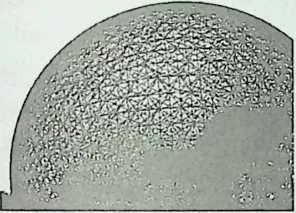
37Because it is the most prevalent manmade structure on the planet, the geodesic dome is the most conspicuous of his environment changing inventions. It was not, however, created primarily for use as homes or playground equipment. It, like all Fuller’s inventions, was invented to discover and demonstrate Nature’s generalized principles. One such principle is the fact that the sphere is a perfect way to build and a model for a ‘‘world that works for everyone’’ because every point on a sphere is equal. The geodesic dome is the closest we humans can come to building a sphere using straight struts.
38On a more practical level, the dome was created for two extremely important environment-altering uses. It was invented to provide temporary, inexpensive housing and to protect large numbers of people and huge amounts of resources from destructive forces such as severe weather and extreme temperatures. These two environment-altering uses clearly demonstrate how environment is stronger than will.
39 People may have a very strong will to survive, but a severe hurricane or earthquake can trump that will and instantly turn them into ‘‘helpless, hopeless victims.’’ However, if they are under the protective cover of a geodesic dome when destructive circumstances occur, their environment will remain stable and so will their lives.
40 If people are rendered homeless and all their material possessions destroyed by natural disasters, flying lightweight, easy-to-assemble cardboard geodesic domes to use as temporary homes will alter their environment. In this instance, the environment-altering invention provides stability as well as a basic foundation for recovery.
41 In both instances, people follow the path of least resistance, either staying inside the huge dome or accepting the temporary domes as homes. And this is just one instance in which Bucky demonstrated the practical nature of working to change environments rather than trying (always unsuccessfully) to change people.
42 Bucky effectively employed this seemingly simple phenomenon throughout his own life to create changes that continue to influence us today even though we are not aware of them. AU his inventions and artifacts (books and other writings, recorded talks, archive, etc.) were designed to change people’s environments, thereby resulting in a positive change of behavior.
43 For example, rather than go out and proselytize to end global starvation and hunger, he wrote and spoke about the truth that in 1976 we reached a point in time when there was enough food on Earth to feed everyone. Educating people to that simple fact changed their environment because they no longer believed that there was insufficient food on Earth.
44 Before learning that fact, people thought that war was valid because everyone had to fight for their ‘‘piece of the pie,’’ and they believed that there was not enough ‘‘pie’’ to feed everyone. Once their environment had been altered through learning some simple facts, they would soon begin to realize how important it was that ‘‘we the people’’ shift the focus of our resources from weaponry to livingry and begin to support all life on Earth.
45 Following Bucky’s model for effective and efficient action, each of us can in fact make a huge difference in the lives of our fellow crewmembers on board Spaceship Earth. We can begin by simply resisting the temptation to try changing people or their behavior and look to see where we can change their environment to create more positive behaviors.
46  ‘‘Revolution by design and ? invention is the only revolution tolerable to all men, all
societies, and all political systems anywhere.’’A Most people realize that some type of
massive global change is underway, but they don’t understand that the shift cannot
succeed using antiquated behaviors, systems, and structures./Ve humans simply cannot
continue to follow the path of recent generations and expect to survive—much less I
thrive. We have to mirror Nature and quickly return to being a sustainable species
and culture. That sustainability requires the activity Bucky labeled a ‘‘design science
revolution.’’
‘‘Revolution by design and ? invention is the only revolution tolerable to all men, all
societies, and all political systems anywhere.’’A Most people realize that some type of
massive global change is underway, but they don’t understand that the shift cannot
succeed using antiquated behaviors, systems, and structures./Ve humans simply cannot
continue to follow the path of recent generations and expect to survive—much less I
thrive. We have to mirror Nature and quickly return to being a sustainable species
and culture. That sustainability requires the activity Bucky labeled a ‘‘design science
revolution.’’
47 Bucky realized that the military could no longer dominate the latest technology and that our best engineers and scientists must shift their attention from weaponry to livingry. This is \ the design science revolution he championed. Bucky’s inven-i I tions were livingry devices that supported sustainable life on_ kEartji. He even labeled himself a ‘‘comprehensive, anticipatory design scientist.’’
4849He devoted most of his life to advocating for a design revolution that encompassed all humans, societies, and institutions. He campaigned for a world that works for everyone, and he believed that the only way that this would happen was if unique ideas were expressed as sustainable designs.
50He was not, however, talking about what most people regard as design. Bucky was working well beyond that former notion of designing a building or a car using the same basic template as had been used for decades. Instead, he was looking into the future to find solutions for problems that had not yet arisen and taking the design of whole systems into consideration. Today, whole systems design is a popular field, but back when Bucky began the concept was essentially unknown.
51Whole systems design requires comprehensive thinking. The most important physical whole system for humans is our fragile Earth. We must design for that whole system within the more comprehensive metaphysical whole system that we cannot experience with our physical senses.
52When we design and create something, we need to consider the whole system of Earth in both the present and future just as Bucky did. By working in this manner, all creators/ designers/leaders can begin to shape a sustainable environment for future generations. This is the revolutionary design science that Bucky predicted would support the survival and success of all humankind, and it offers us numerous opportunities for success both globally and as individuals.
53  ‘‘We are powerfully imprisoned in these Dark Ages simply by the terms in which we have
been conditioned to think.’’
‘‘We are powerfully imprisoned in these Dark Ages simply by the terms in which we have
been conditioned to think.’’
54 4.4
55 By Zoe Weil
56 Guest Commentator
5758What are the terms in which we’ve been conditioned to think? One of the most pervasive and perilous of mental conditionings is the ubiquitous either/o/. We are conditioned fronTa' young age toHirdHirBuiids. Things are black or white. They are as different as night from day. We are expected to be members of one of two political parties: Republicans or Democrats.
59We argue one side or another of what should be considered complex challenges to solve, as in ‘‘loggers versus Northern Spotted Owls’’ or ‘‘do we invade/go to war with
60[pick a country] or not.’’ Our schools all have debate teams in which bright young adults face off around arbitrary and contrived either/or scenarios, such as these actual debate questions: ‘‘Is the U.S. responsible for Mexico’s drug wars?’’ or ‘‘Are teachers’ unions to blame for failing schools?’’
61What druTconditioning does is not only preventusfrom seeing grays and appreciating the spectrums on which we live, but also, more significantly, thinking as what I call solution- aries, whose goal is not to argue which side is right but rather to come up with answers to complex challenges and create a restorative, healthy, humane world for all.
62As a~humane educator and the president of the Institute for Humane Education ( www.HumaneEducation.org), I believe that we can move beyond these dark ages and actually solve our interconnected global challenges by addressing one primary system: schooling. If we were to adopt a new purpose for schooling—to educate a generation with the knowledge, tools, and motivation to be conscientious choice makers and engaged solutionaries for a better world—our graduates would enter their chosen professions understanding their role in ensuring that the systems within them (whether in business and finance, defense and protection, energy and transportation, engineering and architecture, farming and water procurement, production and construction, politics and law, fashion and beauty, etc.) are sustainable, just, and peaceful.
63They would do this as a matter of course because this is what they would have learned in their basic education from Kindergarten through college and graduate school. They would have been conditioned to think of themselves as responsible for contributing to a healthy world.
64There are many ways to go about putting this idea into practice. For example, instead of the unhelpful task of arguing and winning a ‘‘side’’ in a fabricated either/or debate, we could invitp nnr nrpgfivp anrbright youth to explore ideas for end- ing drug wars or improving schools. We could still have teams compete (if we believe competition is a positive way to create new ideas) to come up with solutions, but the goal for the teams would be to delve deeply into a complex problem and come up with the best, most innovative, most cost-effective solutions to pervasive and seemingly intractable problems.
65We could also bring relevant information for solving current challenges into all courses and curricula. We could, in fact, transform the curricula we teach, recognizing that the ‘‘basics’’ of verbal, mathematical, and scientific literacy are simply foundational tools for living healthy, productive, contributing lives.
66Each year of high school might have an overarching subject such as ‘‘Food and Water,’’ ‘‘Protection and Conflict Resolution,’’ ‘‘Products and Structures,’’ and ‘‘Energy and Transportation.’’ Students would learn the ‘‘basics’’ in the
67course of addressing these core systems (without which none of us could survive), and those ‘‘basics’’ would be ever more relevant and meaningful because students would understand their applications to a real world that is still replete with challenges that need to be addressed to create peaceful, healthy societies.
68Thoreau once said, ‘‘There are thousands hacking at the branches of evil to one that is striking at the roots.’’ Education is the root, and if we were to adopt a greater purpose for schooling—to graduate a generation of solutionaries—this generation would, quickly and inexorably, solve the myriad, interconnected challenges we face in creating a healthy, just world for all.
69Zoe Weil is the president of the Institute for Humane Education (IHE) www .HumaneEducation.org, which offers the only M.Ed. and M.A. programs in comprehensive Humane Education linking human rights, environmental preservation, and animal protection. IHE also offers online programs and workshops for teachers, parents, and change agents. She has given a TEDx talk on education and is the author of Nautilus silver medal winner Most Good, Least Harm: A Simple Principle for a Better World and Meaningful Life; Above All, Be Kind; Tlte Potver and Promise of Humane Education, and Moonbeam gold medal winner Claude and Medea about seventh graders who become clandestine activists in New York City. Zoe blogs at www.zoeweil.com. Find her on Facebook and follow her on Twitter at ZoeWeil.
70 A A KEY ELEMENT CONTRIBUTING TO BUCKMINSTER FULLER’S success was his extraordinary ability to think for himself. Although society attempted to indoctrinate him into thinking and acting like a ‘‘productive, good citizen,’’ Bucky was adamant that he and all people need never accept the mandates of others—especially those who are in positions labeled ‘‘leaders.’’
7172At the beginning of most of his marathon thinking-out- loud lectures, he would caution his audience not to believe anything that he (or anyone else) said. He would then go on to advise that people consider the ideas that others posed against their own personal experience. After doing that, a person can either accept or reject the ideas and act accordingly.
73Bucky also often shared the things that he had discovered regarding the words we use and how limiting they can be, and he would coin a term to describe something that he found to be important that had no name. For example, while scientists were constantly telling people that the universe was entropic with all matter and energy traveling out and away, there was nothing to describe the significant phenomenon that is the opposite of entropy.
74Bucky taught that although most scientists believe that entropy is the way of the universe, it has to have a corollary, a something where energy is absorbed inward rather than traveling outward. This phenomenon he labeled ‘‘syntropy’’—a word he created by combining synergy and entropy.
75Some scientists now believe that this phenomenon is what they label a ‘‘black hole.’’ When this occurs in Universe, all energy and matter is sucked in, so nothing can be observed using our physical senses.
76The other place that Bucky observed this phenomenon of synergy happening is on Planet Earth. Energy and a small amount of matter in the form of space dust are constantly coming in to our planet. Then, that energy coalesces even more as plants turn it into physical matter. And with that creation, we have a word to describe a most important aspect of reality and a phenomenon upon which we depend for life.
77This is only one example of the ways we humans keep ourselves in the ‘‘Dark Ages’’ with our words. Another is a word that you just read, and that Bucky did his best to eliminate from his vocabulary. That word is ‘‘believe.’’ Bucky would tell his audiences that he did not believe anything. He would say that ‘‘either I know it or I don't/but he did his best not to use the word believe and to look at all aspects of his life to see what he knew and what he did not.
78 By making that distinction, we are forced to do what Bucky chided us to do and not believe anything we see, hear, read, or are told is true. Rather, we can compare these external aspects of our reality against our personal experience and determine what is true for ourselves. That was the Fuller way, and it served him well for decades.
- 5.
7980‘‘The most important thing toV teach your children is that the Sun does not rise and set. It is the Earth that revolves around the Sun. Then teach them the concepts of North, South, East, and West, and that they relate to where they happen to be on the planet’s surface at that time. Everything else will follow.’’
81 By Ann Medlock
82 Guest Commentator
83 Eppur si muove—‘‘And still it moves’’—said Galileo, centuries ago when the Inquisition forced him to retract his writings about the Earth’s movement around the Sun. And yet we go right on talking as if the Earth were the center of the universe, feeding the ignorance of those who actually believe it is. Buckminster Fuller couldn’t stand that.
84 I heard him do a variation on this theme at his last public appearance in New York. He told us that he’d asked from the podium at a conference of scientists, ‘‘How -many of you saw the sunrise this morning? How about the sunset yesterday?" He’d looked at the many raised hands and in effect said, ‘‘Shame on you.’’ They were scientists. They knew the Sun neither rises nor sets.
85 It was hard not to feel sorry for those entrapped hand-raisers. We’ve all ‘‘seen’’ sunrises and sunsets and we all know that’s not what we’re seeing and yet we all say those words, right? You could see it as an innocent recourse to the poetic, but what Fuller saw was the willful spreading of misinformation, the denial of what is real and proven and scientific. It bugged him.
8687Being a writer, even sometimes a poet, I’ll probably never say, ‘‘Didn’t the atmosphere look gorgeous last night when our position on the planet rotated away from the sun?’’ As a parent and as a creator of classroom materials on compassionate, courageous involvement in the world, I don’t agree with Fuller that helping kids understand the movement of the planet they’re standing on is the most important thing to teach them. But it’s a biggie.
88It’s a dose of reality, a core lesson in proprioception, in nonsense-detecting, and in calling a spade a spade. Given the alarming numbers of people who live by multiple fictions and are indeed willfully denying proven realities, debunking sunrises and sunsets could be a great foundation for introducing kids to the world they actually live in. Living based on facts rather than fictions—what a concept.
89As another wise human once said, we’re entitled to our own opinions, but not our own facts. Fuller lived, breathed, and taught on the solid ground of fact, ever the scientist, backing up his spectacular imagination with proofs, with working, operational models that dazzled the world.
90Ann Medlock is the Founder and Creative Director of the Giraffe Heroes Project (www.giraffe.org) and author of Arias, Riffs & Whispers, and The Meniiaids Tale. For more information about her writing go to www.annmedlock.com.
91 A This simple truth was extremely important to Buckminster Fuller because it was about view and perspective. We’ve all been indoctrinated to believe that the Sun rises and sets—a perspective that implies everything revolves around us and that each of us is more than a single aspect of Universe. Building on that perspective, many of us living in the developed nations have continued to behave as if we are the center of everything and entitled to anything we desire with little or no regard for the welfare of other sentient beings.
92 This view does not respect or honor our beloved Gaia—Mother Earth. It also tends to keeps us from being thoughtful, compassionate crewmembers onboard the planet Bucky named Spaceship Earth and from recognizing that we are stranded on a fragile, lifeboat planet.
93 When we preach this gross lie to our children, we continue to propagate a perspective that is destroying humankind and other species. We also continue to champion the belief that humans are superior beings who can do anything we want and continue on an unsustainable path. And we instruct future generations to keep on doing what we have been doing with the irrational hope that it will finally work.
94 ‘‘We instHTirrbur childreTTaniT grandchildren the belie! that they can take all that they want without regard to others at a time when many of us have realized that we are a single species who must work together and follow the dictates of Nature. Were all in this together, and we need to cooperate and come from love rather fear if we are to survive and thrive as a species and as individuals. This is the perspective of realizing who you are and where you are in physical space and in relationship to all Universe.
95 Bucky championed the fact that knowing where you are in relationship to the elemental surface of our planet is essential to our development and ability to contribute to others. If a person has little or no orientation on Earth, and in relation to other people and physical reality, he can’t proceed forward (on any level) because he does not know where he is or what possibilities exist. In other words, you can’t know where you are going until you know where you are.
96 This is true in both physical reality and metaphorically. We need to wake up and appreciate where we are and what is happening around us. Only then can we take sustainable, positive steps in a direction to benefit ourselves, our families, our neighbors, and all sentient beings. Only then can we begin to step up as truly global citizens. And only then can we experience the love, peace, and joy that is our natural birthright.
97 The primary reason that this perspective is not taught or experienced by most people goes back to the time when ‘‘the church’’ seized power and became the established authority. This was a period of transition from a natural spirituality that was in harmony with Gaia Mother Earth to an era when a small group of men exerted their authority as religious leaders and promoted their own welfare over that of all others.
98 These men would have us believe that the Earth is flat, and for centuries they challenged anyone who argued otherwise. And even though we know that the Earth is spherical (not round, which is still only two dimensional), most of us subconsciously feel that we live on a flat surface and, thus, we say that the Sun rises and sets. This subconscious feeling allowed that handful of religious leaders (and now primarily leaders of our new religion—commerce and business) to control the majority of our resources and maintain the status quo.
99 Their perspective of a flat Earth established the directions ‘‘up’’ and ‘‘down’’ with ‘‘up’’ being good and represented as heaven and ‘‘down’’ being bad and represented as hell. At a time when resources were scarce and life was hard, religious leaders taught people that their next life would be better if they were good citizens, followed the dictates of the church and got into heaven. ‘‘Up’’ and heaven can only exist if we believe that our reality is two-dimensional and flat.
100 Those same religious leaders also empowered themselves to decide who went up and who went down. Thus, people obeyed the mandates of those greedy men and did what they were told in order to support organized religion. Today, we continue this tradition, but the primary forces of greed are business and government leaders.
101 On a spherical Earth, we are'all equal. There is no point that is more important than any other on a sphere. There is also no up or down, heaven or hell controlled by a small clique of elite people.
102 Bucky Fuller’s view is multi-dimensional. On our spherical Earth there is no up or down. Everything exists in relation to everything else, and the correct words are ‘‘out’’ and ‘‘in.’’ With that perspective, everyone has an equal share of power and control, and we begin to establish Bucky’s vision of ‘‘a world that works for everyone.’’
103 To solve the issue of sunrise and sunset, Bucky coined new terms that reflect our experiential reality. These terms are sunsite and sunclipse. These words communicate what really happens at those times. In the morning we site the Sun as it appears on (not above) the horizon, and in the evening it clipses as it disappears on (not below) the horizon. Were we to start using those terms and teaching them to our children, we would begin to live in a more honest and inclusive reality where each of us is of equal value to the whole.
104 By Satyen Raja
105 Guest Commentator
106 Belief is a young person’s first software by their society and surroundings.
107 Belief is the beginning scaffolding that youth ascends (regardless of age) to gain some ground on the unknown.
108 Belief can be a placebo that actually works even without rationale.
109 Belief is the rubber band ball that allows little in (even if you think so).
110 Belief hits its ceiling when beliefs don’t match up with what’s in front of you.
111 Faith is the hope-spring rooted in the invisible.
112 Faith is the rallying call of mad leaders.
113 Faith can be the fallacy of being saved from above from your outs with integrity.
114 Faith is the relaxing of tension and striving to forces beyond our comprehension.
115 Faith also hits its ceiling, as it’s prone to delirium at times …
116 Then there’s the next better step …Knowing.
117 Knowing is the fullest maturation of Faith through the most exhaustive honest seeing through of your beliefs.
118 Knowing is earned from the fire of experience, earned by conscientious (and sometimes silly) trial and error.
119 Knowing comes and makes itself known when one settles down into what is Real for themselves.
120 Knowing doesn’t need an outside thing to have Faith in or an inside set of ideas to believe in.
121122Knowing is irrefutable and isn’t based on facts or perceptions that can be viewed from different angles.
123If it can be viewed from different opinions, dig deeper to the place that transcends any differences.
124This takes knowing that Knowing is worth Knowing and much richer and freeing than what anyone else can give you.
125 Faith and Belief can get one to kill with patriotic zeal.
126 Seeking real Knowing shines light through all of it!
127 Knowing is your best defense and the last stand.
128129Knowing too hits its ceiling, even with the most experienced of us.
130And the most experienced of us know there is that we can never know …The Unknowable.
131SATYEN Raja combines the power of the Warrior and the wisdom of the Sage to inspire audiences worldwide. Satyen is a unique blend of power and of heart. He has taught tens of thousands of students around the world the art of ‘true power.’ Satyen's dramatic style is not for the timid. Through his teachings, your weaknesses become strengths.... Quickly! He is the founder of The Get A Life Company and can be contacted through wwv.TheGetALifeCompany.com.
132 A Buckminster Fuller was constantly advocating that everyone think for herself or himself. He often told his audi-
133 ences, ‘‘don’t believe a word I say or what anyone else says or
134135writes.’’ He would go on to urge people to be moved by child- like curiosity and fully consider everything that comes into
136their environment. Then, one needs to compare that incident or thing against one’s personal experience to see if it feels valid.
137 If it does, a person can accept it, but if it goes against a
138139person’s experience, core values and integrity, an individual needs to reject it—even if the behavior or object is part of ac
140cepted society. That is what thinking for yourself is about.
141Bucky defined belief as allowing others to do the thinking for you and blindly accepting their mandates as the truth. He said that faith in a ‘‘Greater Intelligence’’ (Source / Great Spirit / God / Allah / Higher Power, etc.) was a healthier way to operate, but he also advocated thinking for yourself above even such faith.
142His personal discipline in this area involved language. Thus, he did his best not to use the terms ‘‘believe’’ or ‘‘belief.’’ He would tell his audiences, "either you know something or you don't.’’
143This may seem like a matter of semantics, but if you stop to consider what you are saying and advocating when you say that you believe in something or believe something to be true, you may notice a shift in your thinking. I began doing this many years ago, and I have found it to be a very useful technique for determining what is true for me and what is the result of outer indoctrination.
144For me, the often-taught prioritizing process when a person divides everything into three categories can be helpful here. ‘‘A’’ are the important things. ‘‘B’’ are the things that may be important. And ‘‘C’’ are the unimportant things that can simply be passed over. Beliefs often fall into the ‘‘B’’ category.
145The second step in this process is to go through the ‘‘B’’ pile , and put these things into one of the other categories. Thus, you have things to complete or keep and things to forget or toss out.
146Using a similar exercise with what you believe will result in things that you know and things that you don’t know with nothing jp. hety/een.
147f One interesting thing that Bucky found he knew as he got ' older was how little he knew. In fact, he wrote an epic poem entitled How Little I Know.
148This is the perspective of a true visionary and genius. They recognize that Universe is infinite and beyond our knowing.
149< Even though they are often glorified as brilliant and insightful, \they are humble enough to know how little they actually know, end they eschew such accolades. /—’’
150They realize that there are no beliefs but rather data. And even that data and seeming facts are subject to interpretation and change depending on the perspective of the observer. Thus, it is better to have faith than to believe in something. It is, however, even better to know or know that you do not know and to constantly evaluate what society and others would have you believe against your personal experience.
151  How often I found where I
152 4J7
153 should be going only by setting out for somewhere else.’’
154 By Roshi Joan Halifax
155 Guest Commentator
156 I met Bucky numerous times over the final years of his life.
157158His visionary capacities and ‘‘beginner’s mind’’ made every territory that he entered new—and new for those who were fortunate enough to be with him. He had a curious way of tilting his head when observing or listening, as though he wanted to see things from a totally different perspective. He was a failure gone right, a loser who found truth, a nonconformist who brought new forms into being.
159 He was also dedicated to ending suffering in this world,
160 
 as someone who had much of his early life) In the late 1920s, he dedicated himself to
‘‘the search for the principles governing the universe and helping advance the evolution of
humanity in accordance ivith them ... finding ways of doing more with less to the end that all
people every where can have more and morefi/ow, if these
as someone who had much of his early life) In the late 1920s, he dedicated himself to
‘‘the search for the principles governing the universe and helping advance the evolution of
humanity in accordance ivith them ... finding ways of doing more with less to the end that all
people every where can have more and morefi/ow, if these
161 ered loss and humiliation X
162 h
163 words would suffice!
164165I have always cherished my time with Bucky. He was an inspiration for me. He was out of the box and into this world. He was a systems person, saw the magic of emergence, saw how all beings and things were inextricably connected. He thought globally, was a dedicated environmentalist, and was completely in touch with the local effects of our consumption. He once said: ‘‘There is no energy crisis, onlvjmrisis ofjgnoranceT As a Buddhist, I have long known he was right: our ignorance (supported by our greed and aversion) is bringing immense suffering into our world. Bucky was dedicated to finding a way through this in action and intuition.
166In the end, Bucky knew he was verb, not a noun. His whatness was not his greatness. His greatness was found in his ability to live with ephemerality, to live with the truth of change.
167ROSHI ]OAN Halifax is a Buddhist teacher, author, social activist, and anthropologist. She is Founding Abbot of Upaya Zen Center, a Distinguished Visiting Scholar at the Library of Congress, and has written books on Buddhism, religion, and end-of-life care. She is a pioneer in the end-of-life care field and engaged Buddhism. Learn more about her work at www.upaya.org.
168 By LD Thompson
169170Guest Commentator Buckminster Fuller was a man of humble genius. Though celebrated as an innovator and visionary, he was first to acknowledge that there are those times when, setting off in a direction, something entirely else can happen and course correction is necessary.
171I have seen this acted out in the lives of many talented people I’ve worked with through the years. One set off to be a musician and found himself becoming a computer programmer. Another set off to be a teacher and wound up designing websites. Several planned to be entrepreneurs and found themselves behind a desk working nine to five.
172Do these changes, these course corrections, represent failure? Or do they represent something sublimely providential—communication from our deepest intelligence, guiding us surely and wisely toward the life that we need most to live, adhering to a mandate for growth that is our prime directive?
173If it were possible for each of us to eradicate the concept of failure from our vocabulary, it would be so much easier for us to listen to that deeper intelligence, our Soul, and be guided by it. But as human beings we tend to get caught up in our conditioning and live out of the moment sometimes hanging onto old dreams long after their pertinence in our lives.
174Buckminster Fuller loved nothing more than being out on his sailboat, the Intuition, riding the wild waves of this fascinating life. He once offered a valuable metaphor:
175‘‘On the edge of a large ship's rudder is a miniature rudder called a trimtab. Moving that trimtab builds a low pressure zvhich turns the rudder that steers the giant ship with almost no effort. In society, one individual can be a trimtab, making a major difference and changing the course of the gigantic ship of state.’’
176The ‘‘American Dream’’ is experiencing a sea change. In the midst of an historic economic downturn, the majority of Americans are having to adjust their financial expectations and their capability of achieving their goals. But something greater, more refined, can come out of these adjustments. Those whose lives are dedicated to being awake and aware are finding that their lives are even more meaningful with greater integrity and humility being demanded of them in this moment.
177I know several people who have lost a significant portion of their financial net worth, but they are happier now and more alive than when they were swimming in equity.
178As a result of not resisting our Soul’s curriculum for our life, we are at the point of truly finding out where we should be going …after having set out for somewhere quite different.
179Each of us, during this sea change, has the opportunity and the responsibility to be a trimtab. Every moment, every act, every thought that contributes to consciousness and creativity is potentially that adjustment necessary to turn this ship of state toward a more sustainable direction.
180Every choice that values community, compassion, nonjudgment; every thought that acknowledges that we all live on the same planet and breathe the same air and drink the same water; every innovation in an individual life that offers respect for all life is an act that acknowledges that we, as Souls, are born of the same stuff—the same material, the same intelligence and, ultimately, serve the function of the trimtab.
181This course correction has the potential to deliver us to a very new land, where the Soul’s values—integrity, honesty, generosity—are the values by which we live and express our creativity in our world.
182LD THOMPSON is an author, inspirational speaker, filmmaker and social activist. Having spent over twenty-five years exploring the mind/body/spirit connection, LD works with groups and individuals around the world, helping them find their passion and power through spiritual practice. His new book, THE MESSAGE: A Guide To Being Human, is about how we can understand our ‘‘Soul’s Curriculum.’’ Learn more at www.divineartsmedia.com
183 A In this quote Buckminster Fuller elucidates the wisdom of elders that so many of us have learned over the years. We all set out in life with goals and visions only to find that they take us somewhere completely different. Universe and our past actions (sometimes labeled karma) send us in particular directions that are unseen at the onset of the journey.
184185This book and my relationship with Bucky represents yet another such journey. A Fuller View started nearly ten years ago as my attempt to share more of Bucky’s insights and wisdom online. I would publish a quote followed by my explanation. Eventually, that became a regular feature on my Facebook page, and then morphed into longer writings after I reconnected with the book’s publisher Michael Wiese on Facebook.
186At that point, this was simply an interesting book designed to share Bucky’s ideas and my perspective. Then came the idea of adding ‘‘guest commentators,’’ and that led to the unfolding of a whole new set of possibilities and challenges in order to be of greatest service to the most people.
187Bucky, too, had many such unfolding, invigorating experiences. As he often reminded his audiences,
188‘‘I didn’t set out to design a house that hung from a pole, or to manufacture a new type of automobile, invent a new system of map projection, develop geodesic domes, or Energetic-Synergetic geometry. I started with the Universe ...I could have ended up with a pair of flying slippers.’’
189After years of trying to steer the ship of his life himself, he finally realized a much bigger ‘‘something’’ that he labeled ‘‘Greater Intelligence’’ governed all Universe, and that it would be much easier to begin with as broad a perspective as possible and allow the flow to take him where he would be of greatest use.
190That ‘‘somewhere else’’ is usually far more interesting than where we set out for—because it’s almost always an unknown.
191Certainly, we can try to remain within our comfort zone, but the Greater Intelligence (within us and around us) will take us to places and situations that may be uncomfortable and support of our growth and development. This is where our true self wants to be, even when our lesser self vehemently resists.
192Bucky made a practice of being aware of that unknown and enjoying the journey. He often did not know where he would be led, but he made a point of saying ‘‘yes’’ to invitations whenever possible.
193This is a challenge we all face, and it is particularly difficult at this moment in human evolution when we are morphing from a warring competitive culture to a society predicated on peace, love, and joy for all. Saying ‘‘yes’’ to opportunities and challenges that seem to lead in directions and to places that seem to be out of sync with society is not easy for most of us. Still, ‘‘yes’’ is the required answer if we are to survive and thrive as a species.
194And, in the end, saying ‘‘yes’’ to the unimown will bring us to a higher standard of living and loving than has ever been known to humans. We just don’t know exactly what that new reality will look or feel like yet, but many of us have an intuitive sense that it exists and were excited about the unfolding of this possibility.
195Start With Universe—End Up With Contribution
196 Chapter Conclusion
- 8.
197 ‘‘I didn’t set out to design a v* house that hung from a pole, or to manufacture a new type of automobile, invent a new system of map projection, develop geodesic domes, or Energetic-Synergetic geometry. I started with the Universe—as an organization of energy systems of which all our experiences and possible experiences are only local instances. I could have ended up with a pair of flying slippers.’’A We are all designers of the future—both our individual future and our collective cultural future. Even though most of us don’t often think about the broader aspects of our lives or believe that were subject to the dictates of society and leaders, we are the masters of our own destiny as well as the destiny of future generations. Each of us does in fact create our own reality, and we need to become more conscious creators.
198 The issue is not what we want or what we do, but rather what is our intention and the scale of our perspective at the onset of creation. Ordinarily, we simply decide that we want to have or do something, and we begin the process. We don’t really consider the big picture and how we can be of the greatest service to the most people. We don’t think about how our desires will affect other people or aspects of Universe. And we certainly don’t take the thoughts and feelings of others into account. We simply know what we think we want, and we begin to create it.
199200This way of operating was not always the predominant method, and a more communal broad perspective continues to thrive in a few small isolated pockets of civilization. People in these places live in community, and they consider the environment an essential aspect of their life support system. Thus, they would never chop down a forest of trees simply because they needed the wood for heat or the land for farming. They recognize that the trees and all living organisms are part of a greater whole, and to survive and thrive we must honor all life.
201Knowledge of the Teal’’ world that Nature has created is extremely important to them just as it was to Buckminster Fuller. Following the 1927 epiphany that began his ‘‘56 Year Experiment,’’ Bucky shifted his design/creation focus from a self-centered model to a Universe-centered model. In other words, he began working with as large a vision as possible. For example, he did not initiate his Dymaxion Vehicle project by deciding to design an advanced car that he could mass market. He started with the whole of Universe and from there looked to see what problems would present the largest challenge to people living fifty to one hundred years in the future.
202A major issue he envisioned asTTchallerige was ‘‘humaTr transportation, and from a broad perspective Bucky realized that we could not depend on fossil fuel forever, as was the common belief when he initiated the Dymaxion Vehicle project in the 1930s/Thus begaYTthe emergence of~whathe would eventually label an ‘‘Omni-Medium, Twin Jet Stilt Transport’’
203that could be used as transportation on land, on water, or in the air. Although Bucky’s young daughter Allegra labeled the model for this vehicle a ‘‘Zoommobile,’’ it was not some fantastic science fiction apparition. The Dymaxion Vehicle was in fact the first phase of a transport that Bucky envisioned being viable once the technology that he predicted would happen did emerge.
204 ‘‘Real world’’ issues that most people had to face during the Great Depression were not issues for Bucky when he set out on this quest. The Dymaxion Vehicle was designed to solve many of humankind’s future transportation problems, and if it were mass-produced today, it would provide viable solutions. This is what happens when a person begins with Universe and designs from a broad perspective in order to support all sentient beings, and it is the antithesis of what most people and Corporations have been doing during thp pact rpntnry-fcOokat transportation today to witness the opposite ot starting with Universe design. The automobile and the internal combustion engine emerged from a very narrow vision and a desire to make huge profits for a few individuals and corporations. The ‘‘winners’’ created an impractical vehicle that consumes enormous amounts of resources and uses an engine that has thousands of moving parts and is designed to need lots of repairs and eventually wear out. There is no system to recycle any of the elements of that vehicle or its waste products, and thus the ‘‘modern’’ automobile and internal combustion engine is destroying our environment and may eventually lead to th-exfrme&on z
205 Even at the time of the internal combustion engine’s inception, there were other alternatives offered, but they were proposed by men who, like Bucky, were more interested in solving problems than making huge profits for themselves. In other words, their primary motivation was to make sense rather than trying to make money.
206 You and I now have an opportunity to shift this unnatural way of operating so that we begin with an intention to make sense rather than an intention to make money. This is the aspiration we must have at the onset of every new design project (and the creation of almost anything is a design project) if ‘‘we the people’’ are to take control of our planet, our lives, and the welfare of future generations. We must always ‘‘start with Universe," which includes the welfare of all sentient beings, if we are to survive and thrive on our tiny, fragile Spaceship Earth. The result might be ‘‘flying slippers,’’ but the result could also be Buckminster Fuller’s vision of ‘‘a world that works for everyone.’’