7 BEING Showing Up Fully
23Dare to be naive.A Buckminster Fuller was constantly reminding his audiences that he was simply an average, healthy human doing what he saw needed to be done. He was actually an ordinary human doing extraordinary things that needed to be done, and one of the primary reasons he was able to achieve so much was his naivete and humble confidence.
4Rather than coming from a rigid view of being a knowledgeable expert, he adopted an attitude of constant curiosity. Even in the last years of his life, when he was sought after as an expert in many fields, he continued to learn and grow. And that continual evolution led him to say, ‘‘Don't try to maize me consistent. I am learning all the time.’’
5Although many people consider consistency an important characteristic, Bucky found that consistency restricted his curiosity and focus on being naive. Early in his life, he realized that everything was changing and so he allowed his thinking and view to change as he learned. Thus, he focused on curiosity rather than consistency. He even continued to rewrite ‘‘The Lord’s Prayer’’ over and over as his perspective changed.
6That is not to say that being consciously naive and inconsistent interfered with his integrity. Bucky defined integrity as the ability to hold shape, and he did just that regardless of external circumstances. He continued to be a ‘‘local information gatherer and problem solver’’ on the planet he named Spaceship Earth, and that single-minded attention led him to be what we now label a ‘‘lifelong learner.’’
7His naive inclination did not, however, make him an easy target for people who preyed upon others because they did
8not yet possess his view that we live in an abundant, generous Universe. Although Bucky freely shared his knowledge and resources, he also protected his work so that future generations could learn from his mistakes and experiences.
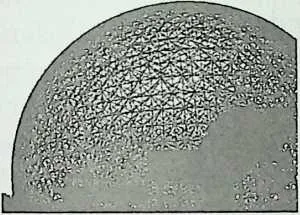
9For example, following his invention of the geodesic dome, he hired the best patent attorney he could find to write unbreakable patents for the dome. He did not do this to make money. He created unbreakable patents to protect his designs from the corporate giants that he knew would swoop in and try to bypass his patents if they saw any possibility of making money from the geodesic dome.
10The result of Bucky’s foresight was that when the geodesic dome was recognized as the only solution to problems faced by the US government and large corporations, Bucky charged them a great deal to use those patents. However, when groups of curious young people asked to use those same patents on their unfunded projects, Bucky never charged them.
11Bucky also continued to recount the importance of naivete and inconsistency in his writing. In 1976 at the age of 81, he wrote the epic poem ‘‘How Little I Know,’’ sharing the fact that the older he got the more he realized how much he still did not know. This idea of knowing that one does not know is characteristic of the genuine wisdom Bucky exhibited in every aspect of his life. The following is an excerpt from that poem.
12‘‘It is understood
13 That if you know that 1 kncrw
14 How to say it ‘correctly’
15 (The exact meaning of which
16 1 have not yet learned)
17 Then I am entitled to say it
18 All incorrectly
19 Which once in a rare while
20 Will make you laugh.
21 And I love you so much
22 Whenever you laugh.
23 But I haven’t learned yet
24 What love may he
25 But I love to love
26 And love being loved
27 And that is a whole lot
28 Of unleamedness. ’’
2930During these most challenging times in the evolution of our species and in many people’s personal growth, we can use more laughter. Daring to be naive helps us all to recognize the unique nature of our situation and that of our entire global society. As the saying goes, ‘‘Now is the time, and we are the people.’’
31Hopefully, each of us has learned enough to know that none of us really knows much of anything compared to the infinite possibilities of Universe. Only then will we be able to competently question authority so that we can stand up and be counted as ‘‘we the people’’ who are a force for good and positive change in the same way Bucky was during his life on Spaceship Earth.
- 2.
32 ‘‘You have to decide whether x " you want to make money or to\ y make sense because the two
3334are mutually exclusive.’’
35By Randolph L. Craft Guest Commentator
36One of my favorite quotes in my sustainable socio-economics ‘‘slant’’ on Bucky’s work is Bucky Fuller’s ‘‘absolute law’’ as it is expressed in this quote. When Bucky said this at ‘‘The Future of Business’’ conference in 1981, he said it with a deliberate ‘‘push’’ in his demeanor, paused and stared at all of the audience for seemingly endless seconds, and then repeated himself—finger raised in almost a scolding gesture with more conviction than the first time. He was serious about this! I have it on videotape.
37From my perspective, this is one of his most misunderstood statements—even by many of the ‘‘Bucky people’’ out there. To truly understand this quote, one needs to know Bucky’s definition of wealth, which I have come to call ‘‘True Wealth,’’ as distinguished from the popularly held vague definition. Bucky’s definition is, ‘‘what we have organized to take care of how many lives for how many forward days.’’
38First of all, we realize that the concept of money and wealth is a human concept. One doesn’t experience wealth if one is dead. Wealth combines resources in the physical world with knowledge and know-how.
39A tree in the forest has no ‘‘wealth/money’’ value if there are no humans to ‘‘utilize’’ it. When a human comes along and knows how to ‘‘harvest’’ it, the human can burn it for heat to stay warm and to cook food. The tree only then has value to the human and can be used to trade and barter with other humans for things needed to survive. If the human knows how to build a shelter with the tree—additional knowledge—the tree then takes on additional value. The tree didn’t change, the human knowledge changed, and the ‘‘wealth’’ value increased.
40Money, on the other hand, is a tool humans invented to represent ‘‘wealth.’’ Money is a contract between two or more people who agree that the ‘‘tool’’ has a certain value. That value is maintained only as long as all parties trust in that value.
41Money isn’t wealth. Money only represents wealth. Money is basically trust.
42As time went on following the invention of the concept of money, humans forgot about the connection between money and the wealth it represents, and we started thinking that the money was the wealth. Once one thinks money is wealth, your whole thought process shifts. You will focus on ‘‘making money’’ instead of ‘‘making sense’’ by producing the ‘‘true wealth’’ that the money represents.
43Producing ‘‘true wealth’’ makes sense—in any economy anywhere under any conditions. ‘‘Making money,’’ on the other hand, usually has people coming up with all kinds of schemes and manipulations that usually make little to no sense when observed from the perspective of ‘‘true wealth.’’
44The US/Western economies are currently a total demonstration of the ‘‘making money’’ thought process, and the ‘‘emerging’’ economies of Spaceship Earth are not far behind. ‘‘Get rich quick at any cost’’ (win/lose or lose/lose), making little to no sense, has replaced a deliberate and thoughtful process to produce needed value for others at a fair value-added profit. This sensible way of operating endures, can only grow, and makes total sense. Thus, Bucky’s statement "you have to decide whether you want to make money or maize sense hecatise they are mutually exclusive’’ helps us all to evaluate our actions and move toward creating a more sustainable society.
45RANDOLPH L. Craft has been studying Buckminster Fuller’s work for decades and teaches about ‘‘true wealth’’ around the world. To learn more about him, ‘‘Sustainable Global Socio-Economics’’ and ‘‘True Wealth,’’ based upon the life and work of Dr. R. Buckminster Fuller visit www.FullerEducation.org.
46 A Frequently repeated and generally not understood, this quote represents a critical aspect of Buckminster Fuller’s operating strategy and the way he showed up after his 1927 contemplation of suicide. At that time, he had done his best to make money and support his family, but he was a total failure in the eyes of society.
4748On the verge of killing himself, he had an epiphany/spiri- tual experience. Not knowing what to do next, he entered into several months of silent meditation, contemplation and pondering his purpose. The result of that period was his great experiment to determine and document what a single individual could accomplish that could not be achieved by any corporation, government, or institution no matter how large or powerful. One of the key elements of that ‘‘56 Year Experiment’’ in which he used himself as ‘‘Guinea Pig B,’’ was his resolve to never again work for a living.
49Bucky decided to make sense rather than to make money. He did not, however, decide to starve, be homeless, or shirk his responsibility to support his family. Instead, he resolved to keep his intention focused on making sense for the benefit of all people rather than trying to make money for himself and his family at the expense of others as most people were (and still are) doing.
50His discipline could be restated as follows: When embarking on any new endeavor, a person whose intention is to make money will probably fail while a person whose primary intention is to make sense and contribute to others will most likely succeed and be supported financially. It’s not about the overall action or money. It’s really about the intention, especially the initial intention. And this is what drives the entire endeavor.
51Over the course of his ‘‘56 Year Experiment,’’ Bucky proved that this strategy works well. In the 1950s he had an annual income of over one million dollars. Realizing that Nature never hoards and Nature only saves enough to sustain a project, Bucky quickly ‘‘reinvested’’ his income in the next not addressed project he saw needed to be done.
52Bucky’s rationale for trying this strategy was quite simple. As humans, we are all part of the great whole we call Nature. Nature always supports whatever is supposed to be. There is no artificial in Nature. Nature always and only allocates the exact amount of resources necessary for any ‘‘project,’’ be it a tree, a rainstorm, or a human.
53Nature never uses too few or too many resources. If something is not in sync with Nature, then is not supported. In fact, it does not even exist.
54Humans are a unique species in that we often attempt to create projects that are not in sync with Nature. These always fail. They may appear to be working for a while, but anything that is not in accord with Nature and her generalized principles will fail.
55This is particularly true of projects or inventions that are initially created to make money and not make sense. Consider the internal combustion engine. In its short tenure (a century is a spit in the ocean when considering the great cosmic time scheme), the internal combustion engine and the fossil fuel it requires have destroyed a great deal of our planet’s natural resources and habitat. That invention is literally lulling us and much of the life on Earth.
56Nature and Earth will survive with or without humans. Because it was created to make money rather than make sense, the internal combustion engine does not support the success of life on Earth and will fail. And it may also result in the extinction of the species that created it.
57Bucky realized that Nature is always successful in every aspect of her work, and he modeled his actions on the thriving templates he found in Nature. At this critical juncture in humankind’s evolution, when we stand on the verge of extinction as a species, and in an era of what Bucky called ‘‘humanity's final exam,’’ ‘‘we the people’’ must always make sense rather than trying to make money at the expense of other people.
58This is not some pie-in-the-sky idea. It’s the mandate of a man who devoted the last 56 years of his life to finding out what works and how we can all implement such best practices into our work and our lives.
- 3.
5960‘‘So I vowed to keep myselfV alive, but only if I would never use me again for just me—each one of us is born of two, and we really belong to each other. I vowed to do my own thinking instead of trying to accommodate everyone else’s opinion, credos, and theories. I vowed to apply my own inventory of experiences to the solving of problems that affect everyone aboard planet Earth.’’
61 By Dr. Joel Levey
6263Guest Commentator
64During a time of tremendous personal crisis in his life, Buckminster Fuller nearly resorted to taking his own life. Instead, a very profound and transformative experience awakened him and inspired him to rededicate his life to being of benefit to others. When writing and speaking about this experience, he made the above statement.
65In affirming that ‘‘we really belong to each other,’’ Bucky echoes an insight from Brother David Steindle-Rast, who says, ‘‘Ethics is how we behave when we realize that we belong together.’’
66Bucky’s heartfelt dedication reflects the universal principle that the Buddha called ‘‘conceiving the mind of enlightenment.’’ This quality of being is the core motivation of a bodhisattva, a person who dedicates him or her self to realizing their true nature and highest potentials in order to support all beings to do the same.

6869As we awaken from experiencing ourselves as separate from others, our wisdom deepens to behold a view of the profound interdependence of all beings. From that view, it is natural to feel empathy for others and to want their happiness. You would never intentionally harm another or take advantage of them for your personal benefit but instead would wish for them to be safe, free from suffering, and to realize their highest potentials.
70As Martin Luther King Jr. once eloquently stated, ‘‘All life is interrelated…caught in an inescapable network of mutuality tied in a single garment of destiny. Whatever affects one directly affects all indirectly. For some strange reason, I can never be what I ought to be until you are what you ought to be. You can never be what you ought to be until I am what I ought to be. This is the interrelated structure of reality.’’
71The great Indian sage Shantideva expressed this realization as, ‘‘How wonderful it would be when all beings experience each other as limbs on the one body of life.’’
72If we were to emulate Bucky’s vow in our own lives, we would dedicate ourselves to:
7374a life of selfless service;a life of mindfulness and vigilance regarding what our motivations are moment to moment throughout each day, lest we lapse into old, self-centered habits; anda life of ceaseless devotion to searching for solutions to problems that plague those who share the life-support systems of Spaceship Earth.Keep in mind that although it may be impossible at this stage of your evolution to live perfectly true to such high ideals, holding such an aspiration as the core organizing principle of your life provides you with a frame of reference/reverence to keep returning to whenever you lapse into the habit of living for just yourself. If you are clear on the direction or goals you are dedicated to in your life, you’ll be more likely to notice when you drift off course, and keep returning again and again to align and attune to the path you are dedicated to following in your life.
75If you find this a compelling possibility for your own life, I invite you to take a step in this direction today. Here are some simple ways to begin:
7677Experience the next breath in a way that is dedicated to all beings remembering their intimate connection with the web of life. As you inhale, envision that you and all beings receive what you most need in this moment to flourish in your life, and as you exhale, dedicate that letting go to supporting all beings in releasing their tensions, misconceptions, self-centeredness, ad infinitum.•Another simple step would be to mindfully drink your tea, or sip your java with the motivation that, ‘‘May this liquid satisfy the deepest thirst of myself and all beings.’’
7879As you open a door to step outside, envision that you are leading all beings to greater freedom and openness.As you return home, envision all beings having a place of peace, safety, and refuge to abide within.As you practice in these kinds of ways, you will gradually develop your capacity to live ever more fully so that your every thought, word, and action is dedicated to benefiting others. Though at first this may be largely a discipline of aspiration and imagination, over time, you will find that you have transformed your identity, worldview, values, and way of life to truly embody Bucky’s vow to live for the benefit of all.
80As we reflect upon Bucky’s brilliance and aspire to walk in his footsteps, may we hold Bucky’s hand, sense the light of his inspiration filling us, and align our hearts and minds with his inspiring example for the benefit of all!
81JOEL Levey, Ph.D., is co-founder ofWisdomAtWork.com, International Institute for Mindfulness, Meditation, and MindBody Medicine, and the International Institute for Corporate Culture and Organizational Health. With his wife, Michelle, he stewards the
82Kohala Sanctuary, a permaculture-designed learning center on the Big Island of Hawaii, and is the co-author of many books and audio programs including: Living in Balance, Luminous Mind, and Wisdom at Work. Joel’s work with leading organizations around Spaceship Earth draws insights from science, spirituality, and medicine, and offers an integrative approach to change resilience, and personal, community, and organizational sustainability and thrivability.
83 A Most of us believe that we are independent and think for ourselves, but we’re generally under the spell and control of many external forces. Although when asked we often say that we’re doing our best to be in integrity, we usually don’t have the integrity of holding our shape (knowing and maintaining our core values) regardless of external factors and circumstances. We’re swayed by the opinions of others as well as the flood of information that inundates us from morning until night.
8485In this 1927 declaration of his integrity and mission, Buckminster Fuller vowed to do his best to maintain his integrity, knowing that his radical stance would be challenged again and again. He was making this vow at a time when people were far less conscious of themselves and their environment than is true today. They were also far more isolated from the majority of the people on what we now know is a tiny Spaceship Earth.
86So, to proclaim that he was going to ‘'apply my own inventory of experiences to the solving of problems that affect everyone aboard planet Earth,’’ was, and still is, an immense commitment. To do this publicly, as Bucky did, ramps up the intensity even more, yet this is the calling that is required of us at this critical moment in the final examination of humans as a species.
87Many of us are now aware that we’re all in this together. There is no other planet that we can escape to. Once the air or water on Earth is polluted beyond the point of being supportive of human life, there is no turning back. And if we reach a point where everybody believes the ideas and vision thrown down to us from above by corporations, governments, and other organizations that would have us live in fear, believing that there is not enough and we must compete with one another, the game of life on Spaceship Earth is over.
88Bucky’s commitment rings true today more than ever. We each need to trust our inner judgment and personal experience above all else. The data is available to each of us with a few clicks of a mouse, and we need to examine it and make our own decisions. Then ‘‘we the people’’ need to rise up and unite in a single voice calling for unity, peace, freedom, justice, and abundance for all. This is the vision of ‘‘a world that works for everyone’’ that Bucky championed throughout his adult life, and this is the only solution that is now acceptable if we are to survive and thrive.
89We really do ‘‘belong to each other.’’ It is time for each of us to be our sister’s and brother’s keeper. It is time to stop the needless death of fifty thousand people every day because they have no food to eat on a planet that produces enough food to feed everyone. It’s time to cry out STOP to those who generate great wealth for themselves by continuing to promote war and destruction.
90‘‘We the people’’ can take charge of our planet and ourselves. We can think for ourselves, and we can go beyond the opinions, credos, theories, and beliefs that have led us to this brink of destruction. Fortunately, we have the lives of people like Buckminster Fuller to use as a template for our actions. We most certainly don’t want to blindly follow in his footsteps, but we must examine his great work so that we can think for ourselves and decide what we can learn and apply from his ‘‘56 Year Experiment’’ on behalf of all people.
913*4 ‘‘Never mind if people don’t v -" understand you, so long as no
92 \ J 'v-" one misunderstands you.’’
93 James Roswell Quinn
9495Guest Commentator In 1984, a good friend gave me a copy of Buckminster Fuller’s book Critical Path. At first, his words nourished my hunger to make a greater impact with my life. But soon, I realized this amazing man had created an instruction manual for how to create positive change ... locally and globally. I have been a student of Buckminster Fuller, and a teacher of his concepts, ever since.
96People who have attended my personal growth and leadership seminars will likely be surprised that I have chosen this quote as my contribution to this important book. Most would probably have assumed that I would speak on Bucky’s concepts of ‘‘Precession,’’ ‘‘Synergism,’’ or the ‘‘Trim-Tab’’ principle (which forms the introduction to my book The Love-Based Leader). While these and many other of Fuller’s concepts are dear to my heart and important in my teachings, this one quote seems to go to the heart of solving difficult personal and global problems.
97To me, no matter how hard we try, it has always seemed that the normal result of most attempts at communication is misunderstanding. In this event, resentment and justified reactions become commonplace. In fact, misunderstanding is at the root of all human conflicts, from marital discords to international wars.
98For example, imagine that I have just asked you to pick me up at the airport at 6:00 PM. If you understood me correctly, you will be there on time. No problem.
99 If you did not understand me, you would stop me and ask me to repeat it. Again, no problem.
100 But, if you misunderstand me and think I said to pick me up at 7:00 PM, then you would not ask for clarification. You would think you got it right. As a result, there will be hurt feelings or worse when you fail to show up on time. There will be a problem.
101 Bucky realized this and strove to be so clear in his own communications that he had to speak in a new way. Fuller actually had to invent words and use creative grammar in order to state his ideas in a way that gave people a chance to understand his concepts. Often called ‘‘Fullereze,’’ his unique language was difficult for many to understand.
102 I do not think this bothered Bucky because, in the end, very few people ‘‘misunderstood’’ him when he explained something. People either understood what he was telling them or they did not. But nobody ever went away with the wrong idea.
103 Some understood his concepts immediately. They began to question how to implement what they learned and wanted to learn more.
104 Others did not understand his concepts at first. They usually became confused in a manner that demanded answers. They then asked clarifying questions or studied further, which ultimately led them to understand.
105 The question becomes, ‘‘Do you want to make a bigger difference with your life?’’ The answer is for you to strive to eliminate miscommunications.
106 When you tell someone something significant, such as a concept you are striving to convey or a personal request, get into the habit of asking clarifying questions. Even when it seems like they understood, ask them to tell you what they heard. Make sure.
107108Conversely, when someone else is striving to communicate an idea or a need to you, get into the habit of repeating back to them what you thought they said. Make sure.
109It is with absolute clarity that we can create trust between individuals and between nations. What kind of a world do you want to live in?
110Therefore, if you want to be a part of creating (in Bucky’s words), ‘‘a world that works for everyone," then strive for clarity in everything you say and everything you hear. Become accountable for your results and teach others to do the same. The world has enough victims; we need leaders.
111As my wife often says, ‘‘Clarity at all costs, or it costs you all.’’
112 I think Bucky would agree.
113114James Roswell Quinn is an author, keynote speaker, leadership trainer, success coach, and financial educator. Since 1979, he has made over fifteen hundred presentations to tens of thousands of people in ten countries. The body of Quinn’s work includes his book, The Love-Based Leader, and his eight-CD personal audio seminar, Get Over Yourself. He has co-authored the book Speaking Of Success, with Jack Canfield, Ken Blanchard, and Steven R. Covey. More information about his works is available on his website www.JamesRQuinn.com. He can be contacted at GlobalKeynote@aol.com 815-248-2081.
115 A This distinction between not being understood and being misunderstood was a critical aspect of Bucky’s personal discipline and operating strategy. After many agonizing experiences of being misunderstood, he came to realize that he was much better off if people simply did not understand him rather than being misunderstood.
116117Thus, he would go to great lengths to clarify each and every detail in his explanation of almost everything. There is no ‘‘short and sweet’’ answer in Bucky Fuller’s world because everything needs to be clarified so that it is not misunderstood.
118This is apparent in his lectures as well as his writing. The lectures were actually labeled ‘‘thinking out loud’’ sessions, and they often ran on for hours as Bucky clarified each point he made. The result of those lengthy discourses in both speaking and writing was usually people not understanding, and that was acceptable because Bucky discovered that not being understood would usually result in people thinking about his ideas even more and asking clarifying questions.
119Bucky also knew that if he covered topics in a cursory manner, people might misunderstand his concepts and take inappropriate action or share incorrect insights based on their misunderstanding. So, Bucky’s writings and talks are unusually convoluted, lengthy, and sprinkled with words he created when he could not find a word that expressed the specific reality or concept he was explaining.
120One such example is the words ‘‘sunsite’’ and ‘‘sunclipse.’’ Bucky coined these words to challenge what he often said was the greatest lie we were foisting upon our children—that the Sun rose and set. The Sun does not rise or set, and just saying or reading those words creates the erroneous belief that humans are the center of all reality around which everything revolves.
121This is not a view of reality that Bucky wanted imposed on young people, so he created the word ‘‘sunsite’’ to replace sunrise and ‘‘sunclipse’’ to replace sunset. These new terms allowed him to correctly speak of the phenomenon of the Sun’s becoming visible and not visible to humans as our Earth rotates.
122When people initially encounter these words, they might not understand them, but that usually stimulates their curiosity and causes them to ask questions. Thus, the truth emerges from not understanding rather than being misunderstood.
- 5.
123 ‘‘There is something patently< .. insane about all the typewriters
124125' sleeping with all the beautiful
126plumbing in the beautiful office buildings—and all the people sleeping in the slums.’’
127 A The issue of resource allocation was a key element in Buckminster Fuller’s thinking and action, and he was continually pointing out irrational cultural activities in this area. More than just a critic or social commentator, Bucky followed his own advice of doing what needs to be done and is not being attended to by taking action to solve the problems he witnessed.
128129His initial action was generally to inform and educate as he did when he talked about office buildings being empty while people slept on the streets. Next he created artifacts (inventions or other physical objects) to solve the problem, mirror Nature’s generalized principles and demonstrate how Nature’s principles can be applied to an issue, offering unique new solutions for the future.
130Bucky’s solution for housing people efficiently was the Dymaxion House. This unique round, inexpensive, self- sustaining house was preceded by the Dymaxion Dwelling Machine, which was another round dwelling made from circular grain silos.
131In 1928 when he came up with his initial concept of the Dymaxion House, Bucky was financially destitute, but he was able to build a model. He then began showing that simple model to anyone who would listen in an effort to make his solution as known as possible. And, after decades of patiently waiting, Bucky’s strategy of ‘‘emergence by emergency’’ eventually paid off in 1944 when the U.S. government was looking for ways to keep wartime aircraft factories busy.
132It was then that the assembly line-produced Dymaxion House was discovered as the easiest solution available, and Bucky quickly began building a working prototype. Even though the Dymaxion House was never a commercial success, that prototype is now a permanent installation at the Henry Ford Museum in Michigan.
133The reality of empty office buildings while people were homeless made no sense in 1928, and it remains just as illogical and inhumane today as people are losing their homes to foreclosure. Efficiency and inclusion dictates that we make use of all our resources as effectively as possible, and our lack of thinking outside the box and compassion is evident in this instance.
134On weekends and evenings, lights and heating are often left running in office buildings and other commercial structures while homeless people are exposed to the elements on the same streets as the warm, dry buildings. In most cities, this is particularly evident in the downtown core areas, which contain the most homeless people and a majority of commercial buildings vacant on weekends and evenings.
135This is just one instance of our wasting valuable resources while treating underprivileged citizens in an inhumane manner. At this critical moment in humanity’s evolution, we need to maximize all our resources while minimizing waste. This would be very simple in the instance of homelessness and office buildings.
136During extremely cold periods, this is exactly what happens. When a blizzard makes outdoor temperatures unbearable, public buildings are opened for the homeless, but our leaders are unwilling to take that same action the rest of the year. And so our office machinery is cared for better than our fellow crewmembers on board Spaceship Earth.
- 6.
137 ‘‘Unconscious decisions have
v* consequences. Our assumptions
drive our priorities, and in
many cases we don’t even
acknowledge they are there.
Innovation arises from questioning
the old assumptions.’’By Stephan A. Schwartz
138 Guest Commentator
139 In 1969, I was in Washington, D.C., a twenty-seven-year-old editor of Seapower, a journal of maritime and naval affairs. Late one afternoon in the spring I was approached by the director of the Navy League, a non-profit foundation that sponsored the magazine, who said to me, ‘‘This is something that might interest you, Stephan. How would you like to spend the day with Buckminster Fuller?’’
140 Fuller was scheduled to give the keynote address at the Navy League’s Annual Conference. He was to be picked up at his hotel about 10 a.m. and needed to be staffed for the day. If I volunteered I was to take him wherever he wanted to go and make sure things went smoothly. I agreed immediately and was struck by the relief in the director’s face. I realized he didn’t want to be burdened with Fuller for a whole day, just before the conference, and was glad I would do it.
141 On my side I couldn’t believe my luck. I had been interested in Buckminster Fuller for years, dating back to when I saw one of his early domes and a picture of the Dymaxion car. The idea of spending a day alone with him I saw not as a burden but as a wonderful unexpected gift.
142 Two days later I am standing in Fuller’s hotel lobby when he gets off the elevator. I recognize him immediately and go
143 up and introduce myself. He has a low flattop haircut and is wearing a bluish green spectacularly unfashionable suit of some hard finish cloth. He looks almost iconically like an inventor engineer. In fact I realize he defines the type in the way Edison must have defined it for his generation.
144 Fuller is smaller in stature than I had thought. His glasses are broken and he has taped them back together. He has hearing aids. I am surprised at how near-sighted he is. It doesn’t show up in many of the pictures. His astigmatism is clearly much worse than my own. It distorts his eyes slightly but this does nothing to filter out a kind of intense curiosity he projects whenever he focuses on me—or anything else.
145 Despite the differences in our age and status, there is no awkwardness between us. He is available and engaged, asking questions and commenting. After speaking with him for a few moments I have the sense he is incredibly competent and understand that he looks at the world in a way unfamiliar to me.
146 I ask him what he wants to do. ‘‘I’d like to go to the Mall, have lunch somewhere you pick, and then come back to the hotel. I speak this evening.’’
147 We catch a taxi and he asks me to have it take us to the science museum. As we walk the Mall he takes in everything and begins to talk about the people, the buildings, the placement of the buildings, how the people use the buildings. ‘‘All those stairs," he says pointing at one of the grand Mall buildings. ‘‘This building was designed to impress, not to be helpful or even functional."
148 Over and over he introduces me to new ways of looking at familiar scenes. It is a mix of science, engineering, and a finer higher element. I realize most of the written accounts I have read about him miss this subtler realm. As we walk, I understand I would have missed it as well except for my own experiences as a meditator. His words are the expression of his metaphysic. He sees pattern and system where most people see only isolated elements.
149 He has taken the time to think through the details, the design choices of our culture, to the point where he can see the higher over-arching narrative of who we are. And it is reflected in almost everything he says. He extrapolates from the present reality to what might be through practical details.
150 ‘‘Do you see the Mellon Gallery'?’’ he asks, using the old name for the National Art Gallery, begun from a bequest from Andrew Mellon.
151 ‘‘Yes.’’
152 ‘‘What does it weigh?’’
153 ‘‘I have no idea,’’ I reply. It takes me a beat to even consider the question. It seems so odd.
154 ‘‘Nor did the architects that designed it.’’
155 ‘‘Does it matter?’’
156 He looks at me for a moment, shading his eyes with his hand. ‘‘A marine architect would know. He would know to the pound. And he wouldn’t use a pound more than was required. The sea compels such attention."
157 It has never occurred to me to consider the weight of a building, and while I think it is an interesting way to look at buildings, I know I am still not getting his point. He lets me think about this as we walk on. After a beat he picks up his thread.
158 ‘‘The design decision not to consider the building’s weight does not exist in isolation; it is a way of looking at the world. From that assumption of what matters and what doesn’t an entire chain of consequences is set in motion. Each step of which because of the flaw in the original conception—not considering the weight—needlessly consumes natural resources and the time and energy of people. Unconscious decisions have consequences.’’
159160I suddenly understand his point. Almost visually I can see in my mind’s eye the network of consequences. How not caring about weight leads to design choices, which lead to orders, which lead to manufacturing, which leads to fluctuations in raw material prices. I see that when unchallenged assumptions are repeated and accepted as the normal way of thinking about a problem then culture is shaped to that bias.
161‘‘Our assumptions drive our priorities, Stephan. And in many cases we don’t even acknowledge they are there. Like asking how much a building weighs, and what that means. Innovation arises from questioning the old assumptions."
162Standing there under the trees that line the Mall's length, shaded from the mid-day Sun, I know Buckminster Fuller has given me the gift of a teaching moment. And four decades later I see how often I have used his insight, and how much I owe to saying ‘‘Yes,’’ when I was asked, ‘‘How would you like to spend the day with Buckminster Fuller?’’
163STEPHAN A. Schwartz is a Senior Samueli Fellow at the Samueli Institute, editor of Schwartzreport.net, and columnist for the journal Explore. He is the author of nearly seventy peer-reviewed scientific papers and technical reports, numerous magazine and newspaper articles, producer of twenty documentaries, and the author of four books, The Secret Vaults of Time, The Alexandria Project, Mind Rover and, his latest, Opening to the Infinite. To learn more about Stephan and his work visit his websites www .stephanaschwartz.com, mvw.schwartzreport.net, explorejournal.com/content/schwartz.
164 A Buckminster Fuller made a practice of questioning almost everything. This was especially true of old assumptions, whether they were his personal ones or society’s. Another of his disciplines was to be as certain and conscious as possible about an issue before making any decision. He did not wait until he was absolutely sure of something before acting, but he made the best decision he could, based on his current knowledge and experience, knowing full well that everything is in constant motion and changing. In other words, he followed the ‘‘ready-fire-aim’’ philosophy of living. Within this context, a person takes action (fire) and course corrects (aim) after each action rather than trying to find the ‘‘perfect moment and action.’’
165166Bucky often reminded people ‘‘don’t try to make me consistent. I am learning all the time," and he was comfortable challenging assumptions and course correcting his initiatives as they progressed. He also realized that the law of cause and effect (also labeled karma) is a vital force influencing every activity and thought. Every action (be it consciously considered or not) has a consequence for the person taking the action and others. Bucky found this to be most important for humankind as we teeter on the verge of what he labeled our ‘‘final examination’’ to determine ‘‘whether humans are a worthwhile to Universe experiment.’’
167Our ancestors have made some severe unconscious decisions, and we are now facing the consequences of those choices. Most of those poor decisions were based on the best information available.
168Still, these decisions were made with the best of intentions from a series of untrue assumptions including that:
169170We live in a Universe where resources are scarce.Making and hoarding (saving) money is good.There are an unlimited amount of physical resources on our planet so we can use them up and throw our ‘‘waste’’ into landfills.Everything revolves around us as individuals and as a species.We must fight for our share of the pie.These are just some of the false beliefs that have helped move us to the brink of a planetary environmental disaster (both globally and individually). We now know that none of these statements is true, and a growing number of us have experienced the abundance and natural flow of a Universe that supports all life. Bucky often had that experience of abundant flow and support, and he was always freely sharing the information he had learned. He often reminded his audiences,
171"It is now highly feasible to take care of everybody on Earth at a higher standard of living than any have ever known. It no longer has to be you or me. Selfishness is unnecessary. War is obsolete. It is a matter of converting the high technology from weaponry to livingry.’’
172Many people now strive to make more mindful decisions that fulfill the philosophy expressed by our wiser ancestors and many indigenous cultures when they talk about considering the effects of their actions seven generations into the future. ‘‘We the people’’ are moving toward a time when our priorities are not driven by our unconscious assumptions but by the truth of our individual and collective experiences. We now have the technology to compile and disseminate legitimate data that is authenticated by judgment-free computers. And we no longer have to trust the propaganda espoused by leaders, be they elected officials (beholden to the donors who finance their election), corporate officers, religious officials, or any other of the people who seek to gain advantage for themselves and their constituents, shareholders, congregations, or other splintered factions at the expense of the whole of life.
173Our world is extremely different than it was just a few years ago. It would not be recognized by the people who did the best that they could but made some unconscious decisions that have resulted in extreme suffering for many and the extinction of numerous species on Planet Earth.
174It’s time for all of us to stand up and question old assumptions that no longer serve the whole and the creation of a sustainable planet that supports us all. It’s time to examine our personal assumptions and release those that no longer serve us in being fully functioning global citizens. And it’s time that we begin to collectively and individually make decisions that support a ‘‘world that works for everyone’’ seven generations into the future and beyond.
- 7.
175176‘‘We are called to be architects
? of the future, not its victims.The challenge is to make the world work for 100% of humanity in the shortest possible time, with spontaneous cooperation, and without ecological damage or disadvantage of anyone.’’
177 By DC Cordova
178 Guest Commentator
179 When I was twenty-seven years old, I first heard Bucky speak. Though he didn’t say these specific words at the time, his life was dedicated to answering that question—and creating artifacts that would support that outcome. That kind of thinking, was. so-radic-al_at the time-aneUstill is for many globallyf was raised to believe that the reason we had starvation on the
180 Planet was ‘‘God’s way of handling over-population’’—an idea that even as a young girl growing up in Chile, I found horrifying, and it never made sense.
181 When I was exposed to Bucky’s teachings …
182 the way that he shared about generalized principles;the way that he taught us how to look/experience nature in a new way by using accurate language such as ‘‘sunclipse’’ as opposed to sunset and ‘‘sunsite’’ as opposed to sunrise;the way he described the mind and human behavior and about Spaceship Earth. ■. it was literally a mind-blowing experience.
183 Nvly thinking and life changed radically. His teachings made so much sense. There was a part of me that understood it so well that I ended up spending my life committed to passing on his work to as many people as possible through experiential trainings—focused on business, no less.
184185It was out of asking the question in this quotation that my purpose evolved: to uplift humanity’s consciousness through business.
186And because he inspired me so much to question the status quo, my mission also evolved: to transform educational systems around the world to eradicate poverty and hunger.
187Test it for yourself. Keep asking that question. See what your ‘‘phantom captain’’ as Bucky called the Spirit, begins to show you.
188By far, this is one of the most powerfully thought-provoking ideas. Remember that the quality of your life is dependent on the quality of your questions…
189 I hope it works for you as well as it did for me!
190191DC Cordova is CEO of Excellerated Business Schools®/Money & You® a global organization that has over eighty thousand graduates from the Asia Pacific and North American regions in English and Chinese. She is the author of the comprehensive systems manual, Money-Making Systems. For more about DC check out her websites www .Excellerated.com and www.MoneyandYou.com. She can be reached at Info@excelle- rated.com or (619) 224--8880.
192 A "Architects of the future unite’’ could be the rallying cry of all those who seek to create Bucky s vision of a ‘‘world that works for everyone." Many people believe Bucky Fuller to have been an architect, but the label he most often used in referring to himself was ‘‘comprehen<;ivpJ anticipatory design scientist’’—-often shortened to the term ‘‘comprehenshdst.’’
193194~ We are all comprehensivists. At least we begin life as com- prehensivists, interested in everything. Justwatch a toddler exploring. She will use all her faculties to investigate everything. She doesn’t just look at the cat or the feather. She wants to touch, smell, hear, and even taste them. Her world is vast and open for discovery, but it quickly closes down as adults with the best of intentions attempt to ‘‘socialize’’ her.
195 Still, it takes years for our comprehensive nature to be ‘‘uneducated’’ out of us. We’re taught and told that we must specialize in order get a good job, make a lot of money and ‘‘succeed.’’ However, as we become more specialized, we lose the global perspective so needed at this time of intense change and crisis for humans.
196 A comprehensive view such as Bucky’s is critical to our survival and success as individuals and as a species. We humans have used our superior minds to become stewards of Spaceship Earth, and we now need to employ our hearts in making sure that all sentient beings are cared for. We need to recognize that we can all live happy, fulfilled lives without damaging our environment or any sentient being. We need to do this despite the false pressures of fear propagated by those in power. That is the mandate for ‘‘architects of the future.’’
197 This is not some pie-in-the-sky dream. Bucky proved that we now have enough resources to care for everyone if we shift from weaponry to livingry. It’s just that simple. We need to stop trying to kill each other and start making sure that everyone has food, a good education, shelter, health care, etc.
198 This can only be done through cooperation. We need to shift from that male-oriented culture of competition to a balanced culture where the feminine is equally respected in the management of Spaceship Earth. Then we will have genuine peace and prosperity. Bucky proved beyond a shadow of a doubt that this is possible when in 1934 he compiled the data showing that in 1976 we would reach a tipping point of having enough resources to support and sustain all life on Earth. Now, it’s up to each of us to do our part in implementing success both globally and locally before we pass the point of no return and can no longer undo the harm that we have done to our planet and all its inhabitants.
1992003.§ ‘‘I have learned that it is possible t to stand and think out loud r
201from the advantage of our most effective possible preparation, which is all recorded, and on tap in our brains and minds. Advance thought about our discourse spoils it. There, awaiting its anytime employment by our brain-scanning mind, is the ever recorded and highlighted inventory of our life-long experiences integrated with all the relevant experiences others have communicated to us. Out of this inventory, your live presence catalyzes my freshly reconsidering thoughts relevant to our mutual interests.’’
202 A Buckminster Fuller was a master of spontaneity. His ‘‘thinking out loud’’ presentations would often run nonstop for several hours or until the building closed for the night. He also felt that anyone is capable of communicating in a similar manner. This is done by releasing preconceived ideas and speaking from the heart in the present moment while addressing issues from the perspective of his famous ‘‘world that works for everyone."
203204To do this, however, requires another skill Bucky cultivated and utilized—the ability to be silent and listen to the
205relevant experiences others communicated to him as well as to his inner guidance in whatever form it arose. In other words, he was able to be completely silent and present for another person and also quiet his mind enough to recognize his inner guidance.
206Although most people viewed him as an effusive speaker, Bucky could sit quietly listening to others’ thoughts and ideas for long periods. This was particularly true of children, whom he recognized as having access to great wisdom because they were not yet (as he labeled it) ‘‘degeniused.’’
207This ability to be present for another without mentally planning one’s next thought seems to be a skill that is becoming less and less prominent or valued in modern society. Many people today seem to have an opinion about almost everything, and because of modern technology, they feel that they are entitled and obliged to share their opinion with everyone all of the time. Because we can now do that so easily online, when people gather face to face they embody that context of ‘‘I have something important to tell you, and I need to be heard right now!’’
208This is probably not true. We can all usually wait our turn to share while listening intently to another. When a person follows Bucky’s way of being, she is open and interested in the thoughts and ideas of another. And from that context of curiosity, Bucky was able to have ‘‘freshly reconsidered thoughts relevant to our mutual interests.’’ In other words, by understanding and appreciating another person’s perspective with an open mind and heart, he was sometimes able to shift his view. Then and only then would he respond to the thoughts and ideas that had been offered, and his fresh openhearted reply was often the basis of the wisdom that so many people came to hear from him and continue to read in his writing.
209In addition to cultivating his ability to listen, Bucky was also a master of speaking spontaneously, and he ‘‘transmitted’’ both a content and context that changed people’s lives forever. Like most people he had experienced a great deal, and he disciplined himself so that he could allow his next thoughts to spontaneously formulate from all his experiences—including the comments of people who had just spoken.
210We each carry important ‘‘pieces of the global success puzzle’’ to contribute, and those gifts are usually most easily accessed in live meetings where people leave their personal agenda at the door. We all have access to solutions and new ideas in our ‘‘ever recorded and highlighted inventory of our life-long experiences integrated with all the relevant experiences others have communicated to us.’’ In other words, our brilliant minds have absorbed everything we have experienced, and any of us can draw on that inventory at will—if we simply relax and speak freely when it is our turn.
211Rather than come prepared with your internal or external Power Point presentation, consider showing up to any gathering ‘‘unprepared’’ with an open heart and an open mind. Bucky trained himself to do just that, and he was very successful at ‘‘being Bucky’’ in front of thousands of people hundreds of times each year for the majority of his adult life.
212The trick to such a vulnerable spontaneity lies in the context of your presentation. The intention has to be as inclusive as you can make it. Bucky was a champion of all people, all life, and our fragile planet, which he labeled Spaceship Earth. When he spoke to people, his intention was to support them in waking up to their true potential. He went to great lengths to make sure that he always maintained that perspective and never attempted to take advantage of others or speak when no one was interested or listening.
213 Coming Together
214 Chapter Conclusion
2152163.9 ‘‘If two of us meet and you take a paper out of your pocket and start reading a speech, I will say, ‘Let me have that. I can read it myself more effectively.’ I am confident that live meetings catalyze swift awareness of the particular experiences of mutual interest regarding which our thoughts are spontaneously formulated. Live meetings often become pivotal in our lives.’’
217 A Buckminster Fuller was a master of ‘‘live meetings,’’ and we can all learn from his dynamic, ubiquitous way of being with others. When he walked into a room or stepped onto a stage, people felt the palpable force of his presence. That force was not, however, the mindless zeal of a motivational speaker or the staunch righteousness of a ‘‘spiritual leader.’’
218219Instead, Bucky radiated the secure confidence of an ‘‘average healthy man’ who had regained his youthful innocence and wonder by trial-and-error experimentation and following his heart path to support all life. He knew himself to be a spiritual being having a human experience, but he did not flaunt a superior position. He advised people not to believe a word of what he (or anyone else) said. He also reminded us that we have an inner wisdom and the ability to check things out against our own personal experience rather than blindly accepting the mandates of those who call themselves ‘‘leaders,’’ wise, or evolved.
220 During his entire adult life, this message remained constant. Bucky reminded audiences that such people were most likely not acting in the best interest of all ‘‘leaders,’’ especially if they were telling us how great they were for doing just that. In a manner similar to John Kennedy during his inaugural speech, Bucky suggested that we ask not what your Earth can do for you, ask what you can do for your Earth and all her inhabitants.
221 Again and again, he championed and demonstrated the power and significance of the ‘‘average, little man.’’ He also reminded people that despite the enormous evolution of technology, no innovations could outstrip the potential of the individual human being, especially when we come together. Thus he firmly believed that ‘‘live meetings catalyze szvift awarenesses.’’ In other words, because we are functioning as physical beings on Earth, coming together face-to-face and heart-to-heart and mind-to-mind creates synergistic insights and experiences that can only happen within that context.
222 Very wise leaders and teachers have always known and used this simple fact. Such meetings ‘‘when two or more come together’’ produce a unique experience, and Bucky was quick to notice that exceptional yet somewhat elusive nature of our live gatherings. This is even more significant today when so many of us are ‘‘meeting’’ on the Internet. We believe that such interactions are an effective and efficient replacement for face-to-face gatherings, but they tend to lack the heart-to-heart perspective that is the essence of the genuine live meetings.
223 Internet connections such as webinars and summits serve a purpose, but they can never replace or come close to producing
224225the result of truly live gatherings because online encounters lack a context of full presence and commitment. People often listen or watch while doing one or more other tasks and don’t truly have their heart and soul in the connection. Accordingly, they (and everybody trying to participate) do not experience the full potential of ‘‘swift awareness of the particular experiences of mutual interest.’’ And the result is that unique new ideas and thoughts are not spontaneously formulated.
226Dozens if not hundreds of ‘‘Internet gurus’’ are now championing online events as critical to success, but these people are usually trying to make money and not make sense. They want us to believe that electronic connections can produce the same results as heart-to-heart and face-to-face interactions, but this is not true. Future generations may master the art of bringing their full selves to online gatherings. However, at this moment in time nothing can replace the face-to-face, heart- to-heart, mind-to-mind encounters of live meetings that do ‘‘become pivotal in our lives.’’ We need to step away from the computers to come out and play. We need to hug each other so that we can feel the interconnection in our precious human bodies. And we need to experience the love and compassion that we share when we look into another person’s eyes. This is the human experience, and it is only available when we come together with full presence in live meetings.