
2 Thought Patterns: Buckminster Fuller the Scientist-Artist
2DANA MILLER
3 Intuition and aesthetics automatedly trigger us into consciousness of the existence of opportunities to consider and selectively initiate alternative acts or position-taking regarding oncoming events, potential realizations or unprecedented breakthroughs in art, technology and other human productivity.
4 BUCKMINSTER FULLER, foreword to Projections: Anti-Materialism, 1970
5 While architects and engineers frequently greeted Buckminster Fuller with skepticism or suspicion, he deftly navigated artistic circles throughout his life. Fuller believed artists were uniquely positioned to conceptualize solutions to humanity’s mounting problems because of their capacity to recognize nature’s inherent patterns and extrapolate comprehensive design applications from them. He consciously cultivated friendships with artists with whom he felt a kinship and from whom he was able to draw inspiration. And although Fuller claimed that he never considered the visual impact of his structures while devising them, much of his work can be viewed as aesthetic exploration. If something wasn’t beautiful when he finished it, Fuller knew it wasn’t correct. This essay will illuminate some of the more important episodes in a career that intersected with those of sculptors, painters, and film and video artists again and again. Fuller’s significant presence in the art world of the 1960s and early ‘70s will be a key focus, as it goes largely unnoted in the literature on Fuller and in the art historical accounts of that period.
6 Fuller’s ardent belief in experientially gained information was crucial to understanding his philosophy. Testing hypotheses through trial and error and accepting failure as part of the process was essential to the ‘‘experientially founded mathematics’’ at the root of his comprehensive design program. As was the case with many of Fuller’s deeply held convictions, he could trace the origins of this approach back to childhood. As a severely cross-eyed toddler, Fuller could see only large patterns and colors, and his earliest understanding of the world was based upon his imagination and physical intuition. When he was in kindergarten, his teacher gave his class toothpicks and peas and asked them to build houses. ‘‘All the other children, none of whom had eye trouble, put together rectilinear box houses,’’ he recalled. ‘‘Not having visualized the rectilinearity about me, I used only my tactile sense. My finger muscles found that only the triangle had a natural shape-holding capability. I therefore felt my way into producing an octahedron-tetrahedron truss assembly. …It was this experience which undoubtedly started me off at fifteen to look for nature’s own structural coordinate system.’’1 Employing ‘‘nature’s own structural coordinate system’’ teleologically to benefit all of humanity became the foundation of Fuller’s lifework as a comprehensive anticipatory design scientist.2 The corollary to Fuller’s belief in nature’s coordinate systems is that man-made edifices built upon those principles will be structurally sound and aesthetically resolved. They will look and feel right. Fuller’s belief in intuition and experientially gained information meant that his design science revolution needed artists as much as scientists and designers. Artists could recognize local patterns and envision ways to translate them into three-dimensional models and universal applications. They often did so in advance of legitimizing scientific discoveries. According to Fuller, this was because artists had resisted specialization and maintained their inherent ability to think independently, intuitively, and comprehensively, while rigorous education had forced scientists into institutionalized methodology and specialization.3 ‘‘Artists are now extraordinarily important to human society. By keeping their innate endowment of capabilities intact, artists have kept the integrity of childhood alive until we reached the bridge between the arts and sciences. Their greatest faculty is the ability of the imagination to formulate conceptually. Suddenly, we realize how important this conceptual ability is.’’4 For Fuller, thinking conceptually meant using the mind, not the brain. ‘‘Many creatures have brains. Man alone has mind. Parrots cannot do algebra; only mind can abstract. Brains are physical devices for storing and retrieving special case experience data.
9 Mind alone can discover and employ the generalized scientific principles found holding true in every special case experience.’’5 Fuller believed that ‘‘only minds can conduct science and produce art,’’6 and the highest compliment he could confer upon someone was to call him or her a ‘‘scientist-artist.’’ Artists also frequently worked in an anticipatory fashion rather than waiting to be presented with specific commissions or challenges. Unlike scientists, architects, or engineers who were reliant upon patrons or external mandates, artists were not members of what Fuller called the ‘‘slave professions.’’
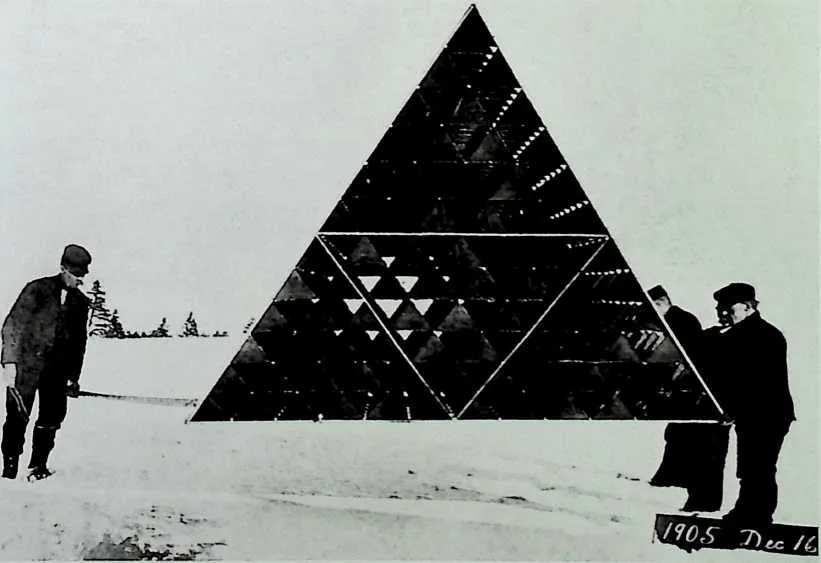
10 By locating the source of his innovations and patents in nature, Fuller could sidestep the inevitable challenges to the originality of his work. Alexander Graham Bell’s experiments with tetrahedral kites and space-frame towers (fig. 1) were a key precedent to Fuller, though one he insisted was brought to his attention long after he reached his independent conclusions.7 The fact that he had unknowingly pursued investigations similar to Bell’s was added proof that a universal coordinated system existed. ‘‘It’s the way nature behaves, so we both discovered nature. It isn’t something you invent. You discover it.’’8 One progenitor Fuller did acknowledge was D’Arcy Wentworth Thompson. Thompson’s seminal 1917 book On Growth and Form demonstrated the morphological similarities of a wide variety of organic substances and the mathematical basis underlying their structure and growth.9 Thompson’s arguments were punctuated with illustrations by Emst Haeckel and photos by Arthur Worthington, among others, and in later versions with photos by Harold Edgerton as well (fig. 2).
11 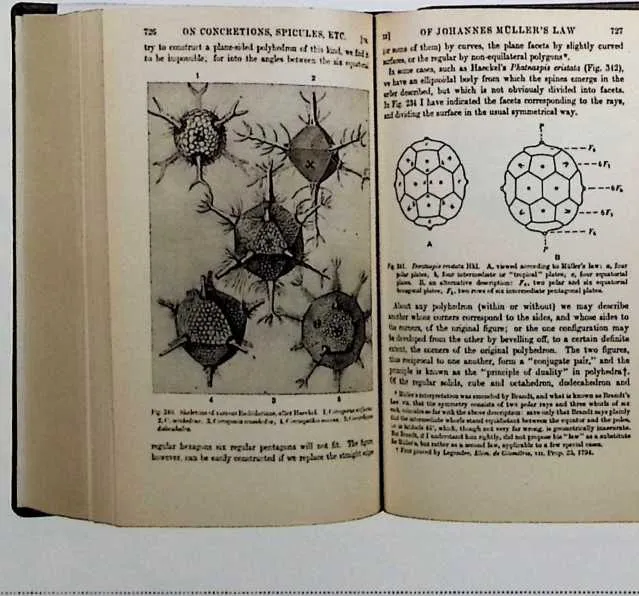 Spread from D'Arcy Wentworth Thompson (1860–1948), On Growth and Form (2nd ed.
Cambridge: Cambridge University Press; New York: MacMillan, 1943; 1st ed. 1917), with
illustrations by Ernst Haeckel (1834-1919)
Spread from D'Arcy Wentworth Thompson (1860–1948), On Growth and Form (2nd ed.
Cambridge: Cambridge University Press; New York: MacMillan, 1943; 1st ed. 1917), with
illustrations by Ernst Haeckel (1834-1919)
12 Romany Marie’s tavern, the eponymous gathering spot run by the Romanian emigre Romany Marie Marchand, was the setting for a seminal period in Fuller’s development. As New York’s version of Paris’s cafe society, Romany Marie’s was filled with artists and intellectuals, and Fuller became a regular in the late 1920s. ‘‘There I would stay, a table-sitter, all evening, until very late into the night,’’ he recalled. ‘‘It was the Greenwich Village of the late ‘20s and early ‘30s that generated great new thinking—and I gained many friends for my concepts, and lost none.’’10 It was there that Fuller, a polymath and autodidact whose formal education amounted to being kicked out of Harvard twice, began crafting his persona as a maverick outsider unrestrained by academic or commercial fiefdoms. Fuller also sharpened his oratory skills in this milieu, holding forth on his Dymaxion House, which he described as a dwelling machine suspended on a mast that could turn to meet the sun. One room in the house was set aside for books, maps, drawing boards, globes, and radio sets. Called the ‘‘Go-Ahead-With-Life room,’’ it was an early example of Fuller’s commitment to the accumulation and visual display of information and set the blueprint for later endeavors such as the Geoscope and World Game.
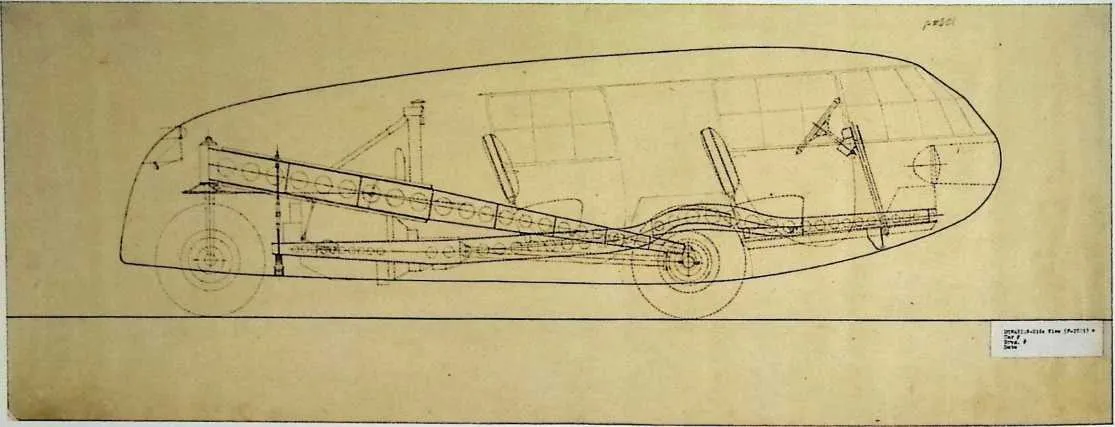
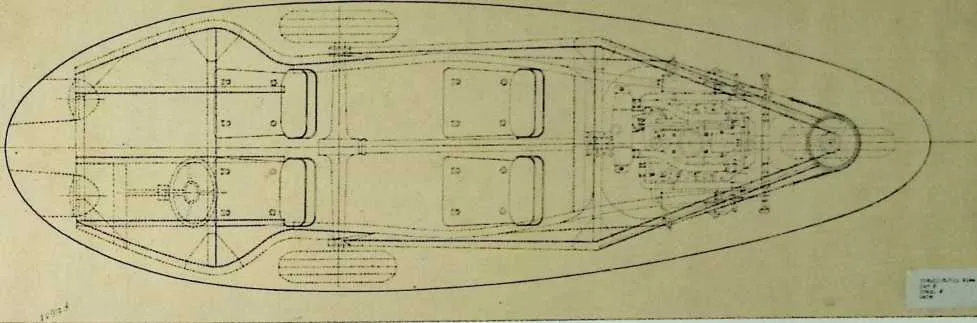
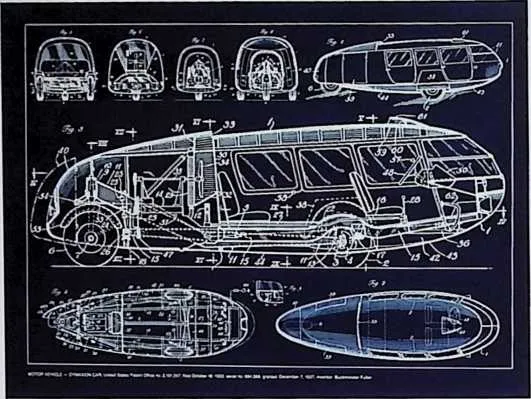
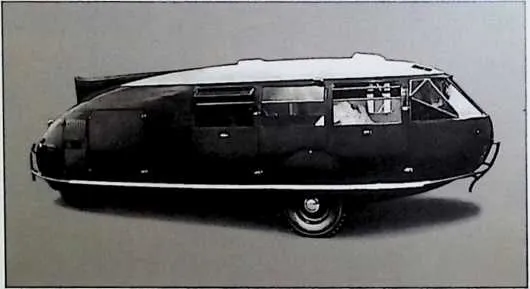
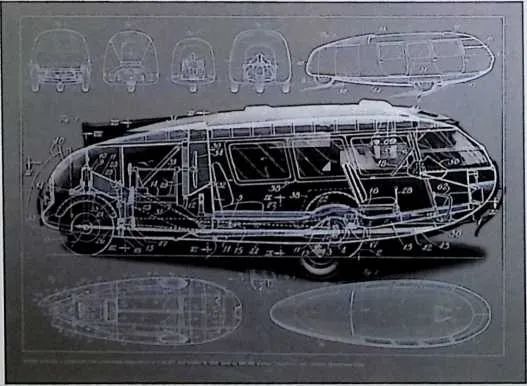
13 Among the artists Fuller met at Romany Marie’s was the young Isamu Noguchi. When Noguchi moved to a new, window-wrapped studio, Fuller planned the interior environment. ‘‘Under Bucky’s sway I painted the whole place silver—so that one was almost blinded by the lack of shadows,’’ Noguchi remembered. ‘‘There I made his portrait head in chrome-plate bronze—also form without shadows’’ (plate 41).11 More than three decades before Warhol’s silver-paint- and foil-covered Factory, Fuller conceived of an entirely reflective silver studio for Noguchi. Noguchi’s highly reflective bust of Fuller was among the first works of art to use chrome plating, a process then reserved primarily for automobiles. The choice of media was only appropriate for the man who advocated the harnessing of technology to meet humanity’s needs. At that time Noguchi was supporting himself as an artist, and Fuller, who was regularly broke, often slept on the floor of his studio. They became lifelong friends, and their mutual influence can be detected throughout both careers, including in works such as Noguchi’s Miss Expanding Universe (see plate 40) and the streamlined models of the Dymaxion car on which they collaborated (plate 46).12
14 When Marie moved her eatery to Minetta Street in 1929, Fuller offered his design services. He devised chairs based on contemporary airplane and steamship furnishings and painted the walls and pipes silver (plate 22). He lit the space brightly using hom-shaped aluminum fixtures, explaining, as Marie recalled, that ‘‘pseudos wouldn’t come and hide in my place, they prefer to go hide in dark rooms, dark dining rooms where you can’t see them well—can’t see through them. To this room, Bucky said, only real and upright people would come, because you would immediately see all the way through them and they wouldn’t mind the test.’’13 In practice, the design was less than successful. The chairs collapsed the evening the tavern opened. ‘‘It was the most ridiculous spectacle you ever saw in your life,’’ Marie recalled. ‘‘It wasn’t enough that there was a deviation with all the luminosity—when they sit down, they fall down.’’14 The next morning she hired a carpenter to make benches to her specifications.
15 The following year Fuller designed ‘‘A Collector’s Room’’ for the architect Ely Jacques Kahn, which went unrealized. The room, which resembled the streamlined form of the Dymaxion car, was to have niches for displaying sculpture (plates 42 and 43). It was ‘‘an outwardly tensed, ovaloid shaped, hyperbolic parabola, faceted, tension (tent) fabric room for installation in the Grand Central Palace at a proposed Architectural Show for a sculptors’ exhibit room—lighting for the room and its sculptural exhibits to diffuse inwardly through the comprehensive translucent, tensed, white fabric ‘walling,’ from lights exterior to the structure.’’15 Noguchi’s studio, Romany Marie’s, and the Collector’s Room all demonstrate Fuller’s early affinity for total environments, employing illumination, reflectivity, translucency, color, tension, and shape to maximum sensorial effect.
16 Fuller continued to promote his Dymaxion House in the early 1930s, often making contacts at Romany Marie’s. He accepted lecture invitations from the Harvard Society for Contemporary Art (recentiy founded by Lincoln Kirstein, Edward
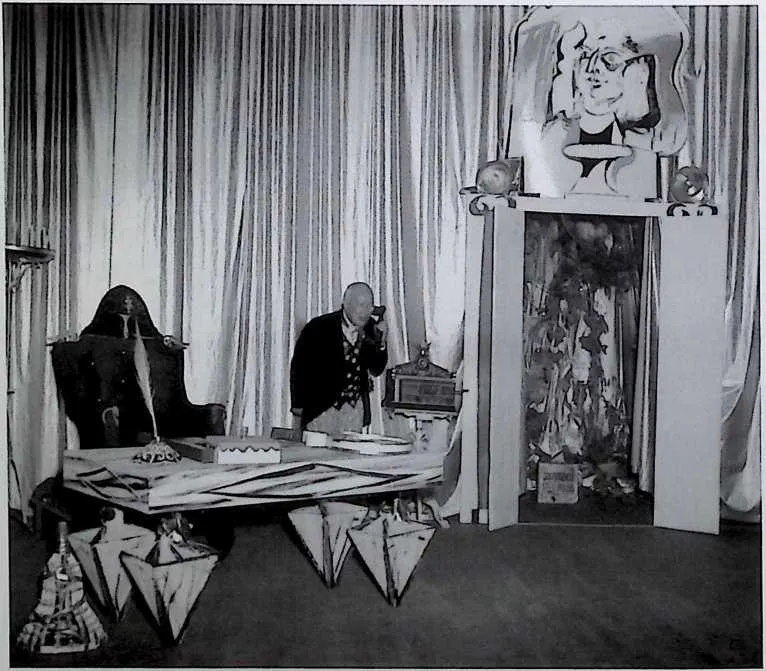
18 HAZEL LARSEN ARCHER (1921-2001)
19 Buckminster Fuller of the Baron Medusa in The Ruse of Medusa at Black Mountain College, summer 1948 Warburg, and John Walker) and his friend Katherine Drier, under the auspices of the Societe Anonyme. But by 1932 his work on Shelter and his burgeoning Dymaxion car business occupied most of his time and took him away from New York’s artistic community.
20 Much has already been written on the two summers that Fuller taught at Black Mountain College, 1948 and 1949, including his encounters with Josef and Anni Albers, Ruth Asawa, John Cage, Merce Cunningham, Willem and Elaine de Kooning, Richard Lippold, and Kenneth Snelson. Yet it was a crucial experience for Fuller and must be discussed, if only briefly.16 Josef Albers hired Fuller for the 1948 summer session at the suggestion of the architect Bertrand Goldberg, whom he thanked, writing, ‘‘The whole affair of which I was somewhat doubtful, turned out very well. He has accepted and has arrived just the other day. And last night he gave a talk for about three hours and he proves to be a great man.’’17 Despite his professed disdain for Bauhaus philosophy, Fuller thrived in the cross-disciplinary, makeshift atmosphere of BMC, and he would become lifelong friends with Albers and his wife Anni.18
21 By all accounts Fuller cast a spell on many who were there in 1948, commencing with the lecture he gave that first evening. Cunningham was in attendance and recalled, ‘‘I remember thinking it’s Bucky Fuller and his magic show. It was immediate, I think, with all of us who were there …this immediate absolute adoration and love of this man because of his …ideas, the width of the ideas. The grandeur with which he saw things and the way in which he spoke about them and demonstrated them.’’19 That performative magic was further unleashed when Fuller played the lead in The Ruse of Medusa, part of Cage’s summer-long concentration on Erik Satie (the play was directed by Arthur Penn, also featured Cunningham and Elaine de Kooning, and employed props and sets by Ruth Asawa and Willem and Elaine de Kooning; fig. 3).
22 During that summer Cage and Cunningham grew close to Fuller, who appreciated the fields of music, dance, theater, and athletics not the least for their ability to heighten and utilize man’s ‘‘intuitive dynamic sense.’’ The three of them breakfasted together every morning and dreamed up an imaginary ‘‘finishing school’’ they would run. It was a ‘‘schematic new school…We would finish anything. In other words, we would really break down all of the conventional ways of approaching school. And the ‘finishing school’ was going to be a caravan, and we would travel from city to city.’’20 Both men credited Fuller with expanding their thinking into a multitude of other directions and encouraging them to think holistically and universally. 21 Cage in particular remained in close contact with Fuller, and years later he struggled to reconcile his belief in indeterminacy with Fuller’s vision of a structured universe, eventually noting with relief, ‘‘There’s a beautiful statement in Fuller’s Education Automation [1963] [sic] in which he says that the whole idea of things being fixed is a notion that we no longer need.’’22
23 JEAN TINGUELy (1925-1991) Fragment from Homage to New York, 1960, in the sculpture garden of the Museum of Modern Art, with the exhibition Three Structures by Buckminster Fuller (September 22, 1959-winter 1960) in the background Painted metal, fabric, tape, wood, and rubber tires
24 6 ft. 8 */« in. x 2 ft. 5s/iin.x7 ft. 37/iin. (20.3 x7.5 x 22.3 m)
25 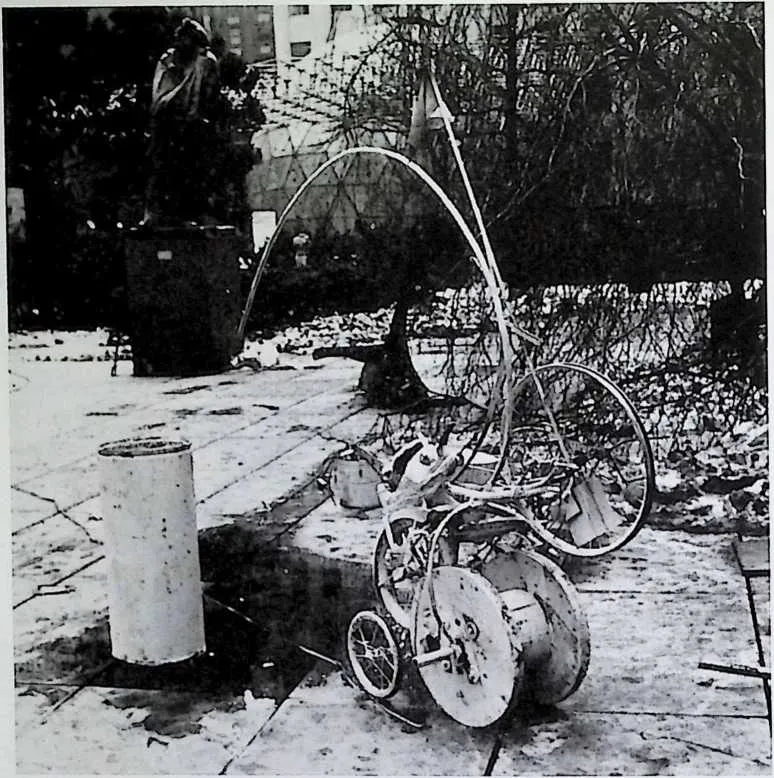 The Museum of Modern Art, New York, Gift of the artist
26 Much of Fuller’s first summer at BMC was occupied with constructing a large-scale great-circle
dome. Despite the immense level of anticipation, the dome, composed of strips of aluminum
Venetian blinds, refused to rise. Immediately dubbed the ‘‘Supine Dome,’’ it was a lesson, Fuller
rationalized, in failure as a necessary step on the path to success. Kenneth Snelson, a young
artist who had intended to pursue painting at BMC, was chosen by Albers to assist Fuller in
his classes that summer because of his demonstrated abilities with three-dimensional
structures and worked on the Supine Dome. The following winter, when Snelson was
back in Oregon, he created several sculptures, including Early X-Piece (1948-49), an
example of a discontinuous compression structure made of wood and nylon (plate 86).
Snelson sent photographs of the work to Fuller and then brought the sculptures with
him to BMC the following summer. Fuller, immediately recognizing the structural
possibilities that Snelson’s sculpture presented, having apparently been searching for such
solutions himself, asked to have Early X-Piece. In the early 1950s, photos of similar works
began to appear in articles about Fuller, without attribution to Snelson. Soon after,
Fuller
coined the word tensegrity to describe tensional integrity with discontinuous compression.
Snelson remembers Fuller asking him what he thought of ‘‘calling our structure ‘tensegrity,’ ’’
thereby signaling his intention to take at least partial credit for the innovation Snelson had
developed that winter.23 This series of events resulted in a lasting rift between student and
teacher.24
27 For much of the 1950s Fuller was absorbed with inventorying and tracking the earth’s resources, culminating with the Geoscope or Minni-Earth projects, discussed at length in K. Michael Hays’s essay in this volume. More than the artifacts that preceded it, the Geoscope was meant to be a symbolic visual display of information, an attentiongetting dramatization. As Mark Wigley has asserted, Fuller conceived of the Geoscope ‘‘as a mechanism for blurring the distinction between science and art.’’25 This distinction was further blurred in projects that Fuller worked on with John McHale and Shoji Sadao starting in the late 1950s, such as Dome Over Manhattan and Cloud Nine. The latter was presented as a photomontage in which spherical cloud cities float above a sublime landscape of deep canyons (plate 144). These monumental, airborne living spaces were the seemingly inevitable conclusion of Fuller’s early experimentations with total environments and his emphasis on buoyancy and lightfulness. One also can’t help but be reminded of Bell’s tetrahedral kite experiments.
28 Beginning in the mid-1950s Fuller was increasingly included in gallery and museum exhibitions, as well as art periodicals. A full-scale exhibition of Fuller’s work at the Walker Art Center was discussed. H. Harvard Amason, then director of the Walker, was a principal supporter, and Gyorgy Kepes, professor of visual design at the Massachusetts Institute of Technology, was slated to design the exhibition. Fuller fantasized that the viewer would become a ‘‘comprehensive apprehender and possibly a neophyte comprehensive designer’’ subsequent to seeing the show.26 That exhibition never came to pass, but in 1959 Arthur Drexler, curator of architecture at the Museum of Modern Art, organized an exhibition of Fuller’s work in the museum’s sculpture garden. Three Structures by Buckminster Fuller ran from September 1959 to winter of 1960 and included a geodesic radome, an octet truss, and a tensegrity mast. A smaller accompanying show with models and didactics was held indoors and overlapped for some of that time. In a wall text Drexler wrote, ‘‘Central to Fuller’s genius, is the insight his ideas give us into universal order. That is an achievement which ranks him with other great poets, scientists, and artists.’’27 The exhibition was widely reported on in the popular press and in art journals. An interesting side note is that Jean Tinguely’s infamous Homage to New York (1960) was literally hatched inside Fuller’s dome (fig. 4). Billy Kliiver and engineers from Bell Labs built the self-destroying machine inside Fuller’s radome in MoMA’s garden over a period of several weeks. This would initiate Kliiver’s decades-long mediation between artists and engineers.
29 ROBERT SMITHSON (1938-1973)
30 Detail of World Ocean Map (Hammer’s Equal Area Projection), 1967 Graphite and Photostat collage 12x10 in. (30.5 x25.4 cm)
31 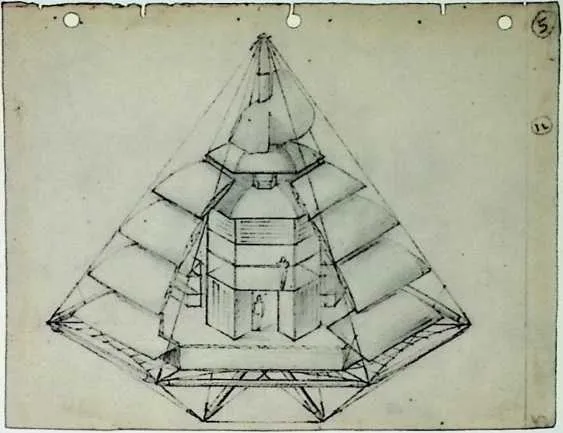 Estate of Robert Smithson, Courtesy James Cohan Gallery, New York
32 The growing recognition that Fuller enjoyed in the 1950s reached a crescendo in the mid-1960s.28 Fuller wrote several books in short succession and was the subject of extensive press coverage, including a 1964 Time cover story and Calvin Tomkins’s New Yorker profile two years later, reprinted in this volume.29 Fuller was no longer described exclusively in terms of engineer, architect, or inventor. Peter Blake called him ‘‘one of the great creators of beautiful sculpture of this century.’’30 His writings became increasingly relevant to artists as a dialogue about the relationship between the arts and the sciences grew in import, led by figures such as C. P. Snow and Kepes. In 1965 Fuller contributed ‘‘Conceptuality of Fundamental Structures’’ to Structure in Art and in Science, one of the Vision + Value series edited by Kepes. He wrote, ‘‘The brush and chisel artists who, despite the literary man’s frustrations, tried to follow the scientists into ‘non-conceptuality’ with their ‘non-representational’ quasi-abstractions are now proven to have been intuitively sound in their conviction that they could really follow or even lead science in the game of intuitive probing.’’31
33 In John Chandler and Lucy Lippard’s review of the Vision + Value series, entitled ‘‘Visual Art and the Invisible World,’’ they wrote, ‘‘What scientists seem to want from art is the method or process of the artist, his powers of visualization—an important part of the method of Galileo and early science, but neglected in the last century.’’ Not surprisingly, Fuller figured prominently in their review, including his assertion that he had finally provided a physical model that artists and scientists alike might use to represent the imperceptible forces around us: ‘‘Buckminster Fuller suggests that the major reason for the failure of the public to keep informed about the ‘evoluting realities’ of science was the literary man’s inability to follow into realms where there were no conceptual models or analogies. Visual artists were not only able to enter these realms, but also occasionally lead the way ‘in the game of intuitive probing.’ However, the result was that neither artist nor scientist was understood by the word-stuck public at large. Fuller claims that his own discovery of the ‘natural four axis, 60 degree, tetrahedronal coordinate system’ has returned ‘conceptuality of dynamic structural principles to scientific validity.’,32
34 Chandler and Lippard’s account of the discussion echoed the ‘‘new sensibility’’ that Susan Sontag had described in her 1965 essay ‘‘One Culture and the New Sensibility.’’ Sontag spoke of a new cultural establishment that unashamedly drew upon scientific developments and was oriented toward the plastic rather than the literary arts. ‘‘This new establishment includes certain painters, sculptors, architects, social planners, film-makers, TV technicians, neurologists, musicians, electronics engineers, dancers, philosophers, and sociologists ldots Some of the basic texts for this new cultural alignment are to be found in the writings of…Buckminster Fuller, Marshall McLuhan, John Cage, Andre Breton, Roland Barthes…and Gyorgy Kepes.’’33
35 Fuller’s growing impact was also manifest in the art of the 1960s, one such example being the milestone 1966 exhibition Primary Structures. The show announced the ascendancy of large-scale, geometrically based sculpture in contemporary art. Curator Kynaston McShine used Fuller’s neologism tensegrity to describe Forrest Myers’s contribution and wrote in the catalogue, ‘‘Central to many of the principles upon which many of the artists like Forrest Myers work are the structures of Buckminster Fuller. Fuller’s theories, now widely accepted and implemented, have been insights into the dynamic structure of nature, and into the interrelationship of physics, mathematics and philosophy.’’34 McShine also drew a connection between Sol LeWitt’s structures and Fuller, describing their white cubic framework as possessing ‘‘a logic and structure that seems to be what Fuller described as ‘comprehensive design.’ The modular pattern, which is so fundamental and universal in nature, in this piece assumes extraordinary beauty.’’35 Even Time noted in its review that the artists ‘‘wax hot for the Geodesic Architect Buckminster Fuller.’’36
36 Several of the artists in Primary Structures showed at the Park Place Gallery, namely Peter Forakis, Robert Grosvenor, and Myers. In his 1966 essay ‘‘Entropy and the New Monuments,’’ Robert Smithson noted that the Park Place Group had ‘‘permuted the ‘models’ of R. Buckminster Fuller’s ‘vectoral’ geometry in the most astounding manner.’’ He continued:
3738Fuller was told by certain scientists that the fourth dimension was ‘‘ha-ha,’’ in other words, that it is laughter…Laughter is in a sense of kind of entropic ‘‘verbalization.’’ How could artists translate this verbal entropy, that is ‘‘ha-ha’’ into ‘‘solid models’’? Some of the Park Place artists seem to be researching this ‘‘curious’’ condition. The order and disorder of the fourth dimension could be set between laughter and crystal-structural, as a device for unlimited speculation.37
39 And yet the art historical accounts of Primary Structures rarely mention Fuller.38 Perhaps this is partly because the Park Place artists are not the ones who, over time, have come to exemplify the Minimalist movement that that exhibition ostensibly baptized.
40 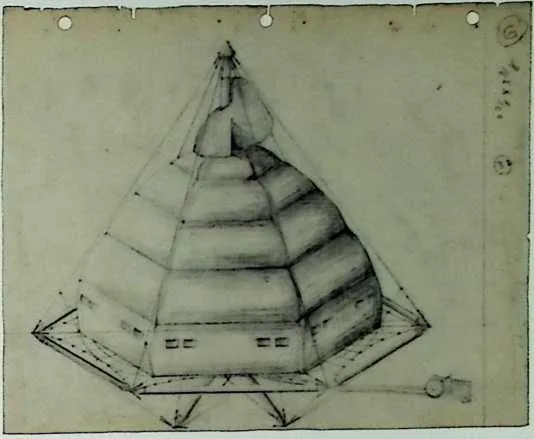 shape of crescents intersect at the ‘ ‘bound’ ’ equator. The ‘‘lune’’ triangulation in this orb
detaches itself and becomes secondary ‘‘sculpture’’.
shape of crescents intersect at the ‘ ‘bound’ ’ equator. The ‘‘lune’’ triangulation in this orb
detaches itself and becomes secondary ‘‘sculpture’’.
41 "Tknt art aptraxinatrlj 50 Pazarr.a Canals to a cubic milt and then art 317 MILLION cubic mita ej cetin."
4243R. Buckminster Fuller: Nine Chains to the Moon
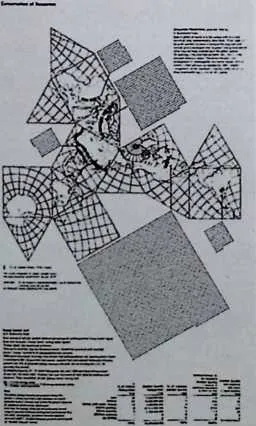
44 R. Buckminster Fuller has developed a type of writing and original cartography, that not only is pragmatic and practical but also astonishing and teratological. His Djmaxion Ptojtclicrt and World Er.rrff Map is a Comonatbia that pros es Ptolemy’s remark that, ‘‘no one presents it rigntly unless he is an artist.’’ Each dot in the World Entry? Map refers to ‘‘1 % of World’s harnessed energy slave population (inanimate power serving man) in terms of human equivalents ..says F uller. The use Fuller makes of the ‘‘dot’’ is in a sense a concentration or dilation of an infinite expanse of spheres of energy. The ‘‘dot’’ has its rim and middle, and could be related to Reinhardt’s mandala, Judd’s ‘‘device’’ of the specific and general, or Pascal's universe of center and circumference.
45 
 Yet, lhe dot evades our capacity to find its center. Where is die central point,
axis, pole, dominant interest, fixed position, absolute structure, or decided goal? The mind is
always being hurled lotsards the outer edge into intractable trajectories that lead to
vertigo.
Yet, lhe dot evades our capacity to find its center. Where is die central point,
axis, pole, dominant interest, fixed position, absolute structure, or decided goal? The mind is
always being hurled lotsards the outer edge into intractable trajectories that lead to
vertigo.
46 ‘‘Entropy and the New Monuments’’ was not the only instance in which Smithson cited Fuller.39 Smithson was drawn to Fuller and to Alexander Graham Bell for their attempts to isolate within the disorder of the natural world key organizing principles that could be translated into monumentally scaled artifacts. They saw no conflict between organic structures and modern technology. Fuller’s forays into cartography also provided a precedent for Smithson’s investigations into alternative mapping systems (fig. 5). In his 1968 ‘‘A Museum of Language in the Vicinity of Art’’ Smithson wrote: ‘‘R. Buckminster Fuller has developed a type of writing and original cartography, that not only is pragmatic and practical but also astonishing and teratological. His Dymaxion Projection and World Energy Map is a Cosmographia that proves Ptolemy’s remark, that, ‘no one presents it rightly unless he is an artist’ ’’ (fig. 6).40
47 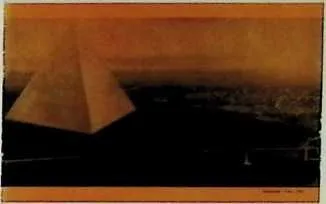
 In the spring of 1967, Fuller’s work was included in a show entitled Projects for
Macrostructures at the Richard Feigen Gallery in New York. His contribution included the
Project for Floating Cloud Structure (the Cloud Nine project), Tetra City, a large-scale floating
tetrahedron that could house up to a million people, and Harlem Redesign, a ‘‘slum clearing
project’’ that had appeared in a 1965 issue of Esquire (plate 148).41 Ronald Bladen, Christo,
Hans Hollein, Claes Oldenburg, and Tony Smith were among the others included in the
exhibition. Tetra City was featured on the cover of the March 1967 Arts Magazine with the
contentious title ‘‘A Minimal Future?’’ (fig. 7). Dan Graham’s article ‘‘Models and
Monuments: The Plague of Architecture’’ considered the Feigen show, as well as two others,
prominently
In the spring of 1967, Fuller’s work was included in a show entitled Projects for
Macrostructures at the Richard Feigen Gallery in New York. His contribution included the
Project for Floating Cloud Structure (the Cloud Nine project), Tetra City, a large-scale floating
tetrahedron that could house up to a million people, and Harlem Redesign, a ‘‘slum clearing
project’’ that had appeared in a 1965 issue of Esquire (plate 148).41 Ronald Bladen, Christo,
Hans Hollein, Claes Oldenburg, and Tony Smith were among the others included in the
exhibition. Tetra City was featured on the cover of the March 1967 Arts Magazine with the
contentious title ‘‘A Minimal Future?’’ (fig. 7). Dan Graham’s article ‘‘Models and
Monuments: The Plague of Architecture’’ considered the Feigen show, as well as two others,
prominently
49 illustrating Fuller’s megastructure projects.42 And yet despite Fuller’s high level of visibility in these art contexts, his significant engagement with the art world of the 1960s goes unnoted in most recent art historical accounts of this period. This significant exchange also remains absent in the literature on Fuller. The one consistent exception is the writing on Kenneth Snelson. One could argue the reverse in his case—too much of the writing on Snelson revolves around Fuller.
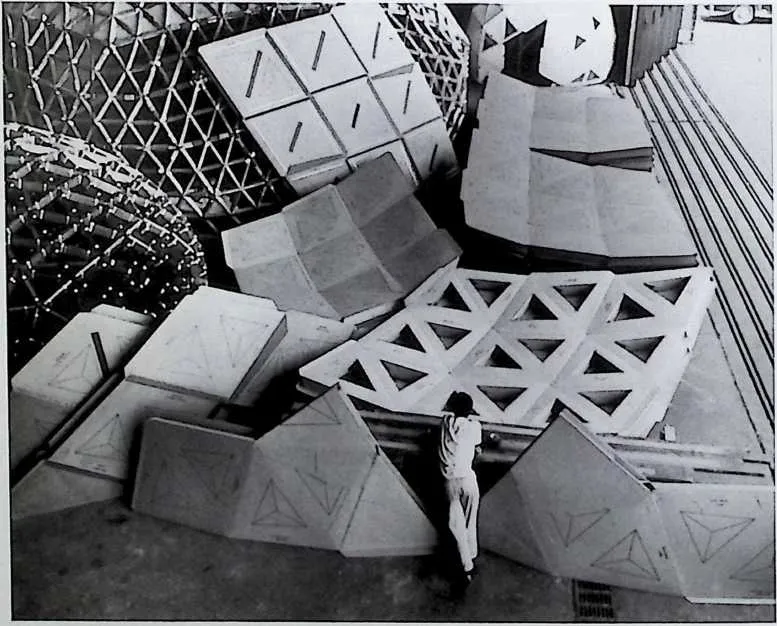
50 One intriguing area of future investigation might be Tony Smith’s relationship to Fuller. Considering that Smith was well versed in architectural history and cited D’Arcy Thompson and Alexander Graham Bell as influences, the literature on Smith somewhat conspicuously elides Fuller.43 Smith had to have had at least a passing familiarity with Fuller through his friendships with Barnett Newman and Gerome Kamrowski. The hexagons of Smith’s 1950--51 East Hampton church project were admittedly indebted to Thompson and Frank Lloyd Wright but perhaps owed something to Fuller’s Dymaxion House as well—and we know that Smith did own copies of plans for Fuller’s house (see fig. S).44 Bat Cave, Smith’s contribution to the 1970 Expo in Osaka, was made in collaboration with the Container Corporation of America. It was composed of thousands of die-cut cardboard tetrahedra and octahedra, a reiterative patterning that was reworked for the Art and Technology exhibition at the Los Angeles County Museum in 1971 (fig. 9). Bat Cave came less than two decades after Fuller collaborated with the Container Corporation of America on die-cut cardboard unit geodesic domes for the 1954 Milan Triennale (fig. 10) .45 Another ripe area for investigation would be to look at Joseph Beuys through the prism of Fuller’s work. The two met in 1974 at the Black and White Oil Conference in Edinburgh, and Beuys made photographic multiples in 1980 to commemorate the event. But even before 1974 Beuys’s work showed an affinity with Fuller’s ideas, not least in his notion of ‘‘social sculpture’’—using aesthetics to help forge a sustainable future.
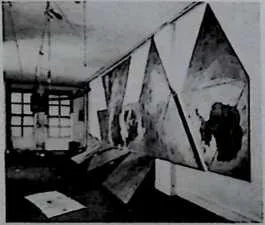
51 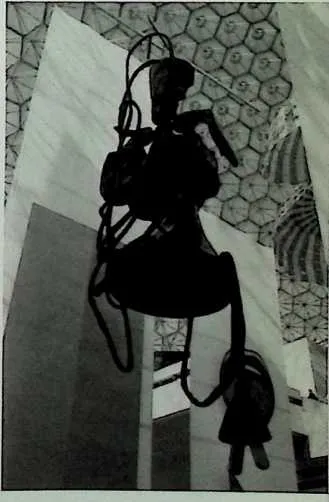 Fuller was never more visible than in summer of 1967, when the three- quarter skybreak
sphere he created for the U.S. Pavilion, the most dramatic structure he ever realized, was
unveiled at the Montreal Expo46 The pavilion’s theme was ‘‘Creative America,’’ and Alan
Solomon was hired to curate a contemporary art exhibition entitled American Painting Now.
Solomon selected a show of large-scale paintings, the exception being a soft sculpture by Claes
Oldenburg that hung from the roof (fig. 11). Jasper Johns proposed a painting based
upon Fuller’s Dymaxion Air-Ocean World Map, thinking ‘‘it seemed logical…to make a
work which repeated the motif of the structure.’’47 Employing Cage as his emissary,
Johns obtained Fuller’s permission to use the map in this manner. Johns wrote and
thanked him, explaining, ‘‘I’m delighted. I intend to hinge the six-foot triangles so that it
will be possible to change the form of the picture should it ever have to be shown in
different environments.’’43 He made the enormous work, his first and only painting of a
world map, in his studio in twenty-two separate panels (fig. 12). ‘‘The stretcher bars
used were angled so that the work could bend to form an icosahedron globe, but the
clumsiness and weight of the work made this idea an impossibility.’’49 As envisioned, the
multipart painting represented a map of possibilities with no single, fixed viewpoint,
exemplifying Fuller’s notion of a ‘‘fluid geography.’’ When Johns first saw the painting
assembled in Montreal, he was disappointed, feeling it conformed too closely to Fuller’s
concept (fig. 13). Over the course of the next four years he reworked it, abandoning the
temperature index of Fuller’s map and removing the hinges, among other alterations. Johns
described the final result as ‘‘a complicated visual experience. It’s both a map and a
painting.’’50 On December 3, 1971, Cunningham performed Loops at MoMA in front of
Johns’s painting, where it had been installed in the Founder’s Room. Slides by Charles
Atlas were projected onto the wall, and he was accompanied by music by Gordon
Mumma.51
Fuller was never more visible than in summer of 1967, when the three- quarter skybreak
sphere he created for the U.S. Pavilion, the most dramatic structure he ever realized, was
unveiled at the Montreal Expo46 The pavilion’s theme was ‘‘Creative America,’’ and Alan
Solomon was hired to curate a contemporary art exhibition entitled American Painting Now.
Solomon selected a show of large-scale paintings, the exception being a soft sculpture by Claes
Oldenburg that hung from the roof (fig. 11). Jasper Johns proposed a painting based
upon Fuller’s Dymaxion Air-Ocean World Map, thinking ‘‘it seemed logical…to make a
work which repeated the motif of the structure.’’47 Employing Cage as his emissary,
Johns obtained Fuller’s permission to use the map in this manner. Johns wrote and
thanked him, explaining, ‘‘I’m delighted. I intend to hinge the six-foot triangles so that it
will be possible to change the form of the picture should it ever have to be shown in
different environments.’’43 He made the enormous work, his first and only painting of a
world map, in his studio in twenty-two separate panels (fig. 12). ‘‘The stretcher bars
used were angled so that the work could bend to form an icosahedron globe, but the
clumsiness and weight of the work made this idea an impossibility.’’49 As envisioned, the
multipart painting represented a map of possibilities with no single, fixed viewpoint,
exemplifying Fuller’s notion of a ‘‘fluid geography.’’ When Johns first saw the painting
assembled in Montreal, he was disappointed, feeling it conformed too closely to Fuller’s
concept (fig. 13). Over the course of the next four years he reworked it, abandoning the
temperature index of Fuller’s map and removing the hinges, among other alterations. Johns
described the final result as ‘‘a complicated visual experience. It’s both a map and a
painting.’’50 On December 3, 1971, Cunningham performed Loops at MoMA in front of
Johns’s painting, where it had been installed in the Founder’s Room. Slides by Charles
Atlas were projected onto the wall, and he was accompanied by music by Gordon
Mumma.51
53 As the 1960s came to a close, the preponderance of unseen forces and vectors that constitute our environment, particularly the electromagnetic spectrum, gained primacy in Fuller’s vast speaking program. His Montreal dome was the epitome of light
55 fulness, transparency, and material dilution. This dematerialization of architecture was the logical result of his philosophy of ephemeralization and paralleled the dematerialization of the art object at that time. In his foreword to the exhibition catalogue for Projections: Anti-Materialism, a 1970 show at the La Jolla Museum of Art, Fuller wrote, ‘‘When successful, tomorrow’s architecture will be approximately invisible, not just figuratively speaking, but literally as well. What will count with world man is how well the architecture serves all humanity while sublimating itself spontaneously. Architecture may be accomplished tomorrow with electrical field and other utterly invisible environment controls.’’52
56 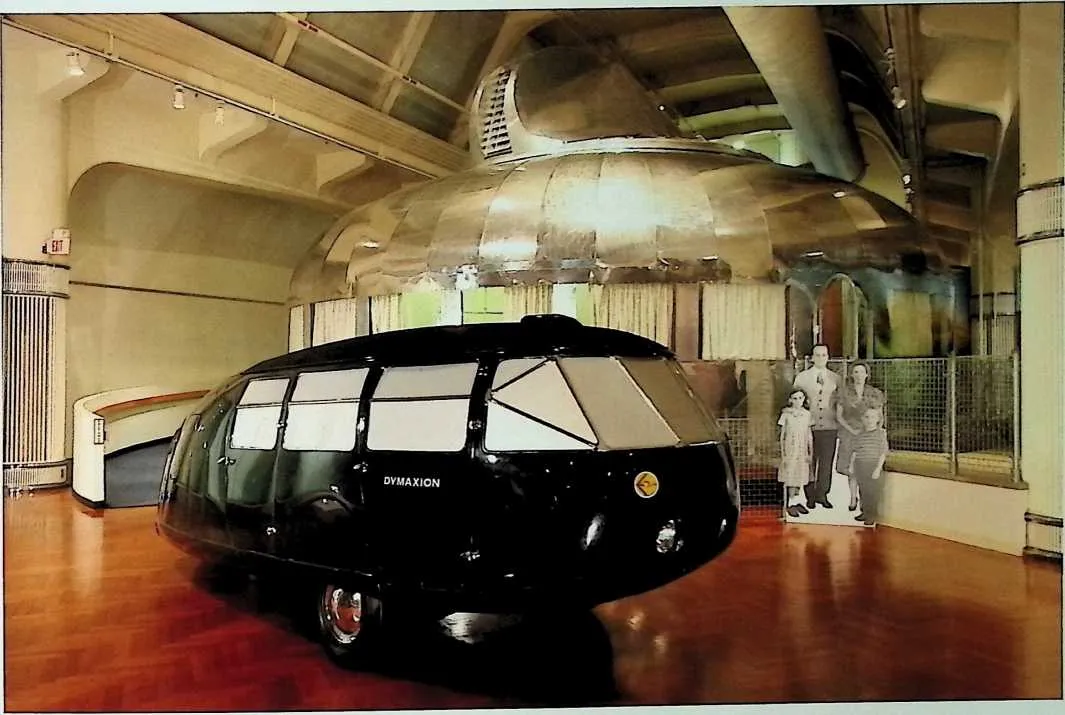
 Artists, specifically those engaged with developing media, closely followed Fuller’s
emphasis on nonvisible forces, the ‘‘ha-ha’’ that he spoke of and Smithson commented on.
Inspired by Fuller, Stan Vanderbeek began to construct his Movie- Drome in 1963. He showed his
multiscreen films inside the domed circular building, which was his attempt at a theater of
infinite space, ‘‘with no ‘edge’ to the screen …a total Envelope-Environment—allowing an almost
endless amount of image material to flow over you and around the Drome.’’53 The collective
Raindance published the alternative television movement journal Radical Sojtware, which
included a pirated interview with Fuller in its first issue in 1970 (fig. 14). Ant Farm
and USCO were two of the several other antiestablishment collectives influenced by
Fuller’s work. The members of Ant Farm considered him a hero and ‘‘the lone voice in
the wilderness among architects and engineers.’’54 In 1969 they ‘‘kidnapped’’ Fuller
on
Artists, specifically those engaged with developing media, closely followed Fuller’s
emphasis on nonvisible forces, the ‘‘ha-ha’’ that he spoke of and Smithson commented on.
Inspired by Fuller, Stan Vanderbeek began to construct his Movie- Drome in 1963. He showed his
multiscreen films inside the domed circular building, which was his attempt at a theater of
infinite space, ‘‘with no ‘edge’ to the screen …a total Envelope-Environment—allowing an almost
endless amount of image material to flow over you and around the Drome.’’53 The collective
Raindance published the alternative television movement journal Radical Sojtware, which
included a pirated interview with Fuller in its first issue in 1970 (fig. 14). Ant Farm
and USCO were two of the several other antiestablishment collectives influenced by
Fuller’s work. The members of Ant Farm considered him a hero and ‘‘the lone voice in
the wilderness among architects and engineers.’’54 In 1969 they ‘‘kidnapped’’ Fuller
on
58 his way to a lecture at the University of Houston’s engineering school. Instead of delivering him to the school, they took him to see his Dymaxion car in the exhibition The Machine at the End of the Mechanical Age, which was on tour in Houston at the time (fig. 15). Their 1970 Inflatocookbook illustrated Energy Credit, an invented paper currency that incorporated Fuller’s visage and a geodesic dome in its design. Fuller penned the introduction to Gene Youngblood’s seminal Expanded Cinema, the first book to treat video as an art medium. He wrote: ‘‘Humans still think in terms of an entirely superficial game of static things—solids, surfaces, or straight lines—despite that no things—no continuums—only discontinuous, energy quanta-separate event packages—operate as remotely from one another as the stars of the Milky Way. Science has found no ‘things’; only events. Universe has no nouns; only verbs.’’55
59 In February 1975 Fuller’s friend Edwin Schlossberg took him to the print workshop Universal Limited Artist Editions as an eightieth-birthday present. There Tatyana Grosman, the proprietor, introduced Fuller to lithography, which he took to immediately. He began crafting a version of the story ‘‘Goldilocks and the Three Bears,’’ retold to explain the mysteries of the universe and the possibilities for mankind’s future. ‘‘I know that we have the option to make it. That’s different than being optimistic. It’s touch and go. Goldy is very concerned. That’s what this is all about. I’m interested in making artifacts that give us options.’’55
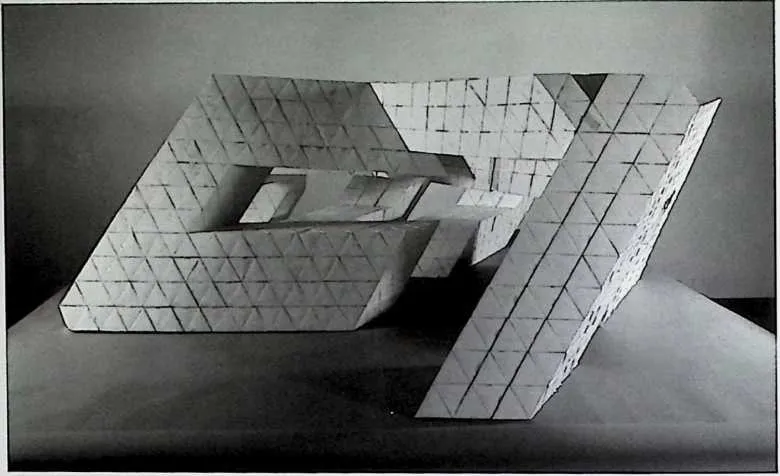
60 Characteristically, Fuller rejected the traditional rectangular structure of a book and created the Tetrascroll from twenty-six triangular pages (plates 164–71). Written in all caps with minimal punctuation, the text included an ‘‘epilever’’ rather than an ‘‘epilogue’’ by Schlossberg. The color was to match a seagull feather, and the
61 book was bound using Dacron, a material frequently used in sailing. Each hinged page of the book can be folded in multiple directions, creating numerous possible configurations of the Tetrascroll, much like his Dymaxion maps and Johns’s vision for his painting. In January of 1977, as part of their Projects series MoMA installed the Tetrciscroll along two perpendicular walls in proximity to an installation of Cage’s work.57 A second print was exhibited almost simultaneously on tables arranged in a V shape at Ronald Feldman Fine Arts, and a third was shown at the Fendrick Gallery in a tetrahedronal frame structure (figs. 16 and 17). Fuller called the Tetrascroll ‘‘everything I think and feel in mathematics and philosophy and everything else.’’ Grossman described it as ‘‘a very beautiful achievement by an artist, a pure vision expressed in lithography.’’58
63 After Grossman’s death in 1982, Calvin Tomkins wrote an homage listing some of the artists she had worked with through the years. Johns was among those, but Fuller was not. Slighted, Fuller wrote Tomkins a somewhat bitter but telling missive:
6465It seems unreasonable for Jasper Johns to be rated as an artist because he employs the beauty and whole unique lay-out, shape, and color of my Dymaxion Sky-Ocean World Map to make his 50 foot hanging for the Expo dome in Montreal in 1967 as an art form, and that Jasper Johns would later receive a $150,000 price for a somewhat modified form of a picture of my map, and not even think of offering any of it to me.59
66 Fuller’s intersection with the artistic avant-garde spanned an astonishing period of the twentieth century, from Romany Marie’s to the explosion of video and new media art in the 1970s. Throughout this time Fuller remained focused on locating, representing, and utilizing patterns in nature, and toward the end of his life he chose to represent his investigations in several formal artistic modes. Yet he stated that it was his ‘‘life long working assumption that the name ‘artist,’ ‘poet’ or ‘musician’ can only be bestowed on individuals by contemporary of later society, that these titles cannot be professed.’’60 While he was alive, there were those who considered him an artist, including Marshall McLuhan, who called him the Leonardo da Vinci of the twentieth century. Since his death the number of those who refer to him as an artist has dramatically increased.61 Certainly one can argue that Fuller’s adult life was a single performative experiment; indeed, he called himself Guinea Pig B for that very reason. He believed artists were essential to society because they could broaden our range of perception and fuel our imagination. He saw patterns and built structures that represented as yet unverified forces in nature, including what would later be known as the Ceo carbon molecule. Fuller expanded our options for the future; thus, by his own definition, he was unquestionably a scientist-artist of the highest order.
67 Notes
68 Epigraph. Buckminster Fuller, foreword to Projections: Anti-Materialism (La Jolla, Calif.: La Jolla Museum of Art, 1970), n.p.
- 1.
- From Dorothy Harley Eber, ‘‘Prologue: An Interview with Buckminster Fuller,’’ in Genius at Work: Images of Alexander Graham Bell (New York: Viking Press, 1982), 11. Fuller delved into other ‘‘important-design-influence experiences’’ in a fourteen-page letter to John McHale dated January 7,1955, M1090, ser. 4, box 2, folder 1, R. Buckminster Fuller Papers, Department of Special Collections, Stanford University Libraries.
- 2.
- Even after he received his glasses at age four, Fuller claimed that he was preternaturally attuned to the patterns around him. ‘‘Good luck for me I was bom cross-eyed.’’ As quoted in Deborah Shapely, ‘‘Declaration of War Was Commencement for Class of 1917,’’ Harvard Crimson, June 13, 1967.
- 3.
- Fuller noted that resistance to specialization is often interpreted by the school system as delinquency or a learning disability, with the result that many such youths drop out of school and become ‘‘minor outlaws or artists using sounds or visual compositions in which they can safely use their own language to say anything they want about the going order of life.’’ As quoted in Howard Taubman, ‘‘Environment as Key to Achievement Is Theme of R. Buckminster Fuller,’’ New York Times, November 28, 1967.
- 4.
- Fuller, ‘‘Emergent Humanity: Its Environment and Education,’’ from R. Buckminster Fuller on Education, reprinted in Buckminster Fuller: Anthology for a New Millennium, ed. Thomas Zung (New York: St. Martin’s Griffin, 2001), 114.
- 5.
- Fuller, introduction to Gene Youngblood, Expanded Cinema (New York: E. P. Dutton, 1970), 20–21.
- 6.
- From a talk Buckminster Fuller presented at a dinner of the American Academy and Institute of Arts and Letters in New York on January 18, 1978, published as ‘‘Josef Albers (1888-1976)’’ in Leonardo 11, no. 4 (Autumn 1978): 311.
- 7.
- Beginning in 1898 Bell worked in his laboratory in Baddeck, Nova Scotia, on a series of tetrahedral structures—kites and towers in particular. He also worked on a hydrofoil craft he called the HD, and in 1919 the fourth version, HD-4, set a world marine speed record.
- 8.
- From Eber, ‘‘Interview with Buckminster Fuller,’’ 9.
- 9.
- The book was the first entry listed in ‘‘Live Book Squad (The mobile ‘shelf’ [footlocker] of B. Fuller as of September, 1949),’’ M1090, subser. 25, box 8, folder 4, Fuller Papers.
- 10.
- Fuller, An Autobiographical Monologue/ Scenario, ed. Robert Snyder (New York: St. Martin’s Press, 1980), 61.
- 11.
- Ibid., 62.
- 12.
- The fascinating relationship between Fuller and Noguchi has been explored in depth in the recent exhibition Best of Friends: Buckminster Fuller and Isamu Noguchi at the Noguchi Museum (May 19-October 15, 2006), and will be expanded in a forthcoming book by its curator, Shoji Sadao.
- 13.
- Robert Schulman, Romany Marie: The Queen of Greenwich Village (Louisville, Ky.: Butler Books, 2006), 105–6.
- 14.
- Ibid., 106.
- 15.
- Letter from John Dixon, Fuller’s assistant, to Donald Robertson, dated December 6,1954, M1090, ser. 4, box 2, folder 4, Fuller Papers.
- 16.
- For a thorough account of the summer of 1948 see Mary Emma Harris, The Arts at Black Mountain College (Cambridge, Mass.: MIT Press, 1987). Other good sources on Fuller and BMC include Eva Diaz, ‘‘Experiment, Expression, and the Paradox of Black Mountain College,’’ in Starting at Zero: Black Mountain College, 1933–57 (Bristol, England: Amolfini; Cambridge, Kettle’s Yard, 2006); Martin Duberman, Black Mountain: An Exploration in Community (New York: W. W. Norton, 1993); and Vincent Katz, ed., Black Mountain College: Experiment in Art (Madrid: Museo Nacional Centro de Reina Sofia, 2002).
- 17.
- Josef Albers, letter to Bertrand Goldberg, July 14,1948, general files 2, box 12, folder Fuller, Bucky, 1948–1949, Black Mountain College Records, 1933–1956, courtesy North Carolina Office of Archives and History, Raleigh. Quoted with permission of the Josef and Anni Albers Foundation. Goldberg had met Albers at the Bauhaus when he studied there in 1932. They became reacquainted when Albers and his wife fled Europe and settled in the United States. Goldberg may have suggested Fuller after turning down Albers’s invitation for that summer himself. Fuller had been so slow to respond to Albers’s invitation that he invited another architect, Charles Burchard, a professor at Harvard. In the end both Burchard and Fuller taught at the college that summer.
- 18.
- In 1939 Fuller wrote to Frederick Kielser about the Bauhaus and its offshoots in the United States: ‘‘Nothing seems more fatuous than esthetically emotional exclamations of ‘appreciation’ of the physical properties of the myriad new materials by so called ‘industrial designers,’ which exclamation on one hand indicate that the speaker anticipates public acclaim for his perspicacity in making the ‘discovery’ and, on the other hand, infers that the anonymous industrial individuals who have spent years in developing the materials should have been so blind as to expend that effort unwitting the dynamics and potentials of their endeavor.’’ Letter to F. J. Kiesler, April 14, 1939, Research Library, The Getty Research Institute, Los Angeles, California (850940). Although Albers’s Homage to the Square series is commonly described as originating in 1949, Fuller recounted being present at this seminal moment. ‘‘One Sunday morning in August, 1948, when I was fortunate enough to be present, Albers developed his system of simple arrangements of squares within squares as explicit articulations of his color harmonies.’’ From Fuller, ‘‘Josef Albers (1888-1976),’’ Leonardo 11, no. 4 (Autumn 1978): 311. Fuller described the Homage to the Square series as a set of generalized principles discovered by Albers.
- 19.
- Interview with Merce Cunningham, from PBS American Masters, Buckminster Fuller: Thinking Out Loud, http://www.thirteen.org/bucky/merce.html (accessed August 23, 2007).
- 20.
- Mary Emma Harris, interview with Buckminster Fuller, October 3, 1971, box 30, folder Fuller, Buckminster, transcript p. 34, Black Mountain College Research Project (1933–73), North Carolina State Archives, Raleigh.
- 21.
- Ruth Asawa and Albert Lanier remembered that Fuller’s sense of the world as a united entity was fairly novel and somewhat controversial. Immediately following World War II, this notion was perceived by some to be anti-American. Interview with the author, February 21, 2007.
- 22.
- Richard Kostelantz, ed., ‘‘Conversation with John Cage,’’ in John Cage (New York: Praeger, 1970), 10. For a discussion of Cage and Fuller, see Branden Joseph, ‘‘Hitchhiker in an Omni-Directional Transport: The Spatial Politics of John Cage and Buckminster Fuller,’’ ANY 17 (1997): 40.
- 23.
- Kenneth Snelson, interview with the author, May 21, 2007.
- 24.
- For further discussion of the complicated relationship between Fuller and Snelson, see transcript for Mary Emma Harris, interview with Kenneth Snelson, May 25, 1972, box 37, folder Snelson, Kenneth, Black Mountain College Research Project (1933-73), North Carolina State Archives, Raleigh; Katz, Black Mountain College; Duberman, Black Mountain; and https://www.grunch.net/snelson/.
- 25.
- Mark Wigley, ‘‘Planetary Homeboy,’’ ANY 17 (1997): 20.
- 26.
- Letter from Fuller to Gyorgy Kepes, dictated to his assistant, John Dixon, and dated December 20, 1954, M1090, ser. 4, box 2, folder 1, Fuller Papers.
- 27.
- Arthur Drexler, text of wall label for ‘‘Structures by Buckminster Fuller,’’ Buckminster Fuller artist file, library of the Museum of Modem Art, New York.
- 28.
- See K. Michael Hays in this volume for an account of Fuller’s growing reputation in the 1950s.
- 29.
- Nine Chains to the Moon, published in 1938, was Fuller’s only book available in any significant quantity in the United States before 1962. Fuller published several major books in the 1960s: Untitled Epic Poem on the History of Industrialization and Education Automation in 1962, Ideas and Integrities, No More Secondhand God and Other Writings, and a reprint of Nine Chains to the Moon in 1963, and Operating Manual for Spaceship Earth, 50 Years of Design Science Revolution and the World Game, and Utopia or Oblivion in 1969.
- 30.
- Peter Blake, ‘‘Five Shapers of Today's Skyline,’’ New York Times, October 21, 1962.
- 31.
- Fuller, ‘‘Conceptuality of Fundamental Structures,’’ in Structure in Art and in Science, ed. Gyorgy Kepes (New York: George Braziller, 1965), 80–81.
- 32.
- John Chandler and Lucy R. Lippard, ‘‘Visual Art and the Invisible World,’’ Art International 11, no. 5 (May 1967): 27.
- 33.
- Susan Sontag, ‘‘One Culture and the New Sensibility,’’ in Against Interpretation and Other Essays (New York: Noonday Press, 1966), 298.
- 34.
- Kynaston McShine, introduction to Primary Structures: Younger American and British Sculptors (New York: Jewish Museum, 1966), n.p.
- 35.
- Ibid.
- 36.
- ‘‘Engineer’s Esthetic,’’ Time, June 3, 1966.
- 37.
- Robert Smithson, ‘‘Entropy and the New Monuments,’’ Artforum 4 (June 1966): 31.
- 38.
- Linda Dalrymple Henderson is one of the few to discuss Fuller’s influence on the Park Place Group. See ‘‘Dean Fleming, Ed Ruda, and the Park Place Gallery’’ in Blanton Museum of Art: American Art since 1900 (Austin, Tex.: Blanton Museum of Art, 2006), 379--87.
- 39.
- Among the other essays in which Smithson cites Fuller are ‘‘The Artist as Site-Seer; Or, a Dintorphic Essay’’ (1966-67) m Robert Smithson: The Collected Writings, ed. Jack Flam (Berkeley: University of California Press, 1996), 342; and ‘‘Towards the Development of an Air Terminal Site,’’ Artforum 5 (Summer 1967): 37. Both of these essays also mention Alexander Graham Bell. Smithson also discusses Fuller and entropy in an interview with Alison Sky published as ‘‘Entropy Made Visible,’’ On Site 4 (1973).
- 40.
- From ‘‘A Museum of Language in the Vicinity of Ait,’’ Art International 12, no. 3 (March 1968): 27. By 1971 Smithson had characterized Fuller as a utopian and distanced himself from Fuller’s program: ‘‘Unlike Buckminster Fuller, I’m interested in collaborating with entropy…After all, wreckage is often more interesting than structure. At least, not as depressing as Dymaxion domes. Utopian saviors we can do without.’’ From an interview with Gregoire Muller, published as ‘‘The Earth …Is a Cruel Master,’’ Arts Magazine 46, no. 2 (November 1971): 40.
- 41.
- June Meyer, ‘‘Instant Slum Clearance,’’ in Esquire 63, no. 4 (April 1965): 108--11.
- 42.
- The other two exhibitions were Scale Models and Drawings at the Dwan Gallery and Architectural Sculpture, Sculpture Architecture, at the Visual Arts Gallery. For more discussion on 1960s megastructures, see Hays’s essay in this volume.
- 43.
- Chandler and Lippard briefly group Fuller and Smith together: ‘‘The organic structure of Tony Smith’s sculptures and Buckminster Fuller’s geodesic domes may be difficult to discern, yet both find the source of their tetrahedral structure in nature.’’ John Chandler and Lucy R. Lippard, ‘‘Visual Art and the Invisible World,’’ Art International 11, no. 5 (May 1967): 29. Later that year Lippard took pains to distinguish between the two in an essay on Smith, writing in a footnote: ‘‘There are areas in which Smith’s ideas, particularly as regards tetrahedral construction and continuity, seem to have affinities with those of Buckminster Fuller. In fact the two have very little in common, and Fuller’s incontestable influence on art has been in an intellectual rather than an esthetic sphere.’’ Lucy R. Lippard, ‘‘Tony Smith: The Ineluctable Modality of the Visible,’’, Art International 11, no. 6 (Summer 1967): 27.
- 44.
- Joan Pachner explains, ‘‘While he later denied any interest in Fuller, Smith did own a set of blueprints for Fuller’s Dymaxion House; it is uncertain when he obtained them.’’ See Pachner, Tony Smith: Architect, Painter, Sculptor (Ph.D. diss., New York University, 1993), 85.
- 45.
- W. Paepcke, president of CCA, was a supporter of Fuller’s. Paepcke was also a patron of Herbert Bayer and Laszld Moholy-Nagy, whom he helped start the American Bauhaus in Chicago. In 1950 Paepcke founded the Aspen Institute, where Fuller became a regular visitor.
- 46.
- Among the other architects considered for the U.S. Pavilion were John Johansen, Philip Johnson, Ludwig Mies van der Rohe, and Paul Rudolph. Marcel Breuer sent an unsolicited submission. According to Jack Masey, it was Peter Chermayeff of Cambridge Seven Associates who suggested that Fuller build a three-quarter sphere rather than a hemispherical dome. Later Fuller showed Masey sketches from several decades before in which he had depicted a three-quarter dome. Masey had first met Fuller when he, under the auspices of the United States Information Agency (USIA), asked Fuller to contribute a geodesic dome to the Jeshyn trade fair in Kabul, Afghanistan, in 1956. They worked together again in 1959 on the Moscow fair dome. Jack Masey, interview with the author, May 8, 2007. For a detailed discussion of the U.S. Pavilion, see Jonathan Massey, ‘‘Buckminster Fuller’s Cybernetic Pastoral: The United States Pavilion at Expo 67,’’ Journal of Architecture 11, no. 4 (September 2006): 463--83.
- 47.
- Jasper Johns in a letter to the author, September 12, 2007.
- 48.
- Jasper Johns in a letter to Fuller, January 23, 1967, M1090, ser. 2, box 154, folder 2, Fuller Papers. Solomon was initially under the impression that Johns would not be able to contribute a new work and was prepared to borrow Johns’s large painting Studio II from private collectors. Letter from Alan Solomon to Victor Ganz, December 7,1966, Alan R. Solomon Papers, Archives of American Art.
- 49.
- Johns to author, September 12, 2007.
- 50.
- ‘‘Heasure Map,’’ Newsweek, February 15,1971,90.
- 51.
- In February 1971 newspapers reported on the rumor that the German collector Peter Ludwig had bought Map, which prompted MoMA to install the work before it left the country. Their Founder’s Room was the only space large enough to accommodate the work. See chronology in Kirk Vamedoe, Jasper Johns: A Retrospective (New York: Museum of Modem Art, 1997), 239.
- 52.
- Fuller, foreword to Projections: Anti-Materialism (La Jolla, Calif.: La Jolla Museum of Art, 1970), n.p.
- 53.
- Stan Vanderbeek, quoted in Douglas Davis, Art and the Future (New York: Praeger, 1973), 49.
- 54.
- Doug Michels, from ‘‘Interview with Ant Farm,’’ in Connie M. Lewallen and Steve Seid, Ant Farm, 1968--1978 (Berkeley and Los Angeles: University of California Press, 2004), 44.
- 55.
- Buckminster Fuller, introduction to Gene Youngblood, Expanded Cinema (New York: E. P. Dutton, 1970), 24.
- 56.
- As quoted in Amei Wallach, ‘‘Bucky and Tatyana,’’ Newsday, February 6, 1977.
- 57.
- Cage had two works on display, Apartment House 1776 and Renga, a system of graphic notation using tracings of drawings from Henry David Thoreau’s journals.
- 58.
- Amei Wallach, introduction to Tetrascroll, Goldilocks and the Three Bears: A Cosmic Fairy Tale, by R. Buckminster Fuller (New York: St. Martin’s Press, 1975), x.
- 59.
- Letter from Fuller to Calvin Tomkins, dated October 6, 1982, M1090, ser. 7, box 6, folder 3, Fuller Papers.
- 60.
- Ibid.
- 61.
- Victoria Vesna, ‘‘Bucky Beat,’’ Artbyte 1, no. 3 (August-September 1998): 22--29; Linda Weintraub, ‘‘I Seem to Be a Verb: R. Buckminster Fuller as Pioneering Eco-Artist,’’ Art Journal 65, no. 1 (Spring 2006): 65--66; Wigley, ‘‘Planetary Homeboy.’’
70 if
VIEW FROM THE PRESENT
71 ANTOINE PICON
73 Ok here are many Buckminster Fullers. A rapid survey reveals F the existence of a series of contrasting figures: the marginal inventor of the 1920s and the world-famous prophet of the 1960s and ′70s, the protege of the U.S. military and the inspiration for alternative communities like Drop City,1 the advocate of technological progress and rationalization and the defender of the environment. Paradoxically, this confusion has been created by Fuller’s endless attempts to explain himself through books, articles, and lectures, not to mention the systematic recording of his life in his Dymaxion Chronofile. His wish to be transparent, like a rigorously defined experiment—to use one of his favorite characterizations of his attitude toward life2—has produced the opposite effect: an impression of opacity generated by an overabundance of details.
74 A closer study of Fuller’s trajectory reveals, however, the persistence of themes and preoccupations, like his transcendentalist emphasis on the creative power of the individual, or his desire to promote a ‘‘revolution in design.’’3 These themes and preoccupations are not distributed randomly. They organize themselves along axes that make it possible to reconstruct another series of avatars of Buckminster Fuller. Are those avatars closer to what the man was in reality than those I mentioned earlier? The answer is difficult to give. At least, because they are the direct product of our power of investigation, they correspond to the reasons we have to be interested still in Fuller’s work today.
75 In this essay, I would like to explore two possible interpretations of Buckminster Fuller. The first relates him to the emergence of the society of information and communication. Due to projects like his World Game, Fuller is often presented as a forerunner of digital culture. What can be said about his relation to information, communication, network, computing, and simulation? It is striking to observe how this kind of question has replaced former inquiries regarding Fuller’s contribution to structural design.
76 The utopian constitutes the other avatar of Buckminster Fuller that I will deal with. Contrary to the information-age Fuller, Fuller the utopian has always been a widely discussed subject. In the 1960s and ′70s, critics were generally fascinated by the brave new world he promised in his books and lectures. Later, his optimistic take on the capacity of man to steer ‘‘Spaceship Earth’’ was seen as typical of the demagogic and technocratic tendencies of the postwar period.4 In connection with the emergence of a digital Fuller, the utopian dimension is probably acquiring a new meaning today.
77 After a long purgatory, utopia is indeed reappraised, not necessarily in terms of a global, well-crafted project, another ideal city after all those that have been produced from the Renaissance on, but as the promise that, with a proper course of action, something different can take place in the near future. In the digital realm, we are no longer fascinated by the discourses on the Global Village that accompanied the creation and early developments of the Internet. The Global Village perspective was, after all, nothing but the ideal city reinvented. In recent years, we have become more sensitive to the notion that utopia is less a definitive state of affairs than an open-ended process, a process that should furthermore empower the individual instead of giving precedence to impersonal collectives. And this is perhaps where Fuller might fit in, despite the colossal dreams of Cloud Nine or Tetra City, as a passionate advocate of utopia as a process giving a key role to the individual. The ultimate expression of his utopian vision, the World Game, was after all a process. This may account for the fascination the endeavor exerts on so many of us today. Just like ‘‘digital Fuller,’’ Fuller the utopian definitely belongs to our present.
78 ‘‘Digital Fuller’’
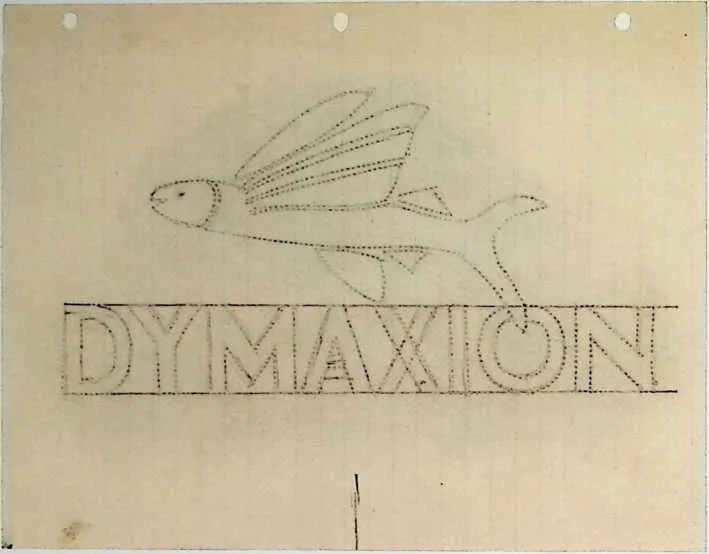
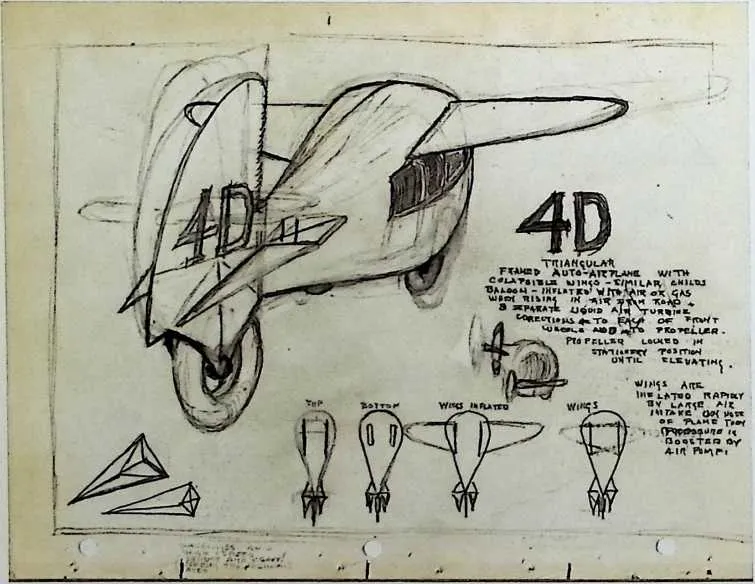
79 From the very beginning of his career, Fuller displayed interests that were clearly related to information and communication. He was, for instance, obsessed with figures and statistics that he collected from all kinds of sources, from daily newspapers to the proceedings of the American Statistical Association. Above all, he was fascinated by the phone and the radio, and their potential to transform everyday life. The proposals and perspectives he elaborated in the 1920s and ′30s under the generic title of 4D or Dymaxion already spoke to the society of information and digital culture, with its trends toward universal mobility, delocalization, and mass customization (see plates 5 and 15).
80 Fuller’s society of the future was characterized by a fluidity of communication that allowed individuals to live pretty much everywhere on the surface of the earth, including the two poles. Why should one have a New York Stock Exchange when one could imagine a ‘‘mechanical stock exchange’’ functioning at the scale of the entire planet? 5 Why have localized schools and universities when one could teach children, young men, and women at home, using radio broadcasting? 6 Material production itself could be decentralized along the main transportation infrastructures, roads and railways, according to the pattern imagined by Fuller for the production and temporary storage of his Dymaxion Houses.7 Never was Fuller as prescient as when he announced the possibility that mass media could satisfy individual preferences, foreshadowing the principle of generalized customization Nicholas Negroponte proclaimed in his influential best seller Being Digital.8
81 This fluidity found its implicit counterpart in the creation of global organizations, like the ones
that would replace the existing stock exchange and the various schools and universities. The
Dymaxion universe was actually far more ambiguous in that respect than its creator officially
acknowledged, an ambiguity that was to form the germ of the enduring tension between
individualistic and technocratic leanings typical of Fuller’s later proposals. In that respect too,
the author of 4D Time Lock and Nine Chains to the Moon announced the fundamental
ambivalence of our
society of information and communication, with its constant oscillation between the desire for
individual freedom and the simultaneous need for coordination and control.
82 Fuller was not the only one to set out on this path. Where he was perhaps especially farsighted was in his understanding of the fundamentally strategic ability required to cope with massive flows of information. While one could survive as a tactician in the traditional industrial society, a new world of highly strategic choices was gradually unfolding, in step with the proliferation of data and the explosive growth of telecommunication. This world was in dire need of visualization techniques to make choices easier. From his Dymaxion Air-Ocean World Map to his postwar Geoscope and World Game, a number of Fuller’s inventions are related to our need, in an information-based society, to distinguish patterns and trends where we previously saw only forms and backgrounds.
83 As a technical adviser to the magazine Fortune from 1938 to 1940, Fuller could already present himself as having a special talent for seeing patterns and trends. Indeed, some of the charts he produced for the magazine, like Dynamics of Progress, Comparison of U.S. Economy with the Rest of the World, or Profile of the Industrial Revolution were quite remarkable (figs. 1 and 2). The experience of World War II reinforced this talent through episodes like his working, alongside filmmakers,
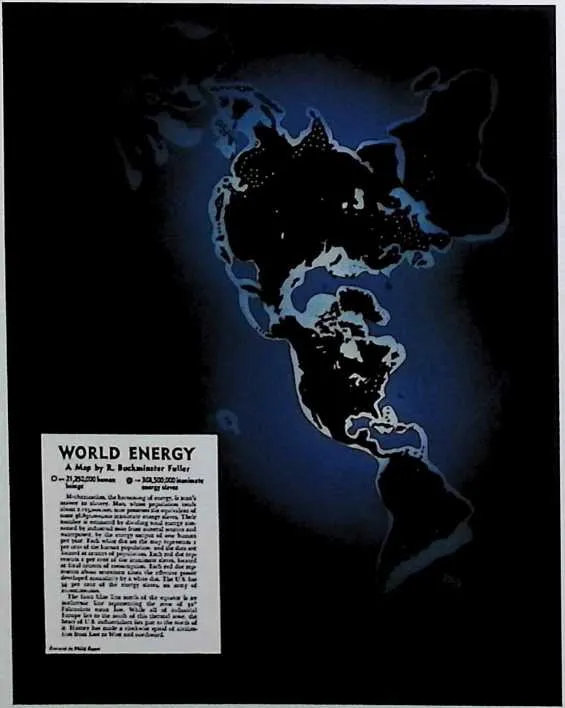
85 World Energy Map, as published in 1 Fortune, February 1940
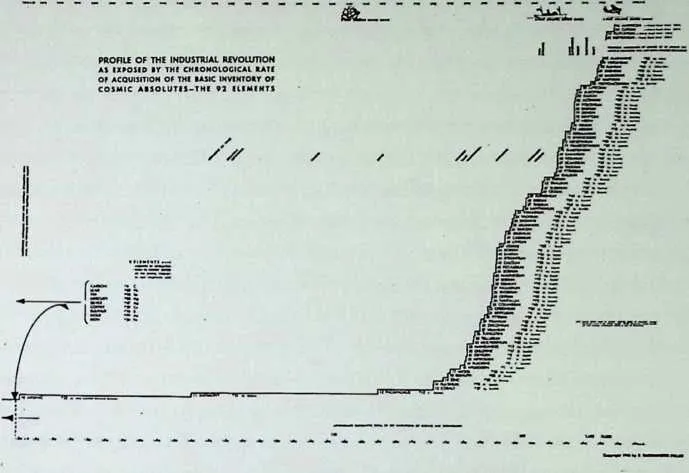
8788Profile of the Industrial Revolution as : Exposed by the Chronological Rate of Acquisition of Basic Inventory of Cosmic Absolutes—the 92 Elements,
- 2.
- j 1946
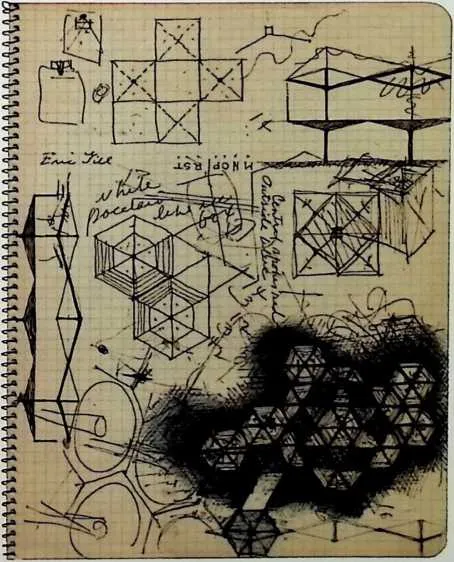
- 3.
- Sketch illustrating an early conception of the Geoscope, 1948