
4 Buckminster Fuller and Contemporary Artists
2Elizabeth A. T. Smith 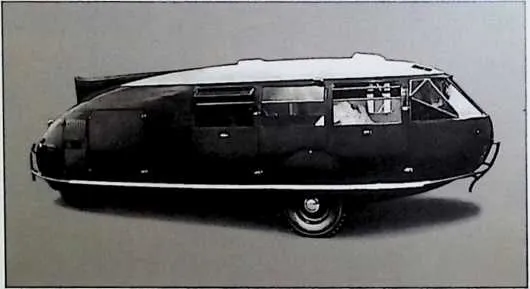
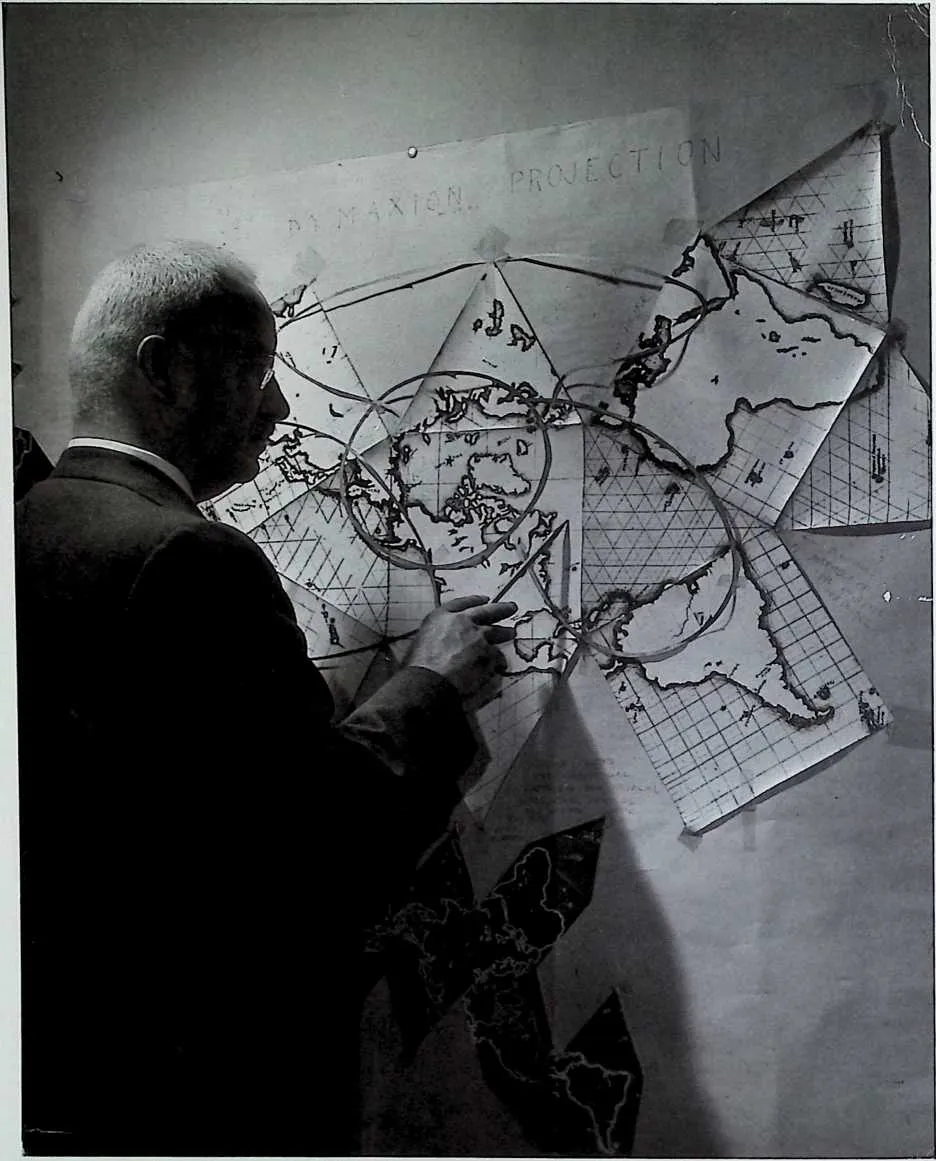
6 The wide range of ideas and achievements associated with Buckminster Fuller—utopian, visionary thinking about systems and their interconnectedness, the structural and aesthetic manifestations of integrity, the relationship between pragmatism and abstract concepts, and the potential of human beings as driving forces of change—resonates in current and recent contemporary art practice. Examples abound of artists who cite Fuller directly as a touchstone for their own thinking; for others, the relationship to his work and ideas resembles a set of shared intuitions or loose affinities. Still others find Fuller relevant as fodder for ideas about shifting interpretations of and uncharted terrains within modernism, including the idea of utopia and its failures. The range of responses to Fuller among today’s artists parallels the expansive and sometimes contradictory way in which his example—not only his work and ideas, but also his persona—has been continuously reevaluated and reinterpreted, beginning in the 1950s and escalating, with ebbs and flows, into the present in ways that manifest ‘‘synergy’’ with the thinking and exigencies of each decade.
7 The position of Fuller, who called himself a ‘‘comprehensive anticipatory design scientist,’’1 as an avatar for today’s artists might best be appreciated as stemming from a ceaseless kind of resdessness, where everything is constantly in a state of discovery or of ‘‘becoming’’—always in flux, never static. Beyond the rationality and tectonics associated with many of Fuller’s achievements, the role of intuition in his work and ideas, as well as the philosophical richness and sense of spirituality that increasingly manifested itself later in his career, have profound resonance today, increasingly setting him apart from his contemporaries and from other modernists. This sphere of influence, centering on the intuitive or psychic/spiritual, contrasts intriguingly with the way in which Fuller is often credited as a forerunner of digital culture—a system based on logic and rationality—as is compellingly analyzed elsewhere in this publication.
910This essay will consider several examples of shared intuitions or affinities between Fuller and various artists active during the past decade. These artists are part of a generation whose work strongly reveals the legacy of conceptualism as well as the impact of minimalism, perceptual modes, feminism, and the performative practices that, though they have percolated within art since the 1960s, have widely proliferated only in the last decade. Extending the boundaries of traditional approaches to media and inviting new practices, disciplines, and models of meaning into the art world, conceptualism ushered in a reconsideration of art that transformed it ‘‘beyond recognition,’’ in the words of noted art theorist Craig Owens.2 With an amorphous yet pervasive legacy, Fuller demonstrates a clear kinship to artists concerned with cross-disciplinary investigation, particularly those navigating uncharted terrain in terms of using or rethinking systems as the basis for individual works or bodies of work. Often, like Fuller, these artists choose to work collaboratively with others to
gain the perspective of specialized applications of knowledge, yet their achievements are highly individualistic and, like Fuller’s, sometimes difficult to categorize or to relate to those of their contemporaries.
12 Perhaps the best-known artist of his generation to acknowledge the inspiration of Fuller, not only in his methods of working but also in his ideas and approaches, is Olafur Eliasson. Profoundly interested in experience and interaction, the effects of time and space, the physical and visual properties of physics, and the relationships between the part or the fragment and the whole—all concepts that also stimulated Fuller—Eliasson also resembles Fuller in the way he communicates his ideas, involving extensive scientific reference and prolific textual elaboration.3 Many of Eliasson’s works in a series of projects involving mathematical patterns and symmetries draw directly from Fuller’s experiments with geometric form. His Model Room installation of 2003 presents an enclosed space filled with specially designed shelves and tables on which are positioned a profusion of small geometric objects resembling scientific models—geodesic domes, kaleidoscopes, and latticeshaped constructions—signaling a restless and energetic mode of experimentation derived from the act of making as the basis of artistic discovery (fig. 1). Model Room was created in collaboration with Einar Thorsteinn, an architect who had extensive contact and involvement with Fuller and who has been a crucial transmitter of his
15 OLAFUR ELIASSON (b. 1967)
16 Model Room, 2003
17 Chipboard display cabinets, mixed media models, maquettes, and prototypes
18 Dimensions variable
19 Courtesy the artist and Tanya Bonakdar
20 Gallery, New York
ideas about the aesthetics and utility of geometry and mathematical forms to Eliasson, with whom he has worked
directly since 1996.4
The same year, Eliasson realized the Blind Pavilion for the Venice Biennale—his most extensive
application of ideas about geometry, non-Euclidian space, and perception to date (fig. 2). In this
large-scale installation of various spatial and perceptual sequences achieved through the
use of a kind of ‘‘energetic geometry,’’ utilizing both interior and exterior spaces of
the existing pavilion structure, the objects presented in Model Room seemed to have
expanded to an architectural scale, offering a compellingly participatory experience for the
viewer.
Describing his concept of the relationship between subjectivity, time, space, and responsibility
as ‘‘the most attractive model for understanding and communicating the idea of temporality in
relation to individual objects and the world at large,’’ Eliasson has coined the term YES (‘‘Your
Engagement Sequence’’):
2223By including YES as a central element of perception, the governing dogma of timelessness and static object-hood may be renegotiated, thus making your responsibility for an active engagement in the concrete situation apparent. …In other words, engagement has consequences and these entail some feeling of responsibility. . . . ‘‘YES,’’ or the fifth dimension, creates a perspective that is personal; it functions to individualize the other
25 OLAFUR ELIASSON
26 ; Blind Pavilion, 2003
27 ; Steel construction, black and
28 •'transparent glass
29 . 8 ft. 2 */t in. x 24 ft. 7 */« in.
30 i (2.5 x 7.5 m)
3132'Installation: Danish Pavilion, 2003 Venice Biennale
33 2 Private collection
3435dimensions of space. I am interested in the potential inherent in giving the individual subject this dimensionality as a sort of tool that relativizes the other existent, presumed static dimensions upon which our conception of space is based.5
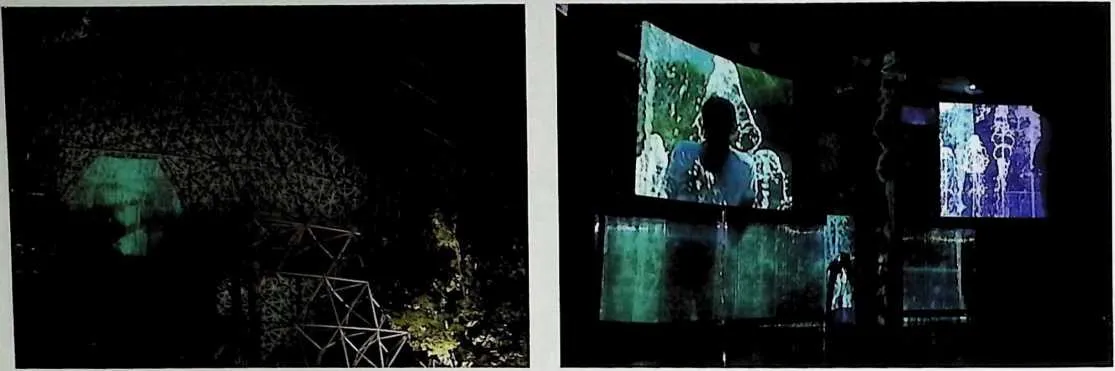
37 Commingling art, science, engineering, and architecture, Eliasson’s approach to systemic components and emphasis on revealing rather than masking their mechanisms of display appears to link him as closely to Fuller as to such artists as Robert Irwin and James Turrell, with whom he is often connected in a shared interest in phenomenological and perceptual effects.6 Furthermore, the ethical dimension of agency implied in Eliasson’s statements about YES offers intriguing parallels with related concepts of Fuller’s, as does his commitment, in various projects since the late 1990s, to utilizing or manipulating natural phenomena, not just to explore perception but also to reflect on man’s place in the chain of life on Earth. Eliasson has commented that he is drawn to utopian architects and thinkers such as Fuller because ‘‘they’ve got that ability to think about their own vision from the outside…Artistic practice has rediscovered its ability to constantly redefine its own programme, and architectural discourse has opened up to other fields in the same way. This is why the fact of integrating architects—and engineers and experts as well—is crucial for me in opening up to other ways of working.’’7 The fluidity of intellectual parameters and disparate interests characteristic of Fuller is also apparent in other artists who have cited him directly as a source or a subject matter in their own work. In her installation Fuller’s Flow (2003), artist Irit Batsry has reconsidered and taken as a source of inspiration Fuller’s vision for the Biosphere, created as the U.S. Pavilion for Montreal Expo 67 (fig. 3). Her project, a video and mixed media installation situated within the Biosphere itself, references Fuller’s creation of the dome and its aesthetic possibilities while advancing theories about perception. Batsry’s project, commenting on the shifting nature of architectural innovation from the time of the Biosphere’s creation in 1967, when it was considered a technological marvel, to its condition as an almost forgotten relic today, seeks to reinvigorate the meaning of technological interactivity. Paying homage to Fuller’s precedent, she probes his ideas about space as stated in 1929: ‘‘A room should not be fixed, should not create a static mood, but should lend itself to change so that its occupants may play upon it as they would upon a piano,’’8 using myriad media including sound, moving imagery, and three-dimensional alterations to the space to offer a kinesthetic, sensorial reinterpretation. Batsry’s interest in Fuller is of long standing. She encountered Fuller’s book Utopia or Oblivion in 1988 while researching her trilogy Passage to Utopia, finding in Fuller’s writing ‘‘an essential connection between the personal and the collective’’ that she had missed in the writings of other utopian thinkers.9 In 1991, her video A
4243
Simple Case of Vision and an installation titled . . . of persistence of absence . . . took as their subject matter a childhood vision disorder that caused Fuller to have almost constant blurred vision. In her work, Batsry sought to give form to the way defective vision alters perception; in Fuller’s case, he credited this experience as having indelibly shaped how he gained information and learned to make sense of the world around him.
44I was bom cross-eyed…My vision was thereafter fully corrected with lenses. Until four I could see only large patterns, houses, trees, outlines of people with blurred coloring. While I saw two dark areas on human faces, I did not see a human eye or a teardrop or a human hair until I was four. Despite my new ability to apprehend details, my childhood’s spontaneous dependence only upon big pattern clues has persisted.10 For Batsry, this physiological fact was of immense significance to Fuller’s future contributions to the world of ideas and also offers a potent metaphor for the primacy of perception and intuition as a catalyst to invention in human experience. Seeking to use Fuller’s actual text as material in combination with other sensorial effects, Batsry discusses her approach as follows:
46Part of my practice at that time was processing many images and texts without predetermining how and when they will be used. …In the beginning of one of these residencies I typed Fuller’s text [cited above] into the character generator, played it back hundreds of times and transformed it in many different ways using colorizers, superimposing and mixing it with live camera images and the ‘‘wobullator’’ (a Nam June Paik device that allows for transforming the image through voltage control). I ended up using all five
days of the residency treating this one paragraph and ended up with a few hours of recorded material.11
48
Various artists have considered Fuller’s complex role within and relationship to modernism
from a more theoretical standpoint. Artist Josiah McElheny has undertaken one of the most
sustained considerations of Fuller from this standpoint in a body of work and writings
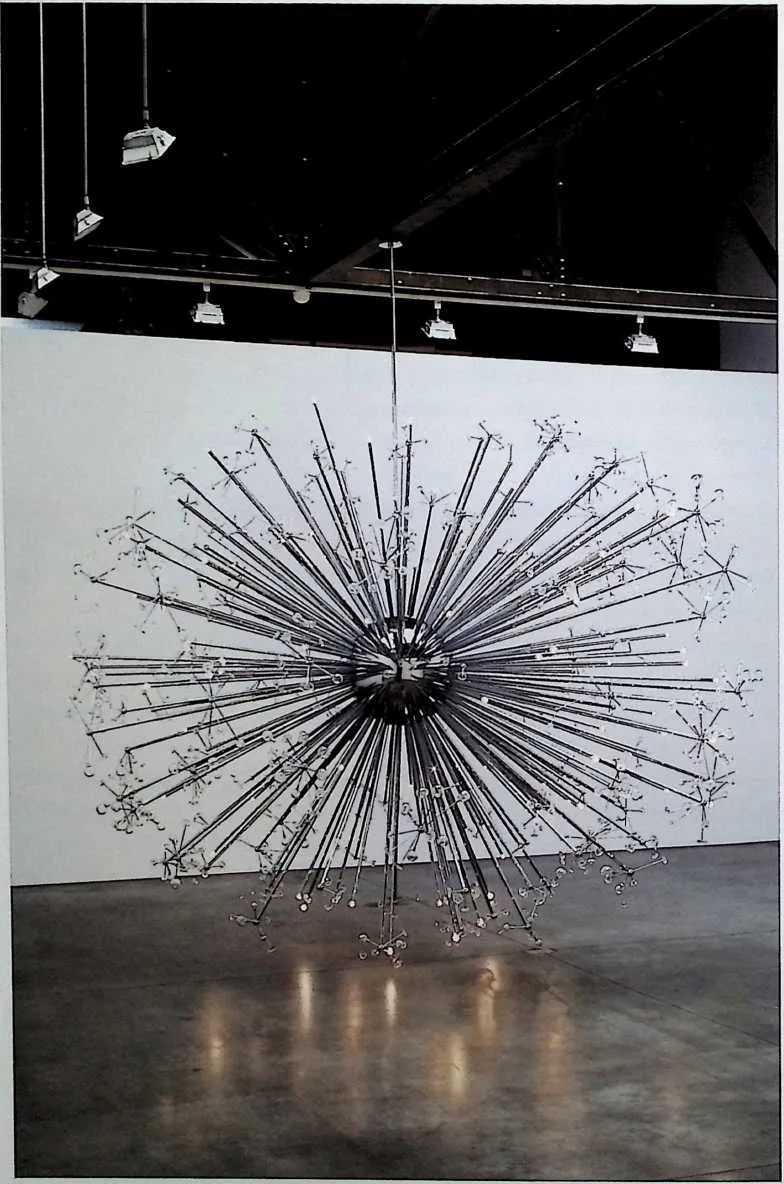
exemplified by a 2005 project titled An End to Modernity (fig. 4). This monumental
sculpture, approximating both a chandelier and a model of the universe as explained
by the Big Bang theory, presents a scientifically accurate rendition of the isotropic
nature of the universe. Created in collaboration with an astronomer and incorporating
references to 1960s-era scientific and culturally derived concepts and objects, the piece was
accompanied by a documentary film also produced by the artist. The hundreds of
component parts within the sculpture present a vast network that appears to coalesce
into a unified whole, yet can never be fully comprehended or apprehended by the
viewer.12
An End to Modernity culminates a series of objects and investigations McElheny has made over
the past few years that reference Fuller directly: specifically a conversation between Fuller and
sculptor Isamu Noguchi in 1929 that led to their proposal for creation of a ‘‘Total Reflective
Abstraction’’—a world of form without shadow, completely reflective form in a totally reflective
environment.13
Intrigued by Fuller and Noguchi’s arrival at the idea of an aesthetic utopia of ‘‘endless
everywhere,’’ McElheny in his interpretation of it encompasses both a meditation on modernism
and its failures and a fascination with ‘‘the intersection of specific concepts and abstract
ones.’’14
What emerges is a problematic, ambivalent relationship to the concept of ‘‘Total Reflective
Abstraction’’ in McElheny’s work. While it has served as a powerful stimulus for McElheny in
various of his own sculptural objects and environments, as, for example, in Buckminster Fuller’s
Proposal to Isamu Noguchi for the New Abstraction of Total Reflection (2003), his approach to
this concept is both an embrace and a critique. In An End to Modernity, McElheny signals the
impossibility of rendering the totality of the universe as imagined by modernism, calling into
question the idea of any kind of totalizing vision as imagined by Fuller or other modernists, yet
creating an object so encompassing and seductive that it renders concrete the power of that
vision.
McElheny states that he is intrigued by the exploration of concepts that ‘‘didn’t
fit within the context of the moment they were invented, or have always been
there but are constantly being returned to because they are needed in a different
way.’’15
A related strand of thinking about Fuller and modernism has been articulated by writer
Francesco Manacorda, who acknowledges Fuller’s centrality to a revisionist modernism that has
exerted a profound influence on a generation of young artists drawn to the more obscure, lateral
impulses within modernism. These were fueled
49 JOSIAH MCELHENy (b. 1966)
54 An End to Modernity, 2005
- Chrome-plated aluminum, electric
- lighting, hand-blown glass, steel cable
- and rigging
55 . Diameter 16 ft. (4.8 m)
56 16 Courtesy Andrea Rosen Gallery, 4 New york
58 by intuition
and organic rather than rational models, constituting what he describes as ‘‘a gothic side of the modem
movement.’’17
For Manacorda, Fuller stands among the ‘‘heretical’’ figures of modernism, whose fantastic
visions such as the Cloud Nine project reveal a hallucinatory blurring of reality and fiction, as
distinct from the ideal of harnessing or marshaling Earth’s systems toward a common
good.18
In a different way, artist Pedro Reyes reveals an equally strong ongoing fascination with
modernism—primarily with the notion of resuscitating ideas that have fallen into disuse or
disfavor but demonstrate new potential. Contrasting with artists who see evidence in
Fuller’s utopianism of the failure of modernism, Reyes’s position is more generous. He
comments, ‘‘The ‘modem’ does not have a fixed value; it becomes more or less interesting
to us.. . . For me, modernism is a toolbox, but it is primarily part of an historical
compost.’’19
Paralleling Fuller in the voracious mix of ideas and disciplines from which he draws
inspiration, Reyes’s work interweaves the social, scientific, mathematical, philosophical, and
aesthetic—consistently going beyond issues of form or making them integral to symbolic and
philosophical concerns.
Described by writer Tatiana Cuevas as ‘‘an idealist: he lives and works thinking of ways to improve the
world,’’ Reyes embraces Fuller as a precursor and potent source of inspiration for many of his projects,
including Parque Vertical (2000), Floating Pyramid (2004), Dream Digester (2005), and Velotaxi
(2008).20
His interest in taking structures or ideas associated with modernism and rehabilitating them in
some way, toward often surprising ends, corresponds to Fuller’s regenerative thinking. For
instance, in Parque Vertical (2000), Reyes re-visioned a 1962 example of modernist architecture
by Mario Pani as a vertical park/urban form by means of a relatively modest alteration of the
infrastructure; naming this unrealized project the ‘‘World Environmental Center’’ has generated
attention to and interest in its possibilities as a model of sustainability and ecological
aspirations.
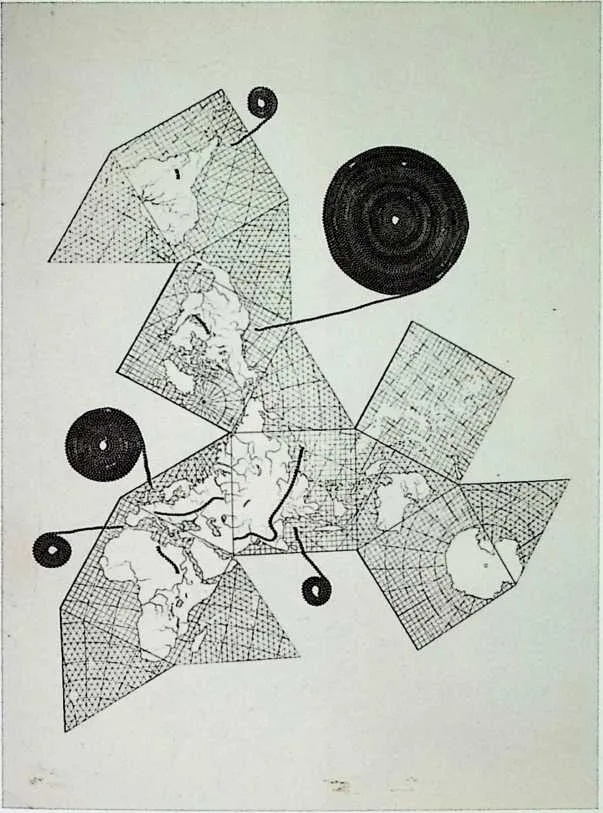
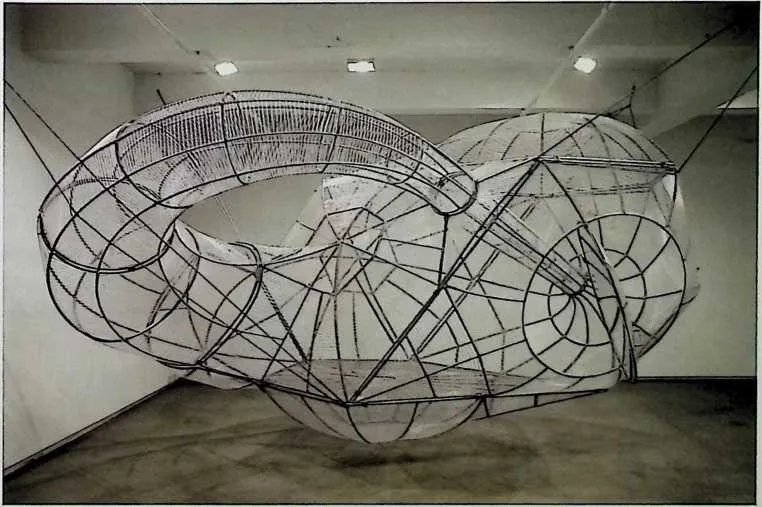
63 The suspended sculptures in Reyes’s Capulas series, ongoing since 2001, approximate Fuller’s work in the way they resemble scientific models based on mathematics and geometry—interactive spaces with an exploratory, experimental character rather than static objects (fig. 5). Expressing his shared interest in the physical and conceptual properties of the microscopic sea creatures called radiolaria with Fuller, Reyes’s Capulas also function much like many of Eliasson’s projects in that they are defined by sensate experience and physical/perceptual engagement. The wordplay of their name—from cupola, capillary, capsule—resonates with Fuller’s term Dymaxion (from dynamic, maximum, ion) and his coinage of other neologisms to emphasize distinctive experiences, concepts, or forms.
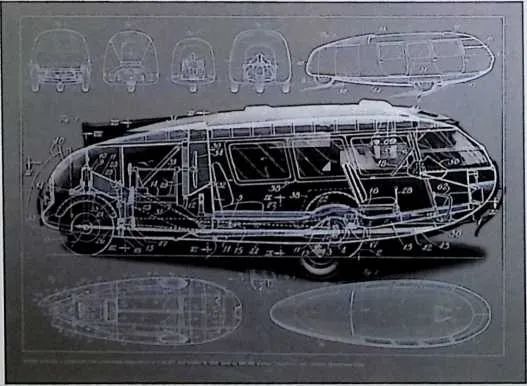
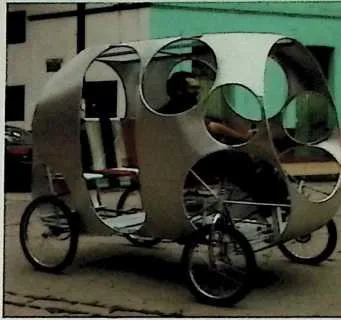
64 Fuller’s visionary experiments with methods of dematerializing structure to make it more efficient and lightweight have fueled Reyes’s ideas for various specific projects. His design for the Velotaxi, a human-powered passenger vehicle planned to debut in 2008, is indebted to the example of Fuller’s Dymaxion car as well as the performative, anti-institutional character of Chris Burden’s 1976 B-car (fig. 6). Applying his artistic/engineering acumen to the problem of creating an alternative to the ubiquitous automobile, Reyes turned the spaces of the Museum of Mexico City into a factory for eight months—an assembly line for the production of prototype vehicles, to be immediately put into circulation in Mexico City’s downtown upon completion. The artist comments:
6566Instead of bringing an exhibition into the museum, the museum produces these objects, and the exhibition will take place outside. The project has several goals. One is to replace cars with nonemission vehicles; another is to enable a migration of the unemployed from informal to more formal economies…. Henry Ford and Frederick Taylor created the foundations of the economy that we live in. I wanted to do something more than criticize how they opened the path for sweatshops, planned obsolescence, consumerism, and drive-thru societies. I thought, if these mechanisms, which approved to be so effective, have led us to ravish the planet, it is because techne has prevailed over ethos. It’s very easy to be enticed by technology and to be indifferent to its moral consequences. But it is useless to resist these driving forces. What we have to do is create new driving forces in the opposite direction, toward healing, not destruction.21 While Reyes’s work clearly manifests a sensibility of relational aesthetics with its emphatic commitment to creating new models of social interaction through art, he
acknowledges and embraces Fuller as a catalytic example for achieving a similar goal. He points to concepts he feels are most relevant and inspirational from Fuller, including: ‘‘Guinea Pig B. How an unemployed middle-aged person, married with kids, can turn his life into an experiment to test the maximum good he can do for the planet…. Dome for Kabul 1956. Him a B-52 into a carrier for a dome. Same as placing a flower in the barrel of a gun. Self-assembly in 24 hours without special training. …No more secondhand god. Talk with the sources of knowledge, not the intermediaries.’’22
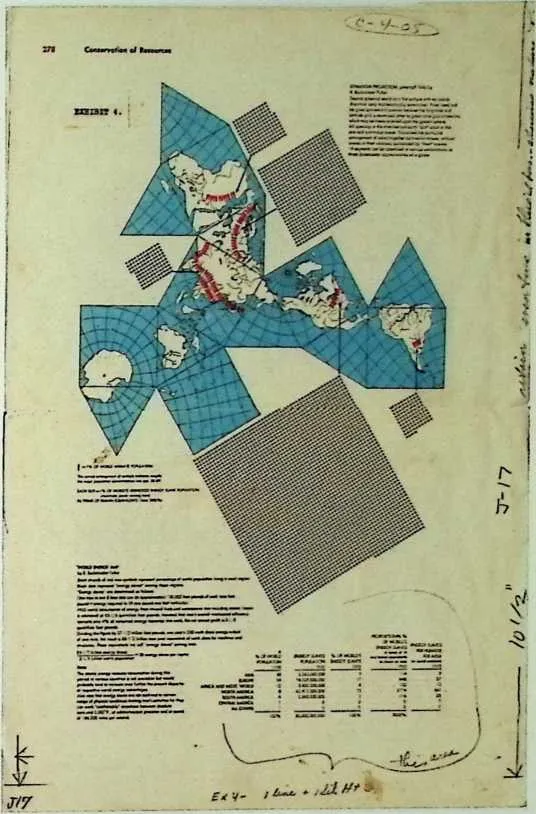
69 The work of artist Andrea Zittel also invites comparison to that of Fuller, in his self-appointment as ‘‘Guinea Pig B’’ and commitment to using himself and his life as raw material for explorations about improving the quality of everyday living. Drawing upon ideas that are both scientific and intuitive, and focusing attention on details of how to achieve more efficient, compact design, Zittel has sought primarily to redefine the role of the artist in relationship to the larger culture.
70 In the early 1990s, Zittel began to design objects resembling furniture, with the goal of creating
one piece that could satisfy all human needs. Reminiscent of Fuller’s Standard of Living Package
(1948-49), Zittel’s Living Units were tested by the artist herself for a period of one year each.
The Living Units exemplify Zittel’s Fulleresque focus on systems of maximum efficiency and how
they can be customized for the individual; she also ‘‘uses her body to test the authenticity of her
art to the world’’ in a way that stems from earlier precedents in performative and feminist
art.23
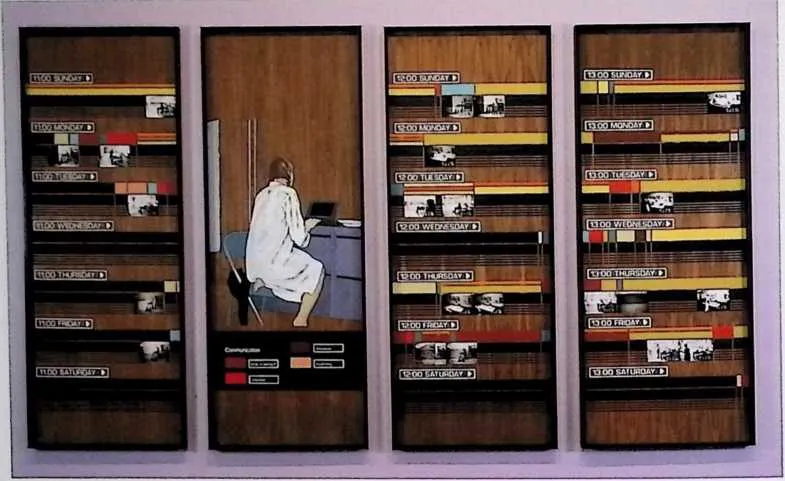
In the 1999 project A-Z Time Trials, Zittel probed the emotional and physiological effects of
the absence of conventional measures of time by casting herself as ‘‘guinea pig Z’’ in a
quasi-scientific experiment in which she analyzed her own responses to this absence, seeking to
better understand human needs and agency (fig. 7). Various additional projects of Zittel’s
resonate intriguingly with Fuller—for instance, the documentary impulse of her A-Z Personal
Profiles Newsletter with his ongoing Chronofile of his life in relationship to society—yet
references to Fuller in Zittel’s highly original and idiosyncratic body of work blend with
psychology, social commentary, and humor as well as a distinct emphasis on the quotidian
rather than the utopian. Asserting that she has always been interested in ‘‘the hybrid
position he created for his practice,’’ Zittel comments on the specific appeal of Fuller’s
designs for the Dymaxion bathroom and the Wichita House, a built version of the
Dymaxion Dwelling Machine that was inhabited by a family for years before falling into
disuse, as having triggered her thinking about authorship and authenticity as a young
artist.24
Aspects of her current and recent work, however, including projects developed as part of ‘‘A-Z
Advanced Technologies,’’ reveal the continuing legacy of Fuller’s restless experimentation with
materials and their applications to improving daily living.
 Similarly involved with creating objects and designs that are both utilitarian in purpose
and infused with social critique is the Danish collective N55. Since 1993 this group has been at
work on a series of projects ranging from hygiene systems to space-frames to fish farms—all
stemming from the concept of providing socially useful artifacts that will in some way improve
human life and circumstances.
Similarly involved with creating objects and designs that are both utilitarian in purpose
and infused with social critique is the Danish collective N55. Since 1993 this group has been at
work on a series of projects ranging from hygiene systems to space-frames to fish farms—all
stemming from the concept of providing socially useful artifacts that will in some way improve
human life and circumstances.
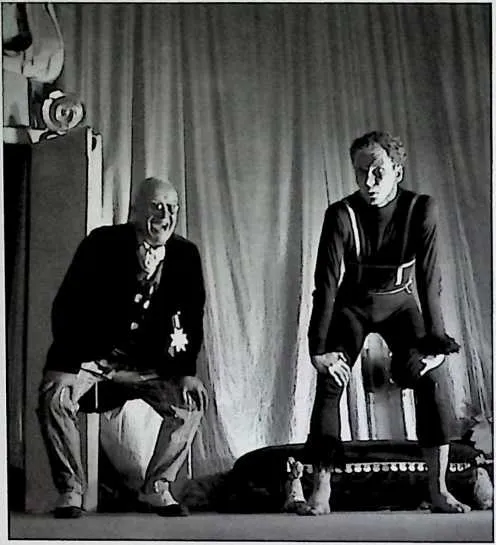
74 Disseminated in the form of ‘‘manuals’’ published on their Web site, with clear descriptions of their purpose, physical components, and construction techniques—and thereby democratically available to all—N55’s designs range from modest objects conceived for individual usage to more ambitious concepts on a larger, civic scale.25 These works can be seen as gestures encompassing social and political commentary about issues ranging from ecological degradation to immigration to community-building and deployment of leisure time, yet in their dedication to inhabitable structures and systems, they are indebted to Fuller’s visionary mass-produced, easily deployed systems of housing and transportation—his array of ‘‘designs for mobility.’’ In 1976, author Stephen Mark Dobbs prognosticated a Fuller-inflected future for art:
76 The
Buckminster Fuller Future. Politics will be obsolete, and the rational use of Earth’s resources will
liberate most people to pursue self-development and avocational interests. The arts and
humanities will prosper. Artists will be admired as models of efficient use of resources and
energy, achieving maximum impact in a given form. But some artists, taking advantage of the
liberal climate, will reject sophisticated technologies at their disposal and will take sheets of
paper, brushes, and paint and inscribe images as they used to do in the twentieth century. For a
time there will be a trend toward pre-scientific attitudes, exalting the mystical and emotional
against the rational and scientific, but that wave of nostalgia will spend itself on a brief
flurry of enthusiasm for four-color psychedelic posters and videotapes of ‘‘Let’s Make a
Deal.’’26
More than thirty years later, it is evident that this scenario—one of several posited by the writer
as a future vision for art and its societal impact—has not played out entirely as imagined, yet
Fuller’s impact on the future of creative practice has perhaps been more wide-ranging than
previously thought. Fuller’s continuing influence on architecture, digital culture, environmental
awareness and urges toward sustainability, and overall global vision has been substantial, while
his currency with artists has been simultaneously pervasive and diffuse, palpable yet
difficult to pinpoint or define with certainty. Yet numerous artists have pointed to the
persistence of Fuller’s legacy or revealed affinities with his thinking, from Robert Smithson’s
engagement with Fuller’s ideas in the mid-1960s to those discussed in this essay whose work
approximates Fuller’s ‘‘comprehensivist’’ position, confounding conventional definitions
of categorization. Artist Mel Chin, known for a significant body of environmentally
committed, often socially and politically activist work since the early 1990s, has noted, ‘‘I’m
not so interested in working with scientists, but the world of ideas is full of scientific
relationships.’’27
In this respect he articulates the thinking of many artists, architects, designers, and others in
creative fields whose interests have taken them beyond the narrow categories of disciplinary
boundaries and closer to a sphere of activity characterized more by its approach to
problem-solving, whether for pragmatic or symbolic ends. Fuller can be appreciated as a spiritual
godfather to this strain of thinking and action.
Alternatively, an artist such as Sarah Sze, who has always developed her sculpture and installation
work without the intervention or collaboration of others, points to Fuller’s contribution in the
creation of scientific models that reveal both structure and relationships between physical objects
(fig. 8). ‘‘It’s the investigation of structures that can perform all of these functions: act as models
for something to be realized full scale, represent laws and behavior, and question the practical
application of objects and structures in the real world, that I find intriguing,’’ she
comments.28
The idea of revealing the way something works as a stimulus for form resonates within Sze’s
work; a sense of flux, disequilibrium, dynamism, and the interconnectedness of microcosmic to
macrocosmic components are defining features of her sculpture. The connections between her
work and Fuller’s are perhaps more tenuous than those between Fuller and any of the artists I
have discussed above. Nevertheless, in its constellation of always interdependent parts that
suggest a magnitude of organic, technological, scientific, and philosophical relationships, Sze’s
work most satisfactorily embodies the spirit of Fuller’s commitment to explorations of
omnidirectional processes of growth and change, and most eloquently references the terrain of
comprehensivism he advocated.

80 In her characterization of Fuller as an ‘‘illusive mutant artist, impossible to categorize,’’ writer Victoria Vesna states that he ‘‘foreshadows the complex persona of a contemporary media artist.’’29 She offers a compelling analysis of his significance for this emerging strain of practice, noting that ‘‘very early on he recognized the computer as a human extension, never losing the organic quality in his interpretation of the human/machine relationship.’’ Going on to describe him as a ‘‘performance artist who constructed practical prototypes of some of his visions,’’ she points to the persistence of an ‘‘invisible aesthetic of integrity’’ underlying and unifying all of his work.30 The notion of the invisible quality of integrity as an aesthetic and ethic, articulated directly by Fuller in 1973 and quoted elsewhere in this publication, stands as a compelling, comprehensive vision that permeates his work’s significance for a younger generation of artists.
Notes
- 1.
- Michael John Gorman, Buckminster Fuller: Designing for Mobility (Milan: Skira, 2005), 16.
- 2.
- Craig Owens, ‘‘Detachment: From the Parergon,’’ in Beyond Recognition: Representation, Power, and Culture, ed. Scott Bryson, Barbara Kruger, Lynne Tillman, and Jane Weinstock (Berkeley and Los Angeles: University of California Press, 1992), 38.
- 3.
- In a 2006 essay titled ‘‘Vibrations,’’ Eliasson begins with a quote from Fuller about the properties of physics that underpins his own ideas about time, energy, subjectivity, criticality, and other alternatives to modernist concepts of space. Olafur Eliasson, ‘‘Vibrations,’’ in Your Engagement Has Consequences: On the Relativity of Your Reality (St. Louis: St. Louis Art Museum, 2006), 59.
- 4.
- Thorsteinn, founder of the Reykjavik-based
research institute ‘‘Constructions Lab’’ in 1973, had a close personal and professional relationship with Fuller. His contributions are referenced extensively in the literature on Eliasson. For his role in Eliasson’s Model Room, see Karen Rosenberg, ‘‘Room with a View: Eliasson’s Elegant Universe,’’ Village Voice, May 2003, http://www.villagevoice. com/art/0320,Rosenberg,43999,13.html (accessed June 27, 2007). See also Madeleine Grynsztejn, ‘‘(Y)our Entanglements: Olafiir Eliasson, the Museum, and Consumer Culture,’’ in Take Your Time: Olafur Eliasson, ed. Madeleine Grynsztejn (San Francisco: Museum of Modem Art, 2007), 25--26 and 31 n. 48. - 5.
- Eliasson, ‘‘Vibrations,’’ 62--63.
- 6.
- An extensive analysis of Eliasson’s relationship to the so-called Light and Space artists is found in Pamela M. Lee, ‘‘Your Light and Space,’’ in Grynsztejn, Take Your Time. See also Susan May, ‘‘Meteorologica,’’ in Olafur Eliasson: The Weather Project (London: Tate Modem, 2004), http://weboelisson.dyndns. info:8080/PDF/Meteorologica.pdf (accessed June 27, 2007).
- 7.
- ‘‘Conversation between Olafur Eliasson and Hans Ulrich Obrist,’’ http://weboeliasson.dyndns.info: 8080/PDF/Conversation_HUO_OE.pdf (accessed August 20, 2007). Collaboration with others from related fields and in various roles has become a primary working method for Eliasson, who maintains a studio of approximately thirty individuals ranging from mathematicians to carpenters, as well as the aforementioned Einar Thorsteinn.
- 8.
- Buckminster Fuller, Dymaxion Chronofile, vol. 36, 1929, M1090, ser. 2, box 21, R. Buckminster Fuller Papers, Department of Special Collections, Stanford University Libraries.
- 9.
- E-mail from Irit Batsry to the author, October 24, 2007.
- 10.
- Buckminster Fuller, from Utopia or Oblivion: The Prospects for Humanity (New York: Bantam, 1969), quoted in an e-mail from Batsry to the author, October 24, 2007.
- 11.
- Ibid.
- 12.
- See ‘‘Josiah McElheny,’’ in Part Object Part Sculpture, ed. Helen Molesworth (Columbus: Wexner Center for the Arts, Ohio State University, 2005--6), 253.
- 13.
- Barbara Pollack, ‘‘Beyond the Looking Glass,’’ Art News 102, no. 11 (December 2003): 109. See also Dana Miller’s essay in this volume, ‘‘Thought Patterns: Buckminster Fuller the Scientist-Artist,’’ for the ‘‘entirely reflective silver studio’’ Fuller conceived for Noguchi.
- 14.
- ‘‘Josiah McElheny Talks about An End to Modernity and Conceptual Drawings for a Chandelier, 1965, both 2005,’’ Artforum 44, no. 3 (November 2005): 237.
- 15.
- Art: 21 film on Josiah McElheny, PBS, http://www.pbs.org/art21/artists/mcelheny/clip2. html (accessed September 14, 2007).
- 16.
- Francesco Manacorda, ‘‘The Dark Side of Modernism: Architecture, Science Fiction, and the Organic,’’ Flash Art 37 (March-April 2004): 91.
- 17.
- Manacorda points to artists Tobias Putrih, Ian Kiaer, Jeff Ono, and Bjom Dahlem as responsive to figures such as Fuller and Frederick Kiesler as stimuli for work that seeks to find ‘‘a path from the artificial to the primordial’’ using science fiction, architectural references, and scale models as tools to investigate modernism’s hidden gothicisms. Ibid., 91--92. Another artist of the same generation engaged with the idea of failure within modernism, specifically Fuller and utopianism, is Christine Tarkowski, whose project Searching for the Failed Utopia takes the form of a series of recent sculptures and installations.
- 18.
- Tatiana Cuevas, ‘‘Pedro Reyes,’’ Bomb, no. 94 (Winter 2005/2006): 21.
- 19.
- Ibid.
- 20.
- E-mail from Pedro Reyes to the author, October 17, 2007. See also Anuj Desai, ‘‘Building a Better Pedicab,’’ ArtNews 106, no. 8 (September 2007): 141--42.
- 21.
- E-mail from Pedro Reyes to the author, September 24, 2007.
- 22.
- Lynn Zelevansky, Sense and Sensibility: Women Artists and Minimalism in the Nineties (New York: Museum of Modem Art, 1994), 32--33.
- 23.
- E-mail from Andrea Zittel to the author, October 27, 2007.
- 24.
- See Web site www.n55.dk.
- 25.
- Stephen Mark Dobbs, ‘‘From Buck Rogers to Buckminster Fuller: On the Future of Art,’’ Art Education 29, no. 3 (March 1976): 11.
- 26.
- ‘‘A Composite Interview with Mel Chin,’’ in Inescapable Histories: Mel Chin (Kansas City, Mo.: ExhibitsUSA, Mid-America Ans Alliance, 1996), 36.
- 27.
- E-mail from Sarah Sze to the author, September 14, 2007.
- 28.
- Victoria Vesna, ‘‘Bucky Beat,’’ Artbyte 1, no. 3 (August-September 1998): 25.
- 29.
- Ibid., 28.