
3 A View from the Present
2Antoine Picon
3 There are many Buckminster Fullers. A rapid survey reveals the existence of a series of contrasting figures: the marginal inventor of the 1920s and the world-famous prophet of the 1960s and ‘70s, the protégé of the U.S. military and the inspiration for alternative communities like Drop City,1 the advocate of technological progress and rationalization and the defender of the environment. Paradoxically, this confusion has been created by Fuller’s endless attempts to explain himself through books, articles, and lectures, not to mention the systematic recording of his life in his Dymaxion Chronofile. His wish to be transparent, like a rigorously defined experiment—to use one of his favorite characterizations of his attitude toward life2—has produced the opposite effect: an impression of opacity generated by an overabundance of details. A closer study of Fuller’s trajectory reveals, however, the persistence of themes and preoccupations, like his transcendentalist emphasis on the creative power of the individual, or his desire to promote a ‘‘revolution in design.’’3 These themes and preoccupations are not distributed randomly. They organize themselves along axes that make it possible to reconstruct another series of avatars of Buckminster Fuller. Are those avatars closer to what the man was in reality than those I mentioned earlier? The answer is difficult to give. At least, because they are the direct product of our power of investigation, they correspond to the reasons we have to be interested still in Fuller’s work today. In this essay, I would like to explore two possible interpretations of Buckminster Fuller. The first relates him to the emergence of the society of information and communication. Due to projects like his World Game, Fuller is often presented as a forerunner of digital culture. What can be said about his relation to information, communication, network, computing, and simulation? It is striking to observe how this kind of question has replaced former inquiries regarding Fuller’s contribution to structural design.
7 The utopian constitutes the other avatar of Buckminster Fuller that I will deal with. Contrary to the information-age Fuller, Fuller the utopian has always been a widely discussed subject. In the 1960s and ‘70s, critics were generally fascinated by the brave new world he promised in his books and lectures. Later, his optimistic take on the capacity of man to steer ‘‘Spaceship Earth’’ was seen as typical of the demagogic and technocratic tendencies of the postwar period.4 In connection with the emergence of a digital Fuller, the utopian dimension is probably acquiring a new meaning today. After a long purgatory, utopia is indeed reappraised, not necessarily in terms of a global, well-crafted project, another ideal city after all those that have been produced from the Renaissance on, but as the promise that, with a proper course of action, something different can take place in the near future. In the digital realm, we are no longer fascinated by the discourses on the Global Village that accompanied the creation and early developments of the Internet. The Global Village perspective was, after all, nothing but the ideal city reinvented. In recent years, we have become more sensitive to the notion that utopia is less a definitive state of affairs than an open-ended process, a process that should furthermore empower the individual instead of giving precedence to impersonal collectives. And this is perhaps where Fuller might fit in, despite the colossal dreams of Cloud Nine or Tetra City, as a passionate advocate of utopia as a process giving a key role to the individual. The ultimate expression of his utopian vision, the World Game, was after all a process. This may account for the fascination the endeavor exerts on so many of us today. Just like ‘‘digital Fuller,’’ Fuller the utopian definitely belongs to our present.
9 ‘‘Digital Fuller’’
10 From the very beginning of his career, Fuller displayed interests that were clearly related to
information and communication. He was, for instance, obsessed with figures and statistics that he
collected from all kinds of sources, from daily newspapers to the proceedings of the American
Statistical Association. Above all, he was fascinated by the phone and the radio, and their
potential to transform everyday life. The proposals and perspectives he elaborated in the 1920s
and ‘30s under the generic title of 4D or Dymaxion already spoke to the society of
information and digital culture, with its trends toward universal mobility, delocalization,
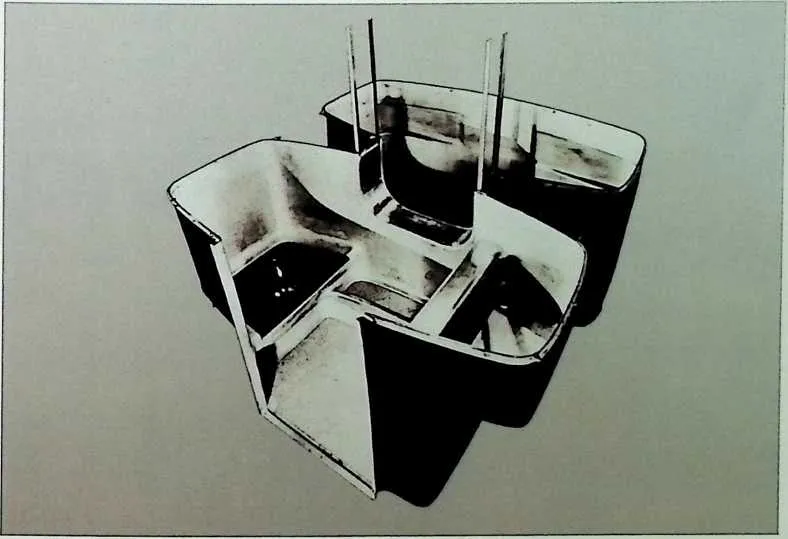
and mass customization (see plates 5 and 15)  Change: add refs
.
Change: add refs
.
11 Fuller’s society of the future was characterized by a fluidity of communication that
allowed individuals to live pretty much everywhere on the surface of the earth, including
the two poles. Why should one have a New York Stock Exchange when one could
imagine a ‘‘mechanical stock exchange’’ functioning at the scale of the entire planet?
5
Why have
localized schools and universities when one could teach children, young men, and women at home, using radio
broadcasting?6
Material production itself could be decentralized along the main transportation infrastructures, roads and
railways, according to the pattern imagined by Fuller for the production and temporary storage of his
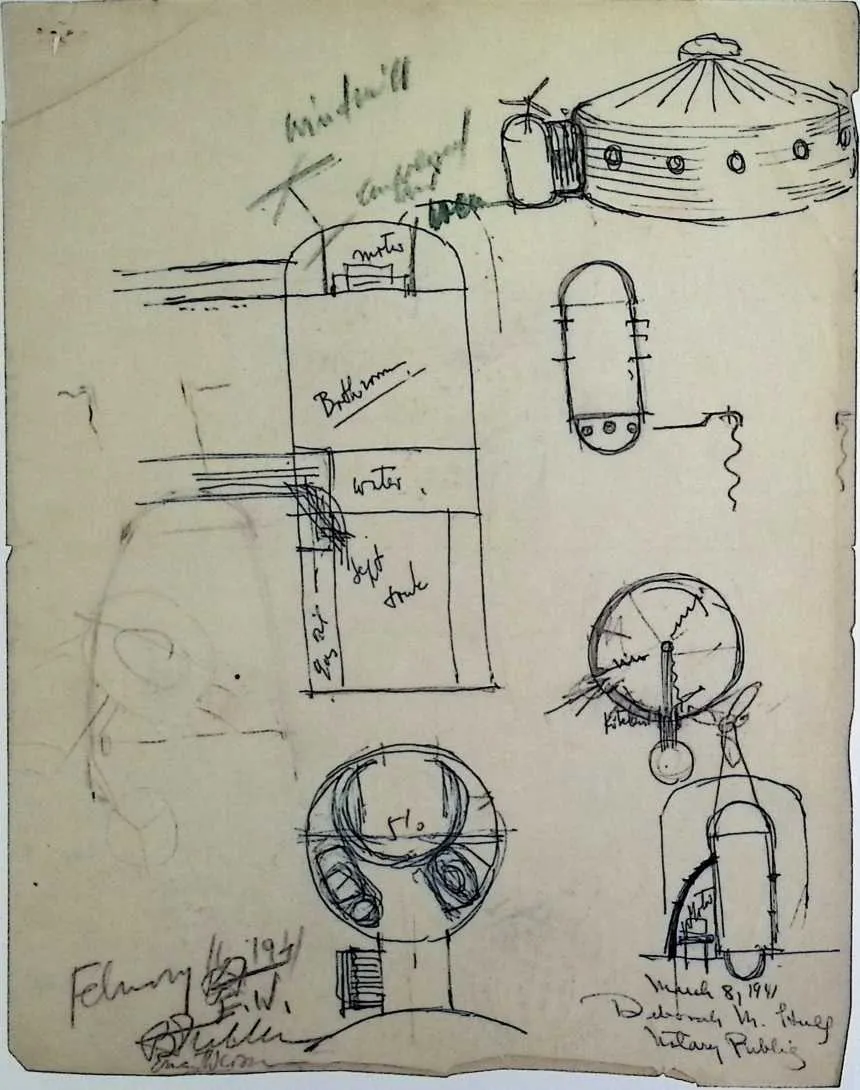
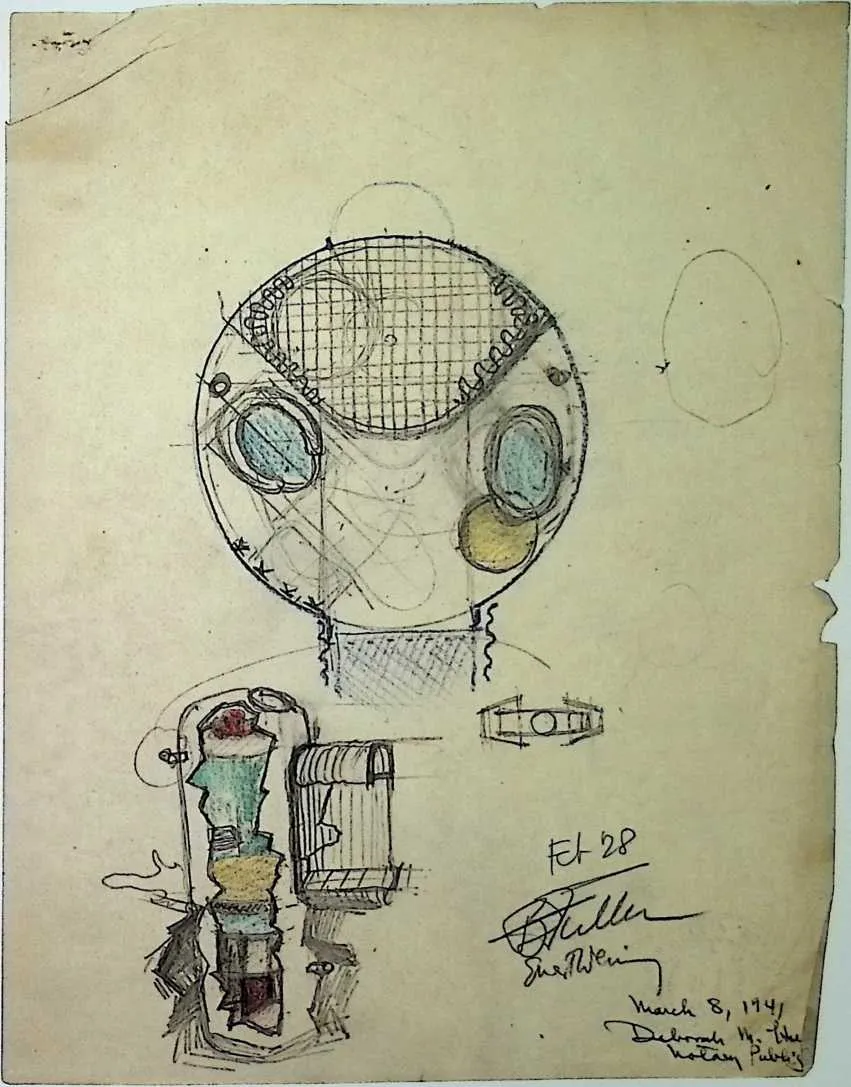
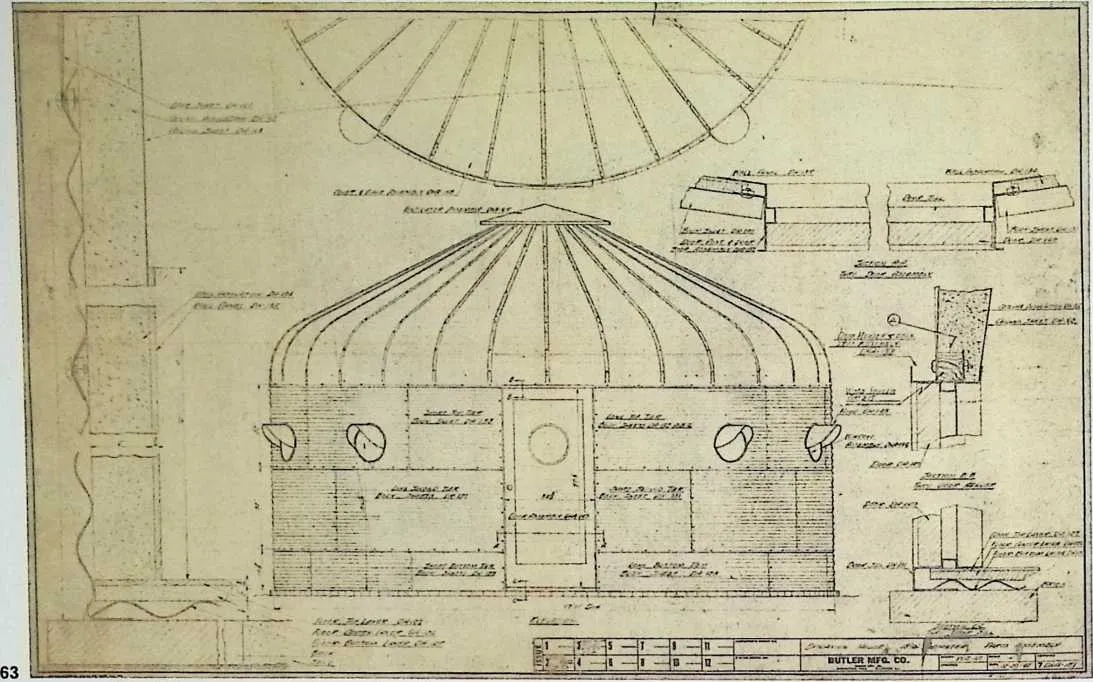
Dymaxion Houses.7
Never was Fuller as prescient as when he announced the possibility that mass media
could satisfy individual preferences, foreshadowing the principle of generalized
customization Nicholas Negroponte proclaimed in his influential best seller Being
Digital.8
This fluidity found its implicit counterpart in the creation of global organizations, like the ones
that would replace the existing stock exchange and the various schools and universities. The
Dymaxion universe was actually far more ambiguous in that respect than its creator officially
acknowledged, an ambiguity that was to form the germ of the enduring tension between
individualistic and technocratic leanings typical of Fuller’s later proposals. In that respect too,
the author of 4D Time Lock Change: add to biblio and Nine Chains to
the Moon
Change: add to biblio and Nine Chains to
the Moon Change: add to biblio announced the fundamental
ambivalence of our society of information and communication, with its constant oscillation
between the desire for individual freedom and the simultaneous need for coordination and
control.
Change: add to biblio announced the fundamental
ambivalence of our society of information and communication, with its constant oscillation
between the desire for individual freedom and the simultaneous need for coordination and
control.
16 Fuller was not the only one to set out on this path. Where he was perhaps especially farsighted was in his understanding of the fundamentally strategic ability required to cope with massive flows of information. While one could survive as a tactician in the traditional industrial society, a new world of highly strategic choices was gradually unfolding, in step with the proliferation of data and the explosive growth of telecommunication. This world was in dire need of visualization techniques to make choices easier. From his Dymaxion Air-Ocean World Map to his postwar Geoscope and World Game, a number of Fuller’s inventions are related to our need, in an information-based society, to distinguish patterns and trends where we previously saw only forms and backgrounds.
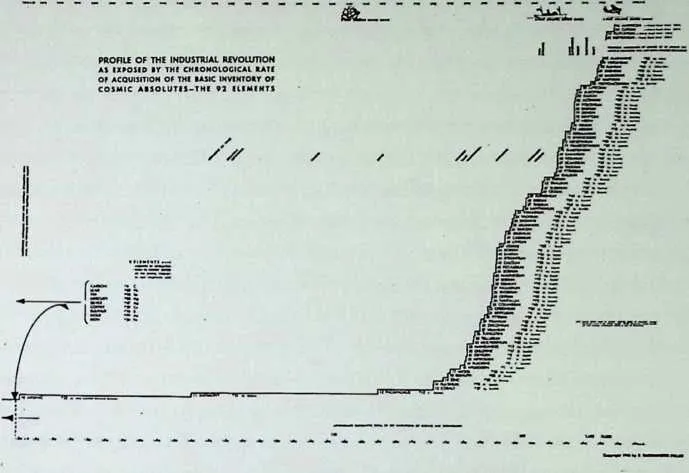
17 As a technical adviser to the magazine Fortune from 1938 to 1940, Fuller could already present himself as having a special talent for seeing patterns and trends. Indeed, some of the charts he produced for the magazine, like Dynamics of Progress, Comparison of U.S. Economy with the Rest of the World, or Profile of the Industrial Revolution were quite remarkable (figs. 1 and 2). The experience of World War II reinforced this talent through episodes like his working, alongside filmmakers,
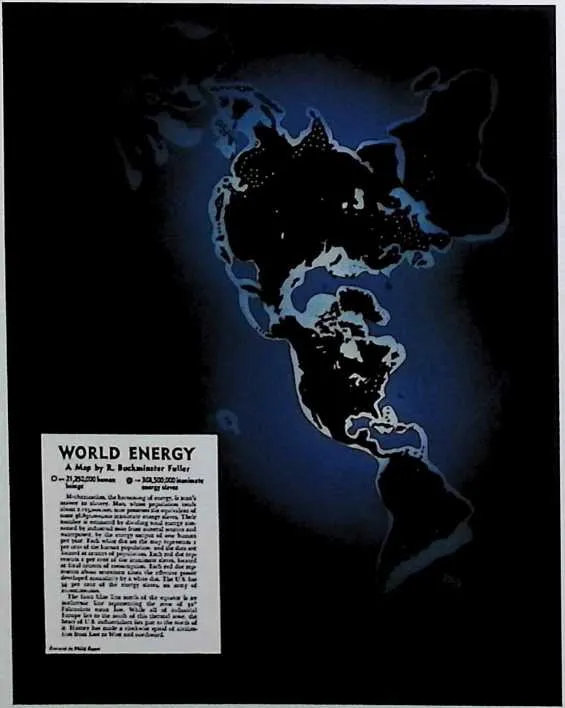
19 World Energy Map, as published in 1 fortune, February 1940
20 Profile of the Industrial Revolution as Exposed by the Chronological Rate of Acquisition of Basic Inventory of Cosmic Absolutes—the 92 Elements, 1946
21 Sketch illustrating an early conception of the Geoscope, 1948
23 designers, and architects like John Ford, Raymond Loewy, and Louis Kahn, for the Office of Strategic
Services, offering synthetic visual presentation of key data for the president of the United States and
his advisers.9
The Geoscope, as an attempt to present a global image of the planet using a geodesic sphere,
was a direct inheritor of this project (fig. 3) Change: add ref
.
Postwar, Buckminster Fuller was even more clearly in tune with the development of a new
society giving precedence to information, communication, and networks. His discourse was
influenced by the rhetoric of cybernetics, with its emphasis on trajectory steering. Operations
research and game theory also left their marks, though their influence was limited by Fuller’s
fundamental interest in geometry rather than calculus (fig. 4)
Change: add ref
.
Postwar, Buckminster Fuller was even more clearly in tune with the development of a new
society giving precedence to information, communication, and networks. His discourse was
influenced by the rhetoric of cybernetics, with its emphasis on trajectory steering. Operations
research and game theory also left their marks, though their influence was limited by Fuller’s
fundamental interest in geometry rather than calculus (fig. 4) Change: add
ref . The ideal of mechanization that had characterized the Dymaxion period was now
complemented by the perspective of computerization. For Fuller, the computer represented the
ability to pass seamlessly from the collection of data to their dynamic visualization. Initiated as a
series of seminars using paper and pencil, like the 1969 session at the New York Studio
School, the World Game was meant to transform itself eventually into a giant computer
simulation.10
In direct relation to this perspective, the notion of scenario became crucial in the thinking of its
inventor. The World Game revolved around the construction of scenarios about the future of the
planet—that is to say, trajectories linking series of possible events. There again, Fuller was in
profound accordance with the rising importance given to events in the culture of information and
communication. With their bits of data that are nothing more than elementary occurrences,
information and electronic communication are fundamentally commensurable with
events, in other words with ‘‘what happens’’ or what may happen, to paraphrase Paul
Virilio.11
Change: add
ref . The ideal of mechanization that had characterized the Dymaxion period was now
complemented by the perspective of computerization. For Fuller, the computer represented the
ability to pass seamlessly from the collection of data to their dynamic visualization. Initiated as a
series of seminars using paper and pencil, like the 1969 session at the New York Studio
School, the World Game was meant to transform itself eventually into a giant computer
simulation.10
In direct relation to this perspective, the notion of scenario became crucial in the thinking of its
inventor. The World Game revolved around the construction of scenarios about the future of the
planet—that is to say, trajectories linking series of possible events. There again, Fuller was in
profound accordance with the rising importance given to events in the culture of information and
communication. With their bits of data that are nothing more than elementary occurrences,
information and electronic communication are fundamentally commensurable with
events, in other words with ‘‘what happens’’ or what may happen, to paraphrase Paul
Virilio.11
27
Fuller’s optimistic scenarios were all based on the alliance between his enduring fascination with
military-style planning and a new concern for the environment. Although probably the most
emblematic representative of this collusion between these seemingly discordant preoccupations,
Fuller was by no means the only one to navigate between them; he was joined by a
whole range of figures of the time. Based on the hypothesis of ‘‘closed worlds’’ the
behavior of which could be predicted, the new tools of the period, like cybernetics,
system theory, linear programming, and computer modeling, emphasized the finitude of
resources and the need for their careful allocation—whether they were Cold War weaponry
or natural resources. It is no coincidence that an engineer like Jay Forrester could
translate the computer techniques he had elaborated for the U.S. Air Defense, for the
Semi-Automatic Ground Environment (SAGE) system in particular, into the simulated world
dynamics used by the Club of Rome to explore the limits of economic growth in the
1970s. Fuller’s ‘‘Spaceship Earth’’ was a particular instance of the ‘‘closed world’’
perspective that triumphed both at the Pentagon and in environmentally conscious
circles.12
This perspective was of course inseparable from the development of communication networks.
Building on some of his prewar intuitions, Fuller now announced the transformation of education into
an industry using ‘‘an educational machine technology that will provide tools such as the individually
selected and articulated two-way TV and an intercontinentally networked, documentaries call-up
system.’’13
Interactivity, with the ‘‘two-way TV,’’ and individual customization would be the fundamental
characteristics of the global networked society of the future.
One should not, however, hold up Buckminster Fuller as an advocate of the new culture of
information and communication who was totally aware of all its implications. The idea of
hybridization between man and technology, for instance—in other words, the question of the
cyborg that was emerging at the time, from cybernetic reflections on the analogy between mind
and computer to practical attempts by the military at a more efficient coupling between man and
machine14—remained
foreign to him.
More generally, Fuller remained at heart a traditional humanist. Just like his friend
Constantinos Doxiadis, an architect and planner who was another postwar prophet
of communication and networks, his aim was not to immerse man completely in
the sphere of accelerated physical transfer, information processing, and instant
messaging, much less to equip him with steel and silicon organs, but rather to
re-create the conditions for a new equilibrium, for a regained serenity in a frenzied
world.15
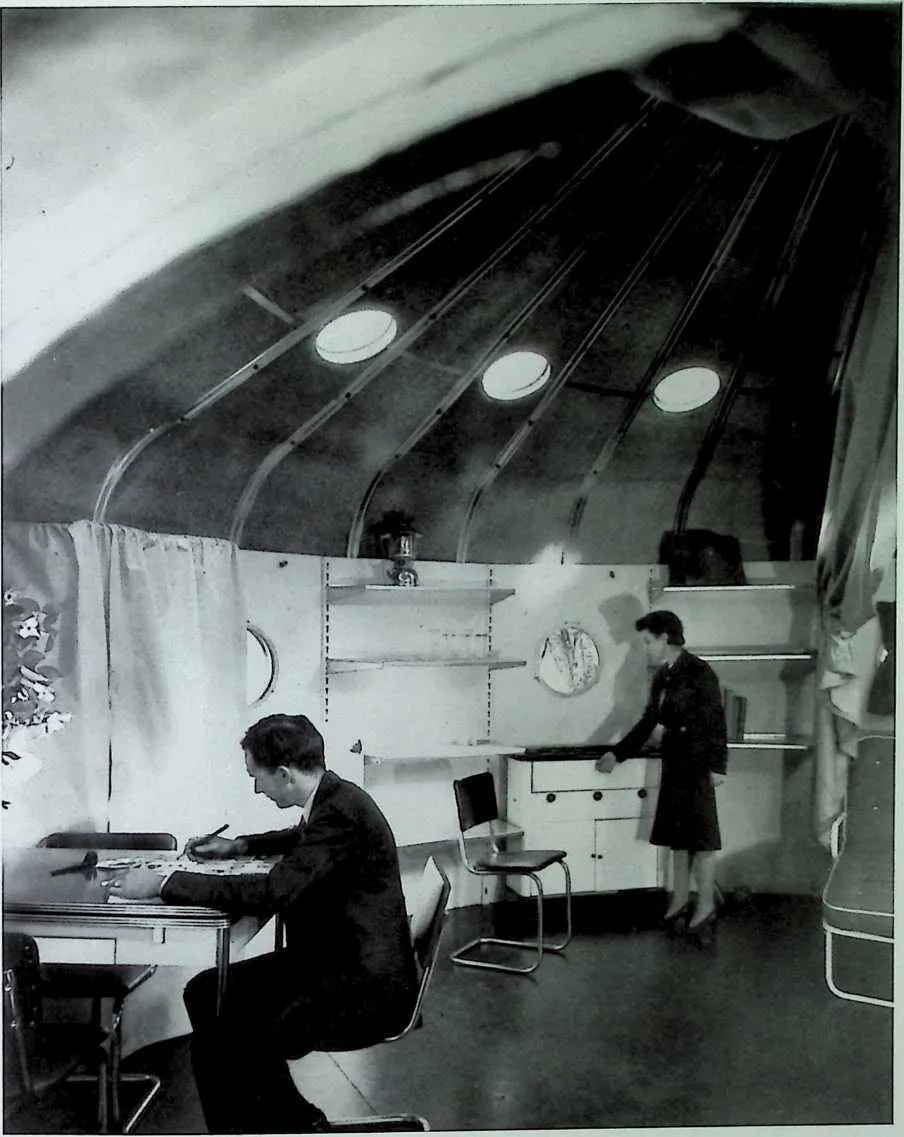
Nothing is more telling, in that respect, than the photographs showing Fuller in the geodesic
home he lived in from 1960 to 1971 in Carbondale, Illinois.
32
Despite its futuristic geometry, the home is quiet, meditative in ambience, almost like
a seventeenth-century Dutch interior (fig. 5) Change: add ref
.
Change: add ref
.
33 If Fuller was clearly a major representative of ±e fundamental shift occurring in these years from
the design of objects to the conception of artificial ambiences and environments, an evolution he
epitomized with his famous project of a giant dome covering a large part of Manhattan to
provide a semitropical climate inside (plate 145)  Change: add ref , he was
certainly not extreme to the point of imagining, like some younger representatives of radical
architecture, that man could be fundamentally altered in his essence through changes in his
surroundings.16
The type of relation he envisioned between man and the environment was much closer to the
Enlightenment quest for perfectibility: mankind’s defects were the result of unhealthy
conditions of life. As he had put it optimistically in 4D Time Lock,
Change: add ref , he was
certainly not extreme to the point of imagining, like some younger representatives of radical
architecture, that man could be fundamentally altered in his essence through changes in his
surroundings.16
The type of relation he envisioned between man and the environment was much closer to the
Enlightenment quest for perfectibility: mankind’s defects were the result of unhealthy
conditions of life. As he had put it optimistically in 4D Time Lock, Change: add biblio ‘‘Education and the proper upbringing of the young in modern,
truthful, healthful environment will quickly efface crime and both mental and physical
deformities.’’17
Prophets are not always as farsighted as their admirers would like them to be. Some of
Buckminster Fuller’s ideas are actually more conservative than the popular picture of the
relentless advocate of rationalization and progress seems to imply. After all, through his
great-aunt Margaret Fuller, he remained indebted all his life to the nineteenth-century
transcendentalist legacy. But it is not only ideas that make prophets. In the case of Fuller, a
series of very concrete patterns of behavior reinforce his emblematic status. It is as
much by these patterns as by his ideas that he announces the rise of information and
communication.
Change: add biblio ‘‘Education and the proper upbringing of the young in modern,
truthful, healthful environment will quickly efface crime and both mental and physical
deformities.’’17
Prophets are not always as farsighted as their admirers would like them to be. Some of
Buckminster Fuller’s ideas are actually more conservative than the popular picture of the
relentless advocate of rationalization and progress seems to imply. After all, through his
great-aunt Margaret Fuller, he remained indebted all his life to the nineteenth-century
transcendentalist legacy. But it is not only ideas that make prophets. In the case of Fuller, a
series of very concrete patterns of behavior reinforce his emblematic status. It is as
much by these patterns as by his ideas that he announces the rise of information and
communication.
36 I
have already mentioned Fuller’s passion for data gathering, a passion he expressed through his
systematic paper clipping. The Chronofile, especially in its first decades, is replete with
clippings from all kinds of newspapers and journals (pages 212--13). This clipping
was definitely linked to a new attitude to data, to the ability to extract, package,
and process it, a perspective announcing its transformation into what we today call
information.18
Even more telling were the various strategies Fuller used to disseminate his ideas.
Some of these strategies were of a technical nature, like his use of the mimeograph, a
cheap mode of reproduction, to put his early writings in circulation. Others were of
a more social nature, like the experimental seminar organized in July 1929 to
elaborate 4D Time Lock. Traditional writing was to be replaced by recording and
editing a series of exchanges between Fuller and a group of expert architects and
engineers.19
More generally, throughout his career, Buckminster Fuller relied heavily on processes
involving state-of-the-art reproduction and communication technologies as well as a
heavy dose of social networking. It is no accident that he was immediately seduced
by Doxiadis’s Ekistics initiative, with its intricate blend of information gathering,
publications, and social events like the Delos meetings organized from 1963 on (fig.
6).20
Like Doxiadis, postwar Fuller acquired and maintained his worldwide celebrity through his skilled
use of media and social network.
 A Paradoxical Utopian
40
The cunning manipulation of media and people might seem at first fundamentally at
odds with the alleged disinterestedness of utopia. But the opposition does not stand
up to closer investigation, for utopia in the industrial age is not only about the
evocation of a brave new world painted with the vivid colors of a dream. No longer a
mere literary genre as it had been from the Renaissance to the eighteenth century,
after the model of Thomas More’s seminal fiction, it aims to transform concretely the
world.21
Because of that ambition, utopia is closely allied with the communication techniques
that can make the dream persuasive enough to generate political and social
effects.22 In
other words, modem and contemporary utopia is intimately linked to media manipulation and social
networking. Early-nineteenth-century Utopians like the French Saint-Simonians were already experts at
these practices.23
A similar degree of expertise was to characterize many subsequent enterprises. Fuller the
utopian is actually inseparable from Fuller the master of communication and public
relations.
Now, the exact nature of Fuller’s utopian vision is not easy to pin down. It seems to present
contradictory features indeed. First and foremost, the emphasis is on a more and more immaterial
society. Fuller’s key principle of ephemeralization, which he defined as the trend toward doing
more with less, describes the progression ‘‘from material to abstract,’’ toward ‘‘intangibility,
non-sensoriality.’’24
Throughout, Fuller’s writings tend to undermine the importance of materiality in favor of
intellectual intuition and reasoning, the principles central to his later work Synergetics. Change: add biblio Nothing is more revealing in that respect than one of his
prospectuses for his 4D Houses, in which we find the following statement: ‘‘At the
high points of each era of the great progression, has it been realized that materials in
themselves signify nothing and can be nothing without the will and the creative urge,
and that character, happiness, love, harmony, and all the eternal qualities of truth
are abstract and of the soul, and have but the freer play for the lack of any material
impediment.’’25
Beside materials, objects themselves have only a relative value and should not be
fetishized. Ephemeralization implies a certain distance from objects, a distance often
based on the privilege given to services rather than to the physical possession of
things. As Fuller once noted, to own a telephone handset has no real importance;
what counts is to subscribe to a phone plan. By the same token, housing was to be
considered as a service rather than a product industry appealing to the instinct of home
ownership.26
Here again, one is tempted to relate Fuller’s stress on immateriality and service to his
understanding of the implications of the rise of information and communication. His advocacy of
immateriality is not without analogy to the kind of discourse we have heard since from theorists
of digital culture like Nicholas Negroponte or William Mitchell.
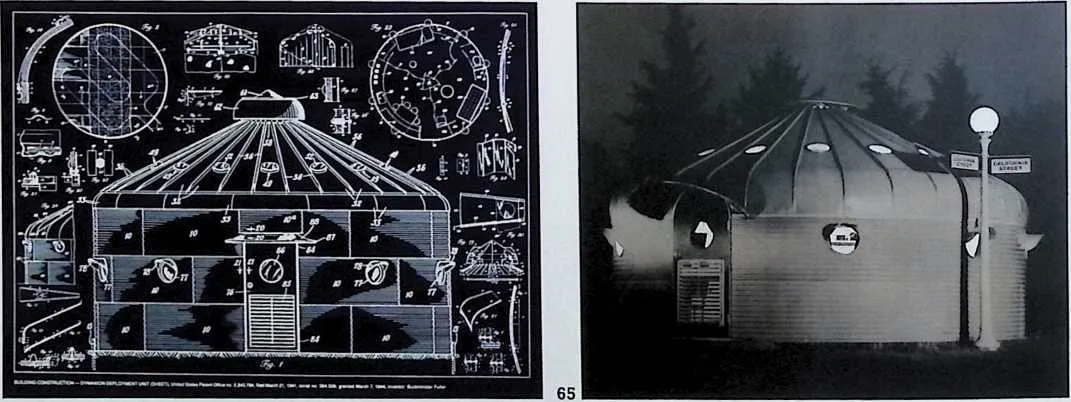
But at the same time, the legacy of Fuller is essentially composed of a series of fascinating objects,
like the Dymaxion house, car, and bathroom, the Wichita House, or his various geodesic domes.
Despite his appeal to what he characterized in turn as the abstract or the metaphysical, he insisted
on the practical, engineeringlike nature of his proposals: ‘‘I must always ‘reduce’ my inventions to
physically working models and must never talk about the inventions until physically proven—or
disproven.’’27
Many other contradictions can be pointed out in Fuller’s vision of the future. As I have already
noted, this future is marked by contradictory trends toward decentralization and centralization,
freedom and control.
Change: add biblio Nothing is more revealing in that respect than one of his
prospectuses for his 4D Houses, in which we find the following statement: ‘‘At the
high points of each era of the great progression, has it been realized that materials in
themselves signify nothing and can be nothing without the will and the creative urge,
and that character, happiness, love, harmony, and all the eternal qualities of truth
are abstract and of the soul, and have but the freer play for the lack of any material
impediment.’’25
Beside materials, objects themselves have only a relative value and should not be
fetishized. Ephemeralization implies a certain distance from objects, a distance often
based on the privilege given to services rather than to the physical possession of
things. As Fuller once noted, to own a telephone handset has no real importance;
what counts is to subscribe to a phone plan. By the same token, housing was to be
considered as a service rather than a product industry appealing to the instinct of home
ownership.26
Here again, one is tempted to relate Fuller’s stress on immateriality and service to his
understanding of the implications of the rise of information and communication. His advocacy of
immateriality is not without analogy to the kind of discourse we have heard since from theorists
of digital culture like Nicholas Negroponte or William Mitchell.
But at the same time, the legacy of Fuller is essentially composed of a series of fascinating objects,
like the Dymaxion house, car, and bathroom, the Wichita House, or his various geodesic domes.
Despite his appeal to what he characterized in turn as the abstract or the metaphysical, he insisted
on the practical, engineeringlike nature of his proposals: ‘‘I must always ‘reduce’ my inventions to
physically working models and must never talk about the inventions until physically proven—or
disproven.’’27
Many other contradictions can be pointed out in Fuller’s vision of the future. As I have already
noted, this future is marked by contradictory trends toward decentralization and centralization,
freedom and control.
49 ‘‘We are convinced that, with the progress of life, the living abodes of humans will become more and more decentralized, and industry more and more centralized and mechanicalized,’’ he wrote in one of his early prospectuses.28 The radical nature of the decentralization of life he had in mind prevents us from interpreting this statement as a simple endorsement of the American suburban model. Another striking discrepancy lies in the spectacular contrast between Fuller’s quest for structural lightness and the gigantism of many of his postwar proposals. This gigantism was to reach its climax with tensegrity megastructures like Cloud Nine and Tetra City (plates 144 and 147), which would have dwarfed Manhattan skyscrapers. Some of his realizations were already of respectable size. As Fuller showed using a postcard from Sevihe, the cathedral of the Spanish city, by no means a small building, could fit entirely inside his geodesic dome at the Montreal Expo 67 (fig. 7).
51 All these apparent contradictions are actually related to a fundamental tension that runs throughout Fuller’s life and work, between the immaterial, light, and mobile on the one hand, the physical, heavy-duty, and large-scale on the other. Now I described these contradictions as apparent, for Fuller’s ultimate utopia revolves precisely around the way to solve the antinomy between these two series of terms.
52 His flirting with the megastructural movement may actually provide some insight into what he really aimed at, for his gigantic structures were supposed to be light to the point of being able to float in the air because of their use of the tensegrity principle. In that respect, Fuller was not far from the structural intuitions of someone like Le Ricolais, who believed that less could sometimes be attained through
53 -THS KEYS AW? REftLESEtSTVUe, BOOM-SHAPCS
54 A WOBo TYPeb WITH -ntESE KEYS SfoWS A STWNA <T= POQM5
55 You Fuve. Tt> WATT 6 W1N=, A SF6C4A<- HtveoAPO
56 ujhose posracD&
CAN BE toTAT®
TH A StBAL *EX
59 A TEXT' IS A SUITE of WORDS': Your, floor. plan Akr> TUat °F YOU) Nfel<\H%oupi
60 THS GNb RefBESexrt tRe
61 iMFhAiTajOVRE Ko which, the rats ARE FiTtej>
62 OBVIOUSLY yt>DR_rUCT H4S. to £e DETAILEJ' EtePi
63 HXhJboluS
64 BGyjteAETt-CS CBA7M. RiTmeM.uK. etc)

66 AJJb YOU -MlE Tb teqCE FIMAU MUENTAHCAI RoWINC THE ?AN
67 THE ‘‘TEXT’’ OS) BE, OF SEVERALPACJes.*.- EACH -pxqe IS 7R£ YIAr» W A JXFFEHEW Floor- i.
68 A '-rexr29 Type, k/ Maw? PEOPLE Ropuses THE P(aM °F a uei4Htofl Hfflb A Ci-ry
70 ts a coLLecTtve 1©CV

72 -TYPa’ e>y ihpsc 'uto u/Airr to U\£ me
73 is mot -rue taUftEtfc CITY WAiJ Eur PATHeft A |*9HN<; LF5T‘‘:
74 ~ttie first srep
TtWAMs tUVlbK
ybuft tewh Be
As you Line
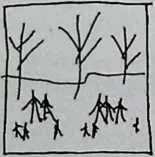
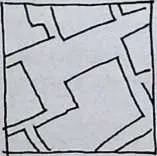
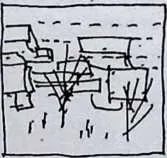
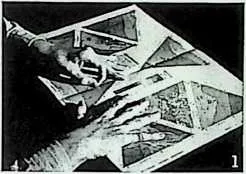
75 more, through a massive mobilization of means.30 Ephemeralization, that is, more with less, could paradoxically lead to less through more. Despite its technocratic connotations, the postwar megastructural movement was linked to the project of using technology to free humanity from the mechanical enslavement of the industrial era. In the megastructures to come, men would wander freely, enjoying their rediscovery of natural sensations such as those provided by light and wind. In that respect, megastructures were comparable to giant liners, enabling their passengers to take full advantage of a direct contact with the elements.
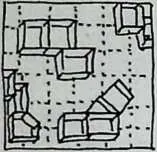
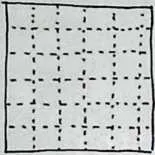
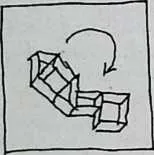
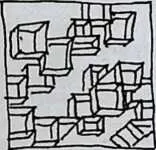
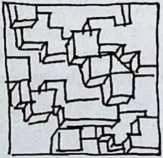
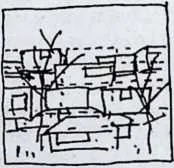
77 The analogy with the liner was not lost on Fuller, who had been a sailor in his youth and was convinced of the maritime origins of modernity though the emblematic figure of the ‘‘pirate.’’31 Before ephemeralization, streamlining had been one of his key concepts, a concept definitely owing something to ship design. Megastructures, just like ships, proposed redemption from the misuse of technology through advanced technology. This redemption went hand in hand with a curious primitivism. What megastructures were ultimately about was the direct experience of a long-forgotten contact with nature. Fuller the utopian is of course not reducible to Fuller the designer of megastructural projects, but the latter is once again revealing. In the past decade, the meaning of megastructures has been revisited in the light provided by their contemporaneousness with the rise of information and communication. Among other things, it has become more and more evident that in the eyes of their most lucid advocates, megastructures were not really objects, but principles of connection and growth.32 Put another way, they had more to do with software than hardware, a property that was to lead to proposals like Yona Friedman’s ‘‘Flatwriter,’’ a computerized system of spatial allocation within the urban megastructures of the future (fig. 8).33 Another alternative explored by the Italian radical group Superstudio was the ultimate replacement of megastructures by equipped surfaces, giant grids on which a nomadic humanity could roam while enjoying all the benefits of advanced technology.34 Fuller is certainly not foreign to this kind of perspective. More generally, megastructures are emblematic of the real status of objects in the ‘‘revolution in design’’ he had in mind, namely the concretization of an attitude toward life, the trace of steps taken in the right direction. Neither the Cloud Nine and Triton City structures nor his tetrahedral city project nor his Old Man River town concept in Saint Louis are to be confused with the ideal cities of the past. They are not meant to prescribe a univocal social organization and style of life; they represent, rather, moments in the development of an endless game with the possibilities of the future. In other words, they mark a trajectory.
82 We are in the midst of a renewed interest in trajectory steering and scenario- oriented management techniques. Along with the desire to understand our immediate past, this might account for the fascination that the cybernetic era exerts on so many young theorists and historians today.35 The reinterpretation of Fuller the utopian is inseparable from that context. Its interest lies also in its resonance with one of the most nagging questions of our time: How can we reconcile the emphasis put on the individual dimension and the possibility of a common principle of hope? After all, Fuller himself liked to present his trajectory as the incarnation of such reconciliation. Of course, we no longer believe that the universe obeys at a fundamental level the laws of synergetic geometry. We no longer take at face value Fuller’s claims to possess the true solution to all the problems plaguing the earth. But there is a definite appeal in his proposal that we consider the future of the world as a game that can be won against all odds. More than the prophet, even more than the digital or the utopian proper, the player might ultimately be the most attractive avatar of Buckminster Fuller today.
84 Notes
- 1.
- Cf. Felicity D. Scott, Architecture or TechnoUtopia: Politics after Modernism (Cambridge, Mass.: MIT Press, 2007), 157--67.
- 2.
- See, for instance, R. Buckminster Fuller and Kiyoshi Kuromiya, Critical Path (New York: St. Martin’s Press, 1981), 124.
- 3.
- This expression is already present in Fuller’s first book, 4D Time Lock (Chicago: privately printed, 1928; Albuquerque, N.Mex.: Lama Foundation, 1972), 13.
- 4.
- R. Buckminster Fuller, Operating Manual for Spaceship Earth (Carbondale: Southern Illinois University Press, 1969).
- 5.
- R. Buckminster Fuller, Nine Chains to the Moon (Philadelphia: J. B. Lippincott, 1938; Garden City, N.Y.: Anchor, 1971), 230.
- 6.
- Fuller, 4D Time Lock, 5.
85 1. See Fuller’s notes for 4D Time Lock, M1090, ser.
- 8.
- box 2, R. Buckminster Fuller Papers, Department of Special Collections, Stanford University Libraries.
- 8.
- Nicholas Negroponte, Being Digital (New York, 1995; reprint, New York: Vintage, 1996), 163--71.
- 9.
-
86
87See Barry Katz, ‘‘The Arts of Wan 'Visual Presentation’ and National Intelligence,’’ Design Issues 12, no.
88892 (Summer 1996): 3--21; and above all Mark Wigley, ‘‘Planetary Homeboy,’’, ANY 17 (1997): 16--23.
- 10.
-
90
91Cf16--23 various documents on the World Game kept in M1090, ser. 18, Projects Files, boxes 24--25, Fuller Papers.
- 11.
-
92
93On the relation between information and event, see Pierre Levy, La Machine univers: Creation, cognition et culture informatique (Paris: La D couverte, 1987), 124 in particular. Paul Virilio, Ce qui arrive [What happens] (Paris: Fondation Cartier pour 1’Art Contemporain, Actes Sud, 2002).
- 12.
- Cf. Paul Edwards, The Closed World: Computers and the Politics of Discourse in Cold War America (Cambridge, Mass.: MIT Press, 1996); Agatha C. Hughes and Thomas P. Hughes, eds., Systems, Experts, and Computers: The Systems Approach in Management and Engineering, World War II and After (Cambridge, Mass.: MIT Press, 2000).
- 13.
- R. Buckminster Fuller, Education Automation: Freeing the Scholar to Return to His Studies (Carbondale: Southern Illinois University Press, 1962), 48.
- 14.
- Cf. Les Levidow and Kevin Robins, eds., Cyborg Worlds: The Military Information Society (London: Free Association, 1989).
- 15.
- On that point, our interpretation of Doxiadis is slightly different from the perspective adopted by Mark Wigley in ‘‘Network Fever,’’ in Grey Room, no. 4 (Summer 2001): 82--122. On Doxiadis see also Alexandros-Andreas Kyrtsis, ed., Constantinos A. Doxiadis: Texts, Design Drawings, Settlements (Athens: Ikaros, 2006).
- 16.
-
94
95Cf. Dominique Rouillard, Superarchitecture: Le Futur de architecture, 1950--1970 (Paris: Editions de La Villette, 2004).
- 17.
-
96
97Fuller, 4D Time Lock, 6.
- 18.
-
98
99See on that theme the articles gathered under the title ‘‘Cut and Paste um 1900,’’ in Kaleidoskopien, no. 4 (2002).
- 19.
- ‘‘Meeting Tuesday, July 9, 1929 Architectural
League, New York. Verbatim report by: National Stenotype,’’ Dymaxion Chronofile, vol. 36, 1929, M1090, ser. 2, box 21, Fuller Papers. - 20.
- For a detailed account of the Delos meetings, see the journal Ekistics. From 1975 to 1977, Fuller was president of the World Society for Ekistics. On Ekistics as a discipline, defined by Doxiadis as the science of human settlements, see Panayiota Pyla, ‘‘Ekistics, Architecture and Environmental Politics, 1945--1976: A Prehistory of Sustainable Development’’ (Ph.D. diss., MIT, 2002).
- 21.
- Michdle Riot-Sarcey, Thomas Bouchet, and Antoine Picon, eds., Dictionnaire des Utopies (Paris: Larousse, 2002).
- 22.
- On the relations between utopia and communication, see Armand Mattelart, The Invention of Communication (Paris: La Decouverte, 1994; English ed., Minneapolis: University of Minnesota Press, 1996).
- 23.
- Cf. Antoine Picon, Les Saint-Simoniens: Raison, imaginaire et utopie (Paris: Belin, 2002).
- 24.
- Fuller, Nine Chains to the Moon, 256. One of the best analyses of the concept of ephemeralization can be found in Martin Pawley, Buckminster Fuller (London: Trefoil, 1990).
- 25.
- ‘‘4D Housing & The Time Dimension,’’ Dymaxion Chronofile, vol. 36, 1929, M1090, ser. 2, box 21, Fuller Papers.
- 26.
- Pawley, Buckminster Fuller, 24.
- 27.
- Fuller and Kuromiya, Critical Path, 125.
- 28.
- ‘‘Cosmopolitan Home Corporation Lightful products,’’ manuscript, M1090, ser. 8, box 2, Fuller Papers.
- 29.
- On Le Ricolais’s paradoxical statement that less can be achieved through more, see Peter McCleary, Robert Le Ricolais: Visions and Paradoxes (Madrid: COAM, 1997).
- 30.
- The figure appears in almost all his accounts of world history. See, for instance, his Operating Manual for Spaceship Earth.
- 31.
- This dimension of the megastructure was already present in Alison and Peter Smithson’s projects like their celebrated Golden Lane. Cf. Rouillard, Superarchitecture.
- 32.
- Sabine Lebesque, Yona Friedman: Structures Serving the Unpredictable (Rotterdam: NAI, 1999), 50--51.
- 33.
- Peter Lang, Superstudio: Life without Objects (Milan: Skira, 2003).
- 34.
- To mention only a few: Branden Hookway, Pandemonium: The Rise of Predatory Locales in the Postwar World (New York: Princeton Architectural Press, 1999); Reinhold Martin, The Organizational Complex: Architecture, Media, and Corporate Space (Cambridge, Mass.: MIT Press, 2003); Michael Kubo, ‘‘Constructing the Cold War Environment: The Architecture of the Rand Corporation, 1950--2005’’ (master’s thesis, Harvard University, 2006).