
9 How They Brought the Good News From Carbondale to Third Avenue
2FOURTEEN YEARS BEFORE Synergetics was published, Fuller had sold the rights to the Macmillan Publishing Company for an indecorous advance of $2,500. The book was ‘‘to contain approximately 70,000 words…based on recent lectures.’’ It was a perfectly good contract reflecting what was then fairly considered the best interests of both parties. But by the time the agreement was 10 years old, Fuller’s circumstances had changed markedly. His other books had earned an enthusiastic following and he was becoming more widely recognized as something of a world figure.
3 Fuller’s office actually maintains a quantified record of his increasing recognition and public activities, compiling annual totals of the accelerating upward curve of articles by and about him, degrees awarded, newspaper articles, audiences lectured, television talk shows, radio interviews, thousands of miles traveled, and so forth. There seems to be no limit to the extent such matters can be measured: three pages in Britannica III, the longest entry in Who’s Who.
45RBF: This is not on ego matter…Just my record as a guinea pig. Just as a navigator has to ‘‘take sights,’’ and ‘‘work his position,’’ and ‘‘keep log books.’’ There is no ego involved. It’s just a matter of attempting to set in order the facts of experience.
6His lecture schedules and architectural commissions left him less time than ever for writing. There appeared to be no way he could afford the time to finish a book of the dense immensity of Synergetics.
7 Fuller eschews agents, in both strict practice and broad principle. He turns down all overtures from lecture bureaus. ‘‘I do not promote,’’ he says. ‘‘I have a basic discipline: Never ask anyone to listen. Speak only when you are asked to speak. When that occurs give them your best.’’1 You don’t need an agent for that kind of strategy. Like his lectures, his book productions had a correspondingly impromptu character: eight books involving eleven different publishers—an aggregate of ad-hocnesses. So much for agents, but when it comes to doctors and lawyers he has respect for profession. Since the 1930s, he has had highly talented patent lawyers; one of them, Donald W. Robertson, wrote a book about being Fuller’s patent attorney.2 An old-line Federal Street law firm in Boston handles his dome royalties. By 1969, when I had made my first visit to Carbondale, it seemed the time had come to seek out competent legal counsel on literary property matters. Bucky authorized me to explore this unfamiliar field and make recommendations to him. And so we found in Gerald Dickler of New York City an accomplished authority in the field with the temperament and tolerance to accommodate the unpredictable interests of an idiosyncratic client. Dickler consolidated Fuller’s various titles in print with a variety of university presses and technical houses in one wholesale contract with Doubleday-Anchor. In renegotiating the Synergetics contract, Dickler was able to identify and serve the interests of publisher and author better than either could have done by themselves. On Macmillan’s side of the picture there was a perfectly valid contract, but no reasonable prospect of fulfilling it unless time could be bought so that Fuller could do the writing at the expense of time otherwise devoted to revenue-producing assignments like lecturing and architectural commissions. It was frustrating for Macmillan to have waited so many years on an author unwilling or unable to release the manuscript. A succession of new editors at Macmillan had left the author with a waning sense of commitment; we wanted to refund the advance and buy up the contract to gain the freedom to start afresh with a new publisher. Bill Whitehead was then our editor at Doubleday-Anchor; he had a sympathetic grasp of Fuller’s philosophy, and we wanted to show the manuscript to him. These were our instructions to Dickler, but he advised against such a course, both on legal grounds and for marketing prospects: he felt that Macmillan was the right house, one of the few that could give Synergetics the in-house production care, promotion, and distribution, to successfully launch such an unconventional work as a trade book.
10 By early 1972, Fuller and I had completed the first third of the new manuscript for the projected work. Prior to submitting this increment to Macmillan, Dickler proposed a new contract to replace that of 1961. The operative effect of his proposal was that it would cost Macmillan$25,000—as a minimum commitment—to see this first third of the manuscript. (This was a little like making them pay to see their own hole card, but they were realistic in recognizing that no book would be forthcoming on the basis of the original advance.) Dickler’s new contract proposed a schedule of a $25,000 advance installment with each successive third, for a total advance of $75,000. But there was a rather unusual special provision in the proposed contract. If the publisher determined, after seeing the first third of the manuscript, ‘‘that the work does not indicate that it will recover an advance of $75,000…he may reduce the offer.’’ But any reduction by the publisher below the full amount would release the author to ‘‘submit the project elsewhere.’’
11 For Macmillan, it was like a blind auction. For the author, the ingenuity of the proposal was the assurance that Macmillan would remain committed to publishing the work—at a hypothetical lower advance—if the author was unable to better the offer with another publisher. As it turned out, Macmillan committed the first $25,000 to see the first third of the manuscript. At the end of the 60-day period for its inspection, they decided to commit the full $75,000 to the book and thus foreclose any possibility of losing it to another publisher. Dickler had foreseen, correctly, that this substantial advance would be sufficient compensation for our disappointment in not taking the book to Bill Whitehead.
12 This greatly increased advance was also an essential element in reactivating the author, while Macmillan was protected from the very real prospect of losing to another publisher a work for which they had waited so long. The new contract proved to be the crucial instrument in bringing the work to completion. The payment of the advance in three installments as each third of the manuscript was completed nicely achieved its calculated effect. In fact, the final third was submitted nine months ahead of the contract deadline. (When we had wrapped up that last installment I brought it up to Manhattan in an old shirt box, delivered it to Macmillan, and headed for Gowanus Basin in Brooklyn where I boarded the Polish freighter Zambrow for an eleven-day passage to Hamburg. I had plenty of time to read the Idylls of the King, as only the captain spoke English.)
13 But there were to be many pitfalls ahead, and the need for Dickler’s guiding hand was by no means ended with the signing of the contract or the submission of the manuscript.
14 There had been resistance at Macmillan to the idea of associating Dr. Loeb with the book. They had no misgivings about Loeb, but they wanted no name other than Fuller’s. Loeb had considerable proprietary material tied up in his contribution, material that he could easily have incorporated in books of his own that were in progress. The real possibility that further delays might give Loeb every excuse to withdraw was a critical factor prompting Fuller to concentrate on meeting the contractual deadlines. Here again, Dickler was instrumental in working out a solution equitable to both Loeb and Macmillan and consonant with Fuller’s promises to Loeb.
15 When the final manuscript was submitted to Macmillan in March 1974 Synergetics, quickly found its first audience at the shirt-sleeve copy-editor level. We were fortunate in being assigned Ken Shaw as copy editor and Maurice Schneps as typographical and layout designer. Shaw’s first love was music but he was broadly knowledgeable in other fields and—though skeptical of its pretensions—sympathetic to the book’s strategy of embracing such a variety of disciplines. He was diligent in enforcing consistency in my rather complex system of numbering each section of the text and resourceful in integrating the text with the illustrations. Copy editors are incurable perfectionists: we had submitted a plate from the voyage of H.M.S. Challenger (at Fig. 203.09), but the quality was not good enough for Ken, so he went down to the New York Public Library and brought back a cleaner impression. He was a stickler for grammatical conventions; time and again he would discover paragraph-long sentences that I had launched without a functioning predicate—maybe a handful of gerunds, but no predicate. Another stumbling block was Fuller’s peculiar capitalization, and on this score I had to fight hard to prevent Shaw from revoking Bucky’s poetic license. The high quality of the final text also owes much to Macmillan’s fiercely independent chief of copy editing, Miriam Hurewitz.3 Maurice Schneps designed the book with a discerning eye to Fuller’s philosophic and artistic intentions. He frequently was called upon to improvise compensations for all the widely varying styles, sizes, qualities, and sources of the illustrative materials. When the book finally went to press at the Vail Ballou Press in Binghamton, N.Y., Maurice virtually went to bed with it; he personally checked the press sheets for registration, printing quality, last-minute corrections, and other production refinements. Both Maurice and Ken were long-suffering with our enormous changes at the last minute; their talents greatly enhanced the final result, and throughout that long winter they were the only ones to give us a feeling that someone at Macmillan knew what the book was about.
17 Fuller was not involved in the first stage of production, the copy editing of the manuscript. He was also insulated from the later stages: the page proofs (where the corrected galleys are divided up into pages), the ‘‘repros’’ (the proofs that are photographed for the making of the offset plates), and the ‘‘blues’’ (which are used to check the quality of the camera work). It was in the intervening stage of the galleys that his creative urges were given free rein.
18 In October 1973, the first galleys began to trickle in, and the effect on Fuller was galvanic. There is a convention in the publishing world that a work is substantially complete by the time it is set in galley. Everything but the final page numbering is supposed to have been determined. The author has the privilege of a brief period of examination to check the book as set in type for conformity to his manuscript. Any errors in the galley not appearing in the manuscript are corrected at the expense of the publisher. Any of the author’s alterations of fact, style, spelling, or grammar—above a standard allowance—are chargeable to the author. Changes of substance, new material, additional content, are generally not contemplated after the galley stage of production.
19 It is, of course, always highly gratifying to a writer to see his words finally in print. The printed words take on a wholly new character—a life of their own—and there is a compulsion even for their own author to read them as if he had never seen them before. This is what Fuller did, but in his case there was nothing final about it.
2021RBF: When I met with Bruce Carrick, our editor at Macmillan, in October 1972, I explained to him in some detail about my method of composition…how a thing is clear when I first write it down on paper and how much clearer it is again when it comes back after you [EJA] have typed it up. But you really can see vastly more only after it has come back to you as galley proofs. That’s when the real writing can begin. This is not a question of being careless. I explained about meeting Winston Churchill’s secretary at the New York World’s Fair and how we both had to go through seven drafts. That is the ideal, seven. Churchill had his speeches and other drafts set up double-spaced in cold type. With me I use galleys. My use of galleys is not facetious: it is part of the process of being adequate and thorough.
22 I had also told Fuller that James Joyce had achieved some of his finest effects in unbridled corrections to galleys. And why was he not to profit from such exalted examples?
2324RBF: I did not know about James Joyce. I was not emulating anyone. Glad to have confirmation of similar needs and tactics of others.
25 There was nothing capricious about Fuller’s feeling for galleys.4 Editors, accountants, and lawyers would join me in stern and unfeeling warnings about the horrendous prospect of overcharges for author’s alterations. The only thing that mattered for Fuller was integrity of expression, and if it was to cost him over $3,500—which it did; the book had to be completely reset—that was just an unavoidable charge to the cost of an unfettered muse. We weren’t a third of the way through the galley corrections when Carrick and I decided that we could in no way let Bucky even see the page proofs or the whole process might be started up all over again. We made no secret of this. It was charming and characteristic of Fuller, in an access of self-knowledge, to be in complete accord.
2728RBF: You forgot to say that I explained all this to Macmillan ahead of time and that they broke their word about accommodating my methods. EJA: Strictly speaking, that is true. They had promised some kind of print from the computer tape from which Fuller could rewrite in advance of the galleys. This was an experimental mode, but one that would permit corrections without alteration charges to the author—if we could manage to cope with the ‘‘idiot tapes’’ in computer characters rather than type. Fuller and I understood that this print-out would not look like or feel like a galley and that we would have to acquire a new computer baby talk to cope with it. This we agreed to do.
29What went wrong was that computer typesetting at that time was brand new, far from perfect, and unfamiliar to Macmillan. The situation was aggravated by faulty coordination between the editing and production departments. The particular composing system chosen would not produce the necessary intermediate steps between manuscript and galleys.
30 Galleys galvanize Fuller partly because of the large visual component of his imagination. The effect is reflexive: his imagination is triggered by what the eye frames in front of him. It was the same with manuscript pages: he never liked to turn them over or continue to another sheet. Page = unit of thought. So his mind was retriggered with every galley and its quite arbitrary increment of thought from the composing process.
31 When Fuller is through with a galley, it often looks like an untended switchboard with all the wires plugged into a margin of floating addenda (see page 150 [Fig. 9.1]).
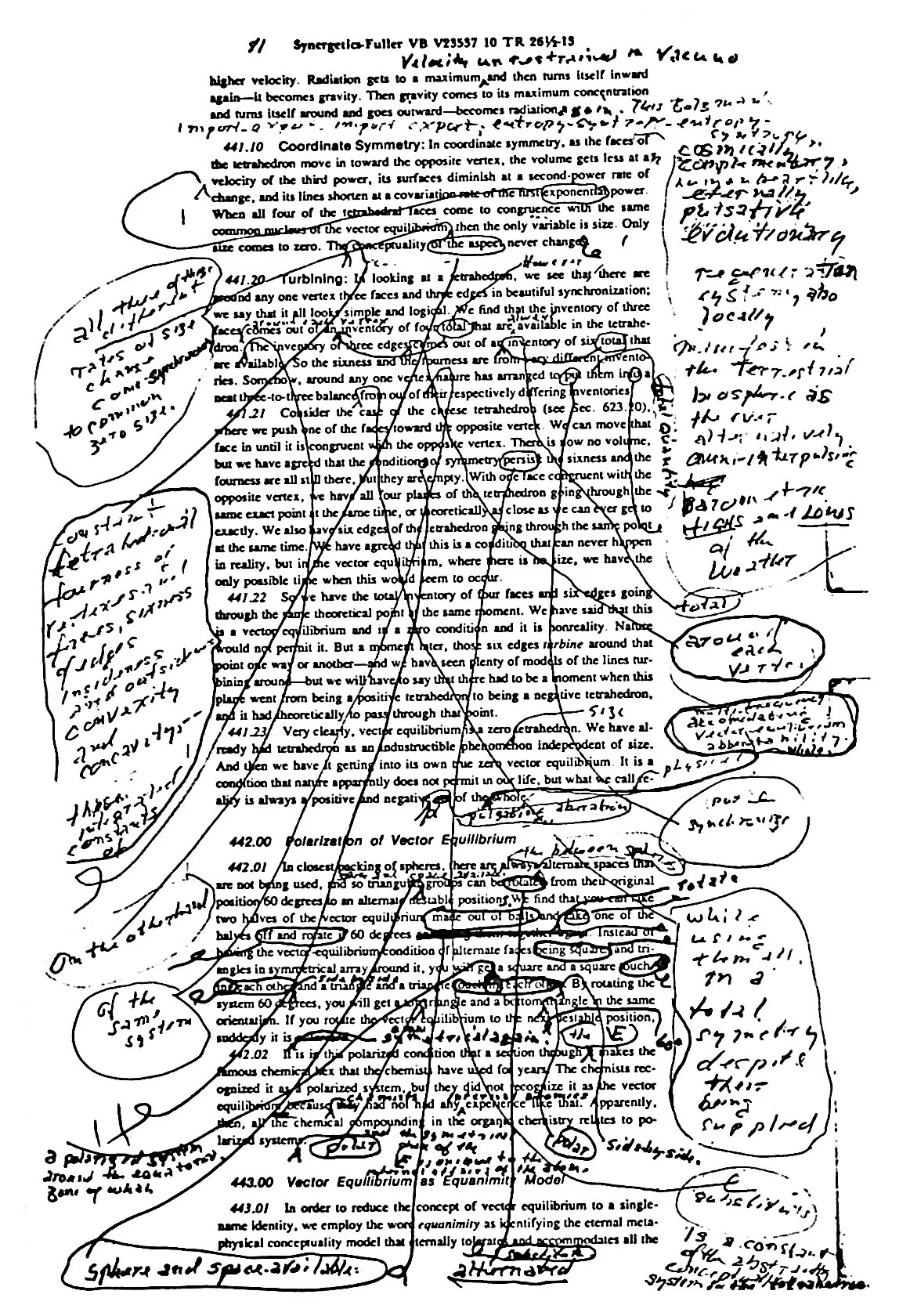
33 We worked on the galleys in intimate communication but usually a continent apart. Every
other mail would bring a new batch of galleys postmarked Prince Edward Island or Pullman,
Washington. I would transcribe them into what was in effect new manuscript. As in the original
composition, there were few corrections or deletions. It was all new content; sometimes nuances
of style but more often matters of substance. Once, working together a whole day at the
Beverly Hotel in New York, we completed only two galleys between breakfast and 11:00
p.m.
textemdash one of these is shown on page 153 [Fig. 9.2].
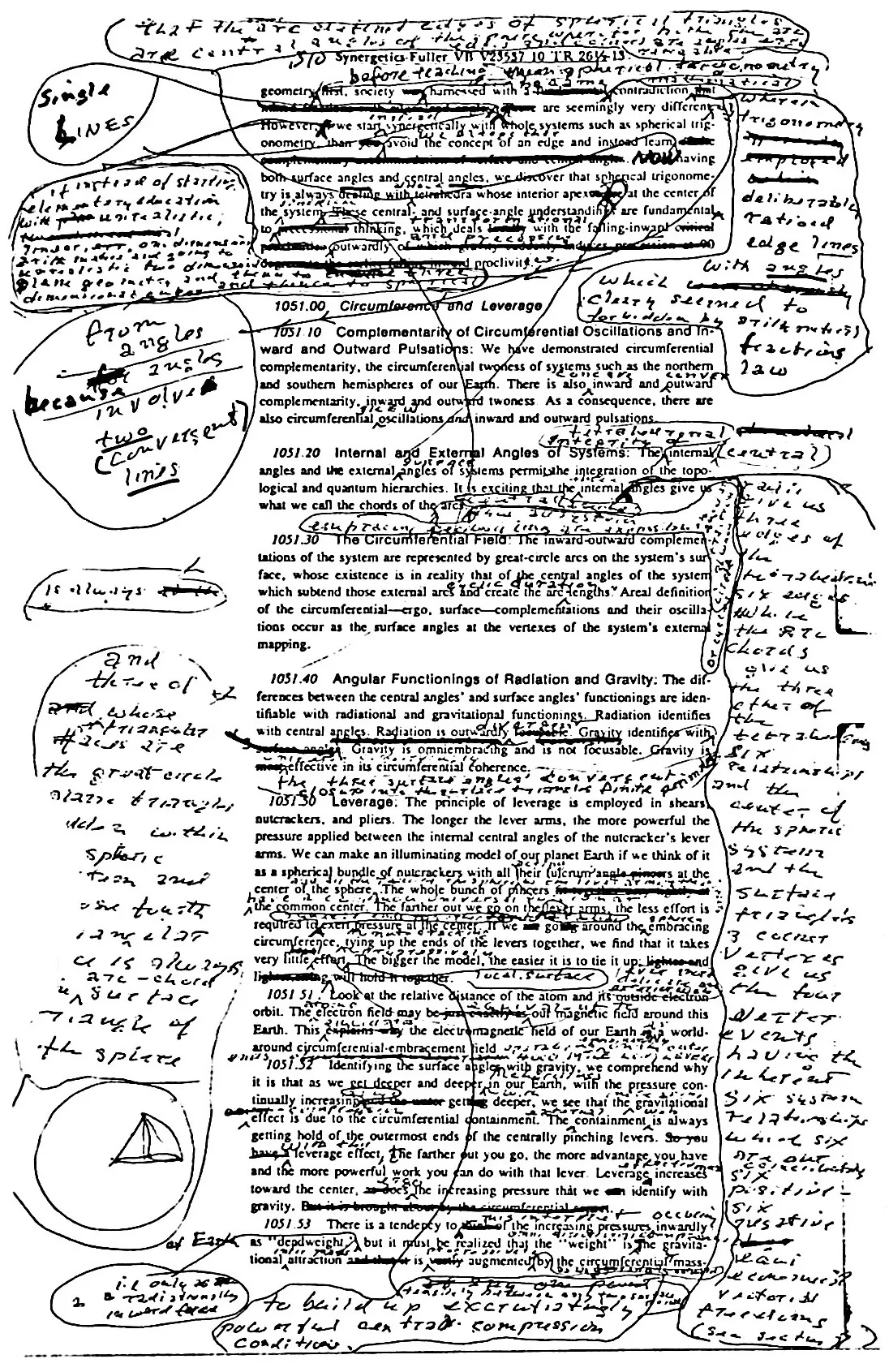
35 With a fine pen using red ink and green ink he had drawn an exquisite sketch of a spherical triangle subsiding into a planar: he was anxious to get that into the book. Anyway, at midnight we went across the street to the Waldorf to celebrate with a steak dinner. There was a pretty nightclub photographer with a flashbulb camera. Always one to convert what others might consider only an occasion into a matter of destiny, Bucky insisted that we have our pictures taken. Fuller is proud of his skill as a photographer, so first he had to instruct the young woman—politely but firmly—in her chosen profession. The eventual picture came back from the darkroom as a fair likeness featuring his credit card and my martini cocktail in the foreground. He inscribed it to me affectionately: ‘‘Entering the home stretch of the 4-century-long synergetics galley race. B.F. and E.J.A. Jr. ‘At the Waldorf,’ January 9, 1974.’’
36 For Fuller the greatest function of the galleys was to concentrate the mind, as Samuel Johnson said of the death sentence. Throughout his career, Fuller had been encapsulating his mathematics in cryptic notes and private equations—never conforming to common usage—caching them away to document his insights, but not really communicating the total geometrical hierarchy. Even writing the book, I felt there were times when we were recarving the Rosetta stone of his inscrutable 1944 memorandum. It was the galleys that provoked him to reveal connections and relationships and insights that he had long kept secret. He would work with the desperate intensity of a canoeist too close to the brink of the spillway. I watched the progress from the distant shore—transfixed but powerless to intervene. Here he was really marking his own paper.
37 The galley confrontations prompted several prodigal creative breakthroughs or, as he called them, intuitively inadvertent cul-de-sacs. All of the book’s climactic definition of his hierarchy of concentric geometrical hierarchies was articulated in white heat as a sort of space walk of 24 new manuscript pages from three pages of galleys, starting in mid-December 1973 in Washington and culminating in feverish composition between Christmas and New Year’s Eve in Pacific Palisades, California.
3839RBF: Sonny, this concentric hierarchy was conceived from the outset and as early as 1934. But I had one value more to establish, the volume of the sphere of unit vector radius, which proved out as five—in 1973. I had made a model of the concentric hierarchy as early as 1947, but this was the first time I had tried drawing it.
40EJA: The conception was earlier; the articulation was at the last minute.
41 These forays from the galleys contain his first explicit formulas for the area of a circle in triangular modules and for the volume of a sphere in tetrahedral modules—all without pi; they are to be found in sections 982.50 through 985.22, ten pages of new text through which the outlines of the original galley text can be only dimly reconstructed.
4243RBF: The correction factors used I found and included in the chart of the hierarchy which I sent to the Raleigh Group in 1947. It was first published formally in No more secondhand God: and other writings in 1963.
44 The text describing the geometrical relationships of tetrahedra and spheres was set up in the three galleys he worked from, but it was extremely terse and obscure. I had typed the manuscript from a long holograph he had written in the hospital in St. Louis the year before (December 1972). I knew he had not been totally satisfied with the solutions he had worked out in the hospital, and if I had asked him whether they should go into print, he would probably have said no. Though they were not clear to me, they were the best statements I had had from him to date on the subject, and I submitted them as part of the manuscript. Thus the galleys functioned as cryptic notes from himself to himself over the intervening twelve months.
45 This is an extravagant way to write a book, but it proved to be effective. At the time, he wrote me an explanatory note attached by Scotch tape to the almost indecipherable galley: ‘‘Sonny, if I had not entered this intuitively inadvertent cul-de-sac I would never have been excited—by attempting to correct it—into discovery of the neat 5-volume of the nuclear sphere, which eliminates the necessity of employing pi in synergetical coordinate systems, though it discloses where and why pi coexists, but only as a terminal vestige.’’
46 Other major passages in the book were written in such gestalt bursts between galleys; examples may be found at sections 905.00 through 905.73; 930.11 through 930.26; and 1053.13 through 1053.17.
47 I couldn’t help suspecting that all these last-minute outbursts must be part of the pattern of Fuller’s lifelong preoccupation with the secrecy of mathematical knowledge: how the navigators and high priests jealously guarded their private means of calculation, reluctant to surrender their source of power and the source of the king’s dependence on them.
48 There is a scene in Animal Crackers where the other Marx Brothers berate Harpo for having stolen the table silver at Margaret Dumont’s dinner party. They lash him with mock abuse and he responds with equally spurious remorse as he lets small cascades of spoons and butter knives fall in penitence from the stuffed sleeves of his raincoat. In a final gesture of abjection he lets drop the whole silver coffeepot. I still have not digested all of Bucky’s whole grand package of add-ons to the galleys, but somehow it reminds me of Harpo’s coffeepot.