
5 Writing Out Loud
2THE MAJOR CONTENTS of Fuller’s other books derives from originally oral presentations. His best speeches are to young and sympathetic audiences willing to hear him through until the final thread of the argument is tied into place. This is a process that can go on for four to five hours; while the back rows have long since straggled to the parking lot, the young remain in a huddled trance around the podium.
3 Since communication is a two-way street, lecturing to others with ‘‘feedback-by-eyes’’ from the audience is his preferred mode of expression. He has an extraordinary ability, even in a large audience, to recognize the faces of friends he may not have seen for years, or to comment quite accurately afterwards when some of us in the front rows may have registered impatience or waning attention. Perhaps this intuitive sensitivity is partially a function of the deafness he developed in later life. Certainly he prefers feedback-by-eyes to questions from the audience. Sometimes when he is asked whether there will be a question period, he will answer, ‘‘Yes, after the lecture is over let us all go home and each of us ask ourselves our own good questions.’’ Furthermore, questions—even in a small group—tend to distract from the broad geodesic structure of his argument. Or even if you put your question to him when there are just two of you, the response is apt to be Socratic. He just gives you the huge view of the largest imaginable patterns and then you have to go back and find the answer yourself.
4 His lectures assembled into a book—like Utopia or oblivion: the prospects for humanity —have an immediacy of impact, but the repetitions and overlappings are inevitable, though Fuller regards this as a virtue rather than a deficiency. No one could ever have lectured with a greater sense of obligation. Psychologically, he says, he’d prefer to clam up, but his lecturing is the most relentless form of self-discipline with every speech demanding a ‘‘fresh inventorying of experience.’’ Direct expression to a responsive audience is in the tradition of classic poets, the great teachers, and the yogis. For Fuller, it affords an integrity of communication that he cannot achieve through any other means.
5 Fuller’s speeches are if not always impromptu, at least spontaneous and extemporaneous in the extreme. Even in the middle of a long lecture he will not hesitate to pause and keep the audience waiting for long self-conscious moments while he decides which fork to take in the road ahead—he would say that the audience participates equally in these decisions of how the narrative should unfold. He refuses even to cue television interviewers before going on camera. He wants to preserve what he calls the ‘‘pristinity’’ of the occasion; he will hear the first question at the same time the viewers do. When pressed for a subject—‘‘What are you going to talk to us about, Dr. Fuller?’’—to put on the printed program or poster, he will oblige with titles like: Planetary Planning, Wood Design in a Dynamic Technology, and Energy Resource Alternatives; but the title is irrelevant except as a metaphor for the larger synergetic theme. There is always only one topic: the universe—whole systems. Journalist Barry Farrell says that Fuller’s talks are like his geodesic domes: their structure does not reveal itself until the last strut is in place. Just as the pattern of what he writes is often not apparent until the last clauses complete the circle of argument. Just as he won’t mail that letter until the last margin has been filled.
6 Of Fuller’s first ten books, three were composed exclusively by himself and written out in longhand: these are Nine Chains to the Moon (1938), No more secondhand God: and other writings (1963), and Intuition (1972). Most of the other books are compilations of letters, lecture transcripts, and largely ephemeral—but never casual—forms of oral expression. His first full-blown literary work, Nine Chains to the Moon, is unlike any of his subsequent works in that it was conceived and executed as a single book. It contains the germs of all his later thought, and it remains today the most comprehensive—though unsystematic—statement of his philosophy; it expresses his program for a world economy as well as his vision of a psychological and philosophical kind of geometry. Synergetics embraces only the latter—the geometry—and thus falls short of wrapping up the entire Fuller canon. Except for footnotes and brief references departing from the main geometrical argument, Synergetics excludes his economics and industrial design programs, Spaceship Earth and the World Game themes. This was a deliberate strategy and virtually a practical necessity; but Fuller regards this as an artistic deficiency of the book and it is understandably a cause of distress to him today. His notebooks of the 1940s and 1950s reveal a grand pattern of presenting his geometry by starting with the most abstract conceptual patterns, which become more detailed as space-filling tensegrity structures merge almost imperceptibly into geodesic dome designs with all the detailed exposition of the patent applications, and ending up as engineering manuals for on-site assembly of the domes themselves. This plan has never been realized, but there is no reason it could not be, given the funds for an edition of half a dozen volumes and the full production facilities of a good university press.
7 In a review for the Washington Post, David Park, a physics professor at Williams College, says, ‘‘ Synergetics is a book about structures, and so we need not bother…about the rest of the ecological and political thinking, though Fuller is all of a piece in the way a more logical mind is not, and to divide him is to damage.’’ Park is saying ‘‘more logical’’ in the sense of more conventional or more culturally traditional; or maybe he isn’t, maybe he thinks it is illogical to combine structure and ecology. It is a recurring dilemma: when editors organize his material in what seems to them a logical way, inevitably to Fuller it seems messy; when Fuller puts it all back in what he calls a scientific sequence, it is apt to seem messy to the editor.
8 For our working sessions in Washington I would prepare our stacks of manuscript drafts and drawings, not only in order of priority, but in what struck me as a logical sequence. Bucky’s own sorting patterns were of quite a different order, and if he didn’t like the openers, he would not hesitate to deal a new hand. He has a flair for reopening the narrative at some new place. And so he would reshuffle the manuscript pages as he rearranged his trains of thought. After his departure, it might take me the better part of a week to sift through the debris and accommodate the new patterns he had imposed—to the extent I could discern them—or, failing that, to restore lamely the previous order as I had perceived it. (I did not feel put upon; to me it would not be nearly as much fun to try and edit the product of a conventionally tidy mind.)
9 Prior to Synergetics, the best expressions of Fuller’s epistemology, his geometry of thinking, are to be found in two mind-bending essays which he wrote out in longhand and which derive in no way from lecture transcripts or oral expression. The first is ‘‘Total Thinking’’—he has a genius for arresting titles—written when he and Anne were at Black Mountain College near Asheville, North Carolina, in May 1949. The years at Black Mountain were among Fuller’s most artistically productive periods—and no wonder! he was in the stimulating company of such bright lights as Josef Albers, Willem and Elaine de Kooning, Merce Cunningham, Ruth Asawa, Richard Lippold, Arthur Penn, and John Cage. ‘‘Total Thinking’’ emerged in print as chapter 12 of Ideas and integrities: a spontaneous autobiographical disclosure.
10 The second essay is ‘‘Omnidirectional Halo,’’ written ten years later (1959) during two rainy winter days when he was holed up alone with a cold in the Hotel Benson in Portland, Oregon. ‘‘Omnidirectional Halo’’ appears as the last two articles of No More Secondhand God, a collection of mostly verse items, marvelous in themselves but something of a dog’s breakfast bound between two covers—quite possibly the result of having cleared off whatever happened to be on top of Fuller’s desk at the time. It is characteristic of his disregard for conventional organization that his essay is broken in half, with the first 12 pages appearing as an introduction to the last 32 pages. If I had to explain Synergetics in one simple statement, I would say that its aim is to substitute ‘‘in, out, and around’’ reality for ‘‘up and down’’ thinking. ‘‘Omnidirectional Halo’’ describes how this can be.
11 These two essays are prodigies of Fuller’s peculiar prose-poetry: dense, cryptic, difficult, provocative, uninhibited. He describes them as intuitive and fleeting glimpses of omniscience. They are not everyone’s dish. I know that some philosophers—at least Bertrand Russell—tell us that the unexamined life is not worth living. Epistemology, abstract thought, philosophical speculation drive a lot of people up the wall. Intellect has nothing to do with it; it is a matter of taste or temperament. Many intelligent people are suspicious of mere logic: for them, the line between dialectic and sophistry is never clear; they are like the lady who had never done anything wrong—once she thought she had, but she found that she was mistaken. The briefest grounding in semantics can make any writing unreadable for some, until the self-conscious preoccupation with the thought processes wanes and the normal reflexes and filters become restored. Few people can read ‘‘Total Thinking’’ and ‘‘Omnidirectional Halo,’’ but for those who can, they are the best epitomes we are likely to have of Fuller’s philosophy.
12 The original plan for Synergetics as I inherited it was to incorporate ‘‘Omnidirectional Halo’’ verbatim and intact as a separate chapter in an anthological manner. I thought it would be retrograde to repeat what was already in print, and I knew that some of the concepts it advanced had been further refined in Fuller’s thinking in the intervening years. He reluctantly entertained my assurances that all the items covered in the essay would be included in Synergetics, but stated afresh and in a larger context. This was done. All of the substance of these essays had been fully recapitulated in my voluminous indexcard extracts —together with his related statements on these topics, both before and since. Thus the means were at hand to provide him with, in effect, new first drafts in his own words. If it could be made easy for him to review, reshuffle, and rewrite these extracts in the style of his philosophical essays, I felt sure we would be on the right track.
13 In my dog-eared copy of ‘‘Omnidirectional Halo,’’ virtually every paragraph and many individual sentences are keyed to the section-number citations where they reappear as rewritten in Synergetics. One long sentence survives verbatim: I went over it quite a few times with Bucky, but he was totally satisfied with the way he had expressed himself and saw no way to improve it; certainly there was no reason to change it for arbitrary considerations. The result was not plagiarism, even self-plagiarism, but healthy reconfirmation.
14 By mid-1971, Fuller had started rewriting enough of my first drafts to assure me that the procedure would be effective. It was my early practice to cite, in the right-hand margin, the exact source and date of every phrase, clause, or sentence, since all I was doing was making a new, systematic, and sometimes exhaustive construct of the things he had said and written from a whole gamut of sources and in a variety of different contexts. Some very useful working techniques came out of our early sessions. I could see that the source citations were such a distraction to him that I had to stop putting them in the margin. Afterwards, I listed the citations on carbon copies, on the back of the manuscript pages, or in a meticulous card-file log.
15 Bucky usually accepted the authenticity of my source material, but there were times when he did not recognize his own language and little wonder, since some of the quotations stemmed from the 1930s. His occasional doubts caused intense anxiety, and I knew I would always have to come up with precise citations if I was to retain his confidence. On the few occasions when it took me 20 minutes to an hour to locate the precise source and context of a quoted sentence, the tension between us would mount; he would find it hard to concentrate, and I would be suspected of error or fabrication until I found satisfactory documentation.
16 I had bought heavy 14-inch mimeograph paper stock—like foolscap —to use for our drafts; it was of a distinct bright canary color to be used exclusively for work on the book. It became a signal between us, as he always sensed my impatience at losing precious time whenever the pages we were working on were not canary-colored—those competing and overlapping compositions again. At first I double-spaced the typescript, using wide margins for the inevitable graffiti.
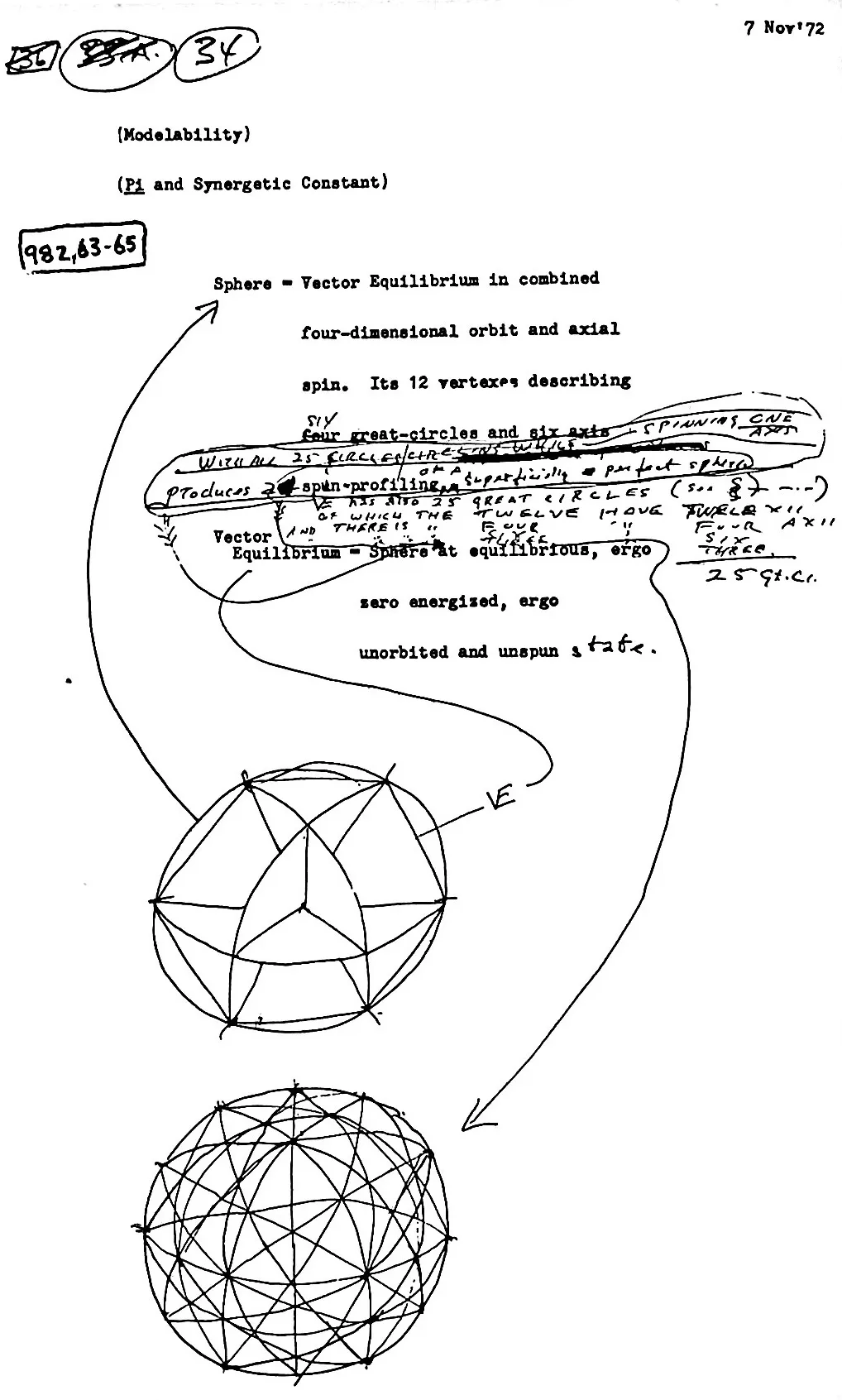
17 These margins also enticed Bucky into the liveliest of geometrical sketching, spontaneous but meticulous drawings in pencil, ink, or felt-tip pen (or a combination of all three). Clusters of closest-packed spheres or great-circle spinning or four-petal tetrahedral flower buds would verge into the typescript to help him visualize the harmonic patterns he was working on. He cannot draw anything static; his figures all torque or twist or penetrate each other. No two are ever quite the same, relics of his accompanying verbal descriptions, interwoven into the manuscript and forgotten after they have been elucidated. It was like drawing out loud.
18 For Fuller no book—not even a single manuscript page—is a static takeout. He seems never to employ any art form without transforming the medium itself. (See illustration 5.1.)
20 Unlike Bucky, I never felt the lack of a typist or stenographer. Only by typing every page myself could I have the same kind of freedom to add, subtract, and rearrange as he had with his pen in the margin. Not everything he wrote in the margin reappeared in the retyped version; I was trying to police the duplications and would sometimes omit what he had written in, where I knew it was going to be treated in greater detail a few pages later on.
21 I would often beg Fuller to read a new draft section through first before picking up his pen to correct it, but I never succeeded; there is something in his visual-mental coordination that forces him to concentrate on the single page before him and prevents him from dry-running through four or five pages in momentarily suspended intervention. He is afraid the reader will function the same way, so he crams details and references in that first paragraph anyway. Who knows, he feels, maybe the reader will never get to that next page. Bucky and I approached the typescripts with completely different focal lengths.
22 Eventually, we had sessions where he would completely rewrite 20 to 30 manuscript pages in a day. I never felt he was drawing Dali moustaches on our Mona Lisas. The great reward for me in our working together was to find the fresh thoughts and phrases, however convoluted in the balloons and interlineations. I could never get him to turn the page over so he would have more room. Nor would he ever carry an insert over to the blank sheets of paper with which I would surround him. Sometimes he would crowd in six or seven lines to an inch. Whenever I asked him why he had to get it all on one side of the page, he would explain, ‘‘that’s just the way I see it in my mind.’’ There was a rationale:
2324RBF: You’re not thinking if you know what you’re going to be thinking about. If you know where you’re going to come out when you start to cerebrate, then that’s not thinking; that’s merely brain-sorting. This is why, when I am drafting in the margins of typescript redrafts, the whole process of thought-catching is so sensitive that I do not know how far this intuitive following of unfolding thought is going to lead. I do not know whether I need more space. I cannot interrupt to turn over on the back of the page or go over on to a new sheet. The thinking is not linear, but it has to be expressed in a linear manner; it is a matter of recording an unexpected omnidirectional involvement in a linear writing or graphing pattern.
25 In our first session in Sarasota, I learned that I was not leaving enough room for him to add his write-ins. I hadn’t fully learned the lesson from the Carbondale typist. So I started making the typescripts triple-spaced and the right margins two-and-a-half to three inches blank. In fact, the crazier the text or dictation seemed to me—he would continue to dictate, not literal text but just thinking out loud—or the more unsure I was of the material I had assembled, the broader would I leave the right-hand margins as a special invitation to rewrite. There was nothing surreptitious about this; I tried to tell him what I was doing. I don’t know whether he ever caught on to the scheme; sometimes my three-inch margin pleas to rewrite would come back virgin, other times they would make me wonder whether I was collaborating with Jackson Pollock—or a monk replaiting the Book of Kells.
26 As an example of the latter, let me give a before-and-after version of the text with an illustration of what he did to rewrite it. (See illustration 5.2.)
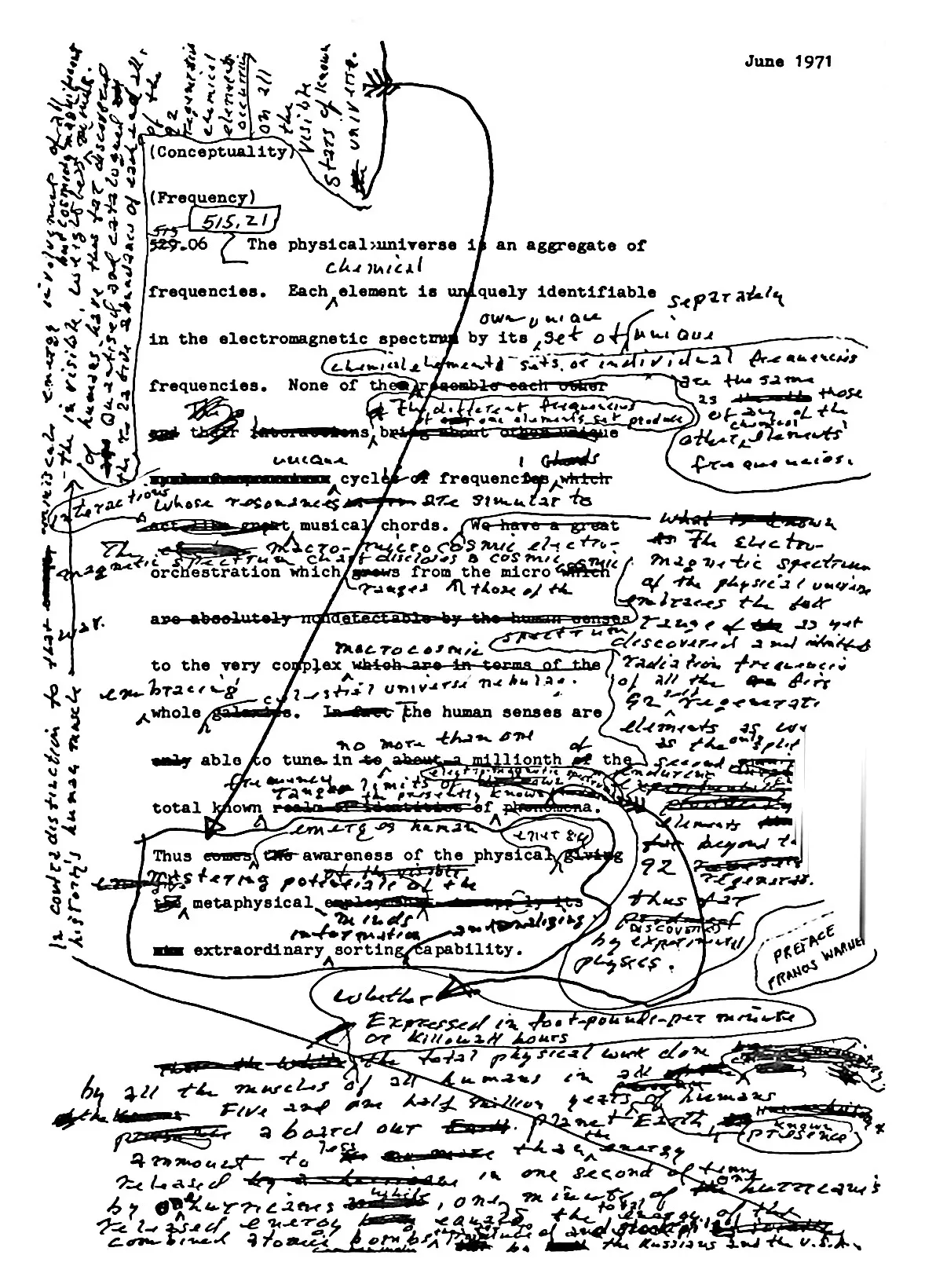
28 I had found an intriguing paragraph from an unpublished preface to a book written by his Oxford friend, Francis Warner. As often happened, Fuller’s preface had missed the publisher’s deadline, so the piece was in a sort of literary limbo. I thought one paragraph would fit very well into his discussion of the phenomenon frequency at Sec. 515. So I put the appropriate running heads at the top of the first draft and left a right margin of almost three inches, with results as follows:
2930Before:
31The physical Universe is an aggregate of frequencies. Each element is uniquely identifiable in the electromagnetic spectrum by its frequencies. None of them resemble each other and their interactions bring about other unique cycles of frequencies which act like great musical chords. We have a great orchestration which grows from the micro which are absolutely nondetectable by the human senses to the very complex which are in terms of the whole galaxies. In fact the human senses are only able to tune in to about a millionth of the total known realm of identities of phenomena. Thus comes the awareness of the physical giving the metaphysical employment—to apply its extraordinary sorting capability.
3233After:
34The physical Universe is an aggregate of frequencies. Each chemical element is uniquely identifiable in the electromagnetic spectrum by its own unique set of separately unique frequencies. None of the chemical element sets or individual frequencies are the same as those of any of the other chemical elements’ frequencies. The different frequencies of one element’s set produce unique cyclic-frequency interactions whose resonances are similar to musical chords. The electromagnetic spectrum of physical Universe embraces the full spectrum range of as yet discovered and identified radiation frequencies of all the first 92 self-regenerative, as well as the only split-second enduring elements beyond the 92 self-regenerative thus far discovered by experimental physics. The macro/micro-cosmic electromagnetic spectrum chart discloses cosmic orchestration which ranges from those of the microcosmic to the very complex macrocosmicembracing whole celestial Universe nebulae. The human senses are able to tune in no more than one-millionth of the total known frequency range limits of the presently known electromagnetic spectrum. Whether expressed in foot-pounds-per-minute or kilowatt-hours, the total physical work done by all the muscles of all humans in the five and one-half million years of known presence of humans aboard our Planet Earth, amounts to less than the energy released in one second of time by one hurricane, while one minute of one hurricane’s released energy equals the total energy of the combined atomic bombs thus far produced and stockpiled by the Russians and the U.S.A. In contradistinction to this minuscule energy involvement of all history’s human muscle, the invisible, weightless, but cosmically magnificent minds of humans have thus far discovered, quantized, and catalogued the relative abundance of each and all of the 92 regenerative chemical elements occurring on all the visible stars of known Universe. Thus emerges human awareness of the physical-energy-mastering potential of the metaphysical mind’s extraordinary information-sorting and -analyzing capability.
35 There is nothing in ‘‘After’’ that was not implicit to Fuller in ‘‘Before’’: in the rewrite he has just permitted the reader to share with him a little more of the philosophical foray. He must have been satisfied with the result as the only change he made on the galley was to reduce the human life-span on earth from five and one-half to two and one-half million years. The final version may be found at Sec. 515.21, the result of only one rewrite.
36 One of the advantages of writing over thinking out loud is the availability of the shouts of capital letters and the murmurs of lower case. Fuller had sprinkled the text of Nine Chains to the Moon with words and even whole phrases all in capitals, and he suggested reviving the practice for our book. I demurred because I found the big-blocked words distracting to the eye and because the reader prefers a nudge to an elbow in the rib. So some consistent house rules emerged in the process of composing Synergetics. Fuller likes initial capitals, but in a way quite distinct from William Blake. For Fuller, nature—like integrity and principle—is abstract and generalized and thus never capitalized. Universe is a place like Pleasantville or Baltimore and deserves a capital letter. Universe is physical and the physical is always special case, i.e., realized in space and time, and thus capitalized. You cannot have a generalized boat, or canoe, or schooner, not in physical reality. Realized physical boats have names. The Universe—ours—has its name.
37 The same with Earth; when we dig up ‘‘earth’’ with a spade instead of ‘‘Earth,’’ it is because we have failed to recognize the unique identity of the stuff of the third planet from the Sun. [Sic.] I once argued with Bucky that at least moons were generic; but not ours, there is only one and it’s the Moon. Conversely, God, in Synergetics, is god because all the associations of God are irreparably anthropomorphic. God, he explains, is part of the thinking process of every man.
38 Fuller’s self-disciplined precision of speech and his close attention to Heisenberg’s indeterminism prompt him to unfamiliar uses of the word approximately. He says ‘‘approximately everywhere’’ and ‘‘approximately none’’ and even ‘‘approximately one.’’ He says he uses the phrase ‘‘approximately everywhere’’ to make the everywhereness coincide with the modular frequency characteristic of any set of random multiplicity.1 This practice—as well as our peculiar capitalization—caused difficulties with Ken Shaw, our erudite copy editor at Macmillan. Shaw would say you can’t say ‘‘approximately one.’’ And I would answer no I can’t, and you can’t, but he can. The way we organized our work we had agreed to define our terms precisely when they were first introduced, not only Fuller’s invented words—57 at last count—but conventional terms he employs in a special way. Each new topic was captioned in the chapter outlines and there was an overlapping of redefinitions and cross-references. This led us to think we might dispense with an index. We felt the built-in repetition might overload and degrade the page references to specific topics. Moreover, an index is inherently antisynergetic, encouraging the search for nonexistent ‘‘building blocks,’’ the erroneous pursuit of the whole from the particular. Our rationale for this may have been a little contrived. We recognized that—ultimately—an index to the complete work would be an essential tool for the reader. With all the final rush of crowding last-minute text into production, any notion of an index had to be abandoned as a practical necessity.
40 In our spontaneous and impromptu, almost aleatory, capturing of fleeting thoughts into first drafts, we would often start off a passage in one context and then see it develop with successive redrafts along lines more appropriate to another section—or another chapter—sometimes inadvertently filling in a missing gap. I called these orphan compositions ‘‘floating inserts’’ until they were tied down with an assigned section number in the outline. On occasion, Bucky would suggest a locus that would never have occurred to me but which enhanced the implications of what had been going on in his mind. I tried to raise the question of where these floating inserts should be placed on many occasions; sometimes he would have a suggestion, other times he was oblivious. In principle, he applauded the virtues of my topical, section-number breakdown, particularly for ease of cross-reference. But my relentless naming of parts tended to obscure his focus on the whole. (After all, what were all those Köchel numbers to Mozart?) Though he had every opportunity to control or determine the broad outlines of our chapter organization, it was not an omnidirectional procedure, and he could never embrace it as his own.
41 I have never wanted to write a biography of Buckminster Fuller, not that it wouldn’t be a great subject: the hero as thinker and myth-maker. What really interests me is not so much his program, but his mind, particularly those ideas he had never fully articulated. His whole life is a metaphor, an organic artifact for the instruction of others. Mrs. Athena V. Lord of Albany, New York, is writing an account of his youth and growing up as a book for children; in their first interview, Fuller suggested that she mythologize his childhood. To document this kind of a living myth would require much more detachment and distance than I could muster. And yet I feel a sense of keen privilege as one human being able to devote his time to another to an extent that must be rare among contemporaries. Most scholars trying to enter the mind of another in any prolonged and systematic way must deal perforce with subjects—artists, writers, statesmen, thinkers—long since departed. When I think of all the professors of English or history devoting the major part of their careers to studying a single figure from the past—how they would envy me: I can ring up the subject of my studies on the telephone any time…to clarify a point, to mine his memory, to seek a judgment, confirm a nuance…or save my questions till we meet for two days every month or so.