
2 No Final Draft
2FOLLOWING MY VISIT to Carbondale, Fuller’s office began to send me a steady stream of articles, clippings, reprints, letters, drafts, manuscripts, files, cassette tapes, transcripts, and ephemeral writings relating in any way to his geometry and philosophy. This was to become the grist for my card index of extracts and cross-references of synergetic geometry. Earlier versions of the basic Synergetics manuscript trickled in, revealing that the book had been conceived of partly as an anthology of previously published works and partly of transcripts of lectures, but principally a series of 100 or so master illustrations, assembled and drafted with the help of various hands over the years.
34RBF: These were neat drafts the students had made of my blackboard drawings disclosing synergetic geometry in hundreds of university lectures.
5 In early 1970, while Bucky was giving a lecture in New York, I met him to take custody of the famous black briefcase containing the latest version of the Synergetics manuscript. As soon as I got back to Washington I opened the briefcase and found the first chapter on top of the pile. It was entitled ‘‘Brain and Mind’’ and consisted of some 50 pages of blank verse! I was appalled. I telephoned Tom Turner, an assistant to Fuller in the Carbondale office, and asked whether this was a recent addition to the manuscript. (In those days nothing was ever dated.) He said, ‘‘Yes, didn’t you know, Bucky is going to rewrite all of Synergetics in blank verse.’’ He may well have planned to; he may well yet do so. But I did not dare raise the question frontally. The prospect of seeing the whole book in blank verse could be regarded as an exciting vista or an utter disaster. I had no trouble making up my mind. Not only do I prefer Fuller’s prose or prose poems to his blank verse with unjustified right margins, but I know that verse is inaccessible to many people and that the potential audience for the work would be restricted accordingly. (There is a theory that if only Galileo had said in verse that the earth moves, the Inquisition might have left him alone.)
6 The original first chapter, ‘‘Brain and Mind,’’ was an essay in epistemology and cosmology. In his geometry and philosophy, Fuller is utterly preoccupied with patterns of energy. He says it is the ‘‘fate of energy in the cosmic scheme to meander through eternity in persistent regenerative bliss…Energy is the capacity to rearrange elemental order.’’ And it is the task of his synergetic geometry to identify energy with number, so it seems not only reasonable to him, but essential, to relate man’s thought processes—his way of knowing—to the syntropic-entropic tidal flows of energy, the largest patterns in his cosmology.
7 At the same time Fuller was writing ‘‘Brain and Mind,’’ I knew he was also writing another work on the same theme: the distinction between brain function and mind function and what he calls the ‘‘hierarchy of degrees of synergy.’’ He had been rewriting this second work under the title Intuition for two years—since the launching of his sloop of that name on 31 July 1968. Fuller not only writes and rewrites but he writes overlapping and concurrent—but separate—versions of the same ideas and arguments. The themes, metaphors, and much of the expository narrative passages of the ‘‘Brain and Mind’’ first chapter and of the Intuition draft were overlapping and closely similar but not identical. This circumstance did not bother Fuller in the least—although to me it was unconventional, unorthodox, and ultimately intolerable, because it’s inconsiderate to the reader.
8 Parallel and concurrent composition—to the point of self-plagiarization—is an intrinsic element of Fuller’s method of literary creation. It is the thought that matters, not the form or the particular piece of paper on which he happens to be recording it. Omnidirectional writing again. The same thoughts and sentences crop up throughout the different verses, letters, and manuscripts on his desk at any given moment, demonstrating a verbal Doppler effect.
9 Bucky agreed with my argument that the ‘‘Brain and Mind’’ first chapter had an integrity of its own separate from the rest of the Synergetics manuscript. I suggested that we delete it from the larger work, combine it with Intuition, and bring out the two as quickly as possible in a single book of verse. I think it was more the urgency of his message than any considerations of literary form that persuaded him to adopt this tactic. In fact, he would probably have preferred to see each chapter printed separately as we completed it. His constant preoccupation with the urgency of the message is one of his most endearing traits. For him this is not vanity but just a question of trying to live up to his fundamental responsibilities. The Wedding Guest in ‘‘The Rime of the Ancient Mariner’’ was no more self-tormented. The result was that I helped him rearrange the two pieces for joint presentation, reducing the overlappings and redundancies—to some extent.
10 On the rare occasions when Fuller stops traveling or lecturing, there is an instantaneous high-tension conflict among projects competing for his attention: architectural blueprints to be screened, drawings to be drawn, exhibit schemes to be sketched, letters to be answered, patents to be filed, friends’ books to be introduced, maps and archives to be reviewed, obligations to family and friends, sloops to be sailed…
1112RBF: You give the impression that I am a philandering yachtsman. I did have just two weeks of racing and cruising in 1971 but since then I have been able to put out only two or three times a summer.
13 so this leaves very few of his waking hours for books and poems to be written.
1415RBF: I think it is funny that in enumerating all the office tasks requiring my attention, it never even occurs to you to explain that I also have to meet overhead expenses averaging about $200,000 a year. For me, the game of making money has been totally sublimated. As fast as I get money, I spend it. I don’t save any money. The result is that people don’t tend to think of me in terms of money.
16My rule is to pay bills instantly whenever money comes in; my secretaries and accountants know these standing instructions and they give me an accounting at the end of every month of all monies coming in and all bills paid.
17You must not use the credit of others for your own projects. I learned that idea from Henry Ford. I have absolutely no budget. I carry it all in my head. And by knowing that if I have paid the bills and then excess money comes in, then I know I can support new research.
18EJA: This was an omission but not an oversight. I am all too much aware of your daydream accounting. I just find it all so appalling—like keeping a roof over your head with skyhooks.
19 In the five years of collaborating on Synergetics we averaged less than two days a month of actually working together, and even those days were inevitably interrupted with lecture engagements and television interviews and the like. (In those same five years, I worked on nothing else seven days a week.)
20 In genuinely desperate exasperation, Bucky once turned to me and groaned—it was a groan—‘‘How can it be, Sonny, how can it be that I always seem to have to be paying someone else in order to get out my own books!’’ He was galled by the injustice of it and suspected that the inevitability of unwanted collaborators resulted from a conspiracy of publishers and literary agents. I think the only reason he has needed the help of others is that he never finds the time to finish the last draft; it is a question of the demands of competing obligations on his time. I told him in vain that Kant never ventured more than ten miles from Königsberg. It is hard to see how anyone with an itinerary like his (see pages 34--35 [ 2.1, 2.2]) can describe himself as a writer.
21 For our first joint working session on the synergetics book, we had arranged to spend all of the second week of February 1971 in a hotel in Sarasota, Florida. Bucky and the indomitable Anne were visiting old family friends, the Alden Hatches, whom they had known since they were married. For once, and indeed the only time, there was a full week for working with no interruptions or competing engagements. On Bucky’s instructions, Hatch had reserved two adjoining double suites, the best in the hotel, on the top floor overlooking sparkling Sarasota Bay. Bucky and I were to work in one room during the day; the other suite was for a retired, highly competent stenographer whose services had been engaged for the full week. If the muse were to fail us it would not be for lack of amenities.
22 I had brought down the sacred neglected manuscript of Synergetics in the famous black briefcase. More important, I had a box full of extensive pages of new draft manuscript, several thousand index cards and extracts of basic definitions and concepts, and a proposed new chapter outline with a whole new strategy for the book. This was the fruit of my first year of labor in virtual isolation. Fuller had seen none of it.
23 In Sarasota, I was to find that it is not just Fuller’s writing that is overlapping and concurrent; so is his entire creative strategy. At any moment there are always two or three occasional pieces, articles, prefaces to books of others, and blank verse poems in process. ‘‘I work on different books at the same time,’’ he says, ‘‘like a painter.’’ The degree of versification of the poems tends to be a function not of original conception but of the number of times they have been rewritten. There are galleys to be sent off to meet magazine deadlines. And there are fleeting, new, not fully formulated poetic themes circling Bucky’s mental control tower awaiting clearance for a landing. I found that there were new drafts of ‘‘Brain and Mind’’ and Intuition on the top of the pile of papers that Bucky had brought with him; these were pieces that I thought had been completed and submitted to the publisher long since. I had yet to learn that chez Bucky there is no final draft. This backlog of always current work in process was the one thing for which I was insufficiently prepared.
24 Clearly, there was not even the mildest prospect of focusing Fuller’s attention on Synergetics—on the book—until the frail craft in the landing circle had been brought in by the control tower or launched off again to the publishers.
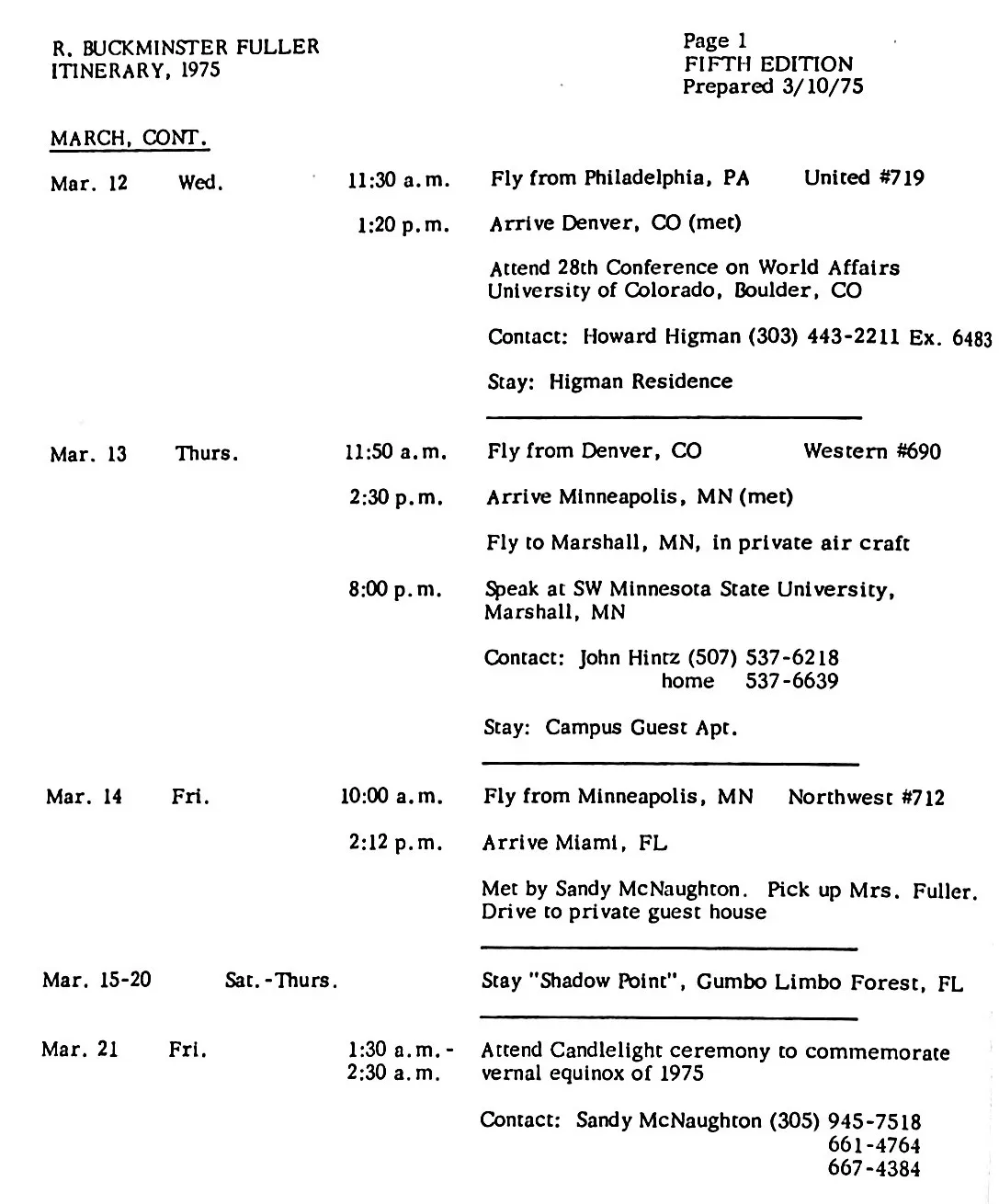
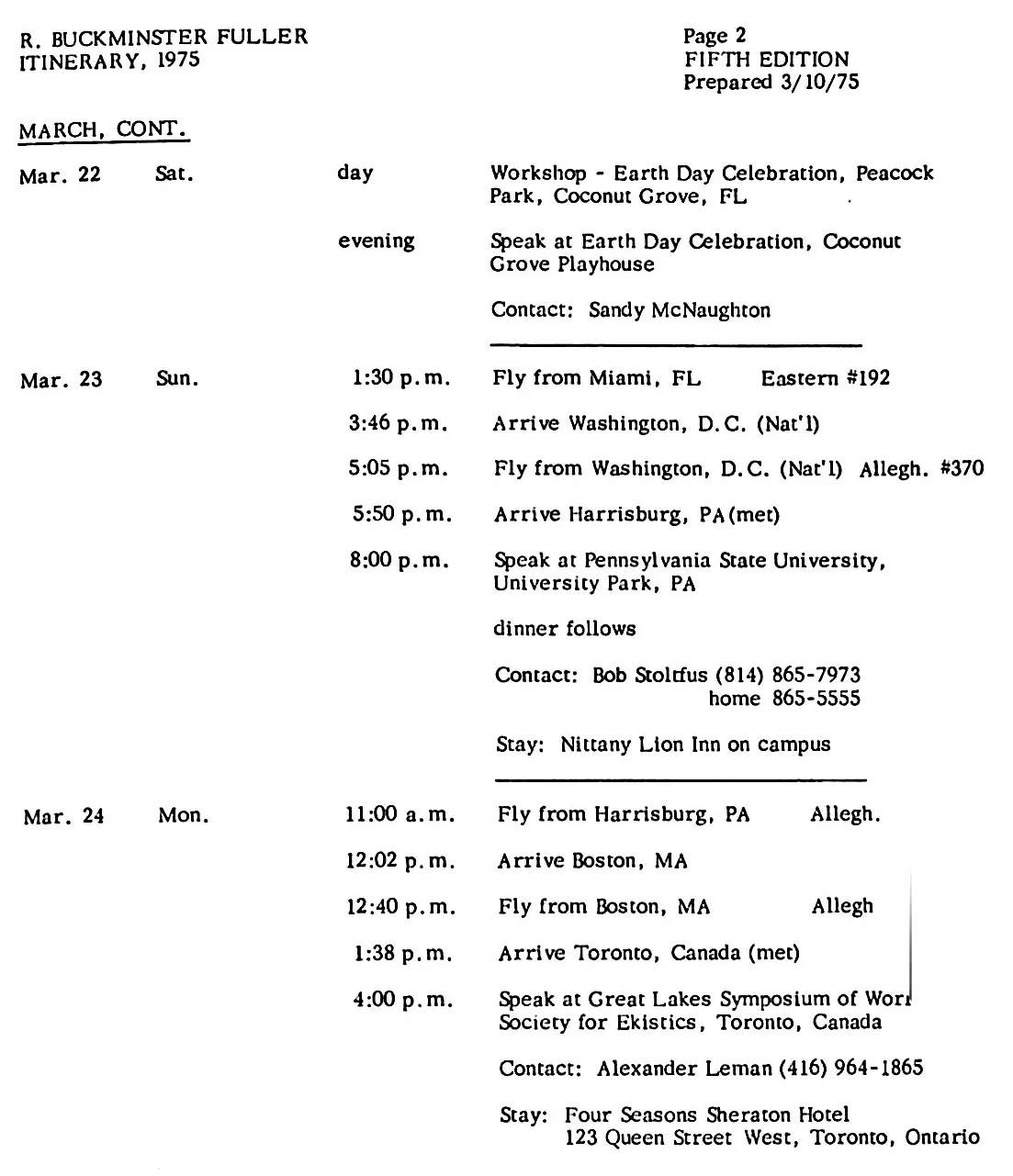
27 They were stacked up, teeming in Fuller’s mind. He would pick up a typescript of 40 to 60 pages and urge me to read it to him out loud; if I made some excuse, then he would just read it out loud to me—so great was his engrossment in the most recent rewrites and revisions. Most of ‘‘Brain and Mind’’ and Intuition were completely retyped by the stenographer in the adjoining suite. If Fuller changed as little as a single word or phrase, no further progress could be made until the entire page had been retyped. We started work on a Monday. Fuller has an exquisite sense of when to reassert his initiatives in order to forestall anyone daring to bring up a topic not germane to his preoccupations. We started work on a Monday, but it was Thursday afternoon before I had a chance to even mention Synergetics.
28 When we finally got down to going over the manuscript Bucky did not seem to have any feeling of intimacy with it. The first chapter had been peeled off for the Intuition book, but I couldn’t get him to even look at the remaining chapters. When I asked him why, he said, ‘‘It’s just not me.’’ He wanted to start over again from scratch, and that was that. He never once, in Sarasota, looked at the manuscript he had been carrying around all those years, and he has never looked at it since.
29 The original chapter captions were vague and undefinitive; they were reworkings of lecture transcripts with titles stressing exposition by historical review: Trends to Invisibility; Return to Modelability; Conceptuality of Structure. Those phrases captured some poetic notions but they lacked precision and betrayed a casual sense of organization; they lacked continuity of theme. My own program for the book had a much more systematic imperative.
30 When I asked Bucky where he wanted to start, he asked what did I mean. I said what do you want the first chapter to be, and I presented a proposed outline of eleven chapters, all of which, as it turned out, survive in the final work.
31 There was only one chapter I had not anticipated, a new one to be called ‘‘Omnitopology.’’ (Topology is a branch of geometry dealing with surface relations, the way figures are related rather than their shape or size. Fuller introduces the nuclear analysis of central angles as well as surface angles, hence omnitopology.) Anyway, that final chapter called ‘‘Omnitopology’’ was to develop into a climactic toccata and fugue, a major war plan revealing the strategy of the balance of the book; most of it was written after the manuscript had gone to Macmillan. I have never gone over Niagara Falls in a barrel, but it must be something like the last few months of publishing a book with Buckminster Fuller.
32 He was not interested in chapters: he likes words, sentences, and paragraphs, as units of thought. Chapters, even whole books, strike him as arbitrary constructs, the unnecessary artistic conventions of people with literary preoccupations quite unattuned to the single geodesic structure of his lifetime oeuvre.
33 Since he had abandoned the old manuscript outline of the accumulated book to that point, I had to persist in asking where to begin. I know now that as always he wanted to begin—like a spider—in the middle and work out to the circumference, or at the circumference and work in toward the middle. But I had to continue in my linear questioning. Did he want to start with the whole? To start with the universe—his customary strategy—or with synergy, a definition of terms, and a description of his tools of analysis? He would have preferred to do both at the same time and, left to his own devices, could no doubt have done so in one decade or another.
34 To my unimaginative linear mind, there was a dilemma whether the first chapter should be called ‘‘Synergy’’ or ‘‘Universe.’’ He decided to start with synergy, defining our terms of procedure; but I sensed that the decision was largely a concession to me on an apparently unimportant point of procedure. Two years later, when it was too late, he reproached me for not having started the book with chapter 8, ‘‘Operational Mathematics,’’ where the reader would first be instructed to use scissors and paste, cutting out circular foldable pie crusts, and using the dividers and straightedge, but not making the mistakes the Greeks had. This would have had pedagogical advantages, but I thought we were being naive enough as it was.
35 By the time we had to leave Sarasota, we had not agreed on a working program, or even a next step, and I was left with a greater burden of initiative than I would have preferred. But our affection and tolerance for each other were such that we were exhilarated by the prospect of close collaboration and we resolved to complete the book at all costs, certainly within the next 12 to 18 months.
36 Bucky hardly glanced at my beautiful index files of extracts on all of his synergetic geometry. He explained that any too-fixed attention to parts and details is antagonistic to the synergetic mental processes in which he had disciplined himself. But he was appreciative of all the work I had done and he showed it off with pride to Anne and the Hatches at a cocktail party. What we mainly accomplished in Sarasota had little to do with the book; after 18 months of collaboration, the first chapter had been effectively combined with his poem about the sloop. The result was Intuition, brought out by Doubleday in May 1972.
37 After our first working session in Florida, Bucky and I said goodbye to each other in the airport at Tampa. ‘‘The only thing that’s expendable,’’ he told me, ‘‘is what we do with our time—all the rest is cumulative.’’