
6 Buckminster Abbey
2FULLER WAS IN continuously orbiting world travel while I was sedentary and rooted at my home in Washington. The pattern of summer schedules left us very little time for working together and one summer went something like this:
3 June: Honorary degrees from several universities or colleges where he would lunch amiably with the trustees, who paid no attention to the subversive content of his remarks; his real allegiance was with the students, and they were his only target. Bucky has described himself as an immigrant in the society of the young.
4 July: First to Gian Carlo Menotti’s festival in Spoleto for a last embrace with Ezra Pound, whom he passionately defended for sharing his view of the irrelevance of politics to poetry—a point on which Pound had been a slow learner. Then Anne and he would be guests of Constantinos Doxiadis for a cruise around the Aegean ending in a conference on Delos. Bucky’s lectures were a gentle rebuke to ‘‘Dinos’’ Doxiadis, the founder of Ekistics, the science of human settlements, for the same fallacy as that of Lewis Mumford: regarding the city as a proper object of study when the minimum considerable social pattern is the totality of Planet Earth. Only the whole big system works.
5 August: Theoretically, this month was reserved for the family’s vacation on Bear Island in Maine, but it was interrupted, as usual, by a United Nations conference in Southeast Asia—what Fuller calls Austronesia—and by board meetings on the West Coast.
6 September: By this time the lecture circuit would be resumed with occasional side-trips for a college gaudy in Oxford or congressional hearings in Washington. Fuller told a panel of six senators that politics is obsolete: Who needs leaders?
7 As a reluctant vagabond—my children had once predicted, accurately, that I would be the only father in Disneyland with a tie on—I made various attempts to co-orbit with Fuller for brief periods and, except for a debacle at Bear Island, they invariably produced original material for the book. Bucky can go to sleep and wake up instantly, refreshed after only 15 minutes. He has tremendous powers of concentration and the ability to screen out the irrelevant, so even after weeks of separation we could pick up the threads of our writing—and even at odd hours or on days with an already crowded schedule. I couldn’t take my typewriter into taxis and he didn’t like me taking notes in the dining room of the Somerset Club in Boston, but we managed to waste very little time.
8 We had one magnificent uninterrupted working session in the top floor of the Blackstone Hotel overlooking the lake in Chicago on a Labor Day weekend when we were almost the only guests in the hotel. Uninterrupted and alone—except for Don Moore, Bill Marlin, and Brendan O’Regan who took part in most of our working sessions. Fuller was reminding us that energy has shape and that thought has shape and that these physical and metaphysical shapes manifest themselves as tetrahedra, specifically his discovered asymmetrical tetrahedra which he had long referred to as the A and B Particles. But the word particle stuck in his craw; it was not right because there are no things, no basic building blocks—there are only relationships between events. At the Blackstone, we buried the particles and rechristened them the A and B Quanta Modules as they appear in the book.
9 Fuller asserts that his synergetic geometry integrates the landmark topological formulations of Leonhard Euler (the Swiss mathematician, 1707--1783) and the famous ‘‘phase rule’’ of the American physical chemist Josiah Willard Gibbs. Fuller had long promised me a sketch or an outline of how he combined, and partially transformed, Euler’s visual analysis and Gibbs’ energetic freedoms. He finally sketched it all out between flights on one of those glossy breakfast menus in the old coffee shop at Logan Airport in Boston. I sprayed fixative on the menu as soon as I got it home, but the smudges had already made it difficult to transcribe and some of the nuances may have been lost where it appears at Sec. 1054.20.
10 We had a wonderful week with Anne and Bucky at Marcel Breuer’s new student union building at the University of Massachusetts in Amherst. They had just gotten in from London and TWA had misplaced Anne’s bag; she just cheerfully bought a new toothbrush and remained serene until the bag arrived two days later. Every night, Bucky lectured alternately with the Maharishi Mahesh Yogi, whose guests we were in a symposium sponsored by the Students International Meditation Society. By day, Bucky and I were trying to write Synergetics despite interruptions from a constant stream of visitors, well-wishers, and just plain sightseers. One morning, Bucky was in unusually deep concentration, his gaze turned inward on some remote horizon of thought; he was just on the point of resolving some apparent contradiction in our text and his face was like a mask of a Dalai Lama. Fuller was in as close to a trance as I have ever seen him when a well-meaning friend burst in on us to urge him to attend a lecture by a young mathematician—in a classroom seven floors below. Although he wakes from sleep in an instant, this time it took us almost half a minute to bring his consciousness back to our everyday world so that we could explain the simple invitation. He politely declined, fixed himself a fresh pot of tea, brushed those particular pages aside, and never regained whatever vision of Shangri La had so entranced him. I felt the loss keenly as that particular cosmic fish got away forever.
11 For a long time, Fuller had circling in his head an elaborate metaphor for his omnidirectional system of spherical coordination. His model described a transparent plastic 20-foot miniature Earth globe inside a transparent plastic crocodile inside a transparent plastic whale inside a 200-foot transparent plastic celestial sphere. He would have preferred for us to build an actual full-scale model but we had to settle for landing it all on paper (Sec. 1110.00) during a week visiting the Hugh Kenners at the Pepper Tree Inn in Santa Barbara. Other such fish were caught in Aspen, in Carbondale, in Fairfield, and in Bryn Mawr.
12 In lecturing, in writing, and in conversation, Fuller often pauses to take stock, to review his tactics and strategies, and reconfirm his objectives. This is one of his many forms of self-discipline which to him is akin to the navigator’s taking fixes on his charts in river piloting. One evening in February 1973, when we were working together in the motel in Santa Barbara, he handed me a sheet of paper in which he had written the following description of our goals and modus operandi:
1314Sonny Applewhite and I meet deliberately and premeditatedly, and thereafter find ourselves spontaneously, inadvertently hauling-in word-netted shoals (schools) of cosmic fish, i.e., epistemological pisces.
15Sonny handles the ship, opens the holds, and heads our catch for the commonwealth harbors of humanity, while my task is to cast the nets of prescient apprehension in discrete directions in the omnidirectional ocean of Universe to be hauled in only upon unpremeditated observational embracements of ever-more-stabilely-generalized systems of ever greater and more incisive comprehension with which we may classify and sort our cosmic-fish catch of evermultiplying Universe’s special case experiences.
16 Our most regular base of literary operations, second only to Washington, was the Beverly Hotel on Lexington Avenue across from the Waldorf-Astoria in New York. It had the virtue of semi-residential suites so Bucky could make his own tea in the pantry and I could type in the sitting room while he napped. The switchboard and front staff treated us as old friends and it was a congenial place. I did not want to stop writing for meals but Bucky clearly preferred to. Fuller’s staple, or at least his preferred diet at every meal, is steak, a diet that helps him to keep his weight trim, suppress a tendency to diverticulitis, and above all refuel those enormous stores of energy. His rate of metabolism would be the envy of a shrew. When young vegetarians express dismay at his beef-eating vice—it does not conform to their idea of his persona—he has to explain that the cows are eating much more vegetation and converting it to protein than he could possibly cope with at first hand.
17 Conveniently across the street from the Beverly was the Royal Scots Grill (staffed by Irish, Koreans, and a beautiful Israeli sabra) where steaks were available for breakfast. This became Fuller’s club. We would put off visitors to mealtime when we would repair across the street to breakfast, lunch, or dine with a stream of publishers, dome builders, artists, students, and mendicants—Clark Eichelberger, Bill Whitehead, John and Magda McHale, Cyril, Joe Duffy, David Cort, or Peter Max. The Royal Scots Grill (since renamed the Belmont Stakes) became the Mermaid Tavern de nos jours. They were very good about turning down the Muzak.
18 As the book took shape it acquired a sort of critical mass attracting Bucky to spend more and more time in writing sessions at my home in Washington. Our longest session was 10 days. We live in a 100-year-old, pseudo-classical, white frame house on a high acre of land edged by ancient oaks. Of our four children, three were then at home, ranging in ages from 12 to 20. It was just as well that the house had abundant waste space so we could come and go without treading on toes. I made an office out of the large sunporch overlooking the grass to the west.
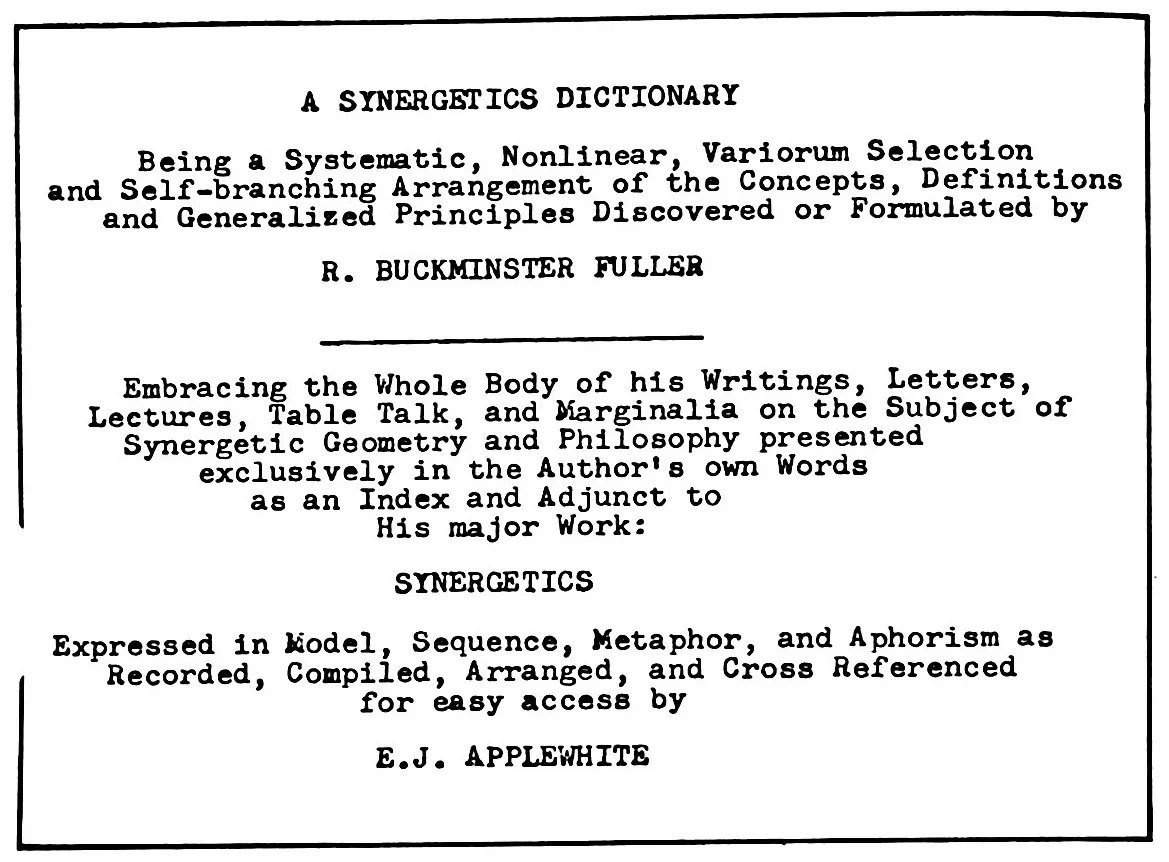
19 There were filing cabinets for the manuscripts, letters, and unpublished papers, as well as each meticulously numbered and dated sheet of the myriad of canary yellow earlier drafts—superseded but not abandoned. There were two bookcases with books only by or relating to Fuller and his geometry. There were two trunks sent from Carbondale containing the original files of Fuller’s synergetics notes, notebooks, drawings, blueprints, and collateral clippings. And there were my twelve file boxes of 5 x 8-inch alphabetized excerpts of everything he had said or written about everything that I could get my hands on. At one end was my desk and my old Underwood standard typewriter surrounded by low tables on which the file boxes were arrayed like the manual of an organ in such a way that I could reach any of the 22,000 excerpts from where I sat while typing. (See the title sheet for these files on opposite page. 6.1)
21 At the other end of the porch was a large round work table (once a family dining-room table, now telescoped without the leaves) with a lamp in the middle for Bucky to write at. We also had sticks, dowels, cardboard, paper clips, and rubber bands for impromptu model making. I first called our office-porch ‘‘The Buckery,’’ but this had a connotation displeasing to Fuller, so we changed the name to ‘‘Buckminster Abbey.’’
22 Coming in the front door or coming from upstairs you could see Bucky through the glass doors from the living room, sitting ramrod straight at the round table on the porch. He would be drawing or writing furiously or staring out at the oak trees. The family knew that they would not bother him going back and forth to the kitchen because he was always so deep in thought. Maybe his deafness was an asset. And when the children did interrupt he was always far more tolerant than I. Fuller has a genius for putting interruptions and the unexpected to good use. What for me was distracting was for him happily synchronous. I was collaborating with a man infatuated with problems, who was looking for some meaning in every interruption: confident, as he says, that the almighty makes no mistakes.
23 On Bucky’s round table there was a hot plate for his never-empty pot of tea—the second staple of his diet—which he consumes like bunker fuel around the clock at a level just below toxicity.
2425RBF: You know how I have so often described the thinking process as a dismissal of irrelevancies…a parting of the strands. But there is also an element of conscious input to thinking. Certain thoughts have to be held in suspense in momentary irrelevancy like the airport holding patterns of planes coming in for a landing.
26Something like this happens when I am concentrating so hard that I put off going to the bathroom. Anne often says to me, Bucky, for heaven’s sake why don’t you go to the bathroom—you’ve been jumping up and down for half an hour…And I do. …I just keep postponing the input of the tea and the output of the pee.
27Science and the physical world give you deliberate stresses with the results of forcing you to do your best work. It’s like rushing to catch a train…Or the way a drowning man sees all the events in his life going by…I get so preoccupied with my thoughts that I cannot find where my fly is and I make a mess in the bathroom…When the rest of life is pushing in on me it forces you to make a comprehensive review…instead of waiting for your life to go by while you’re jumping out of the building. I just build up so much overload and that’s how I do my best thinking.
28 He abandoned alcohol as a drink in the 1940s, and his later work shows a strain of sobriety of which Nine Chains to the Moon is happily devoid. There are passages of Synergetics which in cold print suggest the evidence of too much tea—although he is usually careful to guard against overstimulation by switching temporarily to grapefruit juice. Even though Bucky is personally immaculate, after two sweltering hot nights we found his pillowcases had pink stains that could be diagnosed only as tannic acid having seeped through his scalp. Except for the total unpredictability of his schedule, Bucky was always the ideal houseguest. His arrival would sometimes be heralded by an unexpected shipment of aluminum rods or wooden dowels or plastic struts. (In the days before his elaborate typed itineraries, we always signed for any odd shipments without question, knowing that we could expect the model-maker to follow within a few days.)
29 Fuller is not nocturnal by nature—as the Hewletts were; they could not retire before midnight without a sense of defeat—but he is often unable to stop working until he drops from exhaustion. I lack this kind of compulsion and though I can type quite happily from 8:30 in the morning to 6:00 in the evening seven days a week, I generally prefer not to work after dinner. He, on the other hand, would often work till 2:00 in the morning and—whether she was with us or not—I would sense and share Anne’s strong disapproval. On two occasions when my wife, June, got down to start breakfast, she found Bucky still scrawling away furiously, having moved to the dining table where it was warmer. He had been oblivious that dawn had come, but he would instantly sense the domestic imperatives, pick up his papers hastily, and whisper, ‘‘I was just going to bed, darling.’’
30 When his meals did not coincide with ours, which was often, he would fix his own steak, fruit, and Jell-O. Being a well-trained sailor, he always cleaned up the pans in the galley. He takes a childlike thrill in finding and using new kitchen gadgets and was always bringing in new electric percolators or manual can openers. And he loves to sharpen knives; they were always in great shape after his visits and June would bleed for days.
31 With June and the children, Bucky was never less than gallant, always full of love—often verging on the fatuous. He is an enthusiast of family life and he liked to plunge into all the trivia and tensions, the by-plays and arcana of teen-age communication; he reveled in all the inside jokes and insults, whether he could follow them all or not. Bucky and my family found each other sometimes incomprehensible yet always fascinating. He clearly loved to share in the family life and realized he was totally accepted as a member by all of us—so much so that the kids always felt free to question and tease him and otherwise treat him as yet another relative. They had enormous respect for him, but no awe.
32 When friends dropped in I would want us to keep on working in the office-porch even though they could see us through the glass doors. Bucky had much better manners and he would rather talk than write anyway. In fact, he always loves a party and I was stifling his gregarious instincts with my rude determination to get on with the book.
33 We had everything we needed: steaks, tea, tranquility, and, what was very important for one who worked with Fuller’s intensity, the opportunity for him to peel off upstairs for a nap whenever he would begin to nod after uninterrupted hours of work. Bucky’s costume was usually as informal as our schedule. He once had a wonderful suit made in Montreal with the vest and trousers all of one piece, but of course you wouldn’t notice this until he took his coat off. More often he would sport a long, thin, bright-green dhoti-shirt from New Delhi, but his favorite was a loose Japanese yukata and fiber slippers from Tokyo. During winter storms the porch was often icy, but he would never put on a sweater unless June told him he had to. His energy kept him warm. He was always neat, immaculate, very tidy in dress and work habits. Our working sessions were times of pure pleasure, even high spirits and hilarity, with unfettered communication between us. We interrupted each other all the time with even second- and third-degree interruptions interrupting the interruptions, but we were always able to get back to where we left off.
34 Whether we were working together at 3200 Idaho Avenue, N.W., in Washington or meeting in a motel in a distant city, I always had plenty of time to organize our various concurrent drafts in an order of priority that determined our working agenda. We seldom finished half of what there was to work on, and so we had an invariable rule: always put the most crucial drafts on top of the pile. We would discuss this explicitly; if we had only two days of work before Bucky was going to be hit by a bus, what would we most have wished to put his energies on? What was important, not in terms of any arbitrary schedule of chapters for a book, but what was philosophically most important in terms of an original breakthrough or a critical definition. Bucky would get so excited when he got a really new idea: that was when he first started to call them cosmic fish. In my copy of Synergetics he was later to write:
3536To: Sonny, my cosmic fishing partner who always lets me sit down aft in the fishing seat to have all the fun of catching and playing the fish while he handles the boat, standing at the wheel and engine controls, letting me think he is enjoying it all as much as I do!
37 We wrote in the constant company of posterity. While our thoughts were not morbid, they were preoccupied with intimations of mortality. (Five years ago he said to me, ‘‘I’m 76, I always assume I’ve only got a few more minutes.’’) Even if we only had a half hour between planes at the airport, we always dealt first with the papers on top of the pile in the briefcase. For Bucky, this tactic was a guarantee against trivializing. Since he could spend only a small fraction of his time writing Synergetics, it was all the more imperative that he work at all times on the highest-grade ore and at the cutting edge. There was no time to indulge his pedagogical reflex of starting every session from scratch, recapitulating the whole context in his instinctive synergetic way. For me, this was the one way I could exercise some initiative; it was an effective way of focusing his attention on the unresolved problems—or at least as they so seemed to me.
38 Putting the important papers on the top was only part of it. We usually had three piles on the round table in the sunporch: (1) the most important (canary paper), (2) neglected drafts but not so critical (canary paper), and (3) other of his work in progress not related to Synergetics (white paper). Very rarely some kind of cul-de-sac or mental block would intervene and it would only make sense to turn to something else, some easier piece of descriptive writing. The third pile of white typescripts unrelated to the book provoked a distracting tension between us. He knew that if he spent too much time on the third pile I would begin to get restless; I knew that if he was preoccupied with some current composition it was hopeless to expect him to concentrate on the book. Sometimes he would work on all three piles in rotation, in which case themes and threads of arguments from one pile would find themselves being woven into drafts on the other piles; sometimes the effect was synergetic, other times it was merely fortuitous.
39 My greatest thrill, the keenest satisfaction in working with Fuller, was coming down early in the morning and finding a stack of manuscript pages he had rewritten way into the night before. He would leave a note with the date and the exact time he had knocked off: ‘‘Tout finis which rhymes with 2:15 a.m., and that’s that.’’ Or ‘‘Safe landing after half-century nonstop flight 3:10 a.m.’’ Or ‘‘These pages are rich and exciting; we must bring them to publication at the earliest possible moment.’’ And sometimes hints of dark foreboding: ‘‘I am feeling myself being physically precessed into a strange ephemeral condition. It may be I just need a little sleep. Only God knows. I don’t know.’’ He loved to work from cleaned-up drafts and would politely implore me, ‘‘Because this is the most controversial of my work…it should be very neatly presented.’’
40 So I would get up early and usually have two or three hours to work on cleaning up the drafts on the typewriter before he got up, ate his breakfast steak, and was ready to start on the next day’s sessions. For me, this was a highly creative business and far from routine. I never retyped except with concentration on substance. Here was the opportunity to suggest combining certain themes, checking assertions against previous statements, picking up cross-references, depending heavily on my 5 x 8 file cards. The first two or three drafts of some new topic might come out of the blue (at least out of the blue to me, but probably not to Fuller who always sees events in a more elaborate context than he has time to articulate), and I would have to handle them as floating inserts. As the pattern of thought or geometry developed, I would see where they might fit into one of our chapters under construction. All of our manuscript pages had two running heads, one for the chapter topic which was to go on the verso pages and another for the chapter subsections to be printed as running heads on the recto pages. Gradually, I would present these more finished drafts to Fuller in the context of our agreed chapter outlines. He was ambivalent, sometimes enthusiastic, sometimes indifferent about questions of organization. Our procedure was very flexible. We could and often did make enormous changes at the last minute.
41 Though it may not appear so, our modus operandi put a high premium on spontaneity. As any one who has ever dictated or rewritten a page knows, there is a terrific compulsion to have the clean copy returned almost instantly. In periods of intensity we would work with only one paragraph to a page and go through two or three generations of drafts in an hour, working at least several pages at a time as paragraphs would balloon omnidirectionally answering their internal imperatives and without regard to their ultimate sequence. I would be typing rapidly to get a new paragraph back to him when some completely new thought would come to him. Since my typewriter was engaged, I would grab a yellow legal pad to write down what he was saying. Then I might read back in incredulity what I thought he had just said. But by this time a third new thought had come to him, and he would pace with excitement, sipping tea while a new stream of words—with very little syntax and sometimes no predicates—would come bursting forth. To our great delight and excitement we would find ourselves in a third degree of interruption, with each succession providing an implicit context for the previous ones. While I was trying to field and sort these out in feverish activity, he could not refrain from coming in with a fourth or fifth degree of interruption. It might be an hour until he returned to the table and got engrossed again in the manuscript; then I would have time to sort and type up these various gestalt bursts and—with my compulsion to name and label things—see whether they were various aspects of the same topic or merely concurrent and unrelated. It was an intense and highly satisfactory form of communication: mostly oral for him and, except for my constant questions, mostly written for me. Confronting Fuller with Bucky, confronting self with self.
42 Fuller likes to use tape recorders. Not only are almost all of his lectures recorded, but often informal sessions at home or office—and even at mealtimes. This stems partly from his constant concern that none of his cosmic fish—not the least minnow—should slip through the net of his discourse. The process is also an aural counterpart of his documentary chronofiles. People ask him as a perfunctory courtesy if he agrees to being taperecorded, and he will answer, ‘‘Of course, it can all be on tape. I don’t have any off-the-record life.’’1 As far as I know, Fuller was the first to use the word chronofile. I remember its use from when I was in the Navy, but Bucky says he coined it before he was in the Navy.
44 Fuller’s decision that his whole life should be on the record was made at the age of nine. His private compact made at that early age became a lifelong chronofile project, an unrelenting and exhaustive exercise in self-documentation. He was determined to save every letter, paper, report card, bill, traffic summons, love letter, petition, IOU, or collection notice—favorable or unfavorable—reflecting on paper the total record of one individual and his relations with family, friends, society, and institutions at large. As Fuller says, ‘‘I’m the only guinea pig I have’’; and he wants to share its record with posterity without any selectivity, discrimination, or censorship. His secretaries seal up all the original letters and clippings in bound boxes every month, having forwarded him Xerox copies from which he writes the replies, often right on the face of the copies. Carbons of the replies also go into the chronofile and, if they relate to the geometry, with copies to me for processing in my index cards, which I have subtitled the ‘‘Catalog of a Mind.’’
45 In addition to the letters, hundreds of cassette tapes would be amassed in the course of a year, and I got some very useful material for Synergetics from this electronic resource. The worst part of it was that very few of the recordings have been transcribed and those that are transcribed tend to be of very poor fidelity unless done by the rare person familiar with his ideas and way of talking. Of those who are familiar, few have the patience. (One hard-pressed stenographer had once typed ‘‘fascia birth’’—whatever that meant—for what could only have been ‘‘spaceship earth.’’) Thus I got material for the book, but most often at the cost of having to transcribe the tapes myself—which is how I have spent many days of tedium.
46 As many times as I have heard Fuller speak, I have yet to come away from a talk without having heard something new, either new notions or new phrasings, or both. And so it was with the tapes; I would have to sit listening through three or more hours of tapes to glean as little as one or two new paragraphs or a couple of sentences of fresh grist for my card files. And the tapes were another reason why I felt that Bucky and I were working together in Buckminster Abbey every day—no matter what part of the earth he might be touching base at in his actual itinerary.
47 Bucky would have liked to use tape recorders in our sessions together, but I always avoided it. Just the subconscious registration of the tape reels methodically turning enticed him with the prospect of an ultimate audience of posterity. When he had such a constituency in mind it was difficult to compete for his attention. Recorders also tempted him to talk not faster than he could think but faster than he could articulate. When he was watching me write it all down as he spoke, I could glance up with a glimmer of recognition or a look of skepticism or profound doubt or even dismay, and he would then refine and clarify on the spot. I could read back what he had said, and together we would work out the syntax. (Fuller has contempt for syntax and grammar as such. I am sure he sometimes regarded my pedestrian insistence on predicates as tedious and irrelevant—but in the end the result was synergetic.) It was frustrating for him to have to slow down, but with the instant readback of my makeshift but live dictation I could confront him with himself in the most intimate and effective way.
48 For similar reasons I never wanted a stenographer or secretary. I preferred the enforced slower speed of my own super-hunt-and-peck typing, with which I could improve, clarify, refine, and cross-refer, as I worked through each redraft. Over the past five years, I have typed an average of five or more redrafts of an entire 800-page book, and my typing speed and accuracy have benefited accordingly.
49 Our Buckminster Abbey sunporch became an unfailing invitation to happy days of working together. Our quarrels and disputes were rare. One of us could sense a confrontation coming and head it off by dropping the matter or by conceding a point before tempers flared. Bucky was always extraordinarily sensitive to my mood—as he was to everyone else’s—and I could never be annoyed or frustrated for long and pretend to be otherwise or conceal the fact from him. He might on occasion ignore my displeasure, but he was never oblivious or indifferent. The major battles we had were over what I have come to call his ‘‘expository reflex syndrome.’’
50 Fuller deplores reflex thinking and reflex expression. For him, reflex is physical—like a chicken with its head cut off—but it is not life. (This is central to his rationale for abortion: that the essence of life is awareness, not conception or physical increase. Life is the conscious part of us, not the physical part of us.) He dismisses reflexes, yet I have found over the years of knowing him that there are about a dozen topics or themes, or deeply buried complexes, that trigger within him a profound and urgent compulsion to retell and embroider long and elaborate parables, like the Ancient Mariner to the Wedding Guest, like the Polynesian navigator with his chants, like an ancient litany from lost books. He gets so wrapped up in the retelling that he cannot escape and has to act out the whole sequence in dramatic detail.
5152RBF: What you call my expository reflex syndrome is like pole-vaulting. You have to speed over the approach path again and again before you clear a new height of the bar. Then new heights provide new viewpoints and their new vistas.
53EJA: Yes, I respect the achievements of your tactic—but I find the method tedious and frustrating in practice.
54RBF: Yours is the trying, vicarious task of the track coach wearily watching the pole vaulter’s day-after-day repetitive practicing. Vaulting records are only rarely surpassed.
55You are a generalist, Sonny, but you tend to start from the particular. When you go to the library you could start out in any row of stacks, or you can go to a file and start at any entry and work toward a general pattern. On the other hand, I am not only a generalist, but a comprehensivist; the difference is that I am a design scientist. I am interested in the question of how did we get at this particular point? All the time I want to tell the reader how we arrive at the thoughts we arrive at. You don’t have this design-scientist compulsion to describe every step of the way.
56 An example of this syndrome is his metaphor of ‘‘the deliberately non-straight line,’’ describing an endlessly regressing rope or line hung on nails or pegged in the sand, halved, quartered, and eighthed into ever higher frequency ad infinitum until it becomes a microscopically wavy line. It is a crucial part of his geometry; the hypotenuse of Pythagoras now in the hands of Fuller. He takes an enormous poetic delight in having his listeners share the graphic transformations, the remarkable properties of this simple rope and the kind of line it describes (Sec. 522).
57 The real snag was that we were about to wrap up the first third of the manuscript to send to the publisher and ‘‘The Deliberately Nonstraight Line’’ was one section of the book above all that had been rewritten so many times that we had long since reached the point of diminishing returns. He had already approved a much earlier manuscript version and then, a few months later in New Delhi, he had dictated a lengthy revised version to his granddaughter Alexandra. I had gone over all the variations and subtle refinements of the Alexandra version and had incorporated them in the revised text. There was hardly any way it could be improved consistent with his intent. While we were working on a passage quite unrelated, Fuller’s eye had casually seen the caption to ‘‘The Deliberately Nonstraight Line’’ while checking the chapter outline. He dropped everything and started working on it from scratch as if the idea had just come to him, as if he had never had a chance to tell anyone about it before, and as if we had nothing else to do. Two hours were being wasted on that last day of our working session as he rewrote the whole story in longhand. I glowered. I crossed my arms. I accused him of self-indulgence. We got angry. We had so much of the book still unwritten that we couldn’t possibly waste time rewriting what was already so exhaustively presented. It was the expository reflex syndrome, his sheer pleasure in telling the story again.
58 Our voices rose. The rest of the family avoided the sunporch. And then finally and unexpectedly he gave in with the utmost charm. For the first time he had been persuaded to drop the nonstraight line in mid-exposition, and he never brought it up again.2 I was able to satisfy him that his first version was adequate and that his time could safely be put on something else. But two hours had been wasted and there were still faint whiffs of cordite in the air. That was Valentine’s Day, 1972, and later in the day he asked me for a clean sheet of paper and he drew me a perfectly beautiful white apple with an arrow through it and an accompanying bit of verse. But the poem started off:
6061At the heart
Of the heart
Of the Applewhite
Heart
Are ever
The black seeds…
62 So he forgave my unmannerly effort to spoil his fun. Since that day I have gotten so I can see these reflex syndromes coming. I can spot them a few paragraphs in advance. Sometimes I can head them off before he gets fully wound up, but if not, he simply has to retell the story before he can get down to any other work. There is nothing senile about this; it’s just the urge to communicate and his uncertainty that he has really told it all before.
63 In our last working session before the book went to press, we had spent a wonderful October day in the sunporch office. Bucky recalled that he and Christopher Morley could always intuitively sense the approach of a new moon. (His Moon.) He talked of his mother and how she had cautioned him to first see the new moon over the right shoulder. This omen of good luck was a direct link with his boyhood. We worked on until early evening when we had to turn on the light and when Bucky looked up and out of the window, there was the new harvest moon shining over his right shoulder. He said that’s mother. Tears streamed down his cheeks. She is sending us a message, the book is good, that’s what she’s saying. ‘‘Just think, Sonny, how difficult it must be for her to get a message through to us, how very clever of her to have done it this way.’’