
1 Introduction
2The American designer, Richard Buckminster Fuller (1895-1983), created a new sign system for industrial design products and texts early in his design career.
3 His system reflects the concerns and aspirations of American culture from the recession of 1927, through the economic crash of 1929, and into the Depression and fitful recovery of the 1930s. His design methodologies and philosophies were pragmatic insofar as he sought to make design an objective rather than a subjective discipline. His method incorporates both text and object, language and form.
4 The pragmatic principles that Fuller used in his designs and language are similar in content to the ideas put forth by the American pragmatic philosopher Charles Sanders Peirce (1839-1914), who developed a science of signs known as semiotic. This science was based upon the logical signification (Deely 1990: 106), interpretation, and production of the sign (Innis 1985: viii).
5 Peirce/span>s semiotic theory has impacted anthropology, literary criticism, and has influenced contemporary twentieth-century architectural design theories. These contemporary theories have often been given the name semiotics. This term has frequently replaced Peirce/span>s initial term of semiotic. The term semiotics incorporates aspects of the European study of linguistics, known as semiology. In this study, the term semiotic is used to differentiate the ideas established by Peirce from the sign system created developed by the Swiss linguist, Ferdinand de Saussure (1839-1914), a system more widely accepted in Europe.
6 Fuller created a streamlined vehicle design known as the Dymaxion Vehicle. He derived his idea for the streamlined Dymaxion Vehicle from his sketches of the ‘‘4D Auto-Airplane’’ described in his 1928 book, 4D Time Lock. Fuller proposed in the sketches a three-wheeled teardrop aircraft fuselage with an inverted-vee ‘‘hull,’’ recessed front wheels, inflatable wings, rear steering, and an aerodynamic rudder. His Dymaxion Vehicle was to be the test platform for the ground-based automotive performance of the ‘‘4D Auto-Airplane.’’ Although he never developed the Dymaxion Vehicle into an airplane, it was a dramatic advance over the traditional vehicles of the day. Fuller produced three prototypes of the Dymaxion Vehicle between 1933 and 1935.
7 Fuller believed in learning from experience and observation.His ideas had their beginnings in logic and can be compared with those of Peirce. To gain an understanding of the similarities between Peirce and Fuller/span>s logic, we first need to investigate Peirce/span>s logic. This investigation will involve an examination of Peirce/span>s philosophical categories of phenomenology and epistemology.
8 Peirce' Phenomenology
910Peirce/span>s philosophical category phenomenology was not dependent upon logic. On the contrary, Peirce believed that logic was dependent upon phenomenology (Peirce 1958/8: 205). Peirce/span>s definition of phenomenology differs slightly from the traditional meaning of the term that was expressed in the eighteenth-century writings of Johann Heinrich Lambert (1728-1777) and Immanuel Kant (1724-1804). These philosophers sought ‘‘ …to denote the description of consciousness and experience in abstraction from consideration of its intentional content’’ (Blackburn 1994: 284). The meaning was solely based upon the experience that the object under investigation produced, and it did not include the object, itself, as an aspect of the experience (Ree and Urmson 1995: 233).
11 Peirce adheres to a broader definition of phenomenology:
1213…Phenomenology, or the Doctrine of Categories, whose business it is to unravel the tangled skein [of] all that in any sense appears and wind it into distinct forms; or in other words, to make the ultimate analysis of all experiences the first task to which philosophy has to apply itself. (Peirce 1978: 71)
14Peirce/span>s definition is closer to Hegel/span>s, who claimed that phenomenology was a study of ‘‘ …the evolution of self-consciousness, developing from elementary sense experience to fully rational, free thought processes capable of yielding knowledge’’ (Blackburn 1994: 284--5). Sentiment and intuition, according to Hegel, were to be approached through rigorous conceptual thinking, similar to the discipline of a science (Ree and Urmson 1995:127). Ideas were to function as scientific hypotheses. Hegel wanted to end romanticism in philosophy by elevating philosophy to the stature of a science. (Ibid: 126)
15Similar to Hegel, Peirce believed that ideas function as scientific hypotheses. (Ibid: 228) However, Peirce/span>s phenomenology goes beyond Lambert/span>s, Kant/span>s and even Hegel/span>s definition. Peirce pronounced that:
16I will so far follow Hegel as to call this science Phenomenology although I will not restrict it to the observation and analysis of experience but extend it to describing all the features that are common to whatever is experienced or might conceivably be experienced or become an object of study in any way direct or indirect (sic). (Peirce 1960/5: 27)
17Experience, according to Peirce, was the main attribute of his philosophical definition of phenomenology. The meaning of experience included the object —the idea or thing observed—that was the motivation for the experience. He claimed:
18What is the experience upon which high philosophy is based? For any one of the special sciences, experience is that which the observational art of that science directly reveals. This is connected with and assimilated to knowledge already in our possession and otherwise derived, and thereby receives an interpretation, or theory. But in philosophy there is no special observational art, and there is no knowledge antecedently acquired in the light of which experience is to be interpreted. The interpretation itself is experience. Even logic, however, the higher of the two main branches of philosophy, draws a distinction between truth and falsehood. But in high philosophy, experience is the entire cognitive result of living, and illusion is, for its purposes, just as much experience as is real perception. (Peirce 1958/7: 314)
19 According to Peirce, the process of interpretation is the experience, logic, and observation1 that are responsible for creating the interpretation. He also stressed that the idea, as well as the actual object creating the experience, functioned as an aspect of experience: thus, an illusion could be considered an aspect of reality. Peirce thought of logic as being a system of signs based upon both phenomenology2 and mathematics.3 He claimed that ‘‘logic is the theory of self-controlled, or deliberate, thought; and as such, it must appeal to ethics for its principles. It also depends upon phenomenology and upon mathematics. All thought being performed by means of signs, logic may be regarded as a science of the general laws of signs’’ (sic) (Peirce 1978: 62). Peirce thought the terms /span>semioticand /span>logicwere synonymous in character.
2324In his article ‘‘Ground, Object, and Interpretant,’’ he noted the following: ‘‘Logic, in its general sense, is, as I believe I have shown, only another name for semiotic, the quasi-necessary, or formal, doctrine of signs’’ (1960/2: 134). This doctrine of signs, known as semiotic, is based on Peirce/span>s concept of semiosis.
25Semiosis was comprised of the action among various entities, called signs, and consisted of icons, symbols, and indices. These three types of sign were in a direct relationship with his triadic relata of the sign, the object, and the interpretant. The relationships, or the interactions, among these signs became known as the process of semiosis (fig. 1) (Peirce 1960/6: 236--237).
26Peirce' Epistemology and the Concept of Worldview
2728Peirce endorsed the idea of Wissenschaftslehre4 expressed in the writings of the German philosopher, physiologist, and psychologist Wilhelm Max Wundt (1832-1920), particularly in his work entitled Logic.5 According to Peirce, this concept investigates the methods and results of the special sciences with particular focus on the formation of a metaphysics known as Weltanschauung. Weltanschauung, or worldview, was synonymous with the notion of conceptual knowledge (Peirce 1958/2: 33--34). The works that come under these two terms regard ‘‘logic either as consisting in, or as deduced from, a branch of knowledge which the Germans call Erkenntnisslehre, the doctrine of cognition, or from a closely allied science which they call Wissenschaftslehre, the doctrine of science, or epistemology…‘‘ (Peirce 1960/2: 33).
29A person/span>s cultural worldview, according to Peirce, is the critical and logical study of knowledge. This study became known as epistemology, derived from the Greek term episteme, meaning knowledge.
35 Worldview and Culture
3637It is possible to use the idea of Weltanschauung, or worldview, in the analysis or interpretation of a given culture (Merrell 1985:42). To know is to become conscious of our own knowledge and therefore of ourselves.
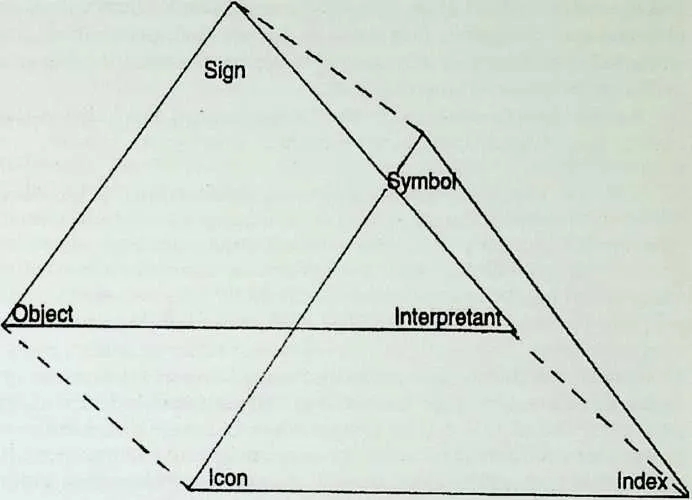
39 Figure 1: Diagram of Peirce/span>s process ofsemiosis. Author/span>s collection.
40 The self is not entirely capable of transcending that of which it is an aspect. Every person/span>s worldview is incomplete insofar as it is an ‘‘incomplete representation of a/the world’’ (Ibid: 72). It is a representation of knowledge because humans have the capacity to transcend that which is known to other individuals. Knowledge is an essential aspect of the human being (Ibid: 72). The American semiotician Floyd Merrell notes:
4142Looking to the past, every philosophy, scientific theory, advanced culture which has fallen into decay, social, political, or economic system, can be demonstrated to contain somewhere, at some point in time, a flaw-at least from our present, and biased, view. Future civilizations will certainly look upon us in their own ‘‘prejudiced’’ way as well. (Ibid: 72)
43 Every culture will have its own worldview, separate and distinct from that of any culture that existed before it.
44 Culture, Design, and Semiotic
45 Designed objects are a reflection of our cultural beliefs. Although these beliefs differ as to how they are expressed in verbal and behavioral modes, they usually do not differ in character or content. The cultural linkages of an artifact or design object are values. Human values can be material and utilitarian; they can also be aesthetic or spiritual, as with icons and cult objects, or they can express attitudes toward other humans or the environment (Frown 1982: 3).
46 Architecture theorist and critic Donald Preziosi also believes that the objects that a human invents have a role in shaping our culture:
4748Not only do we use and make objects; objects in turn have, in a sense, made us what we have become as a species. It seems evident that we have evolved ourselves in large part to interact with this artifactual world of sign-formations-in other words, that human evolution is in part the product of our long interaction with systems of built forms. (1979:1)
49 Preziosi argues that all designed objects function as part of a sign system that exists in a symbiotic relationship with humankind/span>s evolutionary processes. The objects that humans create will have a direct influence on any future products that make up our constructed environment. These products in turn will influence how humankind perceives past and future generations.
50 Jules David Prown, like Preziosi, believes that objects have an influence on our cultural environment. In his article, ‘‘Mind In Matter: An Introduction to Material Culture, Theory, and Method,’’ interpretation is viewed as the knowledge that objects are ‘‘cultural releasers.’’ Prown discusses how the cultural values of a perceiver of an object might be similar to or different from those who produced the object, even though both groups may live in the same society. This explains why some objects are viewed favorably and others neglected; it is also the reason why an object may be ‘‘in fashion’’ one moment, and ‘‘out of fashion’’ the next. The object, in form and function, remains essentially unchanged; it is the consumer or perceiver of the object whose cultural values change. He declares: ‘‘From the time it is created, an artifact can arouse different patterns of response according to the belief system of the perceiver/span>s /span>cultural matrices(1982: 6). In the process of the interpretation of objects, information external to the artifact, such as the designer/span>s purpose or intent, plays an important role in how the object will be interpreted by the consuming society. According to Prown, culture and society, belief and behavior, are connected; this connection determines the manner in which a society will view its objects (Ibid: 6).
51 The architectural theorist Juan Bonta establishes a link between culture, architecture, and semiotics. He believes that the science of semiotics should involve the interpretation of how6 the design object means the particular things it does to a certain culture. The science of semiotics should investigate how expressive systems convey meanings through certain forms and how these relationships originate and change (1979: 211). Culture, Language, and Semiotic
53 Language can be viewed as a sign system. Umberto Eco, for instance, notes that dictionaries and cultivated language must take into account that words function as signs (1984:16). According to anthropologist John Deely, language not only denotes the words a culture uses but also everything that makes humans understand each other, including all imagery used to communicate (1990: 73). Deely, like Eco, argues that the imagery and words used to communicate effectively must be a part of that person/span>s own culture or part of a similar culture. The worldview of a sign/span>s creator or any user of that sign is connected with his or her structure of language. The anthropologist and semiotician Mieczyslaw Wallis claims that ‘‘…there are connections between the structure of language and the worldview’’ (1975: 18). Language directly influences the worldview of both the creator and the reader of a text by virtue of the use of grammatical conventions. In every text there is a style of language that is representative of a certain era. There is a certain language style for every period. As a form of communication, language has a direct influence on the formulation and transfer of knowledge. Language is also a special feature of humankind. A person uses language to express his or her beliefs (Ibid: 36).
54 Literary semiotics, according to the Peircean semiotician John Sheriff, analyzes ’’ the system of conventions which enable literary works to have the meanings they do for members of a given culture’’ (1981:51). Semiotic investigations study the language conventions that enable texts to produce meaning for the reader.
55 Peirce' Semiotic Applied to an Investigation of the
56 Meaning of Fuller' Designs and Language
57 Using Peirce/span>s semiotic theories, I will investigate how Fuller/span>s Dym- axion Vehicle achieves meaning, or a ‘‘logical comprehension’’ (Peirce 1978: 235). The cognitive characters that allow us to understand its meaning are contained within each object.
58 Peirce/span>s semiotic will also be used to inquire7 into the meaning of the language of Fuller/span>s Dymaxion Vehicle patent text, 4D Time Lock and other writings of the cultural milieu from 1928 to 1935. This analysis will, to some extent, be American culture-bound, Weltanschauung-grounded and English-language bound. I will discuss the cultural conventions within Fuller/span>s language,8 in his 4D Time Lock aesthetic text, Dymaxion patent text, and in his Dymaxion Vehicle designs. As Floyd Merrell states in his book A Semiotic Theory of Texts, ‘‘Literary texts as well as scientific texts portray particular perspectives of the world or of a world: world models …‘‘ (1985:101). He also claims that ‘‘ …all scientific texts, like literary fictions, embody,…an imaginary construct’’ (Ibid: 101). A semiotic analysis of Fuller/span>s patent text as well as his aesthetic text 4D Time Lock is possible because there exists an ‘‘imaginary construct’’ within the language structure of these texts. This imaginary construct is an aspect of the author/span>s cultural worldview or internal vision.
61 Fuller/span>s writing style is as exceptional as his designs, and, unlike many designers, he readily put his ideas into print. Some scholars have compared his later writing style to that of James Joyce (1882-1941) (Kenner 1973: 311) because of his propensity to create new compound words. However, while Joyce sought to obscure language intentionally (Schlauch 1973: 13), Fuller wanted to emphasize a precise meaning and sought to write in a clear and concise manner (Antoniades 1990: 59), one that adhered to the linguistic conventions governing patent writing at the time.9 When Fuller wrote the utility patent for the Dymaxion Project, he used the unique conventions of American patent writing during the 1930s. His Dymaxion Vehicle patent text has a specific meaning for the ‘‘semantic reader.’’ 10 These conventions include the conventions of American culture, which are based upon the patent or sign definition in patent writings. Official patent language is a specialized language whose styles and standards are defined by a specific codebook.11 In the patent text, the inventor has to describe the invention in a ‘‘full, clear, concise and exact’’ manner that would allow any person skilled in the inventor/span>s art or science to construct or use it in the same manner as the inventor (Geier 1934: 13). The claim portion of the patent text specifies all functions, operations, features and advantages that the invention has, and describes every new idea implied in the invention (Lamas 1930: 236). According to patent attorney Oscar Geier, the main purpose of the claims is:
6566…to define the exact limits of an invention. No matter what has been described in the body of the specification or illustrated in the drawing, the invention patented is the invention set forth in the claims, nothing more or less. The patentee is bound by his claims and the scope of these claims will not be enlarged by reference to the specification. (1934:14)
67 The diagrams of a patent must display all of the claimed features of the invention. If the invention is an improvement over an older invention, the patentee has to display the improvements in one or more views in a separate drawing. All devices and articles must be shown in sectional as well as frontal views (Ibid: 16).
6869Fuller follows the concise codes of the patent book in the patent text to convey the principles of his Dymaxion Vehicle invention. However, there are certain language and diagrammatic codes in the Dymaxion Vehicle patent that promote the myth of functionalist design.12 The following questions arise: Does Fuller/span>s language in his book 4D Time Lock and other writings from this era reflect the rules in the patent codebook? Is his language therefore a patent language?
70It is vital to understand how Fuller/span>s language was incorporated into his functionalist worldview.13 Does Fuller/span>s unique writing style constitute a lexicon that more precisely conveys a specific meaning? Does his language in 4D Time Lock and other writings of the era correlate with his functionalist thought?;14 is his language a functionalist language per se,15 conveying more meaning with fewer words or written symbols? How does Fuller incorporate, in a pragmatic framework, iconic metaphors that convey specific meanings that he thought would be understood by the majority of readers? These questions direct the present study.
71 This study examines how Peirce/span>s semiotic can be used to interpret Fuller/span>s designs. Fuller/span>s past experience, including observation, trial —and—error16 and logic, along with his use of deductive logic,17 will be applied in this investigation of meaning. How are Fuller/span>s thoughts and experiences communicated in the Dymaxion Vehicles, patent diagrams, 4D Auto-Airplane, and in his writings from this era? In order to understand Fuller/span>s Dymaxion Vehicles and writings, one must understand Fuller/span>s ideas, a process that will involve: 1. the mind/span>s interpretation of sign processes; 2. the mind of the interpreter; and 3. the mind of Fuller. Peirce/span>s three types of reasoning —inductive, deductive, and abductive—will also be used in this investigation in order to gain an understanding of the relationships that occur within Fuller/span>s ideas. Also incorporated into Peirce/span>s logic, or the science of signs, was Peirce/span>s logical triad of the sign, object, and interpretant. This study will determine how the Dymaxion Vehicles and writings stand for the sign, object, and interpretant. Peirce also included into his science of signs the icon, the index, and the symbol which depended on the sign, object, and interpretant to produce meaning for the interpreter (Peirce 1960/6: 233--237).
90 Peirce, like other pragmatic philosophers of his time, believed in Charles Darwin/span>s theory of evolution. Pragmatism is a post-Darwinian philosophy in which the idea of experience can be interpreted as involving an organism and its environment. The pragmatists sought to define the basis ‘‘ of human experience and how the human mind, knowledge, selfhood, and morality, were to be interpreted within Darwin/span>s evolutionary theory’’ [italics mine] (Morris 1970: 7--10).
91 For Peirce, Darwin/span>s theory was used to define how ideas evolve. Ideas, to Peirce, were always changing and therefore evolving. The pragmatists embraced Darwinism, which provided them with an empirical scientific theory to analyze human intelligence, and an evolutionary orientation that approached tire study of intelligence in relation to problems of acting in an environment. Humankind was therefore capable of directing its own future by using intelligence {Ibid: 11).
9293This study will also detail how Fuller/span>s beliefs were Darwinian in motivation and how these beliefs affected his designs and writings. The role of Darwinian evolution and the artifact, the Dymaxion Vehicle, will be a part of this analysis. It is also important to examine the impact of Fuller/span>s beliefs on the meaning of the Dymaxion Vehicle in terms of its iconic, democratic, capitalistic, or socialistic meaning.
94Since culture is a sign-driven activity (Eco 1976: 67), the American culture of the 1930s will be examined for its historical significance. The values, symbols, and ideology of this era will be interpreted against the social and economic plight and the spiritual malaise of the era.
95A product design/span>s meanings, as with language, are cultural constructs. Fuller/span>s cultural and philosophical background will therefore be important when analyzing his designs and language. Fuller/span>s spiritual, aesthetic, and functionalist views also have to be investigated.
96 Peirce' Semiotic as a Method for the
97 Interpretation of the Industrial Object
9899This study explores the possibility of a semiotic theory of design. I will not survey the complete history of semiotic texts and design theories and their various methods. Peirce/span>s semiotic must be related to current theories concerned with its application to the design object; it must also be related to the text or texts by or about the designer or the design object in question. In order to provide a methodological perspective for the design object, Peirce/span>s classical semiotic will be linked with contemporary Peircean semioticians. A comparison will be made using Peirce/span>s semiotic and the current semiotic theories of design and text that are an expansion of his classical semiotic. When it is appropriate, this investigation will leave the contemporary Peircean theorists and return to Peirce.
100The current Peircean semiotic theories and methods will be placed alongside Peirce/span>s own semiotic theories and methods. Both Peirce and the current theorists and methodologists will be used and expounded upon throughout this investigation. It will be shown that these are complementary rather than contradictory. Whether their models and methods differ radically is not at issue here: the focus is on these semiotic theoristsrespective inquiries into Peirce/span>s theoretical foundation of semiotic.
101Vincent Colapietro states that Peirce/span>s theory of signs incorporates much of what is known in semiological terms as a code. A code functions, according to Colapietro, as ‘‘a set of correlations providing the means for generating correlations at a different level (or of a different nature) than those making up the code’’ (1995: 41). These correlations comprise the codes that describe how acculturated organisms act and react in the presence of other organisms that have undergone the same or a similar acculturation. The code or codes exemplified in an artifact, therefore, are dependent upon these acculturations (Ibid: 41).
102 The role of the code in Peirce/span>s semiotic needs to be briefly addressed. The term code has often been used in Saussurean linguistics. The semi- otician Roland Barthes/span> work is an example of this tendency. In Peirce/span>s semiotic theory, which transforms logic into a sign theory, the concept of code appears to be nonexistent. Peirce rarely used the term code and his followers have tried to remain faithful to his terminology. Peirce/span>s concept of habit, however, is the same as Saussure/span>s notion of code (Ibid: 41).
103 Colapietro/span>s example of codes highlights the correlations that exist among words or concepts and the sentences that these words make possible. Sentences then make possible such ideas as arguments or texts. He notes: ‘‘In all situations involving communication, one or more codes can be supposed to underlie the possibility of our communicative successes and practices. These codes are explicable in terms of habits’’ (Ibid: 41--42).
104 Peirce/span>s semiotic can provide an adequate model for the analysis of the industrial design object as well as for the text or texts in question. Recent design theories based on Peirce/span>s semiotic have not included the sign, object, and interpretant or the icon, index and symbol as among the main elements of his concept of semiosis.
105 The major distinction between current design theories and the one proposed in this investigation is the use of Peirce/span>s semiotic in text and design analysis using his concept of semiosis. This study will also examine semiotic aspects that are found in all written texts, scientific as well as aesthetic.
106 Peirce/span>s semiotic offers a method, a way of analyzing characteristics common to all texts, including metaphors, similes, tropes, and analogies, while the European semiological model does not. The European model discloses binary, classificatory schemes (Merrell 1985:2). Peirce/span>s semiotic offers a more broadly based logical approach for the interpretation of a text and a design object. This study focuses upon the interpreter of the text and the object as well as the creator of these forms of communication. It establishes a method for determining hoiv the reader of a text or object derives meaning from these forms.
107 Some scholars believe that art or design cannot be compared to language (Wollheim 1980:137). This study, however, is based on the premise that design can be compared to a language. The comparisons investigated in this study are between the processes that explain the origins and use of a certain language style and those that are used in the creation and signification of a certain designed object. For example, the similarities between the processes involved in developing a functionalist language are similar to the processes involved in developing a functionalist, designed object.
108 Floyd Merrell states that it is the use of language in a text that communicates ideas. He notes:
109110Language is the medium, it is not the text. Texts make use of language to convey, at conscious and unconscious levels and by some as yet undefined capacity, novel ideas, concepts, opinions, desires, emotions, …about the world and about other texts. To do this inevitably entails also the abuse of language: The creation of new meanings and new figurative modes of expression. (1985: 5--6)
111 This statement affirms the idea brought forth in this study, namely that design can be interpreted through the medium and processes of language. Product designs may be analyzed by similar grammatical terms and codes that are usually applied to analyze a text.
112 I will attempt to construct a semiotic model that can be used to analyze not only any design object but also texts that the designer wrote at the time he or she created the design object. Using Peirce/span>s semiotic, I will also examine historical writings concerning the design object under investigation.
113 This study uses Peirce/span>s semiotic to focus upon the process of interpretation. The overall purpose of this investigation is to provide a discussion that will contribute to the existing gap in current semiotic theories of the design object. It will be shown that a Peircean approach can provide the framework for the logical interpretation of the design object.
114 The theory presented here is an extension of Peirce/span>s classical semiotic. The contemporary semioticians used in this investigation, along with Peirce/span>s classical sign system, will be used to create a model for reading the industrial design object. This model discloses the significance of the design object and the reason behind its production. This reading of the design object is partially based on Peirce/span>s notion of unlimited semi- osis.
115 A Resemantization of the Dymaxion Vehicles
116 Peirce/span>s semiotic sign system can be used to reinterpret, or resemantici- cize Fuller/span>s Dymaxion Vehicles, patent text, and book 4D Time Lock. Fuller/span>s unique dual form of expression/communication provides an opportunity to test some of Peirce/span>s principles, and thereby correlate the text with the design object.
117 There are infinite potential interpretations of the Dymaxion patent text, the 4D Time Lock, and the Dymaxion Vehicle. This case study is one of many. The cyclical process of interpretation is constantly evolving. In the process of interpretation, differing perceptions of knowledge can be deduced and disclosed. Hopefully the results of this study will not only provide researchers more insight into Fuller/span>s philosophy and theory of design, but also outline a semiotic methodology that is applicable to design objects in general.