
5 Peirce/span>s Sign and the Dymaxion Vehicle
2Using Peirce/span>s concept of the sign, the Dymaxion Vehicles can be read as signs interacting within the environment. As signs, they stand for something to a specific person, social group or culture. The Dymaxion Vehicles function as signs because they stand for something in some respect or capacity. They represent the idea and the product that Fuller created. The idea of Fuller/span>s concept of the Dymaxion Vehicle creates an idea or interpretant in the interpreter/span>s mind. What this idea is can be discussed through past and present written statements and visual aids.
3 The diagrams and drawings from Fuller/span>s 1937 patent of the Dymaxion Vehicles and the text from this patent are also viewed as signs. The Dymaxion Vehicle is an object that can be interpreted. It signifies an action that was to be carried out, and created an expression through its form and ideology.
4 Peirce/span>s sign does not function in isolation. The sign forms a relationship with the object and interpretant. Thus, when analyzing the Dymaxion, the sign, object and interpretant will all play a role. Using Peirce/span>s triad of sign, object and interpretant, it is possible to analyze how a form can dictate the behavior of a person. Whether the Dymaxion Vehicle dictates behavior is a fundamental question relating to Peirce/span>s triadic relation. To discover this, we must search for similarities between Fuller/span>s written language and the object, namely, the Dymaxion Vehicle.
5 Fuller and Peirce' Sign, Object and Interpretant
6 Underlying Peirce/span>s triad of sign, object and interpretant is the concept of collateral experience and observation. Peirce/span>s collateral experience plays an important role in the analysis of Fuller/span>s Dymaxion Vehicles and writings. Fuller believed that experience is a necessary prerequisite of design. He reports that his naval and engineering experiences were the impetus for the creation of the Dymaxion Vehicle. He also notes that ‘‘functional sense’’ and logic were important in his designs: ‘‘Having encountered the many problems set forth in my 4D book, there came to my assistance the logic and fundamental functional sense, inherent from my long association and natural love of the sea and its boats’’ (Fuller 1970: 88). In this instance, his Navy experiences, logic, and function served him in the development of the Dymaxion Vehicle.
7 According to Fuller, experience is also an important aspect of logic and is noted in his patent writing. In his book 4D Time Lock, he links collateral experience to his design methodology in the following:
8 Through protracted isolation for mental research, analysis, and design, truly aided by material self negation, guided by a vast catalogue of experience, have we leaped ahead (in faith) to the critical ‘‘Bottle neck’’ of progress. Materially acquiring its stewardship through patents, etc. may we at last banish feudalism and the cultivated prosaicness of self-consciousness in everyday life (sic). (1970: 20)
9 Fuller claimed that through patents society can progress to achieve utopia. He saw American culture in the 1930s as unpoetic, unromantic and dull. Society and the products of that society lacked an aesthetic sense of beauty. The American economic system, to Fuller, was synonymous with the medieval, European politico-economic feudal system that kept society in the service of the elite. Fuller/span>s ideas perpetuate his ‘‘romantic functionalist’’ beliefs.1 He also explained the role that collateral experience takes in his book, 4D Time Lock, published in 1928. Fuller pointed out that his book was intended for a specific audience or using Eco/span>s term, a ‘‘model reader.’’ 2 He stated that the book was to be read in a specific manner: To be readable to the general group for whom it was intended, detail of this order had perforce to be left out of 4D book and of this letter. As you may realize from 4D, there is but one proper method for handling any one of these questions. With the proper application of experience to thought, the solutions have been clearly revealed. (1970:121)
12
Peirce/span>s collateral observation is also needed for a semiotic investigation of the Dymaxion Vehicle.
It is important to be acquainted with the Object, in this instance the Dymaxion Vehicle, patent
drawings, photographs, 4D Time Lock text, the patent text, as well as the ideas that
were
their motivation, in order to understand the relationship that exists among them.
13 Collateral observation is determined by the Object, (the Dymaxion Vehicle, patent drawings, photographs, patent text, and 4D Time Lock text), which determines the idea or interpretant in the interpreter/span>s mind. The idea the Dymaxion produces in the mind of the interpreter is just as important as the actual object. The object does not exist before the idea. The notion of collateral observation is expressed in the diagram below.
14 Designer/span>s ideas behind = the motivation of the Dymaxion Vehicle
15 Object - Dymaxion Vehicle Photographs Patent Drawings Patent Text
16 4-D Time Lock Text
17 Interpretant ideas formed in interpreter/span>s mind
18 Experience is not the only important point of similarity between Fuller and Peirce, so too are observation and convention. The following chapter will help to disclose the meanings that Fuller wished to convey through observations and conventions. Using Peirce/span>s concepts of icon, index and symbol, these ideas will be further analyzed.
19 Fuller' Dymaxion Vehicles and Peirce' Icons
20 Peirce/span>s icon is represented in Fuller/span>s Dymaxion Vehicle as the comparison of qualities found among the three Dymaxion Vehicles. The visual aspects of the Dymaxion Vehicles, along with the technical rules, or engineering principles, are similar enough to be termed icons. Fuller differentiates between all three vehicles by the various changes he introduced during the development of each vehicle. These qualities consist of the differences and similarities displayed in the three Dymaxion Vehicles, which will be outlined in the following paragraphs.
21 The first Dymaxion Vehicle (fig. 2) had two forward wheels that were propelled by a Ford V-8 engine mounted in the rear of the vehicle, behind the passenger compartment. The single rear wheel made possible a tight turning radius, enabling the vehicle to park in-line between other cars. To prevent side collisions, Fuller planned for a warning device activated by the extreme turning of the steering wheel (Bush 1975:105).
22 Dymaxion Vehicle Number One was similar to the wingless, tail-less fuselage of the 1928 drawing. It was hand built using a combination of aeronautical and automobile techniques (Marks 1960: 29). The tear drop form was interrupted only by a ‘‘hood-mounted’’ air-intake cooling device for the engine located in the tapered rear of the vehicle. The body consisted of aluminum placed on an ash frame, was 5.7 metres in length, capable of seating eleven, and had a cockpit cover with doors on the left side. After the 1933 Chicago World/span>s Fair accident, parts of the roof were removed to provide ventilation. The vehicle was fitted with aircraft seats and seat belts with controls similar to an aircraft/span>s, such as airspeed indicators and radios. The entire body was ‘‘multi-hinged’’ on a chromemolybdenum aircraft steel ladder chassis divided into two scissor-like sections that were hinged at the front axle (Ibid: 30). The weight of the passengers, as well as the Ford V-8 engine driving two front wheels, was supported by this forward ladder frame. The Dymaxion/span>s body was situated on a steel A-frame, and the rear steering wheels pivoted 160 degrees. Fuller duplicated Ford/span>s rear, now front-beam axle, transverse leaf-spring suspension, and friction dampers. The axle on the Dymaxion vehicle had smaller tension-dampened transverse leaf springs that were located on the long A-frame (Pawley 1990: 68--69).
23 The second Dymaxion Vehicle (fig. 3) was developed after the completion of Dymaxion One. This vehicle had a canvas roof similar to the first Dymaxion Vehicle. This vehicle contained more windshield glass units than the first vehicle; it also had headlights that opened and doors on both sides instead of only one. This car disappeared for a number of years and was found abandoned in California during the 1960s. It now resides in the Harrah Automobile collection in Reno, Nevada, and only its exterior has been refurbished (Ibid: 66).
24 The third Dymaxion Vehicle (fig. 4) was finished in 1934 just before financial problems forced the factory to close. The third vehicle had a ventilation system in the engine compartment and in the sides of its body. It was the only Dymaxion Vehicle to feature flush door handles and an all-metal roof. Fuller omitted the roof-mounting air-intake system found on the first two Dymaxion vehicles. It was very similar to Dymaxion Vehicle Number Two. This third Dymaxion was photographed at the 1934 Chicago World Exposition where it executed 180-degree turns. Leopold Stokowski, a noted conductor of this era, bought this Dymaxion but kept it for only a short time. It was later restored at the Beech aircraft plant in Wichita, Kansas, in 1945. This was the Dymaxion that was later photographed alongside Fuller/span>s private plane. It was last reported seen during the 1950s with over 300,000 miles documented (Ibid: 66).
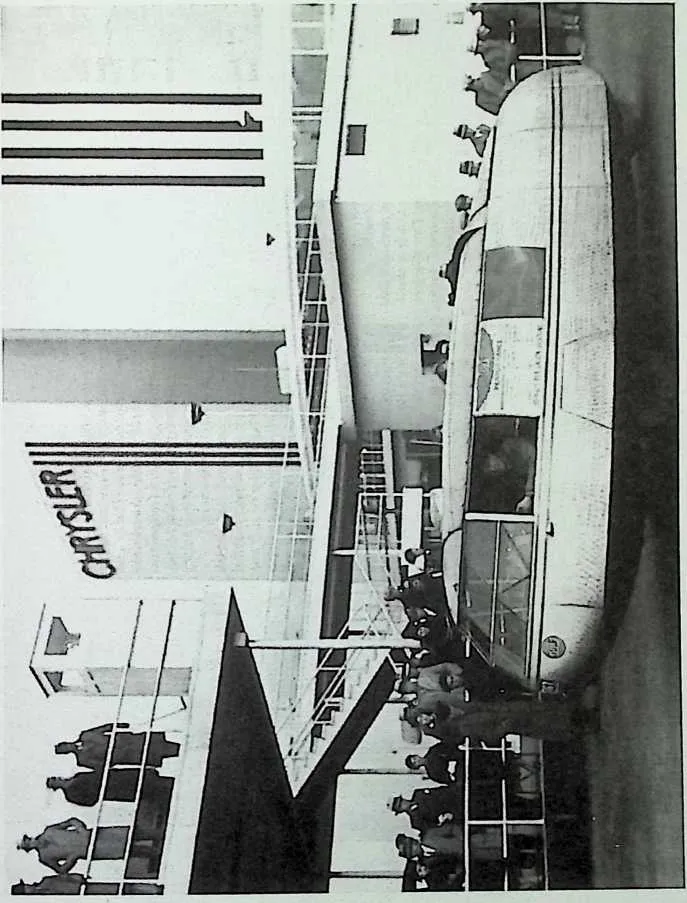
26 Fig.2. Dymaxion Vehicle#!. Copyright 1960Allegro Fuller-Snyder.
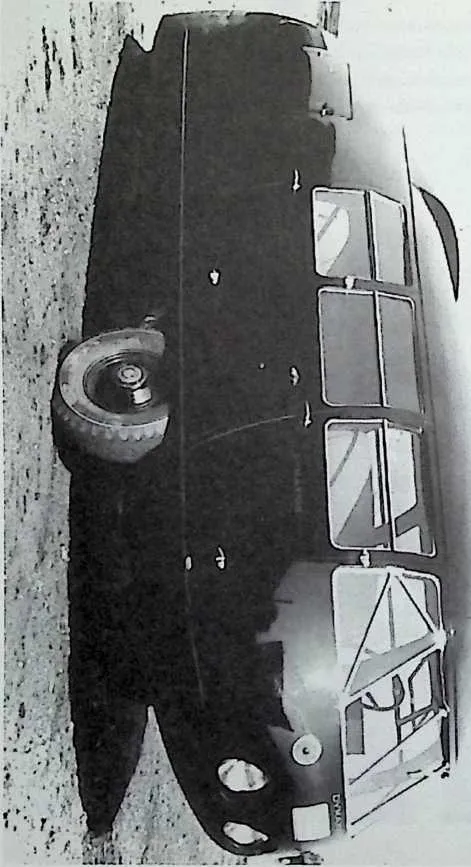
28 Fig. 3. Dyinaxion Vehicle #2. Copyright 1960 Allegro Fuller-Snyder.
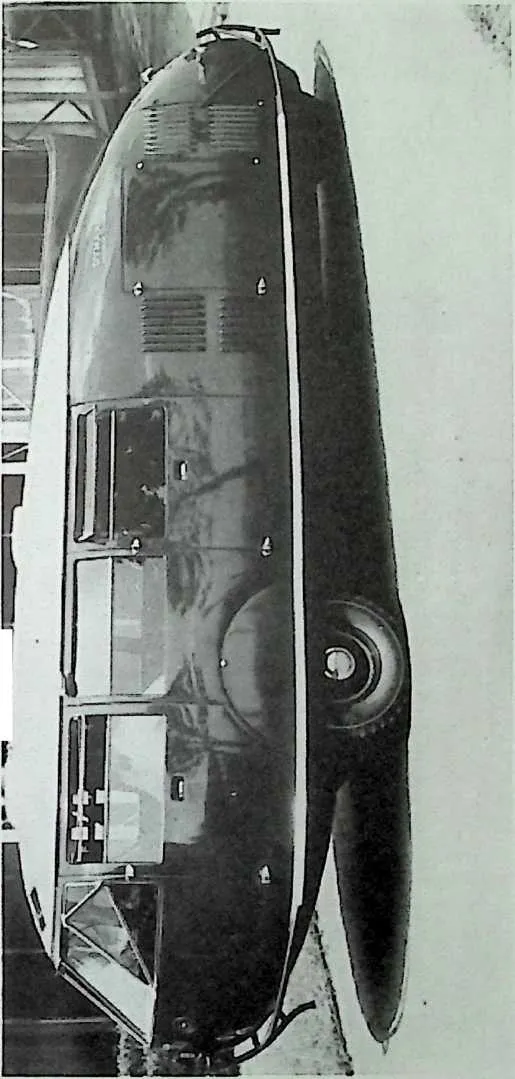
30 Fig. 4. Dymaxion Vehicle #3; Copyright 1960 Allegro Fuller-Snyder.
31 The Dymaxion Vehicles, if we accept Eco/span>s definition of a double,3 are representative of doubles and not partial replicas. There is a high degree of similarity in the ideas, laws, and rules incorporated into all three vehicles. The Dymaxion Vehicles can also be icons by virtue of their similar function. According to Peirce, icons are produced upon resemblance and the sharing of certain properties (Peirce 1985:10). Eco does not believe that spatial relationships can be iconic (Eco 1976: 198). However, the Dymaxion Vehicles, when analyzed as icons, can be representative of spatial properties. They can stand for similar or different spatial relationships. In this case, there are three similar vehicles, yet each one differs to a certain degree in its various automobile units. They are all based upon the same streamform principles and laws. Eco does not discuss the existence of spatial properties with respect to differences and degrees in the distribution of car units, such as the placement of windows, engine, steering wheel, and exterior wheels. A comparison of configurations can be made, and hence spatial relationships can exist. The spatial relationships stand for the logic Fuller uses,4 which can become an icon of the idea. The similar ideas are the logic behind the similar form, which equals the icon. The spatial relationships that exist between the various automobile elements differ only slightly from one Dymaxion Vehicle to the next. It is impossible to assess the similarities and differences among the interiors of each Dymaxion Vehicle since the only interior photograph in existence is that of the first Dymaxion Vehicle (fig. 5).
34 Dymaxion Vehicles ‘‘Two’’ and ‘‘Three’’ form an iconic relationship with Dymaxion Vehicle ‘‘One’’ in three ways: first, by visual similarities; second, by spatial similarities; and third, by the ideas on which their construction and function are based. Eco defines an icon in terms of its visual qualities only. If ideas are icons, as Peirce claims, then the Dymaxion Vehicles ‘‘One’’ , ‘‘Two’’ and ‘‘Three’’ are icons in more than their visual appearance. Fuller based all three on similar laws and principles of aerodynamic streamlining, which were derived in part from the rules of nature.
35 Peirce also believed that there was no such thing as a ‘‘pure icon’’ , although ‘‘icons’’ existed because they were based upon similarities and resemblances (Fitzgerald 1966: 52). If we take Peirce/span>s definition into account and not Eco/span>s,Fuller/span>sDymaxions also function as icons in visu-
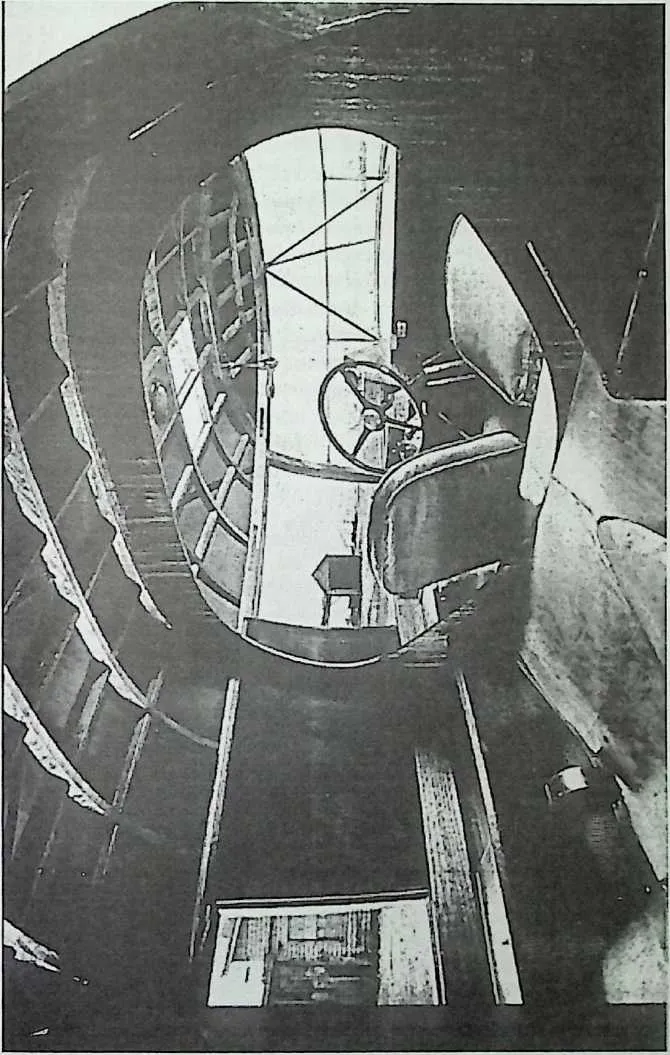
37 Fig. 5. The interior ofDyniaxion #1. Copyright 1960 Allegro Fuller-Snyder.
38 al appearance. The number of similarities between the vehicle/span>s elements, or iconic markers as Eco calls them (1976: 208), outweighs the number of differences between all three Dymaxions.These measurements are accomplished through content analysis.
39 The feeling that the Dymaxion Vehicle evoked in the receiver can be created even in the absence of the physical object in itself; all that is needed is the idea or the interpretant of the object. The Dymaxion Vehicle evoked a certain feeling in the user as well as the onlooker through the interpretant or the idea created in the mind of the interpreter.
40 The two-dimensional images of the Dymaxion Vehicles can also form icons. The interpreter can experience the Dymaxion Vehicles through photographs and films. Films represent a kinetic aspect of the vehicle from the vehicle/span>s exterior. The interpreter does not need to be inside the Dymaxion Vehicle for the sensation of movement or action to be created in his or her mind,5 thereby giving the form meaning. The sensation of movement or action is also formed in the mind when viewing each Dymaxion Vehicle separately in photographs. The interpreter can relate similar experiences and sensations based upon the form of each and by reading Fuller/span>s own words, who actually rode in the car. Since ideas are also iconic in quality,6 Fuller/span>s ideas of evolution function as icons. His ideas concerning the biological, evolutionary process are exemplified in his design methodology as it relates to automobile design. He suggested, As mechanical truths are revealed so do we progress towards perfection; though there can be no absolute perfection in the material world. So has the automobile or airplane continually approached perfection. As it has approached perfection, by the process of the application of truth, so has it approached one final design. (Fuller 1970:11)
43 Automobile design is seen as an evolutionary process7 or, in Fuller/span>s phrase, as ‘‘one final design’’ (Ibid: 11). It is the best and most ‘‘perfect’’ design. Truth, according to Fuller, can be applied technically; however, truth cannot be applied mechanically in reality. Fuller does not state exactly what these mechanical truths are. These mechanical truths may represent mass production. Machinery and technology can be applied to create better designs in airplanes and in automobiles. This is tantamount to a functionalist, ‘‘technocratic’’ belief’’ or ideology: Technology is the answer to solving design problems. The design process or methodology is the application of ‘‘truth.’’ We do not know exactly what Fuller means by ‘‘truth’’ being applied. Fuller uses the metaphor of mechanical truths as representing progress. He compares humans progressing towards perfection in terms similar to design progressing towards perfection. He was basically Darwinian8 in these views, even though he often claimed to be anti-evolutionary in his design philosophy and methodology. Historian Robert Marks claims that Fuller is not Darwinian in his design methodology. He notes the following with respect to Fuller/span>s anti- evolutionary design process:
4647Fuller makes cumulative experience a pivotal factor in change. Experience is finite; it can be stored, studied, directed; it can be turned, with conscious effort, to human advantage. Darwinian evolution is assumed to be operative in ways independent of individual will and design. Darwinian posits chance adaptation to survival; Fuller/span>s approach pivots on the conscious, selective use of cumulative human experience. (1960:10)
48 Marks, however, contradicts himself when he states: ‘‘In its simplest form, Fuller/span>s Dymaxion concept is that rational action in a rational world, in every social and industrial operation, demands the most efficient over-all performance per units of input. A Dymaxion structure, thus, would be one whose performance yielded the greatest possible efficiency in terms of the available technology’’ (Ibid: 9). This statement is Darwinian in its motivation and meaning. According to Marks, any Dymaxion project embodied or symbolized the most evolutionary ideal notion of technology. Although these statements are generally correct, Fuller is Darwinian in his design process as stated earlier. He believed in a form that fits its purpose and function, and this ideal form was the aerodynamic, streamlined vehicle.9 As stated earlier, the image of the Dymaxion Vehicle created iconic relationships in the interpreter/span>s mind. The interpreter need not view the vehicle itself for an image similar to the Dymaxion Vehicle to be created in his or her mind. Other ‘‘streamline’’ vehicles are iconic of the Dymaxion Vehicle and vice versa; examples of this are Paul Jaray/span>s vehicle design of 1922 and other streamlined vehicle designs of the era. These contain a sufficiently high percentage of similar ‘‘iconic markers’’ 10 to make them icons of each other and of the term —or archetypal category—‘‘streamline.’’ 11 The term ‘‘teardrop form’’ represents all vehicles under this type12 by virtue of their similarity in appearance, function, and laws governing their creation as well as their cultural interpretations. Just as Fuller/span>s Darwinian beliefs are iconic, so too are his pragmatic ideas. The reason that Fuller created his Dymaxion Vehicle prototypes as experiments ‘‘#1,’’ ‘‘#2’’ and ‘‘#3’’ is to be found in his pragmatic philosophy. He built these prototypes to test the ideas and his functionalist principles. Fuller used all of the above-mentioned beliefs to create the ‘‘best design’’ of a transportation device.
53 Fuller expressed his belief:
54 My three experimental units of 1933,1934 and 1935 were called the Dymaxion 4D transports. As a result of building and testing these three successive types of the 4D transport I learned of the primary cross-wind, cross-furrow, in-rut, on ice, in-traffic, inparking, ground looping, cornering, high-speed accelerating and decelerating problems and answers and, to the best of my knowledge, am at present better prepared than others for initiating the successful prototyping phases of this new era transport. (Fuller 1969: 20)
55 There is a particular logic and reasoning behind Fuller/span>s choice of a three-dimensional form for the Dymaxion Vehicles. He claimed that material evidence or experiment is needed to convince the public of scientific discoveries such as his Dymaxion system. For example, he compares Lindbergh/span>s flight in 1933 to that of his automobile and housing units. He stated the following:
56 ‘‘Theoretically the two world air routes most recently coursed the Lindberghs, i.e., to the Orient and Russia via Alaska, and to Europe and Africa via Greenland and Iceland, were evident to the world-considerate architect years ago and academic to the scientifically minded for some time past, yet until Lindbergh had actually landed at the New York airport on December 19, 1933, having jauntily traced and retraced his routes, was a notion of popular transportation by air over the pioneered track conceivable? It takes material demonstration to win popular credence of scientifically-arrived-at-theory. (Fuller 1934: 10)
57 Fuller claims that material evidence is needed in order to give his own ideas credibility. He offers this material evidence as the reasoning is, the sense makes its presence known), it is unknowable because, lacking form, there is nothing within our perceptions of it for the mind to grasp. Bridging the gap between form and matter is the architectonic substance of building.’’ I am following this definition of type in this study. For a discussion of the various historical types, see Jan van Pelt and Westfall, 1991: 144--254.
58 behind his choice to convey his design ideas in the three-dimensional prototype13 as well as in the diagrams. By developing these prototypes, he wished to convince the public of his ideas. This became important to him, and he promoted14 his ideas because he often felt that he was a failure15 and needed to reassure himself that his ideas were feasible and not mere speculation. The Dymaxion Vehicle/span>s streamlined form was based upon scientific theory. Aerodynamics gave Fuller the empirical data with which to give credibility to his design ideas. Fuller/span>s main purpose in making the prototypes, although he never wanted them to be mass-produced, was to claim that the idea was an important aspect of the three-dimensional design process or construction of the ‘‘ideal prototype.’’ Fuller/span>s own view on this point seems to contradict his ideas of the Dymaxion designs as equivalent to ‘‘social design’’ (Marks 1960: 8). He produced these designs only in order to prove that they were feasible and could be built; he did not care if they were ever mass-produced for society. These Dymaxion designs were therefore built for his own gratification.
62 Fuller received a grant from Philadelphia stockbroker Philip Pearson to produce the prototypes. Pearson was a supporter of Fuller/span>s ideas and wanted to see them brought to fruition. Hoping to help end the economical struggle of the Great Depression, Pearson supported Fuller/span>s ideas by giving him a few thousand dollars.
63 The prototyping cost of the Dymaxion Vehicle would be about one hundred million dollars.16 However, the technologies of the automotive and airframe industries were more advanced. By using the parts from these two industries, he could produce and test his vehicle/span>s ground taxiing qualities. He also believed that production of the three prototypes was worthwhile just for the experience. Fuller also learned the economics of creating a prototype by having to purchase all of the production tools that were needed for such an endeavor (Ben-Eli 1972: 755). Fuller—Diagrams as Icons
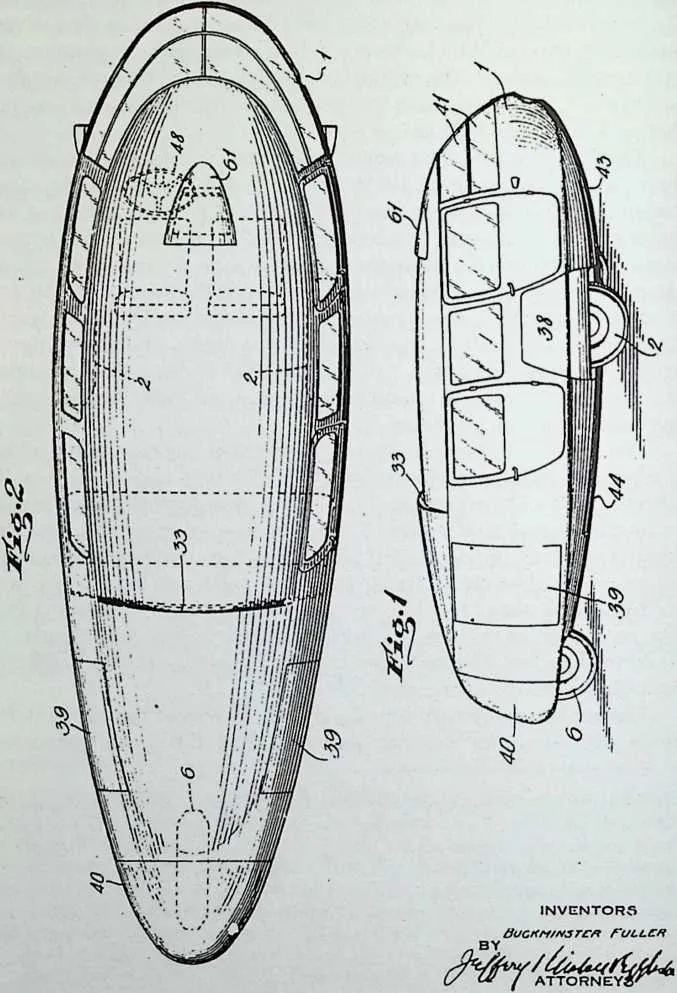
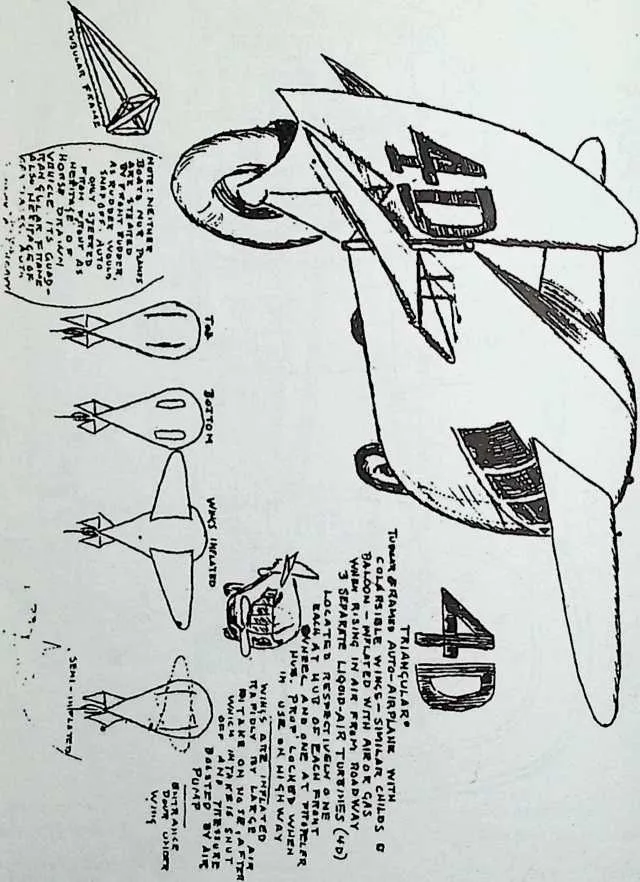
65 The ideas behind the creation of the Dymaxion Vehicles are displayed in the patent diagrams (figs. 6 &7) and 4D drawing (fig. 8). Fuller experimented with the diagrams before the creation of the three-dimensional Dymaxion Vehicle. The diagrams are experiments in and of themselves.17 Fuller/span>s Dymaxion Vehicles were produced through the variations of the ‘‘4D Auto-Airplane.’’ The original conception of the ‘‘4D Auto-Airplane’’ had to be changed because it proposed the incorporation of technologies that were unavailable at the time.18 The drawings and diagrams of the Dymaxion Vehicle are based upon theories of transportation design developed during the 1930s. These drawings and diagrams dealt with the streamlining of a form, and were intended to create a new relationship with the product and the environment. These changed in form for a specific reason. The drawings and diagrams of the Dymaxion Vehicle are based upon the theories and histories of streamlining that provided a foundation for the Dymaxion Vehicle form to be built. Fuller elevated this theory into a philosophy, thereby making it mythic in nature. An investigation into the history and theory of streamlining is needed in order to determine if Fuller/span>s design philosophy can function as a theory.
68 The history of streamlining in design has its beginnings in the history of hydrodynamics and aerodynamics. The term hydrodynamics, first introduced by Daniel Bernoulli in 1738, incorporated the sciences of hydrostatics and hydraulics. Before the use of empirical data, hull designs were largely developed based upon intuition and trial and error. Experiments, often crude, were carried out in England in 1765. It was not until 1869 that one of Her Majesty/span>s was to be tested by measuring speed and resistance in sheltered waters. This experiment was rejected, and Frederick Reech of England was given the funds to test various hull types through a water-filled trench (Bush 1975: 4).
69 During the nineteenth century, it was discovered that the motion of fluids occurs under laminar and turbulent flow. Laminar flow is
70 Dec. 7, 1937.
71 2,101,057
72 B. FULLER
73 MOTOR VEHICLE
74 Filed Oct. 18. 1933
75 4 Sheets-Sheet 1
76 Fig. 6. The Dymaxion Vehicle Patent Diagram. Courtesy, United States Patent Office.
7879Dec. 7, 1937. B. FULLER 2,101,057
80 MOTOR VEHICLE Filed Oct. IB, 1933--4 Sheets-Sheet 4
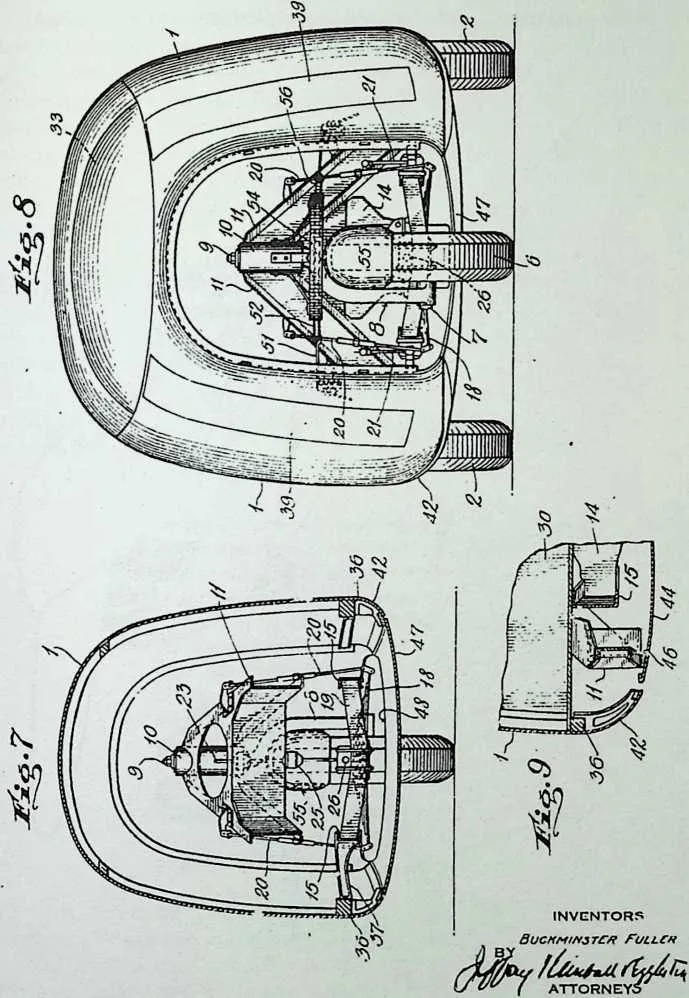
82 Fig 7. The Dymaxion Vehicle Patent Diagram. Courtesy, United States Patent Office.
83 described as a series of parallel layers in a moving fluid that have their own velocity and direction without disturbances in the forward motion. Turbulent flow is the rough eddy of a fluid that is created by an alien form. As a product of this turbulence, a partial vacuum is caused at the rear of the form retarding its forward movement (fig. 9) (Ibid: 4--5).

85 A body is termed streamlined when the flow creates a relatively small amount of turbulence. The first theoretical drawings of streamlines were realized by W.J. Macquorn Rankin. These are visualized in wind tunnels in which streams of smoke are blown over the model form (Ibid: 5).
86 Auto-body designers later began to discuss wind resistance and developed more sophisticated ideas of aerodynamic theory. The teardrop form supplanted the wedge shape as the ideal form that best exemplified streamlining. Scientists in the nineteenth century were interested in the forces that acted upon the rear of an object heading into a force, such as a wind or current. Meikle quotes the designer Norman Bel Geddes on this point: ‘‘This effect was described as a boundary layer of rolling tubes of air, /span>that acted much as roller bearings over which the outer air moves/span>’’ (Meikle 1979: 141).
87 This boundary layer, if it did not converge smoothly at the rear of the object, would disintegrate ‘‘into a chaos of retarding eddies’’ (iWd:141). The ideal form had a broad round front, which would guide the boundary layer gently along a tapering body that developed into a point. It was impossible to round the vehicle/span>s underside because of the location of the wheels. This led to the ideal teardrop form for a land vehicle. This shape emulated drops of water gliding down a smooth surface with the least resistance (Ibid: 141).
88 As Donald Bush suggests:
8990In the natural sciences, the view is often taken that animal forms are altered directly by the forces acting upon them or more gradually by adaptation. In his classic treatise, On Growth and Form, Sir D/span>Arcy Wentworth Thompson used the term streamlined to describe organic structures that offer the least resistance while in motion. One example he used was the hen/span>s egg. Its particular shape results from the deformation of an elastic spheroid in passing through a peristaltic tube (one in which motion is induced by progressive waves of contraction and relaxation.) While in the oviduct, the egg may be viewed as /span>a stationary body round which waves are flowing, with the same result as when a body moves through a fluid at rest.Thompson treated the development of the egg as a hydrodynamic problem, simplified by the absence of turbulence. It is a streamline structure of a simple kind. (Bush 1975: 8--9)
91 This statement uses nature, particularly the egg form, as a metaphor for streamlining and aerodynamic principles.
92 Fuller also uses nature as a metaphoric description in the design process. Fuller used the laws of nature as a source for conveying his ideas of aerodynamics. These ideas were illustrated in the diagrams in his arti-
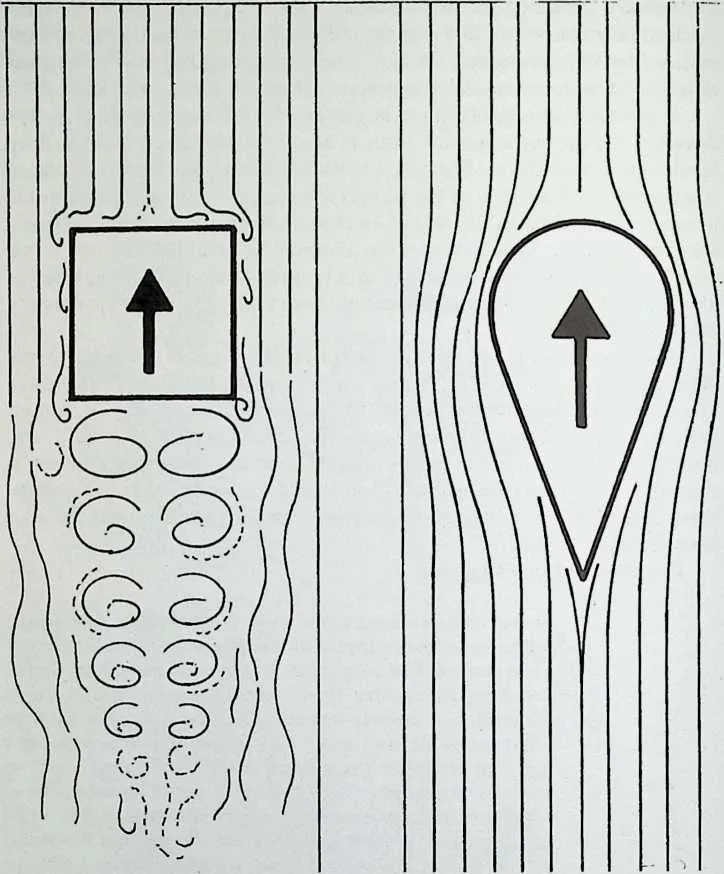
94 Fig. 9. Diagram of the effects caused in a flow by a streamline form (RIGHT) and a non-streamline form (LEFT). Courtesy, collection of Dr. Donald J. Bush.
95 cle, ‘‘Streamlining,’’ published in Shelter magazine. He claimed that nature could be a source for the creation of a transportation vehicle. His diagrams illustrate the laws that he chose to translate in terms of the technical qualities and characteristics of the Dymaxion vehicle.
96 Unexpected changes occurred with each of the prototypes that were taken from only one patent containing five diagrammatic drawings. The variations that occurred are not shown in these patent drawings. The changes that take place with each element, or sign vehicle, such as the windows, doors and periscope, are therefore not shown in these diagrams. The patent diagrams were produced in order to protect a specific design principle (Lamas 1930: 236). These patent diagrams can be read as scientific diagrams. The design methodologist and theorist Lionel March summarizes this idea in claiming that the main function of ‘‘…any scientific endeavour is to establish general laws or theory, the prime objective of designing is to realise a particular case or design. Both require deduction, the quintessential mode of mathematical reasoning, for analytical purposes. Yet science must employ inductive reasoning in order to generalise, and design must use productive inference so as to particularise (sic)’’ (March 1976: 18). The patent diagrams of the Dymaxion Vehicle reflect certain theories of aerodynamics displayed in the two- dimensional drawings. However, they may also be viewed as a particular case of design: the outline drawing of the form discloses the streamline shape or the streamlined vehicle design.
97 Fuller explained his ideas concerning people/span>s unfamiliarity with diagrams that discuss issues concerning stress problems on certain forms. He draws an analogy with nature in order to explain the streamlined form in the 1932 Shelter article. He noted the following:
98 They are not, however, familiar with the stress arguments of the problem. While it would theoretically seem that a perfectly round front would prove the best streamline form, as indicated in the volume, or forward end of an egg, this is true only in cases of relatively slow motion of the penetrating body through the penetrated medium. The stress function at the point of primary impact of the penetrating body into the penetrated medium is that of rendering the penetrated medium asunder. (1932: 76)
99 Fuller uses the common analogy of the 1930s —the egg shape—as a form in nature that is representative of the streamlined form. The medium and penetrating body refer to the stress relationships to which the object is submitted.
100 Fuller also used diagrams in the modeling of the streamline form and its reaction to the medium. He stated the following:
101 Air-craft handbooks, either elementary or advanced, are replete with diagrams indicating the flow of a penetrated medium about a penetrating body showing the swirling areas of regurgitation, in which latter swirls the lack of density approaches vacuum proportions holding back the penetrating body by suction. The diagrams indicate the compounded pressures banked up in advance of relatively non-streamlined bod- ies.Most people are familiar with these diagrams. (Ibid: 76)
102 These diagrams can also function as indices pointing to the qualities of the streamlined form in its reaction with the medium. The icons, discussed in this statement, confirm that there must be a familiarity with the design mentioned. They function as icons because the reader must have some familiarity with the design. Diagrams partake of and illustrate certain cultural conventions. Diagrams function as sign systems that can be read similarly to the language of the culture in which they were produced. The reader must be familiar with the iconic meaning that dictates what an automobile is in order to read the diagram as a vehicle of locomotion.
103 Fuller used diagrams in order to model19 and illustrate this concept of the streamline form and its reaction to the environment. The diagrams are shown in the Shelter article but not in the patent diagrams.
104 Fuller also uses the term ‘‘indicating’’ in the previous quote to display how the diagrams may show the medium being penetrated by a given body, in this case the teardrop form. The diagram/span>s function, according to Fuller, depends on the various theories of nature that exist in a two- dimensional format that the reader can understand and interpret.
105 The diagrams, in this instance, also function as indices, though Peirce never discusses this. The diagrams function as an index by pointing to various aspects or qualities of the streamform in reaction to the viscosity of various media. The use of numbers and letters indicates certain elements of a form and elements such as drawings of wheels and windows. We relate these elements to what is culturally known as an automobile ‘‘semantic unit.’’ 20
106 The 4D patent diagrams and drawings, along with the constructed prototypes of the Dymaxion Vehicles, represent the industrial object or the ‘‘industrial project.’’ 21 The ‘‘industrial project’’ includes the Dymaxion house drawing (fig. 10) insofar as it demonstrates an aspect of Fuller/span>s
107 am following Jan van Pelt/span>s and Westfall/span>s definition of a model. These authors state: ‘‘…the type/span>s character is embodied in its plan diagram, and that plan diagram is about a purpose which is virtually a diagram of how actions achieve the purpose the building serves. This is a model, or an example produced in relatively close proximity to the designer who draws on it and which, because it illustrates intelligent and useful solutions to concrete problems that are still prominent in the art of building, he can follow relatively literally.’’ See Jan van Pelt and Westfall (1991:160-165), for a discussion on models.
108 2This makes reference to Eco/span>s definition of a semantic unit, which functions as a cultural unit and is recognized as the meaning of a term. See Eco, 1976: Theory 66.
109 21! am using Frascari/span>s notion of the ‘‘architectural project.’’ I believe that this idea also applies to industrial design.
110 Dymaxion philosophical system. Fuller thought of the car and house as a system that functioned symbiotically. The Dymaxion Vehicle was developed to deliver the Dymaxion Houses by air to any remote site so that a high standard of living could be made possible no matter where a person was located (Marks 1960: 27). The Dymaxion house, Dymaxion Vehicle, the house, and the vehicle diagrams are the designer/span>s interpretation.
111 In the diagrams, Fuller conveys certain functional denotations of the Dymaxion Vehicle that the reader may understand through the various qualities and connotations that stem from these past, present, and future automobiles. Fuller incorporates not only automobile technology and history into his vehicle designs, but also aeronautical and nautical technology as well.
112 Fuller shared the views of the Swiss architect Le Corbusier on the use of appropriate technology as a solution to design problems. Le Corbusier/span>s Vers Urie Architecture (Towards a Nero Architecture, 1923) described the logic and functionalism of such designs as ocean liners, airplanes and automobiles (Bush 1975: 39). Fuller read Le Corbusier at the time of writing his book, 4D Time Lock,19 and cites it as a contributing factor to his own ideas. Le Corbusier/span>s work compared the evolution of the automobile form with the development of Greek architecture. He discussed the problems of wind resistance and incorporated into his book a chart that described the resistance coefficients of various forms, including the teardrop.The architect Le Corbusier learned from the industrial designer, Norman Bel Geddes, that the teardrop was to become the ultimate form for the automobile (Meikle 1979:144). Through his drawings, Fuller becomes the observer of the physical environment, as well as the observer of his constructed world of objects. The Dymaxion Vehicle is included in this realm of objects. He is also an observer of his own internal world vision or worldview. It is possible to view these diagrams as ‘‘mental imagines’’ (Frascari 1991: 91) or ‘‘mental icons’’ (Peirce 1985:17) known as the ‘‘psychical product’’ , a ‘‘generalized percept’’ (Peirce 1958/8:112). The diagrams and drawings become mental representations of ideas that are exhibited in an external object. The illusion of Fuller/span>s utopia thus functions as an aspect of reality. These drawings and diagrams represented his utopian vision of a certain lifestyle; the internal vision was his internal, mental environment.
114 We can apply Peirce/span>s deductive, theoretic23 and abductive reasoning in analyzing the Dymaxion Vehicle. Theoretic reasoning was used in the creation of the Dymaxion Vehicle through the conventions of diagram-
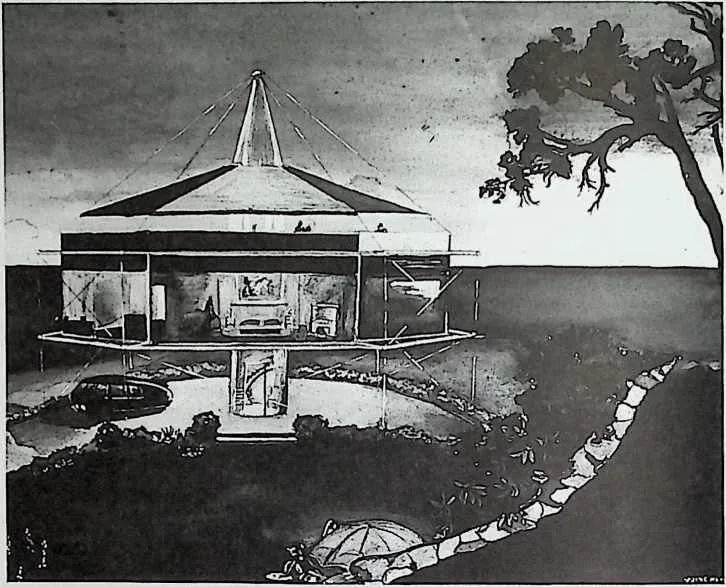
116 Fig. 10. Drawing of the Dymaxion House and Vehicle. Copyright 1960 Allegro Fuller-Snyder.
117 matic drawings. Abductive reasoning occurred when Fuller brought a new idea into the argument. The new idea was expressed in the development of a vehicle that could travel over land, through the air, and on water. It was mainly the idea that was new, not the streamlined form per se.
118 Corollary reasoning, one of Peirce/span>s theories,20 21 is a form of reasoning used to determine what Frascari terms the ‘‘boundary lines’’ in the patent diagrams and in the physical object, the Dymaxion Vehicle. The shape of the product was the ‘‘streamform’’ that comprised the ‘‘product plan.’’ Fuller wanted this form to convey functionalist beliefs and values. The shape alone in the drawings cannot convey this; we need to analyze the text in order to determine if Fuller/span>s designs and ideas are truly functionalist in nature and origin. The shape of the product —the functionalist, streamline, product plan—helps to determine ‘‘boundary lines’’ in the drawings and in the physical object. The Dymaxion Vehicle prototypes are motivated signs that are expressed in Fuller/span>s patent drawings. He interprets the past, present, and anticipated future of the constructed reality of the Dymaxion Vehicle through the patent writings and diagrams. The Dymaxion idea or philosophy, as stated before through the process of semiosis, determines the design and construction of the drawings, as well as the three-dimensional form of the Dymaxion Vehicles. The Dymaxion ‘‘industrial project’’ can be manifested in Fuller/span>s graphic texts, presentation designs, construction, and drawings.
121 Fuller wanted to convey a specific interpretation or translation of the written language into the two-dimensional diagrams, which were limited to a degree. The diagrams were also the physical demonstrations of the designer/span>s —or Fuller/span>s—mental icons, or interpretants that represented the Dymaxion Vehicle.
122 In his book 4D Time Lock, Fuller said that his patent had a limited interpretation.
123 Fuller noted the following:
124 The ensuing patent specifications and drawing in no way are designed as artistic compositions, but merely demonstrate both verbally and graphically a functional composition on which claims of invention must be patent by law be based. They are exhibited here for those who wish to follow through details that may throw light on previous broad statements. They are further exhibited as material translation of our philosophy, lest there be accusations of inability to fathom them. This has been done to far greater extent than is purposely exhibited here, lest other than functional representation confuse or prejudice interpretations, and constructive comment that might not seem acceptable or applicable (sic). (1970: 25--26)
125 By making reference to a functional composition, Fuller is stating that the patent text is functionalist in design, both in terms of its diagrams and its language. A functional composition is therefore also composed of a functional language. Fuller is translating his functionalist philosophy from the idea to the physical form. He is manipulating these sign vehicles in order to transform the unreal into a reality. This action involves the translation of a philosophy from the idea to the physical form.
126 Fuller wrote 4D Time Lock as an aesthetic text, and intended it to be read in conjunction with his patent text and diagrams. The patent has a certain verbal and graphic functional composition. It was a system that was to function symbiotically to express his myth of functionalism. However, Fuller had a certain amount of freedom in the patent text to choose various terms to describe and promote his ideas of a ‘‘functional streamline vehicle.’’
127 The patent diagrams may be seen as iconic representations of Fuller/span>s functionalist philosophy. Restated: ‘‘By adherence to truth fear becomes eliminated. BUT YOU CAN/span>T BETTER THE WORLD BY SIMPLY TALKING OF OR TO IT. PHILOSOPHY TO BE EFFECTIVE MUST BE MECHANICALLY APPLIED (sic)’’ (1970: 6). Fuller is again reiterating his belief that functionalism is a philosophy and not a theory that can be applied. This notion of experimenting with philosophy, —and applying it mechanically—, reiterates Fuller/span>s own pragmatic values, which must be tested in order to be accepted as truth.
128 Fuller also stressed in 4D Time Lock: ‘‘Remember we must translate philosophy to temporal demonstrations. This involves fourth dimension thinking and industrial projection (sic)’’ (Ibid: 26). The industrial projection is equal to the diagrams. The diagrams are not artistic statements or representations. Fuller is trying to add to his diagrams a scientific terminology, thus giving them greater credibility. He believed that his ideas could be displayed in physical form through his drawings and diagrams. He also noted that ‘‘4D thinking’’ was responsible for such industrial projections.
129 The Dymaxion diagrams can be described as ‘‘monsters in the labyrinth’’ of product design;22 they demonstrate the nature of the vehicle/span>s construction. The builders of the Dymaxion Vehicles interpreted these diagrams or blueprints, which helped them create the various templates and jigs that were necessary components of construction. The diagrams became technological icons through social convention. These diagrams or technological icons are responsible for conveying what Frascari describes as three of Peirce/span>s semiotic relationships: (a) the projected icon signifies the socially correct understanding of the sign. This pertains to the social conventions needed in order to understand the Dymaxion diagrams and the patent conventions that Fuller used; (b) the minds of the interpreters responsible for the building or construction of the Dymaxion; (c) the cultural relationship that exists between these two.
131 In its three-dimensional form, Fuller/span>s Dymaxion Vehicle and the diagrams make reference to each other: both object and diagram are therefore icons. They become what Peirce terms the ‘‘psychical product.’’ This ‘‘psychical product’’ can be viewed as Fuller/span>s philosophy brought into the constructed world. Along with the three-dimensional form and diagrams, Fuller also incorporates metaphors and analogies that help to construct his worldview.
132 Fuller-Metaphors and Analogies as Icons
133 Fuller often used nautical metaphors when referring to the exterior form of the Dymaxion Vehicle and its elemental units. He did not include any metaphors when discussing the interior aspects of the Dymaxion Vehicle.
134 The analogy of a ship/span>s form with a streamlined form of an automobile is noted in the following:
135 The hull of the racing sailing boat is not only streamlined in relation to its normal position of balance when riding at anchor without sail, but is also streamlined in relation to its average speed; furthermore, it is streamlined in consideration of /span>heel/span>, or the multitude of water line cross-sections, resultant from the effect of the wind/span>s laying the boat over at various angles. (Fuller 1932: 73)
136 In the above statement, Fuller is describing the relationships or metaphors shared by ship and car. For example, the hull of a racing boat is equal to the automobile/span>s capabilities with respect to balance, speed, heel, and wind-force. These metaphors are based upon their similarities. Fuller believed that the incorporation of a hull shape, consisting of an inverted-vee form in the rear of the Vehicle, would help the aerodynamic stability of the Vehicle (Pawley 1990: 58).
137 The architect and theorist Diana Agrest gives a chart in her book Architecture From Without (1993: 40) in which she compares the metaphor of a house with a ship. Her analysis creates a relationship between two signifying systems, dwelling and ocean liner. Such a relationship exists because of the element common to both, namely the window. Agrest claims, ‘‘Through a metaphoric operation, a figurative substitution of the signifying element common to both systems is produced (dwelling/window-liner/window), carrying and transferring codes from one system (liner) to the other (house) (Ibid: 39). I have adapted Agrest/span>s chart in order to summarize Fuller/span>s use of nautical metaphors in comparison with an automobile/span>s form:
|
142Ship/Liner Code: |
143Boot: 144Sail + 145Inhabit+ 146Movement+ 147Technology |
148Windo~w: 149Passage of Light + View + Seat + Sun |
150Decks: 151Promenade |
152etc. |
|
158Window: Passage of light Light + View + Seat + Sun |
159Encasing: Protection |
160etc. |
||
|
161Housing/ Code: |
162House 163Inhabit + 164Technology |
165Window: Passage of Light + View |
166Wall: Boundary, Protection, etc. |
167etc. |
|
168Metaphor |
169Liner 170Window x 171Auto 172Window |
173Liner Window Light + View Movement + Technology + .. |
174= Auto Window Light + View Movement + .Technology + |
|
184 This chart is based upon the similarities between an automobile and a ship in the areas of semantic and cultural units as well as their function through the use of propositions. These similarities are responsible for the creation of the metaphor.
185 In the following quote, Fuller uses a metaphor for functionalism and for the new era:
186 The first artists to apply their art to the new industrial canvas were our word artists or authors, who have conceived their manuscripts as not for themselves alone, but for mass production. It is however actually true that the inspirational harmony of art comes to the artist by his individualistic conception and enjoyment (sic). (Fuller 1970:13)
187 According to Fuller, authors were the first functional designers to produce for the masses. He wanted to emulate these word artists. The metaphor, ‘‘new industrial canvas,’’ was meant for a new age of progress.
188 Fuller was interested in the aesthetic aspect of technology, which he stressed by noting that the artist/span>s material was a metaphor that conveyed emotions and sensations. According to Fuller, the artist/span>s aesthetic is now translated for the age of technology. When he claimed that the era is equal to an era of the ‘‘new industrial canvas,’’ he is comparing the Zeitgeist to one that is artistic —a physical canvas to which the engineer, or the technocrat, could apply his skills. The newly available materials and forms
189 were made possible through new methods of production. He was calling for the superiority of mass-production over fine art productions.
190 As stated earlier in the section in regards to diagrams, Fuller believed that patents are not to be considered an artistic form. Fuller contradicts this notion in the previous statement. By claiming that mass production is the only true ‘‘artistic form’’ and ‘‘aesthetic principle,’’ he is claiming that industrial objects are expressive in their form. For Fuller, these become metaphors for the functionalist philosophy and aesthetic principles, or laws that govern this philosophy. The designer, according to Fuller, is an artist. The metaphor of the designer as artist, therefore, is established and leads to the myth of the designer as artist.23 Fuller stated:
192 The very strength of metal in tension, which makes possible a scale of fabrication hitherto undreamed of, requires a proper conception of the scale of the picture to be created, by the artist, through industrial channels, before he can properly design in that element. What is more important is that there is required a new modulus of expression, comprehended by and satisfactory to both industrialist and artist. (Ibid: 13)
193 Fuller compared technology to the qualities that were found in the products produced by artists (Ibid: 13). According to Fuller, in order for an object to be properly designed it must be produced using industrial processes. By using this comparison, Fuller is arguing that good design must be industrially produced. He again compares the industrial designer/span>s creative process to that of the artistic process. This is what he refers to as the new ‘‘expression,’’ the functionalist expression. This expression is to be found in his later notion of ‘‘transcendentalist design’’ philosophy.24 Along with nautical metaphors, Fuller incorporates aeronautical metaphors when discussing his transport vehicles. In 1929, he also noted that his Dymaxion was to have ‘‘…a hangar in which the transport unit, an amphibian airplane-automobile, is found as part of the equipment of the house …‘‘ (Fuller 1929:104).
195 The equipment of the house is representative of the transport device that served as an accessory to the housing unit. The transport was not a solitary object but functioned within the other mechanisms of the Dymaxion house. The car and house were therefore intended to function as a system. The Dymaxion Vehicle tended to represent aeronautical rather than nautical technology. Fuller leaned towards the aeronautical technology of the day. For instance, the Granville Brothers /span>Gee Beeracing monoplanes can be shown in the drawing of the 4D-Auto Plane/span>s short and stubby fuselages and its wire braced wings (Pawley 1990: 59). This aeronautical body form was later transferred to the Dymaxion Vehicles.
196 Fuller uses the metaphor of the efficiency of streamlining in aeronautical and nautical transportation devices as the opposite of what is found in architecture and automobiles of the era. He also claimed the efficiency of streamlining in the following: ‘‘In air transport and water transport, the efficacy of streamlining is as relatively efficient as it is proportionately inefficient in the design of land transport or housing’’ (Fuller 1932: 73). The streamlining metaphor is used to compare efficient and functional designs with designs that are not efficient and functional. Designs would be more efficient, according to Fuller, if they incorporated streamlining techniques and theories. Here, Fuller is positing himself as a champion of streamlining.
197 Fuller was not the only designer who promoted designs that would perform actions efficiently. Historian Donald Bush pointed out that it is a twentieth-century phenomenon evident mostly in technologically advanced societies. This is conveyed in methods of production and in objects such as industrial time-motion studies, the superhighway system, and the ‘‘modem compact kitchen.’’ The term ‘‘streamlining’’ is synonymous with saving time and energy, and these forms have symbolic connotations of speed and efficiency (Bush 1975:1).
198 Mathematical metaphors are also incorporated into Fuller/span>s design philosophy. The historian Robert Marks claimed that Fuller/span>s design credo ‘‘…is an assertion, in the tradition of Pythagoras and Newton, that the universe as a whole displays certain signs of orderliness-recognizable patterns of energy relationships. These patterns can be transformed into usable forms’’ (Marks 1960: 7). Fuller, however, goes beyond Newton to embrace an Einsteinian ‘‘conceptual framework.’’ 25 This framework is exemplified by Fuller/span>s use of the terms ‘‘time’’ and ‘‘4D,’’ which function as metaphors and analogies taken from Einstein/span>s theory of relativity, which he read before 1929. He affirmed an Einsteinian conceptual framework in the following analogy:
200 Just as two and two make four, by our system of mathematics, which is an arbitrary formula, and that is a mathematical truth, so are there mechanical truths, mechanics being but the application, in one of its forms, of time or the fourth dimension to the other three dimension which mathematically describe matter. (1970:11)
201 Fuller is here using an analogy that incorporates symbols of the Western mathematical system. Symbols such as ‘‘time dimension’’ are taken from Einstein/span>s theory of relativity. He makes use of the mathematical symbolic system or the conceptual framework of Albert Einstein. He uses the mathematical laws and rules (habits) to give credence to his ideas.
202 These ‘‘mechanical truths’’ use the time metaphor that is equal to the fourth dimension, supporting his ‘‘4D Transport’’ ideas and terminology. Time and matter, to Fuller, are equivalent to the ‘‘4D Transport.’’ He does not explain this notion of time and matter or how it is a mechanical truth; he simply uses the analogy as a comparison. Since Einstein/span>s theory of relativity was accepted by Western culture, he believed that his 4D Vehicle design would be accepted as well. Einstein/span>s conception of a ‘‘four-dimensional continuum’’ effectively quashed the hypothesis of an absolute character for the concept of ‘‘time.’’ His concept of a fourdimensional ’’ time-space’’ claimed that the only physical reality was the event itself and not any particular point in space (Einstein 1945: 30). His theory of relativity was therefore based upon the action of time.
203 ‘‘TIME and RELATIVITY are’’ , according to Fuller, ‘‘essential components of construction design and harmonious composition …‘‘ (1970: 54). Fuller is again making use of metaphors to convey his Einsteinian conceptual framework. This comparison displayed his belief that the Dymaxion Vehicle is a product of the philosophy of Dynamism. This relationship will be discussed later on in this chapter.
204 Fuller uses nature as a metaphor to describe the mechanics of the streamline theory. However, while most other designers tried to promote streamlining by using fish and bird metaphors, Fuller extended this metaphor and incorporated botanical metaphors. These metaphors are illustrated in the statement: ‘‘So does each blade of grass whip its taper in the wind; streamline everywhere, except in man/span>s clumsy contraptions, his block-shaped buildings blocking the wind, blocking progress’’ (1932: 78).
205 In the above statement, Fuller gives the example of an object, grass, reacting to a force, the wind, to explain streamlining. He also uses the plant metaphor to suggest that the streamline shape is superior to a building/span>s form. Buildings that have corners angled at 90 degrees can represent metaphors of anti-futuristic forms that inhibit progress. Here, the role of progress in technology has to be streamlined in shape in order to be futuristic. A building/span>s shape does not block progress; he used this statement to support the myth of streamlined-shaped buildings. Society does not need streamlined buildings that do not move or react to a force. Although grass bends, his streamlined buildings do not. This is in opposition to Fuller/span>s functionalist assertions that designed objects should fit their purpose (1970:136,141).
206 This analogy and simile describing the principles of streamlining are stated in the following:
207 Streamlining is rampantly demonstrated in animate structures, sharks, birds, human heads, etc., but is popularly over-looked as a design factor of botanical structure. It is, however, found profusely in that field. Great trees, subject to enormous wind stresses, are ably streamlined by the action of their leaf structures which are usually streamlined elements themselves dependent upon their flexible stems.They reveal a rounding address-edge and a tapering of their planes towards their release edges. Boughs of trees in heavy winds will be found, through their flexible adjustment, to form pear shapes described by leaf groups, and the whole tree as a multiple of the streamlined bough forms usually tends toward an overall pear shape. (Fuller 1932: 78)
208 The pear shape metaphor that Fuller uses in the above statement, as the ideal streamlined form, is not found in the Dymaxion Vehicle.
209 Fuller incorporates the nature metaphor to produce and expand knowledge at the semantic level of meaning. Does Fuller create the Dymaxions by understanding the principle laws of nature first before he begins his designs? Or does he first write down a specific language before undertaking his Dymaxion designs? This will be examined in the following paragraphs.
210 Fuller stated the following:
211 But what one learns in chemistry is that Nature wrote all the rules of structuring; man does not invent chemical structuring rules; he only discovers the rules. All the chemist can do is to find out what Nature permits, and any substances that are thus developed or discovered are inherently natural.lt is very important to remember that. (Fuller 1969: 75--76)
212 Fuller wrote the book 4D Time Lock and executed the sketches before he applied these ideas to the patent diagrams. First, he needed to write down and use language as a basic structure for his designs. The semantic level of meaning was first applied to his 4D Time Lock, and then carried over to the principles of the patent diagrams, writings, and finally to the three-dimensional model forms. In this manner, Fuller is claiming he did not discover anything radical: he just took what was available, applying various technologies to establish the form and meaning of the Dymaxion.
213 Fuller also uses the model of a communication system as an analogy for the American transport system. He stressed:
214 The great automobile, railway and, potential airways industries are like a giant broadcasting system, prematurely organized.It would be analogous to the radio industry having organized its broadcasting system before manufacturing and distributing its radio receiving sets, not even having a standard hookup to recommend to the trade. Obviously this is an inconceivable condition in our modem economical organizations (sic). (1970: 8)
215 He claimed that little thought is put into these industries before their production. This is a major flaw in the American economical system. However, Fuller does not state exactly how these relate. Do streamlined designs save money or time? Does the streamlined form act as a formula to ensure timesaving, money-saving designs, and therefore manifesting an efficient society, and by extension a definitive design theory?
216 The metaphors and analogies that Fuller incorporates in all of the above statements function first as icons; they are used in order to create in the mind of the interpreter the same representation that Fuller wanted to convey. They become symbolic in their meaning.
217 A symbolic system is formed because a convention within a particular community or sub-culture was created. The culture of 1930s America used the streamlined shape symbolized in the botanical, fish, and egg metaphors to describe such aerodynamic principles as speed and efficiency. The metaphor or myth of streamlining was also realized later in American culture through the writings of the historians Bush (1975) and Meikle (1979).
218 Fuller uses the following analogy to compare and state the advantages of the streamlined vehicle over the conventional car. Fuller pointed out this analogy in his patent writing statement of 1937:
219 By thus enclosing the whole running gear including as much of the wheels as consistent with road clearance in a properly streamline external contour, the advantage is gained that the rate of fuel consumption, as compared with conventional cars of equivalent size and weight, falls off rapidly as the speed is increased above about 10 M.P.H. being some 30% less at 30 miles and 50% less at about 50 miles, while within the overall dimensions of such conventional cars the volume of useful cabin space inside the streamline body is much increased, being practically doubled. All of the interior of the body forward of the drop-angle or bulkhead wall 30 constitutes the useful space for passenger or cargo, and due to the drop-angle the rear seat can extend the full width of the body over the subframe 11, as well as over the main frame 15 and with cars of standard tread gauge this provides a seat some 6 feet wide, long enough to serve as a bunk for sleeping purposes (sic). (U.S. Patent 1933: 2)
220 Fuller is comparing the streamline automobile with that of the automobiles that preceded it. He used the shape as the main functional point of advantage. Fuller only referred to the interior space as a benefit over other automobiles of the 1930s; he never fully documented the interior of the three Dymaxion Vehicles. The seats, according to Fuller, were an improvement over traditional automobiles of the time.
221 Fuller does not state the safety improvements, if there were any, concerning the interior of the Dymaxion Vehicles, nor does he develop any ergonomical plans involving the interior space and gauges used. Moreover, he never mentions if they were easier or more difficult to use than those of conventional automobiles. It was only the external form that became the metaphor for the functional form and its performance.
222 All of the above metaphors and analogies act as codes or aids to help the visual perception of the receiver of the final prototypes of the Dymaxion Vehicles. These function with the iconic diagrams, 4D Time Lock, and patent text to form a complex of codes for the interpreter. All of these representations function to aid visualization and mental perceptions that produce their specific meanings.
223 The Dymaxion Vehicle, Fuller' Language and Peirce' Symbol
224 The symbolism of the name or term Dymaxion can be conveyed through its etymological roots. The term Dymaxion is comprised of the words dynamism, n/fl.r-imum and -ion (Marks 1960: 24). The term /span>dynamism(noun) is representative of the philosophical theory that claims that phenomena of matter or mind are created through the action of forces (Allen and Hawkins: 447). The term /span>maximumrepresents the highest amount that is attainable through such forces of matter or mind (Allen and Hawkins 1991: 897). And finally, the suffix /span>-ionsignifies an instance of these forces (Allen and Hawkins 1991: 747).
225 Although Fuller did not create the word /span>Dymaxion,/span>, he applied it to his various inventions of this era.26 The logic behind the term/span>s meaning correlates with the construction of the Dymaxion Vehicle. The Dymaxion Vehicle is therefore symbolic of Fuller/span>s use of the philosophy of dynamism, brought into the constructed world. These laws became the conventions and experiences or the qualities that he incorporated into the Dymaxion/span>s creation and production of meaning.The word /span>automobileexpresses these qualities of the Dymaxion Vehicles to the interpreter.
227 We can view the term Dymaxion as a series of equivalencies, namely as a sign that signifies a norm27 that is equal to the community of streamline designers that itself is equal to the same or different symbolic system of the interpreter or user. This action can be illustrated by means of the following equation: Sign+noun+signal+community=same/different symbolic system
229 We obtain from this equation the following correlation: /designer/or/community of designers/ versus / users/ or/non-desigers/
230 The word /span>Dymaxionbecomes a replica for the object as well as for the ideas that Fuller claimed were materialized in the Dymaxion system, which many interpreters later described as radical, utopian, and experi- mental.Through the community of users/interpreters, the Dymaxion creates a habit or law of ideas associated with the term. It is through these ideas —this common linkage that various interpreters believe in—that the word acquires its meaning for a particular community. These words associated with the Dymaxion, such as /span>radicaland /span>utopian/span>, become general rules for future interpreters. The term /span>automobile/vehicleis the key term in expressing the qualities of the replica, the Dymaxion. It is what the community of interpreters used in order to establish the meaning of the larger category of automobile, which is largely responsible for how we attach meaning and interpret the Dymaxion. It is first of all a means of transportation.
231 As Donald Bush notes:
232 The Dymaxion Cars represented the first reexamination of the automobile since its emergence as a motorized horse carriage. Fuller/span>s use of streamlining for scientific reasons and his teardrop designs justified the similar forms promoted during the 1930/span>s by American industrial designers. In light of the development of aerodynamics as they understood it, they had professed faith in an optimum form; streamlining was for them no passing fancy of the stylist. It represented changes they thought could and should come. (1975:108)
233 In this statement, the word /span>Dymaxionrefers to the word used to denote the phrase ‘‘streamlining automobile’’ as a symbol for the class of automobiles in this category. In order to create the interpretant or the idea of the sign, the interpreter must have a representation of the Dymaxion in order for it to function as a sign or symbol. The sign must also have an interpreter to establish its meaning. Ideas, however, can also be symbols. Thus, the term Dymaxion is representative (symbolic) of the whole class of objects known as streamlined vehicles of the 1930s. It also is a form that promoted a certain ideology during that era.
234 This symbolization of the Dymaxion Vehicles involves the interpretant, or the idea that the sign or Dymaxion produces in the interpreter/span>s mind. It is a stimulus (the stimulus Dymaxion) for sign production and semiosis for the interpreter. The interpretant thus acts as a symbol. It represents an idea or group of ideas for the interpreter by word association and image association.
235 The Dymaxion functions as a symbol or token; it acquires its meaning through social conventions and becomes a symbolic form for that community. Fuller realized the symbolization of American automobiles in the year 1928 by pointing out the following:
236 In the automobile industry accessories were at first left off and tendered to the consumer as fitting Xmas presents or other tokens of esteem, selfish or otherwise. Today the automobile industry /span>builds inits accessories in their logical functionary place, properly proportioned to the scale of the particular car. No Fords are now being marketed to which Locomobile sized bumpers are ridiculously applied. The fitting bumper is /span>built in/span>. So will the new industrial home, taking a page from the graph of progress, build in its accessories. (1970: 20)
237 Fuller relates to the /span>symbolas a /span>tokenin the above sentence. He is affirming that most automobile makers use an extra ‘‘semantic unit,’’ 28 where symbols of esteem and selfishness were applied to the vehicle because consumers felt the need to express or display their own social position and significance. While Fuller argued that the automobiles of the 1930s misused symbolization, he failed to realize that the Dymaxion is also a token representing the functionalist aesthetic and the meaning or meanings that are associated with this aesthetic. Fuller stated the following with reference to symbolism: ‘‘What was termed functionalism really was not functionalism or the use of streamlining applied to things that did not need to be aerodynamic in form became a stylistic mechanism or ornament ritual form of design’’ (1932: 73). Fuller made reference to this idea again in a 1932 article in Shelter magazine:
239 The infiltration of /span>Symbols of Speed,evolved from aircraft forms, into auto-coach aesthetics has provided such counterdynamic absurdities as the streamline radiator cap, and /span>Airfoilhardware wherein the /span>Streamlineddoor handles of automobiles often /span>back upcounter-dynamically, as in the case of the Auburn cars, etc. No consideration is taken of the fact that the whole automobile is going backward from a streamline viewpoint; that is, that the small end of the automobile, the motor end, is forward and the rounding bulk of the passenger compartment aft, which induces wedging pile-up of the atmospheric medium ahead of the front point, and a high vacuum drag aft (sic). (Ibid: 73)
240 Fuller concentrates entirely on the vehicle/span>s exterior appearance, neglecting its interior qualities. He is arguing that it is the form itself that can convey either symbolism or the misuse of symbolism.
241 The following statement also reveals Fuller/span>s ideas on the proper use of symbols:
242 The same name labeling, referred to in the political discussion, is well revealed in relative blatancy to worth, in the motor car field. /span>Here worth is synonymous with simplicity, best exhibited in the Rolls Royce. This may be seen in the perfection of motor housing with its plain, logical, watershed lines, plane square radiator, lack of fake wood gas tank bracing (seen on Cadillacs and LaSalles, in imitation of antiquated European functionalism) lack of motor hood selfconscious Hutting louvres, and lack of tin apron over springs and frame. The motor hood is not, as in many American cars, aesthetically designed like a wind-blown bob, or the buttocks of a horse. There is a great philosophy exhibited in the Rolls-Royce design, even though it may be contemporarily supplanted, as the Tribune Tower by 4D housing designs, it was the best at /span>its time/span>. The character of the Rolls-Royce is so functionally portrayed as to need no label, though the most delicate and flatly inobtrusive- unobtrusive one has been habitually used. Removal of which would only enhance its value (sic). (1970: 136)
243 According to Fuller, the form or the three-dimensional design can symbolize a philosophy. In the above statement, Fuller delineates the requirements of a functionalist philosophy by discussing what he believes should be included or omitted in the design of automobiles. To Fuller, value equals the logic and simplicity of form. He devalues what he terms ‘‘self-conscious’’ design elements, such as ‘‘louvres.’’ He uses cultural, collateral experience and observation as an example of condemning these design elements. He uses the phrase ‘‘wind blown bob’’ as a metaphor for the American automobile/span>s hood design. In this manner, the stylized American hood designs were inspired by hair fashions. One must know what a ‘‘wind blown bob’’ refers to in order to understand the meaning of this statement. In the statement, ‘‘There is a great philosophy …, it was the best at its time,’’ Fuller is expressing his belief that logos should not be used in order to convince the reader that his Dymaxion Vehicle is not superficial or superfluous in its design and content.
244 The Dymaxion Vehicle, although similar to the design of the Rolls Royce as stated earlier, was dissimilar in design to the Chevrolet. Fuller states:
245 Compare this to the /span>men/span>s toilettype of large enameled sign on the cheap Chevrolet, which changes /span>stylesso often as to need such a label, with the inevitable reflection that the cost is stylistically rather than mechanically represented. All the General Motors products are this way. They are one after the other stylistically changed to copy the design of their nearest competitor up the scale. This goes hand in hand with their sales talk of /span>getting a little morefor the money with them than elsewhere, an intrinsic inference, which reduce itself to the fallacious /span>something for nothing.As the culmination of a year in which they stressed motor superiority, Packard has earned more than quantity production in much touted Chrysler (sic). (.Ibid: 136)
246 He believed the Dymaxion and the Rolls Royce were not stylistically designed.
247 Fuller failed to acknowledge that they are in themselves representative of ‘‘functionalist styling.’’ 29 Fuller referred to this functionalist styling as social design.30 The styling of the Dymaxion functions as a ‘‘mental icon’’ (Peirce 1985: 17) by collateral acquaintance or familiarity, social convention, and general rules to which the community and the designer respond. In this manner, Fuller/span>s Dymaxion Vehicles function as ‘‘mental icons’’ by collateral acquaintance with the meaning of the term; this denotes the idea that produces images and an ideology in the mind of the interpreter. This mental icon or ‘‘psychical product’’ (Peirce 1958/8:112) is representative of the three-dimensional object. Fuller does not disagree with the use of symbols on the condition that they be used according to his functionalist credo. He disagreed with applying symbols to objects that did not have to correspond to aerodynamic theories. This was a misuse of form, and therefore, a misuse of symbols. Fuller considered the unnecessary application of ornament to a vehicle or artifact as proof of a ritualistic design (Fuller 1932: 73). Ritual elements can be defined as the ‘‘semantic units’’ that create the form of the vehicle. This made them symbolic in content. If we take into account that functionalist design is functionalist styling, then Fuller/span>s beliefs and values were not completely functionalist in nature. His views against the symbolism of traditional automobiles are well known. He promoted his designs and the myth of what constituted the best design of a vehicle.
250 Fuller makes use of symbols to convey his views on politics during this era.
251 He stated:
252 In this whole letter our perspective point is entirely abstract, wherefrom, all which embodies time, is revealed in the absurdity of nudity, flapping breasted, hairy chested, or selfish bellied, fine clothes, cosmetics, sedan chairs, or automobiles, being but the badges of eras. I seek to point out the eternal and single truth, available in abstraction,…These truth debating business laws are known as /span>policies/span>, the product of the overworked, secret /span>conferences/span>. They are coincidentally, of the same word derivation as /span>politics/span>. (1970:121)
253 Here, the phrase ‘‘badges of eras’’ makes reference to symbols (tokens) of social status in use during the 1930s. He is arguing that there is only one viewpoint or judgment of what is the only ‘‘eternal’’ and ‘‘single truth’’ ; there are no other truths except his own ‘‘truth’’ or functionalist philosophy. During this era, he also describes business laws —or what he terms /span>policies/span>—as synonymous with the meaning of the term politics; he claims businessmen are like capitalistic politicians in their meaning and truths. They are flamboyant and not to be trusted.
254 In the following statement, Fuller conveys his functionalist anti-ornament credo:
255 Never a thought of the public in the whole cycle except to the hope that they will be awestricken with the /span>beauty/span>. The architects /span>renderingsalways show tiny groups of these speechless admirers. The submission to this /span>art firstcoterie has occasioned the stylistic /span>fake coveringsof industrial products (sic). (Ibid: 141)
256 The symbolism of the product is revealed through its shape. Fuller objects to the use of a form when there is no need for it, an objection that applies to any product that is not functional or does not convey any selfreference. The aerodynamic stream form should only be applied to industrial products such as vehicles of transport that affected their aerodynamic speed. This functional symbolism is equal to the object/span>s efficiency and purpose of creation.
257 The stream form covering became a symbol for future products, representing progress and utopia. This style was applied to products and used horizontal lines, rounded comers, and encasements that formed an image of effortless and frictionless motion, representing by extension a society exempt of effort and friction (Meikle 1979: 4).
258 Fuller also expresses the view that 4D Time Lock was symbolic in content and form.
259 Am mailing you copy no. 143 of 4D under separate cover. It must be read in the exact order set down. Like the combination
260 of a safe it is made up of readily recognizable symbols. It is the order of arrangement that counts. None may /span>out smartthe combination of the safe. (1970: 81)
261 It is arranged according to Fuller/span>s arrangement, in his ordering of thoughts conveyed by manipulating words that function as symbols. The reader must agree with Fuller/span>s symbolic language and meaning; if not, then Fuller justifies this by stating that no person can ‘‘out smart’’ the rules and laws he used to structure meaning. These meanings are only accessible to those who understand and can decode the order and syntax that he uses to translate his thoughts and ideas about design.
262 Fuller and Peirce' Index
263 The Dymaxion Vehicles, in their three-dimensional form, display various spatial connections with the patent diagrams. These relationships are taken from previous codes and conventions used in United States patent diagrams and writing techniques. These spatial relationships are formed in the mind of the interpreter by the letters of the diagram, which function as indices of the three-dimensional object and the various units of the vehicle that correspond to the various letters on the diagram. This is made known through the cultural conventions of patents. Fuller incorporates letters and numbers corresponding to these spatial concepts.
264 The letters and numbers on the diagrams act as pointing fingers that bring the viewer to a relationship with the concept of the Dymaxion Vehicle and the object. The letters of the diagram or words of the patent bear no resemblance to the three-dimensional object: they are linked existentially, bringing about the idea or concept of Fuller/span>s Dymaxion Vehicles. The letters on the diagram and patent writings preexist the interpreter. The interpreter must be acquainted with the English language and alphabet (as well as the use of patents) before an interpretation can take place. The letters of the diagram, therefore, act as subindices or hyposemes. The interpreter is able to connect the written language with the diagram constructions to convey and receive their meaning.
265 Fuller also incorporates demonstrative and relative pronouns in his patent writings to help the interpreter create a linkage to the interpretant or idea of the Dymaxion Vehicle. He tries to express images created in his mind to others, in the hopes that they would also interpret the diagrams and writings in the same way as these images were created in his mind. In this process, a transfer of knowledge and experience occurs.
266 Fuller uses the deictics this, that, and here, as nonverbal pointers that create spatial coordinates linking the Dymaxion diagrammatic image with the letters and numbers he chose. These also point to the patent writing. The interpreter must understand these indices in order to understand the meaning of the patent. The patent writing functions as a set of instructions; they tell the interpreter how and why a certain form is used. The patent also functions as a set of instructions that tells a user how something is or was done. It functions as the sign of its object—the Dymaxion Vehicle. The letters and numbers of the diagram and writings are viewed as sign vehicles that function as the sign of their object.
267 Fuller stated in his patent writings:
268 The forward wheels can be organized as the steering wheels within the broader aspect of this invention, but it is preferred that the steering is done by a rear wheel or wheels such as indicated at 6 which is central of the two forward wheels, being journalled on a stub shaft 7 rigidly fixed in the end of a sin- gle-tined steering fork 8, the head of 9 of which is swivelled to turn on an upright axis. This wheel is preferably of the same size as the forward wheels and interchangeable therewith as in standard automobiles, being readily removed from its stub shaft on the single-tined fork. It may however be dual-tired if desired, or may consist of twin wheels turning together as a unit or like a single wheel and such variants are to be understood as included within the term single steering wheels as used herein (sic). (U.S. Patent 1933:1)
269 This statement, taken from Fuller/span>s patent, contains the pronouns ‘‘this’’ , ‘‘that’’ and the word ‘‘indicated.’’ By claiming ‘‘this invention,’’ Fuller is referring to the forward wheels of the Dymaxion as its steering mechanisms; he notes they are ‘‘within the broader aspect of /span>this/span> invention’’ [Ibid: 1). The phrase ‘‘by broader aspect’’ is obscure. The reader does not know precisely what Fuller means by this phrase. However, Fuller does suggest that by using the index (’’ that’’ ), steering is to be accomplished by a rear wheel as indicated by the index #6, which is connected to the object ‘‘shaft’’ correlating to index #7 in the diagram and in the patent text. By writing ‘‘this wheel,’’ Fuller is pointing out that the idea of the object ‘‘wheel’’ (a conventional cultural object) is the same size as the forward wheels. However, do these indices correspond to the actual three-dimensional vehicle or just to the diagram and patent writing? In order to answer this question, we first need the physical object to test Fuller/span>s hypothesis.
270 Fuller also claimed in his patent:
271 The steering head 9 is journalled on vertically spaced bearings in a deep barrel socket 10 formed in the rear apical end of a generally triangular or A-shaped frame 11 herein termed the subframe, and is slightly castored therein as shown in Fig. 3, to facilitate steering (sic). (Ibid: 1)
272 In conjunction with the word /span>figure,the word ‘‘shown/span>’’ helps to suggest a spatial coordinate point linking the describing sentence with the diagram. This is an existential link; one must have the figure or diagram in order to understand the concept of the sentence that appears before the words ‘‘Fig. 3’’ . Does this really help facilitate steering? In order to answer this question, we again must use the three-dimensional vehicle in order to ascertain if this mechanism actually facilitates steering.
273 In the patent, Fuller also points out; ‘‘The usual engine controls, though not shown in the drawings, will be understood to be arranged in any suitable way’’ {Ibid: 2). In this statement, Fuller uses the phrase ‘‘usual engine controls’’ on the assumption that the reader will share the same experience as he does. Fuller does not explain to the reader what the phrase ‘‘/span>usual engine controls/span>’’ means. He is implying that these controls are conventional and are made known through cultural convention and collateral experience. Also, when Fuller writes ‘‘not shown in the drawing’’ , the elements to be expressed are conceptual; they are not displayed in the invention patent diagrams. By stating this, Fuller is claiming that the idea is just as important as the physical representation of an idea or concept. How are these elements arranged in a ‘‘suitable way’’ ? Fuller offers no explanation but leaves the reader guessing. He takes for granted that the reader has the same collateral experience that he has and that the meaning of ‘‘suitable way’’ will be readily understood. Although the non-physical reality is conveyed through the patent vocabulary that Fuller employed, the reader cannot understand the idea. An existential link again is exemplified; the viewer has no spatial or visual reference for the meaning or interpretation of these words.
274 Fuller states that ‘‘The forward windows 41 are either curved to the streamline contour or composed of smaller flat sections collectively approximating such contour’’ (Ibfd: 2). The object indicated by the number ‘‘41’’ is the front window of the Dymaxion Vehicle, which functions as an index referring to the shape of the form to be executed, namely; the streamlined form. Collectively, the smaller sections correspond to the shape of the three-dimensional object that represents the idea conceptualized in the mind of the interpreter and designer. What ideas are transferred, and do they have the same meaning for the designer as for the interpreter? Here the streamline shape of the line drawing is equal to the term ‘‘streamline.’’ It is the contour and not the word that defines the difference. Both Fuller/span>s diagrams and indices work together to convey their meaning.
275 Fuller also noted in the patent: ‘‘While the body 1 can be variously constructed and wholly of metal, if desired, it is shown as built of wood framing with a light metal covering’’ {Ibid: 2).
276 In the above statement, Fuller is referring to the body or outer casing of the automobile. Index #1 refers to ‘‘the body’’ of the vehicle. Although Fuller notes that the framing may be of wood and light metal covering, we are never really shown this in the diagram. How is this conveyed by Fuller, who is acting as interpreter of his sign creation—the ‘‘body’’ of the vehicle? This is not conveyed directly in the patent but through collateral acquaintance with the materials and the ‘‘type’’ of form to which Fuller is referring in his patent statement.
277 He incorporates pronouns as indices in the following statement:
278 Also specially contributing to the maneuverability and ease of handling generally is the fact that the traction center as well as the gravity center are both located in the same general position, forward of the center point of the wheel base and that this position also substantially coincides with what may be called the streamline center of the body which may be taken as its center of volume or the center of area of its axial section.This center is indicated roughly in Fig. 3 by the small circle 58; the gravity center is lower down and the traction center of course coincides with the axis of the front wheels.The consequences of the grouping of these important centers in the same general forward location are reflected in the structural economy of the vehicle and become obvious on comparison with the action of conventional cars and especially those which have their traction center rearward of the mid-point of the wheel base. (Ibid:3)
279 In this statement, Fuller uses the phrase ‘‘Fig. 3 by the small circle 58’’ as an index. He also uses the pronoun ‘‘this’’ to draw the attention of the reader. These words or indices describe what the interpreter is to estimate in his or /her mind. Fuller claims this is the center of volume area. Is this really shown in the patent diagram, the icon? Indices act as pointers to ideas in the mind of the designer and interpreter. Do we see what Fuller wants us to see in our mind by using these diagrams and indices? He often points to the interpretant and the existential linkage. The interpreter must be acquainted with the mental and physical elements mentioned in the patent to gain an understanding of the patent. However, the interpreter does not need complete collateral experience in order to understand either the patent or Fuller/span>s ideas; however, he does need to understand a few concepts of what is contained within a patent.
280 The Dymaxion Vehicle and Patent Writing as Codes
281 Patent writings as well as aesthetic texts can be viewed as containing various codes. Fuller/span>s patent text and his ideological statements make up an ‘‘impossible world’’ (Eco 1976: 62); (Merrell 1985:101). Codes become the structures of these impossible or ‘‘cultural worlds’’ (Merrell 1985: 101). These codes convey the meaning of Fuller/span>s Dymaxion Vehicles and writings. When the underlying rules of these codes are disclosed to the reader/span>s perception, meaning occurs. Therefore, codes help to clarify a culture/span>s meaning.
282 In this case, the Dymaxion Vehicle and the ideas that the interpreter experiences create the signification between the text and the object. This occurs through a communication process that helps to ground, channel, and define the relationships that make up Fuller/span>s objective world. In this manner, the Dymaxion Vehicle —the object—can be seen as a text. The Dymaxion Vehicle contains a message that communicates meaning. This process is shown in the following diagram below based upon Eco/span>s communication diagram in his book Theory of Semiotics (1976: 33).
283 (Dymaxion Vehicle) —(Fuller) —signal—channel—signal —receiver/interpreter source transmitter message define/interpret
284 Fuller/span>s invention of the Dymaxion Vehicle, both in his patent language, 4-D Time Lock, and diagrams, chose a ‘‘new material continuum’’ 31 that had not been segmented for that purpose. Fuller proposed a new way of organizing both form and language. He mapped within the formal element of a content-type, his concept of streamline. The expression produced by this invention recognizes previous experiences that link an expression with a content unit for both the designer and the interpreter. Umberto Eco does not state whether the linkage of an expression with a content unit is for the designer or the interpreter. However, in Fuller/span>s case, it is both.
286 The Dymaxion is a ‘‘moderate invention’’ 32 that projects from a perceptual representation into an ‘‘expression continuum’’ 33 already established by the social and cultural conventions among a certain class of society during the late 1920s and early 1930s. These conventions are dictated by the rules used to produce an equivalent content-unit. For example, as stated in the patent text, the interior of the Dymaxion Vehicle contained an already established convention of engine design, namely a Ford V-8 engine. It is not known, however, if the controls (such as steering wheel, window handles, gas and break pedals, data display and dashboard instruments) constitute a moderate invention since no record exists of these mechanisms. The culturally shared ideas form a code. This is established as the ‘‘communication’’ or ‘‘shared objectivity’’ (Deely 1990: 67) that Fuller shares with Jaray and other streamline designers of the era. These ‘‘moderate invention’’ codes were in accord with the designers of the era; however, they were not in accord with the would-be user.
289 Designers Bel Geddes and Jaray were two such streamlined designers that with whom Fuller shared such objectivity. Paul Jaray, a Hungarian engineer, was one of the earliest designers to apply aerodynamic principles to auto-body designs. He was the chief of design and development at the Zeppelin airship works at Freidrichshafen, Germany, between 1914 and 1923, during which time plans were made to design and build aerodynamic automobiles.The first German patent for such an automobile was granted in 1921. Jaray and his assistant W. Klemperer placed a prototype of a Jaray on a Ley chassis, and tested it at Zeppelin/span>s newly opened wind-tunnel facilities. The drag coefficient proved to be half that of the stock Ley. Automobiles with closed forms were rare in the early 1920s. According to historian Donald Bush, Jaray-Ley/span>s car was ‘‘sufficiently radical’’ in its appearance to prevent it from being adopted by the public (Bush 1975:101).
290 Jaray developed the Streamline Corporation in the United States. A patent was awarded on his streamlined designs in 1927 (fig. 11). In the patent, Jaray confirmed twelve variations of the streamline type body and claimed that it was the first automobile of this type. Dixi, Ley, Opel, Mercedes-Benz and Mayback all eventually applied Jaray/span>s body form to their chassis (Ibid: 101).
291 Another designer interested in the streamlined automobile was the American Norman Bel Geddes. In 1928, he completed designs for an automobile that he hoped would be produced within five years, his Motor Car #5. Geddes then designed four intermediate body shapes evolving into Car #1, a conventional car with a few innovations and moderate streamlining. This car was close to the public/span>s ‘‘perceptual continuum’’ 34 of the traditional motor vehicle (Ibid: 102 ). The Dymaxion was a ‘‘moderate invention,’’ but is the Dymaxion a ‘‘radical’’ 35 and revolutionary invention? It was radical to the public although not to the other designers who promoted this form. The sender, in this case, is the designer or creator of the product. Fuller strays slightly from the perceptual model and goes to an ‘‘unshaped perceptual continuum’’ 36 where he organizes his own world, design vision and perception. The expression ‘‘The Dymaxion Vehicle’’ is the end product or manifestation of his idea of perceptual labor. Eco does not state that an idea is an aspect of this continuum. However, the idea is just as important an aspect of the continuum as the product. This expressive labor is defined by the patent writings, along with the diagram, and enacted in the construction processes to produce the product, the Dymaxion Vehicle in its three-dimensional form. The receiver consequently has a perceptual mode or ‘‘sememic representation’’ 37 that the interpreter believes Fuller wished to convey. In the case of the Dymaxion Vehicles, the addressees did not accept the subject of the Dymaxion Vehicle (the streamlined shape), because they could not relate to the form as being real to them —real to life—or consistent with their reality perception of what constituted the ‘‘real-to- life.’’ Addressees of the 1930s lacked a ‘‘semantic model’’ 38 that would allow them to compare the elements of the Dymaxion system with those of similar vehicles of the same era. The addressees had never perceived in this way or manner before. The semantic elements of the Dymaxion Vehicles were too different from the traditional vehicles of the era. Fuller was involved in radical code-making whereby he proposed a new set of conventions for motor vehicles for the American public. These conventions existed mostly in the exterior of the vehicle. The semantic units that made up the Dymaxion/span>s bulbous form, tapering toward the rear, as well as the proposal of a new way of viewing through a periscope, are among some of these new semantic conventions. He also incorporated new building techniques through the use of aircraft dials, three wheels instead of four, and a rear engine instead of the conventional front engine found in the automobiles of this era. To use the metaphor of communication theory, the sender of this message is Fuller. For the American public, Fuller tried for semiosis but felt that he had failed. His forms and his vision —his worldview—were not readily accepted by the public and critics of the era. Sales are a measure of society/span>s acceptance of a product. Society was never given the chance to invest in the Dymaxion Vehicle, since they were never mass-produced.
297 In 1934, the Chrysler Corporation introduced the American public to the Airflow as an expensive luxury vehicle. It was the most streamlined production vehicle and 11,292 of them were sold in the first year. The Airflow remained in the market for four years. Conventional wisdom holds that the Airflow was progressive in design for its era (Bush 1975: 121).
298 Fuller did not, however, fail completely in semiosis. He created and invented new codes, some of which were based upon already established codes. The Dymaxion Vehicles used the elements of traditional vehicles —wheels, windows, engine, and doors—all of which served the same function as in traditional automobiles. The difference was the form Fuller gave to the vehicle. The ‘‘aerodynamic’’ codes surrounding streamlined vehicles were already established by the first quarter of the twentieth century.
299 Radical invention does occur in Fuller/span>s ideas and in his external form. Fuller/span>s Dymaxion Vehicles were closer to an ideal aerodynamic form than any other American production automobile. The Tatra V-8 automobile was the closest to the teardrop form in Europe (Ibid: 123). The Dymaxion Vehicles were more radical than the Chrysler Airflow and Tatra V-8, and they proved to Fuller that his ideas and designs were indeed valid.
300 Fuller makes use of tropes39
in the design of the Dymaxion Vehicle and in his written language. He twisted
various words in 4D Time Lock, and applied them more frequently in his later
writings.40
Fuller assembled the elements of the Dymaxion into trophies. To prevent punishment from his
God, he dedicated his life to creating designs for humanity. This
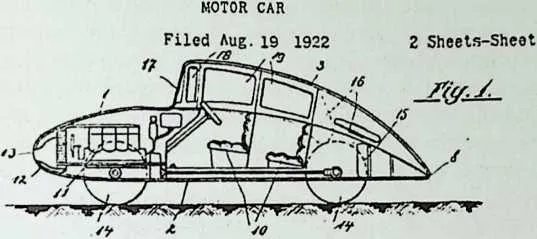
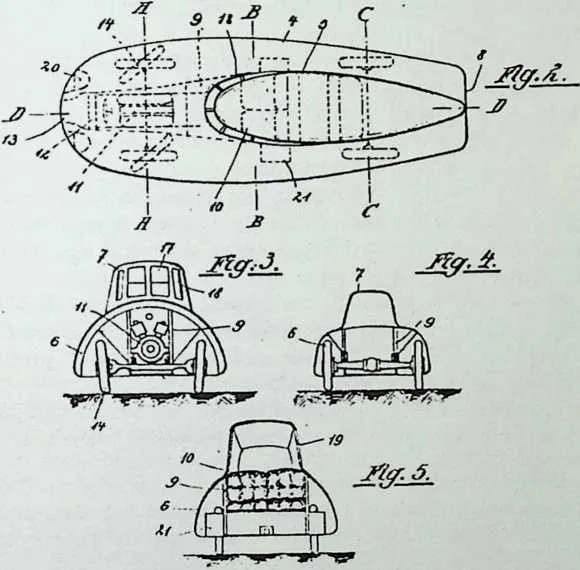
303 June 7, 1927.
304 1,631,269
305 P. JARAY
306307Fig. 11. Paul Jaray/span>s Patent Diagrams of his 1927 Vehicle Design. Courtesy, United States Patent Office. became his raison d/span>etre, and the myth that he adopted to justify his actions and designs.41 The sacrifice of creating ‘‘egocide’’ 42 adds to this aspect. These sacrificial elements as well as the sacrificed elements of other automobile parts (in addition to the new parts) are reflected in the Dymaxion Vehicle. The tropes in the Dymaxion consist of the elements in other automobiles that were twisted or changed for the purpose of fitting into Fuller/span>s concept of a new ‘‘auto type.’’ Examples of these elements are the rounded doors and windows. Although Fuller often condemned traditional automobiles, he incorporates some of their elements in the Dymaxion Vehicle. All automobiles imitate previous automobiles in various degrees. Fuller incorporated familiar automobile motifs (or semantic units), such as wheels, windows, and doors, into a new form of automobile body type. This new body shape presented some advantages over other automobiles of the same era, notably in regards to aerodynamic function.
310 One school of thought holds that Fuller felt that he must be punished for his daughter/span>s death.43 His design philosophy was built upon guilt. To appease his God, Fuller built his designs —or his trophies. Thus, the Dymaxion Vehicle is composed of tropes of sacrifice and mental associations that are manifested in traditional automobiles. The Dymaxion Vehicle is a playful interpretation that relates forms, such as rounded doors, and faceted windows, that had never been associated in this manner before. These tropes are based upon ‘‘rhetorical figures of signification’’ (Frascari 1991:15). It can be argued that Fuller, along with the designers Bel Geddes and Jaray, created a new code category for automobiles during the 1930s. He created functionalist, aerodynamic, mobile structures. He provided a new expression for automobiles in 1930s society and culture by introducing new materials into the perceptual continuum, which had hitherto not been segmented for that purpose. Fuller proposed a new way of organizing codes, both verbally and three-dimensionally, within a segment of society. These codes are the semantic units expressed as:
312 vehicles/automobile/transportation/mobile-structure/Dymaxion/car/streamline
313 As Eco previously claimed, a society must recognize the ‘‘radical code inventors’’ in order for them to be recognized as such (1976: 256). Fuller proclaimed that he was an outcast of society during the 1930s. He was only an outcast to the general public and not to the other streamline designers of the era. Fuller himself states that ‘‘If I had not in 1927 committed ‘‘egocide,’’ I would probably have yielded long ago to convention and there with suicide of my /span>only-for-all-othersinitiative’’ (1983: xxviii). Fuller believed that he was ‘‘unconventional’’ through his egocide, signifying the suicide of the ego. According to Fuller, this event allowed him to focus his design intentions towards helping humanity. He martyrized himself; it was a baptism of the spirit and of the ego. He became the creator of forms that would help humankind.
314 The Dymaxion/span>s failure can be attributed to Fuller not being accepted as a prophet of his era. As the design historian Jeffrey Meikle points out:
315316Experimental cars like the Dymaxion and radical production cars like the Air-flow stimulated publicity, but automakers capitalized on the fad with minor body changes. Automobiles of the early thirties, introduced before streamlining became a sales concern, had some rounding of corners, but generally they had rectangular lines. From 1935 to 1937 the impact of streamlining on auto body design became apparent. (1979:165)
317 The streamlined vehicle/span>s failure, according to design historian Donald Bush, is suggested in the form it represented. The form, according to Bush, had an iconic relationship with the Zeppelins, which in 1917 were used in aerial bombings on London. Another similar form was the sub-marine: ‘‘…a vehicle for terror in the Great War.’’ These designed artifacts had a tapered, cylindrical body that provided easy ‘‘penetration and minimal turbulence in their wake.’’ Both moved slowly but efficiently through their fluid environment and were equipped for climbing and diving, as well as being stabilized to prevent rolling. Zeppelins and submarines were designed to move silently in their environment so as to avoid detection. They became known as forms of destruction, making a deep impression on twentieth-century society (Bush 1975: 8). This early negativity accounts in part for the Dymaxion/span>s failure to generate enthusiasm among the American public.
318 American public/span>s failure to accept the Dymaxion Vehicle is also due to the accident of 1933. While traveling to the 1933 ‘‘Century of Progress Exposition,’’ the first Dymaxion Vehicle, was involved in an accident that killed the driver and injured Fuller. As Bush notes, the newspaper headlines depicted the Dymaxion Vehicle as a ‘‘freak car,’’ and declared that the ‘‘radical three-wheel design’’ was the cause. Fuller was exonerated after an investigation, but not before media coverage damaged the reputation of the vehicle (Ibid: 108).
319 The Depression also contributed to the Dymaxion Vehicle/span>s failure. As design historian Martin Pawley notes, ‘‘…there were no more customers for Dymaxion cars (sic)’’ (1990: 78). The factory was closed and the assets were sold, a common occurrence for industries in the Great Depression (Ibid: 78). Fuller/span>s contemporary, automobile designer William Bushnell Stout, considered Fuller/span>s vehicle conceptions ‘‘far ahead of their time’’ (Ibid: 59).
320 Fuller had different cultural values than those of the majority of the public had during the 1930s. The Dymaxion was a cultural releaser or culturally significant only if an interpretant existed, in the mind of an addressee or decoder. This is why the Dymaxion was neglected.
321 Fuller did not work on any other vehicle designs until 1943, the ‘‘D- 45.’’ This vehicle design adopted many of the design principles used in the earlier Dymaxion Vehicles, although it did change somewhat in appearance (Pawley 1990: 79). What changed drastically was society/span>s ideology and belief system, which together constitute the perceiver/span>s ‘‘cultural matrices.’’ 44 Both the environment and the Dymaxion contained elements of human culture that were demonstrations of how the world was inhabited in the 1930s. By placing the Dymaxion in a museum, the culture of today is supporting the idea that the car is revolutionary and worthy of exhibition in a sacred space. The ‘‘reading’’ of the codes that Fuller produced in the Dymaxion form a grammar of the product. These consist of the syntactic, the semantic, and the pragmatic codes that Fuller used. The technical codes and engineering principles of the Dymaxion Vehicle, such as the steering mechanism, engine, fuel, and wiring, all have communicative content. Eco does not believe that these elements have any communicative ‘‘content’’ , although they do have ‘‘content.’’ They function as the pragmatic codes of the product. It is important to understand why Fuller chose certain geometric equations and kinetic theories to perform certain functions. These mechanisms were derived from an Einsteinian conceptual framework and included the pragmatic codes.
323 Fuller uses the following to support his claim of the value of automobiles in regards to the technical codes of the rear engine:
324325The forward overhang of the main frame 15 pitches upwards from the forward wheels and terminates at about the bumper level of conventional cars or slightly higher, the purpose of which among other things, is to take any collision impact in the event of accident at a point well in advance of the front seat and to receive it on the main frame, so that the inertia of the engine fixed on the rear of that frame will be available to absorb the impact, as is the case in conventional cars having the engine in front (sic). (U.S. Patent 1933: 3)
326 According to Fuller, the vehicle/span>s principal gain was low-speed maneuverability with a parking distance only 75 mm longer than the length of the car, and a turning radius only 300 mm greater. Fuller often boasted that at 15 mph the car could make a 180-degree turn (Pawley 1990: 69). However, as we can see from the above statement, Fuller fails to recognize that, in the event of a collision, the rear engine would thrust forward and aggravate the damage.
327 The syntactic code of the Dymaxion Vehicle may be stated as the plan Fuller used. The Dymaxion/span>s syntactic code consists of the typological or spatial plan. In this instance, the syntactic code is the streamlined and functionalist plan.
328 The style of the Dymaxion Vehicle is a code, establishing an archetypal model of the ‘‘streamline’’ vehicle. The connotation of streamline style is equal to the futuristic style. The iconic code of the Dymaxion Vehicle is equal to the code of connotation. The vehicles are similar in that they are models of transportation featuring wheels, an engine, doors, windows, and a steering wheel. The streamline style is a stylistic connotation. The style categorization, or iconic code, is equivalent to the Dymaxion Vehicle/span>s connotation.
329 We can discover these ideas, such as the connotations and denotations, through Fuller/span>s patent writings, models, videos, diagrams, and prototypes. Each one of these units denotes a type of automobile. For instance, Fuller stated in the patent writing that the form is bulbous in front and tapered in back, has curved windows, door panels, etc.
330 The forms were equivalent in all vehicles known as the streamline type. The placement of such codes or elements of the Dymaxion Vehicles were the result of cultural conventions.
331 The semantic codes consist of the units of the Dymaxion Vehicle (product), and the relations that occur between the product syntagms, as well as the connotative and denotative meanings. The Dymaxion Vehicle is comprised of sign units or sign vehicles such as roof, belly, window, door, and body, which denote the ideologies that are connoted. The Dymaxion Vehicle connotes a system that was in keeping with the functional and sociological categories of the era. The type of car that the Dymaxion denoted was the category known as streamlined. The Dymaxion Vehicle connotes the attributes of a streamlined vehicle such as fast, efficient, clean; in short, it is an emotionally sterile vehicle.45 In addition to this connotation, the Dymaxion Vehicle connotes the philosophy of Dynamism. Fuller attempted to convey the natural and artificial environment in his patent writings and other writings of the time. For instance, the notion of nature connoting efficiency and the artificial environment was equivalent to technology, which also equals efficiency. Therefore, Fuller believed that efficiency of form is synonymous with efficiency of function.
333 The meaning that the Dymaxion Vehicle form evoked was translated by formal characteristics using cross references of images that helped to create a product that was threatening, unwelcoming, functionally efficient, and clean. The Dymaxion Vehicle should be viewed as a representation, although not necessarily an ‘‘intelligible representation.’’ 46 All of these codes are based on the model of verbal language that generates a variety of messages. These codes applied to the Dymaxion Vehicle, writings and diagrams describe the function it performed and fulfilled. The Dymaxion Vehicle communicated its function. It also promoted a certain lifestyle and mode of transportation, signifying the existence of its possible function and lifestyle, even when idle.
335 The ‘‘4D Auto-Airplane’’ is a mnemonic device that enables a person —the interpreter—to establish an idea or the notion of a ‘‘4D Auto-Airplane’’ and its progeny. The Dymaxion, even if never seen or used, is comprised of codes that can be interpreted. The ‘‘4-D’’ Dymaxion prototypes became a ‘‘model’’ or ‘‘type’’ (Eco 1980: 13) for the development of later streamlined vehicles.
336 Fuller and Code Invention: Language
337 Interpretation is a major aspect whenever approaching a text theoretically, in this case Fuller/span>s patent writings, 4D Time Lock, and his other writings of the era. Fuller/span>s patent text, patent diagrams, 4D Time Lock text, and the Dymaxion Vehicles, are products of American culture during the 1930s. The writings and the objects encourage a certain meaning that a community values. Fuller/span>s meanings and the community/span>s meanings can thus be compared.
338 Incorrect interpretations of the Dymaxion Vehicle are also a reflection of the belief system that a particular society holds at various times. It is important, therefore, to analyze the writings that Fuller produced in the 1930s as well as the writings of those historians who discuss the Dymaxion Vehicle.
339 Fuller was against most of the Modernist ideas (Fuller 1969: 32). Yet he created his own style of ‘‘functionalist’’ language, which was exemplified in the patent writing and then applied to his later writings.
340 The patent writing produces a certain response that is evoked by Fuller/span>s choice of terminology. This interpretation is made possible by using reader-text interpretation. Fuller produces functionalist thought that is exemplified in the written form of the patent and later transferred to an object, the Dymaxion Vehicle, which is a representation of the patent language. These ideas can be expressed in the following equation:
341 Fuller + (reader + interpreter) + context/content of patent
342 Semiosis= (Sender = Addressee + context/content of text, and object Dymaxion both equal semiosis)
343 Therefore, visualized as the following equation:
344345(semiosis, interpretation of) context/content of Dymaxion context/content of writings
346 Similar to the meanings produced in the Dymaxion Vehicle, the interpreter must take into consideration the fact that Fuller/span>s text also had a very limited number of users. There were no users of the Dymaxion in the majority of society since it was never mass-produced. Since there were no consumers of the Dymaxion Vehicles and patent writing, they both can be analyzed as utopian products.
347 The analysis of both the patent text and the text of 4D Time Lock help to establish Fuller/span>s utopian dream, the Dymaxion system. Fuller wrote the patent in a particular manner in order to perpetuate his theories and philosophies. His verbal strategy is used to get the attention of the critical and semantic reader. Fuller used this verbal strategy to perpetuate the myth of functionalist philosophy.
348 4D Time Lock can be analyzed as an artistic text. The patent writings have a certain structure, as pointed out by Fuller. The reader must make a critical and semantic interpretation of these texts. It is the reader/span>s interpretation of the patent writing and the critical and semantic interpretation of 4D Time Lock that create a certain meaning that is found within the text. This is equivalent to Peirce/span>s semiosis. The interpreter plays a major role in semiosis. To interpret the Dymaxion, patent writing and 4D Time Lock, the interpreter must see it as an open work, although the text of the patent and 4D carry a certain meaning.
349 The verbal strategy that Fuller employs can be discerned by the ‘‘semantic reader’’ 47 and and the ‘‘critical reader,’’ ,48 which appears in the text as a second-level reading. The patent is written for the semantic reader whereas 4D Time Lock is written for the critical as well as the semantic reader. Fuller deviates from patent rules, laws, or codes in his 4D Time Lock. In 4D, Fuller violates various stylistic and grammatical norms. This produces a work with which the reader is unfamiliar. The text, in this case, gets the attention of the critical reader. Fuller stated the following about interpreting his aesthetic text, 4D Time Lock:
350 What I mean is, that those who have read deeply into 4D have found their appreciation of life and its progression vastly improved, and in the void a new, fuller, and happier sense of mental poise and purposefulness than they have ever had before. Almost to their bewilderment, they may take the new concepts with them into the thick of life and not be forced to leave them behind, as with the fictitionary based romance of the novel, or the happy theories of the university garden which quickly fade and become useless in the big game (sic). (1970: 91)
356 The text, Fuller claims, affects people/span>s behavior. Fuller/span>s 4D Time Lock is a fictitious text, although Fuller does not claim it to be so.
357 Fuller/span>s written language in 4D Time Lock questions the rules, codes, and conventions of language. By writing in this particular manner, he is questioning the cultural conventions of language. He deviates from phonological, syntactic, semantic and narrative rules.
358 For instance, Fuller did not use rules of coherence, although he believed that he did so. He was convinced that his written language was different from Einstein/span>s in conveying meaning and reasoning for his writing style. Yet he did not succeed in such an endeavor. Fuller notes this difference of writing styles in the following:
359360After I had worked out my own time laws of relativity (but lightly touched on in the paper) I decided to study the books of and by Albert Einstein in the library here. I find that I check with him quite closely materially and abstractly, both as to cause and effect, and even to the relative importance of formula. The unfortunate thing about Einstein has been that he seems to have obscured his meanings behind most cryptic language, quite unconsciously, being of so scholarly a nature; and only those who talk the same language have been his audience. They, as is typical of all aesthetic people, have retained to themselves the appreciation of his truths, if indeed they have appreciated them, thinking thereby to set themselves apart as ones to be admired for their obscure learning. (Ibid: 54)
361 However, Fuller fails to realize that his language use in 4D Time Lock was cryptic to the majority of society during the 1930s and remains so even today.
362 He also claimed that he communicated in a functionalist manner:
363364In 1927 I realized that I had to get into semantics in order to define what it is I was undertaking to do. You may recall that I was committed to communicate to my fellow humans only when they asked me to do so. Whereat I must be able to explain in a clear way. (Ben-Eli 1972: 753)
365 The symbolic mode of his writings can be discovered within the text that describes behaviors, objects, and events that make sense literally; however, the reader of Fuller/span>s Dymaxion Vehicle and his other writings believes them to be pragmatically inexplicable. The context in which Fuller uses them is not justified. The reader feels an uneasiness because Fuller/span>s writings produce semantic waste. There is a surplus of imprecise significations that he employs in conversational and narrative ways that appear superfluous. The writings contradict the message that Fuller is trying to convey, namely a precise functionalist language: the language of an engineer.
366 Although Fuller believed that he was giving the reader precise significations, he was not in fact respecting the narrative conventions of the late 1920s and 1930s. He did not convey more ideas in fewer words; he did the opposite. Fuller claimed, ‘‘You can talk simply and to the point without /span>talking down/span>’’ [italics mine] (1970: 28).
367 Fuller created his own language-type and meaning. He wanted his language to reflect a specific, engineer-type, language: a patent-language that signified a functionalist language. This patent-type language, however, can be found in his later writings: No More Secondhand God and And it Came to Pass.
368 In the following statement, Fuller conveys his ideas on language and the manner in which language should be applied in this functionalist vein:
369 It requires excrutiatingly severe mental effort to record thoughts in a manner that will assure their usefulness. This is here set down in juxtaposition to the product of the aesthetically minded phraseologists who judge by quantity and formula not by philosophy (sic). (1970: 40)
370 It is the content (the philosophical meaning) that is important and not the quantity. He wanted to apply his engineer/span>s philosophy to language, to do the most with the least; to convey the most ‘‘meaning’’ with the fewest words. However, he did not always achieve this.
371 The historian Robert Marks describes Fuller/span>s semantic waste in the following terms:
372 Bucky has never been easy to understand-even by those best equipped to grasp his meanings, and those who know him best and love him most. The reason is both psychological and semantic. He overloads the channels of communication. He is ever ready to give too much of himself too spontaneously, too richly, and too quickly. The simplest question evokes a torrent of insights. (1960: 3)
373 Historian Martin Pawley also notes that the text of 4D Time Lock is a seminal text that is sparsely illustrated. Pawley states:
374 /span>4D Timelockis a rambling yet condensed document, with hasty sketches, bold chapter headings and short chapters, and frequent references to hundreds of pages /span>left out for clarity/span> while space apparently remains for endless inconsequential correspondence from relatives and celebrities …(1990: 41)
375 Fuller, in inventing these new language codes in 4D Time Lock, was proposing new and imprecise sign functions. His writing style was beyond duplication because he invented his rules as he wrote and designed.
376 In Fuller/span>s language, it is difficult to distinguish the various ‘‘signal units.’’ 49 His signals in the 4D language are dense and difficult to duplicate. It is consequently difficult to isolate the ‘‘productive rules’’ 50 that he incorporated into his work. Every interpretation uncovers aspects of the codes that may not have been pointed out or seen previously. If we concur with Eco, it was the public/span>s fault for not putting the effort into interpreting Fuller/span>s writings and designs through a critical process of interpretation, because Fuller/span>s language as well as his designs were to evolve both in form and meaning.
379 To interpret Fuller/span>s patent writings, the interpreter has to challenge existing codes and interpret hypotheses that will help him or her comprehend the forms of codification that Fuller used. If the interpreter finds the uncoded elements difficult and complex in their context, it is up to the interpreter to realize that Fuller/span>s message was not based entirely on previous codes. He often referred to non-explicit conventions and codes that had been posited before his code-creating, such as the conventions of patent texts and the conventions established in Paul Jaray/span>s and Henry Ford/span>s designs. The interpreter, therefore, must have rules of competence in order to interpret the message contained within the text.
380 Most interpreters tend to create their own meanings, that do not necessarily match what the designer wanted or intended it them to mean. The interpretation of Fuller/span>s text of 4D Time Lock and the patent, therefore, is marked by our own cultural biases.
381 Conclusion
382 Peirce/span>s semiotic offers a methodology for a semiotic analysis of a related set of form/text/graphics such as Fuller/span>s Dymaxion Vehicles, patent text and diagrams, and book 4D Time Lock. Fuller created a new sign system for product designs and texts in the America of the 1930s. He can therefore be counted among the first generation of American designers, a group that promised the public a better future. Their faith in science, technology, the American system of mass production and the idea of good industrial design struck an optimistic cord in the bleak days of the Depression (Bush 1975: 1--3,; 181--186).
383 Peirce/span>s semiotic also offers a method that is based upon generality rather than specificity: It is not a comprehensive framework in which the failure of one area collapses the whole structure (Colapietro 1995: 47). Peirce/span>s phenomenology and epistemology can be used for an investigation of the processes, methodologies, and theories that are used to develop a building or industrial design product. They also can be employed in the investigation of the meaning of language, in this case the language of a particular designer, Fuller. Semiotics, as a theory, offers instruments for analysis, although not necessarily a design procedure.
384 Peirce/span>s semiotic offers the possibility of better understanding how Fuller/span>s beliefs, habits, and values came into being and how he justified them. Fuller was essentially a pragmatic designer who concentrated on the future, stressing movement and action through his language and Dymaxion designs. In promoting his Dymaxion Vehicles, Fuller turned toward language and discourse in order to persuade the readers of the values and beliefs that were reflected in his own designs and writings.
385 Fuller unwittingly made use of Peirce/span>s concept of semiosis, including his definitions of sign, object, and interpretant. These three relata contain the notions of collateral experience and observation, which were fundamental to Fuller because of his naval and engineering experiences. His experiences were the basis for the Dymaxion Vehicle design.
386 Peirce/span>s speculative grammar categories of index, symbol, and icon also figure into this resemantization of Fuller/span>s texts, diagrams, and vehicle designs. The index helps to disclose the various spatial connections that exist between the three-dimensional form and the diagrammatic patent drawings. The numbers used in the patent diagram and contained within the patent text function as indices; they direct the interpreter to the two-dimensional form of the diagram, thus creating a relationship between the text and drawing. Fuller also used indices in his patent language. For instance, the words this, that and here are all pointers that create a spatial connection with the patent diagram drawings. These indices help guide the interpreter to the object in question, namely the Dymaxion Vehicle diagram and patent text.
387 Peirce/span>s symbol is characterized in Fuller/span>s belief and value system as exemplified in the title of the vehicles, houses, shelters, bathrooms, and other components in his system, the Dymaxion. This composite name, as we have seen in its etymological roots, symbolizes and connotes Fuller/span>s philosophy as it is brought into the physical world through the Dymaxion Vehicle. Ideas can exist as symbols, and therefore the term Dymaxion denotes the class of automobile known as the /span>streamlinevehicle. However, the terms /span>streamformor /span>teardrophad wider currency than the term /span>streamline.Fuller, however, used the term Dym- axion; it was —and remains—proprietary, being Fuller/span>s own. He used it to validate his theories and designs as an emblem of rational design and as a self-congratulatory seal of approval. By using the term /span>Dymaxion/span>, Fuller institutionalized his ego.
388 The Dymaxion functions as a symbol or token; its meaning comes from the social conventions of a particular social group —those who understand basic aerodynamics—and thus its form becomes symbolic for them. Fuller realized this symbolization of vehicle design. However, he failed to realize that the streamline design he promoted was also a symbolic form.
389 The term Dymaxion carries a meaning that reflects the ideology of the era. Designers of the Depression era advocated the style called streamlining in all products in the hope of streamlining society and creating a more efficient society. Americans during the 1930s refused to accept these designs, which were based upon an ideal Platonic form. They related the forms to their own personal lifestyle, which was not analogous to the smooth, impersonal surface of these designs (Meikle 1979:186).
390 Fuller/span>s language, as well as his Dymaxion Vehicle design, is symbolic in content. He claimed that there was a certain syntactical arrangement to his language: a symbolic arrangement that could easily be interpreted. However, the interpreter must agree with Fuller/span>s symbolic language and meaning. The meanings contained within his language, especially in 4D Time Lock, are only readable to the few who can decode the syntax that he used to translate his thoughts on design.
391 Peirce/span>s icon can also be applied to the Dymaxion Vehicle. Since Peirce/span>s icon is based on similar relationships between two or more ideas or objects, a comparison of the ideas and qualities that were the impetus behind Fuller/span>s creation of the Dymaxion can be made.
392 The patent diagrams and the diagrams of the ‘‘4D Auto-Airplane’’ function as icons. Fuller/span>s original diagrams of the ‘‘4D Auto-Airplane,’’ which was the motivation behind the Dymaxion Vehicle, are based upon the functionalist product design theories of the 1930s, which promoted the teardrop form. They also incorporate the history of streamlining that helped Fuller create a relationship between the environment and the form to be built. The product design theories were philosophies applied to a product form. Fuller transformed a theory into a philosophy, thereby making it mythic in nature. A theory can never be a philosophy.
393 It is through the diagrams that Fuller became the observer of both his physical environment and his inner mental environment. The diagrams, in addition to being physical icons, became what Peirce termed the mental icon or the psychic product of Fuller/span>s utopian vision. Fuller/span>s contribution to 1930s American culture was a new type of idea, more so than the streamlined form of his designs. The industrial designer Paul Jaray had developed a streamlined vehicle at an earlier date.
394 Although Fuller denied that his Dymaxion Vehicle design was biological in its orientation, his Dymaxion Vehicles are Darwinian in their motivation. Fuller wanted a design that was the best of its kind, and the form was to be the most perfect form. This Darwinian motivation is suggested in 4D Time Lock, in which he discusses the rules of the interpretation of patents (1970: 26, 80).
395 It is important to note that Fuller first wrote 4D Time Lock and executed sketches before he applied these ideas to his Dymaxion patent text, diagrams, and prototypes. The semantic level is thus applied to his language and then carried over to the patent and Dymaxion Vehicles.
396 Codes are also a part of Fuller/span>s writings and vehicles. It is these codes that convey the signification of his writings and vehicles. Through a communicational process, a relationship between interpreter and object-text occurs. This relationship conveys the meaning of the vehicle and text. Thus the Dymaxion Vehicle can be viewed as a text through the same processes used to interpret the Dymaxion Vehicle/span>s meaning.
397 Semantic, pragmatic, and syntactic codes are also illustrated in the Dymaxion Vehicles. These codes are the technical elements used, the plan used (i.e., —the streamline), and the denotative and connotative meanings of the Dymaxion Vehicles. These codes are all based on the model of verbal language, the primary function of which is to convey a message.
398 Fuller/span>s Dymaxion Vehicles created a new relationship with the environment. The Dymaxion Vehicles still contained elements of kinetic motion and the laws of physics that were applied to all land vehicles of the era. Fuller, however, changed the terminology used to represent this relationship. He created new analogies and metaphors to promote his functionalist philosophy, which he hoped would become a theory of proof for the laws of nature in streamlining and aerodynamics. The Dymaxion was created to function with and within the environment, not against it.
399 Codes are also found in Fuller/span>s language. He claimed he was not a Modernist designer, yet the language and philosophy of the patent contradicts this stance. The patent writing produces a certain response through its terminology. Fuller produced functionalist language in the patent text and then he transferred that language to the Dymaxion Vehicle. This strategy helps to perpetuate the myth of his functionalist philosophy.
400 4D Time Lock is a fictitious, artistic text that requires a critical interpretation. Fuller violated stylistic and grammatical norms to produce a work that the reader of the 1930s, as well as today, would find difficult to understand. He did not use rules of coherence, although he often claimed otherwise. In 4D Time Lock, there is an abundance of semantic waste, a surplus of imprecise significations. This book is the opposite of what Fuller wanted to convey, which was a concise, precise, functionalist language.
401 Fuller/span>s Dymaxion Vehicles and texts are cultural signs that function as an expressive system, conveying meaning. Both Fuller/span>s texts and his objects form a particular grammar that can be read by the interpreter. This interpretation is made possible through the pragmatic philosopher Charles S. Peirce/span>s semiotic theory. This study represents a resemantiza- tion of Fuller/span>s Dymaxion Vehicles, patent diagrams, patent and 4D Time Lock texts.
402 Peirce' Semiotic Theory as a Potential Tool for Industrial Designers
403 Peirce/span>s semiotic theory offers a powerful method of analysis of the industrial design object. His theory may help industrial designers to anticipate the consequences of their designs and help them to understand how their designs impact their socio-cultural environment. As a profession, industrial design needs to have a theoretical base from which designers can appreciate the cultural importance of their designs. Peirce/span>s semiotic has attracted architectural critics and theorists, but has hardly begun to be applied to its full capacity in industrial design. It is an investigation of the designed object using the powers of interpretation and inquiry. This is accomplished by means of the method described below.
404 First, a definition of Peirce/span>s semiotic terms by an inquirer is necessary. It is important to define Peirce/span>s terms of sign, object, and interpre- tant as well as his terms icon, index, and symbol. It is on the basis of these six relata, and the relationship that exists among them, that his premise of unlimited semiosis is defined. In this step, the first task of the inquirer is to articulate a definition of the term, and then determine the conceivable consequences, if any, of identifying an object as a sign through the process of unlimited semiosis.
405 It is the designer/span>s responsibility to reconceptualize Peirce/span>s terms and define them as a ‘‘rhetoric of logic’’ instead of the classical law of logic. This study is based on the assumption that it is not so much a ‘‘logic of rhetoric’’ as in the modernist approach, but a ‘‘rhetoric of logic.’’ It is a matter of how things appear to be written so as to produce a form of logical meaning that is important to this study (cf. Colapietro 1995).
406 The second part of this process consists of describing the object under inquiry. The question needs to be asked: How is this particular design relevant to Peirce/span>s terms of interpretant, sign, and object, in the process of unlimited semiosis? The cognitive implications of the design, which includes its symbolic, indexical and iconic relationship to its socio-cultural context, is questioned.
407 Through Peirce/span>s process of unlimited semiosis, Fuller/span>s Dymaxion Vehicles, Dymaxion Vehicle patent text, and similar writings of the period, can all be interpreted as signs interacting with one another. His semiotic theory functions as a theory of communication. It pertains to how communication helps ‘‘in the formation and reformation of cultural institutions’’ (Langsdorf and Smith 1995: 2). It refocuses on culture. Peirce/span>s semiotic is not only a return to the object or the physical thing itself, as Husserl claims, but it includes our perceptions of the world in which the object functions. It is a process of how we understand our world and our designs in context. The investigation of a designer/span>s Weltanschauung is therefore important. Peirce/span>s semiotic theory may become a process in which a designer acting as an inquirer might clarify the meaning of his or her designs. The designer must, however, believe that Peirce/span>s semiotic theory is relevant to the investigation of meaning in design.
408 In this unlimited semiosis framework, Peirce/span>s theory is built upon generalizations that can help to establish certain standards by which the values of communicative designs may be assessed. Peirce claimed that ‘‘…the most important operation of the mind is that of generalization (1960/1: 33).
409 Peirce/span>s semiotic is based on generalities that allow the imagination of the interpreter to use his or her mental facilities to determine the definitions to be used in a particular study. This study follows Eco/span>s belief that Peirce/span>s general theory of signs does have certain boundaries. The interpretation does have certain limitations based upon specific grammatical codes that the author or designer employs. The interpretation, being of an unlimited nature, does not specify that the interpretation is without an object. Any interpretation of a text or a design object, by virtue of the process of unlimited semiosis, occurs through a process that is constantly evolving through the interpretations of a particular culture, or subculture, through critical inquiry. Peirce/span>s theory functions as a mode of inquiry of the industrial design object under investigation; it is heuristic in nature. The theory of semiotic becomes a theory that is fixed within a post-analytic, post-empirical, and postmodern era.
410 If we accept that everything is a sign, or part of a sign system, as Peirce did, then all objects make reference to each other. In this study, Fuller/span>s Dymaxion Vehicle —the object under inquiry—is in relationship to everything else brought forth in this investigation. The Dymaxion Vehicle, patent text, and Fuller/span>s other texts help to support Peirce/span>s theory that all signs make reference to each other. The texts support the idea that the design object is not to be read as a text, but is to be interpreted by means of similar processes. A text is linear —it has a beginning, a middle and an end, and a set sequence that is read in a time frame—whereas a design is not. It also implies that the text of any designer and any text about that designer will add to a new understanding of that designer and the particular design under investigation. The Dymaxion Vehicle is not the center of attention with everything else as signs relating to that object. On the contrary, the Dymaxion Vehicle is a sign that refers and is referred to by its fellow signs that are chosen to support Peirce/span>s semiotic theory.
411 The design object and the text function symbiotically. The physical aspects of an object under inquiry are important to investigate but so are the processes, which are cognitive, philosophical, and theoretical. These processes should be considered in relation to the object/span>s socio-cultural context. This study assumes that the emphasis on process enables a person not to know the world but to appropriate it using his or her own words and concepts (cf. Diggins: 1994).
412 Thirdly, it is also important to understand the language used by the designer in order to explain a particular design. This step inquires into how the designer justifies what he or she does through the use of metaphors, similes, analogies, and tropes. It investigates the phenomenological aspects of the design. The syntactic, pragmatic, and semantic aspects of the three-dimensional object are also considered.
413 Peirce/span>s pragmatic theory leaves behind the Cartesian self and its claim to universal knowledge. It becomes a reconstruction, not just a critique of an object or idea. His theory may help designers to conceptualize designs through historical examples and aid them in formulating conjectures, testing those conjectures against experience, and then finally using those results.
414 Peirce/span>s critical inquiry applied to Fuller/span>s designs and texts can disclose the manner in which Fuller, through the rhetoric of his texts, justified his designs. How Fuller/span>s designs were symbolic, indexical and iconic helps to place his Dymaxion Vehicle in a socio-cultural context through the use of text analysis. Fuller used his texts to support the ideas that motivated his designs as well as to validate them. Fuller did not use the pop cultural language of the 1930s, but rather the words of his own community or sub-culture of streamline designers. He was a pragmatist who looked to future possibilities and used critical inquiry to find a problem to solve, which was a challenge to his intellect. The solution, according to Fuller, was his Dymaxion house, Vehicle, and related writings that helped him to validate his design philosophy and functionalist theory.
415 Peirce/span>s semiotic theory emphasizes possibilities and not certainties. It should not be thought of as a procrustean bed on the basis of which the designer postulates certain goals and then delineates the means to achieve them. Instead, the emphasis should be placed on possible results of conceptions as they are an aspect of a certain community of inquirers. Some communities have conventional ways of acting, thinking, feeling, believing, and knowing. Designers then are to act as observers, not only as observers of their own communities but of other communities as well. They become the observers of human behavior as well as history. This investigation stresses, as does the semiotician Vincent Colapietro, that Peirce/span>s semiotic is a theory of communication and thus a theory of meaning and that the interpretation of signs will help to disclose meaning to the observer.
416 It is vital to examine, in a socio-cultural context, how a designer/span>s thoughts are constructed through the designer/span>s exclusion of certain ideas. These sometimes elicit arguments contrary to what the designer originally stated. For example, Fuller was not the socialist designer that he often claimed to be. Nor was he anti-Darwinian, but evolutionary in his design approach. He also often stated that his design philosophy was defined by his concept of ego-cide. However, he did not really commit ego-cide, the complete abandonment of his ego. His designs and his writings disclose a philosophy built upon both self-gratification and guilt.
417 Design can be conceived of as a language activity in which ideas are examined for their edifying importance and history is studied in order to find out how a designer/span>s beliefs and designs have come to be justified through rhetoric, that is, how he or she legitimized his or her own discourse and actions. In this vein of thought, Peirce/span>s semiotic suggests that knowledge is no longer based upon ideas that are faithful to reality. Design should not pursue any theories of ‘‘truth’’ but look to language to develop a vocabulary that is based on conventions. This strategy, akin to the ideas brought forth by the historian Diggins, tends to disclose certain rhetorical devices in order to reconstruct —rather than represent.
418 Finally, the object/span>s historical context is interpreted. Language and its meanings change constantly from one moment to the next. Although the meanings of some words change, others will stay the same. This step questions which words have the same meaning in the cultural context of the period being analyzed, compared to the period during which the designer originally used them. The conventions of a community will usually determine the meaning of words at a certain moment in history.
419 Historically, Fuller may be seen as a romantic. Glorifying as it did optimism and the upward movement of life, his vision of a utopian society appealed to the American romantic psyche, which left the past behind when the Depression undermined faith in American values. This study supports the idea put forth by the historian Diggins, according to which pragmatism represented more a form of romanticism than a simple radicalism; the world was therefore viewed as representing future possibilities. As Diggins claims: ‘‘…any philosophy that looks for truth in action has a rendezvous with romanticism’’ (1994: 49). Fuller, in this Romantic manner, hoped to develop designs that would persuade Americans of their social and political value.
420 Designers can make history serve them by analyzing previous designs in their own area of expertise. Designers may be able to use ideas that have been once thought of as radical, utopian, and revolutionary. What has been previously termed radical may not be so radical by the standards of current modern technologies. The designer may be able to analyze earlier patents and designs and apply today/span>s technology to make these designs serve present social and cultural conditions. For instance, Fuller/span>s designs were often termed radical, utopian, and revolutionary for their time. Today/span>s designer, by analyzing such designs, may be able to produce vehicle designs that are more creative. By a historical analysis of Fuller/span>s Dymaxion Vehicle using the patent diagrams, patent text, three-dimensional form, and relevant texts, the designer may be able to identify how Fuller/span>s Dymaxion Vehicle designs helped to shape future designs in transportation. Designers should consequently use history to make it serve the present.
421 Most designers today are unaware of the meanings they incorporate into their designs. Like Fuller, other Modernist designers believed that their work was ‘‘pure’’ and rational, free of symbols and icons. They failed to realize that their work was also symbolic, iconic, as well as indexical. Designers should take charge of qualities in their designs if their designs are to be more interesting and meaningful for consumers as well as for themselves.
422 This study supports the idea advanced by semioticians such as Lenore Langsdorf and Andrew Smith, namely that Peirce/span>s pragmatic theory of semiotic is evolutionary, not revolutionary. Designers should anticipate an evolution in thinking, acting, and doing as a function of how they use communicative strategies to link and justify their designs.
423 This study also follows Digginsresearch by stressing that through Peirce/span>s semiotic rhetoric, conversation, narration, and discourse are disclosed and should be used to offer a means of coping with what has been labeled ‘‘the crisis of modernity.’’ To analyze design in a Peircean framework, one must focus upon representation, rhetoric, and historical context. This framework may help designers to be more sensitive to and conscious of the meanings they put into their designs. It may also help them to be more creative in a whole new range of forms that may be suggested when one has in mind the symbolic or metaphorical content or intent of the design.
424 Designs and texts display our perceptions of the significance of our lives. The nature and function of the product/span>s communication is questioned through rhetoric.
425 Product designers tend to eschew theory in favor of practice. It is important that designers use theory in the design process. Using the approach given above, Peirce/span>s semiotic has the potential to illuminate the communicative process in design in its full complexity.