
2 INTRODUCTION
2DANIEL LOPEZ-PEREZ
3 On August 26, 1966, Richard Buckminster Fuller wrote to Robert Geddes, accepting the invitation of the recently appointed dean of the Princeton University School of Architecture and Urban Planning to deliver the inaugural Kenneth Stone Kassler Memorial Lecture. In a handwritten letter dictated to his wife, Anne Hewlett Fuller, and signed by him, Fuller cautioned Geddes that he would ‘‘speak entirely extemporaneously, without notes.’’ A month or so later, on October 5, Fuller addressed an audience of architecture students, faculty, and area practitioners in a process of ‘‘thinking out loud cumulatively,’’ as had become ‘‘the pattern for [his] life.’’ Speaking on themes he had been rehearsing in his mind for decades, Fuller delivered one of his most compelling assessments of the struggles facing man in the mid-twentieth century.’
4 Fuller opened his lecture by telling of how he had recently been asked by a national magazine to imagine being appointed Building Commissioner of the United States. The editors were interested to know what he, if given the power, would do to solve the nation's significant urban problems. Fuller quickly dismissed the very idea as enforcing one's will upon others—an ineffectual way of approaching these problems, he maintained, given the natural checks and balances of evolution. Looking beyond the post of U.S. commissioner, or ‘‘building czar’’ of the ‘‘political state,’’ Fuller mused on grander aspirations: ‘‘Why not…make me world czar of building,’’ or better yet, ‘‘czar of building the Universe?’’
5 The problem this posed, Fuller conceded, was that that position was co already filled. ‘‘I am deeply impressed,’’ he confessed, ‘‘with the designer of the universe; I am confident I couldn't have done anywhere near such a good job.’’ Instead, Fuller made his mission the study of the universe and of its ‘‘extraordinary design.’’ It was in the space between national ‘‘czar of building’’ and ‘‘czar of building the Universe’’—between influencing a nation and changing the world—that Fuller envisioned his role. His was a search to understand man’s place in the world and the world's place in the universe. He pursued this, in his Kassler address as in his long and productive career, by starting with the questions: What is man doing in the Universe? What is he supposed to be doing? What does he think he is doing?
6 When Fuller arrived at Princeton to deliver his lecture, the seventy-one-year- old was already a well-known figure in contemporary architecture and design. In January 1964, he had been profiled in Time magazine. The inventor of ‘‘houses that fly and bathrooms without water…cars and maps and ways of living bearing the mysterious word 'Dymaxion,'’’ Fuller was ‘‘best known’’ at the time, the editors asserted, for his ‘‘massive mid-century breakthrough known as the ‘geodesic dome.’ ’’2 His early work on industrialized housing and his studies of structural

89tol I.n • MHIUBHI 27. 1953 • 10
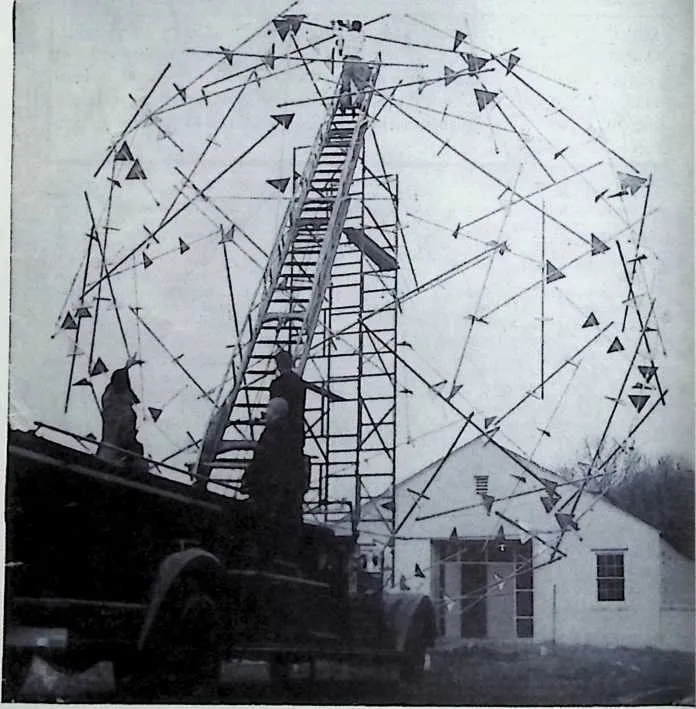
11 Tensegrity Sphere, built on the Princeton University campus by Fuller and students, featured In the 27 November 1953 edition of the Princeton Alumni Weekly. The cover caption reads, ‘‘With the help of the fire department apparatus, graduate students put the final touches on an architectural experiment which has excited nationwide attention.*
12 geometry had culminated in the 1950s in his development of the geodesic dome and his articulation of the geodesic and tensegrity principles that underpinned it. Designed to provide maximum volumetric enclosure and environmental control using a minimum of means, Fuller’s invention found a ready audience during the postwar period and quickly proliferated around the globe.3 In 1966 he was at work on his geodesic tour de force-the United States Pavilion for the World's Fair—which would open a year later in Montreal at Expo ‘67.
13 If Fuller's domes brought him great public notoriety, they also earned him a place in the pantheon of modern architecture. In the mid-1950s, a scale model of one of his geodesic domes joined the collection of the Museum of Modern Art (MoMA) in New York, and in 1960 his two-mile hemispherical Dome over Midtown Manhattan featured prominently in the museum’s Visionary Architecture exhibition.4 Fuller's reputation as a technological visionary had been confirmed a year earlier, when Arthur Drexler, director of the Department of Architecture and Design, installed three of his ‘‘mathematical structures’’ in MoMA's outdoor sculpture garden.5 Alongside bronzes by Gaston Lachaise and Aristide Maillol, Drexler exhibited a geodesic dome, tensegrity mast, and space frame, in an effort to add ‘‘new grist to the modern architectural discourse.’’ The exhibition succeeded in drawing thousands of visitors to what trustees of the museum later acknowledged was ‘‘essentially a show of structural engineering.’’6 A photograph of the structures, illuminated at night in the museum’s courtyard, has become ubiquitous in Fuller's monographs.
14 Fuller never trained as an architect, but his influence on contemporary architecture—although in no way normative—was beyond dispute the year he lectured at Princeton. Seventeen of his most significant patents related to structural and cartographic innovations had already been granted, and a vast number of articles documenting his inventions had appeared in the architectural press. In 1962 a monograph devoted to his work, edited by John McHale, was published as part of George Braziller’s popular Makers of Contemporary Architecture series. As McHale explained elsewhere around that time, ‘‘Any discussion of the impact of technology on architecture…must, inevitably, involve due consideration of the unique contribution of Buckminster Fuller.’’7
15 Fuller’s notoriety may have come from inventing a number of revolutionary artifacts, but his ‘‘unique contribution’’ in the professional sphere came from the concepts, or operative principles, he explored through those worksconcepts that had the power to alter man's relationship to the world. ‘‘In 1927,’’ Fuller explained, ‘‘I made a bargain with myself that I’d discover the principles operative in the universe and turn them
16 over to my fellow men.'8 Fuller spent much of the 1950s and 1960s circling the globe, hosting workshops and <o lecturing on these principles; a charismatic and infatigable speaker, he arguably asserted greater influence with his words than with his inventions.9 But the common thread of Fuller's output was these operating principles: ‘‘He [saw] himself quite simply,’’ Time observed, ‘‘as a kind of technological avatar, come for the liberation of mankind.’’
17 As Geddes explained when introducing Fuller to the Princeton audience, the mission of the Kassler Lectures was to bring to the university distinguished speakers from the ‘‘field of environmental design,’’ which he defined as ‘‘the field of architecture, engineering, industrial design, city planning and its related arts.’’ Fuller was an ideal inaugural speaker, given that his research cut across these disciplines, which had previously been considered distinct areas of study. Geddes called Fuller ‘‘hard to classify…either [an] engineer or architect or inventor or discoverer or geographer or mathematician or all of these,’’ proof of the importance the dean attributed to the cross-disciplinary nature of Fuller's research. At the height of his professional career and public influence, the mature Fuller provided an extraordinary point of departure for the new lecture series.10 Fuller had brought his ideas to Princeton previously. In 1953 the ‘‘advocate of the theory of light-weight, over-all economy in building’’ constructed on its campus ‘‘the largest discontinuous compression sphere ever to be erected.’’1 The sphere was built by students in front of the Architectural Laboratory, a center for experimentation in environmental studies and technology founded by Princeton's School of Architecture in 1949. During an impressive two-week period, Fuller and his team constructed the sphere from ninety 1 Vi-inch aluminum struts held together by a network of Vie- inch steel aircraft cables. The structure enclosed 32,000 cubic feet, or enough volume to accommodate a 2,000-square-foot, eight-room, two-story dwelling. The virtue of this remarkable structure was its lightness: whereas the equivalent volume built from traditional housing materials would weigh an average of 150 tons, this sphere weighed only 650 pounds.12
18 Giving form to the sphere was Fuller's principle of ‘‘discontinuous-compression.’’ As he would later define in his ‘‘Tensile-Integrity Structures’’ patent, a discontinuous- compression structure comprised a combination of compression members in the shape of ‘‘struts.’’ Held together by cables, or ‘‘slings,’’ these members worked in tension in such a way as to evenly distribute structural forces without any strut touching any other strut, thus producing the principle of ‘‘discontinuous-compression.’’13 The essence of ‘‘Tensile-Integrity Structures’’ resided ‘‘in the discovery of how to progressively reduce
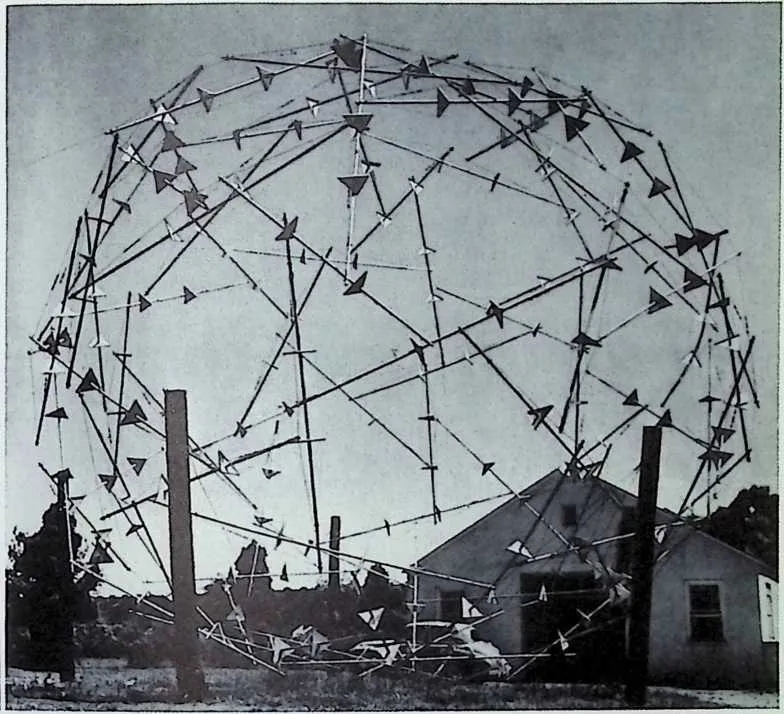
20 Tensegrity Sphere. The 40-foot sphere was built from 90 independent metal struts held together by a network of cables, which evenly distributed loads throughout the lightweight structure.
22 Spedil to The New York Times.
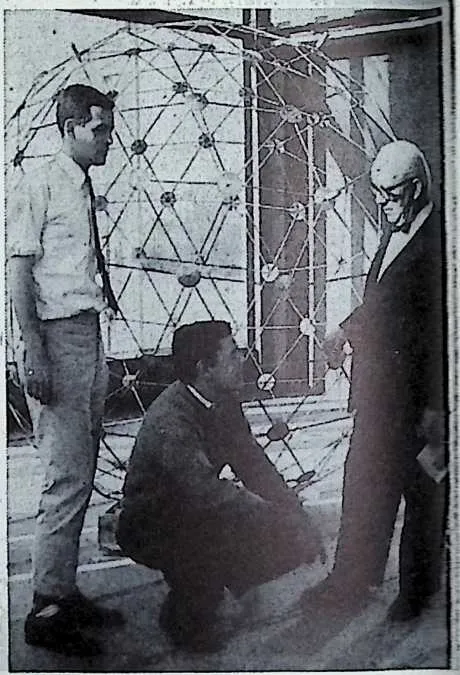
23 Princeton, n. j., April 6 —A large globe map of the earth, a sphere six and a half feet in diameter, constructed of : metal tubing and clear plastic, will be completed early next week at Princeton University.
24 The globe was designed by Dr. R. Buckminster Fuller, who designed the ‘‘Golden Dome’’ for the American Exhibition In Moscow last year. He built it I In the university's architectural ; laboratory with the assistance ' of twelve students from the ; Graduate School of Architecture.
25 Alan W. Richaris
26 CONSTRUCTING MODEL OF EARTH: Dr. R. Buckminster Faller discusses globe he designed with Stuart 51. Hutchison, left, and J. Robert Hillier, Princeton Gradual® School of Architecture students who are assisting him-
27 Since It Is covered with heavens through Uie transparent plastic, the geo-‘‘crust’’ of the device he will scope is a ‘‘true planetarium,’’ able to sec and feel the earth the (M-ycar-old scientist said, revolving in the presence cf As tho student watches the'stars.
28 PRINCETON BUMS LARGE GLOBE MAP
29 ropt ‘Earth’ Designed ; to Give Architect Better Geographic Knowledge
30 Called a geoscope, the globe will bo suspended Inside a glass room. It Is intended to provide a better comprehension of world geography to help architects plan their work In a larger perspective. Dr. Fuller said.
31 He noted that ordinary globes were thrown out of proportion when they ' were enlarged for general use.
32 Dr. Fuller said the trouble with conventional globes was ..that they were built with latitudes and longitudes, which , represent areas of the world by spherical squares. ‘‘However, t you cannot put a square on a sphere,’’ ho pointed out. >
33 The geoscope eliminates this problem by dividing the world Into spherical triangles. One of , tho chief obstacles to Its construction was that tho Information necessary to ‘‘triangu- lata’’ tho Soviet Union was not Available.
34 Geoscope, constructed inside Princeton’s Architectural Lab by Fuller and students, featured in the 6 April 1960 edition of the New York Times. Unambiguously modeled on planet Earth, the globe map, Fuller claimed, was four times larger than any accurate cartographic sphere in existence at the time.
35 the aspect of compression in a structure so that…the structure will have the aspect of continuous tension throughout and the compression will be subjugated so that the compression elements become small islands in a sea of tension.’’14
36 For Fuller, the general shift away from compression and toward tension aimed to ‘‘bring the slenderness, lightness and strength of the suspension bridge cable into the realm previously dominated by the compression columns concept of building.’’15 His invention produced an effect ‘‘akin to taking some of the compression out of the 'compression towers,' i.e. the columns, walls, and roof, of a building through the creation of a structure having discontinuous compression and continuous tension [in which] the islands of compression in the mast are progressively reduced in individual size and total mass.’’16 By reducing the overall structural mass through an assemblage of struts that do not touch and by increasing the ratio of tension over compression through the use of cables, Fuller discovered strength through lightness. As he notes in his Kassler lecture, he envisioned this architectural experiment as ‘‘pointing] the way to practical solutions of actual building problems.’’ Discontinuous-compression domes had the potential to revolutionize the construction industry, and they formed the basis of a number of important patents Fuller would apply for and receive.17
37 But the Princeton project demonstrated something more than structural efficiency. In an article entitled ‘‘The Sphere of Ideas,’’ published in the Princeton Alumni Weekly, the model was described as representing nothing less than the ‘‘characteristic structural principle of the universe.’’ It was ‘‘no accident,’’ the article explained, ‘‘that the sphere is 40 feet in diameter. Mr. Fuller believes that the discontinuous compression principle is the characteristic structural principle of the universe. And with a 40-foot diameter, his sphere becomes a sort of scale model of the world, at 1:1,000,000.’’18 For Fuller, Princeton's discontinuous-compression sphere was both a revolutionary architectural solution, unprecedented in its scale and lightness, and a conceptual model of the universe itself. As such, it served to illustrate his belief that experimentation in search of a better understanding of nature's operative principles was key to the future well-being of mankind and the universe.
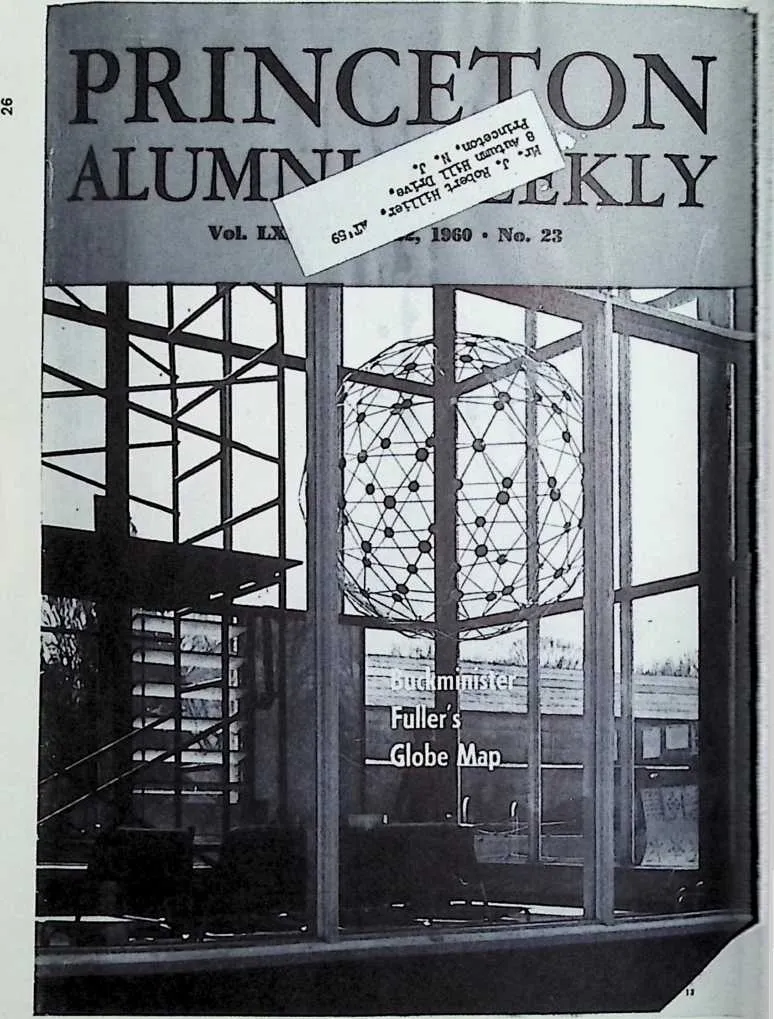
38 In the spring of 1960, Fuller returned to Princeton to build another sphere with students, this time in the form of a geoscope, unambiguously modeled on planet Earth. Claimed by Fuller to be four times larger than any accurate cartographic sphere in existence, the 6 '/a-foot sphere was constructed of metal tubing and several layers of clear plastic film, inscribed with illustrations of the continents. It was suspended inside the large, glazed room of the Architectural Lab, a space used to research natural day-lighting effects on scaled architectural models, and it was a great cartographic achievement. The Daily Princetonian hailed it as the ‘‘best globe map…ever built.’’ Fuller had identified a problem with Mercator projection, commonly used in mapping the Earth, which subdivided the planet's surface into squares by means of latitudinal and longitudinal lines. ‘‘You cannot put a square on a sphere,’’ he insisted.20 In his Dymaxion Map patent of 1946, Fuller presented an alternative method of charting the globe by inscribing a polyhedron within a sphere and projecting the Earth’s surface on its triangular faces. This method of subdivision produced less distortion than either its square predecessor or other known cartographic systems of projection. Thus, the geoscope offered a more accurate representation of the Earth's forms and landmasses.
39 Fuller had built a geoscope previously, at Cornell University in 1952. Although the Cornell model was much larger, the Princeton version was more intricate and arguably more accurate.21 At Princeton, he separated the geodesic structure from the transparent surface of the globe so that the natural geographic properties of the Earth and the conceptual lines of his geometry could be studied independently but also viewed in juxtaposition. In a volume documenting the project's construction, James Robert Hillier (a professor in the School of Architecture who was a student of Fuller at the time) describes the model's capacity to integrate multiple layers of information on its surface in order to visualize relationships between vast amounts of data as the project's greatest potential. ‘‘The system of lights on the Geoscope,’’ Hillier observed, ‘‘would allow a visitor to locate his house on the Earth through a complex system of IBM machines.’’ The light system similarly facilitated ‘‘plotting the location of ships on the oceans…[and] the migration of masses and raw materials.’’ The geoscope could serve as a measuring tool for diagramming complex relationships and also projecting them in time—both backward into history and into the future:
4041Using the same system of lights and computers it could be possible to diagram the history of the world's weather and then, by studying the trends or simply by speeding up the computer so that it had the momentum to carry its diagram ahead by a few years, it could be possible to make general predictions on the world’s future weather.22
42 In a letter discussing his geoscope projects, Fuller described them as ‘‘unexpectedly’’ marrying his geographical and geodesic structural explorations into a single model, a demonstration that in his mind these had become effectively one and the same.23 The structural models represented the organizational protocols of natural form and could in
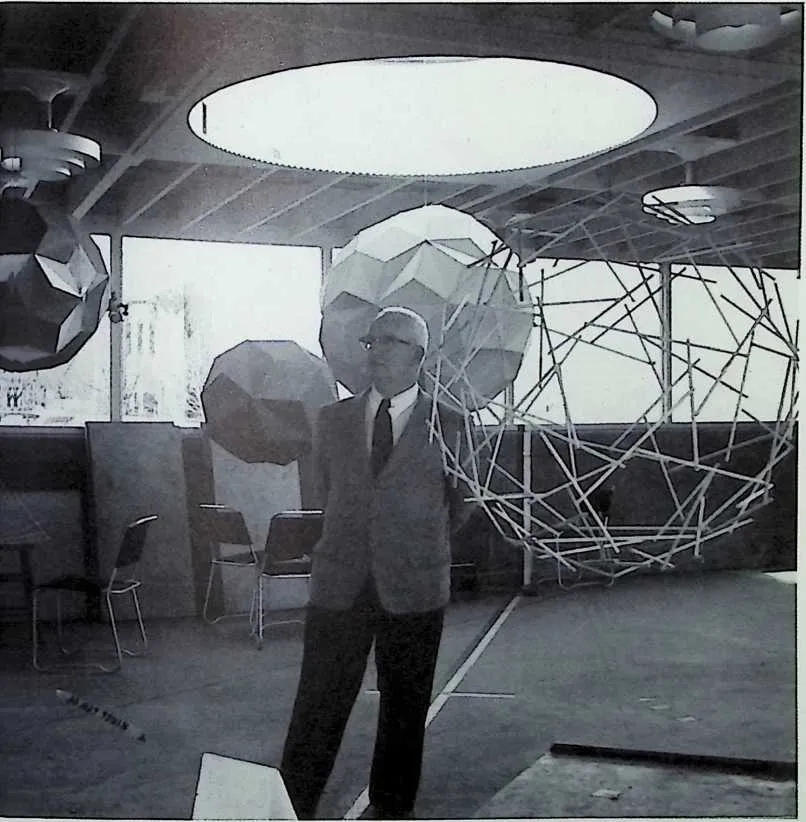
44 Fuller, surrounded by geodesic models In the Architectural Lab at Princeton, about 1953
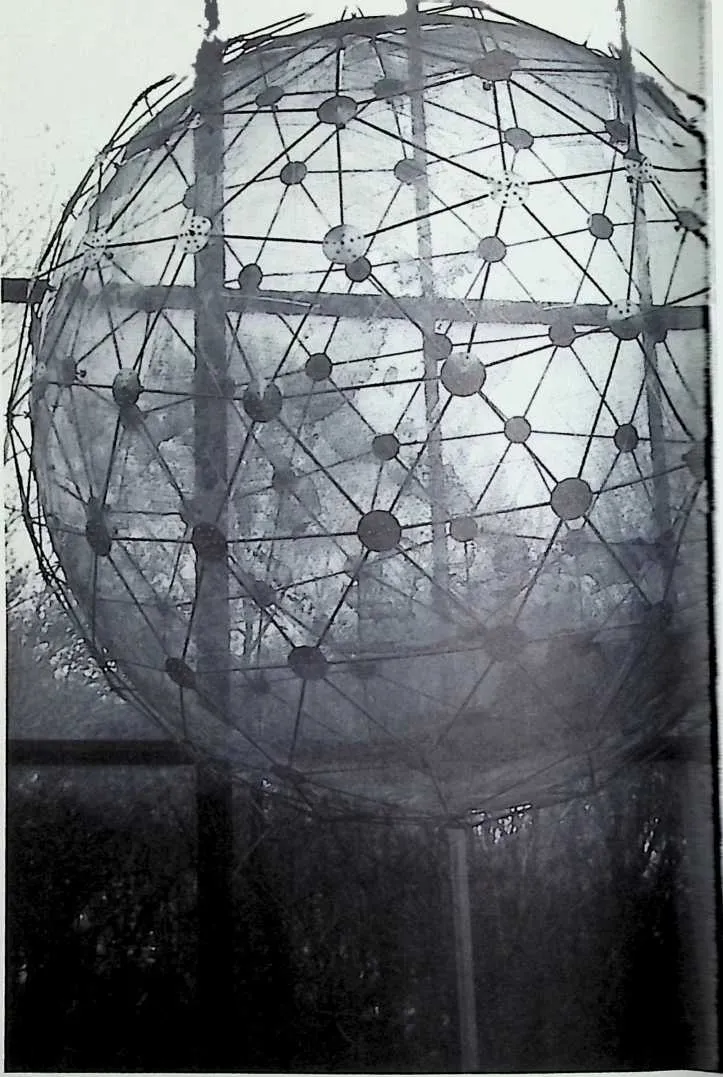
46 Geoscope, constructed of clear plastic inscribed with the continents and hung from a network of hollow metal tubing, about 1960
47 turn be used as measuring devices for mapping and measuring the Earth's geography.
48 The geoscope proved a useful tool for geographers, but Fuller's intended audience for his invention was architects. As he explained to a New York Times reporter, he created the project to ‘‘provide a better comprehension of world geography to help architects plan their work in a larger perspective.’’24 That perspective reflected Fuller's holistic view of Earth and challenged the image of humankind as somehow independent of the environment. The clear surface of the Princeton Geoscope could be read both from outside the sphere looking in toward the center and from inside the sphere looking out at the firmament. Looking in, one could view Earth's geography more accurately than ever before, whereas looking out, one could begin to determine one's position within an ever-expanding universe. This two-way perspective underscored the basic relativity of human perception: the expanding universe was simultaneously ‘‘your private sky.’’ By creating an instrument that contextualized the individual's relative point of view, Fuller helped the world look at itself.25
49 In his 1953 and 1960 visits to Princeton, Fuller formulated and explored cartographic and structural concepts by constructing physical models. In his 1966 Kassler lecture, he also built conceptual models, but this time with words. He engaged his audience in open dialogue, using language as a platform for representing relationships between the conceptual and the physical, the cognitive and the experiential.
50 Deciphering the meaning of Fuller’s words constitutes a collective process of ‘‘experimentation’’ in itself, as the correspondence between word and idea remained for Fuller the subject of continual exploration rather than exposition.26
51 Fuller structures his lecture using clear, deductive logic. He starts with a number of concepts, many of which he introduces as dualities: ‘‘brain’’ and ‘‘mind,’’ the ‘‘physical’’ and the ‘‘metaphysical,’’ the ‘‘entropic’’ and the ‘‘anti-entropic.’’ From these dualities he posits a ‘‘theory of functions’’: functions are relational and exist ‘‘only by virtue of the always and only coexistence of other functions.’’ He proceeds by offering generalizations of increasing complexity regarding these opposing functions. These generalizations give rise to new words whose accrued meanings are clear only within the context of Fuller's developing narrative. While ‘‘dymaxion’’—a synthesis of ‘‘dynamic’’ and ‘‘maximum’’ that refers to Fuller's concept of employing technology and resources to maximum advantage with minimal expenditure of energy and material—is perhaps the most famous neologism in Fuller's idiosyncratic lexicon, countless other terms are introduced throughout his 1966 lecture and in its associated literature.27
52 In his talk, Fuller raises a number of questions about our relationship to the environment across all scales, from the personal to the cosmic. He identifies dual universes: the physical universe, which is ‘‘entropic’’ and ‘‘expansive, increasingly diffuse, increasingly disorderly’’; and our cognitive understanding of the universe, which is ‘‘anti-entropic’’ and increasingly ordered. Within these two opposing orders, Fuller seeks a balance. In view of the continual oscillation between ‘‘physical expansion’’ and ‘‘metaphysical contraction’’ in the universe, he expresses his wonder at nature's anticipatory capacity for regeneration. In the face of what he describes as our ‘‘total environmental challenge,’’ Fuller points to our ‘‘anti-entropic effectiveness’’ as our capacity as ‘‘prime designers’’ to find new forms of order and principles.
53 Essential to this process of balance and regeneration is an expanded notion of ‘‘wealth,’’ one that for Fuller is not based purely on material resources but also includes social accountability. He defines this wealth as ‘‘the organized capability to deal with our forward metabolic regeneration.’’ A feedback loop between material and social resources emerges: ‘‘[T]he more we use our real wealth, which is this organized capability, the more it improves and the more it increases.’’ Fuller sees our chances of reaching this ‘‘organized capability for forward regeneration’ as ‘‘magnificently weighted on the side of success.’’ It is in our capacity to translate ‘‘material’’ into ‘‘energy wealth’’ that he finds our true potential to harness the existing ‘‘energy flows of the universe’’ in order to ‘‘do the most with the least.’’
54 Fuller closes the lecture by focusing on social accountability. Aligning his aspirations with those of a younger generation—whose loyalty he describes as centered not on family, university, or even country but rather on the world—he makes a prophecy: ‘‘[T]he young world is about to take the initiative as inventor-scientist, and in the employing of principles which are operative in universities will succeed in converting the resources available to us to such a high order of effectiveness as to take care of 100% of humanity.’’28
55 Fuller's spherical models can be understood today as oscillating between concrete physical artifacts that revolutionized the worlds of structural design, shelter, and cartography on the one hand and dynamic representations of nature and of our relationship to the environment on the other. Similarly, the terms of Fuller's lecture synthesize their literal and conceptual meanings in search of the most comprehensive knowledge of both—of man in his world. The spherical models constructed on the Princeton campus and the words and concepts developed in the Kassler lecture can be seen as material and conceptual experiments in the fluid and irreducible relationship between the physical and the metaphysical,
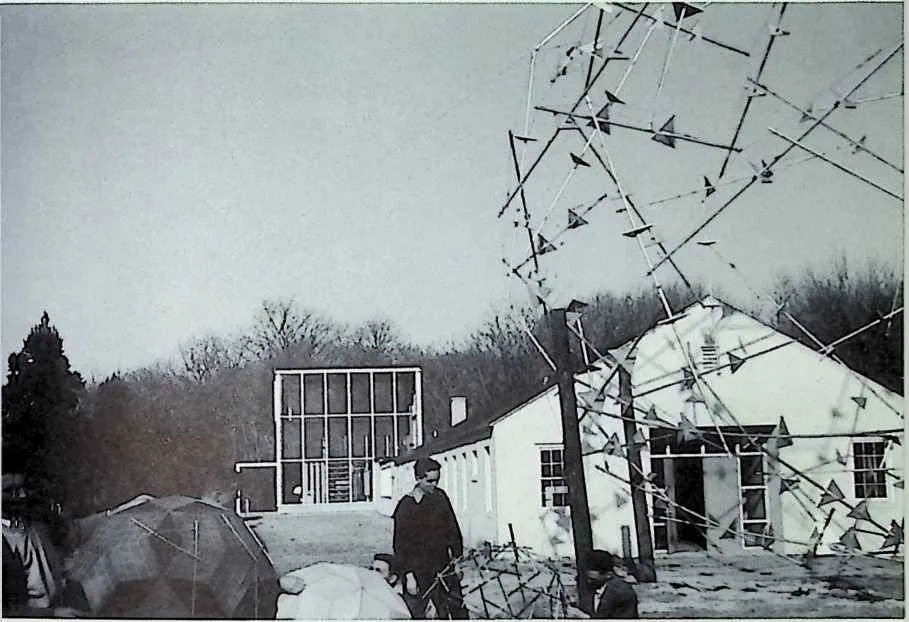
57 Princeton students building geodesic models alongside the Tensegrity Sphere, In front of the Architectural Lab, 1953
58 Geoscope, featured on the cover of the 22 April 1960 edition of the Princeton Alumni Weekly
60 ultimately transforming our understanding of both. As the lecture's title, ‘‘World Man,’’ suggests, Fuller reimagines the relationship between ourselves and our environment, constructing a new future that continues to reshape the present.
61 Today scholars continue to rediscover Fuller and deepen our understanding of his legacy. For Buckminster Fuller: Starting with the Universe, the retrospective held at the Whitney Museum of American Art in New York in 2008, K. Michael Hays described Fuller's progression from the 4-D system of the 1920s to the versions of the geoscope in the 1950s and 1960s as based on the development of a ‘‘geological diagram’’: a ‘‘system in terms of movements, distances, patterns, and intensities…that is centered on the Earth as an environment and a planet in a cosmos.’’29 Hays emphasizes that Fuller's geological diagram is not ‘‘an abstraction that transcends all possible experience,’’ but rather ‘‘an empirical system of differential relations that creates and organizes actual times, movements, trajectories, and ultimately sensations.’’30
62 Hays argues that Fuller's geoscope is endowed with the ‘‘cognitive and perceptual’’ possibilities of ‘‘a 'macro-micro-Universe-information' machine, geo-info-video-dome for the comparative display of flows, patterns, and intensities of population, climate, geology, sociology, finance, and their distributions and interactions.’’31 In this sense, the geoscope project at Princeton was a precursor of the Geographic Information Systems so ubiquitous and foundational to our daily lives, bringing together real-time geographical information and complex data modeling, and constantly recalculating a projection of the future. Whether predicting alternative routes from live traffic patterns or deciphering future sociological and political changes in the population through census-data management and feedback, these systems mediate the relationship between the individual and the collective, between us and the environment. Similarly, Fuller's lifelong epistemological pursuit—his defining and redefining of words and concepts through a process of discursive experimentation, which reached a peak in the language of his patent applications and Synergetics Dictionary—foreshadows our contemporary understanding of innovation as transcending questions of technology to focus instead on issues of intellectual property.
63 Fuller’s geological diagrams run counter to the contemporary disciplinary emphasis on specialization in architecture, which had already begun to emerge by the time he delivered his Kassler lecture. In his brief for the International Union of Architects' ‘‘World Design Science Decade, 1965--1975,’’ Fuller warned about the dangers of specialization and pointed to architects as ‘‘the last species of professional comprehensivists’’ capable of facing the
64 technological, environmental, and political challenges ahead.32 His models call for a more comprehensive understanding co of the contribution that the discipline can make in reshaping our environment—materially, but also socially, politically, and culturally. In ‘‘World Man’’—and, by example, in all of his creative practices—Fuller urges architects to understand their role in society not only as technical specialists but also as public intellectuals, uniquely positioned to build alliances with the professional, civic, and cultural spheres in order to influence them all. If Fuller habitually defined himself as a ‘‘comprehensive anticipatory design scientist’ who championed broad thinking in order to benefit the greatest number, our revisiting of his ‘‘World Man’’ lecture almost half a century after it was delivered challenges us to examine our disciplinary definitions as a way to seize the present and transform the future.
2.1 NOTES
- 1.
- R. Buckminster Fuller to Dr. Robert Geddes, Bear Island, Maine, 26 August 1966; and
66R. Buckminster Fuller, ‘‘World Man,’’ typescript of lecture delivered on October 5, 1966. Both documents, reprinted in their entirety in this volume, are held in the Robert Geddes Papers, Princeton University School of Architecture Archive, Princeton University, Princeton, N.J. In his letter to Geddes, Fuller recommends that his lecture be ‘‘taped, transcribed, and corrected’’ for eventual publication. All subsequent citations of Fuller are taken from this typescript unless otherwise noted.
- 2.
- ‘‘The Dymaxion American,’’ Time 83, no. 2 (10 January 1964): 48. The issue's cover illustration features Fuller’s radome, Dymaxion car, tensegrity octahedron, 4-D apartment house, and Dymaxion mobile laboratory alongside his disembodied head, contoured in the shape of a geodesic sphere.
- 3.
- The Time article maintains that in 1964 Fuller's domes ‘‘covered more square feet of the Earth than any other single kind of shelter.’’ Ibid.
- 4.
- Museum of Modern Art, New York, ‘‘Visionary Architecture,’’ press release, September 29, 1960; exhibition, September 29-December 4, 1960.
- 5.
- R. Buckminster Fuller, ‘‘Here we have the same tensegrity principles, but instead of being a spherical structure, it is a linear structure. It is a tensegrity mast at New York's Museum of Modern Art. If you study this you will see independent tetrahedral groups superimposed.’’ ‘‘World Design Science Decade, 1965–1975, Phase I, Document 2, The Design Initiative’’ (Carbondale, III.: Southern Illinois University, 1964), 41.
- 6.
- Museum of Modern Art, New York, ‘‘Arthur Drexler Retires as Director of Department of Architecture and Design at the Museum of Modern Art,’’ press release, January 1987. See also Three Structures by Buckminster Fuller. Museum of Modern Art, New York, September 22-Winter 1960. For a detailed list of Fuller's creative output, see Jennie Goldstein, ‘‘Selected Contextual Chronology,’’ in Buckinster Fuller; Starting with the Universe, ed. K. Michael Hays and Dana Ashley Miller (New York: Whitney Museum
68 of American Art and Yale University Press, 2008). For a comprehensive chronology of Fuller’s geodesic prototypes, see the University of San Diego's Spherical Atlas Research Unit (sphericalatlas.com).
- 7.
- John McHale, introduction to ‘‘Richard Buckminster Fuller,’’ Architectural Design. July 1961,290. See also John McHale, R. Buckminster Fuller. Makers of Modern Architecture (New York: George Braziller, 1962).
- 8.
- Fuller, quoted in ‘‘Dymaxion American,’’ 51.
- 9.
- Hsiao-Yun Chu and Roberto G. Trujillo, eds., introduction to New Views on R. Buckminster Fuller (Stanford, Calif.: Stanford University Press, 2009), 2.
- 10.
- In an interview Stan Allen conducted with Robert Geddes in preparing this volume, Geddes recalled that although he extended the formal invitation to Fuller, Kenneth Kassler's widow, Elizabeth Bauer Kassler (1911–98), had been the driving force behind bringing Fuller to Princeton. A former curator in the Department of Architecture and Design at MoMA, Bauer Kassler maintained a ‘‘good relationship’’ with Arthur Drexler, Fuller's strong supporter, and likely facilitated contact between the parties. For more on Allen's conversation with Geddes, see the Postscript contained in this volume.
- 11.
- Department of Public Relations, Princeton University, Princeton, N.J., ‘‘Release: Sunday, November 15, 1953,’’ press release, November 1953. Robert Geddes Papers.
- 12.
- For more on the Princeton sphere, see ‘‘Discontinuous Compression Sphere, School of Architecture, Princeton University, 1953,’’ in The Artifacts of R. Buckminster Fuller:
70 A Comprehensive Collection of His Designs and Drawings in Four Volumes (New York: Garland Publishing, 1985), 181–85.
- 13.
- Fuller's patent describes the tensile-integrity structure as ‘‘a strut and a pair of flexible tension slings each connected to an end portion and to a portion intermediate the ends of the strut, and means for connecting said slings respectively to end portions of two other components of like construction.’’ ‘‘Tensile-Integrity Structures,’’ U.S. Patent No. 3,063,521. Fuller applied for this patent on August 31, 1959; he received it on November 13, 1962, almost a decade after he built the Princeton structure. On Fuller's patents, see R. Buckminster Fuller, Inventions: The Patented Works of
72 R. Buckminster Fuller (New York: St. Martin's Press, 1983).
- 14.
- Ibid. Regarding the principle of discontinuous-compression in that project, Fuller later wrote, ‘‘We manufactured and assembled a 40 foot tensegrity sphere of 90 struts. A snowplow ran into this structure on one side and way around 180 degrees from the point of impact a member bent. The loads were distributed completely symmetrically in all directions from the point of impact until finally they came together again at the other pole. There the forces converged in full concentration as waves develop on spheres.’’ Fuller, ‘‘World Design Science Decade,’’ 39.
- 15.
- Fuller, ‘‘Tensile-Integrity Structures.’’
- 16.
- Ibid.
- 17.
- Ibid. For more on his ‘Tensile-Integrity Structures’ patent, see Fuller. Inventions, 179.
- 18.
- ‘‘The Sphere of Ideas,’’ Princeton Alumni Weekly LIV, no. 10 (November 27, 1953): 8.
- 19.
- Henry McLaughlin III, ‘‘Scientist Builds Model Earth in Princeton Lab,’’ The Daily Princetonian (March 24, 1960): LThe basic form of a spherical, or ‘‘globe,’’ map stemmed from Fuller's belief that ‘‘as the Earth is a spherical body, so the only true cartographic representation of its true surface must be spherical. All flat surface maps are compromises with truth.’’ ‘Dymaxion Map [Cartography Patent],'
75 in Fuller, Inventions. 90.
- 20.
- Fuller, quoted in McLaughlin, ‘‘Scientist Builds Model Earth,’’ 1.
- 21.
- James Robert Hillier, ‘‘What Is the Geoscope,’’ Geoscope 1960. 4. Robert Geddes Papers. On the Cornell project, see ‘‘Twenty-Foot Globe of Wooden Slats, Cornell University, 1952.’’ The Artifacts
77 of R. Buckminster Fuller. 86. Fuller began a third geoscope, at the University of Minnesota in 1954, which he nicknamed ‘‘Minni-Earth.’’ R. Buckminster Fuller, letter to Brigadier General Harold E. Watson, United States Air Force, 19 April 1955. Robert Geddes Papers.
- 22.
- Hillier, ‘‘What Is the Geoscope,’’ 4–5.
- 23.
- ‘‘I send you this letter because of your long demonstrated interest and support of my geographical and my structural explorations alike which have now become unexpectedly married in Minni-Earth.’’ Fuller to Watson, 11.
- 24.
- ‘‘Princeton Builds a Large Globe Map,’’ New York Times. April 6, 1960.
- 25.
- R. Buckminster Fuller, ‘‘Geoscope= World Looks at Itself,’’ entry in Synergetics Dictionary: The Mind of Buckminster Fuller. vol. 2, ed. E. J. Applewhite (New York: Garland, 1986), 154.
- 26.
- Fuller described words as ‘‘the first industrial tools’’:
79 [Coherently they involve a plurality of people and are also inherently prior to relayed communication and integration of the respective experiences of a plurality of individuals. This is reminiscent of the scriptural account, 'In the beginning was the word,' which we may modify to read, ‘In the beginning of industrialization was the word.' Crafts are limited to a single person and involve only very local resources and very limited fragments of Earth and time, while industrialization, through the relayed experience of all people—permitted through the individualization of the spoken and written word-involves all experiences of all people everywhere in history.
80 R. Buckminster Fuller, ‘‘Emergent Humanity: Its Environment and Education,’’ in R. Buckminster Fuller on Education (Amherst: University of Massachusetts Press, 1979), 101–2.
- 27.
- For Fuller's comprehensive attempt to codify the meaning of certain central terms, see the four-volume Synergetics Dictionary. For terms that appear in his Kassler lecture, see the Glossary contained in this volume.
- 28.
- In the ‘‘World Man’’ lecture, Fuller cites advances in telecommunications as signaling the way: ‘‘One of the great communication satellites is able, with one-quarter of a ton, to displace the communicating capacity of 75,000 tons of cable under the Atlantic.’’
- 29.
- K. Michael Hays, ‘‘Fuller's Geological Engagements with Architecture,’’ in Buckminster Fuller: Starting with the Universe. 3.
- 30.
- Ibid., 9.
- 31.
- Ibid.
- 32.
- Fuller envisioned an ‘‘epochal reorientation of man’’ through a refocusing of university education: ‘‘[F]rom now on we are going to be giving up specialization and are going to generalization. Everybody will be taught to be a comprehensivist. It is going to come naturally because man is born to
82 be comprehensive. It is a unique biological characteristic. As he cross-breeds he becomes more comprehensively adaptive. Only in-breeding brings specialized capability, by breeding-out general adaptability. Architects constitute the last species of professional comprehensivists for they try to put things together while the vast majority, who are specialists, take things apart.’’ Fuller, ‘‘World Design Science Decade,’’ 98.