
4 GLOSSARY
2COMPILED BY DANIEL LOPEZ-PEREZ
3 For R. Buckminster Fuller, words and concepts were intimately related. ‘‘[The numbers of the words in the dictionary grow,’’ he asserts in his ‘‘World Man’’ lecture, ‘‘because we have more aspects of subjects to consider.’’ Fuller saw language as an invaluable resource—as a tool to be used not only for sharing ideas with others but also for developing ideas. Language was not an end in itself but rather a discursive process, through which he created and explored new concepts. By recombining elements of existing words Fuller coined many new ones, including ‘‘ephemeralization’’ (the nominal form of the verbed noun ‘‘ephemeral’’), which refers to the idea of ‘‘progressively doing more with less,’’ and ‘‘dymaxion’’ (an adjective formed from ‘‘dynamic’’ and ‘‘maximum’’), which he defines as ‘‘maximum output with minimum input.’’
4 The attempt to codify his core terms plays a central role in a series of books Fuller wrote in collaboration with editor E. J. Applewhite beginning in the 1970s. Sharing the word ‘‘synergetics’’ in their titles, the works aimed at providing a comprehensive exposition of Fuller's radical epistemological cosmos with its landscape of unfamiliar models and metaphors. In preparing the Synergetics volumes, Fuller sent Applewhite copies of all the books, articles, lectures, manuscripts, and letters he had written, together with notebooks, drawings, blueprints, and press clippings documenting his work. He also sent him two trunks full of notes he had collected for the project, dating as far back as the 1940s.
56‘‘Synergetics shows us how we may measure our experiences geometrically and topologically and how we may employ geometry and topology to coordinate all information regarding our experiences, both metaphysical and physical. Information can be either conceptually metaphysical or quantitatively special case physical experiencing, or it can be both. The quantized physical case is entropic, while the metaphysical generalized conceptioning induced by the generalized content of the information is syntropic. The resulting mind-appreciated syntropy evolves to anticipatorily terminate the entropically accelerated disorder.’’
7 —R. Buckminster Fuller, Synergetics 2, 1979 Synergetics: Explorations in the Geometry of Thinking was published in 1975. Synergetics 2. which amplified and amended that volume, appeared in 1979. A third and final book, published in 1986 under the title Synergetics Dictionary: The Mind of Buckminster Fuller, was the culmination of the effort to summarize Fuller's thinking, largely by providing definitions of the terms that had become part of his unique lexicon. Completed posthumously, the dictionary reproduces in four monumental volumes the raw materials that Applewhite created while working with Fuller on the two previous books: an exhaustively cross-referenced, alphabetically coded, first-word index of his topical concepts. Typed note cards, each containing a concept, its definition, and (somewhat cryptic) citations from the literature in which the concept appeared, were reproduced in facsimile form, some with handwritten corrections by Fuller as he worked to establish a definitive set of terms.
89‘‘Neither Bucky nor I realized it at the time, but as all those files were compiled they seemed to manifest a sort of self-organizing character, and we ended up creating something approaching a new art form.’’
10—E. J. Applewhite, ‘‘Rationale for the Dictionary,’’ Synergetics Dictionary, vol. 1, 1986
11 For Fuller, the Synergetics project aimed to ‘‘measure’’ all human experience and ‘‘coordinate’’ it into a pattern of words. Applewhite describes that discursive pattern in the introduction to the Synergetics Dictionary as ‘‘a kind of poetic combination of feeling and abstraction—physical sensations merging into metaphysical patterns.’’ On the one hand, a set of diverging lines reveals physical ‘‘experiencing’’---our increase in understanding of the physical world through the gathering of more and more quantifiable data—as ‘‘entropic,’’ chaotic, and ever expanding. On the other hand, a set of converging lines shows metaphysical ‘‘conceptioning’’—our search for conceptual order within the expansive entropy of the physical world—as ‘‘syntropic,’’ increasingly organized and orderly. If Fuller's incessant investigation of the physical world strove to discover nature's rules, his conceptual ordering tried to ‘‘anticipatorily terminate’’ that world's ‘‘accelerated disorder.’’ The physical and conceptual are brought together into what Fuller and Applewhite describe as an ‘‘epistemography of generalization,’’ an endlessly shifting topography propelled by the interplay of all human thinking and experiencing.
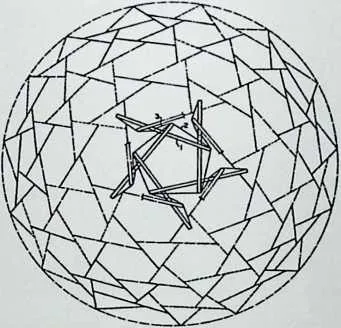
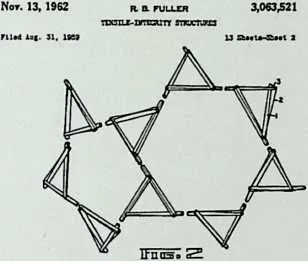
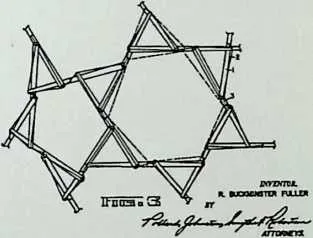
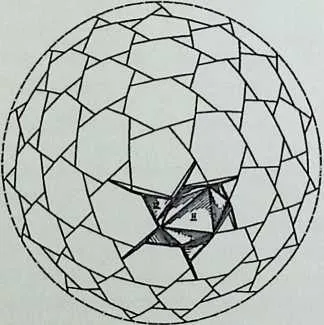
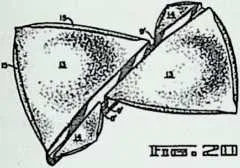
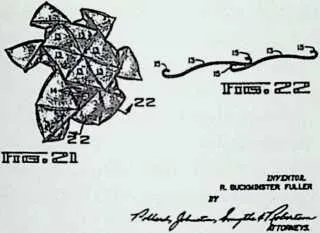
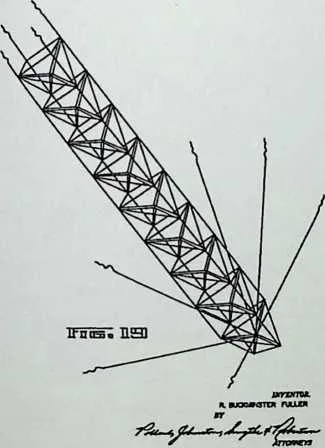
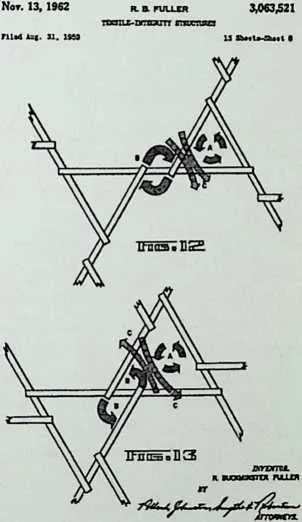
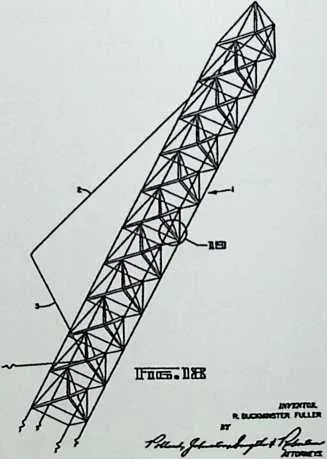
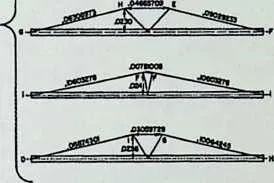
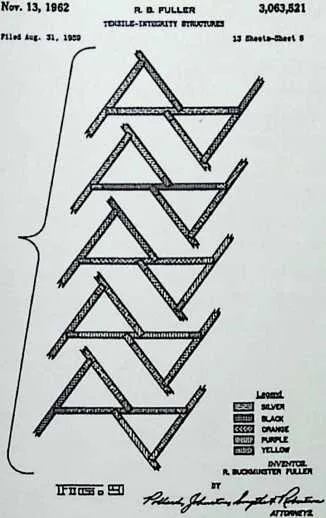
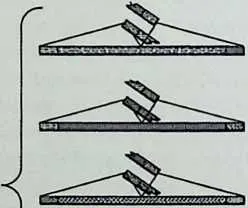
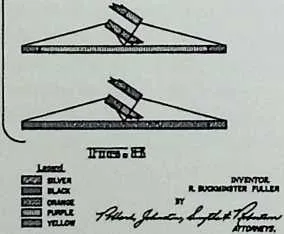
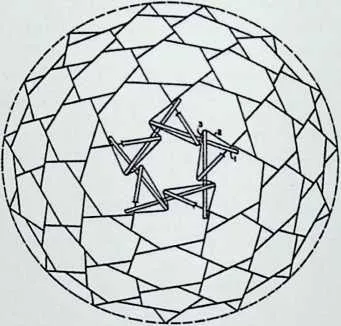
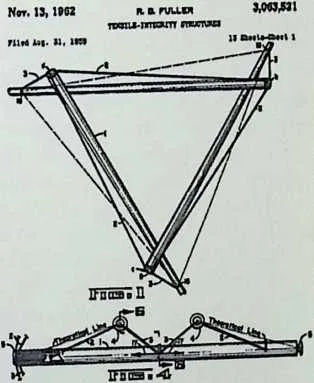
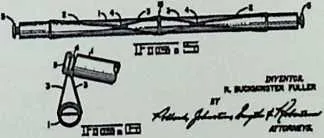
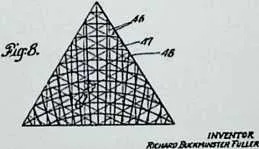
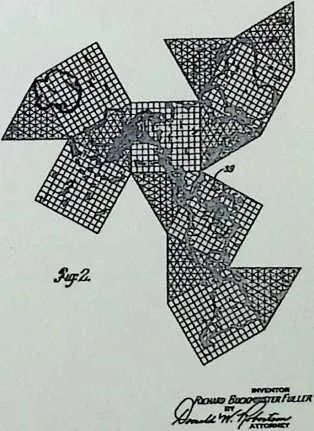
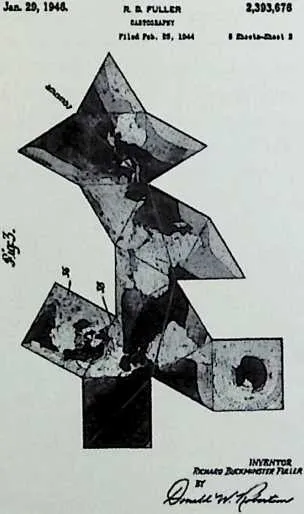
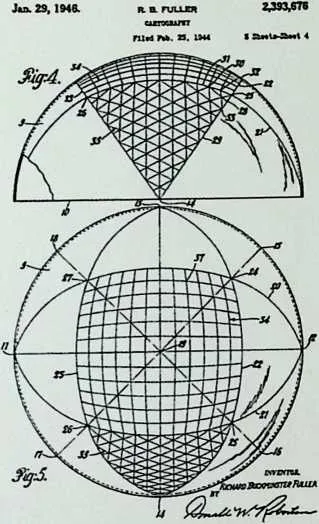
12 The glossary of terms included in this volume illustrates Fuller’s unique and extraordinary exploration of language as it relates to his Kassler lecture, delivered at the Princeton School of Architecture in 1966 and reprinted here in its entirety. The glossary lists a number of key terms, accompanied by surrounding text from the body of the lecture (referenced by page number in the original ‘‘World Man’’ typescript). Brief editorial notes explicate the term's underlying concepts and contextualize it within the broad network of Fuller's ideas. Interspersed with the terms are reproductions of the original drawings Fuller submitted for the patent applications which formed the basis of the two physical models built at Princeton: the ‘‘Cartography’’ patent, filed January 29, 1946; and the ‘‘Tensile-Integrity Structures’’ patent, filed November 13, 1962. Excerpts from Fuller’s Synergetics volumes (identified by title, year, volume, and page or section number) are also included, as are cross-references to other texts, which provide additional literary context. What becomes apparent in comparing the many uses of these terms over the course of his long career is that, despite sincere efforts, Fuller's terminology never becomes fixed or static. Iterative and evolving, like his models of nature's laws, his definitions move and extend from one area of relevance to another; from the scale of the human body, for example, to the scale of the universe. Taken together and read in the context of the ‘‘World Man’’ lecture, the terms and their definitions provide an abstract but suggestive outline of Fuller's ‘‘geometry of thinking.’’
13 I a 4-D House (1928)
14 Prime Design
15 Automation
16 21. StarTensegrity (Octahedra Truss) (1967)
17 9. Dymaxion House (Wichita) (1946)/
18 ' 8. Dymaxion Map (1946)
19 4. Dymaxion Car (i 937) ]
20 7. Dymaxion Deployment Unit Frame
21 (1944)
22 ' 6. Dymaxion Deployment Unit (Sheet)
23 i (1944)
24 i 5. Dymaxion Bathroom (1940)
25 110. Geodesic Dome ; (1954)
26 13. Catenary (geodesic Tent) 0959)
27 l2.Plydome (1959)
28 11. Paperboard / Dome (1959)
29 /
30 / Law of Conservation of Energy
31 z 20. Octa Spinner (1965)
32 19. Laminar Dome (1965)
33 / Wealth
34 »'l8. Monohex (Geodesic Structures) (1965) i Unjverse
35 ! 25. Non-Symmetrical Tens:
36 > anti-entropic Effectiveness
37 / 17. Aspension (Geodesic Structures)
38 I (1964)
39 > 16. Submarisle (Undersea Island) / (1963)
40 [ 2. Stockade: Pneumatic Forming Process i '-(1927) i :
41 ,1. Stockade: Building Structure (1927)
42 1930
43 1940
44 1950
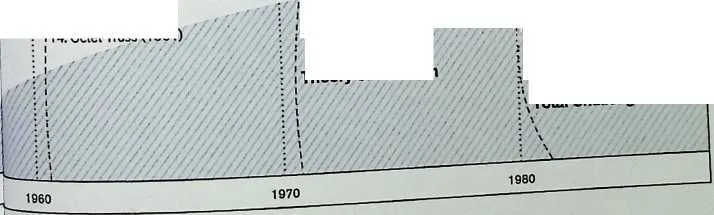
45 This diagram plots the introduction of key terms used by Fuller In his ‘World Man’’ lecture along a chronological axis, based on bibliographic references provided by Applewhite in his Synergetics Dictionary: The Mind of Buckminster Fuller (1986). Interspersed within this chronology are a variety of Fuller's Inventions, numbered as they appeared in Inventions: The Patented Works of R. Buckminster Fuller (1983).
46 26. Floating Breakwater (1979)
47 iegrity (1975)
48 ' 24. Floatable Breakwater (1975)
49 28. Hanging Storage Unit (1983)
50 LbPEZ-PtREZ: glossary
51 I
52 ' Metaphysical and Physical
53 23. Hexa-Pent(1974)
54 > Forward Regeneration
55 i System
56 115. Tensegrity (1962)
57 •J 27. Tensegrity Truss (1980)
58 114. Octet Truss (1961)
59 Theory of Function
60 1 Total Challenge
61 1 22. Rowing Needles (Rowing Craft) ! '(1970)
63 anti-entropic effectiveness.
64 ‘‘[T]he anti-entropic EFFECTIVENESS that is inherent in the brain and in the intellect is predicated upon experience. We have to have experiences where we make mistakes. As a child we have to find out about gravity; we have to pull things…. [T]here must be a number of experiences before we can begin to gain a pattern and many of the special cases experiences, before we begin to generalize and evolve and deduce principles that are operative.’’
65 —‘‘World Man,’’ 1966, pp. 42–43
66 In considering the relationship between physical and metaphysical phenomena, Fuller draws a distinction between the ‘‘brain’’ and the ‘‘mind.’’ The brain coordinates all of the information given to us by our senses (smell, touch, sound, et cetera), whereas the mind reflects intuitively upon the implications of that information. For Fuller, ‘‘design’’ emanates from the search for insights gleaned from observing the physical world and its ‘‘special case experiences.’’ The patterns that emerge are then abstracted into generalized principles.
67 The process of translating the physical into the metaphysical can also operate in the reverse. ‘‘Physical projections’’ can result from conceptual patterns, the presence of which subconsciously affects human behavior. Potential lies in our capacity to consolidate abstract concepts based on the observation of physical phenomena into generalized principles and, in turn, translate these into physical projections that alter our relationship to our environment in beneficial ways. Fuller calls our capacity to carry out this feedback process of discovery and translation our ‘‘anti-entropic effectiveness.’’
68 ‘‘anti-entropic Ordering Principles: I think the anti-entropic ORDERING PRINCIPLES are both subconsciously and consciously developed by humans as conventions of understanding of, for instance, how we can prosper without getting into trouble. ‘The Law and the Citizen’ relates to this consciousness. Laws are conventions, working agreements, often different from the experimentally discovered principles governing physical Universe behaviors. There is usually a deal of difference between yesterday’s erroneous assumptions and today’s scientific findings.’’
6970—Law, May 1965; cited in Synergetics Dictionary, 1986, vol. I, p. 71
71Nor. 13, 1962 r. n ruixra 3,06321
72 TO3ILX-IXTECXITT STRUCTURES FlUd Ab*. 31, loss 13 •
74 irnns.BIED
77 I just have to remind you, as I continually remind myself, that the word 'AUTOMATION' is not something really new. It is a description of a very old process….[Y]ou are 99% automated…you don’t know what you are doing with the supper that you ate tonight…. I have discovered…that I know very, very little, and found that I am certainly well over 99% subconsciously operative…. [A] quadrillion times the quadrillion atoms in coordinate operation in our brains, and we have nothing to do with their extraordinary success in a conscious way, so that when I look on man in this way, I am surprised at the very little, tiny bit of area of his total being and his coordination and his participation with the rest of life around the Earth.’’
78 —‘‘World Man,’’ 1966, pp. 40–41
79 For Fuller, ‘‘automation’’ is a process that takes place in nature on a number of scales: at the scale of the body and its metabolic balances, for example, and at the scale of the planet and its broader cosmic balance. It is also a process central to energy and resource consumption with respect to manufacturing and production. Fuller develops the term in his 1962 text ‘‘Education Automation.’’ There he argues that education is at the center of society’s transition away from mechanized work and toward an ‘‘automation’’ that will produce a more regenerative and sustainable ‘‘industrial equation.’’ ‘‘[T]he more educated our population,’’ Fuller maintains, ‘‘the more effective it becomes as an integral of regenerative consumer individuals.’’
80 Automation: We hear a great deal about AUTOMATION as something very threatening…something new. I’m going to try to define AUTOMATION. By AUTOMATION I would mean any regulatory pattern or control operative independent of man’s controlling it: that would
81 be automated. I’ll point out to you that the orbiting about Earth and all the pulsing of the Sun—this is all automated. I point out that none of you know what you’re doing with your lunch right now—this is all automated. You’re not consciously saying, ‘I’m going to send this
83 off to make hair for tomorrow, and I’m going to have curly hair,’ or whatever it is. You haven’t the slightest idea why you were born at seven pounds, and why you went to 170, and why you stopped. People learned accidentally that they pushed some buttons and made babies, but all the rest is automated. They haven’t the slightest idea why. I point out to you that we have never had anything but AUTOMATION.’’
84 —World Game at NY Studio School, 12 June-July 1969; Saturn Film transcript, Sound 1, Reel 1, pp. 83–84; cited in Synergetics Dictionary, 1986, vol. i,p. 117 From this point on it is man’s intellect that is of advantage. His observation, then, of the principles operative in the universe, his learning new discovery patterns of energy which are operative and shunting them to the ends of the levers to do the work, so I see that the organized capability to deal with our FORWARD REGENERATION is then, if that is wealth, then it consists not only of the energy which is manipulated, but it consists of the intellect which observes and develops….And so [humans] are able to use the generalized principles to their increasing advantage in their metabolic regeneration.’’
85 —‘‘World Man,’’ 1966, p. 51
8687Not. 13,1962 n b. njLLra 3,053,521
88 ii»n 1 r-i»rroirrr rkxiukb
8990HIM Am*. 31. 1E1 M CmU-OmI 10
9293Unas o HZ7
94 The term ‘‘regeneration’’ was intrinsic to Fuller’s ‘‘wealth,’’ a concept that went well beyond an abundance of physical resources. Technology constantly improves the efficiency and precision with which materials are transformed through modem processes of manufacture. No longer conceived as a zero-sum game that unites consumption with the depletion of material resources, Fuller’s notion emphasizes the system’s capacity for regeneration. ‘‘Forward’’ or ‘‘metabolic’’ regeneration implies devising more efficient processes and preventive strategies in the use of material resources, as well as a more universal distribution of these resources. If ‘‘wealth’’ translates into the organized capacity to deal efficiently with resources, then ‘‘forward regeneration’’ signals our organized capacity to find alternative ways of managing and preserving resources for future generations.
95 ‘‘Regenerative: Regenerative means local energy-pattern conservation.’’
9697—Synergetics text at sec. 600.04, 3 October 1972; cited in Synergetics Dictionary, 1986, vol. 3, p. 495

99 law of conservation of energy.
100 Nor. 13,1962
101 FU.4US. 31. 1909
102 R. U FULLER 3,063321
103 TOSUX-mCRITT STRUCTURES 13 II
104 ‘‘[It was] in the early part…of this century that scientists began to make experiments specifically with entropy, and they discovered whenever systems lost energy…it could only dissociate here by joining there, and energies were too% accountable. Therefore they began to feel it was a fallacy to think of the energies escaping from the universe…. [They] felt constrained to formulate a new fundamental
105 3,063321
106 N«. 13, 1962
107 Filed 31. 1959
108 concept which they call the LAW OF CONSERVATION OF ENERGY, which said no energy could be created or no energy could be lost. Energy, then was finite, and we have then, along with the many experiments like those of the speed of light and the other types of observation, experiments of inspired people like Einstein, Plant, and others. We have developing, then an entirely new way of looking at energy.’’
109 —‘‘World Man,’’ 1966, pp. 18–19

111 In describing the law of conservation of energy, where the total amount of energy in a system remains constant over time. Fuller makes reference to Einstein’s theory of relativity, in which energy has an equivalent mass and mass has an equivalent energy. After Einstein, the ‘‘law of conservation of energy’’ could be understood as a ‘‘law of conservation of mass-energy,’’ a revision of the nineteenth-century laws of physics in which energy was somehow lost as it was transferred from one system to another. Fuller highlighted this twentieth-century discovery as a ‘‘new cosmological concept of an inexhaustible’’ universe, where energy can be understood as ‘‘associative as matter’’ and ‘‘disassociative as radiation.’’
112 ‘‘Physicists had predicated their grand strategies upon the experience of trying to make something like a perpetual motion machine. They found that all local machines always had friction, therefore energies were always going out of the system. They call that entropy: local systems were always losing energy to the rest of the universe. When the physicist began to look at their total experience instead of at just one of their experiences, they found that while the energy may escape from one system, it does not go out of the universe. It could only disassociate in one place by associating in another place. They found that this experimentally true, and finally, by the mid-19th century, they dared to develop what they called the LAW OF CONSERVATION OF ENERGY, which said that no energy could be created and no energy could be lost. Energy is finite. Physical universe is finite. Physical Universe is just as finite as the triangle of 180 degrees.’’
113 —Synergetics, 1975, sec. 116.00 ‘‘Energy: Scientists experimenting with entropy discovered that while energy left one local system after another, it always did so only by joining other local systems. The scientists found that energy was always too percent accountable. Therefore, they had to elucidate a new and fundamental scientific law which they called ‘LAW OF CONSERVATION OF ENERGY’ which stated that energy could be neither created nor lost….Therefore we emerged scientifically in the early days of the 20th century into an entirely new cosmological concept of an inexhaustible, ergo finite (physical) Universe consisting entirely of energy—energy associative as matter, and energy disassociative as radiation, and both intertransformable.’’
114115—NASA Speech, June 1966, p. 25; cited in Synergetics Dictionary, 1986, vol. I, p. 616
116Nov. 13, 1962 r. a fuixer 3,063,521
118 metaphysical and physical.



120 'I find that the metaphysical seems to be the balance of the physical, that metaphysical isn’t just the name of a club of people who did not belong to the exact sciences, but METAPHYSICAL is a phenomenon of the universe that is in extraordinary balance and comprehensive to the PHYSICAL expanding, increasing cntropic, disorderly, METAPHYSICAL, continually contracting and increasingly more orderly until it comes to the exquisiteness of a single unity which has a fundamental complementary’ of functions, but inherently includes those functions in one word.’’
121 —‘‘World Man,’’ 1966, p. 33
122 Not. 13, l»«2 naruxiR 38321
123 n>fnt-uncm t iikxtjus
124 HIM la<- n, US* U CUtU-CUtl >
125 l6PEZ-p£rEZ: GLOSSARY 113
126 JLR&SL
127 WVtXTOH.
128 HauOMtOTtR FUXER
129 Fuller often speaks of the world in terms of dualities. Here he juxtaposes the terms ‘‘physical’’ and ‘‘metaphysical’’ as a way to describe what he sees as two parallel universes. On the one hand, the ‘‘physical’’ universe transcends conceptual definition and is thus ‘‘entropic’’ or ‘‘increasingly diffuse and disorderly.’’ Conversely, the ‘‘metaphysical’’ is defined by conceptual understanding and is ‘‘anti-entropic,’’ or inherently tending toward order. Using this duality, Fuller argues that it is in the balance between the ‘‘physical,’’ as the potential to find a better ‘‘regeneration’’ for Earth’s resources, and the ‘‘metaphysical,’’ as the ‘‘know-how’’ of better managing them, where the possibility of a better future lies.
130 prime designer.
131 ‘‘The greatest of all the faculties is the ability of the imagination to formulate conceptuality. Conceptuality is subjective; realization is objective. Conceptuality is METAPHYSICAL and weightless; reality is PHYSICAL.’’
132 —Synergetics, 1975, sec. 501.01
133 ‘‘Metaphysical and Physical: For the support of life on our planet…you get down to two things: METAPHYSICAL and PHYSICAL. So there’s the PHYSICAL regeneration and the METAPHYSICAL know-how of how to employ all the resources, all the patterns, that are operating in Universe…These are the criteria of what you need to keep a human being going.’’
134135—World Game: Grand Strategy, 2 June 1974; cited in Synergetics Dictionary, 1986, vol. 2, p. 619
136 Nor. 13, 1962 r. » t-ju.tr 3,063,531
137 TOanx-DrnaiTT stoctots run 193* u 4
140 ‘‘An inventor is a PRIME designer in that nobody tells him to do that designing. So I am hoping the inventor in everyone, and particularly in the university world…will again re-attack the problem of living on our energy incomes and the enormous tidal energies that are available.’’
141 —‘‘World Man,’’ 1966, p. 45
142 Not. IS, less R. a rouxn 3,063,531
143 TTCitx-Dnraarr sttoctvms ru»4 *at< «. 1K9 19 8U«U-a'«t T
146 The process of design and invention synthesizes issues of technological efficiency and prototyping with the accommodation of what Fuller describes as ‘‘ever more inclusive, efficient, and in every way more humanly pleasing performances.’’ Inventions have the potential to transcend technical function to include a civic and political dimension that Fuller describes in his lecture as the ‘‘social accounting of wealth.’’
147 system.
149 Fuller defines ‘‘system’’ as the first order of difference and subdivision among concepts and divides the Universe into ‘‘systems,’’ which in themselves have an ‘‘interior’’ and an ‘‘exterior’’ whose interrelationships are described as
150 ‘‘FPrime Design: See Artist-scientist, May i960’’ —Synergetics Dictionary, 1986, vol. 3, p. 365
151 ‘‘ 'Design: Our overall use of our energy, our design, is very bad….’’
152 —Energy Slave (3), June-July 1969; cited in Synergetics Dictionary, 1986, vol. 1, p. 472
153 ‘‘Design: The word design is used in contradiction to random happenstance. Design is intellectually deliberate. Design means that all the components of the composition are interconsiderately arranged; i.c., the component behaviors, proclivities, and mathematical integrities are interaccommodatively arranged. Ergo, the family of thus-far-discovered scientifically generalized principles which are omniinteraccommodative and omniconcurrcent inherently constitute a design, an eternal cosmic design whose eternal interrelationships are expressible only in abstract mathematical terms. Being exclusively mathematical, they are inherently metaphysical, weightless, abstractions, which metaphysics can only be conceived of and dealt with by intellect, and being thus far apparently eternal and discoverable only by human intellect, they altogether manifest an a priori cosmic intellect of absolute integrity.’’
154 —Introduction to H. Kenner’s ‘‘Geodesic Math,’’ 8 September 1975, p. to; cited in Synergetics Dictionary, 1986, vol. I, p. 47° ‘‘[A] SYSTEM is the first subdivision of the universe, and a SYSTEM subdivides all of the universe, and all of the universe is outside the SYSTEM and all is inside that SYSTEM. Shirley Morgan can be a SYSTEM; the Earth can be a SYSTEM, because clearly there is that which is interior and that which is exterior to it. Some part of the universe has to be invested in the SYSTEM itself to differentiate what is in or outside at a given moment. That is what I mean by a SYSTEM.’’
155 —‘‘World Man,’’ 1966, p. 28
157 a ‘‘tracery’’ of lines. Following from Ludwig von Bertalanffy’s General System Theory, he thought a system is any self-regulating whole capable of self-correcting through a process of feedback. Fuller used Bertalanffy’s theory as a way to posit a more interactive relationship between an organism and its environment. In his Kassler lecture, Fuller refers to the physiology of the human body as a self-regulating system; in other works, he cites local or global ecosystems.
158 ‘‘A SYSTEM is the first division of the Universe. It divides all of the Universe into six parts: first, all of the universal events occurring geometrically outside the SYSTEM; second, all of the universal events occurring geometrically inside the SYSTEM; third, all of the universal events occurring nonsimultaneously, remotely, and unrelatedly prior to the SYSTEM events; fourth, the Universe events occurring nonsimultaneously, remotely, and unrelatedly prior to the SYSTEM events; fifth, all the geometrically arrayed set of events constituting the SYSTEM itself; and sixth, all of the Universe events occurring synchronously and or coincidentally to and with the systematic set of events uniquely considered.’’
159 —Synergetics, sec. 400.011, 1975
160 ‘‘System: The Local environment is a SYSTEM. A line is always formed by an alteration of the local environment by another SYSTEM. ‘Lines’ are the pattern of consequence of one SYSTEM altering another SYSTEM, either by adding to it, or by taking away from it. The event leaves some kind of tracery.’’
161162—Line, 25 April 1971; cited in Synergetics Dictionary, 1986, vol. 4, p. 114
163 theory of function.
164 ‘‘A function exists only by virtue of the always and only coexistence of other functions. Then from our THEORY OF FUNCTION we might further go and have phenomenon which we would speak about as relativity.’’
165 —‘‘World Man,’’ 1966, p. 30
166 The ‘‘theory of function’’ can be understood as the relationship that emerges between different networks within a self-regulating system. Fuller named the behavior of whole systems ‘‘synergy’’ and defined it in a letter to the editor (John McHale) published in Architectural Design in July 1961 as follows: ‘‘Synergy is the unique behavior of whole systems unpredicted by behavior of their respective subsystems’ events.’’
167 2393,676
168 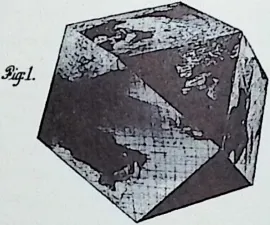 S 1
S 1
169 Ju. 23, 1946.
170 R. Q FULLER cirrcmm riled Feb. 23, 1944
172173total challenge.


175 Ju. 29, IMS.
176 ‘‘The THEORY of functions holds for Universe itself. Universe consists at minimum of both the metaphysical and the physical. The inherent, uniquely differentiatable, but constantly interproportional twoness of physical Universe was embraced in Einstein’s one-word metaphysical concept, ‘relativity,’ and in a more specific and experimentally demonstrable way in the physicist’s concept of complementarity.’’
177 —Synergetics 2, 1979, sec. 326.25
178 ‘‘Theory of Functions: A system is something that divides the Universe into all that is inside the system as distinct from all that is outside of it. Your body is such a system. So is a tomato can. So is the Earth. Viewed from inside, a system is concave; viewed from outside, it is convex. As the sums of the angles add up, the total is always less degrees than a plane. In order to take a flat piece of paper and make it into any kind of polyhedron, regular or irregular, you are going to have keep taking out angles to bring it back to itself until, finally, it is a polyhedron. You always come into that concavity and convexity eventually. When energy radiation impinges on concavity, the radiation converges; energy impinging on convexity diverges the radiation. So concave and convex always and only coexist I give you three kinds of always-and-only coexisting functions: tension and compression, concave and convex, and proton and neutron. Now we can develop something we call THEORY OF FUNCTIONS where we have x and y as the two covariables and have the x standing for tension, convex, and proton and y standing for compression, concave, neutron.’’
179180—Franklin Lecture, Auburn, Alabama, 1970, p. 83; cited in Synergetics Dictionary, 1986, vol. 2, p. too ‘‘I became interested as an inventor in always observing this kind of TOTAL CHALLENGE with respect to anything that I might try to find as permitted in the principles operative in the universe that would give man advantage in regenerating himself on the surface of the Earth, while serving his function of the greatest and most exquisite phase of antientropy.’’
181—‘‘World Man,’’ 1966, p. 38
182 Informed from an early age by a profound sense of ‘‘planetary consciousness,’’ Fuller saw his role as inventor as improving human understanding of the planet and meeting the environmental challenges it then faced. In his famous ‘‘Introduction, Guinea Pig B,’’ published in 1983 (the year of his death), Fuller reflects on this ambitious goal: ‘‘I saw that there was nothing to stop me from thinking
184 universe.
185 about our total planet Earth and thinking realistically about how to operate it on an enduring sustainable basis as the magnificent human-passengered spaceship that it is.’’ Extending his metaphor of Earth as spaceship, he urges his readers to think ‘‘about the total physical resources we have now discovered aboard our ship and about how to use the total cumulative know-how to make this ship work for everybody.’’ Once met, the total challenge posed by Earth would give way to ‘‘the omni-physically successful, spontaneous self-integration of all of humanity’’ into what he called a ‘‘one-town world.’’
187 ‘‘By ‘UNIVERSE’ I mean the aggregate of all of humanity’s consciously-apprehended and communicated experiences.’’
188 —‘‘World Man,’’ 1966, p. 16
189 Fuller employs the term ‘‘Universe’’ as a unifying concept. Often capitalized and preceded by neither definite nor indefinite article, the word suggests an external perspective from which to test assumptions regarding our role on Earth and Earth’s relationship to the cosmos. Borrowing from both the physical sciences and natural philosophy. Fuller used the term to refer to both a physical model and a philosophical concept of the world in its totality.
190 ‘‘UNIVERSE is the comprehensive, historically synchronous, integral-aggregate system embracing all the separate integral-aggregate systems of all men’s consciously apprehended and communicated (to self or others) nonsimultaneous, nonidentical, but always complementary and only partially overlapping, macro-micro, always-and-everywhere, omnitransforming, physical and metaphysical, weighable and unweighable event sequences. UNIVERSE is a dynamically synchronous scenario that is unitarily non-conceptual as of any one moment, yet as an aggregate of Unites is sum-totally finite.’’
191 —Synergetics, 1975, sec. 303.00
192 ‘‘Universe: universe is the integral of all metaphysical and physical phenomena.’’
193194—Equation of Intellect (A), 17 June 1975, p. 17; cited in Synergetics Dictionary, 1986, vol. 4, p. 365
196 wealth.
197198‘‘[[WJhat I mean by WEALTH seems to breakdown into two very important fundamentals. COne is the energy which we employ for our i metabolic regeneration; and I see then the < energy as operative in two fundamental patterns, energies which are disassociative, radiant energies, and the energies which are sociative.’’
199—‘‘World Man,’’ 1966, pp. 48–49
200In Calvin Tompkins’s article ‘‘In the Outlaw Area,’’ published in The New Yorker on January 8,1966, Fuller explains that ‘‘energy, not gold’’ constitutes ‘‘real wealth’’—wealth that is ‘‘not only without practical limit but indestructible.’’ ‘‘Man’s intellect, his ability to tap the cosmic resources of energy and make them work for him,’’ he asserts, is what causes wealth ‘‘to be regenerative, or self-augmenting.’’
201‘‘Wealth: Energy is the essence of WEALTH, WEALTH being the organized capability to support life.’’
202—Human Unsettlement (2), 20 September 1976; cited in Synergetics Dictionary, 1986, vol. 4, p. 483
203‘‘Wealth: WEALTH is the measurable degree of established operative advantage locally organized by intellect over the locally occurring differentiable behaviors of universal energy. WEALTH is an irreversible advantage: it cannot be expended in preferred reorganization of past events; it can only be expended on organizing forward events in preferential patterns.’’
204—Equation of Intellect (B), 17 June 19751 cited in Synergetics Dictionary, 1986, vol. 4, p. 483