
3 WORLD MAN
2OCTOBER 5 , 1966
3 R. BUCKMINSTER FULLER

67DR. ROBERT L. GEDDES: This evening we are very pleased to inaugurate the Kenneth Kassler Memorial Lecture Series, a series that has been given to the University and to the School of Architecture by the runny friends and colleagues and by many of the clients that were dear to Mr. Kassler.
8Mr. Kassler, as you all know, was a Princeton alumnus, a Princeton architect. For many years he was the chairman of the Advisory Council of the School of Architecture and was a dear friend of many of you in this room.
9It is. probably a very fitting tribute to his memory. and also to the intention of the lecture series that we have been able to have Mr. Buckminster Fuller join us this evening as the inaugural lecturer. It is our hope that as this series develops over the years that it will bring to the Princeton campus each year a distinguished man in the field of environmental design, the field of architecture, engineering, industrial design, city planning and its related arts. It is in this way that I think we can pay our respects to the memory of Kenneth Kassler and also to the intention of those who have so kindly supported a lecture series.
10JOHN F TRAINOR
11 It is very difficult for me to introduce Buckminster Fuller to you because so many of you know him already, but I thought it might be helpful if I could establish a few of the facts and perhaps tell you a little bit of the breadth of his interests.
12 Buckminster Fuller is hard to classify. He is either engineer or architect or inventor or discoverer or geographer or mathematician or all of these. He was born in another century, and it seems to me clearly that he is working on ideas which relate to the next century.
13 For those of you more factually minded, he was born in 1895, grew up in New England. His interests since then have grown to be worldwide. For a while he was at Harvard, and then he was at the Naval Academy, and for a number of years worked as an engineer in a variety of industrial corporations.
14 If you read through ‘‘Who’s Who,’’ it seems to start out in a very ordinary way until, all of a sudden in 1927, the name comes out that he founded the Four-D Company and then, a little later, he founded Dymaxion Corporation, and a little later, the Geodesic Corporation, and it clear the interrelationship between invention, discovery, corporate activity, industrial design and the design of the environment was something that was growing and developing throughout these years.
15 Since then, under the ideas and the direction of Buckminster Fuller and his associates, a number of very profound discoveries and objects have been made, including thousands —probably 50,000, I am not sure of the number —but thousands of geodesic domes used for shelter, used for scientific purposes throughout the world. In 1961 and 1962 he was the Charles Elliott Norton professor of poetry at Harvard. In 1958 he delivered the annual discourse at the Royal Institute of British Architects. In his own words he is an inventor and discoverer concerned very much with energetic, synergetic geometry, geodesic structure and its application to man.
16 But perhaps the most important way or the most clear way to understand the vision of this man in society is by the chapter headings in his own spontaneous autobiography, a book called ‘‘ideas and Integrity.’’
17 I called this out in no particular order. I thought you might be interested in the list of chapter headings. They start out with Comprehensive Man, Fluid Geography, Cumulative Nature of Wealth, Domes, their Long History and Recent Developments, Comprehensive Designing, Total Thinking, Prime Design, World Planning, Continuous Man and the Future.
18 It is a great honor and a pleasure for us to have with us this evening to inaugurate the Kenneth Kassler Memorial Lectures, Mr. Buckminster Fuller.
19 DR. R. BUCKMINSTER FULLER: My first visit to Princeton after my undergraduate days at Harvard, on my first visit here I came to the Architectural School in 1929, and I have had many, many visits since, and I have spent a great many wonderful days in those visits with Kenneth Kassler.
20 I really am deeply moved. I am filled almost with a mystical kind of experience in being allowed to give this first Memorial Lecture.
21 Kenneth was completely committed to the search for truth and its application, the applicability of our knowledge, the closer we can get to the truth to the problem of advantage for man and his buildings, developing not just the advantage but the inspiration of man in the way in which the buildings were built. And so tonight I am going to do my best to think out loud in a way that would be very much the way Kenneth, I found Kenneth would like to listen and talk and think out loud together.
22 I have had a life discipline which does not allow me ever to prepare lectures or even to think one minute ahead about them outside of agreeing to give a title. So I was asked to give a title tonight, and I found it a very logical and inspiring title, just the title, ‘‘World Man,’’ because I think world man has already crossed the threshold into being to an important degree.
23 I think all of the world is on the way to world citizenship. Just in my own lifetime I have found my pattern of yearly travel increasing in range and in velocity. I now find my life one in which I really literally live around the earth.
24 I am very often asked, as you must be, ‘‘Where do you live?’’ People think it a perfectly logical question, and they expect a very sharp answer, as you would answer, ‘‘Princeton.’’ But the only answer that I can give that is in any way accurate is to say, ‘‘I live in a little spaceship called Earth,’’ because for many, many years I have not had quarters that we would call home for much more than two months a year, speaking

26 cumulatively. I say almost a third of a century that has been the pattern for my life.
27 I have always been a searcher, explorer for some knowledge regarding the principles that are operative in the universe. I am seeking ways in which they can be employed to man’s advantage. I have needed to conduct myself in a way that would bring favorable results, and I have been very careful not to manipulate the pattern of my engagement with life; that is, I don't deliberately go to some place as a tourist. I only go to places as I am asked or I am called by my work, and that made it possible for me to read the pattern of my increasing range of comings and goings as having possibly economic significance.
28 That was what I was looking for. X was looking for information regarding what is happening to society, so I could feel the places I was being asked to go indicated this spread of the interest in the subjects that I was exploring.
29 So during the '20's I found myself beginning to cover pretty much the eastern half of the United States, and in a period following I began to cover a little greater territory, but today I am going, I have circled the earth at least two times a year, and that seems to be increasing quite rapidly. With it is coming, it just dawns upon you that there are very different kinds of relationship of a man to his earth that are coming up. I am not only circling it east-west, but I am circling it northwest, southwest —Australia.
30 I am now beginning to have about five or six summers and five or six winters a year, so that the kind of memory pattern, the way we try to remember events in the terms of ‘‘That was near the spring of such-and such,’’ becomes an unreliable kind of pattern. I can't think about seasons any more.
31 I wear two watches, because I wear one for my home office so I know whether I can telephone them and I whether anybody will be in the office; the other one I ; change for local time.
32 I have just been asked to write an article for one of our national magazines. Uiey say they would like you to assume that you are the Building Commissioner of the United States, and they would like to know what you would do about the great urban problems. And so, writing about it, I found myself saying: of course, the only reason they want you to consider that you are
33 the building czar is so that you will be able to enforce your will on others and be able to break through inertias, and I realize, of course, that isn't a very valid way of approaching problems, because one of the things I have learned a great deal about are the natural checks and balances of evolution. And I am completely content with due process. I am quite satisfied it takes Just so long —there are no instant babies and no Instant anything. Einstein made that very clear.
34 We have to remember now we are in a world of nonsimultaneous events. So I am not interested in being , a czar and enforcing my will, my political power, making myself building czar.
35 I was to assume I wasn't czar of the political state. I had to assume some very powerful political force had sent me in, but if you wanted really to make a czar of building, why not make me a bigger one, make me world czar of building? Shen I said: why not make me czar of building the universe? And when you get to that point, then you say: in the first place, I am deeply impressed with the designer of the universe; I am confident I couldn't have done anywhere near such a good job. But -what I really care about Is that extraordinary design of the universe, and that is what I would like to work in.
36 What I am interested in is what are the designs and processes and the intertransformabilities and what is man doing in the universe, and what is he supposed to be doing, as well as what does he think he is doing.
37 So I said: I can only answer this question in the way in which I assume, and all the known going type of behaviors of the universe, and I am not going to try to invent to a new universe or new behaviors, but I am very interested in possibly finding out about man and what he is supposed to be doing, and then how I might be able to do anything I can do as an Individual as permitted by the rules of the universe, what might I be able to do on behalf of my fellow-man’s fulfilling the functions to which he is apparently included in the universe.
38 So then I said it was quite interesting to realize the Wright Brothers, Bell and such men didn't need any authority given to them as a czar. These are the men who, dealing in the principles operative in the universe and looking at man’s needs, realized that they can employ the total principles in the universe, and they saw that men needed to communicate, and they had deep intuitive drives in them, if they could accelerate man's intercommunication, he might come to higher understanding, as man are inspired.
39 So we recognize, again, that the inventor needs no license from anyone to address himself to the problems of the humanity, and if he is not employing the principles which are operative in the universe, his invention won't work. If his invention does work, it is a facility for man. It will very probably decrease . the frustrations of man's realization of his highest potentials.
40 It is interesting to think about inventions, because I find that there are inventions —you could invent traps, and men have invented traps for years, or others which do restrict motion, and you might invent a prison which would restrict motion, but man doesn't have very great motion capabilities at any rate. He can only make four miles an hour on his feet, so there is not much further restriction to be had.
41 There is infinite room in the way of accelerating and decreasing the restraints, so that such inventors as Bell and Wright are people who decrease the restraints and permit man's greater permeation of his total environment.
42 I see, then, some of the characteristics of advantage that are already innate in the human, and I don't need any authority to be a czar because as an inventor I have very much greater power.
43 I know that the word ‘‘inventor’’ does not command the respect of society today that it may someday command. I am confident that in the days, the decades and centuries immediately past, those who began to
44 [ develop high economic power and tended to lead man's ! society as economic leaders had great effect on society,: and I say again to invest in inventions, and found
45 those Inventions were profitable, they could also consider their investment very great —and they didn't want change. They wanted to get all the profits they could out of the going machinery.
46 I feel during the last century or so, then, the word ‘‘inventor’’ was a word which was used with some disdain and annoyance on the part of the great economic leaders. So that we have inherited an attitude toward
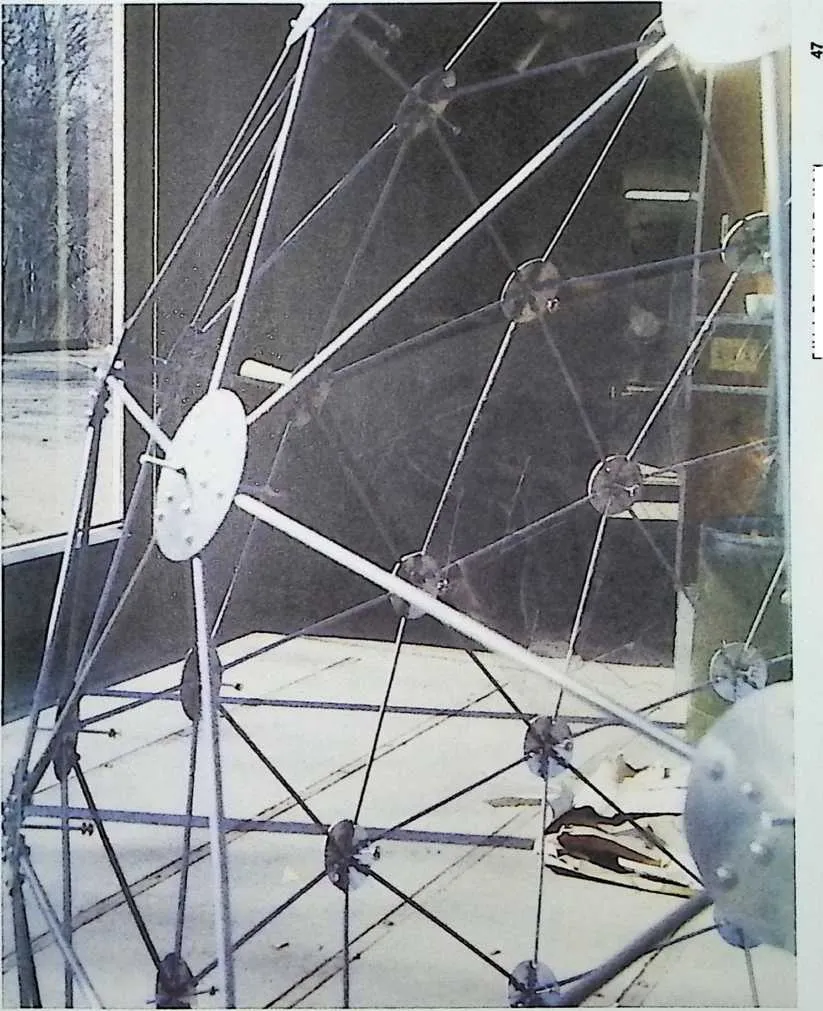
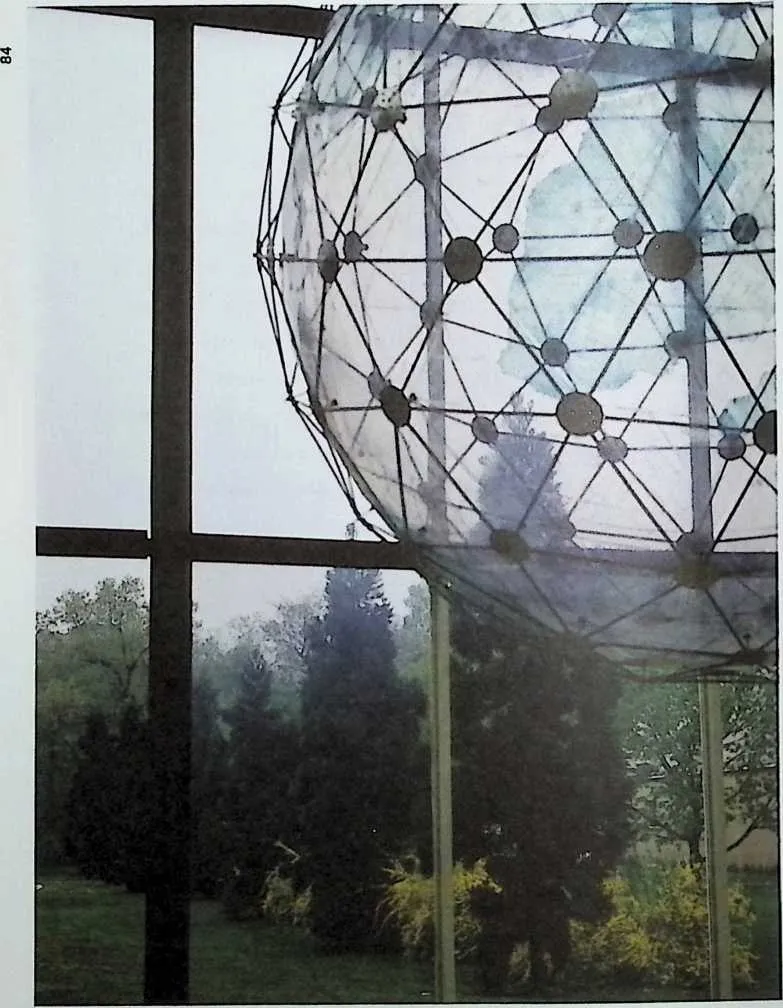
48 Close-up of the Geoscope, 1960
49 the word ‘‘inventor.’’ I found there are inventors' councils.
50 I have a number of patents, so that I am assessed as being an inventor by others. They invite me to join inventors’ societies. I don’t do so because they don't impress me very much, and I don't think an inventor is very good en masse. Invention is something you have to do by yourself.
51 In the Patent Office there are a large number, a great number of applications that come from people---who are really playing a game. They are people 'who study the patent cases. Patents have now been granted. They j try to make some small improvement on them, people to j whom it might be a satisfaction to be able to say to their grandchildren that they have a patent, and put i their picture in a picture frame.
52 Ihe Patent Office examiners found, twenty years ago, almost 85% of the claims for patents were coming from people playing games, people who had retired and didn't have anything better to do. It's a better game than quoits; could you get a patent? The Patent Office was cluttered up with improvements on inventions but not real inventions.
53 To be an invention it has to be really a fundamental surprise, something that can now be done by man that he Just didn't think he would be able to do.
54 In order to talk about our world man and talk about him from the viewpoint of the already high advantage granted to the human being by the designer of the universe in allowing him to invent, to employ principles, if he can, combine them in such a way as to bring about devices which will then decrease the restraints on man, which will give him more of his fundamental capacity of his own time to be invested by him in his own free will way, freeing him from Just a service to his own processes, then addressing this extraordinary advantage given to humanity, the privilege of being an inventor and seeing what we ought to invent in relation to our now-known problems, many of which great wrapped up into big packages and phrases, such as: population explosion, urbanism, and so forth.
55 I am going to think out loud with you in a way that I have thought to myself a great deal. Way back many, many years ago, it was about a half-century ago, I began to play a game with myself which I adopted Just theoretically, because I had observed, as you have, that when you are young you can pick up a little heavier weight each day and your muscles begin to increase, and you can build up your muscles. I said: I think I can build up my answering capabilities, intellectual answering capabilities by asking myself each day a little more difficult question. I finally got to a very big question, and I said: what do you mean by the world ‘‘universe’’?

57 I have a rule for answering my questions. My rule for answering my questions has to be that I must answer the question from experience, not from saying somebody told me so or I looked it up in a book, and they say: you believe this. This is the explanation.
58 I found as part of my experience that time and again somebody that I knew well, with them we had some joint experience and that my friend had spontaneously described what we were describing a little more capably than I could have, so I found when our experience showed us that somebody was speaking, the person who was speaking really was inspired with a desire always to tell as faithfully as possible what he was experiencing, that I could include the experiences of others whom I experienced as being faithful in recounting experiences. I could extend the experience range beyond my own.
59 The very essence, certainly, of modern experimental science is in the art of being very effective in giving faithful account of what it is we experience. So you could include all that kind of data.
60 Well, I said: I will have to answer, then, what I mean by ‘‘universe’’ In the terms of experience, and if I can't answer what I mean by the word ‘‘universe,’’ then I'd better not use the word ‘‘universe’’ even again, because it would be meaningless to me.
61 So I then, remembering I had to answer it in terms of experience, I found the answer came by itself. By ‘‘universe’’ I mean the aggregate of all of humanity's consciously-apprehended and communicated experiences. And the minute I first said that to somebody else, they said, ‘‘I think you left something out.’’
62 So I said, ‘‘That is part of my experience that you think I left something out, and that is sort of an intuitive, logical kind of intuition that you would say so, but I have included all the aggregate of all the consciously communicated human experiences, and they have included dreaming; they have included the fact some people tell lies and deliberately, that our experiences include the fact there are continually greater numbers of facets of any subject, that the numbers of the words in the dictionary grow because we have more aspects of subjects to consider.
63 ‘‘There is, then, what is called a becoming, a growth, and there is change, and that is all part of our experience.’’
64 I suddenly realized this was a very powerful kind of definition. Die only way anybody could prove I was wrong would be experimentally, and that would be an experience and it would be included, so I have had a great many people experience a matter of frustration by trying to prove me wrong. And in as much as my definition seems to hold up, we then can think a little • more about it, because it has some significance in view i of the fact that in the early part of our century the physical scientists,as a consequence of a number of very broad experiments that had been made in discoveries began to reassess and redefine physical science.
65 For instance, it was my experience when I entered the Harvard community before World War I that scientific thinkers, the natural philosophers of the Harvard's community, were letting it be known their thoughts regarding the earth and solar system and universe were that the phenomenon entropy, the second law of thermodynamics, which Showed that systems always lose energy, they felt that applied to the whole universe, and the universe was losing its energies and running down.
66 What I am saying now does not include specific individuals who had already broken away from such thinking, but it was the going, general concept of what called the scholarly society of Harvard that we were in a universe that was running down and Newton's first law of motion, which stated a body persisted in a state i of rest or coma in a line of motion except as affected by other bodies, that the norm of the universe of really i at rest and the motions which we had experienced were i a sort of form of abnormality which in due course would cease as the universe lost its energies.
67 But it was in the early part, just the beginning of this century that scientists began to make experiments specifically with entropy, and they discovered whenever systems lost energy, local systems lost energy, they found it could only dissociate here by joining there, and energies were 100 accountable. Therefore
|
72to |
7319 |
|
76 |
80j |
|
|
82JOHN F. TRAINOR 83THCNTON. M J. |
||
92 in
93 they respected those men very greatly, they could not belong to the closed system, the club of the closed, finite, physical universe, and they said these other disciplines belong in metaphysics.
94 The word ‘‘metaphysics’’ had an undesirable connotation in those days, because people thought of it sometimes inferring magic, and so forth, so the people who were put in the metaphysics club felt they were being put in a very inferior club and being made second-class citizens.
95 I found it very Interesting to be able to make a definition, find the definition In terms of experience, ; which is the very essence of scientific formulation, that we are able to have, then, a universe definition which then, consisting of aggregate of experiences, required that we observe the Individual experiences, and we find that individual experiences are, themselves, finite, that our own observations in the sixth cycle basis, tiny moving-pictures frames —we go to sleep and we wake up. Our experiences always being and end; they are all finite. So we can say that the aggregate of all the finite experiences is finite universe, which includes the experiences which are non-ponderable and non-weighable, non-energy experiences, is also a finite universe.
96 This would then immediately give or make a closed system and give great validity to the highly disciplined activities of expiration of the greater ramifications of the universe than those that are identified as Just physical.
97 But I, myself, find it a little surprising that the scientists who had this strong feeling about a finite, physical world do not ponder upon the fact that their own formulations, treatment of it, the mathematic treatment, that they were dealing in metaphysics in its highest degree, because mathematics is imponderable, weightless, and therefore metaphysical.
98 Now, without ability to think about total universe and to find that it includes also the physical universe, give some sort of strategic effectiveness to the man who wants to think about all the principles operative in the universe and tries to think as an inventor about how they may be employed, how these principles can be employed in relation to man.
99 Then the next question I found myself asking in a very big way was: is man essential to the universe or is he just a theater-goer to enjoy or dislike the experience? This is the kind of question that Shakespeare posed, and I finally came to a way of answering that question, and here is the way I organized my information.
100 I said that the physical universe, all the local 1 systems of physical universe are entropic because, as experiments show, though the physical universe is always losing its energies locally and though they are picked up by other systems, the method of losing the energies as the stars sending energy off radially, the stars themselves are in great motion in respect to one another, so that the energies that are radiated off are diffusely distributed, and due to the continual intermotions and transformations of physical phenomena, the energies, I will say then, are released from the local systems and become ever more diffuse.
101 If they become ever more diffuse, they occupy more and more space, so that has been one of the observations of the characteristics of entropy.
102 So I said quite clearly, then expanding universe
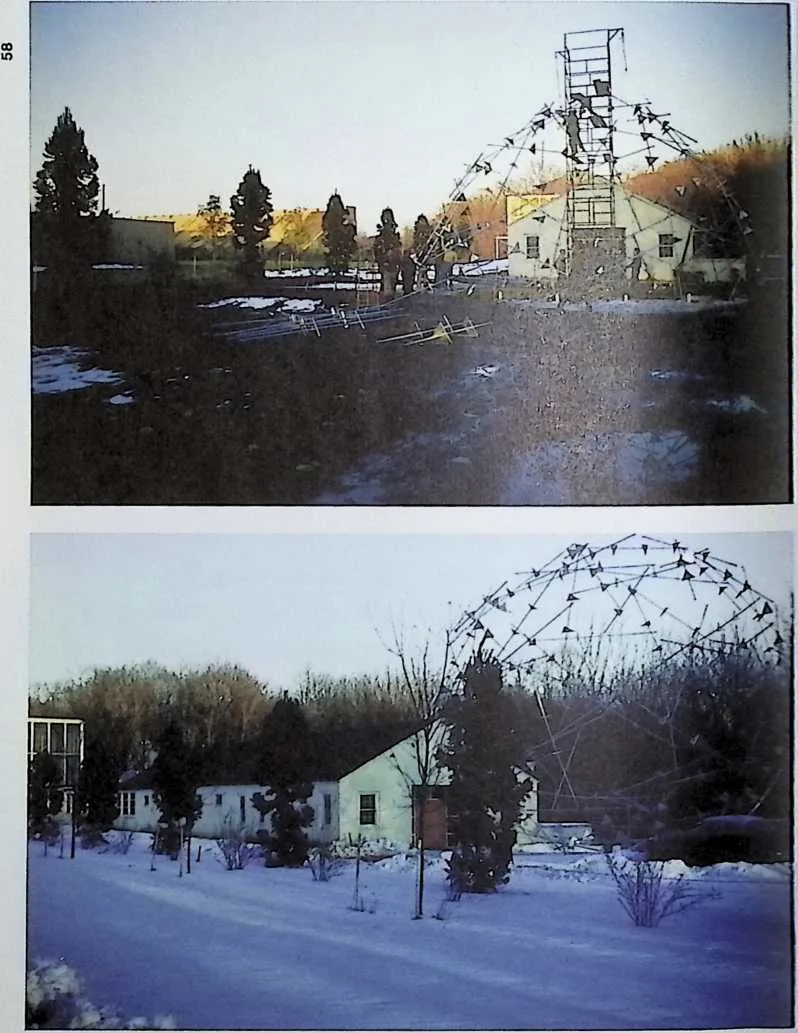
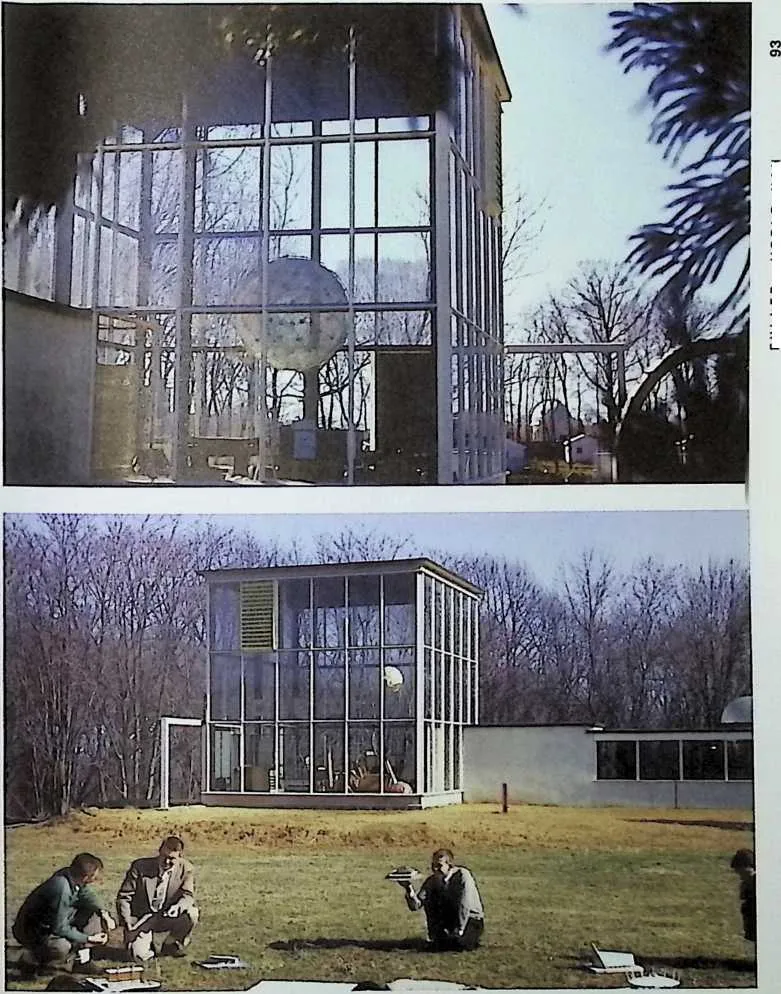
103 top: Students assembling the Tensegrity Sphere in front of the Architectural Lab, 1953 bottom: Fully assembled Tensegrity Sphere
105 is inherent in entropy. If we didn't have ant.TCinnm5r.ai observations, the red shift, and so forth, would seem to affirm the expanding universe.
106 In the most recent years there has been some speculation by other astronomers on the invalidity of the red shift demonstrating expanding universe, but the expanding universe concept is really inherent in the entropy itself and not dependent on the interpretation of the red shift, so I see, then, that the physical universe, entropic and expanding and increasingly diffuse, and as a mathematician would say, he describes that increasing diffusion as increasing disorder, so I said: the physical universe then being expansive, increasingly diffuse, increasingly disorderly, breaking
107 I up into more and more parts, makes me consider what kind of functioning goes on in the universe that balances this, because it is also part of our observation of the general scheme of physical universe that each one of the fundamental patternings has some kind of a complementary set of events. They are complementary sets of events and not mirror images of one another. They do succeed in balancing one another, and they are as positives and negatives that balance one another.
108 Therefore I felt that there must be some phase of the universe that is contracting and increasingly orderly. I said: how can you find that? And the astronomers have had that same intuitive urge and looked for black bodies that might be inhibiting energies in the universe, but the kind of telescopes they had were not suitable for finding the non-radiant black bodies.
109 I said: one of the observations we can make is of our own little spaceship Earth, and because it is not radiant or we wouldn't be able to live upon it, and it is receiving large amounts of energy from the rest of the universe as, for instance, the geophysical year indicated at around 100,000 tons of stardust daily landing on the earth, and we know we receive an enormous amount of sun radiation and a great deal of radiation in one form or another from other stars, so I saw that that radiation impinging on earth was not just bouncing off it as a mirrored, polished ball, that three-quarters of the earth was covered with water, and the water tended to refraction and tended to impounding of that sun energy, and within the water's ths sun energies in various ways, and the vegetation on the dry land Impounded the sun radiation with photosynthesis. And the biologicals, in contradistinction to the other phenomenon we have been speaking about in impounding these energies, did so with beautiful molecular structures, and these molecular structures were highly ordinary and completely anti-entropic. And, the opposite of increasing disorder, there was increasing order.
110 I can see biologicals in general were anti-entropic and the biologicals impounding the energies began to bury the so-called fossil fuels, these deeply impounded energies from the rest of the universe. I saw the earth was a pretty good system of energies of the universe that were literally being collected and working toward Increasing orders, where we find extraordinary crystals in the earth, and so forth.
111 Then I said: what is the function of the human being? I will now recite some thoughts which I have regarding information that has come to us regarding man* s brain as it is probed, as a total mechanism here is probed, by the neurologist and physiologist with the use of electrodes.
112 We come to a point where a great deal is now known about the patterning that goes on here in the way of information as communicated and as reported and as stored and how the information is retrieved, to the point where the men who have been studying this total mechanism say, some of them say, very responsible leaders have said it is easier to explain all the data we have regarding this total phenomenon —if we assume a phenomenon mind as well as a phenomenon brain —than it is to explain all the data, all the data available on the phenomenon brain, because we assume this is a communication system. There are conversations that go on over the system that are not explicable as feedback of the system itself.
113 I am going to give you my own differentiation between brain and mind, and I have tried what I am now going to say to you on some leading neurologists. They don’t have objection to it. I say they don't feel that they have enough experience as yet to say: you are right. But they don’t feel at all like saying: you are wrong. And they do not feel that I am taking advantage of an audience in reciting what I am saying and going to recite regarding my theory of the difference between the brain and the mind.
114 I am now going to have to make some sort of a demonstration to give you the difference. First I take a piece of rope and I tense this rope as tautly I know how, and the more I tense it the tauter it gets. By ‘‘taut’’ we mean it is contracting in its girth, which means while I am tensing it, it is compressing to 90 with the axis of my tensing.
115 I am now going to take a compression member, which is cigar-shaped, like this, and load it on the top, and as I load it on the neutral axis carefully, it tries to expand on its girth, whidh means it is going to tense at 90 to my line of compressing.
116 It is quite easy to demonstrate tension and compression always and only co-exist experimentally. I know there is really a superficial error that is operative in many young people's scheming in an engineering world and world of architecture, where they say, ‘‘I am going to use a tension system.’’ They think of tension as being differentiated from compression, whereas we find, one, the tension might be at the high-tide aspect in its behavior and the compression at the low-tide aspect, so we see and note only the tension or phases of some kind, of an experiment, but we find that experimentally both always and only co-exist.
117 I have another definition I made, what I call the first subdivision of universe. My definition of the universe is the aggregate of all humanity's conscious and aggregate communicating experiences. I have a first subdivision of all that aggregate. My subdivision is one which any one of us can make any time, the very powerful capability of the human mind.
118 We can take any what I call a system, and a system is the first subdivision of universe, and a system subdivides all of the universe, and all of the universe is outside the system and all is inside the system.
119 Shirley Morgan can be a system; the earth can be a system, because clearly there is that which is i interior and that which is exterior to it. Some part of the universe has to be invested in the system itself to differentiate what is in or outside at a given moment. That is what I mean by a system.
120 Now then, it is a quality of systems that in order not to include total universe, they must return upon themselves, must return upon themselves in all directions.
121 A plane would not do so. A plane would go on and on to infinity, so there must be some complex of angles in the system which add up to something less than 560 degrees in order to continually return upon themselves. So it turns out to be observable fact the systems as viewed from inside are inherently concave, and from outside are inherently convex.
122 We being able to discover, then, experimental concave always and only co-exist and also discover that convex and concave are not the same, because the energies impinging on convex surfaces tend to diffuse and on concave tend to contract. They are concentrated so that these are fundamentally different kinds of functions, concave and convex, and yet are fantastically intimate geometrically and always known to co-exist.
123 We can go to identify many always and only coexisting functions, such as, for instance, the neutron and the proton, and finally having harvested an inventory of co-existing functions of many different kinds, we can then bulk them all together and speak of them as a class of all the phenomenon that always and only co-exist, and tn that you develop that we call the
124 30 theory of functions,and the theory of functions is, in the theory of functions a function cannot exist by itself. A function exists only by virtue of the always and only co-existence of other functions.
125 Then from our theory of function we might further go and have phenomenon which we would speak about as relativity.
126 What is interesting about what I have just recited to you is the fact that I started off by saying I take a piece of rope, and I didn't have a piece of rope at all, and nobody in the audience said to me, ‘‘You don't have a piece of rope.’’ You have all had so many experiences with so many ropes that when I did it, it seemed so completely logical to you that I did not contradict any of your experiences, that you allowed me to assume I had a piece of rope. We call that a generalization. That is the first regeneralization.
127 I didn't say whether it was nylon, manila, cotton, what size, whether it was wet. I didn't have to go into any of those special details of our special experiences, so it was a generalized piece of rope, and it was a second-degree generalization when I discovered the always and only co-existing tension and
128 compression, and third to find a whole class of always and only co-existing phenomenon, and fourth degrees to develop the theory of functions, and a fifth degree generalization to condense that into the one word ‘‘relativity.
129 Now, you can play a game with a little dog, taking a belt or a piece of rope, and he will put it in his teeth and he loves to pull on it with you, and he plays a game of tension with you and he is using compression on his teeth and convex and concave surfaces of the teeth.
130 There is nothing in all of our experience to suggest to us any little dog would develop the theory of functions. I would say to you I am for the moment content with the interpretation that the brain always deals with the special case, and the little dog uses
131 a brain with his special case of tugging, that mind always deals with generalizations. It is unique to the mind to discover principles which are operative in all the special case experiences, and it is unique to the mind that it is able to generalize generalizations to such an extraordinary degree as to be able to come to one word, ‘‘relativity,’’ wrapping up all these extra-ordinary special cases.

133 I would then say whereas the biologlcals are anti-entropic and develop beautiful molecular structures out of random receipts, I would then go on to say the human mind goes very much further in its anti-entropic capability in that we had an expanding physical universe, increasingly disorderly, and I was looking for a phase of the universe that was contracting and contracting and becoming more orderly. And in the series of degressive generalizations I gave you, we were contracting, contracting, contracting and ever more orderly, so I say then the human mind seems to be demonstrated in our experience as the most powerful antlentropic patterns operative in the universe.
134 I found myself writing that and putting it in a little publication in 19, and the same year Norbert Weiner wrote in a small publication. His resolution was that man's mind was the great antientropy. He called man the great antientropy, and I knew him, and we talked about it. And we found how we really arrived at it by quite different strategies, but it was interesting that any human being in this moment in history would tend to follow through some strategy that would end up so abruptly at such a fine point.
135 Now then, if man’s great function in the universe is that of the great antientropy, then I would say all his functioning which I have given you is anti-entropic, which was really powerful and has to do with formulations of the mind, none of which are weighable. Therefore they are entirely metaphysical.
136 In as much as none of our experiences have ever demonstrated any validity to magic, I rule out magic as something that can be demonstrated, and therefore I find no reason to include magic or open-endedness in my concept of the word ‘‘metaphysical.’’ Therefore I find that the metaphysical seems to be the balance of the physical, that metaphysical isn’t just the name of a club of people who did not belong to the exact sciences, but metaphysical is a phenomenon of the universe that is in extraordinary balance and comprehensive to the physical expanding, increasing entropic, disorderly, metaphysical, continually contracting and increasingly more orderly until it comes to the exquisiteness of a single unity which has a fundamental complementary of functions, but inherently includes those functions in one word.

138  If man then is essential to the universe as the great antientropy, the universe which
is then following the same divergent, oscillating patterning we find operative in all
the universe physically, accounting for all the propagation of wave phenomenon, the
propagation of everything coming from these somehow complementary, oscillating
systems, then we say that we also have to observe that where nature has disclosed to us
essential functions of various components of our experience, we find nature also fortifying
anticipatorily the total inner functioning by providing, many times, great excesses of one of
the complementaries where the probability, for instance biologically, for survival of
various of the species which have complementary co-existence, where probability of
survival by means of regenerating by extending seeds off in the wind, many times the
possibility of that seed finding the right, most suitable environments and being properly
developed are low, as low probability, and nature sends off large numbers of those seeds in
order to be sure enough of them would be successful to fulfill the complementary inner
functions of biology —that is, for instance, just the vegetation. And so logical life and
reciprocity in the atmosphere of the vegetation giving off all the gases essential to
the mammals and the mammals giving off the gases essential to the vegetation and
such exchanges as that —and nature then providing anticipatorily for large numbers of
any functions made me feel, then, that man is essential to the interfunctioning of the
universe.
If man then is essential to the universe as the great antientropy, the universe which
is then following the same divergent, oscillating patterning we find operative in all
the universe physically, accounting for all the propagation of wave phenomenon, the
propagation of everything coming from these somehow complementary, oscillating
systems, then we say that we also have to observe that where nature has disclosed to us
essential functions of various components of our experience, we find nature also fortifying
anticipatorily the total inner functioning by providing, many times, great excesses of one of
the complementaries where the probability, for instance biologically, for survival of
various of the species which have complementary co-existence, where probability of
survival by means of regenerating by extending seeds off in the wind, many times the
possibility of that seed finding the right, most suitable environments and being properly
developed are low, as low probability, and nature sends off large numbers of those seeds in
order to be sure enough of them would be successful to fulfill the complementary inner
functions of biology —that is, for instance, just the vegetation. And so logical life and
reciprocity in the atmosphere of the vegetation giving off all the gases essential to
the mammals and the mammals giving off the gases essential to the vegetation and
such exchanges as that —and nature then providing anticipatorily for large numbers of
any functions made me feel, then, that man is essential to the interfunctioning of the
universe.
139 Then there must be many of than provided on many planets.
140 Then I am increasingly impressed with the observations and the surmises, hypotheses of people like Hoyle,, who assume that there are hundreds of millions of planets with human beings on them. '
141 Incidentally, there is a very extraordinarily interesting paper which has been written by a man named Morrisson, who is a professor of nuclear physics at Cornell, and now is a visiting professor of nuclear physics at M.I.T. on approaching the existence of human beings on other planets from an entirely different reasoning than that of the astronomers, but there are then many highly capable men in the field of comprehensive observation who find that it is logical to assume many planets with human beings. And I find, then, that I would tend to accredit that, if wa then see that nan is essential to the universe, because it seems, as Hoyle would point out or has pointed out, that man on earth has been behaving possibly very unwisely, and he points out he has just discovered the atomic energy in time to overlap his exhaustion of the fossil fuels, and he hasn't learned at all to think in terms of the conservation of the energy, he does not conduct himself on that basis, and he has been deliberately taking out those energy savings that have been concentrated to this point and starts detonating them and sending them off as energy back into the universe, and prematurely detonating energy storage,which might be faded many years hence, with enough energy concentration to spring into some kind of energy detonating function.
142 Assuming in the interim man has learned on planets where he is aiding the inhibition of energies locally, that he then finds the capability to get off his planet into other parts of the universe before this energy-stored planet becomes the new radiant source.
143 Just thinking in such a schematic vein, I then said: I see that it is true that man has argued to himself really at very short range, not really using
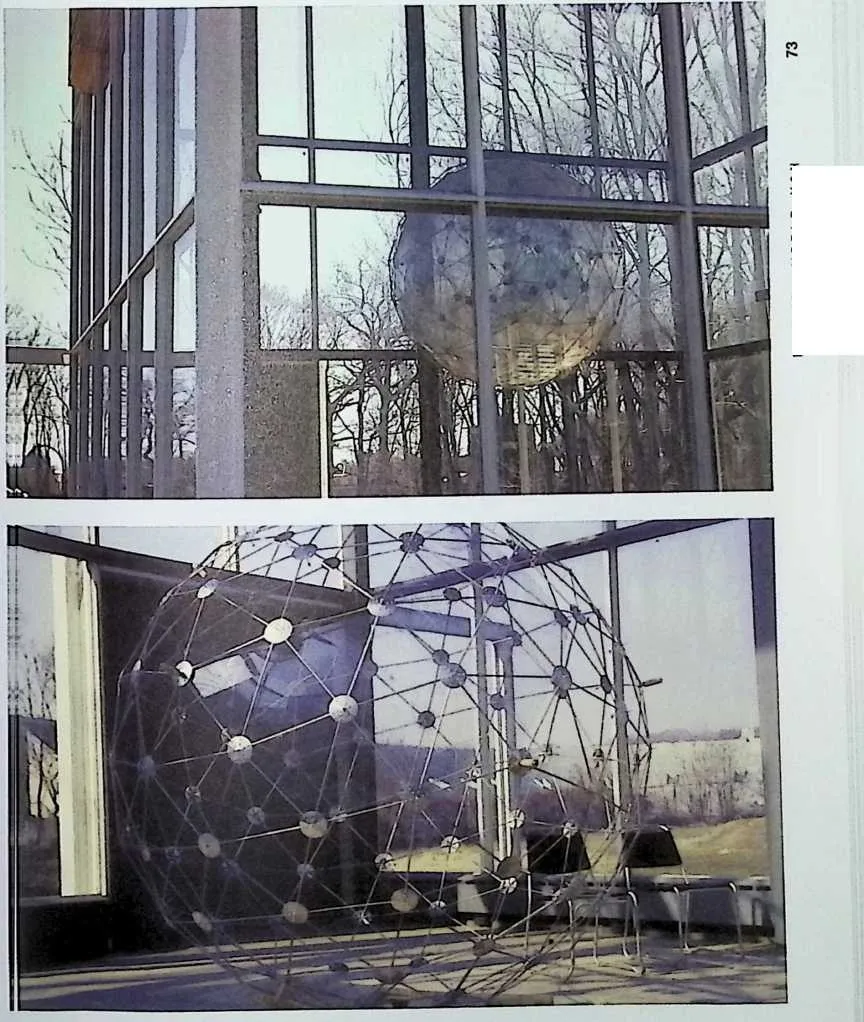
145 top and bottom: Geoscope inside in the Architectural Lab, 1960
146 any long-distance logic about men on earth not thinking about their grandchildren and great-grandchildren, or the children of a thousand years hence. He has said that it is much less expensive to take these energy savings out of the earth than it is to take the trouble to harness the winds and the tides and all of the other sun energies, which are enormous, as daily income which could be harnessed and turned to do the work, while' even helping to conserve that energy even more. Of course it is cheaper to rob the piggy bank than to do the work. If there is money in the piggy bank, it is easier than working, if what you want is money. That is the kind of argument man has made, that kind of argument has been underwriting the validity of his economics and what he calls enterprise.
147 Now then, as an inventor trying to think about ways in which we might stem the energy outflow from earth and aid in the anti-entropic functioning, what might we do to possibly stay the course of man towards possibly very swift doom, because Hoyle certainly infers that man is in such trouble that he may be beyond saving; he may have gone beyond the point of no return, as it is called. I am assuming that he hasn't gone beyond the point of no return, that there is designed also into this system a very large safety factor to give him an opportunity to discover his own error and to set himself to behaving in a way that is logical in respect to his function in the universe.
148 So I became interested as an inventor in always observing this kind of total challenge with respect to anything that I might try to find as permitted in the principles operative in the universe that would give man advantage in regenerating himself on the surface of the earth, while serving his function of the greatest and most exquisite phase of antientropy.
149 I find great encouragement to think that it is not too late for man to make good on earth, because I see it also as part of the great design as we experience it that man is born utterly helpless, that the young human baby remains utterly helpless longer than the young of any other species. Certainly part of the invention of utter helplessness is that it will be ah anticipatory complementary accommodation that would protect and nurture the child, and parents have, certainly, certain drives which we identify as love —parents have love —but the parents are not ingenious enough to really know just what to do for the child, because the child is going to have to breathe air, and the air is there, and the parents didn't invent the air, and the mother doesn't Invent her breast. That is waiting for the child. The inventions have been very thorough.
150 So the parents dissipate to some extent from their drive to look out, but often their love is greatly mis-informed by fears that have been engendered by past experiences they have had and by their parents before them, and so I find our customs and things we relay as logical cautions of the old life to the new life are often not conducive to the success of human beings.
151 So I see that the young are being born utterly helpless, and the older humans struggle along as best they can. They may be quite ignorant, but still the life has prospered, and so I see gradually as we human beings have to stand up and begin to look out for ourselves a little, that humans do begin to participate in the patterns of the regeneration of moral life and are successful by reason of the pre-existence of extraordinarily favorable circumstances and environment.
152 I am sure that in the regenerative drive I am sure there are many humans regenerated. There are all kinds of built-in urgings, and certainly you find the male birds sing and attract the females, and there are certainly very attractive colorings that come into life, and I think possibly a vanity in man makes him boast of his competence to others as part of the great regenerative drive. I don't think he is really warranted in being as bold as he is in suggesting, as I find it suggested in all of my experience, social experience and all the literature in the schools, that man almost seems to think of himself as almost a hundred per cent essential and successful by virtue of his own brilliance and his contrivance.
153 I just have to remind you, as I continually remind myself, that the word ‘‘automation’’ is not something really new. It is a new description of a very old process. I have to remind you that you are 99$ automated and that you don't know what you are doing with the supper that you ate tonight. You are not charging off special energies to send the various glands and they are relayed to some of those energies to make hair and others to make replacing skin. I have not
154 I found a human who even knows why he has hair.
155 I have discovered in my own way in checking on myself that I know very, very little, and I found that I am certainly well over 99% subconsciously operative. I don't have the slightest idea —we find the problem a quadrillion times the quadrillion atoms in coordinate operation in our brains, and we have nothing to do with their extraordinary success in a conscious way, so that when I look on man in this way, I am surprised at the very little, tiny bit of area of his total being and his coordination and his participation with the rest of life around the earth.
156 I am surprised he makes so much a boast of this little, tiny less than 1$ of his total activity which has any conscious participation whatsoever. It is because of this very small-amount I find it easy to excuse him right now for errors that he has made, and I think life has built in, then, that vanity, and allow him to make some mistakes.
157 But now, I think, we are on a new threshold and man and universe, at least the team of humans on the spaceship earth hurtling on through space is about to begin to have to participate consciously in its own evolutionary transformation and success.
158 There la an extra ordinary new challenge. We are going to have to uae this, apparatus we have in a very, very important way, ao the kind of assessment I am trying to make tonight is an assessment of that challenge.
159 Just as man, then, is successfully developed in the womb and is there for nine months, then he suddenly is a very new thing to be born out into the atmosphere and has to do his own breathing, and I think that all of humanity is about to be born into a new kind of relationship to the universe. That is my total kind of feeling. I feel it very, very strongly.
160 I am sure that in as much as our total operating capability, the anti-entropic effectiveness that is inherent in the brain and in the intellect is predicated upon experience. We have to have experiences where we make mistakes. Ab a child we have to find out about gravity; we have to pull things. Parents know that a child keeps dropping things on the floor. They have to get experience about gravity.
161 Parents say, ‘‘Why isn't gravity obvious? Why does he have to do it more than once?’’ If you think about that from what we really know today, there are very few places In the universe where gravity is operating, where a human being could be present. If you were to get too close to the sun, you are going to burn up. there are very few places where it is comfortable enough in the universe to have experiences with gravity. In most of the universe there would be no gravity effect at all, so this is a very special area of the universe where a human can get this effect of the mass pull without being destroyed, and little children then demonstrate to us very clearly there must be a number of experiences before we can begin to gain a pattern, and many of the special cases experiences, before we begin to generalize and evolve and deduce principles that are operative.
162 Therefore, I see our error of burning up fossil fuel to this point is something that might be converted very, very readily as we begin to understand it.
163 I went to a little valley high up in the island of Rhodes this year to a very extraordinary place. They said there were over 10,000 windmills in this valley high up in the mountains, and in the older world we saw man doing very well with his energy income with the

165 windmills and saw him sailing around the world using the winds and not exhausting the energies of the earth, and he has lost some of that quite beautiful art, but I think we now know a great deal about aerodynamics and we ought to be able to build some very extra ordinary energy-impounding machines employing the wind.
166 The head of the United States Navy Department Bureau of Weapons, the scientific design activities, points out that of all the sources of energy operative around the earth there is none which Is so plentiful as the wind power; whereas the sun power Is only available when we are on the sunny side of the earth, the winds are present all around the earth over both the land and the sea.
167 The only thing that has been unfavorable about the winds has been their intermittency, but the magnitudes of them are very great, as they are operative, and man can get on very well with them if we found ways of handling and storing energy. That is one of the things he is learning to do quite well.
168  There are other ways of impounding energy, by pumping water outwardly from the center
of the earth, and I think part of the new kind of a focus of attention of inventors,
inventors taking the iniative, saying, ‘‘Nobody tells an individual to invent. He has the
initiative.’’
There are other ways of impounding energy, by pumping water outwardly from the center
of the earth, and I think part of the new kind of a focus of attention of inventors,
inventors taking the iniative, saying, ‘‘Nobody tells an individual to invent. He has the
initiative.’’
169 In the introduction they quoted me as using the phase ‘‘prime designer.’’ An inventor is a prime designer in that nobody tells him to do that designing. So I am hoping the inventor in everyone, and particularly in the university world, the inventors will again re-attack the problem of living on our energy incomes and the enormous tidal energies that are available.
170 Remember, we started to harness the tides, for instance in Passamaquoddy, where we have those tremendous 80-foot tides twice a day, fantastic, the magnitude of the water pulled out from the earth 80 feet a day twice a day, and the weight of it pulling toward earth is mighty, far mightier than anything man harnessed before.
171 Then it was said politically this was undesirable because the energies can't be transmitted by the high-power lines far enough from Passamaquoddy to reach an Industrial center, so the project was dropped.

173 But today we have great changes in that capability because we have now entered into an era of what we call ultrahigh voltage transmission, and whereas up to now the distance we could send energies around the earth were practically about, the maximum was about 350 miles, now with the new ultrahigh voltage we are going to be able to send it 1500 miles, so places, far remote spots of great energy income could be hooked up to areas of man's high civilization needs.
174 In thinking about what needs to be done and the ; kinds of evolutionary accelerations that we have been experiencing without really intending to have such mutual experiences, I think some of the most important [ ones that we are going to have to deal with relate to our ability to mentally account in an effective manner what it is that we are experiencing.
175 I point to you, for instance, that our accounting of wealth, our social accounting of wealth, all of which accounting gives all of us plenty of trouble in one way or another when we have to deal with it, that that accounting of wealth is predicated upon several fundamental kinds of experiences of early man and certainly relates very much to something I pointed out to
177 Close-up of the Geoscope Inside the Architectural Lab, 1960
178 you a little earlier as being the philosophy that was operative at the beginning of the century which thought of the universe as running down, and they thought wealth was something that would inherently be lost, and as long as you were identifying your wealth with physical, and the physical was continually becoming more diffuse and disorderly and was lost from local availability, then wealth was something that could only be identified as something that could be lost.
179 If our wealth is only physical, then we might say that we would have some trouble dealing with it. I also then point out to you that there has been no new application of scientific discovery to the concept of wealth in our time, and that it is then in our century that we discovered the universe was not entropic, that the energies only escaped from this system by joining another system, that they were always accountable.
180 Therefore, we have the scientist giving us extraordinary assurance in the lav of conservation of energy that it could not be created or lost. Therefore the energy is not going to be lost. It may not be as locally available as it was before, but it will be available again if you have the ability to travel from here to there. You may get to the point where the energy is now being employed. I point out then that I have given myself the same kind of question,problems regarding wealth that I gave regarding the word ‘‘universe’’ or the functioning of man in the universe, and 1 said it is part of my experience that if people had something they called a great deal of money with them and they are on a sinking ship, the money doesn't do them any good.
181 I also can say something else, that my experience showed me no matter how much wealth is accredited to any individual or any corporation or any institution, we cannot alter one iota of yesterday with that wealth. Hie wealth is something, whatever it is it is something i that can only be articulated now and forwardly. This gives me some clue as to what wealth may really be.
182 I found what I am now confident is what I really mean by wealth. It is the organized capability to deal with our forward metabolic regeneration, deal with our needs. So I say in really assessing how much wealth we have this minute, I would assess it: if nobody made another move, how many days could we carry on, if we don't amass anything more. So I see that what I mean by wealth seems to break down into two very important fundamentals. One is the energy which we employ for our metabolic regeneration, and I see then the energy as operative in two fundamental patterns, energies which are dissociative, radiant energies, and the energies which are associative.
183 There are some patterns of energy patterning which : develop self-interferences, just as we can make interference by making a piece of rope and knot it back on itself, you will pull on it and it contracts. I see that there are patterns of structuring where the energies tend to centralize themselves. Energies are > concentric.
184 I will speak, then, and classify everything we speak about as matter as being the concentric patterning s of energy, and there are radiant patternings of energy we have in the form of fire and in many other familiar forms of radiation. I find the radiation energy can be reflected; instead of going into all directions it can be beamed in the preferred direction and concentrated.
185 I see, then, that the long-ago man going through the woods, and this must have happened thousands upon thousands of times, that a man stepped on a log in climbing over and around and found a log that they were stepping on lying across another log, and the other end was under a great big tree lying there, and they saw the big tree moving and they would go up and try it, and they can’t budge that, and yet a little weight on the end of this is making the big tree lift. Man discovered the lever and learned how to use their gravitational advantage.
186 When men then learned, later on, to take levers and insert the ends in the unit fulcrum, which we call a hub, and had a series of them around a hub and then invented putting that hub under the waterfall and letting the water be pulled by gravity toward the center of the earth, make one lever after another to go around and take the shaft which is rotated and put on gears, belts, and later on making rotors and electric generation, at this point man had demonstrated the ability to take the two fundamental patterns of energy, the dissociative and sociative, and develop the Interplay of them, which is the energy then made to do the work on behalf of man that will lead to his regenerative advantage.

188 From this point on it is man's intellect that is of advantage. His observation, then, of the principles operative in the universe, his learning new discovery patterns of energy which are operative and shunting them to the ends of the levers to do the work, so I see that the organized capability to deal with our forward regeneration is then, if that is wealth, then it consists not only of the energy which is manipulated, but it consists of the intellect which observes and develops, then, this generalized principle and realizes i that the principles of the lever isn't just something inherent in this particular log, but find next the log will do it as well. And so they are able to use the generalized principles to their increasing advantage in their metabolic regeneration. So in as much as intellect is a pert of wealth, I then find the following. I find then that we have wealth as an interplay of the metaphysical and physical in which the metaphysical takes the measure of the physical and turns it to advantage and is part of our experience, that everytime we make an experiment we always learn more. You can't learn less.

190 This is an irreversible phenomenon. You may learn what you thought was true wasn't true. You won't have to waste any more of the small amount of time allotted to your life in learning that theory any more. It is learning more to learn that you are wrong. Every time we employ our intellect we learn more. Every time ve make an experiment we learn more, which is to say, then, that the energy part of wealth is non-destructible because of the law of conservation which makes that clear. The energy part of wealth is a part that always improves and always gains, and the more we use it, the more we learn.
191 Therefore I find, in contrast to the concept at the beginning of the century that wealth was something that was continually going to waste away, that the more we use our real wealth, which is this organized capability, the more it improves and the more it increases, | and that we are now employing enormous amounts of wealth of energy flows of the universe coming to the ends of the levers that were not there yesterday.
193 The figure was published two days ago from the Office of Economic Development that of the wealth being generated in one year by the western world —that is Europe, the United States and Japan —the annual wealth generated now is in the order of one and a quarter trillion dollars to be compared with a total of 40 billion monetary gold. Quite clearly, this wealth has nothing to do with that gold that man used to use as a means of exchange, and yet our accounting system is one where our mature accountants meeting at the World Bank in the last ten days said that they tended, said some of their leaders said, ‘‘My sentiment is in favor of gold,’’ and our world's economic affairs rest on such a non-scientifically informed sentiment in relation to the operative factors which we discover ourselves now to be endowed with, fantastic capabilities, because if we extend the energy being generated in Russia and China, we add that to that western world, we are probably somewhere in the magnitude of two trillion dollars annually, and two trillion dollars at the magnificent earning rate of 20$ rate per year on your capital would indicate five times that, or we have over a quadrillion of capital venture now operative in organized capability to deal with our regenerative needs. This is fantastic in its expansion in the last few decades, going out of comprehension by our fellow-men.
194 When I say, again, to think about whether man is going to have ability to carry on our earth, I am not mildly despairing of the case, because I said I have no tendency whatsoever to blame man. I have no tendency to find fault with the way he has been playing or assess him, no fault to find with errors of love, but I am observing that the factors which are operative if properly assessed indicate to me the existence of a potential to deal with our total environmental challenge which is so magnificently weighted on the side of success that I now make the following fundamental assessment of the rates of change going on in relation to man.
195 I made an assessment of the amount of work that men do with this energy wealth in the following manner. I did this first for Fortune Magazine in 194–5. I did it a little earlier for a book in the '50's. There is something that we speak about as foot pounds of work, how much work it takes to carry a pound weight one foot outwardly from the center of the earth in a given amount of time, and the way we rate horsepower is in such terms. And that kind of work concept through experimental information becomes, then, convertible
196 top: Geoscope inside the Architectural Lab, 1960
197 bottom: Students with models outside the Architectural Lab
199  into all kinds of other energy language, such as kilowatts per hour, and I find it is
quite possible, then, to take the measurements of the work human beings can do. And
such foot pound work has been measured in armies around the earth during the last
century, and there is a well-developed estimate of the amount of work a young man in
good health can do in a year in the way of converting the energies which he consumes
into physical work as measured in foot pounds, and we can take, then, the amount of
work that that man can do in one year, and I will call that a one manpower year.
And those figures were in considerable agreement between the armies of the different
major countries, so I took that and called that, then, a one man year. And then I took
the energy being consumed by various industrial networks,and the various industrial
networks are often too remote from one another, and in years when you could not send
energies more than 350 miles, there was no way to get energy from this center to that
other center, because it was more than that distance. So I took various industrial
network economies and took the accounting of all the energies consumed by those
economies in a year in the form of fossil fuels and water power, foods and every known
source. Then I took that total energy income and I divided it by 25 for the following
reason.
into all kinds of other energy language, such as kilowatts per hour, and I find it is
quite possible, then, to take the measurements of the work human beings can do. And
such foot pound work has been measured in armies around the earth during the last
century, and there is a well-developed estimate of the amount of work a young man in
good health can do in a year in the way of converting the energies which he consumes
into physical work as measured in foot pounds, and we can take, then, the amount of
work that that man can do in one year, and I will call that a one manpower year.
And those figures were in considerable agreement between the armies of the different
major countries, so I took that and called that, then, a one man year. And then I took
the energy being consumed by various industrial networks,and the various industrial
networks are often too remote from one another, and in years when you could not send
energies more than 350 miles, there was no way to get energy from this center to that
other center, because it was more than that distance. So I took various industrial
network economies and took the accounting of all the energies consumed by those
economies in a year in the form of fossil fuels and water power, foods and every known
source. Then I took that total energy income and I divided it by 25 for the following
reason.
200 We find there is something called mechanical efficiency, various kinds of engines have contrasting relative efficiencies as to how much work they deliver out of the energies they consume. A reciprocating engine is only about 15% efficient. A turbine is about 30% efficient, and the jet engines up to 65%. Some of the new fuel cells get up to 80% efficiency.
201 Now, then, the over-all mechanics which we are using in our society today are still of a very low order of efficiency as totally operated. To such a low extent I find we are only realizing about 4% work j out of the energies which we are consuming.
202 Therefore I divide the total energies consumed by net work economy, by 25, and it brings me to a 4% figure, and that 4% of the total energy consumed in a year by a given industrial economy I divide by manpower per year and this gives the number of mechanical slaves that are working in the economy for each human being or available to the total number, and we divide those figures by a population which gives how many slaves working for each human being.
203 I find way back in the 1940's in the eastern United States industrially we had 135 energy slaves working for each human being. I also found a very large number of them were going into the next war, and I found it was only necessary to have, with a family of five, they only needed a hundred energy slaves for a family of five, or twenty per person, to keep up the high standard of living of a family going with that high standard of living.
204 At any rate, using the criteria of 100 energy slaves per family of five, I called that an industrial have -family. In 1900, less than 1 of humanity were industrial haves.
205 After the mechanization of World War I in 1919, six and a half per cent of humanity were industrial haves. As we entered World War II, 28 were industrial haves. As a consequence of further mechanization of World War II, we are at a point where 40 of humanity are industrial haves. We have gone from less than 1$ of humanity in a fairly high standard of living —though if you take the highest standard known to any monarch before 1900, it was not too good —but we have today 40$ of humanity enjoying a standard of living higher than that known to any monarch before 1900. This comes out of seemingly nothing, and I have given you some accounting which gives you one of the ways of accounting for how we have had all the success so far.
206 Quite clearly, our bringing 100$ of humanity into high advantage is a matter of time, and I find that the way we have been doing this, taking care of more and more people has to be thought of in the following light.
207 During the Twentieth Century, during this last 66 years the amount of metals that have been mined, the new ores that have been found, estimated ore bodies, the total metals divided by the total population gives us a figure which shows during the whole of the 66 years of the Twentieth Century the amount of metal per each human being has been continually decreasing, so the fact we have taken care of much larger numbers is not because we have discovered more metals, exploited more resources. We have to find, quite clearly we have done more with less, and in doing more with less have cane out, almost exclusively of the technology of the sea and air and now the apace where It has been essential to do more with less.
208 On the land in building a building we have said: the wider the walls, the higher, the more protection we felt, the greater security. But on the sea and sky you had a fundamental floatability or liftability of the plane, and we had to do more with less. So the technology of developing of the enormous hitting power had enormous fallout into our domestic economy of doing more with less.
209 If we have to wait for the fallout of the doing more with less to take us to 100% of humanity, we might quite readily get to the point where man would blow himself up, because if the race to date for developing more with less capability has to be challenging a next war, we might readily employ those weapons. It takes 22 years from the fallout from the weaponry technology to get into our domestic economy. We can save 22 years if we set about deliberately to undertake to redesign the use of our resources in such a manner that we could take care of 100% of humanity.
210 I see these as fundamental challenges, whether man is going to blow himself up or not or whether he will decide on the kind of information that 1b now tending to merge in our cerebrating, our pondering whether our young world will take the initiative and set about deliberately to try to employ those resources by a designed science competence so the resources will be adequate to the service of humanity.
211 I give one example of the doing more with less. One of the great communication satellites is able, with one-quarter of a ton, to displace the communicating capability of 75,000 tons of cable under the Atlantic.
212 I will then end with the fact that my experience with the young world seems to tell me they are impatient' with the concept of solving problems of man by war and political biases, and I see the young tending toward becoming world thinkers.
213 Many were shocked by the inquiry of the reporters of the students at Berkeley a year ago, which indicated that the young people did not feel this particular loyalty to their families, to their university, to their country, but it turns out on further inquiry of those young people that their loyalty is to the world —if not the whole world, they don't have a bias. Their idealism is even higher, so it is my own working hypotheses right now, my prophecy, the best I can prophesy to myself is the young world is about to take the initiative as inventor-scientist, and in the employing of principles which are operative in universities immediately available to them and will succeed in converting the resources available to us to such high order of effectiveness as to take care of 100 of humanity.
214 Thank you.
215 DR. GEDDES: Thank you very much, Mr. Fuller.
216 I know that you felt the warmth of the audience with us tonight, and thank you for sharing this evening with us and for giving us some insight into the nature and scope of inventions, some of the personal and social problems connected with it.
217 I would also like to thank the Committee that made possible the lecture series by their contributions and hard work, and also the members of the New Jersey Society of Architects, whose officers have Joined with us this evening in sponsoring this event. Thank you again, Mr. Fuller. Please come again.