12 Coherence Proofs
2In a structural system or any pattern the question arises; what is the pattern made of? What are the relationships between different elements of the pattern?
3 In a checkerboard pattern such as that shown in figure 9.100 all distances between neighboring intersections are the same. And the distance between two intersections of any line is simply a multiple of this base distance. This base distance then naturally becomes the unit for building the pattern.
4 In our pattern created by the star with five-fold symmetry, the situation is different. There are many different lengths between intersections. If the growth patterns follow simple rules such as those followed in forming the two-dimensional pattern of figure 9.102, then all distances between intersections can be expressed as simple sums of components whose lengths are equal to powers of the divine proportion times some constant. This is also true in three dimensions - the A and B lines of the 31-zone star forming a growth similar to our 2-dimensional growth intersect each other at points where the distance between any two intersections on an A line equals
| (12.1) |

6 and the distance between two intersections on a B line equals a polynomial
| (12.2) |

8 The building blocks for our system are then a series of lengths related by the divine proportion. An A series, a B series and a C series—each of slightly different lengths.1
12.1 Two Dimensions
12.1.1 Definition 1
11We call any particular polynomial of the form
| (12.3) |

13 si and ri are integers.
14 We call the class of all such polynomials F(kT) then;
| (12.4) |

| (12.5) |

| (12.6) |

18 We are interested in the distances between intersections along the lines of certain sets of patterns.
12.1.2 Definition 2
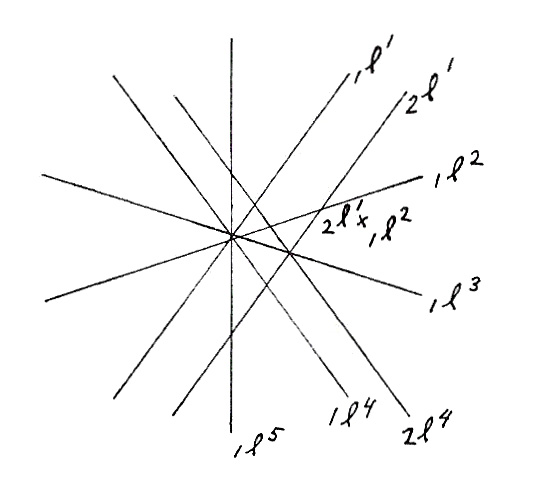
20A pattern is a number of extended lines which point in five different directions in one plane with at least one line pointing in each direction.
12.1.3 Definition 3
22The lines are labeled;
| iln | |||
| n | = 1,2,3,4,5 | ||
| i | = 1,2,… | ||
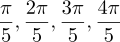
23 n names the direction - i names the particular line pointing in that direction. The angles between lines are;
12.1.4 Definition 4
26An intersection is named by any two of the lines which intersect there, such as
| (12.7) |

12.1.5 Definition 5
29If on a line all intervals between intersections are equal to different fi(kT), then the intersections ‘‘fit’’ each other.
30 An intersection fits a line if it fits all intersections on that line.
31 A line glp fits another line flq if the intersection glp × flq fits all the intersections of flq .
32 A pattern fits if all the intersections on all the lines fit.
33 Lemma 12.1.1. If on a line ln an intersection In fits an intersection Im then In fits all Io where Io fits Im.
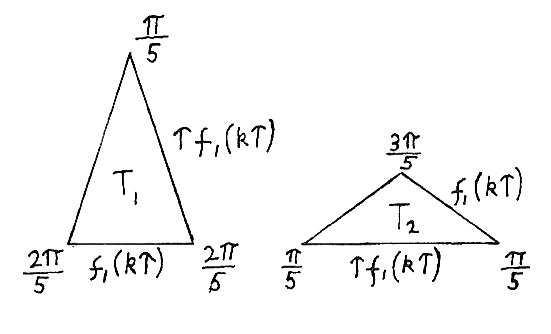
35 Lemma 12.1.2. Any ilm , jln , hlp , m≠n, n≠p, p form a triangle similar to T1 or T2
12.1.6 Definition 6
39These triangles are called the Golden triangles because their sides are in the divine proportion.
40 Lemma 12.1.3. If the two vertices of a Golden Triangle fit each other then all vertices fit each other.
42 Lemma 12.1.4. If a line jlm fits a line hln and if all ln fit some line ilm and if ilm fits all ln without the line jlm , then, all intersections jlm ×ln fit jlm ×hln and the line jlm fits all ln.
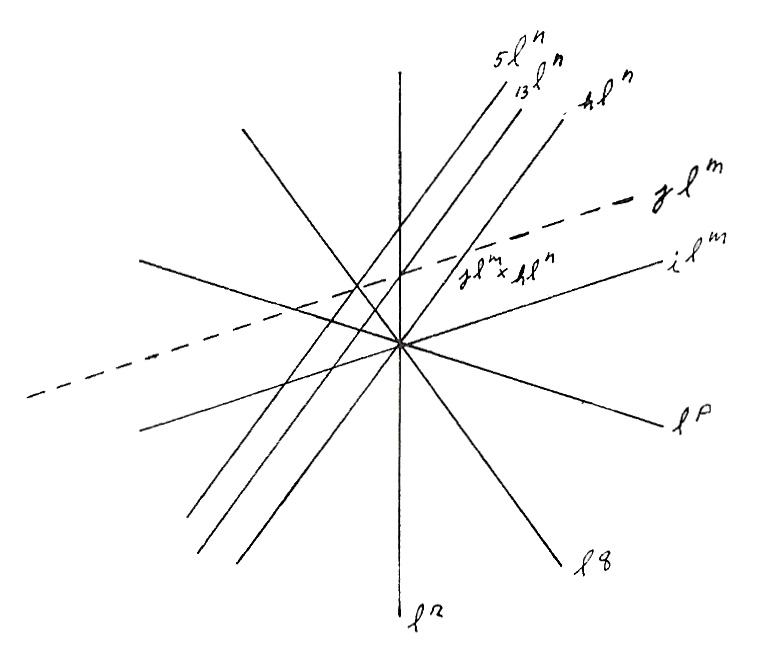
45 Lemma 12.1.5. If jlm fits hln then all lp, p≠m, n×jlm fit jlm×hln and if hln fits all lp without jlm them jlm fits all lp.
47 Theorem 12.1.6. If a pattern fits and a line jlm is added and jlm fits some line jln ,n≠m, then the new pattern including jlm fits.
48 A pattern fits if all the intersections on all the lines fit. (Definition 5) To prove the new pattern fits we must prove all the new intersections fit the lines they are on.
- 1.
- There are no new intersections on the lines klm ,k≠j, therefore all the intersections on these lines fit.
- 2.
- All the intersections jlm ×ln fit jlm ×hlm and the line jlm ×hlm and the line jlm fits all ln. (Lemma 4) Therefore all the intersections of the lines ln fit.
- 3.
- All the intersections lp,p≠m,n×jlm fit jlm ×hln . (Lemma 5) Therefore, the intersections of line jlm fit jlm × hln . Therefore, the intersections fit on all the lines lm (step 1) and jlm fits all lp,p≠m,n (Lemma 5) which means that all the intersections on all the lines lp,p≠m,n fit and our theorem is thus proved.
12.2 Three Dimensions
12.2.1 Definition 1
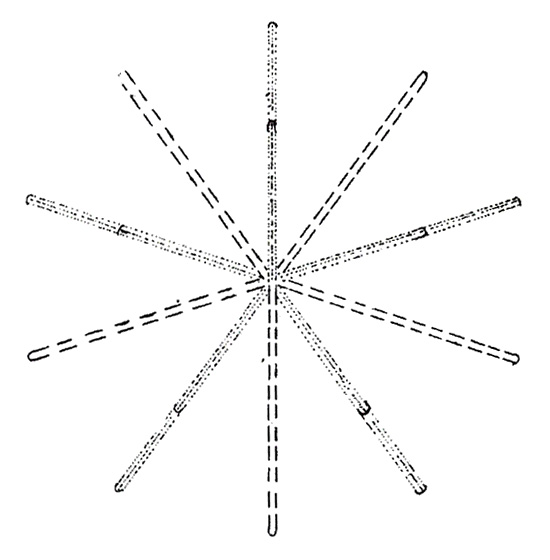
51In three dimensions we have a pattern made up of the diameter lines through vertices and face midpoints of the icosahedron.
52 The lines through the vertices are the A lines.
53 The lines through the face midpoints lines are B lines.
54 There can be other lines parallel to the original 16 lines. They are given the name of the line they are parallel to.
55 We name a line
| iAn1 | |||
| n | = 1,2,3,4,5,6 | ||
| i | = 1,2,… |
| jBm1 | |||
| m | = 1,2,3,4,5,6,7,8,9,10 | ||
| j | = 1,2,… |
57 or generally
| hXip1 | |||
| p | = 1,2…10 | ||
| h | = 1,2,… | ||
| X | = A,B |
12.2.2 Definition 2
60All lines of a 3D pattern are connected directly or through other intersections to the original pattern of 16 lines.
12.2.3 Definition 3
62Intersections on A lines ‘‘fit’’ if all the intervals between them can be expressed as polynomials
| (12.8) |

64 si,ri = integers and A = an interval of length.
12.2.4 Definition 4
66Intersections on B lines ‘‘fit’’ if all intervals between them can be expressed as polynomials.
| (12.9) |

68 si,ri = integers and B = an interval of length.
12.2.5 Definition 5
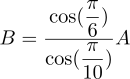
| (12.10) |
12.2.6 Definition 6
72A 3D pattern ‘‘fits’’ if all the intersections on all the lines fit.
12.2.7 Definition 7
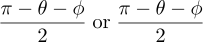
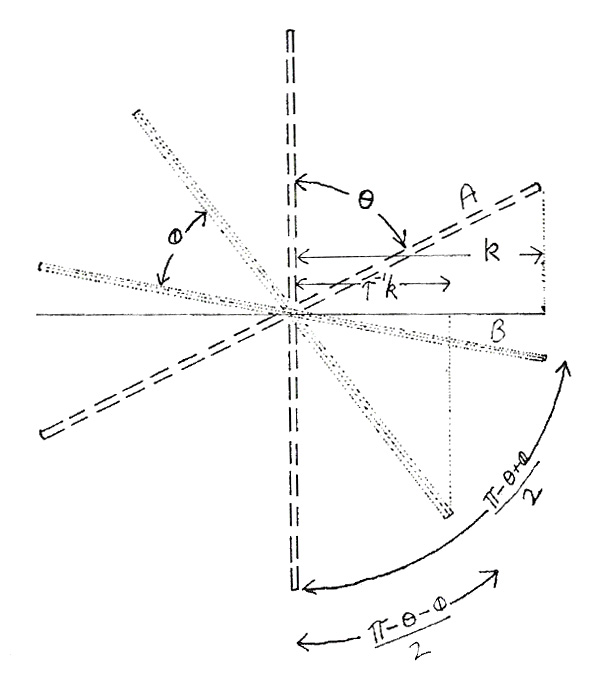
74An R section is a plane containing two A lines and two B lines. The angle between the two A lines is 𝜃; the angle between the two B lines is ϕ; the angle between an A and a B line is
| (12.11) |
12.2.8 Definition 8
77A T plane is a plane perpendicular to an A line. A T plane is named by this A line

79 Lemma 12.2.1. There are five R sections perpendicular to each T plane. Each A line is contained in five different R sections. Each B line is contained in three different R sections.
81 Lemma 12.2.2. The projection of the interval A along any A line onto a T plane
| (12.12) |

12.2.9 Definition 9
| (12.13) |

84Unsure: What does 0.A resolve to? (if the interval is on the A line perpendicular to the T plane).

90 Lemma 12.2.4. The projection onto any T plane of any interval along any line kXir1 between any two intersections which fit in the 3D pattern is a polynomial
| (12.15) |

| si,ri | = integers | ||
| k = Asin(𝜃) | = B sin( ) ) |
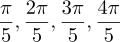
97 Lemma 12.2.6. 3D Patterns which fit project onto all T planes 2-dimensional patterns which fit.
99 Lemma 12.2.7. All intervals between intersections of lines of the 3D pattern appear as intervals between intersections in the projections on some T planes.
100 For an intersection
| (12.17) |

101not to appear as an intersection in the pattern projected on a T plane, the intersecting lines must lie in one of the five perpendicular R sections.
102 At most, two different lines intersect iXknl . The two intersections
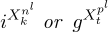
103 lie. Therefore, there is at least one T plane in which both 3D intersections project as 2-dimensional intersections.
105 Lemma 12.2.8. If some pairs of intersections
| (12.18) |

106did not fit in our 3D pattern, that is, we cannot find any polynomial f1(XkT) that equals the interval between them, then also for some T plane we cannot find a polynomial fi(kT) which equals the interval between their projected intersections.
108 Lemma 12.2.9. Any misfits between intersections of the 3D pattern project as misfits between intersections on some T plane. Therefore, a 3D pattern which projects on all T planes as a 2D Pattern which fits is a 3D pattern which fits.
110 Theorem 12.2.10. If a 3D pattern fits and a new line is added kXinl which intersects and fits some other line hXjnl then the new 3D pattern including kXinl fits.
112 Proof. In each T plane the projection of the line kXinl fits the projection of the line hXjml . In each T plane the projection of the 3D pattern without kXinl fits. Therefore, the projection is with the line kXinl fits on each T plane and the theorem is proved. □
113 The coherence proof demonstrates that if one builds a structure using the A and B lines of the 31 zone star (the C lines may be used only within the forms defined by the A and B lines) and always follows the rule that new parts are added at intersections of existing parts or at points along existing parts which can be reached by subdividing a large part into component small parts, then no matter how far or intricately one builds, two extensions of two entirely different limbs of the same structure can always be locked back together in a perfect fit with a combination of our simple parts.
114 We have shown that the intervals between intersections are all equal to certain polynomials in T. Because
| (12.19) |

115all the terms of any such polynomial can descend by subdivisions into a polynomial with only two terms-
| (12.20) |

116There are many interesting side-lights to these investigations. One of which is that it is impossible to divide any one of our building blocks ATn into equal pieces.
117 There are much shorter proofs of the coherence of this system, but the short proofs don’t lead one through so many characteristics of the structure.