
Appendix A
Unfolding WHOLES: A Synergetics Primer
3 by Scott Eastham & John Blackman
5  Change: Fix section/subsection numbering
A.1 The WHOLE Story
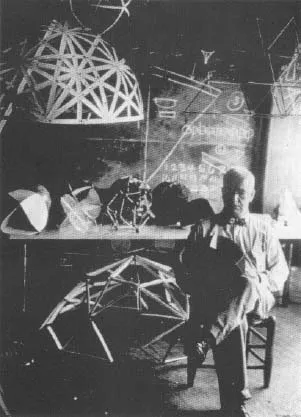
7Now for the fun part. Back in the late 1940s, when Buckminster Fuller was cooking up the first geodesic domes at Black Mountain College, he developed a series of spherical figures which elegantly model the principles of his synergetic geometry. They also served as prototypes for those first domes.
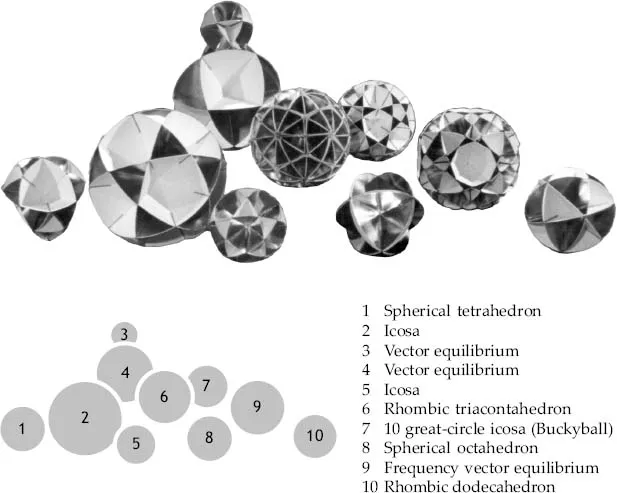
8 Some years ago, we two and some friends—most notably Tom Parker and Michael Connolly—started constructing these figures from specifications first published in Fuller’s Synergetics (1975). After producing the models in clear and reflective (polyester) media, we showed them to Fuller, who pronounced them ‘‘Beautifully done,’’ and gave us his blessing—literally: ‘‘You have my blessing’’—to christen the full spectrum of seven models ‘WHOLES’ (pun intended), and even to market them under that name.
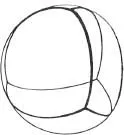
9 To distinguish WHOLES from geodesic domes and tensegrity spheres, WHOLES are great circle models. Only seven such figures can be constructed so as to keep the great circles intact. They make abundantly evident a dimension of Fuller’s geometry—what happens at the center?!—not otherwise easily modelable.
10 Since the demand for WHOLES in the late 1970s quickly outstripped our ability to produce them by hand, we set about finding ways for more people to put them together more easily. A lot of little cotter and bobby pins were bent along the way. Soon we had to have dies cut to stamp out the many disks. For a couple of years, we marketed WHOLES kits of increasing precision and sophistication, mainly in Northern California where in those days we could get away with calling ourselves ‘‘The Whole Works.’’ We received reports of WHOLES flying (well, hanging by a thread) in Europe and Japan, and even within sight of Mt. Everest in Kathmandu. As late as 1999, one was spotted catching the sunlight in the Temple of the Azure Cloud atop Mt. Taishan (Confucius’ Sky Mountain) deep in old China.
11 We sought for years to bring out a brief alternative geometry textbook which would include pre-scored disks and pins to make ‘unfolding’ the WHOLES a snap. But alas, publishers have shied away from such ‘four-dimensional’ illustrations, which would require breaking the ‘frame’ of paper books. It’s not easy to produce a round thing in a square world…Here we present you mainly the specifications for the figures, and some tips on construction, with Fuller’s explicit permission. We also include a few of the scientific corroborations now available for Fuller’s claim that Nature is indeed using the isotropic vector matrix and these elementary figures derived from it for her most basic atomic, molecular, crystalline, metallic and organic structures.
12 One of the tenets of synergetics is that the straight lines and cubical coordinates of conventional science and technology are simply inadequate models for Nature’s spherical and cyclic patterns of growth. Consider galaxies, stars, planets, trees, flowers, rock crystals, molecules, atomic nuclei and so forth…Nowhere do we find boxes, or frames, or straight lines, but everywhere only wholes within wholes within wholes. This primer is intended to show how life’s own spherical geometry can finally replace the mechanistic abstractions of plane geometry, and spherical polyhedra—WHOLES—supplant ‘boxes’ and ‘frames’ as the more accurate models of Nature’s processes.
13 Furthermore, as this book (American Dreamer) goes some distance toward demonstrating, such patterns bear a striking resemblance to the age-old iconographies and sacred geometries which proliferate with astonishing vitality in practically every human culture. Whatever the mandala is said to mean in the diverse traditions that have cultivated this art—an orientation toward the WHOLE of reality, perhaps?—it may well be happening all over again in Fuller’s ‘geometry of thinking.’
14 The WHOLES, then, are first of all one array of the supremely effective heuristic devices Fuller invented and used for teaching synergetics. They also seem to be a key to existing symbolic systems, rendering the implicit connections of many traditional iconographies to natural patterns almost transparent. And they may turn out to be themselves a new medium, a vehicle for artistic endeavor through which such systems of meaning and value may yet find all sorts of further applications. That part, gentle reader, will be up to you.
15 For now, a primer of synergetics. And our wish that ‘unfolding WHOLES’ will be as much fun for you as it has been for us.
16 SE & JB
A.2 SOMEWHOLESOMEWHOLES
A.3 Synergetics Primer
21Synergy, from syn-ergein (Greek: working together, i.e., co-operation)
22 Synergy: Behavior of whole systems unpredicted by the behavior of their parts taken separately.
23 Corollary: Once you start dealing with the known behavior of the whole and the known behavior of some of the parts, you will quite possibly be able to discover the unknown parts.
25 Synergetics: The exploratory strategy of starting with the whole.190
A.3.1 Triangle
3031Energy creates pattern.
Ezra Pound
32To make any headway in simplifying the structural insights of Synergetics, we must try to think the way Bucky Fuller himself does. So we follow Bucky’s reasoning back to basics: There are no ‘things’ in all Universe, he points out, only events. We’ll start with this…
33 What we experience as ‘things’ are nothing but the interpatternings of relationship between events. Events are the dynamic transactions and transformations of energy.
34 In other words, ‘things’ don’t just sit there: They happen.
35 Now energy moves. It takes one direction or another. It articulates certain recognizable patterns. (¶223.80) It has shape.
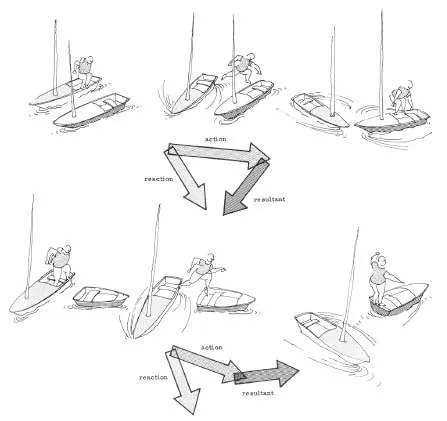
36 The primordial shape of any energy event is threefold: action, reaction, and resultant. (¶537.15) Its vector diagram discloses a triangle, or more precisely, a tendency to triangulate.
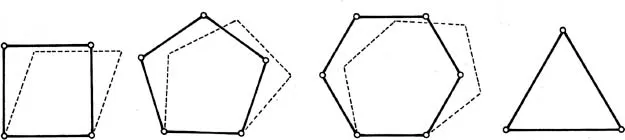
38 Energy, Fuller notes, always and only coheres with minimum effort and maximum efficiency: ‘‘Triangle is structure.’’ Nothing more nor less than the triangle can make this claim.
40 Synergetics begins with the understanding that relations are more real, and more important, than whatever they relate. You cannot encompass any relationship from only a single one of its ‘perspectives’ (angles). Just so, triangulation in nature is never the closed, abstract, static entity that Euclid and his schoolmarm minions would have us believe. The way of triangulation is to spiral. That uncanny third angle (and any of its angles can be the third) is really always open, even if ever so slightly—to other events, other configurations and constellations of energy. There is no depth dimension until two events come together—and ‘mate,’ so to speak:
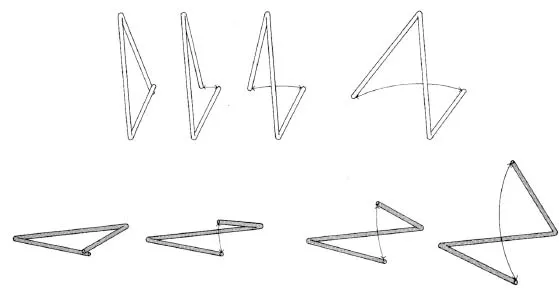
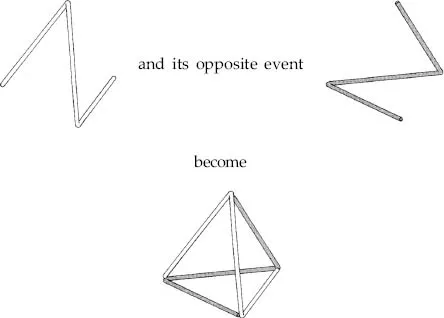
43 Here something perfectly astonishing has happened. One triangle has fused with another to create four triangles: 1 + 1 = 4. Quite vividly, the whole is more than the sum of its parts.
44 This new creature now ‘sticks out’ (literally ek-sists) in the world —it has an inside and an outside—and with it come all the ins and outs of the myriad relationships we experience in the world.
45 How are we to understand this newborn creature, made up solely of triangles and yet more than a triangle?
A.3.2 Tetrahedron
Thing and No-Thing
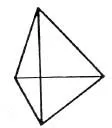
50What we have discovered is the tetrahedron (Greek, tetra, four, hedron, side, face), the minimum ‘anything’ with an inside and outside. Nothing simpler than the tetrahedron exists and, as Fuller maintains, everything that exists is tetrahedrally coordinated.
51 How dare anyone make such a bold assertion?
- Any ‘thing’ must have an inside and an outside (itself and the rest of the Universe) in order to be a ‘thing.’
- The minimum number of events which defines an inside and outside is four.
- A four-fold relationship of events is always a tetrahedron.
52 Therefore if ‘things’ are but the relationships between or among energy events, then the tetrahedron is the most economical path Nature can take to create any ‘thing.’191 This should not imply that the tetrahedron is the single ‘building block’ or only explanation of the world. No single perspective will give you the whole of it, as we have already observed. Yet tetrahedral coordination displays some curiously universal properties which give it precedence over other energetic configurations when we try to account for the shape(s) the world is in.
Tetrahedral Accounting
56Strictly speaking, the cube is not a structure; to use Fuller’s language, it is not a ‘‘self-stabilizing energy event complex.’’
5859If you try to account in cubes for nature’s energy associabilities –as structural systems -you use up to three times as much space as you do if you count space volumes in tetrahedron units.192
61 One would not expect energy to take the long way around, and it never does. Nature is always most economical in structure.
62 Let’s take a look at what this cube is really made of:
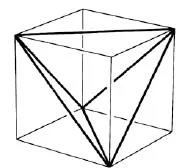
63 • The diagonals of the faces of a cube are the six edges (vectors) of a tetrahedron. (A.6)
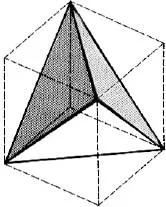
65 • Volumetrically, a cube is no more than a tetrahedron with four smaller tetrahedra attached to each of its four faces.(A.7)
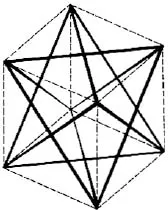
67 • Structurally, a cube is nothing more nor less than two equal tetrahedra (one positive, one negative) joined at their common centers.(A.8)
69 So if you have ever wondered how complex and irrational numbers came to be so complex and irrational, the culprit is the cube. Applied willy-nilly to natural phenomena, the cube invariably distorts whatever it is used to account for. It is an arbitrary, abstract and misleading model of nature’s own very definite structural strategies.
Everywhere and Nowhere
71Another way to get at all this: The simplest self-stabilizing arrangement of spheres (A.9) also reveals itself to be (as Bucky liked to say) ‘‘our friend the tetrahedron.’’ Here you have in a nutshell the ‘omnitriangulated’ set of relationships Fuller will draw out into Nature’s own coordinate system: ‘‘Tetrahedron Discovers Itself and Universe.’’ (¶480.00)

73 Picture these closest-packed spheres multiplying (A.10):
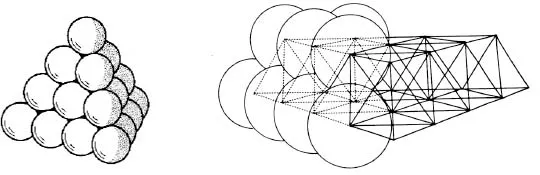
75 Each sphere in this matrix will eventually be surrounded by twelve other spheres at equal distances, each of those twelve will be at the center of twelve others, and so on.
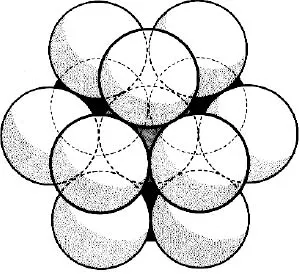
77 The center is everywhere, and nowhere.
78 The vectors connecting the center of each sphere to the centers of the spheres immediately surrounding it form an isotropic vector matrix (Greek, iso, same; tropos, turning), so called because not only are all its vectors equal in length, but the angles around any convergence are always identical: 60-degrees. In traditional physics, combined linear and angular momentum can only be described in terms of unresolvable square roots, because the chords and radials of the XYZ coordinate system are the hypotenuses and legs, respectively, of right triangles. In synergetics, however, the isotropic vector matrix provides for rational, whole-number accounting. As Fuller puts it, this matrix is
7980…the omnirational accomodation of both linear and angular acceleration in the same mathematical coordinate system…[because its] fundamental 60-degree coordination operates either circumferentially or radially. This characteristic is lacking in 90-degree coordination, where the hypotenuse of the 90-degree angles will not be congruent and logically integratable with the radials. (¶423.03)
81 The isotropic vector matrix ‘gives birth’ (Latin, matrix, womb; as in mater, mother) to all the associative (Syntropic) and dissociative (entropic) transformations in Universe. It is implicit in the Law of Conservation of Energy, which holds that energy can neither be created nor destroyed. As such, it may well figure in modern physics’ century-long quest for the so-called ‘unified field’:
8283The synergetics system expresses divergent radiational and convergent gravitational, omnidirectional wavelength and frequency propagation in one operational field. (¶982.52)
84 In other words, through this matrix it may well be possible to see Nature whole. One should, however, bear in mind Fuller’s proviso that he is not ‘copying’ Nature, but learning to build things the way she does:
8586I did not copy nature’s structural patterns. I began to explore structure and develop it in pure mathematical principle, out of which the patterns emerged in pure principle. I then applied them to practical tasks. The reappearance of [such] structures in scientists’ findings at various levels of inquiry confirms the mathematical coordinating system employed by nature. (¶203.09)
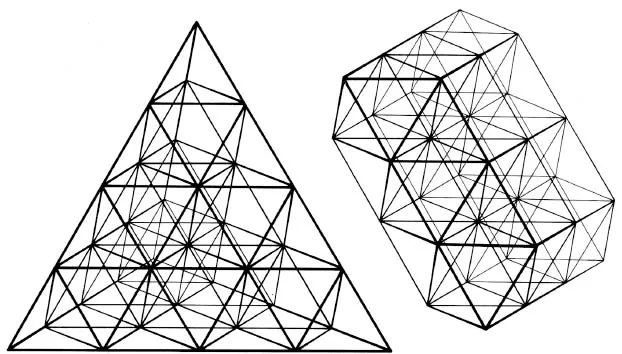
87 Bucky first encountered the isotropic vector matrix in kindergarten (1899) while playing with toothpicks and semi-dried peas. Nearly blind before receiving his first pair of glasses, he felt for the structure that would hold itself together. First he made triangles, these became tetrahedra (A.12), and by adding more tetrahedra tip-to-tip little Bucky built up a trusswork of tetrahedra, with octahedral spaces popping out between them (A.11).193 Because of its alternating tetrahedra and octahedra, he later nicknamed this matrix the ‘oc-tet truss’ (A.13). He early on sought a patent for this structure, but was informed that he could not patent a geometrical structure, only applications made from it. Besides, Alexander Graham Bell had already designed and built a gigantic ‘tetra-kite’ out of octet modules—and it flew! Still, you can spot this truss in all sorts of engineering projects all around you: in the long necks of the cranes used to build (alas, rectangular) skyscrapers, for instance, or the open tubular metal roofing structures so often used for airports and service stations (A.14).
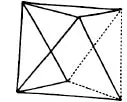
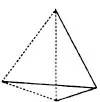
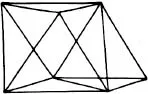
93 Have you ever tried to visualize the fourth dimension? You’ve always been frustrated because the classical model of the fourth dimension is an ungainly creature called ‘hypercube’—a cube turned inside out in directions perpendicular to its faces. You can draw a two-dimensional representation of what this three-dimensional model of the fourth dimension should look like—
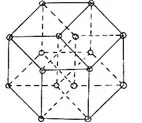
95 —but it is impossible to actually build a three-dimensional model of the legendary hypercube. Interestingly, when we proceed with the same strategy but using the tetrahedron instead of the cube, our luck changes. As E. J. Applewhite points out: ‘‘What the three axes of the cube do for three dimensions, the four axes of the tetrahedron do for four dimensions.’’194
97 In this sense, you need not be surprised when you turn to the models covered in the next few pages, or turn your hand to constructing them, and find yourself making ‘four-dimensional’ artifacts. The four axes of the tetrahedron orient us in four spatial dimensions, of course, but it is almost also fair to say that the dimension of time has indeed been added—a topic we shall take up in more detail under the heading of ‘frequency’ a little later. All of the WHOLES to follow in this Appendix are in Fuller’s terminology 4D models, but some will take you a little more ‘time’ than others. The first ones, however, are quite simple and easy to construct.
A.3.3 Vector Equilibrium
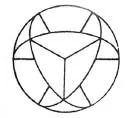
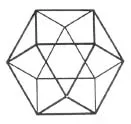
99 Vector equilibrium is the ‘zero’ of synergetics, the nucleus. It is, so to speak, the place of peace at the very center, which is of course not a ‘place’ at all. Vector ‘equilibrium’ is the phase through which anything and everything must pass to become itself or anything else, the nexus of any and every energy event.
100 In Fuller’s eyes, the vector equilibrium tells us some very important things about origins, the way things begin: ‘‘If it is a starting point, it is a vector equilibrium.’’ (¶440.07) And so we shall start our model-making with this figure, rather than with the spherical tetrahedron and octahedron.
101 One might assume that the first layer of 12 spheres closest-packed around a central sphere would make yet another (knobbled) sphere. Surprisingly, it does not. It looks instead like this (A.16):
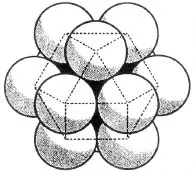
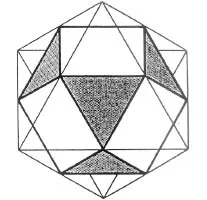
103 Fuller saw in this figure which emerges from closest-packed spheres not merely another ‘solid’ phenomenon, but a dynamic complex of energy events. In classical parlance it is known as the ‘cube-octahedron,’ a name provided by Archimedes, who showed that it can be seen either as a truncated cube (A.17):
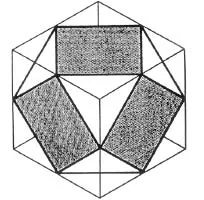
105 or as a truncated octahedron (A.18):
107 But Fuller’s vision cut deeper. He saw that the edge vectors were equal in length to the vectors connecting the center with the surface—i.e., the tensile forces pulling in on the system (the bounding edge vectors) were in dynamic balance with the compressive forces pushing outward from within the system (the radiating vectors). And so he christened this primordial synergy which plays such a prominent part in atomic structural strategies that it has become the conventional international symbol for atomic power, the vector equilibrium.
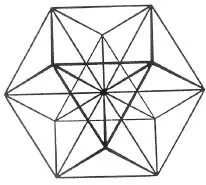
109 The Vector Equilibrium is the simplest of the WHOLES to construct, but it still surprises everyone who actually assembles one. Unlike some of Fuller’s other, better known projects (oc-tet trusses, geodesic spheres, tensegrity figures), there has never been any dispute as to who ‘really’ invented these foldable geometries. In her excellent redaction of Bucky’s geometry, A Fuller explanation: the synergetic geometry of R. Buckminster Fuller, Amy Edmonson marvels at how in the world Fuller ever came up with such a method for making spheres out of folded ‘bow-ties’:
110111Fuller made a remarkable discovery about great-circle patterns that is responsible for their great significance in his mathematics. This discovery involves an intricate relationship between central and surface angles and could so easily be missed that one cannot help but reflecting on the intuition that led Fuller to such an insight.195
113 It is a indeed a signal case of Bucky’s intuitive method operating to disclose fundamental structural insights—perhaps first achieved with the vector equilibrium, since its central and surface angles are exactly the same. Another clue as to how he arrived at these exquisitely beautiful figures may well be that WHOLES model electromagnetic wave phenomena: spherical wave growth out from centers. He himself explicated what is going on in such figures as simply an illustration of this principle:
114115It is characteristic of electromagnetic wave phenomena that a wave must return upon itself, completing a 360-degree circuit. The great circle disks folded or flat provide unitary wave-cycle circumferential circuits. Therefore, folded or not, they act like waves coming back upon themselves in a perfect wave control. We find their precessional cyclic self-interferences producing angular resultants that shunt themselves into little local 60-degree bow-tie ‘holding patterns.’ The entire behavior is characteristic of generalized wave phenomena, (¶455.21)
116 In a deadpan way, as if it were the most ordinary phenomenon in the world, this passage outlines the novelty of what is happening in these models. When you unfold the first of these WHOLES, the Vector Equilibrium on the next page, you will begin with a set of circles…and finish with what appears to be the same set of circles, marvelously transformed into a structurally sound (yet volumeless) sphere. Amazed? So are most people. Amy Edmonson again: ‘‘Looking at the finished model…the procedure is reminiscent of the magic trick in which a handkerchief is cut into tiny pieces and thrown randomly into a hat, only to reappear intact.’’196
118 As you unfold this Vector Equilibrium and the WHOLES to follow, bear in mind the fundamental synergetics axiom that any WHOLE is always more than the sum of its parts. That extra ‘ingredient’ is the metaphysical integrity of pure principle, the synergy of every part working with every other, which is really all that holds the WHOLE together. So follow the instructions, but not blindly. Allow the emerging pattern of the WHOLE to guide you, and you won’t go wrong.
Unfolding the Vector Equilibrium
1214 disks
122 12 pins (see p. 183)
123 WHOLES are made from scored disks which resemble bow-ties when folded and pinned. The ‘‘bow-ties’’ are then pinned together to form a sphere.
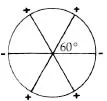
124 To form the bow-ties:
- 1.
- Fold each disk in half along each diameter, as shown in Fig. 1. (Make sharp
creases).
- = fold away from you
+ = fold toward you127Fig.1
- 2.
- Pin each bow-tie as shown in Fig. 2.
129Fig.2
130To form the sphere:
- 3.
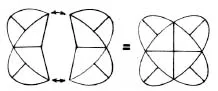
- Pin the first two bow-ties together as shown in Fig. 3.
132Fig.3
- 4.
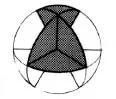
- Continue this pattern to pin the remaining bow-ties. Fig 4 shows the complete
sphere with one bow-tie in relief.
134Fig.4

135 Note: You can expect the bow-ties to slip a little as you pin them, but the figure will adjust itself with the last pin or two. Pinch firmly on the bow-ties to place the last few pins.
A.4 Icosa
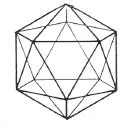
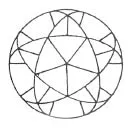
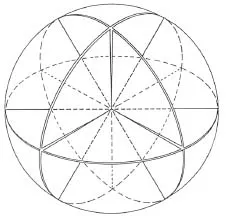
138 Nature unfolds in certain patterns. The icosahedron (Greek, icosa, twenty (triangles)) reveals her integral strategy for most living organisms. Whether it be a leaf popping out from a stem, a nautilus spinning its spiral home in the sea, or the five digits of your own hand, there lies the icosa, shell and shelter, the domicile of life. The icosahedron reveals some of the intimate secrets of organic growth, the way living things unfold.
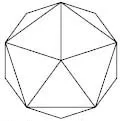
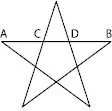
139 The five-pointed star of the icosa holds the key to the sacred ratio of Ø (phi), known since antiquity as the Golden Section, or Divine Proportion:
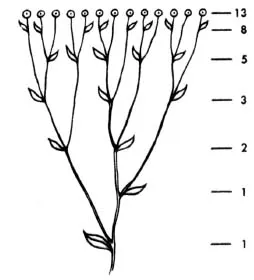
142 The icosahedral ratio Ø is also disclosed by the Fibonacci Series, where the sum of any two consecutive numbers in the series equals the number following:

144 and where any number divided by the preceding number yields the ratio Ø:

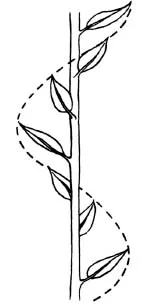
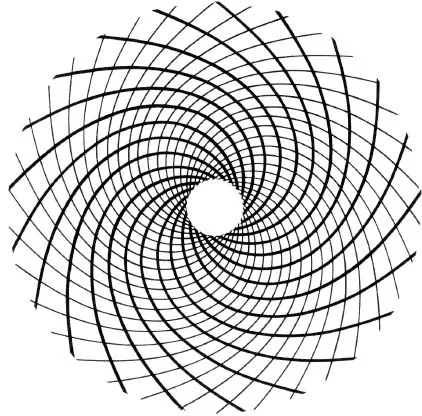
146 Consider plants: phyllotaxis (the arrangement of leaves on stems) is neatly proportioned to Ø:
150 Ø is also the proportion according to which a snail’s shell invariably curls:
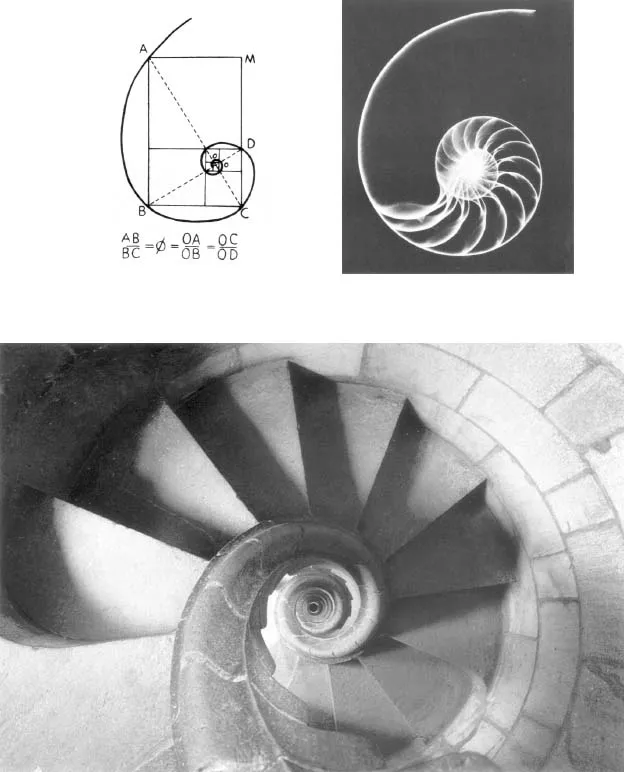
152 1.618 is a very accurate numerical approximation of the Ø ratio. Even people are not exempt from this inbuilt proportioning, as Leonardo and others have outlined:
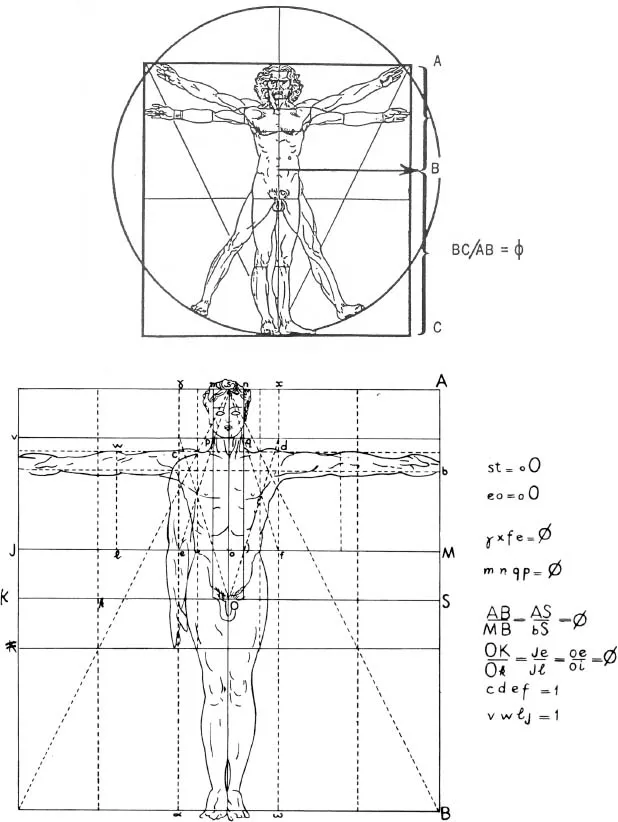
154 It is not therefore so surprising that the cathedrals of the High Middle Ages in Europe were constructed from polyhedral icosa coordinates, largely incorporating Ø and other sacred ratios.
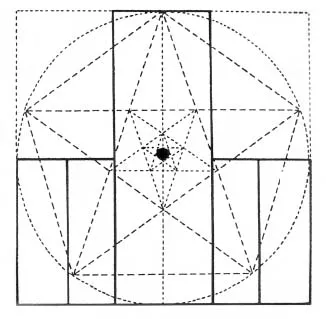
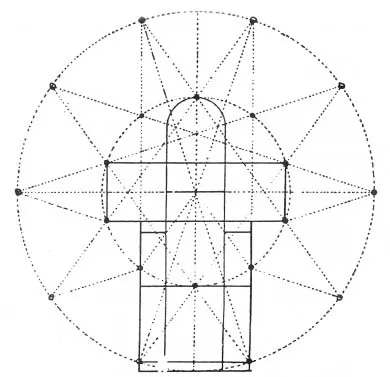
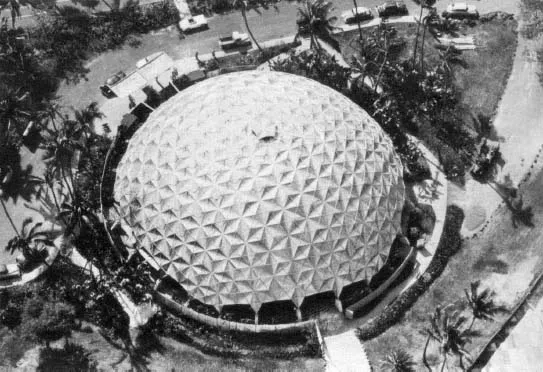
157 By the same token, it is perhaps more than coincidence that Fuller’s famous geodesic domes most commonly employ the same icosahedral strategy. Fuller would say that whenever ‘‘maximum volume enclosure per unit of invested energy’’ is the principle function to be served, then Nature uses the icosahedron. This is why the pneumatic and hydraulic structuring of Nature (e.g., trees, flowers, radiolara, protein shells, etc.) employ spherical icosahedral geometry.
158 An icosahedral geodesic dome places about 1/50th the weight on its foundation as a cubical building of comparable space-enclosing capacity. And geodesic domes enclose space without using any internal supports. Their strength resides in the integrity of the pattern cohering the shell, not in the number of bricks, bolts, crossbeams, and so on. As an important side-effect, the geodesic dome is the only man-made object whose structural strength increases as it gets larger. Ask yourself, what was left standing after the 1906 San Francisco earthquake, or the atomic bombing of Hiroshima? Only the domes. And Bucky’s geodesic structures are stronger still.
159 The geodesic dome is a triumph of pattern integrity over brute force: not exactly mind over matter, but mind and matter working together.
A.4.1 Corroborations
- Photographs of common antibody cells taken by Elias Lazarides and Paul Revel in 1979 revealed their ‘geodome’ structure, confirming Fuller’s intuition that Nature employed icosahedral building strategies in the molecular realm.
- Dr. Aaron Klug of Birkbeck College at London University, winner of the 1982 Nobel Prize in Chemistry, and Dr. Ronald Casper of Boston Children’s Hospital have found the protein shells of certain viruses to be constructed on the same patterns as geodesic domes.
- Dr. John E. Hauser of the University of California at San Francisco photographed the inside of the synaptic clefts of muscle cells (where the nerve cells ‘communicate’ with the muscles), and they turned out to look just like Bucky’s domes.
- In 1999, Harvard cytologist Donald Ingber proposed that the key to the structure of cytoplasm—the squishy substance that holds your every cell together—lies in tensegrity structures of the sort Kenneth Snelson developed from Fuller’s geometry.
161Beyond these corroborations from the sciences, the synergetic strategies of geodesics may yet prove to be one of the great foundational discoveries for human architecture, like the segmented arch or the ogive vault (itself actually a hemispherical oc-tet module in stone). Of course, an entire neighborhood of identical domes might not be much of an improvement on the ‘‘little boxes made of ticky-tacky’’ which ‘‘all look just the same’’ in Malvina Reynolds’ famous lament over the conformity of Daly City, California. All art—music, design, poetry, and architecture alike—exists in the interplay between fixed patterns and flexible variations. In the final analysis, Bucky Fuller was probably more of a visionary structural engineer than an architect; his primary concern was the efficiency promised by geodesic domes. But a contemporary architect of vision like Norman Foster, who seems to have absorbed Bucky’s lessons about triangulated structures as well as his ecological priorities, can go further. Departing from the purely spherical structures Bucky favored, he has found all sorts of intriguing new ways to utilize Nature’s hexagonal coordinates—in his sleek and shimmering ‘Gherkin’ in London, for instance, or the bold new Hearst Tower in New York City.
162 The interconnecting mushroom ‘Biomes’ of Britain’s Eden Project in Cornwall illustrate what can be built from Fuller’s ‘hex-pent’ geodesic forms with today’s lightweight, resilient materials and the ultra-precise machining permitted by computer-assisted design programs. As you unfold the next WHOLE, the Spherical Icosa from which all these beautiful domes are derived, you may begin to appreciate why they look as well as they work. This is not just elegant structure, it is the very structure of elegance.
A.4.2 Unfolding the Icosa
1646 disks
165 30 pins (see p. 182)
166 To form the bow-ties:
167 1) Fold each disk in half along each diameter, as shown in Fig. 1. (Make sharp
creases).
− = fold away from you
+ = fold toward you
169 Fig.1
170 2) Pin each bow-tie as shown in Fig. 2.

172 Fig.2
173 To form the sphere:
174 3) Pin the first two bow-ties together as shown in Fig. 3
176 Fig.3
177 4) Continue this pattern to pin the remaining bowties. Fig 4 shows the complete sphere with one bowtie in relief.

179 Fig.4
180 Note: You can expect the bow-ties to slip a little as you pin them, but the figure will adjust itself with the last pin or two. Pinch firmly on the bow-ties to place the last few pins.
A.5 Rhombic Dodecahedron
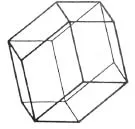
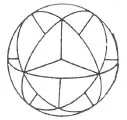
183 The ancient geomancer’s riddle—the ‘squaring of the circle’—cannot be resolved in two dimensions. (Rupturing the flat planes of the Euclidean mentality may very well have been the point of posing the conundrum.197) But in the spherical rhombic dodecahedron (Greek, dodeca, twelve (rhombs)) we witness the sphering of the cube: the six great circles diagonally bisect the cube’s six faces.
185 Once you begin assembling this third WHOLE, you will see just how beautifully it transforms the cube into a sphere (A.33):
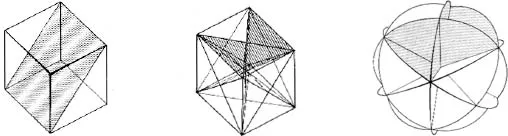
187 In this model, sphere and cube are reconciled; the extremes meet, and embrace. The rhombic dodecahedron is an allspace filler. Fuller notes that ‘‘of all the polyhedra nothing falls so easily into a closest packed group of its own kind as does the rhombic dodecahedron.’’ (¶955.52)
188 The rhombic dodecahedron is also the pattern which best accommodates the transmission and reception of electromagnetic waves. The first radio tuning crystal was presumably a rhombic dodecahedron, that is, as symmetrical a bit of quartz crystal as could be found for somebody’s foxhole radio. This figure, then, may tell us something about attunement, the way things—and/or people –relate to one another most closely.
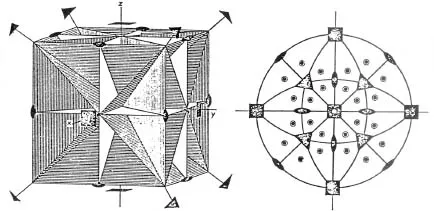
190 Crystallographers are familiar with the rhombic dodecahedron as a domain of reference with which to account for the growth and structure of natural crystals.
191 In Fuller’s synergetic geometry, the rhombic dodecahedron can be identified as the hub of the vector crossings within the isotropic vector matrix.
192 Fuller describes this ‘centrality’ of the rhombic dodecahedron for Nature’s coordinate system in an engaging way which also recapitulates much of our presentation of these figures so far:
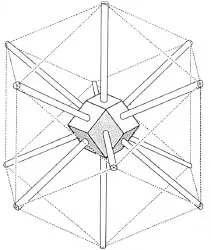
194195Instead of initiating universal mensuration with assumedly straight-lined, square-based cubes firmly packed together on a world plane, we should initiate with operationally verified reality; for instance, the first geometrical forms known to humans, the hemispherical breasts of mother against which the small human spheroidal observatory is nestled. The synergetic initiation of mensuration must start with a sphere directly representing the inherent omnidirectionality of observed experience. Thus, we also start synergetically with wholes instead of parts…
196We find that the sphere becomes operationally omnicontiguously embraced by other spheres of the same diameter, and that ever more sphere layers may symmetrically surround each layer by everywhere closest packing of spheres, which altogether always and only produces the isotropic vector matrix.
197This demonstrates not only the uniformly diametered domains of closest packed spheres, but also that the domains’ vertexially identified points of the system are the centers of closest packed spheres, and that the universal symmetric domain of each of the points and spheres is always and only the rhombic dodecahedron. (¶981.19)
198 To summarize the intimate inter-relationship of these ‘duals,’ as the rhombic dodecahedron and vector equilibrium are sometimes known, Fuller has recourse to metaphor:
199200The rhombic dodecahedron is symmetrically at the heart of the vector equilibrium. The vector equilibrium is the ever-regenerative, palpitatable heart of all the omniresonant hearts of Universe. (¶984.00)
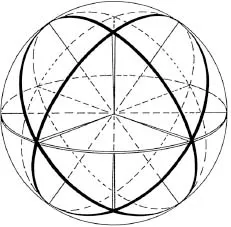
202 You need only hold your model up at a certain angle to see the interlocking heart shapes, which Fuller’s metaphor turns into a fitting gnomon of his WHOLE synergetic (‘co-operative’) universe.
A.5.1 Unfolding the Rhombic Dodecahedron
2036 disks
204 30 pins (see p. 182)
205 To form the bow-ties:
206 1) Fold each disk in half along each diameter, as shown in Fig. 1. (Make sharp
creases).
− = fold away from you
+ = fold toward you
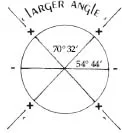
208 Fig.1
209 2) Pin each bow-tie as shown in Fig. 2.
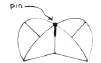
211 Fig.2
212 To form the sphere:
213 3) Pin the first two bow-ties together as shown in Fig. 3
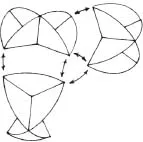
215 Fig. 3
216 4) Continue this pattern to pin the remaining bowties. Fig 4 shows the complete sphere with one bowtie in relief.
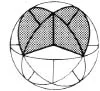
218 Fig. 4
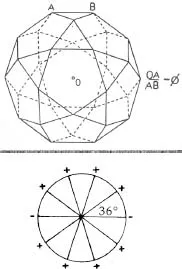
219 Note: You can expect the bow-ties to slip a little as you pin them, but the figure will adjust itself with the last pin or two. Pinch firmly on the bow-ties to place the last few pins.
A.6 Spherical Tet and Octa
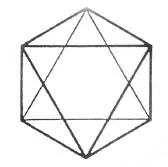
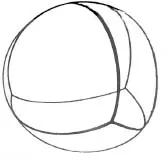
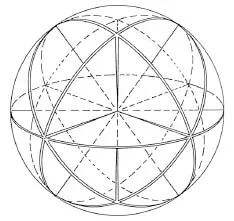
222 There is one foldable WHOLE we’ve skipped over, the spherical octahedron (Greek, octa, eight). Octahedra appear in the isotropic vector matrix as the voids between tetrahedra. Fuller has covered the construction of the spherical octa in great, not to say overwhelming, detail in Synergetics ¶835.00 and ¶836.00.198 There is no need to belabor its relatively simple construction here. But the reader may also be wondering why we have encountered no spherical tetrahedron in our set of foldable figures.
224 The spherical tetrahedron is not a member of the family of (seven and only seven) foldable geodesic polyhedra, which Fuller was accustomed to calling ‘great circle models.’ The spherical tet’s 109-degrees, 28-minutes of spherical angle do not resolve into equal 360-degree-totalling increments. It is simple enough to make a rough spherical tetrahedron, out of clay for example, but every such model is bound to be unique. If you were to use a mold, since the spherical tet has no continuous diameter, every time you made one you would have to break the mold. Of course, there is a ready-made spherical tetrahedron we have all observed without noticing it. The distribution of land masses on our planet Earth forms a rough spherical tet, although only Bucky’s Dymaxion Projection shows it in proper proportion.
225 It can be said, moreover, that the spherical tetrahedron is the arché of all the WHOLES presented here, the most primordial pattern, the granddaddy of them all. Look sharply and you’ll catch sight of it almost everywhere, but always in mid-transformation, always in the process of turning itself into some other, more highly articulated, pattern.
226 In his Cosmic Fishing, E. J. Applewhite describes their collaborative book Synergetics in its entirety as ‘‘a business of stark homage to the tetrahedron.’’ Fuller retorts (on the same page!): ‘‘I am not in homage to anything, certainly not the tetrahedron as an object, merely as the minimum structural system in Universe.’’199
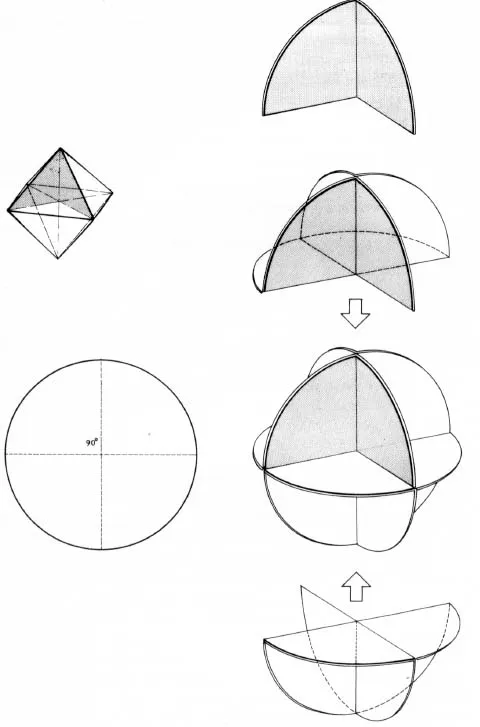
228 Returning to the octahedron, which can be ‘unfolded’ as a WHOLE, we find that its 90-degree coordination introduces an element of redundancy (doubled-up edges) not present in the previous figures. Fuller explains:
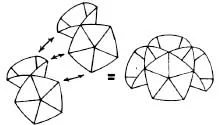
230231The octahedron always exhibits the quality of doubleness. You might think you could do it with one set of three great circles, but it takes two sets of three great circles to fold the octahedron. (¶937.21)
232 Crystals are face-bonded molecules. Thus, to paraphrase Fuller, because it is double-bonded and its vectors are doubled, the octahedron may be considered the optimum representation of crystalline structure: the original diamond in the rough. And indeed, the octahedron turns out to be the most common crystal formation in nature.
233 Here are the simple specifications for the spherical octa. You should have no trouble folding six paper circles in half twice to obtain 90-degree quadrants.
A.6.1 Unfolding the Spherical Octahedron
2356 disks
236 10 pins

A.7 Frequency—12-Great Circle Vector Equilibrium
245246All experiences resolve themselves into discrete angle and frequency patterns. (¶505.03)
A.7.1 Time as Growth
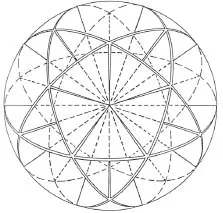
248If you have unfolded the WHOLES presented so far, you now have in your hands the basic strategies Nature uses for all her myriad interpatternings. But growing things—be they flowers, crystals, thoughts, or dreams—take time to articulate themselves.
249 In the late 17th Century, Newton still perceived both time and space as absolutes, a hand-me-down assumption from the classical Euclidean worldview. More than two centuries later, Einstein disagreed, postulated four-dimensional space/time relativity, and proposed some of the practical tests which eventually confirmed his intuition. Following on this overthrow of the clockwork universe, the Russian ‘truth-seeker’ P. D. Ouspensky defined time in his New Model of the Universe (1931) as ‘‘the dimension of organic growth.’’ His model for the ‘shape’ of time was a tree.200
251 Fuller’s intuition of time is similar, but more precise. Time in his synergetic geometry is the dimension of growth out from centers, i.e., from the handful of WHOLE systems we have been toying with in the first four models (spherical vector equilibrium, octahedron, icosahedron, and rhombic dodecahedron). Time is the frequency with which such primordial events occur and recur; time begins with this recurrence, the second.
252 To give you some of the flavor of Bucky’s own approach to unfolding ‘‘nonsimultaneously conceptualizable scenario Universe’’ from these relatively simple WHOLES, it seems appropriate to cite the Master Shaper himself. He requires of his readers nothing less than a radical re-envisioning of everything we take for granted about time and space and all their relations.
A.7.2 Frequency as Time
256257The Babylonians tried unsuccessfully to reconcile and coordinate time and space with circular-arc degrees, minutes and seconds. The XYZ, c.g.s. metric system accounted time as an exponent. Time was not a unique dimension.
258Synergetics is the first [geometry] to introduce the time dimension integrally as the frequency for [WHOLE] systems, which initially are independent of time and size, but when physically realized have both time and size, which are identified in synergetics as the frequency of the system: the modular subdividing of the primitive, timeless, metaphysical system. (¶1054.70–72)
260You cannot have time without growthability, which implicitly has a nucleus from which to grow. We could not have discovered the frequency or time dimensions had we not explored the expansiveness-contractiveness and radiational-gravitational behavior of nuclei [i.e., WHOLES] in pure metaphysical sizeless and timeless principle. (¶1054.72)
A.7.3 Frequency Shell Growth
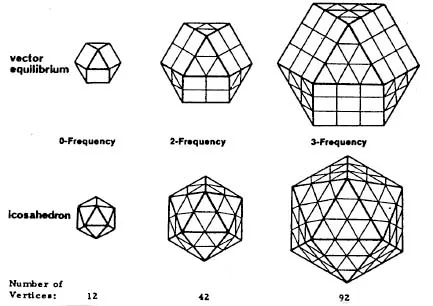
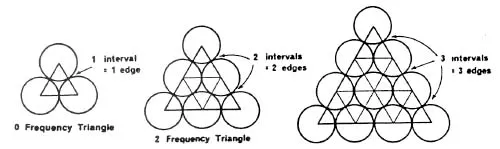
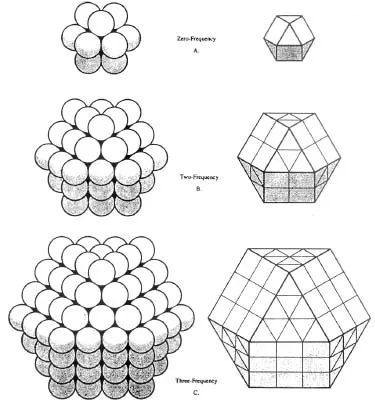
263Closest packing of spheres around a nuclear sphere always produces vector equilibria of various frequencies; the more spheres, the higher the frequency.
265266As additional layers of equi-radius spheres are added it is found that a symmetrical pattern of concentric systems repeats itself. That is, the system of three layers around one sphere, with 92 spheres in the outer layer, begins all over again and repeats itself indefinitely with successively enclosing layers in such a way that the successive layers outside of the 92-sphere layer begin to penetrate the adjacent new nuclear systems. We find then that only the concentric system of spheres within and including the layer of 92 are unique and individual systems. (¶413.04)
267 This concept of a finite system in universal geometry is directly related, Fuller maintains, to the significance of there being 92 and only 92 regenerative chemical elements. R. Marx, in his The Dymaxion world of Buckminster Fuller, extrapolates:
269270It was no surprise to Fuller when the transuranic elements were developed…and it was found that these ‘elements’ disintegrated in split seconds. Fuller describes the transuranics as trans-vector-equilibrium configurations, that is, atomic arrangements in which the radial vectors (the ‘explosive’ force lines) exceed the circumferential restraints.201
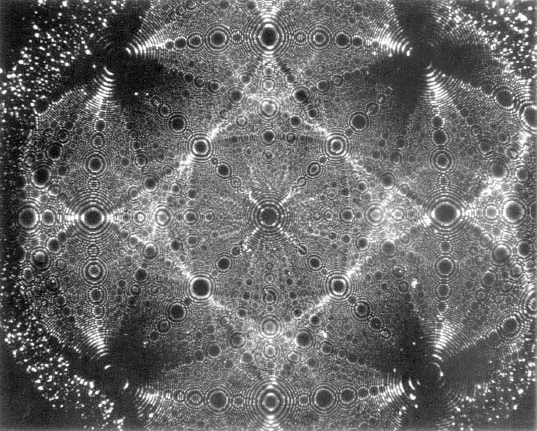
272 By contrast, platinum, the densest and most durable of metals (it is the international standard for weights and measures) turns out to be a near-perfect high-frequency vector equilibrium. When Fuller was shown the photograph of a single platinum crystal reproduced on p.170, he remarked that the information storage capacity of heavy metals would soon be found to far exceed that of silicon, and, properly utilized, would increase the power and diminish the size of computers dramatically. Twenty-five years later, microchip manufacturing giants Intel and IBM simultaneously announced ‘‘one of the biggest advances in transistors in four decades’’ (Washington Post, 27 Jan. 2007), which appears at least partially to confirm Bucky’s intuition. Their breakthrough involves using the silvery heavy metal hafnium to regulate the flow of electricity in a new generation of transistors, ensuring that microchips will continue to ‘ephemeralize’, as Bucky would put it, getting ever smaller and yet more powerful well into the foreseeable future. Once you’ve finished unfolding the Frequency Vector Equilibrium described below, you need only hold the 4∕8-way apertures of your completed model up to the photograph to see its striking similarity to the platinum crystal.
273 Indeed, this is more than similarity; it is identity of structure. Of course there is no platinum in your model, or it would be worth a great deal of money. The atoms of platinum are the white smudges in the photo, which cannot be picked out individually by the field ion microscope. The black spaces in the photo, which delineate the structure you have unfolded, are actually the empty spaces where there are no platinum atoms. This is what Fuller means when he speaks of the entirely meta-physical pattern integrity of the crystal.
274 Since this Appendix is just an introduction to Fuller’s geometry through his great-circle models, we shall have to refrain from elaborating the very many further correspondences with natural patterns available in Fuller’s Synergetics volumes. You do know just about all you need to know in order to decide whether you wish to invest the time and effort that will be required to unfold your first frequency WHOLE, the 12-great-circle vector equilibrium outlined at the end of this section. It is perhaps the most elegant, and certainly the most challenging of all the WHOLES. It will take a little time for you to put this WHOLE together, but you don’t begrudge it. Time is precisely the point, as Fuller duly reminds us:
276277The only dimension is time, the time dimension being the radial dimension outward from or inward toward any regenerative center, which may always be anywhere, yet characterized by always being the center of system regeneration.
278The time dimension is frequency.
279Any point can tune in any other point in Universe. All that is necessary is that they both employ the same frequency…(¶960.06–08)
280 So what you need to unfold a frequency WHOLE is not so much a set of instructions, but a certain attunement to the synergetic principles at work in the WHOLE:
282283In the equanimity model [vector equilibrium], the physical and the metaphysical share the same design. The whole of physical Universe experience is a consequence of our not seeing instantly, which introduces time. As a result of the gamut of relative recall time-lags, the physical is always the imperfect experience, but tantalizingly always ratio-equated with the innate eternal sense of perfection, [¶443.04]
285A field ion microscope picture records the actual locations of individual platinum atoms arranged in clusters within the ringlike facets of one crystal of the metal. The atoms—the tiny white dots—were magnified 120,000 times on the negative and here are further enlarged to 500,000 times life size. (Erwin Müller, Platinum crystal, from Photography as a tool, New York, 1970.)
A.7.4 Unfolding the Frequency Vector Equilibrium
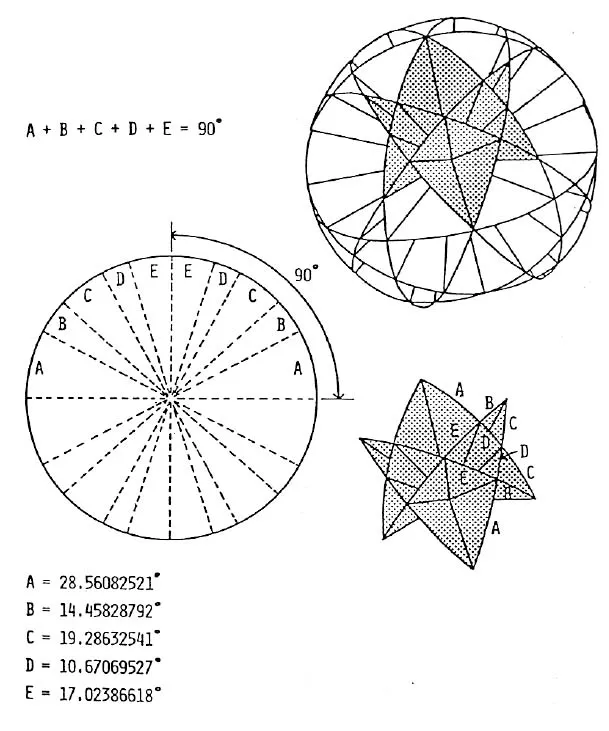
28712 disks
288 132 pins
289 Fold and pin bow-ties.
A.7.5 Dwelling Valve—10-Great-Circle Icosahedron & Buckyballs
291Often circumlocutious, Fuller minces no words on the following point: ‘‘The icosahedron is the prime dwelling valve of Universe.’’ Beyond the theoretical underpinnings he gives for the ubiquity of icosahedral shells in Nature, Fuller is best known for developing high frequency icosahedra into a unique form of human dwelling, the geodesic dome.
292 A ‘geodesic’ is simply a great-circle arc, but as Fuller spun out many more complex figures from the ‘geodesics’ in the WHOLES covered so far, the term has come to denote a vast range of domeworks strategies in which the original great circles are not always visible. Geodesic domes can be generated from from spherical tetrahedra, vector equilibria, octahedra, and so forth but Fuller (and Nature too, it seems) has settled on the icosa as the most economical method for enclosing the most volume with the least surface area, and therefore the least expenditure of materials.
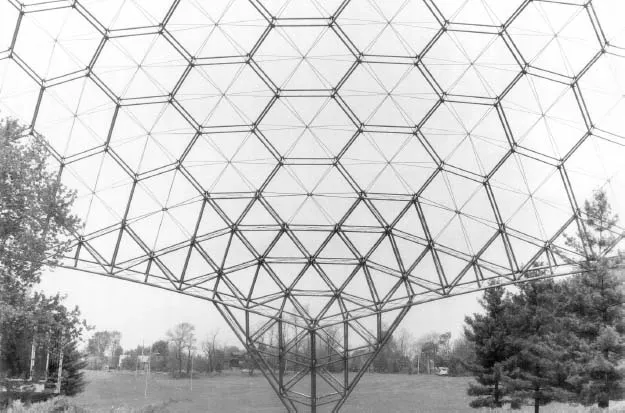
294295Since physics has found no continuums, we have had to clear up what we mean by a sphere. It is not a surface; it is an aggregate of events in close proximity. [¶1023.11]
296 The Greeks were comfortable with the idea of perfect and infinite spheres, a notion which allows for many convenient abstractions from ‘this’ world to the ‘ideal’ world of Forms, but Fuller insisted that today we can no longer afford to live with the misleading idea of ‘solids.’
297298We find local spherical systems of Universe are definite rather than infinite…. All spheres consist of a high-frequency constellation of event points, all of which are approximately equidistant from one central point. All the points in the surface of a sphere may be interconnected; they will subdivide the surface of the sphere into an omnitriangulated spherical web matrix. [¶224.07]
299 Moreover, getting back to our original point about the icosahedron:
300301All spheres are high-frequency geodesic spheres, i.e., triangular-faceted polyhedra, most frequently icosahedral because the icosasphere is the structurally most economical. [¶985.22]
302 As a sidelight which reveals the way he never stopped thinking about such elementary things, notice that in Synergetics Fuller was already pointing out that ‘polyhedra’ is in fact a misnomer, because it suggests solid ‘faces’ (-hedra). In Synergetics 2, he went so far as to coin a more accurate term:
303304There are no solids or absolute continuums; ergo, there are no physically demonstrable faces or sides or hedra; ergo, we reidentify the system-conceptioning experiences heretofore spoken of as polyhedra, by the name polyvertexia, the simplest of which is the tetravertex, or ‘four-fix’ system. (¶986.728)
305 One way to view frequency modulation is as edge-division of the basic triangles of the system. Classical domeworks exhibit one of two strategies:
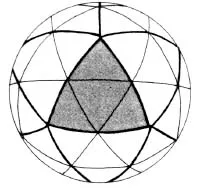
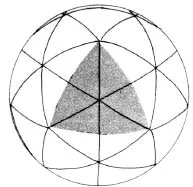
308 These alternatives have differing strengths and weaknesses for various sorts of dwelling functions. Domebooks I and II are a good review of techniques and complaints, e.g., the importance of making models before building the real thing, the leaky roofs on wooden domes (which expand and contract) unless carefully shingled, etc. Hugh Kenner has also explicated many further dome design options in his Geodesic math and how to use it.202 In this work, which he says was written for one architect daring enough to try them, Kenner deploys formulae for designing complex elliptical and egg-shaped domeworks that do not stick to the rigid sphericality Fuller preferred. This should enable the architect or homebuilder to explore uniquely local applications of synergetic architecture…If you want a window there by the tree, and a door over there where it’s sheltered, Kenner gives you the mathematical tools to spin your own sort of geodesic web to suit.
310 The dome-building industry seems to be undergoing a resurgence in the early 21st Century as aging baby-boomers reclaim a little of the counterculture spirit of the ‘60s by custom-designing their own dream homes in all sorts of original ways. Double-and even triple-domes are more and more popular today as people look to create unique spaces in iconic places like Berkley or Sedona, or just to re-inhabit their suburban neighborhood in Pleasantville.
311 Nowadays, everybody has heard of Carbon-60, ‘Buckminsterfullerene,’ so called because it consists of 60 (tetrahedral) carbon atoms…basically a big soot bubble, a cage-like structure so large it can house other molecules inside it. This surprising third form of carbon, isolated almost simultaneously by Smalley in the US and Kroto in the UK, has fascinated organic chemists from day one, although it has yet to find any practical application. Smalley says ruefully, ‘‘Bucky hasn’t found a job.’’ He doesn’t seem to have asked whether ‘Bucky’ was looking for a job, or instead disclosing something about the shape(s) the world is in.
312 Of course it is a great honor for Bucky to have had such a fundamental molecule named after him, even posthumously. It seems to us, however, that the name is just about all the scientists took from Fuller. Any student of Bucky’s synergetic geometry will tell you that the soccer-ball diagram conventionally used to depict C60 is not a Fuller figure at all: There are no triangles! ‘No triangles, no structure,’ Bucky would say. Therefore if you want to see how the 60 tetraheda of ‘Buckminsterfullerene’ actually fit together, you have to go back and look at Bucky’s own geodesic structures.
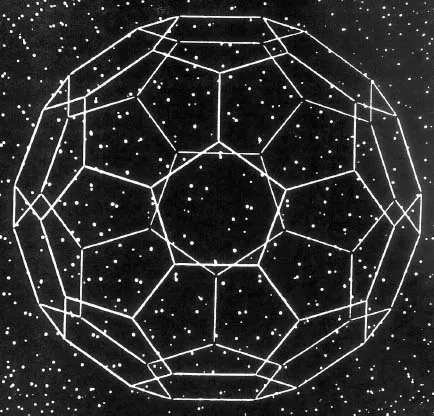
313 The WHOLE we present here may be considered the original ‘Buckyball,’ the ten-great-circle icosa Fuller himself designed long before all the headlines and kudos and conferences about Carbon 60. It is indeed a simpler affair than most of his domes, exhibiting the familiar ‘hex/pent’ configuration of the most rudimentary Class I geodesics. It is also incredibly tough. Carbon 60, we are told nowadays, may well be the seed-form of carbon chemistry in the Universe at large, and possibly the oldest form of matter altogether. It’s your basic Stardust, carbon soot cast out of ancient stellar furnaces. As such, it has had to survive all the rigors of billions of years in space before sifting onto the surfaces of planets like our own little Earth, where it might over a few further billions of years evolve into more complex patterns of life—like you and me, for instance.
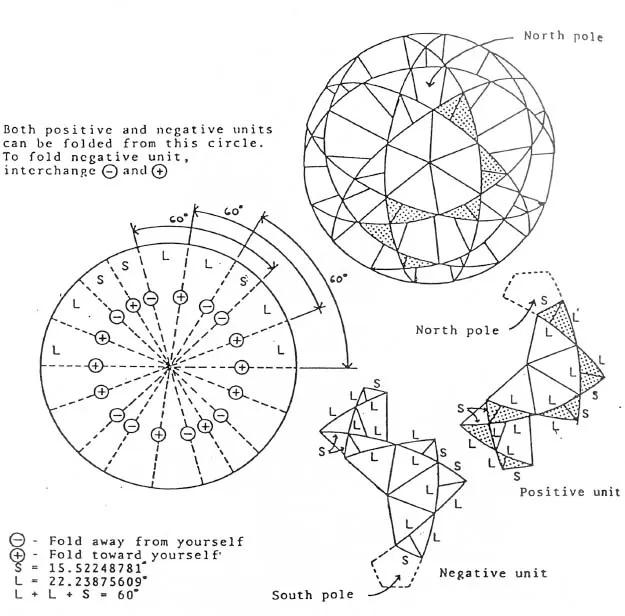
314 Now this WHOLE has one feature we’ve not met with until now: polar asymmetry. It has a positive and a negative pole. Consequently, half the bow-ties must be folded into mirror-images of the other half. This feature may well indicate a difference in electrical potential, a positive and a negative pole—which presumably plays a role in the ‘quantum tunneling’ exploited by the scientists at Lawrence Livermore Laboratories who recently constructed a functional ‘nano-transistor’ by sandwiching a single Buckyball between gold electrodes—the first and so far the only nanotechnology component ever successfully tested.203 Maybe Buckminsterfullerene will one day find ‘a job’ after all.
316 Unfolding this WHOLE is guaranteed to make you see stars, 12 of them to be precise, five-pointed beauties dancing all across its surface. If you use duplex cover stock (white on one side, colored on the other) to construct this WHOLE, you are faced with a choice: Do you want to see white stars surrounded by color, or colored stars surrounded by white?
317 Recall that these figures are the prototypes for Bucky’s domes. They raise fundamental questions…Just what sort of ecological niche would you like to construct for yourself?
318 Here are the specifications Bucky supplied in Synergetics. In this sphere, you’re on your own.
A.7.6 Unfolding the Frequency Icosa
32010 disks
321 90 pins
322 Fold and pin bow ties as shown, half (5) positive and half (5) negative.
A.8 Eye of the Beholder—Rhombic Triacontahedron
325You see what you look for…This final WHOLE may be described several ways, all of them equally accurate. Depending on your point of view, what we have here can be said to consist entirely of:
- 120 triangles or (volumetric) tetrahedra, the maximum number of like sections into which a sphere can be subdivided; or
- 15 double-edged great circles, each the reassembled version of the 30 disks used to unfold the figure; or
- 30 rhombs, which gives it the name Fuller favors: the rhombic triacontahedron, or
- 20 large triangles or tetrahedra (from the original 0-frequency icosahedron), frequencied by the Class II strategy, making this a 2nd-frequency icosa-dodecahedron, or
- 12 five-pointed star/pentagons, which allows us also to call it a pentagonal dodecahedron.
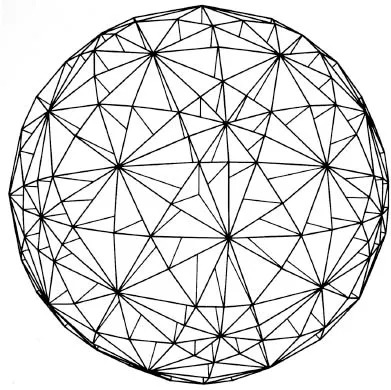
327 What you ‘see’ is what you ‘get.’ Here we cannot help but realize the inadequacy of trying to see the world, at least the energetic-synergetic Universe Fuller lays out for us, from only a single ‘perspective.’ Genuine pluralism is not a political expedient (until we can convert ‘the others’ to our point of view), it is the recognition that the whole of reality cannot be reduced to a single ‘viewpoint’ or common denominator. A pluralistic Universe requires us to see pluralistically, ‘in the round,’ as it were. As Hugh Kenner mentions, polyhedra are really only conveniences for locating systems of symmetry. All perspectives may be equally valid, but not in isolation from one another. Monofocal vision is (as Fuller spent his entire life demonstrating) mainly a form of culturally conditioned blindness.
328 Since the 1970s when Fuller articulated his vision in the Synergetics volumes, the computerized power to animate and illustrate mathematical theorems has made plausible what seem at first glance to be competing visions of ‘the geometry of Nature,’ namely fractal geometry and ‘chaos’ theory. Hugh Kenner has explored the former, Mandelbrot’s fractal indices, with reference to Fuller (as well as Ezra Pound), and James Gleick provided a good introduction to the latter two decades ago in his Chaos: making a new science. But the ‘self-similarity’ of fractal geometry is not synergetic. If the whole is entirely predictable from the part, we are in a different world from Fuller’s, perhaps mapping the dissipation and disintegration of systems (the turbulent flow of a river, the erosion of a rocky seashore, the spilling of a can of paint) rather than ‘unfolding the wholes’ from which flowers, trees, and water droplets take their shape. Chaos theory, in its ‘sensitive dependence on initial conditions,’ begins with the gritty particularities of experience—the highs and lows of weather patterns, the fluttering of leaves, the dripping of a faucet—and looks behind them for ‘strange attractors,’ non-linear equations which seem to resemble Fuller’s non-linear tensegrities in many ways. Chaos theory focuses on complex, local asymmetries which disclose hidden, global symmetries. Fuller, as we have seen, also sought to bridge the gap between his ‘timeless, weightless, metaphysical systems’ and the rhythms of order and disorder in everyday life. He devised a series of intermediate geometric steps—mites, sites, couplers, etc.—to bridge the distance between the simple models we have presented here and the complex associations and dissociations of life as we meet it in the ups and downs, ins and outs of the world human beings actually inhabit and experience.
329 We are neither of us sufficiently sophisticated mathematicians to resolve in some simple formula any disparities between Fuller’s version of ‘Nature’s Coordinate System’ and these later computer-enhanced attempts to come to grips with nature’s geometry. We may however observe this much: Bucky starts from order and seeks from there to try to account for all the irregularities of the world; the chaos theorists begin with apparent randomness and seek the hidden ‘order’ behind it. These may turn out to be simply different ways of looking at the oscillations of life, each valid in its own domain. It would be revealing to see Fuller’s geometry similarly spun out in computer projections—starting with the triangle unfolding into the tetrahedron, from there into the isotropic matrix, and through that matrix to the full range of WHOLE systems—but this is not our business. Our primary concern here is simply to outline Fuller’s synergetic geometry so that you may see for yourself the remarkable correspondences between his synergetic patterns and the sacred geometries of almost every traditional culture. None of those cultures had access to computers, but this did not prevent them from building their temples and cathedrals on these patterns, nor from employing such patterns in symbolic systems intended to bring human culture into meaningful harmony with Nature and, indeed, the Divine.
330 The final WHOLE we present here is the rhombic triacontahedron, which models the maximum number of like units into which a sphere may be subdivided.204 Fuller sees in this figure the graphic illustration of Einstein’s equation, E = mc2. He called it the ‘‘Demass Model,’’ because it seems to present us with the threshold between radiation radiating and matter materializing:
332333…the difference between it is matter and it is radiation…Vastly enlarged, it is the same kind of difference between a soap bubble existing and no longer existing—‘bursting,’ we call it—because it reached the critical limits of spontaneously coexistent, cohesive energy as atoms-arrayed-in-liquid molecules and of atoms rearranged in dispersive behavior as gases.
334This is the generalized critical threshold between it is and it isn’t. (¶986.547)
335 Which seems like the proper note on which to conclude this brief synergetics primer.
A.8.1 Unfolding the Rhombic Triacontahedron
33630 disks
337 180 pins
Fuller on Euler: V + F = E + 2
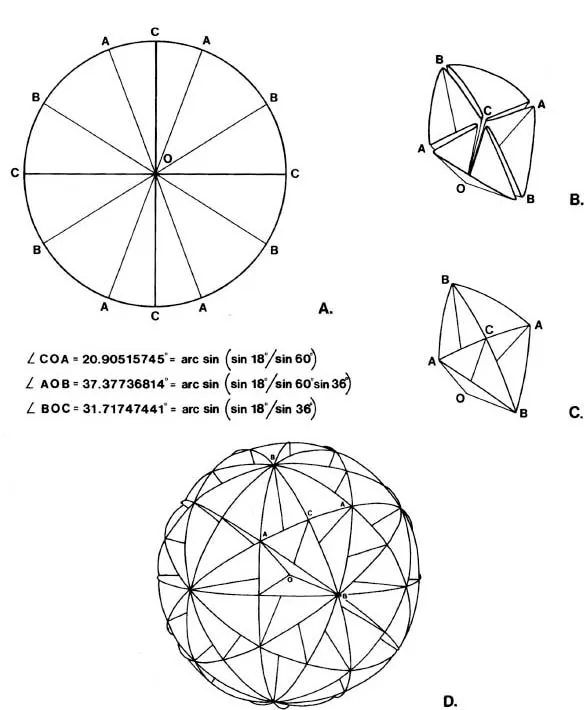
340A final resumé may be drawn from Fuller’s summary of Euler’s topology. In topology, Euler says, in effect, that all visual experiences can be resolved into three unique and irreducible aspects:
- vertices, faces and edges; or
- as unique dimensional abundances: –- points, areas and lines; or
-
341as structural identifications;
342–- joints, windows and struts; or
-
343as we say in synergetics topology:
344–- crossings, openings and trajectories; or
-
345the more generalized:
346–- events, non-events and traceries; or
-
347more refined as:
348–- fixes, discontinuities and continuities; or
-
349in most refined synergetics:
350–- events, non-events and even inter-relatabilities. (¶1007.22–3, paraphrased)
351 As an empty set, Euler’s equation says that in polyhedra the number of [crossings] plus the number of [openings (holes)] is always equal to the number of [boundaries] plus the number 2 [poles].205
| Examples: | V+F=E+2 |
| VE | 12 + 14 = 24 + 2 |
| ICOSA | 30 + 20 = 48 + 2 |
| CUBE | 8 + 6 = 12 + 2 |
A.8.2 Unfolding WHOLES: Practicum The Medium is not the WHOLE Message
354The easiest method of constructing WHOLES is to cut out, score, and fold disks of ordinary construction paper, and then pin them together with bobby pins. Once you’ve tried a few of these, you will no doubt be impatient to explore other materials. There’s more than one way to unfold a WHOLE.
355 What we have presented here is not so much a series of pretty figures as it is a nascent craft, which could become a genuine vehicle for the creative imagination. Don’t be hypnotized by the figures themselves: WHOLES are only a blank multidimensional canvas. Any masterpieces painted on them will be your own. All you need, beyond Fuller’s specifications for the figures themselves, is a compass, a straight edge, a little imagination and the right materials. Even scissors are an optional accessory.
356 A simple way to begin discovering new configurations is by drawing your own mandalic patterns on the disks themselves and watching these re-assemble in four dimensions when you put the model together. Or you could try color-coding the disks to bring out one or another of the patterns latent in the WHOLE.
357 All the physical ‘parts’ of the WHOLE are replaceable by other pins, folds or materials. What remains is only the metaphysical integrity of sheer principle. WHOLES are not just material objects; the message is more than the medium in which it is embodied. But just as there is no message without medium, there are no WHOLES in vacuo. Here are some materials and strategies which have worked well for us:
358 Pins
359 Plain old commercial bobby pins are great for paper WHOLES, and they’re flexible enough to tolerate most of the trial-and-error of learning to unfold WHOLES. For a more finished look (tighter vertices, sharper great circle planes), try replacing bobby with cotter pins. We’ve found that 1in x 1/16in cotter pins work very well for figures from 3in to 12in in diameter. For larger figures, many bigger, fatter and longer cotter pins are available at hardware stores. (Just be sure to avoid the oily ones.)
360 Materials
361 WHOLES can be unfolded from almost anything that will take a fold. Each material has advantages and disadvantages. The following are only suggestions, based on experience.
362 Paper
363 For paper models, conventional cover stock is probably the sturdiest and most durable, with some of the tougher construction papers running close second. Two-ply papers, with a primary color on one face and white (or a complementary color) on the other, are handy for highlighting various facets of the WHOLE. You can make floppy WHOLES from rice paper, and practically indestructible WHOLES from heavy cardboard, but the optimum material probably lies somewhere between these extremes.
364 All colored papers tend to fade with time, and very quickly if exposed to direct sunlight. One way to retard this process is to spray finished WHOLES with clear plastic or acrylic or lacquer. (Do this out of doors. Such sprays are always obnoxious, usually toxic, and highly flammable. Their only virtue is that they will probably preserve your handiwork a little longer).
365 Vinyl
366 Vinyl, even if quite thin, has many properties which recommend it for the construction of WHOLES. Its springy, rubbery quality makes folding easy, it holds a sharp crease and the colors do not fade. Vinyl WHOLES are semi-translucent; the back side of the figure is visible as a spinning shadow-play Vinyl is durable, cleans easily, and is readily available. Its main drawback may be its slightly dull and utilitarian appearance; it lacks the bright glossiness of some of the other plastics mentioned below.
367 Acetate
368 Almost too brittle a medium to take a fold without cracking, acetate plastics can if carefully handled turn into strikingly beautiful—if rather fragile –WHOLES. Moreover, at art supply stores you can often find acetate sheets of a deep blue or red color bonded to a mirror surface, either gold or silver, from which can be generated WHOLES of astonishing jewel-like elegance.
369 Polyester
370 ‘Mylar’ is a trademark for polyester, a species of petroleum-derived plastics from which clear, chrome, colored or matte-finish WHOLES can be unfolded. Mylar is very strong stuff. You cannot tear it, but scored lightly with a compass point it folds easily and sharply. Instead of using scissors, you’ll get more perfect disks by putting steel points in both arms of your compass and cutting each disk out as you inscribe it. Mylar picks up fingerprints during construction: use a clean, dry cloth to polish (or wear gloves in the first place!).
371 We’ve tried just about every sort of mylar from the 1 and 2 mil. thickness of colored kite material to the 10 and 15 mil. industrial thicknesses. We have no hesitation in recommending 4 mil. polyester as the optimum WHOLES material we’ve run across so far. The 4 mil. clear has an unearthly transparency about it, like liquid crystal. Assembled as a WHOLE, it also has the remarkable property of reflecting and projecting light simultaneously.
372 Spun on a thread (loop it under any pin) in strong sunlight, a clear or chrome WHOLE will fill the room with spinning creatures of light—devas, they have been called—a purely unpredictable effect of arranging this sort of material in razor-sharp great circles, which act alternately as windows and mirrors. Mylar WHOLES ‘pump’ light around a room in ways guaranteed to hypnotize cats, dogs, and small children for hours.
373 You might carry all this one step further than we did and try laser-cut diffraction grating material which, in theory anyway, ought to give you a roomful of rainbow ‘devas’, something like the spectral tentacles of Apple’s OS X ‘Flurry’ screensaver writ large. For such experimental materials, only one rule really applies: Try it. Who knows? You might like it.
374 Advanced Synergetic Origami
375 You have more freedom than you may suppose in the design of custom-crafted WHOLES. You need not stick exclusively to the (‘seven and only seven’) intact-great-circle models Buckminster Fuller himself designed. It is possible to unfold quite a few irregular WHOLES as well. Your ingenuity and the limits of your material are about the only constraints.
376 For example, five disks folded without a continuous diameter into nine equal 40-degree sections will yield a strange and wonderful cross-section of metamorphosis: A 2nd-frequency spherical tetrahedron in the midst of transforming itself into the 3rd-frequency spherical tetrahedron sprouting on the other side of the figure, (see Figure ‘SOMEWHOLESOMEWHOLES’, p. 137). Or, with six disks scored at equal 45-degree angles, the eight radii provide folds from which one can easily construct a version of what is called ‘Kelvin’s polyhedron,’ with its alternating 4-lobed stars and hexagonal apertures.
377 Pure symmetry can be tedious. This is why the WHOLES—clear and mirrored, or faced with opposing colors—often turn out to be more interesting as art objects than Bucky’s ‘static’ mass-produced domes. Strung as a mobile on a string, or turned to this peculiar angle or that, the model acquires the added dimension of change through time. You may see just a few oblique facets and odd angles, yet you are still able to sense the unseen parts and to intuit the overall pattern of the WHOLE. WHOLES are beautiful for the same reason that a field of early spring daffodils is beautiful: endless intricate variations on a clearly discernible theme.
378 But if you’ve read this far, you’ve got the idea. In model-making as in life, there’s no substitute for experience. If the exercises above leave undaunted your ardor for model-making, then ‘whole’ families of tensegrity spheres (sticks and wire) and geodesics await your attention in Anthony Pugh’s Introduction to Tensegrity and Hugh Kenner’s Geodesic math and how to use it.206