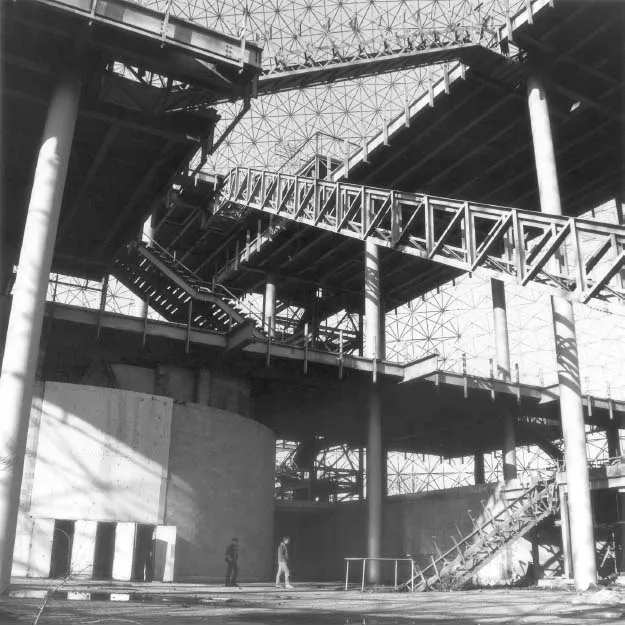
21987. We come late upon the scene. A tremendous shape mushrooms up before us, as
indifferent to our gaze as it is to its frozen surroundings. It’s as if something once
happened here, some cosmic drama played upon this stage, and we are left only the quiet
shell of that event. The forces once in play here seem to have played themselves out. We
bundle our overcoats to us and huddle before yet another bitter blast of the Montréal
winter wind.
3 This thing, this bare Expo Dome, seems an alien form here. It stands out and it stands
totally alone, somewhere—or when—it shouldn’t be. It is an American thing, out of place;
unmoved by the deep Québec cold, by the iced-up St. Lawrence River, by the sharp-edged
skyline of Montréal above and beyond the ice. The dome seems to hold its own like an
architectural island on its own island, Ile St. Hélène, a shape that has kept its shape
despite all the elements—fire, rain, snow, ice and wind—that time and disuse have hurled
against it.
4 We move closer to the strange thing, into its black lace shadow. We circle round, then
duck under the protecting fence through a low furrow made by many ‘illegal’ visitors over
the years. The tourists and architecture buffs, the Bucky Fuller freaks, the curious, the
daring or the merely foolhardy, the teen-aged beer drinkers and furtive lovers and graffiti
artists; many have made this pilgrimage before us, too many leaving their rubbish. We
enter the dome compound cautiously, keeping an eye on the broken chunks of
concrete, the twisted lengths of metal beams and jagged protusions everywhere
underfoot.
5 My guide, Robert Duchesnay, knows every nook and cranny of this ruin. To muse over
ruins is customarily considered a Romantic pursuit, but for that sensibility Nature itself
was the idyll. You made a word-picture, or painted a landscape, and to it you
added an artificial ruin to heighten the sense of Nature’s dominance over Man’s
puny handiwork. But the Expo Dome plays on this sensibility in an unusual
way. It is not the past, or Nature in the raw, that is lost or to be found in this
place. Rather it is the romance of the future that draws people here, the glimpse
of a future that once looked bright and hopeful, and now has grown dim and
darkly clouded. It evokes nostalgia, yes, but not for the past or the pastoral scene.
What we feel instead is something like nostalgia for a lost future: Once upon a
might-have-been…
6 Anyway, this particular ‘ruin’ stoutly defies decrepitude. It has been called ‘the most
beautiful building-completely-destroyed-by-fire in the world.’ Some, including its architect,
Buckminster Fuller, have even declared that they prefer the ruin to the once-functional
building. And it’s easy to see why.
7 The structure itself is so elegant; the vast, mathematically precise sphere so
overwhelming; the feel of the thing at once so massive and so lightsome, that it defies
being taken in at a single glance. Literary critic Hugh Kenner once noted that it looks
much smaller from the outside, since on a sphere (or two-thirds sphere, in this
case) the external dimensions retreat from the eye. We’re not used to looking at
buildings like this; it is outside our usual ‘frameworks.’ Inside, it is clearly huge—very
clearly, since almost nothing stands between you and the enormous 20-storey vault
overhead.
8 For only this much of his achievement was Fuller grudgingly honored by the American
Institute of Architects, that he enclosed more space with less stuff than anybody else in
human history. Although he eventually built even larger structures, the Expo Dome still
dwarfs the Pantheon, St. Peter’s, the Taj Mahal, the Hagia Sofia, and all history’s
other famous domes. Today it simply stands there—vast, purposeless, and yet
somehow its own justification. Filmmakers have repeatedly been drawn to it:
Robert Altman shot his frigidly futurist Quintet under it in 1978; it appears
in passing in Stuart Cooper’s moody, mechanically symmetrical thriller, The
Disappearance. The films glance toward the image, but say not a word about
it.
92005. Montréal, which inherited the Dome after Expo ‘67, has never quite figured out
what to do with it. Slow-growing pressure at last prompted some clean-up and
refurbishing in the early 1990s. In 1995, the Centennial of Fuller’s birth, the Dome was
grandly rechristened ‘Biosphere’ and turned into an environmental education center. It
contains a facility for monitoring water-quality in the St. Lawrence River, standing lonely
sentinel-duty for science while commerce and industry continue to poison the Seaway.
Despite Montréal’s lack of interest, the Dome has, over the years, become something of a
symbol for the city. For many of us, I suspect, it also serves as a kind of symbol for
the 1960s, a lost era of hope which seemed to peak in 1967 when the Mohawk
high-steel workers were erecting the Expo Dome—without scaffolding, believe it or
not—and the Summer of Love was about to get off the ground in San Francisco.
The romance of the future still had power then. People were actually getting
ready to walk on the moon. Optimism and energy coupled with science and
engineering seemed as if they might very well guarantee a limitless horizon for human
‘progress.’
13R. Buckminster Fuller (1895–1983) has been characterized as a mathematician,
architect, inventor, philosopher, and even a prophet. He has also been caricatured as
a wide-eyed technocrat with big plans for the industrialization of practically
everything. Toward the end of his life, a listing of his various honorary
degrees made his the longest entry in Who’s Who. All of these classifications
notwithstanding, Fuller tended to refer to himself as a ‘‘comprehensive anticipatory
designer,’’4
which was his own way of summing up five decades of unparalleled Yankee
ingenuity.5
19
Fuller called his geometry ‘‘synergetics,’’ or the ‘‘geometry of thinking.’’ Its basic approach
is ‘‘the exploratory strategy of starting with the whole …’’ From such thinking about
housing in an integral way, for example, he came up with the startling innovations for
which he is justly famous—geodesic domes and the ‘Dymaxion Dwelling Machine’ most
notable among them. Fuller’s geometry is founded upon triangles and tetrahedra—as is all
the carbon chemistry of organic life—and leaves behind the square, cubical and gridiron
forms which still saddle most conventional architecture. Indeed, Fuller’s synergetics goes
well beyond architecture altogether, into the very structure of matter and the
shape-shiftings of the cosmos at large. So it helps to consider his ‘‘geometry of thinking’’
not as some abstract mathematical formalism, but as an artistic exploration, an
adventure of the creative imagination. No one ever took Einstein’s relativity more to
heart than Fuller; everything is constitutively related to everything else. Bucky
Fuller’s achievement was to articulate these very basic relationships of matter
and energy in meticulous detail, and to find practical applications everywhere,
most of which are still well ahead of their time. His innovations span so many
fields of science and engineering so adroitly that Marshall McLuhan may not
have been too far off the mark in dubbing Fuller ‘‘the Leonardo da Vinci of our
time.’’8
21
Over the course of 1995, those who knew him or were touched by him in life celebrated the
Centennial of Bucky’s birth. Since then, the nostalgic Goodman/Simon American Masters
PBS production Thinking Out Loud has offered rare and touching glimpses of both the
public and private man from half a century of documentary footage, and J. Baldwin has
commenced in his Bucky Works a long overdue reexamination of the continuing utility of
Fuller’s many technical innovations for coming to grips with present-day ecological and
economic dilemmas. But lacking the magic of Bucky’s personality, his legend has
otherwise quickly faded from the media spotlight. Architecture critic Allan Temko is
probably right to call the Expo Dome the apogee of Fuller’s career; in 1967, Bucky
was incontestably the most famous structural designer in the world. An entire
generation has since come of age who have never felt for themselves the magnetic
influence of Buckminster Fuller, or tested the strength his ideas against their own
experience.
22 The best chance for newcomers to ‘meet’ Bucky has probably been provided by D.
W. Jacob’s remarkably comprehensive one-man play, ‘‘R. Buckminster Fuller: The History
(and Mystery) of the Universe,’’ performed memorably by Ron Campbell first at the San
Diego Repertory Theater in the Spring of 2000, and then to multiple return
engagements in San Francisco and elsewhere ever since. Next best would have to be
the very extensive traveling museum exhibit, Your Private Sky, mounted by
the Zürich Museum für Gestaltung which toured Europe in 2000 and Asia in
2001. The vast photographic tome compiled from this exhibition by Joachim
Krause and Claude Lichtenstein delves deeply back into the Fuller archives to
bring to light many previously unremarked aspects of Fuller’s early formative
years.9
26
What is the measure of a man? His ideas and accomplishments? Of course. His friends,
followers, influence? Yes, all of these. But above all, and in a sense beneath all these there
is something else—a character, a style of thinking, a certain spirit, a way of being. In this
respect, Buckminster Fuller was a man distinguished by the depth of his determination
to think for himself, to resolutely go his own way in both words and works. In
1927, at about age 33, Fuller decided to stop speaking until he could rid himself
of received opinions, untested assumptions and speech patterns not his own.
When he resumed speaking a year later, the results were altogether unusual.
Thinking, he had decided, meant weeding out irrelevancies. Henceforward, he
would speak only of matters he had found to be true in his own experience, or of
things which could be tested by experiment. Not surprisingly, both his new way of
speaking and the style of thought behind it were unique and, to many people, quite
incomprehensible.
27 For Fuller, the sun does not rise or set, there is no up and no down (on our
spheroidal Earth), and there are no solids or straight lines in all Universe. If
you had just heard or read about such assertions, which aim to carry Einstein’s
postulates to their logical term, you might well come away scratching your head. But
when Fuller began to show people what he was talking and thinking about by
building elegant models—Try it! Hands on! See for yourself!—his approach became
strikingly clear. Buckminster Fuller had hit upon an entirely novel way not only of
expressing himself, but of relating to the Universe at large. Indeed, he devoted
his life to finding ways for people to work with Nature’s principles, rather than
building, dwelling and thinking against or in spite of the patterned dynamisms
of the natural world. On his deathbed Albert Einstein said he found himself
facing Ernest Haeckel’s famous question, which may yet turn out to be crucial
for our own ecologically-stricken era: ‘‘Is the universe friendly?’’ In 1971, Ezra
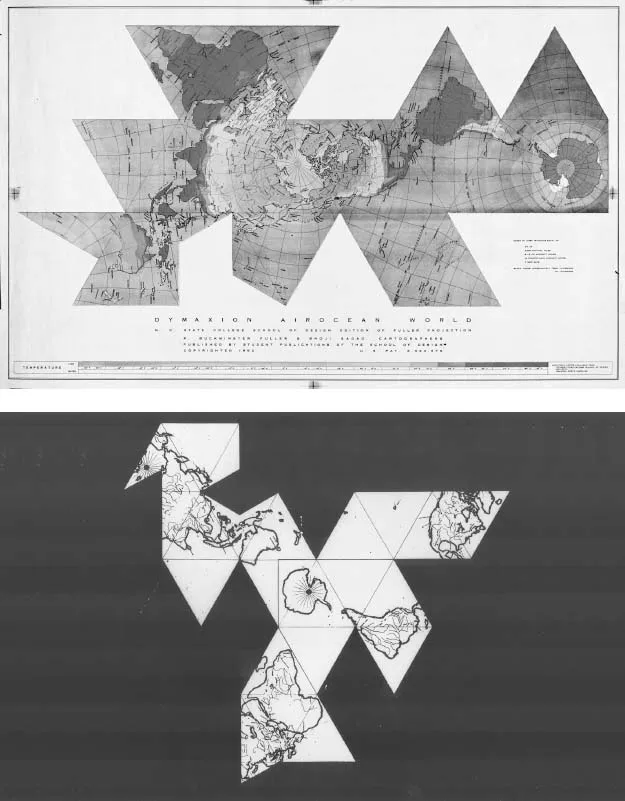
Pound called Bucky Fuller ‘‘friend of the universe,’’ an epithet which suggests that
here at least is a man whose life and work offers a resounding ‘‘Yes!’’ to that
query.11
29
Fuller saw in technology the human mind at work finding ways to do ‘‘more and more with
less and less,’’ using Nature’s bounty without abusing her limits. Early on, he made a
distinction between ‘Brain,’ which he saw mainly as a mechanism for storing particular,
special-case experiences and ‘Mind,’ which he saw as the capacity to learn, to discover the
generalized principles which connect such experiences and make them meaningful. ‘Brain’
is physical and local; ‘Mind’ metaphysical and, he would insist, universal. Just so, he came
to consider all of his inventions and buildings as no more than models, graphic
demonstrations of what could be done by a mind in tune with Nature. And for those of us
who come after Fuller, his works offer the possibility of an alternative science, a way of
exploring natural and human possibilities for ‘livingry,’ as he called it, rather than
weaponry.
33There are many ways of assessing Bucky Fuller’s legacy. But picking about in the charred
ruins of the once-glittering American Pavilion for Expo ‘67, it doesn’t take long to realize
one is also picking one’s way through some other remnants as well, torn cast-offs from
the very fabric of the American dream itself. To see how deeply the texture of
Fuller’s own vision is woven into the many-layered historical tapestry of the
American dream, we must first try to sort the living strands from tangled skein of
lost hopes and shredded dreams it has become, and then try to stitch those
strands together in some semblance of the original pattern. Betsy Ross had it
easy…
34 Once there really was an American dream. No, not the materialistic one with two of
everything: two kids in the big house, two cars in the garage, two pets in the yard, two
bank accounts, and maybe two marriages before you get it all right. The original American
dream was part of the spirit of this place, this land, this Turtle Island as the
Iroquois call North America. Its homeplace was not the Great Plains or the desert
Southwest or the Rocky Mountains or the California goldfields. It belonged to New
England, or to be precise, to the Northeast woodlands more or less centered on
today’s New England. It was alive there when the white settlers first arrived from
England, it was kept alive for a couple of hundred years by remarkable individuals
and even more remarkable communities and Utopian experiments. Its spirit was
that of a bold, pragmatic, reflective, self-reliant people who found themselves in
a rich land and attuned themselves to its possibilities for new sorts of human
dwelling. It has perhaps never been quite so clearly articulated as by Ralph Waldo
Emerson:
37We have listened too long to the courtly muses of Europe. The spirit
of the American freeman is already suspected to be timid, imitative,
tame…What is the remedy?…If the single man plant himself indomitably
on his instincts, and there abide, the huge world will come round to
him. Patience,—patience; with the shades of all the good and great
for company; and for solace the perspective of your own infinite life;
and for work the study and communication of principles, the making
those instincts prevalent, the conversion of the world …We will walk
on our own feet; we will work with our own hands; we will speak our
own minds. A nation of men will for the first time exist, because each
believes himself inspired by the Divine Soul which also inspires all
men.13
43Beauty rests on necessities. The line of beauty is the result of perfect
economy. The cell of the bee is built at that angle which gives the
most strength with the least wax; the bone or quill of the bird
gives the most alar strength. ‘It is the purgation of superfluities,’
said Michel Angelo. There is not a particle to spare in natural
structures.15
45 Like Emerson, Fuller chose to rely primarily on his own experiences in order to
discover the intimate secrets and principles by which the Universe cohered. He once
wrote:
48I did not set out to design a house that hung from a pole or to
manufacture a new type of automobile, invent a new system of map
projection, develop geodesic domes or Energetic Geometry. I started
with the Universe—as an organization of regenerative principles frequently
manifest as energy systems of which all our experiences, and possible
experiences, are only local instances. I could have ended up with a pair
of flying slippers.
53Although human ingenuity makes various inventions, corresponding
by various machines to the same end, it will never discover any
inventions more beautiful, more appropriate or more direct than
nature, because in her inventions nothing is lacking and nothing
superfluous.17
57
From the early seventeenth century onward, villages in New England and environs
exhibited what has sometimes been called ‘Yankee communism,’ a spirit of corporate
co-partnership carried over to this day in communal barn-raising amongst the
Pennsylvania Dutch, for example. It did not escape the eye of the ever-perspicacious Alexis
de Tocqueville, who observed in 1831:
67
Many of the cooperative traits of such self-sufficient villages were carried to their logical
term by the famed Shaker communities: ‘Hands to Work, Hearts to God.’ The Shakers
continued and in some aspects intensified the communal early American pattern, itself
really a vestigial form of the medieval European village, although elsewhere such
communalism was already giving way—either to the rough-and-ready pioneer mentality, or
to the cities as commercial centers. Right through the nineteenth century and
into the twentieth, each Shaker village was more or less self-sufficient in normal
times; yet all participated in a larger pattern of shared faith, institutions, and
techniques.
68 After he and Nathaniel Hawthorne visited a Shaker Village in the Nashua River Valley
during a walking tour in the Autumn of 1842, Emerson was moved to compare the
‘socialist’ Shaker community to a single great ‘capitalist.’ (Before Marx, one might make
such comparisons.) He wrote:
71They have fifteen hundred acres here, a tract of woodland in
Ashburnham, and a sheep pasture somewhere else, enough to supply the
wants of the two hundred souls in this family. They are in many ways
an interesting society, but at present have an additional importance
as an experiment of socialism…What improvement is made is made
forever; this capitalist is old and never dies, his subsistence was long
ago secured, and he has gone on now for long scores of years in adding
easily compound interests to his stock. Moreover, this settlement is
of great value in the heart of the country as a model-farm, in the
absence of rural nobility…Here are improvements invented, or adopted
from other Shaker communities, which the neighboring farmers see and
copy…24
73 Indeed, the Shakers never shared the bias against technology of the Amish or many
another early American Utopian experiment. For the Shakers, the Kingdom had already
come. They considered their foundress, the redoubtable Ann Lee, to have been the
Second Coming. If they were to live up to their vision, they had to set about
creating the conditions of Paradise right here on Earth, in their own communities.
Each settlement was to be an example to the rest of the world: ‘‘No one will
find a spiritual heaven,’’ they used to say, ‘‘until they first create an earthly
heaven.’’25
75
What would a redeemed human life look like here and now? Coming from all walks of life,
they knew the unsettling effects of unbridled sexuality, and voluntarily adopted a celibate
lifestyle. Yet there were always children aplenty in the Shaker villages, and fine schools for
them, since the Shakers started some of the first American orphanages. Knowing from
experience the evils of greed, they agreed upon communal ownership of lands
and goods. Having once felt the sting of persecution, they advocated religious
toleration a full century before the word ‘pluralism’ became fashionable. And by
undertaking collectively the day-to-day chores of maintaining their communities,
they hit upon some remarkably practical improvements. They were among the
first to package and market seeds, herbs and spices. And they invented, among
other utilities, the flat broom, the circular saw, the washing machine and the
clothespin: all labor-saving devices designed to free people from onerous, repetitive
tasks.
76 Their simple, hand-tooled furniture is now by far the most valued body of American
antiques. The Shaker way of life made tangible many of the ideals—thrift, efficiency,
industry, inventiveness—that helped build the young American nation. The works they left
behind share a certain aesthetic not only with Danish modern furniture, but, indeed, with
many of Fuller’s own artifacts: absolutely no frills, a functionalist minimalism which
results in a spare and simple elegance of form. There is one very big difference. Shaker
artifacts were all hand-made, and therefore each unique. Indeed, some scholars say that
the Shaker way of life succumbed to industrialization and mass production, which
eventually cut into the market for their products. And Fuller, more than Hart
Crane or any other American, not only built with industrial tools but saw himself
as the epic poet of industrialization. It’s a refraction we shall examine a little
later.
77 Although ‘artificially’ re-opened for newcomers in 1999, the original Shaker Covenant
was intentionally closed in the late 1980s by the last few elderly Shaker Sisters, who have
since passed away. The end for this living focus of the American dream came, says scholar
Leonard Mendelssohn, neither from their celibacy nor from industrialization. It came, says
he, because America is no longer capable of facing up to its own ideals, let alone sustaining
them.26
79
Yet even in their passing, the Shakers passed on something of that dream and those ideals.
It’s still there; you feel it whenever you visit the quiet, simple buildings and manicured
park-like grounds of one of their model settlements. Here there are no ruins, only
the well-preserved shell of a former life, a tidy utopian vision frozen in time
and in place, perhaps awaiting a new realization. Here you see the remnants
of a vision that was more or less fully realized, and that lived out its natural
life-span.
80 The neglected, burned-out, rubble-strewn shell of Bucky Fuller’s Expo Dome, on the
other hand, would strike the latter-day visitor in exactly the opposite way. Here, too, was
a utopian vision, but of what? Where did such a powerful idea come from, and
why has it all been left to fall apart? What was intended to happen here? And
what would Fuller’s vision look like, had it too been lived out and fully realized?
Before even trying to answer, we need to excavate the American Dream just a bit
further, in order to discern the peculiar way it informs and intersects Fuller’s own
vision.
82The American dream has always been to some extent an immigrant’s vision—of economic
opportunity, of political liberation, of back-to-the-Earth rusticity, or religious
millenarianism. But through this lens, we see only what the newcomers sought; the other
face of privations suffered in their homelands. Yet the American dream was also what the
new arrivals found when they arrived on these American shores. Indeed, if we permit
ourselves to dig down a little deeper in our speculative archaeology, there seems to be a
very special ingredient rooted in the native soil, a unique spirituality to this bio-region, a
mindscape that also belongs to this landscape, part and parcel of the distinct seasons and
mountains and changing winds, and part also of the human character these all tend to
mold.
83 In this sense, Emerson and Thoreau in their self-reliance, as well as the Shakers in
their Kingdom-already-come, were themselves only inheritors of the original
American dream. The early Americans were English or European men and women
who found themselves in a rich and abundant land, which they took to be a
gift from God. In this attitude, they were not alone. And from this angle, it
may well be a very old dream indeed, from an ancient people who never acted
without taking into account the effects of their every action down to the seventh
generation.
84 Partly because Bucky rarely took note of cultural context, it falls to us to
wrestle with the implications of the fact that he built his Expo Dome on Indian
land. The Northeastern Woodlands sheltered native inhabitants of two distinct
language families: the Algonquian speakers were mainly nomadic hunters; their less
numerous Iroquoian neighbors were both hunters and agriculturalists, living in settled
communities, and visiting the St. Lawrence and Montréal areas only as distant hunting
grounds.
85 The Shakers, as it happened, first settled in the Mohawk River valley, near
present-day Albany, NY. Only a few months before the Shakers arrived, this area had been
at the heart of the Mohawk Nation, Elder Brothers of the Iroquois Confederacy. The first
Shaker meeting houses even echoed the Mohawk longhouse architecturally, with its open
dancing floor and separate entrances for men and for women. And when the Shakers
danced there the ecstatic, shuffling ‘Bruin’ dances that became their namesake, they
recorded that ‘old Indian Spirits’ sometimes spoke to them. What did the early Shakers
hear in those old Indian voices?
87 We may only speculate, but surely they knew they were setting up their community on
Mohawk lands. The Iroquois Confederacy embodied not only the first disarmament treaty
(‘burying the hatchet’ under the white roots of the great Tree of Peace) but the first
genuinely United Nations in human history (which in turn became the prototype for the
division of powers in the eventual US Government). The Iroquois League would have been
the immigrants’ first encounter with a fully functional democratic society, coming as they
all did from the old and despotic monarchies of Europe. If these ‘savages’ can do it,
Benjamin Franklin once wrote, why can’t we? He, Madison and Jefferson made sure
that the Iroquois Chiefs were consulted in drafting the original US Articles of
Confederation, modeled on their Confederacy, and the Iroquois were the first to
recognize the new American nation even after it took a more centralized, federal
turn.
88 The Shakers would have seen what was left of the fertile farmlands and orchards the
native peoples had left behind when the newly federalized Americans turned upon them.
This may indeed be the saddest part of our archaeology of the American dream buried in
Bucky Fuller’s work. In 1779, George Washington ordered General Sullivan and his 3,000
soldiers to totally destroy the villages of the Iroquois Confederacy. It was one of the most
shameful episodes in American history—from our angle, no less than an attempted murder
of the native American dream—and deserves a moment of our reflection. Historian Page
Smith writes:
90Sullivan’s campaign was the most ruthless application of a scorched-earth
policy in American history. It bears comparison with Sherman’s march
to the sea or the search-and-destroy missions of American soldiers in
the Vietnam war. The Iroquois Confederacy was the most advanced
Indian federation in the New World. It had made a territory that
embraced the central quarter of New York State into an area of
flourishing farms with well-cultivated fields and orchards and sturdy
houses. Indeed, I believe it could be argued that the Iroquois had
carried cooperative agriculture far beyond anything that the white
settlers had achieved. In little more than a month all of this had been
wiped out, the work of several generations of loving attention to the
soil…27
92 But the dream did not die. It metamorphosed, as we have seen. So what did it mean
to begin with?
93 The interpreter of dreams may be allowed a certain latitude not permitted the
historian…What we glimpse from the very beginning is a dream or, if you like, an ideal of
cooperation. Even the most ‘rugged’ individualist cannot stand alone for long through the
harsh winters of the Northeast Atlantic region. The European model had always been one
of dependence upon a central authority: mon-archy, one leader, one principle. The rhetoric
of the emerging American republic was a cry for independence from all that, autonomy.
But the reality of their lives puts the rhetoric in perspective. The picture we see is one
of bold individualists indeed capable of standing alone in their thinking, but
inevitably drawn into natural alliances with one another: the Shakers trading with
the new American polity, giving and taking selectively; Emerson standing by
the younger Thoreau in the latter’s civil disobedience and rejection of society’s
constraints and conventions. Solzhenitsyn’s hermit posture was not a native New
England stance; and indeed, he could hardly have maintained his absolute privacy
without the aid of his neighbors. Even at the very start, when John Winthrop
and the Puritans came over the Atlantic in 1630 to found the Massachusetts
Bay colony, their biblical ‘city upon a hill,’ they saw that the pilgrims from the
Mayflower voyage nearly a decade earlier had already made common cause with
the indigenous inhabitants. The only native American religious holiday, still
celebrated by Americans and Canadians alike, purportedly commemorates the
harvest they celebrated together so long ago. The Pequods of Massachusetts were
eventually exterminated by the colonists in the War of 1637. The neighboring
Mohawks, though literally decimated to one-tenth of their original numbers, did
however survive with most of their customs, tribal structures, language, and lore
intact.
95Our creator made all of life with nothing lacking. All we humans are
required to do is waste no life and be grateful daily to all life. And so we
gather all our minds into one and send our greetings and our thanksgiving
to our maker, our creator.
98
Mark the main themes: Life—not just as a given, but as gift. The clear mind is the thankful
mind, say the Mohawk elders. And Nature—not just as raw material for ‘development,’ but
as the way things are. Waste not, want not. Finally, interdependence—the rule of Life for
people, indeed, but in reciprocity with the entire natural world. When Christians say
grace, they thank God for the food. But the Indians always thanked the food, too. The
traditional Thanksgiving Address scales the entire Creation—Earth, water, animals, trees,
edible plants, birds, the sun, moon and stars—before addressing its final thanks to the
Creator. When the Europeans departed for the ‘New’ World, some came by reason of faith
alone, others put their faith in reason alone, but all had voluntarily cut themselves off
from their roots in their own native soil. Yet once they arrived, they found a
living network of vital relationships already awaiting them on ‘New England’
soil.
99 Long before this first meeting of Europeans and Native Americans, the peoples of this
continent had known, and recognized, a great genius—a figure quite as remarkable in his
own context as a Jesus of Nazareth, or a Gandhi, or a Martin Luther King in
theirs. His own name was Deganawidah, but it is sacrilegious to call him by
name. He is remembered only as the Peacemaker. He was a Huron, who came
unarmed to Mohawk territory (mainly encompassed by the central quarter of today’s
New York State). Together with his disciple Aionwahtha (Hiawatha), he began
a process which eventually brought peace to five, and later six, tribes long at
war with one another: Seneca, Onondaga, Cayuga, Mohawk, Oneida and, later,
Tuscarora. Out of his vision, steadfast courage and remarkable political innovations,
the Iroquois Confederacy was born. Scholars and native peoples disagree as to
whether this all happened in the century or two before the white settlers arrived, or
several centuries earlier. But in any case, and contrary to the many Western
preconceptions which Robert Vachon’s extensive and intensive intercultural work
convincingly debunks, the Confederacy was neither an empire nor a nation of
warriors.29
The Peacemaker outlined a set of kinship relations, a great extended family of
peoples—Clan Mothers, Elder and Younger Brothers, etc.,—each with different
languages and customs, who nonetheless agreed to meet in peaceful council at a
Central Fire, rather than imposing a single ‘kingship’ regime of the sort familiar to
Europeans.
101
What the Peacemaker taught instead was KAYANEREKOWA, the Great Law of
Peace, and the people who lived according to his teachings came to call themselves the
People of the Great Peace. They still do. Even today, in the face of all sorts of political,
military, religious, and social pressures from the modern American and Canadian
nation-states, the Confederacy lives on. And here, I submit, we finally touch ground. Here
may well be the oldest stratum, the foundation level of the American dream we’ve been
trying to excavate.
104By now you may well be wondering what all this ancient history has to do with Bucky
Fuller and his domes. Patience; we are nearly done digging. There is more at stake here
than collective amnesia about the original American dream, or the bald fact that it was
the Mohawks who actually built Bucky Fuller’s Expo Dome in 1967 on Ile St. Hélène,
itself once Mohawk land. At the deepest level, what is at stake is a matter of principle.
Indeed, the Iroquois Great Law calls into question the very way we conceive of ‘laws’ or
‘principles’ of Nature.
105 Westerners tend to think of ‘law’ as something man-made, a principle or set of
principles discovered by the human mind and imposed upon the things of the natural
world or, indeed, upon human nature itself. The Iroquois Great Law, by contrast,
is a recognition of the Law already there in Nature herself, an attunement to
the ‘Way’ things are—the original plan of the Creator. Westerners, moreover,
tend to see the natural world as fundamentally flawed, or incomplete, or even
sinful; it is merely raw material to be developed to human ends. The Iroquois, in
concert with many traditional societies the world over, have always seen Nature as
pretty good and complete just as it stands: an order, a peace and harmony to be
preserved.
106 This, then, is the first Law, to which human life, customs and institutions ought to be
attuned. It is a way of Life already ‘written’ into the patterned energies and dynamisms of
the natural world: all things ‘are’ always and only in intimate and constitutive relation
with one another, i.e., interdependence. All that is needful for a fully human life has
already been given. The way to realize this law in human affairs, it follows, is
neither by compulsion nor competition, but by cooperation—with one another, with
Nature herself, and with the spiritual power, manitou, surging through her every
fiber.
108The American dream of ‘cooperation’ between different peoples leading to a new polity,
always in tune with the reciprocating ‘way of Nature,’ has been articulated in many ways.
Largely, the holistic vision we have discerned at its root has been displaced by monistic
and dualistic models—the ideal of cooperative ‘confederacy’ displaced in America by
compulsory federalism with its ‘melting pot’ ideal, and in Canada by competitive
‘provincialism’ with its own ideal of a cultural ‘mosaic.’ (Which may be why each polity is
so susceptible to its contrary: bland conformity in Canada, cut-throat competition in
America.) And just where might we expect to find these two visions, the mosaic and the
melting pot, enshrined and architecturally embodied? In the ‘national’ museums, of
course…
109 The Smithsonian in Washington, DC: a hodge-podge of buildings designed in different
epochs for different purposes. A place for everything, everything in its place. ‘Civilization’
resides in the artifacts from mainstream Western sources, duly preserved in the arts
museums, as well as in the aerospace museum where even the ‘future’ is enshrined. All
other cultures, even native American until very recently, have been lumped together in the
‘Natural’ History museum next to the stuffed animals and dinosaur skeletons. One big
melting pot.
110 Canada’s Museum of Civilization in Ottawa: one design concept, by a single
architect—flowing tiers of stone set into the curving river, the flow of time as organizing
principle. ‘Civilization’ here is the upsweep of evolution from the Grand Hall of native
artifacts through the many waves of immigrants—Basque whalers, French settlers, English
soldiers—all the way up to a nineteenth century Main Street. You follow the pattern by
climbing the stairs, but nobody’s allowed to peek into the attic where the future must be
hidden. Unfinished mosaic.
111 Surprisingly, something else has recently surfaced, within yet beyond both images: Bill
Reid’s huge Black Canoe jam-packed with shape-shifting spirits from Haida Gwaii
today faces the Smithsonian from the Canadian Chancery, while its white plaster
cast now adorns the Museum of Civilization. The feat of bi-location is telling.
Each mythic form—Bear, Wolf, Eagle, Beaver, etc.—strains to pull the boat in its
own direction, yet each is pulled inescapably into the medley of other forms.
Raven is at the helm and his way, ‘so I have heard,’ is to go through endless
transformations.
112 Maybe it’s time we North Americans found a new metaphor for ourselves: whether
figured as a mosaic or a melting pot, it’s beginning to look like we’re all in the same
boat.
113 The Shakers no doubt felt and lived it too, in their millennial Christian way. For them,
as for most medieval and renaissance thinkers, the Book of God’s Word (the Bible) and
the Book of God’s Works (Nature), were ultimately the same Book. ‘‘I never feel closer to
God,’’ said Eldress Gertrude Soule about a month before she died in 1988, ‘‘than when I
am walking in these forests and fields and pastures.’’ Emerson and Thoreau, too, borrowed
a leaf from that Book when they spoke of communion with the very ‘Soul’ of
Nature. In ‘Worship,’ a late essay from his Conduct of Life, Emerson took to
task any soft-headed moralists who ignored this connection between Spirit and
Nature:
116The true meaning of spiritual is real; that law which executes itself,
which works without means, and which cannot be conceived as
not existing. I find the omnipresence and the almightiness in the
reaction of every atom in Nature. I can best indicate by examples
those reactions by which every part of Nature replies to the purpose
of the actor,—beneficently to the good, penally to the bad. Let
us replace sentimentalism by realism, and dare to uncover those
simple and terrible laws which, be they seen or unseen, pervade and
govern.31
118 And for Buckminster Fuller, the single word which sums much of this up is
synergy. It is a Greek word, which basically means ‘working together.’ Now that
every other business in the Western world seems to have adopted ‘synergy’ as its
middle name—a tendency which hit a new low when Mobil Oil trade-marked
its latest multi-additive gasoline concoction Synergy®— it may be worthwhile
to glance back at the word’s venerable origins. It is a theological word which
retained currency in Fuller’s time solely in chemistry, for the unique behaviors of
compounds. Yet St. Paul had used it in his Epistles (Rom. 8:28; I Cor. 3:9) to
illustrate not a static but a dynamic conception of human, divine and cosmic
cooperation:
125
And he made a great discovery. He was not the first to see it, to be sure, but I would say
he was the first to see clearly these metaphysical patterns which govern physical changes
through the hi-tech lenses provided by modern science. How did he find it? The
novelty of his approach was the very personal way he took Einstein’s relativity as a
license to re-envision the entire universe of human experience. Instead of a static
Newtonian world of separate ‘things’ whose normal state was to stay pretty
much the way they always were, Fuller saw the universe as a dynamic complex of
interconnected energy events: a fluxus quo. Can we discern the form the flux
takes?
126 In mapping the structures of this dynamic universe, Bucky deliberately chose,
moreover, not to follow the piecemeal, hyper-specialized approach of most science in his
day. Fuller’s understanding of himself as a scientist took its inspiration from Sir Arthur
Eddington’s definition of science as the systematic attempt to set in order the facts of
experience. In this sense, despite his very up-to-date scientific information, he was more
like a natural philosopher in the nineteenth-century English (Lyell, Darwin) or American
(Emerson, William James) mold, still seeking to embrace the Whole. Indeed, one is
reminded of Galileo’s early formulation of the scientist’s quest to ‘read’ the Book of Nature
in a comprehensive way:
129Philosophy is written in that very large book that is continually opened
before our eyes (I mean the universe), but which is not understood
unless one first studies the language and knows the characters in
which it is written. The language of that book is mathematical
and the characters are triangles, circles, and other geometric
figures.34
131 In a sense, Buckminster Fuller claimed nothing less than to have read that Book, in its
original language of images. Synergetics is his exegesis of it, a grammar of this language of
images. What Bucky did uncover—or ‘discover,’ if you suppose as he did that he was the
first to do so—was a matrix of interconnections which also turned out to be the matrix for
all these transformations: ‘‘Nature’s Coordinate System,’’ he boldly called it.
Here is Fuller recounting his own quest in Utopia or oblivion: the prospects for
humanity:
134In 1917, I found myself asserting that I didn’t think nature had a
department of chemistry, a department of mathematics, a department
of physics, and a department of biology and had to have meetings of
department heads in order to decide what to do when you drop your stone
in the water. Universe, i.e. nature, obviously knows just what to do, and
everything seemed beautifully coordinate. The lily pads did just what
they should do, and the fish did just what they should do. Everything
went sublimely, smoothly. So I thought that nature probably had one
coordinate system and probably one most economical arithmetical
and geometric system with which to interaccount all transactions and
transformations. And I thought also that it was preposterous when I
was told that real models are not employed in advanced science, because
science was able to deal with nature by use of completely unmodelable
mathematical abstractions. I could not credit that universe suddenly
went abstract at some micro-level of investigation, wherefore you had
to deal entirely with abstract-formula, unmodelable mathematics…I
thought then that if we could find nature’s own coordinate system
we would understand the models and would be able to develop much
higher exploratory and application capability. I felt that if we ever
found nature’s coordinate system, it would be very simple and always
rational.35
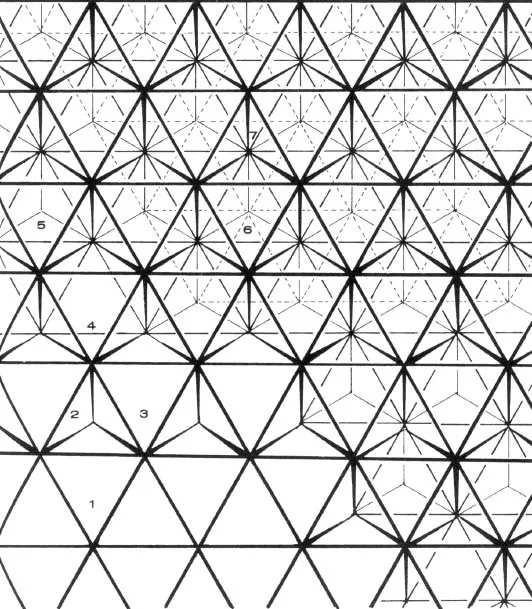
Figure 1.2: The Coordinate System of Nature, alias Octet Truss. Thickest lines are
elements nearest you and (despite effect of perspective) all members are the same
length. Start at bottom left. 1. First-level triangular grid. 2. Tetrahedra, pointing
away from you, with octahedra (3) appearing between them. 4. Second-level grid joins
tips of tetrahedra. 5. Next array of tetrahedra. 6. Dotted lines show third-level grid.
This can be continued indefinitely. Twelve-way vertices (7) in second level are centers
of vector equilibrium. (From Hugh Kenner, Bucky: a guided tour of Buckminster
Fuller, NY (Morrow) 1973. By permission of the William Hugh Kenner Estate.)
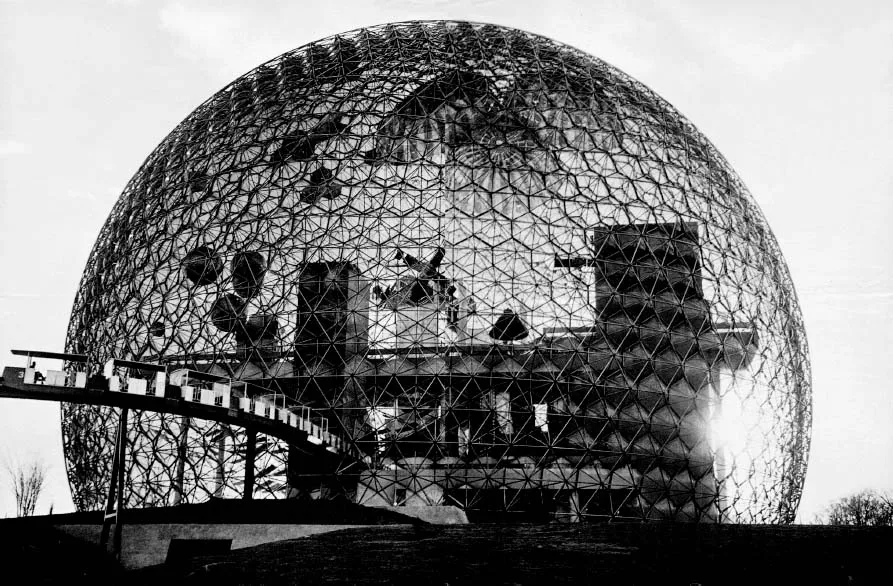
138Bucky Fuller wanted to build a Geoscope under his Montréal dome. His original plan was
rejected by the US Information Agency, the ever-smiling propaganda arm of the US
government, in favor of a display featuring gee-whiz scientific gew-gaws like a monorail
ride and a space capsule, American pop culture pin-ups like Marilyn Monroe,
and some picturesque mylar balloons and multi-coloured parachutes floating in
the dome’s upper reaches. So for reasons of its own, the US government gutted
Fuller’s dome long before fire finished the job. He was retained as architect of the
building, which amounted to little more than the shell of his original vision for Expo
‘67.
141 What then is the connection between the local roots I have been stressing and Bucky’s
global, indeed planetary, vision? There are many factors, of course—extrapolations of his
‘geometry of thinking,’ for example, as we shall see later—but I would single out one: the
sea. New Englanders have always been seafarers, and Bucky was no exception. Fuller
looked at the planet with a sailor’s eye; he always claimed that his generalized Navy
training as a midshipman in the First World War was his introduction to comprehensive,
world-around thinking. Seafaring technology inspired him by its elegant efficiency, and the
seafarer’s world-around experience lent credibility to his own planetary ‘designs.’
Landlubbers take ‘solid’ things to be real; they find comfort in national sovereignties, in
the assurances of institutionalized religion, in the reforms advocated by politicians. Fuller
knew that once you set sail, it’s just you and the elements. You leave your drawing
room theories behind, and learn to survive in the real world. You have to know
how to sail with the wind, and when to tack into the wind. You have to work
with Nature at her most elemental if you’re going to get where you want to
go.
147
The flat Earth mentality Fuller railed against is a landlocked view; order is to be found
only within lines we ourselves have drawn. Landlubbers think the sun rises and sets
upon their own fixed position. On the ocean, however, one senses the swell of the
waves, the ebb and flow of the tides, and even the curvature of the Earth. At
night, your sail slices between the sea and the Milky Way. When Fuller called
the Earth a space ship, people criticized him for comparing the planet to one
of NASA’s tin cans floating in the void. Such a view would indeed be severely
reductionist. Yet Fuller’s perspective was exactly the reverse; the Earth is the proper
model, a fully-provisioned sailing craft winging amongst the stars: we are all
astronauts.
149 It was probably no coincidence that Fuller finally became known to the world in the
mid-1960s, at the time when photos of Earth from space began to transform conventional
outlooks and even to transfer many people’s allegiances from political or religious
sovereignties to the planet as a whole. The mythologist Joseph Campbell saw in those
photos the beginnings of a planetary mythology, encompassing not only a new
environmental sensitivity, but a new spirituality as well. Of course Fuller had seen it all
already, in his own way. The first practical application of his synergetic/energetic
geometry, as it happens, was the Dymaxion Air/Ocean Map, using an icosahedral
projection to divide the Earth’s surface into twenty triangles, which could then be cut
out and laid flat in such a way that either the land masses were continuous,
and surrounded by water, or the one ocean was continuous, and surrounded by
land. Amazingly, his was the first, and so far it is the only, flat cartographic
projection in human history which does not distort the actual shape of the land
masses. Early in the 1990s, National Geographic magazine commissioned a ‘new’
world map and, ignoring Fuller completely, produced yet another variant of the
Mercator projection which not only still distorted everything at the poles, but again
centered on the North Atlantic, a purely political (one might even say colonialistic)
orientation.
150 Now besides the realistic shapes, such a map is also useful for plotting quantities—of
things, people, trees, cars, telephones, televisions, etc.—in a way that makes world-around
trends often invisible (the deforesting of the temperate zones over the past couple of
centuries, for example, or today’s rapid destruction of the rainforests) immediately evident
to anyone with eyes. Fuller’s Geoscope idea derived directly from the Dymaxion map; it
was the 3D version, and since trends over time could be modeled with a little help from
computers, it was potentially a four-dimensional, ‘virtual’ Earth. We’ve all been to
planetariums for simulated trips to the moon or the planets. Bucky wanted to build a
unique kind of ‘Whole Earth’ planetarium, if you will, which would also serve as a
comprehensive database of all human knowledge of the Earth and her resources—precisely
the sort of compendium first proposed by Bacon 400 years earlier in his New
Organon. No doubt Bucky drastically underestimated the quantities of data
involved, just as he over-estimated the computing capability of his time. Even
Japan’s Earth Simulator, the latest evolution of Fuller’s idea and the largest
supercomputer currently up and running, attempts only to handle weather simulations,
not the entire past history as well as a gamut of possible future scenarios for
‘Spaceship Earth.’ But if credit for the original idea of such a vast compilation
of Earth-data must go to Bacon, credit for reviving the idea belongs to Fuller,
with perhaps a nod of appreciation to the folks who took him up on it in the
early Whole Earth Catalogs. He reviewed the concept retrospectively in Critical
path:
152I told the United States Information Agency in 1964 that by 1967 the
regard of the rest of the world for the United States would be at its
lowest ebb in many decades—if not in the total two centuries of the
U.S.A.’s existence. Since each country’s World’s Fair exhibit would be
well published all around Earth, I felt that it would be very important
that the United States do something that would tend to regain the
spontaneous admiration and confidence of the whole world. This could
be done by inaugurating at Expo ‘67 a computerized exploration for the
most universally creative and economically sound internal and external
U.S.A. policy formulation…
153On the working assumption that humanity had established implicit
confidence in …computers and automated instrumentation, I proposed
in 1964 that the United States Expo ‘67 exhibition should have
a 400-foot-diameter 5/8 sphere building similar in shape to the
250-foot-diameter building actually built for Expo ‘67. In the basement
of this building would be housed an extraordinary computer facility.
On entering the building by thirty-six external ramps and escalators
leading in at every ten degrees of circumferential direction, the visitors
would arrive upon a great balcony reaching completely around the
building’s interior quarter-mile perimeter. The visitors would see an
excitingly detailed 100-foot-diameter world globe suspended high within
the 400-foot-diameter 5/8 sphere main building. Cities such as New
York, London, Tokyo, and Los Angeles would appear as flattened-out,
basketball-sized blotches with the tallest buildings and radio towers only
about one-sixteenth of an inch high.
154Periodically the great spherical Earth would be seen to be transforming
slowly into an icosahedron—a polyhedron with twenty (equilateral)
triangular facets…Slowly the 100-foot-diameter icosahedronal Earth’s
surface would be seen to be parting along some of its triangular edges,
as the whole surface slowly opens mechanically as a orange’s skin or an
animal’s skin might be peeled carefully in one piece…The icosahedronal
Earth’s shell thus would be seen to gradually flatten out and be lowered
to the floor of the building. The visitors would realize that they were
now looking at the whole of the Earth’s surface simultaneously without
any visible distortion of the relative size and shape of the land and sea
masses having occurred during the transformation from sphere to the
flattened-out condition we call a map. My cartographic projection of
the ‘Sky-Ocean World’ functions in just such a manner as I have now
described.
155This stretched-out, football-field-sized world map would disclose the
continents arrayed as one world-island in one world-ocean with no
breaks in the continental contours. Its scale would be 1/500,000th of
reality…When completely installed and ready for use, [the Geoscope is]
oriented so that [its] polar axes are always parallel to the real Earth’s
north-south polar axis, with the latitude and longitude of the installed
Geoscope’s zenith point always corresponding exactly with the latitude
and longitude of the critically located point on our real planet Earth at
which the Geoscope is installed. As a consequence of the polar axis and
zenith correspondences of the Geoscope mini-Earth and the real Earth,
it will be found that the miniature Earth Geoscope’s real omnidirectional
celestial-theater orientation always corresponds exactly with the real
omnidirectional celestial-theater of the real planet Earth.
156Since the two spheres (mini-Earth and real Earth) are rigidly coupled
together tangentially…the geographical-geometrical orientation attitudes
brought about by their respective axial rotations and orbital travel
around the Sun will be identical. The Geoscope has the same relationship
to the Earth as has one of the relatively small lifeboats mounted fore and
aft on the davits of an ocean cruise ship to the big ship herself. If the
big ship changes its course from north to east, the lifeboat does likewise.
If the bow rises and falls in a head-on sea, so too does the bow of the
davits-mounted lifeboat…
157The great map would be wired throughout so that mini-bulbs closely
installed all over its surface would be lighted by computer at
appropriate points to show various, accurately positioned, proportional
data regarding world conditions, events, and resources. World events
would occur and transform on this live world map’s ever-evoluting face.
If we had 100,000 light bulbs for instance, each mini-light-bulb could
represent 40,000 people…The bulbs could be computer-distributed to
represent the exact geographical distribution positioning of the people.
Military movements of a million troops would be dramatically visible.
The position of every airplane in the sky and every ship on the
world ocean would be computer-control displayed. Weekend and holiday
exoduses from cities into the country or travel to other cities would be
vividly displayed by computer-controlled tallying instruments.
Figure 1.5: Top: Dymaxion Air/Ocean Map (1954). Bottom: Dymaxion Projections
re-assembled at South Pole to show British Empire’s ‘One Ocean World’ (R. B. Fuller
and S. Sadao. Estate of R. Buckminster Fuller.)
158I proposed that on this stretched-out, reliably accurate, world map
of our Spaceship Earth a great world logistics game be played by
introducing into the computers all the known inventory and whereabouts of
the various metaphysical and physical resources of the Earth. (This
inventory, which took forty years to develop, is now housed at my
headquarters).
159We would then enter into the computer all the inventory of human trends,
known needs, and fundamental behavior characteristics.
160I proposed that individuals and teams would undertake to play the World
Game with those resources, behaviors, trends, vital needs, developmental
desirables, and regenerative inspirations. The players as individuals or teams
would each develop their own theory of how to make the total world work
successfully for all of humanity. Each individual or team would play a theory
through to the end of a predeclared program. It could be played with or
without competitors.
161The objective of the game would be to explore ways to make it
possible for anybody and everybody in the human family to enjoy the
total Earth without any human interfering with any other human
and without any human gaining advantage at the expense of
another.38
163The Geoscope was nothing less than Bucky Fuller’s vision for planet Earth in a nutshell.
But of course it was never built, never even seriously considered by the USIA—although his
proposal for a much larger Geoscope to be anchored in the East River outside the United
Nations building in New York City did receive approval—if not funding—from the
U.N.
164 What happened? Maybe certain powers didn’t want ‘‘military movements of a million
troops’’ in Vietnam to be ‘‘dramatically visible,’’ let alone the deployment of
many thousands of nuclear warheads. Indeed, with twenty-first century satellite
imaging and remote sensing power, who knows what ‘We the people’ might see
were we ever permitted a close-up look at the planet we live on? With fiber
optic cable and broadband information superhighways already available, a big,
centralized Geoscope like the one Bucky envisaged for Montréal would be only
one possible display screen, perhaps for special effects like today’s giant IMAX
cinemas. Size, as Fuller never tired of pointing out, is not a generalized principle.
He anticipated today’s rapid miniaturization of everything with his concept of
ephemeralization —‘doing more and more with less and less’—as the driving force in
technological development. Indeed, there is no technical reason why everybody’s home
computer, which currently displays planetary information from weather satellites
and the like, could not have access to long-range historical scenarios and future
projections as well. But maybe most of us are content to accept our evening news
from government, military and corporate media sources. Maybe we’re just not as
curious about the Big Picture as Bucky was, or supposed us to be. At any event,
Bucky’s Geoscope was never built. Something went wrong, something was out of
sync…
165 Bucky would have calibrated his mini-Earth so that it would be oriented in the
‘‘celestial-theater’’ on exactly the same axis as the big Earth Mother Ship but, plainly,
Fuller’s dream was no longer America’s dream.
166 I suspect that the rejection of his ambitious design for the Expo Dome did not come as
a surprise to Fuller, who always thought big and knew that only portions of his projects
would be realized in his lifetime. He had, moreover, worked for Fortune magazine in
the 1940s, and over the years hobnobbed with the likes of Henry Kaiser and
Henry Ford II. In later life Bucky claimed that in order for the ‘Great Pirates’
to pursue their multinational machinations unperturbed, the rest of us were
being kept ignorant, preoccupied by the details of our own short-term getting
and spending, and utterly unaware of any Big Picture. I had the chance to ask
him, only a month before his death in 1983, whether there really was such a
global conspiracy, or whether the sorry state of the world was simply the result of
ignorance compounded over generations. ‘‘Young man,’’ he replied, ‘‘I’ve lived on
this planet 87 years. I’ve met these people, I know how they operate. And you
better believe it’s a conspiracy.’’ I’m still not entirely comfortable with conspiracy
theories (maybe the conspirators are ignorant, too, of what really will insure their
own well-being?), but I can testify that the shock of recognizing the absolute
degradation of the American dream was not so much Fuller’s as it was that of an
entire young generation who once believed that if you found a better way to
live, or to do something, it would be welcomed and supported by the society
around them. Not a chance…just ask some of the folks who have come up with
improvements in automobile manufacture what Detroit has done with their ideas. In
Vietnam, young Americans learned they were the bad guys. On the home front,
they soon discovered they were the enemy. And when the system forces you to
fight merely to save your own skin, the Big Picture does tend to fade into the
background.
167 In the description of the Geoscope above, you might have noticed that Fuller draws an
analogy between his project and a lifeboat. He was well aware that the big ship is sinking,
at least if present trends prevail. Typically unconcerned about aesthetics, however, he did
not remark that the ‘‘ever-evoluting face’’ of such a globe, mirroring the Earth’s
constantly changing contours with the resolution of a high definition television
screen, might quite possibly have been the most beautiful man-made object on the
planet.
168 Yet during those heady years of the 1960s and 1970s, there were still plenty of young
people who wanted to play Bucky’s World Game rather than war games—with or without a
Geoscope in Montréal. After all, the Leakeys, reviewing the evidence on human origins
they found at Olduvai gorge, had put forward the thesis that we humans became who we
are because we learned how to cooperate and share food in interdependent communities.
The dream of Emerson and the Shakers, not to mention the political innovations of the
Iroquois Confederacy, now had a firm anthropological basis and, seemingly, a global
arena.
169 Perhaps we have to step back to see such dreams clearly. Since the rise of Laissez-faire
capitalism and the so-called Manchester School of economics with its ‘free’ market and
‘invisible hand’ in the early decades of the nineteenth century, there have been a range of
vigorous alternatives to it—some religious, some secular, some vaguely socialist,
some stringently Marxist, some tribal, some familial, some simply neighborly
and communitarian. Taken together these trace a coherent alternative stream of
thought about the foundations of human community. Bucky Fuller’s thinking
sails along with this current, even today driven underground by the prevailing
mercantile propaganda. The New England Transcendentalists would be an early
American example, interacting with, critiquing and reflecting on, various other such
American experiments in community like Brook Farm or the Shakers. John Dewey’s
pragmatism, with its emphasis on consensus, sociability and cooperation rather than
competitive individualism, would be another example of the continuing vitality
of this alternative American dream. In England, John Ruskin’s ‘‘law of help’’
would be the high water mark of the mid-nineteenth century, his response to
what he called ‘‘the law of force,’’ and the ‘‘illth’’ (assuredly not wealth) of the
marketplace.39
The same stream of thought enters the twentieth-century well defended by Pietr
Kropotkin’s Mutual Aid, a counterblast to Thomas Huxley’s attempt to assert the imperial
English designs and dominion of Social Darwinist values in the global marketplace of his
day.
171
Half a century later, we find Bucky attempting to re-order the world into a series of
interlocking service industries which would ‘‘take care of everybody’’ at a very high,
technologically-enhanced standard of living. The Geoscope was to be a step in this
direction: you have to know where in the world things are, and who needs precisely which
things, in order to get them from here to there. In the 1980s and 1990s, Medard Gabel and
others from Bucky’s Philadelphia office were quick to put Fuller’s inventory of ‘‘human
trends, known needs, and fundamental behavior characteristics’’ onto a Hypercard
program, in which form it was made available as ‘‘Global Recall’’ and ‘‘Global Data
Manager’’ (you have my permission to cringe at the latter name). They were presumably
anticipating the sort of decentralized home computer version of the Geoscope
mentioned earlier, although they seemed to be a good deal more thorough at
inventorying the physical resources than the metaphysical. Stewart Brand and his
San Francisco Bay Area Whole Earth Catalog cohort of hip capitalists also got
going with these ideas of Fuller’s in the late 1960s, providing mail order ‘access
to tools’ for anybody, anywhere, to build an alternative lifestyle to their own
design—and they did include at least as much philosophy as physics. But by the
time it was published by Random House as a gigantic bestseller, I suspect the
final Whole Earth Catalog (1985) was less often used as intended, and more
often as a kind of icon that sat unopened upon coffee tables or bookshelves. You
had to have it, but you didn’t really have to do anything with it. Nowadays
that entire operation goes on as the Whole Earth Review, and is available in
the software world for electronic cottages everywhere as WELL (Whole Earth
‘Lectronic Link), a pay site that is now part of salon.com (major credit cards
accepted).
172 As a matter of fact, I first encountered Fuller as a kind of intellectual curiosity in the
pages of Norman Cousins’ Saturday Review during the mid-1960s, but did not really catch
his drift until the late 1960s, when everything seemed to be drifting his way. At the
University of California, Santa Cruz, where I spent my undergraduate years, Fuller was
one of the elements in a complex and exhilarating mix of new ideas with which we were
going to save the world.
173 If Berkeley was political and controversial, Santa Cruz in the late 1960s was much
quieter, more mystical and mythopoetic. There were about three million redwood trees on
the often fog-shrouded campus, which helped give the place a mossy, timeless air. The
university itself was a ‘devolution’ of the vast UC multiversity into something
resembling the Oxford system of small colleges with the resources of a large
university, where you got to know renowned professors on a first-name basis.
Fuller’s domes were going up on one side of my college—that would solve the
world’s housing shortage, eh?—while up the hill, thanks to the good offices of
Paul Lee (a.k.a. the Herbal Trading Company), Alan Chadwick and his disciple
Jon Jeavons were hard at work putting in the first French Intensive garden to
demonstrate the biodynamic agriculture that would feed everybody. ‘‘Our job is to
MAGNIFY life,’’ boomed Chadwick in his stentorian English stage voice, and
he would plant by the light of the full moon. (Nowadays his method is hailed
by the UN as the most effective, and least intrusive, kind of food production
‘development.’)40
There were impromptu seminars on Fuller every week, led by avid students who later
formed the Cathedralite build-your-own-dome kit company.
175
While I’m on this personal note, I might add something about the festive atmosphere—just
in case you missed that party. There was always music in the air in those days, from
visiting musicians like Ali Akbar Khan or Joan Baez or Keith Jarrett, who had just gone
back to his acoustic piano—‘‘Electricity is in everything’’—or from students with
talents not in the least hidden by their long hair and beards, or simply Jefferson
Airplane or good ol’ Grateful Dead on somebody’s stereo. What was going on in
Northern California at the time may well have been the last renaissance of the
original American dream, although perhaps only historian Page Smith (heading up
Cowell College) saw that aspect clearly through all the psychedelic pageantry.
Norman O. Brown might be found by night leading Dionysiac revels through the
redwoods (or maybe he was just tagging along, on the track of ‘‘Love’s Body’’?),
whilst philosopher Albert Hofstadter wandered solitary by day through the same
forests, no doubt mulling over his luminous English translations of Heidegger’s
‘‘Poetically Man Dwells …’’ And those were just some of our own faculty; the
entire 1960s’ carnival of wonders came trooping through Santa Cruz, at one
time or another. And, in so many words, some of us adopted Bucky. He plainly
belonged in the company of those who were going to steer this crazy world back on
course. Bucky himself was caught up in this vortex of energy and insight; he
knew how to sail with the wind at his back. He came to California often, saying
things like, ‘‘We can do it. We can make it work. It’s now or never, utopia or
oblivion.’’ And we young folks listened, enthralled at his three-hour ‘‘thinking aloud’’
monologues, inspired by his mind-bending geometry, astonished at his architectural
sleights-of-hand.
176 As I wrote the foregoing paragraph, it struck me that all of that came to pass barely a
third of a century ago. The pattern held, indeed, for quite a while. As far as I was
concerned, the party in California went on a good nine years at least, from about 1967 to
1976. But then it seemed to vanish…into tough economic times, New Age hucksterism,
political cynicism, yuppies, etc. Or else it splintered into factions: women against men, the
Weather Underground versus the New Right, gays against straights, environmentalists
versus developers, etc.
177 And yet in a sense, it is not lost. As Fuller’s geometry demonstrates, you miss a lot if
you look only at the surfaces. Much of what I have described took place during
the dog days of the Vietnam war when Ronald Reagan was playing the role
of Governor of California. Soon enough, a grateful nation hired the same bad
actor to play President for eight years, all the while supposing they were about
to recapture the germinal impulse of the lost American dream. Instead, what
they got was a re-run of the values of the 1950s: unregulated ‘free’ enterprise,
fundamentalist Christianity, the patriarchal family, back-to-basics schooling,
jingoistic patriotism, etc., all gussied up for the media in pretty ‘photo opportunity’
packages.
180
Yet even in the Reagan era, some incongruities could never quite be suppressed between
the ideological ‘image’ of flag-waving Americanism, and the ‘ghost’ of the original vision.
Picture if you will that supremely ironic moment of bland Reagan-esque incomprehension
as he awarded the Medal of Freedom, the highest honor the US government can bestow, to
R. Buckminster Fuller—a man who had just had the temerity to suggest to the US Senate
that, since national sovereignty was patently obsolete, the United States really ought to set
a good example to the rest of the world by desovereigntizing immediately. (A
resurgence of the manitou of the Iroquois Confederacy? Bucky thought it was his own
idea.)
181 For twenty years, Fuller had been advocating a global, push-button democracy which
would give everybody on the planet an up-to-the-minute vote on all the issues of the
day. We now take electronic polls at the drop of a hat; why not make these the
government, asked Bucky, and reinstitute direct democracy rather than the so-called
‘representative’ democracy subject to all the abuses we all know all too well?
Government by the people, indeed, by all the people on the planet; that was Fuller’s
version, or vision, of the global village. Electronic world democracy may be seen
as an extension of Fuller’s early perception of ‘Continuous Man,’ the band of
waking consciousness—two-thirds of humanity awake and thinking at any given
moment—which circulates, almost unnoticed, around the globe every day. He was
always looking for ways to tune in this critical band of wakefulness, which he
considered among the most important of the Earth’s planetary rhythms. The diurnal
oscillations of mindfulness—a feature of the noosphere, in Teilhard de Chardin’s
phrase—would of course have been dramatically evident on an electronic Geoscope,
marked by the wide band of sunlight rippling East to West over its seas and
continents.
184 All
these spin-offs and undercurrents (and even the distortions) indicate something crucial to
Fuller’s vision: In our synergetic universe, entropy is only apparent. A local system loses
energy, granted; things run down and wear out over time. Yet the energy is never
irretrievably lost. In the totality of universe, it is eventually harvested and taken up into
other systems. Life is anti-entropic. A living pattern—a weather front, a microbe or a
mouse, a fern frond, you or me—holds its shape for a time, then disintegrates. We say it
‘dies.’ But Life goes on.
185 Did the original American dream really die? And did Fuller’s vision, for that matter,
die with him?
186 In many respects, the American dream we hear about these days has become a
nightmarish orgy of greed and a moral lesson in the abuse of power. Instead of vision, we
have willful mass blindness. Instead of ‘livingry,’ we have homelessness and ever more
weaponry. Certainly Fuller’s vision, too, splintered after his death. Various disciples like J.
Baldwin, Medard Gabel and Amy Edmonson, or collaborators like Shoji Sadao, Ed
Applewhite and Kiyoshi Kuromiya kept parts of it alive. But shortly before Fuller’s
death, he was introduced to Werner Erhardt, the infamous founder of Erhard
Seminars Training, or est. So now you can find bits of Bucky’s dream marketed
like components of any other ‘leadership training course,’ a New Age version of
the now thoroughly debased American dream: success at any cost. Yet Fuller
himself claimed he never set out to change people’s minds. If he changed the
environment by making better artifacts, he supposed, people would just naturally be
sensible enough to make up their minds for themselves (and agree with him,
presumably). Maybe some of the people, some of the time, but not everybody all at
once, and not quickly enough to suit some entrepreneurs of marketable New Age
ideas.
187 So all is not roses, not all of the time, for either the American dream or genuine
American dreamers like Bucky Fuller. But all is not thorns, either. Maybe that’s what the
victory of synergy over entropy really means. A synergy is a whole system, a
pattern integrity not comprehensible from a single point of view. The various
manifestations of the original American dream we excavated earlier were themselves
synergies, integral patterns, knots in complex social, philosophical, environmental
and religious nets. Such patterns hold together, sometimes for centuries (when
the ‘self-reliant’ Emerson’s house burned down in 1872, his neighbors took up a
collection and rebuilt it), then pass away like waves on the sea of time. Fuller
describes synergy as one member of a ‘‘family of interaccommodative generalized
principles’’ (leverage, for instance, or the inescapable co-existence of tension and
compression), a ‘family’ which functions somewhat like the kinship system of the Iroquois
Confederacy—each principle distinct, none interfering with the operations of any other:
‘‘The wellspring of reality is the family of weightless generalized principles.’’ In such
a ‘family,’ each principle implies all the others. The synergy of synergies, the
whole concatenation of principles, Fuller called Nature, or in more rapturous
moments, Universe: ‘‘the aggregate of all humanity’s consciously apprehended and
communicated…experiences.’’43
And Universe abides. It accommodates the rising and falling, the living and dying, the
emerging and passing of creatures like us with immense equanimity. ‘‘That Universe
tolerates our protracted nonsense,’’ Fuller once wryly observed, ‘‘suggests significant
unrealized potentials.’’
189 To
return to the Montréal Expo Dome, there is surely no reason why Fuller’s own artifacts
should be exempt from this dynamic interplay of entropy and syntropy. What appears to
be entropy, the dissipation of energy from a local system, must be taken up somewhere,
into some other integral pattern. At least Bucky himself would see it so. And now that
time, fire, ice and wind have ripped through its very fabric, where did the energy—or,
indeed, the integrity—of that vast structure go? Parts have been rebuilt, and the shell
repainted. Bits of the whole structure fell back as ash into the native American soil and
landforms, but other parts—above all, the intact skeleton of the whole —can still
touch the eyes and minds and hearts of all who lay eyes upon it. In a sense, that
energy has gone into you and me, as well as into Robert Duchesnay’s starkly
enigmatic photographs. Both Harry Kroto and Richard Smalley, joint discoverers of
Buckminsterfullerene, had visited the Montréal Dome during its Expo heyday, and
Kroto had built a geodesic playdome for his kids. The two say they hit upon the
soccer-ball structure of ‘Buckyballs’ by recalling Fuller’s domes, which show
plainly that in order to bend the surface of a flat hexagonal matrix all the way
round into a sphere, you have to take out ten (36°) pentagonal tucks. Bucky had
solved their problem, years before it arose, and they honored him by naming
the new molecule after him. But this is only a single instance. Surely Bucky’s
shapes have inspired plenty of other people as well, in many and even more subtle
ways.
191 For decades, Bucky’s domes seemed to be ‘the shape of things to come.’ They were
even used in the color sequel to the H. G. Wells’ film of that name, as well in other sci-fi
films like Silent Running to symbolize the farthest reaches of human dwelling. Once upon
a time, the first Sumerian and Egyptian attempts at civilization tried pyramidal and
hierarchical forms—not only for their monumental architecture, but for the organization of
their totalitarian societies. In our own day, we’ve tried square and cubical and gridiron
forms, and a more egalitarian society mirrored these shapes. For nearly a century, the
machine age gave us merely the vertical projection of these forms, pulled up into the
skyscraper and the new corporate and bureaucratic hierarchies these shapes tend to
accommodate. Bucky wanted to take the industrial tooling of architecture a step
further, to give us a spherical or at least hemispherical model for building, and
perhaps also a more well-rounded notion of human dwelling within the living
biosphere.
192 In a sense, all knowledge is local, and partial—bound by language, culture,
tradition and landforms. Bucky might be reluctant to admit it, but his own grand,
globe-girdling schemes had detectable New England roots. Yet every local truth is equally
bound to the whole Earth, and every partial discovery seeks the widest possible
stage upon which to play its part. Fuller never consciously constructed his domes
to fit into their particular settings the way Frank Lloyd Wright designed his
houses. (In the year 2000, Wright’s beautiful ‘Falling Water’ home was found to be
leaking and falling down; more attention to structure might have headed off
the seven-million-dollar restoration effort.) Geodesic domes, by contrast, were
usually designed in the abstract, with more respect for sheer principle than for
setting.
193 It is therefore more than a little uncanny to travel through Asheville, North Carolina,
where Bucky built the first geodesic domes at Black Mountain College in the late 1940s,
and discover a place where domes actually look like the landforms—or rather vice-versa.
Asheville straddles the juncture of the Blue Mountains and the Great Smokeys. This is
Cherokee country, the old arch-rivals of the Iroquois Confederacy. And here, wherever you
turn, you find little dome-like hills above you and below you, the result of the two rippling
mountain chains merging in steep little troughs and weathered crests. Here, oddly enough
at their very birthplace, Bucky’s round houses would seem to leap right out of the
surrounding landscape as the most obvious and adaptive human variation on a natural
theme.
194 The strong spirit of place notwithstanding, there are no domes remaining here, no
artifacts at all from those first experiments in geodesics. When I visited, the site of Black
Mountain College had become a conventional boy’s school. Yet it was for a few memorable
years one of the most remarkable American efforts to create a free-form open
university. During the late 1940s and early 1950s it was presided over by the titanic
Charles Olson, with occasional faculty like Fuller, Marshall McLuhan, Norman O.
Brown, ‘musician’ John Cage, filmmaker Arthur Penn, or choreographer Merce
Cunningham, and attended mostly by unconventional, creative types like poets Robert
Creely, Denise Levertov and Robert Duncan. Years on, one could still feel the
reverberations of that experiment in the hopes and dreams of faculty members
who eventually tried to recreate the Black Mountain experience at places like
UC Santa Cruz, or more recently Naropa in Colorado. Something similar may
be said of Fuller’s domes. Not a trace left at the site of their origin, not even
a commemorative plaque (in a town which has fastidiously preserved novelist
Thomas Wolfe’s house as a civic shrine), and yet powerful seeds were flung from
this place, and proved so hardy that by now over 350,000 geodesic domes (if
you count playdomes) have sprouted up, a sprinkling on every continent—even
Antarctica.
195 Physical structures deteriorate over time, it is true. Entropy rules the physical. Yet
synergy, as Fuller saw it, is patterned integrity—timeless, weightless, indestructible: ‘‘We
are now synergetically forced to conclude that all phenomena are metaphysical; wherefore,
as many have long suspected—like it or not—life is but a dream.’’
196 In so many words, integrity, and maybe only integrity, endures the bite of time. Once
again, it is a matter of principle.
197 I suspect Bucky Fuller himself would not be overly exercised about his own ‘legacy.’ He
would, however, be intensely interested to see whether the human race manages to survive
the twenty-first century:
200Though humans are born equipped To participate In the supreme function of Universe, This does not guarantee That they will do so. … They must first discover the overwhelmingly superior efficacy Of mind, as compared to muscle. And humans also must discover That the physical, Which they tend to prize as seemingly vital, Is utterly subordinate To the omni-integrity of metaphysical laws Which are discoverable only by mind. … Only if man learns in time To accredit the weightless thinking Over the physical values, In a realistic, economic and philosophical accounting Of all his affairs, Will the particular team of humans Now aboard planet Earth Survive to perform their function.44