Introduction
An Imaginary Symposium
4It would be easy to make R. Buckminster Fuller an early apostle of globalization. Indeed, his cherished word ‘synergy’ has lately been so successfully co-opted by financiers and corporations to rationalize so many callous strategies for global profiteering that it may well qualify as one of the most abused words of the late twentieth century. But I am going to take another tack. The 1999 ‘Battle of Seattle’ WTO protest as well as the more recent Washington D.C., Prague, Genoa, Barcelona and Cancun protests against the G8, the World Bank and the IMF, show us that stark battle lines between globalism and local values of all sorts—economic, ecological, civic, cultural, and religious values—have already been drawn in our midst. With the fighting factions forming, on which side of the police line would Bucky Fuller stand today? The short answer is that he would not approve of the way ‘globalization’ is going today, any more than he sanctioned corporate greed in his lifetime.
5 By the same token, it would be entirely straightforward to treat Fuller as a prophet of technological development, or at least as a prodigious inventor of artifacts, and to turn this book into yet another catalogue of his marvelous technological innovations—the geodesic dome, the Dymaxion ‘Omni-Medium Transport,’ the self-contained bathroom, and so on. To ignore cultural context, to assume that technical facts lie somehow outside the bounds of cultural critique, is a common American blind-spot. Yet no technology is neutral. Each new technology is already inflected in a myriad of ways by the culture which conceives it, and in turn may drastically alter all the variables of the delicate balancing act between nature and culture. Fuller knew this and, in fact, designed his inventions with the specific aim of bringing about far-reaching cultural transformations.
6 In other words, there are plenty of one-sided ways and partial perspectives with which to treat Fuller—inadequately. What then would be an adequate approach, a holistic approach, to a man who espoused ‘‘the exploratory strategy of starting with the whole’’?
7 Imagine the ideal symposium on Buckminster Fuller. You would need a biographer to fill in some of the details of his busy life; a historian to ‘place’ him in his American context; an architect or structural engineer to explicate the principles with which he built things; a non-dogmatic mathematician to outline his synergetic geometry; a philosopher to examine the assumptions of his often unsettling pronouncements; a theologian, perhaps, to recognize the persistent threads of spirituality running through his work; a social critic to weigh his claims that Western society has organized itself on specious premises; a poet or literary critic to do justice to the images he presents in his ‘‘mental mouthfuls’’; and maybe an artist or computer animator to render it all accessible in engaging diagrams.
8 Nobody can be all of these things, and yet each of us must perforce respond to Bucky Fuller in multiplex ways. Just as no single perspective will adequately render one of his geometric figures, Fuller resists being ‘reduced’ to only one or two of his many facets. You may consider this book to be something like the ‘proceedings’ of such an imaginary symposium. I have tried to present here multiple perspectives, and at least to sketch out the various domains in which Fuller’s multifarious thought and work are pertinent. There are bound to be clashes between such diverse views of Fuller, which cannot just be papered over for consistency’s sake. Both technophiles and technophobes, for instance, have long squabbled over the meaning of Bucky’s legacy, and a single book is unlikely to resolve their dispute—though it might hope to deepen both perspectives, so that the argument begins to turn into a dialogue. But knowledge is always personal knowledge, as Michael Polanyi used to insist. My approach to Bucky will, therefore, reflects my own interests, too, my own peripatetic readings, and the particular Fuller constructions I have personally had a chance to visit.
9 Indeed, this book represents for me a kind of intellectual odyssey, a return to meaningful origins. It started out as an attempt to assess the legacy of Buckminster Fuller, scientist-artist-engineer extraordinaire. It passed through a series of discoveries about the original American dream informing Fuller’s vision, which I hold to be an ethic of cooperation, not competition. Naturally enough, my family’s move in 1993 from North America to New Zealand prompted me to re-examine just which dimensions of the American dream were specific to the place, and which were portable. The whole project ended up, a little surprisingly, in what I can only call a rediscovery of the world soul, the ‘omnitriangulated’ structure of a living Universe in Fuller’s work, which I believe revives the anima mundi beloved of the ancients. If you want to save the world, it seems clear to me now; you first have to save her soul…
10 In other words, my approach, like anybody else’s, is bound to be idiosyncratic. To claim ‘objectivity’ in such a study would be obtuse and misleading, just as Bucky Fuller’s science was creative and individualistic in the extreme, and would not fare well in today’s climate of ‘team science’ in thrall to big research grants from governments and transnational corporations. Bucky went his own way, and discovered things which a more conventional methodology would not have permitted him to find. Practically the last words of the last lecture I heard him deliver were to follow your own sense of what is true, and allow yourself to be corrected by the Universe. I have tried to adopt at least that much of his method.
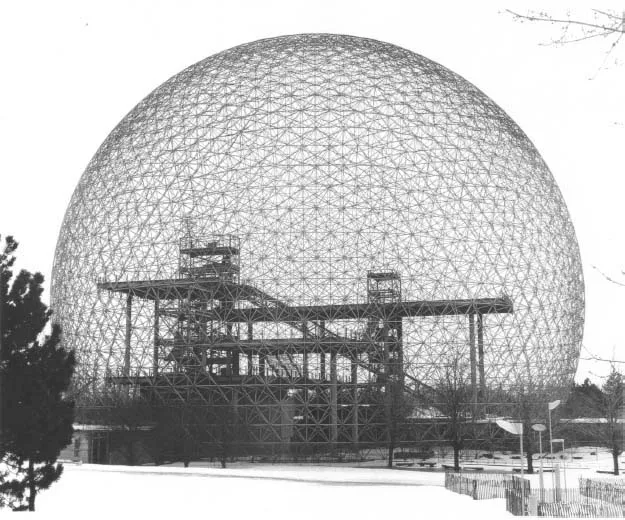
11 American Dreamer does not, therefore, always follow a strictly linear scheme of exposition, but often takes a circular or even spiralling path. Beginning in the ruins of the Montréal Expo Dome, Bucky’s ‘Taj Mahal’ and a center of gravity for this book, various lenses for focusing facets of Fuller’s work radiate outward in ever-widening arcs—first into the New England region and the ‘spirit of place’ to be found there; next examining the vicissitudes of the American dream at large; then using the full range of Fuller’s artifacts to raise questions of technology and human values which eventually span the globe; and finally landing back in the moral and spiritual climate of New England. These concentric probes of context open out in time as well; like deep sea soundings, they are attempts to fathom the various pasts and futures which inform our ever precarious present.
12 I make no apologies for ‘lateral’ thinking. If the book works at all, it will cohere in a non-linear way, like the tensional great circle continuities which hold together the figures of Bucky’s synergetic geometry. The various intersecting themes will appear to slice cleanly into one another, sometimes at abrupt and unexpected angles. This is my intention, a kind of structural homage to Fuller. These underlying continuities seem to me a crucial dimension of his legacy. I can, for instance, never long ignore the voice of Ralph Waldo Emerson as at least one of Fuller’s intellectual progenitors—‘‘The mind of Emerson,’’ asserts Harold Bloom, a little imperiously, ‘‘is the mind of America’’—but I can also hear echoes from the Native American context, and register even more distant reverberations in both the iconographies and the languages of the Indo-European heritage.
13 This raises another way to look at this book: It is a conversation with ghosts. As a Californian visiting New England in search of Fuller’s roots, I found myself in another country. California may not be ‘Ecotopia,’ but it is also surely not the old homestead of early Americana. New England felt to me a little like time travel: Emerson, the Shakers, the pilgrims and American founding fathers, as well as the ghostly voices that first called together the Iroquois Confederacy—all came alive for me, and spoke to me of another dream behind today’s highly touted American dream of material success. They still do, and their persistent presence underscores the strange fate of that original American dream.
14 The writing of this book was catalyzed not only by Fuller’s 1995 Centennial, which ironically coincided with that of his arch-critic Lewis Mumford, but also by Robert Duchesnay’s painstaking efforts to photographically document the remains of Fuller’s large constructions. What I see in the arresting Duchesnay photographs—beautiful structures often falling to bits—is mainly the interplay of syntropy and entropy. In closed systems, entropy is the tendency of things to lose energy and fall apart. Syntropy, by contrast, is Fuller’s word for the cohering forces that hold things together in an open, dynamic universe of living energies. In the physical world, entropy affects everything—including Fuller’s Expo dome, which I first visited in ruins in 1987. In Fuller’s universe, though, the integrative (syntropic) forces are stronger than entropy. He claims the integrity of life survives the all-too-evident powers of decay and disintegration. I wanted to see if he was right, so I looked to his own ideas and structures to see how they had weathered the ravages of time.
15 Thanks to the good offices of his collaborator Ed Applewhite, I was fortunate enough to spend several hours of bracing conversation with Fuller towards the end of his life. I also had the chance to correspond at some length with Lewis Mumford. Long after their passing, their voices continued vigorously to dispute one another—point, counterpoint; endless, insistent echoes—in my head. I knew of their deaths, of course, but it was only in the writing of this book that I came to appreciate the vitality of their ‘ghosts’: strong, clear voices importuning me, on either hand, sometimes seeming to speak right past me to one another. So one purpose of this book is not so much to lay those ghosts to rest, as to pass on to the reader some hints of their animated conversation about the meaning and ends of human life in a technological society.
16 Finally, a word about the long Appendix/Workbook entitled ‘‘Unfolding Wholes.’’ Stanley Cavell maintains that Ralph Waldo Emerson was the first to discover America in thought. Much the same might be said for Bucky Fuller discovering how to think about planet Earth. His Synergetics is subtitled ‘‘Explorations in the Geometry of Thinking.’’ Yet although his thinking presents itself in scientific terms, Fuller did not turn his insights over to peer-reviewed journals for acceptance by the mainstream scientific community. That (partial) acceptance has come instead through quite unexpected applications of his thinking—Buckyballs (Carbon60) would be the most famous instance, or his seemingly far-out ‘Polynesian Genesis’ hypothesis which acquired a measure of plausibility when paleo-anthropologists discovered Homo erectus remains more than 1.5 million years old in Indonesia. But Bucky’s ‘method’ was simply to rely on his own experience, and to ask his audiences to do likewise. Whenever he visited a college or university in the 1960s, the students started building geodesic domes with him; the ‘proof’ was in the ‘putting’ of the principles to work. My aim here is more modest, namely to provide the reader with specifications for seven Fuller figures, which may be constructed with ordinary household materials. If you want a demonstration of Fuller’s principles, so that you may see for yourself whether they work as he says they do, then these ‘local globes’ will serve you well. Before his death, Fuller was kind enough to grant permission to reproduce specifications for these figures from Synergetics.
17 Because there is always more to be said, the best introduction to this book was probably penned long ago by Emerson in the opening lines of his ‘‘Circles,’’ a passage often taken to be the purest statement of American transcendentalism:
1920The eye is the first circle; the horizon which it forms is the second; and throughout nature this primary figure is repeated without end. It is the highest emblem in the cipher of the world. St. Augustine described the nature of God as a circle whose centre was everywhere, and its circumference nowhere.1 We are all our lifetime reading the copious sense of this first of forms…Our life is an apprenticeship to the truth, that around every circle another can be drawn; that there is no end in nature, but every end is a beginning; that there is always another dawn risen on mid-noon, and under every deep a lower deep opens.2
24 SE