
Chapter 2
Refractions
2.1 Dwelling Machine
2Toward the close of Robert Snyder’s film, The World of Buckminster Fuller (1971), Bucky puts his vision for technologically enhanced human dwelling into a single telling image. He has been enthusiastically describing NASA’s ‘black box,’ a self-contained human sustenance kit (including food, water, electricity, plumbing, etc.; all the comforts of home) for life in outer space. Although it might initially cost $20 billion in prototype, Fuller foresees it as eventually a $1,000/500lb. package no bigger than ‘‘a good-sized suitcase’’ for setting up a house here on Earth. Add to this a ‘‘geodesic space umbrella,’’ and humankind might well enter a new age of living lightly upon the Earth:
45You have in effect the man with his umbrella and his briefcase able to go anywhere in Universe—pick a beautiful spot!—and live at a very high standard of living.
6 I’d like to linger with this image because I suspect it lies behind many of Fuller’s artifacts and inventions, and may provide us with a kind of golden thread running from the beginning of his career as a builder to his later years as world-around ‘comprehensive anticipatory designer.’ What does the image include? A lone man (is that sexist?), with briefcase and umbrella (Bucky on his way to a lecture?), able to pitch his geodesic tent wherever and whenever he likes. Forget the inessentials—that the briefcase weighs a quarter ton, that the umbrella is a geodesic canopy 30–40 feet in diameter. Forget the fact that NASA’s spin-off contributions to ‘livingry’ here on Earth so far have tended to range from the trivial to the ridiculous (dustbusters, ingestible toothpaste, battery-operated gloves and boots, invisible braces, liquid-cooled garments, rechargeable electric footwear, self-adjusting sunglasses, sports bras and therapeutic scalp coolers, for instance). Stick with the image, a futuristic idea attired in curiously antique apparel; all that’s missing is a bowler hat equipped with an inverted satellite dish. In some respects it is an undeniably exhilarating image—mainly for the absolute autonomy it promises, a freedom not only to move but to live wherever and however you like. Given that the ‘black box’ would presumably include a version of the self-contained ‘Dymaxion Bathroom’ Fuller invented in the 1930s, one is even encouraged to contemplate liberating one’s bowels from the coils of a central plumbing and water system. ‘Dymaxion,’ by the way, was Fuller’s trademark back in the 1930s and 1940s, coined by a publicist from bits of words he picked out of Fuller’s idiosyncratic vocabulary, presumably combining ‘maximum’ (efficiency?) and ‘dynamic’ (systems?) with a strand of ‘tension.’
7 But back to our image, we have also to ask: what is missing from this picture? Most obviously, there is no community here, not even any family. And surely more questions are raised than answered about land, property, ownership, etc. Above all, as native peoples would be quick to point out, there are no roots to this kind of dwelling, no permanence envisioned and no stewardship of the land implied. This deracination is a refractory issue we shall have to attend to a bit further on.
8 For now, it may suffice simply to outline some of the steps by which Bucky worked his way through customary building practices, conceptual blocks, and recalcitrant materials over the course of half a century to realize this ideal of the man with dwelling-kit briefcase and geodesic umbrella, free to set forth and settle down wherever in the wide world he chooses to be.
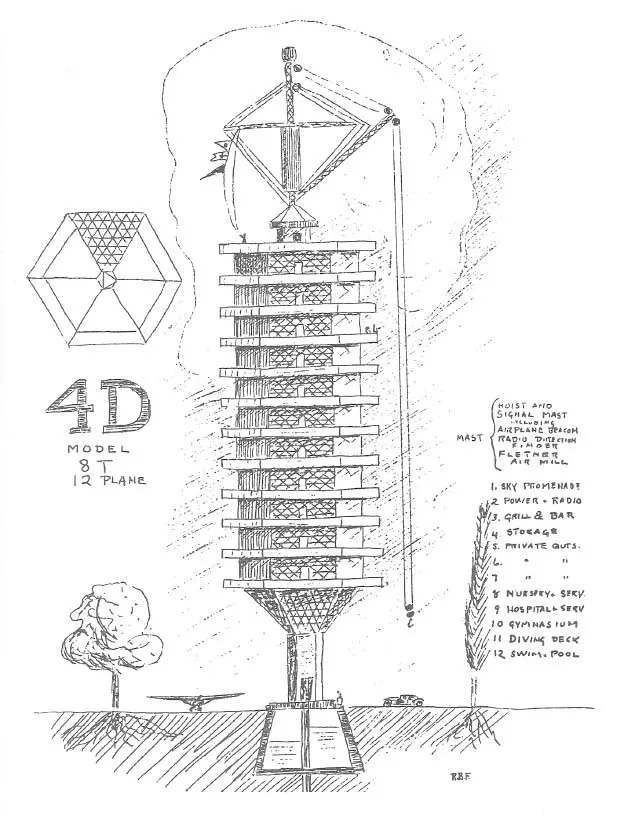
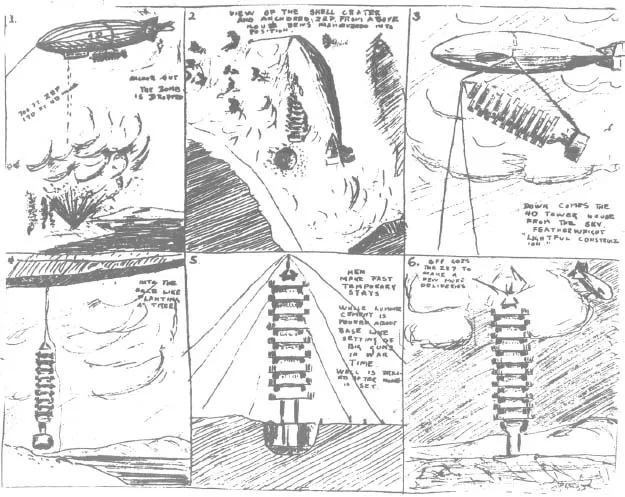
9 It began after he had spent much of the 1920s refining his father-in-law’s patents on the Stockade bricks structural system, which incidentally became the basis for building with acoustical wall and ceiling materials. In 1927, Charles Lindbergh had only just flown the Spirit of St. Louis non-stop from New York to Paris in 33.5 hours, but Fuller was already thinking about great-circle polar routes (five years before anybody else mapped them) and designing multiple-deck tower apartments, with expanded wire-wheel construction. These were to be flown to the North Pole by Zeppelin and erected in a single day. He called them ‘‘stepping stone, world airline maintenance crew environment controls,’’ anticipating a ‘‘one-town world.’’
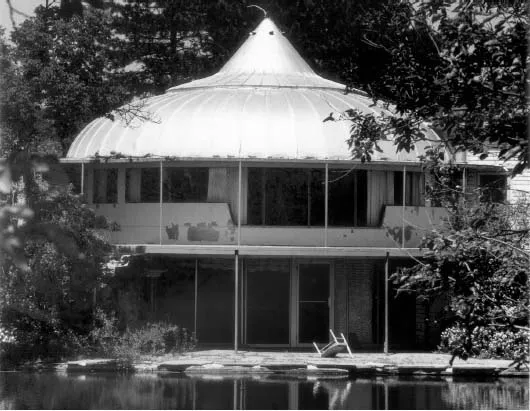
10 Although never built, these so-called ‘‘4D multi-storey dwelling units’’ were the prototypes for the Dymaxion Dwelling Machine, the only complete houses Fuller did actually build. At the time, according to Bucky and Robert Marks in The Dymaxion world of Buckminster Fuller, he listed the advantages of his ‘‘multi-storey units’’ as:
1213Completely independent power, light, heat, sewage disposal; 12 decks average 675 sq. ft. each; all high in air—above dust area, etc.; all furniture built in; swimming pool, gymnasium, infirmary, etc.; as free of land as a boat; time to erect—1 day; fireproof.45
15 These he compared with the limitations of the conventional house—
1718[a] tailor-made archaic contraption with little or no sunlight; jiggle and she’ll bust; tied down to a city sewerage system, the coal or oil company —the utility; six rooms average 225 sq.ft. each; down on the ground, subject to dust, flood, vermin, marauders; no pool, etc.; no structural improvement in 5,000 years—if anything, retrogression; time to erect —6 months; not fireproof46
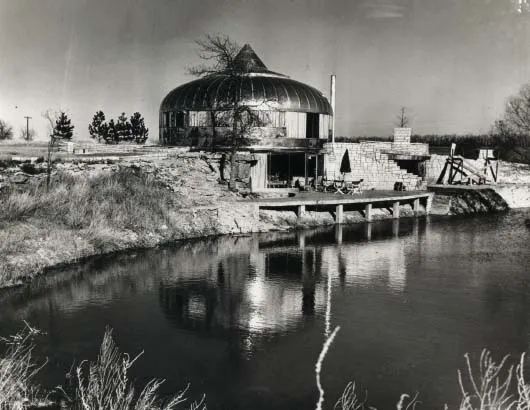
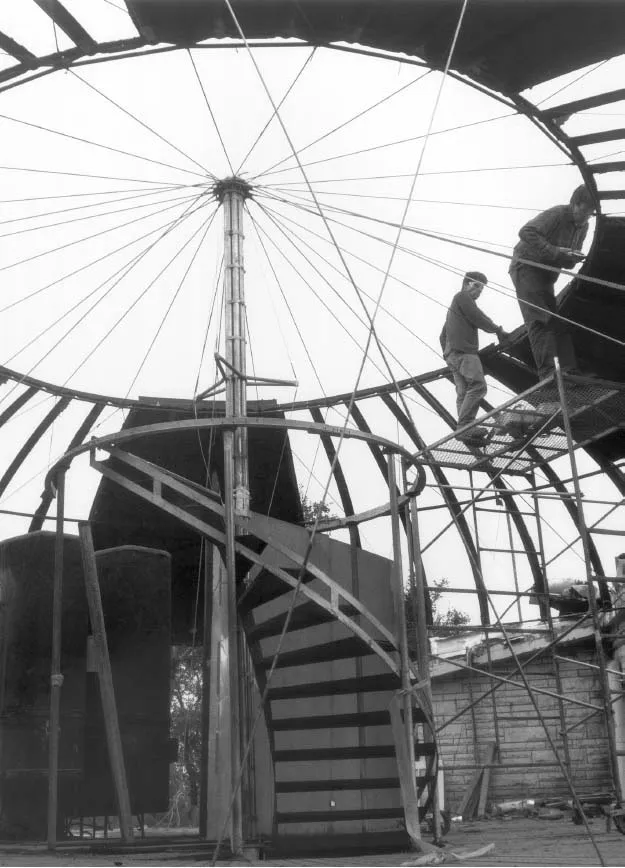
20 It took another 18 years, and the resources of the Beech Aircraft Corporation —which Fuller wanted to see retooled from wartime production to ‘livingry’ —to build a pair of prototypes for the scaled-down single-family aluminum-shelled Dymaxion House in 1946, but the industry Fuller envisaged never materialized. Big-hearted as ever, Bucky offered his patents on the 4D house gratis to the American Institute of Architects. They huffed and they puffed and they passed a resolution putting the idea down: ‘‘The American Institute of Architects is opposed to any kind of house designs that are manufactured like-as-peas-in-a-pod.’’ Never mind, as Hugh Kenner notes in relating the anecdote, that peas in a pod are a marvel of design engineering. Mass-produced houses were supposedly unthinkable, and maybe Fuller’s generosity in just giving his designs away even more so.
21 But Fuller had been thinking seriously about applying industrial techniques to housing for a long while. It seemed to him preposterous that weaponry and shipbuilding and the aircraft industry should progress so rapidly whilst the very structures which nurtured and sustained human life stagnated somewhere back in the late Stone Age. The impulse might well have gone back to his time in the Chicago tenements, where his first daughter Alexandra died of a combination of preventable diseases, and his wife Anne spent most of the day ‘‘chasing yesterday’s dirt.’’ Bucky reasonably surmised that a stunted environment produced stunted human personalities. Give the child a good environment, he countered, and it will develop to its full capacities. Simplistic, perhaps, but compelling. The aim is to free people from all that outmoded housing required of them—a twenty- or thirty-year mortgage, immobilization in centralized plumbing and electrical systems, a minimum of space for a maximum of cost, etc., etc. This, quite clearly, the superficial functionalism of the Bauhaus, for instance, did not do or even aim to do. The so-called International Style settled for only the facade of utility: ‘‘They never looked at the plumbing,’’ Bucky declared. And so he went his own way. In 2001, the Ford Foundation managed to collect and painstakingly reassemble bits and pieces from both prototypes in order to restore a single Dwelling Machine for the Henry Ford Museum in Dearborn, Michigan.
24 Was the sticking point really the notion that housing could be mass-produced? Why should it be? Tenements were already mass-produced, as were many of the Sears & Roebuck kits for the sturdy mail-order Victorian houses that still grace the streets of Western cities like San Francisco (the Haight-Ashbury is full of them). Lumber and piping were mass-produced; nails were mass-produced; shingles and fittings and entire floor plans were already mass-produced. No, kits and mass-production were acceptable—for low-income housing, at the very least—if not the preferred work of architects looking for hefty commissions.
26 Had they been produced, I suspect that Fuller’s Dwelling Machines would have met unexpected, even illogical, resistance to the logical next steps: machine-tooled housing, and metal structures. Never mind if it’s cheaper, more efficient, lighter in weight, more durable and all those good things Fuller extolled. Who wants to live in a glorified tin can? Fuller’s 1940 ‘Dymaxion Deployment Units’ (a quick half-step toward the Dwelling Machine, 7,500 of which were built for the US Army on the design of metal grain silos) even looked like tin cans with portholes, although fairly comfortable inside. As a matter of fact, Fuller’s use of metals was essential to his vision. It had two roots—one he used often to illustrate the very concept of synergy, the other a necessity of structures which rely mainly on tension rather than compression.
27 In the first place, Fuller considered metallurgy and the advantages of alloys to be virtually a paradigm for human evolution and progressive ‘mastery’ of the elements. Take an instance Bucky cited often, the alloy chrome-nickel-steel. The combined tensile strength of the three metals taken separately is 260,000 pounds per square inch. But as an alloy, their tensile strength increases to about 350,000psi. That unexpected increment, the extra 90,000psi., is sheer synergy—the behavior of the whole utterly unpredicted by the behavior of its components taken separately. The gain in efficiency is obvious.
28 Metallurgy also exemplified what Fuller liked to call ‘ephemeralization,’ the ever-progressing know-how which enables thinking humans (using Mind, which discerns overall patterns and principles, and not just Brain, which merely stores special-case instances) to do ‘‘more and more with less and less.’’ This trend was his answer to the pessimism of Malthus, and a prime gradient upon which he predicated his own optimism about progress and the betterment of human life.
29 The second reason to turn to metals was precisely their high tensile strength. Fuller’s constructions deliberately reverse many of the structural biases inherent in the way Western peoples have gone about building things throughout history. Whether gathering rocks from a field and piling them up into a house, or clearing the field of timber later used to build the house, we Westerners have always relied upon the weight of compression (push) to build things—lintels nailed atop posts; bricks piled atop bricks; little boxes jammed together within bigger boxes, etc. Fuller took his lessons from Nature, by discerning that Nature builds her large structures (from the spider’s web to the solar system) by relying much more upon tension (pull); tensile strands joined at knots of compression.
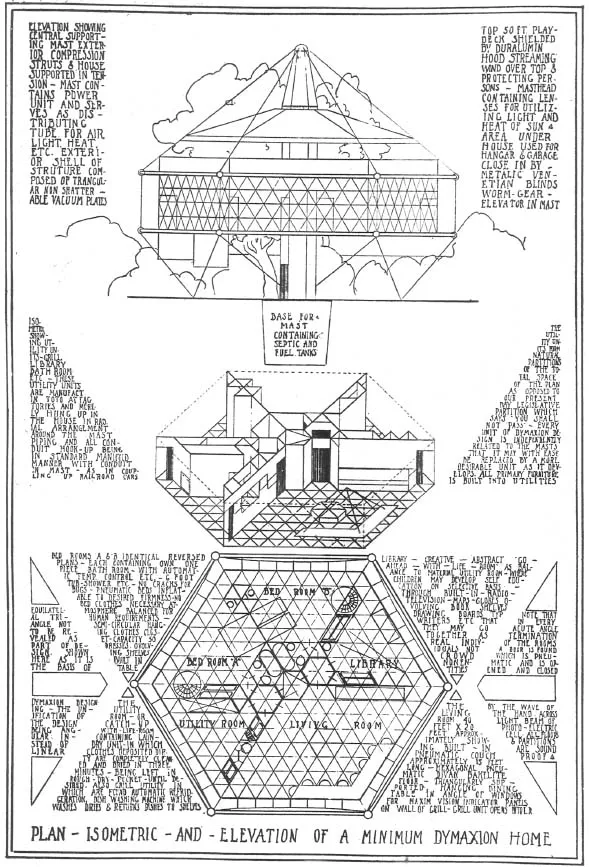
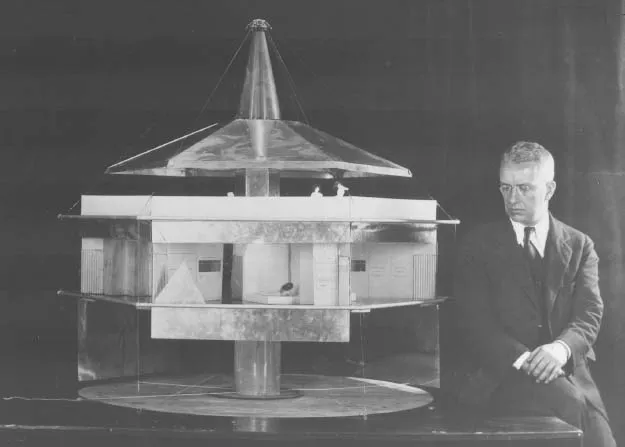
30 The Dymaxion ‘House on a Pole’ was really an expanded pair of interlocked wire-wheels; the hubs were elongated into a mast which contained all the plumbing, electrical and maintenance functions, while the floors and ceilings of the house were suspended by cables from the upper boom. Water, septic and fuel tanks he tucked neatly away in the foundation, the supporting structures were pneumatic (thin aluminum tubes filled with air), and the walls transparent plastic plates. The house was to be assembled top down, the construction sequence illustrated in an elegant model worked up by Fuller and some of his ever-enthusiastic architecture students. Interestingly, as Kenner notes, when Fuller first designed the Dymaxion House in 1927, very few of its appurtenances (washer-drier, temperature controlled ventilation, dishwasher, radio-television receiver) even existed. Most Americans were still living in houses ‘‘pasted, piled and tacked together…without even bathrooms, toilets or sewage disposal.’’47 He was anticipating not just a nicer house, but an industry with an expert research-and-development team devoted to refining such things. You do not build thousands of miles of roads, manufacture tons of metal alloys and pump lakes of liquid fuel to produce only a single automobile. Nor, Fuller reasoned, should you build houses that way. His premise was simple: the time has come to extend industrial strategies to housing. In the end, what Fuller was trying to engineer—all by himself—was an entire industry which would provide you a ‘dwelling unit’ the same way (and at nearly the same cost!) as the phone company provides you a phone:
3536In a few years you may be able to walk into a telephone company booth one morning and ask them to put up a dwelling device on a certain mountain that afternoon. When you’re through with it, you will call the company and ask them to remove it. The company will have your environment control waiting for you wherever you want it at low cost for dream high standards.48
38 Here yet again, we glimpse our man with briefcase and umbrella—this time provided for by the housing industry equivalent of fast food outlets. To get there, he designed and built for the 1934 Chicago World’s Fair his three-wheeler Dymaxion Omni-Medium Transport, which was not—he insisted—an automobile, but only the aerodynamically designed ground-taxiing fuselage for a vehicle able to take you over land or water or through the air to and from your Dwelling Machine (which had a parking place already designed for it). Yet even with two prototype 4D houses actually built in 1946, the industry failed to take off, at least partly because Bucky seemed to be temperamentally unsuited to the games venture capitalists play.
39 The way his old friend Alden Hatch tells the story, he simply had no stomach for what he considered the inherently corrupt and corrupting practices of big business. He had backers, he had 3,500 orders, he had the means to raise the estimated $10 million needed to get production rolling, etc., but at the last minute he kept revising the plans, stalling on any proposed shortcuts, insisting on a full-fledged delivery system, and so forth, until Beech Aircraft pulled out and frustrated associates finally left Fuller and his self-contained house to their own devices. The Dwelling Machine wasn’t ready, he kept repeating. More likely, profit-driven American business wasn’t ready to undertake the entire altruistic service industry Bucky had in mind. This was not the only time he walked away from a possible fortune in order to keep the integrity of his vision intact. The War had demonstrated what America’s tremendous industrial capacity could produce when pressed into service for weaponry. Bucky wanted to rededicate industry to ‘livingry,’ to harness those vast reserves of power and ingenuity to the service of life. In later years, he used to claim that ‘‘making money and making sense are mutually exclusive.’’ At any rate, from this point on he concentrated exclusively on the envelope, anticipating that industry—and later NASA—would soon enough perfect the ‘black box’ or ‘autonomous dwelling device.’
40 Fuller went on from Wichita to Black Mountain College and there started building domes, as we have seen. Geodesic (great-circle) structures—actually first invented in 1922 by Dr. Walter Bauersfeld as a lightweight icosahedral steel lattice for the rooftop dome of his first Zeiss planetarium in Jena, Germany49—emerged for Bucky directly from his own work on the Dymaxion Air-Ocean world map. His first domes mapped the great circles of the vector equilibrium and icosa patterns he was using to subdivide the globe; later he set about subdividing the twenty icosahedron triangles themselves, while allowing the great circles patterns to remain almost invisible in the tensional network holding the whole together. The domes were his one great commercial success. As I write today, the Ethiopian Parliament is meeting under one of them in Addis Ababa. If it were not for the domes, he admitted from time to time, you probably would never have heard of Buckminster Fuller. And if it were not for the income from his patents on the domes, he would not have become the global lecturer of his later years, tirelessly promoting his own technologically enhanced vision of how to ‘make the world work.’ The domes were in a sense only the symbols for Fuller’s larger ideas of human dwelling on Planet Earth. Just as Fuller first derived his geodesic math from work he was doing on the Dymaxion Air-Ocean World cartographic projection, so the Expo Dome, as we have seen, was intended to enclose a Geoscope, the computerized space-age version of the original air-age Dymaxion Map. Although not interchangeable, Whole and Part can include one another, and even turn into one another. According to Fuller, you begin with Whole Systems—the Universe (Nature), and specifically planet Earth—and from there, you learn to focus in on local instances. Reciprocally, this ‘local problem-solving’—which he claimed to be Man’s prime evolutionary function—led you (not directly perhaps, but by great circle routes) back into the Big Picture again, looking for the principles to apply to that particular situation. He called this ‘valving’ the Universe into special-case applications. In the same way, his domes were mainly (though not always) derived from icosahedral hex-pent coordinates. He called the icosa ‘‘the prime dwelling valve of Universe,’’ a form pulled out of the isotropic vector matrix which gives maximum space enclosure for minimum investments of materials and energy. This reciprocating movement from deduction to induction and back again to first principles tended to run against the grain of mainstream science, still wary of the generalizations of the medieval school men and dogmatically tied to solely inductive, analytical methods. By starting with the Whole, and returning to it ever thereafter, Fuller arrived at places and structures you simply could never get to by adding up the bits and pieces in hopes of one fine day achieving the Big Picture.
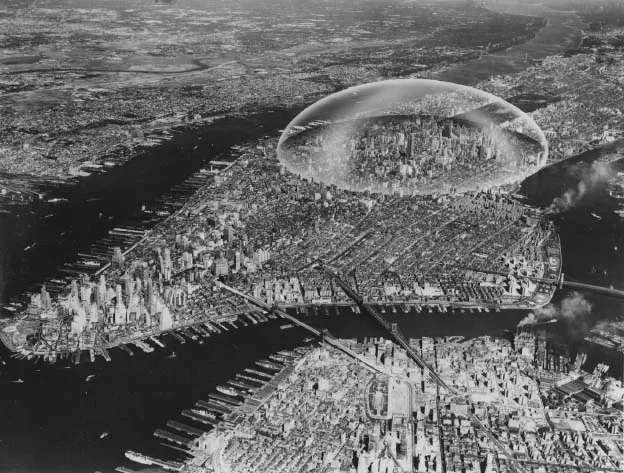
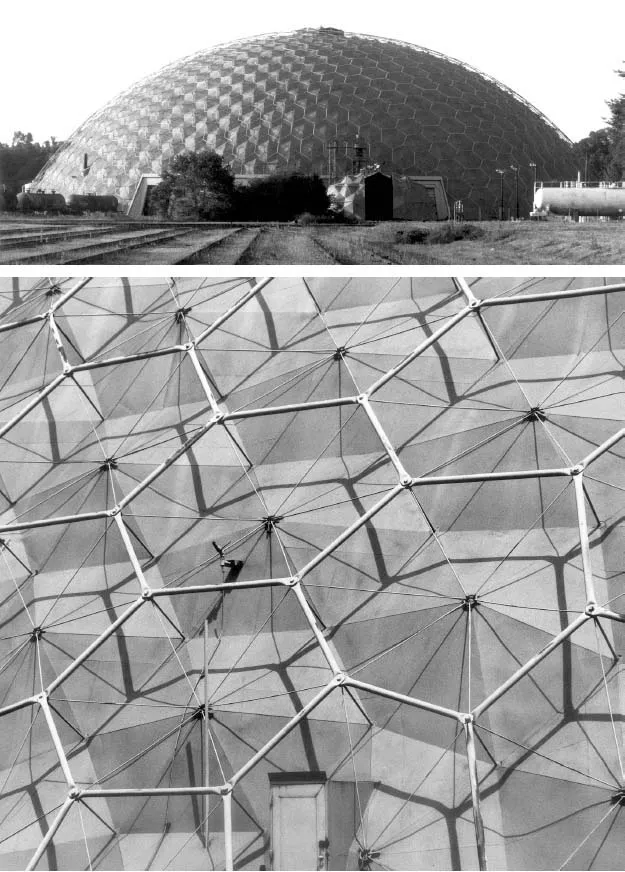
43 By the mid-1960s, Fuller was proposing to dome over entire cities, creating huge ‘‘environment control devices’’ which he claimed would offer ‘‘the enormous advantages of the extroversion of privacy and the introversion of the community.’’ Now whatever he may have meant by this, we’ve run into that word ‘‘community’’ missing from the image of the man with the briefcase and umbrella. But how does Fuller envisage communities? In the 1970s, when his design for a floating community called Triton City emerged, or his big domed stadium proposal (called ‘‘Old Man River’’) for low income housing in St. Louis, it appeared that he had in mind communities as some sort of gigantic composite version of his ‘individual’ dweller—insulated from the vicissitudes of weather, isolated from one another geophysically, entirely autonomous, and sometimes even mobile. He described, for instance, ‘‘a great tetrahedronal city, to house a million people,’’ and sketched it provocatively floating in the middle of San Francisco Bay. And as a final challenge, he pointed out that when geodesic domes—the only man-made structures that get stronger as they get larger—grew to a half-mile or more in diameter, they would weigh so much less than the air inside them that they’d simply float skyward unless tethered. The weight of human ‘‘communities’’ incorporated into these spheroid sky cities, he maintained, would be ‘‘negligible.’’ Thus, the Montréal Expo Dome was no more than a baby 600-ton bubble, a prototype for these vast ‘‘environment control devices.’’ He even designed an ‘‘Octa Spinner’’ to mass-produce the weave from space stations (which are themselves constructed today with ‘his’ octet truss as their basic structural component). Whether feasible or not, desirable or not, these structures all have one important thing in common. They seem to encourage humans to live more lightly on the Earth, even to clear right off the land masses for a time, as if to permit the stressed ecosystems of the planet to regenerate themselves. This is the positive reading: ‘‘…that man may be able to converge and deploy around earth without its depletion.’’
45 On the negative side, Fuller’s notion of the communities meant to fit into these mega-structures seems rather thin and unconvincing. He envisioned communities almost as composite machines, with a multitude of elements, working parts and interactions, all the components of which he would happily design for you. But totally planned communities are not most people’s idea of utopia, despite the prevalence of retirement ‘communities’ for dis-used old people and the recent efforts of the Rouse Corporation (which gave us the EMAC, ‘‘Enclosed Mall, Air-Conditioned’’) and others to design, build and run planned communities with walls and gates and security guards around them to protect the wealthy from the deteriorating urban milieux their own profiteering has created. These self-imposed prisons resemble the picturesque but stifling ‘Village’ in Patrick McGoohan’s celebrated Prisoner TV series of the late 1960s: sterile, petty, conventional totalitarian states full of bland faces, all smiles and no soul.
46 However all this may be, Bucky certainly did not foresee what would happen with dome architecture, except for the very large constructions (Ford Rotunda, American Society for Metals, Union Tank Car, Kaiser Domes, etc.) and pioneering prototypes (Radomes, Skybreaks, Seedpod Foldables, Fly’s Eye, and paperboard domes, etc.) which he and his architectural partner Shoji Sadao actually supervised themselves. Fuller expected his geodesic domes to become overnight a planet-wide housing industry which would mass-produce cheap, efficient ‘Dwelling Machines’ by the millions. He expected the ‘black box’ autonomous dwelling kit as imminent terrestrial fallout from the space program.
47 What happened instead quite probably surprised him: the re-runs of Star Trek lasted longer than the nation’s wholehearted commitment to the space program, and it turned out that the people who actually built and lived in domes did so to express their choice of an alternative lifestyle more or less detached from the mainstream commodity culture. They appealed to the low-budget do-it-yourselfer (who tended to build in wood), not to the industrial manufacturer in search of profits. They appealed to hippy communes more readily than to single families, maybe not only for their ‘cosmic’ embodiment of Nature’s principles—‘‘Every vertex a mandala,’’ as Hugh Kenner once observed of the garden restaurant dome in Isla Vista, CA—but due to pragmatic constraints like leaky roofs, adverse zoning codes, or an open structure and sound-in-the-round acoustics which tend to minimize the privacy family members so often crave from one another. Maybe because he was himself such a maverick, Fuller’s ideas have often tended to appeal to non-conformists who in turn applied them in their own distinctive ways.
2.1.1 Boxed in
48Not a single geodesic dome home was destroyed in the California earthquakes of the 1990s, nor in all the hurricanes that have devastated Florida, Louisiana, and the mid-Atlantic states since global warming increased both their frequency and intensity. Conventional box buildings were easily leveled by a little shake or a big breeze. Yet when people rebuild, up will go the boxes again.
49 Why?
50 We have conditioned ourselves to see life in a box as normal and natural. It is the very shape of Western culture. We are born into a box (cradle, crib and playpen), we spend every day and every night in a box (home, office, automobile), and we generally insist that our remains be buried in a box.
51 Wherever we westerners leave our mark, it seems to be at right angles to the rest of the Universe. Before the European hordes overran the North American continent, to stick with our example, the inhabitants managed to live happily in triangulated structures (tipis) or round houses (hogans, igloos, etc.). Now, everywhere you turn, boxes piled atop boxes, each of them numbered, mortgaged, insured, and taxed to the hilt. Until the next earthquake, anyway…
52 So at home are we in our box that we scarcely even notice it. Western sports and politics, our legal systems, economics and government, all share the same ‘framework.’ The square is everywhere. We squeeze everything into the neat compartments—us/them, right/left, black/white, yes/no—with which we would divide and conquer reality.
53 We have squared off against the Earth herself, as if to repudiate her roundness. And all those rifts dividing the human family? Merely lines we ourselves have drawn.
54 There are alternatives. Bucky Fuller spent his life demonstrating them. His ‘radomes’ in the Arctic weathered temperatures of 50 below zero and winds up to 150mph, yet were still in good enough shape when decommissioned half a century later to be given to local Canadian communities in need of durable community shelters.
55 But until such alternatives are taken seriously, we must conclude that here is a civilization which has quite literally boxed itself in.
57 Many commentators seem to think Bucky’s ideas stand or fall by the success or failure of the dome-building industry. I beg to differ. I find his fundamental re-envisioning of technology as ‘what Nature does,’ and his consequent deployment of ‘Nature’s coordinate system’ (not solely in geodesics but in many other ways as well), to be initiatives more far reaching—and even more durable—than the domes themselves.
58 All of which ironically brings us back—by one of those invisible great circle routes, no doubt—to the moral and spiritual climate of New England.
2.2 Ambivalent Centennial
59During August of 1858, Ralph Waldo Emerson set out in the company of ten other townsmen—doctors, scholars, clerks, he notes—on foot and by canoe to experience the still-wild Adirondack Mountains in upstate New York, deep into what was once Mohawk territory. He kept a journal in blank verse, the early stanzas recording his joy at rediscovering Nature untrammeled.50 ‘‘So fast will Nature acclimate her sons’’ that he and his fellow pilgrims (‘‘Chaucer had no such worthy crew’’) were soon rejoicing to leave behind the ways and wiles of cities and towns:
6263Lords of this realm,
Bounded by dawn and sunset, and the day
Rounded by hours where each outdid the last
In miracles of pomp, we must be proud,
As if associates of the sylvan gods.
We seemed the dwellers of the zodiac,
So pure the Alpine element we breathed,
So light, so lofty pictures came and went.
We trode on air, contemned the distant town,
Its timorous ways, [and] big trifles…
64 Their senses enlivened, the townsmen learned to read again the signs and portents of sky and cloud, deer and eagle, midge and mosquito: ‘‘O world!,’’ exclaimed Emerson, ‘‘What pictures and what harmonies are thine!’’ One observes that in the very act of throwing off the conventions of ‘civilized’ life, Emerson also managed for once to liberate himself from the artificial metrical conventions which so often contorted his efforts at poetry (exceptions like ‘‘Brahma’’ only proving the rule). Had he kept this up, Emerson’s own poetic ‘essays’ might more often have matched the supple grace and freedom of his prose.
6667Judge with what sweet surprises Nature spoke To each apart, lifting her lovely shows
To spiritual lessons pointed home.
And as through dreams in watches of the night,
So through all creatures in their form and ways
Some mystic hint accosts the vigilant
Not clearly voiced, but waking with a new sense
Inviting to new knowledge, one with old.
68 But just as the travellers began to sink snugly into the bosom of Mother Nature—Emerson comparing them to explorers or hunter-gatherers of old—something momentous happens. A newspaper, ‘‘big with great news’’ of the first transatlantic telegraph cable, arrives from the wider world. The atmosphere of Emerson’s journal abruptly changes; now he exults in human ingenuity, while pristine Nature fades discreetly into the background:
7071With a vermilion pencil mark the day
When of our little fleet three cruising skiffs
Entering Big Tupper, bound for the foaming Falls
Of loud Bog River, suddenly confront
Two of our mates returning with swift oars.
One held a printed journal waving high
Caught from a late-arriving traveller,
Big with great news, and shouted the report
For which the world had waited, now firm fact,
Of the wire-cable laid beneath the sea,
And landed on our coast, and pulsating
With ductile fire. Loud, exulting cries
From boat to boat, and to the echoes round,
Greet the glad miracle. Thought’s new-found path
Shall supplement henceforth all trodden ways,
Match God’s equator with a zone of art,
And lift man’s public action to a height
Worthy the enormous cloud of witnesses,
When linked hemispheres attest his deed.
72 At this point, all thoughts turn back to the doings of men, exemplified by the Atlantic Cable—which failed by the way, in October (for lack of proper insulation), and only got properly underway in 1866. Yet this might well be considered the first major link in today’s information ‘superhighway’—‘‘Thought’s new-found path’’—and Emerson seems to see it as a kind of cultural correlate, or precipitate, of all the meaningful interconnections he and his fellow ‘‘dwellers of the zodiac’’ had been perceiving in Nature. Curiously, the intelligible shock wave from the telegrapher’s submarine spark comes to the company of travellers first by ‘‘shouted’’ word of mouth, and then by ‘‘printed journal,’’ inverting the entire history of media from orality to literacy to electricity. Emerson’s paean now absorbs the news by turning in amazement to ‘‘This feat of wit, this triumph of mankind…Urging astonished Chaos with a thrill to be brain, or serve the brain of man’’—
7475Mind wakes a newborn giant from her sleep.
Twirl the old wheels! Time takes a fresh start again,
On for a thousand years of genius more.
76 At such a triumphal moment, the intrepid travellers no longer wish to linger in the wild. A final image sets out to reconcile, if not indeed to subordinate, the bounteous beauties and wisdom of Nature to the electric spark of human genius:
7879…So in the gladness of the new event
We struck our camp, and left the happy hills.
The fortunate star that rose on us sank not;
The prodigal sunshine rested on the land,
The rivers gambolled onward to the sea,
And Nature, the inscrutable and mute,
Permitted on her infinite repose
Almost a smile to steal to cheer her sons,
As if one riddle of the Sphinx were guessed.
80 Emerson was able, as we today are not so easily able, to ‘‘Match God’s equator with a zone of art,’’ to hold in dynamic balance ‘‘inscrutable…mute’’ Nature and ‘‘the glad miracle’’ of Culture, rustic wisdom and technological innovation. It’s as if he is simply turning his head—nodding now toward ‘‘the sylvan gods’’ of Nature and the primeval past, now toward the ‘‘ductile fire’’ of technology and the ‘‘newborn’’ future. Others, even in his ‘Golden Day’ of American letters,51 seemed already to be shaving off in the one direction or the other. Whitman did manage to embrace both Nature and Culture, but only as reflections of his much vaunted ‘Self; Thoreau and Melville leaned toward Nature—‘pure and simple’ in the case of Thoreau; raw, elemental and even inhuman in Melville;—whilst Hawthorne could only draw his Gothic portraits from tortured town life. But Emerson neither saw nor felt any contradiction in casting off the trappings of civilization and singing the praises of Nature, only to find himself celebrating new facets of human genius from the depths of the Adirondack wilderness: ‘‘We flee away from cities, but we bring the best of cities with us.’’
82 * * *
83 Since the time of Emerson’s Adirondack interlude, the rift has deepened between the twin facets of his vision. As a culture, we are now profoundly ambivalent about our own technological artifacts. Since industrial manufacturing techniques were first applied to mechanized warfare in World War I, and grotesquely exaggerated by the Bomb and crematoria of World War II, we have seen all too much of the dark side, the eclipse of Nature and the distortion of human nature, latent in our technologies. 1995 marked the Centennial of the two great ‘holistic’ theorists of technology North America produced during the twentieth century: Bucky Fuller, of course, but also Lewis Mumford, who might well be considered Fuller’s arch-critic…as much for the ease with which he was able to dismiss Fuller as for what he actually deigned to say about him. The coincidence signaled a deeply ambivalent Centennial. The divergences between these two thinkers highlight an intractable split in contemporary attitudes toward technology. In their work, the rift barely discernible in Emerson becomes a chasm.
84 Lewis Mumford lived most of his adult life on farmland in the rolling hills of Amenia, New York, in Dutchess County northeast of New York City (famous, or infamous to some, for Woodstock and Millbrook). While southeastern New York State may only border on today’s New England geographically, Mumford was at least as much an inheritor of the quintessentially New England spirit as Bucky Fuller. The passing years have only magnified Mumford’s stature as a pre-eminent American architecture critic for half a century, as well as the importance of his ground-breaking work as a historian of technics. After a stint in the navy during World War I (much like Bucky’s), Mumford began his career promoting the ‘organicist’ ideas of Patrick Geddes—the Edinburgh biologist and city-planner who collaborated with Ebenezer Howard in originating the ‘Garden Cities’ movement in England—but beyond their common emphasis on regionalism, he soon shook off any remnants of discipleship. His first book, The story of Utopias (1922),52 outlined with prescient accuracy the fatal flaw in all totally ‘planned’ communities. On paper, Utopias appear to be reasonable alternatives to the status quo. In practice, however, they tend to have no room for alternative Utopian visionaries, i.e., for anybody whose own views might be at variance with the original plan. Which is why Utopias—from Plato’s Republic to the many Utopian experiments on American soil—all too easily and too often tend to become totalitarian.
86 Much the same impulse lay behind his first book on American architecture, Sticks and stones: a study of American architecture and civilization (1924),53 which formed the basis for his later and more famous The City in History (1961).54 Here Mumford extolled 17th century New England towns for continuing the medieval polytechnic tradition, where every craftsman was a master and an autonomous source of innovation, working in the free air of interdependence we earlier underscored in our archaeology of the original American dream. He did not go so far back into the native soil as to re-discover the manitou of the Iroquois Confederacy, but he did share much the same admiration for the ‘socialist’ virtues of early American communities expressed by Emerson and de Tocqueville. He, too, saw the cooperative communitarian dimensions of town life as the root of the American spirit in early New England, and decried its fatal erosion by both the mercantilism of the great commercial cities, and the slash-and-burn profiteering of the pioneer mentality. In his later books on technics and civilization, he took a hard look at the irrational streak (wars, persecutions, intolerance) accompanying the most rational plans for civilization from its Mesopotamian origins to the present. In the American context, he first tried to inflect, then began to resist the increasing domination of architecture (since the nineteenth century) by architects and industrial engineers, and of community life by social ‘engineers.’ The only sorts of town plans he endorsed maximized green space and open areas for interaction, indeed, a variety of ‘unplanned’ spaces in which people might freely associate. Otherwise, the organic growth of community could only be cramped by the limitations of the artificial plan. He was at pains to highlight ‘‘the difference between community planning and the ordinary method of city-extension and suburb-building’’:
9091The normative idea of the garden-city and the garden-village is the corrective for the flatulent and inorganic conception of city-development that we labor with, and under, today. So far from being a strange importation from Europe, the garden-city is nothing more or less than a sophisticated recovery of a form that we once enjoyed on our Atlantic seaboard, and lost through our sudden and almost uncontrollable access of natural resources and people.
92Until our communities are ready to undertake the sort of community-planning that leads to garden-cities, it will be an empty eloquence to talk about the future of American architecture.55
94 Given such a stance in 1924, it should come as no surprise that Mumford in later life would resist not only Bucky Fuller’s more grandiose designs, but other mega-projects like Paolo Soleri’s ‘sculpted’ city-scape at Arcosanti. No one man’s perspective could, in Mumford’s view, ever be adequate to encompass the eventual flowering of living communities—but one could attend to the seed-bed, and prepare the ground. Mumford stood for local knowledge, for the traditional wisdom of the place, for the organic growth of cities from the inside out—and against grand ‘plans’ imposed from the outside (unless they were for ‘garden-cities,’ of course) or top-down by architects. While the mariner Bucky Fuller gazed over the boundless sea to the horizon, the town-and-country scholar Mumford stood firm upon the craggy land:
9697Out of the interaction of the folk and their place, through the work, the simple life of the community develops. At the same time, each of these elements carries with it its specific spiritual heritage. The people have their customs and manners and morals and laws; or as we might say more briefly, their institutions; the work has its technology, its craft-experience, from the simple lore of peasant and breeder to the complicated formula? of the modern chemists and metallurgists; while the deeper perception of the ‘place, ’ through the analysis of the falling stone, the rising sun, the running water, the decomposing vegetation and the living animal gives rise to the tradition of ‘learning’ and science.56
99 Here, if anywhere, were the human roots in land and in custom that Bucky’s grand design conceptions not only lacked, but intentionally cast aside. From another angle, though, Fuller and Mumford’s work really did share a common root. They both sought the convergence of organic forms and cultural forms—the very convergence which so galvanized Emerson, their mutual progenitor, in the midst of his Adirondack sojourn. In an early essay called ‘‘The Marriage of Museums,’’ Mumford lauds a proposal to build a connecting walk through Central Park to tie together New York’s Museum of Art and its Museum of Natural History: ‘‘The physical connection will serve to emphasize a cultural borrowing which has at once introduced the presentiments of graphic art into the nature museums, and the organic conception of life into the art museum.’’57 Where the two men differed was in their conception of just how such a fusion of Nature and Culture was to take place. Mumford would accept ‘development’ only according to the word’s etymology: the unfolding of latent possibilities, growth from the inside out. Fuller understood the process in two steps: first, observing and abstracting from Nature the principles with which she works, and second, turning round and imposing these forms upon human artifacts and human dwelling; development from the outside. In Technics and Civilization (1934),58 Mumford hailed Fuller’s plans for the Dwelling Machine and the Dymaxion Transport as intriguing prospects worth watching. By the 1960s, however, in his devastating critique of The Myth of the Machine (1967/1970),59 he had soured on a society which had opted for mechanism rather than organic life, weaponry over the arts of living, giant-ism rather than scaled invention, and a global economy rather than regional self-sufficiency. He took a famous passage of Fuller’s—from one angle full of ironic humor and intended only to open people’s eyes to the design integrity of Nature’s own handiwork—as an occasion to mock what he saw as Bucky’s under-dimensioned appreciation of human nature:
104105Man, observes Fuller, is ‘a self-balancing, 28-jointed adaptor-based biped, an electro-chemical reduction plant, integral with the segregated stowages of special energy extracts in storage batteries, for subsequent actuation of thousands of hydraulic and pneumatic pumps, with motors attached; 62,000 miles of capillaries, millions of warning-signal, railroad, and conveyor systems; crushers and cranes…and a universally distributed telephone service needing no service for 70 years if well managed; the whole, extraordinarily complex mechanism guided with exquisite precision from a turret in which are located telescopic and microscopic self-registering and recording range finders, a spectroscope, etcetera.’
106Fuller’s parallels are neat; the metaphor is superficially precise, if one discounts the airy, pseudo-exact statistical guesses. Only one thing is lacking in this detailed list of mechanical abstractions—the slightest hint, apart from his measurable physical components, of the nature of man.60
108 Ouch! In this period, Mumford went on to disparage Fuller as a ‘genius’ (Fuller denied it) who wouldn’t learn from his mistakes (hardly true), and leapt upon the Expo Dome fire as if it were Bucky’s fault (it was not; a spot welder tried to finish up his repairs even though his fire extinguisher was empty). In some respects though, it is fair to say, Mumford’s critique hit directly and uncomfortably on target. Fuller’s 1943 plan for the rapid industrialization of Brazil, for instance, would have trashed the place far faster than the haphazard ‘development’ which currently accounts for an annual loss of 10,000 acres of rainforest; he actually advocated, for example, bombing hundreds of clearings in the forest and parachuting in machine tools to build timber mills and other industries, airports, etc. (He had of course no idea people were actually living there, but from Mumford’s perspective such ignorance of the region on the part of ‘planners’ and ‘developers’ is precisely the problem.) Later in life, Bucky explicitly dismissed Mumford’s concerns as ‘aesthetics.’61 ‘‘Don’t worry,’’ he tells a group of architecture students in Robert Snyder’s film, ‘‘about making your work beautiful’’ -
111112You don’t have to worry about ‘beautiful’ or ‘pretty,’ because if you have really understood your problem, if you solve it correctly, so life really goes on; if you do it so economically it is realizable: then it always comes out beautiful.
113That’s why a rose is beautiful: as one part of the great regenerative process whereby the a priori design of the Universe is working. If you want to be part of that, you can’t miss beauty.
114 It was clear by this time that the two thinkers, both of whom had high public profiles (Mumford was President of the American Academy of Arts and Letters), had stopped listening to one another. By the time of his Findings and Keepings (1975), Mumford dismissed Fuller as ‘‘that interminable tape-recorder of ‘salvation by technology,’ ‘‘ and lumped him with Marshall McLuhan, Daniel Bell and Arthur Clarke—as one of ‘‘those giant minds whose private dreams all too quickly turned into public nightmares.’’62
116 It is somewhat invidious simply to contrast the two thinkers. Mumford matured early, Fuller rather late; when Fuller began his ascendancy on the world stage during the 1960s, Mumford was already at his peak, and his powers were to decline drastically before his death. Mumford was from the outset a writer of mastery and grace; Fuller, for all his inventive neologisms, a labored and clumsy writer. Mumford had a lot to say about architecture, but never built or even designed anything of consequence; Fuller had little patience for drawing-room theories, but put most of his formidable creative energies into actually making things (including books, of course, which might be counted among his most enduring artifacts).
117 In later life, they rarely agreed about anything. If Fuller extolled alloys and metallurgy as proof that humans evolved by learning how to do ‘more and more with less and less,’ Mumford excoriated mining and metal-working as the rape of the Earth and the first instance of wage-slavery for the hapless human digging tools forced to work in the mines. If Fuller expected NASA’s space program to provide a ‘black box’ kit for human dwelling here on Earth, Mumford saw the astronaut as ‘‘Encapsulated Man’’:
119120…a scaly creature, more like an oversized ant than a primate—certainly not a naked god…a faceless ambulatory mummy…coordinating his reactions with the mechanical and electronic apparatus upon which his survival depends…whose existence from birth to death would be conditioned by the mega-machine, and made to conform, as in a space capsule, to the minimal functional requirements by an equally minimal environment—all under remote control.63
122 That remote control would of course be provided by the computers Bucky hoped might help co-ordinate world-around information and planning for his Geoscope. Mumford found computers an excuse for not thinking, just one more abdication of human responsibilities to the ‘myth’ that machines could bring about the human millennium. In puncturing all such futurist fantasies, Fuller’s easily included, Mumford was taking aim at:
124125…the state that the mass of mankind is fast approaching in actual life, without realizing how pathological it is to be cut off from their own resources for living and to feel no tie with the outer world unless they are connected with the Power Complex and constantly receive information, direction, stimulation, and sedation from a central external source, via radio, discs, and television, with the minimal opportunity for reciprocal face-to-face contact.64
127 Fuller and Mumford were both ‘public intellectuals,’ a vanishing breed on the American scene these days. Both were also astonishingly comprehensive autodidacts, another species nearly as extinct as the moa. Mumford was the more scrupulous and exacting as a scholar, and the more balanced as a writer. Fuller was the more inventive, always able to pull special effects—visual, tactile, geometric, and architectural surprises—out of his bag of tricks. It is important to recognize that although both eventually lectured at colleges and universities, neither held advanced, ‘specialized’ academic degrees. Their generation was happily less hamstrung than our own by ‘experts’ claiming dominion over every conceivable petty ‘field’ of study. Both took justifiable pride in their role as self-taught generalists, and both railed against the ‘barbarism of specialization.’ With obvious relish, Fuller used to relate the following story about academic myopia:
128 In New York City a few years ago, two learned societies met in separate hotels on the same day to discuss strikingly similar topics. The one group consisted of biologists attempting to determine the major factors causing extinction in species of flora and fauna. The other study group consisted of cultural anthropologists grappling with the causes of extinction among human tribes and groups. In both cases, the primary factor leading to extinction turned out to be the same: overspecialization. Ironically, neither group of ‘specialists’ had the least inkling of the other group’s findings. The moral of the story? If we’re not careful, we may very well specialize ourselves right out of existence.
129 Yet Fuller and Mumford were not unlike those two scientific societies in this respect, that neither could really see what the other saw. In his quest for the Whole, Fuller came to favor the simplicity of a heteronomic viewpoint: the whole holding sway over all its parts, coordinating every element to play its proper role. For his part, Mumford came to emphasize complexity and autonomy: each part a free whole in its own right, trusting the larger Whole to take care of itself. Of course the struggle between these two viewpoints—the One and the Many, ‘en kai polla— has been the outstanding Western intellectual quandary ever since Plato opted for the One, and Aristotle for the Many. By the 1960s, the two thinkers were simply talking past each other. Each had a comprehensive view which took into account nearly everything—except of course the annoying existence of the other, perhaps equally plausible, viewpoint. Now these two thinkers knew about one another, read one another, and for 50 years scrupulously avoided any but the most oblique dialogue with one another. Why?
130 It would be superficial merely to label Bucky a technological optimist, and Mumford a pessimist—although the caricature readily fits some of their isolated pronouncements. Mumford tended to speak of what was and what had been, and Fuller of what might be; but Mumford also wrote eloquently of the future in ‘‘The Drama of Renewal’’65 and ‘‘The Flowering of Plants and Men,’’66 while Fuller could be withering in his scorn for the stupidity and wastefulness of status quo science and technological folly. (His satire on the fictitious corporation ‘‘Obnoxico’’ might well describe the attitudes of many a multinational colossus from the 1990s to the present-day).67 Both were prophets of the ecological era long before most people even knew what the word meant. But what do prophets do? They announce (there’s Fuller, looking forward), or they denounce (there’s Mumford, looking warily back over his shoulder, although he professed the role went against his grain). And there they leave us, these two prophets, with the entire twentieth century as the ambivalent proving ground for their theories. It is, therefore, not a little difficult for those of us who follow them to discover exactly which ‘holistic’ vision is the genuine article, which the more real insight. In a certain sense, they leave us stranded between past and future, memory and imagination, origins and destinations.
134 In the present, they both remain fairly influential mavericks. Mumford, lamentably, is not required reading in most college curricula nowadays, even for the liberal arts. His scope is too sweeping, the questions he asks too challenging to be compatible with the technical ‘training’ of worker-drones favored by today’s educational ‘marketplace.’ And Fuller offered an alternative science, an exploratory strategy for independent scientific and technological inquiry, not the sort of thing sought by young people trying to fit into the job slots and training programs offered by big corporations. Of course since the discovery of ‘fullerenes,’ Bucky has become trendy again; a revival of interest in his structures may yet lead people in the sciences back to his books and ideas. On the other hand, the trenchancy and effectiveness of the critiques of technocracy launched by Mumford and others influenced by him (Jacques Ellul, for instance, or Ivan Illich) has meant that Fuller’s work and its import has been almost universally neglected by serious scholars in the humanities.
135 Mumford stands for the sensibility that has won over many of today’s most articulate scholars of technology and human values. It is, with various nuances, an anti-technology, anti-development sensibility, critical of globalizing trends, respecting local knowledge and traditional customs, suspicious of planning and planners, mustering defenses for threatened ecologies and endangered cultures alike. It is this very sensibility that leads one to take seriously the ‘archaic’ insights of native peoples (as we tried to do with respect to the Mohawk Nation earlier on), as well as the integral relationship of land and landforms—bio-regions—to human culture, dwelling, thinking, spirituality, etc. An easy familiarity with Mumford’s themes has long been perceptible in the programs of the German Green Party, for instance (even as the German auto industry reconsiders Bucky’s three-wheeler Dymaxion Transport for mass-production). Today we are, or ought to be, much more critical of universal ‘development’ schemes, whether Fuller’s or anybody else’s; we rightly question whether everybody on the planet needs or even wants to ‘develop’ in the same way, or toward the same Western goals.
136 For his part, Bucky not only made palpable the possibility of an alternative science (that’s really what Synergetics is all about), but he showed off some splendidly creative examples of what might be achieved by somebody taking roads less traveled than the current destructive path of industrial mono-technics. By contrast, what many humanist thinkers nowadays are really looking for—and even finding, in indigenous cultures for example—are alternatives to modern science and technology, so that Bucky tends to get lumped in with all the rest as just another technocrat. For their part, the scientists, so very well trained in their respective specializations, are just not ready or willing to put up with all the paradigm shifts Fuller requires of them. It’s still business-as-usual, not ‘utopia or oblivion.’ Bits and pieces of Bucky’s vision are indeed taken up—a word about synergetics for the mathematicians (I’ve heard it called ‘trivial,’ in Silicon Valley of all places); a page or two on geodesic domes for the architecture students; a footnote on octet trusses for the budding engineers; a sidebar on the Dymaxion Map for the cartographers. But almost nowhere in North America, except perhaps for a brief time at the Buckminster Fuller Institute in California, do scholars and students get a chance to encounter the whole of Fuller’s thought, let alone to challenge it by the equally comprehensive, equally ‘holistic’ thought of Lewis Mumford. Which is not only a shame, but a shameful failure to follow up on the fundamental questions of technology and human values both writers raised in their own ways. Recent developments, however, may soon make scholarly collaboration a little more practicable. In 1999, Bucky’s ‘Chronofile’—1400 linear feet of file boxes, the largest collection of papers from any single human being in the twentieth century (he kept everything!)—was relocated from the Fuller Institute to Stanford University, where it has now been catalogued for easier access.
137 * * *
138 We won’t be able to get Fuller and Mumford together for the knock-down, drag-out conversation they should have had, but we can see why it is imperative to continue their dialogue as best we can in absentia.68 For one thing, if you never think about their divergences, you never have a chance to see where they do, surprisingly, converge. Fuller’s was a cosmological vision; he looked mainly to the physical Universe and to Nature, and discerned there the holistic dimension of cooperation—synergy— between all her elements and principles, which he then extrapolated (sometimes perhaps a little insensitively) to human affairs. Mumford’s was a humanist’s vision; he looked mainly at the deeds and misdeeds of human societies and discerned there the holistic dimension of cooperation—community— swiftly being eroded by mega-technic schemes which ignore both cultural context and human scale.
140 Today the same split can divide ‘deep’ ecologists who see humans as one species in a living, interdependent cosmos, from campaigners for social justice who seek to liberate human beings from structures of oppression in all its social forms. The two visions are not incompatible, but the contexts in which they are spelled out tend to diverge sharply. The common thread is cooperation, though its exponents sometimes let this slip in their enthusiasm for their own particular angle. Both Fuller and Mumford thought they had bridged C. P. Snow’s ‘two cultures’ of the sciences and the humanities, but the bridge seemed to collapse where one another’s viewpoints were concerned. Now, half a century on, can we meaningfully coordinate the cosmological/scientific and the anthropological/humanistic visions? Let’s see if we can’t find some common ground…
141 Both Fuller and Mumford thought that modern technological culture had taken a wrong turn in the twentieth century. Two World Wars pretty well clinched the case. Both sought organic patterns and natural principles on which to base the turn (Fuller), or the return (Mumford), to a more humane culture. Most alarmingly, both thinkers found the present direction of world’s nations and industries suicidal, for equally firm ecological and social reasons. But technology meant something different to each of them. For Mumford, technology was mechanism and, though a culture might benefit from some degree of mechanistic constraint (ritual taboos, for example), the total submission of organism to mechanism was lethal. Fuller, on the other hand, considered technology to be what Nature already does so elegantly—the hydraulic leveraging that holds up the branches of a tree, the tensile gravitation that keeps our planet in its orbit—and which we humans mimic only clumsily and mechanistically. In Fuller’s view, we suffer from our ignorance of Nature’s supremely efficient technologies, attention to which would greatly refine our own artifacts and enhance our lives. In Mumford’s, we have let our technology come not only between us and Nature, but also at the cost of our own human nature.
142 The distinction is important, because it reveals an unexpected concurrence. It is grounded in the deep respect both thinkers share for the mystery at the deepest core of life’s processes. Mumford put it this way: ‘‘The ultimate gift of conscious life is a sense of the mystery that encompasses it.’’69 And in a similar vein, reminding us of the proximity of spirituality to the dwelling place, and of cultural to physical space: ‘‘Religion concerns itself with the reaction of Man in his wholeness to the Whole that embraces him.’’70 As if in chorus, Fuller’s ‘‘Intuition—A Metaphysical Mosaic’’ opens similarly:
146147Life’s original event
and the game of life’s
order of play
are involuntarily initiated
and inherently subject to modification
by the a priori mystery,
within which consciousness first formulates
and from which enveloping and permeating mystery
consciousness never completely separates,
but which it often ignores
then forgets altogether
or deliberately disdains?.71
149 We may simply have to concede that this concurrence of Mumford and Fuller on such a basic theme might be part and parcel of that very mystery. It’s as if some inexpressible harmony, or at least an unseen complementarity, lay behind their passionate refusal even to consider one another’s perspectives. The whole of their relationship, if you think about it long enough, comes to a good deal more than the sum of its parts taken separately. For the sake of balance, we shall hand over the last word of this chapter to Mumford. Had he taken the following exploration of triangles and hexagons just a bit further, he’d have run smack into Fuller’s isotropic vector matrix (the very source of the synergetic geometry), which derives directly from the configuration Mumford so lovingly describes here:
151152Suppose we were all equilateral triangles. Accepting our basic triangularity, we could not conceive of any change, except that of becoming more or less of a triangle. We might think of becoming a bigger triangle or a smaller one, turning from an isoceles triangle to a scalene triangle, almost to the point of being flattened out; but the one thing that would seem indisputable to us would be that we could not keep our precious triangularity if we tried to cut any other kind of figure. Yet that would be a delusion; and it would be the kind of delusion that is brought about by a failure to conceive the role of love.
153Let us endow two right triangles, absolutely equal in every respect, with the power to fall in love: that is, to delight in the constant presence of the other, and spurred by the desire to meet and mingle on the closest possible terms. The nearest that a triangle could get to connubial bliss with another triangle would be if ‘he’ superimposed ‘himself on it, and in order that our identical triangles should not merge their identity completely, we will suppose that the apex of one triangle in the ideal state of their union would intersect the base of the other. At that moment a being unknown in the world of triangles will come into existence: a star. A quite remarkable star, with six points, and with an internal figure in a central position, holding the parts together: a hexagon. What is more, at the tips we will find that this union has begotten six little triangles, just like their father and their mother, only smaller. Mark that the lines and angles of the original triangles remain unchanged: yet in the combination they show new properties, unknown in a purely triangular world. In this scenario none of these little triangles would have existed if the big triangles had not fallen in love’ and sought to merge their identities.
154This parable not merely sums up the nature of emergent change, using existing components to make a radically different pattern or ‘Gestalt’: it also demonstrates, by the simplest of abstractions, the unexpectedly creative interaction that takes place in loving association! That association had its beginning at the very moment when the sexual differentiation into male and female began in the plant world, and was carried to a climax in the ostentatious sexuality of the flowering plants, long before vertebrates emerged.72
15627 August 1956