
Chapter 3
Reflections
3.1 Anima Mundi
2Mumford’s amorous right triangles (90°/45°) combine to give us this figure:
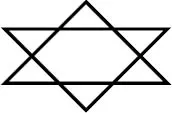
4 And there ends his reflection upon ‘‘the nature of emergent change,’’ i.e., the synergy of any new ‘‘Gestalt.’’ Had he stayed instead with the equilateral triangles (60°) he supposed we all were at the start, the figure would have shifted slightly to look like this:

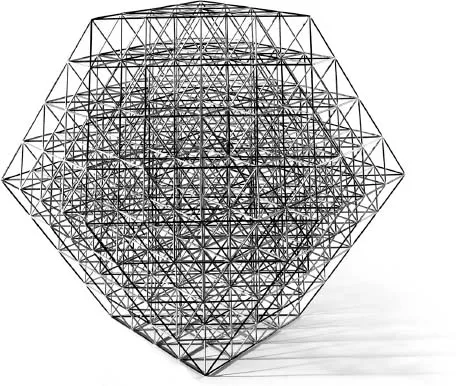
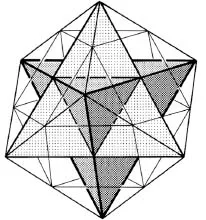
6 Now if you look at this figure long enough, and play around a bit with its properties, the reflection of the ascending and descending triangles, along with the generation of attendant stars and hexagons, could go on practically forever. If you begin with equilateral triangles, and articulate these into tetrahedra, you find octahedral voids popping out between them to form the ‘octet truss,’ the strongest load-bearing structure known to engineering. Continuing the procedure to link up all the vertices discloses an X-ray of Archimedes’ cuboctahedron, a figure Fuller first dubbed ‘The Dymaxion’ and later Vector Equilibrium, a pattern in which the tensile and compressive forces are exactly in balance. You have now arrived at the simplest form of the isotropic (‘same everywhere’) vector matrix which Fuller called ‘Nature’s Coordinate System.’
7 Just as points of reference, I shall have to make short work of the many scientific corroborations now available for Fuller’s intuition that Nature is using this matrix, with its 60° coordination in every direction, for her most basic atomic, molecular, organic and astrophysical configurations.
9 A few highlights:
- 1863, Nicholas Van’t Hoff discovered that the carbon molecule, and therefore all organic carbon-based chemistry, is tetrahedrally co-ordinate.
- In 1958, Linus Pauling demonstrated by diffraction grating analysis that all metallic (i.e., ‘non-organic’) structuring is also coordinated tetrahedrally.
- In 1975, Harvard mathematician Arthur Loeb contributed an ‘‘Afterpiece’’ to Fuller’s Synergetics in which he demonstrated that crystal structures of all sorts were accommodated as well by Fuller’s isotropic vector matrix as by conventional cubical coordinates. (In point of fact, the cube does appear in Fuller’s matrix, but only as a sort of optical illusion if you’re looking at its octahedra and tetrahedra).
- The geodesic domes which Fuller generated from variations on this matrix turned out to be identical in structure to various viruses and antibody cells, which is probably a clue as to why they’re so tough.
- The mathematical projections of the strong binding forces of atomic nuclei, which quantum physics terms mesons and baryons, turn out to be vector equilibrium and tetrahedra, respectively. Bucky was peering into the very heart of matter, where he kept running into old ‘friends’ (figuratively speaking) from his earlier geometric explorations.
- In 1985 Carbon-60, a remarkably stable cluster of 60 carbon atoms said to be the form of carbon carried by diffuse interstellar gas clouds (and thus the probable seed-form of carbon-based chemistry in the Universe at large), was synthesized in the lab and called ‘Buckminsterfullerene’ in honor of the man whose name had become nearly synonymous with icosahedral spheroids. Today there is an entire family of ‘Buckyballs,’ variant ‘fullerenes’ custom-designed for diverse purposes.
-
10The isotropic vector matrix corresponds to the interference pattern formed by the propagation of electromagnetic energy in a vacuum—Einstein’s universal constant, the ‘c2’ of E = mc2—and therefore brings into a single image the sunlight that animates life on Planet Earth and all the new media of electronic, digital and fiber optic communications technology. It is the pattern language—the media matrix, I have called it elsewhere73—of a Universe in radiant communication with itself in all directions.
12 Indeed, I would go so far as to declare this ‘omniintertriangulated’ matrix to be the very structure of illumination, in every sense of the word. At any rate, there is plenty of empirical corroboration from the sciences that Fuller was indeed on to ‘Nature’s Coordinate System’ in a profound way. Following Einstein’s proofs for a curved, finite Universe, Fuller banished the bugaboo of infinity from both his geometry and his conception of Cosmos, yet the ramifications of his ‘whole systems’ approach seem to be very nearly endless. He basically contends that Nature can be so prolifically diverse in reproduction and variation only because she is always most economical in structure. The isotropic vector matrix can also be directly derived from the closest-packing of spheres; it models ‘least effort’ configurations and structural strategies—unlike the cube, which distorts and wastes space, time, and energy prodigiously. At the center of this matrix is the Vector Equilibrium (cuboctahedron), the shape Fuller sees as the unfathomable ‘zero’ of the energetic-synergetic geometry. Indeed, Krause and Lichtenstein consider his ‘Jitterbug’ Transformation of the Vector Equilibrium—a fairly simple wooden stick VE model with latex rubber joints—to be Fuller’s single most important invention:
1314In the Jitterbug Transformation, a cuboctahedron is placed over an icosahedron to form an octahedron (which can be folded into a triangle). For two thousand years, the Platonic bodies stood stood statically and proudly next to one another, and then Fuller…used…his energetic-synergetic geometry to show that they were closely related in structure, and that they could be understood as the phase transitions of a transformative ‘loop,’ specifically, a periodic swinging back and forth between two ‘end’ phases.74
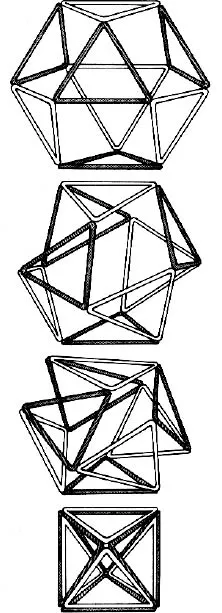
17 Since Fuller saw not only into but through this shape in such a remarkably thorough way, we should allow him to speak for himself about the Vector Equilibrium and its structural implications:
1819The vector equilibrium is the anywhere, anywhen, eternally regenerative, event inceptioning and evolutionary accommodation and will never be seen by man in any physical experience. Yet it is the frame of evolvement. It is not in rotation. It is sizeless and timeless. We have its mathematics, which deals discretely with the chordal lengths. The radial vectors and circumferential vectors are the same size.
20The vector equilibrium is a condition at which nature never allows herself to tarry. The vector equilibrium itself is never found exactly symmetrically in nature’s crystallography. Ever pulsive and impulsive, nature never pauses her cycling at equilibrium: she refuses to get caught irrecoverably at the zero phase of energy. She always closes her transformative cycles at the maximum positive or negative asymmetry stages. See the delicate crystal asymmetry in nature. We have vector equilibriums mildly distorted to asymmetry limits as nature pulsates positively and negatively in respect to equilibrium. Everything that we know as reality has to be either a positive or a negative aspect of the omnipulsative physical Universe.
21…As the circumferentially united and finite great-circle chord vectors of the vector equilibrium cohere the radial vectors, so also does the metaphysical cohere the physical.75
23 If you were a scientist, these astonishing correlations of the isotropic vector matrix with empirical evidence from various realms of the physical world might be enough to keep you busy for a lifetime, as they did Bucky. But a more artistic or philosophical or religious sensibility might see further reflections, more deeply buried perhaps, but in some ways even more extraordinary still. Many would immediately recognize here the Jewish Star of David or, with interlacing dark and light triangles which tradition sees as the union of body and soul, the Seal of Solomon. As if to reinforce the connection, Canada’s premier stained glass pioneer Eric Wesselow produced his ‘growing’ Magen David (Star of David, p. 79) after studying Fuller’s vector equilibrium.

25 If you had instead a classical bent, you might very well see hidden here the Pythagorean tetraktys:

28 From this angle, the vector equilibrium at the heart of Bucky’s matrix is not just a stereoscopic version of Archimedes’ cuboctahedron, but a tetraktys raised to the second power: when one tetraktys is inverted and overlaid upon another, the central ten dots coincide, adding only an inverse outer triangle; the whole forming the familiar 12-around-1 vector equilibrium configuration of closest-packed spheres:

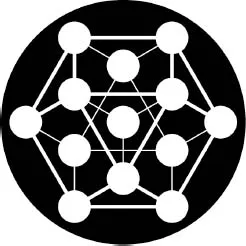
30 Tilt this figure 30° over to one side, and you are again face-to-face with Fuller’s ‘Dymaxion,’ the lines of force connecting closest-packed spheres:
32 And here you may recall that Pythagorean initiates were required to swear their allegiance (as well as their promise not to reveal the secrets of the Order) by the Oath of the Tetraktys: ‘‘I swear by Him who reveals Himself to our minds in the Tetraktys, which contains the Source and Roots of everlasting Nature.’’76 And what was the celebrated doctrine of the Pythagorean’s—the Golden Mean, moderation in all things—if not this balance and this equity played out in the human and social world? You would also be reminded very strongly of Plato’s effort to describe the cosmogony, the genesis of all things, with an arresting geometrical image probably as old as human memory: the soul of the world. We spoke earlier of Emerson’s sense of it. Here we find Socrates listening to the explanation offered by the Pythagorean Timaeus, drawing from sources already ancient in their own time (c. 500 BC):
3435We may say that the world came into being—a living creature truly endowed with soul and intelligence by the providence of God…Wherefore he made the world in the form of a globe, round as from a lathe, having its extremes in every direction equidistant from the center.77 (Tim. 30c, 33b)
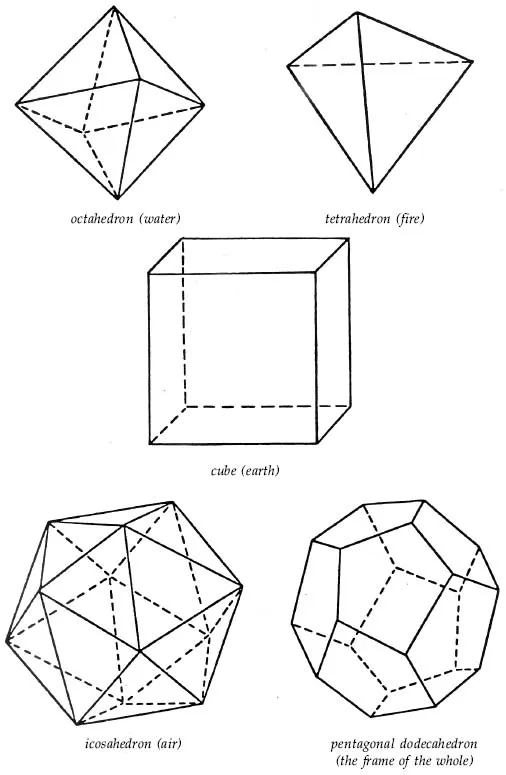
37 And the creator proceeded to divide this globe, Timaeus recounts, by triangulating it in every direction following the harmonic intervals of the tetraktys. The whole was then reconstituted into an interlocking system of perfect circles within circles, assumed to correspond to the orbits of the seven known planets. The permanent elements of this world are described as the five regular polyhedra—the famous Platonic ‘solids’—said to govern all form and recurrence in the natural world. In this image, we catch sight of the fusion of two traditions: the ancient Mediterranean Great Mother Goddess (mater, matrix: womb), the maternal ‘sphere’ which gives birth, which nourishes and sustains, as well as the more abstract mathematical ‘key’ to her prolific diversity, the tetraktys, which also describes the harmonics of the lyre’s vibrating string.78 Even as the soul of the world is fused with its material body, we are encouraged not to lose sight of ‘her’ originally spherical shape:
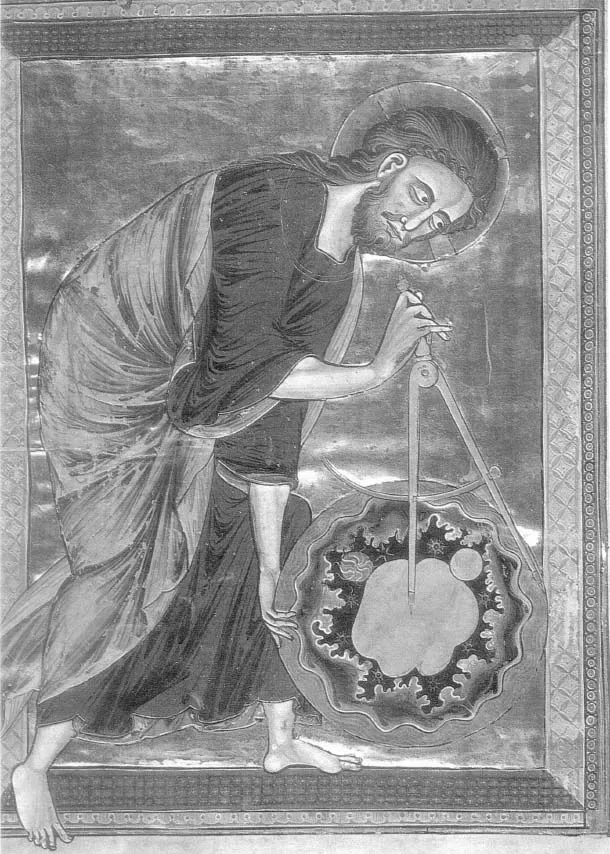
4041Now when the creator had framed the [world] soul according to his will, he formed within her the corporeal universe, and brought the two together and united them center to center. The soul, interfused everywhere from the center to the circumference of heaven, of which also she is the external envelopment, herself turning in herself, began a divine beginning of never-ceasing and rational life enduring throughout all time. The body of heaven is visible, but the soul is invisible and partakes of reason and harmony, and, being made by the best of intellectual and everlasting natures, is the best of things created. (Tim., 36e)79
43 From Plato’s spherical vision of perfect circles and regular ‘solids,’ there is a nearly unbroken tradition (if we forgive Euclid his excess of analytic zeal in flattening the whole thing out) which culminates in the ‘spheres within spheres’ of the medieval Neoplatonism to which Dante, among many illustrious others, was heir. The immensely influential Celestial Hierarchy of the Pseudo-Dionysius (c. 550 AD), who has quite rightly been called ‘the fountainhead’ of Western mysticism, set the pattern of nine metaphysical spheres ‘animated’ by their respective intelligences.80
45 A clarifying note: The 1990s witnessed a remarkable revival of popular interest in angels, but these are not of that sort. Supernatural guides, angels (good or bad) on your shoulder, personalistic ‘guardian’ angels and so forth most likely derive from the Jewish tradition of the two yetser, the twin urges of the human heart,81 often clouded by an atmosphere and an iconography derived from the dualistic Zoroastrian tradition: the powers of darkness versus the legions of light.82 The impersonal Neoplatonic tradition of angelic intelligences moving the celestial spheres is something else again, and much closer to Fuller’s notion of primordial, ‘timeless, metaphysical’ patterns animating the transactions of energy in the atomic, molecular, and biological domains. As Ezra Pound observed: ‘‘The statements of analytic geometry are ‘lords’ over fact. They are the thrones and dominations that rule over form and recurrence.’’83 Matthew Fox and Rupert Sheldrake have recently attempted in The physics of angels: exploring the realm where science and spirit meet to recoup some of these cosmological functions of angels as the ‘intelligences’ governing various domains of the real, but they lack the rigorously disciplined trinitarian imaginations of the Pseudo-Dionysius, Scotus Eriugena, Bonaventure, or Dante, to mention only some of the tradition’s most illustrious exemplars, and tend to get tangled up in wishful fancies all their own.84
50 The same cosmology also captivated many of the great medieval figures of Islam, including Avicenna (Ibn-Sina) in his Tale of Hay Ibn-Yaqzan and Ibn el-Arabi, specifically in his Mohammed’s Ascent to Paradise, which may have provided a structural template for Dante’s Commedia. Speculations like these had underpinned the structural insights of the Masons and helped spark the extraordinary burst of creativity that built the cathedrals throughout Europe during the Middle Ages. Interestingly for our purposes, the Gothic Master Builder Diagram worked on the same icosahedral pattern, incorporating the phi ratio and other sacred proportions, which Bucky used to build most of his domes.
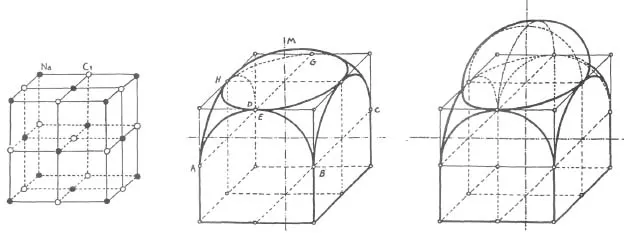
51 By contrast, the Byzantine cupola which signals an architectural continuum between ancient Constantinople’s Hagia Sofia and St. Mark’s in Venice, and is also used to good effect in the twentieth-century Shrine of the Immaculate Conception in Washington, D.C., employs the four triangular ‘pendentives’ from the vector equilibrium to support a round dome on a square base—a configuration which turns out to be akin, oddly enough, to the molecular structure of common table salt.
3.1.1 Angels & Angles
52I may well be falling into the same trap as so many ‘speculative’ thinkers before me, but it seems to me fairly straightforward to translate Fuller’s ‘geometry of thinking’ into the celestial spheres of the Pseudo-Dionysius. We need only move from the simplest such spherical forms through to the most complex.
53 Beginning with the spherical triangle and spherical tetrahedron, which unfold into the seven great-circle models outlined in our Synergetics Primer (Unfolding Wholes, Appendix A), we may re-assemble the nine ‘intelligences’ of the angelic hierarchy into three tiers of three, mirroring and moving outward from their unfathomable divine source in the Trinity:
54 The first tier: Spherical triangle (Seraphim/heat), spherical tetrahedron (Cherubim/light), spherical octahedron (Thrones/matter).
55 The second tier: Spherical vector equilibrium (Dominations), spherical icosidodecahedron (Virtues), spherical rhombic dodecahedron (Powers).
56 The third tier: 12-great-circle Vector Equilibrium (Principalities), 10-great-circle icosidodecahedron (Archangels), 15-great-circle triacontahedron (Angels).
57 To play out the analogy, if there is a ‘fallen’ angel in this schema—fallen precisely outside the original matrix—it is the square frame and the cube (which the Renaissance turned into the basis of the one-point perspectival system and the rectilinear grid spawned from it), the chief mischief-maker now exercising unchallenged ‘dominion’ over all the world…or at least over most of its ‘profane’ architecture.
58 Granting that such an arrangement turns archangels into Buckyballs, you may take or leave it as you see fit. I can only give you the correspondences as I see them. Fuller presents the physical evidence (see Appendix A); the Neoplatonic tradition reinforces the metaphysical coherence of the whole.
59 Not to make too much of an acoustic pun, but it might be said that angles and angels fit snugly together in this worldview from the very beginning.
60 This is a worldview where the direct experience of revelation takes precedence over logical inference, which in turn takes precedence over empirical data…in other words, a sacred, hierarchical worldview more or less precisely opposite to our own modern, secular, techno-scientific reductionisms.
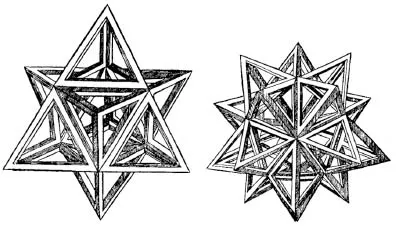
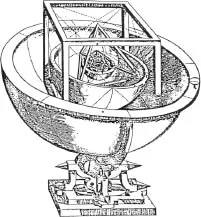
63 Even as late as the Renaissance, Nicolas of Cusa would affirm in his Of learned ignorance(1440) that he shared with the Neoplatonists the insight that ‘‘the Soul of the World is an unfolding of the mind of God,’’ which ‘‘necessarily co-exists with matter, from which it receives a limitation.’’ Unlike Bucky, however, Nicolas permitted infinity into his geometry, thereby unduly muddying the waters for centuries. In his De divina proportione (1509), Luca Pacioli offered three-dimensional models of the Platonic solids, truncated and stellated the icosidodecahedra Bucky would later use to build his domes, and called on his close friend Leonardo da Vinci to render these complex figures for publication, probably from models.85 Significantly for our purposes, Pacioli was the first geometer in the West to insist on making models rather than relying solely upon mathematical abstractions, a pragmatic desideratum Bucky shared with his own great teacher, H.S.M. Coxeter, Professor of Mathematics at the University of Toronto, to whom (along with ‘‘all the geometers of all time’’) Synergetics itself is dedicated.86 In illustrating Pacioli’s book from such models, Leonardo came up with a system for rendering these visually challenging polyhedra which has been employed in practically every subsequent treatise on geometry, perspective and astronomy. (These figures were, incidentally, the only set of Leonardo’s designs published during his lifetime). In the early seventeenth century, Johannes Kepler was still trying to construct a precise geometrical model of the Platonic World Soul. But when his own heliocentric model of the solar system superceded the geocentric Ptolemaic astronomy, with which the anima mundi had been too closely (and quite arbitrarily) correlated, the brashly successful new astronomy cast into historical oblivion the very idea of a living and geometrically integrated World Soul, surely a classic case of throwing out the baby with the bathwater…
66 Stripped of its various geometrical elaborations, the anima mundi still retained in mainstream Christian theology, both Latin and Byzantine, the very basic intuition which we moderns are only lately coming to retrieve, namely that the Cosmos is animate— i.e., ‘en-souled’; that it has its own life and integrity and contains its own principles of movement, growth and regeneration. It is even Biblical, as Wisdom 1:7 attests: Spiritus Domini replevit orbis terrarum; the Spirit of God fills the whole world, this terrestrial orb. Augustine saw no reason to refute it, Origen considered it likely, and the idea is further refined by Thomas Aquinas and most of the other great Schoolmen. The Latin Church only condemned the notion as ‘pantheistic’ when the World Soul was identified with either God or the Holy Spirit, judging that such an identification would abridge not only the transcendence of God but the freedom of human beings, who would thus find themselves locked into a totally predetermined world.
68 In many ways, as noted earlier, the anima mundi is a notion most closely akin to the Great Mother Goddess of the Mediterranean basin, but Mother and Father, Earth and Sky, Cosmos and Theos, surely should not be conceived as antagonists. They are lovers, and their union in the sacred marriage (hieros gamos) forms a perennial theme in world religions.87 Unfortunately, due in large part to the predominance of rationalistic, mechanistic and reductionistic methods in the early days of the natural sciences, it took only a couple of hundred years for modern Western society to forget altogether this vision common to ancient, classical, medieval and renaissance culture: a vision of the Universe as a living reality in which angelic intelligences move the celestial spheres, demons stalk the underworld, and spirits of all sorts populate the interstitial spaces. Even today, ecologists have constantly to remind us ‘‘that the universe is alive,’’ as the Indian Brahmin Iarchus put it to the Pythagorean Apollonius of Tyana at about the time of Christ88 The crucial intuition is that the microcosm of the human soul mirrors the character of the whole Universe: ‘‘As above, so below.’’
71 But science has not stood still since it abandoned the all-inclusive anima mundi in its enthusiasm for concrete empirical data. Indeed, science today is not a monolithic edifice, but a constantly revised set of only-partially-overlapping theories, hypotheses, models and metaphors. I would submit that modern physical and biological science is slowly but surely rediscovering this primordial matrix, the ever-underlying anima mundi. Buckminster Fuller’s ‘geometry of Nature’ will have to stand in as a single case in point for this argument, larger and deeper in scope than we can encompass here. The vigorous ‘renegade’ cosmological theories of Fred Hoyle and his disciples come to mind as a good place to start … One would have to include the vast ‘recycling’ universe of Hoyle’s Quasi-Steady State cosmology (still awaiting observational verification), which resembles Bucky’s ‘‘eternally self-regenerate scenario Universe’’ in important respects; one would have to outline (as John Gribbin does in Stardust)89 the internal nuclear dynamics of stellar evolution, with all the emerging elements geometrically shaped by the constraints of the strong and weak binding forces of the atom; one might take quite seriously Wickramasinghe and Hoyle’s revived ‘panspermia’ idea,90 whereby life arrives on planet Earth from comets carrying freeze-dried bits of bacteria and viruses (with their ‘geodome’ structure) from interstellar dust; and finally one might arrive at all the forms of life on this planet through a synergetic process like Lynn Margulis’s ‘symbiogenesis,’ by now well established,91 which finds free-floating microbes and bacteria ‘co-operating’ to form eukaryotic cells and eventually multicellular life. Add these partial visions together and you begin to find yourself, as the ancients did, at home in a living Universe. Some of the details are still somewhat obscure, or speculative, or very technical, but the overall pattern directly challenges the mechanistic model that has dominated modern science from Newton to Dawkins. It is perhaps enough for us now to note that this momentous rediscovery of the anima mundi has gone almost entirely unnoticed, largely because work in the various fields involved has been in the main highly specialized and the vision of the whole can scarcely emerge in any one scientific discipline alone.
75 In this domain of cosmology, I must confess myself an unabashed Bucky-booster. By using only his own mind, deliberately unencumbered by the conventional Euclidean assumptions, he may well have seen more clearly into the very structure of matter than anyone before him or since. His achievement is remarkable, and almost unparalleled. Challenged in the 1970s by Ed Applewhite to lay out the entire energetic-synergetic geometry in comprehensible form, he undertook to produce in the Synergetics volumes the groundwork for an integrated alternative science based on the 60° coordination of the tetrahedron unfolding into the full isotropic vector matrix. Fuller was an original, one of those do-it-yourself philosophers who don’t flinch from reviewing the whole of human knowledge from their own angle and coming to their own conclusions. The result is admittedly idiosyncratic—when Fuller uses the word ‘metaphysical,’ for instance, he means ‘weightless’; when he says something is ‘rational,’ he means it can be divided into ‘whole-number increments.’ Such an approach, ignoring even the philosophical traditions available to him, has its disadvantages. For one thing, his language remains opaque to most people. On the other hand, Fuller does manage to define his own terms in his own way, so that if you persevere, his way of speaking actually does come to make a good deal of sense.92 It takes the ‘synthetic’ mind of a comprehensivist to see the principle of the whole(s) operating in every nook and cranny of the diverse natural sciences. Such minds are not likely to be fostered by the rigorous ‘analytical’ training that makes a scientist these days; they come to conventional science often as interlopers and mavericks, but also as illuminators.
77 One of the earliest and most important generalists who tried to see the world whole through the specialized lenses of twentieth-century science was of course Jan Christiaan Smuts, whose coinage of the term ‘holism’ in his now-classic Holism and Evolution (1926) was not restricted to the realm of biological evolution, although biology is the field where it has so far received the most attention. Smuts described his use of the word in the following way:
7879The close approach to each other of the concepts of matter, life and mind, and their partial overflow of each other’s domain, raises the further question whether back of them there is not a fundamental principle of which they are the progressive outcome… Holism (from Grk. ‘olos—whole) is the term here coined for this fundamental factor operative towards the creation of wholes in the universe…The idea of wholes and wholeness should not therefore be confined to the biological domain; it covers both organic substances and the highest manifestations of the human spirit…There is an infinity of such wholes comprising all the grades of existence in the universe;…including all wholes which are the ultimate creative centres of reality in the world.93
81 Arthur Koestler not so long ago took up Smuts’ holism and refined it by positing what he called a ‘holarchy,’ that is, a hierarchy of wholes open-ended in both the macro and micro directions, each ‘holon’ coordinating those below it in the hierarchy while at the same time serving as an element in the larger whole above it.94 If you add to Koestler’s sketch the works of Bohm (the ‘implicate order(s)’), Bateson (the ‘pattern that connects’), Thomas Berry (the ‘New Story’), Rupert Sheldrake (‘morphogenic fields’ and ‘morphic resonance’), as well as René Dubos, Teilhard de Chardin, Michael Polanyi, Lewis Thomas and others, you begin to discern what can only be called a pattern or spectrum of patterns, connecting atoms to molecules to amino acids to proteins to cells to organs to organisms to minds to people to communities to cultures to bioregions to the living Earth to the galaxy at large…and, ultimately, some might say, to the communion of all beings in Being itself. We are once again approaching the eukyklos sphæra, the well-rounded sphere, of Plato’s Pythagorean synthesis. Not surprisingly, if you look closely at Fuller’s Synergetics, you may find that we have learned a good deal more about it over the intervening 2,500 years.
83 Much would become clear. You would recognize in your reflection that Descartes and Gauss had set up their XYZ coordinate system, still the basic graph for Western science, at deliberate variance from this 60-degree system. Through this grid, the entire natural world looks askew. You would see that even in the West, the 60-degree system was plainly evident—in cathedral architecture, for instance, in the coiled intricacies of Celtic knots—until the predominance of the square, cube and frame was firmly established by the rise of modern science. You would realize that the Renaissance ‘perspective’ of three-dimensional space projected into two dimensions by such a grid was a deliberate contrivance; convenient in some respects, but tending to isolate human consciousness (here, inside) on one side of the frame, segregated from the wide world (there, outside) on the other. Radical art historian José Argüelles writes:
8485The one-point, linear perspective is an intellectual, rationalistic, and above all purely mechanistic way of dividing space, a development synchronous with Gutenberg’s press. Along with the printed word, it is the single most powerful agent for standardizing the perceptions of the collective mind of Europe over the next few centuries. If the printed word promotes mental uniformity, one-point perspective enforces that uniformity at the visual-sensory level. The grid system employed by one-point perspective is the forerunner of refined cartography and of the Cartesian system of coordinates, the source of all later scientific systems using graphs. Essentially, the one-point perspective is just that—a graph applied to the eye for the purpose of mechanizing vision, and thus mind.95
87 You would not only to begin to inveigh, as Bucky did, against squares, cubes, and the blockheads who thoughtlessly employ them—as arbitrary, abstract, misleading and inefficient models of Nature’s own very definite, concrete, and efficient structural strategies—but you would perhaps begin to notice that in cultures where this Western ‘viewpoint’ had no foothold, Nature’s co-ordinate system still holds sway.96 Anywhere Euclid, Descartes and the abstract analytic geometry they spawned never took hold, you tend to find patterns allied to those Fuller himself developed–with both the technical resources and the pragmatic biases of a twentieth-century scientist-engineer-artist.
89 As a single example, consider one of the earliest instances of 60° radial symmetry: a striking Harrapan bas relief found in the Indus Valley, dating back at least 4,000 years.97

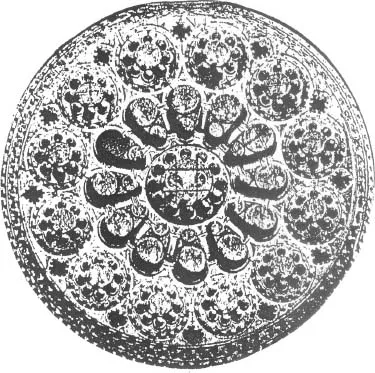
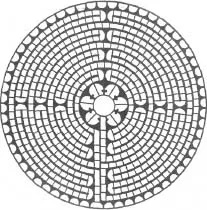
92 Its six-way division of the circle exactly mirrors the great circles slicing through the Vector Equilibrium; or else, given its antiquity, Fuller’s figure is in fact little more than an extremely precise version of that venerable carving. Besides later serving in iconography throughout India as the graphic figure for the second (genital, generative) chakra— described in the literature as ‘energy’s own standing space’—and as the model for innumerable common yantras (meditation diagrams), its circular 60° symmetry may well have provided a prototype for the hexagonal architectural symmetry of many later Hindu temples. It would take us fairly far afield to detail further the myriad correspondences of Fuller’s geometry with the Minoan labrys, or the Pythagorean tetraktys, or the Kabbalah’s Tree of Life, not to mention the patterns in Persian carpets, or Celtic knots, or cathedral rose windows, but all of these pre-Cartesian crystallizations of the isotropic vector matrix and its characteristic 60° symmetry are undeniably tangled up with the very roots of Indo-European culture.98 And, not altogether surprisingly, with those of very many other cultures as well…Indeed, once you start looking for Nature’s coordinate system in the iconographies and sacred geometries of traditional cultures, you can scarcely avoid discovering antecedents everywhere. A scattering of illustrations will suffice to underscore the point.
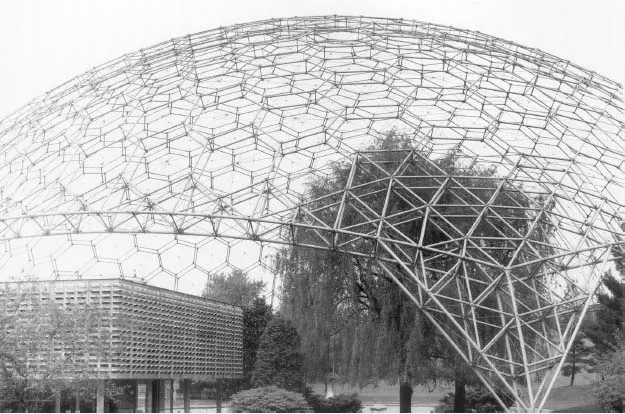
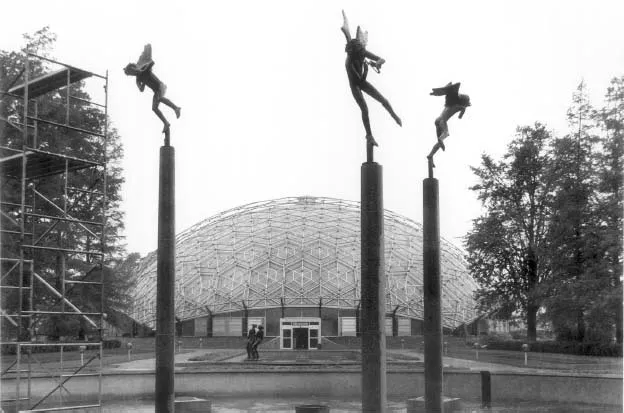
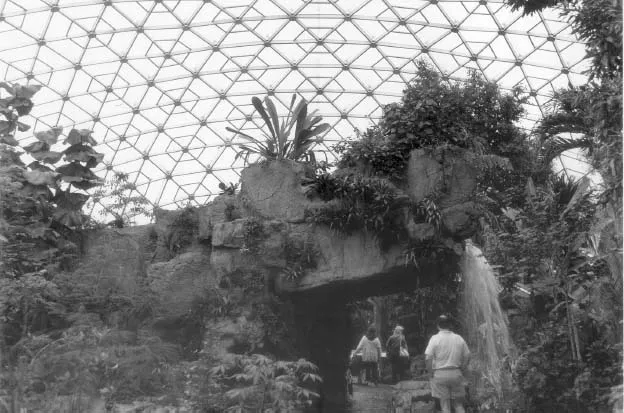
94 As a further boon, you might begin to look at Bucky’s domes in a very different way, as vast figures for contemplation, aerial traceries etched against the vault of the sky. Many of Fuller’s constructions are not primarily utilitarian, but thought-provoking, their lively interplay of positive and negative spaces evoking ‘skyviewing rapture,’ as Bucky’s lifelong friend, the Zen-Modernist sculptor Isamu Noguchi might express it. The American Society for Metals Dome in Cleveland, for instance, has no ostensible purpose beyond showing off what can be done with metals. The playdomes in the childrens’ playground are not for work but for play. The Climatron in St. Louis encloses a miniature biosphere that simply exists, and that is its statement: life nurtured under Bucky’s umbrella. As a matter of fact, this germinal idea has recently sprouted up elsewhere. The Eden Project in Cornwall, Britain’s ‘living theatre of plants and people’ (which opened to visitors early in 2001), consists of a series of giant interlocking geodesic conservatories called ‘Biomes,’ both extending and beautifully refining Fuller’s original Climatron concept.99 And of course there is little left of the Montréal Expo Dome but its enigmatic skeleton, yet reflecting on that alone has taken us places we might not have expected.
96 I would like to think that if we are sensitive to this contemplative dimension of Fuller’s constructs, we may begin to recover one of the eldest domains of sacred geometry, the mandala: the world as pattern, and that pattern as an intelligible world.

3.2 Mandala
3.2.1 Deep South
110Adding his usual descriptive flourishes, biographer Alden Hatch relates one of Buckminster Fuller’s adventures which has in retrospect very nearly become legend:
112113In 1958, on his first trip around the world, Bucky stopped off in India where he had numerous speaking engagements. One day he made three speeches in New Delhi, in the morning, afternoon, and evening. At all three meetings he noticed a striking youngish woman dressed in exquisite saris, who usually sat in or near the front row listening intently, her large dark eyes refulgent with intellectual excitement.
114At the evening lecture, Bucky used a little tensegrity sphere model, only about six inches in diameter, made of string and small turnbuckles. After the lecture he was presented to the lady, Mrs. Indira Gandhi, Prime Minister Nehru’s daughter. She was so interested in the model that he gave it to her. Mrs. Gandhi asked him if he would come on Saturday to meet her father at their house. Bucky says, ‘‘I did meet him and we had a very extraordinary time’’…
115Just what he said that day no one will ever know, for it was, as always, purely spontaneous…In the time he allotted himself he endeavored to give Nehru the essence of his philosophy and the logical reasoning on which it was based. During the entire period Nehru stood quietly intent, absorbing Bucky’s words.
116At the end of an hour and a half Bucky stopped talking…Nehru bowed with folded hands and left the room. He had not spoken a single word.100
118 An extraordinary time, indeed…not a single word?! Bucky had remarkable powers as a monologist, granted, but by the same token a signal disinclination to dialogue. (Part of the problem was his deafness; he could not hear others well, and the phrases he did hear tended simply to trigger off a new monologue; but that’s another issue). Bucky was a man possessed by his own vision. Of course he had several, more conversational meetings with Nehru, who had read and admired his books, and with Indira Gandhi too, who eventually invited him to design the Delhi airport, and to give the Nehru Memorial Lecture in 1969 during her own debut as Prime Minister. They remained lifelong friends, Bucky ever unwilling to concede that the realities of wielding power might have changed her over the years from the eager, ‘‘intent’’ young woman he had met in 1958. But I would like to take this first meeting as a symbol for something beyond personalities, beyond politics for that matter: the encounter of East and West strangely symbolized by Nehru’s silence before Bucky’s customary avalanche of words—the silent bow of the ‘under-developed’ India before a distinctly Western vision of her prospects for technological development.
119 For surely that is what Bucky outlined, and what Nehru was all too ready and willing to receive. His ‘design science revolution’ was the constant theme of all Fuller’s talks and books, but here might have received an Indian twist, as in his ‘‘Ten Proposals for Improving the World’’:
121122The intellect, vision and courage of Mahatma Gandhi conceived of passive resistance with which bloodless revolution he broke the hold on India of history’s most powerful sovereignty. [But…] passive resistance will not amplify the production of life support.
123In extension of the Mahatma’s magnificent vision we are committed to the design science revolution by which it is possible bloodlessly to raise the standard of living of all humanity to a higher level of physical and metaphysical satisfaction than hitherto experienced or dreamed of by any humans. All the knowledge and resources are now available with which to accomplish that comprehensive success.
124This can all be realized by 1985 [!] without any individual profiting at the expense of others or interfering with another’s enjoyment of total planetary citizenship. It requires the competent design science commitment of world-around youth to realize the Gandhian integrity.
125Youth’s spontaneously mutual commitment can only be inspired through experientially gained knowledge and love-sustained innate faith in the eternal reliability of cosmically manifest principles as discovered by science.101
127 This ‘‘extension of the Mahatma’s…vision’’ is vintage Bucky, of course, not Gandhi at all…except for the ‘‘bloodless’’ non-violent ideal they shared (though Nehru and Indira Gandhi apparently did not). One notes right away that Bucky imagines ‘‘the Gandhian integrity’’ will be realized through ‘‘principles…discovered by science,’’ not by a return to the Indic traditions which nurtured Gandhi, nor to Gandhi’s own proposals for agrarian reform, rural self-sufficiency, hand-spinning and weaving and other village crafts. Gandhi claimed he was not against technology, yet his idea of ‘appropriate’ technology was entirely pre-industrial: ‘‘The spinning wheel itself is a machine. What I object to is the craze for machinery, not machinery as such…The supreme consideration is man.’’ In the same epoch as Fuller, you may recall, E. F. Schumacher proposed to revive the Buddha’s suggestion that everybody in India plant one tree a year for five years, a notion which seems much more along the lines of Gandhi’s own approach than the airport Bucky designed for New Delhi. (Today that proposal would produce something like five billion trees—a new world!) Gandhi’s way, in tune with the rooted traditions of Indian peasant life, was in fact profoundly out of tune with the programs of massive industrialization his successors undertook in his name, leading eventually—might one even say inevitably?—to India’s own atomic bomb, and then to Pakistan’s, and so on.
128 The doctrine of development had been outlined by US President Truman only a decade before Fuller’s visit to India, in his Inaugural Address of 1949. At a stroke the world was divided into rich and poor nations, North and South, developed and ‘under-developed’ areas—based solely on GNP And the doctrine was readily accepted on both sides of the ‘development’ divide, across which monies flowed freely for a time. Had Nehru spoken that day, he might well have lamented India’s artificially ‘arrested’ technological development, as he had elsewhere, and laid the blame directly at the feet of the British. It was no coincidence, he would assert, that the poorest Indian provinces were those that had been under British rule the longest. In his The discovery of India, written from Ahmadnagar Fort prison in the early 1940s, Nehru drew attention to the coincidence of the English industrial revolution in the late eighteenth century with the systematic looting of once-wealthy Bengal, which provided vast reservoirs of ready capital for the new industrialists. Their policies were to change the entire relationship of Britain to its Indian colony:
130131The chief business of the East India Company in its early period, the very object for which it was started, was to carry Indian manufactured goods—textiles, etc., as well as spices and the like—from the East to Europe, where there was a great demand for these articles. With the developments in industrial techniques in England a new class of industrial capitalists rose there demanding a change in this policy. The British market was to be closed to Indian products and the Indian market opened to British manufactures…This was followed by vigorous attempts to restrict and crush Indian manufactures…The Indian textile industry collapsed…The process…continued throughout the nineteenth century, breaking up other old industries also, shipbuilding, metalwork, glass, paper, and many crafts…Machinery could not be imported into India. A vacuum was created in India which could only be filled by British goods, and which also led to rapidly increasing unemployment and poverty. The classic type of modern colonial economy was built up, India becoming an agricultural colony of industrial England, supplying raw materials and providing markets for England’s industrial goods.102
133 What Nehru probably saw in Fuller was a fast-track to the most futuristic technology imaginable. What Fuller offered was in fact a maverick technology entirely at variance with the mono-technic trends of Western industry and capital development, envisioned as we have seen as a series of interlocking service industries for all humanity, rather than more profit-taking enterprises for the benefit of a few Great Pirates. Bucky was advocating something very much like what is today called ‘sustainable’ development or ‘green’ redevelopment, but Nehru’s openness to modernization brought mainly the mega-projects and social engineering typical of development programs the world over, and typically unsuited to the indigenous people or their ways of life. While it is surely true that Nehru did not need Bucky to teach him about Great Pirates and their colonial policies, the disaster of Western-style technological development in India over the past fifty years testifies that development itself has turned out to be little more than the reincarnation of the very colonialism Nehru struggled against. His celebrated foreign policy of ‘non-alignment’ with either the Soviet bloc or the Western bloc did not prevent him from aligning his people with a modernization which inexorably tried to Westernize India. So today, the rise of Hindu fundamentalism, the increasing sectarian violence, and the continued ‘modernized’ poverty, are the bitter legacies of such development. Writing a decade ago from New Delhi’s Center for the Study of Developing Societies, Ashis Nandy comments on the demise of the twentieth century’s dream of science and technology as a liberating force beyond politics:
135136The earlier creativity of modern science, which came from the role of science as a mode of dissent and a means of demystification, was actually a negative force. It paradoxically depended upon the philosophical pull and political power of tradition. Once this power collapsed due to the onslaught of modern science itself, modern science was bound to become, first, a rebel without a cause and then, gradually, a new orthodoxy. No authority can be more dangerous than the one which was once a rebel and does not know that it is no longer so.
137The moral that emerges is that modern science can no longer be an ally against authoritarianism. Today it has an in-built tendency to be an ally of authoritarianism.…the scientist has become the main author of the establishment cosmology. He is now the orthodoxy; he is now the Establishment. So much so that to perceive him still as a weak, unorganized fighter against authority can spell disaster for all of us…
138It is therefore not a paradox of our times that to contain modern science many are falling back on what has been one of the main targets of modern science during the last three hundred years—cultural traditions…This, however, only brings us to another question: What kinds of tradition can be used as tools of criticism and what kinds are open to criticism?103
140 In any case, neither Fuller nor Nehru (a brahmin who confessed himself a poor student of the Indian religious classics) paid much attention to the wisdom traditions of India, let alone to her architectural and iconographic heritage. Nehru and his daughter looked to the West, and to modern history with its arenas of politics, law, science and technology, military and police powers. Setting up their own sovereign democratic nation on the Western model, the new rulers of India may well have sought, in Nandy’s phrase, ‘‘to pay back the imperial West in its own coin.’’ Fuller had a good grasp of history, and the history of the British Empire in particular (he followed the exploits of seafaring nations with keen interest), but virtually no background at all in the traditions of India. Beyond this, and probably because he was too busy living out the consequences, he seemed unaware of the power of modern science and mono-technics to co-opt and absorb mavericks like himself into orthodox avenues. As Wolfgang Sachs notes, Truman’s Inaugural Address ‘‘called for technical assistance designed to ‘relieve the suffering of these peoples’ through ‘industrial activities’ and ‘a higher standard of living.’ ’’104 Overseas, Fuller must simply have sounded like a charmingly idiosyncratic Yankee proponent of the cause; a happy propagandist who thought it was all his own idea.
142 Of course with Nehru, Fuller was preaching to the converted. Nehru believed strongly in the underlying unity of India, in her ability not only to tolerate but to absorb and domesticate foreign influences. Of India’s past, he once wrote: ‘‘Foreign influences poured in and often influenced that culture and were absorbed. Disruptive tendencies gave rise immediately to an attempt to find a synthesis. That unity was not conceived as something imposed from outside, a standardization of externals or even of beliefs. It was something deeper …’’105 Yet with his uncritical acceptance of modern industrial development, Nehru was letting in not Fuller’s relatively benign ‘design science revolution,’ but what turned out to be a mega-technic Trojan Horse.
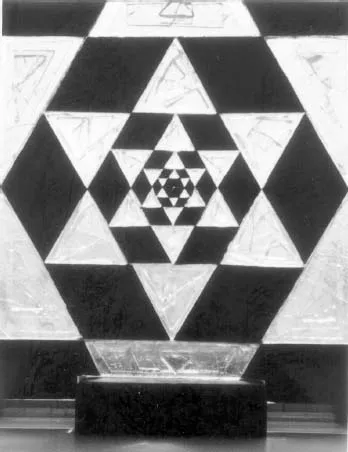
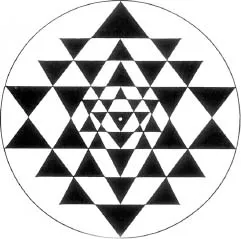
144 At any rate, nobody in the picture at the time seemed to have either the foresight or the hindsight to look at Fuller’s geometry through Indian eyes. It is an astonishing lapse, since the correlations with Hindu iconographic forms are so obvious. I can however tell you from personal experience that Buckminster Fuller, friend and confidant of two Prime Ministers of India, had never examined a śri yantra until I had the opportunity to show him one in mid-1983: ‘‘That’s an isotropic vector matrix,’’ he exclaimed straightaway, a note of surprise in his voice. And so it is, although slightly skewed—as if viewed from a certain angle and projected onto a flat plane. One might even speculate that this is a view of the isotropic vector matrix from the inside. But what does it mean that the core matrix of Fuller’s geometry should show up so accurately rendered not only in this most revered and prominent yantra, but in almost every other Hindu meditation diagram, and in the ground-plans of so many Indian temples as well?
145 Thereby hangs a remarkable tale which Bucky simply did not live long enough to tell. Will you permit me to make up some of this untold story as we go along?
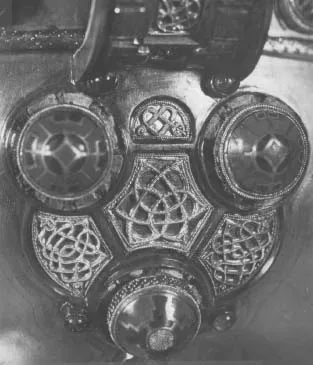
3.2.2 Due East
147First of all, what exactly are mandalas? Mandala is simply the sanskrit word for a circle and center. It was traditionally reserved for Buddhist meditation diagrams, while their Hindu counterparts were called yantras, but today the word mandala has become a generic term covering all such sacred spaces from the rose windows in cathedrals to Navajo sand paintings to the enigmatic pictures produced by psychologist Carl Jung’s patients.106 The short answer is that mandalas are symbols of the whole.
149 In modern, secular society, it may be that more questions are raised than answered by such a definition. What, for example, is a symbol? I shall go out on a limb here: a symbol is the real appearance of something real, which would not otherwise appear at all. Drawing on R. Panikkar’s analysis, I should add that a symbol is neither a purely objective entity (in the world, out there), nor a merely subjective entity (in my mind, in here), but precisely the bridge between object and subject, outer and inner, the real and the ideal.107
151 And in this day and age the very notion of the whole is problematic too, in ways our forebears might never have suspected. We may well have our own idea of the whole—it is all water, or fire, or matter, or God, or consciousness, or chaotic or absurd or whatever—or we may concoct a marvelous system and claim it embraces everything, but we are all too well aware there are others with other ideas, and other systems which also claim to be both comprehensive and comprehensible. We can no longer sustain the pretense to universality of any one vision of the whole—which we know must be conditioned by a specific nature, culture, language, religious tradition, and whatever other factors we deem important. Are we then to suppose that there is no whole, no underlying unity at all? That we are all locked up in our private worlds and images and language games, and that there is no escape? But such an ‘absolute’ relativism contradicts itself (‘Everything is relative except this statement’) and, strictly speaking, cannot even be communicated. If there is no larger whole (again, of nature, culture, language or what have you) in which we both to some degree participate, then I am merely talking to myself here and you are hearing only some distant echoes of your own voice in your head.
152 It is precisely in bridging this apory between the One and the Many, as well as between Self and Other, that symbols in general, and mandalas in particular, come to our aid. A mandala is not primarily a picture of anything. Mandalas are specifically designed to integrate and resolve apparent oppositions and conflicts into the complementary facets of a more comprehensive understanding. The paradoxes of human life do not disappear, but they are transformed—shall we say transfigured?—in the light of the whole. The process of making a mandala brings one face-to-face with the patterned integrities of life itself: center, symmetry, and rhythmic resonance. And there is more: ‘‘The larger whole,’’ as Gregory Bateson once phrased it, ‘‘is primarily beautiful.’’108
154 Anyone with half a wit can see patterns in the flowers, can sense the rhythm of the ocean waves, can marvel at the orderly tracks of the planets through the starry heavens. True, we cannot ‘grasp’ the whole of reality, we cannot ‘know’ it as we know our phone number, nor claim it as our own idea. Of course not. There is an obvious mystery here, as we earlier found both Fuller and Mumford affirming, but also a plain and simple truth. Although we rarely notice it, we can and we do understand something very basic about the entire reality of our experience: it coheres. It seems to ‘work’—it ‘fits’ together quite splendidly; it is whole, intact, sound. It displays, as Bucky tirelessly reiterated, its own integrity. Yet that integrity is not just some objective datum lying about somewhere. It is integrally tied to our own integrity, our own sense of what is true and real. And it is precisely this link between our awareness and the world of which we are aware that is celebrated—indeed, meaningfully ‘cerebrated’—by the mandala.
155 Certainly no single cultural product, no single format or medium, could claim a monopoly on the global mandala tradition. In bygone days, to found a city you laid it out in a mandalic pattern that mirrored the very structure of the universe, or else it wasn’t even a ‘place’ at all.109 To build anything—a home, a city, a pyramid or cathedral, a stone circle or burial mound—you closely followed the iconographic tradition you had inherited because otherwise what you built would not even be real, let alone endure the passage of time. Yet as they have come down to us, the classical mandalas and yantras and masonic diagrams have mainly been confined to two-dimensional representations.110 However much depth they are intended to suggest, they remain rather flat and static. Bucky Fuller’s constructions, taken as figures for contemplation, would appear to be a quite natural evolution of this symbolic heritage. They simply ‘round out’ the traditional mandalic structures and allow us to feel our way into their labyrinthine depths.
158 Such associations may do two things. They may provide Fuller’s geometry a traditional context beyond the purely scientific: in a word, roots.111 And Bucky’s reflections upon such figures may, in turn, allow the sacred geometries of many a traditional culture not only to retain their relevance to lived human experience, but perhaps even to shed some light in a realm previously off-limits to them: modern science itself.112
161 The impact of modern science on most traditional world-views has been quite simply and drastically to dissolve them, to dissipate their vital centers of value; its effect has been entropic. Our order disorders theirs, so to speak, and tends to leave traditional cosmologies in disarray. But the search for meaning goes on. Even a theoretical physicist of the stature of Roger Penrose doubts that the equations for astrophysics and those for quantum mechanics will ever be meaningfully connected. Yet between macrocosm and microcosm lies the mezzocosm of the human condition, where most of us live out most of our days. One way of looking at Fuller’s synergetics might be to see these as patterns constructed out of all this detritus floating around, occasioned by the entropic dissolution of traditional patterns of meaning and value. The disintegration of so many traditions would, according to Bucky’s understanding of synergy and entropy, have to be taken up somewhere else, into some other system of meaning and value. And science itself is in many respects the dominant ‘religion’ of our time, a belief system—the word is scientism— so ingrained for most people that it is simply taken to be real and not a matter of belief at all. Every astrophysicist worth his or her salt today has concocted their own cosmology. But these are mathemathical projections, not lived worldviews, not meaningful universes within which human beings have spent millennia working out the patterns and symbols and ways of life which correspond to their structures and render life within them worth living. Even the few symbolic systems we have riffled through here are enough to suggest that Buckminster Fuller’s cosmology may turn out to be the exception.
162 The emergence of Fuller’s energetic-synergetic geometry—its remarkable predictive power in so many scientific fields coupled with its striking resemblance to a myriad of traditional cosmological systems—may yet turn out to be a seedbed for the eventual transformation of the modern scientific/technocratic worldview into something more life-enhancing, if not indeed more real. Here is Fuller on this Janus-faced topic:
164165Order and Disorder: Birth and Growth: Entropy is locally increasing disorder; syntropy is locally increasing order. Order is obviously the complement, but not mirror-image, of disorder…Universe is a vast variety of frequency rates of eternally regenerative, explosive, entropic vs implosive, syntropic pulsation systems. Electromagnetic radiant energy is entropic; gravitational energy is Syntropic.
166Both entropy and syntropy are operative in respect to planet Earth’s biospheric evolution. Wherever entropy is gaining over syntropy, death prevails; wherever syntropy is gaining over entropy, life prevails.
167Entropy is decadent, putrid, repulsive, disassociative, explosive, dispersive, maximally disordering, and ultimately expansive. Syntropy is impulsive, associative, implosive, collective, maximally ordering, and ultimately compactive. Entropy and syntropy intertransform pulsively…There is an entropic, self-negating, momentary self; there is also the no-time, non-dimensional eternity of mind…Every time we experience the…disconnects of momentary annihilation into eternity, naught is lost. Mind deals only with eternity—with eternal principles. What is gained to offset any loss is the residual, observational lags in accuracy inherent and operative as cognition and the relativity of awareness that we call life.
168The life-propagating syntropy-entropy, birth-to-death transformations constitute the special case realizations of the complex interactive potentials of all the eternal, abstract, dimensionless, nonsubstantial, generalized principles of Universe, interplayed with the ‘if-this-then-that’ integrity of plural cosmic unity’s intercomplementarity. The death and annihilation discontinuities occur as eternal generalization intervenes between the special case, ‘in-time’ relative intersizing of the realizations.113
170 Such an understanding, if you can penetrate Bucky’s idiolect, accords astonishingly well with traditional understandings of the mandala as both a figure for the cosmos at large and an intimate map of the soul’s journey to understanding it.
171 Moving outward from the center, the mandala begins with the simplest elements and moves through level after level of life and being until it encompasses every aspect of daily life. At the center may be a point (bindu), or a God, a geometrical figure like the yin/yang polarity, or maybe a sexual union. Usually the archetypal Word in one form or another is manifest before the myriad things of this world: strophes and melodies, the sacred hymns, prayers and invocations take precedence in this chain of being, because it is first and foremost a chain of meanings. At the next stage, in a primal explosion of light and life, you might see angels or boddhisattvas balancing on this lynchpin, then the sun, moon, stars and planets, then come all the plants and animals, and finally perhaps, the human world and some everyday scenes of domestic life. The entire order of created being radiates outward from the one central source to the circumference.
172 Contrariwise, moving inward toward the center corresponds to the experience that there are levels of consciousness, and degrees of intelligibility: everyday sense awareness first; then strong emotional colors, perhaps; then rational divisions into right and left, up and down, light and shadow, etc.; next the realm of imagination where the highest Gods are at play in the human psyche; then, even higher and more simple, the intuition of the basic principles (‘‘eternal, abstract… generalized principles’’?) by which the whole holds together;114 and finally a merging with the very core of life in which the individual ‘self’ is annihilated by the discovery of its true ‘Self,’ perhaps, and so on. From the One to the Many, and back again; from birth, through growth and fullness, dissolution and death, then back to life again.
174 Fuller’s Universe, too, was an eternally self-regenerate ‘scenario,’ not the one-shot, open-and-shut book so popular in today’s science, with its ‘arrow of time’ running from a dateable beginning (‘Bang’) to a predictable end (‘Crunch’), though Fuller might accept this as one ‘pulse’ in the larger rhythm. Here the creativity of the creation is a constant, which may be tapped at any and every moment; the source of Life may be glimpsed in its endless resourcefulness, in the primordial interplay of syntropy and entropy, fullness and emptiness, systole and diastole, the rhythmic breathing—in and out, in and out—of the entire reality. And the proper way to ‘view’ a mandala? In the Navajo sand painting rituals, the subject sits in the center.115
176 Outward from the center the mandala is cosmography, or indeed, cosmogenesis: the centrifugal, explosive unfolding of life in all its expansive ‘outer’ aspects. Inward from the periphery the mandala forms a ‘psychograph,’ the soul’s symbol of its own inner growth: the awareness that is the centripetal, implosive ‘inner’ dimension of depth. And at the center? That’s the mystery some traditions would call divine, but it need not be couched in theistic language. Need we indeed say anything at all about this rhythmic interval, the empty center (that is clear), the nowhere (that is everywhere) between the ex-plosion of life and the im-plosion of awareness? Maybe that dimension is best characterized as nothing but a simple ‘plosion’—from plaudere, ‘to clap hands’—or else the sound of one hand, clapping.
177 At any event, the mandala bridges the abyss between inner and outer, subject and object, humans and the natural world, that has so long been sundered in our Western, Cartesian world-‘view.’ In the Neoplatonic procession (or emanation) and return of all things to their Source—the very dynamism of trinitarian theology expressed from the Pseudo-Dionysius and Scotus Eriugena through Aquinas and Bonaventure to Meister Eckhardt and Nicolas of Cusa—we see the same pattern front and center in Western thought before it was cut short by the scientific reductionisms. Bucky Fuller’s geometry is a novum in the scientific world precisely because it moves toward restoring this same coincidence of opposites—of inner and outer, cosmos and consciousness—and attempts to see in them and through them a common integrity: ‘‘Unity is plural,’’ says Bucky more than once, ‘‘and at minimum two.’’116 Fuller seems to have anticipated the recent ‘eco-psychology’ movement (of Theodore Roszak et al.)117 by at least two decades. If nothing else, the mandala serves to remind us that relationships are at least as real as whatever they are said to relate.
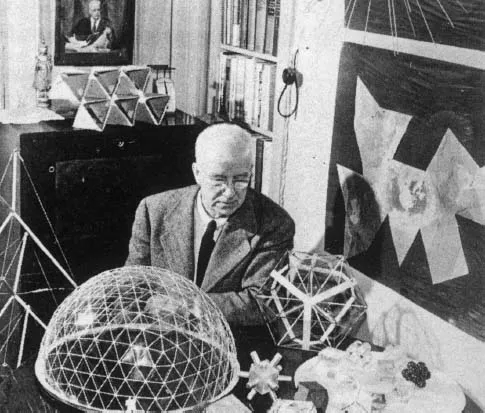
180 Bucky insisted that model-making was the only way to really enter his geometry of mind and nature, and he was right. Before the abstract digital world of the computer entirely erodes our manual sense of contact with real things, we might consider taking his advice.118 He originally wanted to begin Synergetics with what is now Chapter 8, ‘‘Operational Mathematics,’’ presumably so that people would have some hands-on experience with the models before struggling with his prose. Model-making does actually make the writing a good deal clearer; you get a feel for the things Fuller is talking about. Synergetics as it stands still contains the specifications for some models. Extensive commentaries from Anthony Pugh, for instance (who has done much work on the tensegrities Fuller developed with sculptor Kenneth Snelson back in the Black Mountain College days),119 or Hugh Kenner (on geodesic math), offer plenty of others. Fuller’s models—and for me, I might add, particularly the foldable great-circle models in Synergetics (the ‘WHOLES’ of Appendix A) which highlight the dynamic relationship of center to circumference that we have been discussing—provide much the same direct experience with matter itself that more traditional materials have always afforded the artisan. You discover matter in its particularity, the diverse properties of various materials, the constraints of time and space, and most importantly, which principles ‘fit’ what practices (and which do not). The construction of a mandala was—and for that matter still is, in many cultures—a ritual act, which is to say an act of ‘world maintenance,’ upholding the ṛta, the ‘rite’ or ritual order (ordo, the ‘weave’) of things as they are. Bucky, of course, was never just building a dome; he was trying to save the world. The right attitude is a contemplative one, maintaining at once an ultimate seriousness toward whatever one is doing, and a playful sense of abandoning oneself to it. Here we take our cues from the artist. As Eric Wesselow reminds us, ‘‘There are no minor arts, only minor artists.’’120 In the same vein, he passes on the parable of the stone mason, itself passed down for God knows how many years:
185186Once upon a time
there was a king who wanted
to know more about his people.
So he dressed as a wandering merchant
and visited many towns and villages.
One day he stopped at a site
where a building was going up.
He asked one of the workmen,
‘What are you doing?’
The man answered,
‘I am cutting stone.’
Then the king asked another man
who was also cutting stone,
‘What are you doing?’
And the second man answered,
‘I am building a cathedral. ‘121
3.2.3 True North
189Patterned integrities, along with the human ability to discover, articulate and understand them, have long fascinated our species. The oldest known human artifact, an eight-spoked ‘sun-wheel’ found by Louis Leakey in Olduvai Gorge, attests the longevity of this concern. Civilizations may rise and fall, but their patterns remain…
191 From the T’ai Ch’i (yin/yang) diagrams of ancient China, to the rose windows of medieval Europe, to the vajras and dorjes (thunderbolts) of India and Tibet, to the magic carpets of the Middle East, these sacred geometries flourish with astonishing vitality and diversity. Many are still living traditions, able to adapt and transform themselves in the rapidly changing circumstances of the modern world. We come to see that such figures are not isolated ‘art objects,’ any more than Fuller’s synergetic geometry is some remote mathematical abstraction. It is all an incredibly precise metaphor, delimiting what could be called a symbolic spectrum, a keyboard of the imagination, a range of formal possibilities on which the variations and permutations may well be endless.
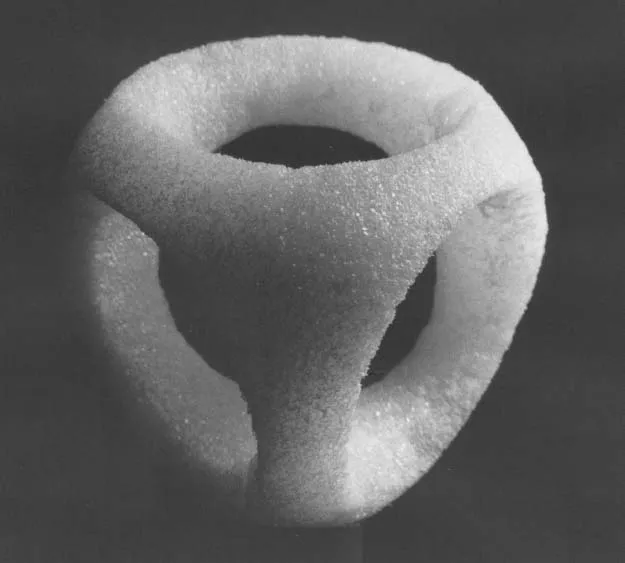
192 It is important to note the limit cases. As Amy Edmonson nicely puts it in describing Fuller’s work, ‘‘Space has shape.’’122 It is not a Newtonian blank, but an articulated emptiness. Fuller himself speaks of the ‘‘12 degrees of freedom,’’ which he derives from ‘opening out’ the six radii of the vector equilibrium—seen as both expanding outward from the center, and contracting inward.123 In drawing up the specifications for the foldable geometries in Synergetics, he notes that only seven such great-circle figures (WHOLES) are possible, since they are derived from the ‘seven axes of symmetry’ offered by spinning the tetrahedron, octahedron and icosahedron on their respective vertices, mid-edges, and face-centers.124 These are cosmic limit-cases, like the 92 regenerative chemical elements, which Fuller maintains are tied to the vector equilibrium configuration achieved by the closest packing of spheres around a central sphere. The tetrahedron itself is a limit-case; nothing simpler has an inside and an outside. The tetrahedron (‘‘the minimum structural system in Universe,’’ says Fuller) gives you maximum surface and minimum volume, while the sphere (‘‘a plurality of energy events approximately equidistant from a central event,’’ says Fuller after constructing thousands of them) is at the other end of the scale, maximum volume for minimum surface. My own symbol for this entire range of symbolic possibilities is an open spherical tetrahedron, a kind of sculptural oxymoron. It underscores Fuller’s seemingly odd claim in Synergetics that the tetrahedron is the ‘‘minimum sphere.’’125
197 Les extrêmes se touchent! On the popular ‘Science Solves Ancient Riddles’ front, Fuller’s geometry apparently resonates equally well with scientific futurists and archaeological explorers of the past. Looking forward, Pat Flanagan of ‘pyramid power’ fame wrote another book, Beyond pyramid power, in which he cited Fuller’s isotropic vector matrix as the shape of ‘‘bioplasmic energy fields’’ about to be uncovered at the frontiers of modern science.126 Fairly far out, of course, but Flanagan did do some empirical testing difficult to explain away. Looking backward, Peter Tompkins proposed in his Mysteries of the Mexican Pyramids that Fuller’s geometry holds the key to the mathematics employed by the builders of the sun and moon pyramids of Teotihuacan—extrapolating a bit freely, perhaps, but based on the work of legitimate field researchers:
199200Harleston concludes that the fundamental message conveyed by the Teotihuacanos is that the physical universe is tetrahedral from the microscopic level of the atom all the way up to the macrocosmic level of the galaxies, on a scale of vibrations in which man stands about the center. Man would thus have built into him, as suggested by Pythagoras and Plato, the tool for unlocking the geometry of the cosmos and recovering the knowledge of his role in the scheme.127
202 Fuller’s own elaborations of the synergetic geometry include several such hierarchies, closely paralleling the inward/outward thrust of mandala meditations.128 The most striking single figure may be his ‘‘Cosmic Hierarchy of Omniinterrationally-phased, Nuclear-centered, Convergently-divergently Intertransformable Systems,’’ one of the color posters Ed Applewhite has included as an extended frontispiece to Synergetics 2.
204 A more elaborated sequence, less abstract and more accessible to the non-geometer, is to be found in the ‘‘Cosmic Hierarchy of Comprehensively Embracing Generalizations’’ in the first Synergetics volume (¶1056.10). Here Fuller begins with ‘‘the cosmic intellectual Integrity manifest by Universe’’; moves down through Synergy (symbolized by a T’ai Ch’i diagram!); Nature, Unknown and Known, metaphysical and physical; syntropy and entropy; astrophysics; the solar system, Earth and its ‘‘biologicals’’; humanity with its various philosophical and political subdivisions; and finally, Them, We, You, and a full dozen and a half dimensions of ‘‘Me.’’ Despite the souped-up scientific language, the reflection moving from the outer cosmos to inner consciousness has much the same feel as many a traditional meditation on the inter-related dimensions of the mandala. A more traditional language would say that Fuller has found his way to the central axis of the world soul. Like the shaman clambering up the cosmic tree, or some latter-day Dante returning to this world after an ascent into the celestial spheres, Fuller travels freely from dimension to dimension via this pivotal axis mundi.129
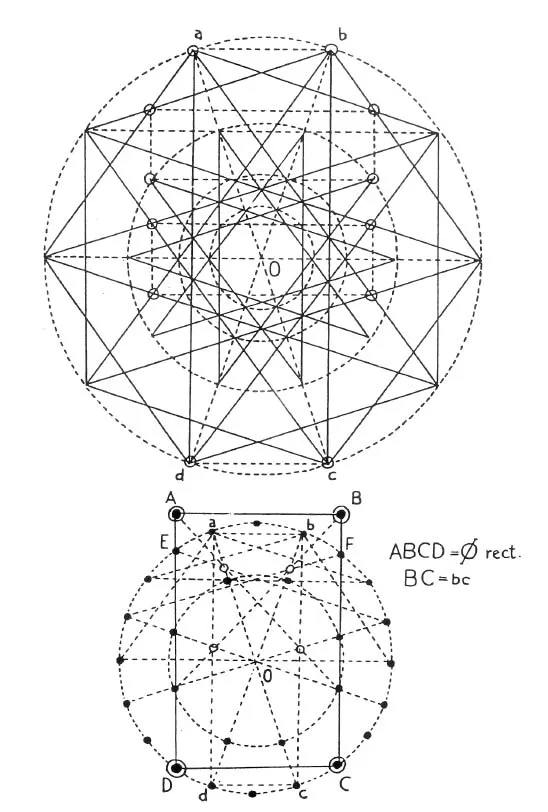
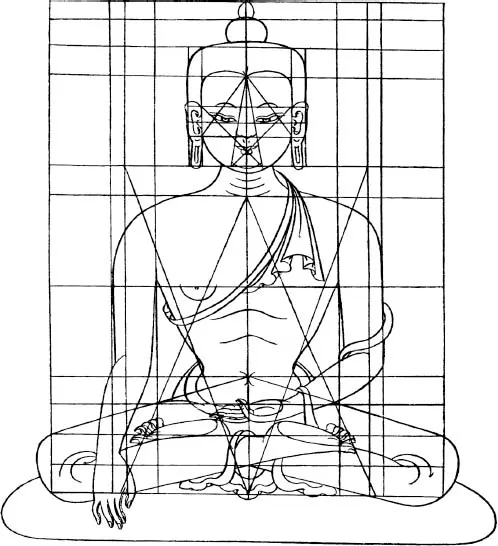
206 Permit a final pictorial ‘word’ about those mandalas. In the following two illustrations, compare for yourself the triangulation of the Hindu Śri Yantra with the pattern used to derive the canonical proportions of the Buddha-body. It is most curious that the Hindu tradition—which fills in the doctrine of the essence (atman) of all things with abundant detail—should choose to empty its most prominent meditation diagram; while the Buddhist tradition—which asserts the emptiness (śunyata) of all things—has opted to fill in the same or a remarkably similar triangulated matrix with the body of the Buddha.
207 Empty or full, much the same coordinate system seems to have captured the imaginations of both Tantrist and Buddhist monks, gainsaying the Himalayan peaks of orthodoxy which so often seem to stand between them.
208 Here again, then, are the skeletal triangles of the classical Śri Yantra, as depicted in Tucci’s Theory and Practice of the Mandala:130
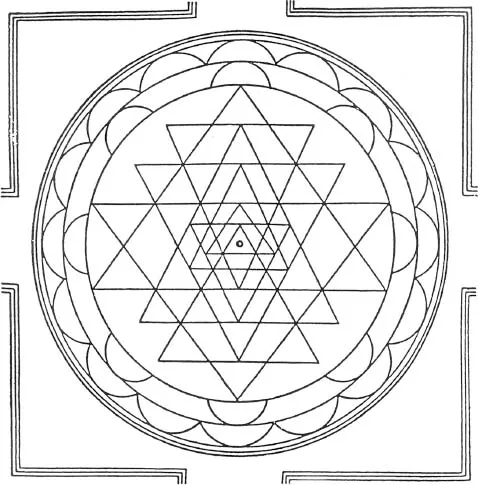
211 In deliberate contrast to the rich fullness of the triloka, the ‘three worlds’ of the Hindu tradition, the Buddha in his radical mutation of Indic religiousness advocated the ‘Eightfold Path’ and an awareness of the ‘emptiness’ of all forms. Could the ‘diamond body’ of Buddhism not have something to do with the octahedral voids which inevitably emerge between tetrahedra in an isotropic vector matrix?131 Are such ‘structural’ reflections permissible?
213 Here are the canonical proportions of the Buddha-body as depicted in Singh’s Himalyan Art:132
216 You are free to draw your own conclusions.
3.2.4 Way Out West
217It is perhaps enough to have glimpsed the structural convergences, without trying to minimize the cultural divergences, between these traditional patterns and Buckminster Fuller’s ‘‘geometry of thinking.’’ But before we too glibly pronounce the union of tradition and modernity a happy marriage, we must recognize that the rift we discerned earlier—between Lewis Mumford’s determination to cling to cultural roots and Fuller’s eagerness to go out on unexplored limbs—has not only deepened for subsequent generations, but has also, in some respects, changed form. Despite millions of homeless and displaced people the world over—more today than ever before in human history—housing and architectural style is not at the forefront of the world’s agenda.133 Despite the prevalence of technology, and its disruption of traditional ways of life, the entire direction of modern technology is simply accepted and the impact of that technology on human values (or vice-versa!) has been left in the shadows—as when a multi-million dollar university complex for genetic engineering is built in Maryland, and a few dollars promised (one day) for an institute to consider its ethical ramifications.134 No, today actual human problems seem to have taken a back seat to ‘virtual’ realities in the new computerized world of the Internet and the World Wide Web. We seem indeed more concerned these days about the map than the territory, more exercised about the latest computer simulations than about the structure of reality.
220 And yet the dichotomy which polarized Fuller and Mumford has never been resolved, and leaves us more ambivalent about it all than ever. The new media technologies seem to be bifurcating people into two mutually irreconcilable time zones: the futurists, those who are—sometimes cautiously, sometimes eagerly—looking forward, aching to live in this hi-tech, hi-touch future-world; and what I would call the archaists, in the best and original sense, those who are—sometimes nostalgically, sometimes polemically—looking backward toward the origins, the archai, preferring to hold onto whatever is left of the past, for all its faults and foibles.135
222 The prevailing problem is an extension of the dilemma that faced Fuller and Mumford, precisely the inherent universalizing tendency of global media technologies, well beyond the bounds of the Eurocentric culture which originally conceived them. We are fast trending toward one global communications system. In skeletal form, it exists already. Yet no matter how ‘pluralistic’ such a system may seem to its designers, it is increasingly evident that many other cultures do not and will never find it so. They find instead their rich and unique cultural universes swiftly being reduced to the terms of the global money market, or commodity market. Is it not preposterous to hear India and China—cultures thousands of years old, with written histories and customs more deeply rooted than anything in the West—referred to as merely ‘developing nations’?136 And yet we accept this terminology, just as once upon a time the Europeans accepted their ‘duty’ to save the souls of native peoples in the Americas, even if to do so meant killing most of them. Today, any culture undergoing the impact of the new media technologies will find their traditional arts and crafts swamped by mass entertainment ‘product’ from Hollywood or New York or London. And while we may agree that some technologies, especially some new media, will accommodate certain reforms of modernity, we must by the same token recognize that they may be fundamentally incompatible with the archaic patterns of cultures not built upon the same assumptions.
224 Bucky Fuller’s great appeal was—and remains—his use of modern scientific and technical information to tell a different story from that of mainstream Western technology, which has too often tended mainly to bring us better guns and bigger bombs, flashier cars and cheaper junk food. Fuller tells us instead a story of humans who discover they belong to a living, responsive Universe and find ways to work in partnership with Nature—a story strikingly congruent, as we have seen, with the way of life extolled by a long succession of indigenous American visionaries. The American dream once meant something: a cooperative way of living in community with other human beings in a particular place and time. Yet the effort to universalize this ‘American way of life’ by modern mass media and propaganda techniques has ended by fatally betraying that vision, both at home and abroad. In the 1980s and ‘90s, the American dream seemed to mean little more to most people than making as much money as you can, no matter who pays. After September 11, 2001, Americans began to realize how high that price may turn out to be. It is almost a truism that today’s very powerful media of communication tend to co-opt the aims, and obscure the origins, of any ‘message’ they convey. As soon as you start making propaganda for ‘good’ things, they start turning into bad things—it’s in the nature of the beast, as Jacques Ellul’s study of propaganda in technological societies demonstrated over three decades ago.137 By the same token, the many ‘new’ scientific stories of Man in Universe, whether told by Bucky Fuller or more recently by Thomas Berry or Ilya Progogine, are prone to the fatal error of assuming that the latest discovery is the last word—that now we finally have ‘got it’ and all other views are obsolete. Mumford’s critique of utopias applies as least as much to the new computer mandarins and electronic missionaries peddling their magical wares to ‘developing’ nations (‘for their own good’) as it did to Plato’s Republic or Erewhon. However valid our concepts may be in the contexts in which they are conceived, they all too often turn toxic when extrapolated as universal values. In order to avoid doing irrevocable evil, maybe we have to stop absolutizing our own most treasured concepts of the good. A little humility goes a long way. Many a ‘native’ cosmology has long been telling us that Man belonged to the Earth, not the other way round, but we’ve been so busy broadcasting our own views that we have almost forgotten how to listen…
226 The upshot is that local knowledge has found its defenders, rallying around the effort to retrieve, or at least vigorously defend, all that has been eroded or marginalized by the new global information technologies. It may now be possible to use remote sensing equipment and Internet relays to put the equivalent of Bucky’s Geoscope into everybody’s home. (Google Earth and other ways to download local information from global positioning satellites are steps in this direction, but do you really want your neighbors peering over your backyard fence and into your windows?) The battle-lines have already been drawn between the new world information order and indigenous or traditional cultures all around us. The name of this dangerous new game is ‘Jihad vs. McWorld,’ as Benjamin Barber put it a decade ago, or at least it will be if we cannot find more peaceable solutions.138 The split we examined between Fuller’s global vision and Mumford’s local knowledge were only two North American exemplars of a debate which has been rekindled everywhere the new technologies take hold.139
229 We humans are contrary creatures: we all seek a certain unity in our lives, but we will resist, even unto death, being reduced to anybody else’s idea of unity. The hoary old problem of the One and the Many has jumped right out of the philosophy books to become the outstanding economic and political dilemma of our day, and the centerpiece of the evening news. Despite all the apparent signs of unification—e-mail, cellphones, the World Wide Web, global news media, so-called free trade, a militarized (though mainly Anglo-Saxon) New World Order, an ever-expanding European Union, etc.—we are simultaneously facing incompatibly ‘distinct’ societies, breakaway republics, religious fundamentalists and fanatical nationalisms everywhere. Globalization has been both relentless and superficial; the differences run too deep. One might pinpoint a European parallel to the philosophical fracture between Mumford and Fuller in the celebrated Gadamer/Habermas debates of the early 1970s, which brought to light similarly diverging vectors in the hermeneutic philosopher’s archaic thrust to recover the primordial ‘Word,’ and the critical theorist’s futuristic thrust toward an ‘ideal speaking situation.’140 Debate we have aplenty, but very little genuine dialogue—where each partner is able to assimilate and build upon at least some of the insights of the other.
231 Ambivalence about the character and direction of the technological juggernaut is scarcely news; it has vexed modern culture since at least the beginnings of the industrial revolution. In the middle of the nineteenth century, you could scarcely miss the traditionalist John Ruskin’s penetrating and prophetic critique of Joseph Paxton’s vast Crystal Palace—the futuristic glass and iron framework for the 1851 London Exhibition—which pioneered the daring use of metal trusses to span wide exposition spaces. He saw it as a new formalism, a rational prison for the imagination, leaving but cramped spaces for the restless creativity of those who follow:
233234The furnace and the forge shall be at your service: you shall draw out your plates of glass and beat out your bars of iron till you have encompassed us all,—if your style is of the practical kind,—with endless perspective of black skeleton and blinding square,—or if your style is to be of the ideal kind,—you shall wreathe your streets with ductile leafage, and roof them with variegated crystal—you shall put, if you will, all London under one blazing dome of many colours that shall light the clouds round it with its flashing as far as the sea. And still, I ask you, what after this? Do you suppose those imaginations of yours will ever lie down there asleep beneath the shade of your iron leafage, or within the coloured light of your enchanted dome? Not so…all the metal and glass that were ever melted have not so much weight in them as will clog the wings of one human spirit’s aspiration.141
236 You will of course see Bucky’s domes as the more ‘ideal’ and audacious evolution of that engineering tradition, which Ruskin rhymes with Coleridge’s ‘‘stately pleasure-dome’’ in Xanadu, while today’s ubiquitous supermalls have emerged as its more ‘practical’ and mundane descendants, with their ‘‘endless perspective of black skeleton and blinding square.’’ Though not geodesic, the Millennium Dome at Greenwich—centerpiece of Britain’s Year 2000 celebrations, which notoriously failed to attract the expected throngs of paying visitors—invoked both Bucky’s and Paxton’s vast pavilions by grandiosely attempting to launch such public ‘pleasure-dome’ exhibitions into the twenty-first century, adding its own high-tech circus atmosphere of rock music and digital special effects under the big top. The technological society drives relentlessly forward, Marshall McLuhan used to say, all the while peering resolutely into the rearview mirror. Stepping back from these eye-popping spectacles and exhibitions, you may also discern how consciously Mumford echoes Ruskin whenever he defends the human and architectural qualities of the medieval polytechnic tradition against any and all such mechanistic attempts, in Ruskin’s own words, ‘‘to invent a ‘new style’…worthy of our engines and telegraphs, as expansive as steam, as sparkling as electricity.’’ You may surmise for yourself what either thinker would make of today’s formless, ‘deconstructivist’ junk-architecture in the highly favored and richly endowed non-style of a Rem Koolhaas.
237 However this may be, we today must continue to wrestle with our problem of global and local, futurist and archaic thinkers. We can see that this very antinomy has continued to divide entire generations of thinkers. For every McLuhan extolling the virtues of media revolutions (and comparing Bucky to Leonardo da Vinci), there will be a George Grant predicting nihilistic apocalypse. In my own generation, we have Stewart Brand, his bestselling Whole Earth Catalog under his arm (inspired by Bucky, you will recall), hitching a ride on the new wave of media technologies at the MIT Media Lab, while Jerry Mander, having made his Four Arguments for the Elimination of Television, takes his stand with native peoples against new media as merely revamped forms of corporate-sponsored colonialism. About a decade ago, I had the good fortune to spend several months in Vancouver, where one evening’s local public TV documentary about cyberpunk centered on ‘post-human’ predictions by Bill Gibson, the young ‘neuromancer’ himself; and the next evening’s documentary featured ethno-botanist Wade Davis, the fellow who cracked the drug for making zombies in The Serpent and the Rainbow, introducing viewers to Northwest Coast Indian dance as a slow, rhythmic, ritualized alternative for people worn down by the accelerated pace of the computer-driven workaday world. In the same town, you feel impelled to visit the Science Centre, housed under a glittering geodesic dome which turns out to be far more interesting than the exhibits inside, while the renaissance of Northwest Coast Native art—which utilizes a formal vocabulary nearly as sophisticated as Fuller’s, also based on the permutations of a few simple polyhedral forms—tugs at you from the other direction in the museums and galleries nearby. The same rift is polarizing succeeding generations, and we still have no middle ground. Each school of thought excommunicates the other.
3.2.5 The Dream of the Dome
239With Ruskin’s ‘‘enchanted dome’’ an element of the uncanny enters our story; we may call it the Dream of the Dome. It is not entirely a digression to record it here, though it does not readily ‘fit’ anywhere, at least not into the normal contours of experience.
240 We have already noticed Ruskin subsuming Paxton’s Crystal Palace into a literary image drawn from Samuel Taylor Coleridge’s famously fragmentary poem Kubla Khan, composed, its author tells us, in a dream of 1797, and only partially transcribed. The tale is well known: In an 1816 Preface to the poem, Coleridge relates that ‘‘in consequence of a slight indisposition’’ he had taken an anodyne, ‘‘from the effects of which he fell asleep in his chair’’ whilst reading in Purchas’s Pilgrimage a line to the effect that ‘‘Here the Khan Kubla commanded a palace to be built …’’ He says he dreamed a composition of some two to three hundred lines ‘‘in which all the images rose up before him as things.’’ Upon waking he set pen to paper, but was interrupted by a visitor before he could transcribe more than the fifty-odd lines of the vivid and musical fragment which describes ‘‘a miracle of rare device/a sunny pleasure-dome with caves of ice.’’
241 It was, I believe, Jorge Luis Borges who first called attention to the extraordinary coincidence—if the meaning of the word may be stretched so far-concerning Coleridge’s dream. He tells us that twenty years after Kubla Khan was published, the first Western version of a Persian ‘universal history’ called the Compendium of Histories by Rashid al-Din appeared in Paris, containing this line written by a vizier of Ghazan Mahmud, a descendent of Kublai: ‘‘East of Shang-tu, Kublai Khan built a palace according to a plan that he had seen in a dream and retained in his memory.’’ Borges justifiably asks, ‘‘How is it to be explained?…A Mongolian emperor, in the thirteenth century, dreams a palace and builds it according to his vision; in the eighteenth century, an English poet, who could not have known that this construction was derived from a dream, dreams a poem about the palace.’’
242 He attempts various hypotheses—coincidence (improbable), an unknown text somehow known only to Coleridge (no evidence), a meeting of the emperor’s soul with the poet on the psychic plane, perhaps, or maybe even an immortal or superhuman dreamer who dreams both men—but all are unsatisfying. He notes that ‘‘ruins were all that was left of Kublai Khan’s palace; of the poem…barely fifty lines were salvaged,’’ and speculates that the dream of the dome has yet to run its course, that the full vision is yet to be realized. Borges concludes: ‘‘Perhaps an archetype not yet revealed to mankind, an eternal object…is gradually entering the world; its first manifestation was the palace; its second, the poem.’’ To bring his story up to date, I need record here only the bare fact that Borges published this reflection in 1951, the very period—I should no doubt say, at the very moment—that Bucky Fuller, unknown to Borges, began building his first geodesic domes, making the transition from scale-models (See Appendix A) to full sized-structures, or, if you like, from dream to realization.
243 In 1851, exactly one hundred years before Bucky’s geodesic domes, Ruskin saw in the Crystal Palace a nightmare which for him ominously presaged the future directions of ‘modern’ architecture. And his prediction has, by and large, come true. But thanks to the meticulous scholarship of Borges, we are entitled to glimpse Bucky playing his part in another kind of dream altogether…dreaming up a way to realize an ‘impossible’ dome dreamt long ago by an English poet, of a palace built ages earlier by the legendary Mongol Emperor of China according to a plan he himself had seen in a dream. Just whose dream (or labyrinthine nightmare) is this anyway?!
244 Ideology is the demythicized part of your world-view; the flexible mythos has become inflexible logos.142 Once articulated as an ideology, logic seems to dictate that you can’t have it both ways: futurism is but the latest evolutionary, progressive variation on the great theme and central imaginative projection of literate, Western civilization—salvation is to be found in the ‘next’ world. It is a transcendent vision, always just a bit beyond reach. And archaism runs in exactly the contrary direction: salvation lies in a retrieval of the past perfect state, which probably wasn’t so perfect, but certainly is past. The inspiration here is immanent, and ever more deeply buried.
246 We’ve allowed Bucky Fuller to stand for the futurist vision, and Lewis Mumford for the archaic. But this is something of a simplification; people are far too complex merely to stand for ‘positions.’ Mumford, too, dreamt and wrote of ‘‘World Culture’’ in a way which also sometimes tended to uncritically extrapolate Western paradigms. Maybe you have to really live in other cultures to see your own for what it is, and Mumford (aside from a brief stint in England) never did. As for Fuller, he went to great pains to preserve his family’s retreat at Bear Island in an entirely pre-industrial condition—no electricity, no plumbing, no phones or fancy information technologies. And yet he returned to Bear Island for a month every year to ‘re-source’ himself, as it were, and did not find drawing water from the well by hand to be incompatible with what he liked to call his ‘cosmic fishing’ for ideas in the ocean of intuition.
247 Like Emerson before him, Mumford stayed more or less centered in one place, at home on his farm in far eastern New York, but was at pains to furnish himself with a remarkably thorough grounding in world civilizations, as well as European literature, philosophy and history. Fuller moved around a lot, circumnavigating the globe many times during his long life, but he had for planet Earth the same sort of filial attachment and sentimental affection most people feel for their own little garden plot. For Fuller, the whole Earth is our local patch of Universe. Ozone depletion and the runaway greenhouse effect indicate that the stewardship of the planet he extolled is indeed long overdue, and in practice not in the least incompatible with local knowledge and indigenous customs. As ecologist Edward Goldsmith reminds us in his magnum opus The Way, traditional and ecological values stem from the same source, a reverence for ‘the Way’ things are.143 If we permit ecology to become merely ‘resource management,’ it loses not only its soul—the very soul of the world, as we have seen—but all memory of those indigenous ‘life-ways.’
249 One fairly obvious way to gauge the level of optimism or pessimism about technology in our society is to watch its science-fiction films. The new ‘bad futures’ we see so much of these days almost invariably have to do with getting stuck in a bad place: the near-future Los Angeles of Blade Runner set the tone, but a spate of films all the way back to Escape from New York emphasize that the places we actually dwell are very easily envisaged as prisons. This may be part of what Susan George has called ‘‘the boomerang effect,’’ when the conditions of the so-called Third World (a two-tier society, endemic violence, decay of physical, social and moral infrastructure, etc.) begin to show up in the inner cities of America; when the beasts and horrors let loose first by colonialism, and more recently by the neo-colonialism of ‘development,’ come home to roost. Stephen King’s kind of ‘domestic’ horror in his early books applies too, when the everyday objects of a technological society turn upon us and become malevolent. And did you notice the resurgence of alien abduction films all through the 1990s? People feel the society they once trusted is out of control, an anonymous and inhuman system; they feel cheated, manipulated, and treated like guinea pigs for social and economic experiments. Their lives have been hijacked by unseen agencies. Nothing makes sense anymore. Is it any wonder our collective hallucinations have strayed to the skies?
250 By the same token, the Star Trek phenomenon, now forty years old and still running strong, seems to be the only science-fiction projection which has managed to preserve an optimistic view of the future. Why? Maybe because their ‘continuing mission’ is always to be on the move, never to dwell permanently in one place, always to seek new frontiers where ‘no one has gone before.’ It is no mere curiosity that the crew of the Starship Enterprise for a time joined the astronaut exhibits in the Smithsonian Aerospace Museum, as if they were real—which in a sense they are, for an America desperate to hang on to its unbounded frontier dynamisms. There’s something deep in the collective psyche at work here, something that runs like a subterranean river below all these American dreams and nightmares and technocratic fantasies of control.
251 Perhaps the very word ‘dwelling’ provides a hint…It is well-known that in English, and indeed all the Indo-European languages, the verb to dwell has a rather curious etymology. We usually suppose, as Bucky Fuller did in designing his dome homes, that dwelling means something altogether positive–nesting, making a home for yourself, settling down—but these are later overlays. The word itself comes from the Anglo-Saxon dwellan, which means to lead or go astray, to stay (in the active sense), to hinder, wander or tarry, even to mislead or err.144 It ultimately derives from the Aryan root dhwel, dhul, appearing in the Sanskrit dhwr, dhur, which means to mislead, deceive. One strong clue as to why ‘dwelling’ has such a negative connotation in the Indo-European languages may be that it is also applied to horses. When they pause and dither before jumping a fence, or when they are slow in raising their feet from the ground in stepping, horses are said to ‘dwell.’
253 Why should this peculiar ‘horse-sense’ of the word be important? Because, as Sidney Pobihushchy once observed, ‘‘We are the horse-people.’’145 By we, he didn’t mean everybody; he meant specifically the light-skinned Indo-European races from the steppes of the Caucasus, those Indo-Aryans who long ago invaded India and pushed the darker-skinned Dravidians south; those Europeans who continued to move ever forward and outward, past the boundaries of Europe itself into New Spain and New France and New England. Of course it’s not some racial quirk, as if white people can’t sit still. It’s those horses—the Indo-European peoples have always been on the move, leaving the graves of their forebears behind, seeking their salvation just over the horizon, ‘progressing’ ever forward, defining Life itself as ‘evolution,’ and in our own day aiming for the far planets and the stars. In its edition of 1958, the year the talkative Fuller met a silent pandit Nehru, under the entry ‘Horse’ the Encyclopædia Brittanica averred:
256257All the great early civilizations were the products of horse-owning, horse-breeding and horse-using nations and those in which the horse was either unknown on in the feral state remained sunk in savagery. No great forward movement of mankind was made without the assistance of the equine race. So consistently was this the case that the glorified figure of ‘the man on horseback’ became the symbol of power.146
259 Such imperial hubris requires little comment. Incredibly, there’s more to the story. As Mumford himself pointed out, the mace—a weapon specifically designed for no other purpose than to bash human heads from horseback—soon enough became, with a bit of gilding, the very sceptre wielded by the sovereign: ‘‘When Parliament is in session, a gigantic specimen lies upon the Speaker’s Table.’’147 Indeed, as Lynn White first clearly showed, the invention of the stirrup not only lifted the knight in full armor atop the ‘great horse’ bred for this purpose, but in the same stroke hoisted the entire feudal hierarchy on top of the local peasantry. Beyond this, domesticating the powerful horse begins the long quest of Western peoples to tame Nature herself and harness her inner power, a quest which has today culminated in nuclear weapons, genetic engineering and social mechanisms of technocratic control in general. People and peoples are set whirling in motion, and all the while new clothes are made to suit new climates, new inventions are concocted to fit constantly changing circumstances, and new theories, new philosophies and new sciences keep tumbling out, purportedly obsolescing and unsettling all ‘settled’ beliefs. And what of the local people, the native inhabitants, those lazy stay-at-homes? Obviously, they’ve just been ‘‘dwelling’’ all the while, going astray, going nowhere; surely they are in error, perplexed, misled by superstition, hindered by cumbersome traditions which have sadly retarded their ‘development.’ Sound familiar?
261 It started with horses, then it built ships, railroads, ‘horseless’ carriages, airplanes and rocket ships and all the rest. But where is there left to go? The vast outward thrust of the Indo-European peoples seems now to have reached—if not indeed to have grossly overstepped—its natural limits; it has become global, and circled right back in ambush upon itself. During both Gulf Wars, for instance, the US and allied Western powers of the New World Order set about systematically bombing the original sites of Western civilization in Iraq (Mesopotamia), all for the sake of fossil fuels, no doubt, but also the name of civilization (democracy) beating back barbarism (tyranny). And yet Mesopotamia is precisely where the military-industrial complex we call ‘civi-lization’—which simply means ‘city-culture’—first arose. In Chechnya, to take another hotspot for example, the local Caucasians who actually stuck around the Caucasus Mountains have found themselves at war for more than a decade with a Russia determined to join this bright and shining New World Order of conspicuous consumers. It all comes full circle. The global dynamisms of science and technology are only the latest horse we are riding; the local resistance will probably end up breeding some of their own, that is to say opening up their own website so as to assert the autonomy of their local culture over against the phony standardization of ‘McWorld’ (remember the flurry of faxes during the Tienamin Square standoff?). Beyond this, the global rash of debilitating computer viruses indicates that not all ‘Netizens’ are happy campers these days. And one day there must come a reckoning—with IT&T or Telecom or COMSAT over the phone bill, if nothing else. So the tension between globalizing technologies and local traditions goes on, adding new techniques, new torques and tensions every year.
262 With an historical background of this scope, the spat between Fuller and Mumford looks like a fairly minor episode. Even the glaring discrepancy between today’s America—embattled land of the free market competitors—and the original American dream of cooperation between diverse peoples seems but a modest chapter of some 300 years.
263 Unless, of course, it turns out to be the final chapter…
3.3 Connections—Real and Unreal
265It is for me dismaying to realize that nowadays, due no doubt to plenty of high-powered and expensive publicity, Disney’s Epcot Center is probably the best-known geodesic dome in the world. It’s not that it’s not beautiful, or that this Kaiser Geodesics’ construction isn’t credited to Buckminster Fuller directly that bothers me. It’s that insipid Mickey Mouse waving at me from the top of the dome in the advertisements, and the idea that a geodesic dome should have become the flagship for Disney World. Now you may have charming childhood memories from Disney films, or you may be one of the debunkers (Bucky is said to have coined the word ‘debunk,’ by the way, in 1927) who claims that his fairytales promote sexist stereotypes or rampant consumerism or what all, but either way you will have to admit that the association with Disney World leaves Bucky and whatever vision he might have had smack in the middle of fantasy-land. It’s the unreality that bothers me. (Disney World seems to be Jean Baudrillard’s favorite example of what he calls ‘hyper-reality,’ where simulations have run amok: more real than real). I guess what it comes down to is that I just cannot dismiss the distinct impression, which has over the years congealed into something like a conviction, that Bucky Fuller was the most practical man I ever met.
266 Besides the Disney dome, Fuller’s geometry has shown up somewhere else that places it all somehow in the world of the unreal. Science-fiction films tend to use omni-triangulated matrices whenever they want to instantly convince you that some structure or species or civilization is really ‘alien.’ The convention may or may not have begun with the three-eyed, three-fingered Martians in George Pal’s War of the Worlds (1953), but threefold patterns have consistently been used since the 1950s for their weird ‘Otherness.’ There’s even an early Star Trek episode called ‘‘By Any Other Name’’ in which aliens from the Andromeda galaxy reduce everybody on the Enterprise to vector equilibria, which are left littering the floor like little urns of untouchable human remains. Now if Bucky was right—and all the indications suggest that he was—then Nature is using 60° tetrahedral coordination for all the living carbon-based systems on our planet, not to mention the metals and rock crystals as well. Apparently, science’s rectilinear grid and square frame of reference has been so ingrained over the past three or four centuries that we consistently see not only ‘Nature’s Coordinate System’ but Nature herself as something alien. Maybe it is we who have all this while been ‘alienated’ from our own home planet. Maybe it’s time we took a look around, as Fuller himself suggested, and got to know the old home place a little better.
267 At least the time has surely come for us to try to evaluate Bucky Fuller’s most fundamental claim: whether we have, as he put it, ‘the option to make it’ here on planet Earth; whether human beings were indeed ‘designed for success’ in this biosphere; and whether the bloodless ‘design science revolution’ he envisaged might help shift us from weaponry to ‘livingry,’ from the greedy, short-sighted profit-taking of multinational corporate ‘Giants,’ as Fuller dubbed them, to world-around service industries for the enhancement of human life. When all is said and done, was Bucky’s claim realistic, or sheer fantasy and science-fiction?
268 Whatever response I might make here, the kind of answer you will accept to this question hinges almost entirely upon what you take to be real.
269 If what is real for you is the current set-up you tune in with the evening news on TV, then you have two choices. You may buy the whole package at face value, in which case the ‘utopia or oblivion’ dilemma doesn’t even arise. This is just the way the world is, was, and ever shall be. Or else, option number two, if you are painfully honest with yourself you will have to shake your head and—sadly, perhaps reluctantly—accept only an answer in the negative. If the current regime of transnational corporations and international finance based on scarcity economics with its political puppet-shows and unabated environmental depredation and vicious little wars every so often to keep the arms market flourishing; if this brave ‘New World Order,’ along with all its ever mightier powers of illusion and collective distractions—flashy consumer commodities, trite sports spectacles, mass entertainment, celebrity scandals and all the rest—if this is what is real for you, then the answer is frankly no. If you are realistic, if you face these facts and their sobering implications as Lewis Mumford surely did, then you will have to admit that without an abrupt turnabout in basic attitudes, it is not very likely that the human species will survive its own predatory, greedy, selfish, paranoid tendencies very far into the twenty-first century. A few lucky minorities who can hang onto what they’ve got might have a nice run for a few years, but sooner or later the world is going to hell in a handbasket and, like it or not, we’re all going with it. Entropy decrees that disorder increases; it’s the way of the world. Malthus was right after all, there never will be enough to go around; so you’d better get yours while the getting is good (back to option number one), and devil take the hindmost. Moreover, there’s nothing much any lone individual can do about it—except maybe to amuse ourselves in ‘virtual’ cyber-playpens until our day is done. Our fate is sealed by forces beyond our control, Q.E.D.
270 If on the other hand what is real for you is what was real for Bucky Fuller–a magnificent garden planet, beautifully designed to support all the forms of life upon it, enough air, water, soil and sunlight for everybody, all the elements of life coordinated by exquisite metaphysical principles innately apprehensible by the human mind, itself far and away the most Syntropic phenomenon in the known Universe—then the panorama swiftly changes. Then an affirmative answer appears much more plausible. Then the integrity of each and every human being counts, precisely because it is intimately connected to the integrity of the Universe at large and capable of spontaneous innovation, free creativity, and the kind of playful interaction with the world around us which will bring the resourcefulness of the entire Universe to bear on local problems. In such a case, we might just surprise ourselves. If this fabric of connections is what is real, then to be realistic means to realize that despite all the overt and covert machinations of all the corporations and politicians and all the rest, it is Mother Earth and the Universe at large which support us after all, and we have been given all we need for a full and happy human life.
271 By contrast, the fundamental assumption of modern economics is that there is not enough to go around, and that when it comes right down to it you and I have to compete with one another to get our hands on increasingly scarce resources. Is it true? If you equate wealth with land, or with gold and other precious metals, or with fossil fuels, it would seem to be so. These things are indeed finite, and human demands upon them can only increase as human population increases. A grim prospect…But some thinkers beg to differ, and differ radically, in their assessment of what constitutes not only wealth, but human well-being.
272 Buckminster Fuller, for one, defined wealth as having two components: physical energy, and ‘metaphysical’ know-how. There’s plenty of energy coming in from the sun every day, he observed, and human know-how only increases. Thus was he able to claim that we are all ‘billionaires,’ and that it is high time we came into our rightful inheritance.148 E. F. Schumacher, for another, considered fossil fuels and metals and the like to be ‘planetary capital,’ and insisted, like Fuller, that we must learn to live on our energy ‘income’ rather than by burning up our energy ‘savings.’ Thus was he able to claim, ‘‘There is no economic problem and, in a sense, there never has been.’’149
275 But modern accounting systems are rigged not to show the true cost of using up non-renewable resources, let alone the wear and tear on people as the biosphere that has so long sustained them is drastically degraded. Fuller once challenged a famous geologist to calculate what it costs nature (it takes hundreds of centuries of heat and pressure) to produce a single gallon of oil at current retail rates. The real cost worked out to roughly a million dollars a gallon. It would be much more today. At those prices, Fuller reasoned, we ought to pay people handsomely to stay home and dream up alternatives to internal combustion instead of driving their cars to work every day.
276 From this angle, the Earth is an economy of abundance; we need only learn how to harvest our wealth judiciously. Moreover, you and I do not in the final analysis have to steal from one another just to survive. This is good news indeed, but by now it should sound familiar: ‘‘All we humans are required to do is waste no life and be grateful daily to all life,’’ declared the Mohawk Thanksgiving Address we examined at the outset.
277 ‘‘Amongst the American Indians,’’ Fuller wrote in And It Came to Pass—Not to Stay, ‘‘it was the nations, not the chiefs or individuals, who controlled the land. The Indians assumed that they had only the hunting, fishing, cultivation and dwelling rights. All the land, water and sky belonged exclusively to The Great Spirit. And the same concept was held by Africans, Eskimos, and Austronesians. But it was long ago conceded in Europe and Asia that…the many individual warlords controlling the lands were the owners of all wealth.’’ In much the same vein, Bucky reprinted in Critical Path an astonishing address purportedly delivered in 1851 by Chief Seattle of the Suquamish tribe near Washington’s Puget Sound, his response to a federal offer to buy two million acres of land for $150,000. Well after Bucky’s death, the Seattle Speech has been denounced as a hoax by scholars who unearthed evidence that it was in fact edited if not rewritten by a white Christian writer in the 1920s. Once the author is discredited, the argument implies, what the text says may also be dismissed. Bucky never knew about any of this, of course; he simply found the Seattle Speech (first presented by Dr. Glenn Olds at an Alaska Future Frontiers Conference in 1979) a profoundly moving early ecological warning and a caution about over-extending the principle of ownership. For my part, although it isn’t very politically correct to say so these days, I really don’t think the current brouhaha much matters. Such a message is just as real, as true and ultimately convincing, as you believe it to be. A few snippets:
279280How can you buy or sell the sky, the warmth of the land? The idea is strange to us.
281If we do not own the freshness of the air and the sparkle of the water, how can you buy them?
282Every part of this earth is sacred to my people. Every shining pine needle, every sandy shore, every mist in the dark woods, every clearing and humming insect is holy in the memory and experience of my people. The sap which courses through the trees carries the memories of the red man.
283The white man’s dead forget the country of their birth when they go to walk among the stars. Our dead never forget this beautiful earth, for it is the mother of the red man. We are part of the earth and it is part of us. The perfumed flowers are our sisters; the deer, the horse, the great eagle, these are our brothers. The rocky crests, the juices in the meadows, the body heat of the pony, and man—all belong to the same family…
284We know that the white man does not understand our ways. One portion of land is the same to him as the next, for he is a stranger who comes in the night and takes from the land whatever he needs. The earth is not his mother, but his enemy, and when he has conquered it, he moves on…He treats his mother, the earth, and his brother, the sky, as things to be bought, plundered, sold like sheep or bright beads. His appetite will devour the earth and leave behind only a desert…
285This we know: the earth does not belong to man; man belongs to the earth. All things are connected…150
287 It is easy to see why such passages appealed to Bucky, however dubious their authorship later turned out to be. A good part of the speech goes directly to mitigate the notion of property, ownership, and the extension of economic values into realms of human and natural life where they simply have no place. At the point where he cites Chief Seattle, Bucky is in the midst of one of his fables about the Great Pirates and Giants—like the fearsome man on horseback wielding a club—which eventually became limited liability colonial enterprises like the British East India Company, and are currently doing business as transnational corporations (many of which seem, as lamented earlier, altogether too fond of abusing the word ‘synergistic’ to describe their money-making operations). It is curious that when people read Synergetics, they accuse Bucky of making things too complex and technical for laypeople to understand. And then when they read Critical path or Grunch of Giants, where he tells his tall tales of global greed and corruption (‘Grunch’ is Bucky’s neologism for ‘Gross Universal Cash Heist’), they turn around and accuse him of naive oversimplification. I wonder. Anyone who is today convinced by Susan George (How the other half dies: the real reasons for world hunger) or Jerry Mander (In the absence of the sacred: the failure of technology and the survival of the Indian nations) would be sure to recognize Bucky’s fables as genuine precursors of these current, and still quite controversial, critiques of the System: ‘‘Heads We Win, Tails You Lose,’’ as Bucky puts it bluntly in Grunch of giants;151 or, as we heard him say earlier, ‘‘You better believe it’s a conspiracy.’’
289 The other resonance in such a passage goes much deeper, into Bucky’s own sense of the real. It has to do with the profound intuition that humans are an integral part of a living Universe expressed by whoever it was that wrote Chief Seattle’s speech, the sense of kinship between the multifoliate forms of life here on planet Earth: ‘‘All belong to the same family.’’ ‘‘Of all his attributes,’’ Norman Cousins wrote just after Fuller’s death, ‘‘none was more compelling than his ability to transmit to others his kinship with the Universe…I have known very few people who, after meeting Bucky, did not forever feel a sublime wonder when looking at a starlit sky’’152
291 This takes us to the core of the matter. Fuller’s geometry, the isotropic vector matrix and its derivatives, can all too easily seem a mathematical abstraction, a cold formalism. It isn’t. It is a map of the possibility for relationships articulated between anyone or anything and everything else that exists. And this in a double sense: first, an inward confidence that the web of life on this planet already forms such a matrix: ‘Nature’s Coordinate System.’ And secondly, an outward thrust, that this net of relationships can and must be articulated in new architectural, social and cultural forms: the ‘design science revolution.’ Although Fuller might at first glance appear to be merely an apologist for technological progress, the more deeply we examine his work the more the two vectors of archaism and futurism we sighted earlier appear to converge.
292 Every so often, there are notions which seem to galvanize entire generations, ‘ideas in the air’ which people will spell out in the most diverse ways, an identifiable Zeitgeist which is somehow shared without any direct causal agency or influence you can put your finger on. Such phenomena signal changes in the mythos, the underlying substrate from which all the concepts and ideas (and even competing ideologies) are born. A myth is not an idea, it is the horizon of intelligibility over against which ideas seem or do not seem to make sense. A living myth ‘‘goes without saying,’’ in Raimon Panikkar’s phrase; it seems self-evident, it is ‘‘what you believe without believing you believe in it.’’153 The myth of technical progress as an indisputable good is one such horizon, currently receding. For my own post-Hiroshima generation, the emerging myth seems to be one of integral connectedness: the human, the earthly, and the sacred are all ‘felt’ to belong together, ‘experienced’ as a complex unity154 despite all the apparent divisions and conflicts between nations, cultures, academic disciplines, and institutions which rend modern life. But a myth is constitutively susceptible to a variety of interpretations. It expresses itself in many ways. In this case, as sketched earlier, there seem to be two dramatically divergent thrusts.
295 On the one hand, there is an immanent understanding of this deep feeling of connectedness. Some see all the connections as already there, deeply buried in the geophysical and biological continuities which bind us not only to one another (‘‘all…the same family’’), but ultimately to the whole Earth. This is the sense of the ever-underlying anima mundi, the maternal matrix of connections we briefly examined earlier. All we need do is stand still in our place and listen, quietly meditate and receive…and we shall discover we already have access to the entire repertory of cosmic wisdom—built into our very genes, perhaps, or maybe just blowing in the wind (prana, pneuma, spiritus). Such a mentality will naturally turn to indigenous cultures in order to restore primordial connections lost in the modern, ‘dis-located’ worldview; or, if it stays within the precincts of modern science, it will tend to articulate a ‘deep’ ecology which puts the web of life ahead of mere human concerns, and the well-being of the spotted owl or some other endangered species well ahead of the livelihood of lumberjacks and their families. As an ideology, this radically cosmocentric view can tend to view human life itself as no more than a pernicious parasite upon the planet, and civilization no more than a disease, syphilization,155 which threatens all other forms of life.
297 On the other hand, there equally is a transcendent understanding of these connections, that they are yet to be made. So we must wire up the planet in a communications revolution, we must build satellites and fiber optic nets and information superhighways in order to connect everybody to everybody else, in order to have all the latest information about ecology, the weather, the health of the rainforests, etc., etc. We must ‘access’ all the libraries from our desktop computers, tune in all the television and radio programs in all the languages, we must send e-mail messages unmediated by the powers-that-be, we must decentralize these very power structures so as to allow equity and freedom, the anarchy of life and creative spontaneity to rise up where structures of oppression have so long held sway. Such a mentality will naturally, which is to say culturally, turn to the latest technology, will wax grandiloquent about virtual realities and hypertexts and media revolutions that obsolesce everything that has ever happened until now…or rather, until tomorrow, when Microsoft’s Bill Gates, seemingly the boy with the most toys lately, completes his ‘Xanadu’ mansion in Seattle, a new ‘high’ in human dwelling with ‘virtual’ HDTV walls upon which will be displayed all the world’s art treasures at the mere push of a button. As an ideology, this radically anthropocentric view can tend to view anything in Nature as merely raw material for the cultural revolution at hand, anything ‘real’ as less satisfying than the virtual and digital ‘special effects’ and extravagant spectacles our new technologies can produce, and planet Earth itself as no more than the testing ground for a species bound to leave it behind and fly to the stars in some vast new wave of space-colonization.
298 More important than such extreme views, of course, are the many efforts to bring the two vectors into harmony. Take for example the flock of high-tech television documentaries on indigenous cultures, or rainforest devastation, or fancy digital displays which render the ozone hole visible. Consider the power of ‘‘the Elder Brothers’ Warning’’ in Alan Ereira’s BBC documentary on the Kogi, which for the first time enters the villages of these pre-Columbian Tyrona people to uncover previously secret lore about Aluna, the Mother, visualized as the nine levels of a hidden matrix of connections underlying all life on Earth (ring a bell?)—while purists may still maintain they have traduced the very cultural values they seek to preserve simply by broadcasting them.156 From this angle, post-modern theorists of the Internet avidly compare it to a ‘rhizome,’ the tangled rootmass of certain plants (Canada thistle, iris, ginger, trillium, etc.) which can sprout freely from any point (although critics are likely to retort that cancer might be a more apt analogy), and routinely employ Fuller’s figures (usually without credit) to illustrate the latest sorts of ‘link-thinking’ about all the sorts of connectivity available in the ‘wired’ world. But many such attempts at synthesis have turned out to be exciting and surprisingly hardy hybrids which are, on balance, signs of hope. Today we have for instance the ‘World Music’ of native peoples available to vast new audiences on cassette and compact disk, including marvelous cross-cultural collaborations like Mickey Hart’s Planet Drum in which at least some fusion of horizons between modern technology and indigenous traditions seems to be occurring. The burgeoning ‘post-colonial’ literatures of people and peoples long under the heel of the West—from Africa, from India, etc.—and yet written in Western languages (English in particular), would be still another example.
300 The giant-ism and concentrated urban populations of Fuller’s later grand plans correspond directly with the media projection of the image of Bucky the Showman upon the world stage. He became a global celebrity who always had something startling to show you, something to astonish. He knew how to grab the headlines—by offering to dome over your city, for instance, or to make everybody billionaires. In 1964, Time featured him on its cover with his head rendered by artist Boris Artzybasheff as a geodesic dome, surrounded by many of his futuristic inventions. In 2004, the U.S. Post Office issued a commemorative 37¢ stamp based on this well-known painting—initial print-run, 60 million stamps.
301 In this respect, many of his later pronouncements do indeed seem to go in the direction of the tide of globalization which Rem Koolhaas has more recently been exploiting in, say, the Grand Palais at Lille, or the $3 billion Universal City expansion: more spectacle than substance. Yet it could equally be argued that Bucky’s real successors are not such idiosyncratic ‘geniuses’ of novelty (or packaging!), but rather those rarer spirits doggedly determined to build and design ecologically fine-tuned ‘livingry’ without trashing the planet in the process. When Esquire ran a survey in the early 1970s of what was ‘in’ and what was ‘out’ in popular culture, Bucky’s domes were ‘in’ but his ideas were already in the ‘out’ column. In this respect, Fuller’s work as a whole has much more in common with less flashy efforts less loudly trumpeted by the mainstream media—like the low-tech, low-energy ‘ , a serious student of nature’s own design strategies who today deplores the industrial idiom of design as ‘‘a machine not for living in, but for dying in,’’ yet sounds undeniably akin to his mentor Bucky Fuller when he writes:
303304We must recognize that every event and manifestation of nature is ‘design. ‘ Living within the laws of nature means expressing our human intention as an interdependent species—aware and grateful that we are at the mercy of sacred forces larger than ourselves, and obeying these laws in order to honor the sacred in each other and in all things. We must come to peace with and accept our place in the natural world.157
306 In all such multifarious efforts to fuse the traditional and the progressive, the primordial and the technological, Buckminster Fuller now appears to have been a true forerunner. If he favored computer analyses of global environmental conditions, it was because he supposed such ‘unbiased’ data would convince people that current industrial strategies were wasteful and inefficient, and Nature’s own design strategies a viable alternative. If he was receptive to the spirituality of native peoples, it was because he felt in them something like his own sense of attunement to a living universe. Since this latter dimension of Fuller’s sensibility is less well-known than all the high-tech gadgets, I would like to dwell upon it for a moment.
307 In a way, it’s all a matter of attitude. Bucky Fuller was, as we have seen, a man of faith—faith in the unshakable integrity of the Universe and the ability of the human mind to participate in that integrity by discovering and employing its basic principles for the betterment of human life on Earth. One of the least understood of such principles, he maintained, is precession. At its simplest, precession is the effect of bodies in motion on other bodies in motion. It is a kind of second-order synergy, a whole system behavior unpredictable from the behavior of two or more whole systems in relation. It is why the Earth orbits the Sun at a (90°) right-angle in response to the (180°) pull of gravity, rather than falling into the Sun. It is why a gyroscope goes off at a (90°) right-angle in response to a (180°) poke from your finger. The way Bucky interpreted it, precession may be viewed as the response of the Universe at large to movement in any local system, as well as to human initiatives undertaken in any local region. It served him as an up-to-date analogue for what a medieval mystic might very well have called the grace of God.
308 His argument ran somewhat as follows. Bees buzz around seeking honey, but their main contribution to life on this planet is the pollinating function they accomplish almost inadvertently for the plant-world. Humans, too, buzz around like bees, seeking money as their honey. As a (precessional) side-effect or ‘fallout’ from all this human busy-ness, a few really life-enhancing inventions and innovations actually do arrive, seemingly by inadvertence and happenstance, which have helped us keep our heads above water thus far. ‘‘I therefore assumed,’’ says Fuller, ‘‘that what humanity rated as ‘side effects’ are nature’s main effects. I adopted the precessional ‘side effects’ as my main objective.’’
309 So Bucky made his life into one long experiment, which he dubbed ‘‘Guinea Pig B’’ (for Bucky). He wanted to see, he tells us in ‘‘Self-Disciplines of Buckminster Fuller,’’ whether the principle of precession, a wonderment in the physical domain, might have socio-economic side effects.158 If he devoted his efforts to discovering and working with Nature’s principles for the improvement of human life, he assumed that the precessional ‘side effect’ would be that the Universe would support him and sustain his efforts materially. Bucky sought to fulfill Emerson’s ideal of ‘self-reliance’ by rendering himself, so to speak, entirely ‘Universe-reliant.’ So he jettisoned the oppressive concept of ‘earning a living’ and all of what he called the ‘honey-money bumbling’ that went with it, reasoning that:
312313Since nature was clearly intent on making humans successful in support of the integrity of eternally regenerative Universe, it seemed clear that if I undertook ever more favorable physical-environment-producing artifact developments that in fact did improve the chances of all humanity’s successful development, it was quite possible that nature would support my efforts…I noted that nature did not require hydrogen to ‘earn a living’ before allowing hydrogen to behave in the unique manner in which it does. Nature does not require that any of its inter complementing members ‘earn a living’…
314I went on to reason that since economic machinery and logistics consist of bodies in motion, since precession governs the interbehaviors of all bodies in motion, and since human bodies are usually in motion, precession must govern all socioeconomic behavors…
315I assumed that nature would ‘evaluate’ my work as I went along. If I was doing what nature wanted done, and if I was doing it in promising ways, permitted by nature’s principles, I would find my work being economically sustained—and vice-versa, in which latter negative case I must quickly cease doing what I had been doing and seek logically alternative courses until I found the new course that nature signified her approval of by providing for its physical support.
316 One is struck by Fuller’s confidence that Nature would correct and inflect his initiatives, a notion he extrapolated in the essay ‘‘Mistake Mystique.’’159 There he reflects that humans learn mostly the way kids do, by trial and error. You can tell children to do this or not to do that all day long, but it merely increases their determination to find out for themselves. Any parent knows that kids have to make their own mistakes.
318 What Bucky observed was that our schools try to cut right across the grain of this natural learning: only correct answers are rewarded, and mistakes penalized. Yet if you never make mistakes, Fuller reasoned, you never learn anything new. It follows that our schools tend to produce people who follow instructions correctly, but who are wary of trying new things, thinking for themselves, or taking any risks. Is it any wonder that our arts are tendentious, that we lag behind in technological innovation, or that we hang onto bad laws and disastrous social policies until it’s too late? Everybody is deathly afraid of making mistakes, or admitting them. Fuller, himself a great innovator, recommended flatly reversing educational priorities: reward students for the number of their own errors they discover and remedy, rather than for merely parroting ‘correct’ answers.
319 It could catch on. Imagine, say, advertisers apologizing for all those lies, governments freely admitting the error of their ways, corporations confessing to price-gouging, industries taking responsibility for pollution, and so forth. We might very soon be living in a different sort of world altogether. Or am I entirely mistaken? The passage in Critical Path continues:
321322Wherefore, I concluded that I would be informed by nature if I proceeeded in the following manner:
323(A) committed myself, my wife, and our infant daughter directly to the design, production, and demonstration of artifact accommodation of the most evident but as-yet-unattended-to human-environment-advantaging evolutionary tasks, and
324(B) paid no attention to ‘earning a living’ in humanity’s established system, yet
325(C) found my family’s and my own life’s needs being unsolicitedly provided for by seemingly pure happenstance and always only ‘in the nick of time,’ and
326(D) being provided for ‘only coincidentally, ’ yet found
327(E) that this only ‘coincidentally,’ unbudgetable, yet realistic support persisted, and did so
328(F) only so long as I continued spontaneously to commit myself unreservedly to the task of developing relevant artifacts, and if I
329(G) never tried to persuade humanity to alter its customs and viewpoints and never asked anyone to listen to me and spoke informatively to others only when they asked me so to do, and if I
330(H) never undertook competitively to produce artifacts others were developing, and attended only to that which no others attended then I could tentatively conclude that my two assumptions were valid:
331(1) that nature might economically sustain human activity that served directly in the ‘mainstream’ realization of essential cosmic regeneration, which had hitherto been accomplished only through seeming ‘right-angled’ side effects of the chromosomically focused biological creatures; and
332(2) that the generalized law of precessional behaviors does govern socioeconomic behaviors as do also the generalized laws of acceleration and ephemeralization.160
334 In short, wonder of wonders, it worked! Bucky says he adopted this course of action in 1927 (though some of the reasoning sounds a posteriori), and he lived and worked another fifty years without falling off the edge of the world (he would object to such a flat-earth anachronism). So Bucky offers us his own life as an example, a rather remarkably successful proof-by-experiment with ‘‘Guinea Pig B’’ that if what you do supports the principles of the Universe and the betterment of humankind, you can rely on the Universe to support you. Do you believe it? Probably not; it’s not the sort of thing we take on faith in these days of tight money, dog-eat-dog, high unemployment, and rampant homelessness. Yet the message has been around for some time: ‘‘Blessed are the unemployed, for they shall deploy themselves …’’161 That famous unemployed carpenter from Nazareth never said these words (the 13th Beatitude?!), but he might have. He did, after all, bid his disciples to ‘‘Consider the birds of the air. They neither sow nor reap, and yet our Father in Heaven feeds them.’’(Mt. 6:26) For 2,000 years, Western civilization as a whole has steadfastly refused to consider those birds—some notable monastic and Utopian and counter-culture experiments along these lines notwithstanding. Will you try it? Not very likely, I suspect. Yet the only way to find out whether it’s true is to turn one’s entire life to the task, as Bucky did, or indeed as Gandhi did in his own ‘experiments with truth.’ To rely utterly on the matrix of creation itself, ignoring mass opinion and institutional structures and all the carrots and sticks pulling and pushing us in exactly the opposite direction…this calls for a radical transformation of attitudes, and one so at odds with the conventional wisdom of our day that without a few such exemplary lives lived wholly for others, it might well seem out of reach entirely, if not just incomprehensible. I still insist that Bucky Fuller was just about the most practical person you’d ever want to meet. Maybe more so than most of us are willing, or able, or courageous enough to be.
336 Such considerations bring us full circle to our final point—which is also, as we shall see, a point of origin.
3.3.1 A Lower Deep
338Brahma
339 If the red slayer thinks he slays,
Or if the slain think he is slain,
They know not well the subtle ways
I keep, and pass, and turn again.
Far or forgot to me is near;
Shadow and sunlight are the same;
The vanished gods to me appear;
And one to me are shame and fame.
They reckon ill who leave me out;
When me they fly, I am the wings;
I am the doubter and the doubt,
And I the hymn the Brahmin sings.
The strong gods pine for my abode,
And pine in vain the sacred Seven;
But thou, meek lover of the good!
Find me, and turn thy back on heaven.162
341 Ralph Waldo Emerson
342 Reflection, or re-flexion, means bending back to the source…So far, we’ve gone from Indians to India and back again, by great circle routes of sea and air and spirit. Now all these horizons converge. We’ve not been able to talk solely about Buckminster Fuller without also considering Emerson and the Iroquois and Mumford and mandalas and modern media and all the rest: ‘‘All things are connected,’’ said the pseudo-Seattle. This radical connectedness and interdependence is the key intuition…so that any movement here is reciprocated by the Universe; so that whenever you take a step upon the Earth, as Bucky liked to point out, she pushes back ever so gently; and so that, sadly, restricting your focus to improvement in one area (high-tech medicine, for instance) usually entails deleterious effects elsewhere (general health and well-being declines). This web, Fuller sought to demonstrate, is the one thing you can really rely on, and it is still palpable under all the encrustations of economics and politics. With that protractor of a mind that was his, Bucky stood inside this web and actually measured the angles where the Pseudo-Dionysius (another even more spectacular literary hoax, by the way—the original ‘pious fraud’) saw but the wings of angels.
343 Yet the two visions are quite similar…except that, as sketched earlier, the celestial hierarchy of Dionysius (three sets of three intelligences mirroring the Trinity; as they do in Dante’s Paradiso) has been as it were plunged tip-down into the very atomic and molecular heart of matter. It is both the buried arché of creation, and the future utopia yet to be achieved—or rather it is neither Arcadia nor Utopia, but abides as a kind of underlying presence in the present. Immanence is not just transcendence inverted; the spatial analogy is misleading. Transcendence is absolute difference; immanence is qualified identity. It is the real presence of the Whole in every part, and ‘the impress,’ as Smuts phrased it, of the Whole upon its every part. And there is more: ‘‘True immanence,’’ says R. Panikkar somewhere, ‘‘is always where transcendence is experienced.’’ The ‘turning point’ (apologies to Fritjof Capra) is NOW: neither nostalgically swooning over paradises lost in the past, nor feverishly hankering after future utopias that never come, but attunement here and now to this vital matrix of connectedness. It is the intuition of the Ground of Being, notably more feminine (mater: matrix) and nurturing than the Ab-solute (meaning un-related) transcendence of European Christianity.
344 The tradition Buckminster Fuller inherited was already to some extent a cross-cultural hybrid; a vital fusion of East and West had begun to take root half a century before he was born. The Hindu ‘‘Brahma’’ of Emerson is not the God Brahma, but the Brahman of the Upanishads (with obvious reference to Kri’sna’s speech to Arjuna in Book XI of the Bhagavad Gita at the start). This is the Brahman that is atman, the Self at the core of every ‘self’; in Emerson’s vocabulary, the Over-Soul resident in every soul. The fascination of the so-called New England ‘transcendentalists’ with the Hindu classics is well-known; the Gita, for example, was as familiar to them as it was to the hippies of the 1960s. Margaret Fuller, Bucky’s great-aunt as well as America’s first feminist author, you will recall, published most of the reflections of Emerson and his ‘circle’ in The Dial, such notions paralleling her own fascination with the organic conception of life she found in translating Goethe: Life Within and Life Without, as she would put it. For his part, the woodsy Henry David Thoreau was particularly enamored of the interrogatory creation story in Rg Veda X, 129:
346347Who really knows? Who can presume to tell it?
Whence was it born? Whence issued this creation?
Even the Gods came after its emergence.
Then who can tell from whence it came to be?
That out of which creation has arisen,
Whether it held firm or it did not,
He who surveys it in the highest heaven,
He surely knows—or maybe He does not!163
349 In this tenth ‘Mandala’ of the oldest human scripture, we witness something quite unfamiliar to European philosophy: a deliberate suspension of ‘causal’ thinking. Indeed, the question of whether a causal agency can be established, a ‘prime mover’ named, may well reveal a limit which the human mind, itself a creative ‘moment’ in that creation, cannot intelligibly transgress. Here we find ourselves in a very different mental and spiritual climate from the Abrahamic traditions. As today’s New England ‘geologian’ Thomas Berry would remind us, landforms and bio-regions have a direct and sometimes overwhelming bearing on spirituality.164 The three great monotheisms were and to some extent remain ‘desert’ religions; Nature is for them no more than a barren wasteland -it is a hard, cruel, flawed, and ultimately sinful world. One’s only hope for salvation lay in transcending the ‘merely’ natural altogether in order to enter a supernatural Kingdom of Heaven. (The exceptions tend to be ecstatic sects like the Shakers, whose Kingdom had already come, or the many Sufi orders of Islam; in point of fact, Anwar Dil’s conversations with Fuller in Humans in universe seem to invite Bucky to make himself at home in that religious universe as well).165 Yet although Emerson came from a long line of New England Protestant preachers, as did Fuller for that matter, there is no hint in his work of any such puritanical disdain for things natural. To the contrary. Emerson’s own first little book, Nature, takes nothing less than the entire created order as the verdant ‘symbol of Spirit.’166 His first full collection of Essays time and again strikes this distinctively American tone of spirit. Here human creativity in art, music, literature or scientific invention is not conceived on the European model as an agnostic struggle with God—Faust; Prometheus; Jacob wrestling with the angel—a ‘counter-creation,’ following George Steiner’s convincing description of European art and artists, so as to be ‘like’ God.167 (Is this not also Victor Frankenstein’s Romantic temptation?) Given Europe’s long and troubled Judæo-Christian history, asserting one’s ‘difference’ from a transcendent God—Itself defined by Its absolute ‘difference’ from everything earthly and natural—might well come to seem the most ‘godly’ thing for a human being to do. But this is not, surely, the American vision, not the consistent effort to co-operate with the divine ‘Spirit’ in Nature which we must by now recognize as the specifically ‘New World’ ingredient in the spirituality these American visionaries shared. In his ‘Compensation,’ for instance, Emerson outlined what an indologist might recognize as his own homespun theory of instant karma:
355356The world globes itself in a drop of dew. The microscope cannot find the animalcule which is less perfect for being little…So do we put our life into every act. The true doctrine of omnipresence is, that God reappears with all his parts in every moss and cobweb. The value of the universe contrives to throw itself into every point. If the good is there, so is the evil; if the affinity, so the repulsion; if the force, so the limitation.
357Thus is the universe alive. All things are moral. That soul, which within us is a sentiment, outside of us is a law. We feel its inspiration; out there in history we can see its fatal strength. ‘It is in the world, and the world was made by it.’Justice is not postponed. A perfect equity adjusts its balance in all parts of life.168, pp. 67–8.
359 With such intimations of a moral Universe at the roots of New England spirituality, the phenomena Fuller described as the socio-economic repercussions of precession don’t sound so remote anymore. Humans are not to see themselves at odds with creation, as in European Christianity, but in tune with all Universe. Even in Fuller’s fulminations against ‘earning a living,’ one cannot but hear echoes of Emerson’s ‘Spiritual Laws’:
361362Why need you choose so painfully your place, and occupation, and associates, and modes of action, and of entertainment?…For you there is a reality, a fit place and congenial duties. Place yourself in the middle of the stream of power and wisdom which animates all whom it floats, and you are without effort impelled to truth, to right, and a perfect contentment…
363I say, do not choose…Each man has his own vocation. The talent is the call. There is one direction in which all space is open to him. He has faculties silently inviting him thither to endless exertion. He is like a ship in a river; he runs against obstructions on every side but one; on that side all obstruction is taken away, and he sweeps serenely over a deepening channel into an infinite sea.…He inclines to do something which is easy to him, and good when it is done, but which no other man can do. He has no rival. For the more truly he consults his own powers, the more difference will his work exhibit from the work of any other.…By doing his work, he makes felt the need which he can supply, and creates the taste by which he is enjoyed. By doing his own work, he unfolds himself…The common experience is that man fits himself as well as he can to the customary details of that work or trade he falls into, and tends it as a dog turns a spit. Then is he a part of the machine he moves; the man is lost. Until he can manage to communicate himself to others in his full stature and proportion, he does not yet find his vocation.169
365 This, then, may be the double legacy of Buckminster Fuller—it is all the words and works he left us to ponder, of course, but it is equally all that was left him by his own New England forebears. Maybe we are too much concerned with what one individual can achieve, perhaps understandably when that individual’s achievements stand out as strongly as Fuller’s do in the midst of the rubble and ruins left by runaway ‘progress’ in the twentieth century. Still, we miss something of Fuller if we do not see him taking his proper place in this main stream of American visionaries. By the same token, our literary analyses are all too preoccupied with ‘influences.’ It is an instance of causal thinking running riot beyond its ken. Did Fuller read Emerson’s Essays? I cannot imagine him not reading them, sometime in his youth perhaps, but direct references are wanting (aside from one or two rare occasions when he compares Emerson unfavorably to his great-aunt Margaret).170 It was Mumford, not Fuller, who would claim the mantle of Emerson. And it was Hugh Kenner, not Fuller, who first spoke of the Emersonian streak in Fuller’s writing.171 Yet this business of ‘influences’ misses what I take to be the main point both Emerson and Fuller were trying to make: the connections are there, and very real, even though they do not readily fit into our customary causal frames of reference (customary since Aristotle, anyway). The matrix to which these thinkers try to direct our attention is not causal, but it is intensely creative. One author does not ‘cause’ another to write. Clairvoyants don’t ‘cause’ the matters they ‘see,’ or foresee. Humans don’t ‘cause’ the Universe to respond to them, or the Good Lord to answer their prayers. This is but a connecting matrix—like Indra’s Net of Gems in the Buddhist Flower Garland Sutra: a web of jewels in which each pearl perfectly reflects all the others (also a precise description, you may have noticed, of an isotropic vector matrix). Causality is a logical category; creation—whether envisioned as a once-upon-a-time act of God, or as an ever-present matrix of living connections—creation is a myth.
368 In the century after Emerson, and quite consciously so since the 1960s, modern science has begun to come round to this intuition that along with, or besides, or above, or indeed beneath causality there is something more…Carl Jung and Wolfgang Pauli called it ‘synchronicity,’ and sought to demonstrate that certain instances of coincidence like telepathy and clairvoyance were, in a phrase, no coincidence.172 But such connections are not restricted to temporal conjunctions alone. The cohering principle is comprehensive of space as well as time. Why doesn’t organic life on Earth just disintegrate? What holds entropy at bay? As we have observed Fuller intently observing, the world seems to be held together not primarily by cause-and-effect mechanisms—mainly the mechanisms of force, which tend to increase entropy, randomness and disorder—but by a remarkably resilient and reliable fabric of connections, a wholly acausal matrix of minutely articulated relationships, none of which may be ignored or neglected with impunity.
370 Arthur Koestler spent a good many years tracking evidence for this acausal matrix in several disciplines, a search of which he wrote at length in The roots of coincidence and Janus: a summing up. Koestler stressed that while science knows how to break up nature’s wholes (atomic and cellular nuclei, for example), it is only on the verge of learning to detect the integrative principle which holds these realities together. To illustrate this non-causal cohering principle, he assembled a formidable battery of evidence and authorities:
372373In the present theory, the ‘order from disorder’ principle is represented by the integrative tendency. We have seen that this principle can be traced all the way back to the Pythagoreans. After its temporary eclipse during the reign of reductionist orthodoxies in physics and biology, it is once more gaining ascendancy in more sophisticated versions. I have mentioned the related concepts of Schrödinger’s negentropy, Szent Györgyi’s syntropy, Bergson’s elan vital, etc.; one might add to the list the German biologist Woltereck who coined the term ‘anamorphosis’…for Nature’s tendency to create new forms of life, and also L.L. Whyte’s ‘morphic principle,’ or ‘the fundamental principle of the development of pattern.’ What all these theories have in common is that they regard the morphic, or formative, or Syntropic tendency, Nature’s striving to create order out of disorder, cosmos out of chaos, as ultimate and irreducible principles beyond causation.173
375 In this ‘kinship group’ of maverick scientists, Fuller’s reflections on the intrinsic connectedness of ‘Nature’s Co-ordinate System’ would seem as much at home as they do in the ‘family’ of New England transcendentalists.
376 Once and for all, however, this term ‘transcendentalism’ badly needs to be qualified. Isn’t the shortcoming of Delbanco’s The real American dream: a meditation on hope that he looks only to the Puritans for his ‘native’ American dream, and fails to qualify their starkly ‘transcendent’ God with any sense of the immanent ‘being here now’ that one cannot miss in Native American traditions, or later in Emerson? Originally borrowed from the German idealism Carlyle happened to be promoting at the time in England, the term ‘transcendentalism,’ as used in America, draws only indirectly on the contemporary idealist philosophies of Kant, Fichte, Schelling, or Hegel (though Emerson was quite conversant with all of them).174 Stanley Cavell, who knows Kant better than most of us ever will, maintains there is a strong connection, although of course Emerson responds to Kant in his own way.175 To my mind, Goethe’s organicism was probably the closest continental cognate to the spirit of American transcendentalism—Margaret Fuller, fluent in German, saw this early on; Emerson labored for years to read the Gesämmelte Werke in the original—but neither Goethe nor his New England readers were much given to dilating upon the transcendental monotheism of European Christianity, either Catholic or Protestant. Hence perhaps the appeal of Emerson to Nietzsche, for instance, rather than to clergy in his own neighborhood.
379 Outside of certain mystical schools, the God of European Christianity has always stood for what R. Panikkar calls a ‘transcendent transcendence.’176 The numinous is, in Rudolf Otto’s renowned phrase, ‘wholly Other:’ distinct, different from everything else in our experience.177 God is the ultimate ‘individual.’ It is also predominately ‘imaged’ as a masculine Supreme Being: the Father of Lights. Despite the mellower tones of the Abba, or a St. Francis, its attributes are mainly Force, Power and Glory—emphatically not the image brought forth time and again by New Englanders from Emerson to Fuller. Theirs is an ‘immanent transcendence,’ a feminine Nature, an all-embracing Ground of Being.178 Not altogether surprisingly, this image seems to accord less directly with the Jewish and Christian Yahweh than it does with Brahman of the Indic traditions. (As Emerson saw, the intuition is in point of fact not incompatible with the Christian God, but you have to go through the Logos, the incarnate Word, even to speak of it, let alone to ‘connect’ transcendence to this world: ‘‘It is in the world and the world was made by it.’’) Says Panikkar, ‘‘Brahman is equally transcendent, though not because it is distant, different and above, but precisely because it is below, common, the mere condition for being…It is the matrix, the yoni (womb), more like a mother nurturing from below than a command from above. It does not lead but sustains.’’179 In this sense, we might begin to hear Fuller’s unusual meditations on the Lord’s Prayer in Intuition as attempts to sound notes of both transcendence and immanence in discordant concord:
385386Oh god, our father—
our furtherer
our evolutionary integrity unfolder…
omniexperience is your identity.180
388 So Fuller and his fellow New Englanders (not to mention some at least of the neighboring native pseudo-’Indians’) would seem to be ‘immanent’ transcendentalists rather than ‘pure’ transcendentalists; a turn of phrase which may help us leave behind the dichotomy between ‘archaists’ and ‘futurists’ that has so vexed twentieth-century thinkers. In the final analysis, it may be monotheism which turns out to be the greater bugaboo here—greater even than gender. Only a crippled and myopic monotheism would try to force us to choose between Father and Mother, the Nature of the Divine and the Divine in Nature: ‘‘God without form is my Father,’’ exclaimed Kabir, the sage fifteenth-century Muslim weaver revered today by Muslims and Hindus alike: ‘‘God with form is my Mother.’’181
390 Speculative? Yes, precisely. We speculate because we are a speculum, as the ancients used to say, a mirror of the Whole. We are the ‘speculative’ dimension of the entire Reality; the microcosm mirroring that macrocosm. And as long as we are speculating on the legacy Bucky both inherited and passed on, we might try listening to linguistic echoes as well as looking for visual, geometrical and structural analogies.
391 Western liberal philosophy has centered on individual liberties and human rights, and this is its great contribution.182 Many traditional cultures—Indian and Indian alike, so to speak—have been built up instead around strong collective notions of duty and social responsibility. The contrast comes to a head in contemporary debates about whether Western ideas of human rights can be universalized, for instance, or whether Western attitudes toward the Earth are inherently irresponsible. A great deal might well hinge upon whether one perceives the world as a battlefield or as a living matrix of connections.
393 It could be said that both Hindu and Buddhist conceptions of the world revolve around differing interpretations of a single powerful root-word, which has also spread its branches into all the Indo-European languages. That root is DHR, pronounced dhri (with a very short ‘i’ at the end). At its simplest, the Sanskrit root dhr means to hold, maintain, keep together.183 Most importantly for our purposes, dhr is the root from which the keyword Dharma derives. Dharma is conventionally translated into English as ‘duty,’ but there is much more to it. Here is Panikkar on the extraordinary complex of meanings encompassed by this one word:
396397As is well known, the meaning of the word Dharma is multi-vocal: besides element, data, quality and origination, it means law, norm of conduct, character of things, right, truth, ritual, morality, justice, righteousness, religion, destiny, etc. Etymologically and existentially…Dharma is that which maintains, gives cohesion and thus strength to any given thing, to reality, and ultimately to the three worlds (triloka).
398Justice keeps human relations together; morality keeps one in harmony with oneself, law is the binding principle for human relations; religion is that which maintains the universe in existence; destiny is what links us with our future; truth is the internal cohesion of a thing; a quality is what pervades a thing with an homogenous character; an element is the minimum consistent particle, spiritual or material; and the like.184
400 To make a long and very beautiful story all too short: interpreted as it were ‘positively’ in the Hindu tradition(s), Dharma is that which holds the world together. Interpreted as it were ‘negatively,’ e.g., by the Buddhist Nagarjuna, all the dharmas are void, śunya, empty, which is to say wide open, clear—a notion scarcely opaque to any observer of Bucky Fuller’s synergetic structures.185 The Buddhist intuition of the ultimate structure of things is therefore a ‘transcendent immanence,’ a deliberate inversion of the Hindu terms. Remarkably, the celebrated European Buddhist scholar S. T. Stcherbatsky, later killed in a Nazi concentration camp, actually made the leap to Fuller’s terminology during the 1930s in his Central Concept of Buddhism, when he dismissed inadequate alternatives and chose to define dharmas as ‘synergies,’ leaning on the doctrine of pratityasamutpada, the radical relativity of all things.186
403 What is of deep interest here to a student of Fuller’s work is the way the root dhr lies just below the surface of our own language. It is this etym, or radix, this very root which underlies truth and trust and triangles and trusses alike: you could say, ‘‘Trust the truth of the trees and trusses,’’ and be saying almost nothing but dhr over and over again. The same root makes a family of the words draw and instruct and construct. The words deriving from dhr always indicate pulling, stretching, drawing out; in other words, tension rather than compression. And if you try listening to these linguistic echoes, you begin to realize that Fuller’s attention to tensional structures and the intertransformability of all forms comes into focus through this linguistic matrix of connected meanings. The same root binds together all the triangles and tetrahedra by which Fuller maintained the entire physical cosmos is sustained.
404 In fact, it is a perfectly extraordinary feature of Fuller’s idiosyncratic use of language. He set out in 1927 to speak only in words he had made his own, but he did not own even those words, nor did he control them as much as he might have supposed. He was, after all, in the midst of a lifelong effort to articulate a range of notions which do in fact tie in closely to this particular etymological root. Some of the most challenging and innovative elements of his personal vocabulary consist almost entirely of dhr words, which he defined for himself in his own way. (An example, chosen practically at random: ‘‘All structures, properly understood, from the solar system to the atom, are tensegrity structures. Universe is omnitensional integrity.’’)187 What Fuller sought to articulate was nothing less than that by which the whole coheres, the generalized principles by virtue of which the entire Universe holds together—a notion with which the Indic traditions are perfectly at home under the heading of Dharma, imaged either as emptiness (Buddhism) or wholeness (Hinduism). Even Fuller’s idea of relying on precession rather than ‘earning’ the life you were freely given at birth seems to have been anticipated in the great Hindu epic, the Mahabharata. In so many words:
407408If Dharma is protected, Dharma protects.
If Dharma is destroyed, Dharma destroys.188
410 How do we ‘explain’ this conjunction of Fuller’s peculiar way of speaking with one of the eldest and most venerated linguistic roots, the very source from which entire religious and cultural traditions have drawn sustenance? We don’t, we can’t…but we can and we do affirm that such a connection exists, and that it amounts to more than sheer coincidence!
411 Maybe wherever people attune themselves to the rhythms of Nature, the same geometric forms and figures of speech Fuller spent his life articulating in modern and Western ways begin to reveal themselves. Similarly, when people try to put themselves above or outside Nature—to isolate the detail in the frame without regard for the whole picture; to put Nature in a box, so to speak—the all-too-familiar ugly patterns of environmental degradation and human misery also begin to re-assert themselves.
412 If nothing else, Bucky tried to show us another way. As he put it in one of his final scraps of writing: ‘‘In any act of regeneration, God, Man and Universe are spontaneous co-operators, i.e., synergists. Only the whole coheres—ergo only the whole exists. There are no parts.’’189