
2 Corporate Restructuring
3 When Fuller went to Chicago as the sole representative of SBS, he was its president and fully supported by its board of directors. Although he was in regular contact with the New York office, the physical separation between the company’s president and its office created difficulties and delays in day-to-day operations. For example, Fuller’s signature was required on all checks and payments. Sam Hoffman sent checks to Fuller in Chicago for endorsement and then made payments after the signed checks were returned. Hoffman also sent Fuller reports on bank balances, sales, and administrative issues for comment, sometimes two or three times a day on the Twentieth Century Limited train. Fuller was usually dilatory in replying and Hoffman repeatedly reminded him of his obligations. Fuller may not have been as reliable as Hoffman preferred, but he did oblige the general manager by sending comments, directions, and progress reports at his own pace.1 Fuller’s accounts of his activities were not overly specific, which may have signaled concern for the SBS board. Fuller also did not completely disclose to the board what tactics he used to organize Stockade Midwest so quickly. He neglected to secure its consent before closing the deal to incorporate the subsidiary. This may have been particularly distressing to board members because it decreased their potential earnings. He informed them the parent company was given 25 percent of the division’s stock options, not the usual 30 percent, when he informed them the Chicago branch was incorporated.
5 As president of both the parent company and the new subsidiary, Fuller may have felt it unnecessary to keep the board informed of the individual steps leading to the latter’s incorporation. This may have been especially so when he needed to make some adjustments to make the venture more attractive to midwestern investors. Although nothing in Fuller’s papers explains his motives, it is easy to imagine he thought of Stockade as his company and the Midwest branch as his project. Therefore, he may have felt a sense of proprietorship that fueled an independence the New York Board found threatening.
6 Just twelve days after the first board meeting of Stockade Midwest in October 1926, DeCoursey Fales, an SBS board member, sent Fuller a note expressing his unhappiness with Fuller’s methods and lack of communication:
78‘‘I wish to impress upon you the seriousness of your following out to the letter your uniform contract; and I think you ought to let your Board know what you are doing.’’2
103 The reprimand touched a nerve. Right before the next SBS board meeting, Fuller nervously wrote to Sam Hoffman that he did not want to make any mistakes; he needed the board’s support. He mentions neither specific errors nor Fales’s cautionary note.4 The reminder about his accountability may have been strong enough to make Fuller realize that even though he was by himself in Chicago, he still answered to the parent company. He may have worried that any dissatisfaction with him would surface at the meeting and reinforce Farley Hopkins’s opinion of him. Hopkins, a Chicago businessman with significant investment in SBS and Stockade Midwest, was negative toward Fuller—in general, as president of SBS, and as president of Stockade Midwest. In November Hopkins purchased 250 shares of SBS to gain the controlling interest.5 Before this Hopkins was a minor shareholder in Stockade Midwest, but his relationship with the parent company is unclear. He obviously considered SBS a solid company and a sound investment since he invested a lot of money and energy in it.6 He probably began to take over the parent company in September when financial pressures compelled Hewlett to liquidate some of his Stockade holdings. At that time Hewlett informed Fuller he intended to either sell some Stockade shares or use them for collateral against a loan:
1516I find myself in need of about $5000.00 more but am exceedingly anxious to avoid selling any more Stockade stock except possibly an odd ten shares out of the 100 share lot that I originally spoke of selling. I thought perhaps somebody out there •would be interested in buying this ten shares and at the same time loaning me the $5000.00 for one year upon the security of 100 shares. If it should prove necessary to let any more of my stock go, I should like it to get into the hands of someone who would back you up, so that is the reason why I am suggesting that you find someone out in Chicago that would take up a proposition of this kind.7
18 Hewlett’s correspondence suggests a tough financial situation, and later in the same day he sent a more anxious telegram suggesting that he sell only fifty shares if the first idea was impractical.8 Hewlett’s letter indicates he previously sold stock and was now reluctant to sell more than necessary. He was also concerned about ensuring continued support for his son-in-law, perhaps another indication that the New York board was disgruntled with Fuller. Hewlett initially held the controlling interest in Stockade,9 and his reluctance to sell stock at this time may indicate he was worried that relinquishing control could jeopardize Fuller’s relationship to the company. The rapidly delivered alternative proposal, on the other hand, reveals that Hewlett’s financial needs outweighed his concern about selling too much stock. There is no record of how much stock, if any, Hewlett sold that September and who might have purchased it. The following sequence of events, however, make Hopkins the best candidate. If he did acquire between fifty and a hundred shares from Hewlett during the latter’s financial crunch, the new purchase positioned him to take over SBS at the November meeting when he bought 250 shares to become the major stockholder.
21 Once in control Hopkins immediately began to reorganize SBS. One element of his restructuring was to elect his associates officers of the board. Hoffman wrote to Fuller in early January 1927 that his expense check was delayed because the new treasurer had not yet assumed his duties. Robert McAllister Lloyd, the original treasurer, had not resigned, which prevented E. B. Millar from taking over.10 Not surprisingly, Hopkins’s plans for reorganization also called for a new company president: himself. Although it makes perfect sense that Hopkins would want to be president of a company he controlled, the appearance of Fuller’s February 10, 1927, resignation letter is surprising. There is nothing in the records leading up to it and no indication beyond Fales’s and Fuller’s letters indicating problems between Fuller and the board. ‘‘Yet, if his resignation letter is an accurate gauge, the board was extremely dissatisfied with him:
2324‘‘Being informed that it is desired by its Board of Directors, and deemed necessary to the welfare and success of the Company that I take the following action, I herewith tender my resignation as President of the Stockade Building System, Inc., to take effect immediately’’11
26 If Fuller was as detrimental to the company as his letter implies, it is curious he was still employed by Stockade after relinquishing his position as president.
27 Fuller continued as president of Stockade Midwest and remained on the board of the parent company. He continued to work for SBS in an administrative capacity. On the day he resigned, Fuller wrote many letters dealing with various aspects of the business. In addition, six days later he reassured a concerned business associate, William McCarty:
2829‘‘You undoubtedly were surprised and upset at the apparent change of command. It is in line with what you, Bill Hull and I discussed upon our last meeting. Do not let it discourage you or allow it to diminish any of your faith in Stockade.’’12
31Fuller also gave a laudatory radio talk on a Chicago station about Stockade in the following month.13 These actions demonstrate that despite his reduced status, Fuller’s commitment to Stockade was not diminished. Fuller, however, at some point jeopardized Stockade’s commitment to him. There is no record of what happened or indication of whether it occurred before or after Fuller submitted his resignation as president. Perhaps in reference to Fuller’s resignation, an unknown event, or both, Andy King, Fuller’s cousin and a business associate, sent a telegram advising:
3334‘‘Taylor and I wish you success …Keep your temper, your head and your confidence.’’14
36 Hoffman was a bit more direct when he suggested:
3738‘‘[I]n the meantime you have been able to straighten out the matter so as to give you, at least, some additional time.’’15
40 Hoffman’s letter does not state what Fuller’s misstep was, but it is clear the former SBS president committed some compromising error. The most persuasive evidence that Fuller brought about his problems with the parent company is a handwritten letter from Hewlett:
4142I think you realize how slow I should be to attribute to you any but honorable intentions but I don’t think you realize how impossible it is to get along with one’s friends and business associates on any basis but one of perfect truth and frankness and you have in your anxiety to help forward perfectly proper accomplishment been too ready to adopt what must seem to anyone on the outside as tricky methods. My acquaintance with Farley Hopkins is as you know very slight. My impression is that he intends to do the decent thing by you and all of us, but if that should not be the case it would be most unfortunate that after putting all the enthusiasm and good work that you have into Stockade you should be the means of justifying outside attack.16
44 The correspondence hints at an act much worse than unauthorized alteration of a standard business contract. It also implies a more damaging offense than the exaggeration Frances Freeman, a secretary, mentioned in a note about the tense working conditions in the reorganized New York office. According to her, Mr. Reid, the new office manager, was small-minded, uncongenial, and contemptible. She was fired because Reid noticed ‘‘that all my loyalty and cooperation seemed to be directed to you and to Mr. Hoffman; that whenever he dictated a letter to you I seemed to look to Mr. Hoffman for approval, and that when he tried to insinuate about your making misstatements or overstatements, I was always ready to defend you.’’17 Freeman provides the only specific evidence of Fuller’s wrongdoing and it is in accord with Hewlett’s admonition about his son-in-law’s overenthusiasm. Overenthusiasm, even continuous, hardly seems a cardinal offense. Perhaps to a petty and hostile management, the combination of overenthusiasm, poor communication, and creative negotiations justified Fuller’s resignation to Hopkins’s new board. Fuller was next pushed to sever his ties to the parent company. Almost a month after stepping down, he wrote to Fales, the critical former board member:
4647‘‘As you know or may not know Mr. Hopkins has succeeded me as President of the Stockade Building System, and I am confining my efforts to the Chicago Corporation.’’18
49Fuller offered no explanation, but in a July letter to O. A. Rasin he described the development of his new relationship to Stockade:
5051You probably do not know that I am no longer connected with the Stockade Building System, but am with its new subsidiary the Stockade Midwest Corporation, and am in no way able to effect any adjustments for the Stockade Building System, as control of this company has passed into the hands of Mr. Farley Hopkins, a man from Chicago who put up a considerable amount of money and reorganized the Stockade Building System…All our earlier plans…were…not considered, as it is the privilege of capital to dictate its own terms, where a weak concern accepts its aid. I have but a comparatively small amount of interest left in the Stockade Building System, and all my stock represents actual cash at par value.19
53 Except for noting the rejection of previous plans and the privilege of capital, Fuller was blandly professional. He shed no light on his relationship with Hopkins or about his own contribution to his weakened position within the Stockade hierarchy.
54 In October 1927, just one month short of a year after becoming Stockade’s major shareholder, Hopkins created a new corporation named Stockade Structures, Inc. This new company, of which Hopkins was president, absorbed the parent company and the subsidiaries. The minutes of a special Stockade Midwest board meeting describe complete support of Hopkins’s plan:
5556At this meeting a proposition of Mr. Farley Hopkins, President of the Parent Company, was unanimously recommended for acceptance by the stockholders. The general substance of this proposition…was to exchange our stock, share for share, to the extent of the capital put in our company for stock in a new national company including the Parent Company and the other subsidiaries, into which company he had proposed to subscribe $200,000 in cash.20
58 With this move Hopkins gained complete control of Stockade and could operate the company according to his own terms.
59 The terms must have included Fuller’s dismissal as president of Stockade Midwest as well as the termination of his employment. Nothing in Fuller’s papers offers any hint about this major restructuring. Like the sudden appearance of his resignation as president of the parent company, Fuller’s ousting from Stockade Midwest is surprising. He was blindsided as he wrote to Mac:
6061‘‘I was fighting pretty much of a lone hand and so busy trying to prove my point that it could be made a paying business that I was unaware of (and would have had no time had I known of it) the plans going on outside and the first thing I knew I was forced out, of all management. That this was a shock and almost heart breaking you may well imagine.’’21
63 Fuller lost this battle in November 1927, just three months after his wife joined him in Chicago, but the war involving him, Stockade, and Hopkins was not yet over.
64 This war had personal as well as professional components:
6566Stockade…really looked good for the first time in 5 years. So that was the stratigical [sic] time for the big grab and Nothing was allowed to stand in the way of the grab…Graduating from a hand nursed business to an impersonal project there are a number of changes that will have to take place, but I believe that all hands will come out alright. The thing that hurt most was false statements to undermine me. It was very unnecessary as shown a proper reason I would always concede for the good of my backers. Some people just can’t credit anyone with altruism.22
68 The false statements are not explained, although they may have referred to his work with a Stockade coworker, Martin Chamberlain, on a patent as discussed later. And, even though Fuller was no longer employed by Stockade, Hopkins’s personal attacks continued. Anne’s diary entries in late November discuss Hopkins’s maltreatment of her husband. She recorded on the 21st that ‘‘Bucky saw Geo. Cross. They can not [sic] make out why Farley is so keen to get Bucky out of Chicago.’’23 Two days later, she noted a more hostile Hopkins:
7071‘‘Bucky…ran into Farley at Tomlinson’s —as usual most disagreeable…Bucky spoke to Marti {Chamberlain} who is getting sick of Farley’s cussing out Bucky. Farley told him not to let RBF in plant.’’24
73 Many of Fuller’s business associates understood the personal nature of these attacks.
74 A few of these associates, George Cross, Henry Tomlinson, and Chamberlain, helped him secure contacts for his new job as a flooring salesman for the F. R. Muller Co. of Waukegan. They also worked with Fuller on the development of his new project, Fuller Houses. Fuller Houses appears in the diary as a completely formulated idea; Fuller must have been working on it while at Stockade. It is first mentioned on November 22 when Anne wrote that ‘‘Bucky …saw Ingratiane …and talked about ‘Fuller Houses.’ ’’25 Numerous diary entries note that Fuller would often pitch Fuller Houses while making business calls for Muller. This may have been similar to the dual or conflicting interests that got him into trouble at Stockade. In an uncanny recreation of the organization of Stockade Midwest when he was on his own in Chicago reporting to an office in New York, Fuller’s sales territory was in Chicago and the Muller office was in Waukegan. Although W. R. Smythe wondered if Fuller would be satisfied selling Muller flooring, he offered Fuller a job at $50.00 per week, with a commission of 1¢ per foot on all footage over 100,000 feet (figure 2.1).26 The job may have seemed like a step backward to his Armour and Kelly-Springfield days, yet Fuller was happy to accept it. He was especially relieved that it was less demanding than his work at Stockade. Fuller welcomed the respite and the added benefit of maintaining his network within architectural circles:
7778‘‘[T]he job which I have taken representing a very fine and reliable old firm in the flooring business here in Chicago on a salary and commission business has the double advantage of keeping me amongst the architects etc, as well as providing a living and a great rest from the terrible responsibility that I have felt without any chance of relief for the last five years.’’27
80 Besides, his only other prospect was a position with the Celotex Corporation, a Stockade competitor, which never materialized.28 As Fuller explained, he accepted the Muller job since it met his immediate needs:
8182‘‘I had to keep my family going and I had established some status in the building trade out here and therefore started in on the first thing that offered in the building line, while making plans for my own next move.’’29
85 The Muller job was not glamorous and did not pay exceptionally well, but it gave Fuller the opportunity to support his family without having to divert too much attention away from his more important project, Fuller Houses.
86 It seems safe to surmise that Fuller’s salary, including commissions, at Muller was less than what he earned at Stockade. There is no exact figure given in his personal papers for his Stockade salary. He later claimed he earned $50 a week at Stockade, but this may have been a conflation of what his various other jobs had paid him. It seems doubtful that the president of one company would earn the same weekly salary as the salesman of another. Even if there were no reduction in his income, Fuller was experiencing a financial pinch. He was feeling a little insecure because, as he confided to Mac:
8788‘‘I am afraid I have taken an awful financial trimming for the time being as I am owed a great deal of money and stock.’’30
90In response to their financial situation, the Fuller family reduced its expenses in January 1928.
91  Letter from W. R. Smythe, F. R. Muller Co., Inc., Waukegan, IL, to RBF, Chicago, IL.
November 22nd, 1927.
Letter from W. R. Smythe, F. R. Muller Co., Inc., Waukegan, IL, to RBF, Chicago, IL.
November 22nd, 1927.

93 When Anne joined Fuller in Chicago, they lived in number 922 of the Virginia Hotel at the corner of Rush and Ohio Streets in the near north side of Chicago, close to the Loop, Chicago’s business district. At some point they moved into room 823. Anne provided a brief description of their lodgings (which could be of either room) and neighborhood in a mid-September letter to her father:
9495‘‘I’m back at the hotel now and everything is awfully nice and comfortable in spite of the terrific heat (96°). It’s the first warm weather we’ve had and if it had to come this is the best time as our rooms here are way up looking toward the Lake…It’s so beautifully kept up in this section and everyone seems to be working so hard to make it more beautiful and efficient and finer in every way.’’31
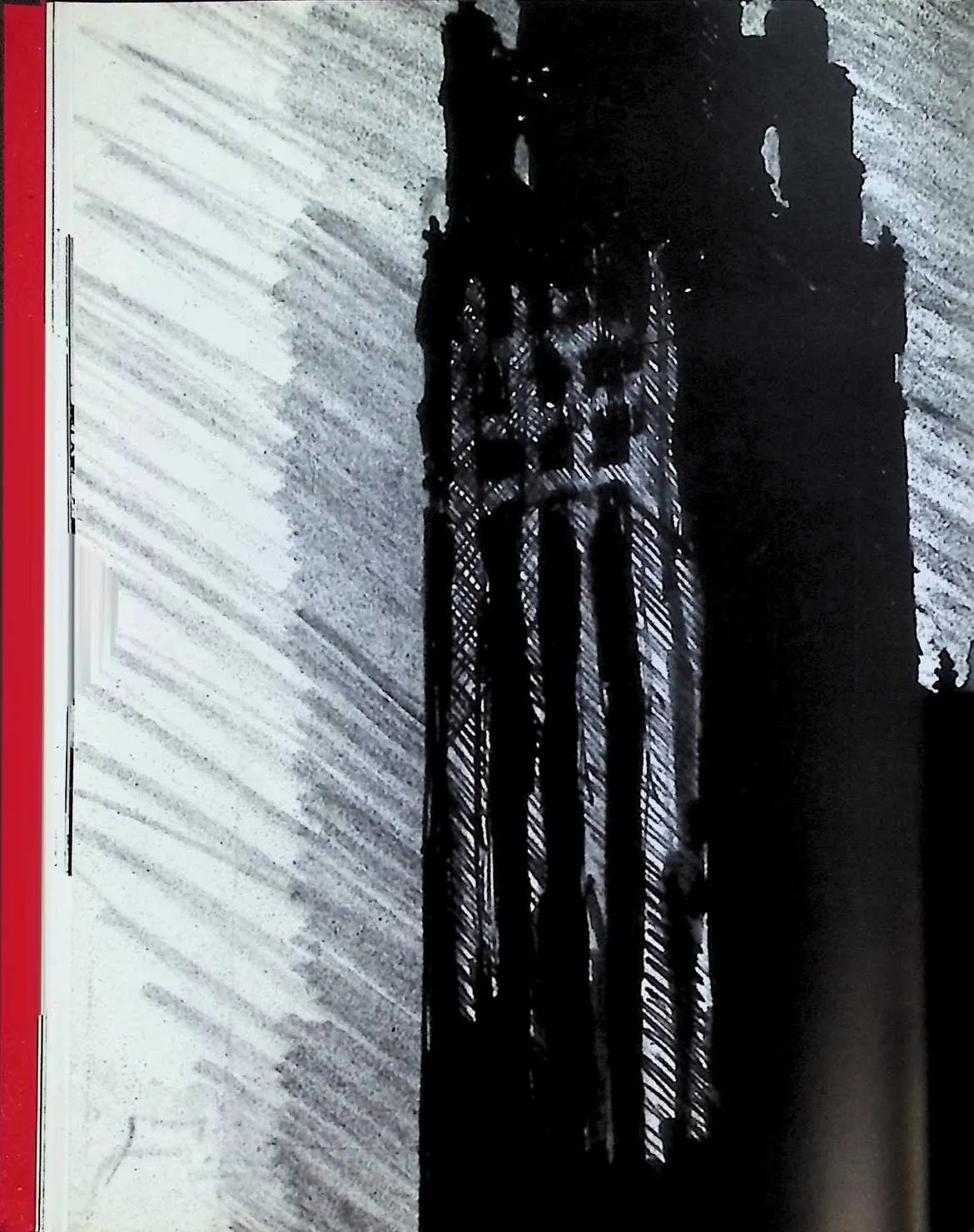
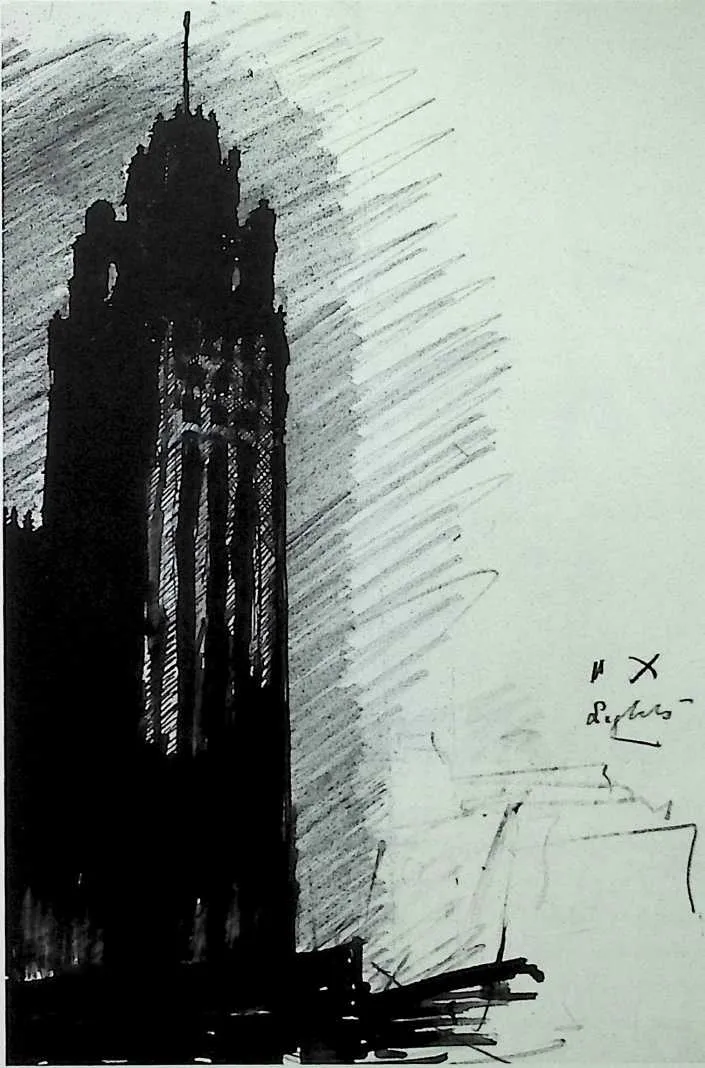
97The Virginia Hotel also looked onto the recently completed Tribune Tower, which Anne drew from one of their windows (figure 2.2).
98 The Virginia was an apartment hotel offering the convenience of private quarters combined with modified butler services, somewhat like a Manhattan doorman building in the early twenty-first century. Among the benefits of apartment hotel living were a sense of security, screened guests, access to a handyman, furnishings, utilities, package handling, and telephone usage for a weekly or monthly fee. This type of accommodation was acceptable to Anne and Fuller, both of whom belonged to the upper echelons of East Coast society and were listed in the New York Social Register.32 Anne first suggested the possibility while preparing to move to Chicago. About a month later, she agreed with Fuller’s idea of staying in his hotel:
100101‘‘I think your idea about living at the Virginia is the best too. During the hot weather and all we wouldn’t want to struggle over getting settled and cooking etc.’’33
103 Anne may have been encouraged by her mother-in-law who lived in an apartment hotel. Hatch reported that Fuller’s mother lived in a Manhattan apartment hotel on East 31st Street in 1915 where he stayed with her when he first began working at Armour.34 Thirteen years later Fuller noted in his holiday letter to Uncle Waldo that his mother and younger sister were ‘‘living this winter at 995 Fifth Avenue, New York City, an apartment hotel.’’35 The Virginia Hotel may not have been of the same caliber as 995 Fifth Avenue, but on Fuller’s $50 a week salary it was too costly for them to stay there.36 2.2 Anne Hewlett Fuller, Tribune Tower, 1927.
108 2.3
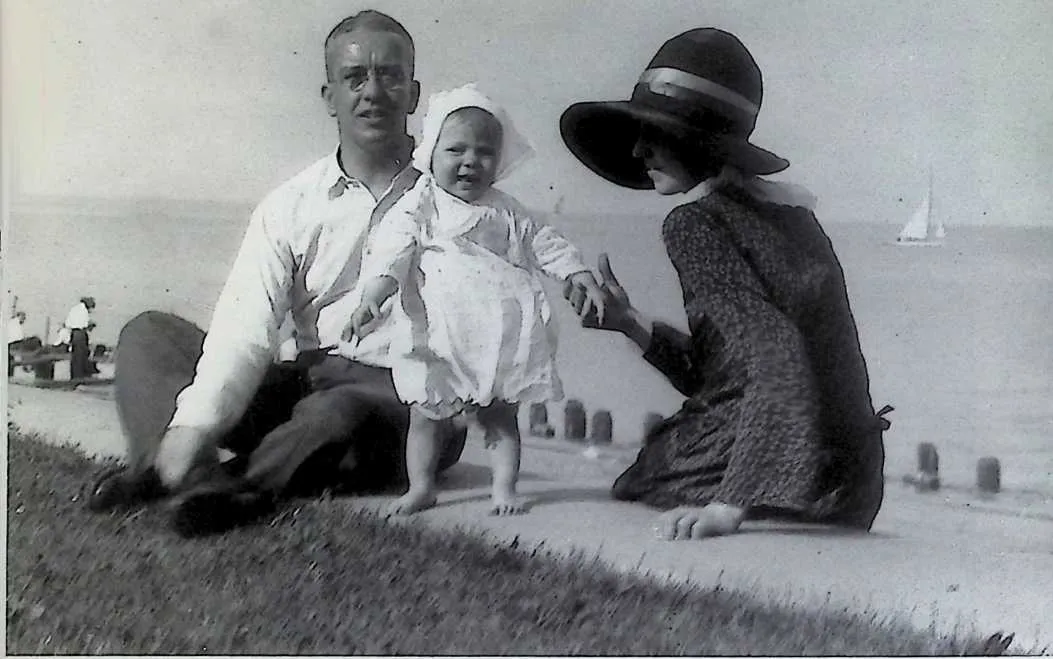
109 Allegra taking her first steps in Lincoln Park, Chicago, 1928.
111 In a late November diary entry, Anne noted they needed to move to a less expensive place. A
few days later the owner of the Virginia told Fuller about the Lake View Hotel as they discussed
his bill. The Fullers immediately moved into the Lake View even though Anne lamented, ‘‘[I]t is
a cheap, tiny place but clean so I think we can stand it for the sake of getting straightened out
financially.’’37
Three days later her attitude toward the new hotel improved a little when they moved into a
sunnier room.
The Lake View, at 739 Belmont Avenue in the Lakeview District, was a new elevator building,
completed in 1927. It was of fireproof construction, with brick walls and reinforced concrete frame, floors,
and roof.38
The neighborhood was zoned for apartments and businesses, with some industrial
development to the south. To the east Belmont Avenue led directly to Lake Michigan
and Lincoln Park. When the Fullers lived there, it was a fashionable, prosperous
neighborhood. The Lake View was not as prestigious as his mother’s building in
Manhattan, but it was well situated with nearby shopping, movie theaters, a park, and a
zoo39
for outings with the baby (figure 2.3). It was also close enough to the Loop to allow Fuller to
walk to work.
Like his contributions to his problems at Stockade, this is new information about Fuller’s
situation immediately after he left the company The Muller job and a decent apartment in a
respectable neighborhood are additions to his standard accounting of this period. Fuller
considered adding the Muller job to the official version of his life story, but decided against
it.40
According to Fuller’s official biography, after leaving Stockade he was broke, out of work, and
forced to move his family into a tenement in a slum neighborhood on Chicago’s North
Side.41
The documents reveal, however, Fuller was employed, even if his family may have found it
difficult to live on his salary. In addition, the Lake View Hotel was not a tenement in a slum,
but a new apartment hotel in a fashionable neighborhood. In 1939, before his life’s
story was codified, Fuller described this residence as ‘‘a small, clean, safe place …a
one-room flat in a new fire-proof apartment building at Clark and Belmont, at $22 a
month.’’42
The notes for Hamilton’s biography show that Fuller considered characterizing
this apartment as ‘‘a one-room flat in a new fireproof apartment
building,’’43
with no mention of the neighborhood. In his biography of Fuller, Hatch described their apartment as
‘‘one fair-sized room, with a sort of cubicle…There was a small window in this storage space, so
they fixed it up for Allegra. There was also an alcove with a stove and sink where Anne did the
cooking.’’44
In keeping with the established story of Fuller’s life, Hatch portrayed the neighborhood as a
slum. Fuller and his biographers misrepresented these facts because it allowed Fuller to
misrepresent the beginnings of Fuller Houses, the project that ultimately became the Dymaxion
House. As disclosed by the records but not his official biography, Fuller was already working on
Fuller Houses in November 1927, when he was living in the Virginia Hotel and not yet employed
by Muller.
Fuller worked diligently for his new employer even though he was more interested in
his own projects than Muller flooring (figure 2.4). Fuller Houses was his most
important new enterprise, although he explored other ideas. For example, ‘‘[a]fter much
philosophical thought while walking about worked out theory of spheres’’ in early
1928.45
He also contemplated patenting a cement mixer and a parking wheel, neither of which is
described in the diary. He visited the annual automobile shows in January to see if any of the
cars had a parking wheel like the one he devised; they did not. He must have discovered that an
other application for parking wheels existed because he abandoned this idea. He did, however,
assist Chamberlain, a Stockade colleague, on a patent for an unknown type of wall
system.
Chamberlain was employed by Stockade and, after Fuller was forced out, complained: ‘‘I will have to
spend more time in Chicago now that you are away from the company, and I suppose they will run me
ragged.’’46
Fuller, despite Hopkins’s wishes, did not disassociate himself from Stockade employees and
projects. He continued to visit the Joliet factory, see former coworkers, and, as late as
January 1928, inspected a Stockade house under construction in Milwaukee. Whether
surreptitiously or openly, Fuller remained involved with Stockade until the discovery of
his work on Chamberlain’s patents and its conflict with his legal obligations to the
company.
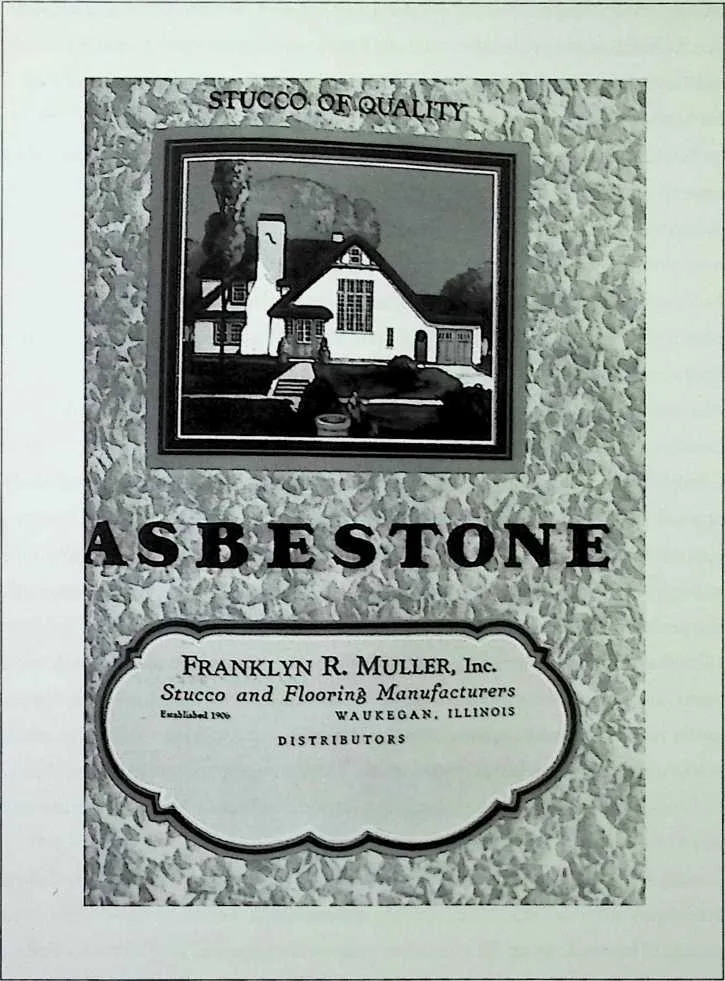
122 F. R. Muller, Inc., Asbestone Catalogue. ca. 1927.
123 Exactly when Fuller began to assist Chamberlain is unknown. The first reference to their collaboration is in November 1927. Chamberlain’s name pops up occasionally, and Fuller more or less kept him informed of his activities. Anne recorded on November 23 that Chamberlain ‘‘was wild about the thought of Celotex taking R.B.F. on very interested to know about RBF’s ‘Fuller Houses’ plan.’’47 In late January there was a brief flurry of activity with Chamberlain. Fuller met him in the Hotel La Salle where they ‘‘discussed patents and Stockade happenings. RBF advised MTC patenting new wall system.’’48 Fuller’s attitude toward Chamberlain soured within a month of that meeting:
126127‘‘M. T. Chamberlain called to say he had finished Stockade & wanted RBF to meet him at patent room of Library. RBF declined account cold. RBF does not want to make further business deals with him.’’49
129 The implication is that Chamberlain willingly resigned from Stockade, although controversy about the patents was the probable cause.
130 Developing new patents for products that could compete with Stockade’s constituted a conflict of interest for Chamberlain as a Stockade employee. Fuller may not have considered his involvement with Chamberlain a conflict since he was no longer employed by the company. Fuller, however, owned shares in Stockade. Therefore, the company’s board, including Hewlett, found his work on Chamberlain’s patents unacceptable.
131 Fuller worked with Chamberlain on at least two patents that conflicted with Stockade’s interests. One was the aforementioned, but undefined, new wall system. The application for the other patent was included in a letter to Fuller. Chamberlain described the device as ‘‘our joint invention covering the processes and devices for mixing fibrous material and a binder cement’’50 into blocks for constructing walls. This was suspiciously similar to producing blocks much like Stockade’s by utilizing a method of manufacture much like Stockade’s. Although Fuller no longer worked for Stockade when Chamberlain sent him the application, they were both employed by the company when the potential patent was written. Chamberlain requested that Fuller ‘‘please attend to this at once and not delay it as you did before.’’51 Out of naivete or indifference, Chamberlain also instructed Fuller to immediately have the Stockade Midwest secretary verify their signatures:
134135‘‘I have signed one copy of each and will ask that you get in touch at once with Miss Feeney and have her acknowledge yours and mine, she of course knowing my signature. Keep the blank copy if you desire to and return the signed copy to me and I will get it into the hands of the patent attorney by next mail so there will be no further delays.’’52
137 Chamberlain was in a hurry and may not have been thinking clearly when he directed Fuller to involve Miss Feeney because he ‘‘was informed yesterday that all employees of the company will have to sign an agreement to turn over all inventions to the company. This of course applies to future inventions applied for after the date of signing the agreement.’’53 The patent for their joint invention was not filed, although nothing in Fuller’s papers explains why. Fuller may have again hesitated to sign it or he may not have wanted to take it into the company’s office, an undoubtedly hostile environment. It could have been signed and forwarded to Miss Feeney in the Stockade office where it was intercepted. The latter case is unlikely since Chamberlain continued to work at Stockade until the following February when hints of Fuller’s legal problems appeared in the diary. In October 1928, when Chamberlain and Fuller were no longer associated with Stockade, Chamberlain alluded to the problematic nature of their patent work. When he praised Fuller’s patent application for the 4D House, Chamberlain remarked:
138139‘‘[T]his will be one patent which there will be no controversy about.’’54 Fuller’s willingness to assist Chamberlain in the development of one or both of his patents was controversial. Earlier in the year, Fuller was in very serious trouble because of it.
142There are clues suggesting a conflict with Stockade and direct evidence confirming Fuller’s complicity in his own problems. The first indication of trouble appeared in the diary on February 20, 1928, when Fuller recorded that Mr. Sweet, his patent lawyer, suggested he ‘‘at once place my Stockade matters in the hands of the best attorneys possible.’’55 A couple of weeks later, Anne wrote that her husband ‘‘[c]alled on Lawyers Messrs. Tenney Harding Sherman & Rogers …discussed Stockade settlement.’’56 On March 17, Fuller made the first of four diary entries regarding ‘‘serious trouble with Stockade.’’57 The issue was resolved five days later when he ‘‘signed agreement with Hopkins relieving each other of all claims.’’58 In the meantime, Fuller had some explaining to do and some ruffled feathers to smooth. On March 18, Fuller sent an explanatory telegram about his new problems
147 with Stockade to Hewlett:
148149Hopkins attorney advises former wrote you Saturday garbled facts serious accusation are not true but he has story which can hurt me terribly is willing to call off if I pay them money have some on hand and expect raise balance in time this seems only thing do stop not matter justice for moment but preservation decency you may have perfect faith me as have done nothing wrong and may count on my not letting it go further stop Hopkins attorney acknowledges I have done nothing wrong but am caught technically and advises settle quickly account Hopkins hatred of me.59
151Hewlett was not placated and his reply the following day was critical:
152153I received Hopkins’ letter and your telegram and have talked with Hoffman. Your telegram is not at all a satisfactory explanation of the situation into which you have gotten yourself Hoffman is certainly a good friend of yours and it seems perfectly evident to me that you have not merely done something absolutely improper but you have put him in the position of having his loyalty to you endanger his position with Hopkins. If you need help in straightening this matter out, (as far as it can be straightened out) let me know and I will do what I can…You should also write to me telling me exactly what the situation is between you and Chamberlain in regard to any patent rights having to do with Stockade or clips60
155 Fuller assured his father-in-law the situation was resolved and assumed complete responsibility for his actions:
156157Any agreements between Chamberlain and myself are terminated. We have no patents. I believe he has taken out patents, what they are I do not know, he was never informative and I do not have any interest in them …I merely know that I did something wrong ill advisedly, but not morally wrong. I feel frightfully about the many mistakes I have made. We have been made to pay dearly for my mistakes61
159 A week later, Hewlett’s follow-up note was calmer and his attitude toward Fuller softer:
160161‘‘What annoyed me was that in letting that matter drift along you were stupidly encouraging F. H. to think and say that all that he inferred…was justified. …All I intended to infer was my impatience at you apparently supplying further ammunition to Hopkins which he might use against you.’’62
163 Fuller managed to work through the problems resulting from his work on Chamberlain’s patents with his father-in-law.
164 Hewlett was also concerned about how Fuller’s actions might negatively affect others, especially Sam Hoffman. Hewlett expressed concern that Hoffman, who by this time was vice-president, might be compromised by his relationship to Fuller. Fuller was confused about Hoffman’s participation and promised to exonerate him:
165166‘‘That Sam Hoffman is so loyal a friend…I appreciate…I feel extremely sorry if I have put him in a bad position, I don’t see how + why he is involved though as he was certainly not responsible for anything I have done. I will see Taber [Hopkins’s lawyer] about it today and see that Hopkins real ize it.’’63
168 Fuller also apologized to Hoffman who reassured him:
169170‘‘Glad to note that the matter has been cleared up, and please don’t worry about my getting in wrong with Hopkins over this…For God’s sake, Buck, keep out of jams from now on and if you do get into a hole don’t keep it under cover for someone else to dig it up. Circumstantial evidence has ruined lots of people.’’64
172Hoffman was compassionate as he warned Fuller to be careful. The warning arrived too late as the evidence of Fuller’s wrongdoing, whether circumstantial or concrete, had already gotten him into serious trouble. On March 29, 1928, Fuller and Hopkins signed an agreement releasing each other of all claims, except for those regarding patents. The terms stipulated that each pay the other one dollar. In addition:
173174The Stockade Corporation hereby releases and discharges R. B. Fuller from all claims and demands (excepting those relating to inventions, patents, and licenses)…R.B. Fuller hereby releases and discharges The Stockade Corporation …from any and all claims and demands which he has against all or any of said companies. This release shall not be held to change or diminish any obligations of R. B. Fuller to The Stockade Corporation, its successors and assignees, with respect to inventions, United States Letters of Patent, licenses under United States Letters of Patent, and in the execution of papers and documents with respect to the prosecution of applications for United States Letters of Patent.65
176 The agreement required Stockade to keep control of the patents and inventions Fuller developed for the company. The problem resulting from his work with Chamberlain arose because Stockade either felt threatened by the potential patents or thought the company should own them.
177 The clause concerning patents and inventions must have referred to only those related to Stockade products. Fuller was granted many patents for later inventions, and there is no record of Stockade filing for rights against these. By the time the legal agreement was signed, Fuller had initiated patent proceedings on Fuller Houses. He obviously did not believe his problems with Stockade extended beyond the company’s processes and products, a sentiment echoed by Chamberlain. Nothing in Fuller’s papers indicates Stockade attempted to further exert any of the powers given to it by the legal agreement.
178 The agreement implies that Fuller surrendered some of his Stockade shares. Fuller’s diary entries from this period also discuss the Stockade agreement, and Dave Taber, Hopkins’s lawyer, told him Hopkins would accept stock in lieu of monetary payment.66 The diary entries and legal agreement are in accord with Fuller’s comment to Hewlett about having to pay dearly for his mistakes. This did not deplete Fuller’s holdings of Stockade shares, nor did his association with the company end. In January 1929 he received notice from the current treasurer, his cousin Andy King:
180181‘‘We expect to get the final papers of dissolution of The Stockade Building System, Inc. very shortly. Will you kindly forward to this office your certificates of stock in that Corporation and we will return to you by registered mail your shares of stock in the Stockade Corporation. The basis of exchange is eight shares of Stockade Corporation stock for one share of Stockade Building System, Inc. stock.’’67
183 The following month King asked Fuller to sign and return a proxy for the annual stockholders meeting, which he must have done because the form is missing. Fuller also sent in a certificate for 40 shares of the Stockade Building System requesting that they be reissued as 320 shares of The Stockade Corporation. Of these, 136 were to be in the name of his brother Wolcott and 184 in the name of Olive Cross, George Cross’s wife.68 Fuller still owned stock in the newly reorganized company even though he was no longer actively participating in its affairs. Fuller was responsible for many of his problems with Stockade, but Hopkins’s antagonistic attitude toward him exacerbated them. If the hostility Hopkins felt toward Fuller was as strong as Fuller’s papers suggest, it is surprising that Fuller was not more cautious. It is unfortunate that Hopkins’s papers have not been located as they would provide a different view of Fuller’s problems with Stockade.
184 There is no mention of Hopkins or of the legal agreement in any of the published accounts of Fuller’s problems with Stockade. Fuller may have alluded to the patent agreement or to being pushed out of the company when he wrote to George Buffington about ‘‘another enterprise, of which I lost control, in the bosom of an ethics fog’’69 while trying to convince Buffington to invest in the 4D House. It is impossible to determine to what he was specifically referring; it could have been the legal agreement, the hostile takeover of Stockade, or something else. Fuller partially outlined the sequence of events in his letter to Mac:
187188At a special meeting of the board of directors it was set forth that…if …additional territory could be secured from the parent company or other compensation …committee was appointed to negotiate with the parent co, which I was not on, due to the fact that Wayne Taylor and myself could not negotiate with Hopkins without a fight or disagreement, and from that time on politics ensued and I cannot tell you in a brief manner all that transpired except that I am now out and Hopkins is running things with my cousin Andy King and that they may make a go of it and that they will certainly try darned hard for Hopkins has a lot of money in it and is expecting to put in $200,000, more if necessary and that…should make everyone’s chance of earning the better.70
190 The letter was written before the March 29 legal agreement and provides no insight into it. Other documents, especially the correspondence between Hewlett and Fuller, offer a better understanding of what gave Hopkins the power to force Fuller to sign the legal agreement.
191 Since Fuller readily admitted a hostile takeover forced him to resign from Stockade, it is curious that the legal agreement is omitted from his codified biography. He may have felt it unnecessary since he was no longer employed by the company when he signed it. Or, it may have too clearly revealed his problems were not always the result of his being misunderstood or abused as he and his biographers like to contend. The legal agreement and corresponding diary entries communicate how complicit Fuller could be in his own problems, an element of his personality he tended to exclude from his biography.
192 Characteristically, Fuller also never divulged his problems with Hopkins and the extent to which they contributed to the termination of his employment at Stockade. In the codified version of the Stockade story, he is presented as either collateral loss from the buyout or a victim of the new management. Fuller as a victim is a prevalent theme in his personal narrative. Karl Conrad first noted it in his dissertation ‘‘Buckminster Fuller and the Technocratic Persuasion’’ while discussing Fuller’s description of the misfortunes of his youth: the death of his father on his fifteenth birthday (July 12, 1910)71 and the high school injury that ended his hopes of a great football career. According to Conrad:
194195‘‘[The young boy as victim becomes the young man as victim; yet these are not unconventional examples of adolescent misfortune.’’72
197 Conrad does not consider these calamities unusual nor does he discuss their potential for psychological devastation. Conrad does recognize Fuller’s ability to exploit them to his best advantage by representing himself as a hapless, misunderstood casualty of events beyond his control. This is a thread Fuller further manipulated when recounting the Stockade story. In two collaborative autobiographies, The Dymaxion World of Buckminster Fuller (1960) and Buckminster Fuller: An Autobiographical Monologue/Scenario (1980), Fuller explained that when Hewlett had to sell his stock, the new management no longer required his services.73 This is a very simplified version of the events, and Fuller did not identify the new management. Elsewhere he falsely identified the Celotex Corporation as the buyer that ‘‘voted him out of office.’’74 Even though Celotex was one of Stockade’s competitors, it played no part in Fuller’s problems with the latter. Fuller unsuccessfully interviewed with Celotex in November 1927, but he was never employed by that company. Celotex, however, provided Fuller with a convenient veil for obscuring his own role in the loss of his Stockade job. Another way this veil worked was to make Fuller appear as the vulnerable scapegoat of the hostile new management. One version was offered by Hatch when he explained that Fuller was fired from Stockade ‘‘with some justification, [since] the new regime did not appreciate his methods.’’75 The unappreciated methods included poor business sense, out-of-tune singing in the office, and a fight about the Joliet plant. Hatch supplemented this with a quotation from Fuller:
198199‘‘I got pushed out…and the people who pushed me out were eager to be vindicated for doing so. They tried to make me out a bad man.’’76
204 In sympathetic agreement with his subject, Hatch placed some blame on Fuller and then allowed his subject to present himself as innocently maligned.
205 Fuller was thus able to use his biographer to garner both sympathy for his maltreatment and criticism of those who betrayed him. He worked hard to ensure the company’s success and later insisted the company had built 240 buildings before he was forced out.77 His 1944 resume claims he ‘‘[s]upervised 150 building operations at various points throughout the eastern half of the United States.’’78 In its first five years, Stockade rapidly expanded beyond its humble beginnings and Fuller played a major role in its growth. Yet, instead of rewarding him, the new management rejected him. He complained that the new management then unjustifiably blamed him for his rejection. While Fuller’s indignity at this mistreatment is understandable, it was not as unwarranted as he made it appear. Fuller was partially responsible. The surviving documents illustrate his complicity and also show that Stockade’s new president, Farley Hopkins, was hostile toward him. Fuller’s actions, as Hewlett noted, often provided ammunition for Hopkins to use against him. Fuller’s work on the patents with Chamberlain made him look like a ‘‘bad man,’’ no matter how naive his involvement may have been. There was no need for Hopkins and the new Stockade management to fabricate any justification for firing Fuller. Even if he later glossed over the sequence of events, he helped set them in motion.
208 But misrepresenting what happened to him at Stockade also allowed him to misrepresent the value of the experience. Fuller later claimed that he learned the folly of craft building, or using manual labor to construct individual houses, while working for the company.79 He also credited Stockade with showing him how the financial structure of the construction industry inhibited the introduction of technological improvements.80 These statements may well be true, yet, like his version of why he was fired from Stockade, they provide only one side of the story. The other side of the story consists of positive lessons. Stockade taught him how to maneuver through the regulations and obstructions of the construction industry. It also taught him the wisdom of an organized plan and thought-out strategy. At Stockade, Fuller learned how to organize and operate a business from scratch. He learned how to market a new invention in an already established industry. Another valuable lesson was to take out patents on his inventions and maintain them to protect his interests. Even though Fuller never acknowledged that Stockade made these contributions to his development, they were potent lessons.
211 The knowledge and experience he gained at Stockade provided the background for his next project, Fuller Houses. In the development of this project, Fuller basically repeated the procedures used at Stockade. The first step was to determine a need and formulate a solution in the form of a marketable product. It was then necessary to protect one’s interest and hard work with patents. Next, a corporation to manufacture and distribute the product was needed, which required enlisting stockholders to help finance the venture. Concurrent with selling the idea to investors was to figure out how to actually manufacture the product. Once these steps were taken, it was simply a matter of marketing the product to the appropriate audience. After Stockade, Fuller was ready to follow his own footsteps to build another successful business based on his invention, Fuller Houses.