
1 Josef Albers and the Ethics of Perception
23Experimentation means learning by experience.
4Josef Albers, 1941
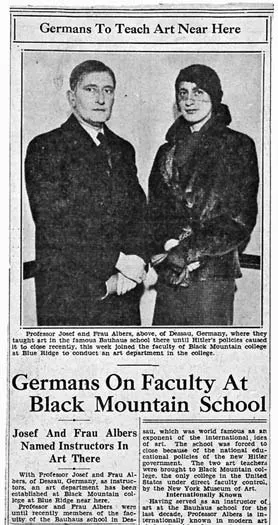
5A most poignant document of Black Mountain College’s early years is the snapshot of Josef and Anni Albers’s arrival, published in North Carolina’s Asheville Citizen on December 5, 1933 (fig. 1.1). ‘‘Germans to Teach Art Near Here,’’ the caption reads, though ‘‘Fresh Off the Boat’’ would do just as well; the grainy newsprint depicts the couple posed tensely in formal attire—he in tie and jacket, she in fur, cloche, and veil. Tightly angled in a corner, they look very much the anxious, recent immigrants. While Anni’s mild gaze seeks out the viewer, Josef averts his eyes, his stiff bearing and tightly clasped hands registering trepidation, even strain. Fleeing the Nazi regime, the couple left Berlin for the site of a newly founded experimental school in rural Appalachia, a quite improbable relocation under other circumstances. Though they came from the Bauhaus, one of the most radical art institutions of the era, to what was vociferously announced as its successor in the United States, this evidence of a nervous arrival is testimony to their unexpectedly providential exile from Europe.
6 Josef knew but a few words in English, though Anni was fluent. In their first years, she would serve double duty as both faculty member at the recently founded college and as his patient translator. The newspaper article does not mention this, nor does it quote his famous response to their welcoming ceremony. Rallying his scant English when asked what he hoped to accomplish in the United States, Josef declared simply, ‘‘I want to open eyes.’’2 Typical of his plain and frank manner, Albers’s pronouncement nonetheless encapsulates two concerns that characterize his years in the United States. Most obviously, it indicates the centrality of his pedagogical commitment (the same newspaper article proclaimed Albers as ‘‘internationally known …for his unusual method of art instruction’’). His statement also foregrounds the preeminence of a study of vision in his pedagogy and in Bauhaus teaching more generally—it is eyes he wants to open, after all.3 Pedagogy and vision: together, his words represent a desire to craft an audience for abstraction and, more particularly, for his art, an audience that would be tutored in the perceptual strategies he was developing in his teaching.
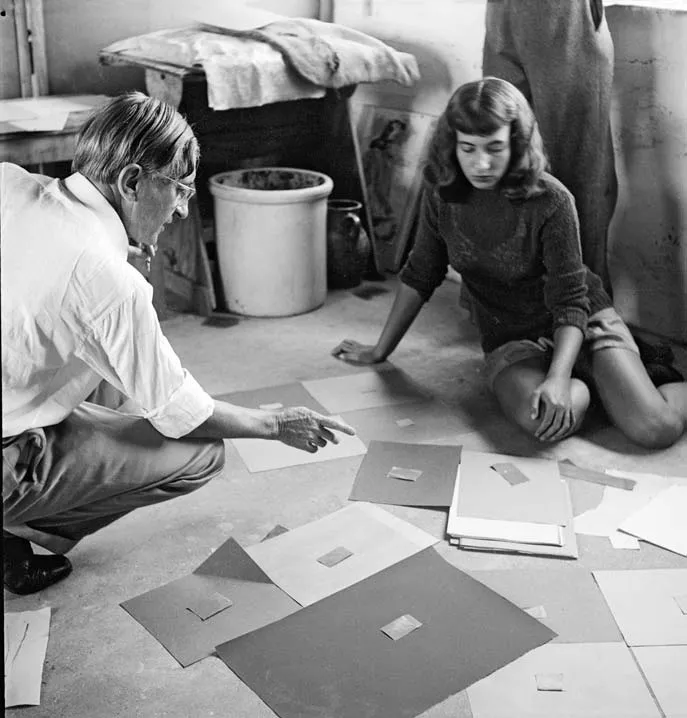
8 The key elements of these perceptual strategies were set out in Albers’s three-pronged Preliminary Course, or Vorkurs, brought from the Bauhaus to Black Mountain and later to Yale University. In these drawing, color, and design classes, he proposed an ordered and disciplined testing of the various qualities and appearances of readily available materials such as construction paper and household paint samples. His approach brought out the correlation between formal arrangement and underlying structure, and placed a high value on economy of labor and resources. He stressed the experience, rather than any definite outcomes, of a laboratory educational environment and promoted forms of experimentation and learning in action that could dynamically change routine habits of seeing.4 He began his drawing and design courses with mirror writing, a simple exercise in defamiliarization. He invited students to draw their names, for example, backward and in cursive, as if reflected in a mirror, and then asked them to render this script using their non-dominant hand. Drawing by automatic motor sense invariably becomes a crutch, overwriting any direct consciousness of how the actual forms of a signature are produced. Mirror exercises provided students with a sure way to begin challenging sterile habits of observation, ‘‘to develop awareness of what we do out of habit as opposed to choice.’’5
10 To grasp Albers’s proposal of what he came to term a ‘‘new visual expression’’ through acts of experimentation, it is crucial to understand the discursive field he produced around geometric abstraction, that is, how he explained the importance of a continuous study of the constitutive elements of form.6 The first section of this chapter will undertake a close reading and analysis of Albers’s large body of unpublished texts written in his budding English, which can shed light on the process of testing variations in form that his pedagogical strategies elaborated. (One could argue that given its minimal denotation of form and its refusal of naturalistic representation, geometric abstraction always relied heavily on discursive interpretations, offered both in the artists’ own writings and by critics.) He redesigned the experience of looking at art as one of ‘‘direct seeing,’’ whereby attention to perceptual habits marks routine cognitive associations as social constructions and allows these associations to be influenced and possibly transformed.7 In that vein, the second section of this chapter will connect Albers’s pedagogy with his own work. With careful study of his sketches, studies, and paintings undertaken at Black Mountain (and a few from his subsequent decades in the United States), it will be possible to address how Albers developed methods of articulating form that highlighted its contingency and endless mutability.
11 The final section of this chapter will explore how Albers went further to find in form an ethics of perception, which he developed in theories of progressive pedagogy concerning experimentation and social change. Drawing on the work of John Dewey, Albers presented the methodology of the experimental test as a forceful corrective against stagnant perceptual habits in the culture at large, bringing attention to the tremendous stake of progressive education in combating forces of social reproduction, that is, the tendency of dominant cultural values to be reproduced as the privileged traditions of a society. He maintained that learning to observe and design form made an essential contribution toward cultural transformation and growth. In brief, in Albers’s ethics of perception, careless habits—habits that inhibit self-actualization and social progress—can be overcome with the disciplined study of the constitution of forms, forms that themselves compose the ubiquitous, though often overlooked, material and appearance of our surroundings.
1.1 Perception Between Science and Intuition
12Elements of Josef Albers’s teachings have become so familiar and ingrained in current art curricula that it is difficult to recall how radically art education was altered by the widespread adoption of his methods. Developed at the Bauhaus in the early 1920s through 1933 and continued at Black Mountain College from 1933 to 1949 and at Yale from 1950 to 1958, Albers’s Preliminary Course consistently challenged conventional art teaching. Indeed, it is important to remember the great influence of Black Mountain’s teaching methods generally—especially during Albers’s nearly two decades at the College—in positioning invention and experiment as central elements of educational practice in the United States, and to bear in mind that in the years preceding its implementation elsewhere, ‘‘it was heresy,’’ according to Albers, ‘‘to consider art a central part of a college curriculum or a means of general education.’’8
13 Visual arts training in the early twentieth century, in Europe as in the United States, took place in specialized art academies modeled on classical Beaux-Arts instructional models or in technical institutes featuring drawing for industrial design, rather than in liberal arts colleges such as Black Mountain. In academies, distinctions among various media were reinforced, and the rendering from life, above all the study of the nude, was central. The emphasis was on repetition (in life studies) and duplication (in copying past works). Advancement was secured by a review process that paradoxically assessed a pupil’s fidelity to precursors and his (rarely her) departure from precedent in an ‘‘original’’ work—the academy study of the male nude. In its technical application, drawing accentuated the repeatability of objective nature by creating a strict geometry of form (and in this sense, to use M. Norton Wise’s phrase, ‘‘drawing is the language of engineering’’).9 This language of reproduced form, as Molly Nesbit contends, was routinized by drills in elementary and higher education toward ‘‘blueprints of production’’ in industrial product design.10 Even attempts to devise hybrid guild-workshop models of art education spawned by the Arts and Crafts movement, as Howard Singerman has noted, tended to attach more importance to craft traditions than to creative work in art and design.11 Whatever the model—academy, technical college, or workshop—visual art training beyond high school was not closely integrated with liberal arts concerns or with experimental or progressive approaches.
14 Albers bemoaned the persistence of such models in the United States:
1617I believe dominating education methods in this country are not at all typically American with their stereotyped requirements, standardized curricula and mechanized evaluation of achievements. Why do we still have the belief in academic standards while our living reveals variety, youth and freshness …? Why must exploration and inventiveness, two American virtues, too, play such a minor part in our schools?12
18He found particularly grating the assumption in standardized art education that talent and an aptitude for art were inherent gifts and prerequisites to creativity. Instead, he fostered a general training in the fundaments of art as ‘‘more democratic [and] …giving a chance to many more people,’’ not just to the exceptional or advanced student.13 In this sense, Albers was a good fit for Black Mountain; the centrality of art education was emphasized in the College’s 1933 inaugural publication shortly before his arrival: ‘‘Fine Arts, which often exist precariously on the fringes of the curriculum, are regarded as an integral part of the life of the College and of importance equal to that of the subjects that usually occupy the center of the curriculum.’’14 The goal was not to produce professional artists but to consider all individuals as possible creators and to offer training for what Albers termed a ‘‘flexible and productive mind that wants to do something with the world …we are on the way to the researcher, discoverer, to the inventor, in short to the worker who produces or understands revelations.’’15
19 Art practice offered the ideal site in culture from which to encourage broad-minded thinking, as training in experimentation steered a course toward ‘‘coordination, interpenetration …conclusions, new viewpoints …for developing a feeling or understanding for atmosphere and culture.’’16 The as yet unrealized prospect of education thus could consist of a richer understanding of ‘‘action or life,’’ not a stockpiling of mere information or knowledge.17 Developing an attuned visual sensibility involved testing, dynamism, and action, not the passivity and stasis of education based on study of precedent alone.18 Albers’s series of foundational courses promoted independent thinking and a close study of the mutable nature of form. On a visit to Black Mountain in 1944, Walter Gropius praised Albers’s innovation: ‘‘He has discarded the old procedure to hand over to the student a ready-made formulated system. He gives them instead objective tools that enable them to dig into the very stuff of life.
20 * * *
21 This ever-changing approach seems to me pregnant of life, present and future.’’19
23 Albers’s battery of courses constituted a broad foundation in the ‘‘stuff of life’’: a general education in the fundamental elements of visual perception, broken down into a sequence of three classes covering the ‘‘main provinces of form’’—drawing, color, and design.20 Yet ‘‘fundamental’’ and ‘‘foundational’’ should not be understood as merely elementary. Rather, through the observation of form’s shape, material (in its structure, surface, and appearance), and coloristic qualities, Albers offered a basic training in articulating form, and possibly in rearticulating it creatively. As Peter Galison has observed, this program of ‘‘building up from simple elements to all higher forms’’ was perhaps the central feature of Bauhaus pedagogy.21
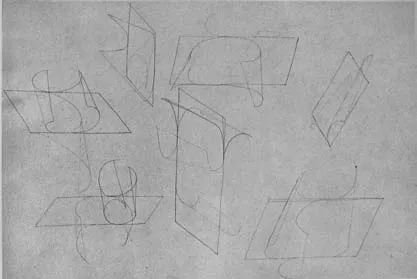
24 Albers’s first course—Basic Drawing—concentrated on shape through the exact observation and transcription of form in space. Drawing was conceived as a ‘‘test of seeing’’ that graphically reported visual data honed by exercises in foreshortening, overlapping, distance, and nearness.22 Albers encouraged students to observe the disposition of line in various contexts; in one study (fig. 1.3), the depiction of repeated bent and scrolled planes tested the precise spatial translation of two dimensions into three. Such trained observation excluded what Albers termed ‘‘expressive drawing’’ as a beginning, that is, the depiction of conditions that could not be assessed with some objectivity; the length of each mark in figure 1.3 maps the real behavior of a line in space with respect to qualities of depth and movement.23 His teaching exercises employed uncomplicated geometric forms such as squares, triangles, and ellipses, as well as simple figures such as letters and numbers, to perform changes in perspective and to create anamorphic effects that demonstrated a mastery of spatial representation. He avoided studies of the nude or classical model, ‘‘because that’s the hardest thing to do and you come maybe only for the nudes and not for the drawing.’’24
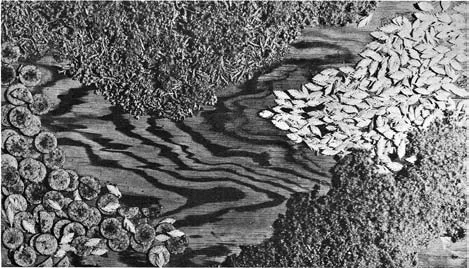
26 Figure 1.4
27 Unknown artist, Matiere Study, n.d. Reproduced in J. Albers, Search Versus Re-Search (Hartford, CT: Trinity College Press, 1969), 77. © Trinity College Trustees. Courtesy of the Watkinson Library, Trinity College, Hartford, Connecticut.
28 Basic Design (the key Werklehre—handicraft, or literally, the study of how to work—portion of the Preliminary Course) involved explorations of the material constitution of form. Albers divided the subject into two components, which he termed matière and material, and focused on exploration using commonly found materials and the fewest possible tools. Matière studies concerned the appearances of materials, distinguishing among structure, facture, and texture, and sought to characterize materials by their tactile or optical perception.25 For example, a trompe l’oeil representation of wood grain on paper gave the optical appearance of wood but the tactile experience of paper (fig. 1.4). Essentially, the practice of combining and confusing the superficial qualities of materials tested (mis)perceptions of the appearances of surfaces.26
29 Material studies concerned the immanent capacities of materials, evaluated structurally and analyzed according to features such as compression, elasticity, and firmness, tested through folding and bending. Here, Albers concentrated on the internal organization of forms and their relation to one another, encouraging dynamic relations rather than strictly symmetrical or mathematically predictable ones. An understanding of the dimensional, spatial, and volumetric qualities of form was accomplished through construction exercises, whose 22 chapter one parameters were defined through formal economy, that is, the ‘‘ratio of effort to effect.’’27
30 Albers believed the disciplined study of the material organization of form to be a necessary condition of art production. As he reasoned, ‘‘Every art work is based on a thinking out of the material.’’28 And in pre-Columbian sculpture he found the signal example of a sophisticated understanding of the technical potentials and limitations of medium. Once Albers relocated to the United States, he amassed an extensive collection of Mexican pre-Columbian pottery and figurines; he felt such work amplified the characteristic tendencies of its material, establishing a reflexive relation between an object’s structure and appearance. In contrast to many uses of clay in Western art, in which it is applied over a hidden armature, pre-Columbian art keeps ‘‘clay clay-like,’’ building ‘‘cake-like flat elements or little globular or sausage-like forms’’29 (fig. 1.5). Stonework commonly uses compact forms lacking delicate protrusions that can break. This construction is ‘‘proof that the artist has not overaimed and that the material has not been over-charged.’’30 Rather than simulating something else, the materiality of pre-Columbian art evokes the constructivist credo: it ‘‘teaches us [to] be truthful with materials.’’31 Though the appearance of any material can mimic another, its underlying structure and technical capacity can never be successfully imitated. The trompe l’oeil woodgrain drawing on paper, however naturalistic, cannot be mistaken for actual wood in its strength or durability (fig. 1.4).
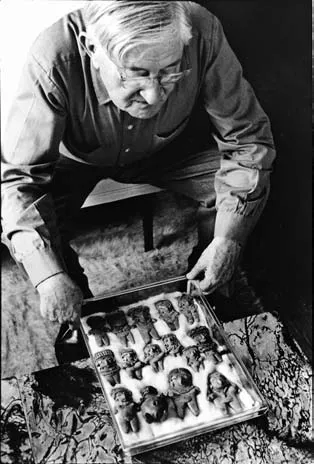
32 Figure 1.5
33 Henri Cartier-Bresson, Josef Albers with Pre-Columbian Figurines, 1968. Gelatin silver photograph. Courtesy Magnum Photos. 23
34 Color study was conceived as the foundational technique of painting, each brushstroke or application of the palette knife the bearer of a dab of colored paint. Albers’s color course encouraged students to tackle the process of painting with clear intentions and proper execution—‘‘to prepare for a disciplined use of color and to prevent accident, brush, or paint-box from taking authorship.’’32 Again, as in his other courses, Albers emphasized active ‘‘laboratory study’’ over the theoretical study of color systems, since ‘‘the ability to see color and color relationship is more important than ‘to know about’ color.’’33
35 Despite the renown Albers later won through his influential 1963 manual Interaction of Color, the study of color was relatively undeveloped in his repertoire upon his arrival in the United States. At the Bauhaus, he had radically shifted the Preliminary Course away from explorations of expression and gestural improvisation to rigorous material studies. The increasingly unpopular fixation with the subjective and emotional potential of color demonstrated by Johannes Itten, his predecessor, hastened his departure (triggering perhaps the most productive schism in Bauhaus ideology, one concerning the role of expression as opposed to design in art).34 Though diverging from Itten’s methods, Albers well understood the subjective dimension of color perception. When presented with irrefutable physical evidence—for example, the demonstration of a particular red shade—‘‘all group members will have the same visual perception. But still the individual associations and emotional reactions will differ vastly.’’35 Color is always relational; its perception is influenced not only by neighboring colors but by the surrounding light and atmospheric conditions. In addition, ‘‘visual memory is amazingly poor’’ as compared with, say, auditory memory, and suggests that ‘‘color is deceiving us all the time’’; these influences on vision have the effect of converting ‘‘the optical (physio-physiological) susception [‘stimuli’] into a psychological effect (perception).’’36 Because optical impressions and reactions are highly susceptible to manipulation or error, our understanding of and reflection on visual data—that is, the way we ‘‘image’’ or represent the world in the process of perception—must be carefully trained. This education in vision works to prevent the ease and apparent lack of mediation of optical vision to stand in for a more robust process of challenging meanings commonly assigned to forms. The fallibility of perception, its reliance on deceptive optical registrations, indicates the mutability of cognitive (that is, abstract/conceptual) comprehension, built as it is on those self-same illusions. ‘‘Color is the most relative medium in art,’’ Albers asserted, and this relativity puts into question how cognitive understandings of the world are founded, maintained, and possibly altered.37
36 Deliberate evaluation of the data of perception marks habits of cognition as such, denaturalizing them and making them receptive to change. In the long history of aesthetic discourse, theorizing perception as indebted to habit was early proposed by British empiricists. John Locke was forcefully skeptical about the ‘‘naturalness’’ of perception; he contended that reactions to the testimony of the senses organize knowledge and experience in ways that become ingrained.
37 Casual relations to such sensory stimuli generate ‘‘habitual customs’’ that reformulate new visual appearances into familiar cognitive patterns: ‘‘We are further to consider concerning perception, that the ideas we receive by sensation are often, in grown people, altered by the judgment, without our taking notice of it.’’ Previous experiences of events—traditions and precedents—model subsequent experiences in their image; therefore, it is important ‘‘to consider how much [one] may be beholden to experience, improvement, and acquired notions.’’38
38 Locke’s recognition that perception is ‘‘beholden to experience’’ and susceptible to routinization became a touchstone of late nineteenth-century philosophical debates about the nature of attention under conditions of growing industrialization and mechanization. Positivists such as Hermann von Helmholtz problematized the ‘‘apparentness’’ and immediacy of visual comprehension with tests of the enervation of visual attention in situations of optical fatigue, citing Johann Wolfgang von Goethe’s experiments with the vulnerability of visual evidence in the phenomenon of afterimages. Nonetheless, von Helmholtz was prey to the conceit, according to Jonathan Crary, that ‘‘habitual repetition was part of what maintained an orderly social world and affirmed the validity and durability of existing relations.’’39 For Crary, Henri Bergson’s arguments about the close connection between habit, repetition, and automation in modernity (as against forms of personal memory) best corrected von Helmholtz’s tendency toward functionalism. Crary detected in Bergson’s work that ‘‘the more ‘determined,’ that is, the more habitual and repetitive one’s perceptual response to one’s environment is, the less autonomy and freedom characterize that individual existence.’’40
39 Citing Bergson’s work, Russian formalists developed theories of vision that focused on remaking perceptual experience.41 Significantly, Viktor Shklovsky’s exploration of ‘‘habituation’’ as a process of rendering perception automatic and unconscious brought to the fore the key role of art in catalyzing new forms of awareness:
4041The purpose of art is to impart the sensation of things as they are perceived and not as they are known. The technique of art is to make objects ‘‘unfamiliar,’’ to make forms difficult, to increase the difficulty and length of perception because the process of perception is an aesthetic end in itself and must be prolonged.42
42 To Shklovsky, the ‘‘purpose [of an image] is not to make us perceive meaning, but to create a special perception of the object—it creates a ‘vision’ of the object instead of serving as a means of knowing it.’’43
43 It can be argued that Shklovsky’s type of formalism, by privileging the ‘‘special perception’’ of art over knowledge, elevated art to a category of direct experience surpassing epistemology, and even attempted to negate the ‘‘ends’’ of meaning production in favor of an ‘‘ends’’ of ‘‘means’’: the process of sensation. In contrast, Albers’s troubling of habituation was undertaken not merely as ‘‘an aesthetic end.’’ Rather, he contended that the entire structure of perception was related to the growth and transformation of cognitively assigned meanings in art and in the world at large. Albers saw art as an epistemological project, as a form of knowledge; to him, the better ‘‘vision’’ that attentive perception provokes can in fact increase awareness about routinely assigned meanings, and thus can encourage people to transform their customary patterns of comprehension. To Albers, ‘‘Every perceivable thing has form …and every form has meaning.’’44 But through routine the richness of the visual and material world is frequently overlooked. The diverse forms of modernity are themselves always changing, yet habit-driven behaviors reinforce accustomed understandings of forms and their existing, known relations to one another.45 Maintaining an alert attention to the appearance and constitution of form short-circuits assumptions that corroborate preexisting categories.
44 In short, Albers wanted to connect visual to social habits. If, for example, one can recognize how a work of art maintains a dynamic construction through careful imbalances of color and form—if a particular color to which one might automatically assign the name ‘‘black’’ is brought out of its familiarity and shown to be perhaps a little purple in one light and a little gray in another—the routine cognitive associations of ‘‘blackness’’ (dirt, gloom, death, and so on) can be made similarly unstable. The potential of color study to uncouple sterile associations he dubbed its ‘‘psychological effect.’’46 In his color exercises (note the comparative study from Interaction of Color, adapted from his Black Mountain-era exercises of making the same color appear different depending on its background [plate 1]), Albers tested the mutability of perception, demonstrating how the reception of color shifts dramatically and is deeply situational. Though the two central forms in each study are identical in shape and color, the gray rectangle on a warm yellow field appears brown and static as compared with its more dynamic, though lower-contrast counterpart on a cool blue ground. The illusion, even in close proximity, is persuasive; as the eye compares, it remains difficult to reconcile the fundamental semblance of the two forms. The ambiguity of the gray shade—lively in one instance, dull in another, and therefore utterly dependent on its immediate context for definition—reveals the extraordinary attention and subtlety every visual experience demands of viewers.
45 Careful study of the discrepancy between optical trickery (they appear as two different colors) and material reality (they actually are the same) can activate a fresh awareness of the constructedness of all habits of meaning in the world, as well as trigger an ambition to redesign them conscientiously.
46 Albers saw experimentation as the preeminent method by which the new and changing experiences of modernity could be expressed and its ‘‘modern problems’’ addressed (first and foremost, how to develop a student’s ‘‘independence, critical ability, and discipline’’), and he envisioned its practice as a disciplined testing process encouraging innovative visual articulations.47 Art itself was the experimental arm of culture, investigating the ‘‘better forms’’ that are the prerequisite of cultural production and progress.48 As he wrote:
4748To understand the meaning of form is the indispensable preliminary condition for culture. Culture is the ability to select or to distinguish the better, that is, the more meaningful form, the better appearance, the better behavior. There- fore culture is a concern with quality. Culture can be manifested in two ways: through recognition of better form and through producing of better form. The latter direction is the way of art. Art as the acting part of culture and therefore its proof and measurement.49
49 Art was more broadly both an ‘‘intuitive search for and discovery of form’’ and ‘‘the knowledge and application of the fundamental laws of form.’’50 Experimental processes constellate these interreliant features of artistic production: intuition and intellect. To Albers, this dialectic had profound social effects. In one respect, practices of teaching and learning were mutually informing and interdependent; in an egalitarian educational climate it was possible to ‘‘break through the boundary between those teaching and those being taught, because then everybody will be teacher and student at the same time.’’51 The problems posed in the classroom setting and as homework assignments should be stimulating to all—novice and expert, instructor and pupil.52 In breaking down hierarchies of expertise, Albers by no means advocated the dissolution of all categories of pedagogical distinction. Rather, he required of himself consummate skill; students would then ‘‘estimate as more competent …the one with more experience and insight.’’53 The goal was discovery, not demonstration: to shift from ‘‘giving information to giving experience.’’54 Experimentation, the testing operation that characterizes creative processes, builds skills of evaluation and assessment: ‘‘This one is better than that one and this shows more your expectations and your aims and all your efforts, then you are on the way to build up yourself.’’55 The procedure of the test joins comparison and what Albers termed competition; it is both self-driven and motivated externally by variations in performance among members of a group:
5051Because this comparing includes of course competition—nothing is big, or nothing is small, when we do not see it in [the] neighborhood of something bigger or smaller. …That’s the relativity of all evaluation, and if I want to evaluate myself by comparing my work with other work …that is comparison and is also competition.56
52 Competition—not antagonism—impelled personal growth and progress within a group by encouraging careful evaluations of subtle changes in performance.57
53 In this explicit focus on competition, Albers differed from other geometric abstractionists at the College, notably Ilya Bolotowsky, Albers’s replacement when he went on sabbatical in 1946--47. In Bolotowsky’s classes, students were urged to produce ‘‘mature’’ work regardless of whether it emulated the styles of other artists, resulting in some conflict at the College as he effectively repealed Albers’s group exercise techniques. Bolotowsky’s courses at Black Mountain propounded a ‘‘universal plastic language with sufficient room for individual difference’’ in which ‘‘originality is encouraged.’’58 He was Albers’s junior by twenty years, and he and other abstract painters based in New York City such as Fritz Glarner had been highly receptive to Piet Mondrian and neoplasticism in the 1930s. Bolotowsky took it on faith that abstraction, not ‘‘nature,’’ was the preeminent modern practice because it captured the essence, not the appearance, of form. Though he and Albers were founding members of the American Abstract Artists (AAA) group in 1936, Bolotowsky’s emphasis on universal characteristics of representation precluded any comparative or experimental testing framework. As he explained in language indebted to Mondrian’s more Neoplatonic moments, ‘‘The majority [in AAA] felt that all worthwhile art has to begin somewhere in nature and then become the essence of it, but a few of us would simply start abstractly and reject nature. …Abstract art is striving to depict an essence of harmony.’’59 Bolotowsky’s emphasis on the immanence of abstraction and the rejection of nature stood in direct opposition to Albers’s methodology, especially as the latter’s model of the test demanded careful observation of the order of existing appearances of ‘‘nature,’’ in the interest of rearticulating them.
54 Albers’s investigations of form, in contrast to Bolotowsky’s, were not undertaken in the interest of generating immediately viable, mature art practices. The goal of the courses was not necessarily to produce anything useful but rather to train observation. As Albers stated, ‘‘In designing there are besides technical and economical problems also problems of form which are independent of a purely functional approach.’’60 To help students avoid succumbing to tendencies of habit or to pressure them to supersede work of the past, Albers advocated ‘‘experiment without aiming to make a product.’’61 He identified intuitive elements in art production available to those with trained vision, recognizing that there are ‘‘many unknown and incalculable X’s which makes it impossible to find every solution by figuring, reckoning and calculating.’’62 He counseled students to devise exceptional situations in which his ‘‘worst enemies’’—symmetry and predictability—were most effectively supplanted by dynamism and discovery.63 The unlabored exercise frequently succeeded; one student recounted how Albers’s first assignment in Basic Design supplied only a few newspapers with the task to ‘‘try to make something out of them that is more than you have now.’’ Dismissing the resulting cut and pasted boats, animals, airplanes, little figurines, and masks as ‘‘kindergarten studies which could have been made better in other materials,’’ Albers alighted on a study of great simplicity in which a young architect folded the newspaper lengthwise and stood it up to resemble a standing screen. ‘‘Albers explained to us how well the material was understood and utilized—how the folding process was natural to paper …now that the paper was standing up, both sides had become visually active. The paper had lost its tired look—its lazy appearance. After a while we caught on to his way of seeing and thinking.’’64
55 An expanded notion of art as mediating between material and culture led
56 Albers to maintain, ‘‘Art is a province in which one finds all the problems of life
57 reflected—not only the problems of form (e.g. proportion and balance)’’ but
58 also what he termed ‘‘spiritual problems,’’ problems of ‘‘philosophy, of religion,
59 of sociology, of economy.’’65 In broadening the definition of art to include visual
60 and material explorations of all sorts, Albers’s pedagogy posited the role of
61 creativity in society as a consciousness to the breadth of aesthetic experience,
62 beyond those observed in the ‘‘laboratory’’ of the classroom. Attentiveness to
63 details of form meant, to Albers, an alertness to the ways in which the indi-
64 vidual was sited in the larger field of social relations. Everything in the world has form; training the eye in the composition of form was a precondition for
65 understanding and possibly transforming the material appearance and imma-
66 terial relations in the world. Albers believed that above all, ‘‘our art instruction
67 attempts first to teach the student to see in the widest sense: to open his eyes
68 to the phenomena about him and, most important of all, to open to his own
69 living, being, and doing.’’66
70 thErE arE no mastErpIEcEs: sErIalIty anD VarIatIon
71 The practice of the experiment, seen in the light of Albers’s body of writings on
72 the test in art and in art education, helps unpack his own body of work in vari-
73 ous media undertaken during his years in the United States. His production at
74 Black Mountain in particular was tremendously catholic; though he had begun
75 his career at the Bauhaus as a glass artist, there and at the College he produced
76 photographs, photomontages, furniture, lithographs, woodand linoleum cuts,
77 pen-and-ink drawings, and oil paintings. In spite of this diversity, Albers’s work
78 from Black Mountain can be divided into roughly two long-term projects: the
79 black-and-white Graphic Tectonics lithographs (1942--48) and the oil-on-Ma-
80 sonite Variants (1947--53), which were inspired by adobe architecture he’d seen
81 in Mexico. Leaving Black Mountain to teach at Yale, he continued to develop
82 the concerns about color perception, initiated in the Variants series, in the later
83 Homage to the Square series (1950 until his death in 1976), as well as those of
84 dimensional perception from the Graphic Tectonics in his subsequent Structural
85 Constellations (1949--58).
86 Albers’s work reflected a deliberate experimentation with the constitutive
87 elements of form, centering on the coloristic and geometric relations organizing the appearance of forms on a two-dimensional surface. The scheme of each
88 construction produces internal frictions and instabilities and must be provisionally extricated from multiple and contradictory dimensional readings. For
89 instance, in Albers’s linoleum cut Fenced (1944), interlocking irregular trapezoidal and triangular forms are demarcated in a regular pattern of vertical
90 lines in two contrasting widths (fig. 1.6). As one follows the diagonals to find
91 the outline of a half-perceived three-dimensional object, the impossibility of
92 extracting such an illogical dimensional form from the matrix of surrounding
93 verticals summons once again an overall flatness to the image. The contingent
94 structure of the jigsawed composition in Fenced—is it more two dimensional
95 than three dimensional? is it a unified shape or several intersecting or even
96 disparate, overlapping forms?—generates optical challenges (though Albers
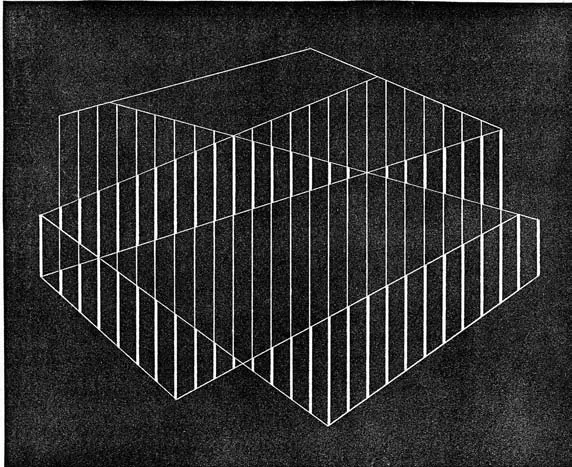
98 Figure 1.6
99 Josef Albers, Fenced, 1944. Linoleum cut, Biltmore Press, Asheville,
100 10 × 12″. Photograph by Tim Nighswander © The Josef and Anni
101 Albers Foundation / Artists Rights Society, New York.
102 disdained association with the later op art moniker) and exposes the rudimentary representational conditions necessary to construct spatially ambiguous
103 images. As Albers observed of a similar work, ‘‘No matter where you start to
104 read, you will never find a logical conclusion. And this, despite the fact that
105 there is no arbitrary point or line, every part is mathematically derived from
106 the underlying square.’’67
107 The distinction between the optical and the conditions under which opticality is understood cognitively was vital in Albers’s work. To him, ‘‘In all
108 visual perception, the initial reaction is optical’’—that is, there is a physical fact
109 of seeing that results in what he termed a ‘‘retinal projection.’’68 Yet the effects
110 of optical stimuli elicit varied perceptual responses that go beyond mere opticality; they are ‘‘post-retinal’’ and occur as the mind synthesizes the visual data
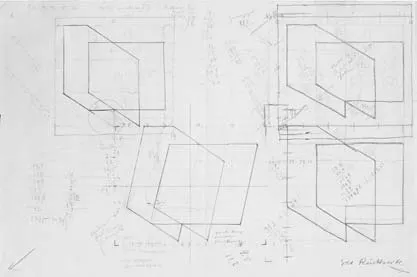
112 Figure 1.7
113 Josef Albers, Studies for Abstract Paintings, ca. 1937. Pencil and
114 red pencil on wove paper, ruled in pencil, 9¼ × 13¾″. Photograph
115 by Tim Nighswander © The Josef and Anni Albers Foundation /
116 Artists Rights Society, New York.
117 of a retinal projection. As Albers was fond of repeating, ‘‘Only there [in the
118 mind] occur such important changes (reactions, results) as, for instance, that
119 gentlemen prefer blondes.’’69
120 Perceptual responses in turn condition cognitive understandings of the
121 world and one’s ability to formulate and change the comprehension of objects
122 and events. (Here, Yve-Alain Bois’s paraphrase of the Russian formalist conception of representation—‘‘form is always ideological’’—is worth bearing in
123 mind when considering Albers’s circuit of testing perception against cognitive
124 meanings.)70 Perception mediates the physical fact of seeing and the social-
125 ly and psychologically determined effects of vision. This zone of perception,
126 as opposed to optics, is where Albers couched his artistic practice, tagging it
127 ‘‘perceptual art.’’71 And in this zone, he emphasized above all ‘‘perceptual ambiguity’’ as opposed to mere ‘‘optical deceptions,’’ which occur in all representation but fail to educate the viewer in more attentive observation.72 Revealing
128 the mechanisms of perception could be accomplished with very limited visual
129 data, hence his predilection toward abstraction. As Albers asserted, ‘‘The how
130 is more important than the what.’’73
131 Albers’s sketches and studies reveal the systematic trial-and-error process
132 that each work underwent before completion, showing how ‘‘finished’’ works
133 are composed of systematic variations and are produced in series. In a pencil
134 study from about 1937, for example, careful calculations of surface area determine alterations in the size and placement of each form, and a series of measurements analyzes the spacing of the central forms as separated from the edges
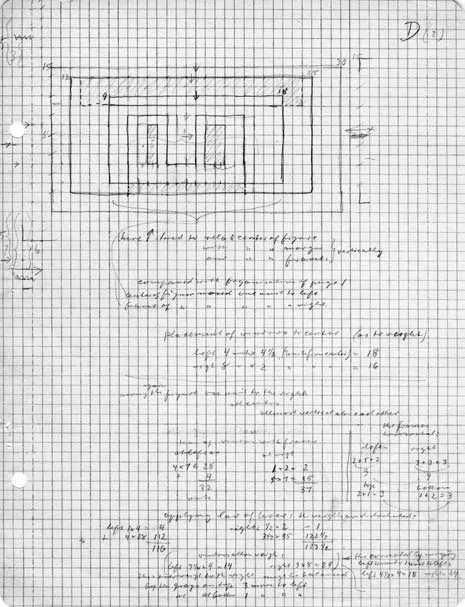
136 Figure 1.8
137 Josef Albers, sketch for Variant D(2), n.d. 8½ × 11″. © The Josef and
138 Anni Albers Foundation / Artists Rights Society, New York.
139 of the future work (fig. 1.7). Minute adjustments and transpositions of certain
140 elements of the repeated forms are worked out in subsequent iterations of the
141 innermost form. For the late 1940s Variants, Albers filled dozens of graph-pa-
142 per sheets with precisely drawn sketches surrounded by detailed calculations
143 of distances, area, and proportions (fig. 1.8). The ‘‘windows,’’ as he termed the
144 central squares of the Variants, are indicated in different positions in relation to
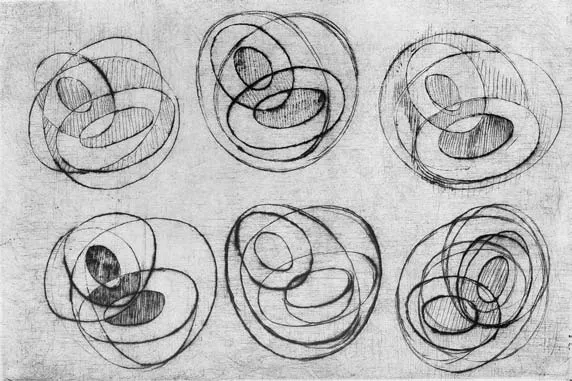
146 Figure 1.9
147 Josef Albers, Variants, 1942. Drypoint, edition 20, printed at Swan Press, Chicago, 6 × 87⁄8″. Photograph by Tim Nighswander © The Josef and Anni Albers Foundation / Artists Rights Society, New York.
148 the surrounding ‘‘frames.’’ Various figures drawn in colored pencil are carefully
149 marked off by the number of graphed squares they occupy. In Albers’s close
150 script, meticulous reactions to the tested schemas are noted. One page contains
151 the following registration of different placements of a single window:
152 Have tried to relate center of figure (vertically) with center of margin (vertical-
153 ly) and with the center of frame (vertically) …compared with organization of
154 page 1 center of figure moved one unit to left, frame of figure moved one unit to
155 right …moving again the figure one unit to the right, all centers almost vertical
156 with each other …this movement to the right must be balanced by the grays
157 on top, 3 more to the left, and at bottom 1 more to the left.
158 This systematic testing and factoring of each altered variable governed the
159 subsequent iterations of the work’s structure.
160 Similarly, his drypoint engraving Variants (1942) represents a series of
161 virtually identical forms subjected to a methodical procedure of modification
162 and recombination on the basis of a test figure’s orientation (figs. 1.9, 1.10).
163 Alternating segments of each individual form-group are shaded in different
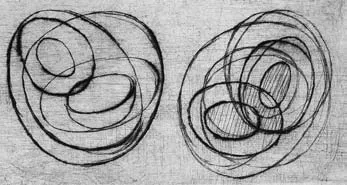
165 Figure 1.10
166 Josef Albers, Variants, 1942, detail. Photograph by Eva Díaz
167 © The Josef and Anni Albers Foundation / Artists Rights Society,
168 New York.
169 arrangements; in the lower-right shape, the orientation is transposed. In his
170 sketchbooks, Albers would carefully draw figures and then invert them, us-
171 ing heavily marked areas as reference points in the reversals in order to test
172 the changing perception of dimensionality in each. Under a shaded version of
173 one sequence is written in pencil: ‘‘The right angles—the square—around the
174 figure do not remain—frontal!’’ Albers’s attempts to adapt the figure test the
175 visual effect of the interlocking forms in various orientations, charting variation
176 among the forms subject to doubling and reversals. This can be seen in a sketch
177 of nine related figures where Albers maintained as a constant a double series of
178 Xs in each figure, varying the angles slightly as he embedded cubes within their
179 armature. As the figure is rotated in space, the Xs are seen torqued, transposed,
180 and eventually resolved, as with the upper-right figure, when a new set of angles
181 has in turn become the control factor.
182 Describing these controls, Albers distinguished between the casual approach he termed ‘‘variety’’ and the experimental rigor of ‘‘variance’’:
183 The word variety, although recently a favored design term, has become discredited because of increased abuse. It has become a pretentious recommendation for designs of questionable merit. It is applied to protect hurried changes,
184 to excuse poor alterations, or to defend any accidental and meaningless whim.
185 . . . Thus the excuse ‘‘for variety’s sake’’ remains a warning signal.
186 To replace this negative criterion, we are in favor of a related word of better
187 reputation, the design term ‘‘variant.’’ As variety usually concerns changes of
188 details, variant means a more thorough re-doing of a whole or of a part within
189 a given scheme. Although variant may remind us slightly of imitative plagiarism, normally it results from a thorough study. Because of a more comprehensive comparison forth and back, it usually aims at a new presentation. On the
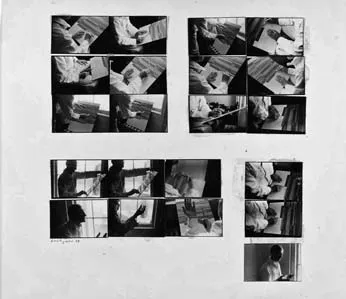
191 Figure 1.11
192 Josef Albers, Spring 39 (Josef Albers Painting at Black Mountain
193 College), 1939. Photocollage of 21 images, 8 × 9″. Photograph by
194 Tim Nighswander © The Josef and Anni Albers Foundation / Artists
195 Rights Society, New York.
196 whole, variants demonstrate, besides a sincere attitude, a healthy belief that
197 there is no final solution in form; thus form demands unending performance
198 and invites constant consideration—visually as well as verbally.74
199 As he later reformulated this idea, ‘‘The final ending, the end quality of all form
200 will not be—cannot be—decided upon.’’75 What Albers advocated was not simply following a set of rules, but rather reworking continually, being a perpetual student of the complex organization of forms in the world. The notion of
201 competition as elaborated in his teaching method undergirded this interest in
202 testing—each iteration a test of the qualities of the material and of the ability of
203 the artist to discern growth and change. He explained, ‘‘In my own work I am
204 content to compete with myself …so I dare further variants.’’76
205 In his many studies for the Variants paintings, Albers devised tools and
206 techniques to facilitate his tests of possible color arrangements and orientations in the series. Detailed preparation studies functioned as ‘‘experimental
207 tryouts’’ for paintings that were themselves intelligible only within a schema of
208 experiments in formal possibilities, rather than discrete and final entities.77 In
209 a sequence of templates (for example in figure 1.12 and plate 2), Albers paint-
210 ed concentric borders in alternating colors on
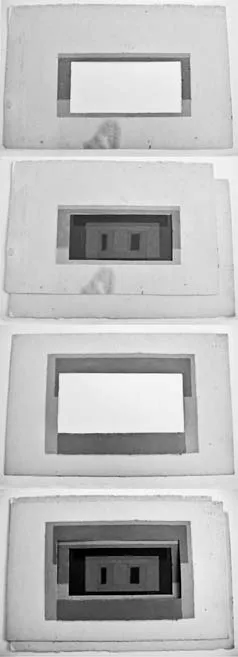
212 several different cardboard mats. He then over-
213 laid these ‘‘frames’’ around different central
214 arrangements, testing the possibilities of color
215 and scale organization of the work by changing
216 the different panels. Varying the interrelated
217 borders by alternating the order of the panels,
218 Albers used the visual ‘‘data’’ to assess more
219 appropriate contrasts and to create the most
220 dynamic compositions. In other studies for the
221 Variants, he often tried out several color combi-
222 nations, painstakingly labeling the constitutive
223 elements by application technique and manu-
224 facturer. As the orientation of the embedded
225 elements was altered, he would calculate the
226 relations of the various surface areas, weighing
227 the components by their color and volumetric
228 intensity. Each of the penciled recipes noted the
229 precise constitution of the study and permitted
230 Albers to adjust specific factors until a desir-
231 able result was obtained; his paintings include
232 these protoconceptualist instructions on their
233 reverse sides as well (plate 4, fig. 1.13). Because
234 of the serial quality of the Variants, however,
235 Albers believed that ‘‘new and different cases
236 [would] be discovered time and time again.’’78
237 The criteria that substantiated the suc-
238 cessful completion of a particular work were
239 intelligible only within a context of continual
240 variation. Using the principle of dynamism—
241 palpable when a composition refused simple
242 harmony and remained asymmetrical, imbal-
243 anced, and syncopated—Albers attempted to
244 maximize the contrast between elements in
245 a given composition. With the potential for
246 countless renditions, each work completes an Fig. 1.12
247 intricate process of testing, and also demands Josef Albers, templates for a Variant study, n.d. 12 × 19″. Photographs by Eva Díaz © The Josef and Anni Albers
248 evaluation and comparison between completed Foundation / Artists Rights Society, New York.
249 works. There are no ‘‘masterpieces’’ in Albers’s
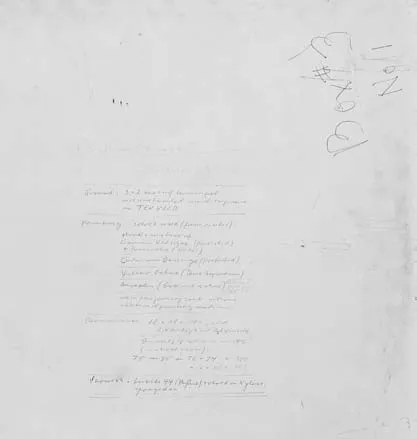
251 Figure 1.13
252 Josef Albers, Variant:
253 Southern Climate,
254 1948--53. Oil on
255 Masonite, 12¼ ×
256 22½″, reverse side.
257 Photograph by Tim
258 Nighswander ©
259 The Josef and Anni
260 Albers Foundation
261 / Artists Rights
262 Society, New York.
263 career; each work emerges from the success of its forerunner and initiates the
264 explorations of its successor.
265 He maintained other ‘‘control’’ factors that made possible a judicious anal-
266 ysis of the element under inspection, be it orientation, surface area, color, or
267 dimensional ambiguity. When painting the Variants, Albers used the same basic
268 ‘‘checkerboard-like structure …which provides a definite relationship of all the
269 parts’’ to one another.79 This allowed modulations in color and orientation to
270 remain measurable when compared with one another. Unmixed colors were
271 spread with a palette knife straight from the tube onto Masonite panels (rose
272 and pink were exceptions, as they are unavailable without mixing), and were
273 applied in one coat without underpainting; striking textural differences often
274 resulted from the distinct consistencies of different paint brands (see the purple
275 section of Variant [plate 3], for example). The always unshaded surfaces of the
276 various sections create flat expanses of color that are tightly abutted by their
277 neighboring hues. Yet for all the precision of the sketches, marked as they are
278 on graph paper in scrupulous ruled lines, in the painted Variant Albers relished
279 a rapid application of color with the knife. The resulting edges, seemingly flaw-
280 less from afar, are in fact loose and sometimes inexact, with visible facture and
281 the pilled texture of the Masonite evident in certain sections, as in the detail of
282 Variant: Southern Climate (1948--53) (plate 4). The performance was so stringently rehearsed in preparatory studies that the paintings themselves profited from Albers’s facility with the knife; he painted the hard edges with penciled-in
283 guidelines but with no masked-off tracing edges.
284 In his yellow, green, white, and gray Variant from the late 1940s, the ap-
285 pearance of depth is illusionistically suggested in certain areas but refused in
286 others80 (plate 6). Here, Albers was interested in the perception of proximate or
287 adjacent areas of darker or lighter color as either transparent overlays or areas
288 of opacity. Through a meticulous and methodical process of color and compo-
289 sitional studies, as in Study for a Variant (III), C (1947), Albers applied bands of
290 color to contiguous sections of the concentric rectangles, confusing the optical
291 impression that the various forms are either embedded in or superimposed on
292 one another (plate 7). Areas of translucency and overlap and, hence, impressions of spatial recession—for example, the appearance of the gray horizontal band in Variant—are contradicted by colored zones that project over and
293 around the ostensibly covered-over section, such as the bright elevation of the
294 area of white (plate 6).
295 Each of Albers’s techniques of illusion implicates viewers, inviting them to
296 become students of the processes of visual perception at play in his work, just
297 as he was in the work’s creation. What Svetlana Alpers has termed ‘‘pictori-
298 al equivocation’’ is very much in operation for Albers: ‘‘The possibility of the
299 painter representing the perception of a thing, and representing it for viewers,
300 in such a way as to encourage the mind to dwell on perceiving it as a process:
301 the painter’s experience of an object as coming into its own, distinguishing itself
302 from others, taking shape.’’81 The sense of perception as a process—the ‘‘how’’
303 and not the ‘‘what’’—is derived from Albers’s conception of ‘‘gestalt,’’ or form,
304 as an active procedure: ‘‘If I had to determine the task of a designer, an artist, or
305 of any kind of creative worker I would use the German verb ‘gestalten.’ ’’82 (As
306 Albers was aware, gestalten constitutes a vast subject in German thought; in his
307 writings he connected it to Gestalt psychology’s evaluation of a form element
308 in relation to a whole.) Gestalten can be defined a variety of ways: to arrange,
309 to create, to design, to frame, to fashion, to organize, or to form; form in Al-
310 bers’s rhetoric was therefore positioned as a practice and procedure, not as the
311 artifact of a process, as demonstrated in Variant: Southern Climate.83 Here, two
312 sand-colored central windows appear to project over the surrounding bright
313 and muted orange frames, yet are simultaneously pulled back toward the top
314 sand-toned horizontal plane that deceptively appears to be the overall ground.
315 The oscillation between foreground and background emphasizes the inherent
316 temporality of the process of perception, and brings home the fundamental am-
317 biguity of seeking any final, stable resolution to the pictorial problems Albers
318 explores. The viewer vacillates between two roles that Albers himself occupies
319 as creator: acting as subject of the experiment in vision, and as organizer of
320 the mutable effects transpiring in the visual field as the image’s components
321 are scanned. Experiencing the basic acts of perception, his audience is invited
322 to work through sections of the picture plane, to weigh imbalances and test
323 dynamic relations. Donald Judd, commenting on an Albers work he owned
324 (plate 8), observed of this process, ‘‘The painting is one single whole and is as
325 complex as a metope. The scheme of squares and the corresponding change of
326 color provides changes in proportion …as in a Mobius strip.’’84 The appearance
327 of squares as either embedded or superimposed in the Variants is contradicted
328 by the visible adjacency of the paint application seen in the thin strips where
329 they meet and the narrow windows revealing stripes of background. In the
330 seemingly elementary demonstration of concentric squares and rectangles, the
331 complicated language of vision is built up so that illusions of representation are
332 confronted by the materiality and inherent flatness of paint.
333 Concentrating on the elements of perception, Albers participated in a
334 shared German-Austrian modernist project of the 1920s and early 1930s in
335 which, according to Peter Galison, ‘‘all knowledge …would be built up from
336 logical strings of basic experiential propositions.’’85 Not coincidentally, there
337 existed a close association of Bauhaus ideology with Vienna Circle logical pos-
338 itivist philosophy, which grew out of the work of Ludwig Wittgenstein and was
339 expounded in the lectures of Otto Neurath and Rudolf Carnap at the Dessau
340 Bauhaus in the late 1920s. According to Carnap, the organization of knowledge
341 from a repertoire of fundamental perceptual experiences unified all modernist
342 endeavors, whether visual or linguistic. In explaining his ‘‘constructional pro-
343 gram,’’ he noted, ‘‘It attempts a step-by-step derivation or ‘construction’ of all
344 concepts from certain fundamental concepts …all concepts can in this way be
345 derived from a few fundamental concepts.’’86 Concerned with how basic units of
346 perception organize knowledge, Neurath postulated that one could backtrack,
347 too, from gestalt to basic compositional units. That is, if forms in combina-
348 tion could be seen as gestalt wholes, what was to stop their constituent parts
349 from being reduced to gestalts themselves in an endless recursion toward an
350 immanent and universal ur-structure of communication? However, Neurath’s
351 quest for common codes of perception—namely his attempt to invent a visu-
352 ally transparent international pictographic language (fig. 1.14)—departed from
353 Albers’s interest in applying the knowledge of fundamental forms toward fur-
354 ther complexity, contingency, variation, and visual ambiguity. Albers’s own at-
355 tempt at representing language was a font (a version of which is used through-
356 out this book) composed of variations on modular forms, in which a series
357 of ten basic components could be recombined to form sans-serif lowercase
358 letters and numbers87 (plate 9). (Though one could argue that both attempts
359 suffer from a surfeit of visual information; each of Albers’s letters needs to be

361 Figure 1.14
362 Otto Neurath, Economic Scheme; Isotype (International System of Typographic
363 Picture Education) designed by Gerd Arntz. From Modern Man in the Making,
364 1939. © 2012 Artists Rights Society, New York/Beeldrecht, Amsterdam.
365 painstakingly assembled from many constituent parts, and Neurath’s ostensi-
366 bly universally recognizable isotype icons are both culturally particular and
367 excessively descriptive—note how many symbols are necessary to convey that
368 a coal worker uses mechanized mining in Neurath’s schema, or how many com-
369 ponents are necessary to make a single x in Albers’s typeset.)
370 Indeed, Albers’s audience is invited to extend this concern with destabi-
371 lizing vision to other aspects of how the world is perceived, represented, and
372 understood. Albers’s mode of geometric abstraction is far from the detachment
373 of art from social conditions advocated by contemporary American formalist
374 critics such as Clement Greenberg.88 Rather, Albers’s goal was to impel us to
375 discover ‘‘which of certain art problems are related to our own life.’’89 (One
376 could make similar claims for the work of Kasimir Malevich, Mondrian, and
377 others who viewed geometric abstraction as an exploration of perception in
378 which art was part of a larger project telescoping outward to environmental
379 design and possibly to social transformation.) The task was to test the relevance
380 of certain rules that result from inherited experience and to devise parallels
381 between problems common to life and art, recognizing that in ‘‘the problems
382 of balance or proportion—that they are tasks of our daily life too.’’90 Or, to put it
383 another way, the objective was to demonstrate ‘‘that a fundamental art problem
384 is a fundamental problem of life and therefore also of education.’’91
385 Nonetheless, the reflexive relation between better art production and a bet-
386 ter performance in life could never reach a point of conclusion. As in his cours-
387 es, the goal of repeatable exercises was to enforce that ‘‘every evaluation is rela-
388 tive and changing,’’ that even in the same exercise different solutions emerge.92
389 Rather than impulsive self-expression, conscientious experimentation set forth
390 criteria that could be used to compare different artists and individual works
391 and encouraged ‘‘discovery of the varied perceptions of others.’’93 Realizing the
392 contingency of all evaluation therefore underscored the profoundly social rela-
393 tion of art. In developing a common set of explorations, art was intelligible only
394 within a community of understanding—‘‘recognizing oneself and developing
395 oneself in relationship to others.’’94
396 Self-expression was to be avoided for another reason that carried tremen-
397 dously high stakes. For Albers, the stress on personal expression had come to
398 justify all forms of trivial explorations, novel effects, and differences for the
399 sake of difference. As he argued, ‘‘To produce something better [would] be
400 more convincing than to do something merely different.’’95 He found the im-
401 portance of art in personal and social growth immense, but growth was always
402 qualitatively assessed, not measured by specious indicators of artistic original-
403 ity. Albers thought of originality as nothing more than ‘‘forced individualism.’’
404 An artist’s ‘‘expression, style and/or contemporaneousness is an unavoidable
405 by-product of personality’’ understood by the virtues of ‘‘honesty and modes-
406 ty,’’ not as the ‘‘result of stylization’’ that most often corroborates originality.96
407 The ambition was to design something better—not necessarily more useful,
408 individuated, or newer, but better in the sense of altering habits of perception
409 and therefore improving the sensitivity of individuals to the construction and
410 organization of the world. Only after detailed study and observation, and with
411 a clear knowledge of how to articulate the appearance and behavior of forms,
412 could one articulate form creatively.97
413 In erecting a foundation in visual analysis and active construction, Albers
414 provided tools for self-improvement through creative production. This, how-
415 ever, was in no way a normative standard for art making more generally. As he
416 claimed, ‘‘There is no objective interpretation of what is art. I do not believe
417 that there are any definite rules or systems by which to evaluate art, or, to dis-
418 tinguish between art and non-art.’’98 In fact, fulfilling the goal of ‘‘more initiative
419 and more imagination …means encouragement of experiments,’’ regardless
420 of the likelihood of failure. Summoning courage to try was the main thing: ‘‘To
421 me it is uneducational to be afraid of minor results. Everyone has to start as a beginner. And mistakes are not the worst media for progress if we develop at
422 the same time articulation and judgment.’’99
423 But mistakes must be recognized as such and not be exploited as an excuse
424 for carelessness or acceptance of accident. As Albers firmly held, ‘‘Every art
425 work is built (i.e. composed), [it] has order, consciously or unconsciously.’’100
426 Intellect must be applied, order demonstrated. Though a trained intuition
427 was essential, art was not the realm of unmitigated passions, the negative ex-
428 ample being ‘‘those painters in New York who can paint only when they get
429 mad and drunk.’’101 Albers demanded order not in the sense of symmetry or
430 harmony but rather as a dynamic consideration of a work’s components and
431 their organization with respect to the whole, to the gestalt form.102 ‘‘You tell
432 the brush and pencil where to go. Not you follow the brush.’’103 Spontaneity
433 and improvisation were to be discouraged as ends in and of themselves: ‘‘In
434 my paintings I adhere to what in other arts is considered a matter of course.
435 Namely, that performance is prepared by rehearsal, that exercises precede re-
436 cital, or plans, execution.’’104
437 As Albers lamented, ‘‘Without comparison and choice there is no value.
438 And why are we afraid that thinking and planning—necessary in all human ac-
439 tivities—will spoil the painting of a picture?’’105 To take such a question seriously
440 requires probing which methods of art production are sanctioned, and assess-
441 ing how these methods relate to conceptions of social order. Albers’s ethics of
442 perception maintains that the arrangement of a picture is a mirror to the way
443 one organizes life: ‘‘There is order …and in this sense this is [the order] of life.
444 In art we have to present an example in which we might live together, and not
445 shoot each other …that’s our collective little baby. …For me studying art is
446 to be on an ethical basis.’’106 Better design alters habits of perception and can
447 improve society—a nervy claim, perhaps, and yet a thoughtful argument for
448 artistic responsibility.
449 This ‘‘ethical basis’’ was possible only through commitment demonstrated
450 by competence. In progressing beyond mere observation to begin rearticu-
451 lating the forms of the world in a creative way, one could then incorporate
452 elements that came intuitively and somewhat spontaneously. This was only
453 achievable, though, when the mastery of techniques of formal articulation
454 became so ingrained—the mind controlling the hand and not the other way
455 around—that the artist could trust in his or her own innovation. In his 1969
456 book Search Versus Re-Search, Albers quoted scientist Louis Pasteur on the
457 topic: ‘‘In research, chance only helps those whose minds are well prepared
458 for it,’’ inserting his own comment: ‘‘Is that different from art?’’107 The radi-
459 cal repositioning of art practice as subject to unconscious desires advocated
460 by surrealism, for example, was anathema to Albers; it mistook what he ar-
461 gued as the incommunicability of the unconscious as an object of interest.
462 Pinpointing what he considered the fallacy of surrealist-derived automatic
463 drawing, in which an ostensibly unmediated relationship of the hand to the
464 unconscious could be tapped, he explained, ‘‘Automatism is a good point of
465 departure but rarely an end of lasting interest. Let us be clear that there is no
466 hand nor tool nor medium quick enough to follow adequately the speed of
467 the ‘stream of the unconscious.’ ’’ Continuing in this vein, he contended, ‘‘The
468 saying that the freshness of the first sketch cannot be repeated is admitting
469 impotence.’’108 To Albers, surrealists’ attempt to mediate art and the uncon-
470 scious muddled the prospect of art, which was not to mimic the structuring
471 principles, however disordered, of involuntary functions of the mind. Rather
472 than search for the repressed material of the unconscious, Albers sought to
473 convey the principles underlying the apperception of everyday life. Under-
474 standing and changing routines of visual perception was the goal of art. He
475 maintained, ‘‘There is no extraordinary without the ordinary, and the root
476 of both is order.’’109 Given Albers’s interest in expressing the contingency of
477 forms through repeated trials, this insistence on order may seem paradoxical,
478 but to him art, at its root, possessed a crucial strategy—design.
479 In 1949 Albers claimed, ‘‘Progress does not depend on accidents only. With-
480 out order and control we will drown or suffocate in chaos and decay.’’110 Design
481 was the force that held chaos at bay: ‘‘To design is to plan and organize, to or-
482 der, to relate and to control. In short it embraces all means opposing disorder
483 and accident.’’111 The role of art was to articulate forms out of the flux of ‘‘mess,
484 chance, and confusion’’ that was too often symptomatic of poor execution and
485 lax thinking.112 The practice of being economical with materials demonstrated
486 the deliberation that went into production: ‘‘Nothing unused is permitted in
487 any form, otherwise the calculations will not work out. Because chance has
488 played a role. Chance has not been accounted for, and therefore it is thoughtless,
489 because it derives from habit.’’113 The imperative to design, in Albers’s schema,
490 epitomized the valued sign of cultural progress and change, not the chaotic
491 acceptance of circumstance.
492 Albers’s stance on restraint and aesthetic intention found company with
493 Theodor Adorno, who likewise understood the dialectical relation of control to
494 expression as a defining element of experimentation: ‘‘The need to take risks is
495 actualized in the idea of the experimental, which—in opposition to the image of
496 the artist’s unconscious organic labor—simultaneously transfers from science to
497 art the conscious control over materials.’’114 Order, control, and design, or what
498 Adorno together termed ‘‘construction,’’ pose the greatest and most sustained
499 challenge to the culture industry’s processes of recuperating artistic practices
500 as novelty or entertainment. Art, activated with more objective processes of
501 control and design, is thus able to conceive outcomes that could never be possible in tactics of fun and play, which, though they seem to result in the unex-
502 pected, are after all predictable features of entertainment culture. ‘‘The concept
503 of construction …always implied the primacy of constructive methods over
504 subjective imagination. Construction necessitates solutions that the imaging
505 ear or eye does not immediately encompass or know in full detail.’’115
506 Improvisation for its own sake, for Adorno as well as for Albers, was gener-
507 ally rebellious posturing or, worse, merely the appearance of spontaneity. As
508 Adorno noted, most musical improvisation, for instance, is actually rehearsed
509 or habit-driven: ‘‘Improvisations conform largely to norms and recur constant-
510 ly.’’116 When control is forfeited, process (or means) is separated from socially
511 effective or intelligible ends. Experimentation, when it partakes in practices of
512 construction and design, results in ‘‘efforts filtered through critical conscious-
513 ness in opposition to the continuation of unreflected aesthetic practices.’’117
514 When artistic experimentation refuses control and reflection, when it stresses
515 chancy ‘‘contents that are not foreseeable in the process of production’’ and
516 that are arrived at by subjective criteria, what results is not greater contingency
517 (the unforeseen as an effect) but more likely a ‘‘subject [that] ratifies its self-ab-
518 dication.’’118
519 The clear evidence of the artist’s control in a process of creation consti-
520 tuted, to Albers and Adorno, a profound ethics of truth and integrity. For Al-
521 bers, ‘‘truth’’ was a reflexive test of the individual’s intention for the resulting
522 articulation of that intent. ‘‘Integrity’’ arose from a vision developed through
523 observation:
524 I have very carefully watched not to be a bandwagon guy. That’s my greatest
525 warning to all my students, ‘‘Please keep away from the bandwagon, from what
526 is fashion and seems now successful or profitable. Stick to your own bones,
527 speak with your own voice, and sit on your own behind.’’ That’s—and how can
528 we say that in ethical terms? Or in moral terms? [To] be honest, and modest,
529 are the greatest virtues of an artist.119
530 pEDagogy anD thE polItIcs oF ExpErImEntatIon
531 Albers was renowned for his teaching strategies and, of course, for his long and
532 prolific artistic production. Yet his contribution to highlighting how traditional
533 pedagogy serves to maintain the status quo, though frequently sidelined, was
534 equally important.120 The ‘‘honesty and modesty’’ of his ethics derived from a
535 project of community education that has been rarely matched since. In a speech
536 from the early 1940s he declared, ‘‘Education is the most decisive factor in peo-
537 ple’s lives.’’121 He saw education as an often underestimated but determining
538 factor in social reproduction. In his view, the effects of traditional education
539 tended to limit creative potential with rote exercises that in turn produced rote
540 individuals.
541 Albers was aware of the limitations of tradition as generally defined in edu-
542 cational processes. Entering the Bauhaus in 1920 as an undergraduate in his ear-
543 ly thirties, he had previously taught primary school and later art, coming into
544 contact with the flourishing education reform movement in Germany.122 He
545 followed John Dewey (whose Democracy and Education appeared in German
546 translation soon after its publication in 1916, and in an interesting transatlantic
547 cross-pollination, its call for ‘‘learning by doing’’ rallied progressive educators
548 throughout Europe) in describing traditional education as an operation of both
549 selective cultural transmission and social control. For Dewey, in transmitting
550 the ‘‘legacy’’ of the past, blind adherence to tradition obscured the reality that
551 ‘‘a great deal [of that] which passed for knowledge was merely the accumulated
552 opinions of the past, much of it absurd and its correct portions not understood
553 when accepted on authority.’’123 In a scathing critique of traditional hierarchies
554 in education, Albers, drawing on Dewey, complained that the professor ‘‘passes
555 on so-called ‘established’ facts: knowledge, methods, rules, to enable historical
556 thinking. …The old school seeks, in addition to its main goal of popular edu-
557 cation, to pass on abilities but only a few essential ones.’’124
558 During his early years at the Bauhaus, Albers attempted to repeal traditional
559 models of art education by devaluing the role of tradition itself. At times, this
560 represented a wholesale abandonment of the concept of history as a reference
561 point for artistic production. With typically modernist zeal, he commented that
562 ‘‘today’s youth notes the wrong direction: that …historical knowledge hinders
563 production. …A lot of history leaves little room for work. The reverse—little
564 history and much work—is our task.’’125 Prior hierarchies of knowledge could
565 be sidestepped by substituting testing operations for the historical or scholarly
566 study of art: ‘‘Experimenting takes priority over studying.’’126
567 In these Bauhaus-era writings, Albers tended to conflate tradition with ret-
568 rograde, authoritarian models of education. After moving to the United States,
569 his vituperative language softened and was supplanted by a voice more attuned
570 to the merits of alternative traditions. He came to view tradition and history as
571 residual formations that, though demanding vigilant testing, must be frequently
572 resuscitated and never dispensed with entirely. The urgency of thinking histor-
573 ically in the present prevents the debasement of real struggles and gains in the
574 past. Like Albers, Walter Benjamin argued that a faithful articulation of history
575 must always contest the adulterations of contemporary novelty-based capitalist
576 culture. He believed it was necessary to
577 retain that image of the past which unexpectedly appears to man singled out
578 by history at a moment of danger. The danger affects both the content of the
579 tradition and its receivers. The same threat hangs over both: that of becoming
580 a tool of the ruling class. In every era the attempt must be made anew to wrest
581 tradition away from a conformism that is about to overpower it.127
582 For Benjamin, revitalizing perceptions of traditions under threat of ever-en-
583 croaching revisionism could awaken alternatives obscured by the dominant
584 culture. Rather than annulling previous models, Albers, like Benjamin, lobbied
585 instead for their augmentation with experimental techniques. Since, for Albers,
586 tradition and experiment were dialectically related, ‘‘there is no art which is
587 only traditional or only experimental.’’128 The skewed preference in education
588 toward tradition had made it an end, yet tradition and experiment ‘‘are only a
589 means, namely towards art, or if you prefer, towards culture.’’129 With all the
590 attention given to the artifacts of the past, the process of creation had become
591 neglected.
592 To Albers, change was a privileged term, but only because most art ped-
593 agogy either neglected it entirely or blindly encouraged it wholeheartedly.
594 Teaching approaches that instead concentrated on design and experimentation
595 enhanced the understanding of the now, of modernity; too often, art practice
596 was initiated from a position of art historical survey. Albers saw this reliance
597 on history as promoting an attitude of retrospection that treated precursors as
598 hallowed and predetermining, stunting innovation and divorcing art from both
599 present conditions and future possibilities.130 The work of art was not histori-
600 cal study; rather, ‘‘its traditional task [was] to find again and again new visual
601 expression of our mentality which changes from generation to generation.’’131
602 Dewey believed that processes of experimentation such as those proposed
603 by Albers, and performed at Black Mountain more generally, provided tech-
604 niques toward progressive pedagogy, and he publicly lauded their ambitions
605 and successes.132 For Dewey, education enhanced an individual’s ability to
606 appreciate self-crafted experiences rather than legacies rationalized as truth.
607 Education thus becomes ‘‘an attack upon so-called purely rational concepts on
608 the ground that they either needed to be ballasted by the results of concrete
609 experiences, or else were mere expressions of prejudice and institutionalized
610 class interest.’’133 This reproduction of circumscribed possibilities has been
611 termed the ‘‘selective tradition’’ by Raymond Williams: ‘‘the way in which from
612 a whole possible arena of past and present, certain meanings and practices are
613 chosen for emphasis, certain other meanings and practices are neglected and
614 excluded.’’134 The process of refining the objects of historical interest and cul-
615 tural transmission to a rehearsed and often static canon or tradition regulates
616 and diminishes the capacity for social and cultural change.
617 For sociologist Pierre Bourdieu, however, Dewey’s stress on individual ex-
618 periences and their curtailment by ‘‘mere’’ prejudice or institutional interest
619 gave too much importance to the role of the individual subject. To Bourdieu,
620 education functions as a central node in the transmission of dominant cultural
621 values in the name of individual experience or success; educational institutions
622 are possibly the most rearguard elements in the self-legitimating processes of
623 social reproduction. He believed that the central ‘‘contribution made by the
624 educational system to the reproduction of the structure of power relationships
625 and symbolic relations between classes, [is] by contributing to the reproduc-
626 tion of the structure of the distribution of cultural capital among these class-
627 es.’’135 Specifically, this system operates by enforcing hierarchies of preexisting
628 knowledge based on cultural ‘‘inheritance’’—the almost unconscious fluency
629 of those reared in dominant class backgrounds with the dominant class culture
630 that is privileged in traditional education. ‘‘By doing away with giving explicitly
631 to everyone, the educational system demands of everyone alike that they have
632 what it does not give.’’136 Educational structures implement dominant cultur-
633 al mores in subtle (and not-so-subtle) hierarchical methods such as testing,
634 tracking, and early specialization (generally legitimated in ideologies such as
635 equality of opportunity—as opposed to equality of outcomes—and the justifica-
636 tion of meritocratic selection).137 This makes education a political battleground,
637 disenfranchising alternative viewpoints that challenge the class power of the
638 privileged.
639 In order to avoid types of social reproduction that favor traditional values
640 (and here Bourdieu helps us see ‘‘traditional’’ as often no more than ‘‘domi-
641 nant-cultural’’), alternative pedagogical practices mount a two-pronged attack:
642 downplaying preexisting knowledge bases (high culture masquerading as tradi-
643 tion) and dedifferentiating specialized sectors (between disciplines or between
644 expert and layperson, for example).138 The task of experimentation in pedagogy
645 is doubly difficult: managing to revoke certain historical processes that have
646 contributed to the reproduction of existing structures of society while transmitting conceptions of history that can be marshaled toward a more forceful
647 remediation of present problems. Dewey, too, recognized this seeming paradox
648 of education: ‘‘We have the problem of ascertaining how acquaintance with the
649 past may be translated into a potent instrumentality for dealing effectively with
650 the future. We may reject knowledge of the past as the end of education and
651 thereby only emphasize its importance as a means.’’139
652 dents. The ethical dimension—the language of realization, responsibility, and
653 The means Albers envisioned were of individuals’ creative possibilities un-
654 leashed by their trained perception of the complex and ever-changing world.
655 Disciplined work freed subjects from unrecognized habits of behavior that
656 inhibited their autonomy and will. In a speech Albers gave in 1940 peppered
657 with references to the ongoing war against Fascism in Europe, he asserted,
658 ‘‘Freedom, if understood as being free from something, has no positive sense
659 at all. Only being free for something has [an] active and productive meaning.’’140
660 Though predating Isaiah Berlin’s influential 1958 essay ‘‘Two Concepts of Liber-
661 ty,’’ Albers’s weighing of ‘‘freedom for’’ above ‘‘freedom from’’ directly opposes
662 Berlin’s conservative critique of ‘‘positive freedom’’ (‘‘freedom for’’) as the cor-
663 rupting tendency of self-determining and collectively controlled social process-
664 es to lapse into authoritarian structures. Albers saw ‘‘freedom for’’ exploration
665 and experimentation as antithetical to the ‘‘negative freedom’’ (freedom from)
666 of ‘‘someone who is the passive recipient of specific rights,’’ a distinction polit-
667 ical theorist Chantal Mouffe has articulated.141 The role of the test in developing
668 self-mastery and expressing positive freedoms demonstrated how knowledge
669 of form could release individuals from habit. What Albers supplied, therefore,
670 was a ‘‘training in [the] ability to choose.’’142 To return to his 1944 print Fenced
671 (fig. 1.6), readings of the possible dimensional orientations of the work can
672 be substantiated only by close consideration. Each path of inspection leads
673 to manifold possibilities—forms project, recede, overlap, torque, and flatten.
674 The image allows for various choices about how it is received and shrugs off a
675 definitive reading. Albers offered a forum in which to both teach and perform
676 observation of forms that brought emancipation from simplistic visual assump-
677 tions. To be able to see as many complicated structures in the world, and to see
678 them particularly in conditions of deceptive simplicity, was a form of liberated
679 vision. This ‘‘freedom [was] competence’’—a seemingly paradoxical condition
680 in which lack of restriction was earned in the restraint of discipline.143
681 Empowering individuals with attentive perception laid the foundation for
682 an educated citizenry challenging regressive, outdated customs and sowing
683 greater freedom in the world, or so Dewey and Albers hoped. While affording
684 a means toward keen observation, any specific program with which to marshal
685 such knowledge or achieve concrete change remained ambiguous. It might in-
686 volve a more equitable distribution of resources, greater social or economic
687 equality, or collective self-determination; Albers’s calls for freedom and reform
688 did not detail the particular social ends of alert perceptual strategies, other than
689 broadly stated ‘‘betterment’’ or ‘‘improvement.’’ For him, providing tools for
690 the conscientious rearticulation of form sufficed; the outcomes of such explo-
691 rations were not elaborated. This was perhaps a liberating proposition for stu-
692 improvement—was stressed above an active political program or explicit goals.
693 Given the tenuous position the Alberses found themselves in as exiles—without citizenship they were constantly vulnerable to residency restrictions and possible deportation—Josef’s caution with respect to the political effects of his methods is somewhat understandable. Whether an educational program can coexist with a political program was always a contentious issue in insular environments such as the Bauhaus and Black Mountain. The politicization of the Bauhaus program by Marxist Hannes Meyer (successor to Gropius as director of the Bauhaus in 1928) was tendentious and short-lived, as conflicts between radicalized students and local government sponsors quickly developed.
694 Likewise, Black Mountain was always fraught with the question of whether it was a community, with attendant political responsibilities, or an educational institution (which is not to say that the latter does not have a politics, that is, concerns about representation, fairness, and justice).
695 Albers consciously defined his role as that of an educator within institutions and avoided explicitly politicized or revolutionary rhetoric. Instead, he trained students in the basic understanding of how the world looks and the high stakes in re-presenting it innovatively. He railed against previous models of education, but in his own project he used a language of careful change, reform, and improvement. As a teacher he belonged to institutions, with their attendant concerns of sustaining state or private funding; he was not anti-institutional, though he lambasted the inattentive habits reproduced in institutions and in culture. Albers provided tools for educating artists and did not dictate the topics or approaches they might take when their formal education ended. Whether his avoidance of direct sociopolitical application of his method merely demonstrated an émigré’s conformism would be difficult to say. Indeed, the central argument of his method did not concern outcomes so much as sharpening perceptions that different practices could wield to various ends. In his art and pedagogy, the study of abstract elements of form was paramount, though Albers remained open to many different kinds of practice. Much to his credit, he was personally responsible for inviting diverse (and divergent) practitioners to join him as faculty at Black Mountain, including neoplasticist Ilya Bolotowsky, realists Jean Charlot and Jacob and Gwendolyn Lawrence, and expressionists Willem and Elaine de Kooning and Robert Motherwell, as well as various other fields’ future luminaries, such as John Cage, Buckminster Fuller, and Charles Olson, nurturing a community of practices that privileged no single teaching or artistic methodology.
696 ‘‘Art is visual documentation of human mentality through (visual) form,’’ Albers claimed.144 He looked not for ‘‘solutions,’’ political or otherwise, but instead posed questions about the nature and understanding of form. His technique of testing subtle distinctions in vision used basic forms as containers for variation, though this work of comparison was sometimes deemed too subtle and restrained. Greenberg in particular singled out Albers as a ‘‘sensuous, even original colorist,’’ while bestowing the faint commendation that his ‘‘strictly rectilinear art …adheres to the dogma of the straight line.’’145 This was not the first time Albers’s artistic method had been characterized as rigid and repetitive—or, for that matter, his teaching dismissed as doctrinaire. The testimony of his students often strikingly refuted such claims, however, for they recognized that as a pedagogue he trained them not to produce work that looked like his own but, with the help of his methodology of experiment, to represent the world liberated of sterile habit. Years after his studies at Black Mountain, Robert Rauschenberg praised Albers’s method:
697698I’m still learning what he taught me, because what he taught had to do with the entire visual world.
699 He didn’t teach you how to ‘‘do art.’’ The focus was always on your personal sense of looking. When he taught water color, for example, he taught the specific properties of water color—not how to make a good water-color picture. When he taught drawing, he taught the efficient functioning of line. Color was about the flexibilities and the complex relationships that colors have with one another. I consider Albers the most important teacher I’ve ever had, and I’m sure he considered me one of his poorest students.146 When asked about Rauschenberg’s comments in an interview, Albers responded:
700 We were not on great admiring terms. With each other. Rauschenberg. He was
701 a little stubborn and doing his own [thing]—but what he is doing now is much
702 more a part of my classes he participated in than he will ever recognize. We
703 have done quite a bit with, at Black Mountain—we have had the tendency—
704 dada was in the air, to do dada, you see? Surface correspondences, you know?
705 Dada—not as Itten did it, as just emphasizing that as different from that, you
706 see? No, we played a lot with combination of materials, ‘‘combination’’ was a
707 great word in our [vocabulary]—and changing surface qualities, …changing
708 of articulation, that was a very exciting study at Black Mountain. And I think
709 that is what lives on in his work now.147
710 That an artist changes the articulation of forms in the world and influences their
711 perception: that was high praise coming from Albers.
712 For him, a determined process of experimentation produced results whereby contingency—the carefully tested permutations of a form’s appearance that can continually be subjected to new variations—could be most clearly maintained. The understanding of contingency as ‘‘trial and error experimentation’’ with the endless possibilities of methodically tested differences was both a pedagogical practice and a methodology guiding his own work.148 This type of experimentation—Albers’s ethics of perception—served as an important impetus to perceptual and possibly cognitive change; indeed, he believed it ‘‘[could] lead to illusions, to new relationships, to different measurements, to other systems.’’ His is perhaps the most concise description of the importance of explorations of form in transforming understandings of the world.
713 Albers insisted that ‘‘art is not an object but an experience’’—an experience in and of perception that facilitates complex understandings of the visual world.149 With his rational exploration of subtle mutations and variations of form, he attempted to construct new modes of visual perception. With his process of experiment, he endeavored to influence patterns of transmission—transmissions of tradition and of social pattern—by introducing the model of the test. It is interesting to note that Black Mountain also fostered the ‘‘next generation’’ of Americans concerned with experiment, notably Cage and Rauschenberg, who sought to sever it from its empirical, deterministic connotations.150
714 As Cage argued in a 1955 essay, ‘‘The word ‘experimental’ is apt, providing it is understood not as descriptive of an act to be later judged in terms of success and failure, but simply as of an act the outcome of which is unknown.’’151 Here we come full circle, with Cage embracing the indeterminacy that Albers wanted to excise. Whether Cage’s invocation of experiment was similarly concerned with history and tradition is an interesting question, one that likely treads closer to experiment as the ‘‘new’’ and ‘‘innovative’’ than experiment as elaborated in careful variation.