
2 John Cage’s Chance Protocols
23Where do we go from here? Towards theatre. That art more than music resembles nature.
4John Cage, 1957
5Defining exactly what constituted an ‘‘experimental’’ artistic practice was a
6 consistent feature of intellectual life at Black Mountain College, and these de-
7 bates moved into an intense new phase after World War II. As the previous
8 chapter set forward, one consequence of the close connection between John
9 Dewey and the College’s Bauhaus-derived (‘‘Albersian,’’ as we could describe
10 the Bauhaus influence at Black Mountain) model of art pedagogy was that ex-
11 perimentation came to be understood as a creative process, nonetheless one
12 characterized by degrees of preparation, considered intention, and technical
13 competence. Similarly, the art practices and pedagogy of Black Mountain’s ear-
14 ly Albersian-Deweyan period—from the year of its founding in 1933 to approx-
15 imately the end of the Second World War—sought to align the dehabituating,
16 ethical, and personal-growth aspects of artistic practice with other forms of
17 production in culture, particularly by associating the experimental test with
18 scientific practice, advanced technological design, and sociocultural progress.
19 In offering parameters for such a conception of artistic work, by the mid-1940s
20 the neo-Bauhaus model at the College held experimentation to be a practice
21 of changing ingrained habits of perception by testing the contingency of form
22 in controlled situations.
23 By 1948, however, several factors—including logistical ones such as the de-
24 parture or retirement of founding or early-era faculty members; the influx of
25 a pool of less malleable (or sometimes merely anti-Germanic) older students
26 and veterans on GI Bill funding who were attracted by the College’s growing
27 53
28 reputation for its summer art and music programs; and, most pressingly, the
29 arrival of first-generation abstract expressionists such as Franz Kline, Willem
30 de Kooning, and Robert Motherwell—had the effect of reorienting the College
31 from a broader liberal arts basis to a more focused concentration on visual,
32 musical, and literary practices and polemics. Though Josef Albers was keen to
33 invite guest faculty for the summer sessions whose work represented a wide
34 spectrum of contemporary visual and cultural production, in 1948 his facul-
35 ty picks proved to be advocates of persuasive alternative arguments for what
36 artistic experimentation could and should mean in the postwar period. These
37 alternatives would challenge the predominance of Albers’s model of art pro-
38 duction, and throw into question the primacy of his pedagogical style at the
39 College. Indeed, whether they acted intentionally or not, proponents of these
40 other visions for (and sometimes against) experimentation undermined the
41 framework (and I use the word framework pointedly: it was a work of framing
42 aesthetic experience) of the Bauhaus model of attention and careful serial vari-
43 ation erected at the College, forevermore eroding its dominance and, by the
44 1950s, jeopardizing its legitimacy as one of the reigning projects of modernist
45 art production in the United States.
46 The Black Mountain College summer session of 1948 surpassed in popu-
47 larity and scope the vaunted 1946 incarnation that had elicited an influential
48 cover profile about the College in Design magazine.2 Among a rotating group
49 of about twenty faculty in session from July through August 1948 were danc-
50 er-choreographer Merce Cunningham and composer John Cage, visitors to the
51 College earlier that year who were asked back for the summer; artists Willem
52 de Kooning and Richard Lippold, both recommended by Cage; architect R.
53 Buckminster Fuller (whose version of experimentation is the topic of chapter
54 3 of this book), and Beaumont Newhall, previously in residence during the
55 summer of 1946, who returned to teach the history of photography. They were
56 joined by about seventy-five painting, sculpture, and theater students, includ-
57 ing Ruth Asawa, Joseph Fiore, Betty and Peter Jennerhahn, Ray Johnson, Hazel
58 Larsen Archer, Kenneth Noland, Arthur Penn, Kenneth Snelson, and Paul and
59 Vera Williams. The Williamses later provided key financial support to Cage
60 and Cunningham at Black Mountain—Cage’s 1952--53 chance-based audiotape
61 collage work Williams Mix was named for them—and they helped support the
62 Merce Cunningham Dance Company, founded during the troupe’s 1953 sum-
63 mer-in-residence at the College.
64 The first assault on the dominant Bauhaus model was blunt. Soon after de
65 Kooning arrived to teach painting, he sowed seeds of resistance to the notion
66 that studying art was necessary at all. According to his wife, Elaine, who was
67 also on campus that summer, by the end of his time at Black Mountain
68 54 chapter two
70 Figure 2.1
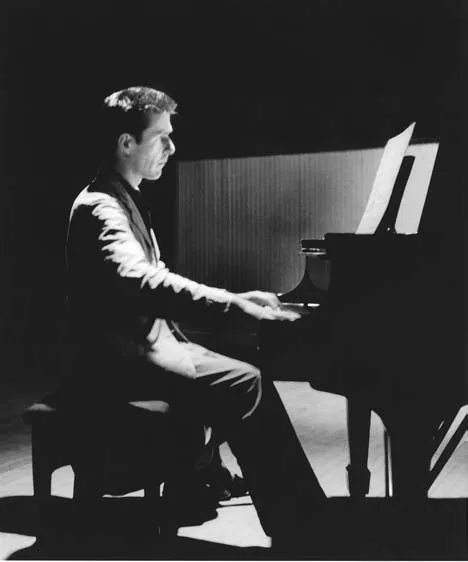
71 Clemens Kalischer, John Cage at Black Mountain College,
72 1948. Gelatin silver print. © Clemens Kalischer. Courtesy
73 the artist.
74 Bill had also become deeply involved with his students. Too involved, Albers
75 thought. He said to Bill at the end of the summer, ‘‘You had ten students. Six
76 of them are leaving the College to go to New York City this September. Do
77 you know anything about it?’’ ‘‘Sure,’’ said Bill. ‘‘I told them if they wanted to
78 be artists, they should quit school and come to New York and get a studio and
79 start painting.’’ Albers seemed not to take this amiss. When he was appointed
80 chairman of the Art Department at Yale two years later, Bill was the first artist
81 to be hired to teach there.3
82 It could be expected that the example of the progressive, modernist art school,
83 embodied most famously and perhaps most effectively by the Bauhaus and by
84 John Cage’s ChanCe ProtoCols 55
85 Black Mountain College, would be challenged by de Kooning and other New
86 York school artists (despite their name). The centrality of pedagogy at both in-
87 stitutions—the transmission of ideas through teaching in formalized situations,
88 of visual testing exercises loosely overseen by a master teacher in design-based
89 artistic experiments—would no doubt grate against the libertarian, individual-
90 ist streak of US-based abstract expressionism.4 (Their allied critics, too, would
91 challenge Black Mountain’s pedagogy. Clement Greenberg, recommended to
92 the College faculty by de Kooning, taught there in 1950. Though he credited the
93 students with impressive intensity, he ultimately ‘‘felt that not much art came
94 out of Black Mountain [only some famous names].’’5) The claim that students
95 at the College did not produce ‘‘mature’’ art, or the accusation that education
96 suffocated creative practice by emphasizing technical skills acquired through
97 trial, test, and peirastic dialogue, were historically quite frequent criticisms of
98 higher education and art institutions leveled by expressionist artists.6
99 Albers, however, was prepared for assaults on the Bauhaus-derived
100 Black Mountain curriculum by expressionists such as de Kooning; after
101 all, he’d spent most of his life and work advocating creative explorations of
102 form beyond the habituated constraints of artists’ subjective or self-revela-
103 tory responses. Yet it was the wolf in sheep’s clothing—John Cage’s model
104 of experimentation—for which Albers was ill-equipped. De Kooning, like his
105 fellow expressionists, did not employ the language of experimentation in a
106 rigorously defined manner; as was discussed in this book’s introduction, in
107 several ways expressionism is antithetical to the practice of the test or to the
108 rhetoric of experimentation as a disciplined, systematic process of examining
109 variables subject to thorough controls. Cage, unlike expressionists, arrived at
110 Black Mountain in 1948 with a version of experimentation—a ‘‘marriage of
111 order and freedom,’’ as he phrased it—that he considered very much in line
112 with Albers’s.7 Yet within a few years, the normally collegial Albers would
113 end his friendship with Cage over the issue of the primacy of chance events in
114 explorations considered experimental.
115 Cage’s methodology of chance-based experimentation first emerged in the
116 scores and events he composed when he taught at Black Mountain from 1948
117 through 1953; in many ways the seismic shifts in his practice during this period
118 are tied to his close engagement with the College. In these scores and events,
119 Cage initiated a series of practices that were highly structured, yet paradoxical-
120 ly attempted to sever the performance of a work from intention, argumenta-
121 tion, or ‘‘authorial’’ control. For Cage, the coupling of organized processes with
122 aleatory (chance-generated) results made it possible to transcend predictable
123 habits of composition and recital. How can one understand Cage’s quixotic
124 formulation of experimentation as a ‘‘purpose to remove purposes,’’ so counter-
125 56 chapter two intuitive to how an experiment was typically envisioned at Black Mountain?8 To
126 investigate this apparent contradiction in the careful organization of situations
127 of greater contingency, of his use of order to obtain indeterminate outcomes, I
128 propose a seemingly oxymoronic phrase: ‘‘chance protocol.’’
129 To Cage, the test was an exploration of uncertainty, not a careful examina-
130 tion of variables (à la Albers). Two watershed events staged at Black Moun-
131 tain played a decisive role in Cage’s formulation of experimentation in such a
132 manner: first, his 1948 production of composer and poet Erik Satie’s 1913 play
133 The Ruse of Medusa (Le piège de Méduse) and second, his 1952 Theater Piece
134 No. 1 (sometimes referred to as Untitled Event), which was subsequently pro-
135 claimed the first ‘‘happening.’’ In Theater Piece No. 1, despite a seemingly chaotic
136 or random form, particular parameters governed the execution of the work:
137 fixed durational segments, the assignment of specific tasks to performers, and
138 an agreed-upon use of certain tools or instruments. This structure served as a
139 chance protocol, allowing ever-greater unpredictability to emerge within pre-
140 defined limitations. In the years that Cage was locked in a tight orbit with the
141 College, his chance-protocol version of experimentation increasingly focused
142 on chance-derived, durationally notated instructions as a means to create and
143 organize contingent events. Initially he used chance processes to compose dis-
144 crete and determinate scores; eventually he developed strategies that allowed a
145 performance to retain as much indeterminacy as possible, usually by producing
146 scores that were subject to alteration before and during recital, and that em-
147 ployed notation systems open to interpretation by the performers.
148 Cage’s pioneering of new forms of composition and performance developed
149 in a climate receptive to seeing experimentation as not merely a feature of visual
150 art practices but also of time-based events and interdisciplinary collaborations.
151 In fact, Black Mountain was one of the rare outposts in the United States during
152 this period for in-depth work in experimental performance—that is to say, pro-
153 ductions coming out of a background in the visual arts that emphasized impro-
154 visational workshopping or unrehearsed performances, nonnarrative methods
155 (in other words, unscripted events lacking developed characterization or dra-
156 matic arc), and a close consideration of how to demarcate or collapse the spaces
157 of performance and audience. Specifically, during the 1930s the College was
158 the key US site invested in a ‘‘Bauhaus idea’’ of theater and live performance.
159 This was due to the popularity of Bauhaus-influenced theater at the campus:
160 throughout the mid-1930s, Bauhaus theater master Oskar Schlemmer’s pupil
161 and collaborator Xanti Schawinsky had staged several original productions
162 of nonnarrative, participatory theater at the College, including Spectodrama:
163 Play, Life, Illusion in 1936 and Danse Macabre: A Sociological Study in 1938. In
164 his project of experimentation through careful observation, it is no coincidence
165 John Cage’s ChanCe ProtoCols 57
166 that Schawinsky subsequently spent several years at ‘‘Albersian’’ Black Moun-
167 tain further developing interdisciplinary theatrical models initially explored in
168 Weimar and Dessau.9
169 The first section of this chapter will explore the existing tradition of Bauhaus
170 experimental theater at Black Mountain, which would be challenged by Cage.
171 Though ten years separated Schawinsky’s departure from Cage’s first extended
172 visit, the models these men investigated and developed at the College represent
173 two of the most radical explorations of US-based experimental performance
174 taking place between the wars and after. (A third, I would argue, was Bertolt
175 Brecht’s notion of Verfremdungseffekts [‘‘distancing effects’’] and Lehrstück
176 [‘‘learning through participation’’] in his ‘‘Epic Theater,’’ which also found fer-
177 tile ground at Black Mountain: Brecht’s English translator Eric Bentley taught
178 there for several years in the mid-1940s and staged productions of Brecht, in-
179 cluding a 1944 reading with sound effects and music of The Private Life of the
180 Master Race.10) Stage events at Black Mountain had also adventurously sampled
181 other European precursors beyond Bauhaus performance—for example, poet
182 M. C. Richards’s productions of works by Jean Cocteau, including Knights of
183 the Round Table in 1949 and a theater-in-the-round version of Marriage on the
184 Eiffel Tower in 1950 (fig. 2.2). It is in Schawinsky’s work, though, that we see
185 a model of nonnarrative performance most clearly related though opposed to
186 that which Cage came to embrace. By staging a comparison between these two
187 models, the stakes of experiments in theater and other time-based media and
188 events in the postwar period can begin to be elucidated. As we will see, the
189 approaches to experimental performance Cage developed at the College soon
190 rose to prominence (and a great deal of notoriety), overshadowing the Bauhaus
191 model, which remains largely obscured to this day.11
192 The second part of this chapter will address how the ‘‘French’’ influences
193 Cage introduced were, in actuality, a series of hybrid sources he was working
194 through in the five years he taught at Black Mountain.12 In this period, he joined
195 several seemingly incompatible threads—French modernist theater from be-
196 fore and after World War I; Zen Buddhism (his fascination with the mystic
197 Huang Po’s strain of Zen arose during his time at the College); and Dada-sur-
198 realist employments of chance composition, most centrally those of Antonin
199 Artaud and Marcel Duchamp.13 His explorations of dispersion, disorder, and
200 void-like mindlessness came to spurn purposeful communication between per-
201 former and audience, estranged the traditional, ‘‘scored’’ relationship between
202 a composition and its performance, and began to draw on aleatory systems that
203 paradoxically structured and controlled unexpected results beyond human pre-
204 diction. The importance of Cage’s practical and discursive move to the chance
205 protocol is key to understanding the epistemic shift involved in repositioning
206 58 chapter two
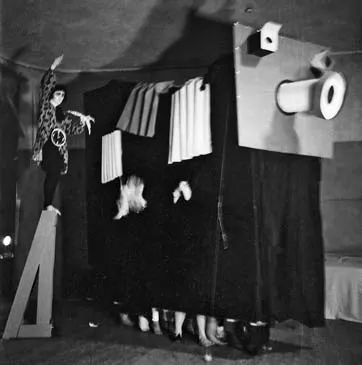
208 Figure 2.2
209 Hazel Larsen Archer, June Rice Christensen as the Photographer
210 in Jean Cocteau’s ‘‘Marriage on the Eiffel Tower,’’ Black Mountain
211 College, 1950. Courtesy of the Estate of Hazel Larsen Archer and
212 the Black Mountain College Museum + Arts Center.
213 experimentation as the production of events that were indeterminate as to their
214 performance. In this, Cage’s Black Mountain events radically altered the spec-
215 trum of possibility for art and performance: in his explorations of French-de-
216 rived avant-garde theater, first of Satie’s work and subsequently of Artaud’s and
217 Duchamp’s, he inaugurated a new experimental model that came to define not
218 only Black Mountain’s future but the trajectories of Fluxus performance, Allan
219 Kaprow--esque Happenings, Judson Dance Theater, and numerous other 1950s
220 and 1960s events.
221 The third and final section of this chapter will take up how in Theater Piece
222 No. 1 Cage pushed experimental performance even further than his sources.
223 Coupled with his analyses of Po’s, Artaud’s, and Duchamp’s projects, Cage’s
224 admiration for Robert Rauschenberg’s Black Mountain College--era works,
225 particularly his 1951 White Paintings, helped Cage explore experimentation as
226 a tool to ‘‘unfocus attention’’14 (fig. 2.3). The apparent emptiness of Rauschen-
227 berg’s paintings encouraged him to ‘‘check my habits of seeing, to counter them
228 for the sake of greater freshness …to be unfamiliar with what I’m doing.’’15 Ul-
229 timately, Cage felt that Rauschenberg’s work revealed that ‘‘art is the imitation
230 of nature in her manner of operation,’’ operations that Cage believed could be
231 unburdened of human desire and interference. He believed his model of stag-
232 ing inattention and dispersion exposed art’s pretentions to ordering life, better
233 reflecting nature’s own complexity, chancy-ness, and lack of single purpose.16
234 John Cage’s ChanCe ProtoCols 59

236 Figure 2.3
237 Robert Rauschenberg, White Painting, 1951. House paint
238 on canvas, 72 × 72″, four panels. © Robert Rauschenberg
239 Foundation/Licensed by VAGA, New York, NY.
240 His perspective on chance operations as a mirror to the (dis)order of nature has
241 proved a contentious point for artists and scholars, from Josef Albers to many
242 in the present. As this last section considers, Cage’s sense of the experimental
243 chance protocol as handmaiden to anarchical freedom from sociopolitical de-
244 terminants remains controversial.
245 In advocating notions of multisensory presentness and the diffusion of at-
246 tention, Cage understood his work as exceeding the Bauhaus tradition at Black
247 Mountain, replacing it instead with studies in Dadaist chance and simultaneity,
248 as well as events inspired by Po’s and Artaud’s conceptions of void-like expe-
249 riences. In his proposal of a chance protocol, Cage argued that a new dimen-
250 sion of perception could be revealed outside human faculties of organization
251 and intention, a form of dispassionate quiescence he paradoxically spent most
252 of his life actively scripting. In order to understand the stakes of the chance
253 protocol’s contravention of the Albersian model of experimentation as tests
254 60 chapter two of controlled variables, we must therefore return to the origin of that tradition
255 in performance—Bauhaus theater—and the genesis of the break—Erik Satie’s
256 The Ruse of Medusa.
257 ÉpatEr lE bauhaus
258 Cage first arrived at Black Mountain College in April 1948 without a teach-
259 ing commision: he was Cunningham’s piano accompanist. But that was still
260 a position of some visibility. In addition to theater and art, Black Mountain
261 throughout the 1930s and 1940s was a notable outpost of experimental music;
262 in 1944, for instance, it hosted a well-publicized and internationally renowned
263 conference celebrating Arnold Schoenberg’s seventy-fifth birthday.17 As early
264 as the late 1930s, when Cage was on the West Coast, he had heard rumors of
265 Black Mountain as ‘‘an advanced place,’’ and had written the school asking for
266 a job; in 1942 he propositioned that the College found an on-site Center for
267 Experimental Music.18 Neither proposal panned out. By the late 1940s, Cage
268 was facing resistance to his work as a composer, though not as a rather showy
269 performer of his prepared piano compositions, performances in which he in-
270 serted objects between piano strings and played the instrument largely for its
271 percussive qualities. He was therefore ‘‘delighted’’ when Albers offered him a
272 teaching post at the College—his first for music composition—during the up-
273 coming summer session of 1948.19
274 When Cage assumed his teaching responsibilities at the College, he further
275 shifted his compositional strategy from the systemic explorations of atonali-
276 ty, seriality, and other recent developments in musical composition that Black
277 Mountain’s Schoenberg-oriented tradition was associated with. That summer,
278 he brought with him nearly all eighteen extant musical scores by Erik Satie and
279 a copy of Satie’s only play, The Ruse of Medusa, proposing the College host an
280 ‘‘amateur festival’’ of Satie’s music. He proceeded to antagonize many of the Col-
281 lege’s German émigrés by performing Satie’s oeuvre exclusively throughout his
282 summer-long stay, rather than surveying, as he remembered it, ‘‘modern music
283 in general’’; particularly infuriating was one of Cage’s introductory speeches
284 that denounced Beethoven’s harmonic tradition in favor of Satie’s emphasis on
285 rhythm and duration.20 In contrast to the rancor his lecture stirred, Cage’s pro-
286 duction of Satie’s long-neglected The Ruse of Medusa, translated that summer by
287 Richards, was universally admired (fig. 2.4). Student Arthur Penn (later known
288 for his films The Miracle Worker and Bonnie and Clyde) directed Buckminster
289 Fuller as the Baron Medusa, Elaine de Kooning as his daughter Frisette, and
290 John Cage’s ChanCe ProtoCols 61
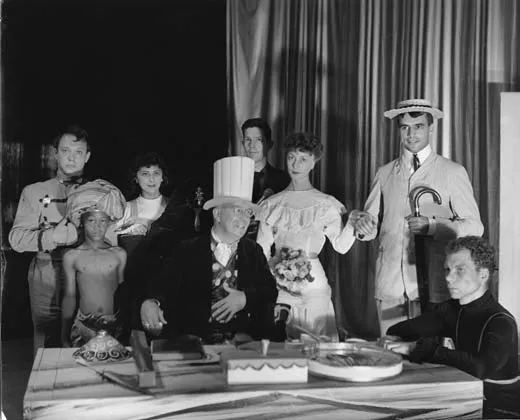
292 Figure 2.4 (above) Figure 2.5 (below)
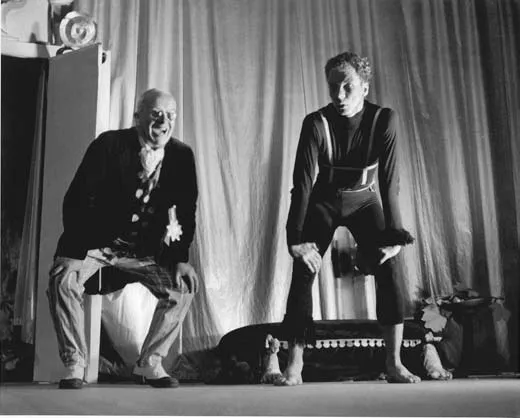
294 Clemens Kalischer, Cast Portrait of ‘‘The Ruse of Medusa,’’ Clemens Kalischer, Buckminster Fuller and Merce including John Cage, Elaine de Kooning, Buckminster Cunningham in ‘‘The Ruse of Medusa,’’ 1948. Gelatin silver
295 Fuller, and Merce Cunningham, 1948. Gelatin silver print. print. © Clemens Kalischer. Courtesy the artist. © Clemens Kalischer. Courtesy the artist.
296 Cunningham as Jonas the ‘‘costly mechanical monkey,’’ with sets and props by
297 Fuller, Willem and Elaine de Kooning, and students Ruth Asawa, Ray John-
298 son, and others. The props included a velvet footstool with giant human feet, a
299 monumental thermometer capped by an oversized paper bow, and a ‘‘baron’s
300 desk’’ painted in a ‘‘guild secret’’ trompe l’oeil technique de Kooning said he had
301 learned as teenager in Holland; this was outfitted with enormous four-sided
302 triangles around its legs (a tweak on the importance of tetrahedrons in Fuller’s
303 work)21 (fig. 2.5).
304 The production set the groundwork for a renewed exploration of the Col-
305 lege’s experimental theater tradition that had remained mostly dormant since
306 Schawinsky’s departure in 1938. Satie’s play features an eccentric, doddering
307 aristocrat, his insolent and ever-defiant manservant, an obedient daughter,
308 and her terrified straight-man fiancé. Consisting largely of rapid-fire puns and
309 absurd nonsequiturs, the loosely sketched plot follows the Baron’s attempts to
310 wire one General Posthumous, a storyline designed as an excuse to frame the
311 Baron’s nonsensical pronouncements regarding the impending betrothal of his
312 daughter. Scene changes are marked by short musical interludes danced by the
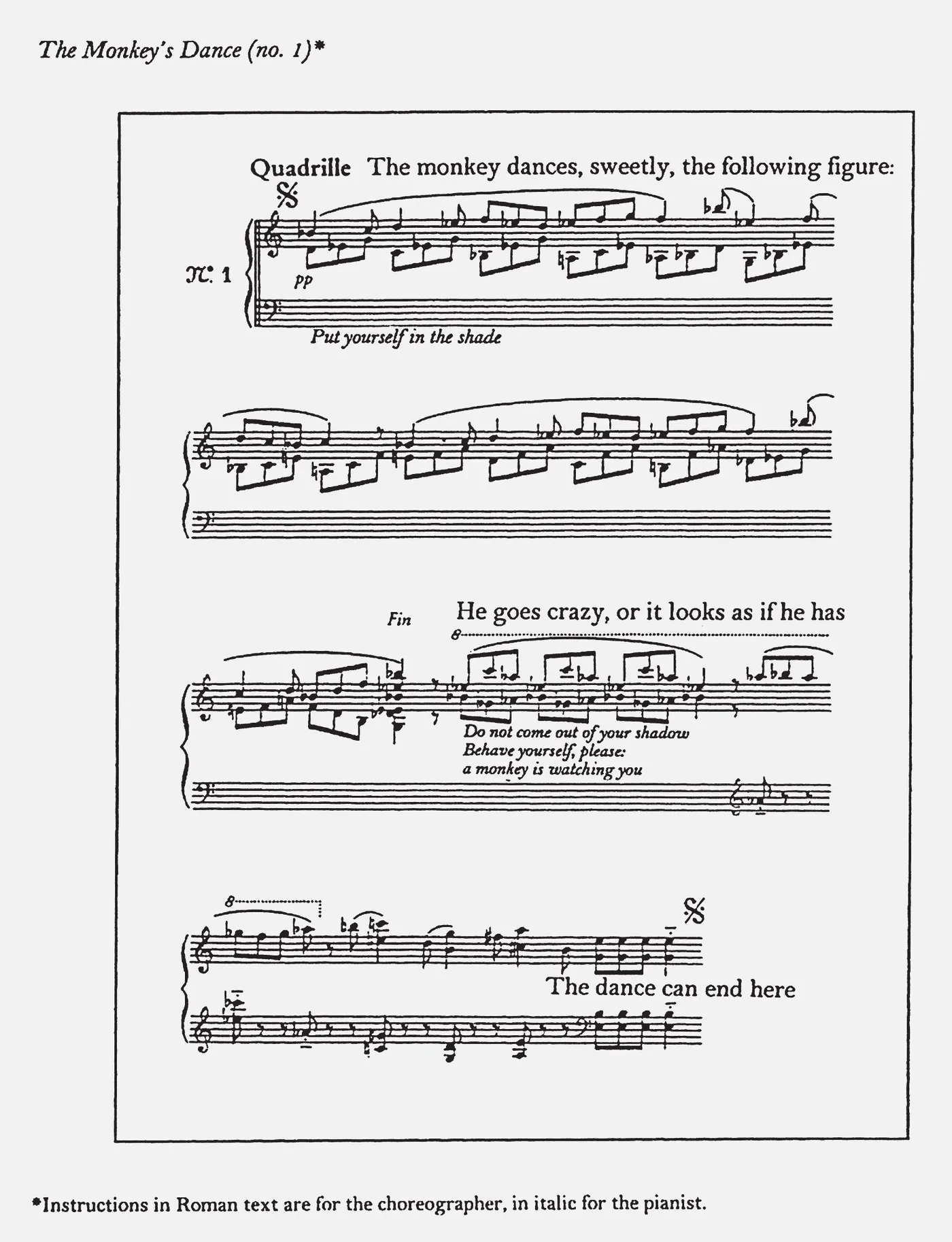
313 mechanical monkey, written in a musical notation full of wisecracks and ironic
314 comments (fig. 2.6). In one section, for example, the score’s text reads at bottom,
315 ‘‘Instructions in Roman text are for the choreographer, in italic for the pianist’’;
316 these begin with the following comments: ‘‘The Monkey’s Dance, no. 1; Qua-
317 drille The monkey dances, sweetly, the following figure; put yourself in the shade;
318 He goes crazy, or it looks as if he has; Do not come out of your shadow / Behave
319 yourself, please: a monkey is watching you; The dance can end here.’’22
320 Satie’s ‘‘lyrical comedy in one act’’ was rarely performed, though it was
321 considered an important successor to Alfred Jarry’s play Ubu Roi (1896) in a
322 tradition of absurdist theater. Satie’s emphasis on burlesque gestures and his
323 creation of characters that sputtered childlike nonsense—‘‘five plus three makes
324 eleven …take four leaves six …two plus seven makes eighteen,’’ or, a few lines
325 later, ‘‘I am going to a billiards match. What a great match! Napoleon will be
326 there. The billiards Napoleon, I mean of course! …the real one’’—made
327 the entire production seem a farcical romp.23 In an article Cage later penned
328 on Satie, he pointed to the apparent freewheeling, illogical unpredictability of
329 Satie’s work and its disregard of musical seriousness as being its most compel-
330 ling qualities. In the essay, set up as an imaginary conversation between the two
331 men sourced from Satie’s published statements, Cage quoted the composer:
332 They will tell you I am not a musician. That’s right. …Take the Fils des Etoiles
333 or the Morceaux en forme de poire, En habit de cheval or the Sarabandes, it is
334 clear that no musical idea presided at the creation of these works.24
335 John Cage’s ChanCe ProtoCols 63
337 Figure 2.6
338 Erik Satie, ‘‘The Monkey’s Dance (no. 1).’’ From The Ruse
339 of Medusa, 1913.
340 The flippancy with which Satie dismissed musical intention delighted Cage. He
341 concluded his ‘‘conversation’’ with the kōan that ‘‘to be interested in Satie one
342 must be disinterested to begin with,’’ a paradox of non-intentioned intention
343 Cage often returned to in defining his chance protocol.25
344 Yet earlier in the essay, Cage claimed that Satie’s investment (far from disin-
345 terestedness) in antagonizing or shocking his audience—the ‘‘power to irritate’’
346 expressed in Satie’s call to ‘‘despise art’’—inspired Cage’s staging of the play at
347 Black Mountain.26 In particular, he was compelled by Satie’s attempt to make
348 64 chapter two ‘‘unpredictable’’ music that, in Satie’s words, ‘‘will be part of the noises of the
349 environment.’’27 Satie’s works demonstrated that music composition could re-
350 flect everyday events—not ‘‘musical ideas’’—by representing ambient noises
351 such as the sounds of eating or the pauses between conversations. To Satie,
352 the radical neutrality of a sound not imposing itself on its audience as ‘‘music’’
353 fundamentally leveled hierarchies of distinction and quality; to Cage, such a
354 move let ‘‘sounds be just sounds …just folk tunes, unresolved ninths, or knives
355 and forks.’’28 In studying Satie’s other scores—particularly Vexations (1893), a
356 cycle that can extend to nearly 24 hours in performance, based on 840 repeti-
357 tions of a simple, fifty-two-beat theme whose four arrangements are alternately
358 heard unaccompanied and then played with two variations of a short chord
359 sequence—Cage was enthusiastic about Satie’s concern with the durational
360 aspects of sound.29 In contrast to more complex qualities of aural information
361 (pitch, frequency, amplitude, and so on), duration was the only feature that was
362 unspecific: it could incorporate measures of both silence and the audible. The
363 grand length of a performance of Vexations—a length that exceeded nearly any
364 individual’s ability to listen attentively—satisfied Satie’s desire that his work be
365 ‘‘furniture music’’ intended as background for other events. By stressing the
366 durational aspect of sound over musical tone, in opposition to prior harmonic
367 traditions, Cage argued that Satie accepted when ‘‘a sound is a sound …[one
368 can] give up illusions about ideas of order, expressions of sentiment, and all
369 the rest of our inherited aesthetic claptrap.’’30 Important, too, was The Ruse of
370 Medusa’s occasional use of instructions to the performer in durational—not
371 musically notated—segments of simple time structures designated in cardinal
372 numbers and plain language (this feature reemerged in Cage’s own work during
373 his next visit to Black Mountain in 1952).
374 Like several College productions before it, Cage’s staging of The Ruse of
375 Medusa encouraged intentionally unnaturalistic and stylized acting as well as
376 innovative set and costume design. Yet there were important differences. Cage’s
377 sourcing of Satie as a precedent for a theater of cacophonous simultaneity and
378 jest departed considerably from existing Bauhaus-oriented theater and perfor-
379 mance that found its way to the College, though these were as dedicated to
380 changing audience’s perceptions through trained visual attention and concen-
381 tration as Satie’s was to doing so with fragmentary, incommunicable meanings
382 and ambiguous gestures.
383 By the mid-1920s, an entire pedagogical and practice methodology dedicat-
384 ed to workshopping time- and motion-based compositions had been perfected
385 at the Bauhaus in its second home in Dessau. This had not always been the case:
386 early theater productions, under the direction of artist Lothar Schreyer, had
387 been expressionistic and melodramatic, with highly charged emotional con-
388 John Cage’s ChanCe ProtoCols 65
390 Figure 2.7
391 Oskar Schlemmer, Triadic Ballet, 1922, photograph 1925.
392 Courtesy Oskar Schlemmer Theatre Estate and Collection.
393 Photograph © Estate of Karl Grill. Reproduced by permission
394 of The J. Paul Getty Museum, Los Angeles.
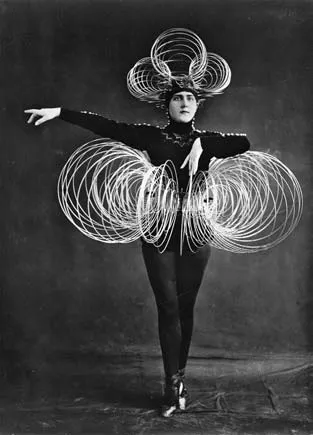
395 tent underscored by dramatic lighting and costumes. In contrast, when Oskar
396 Schlemmer arrived at the Bauhaus in 1921 and subsequently assumed director-
397 ship of the stage workshop in 1923, he explicitly linked theatrical performance
398 with the periodic festivals and costume parties hosted by the school. The em-
399 phasis, for Schlemmer, was not on festivity per se, but rather on the manner
400 in which the masquerade of such events disguised and transformed the human
401 body. He began staging masque-like shows in which performers’ features were
402 camouflaged by heavily padded costumes, elaborate papier-mâché masks, and
403 helmetlike headdresses. In doing so, performers’ bodies were extracted from
404 ‘‘natural’’ or everyday experiences in order to be turned into archetypes of ge-
405 ometry and movement31 (fig. 2.7).
406 Actors in Schlemmer’s productions employed broad, pantomimic gestures
407 and generally did not speak. For example, in Gesture Dance (1926), three per-
408 formers wearing bulbous metallic masks outfitted with identical mustaches
409 66 chapter two and spectacles execute flamboyant renditions of ‘‘everyday actions’’ including
410 sneezing, laughing, and listening.32 The characters’ gesticulations are exagger-
411 ated to the point of being stilted, and the figures return to certain tropes of
412 communication: hand cupped to ear indicates listening, palm shading mouth
413 signs whispering, and boisterous rocking back and forth suggests laughter. The
414 stylized gestures, combined with the use of masks and cumbersome costumes,
415 disengaged the performing body from its habitual movements.
416 The emphasis on costume in Bauhaus theater also transfigured the human
417 body and its everyday appearance by removing distinguishing characteristics
418 and imposing an order of simple shapes and primary colors. According to
419 Schlemmer, this abstracted the body and generalized its features in order to
420 ‘‘reduce the differentiated parts …to simple, unifying forms.’’33 These unified
421 forms thereby permitted viewers to see ‘‘new totality’’ beyond previous hab-
422 it-driven and subjective understandings of form.34 In most theatrical perfor-
423 mance, and indeed in most everyday social behavior, subtle work of visual dis-
424 crimination routinely helps to organize, categorize, and ultimately hierarchize
425 relatively minor differences in human appearances; for example, assessments
426 of the size of a nose or the contour of a foot become paramount indicators of
427 beauty or grace. In stressing general forms, Schlemmer rejected the meticulous
428 morphologies of fashion, the superficial interpretations of physiognomic varia-
429 tion, or the cultural conditioning that patterned gesture and exploited arbitrary
430 differences to create regimes of infinitesimal judgment and distinction. As these
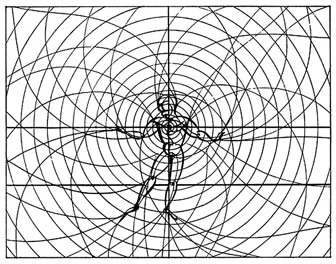
432 Figure 2.8
433 Oskar Schlemmer, drawing of Man as Dancer from
434 Man and Art Figure, ca. 1921. Courtesy Oskar Schlemmer
435 Theatre Estate and Collection.
436 John Cage’s ChanCe ProtoCols 67
437 historically specific, though relatively arbitrary, characteristics became natu-
438 ralized, Schlemmer contended, they promoted fetishistic judgments regard-
439 ing minute differences of form as compared with other fundamentally similar
440 forms. In contrast, Bauhaus theater attempted to overturn this tradition of tiny
441 visual distinctions made according to socially determined, often conflicting
442 habits. It did so by heightening the artifice onstage so that rationally discerned
443 details would throw habitual patterns into sharp relief. In Schlemmer’s system,
444 this perspicuous work of visual judgment focused on the close observation of
445 the relationship of bodies—not as compared to themselves, but rather seen as
446 embedded in larger perspectival contexts and environments. Reducing theater
447 to such basic design elements as form and color represented ‘‘an undertaking
448 whose purpose, contrary to nature, is order.’’35 Denaturalizing the actors’ move-
449 ments and costumes encouraged spectators to remain self-conscious about the
450 spatial relations surrounding the bodies onstage, estranging from habit their
451 perceptions of, and judgments about, human form and gesture.
452 In contrast to Cage’s emphasis on arbitrariness, distraction, and discon-
453 nection, the keywords of Bauhaus theater were unity, totality, and order. For
454 Schlemmer, ‘‘unity’’ was an escape from the maddening simplification of life
455 into trivial and fragmentary subcategories that effaced the larger interconnect-
456 edness of bodies, spatial contexts, and habits of social behavior. With concen-
457 tration and attention, broader concerns could be assessed and judged, includ-
458 ing the fundamental features of form (light, color, movement, and so on) that
459 constituted the foundation of all perception. In the stripped-down environment
460 of the new, ‘‘total’’ stage, spectators would be able to notice how the framing of a
461 theatrical space marked conventions in everyday life to which they had become
462 oblivious and conditioned.
463 In 1936, Albers invited the Swiss émigré Xanti Schawinsky, who had studied
464 with Schlemmer from 1924 to 1928, to Black Mountain to teach painting and
465 theater.36 After fleeing persecution in Nazi Germany, Schawinsky had immi-
466 grated to Italy and had spent several years working in advertising for companies
467 such as Illy Caff’e, Cinzano vermouth, and Olivetti typewriters. He was best
468 known for producing a widely circulated photomontage poster of Mussolini
469 as the head of the masses to celebrate the twelfth anniversary of the Fascist
470 revolution. (Schawinsky was an equal-opportunity designer, one could say:
471 after leaving Black Mountain, he taught at the New Bauhaus in Chicago and
472 with László Moholy-Nagy created patterns for a US Army project of equipment
473 camouflage.)37
474 When he landed at the College, Schawinsky became the United States’ sole
475 proponent and performer of Bauhaus theater, and his ideas and productions re-
476 mained very much part of the institutional memory and lore of the campus after
477 68 chapter two
479 Figure 2.9
480 Xanti Schawinsky, Spectodrama: Play, Life, Illusion, 1936--37.
481 From Helen Post Black Mountain College Documentary Photo
482 Collection. Reproduced courtesy of Peter Modley.
483 his departure; later these were widely circulated in his published reminiscences
484 about his time at Black Mountain.38 Within months of his arrival, he organized
485 a production of nonnarrative theater—a theater of what he called ‘‘total expe-
486 rience’’—titled Spectodrama: Play, Life, Illusion, with music by Kurt Schwitters
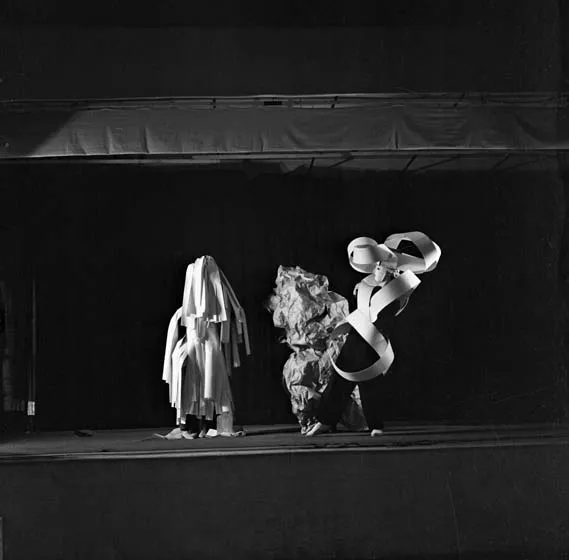
487 (his Ursonate [1922--32]) (see plates 10--12). In a series of episodes that had been
488 previously ‘‘storyboarded’’ and rehearsed through improvisational techniques,
489 Spectodrama staged short scenes of selected elementary concepts of theater,
490 each falling into a specific category: ‘‘optics, form and color, acoustics, sound,
491 language, music, time, space, architecture, technology, and illusion.’’39
492 In each vignette of Spectodrama, the performer’s body, if evident at all
493 (camouflage and illusion, and their constitutive elements of high-contrast
494 John Cage’s ChanCe ProtoCols 69
495 geometric forms, were key features of the Bauhaus style), figures in a tab-
496 leau of what Schawinsky termed ‘‘archetypal’’ geometric, spatial, or social
497 situations: ‘‘play,’’ ‘‘communication,’’ ‘‘form,’’ or ‘‘space.’’ Each portion of the
498 play contains elaborate sets and costumes designed so as to either conceal or
499 set off the performer’s placement and orientation with respect to the stage
500 space and props. For example, one performer, trussed in a costume of stiff,
501 intertwined white paper rolls, might emerge chameleonlike from a tangle
502 of similarly twisted paper props and move toward the stark relief of a blank
503 background. The figure’s poses and the patterns of the props repeat through-
504 out the space to create a ‘‘laboratory for demonstration’’ of the conditions of
505 perceiving difference and similarity.40
506 Moholy-Nagy, also a key figure in Bauhaus theater, termed this research-like
507 element of rational attention the ‘‘theater of totality,’’ in which a body’s move-
508 ment transpired in a structured, architectonic space.41 Rigorously ordering
509 bodies in the theater demonstrated a kind of technical competence that, in
510 orchestrating complex spatial relations onstage, extended the project of spatial
511 organization into nontheatrical everyday life (the theater being a microcosmic
512 exploration of the larger Bauhaus project of synthesizing the ‘‘living and work-
513 ing conditions of the environment’’).42 Though spectators were seated and their
514 attention carefully organized, ‘‘dynamism’’ in performance was nonetheless a
515 frequently invoked term: kinetic sculptures and moving bodies were deployed
516 in order to show that, to Moholy-Nagy, ‘‘material is employed only as the carrier
517 of forces.’’43 These forces charged the performance space with a temporal com-
518 ponent that expressed the true ‘‘unity of life.’’44 In contrast to architecture, static
519 sculpture, or painting, theater was the arena for an examination of transient,
520 time-based events and movements intersecting environmental conditions, and
521 the body’s temporal engagement with those sociospatial circumstances.
522 The search for universal gestures ‘‘common to mankind’’ took precedence
523 over what Moholy-Nagy termed the ‘‘causal ties’’ of previous theater.45 Stage
524 design was emphasized, forcing ‘‘one to learn from the way an artist perceives’’
525 by estranging viewers’ traditional emphasis on character and narrative in order
526 to instead fabricate complicated illusions of spatial perception.46 This model
527 of integration—the performing body and space joined in an ‘‘indissoluble uni-
528 ty’’—radically simplified performance to its ‘‘fundamental’’ components: ‘‘light,
529 space, plane, movement, sound, and human being.’’47
530 Walter Gropius, too, was involved in theorizing performance strategies
531 at the Bauhaus, and he underscored how spectatorial conditions of illusion
532 and attention were influenced by the architecture of the theater itself. In the
533 mid-1920s, he proposed a ‘‘Total Theater’’ in which ‘‘new interpretations
534 of theatrical space’’ were to be explored.48 In Gropius’s model, an elliptical
535 70 chapter two
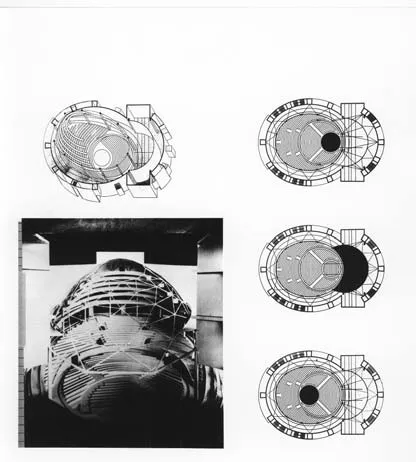
537 Figure 2.10
538 Walter Gropius, Photoboard with model, isometric with three
539 diagrams showing uses of the stage in the ‘‘Total Theater,’’ 1927.
540 Courtesy Bauhaus-Archiv, Berlin. © Artists Rights Society,
541 New York / VG Bild-Kunst, Bonn. Reproduced by permission of
542 Bauhaus-Archiv, Berlin.
543 arrangement of ascending seats was clustered around an embedded, cen-
544 tral circular stage flanking a second cylindrical back stage49 (fig. 2.10). The
545 inner circular stage was designed to rotate, accommodating various seating
546 arrangements that represented the major performance traditions—the pro-
547 scenium stage with a shallow performance space and fixed backdrop, the
548 deep stage in which curtains and backdrops are arranged to reveal greater
549 or lesser portions of the action and to accommodate more or fewer perform-
550 ers, and finally a theater-in-the-round setup. In the latter scenario, according
551 to Gropius, ‘‘the play unfolds itself three-dimensionally while the spectators
552 crowd around concentrically.’’50 He connected this spectatorial arrangement,
553 as Schawinsky did, to precedents in other public, collective events such as the
554 circus, the bullring, and the sports arena.
555 Gropius’s three staging possibilities in the ‘‘Total Theater’’ engendered var-
556 ious spatial effects; more important, his flexible architecture (the rotating core
557 of the structure) could transform the space during performance, surprising the
558 John Cage’s ChanCe ProtoCols 71
559 audience and impelling it to ‘‘shake off its inertia.’’51 The dynamic possibility of
560 moving the stage structure itself intensified the audience’s awareness of the con-
561 ditions of staging, and when the theater was arranged with a central platform
562 surrounded by seating, the ‘‘spectator participate[s] in the drama.’’52 In Bauhaus
563 theories of spectatorship, in other words, the implied salutary social effects of
564 heightening consciousness of the environment were part of the larger interest in
565 concentration, focus, and order as transformative elements of vision. The actor,
566 according to Schlemmer, was ‘‘space-bewitched’’—‘‘altered, transformed, or
567 entranced’’ by the use of masks, props, and costumes so that ‘‘his habitual be-
568 havior and his physical and psychic structure are either upset or put into a new
569 and altogether different balance.’’53 This change in the actor’s ingrained relation
570 to gesture and its social intelligibility would impel an ‘‘inner transformation of
571 the spectator’’ by his or her ‘‘receptivity’’ to the visual ordering of the theatrical
572 field in performance.54 Only a self-reflexive spectator could, ‘‘on the basis of the
573 rational,’’ understand the embeddedness of the actor in his or her surrounding
574 space, a space that is itself ‘‘part of the larger total complex, building (Bau).’’55
575 As the performer acted out order in such a space, the spectator could rationally
576 perceive the larger field of spatial and architectural illusions in which bodies are
577 rooted contextually in their environments.
578 That this work of unification was enacted in the realm of time-based events
579 was important to Schawinsky as he brought these ideas to Black Mountain; to
580 him, theater explored the fundamental conditions of perception underlying all
581 specific disciplinary explorations. As he wrote of theater’s interdisciplinary na-
582 ture, ‘‘Our theater can, I believe, get its impulse from studies that go through all
583 phases of knowledge.’’56 In Schawinsky’s next major performance at the College,
584 he attempted to push notions of spatial totality further. In the 1938 production
585 Danse Macabre: A Sociological Study, adapted from a Latin hymn about the
586 Last Judgment called Dies Irae, Schawinsky’s theatrical staging—while still em-
587 phasizing elaborate masks and costumes modeled on abstract shapes, and em-
588 ploying dramatic spotlights and shadows—also included repetitive movements
589 associated with funeral rites as well as highly mannered costuming (figs. 2.11
590 and 2.12). In staging a medieval morality tale, he chose the Middle Ages’ ‘‘single
591 absolute concept: death’’ in an attempt to ‘‘find the ‘absolute’ of our own time.’’57
592 He sought the limiting experience that transcended performance/animation
593 and background/stasis dichotomies—mortality—though he later distanced
594 himself from the direct reenactment of the macabre source material blamed for
595 the suicide of one of its student actors. The theater-in-the-round aspect of the
596 performance, in which spectators were outfitted with robes and masks and giv-
597 en unconventional seating assignments in concentric circles around the central
598 stage area, to him mimicked the ‘‘original plays [of the Middle Ages] which were
599 72 chapter two
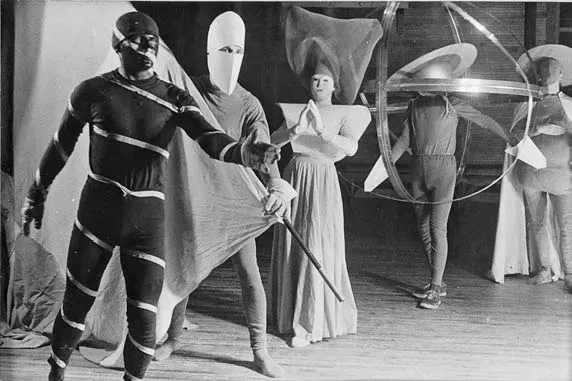
601 Figures 2.11 (above) and 2.12 (below)
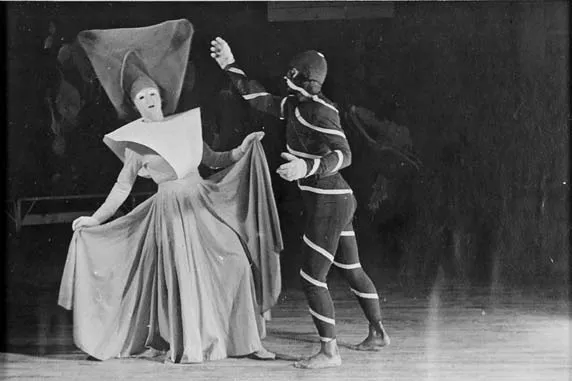
603 Xanti Schawinsky, Danse Macabre: A Sociological Study, Black
604 Mountain College, 1938. Courtesy of The Xanti Schawinsky
605 Estate. Reproduced by permission of Bauhaus-Archiv, Berlin.
606 usually performed on the market place in front of the cathedral.’’58 To Schawin-
607 sky, this focus on people and spaces outside traditional theater—for example,
608 individuals in public space—updated Bauhaus precedents that focused on the
609 circus and moved theater into the territory of history by studying constructions
610 of social subjectivity. As he recalled, ‘‘While work at the Bauhaus theatre aimed
611 at the modernization of theatrical means and concepts, and had a definite pro-
612 fessional and artistic scope, at Black Mountain College an educational crack at
613 the whole man seemed in order.’’59
614 What Schawinsky meant by such a ‘‘total experience’’ incorporating the
615 ‘‘whole man’’ can be understood in relation to Schlemmer’s explication of
616 Bauhaus theater as a totality: to both men, the stage was a site of spatial unity
617 that provided, according to Schawinsky, ‘‘a general study of fundamental phe-
618 nomena.’’60 He added that theater was the most appropriate location to explore
619 concepts of basic perception, because ‘‘space on the stage was a very particular
620 place …it is by nature a place of illusion.’’61 Indeed, to Schlemmer, too, move-
621 ments of bodies on the stage represented, by simplification and abstraction, the
622 wider geometries of relationships in space perceived through visual illusion,
623 and its inverse, penetrating observation. Bauhaus theater’s work with perspec-
624 tive, with embedding the body in its space through complicated geometric for-
625 mations, was often presented as a visual tableau in which the audience perceives
626 space, but does not have any direct relation to the performer’s experience of
627 space. This results in the somewhat disembodied eye that the performances ef-
628 fect—why, for example, reproductions of Bauhaus performances look remark-
629 ably like friezes and pictures, or why Schawinsky envisioned the preparatory
630 diagrams of Spectodrama as static tableaus (plates 10--12). The abstraction of
631 Bauhaus theater and its exploration of visual illusions were ‘‘unified,’’ to use
632 Schlemmer’s language, only by the audience’s visually tracking the position(s)
633 of the performer(s); Bauhaus and Bauhaus-derived theater expressly did not
634 create cohesive spaces of unity between performers and spectators, and consis-
635 tently maintained the illusion of the ‘‘fourth wall,’’ even when seating arrange-
636 ments were less frontally oriented.
637 These theatrical scenarios required spectators’ orientation to the staged
638 events to be fixed and their attention carefully focused in order to perceive
639 the precise and subtly changing visual effects on the stage. An immobilized
640 audience permitted Schlemmer and Schawinsky to apply the framing tech-
641 niques of cinema to live performances. With such focused looking, a montage
642 of visual effects could unfold, in order for each spectator to observe phenom-
643 ena with close attention to the order and sequencing of events that he or she
644 would not normally notice if watching as a casual bystander. Though a ‘‘play
645 instinct’’ was encouraged of actors in workshopping, the final productions
646 74 chapter two
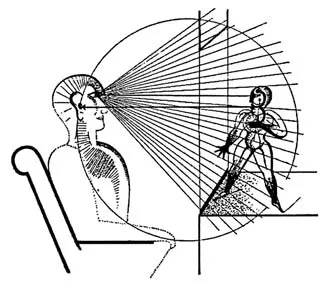
648 Figure 2.13
649 Oskar Schlemmer, drawing from Man and Art Figure, ca. 1921.
650 Courtesy Oskar Schlemmer Theatre Estate and Collection.
651 were predicated on passive spectatorship; Schlemmer wrote that the elabo-
652 rate visual fabulations encouraged a concentration that rivaled the intensity
653 of a ‘‘peep show’’62 (fig. 2.13).
654 In important ways, Schawinsky’s work can be seen as a proxy, in time-based
655 work, for what Albers’s sensibilities hoped to accomplish in two dimensions.
656 Much like Albers, Schawinsky promoted a model of experimentation that
657 stressed order, concentration, and serial repetition, and employed careful vari-
658 ations of formal elements—color, gesture, costume, set design, and lighting—
659 that could be measured, compared, and repeated. These tests of perception
660 were undertaken to dynamically reappraise the seemingly self-evident nature
661 of vision, and to question the habit-driven tendency of physical gestures to
662 be reproduced unwittingly. The experimental practices of both Schawinsky
663 and Albers can be seen as but a corner of a larger Bauhaus project demanding
664 that the experimental act of perceptual testing produce dynamic outcomes in
665 a serial practice of repeatable trials. Schawinsky’s performances were part of a
666 collective project at the Bauhaus in which all forms of perception were being
667 reconsidered, those of time, space, and theatricality, too; for these reasons, the
668 Bauhaus was the first art school to formally incorporate a performance depart-
669 ment, then called a ‘‘stage workshop,’’ into its curriculum. Just as Oskar Schlem-
670 mer envisioned his project as a ‘‘laboratory’’ exploration of space—isolating
671 constitutive elements of light, color, and movement to attend to how under-
672 lying patterns and arrangements of forms outside the theater might function,
673 John Cage’s ChanCe ProtoCols 75
675 Figure 2.14
676 Xanti Schawinsky, scene from The Circus, first performance at
677 the Bauhaus, 1924. Courtesy of The Xanti Schawinsky Estate.
678 Schawinsky pushed Albers’s ideas of laboratory production toward concerns
679 of duration, sound, and motion; toward the incorporation of bodies, theatrical
680 audience, and three-dimensional space—concerns that have always been more
681 pressing in theater than in visual art.63
682 Cage’s production of The Ruse of Medusa was also a hybrid site of theater in a
683 visual arts context, yet Erik Satie’s script, in contrast to the Bauhaus precedents
684 at the College, was dialogue-heavy and intentionally humorous, with quips ad-
685 dressed to the audience explicitly breaking down the fourth wall and engaging
686 the spectator at a supravisual level. In Bauhaus productions from the 1920s,
687 Schawinsky in particular often included comedic scenarios, particularly around
688 the figure of the clown in circus theatrics, but they were largely explorations
689 of pantomime: gesture in relation to the forms of props and the space of the
690 stage (fig. 2.14). The emphasis in the Satie play on a script to be verbalized by
691 actors characterizing fictionalized yet archly comedic roles also departed from
692 Black Mountain precedents. Satie’s 1913 script was, distinct from Bauhaus circus
693 antics and pantomime, a proto--Marx Brothers slapstick full of ribald verbal
694 repartee interspersed with burlesque-like visual gags—scene 2 ends with Baron
695 Medusa, sounding very much like Groucho twenty years later, telling Frisette’s
696 fiancé Astolfo: ‘‘Get out now! …Off like a gun! …Come back in ten minutes . . .
697 I shan’t be here.’’64
698 The provocations of The Ruse of Medusa—its silly jesting and the disrup-
699 tion of narrative continuity in the play’s sarcastic commentary (as Satie himself
700 stated, ‘‘This is a play of pure fantasy …a joke’’)—were only part of its allure
701 for Cage.65 More important, the work was part of a Dadaist repertoire char-
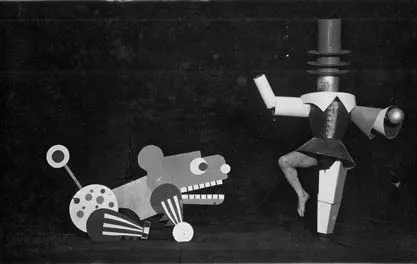
702 acterized by a particular style of writing and scoring. According to historian
703 76 chapter two Sandra Skurvida, Cage’s fascination with the play stemmed from how ‘‘Satie
704 introduced incongruence between language (musical, visual, notational, etc.)
705 and meaning.’’66 Satie’s score and script become a fused and highly interpre-
706 table object pointing to a fundamental hybridity between aural and written
707 information—The Ruse of Medusa’s musical score contains nearly as much tex-
708 tual as sound notation, and its script includes musical interludes interrupting
709 the narrative (such as it is) with a nonverbal ‘‘Monkey’s Dance’’ that is never
710 clearly connected to the other events of the play. Performers must translate
711 both forms of information, which, due to Satie’s nonsensical asides, exceed the
712 normal prescriptions of notation, and in this gap indeterminate interpretations
713 are introduced that explore authorial misdirection or even unintended results
714 (how, for example, as a pianist, would you ‘‘put yourself in the shade,’’ as the
715 score instructs?). As historian Liz Kotz has argued, such a hybridity in a work
716 points to a ‘‘conceptual ambiguity’’ of text-based scoring that ‘‘derives from the
717 use of the text as score [as] inseparably both writing/printed object and per-
718 formance/‘realization.’ ’’67 Cage’s recovery of Satie was motivated in part by the
719 latter’s intentionally ambiguous scoring; the confusion between scripting and
720 dialogue in the play resulted in a contingent performance full of unpredictable
721 or unintended effects.
722 The Ruse of Medusa ’s ambiguities—its absurd monologues and unrelated
723 musical interludes, combined with dance and physical slapstick—alerted Cage
724 to the possibility of seemingly arbitrary relationships between actions in a per-
725 formance. In the apparent randomness of its plotting, Satie’s work departed
726 from previous, more methodical theatrical events at Black Mountain. Even so,
727 the production still drew from a script and rehearsals, in addition to functioning
728 quite successfully as a comedic piece that lent levity to the provocation posed
729 by Cage’s lectures and his single-minded advocacy of Satie. (The play’s sense of
730 lightheartedness was especially pronounced as several Black Mountain faculty
731 members performed self-deprecating, jokey roles in the production.)68 An ex-
732 amination of the ordered unity of a visual field at the College was thus replaced,
733 by the late 1940s, with diametrically opposed practices: dispersion, ambiguity,
734 and inattention. Cage couched this shift in a return to Dada, by revisiting Satie’s
735 snappy and illogical explorations of the ludic and the disruptive effects of word,
736 dance, and sound play.
737 Upon his next visit, Cage extended his methods into something one could
738 more properly term experimental (in his case, the chance protocol)—his hap-
739 pening Theater Piece No. 1. For Cage, ‘‘Happenings …have this thing we’ve
740 spoken of as carelessness in them. Carelessness comes about through . . .
741 ‘non-matrixed’ activity.’’69 Just how he composed and performed nonmatrixed
742 or nonarranged activity is the crux of his chance protocol, and it pushes be-
743 John Cage’s ChanCe ProtoCols 77
744 yond Dada’s attempt to trouble if not end ‘‘art’’ by exacerbating cultural illogic.
745 It comes by way of a most quixotic pairing: Zen and early twentieth-century
746 French art.
747 cIrca 1952: somEthIng Is happEnIng hErE
748 In his first summer at Black Mountain, Cage was just beginning to make inroads
749 in the new post-‘‘German aesthetician’’ version of experimentation of which
750 the Satie play and lectures were key mileposts.70 As he recalled, in 1948 he still
751 ‘‘saw eye-to-eye with Albers at the time, and our conversations were ones char-
752 acterized by agreement.’’71 Though separated by a generation, both men were
753 equally zealous about defining and propagating their respective visions of mod-
754 ernist experimentation, and once Cage introduced chance into his practice,
755 they would forever disagree about its role in art production.
756 The eventual split between the two emerged from a fundamental and intrac-
757 table conflict between their visions for the role of the test in fostering unfore-
758 seen experiences in art. For Albers, because experimentation was the subtle
759 and penetrating work of training the eye and mind to recognize illusion, art
760 practice was therefore situated within a spectrum of design that began with
761 technical proficiency and then produced subtle and carefully organized contin-
762 gency through serial variation. For Cage, in contrast, contingency was a means
763 of unleashing unpredictable aleatory processes that were nonetheless generat-
764 ed by systematic controls. By 1952, his procedures had the effect of drastically
765 devaluing (in anarchic fashion) the role of authorial control in artistic produc-
766 tion, encouraging new types of indeterminate performances in which events
767 unforeseen by artist, performer, or audience could transpire.72 Where Albers
768 argued that ‘‘rehearsal precedes performance,’’ such a notion of rehearsal was
769 precisely what Cage attempted to remove, without substituting expressionistic
770 improvisations on the part of the performer.73
771 Occluding the Albersian conception of experimentation he characterized
772 as a ‘‘marriage of form and content,’’ Cage’s subsequent performance events
773 at the College attempted to leave both the composition and the effects of per-
774 formance actions intentionally open-ended, as much as possible.74 Albers ab-
775 horred Cage’s incitement of artworks left open to accident: as Cage explained,
776 ‘‘When, in 1952, I took the path of chance, and later indeterminacy, our friend-
777 ship was broken …he couldn’t bear the real implications which I then carried
778 out. And he felt that I was renouncing my responsibility as an artist.’’75
779 It was upon this visit, in 1952, that Cage radically disrupted previous mod-
780 els of performance at the College, including his own, by introducing over-
781 78 chapter two lapping activities and inaugurating both a dispersal of attention and a radical
782 narrative fragmentation. With Theater Piece No. 1, Cage worked in the wake of
783 Black Mountain legacies such as the theater-in-the-round, circus-like events
784 previously organized at the College by the Light-Sound-Movement Work-
785 shop led by Betty and Peter Jennerjahn in the late 1940s, which were revived
786 in the summer of 1951 by M. C. Richards and choreographer Katherine Litz.
787 The Jennerjahns, for example, in collaboration with about a dozen College
788 students and faculty, had improvised short theater pieces, sometimes ‘‘limit-
789 ed to a minute, or so,’’ incorporating projected slides, improvised music, and
790 dance elements.76 Like these precursors at the College, Cage’s Theater Piece
791 No. 1 eschewed extensive rehearsals and previously arranged scripting, cos-
792 tuming, music, and characterization; it emphasized simultaneously occurring
793 events and immediacy, and closely considered how to organize the perfor-
794 mance space with respect to the audience, who was often understood as a
795 community of possible participants.
796 Drawing on these precedents, by 1952 Cage was developing chance-derived
797 compositional methods obtained from parameters provided by the I Ching, or
798 the Book of Changes, an ancient Chinese text of divination. In particular, his
799 score for Music of Changes (1951) had been a turning point; during its compo-
800 sition he would ‘‘ask’’ specific ‘‘questions’’ about features of the score, and then
801 make coin tosses or casts of the traditional yarrow sticks to assemble the hexa-
802 grams the I Ching requires; he then used the ‘‘answers’’ to select the duration,
803 tempo, and other dynamics of the composition.77 Cage expressly employed only
804 the structure of the I Ching’s complex randomization features, not its divinatory
805 aspects. As he contended of the innovation of chance composition, ‘‘My work
806 became an exploration of non-intention. To carry it out faithfully I have devel-
807 oped a complicated composing means using I Ching chance operations, making
808 my responsibility that of asking questions instead of making choices.’’78
809 Let’s keep that phrase, ‘‘asking questions instead of making choices,’’ in
810 mind while considering Theater Piece No. 1 and the works composed around
811 it. In early August of 1952, Cage and his frequent collaborator, pianist David
812 Tudor (also at Black Mountain that summer, though he had first arrived at the
813 College in 1951 as piano accompanist to Litz), formulated ideas for a perfor-
814 mance with multiple participants who would perform discrete activities during
815 various overlapping time segments totaling forty-five minutes (see fig. 2.17).
816 Cage proposed that College Rector Charles Olson and faculty member Rich-
817 ards read their poetry, student Robert Rauschenberg display his paintings and
818 play records or project slides, and Cunningham dance. Tudor was to perform
819 on the piano, and Cage would read from a previously prepared lecture on Zen
820 and the medieval mystic Meister Eckhart. To Cage, the piece represented the
821 John Cage’s ChanCe ProtoCols 79
822 possibility of events taking place without being causally related to one another;
823 as he claimed, Theater Piece No. 1 expressed ‘‘the centricity within each event
824 and its non-dependence on other events.’’79
825 Cage had in fact established strict time brackets and organized the perfor-
826 mance with particular time, content, and location parameters. His chance pro-
827 tocol, however, structured the piece’s score around instructions that had many
828 possible effects, which organized a set of open-ended possibilities. The most
829 radical break of such a scoring in Theater Piece No. 1 was the intentionally dis-
830 orienting effect of the performance, what Richards called its ‘‘sensory bombard-
831 ment’’; it decentered attention away from the visual apperception of a theatrical
832 event to the many intermittent, intermedia experiences Cage orchestrated in
833 and around the body of the spectator.80
834 When it was performed at Black Mountain in mid-August, Theater Piece
835 No. 1 incorporated the last-minute addition of upside-down slides, likely
836 projected onto the tilted surfaces of a canopy of Rauschenberg’s monochromat-
837 ic White Paintings (fig. 2.3; works I will discuss later); the canopy was arranged
838 above and to one side of the central arrangement of chairs, which were orga-
839 nized as ‘‘a square composed on four triangles merging towards the center, but
840 not meeting’’81 (fig. 2.15). The seating arrangement allowed performers mobility
841 throughout the audience area, and directly followed, as will be discussed fur-
842 ther, Antonin Artaud’s pronouncement that ‘‘the spectator, placed in the mid-
843 dle of the action, is engulfed and physically affected by it …immerse[d] . . . in
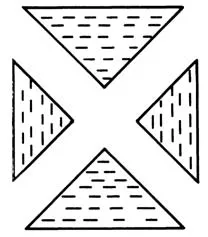
845 Figure 2.15
846 Performance seats and stage space for John Cage’s Theater
847 Piece No. 1, 1952. Published in Michael Kirby and Richard
848 Schechner, ‘‘An Interview with John Cage,’’ Tulane Drama
849 Review 10, no. 2 (Winter 1965).
850 80 chapter two
852 Figure 2.16
853 M. C. Richards’s diagram of John Cage’s Theater Piece No. 1, 1952.
854 Reconstructed in 1989 for publication in James Fetterman, John
855 Cage’s Theater Pieces (New York: Routledge, 1996), 74. Courtesy
856 of the Estate of M. C. Richards.
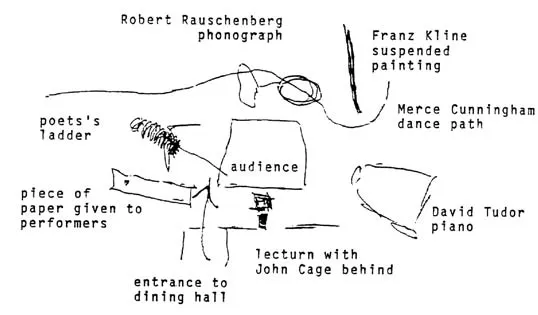
857 a constant bath of light, images, movements and noises.’’82 Olson and Richards
858 ascended a ladder at various points to read for their segments; some claim that
859 Tudor played Cage’s 1952 composition Water Music, and films were likely pro-
860 jected by student Nicholas Cernovich.83 A dog or dogs barked at Cunningham
861 throughout the piece, and hot coffee was served (as part of the performance)
862 in cups that had been set at each seat, regardless of whether they had been pre-
863 viously used as ashtrays during the event. Figure 2.16 is a retrospective map of
864 the event by Richards—no photographs of the performance exist.
865 Cage’s incorporation of multiple events of indeterminate outcome in The-
866 ater Piece No. 1 provoked a mixed response at its debut. Testimonies confirm
867 that the event left some in the audience confounded and even hostile. Com-
868 poser Stefan Wolpe, previously a Bauhaus student and currently teaching at
869 the College, ‘‘bitched’’ about the chaos and left in protest; some thought it was
870 ‘‘quite boring’’ to sit through though, while others claimed it was ‘‘an interesting
871 experiment’’; still others conceded that ‘‘you weren’t supposed to understand
872 it literally.’’84 The seating arrangement discouraged a single vantage point, so
873 contradictory accounts of the evening circulated as the many simultaneous and
874 unrelated actions assailed spectators independently with several registers of
875 sonic, literary, dancerly, and visual events. Spectators were required to turn
876 their heads and move their bodies to see the actions taking place in a panorama
877 John Cage’s ChanCe ProtoCols 81
878 above and around them, and to follow competing strains of aural information
879 and coincident movement. In this sense, they were asked to become partici-
880 pants: by registering experiences in their bodies other than ones cued by visual
881 perception, and by Cage’s increasing phenomenological demands that audience
882 members engage the broader sensorium of their bodies with acoustic, tactile,
883 and even olfactory events.
884 Through its emphasis on simultaneity, the piece ostensibly revealed the
885 unmotivated, untidy flow of life that concentration stifles and conscious de-
886 sign suppresses. As Cunningham reflected on the night: ‘‘Life itself is all these
887 separate things going on at the same time. And contemporary society is so
888 extraordinarily complex that way. Not only things going on right around you,
889 but there are all the things that you hear instantly over the television, that are
890 going on someplace else …they’re happening at the same time.’’85 That life
891 involves a surfeit of difficult sensory information was its peculiar, splendid an-
892 archy, according to the logic Cage set out in Theater Piece No. 1. The simultane-
893 ity of events was the indelible and inescapable fact of the modern world, and
894 Cage’s happening created a situation that intensified its pandemonium (all the
895 while still framing the effect of randomness by a rigorously delimited score that
896 contained defined time brackets and specific instructions).
897 As Cage was incorporating ambient and overlapping noises in musical com-
898 position and performance, he was also redefining what a music score could be.
899 In his ‘‘score’’ for Theater Piece No. 1, for example, traditional musical notations
900 of staffs, bars, keys, and notes were replaced with telegraphic durational seg-
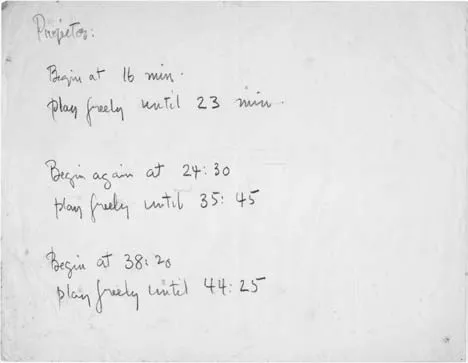
901 ments to be interpreted by the performer. An existing fragment given to one of
902 the performers (likely to Robert Rauschenberg or Nicholas Cernovich) reads,
903 in Cage’s hand (fig. 2.17):
904 Projector:
905 Begin at 16 min.
906 play freely until 23 min.
907 Begin again at 24:30
908 play freely until 35:45
909 Begin at 38:20
910 play freely until 44:2586
911 De-skilling musical language beyond its notation in bars, notes, keys, and
912 measures guaranteed that every event could be simply performed and would
913 produce unique and unpredictable results (although the exacting, time-based
914 constraints on the performer’s freedom could inversely be interpreted as fussy
915 and overbearing, not liberating). Whereas the quantity and length of the score’s
916 82 chapter two
918 Figure 2.17
919 John Cage, Script for Theater Piece No. 1, 1952. 8½ × 11″
920 paper. Music Division, The New York Public Library for the
921 Performing Arts, Astor, Lenox and Tilden Foundations.
922 sections were generated by Cage’s chance-derived use of the I Ching, the per-
923 formers’ interpretations of these instructional commands were ultimately un-
924 known to him. The score, however, produced no reciprocal lack of mastery on
925 the creator’s part—it was not Cage’s choices of which possibilities to put on the
926 table, so to speak, that were chance derived, merely the questions about their
927 specific details.
928 Because no photographic record or film footage of Theater Piece No. 1 exists,
929 to get a sense of its effect it is helpful to compare it to a surviving film recording
930 of Cage’s 1959 composition Water Walk, a work also based on timed segments,
931 that he performed during a television appearance in 196087 (fig. 2.18). In Water
932 Walk Cage is the sole performer, amid a field of some thirty-four items: domes-
933 tic appliances and other household objects related to water or liquidity that are
934 spread over various tables and the floor—a pressure cooker releasing steam, a
935 rubber duck, a toy fish, an electric mixer, an ice cube tray filled with ice, a bottle
936 of Campari, and a bathtub filled with water—as well as some objects related to
937 music or timekeeping, including a piano, five radios, a Turkish cymbal, and
938 John Cage’s ChanCe ProtoCols 83
940 Figure 2.18
941 Still frame from performance of John Cage’s Water Walk on I’ve
942 Got a Secret, January 1960. Courtesy of FremantleMedia, North
943 America.
944 a stopwatch. In the three minutes of Water Walk, Cage methodically moves
945 among these objects: filling the blender with ice, slapping the radios, turning
946 on the blender, squeaking the rubber duck, filling a glass with ice, pouring Cam-
947 pari, and later drinking from it, while periodically consulting his stopwatch.
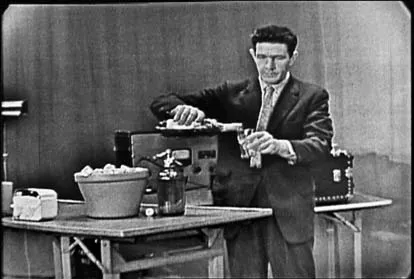
948 Water Walk’s first seconds begin with Cage slamming down the lid of the piano
949 after putting the toy fish on its soundboard, and concludes with Cage knocking
950 the radios to the ground, acts of physical and aural aggression that he manages
951 to make appear calm and unemotional—premeditated—and even a bit slap-
952 stick-y.88 The deliberation and calculation of the performance, despite its mild
953 violence and cacophony, are surprising. During Cage’s systematic movements
954 through the space, he checks his watch like an athlete clocking pace. This ele-
955 ment of precision is striking in many performances of Cage’s works: the way the
956 chance protocol—the fixed, clocked segments that produce seemingly aleatory
957 results—lends a sense of dogged focus on time and duration to the perform-
958 er’s gestures (which can read as disinterestedness or obliviousness to audience
959 members, an audience that may expect a virtuosic memorization of the score,
960 as in ‘‘classical’’ music performances).
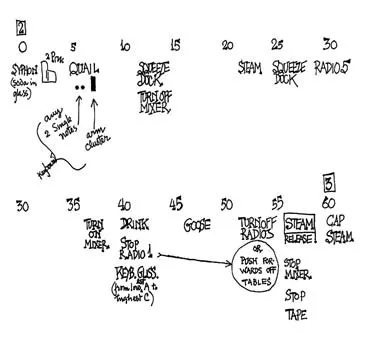
961 The score of Water Walk itself consists of a group of objects: a list of the
962 ‘‘instruments’’; a floor plan showing the placement of the props; three pages of
963 a timeline (one minute for each page) with descriptions, pictographic diagrams,
964 and notations of occurrence of events divided into five-second increments; and
965 84 chapter two a list of notes ‘‘regarding some of the actions to be made in the order of occur-
966 rence’’ (fig. 2.19). Timings in the performed work are estimations: ‘‘Start watch
967 and then time actions as closely as possible to their appearance in the score.’’
968 Water Walk itself was therefore relatively fixed in its performance, but for the
969 brisk yet unspecific tempo of the actions that were to be timed ‘‘as closely as
970 possible.’’89
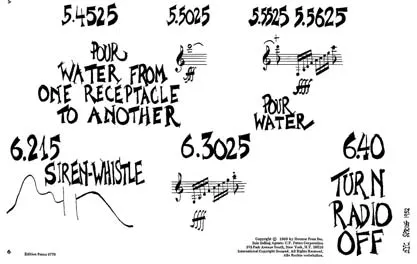
971 Water Walk’s paper score relies on two earlier Cage works: Water Music
972 (1952) and Fontana Mix (1958). Cage used the score of Fontana Mix (which, like
973 many of his scores of the 1950s, employed the I Ching as a randomizing tool) to
974 compose Water Walk and several other compositions; the former piece consists
975 of ten transparencies containing various numbers of dots, ten sheets of paper
976 with curved lines of various thicknesses, one transparency of a two-by-ten-inch
977 grid, and another of a straight line. The Fontana Mix score was itself indetermi-
978 nate (the performer was to superimpose the sheets to find ‘‘time units in which
979 the event may take place’’).90 According to Cage, the ‘‘graph units = any time
980 units,’’ thereby allowing the performance’s duration and tempo to be conceived
981 by the operator of the score. In its title and elements of pictorial scoring, Water
982 Walk clearly resembles Cage’s Water Music, which David Tudor premiered in
983 May of 1952 at the New School for Social Research in New York before returning
984 to Black Mountain—likely the work Tudor was playing during Theater Piece
986 Figure 2.19
987 John Cage, Score for Water Walk, January 1959. Copyright ©
988 1961 by Henmar Press, Inc. Used by permission of C. F. Peters
989 Corporation. All rights reserved.
990 John Cage’s ChanCe ProtoCols 85
992 Figure 2.20
993 John Cage, Score for Water Music, May 1952. Copyright ©
994 1960 by Henmar Press, Inc. Used by permission of C. F. Peters
995 Corporation. All rights reserved.
996 No. 1.91 Like Water Walk, the earlier Water Music emphasized the hybridity of
997 the score as a visual document and aural experience. As Cage explained,
998 Water Music wishes to be a piece of music, but to introduce visual elements in
999 such a way that it can be experienced as theater. …I simply put into the chart
1000 things that would produce not only sounds but that would produce actions

1002 that were interesting to see.92
1003 For example, in Water Music’s score, a descending tone of a steam whistle is
1004 depicted as a linear wave, and the instruction ‘‘Pour water from one recepta-
1005 cle to another’’ bears no musical notation whatsoever but is written in Cage’s
1006 distinctive all-caps handwriting that is in essence a kind of calligraphic visual
1007 design (fig. 2.20).
1008 In the sense that Cage described Water Music as introducing ‘‘visual ele-
1009 ments’’ that could be ‘‘experienced as theater,’’ one can begin to understand the
1010 chance protocol of Theater Piece No. 1 as perhaps one part ‘‘chance’’ to several
1011 parts ‘‘protocol’’—that the protocol’s criterion of experimental innovation is
1012 a demand to ‘‘produce actions that were interesting to see.’’ The staging of the
1013 Black Mountain College dining hall as a 360-degree panorama of competing
1014 aural and visual actions, often taking place simultaneously, was obviously not a
1015 random event; though the length of the time slots the performers were desig-
1016 nated and the other questions Cage asked of the I Ching were subject to chance,
1017 86 chapter two they were organized by his framing of the questions. And if Cage’s Water Walk
1018 television performance is any indication, it is likely that performers of Theater
1019 Piece No. 1 utilized their time slots quite seriously, attempting, for example, to
1020 play the third projector segment for the precise six minutes and five seconds
1021 the score indicated—an officiousness distant from the reputation of ‘‘indeter-
1022 minate’’ compositions as haphazard or non-intentioned.93
1023 Similarly, in Cage’s 1952 composition 4′33″, created during his time at Black
1024 Mountain (though having percolated in his mind for several years), the piece’s
1025 three time sections were chance-determined by use of the I Ching to be thir-
1026 ty-three seconds, two minutes and forty seconds, and one minute and twenty
1027 seconds apiece.94 When Tudor first performed 4′33″, he placed on the piano the
1028 several sheets of the handwritten score, which was notated conventionally on
1029 sheet music with blank measures (figs. 2.21, 2.22). Upon beginning each section,
1030 he closed the lid of the piano and, glancing at a stopwatch, turned the pages of
1031 the score as time passed. When each section ended, he opened the piano lid.
1032 Though the score indicates there should be no intentional sound on the per-
1033 former’s part, as with Water Walk a great deal of theatricalization surrounds
1034 actualizing the matrices of Cage’s ‘‘non-matrixed’’ activity.
1035 Cage’s use of the I Ching was intertwined with his intensifying investigation
1036 of the revelatory possibilities of void-like events described in Zen Buddhist
1037 Figures 2.21 and 2.22
1038 David Tudor’s original version of John Cage’s 4′33″, pages 3 and 4,
1039 1953. The John Cage Trust. Reproduced by permission of The Getty
1040 Research Institute, Los Angeles.
1042 John Cage’s ChanCe ProtoCols 87
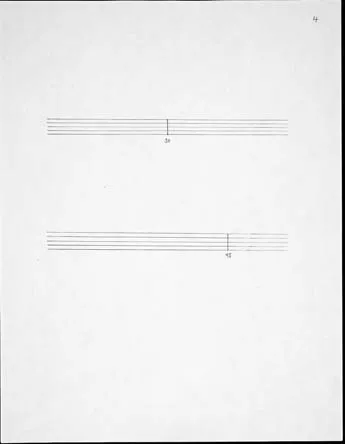
1044 texts; he called these the ‘‘flow-through’’ of experiences that break down the
1045 ego’s barrier.95 Breaking down this barrier, for Cage, revealed the dominance
1046 of ‘‘no-mindedness,’’ or non-intention, in the world, which could be accessed
1047 via an experience of the body as a vessel for sound.96 This connection between
1048 sound and the ‘‘flow-through’’ of experiences followed his 1951 visit to an an-
1049 echoic (an echoless, insulated, and therefore soundproof ) chamber at Harvard
1050 University, during which his expectation of total acoustic withdrawal was over-
1051 turned.97 According to Cage, in the chamber he ‘‘heard two sounds, one high
1052 and one low. When I described them to the engineer in charge, he informed me
1053 that the high one was my nervous system in operation, the low one my blood in
1054 circulation.’’98 Cage had gone to a place where he expected there to be no sound,
1055 and yet sound was nevertheless present and discernible. (He claimed that it was
1056 then that the composition of 4′33″ seemed possible; he realized that ‘‘until I die
1057 there will be sounds. And they will continue following my death. One need not
1058 fear about the future of music.’’)99 Silence was in actuality a ‘‘walking concert’’
1059 of the body; as Cage argued, ‘‘We call it ‘silence’ because it is free of our activity.
1060 It does not correspond to ideas of order or expressive feeling …[that] ‘deafen’
1061 us to the sounds themselves.’’100
1062 That the stimulation and plenitude of ‘‘no-mindedness’’ could be features
1063 of the ostensible void of an anechoic chamber Cage connected to ninth-cen-
1064 tury Buddhist sage Huang Po’s Doctrine of Universal Mind.101 In 1952, Cage be-
1065 gan studying the text at Black Mountain, partly as a result of attending Daisetz
1066 Teitaro Suzuki’s seminars on Buddhism in the mid-1940s, which Suzuki later
1067 taught at Columbia from 1952 to 1957 to great public acclaim.102 Cage credited
1068 his investigation of Po’s Doctrine as a central inspiration for the new directions
1069 his work at Black Mountain was taking, declaring,
1070 I had come through my study of Zen Buddhism with Suzuki to an appreciation
1071 of a particular text: I liked it more than the others connected with Zen Bud-
1072 dhism—it’s called The Huang Po Doctrine of Universal Mind. So one evening
1073 at Black Mountain …we read the entire Huang Po Doctrine with all the notes
1074 and everything …after that experience …people told me their lives had
1075 changed.103
1076 Po’s text describes various paths to spiritual enlightenment, and advocates
1077 strategies of disengagement from action and withdrawal from the preoccu-
1078 pations of conscious thought. The doctrine of ‘‘no purpose’’ described there-
1079 in suggests abandoning intentionality in order to avail the spirit to the true
1080 flux of experience. To Po, attaining enlightenment was an unpredictable and
1081 chancy process, though certain foundational steps could be undertaken in
1082 88 chapter two preparation. He advocated a form of non-attachment and quietism in which
1083 ‘‘you need study no doctrines whatever, but learn only how to avoid seeking
1084 for and attaching yourselves to anything.’’104 Only when the mind and body
1085 were in a condition of harmonic balance, acting in concert with each other,
1086 could the ‘‘selflessness’’ of transcendence emerge. Po claimed that enlighten-
1087 ment may then arrive as an accident, as ‘‘a sudden self-realization’’ in a mo-
1088 ment of utter dispassion.105
1089 Cage was particularly impressed by Po’s assurance that reducing the inten-
1090 tionality of conscious thought—what Po referred to as ‘‘conceptual thought’’—
1091 laid a path to transcendence by way of bodily awareness. To Po, spiritual tran-
1092 scendence was possible for those who ‘‘would only eliminate all conceptual
1093 thought in a flash.’’106 By rejecting the mind’s demands toward reason, the spir-
1094 it would recognize the transitory nature of material phenomena and physical
1095 stimuli; as Po asserted, ‘‘Every phenomenon that exists is a creation of thought;
1096 therefore I need but empty my mind to discover that all of them are void.’’107
1097 Of special interest to Cage was Po’s championing an empty, receptive
1098 mind—an emptiness or ‘‘void’’ alert to the greater flux and changeability of
1099 transitory events. The sense of the void as open possibility became the correlate
1100 to Cage’s conception of an experiment as a protocol without predictable ends.
1101 As he explained,
1102 An experimental action, generated by a mind as empty as it was before it be-
1103 came one …does not move in terms of approximations and errors, as ‘‘in-
1104 formed’’ action by its nature must, for no mental images of what would happen
1105 were set up beforehand; it sees things directly as they are: impermanently
1106 involved in an infinite play of interpenetrations.109
1107 Cage related the notion of the void as impermanence, as a play of unpredictable
1108 difference, to his study at Black Mountain of Antonin Artaud’s work. Linking Po
1109 to Artaud, Cage saw similarities in their analyses of states of void-like instability
1110 in which the transcendence of routine and habit provided passage for unex-
1111 pected events and flashes of inspiration. In this sense, Theater Piece No. 1 was
1112 indelibly shaped by Black Mountain faculty member M. C. Richards’s ongoing
1113 translation of Artaud’s key texts, later compiled in the volume The Theater and
1114 Its Double, which called for forms of theatrical performance that were utterly
1115 immediate and therefore not reliant on scripting or literary interpretation.
1116 Richards had been introduced to Artaud through her then partner Tudor’s
1117 studies in contemporary French musical composers. In his attempt to puzzle
1118 through Pierre Boulez’s 1948 Second Piano Sonata (confiding to Richards that
1119 though the sonata was complicated, he was actually ‘‘not having problems with
1120 John Cage’s ChanCe ProtoCols 89
1121 the notes, but with the music’’), Tudor had read Boulez’s sources for the work:
1122 poet Stéphane Mallarmé and Artaud.109 Richards, Tudor, and Cage discussed
1123 Artaud intensely at the College throughout the summer of 1952, and carefully
1124 studied chapters of The Theatre and Its Double as a companion to the Doctrine’s
1125 claims for the void-like elimination of intention.
1126 Artaud’s work, published first in France in 1938, collected essays and man-
1127 ifestos written throughout the previous two decades. It set forth a proposal
1128 for a ‘‘theater of cruelty’’ in which the effects of certain unpredictable actions
1129 onstage would shock viewers into a ‘‘new notion of space’’ when bombarded
1130 with many simultaneously occurring events.110 This new perception of space
1131 was characterized by ‘‘overlapping images and movements’’ and the ‘‘collusion
1132 of objects, silences, shouts, and rhythms’’ which together perform an ‘‘extreme
1133 action’’ pushing the spectator’s perception beyond its limits.111 In breaking down
1134 the viewer’s perceptual apparatus with overwhelming events, Artaud hoped to
1135 extend the effects of disorientation, ‘‘cruelty,’’ and the difficulty of perception
1136 off the stage and into the world beyond theatrical performance. As he main-
1137 tained, ‘‘There will be no unoccupied point in space, [and] there will be neither
1138 respite nor vacancy in the spectator’s mind or sensibility. That is, between life
1139 and the theater there will be no distinct division, but instead a continuity.’’112 It
1140 was an experience of shock in which the viewer’s previous understandings of
1141 art—art as separated from life—would be overturned. These acts of disturbance
1142 returned art to the chaotic conditions of life veiled by traditional theater’s codi-
1143 fied techniques and habits of scripting, narrativity, and characterization. Those
1144 now moribund aspects of theater would thereafter be supplanted by events of
1145 the world outside theater, thus initiating a ‘‘new’’ art that looked remarkably
1146 like the flux, chaos, and cruelty of ‘‘external’’ life while prismatically allowing
1147 for a critical vision of that life. Rather than revolutionizing the observation of
1148 conditions of the world outside theater by setting up a counterpoint of illusory
1149 effects (or even altering those ‘‘external’’ conditions themselves), art for Artaud
1150 must collapse its pretensions to autonomy and separation into already existing
1151 ‘‘life’’ conditions, thus producing a radical, destructive, and shocking break in
1152 the minds and bodies of spectators accustomed to a theater of affectation and
1153 habit. In sum, only by destroying the separation between theater and life could
1154 an invigorated sense of theater as life catalyze viewers to become aware of their
1155 relationship with natural ‘‘life’’ forces.
1156 To Cage, Artaud’s description of a barrage of simultaneous events raised
1157 ‘‘the possibility of making a theatrical event in which the things that took
1158 place were not causally related to one another.’’113 Interestingly, this is a claim
1159 Artaud himself never explicitly asserted. Cage, like Artaud, wanted to col-
1160 lapse the difference between theater and life, yet to Artaud the most radical
1161 90 chapter two feature of theater was its ability to compound visual and auditory effects in
1162 a dreamlike condensation of experience in which the spectator would lose a
1163 sense of the rules and conventions of the conscious mind. In viewing events
1164 as an endless accretion of disconnected moments, of different possible pres-
1165 ents, Artaud felt the theater of cruelty mimicked the ‘‘internal world’’ of the
1166 spectator; the ‘‘true illusion’’ of theater was the manner in which it reflected
1167 the ‘‘truthful precipitates of dreams’’ (dreams which, after all, do have causal
1168 connections that represent the logic of the unconscious, however latent those
1169 connecting threads may be).114
1170 In Cage’s application of Artaud’s theories of spectatorship to Theater Piece
1171 No. 1, theater would literally act on the audience, but not by the mediation
1172 of acting or plotting, or by employing the unifying field of vision that joined
1173 a costumed actor with the obviously constructed spaces surrounding him or
1174 her, as in Bauhaus theater. Instead, it would do so by an escape from the ‘‘ra-
1175 tionalism’’ of premeditated, written theater performance. Artaud advocated
1176 a theater of ‘‘powerful feeling [that] produces in us the idea of the void . . .
1177 the real void of nature.’’115 Effects of void-like states, what he claimed were
1178 the ‘‘deepest states of mind beyond thought,’’ could be attained in a multi-
1179 sensory experience: it was ‘‘in the light of magic and sorcery that the mise
1180 en scène must be considered …as the burning projection of all the objective
1181 consequences of a gesture, word, sound, music, and their combinations.’’116
1182 Only then would the ‘‘sorcery’’ of theater spiral the spectator into the doubled
1183 world of his or her own unconscious.117
1184 It is noteworthy that Oskar Schlemmer, Xanti Schawinsky, and Antonin
1185 Artaud invoked the notion of illusion as central to a new awareness and self-re-
1186 flexivity they hoped to awaken in their audiences. Yet while Schlemmer saw
1187 the theater as a space of illusion, it was an illusion constructed through focused
1188 attention, not void-like states. In contrast to his and other Bauhaus figures’ ra-
1189 tional examinations of spaces, transacted in the controlled environment of the
1190 theater, to Artaud the immediacy of the present allowed spectators particular
1191 purchase on ‘‘void’’ experiences; any attempts to translate or express the void
1192 through the temporally ‘‘dissembling’’ process of scripting (in which thoughts,
1193 ideas, and intentions from the past hijacked the free expression of ‘‘feelings
1194 and passions’’ in the present) corrupted the truth of immediacy.118 The chaos of
1195 the many simultaneous events onstage would induce experiences of shock in
1196 the audience, and for this reason Artaud insistently opposed the preeminence
1197 of dialogue in theater; as he stated in The Theater and Its Double, ‘‘Our purely
1198 verbal theater [is] unaware of everything that makes theater, of everything that
1199 exists in the air of the stage, which is measured and circumscribed by that air
1200 and has a density in space—movements, shapes, colors, vibrations, attitudes,
1201 John Cage’s ChanCe ProtoCols 91
1202 screams.’’119 This of course echoes Schlemmer’s call for a theater exploring spa-
1203 tial arrangements in the context of bodily movement. Yet in contrast to the de-
1204 liberate and ordered experimentation in Schlemmer’s work (he often referred
1205 to his practice as ‘‘research experiment’’), Artaud stressed the mutability and
1206 contingency of the theatrical space, stating that ‘‘the theater is the only place
1207 in the world where a gesture, once made, can never be made the same way
1208 twice.’’120 In place of the Bauhaus idea of bodies oriented through calculated
1209 geometries of space, Artaud proposed a ‘‘total spectacle’’ in which ‘‘an intensive
1210 mobilization of objects, gestures, and signs’’ provided ‘‘sudden shocks to revive
1211 our understanding.’’121 These shocks could be accomplished through immediacy
1212 and accident: theater should be as violent as ‘‘natural forces’’ that are subject to
1213 ‘‘interventions of chance.’’122
1214 Cage adapted Artaud’s sense of extrahuman ‘‘natural forces’’ as accidental
1215 and arbitrary; theater was a means to succumb to the greater chaos of those
1216 unintended, uncontrollable consequences. Such forces appear cruel or ‘‘tyr-
1217 annous,’’ in Cage’s understanding of Artaud, only because attempts by human
1218 agents to organize and control them create friction between people and their
1219 environments. For Cage, the rational pseudo-order of the mind was to be abol-
1220 ished in favor of the real order of chance. He often invoked earlier Dadaist em-
1221 ployments of chance to supplement his employment of Artaud’s arguments.
1222 Marcel Duchamp’s work in particular was a touchstone for Cage’s notion of
1223 experimentation as the acceptance of accident and the elimination of conscious
1224 interference—those features of Cage’s turn to chance that had so offended Al-
1225 bers. Cage advocated reconsidering Duchamp’s uses of chance not only as a
1226 means to compose, but also as a tool to attain random or indeterminate re-
1227 sults in experimental acts, boldly declaring, ‘‘One way to write music: study
1228 Duchamp.’’123 In particular, he credited Duchamp with opening up a space of
1229 expanded, nonjudgmental awareness: his bottle racks and bicycle wheels un-
1230 derscored the dialogical experience of the art object, its recognition as art based
1231 on a community of understanding rather than any innate quality of the work.
1232 To Duchamp, the unsubjective or ‘‘casual’’ selection of a readymade was key;
1233 the work should be as randomly chosen and therefore as affectless as possible.
1234 As he wrote,
1235 It is necessary to arrive at selecting an object with the idea of not being im-
1236 pressed by this object on the basis of enjoyment of any order. However, it
1237 is difficult to select an object that absolutely does not interest you, not only
1238 on the day on which you select it, and which does not have any chance of
1239 becoming attractive or beautiful and which is neither pleasant to look at nor
1240 particularly ugly.124
1241 92 chapter two To Duchamp, an artist’s nominative act—the declaration itself regardless of
1242 the object—was itself the art. He could choose anything indifferent to, or even
1243 in spite of, its aesthetic merits. Thus began a conceptual leap of faith that con-
1244 tinued to define the condition of art’s intelligibility for Cage. Coupled with
1245 the disinterestedness of the selection of readymade, Duchamp’s approach to
1246 chance also employed a paradox of intentional non-intention in its experimen-
1247 tal method.
1248 One would think that Duchamp’s 1913 musical score Erratum Musique
1249 (which can be translated as ‘‘musical misprint’’), in which twenty-five notes
1250 from F below middle C to high F were drawn from a hat by Duchamp and his
1251 two sisters, would have been pivotal to Cage. Yet Cage stated of the work, ‘‘I
1252 wouldn’t be satisfied with that kind of chance operation in my work. …I enjoy
1253 details and like things to be more complicated.’’125 Instead, of central importance
1254 was Duchamp’s piece 3 Standard Stoppages of 1913--14, in which he dropped a
1255 one-meter length of string three times and recorded the resulting forms (Cage
1256 apparently attempted to replicate the work)126 (plate 13). In creating templates
1257 of the three trials, Duchamp transformed the ‘‘standard’’ of measure into an
1258 indexical reflection of a seemingly arbitrary event. Describing this as ‘‘canned
1259 chance,’’ he underscored how the organizational protocol of the ‘‘experiment’’
1260 resulted in repeatable, quantifiable, and measurable events, though each ‘‘find-
1261 ing’’ was ultimately unpredictable. As philosopher Ian Hacking has written,
1262 such a protocol can be said to use ‘‘chance devices to introduce a new level of
1263 control into experimentation. Control not by getting rid of chance fluxuations,
1264 but by adding some more.’’127 Like a statistical study in which randomization
1265 and stochastic variation are harnessed to eliminate bias, Duchamp’s ‘‘canned
1266 chance,’’ in a most contradictory fashion, allowed each event’s specificity to
1267 emerge by minimizing the subjective element in ‘‘human error.’’
1268 The aleatory elements that Duchamp incorporated in the creation of 3 Stan-
1269 dard Stoppages stressed what he called the ‘‘chain of totally subjective reactions’’
1270 the artist undergoes in planning and realizing a creative act.128 The results of
1271 a chance operation, however, emphasized how chance in fact minimized the
1272 subjectivity of the artist:
1273 ‘‘Theory’’
1274 10 words found by opening the dictionary at random by A
1275 10 words found by opening the dictionary at random by B
1276 These 2 sets of 10 words have the same difference of ‘‘personality’’ as if the 10
1277 words had been written by A and B with an intention. Or else, it matters little,
1278 there would be cases where this ‘‘personality’’ may disappear in A and B. That is
1279 the best case and most difficult.129
1280 John Cage’s ChanCe ProtoCols 93
1281 To Duchamp, subjective ‘‘personality’’ could be effaced if chance events were
1282 not random at all—if arbitrary selections could somehow be made repeatable
1283 among a large-enough sample of chance events. The use of chance creates
1284 unique and diverse experiences that the human mind cannot predict, yet the
1285 mind is so varied and complex that after a few deliberative selections of words,
1286 a subjective and seemingly irrational range of possibilities and associations
1287 emerge that can be as difficult to causally explain as a chance event. Even sam-
1288 ples generated by choice or intention produce seemingly chancy differences; to
1289 Duchamp, the ideal scenario—‘‘the best case’’—resulted when these two situa-
1290 tions, randomness and intention, became coincident and when no distinction
1291 could be perceived between chance and design. Such a de-differentiation could
1292 null all forms of intention, though that remained only the ‘‘most difficult’’ and
1293 remote scenario.
1294 Chance processes, to Duchamp, were paradoxically determinate in their
1295 composition (the control exerted by the creator in setting up the event), while
1296 producing indeterminate outcomes: ‘‘Your chance is different than mine.’’130
1297 Yet ‘‘canned chance’’—the way in which chance generates results only as dif-
1298 ferent as two different subjectivities—inserts elements of indeterminacy and
1299 randomness to create a wider range of possible outcomes, not capricious re-
1300 sults.131 Duchamp employed chance to refute habit and bias; he understood
1301 it as a practice with predictable operations though indeterminate results—in
1302 other words, as a chance protocol. No process of manipulating results, delin-
1303 eating beginnings and endings, or structuring propositions for chance activ-
1304 ities wholly eliminates intentionality; chance protocols, as executed in Dada
1305 and later by Cage, do not reject motivated action. In fact, chance processes
1306 exemplify types of technique and control that are highly motivated and aspire
1307 to eliminate the emotional biases of both individuals and systems. As critic
1308 Ian Pepper has noted, Cage’s ‘‘aesthetics of indifference’’ was in actuality a
1309 ‘‘ ‘discipline’ governed by the liquidation of intention, habit, and agency.’’132
1310 Indeed, Cage later rephrased his ‘‘questions not choices’’ formulation thusly:
1311 ‘‘Most people who believe that I’m interested in chance don’t realize that I
1312 use chance as a discipline. They think I use it—I don’t know—as a way of giv-
1313 ing up making choices.’’133 Chance in composition was a project predicated on
1314 assumptions that it produced new understandings of order. Chance is always
1315 laden with intention. In his years at and post-Black Mountain College, defin-
1316 ing just whose intention reigned became the ground for mounting critiques of
1317 Cage’s notion of the experimental act.
1318 94 chapter two

1320 Plate 1
1321 Color Study IV-3. From Josef Albers, Interaction of Color
1322 (New Haven, CT: Yale University Press, 1963/1971).
1323 © Yale University Press; courtesy Yale University Press.
1325 Plate 2
1326 Josef Albers, template for a Variant study, n.d. 12 × 19″.
1327 Photograph by Tim Nighswander © The Josef and Anni
1328 Albers Foundation / Artists Rights Society, New York.
1330 Plate 3
1331 Josef Albers, Variant, 1947. Oil on Masonite, 12 × 18″.
1332 Photograph by Tim Nighswander © The Josef and Anni
1333 Albers Foundation / Artists Rights Society, New York.

1335 Plate 4
1336 Josef Albers, Variant: Southern Climate, 1948--53. Oil on Masonite, 121⁄4
1337 × 22½″. Photograph by Tim Nighswander © The Josef and Anni Albers
1338 Foundation / Artists Rights Society, New York.

1340 Plate 5
1341 Josef Albers, Variant: Southern Climate, 1948--53, detail.
1342 Photograph by Eva Díaz © The Josef and Anni Albers
1343 Foundation / Artists Rights Society, New York.
1345 Plate 6
1346 Josef Albers, Variant, 1947--55. Oil on Masonite, 26 × 281⁄4″.
1347 Photograph by Tim Nighswander © The Josef and Anni
1348 Albers Foundation / Artists Rights Society, New York.
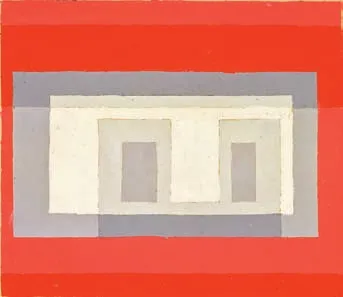
1350 Plate 7
1351 Josef Albers, Study for a Variant (III), C, 1947. Pencil and
1352 oil on paper, 91⁄16 × 117⁄8″. Photograph by Tim Nighswander
1353 © The Josef and Anni Albers Foundation / Artists Rights
1354 Society, New York.
1356 Plate 8
1357 Josef Albers, Homage to the Square, 1958. Oil on Masonite, 18 ×
1358 18″. Photograph © Judd Foundation. Courtesy Judd Foundation
1359 Archive.
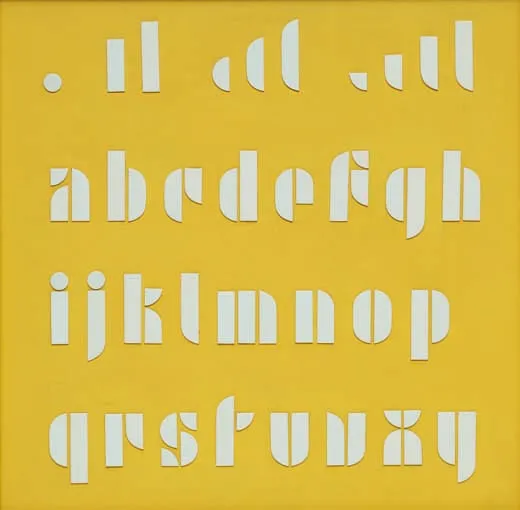
1361 Plate 9
1362 Josef Albers, Lettering Set, 1926--31. Milk glass on painted wood.
1363 The Josef and Anni Albers Foundation / Artists Rights Society,
1364 New York. Digital Image © The Museum of Modern Art/Licensed
1365 by SCALA / Art Resource, NY.
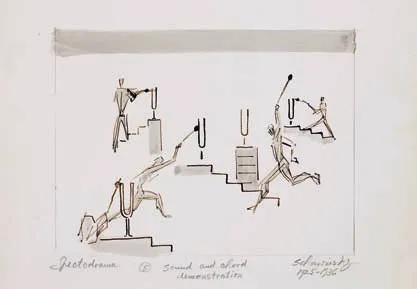
1367 Plate 10
1368 Xanti Schawinsky, Sound and Chord
1369 Demonstration, Spectodrama Sketch
1370 #5, 1936--37. The Xanti Schawinsky
1371 Estate.
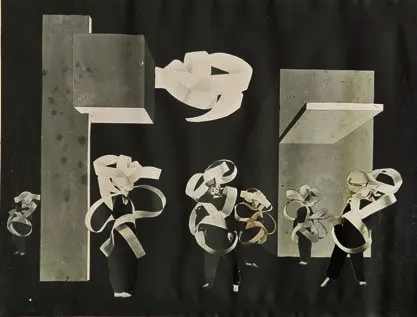
1373 Plate 11
1374 Xanti Schawinsky, Spectodrama
1375 8: Building (Tensional), 1936--37.
1376 Photocollage on paper, 16 × 21.1″.
1377 The Xanti Schawinsky Estate.
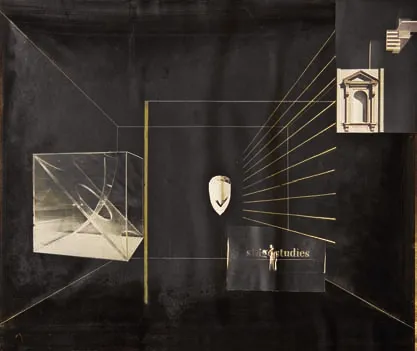
1379 Plate 12
1380 Xanti Schawinsky, Spectodrama
1381 5: Form and Language, 1936--37.
1382 Photocollage and pen on paper, 16.6 ×
1383 20.4″. The Xanti Schawinsky Estate.

1385 Plate 13
1386 Marcel Duchamp, 3 Standard Stoppages. Paris, 1913--14. Wood
1387 box 111⁄8 × 507⁄8 × 9″, with three threads 393⁄8″, glued to three
1388 painted canvas strips 5¼ × 47¼″, each mounted on a glass panel
1389 7¼ × 493⁄8 × ¼″, three wood slats 2½ × 43 × 1⁄8″, shaped along
1390 one edge to match the curves of the threads. © 2012 Artists
1391 Rights Society New York / ADAGP, Paris / Succession Marcel
1392 Duchamp. Digital Image © The Museum of Modern Art/Licensed
1393 by SCALA / Art Resource, NY.

1395 Plate 14
1396 Buckminster Fuller, Dymaxion Air-Ocean World Map, 1954/1981.
1397 29-color silkscreen on Arches 100% rag paper, 50 × 72″. Edition
1398 of 85. Courtesy Carl Solway Gallery, Cincinnati, Ohio.

1400 Plate 15

1402 Buckminster Fuller, World Energy. First published in Fortune,
1403 February 1940. Courtesy The Estate of R. Buckminster Fuller.
1405 Plate 16
1406 Buckminster Fuller, World Energy Map, 1953. Published in
1407 Herbert Bayer’s World Geo-Graphic Atlas. Courtesy The
1408 Estate of R. Buckminster Fuller.
1410 Plate 17
1411 Buckminster Fuller holding model of Autonomous Dwelling
1412 Machine, 1947, next to model of same, assembled and housed
1413 inside geodesic dome, ca. 1950s. Courtesy The Estate of R.
1414 Buckminster Fuller.
1416 Plates 18, 19
1417 Robert Rauschenberg, Factum I and Factum II, 1957. Both: Oil,
1418 ink, pencil, crayon, paper, fabric, newspaper, printed reproduc-
1419 tions, and painted paper on canvas, 613⁄8 × 35½″ each. © Robert
1420 Rauschenberg Foundation/Licensed by VAGA, New York, NY.
1423 Plate 20
1424 Ray Johnson, James Dean (Lucky Strike), 1957. Ink, collage, and
1425 paper on cardboard, 18 × 15.375″. © Ray Johnson Estate. Courte-
1426 sy Richard L. Feigen & Co.
1427 chancE protocols anD thE polItIcs oF thE arbItrary
1428 One way to understand the chance-protocol experiment is as a proposition that
1429 produces indeterminate results that must be accepted rather than judged—not
1430 as the production of material evidence to be evaluated, as Albers had argued.
1431 Cage’s model of experimentation minimized purposeful communication be-
1432 tween artist and audience, positing such exchanges as the obsolete habit of
1433 imposing predictable regularity on both the audience’s interpretive freedom
1434 and on the underlying, fundamentally unknowable organization of nature. In
1435 these proposals of chance and indeterminacy, Cage argued that a new dimen-
1436 sion of perception could be revealed outside human faculties of organization,
1437 assessment, and intention: ‘‘Not an attempt to bring order out of chaos nor to
1438 suggest improvements in creation, but simply a way of waking up to the very
1439 life we’re living, which is so excellent once one gets one’s mind and one’s desires
1440 out of its way and lets it act of its own accord.’’134
1441 In Cage’s turn to a chance-protocol version of experimentation, his work
1442 received degrees of public exposure and notoriety that eclipsed nearly all other
1443 practices at Black Mountain College. In contrast to Albers’s largely unpublished
1444 writings, Cage’s discussions about his influences, and his commentaries on the
1445 development of procedures he was terming ‘‘experimental’’ as early as his first
1446 public talks in 1937 at age twenty-five, were widely published. By 1961, they
1447 were compiled in Silence, his influential collection of essays and lectures.135
1448 Cage’s methodology of experimentation underwent many transformations in
1449 his long life, but what is pertinent to a study of him at Black Mountain—why he
1450 is such a vital case study of experimentation there—is the way he used his rela-
1451 tively brief time at the College to test rapidly maturing ideas about prolonging
1452 the creative process of experimentation in order to generate unpredictable com-
1453 positions, and extending this new process to a work’s reception in performance
1454 situations of unfixed outcome.
1455 Moreover, in contrast to Albers’s long association with the College as a
1456 teacher and artist, Cage’s own work in this vein overshadowed his pedagogi-
1457 cal strategies, which at least during his Black Mountain years were quite un-
1458 derdeveloped. When, for example, he found students unwilling to enroll in
1459 his summer 1952 class at the College, the stated goal of which was to appren-
1460 tice helpers to do the tedious work of cutting and splicing bits of magnetic
1461 tape for his composition Williams Mix, Cage canceled all formal teaching for
1462 the term. His tenure at the College is most closely associated with his key
1463 performance events, and the way he formulated arguments about them into
1464 a new and persuasive experimental model that only later became the basis of
1465 John Cage’s ChanCe ProtoCols 95
1466 an influential pedagogy (in his Experimental Composition classes at the New
1467 School for Social Research and elsewhere).
1468 Ultimately, Cage attributed his split with Albers to the issue of chance as rat-
1469 ifying a new and uniquely American, as opposed to European, hence tradition-
1470 al, aesthetic; he declared that he ‘‘was more interested in a mediocre thing that
1471 is being made now, which is avant-garde, than …in the performance of a great
1472 masterpiece of the past.’’136 In this he distanced himself from existing European
1473 (that is, German) artistic, musical, and theatrical currents at the College; yet
1474 as we have seen, he did this by linking his work with Far Eastern, particular-
1475 ly Chinese, as well as French models. In repudiating the dominant German
1476 harmonic tradition of Beethoven through Schoenberg, Cage supplanted that
1477 canon with overlooked French composers such as Satie, Claude Debussy, and
1478 Edgard Varèse (as he bemoaned, ‘‘No Germans take French music seriously’’).137
1479 In contrast to the German precedents reverberating in the work of Albers and
1480 other émigrés at the College, he abandoned their attentive examination of the
1481 structure and serial organization of form, though he continued to pursue their
1482 familiarly modernist goal of changing audiences’ relationships to established
1483 patterns of perception. In this, Cage’s model of experimentation paradoxically
1484 attempted to script, or rather to score, what he perceived as the eternal and
1485 underlying randomness of life rarely apparent in the rules and discipline of art
1486 and other cultural systems of order.
1487 Cage sought greater indeterminacy so as to prove the fundamental useless-
1488 ness of forms of human intervention in the order of nature. He saw his work as
1489 promoting the ‘‘disappearance of power politics’’ as part of a new, holistic ‘‘total
1490 system’’ existing outside human determination.138 Freewheeling riskiness—the
1491 underlying order of the world as he perceived it—was too often impeded by
1492 the imposition of false order (political, artistic, or otherwise). One should, in
1493 Cage’s words, ‘‘experiment endlessly’’ to unfix determinations of all sorts and
1494 rid the world of all manner of social and artistic habits, including the habit to
1495 think about the world as susceptible to change.139 In this last respect, the title of
1496 Cage’s essay from which the previous quotes are drawn is quite telling: ‘‘Diary:
1497 How to Improve the World (You Will Only Make Matters Worse).’’
1498 Threaded with his study of Duchamp, Antonin Artaud, and Zen prece-
1499 dents, Cage framed his experiments with chance and indeterminacy at Black
1500 Mountain as an expansion of performance toward the incorporation of simul-
1501 taneously occurring and happenstance events.140 In this, he linked his ideas
1502 to Robert Rauschenberg’s works. Rauschenberg was in 1951 exploring the
1503 ultimate ‘‘anti-art’’ provocation, the monochromatic canvas, and his varied
1504 and prolific output during his years at Black Mountain included his so-called
1505 Black Paintings, in which he layered dirt and paint over newsprint, and his
1506 96 chapter two entirely White Paintings, shown during Theater Piece No. 1. These works tested
1507 the boundaries of an image’s legibility by exploring the limits of minimal de-
1508 notation, and flirted with the possibility of void-like emptiness. Cage referred
1509 to the White Paintings series as ‘‘airports for lights, shadows and particles,’’
1510 and attributed to Rauschenberg a passivity against composition and order
1511 that he himself advocated141 (fig. 2.3). Cage claimed that in the White Paintings
1512 ‘‘there is the same acceptance of what happens and no tendency towards ges-
1513 ture or arrangement.’’142
1514 Cage was intrigued with how the white canvases seemed to enhance the
1515 experience of typically overlooked events—the way, for example, the paint-
1516 ings amplified shadows, or how their color and appearance varied according
1517 to light conditions. Cage credited Rauschenberg with opening up a space of
1518 apparent emptiness and revealing it to be in fact full of diverse activity and ex-
1519 perience. Indeed, during Theater Piece No. 1, if we are to believe some accounts,
1520 Rauschenberg’s works oscillated between acting as paintings and operating as
1521 screens for slides or films—deployed as scenography within a theatrical situa-
1522 tion rather than functioning as singular artworks.
1523 In part, Cage attributed his 1952 composition of 4′33″ to Rauschenberg’s
1524 challenge of empty openness. The score’s ‘‘silence’’ was in actuality full of
1525 ‘‘sound’’—the coughs, fidgets, and whispers of the audience, in addition to any
1526 other ambient noises. Cage argued that just as there was no emptiness in the
1527 White Paintings, there was also no silence in life. He felt that the ‘‘unfocused
1528 attention’’ of the paintings, like the voids advocated by Po and Artaud, was an
1529 attack against the separation of thought and experience, intention and imme-
1530 diacy, and in particular, art and life.143 As Cage proclaimed, ‘‘Art’s obscured the
1531 difference between art and life. …Where there’s a history of organization (art),
1532 introduce disorder.’’144
1533 As historian Branden Joseph has noted, Cage equated ‘‘intentional action’’ with
1534 a defense of the category of art, a schema that posited disorder as the underly-
1535 ing process of life, and chance as a ‘‘purer perception of reality.’’146 Awakening
1536 the mind to the infinite and ultimately unknowable indeterminacy of nature
1537 was the objective, if such an interest in revealing the workings of nature can be
1538 said to have a goal at all. Herein lies the paradox at the center of Cage’s chance
1539 protocol, a paradox of which he was well aware: he exerted control in fostering
1540 situations of greater indeterminacy because he believed that the world was fun-
1541 damentally contingent and its possibilities indeterminate. As Cage proclaimed,
1542 ‘‘It’s what you might call a ‘music of contingency,’ which means that you’re
1543 necessary but not in control.’’146
1544 John Cage’s ChanCe ProtoCols 97
1545 It can be argued, however, that though indeterminate outcomes permit the
1546 appearance of freedom, they may in fact mistake the nature of the order they
1547 seek to sidestep. In a 1981 text that apostatizes the Cagean methods she had
1548 been associated with in early 1960s Judson Dance Theater, artist Yvonne Rainer
1549 contended that chance strategies were deployed ‘‘to equalize and suppress hi-
1550 erarchical differentiations of meaning.’’147 In trying to reshuffle predictable out-
1551 comes without creating intentional alternatives, Cage’s posture of dispassionate
1552 quiescence attempted to stifle the desire to influence at all—a stance that is re-
1553 markably amenable to a meek acceptance of the status quo. Challenging Cage,
1554 Rainer argued, ‘‘To have no desire—for ‘improvements on creation’—is neces-
1555 sarily co-equal to having no quarrel with God-given manifestations of reality.’’
1556 For Rainer, Cage ultimately ignored that ‘‘we are surrounded by manifestations
1557 of reality that are not God-given but all fucked up by human society and that
1558 must be contested and reordered.’’148 Attempting to transcend conditions of de-
1559 termination in the interest of greater contingency, Cage’s chance protocol may
1560 serve to rationalize the chance operator’s ‘‘questions’’ as though it were a whole
1561 new experience of a world without control that is being offered. In this space of
1562 relativism, judgments concerning interpretation are withheld, and an implicit
1563 trust is placed in ‘‘all answers answer[ing] all questions,’’ as Cage claimed.149
1564 Though Theater Piece No. 1 made the space of performance beyond the stage
1565 a part of the ‘‘event’’ in a more aggressive way, such a move may, on the one
1566 hand, imply making audience members into participants. Or, on the other, it
1567 can indicate that spectators are mere props to the action. As historian Judith
1568 Rodenbeck has pointed out, the word ‘‘happening …also implies a kind of
1569 passivity—‘it is happening to me’; in this respect it implies, too, an interesting
1570 desubjectification: the presence at an event of an objectified person.’’150 The
1571 instructional logic of Cage’s Theater Piece No. 1 stimulated many future artists,
1572 particularly his students in his Experimental Composition classes at the New
1573 School, but has been criticized for the manner in which happenings’ directives
1574 could sometimes only be narrowly interpreted.151 Does one actually participate
1575 in the ‘‘non-matrixed’’ or nonarranged activity Cage described if, as in the case
1576 of Theater Piece No. 1, one follows a time-notated script or watches someone
1577 doing so? Or does one merely passively follow instructions (as a performer),
1578 or submissively let the many simultaneous events flow over oneself (as a spec-
1579 tator)?
1580 The connection of the experimental chance protocol to arguments about
1581 spectatorial empowerment in this analysis should indicate how working ‘‘ex-
1582 perimentally’’ offers models to test and to organize new forms of collective
1583 agency. For Cage, indeterminacy in musical composition mirrored his idea of
1584 a fundamentally uncontrollable and anarchical world. Conversely, in attempt-
1585 98 chapter two ing to break down the intentions and order of society to emulate the chaotic
1586 character of nature, he was perhaps trying to fix a target that’s always moving.
1587 The attempt by avant-gardists to conceive of a rigid social order, to set points
1588 of opposition and fixed codes to transgress (reason, order, intention, and so
1589 on), may misrecognize the intractable problem of the symbolic order: that it’s
1590 always changing, and sometimes with a perverted rationality. Perhaps Cage
1591 set up order as a straw man, as a foil for his negations, thereby mistaking the at
1592 best distorted forms of rationality that characterize modernity’s instrumental
1593 reason. Or was he exposing the contingency of practices and discourses—aes-
1594 thetic, social, political, or other—that are otherwise pledged to convention,
1595 continuity, and order?
1596 Cage perceived nature as accidental and arbitrary, and saw experimenta-
1597 tion as a window onto the greater chaos of those unintended, uncontrollable
1598 consequences. The rational control of the mind was to cede to the real order of
1599 chance; Cage’s chance-protocol experimental procedure harnessed conditions
1600 of indeterminacy as though chanciness were the order of nature. Chance is
1601 deployed, paradoxically and somewhat aporically, as a way to mimic the unin-
1602 telligible (dis)order of nature. But, as Duchamp’s ‘‘canned chance’’ questioned:
1603 Is nature that disordered; is it not also characterized by pattern, repetition,
1604 structure, and design?
1605 If Cage sought to collapse the distinction between art and life, such a
1606 project could only be accomplished by dissolving art into what he perceived
1607 as the greater chaos of life. As he declared, ‘‘Let life obscure the difference
1608 between life and art.’’152 Yet the question can and should be posed: What
1609 really is the benefit of the sensory overload that Cage evoked in the dissolve
1610 of art into life? As his chance-derived phenomenological overload aimed
1611 to unfocus attention and broaden the boundaries of perception, to many
1612 it may ever more closely resemble entertainment, diversion, and a subject
1613 immersed in a wash of confounding effects that to many is the experience of
1614 ‘‘life’’ in late-capitalist modernity.
1615 In Cage’s chance protocol, he fostered situations of greater indeterminacy
1616 because he believed that acts in the world should be detached, as much as possi-
1617 ble, from fixed or predetermined outcomes. Similar to what philosopher Louis
1618 Althusser, in a series of late essays reexamining aleatory events, once described
1619 as a ‘‘unity of a conjuncture’’ in which many planned and unplanned events
1620 coalesce into unpredictable, immediately experienced presentness, Cage’s
1621 chance protocol intended to unfocus viewers’ attentiveness and diffuse their
1622 concentration in a field of simultaneously occurring events, thereby disrupting
1623 preconceived understandings of the role of causality in maintaining social and
1624 other orders.153
1625 John Cage’s ChanCe ProtoCols 99
1626 Although it is important, as Althusser writes, to ‘‘think the openness of the
1627 world to the event, [to] the as-yet-unimaginable,’’ it may not be possible to prize
1628 Cage’s chance protocol from the quietism about the openness of the world to
1629 chance with which his work is sometimes associated.154 This is a ‘‘Zen’’ quietism
1630 with which Albers, Rainer, and many others have long struggled. In exploring
1631 greater contingency, perhaps Cage can be seen as working in Althusser’s space
1632 of the conjectural, a space of experimentation, openness to the other, and open-
1633 ness to the unknown. That is to say, though the order of the world is fraught
1634 with radical instability, there is the fact of order. But that order is provisional,
1635 and only from a medley of various contingent possibilities comes the necessity
1636 of any one particular order.
1637 Although both the Bauhaus tradition and Cage’s French- and Chinese-in-
1638 spired turn at Black Mountain willfully subordinated subjective expression,
1639 Cage instituted an experimental process based on the investigation of arbitrary
1640 structures and the exploration of extrarational experiences. In contrast, the
1641 model of theatrical experimentation proposed by the Bauhaus—with its tech-
1642 niques of reappraising the conditions of spatial perception, its attention to the
1643 organization of forms and their relations to one another, its careful investigation
1644 of the visual effects of bodily movement, and its charge to spectators that the
1645 rigor of attention in theatrical situations could bring a similar focus to circum-
1646 stances outside a performance—was superseded by the one he put forward.
1647 Between these disparate models exist a range of performance strategies, the
1648 legacies and stakes of which continue to be contested today.
1649 100 chapter two