
Introduction
Black Mountain College Between Chance and Design
3In the years immediately following World War II, an unaccredited college in rural Appalachia became a vital hub of cultural innovation. Black Mountain College was an unlikely place for a naissance: usually it could offer little more than train fare and a bed for its faculty, and it never had more than a few dozen students enrolled at a time. Yet it was the site of a crucial transatlantic dialogue between European modernist aesthetics and pedagogy and their US counterparts, a conversation whose roster of participants—the faculty and students of the College—now reads like a Who’s Who of postwar American art.
4 Artistic experimentation was one of the key themes of this conversation.
5 Seemingly everyone who attended Black Mountain College shared a desire to experiment, though they did not necessarily agree on what this meant. In particular, competing and even incompatible approaches to experimentation were advanced by three of the College’s most notable faculty members in its heyday of the mid-1940s to early 1950s: artist Josef Albers, composer John Cage, and architect-designer R. Buckminster Fuller.
6 The language of experimentation continues to play an important role in contemporary artistic practice, and the ideas and terms advanced by Albers, Cage, and Fuller serve as important reference points. And yet the conflicts that arose among their competing ideas of the ‘‘experiment’’ have not been clarified.
7 This book asks, among other things, what do we mean when we talk about experimentation in art? And why is it important? It moves toward answering these questions by returning to that far-flung corner of North Carolina where decisive arguments about experimentation took place.
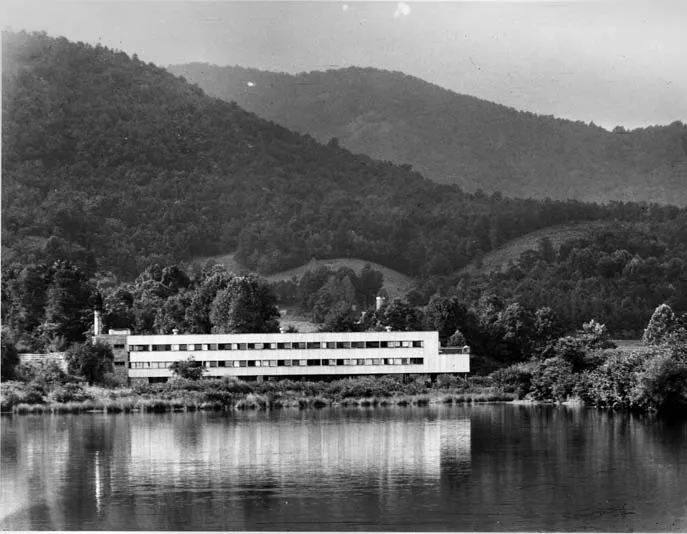
8 Black Mountain College was founded in western North Carolina on the grounds of a YMCA summer camp on the outskirts of a small mountain town by the same name, about twenty miles from Asheville (fig. I.1). In the aftermath of a faculty governance dispute at Rollins College, Florida, nine fired faculty members, including Black Mountain’s first rector, John Andrew Rice, had gone before an American Association of University Professors mediation panel that vindicated them but ultimately could not reinstate them. Soon after, the discharged professors and a contingent of sympathetic staff decided to establish an educational institution that would avoid the pitfalls of autocratic chancellors and trustees and allow for a more flexible curriculum, thereby resolving the key issues in their clash with the Rollins administration. Black Mountain College was established immediately afterward in 1933, with the holistic aim ‘‘to educate a student as a person and as a citizen.’’1 Inspired by the work of introduction philosopher John Dewey (who soon joined the College’s advisory board), its pedagogy emphasized arts training, and its founders hoped to loosen or altogether abolish the types of separations between student and faculty, and faculty and administration, that usually served to specialize roles and bolster hierarchical distinctions.2 With minimal structure, born of both ideological inclination and economic necessity, Black Mountain’s experiment in education was groundbreaking, though relatively brief. In 1957, when the College closed its doors, it had dwindled to less than a half a dozen paying students, with a little over a thousand students having attended since its inception.
10 Despite its short life and modest size, Black Mountain assumes a prominent place in the genealogies of widely disparate fields of thought. It has been heralded as one of the influential points of contact for European exiles emigrating from Nazi Germany; as a standard-bearer of the legacy of intentional (or planned) communities such as Brook Farm in Massachusetts; as the bellwether campus of Southern racial integration; as an important testing ground for proponents of progressive education; and, as this book takes up, as a seminal site of postwar art practices in the United States.3 Adding to the College’s legend, the number of famous participants—in addition to Albers, Cage, and Fuller, faculty included Albers’s wife Anni, Merce Cunningham, Clement Greenberg, Franz Kline, Willem de Kooning, Robert Motherwell, and Ben Shahn; among the students were Ray Johnson, Kenneth Noland, Robert Rauschenberg, Dorothea Rockburne, Kenneth Snelson, and Cy Twombly—and the breadth of their artistic diversity have garnered it an impressive reputation, if an uneven historical treatment.
11 Among the many stories that could be told of Black Mountain College, this book follows the thread of a single concept: experimentation. It can be traced in the spirit of radical innovation at the core of the College’s educational philosophy; for example, in a 1938 campus bulletin, weaving professor Anni Albers implored her students and other artists to employ ‘‘free experimentation …and leave the safe ground of accepted conventions.’’4 She wasn’t alone in espousing the rhetoric of experimentation; it is one of the terms most frequently applied to the College.5 As with other repeatedly used concepts at Black Mountain such as ‘‘community,’’ ‘‘experience,’’ ‘‘innovation,’’ or ‘‘freedom,’’ ‘‘experiment’’ was and continues to be treated as a generically positive attribute, at once a broad endorsement of the College’s progressive history as well as an encapsulation of its specific history and merits.6 Whether in the context of education, community, or visual art and music, many aspirations became attached to experimental practices: collaboration and interdisciplinarity, countercultural ambitions, artistic avant-gardism, cultural improvement, and political progressiveness.1 Experimentation was in fact a complicated and contested concept defined by Black Mountain college Between chance and design projects as varied as geometric abstraction, serialized and mass production, dome architecture, chance-based musical composition, and explorations of monochromatic painting. Yet a broad notion of experimentation in effect became a kind of glue binding the often-fragmented interdisciplinary discussions about the College. At the time the idea was used to rethink underlying assumptions that separated various disciplines into realms of discrete specialization. Prior interdisciplinary modernist explorations such as those practiced at the Bauhaus were revisited and expanded at Black Mountain: art merged with concerns of visual perception and environmental design; music composition flirted with arbitrary sounds and background noise; architecture and shelter design were pushed to redefine the conditions under which individuals, increasingly understood as members of wider communities, experienced space. Experimentation thus provided a shared terminology for College members to view their specific endeavors in relation to different though allied efforts in other disciplines. At Black Mountain, experimentation was professed to be a practice that could be shared by all creative producers.
13 The frequent invocation of ‘‘the experiment’’ by key Black Mountain figures cannot disguise the fact that the concept to which they appealed was, and remains, deeply contradictory. In large part, the contradiction reflects the compound meanings of the word experiment, and the historically shifting relation between concepts such as innovation and tradition, or originality and routine. Experiment shares with empirical and experience a common root in the Latin experiri, ‘‘to try or to put to the test.’’ Until the eighteenth century, experience and experiment were interchangeable in English usage, though subsequently experience came to indicate that which has been previously tested, a past accumulation of knowledge or skill—‘‘lessons as against innovation or experiments,’’ in the words of Raymond Williams.8 Yet experience continued to carry a second nuance, that of a full and active consciousness or awareness that may allow the experimenting with, testing, or trying of something. The complexity in the definition of experience as either the past (tradition) or that which is freshly carried out (innovation) had the effect of splitting the meaning of experiment into two definitions: ‘‘testing under controlled circumstances, ’’ as distinct from ‘‘innovative acts or procedures’’ more generally. Although experimentation is sometimes associated with systematic procedures such as the scientific method, which imply previously formulated hypotheses under test, the term is also invoked (both in art and in science) in trials of new or different experience in which results are not forecast beforehand. At Black Mountain, debates about the degree of freedom or control inherent or permitted in practices considered experimental, and not merely chaotic or improvisational, turned on this ambiguity.
14 Focusing on the rival methodologies of experimental forms as elaborated and practiced by key teachers Albers, Cage, and Fuller is not to say they were the only Black Mountain faculty that appealed to experimentation, but study of their work will help excavate three of the most clearly articulated positions of the period. For Albers, an experiment ‘‘embrace[d] all means opposing disorder and accident.’’9 It represented a careful procedure of testing socially and historically constructed perceptual understandings in art against deceptive optical stimuli. To Cage, experimentation exceeded patterns of reasoning so as to unleash greater indeterminacy. As he stated, ‘‘The word ‘experimental’ is apt, providing it is understood not as descriptive of an act to be later judged in terms of success or failure, but simply as an act the outcome of which is unknown.’’10 To Fuller, experimentation was the nearly opposite procedure of aligning specific failures of a method with the regularities of his holistically conceived system of ‘‘total thinking,’’ a teleological process of discovering empirical truths.11 Experimental procedures were those by which the ‘‘valid data’’ of ‘‘what is really going on in nature’’ could be formulated conceptually and tested by artists or other ‘‘comprehensive designers,’’ thereby exposing the conventionalized knowledge claims or ‘‘myths’’ of an overspecialized society that inefficiently managed its resources.12 Each of these men laid claim to a practice of experimental production stressing innovation without personal expression, and their rigorous procedures of testing—through both methods of chance and investigations of order and design—resulted in thorough redefinitions of what art could be.
15 If one considers the College in terms of its geographical locale, two of the most unlikely Black Mountaineers were Josef and Anni Albers. Exiles from Nazi Germany, both had been on the faculty at the Bauhaus, a school whose radical pedagogy encouraged new considerations of the function of art with respect to industrial production and modern society.13 As it turned out, the Bauhaus—closed in 1933—and Black Mountain—opened that same year—shared many characteristics as progressive educational institutions and as zones of experimental art practice. Upon his arrival in Black Mountain, Albers famously declared, ‘‘I want to open eyes.’’14 His pronouncement indicated a desire to create an audience—for his art, and for practices of abstraction more generally—that would be educated by the new perceptual strategies he was advancing. In the drawing, color, and design courses he taught at the College (from 1933 until his departure in 1949), Albers proposed an ordered and disciplined testing of the various qualities and appearances of readily available materials such as construction paper and household paint samples. His approach emphasized the correlation between formal arrangement and underlying structure, and placed a high value on economy of labor and resources. But understanding the material and appearance of form was part of a broader project; to him, art was the experimental arm of culture, an investigation of the better forms that precondition advanced cultural production and progress. He encouraged a reflexive relation between art production and a better society; as he stated, ‘‘For me studying art is to be on an ethical basis.’’2 Albers’s ethics of perception maintained that the arrangement of a work of art could mirror the way one organizes events outside what is traditionally called art, but only by testing received conventions with carefully controlled sets of visual and material experiments. Chapter 1 takes up how Albers stressed the experience, rather than any definite outcomes, of a laboratory-like educational environment, and promoted forms of experimentation and learning in action that could dynamically change routine habits of seeing.16 As he insisted, ‘‘Art is not an object but an experience’’—an experience in and of perception that facilitates complex understandings of the visual world.17 With his systematic exploration of subtle variations of form, he attempted to construct new techniques of pushing visual perception beyond habit. In this process of experimentation, he tried to influence patterns of transmission—transmissions of artistic tradition and of social pattern—by introducing the model of the perceptual test. The final section of chapter 1 traces Albers’s work on tests of the contingency of form by charting the epistemology of the concept of experiment he drew from, positioning it within College sympathizer John Dewey’s discussions about using experimentation as a test of the mutability of experience.18
17 The celebrated summer programs and institutes at the College supplemented regular faculty such as the Alberses with guests of tremendous energy and talent, often at very early stages of their careers.19 One of the most significant of these sessions occurred during the summer of 1948, attracting John Cage, Merce Cunningham, Elaine and Willem de Kooning, and Buckminster Fuller, among others. Frequently these summer sessions produced unexpected and enduring collaborations, though just as often participants shared a language of experiment to effect vastly different projects. In particular, the Albersian definition of experimentation as a test of tradition—as a training of the eye and mind to recognize illusions by meticulously testing socially and historically constructed perceptual understandings—was being redefined by Cage as simply an act with unexpected results, without need for discursive or other interpretations.
18 Cage arrived at the College in 1948 as dance choreographer Cunningham’s accompanist. His interest in French musico-aesthetic models of disorder and disruption antagonized many of the College’s German émigrés, deeply invested as they were in the twelve-tone music of Arnold Schoenberg and the ordered architectonics of Bauhaus theater. Very schematically, the shift at Black Mountain from a model of experimentation as attention, order, and observation to 6 introduction dispersal, chance, and fragmentation can be understood as Cage’s introduction to the College of his varied sources: his growing interest in Zen Buddhism, Dada, and surrealism, and in particular his often-expressed attraction to the writings and works of Erik Satie, Marcel Duchamp, and Antonin Artaud. Incorporating ideas and actions that had previously been explored by these figures, Cage increasingly viewed experimentation as a terrain of chance procedures and indeterminate outcomes. In his time at the College, he devised techniques to test the relationship of natural forces to human intention, privileging the former over the latter in a way that, some argued, forestalled art’s potential to influence broader social practices.
19 Cage’s 1948 theatrical production at Black Mountain of Satie’s The Ruse of Medusa, characterized by absurd monologues and unrelated musical interludes, alerted him to the possibility of arbitrary relationships between actions within a performance. On his next extended visit to the College, in 1952, in a radical departure from existing traditions of performance at the College and elsewhere, he introduced overlapping activities and narrative fragmentation in the production of Theater Piece No. 1, also known as the first ‘‘happening.’’20 In this later work, Cage recruited faculty and students to perform short, timed scripts, resulting in many unrelated events scattered throughout the performance space that could not be apprehended simultaneously. To Cage, the event represented ‘‘the centricity within each event and its non-dependence on other events,’’ though he had in fact established strict time brackets and organized the event with particular temporal and locational guidelines.21 Cage’s employment of what I discuss as a ‘‘chance protocol’’ in Theater Piece No. 1, which involved particular parameters (duration, assignment of specific tasks to performers, or an agreed-upon use of certain tools or instruments) governing the execution of the work, represented an attempt to sever experimentalism from determining factors such as artistic intention or interpretive argumentation.
20 Chapter 2 addresses how Cage’s version of the experimental test—the formulation of the chance protocol—was, as he termed it, a ‘‘purpose to remove purposes.’’22 This directly contradicted Albers’s project of experimentation as a rigorous and rational testing of carefully controlled and evaluated outcomes. To Cage, experimentation ruptured patterns of reasoning in which testable conditions were hypothesized; procedures of close attention and observation such as those proposed by Albers were impediments that served to control results and impose a restrictive order of calculated effects. The history of the changing nature of experimentation at Black Mountain therefore hinges on a comparison of Cage’s efforts in exploring chance-derived scoring and events of indeterminate performance with the work at the College of European émigrés, who tended to share Albers’s approach to experimentation. A principal one of these émigrés was Xanti Schawinsky, previously a student and collaborator of Bauhaus theater master Oskar Schlemmer in the 1920s. The Schlemmer-Schawinsky tradition of experimentation brought to Black Mountain at Albers’s invitation emphasized ordered vision as a way to defamiliarize viewers in their habitual relation to space and its larger social context. Yet like Cage’s 1948--52 events at the College, it, too, represented a larger shift in which experimental theater commingled with what came to be known as performance art, in that both models probed non-narrative performance situations, employed experimental music, broke with strict theater in their use of spontaneous or unscripted events, and disrupted traditional spatial relationships of audience to stage.23
21 Buckminster Fuller, in contrast, was only obliquely interested in the conditional or accidental. His method of experimentation was oriented toward the acceptance of unforeseen tactical failures in the interest of long-term strategic goals.24 Experimentation was the process of aligning specific faults of a tested form with the regularity of a holistically conceived system, a system he termed ‘‘comprehensive’’ or ‘‘total’’ design. The goal of design, to Fuller, was to convert traditionally compensatory political thinking into what he termed ‘‘anticipating and laboratory experimenting.’’25 These experiments toward comprehensive knowledge—proposed and tested by Fuller and other nonspecialists—were ostensibly set forth for the greater good of society.26
22 This model of experimentation played out in the late 1940s through his research on the structural properties and social benefits of geodesics, defined as the arcs of great circles. Because they mirror the form of the earth itself, spheres were a main component in Fuller’s argument that he was discovering the universal laws of nature on ‘‘Spaceship Earth.’’27 His initial, unsuccessful attempt to assemble a geodesic dome took place during his first summer at Black Mountain in 1948. Then he became energized by College sculpture student Kenneth Snelson’s innovations in what Fuller termed ‘‘tensegrity’’—an engineering principle of discontinuous compression and continuous tension that reoriented Fuller from what he called ‘‘energetic geometry,’’ physical models of energy and tension seen in closely packed spheres, for example. The geodesic dome, eventually prototyped to employ tensegrity, became a touchstone for Fuller’s notion of holistic planning, an efficient ur-structure central to his reconsideration of postwar housing, transport, and communications as networked systems.
23 Yet the articulation of ‘‘total thinking,’’ culminating in the successful erection of a geodesic dome on campus in 1949, was perhaps not the lasting consequence of Fuller’s time at Black Mountain. It was his paradoxical stance of self-declared success in the face of apparent setback—his proposal of a model of experimentation that accommodated failure in the name of the larger holistic program—that proved Fuller’s greatest contribution to the College, particularly in its selective adoption by Cage. In Cage’s case, the acceptance of failure was enthusiastically embraced, and the programmatic element abandoned.
24 Chapter 3 addresses the implications of Fuller’s ‘‘total thinking’’ as a model of experimentation. Though the comprehensive designer was charged with thinking expansively about social problems, the wider, more inclusive breadth of society was not necessarily invited to participate in the design process. Fuller’s heady proposition of artist-scientists seeking truths beyond organized politics was a self-described ‘‘design revolution,’’ the parameters of which could be understood only years into the future.28 His utilitarian version of experiment as a test and proof of total systems found company with many postwar iterations of pattern and network theory emerging from the New Bauhaus in Chicago (later renamed the Institute of Design), where Fuller taught before Black Mountain. The middle part of this chapter, then, takes up Fuller’s relation to his Institute of Design colleagues László Moholy-Nagy and Gyorgy Kepes. Design for these men was not a product but a social process (a distant echo, to very different effects, of Albers’s ‘‘art is not an object but an experience’’); experiment proved that ‘‘structures are not things’’ but patterns.29 Design processes should reveal underlying, universal truths hidden in patterns and networks. The final portion of chapter 3 addresses how Fuller’s still-controversial version of experimentation presented a picture of total design—contingency, alternative platforms, and even human agency itself eliminated—in a world of self-sacrificing nonspecialists risking failure to improve unproductive habits in society. Whereas Cage and Albers argued over degrees of contingency, Fuller regarded experimentation as a process moving knowledge toward a comprehensive, technocratic global order.
25 These three models of experiment initiated at Black Mountain College—the methodical testing of the appearance and construction of form in the interest of designing new, though ever-contingent, visual experiences (Albers); the organization of aleatory (chance-generated) processes and the anarchical acceptance of indeterminacy (Cage); and ‘‘comprehensive, anticipatory design science’’ that tests traditional artistic and architectural forms, and embraces temporary failures, in order to teleologically progress toward a utopia of efficiently managed resources (Fuller)—represent incipient directions of postwar art practice and social praxis, elements of which would be sampled, if not wholly adopted, by Black Mountain students and subsequent practitioners.30
26 Despite their different proposals for experimental art practice—from explorations of contingency to schemes of total design—the cases presented here all attempted to establish experimentation in opposition to self-expression or immediacy. To explore this difference, consider the case of Charles Olson, Black Mountain’s final rector and its guiding influence in the 1950s. Expressionism at the College, embodied in visual art practices such as those of teachers de Kooning, Franz Kline, and Robert Motherwell, and paralleled in expressive literary modes such as those of poets Olson and Robert Creeley, counterposed (in ways that came to define the postwar artistic scene in the United States) the experimental models represented by Albers, Cage, and Fuller.
27 Olson advocated a quixotic form of rapid collaboration in the interest of immediacy, spontaneous production, and personal expression. His student at Black Mountain, poet Jonathan Williams, quotes him as saying—and one could imagine similar words spoken by de Kooning, Jackson Pollock, or any number of postwar expressionists—‘‘You’ve got to take hunches, you’ve got to jump and then see what [happens]—you’ve got to operate as though you knew it.’’31 Discussions at Black Mountain about the complicated nature and effects of experiment must be seen as themselves in dialogue with such counter-tendencies toward direct action and expression. Expressionists’ condensation of self with presence and immediacy was anathema to experimentalists’ methods. For Olson, the velocity of a creative process reflected the hope that the individual could become the prime agent for exploration of what he termed the ‘‘kinetics of experience …the kinetics of themselves as persons as well as of the stuff they have to work on, and by.’’32 In his 1950 essay ‘‘Projective Verse,’’ he praised composition born of spontaneity. Believing that impulsive invention presented an unmediated path to unconscious thought, he was reluctant to either premeditate or revise his work, and claimed that speed affected the direct transcription of the purer material of the unconscious. As he proclaimed: ‘‘It is spontaneous, this way …at all points (even, I should say, our management of daily reality as of the daily work) get on with it, keep moving, keep in speed, the nerves, their speed, the perceptions, theirs, the acts, the split second acts, the whole business, keep it moving as fast as you can, citizen.’’33 In proto-Beat fashion, spontaneity was a process of unveiling the essential expression of subjectivity; Olson was verifying the fidelity of the textual form to the ‘‘truth’’ of the unconscious. He and his cohort of expressionists at Black Mountain weren’t alone in trying to find a form of uncorrupted immediacy in the postwar moment. It is a testament to Albers, Cage, and Fuller that they attempted to generate models of experimental process through their work and pedagogy which, however conflicting, sidestepped the growing tendency to define the project of art as untrammeled, self-revelatory immediacy.
28 * * *
29 The chapters that follow are each aligned along axes of methodology and place. The discussion of place maps a trajectory of spatial and discursive moves from Europe to America—though sometimes from America to Europe—in particular, a cross-circulation of Bauhaus ideas and their stateside reception, as well as a consideration of the German audience for John Dewey’s theories.34 As the phrase ‘‘chance and design’’ in the book’s subtitle indicates, the line of methodological inquiry in this book charts a continuum of experimental practices from the chance-derived to the highly ordered, designed, and, in the case of Fuller, technophilic. Plotting the routes these different men traveled toward their respective visions of experimentation in postwar America results in a particular organizational logic to this project. Such an exploration is suited to a case-study basis for the chapters’ mostly monographic treatments of their subjects. In turn, the chapters relate to one another directly and interweave certain threads, though they are largely focused examinations of three disparate methodologies that characterized experimental practice at the College. Albers, Cage, and Fuller, though they returned to the concept repeatedly, were addressing radically different procedures when they invoked the matter of experimentation. For example, Cage can be seen as a wedge against Albers, moving his (Cage’s) explorations of indeterminacy as a process beyond human agency toward Fuller’s total design as a process beyond political means.
30 The coincidence that concepts and practices employing a notion of the experimental test took root at Black Mountain College, at the same early 1930s moment during which many European models of experimental social and aesthetic practice were being foreclosed upon by political persecution and the ensuing ‘‘call to order’’ of a return to artistic tradition, is also an implicit theme of this book. The Bauhaus project in particular—a utopian vision of aesthetic form integrated with society (art, architecture, design, and performance seen contextually and as part of modernist industry, transport, infrastructure, communication and media, housing, and education)—in its US reception fractured at times into a depoliticized notion of experimentation as mere interdisciplinary conversations. In recent years, art and architectural historians have been rethinking how form is taught to students and meaning is communicated in artworks, regrouping after years of cultural relativism in which criteria for evaluating projects of modernist innovation were deeply shaken. Above all, the Bauhaus was a program, or at least a series of competing programs, that offered students training in the observation of form and its creative rearticulation. It presented students with a persuasive sense of order and design as a means to think about the social stakes of form in a collaborative, interdisciplinary fashion and to rework outmoded, routinized production that led to repetition and stagnation. The minimization of explicit links between aesthetics and social praxis at Black Mountain, in contrast, left the College open to criticisms of its being a communitarian venture of artistic practitioners living a kind of enlightened Black Mountain college Between chance and design social experiment of interdisciplinary affinities as social progress, divorced from earlier avant-gardes’ aspirations to link developments in aesthetic form to wider, socially transformative ramifications.35 The specific post-wartime context of Black Mountain College’s most propitious, creative years also has manifold implications for the rhetoric and practices of experimentation nurtured there. Not only did the College benefit from a bevy of talented veterans who brought generous GI Bill funding—students Kenneth Noland, Robert Rauschenberg, and Kenneth Snelson among many others took advantage of the US government’s few-strings-attached cash payments for tuition and living expenses to attend the unaccredited, art-focused Black Mountain—but the widespread association in postwar society between experimentation and cultural value, following the immense technological advances of the war-driven economy, no doubt influenced the frequency of the term’s invocations on the campus. In this light it is easy to see the invitation to Buckminster Fuller to head the College upon the Alberses’ departure as endorsing his sense of the horizon of experimentation as opening onto questions of scientific truth and advancement.
31 If we can think of the experimental test in its postwar context through a range of meanings, from planned hypothesis to trials of experience more generally, it is indeed a productive term. While this expanded definition of experiment was being rethought at the College as a model of artistic practice that connected activities occurring in various disciplines, testing was simultaneously invoked as a technique to link practices to one another historically. Distinct methods of experimental practice along the continuum of chance and design must also be understood as not simply a triangulated configuration (Albers and Cage, Cage and Fuller, Albers and Fuller). Instead, the work of each figure must be positioned, as they are in this book, in relation to prior and contemporaneous explorations of experimentation they connected to their respective disciplinary practices. Cage’s attraction to chance is appreciated only when his seemingly eclectic interests in Zen, Dada, and Antonin Artaud are linked to his developing notion of ‘‘void’’ spaces and experiences in performance; Fuller’s technocratic design can be best elaborated by probing network and pattern theories developed at the New Bauhaus in Chicago by Moholy-Nagy and Kepes; and Albers’s version of contingent design can be clarified when seen as a part of a broad conversation of geometric abstraction with Bauhaus concerns of visual apperception, Viennese logical positivism, and Theodor Adorno’s contemporaneous theorization of experimentation. Each figure at Black Mountain defined, in his own practice, a particular, historically grounded method of experiment, and then attempted to chart its effects on his audience. Experiment as a single, unified practice never existed at Black Mountain, but Albers, Cage, and Fuller introduction shared aspirations about testing new visual, theatrical, and structural forms and measuring their effects, however different the specific means that characterized their practices.
32 The analysis that follows thus posits a close interrelationship of experimentation and politics, suggesting that working ‘‘experimentally’’ in a cultural practice (in these cases, art, architecture, and music) casts a shadow venture, a project of posing models of how to test and organize new forms of political agency and social life, though sometimes in microcosmic fashion. For Albers, the ‘‘ethics’’ of a careful, trained visual attention to the world of form often substituted pedagogy and personal growth for forms of collective politics or social transformation. For Cage, indeterminacy in musical composition mirrored his idea of a fundamentally uncontrollable and anarchic world, though he created meticulous chance-protocol structures to eliminate personal bias and the crust of habit. And finally, for Fuller, total design in architectural form extended toward types of efficient technocratic social and political organization that, at times, shaded into forms of libertarian utilitarianism. Yet the attribution of a common experimental basis to their works and inventions, and their reinterpretations of tradition, bring to the fore a common impulse to change present and control future conditions. Experiment as a testing of the past or as a moving toward unforeseen experiences was nevertheless a quest for new, more adequate, and politically progressive and inclusive understandings of the world. One would not experiment if the current state of affairs—the status quo—was perceived as satisfactory. This extension of the project of artistic experiment to a redefinition of life conditions was of course as fraught as those preceding it in earlier moments of twentieth-century modernism.
33 The works of these three major teachers at Black Mountain College exemplify methods of experimentation that cannot, nor could they ever, harmonize, given their imperative to define, determine, and delimit quite differentiated life conditions beyond cultural practice. Each chapter of this book accounts for how these practitioners articulated distinct and nuanced procedures of experimentation; yet sometimes so great were the dissimilarities that they united merely in their mutual hostility toward expressionism and the subjectivization of creativity in its productive process as well as in its reception. In the case of figures such as Cage and Fuller, who were at Black Mountain intensely and briefly in the late 1940s and early 1950s, their elaborations of experimentation should be seen contextually in the traditions they displaced at the College (Bauhaus theater, in the case of Cage), or in practices that represented alternative genealogies of the Bauhaus theory so central to the College’s educational mission (the Institute of Design, in the example of Fuller).
34 Ultimately, this book analyzes perhaps the crucial mid-century modernist practice—experimentation—that has not been studied in depth elsewhere, though the concept was explored to a nearly unparalleled degree at Black Mountain during these years. The legacy of Black Mountain College is precisely bound up with these figures’ contradictory visions of modernism as inextricably interwoven with the logic of experimentation—the interest in testing as an exploration of a paradoxical ‘‘fact of contingency,’’ to use Louis Althusser’s phrase.36 This book investigates what chance, design, and the unforeseen mean when a fertile and disputed term like experimentation is the site of discursive struggles as well as historic collaborations. It should be clear that the Black Mountain idea of experimentation, when treated critically and differentially rather than descriptively, elucidates a crucial conflict surrounding American artistic purpose in the late 1940s. In proposing experiment as a model for understanding art practices at Black Mountain College, a clearer understanding can emerge of the College’s role in generating new methods and objects of artistic production, and also innovative critiques about the constitution and uses of form in its time, to develop working means to affect those critiques. Black Mountain participants’ ambitions to transform habits of perception, systems of intention, and patterns of tradition have essential implications for understanding not only modernist but subsequent art practices.