
3 R. Buckminster Fuller’s Design Revolution
23You succeed when you stop failing.
4R. Buckminster Fuller, 1948
5By the late 1940s, Josef Albers’s version of experimentation, which had come to define Black Mountain College’s pedagogy in its first two decades, was beginning to be overshadowed by new and sometimes contradictory proposals. The Alberses’ departure in 1949 left something of a vacuum that gave those alternatives traction and urgency.2 As the previous chapter explored, John Cage’s visits in 1948 through 1953 introduced a ‘‘chance protocol’’ in which experimentation was redefined as unleashing outcomes that were not previously foreseen, thereby supplanting Albers’s model of testing attention through serial variation. Simultaneously, another, third proposition about the important stakes of experimentation was being hatched by Buckminster Fuller (known familiarly at Black Mountain and beyond as ‘‘Bucky’’). His model of the test leveraged the creativity of the artist and the technological innovativeness of the scientist to completely rethink acts and objects of design. The test was not a means to reconfigure visual perception as much as a process of entirely re-envisioning (in all, including transcendental, senses of the word) postwar technocratic society.
6 Fuller’s formulation of experimentation as ‘‘comprehensive design’’ was introduced and subsequently sharpened at Black Mountain College—in fact, he first penned the phrase as the title of the course he taught there in 1948.3 His model, which involved experimentally questioning received ideas about artistic and architectural form, constituted a persuasive argument against specialization that at least superficially aligned with the College’s Bauhaus-derived notion of visual art understood contextually to its surrounding environment by way of collaborations with shoulder disciplines such as theater, architecture and shelter design, and graphic and product design. In Fuller’s case, however, interdisciplinarity was tied even more tightly to utilitarian social and political ends. For him, comprehensiveness was a process of moving design toward specific, functional goals. Experimentation tested existing, inefficient forms to arrive at a more complete picture of true, universal knowledge, and was far from being a practice of elaborating the greater contingency of perception (such as in the Albersian proposition that everything in the world has form, the appearance and structure of which can be unendingly tested in variation).
8 In this claim, Fuller joined Cage in further clouding the waters of Albers’s pedagogical project at Black Mountain, a project that only very subtly moved from the artist’s role in testing form to larger social ends (and those always described as an enrichment of a viewer’s perceptual awareness). In a most contradictory fashion, the chance-protocol model of experimentation articulated by Cage united with Fuller’s proposition of ‘‘total thinking’’ (the title of an essay he wrote while at the College) to shape powerful arguments against the Albersian model.4 Cage’s explorations of indeterminacy as a process to override or exceed human agency formed an unlikely partnership with Fuller’s arguments about comprehensive design as an end beyond political means.5 Fuller’s vision of total design aimed to eventually eliminate contingency entirely, paradoxically by producing situations that embraced short-term failures—failures that looked like Cage’s chaotic-seeming chance protocols—as proof of the farsightedness of his comprehensive, utopian vision.
9 This chapter addresses Fuller’s work and writings of the 1940s and 1950s when he was elaborating his idea of experimentation as a technophilic and teleological form of design. Analysis of his methodology of experimenting, a method honed in the two halcyon and productive summers he taught at Black Mountain College while beginning to engineer plans for large-scale geodesic domes, will elucidate how an acceptance of passing failures in the interest of a deductive model of total design formed a potent argument against the vulnerability of experimental testing to micro-specialization. Indeed, Fuller proclaimed that tests toward efficient design could prevent sociopolitical stagnation; according to him, he was ‘‘solving problems by design competence instead of by political reform.’’6 His version of an experiment as a test and proof of total systems found company with many postwar iterations of pattern, network, and systems theories emerging from the Institute of Design (ID) in Chicago, where he taught after his first summer at Black Mountain (and, somewhat more obliquely, with cybernetics theories of corrective feedback coming out of MIT in Cambridge).7
10 The middle portion of this chapter takes up Fuller’s relation to his ID colleagues László Moholy-Nagy and Gyorgy Kepes. Design for these men was not a product but a social process; experimentation proved that ‘‘structures are not things’’ but patterns.8 As architect Lindy Roy claims of Fuller’s methodology, ‘‘Form can no longer, even in design disciplines, be said to be a thing but at the very least a set of variable relations held in dynamic equilibrium.’’9 Specifically, Fuller proposed that a radical and equitable redistribution of global resources (including natural and existing technological resources used to house, feed, move, and clothe the world’s population) could be accomplished through an empirical study of dynamic patterns of consumption. Design processes could uncover underlying, universal truths hidden in patterns and networks, but only by emphasizing the structural constitution of form, not its surface appearance. As it will become clear, Fuller claimed his emphasis on structural engineering separated him from Bauhaus precedents, yet the importance of thinking design as process and action, not as a single object, remained the shared concern of all the models of experimentation emerging from Black Mountain College.
11 The final section of this chapter addresses the role of political agency in Fuller’s proposal of experimentation as ‘‘comprehensive design.’’ To Fuller, the universal application of comprehensive design—the study and design of the total human environment, including shelter, infrastructure, communication, transport, and other networked systems—could efficiently allocate the sufficient resources of the planet, ‘‘Spaceship Earth.’’ In his scheme, as design substitutes for politics, so, too, would personal consumption replace production. The design and implementation of efficient technologies, in a teleological model, posited a technocratic utopia of postpolitical, postscarcity, postlabor subjects as its horizon of postwar potentialities. To some, that seemed like tomorrow’s totalitarian postagency package wrapped in the mantle of today’s experimental verification, and Fuller’s complicated perspective on political action was frequently remarked on by others—somewhat jokingly by architectural critic Reyner Banham, and more sharply, as we will see, by art historian Meyer Schapiro.
12 Yet Fuller’s call, for example, for portable and nomadic structures responsive to users’ needs, or for the participation of wider groups, including college students, in design decisions, always implied that holistic theses subject to experimental verification would be pressured by contentious and possibly incompatible desires. In attempting to tease clarity from the bundle of contradictions in Fuller’s model of total design, it is immediately apparent how radically he politicized experimentation by claiming it as a palliative to, or substitution for, electoral politics. Further sets of concerns are at stake here, too: the relationship between architecture and art, permanence and innovation; between originality and repetition, control and freedom, chance and design, collectivity and singularity; between modernism’s symbols of progress and its perceived symptoms of decay. (In discussing these contradictions, these paired relationships, let us not understand them as antinomies, binaries, or oppositions. Each term can and should be seen through the lens of its couple, as a dynamic, mutually informing relationship, as part of a dialectic whose terms collaborate to produce a synthesis.)
13 The tension between total, ‘‘anti-entropic’’ design and consumer choice-as-agency therefore hinges on Fuller’s understanding of design as a dynamic process.10 Though he sought to purge design of contingency in a quest for empirically verifiable facts, he recognized that experimental processes were rich with unexpected results in their short-term scenarios. Likewise, it is crucial to acknowledge how Fuller’s proposal of experimentation recognized subjects’ potential agency as too frequently limited by inefficient design and economic necessities—and how enthusiastically his alternative of activating design’s social responsibility was received, at Black Mountain College and beyond.
3.1 The Invention of ‘‘Total Thinking’’
14When Albers invited Fuller to teach at the College in the summer of 1948, the architect was beginning initial research on geodesic geometries (defined as the arcs of great circles), and he came to Black Mountain with a plan to test a prototypical large-scale dome constructed from such forms. By the time he returned to the campus in 1949 and successfully erected a freestanding geodesic structure, he was arguing his project of dome assembly as essential and essentially utopian: the dome was an articulation of ‘‘comprehensive, anticipatory design science’’ that tests traditional artistic and architectural forms (square, heavy, fixed buildings) in order to teleologically progress toward a utopia of efficiently managed resources (lightweight, portable domes that, like the earth, are spherical and therefore inherently more ‘‘natural,’’ according to what he later termed the ‘‘cosmic evolution’’ of form).11 Ever indefatigable, throughout 1948 and 1949 Fuller wrote eager letters about geodesic engineering to advertising agencies and press associates, proselytized to students in long lectures repurposed as even longer position papers, and sent peppy memos and production plans to various branches of the military and to contacts in the private building trades.
15 With a euphoric conviction that his latest research in geodesics represented an important and quite possibly definitive fix to the world’s ills, by the 1950s Fuller was tirelessly advocating the adoption of the geodesic dome as the state-of-the-art shelter solution for the postwar consumer, as well as championing its use as a structure revolutionizing commercial and military construction. The proposal of the dome as a universally applicable form is thus chronologically and philosophically coincident with his developing argument about experimentation as the tireless prototyping of holistic design solutions in order to overturn conventional, inefficient habits of specialization and inequitable resource allocation. To understand how radically Fuller’s concept of ‘‘the experiment’’ developed and transformed in his time at Black Mountain, and how substantially he, in turn, altered the rhetoric of experimentation at the College, it is helpful to contextualize these shifts. To grasp how Fuller arrived at the geodesic engineering his 1948--49 dome assemblies employed, it is necessary to understand his prior inventions: their effects in the period leading up to the Black Mountain domes, and their continuities and dissimilarities with the work he was doing in shelter design by the mid-1940s.
16 In the decades before coming to Black Mountain, Fuller had embarked on numerous ventures pitched as radical remedies to key problems in housing, automotive engineering, aeronautics, and cartography. Together, this body of inventions he termed ‘‘Dymaxion’’ constructions, in which portable, mass-produced goods and shelters efficiently delivered ‘‘the maximum gain of advantage from the minimal energy output.’’12 Throughout the 1930s and 1940s, Fuller produced a variety of prototypical cars, houses, maps, and even bathrooms. Based on his initial 1927 ‘‘4-D House,’’ to which a Marshall Field’s advertising man had lent the ‘‘Dymaxion’’ moniker (a neologism derived from Fuller’s predilection for the words dynamic, maximum, and tension), the Dymaxion constructions emphasized the efficient deployment of resources through mass production. Encouraging portability, they used the weight and cost of the completed structures as central design criteria.
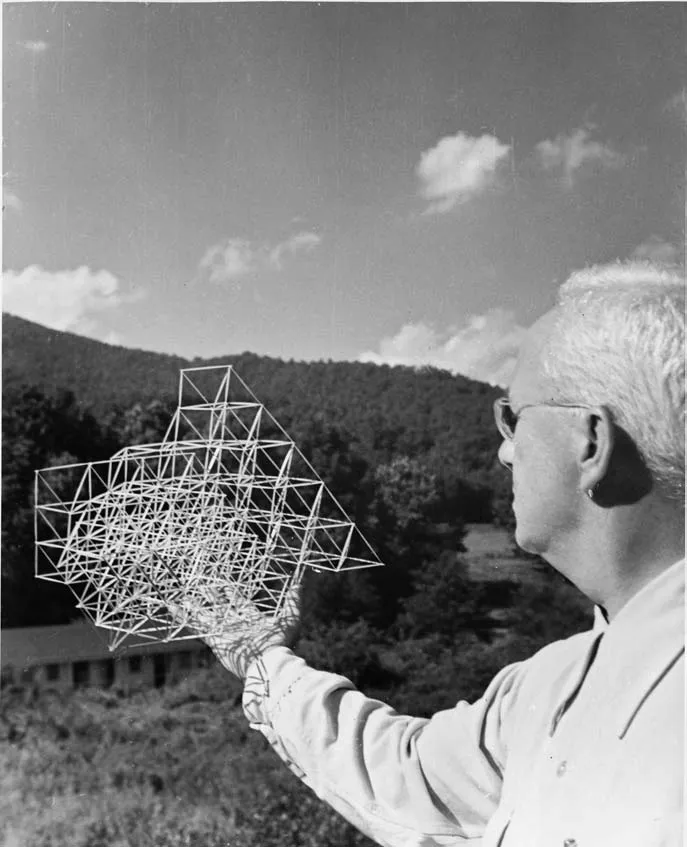
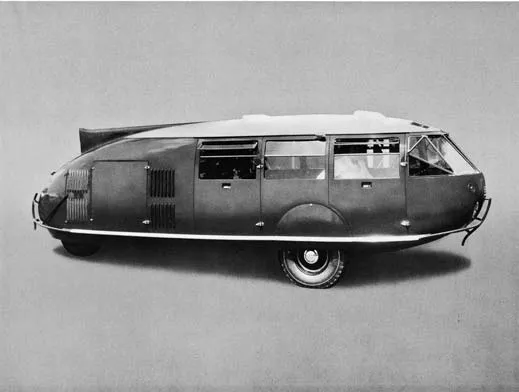
17 The Dymaxion designs innovated in a variety of ways. The original 4-D House, a circular structure with a flexibly arranged internal wall scheme organized around a central supporting ‘‘mast’’ rather than load-bearing walls, weighed one hundred times less than conventional structures of similar scale, and in today’s pricing could be purchased for approximately forty thousand dollars.13 The 1932--33 Dymaxion Car adopted the streamlined appearance of airplane design with unique three-wheel engineering14 (fig. 3.2). Prototypes reportedly reached speeds of 120 miles per hour, and the large twenty-foot-long body comfortably seated eleven passengers.15 Fuller’s 1944--46 Wichita House, sometimes called the Fuller House, finessed the mast support of the 4-D House with a new skin. Designed in collaboration with a Beech Aircraft engineering team, it featured a curved, sheet-metal aluminum exterior with continuous 360-degree windows encasing its radial plan, and was promoted as an easily transported, quick-assembly, affordable suburban home. In 1944, Fuller patented a low-distortion projection of the earth and called it—what else?—the Dymaxion Map. A two-dimensional plan, the map folded into various orientations and assembled into a three-dimensional, globe-like shape. When viewed as a flat projection, the map could be organized according to various strategic schemes—with all landmasses grouped together, for example, or the seas oriented in one broad oceanic route (plate 14). Soon after he developed the projection, Fuller was touting it as a template for networked information display: it permitted a global comparison of shifting economic and social data on energy use and natural resource management, and it could be used to chart, for example, the unequal consumption of raw resources in industrialized versus underdeveloped nations16 (plates 15--16).
19 Despite his reputation as a prolific inventor, however, Fuller was hardly the top candidate for the position of architecture instructor at Black Mountain’s 1948 summer session—the faculty had run through a list of several nominees too booked to attend, and he was a last-minute substitution for Harvard architect Bertrand Goldberg, a former Bauhaus student. His unflagging self-promotion aside, Fuller didn’t have the greatest track record in 1948. Several criticisms were dogging him by the late 1940s, raising a chorus of dissent he attempted to outshout with the tenacity of a carnival barker. Once featured in influential and popular-culture magazines such as Fortune, Time, and the Saturday Evening Post, his inventions tended to languish soon after the prototype development stage.17 Advance publicity for the Wichita House generated numerous serious buyers—from among approximately thirty thousand inquiries—throughout the mid-1940s, yet production had stalled as Fuller struggled with his backers at Beech. (In fact, his Black Mountain invitation had followed closely on the heels of a spring 1948 article in Fortune revealing the collapse of his plans to mass-produce the Wichita House design. Coincidentally, some years earlier a College faculty member had proposed purchasing one for the campus.)18 The Dymaxion Map was intended as an educational distribution for elementary school students, but the project foundered when costs proved prohibitive for mass distribution. A fatal accident involving the Dymaxion Car at the 1933 Chicago World’s Fair led automotive engineers to note that the car’s emulation of aeronautic airstream capabilities encouraged dangerous drift on city roads. Fuller’s projects all seemed so speculative, unrealizable, or downright dangerous that by 1948 a profile on him proposed for Science Illustrated generated the following internal queries: ‘‘Can you include in the piece some of the reasons why Fuller’s plans and projects have failed. …Shouldn’t there be some mention of the fact that Fuller never seems to carry things through? Doesn’t look as though he ever will. Why?’’19 Grumblings of increasing frequency and intensity were voiced about Fuller’s inability to shepherd a project beyond the realm of conjecture, thereby undermining his claims to efficiency through the mass production and distribution of his inventions.20
20 Fuller had long faced criticisms about the wider applicability of his designs, and his rhetoric of experimentation as an acceptance of failure was also ambivalently received. To critics, flaws in his inventions were exacerbated by his cultivation of a self-consciously prophetic breadth of thought, which permitted him to deflect specific criticisms of his projects by attacking his skeptics’ narrow vision. To Fuller, because his projects were ‘‘evolutionary,’’ they could be adequately realized only years or decades after his initial insights, an assertion that some found convenient, if not downright proleptic. Equally alienating to others was Fuller’s style of argumentation—self-aggrandizing and portentous statements written with an autodidact’s proclivity toward showcasing largely irrelevant information, evidenced in his epic lectures and notoriously lengthy digressions. Willfully falling between the two chairs of visionary design and practical execution, engineers found Fuller’s proselytizing unserious, quaint, or fantastical, and dismissed his (frequently patented) schemes to mass-produce his inventions as being as difficult to implement as those of any backyard tinkerer.21
21 In Fuller’s mind, his work demonstrated a form of predictive holistic thinking that by its very nature confounded specialists. As a result, his discoveries were subject to especially jealous and vehement critique, or so he alleged. When his 1927 plan for airlifted ‘‘4D Towers’’ high-rises was ridiculed as utterly unworkable and consigned by critics to the realm of science fiction, Fuller waved off disparagements of himself as a ‘‘radical’’ as quibbles from an establishment fearful of visionary design. He declaimed that critics beholden to the familiar would be refuted by the ‘‘highest order’’ of his ‘‘instrumental science’’:
2223The blinders of habit persuaded man to accept the ignorant ‘‘reality.’’ …‘‘Fixed’’ brains will apprehend as ‘‘radical and revolutionary’’ every discovery.22
24 It would be no understatement to say that Fuller thrived on criticism, using it to fashion a myth of himself as the world’s most forward-looking innovator. The malfunction of his inventions, both practically and according to their potential for mass distribution, to him paradoxically demonstrated the prescience of their design. It was up to someone else to make them workable and to accomplish global implementation. His vision was too prophetic for immediate gains, his productivity too great to bother with final production. To Fuller, failures were incidental given the scope and force of his greater program. By embracing failure, and positioning it as a defining characteristic of his practice, he cloaked himself with a Teflon-like invulnerability to his critics’ dismissals.
25 However, Fuller’s embrace of the sleek styling of airliners did foster a trend toward aerodynamic, cost-efficient automotive designs, and his notion of lightweight (and possibly airborne) portable housing was taken up as an alternative shelter design, at least initially by the US military. As he roamed through various disciplines, he blamed the turf battles and animosity his work engendered on wary specialists, who, corrupted by the narrow and incremental procedures of traditionally conceived science, rejected the foresight of his synthetic vision of shelter design as operating across the fields of art, design, urban and regional planning, structural engineering, and architecture. The totalizing vision of ‘‘anticipatory design science’’ as holistic and altruistic problem solving—an idea always contentiously received in architectural and planning communities—contributed to the tremendous receptiveness of students at Black Mountain and elsewhere to Fuller’s demand that they scale up design to the level of a social practice. To him, the strength of any design innovation was inextricably linked to its potential common applications in mass distribution.
26 Yet the efficiency, either functionally or in terms of consumer interest and widespread consumption, of Fuller’s Dymaxion designs was never tested in the crucible of mass production. Fuller brushed off criticisms about his inability to mass-produce Dymaxion products with a claim that his type of testing required prophetic design, which he could offer; marketing, promotion, and commercial distribution, though important, were secondary concerns. To him, experimentation was a form of ‘‘total thinking,’’ which he defined as ‘‘experimental strategies which embrace potentially powerful forecasting capabilities.’’23 Uncovering the universal principles of form could allow him to anticipate future problems and test provisional solutions; ultimately, his forecasting vision would always outpace implementation. In Fuller’s model, experimental procedures were those by which the ‘‘valid data’’ of ‘‘what is really going on in nature’’ could be formulated conceptually by artists (also known as ‘‘comprehensive designers’’), thereby making possible a higher standard of living for all people through effective resource management.24 In attempting to think comprehensively about society, Fuller advocated inferring future experiments from existing postulates: as he proclaimed, ‘‘the design grew out of the philosophy.’’25 Experimentation, to him, was the process of aligning specific failures of a method with the regularities of holistically conceived systems, a process not unlike a deductive application of the scientific method, in which a general hypothesis is offered and its merits then tested. In his model of experimentation, apparent complexities or impasses were subject to the skepticism of a holistic-thinking mind, with exposure of general underlying rules the result of the experimental protocol.26 Anticipatory design science, as he defined it, demanded that findings be ‘‘generated by experimental discovery of the natural laws involved.’’27
27 The comprehensive designer’s project of rendering technology less specialized and more efficiently and humanely distributed was one by which Fuller intended to bring ‘‘generalized principles into unique experimental control patterns.’’28 Design was the revelation of heretofore hidden global codes: ‘‘By ‘design’ I mean: conscious employment of experimentally discovered principles governing pattern modulation.’’29 To him, ‘‘design science’’ did this work of pattern recognition using a process of simplification ‘‘arrived at by separation of constituent factors of the problem …[so as] to deduce and classify the fundamental principles involved.’’30 Reducing situations to basic principles revealed underlying truths, shaping a positivist endeavor to think empirically about everything on earth. As Fuller noted, ‘‘The progress of knowledge has been essentially a matter of separating things out very carefully from a matrix of confusion and isolating these pure, simple facts.’’31 Simplifying, observing, and ordering the manifestations of a ‘‘problem’’ to discover underlying and universal patterns demonstrated that ‘‘science is the antithesis of chaos.’’32
28 Fuller’s conception of design envisioned that postwar technocratic society would enrich the role of the artist, while the artist-as-generalist could in turn benefit society. (And, as we will see later, an artist played a decisive role in the development of Fuller’s thinking at Black Mountain.) In 1927, he had an epiphany about the scope of this responsibility: as he described it, he ‘‘set about deliberately to be a comprehensivist in an era of almost exclusive trending and formal disciplining towards specialization,’’ and ‘‘gave up forever society’s general economic dictum that every individual who wants to survive must earn a living, substituting instead a search for the tasks that needed to be done that no one else was doing or attempting to do, which if accomplished, would physically and economically advantage society and eliminate pain.’’33 These were lofty ambitions to be sure, but executable by an elite cadre of comprehensive designers (after Fuller’s time at Black Mountain, they also came to be called ‘‘artist-scientists’’), ‘‘an emerging synthesis of artist, inventor, mechanic, objective economist, and evolutionary strategist.’’34 The important contribution of artistic practice toward this hybrid role would be to ‘‘formulate conceptually …all of the as-yet unknown or unproven’’ in preparation for a process of experimental verification.35
29 In a most idealizing fashion, the role of the ‘‘artist’’ represented the unfettered freedom to pursue broad-minded investigations of society against a culture of professionalization and specialization, and the example of artists’ labor was the privileged model of autonomy. As Fuller asserted,
3031The artist …is a predominantly non-frustrated individual holding vigorously to his innate freedoms of exploration, evaluation, self-expression, and …his appreciation of liberty of inquiry and initiative is precisely what we hold most valuable.36
32 The conception of artists’ ‘‘innate freedoms’’ and ‘‘liberty’’ as exterior to the power structures of the status quo rehearses one of Fuller’s common tendencies to see in design an uncorrupted ‘‘outside’’ to social processes, a place of dissent from which to attack and colonize the ‘‘center’’ and transform its moribund values. His heady proposition of artist-scientists seeking truths beyond organized politics was a self-described ‘‘design revolution,’’ the parameters of which could be understood only years into the future.37 A new hybrid role for creative producers—joining features of many professions for the greater good—would also necessarily involve a closer and more supervisory role for designers vis-à-vis capitalist production. In a 1949 letter to media magnate Henry Luce, Fuller explained that the ‘‘reinspiration of the individual’’ required that ‘‘artists …become the capital patrons of initial enterprise.’’38 If engineers and industrial designers became ‘‘artists’’ and initiates to creative production, according to Fuller, their creativity would in turn benefit society in economic terms: ‘‘The community looks to the artist for this function of upping its standards.’’39 His technocracy presented a picture of total design transacted in a world of self-sacrificing nonspecialists risking failure in order to improve unproductive habits in society. The artist’s license to think creatively could fuse with the competence of the engineer to revolutionize shelter design in particular—the traditional province of the architect that, to Fuller, was unfortunately too often merely ‘‘traditional architecture.’’ (In the early 1940s Fuller coined the term debunk, as one contemporary noted, in order to ‘‘point out the flaws in traditional architecture which his type of housing was intended to correct.’’)40
33 Fuller actively cultivated such a ‘‘debunker’’ persona, having dedicated the previous twenty years to separating himself from ‘‘the conventional way of doing things,’’ particularly with respect to how housing resources were traditionally allocated.41 His sense of the historic implications of the Black Mountain dome projects was likewise informed by his well-rehearsed renegade biography that emphasized his lifelong fascination with shelter as well as air-, land-, and sea-vessel design. Born to a well-situated and culturally active New England family, Fuller had little success as an undergraduate at Harvard University and quit to join the US Navy.42 Engaged in various capacities in the building trades (his wife’s family business) following World War I, he found himself disaffected by the conventions and inefficiencies of housing construction. He began to explore prefabricated housing options and briefly managed a corporation producing modular building materials. Various personal crises during the mid1920s, most notably the death of his eldest child and a layoff from his corporate directorship, galvanized Fuller to act on his dissatisfaction by setting forth an alternative to existing ideas about architecture, shelter, and design.
34 To Fuller, home design was the essential field for innovation; not only was it a basic and universal requirement, it demanded a high premium on scarce land, labor, and material resources. Taking as his example the aeronautic and maritime industries, he realized that structures on land had a tremendous implicit advantage that encumbered greater efficiency: an almost complete avoidance of the factors of mass and mobility. Both air and sea vessels were preeminently concerned with weight, for purposes of either buoyancy or lift. This factor separated more vulnerable constructions for flight and sailing from the fixed, overbuilt, and inefficient architecture on land. As Fuller lamented, ‘‘No architects even know what buildings weigh. …Buildings are being built as fortresses, historically, really, the heavier, bigger the better.’’43 His first proposal for lightweight shelter design, the 4-D House, anchored a cylindrical tower with a single enormous mast from which the walls and floors would be hung using high-tension wires rather than being supported from below. Suspending the shell permitted the enclosure of the structure in a series of innovative, easily adaptable, screen-like glass panels. Hence, understanding weight as a previously unacknowledged factor in building construction enabled greater flexibility in designing prototypes and experimenting with new designs. As Fuller noted, ‘‘You can’t make many experiments with big stone blocks, they’re going to kill you. So heavy that it’s really dangerous to experiment.’’44
35 Traditional construction compresses a great deal of a structure’s weight in load-bearing beams or walls requiring significant reinforcement to remain upright. Fuller’s successive Dymaxion houses in fact underscored this element by relying on a massive central post to support the structure’s cylindrical skin. In contrast, his explorations of geodesics in cartographic projections and schematic representations of the globe stimulated a shift in his research toward the smooth and continuous tension of spherical surfaces as opposed to the rigid stress points created by right angles in post-and-lintel structures.45 Because spheres emulate the form of the earth itself, to Fuller they epitomized the universal form of nature that was ‘‘Spaceship Earth.’’ Indeed, according to historian Mark Wigley, ‘‘reconfiguring the relationship between structure and image’’ motivated his topological plotting of the sphere-as-earth onto the facets of a polyhedron, a geometric solid composed of multiple plane faces: ‘‘Fuller’s spheres are always surrogate planets.’’46 In analyzing spherical forms, Fuller extracted the tetrahedron—a pyramid with four sides—as the fundamental element, the ur-form, from which one could then extrapolate the structural behavior of all spheres.
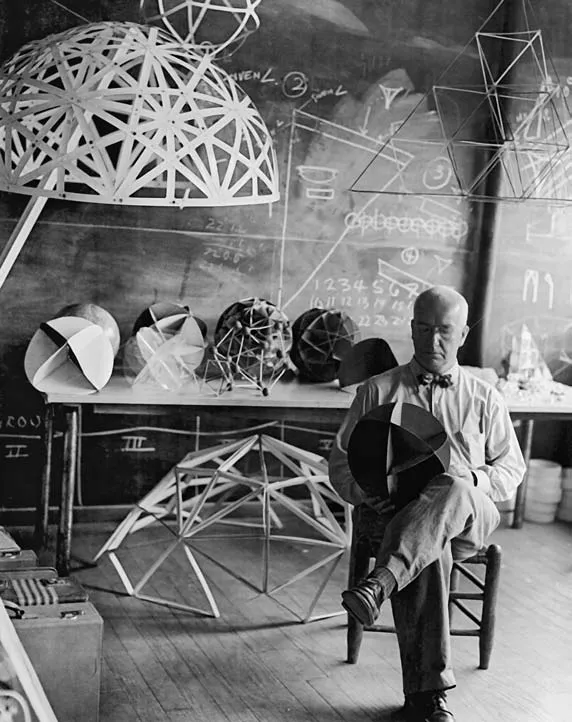
36 Though superficially different in appearance, tetrahedrons and spheres share certain characteristics: in regular tetrahedrons each joint of a triangular plane forms a point of contact upon which even pressure is exerted (by the edges of three planes converging to one point), thereby distributing weight in a dynamic and continuous manner as a sphere does. A series of regular and irregular tetrahedrons could be combined to constitute a near-spherical form, thereby distributing load through multiple points spaced throughout the structure. These innovations in geodesic construction Fuller termed ‘‘energetic geometry,’’ and he made several models in which combinations of polyhedrons were utilized to create circular hinged forms (fig. 3.3). Because the sum of the components performed better than the constituent parts (in terms of load distribution and overall strength), he termed this increased tensile and load-bearing capacity ‘‘synergetic.’’
37 Yet the methodology of experimentation Fuller termed comprehensive design—with its tests of synergetic and energetic geometries—was only beginning to be articulated as he accepted his first-ever teaching commission in the summer of 1948; the invitation to Black Mountain provided respite at a time when his career was beset by setbacks and criticism.47 Upon his arrival at the campus in June, in a three-wheeled Dymaxion motor home filled with energetic geometry models, his unfailing optimism and capacity for charming audiences by the sheer force of his ebullient personality won converts immediately.48 Faculty and students were invigorated by his impish enthusiasm, which he unleashed in marathon lectures on topics ranging from global resource management to industrialization by way of military innovation, with ‘‘our dear friend, the hypotenuse’’ among the asides he’d sneak in.49 Fuller had the sort of avuncular, mad scientist personality that nearly everyone on campus found endearing, and at Black Mountain he received his most enthusiastic reception to date—at least until he became a counter-cultural phenomenon at other colleges and universities by the early 1960s, and a veritable pop-science guru by the end of that decade. And after his time at the College, as we will see, education became a major prong of Fuller’s public self-definition, with pedagogy’s role in initiating the reorganization of social life a chief preoccupation of his extensive writings.50
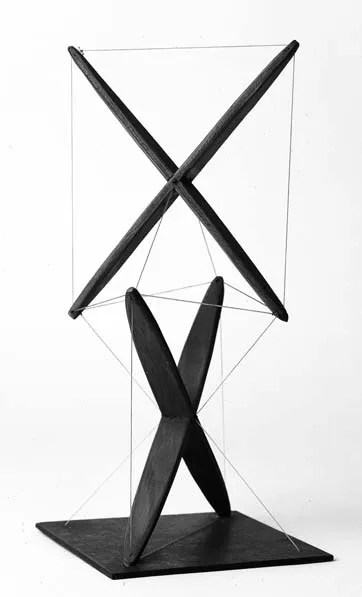
39 When he arrived at the campus in 1948, Fuller met sculpture student Kenneth Snelson, who became excited by the new instructor’s ideas. The next summer, in 1949, Snelson showed Fuller X-Piece, an approximately one-foot-tall column he had constructed of wood and plastic (fig. 3.4). In the work, two wooden cruciform shapes of equal size are perpendicularly oriented to each other, one above the other. They are supported by nylon wires connecting the center and the upper arms of both X forms, suspending the topmost wood form in midair while the lower form acts as a strut. Load is distributed through the wires’ high tension, rigging both figures to balance upright as thin wires boxing the exterior of the Xs keep the forms oriented at an exact right angle to each other. The top form is therefore held aloft by a wire support system mirroring that of the base, implying that further iterations could rise up out of the same system. The sculpture therefore disperses compressive forces, creating what Snelson termed a ‘‘floating compression,’’ an engineering principle of discontinuous compression and continuous tension that uses the mass of the structure to generate tension, which strengthens synergistically with the addition of further elements.
40 Snelson’s unique concept inspired Fuller, who saw in it a new and efficient engineering principle. He asked Snelson to build a modified version, to which he later assigned the name ‘‘tensegrity’’—short for tensional integrity, the way the work’s integrity (its structural stability) was maintained through a pervasive tensional force. Fuller declared that tensegrity would eventually transform the building industry; for example, it would allow towers to rise to great heights without external buttresses, deep anchors, or foundations. Separately, each man patented his version of the tensegrity principle.
42 Fuller and Snelson’s developments in tensegrity can be seen as a response to Fuller’s plan to construct a large-scale, twenty-two-foot-high geodesic dome at the College (figs. 3.5, 3.6). One damp morning, after an extensive series of (pre--computer era) calculations, dozens of cheap, flexible, commercially available Venetian-blind slats were assembled as the dome’s armature. Not surprisingly, the dome failed to rise, and was good-naturedly named the Supine Dome51 (fig. 3.7). According to Fuller, though he was aware that the slats needed to be doubled up in order to have sufficient strength and tensile capability to elevate the dome, he decided to push ahead with insufficient materials so as to demonstrate that structures could be gradually built up to the point of standing, thereby creating materially and economically efficient buildings. Lightness was a prime feature of the dome’s design; as he stated, ‘‘I want to build a building that they’re not afraid of having it collapse because it’s so light it can’t hurt anybody, it’s like confetti …[you] stop having it fall down …[to] make it stand up. …So you start with this supine thing, and then keep fortifying until now …it’s standing up.’’52
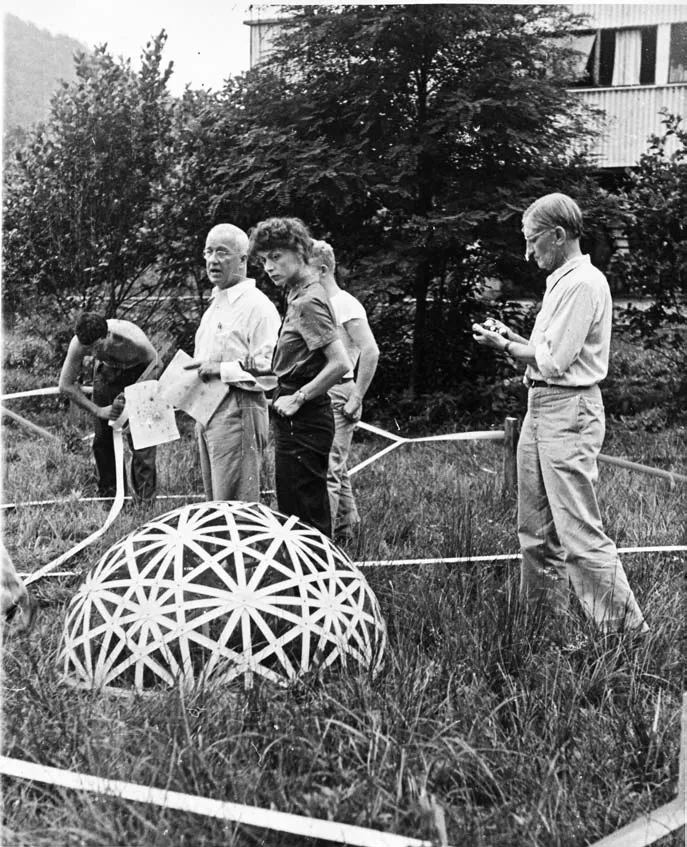
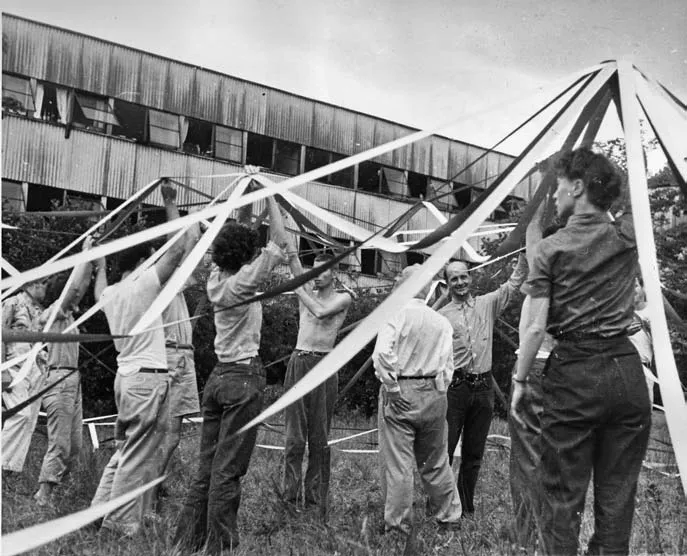
45 Figures 3.5 (previous page) and 3.6 (above)

47 Beaumont Newhall, Buckminster Fuller Constructing Dome from Venetian Blinds at Black Mountain College, 1948 (pictured in fig. 3.5: Buckminster Fuller, Elaine de Kooning, Josef Albers). © 1948 Beaumont Newhall; © 2012 the Estate of Beaumont and Nancy Newhall. Permission to reproduce courtesy of Scheinbaum and Russek Ltd., Santa Fe, New Mexico.

49 Figure 3.7
50 Beaumont Newhall, Buckminster Fuller Constructing Dome from Venetian Blinds at Black Mountain College, 1948 (pictured, Elaine de Kooning). © 1948 Beaumont Newhall; © 2012 the Estate of Beaumont and Nancy Newhall. Permission to reproduce courtesy of Scheinbaum and Russek Ltd., Santa Fe, New Mexico.
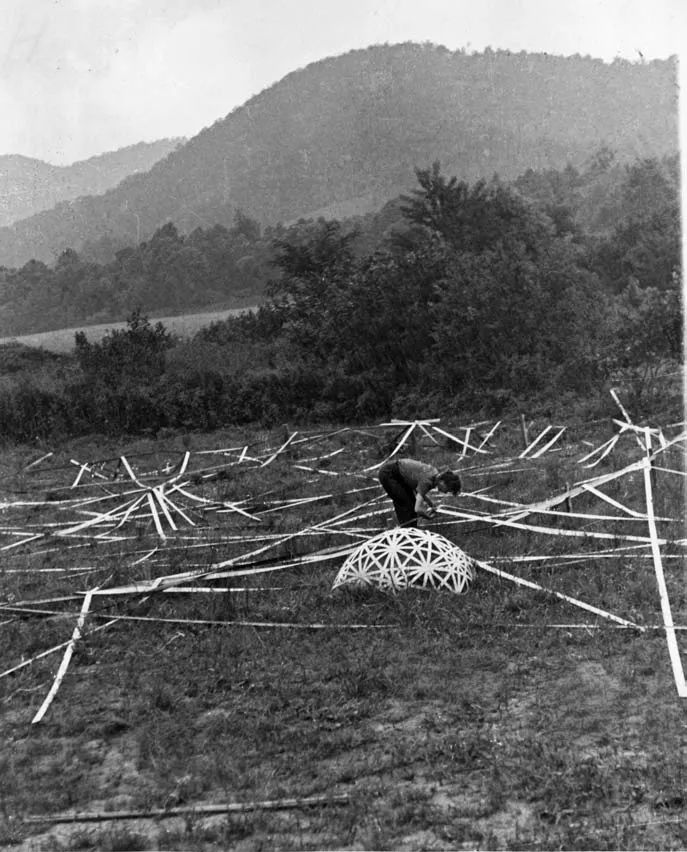
52 To Fuller, investigational prototyping was inextricably part of any experimental method—‘‘I designed this thing so it would deliberately fall down, would not stand.’’ As disorderly as the process of constructing the dome may have appeared to participants—wet Venetian blinds scattered throughout the landscape of Black Mountain’s Lake Eden campus—the dome was, according to him, engineered and ‘‘measured by comprehensive and strict practices of calculation and test.’’53 Fuller wanted students to think structurally about buildings, questioning underlying engineering principles without accepting formal architectural conventions. He excoriated the way most art and architecture programs ‘‘teach otherwise innocent students to make pathetic attempts to out-Mies Mies while overlooking the energetic and economic fundamentals governing development of truly evolutionary design initiative, and design responsibility.’’54 His emphasis on the engineering principles that uphold structures, rather than the manipulation of buildings’ superficial appearances, added radical new focus on the material constitution and structural considerations of architecture. Innovations in the appearance of structures should follow tests of new engineering principles, as opposed to older architectural methods that modified surfaces, only later to ascertain their structural integrity. (This would become the central tenet of his developing critique of Bauhaus design, to which I’ll return.)
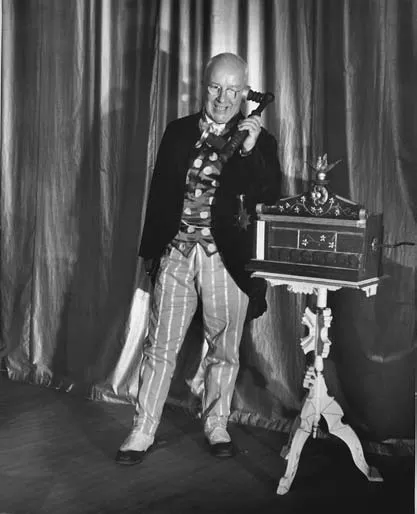
53 Figure 3.8
54 Clemens Kalischer, Buckminster Fuller in ‘‘The Ruse of Medusa,’’ 1948. Gelatin silver print. © Clemens Kalischer. Courtesy the artist.

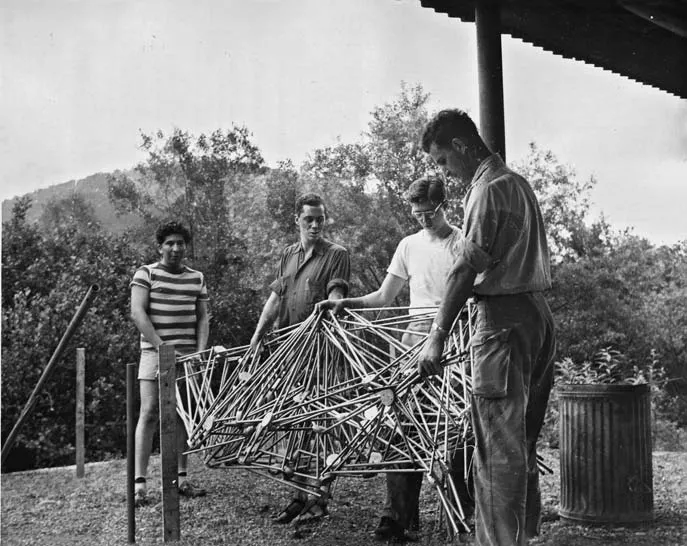
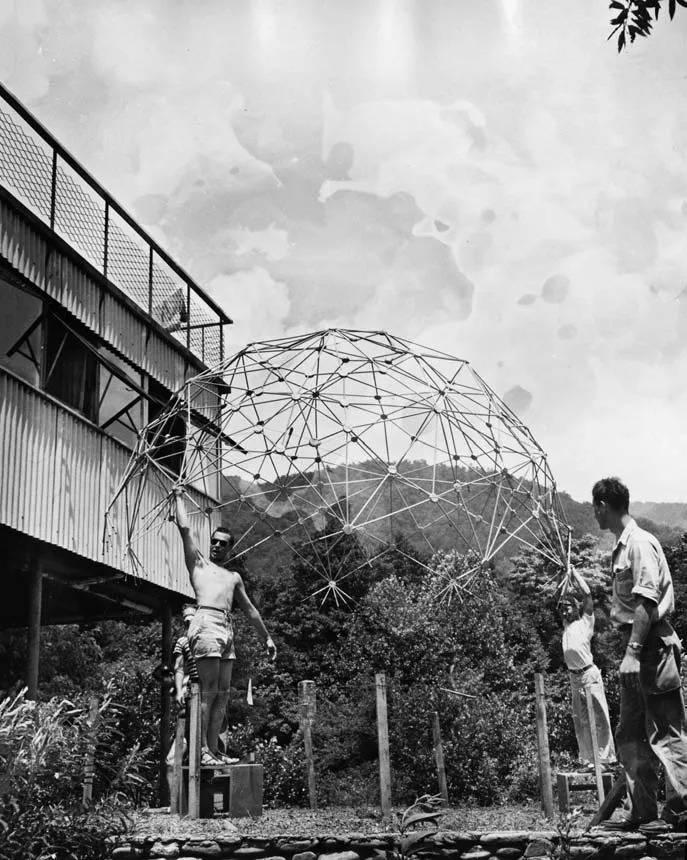
59 Figures 3.9 (previous page) and 3.10 (above) Masato Nakagawa, Buckminster Fuller’s dome of thirty-one great circle necklace structure of tubular beads and continuous internal cable with double heat-sealed, pneumatic, transparent skin. Designed and constructed at the Institute of Design, Chicago, 1948–49. Plastic skin tested at Black Mountain College, summer 1949. Courtesy of the State Archives of North Carolina.
60 Fuller’s presence—and his memorable performance as the Baron Medusa in John Cage’s production of Erik Satie’s play The Ruse of Medusa (fig. 3.8)—so electrified the campus that upon Josef Albers’s resignation in the spring of 1949, he was offered the vacant rectorship of the College. Although he refused the position, Black Mountain, particularly its enthusiastic students such as Snelson and Ruth Asawa, provided Fuller with the unique opportunity to continue conducting what he termed ‘‘exploratory work.’’55 That year he returned to the College as Director of the Summer Institute, accompanied by a dozen or so ID students from Chicago. He also brought along a newly manufactured prototypical dome influenced by the cable engineering of Snelson’s X-Piece, this one more modestly scaled than the earlier Venetian-blind model and composed of flexibly constructed aluminum tubing with an internal cabling system56 (figs. 3.9, 3.10, 3.11). The second dome was erected successfully (it had been prepared months earlier for a demonstration at the Pentagon in Washington, DC), and a new plastic weather-insulating skin was tested57 (fig. 3.12).
61 Figure 3.11
62 Kenneth Snelson, Buckminster Fuller’s Dome, Demonstration of
63 Strength. Black Mountain College, summer 1949. © Kenneth
64 Snelson. Courtesy Marlborough Gallery, New York.
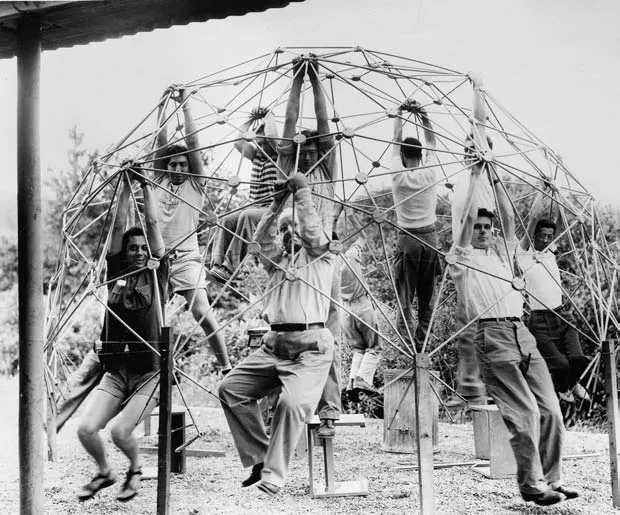

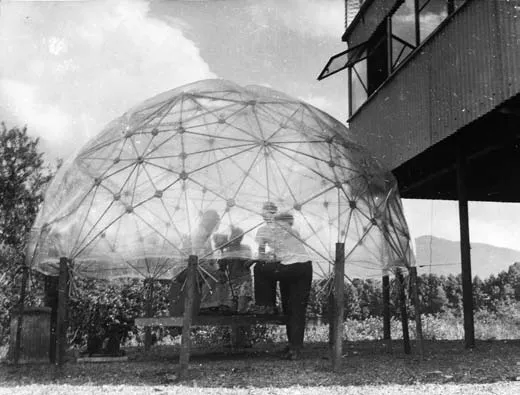
68 Figure 3.12
69 Masato Nakagawa, Buckminster Fuller’s Dome, Demonstration of Plastic Skin. Black Mountain College, summer 1949. Courtesy of the State Archives of North Carolina.
70 The success of the second dome assembly reflected the achievement of a ‘‘synergetic’’ process, but not only in the sense that the lattice structure, when erected, became stronger than its constitutive parts. To Fuller, when an entire system’s or holistic theory’s synergy (in this case, the theory of tensegrity) was experimentally validated, it reinforced the presuppositions supporting the entire method, and therefore strengthened the total system. Synergy was ‘‘evolutionary’’—it compelled progressive improvements of knowledge from a state of chaos to one of order (unlike evolution understood non-teleologically, as biologists in the legacy of Darwin such as Jacques Monod would see it).58 The success of synergetic thought was, Fuller believed, an indication of the ‘‘inherent success’’ of humanity, or what he termed human beings’ role as ‘‘the most comprehensive anti-entropy function of the Universe.’’59 He viewed 124 chapter three ‘‘total thinking’’ as a model of scientific speculation that had been confirmed by the success of the dome assembly. Paradoxically, it was the failure of the initial dome construction that supported his claim to be, in fact, a comprehensive experimentalist with the vision to undertake large-scale dome constructions, not a mere technician tweaking small modulations. Thus, Fuller’s main preoccupations were encapsulated in the Black Mountain dome experiments: his focus on shelter as the primary site of innovation; his emphasis on the central role of artists in accomplishing design advancements; his concern that designers challenge problems creatively while risking short-term failures and possible ridicule by the ‘‘Establishment’’; and his demand that single experiments support larger, systemic planning.60
3.2 The Experimental Finishing School
71Fuller found an unlikely ally at Black Mountain in John Cage, and in the summer of 1948 they began articulating a model of risk and failure in experimentation that discouraged incremental change in the interest of a nearly libertarian freedom from restraint. Cage, after his first encounter with Fuller, deemed experimentation an American individualist ‘‘utilitarianism’’ as distinguished from purposeful, collective (read: European), and ultimately failed politicizations of form.61 Superseding that decline, the men jointly proposed a new model of the test as an act of radical transformation by renegade experimentalists, quite unlike the systematic testing of variables characterizing Albers’s method. ‘‘Comprehensive design’’—Fuller’s terminology—or ‘‘indeterminacy’’—Cage’s—were couched in language directed against the system of methodically varied modifications in Albers’s pedagogy and artistic process. (And yet both men, like Albers, were quite methodical in their approaches to formulating ‘‘experiments,’’ and singularly regimented in their daily lives.)
72 As Fuller recalled of his first summer at Black Mountain,
7475John Cage and Merce [Cunningham] and I had breakfast every morning together out under the trees. And we really did have a very great deal of fun because I spent that summer with them on a fun schematic new school, and I called it ‘‘the finishing school.’’ We would finish anything. In other words, we would really break down all of the conventional ways of approaching school. And ‘‘the finishing school’’ was going to be a caravan, and we would travel from city to city.62
76 It’s hard not to read Fuller and Cage’s iconoclasm about the ‘‘finishing school’’—itemizing ‘‘all of the conventional ways of approaching school’’—as both triggered by and directed against the existing experimentation models endorsed by German émigrés at Black Mountain. Though Fuller was sympathetic to Albers, calling him a fellow ‘‘experientialist,’’ he found Bauhaus architectural design misleading in its claims of engineering structural innovations.63 When in 1955 Fuller was asked by John McHale of the London Independent Group if Bauhaus ideas had influenced his work, he testily replied, ‘‘I must answer vigorously that they have not.’’64 He isolated two major methodological differences separating him from Bauhaus predecessors. First, he believed in the teleological nature of technological innovation as an ‘‘absolute principle’’—as he claimed, ‘‘The more you used technology, the more it improved.’’65 Second, his model of experimentation emphasized the construction and operation of structures as opposed to buildings’ aesthetic appearances. He decried the ‘‘international style thus brought to America by the Bauhaus innovators,’’ which operated ‘‘without …knowledge of the scientific fundamentals of structural mechanics and chemistry.’’66 In sum, ‘‘they only looked at problems of modification of the surface of end products.’’67
77 Upon his first visit to Black Mountain, Fuller’s distance from Bauhaus precedents was immediately noted. As Elaine de Kooning commented, ‘‘Bucky, with his emphasis on how things worked and his total disregard for the Bauhaus concern with design—with how things looked—was a bit of an irritant to the regular faculty.’’68 Snelson, for his part, soon realized that the geometric models Fuller was testing—experiments that had emerged from close study of the structural properties of tetrahedrons and spheres—would produce architectural forms very different from the basic Bauhaus unit of the cube. He credited Fuller with demonstrating that in most design, ‘‘how you occupy space with architecture …has nothing to do with structure. And it became clear to me what kinds of experiences or experiments you had to conduct before you know what a structure really is …because it’s a result of forces which can form stable systems. …That’s what I got from Bucky, quite opposite to the loose notions of structure that the Bauhaus ideas were involved with.’’69 For all Bauhaus members’ interests in axonometric projections and dynamic geometric perspectives, to Fuller these were merely static representations; instead, he foregrounded architectural forms as embedded in systems (transportation, energy, mediatic communication, and so on) seen holistically and as functions of society’s total needs.70
78 Upon closer examination, Fuller’s emphasis on the ‘‘experimental’’ as tests of total systems can be situated within a cultural lexicon that had in fact emerged at the Bauhaus just a few years earlier. His philosophy of efficiency, and the economy of resources and labor, echoes that of Bauhaus practitioners, much like what Albers had earlier called the ‘‘ratio of effort to effect.’’71 In Albers’s version of experimentation, reduction to the fundaments of form (and form was always understood in its structure and appearance, despite Fuller’s stereotyping of Bauhaus methods otherwise) was a way to induce complex comparisons between subtle variations often overlooked in ‘‘macro’’ judgments. Yet to Fuller, the goal was not reduction and economical presentation—‘‘less is more,’’ one could say—but rather the effective employment of existing resources to appear and function greater than their parts—that is, synergistically. As he wrote, ‘‘The whole strategy of [the] artist-engineer initiative comes under the head of progress by comprehensive simplification, by constantly doing more with less.’’72 ‘‘Doing more with less’’ implied efficiency at the level of labor-saving technologies and in the interest of ever-increasing technological productivity, not in order to think of production processes themselves as human endeavors worthy of close study and complex attention. In this, Fuller’s emphasis on systemic rather than formal concerns can be clarified by comparison with the work of László Moholy-Nagy, Albers’s partner (and sometimes antagonist) in teaching the required foundation course at the Bauhaus.73
79 Moholy-Nagy had been a member of the Bauhaus faculty from 1923 to 1928 and went on to found the New Bauhaus in Chicago (ID, where Fuller himself taught during the academic year between his summers at Black Mountain). Exact contemporaries (both were born in 1895), Moholy-Nagy died of leukemia in 1946, two years before Fuller arrived at ID. Though they never worked together directly, in important ways Fuller’s deductive experimental model, which edged design toward a vision of a new technological utopia, overlapped with Moholy-Nagy’s ambitious project of experimentation as radical technological innovations undertaken by artist-designers.
80 Moholy-Nagy called for a culture of artistic production, driven by scientific advancements, that would reject disciplinary specialization while understanding the designer’s responsibility to the total system of society. Like Fuller, he wanted to reclaim science from its misapplication by specialists; as he wrote in his 1938 book The New Vision: Fundamentals of Bauhaus Design, Painting, Sculpture, and Architecture, ‘‘Specialists—like members of a powerful secret society—obscure the road to all-sided individual experiences.’’74 Instead, Moholy-Nagy saw design as ‘‘an integration of intellectual achievements in politics, science, art, technology, in all the realms of human activity. …Our time is one of transition striving toward a synthesis of all knowledge.’’75 His emphasis on cross-disciplinarity was similar to what Fuller would soon be defining as comprehensive design. To Moholy-Nagy, this disciplinary fusion could be accomplished by the universal application of technological innovations. As he contended,
8283The possibilities of the machine—with its abundant production, its ingenious complexity on the one hand, its simplification on the other, had necessarily led to a mass production which has its own significance. The task of the machine—satisfaction of mass requirements—will in the future be held more and more singly and clearly in mind. …Invention and systematization, planning and social responsibility must be applied in increased measure to this end.76
84 Systematization allowed designers to categorize the structure and function of materials, as opposed to manipulating superficial characteristics that might in fact be quite subjectively understood. Altering the mere appearances of forms facilely disregarded the complexities of production; Moholy-Nagy claimed that the artist ‘‘today knows usually very little of engineering problems …nothing about statics, mathematics, technology, although an understanding of these would be more helpful than aesthetic rules in suggesting an efficient working method.’’77 In art, for example, dynamic, not static elements of forms should be accentuated, a result Moholy-Nagy referred to as ‘‘equiposed sculptures,’’ in which volume and material were unified in balanced yet mobile systems. With such objects, ‘‘the path to the freeing of a material from its weight’’ could be found.78 The equiposed sculpture not only brings ‘‘more and more new single pieces into relation,’’ it expands the notion of sculpture into its environment, and ‘‘demonstrates the whole borderland lying between architecture and sculpture.’’79
85 The second-to-last image of Moholy-Nagy’s The New Vision is striking in how it posits structural lightness—material freed from weight—as an inherently positive social value (fig. 3.13). The photograph, taken in 1926, depicts a dozen or so men balanced on a soaring, intricate lattice of triangular struts; the caption indicates that they are constructing the framework for the Carl Zeiss planetarium in Jena, Germany.80 The description continues: ‘‘A new phase of our victory over space: men poised in a swaying open network, like airplanes flying in a formation.’’81 As was the case for Fuller, Moholy-Nagy’s vision of lightness as the new, universal property of modern construction linked engineering innovations to unified yet networked social design. The ability of technologically advanced structures to represent, metaphorically, the interconnected matrix of social systems was key. Like Fuller’s dome designs, whose shape simultaneously referenced the enclosure of domestic life, kiosk-like community shelters, and the networked systems of Spaceship Earth, Moholy-Nagy’s networked forms could inspire a ‘‘universal outlook’’ that would posit design improvements as part of a pattern of growth applicable to the whole of society.82 The artist-designer would deal above all with information and its representation; in an issue of the journal ANY devoted to Fuller it was noted, ‘‘The ability to gather and coordinate vast amounts of information enables the designer to deal once again with the ‘design of the whole.’ ’’83
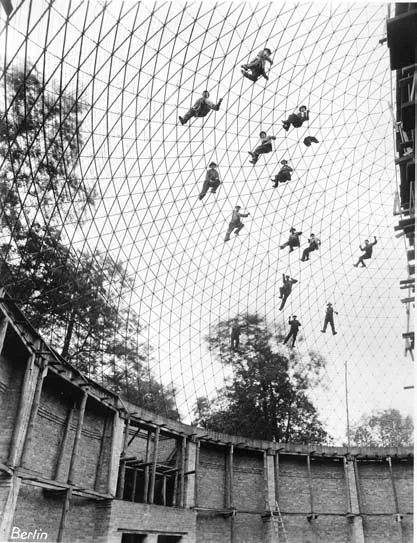
87 Figure 3.13
88 Network Lattice-Framework for a Zeiss Planetarium, n.d. Reprinted in László Moholy-Nagy, The New Vision: Fundamentals of Bauhaus Design, Painting, Sculpture, and Architecture (Mineola, NY: Dover, 1938/2005), 203. Source: Zeiss Archiv.
89 To Fuller and Moholy-Nagy, architecture was hybrid in many ways, most essentially so when it provided shelter while managing the representation of networked resources. In particular, Fuller envisioned the dome as itself a networked building—a site connected to real-time information feeds updated in various media. One can see this sensibility encapsulated in his 1962 ‘‘Geoscope’’ proposal, a precursor to today’s ‘‘digital globes.’’ The Geoscope was envisioned as a two-hundred-foot-diameter spherical display covered with colored lights. Fuller planned to have the enveloping space—literally, the environment—of the Geoscope updated with networked information, data that would allow individual spectators to visualize, study, and possibly redesign the total human ecology in order to quickly and efficiently apportion resources globally.
90 In contrast to Fuller, Moholy-Nagy envisioned planning on a centralized and collective level, and called for workers’ control of industrial capital for the benefit of all.84 Yet like his American counterpart, he believed that the benefits of technological gains could be extended to many more individuals through socially transformative educational experiences. Training subjective awareness about perception through group exercises and individual assignments could make the larger public proficient in complex visual and structural phenomena. Education could therefore allow students to understand the components of form in order to rethink the structural constitution of problems, rather than letting solutions be executed from habit or tradition. Additionally, education was a process in which outcomes were unfixed (as they would not be in industry) and therefore allowed for greater experimental freedom. Both Moholy-Nagy and Fuller invested heavily in their respective pedagogical efforts, and in some ways one could consider design for these men as a polemical project of shaping minds.
91 Gyorgy Kepes, Moholy-Nagy’s colleague at ID, also believed design pedagogy was the key to representing complicated variables as intelligible patterns rather than as static objects, so as to train a new and unique breed of designer. As historian Reinhold Martin has commented, for Kepes this new designer ‘‘was, in effect, a new social type, bearing a humanistic, universal outlook, an evolutionary adaptation capable of managing the reorganization of vision for the benefit of humanity as a whole.’’85 Encouraging this universal outlook while teaching at ID and later at MIT, Kepes connected design with other visual systems, increasingly, marketing and product design. Thus, for both Kepes and Moholy-Nagy, systems-based analysis depended on the training of visual perception, which linked their models to Albers’s and others from Bauhaus. This perceptual emphasis recedes in Fuller’s model, as the focus on structure over appearance produces judgments of dynamism linked more to engineering than to vision.
92 In 1956, Kepes invited Fuller to contribute to The New Landscape in Art and Science, a book he was assembling that set out to synthesize and systematize the whole of scientific and aesthetic knowledge around the concept of organizational patterning. Primarily a visual compendium, The New Landscape featured images of Fuller’s geodesic dome and other recent inventions, along with objects by Charles and Ray Eames, Le Corbusier’s modular figure, and all manner of microscopic and magnified images from nature, such as snails’ 130 chapter three tongues and the Crab Nebula—examples of the harmonious unity of nature organized around morphologies of repetition and networked structure. Kepes later invited Fuller to submit an article to a collection of essays he was editing titled Structure in Art and in Science; according to Kepes, the volume would provide a ‘‘structure of structures’’ in order to focus ‘‘the power to see our world as an interconnected whole.’’86 In Fuller’s contributed essay, ‘‘Conceptuality of Fundamental Structures,’’ he argued, after musing on the complex math of bubbles and other closely packed spheres, that nature does not ‘‘do what we call fudging of her design which means improvising.’’ Instead, it is the artist who could reveal that mathematical constants such as pi—an irrational (not fractional), transcendental (without end) number—are merely models to help us understand the world, and that patterns beyond calculation exist in nature.87
93 Kepes characterized Fuller’s essay as providing ‘‘an inspiring bridge between our comprehension of the structural principles of nature and the potential application of this knowledge to creation of man-made forms.’’88 It was this potential for detecting and understanding patterns shared by natural forms and artistic and architectural constructs that Kepes viewed as the communicative prospect of experimentation and a vital educational tool in Fuller’s work.
94 In his post--Black Mountain College writings, Fuller increasingly emphasized design pedagogy, but for him a student’s understanding of dynamic structures and the way they relate to social problems could emerge only through heuristic experimentation rather than the focused perceptual training advocated by Moholy-Nagy and Kepes. In contrast to the deductive (and predictive) methods of his own comprehensive teleological social planning, Fuller believed that laboratory teaching methods ought to involve a freedom to try out responses to problems without regard for success—what he termed ‘‘intuitive probing’’ in his Kepes essay. To achieve this, he discouraged students from concentrating on surface appearances; as he wrote in 1948, ‘‘I am particularly anxious not to ‘picture’ in advance the nature of logical solutions (à la Beaux-Arts programs), thus leaving the student only those superficial tasks of decoration or assemblage of preconceived components.’’89 He derogated the language of visual form (note the deployment of ‘‘pictur[ing]’’ as a negative value leading to rote ‘‘superficial’’ and ‘‘decorative’’ work). To him, open-ended experimentation without repeated trials allowed students to invent a variety of possibilities that a narrower focus—as Josef Albers required—would foreclose, while still demanding the intense examination of a problem in which the stakes were as high as people’s lives: ‘‘[As] in aircraft technology, nothing is taken for granted.’’90 Free experimentation was encouraged because Fuller’s system was so encompassing, so universal, that its operations required wide-ranging tests to keep pushing toward a horizon of complete and finite knowledge. As he explained, ‘‘Instead of a teaching methodology successfully employed in the past, I assume that all past undertakings are in some degree obsolete, as the total environment of the technical frontier is constantly providing improved means.’’91 By discouraging study of the visual appearance of form, in his pedagogy he emphasized the benefit of leaping to connect form to its social utility.
95 In this sense, too, failure became the essential feature of experimental pedagogy and design; failure represented the freedom to stumble on the unforeseen. As Fuller declared,
9798Design must imagine and discern …in as informed a manner as possible. Design, however, cannot guarantee its results. Failure …provides pivotal data for the efficient designer. …Failure in design is honourable, in science and engineering it is found to be mark of incompetence and failure in politics and finance is ruinous.92
99 He regarded the ethos of speculative experimentation, and its risks of failure, as reflecting the process of personal growth and transformation possible in education itself, and to some extent as helping to shed preoccupations about immediately determining a work’s success. Every experimental failure yielded data and therefore revealed the rules and patterns underpinning the test. The Supine Dome typified his experimentation model; it allowed tactical failures as part of a larger strategy and emphasized the dynamic process of educational risk, not the success or failure of the discrete form of a single dome. For Fuller, alleviating struggles for scarce resources demanded uncovering the principles of a perfectly ordered world of predictable outcomes that could be revealed through experimental verification. As he remarked in 1949, the ‘‘integration of a complex series of failures represents the only means of attaining from nature’’ a plan about where to go next.93 ‘‘Nature’’ would reveal its elusive secrets only after a prolonged campaign of discovery, each failure reinforcing the experimental methodology and yielding more data about the overarching system.
100 In Fuller’s sometimes overweening confidence about the inevitable acceptance of his Dymaxion and dome designs, an important pedagogical precedent is found, despite and sometimes because of these inventions’ often spectacular and highly publicized failures. His work represented an influential model for how students could—before they were tracked into disciplinary specializations—think holistically about their own roles in shaping a better and more just society. Although his methodology was cloaked in the flamboyant, self-important, and sometimes baffling rhetoric of his verbose written tracts and pseudo-scientific neologisms, Fuller’s inventions, and his discursive construction of experimentation as not incompatible with failure, continue to influence a diverse array of practitioners in art, architecture, design, engineering, and science (a class of dome-shaped carbon molecules has even been named for him).94 He sensed dangerous cultural decline in specialists’ inability to act in concert toward macro-level planning, and spent his long lifetime proposing alternative collaborative models between disciplines. His justification for risk, and the acceptance of failure as contributing to ‘‘systems-level’’ thinking, proved irresistible to those attending the 1948 and 1949 summer sessions at Black Mountain College. As John Cage paraphrased Fuller, ‘‘I learn much more when I have a failure than when I have a success.’’95 Beyond Black Mountain, his ‘‘failure-as-risk’’ formulation influenced students of future generations as he became a sought-after speaker on the college lecture circuit by the 1960s. Yet instead of his dream of a technological utopia, it was the paradox of self-declared success in the face of apparent failure, of an experimentation model accommodating individual setbacks for the good of the larger holistic program, that is perhaps Fuller’s greatest contribution to pedagogy and design teaching. To accomplish this holistic program, his ‘‘design revolution’’ had to be cleaved from political connotations, and technologically determined functionalism substituted for the vicissitudes of political action.
3.3 The Politics Of The Design Revolution
102Fuller’s yoking of pedagogy with risk meant that anyone could join the ranks of the comprehensive designers:
104105What impressed me about me in making the experiment with me was that I was so very average. …I knew when I started in 1927 that I could not jump very high and I could not swim very fast and I hadn’t earned the best marks in the class, and I was very obviously very average and inasmuch as I was interested in what the average individual could do, I was a very good case for experimentation.96
106Fuller’s universalization of experimentation—his sense that all students could participate in total thinking as comprehensivists because nature’s universal laws were true and unchanging—was attractive at Black Mountain, to Cage in particular. Fuller’s acceptance of accidents and failures demystified the role of the artist; as Cage noted, ‘‘I would like to make it, as Bucky Fuller does in his talks, where he says ‘I’m just an average human being’—and to make it clear that anybody can do marvelous things.’’97
107 Cage credited Fuller’s zeal for technological innovation as the necessary practical foundation for greater social and artistic freedom, linking it to his own belief in anarchy: ‘‘You see what anarchy needs in order to be practical is that all the utilities work. …If, in other words, the water works, the food works, and if there’s money, and so on, if people have what they need, then anarchy gets along beautifully.’’98 Despite the apparent differences between their experimental models, one deductive in the name of total design, the other at times mechanistic in the name of aleatory processes, Cage felt his view of apolitical experimentation was closely aligned with Fuller’s:
109110Bucky …agreed that there was no conflict between us. He said he was trying to make a world through his ideas that would work so well for everyone that they could live as I was suggesting. In other words, without intention, he was using his intention to make a world in which there could be the presence of non-intention. It would be organized so well that it could be, so to speak, without government.99
111 How two disparate approaches to experimentation could make such happy bedfellows at Black Mountain College reflects an underlying homology in their seemingly conflicting systems. Cage and Fuller were mutually suspicious of electoral politics, which they associated with the powers of governmental or other organizational authority over individuals’ freedoms and creative independence. In a budding friendship that became a lifelong alliance, they proclaimed the distance of their respective experimental models from any political agendas, and shared a discomfort with organized political acts of any form. As was common in postwar, nascent McCarthyite America, they also claimed that the diminishing relevance of such acts, and their replacement by ‘‘total’’ planning and design, foreshadowed the decline of European culture, with its protracted history of political revolutions.100
112 Cage noted that despite the evident paradox of such an alliance, their parallel visions of a highly efficient utilitarianism anticipated a world emancipated from the human struggles technology would soon render obsolete. The great distance between this and perceptual formalisms such as Albers’s turns on this very issue, perhaps more so than any other. What is Viktor Shklovsky’s proposal to ‘‘make forms difficult’’ but a demand to uphold the intensity of art, as an ethical claim, in order to educate subjects about the complexity of art with respect to other social relations?101 For Cage, the possibility of perceptual intensity remained open, if one can call an openness to the non-intention of void-like events ‘‘involvement,’’ but only after Fuller’s comprehensive designers had stitched up the logistical difficulties hampering social progress. To Albers, in contrast, art had special purchase in developing better attentiveness, by and through the complexity of form; this attentiveness could itself produce a better culture.
113 ‘‘I can’t see much hope in the political solutions,’’ Fuller announced in a 1948 talk at ID.102 His pessimism was evident on the micro and local levels at Black Mountain College: he saw the changes in College leadership, changes that resulted in his assuming a more prominent role there in 1949, as an epic and deleterious political battle of left-versus right-wing Cold War ideology that comprehensive design and total thinking would resolve. The departure of the Alberses and Ted Dreier, the latter one of the College’s original founders and a chief financial supporter (by way of his wealthy family), was, to Fuller, a result of a Communist plot to take over the College by purging the old guard; as he stated, ‘‘One of the places where cold psychological warfare probably first [started] was right at Black Mountain.’’103 (Fuller’s anti-Communism was always hyperbolic, to be sure; in actuality, that schism at the College resulted from debates about whether practical arts training or liberal arts courses should be emphasized.) Disdaining the power struggles that characterized the campus administration, Fuller claimed that in his tenure ‘‘I had a very free field on my comprehensivity at Black Mountain.’’104
114 Because Fuller felt himself to be above the political fray, in an interview he distinguished his position throughout the internecine battles at the College thusly: ‘‘I’m certainly not a Communist but I’m certainly not a capitalist, I’m really very transcendental to political—I think that politics is now irrelevant and obsolete so I don’t belong to any of the camps.’’105 Rather than participating in skirmishes at the College, he aligned himself with Cage, Merce Cunningham, and others he considered to be separate from or agnostic to political conflicts. In this, he repeatedly invoked ‘‘democracy’’ as a blanket form of counter-Communism, but his could be said to be a most quixotic form of democracy, applied speedily and efficiently from above as a kind of universal value whose main purpose was to ensure a population’s free and equal access to technological improvements—less direct democracy than direct design.106 Comprehensive designers would buck ‘‘traditional’’ electoral politics, acting instead as techno-gurus or omniscient cosmologists selflessly plotting global change in the interest of a radical, egalitarian dissemination of technology—the key example being Fuller’s own advocacy of the geodesic dome as a comprehensive design solution to many if not all the world’s problems.
115 After the success of the second geodesic dome assembly at Black Mountain, Fuller set about promoting it as a design revolution with a strenuous public relations campaign; the benefit of domes was touted to journalists, military strategists, and students alike. Lightweight and portable, geodesic domes could be airlifted to sites previously inaccessible to construction, and their use of inexpensive building materials such as aluminum meant that large structures such as airplane hangars could be manufactured cheaply. Featuring Fuller’s newly developed octet truss (a lattice-like system of triangular struts braced in 60-degree configurations) that utilized the tensegrity principle, domes became exponentially stronger as their surface area increased107 (fig. 3.14). The dome’s curved exterior profile reduced external wind drag, and its circular shape encouraged internal heat circulation. Precise factory prefabrication would facilitate speedy on-site assembly and keep labor and construction costs low. Moreover, the large internal volume of the dome could be effectively utilized by suspending multiple decks from its frame, thereby adding further square footage. And because the surface area of the enclosing dome skin equals twice the area of its base (in contrast to traditional rectilinear housing construction, in which the outer area is between three to five times as large as the enclosed square footage), domes required less material and energy resources to construct than other buildings of equivalent size.
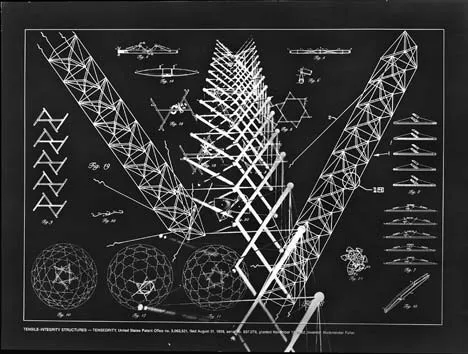
117 Figure 3.14
118 Buckminster Fuller, Tensile Integrity Structures—Tensegrity, technical drawing for 1959 patent filing. Screenprint in white ink on clear polyester film overlaid on a screenprint on Lennox paper, 30 × 40″. From Inventions: Twelve Around One (Cincinnati: Carl Solway Gallery, 1981). Edition of 60. Courtesy Carl Solway Gallery, Cincinnati, Ohio.
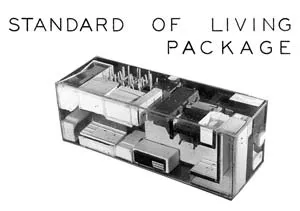
120 Figure 3.15
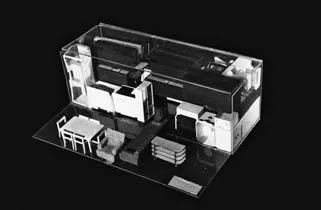
122 Buckminster Fuller, Standard of Living Package, 1947. Courtesy The Estate of R. Buckminster Fuller.
123 Not content with merely industrial applications, Fuller envisioned the dome as an easily transported shell for a prepackaged home system he termed the ‘‘autonomous dwelling machine’’ (fig. 3.15; plate 17). Shipped via freight container, the dwelling machine already contained all infrastructural elements (plumbing, refrigeration, heat, electrical wiring) in addition to all appliances and furniture that occupants generally purchased separately, what he called the ‘‘standard of living package.’’ Yet he contrasted such a dwelling with the range of prefabricated homes then popular in the housing market.108 To Fuller, in prefabrication ‘‘the box is primary,’’ that is, a set of rectilinear panels are perched on a preexisting foundation. Additionally, the contents of the house—furniture, appliances, and fixtures—are rarely supplied. Though the prefab house is originally mobile, once it finds its platform it remains fixed and permanent. Even before his successful dome assembly, in other words, Fuller was contending that the notion of the house as a static object was outmoded: ‘‘ ‘Prefabricated’ houses represent the latest phase of treating with the obsolete concept that the individual and the family are identified with only one spot on this earth’s surface.’’109 A lattice dome’s collapsible and mobile aspect presented a new, ‘‘evolutionary’’ prospect of shelters that could be as peripatetic as human beings’ own ambulatory character, and would use postwar innovations in containerization to treat homes as cargo. But beyond humanity’s history of migration and nomadic patterns, movement was perhaps the single most defining quality of the universe itself, its universal law, so to speak. This was a strikingly prescriptive sense of architecture literally moving humanity toward its technologically enriched destiny: as Fuller wrote in 1945, it was nothing less than ‘‘the emancipation of society from its shackled environment.’’110 Indeed, according to historian Antoine Picon, ‘‘Fuller dreamed of a fluid society in the universe’s own image with all of its components in radiation and flow.’’111
124 By connecting architectural structure to dynamic energy flows, the dwelling machine responded to patterns of nomadism Fuller believed should and would supersede the fortress/mansion model of home construction. The dwelling machine’s integrated and portable network of infrastructure knit together ‘‘a tight but neat assembly of various mechanical units,’’ permitting the ‘‘shell’’—the form and façade of the home—to remain secondary to the ‘‘dwelling activities’’ within.112 Aiming to mass-produce the entire house package, Fuller hoped to make a standard version available to lower-income groups while enticing wealthy customers with deluxe editions. In the immediate postwar period, he predicted, housing would be the most ‘‘outstanding demand’’ globally.113 Yet fragmented and localized housing construction markets encouraged short-term profits and static design considerations rather than a dynamic reconsideration of the industry’s goals and potential. As Fuller wrote, ‘‘I am dubious of any good coming from those who promote for the sake of making money instead of for the sake of mass producing up-standard housing.’’114
125 Selling the mobile dome as a bundled package, however novel a sales gimmick, failed for several important reasons. The dwelling machine package did not allow for much customization, and neglected that many potential buyers had invested heavily in existing possessions and appliances, most of which were duplicated or made superfluous by a bundled purchase. And though hypothetically several size options were available, in effect the dome was a standardized silhouette; in art historian Branden Joseph’s words, for Fuller ‘‘universal accessibility [was] gained at the cost of rendering the world universally similar.’’115 Moreover, the shape of the dome itself was not amenable to customary furniture—its curved interior walls were unsuitable for most existing interior designs—and the affordable costs Fuller publicized presupposed high-volume mass production, though in reality each single package was prohibitively expensive. Additionally, domes as ‘‘autonomous dwelling machines’’ were envisioned as single-family homes in suburban land tracts or rural areas, atomized and disconnected from existing, occupied central-city areas.
126 Perhaps it is not surprising that Fuller’s view of architecture as dispersed through the extra-urban frontier found its greatest fiscal patronage in US military agencies that sporadically used his geodesic domes for remote Arctic 138 chapter three utility outposts and as helicopter hangars. And though the dome later found its broadest nonmilitary audience in counter-cultural communities of the 1960s and 1970s who adopted it in part due to Stewart Brand’s advocacy of Fuller in the Whole Earth Catalog, even in these manifestations the structure was a symptom of decentralized, low-density sprawl. Some have argued that ‘‘dropping out’’ and living in a dome became a subcultural alternative to active participation in urban society.116 And yet, with their ‘‘access to tools’’ ethos, the Whole Earth Catalog and its other do--it--yourself satellite publications and organizations were particularly important forums for exploring, testing, and propagating Fuller’s demand to think of experimentation as an often absurdly impractical prototyping.117 It was this freedom to fail that had been an immensely liberating lesson at Black Mountain, too.
127 In the case of Fuller’s propagation of the dome, can we see both a libertarian individualism and a messianic technocratic determinism at play? As Mark Wigley has commented, in Fuller’s world ‘‘a quasi-theological view underpins the questionable sense of the beauty of ‘natural order,’ the ‘harmony’ of the cosmos, and so on. Ecology is a barely disguised form of theology.’’118 Fuller had argued that designers were the ultimate apolitical seers: ‘‘My envisioned transcendental world design plan would be inherently non-political, because it would be utterly independent of any need for authority beyond that [necessary] for initiation of its study and development.’’119
128 In positing a utopian place outside politics, some have suggested that Fuller misrecognized social rule as the repression of individuals’ creative initiative, thereby dismissing political participation as a confusing cacophony of inefficient, conflicting interests.120 Comprehensive designers were ultimately responsible to that abstraction called democracy else they appear as Communist master planners, yet actual democratic processes remained sidelined in a vision of society as a hyperefficient architecture of networked domes outfitted with ‘‘standard living packages.’’121
129 Fuller’s suspicions about politics as a collective social process ran deep. What he viewed as the most advanced political system—America’s multiparty representative democracy—he simultaneously accused of having intractable structural flaws, and he was deeply skeptical of the slow pace and retrograde pluralism he attributed to postwar mass elections. He was even more distrustful of the politicians such a process voted into power, and dismissed voting outright, claiming of his own ‘‘preventative pathology,’’
131132Ipso facto this is a technical rather than a political scheme. Therefore the referendum cannot be initiated by politics. Political referendums have become negative referendums in which the lesser antipathy is registered. However, our industrial-consumer referendum, which is proposed here, can and will be ultimately recognized and incorporated by politics as mandatory.122
133 Fuller condemned political leaders of all stripes for the slow pace of change, and denied them praise for any successes in improving living standards.123 To him, humanity had been raised from material deprivation by technological improvements, not by the political gains of revolutions. He argued that with a closer relationship to capitalism, scientific design could unleash greater freedoms for individuals. But as ‘‘clients’’ of industry, public will conversely could be seen as subordinated, and supervision remained firmly in the hands of designers. As Fuller crowed, ‘‘Comprehensive anticipatory design science assumes that the client knows absolutely nothing about what he needs or what should be done about it.’’124
134 To Fuller, experimentation itself was a profoundly altruistic though nonpartisan enterprise. Society’s tendency toward specialization was anathema; it dispersed accountability for global concerns through a field of compartmentalized political agencies in competing nations. The charge to designers, then, was to convert reactive and compensatory political thinking into ‘‘anticipating and laboratory experimenting.’’125 The problem was politics, and the solution was more technology, distributed in a more equitable fashion. Thus, Fuller’s universalist proposals aimed to redistribute access to global resources, including the resource of design thinking itself, in the name of the public good. Yet rather than redistributing existing wealth, he proclaimed that the pace of development could be accelerated so that those without technological advantages could soon be raised up into the ‘‘natural world equilibrium’’ of a universal class.126 What Fuller advocated was nothing less than ‘‘a design revolution and not a political revolution.’’127 He insisted as much:
136137All previous revolutions have been designed where the vast majority of the underprivileged pulled down the undeserving few. In a design revolution you don’t pull anything down; we elevate not only the previously underprivileged but [also] those who thought they were privileged to something really good. We get equality attained at the top, and not at the bottom. We’ve never had a revolution like that before.128
138 As he pointed out, the ‘‘design revolution …this was an entirely new idea, and was not political. And it simply took the initiative away from politics.’’129 The transformation from pointless voting to economic Easy Street could be accomplished after a ‘‘critical point’’ was reached—when more than 50 percent 140 chapter three of the global population would equally benefit from access to all available technologies (estimated by Fuller in 1952 to occur in 1972; peak industrialization and commodity distribution were to be attained in the year 2000). At that time, ‘‘everybody will realize that their physical success is in terms of man as consumer instead of man as a producer (because very rapidly in a technical sense, we are transferring from man as a muscle machine to man as a prototyping and reorganizing, redesigning initiator).’’130
139 Technology should be equitably distributed, Fuller maintained, but it also should be applied scientifically. In a key statement of his goals, he wrote a memo to the J. Walter Thompson Company, a leading advertising agency, seeking to inform it of his ‘‘plan for reconversion of a major portion of the war aircraft industry to mass production of dwelling machines.’’131 Dome structures, made of the same lightweight aluminum as airplanes, of course fit the bill splendidly for such a project. For Fuller, the way total thinking tested ‘‘practical principles’’ demonstrated ‘‘a preventative philosophy of living instead of a now excruciatingly curative psychology of necessity,’’ the results being ‘‘far greater than will ever be manifested by politics or lip service.’’132 He regarded this preventative work of comprehensive design as ‘‘a sociological science of precisely definable and equatable mechanics.’’133 Here emerges a key paradox of Fuller’s claims to total planning—and indeed the limitation of all technocratic thinking—that social desires can be ‘‘precisely definable’’ and mechanical. It can be argued that he succumbed to a deterministic functionalism in which social agency is subject to ‘‘all-pervasive laws’’ discernible by designers alone.134
140 In this vein Reyner Banham, inspired by the spirit of language play that coined the ‘‘Dymaxion’’ slogan, christened Fuller a ‘‘dymaxicrat.’’135 By joining the already compound Dymaxion with technocrat, he underscored Fuller’s contradictory position in design circles—as both a technological innovator and a (prolix) spokesperson for technology (and Banham humorously remarked on the problem of writing around Fuller’s neologisms and linguistic animations: ‘‘Comprehensibility survives into print, if the text is Bucky’s own, but if it is written by another hand …trouble!’’).136 He recognized that Fuller’s confidence in technology was a kind of blind trust, in that ‘‘he operationally demonstrate[d] a true hot-rodder’s faith that when he want[ed] a component or adapter, one [would] pop out of the cornucopia of U.S. technology.’’137 Perhaps this faith was in fact a kind of hubris, if the ‘‘technocrat’’ part of Banham’s formulation is given equal weight with ‘‘Dymaxion.’’ The comprehensive designer—‘‘the artist’’—in effect becomes a kind of redeemer, elevating society out of the quagmire of inefficiency and stagnation that to Fuller characterized indecisive political processes.138 The faith in technological solutions and the broad application of his design principles were undertaken in the name of public good, yet without the public’s participation. In effect, Fuller had substituted techno-boosterism for democracy, experimentation for politics. His emphasis on comprehensive design implied that only exceptional individuals could save the masses from themselves, and his criteria for who in fact qualified as a designer were never clearly defined or transparent.139
141 In sum, Fuller’s ‘‘total thinking’’ experimental model is open to several possible criticisms. The first stems from a tautological fallacy at the heart of many totalizing justifications for technocratic social planning: that in thinking holistically about the ‘‘big picture,’’ failures today will assuredly be credited later as deferred proofs. The second relates to Fuller’s attempts to liberate design from the tyranny of short-term expediency caused by ineffective political stewardship with a promise of smoothly functioning and equitably distributed technological solutions for all. In the wholesale adoption of a totalizing system, however, modifications and actions beyond the prescribed architectural program were unaccounted for, and the agency of those individuals in whose names he acted were subsumed in large-scale master-planning initiatives. Claiming to facilitate the ‘‘body politic’’ being given a ‘‘controlling voice,’’ Fuller instead acted as if emancipation from poverty, hunger, and material want were absolutely, not merely routinely, neglected by the ‘‘special interests’’ of democratic squabbling.140 As he declared, liberation from the ‘‘monopoly’’ of majority rule ‘‘will be provided only by scientific organization.’’141 Was there room for contingency, change, and individual agency in Fuller’s ‘‘total process’’?142 Or was ‘‘total thinking’’ a scheme of paternalistic oversight—or worse yet, a regime of totalitarian design?
142 The answer might be: both. Fuller was perhaps the postwar period’s most enthusiastic technophilic utopian; he believed that the world’s population could be fed and housed with existing global resources, but only if master planners were allowed to efficiently allocate them. He saw the tremendous benefits of technological development—for example, in raising standards of living worldwide—but few of its pitfalls. Those problems he patly attributed to an inequitable distribution of technology on the part of governments. He disavowed technocracy by name, distancing himself from the concept by claiming that technocracy was political and because he was apolitical, he was ‘‘not a technocrat …there is no political aspect to my talk.’’ Yet technology was in effect an electric messiah, and he its prophet promising the end of labor and material want: ‘‘When the environment is scientifically conceived and rendered, the human occupants can then divest themselves of the necessity of onerous and Puritanic hardship.’’143
143 Postulating a world of voluntary or unalienated labor has been a hallmark of utopian thinking from Jonathan Swift to Karl Marx to László Moholy-Nagy, yet Fuller’s vision had several distinct characteristics. Historian Reinhold Martin has noted of Fuller’s predictive and deterministic logic that ‘‘he sought to reconcile disunities into a contrived unity in the service of ‘the future.’ ’’144 Additionally, Fuller believed that technology was at heart universally positive: ‘‘Technology was a basic resource that improved, or self-multiplied, with each repeated opportunity of its application.’’145 Although he was critical of the munitions industry, for example, he supported developments in war technology because of the many practical applications in the civilian sector; such applications, he felt, justified the research and its devastating effects.146 Nor did he view technological development as selective in its applications when driven by financial considerations.
144 Criticisms of Fuller’s relationship to profit-driven development gained momentum in subsequent decades; indeed, many found his uncompromising endorsement of capitalism problematic and discomfiting. To some, Fuller’s design revolution was willfully naïve regarding technological advancement, neglecting that the competitive economies for research and the distribution of technology were frequently controlled by capitalist, not magnanimous, imperatives. Instead, he believed that industrialization was at root a process of extending the benefits of scientific innovation throughout the world.147 To Fuller, private industry was the main engine of technological progress, and he believed it had the public good as its primary interest. Countering this thinking, in an epistolary debate from the 1930s Meyer Schapiro upbraided Fuller’s shelter designs for several forms of disingenuousness.148 Schapiro’s essay pointedly criticized Fuller for his
146147faith in an automatic evolution of society through improved housing techniques, irrespective of the conflict of class-interests. For how can one suppose that a new device for manufacturing cheaper houses, controlled by the corporations, which are, by their very nature, party to overproduction, competition, wage-slashing, unemployment speculation, will by itself work any appreciable change in the structure of capitalist society?149
148In positioning citizenship within a consumer model, the capitalist economy became for Fuller the engine running civic participation. Admitting that the current organization of capitalist production was inadequate and perpetuated patterns of unequal access to housing and other basic resources, he could not, however, overcome his optimistic belief that industry would ‘‘evolve’’ of its own goodwill. As Schapiro remarked: ‘‘Precisely how technology will yield this result [a less wasteful industry] is never stated. …Capitalism, it seems, will simply wither away. The ruling class will awaken one morning and discover that its holdings are valueless, but that its services to humanity will continue on a more noble technological level.’’150 That the private sector never fully accepted or financially underwrote Fuller’s schemes was due perhaps to this fundamental misapprehension about the ostensibly unselfish objectives and charitable goals of profit-driven technologies.
149 Additionally, Fuller thought scientific innovation could be applied more justly by encouraging scientists to reflect generally on society’s problems as opposed to working narrowly as specialists. But in assuming that society’s problems are coextensive with the problems of science, Fuller was committing the common error of seeing the social benefits of innovation as the primary factor motivating scientific discovery. As many philosophers of science from Karl Popper to Thomas Kuhn have noted, scientific progress is sometimes driven by internal protocols having more to do with professionalization and the buttressing of confirmed postulates on which career successes are based than any notion of scientific altruism as an interest in progressive social change.
150 In sum, Fuller provided few insights as to how the structure of society could be transformed; functionalism does tend to avoid asking such questions in its pursuit of mapping existing systems. In scorning political action, he placed no faith in the pace of democratic change. To him, it was a matter of exceptional individuals stepping up to the task of envisioning social problems holistically. Fuller clearly wanted inequalities ameliorated, but he did not mean for the underprivileged to take matters into their own hands in any other way than to become trained as comprehensive designers. He foreswore mass political action as mass populism, or what he termed ‘‘mob outburst.’’151 In 1952 he wrote, in words that echo the rhetoric of present-day right-wing pundits, that it was ‘‘historically easy for insurgent politicians to excite the 99% who were have-nots against the few ‘privileged’ men.’’152 Nor did he ever question the sanctity of private property or private enterprise. Equality was simply a matter of capitalism waking up to its inefficiencies.
151 Never is it explored that capitalism might produce class and other inequalities as an effect of its rampant technological development. Fuller believed that social problems could be isolated from the fabric of systemic inequality, prototypes generated that could attempt to solve such problems, and finally a ‘‘testing thereof under both theoretical and working conditions, in all ways consistent with the best technical practices in late phases of industry.’’153 He was experimenting with refining the veneer of capitalist production to encourage a wider distribution of technology’s boons, yet he never questioned the structure of class inequity. His positivist fixation with facts led Fuller to reduce experience to its quantifiable features: as he claimed, ‘‘One of the most important contributions of science to society is its development of the ability to consider 144 chapter three all of the wonders of the physical universe as measurable and rational and of immediate practical significance.’’154 To borrow from Max Horkheimer’s description of this sort of positivist empiricism, Fuller’s instrumentalized reason never ‘‘[rose] above the consideration of immediate utilitarian values …[to] devote itself to reflections about the social order as a whole.’’155
152 Though he may have neglected ‘‘the social order as a whole,’’ Fuller’s underlying argument that shelter was a crucial problem, and that inadequate housing for the poor could be redressed on a global scale, was a persuasive one in its time and into the present. The limitation of politics, in his view, was its inability to see beyond compensatory fixes to pressing concerns. Such expedient thinking occasioned a crisis-response pattern that foreclosed long-term strategic planning, which in turn triggered a series of avoidable emergencies that required extensive resources to ameliorate. The comprehensive, anticipatory designer could alleviate this pattern of inefficient short-term spending. As Fuller stated, ‘‘It is up to the creative pioneer to see to it in advance that his good life-saving equipment has been carefully designed and tested and made ready to hand against the certain coming of the emergency.’’156 Moreover, his ‘‘creative pioneer’’ of technocracy would ostensibly ‘‘render the total tonnage of world resources effectively distributable to the physical advantage of the total world population.’’157 In these claims, Fuller was part of a larger ‘‘post-scarcity’’ technocratic utopianism claiming that the tools for such a redistribution were available, and only needed to be systematically applied by social planners.158 But justifying such means-ends rationalisms is more difficult—in Fuller’s capitulation to a quasi-autocratic design process of total thinking, only very few individuals, in practice, were able to see the big picture and deduce the appropriate problems to test.
153 His skepticism about political action was in part tied to wider cultural fears pervasive in the post--World War II nuclear age, and his work stands at the crossroads of a period in which war’s destruction was frequently attributed to political shortsightedness, not to overinvestment in a limited range of (often military) technologies. One of the comprehensive designer’s main tasks was anticipating the effects of an imminent, devastating nuclear episode, an event Fuller portrayed as yet another indictment of the political misapplication of technology, in no way connected to munitions profiteering and the interpenetration of science research with military spending. In 1949, his lectures at the Institute of Design presented his students with the following problem of apocalypse-cum-homework assignment: ‘‘The city is to be evacuated. All residential and industrial concentrations of 50,000 persons or more are in immediate danger of annihilation. Consumable goods now directed towards these areas will be diverted to smaller decentralized communities. …Everything not decentralized will be destroyed.’’159 To Fuller, suburban dispersal was the optimal response to the threat of nuclear attack; existing urban centers could, however, be selectively shielded. One of his most ambitious proposals was for the construction of a giant transparent dome covering Midtown Manhattan: a colossal fallout protection device160 (fig. 3.16). Such eschatological musings lent urgency to his projects in much the same way that totalitarian impulses have often traded in fear and insecurity.
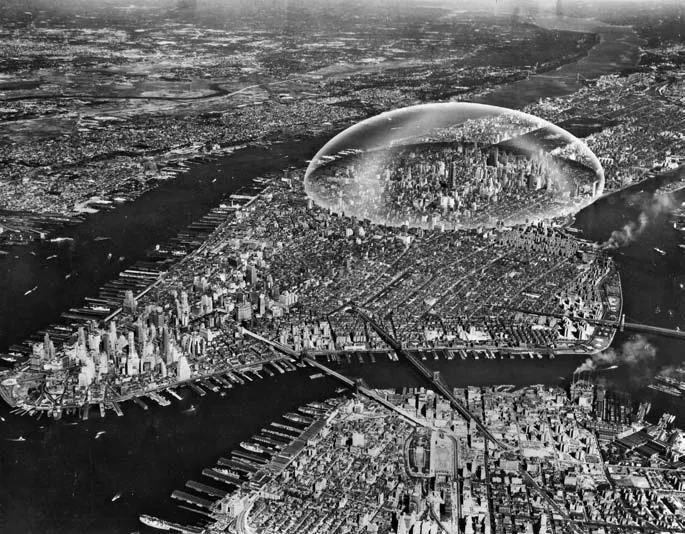
155 Figure 3.16
156 Buckminster Fuller and Shoji Sadao, Dome Over Midtown Manhattan, 1960. Courtesy The Estate of R. Buckminster Fuller.
157 Fuller attempted to move beyond specialization—artistic, political, or otherwise—toward a unity of technological progress and industrial design. His call for a comprehensive approach to mass housing and emergency planning, and his prototyping of viable alternative structures in the absence of robust governmental initiative or private patronage, represent an important ad hoc ethic to solving problems of unequal access to shelter. His time at Black Mountain coincided with the optimistic moment before the escalation of Cold War military spending, similar to the recent post--Cold War one, in which a reallocation of global resources to social justice ends seemed possible.

159 Figure 3.17
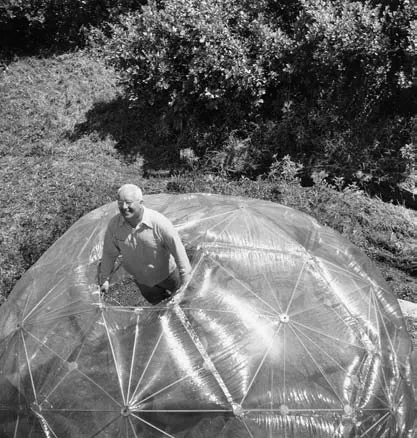
161 Hazel Larsen Archer,Buckminster Fuller with Dome, Black Mountain College, summer 1949. Courtesy of the Estate of Hazel Larsen Archer and the Black Mountain College Museum + Arts Center.
162 Yet Fuller’s language of experimentation was coextensive with a mid-century cultural lexicon emphasizing scientificity in a spirit of American technological optimism and exceptionalism. Design would henceforth be the central element of social planning, superseding political processes: design toward the telos of efficiently distributed technology. Fuller believed that technological development stimulated progress beyond politics along a ‘‘great circle course of transition from absolute ignorance to absolute technical knowledge.’’161 His design revolution—technocracy by another name—advocated the efficient distribution of resources in a society reoriented toward the complete acceptance of scientific authority. His idea of the dome as a manifestation of the patterns of nature to him proved the infallible truth of his discoveries, in which alternatives and the unknown gradually fell away as the universal order of total design was revealed. Fuller’s experimental method may be best understood as design striving for the elimination of unpredictability, contingency, and chance, so as to allow art to remain open to those self-same concerns.