3 IDEAS TO SAVE THE WORLD
3 There is a shock to almost all his proposals, and it is only after reflection that one concedes that yes, ultimately, or possibly in the not too distant future, it may in-deed be so.
4 —Isamu Noguchi, sculptor
3.1 Machines to Make Us Rich
5If Buckminster Fuller didn’t have command of the architectural world, at least he had won its respect. In fact, among many younger students who shared his idealism and sympathized with his battles against the establishment, Fuller became a hero. The squat, little man was looked up to as an example of someone who had fought against modern society and had at least won a battle or two.
6 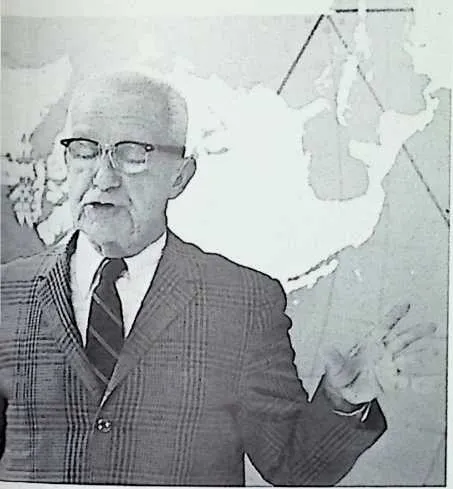 Typically, though, Bucky was so busy charting his own course that he didn’t fit neatly
into the role of rebel. While many idealists spoke out for a simpler future, preached a
back-to-nature lifestyle, and warned of the dangers of relying on technology to solve our
problems, Fuller took the other side. To him machines and technological progress were
not evil; they were going to make everyone in the world rich beyond their wildest
dreams.
Typically, though, Bucky was so busy charting his own course that he didn’t fit neatly
into the role of rebel. While many idealists spoke out for a simpler future, preached a
back-to-nature lifestyle, and warned of the dangers of relying on technology to solve our
problems, Fuller took the other side. To him machines and technological progress were
not evil; they were going to make everyone in the world rich beyond their wildest
dreams.
7 Bucky in front of the Dymaxion Map, talking, as usual.
8 To many people, machines are cold, impersonal monsters that always have some nagging defects and always break down when you need them the most. Bucky’s love of machinery, however, was so great that it once spoiled what was supposed to have been a harsh punishment. After wasting all his money and getting kicked out of Harvard before World War I, Fuller had been forced to face the wrath, not only of his mother, but of the entire collection of close-knit Fuller relatives. An urgent family conference was called and it was decided that Bucky should be packed off to Quebec, Canada, to work in a cotton mill owned by one of the Fullers. There Bucky was supposed to have gotten a taste of the sweaty, boring work of an unskilled laborer. The idea was that Bucky would be so frightened at the prospect of working like that all his life that he would understand the value of studying hard in order to get a good job.
9 One little hitch came up, though, that no one in the family could have predicted. Bucky enjoyed working in the mill, far better than
10 he had liked being at Harvard. He marveled at the machinery, and traced in his mind the ideas that led to the creation of these fascinating inventions. So enthusiastic was Fuller in his work with these cotton mill machines that his family wrongly concluded that their plan had worked. They supposed that Bucky had finally come to his senses and developed good work habits, and that he was trying hard to prove that he had learned his lesson. Proudly, they welcomed young Fuller back to Massachusetts and another try at Harvard. Bucky, however, found Harvard no more stimulating than before, and within a few months he completely baffled his family by getting kicked out a second time.
3.2 Energy Slaves
12Below and right: Energy slaves at work. If wheat was still harvested only by hand and goods moved only in amounts one man could carry at a time, we would live very different lives.
13 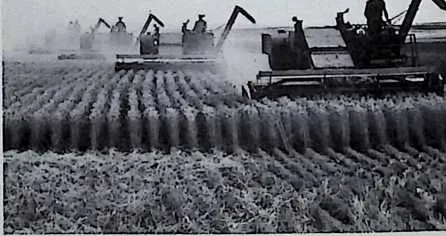 Buckminster never lost his appreciation of what mechanical inventions could do. It
was obvious to him that the key to getting more with less in the world was to build
more and better machines to do more and better work. Fuller also discovered the
key ingredient for operating a society of more and better machines, nearly 40 years
before an Arab oil embargo proved he was right. In the 1930s, at a time when oil
and gasoline were so cheap that it was easier to waste it than to conserve it, Fuller
pointed out that it was really energy and not gold that determined the wealth of a
society.
Buckminster never lost his appreciation of what mechanical inventions could do. It
was obvious to him that the key to getting more with less in the world was to build
more and better machines to do more and better work. Fuller also discovered the
key ingredient for operating a society of more and better machines, nearly 40 years
before an Arab oil embargo proved he was right. In the 1930s, at a time when oil
and gasoline were so cheap that it was easier to waste it than to conserve it, Fuller
pointed out that it was really energy and not gold that determined the wealth of a
society.
14 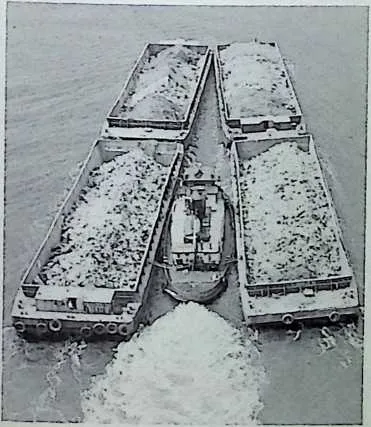 In order to get his energy ideas across, Bucky used the concept of an energy slave. This
term described the amount of work done by an energy-driven machine that equaled the amount
of work that a person could do in the same amount of time. (Since machines are not paid for
their work, Fuller used the term slave.) Bucky calculated that in 1972 each person on Earth was
making use of an average of 200 energy slaves. In other words, if all machines were thrown
out, we would need 200 hard-working slaves for every person on earth to keep our
lifestyles the way they were in 1972. Of course, those energy slaves were not evenly spread
out through the world. Fuller insisted that it was nothing but the lack of harnessed
energy that kept the Third World nations from a lifestyle equal to that of the United
States.
In order to get his energy ideas across, Bucky used the concept of an energy slave. This
term described the amount of work done by an energy-driven machine that equaled the amount
of work that a person could do in the same amount of time. (Since machines are not paid for
their work, Fuller used the term slave.) Bucky calculated that in 1972 each person on Earth was
making use of an average of 200 energy slaves. In other words, if all machines were thrown
out, we would need 200 hard-working slaves for every person on earth to keep our
lifestyles the way they were in 1972. Of course, those energy slaves were not evenly spread
out through the world. Fuller insisted that it was nothing but the lack of harnessed
energy that kept the Third World nations from a lifestyle equal to that of the United
States.
15 Energy experts today would not argue with that reasoning. But Fuller seldom liked to stop at what most people would consider reasonable. He went on to say that by increasing our use of energy slaves, we should be able to take care of every physical need of every person in the world. His argument was a simple equation: wealth = energy + knowledge. Since the amount of energy in the universe remains the same and cannot be destroyed or lost, that number in the equation will never decrease. At the same time, new discoveries continually add to the world’s previous body of knowledge and make that part of the equation increase. Therefore, the world’s wealth will always increase. All that remained in question was, how soon do we want to bring about a utopia on earth? It was Fuller’s contention that human beings are in a position to do whatever they want. Total success for humanity is possible.
3.3 Domed Cities and Floating Pyramids
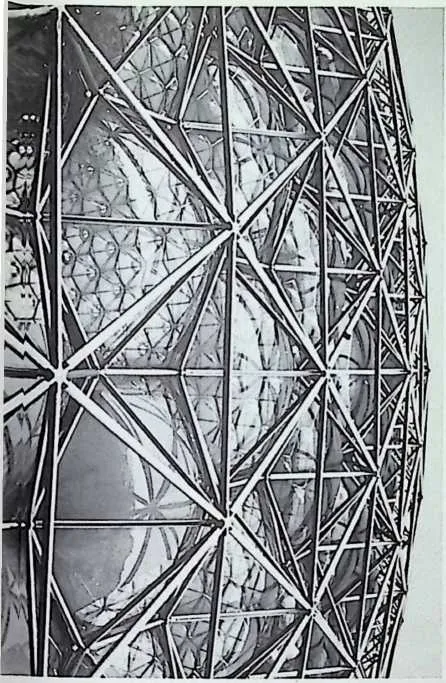
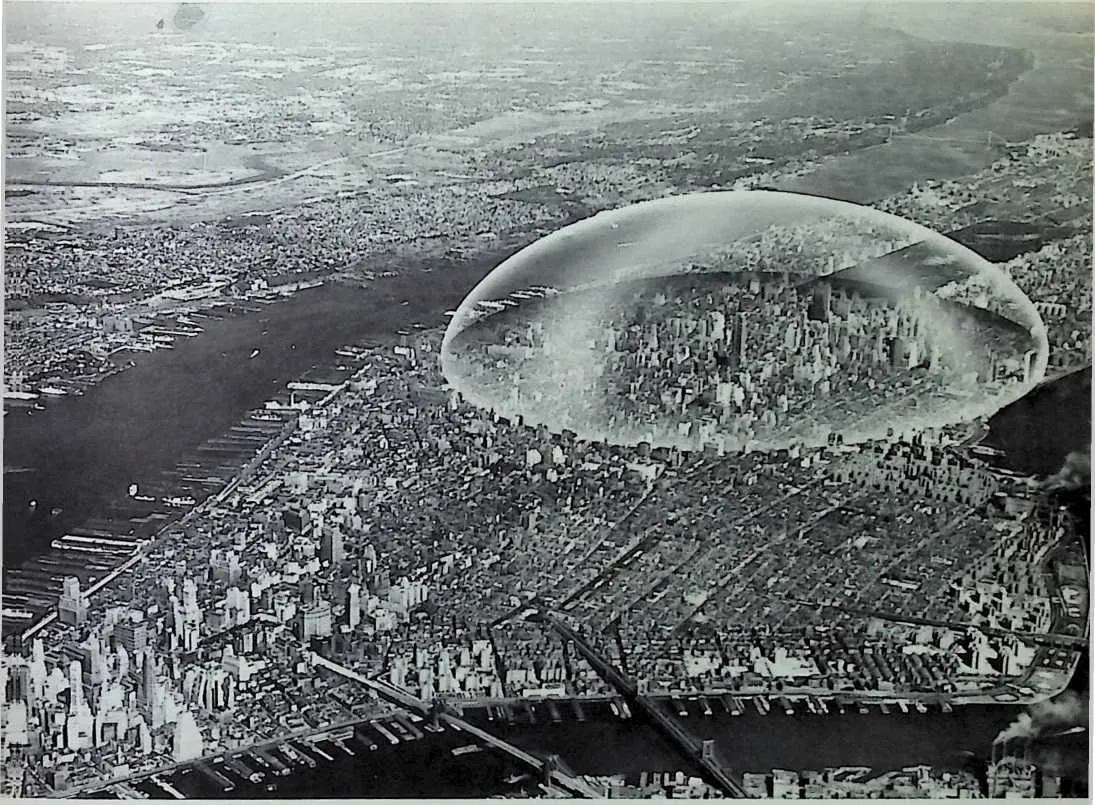
17With that optimistic view of the future, Fuller let his imagination go. How could he best change the environment so that it allowed humans a better life? Well, if it’s possible to build domes over rooms, courtyards, and sports arenas, why not domes over entire cities? Who but Buckminster Fuller would not only dream such things, but calculate the cost and the benefits? He suggested that a dome two miles in diameter over Manhattan, New York, would make the city 50 times more energy-efficient. It would be much less wasteful to air-condition the whole city in a climate-controlled dome than to separately air-condition rooms and buildings the way it is done now. The savings in snow removal costs alone would pay for the dome in 10 years. Thanks to Fuller’s designs, the people in the city wouldn’t even know they were ‘‘inside.’’ Bucky’s dome required so little material in order to be strong that, with a transparent skin stretched over the framework, sunlight could still be enjoyed and the only visible effect of the dome would be a slight
18 An artist's rendering of Fuller's domed New York City.
19 darkening of the sky. Lack of rain would be no problem. Fuller proposed designing grooves into the dome that could collect rain water for the city’s use.
20 Having made houses that could be mobile, Bucky went on to plan entire cities that did not need to be anchored to any property. One of
22 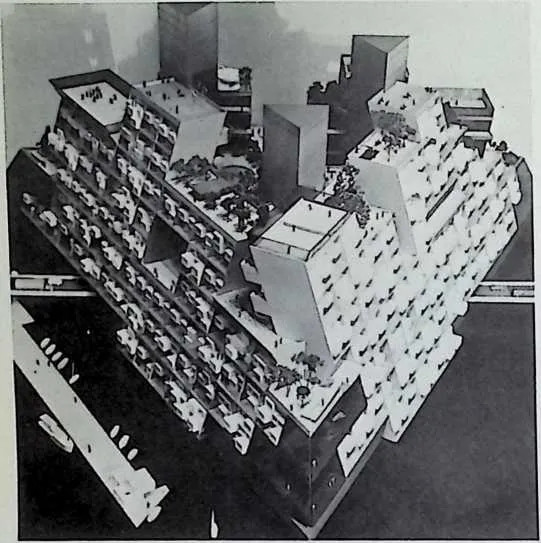 A model of the floating city. The apartments, like building blocks, could be detached from
this city and plugged into a different one.
A model of the floating city. The apartments, like building blocks, could be detached from
this city and plugged into a different one.
23 his ideas was a floating city, in the shape of a tetrahedron two miles long on each edge. This shape could stand up to earthquakes and hurricanes. Atomic reactors, cooled in the ocean water, would provide all the power, including energy to run the desalinization plants that would provide drinking water.
3.4 Spaceship Earth
25Machines, atomic reactors, mastering the environment, meeting all human needs through technology and planning—from the
26 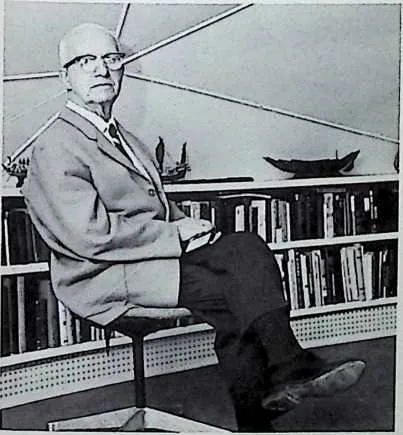 sound of that, Buckminster Fuller could have been an oil company president or a big
busi-ness lobbyist. Yet during his years as a re-searcher at Southern Illinois University in the
1960s, Bucky was a hero to the other side, the anti-establishment, counter-culture
people. How did he cross the line that separated big industry from the back-to-nature
crowd?
sound of that, Buckminster Fuller could have been an oil company president or a big
busi-ness lobbyist. Yet during his years as a re-searcher at Southern Illinois University in the
1960s, Bucky was a hero to the other side, the anti-establishment, counter-culture
people. How did he cross the line that separated big industry from the back-to-nature
crowd?
27 Fuller in front of port of his library at his dome in Carbondale, Illinois.
28 It’s probably a question that Fuller would not have answered, because, continually breaking away from accepted patterns, he saw no reason why one couldn’t believe in both sides. But perhaps a clue can be found in a conversation with an uncle during Bucky’s younger days. This uncle called the boy aside to give him some advice on planning his future. He reminded Bucky that only one out of a hundred people in the world enjoyed the benefits and luxuries that he did. The only way that a young person could guarantee that he would enjoy those benefits was to make sure that those other 99 didn’t. All that talk about charity and cooperation didn’t mean a thing. It was you against the world and success had to be gained at the expense of others.
29 That short conversation must have gnawed at Bucky because over seventy years later he could still recall the details vividly. His uncle’s argument sounded logical, but there was something in it that struck young Fuller as wrong. On that day in 1927 when he debated suicide on the shores of Lake Michigan, Fuller found where his uncle had made his mistake.
30 ‘‘We all belong to the universe,’’ Bucky decided. ‘‘We’re all in this together.’’ ‘‘Continuous man’’ was a term he used to describe his idea that all people should contribute to the fu-ture of the human race as well as to their own needs.
31 Fuller’s philosophy of being a part of the universe led him to be one of the first to introduce the idea of ecology to the general public. There was no greater enemy of his ‘‘more with less’’ motto than waste. If Bucky wanted to depress himself, all he had to do was think of all the world’s cars that were at that moment standing still at stoplights. Millions of engines were gulping energy, spewing out waste, and doing absolutely nothing worthwhile. As much as he liked machines and industry, Fuller pointed out that we can’t act as if we can do anything we like to nature. Bucky used a new term that eventually became so popular it was used as a theme by Governor Jerry Brown, Democratic presidential candidate in 1976. Bucky illustrated our dependence on nature by calling our planet ‘‘Spaceship Earth.’’ By that term he tried to show that there are limits to our world, that it is a closed system. We can’t act as though there’s an endless supply of every resource or as though we can produce tons of garbage, poisonous and otherwise, without trashing our home.
32 The idea of Spaceship Earth also showed that since all people on earth share this limited space, it is crucial that we work and plan together for our future. Fuller broke away from the establishment by blasting the governments of the world. ‘‘Man can do what-ever he wants, yet he invests only in ,race suicide,’’ Bucky fumed, referring to the bil-lions of dollars the world spends on weapons. He believed that if that money was put into design science, everyone would have enough of everything and there would be no need to fight for anything.
3.5 World Citizen
34Bucky led sessions of the World Game while he was alive. The World Game Project still exists and is still putting together information on world resources and needs.
35 Bucky included politics in his creative plans for the future. Considering it high praise that he was sometimes billed as ‘‘Buck-minster Fuller, World Citizen,’’ he dreamed of world citizenship for all. Advanced technology could link everyone to a computer sys-tem. Whenever an issue came up, everyone would punch in his or her vote, the computer would total the votes, and the issue would be decided. That was an example of the over-whelming faith Bucky had in people, a confidence that even many of his admirers did not share.
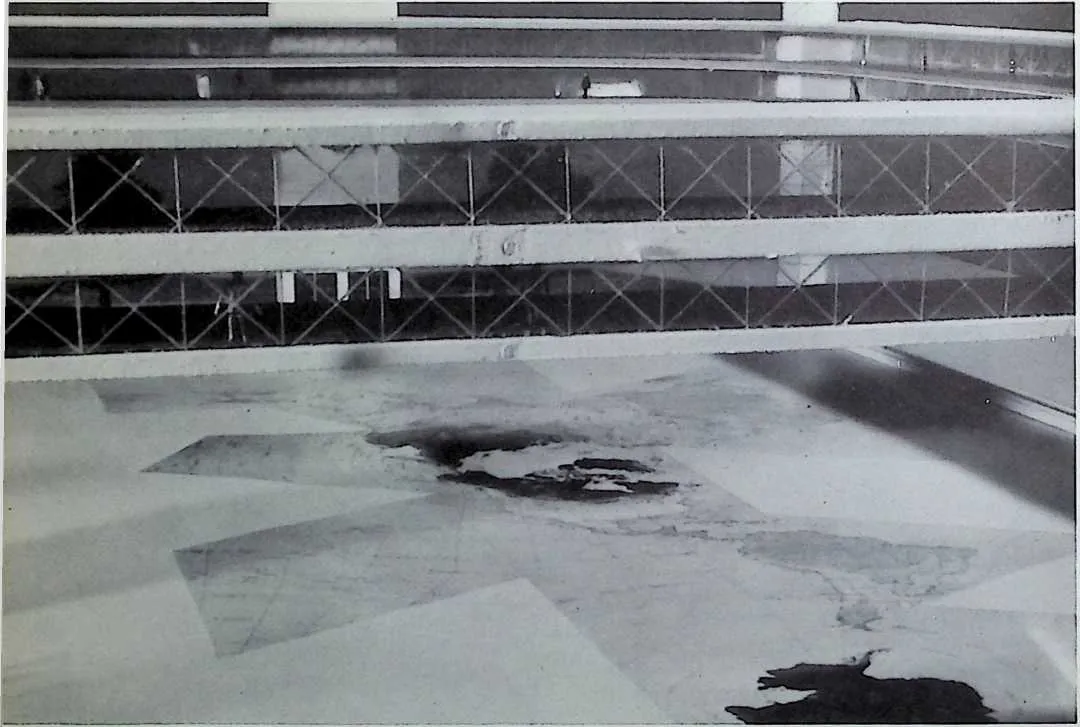
36 Fuller’s invention called the ‘‘World Game’’ received a better reception. In this game, the players took inventory of the world’s resources and needs and tried to come up with a plan to match the resources to the needs. The basic rule of the game was that no one wins unless everyone wins. Bucky toyed with the idea of a massive, computerized version of the game that could go into great detail. But the expense was too great and he had to settle for smaller versions of the non-competitive contest.
37 A model of the full-scale World Game that Fuller hoped to build.