
INTRODUCTION: Untaught Answers
2This was precisely what Bucky was all about: he knew exactly how to ask all the right and pertinent and searching and devastating questions.
3 —Peter Blake, editor, Architectural Forum
4 Remember way back to the time when you used to think that teachers never made mistakes. When you were new to this strange business of school and intensive learning, didn’t you marvel at the way your teacher could rattle off answers and explanations to everything without even pausing to think? Maybe you went home awed by these infallible wizards and asked, ‘‘How did they get to know all that stuff?’’
5 ‘‘They went to school and learned from other teachers,’’ came the answer. But that was more of a stall than an answer, and you weren’t going to settle for that. ‘‘But who taught those other teachers?’’ you continued.
6 ‘‘Well, they had to go to school, too, to learn from teachers older than they were.’’ If you weren’t so persistent you would have given up and walked away no closer to an answer than when you started. But you kept at it.
7 ‘‘But who taught the first teacher?’’ There you really touched a nerve because you asked something that can’t be brushed off with an automatic, one-word answer. Think about all that you’ve learned over the years and all that’s being pumped at you now. Where did it come from? If knowledge were only something handed off from age to age like a bucket in a fire brigade, we’d still be hunting food with crude spears and sleeping on cave floors.
8 Obviously, something is always being added somewhere in the learning process. Where, then, do the new ideas come from? One way in which they enter our world is through such people as Richard Buckminster Fuller. If you study the life of Bucky Fuller, you may get a clue as to how mankind occasionally breaks through into a world of ideas that no one has dreamed of before. His life may give an inkling of what it was that sparked an ancient mind to use a wheel to lighten the transportation load. Or it may clear up some of the mystery as to how science, medicine, and industry suddenly jumped forward so that the world would be almost unrecognizable to those who died a generation before. His life may make it at least believable that someone could break away
9 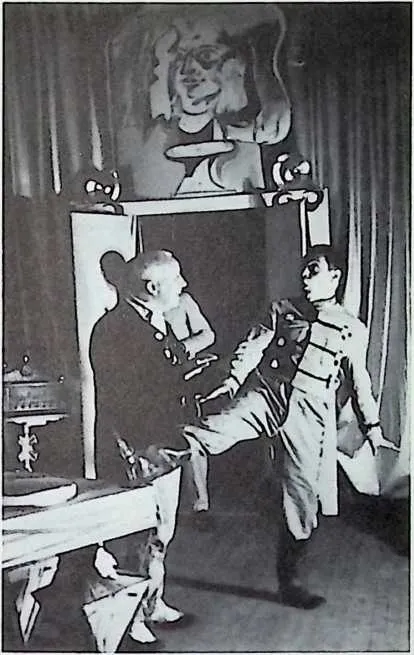 not only from popular opinion but from the evidence of his own senses to declare that the
world isn’t flat, it’s round.
not only from popular opinion but from the evidence of his own senses to declare that the
world isn’t flat, it’s round.
10 Bucky the show-off, left, on stage as Baron Medusa in ‘‘The Ruse of the Medusa,’’ August 14, 1948.
11 -So who is Buckminster Fuller? He was a college dropout who failed at one project after another, yet he collected over 2,000 patents in his lifetime. Many have insisted, and continue to insist, that he was a crackpot, a lunatic, a dreamer, a windbag, and a show-off. Others credit him with being a genius, a modern-day Leonardo da Vinci, and the foremost thinker of our time. ‘‘
12 How could one person be called all those things at one time? An exercise to help us understand how Fuller’s mind worked might also help us understand why his ideas stirred up such heated discussion. Take a look at something we’re all familiar with: houses.
13 The building of houses seems to be one of those things that has improved through the ages. Modern houses are a far cry from dark, damp caves, or flimsy, drafty tents, or the thatched-roof dwellings with the outhouse in the back. The modem version seems to be a pretty good product. It’s clean, airtight, energy-efficient. Aluminum siding, landscaped lawns, kitchens full of conveniences, cozy bedrooms, air-conditioning, and wall-to-wall carpeting have all added to our comfort.
14 Now think about what is still wrong with houses and what we could do to make houses even better. Don’t waste time dabbling with the little things like better storm windows or sunken bathtubs. Start over from scratch.
15 Rethink the whole idea of what kind of covering people ought to live under.
16 Most of us wouldn’t know where to start in redesigning the concept of a house. We probably wouldn’t come up with anything much different from what we already have and it likely wouldn’t be nearly as good as what many people will be sleeping in tonight. In fact, it seems to be a classic case of ‘‘don’t fix it if it isn’t broken.’’ Why go around trying to dream up new structures to live in when what we have is fine?
17 Imagine then that you’re inviting Buckminster Fuller to inspect your dream house, which is everything you feel a house should be. Bucky would concede that what you have is fine for the present, but wouldn’t you like to see into the future, to see a house become something more than what it is now?
18 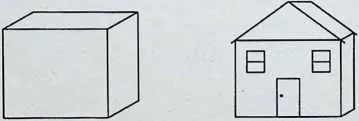 Unless you have an extremely unusual house, Fuller could give you four major reasons,
with-out even stepping in the front door, why your house won’t hold up against what’s coming in
the future. He would tell you that your house is:
Unless you have an extremely unusual house, Fuller could give you four major reasons,
with-out even stepping in the front door, why your house won’t hold up against what’s coming in
the future. He would tell you that your house is:
19 Above: Cube and standard house shape. Below: Sphere and Bucky's geodesic dome.
- 1.
- Too restricting: because it’s not designed to be moved.
- 2.
- Too wasteful of material: because houses don’t have to be heavy and massive to be strong.
- 3.
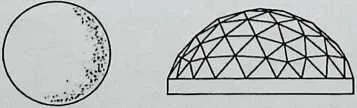 The wrong shape: because it’s based on a cube, not a sphere.
- 4.
- Too expensive: because it was built on the site rather than at a factory. -
20 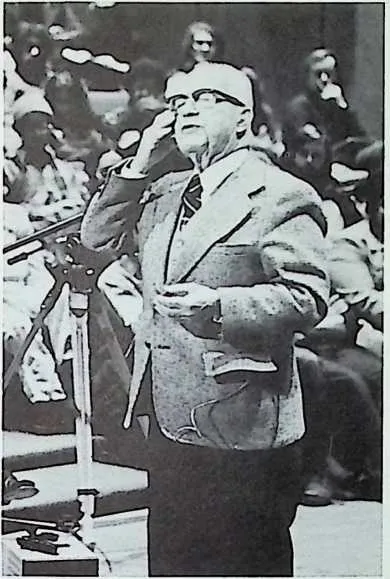 If this list of thoughts had never occurred to you, you’re in good company. For
decades the housing industry hasn’t been able to make sense of them either. And why
should they? Fuller’s complaints seem so off-the-wall, it’s no wonder that so many
thought he was out of his mind. Nobody cared how much a house weighed. What
difference did it make? In fact, people wanted a heavy house to provide strength, so
they wouldn’t get blown away by winds like those trailer homes always were. People
didn’t want houses that moved; if they did, they could buy a tent or trailer. Houses
with square comers were solid, easier to build, and could be naturally divided into
pleasing, rectangular rooms. Finally, the very idea of prefabricated houses sounded too
much Eke a cheap, disposable house. If you wanted quality you had to pay for it.
Didn’t it make sense that a house built into the ground, right on the spot, would last
longer?
If this list of thoughts had never occurred to you, you’re in good company. For
decades the housing industry hasn’t been able to make sense of them either. And why
should they? Fuller’s complaints seem so off-the-wall, it’s no wonder that so many
thought he was out of his mind. Nobody cared how much a house weighed. What
difference did it make? In fact, people wanted a heavy house to provide strength, so
they wouldn’t get blown away by winds like those trailer homes always were. People
didn’t want houses that moved; if they did, they could buy a tent or trailer. Houses
with square comers were solid, easier to build, and could be naturally divided into
pleasing, rectangular rooms. Finally, the very idea of prefabricated houses sounded too
much Eke a cheap, disposable house. If you wanted quality you had to pay for it.
Didn’t it make sense that a house built into the ground, right on the spot, would last
longer?
21 Buckminster Fuller recounting his childhood to an audience at Harvard University Science Center in 1977.
22 '■^Fuller, however, insisted that his questions were important. The questions led to the invention of spectacular geodesic domes so strong they could stand up to the strongest wind, yet so light they could be transported by helicopter. His ideas of radical new houses were in turn part of a grander scheme. For what Buckminster Fuller reaUy had in mind was a plan to save the human race and Eft mankind to a bold new future that overflowed with plenty of everything for everyone in the world.
23 It’s not easy to understand what domes have to do with saving the world. It’s hard enough trying to make sense of Fuller’s questions, without even getting into the answers! At times, Fuller’s brain seemed to be like a satellite which had broken away from all the other satellites in an orbit and went whirring off into space on its own.
24 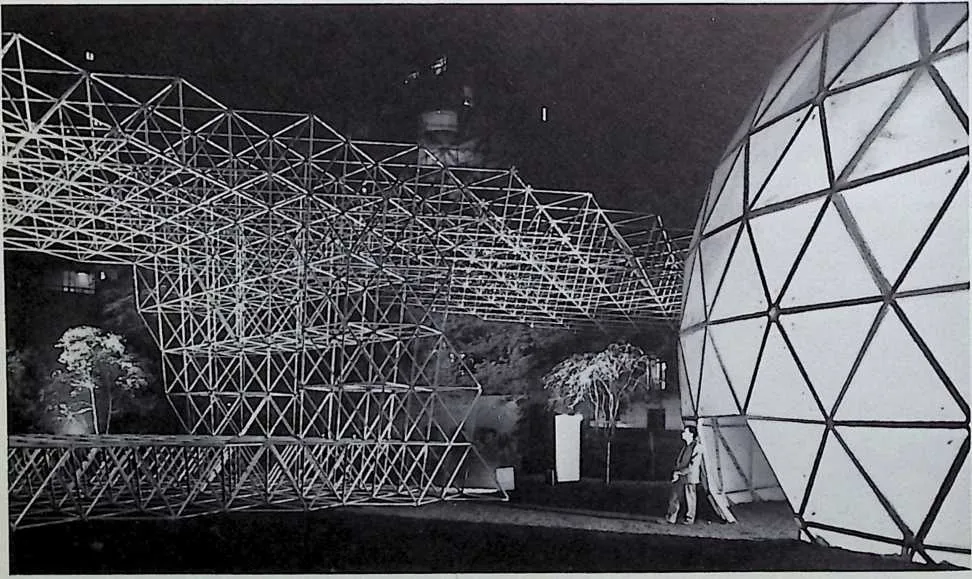 How then did Buckminster Fuller break away? How did he come to explore areas that
others don’t even believe exist? What did he find? Whether you agree with his life or not, the
Fuller life was a most unusual adventure.
How then did Buckminster Fuller break away? How did he come to explore areas that
others don’t even believe exist? What did he find? Whether you agree with his life or not, the
Fuller life was a most unusual adventure.
25 Octet truss and radome in an exhibit of Buckminster Fuller's designs at the Museum of Modern Art in New York in 1959.
26 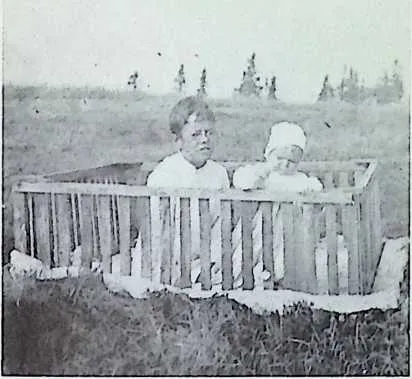 1
1
27 Fuller with his baby sister Rosie at the family's vacation home at Bear Island, Maine.