
1 Comfortably Off
2‘‘I was born cross-eyed,’’ Buckminster Fuller once wrote.
3 ‘‘Not until I was four years old was it discovered that this was caused by my being abnormally farsighted. My vision was thereafter fully corrected with lenses. Until four I could see only large patterns, houses, trees, outlines of people with blurred coloring. While I saw two dark areas on human faces, I did not see a human eye or a teardrop or a human hair until I was four.’’
4 A plea for sympathy? No, not at all. Just the opposite. Fuller went on to explain how lucky he’d been to be bom with poor sight. A fuzzy detail in his surroundings went unnoticed. This forced him to concentrate on the larger pattern, the BIG PICTURE. In later years, that became his formula for clear thinking. First you focused on the BIG PICTURE. Then you filled in the details. Thus a childhood misfortune had been turned into a blessing. A minus had become a plus.
5 Bucky Fuller was to do that many, many times in the 87 years he spent on what he called Spaceship Earth.
6 The BIG PICTURE of R. Buckminster Fuller? …It’s hard to explain in a paragraph. At the time of his death in 1983, he had the longest entry in Who’s Who in America. He’d been on the cover of Time magazine. He’d dined with presidents. The famous geodesic dome was only one of his twenty-five patented inventions. He’d spoken at over five hundred colleges and universities, forty-seven of which had given him honorary degrees. He’d preached his upbeat message of human friendship and betterment to a whole generation of students. And for those who couldn’t hear him in person, he’d written seventeen important books. In fiftyseven trips around the world, he’d become known as ‘‘the planet’s friendly genius.’’
7 Architect, inventor, scientist, mathematician. Historian, economist, philosopher, prophet. Bucky Fuller was all these things—and more. Throughout his life, he shied away from the one-word labels others wanted to pin on him—just as he shrugged off labels like crackpot and inspired child. He liked to call himself a comprehensivist. (Fuller was forever creating new word combinations. Comprehensive, of course, means ‘‘including a great deal.’’ Here he adds ist to make the word refer to a person, like feminist.)
8 Yet the person who perhaps best knew Fuller’s mind suggests that the word to describe him is poet. This may be true, from the beginning (in Fuller’s words):
9 Womb days—
10 Womb days—
11 Dear old tummy tomb days—
12 to the BIG PICTURE:
13 Environment to each must be
14 All Universe excepting me.
15 The Universe in turn must be
16 All that isn’t me plus me.
17 Richard Buckminster Fuller, Jr., was born on July 12, 1895. The place: Milton, Massachusetts, a new and growing suburb of Boston. The weather: warm and sunny, with prospects clear. The family tree was a sturdy old oak. The first Fuller had come to New England in the 1630s, shortly after the Pilgrims. Years later, the Reverend Timothy Fuller represented Massachusetts at the Constitutional Convention. Timothy Fuller refused to sign the final Constitution because it permitted slavery. His grandson, the Reverend Arthur Buckminster Fuller, served as a Union chaplain during the Civil War. As a chaplain, Arthur wasn’t supposed to engage in fighting himself. But his hatred of slavery was such that he insisted on leading the troops into the line of fire. A Confederate bullet ended his life at the Battle of Fredericksburg.
18 The most famous of Bucky’s ancestors was his great-aunt, the amazing Margaret Fuller. She was a feminist before the word was known. Margaret Fuller mastered five languages before she was out of her teens. Later, with Ralph Waldo Emerson, she founded The Dial, a pioneering literary magazine. Then in 1845 she wrote Woman in the Nineteenth Century. All during her life, she held her own with the best minds of her time. (More than that, maybe. She once told Emerson, ‘‘I now know all the people worth knowing in America, and I find no intellect comparable to mine.’’) A great aunt indeed!
19 It was a family tradition ■ for Fuller men to attend
20 ©1960, The Estate of Buckminster Fuller.
21 Courtesy, The Buckminster Fuller Institute, Los Angeles.
22 Bucky Fuller at age one.
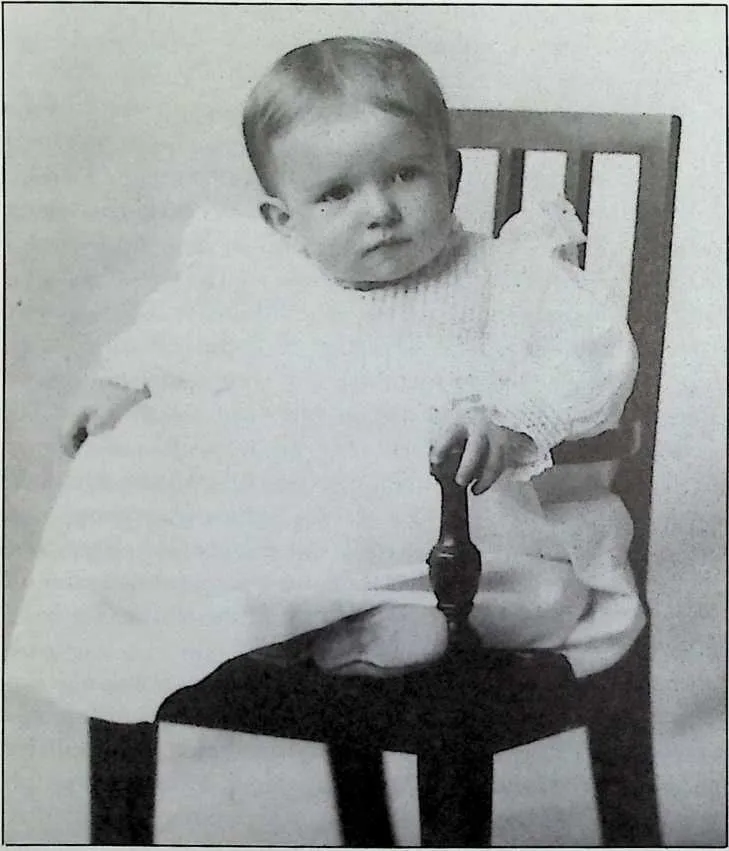
24 Harvard and then become ministers or lawyers. Bucky’s father, however, had followed only half of this tradition. He graduated from Harvard. He then turned his attention to the business world. In a great port city like Boston, importing goods from foreign countries had brought success to many. Richard Fuller determined to go into the import business. He made contacts. He did well. At the time of Bucky’s birth, Richard Fuller’s busy docks in Boston welcomed fine leathers from India and Argentina, fragrant teas from China and Ceylon.
25 In 1891, Richard Fuller had married Caroline Wolcott Andrews, the daughter of a well-to-do Chicago family. She, too, had a distinguished heritage. Distant ancestors had signed the Declaration of Independence and been governors of Connecticut. A year after they married, a girl, Leslie, was born. Three years later, with Bucky on the way, the successful young couple decided to go after that typical American dream, a lot and house in the suburbs. The lot in Milton turned out to be two and a half acres of wooded land, set on a bluff. The new house was a small version of a Victorian mansion: huge white fireplaces, a paneled dining room, servants’ quarters in a third-floor attic. A cook was hired. A gardener tended the grounds. At times Bucky and his sister Leslie each had a private nurse.
26 Of course Bucky really didn’t get a good look at the house until he was four and a half. Then came the glasses. Bucky was overjoyed. Now he could see the separate shingles on the house, not just a blurry wall. He could see his toenails. He could see the tiny brown hairs on his arm! He could see the cat’s eyes—and outside, even the eyes of a snake! What pleased him most, though, were the eyes of his mother. There was tenderness there, concern and warmth and love.
27 Why, eyes could communicate! They could almost speak! It mattered little to Bucky that the thick lenses that framed his own eyes made them look larger than normal to others.
28 Before the glasses, Bucky was thought of as an awkward child, perhaps a little slow. Now he proved to be just the opposite: curious, bright, ever into mischief. He learned about his new surroundings with surprising speed. He learned also to stand up to Leslie, who now often viewed her brother as a new and unwanted challenge. She was forever trying to put him down.
29 Many of Bucky’s first memories concerned his father, a gentle man to whom he was devoted. (Fuller Senior was called both Richard and Dick, and the name Buckminster just seemed too lengthy and lofty for a little kid. The boy was ‘‘Bucky’’ almost at birth.) ‘‘I clearly remember New Year’s Eve, December 31, 1899,’’ Bucky wrote later. ‘‘I was four and a half. I had just received my eyeglasses and was deeply excited at all that I could now see. At 11:45 P.M. my father opened a window of our New England home to let in the twentieth century.’’ Bucky also remembered his father leading him to church by the hand, talking seriously about God, trying to interest the boy in becoming a minister. One of Bucky’s main regrets was that Richard Fuller’s business so often took him away from home. A trip to Argentina could take months. A trip to India once took almost a year.
30 Another memory—often mentioned by Bucky with some pride—concerned a happening in kindergarten. The teacher had given each child a bunch of half-dried peas and a pile of toothpicks. The kids were told to use their imaginations, to build something. Most of the children, as might be expected, made houses and barns. But not Bucky. Avoiding cubes and rectangles, he made a triangle, then seemed pleased with its rigid form. To this he attached another triangle, on the side. Then he added another triangle, and another. Before long he had a strong, complex, three-dimensional structure made entirely of triangles. The teacher was so pleased that she called other teachers into the room to look at it. This surprised Bucky, but it pleased him as well. And why did it so please Bucky to tell this story in later years? Surely, neither the teachers nor Bucky had known that his toothpicks and peas formed something very like the octet truss he would patent in 1961.
31 But the sharpest, the most meaningful, of Bucky’s early memories concerned Bear Island. Throughout his life, this bit of beauty off the coast of Maine remained Bucky’s hold on reality in a changing world. It gave him a sense of place—and, to him, was a place of sense.
32 At the turn of the century, one mark of success in life was to buy a lot in the suburbs and build a big house. Another was to take—or send—the family away for a long summer vacation. The practice was called summering. (‘‘We live in Boston but we summer in Maine.’’) It still makes sense to some people today. But back in the days before air-conditioning, before even electric fans, when horses and outhouses fouled the hot air of July and August, it probably made much more sense. Better the bright mountain breezes or the fresh breath of the sea!
33 At first the Fullers, with other relatives, summered at Marblehead, on the Massachusetts coast north of Boston. Then it was Wiscasset, in southern Maine. Finally, in 1904, it was farther along the Maine coast, the Penobscot Bay area. Bucky’s Grandmother Andrews came east from Chicago with some other relatives, and the whole clan summered on Eagle Island. They lived in a boardinghouse. For Bucky it was a summer of endless surprise, just made for a nine-year-old boy. The island was like a mountaintop rising from the surface of the water. Bucky loved climbing the black rocks, polished smooth by the waves of thousands of years. On clear days the white seagulls traced patterns against the bright blue sky. At other times the gulls fed on crabs and other delicacies of the low tide, their squabbling cries spreading over the gray-green sea.
34 Penobscot Bay is dotted with islands. Bucky, short for his age but wiry and strong, kept up with his older cousins in exploring them all. American Indians had once lived on the islands, and arrowheads were not hard to find. Bucky thought the local lobstermen and fishermen fascinating. They spoke in a strange way, but their gnarled hands and knowing eyes taught lessons beyond the scope of speech. Bucky loved watching them at work. He liked listening to their stories. His days were active, his sleepy nights cool. The sound of the sea, from the lapping of little waves to storm-blown billowing, was never far away.
35 Living close to nature taught Bucky an important lesson that was to serve him well throughout life. The fishermen sailed only when the winds were right. To predict the weather, they studied the skies. They took advantage of the unusually high tide in Penobscot Bay. Their boats were so graceful—not for the sake of art, but simply to slide through the sea. A mast bent a little in the wind; it did not stand rigid and then snap off. Bucky learned that getting along with nature did not mean fighting nature. No, it meant studying nature’s ways and then cooperating with them. Human beings were part of nature, after all. They had to fit in.
36 Bucky was not the only one excited by that summer on Eagle Island. In fact, the whole family fell in love with the area, almost at once. Before much time had passed, Bucky’s father asked Grandmother Andrews to think about buying one of several nearby islands that were for sale. .She agreed. This was even more fun for Bucky—inspecting islands, one of which would be the family’s very own! At length Grandmother Andrews decided on Bear Island, two miles from Eagle. Bucky could hardly believe it. Eighty-seven acres in size and nearly a mile long, Bear Island was to be his home away from home—forever!
37 Since the days of the American Indians, Bear Island had been inhabited. Part of it had once been farmed; stone walls zigzagged between shapeless fields. Three old houses stood on the island, the best of which became the family’s home for the summer of 1905. Bucky got to know every path through the piney woods, every feature of the rocky coast. Life was rugged, but pure and clean in the most basic of ways. There was no electricity, of course (electricity existed but was rare; even the Milton house was without it). All work had to be done by hand, all food brought from the mainland ten miles away. Everyone had assigned chores. Bucky’s mother, now busy with two younger children, Wolcott (Wooly) and Rosamond (Rosy), probably worked the hardest.
38 Even today, many lonely islands off the Maine coast do not have telephones. And in 1905, even the word radio was largely unknown. Communication between Bear Island and the greater world outside had to be by mail. It became Bucky’s job to row the two miles to Eagle Island every day, get the mail from the mailboat that delivered there, and then row back. This was no easy task. Tides and ocean currents often made the two miles seem like five. Some days, the fog was so thick that Bucky had to use a compass.
39 The mail trip, as it turned out, gave Bucky an early chance to turn a minus into a plus. It gave rise to his first useful invention. Interested in sea creatures, he had long marveled at the way a jellyfish propels itself through the water. Bending its supple body like the cupping of a hand, the jellyfish forces water out behind it as it moves along. Could such a principle be used to make rowing a boat easier? Bucky thought yes …possibly. He drew a picture of what he called a ‘‘mechanical jellyfish.’’ Then he set to work.
40 As Bucky later described it, his invention was a ‘‘teepee-like, folding, web-and-spirit cone which was mounted like an inside-out umbrella on the submerged end of a pole.’’ The pole passed through a metal ring attached to the rear of the boat. When Bucky pulled on the pole, the ‘‘teepee’’ collapsed easily upon itself, sliding toward him through the water. Then PUSH! The cone fanned outward, ‘‘almost as though touching bottom.’’ Bucky pushed, and the boat moved forward. He found he could ‘‘push-pole the boat along far more swiftly and easily than by sculling or rowing.’’ An added advantage was that the operator of the boat could face forward, unlike someone rowing. Keeping a straight course shortened the trip on any day. On a foggy day, looking ahead helped avoid trouble.
41 Too soon for Bucky, the summer of 1905 was over, wrapped up and carried back to Milton as a memory. If he had any regrets, they concerned his relationships with the older children. Leslie was now less of a problem, but the family included two older cousins. McGregor and Andrew King had come East for the summer with Grandmother Andrews. They thought of themselves as tough westerners. Often they treated Bucky rather like a sissy. But they spent a good deal of time in another of the houses on Bear Island. Bucky had not let them ruin his summer.
42 Fall meant a return to Milton and to school—to spelling, to arithmetic, to ‘‘who beheaded who and who put someone in a tower,’’ as he put it. When winter neared, however, something happened that seemed to fill the sails of summer once again with wind. Richard Fuller decided to build a huge house on Bear Island. It would be large enough to hold all the Fullers and their relatives for years to come. To draw the plans, he hired an architect named Henry Wadsworth Longfellow, Jr., a Harvard classmate and old friend. It was Longfellow who had designed the Milton house just before Bucky’s birth.
43 The Big House—the building was called by its present name almost at once. The plans thrilled everyone. The house had two stories and an enormous dormered attic for future expansion. Porches and balconies jutted from its sides. It would sit on the highest point on Bear Island, commanding a view all around.
44 It was easy for the Fullers to imagine the completed house, ready and waiting for them to move in. It was not so easy, however, to figure out how the house would be constructed. Every timber, every roll of copper, every shingle, even every nail, would have to be transported to the island ten miles off the coast of Maine. Building the house would take months. The workmen would have to have a place to stay. How could all this be done?
45 A local contractor named Sewell agreed to do the job. To carry materials and to serve as a floating warehouse, he suggested finding an old ship. The boat could also be used as a dormitory for the workers. Finally, Sewell located the Polly, a creaking schooner just seaworthy enough for the job. The Polly had been built in 1805 and had served its country well in the War of 1812. Now this century-old ship was loaded with the materials that would become the Big House. The Polly left Boston about the first of June and soon lay at anchor off Bear Island.
46 The summer of 1906 was an important one in the development of R. Buckminster Fuller, who was later to spend years in the housing industry. Building the Big House gave him a chance to observe construction practices of the time. He watched the house go up, sill by sill, joist by joist, board by board, shingle by shingle. Longfellow’s flat plans took on three-dimensional shape before his eyes.
47 Bucky was busy with other things as well. Grandmother Andrews bought a small motorized boat, one of the first to be seen in the area. The engine, of course, was not the efficient marine design of today. It was an old stationary-type engine that sat in the middle of the boat, as if defying forward movement with its very weight. At its best, it coughed, sputtered, and wheezed its heavy flywheel into action. At its worst—which was often—it simply refused to run. In this and future years, Bucky loved tinkering with spark plugs, gas valves, and other engine parts.
48 Future summers on Bear Island brought new excitement. The family purchased a much larger boat, a motorized cabin cruiser named the Wego. Bucky kept busy. Lumber left over from the Big House offered many temptations to a young boy with a talent for building things. Bucky built a small cabin for himself that is still in use today. When a new Victrola phonograph record player was hauled to Bear Island for the Fuller kids, Bucky designed and built a cabinet for the heavy records. It separated the thick records as they stood upright, much in the manner of the plastic-coated wire record racks that became popular years later. This cabinet, too, is still in use on Bear Island. Bucky left a lot of himself there—but probably not as much as he took away. To the end of his days, he always tried to save the month of August for still another return to the Big House…to nature, to his roots, and to the eternal sea.
49 When he grew older, Buckminster Fuller often looked back on the world into which he’d been born. As a child, of course, he’d simply accepted that world and his place in it. All children do, for the most part. But years later, Bucky would realize what things were like about 1900. Only 5 percent of the people had a standard of living that would be considered acceptable today. And only about 1 percent were in the very top economic and social group. Those fortunate few Bucky divided between the ‘‘wealthy’’ and the ‘‘comfortably off.’’ The ‘‘wealthy’’ were families who not only took their servants by steamer to their Maine mansions, but also took along their prize horses and handcrafted, gilded carriages. His own family, by contrast, was just ‘‘comfortably off.’’
50 The youthful Bucky was not entirely blind to the problems of the poor. Later, as an adult he devoted most of his life to improving the lot of humanity. Even at a very young age, there must have been some sympathy in his heart. There were many poor people around him, even in the suburb of Milton. When he visited his father’s busding wharves and warehouses, he also observed the laborers whose muscle power made the whole system work. In 1965, Bucky shared a sharp memory with an audience: ‘‘When I was young, going from a little town seven miles outside of Boston into Boston through Dorchester, or Roxbury, I saw that all the children in the streets were in rags. No exceptions. People on the trolley really stank. Women of twenty-six years were hags with half their yellow teeth out. There was no dentistry for them.’’
51 But as a boy, probably, Bucky lost little sleep over the plight of the poor. He hadn’t even thought about the BIG PICTURE of ailing humanity. He had his own interests and problems, just like any other child. As far as his life was concerned, he was comfortably off.