
3 The Time of My Life
2In 1965, at the height of his fame, R. Buckminster Fuller shared a memory with an eager audience. The story he told may have been made up, or partly made up. But that is really beside the point. The point is the point of the story. Fuller sometimes used stories to illustrate a more important truth than the truth of what really happened. The BIG PICTURE again.
3 The happening occurred in 1913, just before Bucky went off to Harvard. A rich uncle took him aside for a man-to-man talk. ‘‘Young man,’’ the uncle said, ‘‘I think I must tell you some things that won’t make you very happy. I know that you are impressed with your grandmother’s golden rule: ‘do unto others as you would they should do unto you.’’ But that wasn’t the way the real world worked. No, the uncle went on, ‘‘the golden rule doesn’t work. Those few of us who are rich and who really have the figures know that it is worse than one chance in one hundred that you can survive your allotted days in any comfort. It is not you or the other fellow; it is you or one hundred others.’’ Putting it differently, for a family of five to be ‘‘comfortably off,’’ five hundred others had to suffer. To survive, you had to be a winner, to triumph over others, said the uncle. ‘‘So do it as neatly and as cleanly and politely as you know how and as your conscience will allow.’’
4 So, it was a dog-eat-dog world! Worse than that, even. It was a world ruled by the male dogs. Part of a top dog’s responsibility was to shelter the fragile females from the truth. The ladies had to be protected in their innocent, golden-rule happiness. The uncle felt quite proud that he had taken care of the grandmother’s ‘‘hundred others’’—without her even knowing about it.
5 Bucky’s meat-carrying job in New York put him in quick touch with the ‘‘others’’ of the world. He found that he could get along fine with most of the men he worked with. He admired their strength. He wondered at their ability to keep going, day after day. But that was all. Most of them had had only a few years of school, if any. ‘‘My fellow workman was intellectually timid to a fault,’’ Bucky said later. ‘‘He was a slave; he knew he had very little chance of happy and healthy survival. He was afraid of his words and his mind. He communicated his feelings by the way he chewed tobacco, spat, and blasphemed [swore], using a total vocabulary of no more than about fifty words.’’
6 Clearly, Bucky was quite different from his fellow workers. He had more than fifty words in his mind—a lot more. This difference was soon noticed by his bosses. They moved him up to a cashier’s job. They gave him a small raise in pay. Then they made Bucky what today might be called a ‘‘management trainee.’’ To give him experience, they moved him around from place to place in New York and New Jersey. In less than two years, Bucky worked at twenty-eight branches of Armour and Company. This gave him the BIG PICTURE of the company’s business. He learned that meat went bad fast. It had to be distributed quickly, cleanly, and efficiently. Thus Bucky got his first lessons in distribution patterns. He certainly never imagined that he would later become an expert in distribution patterns for all the earth’s resources, the world around.
7 In other ways, too, Bucky’s life began to look up. He still loved the bright lights. His amazing energy allowed him to dance into the night, get a few hours sleep, and go to work fresh and ready for another long workday. Of course, his social life took money. But here again he was lucky. His mother, who no longer owned the Milton house, came to New York. She rented a Manhattan apartment. Bucky had hardly been cast out by the family. Now his mother did what she could to bring him a home away from home.
8 Caroline Fuller had another good reason to move to New York. She wanted to be close to her oldest child, now Leslie Larned. Leslie had married well. Her husband was the rich and athletic sportsman, Edward P. Larned. They lived where they wanted to live, and they mingled with the best. For the summer of 1915, they rented a house in Lawrence, Long Island. Lawrence was a wealthy community on the Atlantic coast. Mrs. Fuller often traveled to Lawrence to spend time with Leslie and some friends. Before long, when Bucky had a free weekend, he also made the short trip to Lawrence.
9 Bucky soon made friends among the well-to-do Lawrence young people. One Saturday night a friend, Tilden Hazard, wangled him an invitation to a dance. The party was held in a private house, one of the many stately homes in Lawrence that could host such an affair. The large rooms glittered in splendor. The live music spilled out through open windows and spiraled upward toward the July stars. It was a formal event. The men wore tuxedos. The women wore elegant dresses with long, swirling skirts.
10 It was the women, of course, that Bucky looked over first. One woman, in particular, caught his eye—as she did the attention of all twenty or so men present. Her name was Anx Hewlett (really Anglesea, but nobody called her that). Only fifteen years old, she had long golden hair, stunning blue eyes, and a face that caused hearts to skip a few beats, if not melt. She was also something of a flirt. Bucky thanked friendly fortune when he finally got to dance with her. He also danced with Anx’s sister, a beautiful brunette named Anne. She was almost as pretty as her sister Anx, but in a different way. Anne had roses on her cheeks and large, captivating brown eyes. She also seemed more mature than her sister Anx. Bucky, who had just turned twenty, learned that Anne was nineteen.
11 The next day another friend, Ken Phillips, suggested that he and Bucky pay a call on the Hewlett sisters. Bucky didn’t need to be asked twice. Before long they presented themselves at the Hewletts’ door at the end of Martin’s Lane. The visit had been Phillips’s idea, so Bucky let him take the lead. It was soon clear that Phillips’s real interest was in Anne, not in Anx. Bucky didn’t mind at all. He knew neither young woman well. After all, Anx was the one with the cover-girl face and figure. Even more important, the four seemed to hit it off at once. They had fun together.
12 That was Bucky’s first visit to the large brick and shingle house where, over the years, he would spend a lot of time. During the summer of 1915, he went to Leslie’s every weekend he could. From there it was only a short walk to the Hewletts’. It was Ken Phillips and Anne, Bucky and Anx. Double dating was common then, and the foursome seemed to belong together. It might seem there wasn’t much to do on a date. A new invention, the silent motion picture, was about the hottest thing in the area. A ‘‘date’’ was usually a visit—sandwiches in the dining room or lemonade on the lawn. It was considered rather daring when they sailed out to an island for a picnic.
13 The Hewlett household was a strange and wonderful one. Children were everywhere. Anne, the oldest of ten, was definitely no longer a child. She was often forced by her position to be more like a mother. Mrs. Hewlett was an invalid who spent most of her time in an upstairs room. The father, James Monroe Hewlett, was a well-known painter and architect. He was a gentle, caring man, but his work often kept him away. Anne had to help manage the servants and the kids. Most of the children were headstrong, fun-loving, even wild. Anne herself was a fun-loving person, but she did her best to take care of the others. Something was always happening at the Hewlett house. Any excuse would do for a party. The kids loved to write and put on little plays. At best, they were talented children who tried to cooperate without a parent on the scene. At worst, they fought like crazy. Bucky himself, strong as he was, hesitated to step into the battles.
14 Two things began to worry Bucky as the summer neared its end. First, he felt himself growing more fond of Anne and less attracted to the dazzling Anx. Yet Anne was supposed to be Ken Phillips’s girl, and Phillips was his good friend. There were rumors, even, that Anne and Ken were secretly engaged. The whole situation was one big problem. Second, the end of the summer meant that he might never see either of the sisters again. When fall came, the Hewletts would return to their winter home in Brooklyn. A weekend trip to Leslie’s could no longer really be a visit to the Hewlett’s.
15 Unknown to Bucky, it was Anne who would put an end to both these worries. The fall season had hardly started when she invited Bucky to dinner in Brooklyn. The whole family liked Bucky’s good humor, and he was genuinely fond of both Anne’s parents. Bucky said yes to the invitation. Again he had a good time at the Hewletts’, and again he was invited to dinner. More invitations followed. But because of his friendship with Ken, Bucky tended to act formal and shy with Anne. It was she who broke the ice that was already melting between them. She came right out and said it: Certainly, she was not engaged to Kenneth Phillips. Bucky should forget any attachment he imagined between them. In other words, Bucky was free to court Anne himself.
16 Back in 1915, courting was rather formal. The word date today hardly means an evening-long visit with a girl’s family. But in Bucky’s youth, it often did. Not that he dreaded the idea at first. He liked Mrs. Hewlett, and he rather enjoyed the long visits at her bedside upstairs. As for Mr. Hewlett, Bucky had nothing but admiration. The kind and talented James Monroe Hewlett was a gifted man. He designed and painted sets for top Broadway shows. He designed houses. He constantly studied new building materials and methods of construction. These activities fascinated Bucky. What Bucky didn’t like was the part the other Hewlett children chose to play in his courtship.
17 ©1960, The Estate of Buckminster Fuller.
18 Courtesy, The Buckminster Fuller Institute, Los Angeles.
19 Anne Hewlett about 1915.
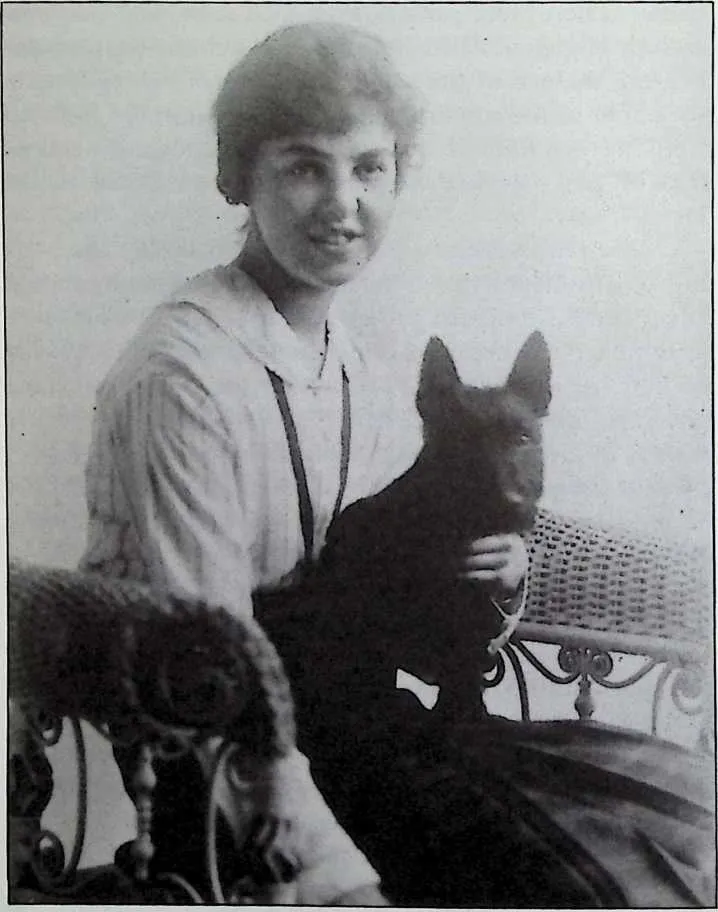
21 Anything the Hewletts did, they did in a big way. When they squabbled, they fought tooth and nail. And when they teased, it was torture. Bucky was used to their constant teasing. They teased each other at every chance, and to be a Hewlett friend meant to be teased as well. But Bucky never expected the kids’ reaction when they saw the stars come out in the lovers’ eyes. Although the Brooklyn house had many rooms, it was almost impossible for Bucky and Anne to find a moment alone. A door was always opening, or some ‘‘emergency’’ would demand Anne’s attention. Because Bucky worked for a huge meat-packing company, he was called ‘‘the butcher boy.’’ Sometimes the kids would get together and chant at the top of their lungs:
22 Listen! Listen! Listen!
23 Anne and Bucky kissin’.
24 Where? Where? Where?
25 In the big, red chair.
26 How? How? How?
27 WOW!
28 With the last loud syllable, the kids would explode with laughter.
29 Bucky, however, refused to give up. Anne loved roses, and he loved sending them. For several weeks he spent a third of his pay at a florist shop near the Fulton Market in lower Manhattan. As the winter wore on, it became clear to all that Anne and Bucky were, indeed, really serious about each other. It also became clear that the frisky little Hewletts were the least of their problems.
30 Old Daniel Willetts lived near the Hewletts in Brooklyn. He was Anne’s grandfather, on her mother’s side. He had loved Anne dearly from the day she was bom. A successful businessman, he had showered Anne with gifts. He had even taken her on trips to Europe. Now he learned that his precious Anne was in love. With whom? With a college dropout, a high-spirited nobody. Why, Bucky had never earned a decent day’s pay in his life. How did he think he could support a wife? Especially a well-bred young woman who was used to the best.
31 Grandfather Willetts’s feelings must have meant a lot to Anne. She tried to break it off with Bucky, which made him miserable. She felt miserable herself. She couldn’t keep up the act. Before long, Daniel Willetts saw that the Fuller boy was coming around again, looking happier than ever. Noticing this, the old man threw up another barrier. It suddenly developed that Anne’s great-aunt Kate had a desperate need to see California, even parts of western Canada such as Lake Louise, over two thousand miles away. She needed a companion to go along on the trip. Would Anne go? The family decided that Anne would have to go.
32 But the trip did not go as Grandfather Willetts had planned. In this case, absence really did make the heart grow fonder. Anne got off the last train home more in love with Bucky than ever. She told Bucky she would marry him. Days later, her parents blessed the union. The engagement was announced, and the young people of Lawrence had another reason to throw party after party.
33 No date could be set for the wedding. Bucky was no longer a ‘‘butcher boy,’’ but his paycheck was still a small one. His wishes alone couldn’t support a wife in a comfortable apartment. If he worked hard at Armour and Company, he thought, the day might not be too far off. But another day, as well, might not be too far off. That was the day the United States would finally be forced to enter World War I.
34 The trouble had started three years earlier, deep in eastern Europe. Almost unnoticed in the United States, a dispute between two small nations had become violent. Then, one by one, the great powers of Europe had entered the conflict. Now Germany, Austria-Hungary, and Turkey faced France, Britain, and Russia. The United States had tried to keep out of the war, but the effort met with less and less success. In 1915 a German submarine had sunk the British passenger liner Lusitania, killing over a thousand people, including 128 Americans. President Woodrow Wilson, continuing to plead for peace, had asked for a buildup in the army and navy. Most Americans, partly because of the Lusitania, felt themselves on the side of Britain and France.
35 President Wilson’s plan to keep out of the war depended on one thing: The Germans would have to observe the old doctrine of freedom of the seas. The United States was a neutral nation. Officially it had not taken sides in the war. Its ships carrying material to Britain and France were not supposed to be attacked by German U-boats, or submarines.
36 For years the Germans had promised not to attack American shipping. For years they had kept that pledge. Then quite suddenly, early in 1917, the German war plan changed. The Germans announced they would shoot at any ships heading for British or French ports. This was too much for most Americans to take. This meant war.
37 No one really liked sending young men off into battle on foreign soil, but most people agreed that it had to be done. Bands played everywhere. Song writers forgot about the moon in June and turned to ‘‘Over There’’ and ‘‘When the Boys Come Marching Home.’’ Older women volunteered to roll bandages and sell Liberty Bonds. Younger women tried to do the work of their departing husbands. Millions of young American men were eager to sign up in the army or navy.
38 R. Buckminster Fuller, of course, was caught up in the war fever that swept the country. Engaged to Anne or not, he had to do his part. With his knowledge of boats and love for the sea, he chose the navy. He hurried to the navy’s recruiting station in New York—only to fail the eye examination. He even tried to cheat, but the examiners were on the lookout for that. They spotted him at once.
39 As it turned out, that minus became another plus. With war on the horizon, the whole Atlantic coast became a target for German U-boats. The danger was clear. German submarines could sail into any big harbor, then shoot at anything. On lonely beaches, the Germans could land spies, even secret agents armed with explosives to blow up key targets. Officials in Washington knew that the Atlantic coast had to be protected at any cost.
40 So did Bucky. Knowing that coastal patrol boats were needed, he thought of the Wego. The family’s old cabin cruiser on Penobscot Bay might not be navy gray, but it might be needed. Mrs. Fuller, after some persuasion, agreed to let the Wego go to war. Bucky got in touch with his old Milton friend, Lincoln Pierce. ‘‘Line’’ liked the idea, and together they went up to Bear Island. Their hands froze as they polished the Wego to a military shine. They teased the old motor to its patriotic best. Finally, they headed the Wego toward nearby Bar Harbor, the nearest naval station on the Maine coast. Would the navy accept Wego? Would the navy also accept its crew?
41 To this day, no one knows how or why young Bucky Fuller was accepted by the U.S. Navy. His bad eyes would have failed him at any regular recruiting station. He had already proved that in New York. Yet in Bar Harbor, Maine, the officials probably looked only at the Wego. Patrol boats were desperately needed, and the men who came with them had to be taken, too. Bucky was offered the rank of chief boatswain. This really surprised him. At the time, chief boatswain was the highest enlisted man’s rank in the navy. It would allow him to wear a white officer’s uniform, even the impressive billed cap that no ordinary sailor could wear.
42 Line Pierce became second in command, and other crew members were signed up. The Wego, docked in Bar Harbor, put to sea on a regular schedule. On calm days, it was easy to scan the waters for the rising periscopes of enemy submarines. But in stormy weather, with visibility limited, it was all the crew could do to keep the little Wego safely afloat. Only forty feet long, the cabin cruiser hadn’t really been built for all-weather service on the open sea.
43 The crew of the Wego never spotted any U-boats, but they did perform an important service. One night they put in for repairs near Machias, an isolated town on the northern coast. They noticed some signal lights flashing between the mainland and an offshore island. The lights seemed to be communicating in some sort of secret code. Then a big fishing boat, as if by signal, began churning its way out to the island. His suspicions aroused, Bucky reported all he had seen as soon as possible. The navy investigated at once. It was found that a large sardine-packing factory, along with the boats that served it, had been equipped as a refueling station for German submarines. The factory had recently been purchased by a businessman. Some of his so-called diesel tanks really held fuel for German subs. His fishing boats could go where they wanted without attracting attention, even at night. What looked like a perfect operation was put out of business by the crew of the little Wego.
44 Other excitement followed. As a chief boatswain, Bucky’s navy salary was $1,800 a year. This was good money for 1917. It was twice what he had earned at Armour and Company. Now, perhaps, he could finally marry Anne Hewlett. She had the same idea. Remembering that Bucky’s father had died on Bucky’s fifteenth birthday, she suggested a happier event for the twelfth day of July. Bucky and his Wego friends arranged a short leave from the navy. Back in Lawrence, Anne arranged for the wedding. It would be held at Rock Hall, her grandmother’s huge white mansion. Rock Hall was—and still is—one of the finest old homes on the Long Island coast.
45 The wedding was a high point in Fuller’s life. First, it was held on the Rock Hall lawn. A movie director, searching the Atlantic coast for a splashy wedding scene, might not have found a better spot. Also, it let Bucky know that he was no longer the ‘‘black sheep’’ of the family. The Fullers were there, with all the relatives. The Hewletts were also there, with all their relatives. Bucky felt honored. Handsome and trim in his tailored navy whites, he looked as glowing as Anne in her low-cut, full-skirted gown. Line Pierce, also in uniform, was the best man. Anx, dazzling as always, served as maid of honor. The many uniforms provided a patriotic tone. The festivities ended with Bucky and Anne’s dashing under an archway formed by sparkling swords.
46 There could be no honeymoon trip, for Fuller had to report back for Wego service. What honeymoon there was took place at the little Bar Harbor cottage that Fuller had rented. It was an odd honeymoon in another way as well. Bucky always loved to have a lot of people around. He and Anne asked Line Pierce and Anx to join then for a few days.
47 Another couple accepted their invitation as well. The wedding party went on, right into the honeymoon.
48 The Bar Harbor cottage was the first of many homes Bucky and Anne were to share. The next few were not homes, really—more like navy quarters or hotel rooms. As long as the war lasted, Anne tried to follow Bucky from station to station. She usually succeeded. They were together as much as possible.
49 After the formal declaration of war in April 1917, many other small boats had been offered to the navy for patrol duty. Nearly all of them were better than the small Wego. As the Maine fleet grew larger, the old Wego found itself outclassed. With a top speed of eight knots, it literally could not keep up. Fuller was not surprised when the Wego was retired. What did surprise him was the series of opportunities that lay ahead.
50 Fuller was given command of the Inca, a nearly new cruiser. The Inca was seventy-two feet long. It could do twenty-eight knots. Because of the Inca's amazing speed, it was sent to serve as a rescue ship at the U.S. Navy flighttraining school in Virginia. The flying school needed rescue ships because of the poor design of the early seaplanes. Naval aviation was just beginning. The first planes, which were really land planes equipped with pontoons, tended to nose over if they hit the sea at too steep an angle. When this happened, the pilot was suddenly under water. He was left hanging upside down by his seatbelt in an open cockpit. Fast rescue ships tried to speed to the disaster in time. Trained divers hurled themselves from the decks of ships like the Inca. They would then try to free the pilot before he drowned. Often it would be too late. A bad landing usually meant death.
51 Bucky Fuller had a better idea. Why not try to lift the whole plane out of the water? Wouldn’t this be better than sending divers to grope below? Fuller designed a mast and boom to be installed on the stern of a ship. A hook would be quickly attached to the overturned plane. This hook, hanging from the boom and attached by cable to a fast winch, would pull the plane upward. Fuller took his drawings to his superior, Commander Pat Bellinger. Yes, said Bellinger. Go ahead. Try it. It might work.
52 Fuller’s idea not only worked, it worked well. Soon all the Inca’s sister ships were equipped with Fuller’s boom. Because of it, the navy saved many lives that would otherwise have been lost to the sea.
53 From that point on, Commander Bellinger had his eye on Chief Boatswain Fuller. Here, he thought, was a young man with promise. Soon another opportunity came along. Naval aviation clearly had a future, but at first there were many problems. One of these was the lack of communication between ships and planes in the air. In 1907, a scientist named Lee De Forest had invented a radio tube that allowed voice transmission for the first time. Dr. De Forest was now working on a project that would put ships in voice contact with the planes above them. A reliable ship was needed for the final test. Commander Bellinger gave the job to Fuller and the Inca.
54 Fuller enjoyed working with the famous scientist. As De Forest brought his equipment on board and got it ready, Fuller learned all he could. Radio communication was an exciting new science. De Forest seemed glad to teach the eager young man all he knew. Finally, the day came for the big test. It went well. It was on Fuller’s ship, the cruiser Inca, that sea and sky said hello for the first time in history.
55 Commander Bellinger had even more good news in store for Fuller. At the time, the navy had a desperate need for officers. The old United States Naval Academy at Annapolis had always been run like a four-year college. It couldn’t possibly turn out all the officers the war required. For this reason, an emergency program was started. Outstanding enlisted men who had been to college and served overseas were offered a special chance. First they would have to get through a very hard, ninety-day cram course at Annapolis. Then they would be allowed to take the examination to become officers in the United States Navy.
56 Fuller was accepted into the program—though how he did it remains something of a mystery. He did not have the required college education. He had not yet served overseas. And his eyes—they didn’t qualify him for the navy’s lowest rank. Probably, Commander Bellinger pulled some strings. He was a highly respected career officer and he knew the right people. If he said young Fuller must be a navy officer, that was that.
57 Bellinger was right about young Fuller. At the Naval Academy, Bucky Fuller had to compete against the very best. His classmates had been top students in their college graduating classes. Fuller had even known some of them at Harvard. Years later, Fuller said that he never worked harder in his life than during those three months. Anne moved into a nearby hotel, but Bucky could find little time to spend with her. There was so much to learn. Mathematics, engineering, even law. Detail after detail about ships, naval maneuvers, and command. Finally, after three months of unending mental toil, the sleepless Chief Boatswain Fuller graduated near the top of his class. He was a ‘‘ninety-day wonder.’’ He was now Ensign Fuller and would soon be a lieutenant.
58 The Naval Academy gave Fuller a new respect for himself and also for the United States Navy. The Harvard castoff had now proved himself as a top student. In fact, some Harvard men had failed the crash program. And Fuller now admired the navy more than ever. The navy’s scope of operations was not just the Maine coast or even the whole United States. No, the navy’s interest was the seven seas, the whole world, the BIG PICTURE. Also, the navy kept up with the cutting edge of scientific advance. At last, Fuller had found his true calling: the United States Navy.
59 After graduation, Fuller was assigned to the staff of Admiral Albert Gleaves. Operating out of New Jersey, Gleaves’s office managed the entire troop-transport operation to Europe. Once again, Fuller’s ability was recognized. He was made a special assistant to the admiral. Part of Fuller’s job was to keep track of where each of 130 ships was at any given time. His scope was the whole Atlantic Ocean. Then, in October 1918, Fuller was sent to find out what life on a troop transport was really like. He found himself assigned to one of the transport ships, the Great Northern. Soon Fuller’s ship sailed off on a trip to France. On the return voyage, the great news finally came: The Germans had surrendered. The war was over!
60 Fortunately for Bucky, the Great Northern returned in time for him to be on hand for a special event. On December 12, 1918, Anne gave birth to a baby girl. They named her Alexandra. As Bucky looked down at the small, frail body, he must have felt a special thrill. He was now a happily married man and the father of a lovely child. He had a new career that he loved—the United States Navy. As he himself said later, the time was a good one, ‘‘the time of my life.’’