
7 Through War and Peace
2In the last fifty years of his life, R. Buckminster Fuller gave hundreds of lectures, maybe thousands. Each lecture contained something new. But through them all, Bucky kept pounding away at a few basic ideas. One of his ideas was this: An action produces both direct and indirect results. The indirect results, in the long run, can be more important.
3 For instance, Fuller would say, consider this example: the honey bee. A bee lights on a flower for a single purpose, to gather a sweet substance called nectar. Yet the bee’s action has an important indirect result. On its body, the bee carries pollen from flower to flower. The bee’s action results in the cross-fertilization of flowers. Thus more and better flowers grow. Thus more and better bees survive.
4 WHAT DO YOU THINK YOU’RE DOING?—that’s an old question. In Fuller’s terms, the question should be this: WHAT ELSE DO YOU THINK YOU’RE DOING? Your actions might produce your own selfish result: Result A. What about the other results? Results B, C, D, and E? Fuller thought that the selfish interests of each human being often stopped progress for all human beings.
5 Fuller’s work on the Dymaxion Vehicle led to an interesting indirect result. Philip Pearson, who had offered the money for the first vehicle, offered the Fullers something more. Pearson and his wife had a summer home not far from the Bridgeport factory. Located in Darien, Connecticut, the Pearson house overlooked Long Island Sound. The Pearsons had been thinking of building a separate dwelling on top of their low garage. Why not let Bucky and Anne design the new house? The Pearsons would pay the bills. The Fullers could live in the house as long as they wanted to.
6 The Fullers agreed. Bucky, of course, was busy at the Bridgeport factory. Anne took over the design of the new house. She had always been a gifted artist. Now she proved herself equal to Bucky as a designer. Her house plan resulted in a convenient three-bedroom home. Allegra, of course, had her own room. Bucky and Anne shared a double bedroom, and the third was for guests. The house had a living room that led to a porch overlooking the water. Bucky could sit there, after work, watching white sails crisscross the blue bay.
7 Allegra, by this time, was no longer a toddler. She was a kindergarten kid. Then a first-grader. Fuller watched her progress in the local school…. Progress? Her father doubted it. Fuller had his own ideas about education. He remembered his own years in school: ‘‘who beheaded who and who put someone in a tower.’’ Fuller now had his own definition of history: who controlled the resources of the world and who had the power to distribute them. Fuller also felt that all children are born full of curiosity. Throughout their growing years, they want to reach out. First they reach out to touch something, then to learn something. According to Fuller, schools of the time killed this desire in the average child. For the most part, school provided only ‘‘a general baby-sitting function.’’ Schools lined kids up in rows and taught everyone the lesson of the day. But why should anyone really care about the lesson of the day? ‘‘There is no reason why everyone should be interested in the geography of Venezuela on the same day and hour unless there is some ‘news’ event there, such as a revolution.’’
8 Bucky and Anne looked around for a school that would consider Allegra’s interests when setting the lesson of the day. The Dalton School in New York City was the final choice. In the fall of 1934, the Fullers moved to an apartment on East Eighty-Seventh Street, just around the corner from Dalton. Allegra could walk to school without even having to cross a street.
9 Back in busy New York, Fuller took on new life. Wherever he went, he carried his own excitement with him. The Dymaxion Vehicle had made him somewhat famous. He had always been able to make friends easily. Now he found himself clinking glasses with New York’s most brilliant people. (Prohibition had ended in 1933. Liquor was once again legal.) He was invited to join the Three Hours for Lunch Club, a rather select group. Its members included well-known writers like Christopher Morley and Don Marquis. Cocktails were served, and served again. The table rang with laughter and wit.
10 Fuller soon became known for his spellbinding talk. Ideas sprang from his mind like popcorn from a popper. The theories of Albert Einstein? Easy, Fuller would say. It
11 didn’t matter that his explanation was not exactly easy. People loved his talk all the same. Fuller had a lifelong urge to communicate what he knew to other people. Now, in 1935, his best friends seemed to be writers. He still wanted to reach a greater audience. The result? Fuller decided to write a book himself. Into it he would pour idea after idea. The sleeping world would take notice at last.
12 Bucky Fuller worked on Nine Chains to the Moon well into 1936. The title alone, he thought, would spark interest. What did it mean? Fuller figured that if all the people on earth stood on each other’s shoulders, they would form a human chain nine times the distance to the moon. In this way, he wanted to show that the moon wasn’t so far away. It was quite within human understanding. So were other places in the universe. So were other far-out ideas.
13 Nine Chains is an exciting book. Reading it today is rather like trying to keep up with the speed of light squared. Fuller jumps from housing to history to psychology to a dozen other fields. To make important points, he SHOUTS in CAPITAL LETTERS. He predicts that power will be beamed from place to place, like radio waves. He sees huge growth for the western coast of Canada, much more than for the United States. In ten years, he states, mass-produced housing will really take off. A new invention called television will mean a new kind of education. The schoolhouse will disappear. Television will also ‘‘smash dictatorships as the hand of man smashes a mosquito.’’ Russia will become an industrial democracy. Another prediction—and a correct one—is that new inventions will make it increasingly possible to do more with less. (Fuller would continue to explain this idea throughout his life. The large radio tube of 1936, for instance, has now given way to the tiny transistor.)
14 When Fuller finished Nine Chains, he sent it off to a publisher. The publisher was interested—but worried as well. Fuller had written three chapters on Einstein. He had tried to explain the practical meaning of Einstein’s famous equation, E = mc2. At the time, it was commonly said that only a dozen scientists in the world could understand Einstein. Fuller was not known as one of these few geniuses. How could the publisher risk putting Einstein-a-la-Fuller before the public?
15 Fuller’s response was Bucky at his best. At the time, Dr. Einstein was at Princeton University in New Jersey. Why not send the manuscript to Einstein? Then the publisher could see what the great man thought of it. This the publisher did. The next year, Fuller received a call from a Dr. Morris Fishbein. Fishbein said he was a friend of Einstein’s. He also said that Einstein wanted to meet Fuller. Would tonight be too soon? At the Fishbein apartment on New York City’s Riverside Drive?
16 That evening R. Buckminster Fuller entered a large, high-ceilinged living room that overlooked the Hudson River. There were quite a few people there, but Einstein singled Fuller out at once. Could they talk privately? They went into a smaller room, a study. Fuller saw the Nine Chains manuscript on a table. Einstein sat down on one side of the table, Fuller on the other. Fuller felt himself in the presence of greatness. ‘‘Young man, you amaze me,’’ Einstein began. He had not only read the book, but approved of it highly. For years, he had supposed that his work had meaning only for scientists. Now Fuller had shown him that it had a practical meaning as well. Yes, he would be glad to write the publisher a go-ahead letter.
17 Nine Chains was finally published in 1938. It received some good reviews, but the sales were far from good. The economy was again sliding downhill. People’s practical concerns just did not include Einstein. It would be many years before Fuller would try writing another book.
18 Meanwhile, Fuller had found a job. It was the first permanent position he had taken since the Stockade years. A friend had asked him to be director of research at the Phelps Dodge Corporation. Phelps Dodge was a large copper producer. The company wanted to start manufacturing more metal products. Fuller quickly learned about new kinds of alloys, which are mixtures of different metals. He designed a new kind of brake drum. Then he turned some old plans of his into what he called the Dymaxion Bathroom. A tub, toilet, and sink formed a single unit, to be sold together as a room-like package. The unit was easily bolted together from four separate pieces. All plumbing was included, so that it needed only single connections for water and drainage. The whole bathroom was only five-by-five feet. It weighed less than the standard tub. Fuller’s idea was that a family could move it from house to house, like a stove or a refrigerator.
19 Twelve Dymaxion Bathrooms were constructed before Phelps Dodge decided to flush the whole project down the drain. For one thing, the company feared trouble from plumbers’ unions. (Why should plumbers be willing to install one unit instead of three separate pieces?) For another, a large customer of Phelps Dodge’s manufactured such items as toilets and sinks. In business, you just did not displease your best customers. The Dymaxion Bathroom was probably another good Fuller idea. But at the time, Phelps Dodge’s business was better off without it.
20 For Fuller, the Dymaxion Bathroom was far from a failure. Like the Dymaxion Vehicle, it was another product ahead of its time. He was still satisfied with his idea, and his good salary at Phelps Dodge continued. The paychecks more than covered Allegra’s school, the apartment, and necessary expenses. There was some money left over for fun. There were good times at Martin’s Lane, and better times on Bear Island. (His relatives still owned their shares of the island property.) In New York, Fuller’s active social life went on. Talking—and drinking—his way around the city, he met more and more important people. One of these people was Ralph Davenport, the editor of Fortune magazine. In 1938, Davenport offered Fuller $15,000 a year to join the Fortune staff. That was a huge temptation (equal to about $125,000 today). Fuller couldn’t resist the money.
21 Or the job. At Fortune, Fuller actually wrote very little. His main duty was to spark others with new ideas. Fortune was—and is—a business magazine. Part of Fuller’s job was to study past business trends in an effort to predict the future. To do this, he took on a huge research assignment. He surveyed the entire progress of discovery and invention, from the beginning of history to 1938. This information he recorded on a number of large charts. The charts were color coded. Discoveries of important ideas and scientific principles were noted in purple. Inventions of a more practical kind appeared in red. Thus the work of a man like Albert Einstein was in purple. The work of a man like Thomas Alva Edison was in red. (Edison, by the way, worked only on inventions he thought would make money. In this way he was Fuller’s exact opposite.) When Fuller lectured with his many charts, they completely covered the walls in even a large room. The color coding made an important point clear. ‘‘Looking at the charts,’’ he said, ‘‘ you could see that the purple of the mind was well over the red of matter.
22 Every time an advance in technology was made it could be traced back to the thinking that had gone on well before it.’’
23 This was another idea that Fuller stressed to the end of his days: mind over matter. In other words, the invisible over the visible. What are the more important things in life? Fuller would say things that are invisible: love, for instance, or a more complete understanding of nature’s laws. The mind and its ideas come first. Edison’s phonograph is important only because of the invisible music that comes out of it.
24 Allegra, however, was concerned with the visible side of Buckminster Fuller. In school she had started the study of dance (which would eventually turn into a career). She had learned how body movements can communicate emotions and thoughts. She also knew that her father was going around giving lectures like a stand-up corpse. When talking, Fuller tended to hold his body stiff as he thought about his words. Now Allegra suggested that he loosen up, more than a little. Bucky wanted very much to do more lecturing. He took Allegra’s advice to heart. The expression on his face began to match his vocal expression. He learned to talk with his fingertips, his hands, his elbows—finally his whole body. His listeners saw almost constant motion, a lively mind in action. He demonstrated his ideas with imaginary props. Allegra’s suggestion resulted in a speaking style that was to bring her father fame.
25 Fuller’s years at Fortune resulted in one more interesting idea: The ‘‘energy slave.’’ During most of human history, people had relied on human muscle power for nearly all of their energy needs. Throughout history, too, slavery had been a common practice at different times and places. If someone owned a slave, just how much energy did that slave produce? One way of measuring energy is called the foot-pound. This is the energy it takes to lift one pound a distance of one foot. Fuller figured that a healthy human being, working all day, could produce about 15,000 foot-pounds of energy. Nowadays, of course, slaves no longer do the work. Engines and electric generators provide the power. Engines and generators are the ‘‘energy slaves’’ of the modern age. Fuller got facts on the populations of different parts of the world and the energy produced there. He figured that each person in North America had 347 energy slaves to do the work. In Europe, each person had 27. Africans had 13, and Asians only 2. Thus were the resources of the world divided.
26 Fuller was to stay at Fortune only about two years. In the summer of 1940, he took a vacation with his writer friend Christopher Morley. Traveling through the rolling farmland of Missouri, Fuller kept seeing huge round grain bins. The bins were made of shining steel. Suddenly an idea hit him: Why not turn a steel grain bin into a house? Excitedly, he explained his thoughts to Morley. A round house provided the most amount of space for the least amount of material. The circular shape was a rigid form. Windows and doors could easily be cut in the bins. Insulation could be added. He could design a kind of Dymaxion roof. If more space was needed, two of the structures could be placed side by side. At the time, millions of American families were living in shabby houses, even shacks. Here was an answer to the problem—an answer that would probably cost no more than $1,000!
27 Soon Fuller was in the offices of the company that made the grain bins, Butler Manufacturing of Kansas City. Shordy after that, what he called the Dymaxion Deployment Unit (DDU) was offered for sale. Most of the orders to buy came
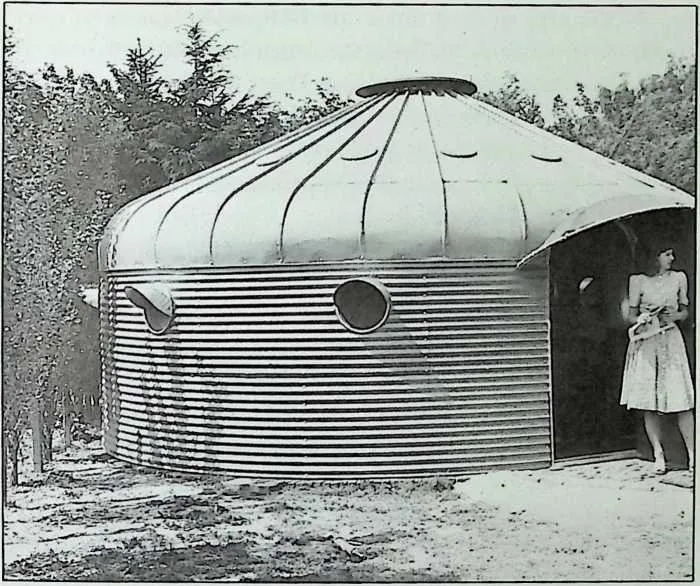
29 This 1941 four-room Dymaxion Deployment Unit was developed to provide cheap housing for defense workers.
30 from a single source: the government. World War II had already started in Europe. In 1939, German soldiers had marched into Poland. In 1940, as Bucky was working on his DDU, France was falling to the Nazis. The United States, while trying to keep out of the war, was preparing for the worst. The U.S. Army and Navy had an instant need for housing overseas. Other DDUs were needed for civilians working to transfer war materials to friendly nations. Before long, hundreds of DDUs sprouted like mushrooms the world around, from the sands of the North Africa to lonely islands in the Pacific.
31 If the government made the DDU a success, it was also the government that ended its production. On December 7, 1941, Japanese planes attacked Pearl Harbor in Hawaii. Right away, the United States declared war on Japan, Germany, and the other Axis powers. America’s factories turned to war production. Steel was in short supply. Military housing, after all, could be built of wood. But wood could not be turned into guns, trucks, planes, tanks, or ships. Butler Manufacturing could no longer produce the DDUs. Steel was needed for other uses.
32 Fuller had begun his World War I service sailing the little Wego up and down the coast of Maine. Now he decided on something more in keeping with his graying hair. During most of World War II, he sailed into a Washington office every morning and left at closing time. He joined the Board of Economic Warfare early in 1942. Anne stayed behind in New York until Allegra’s school year was over. Then the family lived together in crowded Washington. When fall came, Allegra made the daily trip to the exclusive Madeira School in the suburbs.
33 At this time, also, Fuller made another important decision. He quit drinking. ‘‘The war was something serious,’’ he said later. Since 1933, he had done an increasing amount of social drinking. Now, he felt, the war required that he treat himself with sober respect. Also, drinking had begun to affect his life’s work, spreading what he called the ‘‘design revolution.’’ He found that people didn’t listen too closely to a man with a glass of whiskey in his hand. ‘‘They think you are just babbling,’’ he said later. ‘‘I realized that you cannot drink and be taken seriously as a prophet of the future. So I stopped.’’
34 Fuller had vowed to stop drinking before—but he had never stopped for long. This time he kept his promise. As an added piece of good sense, he stopped smoking as well.
35 The Board of Economic Warfare couldn’t use all of Fuller’s amazing energy during the war years. Evenings and weekends, he was free to work on his own projects. One of these projects had been bouncing around in his brain for years: a better map of the world. The maps then in use were, for the most part, those of his own schoolroom days. To show the globe as a flat surface, the maps made some parts of the world look bigger and farther apart than they actually were. This distortion increased as the distance from the equator increased. Thus Greenland appeared to be about the size of South America, instead of only one-sixth as large. Maps using the old-fashioned Mercator projection could not show Antarctica at all.
36 Fuller zeroed in on a new subject of study: the geometry of the sphere. His system of dividing the surface of a sphere into a number of regular triangles and squares was not a new one; it had been around since the ancient Greeks. But Fuller was the first person to see its possibilities for map projection. He interested the editors of Life magazine in the idea. In March 1943, Life published what Bucky called—of course!—the Dymaxion Map. Sales of the issue set a record: 3,000,000. People could cut out the squares and triangles of the map, then arrange them in different ways on a flat surface. You could see the world from the point of view of the North Pole, of Antarctica…of wherever. Little tabs on the sections allowed them to be glued together into a kind of globe. Right in the middle of World War II, Bucky’s map let people view their world in a new and more accurate way.
37 In 1944, Fuller left the Board of Economic Warfare. His talents were demanded elsewhere. By that time, Americans began to see that the end of the war was coming at last. Many people started to worry about their jobs. It became almost impossible to keep workers in aircraft plants. What would happen when peace came again? It was feared that the military would have no need for bombers and fighters. The aircraft production lines would grind to a halt. The workers would lose their jobs. For this reason, many people were leaving aircraft factories for jobs that promised more of a future.
38 Wichita, Kansas, had become an aircraft production center. Several airplane companies had factories in Wichita, among them Beech Aircraft. In 1944, warplanes were still desperately needed. Beech’s main problem was to keep workers on the job. How could this be done? One idea was to show the workers that the factory would keep going after the war ended. But if warplanes were no longer needed, what would the factory make?
39 Houses, of course! Making the body of a B-29 bomber was not really so different from making a metal house. After the war, there would be huge demand for housing. The young men would be coming home, getting married, raising families. And there was that fellow Fuller with his Dymaxion House. He had been preaching the idea since 1928. If two and two ever went together…
40 Bucky talked to the people at Beech Aircraft. He talked to labor leaders. He talked to the Army Air Force. Soon he had moved to Wichita. He redesigned the Dymaxion House, this time leaving out all that had not yet been invented. Beech gave him engineers and a production crew. Before long, news photographers were recording the construction of the first ‘‘House on a Pole.’’
41 Fortune gave the Dymaxion Dwelling Machine a gorgeous spread. Pictures appeared in papers from coast to coast. News stories said the house was to cost $6,500. Although the house was not yet offered for sale, over 36,000 orders were sent to Fuller Houses, Inc. Some of these orders contained checks for the full amount. Stock in the new company soared to twenty dollars a share.
42 But Fuller had been burned in business before. He didn’t want to move too fast. The house would not go on sale until all problems were solved. And there were problems. He had designed the house so that no piece weighed more than ten pounds. The whole house could be packed into a single crate that a big truck easily could carry. But to put the house together, a special truck with a long boom on the back was needed. In most communities, no such truck could be found. Also, the old problem of building codes would have to be solved. Moreover, the electricians’ and plumbers’ unions were ready to fight the new house if it cost their members jobs. The Dymaxion Dwelling Machine came with the wiring and plumbing already assembled. Now both national unions said that their members would have to be paid to take all the wiring and plumbing apart, then paid again for reassembly.
43 Bucky thought he could solve these problems. But he knew it would take time. He jolted his backers when he told them just how much time: seven years. Wow!—that would be 1952! This wasn’t what the factory workers wanted to hear. It wasn’t what the businessmen involved wanted to hear. Seven years'? Couldn’t Fuller be reasonable? Didn’t he realize that he could make half a million on stock deals alone? But Fuller stuck to his forecast. Discussions turned into arguments. The words were raw and very angry.
44 Fuller had arranged things so that without Fuller, there could be no Fuller Houses, Inc. And quite suddenly, there was no Fuller on the scene. Not many months after the war ended, Fuller’s company came to an end also. As with the Dymaxion Vehicle, he simply decided to close up shop. He would move back East, to be with Anne and Allegra.
45 Because of Allegra’s schooling, Anne had never gone to Wichita. Now Allegra’s graduation from high school presented Bucky with an odd personal decision. Like her father, Allegra was a whiz at science and math. Bucky had encouraged her to apply to the Massachusetts Institute of Technology (MIT). He wanted her to follow him as a design science pioneer. MIT accepted Allegra. This was something of an honor, for at the time the famous scientific school had only six women enrolled. Bucky felt honored as well—until he talked to Allegra. She said that she wanted to go on studying what she really liked most: dance. Bucky believed in math, engineering, and the coming design science revolution. But he also believed that people learned best what they really wanted to learn. Two of Bucky’s strongest opinions came head to head. He solved the problem by sending Allegra into the New York dance world with his blessing. Her needs, he realized, had to overrule his.
46 Even before Bucky’s return from Wichita, Anne had rented a small apartment in Forest Hills, New York. This was not far from Allegra’s dance classes in Manhattan. Bucky liked the apartment too. With the Wichita disaster behind him, he decided to take some time off for thought and study. For one thing, he needed to bring his Chronofile up to date.
47 The period turned out to last for two years. In many ways, it was like 1927 and 1928, the silent time that had followed the Stockade disaster. But now Bucky was far from silent. He kept up with his friends and made new ones. He continued to speak in public, wherever and whenever he could. He had to show people that in spite of Wichita, R. Buckminster Fuller was not a failure.
48 If failure was the word, Fuller had failed only to make money. Yet since 1927, he had put moneymaking behind him. In fact, he despised people who put making money ahead of making sense. In 1947, he told an audience about a new company he was forming. ‘‘Obnoxico’’ was clearly a joke. The company would make only the most obnoxious of products. Yet it was certain to make millions out of the horribly poor taste of some people. The first product, Bucky said, would be this: The last diaper worn by a baby would be stuffed with paper and sent to Obnoxico. The company would plate the diaper with silver or gold. Then it would be returned to the proud parents, ‘‘to be filled with ferns and hung in the back window of your car.’’
49 Friends sent Bucky other ideas for a promised Obnoxico catalog. Then he announced that he was giving up the project—because it was so sadly sure to be successful. And this may have been true. In later years, Bucky was to comment on the increasing number of ‘‘Obnoxico items’’ for sale everywhere. One example he noted: a toilet seat made of dollar bills embedded in clear plastic. Other examples anyone could find—by the thousands.