
2 Teenage Troubles
2Until early in life, R. Buckminster Fuller learned that good luck and bad luck are something like the tides. Fortunes rise for a while, then they start to fall. The main difference is that life provides no tide table. The future is always uncertain.
3 Grandmother Andrews, who had bought Bear Island to bring her large family together, died late in 1906. That sad event was only one sign that for Bucky the tide had turned. Another sign was that Bucky continued with troubles in school.
4 Those difficulties had started in the very first grade. Bucky would say something original, and the class would laugh at him. Even worse, the teacher would let him know that he was in school to learn, not to think. But Bucky had always had a lively imagination. As a four-year-old with poor eyesight, he had thought that much of what his older sister Leslie told him about the world must be made up. As a result, he had started to make up things himself. The habit continued. Before long it resulted in his teachers telling him to ‘‘shut up and learn.’’ For the most part, Bucky obeyed the command. He really had no choice. He sat at his desk with one eye on the clock, waiting for the school day to end and his own day to begin.
5 At home, things were different. As an adult, Bucky would remember arriving home on his bicycle—a new-fashioned bike with wire-spoked wheels and real rubber tires! Or he would walk home through a wonderland of falling snow, to find his mother waiting with a smile and a cup of hot tea. Later, perhaps, his father would thrill the family with tales of his latest trip overseas. Why, a person could now go anywhere in the world by modern steamship! The steamer had freed travelers from schedules determined by whim of the winds. It was an exciting time to be alive. Along with Bucky’s birth had come something called the wireless. This amazing invention could send messages through the air. Some experts said that there might soon be one in every living room. The first American car, too, had been built the year Bucky was born. Bucky had seen his first car at the age of seven. The Wright brothers’ airplane flight near Kitty Hawk, North Carolina, in 1903 had sent American kids on a model-making binge. By the age of twelve, Bucky had built about thirty different models, biplanes and even triplanes. He sailed them out his upstairs window when he should have been doing homework.
6 Then quite suddenly, in 1907, tragedy struck the Fuller family.
7 Richard Fuller, not only Bucky’s father but his idol as well, suffered a stroke—caused by damage to an artery in the brain. It was far from a ‘‘killer stroke,’’ but it left its victim partially disabled. The successful businessman could no longer go to work. The family doctor knew of no drug that would really help. Even worse, the doctor knew of no sure way to prevent a second stroke, a possibility everyone feared. Another one could easily kill him. The medical prescription was simply rest and good care.
8 The whole family pitched in. A special room was fixed up for Richard Fuller, and Bucky did everything he could to help. He read aloud to the man who not long before had helped teach him to read. During hot summer nights, he sat fanning his father for hours. There were good days. There were bad days. But at last came what the whole family dreaded: another stroke. Then a whole series of strokes. Each left the gentle man worse off than before.
9 Richard Fuller was ill for three years. Toward the end of that time, in Bucky’s words, ‘‘he was out of his mind…. I had to lead my own father around by the hand, a man I loved and revered.’’ Death finally came on July 12, 1910. It was Bucky’s fifteenth birthday.
10 Caroline Andrews Fuller, Bucky’s mother, was a deeply religious woman. But she was hardly blessed with shyness. She was strong and determined. Her first goal was to keep the family together. This was not easy, since money no longer flowed in from her husband’s business. With four children to care for and feed, she had to watch every penny. All servants except the cook were let go. The Fullers would have to do the housework themselves.
11 Much of this work fell to the oldest son, Bucky. The experience taught him how much human energy it took to keep a house going in 1910. He had to roll up the rugs, haul them outside, and drape them over the clothesline. Then he pounded the rugs with a carpet beater. Clouds of dust filled the air. After the rugs had been carefully brushed, they were lugged back inside and rolled out on the floor.
12 Outside the house, Bucky had to tend the lawn and rake the driveway. Inside, he had to fill the kerosene lamps and do other chores. In the cellar squatted a stubborn monster known as a coal furnace. Bucky had to shovel coal onto the fire, shake the grates, and shovel out the ashes. Worst of all were the clinkers, masses of half-burned coal that settled into the grates and could put out the fire. These had to be poked loose, then lifted out with heavy tongs. It was hard work for a fifteen-year-old.
13 An important part of Mrs. Fuller’s plan was to keep Bucky enrolled in a private school, Milton Academy. It was lucky that one of the leading schools in the country was located in their very town. Milton Academy was thought of as a prep school for Harvard College. Its students came from all parts of New England. Most of them, of course, came from well-to-do families who could afford the best for their sons.
14 Even before his father’s death, Bucky had felt rather out of place at Milton. Most of the boys were boarding students. They formed a tight social knot. They were the ‘‘in’’ group. ‘‘There were very few of us day scholars,’’ Bucky said later, ‘‘and you were then a little bit of a second-class kind of character….’’ All the A’s on Bucky’s report cards impressed his mother, but they made not the slightest scratch on the social system that was Milton Academy. He was still a local kid. He still went home to his mommy after sports every afternoon.
15 It was in sports that Bucky saw his chance. Like most normal teenagers, he wanted to be accepted. He wanted others to look up to him. And he was a good athlete. He
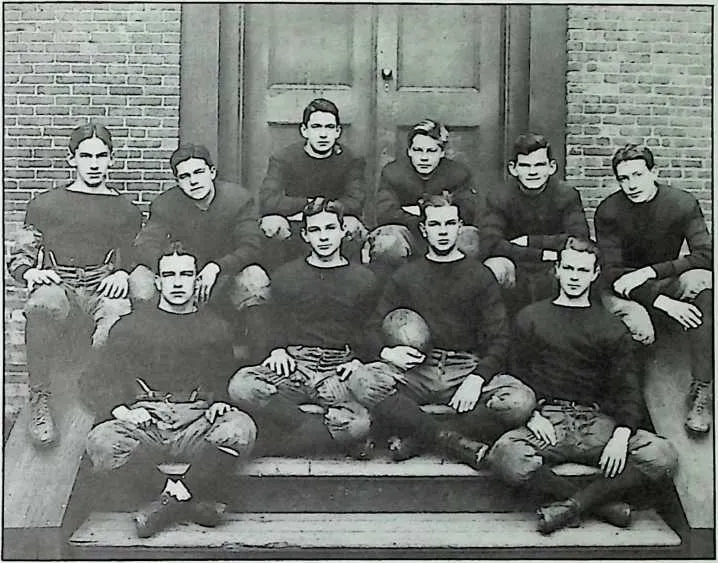
17 Bucky Fuller (lower left) on the football team.
18 ©1960, The Estate of Buckminster Fuller.
19 Courtesy, The Buckminster Fuller Institute, Los Angeles.
20 loved testing the strength and skill of his body. He probably knew exactly what he was doing when he decided to go out for the football team.
21 Fuller?—on the football team? Others thought it odd. They knew that without his glasses, he could hardly tell one player from another—much less see a spot pass over center. With the small football helmets then worn, it would be impossible for him to wear glasses on the field. But when Bucky really put his mind on something, it drove ahead through the best defense. He made the team. Then he discovered that there was one position where he could control the ball and not have to see it in the air. This was the quarterback spot. He tried out for quarterback, and he made that, too. Quarterback Fuller! Starting Quarterback Fuller!
22 In later years, Fuller was often to speak of his short football career. It might be expected that his favorite memory would be a touchdown pass or a sixty-yard run. Sadly, that was not the case. The memory that cut deepest was a social one, not a moment of glory on the football field. When he first tried out for the football team, Bucky learned that the players were expected to supply their own helmets. (In those days football helmets were not the huge plastic domes players now wear. They were much smaller, head-hugging devices made of padded leather.) Now Bucky would have to ask his mother to buy a helmet. He hated to ask. She gave him no allowance, and he never had any spending money, even for important things. He had to ask his mother for everything. When he asked for the helmet, her response only made things worse. She went out and bought an inexpensive helmet herself. It wasn’t even made of leather—just some kind of cheap quilting. But it was all his mother could afford. Bucky had to wear it to the first few practices. He never forgot the embarrassment.
23 In fact, most of Bucky’s school memories centered on the social scene. He was a sensitive boy. What teachers thought of him really mattered to Bucky. What fellow students thought of. him mattered even more. In Synergetics, his major book, he later recalled a typical experience. The teacher was busy at his or her desk. The students were supposed to be working quietly at their desks. Then some noise would come from Bucky’s part of the room.
24 ‘‘One mark for Fuller,’’ the teacher would say, without looking up. (A mark meant staying 15 minutes after school.)
25 Next, something would be thrown through the air.
26 ‘‘Two marks!’’
27 A pause, then another noise. Again, Bucky was truly innocent. The teacher would not look up.
28 ‘‘Three marks for Fuller!’’
29 And Bucky would have to stay after school, angry at his classmates and the teacher alike.
30 Bucky once summed up his school years in this way: ‘‘I often found myself to be the number one antifavorite amongst my schoolteachers and fellow students.’’ But statements like this sound like the adult Fuller speaking, not the boy himself. Among Fuller’s many talents was a gift for exaggeration. The best photo taken of Bucky as a schoolboy suggests quite a different picture. It shows Bucky as a member of a group, the football team. Bucky sits in the front row, ramrod straight. His just-wavy dark hair is neady parted in the center and carefully trimmed. He wears an assured, tough-guy look on his square, handsome face. Above a strong chin, the corners of the mouth slant down a litde. His muscular chest and shoulders seem to strain the fabric of his black football jersey; the only wrinkles run from side to side. He sits with his ankles crossed, his hands relaxed on his thighs. It just isn’t a picture of a loner or a loser, a wimp or a washout.
31 Certainly, Milton Academy was far from a disaster for Bucky. He enjoyed singing in the glee club. He must have liked working in the new electrical laboratory, one of the best equipped in the country. He made some good friends, among them Lincoln Pierce, a lifelong pal. Another associate of later years was W. Starling Burgess, a Milton graduate who had made the first successful airplane flight in the Northeast. Burgess came back to the school to give an illustrated lecture about his ten-mile flight. And we know from Bucky’s own account that he enjoyed science and mathematics, subjects in which he always got honors. His other grades, except for Latin, were also good. If Milton Academy was a prep school for Harvard, it did just what it was supposed to do in Bucky’s case. It prepared him well. Bucky was admitted to Harvard’s freshman class in 1913.
32 Harvard College is in Cambridge, Massachusetts, just across the Charles River from Boston. Even in Bucky’s day its red-brick buildings looked old, worn with rich tradition from its founding in 1636. In contrast to busy Boston, the Harvard area was a quiet place of cool lawns and towering trees. Bucky had first heard about Harvard on his father’s knee. Later, he had read the diaries that four generations of Fuller men had kept while attending Harvard. For seventeen-year-old Bucky, Havard was more than just a special place. It became a myth, a dream, a Camelot on the Charles River. For the whole Fuller family, it was unthinkable that a bright boy like Bucky should not go on to Harvard. His mother had little money, but other relatives were more than willing to help.
33 So in the fall of 1913, the summer tingle of Bear Island behind him, R. Buckminster Fuller entered Harvard College. He must have experienced the nervous glow that freshmen feel as they first unpack their bags in a dormitory room. It was on to a new life.
34 But almost at once, Bucky’s dreams were attacked by cruel reality. Other Milton quarterbacks had gone on to star on the Harvard team, and Bucky had high hopes. These were dashed when he broke a kneecap during an early practice. His football career was over.
35 Other disappointments followed in rapid order. Bucky was a fun-loving young man. He liked nothing more than a girl on his arm, a room ringing with laughter, and the pop of champagne corks. He loved to dance. He was good at thinking up funny little poems on the spot. But once again, his dreams faded with the cold dawn of reality. His first real girlfriend left him for another man. And the Boston nightspots—only minutes away by the new subway—were beyond the reach of his bank account.
36 Moreover, Bucky found that he really didn’t like his classes. In part, this was his own fault. At Milton Academy, he had found math and science easy. He had even taken college-level math in high school. So when the time came to choose his college classes, he decided to look at other subjects. Harder courses, he thought, would be more of a challenge. But a short time later, he found that subjects like art, music, and German literature really didn’t interest him. He was bored. He started to cut classes.
37 Finally, Bucky’s main problem again concerned the social scene. Before World War I, the social whirl at Harvard revolved around a number of clubs. Bucky learned that students’ social life depended on the club they belonged to. The Porcellian Club was at the top. Its members were the real aristocrats. Other clubs formed descending rungs on the social ladder. Bucky found that his Milton friends, one by one, were being asked to join clubs. When that happened, they cut Bucky off like a social misfit. The trouble was that being asked to join a club had nothing to do with one’s worth as a person. No, club membership depended on the family’s wealth and social position. In fact, many club memberships were arranged by older brothers or fathers who had themselves been members of the clubs. This left Bucky in a helpless position. He had no older brother. His father was dead. And his mother had very little money.
38 As the first term neared its end, the sad truth became clear. Bucky would not be asked to join a club. True, there were other freshmen who cared little about the clubs and might not have joined even if asked. But joining a club was part of the Milton-Harvard connection. More and more, Bucky felt insecure and embarrassed. He just didn’t fit in. He was a marshmallow in orange juice. In this regard, his older sister Leslie was of little help. She had just married a Porcellian man and seemed to think that the club system was part of the divine order of the universe. ‘‘Bucky,’’ she told her brother, ‘‘you’re going to be a disgrace to the family. You’re not going to get into any of the clubs, and all the Milton boys are.’’
39 In an interesting way, however, it was Leslie who figured in Bucky’s solution to the problem. She and her husband were in the process of moving. Their huge Russian wolfhound, Mitzi, had to be left alone for a time. Would Bucky agree to walk Mitzi on a regular basis? Of course he would.
40 On Bucky’s dog-walking rounds, he often passed a theater. Then playing was a review called the Passing Show of 1912. Bucky found that if he went by the stage door at just the right time, the actresses and dancers would be leaving. Mitzi was the kind of dog that everyone loves. The young women would stop to pat the dog. Bucky would answer questions, then start asking some of his own. Several of the women said yes when Bucky asked them to dinner. In this way he got dates—not just college dates, but dates with real actresses, beautiful young women! Bucky’s real triumph was the yes of Marilyn Miller, breathtakingly beautiful and one of the stars of the show.
41 Crazy isn’t the right word for it, but it’s often used. A young person under pressure does something that seems
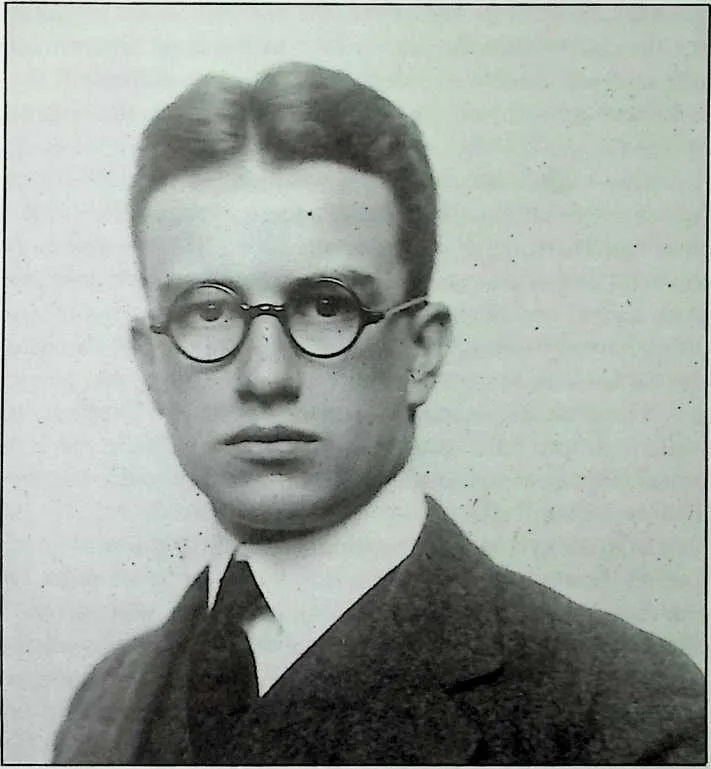
43 Buckminster Fuller was twice expelled from Harvard College.
44 ©1960, The Estate of Buckminster Fuller.
45 Courtesy, The Buckminster Fuller Institute, Los Angeles.
46 completely mad. In Bucky’s case, it was this: As his mid-year exams approached, the Passing Show moved on to New York City. Bucky went to the bank. He took out all the money his mother had deposited for his year’s education. That done, he packed his best clothes and got on a train for New York. He checked into a good hotel. Then it was off to the Passing Show. Bucky sent Marilyn Miller roses and champagne. After the show, he went backstage. Would Marilyn Miller join him at Churchill’s—then the place to eat in the city? She smiled and agreed. Bucky sparkled with joy. He extended the invitation to this woman, to that woman, to the whole chorus.
47 That night Bucky had the woman on his arm, the room full of laughter, the popping of champagne corks. As he later recalled it, ‘‘the champagne flowed like the Hudson River.’’ The bill was staggering. So were the other bills he soon had to pay. Before long he was spending money he didn’t have. The fling was over. There was only one thing to do: Go back and face Harvard—and his family.
48 The Harvard encounter was short, but hardly sweet. A student simply did not leave Harvard at exam time for a round of lush living. Bucky was expelled for bad conduct. That was that.
49 But Bucky’s biggest problem lay with his family. His mother had pinched pennies for years to send him to Harvard. She had even sold the house in Milton. Her relatives felt that she had been betrayed, badly betrayed, by Bucky. She felt that way herself. A family conference was arranged. Of course, there was no way to get the money back. Whatever happened to Bucky would probably be punishment enough. But just what would happen to Bucky? How could he be forced to shape up?
50 Soon the family handed down its sentence. A cousin owned a cotton mill in Canada. The mill owner could use a strong young man like Bucky. And Sherbrooke, Quebec, was a long, long way from the bright lights of Broadway. In fact, Sherbrooke was a cold, lonely mill town that seemed to be miles away from anywhere. Bucky would earn his own money and pay his own expenses. So on a frigid day in February 1914, Bucky packed his bags again. This time he was headed not for Harvard—nor for high living.
51 If punishment was part of the family’s plan, it hardly seemed like that to Bucky. ‘‘I loved the people and the work,’’ he said later. Again, a minus became a plus. Bucky’s job was to help install new machinery in the cotton mill. He worked with engineers and mechanics, practical men whose ability he admired. The machines all came from overseas, from England and France. Parts were often damaged in shipment—or, in the case of the English machines, defective in the first place. The chief engineer saw Bucky’s talent and put him in charge of repairing these parts. Sometimes they were so badly damaged that new parts had to be made. Bucky learned a lot about metals—one of his lifelong interests. He learned what the local metalworking shops could and could not do. He learned how to sketch diagrams for new parts of his own design. The chief engineer was more and more impressed.
52 Reports of Bucky’s talents filtered down to Massachusetts. Why, the boy had not only mended his ways, but completely reformed! His character now seemed perfect in every way. Before many months had passed, the sentence was lifted. When Bear Island time came again, Bucky was back with his boats on the beautiful Maine coast.
53 To the family, a complete reformation would mean a return to Harvard. Bucky, Still trying to prove himself, was willing to reapply. The Harvard authorities, too, looked at the reports from Canada. They were willing to give him another chance. Bucky became a freshman once again, this time in the entering class of 1914.
54 Bucky’s second attempt at Harvard is less interesting than the first, but it turned out just the same. Bucky was just plain bored. He had a good memory, but he didn’t like memorizing facts he saw no reason to know in the first place. Did he really want to spend four years cramming for what he considered meaningless tests? No, he decided. Once again he started to cut classes. Once again he skipped exams. It came as no surprise when he was once again expelled, again for ‘‘irresponsible conduct.’’ Bucky had planned it just that way.
55 This time the family felt doubly betrayed. But Bucky was Bucky, they thought. There was no controlling him. For this reason, there was no new family plan of correction. Bucky would have to find his own way.
56 For a time, Bucky returned to Canada. Then he felt that old lure of New York City. He headed to New York and started looking for a job. Any kind of a job. Just as long as it paid him enough to have some fun after work. He looked all over. Wages were so low that there was hardly enough to live on. Finally he took a job as a meat handler for Armour and Company. It paid fifteen dollars a week.
57 Buckminster Fuller once wrote that a person’s life should never be looked at as a still picture. Instead, life is like a motion picture. The individual frames run together, in constant motion. Still, it is useful to take a snapshot of Bucky’s life in the spring of 1915.
58 Fuller men had gone to Harvard since 1740, but only Bucky had been expelled. More than that, he’d been kicked out twice. He’d betrayed the family trust. Now he worked at a job that demanded a strong back, not a quick brain. Six days a week, the job started at three in the morning. Through the echoes of nearly empty, dimly lit streets, he walked to work at an hour when the rest of the city lay asleep. Then, for twelve or fourteen hours, he lugged quarters of beef on and off trucks, down into the dark holds of ships, or into central markets. It was dirty work, sheer drudgery. Bucky’s fellow workers were hardly the Por-cellians of Harvard Yard. Once ‘‘comfortably off,’’ he had now grasped at the social ladder, missed, and fallen off. He had come down in the world.
59 If there was one comforting thought in Bucky’s mind at the time, it could have been this: You can’t fall off the floor.