
6 Dymaxion Days
2R Buckminster Fuller’s decision by Lake Michigan was the big turning point in his life. Before the decision, he had thought of himself as a failure. Supposedly, being a failure was the rule of life. His uncle had told him about it back in 1913. Human beings were born failures. Every man had to prove his right to success and happiness. But now, Fuller realized that the rule was a false one. He saw the BIG PICTURE. Only human beings could discover the scientific laws that governed the universe. That gave humanity a rather honored place in the universe. In a way, human beings were the tools the universe used to understand itself. Could such creatures be called failures? No, not at all. Human life was a great success. Fuller’s only trouble was this: He had just one lifetime to spread his new knowledge to every man and woman on the face of the globe.
3 Fuller rolled up his mental sleeves and set to work. To
4 BUCKMINSTER FULLER
5 ©1960, The Estate of Buckminster Fuller.
6 Courtesy, The Buckminster Fuller Institute, Los Angeles.
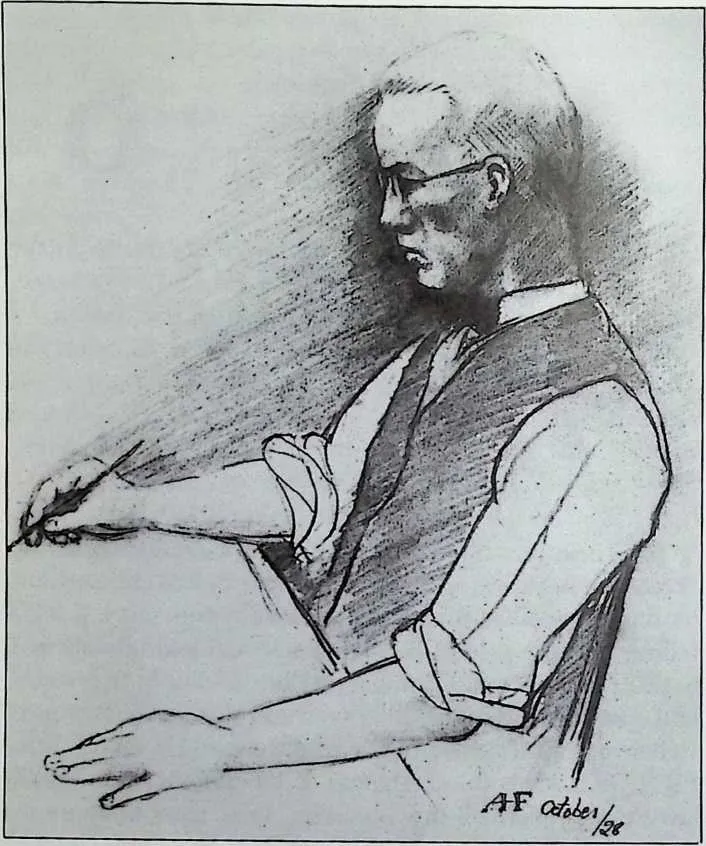
7 Anne Fuller drew this portrait of Buckminster Fuller in 1928.
9 get more time in each day, he discovered a new method of sleeping. He had long envied the way dogs and some other animals slept. They simply took short naps when they were tired, and woke up refreshed. Fuller tried this himself. He found that he could get along with a half-hour nap in every six-hour period. This gave him a twenty-two-hour workday. Usually, of course, he got more sleep. But when he was busy with a project, an eight-hour workday could be stretched to twenty-two.
10 The projects came fast. Fuller turned his attention to what he called his Chronofile. This was a chronological—or time-order—file of every piece of paper that had anything to do with his life. As a boy, Fuller had loved to keep things. He saved letters and copies of their replies. He saved report cards and bills and school papers. He clipped and saved scientific articles that interested him. Over the years, he had started to keep these papers in albums. Now Fuller saw his Chronofile as something more than a hobby. It was to illustrate the entire life of an advanced man who was born back in the dark ages of the nineteenth century.
11 Fuller had spent five bad years in the building industry. It is not surprising that housing was still very much on his mind. Much of the time he spent writing was devoted to houses—what they were now and what they should be. As Fuller saw it, the whole building field was a disaster. The trouble started right with the person who wanted a house built. That person told the architect what he or she wanted. This, to Fuller, was like a patient telling the doctor what was wrong with him or her. The average person knew absolutely nothing about new building materials and methods. Yet the architect, eager for the customer’s dollars, would go along.
12 Then the builder would smile and do what was wanted. As a result, the housing industry was stuck in the ways of the past.
13 Some of Fuller’s 1927 writings still survive. In one essay, he makes fun of the building industry. What would happen, he asks, if a car were to be designed and built like a house. First, the man with the money would have to select a car designer from among thousands of designers. Then that designer would come with pictures of other cars and with parts catalogs. The man might select a sturdy bumper made in Indiana, a Spanish roof, and an English flywheel. Then a builder would have to be chosen from among thousands of builders. Building the car would take a long time, since it was a one-of-a-kind operation. Government inspectors would constantly interfere. When the car was finally finished, it would have cost $50,000. (This is about $500,000 in today’s money.) Moreover, it would not run well. Probably it would not run at all.
14 For Bucky Fuller, the housing industry should be just that: an industry. Like cars and planes, houses should be made in factories. The most modern materials should be used. Most of all, architects should take advantage of the principle of tension. Tension, or ‘‘pull strength,’’ is the opposite of compression, or ‘‘push strength.’’ For thousands of years, builders had relied on compression. A stone was put on a stone, or a beam on a beam. Each pushed down on the one below it—on all others below it. As a result, walls had to be thick and strong. Now, however, metal rods and cables of advanced design permitted the use of tension. Walls could be held up from the top, not supported from below. If a wall had to support nothing above it, it could be made entirely of very thin glass.
15 In 1928, Fuller began sending off drawings of what he called a 4D Tower House. The whole structure was supported by a thick metal cylinder, or hollow pole. From this central pole hung ten hexagonal (six-sided) decks. A model might look like this: Imagine a strong aluminum cylinder ten feet high and a foot across. This cylinder, or thick pole, is set upright on the ground. Hanging from and around it are ten decks. These enclosed decks are living areas. Machines to heat and cool the dwelling, as well as the plumbing, are in the central pole. The whole structure has a look of lightness and grace.
16 Science fiction, perhaps? Since the 4D Tower House was to be built in a factory, it would have to be delivered to its permanent location. To do this, Fuller would have used huge zeppelins, or dirigibles. One of these football-shaped mon-ters of the air would simply hook onto the house and lift it to its site. Then the dirigible would drop a bomb, to make a hole in the ground. The bottom end of the house would be lowered into the hole. Cables would hold the structure in place as concrete was poured around the foundation part of the house. Fuller claimed that the whole building, ready to live in, could be put in place in a single day.
17 A more practical idea followed. This was a one-family version of the ‘‘House on a Pole.’’ Fuller called it the 4D House. A single deck hung from a central pole. Again, all the pipes, wires, and machinery to keep the house going were inside the pole. The living space featured the latest equipment. Having watched little Allegra as she toddled from this danger to that, Fuller made the rooms absolutely safe for children. The house cleaned itself with very little human effort. Dishes were washed and put away automatically. Air mattresses on the beds could be adjusted to the sleeper’s comfort. A special learning center featured television, which
18 ©1980, Buckminster Fuller Institute.
19 Courtesy, The Buckminster Fuller Institute, Los Angeles.
20 The 1928 plans for Fuller’s 4D Dymaxion House.
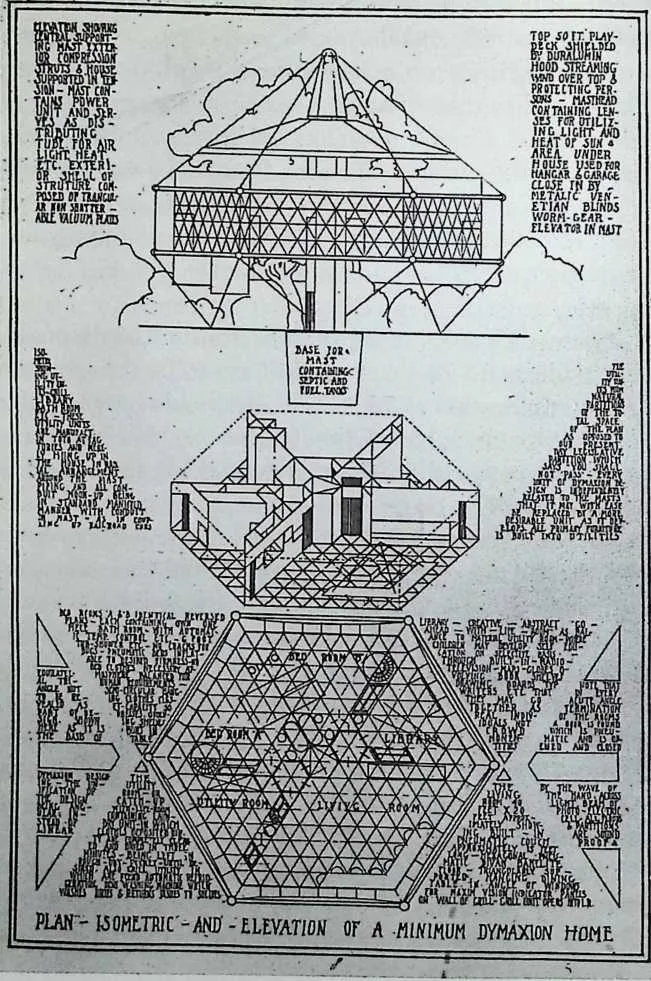
22 hadn’t even been invented in its present form yet. Nor had the solar power units been invented. Neither had the machine that opened doors with a wave of the hand. Nor had the ‘‘fog gun,’’ a skin-cleaning device that used almost no water. Neither had the special toilet that stored waste for later disposal. In fact, the kind of hard aluminum necessary for the house itself was still five years away.
23 These matters were not serious problems to Fuller. He considered them details. Once the BIG PICTURE of the house was in people’s minds, the necessary inventions would follow. The more Fuller worked on his 4D House, the more excited he got. The cost? Fuller investigated the cost per pound of an automobile. Using a slightly higher figure, he announced that his three-ton house would cost $1,500. That low price would be a one-time cost. Because the house required no electric, sewer, or water lines, it could be transported anywhere a family wanted to move. You could live on a Pacific cliff one year and in the Colorado Rockies the next, in the very same house.
24 Fuller’s interest in the 4D House began to draw him out of his own. He began to talk again. He applied for patents. He made a shiny scale model of the house that excited all who saw it.
25 In 1929, the huge Marshall Field department store in Chicago decided to put on a furniture-of-the-future show. The store thought Fuller and his model house would attract customers. Would Bucky agree? Certainly. The store was by far the largest in Chicago. The show would be just the place for his 4D House. He liked the idea of giving a short lecture several times a day.
26 Plans for the show went smoothly—except for one thing. The publicity people at Marshall Field wondered about the term ‘‘4D House.’’ It didn’t sound exciting. What did it mean, anyhow? Fuller explained that the ‘‘D’’ stood for ‘‘dimension.’’ The first three dimensions were the usual ones: width, length, and height. The fourth dimension was time, in honor of Albert Einstein. But all Fuller’s talk of Einstein and modern science didn’t impress the Marshall Field people. They suggested finding a new name, something zingy, with the sound of the future in it. An advertising writer was hired to work with Fuller. He wrote down some words that Fuller often used. Then he separated the syllables and tried putting this with that. By and by he had it: Dymaxion!
27 Dymaxion is a combination of dynamic, maximum, and ion. Fuller liked the new word, too. It became his trademark for many years. And the newly named Dymaxion House was the hit of the show.
28 Not all of Fuller’s efforts were as successful, however. In June 1929, he went to the annual convention of the American Institute of Architects (AIA). It was held in St. Louis, Missouri. Fuller and a friend drove down from Chicago with the model house. Fuller’s hope was to do more than just display the house. He really believed that Alexandra would not have died if she had been raised in climate-controlled, dirt-free surroundings. Fuller wanted to give the house to humanity. He offered the patents, free of charge, to the AIA. To his disappointment, the offer was not only rejected, but scorned. Factory-build housing, after all, would have put the architects out of business. Their statement indicated their fears: ‘‘Be it resolved that the AIA establish itself on record as inherently [by nature] opposed to any peas-in-a-pod-like reproducible designs.’’
29 Fuller made another resolution of his own. He decided that his years of exile in Chicago should come to an end.
30 Memories of Bear Island acted like a magnet on his mind. Soon Bucky, Anne, and little Allegra were headed back East, back to the salt air and the whispering pines. Bucky wanted to spend the whole summer in the Big House.
31 The summer of 1929 was a good change for Bucky. He had always been disappointed that Anne really didn’t like the rough life. For her, living in the Big House was a little too much like camping. She didn’t even like to go sailing. Now Bucky found that Allegra, not quite two years old, seemed just the opposite. Like Bucky, Allegra was stocky and energetic. She loved the waves. She shrieked happily when Bucky took her for short splashes in the icy water. Both father and daughter beamed with pride when Allegra learned to point at a boat and say ‘‘sloop,’’ ‘‘ketch,’’ or ‘‘schooner.’’
32 Wanting something to do with his hands, Fuller bought an old cargo boat. The tub was forty-four feet of decay, rust, and trouble. It was wide enough to be called a barge. The low price was a joke. So, nearly, was the purchase. And so, certainly, was Fuller’s new name for the antique: the Lady Anne. Roger Hewlett, Anne’s younger brother, spent much of the summer working with Bucky on the boat named for sister and wife. They cut down tall trees to replace the two masts. They scraped, varnished, and painted. Bucky even managed to talk a local shipyard owner out of a new engine. Roger was amazed at Bucky’s ability to swing a fast, shady business deal his way. ‘‘He could convince a silkworm that nylon was better,’’ Roger said later. But the engine stayed in the Lady Anne, and the boat was to be Bucky’s summer toy for another three years.
33 September came all too soon, and the happy group on Bear Island began to break up. Bucky decided to go to New York City. He thought that New York would be the best place
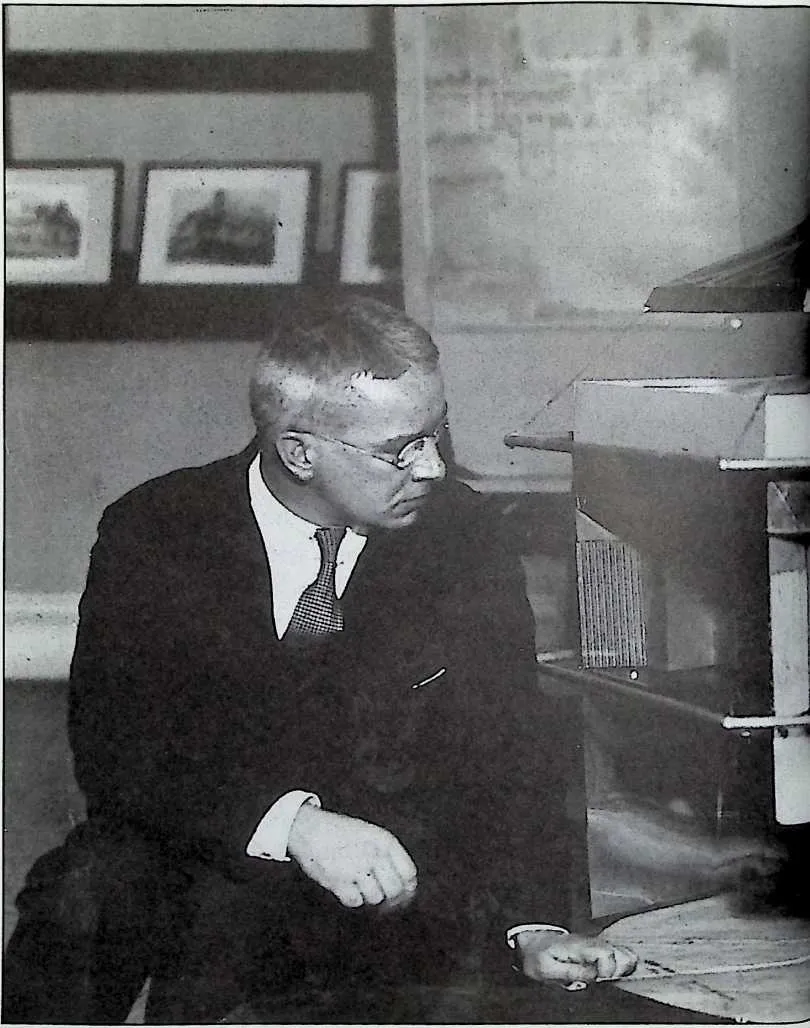
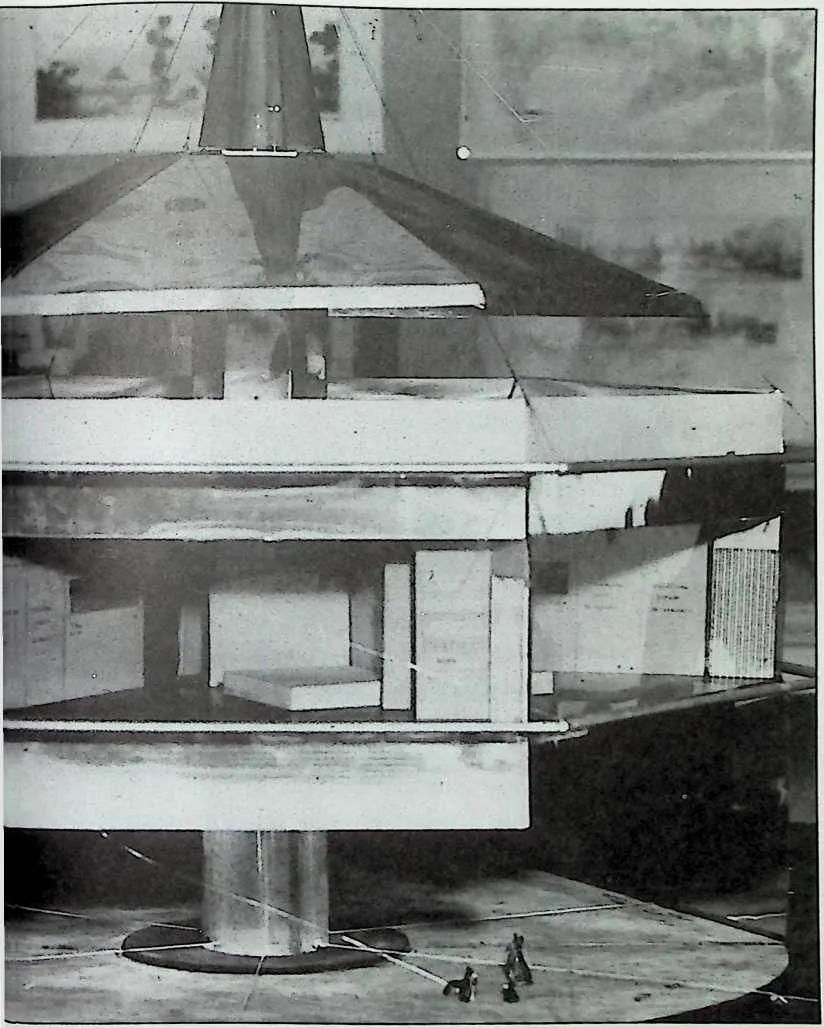
3637Buckminster Fuller and the model of his Dymaxion House.
38 to show the Dymaxion House and to interest people in his other ideas. First he settled Anne and Allegra in a small but comfortable house on Long Island. Then he went off to the big city to preach his message of a better future.
39 October 1929, however, brought its own kind of message about the future. The sliding stock market made headlines day after day. During the 1920s, the stock market had gone up, up, and up. Not only the wealthy, but also middle-class people had bought more and more shares and had made more and more money. Late in 1929, few people realized that the hot economy of the 1920s had begun to cool down. But when the stock market started down, people grew fearful. They sold their shares, which drove the market down even more. They also tightened their purse strings, which drove the economy down. A recession in 1930 turned into the Great Depression that lasted for years. Many people lost their jobs—and even, as some banks closed, their savings.
40 As the Great Depression began, Anne and Allegra were safe, living in a nice house in Hewlett, Long Island. Bucky’s goal was to keep them there, with the rent paid and food on the table. He tried to join them on weekends. The rest of the time he spent in New York, living on almost nothing. He slept where he could: in a corner of a friend’s apartment, in a storeroom atop a warehouse, under the table on which his Dymaxion House was being displayed in a hotel. Sometimes he got along on one meal a day. At one point he took a job he liked—but it ended after a few months. During this difficult period Caroline Fuller helped the family out with a small allowance. But Bucky was too proud to accept much personal help from his mother.
41 By this time Fuller had built a new model of his Dymaxion House. He could take it apart and carry it around in a large suitcase. In spite of the depression, people still found the house fascinating. Fuller received invitations from as far off as Chicago to give lecture/demonstrations. Some of these invitations were good ones indeed: the Princeton University School of Architecture and the Yale University Architectural School. But Fuller still spent most of his time sitting around New York cafes, talking and drinking coffee. His talk always interested people, and one cafe owner even paid him in meals to sit at a table and attract customers. Although Fuller liked the cafe life, what he really wanted was a larger audience.
42 Late in 1930, Bucky learned that a small architecture magazine called T Square was for sale. A magazine, he thought, would give him the larger audience he needed. Why not buy T Square and tell the architects of the country what they really needed to hear? Of course, he would need some money—but once again, Fuller found a way. He cashed in his life insurance policy and bought the magazine.
43 Bucky Fuller was never a person to do something in the traditional way. This was true with the magazine. First, he changed its name to Shelter. Then he canceled all advertising contracts. To accept advertising meant publishing on a regular schedule, which he had no wish to do. Instead, he would publish only when a truly excellent issue had been put together. He raised the price to $2—unheard of! (This would be about $20 an issue today.) Finally, he used his contacts to get articles by exciting, up-and-coming young architects.
44 Shelter, some experts said, was sure to fail. Young Fuller knew nothing about putting a magazine together and then getting people to buy it. As it happened, however, these experts were wrong. With each issue, Shelter sold more and more copies. The magazine was full of new ideas. One issue was devoted to ecology, a subject few people in 1931 had ever thought about. So it came as a surprise when, late in 1932, Fuller decided to close the magazine. He dumped all the articles he had on hand into what he announced was the final issue.
45 Actually, Fuller’s decision was typical of him. He had proved that a magazine like Shelter could be a success. That was all he wanted to do. He had no wish to be tied down to a business forever, just because it made money. And besides, he had many other interests to work on. For instance, since his navy days he had been drawing little pictures of a new kind of vehicle. Mainly, it was a small plane with wings that collapsed, powered by what we know today as jet engines. Landing at sea, the vehicle became a fast boat. Coming down onto land, the vehicle turned into a car. Some of these ideas and drawings Fuller had put into the last issue of Shelter. Small models of this Dymaxion Vehicle had been displayed with the ‘‘House on a Pole.’’
46 Fortunately, the article or the model had interested Philip Pearson, a wealthy investor. Early in 1933, Pearson came to Bucky Fuller with a proposal. He would put up the money if Fuller would produce the land-travel version of the Dymaxion Vehicle.
47 At first Fuller had his doubts. He remembered his years with Stockade Building System. He had worked and worked, only to be forced out because the stockholders wanted more money. Now Fuller told Pearson that he would take the money only if he had total control. Pearson was to expect absolutely nothing in return. Even if Fuller decided to spend all the money on ice-cream sodas, Pearson would have nothing to say. That would be that.
48 Pearson, too, must have had his doubts. But he went on listening to Bucky’s spellbinding ideas. Fuller had figured out that the main problem in future automobile design would be air resistance. Most cars of the time looked something like the most common one, the Model A Ford. They were boxlike, with nearly flat vertical surfaces front and rear. At thirty miles an hour, air resistance was not too much of a problem for a Model A. But Fuller knew that cars of the future might go ninety miles an hour. At ninety, air resistance would be not three times as much as at thirty, but nine times as much. He explained that even going from thirty to sixty, air resistance increased four times. Fuller’s streamlined, teardrop design must have been too much for Pearson to resist. He said yes to Fuller’s terms. He even went to a safe-deposit box and got the money in cash.
49 The month of March 1933 was the most depressed point in the Great Depression. Franklin D. Roosevelt, the newly elected president, closed the banks because so many were failing. Businesses everywhere were going belly-up. A quarter of the American work force was unemployed, and those lucky enough to have jobs often found their wages cut. Yet it was in March 1933 that R. Buckminster Fuller found himself in a position to start a new company, the Dymaxion Corporation. In a sad but useful way, the depression was an advantage. Many factories were idle, for sale or for rent. Looking for a place to build the Dymaxion Vehicle, Fuller decided on a small factory in Bridgeport, Connecticut. It had once manufactured the Locomobile; that car company had disappeared with the coming of bad times. Fuller also found that a small employment ad in the paper produced a long line of skilled workers, desperate for the paychecks that would feed their families. Although he needed only twenty-eight people, more than a thousand applied.
50 Fuller was also able to hire the chief engineer he wanted, W. Starling Burgess. It was Burgess who had returned to Milton Academy with the thrilling tales of an aviation pioneer. Since that time, Burgess had designed many well-known boats and airplanes. Two of his boats had won the America’s Cup. At the time, his name was better known than Fuller’s. But Bucky didn’t mind. Burgess’s math was also better, and that was what mattered.
51 With Pearson’s cash, Burgess’s know-how, the workers’ skills, and Fuller’s energy, the Dymaxion Vehicle rapidly took shape. The motor and drivetrain were modifications of standard equipment. Everything else—the frame, the body, and many parts—had to be designed and manufactured from scratch. Fuller and Burgess agreed that every piece of the vehicle had to be perfect. There was no such thing as ‘‘second best.’’ They also tried to avoid publicity until the vehicle could be rolled out of the factory. It was put together in a back room without windows. Only special people could enter.
52 After three months of good progress, Fuller ran into real trouble. Without saying anything, the workers were staging a slowdown. Fuller realized their problem. Although the men had been told to expect six months’ work at the most, they wanted their jobs to go on. When the Dymaxion Vehicle was finished, their work would be finished also. What could Fuller do? Lecture and threaten the workers day after day? No, he decided. He liked the men too much to turn against them. One day he announced that a second car was to go into production. Of course, he had no idea where the money would come from. But the announcement served its purpose. The first Dymaxion Vehicle was finished on time: July 12, 1933. It was Bucky’s thirty-eighth birthday.
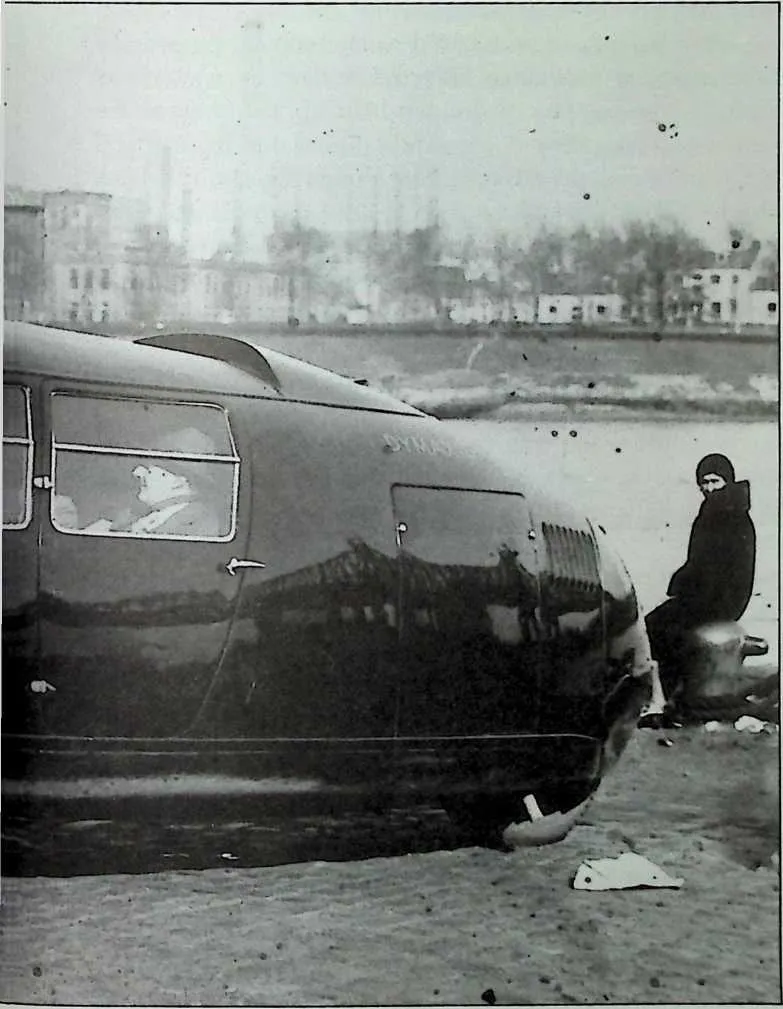
53 A crowd of thousands gasped and marveled as the Dymaxion Vehicle came out of the plant. Used to seeing Model A Fords and 1930 Studebakers, they now saw a teardrop on wheels. Three wheels, to be exact. A pair in the front provided front-wheel drive. A single wheel at the back served to steer the vehicle. The motor was also in the rear, behind a nine-passenger compartment. Fuller tried the vehicle on a small test track near the factory. It handled perfectly. Even with only three wheels, it was more stable than the ordinary car. It could round curves at a faster speed. This was due to three things: the front-wheel drive, the low center of gravity, and the rear-wheel steering.
54 Almost overnight, the names Fuller and Dymaxion were in papers across the country. The car was a news photographer’s dream come true. Fuller was soon driving from place to place, showing what the car could do and answering questions. He would point out that the car cooperated with nature; it didn’t try to fight natural laws. Did a fish guide itself from the front or the back? And who ever heard of a bird that slowed forward progress by steering itself from the front? Bucky loved demonstrating how the vehicle could be parked in a space only a few inches longer than its own nineteen feet. He would nose the vehicle into the curb, nearly touching the car ahead of it. Then he would cut the rear wheel all the way, so that it pointed at the curb. A touch on the accelerator, and the rear of the vehicle slid into the space sideways.
55 Many people got the see the vehicle, but only a fortunate few were chosen to ride in it. Fuller took the vehicle to New York by special request. This time the fortunate few were a group of top magazine editors. Talking as he drove,
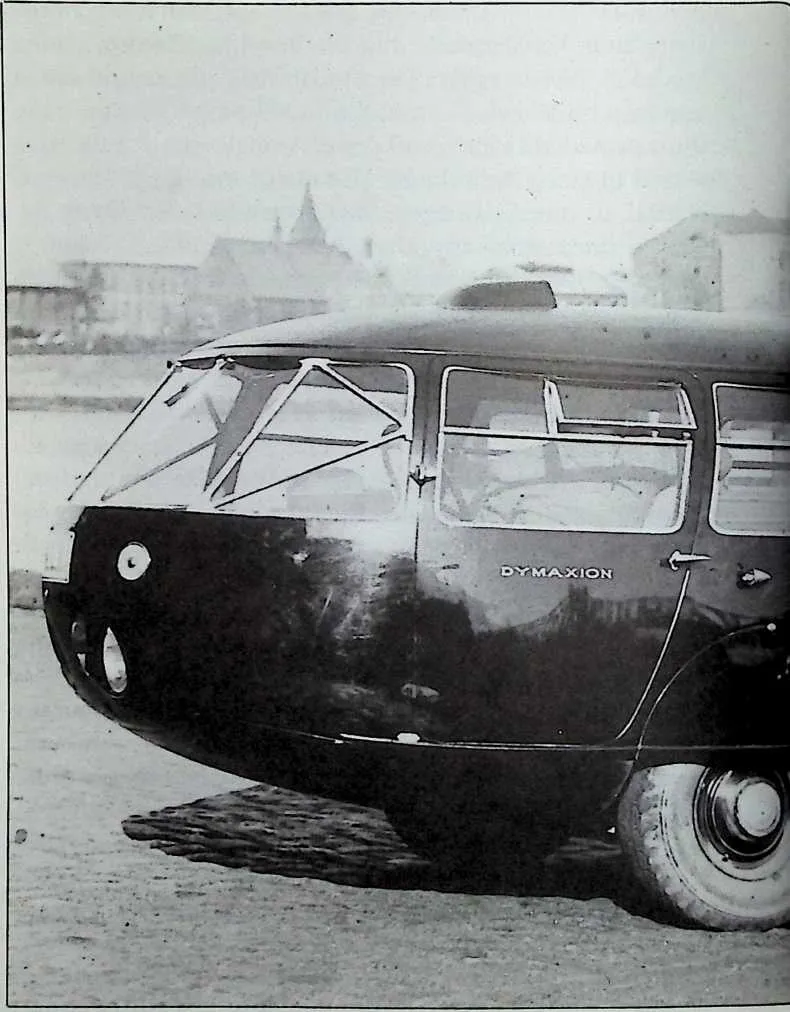
57 Fidler's Dymaxion Vehicle. The rear wheel steered the streamlined,
tear-shaped vehicle, acting much like the rudder of a ship.
59 Fuller started down Fifth Avenue. Of course, everyone on the sidewalk stopped and stared as the vehicle passed. In those years, a policeman directed traffic at each busy midtown crossing. One policeman held up a stop sign of a hand, and Fuller obeyed. He slowly pulled one front wheel within inches of the officer’s foot. Then he cut the back wheel and did a complete circle around the policeman, so carefully that the wheel next to the amazed officer turned in a circle only a foot or so wide. Seeing this, the policeman at the next corner also stopped Fuller. He expected the same demonstration, and he got it. There was a policeman at every corner. It took Fuller an hour to make the planned one-mile trip.
60 Another of the fortunate few was Amelia Earhart, the famous aviator. She, too, was interested in advanced design. She also understood Bucky’s reason for using the term vehicle, not car. The vehicle was, over time, to become a plane, with collapsing wings and jet engines that hadn’t yet been invented. Bucky Fuller and Amelia Earhart became good friends. She told Bucky that she planned to go to Washington, D.C., to accept an award. Eleanor Roosevelt, President Franklin D. Roosevelt’s wife, had invited her to stay at the White House. Why couldn’t Bucky drive her up to the White House in style—in the Dymaxion Vehicle? Bucky agreed. A photo of Mrs. Roosevelt and the vehicle would get in a lot of papers.
61 The trip to Washington took longer than planned. Fuller was stopped more than fifty times by curious policemen. But he got the pictures he wanted—and the publicity. Later, Fuller took the vehicle to Chicago, where it was the hit of the 1933 World’s Fair. He found that he could get thirty miles on a gallon of gas, sometimes forty. The vehicle’s top speed was 120 miles an hour. This amazed even Fuller, for the engine was only ninety-five horsepower. He knew about other cars that could do 120. They had 300-horsepower engines.
62 In fact, the vehicle had only two disadvantages. Because of its plane-like design, it tended to handle a little like a plane when hit by strong winds. Its tail became light. This defect, Fuller felt, could be corrected in later models. Still, to play it safe, only Fuller or someone approved by him ever drove the vehicle. The second disadvantage was an odd, indirect one. Other drivers on the road, like everyone who saw the vehicle, were fascinated. They sometimes forgot their own driving as they stared at the Dymaxion Vehicle. Their eyes left the road ahead. Obviously, this was dangerous—for Fuller as well. Other interested drivers tried to follow the vehicle. Or they would draw up alongside, for a long second look. Some tried to pass, even to race. It was this second danger that led to tragedy.
63 To get money to finish Dymaxion 2, Bucky was forced to sell Dymaxion 1. It went to Gulf Oil. The company planned to use it in advertising. Al Williams, a Gulf executive, was put in charge of the vehicle. He drove it here and there, with great success. Soon, however, Fuller learned that an English company was interested in the vehicle. The company might buy Dymaxion 2. They might even buy rights to make the car in England. Now the English company was sending an expert to Chicago. Fuller asked Williams to get the Dymaxion 1 to Chicago at once. In turn, Williams hired a professional race driver to take the car from Detroit to Chicago. The driver, a man named Turner, was to demonstrate the vehicle. He was to show the English guest every courtesy.
64 Bucky was busy in the Bridgeport factory when the news from Chicago arrived. He learned of it from the headlines:
65 DYMAXION CAR KILLS DRIVER
66 THREE-WHEELED CAR KILLS DRIVER
67 FREAK CAR ROLLS OVER, KILLS RACE DRIVER
68 Fuller rushed to Chicago. On the way, he read every newspaper he could. The stories said that the vehicle had struck some kind of ‘‘wave’’ in the road. It had skidded, then turned over several times.
69 In Chicago, Fuller slowly learned the whole story. A car driven by a local Chicago politician had started to play games with the Dymaxion Vehicle. The car had followed, drawn up alongside, and tried to race. Turner, annoyed, had tried to outrun the politician. In the race, the politician’s car hit the rear of the Dymaxion Vehicle. Both vehicles went out of control. The politician was not seriously injured. But he had influence. His car was towed away before newspaper reporters got to the scene. As a result, the news stories were incomplete. The fact that a park commissioner’s car had caused the collision was never mentioned.
70 The future of the Dymaxion Vehicle crashed with that accident. The true story didn’t come out for weeks, and then got only back space in the papers. In the public mind, the vehicle was a killer. Fuller did all he could to correct things. His mother died in 1934, leaving him a little money in stocks and bonds. This he put into still a third Dymaxion Vehicle. With it, Fuller broke the Detroit-to-Chicago speed record. The Chicago World’s Fair continued into the summer of 1934, and Fuller demonstrated the vehicle’s stability to thousands of people. The crowds said ‘‘Oh!’’ and ‘‘Ah!’’ at Fuller’s racetrack turns—but this was, after all, the same kind of car that had killed a man.
71 Fuller tried other stunts, but nothing seemed to help. In 1934, the few car companies left in business were struggling. Sales were still low. No company had the money to completely retool for a new kind of car. Sadly, Bucky had to close the Bridgeport factory. His mother’s stocks and bonds weren’t enough to pay off all his debts. He had to sell something else his mother had left him. This was his share of Bear Island.